EP0056902A2 - Preparation of fluid bed-catalysts containing the mixed oxides of vanadium and phosphorus - Google Patents
Preparation of fluid bed-catalysts containing the mixed oxides of vanadium and phosphorus Download PDFInfo
- Publication number
- EP0056902A2 EP0056902A2 EP81305884A EP81305884A EP0056902A2 EP 0056902 A2 EP0056902 A2 EP 0056902A2 EP 81305884 A EP81305884 A EP 81305884A EP 81305884 A EP81305884 A EP 81305884A EP 0056902 A2 EP0056902 A2 EP 0056902A2
- Authority
- EP
- European Patent Office
- Prior art keywords
- catalyst
- precursor
- vanadium
- fluid bed
- phosphorus
- Prior art date
- Legal status (The legal status is an assumption and is not a legal conclusion. Google has not performed a legal analysis and makes no representation as to the accuracy of the status listed.)
- Granted
Links
Classifications
-
- B—PERFORMING OPERATIONS; TRANSPORTING
- B01—PHYSICAL OR CHEMICAL PROCESSES OR APPARATUS IN GENERAL
- B01J—CHEMICAL OR PHYSICAL PROCESSES, e.g. CATALYSIS OR COLLOID CHEMISTRY; THEIR RELEVANT APPARATUS
- B01J23/00—Catalysts comprising metals or metal oxides or hydroxides, not provided for in group B01J21/00
- B01J23/002—Mixed oxides other than spinels, e.g. perovskite
-
- B—PERFORMING OPERATIONS; TRANSPORTING
- B01—PHYSICAL OR CHEMICAL PROCESSES OR APPARATUS IN GENERAL
- B01J—CHEMICAL OR PHYSICAL PROCESSES, e.g. CATALYSIS OR COLLOID CHEMISTRY; THEIR RELEVANT APPARATUS
- B01J27/00—Catalysts comprising the elements or compounds of halogens, sulfur, selenium, tellurium, phosphorus or nitrogen; Catalysts comprising carbon compounds
- B01J27/14—Phosphorus; Compounds thereof
- B01J27/186—Phosphorus; Compounds thereof with arsenic, antimony, bismuth, vanadium, niobium, tantalum, polonium, chromium, molybdenum, tungsten, manganese, technetium or rhenium
- B01J27/195—Phosphorus; Compounds thereof with arsenic, antimony, bismuth, vanadium, niobium, tantalum, polonium, chromium, molybdenum, tungsten, manganese, technetium or rhenium with vanadium, niobium or tantalum
- B01J27/198—Vanadium
-
- C—CHEMISTRY; METALLURGY
- C07—ORGANIC CHEMISTRY
- C07C—ACYCLIC OR CARBOCYCLIC COMPOUNDS
- C07C51/00—Preparation of carboxylic acids or their salts, halides or anhydrides
- C07C51/16—Preparation of carboxylic acids or their salts, halides or anhydrides by oxidation
- C07C51/21—Preparation of carboxylic acids or their salts, halides or anhydrides by oxidation with molecular oxygen
- C07C51/215—Preparation of carboxylic acids or their salts, halides or anhydrides by oxidation with molecular oxygen of saturated hydrocarbyl groups
-
- C—CHEMISTRY; METALLURGY
- C07—ORGANIC CHEMISTRY
- C07C—ACYCLIC OR CARBOCYCLIC COMPOUNDS
- C07C51/00—Preparation of carboxylic acids or their salts, halides or anhydrides
- C07C51/16—Preparation of carboxylic acids or their salts, halides or anhydrides by oxidation
- C07C51/21—Preparation of carboxylic acids or their salts, halides or anhydrides by oxidation with molecular oxygen
- C07C51/25—Preparation of carboxylic acids or their salts, halides or anhydrides by oxidation with molecular oxygen of unsaturated compounds containing no six-membered aromatic ring
-
- C—CHEMISTRY; METALLURGY
- C07—ORGANIC CHEMISTRY
- C07C—ACYCLIC OR CARBOCYCLIC COMPOUNDS
- C07C51/00—Preparation of carboxylic acids or their salts, halides or anhydrides
- C07C51/16—Preparation of carboxylic acids or their salts, halides or anhydrides by oxidation
- C07C51/21—Preparation of carboxylic acids or their salts, halides or anhydrides by oxidation with molecular oxygen
- C07C51/25—Preparation of carboxylic acids or their salts, halides or anhydrides by oxidation with molecular oxygen of unsaturated compounds containing no six-membered aromatic ring
- C07C51/252—Preparation of carboxylic acids or their salts, halides or anhydrides by oxidation with molecular oxygen of unsaturated compounds containing no six-membered aromatic ring of propene, butenes, acrolein or methacrolein
-
- B—PERFORMING OPERATIONS; TRANSPORTING
- B01—PHYSICAL OR CHEMICAL PROCESSES OR APPARATUS IN GENERAL
- B01J—CHEMICAL OR PHYSICAL PROCESSES, e.g. CATALYSIS OR COLLOID CHEMISTRY; THEIR RELEVANT APPARATUS
- B01J2523/00—Constitutive chemical elements of heterogeneous catalysts
Definitions
- This invention relates to a method for preparing fluid bed catalysts useful in the production of dicarboxylic acid anhydrides by the oxidation of hydrocarbon. More particularly it is directed to the preparation of fluid bed catalysts suitable for producing maleic anhydride from 4-carbon atom hydrocarbons, such as n-butane, n-butenes, 1,3 butadiene or a mixture thereof.
- Catalysts containing vanadium and phosphorus oxides have been used in the oxidation of 4-carbon atom hydrocarbons, such as n-butane, n-butenes, 1, 3 butadiene or mixtures thereof with molecular oxygen or oxygen-containing gas to produce maleic anhydride.
- Conventional methods of preparing these catalysts involve reducing a pentavalent vanadium compound, and combining the same with a phosphorus compound, and if desired, promoter element compounds under conditions which will provide vanadium in a valence state below +5 to form catalyst precursors capable of being converted to an oxide.
- the catalyst oxide precursor is then recovered and calcined, before or after the fixed bed catalyst particles are formed to provide active catalytic material.
- U.S. Patents 3,888,886; 3,905,914; 3,931,046; 3,932,305 and 3,975,300 disclose the testing of promoted vanadium phosphorus oxide catalysts for maleic anhydride production from butane in one inch diameter fluid bed reactors.
- the catalysts were prepared by forming the catalyst precurson in aqueous media (in 3,975,300 the precursor was formed in a paste of vanadium compound, a phosphorus compound and an organic reducing agent), drying and thereafter grinding and sieving the precursor to a powder of about 74 to 250 microns size. This manner of preparation, however, does not result in the uniform, microspheroidal catalyst particles preferred for successful fluid bed operation.
- Commercial fluid bed catalysts are preferably microspheroidal particles within the range of 20 to 300 microns in average diameter, preferably having 80% of the particles within the range of 30 to 80 microns in diameter. Most preferably, 25 to 40% of the particles have an average diameter of less than 45 microns.
- vanadium-phosphorus mixed oxide precursor may be introduced into water to form an aqueous slurry which may then be spray dired to form microspheroidal fluid bed catalysts, without adversely affecting the surface area or activity of the catalyst.
- a process for the preparation of a fluid bed oxidation catalyst containing the mixed oxides of vanadium and phosphorus comprising:
- Catalyst precursors of vanadium phosphorus mixed oxide catalysts for hydrocarbon oxidation may be prepared according to methods known in the art.
- U.S. Patent No. 4,002,650 discloses the preparation of vanadium and phosphorus mixed oxide containing catalysts by reacting vanadium and phosphorus compounds in an aqueous solution, with HC1 being utilized as a solvating and reducing agent for vanadium. Similar preparational techniques are described in European Patent Appln. No. 3,431 in which the additional step of comminuting the vanadium-phosphorus precursor to a.particle size of 500 to 700 microns (0.5 to 0.7 mm) is disclosed.
- U.S. Patent No. 4,043,943 discloses the preparation of the catalyst precursor in a liquid organic medium, preferably anhydrous, wherein the vanadium compound is reduced and solvated by gaseous HC1 followed by reaction with the phosphorus compound.
- oxidation catalysts containing the mixed oxides of vanadium and phosphorus is disclosed in European Patent Appln. 80304635.8 (0031696) wherein a vanadium compound is at least partially solubilized in an organic liquid medium capable of reducing at least a portion of the vanadium to a +4 valence state, and unsolubilized vanadium having a particle'size larger than about 0.1 mm diameter is removed from the medium before addition of a J phosphorus-containing compound.
- the preparation of such catalysts is disclosed European Patent Appln. 81300972.7 wherein partial reduction of a pentavalent vanadium compound is effected in the presence of a phosphorus compound in an organic liquid medium capable of reducing the vanadium.
- the catalysts precursor may be recovered from the liquid reaction medium in which it was prepared (preferably an essentially anhydrous maintained organic liquid medium) by conventional methods, such as evaporation, filtration, centrifugation or decanting. The precursor is then preferably dried by heating. Alternatively, the recovered precursor, which is still partially wet with the organic liquid, may be treated with a low boiling solvent such as petroleum ether. In another embodiment, excess preparational reaction media may be substantially removed by vacuum filtration. In yet another embodiment, excess water can be introduced into the precursor containing organic liquid reaction medium, allowing an organic layer to separate from the aqueous layer.
- the catalyst precursor After recovery, the catalyst precursor is comminuted before it is introduced into water to form an aqueous slurry.
- the catalyst precursor as produced generally has a particle size of greater than one micron average diameter before it is comminuted. It is preferred, however, that a substantial portion of the catalyst precursor be reduced in particle size to less than one micron, and preferably less than one half micron average diameter.
- This step of comminuting may be accomplished before the precursor is recovered from its reaction media, or after recovery. Comminution after recovery can be effected either prior or subsequent to introduction into water.
- dried catalyst precursor particles may be dry milled, such as by ball milling, or the catalyst precursor containing aqueous slurry may be ball milled.
- the catalyst precursor preferably should be uncalcined when introduced into water. Substantial contacting of the calcined vanadium phosphorus mixed oxide catalyst with water (at less than 100°C) reduces the activity of the catalyst particularly if calcined in air.
- the solids content of the catalyst precursor containing aqueous slurry should be adjusted to 25 to 60 weight percent.
- the catalyst precursor-containing aqueous slurry is then spray dried to form uniform, microspheroidal particles having a particle size range of between 20 to 300 microns, generally between 20 to,240 microns. Spray drying may be accomplished by methods known in the art.
- the catalyst precursor may contain promoter elements including but not limited to U, Co, Mo, Fe, Zn, Hf, Zr or mixtures thereof. These may be incorporated into the catalyst precursor in any of the methods known in the art, such as inclusion via the liquid reaction medium prior to or after reduction of the vanadium.
- Inert diluents or supports may be added to the fluid bed catalyst, such as by addition of the diluent or support to the aqueous slurry prior to spray drying.
- Catalysts suitable for the production of maleic anhydride from 4-carbon atom hydrocarbons generally have a phosphorus to vanadium ratio of 3:1 to 0.5:1. A P/V ratio of approximately 1.2:] is preferred. These catalysts preferably exhibit an average valence for vanadium within the range of +3.5 to +4.6.
- the catalyst may be calcined in air or an oxygen-containing gas at a temperature of 250°C. to 600°C. for a period of up to 5 hours or more.
- One method of calcination of the catalyst is accomplished by heating the catalyst in a mixture of steam and air or air alone over the catalyst at a temperature of 300°C. to 500°C. for a period of 1 to 5 hours.
- the catalyst may also be calcined in the presence of hydrocarbon, an inert gas, or both.
- the fluid bed catalyst prepared by the process of the present invention may be utilized in oxidation type fluid bed reactors known in the art.
- the hydrocarbon reacted to form maleic anhydride may be n-butane, n-butenes, 1,3-butadiene, or a mixture thereof. It is preferred to use n-butane or a mixture of hydrocarbons that arc produced in refinery streams.
- the molecular oxygen is most conveniently added as air, but synthetic streams containing molecular oxygen are also suitable.
- other gases may be added to the reactant feed. For example, steam or nitrogen could be added to the reactants.
- the ratio of the reactants may vary widely and is not critical.
- the ratio of molecular oxygen to the hydrocarbon may range from 3 to 30 moles of oxygen per mole of hydrocarbon.
- Preferred oxygen/hydrocarbon ratios are from 4 to 20 moles of oxygen per mole of hydrocarbon.
- the reaction temperature may vary widely and is dependent upon the particular hydrocarbon and catalyst employed. Normally, temperatures of 250°C. to 600°C. are employed with temperatures of 325°C. to 500°C. being preferred.
- the contact time may be as low as a fraction of a second or as high as 50 seconds.
- the reaction may be conducted at atmospheric, superatmospheric. or subatmospheric pressure. Operation at superatmospheric pressure is preferred, from greater than one atmosphere to about three atmospheres.
- the fluid bed catalyst described in Examples 1-8, below were used to produce maleic anhydride from n-butane in an 80cc fluid bed reactor consisting of 35.5 cm length of stainless steel tubing having an outer diameter of 3.8 cm, having a stainless steel frit at the bottom of the tube to act as a gas (air) distributor and an axial 1.3cc outer diameter gas (hydrocarbon sparger/thermowell.
- the assembly contained an aluminium block pre-heater for the gases, and heating of the reactor unit was accomplished by placement in a temperature controlled molten salt bath.
- the fluid bed catalyst described in Examples 9-47, below were used to produce maleic anhydride from n-butane in a 440cc fluid bed reactor consisting of a 61 cm length of stainless steel tubing having an outer diameter of 3.8cm having a stainless steel sparger at the bottom of the tube to act as a gas (air) distributor, with an axial 0.64cm outer diameter thermowell and a separate hydrocarbon inlet at the bottom of the tube.
- the reactor was fitted with internal gas redistributing baffles. Gas preheating and reactor temperature control was accomplished by placement of the reactor unit in a thermostated fluidized sand bath.
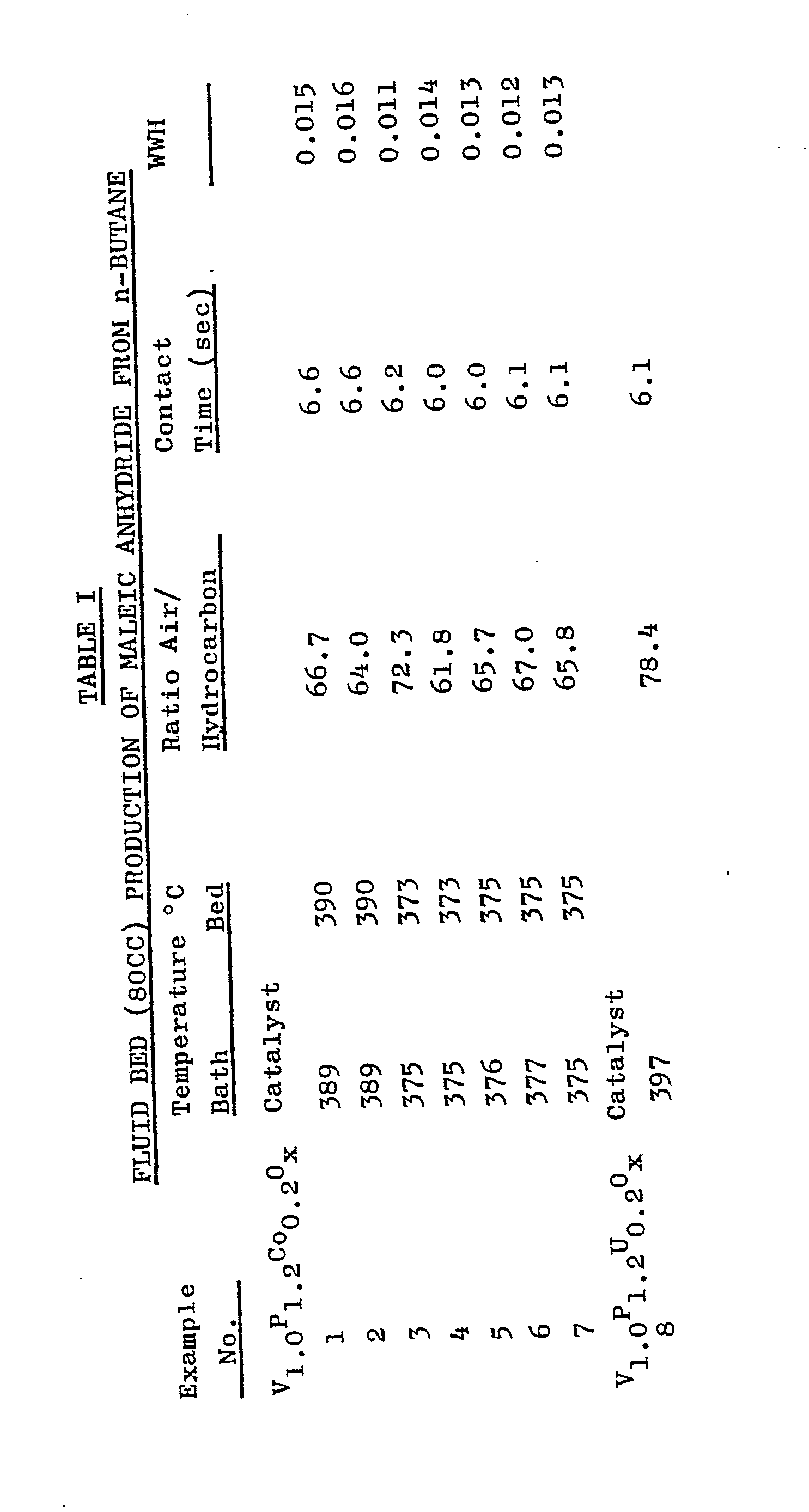
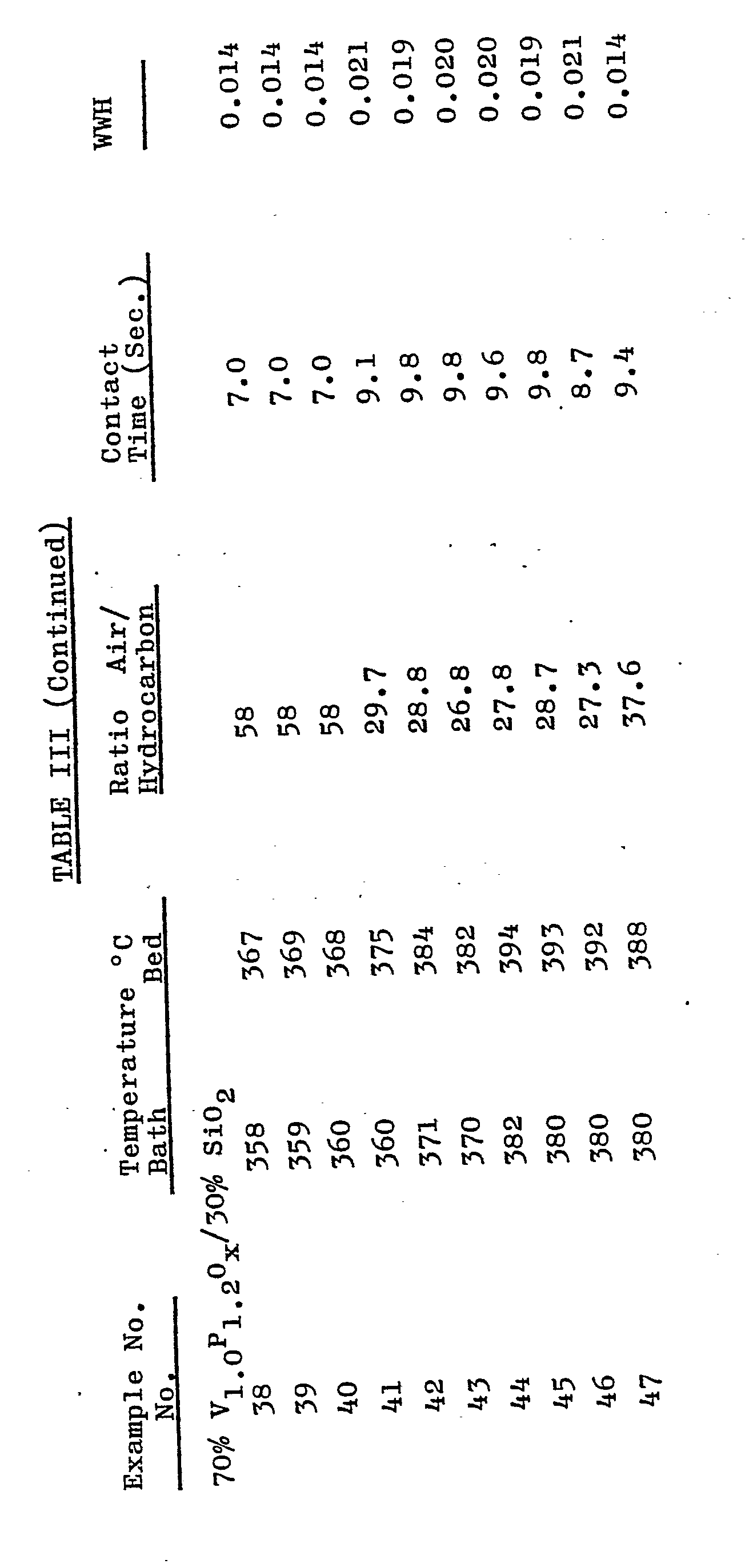
- Flasks for receiving the product maleic anhydride were air cooled, and tail gases were routed to a Carle Analytical Gas Chromatograph III for analysis. Reaction conditions and results of the tests run are described in Tables I through III. The results are stated in terms as follows: The throughput of hydrocarbon feed in the production of maleic anhydride, or the working rate imposed upon the catalyst is designated in the tables as WWH, or weight of feed/weight of catalyst/hour.
- a fluid bed catalyst having the formula V 1.0 P 1.2 Co 0.2 O x were prepared according to the procedure set forth in Examples 1-7 above, except that 935.5g uranyl acetate dihydrate was substituted for the cobalt compound. Results of the fluid bed (80cc) production of maleic anhydride from n-butane using the catalyst of Example 8 are listed in Table I.
- a fluid bed catalyst having the formula V 1.0 P 1.2 Co 0.2 O x was prepared according to the procedure set forth in Examples 1-7 above. Results of the fluid bed (440 cc) production of maleic anhydride from n-butane using the catalyst of Examples 9-20 are listed in Table II.
- a fluid bed catalyst having the formula V 1.0 P 1.2 O x was prepared according to the following procedure.
- Catalyst precursor was prepared by introducing 7.276 k g V205, and 10.5 kg mixed phosphoric acid (including 1.2 kg H 2 0) into 120 litres isobutanol with stirring, and refluxing the resulting slurry for 6 hours.
- the mixed phosphoric acid source contained 87% orthophosphoric acid, 11.5% pyrophosphoric acid and 1.5% triphosphoric acid based upon total weight of phosphoric acid.
- the slurry was cooled, the catalyst precursor recovered by filtration and dried for 3 hours at 150°C.
- the dried catalyst precursor was ball milled for 5.5 hours, and 5000 g comminuted catalyst precursor was thereafter introduced into 3667g water with stirring. The resulting slurry was spray dried to yield uniform, microspheroidal catalyst particles. Results of the fluid bed (440 cc) production of maleic anhydride from n-butane using the catalyst of Examples 21-27 are listed in Table III.
- a fluid bed catalyst having the formula 80 wt.% V 1.0 P 1.2 O x /20 wt. % SiO 2 was prepared according to the following procedure. 2.5 kg dry, comminuted catalyst precursor, prepared as in Examples 21-27 was introduced into 2.6 kg water, containing 1.8 kg Nalco 1034A silica sol (trade designation of Nal co Chemical Co.), with stirring. The resulting slurry was spray dried to yield uniform, microspheroidal catalyst particles. Results of the fluid bed (440 cc) production of maleic anhydride from n-butane using the catalyst of Examples 28-37 are listed in Table III.
- a fluid bed catalyst having the formula 70 wt.% v 1.0 P 1.2 O x /30 wt. % SiO 2 was prepared according to the following procedure.
- Catalyst precursor was prepared by introducing 7.276 kg V 2 O 5 and 9.39 kg orthophosphoric acid (100%) in 120 litres. isobutanol with stirring, and refluxing the resulting slurry for 16 hours. The slurry was cooled, the catalyst precursor recovered by filtration and dried for 2 hours at 150°C.
- the dried catalyst precursor was ball milled for 24 hours, and 884 g comminuted catalyst precursor was introduced into 2000 g water containing 1065 g Nalco 1034A silica sol, with stirring. The resulting slurry was spray dried to yield uniform, microspheroidal catalyst particles. Results of the fluid bed (440 cc) production of maleic anhydride from n-butane using the catalyst of Examples 38-47 are listed in Table III.
- fluid bed catalysts containing the mixed oxides of vanadium and phosphorus may be prepared according to the present invention, such catalysts being useful in the production of maleic anhydride from 4-carbon atom hydrocarbons.
- the fluid bed catalysts thus prepared are uniform, microspheroidal, and are suitable for use as commercial fluid bed catalysts, a substantial portion of the microsphoroidal particles of such catalysts having particle sizes within the range of 20 microns to 100 microns.
- the particle size requirement for fluid bed catalysts, set forth above, are met by these catalysts.
- Catalyst precursors which have been prepared in organic media unexpectedly retain their high activity for the production of maleic anhydride, when further treated according to the process of the present invention.
Landscapes
- Chemical & Material Sciences (AREA)
- Organic Chemistry (AREA)
- Engineering & Computer Science (AREA)
- Oil, Petroleum & Natural Gas (AREA)
- Materials Engineering (AREA)
- Chemical Kinetics & Catalysis (AREA)
- Furan Compounds (AREA)
- Catalysts (AREA)
Abstract
- (a) preparing a catalyst precursor containing a vanadium phosphorus mixed oxide;
- (b) comminuting the catalyst precursor;
- (c) introducing the catalyst precursor into water prior or subsequent to comminution thereof to form an aqueous slurry; and
- (d) spray drying said slurry to form microspheroidal catalyst particles
is provided, as well as the use of such catalyst in the oxidation 4-carbon atom hydrocarbons, in particular n-butane to produce maleic anhydride. The catalysts prepared from catalyst precursors in organic medium retain their high activity from the above method is used for their preparation.
Description
- This invention relates to a method for preparing fluid bed catalysts useful in the production of dicarboxylic acid anhydrides by the oxidation of hydrocarbon. More particularly it is directed to the preparation of fluid bed catalysts suitable for producing maleic anhydride from 4-carbon atom hydrocarbons, such as n-butane, n-butenes, 1,3 butadiene or a mixture thereof.
- The advantages of fluid bed hydrocarbon oxidation processes compared to fixed bed hydrocarbon oxidation processes are well known in the art, including the improvement of temperature control and heat transfer for oxidation reactions. Catalysts which are suitable for fixed bed processes are not necessarily suitable for fluid bed processes. Despite the incentive to utilize fluid bed technology in the production of maleic anhydride from 4-carbon atom hydrocarbons, there currently is no commercial fluid bed plant of this type in operation, all such commercial plants being fixed bed operations.
- Catalysts containing vanadium and phosphorus oxides have been used in the oxidation of 4-carbon atom hydrocarbons, such as n-butane, n-butenes, 1, 3 butadiene or mixtures thereof with molecular oxygen or oxygen-containing gas to produce maleic anhydride. Conventional methods of preparing these catalysts involve reducing a pentavalent vanadium compound, and combining the same with a phosphorus compound, and if desired, promoter element compounds under conditions which will provide vanadium in a valence state below +5 to form catalyst precursors capable of being converted to an oxide. The catalyst oxide precursor is then recovered and calcined, before or after the fixed bed catalyst particles are formed to provide active catalytic material.
- U.S. Patents 3,888,886; 3,905,914; 3,931,046; 3,932,305 and 3,975,300 disclose the testing of promoted vanadium phosphorus oxide catalysts for maleic anhydride production from butane in one inch diameter fluid bed reactors. In most instances, the catalysts were prepared by forming the catalyst precurson in aqueous media (in 3,975,300 the precursor was formed in a paste of vanadium compound, a phosphorus compound and an organic reducing agent), drying and thereafter grinding and sieving the precursor to a powder of about 74 to 250 microns size. This manner of preparation, however, does not result in the uniform, microspheroidal catalyst particles preferred for successful fluid bed operation.
- Commercial fluid bed catalysts are preferably microspheroidal particles within the range of 20 to 300 microns in average diameter, preferably having 80% of the particles within the range of 30 to 80 microns in diameter. Most preferably, 25 to 40% of the particles have an average diameter of less than 45 microns.
- It is therefore an object of the invention to provide a process of preparing fluid bed oxidation catalysts containing a mixture of the oxides of vanadium and phosphorus.
- It is a further object of the invention to provide a process for producing maleic anhydride from 4-carbon atom hydrocarbons utilizing such catalysts.
- We have found according to the invention that excellent uniform, microspheroidal vanadium phosphorus mixed oxide containing catalysts, useful in the production of maleic anhydride from 4-earbon atom hydrocarbons in fluid bed operations, can be obtained by spray drying an aqeuous slurry of the catalyst precursor. Although this method of preparation may be utilized in forming fluid bed vanadium phosphorus mixed oxide catalysts prepared in aqueous media, it is unexpectedly efficacious when utilized in forming such catalysts in which the precursor was prepared in organic liquid solution or slurry.
- It had previously been found that the preparation of vanadium phosphorus mixed oxide precursors in organic liquid media, solutions or slurries, particularly if maintained as essentially anhydrous, resulted in catalysts of high surface area and enhanced activity for the production of maleic anhydride from 4-carbon atom hydrocarbons. The presence of an excess of water in the final stages of preparation diminished both the surface area and activity of the catalysts. The formation of fluid bed catalysts by spray drying an organic liquid slurry of the catalyst precursor, because of flammability of the organic media, is not preferred.
- We have found that once the vanadium-phosphorus mixed oxide precursor has been formed, it may be introduced into water to form an aqueous slurry which may then be spray dired to form microspheroidal fluid bed catalysts, without adversely affecting the surface area or activity of the catalyst.
- According to the invention there is provided a process for the preparation of a fluid bed oxidation catalyst containing the mixed oxides of vanadium and phosphorus, comprising:
- (a) preparing a catalyst precursor containing a vanadium phosphorus mixed oxide;
- (b) comminuting the catalyst precursor;
- (c) introducing the catalyst precursor into water prior or subsequent to communi-tion thereof to form an aqueous slurry and
- (d) spray drying said slurry to form microspheroidal catalyst particles.
- Catalyst precursors of vanadium phosphorus mixed oxide catalysts for hydrocarbon oxidation may be prepared according to methods known in the art.
- U.S. Patent No. 4,002,650 discloses the preparation of vanadium and phosphorus mixed oxide containing catalysts by reacting vanadium and phosphorus compounds in an aqueous solution, with HC1 being utilized as a solvating and reducing agent for vanadium. Similar preparational techniques are described in European Patent Appln. No. 3,431 in which the additional step of comminuting the vanadium-phosphorus precursor to a.particle size of 500 to 700 microns (0.5 to 0.7 mm) is disclosed.
- ' U.S. Patent No. 4,043,943 discloses the preparation of the catalyst precursor in a liquid organic medium, preferably anhydrous, wherein the vanadium compound is reduced and solvated by gaseous HC1 followed by reaction with the phosphorus compound.
- The preparation of oxidation catalysts containing the mixed oxides of vanadium and phosphorus is disclosed in European Patent Appln. 80304635.8 (0031696) wherein a vanadium compound is at least partially solubilized in an organic liquid medium capable of reducing at least a portion of the vanadium to a +4 valence state, and unsolubilized vanadium having a particle'size larger than about 0.1 mm diameter is removed from the medium before addition of a J phosphorus-containing compound. The preparation of such catalysts is disclosed European Patent Appln. 81300972.7 wherein partial reduction of a pentavalent vanadium compound is effected in the presence of a phosphorus compound in an organic liquid medium capable of reducing the vanadium.
- The catalysts precursor may be recovered from the liquid reaction medium in which it was prepared (preferably an essentially anhydrous maintained organic liquid medium) by conventional methods, such as evaporation, filtration, centrifugation or decanting. The precursor is then preferably dried by heating. Alternatively, the recovered precursor, which is still partially wet with the organic liquid, may be treated with a low boiling solvent such as petroleum ether. In another embodiment, excess preparational reaction media may be substantially removed by vacuum filtration. In yet another embodiment, excess water can be introduced into the precursor containing organic liquid reaction medium, allowing an organic layer to separate from the aqueous layer.
- After recovery, the catalyst precursor is comminuted before it is introduced into water to form an aqueous slurry. The catalyst precursor as produced generally has a particle size of greater than one micron average diameter before it is comminuted. It is preferred, however, that a substantial portion of the catalyst precursor be reduced in particle size to less than one micron, and preferably less than one half micron average diameter. This step of comminuting may be accomplished before the precursor is recovered from its reaction media, or after recovery. Comminution after recovery can be effected either prior or subsequent to introduction into water. For example, dried catalyst precursor particles may be dry milled, such as by ball milling, or the catalyst precursor containing aqueous slurry may be ball milled.
- The catalyst precursor preferably should be uncalcined when introduced into water. Substantial contacting of the calcined vanadium phosphorus mixed oxide catalyst with water (at less than 100°C) reduces the activity of the catalyst particularly if calcined in air.
- The solids content of the catalyst precursor containing aqueous slurry should be adjusted to 25 to 60 weight percent. The catalyst precursor-containing aqueous slurry is then spray dried to form uniform, microspheroidal particles having a particle size range of between 20 to 300 microns, generally between 20 to,240 microns. Spray drying may be accomplished by methods known in the art.
- The catalyst precursor may contain promoter elements including but not limited to U, Co, Mo, Fe, Zn, Hf, Zr or mixtures thereof. These may be incorporated into the catalyst precursor in any of the methods known in the art, such as inclusion via the liquid reaction medium prior to or after reduction of the vanadium.
- Inert diluents or supports may be added to the fluid bed catalyst, such as by addition of the diluent or support to the aqueous slurry prior to spray drying.
- Catalysts suitable for the production of maleic anhydride from 4-carbon atom hydrocarbons generally have a phosphorus to vanadium ratio of 3:1 to 0.5:1. A P/V ratio of approximately 1.2:] is preferred. These catalysts preferably exhibit an average valence for vanadium within the range of +3.5 to +4.6.
- The catalyst may be calcined in air or an oxygen-containing gas at a temperature of 250°C. to 600°C. for a period of up to 5 hours or more. One method of calcination of the catalyst is accomplished by heating the catalyst in a mixture of steam and air or air alone over the catalyst at a temperature of 300°C. to 500°C. for a period of 1 to 5 hours. The catalyst may also be calcined in the presence of hydrocarbon, an inert gas, or both. The fluid bed catalyst prepared by the process of the present invention may be utilized in oxidation type fluid bed reactors known in the art.
- The hydrocarbon reacted to form maleic anhydride may be n-butane, n-butenes, 1,3-butadiene, or a mixture thereof. It is preferred to use n-butane or a mixture of hydrocarbons that arc produced in refinery streams. The molecular oxygen is most conveniently added as air, but synthetic streams containing molecular oxygen are also suitable. In addition to the hydrocarbon and molecular oxygen, other gases may be added to the reactant feed. For example, steam or nitrogen could be added to the reactants.
- The ratio of the reactants may vary widely and is not critical. The ratio of molecular oxygen to the hydrocarbon may range from 3 to 30 moles of oxygen per mole of hydrocarbon. Preferred oxygen/hydrocarbon ratios are from 4 to 20 moles of oxygen per mole of hydrocarbon.
- The reaction temperature may vary widely and is dependent upon the particular hydrocarbon and catalyst employed. Normally, temperatures of 250°C. to 600°C. are employed with temperatures of 325°C. to 500°C. being preferred. The contact time may be as low as a fraction of a second or as high as 50 seconds. The reaction may be conducted at atmospheric, superatmospheric. or subatmospheric pressure. Operation at superatmospheric pressure is preferred, from greater than one atmosphere to about three atmospheres.
- The fluid bed catalyst described in Examples 1-8, below were used to produce maleic anhydride from n-butane in an 80cc fluid bed reactor consisting of 35.5 cm length of stainless steel tubing having an outer diameter of 3.8 cm, having a stainless steel frit at the bottom of the tube to act as a gas (air) distributor and an axial 1.3cc outer diameter gas (hydrocarbon sparger/thermowell. The assembly contained an aluminium block pre-heater for the gases, and heating of the reactor unit was accomplished by placement in a temperature controlled molten salt bath.
- The fluid bed catalyst described in Examples 9-47, below were used to produce maleic anhydride from n-butane in a 440cc fluid bed reactor consisting of a 61 cm length of stainless steel tubing having an outer diameter of 3.8cm having a stainless steel sparger at the bottom of the tube to act as a gas (air) distributor, with an axial 0.64cm outer diameter thermowell and a separate hydrocarbon inlet at the bottom of the tube. The reactor was fitted with internal gas redistributing baffles. Gas preheating and reactor temperature control was accomplished by placement of the reactor unit in a thermostated fluidized sand bath.
- Flasks for receiving the product maleic anhydride were air cooled, and tail gases were routed to a Carle Analytical Gas Chromatograph III for analysis. Reaction conditions and results of the tests run are described in Tables I through III. The results are stated in terms as follows:


- A fluid bed catalyst having the formula V1.0P1.2C°0.2Ox, (where x = number of oxygens needed to satisfy the valence requirements of the other elements) was prepared by the following procedure..1008g vanadium pentoxide and 528.2g cobaltous chloride dihydrate were added to 5.5 litres isobutanol with stirring to form a slurry. Anhydrous hydrogen chloride gas was bubbled through the liquid medium which was maintained by cooling at a temperature of about 20°+ 5°C. After dissolution and reduction of the vanadium (about 4 hours, at which time the temperature of the now-homogenous red-brown solution began to drop) 1303 g 100% ortho-phosphoric acid in 2 litres isobutanol was added to the liquid medium. The liquid medium was then refluxed for 2 hours, acquiring a blue-green colour. The solution was dried by evaporation at a temperature of 150°C. The dried material was ground to yield a powdered catalyst precursor.
- 1500 g of the catalyst precursor powder was mixed with 3 litres water and the resulting slurry was milled for 12 hours. The comminuted catalyst precursor containing slurry was spray dried and calcined in air at 400°C for 16 hours. The resulting catalyst particles were dark green in colour and were microspheroidal in form. Results of the fluid bed (80cc) production of maleic anhydride from n-butane using the catalyst of Examples 1-7 are listed in Table I.
- A fluid bed catalyst having the formula V1.0P1.2Co0.2Ox were prepared according to the procedure set forth in Examples 1-7 above, except that 935.5g uranyl acetate dihydrate was substituted for the cobalt compound. Results of the fluid bed (80cc) production of maleic anhydride from n-butane using the catalyst of Example 8 are listed in Table I.
- A fluid bed catalyst having the formula V 1.0P1.2 Co0.2Ox was prepared according to the procedure set forth in Examples 1-7 above. Results of the fluid bed (440 cc) production of maleic anhydride from n-butane using the catalyst of Examples 9-20 are listed in Table II.
- A fluid bed catalyst having the formula V1.0P1.2Ox was prepared according to the following procedure. Catalyst precursor was prepared by introducing 7.276 kg V205, and 10.5 kg mixed phosphoric acid (including 1.2 kg H20) into 120 litres isobutanol with stirring, and refluxing the resulting slurry for 6 hours. The mixed phosphoric acid source contained 87% orthophosphoric acid, 11.5% pyrophosphoric acid and 1.5% triphosphoric acid based upon total weight of phosphoric acid. The slurry was cooled, the catalyst precursor recovered by filtration and dried for 3 hours at 150°C.
- The dried catalyst precursor was ball milled for 5.5 hours, and 5000 g comminuted catalyst precursor was thereafter introduced into 3667g water with stirring. The resulting slurry was spray dried to yield uniform, microspheroidal catalyst particles. Results of the fluid bed (440 cc) production of maleic anhydride from n-butane using the catalyst of Examples 21-27 are listed in Table III.
- A fluid bed catalyst having the formula 80 wt.% V1.0 P1.2Ox/20 wt. % SiO2 was prepared according to the following procedure. 2.5 kg dry, comminuted catalyst precursor, prepared as in Examples 21-27 was introduced into 2.6 kg water, containing 1.8 kg Nalco 1034A silica sol (trade designation of Nal co Chemical Co.), with stirring. The resulting slurry was spray dried to yield uniform, microspheroidal catalyst particles. Results of the fluid bed (440 cc) production of maleic anhydride from n-butane using the catalyst of Examples 28-37 are listed in Table III.
- A fluid bed catalyst having the formula 70 wt.% v1.0P1.2Ox/30 wt. % SiO2 was prepared according to the following procedure. Catalyst precursor was prepared by introducing 7.276 kg V2O5 and 9.39 kg orthophosphoric acid (100%) in 120 litres. isobutanol with stirring, and refluxing the resulting slurry for 16 hours. The slurry was cooled, the catalyst precursor recovered by filtration and dried for 2 hours at 150°C.
- The dried catalyst precursor was ball milled for 24 hours, and 884 g comminuted catalyst precursor was introduced into 2000 g water containing 1065 g Nalco 1034A silica sol, with stirring. The resulting slurry was spray dried to yield uniform, microspheroidal catalyst particles. Results of the fluid bed (440 cc) production of maleic anhydride from n-butane using the catalyst of Examples 38-47 are listed in Table III.
- As can be seen from the results listed in Table I through III, fluid bed catalysts containing the mixed oxides of vanadium and phosphorus may be prepared according to the present invention, such catalysts being useful in the production of maleic anhydride from 4-carbon atom hydrocarbons. The fluid bed catalysts thus prepared are uniform, microspheroidal, and are suitable for use as commercial fluid bed catalysts, a substantial portion of the microsphoroidal particles of such catalysts having particle sizes within the range of 20 microns to 100 microns. The particle size requirement for fluid bed catalysts, set forth above, are met by these catalysts. Catalyst precursors which have been prepared in organic media, unexpectedly retain their high activity for the production of maleic anhydride, when further treated according to the process of the present invention.



Claims (15)
Applications Claiming Priority (4)
| Application Number | Priority Date | Filing Date | Title |
|---|---|---|---|
| US06/220,624 US4317778A (en) | 1980-12-29 | 1980-12-29 | Preparation of maleic anhydride using fluidized catalysts |
| US220624 | 1980-12-29 | ||
| US06/221,670 US4351773A (en) | 1980-12-31 | 1980-12-31 | Preparation of maleic anhydride from butane using fluidized vanadium-phosphorous-oxide containing catalysts |
| US221670 | 1988-07-20 |
Publications (3)
| Publication Number | Publication Date |
|---|---|
| EP0056902A2 true EP0056902A2 (en) | 1982-08-04 |
| EP0056902A3 EP0056902A3 (en) | 1982-09-15 |
| EP0056902B1 EP0056902B1 (en) | 1986-02-19 |
Family
ID=26915031
Family Applications (1)
| Application Number | Title | Priority Date | Filing Date |
|---|---|---|---|
| EP19810305884 Expired EP0056902B1 (en) | 1980-12-29 | 1981-12-15 | Preparation of fluid bed-catalysts containing the mixed oxides of vanadium and phosphorus |
Country Status (2)
| Country | Link |
|---|---|
| EP (1) | EP0056902B1 (en) |
| DE (1) | DE3173855D1 (en) |
Cited By (4)
| Publication number | Priority date | Publication date | Assignee | Title |
|---|---|---|---|---|
| AT392921B (en) * | 1983-08-17 | 1991-07-10 | Lummus Crest Inc | METHOD FOR PRODUCING CATALYSTS CONTAINING MIXED VANADIUM AND PHOSPHORUS OXIDS |
| CN1066638C (en) * | 1993-06-29 | 2001-06-06 | 三菱化学株式会社 | Oxide catalyst and method for producing maleic anhydride using the same |
| US11850219B2 (en) | 2015-11-12 | 2023-12-26 | Nutrition21, LLC | Inositol-stabilized arginine-silicate for hair growth and thickening |
| US11931342B2 (en) | 2016-09-01 | 2024-03-19 | Nutrition21, LLC | Magnesium biotinate compositions and methods of use |
Family Cites Families (4)
| Publication number | Priority date | Publication date | Assignee | Title |
|---|---|---|---|---|
| US4132670A (en) * | 1974-11-06 | 1979-01-02 | Chevron Research Company | Method of preparing vanadium (IV) phosphate composition with high intrinsic surface area |
| US4016105A (en) * | 1975-02-07 | 1977-04-05 | Petro-Tex Chemical Corporation | Catalyst preparative method |
| US4092269A (en) * | 1976-10-15 | 1978-05-30 | Monsanto Company | Phosphorus-vanadium-oxygen catalysts having a specific pore volume |
| US4179404A (en) * | 1976-12-15 | 1979-12-18 | Denka Chemical Corporation | Catalyst preparative method |
-
1981
- 1981-12-15 DE DE8181305884T patent/DE3173855D1/en not_active Expired
- 1981-12-15 EP EP19810305884 patent/EP0056902B1/en not_active Expired
Cited By (6)
| Publication number | Priority date | Publication date | Assignee | Title |
|---|---|---|---|---|
| AT392921B (en) * | 1983-08-17 | 1991-07-10 | Lummus Crest Inc | METHOD FOR PRODUCING CATALYSTS CONTAINING MIXED VANADIUM AND PHOSPHORUS OXIDS |
| CN1066638C (en) * | 1993-06-29 | 2001-06-06 | 三菱化学株式会社 | Oxide catalyst and method for producing maleic anhydride using the same |
| US11850219B2 (en) | 2015-11-12 | 2023-12-26 | Nutrition21, LLC | Inositol-stabilized arginine-silicate for hair growth and thickening |
| US11931342B2 (en) | 2016-09-01 | 2024-03-19 | Nutrition21, LLC | Magnesium biotinate compositions and methods of use |
| US11938117B2 (en) | 2016-09-01 | 2024-03-26 | Nutrition21, LLC | Magnesium biotinate compositions and methods of use |
| US12257238B2 (en) | 2016-09-01 | 2025-03-25 | Nutrition21, LLC | Magnesium biotinate compositions and methods of use |
Also Published As
| Publication number | Publication date |
|---|---|
| EP0056902B1 (en) | 1986-02-19 |
| DE3173855D1 (en) | 1986-03-27 |
| EP0056902A3 (en) | 1982-09-15 |
Similar Documents
| Publication | Publication Date | Title |
|---|---|---|
| US4351773A (en) | Preparation of maleic anhydride from butane using fluidized vanadium-phosphorous-oxide containing catalysts | |
| US4317778A (en) | Preparation of maleic anhydride using fluidized catalysts | |
| EP0039537B1 (en) | Improved mixed vanadium phosphorus oxide catalysts and preparation thereof and use in production of maleic anhydride | |
| EP0056183B1 (en) | Preparation of vanadium phosphorus catalysts using a mixed phosphorus source and use thereof in oxidation of c4-hydro-carbons to maleic anhydride | |
| US4244879A (en) | Preparation of maleic anhydride | |
| US4315864A (en) | Preparation of maleic anhydride | |
| US4632915A (en) | Iron/lithium--promoted catalysts for the production of maleic anhydride | |
| US4360453A (en) | Preparation of vanadium phosphorus catalysts | |
| US4294722A (en) | Preparation of vanadium phosphorus catalysts | |
| CA1197230A (en) | Preparation of improved mixed vanadium phosphorus oxide catalysts and their use in oxidation processes | |
| US4374043A (en) | Preparation of fluidizable vanadium phosphorus oxide catalysts using a mixed phosphorus source | |
| EP0107274B1 (en) | Attrition resistant microspheroidal fluid bed catalysts containing the mixed oxides of vanadium and phosphorus | |
| US4525471A (en) | Attrition resistant microspheroidal fluid bed catalysts containing the mixed oxides of vanadium and phosphorus | |
| EP0056902B1 (en) | Preparation of fluid bed-catalysts containing the mixed oxides of vanadium and phosphorus | |
| US4448893A (en) | Preparation of improved mixed vanadium phosphorus oxide catalyst and their use in oxidation processes | |
| US4396536A (en) | Preparation of vanadium phosphorous catalysts using olefinic oxygenated media | |
| US4647673A (en) | Maleic anhydride process | |
| US4670415A (en) | Process for the preparation of iron/lithium -promoted catalysts for the production of maleic anhydride | |
| EP0221876B1 (en) | Iron/lithium - promoted catalysts for the production of maleic anhydride and a process for the preparation thereof | |
| GB2090155A (en) | Process for producing phosphorous-vanadium-oxygen catalysts | |
| JP3603352B2 (en) | Method for producing phosphorus-vanadium oxide catalyst | |
| US4365069A (en) | Use of improved mixed vanadium phosphorus oxide catalyst in oxidation processes | |
| US4400522A (en) | Preparation of maleic anhydride | |
| EP0106927B1 (en) | Production of improved mixed vanadium phosphorus oxide catalysts | |
| US4429137A (en) | Preparation of maleic anhydride |
Legal Events
| Date | Code | Title | Description |
|---|---|---|---|
| PUAI | Public reference made under article 153(3) epc to a published international application that has entered the european phase |
Free format text: ORIGINAL CODE: 0009012 |
|
| PUAL | Search report despatched |
Free format text: ORIGINAL CODE: 0009013 |
|
| AK | Designated contracting states |
Designated state(s): BE DE FR GB IT NL |
|
| AK | Designated contracting states |
Designated state(s): BE DE FR GB IT NL |
|
| 17P | Request for examination filed |
Effective date: 19830215 |
|
| GRAA | (expected) grant |
Free format text: ORIGINAL CODE: 0009210 |
|
| AK | Designated contracting states |
Designated state(s): BE DE FR GB IT NL |
|
| ITF | It: translation for a ep patent filed | ||
| REF | Corresponds to: |
Ref document number: 3173855 Country of ref document: DE Date of ref document: 19860327 |
|
| ET | Fr: translation filed | ||
| PLBE | No opposition filed within time limit |
Free format text: ORIGINAL CODE: 0009261 |
|
| STAA | Information on the status of an ep patent application or granted ep patent |
Free format text: STATUS: NO OPPOSITION FILED WITHIN TIME LIMIT |
|
| 26N | No opposition filed | ||
| ITTA | It: last paid annual fee | ||
| PGFP | Annual fee paid to national office [announced via postgrant information from national office to epo] |
Ref country code: NL Payment date: 20000929 Year of fee payment: 20 |
|
| PGFP | Annual fee paid to national office [announced via postgrant information from national office to epo] |
Ref country code: GB Payment date: 20001107 Year of fee payment: 20 |
|
| PGFP | Annual fee paid to national office [announced via postgrant information from national office to epo] |
Ref country code: FR Payment date: 20001204 Year of fee payment: 20 |
|
| PGFP | Annual fee paid to national office [announced via postgrant information from national office to epo] |
Ref country code: DE Payment date: 20001222 Year of fee payment: 20 |
|
| BE20 | Be: patent expired |
Free format text: 20011215 THE *STANDARD OIL CY |
|
| PGFP | Annual fee paid to national office [announced via postgrant information from national office to epo] |
Ref country code: BE Payment date: 20010118 Year of fee payment: 20 |
|
| PG25 | Lapsed in a contracting state [announced via postgrant information from national office to epo] |
Ref country code: GB Free format text: LAPSE BECAUSE OF EXPIRATION OF PROTECTION Effective date: 20011214 |
|
| PG25 | Lapsed in a contracting state [announced via postgrant information from national office to epo] |
Ref country code: NL Free format text: LAPSE BECAUSE OF EXPIRATION OF PROTECTION Effective date: 20011215 |
|
| REG | Reference to a national code |
Ref country code: GB Ref legal event code: PE20 Effective date: 20011214 |
|
| NLV7 | Nl: ceased due to reaching the maximum lifetime of a patent |
Effective date: 20011215 |