EP0054553B1 - Steuersignal für den abfangübergangsbereich eines flugzeuges - Google Patents
Steuersignal für den abfangübergangsbereich eines flugzeuges Download PDFInfo
- Publication number
- EP0054553B1 EP0054553B1 EP81901274A EP81901274A EP0054553B1 EP 0054553 B1 EP0054553 B1 EP 0054553B1 EP 81901274 A EP81901274 A EP 81901274A EP 81901274 A EP81901274 A EP 81901274A EP 0054553 B1 EP0054553 B1 EP 0054553B1
- Authority
- EP
- European Patent Office
- Prior art keywords
- aircraft
- signal
- flare
- producing
- altitude
- Prior art date
- Legal status (The legal status is an assumption and is not a legal conclusion. Google has not performed a legal analysis and makes no representation as to the accuracy of the status listed.)
- Expired
Links
Images
Classifications
-
- G—PHYSICS
- G05—CONTROLLING; REGULATING
- G05D—SYSTEMS FOR CONTROLLING OR REGULATING NON-ELECTRIC VARIABLES
- G05D1/00—Control of position, course, altitude or attitude of land, water, air or space vehicles, e.g. using automatic pilots
- G05D1/04—Control of altitude or depth
- G05D1/06—Rate of change of altitude or depth
- G05D1/0607—Rate of change of altitude or depth specially adapted for aircraft
- G05D1/0653—Rate of change of altitude or depth specially adapted for aircraft during a phase of take-off or landing
- G05D1/0676—Rate of change of altitude or depth specially adapted for aircraft during a phase of take-off or landing specially adapted for landing
Definitions
- the present invention pertains to the aircraft guidance art and, more particularly, to a system for controlling aircraft flight during landing flare.
- a method and apparatus for producing an aircraft flare path control signal comprising:
- Flare A critical portion of aircraft landing trajectory is commonly known as flare-out or flare. Flare is that portion of the landing trajectory between the fixed angle glideslope and aircraft runway touchdown. Thus, it is desirable, particularly for commercial aircraft, that the flare profile depart smoothly from the fixed angle glideslope approach providing a smooth transition to runway rollout.
- flare height from which flare is initiated may be affected by aircraft groundspeed. This has an adverse effect on the ability of the pilot to monitor the system for proper operation and may place the affected by aircraft groundspeed. This has an adverse effect on the ability of the pilot to monitor the system for proper operation and may place the start of the flare ahead of the runway threshold where terrain'features may make it difficult to use radio altimeters.
- apparatus for producing an aircraft flare path control signal includes a means for producing a signal h representative of aircraft altitude. Also, suitable means produces a signal V G representative of aircraft groundspeed and further means produces a signal h representative of aircraft altitude rate.
- a computer produces a pitch control surface command signal 6e r according to the relationship: where K ⁇ , K h , V G REF and h B are constants selected for a given system configuration.
- a method for producing an aircraft flare path control signal comprises the first step of producing signal h representative of aircraft altitude. Second, a signal V G is produced representative of aircraft groundspeed. Third, a signal h is produced, representative of aircraft altitude rate. Finally, a pitch control surface command signal ⁇ e c is computed according to the relationship: where K ⁇ , K h , V G REF and h B are constants selected for a given system configuration.
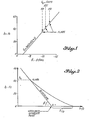
- Fig. 1 is a graph of this equation, showing altitude on the vertical axis versus altitude rate, on the horizontal axis. Exemplary values of the various constants are selected, i.e. the value of K h /K ⁇ ; is assumed to be .205 and the value of h B is assumed to be 12.
- Fig. 1 illustrates this flare height h o for values of 110, 125 and 140 groundspeed knots (203, 231, 253 km/h).
- V G groundspeed knots
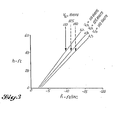
- Fig. 2 is a plot of aircraft altitude h versus runway position X and illustrates the distance X TD between the aircraft actual touchdown point and the glideslope intercept point with the runway. It is assumed that the aircraft is on a glideslope angle ⁇ and that flare is initiated at the alitutude h o , which is approximately 42 feet.
- the dispersion distance X TD is a function of groundspeed V G .
- the touchdown distance X TD varies about 200 feet (61 m) for a fifteen knot (27 km/h) variation in V G , a significant deviation considering the dispersion due to all other sources.
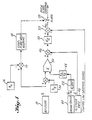
- Fig. 4 is a block diagram illustrating the preferred embodiment of the apparatus for producing the aircraft flare path control signal in accordance with this newly derived control law.
- an altitude block 10 produces an output signal h representative of aircraft altitude.
- a suitable means for producing the altitude signal hi is commonly available in commercial aircraft and, as such, will not be discussed here.
- the altitude signal h is passed to a pair of summers 12, 14. Also passed to an input of summer 12 is the output from block 16. Block 16 produces a fixed signal corresponding to the altitude height for flare initiation h o . As discussed above, in a system according to the instant invention the flare initiation altitude h o is constant regardless of groundspeed variations.
- the summer 12 acts to subtract the signal h o from the signal h such that its output is negative if and only if the aircraft altitude has dropped below the flare initiation altitude.
- a logic circuit 18 activates a switch 20 which causes the pitch flare command signal ⁇ e c , which is produced in a manner discussed herein below,-to be coupled to the aircraft's flight dynamics.
- the pitch control command signal ⁇ e c is computed as follows.
- the altitude signal h is summed with a constant signal h B supplied from block 30.
- the output from summer 14 is of the form h+h B .
- This signal is applied as one input to a multiplier 32.
- the groundspeed block 40 produces an output signal V G corresponding to aircraft groundspeed.
- Such groundspeed signals V G are commonly provided on commercial aircraft and, as such, will not be discussed here.
- the groundspeed signal V G is multiplied by a factor 1N G REF in block 42.
- the signal 1/V G REF is a constant value depending upon a particular system configuration.
- the signal out of block 42 is then multiplied by a gain factor K h /K ⁇ in block 44. Both K h and K ⁇ are constants selected for a particular system configuration.
- the output from block 44 is a signal having a value This signal is then applied to the remaining input of multiplier 32 where it is multiplied by the signal h+h B .
- the output from multiplier 32 is summed in a summer 46 with the output from altitude rate block 48.
- Altitude rate block 48 produces an altitude rate sighal h which, as with the altitude block 10 and groundspeed block 40 is commonly provided in commercial aircraft.
- the output from summer 46 is multiplied by a gain factor K ⁇ in gain block 50.
- the factor K is a constant dependent upon a given system configuration.
- the signal at the output from gain block 50 is This signal is, then, the desired improved control law signal.
- control law damping signals which are used to dampen short and long term oscillations. These are well understood by those skilled in this art and, as such, will not be discussed here. Hence, the control law damping terms are summed with the control signal in a summer circuit 52 before being passed as the output pitch flare command signal ⁇ e c .
- the pitch flare command signal may be used in the aircraft either as an input to the flight director to indicate to the pilot a desired aircraft pitch angle or it may be coupled directly to the aircraft's autopilot for automatic control of aircraft flare-out.
Landscapes
- Engineering & Computer Science (AREA)
- Aviation & Aerospace Engineering (AREA)
- Radar, Positioning & Navigation (AREA)
- Remote Sensing (AREA)
- Physics & Mathematics (AREA)
- General Physics & Mathematics (AREA)
- Automation & Control Theory (AREA)
- Traffic Control Systems (AREA)
- Control Of Position, Course, Altitude, Or Attitude Of Moving Bodies (AREA)
Claims (2)

gekennzeichnet, durch das Erzeugen eines Signals VG, das für die Geschwindigkeit des Flugzeugs über Grund repräsentativ ist; und das Berechnen eines Nicksteuer- bzw. -regelbodenbefehlssignals δec gemäß der Beziehung:

Applications Claiming Priority (2)
| Application Number | Priority Date | Filing Date | Title |
|---|---|---|---|
| US06/162,451 US4354237A (en) | 1980-06-24 | 1980-06-24 | Method and apparatus for producing an aircraft flare path control signal |
| US162451 | 1980-06-24 |
Publications (3)
| Publication Number | Publication Date |
|---|---|
| EP0054553A1 EP0054553A1 (de) | 1982-06-30 |
| EP0054553A4 EP0054553A4 (de) | 1982-12-27 |
| EP0054553B1 true EP0054553B1 (de) | 1986-02-05 |
Family
ID=22585675
Family Applications (1)
| Application Number | Title | Priority Date | Filing Date |
|---|---|---|---|
| EP81901274A Expired EP0054553B1 (de) | 1980-06-24 | 1981-05-04 | Steuersignal für den abfangübergangsbereich eines flugzeuges |
Country Status (3)
| Country | Link |
|---|---|
| US (1) | US4354237A (de) |
| EP (1) | EP0054553B1 (de) |
| WO (1) | WO1982000063A1 (de) |
Families Citing this family (21)
| Publication number | Priority date | Publication date | Assignee | Title |
|---|---|---|---|---|
| US4533999A (en) * | 1981-08-19 | 1985-08-06 | The Boeing Company | Aircraft roll steering command system |
| US4419732A (en) * | 1981-09-14 | 1983-12-06 | The Boeing Company | Method and apparatus for an aircraft inner loop elevator control system |
| US4801110A (en) * | 1987-12-21 | 1989-01-31 | Honeywell Inc. | Approach to hover control system for helicopters |
| EP0372660A3 (de) * | 1988-12-08 | 1991-07-03 | The Boeing Company | Steuerung des vertikalen Flugweges, Flugsteuerungssystem für das Abfangen der Landung |
| US5036469A (en) * | 1989-03-02 | 1991-07-30 | The Boeing Company | Pitch attitude command flight control system for landing flare |
| US5113346A (en) * | 1990-01-26 | 1992-05-12 | The Boeing Company | Aircraft automatic landing system with engine out provisions |
| US5020747A (en) * | 1990-01-26 | 1991-06-04 | The Boeing Company | Method and apparatus for controlling flare engagement height in automatic landing systems |
| US5377937A (en) * | 1991-09-03 | 1995-01-03 | The Boeing Company | Aircraft flare control system utilizing an envelope limiter |
| US5406487A (en) * | 1991-10-11 | 1995-04-11 | Tanis; Peter G. | Aircraft altitude approach control device |
| FR2725691B1 (fr) * | 1994-10-18 | 1997-01-03 | Sextant Avionique | Dispositif d'aide au pilotage, en phase d'atterrissage, d'un aeronef |
| IL115977A (en) * | 1995-11-14 | 1998-10-30 | Israel Aircraft Ind Ltd | System and method for automatically landing an aircraft |
| US5823479A (en) * | 1996-05-20 | 1998-10-20 | The Boeing Company | Landing attitude modifier for airplane |
| US6575410B2 (en) * | 2001-04-25 | 2003-06-10 | Safe Flight Instrument Corporation | Glide slope tracking system |
| US6600991B1 (en) | 2001-08-14 | 2003-07-29 | The United States Of America As Represented By The Administrator Of The National Aeronautics And Space Administration | Neighboring optimal aircraft guidance in a general wind environment |
| US6676088B1 (en) * | 2002-10-07 | 2004-01-13 | Safe Flight Instrument Corporation | Flare control system |
| FR2864270B1 (fr) * | 2003-12-19 | 2006-02-24 | Thales Sa | Dispositif avance d'anti-collision terrain |
| US8275496B2 (en) | 2007-11-21 | 2012-09-25 | The Boeing Company | Longitudinal and vertical gust feed forward compensation using lateral control surfaces |
| US8606437B2 (en) * | 2011-11-28 | 2013-12-10 | Embraer S.A. | Flight control system mode and method providing aircraft speed control through the usage of momentary on-off control |
| US8831799B1 (en) | 2013-04-04 | 2014-09-09 | The Boeing Company | Flight director flare guidance |
| FR3016449B1 (fr) * | 2014-01-10 | 2017-07-21 | Thales Sa | Procede de guidage d'atterrisage d'un aeronef, programme d'ordinateur et dispositif associes |
| US9595200B2 (en) | 2015-02-09 | 2017-03-14 | The Boeing Company | System and method for providing guidance during a flare maneuver of an aircraft |
Family Cites Families (20)
| Publication number | Priority date | Publication date | Assignee | Title |
|---|---|---|---|---|
| US3169730A (en) * | 1962-11-01 | 1965-02-16 | Sperry Rand Corp | Flight control system |
| GB1084545A (en) * | 1963-05-16 | 1967-09-27 | British Aircraft Corp Ltd | Improvements in missile control systems |
| US3265333A (en) * | 1964-02-03 | 1966-08-09 | North American Aviation Inc | Override control means for automatic landing system |
| US3295796A (en) * | 1964-04-03 | 1967-01-03 | Sperry Rand Corp | Flight control system |
| US3333795A (en) * | 1966-01-10 | 1967-08-01 | Collins Radio Co | Flare computer |
| GB1178673A (en) * | 1966-01-29 | 1970-01-21 | Elliott Brothers London Ltd | Improvements in and relating to the Control of Aircraft |
| GB1178842A (en) * | 1966-01-29 | 1970-01-21 | Elliott Brothers London Ltd | Improvements in and relating to the Control of Aircraft |
| US3437292A (en) * | 1966-11-21 | 1969-04-08 | Safe Flight Instrument | Automatic aircraft throttle closure system for flare |
| US3601339A (en) * | 1968-06-03 | 1971-08-24 | Elliott Brothers London Ltd | Aircraft-landing systems |
| US3604908A (en) * | 1969-05-19 | 1971-09-14 | Sperry Rand Corp | Landing control system for aircraft |
| US3626163A (en) * | 1970-01-28 | 1971-12-07 | Us Army | Automatic landing system |
| US3618002A (en) * | 1970-03-02 | 1971-11-02 | Boeing Co | Windshear warning system and indicator |
| US3652835A (en) * | 1970-05-14 | 1972-03-28 | Sperry Rand Corp | Aircraft glide slope coupler system |
| US3752967A (en) * | 1971-12-20 | 1973-08-14 | C Vietor | Ascent and descent slope tracker system |
| US4006871A (en) * | 1972-06-19 | 1977-02-08 | The Boeing Company | Automatic pitch axis control system for aircraft |
| US3967267A (en) * | 1974-10-09 | 1976-06-29 | Bell Telephone Laboratories, Incorporated | Light pen detection for plasma panels using specially timed scanning address pulses |
| US3976267A (en) * | 1974-11-14 | 1976-08-24 | The Boeing Company | Vertical glide slope control system including complementary filter |
| US4021010A (en) * | 1975-08-29 | 1977-05-03 | Bliss John H | Method and apparatus to overcome aircraft control problems due to wind shear |
| GB1563501A (en) * | 1976-02-11 | 1980-03-26 | Elliott Bros | Aircrft instruments |
| US4141522A (en) * | 1977-05-16 | 1979-02-27 | Boeing Commercial Airplane Company | Independent glide slope gain programming system |
-
1980
- 1980-06-24 US US06/162,451 patent/US4354237A/en not_active Expired - Lifetime
-
1981
- 1981-05-04 EP EP81901274A patent/EP0054553B1/de not_active Expired
- 1981-05-04 WO PCT/US1981/000600 patent/WO1982000063A1/en not_active Ceased
Also Published As
| Publication number | Publication date |
|---|---|
| US4354237A (en) | 1982-10-12 |
| EP0054553A4 (de) | 1982-12-27 |
| EP0054553A1 (de) | 1982-06-30 |
| WO1982000063A1 (en) | 1982-01-07 |
Similar Documents
| Publication | Publication Date | Title |
|---|---|---|
| EP0054553B1 (de) | Steuersignal für den abfangübergangsbereich eines flugzeuges | |
| EP0034874B1 (de) | Steuersystem für die Flugzeuglandung | |
| US3739380A (en) | Slant range tracking terrain avoidance system | |
| EP0565660B1 (de) | Bodennäherungswarninstrument mit Fluglagemodulation einer Hangfunkpeilungsalarmfunktion. | |
| EP0031619B1 (de) | System zum Steuern des vertikalen Flugweges eines Flugzeuges | |
| EP0233941B1 (de) | Grundannäherungswarnanlage für flugzeuge mit verminderter leistung | |
| US5377937A (en) | Aircraft flare control system utilizing an envelope limiter | |
| US4347572A (en) | Method and apparatus for an aircraft climb-out guidance system | |
| DE3881667T2 (de) | Steuerungssystem für Hubschrauber. | |
| US5136518A (en) | Pitch guidance system | |
| GB1316485A (en) | Landing control system for aircraft | |
| US6450456B1 (en) | Airborne safe landing power control system and method | |
| US6575410B2 (en) | Glide slope tracking system | |
| US5020747A (en) | Method and apparatus for controlling flare engagement height in automatic landing systems | |
| US3618878A (en) | Aircraft throttle control | |
| US3291421A (en) | Pitch controller for automatic landing | |
| EP0235964A2 (de) | Verfahren und Gerät zur Steuerung eines Flugzeuges im Bereich der Windscherung | |
| US5826834A (en) | Self adaptive limiter for automatic control of approach and landing | |
| EP0224279B1 (de) | Vorrichtung und Verfahren zum Generieren von Steuerbefehlen für ein Flugzeug unter Verwendung einer Rückkopplung mit nichtlinearer Verstärkung | |
| US4164340A (en) | Method and apparatus for determining when a glide slope signal exceeds a predetermined level | |
| JPH0567478B2 (de) | ||
| US3447765A (en) | Automatic control system for landing an aircraft | |
| US3052427A (en) | Flare-out system for aircraft | |
| US5111403A (en) | Terrain compensation method and apparatus for aircraft automatic landing systems | |
| US2709053A (en) | Automatic approach system |
Legal Events
| Date | Code | Title | Description |
|---|---|---|---|
| PUAI | Public reference made under article 153(3) epc to a published international application that has entered the european phase |
Free format text: ORIGINAL CODE: 0009012 |
|
| 17P | Request for examination filed |
Effective date: 19820222 |
|
| AK | Designated contracting states |
Designated state(s): DE FR GB NL SE |
|
| GRAA | (expected) grant |
Free format text: ORIGINAL CODE: 0009210 |
|
| AK | Designated contracting states |
Designated state(s): DE FR GB NL SE |
|
| PG25 | Lapsed in a contracting state [announced via postgrant information from national office to epo] |
Ref country code: SE Effective date: 19860228 |
|
| ET | Fr: translation filed | ||
| REF | Corresponds to: |
Ref document number: 3173695 Country of ref document: DE Date of ref document: 19860320 |
|
| PLBE | No opposition filed within time limit |
Free format text: ORIGINAL CODE: 0009261 |
|
| STAA | Information on the status of an ep patent application or granted ep patent |
Free format text: STATUS: NO OPPOSITION FILED WITHIN TIME LIMIT |
|
| 26N | No opposition filed | ||
| PGFP | Annual fee paid to national office [announced via postgrant information from national office to epo] |
Ref country code: FR Payment date: 19980420 Year of fee payment: 18 |
|
| PGFP | Annual fee paid to national office [announced via postgrant information from national office to epo] |
Ref country code: DE Payment date: 19980421 Year of fee payment: 18 |
|
| PGFP | Annual fee paid to national office [announced via postgrant information from national office to epo] |
Ref country code: GB Payment date: 19980427 Year of fee payment: 18 |
|
| PGFP | Annual fee paid to national office [announced via postgrant information from national office to epo] |
Ref country code: NL Payment date: 19980430 Year of fee payment: 18 |
|
| PG25 | Lapsed in a contracting state [announced via postgrant information from national office to epo] |
Ref country code: GB Free format text: LAPSE BECAUSE OF NON-PAYMENT OF DUE FEES Effective date: 19990504 |
|
| PG25 | Lapsed in a contracting state [announced via postgrant information from national office to epo] |
Ref country code: NL Free format text: LAPSE BECAUSE OF NON-PAYMENT OF DUE FEES Effective date: 19991201 |
|
| GBPC | Gb: european patent ceased through non-payment of renewal fee |
Effective date: 19990504 |
|
| PG25 | Lapsed in a contracting state [announced via postgrant information from national office to epo] |
Ref country code: FR Free format text: LAPSE BECAUSE OF NON-PAYMENT OF DUE FEES Effective date: 20000131 |
|
| NLV4 | Nl: lapsed or anulled due to non-payment of the annual fee |
Effective date: 19991201 |
|
| PG25 | Lapsed in a contracting state [announced via postgrant information from national office to epo] |
Ref country code: DE Free format text: LAPSE BECAUSE OF NON-PAYMENT OF DUE FEES Effective date: 20000301 |
|
| REG | Reference to a national code |
Ref country code: FR Ref legal event code: ST |