EP0054516A2 - Tricyclohexylzinnimide, Verfahren zu ihrer Herstellung und ihre Verwendung in der Schädlingsbekämpfung - Google Patents
Tricyclohexylzinnimide, Verfahren zu ihrer Herstellung und ihre Verwendung in der Schädlingsbekämpfung Download PDFInfo
- Publication number
- EP0054516A2 EP0054516A2 EP81810492A EP81810492A EP0054516A2 EP 0054516 A2 EP0054516 A2 EP 0054516A2 EP 81810492 A EP81810492 A EP 81810492A EP 81810492 A EP81810492 A EP 81810492A EP 0054516 A2 EP0054516 A2 EP 0054516A2
- Authority
- EP
- European Patent Office
- Prior art keywords
- formula
- compound
- compound according
- compounds
- preparation
- Prior art date
- Legal status (The legal status is an assumption and is not a legal conclusion. Google has not performed a legal analysis and makes no representation as to the accuracy of the status listed.)
- Withdrawn
Links
- 0 CC(C*)[N+]C Chemical compound CC(C*)[N+]C 0.000 description 1
Classifications
-
- C—CHEMISTRY; METALLURGY
- C07—ORGANIC CHEMISTRY
- C07F—ACYCLIC, CARBOCYCLIC OR HETEROCYCLIC COMPOUNDS CONTAINING ELEMENTS OTHER THAN CARBON, HYDROGEN, HALOGEN, OXYGEN, NITROGEN, SULFUR, SELENIUM OR TELLURIUM
- C07F7/00—Compounds containing elements of Groups 4 or 14 of the Periodic Table
- C07F7/22—Tin compounds
- C07F7/2284—Compounds with one or more Sn-N linkages
-
- A—HUMAN NECESSITIES
- A01—AGRICULTURE; FORESTRY; ANIMAL HUSBANDRY; HUNTING; TRAPPING; FISHING
- A01N—PRESERVATION OF BODIES OF HUMANS OR ANIMALS OR PLANTS OR PARTS THEREOF; BIOCIDES, e.g. AS DISINFECTANTS, AS PESTICIDES OR AS HERBICIDES; PEST REPELLANTS OR ATTRACTANTS; PLANT GROWTH REGULATORS
- A01N55/00—Biocides, pest repellants or attractants, or plant growth regulators, containing organic compounds containing elements other than carbon, hydrogen, halogen, oxygen, nitrogen and sulfur
- A01N55/02—Biocides, pest repellants or attractants, or plant growth regulators, containing organic compounds containing elements other than carbon, hydrogen, halogen, oxygen, nitrogen and sulfur containing metal atoms
- A01N55/04—Tin
Definitions
- the present invention relates to tricyclohexyltinimides, processes for their preparation and their use in pest control.
- the tricyclohexyltinimides have the formula where X and R 1 and R 2 each represent hydrogen or alkyl.
- the alkyl groups representing R1 and R 2 can be straight-chain or branched and preferably have 1 to 5 carbon atoms in the chain. Examples of such groups are: methyl, ethyl, propyl, isopropyl, n-, i-, sec-, tert-butyl, n-pentyl and its isomers.
- R 1 and R 2 each represent hydrogen or methyl.
- the compounds of the formula I can be prepared by methods known per se, for example as follows:
- X and Y have the meaning given for formula I.
- the process is carried out at normal pressure and a temperature between 0 to 200 ° C and optionally in a solvent.
- solvents are aliphatic, aromatic and halogenated hydrocarbons, in particular benzene, xylene, toluene, chloroform or chlorobenzene, further ketones such as acetone, methyl ethyl ketone, nitriles such as acetonitrile, formamides such as dimethylformamide.
- the starting materials of the formulas II and III are known or can be prepared by known methods.
- the compounds of the formula I are suitable for controlling various types of pests on animals and plants.
- compounds of formula I are suitable for controlling insects e.g. of the order Lepidoptera, Coleoptera, Homoptera, Heteroptera, Diptera, Thysanoptera, Orthoptera, Anoplura, Siphonaptera, Mallophaga, Thysanura, Psocoptera and Hymenoptera as well as mites and ticks of the order Acarina.
- acaricidal or insecticidal effect can be significantly broadened by adding other insecticides and / or acaricides and adapted to the given circumstances.
- Suitable additives are e.g. org. Phosphorus compounds; Nitrophenols and their derivatives; Formamidines; Ureas; pyrethrin-like compounds as well as carbamates and chlorinated hydrocarbons.
- the substances of the formula I have a fungicidal action.
- these active substances are effective against the phytopathogenic fungi belonging to the following classes: Ascomycetes (e.g. Erysiphaceae, Fusarium, Helminthosporium); Basidiomycetes such as Puccinia, Rhizoctonia, Tilletia, Hemileia; Fungi imperfecti (e.g. - Cercospora, Botrytis. Septoria); Phycomycetes such as Phytophthora.
- the compounds of the formula I have a systemic action.
- the compounds of formula I are advantageously used as dressing agents for the treatment of seeds and stocks (fruits, tubers, grains) and plant cuttings for protection against fungal infections and against phytopathogenic fungi occurring in the soil.
- the compounds of the formula I are used in unchanged form or preferably together with the auxiliaries customary in formulation technology and are therefore used, for example, to form emulsion concentrates, directly sprayable or dilutable solutions, dilute emulsions, wettable powders, soluble powders, dusts, granules, and also encapsulations in, for example, polymers Fabrics in a known way processed.
- the methods of application such as spraying, atomizing, dusting, scattering or pouring are selected in the same way as the type of agent, in accordance with the intended goals and the given conditions.
- the formulations i.e. the agents, preparations or compositions containing the active ingredient of formula I and optionally a solid or liquid additive are prepared in a known manner, e.g. by intimately mixing and / or grinding the active ingredients with extenders, e.g. Solvents, solid carriers, and optionally surface-active compounds (surfactants).
- extenders e.g. Solvents, solid carriers, and optionally surface-active compounds (surfactants).
- Aromatic hydrocarbons preferably fractions C 8 to C 12 , such as xylene mixtures or substituted naphthalenes, phthalic acid esters such as dibutyl or dioctyl phthalate, aliphatic hydrocarbons such as cyclohexane or paraffins, alcohols and glycols and their ethers and esters, such as Ethanol, ethylene glycol, ethylene glycol monomethyl or ethyl ether, ketones such as cyclohexanone, strongly polar solvents such as N-methyl-2-pyrrolidone, dimethyl sulfoxide or dimethylformamide, and optionally epoxidized vegetable oils such as epoxidized coconut oil or soybean oil; or water.
- Aromatic hydrocarbons preferably fractions C 8 to C 12 , such as xylene mixtures or substituted naphthalenes, phthalic acid esters such as dibutyl or dioctyl phthalate, aliphatic
- Natural rock flours such as calcite, talc, kaolin, montmorillonite or attapulgite, are generally used as solid carriers, for example for dusts and dispersible powders.
- highly disperse silica or highly disperse absorbent polymers can also be added.
- Porous types such as pumice, broken brick, sepiolite or bentonite are suitable as granular, adsorptive granule carriers, and non-sorptive carrier materials, such as calcite or sand.
- inorganic or pre-granulated materials organic nature such as in particular dolomite or shredded plant residues can be used.
- suitable surface-active compounds are nonionic, cationic and / or anionic surfactants with good emulsifying, dispersing and wetting properties.
- surfactants are also to be understood as mixtures of surfactants.
- Suitable anionic surfactants can be both so-called water-soluble soaps and water-soluble synthetic surface-active compounds.
- Suitable soaps are the alkali, alkaline earth or optionally substituted ammonium salts of higher fatty acids C 10 -C 22 ), such as the Na or K salts of oleic or stearic acid, or of natural fatty acid mixtures, for example from coconut or Tallow oil can be extracted.
- the fatty acid methyl taurine salts should also be mentioned.
- the fatty sulfonates or sulfates are generally present as alkali, alkaline earth or optionally substituted ammonium salts and have an alkyl radical with 8 to 22 carbon atoms, alkyl also including the alkyl part of acyl radicals, for example the sodium or calcium salt lignin sulfonic acid, dodecyl sulfuric acid ester or a fatty alcohol sulfate mixture made from natural fatty acids.
- This subheading also includes the salts of sulfuric acid esters and sulfonic acids from fatty alcohol-ethylene oxide adducts.
- the sulfonated benzimidazole derivatives preferably contain 2 sulfonic acid groups and a fatty acid residue with 8-22 carbon atoms.
- alkylarylsulofnates are Na, Ca or tri ethanolamine salts of dodecylbenzenesulfonic acid, dibutylnaphthalenesulfonic acid, or a naphthalenesulfonic acid-formaldehyde condensation product.
- Corresponding phosphates such as e.g. Salt of the phosphoric acid ester of a p-nonylphenol (4-14) ethylene oxide adduct in question.
- Suitable nonionic surfactants are primarily polyglycol ether derivatives of aliphatic or cycloaliphatic alcohols, saturated or unsaturated fatty acids and alkylphenols, which can contain 3 to 30 glycol ether groups and 8 to 20 carbon atoms in the (aliphatic) hydrocarbon radical and 6 to 18 carbon atoms in the alkyl radical of the alkylphenols.
- nonionic surfactants are the water-soluble polyethylene oxide adducts containing 20 to 250 ethylene glycol ether groups and 10 to 100 propylene glycol ether groups on polypropylene glycol, ethylene diaminopolypropylene glycol and alkyl polypropylene glycol with 1 to 10 carbon atoms in the alkyl chain.
- the compounds mentioned usually contain 1 to 5 ethylene glycol units per propylene glycol unit.
- nonionic surfactants are nonylphenol polyethoxyethanols, castor oil polyglycol ethers, polypropylene-polyethylene oxide adducts, tributylphenoxypolyethoxyethanol, polyethylene glycol and octylphenoxypolyethoxyethanol.
- Fatty acid esters of polyoxyethylene sorbitan such as polyoxyethylene sorbitan trioleate, are also suitable.
- the cationic surfactants are primarily quaternary ammonium salts which contain at least one alkyl radical having 8 to 22 carbon atoms as N substituents and, as further substituents, have lower, optionally halogenated alkyl, benzyl or lower hydroxyalkyl radicals.
- the salts are preferably in the form of halides, methyl sulfates or ethyl sulfates, e.g. the stearyltrimethylammonium chloride or the benzyldi (2-chloroethyl) ethylimmonium bromide.
- the pesticidal preparations generally contain 0.1 to 99%, in particular 0.1 to 95%, active ingredient of the formula I, 1 to 99.9% of a solid or liquid additive and 0 to 25%, in particular 0.1 to 25 %, a surfactant.
- the agents can also contain other additives such as stabilizers, defoamers, viscosity regulators, binders, adhesives and fertilizers or other active ingredients to achieve special effects.
- Emulsions of any desired concentration can be prepared from such concentrates by dilution with water.
- the solutions are suitable for use in the form of tiny drops.
- the active ingredient is dissolved in methylene chloride, sprayed onto the carrier and the solvent is then evaporated off in vacuo.
- Ready-to-use dusts are obtained by intimately mixing the carrier substances with the active ingredient.
- the active ingredient is mixed well with the additives and ground well in a suitable mill.
- Spray powder is obtained which can be diluted with water to form suspensions of any desired concentration.
- Emulsions of any desired concentration can be prepared from this concentrate by dilution with water.
- Ready-to-use dusts are obtained by mixing the active ingredient with the carrier and grinding it in a suitable mill.
- the active ingredient is mixed with the additives, ground and moistened with water. This mixture is extruded and then dried in an air stream.
- the finely ground active ingredient is evenly applied in a mixer to the kaolin moistened with polyethylene glycol. In this way, dust-free coating granules are obtained.
- the finely ground active ingredient is intimately mixed with the additives. This gives a suspension concentrate from which suspensions of any desired concentration can be prepared by dilution with water.
- the compound of the formula is obtained with a melting point of 192-196 ° C.
- Example 2 Effect against plant-damaging acarids Tetranychus urticae (OP-sensitive) Tetranychus cinnabarinus (OP-tolerant) and Panonychus ulmi.
- the primary leaves of Phaseolus vulgaris plants are coated with an infested leaf piece from a mass cultivation of Tetranychus urticae (OP-sens.), Tetranychus cannabarinus (OP-tol.) Or Panonychus ulmi 16 hours before the test for acaricidal activity. (The tolerance relates to the tolerance of diazinon).
- the infested plants treated in this way are sprayed with a test solution containing 400 or 200 ppm of the compound to be tested to runoff.
- One plant is used per concentration and per test species. During the course of the experiment, the plants are in greenhouse cabins at 25 ° C.
- Cotton plants are treated with a test solution containing 50, 100 ; 200 and 4 0 0 ppm of the compound to be tested, sprayed.
- the cotton plants are populated with Spodoptera littoralis larvae L 3 .
- the experiment is carried out at 24 ° C and 60% relative humidity.
- tomato plants are sprayed with a spray mixture (0.02% active substance) made from wettable powder of the active ingredient. After 24 hours, the treated plants are infected with a sporangia suspension of the fungus. The fungal attack is assessed after incubation of the infected plants for 5 days at 90-100% relative atmospheric humidity and 20 ° C.
- the compound of the formula shows less than 5% infection compared to untreated control plants (100% infestation).
- Example 5 Action against Cercospora arachidicola on peanut plants Residual protective action
- 10-15 cm high peanut plants are sprayed with a spray mixture (0.006% active substance) made from wettable powder of the active substance and infected 48 hours later with a conical suspension of the fungus.
- the infected plants are incubated for 72 hours at approx. 21 ° C and high air humidity and then placed in a greenhouse until the typical leaf spots appear.
- the fungicidal activity is assessed 12 days after infection based on the number and size of the spots that appear.
- the compound of the formula completely suppresses fungal attack at a concentration of 60 ppm.
Landscapes
- Life Sciences & Earth Sciences (AREA)
- Organic Chemistry (AREA)
- Chemical & Material Sciences (AREA)
- Dentistry (AREA)
- Health & Medical Sciences (AREA)
- Engineering & Computer Science (AREA)
- Plant Pathology (AREA)
- General Health & Medical Sciences (AREA)
- Wood Science & Technology (AREA)
- Zoology (AREA)
- Environmental Sciences (AREA)
- Pest Control & Pesticides (AREA)
- Agronomy & Crop Science (AREA)
- Agricultural Chemicals And Associated Chemicals (AREA)
Abstract
Tricyclohexylzinnimide der Formel
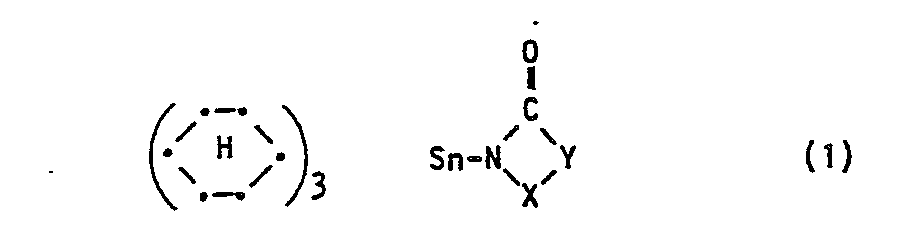
worin X
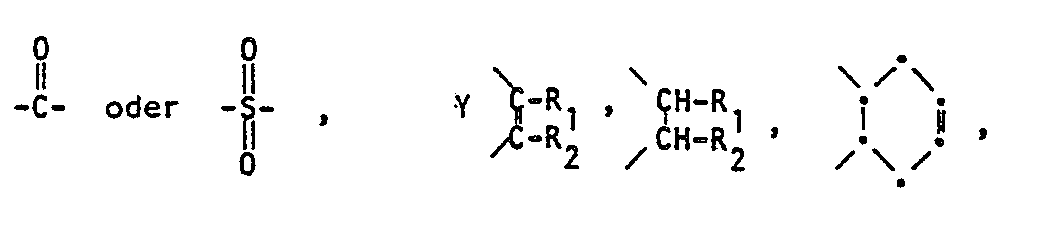

und R1 und R2 je Wasserstoff oder Alkyl bedeuten.
Ein Verfahren zur Herstellung dieser Tricyciohexylzinnimide und ihre Verwendung in der Schädlingsbekämpfung werden beschrieben.
Description
- Die vorliegende Erfindung betrifft Tricyclohexylzinnimide, Verfahren zu ihrer Herstellung und ihre Verwendung in der Schädlingsbekämpfung.
- Die Tricyclohexylzinnimide haben die Formel


- Die für R1 und R2 stehenden Alkylgruppen können geradkettig oder verzweigt sein und haben in der Kette vorzugsweise 1 bis 5 Kohlenstoffatome. Beispiele solcher Gruppen sind: Methyl, Aethyl, Propyl, Isopropyl, n-, i-, sek.-, tert.-Butyl, n-Pentyl und dessen Isomere.
- Wegen ihrer Wirkung von besonderer Bedeutung sind Verbindungen der Formel I, worin

- R1 und R2 je Wasserstoff oder Methyl bedeuten.
- Die Verbindungen der Formel I können nach an sich bekannten Methoden, z.B. wie folgt hergestellt werden:

- In der Formel III haben X und Y die für die Formel I angegebene Bedeutung. Das Verfahren wird bei normalem Druck und einer Temperatur zwischen 0 bis 200°C und gegebenenfalls in einem Lösungsmittel durchgeführt. Als Lösungsmittel kommen z.B. aliphatische, aromatische sowie halogenierte Kohlenwasserstoffe, insbesondere Benzol, Xylol, Toluol, Chloroform oder Chlorbenzol,weiter Ketone wie Aceton, Methyläthylketon, Nitrile wie Acetonitril, Formamide wie Dimethylformamid in Frage.
- Die Ausgangsstoffe der Formeln II und III sind bekannt oder können nach bekannten Methoden hergestellt werden.
- Die Verbindungen der Formel I eignen sich zur Bekämpfung von verschiedenartigen Schädlingen an Tieren und Pflanzen.
- So eignen sich Verbindungen der Formel I zur Bekämpfung von Insekten z.B. der Ordnung Lepidoptera, Coleoptera, Homoptera, Heteroptera, Diptera, Thysanoptera, Orthoptera, Anoplura, Siphonaptera, Mallophaga, Thysanura, Psocoptera und Hymenoptera sowie Milben und Zecken der Ordnung Acarina.
- Es hat sich gezeigt, dass die Verbindungen der Formel I eine starke Wirkung sowohl gegen pflanzenschädigende Milben: z.B. der Familien Tetranychidae, Tarsonemidae, Eriophydae, Tyroglyphidae und Glycyphagidae als auch gegen ektoparasitäre Milben und Zecken: z.B. der Familien Ixodidae, Argasidae, Sarcoptidae und Dermanyssidae aufweisen.
- Die akarizide bzw. insektizide Wirkung lässt sich durch Zusatz von anderen Insektiziden und/oder Akariziden wesentlich verbreitern und an gegebene Umstände anpassen. Als Zusätze eignen sich z.B. org. Phosphorverbindungen; Nitrophenole und deren Derivate; Formamidine; Harnstoffe; pyrethrinartige Verbindungen sowie Karbamate und chlorierte Kohlenwasserstoffe.
- Weiter zeigen die Substanzen der Formel I fungizide Wirkung..
- So sind diese Wirkstoffe gegen die den folgenden Klassen angehörenden phytopathogenen Pilze wirksam: Ascomycetes (z.B. Erysiphaceae, Fusarium, Helminthosporium); Basidiomycetes wie Puccinia, Rhizoctonia, Tilletia, Hemileia; Fungi imperfecti (z.B.- Cercospora, Botrytis. Septoria); Phycomycetes wie Phytophthora. Ueberdies wirken die Verbindungen der Formel I systemisch. Die Verbindungen der Formel, I werden vorteilhaft als Beizmittel zur Behandlung von Saatgut und Vorrat (Früchte, Knollen, Körner) und Pflanzenstecklingen zum Schutz vor Pilzinfektionen sowie gegen im Erdboden auftretende phytopathogene Pilze eingesetzt.
- Die Verbindungen der Formel I werden in unveränderter Form oder vorzugsweise zusammen mit den in der Formulierungstechnik üblichen Hilfsmitteln eingesetzt und werden daher z.B. zu Emulsionskonzentraten, direkt versprühbaren oder verdünnbaren Lösungen, verdünnten Emulsionen, Spritzpulvern, löslichen Pulvern, Stäubemitteln, Granulaten, auch Verkapselungen in z.B. polymeren Stoffen in bekannter Weise verarbeitet. Die Anwendungsverfahren wie Versprühen, Vernebeln., Verstäuben, Verstreuen oder Giessen werden gleich wie die Art der Mittel den angestrebten Zielen und den gegebenen Verhältnissen entsprechend gewählt.
- Die Formulierungen, d.h. die den Wirkstoff der Formel I und gegebenenfalls einen festen oder flüssigen Zusatzstoff enthaltenden Mittel, Zubereitungen oder Zusammensetzungen werden in bekannter Weise hergestellt, z.B. durch inniges Vermischen und/oder Vermahlen der Wirkstoffe mit Streckmitteln, wie z.B. Lösungsmitteln, festen Trägerstoffen, und gegebenenfalls oberflächenaktiven Verbindungen (Tensiden).
- Als Lösungsmittel können in Frage kommen: Aromatische Kohlenwasserstoffe, bevorzugt die Fraktionen C8 bis C12, wie z.B. Xylolgemische oder substituierte Naphthaline, Phthalsäureester wie Dibutyl- oder Dioctylphthalat, aliphatische Kohlenwasserstoffe wie Cyclohexan oder Paraffine, Alkohole und Glykole sowie deren Aether und Ester, wie Aethanol, Aethylenglykol, Aethylenglykolmonomethyl- oder -äthyläther, Ketone wie Cyclohexanon, stark polare Lösungsmittel wie N-Methyl-2-pyrrolidon, Dimethylsulfoxid oder Dimethylformamid, sowie gegebenenfalls epoxydierte Pflanzenöle wie epoxydiertes Kokosnussöl oder Sojaöl; oder Wasser.
- Als feste Trägerstoffe, z.B. für Stäubemittel und dispergierbare Pulver, werden in der Regel natürliche Gesteinsmehle verwendet, wie Calcit, Talkum, Kaolin, Montmorillonit oder Attapulgit. Zur Verbesserung der physikalischen Eigenschaften können auch hochdisperse Kieselsäure oder hochdisperse saugfähige Polymerisate zugesetzt werden. Als gekörnte, adsorptive Granulatträger kommen poröse Typen, wie z.B. Bimsstein, Ziegelbruch, Sepiolit oder Bentonit, als nicht sorptive Trägermaterialien z.B. Calcit oder Sand in Frage. Darüberhinaus kann eine Vielzahl von vorgranulierten Materialien anorganischer oder organischer Natur wie insbesondere Dolomit oder zerkleinerte Pflanzenrückstände verwendet werden.
- Als oberflächenaktive Verbindungen kommen je nach der Art des zu formulierenden Wirkstoffs der Formel I nichtionogene, kation- und/oder anionaktive Tenside mit guten Emulgier-, Dispergier- und Netzeigenschaften in Betracht. Unter Tensiden sind auch Tensidgemische zu verstehen.
- Geeignete anionische Tenside können sowohl sog. wasserlösliche Seifen wie wasserlösliche synthetische oberflächenaktive Verbindungen sein.
- Als Seifen eignen sich die Alkali-, Erdalkali- oder gegebenenfalls substituierten Ammoniumsalze von höheren Fettsäuren C10-C22), wie z.B. die Na- oder K-Salze der Oel- oder Stearinsäure, oder von natürlichen Fettsäuregemischen, die z.B. aus Kokosnuss- oder Talgöl gewonnen werden können. Ferner sind auch die Fettsäuremethyl-taurinsalze zu erwähnen.
- Häufiger werden jedoch sog. synthetische Tenside verwendet, insbesondere Fettsulfonate, Fettsulfate, sulfonierte Benzimidazolderivate oder Alkylarylsulfonate.
- Die Fettsulfonate oder -sulfate liegen in der Regel als Alkali-, Erdalkali- oder gegebenenfalls substituierte Ammoniumsalze vor und weisen einen Alkylrest mit 8 bis 22 C-Atomen auf, wobei Alkyl auch den Alkylteil von Acylresten einschliesst, z.B. das Na- oder Ca-Salz der Ligninsulfonsäure, des Dodecylschwefelsäureesters oder eines aus natürlichen Fettsäuren hergestellten Fettalkoholsulfatgemisches. Hierher gehören auch die Salze der Schwefelsäureester und Sulfonsäuren von Fettalkohol-Aethylenoxid-Addukten. Die sulfonierten Benzimidazolderivate enthalten vorzugsweise 2 Sulfonsäuregruppen und einen Fettsäurerest mit 8-22 C-Atomen. Alkylarylsulofnate sind z.B. die Na-, Ca- oder Tri- äthanolaminsalze der Dodecylbenzolsulfonsäure, der Dibutylnaphthalinsulfonsäure, oder eines Naphthalinsulfonsäure-Formaldehydkondensationsproduktes.
- Ferner kommen auch entsprechende Phosphate wie z.B. Salzes des Phosphorsäureester eines p-Nonylphenol-(4-14)-Aethylenoxyd-Adduktes in Frage.
- Als nichtionische Tenside kommen in erster Linie Polyglykolätherderivate von aliphatischen oder cycloaliphatischen Alkoholen, gesättigten oder ungesättigten Fettsäuren und Alkylphenolen in Frage, die 3 bis 30 Glykoläthergruppen und 8 bis 20 Kohlenstoffatome im (aliphatischen) Kohlenwasserstoffrest und 6 bis 18 Kohlenstoffatome im Alkylrest der Alkylphenole enthalten können.
- Weitere geeignete nichtionische Tenside sind die wasserlöslichen, 20 bis 250 Aethylenglykoläthergruppen und 10-bis 100 Propylenglykoläthergruppen enthaltenden Polyäthylenoxidaddukte an Polypropylenglykol, Aethylendiaminopolypropylenglykol und Alkylpolypropylenglykol mit 1 bis 10 Kohlenstoffatomen in der Alkylkette. Die genannten Verbindungen enthalten üblicherweise pro Propylenglykol-Einheit 1 bis 5 Aethylenglykoleinheiten.
- Als Beispiele nichtionischer Tenside seien Nonylphenolpoly- äthoxyäthanole, Ricinusölpolyglycoläther, Polypropylen-Polyäthylenoxydaddukte, Tributylphenoxypolyäthoxyäthanol, Polyäthylenglykol und Octylphenoxypolyäthoxyäthanol erwähnt..
- Ferner kommen auch Fettsäureester von Polyoxyäthylensorbitan wie das Polyoxyäthylensorbitan-trioleat in Betracht.
- Bei den kationischen Tensiden handelt es sich vor allem um quartäre Ammoniumsalze, welche als N-Substituenten mindestens einen Alkylrest mit 8 bis 22 C-Atomen enthalten und als weitere Substituenten niedrige, gegebenenfalls halogenierte Alkyl-, Benzyl- oder niedrige Hydroxyalkylreste aufweisen. Die Salze liegen vorzugsweise als Halogenide, Methylsulfate oder Aethylsulfate vor, z.B. das Stearyltrimethylammoniumchlorid oder das Benzyldi(2-chloräthyl)-äthylaimmo- niumbromid.
- Die in der Formulierungstechnik gebräuchlichen Tenside sind u.a. in folgender Publikation beschrieben:
- "Mc Cutcheon's Detergents and Emulsifiers Annual" MC Publishing-Corp., Ringwood, New Jersey, 1979.
- Die pestiziden Zubereitungen enthalten in der Regel 0,1 bis 99%, insbesondere 0,1 bis 95%, Wirkstoff der Formel I, 1 bis 99,9% eines festen oder flüssigen Zusatzstoffes und 0 bis 25%, insbesondere 0,1 bis 25%, eines Tensides.
- Während als Handelsware eher konzentrierte Mittel bevorzugt werden, verwendet der Endverbraucher in der Regel verdünnte Mittel.
- Die Mittel können auch weitere Zusätze wie Stabilisatoren, Entschäumer,Viskositätsregulatoren, Bindemittel, Haftmittel sowie Dünger oder andere Wirkstoffe zur Erzielung spezieller Effekte enthalten.
-


- Die Lösungen sind zur Anwendung in Form kleinster Tropfen geeignet.

- Der Wirkstoff wird in Methylenchlorid gelöst, auf den Träger aufgesprüht und das Lösungsmittel anschliessend im Vakuum abgedampft.

- Durch inniges Vermischen der Trägerstoffe mit dem Wirkstoff erhält man gebrauchsfertige Stäubemittel.
-

-


- Man erhält anwendungsfertige Stäubemittel, indem der Wirkstoff mit dem Träger vermischt und auf einer geeigneten Mühle vermahlen wird.
-

-

-

- Der fein gemahlene Wirkstoff wird mit den Zusatzstoffen innig vermischt. Man erhält so ein Suspensions-Konzentrat, aus welchem durch Verdünnen mit Wasser Suspensionen jeder gewünschten Konzentration hergestellt werden können.
- Zu 13,17 g Bis-Tricyclohexylzinnoxid in 500 ml Aceton werden 6,94 g Succinimid zugegeben. Das Reaktionsgemisch wird zwei Stunden lang bei 55-60°C gerührt. Nach dem Abdestillieren von Vierfünftel des Acetons wird das auskristallisierende Produkt abgenutscht und getrocknet.
- Man erhält die Verbindung der Formel

- Auf analoge Weise werden auch folgende Verbindungen hergestellt:

- Die Primärblätter von Phaseolus vulgaris Pflanzen werden 16 Stunden vor dem Versuch auf akarizide Wirkung mit einem infestierten Blattstück aus einer Massenzucht von Tetranychus urticae (OP-sens.), Tetranychus cannabarinus (OP-tol.) oder Panonychus ulmi belegt. (Die Toleranz bezieht sich auf die Verträglichkeit von Diazinon).
- Die so behandelten infest.ierten Pflanzen werden mit einer Versuchslösung enthaltend 400 oder 200 ppm der zu prüfenden Verbindung bis zur Tropfnässe besprüht.
- Nach 24 Stunden und wiederum 7 Tagen werden Imagines und Larven (alle beweglichen Stadien) unter dem Binokular auf lebende und tote Individuen ausgewertet.
- Man verwendet pro Konzentration und pro Testspezies eine Pflanze. Während des Versuchsverlaufs stehen die Pflanzen in Gewächshauskabinen bei 25°C.
- Verbindungen gemäss Beispiel 1 zeigen in diesem Versuch die in der folgenden Tabelle aufgeführte Wirkung gegen Individuen der Spezies Tetranychus urticae, Tetranychus cinnabarinus und Panonychus ulmi.
- Baumwollpflanzen werden mit einer Versuchslösung, enthaltend 50, 100; 200 und 400 ppm der zu prüfenden Verbindung, besprüht.
- Nach dem Antrocknen des Belages werden die Baumwollpflanzen mit Spodoptera littoralis-Larven L3 besetzt. Der Versuch wird bei 24°C und 60 % relativer Luftfeuchtigkeit durchgeführt.
- Verbindungen gemäss Beispiel 1 zeigen im obigen Test die in der folgenden Tabelle äufgeführte Frassgift-Wirkung gegen Spodoptera-Larven.
- In der folgenden Tabelle sind Versuchsergebnisse auf der Basis der vorstehenden Beispiele aufgeführt, und zwar mit folgendem Bewertungsindex in bezug auf die prozentuale Abtötung der Schädlinge:
- A: 70-100 % Abtötung bei 50 ppm Wirkstoffkonzentration
- B: 70-100% Abtötung bei 100 ppm Wirkstoffkonzentration
- C: 70-100 7 Abtötung bei 200 ppm Wirkstoffkonzentration
- D: 70-100 % Abtötung bei 400 ppm Wirkstoffkonzentration

- Tomatenpflanzen werden nach 3-wöchiger Anzucht mit einer aus Spritzpulver des Wirkstoffes hergestellten Spritzbrühe (0,02% Aktibsubstanz) besprüht. Nach 24 Stunden werden die behandelten Pflanzen mit einer Sporangiensuspension des Pilzes infiziert. Die Beurteilung des Pilzbefalls erfolgt nach einer Inkubation der infizierten Pflanzen während 5 Tagen bei 90-100% relativer Luftfeuchtigkeit und 20°C.
- Die Verbindung der Formel

- 10-15 cm hohe Erdnusspflanzen werden mit einer aus Spritzpulver der Wirksubstanz hergestellten Spritzbrühe (0,006% Aktivsubstanz) besprüht und 48 Stunden später mit einer Koniediensuspension des Pilzes infiziert. Die infizierten Pflanzen werden während 72 Stunden bei ca. 21°C und hoher Luftfeuchtigkeit inkubiert und anschliessend bis zum Auftreten der typischen Blattflecken in einem Gewächshaus aufgestellt. Die Beurteilung der fungiziden Wirkung erfolgt 12 Tage nach der Infektion basierend auf Anzahl und Grösse der auftretenden Flecken. Die Verbindung der Formel

Claims (14)
1. Ein Tricyclohexylzinnimid der Formel

worin X


und R1 und R2 je Wasserstoff oder Alkyl bedeuten.
2. Ein Tricyclohexylzinnimid gemäss Anspruch 1, worin X


oder

und R1 und R2 je Wasserstoff oder Methyl bedeuten.
3. Die Verbindung gemäss Anspruch 2 der Formel

4. Die Verbindung gemäss Anspruch 2 der Formel

5. Die Verbindung gemäss Anspruch 2 der Formel

6. Die Verbindung gemäss Anspruch 1 der Formel

7. Die Verbindung gemäss Anspruch 1 der Formel

8. Die Verbindung gemäss Anspruch 1 der Formel

9. Die Verbindung gemäss Anspruch 1 der Formel

10. Ein Verfahren zur Herstellung von Verbindungen gemäss Anspruch 1, dadurch gekennzeichnet, dass man die Verbindung der Formel

mit einer Verbindung der Formel

umsetzt, worin X und Y die im Anspruch 1 angegebene Bedeutung haben.
11. Ein Schädlingsbekämpfungsmittel, welches neben einem geeigneten Träger- und/oder anderen Zuschlagstoff als aktive Komponente eine Verbindung gemäss Anspruch 1 enthält.
12. Verwendung einer Verbindung gemäss Anspruch 1 zur Bekämpfung von verschiedenartigen.tierischen und pflanzlichen Schädlingen.
13. Verwendung gemäss Anspruch 12 zur Bekämpfung von Insekten und Vertretern der Ordnung Akarina.
14. Verwendung gemäss Anspruch 12 zur Bekämpfung von phytopathogenen Pilzen.
Applications Claiming Priority (4)
| Application Number | Priority Date | Filing Date | Title |
|---|---|---|---|
| CH9304/80 | 1980-12-17 | ||
| CH930480 | 1980-12-17 | ||
| CH6256/81 | 1981-09-29 | ||
| CH625681 | 1981-09-29 |
Publications (2)
| Publication Number | Publication Date |
|---|---|
| EP0054516A2 true EP0054516A2 (de) | 1982-06-23 |
| EP0054516A3 EP0054516A3 (de) | 1982-10-06 |
Family
ID=25699264
Family Applications (1)
| Application Number | Title | Priority Date | Filing Date |
|---|---|---|---|
| EP81810492A Withdrawn EP0054516A3 (de) | 1980-12-17 | 1981-12-11 | Tricyclohexylzinnimide, Verfahren zu ihrer Herstellung und ihre Verwendung in der Schädlingsbekämpfung |
Country Status (2)
| Country | Link |
|---|---|
| EP (1) | EP0054516A3 (de) |
| IL (1) | IL64554A0 (de) |
Cited By (1)
| Publication number | Priority date | Publication date | Assignee | Title |
|---|---|---|---|---|
| US4486424A (en) * | 1981-10-13 | 1984-12-04 | Ciga-Geigy Corporation | Triorganotin hydantoin compounds, and the use thereof for combating insects and acarids |
Family Cites Families (2)
| Publication number | Priority date | Publication date | Assignee | Title |
|---|---|---|---|---|
| US3544588A (en) * | 1968-10-11 | 1970-12-01 | Tenneco Chem | Organotin imides |
| US4036958A (en) * | 1975-10-06 | 1977-07-19 | Stauffer Chemical Company | Insecticidal and miticidal active isothiuronium tricyclohexyl tin imide |
-
1981
- 1981-12-11 EP EP81810492A patent/EP0054516A3/de not_active Withdrawn
- 1981-12-15 IL IL64554A patent/IL64554A0/xx unknown
Cited By (1)
| Publication number | Priority date | Publication date | Assignee | Title |
|---|---|---|---|---|
| US4486424A (en) * | 1981-10-13 | 1984-12-04 | Ciga-Geigy Corporation | Triorganotin hydantoin compounds, and the use thereof for combating insects and acarids |
Also Published As
| Publication number | Publication date |
|---|---|
| IL64554A0 (en) | 1982-03-31 |
| EP0054516A3 (de) | 1982-10-06 |
Similar Documents
| Publication | Publication Date | Title |
|---|---|---|
| EP0125204A1 (de) | 3-Phenoxybenzyl-(2-phenyl-2,2-alkylen-äthyl)-äther und -thioäther, Verfahren zu ihrer Herstellung und ihre Verwendung in der Schädlingsbekämpfung | |
| EP0097126B1 (de) | 2-(3-Pyridyl)-1,3,4-oxadiazole, Verfahren zu ihrer Herstellung und ihre Verwendung in der Schädlingsbekämpfung | |
| EP0110829B1 (de) | Schädlingsbekämpfungsmittel | |
| EP0191734B1 (de) | Schädlingsbekämpfungsmittel | |
| EP0133418A2 (de) | Die Verwendung von 3-Acylaminobenzisothiazolen in der Schädlingsbekämpfung | |
| EP0179020A2 (de) | Thioxanthene in der Schädlingsbekämpfung | |
| EP0050093A2 (de) | Cyclopropancarbonsäure-alpha-allenyl-3-phenoxy-benzylester, ihre Herstellung und Verwendung in der Schädlingsbekämpfung | |
| EP0086748A1 (de) | 3-Amidino-benzisothiazol-1,1-dioxide, Verfahren zu ihrer Herstellung und ihre Verwendung in der Schädlingsbekämpfung | |
| EP0138762B1 (de) | Schädlingsbekämpfungsmittel | |
| EP0077300B1 (de) | Triorganozinnhydantoin-Verbindungen, Verfahren zu ihrer Herstellung und ihre Verwendung in der Schädlingsbekämpfung | |
| EP0207891A1 (de) | Salze von 3-Acylaminobenzisothiazol-S,S-dioxiden, Verfahren zu ihrer Herstellung und ihre Verwendung in der Schädlingsbekämpfung | |
| EP0113317B1 (de) | Carbamate | |
| EP0135105A1 (de) | Mittel zur Bekämpfung von Insekten und Vertretern der Ordnung Akarina, welche als aktive Komponente 2-(1-Indolinyl-methyl)-imidazoline oder deren Salzen enthalten | |
| EP0129511B1 (de) | Neue Amidine | |
| EP0036839A2 (de) | 4-N,N-Dimethylcarbamoyloxy-5-methyl-pyrimidine, Verfahren zu ihrer Herstellung und ihre Verwendung in der Schädlingsbekämpfung, sowie die als Zwischenprodukte verwendeten 4-Hydroxy-5-methyl-pyrimidine | |
| EP0077296B1 (de) | Organozinnverbindungen | |
| EP0062003B1 (de) | Neue carboxylierte Oximcarbamate, Verfahren zu ihrer Herstellung, und ihre Verwendung in der Schädlingsbekämpfung | |
| EP0149977B1 (de) | Neue N-Phosphoryl- oder N-Thiophosphoryl-N'-s-triazinyl-formamidine | |
| EP0049684B1 (de) | N-(Benzamidosulfenyl)-N-methyl-carbamate, Zwischenprodukte, Herstellung und Verwendung in der Schädlingsbekämpfung | |
| EP0051565A1 (de) | 1-N,N-Dimethylcarbamoyl-3(5)-cyclopropyl-1,2,4-triazole, Verfahren zu ihrer Herstellung und ihre Verwendung in der Schädlingsbekämpfung | |
| EP0041920A2 (de) | Neue Organophosphate | |
| EP0094909B1 (de) | N-Alkyliden-imino-oxicarbonyl-N-methyl-(2,2-dimethyl-2,3-di-hydrobenzofuranyl(7))-carbamate, Verfahren zu ihrer Herstellung und ihre Verwendung in der Schädlingsbekämpfung | |
| EP0054517B1 (de) | Phenyl-N-(cyanoalkylsulfenyl)-N-methylcarbamate, Verfahren zu ihrer Herstellung und ihre Verwendung in der Schädlingsbekämpfung | |
| EP0053096A1 (de) | Unsymmetrische Bis-Carbamate, Verfahren zu ihrer Herstellung und ihre Verwendung in der Schädlingsbekämpfung | |
| EP0048696A2 (de) | Zinnverbindungen |
Legal Events
| Date | Code | Title | Description |
|---|---|---|---|
| PUAI | Public reference made under article 153(3) epc to a published international application that has entered the european phase |
Free format text: ORIGINAL CODE: 0009012 |
|
| 17P | Request for examination filed |
Effective date: 19811214 |
|
| AK | Designated contracting states |
Designated state(s): AT BE CH DE FR GB IT NL |
|
| PUAL | Search report despatched |
Free format text: ORIGINAL CODE: 0009013 |
|
| AK | Designated contracting states |
Designated state(s): AT BE CH DE FR GB IT NL |
|
| STAA | Information on the status of an ep patent application or granted ep patent |
Free format text: STATUS: THE APPLICATION HAS BEEN WITHDRAWN |
|
| 18W | Application withdrawn |
Withdrawal date: 19821216 |
|
| RIN1 | Information on inventor provided before grant (corrected) |
Inventor name: DRABEK, JOZEF, DR. |