EP0054501A1 - Verfahren und Einrichtung zum Begrenzen der Beschleunigung einer Gasturbine - Google Patents
Verfahren und Einrichtung zum Begrenzen der Beschleunigung einer Gasturbine Download PDFInfo
- Publication number
- EP0054501A1 EP0054501A1 EP19810402020 EP81402020A EP0054501A1 EP 0054501 A1 EP0054501 A1 EP 0054501A1 EP 19810402020 EP19810402020 EP 19810402020 EP 81402020 A EP81402020 A EP 81402020A EP 0054501 A1 EP0054501 A1 EP 0054501A1
- Authority
- EP
- European Patent Office
- Prior art keywords
- engine
- acceleration
- generating
- signal
- speed
- Prior art date
- Legal status (The legal status is an assumption and is not a legal conclusion. Google has not performed a legal analysis and makes no representation as to the accuracy of the status listed.)
- Ceased
Links
Images
Classifications
-
- F—MECHANICAL ENGINEERING; LIGHTING; HEATING; WEAPONS; BLASTING
- F02—COMBUSTION ENGINES; HOT-GAS OR COMBUSTION-PRODUCT ENGINE PLANTS
- F02C—GAS-TURBINE PLANTS; AIR INTAKES FOR JET-PROPULSION PLANTS; CONTROLLING FUEL SUPPLY IN AIR-BREATHING JET-PROPULSION PLANTS
- F02C9/00—Controlling gas-turbine plants; Controlling fuel supply in air- breathing jet-propulsion plants
- F02C9/26—Control of fuel supply
- F02C9/28—Regulating systems responsive to plant or ambient parameters, e.g. temperature, pressure, rotor speed
-
- F—MECHANICAL ENGINEERING; LIGHTING; HEATING; WEAPONS; BLASTING
- F05—INDEXING SCHEMES RELATING TO ENGINES OR PUMPS IN VARIOUS SUBCLASSES OF CLASSES F01-F04
- F05D—INDEXING SCHEME FOR ASPECTS RELATING TO NON-POSITIVE-DISPLACEMENT MACHINES OR ENGINES, GAS-TURBINES OR JET-PROPULSION PLANTS
- F05D2270/00—Control
- F05D2270/01—Purpose of the control system
- F05D2270/04—Purpose of the control system to control acceleration (u)
-
- F—MECHANICAL ENGINEERING; LIGHTING; HEATING; WEAPONS; BLASTING
- F05—INDEXING SCHEMES RELATING TO ENGINES OR PUMPS IN VARIOUS SUBCLASSES OF CLASSES F01-F04
- F05D—INDEXING SCHEME FOR ASPECTS RELATING TO NON-POSITIVE-DISPLACEMENT MACHINES OR ENGINES, GAS-TURBINES OR JET-PROPULSION PLANTS
- F05D2270/00—Control
- F05D2270/01—Purpose of the control system
- F05D2270/04—Purpose of the control system to control acceleration (u)
- F05D2270/042—Purpose of the control system to control acceleration (u) by keeping it below damagingly high values
Definitions
- the invention relates to a method and apparatus for acceleration limiting of a gas turbine engine as set forth in the pre-characterizing parts of Claims 1 and 7, respectively.
- the closed loop fuel control of gas turbine engines based on acceleration has become successfully implemented in various systems. These systems act directly to control the rate of change of the engine speed as a function of an acceleration term.
- the acceleration term is formed by differencing a scheduled term with an actual or an implied actual parameter of the gas generator. The actual acceleration of the engine is fed back through changes in the actual term for compararison with the scheduled term.
- the acceleration term which after an integration effectively provides a datum for a proportional speed control loop, may be a function of any of a number of control input parameters including engine speed, ambient pressure, temperature, compressor pressure, etc. Advantages of this form of acceleration control include consistent predictable accelerations which take account of fuel type, temperature, and altitude.
- the acceleration time in such systems is also generally independent of air bleed and power extraction status.
- a closed loop fuel control for a gas turbine engine based on acceleration is more fully disclosed in European Patent Application No. 81 401859.4 , filed in the name of Aviation Electric Ltd. on November 24, 1981.
- Other examples of closed loop systems of this type are illustrated in U.S. Patent Nos. 4,018,044; 4,100,731; and 4,040,250.
- the acceleration that is requested should be a function of the final desired output power or speed. Generally, it is desired that an acceleration be the safe maximum available from the engine for the particular operating conditions of the engine. Only the physical limitations of the engine should reduce the acceleration capability of the control. One set of acceleration limiting conditions is where the compressor begins to stall and the engine enters a surge condition destructive to the equipment. Therefore, the acceleration and fuel flow must be controlled so that a safe operating margin is maintained between stall conditions and the operating point so the engine does not encounter these problems. On most controls, an acceleration limiter, producing predetermined acceleration limits, is utilised to control the safety factor. When on acceleration limit, the fuel flow to the engine is scheduled by the acceleration limiter without regard to the steady running line of the engine.
- this margin of safety is defined in terms of a surge line representing an acceleration limit which, if not exceeded, will help prevent the engine from stalling.
- the surge line has been defined as an open loop schedule in terms of parameter groups such as the fuel/air ratio of the engine (Wf/(Pc y lTO)) versus the gas generator speed (N/ ⁇ To).
- the parameter groups are "nondimensional" (lacking only a geometrical scaling factor) and generally apply to all engines of the particular type for which the stall line was determined.
- a new schedule does not have to be developed every time an engine dimension is modified and is equally adaptable to all engines regardless of size of that design.
- the new schedules are merely scaled versions of the previous schedules based on the engine size changes.
- the present invention overcomes the disadvantages and limitations of the prior art arrangements by the features specified in the characterizing parts of Claims 1 and 7, respectively.
- the acceleration term is formed by a fuel control in a closed loop manner.
- the acceleration term Is integrated to yield a demanded speed signal which Is a datum to which a proportional speed loop is slaved.
- the demanded velocity is subsequently differenced with the actual velocity in the proportional loop to control the fuel flow to the engine.
- an acceleration limiter compares the acceleration term to upper and lower acceleration limits defining acceptable boundaries for the parameter.
- the anti-surge limits are variable and are modified according to the operating conditions of the engine.
- the acceleration limit is generated from the function defining the surge boundary of the engine in terms of Wf, N, and dN/dt where 1Jf is the fuel flow to the engine, N is the rotational velocity of the rotor, and dN/dt the acceleration of the rotor.
- an array of (dN/dt X N)/Wf values versus N/ ⁇ can be stored in a memory device and those values read out on command for any particular corrected speed. These values when multiplied by the fuel flow, Wf, and divided by the speed N yield an acceleration limit directly.
- An advantage of the sytem is that the acceleration limit when defined by the ratio (dN/dt X N)/Wf is dimensionless.
- An acceleration multiplied by a speed produces a term in the numerator that is equivalent to excess torque or engine power.
- the denominator Wf can be thought of as engine power when the fuel flow is converted into units of B.T.U.s or heat energy. Taking the ratio or dividing a power term by a power term cancels the dimensions from the ratio.
- the same acceleration limiter can then be used for any engine of a particular type, regardless of dimension change by scaling the schedule to the size change.
- a second correction matrix is provided where second order factors that affect the surge margin of the engine can be utilized to modify the acceleration limit.
- the second order factors compensated for can be gas generator speed, ambient temperature, and ambient pressures.
- "dimensional" effects such as low compressor Reynolds numbers and variable geometry can be corrected for in this manner. Since the primary effect of pressure changes, i.e., altitude differences, have been compensated for In the acceleration term, the pressure transducers for the correction circuit have considerably reduced accuracy requirements.
- the transducers can be simple bilevel transducers to signal a change from a region or a condition that may necessitate further acceleration limit correction.
- schedules are formed for high Reynolds numbers as a function of ambient pressure Po and ambient temperature To. Another schedule provides for anti-icing needs as a function of bleed valve position Bp. Still another schedule is provided for operation as a function of the variable geometry position Gp.
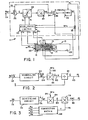
- a fuel control system 11 for a turbojet engine which is generally designated 10.
- the engine 10 includes an intake duct 22 through which air enters. After entering the engine, the air is compressed by a low pressure compressor 12 and subsequently by a high pressure compressor 17.
- Compressors 12 and 17 are of the axial type which produce an increase in pressure and consequently, an increase in the density of the incoming air proportional to their speed.
- the denser air moves to a fuel supply section where a fuel ring 16 produces a combustible fuel/air mixture by spraying fuel into the incoming stream.
- the fuel/air mixture is thereafter ignited and combusted in burners 18 to produce a high velocity exhaust gas.
- the exhaust gas exits through a nozzle 20 to produce a forward thrust.
- a portion of the energy contained in the exhaust gas is expended in rotating a low pressure turbine 14 and a high pressure turbine 19 which are physically attached to the respective compressors by concentrically disposed rotor shafts.
- Each compressor and turbine combination form a spool which rotates independently from the other.
- the engine described is a conventional two-spool turbojet engine in which the second or low pressure spool has been added to increase the efficiency of the engine.
- the control of the engine speed and thus output power or thrust of the engine is regulated by the amount of fuel flowing through the fuel ring 16.
- This fuel flow Wf is modulated by the fuel control 11 to provide more or less energy and thus reaction power from the engine. Increasing the fuel flow increases the engine speed and output power while decreasing the fuel flow decreases engine speed and output power.
- the fuel control system 11 is provided for assuring that control of the engine speed is maintained during steady state operation, accelerations and decelerations.
- the fuel control illustrated is based on an input to terminal 24 which is the desired or scheduled rotational speed Ngs, of one of the compressor and turbine combinations of the engine 10.
- the signal Ngs can, for example, be generated as the output from a schedule based on the power lever angle of the particular device the engine is used on. In its simplest form the Ngs signal can be generated from a potentiometer that is ganged to the power lever.
- the high pressure compressor speed (high spool speed Nh) or the low pressure compressor speed (low spool speed N) is meant because either can be used to control the engine,
- the controlling parameter of the fuel control will be the high spool speed Nh.
- the high spool speed is chosen as the controlling parameter in this type of engine since it is the more critical to the operation.
- the control system operates to govern the engine speed as a function of the scheduled speed Ngs and accelerates or decelerates the engine in a manner to reach a new scheduled speed when the pilot or another system component changes the scheduled engine speed. Otherwise, for changes in engine environment such as.altitude, temperature, pressure or other factors, the governor acts to maintain the scheduled speed Ngs.
- the engine forms an acceleration term which is preferably the difference of the scheduled speed Ngs and a demanded speed term Nd.
- the acceleration term can be formed as the difference between the high spool speed signal Nh and the scheduled speed signal Ngs.
- the advantages of forming the acceleration term as a function of the demanded signal are set forth in the referenced application. This function is performed by feeding the two chosen parameters to a first summing Junction 26 and generating a difference signal of sign and magnitude equivalent to the difference therebetween.
- the acceleration term or difference signal is integrated in an integrator 32 to become the demanded speed signal Nd. This portion of the control forms an integral loop providing a datum which is the demanded speed signal Nd.
- the acceleration term is conventionally limited by a comparator circuit 28.
- the comparator 28 compares the acceleration term to an upper limit At and a lower limit Dl and passes the acceleration term unmodified if between the two values. However, if the acceleration is great enough to cause surge, the acceleration term will be limited at the upper acceleration limit Al, while if the deceleration is sufficient to cause flame out it will be limited at the lower deceleration limit Dl.
- An accel/decel limiter circuit 30 as will be more fully described hereinafter is used to generate the variable limits and to modify the limits as a function of a group of operating parameters of the engine.
- An acceleration limit schedule is stored in a memory device of the circuit where the schedule is substantially equivalent to the steady state surge line of the particular engine expressed as a function of the engine operating parameters chosen.
- the schedule is formed as a function of the corrected speed N/v1 3 input through the combination of the high spool speed signal Nh and a signal, To, from a temperature sensor representative of the ambient temperature.
- the corrected speed is inversely proportional to the square root of ambient temperature.
- Other inputs for this implementation are an electrical signal Wfe which is representative of the fuel flow as measured by a flow sensor 35 or alternatively, as the fuel metering valve position.
- the fuel flow signal Wfe, and high spool speed Nh are used to generate a scheduled value which is corrected by a multiplication factor.
- the multiplication factor is scheduled as a function of the temper 3 ture signal To, a signal Po from a pressure sensor indicative of the ambient pressure, a signal Gp from a position sensor indicative of the position of the variable geometry of the low speed compressor, and a signal Bp from a position sensor indicative of the position of the bleed valves of the high pressure compressor.
- the position, temperature, flow, and pressure sensors are devices that transduce the respective physical parameters into an electrical signal for further processing. As such, these devices are well known in the art and have only been shown schematically.
- the demanded speed signal Nd is differenced with the high spool speed Nh in a second summing circuit 34.
- the error signal E generated by this difference is then used to proportionally control the fuel flow to the engine 10 in a direction tending to null the error between the scheduled speed signal Ngs and the demanded speed signal Nd.
- this portion of the controller forms a proportional control loop slaved to the datum Nd.
- the actual engine speed Nh will change to where there is a steady state error E supporting that particular demanded speed.
- the proportional control is developed by a hydromechanical unit (HMU) 36 which receives as an input the error signal E.
- the HMU 36 multiplies the error signal E by a predetermined gain to provide a fuel flow Wf which is proportional to the error signal.
- the HMU could be implemented as a proportional solenoid valve which changes position with respect to a control voltage representative of the error signal to regulate fuel flow from a pressurized fuel source.
- the HMU 36 would, therefore, also consist of a pressure regulator and a pressurized source of fuel (not shown) as is conventionally known in the art.
- the HMU 36 can include means for mechanically multiplying the error signal E by an input representative of the output of the compressor stages, compressor pressure Pc.
- the multiplying means could comprise a multiplying piston coupled to the fuel valve which transduces the compressor pressure Pc into a force to assist the solenoid.
- the error signal E at all engine operating points is proportional to Wf/Pc or the fuel/air ratio of the engine. Because of this mechanical multiplication, the error signal E can be thought of as being generated as a function of the fuel/air ratio of the engine. Normally, this would make the scheduling of the speed signal Ngs much easier to implement.
- the limiter circuit comprises an acceleration portion and a deceleration portion with a means for generating each of the limits A1, D1.
- the deceleration limit Dl can be a constant and transmitted to the comparator circuit 28 as a reference voltage.
- the deceleration limit Dl can be an inversion of the acceleration limit Al below the steady state running line.
- the acceleration portion of the accel/decel limiter circuit is better illustrated with reference to Figure 2.
- the acceleration limit, Al as a function of fuel flow, Wf, engine speed N, and acceleration dN/dt is shown.
- the acceleration is represented by the usual engineering character "N-dot" in the drawings.
- the limit is calculated by first scheduling a value of a parameter ratio defined by (dN/dt X N)/Wf as a function of corrected engine speed N/ ⁇ . These values are stored in a memory of a scheduling circuit 50.
- the circuit 50 when addressed by values of the corrected speed input via lead 52 transmits values of the ratio to the input of a multiplier circuit 56.
- the multiplier circuit 56 receives at its other input the signal Wfe representing the fuel flow and generates the product of the two factors as an output to lead 60.
- a divider 61 divides this product by the corrected speed to yield an output on lead 63.
- the quotient, acceleration limit Al, is then transmitted to the comparator circuit 28 to modify the acceleration term in the manner previously described via lead 63.
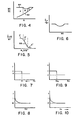
- curve 66 illustrates the acceleration schedule of a particular engine in terms of the preferred nondimensional ratio. This schedule is substantially equivalent to the steady state stall line of an engine with a margin of safety separating them.
- Evidence that curve 66 is representative of a generalized acceleration schedule for a typical engine is seen by comparing this curve with Figure 4.
- the fuel/air ratio Wf/Pc of the engine is graphically illustrated as a function of corrected engine speed.
- a conventional steady state running line of the engine is shown as curve 62 and the stall boundary as curve 64.
- the acceleration margin of the engine is that permissible overfueling or excess fuel/ air ratio area between the steady running line and the stall boundary. The overfueling in excess of steady state will produce a related acceleration and can be imagined as an acceleration limit.
- region A has a relatively large acceleration margin that decreases slightly with increases in speed; region B has a more rapidly decreasing acceleration margin; and region C has a smaller, but still decreasing acceleration margin.
- regions of figure 4 correspond to the acceleration limit regions A', B I , C' in Figure 5, which are similar in behavior.
- Region A' provides a relatively large acceleration limit which decreases with a small slope, region B' has a greater slope and the acceleration parameter falls off faster, and region C' produces a substantially small acceleration limit which falls off with less slope.
- the acceleration parameter can be generated in a simplified approximated form by three straight lines of the correct slope. Moreover, by varying the slopes of each segment, a generalized method for fitting the acceleration parameter to the stall margin of different engines can be obtained.
- a scheduling circuit 70 and a multiplier 84 identical to that illustrated in Figure 2 are shown as the basis for a second implementation of the acceleration portion of the accel/decel circuit 30.
- the nondimensional parameter ratio is defined as (dN/dt)/Wf.
- This ratio is input to the multiplier 84, multiplied by Wfe, and the product which is representative of the acceleration limit output to a second multiplier 78.
- the acceleration limit, dN/dt, output from terminal 80 is modified by multiplication by a correction factor f input to multiplier 78 via lead 76.
- the output of the multiplier, lead 82 transmits the corrected acceleration limit Al to the comparator 28.
- the ratio (dN/dt)/Wf is used in this implementation as a simplification of the embodiment shown in Figure 2.
- this simplified form for the ratio can be utilized. This is true because it is evident that for every value of the ratio (dN/dt X N)/Wf as a function of N, there is a unique value of the ratio (dN/dt)/Wf as a function of Nh.
- This schedule is illustrated as Figure 6 in the drawings. Further simplification in this embodiment is shown by the multiplication by true engine speed Nh instead of corrected speed.
- the temperature correction as will be more fully described hereinafter, can be factored into the limit by the correction matrix 68 through factor f.
- the correction factor f is the output of a correction matrix 68 including one or more correction schedules based on various operating parameters of the engine. These various schedules can be independent or all folded into one multivariable look-up table.
- the factor f is a function of ambient pressure Po as is illustrated in Figure 7. This schedule would be advantageous for environments where the engine may encounter low Reynolds numbers. These situations are most likely to occur above a flight level of 30,000 ft. and thus, simple bilevel pressure switch could be used to sense this environmental condition as pressure Pl. At this reduced pressure, the factor f would be reduced in a stepwise manner from unity to a fraction A.
- the correction matrix 68 includes a schedule illustrated in Figure 9 for modifying the acceleration limit as a function of the bleed valve position Bp.
- the curve indicates that the acceleration limit is modified stepwise when heavy loads on the bleed system are imposed. These loads are caused by anti-icing needs and other situations in which large amounts of pressurized air are diverted from the compressor at position Bpl. During these heavy loads the compressor stall margin is reduced and the factor f accordingly reduced from unity to a fraction C.
- the schedule illustrated in FIGURE 10, describes the proportional decrease in the factor f from unity to a fraction D for variations in the ambient temperature. As temperature increases the acceleration limit is reduced to compensate for the change in compressor efficiency. This schedule is used to correct the speed for temperature and,further, to compensate for high Reynolds numbers.
Landscapes
- Engineering & Computer Science (AREA)
- Chemical & Material Sciences (AREA)
- Combustion & Propulsion (AREA)
- Mechanical Engineering (AREA)
- General Engineering & Computer Science (AREA)
- Control Of Turbines (AREA)
- Electrical Control Of Air Or Fuel Supplied To Internal-Combustion Engine (AREA)
Applications Claiming Priority (2)
| Application Number | Priority Date | Filing Date | Title |
|---|---|---|---|
| US21737480A | 1980-12-17 | 1980-12-17 | |
| US217374 | 1980-12-17 |
Publications (1)
| Publication Number | Publication Date |
|---|---|
| EP0054501A1 true EP0054501A1 (de) | 1982-06-23 |
Family
ID=22810804
Family Applications (1)
| Application Number | Title | Priority Date | Filing Date |
|---|---|---|---|
| EP19810402020 Ceased EP0054501A1 (de) | 1980-12-17 | 1981-12-17 | Verfahren und Einrichtung zum Begrenzen der Beschleunigung einer Gasturbine |
Country Status (4)
| Country | Link |
|---|---|
| EP (1) | EP0054501A1 (de) |
| JP (1) | JPS57124031A (de) |
| BR (1) | BR8108162A (de) |
| CA (1) | CA1177264A (de) |
Cited By (7)
| Publication number | Priority date | Publication date | Assignee | Title |
|---|---|---|---|---|
| EP0063999A1 (de) * | 1981-04-24 | 1982-11-03 | AVIATION ELECTRIC Limited | Brennstoffregeleinrichtung für eine Gasturbine |
| EP0065892A1 (de) * | 1981-05-12 | 1982-12-01 | AVIATION ELECTRIC Limited | Brennstoffkontrolleinrichtung für eine Gasturbine |
| EP0153056A3 (en) * | 1984-02-13 | 1985-12-18 | Dresser Industries,Inc. | Controlling the fuel to oxygen ratio of an internal combustion engine |
| EP0175890A1 (de) * | 1984-08-15 | 1986-04-02 | Joh. Vaillant GmbH u. Co. | Verfahren zum Bilden eines Abschaltsignales eines gasbeheizten Gerätes |
| GB2218537A (en) * | 1988-05-11 | 1989-11-15 | Rolls Royce Plc | Engine control |
| WO2011031444A1 (en) * | 2009-08-27 | 2011-03-17 | Advanced Energy Industries, Inc. | Multi-mode control loop with improved performance for mass flow controller |
| CN110886656A (zh) * | 2018-09-11 | 2020-03-17 | 普拉特 - 惠特尼加拿大公司 | 用于为发动机启动设定加速度计划的方法与系统 |
Citations (2)
| Publication number | Priority date | Publication date | Assignee | Title |
|---|---|---|---|---|
| US3832846A (en) * | 1972-04-27 | 1974-09-03 | Woodward Governor Co | Speed governor with fuel rate control |
| DE2530305A1 (de) * | 1974-07-09 | 1976-01-29 | Lucas Industries Ltd | Kraftstoffregelsystem fuer gasturbinentriebwerke |
-
1981
- 1981-12-08 CA CA000391729A patent/CA1177264A/en not_active Expired
- 1981-12-14 JP JP20143781A patent/JPS57124031A/ja active Pending
- 1981-12-16 BR BR8108162A patent/BR8108162A/pt unknown
- 1981-12-17 EP EP19810402020 patent/EP0054501A1/de not_active Ceased
Patent Citations (4)
| Publication number | Priority date | Publication date | Assignee | Title |
|---|---|---|---|---|
| US3832846A (en) * | 1972-04-27 | 1974-09-03 | Woodward Governor Co | Speed governor with fuel rate control |
| DE2530305A1 (de) * | 1974-07-09 | 1976-01-29 | Lucas Industries Ltd | Kraftstoffregelsystem fuer gasturbinentriebwerke |
| FR2277980A1 (fr) * | 1974-07-09 | 1976-02-06 | Lucas Industries Ltd | Systemes de commande d'alimentation en carburant pour moteur a turbine a gaz |
| GB1520412A (en) * | 1974-07-09 | 1978-08-09 | Lucas Industries Ltd | Gas turbine engine fuel control systems |
Cited By (9)
| Publication number | Priority date | Publication date | Assignee | Title |
|---|---|---|---|---|
| EP0063999A1 (de) * | 1981-04-24 | 1982-11-03 | AVIATION ELECTRIC Limited | Brennstoffregeleinrichtung für eine Gasturbine |
| EP0065892A1 (de) * | 1981-05-12 | 1982-12-01 | AVIATION ELECTRIC Limited | Brennstoffkontrolleinrichtung für eine Gasturbine |
| EP0153056A3 (en) * | 1984-02-13 | 1985-12-18 | Dresser Industries,Inc. | Controlling the fuel to oxygen ratio of an internal combustion engine |
| EP0175890A1 (de) * | 1984-08-15 | 1986-04-02 | Joh. Vaillant GmbH u. Co. | Verfahren zum Bilden eines Abschaltsignales eines gasbeheizten Gerätes |
| GB2218537A (en) * | 1988-05-11 | 1989-11-15 | Rolls Royce Plc | Engine control |
| GB2218537B (en) * | 1988-05-11 | 1993-02-17 | Rolls Royce Plc | Engine control |
| WO2011031444A1 (en) * | 2009-08-27 | 2011-03-17 | Advanced Energy Industries, Inc. | Multi-mode control loop with improved performance for mass flow controller |
| US8195312B2 (en) | 2009-08-27 | 2012-06-05 | Hitachi Metals, Ltd | Multi-mode control loop with improved performance for mass flow controller |
| CN110886656A (zh) * | 2018-09-11 | 2020-03-17 | 普拉特 - 惠特尼加拿大公司 | 用于为发动机启动设定加速度计划的方法与系统 |
Also Published As
| Publication number | Publication date |
|---|---|
| CA1177264A (en) | 1984-11-06 |
| BR8108162A (pt) | 1982-09-28 |
| JPS57124031A (en) | 1982-08-02 |
Similar Documents
| Publication | Publication Date | Title |
|---|---|---|
| US4423592A (en) | Fuel control system for gas turbine engine | |
| US4593523A (en) | Method and apparatus for acceleration limiting a gas turbine engine | |
| US4625510A (en) | Stress limiter apparatus for a gas turbine engine | |
| US4449360A (en) | Stall detector and surge prevention feature for a gas turbine engine | |
| US5083277A (en) | Fuel control system | |
| US5315819A (en) | Power management system for turbine engines | |
| US4370560A (en) | Compressor load control for an auxiliary power unit | |
| US4242864A (en) | Integrated control system for a gas turbine engine | |
| US4294069A (en) | Exhaust nozzle control and core engine fuel control for turbofan engine | |
| US2947141A (en) | Fuel feed and power control system for gas turbine engines | |
| EP0092425B1 (de) | Brennstoffregler für Gasturbinentriebwerke | |
| US5133182A (en) | Control of low compressor vanes and fuel for a gas turbine engine | |
| EP3626627A1 (de) | Modellbasiertes steuerungssystem und verfahren für einen turbopromotor | |
| US4432201A (en) | Acceleration limit reset | |
| EP0363301B1 (de) | Steuervorrichtung für Gasturbinenanlagen | |
| CN1012445B (zh) | 燃气涡轮发动机的瞬变控制系统 | |
| US4507915A (en) | Stall detector and surge prevention feature for a gas turbine engine | |
| CN110199102B (zh) | 燃气涡轮发动机燃料控制系统和方法 | |
| US4442667A (en) | Acceleration limit reset | |
| CA1177264A (en) | Method and apparatus for acceleration limiting a gas turbine engine | |
| US5447023A (en) | Synthesized fuel flow rate and metering valve position | |
| CA1177936A (en) | Stress limiter apparatus for a gas turbine engine | |
| JPS6146655B2 (de) | ||
| US3820321A (en) | Acceleration control for gas turbine engine | |
| GB2171224A (en) | Isochronous gas turbine speed control |
Legal Events
| Date | Code | Title | Description |
|---|---|---|---|
| PUAI | Public reference made under article 153(3) epc to a published international application that has entered the european phase |
Free format text: ORIGINAL CODE: 0009012 |
|
| 17P | Request for examination filed |
Effective date: 19811223 |
|
| AK | Designated contracting states |
Designated state(s): DE FR GB IT SE |
|
| STAA | Information on the status of an ep patent application or granted ep patent |
Free format text: STATUS: THE APPLICATION HAS BEEN REFUSED |
|
| 18R | Application refused |
Effective date: 19860330 |
|
| RIN1 | Information on inventor provided before grant (corrected) |
Inventor name: HAWES, DAVID J. |