EP0054371B1 - Process for detoxification - Google Patents
Process for detoxification Download PDFInfo
- Publication number
- EP0054371B1 EP0054371B1 EP81305619A EP81305619A EP0054371B1 EP 0054371 B1 EP0054371 B1 EP 0054371B1 EP 81305619 A EP81305619 A EP 81305619A EP 81305619 A EP81305619 A EP 81305619A EP 0054371 B1 EP0054371 B1 EP 0054371B1
- Authority
- EP
- European Patent Office
- Prior art keywords
- cyanide
- process according
- metal
- complexing agent
- nickel
- Prior art date
- Legal status (The legal status is an assumption and is not a legal conclusion. Google has not performed a legal analysis and makes no representation as to the accuracy of the status listed.)
- Expired
Links
- 238000000034 method Methods 0.000 title claims description 28
- 238000001784 detoxification Methods 0.000 title claims description 21
- MHAJPDPJQMAIIY-UHFFFAOYSA-N Hydrogen peroxide Chemical compound OO MHAJPDPJQMAIIY-UHFFFAOYSA-N 0.000 claims description 46
- XFXPMWWXUTWYJX-UHFFFAOYSA-N Cyanide Chemical compound N#[C-] XFXPMWWXUTWYJX-UHFFFAOYSA-N 0.000 claims description 39
- 239000008139 complexing agent Substances 0.000 claims description 34
- 239000002184 metal Substances 0.000 claims description 28
- 229910052751 metal Inorganic materials 0.000 claims description 28
- PXHVJJICTQNCMI-UHFFFAOYSA-N Nickel Chemical compound [Ni] PXHVJJICTQNCMI-UHFFFAOYSA-N 0.000 claims description 27
- 239000000243 solution Substances 0.000 claims description 26
- 239000010949 copper Substances 0.000 claims description 20
- RYGMFSIKBFXOCR-UHFFFAOYSA-N Copper Chemical compound [Cu] RYGMFSIKBFXOCR-UHFFFAOYSA-N 0.000 claims description 18
- 229910052802 copper Inorganic materials 0.000 claims description 18
- 229910052759 nickel Inorganic materials 0.000 claims description 14
- 238000006243 chemical reaction Methods 0.000 claims description 12
- NLEUXPOVZGDKJI-UHFFFAOYSA-N nickel(2+);dicyanide Chemical compound [Ni+2].N#[C-].N#[C-] NLEUXPOVZGDKJI-UHFFFAOYSA-N 0.000 claims description 7
- 150000003839 salts Chemical class 0.000 claims description 7
- DOBRDRYODQBAMW-UHFFFAOYSA-N copper(i) cyanide Chemical group [Cu+].N#[C-] DOBRDRYODQBAMW-UHFFFAOYSA-N 0.000 claims description 5
- 239000003446 ligand Substances 0.000 claims description 5
- KXDHJXZQYSOELW-UHFFFAOYSA-N Carbamic acid Chemical group NC(O)=O KXDHJXZQYSOELW-UHFFFAOYSA-N 0.000 claims description 4
- KCXVZYZYPLLWCC-UHFFFAOYSA-N EDTA Chemical group OC(=O)CN(CC(O)=O)CCN(CC(O)=O)CC(O)=O KCXVZYZYPLLWCC-UHFFFAOYSA-N 0.000 claims description 3
- 239000012670 alkaline solution Substances 0.000 claims description 3
- 230000003197 catalytic effect Effects 0.000 claims description 2
- 229960001484 edetic acid Drugs 0.000 claims 1
- 238000007792 addition Methods 0.000 description 11
- 150000002825 nitriles Chemical class 0.000 description 10
- 239000003054 catalyst Substances 0.000 description 7
- HEMHJVSKTPXQMS-UHFFFAOYSA-M Sodium hydroxide Chemical compound [OH-].[Na+] HEMHJVSKTPXQMS-UHFFFAOYSA-M 0.000 description 6
- 239000007864 aqueous solution Substances 0.000 description 3
- XTVVROIMIGLXTD-UHFFFAOYSA-N copper(II) nitrate Chemical compound [Cu+2].[O-][N+]([O-])=O.[O-][N+]([O-])=O XTVVROIMIGLXTD-UHFFFAOYSA-N 0.000 description 3
- NFDRPXJGHKJRLJ-UHFFFAOYSA-N edtmp Chemical compound OP(O)(=O)CN(CP(O)(O)=O)CCN(CP(O)(O)=O)CP(O)(O)=O NFDRPXJGHKJRLJ-UHFFFAOYSA-N 0.000 description 3
- 238000011835 investigation Methods 0.000 description 3
- 238000005259 measurement Methods 0.000 description 3
- QGZKDVFQNNGYKY-UHFFFAOYSA-N Ammonia Chemical compound N QGZKDVFQNNGYKY-UHFFFAOYSA-N 0.000 description 2
- DGAQECJNVWCQMB-PUAWFVPOSA-M Ilexoside XXIX Chemical compound C[C@@H]1CC[C@@]2(CC[C@@]3(C(=CC[C@H]4[C@]3(CC[C@@H]5[C@@]4(CC[C@@H](C5(C)C)OS(=O)(=O)[O-])C)C)[C@@H]2[C@]1(C)O)C)C(=O)O[C@H]6[C@@H]([C@H]([C@@H]([C@H](O6)CO)O)O)O.[Na+] DGAQECJNVWCQMB-PUAWFVPOSA-M 0.000 description 2
- QPCDCPDFJACHGM-UHFFFAOYSA-N N,N-bis{2-[bis(carboxymethyl)amino]ethyl}glycine Chemical compound OC(=O)CN(CC(O)=O)CCN(CC(=O)O)CCN(CC(O)=O)CC(O)=O QPCDCPDFJACHGM-UHFFFAOYSA-N 0.000 description 2
- 239000002253 acid Substances 0.000 description 2
- 238000001816 cooling Methods 0.000 description 2
- 150000001879 copper Chemical class 0.000 description 2
- ORTQZVOHEJQUHG-UHFFFAOYSA-L copper(II) chloride Chemical compound Cl[Cu]Cl ORTQZVOHEJQUHG-UHFFFAOYSA-L 0.000 description 2
- ARUVKPQLZAKDPS-UHFFFAOYSA-L copper(II) sulfate Chemical compound [Cu+2].[O-][S+2]([O-])([O-])[O-] ARUVKPQLZAKDPS-UHFFFAOYSA-L 0.000 description 2
- OPQARKPSCNTWTJ-UHFFFAOYSA-L copper(ii) acetate Chemical compound [Cu+2].CC([O-])=O.CC([O-])=O OPQARKPSCNTWTJ-UHFFFAOYSA-L 0.000 description 2
- LELOWRISYMNNSU-UHFFFAOYSA-N hydrogen cyanide Chemical compound N#C LELOWRISYMNNSU-UHFFFAOYSA-N 0.000 description 2
- WQYVRQLZKVEZGA-UHFFFAOYSA-N hypochlorite Chemical compound Cl[O-] WQYVRQLZKVEZGA-UHFFFAOYSA-N 0.000 description 2
- 229910052708 sodium Inorganic materials 0.000 description 2
- 239000011734 sodium Substances 0.000 description 2
- 235000011121 sodium hydroxide Nutrition 0.000 description 2
- XLYOFNOQVPJJNP-UHFFFAOYSA-N water Substances O XLYOFNOQVPJJNP-UHFFFAOYSA-N 0.000 description 2
- NWUYHJFMYQTDRP-UHFFFAOYSA-N 1,2-bis(ethenyl)benzene;1-ethenyl-2-ethylbenzene;styrene Chemical compound C=CC1=CC=CC=C1.CCC1=CC=CC=C1C=C.C=CC1=CC=CC=C1C=C NWUYHJFMYQTDRP-UHFFFAOYSA-N 0.000 description 1
- JJLJMEJHUUYSSY-UHFFFAOYSA-L Copper hydroxide Chemical compound [OH-].[OH-].[Cu+2] JJLJMEJHUUYSSY-UHFFFAOYSA-L 0.000 description 1
- 239000005750 Copper hydroxide Substances 0.000 description 1
- FCKYPQBAHLOOJQ-UHFFFAOYSA-N Cyclohexane-1,2-diaminetetraacetic acid Chemical compound OC(=O)CN(CC(O)=O)C1CCCCC1N(CC(O)=O)CC(O)=O FCKYPQBAHLOOJQ-UHFFFAOYSA-N 0.000 description 1
- 229940120146 EDTMP Drugs 0.000 description 1
- DHMQDGOQFOQNFH-UHFFFAOYSA-N Glycine Chemical class NCC(O)=O DHMQDGOQFOQNFH-UHFFFAOYSA-N 0.000 description 1
- OJDHPAQEFDMEMC-UHFFFAOYSA-N N#C[Cu]C#N Chemical class N#C[Cu]C#N OJDHPAQEFDMEMC-UHFFFAOYSA-N 0.000 description 1
- BQCADISMDOOEFD-UHFFFAOYSA-N Silver Chemical compound [Ag] BQCADISMDOOEFD-UHFFFAOYSA-N 0.000 description 1
- QAOWNCQODCNURD-UHFFFAOYSA-L Sulfate Chemical compound [O-]S([O-])(=O)=O QAOWNCQODCNURD-UHFFFAOYSA-L 0.000 description 1
- 238000010521 absorption reaction Methods 0.000 description 1
- 230000001133 acceleration Effects 0.000 description 1
- 239000003513 alkali Substances 0.000 description 1
- 229910021529 ammonia Inorganic materials 0.000 description 1
- JXLHNMVSKXFWAO-UHFFFAOYSA-N azane;7-fluoro-2,1,3-benzoxadiazole-4-sulfonic acid Chemical compound N.OS(=O)(=O)C1=CC=C(F)C2=NON=C12 JXLHNMVSKXFWAO-UHFFFAOYSA-N 0.000 description 1
- 239000002585 base Substances 0.000 description 1
- 230000015572 biosynthetic process Effects 0.000 description 1
- 150000007942 carboxylates Chemical group 0.000 description 1
- KXZJHVJKXJLBKO-UHFFFAOYSA-N chembl1408157 Chemical compound N=1C2=CC=CC=C2C(C(=O)O)=CC=1C1=CC=C(O)C=C1 KXZJHVJKXJLBKO-UHFFFAOYSA-N 0.000 description 1
- 239000003153 chemical reaction reagent Substances 0.000 description 1
- 239000003795 chemical substances by application Substances 0.000 description 1
- 150000004696 coordination complex Chemical class 0.000 description 1
- 229910001956 copper hydroxide Inorganic materials 0.000 description 1
- 229940076286 cupric acetate Drugs 0.000 description 1
- 229960003280 cupric chloride Drugs 0.000 description 1
- 230000006378 damage Effects 0.000 description 1
- 238000000354 decomposition reaction Methods 0.000 description 1
- 230000007423 decrease Effects 0.000 description 1
- 230000001419 dependent effect Effects 0.000 description 1
- 230000001627 detrimental effect Effects 0.000 description 1
- 238000010494 dissociation reaction Methods 0.000 description 1
- 208000018459 dissociative disease Diseases 0.000 description 1
- 238000005868 electrolysis reaction Methods 0.000 description 1
- IFQUWYZCAGRUJN-UHFFFAOYSA-N ethylenediaminediacetic acid Chemical compound OC(=O)CNCCNCC(O)=O IFQUWYZCAGRUJN-UHFFFAOYSA-N 0.000 description 1
- 239000007789 gas Substances 0.000 description 1
- PCHJSUWPFVWCPO-UHFFFAOYSA-N gold Chemical compound [Au] PCHJSUWPFVWCPO-UHFFFAOYSA-N 0.000 description 1
- 229910052737 gold Inorganic materials 0.000 description 1
- 239000010931 gold Substances 0.000 description 1
- NBZBKCUXIYYUSX-UHFFFAOYSA-N iminodiacetic acid Chemical compound OC(=O)CNCC(O)=O NBZBKCUXIYYUSX-UHFFFAOYSA-N 0.000 description 1
- 239000003456 ion exchange resin Substances 0.000 description 1
- 229920003303 ion-exchange polymer Polymers 0.000 description 1
- 150000004972 metal peroxides Chemical class 0.000 description 1
- 230000000750 progressive effect Effects 0.000 description 1
- 230000005180 public health Effects 0.000 description 1
- 230000035484 reaction time Effects 0.000 description 1
- 229910052709 silver Inorganic materials 0.000 description 1
- 239000004332 silver Substances 0.000 description 1
- 239000003381 stabilizer Substances 0.000 description 1
- 238000010561 standard procedure Methods 0.000 description 1
- 239000000126 substance Substances 0.000 description 1
- 229910021653 sulphate ion Inorganic materials 0.000 description 1
- 239000002351 wastewater Substances 0.000 description 1
Classifications
-
- C—CHEMISTRY; METALLURGY
- C02—TREATMENT OF WATER, WASTE WATER, SEWAGE, OR SLUDGE
- C02F—TREATMENT OF WATER, WASTE WATER, SEWAGE, OR SLUDGE
- C02F1/00—Treatment of water, waste water, or sewage
- C02F1/72—Treatment of water, waste water, or sewage by oxidation
- C02F1/722—Oxidation by peroxides
-
- C—CHEMISTRY; METALLURGY
- C02—TREATMENT OF WATER, WASTE WATER, SEWAGE, OR SLUDGE
- C02F—TREATMENT OF WATER, WASTE WATER, SEWAGE, OR SLUDGE
- C02F1/00—Treatment of water, waste water, or sewage
- C02F1/68—Treatment of water, waste water, or sewage by addition of specified substances, e.g. trace elements, for ameliorating potable water
- C02F1/683—Treatment of water, waste water, or sewage by addition of specified substances, e.g. trace elements, for ameliorating potable water by addition of complex-forming compounds
-
- C—CHEMISTRY; METALLURGY
- C02—TREATMENT OF WATER, WASTE WATER, SEWAGE, OR SLUDGE
- C02F—TREATMENT OF WATER, WASTE WATER, SEWAGE, OR SLUDGE
- C02F2101/00—Nature of the contaminant
- C02F2101/10—Inorganic compounds
- C02F2101/16—Nitrogen compounds, e.g. ammonia
- C02F2101/18—Cyanides
-
- Y—GENERAL TAGGING OF NEW TECHNOLOGICAL DEVELOPMENTS; GENERAL TAGGING OF CROSS-SECTIONAL TECHNOLOGIES SPANNING OVER SEVERAL SECTIONS OF THE IPC; TECHNICAL SUBJECTS COVERED BY FORMER USPC CROSS-REFERENCE ART COLLECTIONS [XRACs] AND DIGESTS
- Y10—TECHNICAL SUBJECTS COVERED BY FORMER USPC
- Y10S—TECHNICAL SUBJECTS COVERED BY FORMER USPC CROSS-REFERENCE ART COLLECTIONS [XRACs] AND DIGESTS
- Y10S210/00—Liquid purification or separation
- Y10S210/902—Materials removed
- Y10S210/903—Nitrogenous
- Y10S210/904—-CN containing
Definitions
- the present invention relates to a process for the detoxification of aqueous solutions of cyanide and, in particular, to solutions of metal cyanide complexes by reaction with hydrogen peroxide.
- a process for the detoxification of an aqueous alkaline solution of a metal cyanide complex by introduction therein of hydrogen peroxide in the presence of a complexing agent in a mole ratio to the metal of from 0.5:1 to 3:1 which can form with nickel cyanide a mixed ligand complex having a stability constant as herein defined of not greater than 9.5.
- the suitability of the complexing agent is determined by reference to the value of the stability constant of the nickel mixed ligand complex.
- stability constant means the constant 13112' expressed as a logarithm to the base of 10 for the dissociation reaction wherein L represents a molecule of the complexing agent and
- One suitable class of complexing agents comprises aminocarboxylic acids which form metal complexes having a stability constant as defined herein of not more than 9.5. It will be recognised that under alkaline conditions the aminocarboxylic acids will be wholely or partly in carboxylate form and can be introduced in acid form or in the form of a salt, usually a soluble salt. In many cases, the complexing agent is selected within the class of aminoacetic acids/salts.
- the stability constant can have a negative value. It is preferable to select complexing agents which form complexes that have as low a value as possible of the stability constant. In consequence, preferred complexing agents form complexes, the stability constant for which is below 8 such as DTPA and especially preferred complexing agents form complexes the stability constant for which has a negative value, such as EDTA.
- the mole ratio of complexing agent:metal is selected within the range of 0.6:1 to 2:1 and especially from 0.8:1 to 1.5:1. In many instances the complexing agent:metal mole ratio will be 1:1 (+/- 5%).
- a stoichiometric amount of hydrogen peroxide i.e. a mole ratio of H 2 0 2 :CN- of at least 1:1.
- the mole ratio is usually selected within the range of from 1.5:1 1 to 5:1, and in many instances the mole ratio is selected in the range of 2:1 to 3:1.
- the hydrogen peroxide in a single addition, more effective utilisation of the hydrogen peroxide can be achieved under many circumstances if it is introduced either in a plurality of incremental additions, for example 3 or 4 times at intervals during the reaction period often substantially regularly, or by progressively introducing the reagent throughout all or the greater part of the reaction period, such as 50-80% or by some combination in which, for example, part of the hydrogen peroxide is introduced initially and the remainder is introduced progressively.
- a catalytic amount of a copper salt is employed, taking advantage of the fact that the copper catalyst is believed to act by forming a copper cyanide complex which reacts with the hydrogen peroxide.
- the acceleration of the rate increased by the addition of a copper salt to other metal cyanide complexes complements the enhanced extent of detoxification obtained by addition of the complexing agent.
- the addition of the suitable complexing agents enhances even the detoxification of copper cyanide complexes.
- insufficient copper it can be added, preferably to a concentration of from 50 to 200 ppm copper, advantageously in the form of a readily water soluble cupric salt, such as cupric sulphate, cupric chloride, cupric nitrate or cupric acetate. Higher concentrations of copper, even in the region of 1000 to 10000 ppm can be present in this process, but it will be recognised that if the detoxified solution is to be discharged into a watercourse, subsequent removal of the copper for example using an ion exchange resin should preferably be carried out.
- aqueous alkaline cyanide solution it is desirable to maintain the aqueous alkaline cyanide solution at a pH greater than that at which hydrogen cyanide gas is evolved, so that a pH of at least pH 9 and often in the range of from pH 9.5 to pH 12 is normally selected.
- a convenient pH is often at around pH 10.
- the pH of the alkaline solution can be controlled by conventional means, e.g. by linking a pH electrode to control the introduction of an aqueous alkali such as sodium hydroxide solution, should the solution fall below a predetermined pH, such as pH 9.5.
- the process of the present invention is well suited to the treatment of metal cyanides complexes in which the complex has the formula M(CN)42- where M represents the metal.
- M represents the metal.
- Specific examples of such complexes include nickel and the group 1B (i.e. copper, silver, gold) cyanide complexes.
- the process of the present invention is especially suitable for the detoxification of comparatively concentrated solutions of the metal cyanide.
- Such solutions often have a content of at least 4000 ppm cyanide and for example at least 1000 or 2000 ppm nickel or other metal such as copper.
- the present invention is of particular value in the detoxification of nickel stripping solution, which in many cases have a nickel content in the range of from 3000 to 7000 ppm and the cyanide content in the range of from 1000 to 4000 ppm.
- Such stripping solutions often contain very high concentrations, such as 25000 to 30000 ppm, of sodium meta-dinitrobenzenesulphonate which renders impractical the detoxification of such solutions with hypochlorite or by electrolysis.
- Copper cyanide solutions which can be treated effectively in the present invention typically contain copper in the range of 2000 to 10000 ppm and cyanide 4000 to 20000 ppm.
- the reaction between the metal cyanide and hydrogen peroxide is exothermic. It is preferable to maintain the cyanide solution after introduction of the hydrogen peroxide at a temperature of not greater than 70°C, and especially from 60 to 70°C and it will be recognised that cooling of the solution may be needed. It will be recognised that the extent of cooling is dependent on the initial concentration of cyanide in the solution and on the mode of introduction of the hydrogen peroxide, i.e. whether it is single stage or incremental or progressive.
- the reaction time depends at least partly upon the residual concentration of cyanide in the solution that can be tolerated by the user of the invention process. Broadly speaking, the extent of detoxification continues to increase with the effluxion of time.
- reaction period of at least 30 minutes, and in practice the reaction period is often at least 60 minutes, in many cases being up to 150 minutes. It will be understood, though, that a reaction period in excess of 150 minutes can be employed, if desired, and can continue to show an increase in detoxification, especially where the complexing agent used forms a metal complex which has a stability constant at the upper end of the range, for example in the range of from 4 to 9.5, such as NTA or EDDA.
- the concentrations of nickel were determined in most cases by a standard atomic absorption spectrophotometric technique and in the remaining measurements by difference between the total cyanide and free cyanide measurements.
- the cyanide concentrations were measured as described in "Standard Methods for the Examination of Water and Waste Water” (13th Edition) published by the American Public Health Association et al. Comparisons are designated by the prefix C.
- the pH of the solution was then adjusted to and maintained at pH 10 by introduction of caustic soda as required, during the incremental addition of hydrogen peroxide to a total amount of the latter expressed in the Table as a mole ratio of H 2 0 2 :CN.
- the hydrogen peroxide was introduced in the form of the standard 35% by weight aqueous solution commercially available from Interox Chemicals Limited.
- the hydrogen peroxide solution was added in three equal portions at 30 minute intervals and in Example 9 the hydrogen peroxide was added in four equal portions, again at 30 minute intervals.
- the residual cyanide content of the solution was measured 30 minutes after the final portion of hydrogen peroxide had been introduced and the result is expressed in the Table both as measured and as a percentage of the initial total cyanide content.
- the complexing agents are referred to by their initials and the key to them will be found in the text hereinbefore, with the exception of EDTMPA in comparison C4 which is ethylenediaminetetramethylene- phosphonic acid, hexapotassium salt.
- EDTMPA ethylenediaminetetramethylene- phosphonic acid, hexapotassium salt.
- the cyanide solution contained sodium meta-dinitrobenzenesulphonate at an initial concentration in excess of 20000 ppm.
Landscapes
- Chemical & Material Sciences (AREA)
- Life Sciences & Earth Sciences (AREA)
- Hydrology & Water Resources (AREA)
- Engineering & Computer Science (AREA)
- Environmental & Geological Engineering (AREA)
- Water Supply & Treatment (AREA)
- Organic Chemistry (AREA)
- Health & Medical Sciences (AREA)
- Medicinal Chemistry (AREA)
- Removal Of Specific Substances (AREA)
- Catalysts (AREA)
Description
- The present invention relates to a process for the detoxification of aqueous solutions of cyanide and, in particular, to solutions of metal cyanide complexes by reaction with hydrogen peroxide.
- The principle of using hydrogen peroxide to detoxify aqueous solutions of inorganic cyanides has been known for some time. Thus, for example, J. Broucek indicated in Koroce a Ochrana Materialu, 1962, pp 95-96 that sodium cyanide could be oxidised, and he thought that it was mainly to ammonia and that turbidity due to copper hydroxide could be readily measured. The use of a catalyst such as copper sulphate to accelerate cyanide destruction using hydrogen peroxide was disclosed by F. Oehme in 1966 in Tech. Eau (Brussels) No 237. Naturally it will be recognised that in practice the hydrogen peroxide used commercially is stabilised against decomposition during storage by addition of a small amount generally in the region of 50 to 100 ppm of conventional stabilisers, for example those referred to in French patent specification 1 564 915. Herein ppm indicates g/m3 unless otherwise stated.
- Although the above-mentioned methods are comparatively effective against most simple inorganic cyanides, when they are applied to the detoxification of metal cyanide complexes a relatively high proportion of the cyanide remains, despite the addition of levels of copper catalyst disclosed in the literature to be adequate for accelerating cyanide detoxification. As a result of the present investigations which had as their objective the lowering of the residual cyanide level from metal cyanide complexes it is now believed that the detoxification using the methods outlined above quite possibly terminates with the formation of a normal metal cyanide salt, for example in the case of nickel, Ni(CN)2. However, it will be understood that the present invention is not based specifically upon any particular theory or explanation.
- It has been found in the course of the present investigations that the extent of detoxification of metal cyanide complexes can be improved by carrying out the detoxification in the presence of a restricted amount of selected complexing agents. Where other than a restricted amount of the appropriate complexing agents or inappropriate complexing agents are employed, less or no substantial improvement was detectable.
- According to the present invention, there is provided a process for the detoxification of an aqueous alkaline solution of a metal cyanide complex by introduction therein of hydrogen peroxide in the presence of a complexing agent in a mole ratio to the metal of from 0.5:1 to 3:1 which can form with nickel cyanide a mixed ligand complex having a stability constant as herein defined of not greater than 9.5.
- The suitability of the complexing agent is determined by reference to the value of the stability constant of the nickel mixed ligand complex. The term "stability constant" as used herein means the constant 13112' expressed as a logarithm to the base of 10 for the dissociation reaction


- The stability constant, together with a method for its measurement for such complexes is given in an article entitled "Determination of Stability Constants of Mixed Ligand Complexes by Kinetic Method: Part II-Mixed Ligand complexes of Aminocarboxylates & Cyanide Ion with Nickel (11)" by K Kumar and P C Nigam and published in the Indian Journal of Chemistry Volume 18A, September 1979 pp 247-251.
- One suitable class of complexing agents comprises aminocarboxylic acids which form metal complexes having a stability constant as defined herein of not more than 9.5. It will be recognised that under alkaline conditions the aminocarboxylic acids will be wholely or partly in carboxylate form and can be introduced in acid form or in the form of a salt, usually a soluble salt. In many cases, the complexing agent is selected within the class of aminoacetic acids/salts.
-
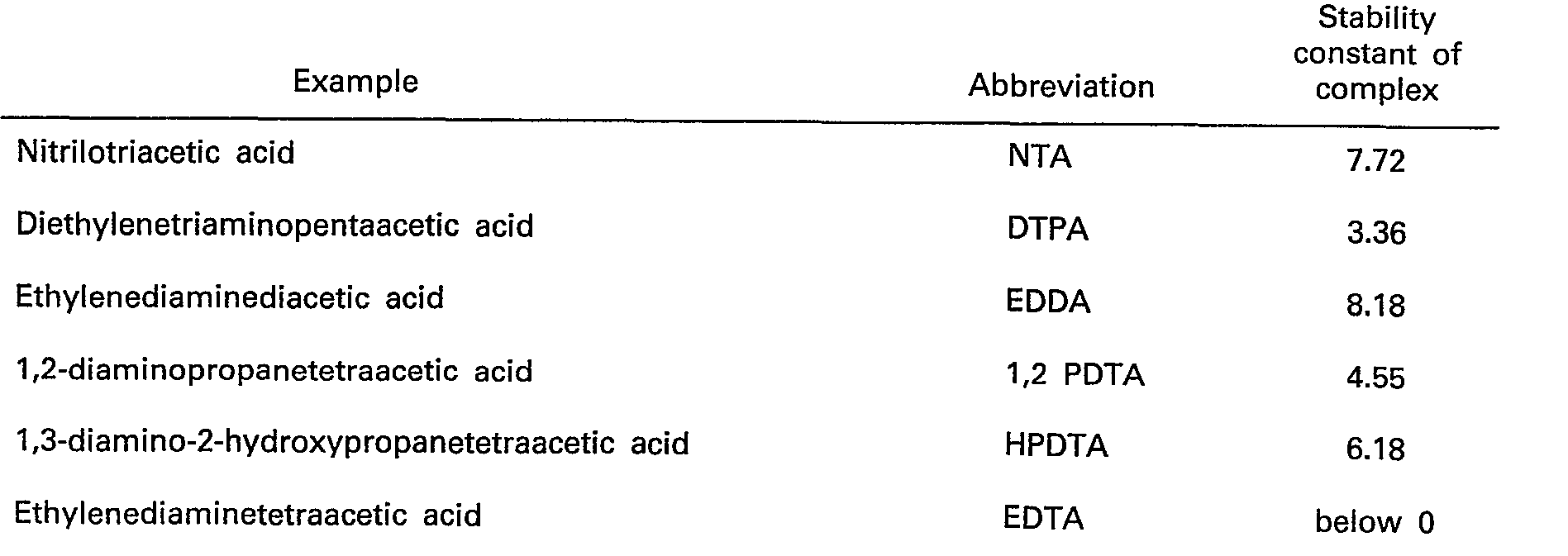
- It will be recognised that the stability constant can have a negative value. It is preferable to select complexing agents which form complexes that have as low a value as possible of the stability constant. In consequence, preferred complexing agents form complexes, the stability constant for which is below 8 such as DTPA and especially preferred complexing agents form complexes the stability constant for which has a negative value, such as EDTA.
-

- When unsuitable complexing agents are used, such as those above-exemplified or others such as ethylene-diaminotetramethylenephosphonic acid, the residual cyanide content is markedly higher, often an order of magnitude or greater than when using the selected complexing agents according to the present invention under practical working conditions.
- In the course of the investigation, it was found that the extent of detoxification increases as the mole ratio of complexing agent to metal is increased until a mole ratio of 1:1 is attained and thereafter gradually decreases. Thus, it is preferable for the mole ratio of complexing agent:metal to be selected within the range of 0.6:1 to 2:1 and especially from 0.8:1 to 1.5:1. In many instances the complexing agent:metal mole ratio will be 1:1 (+/- 5%).
- It is preferable to employ at least a stoichiometric amount of hydrogen peroxide, i.e. a mole ratio of H202:CN- of at least 1:1. In practice, the mole ratio is usually selected within the range of from 1.5:1 1 to 5:1, and in many instances the mole ratio is selected in the range of 2:1 to 3:1. Although it is possible to introduce the hydrogen peroxide in a single addition, more effective utilisation of the hydrogen peroxide can be achieved under many circumstances if it is introduced either in a plurality of incremental additions, for example 3 or 4 times at intervals during the reaction period often substantially regularly, or by progressively introducing the reagent throughout all or the greater part of the reaction period, such as 50-80% or by some combination in which, for example, part of the hydrogen peroxide is introduced initially and the remainder is introduced progressively.
- Although it is possible to carry out the reaction in the absence of added copper catalyst, it is preferable that a catalytic amount of a copper salt is employed, taking advantage of the fact that the copper catalyst is believed to act by forming a copper cyanide complex which reacts with the hydrogen peroxide. In fact, it has been found that the acceleration of the rate increased by the addition of a copper salt to other metal cyanide complexes complements the enhanced extent of detoxification obtained by addition of the complexing agent. Indeed the addition of the suitable complexing agents enhances even the detoxification of copper cyanide complexes. As a consequence, it is desirable for the cyanide solutions to contain at least 10 ppm copper. If insufficient copper is present it can be added, preferably to a concentration of from 50 to 200 ppm copper, advantageously in the form of a readily water soluble cupric salt, such as cupric sulphate, cupric chloride, cupric nitrate or cupric acetate. Higher concentrations of copper, even in the region of 1000 to 10000 ppm can be present in this process, but it will be recognised that if the detoxified solution is to be discharged into a watercourse, subsequent removal of the copper for example using an ion exchange resin should preferably be carried out.
- In practice, it is desirable to maintain the aqueous alkaline cyanide solution at a pH greater than that at which hydrogen cyanide gas is evolved, so that a pH of at least pH 9 and often in the range of from pH 9.5 to pH 12 is normally selected. A convenient pH is often at around pH 10.
- The pH of the alkaline solution can be controlled by conventional means, e.g. by linking a pH electrode to control the introduction of an aqueous alkali such as sodium hydroxide solution, should the solution fall below a predetermined pH, such as pH 9.5.
- The process of the present invention is well suited to the treatment of metal cyanides complexes in which the complex has the formula M(CN)42- where M represents the metal. Specific examples of such complexes include nickel and the group 1B (i.e. copper, silver, gold) cyanide complexes.
- The process of the present invention is especially suitable for the detoxification of comparatively concentrated solutions of the metal cyanide. Such solutions often have a content of at least 4000 ppm cyanide and for example at least 1000 or 2000 ppm nickel or other metal such as copper. In consequence, the present invention is of particular value in the detoxification of nickel stripping solution, which in many cases have a nickel content in the range of from 3000 to 7000 ppm and the cyanide content in the range of from 1000 to 4000 ppm. Such stripping solutions often contain very high concentrations, such as 25000 to 30000 ppm, of sodium meta-dinitrobenzenesulphonate which renders impractical the detoxification of such solutions with hypochlorite or by electrolysis. The sulphonate appears to have no detrimental effect, in a process according to the present invention. Copper cyanide solutions which can be treated effectively in the present invention typically contain copper in the range of 2000 to 10000 ppm and cyanide 4000 to 20000 ppm.
- It will be readily understood, that although the process of the present invention is extremely well suited for treating concentrations of cyanide within the aforementioned ranges, higher concentrations can be treated merely by employing the appropriate mole ratio of complexing agent to metal and hydrogen peroxide to cyanide, but in preference also dividing the hydrogen peroxide addition into a slightly larger number of incremental additions. Naturally, the present invention copes with lower concentrations of metal and cyanide of e.g. 500 to 1000 ppm nickel or copper without undue difficulty.
- The reaction between the metal cyanide and hydrogen peroxide is exothermic. It is preferable to maintain the cyanide solution after introduction of the hydrogen peroxide at a temperature of not greater than 70°C, and especially from 60 to 70°C and it will be recognised that cooling of the solution may be needed. It will be recognised that the extent of cooling is dependent on the initial concentration of cyanide in the solution and on the mode of introduction of the hydrogen peroxide, i.e. whether it is single stage or incremental or progressive. The reaction time depends at least partly upon the residual concentration of cyanide in the solution that can be tolerated by the user of the invention process. Broadly speaking, the extent of detoxification continues to increase with the effluxion of time. It is desirable to employ a reaction period of at least 30 minutes, and in practice the reaction period is often at least 60 minutes, in many cases being up to 150 minutes. It will be understood, though, that a reaction period in excess of 150 minutes can be employed, if desired, and can continue to show an increase in detoxification, especially where the complexing agent used forms a metal complex which has a stability constant at the upper end of the range, for example in the range of from 4 to 9.5, such as NTA or EDDA.
- Having described the invention in general terms, specific embodiments will be described hereinafter more fully by way of example only.
- In the Examples and comparisons, the concentrations of nickel were determined in most cases by a standard atomic absorption spectrophotometric technique and in the remaining measurements by difference between the total cyanide and free cyanide measurements. The cyanide concentrations were measured as described in "Standard Methods for the Examination of Water and Waste Water" (13th Edition) published by the American Public Health Association et al. Comparisons are designated by the prefix C.
- In each of the Examples and comparisons, C1 to C15, for the detoxification of nickel cyanide, and C16to 19 for the detoxification of copper cyanide, a sample (100-200 ml) of solution having the characteristics shown in the Table below was introduced into a reaction vessel into which thereafter first, the specified complexing agent was introduced in a mole ratio to nickel specified in the Table as mole ratio CA:Ni or CA:Cu respectively and then copper sulphate was introduced into the nickel cyanide solutions, but not into the copper cyanide solutions, to give a concentration as Cu of 100 ppm, except in Example 6 and comparison C1, where no copper was present. In each case, the pH of the solution was then adjusted to and maintained at pH 10 by introduction of caustic soda as required, during the incremental addition of hydrogen peroxide to a total amount of the latter expressed in the Table as a mole ratio of H202:CN. The hydrogen peroxide was introduced in the form of the standard 35% by weight aqueous solution commercially available from Interox Chemicals Limited. In all the Examples and comparisons except Example 9 the hydrogen peroxide solution was added in three equal portions at 30 minute intervals and in Example 9 the hydrogen peroxide was added in four equal portions, again at 30 minute intervals. The residual cyanide content of the solution was measured 30 minutes after the final portion of hydrogen peroxide had been introduced and the result is expressed in the Table both as measured and as a percentage of the initial total cyanide content.
- The complexing agents are referred to by their initials and the key to them will be found in the text hereinbefore, with the exception of EDTMPA in comparison C4 which is ethylenediaminetetramethylene- phosphonic acid, hexapotassium salt. In each of comparisons C5 and C7 and Examples 6, 8, 9, 10 and 11, the cyanide solution contained sodium meta-dinitrobenzenesulphonate at an initial concentration in excess of 20000 ppm.

- From the Table above, it will be observed that a marked improvement was obtained using complexing agents NTA, DTPA, and EDTA in a mole ratio to metal according to the present invention but that if the mole ratio to metal was outside the range specified, then the improvement in residual cyanide was markedly less. Similarly, it will be observed that complexing agents IDA, CDTA and EDTMPA produced markedly inferior results to using complexing agents selected according to the present invention. Thirdly, it will be observed that the residual content of cyanide in solution was not affected to a great extent by the initial ratio of metal to total cyanide in the solution. Fourthly, it will be seen that the use of the complexing agents without copper catalyst agents for detoxifying nickel cyanide, could provide a result of similar quality to that provided by a copper catalyst, but that addition of a copper catalyst led to an accelerated removal of cyanide from solution. Finally it can be seen that a mole ratio of hydrogen peroxide to cyanide of 2.5 to 1 gave better detoxification than if a mole ratio of 1.5 to 1 was used.
Claims (14)
Applications Claiming Priority (2)
| Application Number | Priority Date | Filing Date | Title |
|---|---|---|---|
| GB8039829 | 1980-12-12 | ||
| GB8039829 | 1980-12-12 |
Publications (2)
| Publication Number | Publication Date |
|---|---|
| EP0054371A1 EP0054371A1 (en) | 1982-06-23 |
| EP0054371B1 true EP0054371B1 (en) | 1985-03-27 |
Family
ID=10517934
Family Applications (1)
| Application Number | Title | Priority Date | Filing Date |
|---|---|---|---|
| EP81305619A Expired EP0054371B1 (en) | 1980-12-12 | 1981-11-27 | Process for detoxification |
Country Status (3)
| Country | Link |
|---|---|
| US (1) | US4417987A (en) |
| EP (1) | EP0054371B1 (en) |
| DE (1) | DE3169600D1 (en) |
Families Citing this family (9)
| Publication number | Priority date | Publication date | Assignee | Title |
|---|---|---|---|---|
| US4512900A (en) * | 1983-12-13 | 1985-04-23 | International Business Machines Corporation | Method for treating waste compositions |
| US4743381A (en) * | 1987-07-01 | 1988-05-10 | Fmc Corporation | Process for oxidizing a cyanide compound |
| US4822496A (en) * | 1988-08-18 | 1989-04-18 | Degussa Aktiengesellschaft | Process for the treatment of effluent containing cyanide and toxic metals, using hydrogen peroxide and trimercaptotriazine |
| US5364605A (en) * | 1991-06-05 | 1994-11-15 | Fmc Corporation | Recovery of cyanide from precious metal tailings |
| US5137642A (en) * | 1992-01-21 | 1992-08-11 | Fmc Corporation | Detoxification of aqueous cyanide solutions |
| USH1661H (en) * | 1994-08-30 | 1997-07-01 | The United States Of America As Represented By The Secretary Of The Navy | Ion exchange removal of cations under chelating/complexing conditions |
| DE19536955C1 (en) * | 1995-10-04 | 1997-01-09 | Fichtel & Sachs Ag | Chain changer for bicycles |
| DE19646553A1 (en) * | 1996-10-29 | 1998-04-30 | Delta Umwelt Technik Gmbh | Catalytic wet oxidation of organic or inorganic contaminants |
| JP2017042722A (en) * | 2015-08-27 | 2017-03-02 | Adeka総合設備株式会社 | Chemical substance decomposition composition and chemical substance decomposition method |
Family Cites Families (7)
| Publication number | Priority date | Publication date | Assignee | Title |
|---|---|---|---|---|
| US3505217A (en) * | 1968-05-03 | 1970-04-07 | Enthone | Process for the destruction of cyanide in waste solutions |
| US3617567A (en) * | 1969-05-15 | 1971-11-02 | Du Pont | Destruction of cyanide in aqueous solutions |
| US3682701A (en) * | 1970-02-12 | 1972-08-08 | Lancy Lab | Integrated waste water treatment for reusage after cyanide type plating |
| US3617582A (en) * | 1970-03-02 | 1971-11-02 | Du Pont | Process for detoxifying cyanide waste waters |
| JPS516462B2 (en) * | 1972-01-10 | 1976-02-27 | ||
| US3788983A (en) * | 1972-01-26 | 1974-01-29 | Rohm & Haas | Selective separation of cyanide from waste streams by adsorption process |
| DE2352856C3 (en) * | 1973-10-22 | 1978-09-28 | Deutsche Gold- Und Silber-Scheideanstalt Vormals Roessler, 6000 Frankfurt | Process for the detoxification of waste water containing cyanides and / or cyanohydrins and / or nitriles |
-
1981
- 1981-11-27 DE DE8181305619T patent/DE3169600D1/en not_active Expired
- 1981-11-27 EP EP81305619A patent/EP0054371B1/en not_active Expired
- 1981-12-07 US US06/328,109 patent/US4417987A/en not_active Expired - Lifetime
Also Published As
| Publication number | Publication date |
|---|---|
| DE3169600D1 (en) | 1985-05-02 |
| EP0054371A1 (en) | 1982-06-23 |
| US4417987A (en) | 1983-11-29 |
Similar Documents
| Publication | Publication Date | Title |
|---|---|---|
| US4455287A (en) | Method of stabilizing chelated polyvalent metal solutions | |
| AU647254B2 (en) | A process for the detoxification of cyanide-containing aqueous solutions | |
| US4512900A (en) | Method for treating waste compositions | |
| EP0166557B1 (en) | Process for waste treatment | |
| CA1037166A (en) | Process for detoxicating cyanides and nitriles with peroxygen compounds | |
| US4615873A (en) | Treatment of cyanide-ferrocyanide effluents | |
| US4417987A (en) | Process for detoxification | |
| US4822496A (en) | Process for the treatment of effluent containing cyanide and toxic metals, using hydrogen peroxide and trimercaptotriazine | |
| US5482694A (en) | Regeneration of cyanide by oxidation of thiocyanate | |
| US4915849A (en) | Process for the treatment of effluents containing cyanide and other oxidizable substances | |
| US5137642A (en) | Detoxification of aqueous cyanide solutions | |
| DE4110056A1 (en) | METHOD FOR DETOXIFYING AQUEOUS SOLUTIONS CONTAINING CYANHYDRINE AND / OR NITRILE | |
| US5397482A (en) | Treatment of cyanides in effluents with Caro's acid | |
| US5676846A (en) | Process for the detoxification of effluents containing free or complexed cyanides | |
| US4176060A (en) | Process for soluble cyanide removal from wastewater streams | |
| EP0465447B1 (en) | Process for the production of chlorine dioxide | |
| GB1571261A (en) | Process for purifying phenol containing effluents | |
| WO1990015026A1 (en) | Process for reduction of hexavalent chromium | |
| US5178775A (en) | Cost effective process for detoxification of cyanide-containing effluents | |
| US5686057A (en) | Selective oxidation of hydrogen sulfide in molten sulfur | |
| US5569386A (en) | Method for controlling the detoxification of cyanidic waste waters | |
| US6355179B1 (en) | Decomposition of residual hydroxylamine by hydrogen peroxide treatment | |
| AU2001270369B2 (en) | Method for treating aqueous streams containing low valent sulfur compounds | |
| JPH05337476A (en) | Cyan compound treatment method | |
| JP2001269674A (en) | Treatment of wastewater containing cyanide |
Legal Events
| Date | Code | Title | Description |
|---|---|---|---|
| PUAI | Public reference made under article 153(3) epc to a published international application that has entered the european phase |
Free format text: ORIGINAL CODE: 0009012 |
|
| AK | Designated contracting states |
Designated state(s): BE DE FR GB IT NL |
|
| 17P | Request for examination filed |
Effective date: 19821130 |
|
| ITF | It: translation for a ep patent filed | ||
| GRAA | (expected) grant |
Free format text: ORIGINAL CODE: 0009210 |
|
| AK | Designated contracting states |
Designated state(s): BE DE FR GB IT NL |
|
| REF | Corresponds to: |
Ref document number: 3169600 Country of ref document: DE Date of ref document: 19850502 |
|
| ET | Fr: translation filed | ||
| PLBI | Opposition filed |
Free format text: ORIGINAL CODE: 0009260 |
|
| 26 | Opposition filed |
Opponent name: DEGUSSA AG, FRANKFURT - ZWEIGNIEDERLASSUNG WOLFGAN Effective date: 19851217 |
|
| NLR1 | Nl: opposition has been filed with the epo |
Opponent name: DEGUSSA AG |
|
| PLBN | Opposition rejected |
Free format text: ORIGINAL CODE: 0009273 |
|
| STAA | Information on the status of an ep patent application or granted ep patent |
Free format text: STATUS: OPPOSITION REJECTED |
|
| 27O | Opposition rejected |
Effective date: 19871010 |
|
| NLR2 | Nl: decision of opposition | ||
| REG | Reference to a national code |
Ref country code: FR Ref legal event code: CA |
|
| ITTA | It: last paid annual fee | ||
| PGFP | Annual fee paid to national office [announced via postgrant information from national office to epo] |
Ref country code: GB Payment date: 19961004 Year of fee payment: 16 |
|
| PGFP | Annual fee paid to national office [announced via postgrant information from national office to epo] |
Ref country code: FR Payment date: 19961029 Year of fee payment: 16 |
|
| PGFP | Annual fee paid to national office [announced via postgrant information from national office to epo] |
Ref country code: BE Payment date: 19961030 Year of fee payment: 16 |
|
| PGFP | Annual fee paid to national office [announced via postgrant information from national office to epo] |
Ref country code: NL Payment date: 19961130 Year of fee payment: 16 |
|
| PGFP | Annual fee paid to national office [announced via postgrant information from national office to epo] |
Ref country code: DE Payment date: 19970127 Year of fee payment: 16 |
|
| PG25 | Lapsed in a contracting state [announced via postgrant information from national office to epo] |
Ref country code: GB Free format text: LAPSE BECAUSE OF NON-PAYMENT OF DUE FEES Effective date: 19971127 |
|
| PG25 | Lapsed in a contracting state [announced via postgrant information from national office to epo] |
Ref country code: FR Free format text: THE PATENT HAS BEEN ANNULLED BY A DECISION OF A NATIONAL AUTHORITY Effective date: 19971130 Ref country code: BE Free format text: LAPSE BECAUSE OF NON-PAYMENT OF DUE FEES Effective date: 19971130 |
|
| BERE | Be: lapsed |
Owner name: INTEROX CHEMICALS LTD Effective date: 19971130 |
|
| PG25 | Lapsed in a contracting state [announced via postgrant information from national office to epo] |
Ref country code: NL Free format text: LAPSE BECAUSE OF NON-PAYMENT OF DUE FEES Effective date: 19980601 |
|
| GBPC | Gb: european patent ceased through non-payment of renewal fee |
Effective date: 19971127 |
|
| PG25 | Lapsed in a contracting state [announced via postgrant information from national office to epo] |
Ref country code: DE Free format text: LAPSE BECAUSE OF NON-PAYMENT OF DUE FEES Effective date: 19980801 |
|
| NLV4 | Nl: lapsed or anulled due to non-payment of the annual fee |
Effective date: 19980601 |
|
| REG | Reference to a national code |
Ref country code: FR Ref legal event code: ST |