EP0051573A2 - A sewing machine for fancy seams - Google Patents
A sewing machine for fancy seams Download PDFInfo
- Publication number
- EP0051573A2 EP0051573A2 EP81850199A EP81850199A EP0051573A2 EP 0051573 A2 EP0051573 A2 EP 0051573A2 EP 81850199 A EP81850199 A EP 81850199A EP 81850199 A EP81850199 A EP 81850199A EP 0051573 A2 EP0051573 A2 EP 0051573A2
- Authority
- EP
- European Patent Office
- Prior art keywords
- counter
- memory
- stitch
- code
- sewing machine
- Prior art date
- Legal status (The legal status is an assumption and is not a legal conclusion. Google has not performed a legal analysis and makes no representation as to the accuracy of the status listed.)
- Granted
Links
- 238000009958 sewing Methods 0.000 title claims abstract description 20
- 230000002441 reversible effect Effects 0.000 claims abstract description 5
- 239000004744 fabric Substances 0.000 claims description 2
- 230000007246 mechanism Effects 0.000 claims 3
- 238000010586 diagram Methods 0.000 description 5
- 230000006870 function Effects 0.000 description 3
- 238000000034 method Methods 0.000 description 1
- 230000035515 penetration Effects 0.000 description 1
- 230000000750 progressive effect Effects 0.000 description 1
Images

Classifications
-
- G—PHYSICS
- G05—CONTROLLING; REGULATING
- G05B—CONTROL OR REGULATING SYSTEMS IN GENERAL; FUNCTIONAL ELEMENTS OF SUCH SYSTEMS; MONITORING OR TESTING ARRANGEMENTS FOR SUCH SYSTEMS OR ELEMENTS
- G05B19/00—Programme-control systems
- G05B19/02—Programme-control systems electric
- G05B19/18—Numerical control [NC], i.e. automatically operating machines, in particular machine tools, e.g. in a manufacturing environment, so as to execute positioning, movement or co-ordinated operations by means of programme data in numerical form
- G05B19/408—Numerical control [NC], i.e. automatically operating machines, in particular machine tools, e.g. in a manufacturing environment, so as to execute positioning, movement or co-ordinated operations by means of programme data in numerical form characterised by data handling or data format, e.g. reading, buffering or conversion of data
-
- D—TEXTILES; PAPER
- D05—SEWING; EMBROIDERING; TUFTING
- D05B—SEWING
- D05B19/00—Programme-controlled sewing machines
- D05B19/02—Sewing machines having electronic memory or microprocessor control unit
- D05B19/04—Sewing machines having electronic memory or microprocessor control unit characterised by memory aspects
- D05B19/10—Arrangements for selecting combinations of stitch or pattern data from memory ; Handling data in order to control stitch format, e.g. size, direction, mirror image
-
- G—PHYSICS
- G05—CONTROLLING; REGULATING
- G05B—CONTROL OR REGULATING SYSTEMS IN GENERAL; FUNCTIONAL ELEMENTS OF SUCH SYSTEMS; MONITORING OR TESTING ARRANGEMENTS FOR SUCH SYSTEMS OR ELEMENTS
- G05B2219/00—Program-control systems
- G05B2219/30—Nc systems
- G05B2219/35—Nc in input of data, input till input file format
- G05B2219/35554—Mirror, other conversions
-
- G—PHYSICS
- G05—CONTROLLING; REGULATING
- G05B—CONTROL OR REGULATING SYSTEMS IN GENERAL; FUNCTIONAL ELEMENTS OF SUCH SYSTEMS; MONITORING OR TESTING ARRANGEMENTS FOR SUCH SYSTEMS OR ELEMENTS
- G05B2219/00—Program-control systems
- G05B2219/30—Nc systems
- G05B2219/36—Nc in input of data, input key till input tape
- G05B2219/36233—Convert program so that it can be executed in reverse order
-
- G—PHYSICS
- G05—CONTROLLING; REGULATING
- G05B—CONTROL OR REGULATING SYSTEMS IN GENERAL; FUNCTIONAL ELEMENTS OF SUCH SYSTEMS; MONITORING OR TESTING ARRANGEMENTS FOR SUCH SYSTEMS OR ELEMENTS
- G05B2219/00—Program-control systems
- G05B2219/30—Nc systems
- G05B2219/36—Nc in input of data, input key till input tape
- G05B2219/36558—Forward and backward reading of tape, reverse execution program
-
- G—PHYSICS
- G05—CONTROLLING; REGULATING
- G05B—CONTROL OR REGULATING SYSTEMS IN GENERAL; FUNCTIONAL ELEMENTS OF SUCH SYSTEMS; MONITORING OR TESTING ARRANGEMENTS FOR SUCH SYSTEMS OR ELEMENTS
- G05B2219/00—Program-control systems
- G05B2219/30—Nc systems
- G05B2219/45—Nc applications
- G05B2219/45195—Sewing machines
Definitions
- the present invention relates to a sewing machine for the sewing of fancy seams.
- a sewing machine with electronic pattern data circuits for the generation of signals converted into movements of the stitch forming instrumentalities of the machine, utilizing the so-called seam element principle by storing stitch data in an electronic memory, is described in a prior patent publication no. 7905423-5.
- This memory the stitch memory, determines the shape of every seam element which usually comprises a plurality of stitches.
- another memory is required in this machine to determine for each fancy seam the sequence of seam elements which form the fancy seam to be sewn. This second memory is called a seam instruction list.
- the seam element principle allows different variations of addressing in a memory unit of the type related to, in order to perform seam elements of a special shape.
- it is offered a possibility of further utilizing the stored information and hence to save capacity by conditionally making reflections of the seam element as for example in a coordinate system from one quadrant to the other. Every stored seam element can thus, besides its normal shape, be carried out into three reflected images.
- the purpose of the invention is to obtain an improvement of the pattern data circuits according to the said publication, whereby the normal shape of the stored seam element is completed with reflected shapes of the same.
- the solution of the problem of making such reflected elements is developed from an electronic counter for addressing in the stitch memory.
- an address counter which is stepped by a pulse in synchronism with the motion of the machine, i.e. the counter releases the code words of every one of the stitches from the memory in a progressive sequence.
- FIG. 1 examples of seam elements and their reflected images
- Fig. 2 examples of backwards addressed seam element with reflected images
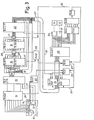
- Fig. 3 a wiring diagram of an electronic system in a sewing machine
- Fig. 4 a wiring diagram of an address counter.
- FIG. 3 A block diagram of the electronic system according to the invention is shown in Fig. 3 which includes a simple picture of a sewing machine 10 with a pattern selection device with seam selection keys 11 and a pre-selector 12 in the form of a plug-in unit.
- the function blocks in the diagram are standard circuits of the TTL-technics (transistor-transistor logic) and are marked by type numbers which refer to a conventional numbering system of TTL-circuits. The description of the functioning of each of these standard circuits reads as follows:
- the code on the A-input will pass the selector to the output and further via a wire group 18 to an address counter 19.
- This one is pre-adjustable so that the code on the group 18 in the presence of a signal on a trigger input 20 sets the counter on the digital number represented by the code.
- the address code goes further on a wire group 21 to a seam instruction list 22 in which the address word points out a memory cell storing the seam element code of the first seam element of the selected seam.
- the seam element code is fed via a wire group 23 to the B-input of another address counter 34 provided with a shift input 25 activated by a control circuit 26, 27 controlled by an output 28 of the encoder 14. So far the proceeding in the system is the same as the prior one described in the said publication. The rest of the system in Fig. 3 is different from the previously described one and shall now be described in detail.
- Addressing in a stitch memory 29 can be carried out in several ways and the technique is substantially the same as addressing in the seam instruction list 22.
- the counter 24 is like the counter 19 pre-adjustable so that the code on the group 23 in the presence of a signal on the trigger input 25 adjusts the counter to the digital number represented by the code.
- the trigger input is connected to the control circuit 26, 27 which gives a signal of locking the code on the group 23 the locking of which, however, ceases when a pulse from the position indicator 13 makes a change in the control circuits.
- the output of the counter supplies an address to the stitch memory 29 in which a memory cell is then activated and emits a stitch code to positioning the needle and the cloth feeder.
- the first stitch of a selected seam element is carried out when the memory cell with the code of the first needle penetration is pointed out by said stitch address, and the first stitch code is then supplied on a pair of groups 30, 31.
- the counter steps forwards under control by the circuits 26, 27 and provides the address to the next memory cell in the seam element to be sewn from which cell a code of the position of the next stitch will come.
- At the end of the seam element there is a memory cell storing a seam element end code which via an inverter and gates comes through a wire 32 to the counting control function in the counter 19.
- To the digital number on which the counter was formerly pre-set is now added a logical "1".
- the new address code which then is supplied to the group 21 is the sum of the former code and "1".
- This new code points out another cell in the seam instruction list and the code of that cell is fed to the inputs of the address counter 24.
- Another stitch address is then present on the output which points out a cell in the stitch memory 29.
- the contents of this cell constitutes the code of the first stitch of the second seam element of a selected seam. Henceforth all the stitches of the second seam element are sewn by means of the operating units 24 and 29 as formerly was the case in the first seam element.
- the end of the seam element is marked by an end code on the wire 32 as described before.
- Fig. 2 shows the patterns corresponding to the seam elements in Fig. 1 obtained by a backward addressing in the stitch memory.
- the elements shown in Fig. 1 are a) the normal shape, b) reflected in the X-axis, c) reflected in the Y-axis, d) reflected in both the X-axis and Y-axis.
- the element is shown a) backwards, b) backwards and reflected in the X-axis, c) backwards and reflected in the Y-axis and d) backwards and reflected in both the X- and Y-axis.
- An arrow on all elements shows the feed direction when sewing the element.
- the elements in the figures have in pairs the same shape, i.e. la and 2d but the feed direction of one element is opposite to that of the other.
- the feeding direction is essential when sewing a plurality of seam elements, one after another and for sewing a pattern combination of for example the seam elements la and lc, it is necessary to substitute 2d for la as the feeding direction must be the same during the sewing of the two elements (i.e.
- lc is obtained by backwards addressing by a reversed feeding and an inversion "left to right" of the needle's zig-zag positions.
- a reversed feeding and an inversion "left to right” can be carried out in a well-known manner by inverting the codes on the groups 31 and 30 respectively by means of inverters 33, 34.
Landscapes
- Engineering & Computer Science (AREA)
- Human Computer Interaction (AREA)
- Manufacturing & Machinery (AREA)
- Physics & Mathematics (AREA)
- General Physics & Mathematics (AREA)
- Automation & Control Theory (AREA)
- Computer Hardware Design (AREA)
- Microelectronics & Electronic Packaging (AREA)
- Textile Engineering (AREA)
- Sewing Machines And Sewing (AREA)
Abstract
Description
- The present invention relates to a sewing machine for the sewing of fancy seams. A sewing machine with electronic pattern data circuits for the generation of signals converted into movements of the stitch forming instrumentalities of the machine, utilizing the so-called seam element principle by storing stitch data in an electronic memory, is described in a prior patent publication no. 7905423-5. This memory, the stitch memory, determines the shape of every seam element which usually comprises a plurality of stitches. Besides, another memory is required in this machine to determine for each fancy seam the sequence of seam elements which form the fancy seam to be sewn. This second memory is called a seam instruction list.
- The seam element principle allows different variations of addressing in a memory unit of the type related to, in order to perform seam elements of a special shape. In a similar way, like saving memory capacity by dividing the fancy seams into seam elements as described in said publication, it is offered a possibility of further utilizing the stored information and hence to save capacity by conditionally making reflections of the seam element as for example in a coordinate system from one quadrant to the other. Every stored seam element can thus, besides its normal shape, be carried out into three reflected images.
- The purpose of the invention is to obtain an improvement of the pattern data circuits according to the said publication, whereby the normal shape of the stored seam element is completed with reflected shapes of the same. The solution of the problem of making such reflected elements is developed from an electronic counter for addressing in the stitch memory. When sewing the normal shape of the seam element the successive needle positions are determined by addressing in the memory by an address counter which is stepped by a pulse in synchronism with the motion of the machine, i.e. the counter releases the code words of every one of the stitches from the memory in a progressive sequence. In order to make a reflected shape of the normal seam element the successive needle positions are addressed backwards by the address counter so that the stitch to be sewn last normally now is sewn first and so on, until finally the stitch to be sewn first normally now is sewn last. A feature of the machine like that is obtained when it is provided with the characterizing arrangements defined in Claim 1.
- An embodiment of a sewing machine provided with electronic data circuits with the said feature is described in the following with reference to the attached drawing which shows in Fig. 1 examples of seam elements and their reflected images, in Fig. 2 examples of backwards addressed seam element with reflected images, in Fig. 3 a wiring diagram of an electronic system in a sewing machine, and in Fig. 4 a wiring diagram of an address counter.
- A block diagram of the electronic system according to the invention is shown in Fig. 3 which includes a simple picture of a
sewing machine 10 with a pattern selection device withseam selection keys 11 and a pre-selector 12 in the form of a plug-in unit. On the upper arm shaft of the machine there is aposition indicator 13 which by electric pulses indicates the angle position of the shaft during a revolution of the machine and supplies these pulses to a gate. The function blocks in the diagram are standard circuits of the TTL-technics (transistor-transistor logic) and are marked by type numbers which refer to a conventional numbering system of TTL-circuits. The description of the functioning of each of these standard circuits reads as follows: - Circuit no. 74 148 Encoder. It gives a unique 3-bits code to every one of the 8 inputs being earthed. Furthermore, it gives a signal on a separate output when one of the inputs is earthed.
- Circuit no. 74
S 278 Read-only memory. 5-bits input makes 4x8=32 different addresses. Each address makes an 8-bits word on the output. - Circuit no. 74 157 Address selector. It selects one of the input groups A and B and puts it to the output. If B is not selected A is. Every
circuit 74 157 can deal with 4 bits. - Circuit no. 74 191. A 4-bits counter. It can be pre-adjusted to the desired 4-bits code.
- Circuit no. 74
S 471 Read-only memory. 8 bits make 256 addresses. Each address gives an 8-bits word on the output. - Circuit no. 74 121 Monostable flip-flop. It gives a pulse out when the input is a logical "1".
- Circuit no. 74
LS 169 Reversible counter. It can be pre-adjusted on a desired 4-bits code and has an input related to forward/backward counting which for a logical "1" makes it count forwards and for a logical "0" makes it count backwards. - Circuit no. 7432 A logic OR-gate.
- Circuit no. 7430 A logic 8-bits NAND-gate.
- Circuit no. 7404 An inverter.
- A great deal of the electronic system is closer described in the aforesaid patent publication which describes the proceeding in the diagram for a selected seam element in the normal shape. For the sake of completeness the proceeding is here repeated in brief. When the operator pushes a
key 11, one of the inputs of theencoder 14 is earthed and a unique 3-bits code is fed to astart address memory 15. This one has also a 2-bits input from the pre-selector 12 which together with the unique 3-bits code forms a so-called seam selection code. This code releases an address word in the start address memory which is put on a wire group A (7 bits) to the A-inputs of anadress selector 16. If no shift signal is present on theshift input 17 of the selector, the code on the A-input will pass the selector to the output and further via awire group 18 to anaddress counter 19. This one is pre-adjustable so that the code on thegroup 18 in the presence of a signal on atrigger input 20 sets the counter on the digital number represented by the code. The address code goes further on awire group 21 to aseam instruction list 22 in which the address word points out a memory cell storing the seam element code of the first seam element of the selected seam. The seam element code is fed via awire group 23 to the B-input of anotheraddress counter 34 provided with ashift input 25 activated by acontrol circuit output 28 of theencoder 14. So far the proceeding in the system is the same as the prior one described in the said publication. The rest of the system in Fig. 3 is different from the previously described one and shall now be described in detail. - Addressing in a
stitch memory 29 can be carried out in several ways and the technique is substantially the same as addressing in theseam instruction list 22. Thecounter 24 is like thecounter 19 pre-adjustable so that the code on thegroup 23 in the presence of a signal on thetrigger input 25 adjusts the counter to the digital number represented by the code. The trigger input is connected to thecontrol circuit group 23 the locking of which, however, ceases when a pulse from theposition indicator 13 makes a change in the control circuits. The output of the counter supplies an address to thestitch memory 29 in which a memory cell is then activated and emits a stitch code to positioning the needle and the cloth feeder. The first stitch of a selected seam element is carried out when the memory cell with the code of the first needle penetration is pointed out by said stitch address, and the first stitch code is then supplied on a pair ofgroups 30, 31. After each cycle of the machine the counter steps forwards under control by thecircuits wire 32 to the counting control function in thecounter 19. To the digital number on which the counter was formerly pre-set is now added a logical "1". The new address code which then is supplied to thegroup 21 is the sum of the former code and "1". This new code points out another cell in the seam instruction list and the code of that cell is fed to the inputs of theaddress counter 24. Another stitch address is then present on the output which points out a cell in thestitch memory 29. The contents of this cell constitutes the code of the first stitch of the second seam element of a selected seam. Henceforth all the stitches of the second seam element are sewn by means of the operatingunits wire 32 as described before. - In the function description of the
counter 24 is stated that this one is reversible, i.e. it can step forwards as well as backwards. This will give a special feature to the system which implies that the number of possible patterns is essentially increased without the occupation of a greater memory capacity. The range of patterns thus enlarged is illustrated as examples in Fig. 2 which shows the patterns corresponding to the seam elements in Fig. 1 obtained by a backward addressing in the stitch memory. The elements shown in Fig. 1 are a) the normal shape, b) reflected in the X-axis, c) reflected in the Y-axis, d) reflected in both the X-axis and Y-axis. In Fig. 2 the element is shown a) backwards, b) backwards and reflected in the X-axis, c) backwards and reflected in the Y-axis and d) backwards and reflected in both the X- and Y-axis. An arrow on all elements shows the feed direction when sewing the element. The elements in the figures have in pairs the same shape, i.e. la and 2d but the feed direction of one element is opposite to that of the other. The feeding direction is essential when sewing a plurality of seam elements, one after another and for sewing a pattern combination of for example the seam elements la and lc, it is necessary to substitute 2d for la as the feeding direction must be the same during the sewing of the two elements (i.e. the arrows shall be directed in the same way). The same memory cells in the stitch memory are used: lc is obtained by backwards addressing by a reversed feeding and an inversion "left to right" of the needle's zig-zag positions. A reversed feeding and an inversion "left to right" can be carried out in a well-known manner by inverting the codes on thegroups 31 and 30 respectively by means ofinverters - All seams are sewn on instruction from the
seam instruction list 22, even the elements in the backward addressing. On awire 35 "1" and "0" are transferred to thecounter 24 which counts forward for "1" and backward for "0". The instruction on thegroup 23 is thus completed by the information on thewire 35, in other respects the addressing is carried out by analogy with the previously described system.
Claims (6)
Applications Claiming Priority (2)
| Application Number | Priority Date | Filing Date | Title |
|---|---|---|---|
| SE8007658 | 1980-10-30 | ||
| SE8007658A SE424202B (en) | 1980-10-30 | 1980-10-30 | SEWING MACHINE MACHINE |
Publications (3)
| Publication Number | Publication Date |
|---|---|
| EP0051573A2 true EP0051573A2 (en) | 1982-05-12 |
| EP0051573A3 EP0051573A3 (en) | 1984-03-21 |
| EP0051573B1 EP0051573B1 (en) | 1987-01-28 |
Family
ID=20342128
Family Applications (1)
| Application Number | Title | Priority Date | Filing Date |
|---|---|---|---|
| EP81850199A Expired EP0051573B1 (en) | 1980-10-30 | 1981-10-29 | A sewing machine for fancy seams |
Country Status (6)
| Country | Link |
|---|---|
| US (1) | US4399760A (en) |
| EP (1) | EP0051573B1 (en) |
| JP (1) | JPS57103672A (en) |
| AU (1) | AU549651B2 (en) |
| DE (1) | DE3175877D1 (en) |
| SE (1) | SE424202B (en) |
Cited By (2)
| Publication number | Priority date | Publication date | Assignee | Title |
|---|---|---|---|---|
| EP0418651A3 (en) * | 1989-09-11 | 1992-03-25 | Mitsubishi Denki Kabushiki Kaisha | Device for creating reverse stitching data for a sewing machine |
| AT1782U1 (en) * | 1996-10-15 | 1997-11-25 | Juki Middle Europ Gmbh | DEVICE FOR PRODUCING A SEAM AND A PRODUCTION CERTIFICATE |
Families Citing this family (5)
| Publication number | Priority date | Publication date | Assignee | Title |
|---|---|---|---|---|
| JPS5532517A (en) * | 1978-08-29 | 1980-03-07 | Janome Sewing Machine Co Ltd | Method of generating pattern of electric sewing machine |
| JPS6043149B2 (en) * | 1981-08-31 | 1985-09-26 | ブラザー工業株式会社 | programming device for sewing machine |
| JPS59111783A (en) * | 1982-12-15 | 1984-06-28 | 蛇の目ミシン工業株式会社 | Pattern generating system of computer sewing machine |
| JPS59207184A (en) * | 1983-05-11 | 1984-11-24 | 蛇の目ミシン工業株式会社 | Control of electronic sewing machine |
| US4499838A (en) * | 1984-09-04 | 1985-02-19 | The Singer Company | Pattern data storage by equations in an electronically controlled sewing machine |
Family Cites Families (8)
| Publication number | Priority date | Publication date | Assignee | Title |
|---|---|---|---|---|
| JPS473877U (en) * | 1971-02-01 | 1972-09-07 | ||
| BR7606135A (en) * | 1975-09-17 | 1977-06-14 | Singer Co | SEWING MACHINE STANDARD SELECTION SYSTEM |
| GB1567513A (en) * | 1976-05-14 | 1980-05-14 | Sharp Kk | Programmable stitch pattern forming control in an electronic sewing machine |
| JPS5818110B2 (en) * | 1976-12-27 | 1983-04-11 | 蛇の目ミシン工業株式会社 | Sewing machine backstitch device |
| JPS588873B2 (en) * | 1977-04-04 | 1983-02-17 | 蛇の目ミシン工業株式会社 | Electronic control device for pattern sewing machine |
| JPS581954B2 (en) * | 1977-12-12 | 1983-01-13 | アイシン精機株式会社 | Electronic sewing machine pattern signal generator |
| DD136402A1 (en) * | 1978-05-02 | 1979-07-04 | Wolfgang Schwarz | ELECTRONICALLY CONTROLLED KNITTING MACHINE, ESPECIALLY CIRCULAR KNITTING MACHINE, WITH ELECTROMAGNETIC PATTERN SELECTION |
| SE419993B (en) * | 1979-06-20 | 1981-09-07 | Husqvarna Ab | SEWING MACHINE FOR SUMMER OF MONSTER SUMMER |
-
1980
- 1980-10-30 SE SE8007658A patent/SE424202B/en not_active IP Right Cessation
-
1981
- 1981-10-14 AU AU76336/81A patent/AU549651B2/en not_active Ceased
- 1981-10-23 US US06/314,362 patent/US4399760A/en not_active Expired - Fee Related
- 1981-10-29 EP EP81850199A patent/EP0051573B1/en not_active Expired
- 1981-10-29 JP JP56172182A patent/JPS57103672A/en active Granted
- 1981-10-29 DE DE8181850199T patent/DE3175877D1/en not_active Expired
Cited By (3)
| Publication number | Priority date | Publication date | Assignee | Title |
|---|---|---|---|---|
| EP0418651A3 (en) * | 1989-09-11 | 1992-03-25 | Mitsubishi Denki Kabushiki Kaisha | Device for creating reverse stitching data for a sewing machine |
| US5153840A (en) * | 1989-09-11 | 1992-10-06 | Mitsubishi Denki K.K. | Device for creating reverse stitching data for a sewing machine |
| AT1782U1 (en) * | 1996-10-15 | 1997-11-25 | Juki Middle Europ Gmbh | DEVICE FOR PRODUCING A SEAM AND A PRODUCTION CERTIFICATE |
Also Published As
| Publication number | Publication date |
|---|---|
| US4399760A (en) | 1983-08-23 |
| DE3175877D1 (en) | 1987-03-05 |
| EP0051573A3 (en) | 1984-03-21 |
| JPH0113397B2 (en) | 1989-03-06 |
| JPS57103672A (en) | 1982-06-28 |
| SE424202B (en) | 1982-07-05 |
| EP0051573B1 (en) | 1987-01-28 |
| AU549651B2 (en) | 1986-02-06 |
| AU7633681A (en) | 1982-05-06 |
| SE8007658L (en) | 1982-05-01 |
Similar Documents
| Publication | Publication Date | Title |
|---|---|---|
| US3872808A (en) | Sewing machine stitch pattern selection from data stored in a multiple pattern static memory | |
| US3855956A (en) | Sewing machine stitch pattern generation from stitch data stored in static memory | |
| US4446520A (en) | Process of preparing and processing sewing data for an automatic sewing machine | |
| US4369722A (en) | Control system for a plurality of embroidery sewing machines | |
| US4742786A (en) | Data processing system for sewing machine | |
| EP0147087B1 (en) | Embroidery machine | |
| US4242973A (en) | Sewing machine with electronic patterning system | |
| US4200048A (en) | Electronic sewing machine | |
| US4116144A (en) | Stitch pattern forming control in a sewing machine | |
| GB2073445A (en) | Automatic sewing machine | |
| EP0051573B1 (en) | A sewing machine for fancy seams | |
| US4345532A (en) | Electronic sewing machine with back stitching system | |
| GB2068145A (en) | Automatic sewing machine | |
| US4389954A (en) | Electronic sewing machine | |
| GB2026724A (en) | Formation of variable width cutting space buttonhole patterns in an electronically controlled sewing machine | |
| US4108093A (en) | Pattern stitching speed control system for electronic sewing machines | |
| US4144827A (en) | Expanded entry for programmable memory of a sewing machine | |
| US4522137A (en) | Method of producing stitch patterns in an electronic sewing machine | |
| EP0031312A2 (en) | Electronic sewing machine with a sewing guide | |
| US4108091A (en) | Electronic circuits for sewing machines | |
| US4187789A (en) | Sewing machine with an electronic pattern stitch control system | |
| US4674420A (en) | Embroidery machine control device having means to input new character patterns into a pre-programmed series of patterns | |
| US4389953A (en) | Sewing machine for sewing fancy seams | |
| US4381721A (en) | Electronic sewing machine | |
| US4599962A (en) | Electronic sewing machine |
Legal Events
| Date | Code | Title | Description |
|---|---|---|---|
| PUAI | Public reference made under article 153(3) epc to a published international application that has entered the european phase |
Free format text: ORIGINAL CODE: 0009012 |
|
| AK | Designated contracting states |
Designated state(s): CH DE FR GB IT |
|
| 17P | Request for examination filed |
Effective date: 19821108 |
|
| PUAL | Search report despatched |
Free format text: ORIGINAL CODE: 0009013 |
|
| AK | Designated contracting states |
Designated state(s): CH DE FR GB IT LI |
|
| GRAA | (expected) grant |
Free format text: ORIGINAL CODE: 0009210 |
|
| AK | Designated contracting states |
Kind code of ref document: B1 Designated state(s): CH DE FR GB IT LI |
|
| REF | Corresponds to: |
Ref document number: 3175877 Country of ref document: DE Date of ref document: 19870305 |
|
| ITF | It: translation for a ep patent filed | ||
| ET | Fr: translation filed | ||
| PLBE | No opposition filed within time limit |
Free format text: ORIGINAL CODE: 0009261 |
|
| STAA | Information on the status of an ep patent application or granted ep patent |
Free format text: STATUS: NO OPPOSITION FILED WITHIN TIME LIMIT |
|
| 26N | No opposition filed | ||
| PGFP | Annual fee paid to national office [announced via postgrant information from national office to epo] |
Ref country code: FR Payment date: 19901012 Year of fee payment: 10 |
|
| PGFP | Annual fee paid to national office [announced via postgrant information from national office to epo] |
Ref country code: GB Payment date: 19901019 Year of fee payment: 10 |
|
| ITTA | It: last paid annual fee | ||
| PGFP | Annual fee paid to national office [announced via postgrant information from national office to epo] |
Ref country code: CH Payment date: 19901102 Year of fee payment: 10 |
|
| PGFP | Annual fee paid to national office [announced via postgrant information from national office to epo] |
Ref country code: DE Payment date: 19901130 Year of fee payment: 10 |
|
| PG25 | Lapsed in a contracting state [announced via postgrant information from national office to epo] |
Ref country code: GB Effective date: 19911029 |
|
| PG25 | Lapsed in a contracting state [announced via postgrant information from national office to epo] |
Ref country code: LI Effective date: 19911031 Ref country code: CH Effective date: 19911031 |
|
| GBPC | Gb: european patent ceased through non-payment of renewal fee | ||
| PG25 | Lapsed in a contracting state [announced via postgrant information from national office to epo] |
Ref country code: FR Effective date: 19920630 |
|
| REG | Reference to a national code |
Ref country code: CH Ref legal event code: PL |
|
| PG25 | Lapsed in a contracting state [announced via postgrant information from national office to epo] |
Ref country code: DE Effective date: 19920701 |
|
| REG | Reference to a national code |
Ref country code: FR Ref legal event code: ST |