EP0049155B1 - Production of silane modified copolymers of alkylene-alkyl acrylates, polysiloxanes having combined therein organo titanates used in their production, process for producing such polysiloxanes, and electrical conductors insulated by cured silane modified copolymers - Google Patents
Production of silane modified copolymers of alkylene-alkyl acrylates, polysiloxanes having combined therein organo titanates used in their production, process for producing such polysiloxanes, and electrical conductors insulated by cured silane modified copolymers Download PDFInfo
- Publication number
- EP0049155B1 EP0049155B1 EP81304496A EP81304496A EP0049155B1 EP 0049155 B1 EP0049155 B1 EP 0049155B1 EP 81304496 A EP81304496 A EP 81304496A EP 81304496 A EP81304496 A EP 81304496A EP 0049155 B1 EP0049155 B1 EP 0049155B1
- Authority
- EP
- European Patent Office
- Prior art keywords
- polysiloxane
- titanate
- carbon atoms
- silane
- atoms inclusive
- Prior art date
- Legal status (The legal status is an assumption and is not a legal conclusion. Google has not performed a legal analysis and makes no representation as to the accuracy of the status listed.)
- Expired
Links
Classifications
-
- H—ELECTRICITY
- H01—ELECTRIC ELEMENTS
- H01B—CABLES; CONDUCTORS; INSULATORS; SELECTION OF MATERIALS FOR THEIR CONDUCTIVE, INSULATING OR DIELECTRIC PROPERTIES
- H01B3/00—Insulators or insulating bodies characterised by the insulating materials; Selection of materials for their insulating or dielectric properties
- H01B3/18—Insulators or insulating bodies characterised by the insulating materials; Selection of materials for their insulating or dielectric properties mainly consisting of organic substances
- H01B3/30—Insulators or insulating bodies characterised by the insulating materials; Selection of materials for their insulating or dielectric properties mainly consisting of organic substances plastics; resins; waxes
- H01B3/46—Insulators or insulating bodies characterised by the insulating materials; Selection of materials for their insulating or dielectric properties mainly consisting of organic substances plastics; resins; waxes silicones
-
- C—CHEMISTRY; METALLURGY
- C08—ORGANIC MACROMOLECULAR COMPOUNDS; THEIR PREPARATION OR CHEMICAL WORKING-UP; COMPOSITIONS BASED THEREON
- C08G—MACROMOLECULAR COMPOUNDS OBTAINED OTHERWISE THAN BY REACTIONS ONLY INVOLVING UNSATURATED CARBON-TO-CARBON BONDS
- C08G81/00—Macromolecular compounds obtained by interreacting polymers in the absence of monomers, e.g. block polymers
- C08G81/02—Macromolecular compounds obtained by interreacting polymers in the absence of monomers, e.g. block polymers at least one of the polymers being obtained by reactions involving only carbon-to-carbon unsaturated bonds
-
- A—HUMAN NECESSITIES
- A61—MEDICAL OR VETERINARY SCIENCE; HYGIENE
- A61K—PREPARATIONS FOR MEDICAL, DENTAL OR TOILETRY PURPOSES
- A61K36/00—Medicinal preparations of undetermined constitution containing material from algae, lichens, fungi or plants, or derivatives thereof, e.g. traditional herbal medicines
- A61K36/18—Magnoliophyta (angiosperms)
- A61K36/185—Magnoliopsida (dicotyledons)
- A61K36/68—Plantaginaceae (Plantain Family)
-
- A—HUMAN NECESSITIES
- A61—MEDICAL OR VETERINARY SCIENCE; HYGIENE
- A61K—PREPARATIONS FOR MEDICAL, DENTAL OR TOILETRY PURPOSES
- A61K9/00—Medicinal preparations characterised by special physical form
- A61K9/14—Particulate form, e.g. powders, Processes for size reducing of pure drugs or the resulting products, Pure drug nanoparticles
- A61K9/16—Agglomerates; Granulates; Microbeadlets ; Microspheres; Pellets; Solid products obtained by spray drying, spray freeze drying, spray congealing,(multiple) emulsion solvent evaporation or extraction
- A61K9/1605—Excipients; Inactive ingredients
- A61K9/1629—Organic macromolecular compounds
- A61K9/1635—Organic macromolecular compounds obtained by reactions only involving carbon-to-carbon unsaturated bonds, e.g. polyvinyl pyrrolidone, poly(meth)acrylates
-
- A—HUMAN NECESSITIES
- A61—MEDICAL OR VETERINARY SCIENCE; HYGIENE
- A61K—PREPARATIONS FOR MEDICAL, DENTAL OR TOILETRY PURPOSES
- A61K9/00—Medicinal preparations characterised by special physical form
- A61K9/14—Particulate form, e.g. powders, Processes for size reducing of pure drugs or the resulting products, Pure drug nanoparticles
- A61K9/16—Agglomerates; Granulates; Microbeadlets ; Microspheres; Pellets; Solid products obtained by spray drying, spray freeze drying, spray congealing,(multiple) emulsion solvent evaporation or extraction
- A61K9/1605—Excipients; Inactive ingredients
- A61K9/1629—Organic macromolecular compounds
- A61K9/1641—Organic macromolecular compounds obtained otherwise than by reactions only involving carbon-to-carbon unsaturated bonds, e.g. polyethylene glycol, poloxamers
-
- A—HUMAN NECESSITIES
- A61—MEDICAL OR VETERINARY SCIENCE; HYGIENE
- A61K—PREPARATIONS FOR MEDICAL, DENTAL OR TOILETRY PURPOSES
- A61K9/00—Medicinal preparations characterised by special physical form
- A61K9/48—Preparations in capsules, e.g. of gelatin, of chocolate
- A61K9/50—Microcapsules having a gas, liquid or semi-solid filling; Solid microparticles or pellets surrounded by a distinct coating layer, e.g. coated microspheres, coated drug crystals
- A61K9/5005—Wall or coating material
- A61K9/5021—Organic macromolecular compounds
- A61K9/5026—Organic macromolecular compounds obtained by reactions only involving carbon-to-carbon unsaturated bonds, e.g. polyvinyl pyrrolidone, poly(meth)acrylates
-
- A—HUMAN NECESSITIES
- A61—MEDICAL OR VETERINARY SCIENCE; HYGIENE
- A61K—PREPARATIONS FOR MEDICAL, DENTAL OR TOILETRY PURPOSES
- A61K9/00—Medicinal preparations characterised by special physical form
- A61K9/48—Preparations in capsules, e.g. of gelatin, of chocolate
- A61K9/50—Microcapsules having a gas, liquid or semi-solid filling; Solid microparticles or pellets surrounded by a distinct coating layer, e.g. coated microspheres, coated drug crystals
- A61K9/5005—Wall or coating material
- A61K9/5021—Organic macromolecular compounds
- A61K9/5031—Organic macromolecular compounds obtained otherwise than by reactions only involving carbon-to-carbon unsaturated bonds, e.g. polyethylene glycol, poly(lactide-co-glycolide)
-
- C—CHEMISTRY; METALLURGY
- C07—ORGANIC CHEMISTRY
- C07F—ACYCLIC, CARBOCYCLIC OR HETEROCYCLIC COMPOUNDS CONTAINING ELEMENTS OTHER THAN CARBON, HYDROGEN, HALOGEN, OXYGEN, NITROGEN, SULFUR, SELENIUM OR TELLURIUM
- C07F7/00—Compounds containing elements of Groups 4 or 14 of the Periodic Table
- C07F7/02—Silicon compounds
- C07F7/08—Compounds having one or more C—Si linkages
- C07F7/18—Compounds having one or more C—Si linkages as well as one or more C—O—Si linkages
- C07F7/1804—Compounds having Si-O-C linkages
-
- C—CHEMISTRY; METALLURGY
- C08—ORGANIC MACROMOLECULAR COMPOUNDS; THEIR PREPARATION OR CHEMICAL WORKING-UP; COMPOSITIONS BASED THEREON
- C08F—MACROMOLECULAR COMPOUNDS OBTAINED BY REACTIONS ONLY INVOLVING CARBON-TO-CARBON UNSATURATED BONDS
- C08F8/00—Chemical modification by after-treatment
- C08F8/42—Introducing metal atoms or metal-containing groups
-
- C—CHEMISTRY; METALLURGY
- C08—ORGANIC MACROMOLECULAR COMPOUNDS; THEIR PREPARATION OR CHEMICAL WORKING-UP; COMPOSITIONS BASED THEREON
- C08G—MACROMOLECULAR COMPOUNDS OBTAINED OTHERWISE THAN BY REACTIONS ONLY INVOLVING UNSATURATED CARBON-TO-CARBON BONDS
- C08G77/00—Macromolecular compounds obtained by reactions forming a linkage containing silicon with or without sulfur, nitrogen, oxygen or carbon in the main chain of the macromolecule
- C08G77/60—Macromolecular compounds obtained by reactions forming a linkage containing silicon with or without sulfur, nitrogen, oxygen or carbon in the main chain of the macromolecule in which all the silicon atoms are connected by linkages other than oxygen atoms
-
- C—CHEMISTRY; METALLURGY
- C08—ORGANIC MACROMOLECULAR COMPOUNDS; THEIR PREPARATION OR CHEMICAL WORKING-UP; COMPOSITIONS BASED THEREON
- C08G—MACROMOLECULAR COMPOUNDS OBTAINED OTHERWISE THAN BY REACTIONS ONLY INVOLVING UNSATURATED CARBON-TO-CARBON BONDS
- C08G81/00—Macromolecular compounds obtained by interreacting polymers in the absence of monomers, e.g. block polymers
- C08G81/02—Macromolecular compounds obtained by interreacting polymers in the absence of monomers, e.g. block polymers at least one of the polymers being obtained by reactions involving only carbon-to-carbon unsaturated bonds
- C08G81/024—Block or graft polymers containing sequences of polymers of C08C or C08F and of polymers of C08G
-
- C—CHEMISTRY; METALLURGY
- C08—ORGANIC MACROMOLECULAR COMPOUNDS; THEIR PREPARATION OR CHEMICAL WORKING-UP; COMPOSITIONS BASED THEREON
- C08L—COMPOSITIONS OF MACROMOLECULAR COMPOUNDS
- C08L83/00—Compositions of macromolecular compounds obtained by reactions forming in the main chain of the macromolecule a linkage containing silicon with or without sulfur, nitrogen, oxygen or carbon only; Compositions of derivatives of such polymers
- C08L83/16—Compositions of macromolecular compounds obtained by reactions forming in the main chain of the macromolecule a linkage containing silicon with or without sulfur, nitrogen, oxygen or carbon only; Compositions of derivatives of such polymers in which all the silicon atoms are connected by linkages other than oxygen atoms
-
- H—ELECTRICITY
- H01—ELECTRIC ELEMENTS
- H01B—CABLES; CONDUCTORS; INSULATORS; SELECTION OF MATERIALS FOR THEIR CONDUCTIVE, INSULATING OR DIELECTRIC PROPERTIES
- H01B3/00—Insulators or insulating bodies characterised by the insulating materials; Selection of materials for their insulating or dielectric properties
- H01B3/18—Insulators or insulating bodies characterised by the insulating materials; Selection of materials for their insulating or dielectric properties mainly consisting of organic substances
- H01B3/30—Insulators or insulating bodies characterised by the insulating materials; Selection of materials for their insulating or dielectric properties mainly consisting of organic substances plastics; resins; waxes
- H01B3/44—Insulators or insulating bodies characterised by the insulating materials; Selection of materials for their insulating or dielectric properties mainly consisting of organic substances plastics; resins; waxes vinyl resins; acrylic resins
-
- H—ELECTRICITY
- H01—ELECTRIC ELEMENTS
- H01B—CABLES; CONDUCTORS; INSULATORS; SELECTION OF MATERIALS FOR THEIR CONDUCTIVE, INSULATING OR DIELECTRIC PROPERTIES
- H01B3/00—Insulators or insulating bodies characterised by the insulating materials; Selection of materials for their insulating or dielectric properties
- H01B3/18—Insulators or insulating bodies characterised by the insulating materials; Selection of materials for their insulating or dielectric properties mainly consisting of organic substances
- H01B3/30—Insulators or insulating bodies characterised by the insulating materials; Selection of materials for their insulating or dielectric properties mainly consisting of organic substances plastics; resins; waxes
- H01B3/44—Insulators or insulating bodies characterised by the insulating materials; Selection of materials for their insulating or dielectric properties mainly consisting of organic substances plastics; resins; waxes vinyl resins; acrylic resins
- H01B3/441—Insulators or insulating bodies characterised by the insulating materials; Selection of materials for their insulating or dielectric properties mainly consisting of organic substances plastics; resins; waxes vinyl resins; acrylic resins from alkenes
Definitions
- This application relates to the production of silane modified copolymers of alkylene-alkyl acrylates, by the reaction of a polysiloxane and an alkylene-alkyl acrylate copolymer, which can be extruded about electrical conductors and water-cured, if so desired, to crosslinked products, providing insulation about electrical conductors which is characterized by improved surface characteristics. More particularly, this invention relates to polysiloxanes having combined therein an organo titanate and the use thereof in the production of silane modified copolymers of alkylene-alkyl acrylates.
- Silane modified copolymers of alkylene-alkyl acrylates and a process for the preparation thereof by reacting a mixture containing a silane and an alkylene-alkyl acrylate copolymer are described in detail in European Patent Serial No 4752.
- the Silane modified copolymers, as described in that patent, can be extruded about electrical conductors such as wire and cable and water-cured to crosslinked products to provide insulation thereon of excellent quality.
- silane modified alkylene-alkyl acrylate copolymers It is customary, prior to extruding silane modified alkylene-alkyl acrylate copolymers about wire and cable, to ensure removal therefrom of undesirable volatiles.
- the presence of undesirable volatiles could lead to the formation of voids in the extruded insulation, marring the appearance of the final insulated product and, in some instances, shortening its working life.
- removal of undesirable volatiles from the silane modified copolymers reduces odor problems at the extruder and in the insulated wire or cable.
- removal of volatiles from the silane modified copolymers by a subsequent devolatilization step after the preparation of the copolymers, increases the time required to produce an insulated product and, also, increases the overall cost thereof.
- the present invention provides for the production of silane modified copolymers of alkylene-alkyl acrylates which are free of undesirable volatiles and consequently need not be subjected to a subsequent devolatilization step.
- the silane modified copolymers, prepared in accordance with the present invention can be directly extruded about wires and cables and water-cured to crosslinked products to provide insulation thereon, free of undesirable voids and odors.
- a silane modified copolymer is produced by reacting a mixture containing an alkylene-alkyl acrylate copolymer and a polysiloxane containing repeating units of the formula: wherein R is a hydrocarbon radical; each V, which can be the same or different, is hydrogen, a hydrocarbon radical or a hydrolyzable group; Z is a hydrolyzable group; n is an integer having a value of one to 18 inclusive and x is an integer having a value of at least 2, generally 2 to 1000 inclusive, preferably 5 to 25 inclusive.
- Suitable hydrocarbon radicals for R are alkylene radicals having one to 18 carbon atoms inclusive, preferably one to 6 carbon atoms inclusive, such as methylene, ethylene, propylene, butylene, and hexylene.
- each V can be hydrogen, a hydrocarbon radical or a hydrolyzable group.
- suitable hydrocarbon radicals are alkyl radicals having one to 18 carbon radicals, preferably one to 6 carbon atoms inclusive such as methyl, ethyl, n-propyl, isopropyl, n-butyl, and n-hexyl; alkoxy radicals having one to 18 carbon atoms inclusive, preferably one to 6 carbon atoms inclusive, such as methoxy, ethoxy, propoxy, hexoxy, dodecyloxy, and methoxyethoxy; aryl radicals having 6 to 8 carbon atoms inclusive such as phenyl, methyl phenyl, and ethyl phenyl; and cycloaliphatic radicals having 5 to 8 carbon atoms inclusive such as cyclopentyl, cyclohexyl, and cyclohexyloxy.
- Z is a hydrolyzable group among which can be noted alkoxy radicals having one to 18 carbon atoms inclusive, preferably one to 6 carbon atoms inclusive such as methyloxymethyl, methyloxypropyl, ethyloxyethyl, ethyloxypropyl, propyloxypropyl, propyloxybutyl and propyloxyhexyl; oxy aryl radicals such as oxyphenyl; oxyaliphatic radicals such as oxyhexyl; halogens such as chlorine, and other hydrolyzable groups as further described in U.S.-A-3,408,420 to John B. Wiggill patented October 29, 1968.
- Polysiloxanes having repeating units falling within the scope of Formula I can be prepared as described in U.S.-A-3,193,567 to Gerd Rossmy patented July 6, 1965 or by condensing and polymerizing a silane falling within the scope of Formula II in the presence of a metal carboxylate.
- suitable metal carboxylates can be noted dibutyltin dilaurate, stannous acetate, stannous octoate, lead naphthenate, zinc octoate, and iron 2-ethyl hexoate.
- Conditions employed for the production of polysiloxanes, reaction temperatures, amount of materials, etc, using metal carboxylates as catalysts are the same as subsequently described with respect to the use of organo titanates.
- R' is a hydrocarbon radical, as for example an alkyl radical having one to 18 carbon atoms inclusive, preferably one to four carbon atoms inclusive such as methyl, ethyl, n-propyl, isopropyl, and n-butyl; alkylene radicals having two to 18 carbon atoms inclusive, preferably two to 4 carbon atoms inclusive such as ethylene, and propylene; aryl radicals having six to ten carbon atoms inclusive such as phenyl, and benzyl. Other variable are as previously defined.
- silanes falling within the scope of Formula II are the following: acetooxyethyltrimethoxy silane acetooxyethyltriethoxy silane acetooxyethyl-tris-(2-methoxyethoxy) silane methacryloxyethyltrimethoxy silane a-methylacryloxypropyltriethoxy silane acetooxyethylmethyldimethoxy silane a-methacryloxypropyltrimethoxy silane acetooxypropyltrimethoxy silane acetooxypropyltriethoxy silane a-methacryloxypropyl-tris-(2-methoxyethoxy) silane
- Preferred polysiloxanes for purposes of this invention, contain repeating units falling within the scope of Formula I and have combined therein an organo titanate.
- the organo titanate modified polysiloxanes can be used as such, without the use of additional organo titanate catalyst, to react with the copolymers of alkylene-alkyl acrylate.
- the preferred polysiloxanes have a viscosity of from 0.05 to 15 Ns/m 2 (0.5 to 150 poise), preferably from 0.1 to 2 Nslm 2 (one to 20 poise) as determined by a Gardner-Holt bubble viscometer at a temperature of 25°C.
- Organo titanate modified polysiloxanes can be prepared by reacting a mixture containing a silane falling within the scope of Formula II with an organo titanate falling within the scope of Formula III.
- each R 2 which can be the same or different, is hydrogen or a hydrocarbon radical having one to 18 carbon atoms inclusive, preferably one to 14 carbon atoms inclusive.
- hydrocarbon radicals are alkyl radicals such as methyl, ethyl, n-propyl, isopropyl, butyl, octyl, lauryl, myristyl, and stearyl, cycloaliphatic radicals such as cyclopentyl, and cyclohexyl, aryl radicals such as phenyl, methylphenyl, and chlorophenyl; alkaryl radicals such as benzyl.
- alkyl radicals such as methyl, ethyl, n-propyl, isopropyl, butyl, octyl, lauryl, myristyl, and stearyl
- cycloaliphatic radicals such as cyclopentyl, and cyclohexyl
- aryl radicals such as phenyl, methylphenyl, and chlorophenyl
- alkaryl radicals such as benzyl.
- Particularly desirable titanates falling within the scope of Formula III are those wherein each R 2 is alkyl having one to 18 carbon atoms inclusive, preferably one to 14 carbon atoms inclusive, exemplified by tetrabutyl titanate, and tetraisopropyl titanate.
- Organo titanates falling within the scope of Formula III are known compounds and can be conveniently prepared as described in U.S.-A-2,984,641 to Leon E. Wolinski patented May 16,1961.
- organo titanates are the organo titanium chelates such as tetraoctylene glycol titanium, triethanol amine titanate, titanium acetyl acetonate, and titanium lactate.
- At least a catalytic amount of organo titanate is used to produce the organo titanate modified polysiloxanes, that is an amount sufficient to catalyze the condensation and polymerization reaction to produce a polysiloxane.
- the amount of organo titanate used is of the order of from O.D01 to 25 percent by weight based on the weight of the monomeric silane. It is preferred to use from 0.5 to 5 percent by weight of organo titanate based on the weight of the monomeric silane.
- the temperature at which the reaction is conducted can be varied over a wide range, for example from 0°C to 250°C. A temperature in the range of from 70°C to 130°C is preferred. Also the reaction can be conducted using a suitable solvent, illustrated by hydrocarbon solvents such as toluene, xylene, cumene, decaline, dodecane, and chlorobenzene.
- a suitable solvent illustrated by hydrocarbon solvents such as toluene, xylene, cumene, decaline, dodecane, and chlorobenzene.
- the reaction between the organo titanate and the monomeric silane can be conducted under atmospheric, subatmospheric or superatmospheric pressure. It is preferred to conduct the later stages of the reaction under subatmospheric pressure to allow for more facile removal of volatile by-products. Also, the reaction is preferably conducted under the atmosphere of an inert gas such as nitrogen or argon to avoid formation of a gel due to the water sensitivity of the product.
- an inert gas such as nitrogen or argon
- Control of the repeating unit, Formula I, of the polysiloxane can be effected by introducing an end blocker, as for example, a high boiling ester into the reaction mixture, at the beginning of the reaction or at any convenient point in the reaction process.
- an end blocker as for example, a high boiling ester
- the number of repeating units of the polysiloxane is equal to the mole ratio of the monomeric silane to the end blocker as exemplified by the following simplified reaction scheme wherein the silane is shown to be acetooxyethyltrimethoxy silane and the high boiling ester is shown to be methyl benzoate.
- Suitable end blockers have the general formula wherein each R 3 , which can be the same or different is a hydrocarbon radical as defined for R 2 .
- reaction is evidenced by cessation of the evolution of volatiles and the weight/ volume of volatiles collected as compared to the theoretical weight/volume.
- the reaction can be run to a desired viscosity level and the reactants cooled to stop the reaction.
- alkylene-alkyl acrylate copolymers with which the polysiloxanes are reacted to form the silane modifed copolymers are known copolymers produced by reacting an alkene with an alkyl acrylate.
- Suitable alkenes are ethylene, propylene, butene-1, isobutylene, pentene-1, 2-methylbutene-1, 3-methylbutene-1 hexene, heptene-1, octene-1, vinyl chloride, and styrene.
- the alkylene moiety of the alkylene-alkyl acrylate copolymer generally contains from 2 to 18 carbon atoms inclusive, preferably 2 to 3 carbon atoms inclusive.
- Suitable alkyl acrylate monomers which are copolymerized with the alkenes fall within the scope of the following formula: wherein R 4 is hydrogen or methyl and R 5 is alkyl having one to 8 carbon atoms inclusive.
- Illustrative compounds encompassed by this formula are: methyl acrylate, ethyl acrylate, t-butyl acrylate, methyl methacrylate, n-butylacrylate, n-butylmethacrylate, and 2-ethylhexyl acrylate.
- Alkylene-alkyl acrylate copolymers generally have a density (ASTM D 1505) with conditioning as in ASTM D 147-72) of from 0.92 to 0.94 kg/m 3 and a melt index (ASTM-1238 of 303 kPa - (44 psi) tested pressure) of from 0.83 to 834 mg/S (0.5 to 500 decigrams per minute).
- the preferred copolymer is a copolymer of ethylene-ethyl acrylate, generally having from one to 50 percent by weight combined ethyl acrylate, preferably having from 2 to 20 percent by weight combined ethyl acrylate.
- silane modified copolymer of an alkylene-alkyl acrylate is carried out by reacting a polysiloxane, as described, with a copolymer of an alkylene-alkyl acrylate in the presence of an organo titanate catalyst.
- additional organo titanate catalyst may not be necessary, especially when at least 0.5 percent by weight organo titanate, based on the weight of the monomeric silane, was used in the preparation of the polysiloxane.
- the amount of organo titanate catalyst added to the reaction mixture is a catalytic amount, sufficent to catalyze the reaction between the polysiloxane and the copolymer.
- a preferred amount is from 0.001 to 50 percent by weight, most preferably from 0.1 to 25 percent by weight based on the weight of the polysiloxane.
- the amount of polysiloxane used can vary from 0.05 to 10 and preferably from 0.3 to 5 percent by weight based on the weight of the copolymer.
- the temperature at which this reaction is carried out is not critical and can vary, conveniently, from 80°C to 300°C and preferably from 150°C to 230°C.
- the reaction can be carried out at atmospheric, subatmospheric or superatmospheric pressure, although atmospheric pressure is preferred and in the presence of solvents as previously described.
- Recovery of the silane modified copolymer is effected by allowing the contents of the reaction flask to cool and discharge to a suitable receiver for storage preferably under an inert gas blanket.
- the reaction can be carried out in any suitable apparatus, preferably an apparatus in which the copolymer is subjected to mechanical working such as a Brabender mixer, a Banbury mixer or an extruder.
- the polysiloxane can be added to the fluxed copolymer and the organo titanate, if needed, then added.
- the organo titanate, if needed, can be added to the copolymer prior to the addition of the polysiloxane.
- organo titanate and polysiloxane can be premixed and added to the fluxed polymer.
- the reaction between the alkylene-alkyl acrylate copolymer and the polysiloxane may be depicted by the following equation: wherein the variables are as previously defined and the silicon containing unit is present in an amount of at least 0.05 percent by weight, generally from 0.1 to 10 percent by weight and preferably from 0.3 to 5 percent by weight based on the total weight of the modified copolymer.
- the curing or crosslinking of the silane modified alkylene-alkyl acrylate copolymer is effected by exposing the copolymer to moisture.
- the moisture present in the atmosphere is usually sufficient to permit curing to occur over a period of 48 hours.
- the rate of curing in a matter of 30 minutes, can be accelerated by exposure to an artificially humidified atmosphere or immersion in water, and heating to elevated temperatures or by exposure to steam.
- curing is effected at temperatures of the order of from 23°C to 100°C, preferably from 70°C to 100°C.
- crosslinking may be carried out in the presence of a silanol condensation catalyst.
- a unique feature of this invention is that the crosslinking reaction can be carried out at significant rates in the absence of added silanol condensation catalyst.
- the organo titanate catalyst or catalyst residues present in the production of the silane modified copolymers also catalyze the crosslinking reaction.
- Such materials include metal carboxylates previously described; organic bases such as ethylamine, hexylamine dibutylamine and piperidine, and acids such as mineral acids and fatty acids.
- silane modified copolymers of this invention may be added various additives, in amounts well known in the art, such as fillers among which can be mentioned carbon black, clay, talc, magnesium silicate, calcium carbonate, silica, and aluminum hydroxide.
- fillers among which can be mentioned carbon black, clay, talc, magnesium silicate, calcium carbonate, silica, and aluminum hydroxide.
- the silane modified copolymers can be redered flame retardant by the addition thereto of halogen containing flame retardants such as decabromodiphenyl oxide, chlorinated polyethylene, polyvinyl chloride and halogenated paraffin waxes, alone, or in admixture with organic or inorganic antimony compounds such as antimony oxide and/or alkaline earth, metal oxides, carbonates, hydroxides and sulfates.
- organic or inorganic antimony compounds such as antimony oxide and/or alkaline earth, metal oxides, carbonates, hydroxides and sulfates.
- alkaline earth metal compounds can be noted calcium oxide, calcium carbonate, calcium hydroxide, calcium sulfate, magnesium oxide, magnesium carbonate, magnesium hydroxide and magnesium sulfate.
- reaction scheme for the preparation of the polysiloxane can be depicted as follows wherein the silane monomer was acetooxyethyltrimethoxy silane:
- n as 8-9 is consistent with viscosity of product and amount of volatiles recovered.
- the 5.80 gram mixture contained 97 percent by weight polysiloxane and 3 percent by weight dibutyltin dilaurate. After homogeneity was reached in the Brabender, as indicated by a constant torque measurement, 1.26 grams of tetraisopropyl titanate were added to the contents of the Brabender. The contents of the Brabender were then maintained at a temperature of 160-170°C for a period of 30 minutes resulting in a reaction whereby the silane reacted with the ethylene-ethyl acrylate copolymer evidenced by an increase in torque. Volatiles which evolved during the reaction were condensed in a dry ice trap which was connected to the Brabender. At the end of the 30 minute period, the contents of the Brabender were discharged into a polyethylene bag under an atmosphere of argon.
- the 8.84 gram mixture contained 97 percent by weight acetooxyethyltrimethoxy silane and 3 percent by weight dibutyltin dilaurate.
- 1.26 grams of tetraisopropyl titanate were added to the contents of the Brabender.
- the contents of the Brabender were then maintained at a temperature of 160-170°C for a period of thirty minutes resulting in a reaction whereby the silane reacted with the ethylene-ethyl acrylate copolymer.
- Volatiles which evolved during the reaction were condensed in a dry ice trap which was connected to the Brabender.
- the contents of the Brabender were discharged into a polyethylene bag under an atmosphere of argon.
- the plaques were cured by being suspended in water, which was at a temperature of 90°C, for three hours. After the three hour water-cure, the plaques were removed from the water, wiped dry and placed in a vacuum oven, which was at a temperature of 50°C, for one hour in order to ensure removal of residual water.
- This example illustrates the preparation of a polysiloxane using an end blocker.
- Example 3 was repeated using the same reactants, same molar amounts and same reaction conditions with the exception that acetooxyethylmethyldimethoxy silane was used as the monomeric silane. Viscosity of the product was 0.14 N S / M 2 (1.4 poise).
- silane modified copolymers of alkylene-alkyl acrylates although described primarily for use as insulation can also be used as jacketing about industrial cables telephone wires and cables.
Landscapes
- Health & Medical Sciences (AREA)
- Chemical & Material Sciences (AREA)
- Medicinal Chemistry (AREA)
- Organic Chemistry (AREA)
- Engineering & Computer Science (AREA)
- Life Sciences & Earth Sciences (AREA)
- Bioinformatics & Cheminformatics (AREA)
- Animal Behavior & Ethology (AREA)
- Epidemiology (AREA)
- General Health & Medical Sciences (AREA)
- Public Health (AREA)
- Veterinary Medicine (AREA)
- Chemical Kinetics & Catalysis (AREA)
- Polymers & Plastics (AREA)
- Pharmacology & Pharmacy (AREA)
- Natural Medicines & Medicinal Plants (AREA)
- Spectroscopy & Molecular Physics (AREA)
- Physics & Mathematics (AREA)
- General Chemical & Material Sciences (AREA)
- Alternative & Traditional Medicine (AREA)
- Biotechnology (AREA)
- Botany (AREA)
- Medical Informatics (AREA)
- Microbiology (AREA)
- Mycology (AREA)
- Silicon Polymers (AREA)
- Medicinal Preparation (AREA)
- Macromonomer-Based Addition Polymer (AREA)
- Addition Polymer Or Copolymer, Post-Treatments, Or Chemical Modifications (AREA)
- Medicines Containing Plant Substances (AREA)
- Pharmaceuticals Containing Other Organic And Inorganic Compounds (AREA)
- Other Resins Obtained By Reactions Not Involving Carbon-To-Carbon Unsaturated Bonds (AREA)
- Element Separation (AREA)
- Steroid Compounds (AREA)
Description
- This application relates to the production of silane modified copolymers of alkylene-alkyl acrylates, by the reaction of a polysiloxane and an alkylene-alkyl acrylate copolymer, which can be extruded about electrical conductors and water-cured, if so desired, to crosslinked products, providing insulation about electrical conductors which is characterized by improved surface characteristics. More particularly, this invention relates to polysiloxanes having combined therein an organo titanate and the use thereof in the production of silane modified copolymers of alkylene-alkyl acrylates.
- Water-curable, silane modified copolymers of alkylene-alkyl acrylates and a process for the preparation thereof by reacting a mixture containing a silane and an alkylene-alkyl acrylate copolymer are described in detail in European Patent Serial No 4752. The Silane modified copolymers, as described in that patent, can be extruded about electrical conductors such as wire and cable and water-cured to crosslinked products to provide insulation thereon of excellent quality.
- It is customary, prior to extruding silane modified alkylene-alkyl acrylate copolymers about wire and cable, to ensure removal therefrom of undesirable volatiles. The presence of undesirable volatiles could lead to the formation of voids in the extruded insulation, marring the appearance of the final insulated product and, in some instances, shortening its working life. In addition, removal of undesirable volatiles from the silane modified copolymers reduces odor problems at the extruder and in the insulated wire or cable. Obviously, removal of volatiles from the silane modified copolymers, by a subsequent devolatilization step after the preparation of the copolymers, increases the time required to produce an insulated product and, also, increases the overall cost thereof.
- The present invention provides for the production of silane modified copolymers of alkylene-alkyl acrylates which are free of undesirable volatiles and consequently need not be subjected to a subsequent devolatilization step. The silane modified copolymers, prepared in accordance with the present invention, can be directly extruded about wires and cables and water-cured to crosslinked products to provide insulation thereon, free of undesirable voids and odors.
- In one aspect of the present invention a silane modified copolymer is produced by reacting a mixture containing an alkylene-alkyl acrylate copolymer and a polysiloxane containing repeating units of the formula:

- Illustrative of suitable hydrocarbon radicals for R are alkylene radicals having one to 18 carbon atoms inclusive, preferably one to 6 carbon atoms inclusive, such as methylene, ethylene, propylene, butylene, and hexylene.
- As stated, each V can be hydrogen, a hydrocarbon radical or a hydrolyzable group. Illustrative of suitable hydrocarbon radicals are alkyl radicals having one to 18 carbon radicals, preferably one to 6 carbon atoms inclusive such as methyl, ethyl, n-propyl, isopropyl, n-butyl, and n-hexyl; alkoxy radicals having one to 18 carbon atoms inclusive, preferably one to 6 carbon atoms inclusive, such as methoxy, ethoxy, propoxy, hexoxy, dodecyloxy, and methoxyethoxy; aryl radicals having 6 to 8 carbon atoms inclusive such as phenyl, methyl phenyl, and ethyl phenyl; and cycloaliphatic radicals having 5 to 8 carbon atoms inclusive such as cyclopentyl, cyclohexyl, and cyclohexyloxy.
- Z, as previously stated, is a hydrolyzable group among which can be noted alkoxy radicals having one to 18 carbon atoms inclusive, preferably one to 6 carbon atoms inclusive such as methyloxymethyl, methyloxypropyl, ethyloxyethyl, ethyloxypropyl, propyloxypropyl, propyloxybutyl and propyloxyhexyl; oxy aryl radicals such as oxyphenyl; oxyaliphatic radicals such as oxyhexyl; halogens such as chlorine, and other hydrolyzable groups as further described in U.S.-A-3,408,420 to John B. Wiggill patented October 29, 1968.
- Polysiloxanes having repeating units falling within the scope of Formula I can be prepared as described in U.S.-A-3,193,567 to Gerd Rossmy patented July 6, 1965 or by condensing and polymerizing a silane falling within the scope of Formula II in the presence of a metal carboxylate. Among suitable metal carboxylates can be noted dibutyltin dilaurate, stannous acetate, stannous octoate, lead naphthenate, zinc octoate, and iron 2-ethyl hexoate. Conditions employed for the production of polysiloxanes, reaction temperatures, amount of materials, etc, using metal carboxylates as catalysts are the same as subsequently described with respect to the use of organo titanates.

- Exemplary of suitable silanes falling within the scope of Formula II are the following:


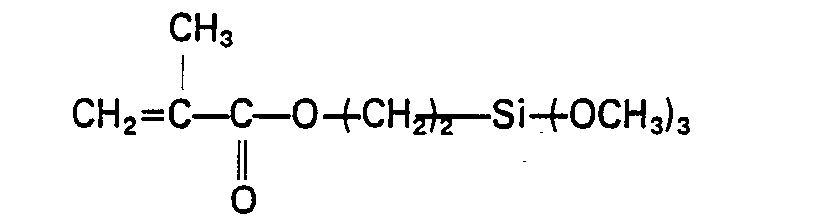





- Preferred polysiloxanes, for purposes of this invention, contain repeating units falling within the scope of Formula I and have combined therein an organo titanate. The organo titanate modified polysiloxanes can be used as such, without the use of additional organo titanate catalyst, to react with the copolymers of alkylene-alkyl acrylate.
- The preferred polysiloxanes have a viscosity of from 0.05 to 15 Ns/m2 (0.5 to 150 poise), preferably from 0.1 to 2 Nslm2 (one to 20 poise) as determined by a Gardner-Holt bubble viscometer at a temperature of 25°C.
- Organo titanate modified polysiloxanes can be prepared by reacting a mixture containing a silane falling within the scope of Formula II with an organo titanate falling within the scope of Formula III.

- Exemplary of suitable hydrocarbon radicals are alkyl radicals such as methyl, ethyl, n-propyl, isopropyl, butyl, octyl, lauryl, myristyl, and stearyl, cycloaliphatic radicals such as cyclopentyl, and cyclohexyl, aryl radicals such as phenyl, methylphenyl, and chlorophenyl; alkaryl radicals such as benzyl.
- Particularly desirable titanates falling within the scope of Formula III are those wherein each R2 is alkyl having one to 18 carbon atoms inclusive, preferably one to 14 carbon atoms inclusive, exemplified by tetrabutyl titanate, and tetraisopropyl titanate.
- Organo titanates falling within the scope of Formula III are known compounds and can be conveniently prepared as described in U.S.-A-2,984,641 to Leon E. Wolinski patented May 16,1961.
- Other suitable organo titanates are the organo titanium chelates such as tetraoctylene glycol titanium, triethanol amine titanate, titanium acetyl acetonate, and titanium lactate.
- At least a catalytic amount of organo titanate is used to produce the organo titanate modified polysiloxanes, that is an amount sufficient to catalyze the condensation and polymerization reaction to produce a polysiloxane. Generally, the amount of organo titanate used is of the order of from O.D01 to 25 percent by weight based on the weight of the monomeric silane. It is preferred to use from 0.5 to 5 percent by weight of organo titanate based on the weight of the monomeric silane.
- The temperature at which the reaction is conducted can be varied over a wide range, for example from 0°C to 250°C. A temperature in the range of from 70°C to 130°C is preferred. Also the reaction can be conducted using a suitable solvent, illustrated by hydrocarbon solvents such as toluene, xylene, cumene, decaline, dodecane, and chlorobenzene.
- The reaction between the organo titanate and the monomeric silane can be conducted under atmospheric, subatmospheric or superatmospheric pressure. It is preferred to conduct the later stages of the reaction under subatmospheric pressure to allow for more facile removal of volatile by-products. Also, the reaction is preferably conducted under the atmosphere of an inert gas such as nitrogen or argon to avoid formation of a gel due to the water sensitivity of the product.
- Control of the repeating unit, Formula I, of the polysiloxane can be effected by introducing an end blocker, as for example, a high boiling ester into the reaction mixture, at the beginning of the reaction or at any convenient point in the reaction process.
- The number of repeating units of the polysiloxane is equal to the mole ratio of the monomeric silane to the end blocker as exemplified by the following simplified reaction scheme wherein the silane is shown to be acetooxyethyltrimethoxy silane and the high boiling ester is shown to be methyl benzoate.

- Suitable end blockers have the general formula

- Completion of the reaction is evidenced by cessation of the evolution of volatiles and the weight/ volume of volatiles collected as compared to the theoretical weight/volume. Alternatively, the reaction can be run to a desired viscosity level and the reactants cooled to stop the reaction.
- The alkylene-alkyl acrylate copolymers with which the polysiloxanes are reacted to form the silane modifed copolymers are known copolymers produced by reacting an alkene with an alkyl acrylate.
- Suitable alkenes are ethylene, propylene, butene-1, isobutylene, pentene-1, 2-methylbutene-1, 3-methylbutene-1 hexene, heptene-1, octene-1, vinyl chloride, and styrene.
- The alkylene moiety of the alkylene-alkyl acrylate copolymer generally contains from 2 to 18 carbon atoms inclusive, preferably 2 to 3 carbon atoms inclusive.
- Suitable alkyl acrylate monomers which are copolymerized with the alkenes fall within the scope of the following formula:

- Alkylene-alkyl acrylate copolymers generally have a density (ASTM D 1505) with conditioning as in ASTM D 147-72) of from 0.92 to 0.94 kg/m3 and a melt index (ASTM-1238 of 303 kPa - (44 psi) tested pressure) of from 0.83 to 834 mg/S (0.5 to 500 decigrams per minute).
- For purpose of. the present invention, the preferred copolymer is a copolymer of ethylene-ethyl acrylate, generally having from one to 50 percent by weight combined ethyl acrylate, preferably having from 2 to 20 percent by weight combined ethyl acrylate.
- The production of a silane modified copolymer of an alkylene-alkyl acrylate is carried out by reacting a polysiloxane, as described, with a copolymer of an alkylene-alkyl acrylate in the presence of an organo titanate catalyst.
- In those instances wherein the polysiloxane contains combined organo titanate, additional organo titanate catalyst may not be necessary, especially when at least 0.5 percent by weight organo titanate, based on the weight of the monomeric silane, was used in the preparation of the polysiloxane.
- The amount of organo titanate catalyst added to the reaction mixture is a catalytic amount, sufficent to catalyze the reaction between the polysiloxane and the copolymer. A preferred amount is from 0.001 to 50 percent by weight, most preferably from 0.1 to 25 percent by weight based on the weight of the polysiloxane.
- The amount of polysiloxane used can vary from 0.05 to 10 and preferably from 0.3 to 5 percent by weight based on the weight of the copolymer.
- The temperature at which this reaction is carried out is not critical and can vary, conveniently, from 80°C to 300°C and preferably from 150°C to 230°C.
- The reaction can be carried out at atmospheric, subatmospheric or superatmospheric pressure, although atmospheric pressure is preferred and in the presence of solvents as previously described.
- Completion of the reaction is evidenced by measurement of no further viscosity change.
- Recovery of the silane modified copolymer is effected by allowing the contents of the reaction flask to cool and discharge to a suitable receiver for storage preferably under an inert gas blanket.
- The reaction can be carried out in any suitable apparatus, preferably an apparatus in which the copolymer is subjected to mechanical working such as a Brabender mixer, a Banbury mixer or an extruder. The polysiloxane can be added to the fluxed copolymer and the organo titanate, if needed, then added. Alternatively, the organo titanate, if needed, can be added to the copolymer prior to the addition of the polysiloxane. Also, organo titanate and polysiloxane can be premixed and added to the fluxed polymer.
- The reaction between the alkylene-alkyl acrylate copolymer and the polysiloxane may be depicted by the following equation:

- The curing or crosslinking of the silane modified alkylene-alkyl acrylate copolymer is effected by exposing the copolymer to moisture. The moisture present in the atmosphere is usually sufficient to permit curing to occur over a period of 48 hours.
- The rate of curing, in a matter of 30 minutes, can be accelerated by exposure to an artificially humidified atmosphere or immersion in water, and heating to elevated temperatures or by exposure to steam.
- Generally, curing is effected at temperatures of the order of from 23°C to 100°C, preferably from 70°C to 100°C.
- Additionally, the crosslinking may be carried out in the presence of a silanol condensation catalyst. A unique feature of this invention is that the crosslinking reaction can be carried out at significant rates in the absence of added silanol condensation catalyst. The organo titanate catalyst or catalyst residues present in the production of the silane modified copolymers also catalyze the crosslinking reaction.
- Alternatively, a wide variety of materials which function as silanol condensation catalysts and which are known in the art can be employed in the crosslinking process. Such materials include metal carboxylates previously described; organic bases such as ethylamine, hexylamine dibutylamine and piperidine, and acids such as mineral acids and fatty acids.
- To the silane modified copolymers of this invention may be added various additives, in amounts well known in the art, such as fillers among which can be mentioned carbon black, clay, talc, magnesium silicate, calcium carbonate, silica, and aluminum hydroxide.
- The silane modified copolymers can be redered flame retardant by the addition thereto of halogen containing flame retardants such as decabromodiphenyl oxide, chlorinated polyethylene, polyvinyl chloride and halogenated paraffin waxes, alone, or in admixture with organic or inorganic antimony compounds such as antimony oxide and/or alkaline earth, metal oxides, carbonates, hydroxides and sulfates. Among such alkaline earth metal compounds can be noted calcium oxide, calcium carbonate, calcium hydroxide, calcium sulfate, magnesium oxide, magnesium carbonate, magnesium hydroxide and magnesium sulfate.
- The following Examples further illustrate the present invention.
- The reaction scheme for the preparation of the polysiloxane can be depicted as follows wherein the silane monomer was acetooxyethyltrimethoxy silane:

- One hundred and four grams (0.5 mole) of acetooxyethyltrimethoxy silane were placed in a 250 ml. three-necked, round bottom flask and heated to a temperature of 75°C under a nitrogen gas atmosphere. When the contents of the flask reached a temperature of 75°C, 1.191 grams of tetraisopropyl titanate were added thereto using a syringe. The reaction mixture was heated for three hours at a temperature of 95°C-110°C. Volatiles evolved during the reaction and were condensed in a dry ice trap. At the end of the three hour period, the contents of the flask were cooled to room temperature, about 23°C, the residue removed from the flask, weighed and stored under argon.

-
- Volatiles strong absorption at 1685 reciprocal centimeters which is consistent with strong
- adsorption at 1690 reciprocal centimeters for a known sample of methyl acetate. Polysiloxane
- Product strong absorption at 1080 reciprocal centimeters which is consistent with Si-O-CH3 group; weak absorption at 1692 reciprocal centimeters which is consistent with significant reduction of carbonyl groups.
- Value of n as 8-9 is consistent with viscosity of product and amount of volatiles recovered.
- To a 300 ml Brabender mixer heated to a temperature of 160°C and maintained under a blanket of argon gas, there was added 244 grams of a copolymer of ethylene-ethyl acrylate, having a melt index of 1.2 and containing 16 percent by weight combined ethyl acrylate and 1.26 grams of 1,2-dihydro-2,3,4-trimethyl quinoline, an antioxidant. The mixture was fluxed and mixed rapidly for 2 minutes. To the fluxed mixture, there was added, by means of a syririge, 5.80 grams of a mixture of the polysiloxane of (A) and dibutyltin dilaurate. The 5.80 gram mixture contained 97 percent by weight polysiloxane and 3 percent by weight dibutyltin dilaurate. After homogeneity was reached in the Brabender, as indicated by a constant torque measurement, 1.26 grams of tetraisopropyl titanate were added to the contents of the Brabender. The contents of the Brabender were then maintained at a temperature of 160-170°C for a period of 30 minutes resulting in a reaction whereby the silane reacted with the ethylene-ethyl acrylate copolymer evidenced by an increase in torque. Volatiles which evolved during the reaction were condensed in a dry ice trap which was connected to the Brabender. At the end of the 30 minute period, the contents of the Brabender were discharged into a polyethylene bag under an atmosphere of argon.
- The volatiles which were collected weighed 0.03 grams.
- This example was conducted in the same manner as Example 1 with the exception that no additional tetraisopropyl titanate was used. The reactants and amounts thereof were as follows:

- The volatiles which were collected weighed 0.03 grams.
- To a 300 ml Brabender mixer heated to a temperature of 160°C and maintained under a blanket of argon gas, there was added 241 grams of a copolymer and ethylene-ethyl acrylate having a melt index of 1.2 and containing 16 percent by weight combined ethyl acrylate and 1.26 grams of 1,2-dihydro-2,3,4-trimethyl quinoline. This mixture was fluxed and mixed rapidly for 2 minutes. To the fluxed mixture, there was added, by means of a syringe, 8.84 grams of a mixture of acetooxyethyltrimethoxy silane

- The volatiles which were collected weighed 3.01 grams.
- 20 gram samples of silane modified copolymers of Example 1, Example 2 and Control 1 were pressed into plaques of the following dimensions: 76.2 mm x 76.2 mm x 1.91 mm (3 inches x 3 inches x .075 inch) in a five minute cycle at a temperature of 110°C-115°C under a pressure of 34.5 MPa (5000 psig).
- The plaques were cured by being suspended in water, which was at a temperature of 90°C, for three hours. After the three hour water-cure, the plaques were removed from the water, wiped dry and placed in a vacuum oven, which was at a temperature of 50°C, for one hour in order to ensure removal of residual water.
- The plaques were then measured for degree of cross-linking, according to the Monsanto Rheometer test. This test procedure is described, more fully, in U.S.-A-4,018,852 to Donald L. Schober, granted April 19, 1977. Figure 1 of the drawing of this patent shows the typical Rheometer curve. The level of vulcanization or crosslinking is designated as H and is measured in terms of m-kg (inch-pounds) of torque on the Rheometer test equipment.
- Results with respect to the plaques tested are as follows:

- Results show that a copolymer reacted with a polysiloxane has the same degree of crosslinking, with evolution of significantly less volatiles, than a copolymer reacted with a monomeric silane.
- This example illustrates the preparation of a polysiloxane using an end blocker.
- A three liter flask was charged with 2140 grams and 10.29 moles of acetooxyethyltrimethoxy silane, 154 grams (1.03 moles) of ethyl benzoate and the contents of the flask brought to a temperature of 85°C. To this mixture, there were then added 21 grams of tetraisopropyl titanate. The solution, kept under an argon gas atmosphere, was stirred while being heated for 5i hours at a temperature of 94°C-125°C. During this period of time, 752 grams of volatiles were collected in an acetone dry ice trap. This was 98.8 percent of the theoretical amount of methyl acetate based on 100 percent conversion. The polysiloxane product recovered weighed 1543 grams, 99.3 percent of the theoretical yield. Viscosity of the product was 0.14 Ns/ m2 (1.4 poise). The equation for the preparation is as follows:

- Example 3 was repeated using the same reactants, same molar amounts and same reaction conditions with the exception that acetooxyethylmethyldimethoxy silane was used as the monomeric silane. Viscosity of the product was 0.14 NS/M 2 (1.4 poise).
- The silane modified copolymers of alkylene-alkyl acrylates, although described primarily for use as insulation can also be used as jacketing about industrial cables telephone wires and cables.
Claims (42)


Applications Claiming Priority (8)
| Application Number | Priority Date | Filing Date | Title |
|---|---|---|---|
| US192319 | 1980-09-30 | ||
| US06/192,319 US4328323A (en) | 1979-08-29 | 1980-09-30 | Production of silane modified copolymers of alkylene-alkyl acrylates |
| US06/207,600 US4321263A (en) | 1980-09-30 | 1980-11-17 | Psyllium compositions |
| AR288783A AR229176A1 (en) | 1980-09-30 | 1982-03-17 | METHOD FOR PRODUCING AN INGERIBLE COMPOSITION OF GRANULATED PSYLLIUM |
| IT20240/82A IT1150693B (en) | 1980-09-30 | 1982-03-18 | Rapidly water-dispersible psyllium compsn. |
| ES510650A ES510650A0 (en) | 1980-09-30 | 1982-03-22 | METHOD FOR PRODUCING A DISPERSIBLE THUMB COMPOSITION ("PSYLLIUM) IN WATER. |
| PCT/US1982/000345 WO1983003353A1 (en) | 1980-09-30 | 1982-03-22 | Psyllium compositions |
| NZ200489A NZ200489A (en) | 1980-09-30 | 1982-04-30 | Granulated psyllium composition readily dispersible in water |
Related Child Applications (2)
| Application Number | Title | Priority Date | Filing Date |
|---|---|---|---|
| EP83111039.0 Division-Into | 1981-09-29 | ||
| EP83111039A Division EP0107211A3 (en) | 1980-09-30 | 1981-09-29 | Polysiloxanes and process for preparing same |
Publications (3)
| Publication Number | Publication Date |
|---|---|
| EP0049155A2 EP0049155A2 (en) | 1982-04-07 |
| EP0049155A3 EP0049155A3 (en) | 1982-12-01 |
| EP0049155B1 true EP0049155B1 (en) | 1986-02-12 |
Family
ID=36764430
Family Applications (3)
| Application Number | Title | Priority Date | Filing Date |
|---|---|---|---|
| EP81304496A Expired EP0049155B1 (en) | 1980-09-30 | 1981-09-29 | Production of silane modified copolymers of alkylene-alkyl acrylates, polysiloxanes having combined therein organo titanates used in their production, process for producing such polysiloxanes, and electrical conductors insulated by cured silane modified copolymers |
| EP83111039A Withdrawn EP0107211A3 (en) | 1980-09-30 | 1981-09-29 | Polysiloxanes and process for preparing same |
| EP82901260A Expired EP0104167B1 (en) | 1980-09-30 | 1982-03-22 | Psyllium compositions |
Family Applications After (2)
| Application Number | Title | Priority Date | Filing Date |
|---|---|---|---|
| EP83111039A Withdrawn EP0107211A3 (en) | 1980-09-30 | 1981-09-29 | Polysiloxanes and process for preparing same |
| EP82901260A Expired EP0104167B1 (en) | 1980-09-30 | 1982-03-22 | Psyllium compositions |
Country Status (22)
| Country | Link |
|---|---|
| US (1) | US4321263A (en) |
| EP (3) | EP0049155B1 (en) |
| JP (3) | JPS57126804A (en) |
| KR (1) | KR860001033B1 (en) |
| AR (1) | AR229176A1 (en) |
| AU (2) | AU549650B2 (en) |
| BR (1) | BR8106256A (en) |
| CA (1) | CA1176782A (en) |
| CS (1) | CS713181A2 (en) |
| DE (2) | DE3173770D1 (en) |
| DK (2) | DK430381A (en) |
| ES (3) | ES505873A0 (en) |
| FI (1) | FI813049L (en) |
| GR (1) | GR75020B (en) |
| IL (1) | IL63927A0 (en) |
| IN (1) | IN155681B (en) |
| IT (1) | IT1150693B (en) |
| NO (2) | NO813288L (en) |
| NZ (1) | NZ200489A (en) |
| PL (1) | PL129360B1 (en) |
| WO (1) | WO1983003353A1 (en) |
| ZA (1) | ZA816715B (en) |
Families Citing this family (81)
| Publication number | Priority date | Publication date | Assignee | Title |
|---|---|---|---|---|
| NZ190052A (en) * | 1978-03-31 | 1980-11-14 | Union Carbide Corp | Water-curable silane-modified alkylene alkylacrylate copolymers |
| US4321263A (en) * | 1980-09-30 | 1982-03-23 | Rowell Laboratories, Inc. | Psyllium compositions |
| US4369289A (en) * | 1980-09-30 | 1983-01-18 | Union Carbide Corporation | Masterbatch composition comprising a matrix having a polysiloxane dispersed therein and a method for the preparation thereof |
| US4446279A (en) * | 1982-02-22 | 1984-05-01 | Union Carbide Corporation | Compositions based on a polysiloxane and an organo titanate and the use thereof in the preparation of water curable, silane modified alkylene-alkyl acrylate copolymers |
| US4548806A (en) * | 1982-07-23 | 1985-10-22 | G. D. Searle & Co. | Psyllium hydrophilic mucilloid composition |
| US4459280A (en) * | 1982-07-23 | 1984-07-10 | G. D. Searle & Co. | Psyllium hydrophilic mucilloid composition |
| US4969955A (en) * | 1983-02-07 | 1990-11-13 | S. C. Johnson & Son, Inc. | Coated pregelatinized starch and process for producing same |
| US4551331A (en) * | 1983-06-02 | 1985-11-05 | S. C. Johnson & Son, Inc. | Easily dispersible dietary fiber product and method for producing the same |
| USRE32811E (en) * | 1983-06-02 | 1988-12-27 | S. C. Johnson & Son, Inc. | Easily dispersible dietary fiber product and method for producing the same |
| US4526930A (en) * | 1983-09-23 | 1985-07-02 | Union Carbide Corporation | Production of water-curable, silane modified thermoplastic polymers |
| US5009916A (en) * | 1983-12-12 | 1991-04-23 | The Procter & Gamble Company | Psyllium mucilloid fiber food products |
| IT1180507B (en) * | 1984-06-29 | 1987-09-23 | Roberto Valducci | PROCEDURE FOR THE PREPARATION OF ETOFIBRATE OR SUBSTANCES OF EQUAL OR SIMILAR CHARACTERISTICS, IN MICROGUNULI-DELAY AND PRODUCT OBTAINED WITH SUCH PROCEDURE |
| US4598116A (en) * | 1984-11-09 | 1986-07-01 | Union Carbide Corporation | Scorch resistant compositions based on water-curable thermoplastic polymers having hydrolyzable, pendant silane moieties, and organo titanates |
| DE3682088D1 (en) * | 1985-03-18 | 1991-11-28 | Mitsubishi Petrochemical Co | METHOD FOR PRODUCING WATER-ABSORBING POLYMERS. |
| US4692328A (en) * | 1985-09-24 | 1987-09-08 | Dynatech Corporation | Biologically useful polymer preparations |
| US4772484A (en) * | 1985-09-24 | 1988-09-20 | Kitchell Judith P | Biologically useful polymer preparations |
| US4882160A (en) * | 1985-12-20 | 1989-11-21 | Warner Lambert Co. | Confectionery delivery system for dictary fiber |
| JPH048366Y2 (en) * | 1986-01-30 | 1992-03-03 | ||
| JPS6312671A (en) * | 1986-07-02 | 1988-01-20 | T S B:Kk | Inorganic coating agent |
| CA1297222C (en) * | 1986-09-10 | 1992-03-10 | Richard Frank Tomko | Moisture-curable low molecular weight polymers and compositions and composites thereof |
| US4828842A (en) * | 1986-09-16 | 1989-05-09 | L. Perrigo Company | Water dispersible compound |
| EP0332773B1 (en) * | 1986-09-19 | 1993-07-14 | Sumitomo Electric Industries Limited | Flame retardant heat-shrinkable tube |
| DE3702209A1 (en) * | 1987-01-26 | 1988-08-04 | Licentia Gmbh | PLASTIC INSULATION AND METHOD FOR THEIR PRODUCTION |
| US4849222A (en) * | 1987-03-24 | 1989-07-18 | The Procter & Gamble Company | Mixtures for treating hypercholesterolemia |
| US5143728A (en) * | 1987-09-04 | 1992-09-01 | The Procter & Gamble Company | Psyllium-containing filling compositions and methods |
| US5095008A (en) * | 1987-09-14 | 1992-03-10 | The Procter & Gamble Company | Cookies containing psyllium |
| US4950140A (en) * | 1987-09-14 | 1990-08-21 | The Procter & Gamble Company | Cookies containing psyllium |
| US4999200A (en) * | 1987-12-09 | 1991-03-12 | Marion Laboratories | Psyllium tablet composition, method of manufacture and method of use |
| US5910317A (en) * | 1988-01-11 | 1999-06-08 | The Procter & Gamble Company | Mixed compositions for treating hypercholesterolemia |
| US4978529A (en) * | 1988-05-25 | 1990-12-18 | Denick Jr John | Easily dispersible psyllium compositions |
| US5149541A (en) * | 1988-10-03 | 1992-09-22 | The Procter & Gamble Company | Psyllium-containing produces with a distribution of particle size |
| US5024996A (en) * | 1989-12-05 | 1991-06-18 | General Mills, Inc. | R-T-E cereal with soluble fibers |
| US5026689A (en) * | 1989-03-29 | 1991-06-25 | General Mills, Inc. | R-T-E cereal with psyllium |
| USRE36067E (en) * | 1989-03-29 | 1999-01-26 | Kellogg Company | R-T-E cereal with psyllium |
| US5015486A (en) * | 1989-09-11 | 1991-05-14 | General Mills, Inc. | Dry mix for microwave muffins with psyllium and method of preparation |
| NL9001980A (en) * | 1990-09-07 | 1992-04-01 | Pharmalett Int Bv | USE OF POLYSACCHARIDES IN WOUND TREATMENT PREPARATIONS. |
| US5126150A (en) * | 1990-10-01 | 1992-06-30 | The Procter & Gamble Company | Compositions containing psyllium |
| AU663693B2 (en) * | 1990-12-20 | 1995-10-19 | Procter & Gamble Company, The | Psyllium and cholestyramine compositions with improved palatability |
| KR100242146B1 (en) | 1991-05-31 | 2000-03-02 | 데이 수잔 자넷 | Cross linkable polymeric composition |
| US5234687A (en) * | 1991-10-21 | 1993-08-10 | The Procter & Gamble Company | Method of making an unflavored psyllium drink mix |
| CA2069838A1 (en) * | 1991-12-11 | 1993-06-12 | Richard Swee-Chye Yeo | Synthetic fecal fluid compound |
| US5266473A (en) * | 1992-01-28 | 1993-11-30 | Kellogg Company | Method for decreasing the allergenicity of psyllium seed husk by enzyme treatment |
| US5271936A (en) * | 1992-01-28 | 1993-12-21 | Kellogg Company | Heat treatment for decreasing the allergenicity of psyllium seed husk products |
| US5258181A (en) * | 1992-03-02 | 1993-11-02 | The Procter & Gamble Company | Compositions containing psyllium |
| NZ249745A (en) * | 1992-03-11 | 1996-10-28 | Procter & Gamble | Psyllium drink mix having granulated base |
| WO1993018756A1 (en) * | 1992-03-20 | 1993-09-30 | The Procter & Gamble Company | Anion exchange resin compositions |
| US5232698A (en) * | 1992-06-12 | 1993-08-03 | The Proctor & Gamble Company | Psyllium drink mix compositions |
| US5234916A (en) * | 1992-06-12 | 1993-08-10 | The Proctor & Gamble Company | Psyllium drink mix compositions |
| GR1002271B (en) * | 1992-07-10 | 1996-04-29 | Johnson & Johnson Merck Consum | A psyllium-hydrocolloid gum composition. |
| US5338549A (en) * | 1992-12-21 | 1994-08-16 | The Procter & Gamble Company | Powdered psyllium drink mix compositions containing antioxidant |
| US5346939A (en) * | 1993-01-25 | 1994-09-13 | Minnesota Mining And Manufacturing Company | Water curable resin compositions |
| US5422101A (en) * | 1993-05-14 | 1995-06-06 | The Procter & Gamble Company | Cholesterol lowering drink mix compositions |
| US5476912A (en) * | 1993-07-02 | 1995-12-19 | Tokuyama Corporation | Silicone-modified acrylic copolymer and adhesive thereof |
| GB2281697A (en) * | 1993-09-14 | 1995-03-15 | Euro Celtique Sa | Laxative compositions in capsules |
| US5683501A (en) * | 1993-11-09 | 1997-11-04 | Nippon Shokubai Co., Ltd. | Compound fine particles and composition for forming film |
| US5516524A (en) * | 1993-12-20 | 1996-05-14 | The Procter & Gamble Company | Laxative compositions containing bulk fiber |
| DK0820306T3 (en) * | 1995-04-03 | 2003-03-10 | Poul Bachmann | Pharmaceutical preparation containing pectin and a phospholipid used as a remedy for diarrhea and gastric ulcer |
| US5710183A (en) * | 1995-07-14 | 1998-01-20 | Halow; George M. | Laxative/antidiarrheal composition comprising polyethylene glycol and fiber bulking agent |
| US5651988A (en) * | 1995-08-18 | 1997-07-29 | Xyrofin Oy | Combination osmotic and bulk forming laxatives |
| US5955123A (en) * | 1996-10-21 | 1999-09-21 | The Procter & Gamble Company | Baked compositions comprising psyllium |
| US6552118B2 (en) | 1997-07-28 | 2003-04-22 | Kaneka Corporation | Curable adhesive composition |
| CA2310231A1 (en) | 1997-11-07 | 1999-05-27 | Kellogg Company | Extruded intermediates containing a soluble fiber and food products containing same |
| DE19756677A1 (en) * | 1997-12-19 | 1999-06-24 | Krewel Meuselbach Gmbh | Per-oral dry plant extract |
| US6334979B1 (en) | 1997-12-23 | 2002-01-01 | Cosmed Group, Inc. | Gaseous blend of Ox and its use for biological burden reduction |
| DE19857816C2 (en) | 1998-12-15 | 2001-02-01 | Bionorica Arzneimittel Gmbh | Flowable, ready-to-press drug precursors for tablets, pellets and dragees, as well as processes for their preparation |
| DE10000792A1 (en) * | 2000-01-11 | 2001-07-19 | Bernhard C Lippold | Formulations of active substances in the form of a solid dispersion |
| MXPA03008179A (en) | 2001-03-12 | 2003-12-12 | Bristol Myers Squibb Co | Confectionery compositions containing fiber. |
| US20030211179A1 (en) * | 2001-08-08 | 2003-11-13 | Liangli Yu | Method for improving psyllium functionality by solid-state reaction(s) |
| US20040071779A1 (en) * | 2002-10-09 | 2004-04-15 | Keiser Dale Arthur | Gelled laxative compositions |
| US7098193B2 (en) * | 2003-02-18 | 2006-08-29 | The Procter & Gamble Company | Compositions comprising a defined polysaccharide component |
| US7026303B2 (en) * | 2003-02-18 | 2006-04-11 | The Procter & Gamble Company | Compositions comprising a polysaccharide component and one or more coating layers |
| US7687075B2 (en) | 2003-11-19 | 2010-03-30 | Salix Pharmaceuticals, Ltd. | Colonic purgative composition with soluble binding agent |
| US9078808B2 (en) * | 2009-03-26 | 2015-07-14 | Warsaw Orthopedic, Inc. | Device to deliver magnesium in PEG formulation |
| US9206118B2 (en) * | 2009-08-03 | 2015-12-08 | University Of Maryland, College Park | Sulfated psyllium derivative for reducing the risk of chronic human diseases and method for preparing the same |
| DE102010003108A1 (en) | 2010-03-22 | 2011-09-22 | Wacker Chemie Ag | Silaoxacyclen |
| DE102010003110A1 (en) | 2010-03-22 | 2011-09-22 | Wacker Chemie Ag | Preparation of Silaoxacycles |
| US9301921B2 (en) * | 2012-04-05 | 2016-04-05 | Gavis Pharmaceuticals, Llc | Laxative gel composition |
| CN107875137B (en) * | 2016-09-30 | 2021-08-06 | 天士力医药集团股份有限公司 | A kind of traditional Chinese medicine moisture-proof coating agent |
| CN107875125B (en) * | 2016-09-30 | 2021-11-09 | 天士力医药集团股份有限公司 | Traditional Chinese medicine formula granule and preparation method thereof |
| BR112020003235A2 (en) * | 2017-08-17 | 2020-08-18 | Ceva Sante Animale | oral compositions and methods of preparing them |
| JP2025110357A (en) * | 2024-01-15 | 2025-07-28 | 株式会社Eneos Nuc | Crosslinkable resin composition, crosslinked resin product and its manufacturing method, recycled copolymer and its manufacturing method, recycled crosslinkable resin composition and its manufacturing method |
Family Cites Families (19)
| Publication number | Priority date | Publication date | Assignee | Title |
|---|---|---|---|---|
| US1891697A (en) * | 1931-07-10 | 1932-12-20 | Louis A Tuvin | Food accessory compound |
| US2060336A (en) * | 1933-04-05 | 1936-11-10 | Libby Mcneill & Libby | Composition of matter containing vegetable mucinous extract from plants |
| US1975731A (en) * | 1933-08-17 | 1934-10-02 | Nat Vaccine And Antitoxin Inst | Method of treating psyllium seeds |
| US2043204A (en) * | 1934-02-20 | 1936-06-02 | George R Gould | Laxative composition |
| US2095259A (en) * | 1934-08-03 | 1937-10-12 | Searle & Co | Mucinous preparations |
| US2132484A (en) * | 1934-08-03 | 1938-10-11 | Searle & Co | Method of preparing mucinous substances |
| US2146867A (en) * | 1937-06-07 | 1939-02-14 | Welin Sater Company | Medicinal preparation and method of making the same |
| US2278464A (en) * | 1938-09-20 | 1942-04-07 | Food Mfg Corp | Medicinal preparation |
| US2540253A (en) * | 1949-02-08 | 1951-02-06 | Merck & Co Inc | Granulation process |
| US2698822A (en) * | 1951-04-28 | 1955-01-04 | Fougera & Co Inc E | Cardiac glycoside buccal composition |
| US2820741A (en) * | 1954-04-29 | 1958-01-21 | Abbott Lab | Aluminum aspirin granulation and method for making |
| DE1251961B (en) * | 1960-08-30 | 1967-10-12 | Th Goldschmidt A G, Essen | Process for the preparation of a self-adjusting equilibrium mixture from monomeric cyclic and polymeric siloxaalkane compounds |
| US3136692A (en) * | 1961-06-30 | 1964-06-09 | Strong Cobb Arner Inc | Effervescent composition containing polyvinylpyrrolidone |
| FR1488203A (en) * | 1961-11-10 | 1967-07-13 | Goldschmidt Ag Th | New polysiloxanes containing acyloxyalkyl groups and process for their preparation |
| US3553313A (en) * | 1966-12-21 | 1971-01-05 | Luis Picas Tort | Manufacture of granulate feed |
| NZ190052A (en) * | 1978-03-31 | 1980-11-14 | Union Carbide Corp | Water-curable silane-modified alkylene alkylacrylate copolymers |
| FR2447386A1 (en) * | 1979-01-24 | 1980-08-22 | Rhone Poulenc Ind | PHOTOPOLYMERIZABLE ORGANOPOLYSILOXANIC COMPOSITIONS |
| DE3001357C2 (en) * | 1980-01-16 | 1986-08-21 | Dr. Madaus & Co, 5000 Koeln | Granulated laxative based on plantago seeds and senna pods and process for the manufacture of the same |
| US4321263A (en) * | 1980-09-30 | 1982-03-23 | Rowell Laboratories, Inc. | Psyllium compositions |
-
1980
- 1980-11-17 US US06/207,600 patent/US4321263A/en not_active Expired - Lifetime
-
1981
- 1981-09-15 GR GR66152A patent/GR75020B/el unknown
- 1981-09-25 IL IL63927A patent/IL63927A0/en unknown
- 1981-09-25 CA CA000386696A patent/CA1176782A/en not_active Expired
- 1981-09-25 ZA ZA816715A patent/ZA816715B/en unknown
- 1981-09-28 NO NO813288A patent/NO813288L/en unknown
- 1981-09-29 DE DE8181304496T patent/DE3173770D1/en not_active Expired
- 1981-09-29 EP EP81304496A patent/EP0049155B1/en not_active Expired
- 1981-09-29 KR KR1019810003658A patent/KR860001033B1/en not_active Expired
- 1981-09-29 AU AU75746/81A patent/AU549650B2/en not_active Ceased
- 1981-09-29 DK DK430381A patent/DK430381A/en not_active Application Discontinuation
- 1981-09-29 ES ES505873A patent/ES505873A0/en active Granted
- 1981-09-29 IN IN1091/CAL/81A patent/IN155681B/en unknown
- 1981-09-29 CS CS817131A patent/CS713181A2/en unknown
- 1981-09-29 JP JP56153127A patent/JPS57126804A/en active Granted
- 1981-09-29 BR BR8106256A patent/BR8106256A/en unknown
- 1981-09-29 EP EP83111039A patent/EP0107211A3/en not_active Withdrawn
- 1981-09-30 FI FI813049A patent/FI813049L/en not_active Application Discontinuation
- 1981-09-30 PL PL1981233254A patent/PL129360B1/en unknown
-
1982
- 1982-03-17 AR AR288783A patent/AR229176A1/en active
- 1982-03-18 IT IT20240/82A patent/IT1150693B/en active
- 1982-03-22 WO PCT/US1982/000345 patent/WO1983003353A1/en not_active Ceased
- 1982-03-22 ES ES510639A patent/ES510639A0/en active Granted
- 1982-03-22 DE DE8282901260T patent/DE3280057D1/en not_active Expired - Fee Related
- 1982-03-22 EP EP82901260A patent/EP0104167B1/en not_active Expired
- 1982-03-22 ES ES510650A patent/ES510650A0/en active Granted
- 1982-03-22 JP JP57501316A patent/JPS59500417A/en active Granted
- 1982-04-30 NZ NZ200489A patent/NZ200489A/en unknown
- 1982-05-03 AU AU83199/82A patent/AU551220B2/en not_active Ceased
-
1983
- 1983-10-31 DK DK4983/83A patent/DK498383D0/en not_active Application Discontinuation
- 1983-11-21 NO NO834266A patent/NO834266L/en unknown
-
1984
- 1984-02-22 JP JP59030480A patent/JPS6035027A/en active Granted
Also Published As
Similar Documents
| Publication | Publication Date | Title |
|---|---|---|
| US4328323A (en) | Production of silane modified copolymers of alkylene-alkyl acrylates | |
| US4552941A (en) | Polysiloxanes from acyloxysilanes using organo metallic catalyst | |
| EP0049155A2 (en) | Production of silane modified copolymers of alkylene-alkyl acrylates, polysiloxanes having combined therein organo titanates used in their production, process for producing such polysiloxanes, and electrical conductors insulated by cured silane modified copolymers | |
| US4575535A (en) | Water-curable, silane modified alkylene-alkyl acrylate copolymers and a process for the production thereof | |
| US4343917A (en) | Water curable, amino silane modified alkylene-alkyl acrylate copolymers | |
| US4434272A (en) | Water-curable, silane modified alkyl acrylate copolymers and a process for the preparation thereof | |
| EP0120115B1 (en) | Compositions based on a polysiloxane and an organo titanate and the use thereof in the preparation of water curable, silane modified alkylene-alkyl acrylate copolymers | |
| US4440907A (en) | Process of producing a water-curable, silane modified alkylene-alkyl acrylate copolymer by reacting an alkylene-alkyl acrylate copolymer with a polysiloxane predispersed in a thermoplastic resin matrix | |
| US4353997A (en) | Compositions based on water-curable, silane modified copolymers of alkylene-alkyl acrylates | |
| EP0106062B1 (en) | Polysiloxanes and the use thereof in the production of silane modified alkylene-alkyl acrylate copolymers | |
| EP0150773B1 (en) | Water curable, azide sulfonyl silane modified ethylene polymers | |
| US4291136A (en) | Water-curable silane modified alkylene alkylacrylate copolymer and a process for its production | |
| US4526930A (en) | Production of water-curable, silane modified thermoplastic polymers | |
| EP0004752B1 (en) | A water curable silane modified alkylene alkylacrylate copolymer, a process for its production and products made therefrom | |
| US4404349A (en) | Polysiloxanes having combined therein organo titanates | |
| EP0150774B1 (en) | Water curable, azide sulfonyl silane modified, alkylene acrylate copolymers | |
| CA1186437A (en) | Production of silane modified copolymers of alkylene- alkyl acrylates, polysiloxanes having combined therein organo titanates and the use thereof in the production of silane modified copolymers of alkylene- alkyl acrylates | |
| CA1234390A (en) | Acyl polysiloxanes | |
| JPS6218577B2 (en) | ||
| CA1239721A (en) | Polysiloxanes and the use thereof in the production of silane modified alkylene-alkyl acrylate copolymers | |
| NO821247L (en) | PREPARATION BASED ON WATERABLE SILANE MODIFIED COPOLYMERS OF ALKYLEN-ALKYLACRYLATES |
Legal Events
| Date | Code | Title | Description |
|---|---|---|---|
| PUAI | Public reference made under article 153(3) epc to a published international application that has entered the european phase |
Free format text: ORIGINAL CODE: 0009012 |
|
| AK | Designated contracting states |
Designated state(s): DE FR GB IT NL SE |
|
| RAP1 | Party data changed (applicant data changed or rights of an application transferred) |
Owner name: UNION CARBIDE CORPORATION |
|
| PUAL | Search report despatched |
Free format text: ORIGINAL CODE: 0009013 |
|
| AK | Designated contracting states |
Designated state(s): DE FR GB IT NL SE |
|
| 17P | Request for examination filed |
Effective date: 19821022 |
|
| RBV | Designated contracting states (corrected) |
Designated state(s): DE FR GB IT NL SE |
|
| ITF | It: translation for a ep patent filed | ||
| GRAA | (expected) grant |
Free format text: ORIGINAL CODE: 0009210 |
|
| AK | Designated contracting states |
Designated state(s): DE FR GB IT NL SE |
|
| ET | Fr: translation filed | ||
| REF | Corresponds to: |
Ref document number: 3173770 Country of ref document: DE Date of ref document: 19860327 |
|
| PLBE | No opposition filed within time limit |
Free format text: ORIGINAL CODE: 0009261 |
|
| STAA | Information on the status of an ep patent application or granted ep patent |
Free format text: STATUS: NO OPPOSITION FILED WITHIN TIME LIMIT |
|
| 26N | No opposition filed | ||
| ITTA | It: last paid annual fee | ||
| PGFP | Annual fee paid to national office [announced via postgrant information from national office to epo] |
Ref country code: SE Payment date: 19940615 Year of fee payment: 14 Ref country code: DE Payment date: 19940615 Year of fee payment: 14 |
|
| PGFP | Annual fee paid to national office [announced via postgrant information from national office to epo] |
Ref country code: GB Payment date: 19940629 Year of fee payment: 14 |
|
| PGFP | Annual fee paid to national office [announced via postgrant information from national office to epo] |
Ref country code: NL Payment date: 19940930 Year of fee payment: 14 |
|
| EAL | Se: european patent in force in sweden |
Ref document number: 81304496.3 |
|
| PG25 | Lapsed in a contracting state [announced via postgrant information from national office to epo] |
Ref country code: GB Effective date: 19950929 |
|
| PG25 | Lapsed in a contracting state [announced via postgrant information from national office to epo] |
Ref country code: SE Effective date: 19950930 |
|
| PG25 | Lapsed in a contracting state [announced via postgrant information from national office to epo] |
Ref country code: NL Effective date: 19960401 |
|
| GBPC | Gb: european patent ceased through non-payment of renewal fee |
Effective date: 19950929 |
|
| PG25 | Lapsed in a contracting state [announced via postgrant information from national office to epo] |
Ref country code: DE Effective date: 19960601 |
|
| NLV4 | Nl: lapsed or anulled due to non-payment of the annual fee |
Effective date: 19960401 |
|
| EUG | Se: european patent has lapsed |
Ref document number: 81304496.3 |
|
| PGFP | Annual fee paid to national office [announced via postgrant information from national office to epo] |
Ref country code: FR Payment date: 19970820 Year of fee payment: 17 |
|
| PG25 | Lapsed in a contracting state [announced via postgrant information from national office to epo] |
Ref country code: FR Free format text: LAPSE BECAUSE OF NON-PAYMENT OF DUE FEES Effective date: 19990531 |
|
| REG | Reference to a national code |
Ref country code: FR Ref legal event code: ST |