EP0049119B1 - Cephalosporin derivatives, a process for their preparation and compositions containing them - Google Patents
Cephalosporin derivatives, a process for their preparation and compositions containing them Download PDFInfo
- Publication number
- EP0049119B1 EP0049119B1 EP81304416A EP81304416A EP0049119B1 EP 0049119 B1 EP0049119 B1 EP 0049119B1 EP 81304416 A EP81304416 A EP 81304416A EP 81304416 A EP81304416 A EP 81304416A EP 0049119 B1 EP0049119 B1 EP 0049119B1
- Authority
- EP
- European Patent Office
- Prior art keywords
- compound
- formula
- acid
- reaction
- preparation
- Prior art date
- Legal status (The legal status is an assumption and is not a legal conclusion. Google has not performed a legal analysis and makes no representation as to the accuracy of the status listed.)
- Expired
Links
- 238000000034 method Methods 0.000 title claims description 5
- 239000000203 mixture Substances 0.000 title description 17
- 229930186147 Cephalosporin Natural products 0.000 title description 12
- 229940124587 cephalosporin Drugs 0.000 title description 12
- 150000001780 cephalosporins Chemical class 0.000 title description 12
- 238000002360 preparation method Methods 0.000 title description 10
- 150000001875 compounds Chemical class 0.000 claims description 64
- UMGDCJDMYOKAJW-UHFFFAOYSA-N thiourea Chemical compound NC(N)=S UMGDCJDMYOKAJW-UHFFFAOYSA-N 0.000 claims description 16
- 150000003839 salts Chemical class 0.000 claims description 9
- XSQUKJJJFZCRTK-UHFFFAOYSA-N Urea Natural products NC(N)=O XSQUKJJJFZCRTK-UHFFFAOYSA-N 0.000 claims description 8
- VEXZGXHMUGYJMC-UHFFFAOYSA-N Hydrochloric acid Chemical compound Cl VEXZGXHMUGYJMC-UHFFFAOYSA-N 0.000 claims description 6
- UMJKBRGJZOPYPX-PVQCJRHBSA-N 2,2-dimethylpropanoyloxymethyl (6R)-7-[[2-(2-amino-1,3-thiazol-4-yl)-2-hydroxyiminoacetyl]amino]-3-(methoxymethyl)-8-oxo-5-thia-1-azabicyclo[4.2.0]oct-2-ene-2-carboxylate Chemical compound NC=1SC=C(N=1)C(C(=O)NC1[C@@H]2N(C(=C(CS2)COC)C(=O)OCOC(C(C)(C)C)=O)C1=O)=NO UMJKBRGJZOPYPX-PVQCJRHBSA-N 0.000 claims description 4
- 125000005843 halogen group Chemical group 0.000 claims description 4
- 239000003242 anti bacterial agent Substances 0.000 claims description 3
- 230000003115 biocidal effect Effects 0.000 claims description 3
- 239000003085 diluting agent Substances 0.000 claims description 3
- 239000003937 drug carrier Substances 0.000 claims description 3
- 239000008194 pharmaceutical composition Substances 0.000 claims description 3
- 229910052801 chlorine Inorganic materials 0.000 claims description 2
- 238000004519 manufacturing process Methods 0.000 claims description 2
- 125000001309 chloro group Chemical group Cl* 0.000 claims 1
- XEKOWRVHYACXOJ-UHFFFAOYSA-N Ethyl acetate Chemical compound CCOC(C)=O XEKOWRVHYACXOJ-UHFFFAOYSA-N 0.000 description 24
- 238000006243 chemical reaction Methods 0.000 description 18
- 210000001035 gastrointestinal tract Anatomy 0.000 description 13
- QTBSBXVTEAMEQO-UHFFFAOYSA-N Acetic acid Chemical compound CC(O)=O QTBSBXVTEAMEQO-UHFFFAOYSA-N 0.000 description 12
- 230000000844 anti-bacterial effect Effects 0.000 description 10
- YMWUJEATGCHHMB-UHFFFAOYSA-N Dichloromethane Chemical compound ClCCl YMWUJEATGCHHMB-UHFFFAOYSA-N 0.000 description 9
- 238000010521 absorption reaction Methods 0.000 description 9
- 239000002253 acid Substances 0.000 description 9
- 150000002148 esters Chemical class 0.000 description 9
- 241000894006 Bacteria Species 0.000 description 8
- -1 cephalosporin compounds Chemical class 0.000 description 8
- 239000000243 solution Substances 0.000 description 8
- LFQSCWFLJHTTHZ-UHFFFAOYSA-N Ethanol Chemical compound CCO LFQSCWFLJHTTHZ-UHFFFAOYSA-N 0.000 description 7
- 239000002904 solvent Substances 0.000 description 7
- CSNNHWWHGAXBCP-UHFFFAOYSA-L Magnesium sulfate Chemical compound [Mg+2].[O-][S+2]([O-])([O-])[O-] CSNNHWWHGAXBCP-UHFFFAOYSA-L 0.000 description 6
- OKKJLVBELUTLKV-UHFFFAOYSA-N Methanol Chemical compound OC OKKJLVBELUTLKV-UHFFFAOYSA-N 0.000 description 6
- DNIAPMSPPWPWGF-UHFFFAOYSA-N Propylene glycol Chemical compound CC(O)CO DNIAPMSPPWPWGF-UHFFFAOYSA-N 0.000 description 6
- 230000000694 effects Effects 0.000 description 6
- BDAGIHXWWSANSR-UHFFFAOYSA-N methanoic acid Natural products OC=O BDAGIHXWWSANSR-UHFFFAOYSA-N 0.000 description 6
- VLKZOEOYAKHREP-UHFFFAOYSA-N n-Hexane Chemical compound CCCCCC VLKZOEOYAKHREP-UHFFFAOYSA-N 0.000 description 6
- LPXPTNMVRIOKMN-UHFFFAOYSA-M sodium nitrite Chemical compound [Na+].[O-]N=O LPXPTNMVRIOKMN-UHFFFAOYSA-M 0.000 description 6
- 210000002700 urine Anatomy 0.000 description 6
- XLYOFNOQVPJJNP-UHFFFAOYSA-N water Substances O XLYOFNOQVPJJNP-UHFFFAOYSA-N 0.000 description 6
- VYPSYNLAJGMNEJ-UHFFFAOYSA-N Silicium dioxide Chemical compound O=[Si]=O VYPSYNLAJGMNEJ-UHFFFAOYSA-N 0.000 description 5
- 238000001727 in vivo Methods 0.000 description 5
- 239000003960 organic solvent Substances 0.000 description 5
- 238000011084 recovery Methods 0.000 description 5
- IOVCWXUNBOPUCH-UHFFFAOYSA-N Nitrous acid Chemical compound ON=O IOVCWXUNBOPUCH-UHFFFAOYSA-N 0.000 description 4
- UIIMBOGNXHQVGW-UHFFFAOYSA-M Sodium bicarbonate Chemical compound [Na+].OC([O-])=O UIIMBOGNXHQVGW-UHFFFAOYSA-M 0.000 description 4
- FAPWRFPIFSIZLT-UHFFFAOYSA-M Sodium chloride Chemical compound [Na+].[Cl-] FAPWRFPIFSIZLT-UHFFFAOYSA-M 0.000 description 4
- WYURNTSHIVDZCO-UHFFFAOYSA-N Tetrahydrofuran Chemical compound C1CCOC1 WYURNTSHIVDZCO-UHFFFAOYSA-N 0.000 description 4
- 230000002378 acidificating effect Effects 0.000 description 4
- 239000003795 chemical substances by application Substances 0.000 description 4
- 238000001704 evaporation Methods 0.000 description 4
- 230000008020 evaporation Effects 0.000 description 4
- 239000000047 product Substances 0.000 description 4
- 239000000600 sorbitol Substances 0.000 description 4
- 235000010356 sorbitol Nutrition 0.000 description 4
- OSWFIVFLDKOXQC-UHFFFAOYSA-N 4-(3-methoxyphenyl)aniline Chemical compound COC1=CC=CC(C=2C=CC(N)=CC=2)=C1 OSWFIVFLDKOXQC-UHFFFAOYSA-N 0.000 description 3
- WEVYAHXRMPXWCK-UHFFFAOYSA-N Acetonitrile Chemical compound CC#N WEVYAHXRMPXWCK-UHFFFAOYSA-N 0.000 description 3
- FBPFZTCFMRRESA-FSIIMWSLSA-N D-Glucitol Natural products OC[C@H](O)[C@H](O)[C@@H](O)[C@H](O)CO FBPFZTCFMRRESA-FSIIMWSLSA-N 0.000 description 3
- ZMXDDKWLCZADIW-UHFFFAOYSA-N N,N-Dimethylformamide Chemical compound CN(C)C=O ZMXDDKWLCZADIW-UHFFFAOYSA-N 0.000 description 3
- 241000191967 Staphylococcus aureus Species 0.000 description 3
- 239000007864 aqueous solution Substances 0.000 description 3
- 150000001735 carboxylic acids Chemical class 0.000 description 3
- 235000019253 formic acid Nutrition 0.000 description 3
- 239000000543 intermediate Substances 0.000 description 3
- 229910052943 magnesium sulfate Inorganic materials 0.000 description 3
- 235000019341 magnesium sulphate Nutrition 0.000 description 3
- 229910052751 metal Inorganic materials 0.000 description 3
- 239000002184 metal Substances 0.000 description 3
- 125000001570 methylene group Chemical group [H]C([H])([*:1])[*:2] 0.000 description 3
- 229920006395 saturated elastomer Polymers 0.000 description 3
- 239000000741 silica gel Substances 0.000 description 3
- 229910002027 silica gel Inorganic materials 0.000 description 3
- 235000010288 sodium nitrite Nutrition 0.000 description 3
- 238000001228 spectrum Methods 0.000 description 3
- 238000003756 stirring Methods 0.000 description 3
- 125000001424 substituent group Chemical group 0.000 description 3
- 235000020357 syrup Nutrition 0.000 description 3
- 239000006188 syrup Substances 0.000 description 3
- 244000215068 Acacia senegal Species 0.000 description 2
- 0 BN=C(C(NCC(C1SCC(*)=C(*)N11)C1=O)=O)c1c[s]c(N)n1 Chemical compound BN=C(C(NCC(C1SCC(*)=C(*)N11)C1=O)=O)c1c[s]c(N)n1 0.000 description 2
- UHOVQNZJYSORNB-UHFFFAOYSA-N Benzene Chemical compound C1=CC=CC=C1 UHOVQNZJYSORNB-UHFFFAOYSA-N 0.000 description 2
- WKBOTKDWSSQWDR-UHFFFAOYSA-N Bromine atom Chemical group [Br] WKBOTKDWSSQWDR-UHFFFAOYSA-N 0.000 description 2
- VTYYLEPIZMXCLO-UHFFFAOYSA-L Calcium carbonate Chemical compound [Ca+2].[O-]C([O-])=O VTYYLEPIZMXCLO-UHFFFAOYSA-L 0.000 description 2
- HEDRZPFGACZZDS-UHFFFAOYSA-N Chloroform Chemical compound ClC(Cl)Cl HEDRZPFGACZZDS-UHFFFAOYSA-N 0.000 description 2
- 108010010803 Gelatin Proteins 0.000 description 2
- DHMQDGOQFOQNFH-UHFFFAOYSA-N Glycine Chemical compound NCC(O)=O DHMQDGOQFOQNFH-UHFFFAOYSA-N 0.000 description 2
- 229920000084 Gum arabic Polymers 0.000 description 2
- OFOBLEOULBTSOW-UHFFFAOYSA-N Malonic acid Chemical compound OC(=O)CC(O)=O OFOBLEOULBTSOW-UHFFFAOYSA-N 0.000 description 2
- FXHOOIRPVKKKFG-UHFFFAOYSA-N N,N-Dimethylacetamide Chemical compound CN(C)C(C)=O FXHOOIRPVKKKFG-UHFFFAOYSA-N 0.000 description 2
- NBIIXXVUZAFLBC-UHFFFAOYSA-N Phosphoric acid Chemical compound OP(O)(O)=O NBIIXXVUZAFLBC-UHFFFAOYSA-N 0.000 description 2
- 239000002202 Polyethylene glycol Substances 0.000 description 2
- 235000010489 acacia gum Nutrition 0.000 description 2
- 239000000205 acacia gum Substances 0.000 description 2
- 150000007513 acids Chemical class 0.000 description 2
- 230000002411 adverse Effects 0.000 description 2
- 239000001506 calcium phosphate Substances 0.000 description 2
- 229910000389 calcium phosphate Inorganic materials 0.000 description 2
- 235000011010 calcium phosphates Nutrition 0.000 description 2
- 239000002775 capsule Substances 0.000 description 2
- 150000001732 carboxylic acid derivatives Chemical class 0.000 description 2
- 238000004587 chromatography analysis Methods 0.000 description 2
- 238000004440 column chromatography Methods 0.000 description 2
- 239000002274 desiccant Substances 0.000 description 2
- GGSUCNLOZRCGPQ-UHFFFAOYSA-N diethylaniline Chemical compound CCN(CC)C1=CC=CC=C1 GGSUCNLOZRCGPQ-UHFFFAOYSA-N 0.000 description 2
- 239000002552 dosage form Substances 0.000 description 2
- 238000000605 extraction Methods 0.000 description 2
- 239000000706 filtrate Substances 0.000 description 2
- 239000008273 gelatin Substances 0.000 description 2
- 229920000159 gelatin Polymers 0.000 description 2
- 235000019322 gelatine Nutrition 0.000 description 2
- 235000011852 gelatine desserts Nutrition 0.000 description 2
- 239000012669 liquid formulation Substances 0.000 description 2
- HQKMJHAJHXVSDF-UHFFFAOYSA-L magnesium stearate Chemical compound [Mg+2].CCCCCCCCCCCCCCCCCC([O-])=O.CCCCCCCCCCCCCCCCCC([O-])=O HQKMJHAJHXVSDF-UHFFFAOYSA-L 0.000 description 2
- 125000004184 methoxymethyl group Chemical group [H]C([H])([H])OC([H])([H])* 0.000 description 2
- 229920001223 polyethylene glycol Polymers 0.000 description 2
- 235000017557 sodium bicarbonate Nutrition 0.000 description 2
- 229910000030 sodium bicarbonate Inorganic materials 0.000 description 2
- 239000011780 sodium chloride Substances 0.000 description 2
- 239000000126 substance Substances 0.000 description 2
- 239000000725 suspension Substances 0.000 description 2
- 125000000999 tert-butyl group Chemical group [H]C([H])([H])C(*)(C([H])([H])[H])C([H])([H])[H] 0.000 description 2
- YLQBMQCUIZJEEH-UHFFFAOYSA-N tetrahydrofuran Natural products C=1C=COC=1 YLQBMQCUIZJEEH-UHFFFAOYSA-N 0.000 description 2
- QORWJWZARLRLPR-UHFFFAOYSA-H tricalcium bis(phosphate) Chemical compound [Ca+2].[Ca+2].[Ca+2].[O-]P([O-])([O-])=O.[O-]P([O-])([O-])=O QORWJWZARLRLPR-UHFFFAOYSA-H 0.000 description 2
- SXBDXXFTJVHSAF-ZCFIWIBFSA-N (6r)-5-thia-1-azabicyclo[4.2.0]oct-3-en-8-one Chemical compound S1C=CCN2C(=O)C[C@H]21 SXBDXXFTJVHSAF-ZCFIWIBFSA-N 0.000 description 1
- RAIPHJJURHTUIC-UHFFFAOYSA-N 1,3-thiazol-2-amine Chemical class NC1=NC=CS1 RAIPHJJURHTUIC-UHFFFAOYSA-N 0.000 description 1
- CSCPPACGZOOCGX-MICDWDOJSA-N 1-deuteriopropan-2-one Chemical compound [2H]CC(C)=O CSCPPACGZOOCGX-MICDWDOJSA-N 0.000 description 1
- IIZPXYDJLKNOIY-JXPKJXOSSA-N 1-palmitoyl-2-arachidonoyl-sn-glycero-3-phosphocholine Chemical compound CCCCCCCCCCCCCCCC(=O)OC[C@H](COP([O-])(=O)OCC[N+](C)(C)C)OC(=O)CCC\C=C/C\C=C/C\C=C/C\C=C/CCCCC IIZPXYDJLKNOIY-JXPKJXOSSA-N 0.000 description 1
- DASYMCLQENWCJG-PVQCJRHBSA-N 2,2-dimethylpropanoyloxymethyl (6R)-7-[[2-(2-amino-1,3-thiazol-4-yl)-2-methoxyiminoacetyl]amino]-3-methyl-8-oxo-5-thia-1-azabicyclo[4.2.0]oct-2-ene-2-carboxylate Chemical compound NC=1SC=C(N=1)C(C(=O)NC1[C@@H]2N(C(=C(CS2)C)C(=O)OCOC(C(C)(C)C)=O)C1=O)=NOC DASYMCLQENWCJG-PVQCJRHBSA-N 0.000 description 1
- WBBUJXBDIUZTAU-FQNRMIAFSA-N 2,2-dimethylpropanoyloxymethyl (6r)-7-[(4-bromo-3-oxobutanoyl)amino]-3-(methoxymethyl)-8-oxo-5-thia-1-azabicyclo[4.2.0]oct-2-ene-2-carboxylate Chemical compound S1CC(COC)=C(C(=O)OCOC(=O)C(C)(C)C)N2C(=O)C(NC(=O)CC(=O)CBr)[C@@H]12 WBBUJXBDIUZTAU-FQNRMIAFSA-N 0.000 description 1
- XXIIEXLKYZTIBL-FFFFSGIJSA-N 2,2-dimethylpropanoyloxymethyl (6r)-7-amino-3-(methoxymethyl)-8-oxo-5-thia-1-azabicyclo[4.2.0]oct-2-ene-2-carboxylate Chemical compound S1CC(COC)=C(C(=O)OCOC(=O)C(C)(C)C)N2C(=O)C(N)[C@@H]12 XXIIEXLKYZTIBL-FFFFSGIJSA-N 0.000 description 1
- 235000019489 Almond oil Nutrition 0.000 description 1
- 241000416162 Astragalus gummifer Species 0.000 description 1
- ODXTUJKPCVKYDB-PVQCJRHBSA-N BrCC(=O)C(C(=O)NC1[C@@H]2N(C(=C(CS2)COC)C(=O)OCOC(C(C)(C)C)=O)C1=O)=NO Chemical compound BrCC(=O)C(C(=O)NC1[C@@H]2N(C(=C(CS2)COC)C(=O)OCOC(C(C)(C)C)=O)C1=O)=NO ODXTUJKPCVKYDB-PVQCJRHBSA-N 0.000 description 1
- JQJPBYFTQAANLE-UHFFFAOYSA-N Butyl nitrite Chemical compound CCCCON=O JQJPBYFTQAANLE-UHFFFAOYSA-N 0.000 description 1
- 229920002134 Carboxymethyl cellulose Polymers 0.000 description 1
- KZBUYRJDOAKODT-UHFFFAOYSA-N Chlorine Chemical compound ClCl KZBUYRJDOAKODT-UHFFFAOYSA-N 0.000 description 1
- 229920002261 Corn starch Polymers 0.000 description 1
- FBPFZTCFMRRESA-JGWLITMVSA-N D-glucitol Chemical compound OC[C@H](O)[C@@H](O)[C@H](O)[C@H](O)CO FBPFZTCFMRRESA-JGWLITMVSA-N 0.000 description 1
- 241000192125 Firmicutes Species 0.000 description 1
- WQZGKKKJIJFFOK-GASJEMHNSA-N Glucose Natural products OC[C@H]1OC(O)[C@H](O)[C@@H](O)[C@@H]1O WQZGKKKJIJFFOK-GASJEMHNSA-N 0.000 description 1
- 239000004471 Glycine Substances 0.000 description 1
- 239000004354 Hydroxyethyl cellulose Substances 0.000 description 1
- 229920000663 Hydroxyethyl cellulose Polymers 0.000 description 1
- 229920002153 Hydroxypropyl cellulose Polymers 0.000 description 1
- GUBGYTABKSRVRQ-QKKXKWKRSA-N Lactose Natural products OC[C@H]1O[C@@H](O[C@H]2[C@H](O)[C@@H](O)C(O)O[C@@H]2CO)[C@H](O)[C@@H](O)[C@H]1O GUBGYTABKSRVRQ-QKKXKWKRSA-N 0.000 description 1
- AFVFQIVMOAPDHO-UHFFFAOYSA-N Methanesulfonic acid Chemical compound CS(O)(=O)=O AFVFQIVMOAPDHO-UHFFFAOYSA-N 0.000 description 1
- 240000006711 Pistacia vera Species 0.000 description 1
- DBMJMQXJHONAFJ-UHFFFAOYSA-M Sodium laurylsulphate Chemical compound [Na+].CCCCCCCCCCCCOS([O-])(=O)=O DBMJMQXJHONAFJ-UHFFFAOYSA-M 0.000 description 1
- 239000004141 Sodium laurylsulphate Substances 0.000 description 1
- QAOWNCQODCNURD-UHFFFAOYSA-N Sulfuric acid Chemical compound OS(O)(=O)=O QAOWNCQODCNURD-UHFFFAOYSA-N 0.000 description 1
- FZWLAAWBMGSTSO-UHFFFAOYSA-N Thiazole Chemical group C1=CSC=N1 FZWLAAWBMGSTSO-UHFFFAOYSA-N 0.000 description 1
- 229920001615 Tragacanth Polymers 0.000 description 1
- AZFNGPAYDKGCRB-XCPIVNJJSA-M [(1s,2s)-2-amino-1,2-diphenylethyl]-(4-methylphenyl)sulfonylazanide;chlororuthenium(1+);1-methyl-4-propan-2-ylbenzene Chemical compound [Ru+]Cl.CC(C)C1=CC=C(C)C=C1.C1=CC(C)=CC=C1S(=O)(=O)[N-][C@@H](C=1C=CC=CC=1)[C@@H](N)C1=CC=CC=C1 AZFNGPAYDKGCRB-XCPIVNJJSA-M 0.000 description 1
- 239000004480 active ingredient Substances 0.000 description 1
- 239000000654 additive Substances 0.000 description 1
- 229910052783 alkali metal Inorganic materials 0.000 description 1
- 125000000217 alkyl group Chemical group 0.000 description 1
- 239000008168 almond oil Substances 0.000 description 1
- YNQLUTRBYVCPMQ-UHFFFAOYSA-N alpha-methyl toluene Natural products CCC1=CC=CC=C1 YNQLUTRBYVCPMQ-UHFFFAOYSA-N 0.000 description 1
- 229910000147 aluminium phosphate Inorganic materials 0.000 description 1
- CEGOLXSVJUTHNZ-UHFFFAOYSA-K aluminium tristearate Chemical compound [Al+3].CCCCCCCCCCCCCCCCCC([O-])=O.CCCCCCCCCCCCCCCCCC([O-])=O.CCCCCCCCCCCCCCCCCC([O-])=O CEGOLXSVJUTHNZ-UHFFFAOYSA-K 0.000 description 1
- 229940088710 antibiotic agent Drugs 0.000 description 1
- 239000002585 base Substances 0.000 description 1
- SRSXLGNVWSONIS-UHFFFAOYSA-N benzenesulfonic acid Chemical compound OS(=O)(=O)C1=CC=CC=C1 SRSXLGNVWSONIS-UHFFFAOYSA-N 0.000 description 1
- 239000011230 binding agent Substances 0.000 description 1
- 230000015572 biosynthetic process Effects 0.000 description 1
- 230000037396 body weight Effects 0.000 description 1
- GDTBXPJZTBHREO-UHFFFAOYSA-N bromine Substances BrBr GDTBXPJZTBHREO-UHFFFAOYSA-N 0.000 description 1
- 229910052794 bromium Inorganic materials 0.000 description 1
- 229910000019 calcium carbonate Inorganic materials 0.000 description 1
- 125000003178 carboxy group Chemical group [H]OC(*)=O 0.000 description 1
- 239000001768 carboxy methyl cellulose Substances 0.000 description 1
- 235000010948 carboxy methyl cellulose Nutrition 0.000 description 1
- 239000008112 carboxymethyl-cellulose Substances 0.000 description 1
- 229940105329 carboxymethylcellulose Drugs 0.000 description 1
- 229940084030 carboxymethylcellulose calcium Drugs 0.000 description 1
- XIURVHNZVLADCM-IUODEOHRSA-N cefalotin Chemical compound N([C@H]1[C@@H]2N(C1=O)C(=C(CS2)COC(=O)C)C(O)=O)C(=O)CC1=CC=CS1 XIURVHNZVLADCM-IUODEOHRSA-N 0.000 description 1
- 229960000603 cefalotin Drugs 0.000 description 1
- OLVCFLKTBJRLHI-AXAPSJFSSA-N cefamandole Chemical compound CN1N=NN=C1SCC1=C(C(O)=O)N2C(=O)[C@@H](NC(=O)[C@H](O)C=3C=CC=CC=3)[C@H]2SC1 OLVCFLKTBJRLHI-AXAPSJFSSA-N 0.000 description 1
- 229960003012 cefamandole Drugs 0.000 description 1
- MLYYVTUWGNIJIB-BXKDBHETSA-N cefazolin Chemical compound S1C(C)=NN=C1SCC1=C(C(O)=O)N2C(=O)[C@@H](NC(=O)CN3N=NN=C3)[C@H]2SC1 MLYYVTUWGNIJIB-BXKDBHETSA-N 0.000 description 1
- 229960001139 cefazolin Drugs 0.000 description 1
- SNBUBQHDYVFSQF-HIFRSBDPSA-N cefmetazole Chemical compound S([C@@H]1[C@@](C(N1C=1C(O)=O)=O)(NC(=O)CSCC#N)OC)CC=1CSC1=NN=NN1C SNBUBQHDYVFSQF-HIFRSBDPSA-N 0.000 description 1
- 229960003585 cefmetazole Drugs 0.000 description 1
- 238000007385 chemical modification Methods 0.000 description 1
- 239000007810 chemical reaction solvent Substances 0.000 description 1
- 239000000460 chlorine Substances 0.000 description 1
- 239000003240 coconut oil Substances 0.000 description 1
- 235000019864 coconut oil Nutrition 0.000 description 1
- 239000008120 corn starch Substances 0.000 description 1
- 239000007857 degradation product Substances 0.000 description 1
- WASQWSOJHCZDFK-UHFFFAOYSA-N diketene Chemical compound C=C1CC(=O)O1 WASQWSOJHCZDFK-UHFFFAOYSA-N 0.000 description 1
- 238000010494 dissociation reaction Methods 0.000 description 1
- 230000005593 dissociations Effects 0.000 description 1
- 239000003995 emulsifying agent Substances 0.000 description 1
- 239000002702 enteric coating Substances 0.000 description 1
- 238000009505 enteric coating Methods 0.000 description 1
- 230000032050 esterification Effects 0.000 description 1
- 238000005886 esterification reaction Methods 0.000 description 1
- 235000019197 fats Nutrition 0.000 description 1
- 239000000499 gel Substances 0.000 description 1
- 239000008103 glucose Substances 0.000 description 1
- 125000005283 haloketone group Chemical group 0.000 description 1
- 125000004435 hydrogen atom Chemical group [H]* 0.000 description 1
- 235000019447 hydroxyethyl cellulose Nutrition 0.000 description 1
- 239000001863 hydroxypropyl cellulose Substances 0.000 description 1
- 235000010977 hydroxypropyl cellulose Nutrition 0.000 description 1
- 230000002401 inhibitory effect Effects 0.000 description 1
- 238000002347 injection Methods 0.000 description 1
- 239000007924 injection Substances 0.000 description 1
- 238000007689 inspection Methods 0.000 description 1
- 210000000936 intestine Anatomy 0.000 description 1
- 239000008101 lactose Substances 0.000 description 1
- 235000010445 lecithin Nutrition 0.000 description 1
- 239000000787 lecithin Substances 0.000 description 1
- 229940067606 lecithin Drugs 0.000 description 1
- 239000000314 lubricant Substances 0.000 description 1
- 235000019359 magnesium stearate Nutrition 0.000 description 1
- 125000000956 methoxy group Chemical group [H]C([H])([H])O* 0.000 description 1
- 229920000609 methyl cellulose Polymers 0.000 description 1
- 239000001923 methylcellulose Substances 0.000 description 1
- 150000007522 mineralic acids Chemical class 0.000 description 1
- 230000004048 modification Effects 0.000 description 1
- 238000012986 modification Methods 0.000 description 1
- CSDTZUBPSYWZDX-UHFFFAOYSA-N n-pentyl nitrite Chemical compound CCCCCON=O CSDTZUBPSYWZDX-UHFFFAOYSA-N 0.000 description 1
- 231100000989 no adverse effect Toxicity 0.000 description 1
- 239000002687 nonaqueous vehicle Substances 0.000 description 1
- 238000000655 nuclear magnetic resonance spectrum Methods 0.000 description 1
- 150000007524 organic acids Chemical class 0.000 description 1
- 235000005985 organic acids Nutrition 0.000 description 1
- 239000001267 polyvinylpyrrolidone Substances 0.000 description 1
- 229920000036 polyvinylpyrrolidone Polymers 0.000 description 1
- 235000013855 polyvinylpyrrolidone Nutrition 0.000 description 1
- 235000015497 potassium bicarbonate Nutrition 0.000 description 1
- 229910000028 potassium bicarbonate Inorganic materials 0.000 description 1
- 239000011736 potassium bicarbonate Substances 0.000 description 1
- TYJJADVDDVDEDZ-UHFFFAOYSA-M potassium hydrogencarbonate Chemical compound [K+].OC([O-])=O TYJJADVDDVDEDZ-UHFFFAOYSA-M 0.000 description 1
- 239000004304 potassium nitrite Substances 0.000 description 1
- 235000010289 potassium nitrite Nutrition 0.000 description 1
- 229920001592 potato starch Polymers 0.000 description 1
- 239000000843 powder Substances 0.000 description 1
- 239000011541 reaction mixture Substances 0.000 description 1
- 238000001953 recrystallisation Methods 0.000 description 1
- 238000001226 reprecipitation Methods 0.000 description 1
- 239000000377 silicon dioxide Substances 0.000 description 1
- 235000020374 simple syrup Nutrition 0.000 description 1
- 235000019333 sodium laurylsulphate Nutrition 0.000 description 1
- 210000002784 stomach Anatomy 0.000 description 1
- 239000001117 sulphuric acid Substances 0.000 description 1
- 235000011149 sulphuric acid Nutrition 0.000 description 1
- 239000000375 suspending agent Substances 0.000 description 1
- 208000024891 symptom Diseases 0.000 description 1
- 238000003786 synthesis reaction Methods 0.000 description 1
- 239000003826 tablet Substances 0.000 description 1
- 239000000454 talc Substances 0.000 description 1
- 229910052623 talc Inorganic materials 0.000 description 1
- 230000001225 therapeutic effect Effects 0.000 description 1
- 239000003981 vehicle Substances 0.000 description 1
- 239000000080 wetting agent Substances 0.000 description 1
Classifications
-
- C—CHEMISTRY; METALLURGY
- C07—ORGANIC CHEMISTRY
- C07D—HETEROCYCLIC COMPOUNDS
- C07D501/00—Heterocyclic compounds containing 5-thia-1-azabicyclo [4.2.0] octane ring systems, i.e. compounds containing a ring system of the formula:, e.g. cephalosporins; Such ring systems being further condensed, e.g. 2,3-condensed with an oxygen-, nitrogen- or sulfur-containing hetero ring
-
- C—CHEMISTRY; METALLURGY
- C07—ORGANIC CHEMISTRY
- C07D—HETEROCYCLIC COMPOUNDS
- C07D277/00—Heterocyclic compounds containing 1,3-thiazole or hydrogenated 1,3-thiazole rings
- C07D277/02—Heterocyclic compounds containing 1,3-thiazole or hydrogenated 1,3-thiazole rings not condensed with other rings
- C07D277/20—Heterocyclic compounds containing 1,3-thiazole or hydrogenated 1,3-thiazole rings not condensed with other rings having two or three double bonds between ring members or between ring members and non-ring members
- C07D277/587—Heterocyclic compounds containing 1,3-thiazole or hydrogenated 1,3-thiazole rings not condensed with other rings having two or three double bonds between ring members or between ring members and non-ring members with aliphatic hydrocarbon radicals substituted by carbon atoms having three bonds to hetero atoms with at the most one bond to halogen, e.g. ester or nitrile radicals, directly attached to ring carbon atoms, said aliphatic radicals being substituted in the alpha-position to the ring by a hetero atom, e.g. with m >= 0, Z being a singly or a doubly bound hetero atom
-
- A—HUMAN NECESSITIES
- A61—MEDICAL OR VETERINARY SCIENCE; HYGIENE
- A61P—SPECIFIC THERAPEUTIC ACTIVITY OF CHEMICAL COMPOUNDS OR MEDICINAL PREPARATIONS
- A61P31/00—Antiinfectives, i.e. antibiotics, antiseptics, chemotherapeutics
- A61P31/04—Antibacterial agents
-
- Y—GENERAL TAGGING OF NEW TECHNOLOGICAL DEVELOPMENTS; GENERAL TAGGING OF CROSS-SECTIONAL TECHNOLOGIES SPANNING OVER SEVERAL SECTIONS OF THE IPC; TECHNICAL SUBJECTS COVERED BY FORMER USPC CROSS-REFERENCE ART COLLECTIONS [XRACs] AND DIGESTS
- Y02—TECHNOLOGIES OR APPLICATIONS FOR MITIGATION OR ADAPTATION AGAINST CLIMATE CHANGE
- Y02P—CLIMATE CHANGE MITIGATION TECHNOLOGIES IN THE PRODUCTION OR PROCESSING OF GOODS
- Y02P20/00—Technologies relating to chemical industry
- Y02P20/50—Improvements relating to the production of bulk chemicals
- Y02P20/55—Design of synthesis routes, e.g. reducing the use of auxiliary or protecting groups
Definitions
- the present invention relates to new cephalosporin compounds which are particularly suitable for oral administration, to processes and intermediates for preparing these compounds and to compositions containing the compounds.
- cephalosporin derivatives which exhibit antibacterial activity have been discovered, most of them are for parental administration. However, except where massive doses of an antibiotic are to be administered quickly, the preferred route of administration is oral, as oral preparations can be administered by the patient himself without the need for trained supervision or assistance. Unfortunately, of the many cephalosporin derivatives discovered, very few possess a combination of superior antibacterial activity, broad antibacterial spectrum against both gram-positive and gram-negative bacteria (especially against Staphylococcus aureus) and the ability to be absorbed efficiently through the digestive tract.
- cephalothin, cefazolin and cefmetazole are widely used for parental administration, particularly by injection.
- these compounds are administered orally, only about 5% of the dose administered is recovered in the urine, showing their poor absorption through the digestive tract and their unsuitability for oral administration. This is thought to be due to the strong dissociation of the carboxy group at the 4-position (i.e. the low pKa value) and the strong acidity.
- one known class has a 2-(2-aminothiazol-4-yl)-2-alkoxyiminoacetamido group at the 7-position and may be represented by the following formula: (in which B, D and E are substituents).
- Japanese Patent Application Kokei i.e. as laid-open to public inspection
- No. 5046/79 discloses, inter alia, the compound of formula: but the recovery rate in urine after oral administration of this compound is only 15%, which is far too low for the compound to be of value for oral administration.
- Japanese Patent Application Kokai No. 9296/79 discloses, inter alia, a compound of formula: but the recovery rate in urine is expected to be similar to or even less than that of the compound of disclosed in Japanese Patent Application Kokai No. 5046/79.
- cephalosporin nucleus includes many points at which different substituents may be introduced and the introduction of a particular substituent to improve one property may adversely affect other properties in a quite unpredictable way.
- a particular chemical modification is known to improve the properties of one particular compound, this is not any indication that a similar modification will similarly improve the properties of any other compound.
- cephalosporin derivative which can be administered orally, as it is readily absorbed through the digestive tract, and which is then readily hydrolyzed and converted in vivo to the corresponding carboxylic acid which, in turn, shows quite outstanding activity against both gram-positive and gram-negative bacteria.
- the present invention consists in a compound of formula (I): in which:
- the invention also provides a pharmaceutical composition
- a pharmaceutical composition comprising, as active ingredient, the compound of the invention in admixture with a pharmaceutically acceptable carrier or diluent.
- the invention also provides a process for preparing the compound of the invention, as described hereafter.
- the compound of this invention has the hydroxyimino group in the syn configuration, and is pivaloyloxymethyl 7-[2-(2-aminothiazol-4-yl)-2-hydroxyiminoacetamido]-3-methoxymethyl-3-cephem-4-carboxylate.
- the compound of formula (I) of the present invention is the syn-configuration, which has been found to have much stronger antibacterial activity than the corresponding anti-isomer.
- the compound of formula (I) will form acid addition salts with various acids and the invention thus also includes such salts with pharmaceutically acceptable acids, for example inorganic acids (such as hydrochloric acid, sulphuric acid or phosphoric acid) or organic acids (such as methanesulphonic acid, benzenesulphonic acid or malonic acid).
- inorganic acids such as hydrochloric acid, sulphuric acid or phosphoric acid
- organic acids such as methanesulphonic acid, benzenesulphonic acid or malonic acid.
- the hydrochloride is most preferred.
- the compound of formula (I) may be prepared by reacting a corresponding compound of formula (II): (in which X represents a halogen atom, for example a chlorine or bromine atom) with thiourea.
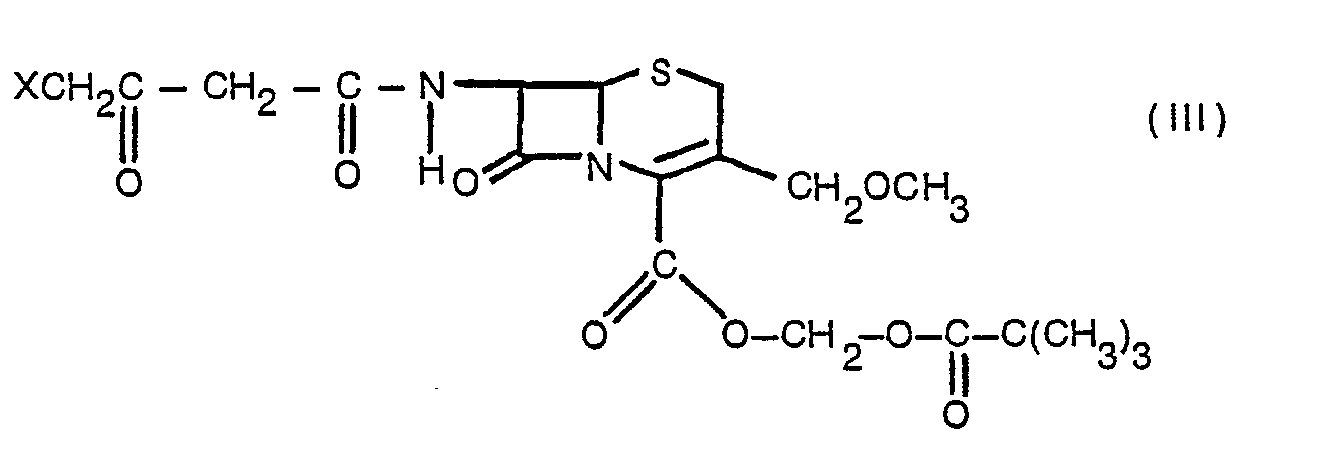
- the compound of formula (II), which is new and also forms part of the present invention may be prepared by nitrosoating a compound of formula (III): (in which X is as defined above).
- the compound of the invention is preferably prepared by a two-stage reaction, in which the compound of formula (III) is first nitrosoated and then the resulting compound of formula (II) is reacted with thiourea to form the thiazole ring.
- the nitrosoation of the compound of formula (III) to prepare the compound of formula (II) may be effected by techniques known for the nitrosoation of reactive methylene groups, especially in 9-diketones. Such a nitrosoation reaction is normally effected using a metal salt of nitrous acid under acidic conditions or an ester of nitrous acid under suitable conditions.
- a metal salt of nitrous acid under acidic conditions or an ester of nitrous acid under suitable conditions.
- This reaction is normally carried out in the presence of a solvent, the nature of which is not critical, provided that it is capable of dissolving the compound of formula (III) and does not have any adverse effect upon the reaction.
- Suitable solvents include formic acid, acetic acid, tetrahydrofuran, methanol, ethanol, chloroform, ethyl acetate and benzene, or a mixture of water with one or more of these solvents.
- the particular solvent chosen will depend upon the nature of the nitrosoating agent.
- metal salts of nitrous acid employed as the nitrosoating agent include alkali metal salts (such as sodium nitrite or potassium nitrite), preferably sodium nitrite.
- alkali metal salts such as sodium nitrite or potassium nitrite
- the nitrous acid ester is preferably an ester with a lower alcohol, for example pentyl nitrite or butyl nitrite.
- the reaction must be carried out under acidic conditions and, if an acidic solvent (such as formic acid or acetic acid) is not employed, the addition of an acid (which may be organic or inorganic) is necessary. Accordingly, we prefer to carry out the reaction using formic acid or acetic acid as the reaction solvent.
- an acidic solvent such as formic acid or acetic acid
- the reaction is preferably carried out at ambient temperature or below and will require a period which may range from 10 minutes to several hours.
- the resulting product of formula (II) may be isolated and purified by conventional means, for example by concentration, extraction with organic solvents or chromatographic techniques.
- reaction of the compound of formula (II) with thiourea to give the desired compound of formula (I) is essentially the synthesis of an aminothiazole derivative by reacting a haloketone with thiourea and may be carried out in much the same way as is common for this type of reaction.
- the reaction is usually-carried out in the presence of a solvent, the nature of which is not critical, provided that is has no adverse effect upon the reaction.
- the solvent is preferably an organic solvent (such as dimethylformamide, dimethylacetamide, methanol, ethanol, tetrahydrofuran or acetonitrile) or a mixture of water with one or more of these organic solvents.
- a base for example sodium bicarbonate or potassium bicarbonate.
- the thiourea is preferably employed in an amount of 1 or more equivalents per equivalent of said compound of formula (II).
- the reaction is preferably effected at ambient temperature and will normally be complete within a period of from 1 to 10 hours.
- the desired compound of formula (I) may be isolated and purified by conventional means, for example by concentration, extraction with organic solvents, chromatographic techniques, reprecipitation or recrystallization.
- the compound of formula (I) and its acid addition salts may advantageously be employed in antibacterial compositions for oral administration.
- a compound may be used for this purpose, it is essential, as mentioned above, that it should be well absorbed through the digestive tract after oral administration. Good absorption through the digestive tract is demonstrated by a good recovery of the compound or of degradation products in the urine after oral administration.
- pivaloyloxymethyl 7-[2-(2-aminothiazoi-4-yi)-2-methoxyiminoacetamido]-3-methyl-3-cephem-4-carboxylate has a recovery rate in urine of 66.7%, which is comparable with the value of 50% or more found with pivaloyloxymethyl 7-[2-(2-aminothiazol-4-yl)-2-hydroxyiminoacetamido]-3-methoxymethyl-3-cephem-4-carboxylate of the present invention.
- These figures are both quite satisfactory for the purposes of oral administration.
- the compounds should, after hydrolyzation in vivo , be very active against both gram-positive and gram-negative bacteria.
- the compound of the invention, as well as the prior art compound, are hydrolyzed in vivo to the corresponding carboxylic acids and, hence, it is the antibacterial activities of these carboxylic acids, rather than of the esters, which are important from the clinical point of view.
- the activities of the carboxylic acids corresponding to the above-mentioned prior art compound and the compound of the invention against various bacteria are shown in the following Table, in terms of their minimal inhibitory concentrations (pg/ml).
- the compound of the invention is preferably administered orally, for example in the form of capsules, tablets, powders, syrups or suspensions.
- the dosage depends upon the age, symptoms and body weight of the patient and on the duration of treatment, but the dosage may normally range from 0.2 g to 5 g per day, preferably from 0.5 g to 3 g per day for adults, however, if necessary, larger doses may be employed.
- the compound is preferably administered in divided doses, for example from 3 to 4 times per day.
- any conventional pharmaceutically acceptable carrier or dilent may be employed in admixture with the active compound.
- the composition is generally intended to be administered orally, it is desirably presented in a form readily absorbed through the stomach or intestines.
- Tablets or capsules are normally in unit dosage form and may contain binding agents (e.g. syrup, gum arabic, gelatin, sorbitol, gum tragacanth, polyvinylpyrrolidone, carboxymethyl- cellulse or hydroxypropylcellulose), diluents (e.g.
- lactose sugar, corn starch, calcium phosphate, sorbitol, glycine, calcium carbonate, calcium phosphate or polyethylene glycol
- lubricants e.g. magnesium stearate, talc, polyethylene glycol or silica
- disintegrating agents e.g. potato starch or carboxymethylcellulose calcium
- wetting agents e.g. sodium lauryl sulphate
- the tablets may, if desired, be coated, e.g. with an enteric coating, as is weIl-known in the art.
- Liquid formulations may be aqueous or oily suspensions, syrups, elixirs or similar compositions.
- the composition may be a dried product which can then be redissolved in water or in another suitable vehicle before administration.
- Such liquid formulations may contain conventional additives, such as suspending agents (e.g. sorbitol syrup, methylcellulose, glucose/sugar syrup, gelatin, hydroxyethylcellulose, carboxymethylcellulose, aluminium stearate gel or hydrogenated edible fat), emulsifying agents (e.g. lecithin, monoleic acid sorbitol or gum arabic), non-aqueous vehicles (e.g. almond oil, fractionated coconut oil, oily esters, propylene glycol or ethyl acetate) or any combination of two or more thereof.
- suspending agents e.g. sorbitol syrup, methylcellulose, glucose/sugar syrup, gelatin, hydroxyethylcellulose, carboxymethylcellulose, aluminium stea
- composition of the invention When the composition of the invention is formulated in unit dosage form, it preferably contains from 50 to 500 mg of the compound of the invention per unit dose.
- the preparation of the compound of the invention is further illustrated by the following Example and the preparation of certain intermediates is illustrated by the following Preparations.
- the compound of the invention is in the syn configuration.
- the residue was dissolved in 50 ml of ethyl acetate, washed, in turn, with 5 ml each of water, 5% w/v aqueous hydrochloric acid and a saturated aqueous solution of sodium chloride, and then dried over anhydrous magnesium sulphate. The drying agent was filtered off and the filtrate was concentrated by evaporation under reduced pressure. The residue was chromatographed through a column containing 30 g of silica gel, eluted with a 1 : 1 by volume mixture of hexane and ethyl acetate, to give 288 mg of the title compound.
Landscapes
- Chemical & Material Sciences (AREA)
- Organic Chemistry (AREA)
- Health & Medical Sciences (AREA)
- Chemical Kinetics & Catalysis (AREA)
- Life Sciences & Earth Sciences (AREA)
- General Chemical & Material Sciences (AREA)
- Medicinal Chemistry (AREA)
- Nuclear Medicine, Radiotherapy & Molecular Imaging (AREA)
- Communicable Diseases (AREA)
- Pharmacology & Pharmacy (AREA)
- Oncology (AREA)
- Animal Behavior & Ethology (AREA)
- General Health & Medical Sciences (AREA)
- Public Health (AREA)
- Veterinary Medicine (AREA)
- Cephalosporin Compounds (AREA)
- Pharmaceuticals Containing Other Organic And Inorganic Compounds (AREA)
Description
- The present invention relates to new cephalosporin compounds which are particularly suitable for oral administration, to processes and intermediates for preparing these compounds and to compositions containing the compounds.
- Although many cephalosporin derivatives which exhibit antibacterial activity have been discovered, most of them are for parental administration. However, except where massive doses of an antibiotic are to be administered quickly, the preferred route of administration is oral, as oral preparations can be administered by the patient himself without the need for trained supervision or assistance. Unfortunately, of the many cephalosporin derivatives discovered, very few possess a combination of superior antibacterial activity, broad antibacterial spectrum against both gram-positive and gram-negative bacteria (especially against Staphylococcus aureus) and the ability to be absorbed efficiently through the digestive tract.
- For example, cephalothin, cefazolin and cefmetazole are widely used for parental administration, particularly by injection. However, when these compounds are administered orally, only about 5% of the dose administered is recovered in the urine, showing their poor absorption through the digestive tract and their unsuitability for oral administration. This is thought to be due to the strong dissociation of the carboxy group at the 4-position (i.e. the low pKa value) and the strong acidity.
- Because of this, many efforts have been made to improve the absorption of cephalosporin derivatives through the digestive tract by esterifying the 4-carboxy group but almost all such efforts have failed to obtain cephalosporin derivatives which are well absorbed through the digestive tract and which are therefore useful for oral administration, as described hereafter, in the one instance where absorption through the digestive tract has been significantly improved, the resulting compound lacks the desired broad antibacterial spectrum.
- For example, the Journal of Antibiotics, 32 No. 11, 1155 (1979) discloses that the absorption of cefamandol through the digestive tract is not improved by esterification to prepare the acetoxymethyl ester, since this ester is only sparingly soluble in water. Although absorption of the ester through the digestive tract can be improved to a limited extent by administration of the ester in solution in certain organic solvents (such as propylene glycol), this is not a particularly good solution to the problem.
- The Journal of Medicinal Chemistry, 22, 657 (1979), on the other hand, reports that the absorption through the digestive tract of another ester of a cephalosporin which is readily soluble in water, is not significantly improved due to chemical instability of the ester.
- Furthermore, it is known that, in general, lower alkyl and benzhydryl esters of cephalosporins possess, in themselves, almost no antibacterial activity and that they are not hydrolyzed in vivo (which might otherwise convert them to an active acid) and hence they are not of value for therapeutic use, although they may be useful as synthetic intermediates.
- Of the various cephalosporin derivatives known, one known class has a 2-(2-aminothiazol-4-yl)-2-alkoxyiminoacetamido group at the 7-position and may be represented by the following formula:

- For example, Japanese Patent Application Kokei (i.e. as laid-open to public inspection) No. 5046/79 discloses, inter alia, the compound of formula:


- Another compound having a similar chemical structure, specifically pivaloyloxymethyl 7-[2-(2-aminothiazol-4-yl)-2-methoxyiminoacetamido]-3-methyl-3-cephem-4-carboxylate is disclosed in Japanese Patent Application Kokai No. 34795/78 and we have found that this compound exhibits very good recovery in urine, at a level comparable with that of the compounds of the present invention, thus suggesting that it may well be suitable for oral administration. However, we have also found that this compound, when administered orally, is hydrolyzed and converted in vivo to the corresponding carboxylic acid which, in turn, has poor activity against Staphylococcus aureus. Failure to inhibit the growth of this bacterium, which is perhaps one of the most important from the clinical point of view, could be a disadvantage in actual use.
- It is, accordingly, clear from the above discussion that preparation of a cephalosporin derivative which meets the triple requirements of good absorption through the digestive tract, high antibacterial activity and a broad antibacterial spectrum, is not a simple matter. The cephalosporin nucleus includes many points at which different substituents may be introduced and the introduction of a particular substituent to improve one property may adversely affect other properties in a quite unpredictable way. Moreover, it has clearly been demonstrated that, even where a particular chemical modification is known to improve the properties of one particular compound, this is not any indication that a similar modification will similarly improve the properties of any other compound.
- We have now surprisingly discovered a cephalosporin derivative which can be administered orally, as it is readily absorbed through the digestive tract, and which is then readily hydrolyzed and converted in vivo to the corresponding carboxylic acid which, in turn, shows quite outstanding activity against both gram-positive and gram-negative bacteria.
- Accordingly, the present invention consists in a compound of formula (I):

- R1 represents a hydrogen atom and
- R2 represents a tert-butyl group;
- The invention also provides a pharmaceutical composition comprising, as active ingredient, the compound of the invention in admixture with a pharmaceutically acceptable carrier or diluent.
- The invention also provides a process for preparing the compound of the invention, as described hereafter.
- The compound of this invention has the hydroxyimino group in the syn configuration, and is pivaloyloxymethyl 7-[2-(2-aminothiazol-4-yl)-2-hydroxyiminoacetamido]-3-methoxymethyl-3-cephem-4-carboxylate.
- As indicated, the compound of formula (I) of the present invention is the syn-configuration, which has been found to have much stronger antibacterial activity than the corresponding anti-isomer.
- The compound of formula (I) will form acid addition salts with various acids and the invention thus also includes such salts with pharmaceutically acceptable acids, for example inorganic acids (such as hydrochloric acid, sulphuric acid or phosphoric acid) or organic acids (such as methanesulphonic acid, benzenesulphonic acid or malonic acid). Of the acid addition salts, the hydrochloride is most preferred.
- The compound of formula (I) may be prepared by reacting a corresponding compound of formula (II):

- The compound of formula (II), which is new and also forms part of the present invention may be prepared by nitrosoating a compound of formula (III):

- Accordingly, the compound of the invention is preferably prepared by a two-stage reaction, in which the compound of formula (III) is first nitrosoated and then the resulting compound of formula (II) is reacted with thiourea to form the thiazole ring.
- The nitrosoation of the compound of formula (III) to prepare the compound of formula (II) may be effected by techniques known for the nitrosoation of reactive methylene groups, especially in 9-diketones. Such a nitrosoation reaction is normally effected using a metal salt of nitrous acid under acidic conditions or an ester of nitrous acid under suitable conditions. However, when preparing the compound of the invention, it is necessary to carry out the reaction under such conditions that the cephalosporin ring system and the halogen atom on the side chain at the 7-position do not participate in the reaction. It is, accordingly, desirable to carry out the reaction under weakly acidic or weakly basic conditions at a temperature below ambient. This reaction is normally carried out in the presence of a solvent, the nature of which is not critical, provided that it is capable of dissolving the compound of formula (III) and does not have any adverse effect upon the reaction. Suitable solvents include formic acid, acetic acid, tetrahydrofuran, methanol, ethanol, chloroform, ethyl acetate and benzene, or a mixture of water with one or more of these solvents. The particular solvent chosen will depend upon the nature of the nitrosoating agent.
- Examples of metal salts of nitrous acid employed as the nitrosoating agent include alkali metal salts (such as sodium nitrite or potassium nitrite), preferably sodium nitrite. The nitrous acid ester is preferably an ester with a lower alcohol, for example pentyl nitrite or butyl nitrite.
- Where a metal salt of nitrous acid is used as the nitrosoating agent, the reaction must be carried out under acidic conditions and, if an acidic solvent (such as formic acid or acetic acid) is not employed, the addition of an acid (which may be organic or inorganic) is necessary. Accordingly, we prefer to carry out the reaction using formic acid or acetic acid as the reaction solvent.
- The reaction is preferably carried out at ambient temperature or below and will require a period which may range from 10 minutes to several hours.
- After completion of the reaction, the resulting product of formula (II) may be isolated and purified by conventional means, for example by concentration, extraction with organic solvents or chromatographic techniques.
- The reaction of the compound of formula (II) with thiourea to give the desired compound of formula (I) is essentially the synthesis of an aminothiazole derivative by reacting a haloketone with thiourea and may be carried out in much the same way as is common for this type of reaction.
- The reaction is usually-carried out in the presence of a solvent, the nature of which is not critical, provided that is has no adverse effect upon the reaction. The solvent is preferably an organic solvent (such as dimethylformamide, dimethylacetamide, methanol, ethanol, tetrahydrofuran or acetonitrile) or a mixture of water with one or more of these organic solvents. If desired, the reaction may be terminated by the addition of a base, for example sodium bicarbonate or potassium bicarbonate.
- The thiourea is preferably employed in an amount of 1 or more equivalents per equivalent of said compound of formula (II).
- The reaction is preferably effected at ambient temperature and will normally be complete within a period of from 1 to 10 hours.
- When the reaction is complete, the desired compound of formula (I) may be isolated and purified by conventional means, for example by concentration, extraction with organic solvents, chromatographic techniques, reprecipitation or recrystallization.
- The compound of formula (I) and its acid addition salts may advantageously be employed in antibacterial compositions for oral administration. In order that a compound may be used for this purpose, it is essential, as mentioned above, that it should be well absorbed through the digestive tract after oral administration. Good absorption through the digestive tract is demonstrated by a good recovery of the compound or of degradation products in the urine after oral administration.
- The known compound, pivaloyloxymethyl 7-[2-(2-aminothiazoi-4-yi)-2-methoxyiminoacetamido]-3-methyl-3-cephem-4-carboxylate has a recovery rate in urine of 66.7%, which is comparable with the value of 50% or more found with pivaloyloxymethyl 7-[2-(2-aminothiazol-4-yl)-2-hydroxyiminoacetamido]-3-methoxymethyl-3-cephem-4-carboxylate of the present invention. These figures are both quite satisfactory for the purposes of oral administration. However, in addition to this good absorption through the digestive tract, it is desirable that the compounds should, after hydrolyzation in vivo , be very active against both gram-positive and gram-negative bacteria. The compound of the invention, as well as the prior art compound, are hydrolyzed in vivo to the corresponding carboxylic acids and, hence, it is the antibacterial activities of these carboxylic acids, rather than of the esters, which are important from the clinical point of view. The activities of the carboxylic acids corresponding to the above-mentioned prior art compound and the compound of the invention against various bacteria are shown in the following Table, in terms of their minimal inhibitory concentrations (pg/ml).

- It is clear from the above Table, that the compound of the invention and the prior art compound, when administered orally, are highly active against gram-negative bacteria and that their activities against these bacteria are broadly comparable. However, whereas the compound of the invention is highly active against Staphylococcus aureus, which is representative of the gram-positive bacteria, the prior art compound has a rather low activity against these bacteria.
- The compound of the invention is preferably administered orally, for example in the form of capsules, tablets, powders, syrups or suspensions. The dosage depends upon the age, symptoms and body weight of the patient and on the duration of treatment, but the dosage may normally range from 0.2 g to 5 g per day, preferably from 0.5 g to 3 g per day for adults, however, if necessary, larger doses may be employed. The compound is preferably administered in divided doses, for example from 3 to 4 times per day.
- In the pharmaceutical compositions of the present invention, any conventional pharmaceutically acceptable carrier or dilent may be employed in admixture with the active compound. As the composition is generally intended to be administered orally, it is desirably presented in a form readily absorbed through the stomach or intestines. Tablets or capsules are normally in unit dosage form and may contain binding agents (e.g. syrup, gum arabic, gelatin, sorbitol, gum tragacanth, polyvinylpyrrolidone, carboxymethyl- cellulse or hydroxypropylcellulose), diluents (e.g. lactose, sugar, corn starch, calcium phosphate, sorbitol, glycine, calcium carbonate, calcium phosphate or polyethylene glycol), lubricants (e.g. magnesium stearate, talc, polyethylene glycol or silica), disintegrating agents (e.g. potato starch or carboxymethylcellulose calcium) or wetting agents (e.g. sodium lauryl sulphate) or any combination thereof. The tablets may, if desired, be coated, e.g. with an enteric coating, as is weIl-known in the art.
- Liquid formulations may be aqueous or oily suspensions, syrups, elixirs or similar compositions.. Alternatively, the composition may be a dried product which can then be redissolved in water or in another suitable vehicle before administration. Such liquid formulations may contain conventional additives, such as suspending agents (e.g. sorbitol syrup, methylcellulose, glucose/sugar syrup, gelatin, hydroxyethylcellulose, carboxymethylcellulose, aluminium stearate gel or hydrogenated edible fat), emulsifying agents (e.g. lecithin, monoleic acid sorbitol or gum arabic), non-aqueous vehicles (e.g. almond oil, fractionated coconut oil, oily esters, propylene glycol or ethyl acetate) or any combination of two or more thereof.
- When the composition of the invention is formulated in unit dosage form, it preferably contains from 50 to 500 mg of the compound of the invention per unit dose.
- The preparation of the compound of the invention is further illustrated by the following Example and the preparation of certain intermediates is illustrated by the following Preparations. The compound of the invention is in the syn configuration.
- 168 mg of diketene were dissolved in 2 ml of methylene chloride and, whilst stirring the solution, it was cooled to -30°C. To the solution was then added dropwise a solution of 320 mg of bromine in 2 ml of methylene chloride, and the resulting mixture was added dropwise to a solution of 322 mg of pivaloyloxymethyl 7-amino-3-methoxymethyl-3-cephem-4-carboxylate and 299 mg of N,N-diethylaniline in 5 ml of methylene chloride, which had been cooled to -5°C. The mixture was left to stand for 30 minutes, after which it was concentrated by evaporation under reduced pressure. The residue was dissolved in 50 ml of ethyl acetate, washed, in turn, with 5 ml each of water, 5% w/v aqueous hydrochloric acid and a saturated aqueous solution of sodium chloride, and then dried over anhydrous magnesium sulphate. The drying agent was filtered off and the filtrate was concentrated by evaporation under reduced pressure. The residue was chromatographed through a column containing 30 g of silica gel, eluted with a 1 : 1 by volume mixture of hexane and ethyl acetate, to give 288 mg of the title compound.
- The whole of the product obtained in Preparation 1 was dissolved in 5 ml of acetic acid. To the resulting solution were added, in small portions, a total of 38 mg of sodium nitrite, whilst stirring the mixture at room temperature. After the addition was complete, stirring was continued for a further 30 minutes. The reaction mixture was then diluted with 20 ml of ethyl acetate, washed three times with a saturated aqueous solution of sodium chloride and dried over anhydrous magnesium sulphate. The drying agent was filtered off and the residue was concentrated by evaporation under reduced pressure. The residue was subjected to column chromatography through 15 g of silica gel, eluted with a 1 : 1 by volume mixture of hexane and ethyl acetate, to give 200 mg of the title compound.
- The whole of the product obtained in Preparation 2 was dissolved in 5 ml of dimethylacetamide. To the solution were added 55 mg of thiourea, and the mixture was stirred for 2 hours, after which 20 ml of ethyl acetate were added. The mixture was washed thoroughly with a saturated aqueous solution of sodium bicarbonate to remove the excess thiourea; the mixture was then dried over anhydrous magnesium sulphate, which was then filtered off. The filtrate was concentrated by evaporation under reduced pressure and the residue was subjected to column chromatography through 10 g of silica gel, eluted with ethyl acetate, to give 118 mg of the title compound. Nuclear Magnetic Resonance spectrum (deuteroacetone) 6 ppm:
- 1.21 (9H, singlet, t-butyl);
- 3.28 (3H, singlet, OCH3 of methoxymethyl);
- 3.61 (2H, singlet, 2-cephem H2);
- 4.27 (2H, singlet, CH2 of methoxymethyl);
- 5.21 (1H, doublet, J=5 Hz, 6-cephem H);
- 5.8-6.2 (3H, multiplet, 7-cephem H and CH2 of pivaloyloxymethyl);
- 6.87 (1H, singlet);
- 6.4-7.6 (3H, multiplet, NH2 and OH);
- 9.0 (1H, doublet, j=9 Hz, 7-cephem NH).
and pharmaceutically acceptable acid addition salts thereof.
Claims (6)

Priority Applications (1)
| Application Number | Priority Date | Filing Date | Title |
|---|---|---|---|
| DE8484106315T DE3175700D1 (en) | 1980-09-30 | 1981-09-24 | Cephalosporin derivatives, a process for their preparation and compositions containing them |
Applications Claiming Priority (2)
| Application Number | Priority Date | Filing Date | Title |
|---|---|---|---|
| JP136449/80 | 1980-09-30 | ||
| JP55136449A JPS5759894A (en) | 1980-09-30 | 1980-09-30 | Cephalosporin for oral administration |
Related Child Applications (1)
| Application Number | Title | Priority Date | Filing Date |
|---|---|---|---|
| EP84106315.9 Division-Into | 1984-06-02 |
Publications (3)
| Publication Number | Publication Date |
|---|---|
| EP0049119A2 EP0049119A2 (en) | 1982-04-07 |
| EP0049119A3 EP0049119A3 (en) | 1983-02-09 |
| EP0049119B1 true EP0049119B1 (en) | 1986-01-15 |
Family
ID=15175363
Family Applications (2)
| Application Number | Title | Priority Date | Filing Date |
|---|---|---|---|
| EP84106315A Expired EP0134420B1 (en) | 1980-09-30 | 1981-09-24 | Cephalosporin derivatives, a process for their preparation and compositions containing them |
| EP81304416A Expired EP0049119B1 (en) | 1980-09-30 | 1981-09-24 | Cephalosporin derivatives, a process for their preparation and compositions containing them |
Family Applications Before (1)
| Application Number | Title | Priority Date | Filing Date |
|---|---|---|---|
| EP84106315A Expired EP0134420B1 (en) | 1980-09-30 | 1981-09-24 | Cephalosporin derivatives, a process for their preparation and compositions containing them |
Country Status (9)
| Country | Link |
|---|---|
| US (1) | US4483855A (en) |
| EP (2) | EP0134420B1 (en) |
| JP (1) | JPS5759894A (en) |
| KR (1) | KR870000826B1 (en) |
| CA (1) | CA1172248A (en) |
| DE (1) | DE3173511D1 (en) |
| ES (1) | ES505922A0 (en) |
| FI (1) | FI72978C (en) |
| PH (1) | PH16994A (en) |
Families Citing this family (19)
| Publication number | Priority date | Publication date | Assignee | Title |
|---|---|---|---|---|
| FR2476087A1 (en) * | 1980-02-18 | 1981-08-21 | Roussel Uclaf | NOVEL OXIMES DERIVED FROM 3-ALKYLOXY OR 3-ALKYL-THIOMETHYL 7-AMINO THIAZOLYL ACETAMIDO CEPHALOSPORANIC ACID, PROCESS FOR PREPARING THEM AND THEIR APPLICATION AS MEDICAMENTS |
| US5243043A (en) * | 1980-02-18 | 1993-09-07 | Roussel Uclaf | Cephalosporins |
| JPS5984890A (en) | 1982-11-05 | 1984-05-16 | Hisayasu Ishimaru | Cephalosporin compound for oral administration |
| JPS58159496A (en) * | 1983-03-02 | 1983-09-21 | Kyoto Yakuhin Kogyo Kk | Cephem-based compound |
| NZ208281A (en) * | 1983-06-02 | 1986-11-12 | Takeda Chemical Industries Ltd | Cephalosporin ester derivatives and pharmaceutical compositions |
| JPS604189A (en) * | 1983-06-20 | 1985-01-10 | Sankyo Co Ltd | Production of beta-lactam compound |
| JPH0631259B2 (en) * | 1984-02-17 | 1994-04-27 | 三共株式会社 | Oral cefalosporin compound |
| JPH01230547A (en) * | 1988-01-14 | 1989-09-14 | Takeda Chem Ind Ltd | Production of tertiary butyl 3-oxobutyrate and use thereof |
| DE3804841A1 (en) * | 1988-02-17 | 1989-08-31 | Hoechst Ag | CEPHALOSPORINE DERIVATIVES AND METHOD FOR THEIR PRODUCTION |
| DE3809561A1 (en) * | 1988-03-22 | 1989-10-05 | Hoechst Ag | ESTER OF 7- (2- (2-AMINOTHIAZOL-4-YL) -2- (Z) - HYDROXYIMINOACETAMIDO) -3-METHOXYMETHYL-3-CEPHEM-4-CARBONIC ACID, PROCESS FOR THEIR PRODUCTION AND PHARMACEUTICAL ACCESSORIES CONTAINING IT |
| DE3901405A1 (en) * | 1989-01-19 | 1990-07-26 | Hoechst Ag | CEPHALOSPORINE DERIVATIVES AND METHOD FOR THEIR PRODUCTION |
| DE3910093A1 (en) * | 1989-03-29 | 1990-10-04 | Hoechst Ag | CEPHALOSPORINE DERIVATIVES AND METHOD FOR THEIR PRODUCTION |
| US5081116A (en) * | 1989-04-12 | 1992-01-14 | Yamanouchi Pharmaceutical Co., Ltd. | Cephalosporin derivatives |
| DE3919259A1 (en) * | 1989-06-13 | 1990-12-20 | Hoechst Ag | CRYSTALLINE CEPHEM ACID ADDITION SALTS AND METHOD FOR THE PRODUCTION THEREOF |
| YU48484B (en) * | 1991-05-24 | 1998-09-18 | Hoechst Aktiengesellschaft | CRYSTAL ACID ADDITIONAL SALTS OF DIASTEREOMEROUS PURE 1- (2,2-DIMETHYLPROPIONYLOXY) -ETHYLESTERS OF 3-CEFEM-4-CARBONIC ACIDS |
| PT531875E (en) * | 1991-09-07 | 2004-08-31 | Aventis Pharma Gmbh | ESTER-1- (ISOPROPOXYCARBONYL) -EETHYL ESTERS OF 3-CEFEM-4-CARBOXYLIC ACID AND PROCESS FOR PREPARATION |
| TW212181B (en) * | 1992-02-14 | 1993-09-01 | Hoechst Ag | |
| DK0570849T3 (en) * | 1992-05-21 | 1998-09-28 | Hoechst Ag | Process for cleavage of cephalosporin prodrug esters to form 7-amino-3-methoxymethyl-ceph-3-em-4-carboxylic acid |
| AT408226B (en) * | 1999-05-05 | 2001-09-25 | Biochemie Gmbh | CRYSTALINE 7- (2- (2-FORMYLAMINOTHIAZOL-4-YL) -2 |
Citations (1)
| Publication number | Priority date | Publication date | Assignee | Title |
|---|---|---|---|---|
| EP0034536A2 (en) * | 1980-02-18 | 1981-08-26 | Roussel-Uclaf | Oxime derivatives of 3-alkyloxy- or 3-alkylthiomethyl 7-amino-thiazolylacetamido cephalosporanic acid, their preparation, their use as medicaments and compositions containing them |
Family Cites Families (5)
| Publication number | Priority date | Publication date | Assignee | Title |
|---|---|---|---|---|
| DE2760123C2 (en) * | 1976-01-23 | 1986-04-30 | Roussel-Uclaf, Paris | 7-Aminothiazolyl-syn-oxyiminoacetamidocephalosporanic acids, their preparation and pharmaceutical compositions containing them |
| DE2760484C2 (en) * | 1976-04-14 | 1992-12-03 | Takeda Chemical Industries, Ltd., Osaka, Jp | |
| JPS6011713B2 (en) * | 1976-09-08 | 1985-03-27 | 武田薬品工業株式会社 | Cephalosporin derivatives and their production method |
| DE2714880A1 (en) * | 1977-04-02 | 1978-10-26 | Hoechst Ag | CEPHEMDER DERIVATIVES AND PROCESS FOR THEIR PRODUCTION |
| US4409215A (en) * | 1979-11-19 | 1983-10-11 | Fujisawa Pharmaceutical Co., Ltd. | 7-Acylamino-3-substituted cephalosporanic acid derivatives and processes for the preparation thereof |
-
1980
- 1980-09-30 JP JP55136449A patent/JPS5759894A/en active Pending
-
1981
- 1981-09-23 US US06/304,987 patent/US4483855A/en not_active Expired - Lifetime
- 1981-09-24 EP EP84106315A patent/EP0134420B1/en not_active Expired
- 1981-09-24 EP EP81304416A patent/EP0049119B1/en not_active Expired
- 1981-09-24 DE DE8181304416T patent/DE3173511D1/en not_active Expired
- 1981-09-29 PH PH26287A patent/PH16994A/en unknown
- 1981-09-30 CA CA000387049A patent/CA1172248A/en not_active Expired
- 1981-09-30 FI FI813037A patent/FI72978C/en not_active IP Right Cessation
- 1981-09-30 ES ES505922A patent/ES505922A0/en active Granted
- 1981-09-30 KR KR1019810003697A patent/KR870000826B1/en not_active Expired
Patent Citations (1)
| Publication number | Priority date | Publication date | Assignee | Title |
|---|---|---|---|---|
| EP0034536A2 (en) * | 1980-02-18 | 1981-08-26 | Roussel-Uclaf | Oxime derivatives of 3-alkyloxy- or 3-alkylthiomethyl 7-amino-thiazolylacetamido cephalosporanic acid, their preparation, their use as medicaments and compositions containing them |
Also Published As
| Publication number | Publication date |
|---|---|
| CA1172248A (en) | 1984-08-07 |
| EP0049119A3 (en) | 1983-02-09 |
| DE3173511D1 (en) | 1986-02-27 |
| EP0134420B1 (en) | 1986-12-10 |
| FI72978C (en) | 1987-08-10 |
| EP0134420A1 (en) | 1985-03-20 |
| ES8302001A1 (en) | 1983-01-01 |
| PH16994A (en) | 1984-05-04 |
| KR870000826B1 (en) | 1987-04-23 |
| JPS5759894A (en) | 1982-04-10 |
| ES505922A0 (en) | 1983-01-01 |
| FI813037L (en) | 1982-03-31 |
| FI72978B (en) | 1987-04-30 |
| EP0049119A2 (en) | 1982-04-07 |
| US4483855A (en) | 1984-11-20 |
| KR830007686A (en) | 1983-11-04 |
Similar Documents
| Publication | Publication Date | Title |
|---|---|---|
| EP0134420B1 (en) | Cephalosporin derivatives, a process for their preparation and compositions containing them | |
| EP0049118B1 (en) | Cephalosporin derivatives, their preparation and compositions containing them | |
| FR2509312A1 (en) | NOVEL ACYLATED DERIVATIVES, THEIR PREPARATION AND THEIR THERAPEUTIC USES | |
| CH616682A5 (en) | ||
| EP0329008B1 (en) | Cephalosporinderivatives and process for its preparation | |
| EP0236231B1 (en) | Novel cephem compounds | |
| US5081116A (en) | Cephalosporin derivatives | |
| LU82429A1 (en) | HETEROCYCLIC DERIVATIVES OF OXY-IMINO-SUBSTITUTED CEPHALOSPORINS | |
| CH621125A5 (en) | ||
| US3655658A (en) | 7(alpha-amino-alpha-phenylacetamido)-cephalosporanate esters | |
| US4189479A (en) | Cephalosporin esters | |
| EP0137227B1 (en) | Process for the preparation of cephalosporin derivatives using novel thioesters | |
| HU190166B (en) | Process for producing 7-substituted 3-vinyl-3-cepheme-derivatives | |
| US4103008A (en) | 7[2(2,3 Dioxopiperazin-1-yl-carbonylamino)substituted 2 phenylacetamido]-3-2'-thiadiazolyl cephalosporanic acid derivatives | |
| JPS60142987A (en) | Cephalosporin derivative | |
| KR0178957B1 (en) | Penem compounds | |
| BE833063A (en) | N - ACYLAMINO - ALPHA - ARYLACETAMIDO - CEPHALOSPORINS | |
| NZ232135A (en) | Cephemcarboxylic acid ester derivatives and pharmaceutical compositions | |
| EP0068403B1 (en) | Cephalosporin compound | |
| KR0164433B1 (en) | Cephalosporin derivatives and preparation methods thereof | |
| CH687205A5 (en) | thioalkylthiocarbacephalosporine derivatives. | |
| GB2051066A (en) | Cephalosporin derivatives suitable for oral administration | |
| EP0321562B1 (en) | Crystalline cephalosporin compounds, process for their preparation, and intermediates for their preparation | |
| CA1169853A (en) | Cephalosporin derivatives | |
| EP0128028A2 (en) | Cephalosporin derivatives, their production and use |
Legal Events
| Date | Code | Title | Description |
|---|---|---|---|
| PUAI | Public reference made under article 153(3) epc to a published international application that has entered the european phase |
Free format text: ORIGINAL CODE: 0009012 |
|
| AK | Designated contracting states |
Designated state(s): CH DE FR GB IT LI |
|
| PUAL | Search report despatched |
Free format text: ORIGINAL CODE: 0009013 |
|
| 17P | Request for examination filed |
Effective date: 19821022 |
|
| AK | Designated contracting states |
Designated state(s): CH DE FR GB IT LI |
|
| GRAA | (expected) grant |
Free format text: ORIGINAL CODE: 0009210 |
|
| AK | Designated contracting states |
Designated state(s): CH DE FR GB IT LI |
|
| ITF | It: translation for a ep patent filed | ||
| REF | Corresponds to: |
Ref document number: 3173511 Country of ref document: DE Date of ref document: 19860227 |
|
| ET | Fr: translation filed | ||
| PLBE | No opposition filed within time limit |
Free format text: ORIGINAL CODE: 0009261 |
|
| STAA | Information on the status of an ep patent application or granted ep patent |
Free format text: STATUS: NO OPPOSITION FILED WITHIN TIME LIMIT |
|
| 26N | No opposition filed | ||
| ITTA | It: last paid annual fee | ||
| PGFP | Annual fee paid to national office [announced via postgrant information from national office to epo] |
Ref country code: FR Payment date: 20000912 Year of fee payment: 20 |
|
| PGFP | Annual fee paid to national office [announced via postgrant information from national office to epo] |
Ref country code: DE Payment date: 20000918 Year of fee payment: 20 |
|
| PGFP | Annual fee paid to national office [announced via postgrant information from national office to epo] |
Ref country code: GB Payment date: 20000920 Year of fee payment: 20 |
|
| PGFP | Annual fee paid to national office [announced via postgrant information from national office to epo] |
Ref country code: CH Payment date: 20000927 Year of fee payment: 20 |
|
| PG25 | Lapsed in a contracting state [announced via postgrant information from national office to epo] |
Ref country code: LI Free format text: LAPSE BECAUSE OF EXPIRATION OF PROTECTION Effective date: 20010923 Ref country code: GB Free format text: LAPSE BECAUSE OF EXPIRATION OF PROTECTION Effective date: 20010923 Ref country code: CH Free format text: LAPSE BECAUSE OF EXPIRATION OF PROTECTION Effective date: 20010923 |
|
| REG | Reference to a national code |
Ref country code: CH Ref legal event code: PL |
|
| REG | Reference to a national code |
Ref country code: GB Ref legal event code: PE20 Effective date: 20010923 |