EP0046386B1 - Vinyl ester resin compositions - Google Patents
Vinyl ester resin compositions Download PDFInfo
- Publication number
- EP0046386B1 EP0046386B1 EP81303716A EP81303716A EP0046386B1 EP 0046386 B1 EP0046386 B1 EP 0046386B1 EP 81303716 A EP81303716 A EP 81303716A EP 81303716 A EP81303716 A EP 81303716A EP 0046386 B1 EP0046386 B1 EP 0046386B1
- Authority
- EP
- European Patent Office
- Prior art keywords
- composition according
- vinyl ester
- resin
- epoxy
- acid
- Prior art date
- Legal status (The legal status is an assumption and is not a legal conclusion. Google has not performed a legal analysis and makes no representation as to the accuracy of the status listed.)
- Expired
Links
- 229920001567 vinyl ester resin Polymers 0.000 title claims abstract description 36
- 239000011342 resin composition Substances 0.000 title description 10
- 229920005989 resin Polymers 0.000 claims abstract description 58
- 239000011347 resin Substances 0.000 claims abstract description 55
- 239000000203 mixture Substances 0.000 claims abstract description 28
- 239000003822 epoxy resin Substances 0.000 claims abstract description 11
- 229920000647 polyepoxide Polymers 0.000 claims abstract description 11
- 239000007859 condensation product Substances 0.000 claims abstract description 9
- 150000005846 sugar alcohols Chemical class 0.000 claims abstract description 7
- 150000003934 aromatic aldehydes Chemical class 0.000 claims abstract description 6
- 150000002762 monocarboxylic acid derivatives Chemical class 0.000 claims abstract description 5
- HZVFRKSYUGFFEJ-YVECIDJPSA-N (2r,3r,4s,5r)-7-phenylhept-6-ene-1,2,3,4,5,6-hexol Chemical compound OC[C@@H](O)[C@@H](O)[C@H](O)[C@@H](O)C(O)=CC1=CC=CC=C1 HZVFRKSYUGFFEJ-YVECIDJPSA-N 0.000 claims abstract description 4
- FMZUHGYZWYNSOA-VVBFYGJXSA-N (1r)-1-[(4r,4ar,8as)-2,6-diphenyl-4,4a,8,8a-tetrahydro-[1,3]dioxino[5,4-d][1,3]dioxin-4-yl]ethane-1,2-diol Chemical compound C([C@@H]1OC(O[C@@H]([C@@H]1O1)[C@H](O)CO)C=2C=CC=CC=2)OC1C1=CC=CC=C1 FMZUHGYZWYNSOA-VVBFYGJXSA-N 0.000 claims description 18
- 229940087101 dibenzylidene sorbitol Drugs 0.000 claims description 18
- PPBRXRYQALVLMV-UHFFFAOYSA-N Styrene Natural products C=CC1=CC=CC=C1 PPBRXRYQALVLMV-UHFFFAOYSA-N 0.000 claims description 15
- 239000004593 Epoxy Substances 0.000 claims description 10
- FBPFZTCFMRRESA-FSIIMWSLSA-N D-Glucitol Natural products OC[C@H](O)[C@H](O)[C@@H](O)[C@H](O)CO FBPFZTCFMRRESA-FSIIMWSLSA-N 0.000 claims description 7
- HUMNYLRZRPPJDN-UHFFFAOYSA-N benzenecarboxaldehyde Natural products O=CC1=CC=CC=C1 HUMNYLRZRPPJDN-UHFFFAOYSA-N 0.000 claims description 7
- 239000000600 sorbitol Substances 0.000 claims description 7
- 239000001431 2-methylbenzaldehyde Substances 0.000 claims description 6
- 125000001424 substituent group Chemical group 0.000 claims description 5
- ZRSNZINYAWTAHE-UHFFFAOYSA-N p-methoxybenzaldehyde Chemical compound COC1=CC=C(C=O)C=C1 ZRSNZINYAWTAHE-UHFFFAOYSA-N 0.000 claims description 4
- QNGNSVIICDLXHT-UHFFFAOYSA-N para-ethylbenzaldehyde Natural products CCC1=CC=C(C=O)C=C1 QNGNSVIICDLXHT-UHFFFAOYSA-N 0.000 claims description 4
- MYRTYDVEIRVNKP-UHFFFAOYSA-N 1,2-Divinylbenzene Chemical class C=CC1=CC=CC=C1C=C MYRTYDVEIRVNKP-UHFFFAOYSA-N 0.000 claims description 3
- CERQOIWHTDAKMF-UHFFFAOYSA-N Methacrylic acid Chemical compound CC(=C)C(O)=O CERQOIWHTDAKMF-UHFFFAOYSA-N 0.000 claims description 3
- 239000003085 diluting agent Substances 0.000 claims description 3
- BJELTSYBAHKXRW-UHFFFAOYSA-N 2,4,6-triallyloxy-1,3,5-triazine Chemical compound C=CCOC1=NC(OCC=C)=NC(OCC=C)=N1 BJELTSYBAHKXRW-UHFFFAOYSA-N 0.000 claims description 2
- NIXOWILDQLNWCW-UHFFFAOYSA-N 2-Propenoic acid Natural products OC(=O)C=C NIXOWILDQLNWCW-UHFFFAOYSA-N 0.000 claims description 2
- SBYMUDUGTIKLCR-UHFFFAOYSA-N 2-chloroethenylbenzene Chemical compound ClC=CC1=CC=CC=C1 SBYMUDUGTIKLCR-UHFFFAOYSA-N 0.000 claims description 2
- 239000004641 Diallyl-phthalate Substances 0.000 claims description 2
- 150000001252 acrylic acid derivatives Chemical class 0.000 claims description 2
- 150000001298 alcohols Chemical class 0.000 claims description 2
- 125000003277 amino group Chemical group 0.000 claims description 2
- 150000003935 benzaldehydes Chemical class 0.000 claims description 2
- QUDWYFHPNIMBFC-UHFFFAOYSA-N bis(prop-2-enyl) benzene-1,2-dicarboxylate Chemical compound C=CCOC(=O)C1=CC=CC=C1C(=O)OCC=C QUDWYFHPNIMBFC-UHFFFAOYSA-N 0.000 claims description 2
- 235000013985 cinnamic acid Nutrition 0.000 claims description 2
- 125000005843 halogen group Chemical group 0.000 claims description 2
- OVWYEQOVUDKZNU-UHFFFAOYSA-N m-tolualdehyde Chemical compound CC1=CC=CC(C=O)=C1 OVWYEQOVUDKZNU-UHFFFAOYSA-N 0.000 claims description 2
- 150000002734 metacrylic acid derivatives Chemical class 0.000 claims description 2
- WBYWAXJHAXSJNI-UHFFFAOYSA-N methyl p-hydroxycinnamate Natural products OC(=O)C=CC1=CC=CC=C1 WBYWAXJHAXSJNI-UHFFFAOYSA-N 0.000 claims description 2
- 125000000449 nitro group Chemical group [O-][N+](*)=O 0.000 claims description 2
- BTFQKIATRPGRBS-UHFFFAOYSA-N o-tolualdehyde Chemical compound CC1=CC=CC=C1C=O BTFQKIATRPGRBS-UHFFFAOYSA-N 0.000 claims description 2
- FXLOVSHXALFLKQ-UHFFFAOYSA-N p-tolualdehyde Chemical compound CC1=CC=C(C=O)C=C1 FXLOVSHXALFLKQ-UHFFFAOYSA-N 0.000 claims description 2
- HJWLCRVIBGQPNF-UHFFFAOYSA-N prop-2-enylbenzene Chemical class C=CCC1=CC=CC=C1 HJWLCRVIBGQPNF-UHFFFAOYSA-N 0.000 claims description 2
- WBYWAXJHAXSJNI-VOTSOKGWSA-M .beta-Phenylacrylic acid Natural products [O-]C(=O)\C=C\C1=CC=CC=C1 WBYWAXJHAXSJNI-VOTSOKGWSA-M 0.000 claims 1
- SMZOUWXMTYCWNB-UHFFFAOYSA-N 2-(2-methoxy-5-methylphenyl)ethanamine Chemical compound COC1=CC=C(C)C=C1CCN SMZOUWXMTYCWNB-UHFFFAOYSA-N 0.000 claims 1
- WBYWAXJHAXSJNI-SREVYHEPSA-N Cinnamic acid Chemical compound OC(=O)\C=C/C1=CC=CC=C1 WBYWAXJHAXSJNI-SREVYHEPSA-N 0.000 claims 1
- XYLMUPLGERFSHI-UHFFFAOYSA-N alpha-Methylstyrene Chemical compound CC(=C)C1=CC=CC=C1 XYLMUPLGERFSHI-UHFFFAOYSA-N 0.000 claims 1
- HUMNYLRZRPPJDN-KWCOIAHCSA-N benzaldehyde Chemical group O=[11CH]C1=CC=CC=C1 HUMNYLRZRPPJDN-KWCOIAHCSA-N 0.000 claims 1
- 229930016911 cinnamic acid Natural products 0.000 claims 1
- LDHQCZJRKDOVOX-NSCUHMNNSA-N crotonic acid Chemical compound C\C=C\C(O)=O LDHQCZJRKDOVOX-NSCUHMNNSA-N 0.000 claims 1
- 239000011353 cycloaliphatic epoxy resin Substances 0.000 claims 1
- 125000003011 styrenyl group Chemical group [H]\C(*)=C(/[H])C1=C([H])C([H])=C([H])C([H])=C1[H] 0.000 claims 1
- LDHQCZJRKDOVOX-UHFFFAOYSA-N trans-crotonic acid Natural products CC=CC(O)=O LDHQCZJRKDOVOX-UHFFFAOYSA-N 0.000 claims 1
- 230000009974 thixotropic effect Effects 0.000 abstract description 3
- 239000000047 product Substances 0.000 description 17
- 238000000034 method Methods 0.000 description 13
- ZMXDDKWLCZADIW-UHFFFAOYSA-N N,N-Dimethylformamide Chemical compound CN(C)C=O ZMXDDKWLCZADIW-UHFFFAOYSA-N 0.000 description 12
- 239000000126 substance Substances 0.000 description 11
- IISBACLAFKSPIT-UHFFFAOYSA-N bisphenol A Chemical compound C=1C=C(O)C=CC=1C(C)(C)C1=CC=C(O)C=C1 IISBACLAFKSPIT-UHFFFAOYSA-N 0.000 description 10
- 239000000654 additive Substances 0.000 description 9
- 235000010356 sorbitol Nutrition 0.000 description 9
- 239000000463 material Substances 0.000 description 7
- IAZDPXIOMUYVGZ-UHFFFAOYSA-N Dimethylsulphoxide Chemical compound CS(C)=O IAZDPXIOMUYVGZ-UHFFFAOYSA-N 0.000 description 6
- 125000004185 ester group Chemical group 0.000 description 6
- 239000002253 acid Substances 0.000 description 5
- 239000002904 solvent Substances 0.000 description 5
- QTBSBXVTEAMEQO-UHFFFAOYSA-N Acetic acid Chemical compound CC(O)=O QTBSBXVTEAMEQO-UHFFFAOYSA-N 0.000 description 4
- CSCPPACGZOOCGX-UHFFFAOYSA-N Acetone Chemical compound CC(C)=O CSCPPACGZOOCGX-UHFFFAOYSA-N 0.000 description 4
- 239000010425 asbestos Substances 0.000 description 4
- 229940106691 bisphenol a Drugs 0.000 description 4
- 229920000728 polyester Polymers 0.000 description 4
- 229910052895 riebeckite Inorganic materials 0.000 description 4
- 208000021017 Weight Gain Diseases 0.000 description 3
- 230000000996 additive effect Effects 0.000 description 3
- 239000002671 adjuvant Substances 0.000 description 3
- 125000000649 benzylidene group Chemical group [H]C(=[*])C1=C([H])C([H])=C([H])C([H])=C1[H] 0.000 description 3
- 239000003054 catalyst Substances 0.000 description 3
- 238000006243 chemical reaction Methods 0.000 description 3
- 239000012530 fluid Substances 0.000 description 3
- LNEPOXFFQSENCJ-UHFFFAOYSA-N haloperidol Chemical compound C1CC(O)(C=2C=CC(Cl)=CC=2)CCN1CCCC(=O)C1=CC=C(F)C=C1 LNEPOXFFQSENCJ-UHFFFAOYSA-N 0.000 description 3
- 230000007062 hydrolysis Effects 0.000 description 3
- 238000006460 hydrolysis reaction Methods 0.000 description 3
- 125000002887 hydroxy group Chemical group [H]O* 0.000 description 3
- 239000003999 initiator Substances 0.000 description 3
- 125000002496 methyl group Chemical group [H]C([H])([H])* 0.000 description 3
- 239000000178 monomer Substances 0.000 description 3
- 150000003254 radicals Chemical class 0.000 description 3
- 238000007493 shaping process Methods 0.000 description 3
- 230000004584 weight gain Effects 0.000 description 3
- 235000019786 weight gain Nutrition 0.000 description 3
- WFUGQJXVXHBTEM-UHFFFAOYSA-N 2-hydroperoxy-2-(2-hydroperoxybutan-2-ylperoxy)butane Chemical compound CCC(C)(OO)OOC(C)(CC)OO WFUGQJXVXHBTEM-UHFFFAOYSA-N 0.000 description 2
- FBPFZTCFMRRESA-JGWLITMVSA-N D-glucitol Chemical compound OC[C@H](O)[C@@H](O)[C@H](O)[C@H](O)CO FBPFZTCFMRRESA-JGWLITMVSA-N 0.000 description 2
- RTZKZFJDLAIYFH-UHFFFAOYSA-N Diethyl ether Chemical compound CCOCC RTZKZFJDLAIYFH-UHFFFAOYSA-N 0.000 description 2
- JLTDJTHDQAWBAV-UHFFFAOYSA-N N,N-dimethylaniline Chemical compound CN(C)C1=CC=CC=C1 JLTDJTHDQAWBAV-UHFFFAOYSA-N 0.000 description 2
- VYPSYNLAJGMNEJ-UHFFFAOYSA-N Silicium dioxide Chemical compound O=[Si]=O VYPSYNLAJGMNEJ-UHFFFAOYSA-N 0.000 description 2
- 150000007513 acids Chemical class 0.000 description 2
- 238000007259 addition reaction Methods 0.000 description 2
- 239000000945 filler Substances 0.000 description 2
- 229910021485 fumed silica Inorganic materials 0.000 description 2
- 238000005259 measurement Methods 0.000 description 2
- CERQOIWHTDAKMF-UHFFFAOYSA-M methacrylate group Chemical group C(C(=C)C)(=O)[O-] CERQOIWHTDAKMF-UHFFFAOYSA-M 0.000 description 2
- 238000002360 preparation method Methods 0.000 description 2
- -1 sorbitol Chemical class 0.000 description 2
- 150000003512 tertiary amines Chemical class 0.000 description 2
- 125000000391 vinyl group Chemical group [H]C([*])=C([H])[H] 0.000 description 2
- JLBJTVDPSNHSKJ-UHFFFAOYSA-N 4-Methylstyrene Chemical compound CC1=CC=C(C=C)C=C1 JLBJTVDPSNHSKJ-UHFFFAOYSA-N 0.000 description 1
- 239000004342 Benzoyl peroxide Substances 0.000 description 1
- OMPJBNCRMGITSC-UHFFFAOYSA-N Benzoylperoxide Chemical compound C=1C=CC=CC=1C(=O)OOC(=O)C1=CC=CC=C1 OMPJBNCRMGITSC-UHFFFAOYSA-N 0.000 description 1
- 229910004373 HOAc Inorganic materials 0.000 description 1
- UFHFLCQGNIYNRP-UHFFFAOYSA-N Hydrogen Chemical compound [H][H] UFHFLCQGNIYNRP-UHFFFAOYSA-N 0.000 description 1
- PIOYBULRRJNPSG-PNEVXBJMSA-N Lucialdehyde C Natural products O=C/C(=C\CC[C@@H](C)[C@@H]1[C@]2(C)[C@](C)(C=3C(=O)C[C@H]4C(C)(C)[C@@H](O)CC[C@]4(C)C=3CC2)CC1)/C PIOYBULRRJNPSG-PNEVXBJMSA-N 0.000 description 1
- 239000004594 Masterbatch (MB) Substances 0.000 description 1
- TVXBFESIOXBWNM-UHFFFAOYSA-N Xylitol Natural products OCCC(O)C(O)C(O)CCO TVXBFESIOXBWNM-UHFFFAOYSA-N 0.000 description 1
- 230000002378 acidificating effect Effects 0.000 description 1
- 230000002411 adverse Effects 0.000 description 1
- 125000000217 alkyl group Chemical group 0.000 description 1
- 125000002947 alkylene group Chemical group 0.000 description 1
- 150000008064 anhydrides Chemical class 0.000 description 1
- 125000003118 aryl group Chemical group 0.000 description 1
- 125000000732 arylene group Chemical group 0.000 description 1
- 235000019400 benzoyl peroxide Nutrition 0.000 description 1
- 239000006227 byproduct Substances 0.000 description 1
- 230000000711 cancerogenic effect Effects 0.000 description 1
- 239000007795 chemical reaction product Substances 0.000 description 1
- 229910017052 cobalt Inorganic materials 0.000 description 1
- 239000010941 cobalt Substances 0.000 description 1
- GUTLYIVDDKVIGB-UHFFFAOYSA-N cobalt atom Chemical compound [Co] GUTLYIVDDKVIGB-UHFFFAOYSA-N 0.000 description 1
- 230000000052 comparative effect Effects 0.000 description 1
- 239000013068 control sample Substances 0.000 description 1
- 238000004132 cross linking Methods 0.000 description 1
- 125000002993 cycloalkylene group Chemical group 0.000 description 1
- GGSUCNLOZRCGPQ-UHFFFAOYSA-N diethylaniline Chemical compound CCN(CC)C1=CC=CC=C1 GGSUCNLOZRCGPQ-UHFFFAOYSA-N 0.000 description 1
- 125000000118 dimethyl group Chemical group [H]C([H])([H])* 0.000 description 1
- 230000003292 diminished effect Effects 0.000 description 1
- 230000000694 effects Effects 0.000 description 1
- 238000005516 engineering process Methods 0.000 description 1
- 125000003700 epoxy group Chemical group 0.000 description 1
- FFYWKOUKJFCBAM-UHFFFAOYSA-N ethenyl 2-methylprop-2-enoate Chemical class CC(=C)C(=O)OC=C FFYWKOUKJFCBAM-UHFFFAOYSA-N 0.000 description 1
- BLCTWBJQROOONQ-UHFFFAOYSA-N ethenyl prop-2-enoate Chemical compound C=COC(=O)C=C BLCTWBJQROOONQ-UHFFFAOYSA-N 0.000 description 1
- UKRVECBFDMVBPU-UHFFFAOYSA-N ethyl 3-oxoheptanoate Chemical compound CCCCC(=O)CC(=O)OCC UKRVECBFDMVBPU-UHFFFAOYSA-N 0.000 description 1
- 125000001495 ethyl group Chemical group [H]C([H])([H])C([H])([H])* 0.000 description 1
- 238000009730 filament winding Methods 0.000 description 1
- 238000009472 formulation Methods 0.000 description 1
- 238000009787 hand lay-up Methods 0.000 description 1
- 229910052739 hydrogen Inorganic materials 0.000 description 1
- 239000001257 hydrogen Substances 0.000 description 1
- 238000007654 immersion Methods 0.000 description 1
- 239000003112 inhibitor Substances 0.000 description 1
- 239000012948 isocyanate Substances 0.000 description 1
- 150000002513 isocyanates Chemical class 0.000 description 1
- PIOYBULRRJNPSG-GPEQXWBKSA-N lucialdehyde C Chemical compound C([C@@]12C)C[C@H](O)C(C)(C)[C@@H]1CC(=O)C1=C2CC[C@]2(C)[C@@H]([C@@H](CC\C=C(/C)C=O)C)CC[C@]21C PIOYBULRRJNPSG-GPEQXWBKSA-N 0.000 description 1
- 238000004519 manufacturing process Methods 0.000 description 1
- HEBKCHPVOIAQTA-UHFFFAOYSA-N meso ribitol Natural products OCC(O)C(O)C(O)CO HEBKCHPVOIAQTA-UHFFFAOYSA-N 0.000 description 1
- 125000005395 methacrylic acid group Chemical group 0.000 description 1
- 238000012986 modification Methods 0.000 description 1
- 230000004048 modification Effects 0.000 description 1
- 150000002763 monocarboxylic acids Chemical class 0.000 description 1
- 238000000465 moulding Methods 0.000 description 1
- GEMHFKXPOCTAIP-UHFFFAOYSA-N n,n-dimethyl-n'-phenylcarbamimidoyl chloride Chemical compound CN(C)C(Cl)=NC1=CC=CC=C1 GEMHFKXPOCTAIP-UHFFFAOYSA-N 0.000 description 1
- 125000005609 naphthenate group Chemical group 0.000 description 1
- 231100000252 nontoxic Toxicity 0.000 description 1
- 230000003000 nontoxic effect Effects 0.000 description 1
- 150000001451 organic peroxides Chemical class 0.000 description 1
- 239000002245 particle Substances 0.000 description 1
- 150000002978 peroxides Chemical class 0.000 description 1
- 150000003003 phosphines Chemical class 0.000 description 1
- 239000000049 pigment Substances 0.000 description 1
- 239000004014 plasticizer Substances 0.000 description 1
- 229920001225 polyester resin Polymers 0.000 description 1
- 239000004645 polyester resin Substances 0.000 description 1
- 229920000642 polymer Polymers 0.000 description 1
- 238000011417 postcuring Methods 0.000 description 1
- 125000001436 propyl group Chemical group [H]C([*])([H])C([H])([H])C([H])([H])[H] 0.000 description 1
- 230000009257 reactivity Effects 0.000 description 1
- 239000002990 reinforced plastic Substances 0.000 description 1
- 230000002787 reinforcement Effects 0.000 description 1
- 150000003839 salts Chemical class 0.000 description 1
- 239000000523 sample Substances 0.000 description 1
- 239000000344 soap Substances 0.000 description 1
- 238000003756 stirring Methods 0.000 description 1
- 229920001187 thermosetting polymer Polymers 0.000 description 1
- 239000013008 thixotropic agent Substances 0.000 description 1
- 229920006305 unsaturated polyester Polymers 0.000 description 1
- 229920002554 vinyl polymer Polymers 0.000 description 1
- XLYOFNOQVPJJNP-UHFFFAOYSA-N water Substances O XLYOFNOQVPJJNP-UHFFFAOYSA-N 0.000 description 1
- 238000009736 wetting Methods 0.000 description 1
- 239000000811 xylitol Substances 0.000 description 1
- 235000010447 xylitol Nutrition 0.000 description 1
- HEBKCHPVOIAQTA-SCDXWVJYSA-N xylitol Chemical compound OC[C@H](O)[C@@H](O)[C@H](O)CO HEBKCHPVOIAQTA-SCDXWVJYSA-N 0.000 description 1
- 229960002675 xylitol Drugs 0.000 description 1
Classifications
-
- C—CHEMISTRY; METALLURGY
- C08—ORGANIC MACROMOLECULAR COMPOUNDS; THEIR PREPARATION OR CHEMICAL WORKING-UP; COMPOSITIONS BASED THEREON
- C08L—COMPOSITIONS OF MACROMOLECULAR COMPOUNDS
- C08L63/00—Compositions of epoxy resins; Compositions of derivatives of epoxy resins
- C08L63/10—Epoxy resins modified by unsaturated compounds
Definitions
- the present invention relates to compositions comprising a vinyl ester resin and a thixotropy-imparting material.
- the so-called "vinyl ester” class of resins has for some years been recognized as useful for a wide range of resin applications, especially those demanding superior chemical resistance.
- the resins are chemically the reaction products of epoxy resins and ethylenically unsaturated monocarboxylic acids.
- Typical vinyl ester resins now commercially available include the EPOCRYL @ resins (marketed by Shell Chemical Company), DERAKANE @ 411 (marketed by Dow Chemical Company) and CO-REZYN,9 VE-8300 (marketed by Interplastic Company).
- the viscosity of the resin composition should be controlled so that the composition is fluid enough to allow easy application and good wetting of fillers and reinforcements, yet not so fluid that it drains from vertical surfaces to cause resin-starved areas in the shaped product.
- excellent body and hold-up characteristics are very important if not critical to the procedure, especially during the shaping and curing steps.
- the resin is typically dissolved in a vinyl monomer, e.g., styrene, whereupon it is shaped and cured to produce shaped products. If, during the shaping and curing steps, the body and hold-up characteristics of the composition are such that outflow or running of the composition occurs when, for instance, the resin composition is applied onto a vertical surface for lining, the resin surface of the shaped product may be of uneven thickness and have diminished mechanical strength.
- a vinyl monomer e.g., styrene
- thixotroping additives for vinyl ester resin compositions have provided products which have achieved a fair measure of commercial success, these known additives exhibit certain drawbacks in vinyl ester resin compositions and they may fail effectively to prevent outflow or running of the resin.
- the fumed silica product requires the presence of relatively large amounts of the thixotroping additive in the resin composition to achieve the desired thixotroping effect; such a concentration may adversely affect the chemical resistance of the product, especially its resistance to basic materials.
- the asbestos-containing product may provide a relatively high thixotropic index at low concentrations of added thixotrope, its use is being discouraged and may even be prohibited by law, owing to the recently-recognised carcinogenic properties associated with asbestos and asbestos-containing materials.
- a composition comprises a vinyl ester resin made by condensing an epoxy resin and an ethylenically unsaturated monocarboxylic acid; and a condensation product of a sugar alcohol and an aromatic aldehyde.
- a composition of the invention can exhibit good thixotropic properties, even at low concentrations of the thixotroping condensation product.
- the novel compositions can also have excellent chemical resistance, even to basic chemicals.
- curable and cured vinyl ester resins are provided with a non-toxic and safe thixotroping additive that may be handled without special precautions during processing.
- the present invention allows the production of shaped products of vinyl ester resins free from undesired outflow or running of the resins, even at relatively low concentrations of the added thixotrope.
- a composition of the present invention preferably comprises from 0.1 to 10, more preferably 0.3 to 5% by weight of the condensation product.
- the sugar alcohol from which the product is derived is selected from pentahydric, hexahydric and heptahydric alcohols. Examples are xylitol, sorbitol, a-glucoheptitol, and their homologues in various isomeric forms.
- aromatic aldehydes which may be condensed with the sugar alcohol include benzaldehyde, ortho-, para- and meta-tolualdehyde, anisaldehyde and benzaldehydes having 1 to 3 substituents selected from amino groups, nitro groups and halogen atoms.
- the thixotroping additives may be conveniently prepared by means of a variety of known techniques, such as, for instance, that disclosed in U.S. Patent Specification No. 3,767,729. In general, the preparation may be accomplished by condensing the sugar alcohol, e.g. sorbitol, with the aromatic aldehyde in the presence of an acidic catalyst.
- a preferred category of thixotroping additives are the benzylidene sorbitols, which may be made by condensing sorbitol with benzaldehyde.
- benzylidene sorbitol By adjusting the molar ratio of benzaldehyde to sorbitol, monobenzylidene sorbitol, dibenzylidene sorbitol and tribenzylidene sorbitol can be produced selectively. Any of these benzylidene sorbitols can be used in the invention, if desired in admixture with one another. Therefore, even when a mixture of benzylidene sorbitols is produced, there is no need to isolate them.
- condensation products are dibenzylidene sorbitol, mixtures of monobenzylidene sorbitol and dibenzylidene sorbitol, and mixtures of dibenzylidene sorbitol and tribenzylidene sorbitol.
- a composition of the present invention may comprise an adjuvant, in order to facilitate handling, cure and to provide desired mechanical properties.
- suitable compatible adjuvants include reactive, ethylenically unsaturated comonomers such as styrene, chlorostyrene, vinyltoluenes, methylstyrene, diallyl phthalate, triallyl cyanurate, acrylate esters, methacrylate esters and divinylbenzene. Styrene is the preferred compatible adjuvant.
- the compositions may also comprise a non-reactive diluent, such as acetone, where low application viscosity is required but where properties obtainable only with the neat resin are desired.
- the vinyl ester resins used in the present invention may be any of those known in the art and may be prepared by an addition reaction between an epoxy resin and an ethylenically unsaturated monocarboxylic acid. Processes for preparing suitable vinyl ester resins are disclosed in U.S. Patent Specifications Nos. 3,256,226; 3,317,465; 3,345,401; 3,373,221; 3,377,406; 3,432,478; 3,548,030; 3,564,074; 3,634,542 and 3,637,618.
- the reaction by means of which the vinyl ester resins used in the present invention are prepared is straightforward. It may be catalysed by suitable catalysts such as, for instance, tertiary amines, phosphines, alkalis or -onium salts.
- suitable catalysts such as, for instance, tertiary amines, phosphines, alkalis or -onium salts.
- the general equation for the reaction may be represented as follows: wherein R is, for instance, alkylene, cycloalkylene, arylene, arylalkylene, oxyarylene, oxyarylalkylene or cycloalkylene ester.
- Suitable acids are acrylic, methacrylic, crotonic and cinnamic acids.
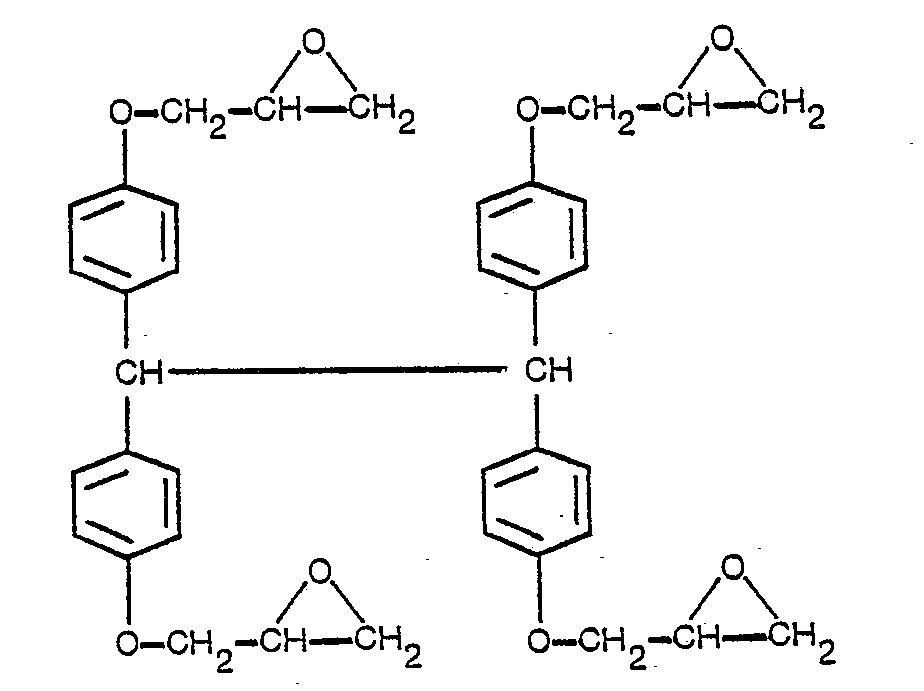
- Suitable epoxy resins are the following:
- a substantial number of different vinyl ester resins having distinct characteristics may be prepared by combining different epoxy resins with various unsaturated acids.
- the variety of products may of course be even further extended, depending upon the selection of the unsaturated monomers which can be combined, and copolymerised, with the vinyl ester resin.
- the vinyl ester resins which have so far achieved the greatest utility and which are therefore preferred for use in the present invention are the bisphenol-A (BPA)-epoxy based vinyl ester resins. These resins may be employed in the compositions of the present invention either with or without a co-reactive monomer such as styrene.
- the BPA-epoxy based vinyl ester resins provide the convenience and practical handling properties of ambient temperature-cure polyester systems, yet they exhibit the excellent physical/mechanical properties associated with well-cured epoxy resin systems. They thus combine the desired properties of two different thermosetting resins into a single resin system.
- the vinyl ester resin systems of the present invention possess excellent physical, mechanical and handling properties. These properties may be attributed to their molecular structure.
- the aromatic rings may provide good mechanical properties and heat resistance.
- the ether linkages may contribute to good chemical resistance.
- the pendant hydroxyl groups may provide adhesion and reactive sites for further modification, as for example by reaction with anhydrides or isocyanates. Substituents may be provided at the hydroxyl sites and may alter properties to suit specific end use application requirements. The pendant hydroxyl groups probably also enhance the reactivity of the double bond.
- the unsaturated acid groups may provide reactive sites for crosslinking and may afford to the products some or all of the cure characteristics of polyester resins. Substituents within the acid moiety may also affect the chemical resistance. For instance, the methyl group of methacrylic acid stabilises the ester group towards hydrolysis, and for this reason the methacrylate vinyl esters may be more resistant to chemical attack than are the acrylate vinyl ester resins.
- n in the above resin formulae, or in general the number of monomeric units, may be from 1 to 5.
- Terminal location of the ester groups may contribute to the superior chemical resistance of the resins.
- the recurring ester groups along the backbone of a typical bisphenol-A-fumarate polyester, for instance, are the most vulnerable part of the resin since they are subject to hydrolysis. Once hydrolysed, the polymer chain is broken, leaving it susceptible to further chemical attach.
- the vinyl esters contain only terminal ester groups, and the number of ester groups is less than in BPA-fumarate polyesters. Thus there are fewer vulnerable sites in the vinyl ester resin. Further, attack at these terminal sites leaves the backbone of the molecule unaffected.
- substituents on the acid moiety such as the methyl group of methacrylic acid, may also protect the ester group against hydrolysis.
- the thixotropy-imparting condensation product used in the invention may be added to the vinyl ester resin composition by means of a wide range of addition techniques.
- One convenient means of addition comprises first dissolving the thixotropy-imparting material in a suitable solvent which is compatible with the vinyl ester resin. Suitable solvents include, for instance, dimethylformamide and dimethyl sulfoxide.
- the resin compositions of the present invention may also comprise catalysts, inhibitors, fillers, pigments and/or other known conventional additives.
- compositions of the invention may be polymerised and cross-linked, using free radical generating initiators which are known in the art.
- Polymerisation of the resin is by means of a true addition reaction and, typically, no by-products are formed.
- Suitable initiators include peroxides, preferably organic peroxides such as benzoyl peroxide or methyl ethyl ketone peroxide, as well as other sources of free radicals.
- photoinitiators which generate free radicals may also be used to initiate polymerisation of the compositions of the present invention.
- the initiator may be used with conventional accelerators or promoters such as, for instance, tertiary amines, e.g. dimethyl or diethyl aniline, and metallic soaps such as cobalt or manganese octoate or naphthenate.
- Suitable shaping methods include the hand lay-up method, the spray-up method, the cold-press method, the bag method, the matched-die method, the filament-winding method and the continuous moulding method.
- Examples 1 to 4 essentially pure dibenzylidene sorbitol (DBS) was added in varying amounts to EPOCRYL @ Resin 322-45 (a bisphenol-A epoxy-based vinyl ester resin terminated with methacrylate ester groups).
- DBS dibenzylidene sorbitol
- the resin is supplied in a 45% styrene solution and has a viscosity of about 700 mPa ⁇ s at 25°C.
- the DBS (which was prepared as described in U.S. Patent Specification No. 3,767,729) was first made into a 15% solution of the DBS in dimethylformamide.
- the DBS solution was added to the resin using a Fisher Dynamix electric stirrer at a setting of 10 which provided a speed of about 300 rpm.
- the viscosity of the solution was measured at 25°C using a Brookfield Model RVF Viscometer at 2 and 20 rpm.
- the viscosity index (VI) was determined as the ratio of the viscosity of the solution at the two speeds, the value at 2 rpm being divided by that at 20 rpm. Viscosity data were collected after one hour, 16 hours and 19 days from the preparation of the solution.
- Viscosity information was determined for a control sample of the resin containing no DBS. The results are given in Table 1, the VI values showing the absolute viscosity measurements as the ratio expressed above.
- the vinyl ester resin employed was Dow's Derakane° Resin 411-45 (a biphenol-A-based vinyl ester resin having methacrylate groups). It is sold as a 55% solution in styrene with a typical viscosity of 400-700 mPa-s. DBS was added to this solution in the same manner as described for Examples 1 to 4. Viscosity data were collected after one hour; 17 hours and 11 days, and are tabulated in Table 2 in the same manner as in Table 1.
- the vinyl ester resin employed was Interplastic's CO ⁇ REZYN® VE-8300 (a biphenol-A-based vinyl ester resin having methacrylate groups). It is sold as a 55% solution in styrene with a typical viscosity of 400 ⁇ 800 mPa-s. DBS was added to this solution in the same manner as described for Examples 1 to 4. Viscosity data were collected after one hour, 20 hours and 20 days, and are tabulated in Table 3 in the same manner as in Table 1.
- Example 14 to 16 the vinyl ester resin employed was Dow's DERAKANE® RESIN 411-45.
- DBS was added to the resin in the same manner as described for Examples 1 to 4, but as a solution in dimethyl sulfoxide rather than dimethylformamide, to form a 25% solution of the thixotropy-imparting material in the resin.
- Viscosity information was collected after one hour, 17 hours and 20 days. The results are summarised in Table 4, in the same manner as in Table 1.
- WG weight gains
Landscapes
- Chemical & Material Sciences (AREA)
- Health & Medical Sciences (AREA)
- Chemical Kinetics & Catalysis (AREA)
- Medicinal Chemistry (AREA)
- Polymers & Plastics (AREA)
- Organic Chemistry (AREA)
- Macromonomer-Based Addition Polymer (AREA)
- Compositions Of Macromolecular Compounds (AREA)
- Epoxy Resins (AREA)
Abstract
Description
- The present invention relates to compositions comprising a vinyl ester resin and a thixotropy-imparting material.
- The so-called "vinyl ester" class of resins has for some years been recognized as useful for a wide range of resin applications, especially those demanding superior chemical resistance. The resins are chemically the reaction products of epoxy resins and ethylenically unsaturated monocarboxylic acids. Typical vinyl ester resins now commercially available include the EPOCRYL@ resins (marketed by Shell Chemical Company), DERAKANE@ 411 (marketed by Dow Chemical Company) and CO-REZYN,9 VE-8300 (marketed by Interplastic Company).
- In the use of vinyl ester resins to prepare shaped products, in particular fibreglass-reinforced plastic (FRP) structures, the viscosity of the resin composition should be controlled so that the composition is fluid enough to allow easy application and good wetting of fillers and reinforcements, yet not so fluid that it drains from vertical surfaces to cause resin-starved areas in the shaped product. Moreover, in many uses, for instance where shaped products such as pipes, tanks, scrubbers or ducts are prepared using a vinyl ester resin, excellent body and hold-up characteristics are very important if not critical to the procedure, especially during the shaping and curing steps. In such applications, the resin is typically dissolved in a vinyl monomer, e.g., styrene, whereupon it is shaped and cured to produce shaped products. If, during the shaping and curing steps, the body and hold-up characteristics of the composition are such that outflow or running of the composition occurs when, for instance, the resin composition is applied onto a vertical surface for lining, the resin surface of the shaped product may be of uneven thickness and have diminished mechanical strength.
- It has previously been proposed to improve the viscosity, body and hold-up characteristics of vinyl ester resins by adding certain thixotropic agents. It has been reported that Cab-O-SiI@ M-5 (a fumed silica product manufactured by Cabot Corporation) and Calidria@ RG-244 (an asbestos product manufactured by Union Carbide) are "extremely effective" thixotroping additives in certain vinyl ester resin compositions, namely EPOCRYL@ Resins 21, DRH-321 and DRH-322 (see "Unsaturated Polyester Technology" edited by Paul F. Bruins; Gordon and Breach Science Publishers). While the known thixotroping additives for vinyl ester resin compositions have provided products which have achieved a fair measure of commercial success, these known additives exhibit certain drawbacks in vinyl ester resin compositions and they may fail effectively to prevent outflow or running of the resin. The fumed silica product requires the presence of relatively large amounts of the thixotroping additive in the resin composition to achieve the desired thixotroping effect; such a concentration may adversely affect the chemical resistance of the product, especially its resistance to basic materials. While the asbestos-containing product may provide a relatively high thixotropic index at low concentrations of added thixotrope, its use is being discouraged and may even be prohibited by law, owing to the recently-recognised carcinogenic properties associated with asbestos and asbestos-containing materials.
- According to the present invention, a composition comprises a vinyl ester resin made by condensing an epoxy resin and an ethylenically unsaturated monocarboxylic acid; and a condensation product of a sugar alcohol and an aromatic aldehyde.
- A composition of the invention can exhibit good thixotropic properties, even at low concentrations of the thixotroping condensation product. The novel compositions can also have excellent chemical resistance, even to basic chemicals. By means of the invention, curable and cured vinyl ester resins are provided with a non-toxic and safe thixotroping additive that may be handled without special precautions during processing. The present invention allows the production of shaped products of vinyl ester resins free from undesired outflow or running of the resins, even at relatively low concentrations of the added thixotrope.
- A composition of the present invention preferably comprises from 0.1 to 10, more preferably 0.3 to 5% by weight of the condensation product. It is preferred that the sugar alcohol from which the product is derived is selected from pentahydric, hexahydric and heptahydric alcohols. Examples are xylitol, sorbitol, a-glucoheptitol, and their homologues in various isomeric forms. Examples of aromatic aldehydes which may be condensed with the sugar alcohol include benzaldehyde, ortho-, para- and meta-tolualdehyde, anisaldehyde and benzaldehydes having 1 to 3 substituents selected from amino groups, nitro groups and halogen atoms.
- The thixotroping additives may be conveniently prepared by means of a variety of known techniques, such as, for instance, that disclosed in U.S. Patent Specification No. 3,767,729. In general, the preparation may be accomplished by condensing the sugar alcohol, e.g. sorbitol, with the aromatic aldehyde in the presence of an acidic catalyst. A preferred category of thixotroping additives are the benzylidene sorbitols, which may be made by condensing sorbitol with benzaldehyde. By adjusting the molar ratio of benzaldehyde to sorbitol, monobenzylidene sorbitol, dibenzylidene sorbitol and tribenzylidene sorbitol can be produced selectively. Any of these benzylidene sorbitols can be used in the invention, if desired in admixture with one another. Therefore, even when a mixture of benzylidene sorbitols is produced, there is no need to isolate them. The most preferred condensation products are dibenzylidene sorbitol, mixtures of monobenzylidene sorbitol and dibenzylidene sorbitol, and mixtures of dibenzylidene sorbitol and tribenzylidene sorbitol.
- A composition of the present invention may comprise an adjuvant, in order to facilitate handling, cure and to provide desired mechanical properties. Suitable compatible adjuvants include reactive, ethylenically unsaturated comonomers such as styrene, chlorostyrene, vinyltoluenes, methylstyrene, diallyl phthalate, triallyl cyanurate, acrylate esters, methacrylate esters and divinylbenzene. Styrene is the preferred compatible adjuvant. The compositions may also comprise a non-reactive diluent, such as acetone, where low application viscosity is required but where properties obtainable only with the neat resin are desired.
- The vinyl ester resins used in the present invention may be any of those known in the art and may be prepared by an addition reaction between an epoxy resin and an ethylenically unsaturated monocarboxylic acid. Processes for preparing suitable vinyl ester resins are disclosed in U.S. Patent Specifications Nos. 3,256,226; 3,317,465; 3,345,401; 3,373,221; 3,377,406; 3,432,478; 3,548,030; 3,564,074; 3,634,542 and 3,637,618.
- In general, the reaction by means of which the vinyl ester resins used in the present invention are prepared is straightforward. It may be catalysed by suitable catalysts such as, for instance, tertiary amines, phosphines, alkalis or -onium salts. The general equation for the reaction may be represented as follows:

- Suitable acids are acrylic, methacrylic, crotonic and cinnamic acids. Suitable epoxy resins are the following:
-

-

-
-

- A substantial number of different vinyl ester resins having distinct characteristics may be prepared by combining different epoxy resins with various unsaturated acids. The variety of products may of course be even further extended, depending upon the selection of the unsaturated monomers which can be combined, and copolymerised, with the vinyl ester resin. The vinyl ester resins which have so far achieved the greatest utility and which are therefore preferred for use in the present invention are the bisphenol-A (BPA)-epoxy based vinyl ester resins. These resins may be employed in the compositions of the present invention either with or without a co-reactive monomer such as styrene.
- The BPA-epoxy based vinyl ester resins provide the convenience and practical handling properties of ambient temperature-cure polyester systems, yet they exhibit the excellent physical/mechanical properties associated with well-cured epoxy resin systems. They thus combine the desired properties of two different thermosetting resins into a single resin system.
- The vinyl ester resin systems of the present invention possess excellent physical, mechanical and handling properties. These properties may be attributed to their molecular structure.
- These products, representing a successful marriage of epoxies and polyesters, may exhibit characteristics of each. Within the epoxy resin moiety, the aromatic rings may provide good mechanical properties and heat resistance. The ether linkages may contribute to good chemical resistance. The pendant hydroxyl groups may provide adhesion and reactive sites for further modification, as for example by reaction with anhydrides or isocyanates. Substituents may be provided at the hydroxyl sites and may alter properties to suit specific end use application requirements. The pendant hydroxyl groups probably also enhance the reactivity of the double bond. The unsaturated acid groups may provide reactive sites for crosslinking and may afford to the products some or all of the cure characteristics of polyester resins. Substituents within the acid moiety may also affect the chemical resistance. For instance, the methyl group of methacrylic acid stabilises the ester group towards hydrolysis, and for this reason the methacrylate vinyl esters may be more resistant to chemical attack than are the acrylate vinyl ester resins.
- In general, R1 in a group-CO-CR1=C- in the resin may be hydrogen or, for example, C1-s alkyl, e.g. methyl, ethyl or propyl. n in the above resin formulae, or in general the number of monomeric units, may be from 1 to 5.
- Terminal location of the ester groups may contribute to the superior chemical resistance of the resins. The recurring ester groups along the backbone of a typical bisphenol-A-fumarate polyester, for instance, are the most vulnerable part of the resin since they are subject to hydrolysis. Once hydrolysed, the polymer chain is broken, leaving it susceptible to further chemical attach. However, the vinyl esters contain only terminal ester groups, and the number of ester groups is less than in BPA-fumarate polyesters. Thus there are fewer vulnerable sites in the vinyl ester resin. Further, attack at these terminal sites leaves the backbone of the molecule unaffected. As mentioned above, substituents on the acid moiety, such as the methyl group of methacrylic acid, may also protect the ester group against hydrolysis.
- The thixotropy-imparting condensation product used in the invention may be added to the vinyl ester resin composition by means of a wide range of addition techniques. One convenient means of addition comprises first dissolving the thixotropy-imparting material in a suitable solvent which is compatible with the vinyl ester resin. Suitable solvents include, for instance, dimethylformamide and dimethyl sulfoxide. In addition to the vinyl ester resin, thixotroping additive and, if desired, a reactive or non-reactive diluent, the resin compositions of the present invention may also comprise catalysts, inhibitors, fillers, pigments and/or other known conventional additives.
- Compositions of the invention may be polymerised and cross-linked, using free radical generating initiators which are known in the art. Polymerisation of the resin is by means of a true addition reaction and, typically, no by-products are formed. Suitable initiators include peroxides, preferably organic peroxides such as benzoyl peroxide or methyl ethyl ketone peroxide, as well as other sources of free radicals. For example, photoinitiators which generate free radicals may also be used to initiate polymerisation of the compositions of the present invention. The initiator may be used with conventional accelerators or promoters such as, for instance, tertiary amines, e.g. dimethyl or diethyl aniline, and metallic soaps such as cobalt or manganese octoate or naphthenate.
- -Various shaping methods may be employed to shape the resin composition. Suitable methods include the hand lay-up method, the spray-up method, the cold-press method, the bag method, the matched-die method, the filament-winding method and the continuous moulding method.
- The following Examples illustrate the invention, except Examples 5 and 17 which are comparative. Unless otherwise indicated, all parts and percentages are by weight. Viscosity measurements are in mPa · s.
- In Examples 1 to 4, essentially pure dibenzylidene sorbitol (DBS) was added in varying amounts to EPOCRYL@ Resin 322-45 (a bisphenol-A epoxy-based vinyl ester resin terminated with methacrylate ester groups). The resin is supplied in a 45% styrene solution and has a viscosity of about 700 mPa·s at 25°C.
- The DBS (which was prepared as described in U.S. Patent Specification No. 3,767,729) was first made into a 15% solution of the DBS in dimethylformamide. The DBS solution was added to the resin using a Fisher Dynamix electric stirrer at a setting of 10 which provided a speed of about 300 rpm. After addition, the viscosity of the solution was measured at 25°C using a Brookfield Model RVF Viscometer at 2 and 20 rpm. The viscosity index (VI) was determined as the ratio of the viscosity of the solution at the two speeds, the value at 2 rpm being divided by that at 20 rpm. Viscosity data were collected after one hour, 16 hours and 19 days from the preparation of the solution. In Example 5, viscosity information was determined for a control sample of the resin containing no DBS. The results are given in Table 1, the VI values showing the absolute viscosity measurements as the ratio expressed above.

- In Examples 6 to 8, the vinyl ester resin employed was Dow's Derakane° Resin 411-45 (a biphenol-A-based vinyl ester resin having methacrylate groups). It is sold as a 55% solution in styrene with a typical viscosity of 400-700 mPa-s. DBS was added to this solution in the same manner as described for Examples 1 to 4. Viscosity data were collected after one hour; 17 hours and 11 days, and are tabulated in Table 2 in the same manner as in Table 1.

- In Examples 9 to 13, the vinyl ester resin employed was Interplastic's CO―REZYN® VE-8300 (a biphenol-A-based vinyl ester resin having methacrylate groups). It is sold as a 55% solution in styrene with a typical viscosity of 400―800 mPa-s. DBS was added to this solution in the same manner as described for Examples 1 to 4. Viscosity data were collected after one hour, 20 hours and 20 days, and are tabulated in Table 3 in the same manner as in Table 1.

- In Examples 14 to 16, the vinyl ester resin employed was Dow's DERAKANE® RESIN 411-45. DBS was added to the resin in the same manner as described for Examples 1 to 4, but as a solution in dimethyl sulfoxide rather than dimethylformamide, to form a 25% solution of the thixotropy-imparting material in the resin. Viscosity information was collected after one hour, 17 hours and 20 days. The results are summarised in Table 4, in the same manner as in Table 1.

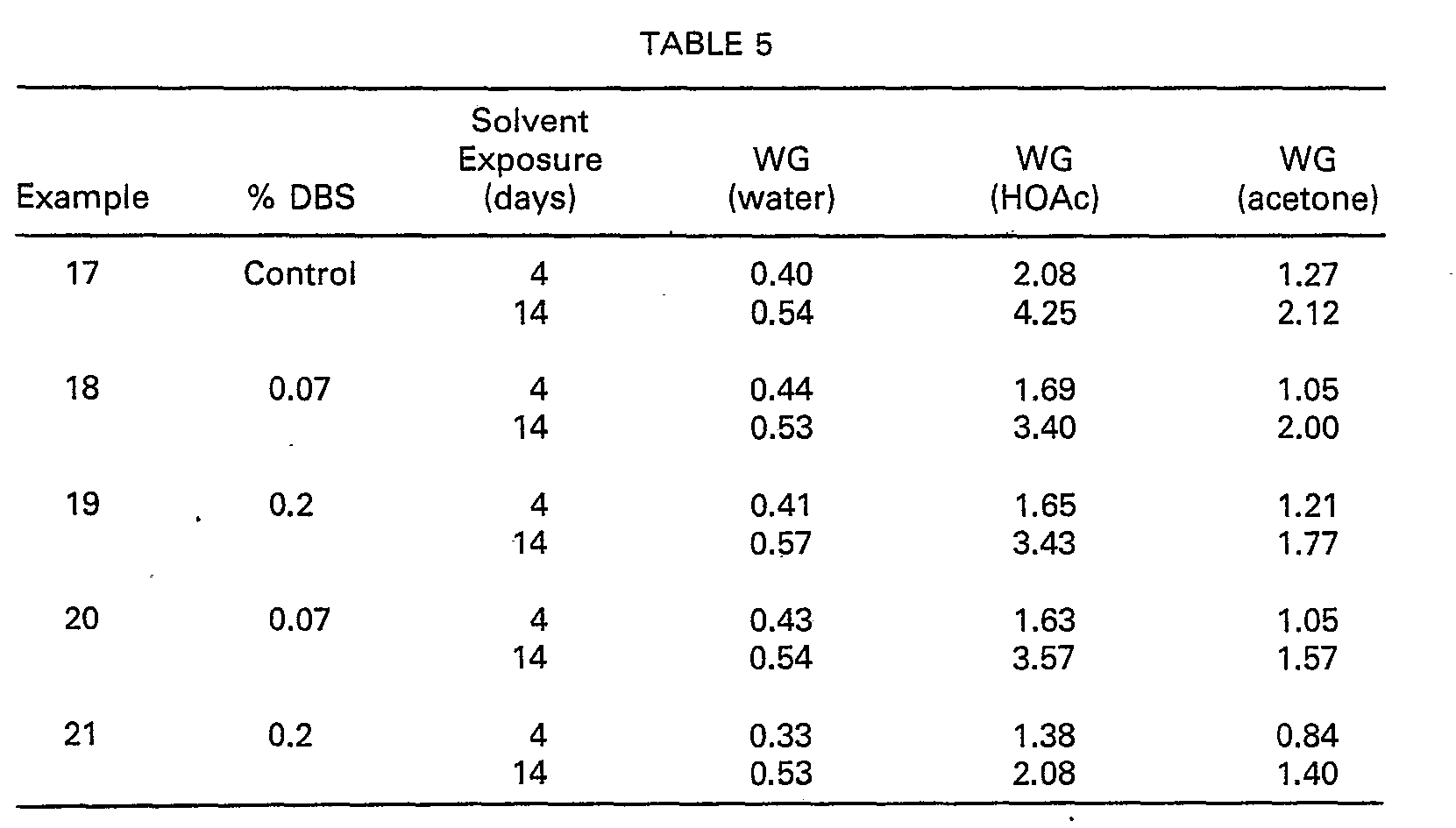
- In these Examples, the improved resistance to solvents of a variety of cured vinyl ester resin samples containing DBS as a thixotropy-imparting material, in varying concentrations, is illustrated:
- Samples were prepared by making a master batch of Epocryl® 322 which contained 0.25% cobalt naphthenate (8% Co) and 0.25% N,N-dimethylaniline. Example 17 was a control, no thixotropy-imparting material being added. For use in Examples 18 and 19, a 25% solution of DBS in dimethyl sulfoxide was prepared. For use in Examples 20 and 21, a 15% solution of DBS in dimethylformamide was prepared. The solution was added to the resin sample in each instance in an amount sufficient to provide the amount of DBS in the product resin given in Table 5.
- The mixtures were stirred. 2.1 %, with respect to the mixture, of LUBERSOL@ DDM-9 (a 9% solution of methyl ethyl ketone peroxide in plasticiser, sold by the Lucidal Division of Pennwalt Corporation) were then added. After further stirring, the formulations were cast in a rod-shaped mould. After curing at room temperature for several hours, the bars were removed from the moulds and were post-cured in an oven at 50°C for 12 hours. After post-curing, discs were cut from the bars, polished slightly to remove rough edges and loose particles, and weighed prior to exposure to solvent. After immersion in water, acetic acid (HOAc) or acetone for 4 and 14 days, the samples were removed, dried to remove excess fluid and reweighed to determine weight gain. The weight gains (WG) given in Table 5 were calculated by dividing the difference in weight before and after solvent exposure by the initial weight, expressed as a percentage.
Claims (8)
Priority Applications (1)
| Application Number | Priority Date | Filing Date | Title |
|---|---|---|---|
| AT81303716T ATE15907T1 (en) | 1980-08-14 | 1981-08-14 | VINYLESTER RESIN COMPOSITIONS. |
Applications Claiming Priority (2)
| Application Number | Priority Date | Filing Date | Title |
|---|---|---|---|
| US178149 | 1980-08-14 | ||
| US06/178,149 US4310644A (en) | 1980-08-14 | 1980-08-14 | Vinyl ester resin compositions |
Publications (3)
| Publication Number | Publication Date |
|---|---|
| EP0046386A2 EP0046386A2 (en) | 1982-02-24 |
| EP0046386A3 EP0046386A3 (en) | 1982-03-10 |
| EP0046386B1 true EP0046386B1 (en) | 1985-10-02 |
Family
ID=22651400
Family Applications (1)
| Application Number | Title | Priority Date | Filing Date |
|---|---|---|---|
| EP81303716A Expired EP0046386B1 (en) | 1980-08-14 | 1981-08-14 | Vinyl ester resin compositions |
Country Status (6)
| Country | Link |
|---|---|
| US (1) | US4310644A (en) |
| EP (1) | EP0046386B1 (en) |
| JP (1) | JPS57145116A (en) |
| AT (1) | ATE15907T1 (en) |
| CA (1) | CA1166787A (en) |
| DE (1) | DE3172531D1 (en) |
Families Citing this family (18)
| Publication number | Priority date | Publication date | Assignee | Title |
|---|---|---|---|---|
| US4427835A (en) | 1981-08-07 | 1984-01-24 | The Procter & Gamble Company | Agents for preparing cross-linked polymers and paint and plastic compositions containing those agents |
| US4506048A (en) * | 1981-08-07 | 1985-03-19 | The Procter & Gamble Company | Agents for preparing cross-linked polymers and paint and plastic compositions containing those agents |
| US4465810A (en) * | 1982-07-01 | 1984-08-14 | The Procter & Gamble Company | Agents for preparing cross-linked polymers and water-based paint compositions containing those agents |
| JPH02133421A (en) * | 1988-11-14 | 1990-05-22 | Sunstar Eng Inc | Epoxy resin composition |
| EP0419198B1 (en) * | 1989-09-20 | 1996-04-17 | Nippon Oil Co. Ltd. | Liquid fuel combustion burner |
| US5292841A (en) * | 1993-04-19 | 1994-03-08 | Aristech Chemical Corporation | Laminating resins having low organic emissions |
| AU681986B2 (en) * | 1995-04-25 | 1997-09-11 | Glasteel Industrial Laminates A Division Of The Alpha Corporation Of Tennessee | Thermosetting resin compositions, electrical laminates obtained therefrom and process of producing these |
| JP3431782B2 (en) * | 1996-03-08 | 2003-07-28 | 昭和高分子株式会社 | Curable composite material composition and curing method thereof |
| US6042227A (en) * | 1998-05-19 | 2000-03-28 | Xerox Corporation | Hot melt phase change ink containing Diels-Alder polymerization precursor |
| GB0116318D0 (en) * | 2001-07-03 | 2001-08-29 | 4 The Environment Ltd | Processing of waste materials |
| DE102004059883A1 (en) * | 2004-12-10 | 2006-06-14 | Brandenburger Patentverwertung Gbr (Vertretungsberechtigte Gesellschafter Herr Joachim Brandenburger | Production of a resin-impregnated fiber hose for the inner lining of ducts and pipelines |
| US20060134408A1 (en) * | 2004-12-20 | 2006-06-22 | Mitsubishi Rayon Co., Ltd. | Process for producing sandwich structure and adhesive film therefor |
| US7723416B2 (en) * | 2005-07-11 | 2010-05-25 | Illinois Tool Works, Inc. | Peroxide dispersions |
| US7550532B2 (en) * | 2005-07-11 | 2009-06-23 | Illinois Tool Works Inc. | Polyester resin composition |
| US7781514B2 (en) * | 2005-07-11 | 2010-08-24 | Illinois Tool Works Inc. | Microspheres as thickening agents for organic peroxides |
| WO2008106718A1 (en) * | 2007-03-02 | 2008-09-12 | Advanced Composites International Pty Ltd | Reinforced composite material |
| AU2009340370C1 (en) * | 2009-02-23 | 2017-02-02 | Hydrawall Pty Ltd | Surface composition and method of application |
| JP2024500854A (en) * | 2020-12-21 | 2024-01-10 | カーボン・エンジニアリング・リミテッド | carbon dioxide capture |
Family Cites Families (3)
| Publication number | Priority date | Publication date | Assignee | Title |
|---|---|---|---|---|
| DE1161014B (en) * | 1961-12-09 | 1964-01-09 | Basf Ag | Polyester molding or coating compounds |
| JPS5023434B1 (en) * | 1971-02-16 | 1975-08-07 | ||
| US4151219A (en) * | 1977-05-11 | 1979-04-24 | The Dow Chemical Company | Vinyl ester resins containing polyoxyalkylene low profile additives |
-
1980
- 1980-08-14 US US06/178,149 patent/US4310644A/en not_active Expired - Lifetime
-
1981
- 1981-08-13 CA CA000383848A patent/CA1166787A/en not_active Expired
- 1981-08-14 JP JP56127678A patent/JPS57145116A/en active Pending
- 1981-08-14 AT AT81303716T patent/ATE15907T1/en not_active IP Right Cessation
- 1981-08-14 EP EP81303716A patent/EP0046386B1/en not_active Expired
- 1981-08-14 DE DE8181303716T patent/DE3172531D1/en not_active Expired
Also Published As
| Publication number | Publication date |
|---|---|
| EP0046386A3 (en) | 1982-03-10 |
| EP0046386A2 (en) | 1982-02-24 |
| DE3172531D1 (en) | 1985-11-07 |
| ATE15907T1 (en) | 1985-10-15 |
| CA1166787A (en) | 1984-05-01 |
| US4310644A (en) | 1982-01-12 |
| JPS57145116A (en) | 1982-09-08 |
Similar Documents
| Publication | Publication Date | Title |
|---|---|---|
| EP0046386A2 (en) | Vinyl ester resin compositions | |
| US2824851A (en) | Acrylic acid derivatives of epoxide resins and method of curing same | |
| US3219604A (en) | Polyester resin composition modified by monocarboxylic acid and metallic bridging agent | |
| US3773856A (en) | Process for the preparation of unsaturated epoxy ester compositions | |
| US2575440A (en) | Crotonate esters of glyceryl polyethers of dihydric phenols | |
| US3222421A (en) | Polyester resinous compositions | |
| JPS5991157A (en) | Powdery coating agent and manufacture of polyester formed body | |
| US3518326A (en) | Thermosetting resins derived from n - 3 - oxohydrocarbon - substituted acrylamides | |
| US2475731A (en) | Copolymerization products of styrene and adduct modified glycolmaleate resins | |
| US2444655A (en) | Abrasion-resistant polymers and process for preparing same | |
| US4100120A (en) | Resinous composition | |
| CN111662540B (en) | Amino modified unsaturated polyester resin | |
| US3957906A (en) | Chemically resistant polyester resins compositions | |
| US3993663A (en) | Curable resinous composition | |
| US3792006A (en) | Water extended vinyl ester resins | |
| USRE31310E (en) | Impact resistant vinyl ester resin and process for making same | |
| JPH0233724B2 (en) | ||
| US3272843A (en) | Phenylene-bis | |
| US3661828A (en) | Thermoset molding powders employing glycidyl methacrylate and diphenols | |
| JPH0576487B2 (en) | ||
| US3933857A (en) | Polymerizable cycloacetal resinous composition | |
| US3733311A (en) | Thermoset resin from glycidol and a cyclic anhydride | |
| US5750619A (en) | Coating composition of non-cyclic anhydride resin, polyepoxy oligomer and stabilized acrylic resin | |
| JPH05163323A (en) | Thioester polymerization regulator | |
| JP2851414B2 (en) | Heat resistant vinyl ester resin composition |
Legal Events
| Date | Code | Title | Description |
|---|---|---|---|
| PUAI | Public reference made under article 153(3) epc to a published international application that has entered the european phase |
Free format text: ORIGINAL CODE: 0009012 |
|
| PUAL | Search report despatched |
Free format text: ORIGINAL CODE: 0009013 |
|
| AK | Designated contracting states |
Designated state(s): AT BE CH DE FR GB IT LU NL SE |
|
| AK | Designated contracting states |
Designated state(s): AT BE CH DE FR GB IT LU NL SE |
|
| 17P | Request for examination filed |
Effective date: 19820817 |
|
| RAP1 | Party data changed (applicant data changed or rights of an application transferred) |
Owner name: MILLIKEN RESEARCH CORPORATION |
|
| ITF | It: translation for a ep patent filed | ||
| GRAA | (expected) grant |
Free format text: ORIGINAL CODE: 0009210 |
|
| AK | Designated contracting states |
Designated state(s): AT BE CH DE FR GB IT LI LU NL SE |
|
| REF | Corresponds to: |
Ref document number: 15907 Country of ref document: AT Date of ref document: 19851015 Kind code of ref document: T |
|
| REF | Corresponds to: |
Ref document number: 3172531 Country of ref document: DE Date of ref document: 19851107 |
|
| ET | Fr: translation filed | ||
| PLBE | No opposition filed within time limit |
Free format text: ORIGINAL CODE: 0009261 |
|
| STAA | Information on the status of an ep patent application or granted ep patent |
Free format text: STATUS: NO OPPOSITION FILED WITHIN TIME LIMIT |
|
| PG25 | Lapsed in a contracting state [announced via postgrant information from national office to epo] |
Ref country code: SE Effective date: 19860815 |
|
| 26N | No opposition filed | ||
| ITTA | It: last paid annual fee | ||
| PGFP | Annual fee paid to national office [announced via postgrant information from national office to epo] |
Ref country code: AT Payment date: 19920702 Year of fee payment: 12 |
|
| PGFP | Annual fee paid to national office [announced via postgrant information from national office to epo] |
Ref country code: LU Payment date: 19920707 Year of fee payment: 12 |
|
| PGFP | Annual fee paid to national office [announced via postgrant information from national office to epo] |
Ref country code: NL Payment date: 19920831 Year of fee payment: 12 |
|
| PGFP | Annual fee paid to national office [announced via postgrant information from national office to epo] |
Ref country code: CH Payment date: 19920915 Year of fee payment: 12 |
|
| EPTA | Lu: last paid annual fee | ||
| PGFP | Annual fee paid to national office [announced via postgrant information from national office to epo] |
Ref country code: FR Payment date: 19930608 Year of fee payment: 13 |
|
| PGFP | Annual fee paid to national office [announced via postgrant information from national office to epo] |
Ref country code: GB Payment date: 19930621 Year of fee payment: 13 |
|
| PGFP | Annual fee paid to national office [announced via postgrant information from national office to epo] |
Ref country code: BE Payment date: 19930625 Year of fee payment: 13 |
|
| PG25 | Lapsed in a contracting state [announced via postgrant information from national office to epo] |
Ref country code: LU Free format text: LAPSE BECAUSE OF NON-PAYMENT OF DUE FEES Effective date: 19930814 Ref country code: AT Effective date: 19930814 |
|
| PG25 | Lapsed in a contracting state [announced via postgrant information from national office to epo] |
Ref country code: LI Effective date: 19930831 Ref country code: CH Effective date: 19930831 |
|
| PGFP | Annual fee paid to national office [announced via postgrant information from national office to epo] |
Ref country code: DE Payment date: 19930930 Year of fee payment: 13 |
|
| PG25 | Lapsed in a contracting state [announced via postgrant information from national office to epo] |
Ref country code: NL Effective date: 19940301 |
|
| NLV4 | Nl: lapsed or anulled due to non-payment of the annual fee | ||
| REG | Reference to a national code |
Ref country code: CH Ref legal event code: PL |
|
| PG25 | Lapsed in a contracting state [announced via postgrant information from national office to epo] |
Ref country code: GB Effective date: 19940814 |
|
| PG25 | Lapsed in a contracting state [announced via postgrant information from national office to epo] |
Ref country code: BE Effective date: 19940831 |
|
| EUG | Se: european patent has lapsed |
Ref document number: 81303716.5 Effective date: 19870812 |
|
| BERE | Be: lapsed |
Owner name: MILLIKEN RESEARCH CORP. Effective date: 19940831 |
|
| GBPC | Gb: european patent ceased through non-payment of renewal fee |
Effective date: 19940814 |
|
| PG25 | Lapsed in a contracting state [announced via postgrant information from national office to epo] |
Ref country code: FR Effective date: 19950428 |
|
| PG25 | Lapsed in a contracting state [announced via postgrant information from national office to epo] |
Ref country code: DE Effective date: 19950503 |
|
| REG | Reference to a national code |
Ref country code: FR Ref legal event code: ST |