EP0046269B1 - Magnetic recording media and process for fabricating the same - Google Patents
Magnetic recording media and process for fabricating the same Download PDFInfo
- Publication number
- EP0046269B1 EP0046269B1 EP81106264A EP81106264A EP0046269B1 EP 0046269 B1 EP0046269 B1 EP 0046269B1 EP 81106264 A EP81106264 A EP 81106264A EP 81106264 A EP81106264 A EP 81106264A EP 0046269 B1 EP0046269 B1 EP 0046269B1
- Authority
- EP
- European Patent Office
- Prior art keywords
- film
- magnetic recording
- thin film
- magnetic
- recording medium
- Prior art date
- Legal status (The legal status is an assumption and is not a legal conclusion. Google has not performed a legal analysis and makes no representation as to the accuracy of the status listed.)
- Expired
Links
- 230000005291 magnetic effect Effects 0.000 title claims description 88
- 238000000034 method Methods 0.000 title claims description 24
- 239000010409 thin film Substances 0.000 claims description 73
- 239000010408 film Substances 0.000 claims description 69
- 229920006267 polyester film Polymers 0.000 claims description 34
- QVGXLLKOCUKJST-UHFFFAOYSA-N atomic oxygen Chemical compound [O] QVGXLLKOCUKJST-UHFFFAOYSA-N 0.000 claims description 25
- 229910052760 oxygen Inorganic materials 0.000 claims description 25
- 239000001301 oxygen Substances 0.000 claims description 25
- 239000002245 particle Substances 0.000 claims description 20
- 150000001875 compounds Chemical class 0.000 claims description 19
- 239000000314 lubricant Substances 0.000 claims description 15
- 229920005989 resin Polymers 0.000 claims description 15
- 239000011347 resin Substances 0.000 claims description 15
- 230000005294 ferromagnetic effect Effects 0.000 claims description 14
- 229910052751 metal Inorganic materials 0.000 claims description 14
- 239000002184 metal Substances 0.000 claims description 14
- 230000003746 surface roughness Effects 0.000 claims description 13
- 239000000956 alloy Substances 0.000 claims description 12
- 229910045601 alloy Inorganic materials 0.000 claims description 12
- 239000007787 solid Substances 0.000 claims description 10
- 150000002605 large molecules Chemical class 0.000 claims 2
- 239000000839 emulsion Substances 0.000 description 22
- XUIMIQQOPSSXEZ-UHFFFAOYSA-N Silicon Chemical compound [Si] XUIMIQQOPSSXEZ-UHFFFAOYSA-N 0.000 description 15
- 239000010703 silicon Substances 0.000 description 15
- 229910052710 silicon Inorganic materials 0.000 description 15
- 238000004519 manufacturing process Methods 0.000 description 10
- 239000003822 epoxy resin Substances 0.000 description 9
- 229920000647 polyepoxide Polymers 0.000 description 9
- 239000000853 adhesive Substances 0.000 description 8
- 230000001070 adhesive effect Effects 0.000 description 8
- PXHVJJICTQNCMI-UHFFFAOYSA-N Nickel Chemical compound [Ni] PXHVJJICTQNCMI-UHFFFAOYSA-N 0.000 description 7
- 239000004848 polyfunctional curative Substances 0.000 description 7
- 229920002451 polyvinyl alcohol Polymers 0.000 description 7
- 235000019422 polyvinyl alcohol Nutrition 0.000 description 7
- 239000000758 substrate Substances 0.000 description 7
- 238000007738 vacuum evaporation Methods 0.000 description 7
- 239000004593 Epoxy Substances 0.000 description 6
- 239000004372 Polyvinyl alcohol Substances 0.000 description 6
- YXFVVABEGXRONW-UHFFFAOYSA-N Toluene Chemical compound CC1=CC=CC=C1 YXFVVABEGXRONW-UHFFFAOYSA-N 0.000 description 6
- 229910052782 aluminium Inorganic materials 0.000 description 6
- XAGFODPZIPBFFR-UHFFFAOYSA-N aluminium Chemical compound [Al] XAGFODPZIPBFFR-UHFFFAOYSA-N 0.000 description 6
- 239000010941 cobalt Substances 0.000 description 6
- 229910017052 cobalt Inorganic materials 0.000 description 6
- GUTLYIVDDKVIGB-UHFFFAOYSA-N cobalt atom Chemical compound [Co] GUTLYIVDDKVIGB-UHFFFAOYSA-N 0.000 description 6
- 229920000728 polyester Polymers 0.000 description 6
- 238000000151 deposition Methods 0.000 description 5
- 239000000203 mixture Substances 0.000 description 5
- 229920000570 polyether Polymers 0.000 description 5
- OKTJSMMVPCPJKN-UHFFFAOYSA-N Carbon Chemical compound [C] OKTJSMMVPCPJKN-UHFFFAOYSA-N 0.000 description 4
- 239000004721 Polyphenylene oxide Substances 0.000 description 4
- 239000011248 coating agent Substances 0.000 description 4
- 238000000576 coating method Methods 0.000 description 4
- 229920001577 copolymer Polymers 0.000 description 4
- 238000001035 drying Methods 0.000 description 4
- 239000010439 graphite Substances 0.000 description 4
- 229910002804 graphite Inorganic materials 0.000 description 4
- 238000001000 micrograph Methods 0.000 description 4
- 238000002156 mixing Methods 0.000 description 4
- XEKOWRVHYACXOJ-UHFFFAOYSA-N Ethyl acetate Chemical compound CCOC(C)=O XEKOWRVHYACXOJ-UHFFFAOYSA-N 0.000 description 3
- XEEYBQQBJWHFJM-UHFFFAOYSA-N Iron Chemical compound [Fe] XEEYBQQBJWHFJM-UHFFFAOYSA-N 0.000 description 3
- BZHJMEDXRYGGRV-UHFFFAOYSA-N Vinyl chloride Chemical compound ClC=C BZHJMEDXRYGGRV-UHFFFAOYSA-N 0.000 description 3
- 239000000654 additive Substances 0.000 description 3
- 230000002411 adverse Effects 0.000 description 3
- 239000003054 catalyst Substances 0.000 description 3
- 238000007334 copolymerization reaction Methods 0.000 description 3
- LNEPOXFFQSENCJ-UHFFFAOYSA-N haloperidol Chemical compound C1CC(O)(C=2C=CC(Cl)=CC=2)CCN1CCCC(=O)C1=CC=C(F)C=C1 LNEPOXFFQSENCJ-UHFFFAOYSA-N 0.000 description 3
- 230000001050 lubricating effect Effects 0.000 description 3
- 239000005020 polyethylene terephthalate Substances 0.000 description 3
- 239000002685 polymerization catalyst Substances 0.000 description 3
- 239000002904 solvent Substances 0.000 description 3
- 238000004544 sputter deposition Methods 0.000 description 3
- 229920002803 thermoplastic polyurethane Polymers 0.000 description 3
- LDVVTQMJQSCDMK-UHFFFAOYSA-N 1,3-dihydroxypropan-2-yl formate Chemical compound OCC(CO)OC=O LDVVTQMJQSCDMK-UHFFFAOYSA-N 0.000 description 2
- VTYYLEPIZMXCLO-UHFFFAOYSA-L Calcium carbonate Chemical compound [Ca+2].[O-]C([O-])=O VTYYLEPIZMXCLO-UHFFFAOYSA-L 0.000 description 2
- 239000004215 Carbon black (E152) Substances 0.000 description 2
- 229920000877 Melamine resin Polymers 0.000 description 2
- GWEVSGVZZGPLCZ-UHFFFAOYSA-N Titan oxide Chemical compound O=[Ti]=O GWEVSGVZZGPLCZ-UHFFFAOYSA-N 0.000 description 2
- XTXRWKRVRITETP-UHFFFAOYSA-N Vinyl acetate Chemical compound CC(=O)OC=C XTXRWKRVRITETP-UHFFFAOYSA-N 0.000 description 2
- 150000001412 amines Chemical class 0.000 description 2
- 239000012298 atmosphere Substances 0.000 description 2
- 230000015572 biosynthetic process Effects 0.000 description 2
- 230000000903 blocking effect Effects 0.000 description 2
- 239000012461 cellulose resin Substances 0.000 description 2
- 230000008021 deposition Effects 0.000 description 2
- QXYJCZRRLLQGCR-UHFFFAOYSA-N dioxomolybdenum Chemical compound O=[Mo]=O QXYJCZRRLLQGCR-UHFFFAOYSA-N 0.000 description 2
- 239000002270 dispersing agent Substances 0.000 description 2
- 230000000694 effects Effects 0.000 description 2
- 238000001704 evaporation Methods 0.000 description 2
- 230000008020 evaporation Effects 0.000 description 2
- -1 fatty acid esters Chemical class 0.000 description 2
- 229930195733 hydrocarbon Natural products 0.000 description 2
- 229910052742 iron Inorganic materials 0.000 description 2
- 238000005259 measurement Methods 0.000 description 2
- 150000007974 melamines Chemical class 0.000 description 2
- 229910044991 metal oxide Inorganic materials 0.000 description 2
- 150000004706 metal oxides Chemical class 0.000 description 2
- 150000002739 metals Chemical class 0.000 description 2
- 229910052759 nickel Inorganic materials 0.000 description 2
- QIQXTHQIDYTFRH-UHFFFAOYSA-N octadecanoic acid Chemical compound CCCCCCCCCCCCCCCCCC(O)=O QIQXTHQIDYTFRH-UHFFFAOYSA-N 0.000 description 2
- 230000002195 synergetic effect Effects 0.000 description 2
- 239000002562 thickening agent Substances 0.000 description 2
- OGIDPMRJRNCKJF-UHFFFAOYSA-N titanium oxide Inorganic materials [Ti]=O OGIDPMRJRNCKJF-UHFFFAOYSA-N 0.000 description 2
- 229920006337 unsaturated polyester resin Polymers 0.000 description 2
- 238000001771 vacuum deposition Methods 0.000 description 2
- XLYOFNOQVPJJNP-UHFFFAOYSA-N water Chemical compound O XLYOFNOQVPJJNP-UHFFFAOYSA-N 0.000 description 2
- JTXMVXSTHSMVQF-UHFFFAOYSA-N 2-acetyloxyethyl acetate Chemical compound CC(=O)OCCOC(C)=O JTXMVXSTHSMVQF-UHFFFAOYSA-N 0.000 description 1
- 229920002134 Carboxymethyl cellulose Polymers 0.000 description 1
- LFQSCWFLJHTTHZ-UHFFFAOYSA-N Ethanol Chemical compound CCO LFQSCWFLJHTTHZ-UHFFFAOYSA-N 0.000 description 1
- 108010010803 Gelatin Proteins 0.000 description 1
- 239000004354 Hydroxyethyl cellulose Substances 0.000 description 1
- 229920000663 Hydroxyethyl cellulose Polymers 0.000 description 1
- 239000004952 Polyamide Substances 0.000 description 1
- 229920006362 Teflon® Polymers 0.000 description 1
- RTAQQCXQSZGOHL-UHFFFAOYSA-N Titanium Chemical compound [Ti] RTAQQCXQSZGOHL-UHFFFAOYSA-N 0.000 description 1
- 150000001298 alcohols Chemical class 0.000 description 1
- PNEYBMLMFCGWSK-UHFFFAOYSA-N aluminium oxide Inorganic materials [O-2].[O-2].[O-2].[Al+3].[Al+3] PNEYBMLMFCGWSK-UHFFFAOYSA-N 0.000 description 1
- 239000002585 base Substances 0.000 description 1
- 239000011230 binding agent Substances 0.000 description 1
- 229910000019 calcium carbonate Inorganic materials 0.000 description 1
- 239000006229 carbon black Substances 0.000 description 1
- 230000003197 catalytic effect Effects 0.000 description 1
- 230000007797 corrosion Effects 0.000 description 1
- 238000005260 corrosion Methods 0.000 description 1
- 238000007872 degassing Methods 0.000 description 1
- 235000014113 dietary fatty acids Nutrition 0.000 description 1
- 238000009713 electroplating Methods 0.000 description 1
- 150000002148 esters Chemical class 0.000 description 1
- 230000001747 exhibiting effect Effects 0.000 description 1
- 238000002474 experimental method Methods 0.000 description 1
- 239000000194 fatty acid Substances 0.000 description 1
- 229930195729 fatty acid Natural products 0.000 description 1
- 239000010419 fine particle Substances 0.000 description 1
- 239000012634 fragment Substances 0.000 description 1
- 239000007789 gas Substances 0.000 description 1
- 229920000159 gelatin Polymers 0.000 description 1
- 239000008273 gelatin Substances 0.000 description 1
- 235000019322 gelatine Nutrition 0.000 description 1
- 235000011852 gelatine desserts Nutrition 0.000 description 1
- 150000002430 hydrocarbons Chemical class 0.000 description 1
- 235000019447 hydroxyethyl cellulose Nutrition 0.000 description 1
- 239000001023 inorganic pigment Substances 0.000 description 1
- 238000007733 ion plating Methods 0.000 description 1
- 239000000463 material Substances 0.000 description 1
- QLOAVXSYZAJECW-UHFFFAOYSA-N methane;molecular fluorine Chemical compound C.FF QLOAVXSYZAJECW-UHFFFAOYSA-N 0.000 description 1
- 229920000609 methyl cellulose Polymers 0.000 description 1
- 239000001923 methylcellulose Substances 0.000 description 1
- 235000010981 methylcellulose Nutrition 0.000 description 1
- CWQXQMHSOZUFJS-UHFFFAOYSA-N molybdenum disulfide Chemical compound S=[Mo]=S CWQXQMHSOZUFJS-UHFFFAOYSA-N 0.000 description 1
- 229910052755 nonmetal Inorganic materials 0.000 description 1
- 238000010943 off-gassing Methods 0.000 description 1
- 239000012860 organic pigment Substances 0.000 description 1
- IEQIEDJGQAUEQZ-UHFFFAOYSA-N phthalocyanine Chemical compound N1C(N=C2C3=CC=CC=C3C(N=C3C4=CC=CC=C4C(=N4)N3)=N2)=C(C=CC=C2)C2=C1N=C1C2=CC=CC=C2C4=N1 IEQIEDJGQAUEQZ-UHFFFAOYSA-N 0.000 description 1
- 229920003023 plastic Polymers 0.000 description 1
- 239000004033 plastic Substances 0.000 description 1
- 238000007747 plating Methods 0.000 description 1
- 229920002647 polyamide Polymers 0.000 description 1
- 238000002360 preparation method Methods 0.000 description 1
- 230000000644 propagated effect Effects 0.000 description 1
- 150000003254 radicals Chemical class 0.000 description 1
- 229920006395 saturated elastomer Polymers 0.000 description 1
- 230000035939 shock Effects 0.000 description 1
- 239000011877 solvent mixture Substances 0.000 description 1
- 230000005236 sound signal Effects 0.000 description 1
- 239000004094 surface-active agent Substances 0.000 description 1
- 239000000454 talc Substances 0.000 description 1
- 229910052623 talc Inorganic materials 0.000 description 1
- TXEYQDLBPFQVAA-UHFFFAOYSA-N tetrafluoromethane Chemical compound FC(F)(F)F TXEYQDLBPFQVAA-UHFFFAOYSA-N 0.000 description 1
- 230000008646 thermal stress Effects 0.000 description 1
- 229920005992 thermoplastic resin Polymers 0.000 description 1
- 239000010936 titanium Substances 0.000 description 1
- 229910052719 titanium Inorganic materials 0.000 description 1
Images

Classifications
-
- G—PHYSICS
- G11—INFORMATION STORAGE
- G11B—INFORMATION STORAGE BASED ON RELATIVE MOVEMENT BETWEEN RECORD CARRIER AND TRANSDUCER
- G11B5/00—Recording by magnetisation or demagnetisation of a record carrier; Reproducing by magnetic means; Record carriers therefor
- G11B5/62—Record carriers characterised by the selection of the material
- G11B5/73—Base layers, i.e. all non-magnetic layers lying under a lowermost magnetic recording layer, e.g. including any non-magnetic layer in between a first magnetic recording layer and either an underlying substrate or a soft magnetic underlayer
- G11B5/7368—Non-polymeric layer under the lowermost magnetic recording layer
-
- G—PHYSICS
- G11—INFORMATION STORAGE
- G11B—INFORMATION STORAGE BASED ON RELATIVE MOVEMENT BETWEEN RECORD CARRIER AND TRANSDUCER
- G11B5/00—Recording by magnetisation or demagnetisation of a record carrier; Reproducing by magnetic means; Record carriers therefor
- G11B5/62—Record carriers characterised by the selection of the material
- G11B5/73—Base layers, i.e. all non-magnetic layers lying under a lowermost magnetic recording layer, e.g. including any non-magnetic layer in between a first magnetic recording layer and either an underlying substrate or a soft magnetic underlayer
- G11B5/739—Magnetic recording media substrates
- G11B5/73923—Organic polymer substrates
- G11B5/73927—Polyester substrates, e.g. polyethylene terephthalate
-
- Y—GENERAL TAGGING OF NEW TECHNOLOGICAL DEVELOPMENTS; GENERAL TAGGING OF CROSS-SECTIONAL TECHNOLOGIES SPANNING OVER SEVERAL SECTIONS OF THE IPC; TECHNICAL SUBJECTS COVERED BY FORMER USPC CROSS-REFERENCE ART COLLECTIONS [XRACs] AND DIGESTS
- Y10—TECHNICAL SUBJECTS COVERED BY FORMER USPC
- Y10S—TECHNICAL SUBJECTS COVERED BY FORMER USPC CROSS-REFERENCE ART COLLECTIONS [XRACs] AND DIGESTS
- Y10S428/00—Stock material or miscellaneous articles
- Y10S428/90—Magnetic feature
-
- Y—GENERAL TAGGING OF NEW TECHNOLOGICAL DEVELOPMENTS; GENERAL TAGGING OF CROSS-SECTIONAL TECHNOLOGIES SPANNING OVER SEVERAL SECTIONS OF THE IPC; TECHNICAL SUBJECTS COVERED BY FORMER USPC CROSS-REFERENCE ART COLLECTIONS [XRACs] AND DIGESTS
- Y10—TECHNICAL SUBJECTS COVERED BY FORMER USPC
- Y10T—TECHNICAL SUBJECTS COVERED BY FORMER US CLASSIFICATION
- Y10T428/00—Stock material or miscellaneous articles
- Y10T428/24—Structurally defined web or sheet [e.g., overall dimension, etc.]
- Y10T428/24355—Continuous and nonuniform or irregular surface on layer or component [e.g., roofing, etc.]
-
- Y—GENERAL TAGGING OF NEW TECHNOLOGICAL DEVELOPMENTS; GENERAL TAGGING OF CROSS-SECTIONAL TECHNOLOGIES SPANNING OVER SEVERAL SECTIONS OF THE IPC; TECHNICAL SUBJECTS COVERED BY FORMER USPC CROSS-REFERENCE ART COLLECTIONS [XRACs] AND DIGESTS
- Y10—TECHNICAL SUBJECTS COVERED BY FORMER USPC
- Y10T—TECHNICAL SUBJECTS COVERED BY FORMER US CLASSIFICATION
- Y10T428/00—Stock material or miscellaneous articles
- Y10T428/24—Structurally defined web or sheet [e.g., overall dimension, etc.]
- Y10T428/24355—Continuous and nonuniform or irregular surface on layer or component [e.g., roofing, etc.]
- Y10T428/24372—Particulate matter
- Y10T428/24405—Polymer or resin [e.g., natural or synthetic rubber, etc.]
-
- Y—GENERAL TAGGING OF NEW TECHNOLOGICAL DEVELOPMENTS; GENERAL TAGGING OF CROSS-SECTIONAL TECHNOLOGIES SPANNING OVER SEVERAL SECTIONS OF THE IPC; TECHNICAL SUBJECTS COVERED BY FORMER USPC CROSS-REFERENCE ART COLLECTIONS [XRACs] AND DIGESTS
- Y10—TECHNICAL SUBJECTS COVERED BY FORMER USPC
- Y10T—TECHNICAL SUBJECTS COVERED BY FORMER US CLASSIFICATION
- Y10T428/00—Stock material or miscellaneous articles
- Y10T428/24—Structurally defined web or sheet [e.g., overall dimension, etc.]
- Y10T428/24355—Continuous and nonuniform or irregular surface on layer or component [e.g., roofing, etc.]
- Y10T428/24446—Wrinkled, creased, crinkled or creped
-
- Y—GENERAL TAGGING OF NEW TECHNOLOGICAL DEVELOPMENTS; GENERAL TAGGING OF CROSS-SECTIONAL TECHNOLOGIES SPANNING OVER SEVERAL SECTIONS OF THE IPC; TECHNICAL SUBJECTS COVERED BY FORMER USPC CROSS-REFERENCE ART COLLECTIONS [XRACs] AND DIGESTS
- Y10—TECHNICAL SUBJECTS COVERED BY FORMER USPC
- Y10T—TECHNICAL SUBJECTS COVERED BY FORMER US CLASSIFICATION
- Y10T428/00—Stock material or miscellaneous articles
- Y10T428/24—Structurally defined web or sheet [e.g., overall dimension, etc.]
- Y10T428/24942—Structurally defined web or sheet [e.g., overall dimension, etc.] including components having same physical characteristic in differing degree
Definitions
- the present invention relates to a magnetic recording medium according to the preamble of claim 1 and a process for fabricating the same, according to the preamble of claim 7.
- a recording medium and process are known from the DE-A-27 31 924.
- Ferromagnetic thin-film type magnetic recording media are prepared by forming a thin film of iron, cobalt, nickel or an alloy thereof by the vacuum deposition, sputtering or electroplating method over the surface of a high-molecular compound film.
- Such magnetic recording media have an advantage in comparison with coated type magnetic recording media prepared by applying over the surface of a base or substrate a mixture of ferromagnetic particles and a binder in that the former have a far higher recording density than the later.
- polyester films have been widely used as bases or substrates for the production of thin-film type magnetic recording media.
- their surfaces are formed with extremely fine projections of residues of catalytic particles or specially added finely divided particles so that lubricity; that is, the property to lessen friction, of the film surfaces can be improved.
- lubricity that is, the property to lessen friction
- the rotary magnetic heads tend to scratch the ferromagnetic thin film from its cracks and finally separate it from the base or substrate. As a result, the still - picture - reproducibility - life becomes very short.
- Rmax is defined in JIS B0601-1976 or ISO R468-1966. It is rated as a value in 11m obtained by dividing a maximum peak-to- valley distance over a reference length by a longitudinal magnification).
- the vacuum evaporation, ion-plating or sputtering method in which magnetic thin films are deposited in vacuum is advantageous over the wet plating method in that uniform magnetic characteristics are ensured over a long length of magnetic recording media and that no pollution problem arises from the disposal of wastes.
- film bases or substrates are subjected to heat in vacuum or at reduced pressures so that gases mainly consisting of water vapor and polyester oligomer evolve from the surfaces of the base or substrate.
- the magnetic and other characteristics of finished products are adversely affected. Water vapor can be removed by a pre-drying step, but it is difficult to eliminate polyester oligomers by a preliminary step.
- a magnetic recording medium according to claim 1 has considerable advantages as may be seen from the table 1 below where the invention ,is compared with several prior art recording media. As can be seen from the table an improvement in the still life time up to nine times may be achieved.
- the metal thin-film type magnetic recording medium of the invention further has excellent magnetic characteristics. It also has a long shelf life even at high temperatures and humidity.
- still-picture reproduction mode a mode is meant in which a predetermined length of magnetic thin film is repetitively scanned many times by rotary heads at a high velocity.
- non-metal tapes are produced as follows. First while a polyester film is being still elongated, a resin emulsion containing a lubricant such as wax is applied to one or both of the smooth surfaces of the film. Thereafter, the film is heated so that cured polymeric structures are produced and the film is further elongated so that the surfaces thereof are imparted with extremely fine worm-like or particle-like projections. (see Japanese Published Patent Application Nos. 84264/1977, 128683/1978 and 94574/1979 and US Patent No. 4,233,352).
- the surface with worm-like or particle-like projections of the film is used as a back surface of a magnetic recording medium, or the smooth surface (or one of the surfaces when both have worm-like or particle-like projections) of the film is coated with a magnetic layer.
- the magnetic recording layer is formed necessarily on the surface with worm-like or particle-like projections of the film.
- the worm-like or particle-like projections mainly consist of fragments of thin film consisting of cured high-molecular compounds, but recesses are considered to be consisting of polyester film itself.
- the length of a worm-like or particle-like projection or peak is preferably 0.1-50 pm and more preferably 0.1 -5 pm; the width is preferably 0.1-10 ⁇ m and more preferably 0.1-3 ⁇ m; the height Rmax is preferably 0.005-01 pm and more preferably 0.005-0.05 p m; and the density (the number of projections or peaks per unit area) is preferably between 10 3 and 10 7 per mm 2 and more preferably between 10 4 and 10 6 per mm 2 .
- Fig. 1 is a micrograph (500 magnifications) showing the surface of a magnetic recording medium in accordance with the present invention.
- Fig. 2 is a micrograph (500 magnifications) showing the surface of a magnetic recording medium consisting of a conventional polyester film and a magnetic thin film coated thereon. Strips indicate cracks produced when each magnetic recording medium was heated under tension.
- a cured high-molecular compound with a large quantity of non-cured lubricant such as natural or artificial wax.
- non-cured lubricant such as natural or artificial wax.
- lubricants are not preferable.
- Cured high-molecular compounds used in the present invention are denatured silicon plastics or resins denatured with alcohols, epoxy, polyesters, polyethers, amines or melamines, epoxy resins, urethane resins, unsaturated polyester resins and their copolymers and mixtures. In general, these compounds are used in the form of aqueous emulsion.
- Preferable water-soluble high-molecular thickeners are hydroxyethyl cellulose, methyl cellulose, carboxylmethyl cellulose, polyvinyl alcohols, gelatin and so on.
- a preferable polymerization catalyst is, for example, MgC1 2 for epoxy radicals.
- aqueous emulsion aqueous emulsion
- agueous emulsion is then applied or coated over a monoaxially (longitudinally) elongated polyester film, which is as free from solid particles such as residual catalysts as possible, and dried and cured.
- the polyester film is then elongated laterally and, if needed, longitudinally again.
- an elongated polyester film used in the present invention is produced.
- Surface roughness values of polyester films thus fabricated can be varied by controlling the thickness of a film of aqueous emulsion applied thereto.
- the surface roughness value Rmax When used as the surface of a base upon which is coated a magnetic thin film, the surface roughness value Rmax must be between 0.003 and 0.1 Il m.
- the uncoated surface of the film can be so processed as to have desired properties, qualities and conditions. For instance, in the case of the fabrication of magnetic disks, uncoated surfaces must be smooth. In the case of fabrication of magnetic tapes, it is preferable that the uncoated surfaces are also imparted with worm-like or particle-like projections consisting of cured high-molecular compounds as described above or are formed with a thin film of high-molecular compound containing a lubricant so that transportability of magnetic films can be improved. It is preferable that the uncoacted surface have the roughness value of 0.01 and 1.0 11 m in Rmax.
- One of the features of the present invention resides in the fact that the adhesive strength to the base film of the magnetic thin film can be considerably improved and consequently the occurrence of cracks can be reduced to a minimum and, therefore, the still - picture - reproducibility - life can be increased.
- the adhesive strength is improved because the magnetic thin film or nonmagnetic thin film (undercoating) coated over the surface of the base film contains oxygen (that is, at least part of the structure is oxidized) and because of synergistic effects of the surface tenure and extremely fine structures of the surface of polyester film.
- thin films having a higher degree of coercive force and exhibiting a higher degree of resistance to corrosion can be obtained when a small volume of oxygen is introduced into a Bell jar or the like and the angle or vapor incidence is inclined at some angle.
- the deposited film consists of partially oxidized ferromagnetic metals and exhibits a strong adhesive strength to the base film as compared with the thin film deposited without introducing oxygen.
- polyester films of the type having worm-like or particle-like projections consisting of the cured high-molecular compounds over their surfaces as described previously the adhesive strength between the thin film and the base film becomes high.
- the surfaces of recording media be as smooth as possible.
- the magnetic recording medium consisting of a base with smooth surfaces and a magnetic thin film deposited over one surface thereof has by far a shorter still - picture - reproducibility - life than the magnetic recording medium of the present invention.
- the causes of such difference in still - picture - reproducibility - life can be attributed to (1) the difference in real area of contact between a video head and a magnetic recording medium; (2) the difference in propagation of cracks in thin films of metal oxide; and (3) the difference in shock absorbing action (cushion) against the impact caused when the video head rotating at high speeds strikes against the magnetic thin film on a recording medium.
- Nonmagnetic thin films can be formed by sputtering techniques with A1 2 0 3 or Si0 2 and they exhibit a high adhesive strength.
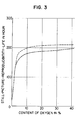
- the content of the oxygen is higher than 3% or higher than 5% in atomic number ratio relative to a ferromagnetic or nonmagnetic metal adjacent to the surface of a base film as shown in Fig. 3.
- the data shown in Fig. 3 were obtained by the measurements of still - picture - reproducibility - life of magnetic recording media or tapes of the type consisting of a polyester film with worm-like or particle-like projections formed on one or both surfaces thereof and consisting of cured high-molecular compounds and a thin film of Co-Ni alloy (the content of Ni being 25% by weight) when such magnetic tapes were played with a home video tape recorder.
- the process for providing such magnetic recording media or tapes is substantially similar to that of First Example to be described below.
- FIG. 3 shows the characteristic of the magnetic recording media or film consisting of a base film and a thin film of Co-Ni alloy directly deposited upon one surface of the base film while the dotted-line curve, the characteristic of a magnetic recording medium or tape consisting of a thin film of Co-Ni alloy over one surface of a base film through an undercoating of aluminum.
- a monoaxially elongated polyethyleneter- ephthalate which is almost free from extremely fine particles such as residues of copolymerization catalysts is prepared.
- Epoxy denatured silicon emulsion and aqueous emulsion of a hardener containing a small amount of polyvinyl alcohol are applied over one surface of the film at the rate of 100 mg/m 2 as solid matter and over the other surface at the rate of 300 mg/m 2 .
- the film is further laterally elongated three times the original width. Thereafter, the film is heated at 180 ⁇ 200°C.
- the film prepared in this process becomes 12 pm in thickness and has worm-like projections over the surfaces thereof, the projections consisting of cured denatured silicon.
- the surface roughness values Rmax are 0.02 pm over the top surface and 0.07 ⁇ m over the bottom surface.
- the vapor or beam of Co-Ni alloy (the content of Ni being 20% by weight) is inclined at an angle to the film surface and made. to continuously impinge against them so that a magnetic thin film 0.1 ⁇ m is deposited.
- the content of the oxygen in the deposited ferromagnetic thin film is 5% in atomic number ratio. relative to the Co-Ni alloy.
- the sample prepared in this process is referred to as "sample A" while a sample prepared under the same conditions as described above except that the evaporation atmosphere contains no oxygen is referred to as "sample B".
- a further sample C is prepared by depositing by the vacuum evaporation technique a thin film of aluminum about 20 nm (200 A) in thickness over the surface of the polyester film of the type described and then depositing a thin film of Co-Ni alloy in vacuum introduced with an extremely small amount of oxygen with an inclined angle of vapor incidence.
- the sample C contains 4% of oxygen in its aluminum thin film.
- a further sample D is prepared by following the procedure of sample C except that no oxygen is introduced when an aluminum thin film is deposited.
- the sample D contains less than 1% of oxygen in its aluminum thin film.
- sample E is prepared as follows: First, as a base film, polyester films for the production of conventional magnetic films are prepared.
- sample F is prepared as follows. By following the procedure of sample A, only the back surface of the film is imparted with worm-like projectons but the top surface remains smooth. (It is 12 ⁇ m in thickness). Over the smooth top surface of the film is deposited to the thickness of 0.1 ⁇ m a thin film of Co-Ni alloy (the Ni content being 20% by weight) containing 5% (atomic percent) of oxygen.
- Samples A to F are cut into a predetermined length and prepared in the form of a cassette tape. Using a home video tape recorder, measurement of still life characteristic; that is, still - picture - reproducibility - life is made. The results are as follows:
- the polyester film as prepared in Example 1 is used. Instead of epoxy-denatured silicon emulsion, a mixture of epoxy resin emulsion (epoxy equivalent is (1500-2500)), a hardener and a small amount of polyether silicon and polyvinyl alcohol as additives is used. In vacuum introduced with a small amount of oxygen, a thin film of pure cobalt is deposited. A sample whose magnetic thin film contains 10% of oxygen has a still - picture - reproducibility - life of 200 minutes, but a sample whose oxygen content in its magnetic film is less than 1% because no oxygen is introduced has a life of 30 minutes.
- the back surface of the base film is preferably imparted with suitable roughness or irregularities prior to the deposition of a thin film of ferromagnetic metal by the vacuum evaporation technique. This is done in order to suppress runnability of the base film and inhibit the evaporation of polyester oligomer in the vacuum evaporation device and to ensure desired transportability of the finished product.
- the surfaces of a base film are imparted or provided with worm-like or particle-like projections, the finished recording medium can have satisfactory fundamental requirements such as head-contactability, transportability and so on under normal conditions.
- a first countermeasure is to use a polyester film whose front surface has worm-like or particle-like projections of cured high-molecular compound as described above and whose back surface is coated with a thin film of resin in which solid particles are dispersed. Because of these solid particles, the back surface is provided with extremely fine projections so that runnability can be improved.
- solid particles themselves have lubricating properties.
- they are finely divided particles of Teflon@, carbon fluoride, graphite, molybdenum bisulfide, etc.
- finely divided particles of, for instance, alumina, silic, titanium oxide, calcium carbonate, talc, carbon black, phthalocyanine, etc. which are normally used as organic and inorganic pigment can be used. In the latter case, it is preferable that their particle size be less than 0.5 Irm.
- thermoplastic resins having a softening point less than 150°C. They are, for instance, polyester, polyamides, polyether, cellulose resins, etc. These resins are mixed with solvents, dispersants and, if needed, additives, polymerization catalysts, hardeners and so on to prepare coating solutions.
- a suitable solution is applied to the back surface thereof and then dried and. hardened.
- a thin film formed over the back surface can have worm-like or particle-like projections as in the case of the front surface.
- the back surface is made such roughly as that fine solid particles are distributed on a worm-like surface of the thin film.
- the roughness value of the back surface be higher than that of the front surface and be 0.01-1.0 11m in Rmax. It is most ideal that finely divided solid particles are projected out of the thin film at an extremely high density, but they may be uneven to give suitable surface roughness.
- the second countermeasure is to produce worm-like projections on both the surfaces of a base film as described in conjunction with Examples 1 and 2. Thereafter, a magnetic thin film is deposited over the front surface and a thin film of resin containing a lubricant is formed over the back surface. A thin film of resin containing a lubricant can be coated over such a thin film of resin with dispersed solid particles as described previously.
- the lubricant have such properties that when the magnetic tape is wound on a reel, part of the lubricant is transferred to the adjacent magnetic thin film so that "blocking" can be prevented and the friction between the magnetic head and the magnetic thin film can be reduced to prevent noise or squeaks.
- preferable lubricants are hydrocarbon wax, fatty acid esters, silicons, hydrocarbon fluorides, graphite, molybdenum dioxide, graphite fluoride and so on. Such lubricants are added to solutions of vinyl chloride resins, urethane resins, epoxy resins or ester resins, applied to the back surface of the base film with the front surface coated with a magnetic thin film and dried and hardened.
- organic lubricants have a low-molecular weight and exhibit a .high vapor pressure under reduced pressure so that it is preferable that the lubricating film be formed after the magnetic thin film has been formed under reduced pressure.
- the back surface of the base film which has been exposed to reduced pressures has more uniformed wettability than before it was subjected to reduced pressures. As a result, the adhesive strength between the back surface of the base film and the thin film thereover becomes more stable.
- the lubricating film be 0.01-0.5 um in thickness and the content of a lubricant in the thin film be 0.1-50% by volume.
- a monoaxially elongated polyethylenetereph- thalate film which is almost free from particles or copolymerization residues is prepared.
- Aqueous emulsion consisting or epoxydenatured silicon emulsion and its hardener and a small amount of polyvinyl alcohol is applied to one surface of the film at the rate of 100 mg/m 2 and to the other surface at the rate of 300 mg/m 2 .
- the film is further laterally elongated three times the original width and heated at 180-200 0 C.
- the surface roughness values of the front and back surfaces of the film are 0.02 ⁇ m and 0.07 pm in Rmax, respectively.
- a long length of such film is connected to a long length of polyester film for the production of conventional magnetic tapes (12 pm in thickness and surface roughness value Rmax of 0.3 ⁇ m).
- the film tape is then set in a vacuum evaporation apparatus. While it is advanced along a metal roll, the beam of cobalt vapor is made to impinge it at an inclined angle in the presence of a small amount of the oxygen, whereby a cobalt thin film of the thickness of 0.1 11m is deposited.
- the degree of vacuum is 3X10- 5 torr which is lower than 5x 10 ⁇ 5 torr experienced when the conventional film tape is deposited with a magnetic thin film.
- sample G A solution is prepared by mixing 0.2 parts by weight of monoglyceride stearate, 0.5 parts by weight of copolymers of vinyl chloride and vinyl acetate and 100 parts by weight of a solvent mixture consisting of ethyl acetate and toluene. The solution is applied to the back surface of the sample G and dried. A sample prepared in this process is referred to as "sample H".
- the samples G and H are then cut into a predetermined length and prepared in the form of a cassette tape. Using a home video tape recorder, the qualities of pictures reproduced from these sample tapes are evaluated. During the initial experimental stage at 25°C and 75% in relative humidity, the images with satisfactory qualities can be reproduced from both the samples G and H.
- the samples G and H have been left for one week at 40°C and 90% in relative humidity.
- the tests are made under the same conditions as described above.
- the images reproduced from the' sample H are stable, but the images reproduced from the sample G are distorted and noise or squeaks are produced when made into contact with the cylinder of a rotating head because of its poor transportability.
- epoxy resin emulsion (the equivalent weight of epoxy being 1500-2500) is used to prepare a coating emulsion together with a hardener and a small amount of polyether-denatured silicon and polyvinyl alcohol. A thin film of Co-Ni (th content of Ni is 20%) is formed. Epoxy resin is added with 2% by weight of polyether silicon to prepare epoxy resin which is curable by irradiation of ultraviolet rays. The resin is applied to the thickness of 0.1 ⁇ m over the back surface of the base film. The results or effects are substantially similar to those attained by Example 3.
- a monoaxially elongated polyethylenetereph- thalate film, which is almost free from particles such as copolymerization catalyst residues is prepared.
- Aqueous emulsion is prepared by mixing epoxy-denatured silicon emulsion, a hardener therefor and a small amount of polyvinyl alcohol. The aqueous emulsion is then applied to the front surface of the film at the rate of 100 mg/m 2 . 50 parts by weight of finely divided graphite particles based on 100 parts by weight of the resin is further added to the aqueous emulsion of the above-described compositions.
- This emulsion is applied to the back surface of the film at the rate of 400 mg/m 2 and dried and then laterally elongated three times the original width. Thereafter, the elongated film is heated at 180-200°C.
- the front surface has the roughness value of 0.02 um and the back surface, the roughness value of 0.07 ⁇ m.
- a length of such film tape is connected to a length of conventional film tape used for the fabrication of magnetic tapes (12 ⁇ m in thickness and 0.3 ⁇ m in Rmax).
- the tape is set into a vacuum evaporation apparatus. While it is transported along the surface of a metal roll, the beam of evaporated cobalt is made to impinge upon it at an inclined angle in the presence of a small amount of the oxygen to deposit a cobalt thin film of 0.1 ⁇ m in thickness.
- the degree of vacuum is 3x10- 5 torr when the tape of the present invention is passing through the apparatus but it is 5x10- 5 torr when the conventional tape is being transported therethrough.
- Aqueous emulsion is prepared by mixing epoxy-denatured silicon emulsion, a hardener therefor and a small amount of polyvinyl alcohol.
- the aqueous emulsion is applied to the front surface of the film at the rate of 100 mg/m 2 and to the back surface thereof at the rate of 300 mg/m 2 .
- the film is prepared which will be referred to as "sample J".
- a further sample K is prepared by following the procedure of sample J except that epoxy resin dispersed with titanium oxide (100 parts by weight of 100 parts by weight of epoxy resin) is applied to the back surface (with the surface roughness value of 0.07 ⁇ m while the surface roughness value of the front surface being 0.02 ⁇ m) of the film prior to the vacuum evaporation step, thereby forming a thin film 0.5 ⁇ m in thickness.
- Xstill further sample L is prepared by applying to the back surface of the sample K a solution prepared by mixing 0.2 parts by weight of monoglyceride stearate and 0.5 by weight of copolymers of vinyl chloride and vinyl acetate with 100 parts by weight of solvent consisting of ethylene acetate and toluene and drying the film.
- the samples I to L are cut into a predetermined length to prepare them in the form of a cassette tape.
- a conventional home video tape recorder With a conventional home video tape recorder, the qualities of the images reproduced from respective sample tapes are evaluated. During the intitial stage of experiments at 25°C and 75% in relative humidity, the images reproduced from all samples tapes are satisfactory in quality. After the sample tapes have been left for one week at 40°C and 90% in relative humidity, they are tested under the same conditions. The images reproduced from the samples I, K and L are stable, but the images reproduced from the sample J are distorted and noise or squeaks are produced when made into contact with the cylinder of a rotating head assembly because of poor transportability of the sample J. When the samples I, K and L are tested at 30°C and 80% in relative humidity with other conditions same as described above, the samples I and L are found satisfactory, but the sample K produces some noise or squeaks sometimes.
- the present invention relates to a magnetic recording medium which is of the thin-film type, has along still - picture - reproducibility - life (or still life) and exhibits a higher degree of resistance to humidity and a process for the fabrication of such magnetic recording medium.
- the present invention has high industrial advantages.
Landscapes
- Magnetic Record Carriers (AREA)
Description
- The present invention relates to a magnetic recording medium according to the preamble of claim 1 and a process for fabricating the same, according to the preamble of claim 7. Such a recording medium and process are known from the DE-A-27 31 924.
- Ferromagnetic thin-film type magnetic recording media are prepared by forming a thin film of iron, cobalt, nickel or an alloy thereof by the vacuum deposition, sputtering or electroplating method over the surface of a high-molecular compound film. Such magnetic recording media have an advantage in comparison with coated type magnetic recording media prepared by applying over the surface of a base or substrate a mixture of ferromagnetic particles and a binder in that the former have a far higher recording density than the later. However, there are differences in hardness, mechanical strength and thermal property between magnetic thin films and bases or substrates which are made of high-molecular compounds in the case of the fabrication of magnetic tapes or flexible magnetic disks. Therefore, during the fabrication process or use if the magnetic tapes or disks are subjected to forces or thermal stresses in excess of their permissible limits, magnetic thin films are easily cracked. Once cracks have propagated, head-contactability; that is, a degree of capability for a magnetic tape or disk to contact with a magnetic recording-and-reproducing head, is degraded depending upon the configurations of cracks. As a result, wear of the magnetic head is accelerated and the thin film itself is rapidly damaged. In the case of the home video tape recorder, a magnetic tape is wrapped around a cylinder and rotary heads are used to record or reproduce video and audio signals. In the still-picture reproduction mode, cracks tend to develop in the direction in which the rotary heads rotate. These cracks adversely affect "still - picture - reproducibility - life; that is, a life of a magnetic film during which still pictures can be satisfactorily reproduced.
- In general, polyester films have been widely used as bases or substrates for the production of thin-film type magnetic recording media. In the preparation of such films, their surfaces are formed with extremely fine projections of residues of catalytic particles or specially added finely divided particles so that lubricity; that is, the property to lessen friction, of the film surfaces can be improved. When a thin film of a ferromagnetic metal or alloy is formed over the surface of such film, cracks tend to develop from the peaks of projections. In the still-picture reproduction modes, the rotary magnetic heads tend to scratch the ferromagnetic thin film from its cracks and finally separate it from the base or substrate. As a result, the still - picture - reproducibility - life becomes very short. In addition, their surface roughness cannot be reduced less than 0.1 11m in Rmax. (Rmax is defined in JIS B0601-1976 or ISO R468-1966. It is rated as a value in 11m obtained by dividing a maximum peak-to- valley distance over a reference length by a longitudinal magnification).
- When thin films are formed over the smooth surfaces of polyester film bases or substrates free from such extremely fine projections as described above, friction between the cylinder of a rotary head assembly and a magnetic tape is so extremely high that the smooth transportation of the magnetic tape cannot be ensured.
- The vacuum evaporation, ion-plating or sputtering method in which magnetic thin films are deposited in vacuum is advantageous over the wet plating method in that uniform magnetic characteristics are ensured over a long length of magnetic recording media and that no pollution problem arises from the disposal of wastes. However, when magnetic thin films are formed, film bases or substrates are subjected to heat in vacuum or at reduced pressures so that gases mainly consisting of water vapor and polyester oligomer evolve from the surfaces of the base or substrate. As a result, the magnetic and other characteristics of finished products are adversely affected. Water vapor can be removed by a pre-drying step, but it is difficult to eliminate polyester oligomers by a preliminary step.
- It is an object of the invention to overcome the above and other problems encountered in the prior art magnetic recording media and to provide a recording medium with a considerably improved "still-life"-duration. This object is attained by the improvement as set forth in the characterizing clause of claims 1 and 7, respectively.
- A magnetic recording medium according to claim 1 has considerable advantages as may be seen from the table 1 below where the invention ,is compared with several prior art recording media. As can be seen from the table an improvement in the still life time up to nine times may be achieved.
- The metal thin-film type magnetic recording medium of the invention further has excellent magnetic characteristics. It also has a long shelf life even at high temperatures and humidity.
- By "still-picture reproduction mode" a mode is meant in which a predetermined length of magnetic thin film is repetitively scanned many times by rotary heads at a high velocity.
-

-
- Fig. 1 is a micrograph showing the surface of a magnetic recording medium of the present invention;
- Fig. 2 is a micrograph showing the surface of a prior art magnetic recording medium; and
- Fig. 3 shows life characteristics of magnetic recording media in accordance with the present invention.
- Bases which are preferable or recommended to be used for the fabrication of coated type magnetic tapes, non-metal tapes are produced as follows. First while a polyester film is being still elongated, a resin emulsion containing a lubricant such as wax is applied to one or both of the smooth surfaces of the film. Thereafter, the film is heated so that cured polymeric structures are produced and the film is further elongated so that the surfaces thereof are imparted with extremely fine worm-like or particle-like projections. (see Japanese Published Patent Application Nos. 84264/1977, 128683/1978 and 94574/1979 and US Patent No. 4,233,352). In these prior arts, the surface with worm-like or particle-like projections of the film is used as a back surface of a magnetic recording medium, or the smooth surface (or one of the surfaces when both have worm-like or particle-like projections) of the film is coated with a magnetic layer. In the present invention, on the contrary, the magnetic recording layer is formed necessarily on the surface with worm-like or particle-like projections of the film.
- The worm-like or particle-like projections mainly consist of fragments of thin film consisting of cured high-molecular compounds, but recesses are considered to be consisting of polyester film itself. As a result, when a magnetic recording medium of the type in which a magnetic thin film if formed over the surface of the base with worm-like or particle-like projections is subjected to thermal or mechanical impacts, extremely fine cracks propagate along the boundaries between peaks and valleys. Crack spacing is small and the peaks are considered to be almost free from cracks. Therefore, it is apparent that such cracks will not adversely affect transportability and still-picture-reproducibility.
- The length of a worm-like or particle-like projection or peak is preferably 0.1-50 pm and more preferably 0.1 -5 pm; the width is preferably 0.1-10 µm and more preferably 0.1-3 µm; the height Rmax is preferably 0.005-01 pm and more preferably 0.005-0.05 pm; and the density (the number of projections or peaks per unit area) is preferably between 103 and 107 per mm2 and more preferably between 104 and 106 per mm 2.
- Fig. 1 is a micrograph (500 magnifications) showing the surface of a magnetic recording medium in accordance with the present invention. Fig. 2 is a micrograph (500 magnifications) showing the surface of a magnetic recording medium consisting of a conventional polyester film and a magnetic thin film coated thereon. Strips indicate cracks produced when each magnetic recording medium was heated under tension.
- In order to impart surface roughness or irregularities to polyester films, there has been used a cured high-molecular compound with a large quantity of non-cured lubricant such as natural or artificial wax. However, in order to attain the objects of the present invention, such lubricants are not preferable. According to the present invention it is preferable to use a cured high-molecular compound, if needed with a small amount of surface active agent and thickener which are needed to improve the adhesive strength to polyester film or to coat a thin magnetic film over a polyester film. Cured high-molecular compounds used in the present invention are denatured silicon plastics or resins denatured with alcohols, epoxy, polyesters, polyethers, amines or melamines, epoxy resins, urethane resins, unsaturated polyester resins and their copolymers and mixtures. In general, these compounds are used in the form of aqueous emulsion.
- Preferable water-soluble high-molecular thickeners are hydroxyethyl cellulose, methyl cellulose, carboxylmethyl cellulose, polyvinyl alcohols, gelatin and so on.
- A preferable polymerization catalyst is, for example, MgC12 for epoxy radicals.
- These compounds are mixed with solvents, dispersants additives polymerization catalysts and thickemers to prepare an aqueous emulsion. The agueous emulsion is then applied or coated over a monoaxially (longitudinally) elongated polyester film, which is as free from solid particles such as residual catalysts as possible, and dried and cured. The polyester film is then elongated laterally and, if needed, longitudinally again. Thus, an elongated polyester film used in the present invention is produced.
- Surface roughness values of polyester films thus fabricated can be varied by controlling the thickness of a film of aqueous emulsion applied thereto. When used as the surface of a base upon which is coated a magnetic thin film, the surface roughness value Rmax must be between 0.003 and 0.1 Ilm.
- The uncoated surface of the film can be so processed as to have desired properties, qualities and conditions. For instance, in the case of the fabrication of magnetic disks, uncoated surfaces must be smooth. In the case of fabrication of magnetic tapes, it is preferable that the uncoated surfaces are also imparted with worm-like or particle-like projections consisting of cured high-molecular compounds as described above or are formed with a thin film of high-molecular compound containing a lubricant so that transportability of magnetic films can be improved. It is preferable that the uncoacted surface have the roughness value of 0.01 and 1.0 11m in Rmax.
- One of the features of the present invention resides in the fact that the adhesive strength to the base film of the magnetic thin film can be considerably improved and consequently the occurrence of cracks can be reduced to a minimum and, therefore, the still - picture - reproducibility - life can be increased. The adhesive strength is improved because the magnetic thin film or nonmagnetic thin film (undercoating) coated over the surface of the base film contains oxygen (that is, at least part of the structure is oxidized) and because of synergistic effects of the surface tenure and extremely fine structures of the surface of polyester film. These and other advantageous properties of the present invention will be described in detail below in conjunction with the direct coating of ferromagnetic metal thin films over the surfaces of polyester film bases by the conventional vacuum evaporation technique.
- In the case of deposition of thin films of ferromagnetic metals such as Co, Ni and Fe, thin films having a higher degree of coercive force and exhibiting a higher degree of resistance to corrosion can be obtained when a small volume of oxygen is introduced into a Bell jar or the like and the angle or vapor incidence is inclined at some angle. The deposited film consists of partially oxidized ferromagnetic metals and exhibits a strong adhesive strength to the base film as compared with the thin film deposited without introducing oxygen. Especially when polyester films of the type having worm-like or particle-like projections consisting of the cured high-molecular compounds over their surfaces as described previously, the adhesive strength between the thin film and the base film becomes high. In addition, because of microstructures of surfaces, synergistic effects can be obtained as described previously. As a result, still - picture - reproducibility - life can be increased. If it is only desired to increase the video output, it is preferable that the surfaces of recording media be as smooth as possible. However, the magnetic recording medium consisting of a base with smooth surfaces and a magnetic thin film deposited over one surface thereof has by far a shorter still - picture - reproducibility - life than the magnetic recording medium of the present invention. The causes of such difference in still - picture - reproducibility - life can be attributed to (1) the difference in real area of contact between a video head and a magnetic recording medium; (2) the difference in propagation of cracks in thin films of metal oxide; and (3) the difference in shock absorbing action (cushion) against the impact caused when the video head rotating at high speeds strikes against the magnetic thin film on a recording medium.
- There has been devised and widely used a process for depositing nonmagnetic material such as aluminum, titanium or silicon over the surface of a base film in order to improve reproducibility of magnetic characteristics of the thin film of ferromagnetic metal oxide. In this case, if oxygen is introduced to the nonmagnetic thin film which is in contact with the basefilm,the adhesive strength can be considerably improved as compared with no oxygen is introduced. Nonmagnetic thin films can be formed by sputtering techniques with A1203 or Si02 and they exhibit a high adhesive strength. The content of the oxygen is higher than 3% or higher than 5% in atomic number ratio relative to a ferromagnetic or nonmagnetic metal adjacent to the surface of a base film as shown in Fig. 3.
- The data shown in Fig. 3 were obtained by the measurements of still - picture - reproducibility - life of magnetic recording media or tapes of the type consisting of a polyester film with worm-like or particle-like projections formed on one or both surfaces thereof and consisting of cured high-molecular compounds and a thin film of Co-Ni alloy (the content of Ni being 25% by weight) when such magnetic tapes were played with a home video tape recorder. The process for providing such magnetic recording media or tapes is substantially similar to that of First Example to be described below. The solid-line curve in Fig. 3 shows the characteristic of the magnetic recording media or film consisting of a base film and a thin film of Co-Ni alloy directly deposited upon one surface of the base film while the dotted-line curve, the characteristic of a magnetic recording medium or tape consisting of a thin film of Co-Ni alloy over one surface of a base film through an undercoating of aluminum.
- A monoaxially elongated polyethyleneter- ephthalate which is almost free from extremely fine particles such as residues of copolymerization catalysts is prepared. Epoxy denatured silicon emulsion and aqueous emulsion of a hardener containing a small amount of polyvinyl alcohol are applied over one surface of the film at the rate of 100 mg/m2 as solid matter and over the other surface at the rate of 300 mg/m2. After drying, the film is further laterally elongated three times the original width. Thereafter, the film is heated at 180―200°C. Thus, the film prepared in this process becomes 12 pm in thickness and has worm-like projections over the surfaces thereof, the projections consisting of cured denatured silicon. The surface roughness values Rmax are 0.02 pm over the top surface and 0.07 µm over the bottom surface. In vacuum containing only an extremely small amount of oxygen, the vapor or beam of Co-Ni alloy (the content of Ni being 20% by weight) is inclined at an angle to the film surface and made. to continuously impinge against them so that a magnetic thin film 0.1 µm is deposited. The content of the oxygen in the deposited ferromagnetic thin film is 5% in atomic number ratio. relative to the Co-Ni alloy. The sample prepared in this process is referred to as "sample A" while a sample prepared under the same conditions as described above except that the evaporation atmosphere contains no oxygen is referred to as "sample B". (the content of the oxygen is less than 1%) A further sample C is prepared by depositing by the vacuum evaporation technique a thin film of aluminum about 20 nm (200 A) in thickness over the surface of the polyester film of the type described and then depositing a thin film of Co-Ni alloy in vacuum introduced with an extremely small amount of oxygen with an inclined angle of vapor incidence. The sample C contains 4% of oxygen in its aluminum thin film. A further sample D is prepared by following the procedure of sample C except that no oxygen is introduced when an aluminum thin film is deposited. The sample D contains less than 1% of oxygen in its aluminum thin film. In addition, sample E is prepared as follows: First, as a base film, polyester films for the production of conventional magnetic films are prepared. (Its thickness is 12 pm and has the surface roughness value Rmax of 0.3 µm and has no coating). In vacuum introduced with an extremely small amount of the oxygen, the Co-Ni alloy is deposited over the surface of the base film to the thickness of 0.1 µm with an inclined angle of vapor incidence. Furthermore, sample F is prepared as follows. By following the procedure of sample A, only the back surface of the film is imparted with worm-like projectons but the top surface remains smooth. (It is 12 µm in thickness). Over the smooth top surface of the film is deposited to the thickness of 0.1 µm a thin film of Co-Ni alloy (the Ni content being 20% by weight) containing 5% (atomic percent) of oxygen.
- Samples A to F are cut into a predetermined length and prepared in the form of a cassette tape. Using a home video tape recorder, measurement of still life characteristic; that is, still - picture - reproducibility - life is made. The results are as follows:

- The polyester film as prepared in Example 1 is used. Instead of epoxy-denatured silicon emulsion, a mixture of epoxy resin emulsion (epoxy equivalent is (1500-2500)), a hardener and a small amount of polyether silicon and polyvinyl alcohol as additives is used. In vacuum introduced with a small amount of oxygen, a thin film of pure cobalt is deposited. A sample whose magnetic thin film contains 10% of oxygen has a still - picture - reproducibility - life of 200 minutes, but a sample whose oxygen content in its magnetic film is less than 1% because no oxygen is introduced has a life of 30 minutes.
- So far, the present invention has been described in conjunction with the increase in still - picture - reproducibility - life and will be described in conjunction with the improvement of the back-surface-texture of magnetic recording media.
- In general, the back surface of the base film is preferably imparted with suitable roughness or irregularities prior to the deposition of a thin film of ferromagnetic metal by the vacuum evaporation technique. This is done in order to suppress runnability of the base film and inhibit the evaporation of polyester oligomer in the vacuum evaporation device and to ensure desired transportability of the finished product. When, as described previously, the surfaces of a base film are imparted or provided with worm-like or particle-like projections, the finished recording medium can have satisfactory fundamental requirements such as head-contactability, transportability and so on under normal conditions. However, when the magnetic recording medium is transported in the atmosphere of high humidity after it has been left for a long time at high temperatures and humidity, noise is produced when it makes contact with guide posts. In the worst case, "blocking" occurs between the front and back surfaces of the magnetic film when it is wound on a reel. In order to overcome this problem, the present invention proposes the following two countermeasures. A first countermeasure is to use a polyester film whose front surface has worm-like or particle-like projections of cured high-molecular compound as described above and whose back surface is coated with a thin film of resin in which solid particles are dispersed. Because of these solid particles, the back surface is provided with extremely fine projections so that runnability can be improved. It follows, therefore, that it is preferable that solid particles themselves have lubricating properties. For instance, they are finely divided particles of Teflon@, carbon fluoride, graphite, molybdenum bisulfide, etc. In addition, finely divided particles of, for instance, alumina, silic, titanium oxide, calcium carbonate, talc, carbon black, phthalocyanine, etc. which are normally used as organic and inorganic pigment, can be used. In the latter case, it is preferable that their particle size be less than 0.5 Irm.
- As resins in which are dispersed such finely divided particles, it is preferable to use cured high-molecular compounds as described previously; that is, silicon resins which are denatured with alcohol, epoxy, polyester, polyether, amines or melamines, epoxy resins, urethane resins, saturated or unsaturated polyester resins, cellulose resins, and their copolymers and mixtures. In addition, use is made of thermoplastic resins having a softening point less than 150°C. They are, for instance, polyester, polyamides, polyether, cellulose resins, etc. These resins are mixed with solvents, dispersants and, if needed, additives, polymerization catalysts, hardeners and so on to prepare coating solutions. While a polyester film is being elongated, a suitable solution is applied to the back surface thereof and then dried and. hardened. When the solution is applied to a polyester film which is being monoaxially or longitudinally elongated, a thin film formed over the back surface can have worm-like or particle-like projections as in the case of the front surface. In this case, the back surface is made such roughly as that fine solid particles are distributed on a worm-like surface of the thin film.
- It is preferable that the roughness value of the back surface be higher than that of the front surface and be 0.01-1.0 11m in Rmax. It is most ideal that finely divided solid particles are projected out of the thin film at an extremely high density, but they may be uneven to give suitable surface roughness.
- The second countermeasure is to produce worm-like projections on both the surfaces of a base film as described in conjunction with Examples 1 and 2. Thereafter, a magnetic thin film is deposited over the front surface and a thin film of resin containing a lubricant is formed over the back surface. A thin film of resin containing a lubricant can be coated over such a thin film of resin with dispersed solid particles as described previously.
- It is preferable that the lubricant have such properties that when the magnetic tape is wound on a reel, part of the lubricant is transferred to the adjacent magnetic thin film so that "blocking" can be prevented and the friction between the magnetic head and the magnetic thin film can be reduced to prevent noise or squeaks. For instance, preferable lubricants are hydrocarbon wax, fatty acid esters, silicons, hydrocarbon fluorides, graphite, molybdenum dioxide, graphite fluoride and so on. Such lubricants are added to solutions of vinyl chloride resins, urethane resins, epoxy resins or ester resins, applied to the back surface of the base film with the front surface coated with a magnetic thin film and dried and hardened. In general, organic lubricants have a low-molecular weight and exhibit a .high vapor pressure under reduced pressure so that it is preferable that the lubricating film be formed after the magnetic thin film has been formed under reduced pressure. The back surface of the base film which has been exposed to reduced pressures has more uniformed wettability than before it was subjected to reduced pressures. As a result, the adhesive strength between the back surface of the base film and the thin film thereover becomes more stable. It is preferable that the lubricating film be 0.01-0.5 um in thickness and the content of a lubricant in the thin film be 0.1-50% by volume.
- A monoaxially elongated polyethylenetereph- thalate film which is almost free from particles or copolymerization residues is prepared. Aqueous emulsion consisting or epoxydenatured silicon emulsion and its hardener and a small amount of polyvinyl alcohol is applied to one surface of the film at the rate of 100 mg/m2 and to the other surface at the rate of 300 mg/m2. After drying, the film is further laterally elongated three times the original width and heated at 180-2000C. Thus is prepared an elongated polyester film 12 pm in thickness with both the surfaces formed with worm-like projections consisting of cured denatured silicon. The surface roughness values of the front and back surfaces of the film are 0.02 µm and 0.07 pm in Rmax, respectively. A long length of such film is connected to a long length of polyester film for the production of conventional magnetic tapes (12 pm in thickness and surface roughness value Rmax of 0.3 µm). The film tape is then set in a vacuum evaporation apparatus. While it is advanced along a metal roll, the beam of cobalt vapor is made to impinge it at an inclined angle in the presence of a small amount of the oxygen, whereby a cobalt thin film of the thickness of 0.1 11m is deposited. The degree of vacuum is 3X10⁻⁵ torr which is lower than 5x 10―5 torr experienced when the conventional film tape is deposited with a magnetic thin film. This means that the formation of worm-like projections on both the surfaces of the polyester film tape of the present invention is very effective in suppressing "outgassing". The sample thus prepared is called sample G. A solution is prepared by mixing 0.2 parts by weight of monoglyceride stearate, 0.5 parts by weight of copolymers of vinyl chloride and vinyl acetate and 100 parts by weight of a solvent mixture consisting of ethyl acetate and toluene. The solution is applied to the back surface of the sample G and dried. A sample prepared in this process is referred to as "sample H".
- The samples G and H are then cut into a predetermined length and prepared in the form of a cassette tape. Using a home video tape recorder, the qualities of pictures reproduced from these sample tapes are evaluated. During the initial experimental stage at 25°C and 75% in relative humidity, the images with satisfactory qualities can be reproduced from both the samples G and H.
- The samples G and H have been left for one week at 40°C and 90% in relative humidity. The tests are made under the same conditions as described above. The images reproduced from the' sample H are stable, but the images reproduced from the sample G are distorted and noise or squeaks are produced when made into contact with the cylinder of a rotating head because of its poor transportability.
- Instead of epoxy-denatured emulsion, epoxy resin emulsion (the equivalent weight of epoxy being 1500-2500) is used to prepare a coating emulsion together with a hardener and a small amount of polyether-denatured silicon and polyvinyl alcohol. A thin film of Co-Ni (th content of Ni is 20%) is formed. Epoxy resin is added with 2% by weight of polyether silicon to prepare epoxy resin which is curable by irradiation of ultraviolet rays. The resin is applied to the thickness of 0.1 µm over the back surface of the base film. The results or effects are substantially similar to those attained by Example 3.
- A monoaxially elongated polyethylenetereph- thalate film, which is almost free from particles such as copolymerization catalyst residues is prepared. Aqueous emulsion is prepared by mixing epoxy-denatured silicon emulsion, a hardener therefor and a small amount of polyvinyl alcohol. The aqueous emulsion is then applied to the front surface of the film at the rate of 100 mg/m2. 50 parts by weight of finely divided graphite particles based on 100 parts by weight of the resin is further added to the aqueous emulsion of the above-described compositions. This emulsion is applied to the back surface of the film at the rate of 400 mg/m2 and dried and then laterally elongated three times the original width. Thereafter, the elongated film is heated at 180-200°C. An elongated polyester film, prepared in this process, of the thickness of 12 µm with the front surface formed with worm-like projections consisting of cured denatured silicon and the back surface formed also with worm-like projection consisting of cured denatured silicon and having graphite particles dispersed therein. The front surface has the roughness value of 0.02 um and the back surface, the roughness value of 0.07 µm. A length of such film tape is connected to a length of conventional film tape used for the fabrication of magnetic tapes (12 µm in thickness and 0.3 µm in Rmax). The tape is set into a vacuum evaporation apparatus. While it is transported along the surface of a metal roll, the beam of evaporated cobalt is made to impinge upon it at an inclined angle in the presence of a small amount of the oxygen to deposit a cobalt thin film of 0.1 µm in thickness. The degree of vacuum is 3x10⁻⁵ torr when the tape of the present invention is passing through the apparatus but it is 5x10⁻⁵ torr when the conventional tape is being transported therethrough. Thus, as is the case of the Example 4, it is apparent that the formation of worm-like projections over the both the surfaces of the tape is very effective in suppressing "degassing". The tape prepared in this process will be referred to as "sample I".
- Aqueous emulsion is prepared by mixing epoxy-denatured silicon emulsion, a hardener therefor and a small amount of polyvinyl alcohol. The aqueous emulsion is applied to the front surface of the film at the rate of 100 mg/m 2 and to the back surface thereof at the rate of 300 mg/m2. Thereafter, following the procedure of Example 4, the film is prepared which will be referred to as "sample J".
- A further sample K is prepared by following the procedure of sample J except that epoxy resin dispersed with titanium oxide (100 parts by weight of 100 parts by weight of epoxy resin) is applied to the back surface (with the surface roughness value of 0.07 µm while the surface roughness value of the front surface being 0.02 µm) of the film prior to the vacuum evaporation step, thereby forming a thin film 0.5 µm in thickness.
- Xstill further sample L is prepared by applying to the back surface of the sample K a solution prepared by mixing 0.2 parts by weight of monoglyceride stearate and 0.5 by weight of copolymers of vinyl chloride and vinyl acetate with 100 parts by weight of solvent consisting of ethylene acetate and toluene and drying the film.
- The samples I to L are cut into a predetermined length to prepare them in the form of a cassette tape. With a conventional home video tape recorder, the qualities of the images reproduced from respective sample tapes are evaluated. During the intitial stage of experiments at 25°C and 75% in relative humidity, the images reproduced from all samples tapes are satisfactory in quality. After the sample tapes have been left for one week at 40°C and 90% in relative humidity, they are tested under the same conditions. The images reproduced from the samples I, K and L are stable, but the images reproduced from the sample J are distorted and noise or squeaks are produced when made into contact with the cylinder of a rotating head assembly because of poor transportability of the sample J. When the samples I, K and L are tested at 30°C and 80% in relative humidity with other conditions same as described above, the samples I and L are found satisfactory, but the sample K produces some noise or squeaks sometimes.
- In summary, the present invention relates to a magnetic recording medium which is of the thin-film type, has along still - picture - reproducibility - life (or still life) and exhibits a higher degree of resistance to humidity and a process for the fabrication of such magnetic recording medium. The present invention has high industrial advantages.
Claims (8)
Applications Claiming Priority (4)
| Application Number | Priority Date | Filing Date | Title |
|---|---|---|---|
| JP113898/80 | 1980-08-18 | ||
| JP113904/80 | 1980-08-18 | ||
| JP11389880A JPS5737719A (en) | 1980-08-18 | 1980-08-18 | Magnetic recording medium |
| JP11390480A JPS5737720A (en) | 1980-08-18 | 1980-08-18 | Magnetic recording medium and its manufacture |
Publications (2)
| Publication Number | Publication Date |
|---|---|
| EP0046269A1 EP0046269A1 (en) | 1982-02-24 |
| EP0046269B1 true EP0046269B1 (en) | 1986-08-13 |
Family
ID=26452783
Family Applications (1)
| Application Number | Title | Priority Date | Filing Date |
|---|---|---|---|
| EP81106264A Expired EP0046269B1 (en) | 1980-08-18 | 1981-08-11 | Magnetic recording media and process for fabricating the same |
Country Status (3)
| Country | Link |
|---|---|
| US (1) | US4564549A (en) |
| EP (1) | EP0046269B1 (en) |
| DE (1) | DE3175106D1 (en) |
Families Citing this family (10)
| Publication number | Priority date | Publication date | Assignee | Title |
|---|---|---|---|---|
| EP0077549B2 (en) * | 1981-10-15 | 1991-01-02 | Matsushita Electric Industrial Co., Ltd. | Magnetic recording medium |
| DE3368805D1 (en) * | 1982-03-10 | 1987-02-05 | Toray Industries | Laminated film and magnetic recording medium made therewith |
| DE3368806D1 (en) * | 1982-03-10 | 1987-02-05 | Toray Industries | Laminated film and magnetic recording medium made therewith |
| JPS5919229A (en) * | 1982-07-22 | 1984-01-31 | Matsushita Electric Ind Co Ltd | magnetic recording medium |
| US4548855A (en) * | 1982-11-02 | 1985-10-22 | Toray Industries, Inc. | Polyester film for magnetic recording medium |
| EP0109667B1 (en) * | 1982-11-19 | 1987-04-01 | Matsushita Electric Industrial Co., Ltd. | Magnetic recording medium |
| JP2777003B2 (en) * | 1991-06-28 | 1998-07-16 | 帝人株式会社 | Polyester film for magnetic recording medium and method for producing the same |
| US5210673A (en) * | 1991-09-09 | 1993-05-11 | Hitachi Metals, Ltd. | Thin-film hard disk magnetic medium |
| JP2003191384A (en) * | 2001-12-26 | 2003-07-08 | Mitsubishi Polyester Film Copp | Polyester film for release film |
| US20080311429A1 (en) * | 2007-06-15 | 2008-12-18 | Tadao Katsuragawa | Magnetic film, magnetic recording/ reproducing device, and polarization conversion component |
Family Cites Families (10)
| Publication number | Priority date | Publication date | Assignee | Title |
|---|---|---|---|---|
| GB1401305A (en) * | 1972-09-01 | 1975-07-16 | Ici Ltd | Magnetic recording materials |
| JPS5729769B2 (en) * | 1974-02-15 | 1982-06-24 | ||
| JPS585452B2 (en) * | 1975-08-28 | 1983-01-31 | 富士写真フイルム株式会社 | magnetic recording medium |
| JPS5843817B2 (en) * | 1976-02-24 | 1983-09-29 | 富士写真フイルム株式会社 | magnetic recording medium |
| GB1599161A (en) * | 1976-07-15 | 1981-09-30 | Matsushita Electric Industrial Co Ltd | Magnetic recording medium and method of making the same |
| JPS6037972B2 (en) * | 1976-09-29 | 1985-08-29 | 富士写真フイルム株式会社 | magnetic recording medium |
| JPS6035267B2 (en) * | 1978-01-09 | 1985-08-13 | 東レ株式会社 | surface modified polyester film |
| JPS6033289B2 (en) * | 1979-07-18 | 1985-08-02 | 松下電器産業株式会社 | Metal thin film magnetic recording media |
| US4489117A (en) * | 1981-09-01 | 1984-12-18 | Toray Industries, Inc. | Super high density magnetic recording medium |
| JPS5919229A (en) * | 1982-07-22 | 1984-01-31 | Matsushita Electric Ind Co Ltd | magnetic recording medium |
-
1981
- 1981-08-11 EP EP81106264A patent/EP0046269B1/en not_active Expired
- 1981-08-11 DE DE8181106264T patent/DE3175106D1/en not_active Expired
-
1984
- 1984-10-03 US US06/657,056 patent/US4564549A/en not_active Expired - Lifetime
Also Published As
| Publication number | Publication date |
|---|---|
| DE3175106D1 (en) | 1986-09-18 |
| EP0046269A1 (en) | 1982-02-24 |
| US4564549A (en) | 1986-01-14 |
Similar Documents
| Publication | Publication Date | Title |
|---|---|---|
| US4565734A (en) | Magnetic recording medium | |
| US4486500A (en) | Magnetic recording medium | |
| EP0046269B1 (en) | Magnetic recording media and process for fabricating the same | |
| EP0074750B1 (en) | Polyester film for magnetic recording medium and magnetic recording medium made therewith | |
| US4414271A (en) | Magnetic recording medium and method of preparation thereof | |
| US4943479A (en) | Magnetic recording medium | |
| US4666754A (en) | Magnetic recording medium | |
| EP0650158A1 (en) | Magnetic recording medium, method for producing the same and method for forming film by plasma cvd | |
| US4780366A (en) | Magnetic recording medium for image recording | |
| US4741954A (en) | Magnetic recording medium | |
| US4652483A (en) | Magnetic recording medium | |
| US20050074636A1 (en) | Magnetic recording medium and method for producing the same | |
| CA2081095A1 (en) | Magnetic recording medium and method for examining magnetic recording medium | |
| US4610930A (en) | Magnetic recording medium and process for producing the same | |
| EP0513418A1 (en) | Magnetic recording medium | |
| JPH05334666A (en) | Production of magnetic disk and magnetic disk | |
| JPH02282919A (en) | Magnetic recording medium | |
| KR950009553A (en) | Magnetic recording medium | |
| JPH04163737A (en) | Optical tape | |
| GB2102305A (en) | Magnetic recording medium and process for producing the same | |
| JPS62262226A (en) | Magnetic recording medium | |
| JPH0475573B2 (en) | ||
| JPH10247316A (en) | Magnetic recording medium and method of manufacturing the same | |
| JPH04353616A (en) | magnetic recording medium | |
| JPS60229228A (en) | Magnetic recording medium |
Legal Events
| Date | Code | Title | Description |
|---|---|---|---|
| PUAI | Public reference made under article 153(3) epc to a published international application that has entered the european phase |
Free format text: ORIGINAL CODE: 0009012 |
|
| 17P | Request for examination filed |
Effective date: 19810811 |
|
| AK | Designated contracting states |
Designated state(s): DE FR GB |
|
| GRAA | (expected) grant |
Free format text: ORIGINAL CODE: 0009210 |
|
| AK | Designated contracting states |
Kind code of ref document: B1 Designated state(s): DE FR GB |
|
| REF | Corresponds to: |
Ref document number: 3175106 Country of ref document: DE Date of ref document: 19860918 |
|
| ET | Fr: translation filed | ||
| PLBE | No opposition filed within time limit |
Free format text: ORIGINAL CODE: 0009261 |
|
| STAA | Information on the status of an ep patent application or granted ep patent |
Free format text: STATUS: NO OPPOSITION FILED WITHIN TIME LIMIT |
|
| 26N | No opposition filed | ||
| REG | Reference to a national code |
Ref country code: GB Ref legal event code: 746 Effective date: 19960822 |
|
| PGFP | Annual fee paid to national office [announced via postgrant information from national office to epo] |
Ref country code: DE Payment date: 20000807 Year of fee payment: 20 |
|
| PGFP | Annual fee paid to national office [announced via postgrant information from national office to epo] |
Ref country code: GB Payment date: 20000809 Year of fee payment: 20 |
|
| PGFP | Annual fee paid to national office [announced via postgrant information from national office to epo] |
Ref country code: FR Payment date: 20000811 Year of fee payment: 20 |
|
| PG25 | Lapsed in a contracting state [announced via postgrant information from national office to epo] |
Ref country code: GB Free format text: LAPSE BECAUSE OF EXPIRATION OF PROTECTION Effective date: 20010810 |
|
| REG | Reference to a national code |
Ref country code: GB Ref legal event code: PE20 Effective date: 20010810 |