EP0045112B1 - Process for countercurrent crystallization with recirculation - Google Patents
Process for countercurrent crystallization with recirculation Download PDFInfo
- Publication number
- EP0045112B1 EP0045112B1 EP81200843A EP81200843A EP0045112B1 EP 0045112 B1 EP0045112 B1 EP 0045112B1 EP 81200843 A EP81200843 A EP 81200843A EP 81200843 A EP81200843 A EP 81200843A EP 0045112 B1 EP0045112 B1 EP 0045112B1
- Authority
- EP
- European Patent Office
- Prior art keywords
- zone
- crystals
- liquid
- temperature
- zones
- Prior art date
- Legal status (The legal status is an assumption and is not a legal conclusion. Google has not performed a legal analysis and makes no representation as to the accuracy of the status listed.)
- Expired
Links
- 238000000034 method Methods 0.000 title claims abstract description 41
- 230000008569 process Effects 0.000 title claims abstract description 36
- 238000002425 crystallisation Methods 0.000 title description 7
- 230000008025 crystallization Effects 0.000 title description 7
- 239000013078 crystal Substances 0.000 claims abstract description 108
- 239000007788 liquid Substances 0.000 claims abstract description 43
- 239000012452 mother liquor Substances 0.000 claims abstract description 23
- 230000015572 biosynthetic process Effects 0.000 claims abstract description 4
- 239000000155 melt Substances 0.000 claims description 11
- 239000000126 substance Substances 0.000 claims description 5
- 230000003134 recirculating effect Effects 0.000 abstract description 2
- URLKBWYHVLBVBO-UHFFFAOYSA-N Para-Xylene Chemical group CC1=CC=C(C)C=C1 URLKBWYHVLBVBO-UHFFFAOYSA-N 0.000 description 10
- 239000002562 thickening agent Substances 0.000 description 10
- 239000002002 slurry Substances 0.000 description 9
- 239000000203 mixture Substances 0.000 description 7
- 238000007670 refining Methods 0.000 description 7
- 238000000926 separation method Methods 0.000 description 7
- 238000001816 cooling Methods 0.000 description 6
- 230000000694 effects Effects 0.000 description 5
- 239000012535 impurity Substances 0.000 description 5
- 150000002894 organic compounds Chemical class 0.000 description 5
- 239000000463 material Substances 0.000 description 4
- 238000010276 construction Methods 0.000 description 3
- 230000005484 gravity Effects 0.000 description 3
- 238000002844 melting Methods 0.000 description 3
- 230000008018 melting Effects 0.000 description 3
- 239000000243 solution Substances 0.000 description 3
- 239000007864 aqueous solution Substances 0.000 description 2
- 239000000284 extract Substances 0.000 description 2
- 238000001953 recrystallisation Methods 0.000 description 2
- 238000010992 reflux Methods 0.000 description 2
- 239000000725 suspension Substances 0.000 description 2
- 230000008719 thickening Effects 0.000 description 2
- 235000013405 beer Nutrition 0.000 description 1
- 150000001875 compounds Chemical class 0.000 description 1
- 230000006835 compression Effects 0.000 description 1
- 238000007906 compression Methods 0.000 description 1
- 230000001419 dependent effect Effects 0.000 description 1
- 239000012530 fluid Substances 0.000 description 1
- 235000015203 fruit juice Nutrition 0.000 description 1
- 230000007246 mechanism Effects 0.000 description 1
- 238000005457 optimization Methods 0.000 description 1
- 238000010587 phase diagram Methods 0.000 description 1
- 230000000630 rising effect Effects 0.000 description 1
- 238000007790 scraping Methods 0.000 description 1
- 230000035939 shock Effects 0.000 description 1
- 238000003756 stirring Methods 0.000 description 1
- 235000015192 vegetable juice Nutrition 0.000 description 1
- 239000008096 xylene Substances 0.000 description 1
- 150000003738 xylenes Chemical class 0.000 description 1
Images
Classifications
-
- B—PERFORMING OPERATIONS; TRANSPORTING
- B01—PHYSICAL OR CHEMICAL PROCESSES OR APPARATUS IN GENERAL
- B01D—SEPARATION
- B01D9/00—Crystallisation
- B01D9/0059—General arrangements of crystallisation plant, e.g. flow sheets
-
- A—HUMAN NECESSITIES
- A23—FOODS OR FOODSTUFFS; TREATMENT THEREOF, NOT COVERED BY OTHER CLASSES
- A23F—COFFEE; TEA; THEIR SUBSTITUTES; MANUFACTURE, PREPARATION, OR INFUSION THEREOF
- A23F5/00—Coffee; Coffee substitutes; Preparations thereof
- A23F5/24—Extraction of coffee; Coffee extracts; Making instant coffee
- A23F5/28—Drying or concentrating coffee extract
- A23F5/30—Drying or concentrating coffee extract by freezing out the water
-
- A—HUMAN NECESSITIES
- A23—FOODS OR FOODSTUFFS; TREATMENT THEREOF, NOT COVERED BY OTHER CLASSES
- A23L—FOODS, FOODSTUFFS OR NON-ALCOHOLIC BEVERAGES, NOT OTHERWISE PROVIDED FOR; PREPARATION OR TREATMENT THEREOF
- A23L2/00—Non-alcoholic beverages; Dry compositions or concentrates therefor; Preparation or treatment thereof
- A23L2/02—Non-alcoholic beverages; Dry compositions or concentrates therefor; Preparation or treatment thereof containing fruit or vegetable juices
- A23L2/08—Concentrating or drying of juices
- A23L2/12—Concentrating or drying of juices by freezing
Definitions
- This invention relates to a process whereby a crystallizable component is separated from a liquid multi-component system by a process of crystallization, induced by progressively cooling said system.
- a process of this type is disclosed in European patent 15042 in the name of applicants and involves the concentration of fruit juice, vegetable juices and extracts (such as coffee extract), wine, beer and other materials which comprise aqueous solutions which can be concentrated by the formation and removal of ice crystals.
- the present invention relates to a continuous multi-stage process for separating one crystallizable organic component from a liquid containing a plurality of organic substances e.g. the crystallization involving the resolution of nonaqueous mixtures of organic compounds.
- continuous or semi continuous crystallization processes a stream of the multi-component liquid system is progressively passed through zones of progressively lower temperatures.
- cocurrent processes the crystals formed follow the same direction as the liquid.
- countercurrent processes the crystals formed are forced in a direction opposite to the direction of the liquid.
- cocurrent processes the crystals have to be separated from the mother liquor at a point of the last zone where this mother liquor is percentage- wise richest in components not being the component to be crystallized out and separated.
- countercurrent processes the crystals are separated out from the suspension in the first zone, where the liquid is comparatively poor in components which do not have to be crystallized out.
- the present invention provides a continuous multi-stage process for separating one crystallizable organic component from a liquid containing a plurality of organic substances, which comprises passing a stream of said liquid successively through at least part of a series of succeeding zones of successively lower temperatures including the zone of lowest temperature, so as to induce the formation of crystals of said one component in each of said zones, passing the crystals formed in each of said zones in a direction countercurrent to the direction of the stream of liquid through at least part of said zones, including the zone of highest temperature, separating in a packed bed wash column the crystals present in the zone of highest temperature from their mother liquor and recovering at least part of these crystals, separating the crystals in the zone of lowest temperature from their mother liquor and recovering that mother liquor, and introducing into a zone of lower temperature a portion of the crystals formed in a preceding zone of higher temperature other than the immediately preceding zone, said portion having a mean crystal size larger than the mean crystal size of the crystals formed in said zone of lower temperature had said larger crystals not been introduced into said zone.
- Occlusion of components not desired may occur in the crystals, and, all depending on the phase diagram, also "mixed crystals" may crystallize out. In specific cases it is even possible that the product desired has the composition of a mixed crystal. In most cases however a chemically pure product is desired.
- recrystallization may occur as the crystals formed in the low temperature zones come in contact, successively in zones of higher temperatures, with liquid with a lower content of "non-desirables"; equilibrium is established between the crystals and the liquid and/or occluded and adhering impurities are gradually removed.
- zone has to be taken in its broadest sense. Though an advantageous effect can be observed by recirculating part of the crystals present in any one of the zones from that zone to a zone of lower temperature other than the next succeeding zone, and preferably by introducing crystals from anyone of the zones other than the penultimate zone into the last zone, the best results are generally obtained by recirculation from the zone of highest temperature to the zone of lowest temperature.
- the countercurrent process can in principle be performed while the crystals of any one zone do not pass all to the subsequent zones of higher temperature in succession but e.g. are directed immediately to the zone of highest temperature, preferably the countercurrent process is operated in such a way that all the crystals pass successively through all of the zones with a temperature higher than that of said zone.
- the liquid can be fed in the zone of highest temperature. This is to be the preferred embodiment in those cases where the crystals easily crystallize out in pure condition i.e. without occlusion of and not forming mixed crystals with undesired components.
- the crystals formed are less pure.
- the purity can be increased by feeding the liquid not in the zone of highest temperature, but in a zone intermediate between the zone of highest temperature and the zone of lowest temperature.
- the crystals of the zone wherein the liquid is fed can in these cases be brought in contact ("washed") with a melt of the crystals of the one component to be recovered.
- the crystals are partly melted and used as a reflux.
- U.S.-A-3,645,699 Brodie.
- the melt is brought countercurrently in contact with the impure crystals so as to establish equilibrium between the two phases. Cooling in what is called the "refining" section takes care that the melted portion again crystallizes.
- the refining section described in this patent is combined with an adiabatically operated section, designated as "purifying section", which is also used for purposes of separating crystals and liquid by gravity.
- the refining section can of course also be combined with e.g. a wash column instead of a separation by gravity.
- While the feed in the processes at issue will be generally liquid, it may also contain crystals, thus being a slurry.
- the crystals In the zone of highest temperature the crystals will have the largest size, having had time to grow when passing on from the zones of lower temperature to said zone of highest temperature and will have the highest purity.
- a number of these crystals are transferred to e.g. the zone of lowest temperature, in which a liquid is present with the highest content of non-desirables, they will have the following effect.
- nuclei are formed at .a high rate. These nuclei are distributed throughout the liquid in that zone by the scraping and stirring mechanism.
- Recirculation of the crystals can e.g. be accomplished by withdrawing some of the liquid in the zone of highest temperature with the crystals suspended in it to the zone of lowest temperature.
- a thickening may first take place in order to create a slurry with a higher crystal content. This can e.g. be accomplished in a thickener as described in U.S.-A-4,188,797 (Thijssen).
- wash columns are appropriate whenever a "washfront" can be created at about melting temperature with at the one side the melt of the one component to be separated out and at the other side the mother liquor trapped in between the (as the case may be agglomerated) crystals.
- This has been extensively discussed in British Patent Application No. 79,21808 (Published British Application No. 2023564A) (Thijssen) for aqueous solutions, whereby the one component to be separated out is ice, but wash columns of the same construction can also advantageously be used when said one component is e.g. an organic crystallizable compound.
- U.S.-A-3,645,699 (Brodie) separation is accomplished by gravity; the crystals of the component to be separated out "falling" through a melt of that same component.
- the liquid to be concentrated enters at 9 and is fed to stage 1 together with part of the return liquid 10 from wash column 8.
- Crystal slurry from stage 1 is fed at 11 to wash column 8.
- the component separated out is withdrawn from the wash column 8
- the liquid separated from the crystals is partly returned to stage 1 at 10 and partly, at 14, fed to stage 2.
- a slurry of crystals is recirculated at 15 from stage 1. It is thickened in 17 and led to stage 4, while the mother liquor is recirculated to stage 1.
- For the thickening process see U.S.-A-4,188,797 (Thijssen).
- the crystals and mother liquor are led countercurrently through the various stages, as will be clear from the figure and as described in detail in the application mentioned above. Mother liquor with the lowest content of the crystallizable component is withdrawn at 16.
- (101) to (106) are crystallizer compartments as described in U.S.-A-4,188,797 (Thijssen) while (107) is a thickener as described in the same patent.
- 108) a wash column is shown of the construction as described in British Patent Application No. 79,21808 (Published British Patent Application No. 2023564A) (Thijssen).
- the feed enters at (109) in crystallizing compartment (102) and the liquid passes on to (103) up to (106).
- Mother liquor is recovered at (110).
- the compartment (101) functions as a refining section, by a process of recrystallization.
- the crystals arriving in this compartment from compartment (102) are here brought in contact with a melt of the one component which has to be separated out of the multi-component liquid system.
- the wash column (108) separates the crystals from their mother liquor. Part of the crystals after melting are returned to the compartment (101), while the rest is recovered at (111).
- a suspension of crystals (112) is withdrawn from compartment (102) and fed to the thickener (107).
- the liquid (113) leaving the thickener is returned to the compartment (102), while the thickened slurry of crystals (114) is passed on to the compartment (106) of lowest temperature.
- more than one refining compartment may be necessary, depending on the specific composition of the liquid to be treated and the purity of the crystallized component desired. Likewise the number of crystallizer compartments depends on the specific case at hand.
- a wash column (108) is used as described in British Patent Application No. 79,21808 (Published British Patent Application No. 2023564A) (Thijssen), while crystals are recirculated as a thickened slurry obtained in a thickener (107) of the construction as described in U.S.-A-4,188,797.
- a temperature profile from about -11°C in compartment (101) to -65°C in compartment (106).
- the purified p-xylene is recovered at (111) as a melt while the rest is returned to compartment (101).
- the ratio of recovered to refluxed melt of p-xylene is 5:1.
- the temperature of the melt is about +15°C (the melting point of pure p-xylene is +13,26°C).
- table 1 the material balance around the total apparatus is given, with a recirculation ratio of crystals of 20%, which means that 80% of the crystals present in compartment (102) are passed onto compartment (101) and 20% is recirculated to compartment (106).
- table 1 also the composition is given of the p-xylene fed out at (111).
Landscapes
- Chemical & Material Sciences (AREA)
- Life Sciences & Earth Sciences (AREA)
- Polymers & Plastics (AREA)
- Food Science & Technology (AREA)
- Engineering & Computer Science (AREA)
- Health & Medical Sciences (AREA)
- Nutrition Science (AREA)
- Chemical Kinetics & Catalysis (AREA)
- Crystallography & Structural Chemistry (AREA)
- Organic Low-Molecular-Weight Compounds And Preparation Thereof (AREA)
- Extraction Or Liquid Replacement (AREA)
- Non-Alcoholic Beverages (AREA)
- Saccharide Compounds (AREA)
- Separation Using Semi-Permeable Membranes (AREA)
Abstract
Description
- This invention relates to a process whereby a crystallizable component is separated from a liquid multi-component system by a process of crystallization, induced by progressively cooling said system. A process of this type is disclosed in European patent 15042 in the name of applicants and involves the concentration of fruit juice, vegetable juices and extracts (such as coffee extract), wine, beer and other materials which comprise aqueous solutions which can be concentrated by the formation and removal of ice crystals.
- The present invention relates to a continuous multi-stage process for separating one crystallizable organic component from a liquid containing a plurality of organic substances e.g. the crystallization involving the resolution of nonaqueous mixtures of organic compounds.
- In continuous or semi continuous crystallization processes a stream of the multi-component liquid system is progressively passed through zones of progressively lower temperatures. In cocurrent processes the crystals formed follow the same direction as the liquid. In countercurrent processes the crystals formed are forced in a direction opposite to the direction of the liquid. In cocurrent processes the crystals have to be separated from the mother liquor at a point of the last zone where this mother liquor is percentage- wise richest in components not being the component to be crystallized out and separated. In contrast, in countercurrent processes the crystals are separated out from the suspension in the first zone, where the liquid is comparatively poor in components which do not have to be crystallized out. It stands to reason that it is easier to obtain purity of the component which crystallizes and which has to be separated out, in the last (countercurrent) case than in the first (cocurrent) case. The content of impurities adhering to the crystals will be less. Moreover, in most cases the viscosity in the first zone will be lower, which facilitates the separation of mother liquor from the crystals.
- To summarize: generally in cocurrent processes, crystals have to be separated out from a relatively viscous mother liquor, with a relatively high concentration of substances which are.to be considered as impurities if they adhere to the crystals, while in countercurrent processes the reverse holds true.
- Examples of countercurrent processes of this type are to be found in U.S.-A-3,283,522 (Ganiaris), U.S.-A-3,645,699 (Brodie) and U.S.-A-4,188,797 (Thijssen).
- The process described in the last mentioned patent involves freeze concentration, whereby the one component to be separated out is ice, but an apparatus built according to the same principle as described in said patent can also advantageously be used when said one component is e.g. a crystallizable organic compound.
- Furthermore, in US-A-2,552,523 a multistage crystallization process is described in which the large crystals follow a path countercurrent to the solution and the flow of small crystals is cocurrent with the flow of the solution. This implies that there will be a profusion of small crystals in the stream of solution. The overall effect is that the total amount of ice formed throughout the process will be distributed over a large number of crystals, meaning that the average size of the crystals will be relatively small.
- The present invention provides a continuous multi-stage process for separating one crystallizable organic component from a liquid containing a plurality of organic substances, which comprises passing a stream of said liquid successively through at least part of a series of succeeding zones of successively lower temperatures including the zone of lowest temperature, so as to induce the formation of crystals of said one component in each of said zones, passing the crystals formed in each of said zones in a direction countercurrent to the direction of the stream of liquid through at least part of said zones, including the zone of highest temperature, separating in a packed bed wash column the crystals present in the zone of highest temperature from their mother liquor and recovering at least part of these crystals, separating the crystals in the zone of lowest temperature from their mother liquor and recovering that mother liquor, and introducing into a zone of lower temperature a portion of the crystals formed in a preceding zone of higher temperature other than the immediately preceding zone, said portion having a mean crystal size larger than the mean crystal size of the crystals formed in said zone of lower temperature had said larger crystals not been introduced into said zone.
- The advantages of the process according to the present invention will be discussed hereinafter.
- When speaking of "one component" we do not mean that this one component crystallizing out should necessarily have a distinct chemical identity, and certainly not to be already in a state of high purity. In a freeze concentration process, wherein said one component is ice, the crystals can generally have a high purity. This, however, is e.g. not always the case with many mixtures of organic compounds.
- Occlusion of components not desired may occur in the crystals, and, all depending on the phase diagram, also "mixed crystals" may crystallize out. In specific cases it is even possible that the product desired has the composition of a mixed crystal. In most cases however a chemically pure product is desired. During their passage from the zone of lowest temperature to the zone of highest temperature recrystallization may occur as the crystals formed in the low temperature zones come in contact, successively in zones of higher temperatures, with liquid with a lower content of "non-desirables"; equilibrium is established between the crystals and the liquid and/or occluded and adhering impurities are gradually removed.
- When speaking of "recovering at least part of these crystals" it does not mean that these have to be fed out in their totality from the apparatus as such. One method of feeding out is in several cases to melt the crystals at least partly after they have been separated from the mother liquor. The melt or the melt with crystals still suspended in it can then be fed out as a fluid. Part of the melt can be used as a reflux to "wash" the crystals, as e.g. described in U.S.-A-2,854,494 (Thomas) and U.S.-A-3,645,699 (Brodie).
- There are several methods by which the crystals can be induced to follow a path countercurrently to the direction of the liquid stream. One such method is described in U.S.-A-3,645,699 (Brodie). By this method the zones of different temperatures are not separate, but are, so to say, contiguous to one another. In U.S.-A-3,283,522 (Ganiaris), there are separate zones and each zone is provided with means to separate the crystals from the liquid and pass these on in a different direction. The same occurs according to U.S.-A-4,188,797 (Thijssen).
- From the above it follows that the term "zone" has to be taken in its broadest sense. Though an advantageous effect can be observed by recirculating part of the crystals present in any one of the zones from that zone to a zone of lower temperature other than the next succeeding zone, and preferably by introducing crystals from anyone of the zones other than the penultimate zone into the last zone, the best results are generally obtained by recirculation from the zone of highest temperature to the zone of lowest temperature. Although the countercurrent process can in principle be performed while the crystals of any one zone do not pass all to the subsequent zones of higher temperature in succession but e.g. are directed immediately to the zone of highest temperature, preferably the countercurrent process is operated in such a way that all the crystals pass successively through all of the zones with a temperature higher than that of said zone.
- The liquid can be fed in the zone of highest temperature. This is to be the preferred embodiment in those cases where the crystals easily crystallize out in pure condition i.e. without occlusion of and not forming mixed crystals with undesired components.
- With many mixtures of organic compounds the crystals formed are less pure. In those cases the purity can be increased by feeding the liquid not in the zone of highest temperature, but in a zone intermediate between the zone of highest temperature and the zone of lowest temperature. The crystals of the zone wherein the liquid is fed can in these cases be brought in contact ("washed") with a melt of the crystals of the one component to be recovered. To this purpose the crystals are partly melted and used as a reflux. One example is to be found in U.S.-A-3,645,699 (Brodie). In that specific case the melt is brought countercurrently in contact with the impure crystals so as to establish equilibrium between the two phases. Cooling in what is called the "refining" section takes care that the melted portion again crystallizes. The refining section described in this patent is combined with an adiabatically operated section, designated as "purifying section", which is also used for purposes of separating crystals and liquid by gravity. The refining section can of course also be combined with e.g. a wash column instead of a separation by gravity.
- While the feed in the processes at issue will be generally liquid, it may also contain crystals, thus being a slurry.
- It stands to reason that the effect is the more pronounced the greater the recirculation factor for the crystals is. When the recirculated crystals are first separated from the liquid in which they occur, there is in principle no other limit to the recirculation factor than the requirement that in an equilibrated process as much of the "desired" component has to be removed from, as is formed in, the process. Of course, for reasons of economy we shall not push the recirculation factor beyond what is necessary. Depending on circumstances, such as the very nature of the product to be separated out, the concentration of the liquid, the cost of energy, the capital outlay for instrumentation etc., we shall choose the recirculation such as to obtain an economical optimization. In most cases recirculation factors of 1-25% are adequate. Generally a recirculation factor of 2-10% will be preferred. While conveniently and preferentially the recirculation may be accomplished continuously, intermittent recirculation is not excluded.
- The advantageous effect according to the invention may be understood by the following considerations.
- In the zone of highest temperature the crystals will have the largest size, having had time to grow when passing on from the zones of lower temperature to said zone of highest temperature and will have the highest purity. When a number of these crystals are transferred to e.g. the zone of lowest temperature, in which a liquid is present with the highest content of non-desirables, they will have the following effect. At the cooling surface of the zone of lowest temperature nuclei are formed at .a high rate. These nuclei are distributed throughout the liquid in that zone by the scraping and stirring mechanism. Now, large crystals having a lower solubility than small crystals, the nuclei are not stable in the presence of the recirculated crystals and most of these nuclei will dissolve again adding to the growth of the recirculated larger crystals. This means that the crystals ultimately obtained in the zone in question will be larger than without recirculation as according to the invention. All this means that the crystals which we will ultimately get in the zone of highest temperature will be appreciably larger than would have been the case without recirculation. It has to be emphasized that separation processes, whatever they may be, are the. more easy to operate the larger the crystals are, and will result in a purer product.
- First the larger the crystals the smaller the surface per weight unit, and consequently the smaller the quantity of mother liquor which may tend to adhere to the crystals. An essential aspect is also the fact that in packed bed wash columns, the pressure to be applied for a certain throughput is very dependent on the crystal size, rising sharply as the crystals get smaller. This is especially of importance with crystals of many organic compounds, which, being relatively soft, are easily deformable by pressure. This results in compression of the crystal layer and thus in lower porosity of this layer.
- There is one more reason why recirculation according to the invention will produce a purer product. As the nuclei at the cooling surfaces of the crystallizer are formed rapidly there is in many cases an appreciable tendency for impurities to be occluded. When the nuclei redissolve due to the presence of the recirculated large crystals, the material present in those nuclei will settle on those recirculated crystals, but in a more orderly way than by the "shock cooling" at the cold cooling surfaces. Accordingly there will be less tendency for occlusion of impurities.
- It may be remarked here to avoid any misunderstanding that the notion of "desired" and "not desired", as used above, only means "desired" or "not desired" to crystallize and has no bearing on whether the component crystallized out is the most valuable one or, in contrast, the less valuable one which by crystallization and subsequent separation has to be eliminated.
- Recirculation of the crystals can e.g. be accomplished by withdrawing some of the liquid in the zone of highest temperature with the crystals suspended in it to the zone of lowest temperature. As the case may be a thickening may first take place in order to create a slurry with a higher crystal content. This can e.g. be accomplished in a thickener as described in U.S.-A-4,188,797 (Thijssen).
- Many methods for the separation of crystals from their mother liquor have been proposed in continuous crystallization processes. Centrifuges are well known, but wash columns have definite advantages in several instances and have also been described in several patents, see e.g. U.S.-A-2,854,494 (Thomas), U.S.-A-3,587,859 (Probstein), U.S.-A-3,872,009 (Thijssen) and British Patent Application 79,21808 (Published British Patent Application No. 2023564A) (Thijssen).
- Wash columns are appropriate whenever a "washfront" can be created at about melting temperature with at the one side the melt of the one component to be separated out and at the other side the mother liquor trapped in between the (as the case may be agglomerated) crystals. This has been extensively discussed in British Patent Application No. 79,21808 (Published British Application No. 2023564A) (Thijssen) for aqueous solutions, whereby the one component to be separated out is ice, but wash columns of the same construction can also advantageously be used when said one component is e.g. an organic crystallizable compound. In U.S.-A-3,645,699 (Brodie) separation is accomplished by gravity; the crystals of the component to be separated out "falling" through a melt of that same component.
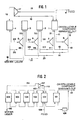
- The process according to the present invention will now be further described with reference to the accompanying drawings, in which:-
- Figure 1 is by way of example a schematic representation of a flow sheet for a preferred embodiment of the invention, in cases wherein an extra refining section is not necessary; and
- Figure 2 is by way of example a schematic representation of a flow sheet in the case wherein an extra "refining section" is necessary.
- For details of the apparatus which can be used in these cases (that is, of course, without recirculation as according to the present invention) we refer e.g. to U.S.-A-4,188,797 (Thijssen) and to the British Patent Application No. 79,21808 (Published British Patent Application No. 2023564A) (Thijssen).
- Referring to Figure 1 the four stages of the crystallizer are shown at 1, 2, 3 and 4. Thickeners for crystal slurry appear at 5, 6 and 7, while the final wash column is denoted with 8. At 17 we see an apparatus which operates as thickener or wash column. For this we refer e.g. to Figure 8 of U.S.―A―4,188,797 (Thijssen). When the
apparatus 17 operates as a thickener, some mother liquor ofstage 1 will be introduced instage 4. It has however been found that generally this does not introduce a major influence on the efficiency of the operation. - The liquid to be concentrated enters at 9 and is fed to stage 1 together with part of the
return liquid 10 fromwash column 8. Crystal slurry fromstage 1 is fed at 11 to washcolumn 8. At 12 the component separated out is withdrawn from thewash column 8, while at 13 the liquid separated from the crystals is partly returned tostage 1 at 10 and partly, at 14, fed tostage 2. A slurry of crystals is recirculated at 15 fromstage 1. It is thickened in 17 and led tostage 4, while the mother liquor is recirculated tostage 1. For the thickening process see U.S.-A-4,188,797 (Thijssen). The crystals and mother liquor are led countercurrently through the various stages, as will be clear from the figure and as described in detail in the application mentioned above. Mother liquor with the lowest content of the crystallizable component is withdrawn at 16. - The nature of material streams in Figure 1 is as follows:

- Referring now to Figure 2, (101) to (106) are crystallizer compartments as described in U.S.-A-4,188,797 (Thijssen) while (107) is a thickener as described in the same patent. At (108) a wash column is shown of the construction as described in British Patent Application No. 79,21808 (Published British Patent Application No. 2023564A) (Thijssen). As described in detail in U.S.-A-4,188,797 (Thijssen) and also above when discussing Figure 1, the slurry from each of the compartments is led to a thickener, the thickened slurry is passed on to the preceding compartment (of higher temperature), while the liquid leaving the thickener is partly recirculated to the same compartment and for the rest to the following compartment (of lower temperature), or finally recovered from the last compartment. For reasons of clarity and simplicity in this case only the general direction of flow of the liquid and the crystals are shown, the direction of the liquid being indicated with dotted lines, the direction of the crystals with drawn lines.
- The feed enters at (109) in crystallizing compartment (102) and the liquid passes on to (103) up to (106). Mother liquor is recovered at (110).
- The compartment (101) functions as a refining section, by a process of recrystallization. The crystals arriving in this compartment from compartment (102) are here brought in contact with a melt of the one component which has to be separated out of the multi-component liquid system. The wash column (108) separates the crystals from their mother liquor. Part of the crystals after melting are returned to the compartment (101), while the rest is recovered at (111). A suspension of crystals (112) is withdrawn from compartment (102) and fed to the thickener (107). The liquid (113) leaving the thickener is returned to the compartment (102), while the thickened slurry of crystals (114) is passed on to the compartment (106) of lowest temperature. Of course more than one refining compartment may be necessary, depending on the specific composition of the liquid to be treated and the purity of the crystallized component desired. Likewise the number of crystallizer compartments depends on the specific case at hand.
- The present invention will now be further illustrated by way of the following Example:-
- The process as generally discussed in Figure 2 to which we refer here will now be described as applied to the separation of p-xylene from a mixture containing it and other isometric xylenes.
- Use is made of a crystallizer with six compartments (101) to (106) with the dimensions which were mentioned in U.S.-A-4,188,797 (Thijssen). A wash column (108) is used as described in British Patent Application No. 79,21808 (Published British Patent Application No. 2023564A) (Thijssen), while crystals are recirculated as a thickened slurry obtained in a thickener (107) of the construction as described in U.S.-A-4,188,797. Throughout the apparatus there is a temperature profile from about -11°C in compartment (101) to -65°C in compartment (106). The purified p-xylene is recovered at (111) as a melt while the rest is returned to compartment (101). The ratio of recovered to refluxed melt of p-xylene is 5:1. The temperature of the melt is about +15°C (the melting point of pure p-xylene is +13,26°C).
- In table 1 the material balance around the total apparatus is given, with a recirculation ratio of crystals of 20%, which means that 80% of the crystals present in compartment (102) are passed onto compartment (101) and 20% is recirculated to compartment (106). In table 1 also the composition is given of the p-xylene fed out at (111).
- In table 2 the same data are given in the case that no recirculation of crystals is applied. In both cases the same pressure drop in the wash column is maintained. Comparing tables 1 and 2 it is seen that the product purity is increased from 99.5% to 99.9% while at the same time the throughput of the apparatus by the recirculation is increased with 40%.


Claims (5)
Priority Applications (1)
| Application Number | Priority Date | Filing Date | Title |
|---|---|---|---|
| AT81200843T ATE19958T1 (en) | 1980-07-24 | 1981-07-22 | PROCESS FOR COUNTER-CURRENT CRYSTALIZATION WITH RECYCLING. |
Applications Claiming Priority (2)
| Application Number | Priority Date | Filing Date | Title |
|---|---|---|---|
| GB8024186 | 1980-07-24 | ||
| GB8024186A GB2082081B (en) | 1980-07-24 | 1980-07-24 | Process for countercurrent crystallization with recirculation |
Publications (3)
| Publication Number | Publication Date |
|---|---|
| EP0045112A2 EP0045112A2 (en) | 1982-02-03 |
| EP0045112A3 EP0045112A3 (en) | 1982-08-11 |
| EP0045112B1 true EP0045112B1 (en) | 1986-05-28 |
Family
ID=10514995
Family Applications (1)
| Application Number | Title | Priority Date | Filing Date |
|---|---|---|---|
| EP81200843A Expired EP0045112B1 (en) | 1980-07-24 | 1981-07-22 | Process for countercurrent crystallization with recirculation |
Country Status (10)
| Country | Link |
|---|---|
| US (1) | US4508553A (en) |
| EP (1) | EP0045112B1 (en) |
| JP (1) | JPS6010763B2 (en) |
| AT (1) | ATE19958T1 (en) |
| AU (1) | AU532459B2 (en) |
| BR (1) | BR8104754A (en) |
| DE (1) | DE3174711D1 (en) |
| GB (1) | GB2082081B (en) |
| MX (1) | MX151760A (en) |
| ZA (1) | ZA814754B (en) |
Families Citing this family (17)
| Publication number | Priority date | Publication date | Assignee | Title |
|---|---|---|---|---|
| NL8200075A (en) * | 1982-01-11 | 1983-08-01 | Tno | METHOD FOR CONTINUALLY PARTIAL CRYSTALIZATION AND SEPARATION OF A LIQUID MIXTURE AND AN APPARATUS FOR CARRYING OUT THIS PROCESS. |
| JPS63144231U (en) * | 1987-03-12 | 1988-09-22 | ||
| US4787985A (en) * | 1987-08-25 | 1988-11-29 | Grenco Process Technology B.V. | Multi-stage purification unit process |
| US5127921A (en) * | 1988-07-28 | 1992-07-07 | Griffiths Kenneth F | Multistage recrystallization for superpurifying crystallizable substances |
| USRE36897E (en) * | 1993-03-23 | 2000-10-03 | Labatt Brewing Company Limited | Methods for chill treating non-distilled malted barley beverages |
| US5304384A (en) * | 1993-03-23 | 1994-04-19 | Labatt Brewing Company Limited | Improvements in production of fermented malt beverages |
| US5695795A (en) * | 1993-03-23 | 1997-12-09 | Labatt Brewing Company Limited | Methods for chill-treating non-distilled malted barley beverages |
| US5466266A (en) * | 1993-06-17 | 1995-11-14 | Griffiths; Kenneth F. | Closed system multistage superpurification recrystallization |
| US5558778A (en) * | 1993-11-16 | 1996-09-24 | Shell Oil Company | Process for the treatment of a wastewater |
| US5869114A (en) * | 1994-03-18 | 1999-02-09 | Labatt Brewing Company Limited | Production of fermented malt beverages |
| IT1270000B (en) * | 1994-09-22 | 1997-04-16 | Solvay Interox | PROCESS FOR THE MANUFACTURE OF PERSAL PARTICLES |
| ES2189624B1 (en) * | 2001-02-19 | 2004-10-16 | Agustin Mendoza Turro | PROCEDURE FOR THE CONCENTRATION OF JUICES. |
| ES2233147B1 (en) * | 2002-11-21 | 2007-07-01 | Agustin Mendoza Turro | PROCEDURE FOR THE CONCENTRATION OF JUICES. |
| US8956542B1 (en) * | 2013-07-30 | 2015-02-17 | Showa Freezing Plant Co., Ltd. | Method for processing radioactively-contaminated water |
| CN108905263A (en) * | 2018-07-13 | 2018-11-30 | 连云港康乐药业有限公司 | A kind of production method of paracetamol fine grain |
| US20240010599A1 (en) * | 2020-11-20 | 2024-01-11 | Nippon Shokubai Co., Ltd. | Method for purifying compound |
| WO2022107812A1 (en) * | 2020-11-20 | 2022-05-27 | 株式会社日本触媒 | Purification device |
Citations (1)
| Publication number | Priority date | Publication date | Assignee | Title |
|---|---|---|---|---|
| US2552523A (en) * | 1948-06-18 | 1951-05-15 | Ohio Commw Eng Co | Method of extracting liquids from a solution to effect concentration |
Family Cites Families (4)
| Publication number | Priority date | Publication date | Assignee | Title |
|---|---|---|---|---|
| US3283522A (en) * | 1963-11-04 | 1966-11-08 | Struthers Scientific Int Corp | Freeze concentration |
| AU416845B2 (en) * | 1968-09-18 | 1971-08-27 | Union Carbide Australia Limited | Solid-liquid continuous countercurrent purifier |
| GB1589477A (en) * | 1977-01-12 | 1981-05-13 | Douwe Egberts Tabaksfab | Freeze concentration apparatus |
| ZA80554B (en) * | 1979-02-22 | 1981-02-25 | Douwe Egberts Tabaksfab | Counter current crystallization process |
-
1980
- 1980-07-24 GB GB8024186A patent/GB2082081B/en not_active Expired
-
1981
- 1981-07-13 ZA ZA814754A patent/ZA814754B/en unknown
- 1981-07-20 US US06/284,947 patent/US4508553A/en not_active Expired - Fee Related
- 1981-07-20 AU AU73128/81A patent/AU532459B2/en not_active Ceased
- 1981-07-22 DE DE8181200843T patent/DE3174711D1/en not_active Expired
- 1981-07-22 EP EP81200843A patent/EP0045112B1/en not_active Expired
- 1981-07-22 AT AT81200843T patent/ATE19958T1/en not_active IP Right Cessation
- 1981-07-22 MX MX188407A patent/MX151760A/en unknown
- 1981-07-23 BR BR8104754A patent/BR8104754A/en not_active IP Right Cessation
- 1981-07-24 JP JP56115405A patent/JPS6010763B2/en not_active Expired
Patent Citations (1)
| Publication number | Priority date | Publication date | Assignee | Title |
|---|---|---|---|---|
| US2552523A (en) * | 1948-06-18 | 1951-05-15 | Ohio Commw Eng Co | Method of extracting liquids from a solution to effect concentration |
Also Published As
| Publication number | Publication date |
|---|---|
| JPS6010763B2 (en) | 1985-03-20 |
| ATE19958T1 (en) | 1986-06-15 |
| US4508553A (en) | 1985-04-02 |
| JPS5745303A (en) | 1982-03-15 |
| DE3174711D1 (en) | 1986-07-03 |
| ZA814754B (en) | 1982-10-27 |
| BR8104754A (en) | 1982-04-13 |
| AU7312881A (en) | 1982-01-28 |
| EP0045112A3 (en) | 1982-08-11 |
| AU532459B2 (en) | 1983-09-29 |
| GB2082081B (en) | 1984-04-26 |
| EP0045112A2 (en) | 1982-02-03 |
| GB2082081A (en) | 1982-03-03 |
| MX151760A (en) | 1985-03-05 |
Similar Documents
| Publication | Publication Date | Title |
|---|---|---|
| EP0045112B1 (en) | Process for countercurrent crystallization with recirculation | |
| US2540977A (en) | Continuous fractional crystallization process | |
| KR100412313B1 (en) | High-temperature crystallization at one or more stages and production of para-xylene by partial melting of crystals | |
| EP0105524B1 (en) | Countercurrent, cooling crystallization and purification method for multi-component molten mixture | |
| US2815288A (en) | Crystal purification | |
| EP0084895B1 (en) | A process for the continuous partial crystallization and the separation of a liquid mixture and a device for carrying out this process | |
| US4557741A (en) | Gradient column freeze concentration system | |
| EP0015042B1 (en) | Improved counter current crystallization process | |
| US5062862A (en) | Process and apparatus for recovering a pure substance from a liquid mixture by crystallization | |
| US2886603A (en) | Crystallization process | |
| US4406679A (en) | Apparatus for and method of preparing crystals for washing | |
| US2851368A (en) | Crystal purification | |
| EP2928828B1 (en) | Process and apparatus for producing ammonium sulfate crystals | |
| US7179435B2 (en) | Method and apparatus for recovering a pure substance from an impure solution by crystallization | |
| CA1195918A (en) | Process for countercurrent crystallization with recirculation | |
| US3467724A (en) | P-xylene process | |
| US3050952A (en) | Separation by crystallization | |
| US4025573A (en) | Separation process | |
| US3541804A (en) | Fractional crystallization with an immiscible refrigerant | |
| US3662562A (en) | Apparatus for the formation and separation of solid materials from a liquid | |
| USRE24038E (en) | arnold | |
| CN206188683U (en) | A piece -rate system for separating mix dichlorobenzene | |
| US4956520A (en) | Separation process | |
| GB2185421A (en) | Process for vacuum evaporation crystallisation | |
| US2882133A (en) | Crystal purification apparatus and process |
Legal Events
| Date | Code | Title | Description |
|---|---|---|---|
| PUAI | Public reference made under article 153(3) epc to a published international application that has entered the european phase |
Free format text: ORIGINAL CODE: 0009012 |
|
| AK | Designated contracting states |
Designated state(s): AT CH DE FR IT NL SE |
|
| PUAL | Search report despatched |
Free format text: ORIGINAL CODE: 0009013 |
|
| AK | Designated contracting states |
Designated state(s): AT CH DE FR IT NL SE |
|
| 17P | Request for examination filed |
Effective date: 19820526 |
|
| GRAA | (expected) grant |
Free format text: ORIGINAL CODE: 0009210 |
|
| AK | Designated contracting states |
Kind code of ref document: B1 Designated state(s): AT CH DE FR IT LI NL SE |
|
| REF | Corresponds to: |
Ref document number: 19958 Country of ref document: AT Date of ref document: 19860615 Kind code of ref document: T |
|
| ITF | It: translation for a ep patent filed | ||
| REF | Corresponds to: |
Ref document number: 3174711 Country of ref document: DE Date of ref document: 19860703 |
|
| ET | Fr: translation filed | ||
| PLBE | No opposition filed within time limit |
Free format text: ORIGINAL CODE: 0009261 |
|
| STAA | Information on the status of an ep patent application or granted ep patent |
Free format text: STATUS: NO OPPOSITION FILED WITHIN TIME LIMIT |
|
| 26N | No opposition filed | ||
| ITTA | It: last paid annual fee | ||
| PGFP | Annual fee paid to national office [announced via postgrant information from national office to epo] |
Ref country code: FR Payment date: 19920716 Year of fee payment: 12 |
|
| PGFP | Annual fee paid to national office [announced via postgrant information from national office to epo] |
Ref country code: AT Payment date: 19920727 Year of fee payment: 12 |
|
| PGFP | Annual fee paid to national office [announced via postgrant information from national office to epo] |
Ref country code: CH Payment date: 19920728 Year of fee payment: 12 |
|
| PGFP | Annual fee paid to national office [announced via postgrant information from national office to epo] |
Ref country code: NL Payment date: 19920731 Year of fee payment: 12 |
|
| PGFP | Annual fee paid to national office [announced via postgrant information from national office to epo] |
Ref country code: DE Payment date: 19920910 Year of fee payment: 12 |
|
| NLV4 | Nl: lapsed or anulled due to non-payment of the annual fee | ||
| PGFP | Annual fee paid to national office [announced via postgrant information from national office to epo] |
Ref country code: SE Payment date: 19930719 Year of fee payment: 13 |
|
| PG25 | Lapsed in a contracting state [announced via postgrant information from national office to epo] |
Ref country code: AT Effective date: 19930722 |
|
| PG25 | Lapsed in a contracting state [announced via postgrant information from national office to epo] |
Ref country code: LI Effective date: 19930731 Ref country code: CH Effective date: 19930731 |
|
| PG25 | Lapsed in a contracting state [announced via postgrant information from national office to epo] |
Ref country code: NL Effective date: 19940201 |
|
| NLV4 | Nl: lapsed or anulled due to non-payment of the annual fee | ||
| PG25 | Lapsed in a contracting state [announced via postgrant information from national office to epo] |
Ref country code: FR Effective date: 19940331 |
|
| REG | Reference to a national code |
Ref country code: CH Ref legal event code: PL |
|
| PG25 | Lapsed in a contracting state [announced via postgrant information from national office to epo] |
Ref country code: DE Effective date: 19940401 |
|
| REG | Reference to a national code |
Ref country code: FR Ref legal event code: ST |
|
| PG25 | Lapsed in a contracting state [announced via postgrant information from national office to epo] |
Ref country code: SE Effective date: 19940723 |
|
| EUG | Se: european patent has lapsed |
Ref document number: 81200843.1 Effective date: 19950210 |
|
| EUG | Se: european patent has lapsed |
Ref document number: 81200843.1 |