EP0044352B1 - Addukte aus Diisocyanaten und Methacryloylalkylethern, -alkoxybenzolen bzw. -alkoxycycloalkanen und deren Verwendung - Google Patents
Addukte aus Diisocyanaten und Methacryloylalkylethern, -alkoxybenzolen bzw. -alkoxycycloalkanen und deren Verwendung Download PDFInfo
- Publication number
- EP0044352B1 EP0044352B1 EP80104311A EP80104311A EP0044352B1 EP 0044352 B1 EP0044352 B1 EP 0044352B1 EP 80104311 A EP80104311 A EP 80104311A EP 80104311 A EP80104311 A EP 80104311A EP 0044352 B1 EP0044352 B1 EP 0044352B1
- Authority
- EP
- European Patent Office
- Prior art keywords
- representing
- compounds
- group
- general formula
- optionally substituted
- Prior art date
- Legal status (The legal status is an assumption and is not a legal conclusion. Google has not performed a legal analysis and makes no representation as to the accuracy of the status listed.)
- Expired
Links
- 125000005442 diisocyanate group Chemical group 0.000 title abstract description 4
- 150000001875 compounds Chemical class 0.000 claims abstract description 24
- 239000000945 filler Substances 0.000 claims abstract description 17
- 239000000203 mixture Substances 0.000 claims abstract description 16
- -1 methacryloyl alkyl ethers Chemical class 0.000 claims abstract description 8
- 239000000463 material Substances 0.000 claims description 21
- 238000011049 filling Methods 0.000 claims description 17
- 239000011230 binding agent Substances 0.000 claims description 7
- 238000006116 polymerization reaction Methods 0.000 claims description 7
- 239000003505 polymerization initiator Substances 0.000 claims description 6
- 125000001997 phenyl group Chemical group [H]C1=C([H])C([H])=C(*)C([H])=C1[H] 0.000 claims description 5
- 125000004432 carbon atom Chemical group C* 0.000 claims description 4
- 125000002993 cycloalkylene group Chemical group 0.000 claims description 4
- 125000000113 cyclohexyl group Chemical group [H]C1([H])C([H])([H])C([H])([H])C([H])(*)C([H])([H])C1([H])[H] 0.000 claims description 4
- 239000003999 initiator Substances 0.000 claims description 4
- PJANXHGTPQOBST-VAWYXSNFSA-N trans-stilbene Chemical group C=1C=CC=CC=1/C=C/C1=CC=CC=C1 PJANXHGTPQOBST-VAWYXSNFSA-N 0.000 claims description 4
- 125000001931 aliphatic group Chemical group 0.000 claims description 3
- 125000003118 aryl group Chemical group 0.000 claims description 3
- 125000000753 cycloalkyl group Chemical group 0.000 claims description 3
- 239000000975 dye Substances 0.000 claims description 3
- 125000002347 octyl group Chemical group [H]C([*])([H])C([H])([H])C([H])([H])C([H])([H])C([H])([H])C([H])([H])C([H])([H])C([H])([H])[H] 0.000 claims description 3
- 239000006096 absorbing agent Substances 0.000 claims description 2
- 125000000217 alkyl group Chemical group 0.000 claims description 2
- 125000001797 benzyl group Chemical group [H]C1=C([H])C([H])=C(C([H])=C1[H])C([H])([H])* 0.000 claims description 2
- 239000005548 dental material Substances 0.000 claims description 2
- 125000004836 hexamethylene group Chemical group [H]C([H])([*:2])C([H])([H])C([H])([H])C([H])([H])C([H])([H])C([H])([H])[*:1] 0.000 claims 3
- 125000000843 phenylene group Chemical group C1(=C(C=CC=C1)*)* 0.000 claims 3
- 125000005346 substituted cycloalkyl group Chemical group 0.000 claims 3
- 150000005224 alkoxybenzenes Chemical class 0.000 abstract description 4
- 238000010521 absorption reaction Methods 0.000 abstract description 3
- XLYOFNOQVPJJNP-UHFFFAOYSA-N water Substances O XLYOFNOQVPJJNP-UHFFFAOYSA-N 0.000 abstract description 3
- 239000002639 bone cement Substances 0.000 abstract description 2
- 239000003479 dental cement Substances 0.000 abstract description 2
- 238000002845 discoloration Methods 0.000 abstract 1
- 239000000178 monomer Substances 0.000 description 15
- 239000002131 composite material Substances 0.000 description 9
- 239000003814 drug Substances 0.000 description 8
- 239000000047 product Substances 0.000 description 8
- CERQOIWHTDAKMF-UHFFFAOYSA-N Methacrylic acid Chemical compound CC(=C)C(O)=O CERQOIWHTDAKMF-UHFFFAOYSA-N 0.000 description 7
- 238000002360 preparation method Methods 0.000 description 5
- 239000000853 adhesive Substances 0.000 description 4
- 230000001070 adhesive effect Effects 0.000 description 4
- 239000007795 chemical reaction product Substances 0.000 description 4
- 150000002978 peroxides Chemical class 0.000 description 4
- RIOQSEWOXXDEQQ-UHFFFAOYSA-N triphenylphosphine Chemical compound C1=CC=CC=C1P(C=1C=CC=CC=1)C1=CC=CC=C1 RIOQSEWOXXDEQQ-UHFFFAOYSA-N 0.000 description 4
- FQYUMYWMJTYZTK-UHFFFAOYSA-N Phenyl glycidyl ether Chemical compound C1OC1COC1=CC=CC=C1 FQYUMYWMJTYZTK-UHFFFAOYSA-N 0.000 description 3
- 150000001412 amines Chemical class 0.000 description 3
- 238000006243 chemical reaction Methods 0.000 description 3
- 238000001723 curing Methods 0.000 description 3
- 150000002170 ethers Chemical class 0.000 description 3
- 239000011521 glass Substances 0.000 description 3
- 239000007788 liquid Substances 0.000 description 3
- 239000002245 particle Substances 0.000 description 3
- 239000011347 resin Substances 0.000 description 3
- 229920005989 resin Polymers 0.000 description 3
- AZQWKYJCGOJGHM-UHFFFAOYSA-N 1,4-benzoquinone Chemical compound O=C1C=CC(=O)C=C1 AZQWKYJCGOJGHM-UHFFFAOYSA-N 0.000 description 2
- XDTMQSROBMDMFD-UHFFFAOYSA-N Cyclohexane Chemical compound C1CCCCC1 XDTMQSROBMDMFD-UHFFFAOYSA-N 0.000 description 2
- 239000004593 Epoxy Substances 0.000 description 2
- QIGBRXMKCJKVMJ-UHFFFAOYSA-N Hydroquinone Chemical compound OC1=CC=C(O)C=C1 QIGBRXMKCJKVMJ-UHFFFAOYSA-N 0.000 description 2
- VYPSYNLAJGMNEJ-UHFFFAOYSA-N Silicium dioxide Chemical compound O=[Si]=O VYPSYNLAJGMNEJ-UHFFFAOYSA-N 0.000 description 2
- 239000002253 acid Substances 0.000 description 2
- WURBFLDFSFBTLW-UHFFFAOYSA-N benzil Chemical compound C=1C=CC=CC=1C(=O)C(=O)C1=CC=CC=C1 WURBFLDFSFBTLW-UHFFFAOYSA-N 0.000 description 2
- ISAOCJYIOMOJEB-UHFFFAOYSA-N benzoin Chemical compound C=1C=CC=CC=1C(O)C(=O)C1=CC=CC=C1 ISAOCJYIOMOJEB-UHFFFAOYSA-N 0.000 description 2
- IISBACLAFKSPIT-UHFFFAOYSA-N bisphenol A Chemical compound C=1C=C(O)C=CC=1C(C)(C)C1=CC=C(O)C=C1 IISBACLAFKSPIT-UHFFFAOYSA-N 0.000 description 2
- 239000012948 isocyanate Substances 0.000 description 2
- 150000002513 isocyanates Chemical class 0.000 description 2
- 238000004519 manufacturing process Methods 0.000 description 2
- 238000012986 modification Methods 0.000 description 2
- 230000004048 modification Effects 0.000 description 2
- RZXMPPFPUUCRFN-UHFFFAOYSA-N p-toluidine Chemical compound CC1=CC=C(N)C=C1 RZXMPPFPUUCRFN-UHFFFAOYSA-N 0.000 description 2
- TZMFJUDUGYTVRY-UHFFFAOYSA-N pentane-2,3-dione Chemical compound CCC(=O)C(C)=O TZMFJUDUGYTVRY-UHFFFAOYSA-N 0.000 description 2
- 239000003566 sealing material Substances 0.000 description 2
- 239000003381 stabilizer Substances 0.000 description 2
- 238000003756 stirring Methods 0.000 description 2
- 239000000126 substance Substances 0.000 description 2
- CIHOLLKRGTVIJN-UHFFFAOYSA-N tert‐butyl hydroperoxide Chemical compound CC(C)(C)OO CIHOLLKRGTVIJN-UHFFFAOYSA-N 0.000 description 2
- 239000002966 varnish Substances 0.000 description 2
- CIDZDYAPPNMBIY-UHFFFAOYSA-N (4-butylphenyl)methanol Chemical compound CCCCC1=CC=C(CO)C=C1 CIDZDYAPPNMBIY-UHFFFAOYSA-N 0.000 description 1
- XMNIXWIUMCBBBL-UHFFFAOYSA-N 2-(2-phenylpropan-2-ylperoxy)propan-2-ylbenzene Chemical compound C=1C=CC=CC=1C(C)(C)OOC(C)(C)C1=CC=CC=C1 XMNIXWIUMCBBBL-UHFFFAOYSA-N 0.000 description 1
- HIXDQWDOVZUNNA-UHFFFAOYSA-N 2-(3,4-dimethoxyphenyl)-5-hydroxy-7-methoxychromen-4-one Chemical compound C=1C(OC)=CC(O)=C(C(C=2)=O)C=1OC=2C1=CC=C(OC)C(OC)=C1 HIXDQWDOVZUNNA-UHFFFAOYSA-N 0.000 description 1
- XNJDQHLXEBQMDE-UHFFFAOYSA-N 2-(cyclohexyloxymethyl)oxirane Chemical compound C1OC1COC1CCCCC1 XNJDQHLXEBQMDE-UHFFFAOYSA-N 0.000 description 1
- HWSSEYVMGDIFMH-UHFFFAOYSA-N 2-[2-[2-(2-methylprop-2-enoyloxy)ethoxy]ethoxy]ethyl 2-methylprop-2-enoate Chemical compound CC(=C)C(=O)OCCOCCOCCOC(=O)C(C)=C HWSSEYVMGDIFMH-UHFFFAOYSA-N 0.000 description 1
- LTHJXDSHSVNJKG-UHFFFAOYSA-N 2-[2-[2-[2-(2-methylprop-2-enoyloxy)ethoxy]ethoxy]ethoxy]ethyl 2-methylprop-2-enoate Chemical compound CC(=C)C(=O)OCCOCCOCCOCCOC(=O)C(C)=C LTHJXDSHSVNJKG-UHFFFAOYSA-N 0.000 description 1
- BQZJOQXSCSZQPS-UHFFFAOYSA-N 2-methoxy-1,2-diphenylethanone Chemical compound C=1C=CC=CC=1C(OC)C(=O)C1=CC=CC=C1 BQZJOQXSCSZQPS-UHFFFAOYSA-N 0.000 description 1
- IKTABEIWDPZBHF-UHFFFAOYSA-N 2-methyl-1-trimethoxysilylprop-2-en-1-one Chemical compound CO[Si](OC)(OC)C(=O)C(C)=C IKTABEIWDPZBHF-UHFFFAOYSA-N 0.000 description 1
- FRIBMENBGGCKPD-UHFFFAOYSA-N 3-(2,3-dimethoxyphenyl)prop-2-enal Chemical compound COC1=CC=CC(C=CC=O)=C1OC FRIBMENBGGCKPD-UHFFFAOYSA-N 0.000 description 1
- VPWNQTHUCYMVMZ-UHFFFAOYSA-N 4,4'-sulfonyldiphenol Chemical class C1=CC(O)=CC=C1S(=O)(=O)C1=CC=C(O)C=C1 VPWNQTHUCYMVMZ-UHFFFAOYSA-N 0.000 description 1
- BMULWKLWORMXCY-UHFFFAOYSA-N 4-(2,2,4,4-tetramethylpentan-3-yl)phenol Chemical compound CC(C)(C)C(C(C)(C)C)C1=CC=C(O)C=C1 BMULWKLWORMXCY-UHFFFAOYSA-N 0.000 description 1
- XOJWAAUYNWGQAU-UHFFFAOYSA-N 4-(2-methylprop-2-enoyloxy)butyl 2-methylprop-2-enoate Chemical compound CC(=C)C(=O)OCCCCOC(=O)C(C)=C XOJWAAUYNWGQAU-UHFFFAOYSA-N 0.000 description 1
- BBAKQSDEUXCWFY-UHFFFAOYSA-N 5-hydroxy-2-methyl-6-phenoxyhex-1-en-3-one Chemical compound CC(=C)C(=O)CC(O)COC1=CC=CC=C1 BBAKQSDEUXCWFY-UHFFFAOYSA-N 0.000 description 1
- SAPGBCWOQLHKKZ-UHFFFAOYSA-N 6-(2-methylprop-2-enoyloxy)hexyl 2-methylprop-2-enoate Chemical compound CC(=C)C(=O)OCCCCCCOC(=O)C(C)=C SAPGBCWOQLHKKZ-UHFFFAOYSA-N 0.000 description 1
- JNWPFPFXZSAHGD-UHFFFAOYSA-N 6-carbamoyloxyhexyl carbamate Chemical compound NC(=O)OCCCCCCOC(N)=O JNWPFPFXZSAHGD-UHFFFAOYSA-N 0.000 description 1
- NIXOWILDQLNWCW-UHFFFAOYSA-M Acrylate Chemical compound [O-]C(=O)C=C NIXOWILDQLNWCW-UHFFFAOYSA-M 0.000 description 1
- 229910001312 Amalgam (dentistry) Inorganic materials 0.000 description 1
- 239000004342 Benzoyl peroxide Substances 0.000 description 1
- OMPJBNCRMGITSC-UHFFFAOYSA-N Benzoylperoxide Chemical compound C=1C=CC=CC=1C(=O)OOC(=O)C1=CC=CC=C1 OMPJBNCRMGITSC-UHFFFAOYSA-N 0.000 description 1
- 229930185605 Bisphenol Natural products 0.000 description 1
- KXDHJXZQYSOELW-UHFFFAOYSA-M Carbamate Chemical compound NC([O-])=O KXDHJXZQYSOELW-UHFFFAOYSA-M 0.000 description 1
- QSJXEFYPDANLFS-UHFFFAOYSA-N Diacetyl Chemical group CC(=O)C(C)=O QSJXEFYPDANLFS-UHFFFAOYSA-N 0.000 description 1
- 239000005057 Hexamethylene diisocyanate Substances 0.000 description 1
- CERQOIWHTDAKMF-UHFFFAOYSA-M Methacrylate Chemical compound CC(=C)C([O-])=O CERQOIWHTDAKMF-UHFFFAOYSA-M 0.000 description 1
- AFBPFSWMIHJQDM-UHFFFAOYSA-N N-methyl-N-phenylamine Natural products CNC1=CC=CC=C1 AFBPFSWMIHJQDM-UHFFFAOYSA-N 0.000 description 1
- 244000028419 Styrax benzoin Species 0.000 description 1
- 235000000126 Styrax benzoin Nutrition 0.000 description 1
- 235000008411 Sumatra benzointree Nutrition 0.000 description 1
- ZJCCRDAZUWHFQH-UHFFFAOYSA-N Trimethylolpropane Chemical compound CCC(CO)(CO)CO ZJCCRDAZUWHFQH-UHFFFAOYSA-N 0.000 description 1
- 238000003848 UV Light-Curing Methods 0.000 description 1
- 239000012963 UV stabilizer Substances 0.000 description 1
- QCWXUUIWCKQGHC-UHFFFAOYSA-N Zirconium Chemical compound [Zr] QCWXUUIWCKQGHC-UHFFFAOYSA-N 0.000 description 1
- COHCXWLRUISKOO-UHFFFAOYSA-N [AlH3].[Ba] Chemical compound [AlH3].[Ba] COHCXWLRUISKOO-UHFFFAOYSA-N 0.000 description 1
- JFBZPFYRPYOZCQ-UHFFFAOYSA-N [Li].[Al] Chemical compound [Li].[Al] JFBZPFYRPYOZCQ-UHFFFAOYSA-N 0.000 description 1
- 239000012190 activator Substances 0.000 description 1
- 150000001555 benzenes Chemical class 0.000 description 1
- 229960002130 benzoin Drugs 0.000 description 1
- 235000019400 benzoyl peroxide Nutrition 0.000 description 1
- XYVBNYDBWYFYQX-UHFFFAOYSA-N bis(4-methyl-3-oxopent-4-enyl) benzene-1,2-dicarboxylate Chemical compound CC(=C)C(=O)CCOC(=O)C1=CC=CC=C1C(=O)OCCC(=O)C(C)=C XYVBNYDBWYFYQX-UHFFFAOYSA-N 0.000 description 1
- 239000005388 borosilicate glass Substances 0.000 description 1
- KXDHJXZQYSOELW-UHFFFAOYSA-N carbamic acid group Chemical group C(N)(O)=O KXDHJXZQYSOELW-UHFFFAOYSA-N 0.000 description 1
- 150000001728 carbonyl compounds Chemical class 0.000 description 1
- 125000002915 carbonyl group Chemical group [*:2]C([*:1])=O 0.000 description 1
- 239000003795 chemical substances by application Substances 0.000 description 1
- 238000009833 condensation Methods 0.000 description 1
- 230000005494 condensation Effects 0.000 description 1
- 125000002704 decyl group Chemical group [H]C([H])([H])C([H])([H])C([H])([H])C([H])([H])C([H])([H])C([H])([H])C([H])([H])C([H])([H])C([H])([H])C([H])([H])* 0.000 description 1
- 125000004989 dicarbonyl group Chemical group 0.000 description 1
- KORSJDCBLAPZEQ-UHFFFAOYSA-N dicyclohexylmethane-4,4'-diisocyanate Chemical compound C1CC(N=C=O)CCC1CC1CCC(N=C=O)CC1 KORSJDCBLAPZEQ-UHFFFAOYSA-N 0.000 description 1
- GYZLOYUZLJXAJU-UHFFFAOYSA-N diglycidyl ether Chemical class C1OC1COCC1CO1 GYZLOYUZLJXAJU-UHFFFAOYSA-N 0.000 description 1
- ATUOYWHBWRKTHZ-UHFFFAOYSA-N dimethylmethane Natural products CCC ATUOYWHBWRKTHZ-UHFFFAOYSA-N 0.000 description 1
- RTZKZFJDLAIYFH-UHFFFAOYSA-N ether Substances CCOCC RTZKZFJDLAIYFH-UHFFFAOYSA-N 0.000 description 1
- 125000001495 ethyl group Chemical group [H]C([H])([H])C([H])([H])* 0.000 description 1
- 239000002241 glass-ceramic Substances 0.000 description 1
- VOZRXNHHFUQHIL-UHFFFAOYSA-N glycidyl methacrylate Chemical compound CC(=C)C(=O)OCC1CO1 VOZRXNHHFUQHIL-UHFFFAOYSA-N 0.000 description 1
- 235000019382 gum benzoic Nutrition 0.000 description 1
- RRAMGCGOFNQTLD-UHFFFAOYSA-N hexamethylene diisocyanate Chemical compound O=C=NCCCCCCN=C=O RRAMGCGOFNQTLD-UHFFFAOYSA-N 0.000 description 1
- 125000004051 hexyl group Chemical group [H]C([H])([H])C([H])([H])C([H])([H])C([H])([H])C([H])([H])C([H])([H])* 0.000 description 1
- 230000000977 initiatory effect Effects 0.000 description 1
- 230000007794 irritation Effects 0.000 description 1
- QQVIHTHCMHWDBS-UHFFFAOYSA-L isophthalate(2-) Chemical compound [O-]C(=O)C1=CC=CC(C([O-])=O)=C1 QQVIHTHCMHWDBS-UHFFFAOYSA-L 0.000 description 1
- 125000001449 isopropyl group Chemical group [H]C([H])([H])C([H])(*)C([H])([H])[H] 0.000 description 1
- 229910052746 lanthanum Inorganic materials 0.000 description 1
- FZLIPJUXYLNCLC-UHFFFAOYSA-N lanthanum atom Chemical compound [La] FZLIPJUXYLNCLC-UHFFFAOYSA-N 0.000 description 1
- 229910052751 metal Inorganic materials 0.000 description 1
- 239000002184 metal Substances 0.000 description 1
- 125000005395 methacrylic acid group Chemical group 0.000 description 1
- 125000002496 methyl group Chemical group [H]C([H])([H])* 0.000 description 1
- 125000000325 methylidene group Chemical group [H]C([H])=* 0.000 description 1
- GYVGXEWAOAAJEU-UHFFFAOYSA-N n,n,4-trimethylaniline Chemical compound CN(C)C1=CC=C(C)C=C1 GYVGXEWAOAAJEU-UHFFFAOYSA-N 0.000 description 1
- 125000004123 n-propyl group Chemical group [H]C([H])([H])C([H])([H])C([H])([H])* 0.000 description 1
- 125000001400 nonyl group Chemical group [H]C([*])([H])C([H])([H])C([H])([H])C([H])([H])C([H])([H])C([H])([H])C([H])([H])C([H])([H])C([H])([H])[H] 0.000 description 1
- 150000003961 organosilicon compounds Chemical class 0.000 description 1
- 230000000399 orthopedic effect Effects 0.000 description 1
- 125000001147 pentyl group Chemical group C(CCCC)* 0.000 description 1
- 125000000951 phenoxy group Chemical group [H]C1=C([H])C([H])=C(O*)C([H])=C1[H] 0.000 description 1
- 230000000704 physical effect Effects 0.000 description 1
- 229920000768 polyamine Polymers 0.000 description 1
- 239000001294 propane Substances 0.000 description 1
- 239000011044 quartzite Substances 0.000 description 1
- 150000004053 quinones Chemical class 0.000 description 1
- 230000005855 radiation Effects 0.000 description 1
- 239000011541 reaction mixture Substances 0.000 description 1
- 239000000377 silicon dioxide Substances 0.000 description 1
- 150000004979 silylperoxides Chemical class 0.000 description 1
- 125000003107 substituted aryl group Chemical group 0.000 description 1
- 208000024891 symptom Diseases 0.000 description 1
- KKEYFWRCBNTPAC-UHFFFAOYSA-L terephthalate(2-) Chemical compound [O-]C(=O)C1=CC=C(C([O-])=O)C=C1 KKEYFWRCBNTPAC-UHFFFAOYSA-L 0.000 description 1
- GJBRNHKUVLOCEB-UHFFFAOYSA-N tert-butyl benzenecarboperoxoate Chemical compound CC(C)(C)OOC(=O)C1=CC=CC=C1 GJBRNHKUVLOCEB-UHFFFAOYSA-N 0.000 description 1
- 125000005425 toluyl group Chemical group 0.000 description 1
- 125000005270 trialkylamine group Chemical group 0.000 description 1
- 125000005259 triarylamine group Chemical group 0.000 description 1
- AQLJVWUFPCUVLO-UHFFFAOYSA-N urea hydrogen peroxide Chemical compound OO.NC(N)=O AQLJVWUFPCUVLO-UHFFFAOYSA-N 0.000 description 1
- 125000005023 xylyl group Chemical group 0.000 description 1
- 229910052726 zirconium Inorganic materials 0.000 description 1
Classifications
-
- C—CHEMISTRY; METALLURGY
- C08—ORGANIC MACROMOLECULAR COMPOUNDS; THEIR PREPARATION OR CHEMICAL WORKING-UP; COMPOSITIONS BASED THEREON
- C08F—MACROMOLECULAR COMPOUNDS OBTAINED BY REACTIONS ONLY INVOLVING CARBON-TO-CARBON UNSATURATED BONDS
- C08F20/00—Homopolymers and copolymers of compounds having one or more unsaturated aliphatic radicals, each having only one carbon-to-carbon double bond, and only one being terminated by only one carboxyl radical or a salt, anhydride, ester, amide, imide or nitrile thereof
- C08F20/02—Monocarboxylic acids having less than ten carbon atoms, Derivatives thereof
- C08F20/10—Esters
- C08F20/34—Esters containing nitrogen, e.g. N,N-dimethylaminoethyl (meth)acrylate
- C08F20/36—Esters containing nitrogen, e.g. N,N-dimethylaminoethyl (meth)acrylate containing oxygen in addition to the carboxy oxygen, e.g. 2-N-morpholinoethyl (meth)acrylate or 2-isocyanatoethyl (meth)acrylate
-
- A—HUMAN NECESSITIES
- A61—MEDICAL OR VETERINARY SCIENCE; HYGIENE
- A61K—PREPARATIONS FOR MEDICAL, DENTAL OR TOILETRY PURPOSES
- A61K6/00—Preparations for dentistry
- A61K6/20—Protective coatings for natural or artificial teeth, e.g. sealings, dye coatings or varnish
-
- A—HUMAN NECESSITIES
- A61—MEDICAL OR VETERINARY SCIENCE; HYGIENE
- A61K—PREPARATIONS FOR MEDICAL, DENTAL OR TOILETRY PURPOSES
- A61K6/00—Preparations for dentistry
- A61K6/30—Compositions for temporarily or permanently fixing teeth or palates, e.g. primers for dental adhesives
-
- A—HUMAN NECESSITIES
- A61—MEDICAL OR VETERINARY SCIENCE; HYGIENE
- A61K—PREPARATIONS FOR MEDICAL, DENTAL OR TOILETRY PURPOSES
- A61K6/00—Preparations for dentistry
- A61K6/80—Preparations for artificial teeth, for filling teeth or for capping teeth
- A61K6/884—Preparations for artificial teeth, for filling teeth or for capping teeth comprising natural or synthetic resins
- A61K6/887—Compounds obtained by reactions only involving carbon-to-carbon unsaturated bonds
-
- A—HUMAN NECESSITIES
- A61—MEDICAL OR VETERINARY SCIENCE; HYGIENE
- A61K—PREPARATIONS FOR MEDICAL, DENTAL OR TOILETRY PURPOSES
- A61K6/00—Preparations for dentistry
- A61K6/80—Preparations for artificial teeth, for filling teeth or for capping teeth
- A61K6/884—Preparations for artificial teeth, for filling teeth or for capping teeth comprising natural or synthetic resins
- A61K6/891—Compounds obtained otherwise than by reactions only involving carbon-to-carbon unsaturated bonds
- A61K6/896—Polyorganosilicon compounds
Definitions
- the present invention relates to new, polymerizable adducts of diisocyanates and methacryloylalkyl ethers, alkoxybenzenes or alkoxycycloalkanes and their use in binders, in particular in dental materials, and a dental restoration and filling material.
- R and R 2 may be the same or different and a straight-chain or branched alkyl group having 2 to 14 carbon atoms or an optionally substituted aryl or cycloalkyl group and R x is a divalent (ar) aliphatic, cycloaliphatic or aromatic radical having 2 to 14 C atoms mean.
- the radicals R 1 and R 2 can be the same or different and can contain methyl, ethyl, n-propyl, isopropyl, n or sec. Or tert.-butyl, pentyl, hexyl. , Octyl, 2-ethylhexyl, nonyl, decyl or lauryl radicals, it being found that particularly good results can be achieved with the 2-ethylhexyl radical.
- R and R 2 can also optionally be substituted aromatic radicals, in particular phenyl, benzyl, toluyl or xylyl groups or cycloalkyl, in particular cyclohexyl radicals.
- the radical R x stands for an alkylene radical, which can be branched or straight-chain, for example ethylene, propylene, butylene, pentamethylene, hexamethylene, octamethylene or 2-ethylhexamethylene radicals or for divalent aromatic groups, in particular phenylene, phenoxyphenylene -, Toluylene, araliphatic groups, such as methylene bisphenyl or propylene bisphenyl radicals and cycloalkylene groups, in particular cyclohexane or methylene or propylene biscyclohexyl groups.
- the polymerizable compounds according to the invention with 2 methacrylic groups are prepared in a manner known per se by condensation of the corresponding isocyanates with the corresponding methacryloylalkyl ethers, alkoxybenzenes or alkoxycycloalkanes, which in turn is also in a manner known per se by reaction of methacrylic acid with the corresponding glycidyl ethers won. Production processes which are suitable in principle are described, for example, in DE-AS 2 357 324.
- the products according to the invention are basically suitable for all those uses where monomers with at least two polymerizable double bonds can be used in the molecule. As already indicated, they are particularly suitable for use as binders and in adhesives, in particular for use in medicine and dental medicine.
- filler material in the compositions.
- maximum amount of filler to be used depends on the properties of the monomers used in the composition.
- the proportion of filler in the overall composition can be increased to about 90%.
- the present invention therefore also relates to a dental filling material which is characterized by a proportion of at least one of the monomers according to the invention, a filler, a polymerization initiator or accelerator, and, if appropriate, further substances known per se, such as further monomers, UV absorbers, stabilizers, dyes, etc. .
- the filling materials used can be radiopaque or radiopaque materials.
- examples are in particular the various silica modifications such as glass (powdered glass), borosilicate glass and other glasses such as quartzite, christobalite and the like.
- Suitable radiopaque fillers are described, for example, in US Pat. Nos. 3,801,344, 3,808,170 and 9,975,203 and DE-OS No. 2,347,591.
- these fillers can also be silanized in a known manner.
- the particle sizes of the fillers used are generally between about 0.01 and 100 microns; in many cases it is possible and also sensible to use combinations of fillers of lower and higher particle sizes, the preferred particle diameter being between approximately 0.05 and approximately 50, preferably approximately 30 microns.
- Composites come in two modifications, either as two-phase preparations, one phase of which is a polymerization initiator, for example a peroxide, and the other phase of which Accelerator for this peroxide, for example an organic amine, contains, the two phases being brought together immediately before the tooth filling and the polymerization occurs in the drilled cavity, preferably provided with a relining material, to be filled.
- a polymerization initiator for example a peroxide
- Accelerator for this peroxide for example an organic amine
- the monomers according to the invention can of course be used both in two-phase and in single-phase preparations.
- photopolymerization initiators are known, preferably carbonyl compounds, in particular benzil and benzene derivatives, such as 4,4-oxydibenzil or other dicarbonyl compounds, e.g. B. diacetyl, 2,3-pentanedione, or metal carbonyls, quinones and their derivatives.
- the proportion of photopolymerization initiator is about 0.01 to about 5% by weight of the total composition.
- These single-phase preparations preferably also contain so-called polymerization accelerators. These are substances that accelerate the polymerization reaction in the presence of polymerization initiators.
- Known accelerators are, for example, various amines such as p-toluidine, dimethyl-p-toluidine, trialkylamines, polyamines such as N, N, N ', N'-tetraalkylalkylenediamines and sulfimides, preferably in an amount of about 0.01 to about 5% by weight. % of the total composition.
- one of these mixtures generally contains a polymerization initiator.
- a polymerization initiator mostly peroxides, which decompose when the polymerization is initiated and form free radicals.
- Suitable peroxides are, for example, aryl peroxides such as benzoyl peroxide, cumene hydroperoxide, urea peroxide, tert-butyl hydroperoxide or perbenzoate and silyl peroxides, in amounts of preferably about 0.01 to about 5, in particular about 0.5 to 2.5,% by weight.
- one phase of the two-phase agent contains a polymerization initiator
- an accelerator of the type described above preferably an amine, is expediently added to the other phase.
- polymerizable organosilicon compounds for example methacryloylalkyltrihydroxysilanes or methacryloyltrimethoxysilane, can be used to improve the adhesion between filler and resin.
- monomers already proposed for this purpose can also be used in the dental filling materials used.
- Such monomers are, for example, alkanedioidimethacrylates such as 1,6-hexanediol dimethacrylate, 1,4-butanediol dimethacrylate or tri- or tetraethylene glycol dimethacrylate, bis- (2-methacryloylethyl) phthalate, isophthalate or terephthalate, trimethylol propane di- and trimethacrylate dihydroxy acrylate, reaction methacrylate products , as described, for example, in DE-OS No.
- reaction products from bisphenols, in particular bisphenol A, and glycidyl methacrylate (bis-GMA), adducts from (di-) isocyanates and 2,2 - propane bis [3- (4 phenoxy) -1,2-hydroxypropane-1-methacrylate] according to US Pat. No. 3,629,187 and other polymerizable compounds already proposed for this purpose.
- Composite materials sometimes contain small amounts of dyes to give the filled tooth surfaces the most natural impression possible.
- UV stabilizers are e.g. Hydroquinone, p-benzoquinone, p-butylhydroxytoluene and the like
- 225 g of phenylglycidyl ether were reacted together with 150 g of methacrylic acid at 100 ° C. in the presence of 1 g of triphenylphosphine and 0.7 g of di-tert-butyl-p-hydroxytoluene with stirring until an epoxy equivalent of less than 0.005 was reached.
- the carbamate obtained is a light yellow liquid with a refractive index of 1.528 at 30 ° C.
- the corresponding cyclohexyl derivative can be prepared in an analogous manner by replacing the phenylglycidyl ether with cyclohexylglycidyl ether.
- a reaction product obtained in analogy to Example A and consisting of 150 g of phenylglycidyl ether and 129 g of methacrylic acid was admixed with 84 g of hexamethylene diisocyanate at 45-50 ° C. for one hour. After standing overnight at 30 ° C, a pale yellow viscous liquid consisting of the hexamethylene biscarbamate of 3-methacroyl-2-hydroxypropoxybenzene was obtained.
- the reaction product is a pale yellow viscous liquid with a refractive index of 1.543 at 30 ° C.
- a “composite” filling material was made from the following components:
- Pastes A and B were mixed together in equal parts and cured briefly; the product obtained had the following mechanical properties:
- the material also showed excellent color stability.
- a “composite” filling material consisted of 2 pastes with the following composition:
- Pastes A and B were mixed together in approximately equal amounts and were completely cured after approximately 2.5 minutes at 23 ° C.
- the polymerization product showed the following physical values:
- the product showed excellent color stability and an attractive, natural appearance.
- a filling material consisting of 2 pastes was produced:
- Pastes A and B were mixed in approximately equal proportions. Curing took place in 150 seconds at 23 ° C. The cured material showed the following properties:
- the color stability was excellent.
- a radio-opaque, light-curing, single-phase filling material of the following composition was produced:
- a fissure sealing material has the following monomer composition:
- This resin mixture can be cured either by a redox system (e.g. cumene peroxide / triarylamine) or by irradiation with UV light or visible light in the presence of a UV activator such as benzoin, benzoin methyl ether, benzil, etc. respectively.
- a redox system e.g. cumene peroxide / triarylamine
- UV activator such as benzoin, benzoin methyl ether, benzil, etc. respectively.
- This varnish is UV-curing and can be used in any way in dental medicine. It should be emphasized again that the compounds according to the invention are suitable for use for all purposes where monomers with more than one double bond in the molecule are used in binders, in particular in medicine and dental medicine.
Landscapes
- Health & Medical Sciences (AREA)
- Oral & Maxillofacial Surgery (AREA)
- Veterinary Medicine (AREA)
- Epidemiology (AREA)
- Life Sciences & Earth Sciences (AREA)
- Animal Behavior & Ethology (AREA)
- General Health & Medical Sciences (AREA)
- Public Health (AREA)
- Plastic & Reconstructive Surgery (AREA)
- Chemical & Material Sciences (AREA)
- Medicinal Chemistry (AREA)
- Chemical Kinetics & Catalysis (AREA)
- Polymers & Plastics (AREA)
- Organic Chemistry (AREA)
- Dental Preparations (AREA)
- Organic Low-Molecular-Weight Compounds And Preparation Thereof (AREA)
- Adhesives Or Adhesive Processes (AREA)
- Addition Polymer Or Copolymer, Post-Treatments, Or Chemical Modifications (AREA)
- Polyurethanes Or Polyureas (AREA)
Description
- Die vorliegende Erfindung betrifft neue, polymerisierbare Addukte aus Diisocyanaten und Methacryloylalkylethern, -alkoxybenzolen bzw. -alkoxycycloalkanen und deren Verwendung in Bindemitteln, insbesondere in Dentalmaterialien, sowie ein dentales Restorations- und Füllungsmaterial.
- Es existieren bereits zahlreiche polymerisierbare Verbindung, die mehr als eine Doppelbindung im Molekül aufweisen. Diese Verbindungen werden für vielfältige Anwendungszwecke verwendet, insbesondere auch als Bindemittel zur Herstellung verschiedener Klebstoffe, u.a. auch in der Medizin und Dentalmedizin, bei der Konfektionierung von Knochenzementen, dentalen Restorations- und Füllmassen, dentalen Versiegelungsmaterialien, orthopädischen und orthodontischen Klebstoffen etc.
- Es wurde nun gefunden, daß sich eine neue Klasse von Monomeren, die durch die Umsetzung von aliphatischen, aromatischen oder cycloaliphatischen Diisocyanaten mit Methacryloylalkylethern, -alkoxybenzolen oder -alkoxycycloalkanen erhalten werden, besonders gut für den Einsatz als Bindemittel und Klebstoffe, vor allem in den aufgezählten Arbeitsgebieten, eignet.
- Gegenstand der Erfindung sind somit neue Verbindungen der allgemeinen Formel

- Wie gesagt, können die Reste R, und R2 dabei gleich oder verschieden sein und Methyl-, Ethyl-, n-Propyl-, Isopropyl-, n- bzw. sec.- oder tert.-Butyl-, Pentyl-, Hexyl-, Octyl-, 2-Ethylhexyl-, Nonyl-, Decyl-, oder Laurylreste bedeuten, wobei sich gezeigt hat, daß mit dem 2-Ethylhexylrest besonders gute Ergebnisse erzielt werden können. R, und R2 können jedoch auch gegebenenfalls substituiert aromatische Reste, insbesondere Phenyl-, Benzyl-, Toluyl- oder Xylyl-Gruppen oder Cycloalkyl-, insbesondere Cyclohexylreste, darstellen.
- Der Rest Rx steht für einen Alkylenrest, der verzweigt oder geradkettig sein kann, beispielsweise Ethylen-, Propylen-, Butylen-, Pentamethylen-, Hexamethylen-, Octamethylen-, oder 2-Ethylhexamethylenreste oder für zweiwertige aromatische Gruppen, insbesondere Phenylen-, Phenoxyphenylen-, Toluylen-, araliphatische Gruppen, wie Methylenbisphenyl- oder Propylenbisphenylreste sowie Cycloalkylengruppen, insbesondere Cyclohexan- bzw. Methylen- oder Propylenbiscyclohexyl-Gruppen.
- Die Herstellung der erfindungsgemäßen polymerisierbaren Verbindungen mit 2 Methacrylgruppen erfolgt in der an sich bekannten Weise durch Kondensation der entsprechenden Isocyanate mit den entsprechenden Methacryloylalkylethern, -alkoxybenzolen bzw. -alkoxycycloalkanen, die ihrerseits wiederum durch Reaktion von Methacrylsäure mit den entsprechenden Glycidylethern in ebenfalls an sich bekannter Weise gewonnen wurden. Prinzipiell geeignete Herstellungsverfahren sind beispielsweise in der DE-AS 2 357 324 beschrieben.
- Aus dieser DE-AS der DE-OS Nr. 2 419 887 sowie der US-PS Nr. 3 425 988 sind zwar ebenfalls bereits (Meth)Acrylsäureester bekannt, die Carbaminsäuregruppierungen im Molekül aufweisen, jedoch handelt es sich bei diesen bekannten Produkten um von den erfindungsgemäßen Monomeren strukturell unterschiedliche Produkte, mit denen die durch die Verwendung der erfindungsgemäßen Zusammensetzungen erzielbaren Vorteile nicht erreicht werden können.
- Die erfindungsgemäßen Produkte eigenen sich grundsätzlich für alle diejenigen Verwendungszwecke, wo Monomere mit mindestens zwei polymerisierbaren Doppelbindungen im Molekül Einsatz finden können. Wie bereits angedeutet, sind sie besonders geeignet zur Anwendung als Bindemittel und in Klebstoffen, insbesondere zur Anwendung in der Medizin und Dentalmedizin.
- In der Dentalmedizin haben besonders die aus Füllstoffen und polymerisierbaren Verbindungen bestehenden Füllungsmaterialien, die sogenannten "Composites", in den letzten Jahren zunehmende Bedeutung erlangt, da diese Produkte vom Zahnarzt leicht und sicher zu handhaben sind, vom Patienten in der Regel gut und reizlos vertragen werden und die Möglichkeit bieten, von den aus physiologischen Gründen immer wieder kritisierten Amalgam-Füllungsmaterialien abzurücken.
- Nachteile der Composites gegenüber den herkömmlichen Füllungsmaterialien sind jedoch ihre Schrumpfungsanfälligkeit und ihre Wasserabsorption; besonders durch die mögliche Schrumpfung können zwischen Füllungsrand und ausgefüllter Kavität im Laufe der Zeit sekundärkariöse Erscheinungen auftreten.
- Es ist daher das Bestreben der Fachwelt, Composites herzustellen, die nach Möglichkeit keine Schrumpfung aufweisen, ein geringe Wasserabsorption besitzen, gute mechanische Eigenschaften aufweisen und farbstabil sind.
- Diese Eigenschaften lassen sich durch einen möglichst hohen Anteil des Füllermaterials in den Zusammensetzungen erreichen. Die Höchstmenge des einzusetzenden Fülleranteils ist jedoch abhängig von den Eigenschaften der in der Zusammensetzung eingesetzten Monomeren.
- Übliche Composites weisen nach ihrer Aushärtung in der Regel folgende mechanische Eigenschaftswerte auf:

- Es wurde nun gefunden, daß man die aufgeführten mechanischen Eigenschaften üblicher, bekannter Composites durch den Einsatz der erfindungsgemäßen Monomeren ganz wesentlich verbessern kann und insbesondere ein wesentlich erhöhtes Verhältnis von Füllstoff zu Harz erreicht werden kann, was wiederum eine ebenso wesentliche Verbesserung der physikalischen Eigenschaften der Füllungen zur Folge hat.
- Der Füllstoffanteil in der Gesamtzusammensetzung läßt sich dabei bis auf etwa 90% steigern.
- Gegenstand der vorliegenden Erfindung ist daher auch ein dentales Füllungsmaterial, das gekennzeichnet ist durch einen Anteil zumindest eines der erfindungsgemäßen Monomeren, eines Füllers, eines Polymerisationsinitiators oder Beschleunigers, sowie gegebenenfalls weiterer an sich bekannter Stoffe wie weiterer Monomerer, UV-Absorber, Stabilisatoren, Farbstoffe etc.
- Bei den eingesetzten Füllungsmaterialien kann es sich um röntgendurchlässige oder röntgenundurchlässige Materialien handeln. Beispiele sind insbesondere die verschiedenen Siliciumdioxid-Modifikationen, wie Glas (pulverisiertes Glas), Borsilicatglas und andere Gläser wie Quarzit, Christobalit u.ä. für röntgendurchlässige Füllstoffe und Bariumaluminiumsilicat, Lithiumaluminiumsilicat oder Glaskeramik-Füllstoffe, die beispielsweise die Elemente Lanthan oder Zirkonium enthalten, für röntgenundurchlässige Füllstoffe. Geeignete röntgenundurchlässige Füllstoffe sind beispielsweise in den US-PSen Nr. 3 801 344, 3 808 170 und 9 975 203 und der DE-OS Nr. 2 347 591 beschrieben.
- Zur Erhöhung der Haftfestigkeit können diese Füllstoffe auch in bekannter Weise silanisiert sein.
- Die Teilchengrößen der eingesetzten Füllstoffe bewegen sich in der Regel zwischen etwa 0,01 und 100 Mikron; es ist in vielen Fällen möglich und auch sinnvoll, Kominationen aus Füllstoffen niederer und höherer Teilchengrößen einzusetzen, wobei der bevorzugte Teilchendurchmesser zwischen etwa 0,05 und etwa 50, vorzugsweise etwa 30 Mikron liegt.
- Composites liegen in zwei Modifikationen vor, entweder als zweiphasige Präparate, von denen die eine Phase einen Polymerisationsinitiator, beispielsweise ein Peroxid, und die andere Phase einen Beschleuniger für dieses Peroxid, beispielsweise ein organisches Amin, enthält, wobei das Zusammenbringen beider Phasen unmittelbar vor der Zahnfüllung erfolgt und die Polymerisation in der aufgebohrten, vorzugsweise mit einem Unterfütterungsmaterial versehenen, zu füllenden Kavität eintritt.
- Es ist jedoch auch möglich, einphasige Präparate herzustellen, die unter Einwirkung von Licht, beispielsweise UV- oder Laser-licht, polymerisieren und dann selbstverständlich einen Photopolymerisationsinitiator und gegebenenfalls auch einen Beschleuniger dafür enthalten müssen.
- Der Einsatz der erfindungsgemäßen Monomeren ist selbstverständlich sowohl in Zwei- als auch in Einphasenpräparaten möglich.
- Für Einphasenpräparate kommt in der Regel die Polymerisationseinleitung durch Strahlung in Betracht. Entsprechende Photopolymerisationsinitiatoren sind bekannt, vorzugsweise handelt es sich dabei um Carbonylverbindungen, insbesondere Benzil und Benzilderivate, wie 4,4-Oxydibenzil oder andere Dicarbonylverbindungen, z. B. Diacetyl, 2,3-Pentandion, oder Metallcarbonyle, Chinone und deren Derivate. Der Anteil an Photopolymerisationsinitiator beträgt etwa 0,01 bis etwa 5 Gew.-% der Gesamtzusammensetzung.
- Diese einphasigen Präparate enthalten vorzugsweise auch noch sogenannte Polymerisationsbeschleuniger. Dies sind Substanzen, die in Gegenwart von Polymerisationsinitiatoren die Polymerisations reaktion beschleunigen.
- Bekannte Beschleuniger sind beispielsweise verschiedene Amine wie p-Toluidin, Dimethyl-p-toluidin, Trialkylamine, Polyamine wie N, N, N', N'-Tetraalkylalkylendiamine und Sulfimide, vorzugsweise in einer Menge von etwa 0,01 bis etwa 5 Gew.-% der Gesamtzusammensetzung.
- Soll das die erfindungsgemäßen Monomeren enthaltende Dentalfüllungsmaterial nicht lichthärtbar sein und in zwei bis zur Anwendung voneinander getrennt gehaltenen Phasen vorliegen, so enthält eine dieser Mischungen in der Regel einen Polymerisationsinitiator. Dies sind zumeist Peroxide, die bei der Auslösung der Polymerisation unter Radikalbildung zerfallen. Geeignete Peroxide sind beispielsweise Arylperoxide wie Benzoylperoxid, Cumolhydroperoxid, Harnstoffperoxid, tert.-Butylhydroperoxid oder -perbenzoat und Silylperoxide, in Mengen von vorzugsweise etwa 0,01 bis etwa 5, insbesondere etwa 0,5 bis 2,5 Gew.-%.
- Enthält die eine Phase des zweiphasigen Mittels einen Polymerisationsinitiator, so wird der anderen Phase zweckmäßigerweise ein Beschleuniger des oben beschriebenen Typs, vorzugsweise ein Amin, zugesetzt.
- In diesen die erfindungsgemäßen Monomeren enthaltenden Dentalfüllungsmaterialien können zur Verbesserung der Haftfähigkeit zwischen Füllstoff und Harz polymerisierbare Organosiliciumverbindungen mitverwendet werden, beispielsweise Methacryloylalkyltrihydroxysilane oder Methacryloyltrimethoxysilan.
- Zusätzlich zu den erfindungsgemäßen Monomeren können in den eingesetzten dentalen Füllungsmaterialien weiter für diesen Zweck bereits vorgeschlagene Monomere mit verwendet werden. Solche Monomere sind beispielsweise Alkandioidimethacryiate wie 1,6-Hexandioldimethacrylat, 1,4-Butandioldimethacrylat oder Tri-oder Tetraäthylenglykoldimethacrylat, Bis-(2-methacryloyläthyl)-phthalat, -isophthalat oder -terephthalat, Trimethylolpropandi- und trimethacrylat, Reaktionsprodukte aus Diisocyanaten und einfachen Hydroxyalkylmethacrylaten, wie sie beispielsweise in der DE-OS Nr. 2312559 beschrieben sind, Reaktionsprodukte aus Bisphenolen, insbesondere Bisphenol A, und Glycidylmethacrylat (Bis-GMA), Addukte aus (Di-)Isocyanaten und 2,2-Propanbis-[3-(4-phenoxy)-1,2-hydroxypropan-1-methacrylat] nach der US-PS Nr. 3 629 187 sowie sonstige für diesen Zweck bereits vorgeschlagene polymerisierbare Verbindungen.
- Zur Einstellung eines möglichst naturgetreuen Eindrucks der gefüllten Zahnflächen enthalten Composite-Materialien zuweilen Farbstoffe in geringen Mengen.
- Weiterhin ist der Zusatz geringer Mengen an UV-Stabilisatoren möglich. Geeignete Stabilisatoren sind z.B. Hydrochinon, p-Benzochinon, p-Butylhydroxytoluol u.ä.
- Die folgenden Beispiele dienen der Erläuterung der Erfindung:
- 225 g Phenylglycidyläther wurden zusammen mit 150 g Methacrylsäure bei 100°C in Gegenwart von 1 g Triphenylphosphin und 0,7 g di-tert.-Butyl-p-hydroxytoluol unter Rühren umgesetzt, bis ein Epoxyäquivalent von weniger als 0,005 erreicht war.
- Nach der Abdestillation des unreagierten Methacrylsäure-Überschusses bis zum Erreichen einer Säurezahl unterhalb 3 wurde der verbleibende Rückstand auf 40° gekühlt und die äquimolare Menge Methylen-bis-(4-isocynatocyclohexan) während einer Stunde bei 45-50°C zugesetzt. Die Mischung wurde bei 30°C über Nacht stehen gelassen.
- Das erhaltene Carbamat ist eine hellgelbe Flüssigkeit mit einem Brechungsindex von 1,528 bei 30°C.
- Auf analoge Weise kann durch Austausch des Phenylglycidylethers durch Cyclohexylglycidylether das entsprechende Cyclohexylderivat hergestellt werden.
- Ein analog Beispiel A erhaltenes Reaktionsprodukt aus 150 g Phenylglycidylether und 129 g Methacrylsäure wurde bei 45-50°C während einer Stunde mit 84 g Hexamethylendiisocyanat versetzt. Nach dem Stehenlassen über Nacht bei 30°C wurde eine blaßgelbe viskose Flüssigkeit, bestehend aus dem Hexamethylenbiscarbamat des 3-Methacroyl-2-hydroxypropoxybenzols, erhalten.
- 185,34 g 2-Ethylhexylglydidylether und 129 g Methacrylsäure wurden bei 100°C in Gegenwart von 2 g Triphenylphosphin unter starkem Rühren umgesetzt, bis das Reaktionsgemisch ein Epoxyäquivalent von weniger als 0,005 aufwies.
- Nach dem Abdestillieren des Methacrylsäureüberschusses bis zum Erreichen einer Säurezahl von weniger als 3 wurde dis Mischung auf 40°C gekühlt und während einer Zeitspanne von 1 Stunde 131 g Methylenbis-(4-isocyanatocyclohexan) zugesetzt bei 45-50°C. Danach wurde das Reaktionsprodukt über Nacht bei 30°C gelagert.
- Das Reaktionsprodukt ist eine bleichgelbe viskose Flüssigkeit mit einem Brechungsindex von 1,543 bei 30°C.
- Ein "Composite"-Füllungsmaterial wurde aus folgenden Bestandteilen hergestellt:

- Die Pasten A und B wurden zu gleichen Teilen zusammengemischt und kurzzeitig ausgehärtet; das erhaltene Produkt zeigte folgende mechanische Eigenschaften:

- Das Material zeigte darüberhinaus eine ausgezeichnete Farbstabilität.
- Ein "Composite"-Füllmaterial bestand aus 2 Pasten folgender Zusammensetzung:


- Die Pasten A und B wurden in etwa gleichen Mengen miteinander vermischt und waren nach etwa 2,5 Minuten bei 23°C vollständig ausgehärtet. Das Polymerisationsprodukt zeigte die folgenden physikalischen Werte:
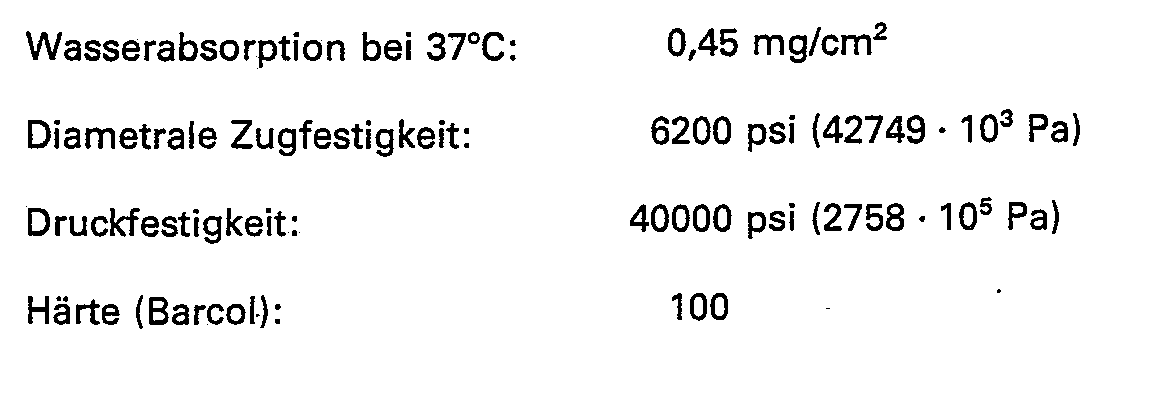
- Das Produkt zeigte hervorragende Farbstabilität und ein ansprechendes, natürliches Aussehen.
- Ein aus 2 Pasten bestehendes Füllungsmaterial wurde hergestellt:

- Die Pasten A und B wurden zu etwa gleichen Teilen gemischt. Die Aushärtung erfolgte bei 23°C in 150 Sekunden. Das ausgehärtete Material zeigte folgende Eigenschaften:

- Die Farbstabilität war ausgezeichnet.
- Es wurde ein radioopakes, lichthärtendes Einphasen-Füllungsmaterial der folgenden Zusammensetzunq heroestellt:


- Ein Fissurenversiegelungsmaterial weist folgende Monomeren-Zusammensetzung auf:
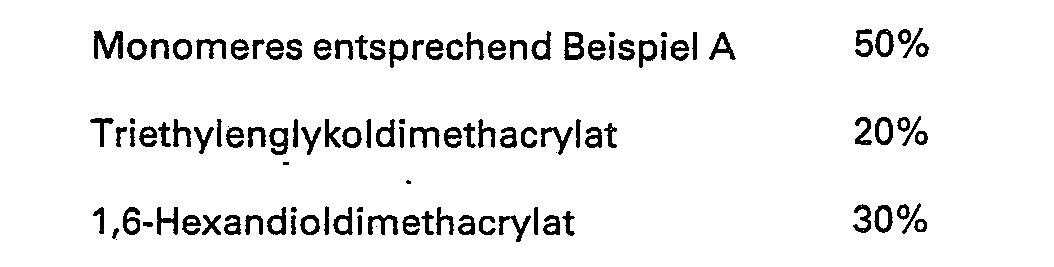
- Die Härtung dieses Harzgemisches kann entweder durch ein Redoxsystem (z.B. Cumolperoxid/ Triarylamin) oder durch Bestrahlung mit UV-Licht oder sichtbarem Licht in Gegenwart eines UV-Aktivators wie Benzoin, Benzoinmethylether, Benzil, u.ä. erfolgen.
- Dentallack:
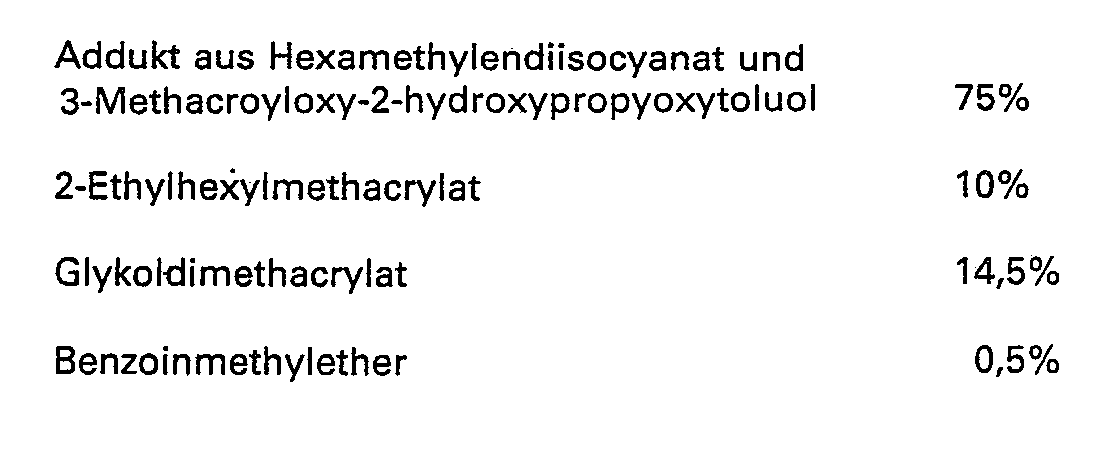
- Dieser Lack ist UV-härtend und kann in der Dentalmedizin beliebig eingesetzt werden. Es sei nochmals betont, daß sich die erfindungsgemäßen Verbindungen zum Einsatz für alle Zwecke eignen, wo Monomere mit mehr als einer Doppelbindung im Molekül in Bindemitteln zum Einsatz gelangen, insbesondere in der Medizin und Dentalmedizin.
Claims (15)

sowie gegebenenfalls weitere polymerisierbare Verbindungen, UV-Absorber, Farbstoffe, Haftungsverbesserer und sonstige in solchen Mitteln an sich übliche Zusätze.
Priority Applications (9)
| Application Number | Priority Date | Filing Date | Title |
|---|---|---|---|
| DE8080104311T DE3070209D1 (en) | 1980-07-23 | 1980-07-23 | Adducts from diisocyanates and methacryloylalkylethers, -alcoxybenzenes resp. -alcoxycycloalcanes and their use |
| AT80104311T ATE11909T1 (de) | 1980-07-23 | 1980-07-23 | Addukte aus diisocyanaten und methacryloylalkylethern, -alkoxybenzolen bzw. alkoxycycloalkanen und deren verwendung. |
| EP80104311A EP0044352B1 (de) | 1980-07-23 | 1980-07-23 | Addukte aus Diisocyanaten und Methacryloylalkylethern, -alkoxybenzolen bzw. -alkoxycycloalkanen und deren Verwendung |
| CA000380231A CA1162558A (en) | 1980-07-23 | 1981-06-19 | Adducts of diisocyanates and methacryloyl alkyl ethers, alkoxybenzenes, or alkoxycycloalkanes, compositions containing such compounds and method of use thereof |
| US06/276,680 US4383826A (en) | 1980-07-23 | 1981-06-23 | Adducts of diisocyanates and methacryloyl alkyl ethers, alkoxybenzenes or alkoxycycloalkanes, compositions containing such compounds, and method of use thereof |
| PH25869A PH19368A (en) | 1980-07-23 | 1981-07-07 | Adducts of diisocyanates and methacryloyl alkyl esters,alkoxybenzenes or alkoxycycloalkanes,compositions containing such compounds,and method of use thereof |
| PT73404A PT73404B (en) | 1980-07-23 | 1981-07-21 | Process for obtaining diisocyanate and methacryloylalkylether alcoxybenzen or alcoxycicloalkan adducts |
| JP56115003A JPS5753452A (en) | 1980-07-23 | 1981-07-22 | Polymerizable adduct |
| ES504175A ES8204985A1 (es) | 1980-07-23 | 1981-07-22 | Procedimiento para la obtencion de productos de adicion de diisocianato y metacriloalquileteres,-alcoxibencenos o bien-alcoxiciloalcanos |
Applications Claiming Priority (1)
| Application Number | Priority Date | Filing Date | Title |
|---|---|---|---|
| EP80104311A EP0044352B1 (de) | 1980-07-23 | 1980-07-23 | Addukte aus Diisocyanaten und Methacryloylalkylethern, -alkoxybenzolen bzw. -alkoxycycloalkanen und deren Verwendung |
Publications (2)
| Publication Number | Publication Date |
|---|---|
| EP0044352A1 EP0044352A1 (de) | 1982-01-27 |
| EP0044352B1 true EP0044352B1 (de) | 1985-02-20 |
Family
ID=8186726
Family Applications (1)
| Application Number | Title | Priority Date | Filing Date |
|---|---|---|---|
| EP80104311A Expired EP0044352B1 (de) | 1980-07-23 | 1980-07-23 | Addukte aus Diisocyanaten und Methacryloylalkylethern, -alkoxybenzolen bzw. -alkoxycycloalkanen und deren Verwendung |
Country Status (9)
| Country | Link |
|---|---|
| US (1) | US4383826A (de) |
| EP (1) | EP0044352B1 (de) |
| JP (1) | JPS5753452A (de) |
| AT (1) | ATE11909T1 (de) |
| CA (1) | CA1162558A (de) |
| DE (1) | DE3070209D1 (de) |
| ES (1) | ES8204985A1 (de) |
| PH (1) | PH19368A (de) |
| PT (1) | PT73404B (de) |
Families Citing this family (54)
| Publication number | Priority date | Publication date | Assignee | Title |
|---|---|---|---|---|
| JPS5914001B2 (ja) * | 1978-08-29 | 1984-04-02 | 株式会社クラレ | 歯科用材料 |
| DD148857A3 (de) * | 1979-06-29 | 1981-06-17 | Alfred Breustedt | Mineralzahn mit silangekoppeltem plasthaftteil und verfahren zu dessen herstellung |
| US4504231A (en) * | 1981-02-17 | 1985-03-12 | Dentsply Research & Development Corp. | Process for filling teeth |
| US4490115A (en) * | 1981-05-27 | 1984-12-25 | Scientific Pharmaceutical, Inc. | Dental material comprising adducts of 3-methacroyl-2-hydroxypropyl esters with diisocyanates |
| US4420306A (en) * | 1982-06-24 | 1983-12-13 | Blendax-Werke R. Schneider Gmbh & Co. | Tetraacrylic and tetramethacrylic esters and dental materials containing same |
| US4477604A (en) * | 1982-09-20 | 1984-10-16 | Oechsle Iii Sixtus J | Polyurethane compositions and their use as luting agents |
| DE3382078D1 (de) * | 1982-12-06 | 1991-02-07 | Ici Plc | Aromatische oligomere und harze. |
| DE3245563A1 (de) * | 1982-12-09 | 1984-06-14 | Henkel KGaA, 4000 Düsseldorf | Verfahren zur herstellung von (meth)acrylsaeureestergruppierungen aufweisenden verbindungen, neue (meth)acrylsaeureester sowie anaerob haertende klebe- und dichtmassen |
| US4551486A (en) * | 1983-11-16 | 1985-11-05 | Dentsply Research & Development Corp. | Interpenetrating polymer network compositions |
| US4863977A (en) * | 1983-11-16 | 1989-09-05 | Dentsply Research & Development Corp. | Process for preparing interpenetrating polymer network objects employing rubber-modified polymers |
| US4711913A (en) * | 1983-11-16 | 1987-12-08 | Dentsply International Inc. | Interpenetrating polymer network compositions employing rubber-modified polymers |
| US5210109A (en) * | 1983-11-16 | 1993-05-11 | Dentsply Research & Development Corp. | Interpenetrating polymer network compositions employing rubber-modified polymers |
| DE3522005A1 (de) * | 1985-06-20 | 1987-01-02 | Bayer Ag | (meth)-acrylsaeureester und ihre verwendung |
| DE3522006A1 (de) * | 1985-06-20 | 1987-01-02 | Bayer Ag | (meth)-acrylsaeure-derivate von tricyclodecanen und ihre verwendung |
| US4906588A (en) * | 1988-06-23 | 1990-03-06 | Dallas Semiconductor Corporation | Enclosed buried channel transistor |
| CA2000803C (en) * | 1988-10-21 | 1997-04-01 | Hisao Furukawa | Resin composition |
| US5034433A (en) * | 1990-04-10 | 1991-07-23 | Essential Dental Systems, Inc. | Composite dental cement composition containing titanium |
| US6353061B1 (en) | 1993-05-26 | 2002-03-05 | Dentsply Gmbh | α, ω-methacrylate terminated macromonomer compounds |
| US6369164B1 (en) | 1993-05-26 | 2002-04-09 | Dentsply G.M.B.H. | Polymerizable compounds and compositions |
| US20050043490A1 (en) * | 1993-05-26 | 2005-02-24 | Klee Joachim E. | Polymerizable compounds and compositions |
| US5998499A (en) | 1994-03-25 | 1999-12-07 | Dentsply G.M.B.H. | Liquid crystalline (meth)acrylate compounds, composition and method |
| DE4412831C2 (de) * | 1994-04-14 | 1996-03-21 | Heraeus Kulzer Gmbh | Künstlicher Zahn |
| CA2146816A1 (en) * | 1994-04-22 | 1995-10-23 | Joachim E. Klee | Process and composition for preparing a dental polymer product |
| US5688883A (en) * | 1995-03-14 | 1997-11-18 | Dentsply Gmbh | Polymerizable composition |
| US6409972B1 (en) | 1995-06-06 | 2002-06-25 | Kwan-Ho Chan | Prepackaged liquid bone cement |
| DE19608316C2 (de) * | 1996-02-22 | 2000-11-09 | Ivoclar Ag Schaan | Funktionalisierte bicyclische (Meth)acrylate, Verfahren zu deren Herstellung und deren Verwendung #### |
| WO2007033288A2 (en) * | 2005-09-14 | 2007-03-22 | Danville Materials, Inc. | Composite paste for dental prostheses |
| TW201035060A (en) * | 2008-10-09 | 2010-10-01 | Septodont Confi Dental Division | Carbamate-methacrylate monomers and their use in dental applications |
| EP2219073B1 (de) | 2009-02-17 | 2020-06-03 | Covestro Deutschland AG | Holografische Medien und Photopolymerzusammensetzungen |
| DE102011077248B3 (de) | 2011-06-09 | 2012-09-27 | Hilti Aktiengesellschaft | Verwendung eines Inhibitors, Harzmischung, Reaktionsharzmörtel, Zweikomponenten - Mörtelsystem und dessen Verwendung sowie Patrone, Kartusche oder Folienbeutel enthaltend ein Zweikomponenten - Mörtelsystem |
| DE102011077254B3 (de) | 2011-06-09 | 2012-09-20 | Hilti Aktiengesellschaft | Verwendung einer Inhibitorkombination, Harzmischung, Reaktionsharzmörtel, Zweikomponenten - Mörtelsystem und dessen Verwendung sowie Patrone, Kartusche oder Folienbeutel enthaltend ein Zweikomponenten - Mörtelsystem |
| DE102011078785B4 (de) | 2011-07-07 | 2013-03-07 | Hilti Aktiengesellschaft | Härterzusammensetzung, diese enthaltendes Mehrkomponenten-Mörtelsystem, dessen Verwendung sowie Patrone, Kartusche oder Folienbeutel enthaltend ein Mehrkomponenten - Mörtelsystem |
| EP2862899A1 (de) | 2013-10-21 | 2015-04-22 | HILTI Aktiengesellschaft | Harzmischung auf Basis eines Vinylesterurethanharzes, Verfahren zu deren Herstellung und deren Verwendung |
| EP3623407A1 (de) | 2018-09-14 | 2020-03-18 | Hilti Aktiengesellschaft | Reaktiver amin-beschleuniger, diesen enthaltendes reaktivharz sowie deren verwendung |
| EP3708591A1 (de) | 2019-03-15 | 2020-09-16 | Hilti Aktiengesellschaft | Beschleuniger-kombination |
| EP3838863A1 (de) | 2019-12-18 | 2021-06-23 | Hilti Aktiengesellschaft | Verwendung einer reaktivharz-zusammensetzung für die chemische befestigung eines verankerungsmittels in einem bohrloch |
| EP3838862A1 (de) | 2019-12-18 | 2021-06-23 | Hilti Aktiengesellschaft | Verwendung einer reaktivharz-zusammensetzung für die chemische befestigung eines verankerungsmittels in einem bohrloch |
| EP4056607A1 (de) | 2021-03-12 | 2022-09-14 | Hilti Aktiengesellschaft | Reaktivverdünnermischung für die chemische befestigung |
| EP4177235A1 (de) | 2021-11-09 | 2023-05-10 | HILTI Aktiengesellschaft | Pulverisierte recyclingmaterialien als füllstoffe für mehrkomponenten-systeme zur chemischen befestigung |
| EP4177229A1 (de) | 2021-11-09 | 2023-05-10 | Hilti Aktiengesellschaft | Ziegelmehl als füllstoff in mehrkomponenten-systemen für die chemische befestigung |
| EP4257570A1 (de) | 2022-04-06 | 2023-10-11 | Hilti Aktiengesellschaft | Verbindungen auf basis recyclierter verbindungen für mehrkomponenten-reaktivharzsysteme zur chemischen befestigung |
| EP4261197B1 (de) | 2022-04-12 | 2024-12-04 | Hilti Aktiengesellschaft | Zweikomponenten-mörtelmasse und deren verwendung |
| EP4261196B1 (de) | 2022-04-12 | 2024-12-04 | Hilti Aktiengesellschaft | Zweikomponenten-mörtelmasse und deren verwendung |
| EP4303202A1 (de) | 2022-07-06 | 2024-01-10 | Hilti Aktiengesellschaft | Zweikomponenten-mörtelmasse mit thermoresponsivem inhibitor |
| EP4357390A1 (de) | 2022-10-18 | 2024-04-24 | Hilti Aktiengesellschaft | Biogene methacrylate auf basis von polycarbonatdiolen als reaktive harze für die härtung von reaktivharzen |
| EP4357313A1 (de) | 2022-10-18 | 2024-04-24 | Hilti Aktiengesellschaft | Methacrylate aus zuckerderivaten als reaktive bestandteile in reaktivharzen für die chemische befestigung |
| EP4442721A1 (de) | 2023-04-05 | 2024-10-09 | Hilti Aktiengesellschaft | Enamine als initiatoren bei der härtung von radikalisch härtenden reaktivharzen für die chemische befestigung |
| EP4570772A1 (de) | 2023-12-15 | 2025-06-18 | Hilti Aktiengesellschaft | Mehrkomponentenharzsystem für chemische dübel mit hohem füllgrad |
| EP4574876A1 (de) | 2023-12-21 | 2025-06-25 | Hilti Aktiengesellschaft | Harzzusammensetzungen mit isocyanuraten zur verbesserung der ausziehleistung von chemischen ankern |
| EP4574791A1 (de) | 2023-12-21 | 2025-06-25 | Hilti Aktiengesellschaft | Verwendung von tris-[(methacryloyloxy)-alkyl]-isocyanursäuren in reaktivharz-zusammensetzungen sowie in daraus erhaltenen mehrkomponenten-reaktivharz-systemen |
| EP4574850A1 (de) | 2023-12-21 | 2025-06-25 | Hilti Aktiengesellschaft | Mehrkomponenten-reaktivharz-systeme mit verbesserter feuerbeständigkeit auf der basis von tris-[(methacryloyloxy)-alkyl]-isocyanursäuren und deren verwendung für eine chemische befestigung von verankerungsmitteln in bohrlöchern |
| EP4574853A1 (de) | 2023-12-21 | 2025-06-25 | Hilti Aktiengesellschaft | Härtersystem für radikalisch härtbare reaktionsharze zur chemischen befestigung |
| EP4574875A1 (de) | 2023-12-21 | 2025-06-25 | Hilti Aktiengesellschaft | Verfahren zur herstellung einer isocyanurate enthaltenden harzzusammensetzung zur verbesserung der ausziehleistung von chemischen ankern |
| EP4678620A1 (de) | 2024-07-12 | 2026-01-14 | Hilti Aktiengesellschaft | Schnellhärtendes ankersystem mit optimierter härterverteilung |
Citations (2)
| Publication number | Priority date | Publication date | Assignee | Title |
|---|---|---|---|---|
| DE2419887A1 (de) * | 1973-04-24 | 1974-11-21 | Ici Ltd | Dentalmassen |
| DE2357324B2 (de) * | 1972-11-16 | 1979-07-12 | Loctite (Ireland) Ltd., Dublin | Härtbare Zementmischung für dentale Zwecke |
Family Cites Families (7)
| Publication number | Priority date | Publication date | Assignee | Title |
|---|---|---|---|---|
| US3425988A (en) * | 1965-01-27 | 1969-02-04 | Loctite Corp | Polyurethane polyacrylate sealant compositions |
| US3629187A (en) * | 1969-06-25 | 1971-12-21 | Dentsply Int Inc | Dental compositions containing adduct of 2 2' - propane bis 3-(4-phenoxy)-1 2-hydroxy propane - 1 - methacrylate and isocyanate |
| US3801344A (en) * | 1971-06-30 | 1974-04-02 | Owens Illinois Inc | Tooth filling and facing compositions comprising a radiopaque glass and method of making the same |
| US3975203A (en) * | 1971-06-30 | 1976-08-17 | Owens-Illinois, Inc. | Composition for use as a filler in tooth filling and facing composition and method of making the same |
| US3979426A (en) * | 1971-08-12 | 1976-09-07 | Ppg Industries, Inc. | Radiation-sensitive diacrylates |
| US4017649A (en) * | 1973-02-05 | 1977-04-12 | Ppg Industries, Inc. | Radiation-sensitive compounds and methods of using same |
| US4065627A (en) * | 1976-09-27 | 1977-12-27 | General Mills Chemicals, Inc. | High molecular weight radiation curable resins |
-
1980
- 1980-07-23 DE DE8080104311T patent/DE3070209D1/de not_active Expired
- 1980-07-23 AT AT80104311T patent/ATE11909T1/de not_active IP Right Cessation
- 1980-07-23 EP EP80104311A patent/EP0044352B1/de not_active Expired
-
1981
- 1981-06-19 CA CA000380231A patent/CA1162558A/en not_active Expired
- 1981-06-23 US US06/276,680 patent/US4383826A/en not_active Expired - Lifetime
- 1981-07-07 PH PH25869A patent/PH19368A/en unknown
- 1981-07-21 PT PT73404A patent/PT73404B/pt unknown
- 1981-07-22 JP JP56115003A patent/JPS5753452A/ja active Granted
- 1981-07-22 ES ES504175A patent/ES8204985A1/es not_active Expired
Patent Citations (2)
| Publication number | Priority date | Publication date | Assignee | Title |
|---|---|---|---|---|
| DE2357324B2 (de) * | 1972-11-16 | 1979-07-12 | Loctite (Ireland) Ltd., Dublin | Härtbare Zementmischung für dentale Zwecke |
| DE2419887A1 (de) * | 1973-04-24 | 1974-11-21 | Ici Ltd | Dentalmassen |
Also Published As
| Publication number | Publication date |
|---|---|
| EP0044352A1 (de) | 1982-01-27 |
| JPS5753452A (en) | 1982-03-30 |
| PT73404A (en) | 1981-08-01 |
| CA1162558A (en) | 1984-02-21 |
| ES504175A0 (es) | 1982-05-16 |
| PH19368A (en) | 1986-04-02 |
| ES8204985A1 (es) | 1982-05-16 |
| PT73404B (en) | 1982-08-09 |
| JPH0237349B2 (de) | 1990-08-23 |
| US4383826A (en) | 1983-05-17 |
| ATE11909T1 (de) | 1985-03-15 |
| DE3070209D1 (en) | 1985-03-28 |
Similar Documents
| Publication | Publication Date | Title |
|---|---|---|
| EP0044352B1 (de) | Addukte aus Diisocyanaten und Methacryloylalkylethern, -alkoxybenzolen bzw. -alkoxycycloalkanen und deren Verwendung | |
| DE3903407C2 (de) | ||
| EP0060911B1 (de) | Dentales Füllungsmaterial | |
| EP0156105B1 (de) | Dentales Füllungsmaterial | |
| DE3783437T2 (de) | Heilmittel. | |
| EP2016931B1 (de) | Dentalkomposite mit niedriger Schrumpfspannung und hoher Biegefestigkeit | |
| DE60204187T2 (de) | Dentalmasse-Kit | |
| EP0486775B1 (de) | Polymerisierbares Dentalmaterial | |
| EP0091990B1 (de) | Dentales Restorationsmaterial | |
| EP1139973A2 (de) | Polymerisierbare massen auf der basis von zur aushärtung befähigten siloxanverbindungen | |
| EP0904767B1 (de) | Dentalmassen auf der Basis von ROMP-Oligomeren oder -Polymeren | |
| DE10026432A1 (de) | Präpolymere (Meth)acrylate mit polycyclischen oder aromatischen Segmenten | |
| EP0904766A2 (de) | Durch ROMP härtbare Dentalmassen | |
| EP4205723A1 (de) | Sulfathaltiger oder phosphataltiger, selbsthaftender dentaler kompositzement mit guter transparenz | |
| EP0717976A2 (de) | Polymerisierbares Dentalmaterial | |
| EP0143362A2 (de) | Dentales Restorationsmaterial | |
| DE69621500T2 (de) | Polymerisierbare Zusammensetzung | |
| EP3119377B1 (de) | Photopolymerisierbare und dualhärtende dentalwerkstoffe auf der basis von thioharnstoffderivaten | |
| EP3692974A1 (de) | Dentalmaterialien mit verbesserten mechanischen eigenschaften | |
| EP3868767B1 (de) | Langwellig absorbierende photoinitiatoren | |
| EP0101807B1 (de) | Neue Tetra(meth)acrylsäureverbindungen und deren Verwendung | |
| EP4039220A1 (de) | Dentalmaterialien auf der basis von polymerisationsfähigen thioharnstoff-derivaten | |
| EP0104491B1 (de) | Neue Diacryl- und Dimethacrylester und ihre Verwendung | |
| EP3042645A1 (de) | Dentalkomposite mit verbesserter Lagerstabilität | |
| EP3064192A1 (de) | Dentalmaterialien auf der Basis von Hybridmonomeren |
Legal Events
| Date | Code | Title | Description |
|---|---|---|---|
| PUAI | Public reference made under article 153(3) epc to a published international application that has entered the european phase |
Free format text: ORIGINAL CODE: 0009012 |
|
| 17P | Request for examination filed |
Effective date: 19810605 |
|
| AK | Designated contracting states |
Designated state(s): AT BE CH DE FR GB IT LU NL SE |
|
| GRAA | (expected) grant |
Free format text: ORIGINAL CODE: 0009210 |
|
| AK | Designated contracting states |
Designated state(s): AT BE CH DE FR GB IT LI LU NL SE |
|
| PG25 | Lapsed in a contracting state [announced via postgrant information from national office to epo] |
Ref country code: SE Effective date: 19850220 Ref country code: IT Free format text: LAPSE BECAUSE OF FAILURE TO SUBMIT A TRANSLATION OF THE DESCRIPTION OR TO PAY THE FEE WITHIN THE PRESCRIBED TIME-LIMIT;WARNING: LAPSES OF ITALIAN PATENTS WITH EFFECTIVE DATE BEFORE 2007 MAY HAVE OCCURRED AT ANY TIME BEFORE 2007. THE CORRECT EFFECTIVE DATE MAY BE DIFFERENT FROM THE ONE RECORDED. Effective date: 19850220 |
|
| REF | Corresponds to: |
Ref document number: 11909 Country of ref document: AT Date of ref document: 19850315 Kind code of ref document: T |
|
| REF | Corresponds to: |
Ref document number: 3070209 Country of ref document: DE Date of ref document: 19850328 |
|
| ET | Fr: translation filed | ||
| PLBI | Opposition filed |
Free format text: ORIGINAL CODE: 0009260 |
|
| 26 | Opposition filed |
Opponent name: BASF AKTIENGESELLSCHAFT Effective date: 19851010 |
|
| NLR1 | Nl: opposition has been filed with the epo |
Opponent name: BASF AKTIENGESELLSCHAFT |
|
| PLBN | Opposition rejected |
Free format text: ORIGINAL CODE: 0009273 |
|
| STAA | Information on the status of an ep patent application or granted ep patent |
Free format text: STATUS: OPPOSITION REJECTED |
|
| 27O | Opposition rejected |
Effective date: 19861108 |
|
| NLR2 | Nl: decision of opposition | ||
| REG | Reference to a national code |
Ref country code: CH Ref legal event code: PUE Owner name: BLENDAX GMBH |
|
| NLS | Nl: assignments of ep-patents |
Owner name: BLENDAX GMBH TE MAINZ, BONDSREPUBLIEK DUITSLAND. |
|
| REG | Reference to a national code |
Ref country code: FR Ref legal event code: TP |
|
| REG | Reference to a national code |
Ref country code: GB Ref legal event code: 732 |
|
| ITTA | It: last paid annual fee | ||
| PGFP | Annual fee paid to national office [announced via postgrant information from national office to epo] |
Ref country code: SE Payment date: 19910930 Year of fee payment: 11 |
|
| EPTA | Lu: last paid annual fee | ||
| PGFP | Annual fee paid to national office [announced via postgrant information from national office to epo] |
Ref country code: GB Payment date: 19990614 Year of fee payment: 20 Ref country code: AT Payment date: 19990614 Year of fee payment: 20 |
|
| PGFP | Annual fee paid to national office [announced via postgrant information from national office to epo] |
Ref country code: NL Payment date: 19990630 Year of fee payment: 20 |
|
| PGFP | Annual fee paid to national office [announced via postgrant information from national office to epo] |
Ref country code: FR Payment date: 19990707 Year of fee payment: 20 |
|
| PGFP | Annual fee paid to national office [announced via postgrant information from national office to epo] |
Ref country code: DE Payment date: 19990730 Year of fee payment: 20 |
|
| PGFP | Annual fee paid to national office [announced via postgrant information from national office to epo] |
Ref country code: LU Payment date: 19990813 Year of fee payment: 20 |
|
| PGFP | Annual fee paid to national office [announced via postgrant information from national office to epo] |
Ref country code: BE Payment date: 19990817 Year of fee payment: 20 |
|
| PGFP | Annual fee paid to national office [announced via postgrant information from national office to epo] |
Ref country code: CH Payment date: 19991021 Year of fee payment: 20 |
|
| BE20 | Be: patent expired |
Free format text: 20000723 *BLENDAX G.M.B.H. |
|
| PG25 | Lapsed in a contracting state [announced via postgrant information from national office to epo] |
Ref country code: LI Free format text: LAPSE BECAUSE OF EXPIRATION OF PROTECTION Effective date: 20000722 Ref country code: GB Free format text: LAPSE BECAUSE OF EXPIRATION OF PROTECTION Effective date: 20000722 Ref country code: CH Free format text: LAPSE BECAUSE OF EXPIRATION OF PROTECTION Effective date: 20000722 |
|
| PG25 | Lapsed in a contracting state [announced via postgrant information from national office to epo] |
Ref country code: NL Free format text: LAPSE BECAUSE OF EXPIRATION OF PROTECTION Effective date: 20000723 Ref country code: LU Free format text: LAPSE BECAUSE OF NON-PAYMENT OF DUE FEES Effective date: 20000723 Ref country code: AT Free format text: LAPSE BECAUSE OF EXPIRATION OF PROTECTION Effective date: 20000723 |
|
| REG | Reference to a national code |
Ref country code: CH Ref legal event code: PL |
|
| REG | Reference to a national code |
Ref country code: GB Ref legal event code: PE20 Effective date: 20000722 |
|
| NLV7 | Nl: ceased due to reaching the maximum lifetime of a patent |
Effective date: 20000723 |