EP0042025B1 - Method of manufacturing structural members of epoxy resin - Google Patents
Method of manufacturing structural members of epoxy resin Download PDFInfo
- Publication number
- EP0042025B1 EP0042025B1 EP80850090A EP80850090A EP0042025B1 EP 0042025 B1 EP0042025 B1 EP 0042025B1 EP 80850090 A EP80850090 A EP 80850090A EP 80850090 A EP80850090 A EP 80850090A EP 0042025 B1 EP0042025 B1 EP 0042025B1
- Authority
- EP
- European Patent Office
- Prior art keywords
- layer
- fabric
- epoxy resin
- fabric reinforced
- hardener
- Prior art date
- Legal status (The legal status is an assumption and is not a legal conclusion. Google has not performed a legal analysis and makes no representation as to the accuracy of the status listed.)
- Expired
Links
Images
Classifications
-
- B—PERFORMING OPERATIONS; TRANSPORTING
- B29—WORKING OF PLASTICS; WORKING OF SUBSTANCES IN A PLASTIC STATE IN GENERAL
- B29C—SHAPING OR JOINING OF PLASTICS; SHAPING OF MATERIAL IN A PLASTIC STATE, NOT OTHERWISE PROVIDED FOR; AFTER-TREATMENT OF THE SHAPED PRODUCTS, e.g. REPAIRING
- B29C70/00—Shaping composites, i.e. plastics material comprising reinforcements, fillers or preformed parts, e.g. inserts
- B29C70/04—Shaping composites, i.e. plastics material comprising reinforcements, fillers or preformed parts, e.g. inserts comprising reinforcements only, e.g. self-reinforcing plastics
- B29C70/28—Shaping operations therefor
- B29C70/30—Shaping by lay-up, i.e. applying fibres, tape or broadsheet on a mould, former or core; Shaping by spray-up, i.e. spraying of fibres on a mould, former or core
-
- B—PERFORMING OPERATIONS; TRANSPORTING
- B29—WORKING OF PLASTICS; WORKING OF SUBSTANCES IN A PLASTIC STATE IN GENERAL
- B29C—SHAPING OR JOINING OF PLASTICS; SHAPING OF MATERIAL IN A PLASTIC STATE, NOT OTHERWISE PROVIDED FOR; AFTER-TREATMENT OF THE SHAPED PRODUCTS, e.g. REPAIRING
- B29C70/00—Shaping composites, i.e. plastics material comprising reinforcements, fillers or preformed parts, e.g. inserts
- B29C70/04—Shaping composites, i.e. plastics material comprising reinforcements, fillers or preformed parts, e.g. inserts comprising reinforcements only, e.g. self-reinforcing plastics
- B29C70/06—Fibrous reinforcements only
- B29C70/08—Fibrous reinforcements only comprising combinations of different forms of fibrous reinforcements incorporated in matrix material, forming one or more layers, and with or without non-reinforced layers
-
- B—PERFORMING OPERATIONS; TRANSPORTING
- B29—WORKING OF PLASTICS; WORKING OF SUBSTANCES IN A PLASTIC STATE IN GENERAL
- B29C—SHAPING OR JOINING OF PLASTICS; SHAPING OF MATERIAL IN A PLASTIC STATE, NOT OTHERWISE PROVIDED FOR; AFTER-TREATMENT OF THE SHAPED PRODUCTS, e.g. REPAIRING
- B29C70/00—Shaping composites, i.e. plastics material comprising reinforcements, fillers or preformed parts, e.g. inserts
- B29C70/04—Shaping composites, i.e. plastics material comprising reinforcements, fillers or preformed parts, e.g. inserts comprising reinforcements only, e.g. self-reinforcing plastics
- B29C70/06—Fibrous reinforcements only
- B29C70/10—Fibrous reinforcements only characterised by the structure of fibrous reinforcements, e.g. hollow fibres
- B29C70/16—Fibrous reinforcements only characterised by the structure of fibrous reinforcements, e.g. hollow fibres using fibres of substantial or continuous length
- B29C70/22—Fibrous reinforcements only characterised by the structure of fibrous reinforcements, e.g. hollow fibres using fibres of substantial or continuous length oriented in at least two directions forming a two-dimensional [2D] structure
-
- B—PERFORMING OPERATIONS; TRANSPORTING
- B29—WORKING OF PLASTICS; WORKING OF SUBSTANCES IN A PLASTIC STATE IN GENERAL
- B29C—SHAPING OR JOINING OF PLASTICS; SHAPING OF MATERIAL IN A PLASTIC STATE, NOT OTHERWISE PROVIDED FOR; AFTER-TREATMENT OF THE SHAPED PRODUCTS, e.g. REPAIRING
- B29C70/00—Shaping composites, i.e. plastics material comprising reinforcements, fillers or preformed parts, e.g. inserts
- B29C70/04—Shaping composites, i.e. plastics material comprising reinforcements, fillers or preformed parts, e.g. inserts comprising reinforcements only, e.g. self-reinforcing plastics
- B29C70/28—Shaping operations therefor
- B29C70/54—Component parts, details or accessories; Auxiliary operations, e.g. feeding or storage of prepregs or SMC after impregnation or during ageing
- B29C70/545—Perforating, cutting or machining during or after moulding
-
- B—PERFORMING OPERATIONS; TRANSPORTING
- B29—WORKING OF PLASTICS; WORKING OF SUBSTANCES IN A PLASTIC STATE IN GENERAL
- B29D—PRODUCING PARTICULAR ARTICLES FROM PLASTICS OR FROM SUBSTANCES IN A PLASTIC STATE
- B29D99/00—Subject matter not provided for in other groups of this subclass
- B29D99/0003—Producing profiled members, e.g. beams
-
- B—PERFORMING OPERATIONS; TRANSPORTING
- B32—LAYERED PRODUCTS
- B32B—LAYERED PRODUCTS, i.e. PRODUCTS BUILT-UP OF STRATA OF FLAT OR NON-FLAT, e.g. CELLULAR OR HONEYCOMB, FORM
- B32B5/00—Layered products characterised by the non- homogeneity or physical structure, i.e. comprising a fibrous, filamentary, particulate or foam layer; Layered products characterised by having a layer differing constitutionally or physically in different parts
- B32B5/22—Layered products characterised by the non- homogeneity or physical structure, i.e. comprising a fibrous, filamentary, particulate or foam layer; Layered products characterised by having a layer differing constitutionally or physically in different parts characterised by the presence of two or more layers which are next to each other and are fibrous, filamentary, formed of particles or foamed
- B32B5/24—Layered products characterised by the non- homogeneity or physical structure, i.e. comprising a fibrous, filamentary, particulate or foam layer; Layered products characterised by having a layer differing constitutionally or physically in different parts characterised by the presence of two or more layers which are next to each other and are fibrous, filamentary, formed of particles or foamed one layer being a fibrous or filamentary layer
- B32B5/26—Layered products characterised by the non- homogeneity or physical structure, i.e. comprising a fibrous, filamentary, particulate or foam layer; Layered products characterised by having a layer differing constitutionally or physically in different parts characterised by the presence of two or more layers which are next to each other and are fibrous, filamentary, formed of particles or foamed one layer being a fibrous or filamentary layer another layer next to it also being fibrous or filamentary
-
- B—PERFORMING OPERATIONS; TRANSPORTING
- B32—LAYERED PRODUCTS
- B32B—LAYERED PRODUCTS, i.e. PRODUCTS BUILT-UP OF STRATA OF FLAT OR NON-FLAT, e.g. CELLULAR OR HONEYCOMB, FORM
- B32B5/00—Layered products characterised by the non- homogeneity or physical structure, i.e. comprising a fibrous, filamentary, particulate or foam layer; Layered products characterised by having a layer differing constitutionally or physically in different parts
- B32B5/22—Layered products characterised by the non- homogeneity or physical structure, i.e. comprising a fibrous, filamentary, particulate or foam layer; Layered products characterised by having a layer differing constitutionally or physically in different parts characterised by the presence of two or more layers which are next to each other and are fibrous, filamentary, formed of particles or foamed
- B32B5/24—Layered products characterised by the non- homogeneity or physical structure, i.e. comprising a fibrous, filamentary, particulate or foam layer; Layered products characterised by having a layer differing constitutionally or physically in different parts characterised by the presence of two or more layers which are next to each other and are fibrous, filamentary, formed of particles or foamed one layer being a fibrous or filamentary layer
- B32B5/28—Layered products characterised by the non- homogeneity or physical structure, i.e. comprising a fibrous, filamentary, particulate or foam layer; Layered products characterised by having a layer differing constitutionally or physically in different parts characterised by the presence of two or more layers which are next to each other and are fibrous, filamentary, formed of particles or foamed one layer being a fibrous or filamentary layer impregnated with or embedded in a plastic substance
-
- B—PERFORMING OPERATIONS; TRANSPORTING
- B29—WORKING OF PLASTICS; WORKING OF SUBSTANCES IN A PLASTIC STATE IN GENERAL
- B29K—INDEXING SCHEME ASSOCIATED WITH SUBCLASSES B29B, B29C OR B29D, RELATING TO MOULDING MATERIALS OR TO MATERIALS FOR MOULDS, REINFORCEMENTS, FILLERS OR PREFORMED PARTS, e.g. INSERTS
- B29K2063/00—Use of EP, i.e. epoxy resins or derivatives thereof, as moulding material
-
- B—PERFORMING OPERATIONS; TRANSPORTING
- B32—LAYERED PRODUCTS
- B32B—LAYERED PRODUCTS, i.e. PRODUCTS BUILT-UP OF STRATA OF FLAT OR NON-FLAT, e.g. CELLULAR OR HONEYCOMB, FORM
- B32B2260/00—Layered product comprising an impregnated, embedded, or bonded layer wherein the layer comprises an impregnation, embedding, or binder material
- B32B2260/02—Composition of the impregnated, bonded or embedded layer
- B32B2260/021—Fibrous or filamentary layer
-
- B—PERFORMING OPERATIONS; TRANSPORTING
- B32—LAYERED PRODUCTS
- B32B—LAYERED PRODUCTS, i.e. PRODUCTS BUILT-UP OF STRATA OF FLAT OR NON-FLAT, e.g. CELLULAR OR HONEYCOMB, FORM
- B32B2260/00—Layered product comprising an impregnated, embedded, or bonded layer wherein the layer comprises an impregnation, embedding, or binder material
- B32B2260/04—Impregnation, embedding, or binder material
- B32B2260/046—Synthetic resin
-
- B—PERFORMING OPERATIONS; TRANSPORTING
- B32—LAYERED PRODUCTS
- B32B—LAYERED PRODUCTS, i.e. PRODUCTS BUILT-UP OF STRATA OF FLAT OR NON-FLAT, e.g. CELLULAR OR HONEYCOMB, FORM
- B32B2305/00—Condition, form or state of the layers or laminate
- B32B2305/08—Reinforcements
Definitions
- the invention relates to a method of manufacturing a laminated structural member according to the first part of claim 1.
- a method is known (US-A-3959544).
- Epoxy plastics are used to an increasing extent in building industry, e.g. as a coating on concrete floors, as an adhensive and as an injection or repair material in concrete structures.
- Epoxy plastics have a number of good qualities which are of considerable value in this connection, namely among others a strong adhesion to most materials, dimensional stability after hardening, low shrinkage, chemical resistance and electric insulating capacity.
- epoxy plastics are difficult to handle, especially because of their extreme adhesiveness.
- the main object of the invention is to achieve a practically suitable and, from an industrial hygienc point of view, relatively harmless method to manufacture sheet or profile members of fabric reinforced epoxy plastic. This is accomplished by the inventive method, the basic features of which are stated in the appended claim 1. Suitable further features appear from the sub-claims.
- a thin fabric reinforced layer it is possible to produce such a layer by spreading out a sheet of fabric, preferably a polyester material, on a support which is not adhesive relative to epoxy plastic.
- a suitable material for this purpose has turned out to be a thermoplastic foil, such as a polyethylene or a PVC foil, which is first laid out on a firm, preferably planar support, such as a table or the like. Then, the fabric is soaked with an epoxy resin and a hardner, so that upon hardening a flexible fabric reinforced layer is obtained, which can easily be removed from the supporting foil.
- the basic feature of the invention is to let such a reinforced layer, possibly divided into plates or strips, form a support when applying a much thicker intermediate layer consisting of an expoy resin, a preferably rather slow hardener and a thickening agent, such as an epoxy filler.
- the intermediate layer is smoothed, and a fluent epoxy resin is spread on.
- a reinforced fabric preferably likewise a polyester material, is applied while being thoroughly drenched, so that another fabric reinforced layer is formed.
- a kind of sandwich laminate is obtained, and the intermediate layer can maintain a substantially uniform thickness during the hardening process, even if the hardening takes place on a support having non-horizontal portions, e.g., for the manufacture of profile members.
- the laminate Upon application of all layers to be included in the laminated structural member, the laminate is permitted to finally harden on a support or a mould bed corresponding in shape to the desired final product, so that a rather rigid member will result.
- the hardened member can be further treated by grinding and/or applying more epoxy palstic on certain portions, but normally such further treatment is not necessary.
- An essential advantage of the invention is that the member can be moved before the final harening process and be easily handled when being laid onto the support or the like. This is made possible by the already hardened, outer fabric reinforced layer which is dry and dimensionally stable, though somewhat resilient.
- a tape can preferably be applied over the joints to prevent the escape and adhesion of the intermediate layer.
- each intermediate layer may be advantageous to apply each intermediate layer on a separate supporting fabric reinforced layer and thereafter put both units together while laying a reinforced fabric between the two intermediate layers.
- a rather large and planar sheet (having the dimensions 0,5 x 1000 x 4500 mm) is produced.
- the sheet consists of a polyester fabric soaked with epoxy resin and a hardener so as to constitute, upon hardening, a thin and flexible sheet.
- the support is provided with a polyethylene foil so as to permit easy removal of the sheet from the support and division of the sheet as desired, in this case into strips 2, indicated by dashed lines to the left in Fig. 1.
- the division can be effected by sawing, shearing or cutting by means of a suitable tool.
- two strips 2a (0,5 x 40 x 4500 mm) are first laid out, one adjacent to the other on a planar support. Threafter, a first, rather thick (appr. 2 mm) intermediate layer 3a is applied.
- This layer which consists of epoxy resin, a hardener and a thickening agent (such as epoxy putty), is smoothed and soaked with a fluent epoxy resin, whereupon a reinforcement fabric 4 is applied and soaked into the thin epoxy resin.
- a corresponding sheet member with two strips 2b and a second thick, still not harened intermediate layer 3b is laid on top of the reinforcement fabric 4, so as to form a symmetrical, still not hardened laminate unit 2a, 3a, 4, 3b, 2b.
- This laminate unit is laid on a support 5 having mutually perpendicular support surfaces, as indicated in Fig. 3. Upon hardening, the desired L-profile member of fabric reinforced epoxy plastic is obtained.
Landscapes
- Engineering & Computer Science (AREA)
- Mechanical Engineering (AREA)
- Chemical & Material Sciences (AREA)
- Composite Materials (AREA)
- Textile Engineering (AREA)
- Laminated Bodies (AREA)
- Reinforced Plastic Materials (AREA)
- Heating, Cooling, Or Curing Plastics Or The Like In General (AREA)
- Macromonomer-Based Addition Polymer (AREA)
Abstract
Description
- The invention relates to a method of manufacturing a laminated structural member according to the first part of claim 1. Such a method is known (US-A-3959544). Epoxy plastics are used to an increasing extent in building industry, e.g. as a coating on concrete floors, as an adhensive and as an injection or repair material in concrete structures.
- Epoxy plastics have a number of good qualities which are of considerable value in this connection, namely among others a strong adhesion to most materials, dimensional stability after hardening, low shrinkage, chemical resistance and electric insulating capacity. However, seen from an industrial hygienic point of view as well as a practical one, epoxy plastics are difficult to handle, especially because of their extreme adhesiveness.
- The main object of the invention is to achieve a practically suitable and, from an industrial hygienc point of view, relatively harmless method to manufacture sheet or profile members of fabric reinforced epoxy plastic. This is accomplished by the inventive method, the basic features of which are stated in the appended claim 1. Suitable further features appear from the sub-claims.
- Thus, in the method of manufacturing according to the invention, one starts out with a thin fabric reinforced layer. It is possible to produce such a layer by spreading out a sheet of fabric, preferably a polyester material, on a support which is not adhesive relative to epoxy plastic. A suitable material for this purpose has turned out to be a thermoplastic foil, such as a polyethylene or a PVC foil, which is first laid out on a firm, preferably planar support, such as a table or the like. Then, the fabric is soaked with an epoxy resin and a hardner, so that upon hardening a flexible fabric reinforced layer is obtained, which can easily be removed from the supporting foil.
- The basic feature of the invention is to let such a reinforced layer, possibly divided into plates or strips, form a support when applying a much thicker intermediate layer consisting of an expoy resin, a preferably rather slow hardener and a thickening agent, such as an epoxy filler. The intermediate layer is smoothed, and a fluent epoxy resin is spread on. Then a reinforced fabric, preferably likewise a polyester material, is applied while being thoroughly drenched, so that another fabric reinforced layer is formed. Hereby, a kind of sandwich laminate is obtained, and the intermediate layer can maintain a substantially uniform thickness during the hardening process, even if the hardening takes place on a support having non-horizontal portions, e.g., for the manufacture of profile members.
- . If so desired, in order to obtain a thicker and stronger laminate, it is possible to apply another thick intermediate layer (epoxy resin, a hardener and a thickening agent) on top of the reinforcement fabric before the first intermediate layer is hardened, as well as still another fabric reinforced layer, preferably of the kind as the first rather thin fabric reinforced layer. This outer fabric reinforced layer can also be divided into plates, strips or the like. However, the intermediate layers and reinforcement fabrics should be continuous so as to secure high strength even of the joints between different segments or the like of the finished sheet or profile member.
- Upon application of all layers to be included in the laminated structural member, the laminate is permitted to finally harden on a support or a mould bed corresponding in shape to the desired final product, so that a rather rigid member will result. Of course, the hardened member can be further treated by grinding and/or applying more epoxy palstic on certain portions, but normally such further treatment is not necessary.
- An essential advantage of the invention is that the member can be moved before the final harening process and be easily handled when being laid onto the support or the like. This is made possible by the already hardened, outer fabric reinforced layer which is dry and dimensionally stable, though somewhat resilient. In case the outer fabric reinforced layer is divided into strips or plates, which are to be mutually folded before the member is finally hardened, a tape can preferably be applied over the joints to prevent the escape and adhesion of the intermediate layer.
- As to the handling of a member having two intermediate layers, it may be advantageous to apply each intermediate layer on a separate supporting fabric reinforced layer and thereafter put both units together while laying a reinforced fabric between the two intermediate layers.
- A preferred embodiment of the invention will now be described with reference to the drawing.
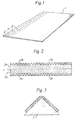
- Fig. 1 shows schematically in perspective view a fabric reinforced layer;
- Fig. 2 shows in cross-section and in a larger scale a laminate before being hardened; and
- Fig. 3 shows in cross-section the laminate laid on a support where it is permitted to harden.
- On a planar support a rather large and planar sheet (having the dimensions 0,5 x 1000 x 4500 mm) is produced. The sheet consists of a polyester fabric soaked with epoxy resin and a hardener so as to constitute, upon hardening, a thin and flexible sheet. Before applying the sheet, the support is provided with a polyethylene foil so as to permit easy removal of the sheet from the support and division of the sheet as desired, in this case into
strips 2, indicated by dashed lines to the left in Fig. 1. The division can be effected by sawing, shearing or cutting by means of a suitable tool. - For the manufacture of an elongated, angle profile member having mutually perpendicular and equally long legs, two
strips 2a (0,5 x 40 x 4500 mm) are first laid out, one adjacent to the other on a planar support. Threafter, a first, rather thick (appr. 2 mm)intermediate layer 3a is applied. This layer, which consists of epoxy resin, a hardener and a thickening agent (such as epoxy putty), is smoothed and soaked with a fluent epoxy resin, whereupon a reinforcement fabric 4 is applied and soaked into the thin epoxy resin. Thereafer, a corresponding sheet member with two strips 2b and a second thick, still not harenedintermediate layer 3b is laid on top of the reinforcement fabric 4, so as to form a symmetrical, still not hardenedlaminate unit - This laminate unit is laid on a
support 5 having mutually perpendicular support surfaces, as indicated in Fig. 3. Upon hardening, the desired L-profile member of fabric reinforced epoxy plastic is obtained.
Claims (4)
Priority Applications (3)
| Application Number | Priority Date | Filing Date | Title |
|---|---|---|---|
| AT80850090T ATE5304T1 (en) | 1980-06-13 | 1980-06-13 | PROCESS FOR MAKING EPOXY STRUCTURAL PARTS. |
| DE8080850090T DE3065597D1 (en) | 1980-06-13 | 1980-06-13 | Method of manufacturing structural members of epoxy resin |
| EP80850090A EP0042025B1 (en) | 1980-06-13 | 1980-06-13 | Method of manufacturing structural members of epoxy resin |
Applications Claiming Priority (1)
| Application Number | Priority Date | Filing Date | Title |
|---|---|---|---|
| EP80850090A EP0042025B1 (en) | 1980-06-13 | 1980-06-13 | Method of manufacturing structural members of epoxy resin |
Publications (2)
| Publication Number | Publication Date |
|---|---|
| EP0042025A1 EP0042025A1 (en) | 1981-12-23 |
| EP0042025B1 true EP0042025B1 (en) | 1983-11-16 |
Family
ID=8187482
Family Applications (1)
| Application Number | Title | Priority Date | Filing Date |
|---|---|---|---|
| EP80850090A Expired EP0042025B1 (en) | 1980-06-13 | 1980-06-13 | Method of manufacturing structural members of epoxy resin |
Country Status (3)
| Country | Link |
|---|---|
| EP (1) | EP0042025B1 (en) |
| AT (1) | ATE5304T1 (en) |
| DE (1) | DE3065597D1 (en) |
Families Citing this family (1)
| Publication number | Priority date | Publication date | Assignee | Title |
|---|---|---|---|---|
| US10377091B2 (en) * | 2016-11-01 | 2019-08-13 | The Boeing Company | Methods for forming a composite blade stiffener and facilitating application of barely visible impact damage treatments |
Family Cites Families (3)
| Publication number | Priority date | Publication date | Assignee | Title |
|---|---|---|---|---|
| US3959544A (en) * | 1973-12-26 | 1976-05-25 | Rogers Charles W | Filamentary tape constructions and methods |
| DE2405054B2 (en) * | 1974-02-02 | 1977-06-16 | Härtung, Helmut, 4000 Düsseldorf | PROCESS FOR MANUFACTURING A LAYERED BODY FROM FIBER-REINFORCED RESIN |
| DE2631401A1 (en) * | 1976-07-13 | 1978-01-19 | Ruthard Marowsky | PLASTIC COMPONENT WITH TEXTILE REINFORCEMENT |
-
1980
- 1980-06-13 AT AT80850090T patent/ATE5304T1/en not_active IP Right Cessation
- 1980-06-13 EP EP80850090A patent/EP0042025B1/en not_active Expired
- 1980-06-13 DE DE8080850090T patent/DE3065597D1/en not_active Expired
Also Published As
| Publication number | Publication date |
|---|---|
| ATE5304T1 (en) | 1983-12-15 |
| DE3065597D1 (en) | 1983-12-22 |
| EP0042025A1 (en) | 1981-12-23 |
Similar Documents
| Publication | Publication Date | Title |
|---|---|---|
| JPH01317754A (en) | Form composite body and manufacture thereof | |
| US5070668A (en) | Textured construction material and method of fabrication | |
| US20170163207A1 (en) | Translucent building material | |
| US4349401A (en) | Method to manufacture structural members of epoxy plastic | |
| US4233098A (en) | Method of making metal-plastic ski | |
| US3480497A (en) | Method of making a reinforced resin panel using a soluble cover sheet | |
| US3231457A (en) | Veneer | |
| US5215699A (en) | Textured construction material and method of fabricating | |
| US3197352A (en) | Method of forming rigid panels and rigid panel products | |
| US3989789A (en) | Method for making a non-rigid laminar core | |
| GB2092063A (en) | Coated board for concrete form and method of making the same | |
| KR20040050006A (en) | Glass Fiber Reinforcement Plastic sandwich panel and its manufacturing method | |
| EP0042025A1 (en) | Method of manufacturing structural members of epoxy resin | |
| CA2185903A1 (en) | Continuous mouldings and methods of production thereof | |
| FI72463B (en) | SAETT ATT FRAMSTAELLA ETT PROFILFORMIGT, LAMINERAT KONSTRUKTIONSELEMENT AV EPOXIPLAST. | |
| JPH11509492A (en) | Reinforced foam core | |
| EP0309606A1 (en) | Improved concrete form panel product | |
| RU2818322C1 (en) | Method of sealing and protecting ribs of volumetric furniture or construction products having slab base and lined with cover layers | |
| DE102006016943A1 (en) | Optimization of paper quality for application in loaded element by coating/impregnating a chemical e.g. polyurethane/polyester synthetic material, where the fiber structure of the paper is strengthened and solidified | |
| JPH02208040A (en) | Production of base material for interior material | |
| JPH1046780A (en) | Joint filling construction material and joint treatment method | |
| JP3323373B2 (en) | Method of manufacturing honeycomb core made of fiber reinforced plastic | |
| JPS62270309A (en) | Manufacture of laminated interior automotive trim member | |
| FR2155886A1 (en) | Laminated plastic construction panels - covering a reinforced plastic frame work | |
| JPS58131057A (en) | Manufacture of laminated interior finish material for automobile |
Legal Events
| Date | Code | Title | Description |
|---|---|---|---|
| PUAI | Public reference made under article 153(3) epc to a published international application that has entered the european phase |
Free format text: ORIGINAL CODE: 0009012 |
|
| AK | Designated contracting states |
Designated state(s): AT BE CH DE FR GB IT LI LU NL |
|
| 17P | Request for examination filed |
Effective date: 19820612 |
|
| ITF | It: translation for a ep patent filed | ||
| GRAA | (expected) grant |
Free format text: ORIGINAL CODE: 0009210 |
|
| AK | Designated contracting states |
Designated state(s): AT BE CH DE FR GB IT LI LU NL |
|
| PG25 | Lapsed in a contracting state [announced via postgrant information from national office to epo] |
Ref country code: AT Effective date: 19831116 |
|
| REF | Corresponds to: |
Ref document number: 5304 Country of ref document: AT Date of ref document: 19831215 Kind code of ref document: T |
|
| REF | Corresponds to: |
Ref document number: 3065597 Country of ref document: DE Date of ref document: 19831222 |
|
| ET | Fr: translation filed | ||
| PLBE | No opposition filed within time limit |
Free format text: ORIGINAL CODE: 0009261 |
|
| STAA | Information on the status of an ep patent application or granted ep patent |
Free format text: STATUS: NO OPPOSITION FILED WITHIN TIME LIMIT |
|
| 26N | No opposition filed | ||
| ITPR | It: changes in ownership of a european patent |
Owner name: CONCESSIONE DI LICENZA NON ESCLUSIVA;EXPANDITE LIM |
|
| REG | Reference to a national code |
Ref country code: GB Ref legal event code: 732 |
|
| REG | Reference to a national code |
Ref country code: CH Ref legal event code: PLI Owner name: EXPANDITE LIMITED |
|
| ITTA | It: last paid annual fee | ||
| REG | Reference to a national code |
Ref country code: CH Ref legal event code: PUE Owner name: INTERSPAN AB Ref country code: CH Ref legal event code: PFA Free format text: TAETIS FUNKTIONSUTVECKLING AB |
|
| BECH | Be: change of holder |
Free format text: 911120 *INTERSPAN A.B. |
|
| ITPR | It: changes in ownership of a european patent |
Owner name: CAMBIO RAGIONE SOCIALE;TAETIS FUNKTIONSUTVECKLING |
|
| REG | Reference to a national code |
Ref country code: FR Ref legal event code: TP Ref country code: FR Ref legal event code: CD |
|
| NLT1 | Nl: modifications of names registered in virtue of documents presented to the patent office pursuant to art. 16 a, paragraph 1 |
Owner name: TAETIS FUNKTIONSUTVECKLING AKTIEBOLAG TE TAEBY, ZW |
|
| NLS | Nl: assignments of ep-patents |
Owner name: INTERSPAN AB TE STOCKHOLM, ZWEDEN. |
|
| REG | Reference to a national code |
Ref country code: GB Ref legal event code: 732 |
|
| PGFP | Annual fee paid to national office [announced via postgrant information from national office to epo] |
Ref country code: GB Payment date: 19920615 Year of fee payment: 13 |
|
| PGFP | Annual fee paid to national office [announced via postgrant information from national office to epo] |
Ref country code: CH Payment date: 19920616 Year of fee payment: 13 |
|
| PGFP | Annual fee paid to national office [announced via postgrant information from national office to epo] |
Ref country code: LU Payment date: 19920618 Year of fee payment: 13 Ref country code: FR Payment date: 19920618 Year of fee payment: 13 |
|
| PGFP | Annual fee paid to national office [announced via postgrant information from national office to epo] |
Ref country code: BE Payment date: 19920624 Year of fee payment: 13 |
|
| PGFP | Annual fee paid to national office [announced via postgrant information from national office to epo] |
Ref country code: NL Payment date: 19920630 Year of fee payment: 13 |
|
| PGFP | Annual fee paid to national office [announced via postgrant information from national office to epo] |
Ref country code: DE Payment date: 19920720 Year of fee payment: 13 |
|
| EPTA | Lu: last paid annual fee | ||
| PG25 | Lapsed in a contracting state [announced via postgrant information from national office to epo] |
Ref country code: LU Free format text: LAPSE BECAUSE OF NON-PAYMENT OF DUE FEES Effective date: 19930613 Ref country code: GB Effective date: 19930613 |
|
| PG25 | Lapsed in a contracting state [announced via postgrant information from national office to epo] |
Ref country code: LI Effective date: 19930630 Ref country code: CH Effective date: 19930630 Ref country code: BE Effective date: 19930630 |
|
| BERE | Be: lapsed |
Owner name: INTERSPAN A.B. Effective date: 19930630 |
|
| PG25 | Lapsed in a contracting state [announced via postgrant information from national office to epo] |
Ref country code: NL Effective date: 19940101 |
|
| GBPC | Gb: european patent ceased through non-payment of renewal fee |
Effective date: 19930613 |
|
| NLV4 | Nl: lapsed or anulled due to non-payment of the annual fee | ||
| PG25 | Lapsed in a contracting state [announced via postgrant information from national office to epo] |
Ref country code: FR Effective date: 19940228 |
|
| REG | Reference to a national code |
Ref country code: CH Ref legal event code: PL |
|
| REG | Reference to a national code |
Ref country code: FR Ref legal event code: ST |
|
| PG25 | Lapsed in a contracting state [announced via postgrant information from national office to epo] |
Ref country code: DE Effective date: 19940503 |
|
| NLUE | Nl: licence registered with regard to european patents |
Effective date: 19850524 |