EP0042004B1 - Schiessimulationssystem - Google Patents
Schiessimulationssystem Download PDFInfo
- Publication number
- EP0042004B1 EP0042004B1 EP81900248A EP81900248A EP0042004B1 EP 0042004 B1 EP0042004 B1 EP 0042004B1 EP 81900248 A EP81900248 A EP 81900248A EP 81900248 A EP81900248 A EP 81900248A EP 0042004 B1 EP0042004 B1 EP 0042004B1
- Authority
- EP
- European Patent Office
- Prior art keywords
- bullet
- indicia
- aircraft
- simulated
- target
- Prior art date
- Legal status (The legal status is an assumption and is not a legal conclusion. Google has not performed a legal analysis and makes no representation as to the accuracy of the status listed.)
- Expired
Links
Images



Classifications
-
- H—ELECTRICITY
- H01—ELECTRIC ELEMENTS
- H01M—PROCESSES OR MEANS, e.g. BATTERIES, FOR THE DIRECT CONVERSION OF CHEMICAL ENERGY INTO ELECTRICAL ENERGY
- H01M4/00—Electrodes
- H01M4/02—Electrodes composed of, or comprising, active material
- H01M4/36—Selection of substances as active materials, active masses, active liquids
- H01M4/48—Selection of substances as active materials, active masses, active liquids of inorganic oxides or hydroxides
- H01M4/56—Selection of substances as active materials, active masses, active liquids of inorganic oxides or hydroxides of lead
- H01M4/57—Selection of substances as active materials, active masses, active liquids of inorganic oxides or hydroxides of lead of "grey lead", i.e. powders containing lead and lead oxide
-
- F—MECHANICAL ENGINEERING; LIGHTING; HEATING; WEAPONS; BLASTING
- F41—WEAPONS
- F41G—WEAPON SIGHTS; AIMING
- F41G3/00—Aiming or laying means
- F41G3/26—Teaching or practice apparatus for gun-aiming or gun-laying
- F41G3/2605—Teaching or practice apparatus for gun-aiming or gun-laying using a view recording device cosighted with the gun
-
- F—MECHANICAL ENGINEERING; LIGHTING; HEATING; WEAPONS; BLASTING
- F41—WEAPONS
- F41G—WEAPON SIGHTS; AIMING
- F41G3/00—Aiming or laying means
- F41G3/26—Teaching or practice apparatus for gun-aiming or gun-laying
- F41G3/2616—Teaching or practice apparatus for gun-aiming or gun-laying using a light emitting device
- F41G3/2622—Teaching or practice apparatus for gun-aiming or gun-laying using a light emitting device for simulating the firing of a gun or the trajectory of a projectile
- F41G3/2644—Displaying the trajectory or the impact point of a simulated projectile in the gunner's sight
-
- H—ELECTRICITY
- H01—ELECTRIC ELEMENTS
- H01M—PROCESSES OR MEANS, e.g. BATTERIES, FOR THE DIRECT CONVERSION OF CHEMICAL ENERGY INTO ELECTRICAL ENERGY
- H01M4/00—Electrodes
- H01M4/02—Electrodes composed of, or comprising, active material
- H01M4/64—Carriers or collectors
- H01M4/70—Carriers or collectors characterised by shape or form
- H01M4/76—Containers for holding the active material, e.g. tubes, capsules
- H01M4/765—Tubular type or pencil type electrodes; tubular or multitubular sheaths or covers of insulating material for said tubular-type electrodes
-
- Y—GENERAL TAGGING OF NEW TECHNOLOGICAL DEVELOPMENTS; GENERAL TAGGING OF CROSS-SECTIONAL TECHNOLOGIES SPANNING OVER SEVERAL SECTIONS OF THE IPC; TECHNICAL SUBJECTS COVERED BY FORMER USPC CROSS-REFERENCE ART COLLECTIONS [XRACs] AND DIGESTS
- Y02—TECHNOLOGIES OR APPLICATIONS FOR MITIGATION OR ADAPTATION AGAINST CLIMATE CHANGE
- Y02E—REDUCTION OF GREENHOUSE GAS [GHG] EMISSIONS, RELATED TO ENERGY GENERATION, TRANSMISSION OR DISTRIBUTION
- Y02E60/00—Enabling technologies; Technologies with a potential or indirect contribution to GHG emissions mitigation
- Y02E60/10—Energy storage using batteries
Definitions
- This invention relates to a gunnery simulation system for use, with an aircraft, in gunfire training and evaluation of accuracy in simulated gunfire.
- a gunnery simulating system for use with an aircraft, for gunfire training and evaluation of simulated firing accuracy, comprises a sighting panel presenting a field of view, including a target, to a gun operator; means for generating data signals describing the roll rate p, pitch rate q, yaw rate r, lift acceleration A w , and true air speed V a , of the aircraft, the gun angle of attack Q g, and the relative air density p/p o ; display means for presenting and for displaying simulated bullet indicia on said sighting panel superimposed on said field of view; means controlled by said operator for simulating the firing of the guns of the aircraft at said target; and means for controlling the operation of said display means to present said simulated bullet indicia responsive to said simulated firing of the guns of the aircraft and to display simulated trajectory paths for each of said presented simulated bullet indicia in said field of view in response to said
- the present invention can be seen to employ the principle of firing simulated bullets at real targets. This is accomplished by projecting images or "pips" which track the trajectory of hypothetical bullets on the head-up display (HUD) used by the gun operator (pilot) of the attacking aircraft. This permits the pilot to observe the trajectory of the simulated bullets as the pips move toward the target in a manner essentially similar to the way tracer rounds are used in the instance of live ammunition.
- HUD head-up display
- the pips may be displayed only within the gun camera system and recorded for later use in evaluating pilot performance. This may be done by superimposing the pip display on the field of view of gun camera 72 (Fig. 3), which may or may not be positioned to record the actual field of view of the pilot.
- the displayed "pips" do not directly represent the bullets themselves, but rather two pips are projected for each bullet and the bullet position (which need not be actually displayed) is mid-way between the two pips.
- This principle is illustrated in Fig. 1 wherein pips (b11, b 12' ) are equidistant from the simulated trajectory path of the first simulated round fired after the pilot depresses the trigger. The position of the round itself (circled dot) is mid-way between the pips (b 11 , b 12 ).
- Pips (b 21 , b 22 ), (b 31 , b 32 ) and (b 4 ,, b 42 ) are equidistant from the simulated second, third, and fourth fired rounds, respectively.
- the target T is shown with respect to the pairs of pips and the distance between a pair of pips is selected to be equal to a known dimension of the target, e.g., aircraft wingspan.
- the pips are displayed to appear to converge as the simulated round position moves further along its trajectory path from the gun muzzle.
- the point when the display round is at target range is determined by observing the lateral separation between the pip pair representing the round.
- the round is in the plane of the target.
- This use of dual pips enables the pilot, or a person evaluating the pilot's performance through later review of videotape or film pro- by camera 72, to determine the point at which the bullets pass through the plane of the target. Rounds which overlie the target image at this point are "hits".
- This simulated bullet display system therefore, enables a more accurate and useful evaluation of a pilot's performance than the traditional use of live tracer rounds and simulated target techniques.
- the degree of accuracy with which target range can be measured by this system is limited primarily by the film resolution of the videotape since a "hit" is determined visually by the equality of pip spacing and selected target dimension.
- camera film resolution is about 0.5 milliradians (mr) under normal lighting conditions.
- Fig. 2 are presented a set of graphs A, B, C for the following assumed conditions.
- the true airspeed of the "firing" aircraft is about 450 knots (about 800 kilometers per hour (800 km/hr)).
- the "target” aircraft is an F-4 fighter plane.
- the altitude of the encounter between the two aircraft is 3000 meters (m).
- the horizontal axis in Fig. 2 indicates range, i.e. separation of the two aircraft, in meters (m).
- the vertical axis indicates angle in milliradians (mr) as viewed from the firing aircraft.
- Graph A reflects the angle, in mr, subtended by the target aircraft, at an aspect angle of 30°, as a function of range.
- Graph B indicates the bullet-miss-error (in mr) as a function of range, as calculated by typical aircraft radar computation, which is subject to computation inaccuracy as to distance to the target of 10 meters, equivalent to a 2 mr inaccuracy.
- Graph C indicates the bullet-miss error in mr as calculated by the so-called "stadia metric method" which is subject to an inaccuracy of 0.5 mr due to the mentioned 0.5 mr camera film resolution. It is apparent that the stadia metric method is more accurate than a typical aircraft radar in computing target range for distances up to 500 meters. The uncertainty in bullet impact error is within typical target dimensions out to a range of about 800 meters.
- the symbol ADL denotes the so-called armament datum line.
- the point in time when each simulated round passes through the target range can be determined in flight from known ballistic parameters and the motion characteristics of the aircraft at the time of firing. This point in time can be displayed directly to the pilot and recorded on the videotape or other film.
- the stadia method then can be used as a more accurate assessment of error in short ranges without radar lock-on, i.e., less than 500 metres, and as a backup assessment at longer ranges when the recorded data is being analyzed.
- the evaluation display can be flight tested simply by reducing the target wingspan to zero and firing live tracers under conditions where they can be easily observed and photographed. There should be a one-to-one correspondence between the actual and simulated rounds as the aircraft is maneuvered while the rounds are in flight. In normal operating conditions, this also provides the pilot with an effective method for checking the boresight accuracy of the aircraft guns.
- the pilot When the gunnery evaluation display is included in the same HUD used by the pilot for gun aiming, the pilot is provided with a sense of having fired a weapon at the target during a training exercise, and provided a useful degree of immediate feedback of results. If, however, it is determined that the pilot would be distracted by including the evaluation display in the normal gunsight, then the simulated rounds could be superimposed on the videotape produced by the gunsight TV camera.
- Fig. 3 shows, in block diagram form, the gunsight system in accordance with a preferred embodiment of the invention.
- the pilot (gun operator), located at B, is presented with a field of view through a combining glass panel 22 arranged in accordance with a conventional HUD configuration.
- the pilot's field of view includes the line of sight 11 to the target.
- the display means for presenting and displaying simulated bullet pips or trajectory indicia comprises a sighting display unit 24, including a cathode ray tube (CRT) 26 and collimating optics 27, operating to project sighting indicia onto the pilot's field of view via the combining glass 22.
- the collimating optics 27 serve to focus the indicia images so that they appear to the pilot to be emanating from infinity, i.e., from the area of the target.
- This collimating arrangement is well-known in connection with HUD systems and operates to eliminate parallax problems and permits the pilot the freedom to move his head within the sight field of view without degrading the accuracy of the system.
- the display unit 24 projects bullet trajectory indicia or pips in accordance with control signals received from a controlling means 25 including a symbol generator 28 and a digital computer 30.
- the latter receives inputs through an analog-to-digital (A/D) converter unit 32 from means for generating data signals describing the motion of the aircraft and including a plurality of data input sources 34, 36 and 38.
- A/D analog-to-digital
- Air data generator 34 supplies signals to A/D unit 32 over lines 52, 54 and 56 representing, respectively, aircraft true air speed V a , gun angle of attackQg, and relative air density p/p o . These signals are encoded by A/D converter unit 32 and are fed to computer 30 via data bus 64.
- An inertial data generator 36 supplies signals representing own aircraft lift acceleration A W , roll rate p, pitch rate q, and yaw rate r, on lines 58, 60, 62 and 64, respectively. These signals are also encoded by A/D converter 32 and fed to computer 30 via a data bus 64.
- a means controlled by the operator for simulating the firing of the aircraft gun comprises a trigger subsystem 38 which supplies signals T representing the actuation of the gun trigger by the pilot and AS corresponding to the identification of the type of the target.
- the signals T could be a single pulse indicating the firing of a single bullet or, more likely, a series of pulses corresponding to a series of bullets fired in a sequence at the target. These signals are supplied to A/D converter 32 and fed to computer 30 over data bus 64.
- a videotape camera 72 is positioned to record the view of the pilot through his sighting panel 22.
- the target and approaching stream of bullet trajectory indicia or pips can be recorded on videotape for later analysis and evaluation.
- Fig. 4 geometrically represents the components of the range vector R * and bullet velocity vector V b which describes the trajectory of the bullet at any point in time after firing.
- the position of the firing aircraft is indicated by the point of origin a/c and the components u, v and w represent unit vectors along the axes of the three spatial dimensions realtive to the point of origin a/c.
- Unit vector v is along the right wing of the aircraft
- unit vector u is along the gun bore axis
- unit vector w is in a direction normal to the wings and, by convention, downward.
- the unit vector s is along the line of sight to the target.
- the vector V m is the multiplication product of unit vector u and scalar muzzle velocity (speed) V m .
- the true airspeed of the aircraft is defined by the vector V a .
- Equation (42) is therefore an appropriate correction to be added to the traverse bullet angle.
- Traverse angles (22) and (23) may be approximated by the argument of the arc tan function with sufficient accuracy.
- Table 1 lists the error due to omitting the third order term in approximating tan -1 X with X.
- the third order term is apparently necessary for elevation angles but not for traverse angles.
- the angular position of the bullet at target range is displayed in the form of a six milliradian circle (dispersion) at the time that bullet range is equal to target range.
- a somewhat simpler, and sufficiently accurate approach is to compare the u axis component of bullet position with the u axis component of target range, i.e., Where:
- the mentioned computer (iteration time interval At of 0.02 sec. produces a 4 mr step between successive bullet angles. This is not a negligible error, although it is small.
- Fig. 5 shows in more detail the computer 30 of Fig. 3.
- the computer 30 comprises a central processor unit 102 interconnected with a timing circuit 104 and a memory 106.
- the central processor unit 102 receives the outputs from air data generator 34, inertial data generator 36 and trigger subsystem 38 over bus 64 through input/output control 108.
- the CPU 102 passes information from memory 106 to bus 66 and to symbol generator 28 through the input/output control 108. This information comprises the angular coordinates for the pairs of bullet trajectory indicia or pips displayed on the combining glass 22 by the sighting display unit 24.
- a suitable central processor unit is the MCP701A digital display processor manufactured by General Electric Co.
- the angular coordinates of the pairs of pips are generated by central processor unit 102 by means of the above-discussed equations.
- the central processor 102 is programmed to perform the necessary operations.
- Figs. 6a and 6b show the program for accomplishing this task.
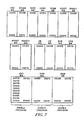
- Fig. 7 shows the data tables resident in memory 106 for storing the data necessary to perform the calculations.
- Fig. 8 shows the display tables also resident in memory 106 for storing the angular coordinate of the pairs of pips.
- the tables in Fig. 7 store data concerning and describing the condition of each simulated bullet.
- each table has ten entries and, thus, the system is capable of simultaneously displaying ten simulated bullets in the form of ten pairs of bullet trajectory indicia, i.e., ten pairs of pips.
- the information stored in the tables comprises:
- the quantities RVV, RW1, and RWW are both double precision, meaning that two words of storage are provided for each of these quantities.
- Fig. 6a the operation of the firing evaluation and display system is initiated by setting the A register and the B register to PG35. K is set to one and KBUT is set to NBUT. The next step is to fetch T(K) which in this instance would be T(1 This quantity is checked for zero and, if it is zero, then that entry in the bullet table is not active and no update of a bullet position is required for that entry. In such case, KBUT is decremented by one and checked to see if it is zero. If KBUT is zero then all the entries in the bullet table have been processed and processing continues to update any remaining display angular coordinates.
- T(K) is set to the quantity T(K)-1.
- the time of flight is computed as The quantity 0.02 is chosen because the system is set to display 1-10 bullets simultaneously. Presently, with ten bullets a twenty millisecond interrupt time is the minimum and, thus, the quantity ITMAX-T(K) specifies the number of iterations performed and the quantity 0.02 corresponds to the time between iterations.
- the new bullet position for bullet K is calculated according to the foregoing equations and the results are stored in the Kth entry of the bullet tables shown in Fig. 7.
- the pointer into the number of bullets processed, KBUT is decremented by one and checked to see if it is zero. If it is not, the A register is incremented by one, the B register is incremented by two and K is incremented by one.
- the next entry in the bullet table is processed in the above-described manner and the same procedures are iteratively performed until all entries in the bullet table have been accessed and new bullet positions calculated and stored for each active entry.
- the A register and B register are reset to PG35, the C register is set to DEND, K is reset to one and KBUT is set to NBUT.
- the processing continues to update the angular coordinates for each bullet trajectory indicia or pair of bullet pips stored in the bullet display table of Fig. 8.
- the x and y positions for each pip of a pair of pips representing the simulated bullet is compared to maximum display parameters to insure that the computer 30 does not generate angular display coordinates which are outside of the display range of display unit 24. If such is the case, further processing for that entry in the bullet table is bypassed. If, however, the x and y coordinates are within the display limits, the angular display coordinates stored in the display table shown in Fig. 8 corresponding to this bullet position in the bullet table of Fig. 7 are updated with the newly calculated bullet position for that particular bullet entry.
- the display table of Fig. 8 utilizes six words of storage for each bullet. These six words store, in order, POSX, POSY, corresponding to ⁇ v and ⁇ w1 , respectively.
- a JM5 instruction meaning to jump five words ahead in processing, POSX, POSY, corresponding to ⁇ v and A,,2, respectively, and another JM5 instruction.
- the bullet display table shown in Fig. 8 reflects two active bullet positions, i.e., bullet 1 and bullet 2 and eight inactive bullet positions 3-10.
- the first word of storage is a JMP6 instruction which results in bypassing all processing for that entry in the bullet display table.
- the entry in the bullet display table has been updated with new angular coordinates reflecting the newly determined bullet position, the entry T(K) is checked to see if it is equal to one. If it is, that entry in the bullet table is made inactive by setting T(K) equal to zero. This is done because the time of flight for the simulated bullet corresponding to that entry in a bullet table is equal to the maximum time of flight within the system and, thus, the pair of pips for that particular bullet entry will not longer be displayed.
- the operations following (1) the BIPAS determination, (2) a determination that T(K) is equal to one, and (3) the setting of T(K) to zero are all the same.
- These operations include incrementing the A register by one, incrementing the B register by two, incrementing the C register by six, incrementing K by one and decrementing KBUT by one. If KBUT is not equal to zero then the next entry in the bullet table is processed in the foregoing manner in order to update its corresponding entry in the bullet display table.
- the END routine is loaded in the display table and the symbol generator is permitted to transfer the angular coordinates of each pair of pips to the display unit for display on sighting panel 22.
- the manner in which the display of the pips is accomplished in response to the angular display coordinates is well-known and need not be further discussed.
- the processing operations set forth in Fig. 6b are performed in response to the firing of another simulated bullet by the gun operator or pilot.
- First the trigger flag, TRFLG is checked to see if it equals one. If it does not, then no new simulated bullet has been fired and processing returns to the bullet table updating routines set forth in Fig. 6a. If TRFLG is equal to one then another trigger flag TRFLG1 is also checked to see if it equals one. If it does, the bullet counter BSC is decremented by one and checked to see if it equals zero. If it is not equal to zero then a sufficient time has not passed since the previous bullet has been entered into the system and processing returns to the bullet position update routines in Fig. 6a.
- BSC is reset, i.e., set to six in this instance, and a new entry is placed in the bullet tables shown in Fig. 7.
- the entry of a new, simulated bullet into the system is accomplished by scanning the bullet table for zero entries in the T(K) positions. If a zero entry is found, ITMAX is loaded into the T(K) storage position for the detected position in the bullettable. Also, intialization of certain variables is performed at this time, and the instantaneous values of the air data sensors and inertial data sensors are stored in appropriate form in that entry of the bullet table. After these initialization steps are performed, processing returns to the bullet updating routines of Fig. 6a.
- a pilot sitting at B sights a target aircraft in his field of view 11.
- the pilot operates the trigger subsystem by actuating the aircraft selector and the trigger for the guns of the aircraft.
- the aircraft selector generates an aircraft selector pulse AS identifying the type of target aircraft and the trigger subsystem generates trigger pulses T for each depression or the continual depression of the trigger. These signals are provided to the analog-to-digital converter 32.
- the air data generator 34 is supplying instantaneous values for the velocity of the aircraft, V a , the gun angle of attack, Q g, and relative air density p. These signals are similarly encoded by the analog-to-digital converter 32.
- the inertial data generator 36 is also supplying instantaneous values for the aircraft lift acceleration A w , roll rate p, pitch rate q, and yaw rate r. Again, these signals are encoded by the analog-to-digital converter 32 and, with the other inputs, are supplied to computer 30.
- the computer 30 creates an entry in a bullet table stored in its memory for each simulated bullet fired by the pilot. All necessary information for computing and displaying the trajectory of the simulated bullet is stored in its corresponding entry in the bullet table. From this data, the computer computes a range vector and velocity vector for each simulated bullet. Angular display coordinates are generated from the range vector and velocity vector such that a pair of bullet trajectory indicia or visible pips can be displayed in a manner that represents the trajectory of the simulated bullet over a particular time span. The equations necessary for computing the range vector and velocity vector as well as the angular display coordinates have been previously set forth.
- the angular display coordinates for the pips are stored in the bullet display table.
- the computer transfers the contents of the bullet display table to the symbol generator 28 which controls the display unit 24 in a manner that will project the bullet trajectory indicia or pips corresponding to each simulated bullet on combining glass 22. This superimposes the pips on the field of view of the pilot so that the relative position of the pips and the target aircraft can be observed.
- a camera 72 is coupled to the display unit 24 by control lines 74 such that the camera can record on videotape the superimposed image of the pips and target much as they are actually seen by the pilot.
- the computer continually updates the trajectory for each pair of display pips so that the pips are made to appear to approach the target much as actual bullets would approach the target. This is accomplished by decreasing the distance between the pair of pips while continually updating the display position of the pips.
- the initial separation between the pips is computed by computer 30 in accordance with the target identification signal AS generated by the trigger subsystem. This separation is a function of some dimension of the identified target, for example, aircraft wingspan.
- the convergence of the pips is computed to represent the apparent decrease in the selected dimension of the target with increasing distance.
- a hit of the target aircraft by the simulated bullet occurs when the pips are seen to be superimposed upon the target and separated from each other by the same distance as the selected dimension of the target.
- the selected dimension is the wingspan of an aircraft then the separation between the pips would have to be equal to the wingspan of the target aircraft as it appears to the pilot when the pips-are directly superimposed on the target. This corresponds to the intersection of the plane of the target by the pips representing the simulated bullet.
- a radar unit 31 can be employed to supply the actual range to the target, R t , by radar lock-on.
- the computer can be programmed to compute the point in time that the simulated bullet would arrive at that range. When this occurs, the computer generates a dispersion pattern or other type of visible signal indicating that the pips have arrived at the range of the target. If the pips are directly superimposed over the target at the time of the visible signal, then it can be assumed that a bullet simulated by the pips would have hit the target aircraft.
- the video camera 72 records the image of the target, the continually changing position of the pips and also the visible signal generated when the pips reach the target range.
- the use of the videotape with or without radar lock-on enables the evaluation of the firing technique and accuracy of the pilot. It enables pilots to study gunnery techniques while using actual aircraft as targets in simulated combat situations but avoids the previously mentioned drawbacks of using drones and towed targets.
Landscapes
- Engineering & Computer Science (AREA)
- Chemical & Material Sciences (AREA)
- Radar, Positioning & Navigation (AREA)
- General Engineering & Computer Science (AREA)
- Chemical Kinetics & Catalysis (AREA)
- Electrochemistry (AREA)
- General Chemical & Material Sciences (AREA)
- Inorganic Chemistry (AREA)
- Aiming, Guidance, Guns With A Light Source, Armor, Camouflage, And Targets (AREA)
- Battery Electrode And Active Subsutance (AREA)
Claims (5)


Applications Claiming Priority (2)
| Application Number | Priority Date | Filing Date | Title |
|---|---|---|---|
| US105606 | 1979-12-20 | ||
| US06/105,606 US4308015A (en) | 1979-12-20 | 1979-12-20 | System and method for aircraft gunnery training and accuracy evaluation |
Publications (3)
| Publication Number | Publication Date |
|---|---|
| EP0042004A1 EP0042004A1 (de) | 1981-12-23 |
| EP0042004A4 EP0042004A4 (de) | 1982-04-29 |
| EP0042004B1 true EP0042004B1 (de) | 1985-09-11 |
Family
ID=22306789
Family Applications (1)
| Application Number | Title | Priority Date | Filing Date |
|---|---|---|---|
| EP81900248A Expired EP0042004B1 (de) | 1979-12-20 | 1980-12-17 | Schiessimulationssystem |
Country Status (8)
| Country | Link |
|---|---|
| US (1) | US4308015A (de) |
| EP (1) | EP0042004B1 (de) |
| JP (2) | JPH06100439B2 (de) |
| AU (1) | AU532500B2 (de) |
| DE (1) | DE3071066D1 (de) |
| IL (1) | IL61732A (de) |
| IT (1) | IT1193570B (de) |
| WO (1) | WO1981001875A1 (de) |
Families Citing this family (13)
| Publication number | Priority date | Publication date | Assignee | Title |
|---|---|---|---|---|
| US4698489A (en) * | 1982-09-30 | 1987-10-06 | General Electric Company | Aircraft automatic boresight correction |
| FR2536847B1 (fr) * | 1982-11-30 | 1986-10-17 | Thomson Csf | Simulateur d'entrainement au tir au canon de petit calibre sur cibles simulees |
| FR2536921A1 (fr) * | 1982-11-30 | 1984-06-01 | Thomson Csf | Regulateur a faible tension de dechet |
| US4661987A (en) * | 1985-06-03 | 1987-04-28 | The United States Of America As Represented By The Secretary Of The Navy | Video processor |
| US5228854A (en) * | 1992-07-21 | 1993-07-20 | Teledyne, Inc. | Combat training system and method |
| JP3503982B2 (ja) * | 1994-03-18 | 2004-03-08 | 富士通株式会社 | 視点設定装置 |
| JP3442965B2 (ja) * | 1997-04-25 | 2003-09-02 | 任天堂株式会社 | ビデオゲームシステムおよびビデオゲーム用記憶媒体 |
| US6875019B2 (en) * | 2002-02-11 | 2005-04-05 | United Defense, Lp | Naval virtual target range system |
| AUPS230802A0 (en) * | 2002-05-14 | 2002-06-13 | Roberts, David Grant | Aircraft based visual aid |
| EP1643206A1 (de) * | 2004-10-02 | 2006-04-05 | Saab Ab | Simulationssystem, -verfahren und Computerprogramm |
| DE102005041704A1 (de) * | 2005-09-02 | 2007-03-15 | Oerlikon Contraves Ag | Verfahren zur Optimierung eines Feuerauslösens einer Waffe oder eine Geschützes |
| WO2008115216A2 (en) * | 2006-12-01 | 2008-09-25 | Aai Corporation | Apparatus, method and computer program product for weapon flyout modeling and target damage assesment |
| CN118192303B (zh) * | 2024-05-16 | 2024-08-13 | 成都流体动力创新中心 | 一种半实物仿真方法及系统 |
Family Cites Families (12)
| Publication number | Priority date | Publication date | Assignee | Title |
|---|---|---|---|---|
| US2467831A (en) * | 1942-09-26 | 1949-04-19 | Gen Electric | Sighting mechanism |
| US3024536A (en) * | 1954-08-11 | 1962-03-13 | Mathema Corp Reg Trust | Ordnance sight for mobile targets |
| US2843028A (en) * | 1955-03-11 | 1958-07-15 | William C Ward | Miss-distance indicator |
| US2979711A (en) * | 1956-06-29 | 1961-04-11 | North American Aviation Inc | Fire control system |
| US2957384A (en) * | 1956-11-27 | 1960-10-25 | Gen Motors Corp | Optical sighting device |
| US2957245A (en) * | 1957-05-29 | 1960-10-25 | Creighton B Kimble | Electronic reticle generator |
| US3137769A (en) * | 1961-01-24 | 1964-06-16 | Barnes Eng Co | Reflex sighting |
| DE1951622C3 (de) * | 1969-10-14 | 1974-03-28 | Honeywell Gmbh, 6000 Frankfurt | Anordnung zur simulierten Darstellung von Schußbahnen |
| SE340061B (de) * | 1970-03-06 | 1971-11-01 | Bofors Ab | |
| US3716696A (en) * | 1970-09-04 | 1973-02-13 | Honeywell Inc | Projectile stream display apparatus |
| US3671100A (en) * | 1970-10-23 | 1972-06-20 | Perkins Elmer Corp The | System for integrating gunsight reticle image and image received by a camera |
| DE2746534C2 (de) * | 1977-10-17 | 1982-07-29 | Honeywell Gmbh, 6000 Frankfurt | Verfahren zur Simulation eines beweglichen Zieles |
-
1979
- 1979-12-20 US US06/105,606 patent/US4308015A/en not_active Expired - Lifetime
-
1980
- 1980-12-17 EP EP81900248A patent/EP0042004B1/de not_active Expired
- 1980-12-17 WO PCT/US1980/001681 patent/WO1981001875A1/en not_active Ceased
- 1980-12-17 IL IL61732A patent/IL61732A/xx not_active IP Right Cessation
- 1980-12-17 DE DE8181900248T patent/DE3071066D1/de not_active Expired
- 1980-12-17 JP JP56500429A patent/JPH06100439B2/ja not_active Expired - Lifetime
- 1980-12-17 JP JP81500429A patent/JPS56501538A/ja active Pending
- 1980-12-19 AU AU65560/80A patent/AU532500B2/en not_active Expired
- 1980-12-19 IT IT26794/80A patent/IT1193570B/it active
Also Published As
| Publication number | Publication date |
|---|---|
| IL61732A (en) | 1985-01-31 |
| WO1981001875A1 (en) | 1981-07-09 |
| IT8026794A0 (it) | 1980-12-19 |
| DE3071066D1 (en) | 1985-10-17 |
| AU532500B2 (en) | 1983-09-29 |
| US4308015A (en) | 1981-12-29 |
| EP0042004A1 (de) | 1981-12-23 |
| AU6556080A (en) | 1981-06-25 |
| IT1193570B (it) | 1988-07-08 |
| JPS56501538A (de) | 1981-10-22 |
| EP0042004A4 (de) | 1982-04-29 |
| JPH06100439B2 (ja) | 1994-12-12 |
| JPS55501199A (de) | 1980-12-25 |
Similar Documents
| Publication | Publication Date | Title |
|---|---|---|
| US3845276A (en) | Laser-sight and computer for anti-aircraft gun fire control system | |
| US4698489A (en) | Aircraft automatic boresight correction | |
| US4308015A (en) | System and method for aircraft gunnery training and accuracy evaluation | |
| US5794889A (en) | Fire retardant delivery system | |
| US3609883A (en) | System for simulating the firing of a weapon at a target | |
| US3699310A (en) | Angular rate bombing system | |
| KR101560295B1 (ko) | 표적 획득 시뮬레이션 장치 | |
| US3716696A (en) | Projectile stream display apparatus | |
| US3995144A (en) | Banked bombing system | |
| RU2170907C1 (ru) | Способ прицеливания при атаке скоростных целей истребителем по спрямленной траектории и устройство для его реализации | |
| US3206143A (en) | Controller for guiding a missile carrier on the location curve of ballistic firing positions | |
| KR850000014B1 (ko) | 사격모의 시스템 | |
| RU2707325C1 (ru) | Способ прицеливания при стрельбе из пушки по маневрирующей воздушной цели | |
| RU2217684C2 (ru) | Способ стрельбы боевой машины по воздушной цели (варианты) и система для его реализации | |
| US3075188A (en) | Stable optical tracking fire control system | |
| Krishnamoorthy et al. | An Aerodynamic Database for the Mk 82 General Purpose Low Drag Bomb. | |
| Gilbert et al. | Snap-Shoot Gunsight for Fixed-Gun Fighter Aircraft | |
| Williams | A piloted simulation investigating handling qualities and performance requirements of a single-pilot helicopter in air combat employing a helmet-driven turreted gun | |
| Wiles | Air-to-air gunnery systems test and evaluation | |
| BURESH et al. | Air-to-air combat development of the AH-64A Apache | |
| Elwell et al. | A Computer Model for the Evaluation of Helicopter Fire Control Systems | |
| RU2172463C2 (ru) | Способ стрельбы боевой машины по цели и система для его реализации | |
| LEONDES et al. | Modeling the Effects of Pilot Performance on Weapon Delivery Accuracy | |
| Jupin | The ballistics processor of a multiple processor airborne tactical system | |
| Clark | Integrated helmet mounted display concepts for air combat |
Legal Events
| Date | Code | Title | Description |
|---|---|---|---|
| PUAI | Public reference made under article 153(3) epc to a published international application that has entered the european phase |
Free format text: ORIGINAL CODE: 0009012 |
|
| AK | Designated contracting states |
Designated state(s): DE FR GB NL SE |
|
| 17P | Request for examination filed |
Effective date: 19811214 |
|
| GRAA | (expected) grant |
Free format text: ORIGINAL CODE: 0009210 |
|
| AK | Designated contracting states |
Designated state(s): DE FR GB NL SE |
|
| REF | Corresponds to: |
Ref document number: 3071066 Country of ref document: DE Date of ref document: 19851017 |
|
| ET | Fr: translation filed | ||
| PLBE | No opposition filed within time limit |
Free format text: ORIGINAL CODE: 0009261 |
|
| STAA | Information on the status of an ep patent application or granted ep patent |
Free format text: STATUS: NO OPPOSITION FILED WITHIN TIME LIMIT |
|
| PG25 | Lapsed in a contracting state [announced via postgrant information from national office to epo] |
Ref country code: DE Effective date: 19860902 |
|
| 26N | No opposition filed | ||
| EAL | Se: european patent in force in sweden |
Ref document number: 81900248.6 |
|
| PGFP | Annual fee paid to national office [announced via postgrant information from national office to epo] |
Ref country code: FR Payment date: 20000119 Year of fee payment: 20 |
|
| PGFP | Annual fee paid to national office [announced via postgrant information from national office to epo] |
Ref country code: SE Payment date: 20000120 Year of fee payment: 20 Ref country code: GB Payment date: 20000120 Year of fee payment: 20 |
|
| PGFP | Annual fee paid to national office [announced via postgrant information from national office to epo] |
Ref country code: NL Payment date: 20000125 Year of fee payment: 20 |
|
| PG25 | Lapsed in a contracting state [announced via postgrant information from national office to epo] |
Ref country code: GB Free format text: LAPSE BECAUSE OF EXPIRATION OF PROTECTION Effective date: 20001216 |
|
| PG25 | Lapsed in a contracting state [announced via postgrant information from national office to epo] |
Ref country code: NL Free format text: LAPSE BECAUSE OF EXPIRATION OF PROTECTION Effective date: 20001217 |
|
| PG25 | Lapsed in a contracting state [announced via postgrant information from national office to epo] |
Ref country code: SE Free format text: THE PATENT HAS BEEN ANNULLED BY A DECISION OF A NATIONAL AUTHORITY Effective date: 20001230 |
|
| REG | Reference to a national code |
Ref country code: GB Ref legal event code: PE20 Effective date: 20001216 |
|
| NLV7 | Nl: ceased due to reaching the maximum lifetime of a patent |
Effective date: 20001217 |
|
| EUG | Se: european patent has lapsed |
Ref document number: 81900248.6 |