EP0037231B1 - Substituted acyl derivatives of octahydro-1h-indole-2-carboxylic acids - Google Patents
Substituted acyl derivatives of octahydro-1h-indole-2-carboxylic acids Download PDFInfo
- Publication number
- EP0037231B1 EP0037231B1 EP81301243A EP81301243A EP0037231B1 EP 0037231 B1 EP0037231 B1 EP 0037231B1 EP 81301243 A EP81301243 A EP 81301243A EP 81301243 A EP81301243 A EP 81301243A EP 0037231 B1 EP0037231 B1 EP 0037231B1
- Authority
- EP
- European Patent Office
- Prior art keywords
- octahydro
- indole
- carboxylic acid
- compound
- pharmaceutically acceptable
- Prior art date
- Legal status (The legal status is an assumption and is not a legal conclusion. Google has not performed a legal analysis and makes no representation as to the accuracy of the status listed.)
- Expired
Links
- 125000002252 acyl group Chemical group 0.000 title description 2
- 150000001875 compounds Chemical class 0.000 claims description 42
- 150000003839 salts Chemical class 0.000 claims description 24
- -1 trimethylsilyl ester Chemical class 0.000 claims description 12
- 239000002253 acid Chemical class 0.000 claims description 10
- 238000000034 method Methods 0.000 claims description 10
- 150000001447 alkali salts Chemical class 0.000 claims description 8
- 125000005907 alkyl ester group Chemical group 0.000 claims description 8
- 125000001495 ethyl group Chemical class [H]C([H])([H])C([H])([H])* 0.000 claims description 8
- 125000004432 carbon atom Chemical group C* 0.000 claims description 7
- 125000004435 hydrogen atom Chemical group [H]* 0.000 claims description 7
- 150000004820 halides Chemical class 0.000 claims description 4
- 239000001257 hydrogen Substances 0.000 claims description 4
- 229910052739 hydrogen Inorganic materials 0.000 claims description 4
- 229910052783 alkali metal Inorganic materials 0.000 claims description 3
- 239000002585 base Substances 0.000 claims description 3
- 229910052736 halogen Inorganic materials 0.000 claims description 2
- 230000003301 hydrolyzing effect Effects 0.000 claims description 2
- 150000001340 alkali metals Chemical class 0.000 claims 1
- 239000003937 drug carrier Substances 0.000 claims 1
- 125000005843 halogen group Chemical group 0.000 claims 1
- HCUARRIEZVDMPT-UHFFFAOYSA-N indolyl-2-carboxylic acid Natural products C1=CC=C2NC(C(=O)O)=CC2=C1 HCUARRIEZVDMPT-UHFFFAOYSA-N 0.000 claims 1
- 239000008194 pharmaceutical composition Substances 0.000 claims 1
- 150000003512 tertiary amines Chemical class 0.000 claims 1
- XEKOWRVHYACXOJ-UHFFFAOYSA-N Ethyl acetate Chemical compound CCOC(C)=O XEKOWRVHYACXOJ-UHFFFAOYSA-N 0.000 description 27
- 239000000243 solution Substances 0.000 description 27
- OKKJLVBELUTLKV-UHFFFAOYSA-N Methanol Chemical compound OC OKKJLVBELUTLKV-UHFFFAOYSA-N 0.000 description 24
- XLYOFNOQVPJJNP-UHFFFAOYSA-N water Substances O XLYOFNOQVPJJNP-UHFFFAOYSA-N 0.000 description 20
- 239000000203 mixture Substances 0.000 description 17
- YMWUJEATGCHHMB-UHFFFAOYSA-N Dichloromethane Chemical compound ClCCl YMWUJEATGCHHMB-UHFFFAOYSA-N 0.000 description 15
- 239000000047 product Substances 0.000 description 13
- RTZKZFJDLAIYFH-UHFFFAOYSA-N Diethyl ether Chemical compound CCOCC RTZKZFJDLAIYFH-UHFFFAOYSA-N 0.000 description 11
- 102000004270 Peptidyl-Dipeptidase A Human genes 0.000 description 10
- 108090000882 Peptidyl-Dipeptidase A Proteins 0.000 description 10
- UUUHXMGGBIUAPW-UHFFFAOYSA-N 1-[1-[2-[[5-amino-2-[[1-[5-(diaminomethylideneamino)-2-[[1-[3-(1h-indol-3-yl)-2-[(5-oxopyrrolidine-2-carbonyl)amino]propanoyl]pyrrolidine-2-carbonyl]amino]pentanoyl]pyrrolidine-2-carbonyl]amino]-5-oxopentanoyl]amino]-3-methylpentanoyl]pyrrolidine-2-carbon Chemical compound C1CCC(C(=O)N2C(CCC2)C(O)=O)N1C(=O)C(C(C)CC)NC(=O)C(CCC(N)=O)NC(=O)C1CCCN1C(=O)C(CCCN=C(N)N)NC(=O)C1CCCN1C(=O)C(CC=1C2=CC=CC=C2NC=1)NC(=O)C1CCC(=O)N1 UUUHXMGGBIUAPW-UHFFFAOYSA-N 0.000 description 9
- ZMXDDKWLCZADIW-UHFFFAOYSA-N N,N-Dimethylformamide Chemical compound CN(C)C=O ZMXDDKWLCZADIW-UHFFFAOYSA-N 0.000 description 9
- HEMHJVSKTPXQMS-UHFFFAOYSA-M Sodium hydroxide Chemical compound [OH-].[Na+] HEMHJVSKTPXQMS-UHFFFAOYSA-M 0.000 description 9
- 238000006243 chemical reaction Methods 0.000 description 9
- FAPWRFPIFSIZLT-UHFFFAOYSA-M Sodium chloride Chemical compound [Na+].[Cl-] FAPWRFPIFSIZLT-UHFFFAOYSA-M 0.000 description 8
- LFQSCWFLJHTTHZ-UHFFFAOYSA-N Ethanol Chemical compound CCO LFQSCWFLJHTTHZ-UHFFFAOYSA-N 0.000 description 7
- 238000001914 filtration Methods 0.000 description 7
- 239000007787 solid Substances 0.000 description 7
- WEVYAHXRMPXWCK-UHFFFAOYSA-N Acetonitrile Chemical compound CC#N WEVYAHXRMPXWCK-UHFFFAOYSA-N 0.000 description 6
- HEDRZPFGACZZDS-UHFFFAOYSA-N Chloroform Chemical compound ClC(Cl)Cl HEDRZPFGACZZDS-UHFFFAOYSA-N 0.000 description 6
- JUJWROOIHBZHMG-UHFFFAOYSA-N Pyridine Chemical compound C1=CC=NC=C1 JUJWROOIHBZHMG-UHFFFAOYSA-N 0.000 description 6
- WYURNTSHIVDZCO-UHFFFAOYSA-N Tetrahydrofuran Chemical compound C1CCOC1 WYURNTSHIVDZCO-UHFFFAOYSA-N 0.000 description 6
- ZMANZCXQSJIPKH-UHFFFAOYSA-N Triethylamine Chemical compound CCN(CC)CC ZMANZCXQSJIPKH-UHFFFAOYSA-N 0.000 description 6
- HQKMJHAJHXVSDF-UHFFFAOYSA-L magnesium stearate Chemical compound [Mg+2].CCCCCCCCCCCCCCCCCC([O-])=O.CCCCCCCCCCCCCCCCCC([O-])=O HQKMJHAJHXVSDF-UHFFFAOYSA-L 0.000 description 6
- 239000002904 solvent Substances 0.000 description 6
- CQYBNXGHMBNGCG-UHFFFAOYSA-N 2,3,3a,4,5,6,7,7a-octahydro-1h-indol-1-ium-2-carboxylate Chemical class C1CCCC2NC(C(=O)O)CC21 CQYBNXGHMBNGCG-UHFFFAOYSA-N 0.000 description 5
- 0 CC(CSC(*)=O)C1NC(CCCC2)C2CC1C(O)=O Chemical compound CC(CSC(*)=O)C1NC(CCCC2)C2CC1C(O)=O 0.000 description 5
- XBPCUCUWBYBCDP-UHFFFAOYSA-N Dicyclohexylamine Chemical compound C1CCCCC1NC1CCCCC1 XBPCUCUWBYBCDP-UHFFFAOYSA-N 0.000 description 5
- VEXZGXHMUGYJMC-UHFFFAOYSA-N Hydrochloric acid Chemical compound Cl VEXZGXHMUGYJMC-UHFFFAOYSA-N 0.000 description 5
- QAOWNCQODCNURD-UHFFFAOYSA-N Sulfuric acid Chemical compound OS(O)(=O)=O QAOWNCQODCNURD-UHFFFAOYSA-N 0.000 description 5
- 238000001953 recrystallisation Methods 0.000 description 5
- QGZKDVFQNNGYKY-UHFFFAOYSA-N Ammonia Chemical compound N QGZKDVFQNNGYKY-UHFFFAOYSA-N 0.000 description 4
- 101800000734 Angiotensin-1 Proteins 0.000 description 4
- 102400000344 Angiotensin-1 Human genes 0.000 description 4
- 229920002261 Corn starch Polymers 0.000 description 4
- CSNNHWWHGAXBCP-UHFFFAOYSA-L Magnesium sulfate Chemical compound [Mg+2].[O-][S+2]([O-])([O-])[O-] CSNNHWWHGAXBCP-UHFFFAOYSA-L 0.000 description 4
- RKOTXQYWCBGZLP-UHFFFAOYSA-N N-[(2,4-difluorophenyl)methyl]-2-ethyl-9-hydroxy-3-methoxy-1,8-dioxospiro[3H-pyrido[1,2-a]pyrazine-4,3'-oxolane]-7-carboxamide Chemical compound CCN1C(OC)C2(CCOC2)N2C=C(C(=O)NCC3=C(F)C=C(F)C=C3)C(=O)C(O)=C2C1=O RKOTXQYWCBGZLP-UHFFFAOYSA-N 0.000 description 4
- PMZURENOXWZQFD-UHFFFAOYSA-L Sodium Sulfate Chemical compound [Na+].[Na+].[O-]S([O-])(=O)=O PMZURENOXWZQFD-UHFFFAOYSA-L 0.000 description 4
- UIIMBOGNXHQVGW-UHFFFAOYSA-M Sodium bicarbonate Chemical compound [Na+].OC([O-])=O UIIMBOGNXHQVGW-UHFFFAOYSA-M 0.000 description 4
- ORWYRWWVDCYOMK-HBZPZAIKSA-N angiotensin I Chemical compound C([C@@H](C(=O)N[C@@H]([C@@H](C)CC)C(=O)N[C@@H](CC=1NC=NC=1)C(=O)N1[C@@H](CCC1)C(=O)N[C@@H](CC=1C=CC=CC=1)C(=O)N[C@@H](CC=1NC=NC=1)C(=O)N[C@@H](CC(C)C)C(O)=O)NC(=O)[C@@H](NC(=O)[C@H](CCCN=C(N)N)NC(=O)[C@@H](N)CC(O)=O)C(C)C)C1=CC=C(O)C=C1 ORWYRWWVDCYOMK-HBZPZAIKSA-N 0.000 description 4
- 239000008120 corn starch Substances 0.000 description 4
- 239000000284 extract Substances 0.000 description 4
- 239000000463 material Substances 0.000 description 4
- 239000003755 preservative agent Substances 0.000 description 4
- 229910052938 sodium sulfate Inorganic materials 0.000 description 4
- 235000011152 sodium sulphate Nutrition 0.000 description 4
- 239000007858 starting material Substances 0.000 description 4
- CIWBSHSKHKDKBQ-JLAZNSOCSA-N Ascorbic acid Chemical compound OC[C@H](O)[C@H]1OC(=O)C(O)=C1O CIWBSHSKHKDKBQ-JLAZNSOCSA-N 0.000 description 3
- 206010020772 Hypertension Diseases 0.000 description 3
- CZGUSIXMZVURDU-JZXHSEFVSA-N Ile(5)-angiotensin II Chemical compound C([C@@H](C(=O)N[C@@H]([C@@H](C)CC)C(=O)N[C@@H](CC=1NC=NC=1)C(=O)N1[C@@H](CCC1)C(=O)N[C@@H](CC=1C=CC=CC=1)C([O-])=O)NC(=O)[C@@H](NC(=O)[C@H](CCCNC(N)=[NH2+])NC(=O)[C@@H]([NH3+])CC([O-])=O)C(C)C)C1=CC=C(O)C=C1 CZGUSIXMZVURDU-JZXHSEFVSA-N 0.000 description 3
- VYPSYNLAJGMNEJ-UHFFFAOYSA-N Silicium dioxide Chemical compound O=[Si]=O VYPSYNLAJGMNEJ-UHFFFAOYSA-N 0.000 description 3
- 239000004480 active ingredient Substances 0.000 description 3
- 239000013543 active substance Substances 0.000 description 3
- 150000001408 amides Chemical class 0.000 description 3
- 150000001412 amines Chemical class 0.000 description 3
- 239000002775 capsule Substances 0.000 description 3
- 239000000706 filtrate Substances 0.000 description 3
- 238000001640 fractional crystallisation Methods 0.000 description 3
- 230000002401 inhibitory effect Effects 0.000 description 3
- 239000010410 layer Substances 0.000 description 3
- 235000019359 magnesium stearate Nutrition 0.000 description 3
- VLKZOEOYAKHREP-UHFFFAOYSA-N n-Hexane Chemical compound CCCCCC VLKZOEOYAKHREP-UHFFFAOYSA-N 0.000 description 3
- 239000012044 organic layer Substances 0.000 description 3
- 239000002244 precipitate Substances 0.000 description 3
- UMJSCPRVCHMLSP-UHFFFAOYSA-N pyridine Natural products COC1=CC=CN=C1 UMJSCPRVCHMLSP-UHFFFAOYSA-N 0.000 description 3
- 229920006395 saturated elastomer Polymers 0.000 description 3
- 239000011780 sodium chloride Substances 0.000 description 3
- 239000000126 substance Substances 0.000 description 3
- YLQBMQCUIZJEEH-UHFFFAOYSA-N tetrahydrofuran Natural products C=1C=COC=1 YLQBMQCUIZJEEH-UHFFFAOYSA-N 0.000 description 3
- 239000003981 vehicle Substances 0.000 description 3
- RYHBNJHYFVUHQT-UHFFFAOYSA-N 1,4-Dioxane Chemical compound C1COCCO1 RYHBNJHYFVUHQT-UHFFFAOYSA-N 0.000 description 2
- GUBGYTABKSRVRQ-XLOQQCSPSA-N Alpha-Lactose Chemical compound O[C@@H]1[C@@H](O)[C@@H](O)[C@@H](CO)O[C@H]1O[C@@H]1[C@@H](CO)O[C@H](O)[C@H](O)[C@H]1O GUBGYTABKSRVRQ-XLOQQCSPSA-N 0.000 description 2
- 102000005862 Angiotensin II Human genes 0.000 description 2
- 101800000733 Angiotensin-2 Proteins 0.000 description 2
- IJGRMHOSHXDMSA-UHFFFAOYSA-N Atomic nitrogen Chemical compound N#N IJGRMHOSHXDMSA-UHFFFAOYSA-N 0.000 description 2
- 241000167854 Bourreria succulenta Species 0.000 description 2
- OYPRJOBELJOOCE-UHFFFAOYSA-N Calcium Chemical compound [Ca] OYPRJOBELJOOCE-UHFFFAOYSA-N 0.000 description 2
- 241000700199 Cavia porcellus Species 0.000 description 2
- 108010010803 Gelatin Proteins 0.000 description 2
- DGAQECJNVWCQMB-PUAWFVPOSA-M Ilexoside XXIX Chemical compound C[C@@H]1CC[C@@]2(CC[C@@]3(C(=CC[C@H]4[C@]3(CC[C@@H]5[C@@]4(CC[C@@H](C5(C)C)OS(=O)(=O)[O-])C)C)[C@@H]2[C@]1(C)O)C)C(=O)O[C@H]6[C@@H]([C@H]([C@@H]([C@H](O6)CO)O)O)O.[Na+] DGAQECJNVWCQMB-PUAWFVPOSA-M 0.000 description 2
- GUBGYTABKSRVRQ-QKKXKWKRSA-N Lactose Natural products OC[C@H]1O[C@@H](O[C@H]2[C@H](O)[C@@H](O)C(O)O[C@@H]2CO)[C@H](O)[C@@H](O)[C@H]1O GUBGYTABKSRVRQ-QKKXKWKRSA-N 0.000 description 2
- 108090000783 Renin Proteins 0.000 description 2
- 229930006000 Sucrose Natural products 0.000 description 2
- CZMRCDWAGMRECN-UGDNZRGBSA-N Sucrose Chemical compound O[C@H]1[C@H](O)[C@@H](CO)O[C@@]1(CO)O[C@@H]1[C@H](O)[C@@H](O)[C@H](O)[C@@H](CO)O1 CZMRCDWAGMRECN-UGDNZRGBSA-N 0.000 description 2
- 239000003513 alkali Substances 0.000 description 2
- 229910021529 ammonia Inorganic materials 0.000 description 2
- 238000005915 ammonolysis reaction Methods 0.000 description 2
- 229950006323 angiotensin ii Drugs 0.000 description 2
- 239000008346 aqueous phase Substances 0.000 description 2
- WPYMKLBDIGXBTP-UHFFFAOYSA-N benzoic acid Chemical compound OC(=O)C1=CC=CC=C1 WPYMKLBDIGXBTP-UHFFFAOYSA-N 0.000 description 2
- 239000011230 binding agent Substances 0.000 description 2
- 230000015572 biosynthetic process Effects 0.000 description 2
- 230000036772 blood pressure Effects 0.000 description 2
- 229910052794 bromium Inorganic materials 0.000 description 2
- 229910052791 calcium Inorganic materials 0.000 description 2
- 239000011575 calcium Substances 0.000 description 2
- 239000003795 chemical substances by application Substances 0.000 description 2
- 235000019693 cherries Nutrition 0.000 description 2
- 239000000460 chlorine Substances 0.000 description 2
- 229910052801 chlorine Inorganic materials 0.000 description 2
- 229910052681 coesite Inorganic materials 0.000 description 2
- 238000001816 cooling Methods 0.000 description 2
- 229910052906 cristobalite Inorganic materials 0.000 description 2
- 239000013078 crystal Substances 0.000 description 2
- XBDQKXXYIPTUBI-UHFFFAOYSA-N dimethylselenoniopropionate Natural products CCC(O)=O XBDQKXXYIPTUBI-UHFFFAOYSA-N 0.000 description 2
- 239000000796 flavoring agent Substances 0.000 description 2
- 235000003599 food sweetener Nutrition 0.000 description 2
- 238000004108 freeze drying Methods 0.000 description 2
- 229920000159 gelatin Polymers 0.000 description 2
- 239000008273 gelatin Substances 0.000 description 2
- 235000019322 gelatine Nutrition 0.000 description 2
- 235000011852 gelatine desserts Nutrition 0.000 description 2
- 230000007062 hydrolysis Effects 0.000 description 2
- 238000006460 hydrolysis reaction Methods 0.000 description 2
- 238000000338 in vitro Methods 0.000 description 2
- 239000004615 ingredient Substances 0.000 description 2
- 239000007924 injection Substances 0.000 description 2
- 238000002347 injection Methods 0.000 description 2
- 150000007529 inorganic bases Chemical class 0.000 description 2
- 239000008101 lactose Substances 0.000 description 2
- 239000007788 liquid Substances 0.000 description 2
- 159000000003 magnesium salts Chemical class 0.000 description 2
- 229910052943 magnesium sulfate Inorganic materials 0.000 description 2
- 235000019341 magnesium sulphate Nutrition 0.000 description 2
- 230000003287 optical effect Effects 0.000 description 2
- 150000007530 organic bases Chemical class 0.000 description 2
- 239000000546 pharmaceutical excipient Substances 0.000 description 2
- IUGYQRQAERSCNH-UHFFFAOYSA-N pivalic acid Chemical compound CC(C)(C)C(O)=O IUGYQRQAERSCNH-UHFFFAOYSA-N 0.000 description 2
- 239000011736 potassium bicarbonate Substances 0.000 description 2
- 235000015497 potassium bicarbonate Nutrition 0.000 description 2
- 229910000028 potassium bicarbonate Inorganic materials 0.000 description 2
- BWHMMNNQKKPAPP-UHFFFAOYSA-L potassium carbonate Chemical compound [K+].[K+].[O-]C([O-])=O BWHMMNNQKKPAPP-UHFFFAOYSA-L 0.000 description 2
- TYJJADVDDVDEDZ-UHFFFAOYSA-M potassium hydrogencarbonate Chemical compound [K+].OC([O-])=O TYJJADVDDVDEDZ-UHFFFAOYSA-M 0.000 description 2
- LUDPWTHDXSOXDX-UHFFFAOYSA-N s-(3-chloro-2-methyl-3-oxopropyl) ethanethioate Chemical compound ClC(=O)C(C)CSC(C)=O LUDPWTHDXSOXDX-UHFFFAOYSA-N 0.000 description 2
- 210000002966 serum Anatomy 0.000 description 2
- 229910052708 sodium Inorganic materials 0.000 description 2
- 239000011734 sodium Substances 0.000 description 2
- 229910000030 sodium bicarbonate Inorganic materials 0.000 description 2
- 235000017557 sodium bicarbonate Nutrition 0.000 description 2
- 241000894007 species Species 0.000 description 2
- 229910052682 stishovite Inorganic materials 0.000 description 2
- 239000005720 sucrose Substances 0.000 description 2
- 239000000725 suspension Substances 0.000 description 2
- 239000003765 sweetening agent Substances 0.000 description 2
- 229910052905 tridymite Inorganic materials 0.000 description 2
- 239000008215 water for injection Substances 0.000 description 2
- NWUYHJFMYQTDRP-UHFFFAOYSA-N 1,2-bis(ethenyl)benzene;1-ethenyl-2-ethylbenzene;styrene Chemical compound C=CC1=CC=CC=C1.CCC1=CC=CC=C1C=C.C=CC1=CC=CC=C1C=C NWUYHJFMYQTDRP-UHFFFAOYSA-N 0.000 description 1
- FAKRSMQSSFJEIM-UHFFFAOYSA-N 1-(2-methyl-3-sulfanylpropanoyl)pyrrolidine-2-carboxylic acid Chemical compound SCC(C)C(=O)N1CCCC1C(O)=O FAKRSMQSSFJEIM-UHFFFAOYSA-N 0.000 description 1
- RQEUFEKYXDPUSK-UHFFFAOYSA-N 1-phenylethylamine Chemical class CC(N)C1=CC=CC=C1 RQEUFEKYXDPUSK-UHFFFAOYSA-N 0.000 description 1
- JTNCEQNHURODLX-UHFFFAOYSA-N 2-phenylethanimidamide Chemical compound NC(=N)CC1=CC=CC=C1 JTNCEQNHURODLX-UHFFFAOYSA-N 0.000 description 1
- HBAQYPYDRFILMT-UHFFFAOYSA-N 8-[3-(1-cyclopropylpyrazol-4-yl)-1H-pyrazolo[4,3-d]pyrimidin-5-yl]-3-methyl-3,8-diazabicyclo[3.2.1]octan-2-one Chemical class C1(CC1)N1N=CC(=C1)C1=NNC2=C1N=C(N=C2)N1C2C(N(CC1CC2)C)=O HBAQYPYDRFILMT-UHFFFAOYSA-N 0.000 description 1
- 239000005541 ACE inhibitor Substances 0.000 description 1
- VHUUQVKOLVNVRT-UHFFFAOYSA-N Ammonium hydroxide Chemical compound [NH4+].[OH-] VHUUQVKOLVNVRT-UHFFFAOYSA-N 0.000 description 1
- 102000004881 Angiotensinogen Human genes 0.000 description 1
- 108090001067 Angiotensinogen Proteins 0.000 description 1
- 239000004475 Arginine Substances 0.000 description 1
- 241000416162 Astragalus gummifer Species 0.000 description 1
- 239000005711 Benzoic acid Substances 0.000 description 1
- WKBOTKDWSSQWDR-UHFFFAOYSA-N Bromine atom Chemical compound [Br] WKBOTKDWSSQWDR-UHFFFAOYSA-N 0.000 description 1
- QLBRRRMYVVHLMU-UHFFFAOYSA-N CC(CS)C(C(C1)C(O)=O)NC2C1C(C)=CCC2 Chemical compound CC(CS)C(C(C1)C(O)=O)NC2C1C(C)=CCC2 QLBRRRMYVVHLMU-UHFFFAOYSA-N 0.000 description 1
- MRGFMURAMDQFHV-UHFFFAOYSA-N CCCCC(CC(C)C(O)=O)C(C)NC(C(C)CSCO)=O Chemical compound CCCCC(CC(C)C(O)=O)C(C)NC(C(C)CSCO)=O MRGFMURAMDQFHV-UHFFFAOYSA-N 0.000 description 1
- 241000282472 Canis lupus familiaris Species 0.000 description 1
- ZAMOUSCENKQFHK-UHFFFAOYSA-N Chlorine atom Chemical compound [Cl] ZAMOUSCENKQFHK-UHFFFAOYSA-N 0.000 description 1
- XDTMQSROBMDMFD-UHFFFAOYSA-N Cyclohexane Chemical compound C1CCCCC1 XDTMQSROBMDMFD-UHFFFAOYSA-N 0.000 description 1
- NOTFZGFABLVTIG-UHFFFAOYSA-N Cyclohexylethyl acetate Chemical compound CC(=O)OCCC1CCCCC1 NOTFZGFABLVTIG-UHFFFAOYSA-N 0.000 description 1
- 235000019739 Dicalciumphosphate Nutrition 0.000 description 1
- ZAFNJMIOTHYJRJ-UHFFFAOYSA-N Diisopropyl ether Chemical compound CC(C)OC(C)C ZAFNJMIOTHYJRJ-UHFFFAOYSA-N 0.000 description 1
- LVGKNOAMLMIIKO-UHFFFAOYSA-N Elaidinsaeure-aethylester Natural products CCCCCCCCC=CCCCCCCCC(=O)OCC LVGKNOAMLMIIKO-UHFFFAOYSA-N 0.000 description 1
- 108010008488 Glycylglycine Proteins 0.000 description 1
- UFHFLCQGNIYNRP-UHFFFAOYSA-N Hydrogen Chemical compound [H][H] UFHFLCQGNIYNRP-UHFFFAOYSA-N 0.000 description 1
- 240000007472 Leucaena leucocephala Species 0.000 description 1
- 235000010643 Leucaena leucocephala Nutrition 0.000 description 1
- KDXKERNSBIXSRK-UHFFFAOYSA-N Lysine Natural products NCCCCC(N)C(O)=O KDXKERNSBIXSRK-UHFFFAOYSA-N 0.000 description 1
- 239000004472 Lysine Substances 0.000 description 1
- FYYHWMGAXLPEAU-UHFFFAOYSA-N Magnesium Chemical compound [Mg] FYYHWMGAXLPEAU-UHFFFAOYSA-N 0.000 description 1
- 241000124008 Mammalia Species 0.000 description 1
- 244000246386 Mentha pulegium Species 0.000 description 1
- 235000016257 Mentha pulegium Nutrition 0.000 description 1
- 235000004357 Mentha x piperita Nutrition 0.000 description 1
- 229920003091 Methocel™ Polymers 0.000 description 1
- 235000019483 Peanut oil Nutrition 0.000 description 1
- ZLMJMSJWJFRBEC-UHFFFAOYSA-N Potassium Chemical compound [K] ZLMJMSJWJFRBEC-UHFFFAOYSA-N 0.000 description 1
- RWRDLPDLKQPQOW-UHFFFAOYSA-N Pyrrolidine Chemical group C1CCNC1 RWRDLPDLKQPQOW-UHFFFAOYSA-N 0.000 description 1
- 241000700159 Rattus Species 0.000 description 1
- 102100028255 Renin Human genes 0.000 description 1
- 102000005686 Serum Globulins Human genes 0.000 description 1
- 108010045362 Serum Globulins Proteins 0.000 description 1
- 229920001800 Shellac Polymers 0.000 description 1
- 229920001615 Tragacanth Polymers 0.000 description 1
- AUALQMFGWLZREY-UHFFFAOYSA-N acetonitrile;methanol Chemical compound OC.CC#N AUALQMFGWLZREY-UHFFFAOYSA-N 0.000 description 1
- 150000007513 acids Chemical class 0.000 description 1
- 230000001476 alcoholic effect Effects 0.000 description 1
- 239000000783 alginic acid Substances 0.000 description 1
- 235000010443 alginic acid Nutrition 0.000 description 1
- 229920000615 alginic acid Polymers 0.000 description 1
- 229960001126 alginic acid Drugs 0.000 description 1
- 150000004781 alginic acids Chemical class 0.000 description 1
- 229910001854 alkali hydroxide Inorganic materials 0.000 description 1
- 229910000288 alkali metal carbonate Inorganic materials 0.000 description 1
- 150000008041 alkali metal carbonates Chemical class 0.000 description 1
- 150000008044 alkali metal hydroxides Chemical class 0.000 description 1
- 229910052784 alkaline earth metal Inorganic materials 0.000 description 1
- 229910001860 alkaline earth metal hydroxide Inorganic materials 0.000 description 1
- 125000000217 alkyl group Chemical group 0.000 description 1
- 150000001413 amino acids Chemical class 0.000 description 1
- 239000000908 ammonium hydroxide Substances 0.000 description 1
- 150000003863 ammonium salts Chemical class 0.000 description 1
- 238000004458 analytical method Methods 0.000 description 1
- 229940044094 angiotensin-converting-enzyme inhibitor Drugs 0.000 description 1
- 239000003963 antioxidant agent Substances 0.000 description 1
- 239000000010 aprotic solvent Substances 0.000 description 1
- 239000007864 aqueous solution Substances 0.000 description 1
- ODKSFYDXXFIFQN-UHFFFAOYSA-N arginine Natural products OC(=O)C(N)CCCNC(N)=N ODKSFYDXXFIFQN-UHFFFAOYSA-N 0.000 description 1
- 238000003556 assay Methods 0.000 description 1
- 239000012298 atmosphere Substances 0.000 description 1
- JUHORIMYRDESRB-UHFFFAOYSA-N benzathine Chemical compound C=1C=CC=CC=1CNCCNCC1=CC=CC=C1 JUHORIMYRDESRB-UHFFFAOYSA-N 0.000 description 1
- 235000010233 benzoic acid Nutrition 0.000 description 1
- PASDCCFISLVPSO-UHFFFAOYSA-N benzoyl chloride Chemical compound ClC(=O)C1=CC=CC=C1 PASDCCFISLVPSO-UHFFFAOYSA-N 0.000 description 1
- GDTBXPJZTBHREO-UHFFFAOYSA-N bromine Substances BrBr GDTBXPJZTBHREO-UHFFFAOYSA-N 0.000 description 1
- 239000000872 buffer Substances 0.000 description 1
- AXCZMVOFGPJBDE-UHFFFAOYSA-L calcium dihydroxide Chemical compound [OH-].[OH-].[Ca+2] AXCZMVOFGPJBDE-UHFFFAOYSA-L 0.000 description 1
- 239000000920 calcium hydroxide Substances 0.000 description 1
- 229910001861 calcium hydroxide Inorganic materials 0.000 description 1
- 239000001506 calcium phosphate Substances 0.000 description 1
- 159000000007 calcium salts Chemical class 0.000 description 1
- FAKRSMQSSFJEIM-RQJHMYQMSA-N captopril Chemical compound SC[C@@H](C)C(=O)N1CCC[C@H]1C(O)=O FAKRSMQSSFJEIM-RQJHMYQMSA-N 0.000 description 1
- 229960000830 captopril Drugs 0.000 description 1
- 150000004649 carbonic acid derivatives Chemical class 0.000 description 1
- 125000002843 carboxylic acid group Chemical group 0.000 description 1
- 239000003054 catalyst Substances 0.000 description 1
- 150000001768 cations Chemical class 0.000 description 1
- OIQPTROHQCGFEF-UHFFFAOYSA-L chembl1371409 Chemical compound [Na+].[Na+].OC1=CC=C2C=C(S([O-])(=O)=O)C=CC2=C1N=NC1=CC=C(S([O-])(=O)=O)C=C1 OIQPTROHQCGFEF-UHFFFAOYSA-L 0.000 description 1
- 239000007958 cherry flavor Substances 0.000 description 1
- 150000008280 chlorinated hydrocarbons Chemical class 0.000 description 1
- 238000004587 chromatography analysis Methods 0.000 description 1
- 235000015165 citric acid Nutrition 0.000 description 1
- KRKNYBCHXYNGOX-UHFFFAOYSA-N citric acid group Chemical class C(CC(O)(C(=O)O)CC(=O)O)(=O)O KRKNYBCHXYNGOX-UHFFFAOYSA-N 0.000 description 1
- 238000000576 coating method Methods 0.000 description 1
- 239000003240 coconut oil Substances 0.000 description 1
- 235000019864 coconut oil Nutrition 0.000 description 1
- 239000012230 colorless oil Substances 0.000 description 1
- 235000012343 cottonseed oil Nutrition 0.000 description 1
- 239000002385 cottonseed oil Substances 0.000 description 1
- 238000002425 crystallisation Methods 0.000 description 1
- 230000008025 crystallization Effects 0.000 description 1
- 125000000113 cyclohexyl group Chemical group [H]C1([H])C([H])([H])C([H])([H])C([H])(*)C([H])([H])C1([H])[H] 0.000 description 1
- NEFBYIFKOOEVPA-UHFFFAOYSA-K dicalcium phosphate Chemical compound [Ca+2].[Ca+2].[O-]P([O-])([O-])=O NEFBYIFKOOEVPA-UHFFFAOYSA-K 0.000 description 1
- 229940038472 dicalcium phosphate Drugs 0.000 description 1
- 229910000390 dicalcium phosphate Inorganic materials 0.000 description 1
- 231100000676 disease causative agent Toxicity 0.000 description 1
- 238000001035 drying Methods 0.000 description 1
- 230000000694 effects Effects 0.000 description 1
- 229920001971 elastomer Polymers 0.000 description 1
- 239000000469 ethanolic extract Substances 0.000 description 1
- QQXQAEWRSVZPJM-UHFFFAOYSA-N ethyl 1h-indole-2-carboxylate Chemical compound C1=CC=C2NC(C(=O)OCC)=CC2=C1 QQXQAEWRSVZPJM-UHFFFAOYSA-N 0.000 description 1
- LVGKNOAMLMIIKO-QXMHVHEDSA-N ethyl oleate Chemical compound CCCCCCCC\C=C/CCCCCCCC(=O)OCC LVGKNOAMLMIIKO-QXMHVHEDSA-N 0.000 description 1
- 229940093471 ethyl oleate Drugs 0.000 description 1
- 239000010685 fatty oil Substances 0.000 description 1
- 235000019634 flavors Nutrition 0.000 description 1
- 235000013355 food flavoring agent Nutrition 0.000 description 1
- 239000007789 gas Substances 0.000 description 1
- 239000007903 gelatin capsule Substances 0.000 description 1
- 230000003179 granulation Effects 0.000 description 1
- 238000005469 granulation Methods 0.000 description 1
- 150000002367 halogens Chemical group 0.000 description 1
- 238000010438 heat treatment Methods 0.000 description 1
- 125000001072 heteroaryl group Chemical group 0.000 description 1
- 235000001050 hortel pimenta Nutrition 0.000 description 1
- 239000012433 hydrogen halide Substances 0.000 description 1
- 229910000039 hydrogen halide Inorganic materials 0.000 description 1
- 238000005984 hydrogenation reaction Methods 0.000 description 1
- 239000005457 ice water Substances 0.000 description 1
- 238000011534 incubation Methods 0.000 description 1
- 229940060367 inert ingredients Drugs 0.000 description 1
- 230000005764 inhibitory process Effects 0.000 description 1
- 229940102223 injectable solution Drugs 0.000 description 1
- 239000003456 ion exchange resin Substances 0.000 description 1
- 229920003303 ion-exchange polymer Polymers 0.000 description 1
- XMGQYMWWDOXHJM-UHFFFAOYSA-N limonene Chemical compound CC(=C)C1CCC(C)=CC1 XMGQYMWWDOXHJM-UHFFFAOYSA-N 0.000 description 1
- 239000000314 lubricant Substances 0.000 description 1
- 229910052749 magnesium Inorganic materials 0.000 description 1
- 239000011777 magnesium Substances 0.000 description 1
- 239000000395 magnesium oxide Substances 0.000 description 1
- CPLXHLVBOLITMK-UHFFFAOYSA-N magnesium oxide Inorganic materials [Mg]=O CPLXHLVBOLITMK-UHFFFAOYSA-N 0.000 description 1
- AXZKOIWUVFPNLO-UHFFFAOYSA-N magnesium;oxygen(2-) Chemical compound [O-2].[Mg+2] AXZKOIWUVFPNLO-UHFFFAOYSA-N 0.000 description 1
- VZCYOOQTPOCHFL-UPHRSURJSA-N maleic acid group Chemical group C(\C=C/C(=O)O)(=O)O VZCYOOQTPOCHFL-UPHRSURJSA-N 0.000 description 1
- RPNNPZHFJPXFQS-UHFFFAOYSA-N methane;rhodium Chemical compound C.[Rh] RPNNPZHFJPXFQS-UHFFFAOYSA-N 0.000 description 1
- 229920000609 methyl cellulose Polymers 0.000 description 1
- 125000002496 methyl group Chemical group [H]C([H])([H])* 0.000 description 1
- 235000010270 methyl p-hydroxybenzoate Nutrition 0.000 description 1
- OSWPMRLSEDHDFF-UHFFFAOYSA-N methyl salicylate Chemical compound COC(=O)C1=CC=CC=C1O OSWPMRLSEDHDFF-UHFFFAOYSA-N 0.000 description 1
- 239000001923 methylcellulose Substances 0.000 description 1
- 235000010981 methylcellulose Nutrition 0.000 description 1
- 150000007522 mineralic acids Chemical class 0.000 description 1
- 238000012986 modification Methods 0.000 description 1
- 230000004048 modification Effects 0.000 description 1
- 125000000896 monocarboxylic acid group Chemical group 0.000 description 1
- 230000003472 neutralizing effect Effects 0.000 description 1
- 229910052757 nitrogen Inorganic materials 0.000 description 1
- 125000004433 nitrogen atom Chemical group N* 0.000 description 1
- 239000003921 oil Substances 0.000 description 1
- 235000019198 oils Nutrition 0.000 description 1
- 239000007968 orange flavor Substances 0.000 description 1
- 150000007524 organic acids Chemical class 0.000 description 1
- 239000003960 organic solvent Substances 0.000 description 1
- 238000007911 parenteral administration Methods 0.000 description 1
- 239000000312 peanut oil Substances 0.000 description 1
- 235000019371 penicillin G benzathine Nutrition 0.000 description 1
- 239000012071 phase Substances 0.000 description 1
- 210000002381 plasma Anatomy 0.000 description 1
- 229910052700 potassium Inorganic materials 0.000 description 1
- 239000011591 potassium Substances 0.000 description 1
- XAEFZNCEHLXOMS-UHFFFAOYSA-M potassium benzoate Chemical compound [K+].[O-]C(=O)C1=CC=CC=C1 XAEFZNCEHLXOMS-UHFFFAOYSA-M 0.000 description 1
- 229910000343 potassium bisulfate Inorganic materials 0.000 description 1
- 229910000027 potassium carbonate Inorganic materials 0.000 description 1
- 235000011181 potassium carbonates Nutrition 0.000 description 1
- 159000000001 potassium salts Chemical class 0.000 description 1
- 229920001592 potato starch Polymers 0.000 description 1
- 239000000843 powder Substances 0.000 description 1
- 238000002360 preparation method Methods 0.000 description 1
- 125000001325 propanoyl group Chemical group O=C([*])C([H])([H])C([H])([H])[H] 0.000 description 1
- 235000019260 propionic acid Nutrition 0.000 description 1
- 235000010232 propyl p-hydroxybenzoate Nutrition 0.000 description 1
- 239000003586 protic polar solvent Substances 0.000 description 1
- 125000000168 pyrrolyl group Chemical group 0.000 description 1
- IUVKMZGDUIUOCP-BTNSXGMBSA-N quinbolone Chemical group O([C@H]1CC[C@H]2[C@H]3[C@@H]([C@]4(C=CC(=O)C=C4CC3)C)CC[C@@]21C)C1=CCCC1 IUVKMZGDUIUOCP-BTNSXGMBSA-N 0.000 description 1
- 238000010992 reflux Methods 0.000 description 1
- XEYWOETXQNDSED-UHFFFAOYSA-N s-(3-chloro-3-oxopropyl) ethanethioate Chemical compound CC(=O)SCCC(Cl)=O XEYWOETXQNDSED-UHFFFAOYSA-N 0.000 description 1
- CVHZOJJKTDOEJC-UHFFFAOYSA-N saccharin Chemical compound C1=CC=C2C(=O)NS(=O)(=O)C2=C1 CVHZOJJKTDOEJC-UHFFFAOYSA-N 0.000 description 1
- 229940081974 saccharin Drugs 0.000 description 1
- 235000019204 saccharin Nutrition 0.000 description 1
- 239000000901 saccharin and its Na,K and Ca salt Substances 0.000 description 1
- 239000008159 sesame oil Substances 0.000 description 1
- 235000011803 sesame oil Nutrition 0.000 description 1
- 239000004208 shellac Substances 0.000 description 1
- ZLGIYFNHBLSMPS-ATJNOEHPSA-N shellac Chemical compound OCCCCCC(O)C(O)CCCCCCCC(O)=O.C1C23[C@H](C(O)=O)CCC2[C@](C)(CO)[C@@H]1C(C(O)=O)=C[C@@H]3O ZLGIYFNHBLSMPS-ATJNOEHPSA-N 0.000 description 1
- 229940113147 shellac Drugs 0.000 description 1
- 235000013874 shellac Nutrition 0.000 description 1
- 239000000377 silicon dioxide Substances 0.000 description 1
- 238000004467 single crystal X-ray diffraction Methods 0.000 description 1
- 159000000000 sodium salts Chemical class 0.000 description 1
- 239000003381 stabilizer Substances 0.000 description 1
- 238000010561 standard procedure Methods 0.000 description 1
- 239000008174 sterile solution Substances 0.000 description 1
- 239000012258 stirred mixture Substances 0.000 description 1
- 238000003756 stirring Methods 0.000 description 1
- 239000000758 substrate Substances 0.000 description 1
- 238000003786 synthesis reaction Methods 0.000 description 1
- 239000006188 syrup Substances 0.000 description 1
- 235000020357 syrup Nutrition 0.000 description 1
- YBRBMKDOPFTVDT-UHFFFAOYSA-N tert-butylamine Chemical compound CC(C)(C)N YBRBMKDOPFTVDT-UHFFFAOYSA-N 0.000 description 1
- 235000015112 vegetable and seed oil Nutrition 0.000 description 1
- 239000008158 vegetable oil Substances 0.000 description 1
- 239000009637 wintergreen oil Substances 0.000 description 1
Classifications
-
- C—CHEMISTRY; METALLURGY
- C07—ORGANIC CHEMISTRY
- C07D—HETEROCYCLIC COMPOUNDS
- C07D209/00—Heterocyclic compounds containing five-membered rings, condensed with other rings, with one nitrogen atom as the only ring hetero atom
- C07D209/02—Heterocyclic compounds containing five-membered rings, condensed with other rings, with one nitrogen atom as the only ring hetero atom condensed with one carbocyclic ring
- C07D209/04—Indoles; Hydrogenated indoles
- C07D209/30—Indoles; Hydrogenated indoles with hetero atoms or with carbon atoms having three bonds to hetero atoms with at the most one bond to halogen, directly attached to carbon atoms of the hetero ring
- C07D209/42—Carbon atoms having three bonds to hetero atoms with at the most one bond to halogen, e.g. ester or nitrile radicals
-
- A—HUMAN NECESSITIES
- A61—MEDICAL OR VETERINARY SCIENCE; HYGIENE
- A61P—SPECIFIC THERAPEUTIC ACTIVITY OF CHEMICAL COMPOUNDS OR MEDICINAL PREPARATIONS
- A61P9/00—Drugs for disorders of the cardiovascular system
- A61P9/12—Antihypertensives
-
- C—CHEMISTRY; METALLURGY
- C07—ORGANIC CHEMISTRY
- C07K—PEPTIDES
- C07K5/00—Peptides containing up to four amino acids in a fully defined sequence; Derivatives thereof
- C07K5/02—Peptides containing up to four amino acids in a fully defined sequence; Derivatives thereof containing at least one abnormal peptide link
- C07K5/022—Peptides containing up to four amino acids in a fully defined sequence; Derivatives thereof containing at least one abnormal peptide link containing the structure -X-C(=O)-(C)n-N-C-C(=O)-Y-; X and Y being heteroatoms; n being 1 or 2
- C07K5/0222—Peptides containing up to four amino acids in a fully defined sequence; Derivatives thereof containing at least one abnormal peptide link containing the structure -X-C(=O)-(C)n-N-C-C(=O)-Y-; X and Y being heteroatoms; n being 1 or 2 with the first amino acid being heterocyclic, e.g. Pro, Trp
-
- C—CHEMISTRY; METALLURGY
- C07—ORGANIC CHEMISTRY
- C07K—PEPTIDES
- C07K5/00—Peptides containing up to four amino acids in a fully defined sequence; Derivatives thereof
- C07K5/04—Peptides containing up to four amino acids in a fully defined sequence; Derivatives thereof containing only normal peptide links
- C07K5/06—Dipeptides
- C07K5/06008—Dipeptides with the first amino acid being neutral
- C07K5/06017—Dipeptides with the first amino acid being neutral and aliphatic
- C07K5/06026—Dipeptides with the first amino acid being neutral and aliphatic the side chain containing 0 or 1 carbon atom, i.e. Gly or Ala
-
- C—CHEMISTRY; METALLURGY
- C07—ORGANIC CHEMISTRY
- C07K—PEPTIDES
- C07K5/00—Peptides containing up to four amino acids in a fully defined sequence; Derivatives thereof
- C07K5/04—Peptides containing up to four amino acids in a fully defined sequence; Derivatives thereof containing only normal peptide links
- C07K5/06—Dipeptides
- C07K5/06008—Dipeptides with the first amino acid being neutral
- C07K5/06017—Dipeptides with the first amino acid being neutral and aliphatic
- C07K5/06034—Dipeptides with the first amino acid being neutral and aliphatic the side chain containing 2 to 4 carbon atoms
-
- C—CHEMISTRY; METALLURGY
- C07—ORGANIC CHEMISTRY
- C07K—PEPTIDES
- C07K5/00—Peptides containing up to four amino acids in a fully defined sequence; Derivatives thereof
- C07K5/04—Peptides containing up to four amino acids in a fully defined sequence; Derivatives thereof containing only normal peptide links
- C07K5/06—Dipeptides
- C07K5/06008—Dipeptides with the first amino acid being neutral
- C07K5/06078—Dipeptides with the first amino acid being neutral and aromatic or cycloaliphatic
-
- A—HUMAN NECESSITIES
- A61—MEDICAL OR VETERINARY SCIENCE; HYGIENE
- A61K—PREPARATIONS FOR MEDICAL, DENTAL OR TOILETRY PURPOSES
- A61K38/00—Medicinal preparations containing peptides
Definitions
- This invention relates to substituted acyl derivatives of octahydro-1H-indole-2-carboxylic acids.
- Captopril 1-(3-Mercapto-2-methyl-propanoyl)-pyrrolidine-2-carboxylic acid (Captopril) is a known ACE inhibitor having an IC50, as determined in vitro by the Cashman's method, of 2 x 10- 8 .
- the invention provides octahydro-1-( ⁇ -mercaptoalkanoyl)-1H-indole-2-carboxylic acid compounds having the formula: wherein R 2 is a hydrogen atom or in which R 3 is a lower alkyl radical having from 1 to 4 carbon atoms;
- Preferred compounds of the invention are octahydro-1-( ⁇ -mercaptoalkanoyl)-1H-indole-2-carboxylic acids having the formula: wherein R 2 is a hydrogen atom or in which R 3 is a lower alkyl radical having one or two carbon atoms;
- the compounds of the invention have asymmetric carbon atoms. These carbon atoms are indicated by an asterisk in formula I. Additional asymmetric carbon atoms may be present in the lower alkyl groups.
- the compounds accordingly exist as optical isomers and diastereomers or as racemates and mixtures thereof. All of these are within the scope of the invention.
- octahydro-1 H-indole-2-carboxylic acid has been resolved via the a-phenylethylamine salt of its N-benzoyl derivative.
- Biologically active compounds are derived from either the racemic or levorotatory forms of octahydro-1H-indole-2-carboxylic acid.
- Optical isomers and diastereomers arising from the chirality at the centers marked with an asterisk in formula I and racemates and mixtures thereof are within the scope of this invention. The S configuration at these centers is preferred.
- the compounds of the invention may exist in anhydrous form as well as in solvated, including hydrated, forms.
- the hydrated forms and the solvated forms with pharmaceutically acceptable solvents are equivalent to the anhydrous or unsolvated form for the purposes of the invention.
- the compounds of the invention which have the formula or the lower, C l - 4 , alkyl esters thereof are produced by reacting octahydro-1 H-indole-2-carboxylic acid or the lower, C ' - 4 , alkyl ester thereof with an mercaptoalkanoic acid halide of the formula, in a basic medium; where X is halogen, preferably chlorine or bromine; and R 3 has the significance specified above.
- the basic media can be provided by the use of two molar equivalents of the octahydro-1 H-indole-2-carboxylic acid compound or more preferably by the use of an excess of a tertiary organic amine such as pyridine ortriethylamine, an alkali or alkaline earth metal hydroxide, an alkali metal bicarbonate, an alkali metal carbonate or other inorganic base capable of neutralizing the hydrogen halide formed during the reaction.
- the reaction is carried out at a temperature of about 0°C to about 45°C under anhydrous or aqueous conditions.
- Suitable organic solvents for the reaction include dichloromethane, tetrahydrofuran, dioxane, chloroform, pyridine and triethylamine. The reaction is quite rapid and is usually complete in about one-half to four hours.
- the compounds of the invention wherein R 2 is an group and R is hydrogen can, in accordance with the invention, also be produced by reacting a trimethylsilyl ester of a octahydro-1H-indoie-2-carboxylic acid with an mercaptoalkanoic acid halide (II) followed by hydrolysis of the intermediate trimethylsilyl ester compound to the free acid by treatment with water.
- the first step of the process is carried out in a non-protic solvent such as methylene chloride, tetrahydrofuran, dioxane, chloroform or acetonitrile at an elevated temperature, usually about 60°C to 100°C. After the reaction is complete, about one-half to one hour, the intermediate trimethylsilyl ester compound is treated with water at room temperature to produce the desired product.
- the compounds of the invention which have the formula, and the lower, C l - 4 , alkyl esters thereof can, in accordance with the invention, be produced by hydrolyzing a compound of the invention which has the formula, or the lower, C,_ 4 , alkyl ester thereof where R 3 has the same significance as given above.
- the hydrolysis is most conveniently carried out by reacting said compound with an excess of an alkali metal hydroxide in an aqueous alcoholic solution under an inert atmosphere for 5 minutes to 24 hours at a temperature of about 20°C to about 80°C.
- the compounds of formula III can also be produced by ammonolysis of a compound of the formula, wherein R 3 has the same significance as given above.
- the ammonolysis is most conveniently carried out at room temperature in an alcohol which has been saturated with gaseous ammonia. The reaction usually requires 1 to 24 hours for completion.
- the above described synthesis can utilize the racemate or one of the enantiomers as starting material.
- the racemic starting material is used in the synthetic procedure, the stereomers obtained in the product can be separated by conventional chromatographic or fractional crystallization methods.
- R 2 may alternately be prepared from compounds where R 2 is hydrogen by treatment of the latter with a suitable acylating agent, where X is a leaving group; e.g., Cl, Br, in the presence of a base, e.g., alkali carbonates or tertiary organic amines; in aprotic solvents, e.g., dimethylformamide, tetrahydrofuran or chlorinated hydrocarbons. These may be purified as the free acids or isolated as salts with hindred organic amines, e.g., dicyclohexylamine or t-butylamine.
- a suitable acylating agent where X is a leaving group; e.g., Cl, Br, in the presence of a base, e.g., alkali carbonates or tertiary organic amines; in aprotic solvents, e.g., dimethylformamide, tetrahydrofuran or chlorinated hydrocarbons.
- the products are obtained typically as a mixture of diastereomers which can be separated by standard methods of fractional crystallization or chromatography.
- the compounds of this invention form basic salts with various inorganic and organic bases which are also within the scope of the invention.
- Such salts include ammonium salts, alkali metal salts like sodium and potassium salts, alkaline earth metal salts like the calcium and magnesium salts, salts with organic bases, e.g., dicyclohexylamine or benzathine, salts with basic amino acids like arginine, lysine and the like.
- the pharmaceutically acceptable salts are preferred, although other salts such as the dicyclohexylamine salt are also useful, e.g., in isolating, purifying or characterizing the product.
- the salts are formed in conventional manner by reacting the free acid form of the product with one or more equivalents of the appropriate base providing the desired cation in a solvent or medium in which the salt is insoluble, or in water and removing the water by freeze drying.
- the pharmaceutically acceptable acid addition salts may be prepared by conventional reactions with equivalent amounts of organic or inorganic acids.
- pharmaceutically acceptable acid salts are the salts of hydrochloric, sulfuric, acetic, fumeric, malic, maleic and citric acids.
- angiotensinogen a pseudoglobulin in blood plasma
- angiotensin I is converted by angiotensin converting enzyme (ACE) to the octapeptide angiotensin II.
- ACE angiotensin converting enzyme
- the latter is an active pressor substance which has been implicated as the causative agent in various forms of hypertension in various mammalian species, e.g., rats and dogs.
- the compounds of this invention intervene in the renin ⁇ angiotensin I -j angiotensin II sequence by inhibiting angiotensin I converting enzyme and reducing or eliminating the formation of the pressor substance angiotensin II, and therefore are useful in reducing or relieving hypertension.
- compositions containing one or a combination of compounds of formula I or a pharmaceuctically acceptable salt thereof hypertension in the species of mammal suffering therefrom is alleviated.
- the substance is preferably administered orally, but parenteral routes such as subcutaneously, intramuscularly, intravenously or intraperitoneally can also be employed.
- Angiotensin converting enzyme (ACE) inhibitory activity is determined by assaying guinea pig serum ACE in the presence and absence of the test compound. ACE from guinea pig serum and the test compounds are preincumbated for 10 minutes before the addition of the labelled substrate 3 H-hippuryl-glycyl-glycine. After a 60 minute incubation at 37°C the reaction is stopped by the addition of 0.1 N HCI. ACE cleaves the hippuryl-glycyl bond to form the dipeptide glycyl-glycine and 3 H-hippuric acid. The 3 H-hippuric acid is then extracted with ethyl acetate and the ACE inhibition of a given sample calculated on the basis of the 3H-hippuric acid generated.
- ACE angiotensin converting enzyme
- the IC so is the molar concentration of compound which inhibits 50% of the conversion of angiotensin I to angiotension I/.
- the compounds of the invention can be utilized to reduce blood pressure in the form of tablets, capsules or elixirs for oral administration or in sterile solutions or suspensions for parenteral administration.
- About 10 to 500 mg. of a compound or mixture of compounds of formula I or a pharmaceutically acceptable salt thereof is compounded with a pharmaceutically acceptable vehicle or carrier which may contain excipients, binders, preservatives, stabilizers, flavors, etc., in accord with accepted pharmaceutical practice.
- the amount of active substance in these compositions or preparations is such that a suitable dosage in the range indicated is obtained.
- Illustrative of the inert ingredients which may be incorporated in tablets, capsules and the like are the following: A binder such a gum tragacanth, acacia, corn starch or gelatin; an excipient such as dicalcium phosphate; a disintegrating agent such as corn starch, potato starch, alginic acid and the like; a lubricant such as magnesium stearate; a sweetening agent such as sucrose, lactose or saccharin; a flavoring agent such as peppermint, oil of wintergreen or cherry.
- a binder such as gum tragacanth, acacia, corn starch or gelatin
- an excipient such as dicalcium phosphate
- a disintegrating agent such as corn starch, potato starch, alginic acid and the like
- a lubricant such as magnesium stearate
- a sweetening agent such as sucrose, lactose or saccharin
- a flavoring agent such as peppermint,
- tablets may be coated with shellac, sugar or both.
- a syrup or elixir may contain the active compound, sucrose as a - sweetening agent, methyl and propyl parabens as preservatives, a dye and a flavoring such as cherry or orange flavor.
- Sterile compositions for injection can be formulated according to conventional pharmaceutical practice by dissolving or suspending the active substance in a vehicle such as water for injection, a naturally occurring vegetable oil like sesame oil, coconut oil, peanut oil, cottonseed oil, etc., or a synthetic fatty vehicle like ethyl oleate or the like. Buffers, preservatives, antioxidants and the like can be incorporated as required.
- the ethyl (2a,3a ⁇ ,7a ⁇ )-octahydro-1H-indole-2-carboxylate used as the starting material in Example 1 is prepared by the following procedure.
- a solution of 100 g (0.53 mole) of ethyl indole-2-carboxylate in 1000 ml of absolute ethanol and 32 ml of concentrated sulfuric acid is hydrogenated over rhodium on charcoal (4.0 g; 10%) using a Paar hydrogenation apparatus until the uptake of hydrogen ceases (22.3 hours).
- the catalyst is removed by filtration, and the filtrate is evaporated in vacuo.
- the syrupy residue is dissolved in ice water and the solution is neutralized first with potassium carbonate and then made basic with potassium bicarbonate.
- the oily precipitate is extracted with 300 ml of diethyl ether, and the aqueous layer is extracted with another 300 ml of diethyl ether.
- the combined ethereal extracts are washed with saturated aqueous sodium chloride solution, dried over sodium sulfate and evaporated in vacuo yielding 78.5 g of ethyl (2a,3a ⁇ ,7a ⁇ )-octahydro-1 H-indole-2-carboxylate as a nearly colorless oil of high purity.
- the original aqueous layer is saturated with solid sodium chloride and extracted twice with 150 ml of ethyl acetate.
- ethyl (2a,3a ⁇ ,7a ⁇ )-octahydro-1-[3-(acetylthio)-2-methylpropanoyl]-1H-indole-2-carboxylate is produced from ethyl (2a,3a ⁇ ,7a ⁇ )-octahydro-1H-indole-2-carboxylate and 3-(acetylthio)-2-methylpropanoyl chloride.
- diastereomer A is obtained by filtration, as set forth in Example 4A, 20 ml of isopropyl ether is added to the original filtrate and the solution is concentrated to 15 ml. Upon cooling 0.7 g of additional product; m- 135-7°C, is obtained. Repeated fractional crystallization alternately from hexane and ethyl acetate gives a pure sample of diastereomer B, as a white solid; mp 151.5-153.5°C.
- a mixture of 2.44 g of 2,2-dimethylpropanoic acid, 1,1'-carboyldiimidazole and 50 ml of dry dimethylformamide is prepared and stirred for 1 hour at room temperature until the evolution of gas ceases.
- a solution of racemic (2a,3a ⁇ ,7a ⁇ )-octahydro-1-(3-mercapto-2-methylpropanoyl)-1H-indole-2-carboxylic acid (diastereomer A) and 2.05 g of triethylamine in 20 ml of dimethylformamide is then added and this mixture is stirred for 18 hours at 25°C.
- This compound 87.75 g, is added to a solution of 38.9 g, of (/)-a-phenylethylamine in 700 ml of methanol to form a solution.
- This is diluted with 1250 ml of ethyl acetate and seeded with a crystal of the resolved salt. The mixture begins to precipitate the desired salt.
- the (2a,3a ⁇ ,7a ⁇ )-octahydro-1-(3-mercapto-2-methylpropanoyl)-1H-indole-2-carboxylic acid and corn starch are admixed with an aqueous solution of the gelatin.
- the mixture is dried and ground to fine powder.
- the Avicel and then the magnesium stearate are admixed with the granulation. This is then compressed in a tablet press to form 1000 tablets each containing 100 mg of active ingredients.
- An injectable solution is produced as follows:
- the active substance, preservatives and sodium chloride are dissolved in 3 liters of water for injection and then the volume is brought up to 5 liters.
- the solution is filtered through a sterile filter and aseptically filled into presterilized vials which are then closed with presterilized rubber closures.
- Each vial contains 5 ml of solution in a concentration of 100 mg of active ingredient per ml of solution for injection.
Landscapes
- Chemical & Material Sciences (AREA)
- Organic Chemistry (AREA)
- Health & Medical Sciences (AREA)
- Medicinal Chemistry (AREA)
- General Health & Medical Sciences (AREA)
- Life Sciences & Earth Sciences (AREA)
- Biophysics (AREA)
- Biochemistry (AREA)
- Proteomics, Peptides & Aminoacids (AREA)
- Molecular Biology (AREA)
- Genetics & Genomics (AREA)
- Pharmacology & Pharmacy (AREA)
- Engineering & Computer Science (AREA)
- Animal Behavior & Ethology (AREA)
- Bioinformatics & Cheminformatics (AREA)
- Public Health (AREA)
- Veterinary Medicine (AREA)
- General Chemical & Material Sciences (AREA)
- Cardiology (AREA)
- Heart & Thoracic Surgery (AREA)
- Nuclear Medicine, Radiotherapy & Molecular Imaging (AREA)
- Chemical Kinetics & Catalysis (AREA)
- Pharmaceuticals Containing Other Organic And Inorganic Compounds (AREA)
- Indole Compounds (AREA)
- Peptides Or Proteins (AREA)
- Medicines That Contain Protein Lipid Enzymes And Other Medicines (AREA)
Description
- This invention relates to substituted acyl derivatives of octahydro-1H-indole-2-carboxylic acids.
- 1-(3-Mercapto-2-methyl-propanoyl)-pyrrolidine-2-carboxylic acid (Captopril) is a known ACE inhibitor having an IC50, as determined in vitro by the Cashman's method, of 2 x 10⁻⁸.
- The invention provides octahydro-1-(ω-mercaptoalkanoyl)-1H-indole-2-carboxylic acid compounds having the formula:


- a lower, C1-4, alkyl ester thereof, or a pharmaceutically acceptable salt thereof.
- Preferred compounds of the invention are octahydro-1-(ω-mercaptoalkanoyl)-1H-indole-2-carboxylic acids having the formula:


- a lower, C1-4, alkyl ester thereof, or a pharmaceutically acceptable salt thereof. The preferred specific compounds of the invention are:
- octahydro-1-(3-mercapto-2-methylpropanoyl)-1H-indole-2-carboxylic acid;
- octahydro-1-[3-(acetylthio)-2-methylpropanoyl]-1H-indole-2-carboxylic acid;
- octahydro-1-[3-(propanoylthio)-2-methylpropanoyl]-1 H-indole-2-carboxylic acid;
- The compounds of the invention have asymmetric carbon atoms. These carbon atoms are indicated by an asterisk in formula I. Additional asymmetric carbon atoms may be present in the lower alkyl groups. The compounds accordingly exist as optical isomers and diastereomers or as racemates and mixtures thereof. All of these are within the scope of the invention.
- Single crystal x-ray diffraction analysis of the N-3-bromobenzoyl derivative of octahydro-1 H-indole-2-carboxylic acid used as a starting material in this invention has shown that the cyclohexane and pyrrolidine ring junction is the cis configuration, with the carboxylic acid group of the pyrrole ring disposed cis to the fused cyclohexane ring, i.e.,

- Furthermore, octahydro-1 H-indole-2-carboxylic acid has been resolved via the a-phenylethylamine salt of its N-benzoyl derivative. Biologically active compounds are derived from either the racemic or levorotatory forms of octahydro-1H-indole-2-carboxylic acid. Optical isomers and diastereomers arising from the chirality at the centers marked with an asterisk in formula I and racemates and mixtures thereof are within the scope of this invention. The S configuration at these centers is preferred.
- The compounds of the invention may exist in anhydrous form as well as in solvated, including hydrated, forms. In general, the hydrated forms and the solvated forms with pharmaceutically acceptable solvents are equivalent to the anhydrous or unsolvated form for the purposes of the invention.
- The compounds of the invention which have the formula


- The compounds of the invention wherein R2 is an

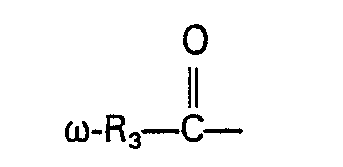
- The compounds of the invention which have the formula,


- The above described synthesis can utilize the racemate or one of the enantiomers as starting material. When the racemic starting material is used in the synthetic procedure, the stereomers obtained in the product can be separated by conventional chromatographic or fractional crystallization methods.
- Compounds of the invention of formula I where R2 is


- The products are obtained typically as a mixture of diastereomers which can be separated by standard methods of fractional crystallization or chromatography.
- The compounds of this invention form basic salts with various inorganic and organic bases which are also within the scope of the invention. Such salts include ammonium salts, alkali metal salts like sodium and potassium salts, alkaline earth metal salts like the calcium and magnesium salts, salts with organic bases, e.g., dicyclohexylamine or benzathine, salts with basic amino acids like arginine, lysine and the like. The pharmaceutically acceptable salts are preferred, although other salts such as the dicyclohexylamine salt are also useful, e.g., in isolating, purifying or characterizing the product.
- The salts are formed in conventional manner by reacting the free acid form of the product with one or more equivalents of the appropriate base providing the desired cation in a solvent or medium in which the salt is insoluble, or in water and removing the water by freeze drying.
- In the compounds of formula I when R3 is heteroaryl containing 1 or 2 nitrogen atoms the pharmaceutically acceptable acid addition salts may be prepared by conventional reactions with equivalent amounts of organic or inorganic acids. As exemplary, but not limiting, of pharmaceutically acceptable acid salts are the salts of hydrochloric, sulfuric, acetic, fumeric, malic, maleic and citric acids.
- The action of the enzyme renin on angiotensinogen, a pseudoglobulin in blood plasma, produces the decapeptide angiotensin I. Angiotensin I is converted by angiotensin converting enzyme (ACE) to the octapeptide angiotensin II. The latter is an active pressor substance which has been implicated as the causative agent in various forms of hypertension in various mammalian species, e.g., rats and dogs. The compounds of this invention intervene in the renin → angiotensin I -j angiotensin II sequence by inhibiting angiotensin I converting enzyme and reducing or eliminating the formation of the pressor substance angiotensin II, and therefore are useful in reducing or relieving hypertension. Thus by the administration of a composition containing one or a combination of compounds of formula I or a pharmaceuctically acceptable salt thereof, hypertension in the species of mammal suffering therefrom is alleviated. A single dose, or preferably two to four divided daily doses, provided on a basis of about 0.1 to 100 mg per kilogram per day, preferably about 1 to 50 mg per kilogram per day is appropriate to reduce blood pressure. The substance is preferably administered orally, but parenteral routes such as subcutaneously, intramuscularly, intravenously or intraperitoneally can also be employed.
- The following Table shows the in vitro activity of compounds of formula V in an assay for angiotensin converting enzyme inhibitory activity which is a modification of a test reported by D. Cushman and H. Cheung, Biochemical Pharmacology, 20,1637-1648 (1971).
- In vitroACEAssay: Angiotensin converting enzyme (ACE) inhibitory activity is determined by assaying guinea pig serum ACE in the presence and absence of the test compound. ACE from guinea pig serum and the test compounds are preincumbated for 10 minutes before the addition of the labelled substrate 3H-hippuryl-glycyl-glycine. After a 60 minute incubation at 37°C the reaction is stopped by the addition of 0.1 N HCI. ACE cleaves the hippuryl-glycyl bond to form the dipeptide glycyl-glycine and 3H-hippuric acid. The 3H-hippuric acid is then extracted with ethyl acetate and the ACE inhibition of a given sample calculated on the basis of the 3H-hippuric acid generated.

- The ICso is the molar concentration of compound which inhibits 50% of the conversion of angiotensin I to angiotension I/.
- The compounds of the invention can be utilized to reduce blood pressure in the form of tablets, capsules or elixirs for oral administration or in sterile solutions or suspensions for parenteral administration. About 10 to 500 mg. of a compound or mixture of compounds of formula I or a pharmaceutically acceptable salt thereof is compounded with a pharmaceutically acceptable vehicle or carrier which may contain excipients, binders, preservatives, stabilizers, flavors, etc., in accord with accepted pharmaceutical practice. The amount of active substance in these compositions or preparations is such that a suitable dosage in the range indicated is obtained.
- Illustrative of the inert ingredients which may be incorporated in tablets, capsules and the like are the following: A binder such a gum tragacanth, acacia, corn starch or gelatin; an excipient such as dicalcium phosphate; a disintegrating agent such as corn starch, potato starch, alginic acid and the like; a lubricant such as magnesium stearate; a sweetening agent such as sucrose, lactose or saccharin; a flavoring agent such as peppermint, oil of wintergreen or cherry. When the dosage unit form is a capsule, it may contain in addition to materials of the above type a liquid carrier such as a fatty oil. Various other materials may be present as coatings or to otherwise modify the physical form of the dosage unit. For instance, tablets may be coated with shellac, sugar or both. A syrup or elixir may contain the active compound, sucrose as a - sweetening agent, methyl and propyl parabens as preservatives, a dye and a flavoring such as cherry or orange flavor.
- Sterile compositions for injection can be formulated according to conventional pharmaceutical practice by dissolving or suspending the active substance in a vehicle such as water for injection, a naturally occurring vegetable oil like sesame oil, coconut oil, peanut oil, cottonseed oil, etc., or a synthetic fatty vehicle like ethyl oleate or the like. Buffers, preservatives, antioxidants and the like can be incorporated as required.
- The invention is illustrated by the following examples.
- A solution of 4.2 g (0.025 mole) of 3-(acetylthio)propanoyl chloride in 10 ml of dichloromethane is added over a period of 20 minutes to a stirred mixture of 4.9 g (0.025 mole) of racemic ethyl (2a,3ap,7a(3)-octahydro-1 H-indole-2-carboxylate and 4.0 g of sodium bicarbonate in 40 ml of water and 90 ml of dichloromethane at 5 to 10°C with cooling. After 40 minutes the two phases are separated and the aqueous phase extracted with 50 ml of dichloromethane. The combined organic extracts are washed first with dilute sulfuric acid (0.01 N), then sodium bicarbonate (0.01 N), and finally water. The organic layer is separated and dried over sodium sulfate. The solvent is removed in vacuo giving 5.8 g of product as a viscous colorless liquid, b.p. 245-247°C (753 mm). Infrared (film): 1745 (ester C=O), 1690 (S-acetyl C=O), 1643 cm-' (amide C=O). Tlc (2:1 acetonitrile-methanol/SiO2) single spot, Rf 0.3.
-

- Utilizing the procedure described in Example 1, ethyl (2a,3aβ,7aβ)-octahydro-1-[3-(acetylthio)-2-methylpropanoyl]-1H-indole-2-carboxylate is produced from ethyl (2a,3aβ,7aβ)-octahydro-1H-indole-2-carboxylate and 3-(acetylthio)-2-methylpropanoyl chloride. The product is a viscous oil, bp 261.6°C (748 mmHg). Infrared (film), 1742 (ester C=O), 1690 (S-acetyl C=O), 1640 cm-1 (amide C=O). Tlc (acetonitrilel Si02) single spot, R, 0.6.

- A solution of 2.05 g (0.01 mole) of (2α,3aβ,7aβ)-octahydro-1 H-indole-2-carboxylic acid hydrochloride in 15 ml of anhydrous pyridine is stirred at 0°C, while 1.81 g (0.01 mole) of 3-(acetylthio)-2-methylpropanoyl chloride is added dropwise over a period of 10 minutes. The stirring is continued for 2 hours, and then the solution is adjusted to pH 3.5 by the slow addition of 15 percent sulfuric acid. The resulting precipitate is dissolved in 100 ml of diethyl ether, and the aqueous phase is extracted with an additional 100 ml of ether. The combined ethereal extracts are washed with saturated sodium chloride solution, dried over sodium sulfate, and then concentrated to 15 ml. After standing overnight 1.4 g of white crystals are obtained by filtration; mp 165-7°C. Recrystallization from cyclohexane-ethyl acetate (1:1) gives 0.9 g of highly pure diastereomer A; mp 168.5-170°C. Infrared (KBr): 1742 (COOH), 1689 (S-acetyl C=O), 1648, 1592 cm-1 (amide C=O).

- After diastereomer A is obtained by filtration, as set forth in Example 4A, 20 ml of isopropyl ether is added to the original filtrate and the solution is concentrated to 15 ml. Upon cooling 0.7 g of additional product; m- 135-7°C, is obtained. Repeated fractional crystallization alternately from hexane and ethyl acetate gives a pure sample of diastereomer B, as a white solid; mp 151.5-153.5°C.
- (2a,3aβ,7aβ)-Octahydro-1-[3-(acetylthio)-2-methylpropanoyl)-1H-indole-2-carboxylic acid (diastereomer A), 1.0 g, is dissolved at room temperature under nitrogen in 5N ammonia in methanol. This is stirred 2.5 hours and then the solvent is removed at reduced pressure. The residue is taken up in water, acidified with a 10% potassium bisulfate solution, and extracted into ethyl acetate. Drying (magnesium sulfate) and concentration of the organic layer gives diastereomer A of the desired product, which is purified by crystallization from ethyl acetate. The pure A isomer has mp 155-156°C.
- Applying the procedure set forth in Example 4B gives diastereomer B of (2a,3aβ,7aβ)-octahydro-1-(3-mercapto-2-methylpropanoyl)-1H-indole-2-carboxylic acid as a white solid, mp 141-142°C.
- (2a,3aβ,7aβ)-Octahydro-1-(3-mercapto-2-methylpropanoyl)-1H-indole-2-carboxylic acid (5 mg) is dissolved in a solution of water (2.5 ml) and an equivalent amount of 1N sodium hydroxide. The solution is freeze dried to obtain the sodium salt.
- (2a,3aβ,7aβ)-Octahydro-1-(3-mercapto-2-methylpropanoyl)-1H-indole-2-carboxylic acid (5 mg) magnesium oxide (49.5 mg) and water (10 ml) are stirred with slight heating until complete solution is obtained. Then the solvent is removed by freeze drying to obtain the magnesium salt.
- (2a,3aβ,7aβ)-Octahydro-1-(3-mercapto-2-methylpropanoyl)-1H-indole-2-carboxylic acid (5 .mg) is dissolved in a mixture of calcium hydroxide (91 mg) and water (10 ml), and the solution is freeze dried to obtain the calcium salt.
- (2a,3aβ,7aβ)-Octahydro-1-(3-mercapto-2-methylpropanoyl)-1H-indole-2-carboxylic acid (5 mg) is dissolved in a mixture of an equivalent amount of potassium bicarbonate and water (10 ml) and freeze dried to obtain the potassium salt.
- Following the procedure of Example 5A, but substituting (/)-(2α,3aβ,7aβ)-octahydro-1-(3-(benzoylthio)-2-methylpropanoyl)-1 H-2-carboxylic acid (diastereomer A) for (2a,3aβ,7aβ)-octahydro-1-[3-(acetylthio)-2-methylpropanoyl]-1H-indole-2-carboxylic acid, (/)-(2a,3aβ,7aβ)-octahydro-1-(3-mercapto-2-methylpropanoyl)-1H-2-carboxylic acid is obtained. This material is purified as the dicyclohexylamine salt; mp 145-148°C,

- A mixture of 2.44 g of 2,2-dimethylpropanoic acid, 1,1'-carboyldiimidazole and 50 ml of dry dimethylformamide is prepared and stirred for 1 hour at room temperature until the evolution of gas ceases. A solution of racemic (2a,3aβ,7aβ)-octahydro-1-(3-mercapto-2-methylpropanoyl)-1H-indole-2-carboxylic acid (diastereomer A) and 2.05 g of triethylamine in 20 ml of dimethylformamide is then added and this mixture is stirred for 18 hours at 25°C. The solvent is removed at reduced pressure and the residue is treated with water, acidified with dilute hydrochloric acid and extracted with ethyl acetate. The organic layer is washed with a saturated sodium chloride solution, dried (magnesium sulfate) and concentrated to dryness to give the desired product. This is purified by recrystallization from ethyl acetate and has mp 134-136°C.
- Following the procedure described in the above reference Example, and substituting propionic acid for 2,2-dimethylpropanoic acid, (2a,3aβ,7aβ)-octahydro-1-[3-(propanoylthio)-2-methylpropanoyl]-1H-indo(e-2-carboxylic acid (diastereomer A) can be obtained. It has mp 170―172°C after recrystallization from acetonitrile.
- A solution of 20.0 g of racemic (2a,3aβ,7aβ)-octahydro-1H-indole-2-carboxylic acid in 200 ml of water is cooled in an ice bath and treated dropwise during 1.5 hours simultaneously but separately with 14.4 ml of benzoyl chloride and 120 ml of 2N sodium hydroxide solution, keeping the pH between 6 and 8. The solution is stirred for an additional 30 minutes and the pH is adjusted to 1.8 with 1 N hydrochloric acid. Racemic N-benzoyl-(2α,3aβ,7aβ)-octahydro-1H-indole-2-carboxylic acid precipitates and is collected by filtration. Recrystallization from aqueous ethanol gives pure product, mp 191-193°C.
- This compound, 87.75 g, is added to a solution of 38.9 g, of (/)-a-phenylethylamine in 700 ml of methanol to form a solution. This is diluted with 1250 ml of ethyl acetate and seeded with a crystal of the resolved salt. The mixture begins to precipitate the desired salt. After standing 18 hours at 5°C, the salt, collected by filtration, has mp 212-215°C (dec.) and [a]o3 = -49.4° (C = 1, methanol). Recrystallization from a 2:1 mixture of ethyl acetate and methanol gives product with the same mp and rotation.
- The levorotatory salt, 48.2 g, is suspended in a mixture of 884 ml of water and 353 ml of methanol and acidified with dilute hydrochloric acidd to pH 2. After 15 minutes, the initial solid dissolves and a new solid separates. Water, 430 ml, is added and the (/)-N-benzoyl-(2α,3aβ,7aβ)-octahydro-1H-indole-2-carboxylic acid is collected by filtration, mp 169-171°C, [a]o3 = -51.4° (C = 1, methanol).
- A suspension of the (I)-benzoate in 200 ml of 6N hydrochloric acid is heated at reflux for 4 hours. The resulting solution is diluted with 100 ml of water and cooled. Filtration removes precipitated benzoic acid. The filtrate is extracted with chloroform and the pH of the aqueous layer is adjusted to 6.5 with dilute sodium hydroxide solution. Concentration of this to dryness gives a solid which is ground and extracted with anhydrous ethanol. Concentration of the ethanol extract gives (/)-(2a,3aβ,7aβ)-octahydro-1 H-indole-2-carboxylic acid which may be purified by passing it through an ion exchange resin in the acid form and eluting with 2N ammonium hydroxide, isolating the solid and recrystallizing this from anhydrous ethanol. The pure (/)-amino acid has mp 265-266°C (dec.),

- 1000 tablets each containing 100 mg of (2a,3aβ,7aβ)-octahydro-1-(3-mercapto-2-methylpropanoyl)-1H-indole-2-carboxylic acid are produced from the following ingredients.
-

- The (2a,3aβ,7aβ)-octahydro-1-(3-mercapto-2-methylpropanoyl)-1H-indole-2-carboxylic acid and corn starch are admixed with an aqueous solution of the gelatin. The mixture is dried and ground to fine powder. The Avicel and then the magnesium stearate are admixed with the granulation. This is then compressed in a tablet press to form 1000 tablets each containing 100 mg of active ingredients.
- 1000 tablets each containing 200 mg of (2a,3aβ,7aβ)-octahydro-1-(3-mercapto-2-methylpropanoyl)-1H-indole-2-carboxylic acid are produced from the following ingredients.
-

- The (2a,3aβ,7aβ)-octahydro-1-(3-mercapto-2-methylpropanoyl)-1H-indole-2-carboxylic acid, lactose and Avicel are admixed, then blended with the corn starch. Magnesium stearate is added. The dry mixture is compressed in a tablet press to form 1000, 505 mg tablets each containing 200 mg of active ingredient. The tablets are coated with a solution of Methocel E 15 (methyl cellulose) including as a color a lake containing yellow No. 6.
- Two piece No. 1 gelatin capsules each containing 250 mg of (2a,3aβ,7aβ)-octahydro-1-(3-mercapto-2-methylpropanoyl)-1H-indole-2-carboxylic acid are filled with a mixture of the followinq inqredients.

-
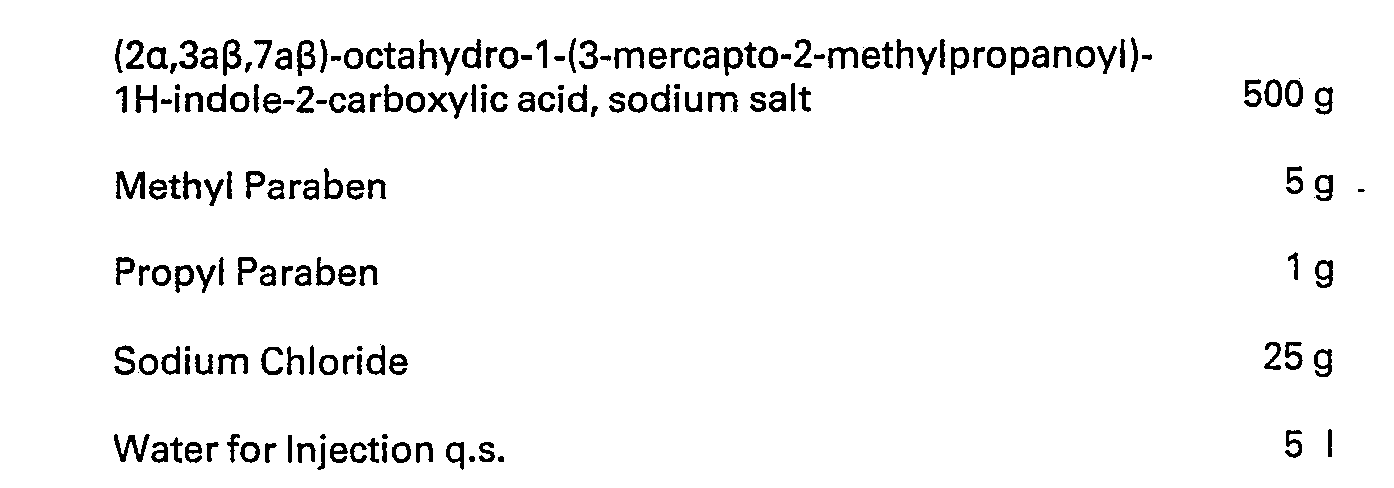
- The active substance, preservatives and sodium chloride are dissolved in 3 liters of water for injection and then the volume is brought up to 5 liters. The solution is filtered through a sterile filter and aseptically filled into presterilized vials which are then closed with presterilized rubber closures. Each vial contains 5 ml of solution in a concentration of 100 mg of active ingredient per ml of solution for injection.
and the pharmaceutically acceptable basic salts thereof.
Claims (14)


Priority Applications (3)
| Application Number | Priority Date | Filing Date | Title |
|---|---|---|---|
| AT83101990T ATE28452T1 (en) | 1980-10-06 | 1981-03-24 | ACYL DERIVATIVES OF OCTAHYDRO-1H-INDOL-2CARBONS|URE. |
| DE8383101990T DE3176323D1 (en) | 1980-10-06 | 1981-03-24 | Substituted acyl derivative of octahydro-1h-indole-2-carboxylic acid |
| AT81301243T ATE25243T1 (en) | 1980-04-02 | 1981-03-24 | ACYL DERIVATIVES OF OCTAHYDRO-1H-INDOL-2CARBONS|URE. |
Applications Claiming Priority (6)
| Application Number | Priority Date | Filing Date | Title |
|---|---|---|---|
| US13710680A | 1980-04-02 | 1980-04-02 | |
| US137106 | 1980-04-02 | ||
| US19430780A | 1980-10-06 | 1980-10-06 | |
| US194307 | 1980-10-06 | ||
| US06/233,940 US4350704A (en) | 1980-10-06 | 1981-02-17 | Substituted acyl derivatives of octahydro-1H-indole-2-carboxylic acids |
| US233940 | 1981-02-17 |
Related Child Applications (2)
| Application Number | Title | Priority Date | Filing Date |
|---|---|---|---|
| EP83101990.6 Division-Into | 1983-03-01 | ||
| EP83101991.4 Division-Into | 1983-03-01 |
Publications (3)
| Publication Number | Publication Date |
|---|---|
| EP0037231A2 EP0037231A2 (en) | 1981-10-07 |
| EP0037231A3 EP0037231A3 (en) | 1982-04-28 |
| EP0037231B1 true EP0037231B1 (en) | 1987-01-28 |
Family
ID=27384960
Family Applications (1)
| Application Number | Title | Priority Date | Filing Date |
|---|---|---|---|
| EP81301243A Expired EP0037231B1 (en) | 1980-04-02 | 1981-03-24 | Substituted acyl derivatives of octahydro-1h-indole-2-carboxylic acids |
Country Status (14)
| Country | Link |
|---|---|
| EP (1) | EP0037231B1 (en) |
| KR (2) | KR850000302B1 (en) |
| AU (1) | AU543861B2 (en) |
| CA (1) | CA1205476A (en) |
| DE (1) | DE3175875D1 (en) |
| DK (2) | DK157851C (en) |
| ES (2) | ES8206474A1 (en) |
| FI (1) | FI76072C (en) |
| HK (1) | HK30489A (en) |
| IE (1) | IE52663B1 (en) |
| IL (1) | IL62294A (en) |
| NO (1) | NO156609C (en) |
| NZ (1) | NZ196704A (en) |
| SG (1) | SG3889G (en) |
Families Citing this family (37)
| Publication number | Priority date | Publication date | Assignee | Title |
|---|---|---|---|---|
| US4599357A (en) * | 1979-12-17 | 1986-07-08 | Ciba-Geigy Corporation | 1-mercaptoalkanoylindoline-2-carboxylic acids |
| DE3177130D1 (en) * | 1980-08-30 | 1990-01-11 | Hoechst Ag | AMINO ACID DERIVATIVES, METHOD FOR THE PRODUCTION THEREOF, MEANS CONTAINING THEM AND THE USE THEREOF. |
| FR2492381A1 (en) * | 1980-10-21 | 1982-04-23 | Science Union & Cie | NOVEL AZA BICYCLO ALKANE CARBOXYLIC ACIDS SUBSTITUTED IN THEIR PREPARATION METHODS AND THEIR USE AS AN ENZYME INHIBITOR |
| EP0050800B2 (en) * | 1980-10-23 | 1995-06-07 | Schering Corporation | Carboxyalkyl dipeptides, processes for their production and pharmaceutical compositions containing them |
| US4374847A (en) * | 1980-10-27 | 1983-02-22 | Ciba-Geigy Corporation | 1-Carboxyalkanoylindoline-2-carboxylic acids |
| GB2086390B (en) * | 1980-11-03 | 1984-06-06 | Ciba Geigy Ag | 1-carboxy-azaalkanoylindoline-2-carboxylic acids process for their manufacture pharmaceutical preparations containing these compounds and their therapeutic application |
| US4479963A (en) * | 1981-02-17 | 1984-10-30 | Ciba-Geigy Corporation | 1-Carboxyalkanoylindoline-2-carboxylic acids |
| DE3260423D1 (en) * | 1981-02-17 | 1984-08-30 | Warner Lambert Co | Substituted acyl derivatives of octahydro-1h-isoindole-1-carboxylic acids and esters |
| DE3134933A1 (en) * | 1981-09-03 | 1983-03-31 | Hoechst Ag, 6230 Frankfurt | "UREA DERIVATIVES, METHOD FOR THE PRODUCTION THEREOF AND THE MEDICINES THEREOF AND THE USE THEREOF" |
| DE3226768A1 (en) * | 1981-11-05 | 1983-05-26 | Hoechst Ag, 6230 Frankfurt | DERIVATIVES OF CIS, ENDO-2-AZABICYCLO- (3.3.0) -OCTAN-3-CARBONIC ACID, METHOD FOR THE PRODUCTION THEREOF, THE MEANS CONTAINING THEM AND THE USE THEREOF |
| ATE25244T1 (en) * | 1981-12-29 | 1987-02-15 | Hoechst Ag | NEW DERIVATIVES OF BICYCLIC AMINO ACIDS, PROCESS FOR THEIR PREPARATION, COMPOSITIONS CONTAINING THEM AND THEIR USE, AS WELL AS NEW BICYCLIC AMINO ACIDS AS INTERMEDIATE STAGES AND PROCESS FOR THEIR PREPARATION. |
| NZ202903A (en) * | 1981-12-29 | 1988-01-08 | Hoechst Ag | 1-- pe pyrrol-2-yl-carboxylic acid derivatives and pharmaceutical compositions |
| DE3210496A1 (en) * | 1982-03-23 | 1983-10-06 | Hoechst Ag | NEW DERIVATIVES OF BICYCLIC AMINO ACIDS, METHOD FOR THE PRODUCTION THEREOF, THE MEANS CONTAINING THEM AND THE USE THEREOF, AND NEW BICYCLIC AMINO ACIDS AS INTERMEDIATE STAGES AND METHOD FOR THE PRODUCTION THEREOF |
| DE3211397A1 (en) * | 1982-03-27 | 1983-11-10 | Hoechst Ag, 6230 Frankfurt | SPIRO (4. (3 + N)) - 2-AZA-3-CARBONIC ACID DERIVATIVES, METHOD FOR THE PRODUCTION THEREOF, THE MEANS CONTAINING THEM AND THEIR USE |
| DE3246503A1 (en) * | 1982-12-16 | 1984-06-20 | Hoechst Ag, 6230 Frankfurt | DERIVATIVES OF CIS, ENDO-2-AZABICYCLO- (5.3.0) -DECAN-3-CARBONIC ACID, METHOD FOR THE PRODUCTION THEREOF, THESE AGENTS AND THE USE THEREOF |
| HU191120B (en) * | 1983-01-31 | 1987-01-28 | Hoechts Ag,De | Process for raceme separation of optically active byciclic imino-alpha-carbonic acid esthers |
| US5175306A (en) * | 1983-01-31 | 1992-12-29 | Hoechst Aktiengesellschaft | Process for the resolution of racemates of optically active bicyclic imino-α-carboxylic esters |
| DE3303344A1 (en) | 1983-02-02 | 1984-08-02 | Hoechst Ag, 6230 Frankfurt | METHOD FOR PRODUCING N-ALKYLATED AMINO ACIDS AND THEIR ESTERS |
| DE3333454A1 (en) * | 1983-09-16 | 1985-04-11 | Hoechst Ag, 6230 Frankfurt | METHOD FOR PRODUCING N-ALKYLATED DIPEPTIDES AND THEIR ESTERS |
| DE3333455A1 (en) * | 1983-09-16 | 1985-04-11 | Hoechst Ag, 6230 Frankfurt | METHOD FOR PRODUCING N-ALKYLATED DIPEPTIDES AND THEIR ESTERS |
| US5684016A (en) * | 1984-04-12 | 1997-11-04 | Hoechst Aktiengesellschaft | Method of treating cardiac insufficiency |
| DE3413710A1 (en) * | 1984-04-12 | 1985-10-24 | Hoechst Ag, 6230 Frankfurt | METHOD FOR TREATING HEART INSUFFICIENCY |
| DE3431541A1 (en) * | 1984-08-28 | 1986-03-06 | Hoechst Ag, 6230 Frankfurt | CIS, ENDO-2-AZABICYCLOALKAN-3-CARBONIC ACID DERIVATIVES, METHOD FOR THE PRODUCTION THEREOF, THEIR USE AND INTERMEDIATE PRODUCTS IN THEIR PRODUCTION |
| US5231080A (en) * | 1985-10-15 | 1993-07-27 | Hoechst Aktiengesellschaft | Method for the treatment of atherosclerosis, thrombosis, and peripheral vessel disease |
| US5231084A (en) * | 1986-03-27 | 1993-07-27 | Hoechst Aktiengesellschaft | Compounds having a cognition adjuvant action, agents containing them, and the use thereof for the treatment and prophylaxis of cognitive dysfuncitons |
| US4749688A (en) * | 1986-06-20 | 1988-06-07 | Schering Corporation | Use of neutral metalloendopeptidase inhibitors in the treatment of hypertension |
| EP0254032A3 (en) | 1986-06-20 | 1990-09-05 | Schering Corporation | Neutral metalloendopeptidase inhibitors in the treatment of hypertension |
| EP0566157A1 (en) | 1986-06-20 | 1993-10-20 | Schering Corporation | Neutral metalloendopeptidase inhibitors in the treatment of hypertension |
| DE3633496A1 (en) * | 1986-10-02 | 1988-04-14 | Hoechst Ag | COMBINATION OF ANGIOTENSIN CONVERTING ENZYME INHIBITORS WITH CALCIUMANTAGONISTS AND THEIR USE IN MEDICINAL PRODUCTS |
| FR2605630B1 (en) * | 1986-10-22 | 1989-06-30 | Roussel Uclaf | PROCESS FOR THE PREPARATION OF OCTAHYDROINDOLE DERIVATIVES AND PREPARATION INTERMEDIATES |
| DE3639879A1 (en) * | 1986-11-21 | 1988-06-01 | Hoechst Ag | METHOD FOR PRODUCING MONO, BI AND TRICYCLIC AMINO ACIDS, INTERMEDIATE PRODUCTS OF THIS METHOD, AND A METHOD FOR PRODUCING THE SAME |
| DE3641451A1 (en) * | 1986-12-04 | 1988-06-16 | Hoechst Ag | DERIVATIVES OF BICYCLIC AMINOCARBONIC ACIDS, METHODS AND INTERMEDIATE PRODUCTS FOR THE PRODUCTION AND USE THEREOF |
| DE3722007A1 (en) * | 1987-07-03 | 1989-01-12 | Hoechst Ag | METHOD FOR PRODUCING BICYCLIC AMINOCARBONIC ACIDS, INTERMEDIATE PRODUCTS OF THIS METHOD AND THE USE THEREOF |
| FR2620703B1 (en) * | 1987-09-17 | 1991-10-04 | Adir | PROCESS FOR THE INDUSTRIAL SYNTHESIS OF PERHYDROINDOLE CARBOXYLIC ACID - 2 (2S, 3AS, 7AS). APPLICATION TO THE SYNTHESIS OF CARBOXYALKYL DIPEPTIDES |
| CA2522195A1 (en) * | 2003-04-15 | 2004-10-28 | Warner-Lambert Company Llc | [b]-fused bicyclic proline derivatives and their use for treating arthritic conditions |
| SI21800A (en) | 2004-05-14 | 2005-12-31 | Krka, Tovarna Zdravil, D.D., Novo Mesto | New procedure of synthesis of perindopril |
| EP1792896A1 (en) | 2005-12-01 | 2007-06-06 | KRKA, tovarna zdravil, d.d., Novo mesto | Process for the preparation of perindopril and salts thereof |
Citations (3)
| Publication number | Priority date | Publication date | Assignee | Title |
|---|---|---|---|---|
| BE608905R (en) * | 1960-12-19 | 1962-04-06 | Bayer Ag | A method of manufacturing a compound which acts on blood pressure. |
| BE611886A (en) * | 1960-12-24 | 1962-06-22 | Bayer Ag | Manufacturing process for guanidine derivatives |
| EP0031741A1 (en) * | 1979-12-07 | 1981-07-08 | SCIENCE UNION ET Cie SOCIETE FRANCAISE DE RECHERCHE MEDICALE | Substituted imino-acids, process for their preparation and their use as enzyme inhibitors |
Family Cites Families (7)
| Publication number | Priority date | Publication date | Assignee | Title |
|---|---|---|---|---|
| US4105776A (en) * | 1976-06-21 | 1978-08-08 | E. R. Squibb & Sons, Inc. | Proline derivatives and related compounds |
| JPS5572169A (en) * | 1978-11-27 | 1980-05-30 | Tanabe Seiyaku Co Ltd | Isoquinoline derivative and its preparation |
| IL58849A (en) * | 1978-12-11 | 1983-03-31 | Merck & Co Inc | Carboxyalkyl dipeptides and derivatives thereof,their preparation and pharmaceutical compositions containing them |
| US4461896A (en) * | 1979-02-07 | 1984-07-24 | Norwich Eaton Pharmaceuticals, Inc. | 1-[Acylthio) and (mercapto)-1-oxoalkyl]-1,2,3,4-tetrahydroquinoline-2-carboxylic acids |
| DE3063420D1 (en) * | 1979-03-26 | 1983-07-07 | Takeda Chemical Industries Ltd | Tetrahydroisoquinolines, their production and the compounds and pharmaceutical compositions containing them for use in the prevention or treatment of hypertension |
| US4303583A (en) * | 1979-08-13 | 1981-12-01 | American Home Products Corporation | 1H,5H-[1,4]Thiazepino[4,3-a]indole-1,5-diones |
| DE2937779A1 (en) * | 1979-09-19 | 1981-04-09 | Hoechst Ag, 6000 Frankfurt | AMINO ACID DERIVATIVES AND METHOD FOR THE PRODUCTION THEREOF |
-
1981
- 1981-03-03 IE IE463/81A patent/IE52663B1/en unknown
- 1981-03-04 IL IL62294A patent/IL62294A/en unknown
- 1981-03-05 CA CA000372381A patent/CA1205476A/en not_active Expired
- 1981-03-24 EP EP81301243A patent/EP0037231B1/en not_active Expired
- 1981-03-24 DE DE8181301243T patent/DE3175875D1/en not_active Expired
- 1981-03-30 FI FI810971A patent/FI76072C/en not_active IP Right Cessation
- 1981-03-31 AU AU68939/81A patent/AU543861B2/en not_active Ceased
- 1981-04-01 NO NO811121A patent/NO156609C/en unknown
- 1981-04-01 KR KR1019810001100A patent/KR850000302B1/en not_active Expired
- 1981-04-01 DK DK148281A patent/DK157851C/en not_active IP Right Cessation
- 1981-04-01 ES ES500965A patent/ES8206474A1/en not_active Expired
- 1981-04-01 NZ NZ196704A patent/NZ196704A/en unknown
- 1981-07-22 ES ES504189A patent/ES504189A0/en active Granted
-
1984
- 1984-09-27 KR KR1019840005928A patent/KR850000303B1/en not_active Expired
-
1988
- 1988-02-22 DK DK091088A patent/DK159419C/en not_active IP Right Cessation
-
1989
- 1989-01-24 SG SG38/89A patent/SG3889G/en unknown
- 1989-04-13 HK HK304/89A patent/HK30489A/en unknown
Patent Citations (3)
| Publication number | Priority date | Publication date | Assignee | Title |
|---|---|---|---|---|
| BE608905R (en) * | 1960-12-19 | 1962-04-06 | Bayer Ag | A method of manufacturing a compound which acts on blood pressure. |
| BE611886A (en) * | 1960-12-24 | 1962-06-22 | Bayer Ag | Manufacturing process for guanidine derivatives |
| EP0031741A1 (en) * | 1979-12-07 | 1981-07-08 | SCIENCE UNION ET Cie SOCIETE FRANCAISE DE RECHERCHE MEDICALE | Substituted imino-acids, process for their preparation and their use as enzyme inhibitors |
Also Published As
| Publication number | Publication date |
|---|---|
| FI76072C (en) | 1988-09-09 |
| DK157851C (en) | 1990-07-30 |
| EP0037231A2 (en) | 1981-10-07 |
| ES500965A0 (en) | 1982-08-16 |
| DE3175875D1 (en) | 1987-03-05 |
| DK91088A (en) | 1988-02-22 |
| ES8205771A1 (en) | 1982-06-16 |
| IE52663B1 (en) | 1988-01-20 |
| IE810463L (en) | 1981-10-02 |
| SG3889G (en) | 1989-06-02 |
| IL62294A0 (en) | 1981-05-20 |
| IL62294A (en) | 1986-07-31 |
| KR850000302B1 (en) | 1985-03-18 |
| FI810971L (en) | 1981-10-03 |
| HK30489A (en) | 1989-04-21 |
| FI76072B (en) | 1988-05-31 |
| KR830005136A (en) | 1983-08-03 |
| AU6893981A (en) | 1981-10-08 |
| AU543861B2 (en) | 1985-05-09 |
| DK159419B (en) | 1990-10-15 |
| DK91088D0 (en) | 1988-02-22 |
| NO156609C (en) | 1987-10-21 |
| ES8206474A1 (en) | 1982-08-16 |
| KR850000303B1 (en) | 1985-03-18 |
| ES504189A0 (en) | 1982-06-16 |
| DK148281A (en) | 1981-10-03 |
| CA1205476A (en) | 1986-06-03 |
| DK159419C (en) | 1991-03-18 |
| NO811121L (en) | 1981-10-05 |
| EP0037231A3 (en) | 1982-04-28 |
| NO156609B (en) | 1987-07-13 |
| NZ196704A (en) | 1984-12-14 |
| DK157851B (en) | 1990-02-26 |
Similar Documents
| Publication | Publication Date | Title |
|---|---|---|
| US4350704A (en) | Substituted acyl derivatives of octahydro-1H-indole-2-carboxylic acids | |
| KR850000302B1 (en) | Process for preparing octahydro-1h-indole-2-carboxylic acid derivatives | |
| US4086338A (en) | N-carboxyalkanoyl derivatives of azetidine-2-carboxylic acid | |
| US4046889A (en) | Azetidine-2-carboxylic acid derivatives | |
| FI79839B (en) | FOERFARANDE FOER FRAMSTAELLNING AV TERAPEUTISKT VERKANDE (S, S, S) -ISOMERER AV SUBSTITUERADE ACYLDERIVAT AV 1,2,3,4-TETRAHYDROISOKINOLIN-3-CARBOXYLSYROR. | |
| US4425355A (en) | Substituted acyl derivatives of chair form of octahydro-1H-indole-2-carboxylic acids | |
| IE51918B1 (en) | Bicyclic compounds their production and use | |
| US4154937A (en) | Hydroxycarbamoylalkylacylpipecolic acid compounds | |
| IE60995B1 (en) | Process for the synthesis of alpha N alkylated amino acids and esters thereof. Application to the synthesis of carboxyalkyl dipeptides. | |
| EP0093805B1 (en) | Octahydro-2-(omega-mercaptoalkanoyl)3-oxo-1h-isoindole-1-carboxylic acids and esters | |
| JPH0247480B2 (en) | ||
| AU2005232938B2 (en) | Process for the preparation of perindopril | |
| US4503043A (en) | Substituted acyl derivatives of octahydro-1H-isoindole-1-carboxylic acids | |
| US4746676A (en) | Carboxyalkyl dipeptide compounds | |
| HAYASHI et al. | Studies on angiotensin-converting enzyme inhibitors. I. Syntheses and angiotensin-converting enzyme inhibitory activity of 2-(3-mercaptopropionyl)-1, 2, 3, 4-tetrahydroisoquinoline-3-carboxylic acid derivatives | |
| IE57600B1 (en) | Isoindoledicarboxylic acid derivatives,their preparation and pharmaceutical compositions containing them | |
| FI76560C (en) | FOR EXAMINATION OF PHARMACEUTICAL PRODUCTS 1- / 2 - / (1-CARBETOXY-3-PHENYLPROPYL) AMINO / -1-OXOPROPYL / -OCTAHYDRO-1H-INDOL-2-CARBOXYL SYRA. | |
| IE52664B1 (en) | Substituted acyl derivative of octahydro-1h-indole-2-carboxylic acid | |
| HU183383B (en) | Process for preparing substituted octahydro-1h-indole-carboxylic acid derivatives | |
| 林公明 et al. | Studies on angiotensin-converting enzyme inhibitors. I. Syntheses and angiotensinconverting enzyme inhibitory activity of 2-(3-mercaptopropionyl)-1, 2, 3, 4-tetrahydroisoquinoline-3-carboxylic acid derivatives. | |
| HU187880B (en) | Process for preparing octqhydro-1h-indola-2-carboxylic acid acyl derivatives | |
| HK1086280B (en) | Novel method for synthesising derivatives (2s, 3as, 7as)-1-[(s)-alanyl]-octahydro,-1hindole-2-carboxylic acid and the use thereof for perindopril synthesis | |
| HK1086280A1 (en) | Novel method for synthesising derivatives (2s, 3as, 7as)-1-[(s)-alanyl]-octahydro,-1hindole-2-carboxylic acid and the use thereof for perindopril synthesis | |
| JPH01110695A (en) | Amino acid derivative as hypotensive agent | |
| HK1086281A1 (en) | Novel method for synthesising perindopril and the pharmaceutically acceptable salt thereof |
Legal Events
| Date | Code | Title | Description |
|---|---|---|---|
| PUAI | Public reference made under article 153(3) epc to a published international application that has entered the european phase |
Free format text: ORIGINAL CODE: 0009012 |
|
| AK | Designated contracting states |
Designated state(s): AT BE CH DE FR GB IT LU NL SE |
|
| 17P | Request for examination filed |
Effective date: 19811015 |
|
| PUAL | Search report despatched |
Free format text: ORIGINAL CODE: 0009013 |
|
| AK | Designated contracting states |
Designated state(s): AT BE CH DE FR GB IT LU NL SE |
|
| ITF | It: translation for a ep patent filed | ||
| GRAA | (expected) grant |
Free format text: ORIGINAL CODE: 0009210 |
|
| AK | Designated contracting states |
Kind code of ref document: B1 Designated state(s): AT BE CH DE FR GB IT LI LU NL SE |
|
| REF | Corresponds to: |
Ref document number: 25243 Country of ref document: AT Date of ref document: 19870215 Kind code of ref document: T |
|
| REF | Corresponds to: |
Ref document number: 3175875 Country of ref document: DE Date of ref document: 19870305 |
|
| PG25 | Lapsed in a contracting state [announced via postgrant information from national office to epo] |
Ref country code: LU Free format text: LAPSE BECAUSE OF NON-PAYMENT OF DUE FEES Effective date: 19870331 |
|
| ET | Fr: translation filed | ||
| PLBE | No opposition filed within time limit |
Free format text: ORIGINAL CODE: 0009261 |
|
| STAA | Information on the status of an ep patent application or granted ep patent |
Free format text: STATUS: NO OPPOSITION FILED WITHIN TIME LIMIT |
|
| 26N | No opposition filed | ||
| PGFP | Annual fee paid to national office [announced via postgrant information from national office to epo] |
Ref country code: LU Payment date: 19890109 Year of fee payment: 9 |
|
| PGFP | Annual fee paid to national office [announced via postgrant information from national office to epo] |
Ref country code: GB Payment date: 19910215 Year of fee payment: 11 |
|
| PGFP | Annual fee paid to national office [announced via postgrant information from national office to epo] |
Ref country code: AT Payment date: 19910225 Year of fee payment: 11 |
|
| PGFP | Annual fee paid to national office [announced via postgrant information from national office to epo] |
Ref country code: SE Payment date: 19910304 Year of fee payment: 11 |
|
| PGFP | Annual fee paid to national office [announced via postgrant information from national office to epo] |
Ref country code: FR Payment date: 19910321 Year of fee payment: 11 |
|
| PGFP | Annual fee paid to national office [announced via postgrant information from national office to epo] |
Ref country code: DE Payment date: 19910327 Year of fee payment: 11 |
|
| ITTA | It: last paid annual fee | ||
| PGFP | Annual fee paid to national office [announced via postgrant information from national office to epo] |
Ref country code: NL Payment date: 19910331 Year of fee payment: 11 |
|
| PGFP | Annual fee paid to national office [announced via postgrant information from national office to epo] |
Ref country code: CH Payment date: 19910408 Year of fee payment: 11 |
|
| PGFP | Annual fee paid to national office [announced via postgrant information from national office to epo] |
Ref country code: BE Payment date: 19910626 Year of fee payment: 11 |
|
| PG25 | Lapsed in a contracting state [announced via postgrant information from national office to epo] |
Ref country code: GB Effective date: 19920324 Ref country code: AT Effective date: 19920324 |
|
| PG25 | Lapsed in a contracting state [announced via postgrant information from national office to epo] |
Ref country code: SE Effective date: 19920325 |
|
| PG25 | Lapsed in a contracting state [announced via postgrant information from national office to epo] |
Ref country code: LI Effective date: 19920331 Ref country code: CH Effective date: 19920331 Ref country code: BE Effective date: 19920331 |
|
| BERE | Be: lapsed |
Owner name: WARNER-LAMBERT CY Effective date: 19920331 |
|
| PG25 | Lapsed in a contracting state [announced via postgrant information from national office to epo] |
Ref country code: NL Effective date: 19921001 |
|
| NLV4 | Nl: lapsed or anulled due to non-payment of the annual fee | ||
| GBPC | Gb: european patent ceased through non-payment of renewal fee | ||
| PG25 | Lapsed in a contracting state [announced via postgrant information from national office to epo] |
Ref country code: FR Effective date: 19921130 |
|
| REG | Reference to a national code |
Ref country code: CH Ref legal event code: PL |
|
| PG25 | Lapsed in a contracting state [announced via postgrant information from national office to epo] |
Ref country code: DE Effective date: 19921201 |
|
| REG | Reference to a national code |
Ref country code: FR Ref legal event code: ST |
|
| EUG | Se: european patent has lapsed |
Ref document number: 81301243.2 Effective date: 19921005 |