EP0036652A2 - Cephalosporin derivatives, process for their preparation, corresponding compositions, their use in the treatment of diseases and intermediates - Google Patents
Cephalosporin derivatives, process for their preparation, corresponding compositions, their use in the treatment of diseases and intermediates Download PDFInfo
- Publication number
- EP0036652A2 EP0036652A2 EP81102131A EP81102131A EP0036652A2 EP 0036652 A2 EP0036652 A2 EP 0036652A2 EP 81102131 A EP81102131 A EP 81102131A EP 81102131 A EP81102131 A EP 81102131A EP 0036652 A2 EP0036652 A2 EP 0036652A2
- Authority
- EP
- European Patent Office
- Prior art keywords
- group
- methyl
- compound
- formula
- oxo
- Prior art date
- Legal status (The legal status is an assumption and is not a legal conclusion. Google has not performed a legal analysis and makes no representation as to the accuracy of the status listed.)
- Ceased
Links
- 0 CC(N(C)CC1*)=NC1=O Chemical compound CC(N(C)CC1*)=NC1=O 0.000 description 1
- ZNQFXUXPDNGZIA-UHFFFAOYSA-N Cc1nc(C(O)=O)n[n]1C Chemical compound Cc1nc(C(O)=O)n[n]1C ZNQFXUXPDNGZIA-UHFFFAOYSA-N 0.000 description 1
Classifications
-
- C—CHEMISTRY; METALLURGY
- C07—ORGANIC CHEMISTRY
- C07D—HETEROCYCLIC COMPOUNDS
- C07D253/00—Heterocyclic compounds containing six-membered rings having three nitrogen atoms as the only ring hetero atoms, not provided for by group C07D251/00
- C07D253/02—Heterocyclic compounds containing six-membered rings having three nitrogen atoms as the only ring hetero atoms, not provided for by group C07D251/00 not condensed with other rings
- C07D253/06—1,2,4-Triazines
- C07D253/065—1,2,4-Triazines having three double bonds between ring members or between ring members and non-ring members
- C07D253/07—1,2,4-Triazines having three double bonds between ring members or between ring members and non-ring members with hetero atoms, or with carbon atoms having three bonds to hetero atoms with at the most one bond to halogen, e.g. ester or nitrile radicals, directly attached to ring carbon atoms
- C07D253/075—Two hetero atoms, in positions 3 and 5
-
- C—CHEMISTRY; METALLURGY
- C07—ORGANIC CHEMISTRY
- C07D—HETEROCYCLIC COMPOUNDS
- C07D249/00—Heterocyclic compounds containing five-membered rings having three nitrogen atoms as the only ring hetero atoms
- C07D249/02—Heterocyclic compounds containing five-membered rings having three nitrogen atoms as the only ring hetero atoms not condensed with other rings
- C07D249/08—1,2,4-Triazoles; Hydrogenated 1,2,4-triazoles
- C07D249/10—1,2,4-Triazoles; Hydrogenated 1,2,4-triazoles with hetero atoms or with carbon atoms having three bonds to hetero atoms with at the most one bond to halogen, e.g. ester or nitrile radicals, directly attached to ring carbon atoms
- C07D249/12—Oxygen or sulfur atoms
Definitions
- R 1 in group (a) can represent lower alkyl, preferably a straight-chain or branched alkyl group with 1-7 carbon atoms, such as ethyl, n-propyl, isopropyl, n-butyl, isobutyl, sec-butyl, t-butyl, n -Pentyl or, especially, methyl.
- R 1 can (together with the oxygen) also represent an easily hydrolyzable ether group.
- R 1 can be, for example, lower alkanoyloxyalkyl, for example acetoxymethyl, pivaloyloxymethyl, 1-acetoxyethyl and 1-pivaloyloxyethyl; lower alkoxycarbonyloxyalkyl, for example methoxycarbonyloxymethyl, 1-ethoxycarbonyloxyethyl and 1-isopropoxycarbonyloxyethyl; Lactonyl groups, for example phthalidyl and thiophthalidyl; lower alkoxymethyl, eg methoxymethyl; and lower alkanoylaminomethyl, for example acetamidomethyl.
- lower alkanoyloxyalkyl for example acetoxymethyl, pivaloyloxymethyl, 1-acetoxyethyl and 1-pivaloyloxyethyl
- lower alkoxycarbonyloxyalkyl for example methoxycarbonyloxymethyl, 1-ethoxycarbonyloxyethyl and 1-
- esters of the compounds of the formula I are to be understood as meaning compounds of the formula I in which at least one carboxy group is in the form of an easily hydrolyzable ester group.
- esters which can be conventional, are the lower alkanoyloxyalkyl esters, for example the acetoxymethyl, pivaloyloxymethyl, 1-acetoxyethyl and 1-pivaloyloxyethyl esters; the lower alkoxycarbonyloxyalkyl esters, for example methoxycarbonyloxymethyl, 1-ethoxycarbonyloxyethyl and 1-isopropoxycarbonyloxyethyl ester; the lactonylesters, for example the phthalidyl and thiophthalidyl esters; the lower alkoxymethyl esters, for example the methoxymethyl ester; and the lower.alkanoylaminomethyl esters, for example the acetamidomethyl ester.
- esters such as the benzyl and cyanomethyl esters, may also be useful.
- the esters can be monoesters or diesters.
- the second ester formation can occur in connection with the carboxy radical of the 3-carboxy-1-methyl-1H-1,2,4-triazol-5-yl group X (group (b)).
- salts of the compounds of formula I are alkali metal salts such as the sodium and potassium salt; the ammonium salt; Alkaline earth metal salts such as the calcium salt; Salts with organic bases, such as salts with amines, e.g. Salts with N-ethyl-piperidine, procaine, dibenzylamine, N, N'-dibenzylethylenediamine, alkylamines or dialkylamines, and salts with amino acids, e.g. Salts with arginine or lysine.
- the salts can be mono-salts or also disalts.
- the second salt formation can occur in compounds with the carboxy radical of the 3-carboxy-1-methyl-1H-1,2,4-triazol-5-yl group X (group (b)).
- the compounds of formula I also form addition salts with organic or inorganic acids.
- such salts are hydrohalides, for example hydrochlorides, hydrobromides, hydroiodides, and also other mineral acid salts, such as sulfates, nitrates, phosphates and the like, alkyl and monoaryl sulfonates, such as ethanesulfonates, toluenesulfonates, benzenesulfonates and the like, and also other organic acid salts, such as Acetates, tartrates, maleates, citrates, benzoates, salicylates, ascorbates and the like.
- the compounds of formula I can be hydrated.
- the hydration can take place in the course of the manufacturing process or can gradually occur as a result of hygroscopic properties of an initially anhydrous product.
- the products according to the invention can be in the synisomeric form or in the anti-isomeric form or as mixtures of these two forms.
- the syn-isomeric form or mixtures in which the syn-isomeric form predominates is preferred.
- Carboxy groups present in the starting compounds of formulas II and III can optionally be protected, e.g. by esterification to an easily cleavable ester such as a silyl ester, e.g. the trimethylsilyl ester.
- the easily hydrolyzable esters described above can also be used.
- the carboxy groups can also be protected by salt formation with an inorganic or tertiary organic base, such as triethylamine.
- Possible R protective groups are, for example, protective groups which can be split off under acidic hydrolysis, e.g. t-butoxycarbonyl or trityl, or also basic hydrolytically removable protective groups, such as Trifluoroacetyl.
- Preferred R-protecting groups are chloro, bromine and iodoacetyl, especially chloroacetyl. The latter protective groups can be split off by treatment with thiourea.
- the starting compounds of formula II can be prepared, for example, by N-acylation of the corresponding 7-amino compound, specifically by using a compound of the general formula in which X 1 has the meaning given above and the carboxy group and / or the amino group in protected ter form can be present with an acid of the general formula in which R has the meaning given above, or is reacted with a reactive functional derivative of this acid and optionally cleaves any carboxy protective groups present.
- the carboxy groups present in the 7-amino compound of the formula IV can optionally be protected, in the manner explained above for the starting compound of the formula II to be prepared.
- the amino group of the compound of formula IV can e.g. protected by a silyl protecting group such as trimethylsilyl.
- Examples of reactive functional derivatives of acids of the formula V are halides, ie chlorides, bromides and fluorides; Azides; Anhydrides, especially mixed anhydrides with stronger acids; reactive esters, for example N-Hy d roxysuccinimidester, and amides, for example imidazolides, into consideration.
- a free acid of formula V can be condensed with one of the esters corresponding to formula IV using a carbodiimide, such as dicylohexylcarbodiimide, in an inert solvent, such as ethyl acetate, acetonitrile, dioxane, chloroform, methylene chloride, benzene or dimethylformamide ! and then split off the ester group.
- oxazolium salts for example N-ethyl-5-phenyl-isoxazolium-3'-sulfonate, can also be used as condensing agents.
- a salt of an acid of formula IV e.g. a trialkylammonium salt such as the triethylammonium salt with a reactive functional derivative of an acid of formula V as mentioned above in an inert solvent, e.g. one of the above to.
- an acid halide preferably the chloride of an acid of the formula V
- the reaction is preferably carried out in the presence of an acid binding agent, e.g. in the presence of aqueous alkali, preferably sodium hydroxide solution, or also in the presence of an alkali metal carbonate, such as potassium carbonate, or in the presence of a lower alkylated amine, such as triethylamine.
- Water is preferably used as the solvent, if appropriate in a mixture with an inert organic solvent, such as tetrahydrofuran or dioxane. It can also be used in an aprotic organic solvent such as e.g. Dimethylformamide, dimethyl sulfoxide or hexamethylphosphoric triamide can be worked.
- silylated starting compounds of formula IV the process is carried out in an anhydrous medium.
- reaction of the 7-amino compound of the formula IV with the acid of the formula V or a reactive functional derivative thereof can expediently take place at temperatures between about -40 ° C. and room temperature, for example at about 0-10 ° C.
- halogens e.g. Chlorine, bromine or iodine
- acyloxy residues e.g. lower alkanoyloxy radicals, such as acetoxy, lower alkyl or arylsulfonyloxy radicals, such as mesyloxy or tosyloxy, or the azidorest in question.
- reaction of the compound of formula VI with the thiol of the formula VII can in a known manner, for example at a temperature between about 40 and 80 ° C, conveniently at about 60 o C, preferably in Water or in a buffer solution with a pH of about 6 to 7, preferably 6.5. If desired, the carboxy group of the compounds II obtained can then be protected, for example by salt formation or esterification.
- the thiols of the formula VII are in tautomeric equilibrium with the corresponding thions in the sense of the formulas below where R 1 has the above meaning or wherein the carboxy group can be protected.
- the preparation of these compounds is described in Examples 1, 2 and 3.
- the R 1 group is generally introduced by using an S-protected thiol (for example by benzhydryl) with the halide containing the R 1 group.
- the iodide in an inert organic solvent in the presence of an acid-binding agent, for example potassium carbonate, preferably at about 10 ° -50 ° C., and the protective group is split off (benzhydryl can be split off with anisole and trifluoroacetic acid at room temperature).
- an acid-binding agent for example potassium carbonate
- the amino protective group R of an initial compound of the formula II is split off.
- Protecting groups which can be split off by acid hydrolysis are preferably added Removed with the help of a lower alkane carboxylic acid, which may be halogenated. In particular, formic acid or trifluoroacetic acid is used.
- the temperature is usually room temperature, although slightly elevated or slightly reduced temperature can also be used, for example in the range from about 0 ° C. to + 40 ° C.
- Protective groups which can be split off under alkaline conditions are generally hydrolyzed with dilute aqueous alkali at 0 ° C. to 30 ° C.
- the chloroacetyl, bromoacetyl and iodoacetyl protective groups can be split off using thiourea in an acidic, neutral or alkaline medium at about 0-30 ° C.
- Hydrogenolytic elimination eg elimination of benzyl is unsuitable here, since the oxime function to the amino group would be reduced during hydrogenolysis.
- any carboxy protective groups present in the reaction product can be split off.
- the protective group is a silyl group (silyl ester)
- this group can be split off particularly easily by treating the reaction product with water.
- Lower alkanoyloxyalkyl, alkoxycarbonyloxyalkyl, lactonyl, alkoxymethyl and alkanoylaminomethyl esters are preferably cleaved off enzymatically using a suitable esterase (at about 20-40 ° C.).
- a carboxy group is protected by salt formation (e.g. with triethylamine), this salt-forming protective group can be split off by treatment with acid.
- the acid can be e.g. Hydrochloric acid, sulfuric acid, phosphoric acid or citric acid can be used. ;
- the carboxy protective groups can be split off in the same way as just described before the protective group R is split off.
- the halide of the formula III used according to the invention can, for example, by reacting a compound of the formula IV with a halogenated carboxylic acid of the general formula in which Y represents a halogen atom, or are prepared with a reactive derivative of this compound.
- the halogenated carboxylic acid of formula VIII is used either in the free form in the presence of a condensing agent, for example an N, N'-disubstituted carbodiimide, such as N, N'-dicyclohexylcarbodiimide, or an azolide compound, such as N, N'-carbonyldiimidazole or N, N '-Thionyldiimidazole or in the form of an acid halide, such as acid chloride or bromide, in the form of an acid anhydride, such as an acid anhydride with a carbonic acid monoester, for example with monomethyl or monoisopropyl carbonate, or in the form of an activated ester, such as the p-nitrophenyl ester, 2 , 4-dinitrophenyl ester, N-hydroxysuccinimide ester or N-hydroxyphthalimide ester.
- a condensing agent for example an N, N'-disub
- the reaction is generally carried out in an inert organic solvent, for example in a halogenated hydrocarbon, such as chloroform, dichloromethane, carbon tetrachloride, in an ether, for example tetrahydrofuran, dioxane, in dimethylformamide, dimethylacetamide, water or mixtures thereof.
- a halogenated hydrocarbon such as chloroform, dichloromethane, carbon tetrachloride
- an ether for example tetrahydrofuran, dioxane, in dimethylformamide, dimethylacetamide, water or mixtures thereof.
- the reaction temperature is primarily in the range from about -50 to + 40 ° C, preferably about -10 to + 10 ° C.
- the inventive reaction of the halide of formula III with thiourea (variant b) of the process according to the invention) is preferably carried out in an inert solvent, such as, for example, in a lower alkanol, for example ethanol, in a lower ketone, such as acetone, in an ether, such as tetrahydrofuran. Dioxane, in dimethylformamide, dimethylacetamide, in water or in mixtures thereof.
- the reaction temperature is generally in the range from about 0 ° C to 60 ° C, preferably at room temperature.
- the chloride, bromide, fluoride or iodide can be used as the halide of the formula III; preference is given to using the chloride or the bromide.
- the free acid of formula III can be used, but optionally also a salt thereof, the same salts as the salts of the compounds of the formula I explained above come into consideration.
- the carboxylic acid is preferably reacted with the corresponding halide containing the ester group, preferably with the iodide.
- the reaction can be carried out using a base, e.g. an alkali metal hydroxide or carbonate, or an organic amine such as triethylamine. If group (b) is present, its carboxy function is also esterified, giving an easily hydrolyzable diester. An excess of the corresponding halide is preferably used.
- the esterification reaction is preferably carried out in an inert organic solvent, such as dimethylacetamide, hexamethylphosphoric triamide, dimethyl sulfoxide or, preferably, dimethylformamide.
- the temperature is preferably in the range of about 0-40 ° C.
- the salts and hydrates of the compounds of the formula I or the hydrates of these salts can be prepared in a manner known per se, e.g. by reacting the carboxylic acid of formula I with an equivalent amount of the desired base, suitably in a solvent such as water or in an organic solvent such as ethanol, methanol, acetone and others. If a second equivalent of base is used, salt formation also takes place on the. Carboxy function of a group (b) which may be present, a disalt being formed.
- the temperature of salt formation is not critical. It is generally at room temperature, but can also be slightly above or below, for example in the range from 0 ° C to + 50 ° C.
- the hydrates are usually produced automatically in the course of the manufacturing process or as a result of hygroscopic properties of an initially anhydrous product.
- a completely or partially anhydrous product (carboxylic acid of the formula I or ester, ether or salt thereof) in a moist atmosphere, e.g. at about + 10 ° C to + 40 ° C.
- the 7-amino compounds of the formula IV used above can be started from a compound of the formula in which Z represents a leaving group and the carboxy group can be protected by salt formation with an inorganic or tertiary organic base, can be prepared with a thiol of the formula VII.
- the reaction can be carried out under the same conditions as those described for the reaction of the starting compounds VI with VII.
- the compounds of the formula VI can be prepared starting from a compound of the formula IX and an acid of the formula V or a reactive functional derivative thereof under the same conditions as were described for the reaction of the compounds of the formulas IV and V.
- the carboxy group and / or the amino group of the compound IV obtained can then be protected, e.g. by esterification or salt formation of the carboxy group or by silylation of the amino group.
- syn / anti mixture of a compound of the formula I obtained can be separated into the corresponding syn and anti forms in a customary manner, for example by recrystallization or by chromatographic methods using a suitable solvent or solvent mixture.
- the compounds of formulas I and II as well as the corresponding readily hydrolyzable esters and salts and the hydrates of these products have antibiotic, in particular bactericidal, activity. They possess a broad Wirkun g s- spectrum against Gram-positive bacteria, eg Staphylokok ken, and against Gram-negative bacteria, such as Haemophilüs ..
- influenzae influenzae, Neisseria gonorrhoeae, as well as against various ⁇ -lactamase-forming Gram-negative pathogens, such as Escherichia coli, Serratia marcescens, Enterobacter cloacae, Pseudomonas aeruginosa, Proteus mirabilis, Proteus vulgaris, Proteus vulgaris .
- the compounds of the formula I and II and the corresponding readily hydrolyzable esters and salts or the hydrates of these products can be used for the treatment and prophylaxis of infectious diseases.
- a daily dose of about 0.1 g to about 2 g is suitable for the adult.
- the parenteral administration of the compounds according to the invention is particularly preferred.
- the products according to the invention can be used as medicaments, for example in the form of pharmaceutical preparations, which they or their salts are mixed with a pharmaceutical, organic or inorganic inert carrier material suitable for enteral or parenteral administration, such as water, gelatin, gum arabic, milk sugar, Contain starch, magnesium stearate, talc, vegetable oils, polyalkylene glycols, petroleum jelly, etc.
- a pharmaceutical, organic or inorganic inert carrier material suitable for enteral or parenteral administration such as water, gelatin, gum arabic, milk sugar, Contain starch, magnesium stearate, talc, vegetable oils, polyalkylene glycols, petroleum jelly, etc.
- the pharmaceutical preparations can be in solid form, for example as tablets, dragees, suppositories, capsules; or in liquid form, for example as solutions, suspensions or emulsions.
- the compounds of the formula I and their salts or hydrates are preferably suitable for parenteral administration and are preferably prepared for this purpose as lyophilisates or dry powder for dilution with conventional agents 1 such as water or isotonic saline.
- the easily hydrolyzable esters of the compounds of the formula I and their salts or hydrates are also suitable for enteral administration.
- the compound used as the starting material in the above process can be prepared as follows:
- the orange filtrate is concentrated with. Hydrochloric acid at 25 ° C to pH 3.5.
- the precipitated substance is filtered off with suction, washed successively with 100 ml of water, .300 ml of acetone and 300 ml of low-boiling petroleum ether and dried overnight at 40 ° C. in vacuo.
- a beige-colored substance is obtained which, for cleaning, is suspended in 1: 1 in 150 ml of water / methanol and 3.6 ml of triethylamine are added dropwise over the course of 1 hour, a dark solution being formed at pH 8.5 which still contains little undissolved matter . After adding 3 g of decolorizing charcoal, the mixture is stirred at 25 ° C.
- This solution is cooled to -30 ° C, mixed with 50 g of ice and stirred at -5 ° C for 10 minutes.
- the methylene chloride phase containing the acid chloride formed is separated off and initially stored at about -15 ° C.
- This acid chloride solution becomes a solution cooled to 0-5 ° C., which can be prepared by adding the (6R, 7R) -7-amino-3 - / [(2,5-dihydro-6-methoxy-2- methyl-5-oxo-as-triazin-3-yl) thio] methyl / -8-oxo-5-thia-1-azabicyclo- [4.2.0] oct-2-en-2-carboxylic acid with 3N sodium hydroxide solution to pH 8.2 was prepared in 500 ml of water, added dropwise over 30 minutes with vigorous stirring, the pH of the being kept at 8.0-8.2 with 3N sodium hydroxide solution using an autotitrator.
- the mixture is stirred at 25 ° C for 2 hours. Then 300 ml of methylene chloride and 2 1 n-butanol are added. The pH is reset to 2 with 3N hydrochloric acid with vigorous stirring. The organic phase is separated off, washed three times with 1 l of water each time, stirred with 20 g of decolorizing charcoal for 15 minutes and filtered. The light yellow filtrate is concentrated in vacuo at 60 ° C, the reaction product precipitates. The latter is filtered off with suction and washed successively with n-butanol, ether and low-boiling petroleum ether and dried overnight at 40 ° C. in vacuo.
- the latter is mixed in a mixture of 300 ml acetone and 50 ml Dissolved methanol and mixed with 35 ml of a 2N solution of 2-ethylcaproic acid sodium salt in ethyl acetate.
- the precipitated sodium salt is filtered off, washed successively with acetone and low-boiling petroleum ether and dried in vacuo at 25 ° C. You get beige-colored .
- the beige-colored filter cake is azeotroped with ethanol under reduced pressure, filtered off, washed with ethanol and low-boiling petroleum ether and dried in vacuo at 40 ° C. This gives a beige-brown fraction II, which is suspended in 2 l of methanol for purification and transfer to the disodium salt, mixed with 50 ml of a 2N solution of the sodium salt of 2-ethyleapronic acid in ethyl acetate and then stirred with 200 ml of water for 30 minutes. Little undissolved, brown material is filtered off and discarded.
- the compound used as the starting material in the above process can be prepared as follows:
- the orange-red Solution is with conc. Hydrochloric acid adjusted to pH 3.
- the precipitated substance is filtered with suction and washed successively with 250 ml of water, 500 ml of acetone, 500 ml of low-boiling petroleum ether and dried overnight in vacuo at 40-45 0 C.
- This compound is, according to paragraph g) of Example 1, starting from 100 g of 2- (2-chloroacetamido-4-thiazolyl) -2- (Z) -methoxyimino-acetic acid and 111.5 g (6R, 7R) -7-amino -3- / 1) 3-carboxy-1-methyl-1,2,4-triazol-5-yl) thio] methyl / 8-oxo-5-thia-1-azabicyclo [4.2.0] oct-2- en-2-carboxylic acid produced.
- a further 250 ml of solvent are distilled off from the mother liquor in vacuo at 40 ° C.
- the material which has precipitated is filtered off with suction, washed with ethanol and low-boiling petroleum ether and dried overnight at 40 ° C. in a high vacuum.
- a beige fraction II is obtained.
- this substance is dissolved in 100 ml of water and mixed with 2 l of ethanol. This solution is strongly concentrated in vacuo at 40 ° C.
- the precipitated material is filtered off with suction, washed with ethanol and low-boiling petroleum ether and dried at 40 ° C. in a high vacuum. Fraction III is obtained and is discarded.
- the solid obtained is filtered off with suction and washed with 50 ml of water.
- the yellow filter cake is stirred well with 250 ml of ethanol, suction filtered, washed with ethanol and dried in vacuo at 40 ° C.
- Colorless crude crystallizate is obtained, which is recrystallized from methanol and provides colorless pure substance with a melting point of 150-153 ° C.
- the aqueous phase is extracted twice with 50 ml of ethyl acetate.
- the combined ethyl acetate phases are dried over sodium sulfate and evaporated in vacuo at 35 ° C.
- the remaining yellow oil is chromatographed on a silica gel column using ethyl acetate as the eluent.
- the fractions containing the desired product are collected and evaporated in vacuo at 35 ° C.
- the remaining pale blue oil is dried in a high vacuum at 25 ° C. for 1 hour, the pure substance being obtained as a pale blue resin.
- 14.56 g of the compound prepared under f) are suspended in 300 ml of ethyl acetate and mixed with 30 ml of N, O-bis (trimethylsilyl) acetamide. The mixture is stirred at 35-40 ° C for 30 minutes, whereby a dark solution is formed. This solution is cooled to -5 ° to -10 ° C and stirred under exclusion of moisture until acylation.
- 592.1 g of tert-butyl acetoacetate are dissolved in 560 ml of glacial acetic acid.
- a solution of 290.6 g of sodium nitrite in 655 ml of water is added dropwise to this solution at 5-10 ° C. for 2 1/2 hours.
- the resulting yellow suspension is stirred at 20 ° C. for 30 minutes, 940 ml of water are added and the mixture is stirred for a further 2 hours.
- the mixture is mixed with 900 ml of water and 900 g of ice and extracted three times with 1 1 of ethyl acetate in the stirring vessel.
- the solution prepared according to 1) is added dropwise over about 30 minutes to the solution prepared according to g) at -10 to 0 ° C.
- the mixture is stirred for 30 minutes at -10 to 0 ° C and 1 hour without cooling; then 300 ml of ethyl acetate and 200 ml of water are added.
- the precipitated material is sucked off and discarded.
- the aqueous phase of the filtrate is separated off and discarded; the organic phase is washed 6 times with 250 ml of water each time, dried with sodium sulfate, strongly concentrated in vacuo at 40 ° C. and then closed poured onto 500 ml ether.
- the precipitated substance is filtered off, washed with ether and low-boiling petroleum ether and dried under high vacuum at 40 ° C overnight. Obtained beige, amorphous pure substance.
- the nuclear magnetic resonance spectrum and the infrared spectrum correspond to the structure given.
Landscapes
- Chemical & Material Sciences (AREA)
- Organic Chemistry (AREA)
- Cephalosporin Compounds (AREA)
- Pharmaceuticals Containing Other Organic And Inorganic Compounds (AREA)
Abstract
Cephalosporinderivate der allgemeinen Formel


Ferner auch entsprechende Präparate, die Verwendung dieser Produkte bei der Behandlung von Krankheiten, die Herstellung der Wirkstoffe sowie dabei anfallende Zwischenprodukte.Furthermore, corresponding preparations, the use of these products in the treatment of diseases, the production of the active ingredients and the resulting intermediates.
Description
Die vorliegende Erfindung betrifft neue Cephalosporinderivate der allgemeinen Formel


R 1 in der Gruppe (a) kann niederes Alkyl darstellen, vorzugsweise eine geradkettige oder verzweigte Alkylgruppe mit.1-7 Kohlenstoffatomen, wie Aethyl, n-Propyl, Isopropyl, n-Butyl, Isobutyl, sec-Butyl, t-Butyl, n-Pentyl oder, insbesondere, Methyl. R1 kann (zusammen mit dem Sauerstoff) ebenfalls eine leicht hydrolysierbare Aethergruppe darsteellen. so karn R1 beispielsweise badeuten: Niederes Alkanoyloxyalkyl, z.B. Acetoxymethyl, Pivaloyloxymethyl, 1-Acetoxyäthyl und 1-Pivaloyloxyäthyl; niederes Alkoxycarbonyloxyalkyl, z.B. Methoxycarbonyloxymethyl, 1-Aethoxycarbonyloxyäthyl und 1-Isopropoxycarbonyloxyäthyl; Lactonylgruppen, z.B. Phthalidyl und Thiophthalidyl; niederes Alkoxymethyl, z.B. Methoxymethyl; und niederes Alkanoylaminomethyl, z.B. Acetamidomethyl. R 1 in group (a) can represent lower alkyl, preferably a straight-chain or branched alkyl group with 1-7 carbon atoms, such as ethyl, n-propyl, isopropyl, n-butyl, isobutyl, sec-butyl, t-butyl, n -Pentyl or, especially, methyl. R 1 can (together with the oxygen) also represent an easily hydrolyzable ether group. R 1 can be, for example, lower alkanoyloxyalkyl, for example acetoxymethyl, pivaloyloxymethyl, 1-acetoxyethyl and 1-pivaloyloxyethyl; lower alkoxycarbonyloxyalkyl, for example methoxycarbonyloxymethyl, 1-ethoxycarbonyloxyethyl and 1-isopropoxycarbonyloxyethyl; Lactonyl groups, for example phthalidyl and thiophthalidyl; lower alkoxymethyl, eg methoxymethyl; and lower alkanoylaminomethyl, for example acetamidomethyl.
Als leicht.hydrolysierbare Ester der Verbindungen der Formel I sind Verbindungen der Formel I zu verstehen, worin mindestens eine Carboxygruppe in Form einer leicht hydrolysierbaren Estergruppe vorliegt. Beispiele solcher Ester, die herkömmlicher Art sein können, sind die niederen Alkanoyloxyalkylester, z.B. der Acetoxymethyl-, Pivaloyloxymethyl-, 1-Acetoxyäthyl- und 1-Pivaloyloxyäthylester; die niederen Alkoxycarbonyloxyalkylester, z.B. der Methoxycarbonyloxymethyl-, 1-Aethoxycarbonyloxyäthyl-und 1-Isopropoxycarbonyloxyäthylester; die Lactonylester, z.B. der Phthalidyl- und Thiophthalidylester; die niederen Alkoxymethylester, z.B. der Methoxymethylester; und die niederen.Alkanoylaminomethylester, z.B. der Acetamidomethylester. Auch andere Ester, z.B. die Benzyl- und Cyanmethylester, können brauchbar sein. Die Ester können Monoester oder auch Diester sein. Die zweite Esterbildung kann in Verbindung mit dem Carboxyrest der 3-Carboxy-1-methyl-1H-1,2,4-triazol-5-ylgruppe X (Gruppe (b)) auftreten.Easily hydrolyzable esters of the compounds of the formula I are to be understood as meaning compounds of the formula I in which at least one carboxy group is in the form of an easily hydrolyzable ester group. Examples of such esters, which can be conventional, are the lower alkanoyloxyalkyl esters, for example the acetoxymethyl, pivaloyloxymethyl, 1-acetoxyethyl and 1-pivaloyloxyethyl esters; the lower alkoxycarbonyloxyalkyl esters, for example methoxycarbonyloxymethyl, 1-ethoxycarbonyloxyethyl and 1-isopropoxycarbonyloxyethyl ester; the lactonylesters, for example the phthalidyl and thiophthalidyl esters; the lower alkoxymethyl esters, for example the methoxymethyl ester; and the lower.alkanoylaminomethyl esters, for example the acetamidomethyl ester. Other esters, such as the benzyl and cyanomethyl esters, may also be useful. The esters can be monoesters or diesters. The second ester formation can occur in connection with the carboxy radical of the 3-carboxy-1-methyl-1H-1,2,4-triazol-5-yl group X (group (b)).
Beispiele von Salzen der Verbindungen der Formel I sind Alkalimetallsalze, wie das Natrium- und Kaliumsalz; das Ammoniumsalz; Erdalkalimetallsalze, wie das Calciumsalz; Salze mit organischen Basen, wie Salze mit Aminen, z.B. Salze mit N-Aethyl-piperidin, Procain, Dibenzylamin, N,N'-Dibenzyläthylendiamin, Alkylaminen oder Dialkylaminen, sowie Salze mit Aminosäuren, wie z.B. Salze mit Arginin oder Lysin. Die Salze können Monosalze oder auch Disalze sein. Die zweite Salzbildung kann in Verbindungen mit i dem Carboxyrest der 3-Carboxy-1-methyl-1H-1,2,4-triazol-5-ylgruppe X (Gruppe (b)) auftreten.Examples of salts of the compounds of formula I are alkali metal salts such as the sodium and potassium salt; the ammonium salt; Alkaline earth metal salts such as the calcium salt; Salts with organic bases, such as salts with amines, e.g. Salts with N-ethyl-piperidine, procaine, dibenzylamine, N, N'-dibenzylethylenediamine, alkylamines or dialkylamines, and salts with amino acids, e.g. Salts with arginine or lysine. The salts can be mono-salts or also disalts. The second salt formation can occur in compounds with the carboxy radical of the 3-carboxy-1-methyl-1H-1,2,4-triazol-5-yl group X (group (b)).
Die Verbindungen der Formel I bilden ebenfalls Additionssalze mit organischen oder anorganischen Säuren. Beispiele solcher Salze sind Hydrohalogenide, beispielsweise Hydrochloride, Hydrobromide, Hydrojodide, sowie andere Mineralsäuresalze, wie Sulfate, Nitrate, Phosphate und dgl., Alkyl- und Monoaryl-sulfonate, wie Aethansulfonate, Toluolsulfonate, Benzolsulfonate und dgl. und auch andere organische Säuresalze, wie Acetate, Tartrate, Maleate, Citrate, Benzoate, Salicylate, Ascorbate und dgl.The compounds of formula I also form addition salts with organic or inorganic acids. Examples of such salts are hydrohalides, for example hydrochlorides, hydrobromides, hydroiodides, and also other mineral acid salts, such as sulfates, nitrates, phosphates and the like, alkyl and monoaryl sulfonates, such as ethanesulfonates, toluenesulfonates, benzenesulfonates and the like, and also other organic acid salts, such as Acetates, tartrates, maleates, citrates, benzoates, salicylates, ascorbates and the like.
Die Verbindungen der Formel I (einschliesslich deren Salze und leicht hydrolysierbare Ester) können hydratisiert sein. Die Hydratisierung kann im Zuge des Herstellungsverfahrens erfolgen oder allmählich als Folge hygroskopischer Eigenschaften eines zunächst wasserfreien Produktes auftreten.The compounds of formula I (including their salts and readily hydrolyzable esters) can be hydrated. The hydration can take place in the course of the manufacturing process or can gradually occur as a result of hygroscopic properties of an initially anhydrous product.
Die erfindungsgemässen Produkte können in der synisomeren Form


Bevorzugte Produkte sind
- - (6R,7R)-7-/2-(2-Amino-4-thiazolyl)-2-[(Z)-methoxy- imino]aeetamido/-3-/C(2,5-dihydro-6-methoxy-2-methyl-5-oxo-as-triazin-3-yl)thio]methyl/-8-oxo-5-thia-1-azabicyclo[4.2.0]oct-2-en-2-carhonsäure (6R,7R)-7-/2-(2-Amino-4-thiazolyl)-2-[(Z)-methoxy- imino]acetamido/-3-/[(3-carboxy-1-methyl-1H-1,2,4-triazol-5-yl)thio]methyl/-8-oxo-5-thia-1-azabicy- clo[4.2.0]oct-2-en-2-carbonsäure
- - (6R,7R)-7-[2-(2-Amino-4-thiazolyl)-2-((Z)-methoxy- iminoiacetamido]-3-[CC2,5-dihydro-2-methyl-5-oxo-6-[(pivaloyloxy)methoxy]-as-triazin-3-yl]thio]methyl]-5-oxo-4-thia-l-azabicyclo[4.2.0]oct-2-en-2-carbonsäure und deren Salze sowie die entsprechenden Hydrate.
- - (6R, 7R) -7- / 2- (2-amino-4-thiazolyl) -2 - [(Z) -methoxy-imino] aeetamido / -3- / C (2,5-dihydro-6-methoxy -2-methyl-5-oxo-as-triazin-3-yl) thio] methyl / -8-oxo-5-thia-1-azabicyclo [4.2.0] oct-2-en-2-carhonic acid (6R, 7R) -7- / 2- (2-amino-4-thiazolyl) -2 - [(Z) -methoxyimino] acetamido / -3 - / [(3-carboxy-1-methyl-1H-1,2 , 4-triazol-5-yl) thio] methyl / -8-oxo-5-thia-1-azabicyclo [4.2.0] oct-2-en-2-carboxylic acid
- - (6R, 7R) -7- [2- (2-amino-4-thiazolyl) -2 - ((Z) -methoxy-iminoiacetamido] -3- [CC2,5-dihydro-2-methyl-5-oxo -6 - [(pivaloyloxy) methoxy] -as-triazin-3-yl] thio] methyl] -5-oxo-4-thia-l-azabicyclo [4.2.0] oct-2-en-2-carboxylic acid and their Salts and the corresponding hydrates.
Die obigen Cephalosporinderivate können erfindungsgemäss dadurch hergestellt werden, dass man
- a) in einer Verbindung der allgemeinen Formel

- b) ein Halogenid der allgemeinen Formel

- c) zur Herstellung eines leicht hydrolysierbaren Esters einer Verbindung der Formel I eine Carbonsäure der Formel I einer entsprechenden Veresterung unterwirft, oder dass man
- d) zur Herstellung von Salzen oder Hydraten einer Verbindung der Formel I bzw. Hydraten dieser Salze eine Verbindung der Formel I in ein Salz oder Hydrat bzw. ein Hydrat dieses Salzes überführt.
- a) in a compound of the general formula
- b) a halide of the general formula
- c) for the preparation of an easily hydrolyzable ester of a compound of formula I, a carboxylic acid of formula I is subjected to a corresponding esterification, or that one
- d) for the preparation of salts or hydrates of a compound of formula I or hydrates of these salts, a compound of formula I is converted into a salt or hydrate or a hydrate of this salt.
In den Ausgangsverbindungen der Formeln II und III vorhandene Carboxygruppen können wahlweise geschützt sein, z.B. durch Veresterung zu einem leicht spaltbaren Ester, wie einem Silylester, z.B. dem Trimethylsilylester. Es kommen auch die oben erläuterten, leicht hydrolysierbaren Ester in Betracht. Die Carboxygruppen können auch durch Salzbildung mit einer anorganischen oder tertiären organischen Base, wie Triäthylamin, geschützt werden. Mögliche R- Schutzgruppen sind beispielsweise sauer-hydrolytisch abspaltbare Schutzgruppen, wie z.B. t-Butoxycarbonyl oder Trityl, oder auch basisch-hydrolytisch abspaltbare Schutzgruppen, wie z.B. Trifluoracetyl. Bevorzugte R-Schutzgruppen sind Chlor-, Brom- und Jodacetyl, insbesondere Chloracetyl. Letztere Schutzgruppen können durch Behandeln mit Thioharnstoff abgespalten werden.Carboxy groups present in the starting compounds of formulas II and III can optionally be protected, e.g. by esterification to an easily cleavable ester such as a silyl ester, e.g. the trimethylsilyl ester. The easily hydrolyzable esters described above can also be used. The carboxy groups can also be protected by salt formation with an inorganic or tertiary organic base, such as triethylamine. Possible R protective groups are, for example, protective groups which can be split off under acidic hydrolysis, e.g. t-butoxycarbonyl or trityl, or also basic hydrolytically removable protective groups, such as Trifluoroacetyl. Preferred R-protecting groups are chloro, bromine and iodoacetyl, especially chloroacetyl. The latter protective groups can be split off by treatment with thiourea.
Die Ausgangsverbindungen der Formel II können z.B. durch N-Acylierung der entsprechenden 7-Aminoverbindung hergestellt werden, und zwar indem man eine Verbindung der allgemeinen Formel


Die in der 7-Aminoverbindung der Formel IV vorhandenen Carboxygruppen können wahlweise geschützt sein, und zwar in der oben für die herzustellende Ausgangsverbindung der Formel II erläuterten Weise. Die Aminogruppe der Verbindung der Formel IV kann z.B. durch eine Silylschutzgruppe, wie Trimethylsilyl, geschützt sein.The carboxy groups present in the 7-amino compound of the formula IV can optionally be protected, in the manner explained above for the starting compound of the formula II to be prepared. The amino group of the compound of formula IV can e.g. protected by a silyl protecting group such as trimethylsilyl.
Als reaktionsfähige funktionelle Derivate von Säuren der Formel V kommen z.B. Halogenide, d.h. Chloride, Bromide und Fluoride; Azide; Anhydride, insbesondere gemischte Anhydride mit stärkeren Säuren; reaktionsfähige Ester, z.B. N-Hydroxysuccinimidester, und Amide, z.B. Imidazolide, in Betracht.Examples of reactive functional derivatives of acids of the formula V are halides, ie chlorides, bromides and fluorides; Azides; Anhydrides, especially mixed anhydrides with stronger acids; reactive esters, for example N-Hy d roxysuccinimidester, and amides, for example imidazolides, into consideration.
Die Umsetzung der 7-Aminoverbindung der Formel IV mit der Säure der Formel V oder einem reaktionsfähigen funktionellen Derivat davon kann in an sich bekannter Weise durchgeführt werden. So kann man z.B. eine freie Säure der Formel V mit einem der erwähnten Ester entsprechend Formel IV mittels eines Carbodiimids, wie Dicylohexylcarbodiimid, in einem inerten Lösungsmittel, wie Aethylacetat,Acetonitril, Dioxan, Chloroform, Methylenchlorid, Benzol oder Dimethylformamid, kondensieren ! und anschliessend die Estergruppe abspalten. Anstelle ! von Carbodiimiden lassen sich als Kondensationsmittel auch Oxazoliumsalze, z.B. N-Aethyl-5-phenyl-isoxazolium-3'-sulfonat, verwenden.The reaction of the 7-amino compound of formula IV with the acid of formula V or a reactive functional derivative thereof can be carried out in a manner known per se. For example, a free acid of formula V can be condensed with one of the esters corresponding to formula IV using a carbodiimide, such as dicylohexylcarbodiimide, in an inert solvent, such as ethyl acetate, acetonitrile, dioxane, chloroform, methylene chloride, benzene or dimethylformamide ! and then split off the ester group. Instead of ! Of carbodiimides, oxazolium salts, for example N-ethyl-5-phenyl-isoxazolium-3'-sulfonate, can also be used as condensing agents.
Nach einer anderen Ausführungsform setzt man ein Salz einer Säure der Formel IV, z.B. ein Trialkylammoniumsalz, wie das Triäthylammoniumsalz, mit einem reaktionsfähigen funktionellen Derivat einer Säure der Formel V wie oben erwähnt in einem inerten Lösungsmittel, z.B. einem der oben genannten, um.In another embodiment, a salt of an acid of formula IV, e.g. a trialkylammonium salt such as the triethylammonium salt with a reactive functional derivative of an acid of formula V as mentioned above in an inert solvent, e.g. one of the above to.
Nach einer weiteren Ausführungsform wird ein Säurehalogenid, vorzugsweise das Chlorid einer Säure der Formel V mit dem Amin der Formel IV umgesetzt. Die Umsetzung erfolgt vorzugsweise in Gegenwart eines säurebindenden Mittels, z.B. in Gegenwart von wässrigem Alkali, vorzugsweise Natronlauge, oder auch in Gegenwart eines Alkalimetallcarbonats, wie Kaliumcarbonat, oder in Gegenwart eines nieder-alkylierten Amins, wie Triäthylamin. Als Lösungsmittel wird vorzugsweise Wasser verwendet, ggfs. im Gemisch mit einem inerten organischen Lösungsmittel, wie Tetrahydrofuran oder Dioxan. Es kann auch in einem aprotischen organischen Lösungsmittel, wie z.B. Dimethylformamid, Dimethylsulfoxid oder Hexamethylphosphorsäuretriamid, gearbeitet werden. Bei Verwendung von silylierten Ausgangsverbindungen der Formel IV wird in wasserfreiem Medium gearbeitet.According to a further embodiment, an acid halide, preferably the chloride of an acid of the formula V, is reacted with the amine of the formula IV. The reaction is preferably carried out in the presence of an acid binding agent, e.g. in the presence of aqueous alkali, preferably sodium hydroxide solution, or also in the presence of an alkali metal carbonate, such as potassium carbonate, or in the presence of a lower alkylated amine, such as triethylamine. Water is preferably used as the solvent, if appropriate in a mixture with an inert organic solvent, such as tetrahydrofuran or dioxane. It can also be used in an aprotic organic solvent such as e.g. Dimethylformamide, dimethyl sulfoxide or hexamethylphosphoric triamide can be worked. When using silylated starting compounds of formula IV, the process is carried out in an anhydrous medium.
Die Umsetzung der 7-Aminoverbindung der Formel IV mit der Säure der Formel V oder einem reaktionsfähigen funktionellen Derivat davon kann zweckmässig bei Temperaturen zwischen etwa -40°C und Zimmertemperatur, beispielsweise bei etwa 0-10°C, erfolgen.The reaction of the 7-amino compound of the formula IV with the acid of the formula V or a reactive functional derivative thereof can expediently take place at temperatures between about -40 ° C. and room temperature, for example at about 0-10 ° C.
Ausgangsverbindungen der Formel II, worin R nicht monchalogeniert ist, wie in Brom-, Chlor- und Jodacetyl, körnen auch durch Thiolierung hergestellt werden, und zwar indem man eine Verbindung der allgemeinen Formel


Als austretende Gruppe Z einer Verbindung der Formel VI kommen beispielsweise Halogene, z.B. Chlor, Brom oder Jod, Acyloxyreste, z.B. niedere Alkanoyloxyreste, wie Acetoxy, niedere Alkyl- oder Arylsulfonyloxyreste, wie Mesyloxy oder Tosyloxy, oder der Azidorest in Frage.As leaving group Z of a compound of formula VI there are for example halogens, e.g. Chlorine, bromine or iodine, acyloxy residues, e.g. lower alkanoyloxy radicals, such as acetoxy, lower alkyl or arylsulfonyloxy radicals, such as mesyloxy or tosyloxy, or the azidorest in question.
Die Umsetzung der Verbindung der Formel VI mit dem Thiol der Formel VII kann in an sich bekannter Weise, z.B. bei einer Temperatur zwischen etwa 40 und 80°C, zweckmässig bei etwa 60oC, vorzugsweise in Wasser oder in einer Pufferlösung mit einem pH von etwa 6 bis 7, vorzugsweise 6,5, durchgeführt werden. Die Carboxygruppe der erhaltenen Verbindungen II kann erwünschtenfalls anschliessend geschützt werden, z.B. durch Salzbildung oder Veresterung.The reaction of the compound of formula VI with the thiol of the formula VII can in a known manner, for example at a temperature between about 40 and 80 ° C, conveniently at about 60 o C, preferably in Water or in a buffer solution with a pH of about 6 to 7, preferably 6.5. If desired, the carboxy group of the compounds II obtained can then be protected, for example by salt formation or esterification.
Die Thiole der Formel VII stehen in tautomerem Gleichgewicht mit den entsprechenden Thionen im Sinne der nachstehenden Formeln


Gemäss Variante a) des erfindungsgemässen Verfahrens wird die Aminoschutzgruppe R einer Ausgangsverbindung der Formel II abgespalten. Durch saure Hydrolyse abspaltbare Schutzgruppen werden vorzugsweise mit Hilfe einer niederen Alkancarbonsäure, die ggfs. halogeniert sein kann, entfernt. Insbesondere verwendet man Ameisensäure oder Trifluoressigsäure. Die Temperatur ist in der Regel Raumtemperatur, obwohl auch leicht erhöhte bzw. leicht erniedrigte Temperatur angewendet werden kann, z.B. im Bereiche von etwa 0°C bis +40°C. Alkalisch abspaltbare Schutzgruppen werden im allgemeinen mit verdünnter wässriger Lauge bei 0°C bis 30°C hydrolysiert. Die Chloracetyl-, Bromacetyl- und Jodacetyl-Schutzgruppen können mittels Thioharnstoff in saurem, neutralem oder alkalischem Milieu bei etwa 0-30°C abgespalten werden. Hydrogenolytische Abspaltung (z.B. Abspaltung von Benzyl) ist hier ungeeignet, da bei der Hydrogenolyse die Oximfunktion zur Aminogruppe reduziert würde.According to variant a) of the process according to the invention, the amino protective group R of an initial compound of the formula II is split off. Protecting groups which can be split off by acid hydrolysis are preferably added Removed with the help of a lower alkane carboxylic acid, which may be halogenated. In particular, formic acid or trifluoroacetic acid is used. The temperature is usually room temperature, although slightly elevated or slightly reduced temperature can also be used, for example in the range from about 0 ° C. to + 40 ° C. Protective groups which can be split off under alkaline conditions are generally hydrolyzed with dilute aqueous alkali at 0 ° C. to 30 ° C. The chloroacetyl, bromoacetyl and iodoacetyl protective groups can be split off using thiourea in an acidic, neutral or alkaline medium at about 0-30 ° C. Hydrogenolytic elimination (eg elimination of benzyl) is unsuitable here, since the oxime function to the amino group would be reduced during hydrogenolysis.
Nach Durchführung der Verfahrensvariante a) können, falls erwünscht, allenfalls im Reaktionsprodukt vorhandene Carboxyschutzgruppen abgespalten werden. Wenn die Schutzgruppe eine Silylgruppe darstellt (Silylester), kann diese Gruppe besonders leicht durch Behandeln des Umsetzungsproduktes mit Wasser abgespalten werden. Niedere Alkanoyloxyalkyl-, Alkoxycarbonyloxyalkyl-, Lactonyl-, Alkoxymethyl- und Alkanoylaminomethylester werden vorzugsweise enzymatisch mit Hilfe einer geeigneten Esterase (bei etwa 20-40°C) abgespalten. Wenn eine Carboxygruppe durch Salzbildung (z.B. mit Triäthylamin) geschützt ist, so kann die Abspaltung dieser salzbildenden Schutzgruppe durch Behandlung mit Säure.erfolgen. Als Säure kann hierbei z.B. Salzsäure, Schwefelsäure, Phosphorsäure oder Citronensäure verwendet werden. ;After carrying out process variant a), if desired, any carboxy protective groups present in the reaction product can be split off. If the protective group is a silyl group (silyl ester), this group can be split off particularly easily by treating the reaction product with water. Lower alkanoyloxyalkyl, alkoxycarbonyloxyalkyl, lactonyl, alkoxymethyl and alkanoylaminomethyl esters are preferably cleaved off enzymatically using a suitable esterase (at about 20-40 ° C.). If a carboxy group is protected by salt formation (e.g. with triethylamine), this salt-forming protective group can be split off by treatment with acid. The acid can be e.g. Hydrochloric acid, sulfuric acid, phosphoric acid or citric acid can be used. ;
Die Carboxyschutzgruppen können in der gleichen Weise wie soeben beschrieben auch vor der Abspaltung der Schutzgruppe R abgespalten werden.The carboxy protective groups can be split off in the same way as just described before the protective group R is split off.
Das erfindungsgemäss eingesetzte Halogenid der Formel III kann z.B. durch Umsetzung einer Verbindung der Formel IV mit einer halogenierten Carbonsäure der allgemeinen Formel

Die erfindungsgemässe Umsetzung des Halogenids der Formel III mit Thioharnstoff (Variante b) des erfindungsgemässen Verfahrens) erfolgt vorzugsweise in einem inerten Lösungsmittel, wie z.B. in einem niederen Alkanol, z.B. Aethanol, in einem niederen Keton, wie Aceton, in einem Aether, wie Tetrahydrofuran, Dioxan, in Dimethylformamid, Dimethylacetamid, in Wasser oder in Mischungen davon. Die Reaktionstemperatur liegt im allgemeinen im Bereich von etwa 0°C bis 60°C, vorzugsweise bei Zimmertemperatur. Als Halogenid der Formel III kann das Chlorid, Bromid, Fluorid oder Jodid eingesetzt werden, bevorzugt verwendet man das Chlorid oder das Bromid. Es kann die freie Säure der Formel III eingesetzt werden, wahlweise aber auch ein Salz davon, wobei die gleichen Salze wie die oben erläuterten Salze der Verbindungen der Formel I in Betracht kommen.The inventive reaction of the halide of formula III with thiourea (variant b) of the process according to the invention) is preferably carried out in an inert solvent, such as, for example, in a lower alkanol, for example ethanol, in a lower ketone, such as acetone, in an ether, such as tetrahydrofuran. Dioxane, in dimethylformamide, dimethylacetamide, in water or in mixtures thereof. The reaction temperature is generally in the range from about 0 ° C to 60 ° C, preferably at room temperature. The chloride, bromide, fluoride or iodide can be used as the halide of the formula III; preference is given to using the chloride or the bromide. The free acid of formula III can be used, but optionally also a salt thereof, the same salts as the salts of the compounds of the formula I explained above come into consideration.
Zur Herstellung der leicht hydrolysierbaren Ester der Carbonsäuren der Formel I gemäss Variante c) wird die Carbonsäure vorzugsweise mit dem entsprechenden, die Estergruppe enthaltenden Halogenid, bevorzugt mit dem Jodid, umgesetzt. Die Reaktion kann mit Hilfe einer Base, z.B. einem Alkalimetallhydroxid oder -carbonat, oder einem organischen Amin, wie Triäthylamin, beschleunigt werden. Bei Vorhandensein der Gruppe (b) wird deren Carboxyfunktion ebenfalls verestert, wobei ein leicht hydrolysierbarer Diester erhalten wird. Vorzugsweise verwendet man dabei einen Ueberschuss an dem entsprechenden Halogenid. Die Veresterungsreaktion wird vorzugsweise in einem inerten organischen Lösungsmittel durchgeführt, wie Dimethylacetamid, Hexamethylphosphorsäuretriamid, Dimethylsulfoxid oder, vorzugsweise, Dimethylformamid. Die Temperatur liegt vorzugsweise im Bereiche von etwa 0-40°C.To produce the readily hydrolyzable esters of the carboxylic acids of the formula I according to variant c), the carboxylic acid is preferably reacted with the corresponding halide containing the ester group, preferably with the iodide. The reaction can be carried out using a base, e.g. an alkali metal hydroxide or carbonate, or an organic amine such as triethylamine. If group (b) is present, its carboxy function is also esterified, giving an easily hydrolyzable diester. An excess of the corresponding halide is preferably used. The esterification reaction is preferably carried out in an inert organic solvent, such as dimethylacetamide, hexamethylphosphoric triamide, dimethyl sulfoxide or, preferably, dimethylformamide. The temperature is preferably in the range of about 0-40 ° C.
Die Herstellung der Salze und Hydrate der Verbindungen der Formel I bzw. der Hydrate dieser Salze kann in an sich bekannter Weise erfolgen, z.B. durch Umsetzung der Carbonsäure der Formel I mit einer äquivalenten Menge der gewünschten Base, zweckmässig in einem Lösungsmittel wie Wasser oder in einem organischen Lösungsmittel, wie Aethanol, Methanol, Aceton und anderen mehr. Bei Verwendung eines zweiten Aequivalents an Base erfolgt Salzbildung auch an der. Carboxyfunktion einer allenfalls vorhandenen Gruppe (b), wobei ein Disalz entsteht. Die Temperatur der Salzbildung ist nicht kritisch. Sie liegt im allgemeinen bei Raumtemperatur, kann aber auch leicht darüber oder darunter, etwa im Bereiche von 0°C bis +50°C, sein.The salts and hydrates of the compounds of the formula I or the hydrates of these salts can be prepared in a manner known per se, e.g. by reacting the carboxylic acid of formula I with an equivalent amount of the desired base, suitably in a solvent such as water or in an organic solvent such as ethanol, methanol, acetone and others. If a second equivalent of base is used, salt formation also takes place on the. Carboxy function of a group (b) which may be present, a disalt being formed. The temperature of salt formation is not critical. It is generally at room temperature, but can also be slightly above or below, for example in the range from 0 ° C to + 50 ° C.
Die Herstellung der Hydrate erfolgt zumeist automatisch im Zuge des Herstellungsverfahrens oder als Folge hygroskopischer Eigenschaften eines zunächst wasserfreien Produktes. Zur gezielten Herstellung eines Hydrats kann ein ganz oder teilweise wasserfreies Produkt (Carbonsäure der Formel I bzw. Ester, Aether oder Salz davon) einer feuchten Atmosphäre, z.B. bei etwa +10°C bis +40°C, ausgesetzt werden.The hydrates are usually produced automatically in the course of the manufacturing process or as a result of hygroscopic properties of an initially anhydrous product. For the targeted production of a hydrate, a completely or partially anhydrous product (carboxylic acid of the formula I or ester, ether or salt thereof) in a moist atmosphere, e.g. at about + 10 ° C to + 40 ° C.
Die oben verwendeten 7-Aminoverbindungen der Formel IV können ausgehend von einer Verbindung der Formel

Die Carboxygruppe und/oder die Aminogruppe der erhaltenen Verbindung IV können erwünschtenfalls anschliessend geschützt werden, z.B. durch Veresterung oder Salzbildung der Carboxygruppe oder durch Silylierung der Aminogruppe.If desired, the carboxy group and / or the amino group of the compound IV obtained can then be protected, e.g. by esterification or salt formation of the carboxy group or by silylation of the amino group.
Ein allenfalls erhaltenes syn/anti-Gemisch einer Verbindung der Formel I kann in die entsprechenden syn-und anti-Formen in üblicher Weise aufgetrennt werden, beispielsweise durch Umkristallisation oder durch chromatographische Methoden unter Verwendung eines geeigneten Lösungsmittels bzw. Lösungsmittelgemisches.Any syn / anti mixture of a compound of the formula I obtained can be separated into the corresponding syn and anti forms in a customary manner, for example by recrystallization or by chromatographic methods using a suitable solvent or solvent mixture.
Die Verbindungen der Formeln I und II sowie die entsprechenden leicht hydrolysierbaren Ester und Salze bzw. die Hydrate dieser Produkte sind antibiotisch, insbeson- dere bakterizid wirksam. Sie besitzen ein breites Wirkungs- spektrum gegen Gram-positive Bakterien, z.B. Staphylokokken, und gegen Gram-negative Bakterien, wie z.B. Haemophilüs.. influenzae, Neisseria gonorrhoeae, sowie gegen verschiedene β-Lactamase-bildende Gram-negative Erreger, wie Escherichia coli, Serratia marcescens, Enterobacter cloacae, Pseudomonas aeruginosa, Proteus mirabilis, Proteus vulgaris.The compounds of formulas I and II as well as the corresponding readily hydrolyzable esters and salts and the hydrates of these products have antibiotic, in particular bactericidal, activity. They possess a broad Wirkun g s- spectrum against Gram-positive bacteria, eg Staphylokok ken, and against Gram-negative bacteria, such as Haemophilüs .. influenzae, Neisseria gonorrhoeae, as well as against various β-lactamase-forming Gram-negative pathogens, such as Escherichia coli, Serratia marcescens, Enterobacter cloacae, Pseudomonas aeruginosa, Proteus mirabilis, Proteus vulgaris, Proteus vulgaris .
Die Verbindungen der Formel I und II sowie die entsprechenden leicht hydrolysierbaren Ester und Salze bzw. die Hydrate dieser Produkte können zur Behandlung und Prophylaxe von Infektionskrankheiten verwendet werden. Für den Erwachsenen kommt eine Tagesdosis von etwa 0,1 g bis etwa 2 g in Betracht. Die parenterale Verabreichung der erfindungsgemässen Verbindungen ist besonders bevor- zugt.The compounds of the formula I and II and the corresponding readily hydrolyzable esters and salts or the hydrates of these products can be used for the treatment and prophylaxis of infectious diseases. A daily dose of about 0.1 g to about 2 g is suitable for the adult. The parenteral administration of the compounds according to the invention is particularly preferred.
Zum Nachweis der antimikrobiellen Wirksamkeit der erwähnten Produkte wurden folgende repräsentative Vertreter getestet:
- Produkt A: (6R,7R)-7-/2-(2-Amino-4-thiazolyl)-2-[(Z)-methoxyimino]acetamido/-3-/[(2,5-dihydro-6- methoxy-2-methyl-5-oxo-as-triazin-3-yl)- ; thio]methyl/-8-oxo-5-thia-1-azabicyclo-[4.2.0]oct-2-en-2-carbonsäure-Natriumsalz
- Produkt B: (6R,7R)-7-/2-(2-Amino-4-thiazolyl)-2-[(Z)-methoxyimino]acetamido/-3-/[(3-carboxy-1-methyl-1H-1,2,4-triazol-5-yl)thio]methyl/-8-oxo-5-thia-1-azabicyclo[4.2.0]oct-2-en-2-carbonsäure-Dinatriumsalz
- Produkt C: (6R,7R)-7-[2-(2-Amino-4-thiazolyl)-2-((Z)-methoxyimino)acetamido]-3-[[[2,5-dihydro-2-methyl-5-oxo-6-[(pivaloyloxy)methoxy]-as- triazin-3-yl]thio]methyl]-5-oxo-4-thia-1-azabicyclo[4.2.0]oct-2-en-2-carbonsäure-Natrium-. salz.
- Product A: (6R, 7R) -7- / 2- (2-amino-4-thiazolyl) -2 - [(Z) -methoxyimino] acetamido / -3 - / [(2,5-dihydro-6-methoxy -2-methyl-5-oxo-as-triazin-3-yl) -; thio] methyl / -8-oxo-5-thia-1-azabicyclo- [4.2.0] oct-2-ene-2-carboxylic acid sodium salt
- Product B: (6R, 7R) -7- / 2- (2-amino-4-thiazolyl) -2 - [(Z) -methoxyimino] acetamido / -3 - / [(3-carboxy-1-methyl-1H -1,2,4-triazol-5-yl) thio] methyl / -8-oxo-5-thia-1-azabicyclo [4.2.0] oct-2-ene-2-carboxylic acid disodium salt
- Product C: (6R, 7R) -7- [2- (2-amino-4-thiazolyl) -2 - ((Z) -methoxyimino) acetamido] -3 - [[[2,5-dihydro-2-methyl -5-oxo-6 - [(pivaloyloxy) methoxy] astriazin-3-yl] thio] methyl] -5-oxo-4-thia-1-azabicyclo [4.2.0] oct-2-en-2 -carboxylic acid-sodium. salt.
Aktivität in vitro: Mindesthemmkonzentration (µg/ml)

Verbindungen der Formel I, worin X die Gruppe (b) darstellt, sowie die entsprechenden Ester, Salze und Hydrate zeichnen sich durch eine lange Halbwertzeit aus, d.h. sie bleiben lange im Organismus und können dementsprechend effektiver ihre keimtötende Funktion ausüben. So zeigt z.B. das Dinatriumsalz von (6R,7R)-7-/-2-(2-Amino-4-thiazolyl)-2-[(Z)-me- thoxyimino]acetamido/-3-/[(3-carboxy-1-methyl-1H-1,2,4-triazol-5-yl)thio]methyl/-8-oxo-5-thia-1-azabieyclo[4.2.0]-oct-2-en-2-carbonsäure eine Halbwertzeit an der Ratte von 22 Min. nach Verabreichung von 20 mg Substanz pro kg Körpergewicht.Compounds of formula I in which X represents group (b) and the corresponding esters, salts and hydrates are distinguished by a long half-life, i.e. they remain in the organism for a long time and can therefore perform their germicidal function more effectively. For example, the disodium salt of (6R, 7R) -7 - / - 2- (2-amino-4-thiazolyl) -2 - [(Z) -methoxyimino] acetamido / -3 - / [(3-carboxy-1- methyl-1H-1,2,4-triazol-5-yl) thio] methyl / -8-oxo-5-thia-1-azabieyclo [4.2.0] oct-2-en-2-carboxylic acid has a half-life the rat 22 min after administration of 20 mg substance per kg body weight.

Die erfindungsgemässen Produkte können als Heilmittel, z.B. in Form pharmazeutischer Präparate Verwendung finden, welche sie oder ihre Salze in Mischung mit einem für die enterale oder parenterale Applikation geeigneten pharmazeutischen, organischen oder anorganischen inerten Trägermaterial, wie z.B. Wasser, Gelatine, Gummi arabicum, Milchzucker, Stärke, Magnesiumstearat, Talk, pflanzliche Oele, Polyalkylenglykole, Vaseline, usw. enthalten. Die pharmazeutischen Präparate können in fester Form, z.B. als Tabletten, Dragees, Suppositorien, Kapseln; oder in flüssiger Form, z.B. als Lösungen, Suspensionen oder Emulsionen, vorliegen. Gegebenenfalls sind sie sterilisiert und bzw. oder enthalten Hilfsstoffe, wie Konservierungs-, Stabilisierungs-, Netz- oder Emulgiermittel, Salze zur Veränderung des osmotischen Druckes, Anaesthetica oder Puffer. Sie können auch noch andere therapeutisch wertvolle Stoffe enthalten. Die Verbindungen der Formel I und ihre Salze bzw. Hydrate kommen vorzugsweise für die parenterale Applikation in Betracht und werden zu diesem Zweck bevorzugt als Lyophilisate oder Trockenpulver zur Verdünnung mit üblichen Agenzien 1wie Wasser oder isotonische Kochsalzlösung, zubereitet. Die leicht hydrolysierbaren Ester der Verbindungen der Formel I und ihre Salze bzw. Hydrate kommen auch für die enterale Verabreichung in Betracht.The products according to the invention can be used as medicaments, for example in the form of pharmaceutical preparations, which they or their salts are mixed with a pharmaceutical, organic or inorganic inert carrier material suitable for enteral or parenteral administration, such as water, gelatin, gum arabic, milk sugar, Contain starch, magnesium stearate, talc, vegetable oils, polyalkylene glycols, petroleum jelly, etc. The pharmaceutical preparations can be in solid form, for example as tablets, dragees, suppositories, capsules; or in liquid form, for example as solutions, suspensions or emulsions. If appropriate, they are sterilized and / or contain auxiliaries, such as preservatives, stabilizers, wetting agents or emulsifiers, salts for changing the osmotic pressure, anesthetics or buffers. They can also contain other therapeutically valuable substances. The compounds of the formula I and their salts or hydrates are preferably suitable for parenteral administration and are preferably prepared for this purpose as lyophilisates or dry powder for dilution with conventional agents 1 such as water or isotonic saline. The easily hydrolyzable esters of the compounds of the formula I and their salts or hydrates are also suitable for enteral administration.
Herstellung des Natriumsalzes der (6R,7R)-7-/2-(2-Amino-4-thiazolyl)-2-[(Z)-methoxyimino]acetamido/-3- /[(2,5-dihydro-6-methoxy-2-methyl-5-oxo-as-triazin-3-yl)thio]methyl/-8-oxo-5-thia-1-azabicyclo[4.2.0]oct-2-en-2-carbonsäurePreparation of the sodium salt of (6R, 7R) -7- / 2- (2-amino-4-thiazolyl) -2 - [(Z) -methoxyimino] acetamido / -3- / [(2,5-dihydro-6- methoxy-2-methyl-5-oxo-as-triazin-3-yl) thio] methyl / -8-oxo-5-thia-1-azabicyclo [4.2.0] oct-2-en-2-carboxylic acid
34,5 g Natriumsalz der (6R,7R)-7-/2-[2-(2-Chloracet- amido)-4-thiazolyl]-2-[(Z)-methoxyimino]acetamido/-3- /[(2,5-dihydro-6-methoxy-2-methyl-5-oxo-as-triazin-3-yl)thio]methyl/-8-oxo-S-thia-1-azabicyclo[4.2.0]oct-2-en-2-carbonsäure werden in 700 ml Wasser zusammen mit 20 g Thioharnstoff gelöst und über Nacht bei 25oC unter Stickstoff-Begasung gerührt, wobei der pH-Wert der Reaktionslösung unter Zugabe von 1N Natronlauge bei 7 gehalten wird. Unter kräftigem Rühren wird der pH-Wert durch Zugabe von 1N Salzsäure auf 4 zurückgestellt. Das dabei ausgefallene Material wird abgenutscht und verworfen. Die gelbe Mutterlauge wird mit 1N Salzsäure auf pH 3 gestellt. Das ausgefallene Produkt wird abgenutscht, mit Wasser, Aethanol und tiefsiedendem Petroläther gewaschen und im Vakuum bei 40°C getrocknet. Man erhält beige-farbene (6R,7R)-7-/2-(2-Amino-4-thiazolyl)-2-[(Z)-methoxyimi- no]acetamido/-3-/[(2,5-dihydro-6-methoxy-2-methyl-5-oxo- as-triazin-3-yl)thio]methyl/-8-oxo-5-thia-1-azabicyclo-[4.2.0]oct-2-en-2-carbonsäure, welche, zwecks Ueberführung in das Natriumsalz, in 350 ml Methanol suspendiert und mit 20 ml einer 2N Lösung von 2-Aethylcapronsäure-Natriumsalz in Essigester versetzt wird. Nach ca. 15 Minuten ist eine Lösung entstanden, welche mit 300 ml Aethanol verdünnt wird. Dabei fällt wenig amorphes Material aus, das abgenutscht und verworfen wird. Das Filtrat wird im Vakuum bei 400C stark eingeengt. Das dabei ausgefallene Material wird abgenutscht, mit Aethanol und tiefsiedendem Petroläther gewaschen, und über Nacht im Hochvakuum bei 40°C getrocknet. Man erhält reines Natriumsalz der (6R,7R)-7-/2-(2-Amino-4-thiazolyl)-2-[(Z)-methoxy- imino]acetamido/-3-/[(2,5-dihydro-6-met'noxy-2-methyl-5-oxo-as -triazin-3-yl)thio]methyl/-8-oxo-5-thia-1-azabicyclo[4.2.0]-oct-2-en-2-carbonsäure als gelbliches Pulver mit 
Die im obigen Verfahren als Ausgangsmaterial verwendete Verbindung kann wie folgt hergestellt werden:The compound used as the starting material in the above process can be prepared as follows:
39,79 g 1,2,5,6-Tetrahydro-5,6-dioxo-3-mercapto-2-methyl-as-triazin werden in 500 ml Dimethylformamid aufgenommen und mit 35 ml Triäthylamin versetzt. Während 15 Minuten werden 39 ml Benzyloxycarbonylchlorid zugetropft, wobei die Temperatur des Reaktionsgemisches auf 450C steigt, Triäthylamin-hydrochlorid ausfällt und die Suspension gelb gefärbt wird. Das Gemisch wird 2 1/2 Stunden bei 25°C gerührt und anschliessend im Vakuum bei 70°C eingedampft. Der ölige Eindampfrückstand wird mit 500 ml Wasser während 1 Stunde verrührt, wobei dieser fest wird. Der Festkörper wird abgenutscht und mit 50 ml Wasser gewaschen. Das gelbe Nutschgut wird mit 250 ml Aethanol gut verrührt, abgenutscht, mit Aethanol gewaschen und im Vakuum bei 40°C getrocknet. Man erhält ein farbloses Rohkristallisat, das aus Methanol umkristallisiert wird und farblosen Tetrahydro-2-methyl-5,6-dioxo-3-thioxo-as-triazin-1(2H)-carbonsäure-benzylester vom Schmelzpunkt 150-153°C liefert.39.79 g of 1,2,5,6-tetrahydro-5,6-dioxo-3-mercapto-2-methyl-as-triazine are taken up in 500 ml of dimethylformamide and mixed with 35 ml of triethylamine. 39 ml of benzyloxycarbonyl chloride are added dropwise over 15 minutes, the temperature of the reaction mixture rising to 45 ° C., triethylamine hydrochloride precipitating out and the suspension being colored yellow. The mixture is stirred for 2 1/2 hours at 25 ° C and then evaporated in vacuo at 70 ° C. The oily evaporation residue is stirred with 500 ml of water for 1 hour, during which it becomes solid. The solid is filtered off and washed with 50 ml of water. The yellow filter cake is stirred well with 250 ml of ethanol, suction filtered, washed with ethanol and dried in vacuo at 40 ° C. A colorless crude crystallizate is obtained which is recrystallized from methanol and gives colorless tetrahydro-2-methyl-5,6-dioxo-3-thioxo-as-triazine-1 (2H) -carboxylic acid benzyl ester with a melting point of 150-153 ° C.
13,2 g Tetrahydro-2-methyl-5,6-dioxo-3-thioxo-as- triazin-1(2H)-carbonsäure-benzylester werden in 500 ml Aethylacetat gelöst und mit einer Lösung von Diphenyldiazomethan in 90 ml tiefsiedendem Petroläther versetzt. Die anfangs violette Reaktionslösung wird 40 Stunden bei 25°C stehen gelassen, wobei die Farbe blassrot wird. Es werden 3 ml Eisessig zugegeben, und das Gemisch wird nach 1 Stunde im Vakuum bei 40°C eingedampft. Man erhält ein gelbes Oel als Eindampfrückstand. Dieses wird mittels Säulenchromatographie an Kieselgel mit den Elutionsmitteln Benzol, Benzol/Aethylacetat 95:5 und Benzol/Aethylacetat 90:10 aufgetrennt. Die die gewünschte Substanz enthaltenden Fraktionen werden gesammelt und im Vakuum bei 40°C eingedampft. Man erhält nach dem Umkristallisieren aus Aethanol farblosen 3-[(Diphenylmethyl)thio]-5,6-dihydro-2-methyl-5,6-dioxo-as-triazin-1(2H)-carbonsäure-benzylester vom Schmelzpunkt 90-92°C.13.2 g of tetrahydro-2-methyl-5,6-dioxo-3-thioxo-astriazin-1 (2H) -carboxylic acid benzyl ester in 500 ml Dissolved ethyl acetate and mixed with a solution of diphenyldiazomethane in 90 ml of low-boiling petroleum ether. The initially violet reaction solution is left to stand at 25 ° C. for 40 hours, the color turning pale red. 3 ml of glacial acetic acid are added, and the mixture is evaporated in vacuo at 40 ° C. after 1 hour. A yellow oil is obtained as an evaporation residue. This is separated by column chromatography on silica gel with the eluents benzene, benzene / ethyl acetate 95: 5 and benzene / ethyl acetate 90:10. The fractions containing the desired substance are collected and evaporated in vacuo at 40 ° C. After recrystallization from ethanol, colorless 3 - [(diphenylmethyl) thio] -5,6-dihydro-2-methyl-5,6-dioxo-as-triazine-1 (2H) -carboxylic acid benzyl ester of melting point 90-9 is obtained 2 ° C.
6,9 g 3-[(Diphenylmethyl)thio]-5,6-dihydro-2-methyl-5,6-dioxo-as-triazin-1(2H)-carbonsäure-benzylester werden in 100 ml Aethylacetat gelöst und mit 30 ml einer wässrigen, 7%igen Ammoniak-Lösung bei 25°C während 15 Minuten gut durchgerührt. Die Aethylacetatphase wird abgetrennt und verworfen. Die wässrige Phase wird mit 7 ml konz. Salzsäure versetzt und 30 Minuten im Eisbad gerührt. Die dabei ausgefallene Substanz wird abgenutscht, mit Wasser gewaschen und sofort aus Aethanol umkristallisiert. Man erhält farbloses 3-1(Diphenylmethyl)thio]-1,2-dihy- dro-2-methyl-as-triazin-5,6-dion vom Schmelzpunkt 180-182 o C. 6.9 g of benzyl 3 - [(diphenylmethyl) thio] -5,6-dihydro-2-methyl-5,6-dioxo-as-triazine-1 (2H) -carboxylate are dissolved in 100 ml of ethyl acetate and mixed with 30 ml of an aqueous 7% ammonia solution at 25 ° C for 15 minutes. The ethyl acetate phase is separated off and discarded. The aqueous phase is concentrated with 7 ml. Hydrochloric acid added and stirred in an ice bath for 30 minutes. The precipitated substance is filtered off, washed with water and immediately recrystallized from ethanol. Of colorless 3-1 (diphenylmethyl) thio] -1,2-dihydroxyacetone dro-2-methyl-as-triazine-5,6-dione of melting point 180-18 2 o C.
3,9 g 3-[(Diphenylmethyl)thio]-1,2-dihydro-2-methyl- as-triazin-5,6-dion werden in 40 ml Dimethylformamid gelöst und mit 1,68 ml Triäthylamin sowie 4 ml Methyljodid versetzt. Nach 2-stündigem Rühren bei 25°C werden dem Gemisch noch 1,38 g Kaliumcarbonat zugegeben um die Reaktion zu beschleunigen. Nach weiterem 2-stündigem Rühren bei 250C ist das Ausgangsmaterial vollständig umgesetzt. Die resultierende, rote Suspension wird auf Wasser gegossen und dreimal mit Aethylacetat extrahiert. Die vereinigten Essigesterextrakte werden mit Wasser gewaschen, über Natriumsulfat getrocknet und im Vakuum bei 40°C eingedampft. Der rote Eindampfrückstand wird mittels Säulenchromatographie an Kieselgel mit Aethylacetat als Elutionsmittel gereinigt. Umkristallisieren aus Aethylacetat/Aether/Petroläther liefert gelbliches 3-[(Diphenylmethyl)thio]-6-methoxy-2-methyl-as-triazin-5(2H)-on vom Schmelzpunkt 135-138°C.3.9 g of 3 - [(diphenylmethyl) thio] -1,2-dihydro-2-methyl-as-triazine-5,6-dione are dissolved in 40 ml of dimethylformamide dissolves and mixed with 1.68 ml of triethylamine and 4 ml of methyl iodide. After stirring for 2 hours at 25 ° C., 1.38 g of potassium carbonate are added to the mixture in order to accelerate the reaction. After stirring for a further 2 hours at 25 ° C., the starting material is completely converted. The resulting red suspension is poured onto water and extracted three times with ethyl acetate. The combined ethyl acetate extracts are washed with water, dried over sodium sulfate and evaporated in vacuo at 40 ° C. The red evaporation residue is purified by column chromatography on silica gel with ethyl acetate as the eluent. Recrystallization from ethyl acetate / ether / petroleum ether gives yellowish 3 - [(diphenylmethyl) thio] -6-methoxy-2-methyl-as-triazine-5 (2H) -one with a melting point of 135-138 ° C.
2,6 g 3-[(Diphenylmethyl)thio]-6-methoxy-2-methyl- as-triazin-5(2H)-on werden in 26 ml Anisol und 50 ml Trifluoressigsäure gelöst und 3 Stunden bei 25°C gerührt. Die Reaktionslösung wird im Vakuum bei 40°C eingedampft. Der Eindampfrückstand wird mit wenig Aethylacetat und viel tiefsiedendem Petroläther verrührt, abgenutscht und aus Methanol umkristallisiert. Man erhält 3,4-Dihydro-6-methoxy-2-methyl-3-thioxo-as-triazin-5(2H)-on als farblose, glänzende Kristalle vom Schmelzpunkt 215-220°C.2.6 g of 3 - [(diphenylmethyl) thio] -6-methoxy-2-methyl-as-triazine-5 (2H) -one are dissolved in 26 ml of anisole and 50 ml of trifluoroacetic acid and stirred at 25 ° C. for 3 hours. The reaction solution is evaporated in vacuo at 40 ° C. The evaporation residue is stirred with a little ethyl acetate and a lot of low-boiling petroleum ether, suction filtered and recrystallized from methanol. 3,4-Dihydro-6-methoxy-2-methyl-3-thioxo-as-triazin-5 (2H) -one is obtained as colorless, shiny crystals with a melting point of 215-220 ° C.
13,6 g 7-Aminocephalosporansäure und 9,53 g 3,4-Di- hydro-6-methoxy-2-methyl-3-thioxo-as-triazin-5(2H)-on werden in 250 ml Wasser suspendiert. Der pH-Wert der Suspension wird bei 25°C mit 1N Natronlauge auf 6,5 gestellt. Die Suspension wird auf 60°C erwärmt und unter Stickstoffbegasung 4 Stunden bei 60°C gerührt, wobei der pH-Wert mit 1N Natronlauge bei 6,5 gehalten wird. Nach 1 Stunde entsteht eine Lösung, nach 2 Stunden beginnt etwas Material auszufallen, und es wird keine Natronlauge mehr verbraucht. Das Gemisch wird auf 25°C abgekühlt und von wenig Ungelöstem mittels Filtration abgetrennt. Das orange Filtrat wird mit konz. Salzsäure bei 25°C auf pH 3,5 gestellt. Die ausgefallene Substanz wird abgenutscht, nacheinander mit 100 ml Wasser,.300 ml Aceton und 300 ml tiefsiedendem Petroläther gewaschen und über Nacht im Vakuum bei 40°C getrocknet. Man erhält eine beige gefärbte Substanz, die zur Reinigung in 150 ml Wasser/Methanol 1:1 suspendiert und mit 3,6 ml Triäthylamin tropfenweise während 1 Stunde versetzt wird, wobei bei pH 8,5 eine dunkle Lösung entsteht, welche noch wenig Ungelöstes enthält. Nach Zugabe von 3 g Entfärbungskohle wird 15 Minuten bei 25°C gerührt, über einen Hartfilter von der Entfärbungskohle abfiltriert und mit 50 ml Wasser/Methanol 1:1 nachgewaschen. Das orange Filtrat wird mit ca. 2 ml konz. Salzsäure auf pH 3 gestellt. Die dabei ausgefallene Substanz wird abgenutscht, nacheinander mit 50 ml Wasser/Methanol 1:1, 100 ml Methanol, 50 ml Aether und 50 ml tiefsiedendem Petroläther gewaschen und über Nacht im Vakuum bei 40°C getrocknet. Man erhält reine, beige-farbene (6R,7R)-7-Amino-3-/[(2,5-dihydro-6-methoxy-2-methyl-5-oxo-as-triazin-3-yl)thioJmethyl/-8-oxo-5-thia-1-azabicyclo[4.2.0]oct-2-en-2-carbonsäure.13.6 g of 7-aminocephalosporanic acid and 9.53 g of 3,4-di-hydro-6-methoxy-2-methyl-3-thioxo-as-triazine-5 (2H) -one are suspended in 250 ml of water. The pH of the Sus Pension is set to 6.5 at 25 ° C with 1N sodium hydroxide solution. The suspension is heated to 60 ° C. and stirred at 60 ° C. for 4 hours while gassing with nitrogen, the pH being kept at 6.5 with 1N sodium hydroxide solution. After 1 hour a solution is formed, after 2 hours some material begins to fail and sodium hydroxide is no longer used. The mixture is cooled to 25 ° C. and separated from a little undissolved by filtration. The orange filtrate is concentrated with. Hydrochloric acid at 25 ° C to pH 3.5. The precipitated substance is filtered off with suction, washed successively with 100 ml of water, .300 ml of acetone and 300 ml of low-boiling petroleum ether and dried overnight at 40 ° C. in vacuo. A beige-colored substance is obtained which, for cleaning, is suspended in 1: 1 in 150 ml of water / methanol and 3.6 ml of triethylamine are added dropwise over the course of 1 hour, a dark solution being formed at pH 8.5 which still contains little undissolved matter . After adding 3 g of decolorizing charcoal, the mixture is stirred at 25 ° C. for 15 minutes, filtered off from the decolorizing charcoal using a hard filter and washed with 50 ml of water / methanol 1: 1. The orange filtrate is concentrated with approx. 2 ml. Hydrochloric acid adjusted to pH 3. The precipitated substance is filtered off with suction, washed successively with 50 ml of water / methanol 1: 1, 100 ml of methanol, 50 ml of ether and 50 ml of low-boiling petroleum ether and dried overnight at 40 ° C. in vacuo. Pure, beige-colored (6R, 7R) -7-amino-3 - / [(2,5-dihydro-6-methoxy-2-methyl-5-oxo-as-triazin-3-yl) thio-methyl / -8-oxo-5-thia-1-azabicyclo [4.2.0] oct-2-ene-2-carboxylic acid.
Zu 200 ml über Calciumchlorid getrocknetem Methylenchlorid werden 25 g Phosphorpentachlorid gegeben. Die Suspension wird unter Rühren auf -10°C abgekühlt, und während ca. 5 Minuten werden 46 ml N,N-Dimethylacetamid zugetropft, wobei die Temperatur auf -5°C ansteigt. Die Suspension wird auf -150C gekühlt und 15 Minuten gerührt. Nach dem Abkühlen auf -20°C werden 33,3 g 2-(2-Chloracet- amido-4-thiazolyl)-2-(Z)-methoxyimino-essigsäure zugegeben und 45 Minuten bei -15°C gerührt, wobei eine gelb-orange Lösung entsteht. Diese Lösung wird auf -30°Cgekühlt, mit 50 g Eis versetzt und 10 Minuten bei -5°C gerührt. Die das gebildete Säurechlorid enthaltende Methylenchlorid-Phase wird abgetrennt und zunächst bei ca. -15°C aufbewahrt. Diese Säurechlorid-Lösung wird einer auf 0-5°C gekühlten Lösung, die durch Versetzen der unter f) hergestellten (6R,7R)-7-Amino-3-/[(2,5-dihydro-6-methoxy-2-methyl-5-oxo- as-triazin-3-yl)thio]methyl/-8-oxo-5-thia-1-azabicyclo-[4.2.0]oct-2-en-2-carbonsäure mit 3N Natronlauge bis pH 8,2 in 500 ml Wasser hergestellt wurde, während 30 Minuten unter kräftigem Rühren zugetropft, wobei der pH-Wert des mit 3N Natronlauge mit Hilfe eines Autotitrators bei 8,0-8,2 gehalten wird. Das Gemisch wird 2 Stunden bei 25°C gerührt. Danach werden 300 ml Methylenchlorid und 2 1 n-Butanol zugegeben. Unter kräftigem Rühren wird das pH mit 3N Salzsäure auf 2 zurückgestellt. Die organische Phase wird abgetrennt, dreimal mit je 1 1 Wasser gewaschen, mit 20 g Entfärbungskohle 15 Minuten lang verrührt und filtriert. Das hellgelbe Filtrat wird im Vakuum bei 60°C stark eingeengt, wobei das Reaktionsprodukt ausfällt. Letzteres wird abgenutscht und nacheinander mit n-Butanol, Aether und tiefsiedendem Petroläther gewaschen und über Nacht im Vakuum bei 40°C getrocknet. Man erhält rohe, beige (6R,7R)-7-/2-[2-(2-Chloracetamido)-4-thiazolyl]-2-[(Z)-methoxyimino]acetamido/-3-/[(2,5-dihydro-6-methoxy-2-methyl-5-oxo-as-triazin-3-yl)thio]methyl/-8-oxo-5-thia-1-azabicyclo[4.2.0]oct-2-en-2-carbonsäure. Zwecks Ueberführung in das Natriumsalz und Reinigung wird letztere in einem Gemisch von 300 ml Aceton und 50 ml Methanol gelöst und mit 35 ml einer 2N Lösung von 2-Aethylcapronsäure-Natriumsalz in Essigester versetzt. Das ausgefallene Natriumsalz wird abgenutscht, nacheinander mit Aceton und tiefsiedendem Petroläther gewaschen und im Vakuum bei 25°C getrocknet. Man erhält beige-farbenes. Natriumsalz der (6R,7R)-7-/2-[2-(2-Chloracetamido)-4-thia- zolyl]-2-[(Z)-methoxyimino]acetamido/-3-/[(2,5-dihydro-6-methoxy-2-methyl-5-oxo-as-triazin-3-yl)thio]methyl/-8-oxo-5-thia-1-azabicyclo[4.2.0]oct-2-en-2-carbonsäure mit [α]25 D = -131,5° (c = 1 in Wasser).To 200 ml of methylene dried over calcium chloride chloride, 25 g of phosphorus pentachloride are added. The suspension is cooled to -10 ° C. with stirring, and 46 ml of N, N-dimethylacetamide are added dropwise over the course of about 5 minutes, the temperature rising to -5 ° C. The suspension is cooled to -15 0 C and stirred for 15 minutes. After cooling to -20 ° C, 33.3 g of 2- (2-chloroacetamido-4-thiazolyl) -2- (Z) -methoxyimino-acetic acid are added and the mixture is stirred at -15 ° C for 45 minutes, one yellow -orange solution arises. This solution is cooled to -30 ° C, mixed with 50 g of ice and stirred at -5 ° C for 10 minutes. The methylene chloride phase containing the acid chloride formed is separated off and initially stored at about -15 ° C. This acid chloride solution becomes a solution cooled to 0-5 ° C., which can be prepared by adding the (6R, 7R) -7-amino-3 - / [(2,5-dihydro-6-methoxy-2- methyl-5-oxo-as-triazin-3-yl) thio] methyl / -8-oxo-5-thia-1-azabicyclo- [4.2.0] oct-2-en-2-carboxylic acid with 3N sodium hydroxide solution to pH 8.2 was prepared in 500 ml of water, added dropwise over 30 minutes with vigorous stirring, the pH of the being kept at 8.0-8.2 with 3N sodium hydroxide solution using an autotitrator. The mixture is stirred at 25 ° C for 2 hours. Then 300 ml of methylene chloride and 2 1 n-butanol are added. The pH is reset to 2 with 3N hydrochloric acid with vigorous stirring. The organic phase is separated off, washed three times with 1 l of water each time, stirred with 20 g of decolorizing charcoal for 15 minutes and filtered. The light yellow filtrate is concentrated in vacuo at 60 ° C, the reaction product precipitates. The latter is filtered off with suction and washed successively with n-butanol, ether and low-boiling petroleum ether and dried overnight at 40 ° C. in vacuo. This gives crude, beige (6R, 7R) -7- / 2- [2- (2-chloroacetamido) -4-thiazolyl] -2 - [(Z) -methoxyimino] acetamido / -3 - / [(2.5 dihydro-6-methoxy-2-methyl-5-oxo-as-triazin-3-yl) thio] methyl / -8-oxo-5-thia-1-azabicyclo [4.2.0] oct-2-en- 2-carboxylic acid. For the purpose of conversion into the sodium salt and purification, the latter is mixed in a mixture of 300 ml acetone and 50 ml Dissolved methanol and mixed with 35 ml of a 2N solution of 2-ethylcaproic acid sodium salt in ethyl acetate. The precipitated sodium salt is filtered off, washed successively with acetone and low-boiling petroleum ether and dried in vacuo at 25 ° C. You get beige-colored . Sodium salt of (6R, 7R) -7- / 2- [2- (2-chloroacetamido) -4-thia-z olyl] -2 - [(Z) -methoxyimino] acetamido / -3 - / [(2,5 dihydro-6-methoxy-2-methyl-5-oxo-as-triazin-3-yl) thio] methyl / -8-oxo-5-thia-1-azabicyclo [4.2.0] oct-2-en- 2-carboxylic acid with [α] 25 D = -131.5 ° (c = 1 in water).
53 g (6R,7R)-3-/[(3-Carboxy-1-methyl-1H-1,2,4-triazol-5-yl)thio]methyl/-7-/2-[2-(2-chloracetamido)-4-thiazolyl]-2-[(Z)-methoxyimino]acetamido/-8-oxo=5-thia-1-aza- bicyclo[4.2.0]oct-2-en-2-carbonsäure werden in 1 1 Wasser zusammen mit 34 g Thioharnstoff suspendiert. Das pH wird durch Zutropfen von 1N Natronlauge auf 7 gestellt, wobei eine dunkelbraune Lösung entsteht. Diese wird über Nacht unter Stickstoffbegasung bei pH 7 gerührt, wobei das pH mit 1N Natronlauge mit Hilfe eines Autotitrators konstant gehalten wird. Das pH der Reaktionslösung wird mit 1N Salzsäure auf 3,5 unter Rühren zurückgestellt. Die ausgefallene Substanz (Fraktion I) wird abgenutscht, mit 250 ml Wasser gewaschen und im Vakuum bei 40°C getrocknet. Die Fraktion I ist braun gefärbt und stark verunreinigt; sie wird verworfen. Die orange Mutterlauge wird mit 1N Salzsäure unter Rühren auf pH 2,65 zurückgestellt. Das ausgefallene Material wird abgenutscht und mit 250 ml Wasser gewaschen. Das beige-farbene Nutschgut wird unter vermindertem Druck mit Aethanol azeotropiert, abgenutscht, mit Aethanol und tiefsiedendem Petroläther gewaschen und im Vakuum bei 40°C getrocknet. Man erhält somit eine beige-braune Fraktion II, welche zwecks Reinigung und Ueberführung in das Dinatriumsalz in 2 1 Methanol suspendiert, mit 50 ml einer 2N Lösung des Natriumsalzes der 2-Aethyleapronsäure in Aethylacetat versetzt und anschliessend mit 200 ml Wasser 30 Minuten gerührt wird. Wenig ungelöstes, braunes Material wird abfiltriert und verworfen. Vom orange gefärbten Filtrat wird im Vakuum bei 40°C ca. 1 1 abgedampft, dann 1 1 Aethanol zugegeben und im Vakuum auf ein Volumen von ca. 500 ml eingeengt. Vom dabei ausgefallenen, schmierigen braunen Harz, welches ein starkes Gemisch darstellt, wird abdekantiert. Die abdekantierte gelborange Lösung wird mit 1 1 Aethanol versetzt und im Vakuum bei 40°C stark eingeengt, wobei teilweise Substanz ausfällt. Nach Zugabe von 2,5 1 Methanol entsteht eine gelbe Lösung, welche im Vakuum bei 40 C stark eingeengt wird. Das dabei ausgefallene Dinatriumsalz wird abgenutscht, mit Methanol und tiefsiedendem Petroläther gewaschen und im Hochvakuum bei 350C getrocknet. Man erhält reines, beige-farbenes Dinatriumsalz der (6R,7R)-7-/2-(2-Amino-4-thiazolyl)-2-[(Z)-methoxyimino]acetamido/-3-/[(3 -carboxy-1-methyl-1H-1,2,4-triazol-5-yl)thio]methyl/-8-oxo-5-thia-1-aza- bicyclo[4.2.0]oct-2-en-2-carbonsäure mit 
Die im obigen Verfahren als Ausgangsmaterial verwendete Verbindung kann wie folgt hergestellt werden:The compound used as the starting material in the above process can be prepared as follows:
12,9 g 1-Methoxyoxalyl-2-methyl-thiosemicarbazid werden einer Lösung von 1,6 g Natrium in 200 ml Methanol zugegeben. Das Gemisch wird 4 Stunden unter Rückfluss gekocht. Die nach einer 1/2 Stunde ausgefallene Substanz wird abgetrennt. Die Mutterlauge wird im Vakuum bei 40°C eingedampft. Der Eindampfrückstand wird in 100 ml Wasser gelöst und mit konz. Salzsäure angesäuert. Das dabei ausgeschiedene Kristallisat liefert nach dem Umkristallisieren aus Wasser reinen, farblosen 4,5-Dihydro-1-methyl-5-thioxo-1H-1,2,4-thiazol-3-carbonsäure-methylester vom Schmelzpunkt 188-190°C (Zers.).12.9 g of 1-methoxyoxalyl-2-methyl-thiosemicarbazide are added to a solution of 1.6 g of sodium in 200 ml of methanol. The mixture is refluxed for 4 hours. The substance that failed after half an hour is separated. The mother liquor is evaporated in vacuo at 40 ° C. The evaporation residue is dissolved in 100 ml of water and with conc. Acidified hydrochloric acid. After recrystallization from water, the precipitated crystals give pure, colorless 4,5-dihydro-1-methyl-5-thioxo-1H-1,2,4-thiazole-3-carboxylic acid methyl ester with a melting point of 188-190 ° C ( Dec.).
3,46 g 4,5-Dihydro-1-methyl-5-thioxo-1H-1,2,4-triazol-3-carbonsäure-methylester werden in 50 ml 1N Natronlauge gelöst.Nach halbstündigem Rühren bei 250C wird die Reaktionslösung mit 25 ml 2N Salzsäure sauer gestellt und im Vakuum bei 40°C eingeengt, wobei die gewünschte Säure kristallisiert. Diese wird abgenutscht, mit Eiswasser gewaschen und im Hochvakuum bei 45°C getrocknet. Man erhält farblose 4,5-Dihydro-1-methyl-5-thioxo-1H-1,2,4-triazol-3-carbonsäure vom Schmelzpunkt 177-178°C (Zers.).3.46 g of 4,5-dihydro-1-methyl-5-thioxo-1H-1,2,4-triazole-3-carboxylic acid methylester in 50 ml of 1N sodium hydroxide solution gelöst.Nach half hours of stirring at 25 0 C, the The reaction solution is acidified with 25 ml of 2N hydrochloric acid and concentrated in vacuo at 40 ° C., the desired acid crystallizing. This is filtered off, washed with ice water and dried at 45 ° C in a high vacuum. Colorless 4,5-dihydro-1-methyl-5-thioxo-1H-1,2,4-triazole-3-carboxylic acid with a melting point of 177-178 ° C. (dec.) Is obtained.
34 g 7-Aminocephalosporansäure werden zusammen mit 25,5 g 4,5-Dihydro-1-methyl-5-thioxo-1H-1,2,4-triazol-3-carbonsäure in 500 ml Wasser suspendiert. Das pH wird mit 3N Natronlauge auf 6,5 gestellt. Das Gemisch wird 4 Stunden bei 55°C unter Stickstoffbegasung gerührt, wobei das pH mit 3N Natronlauge mit Hilfe eines Autotitrators konstant bei 6,5 gehalten wird. Die dunkle Lösung wird auf 25°C gekühlt und mit konz. Salzsäure auf pH 3,5 gestellt. Nach 15 Minuten wird das ausgefallene Material abgenutscht, in 500 ml Wasser suspendiert und mit 3N Natronlauge bei pH 7 in Lösung gebracht. Die orangerote Lösung wird mit konz. Salzsäure auf pH 3 gestellt. Die ausgefallene Substanz wird abgenutscht und nacheinander mit 250 ml Wasser, 500 ml Aceton, 500 ml tiefsiedendem Petroläther gewaschen und über Nacht im Vakuum bei 40-450C getrocknet. Man erhält (6R,7R)-7-Amino-3-/[(3-Carboxy-1-methyl-1,2,4-triazol-5-yl)thio]methyl/-8-oxo-5-thia-1-azabicyclo[4.2.0]oct-2-en-2-carbonsäure als beige gefärbtes Pulver.34 g of 7-aminocephalosporanic acid are suspended in 500 ml of water together with 25.5 g of 4,5-dihydro-1-methyl-5-thioxo-1H-1,2,4-triazole-3-carboxylic acid. The pH is adjusted to 6.5 with 3N sodium hydroxide solution. The mixture is stirred for 4 hours at 55 ° C. under a nitrogen blanket, the pH being kept constant at 6.5 using 3N sodium hydroxide solution with the aid of an autotitrator. The dark solution is cooled to 25 ° C and concentrated with. Hydrochloric acid adjusted to pH 3.5. After 15 minutes, the precipitated material is filtered off, suspended in 500 ml of water and brought into solution with 3N sodium hydroxide solution at pH 7. The orange-red Solution is with conc. Hydrochloric acid adjusted to pH 3. The precipitated substance is filtered with suction and washed successively with 250 ml of water, 500 ml of acetone, 500 ml of low-boiling petroleum ether and dried overnight in vacuo at 40-45 0 C. This gives (6R, 7R) -7-amino-3 - / [(3-carboxy-1-methyl-1,2,4-triazol-5-yl) thio] methyl / -8-oxo-5-thia- 1-azabicyclo [4.2.0] oct-2-en-2-carboxylic acid as a beige colored powder.
, Diese Verbindung wird gemäss Absatz g) von Beispiel 1 ausgehend von 100 g 2-(2-Chloracetamido-4-thiazolyl)-2-(Z)-methoxyimino-essigsäure und 111,5 g (6R,7R)-7-Amino-3-/1)3-carboxy-1-methyl-1,2,4-triazol-5-yl)thio]methyl/ 8-oxo-5-thia-1-azabicyclo[4.2.0]oct-2-en-2-carbonsäure hergestellt. Man erhält beige-farbene (6R,7R)-3-/[(3-car- boxy-1-methyl-1H-1,2,4-triazol-5-yl)thio]methyl/-7-/2-[2-(2-chloracetamido)-4-thiazolyl]-2-[(Z)-methoxyimino]acet- amido/-8-oxo-5-thia-1-azabicyclo[4.2.0]oct-2-en-2-carbonsäure.This compound is, according to paragraph g) of Example 1, starting from 100 g of 2- (2-chloroacetamido-4-thiazolyl) -2- (Z) -methoxyimino-acetic acid and 111.5 g (6R, 7R) -7-amino -3- / 1) 3-carboxy-1-methyl-1,2,4-triazol-5-yl) thio] methyl / 8-oxo-5-thia-1-azabicyclo [4.2.0] oct-2- en-2-carboxylic acid produced. Beige-colored (6R, 7R) -3 - / [(3-c ar - boxy-1-methyl-1H-1,2,4-triazol-5-yl) thio] methyl / -7- / 2 is obtained - [2- (2-chloroacetamido) -4-thiazolyl] -2 - [(Z) -methoxyimino] acetamido / -8-oxo-5-thia-1-azabicyclo [4.2.0] oct-2-ene -2-carboxylic acid.
13,5 g (6R,7R)-7-[4-Brom-1-[(Z)-methoxy- 1 imino]acetoacetamido]-3-[[[2,5-dihydro-2-methyl-5-oxo-6-[(pivaloyloxy)methoxy]-as-triazin-3-yl]thioJmethyl]-8-oxo-5-thia-1-azabicyclo[4.2.0)oct-2-en-2-carbonsäure und 2,96 g Thioharnstoff werden in 80 ml Aethanol gelöst. Die Lösung wird 2 Stunden bei 25°C gerührt und dann mit 22 ml einer 2N Lösung von 2-Aethylcaprcnsäure-Natriumsalz in Aethylacetat versetzt, wobei sofort das Natriumsalz ausfällt. Nun wird mit Aethanol auf 1000 ml verdünnt. Es werden noch 500 ml Methanol hinzugefügt, wobei eine gelbbräunliche Lösung entsteht. Im Vakuum bei 40°C werden ca. 600 ml Lösungsmittel abdestilliert. Das dabei ausgefallene Material wird abgenutscht, mit Aethanol und tiefsiedendem Petroläther gewaschen und im Hochvakuum bei 40°C getrocknet. Man erhält eine bräunliche Fraktion I, welche verworfen wird.13.5 g (6R, 7R) -7- [4-bromo-1 - [(Z) -methoxy-1 imino] acetoacetamido] -3 - [[[2,5-dihydro-2-methyl-5-oxo -6 - [(pivaloyloxy) methoxy] -as-triazin-3-yl] thio-methyl] -8-oxo-5-thia-1-azabicyclo [4.2.0) oct-2-en-2-carboxylic acid and 2.96 g of thiourea are dissolved in 80 ml of ethanol. The solution is stirred for 2 hours at 25 ° C and then with 22 ml of a 2N Solution of 2-ethylcapric acid sodium salt in ethyl acetate, the sodium salt precipitating immediately. Now dilute to 1000 ml with ethanol. 500 ml of methanol are added, giving a yellow-brown solution. About 600 ml of solvent are distilled off in vacuo at 40 ° C. The material which has precipitated out is filtered off with suction, washed with ethanol and low-boiling petroleum ether and dried at 40 ° C. in a high vacuum. A brownish fraction I is obtained, which is discarded.
Aus der Mutterlauge werden im Vakuum bei 40°C weitere 250 ml Lösungsmittel abdestilliert. Das dabei ausgefallene Material wird abgenutscht, mit Aethanol und tiefsiedendem Petroläther gewaschen und über Nacht im Hochvakuum bei 40°C getrocknet. Man erhält eine beige Fraktion II. Zwecks Reinigung wird diese Substanz in 100 ml Wasser gelöst und mit 2 1 Aethanol versetzt. Diese Lösung wird im Vakuum bei 40°C stark eingeengt. Das ausgefallene Material wird abgenutscht, mit Aethanol und tiefsiedendem Petroläther gewaschen und im Hochvakuum bei 40°C getrocknet. Man erhält eine Fraktion III, die verworfen wird. Die Mutterlauge wird noch, zwecks Entfernung von Wasser, 2 mal mit je 1 1 Aethanol versetzt und am Vakuum bei 40°C stark eingeengt. Zuletzt wird noch Aceton zugegeben. Die dabei ausgefallene Substanz wird abgenutscht, mit Aceton und tiefsiedendem Petroläther gewaschen und über Nacht im Hochvakuum bei 40°C getrocknet. Man erhält somit reine, nicht kristalline Titelsubstanz mit [αJ25 D = 124,6° (c = 1 in Wasser). Das Kernresonanzspektrum und die Mikroanalyse entsprechen der angegebenen Struktur.A further 250 ml of solvent are distilled off from the mother liquor in vacuo at 40 ° C. The material which has precipitated is filtered off with suction, washed with ethanol and low-boiling petroleum ether and dried overnight at 40 ° C. in a high vacuum. A beige fraction II is obtained. For purification, this substance is dissolved in 100 ml of water and mixed with 2 l of ethanol. This solution is strongly concentrated in vacuo at 40 ° C. The precipitated material is filtered off with suction, washed with ethanol and low-boiling petroleum ether and dried at 40 ° C. in a high vacuum. Fraction III is obtained and is discarded. To remove water, the mother liquor is mixed twice with 1 l of ethanol each time and concentrated in vacuo at 40 ° C. Finally acetone is added. The substance which has precipitated out is filtered off with suction, washed with acetone and low-boiling petroleum ether and dried overnight at 40 ° C. in a high vacuum. This gives pure, non-crystalline title substance with [αJ 25 D = 124.6 ° (c = 1 in water). The nuclear magnetic resonance spectrum and the microanalysis correspond to the structure given.
Die in obigem Verfahren als Ausgangsmaterial verwendete (6R,7R)-7-[4-Brom-2-[(Z)-methoxyiminoJacetoacetamidoJ-3-[[[2,5-dihydro-2-methyl-5-oxo-6-[(pivaloyloxy)methoxyJ-as- triazin-3-yl]thio]methyl]-8-oxo-5-thia-1-azabicyclo[4.2.0]oct-2-en-2-carbonsäure kann wie folgt hergestellt werden:The (6R, 7R) -7- [4-bromo-2 - [(Z) -methoxyiminoJacetoacetamidoJ-3 - [[[2,5-dihydro-2-methyl-5-oxo-6- [(pivaloyloxy) methoxyJ-as-triazin-3-yl] thio] methyl] -8-oxo-5-thia-1-azabicyclo [4.2.0] oct-2-en-2-carboxylic acid can be prepared as follows:
39,79 g 1,2,5,6-Tetrahydro-5,6-dioxo-3-mercapto-2-methyl-as-triazin werden in 500 ml Dimethylformamid und mit 35 ml Triäthylamin versetzt. Während 15 Minuten werden 39 ml Benzyloxycarbonylchlorid zugetropft, wobei die Temperatur des Reaktionsgemisches auf 45°C steigt, Triäthylamin-hydrochlorid ausfällt und die Suspension gelb gefärbt wird. Das Gemisch wird 2 1/2 Stunden bei 25°C gerührt und anschliessend am Vakuum bei 70°C eingedampft. Der ölige Eindampfrückstand wird mit 500 ml Wasser während 1 Stunde verrührt, wobei dieser fest wird. Der erhaltene Festkörper wird abgenutscht und mit 50 ml Wasser gewaschen. Das gelbe Nutschgut wird mit 250 ml Aethanol gut verrührt, abgenutscht, mit Aethanol gewaschen und im Vakuum bei 40°C getrocknet. Man erhält farbloses Rohkristallisat, das aus Methanol umkristallisiert wird und farblose Reinsubstanz vom Smp. 150-153°C liefert.39.79 g of 1,2,5,6-tetrahydro-5,6-dioxo-3-mercapto-2-methyl-as-triazine are added in 500 ml of dimethylformamide and 35 ml of triethylamine. 39 ml of benzyloxycarbonyl chloride are added dropwise over 15 minutes, the temperature of the reaction mixture rising to 45 ° C., triethylamine hydrochloride precipitating out and the suspension being colored yellow. The mixture is stirred for 2 1/2 hours at 25 ° C and then evaporated in vacuo at 70 ° C. The oily evaporation residue is stirred with 500 ml of water for 1 hour, during which it becomes solid. The solid obtained is filtered off with suction and washed with 50 ml of water. The yellow filter cake is stirred well with 250 ml of ethanol, suction filtered, washed with ethanol and dried in vacuo at 40 ° C. Colorless crude crystallizate is obtained, which is recrystallized from methanol and provides colorless pure substance with a melting point of 150-153 ° C.
13,2 g Tetrahydro-2-methyl-5,6-dioxo-3-thioxo-as- triazin-1(2H)-carbonsäure-benzylester werden in 500 ml Essigester gelöst und mit einer Lösung von Diphenyldiazomethan in 90 ml tiefsiedendem Petroläther versetzt. Die anfangs violette Reaktionslösung wird 40 Stunden bei 25°C stehen gelassen, wobei die Farbe blassrot wird. Es werden 3 ml Eisessig zugegeben, und das Gemisch wird nach 1 Stunde im Vakuum bei 40°C eingedampft. Man erhält ein gelbes Oel als Eindampfrückstand. Dieser wird mittels Säulenchromatographie an Kieselgel mit den Elutionsmitteln Benzol, Benzol/Aethylacetat 95:5 und Benzol/Aethylacetat 90:10 aufgetrennt. Die die gewünschte Substanz enthaltenden Fraktionen werden gesammelt und im Vakuum bei 40°C eingedampft. Man erhält, nach dem Umkristallisieren aus Aethanol, farblose Reinsubstanz vom Smp. 90-92°C.13.2 g of tetrahydro-2-methyl-5,6-dioxo-3-thioxo-astriazin-1 (2H) -carboxylic acid benzyl ester are dissolved in 500 ml of ethyl acetate and mixed with a solution of diphenyldiazomethane in 90 ml of low-boiling petroleum ether . The initially violet reaction solution is left to stand at 25 ° C. for 40 hours, the color turning pale red. 3 ml of glacial acetic acid are added, and the mixture is evaporated in vacuo at 40 ° C. after 1 hour. A yellow oil is obtained as an evaporation residue. This is separated by column chromatography on silica gel with the eluents benzene, benzene / ethyl acetate 95: 5 and benzene / ethyl acetate 90:10. The fractions containing the desired substance are collected and evaporated in vacuo at 40 ° C. It is obtained after recrystallization Ethanol, colorless pure substance with a melting point of 90-92 ° C.
6,9 g der unter b) hergestellten Substanz werden in 100 ml Aethylacetat gelöst und mit 30 ml einer wässrigen, 7%igen Ammoniak-Lösung bei 25°C während 15 Minuten gut durchgerührt. Die Aethylacetatphase wird abgetrennt und verworfen. Die wässrige Phase wird mit 7 ml konz. Salzsäure versetzt und 30 Minuten im Eisbad gerührt. Die dabei ausgefallene Substanz wird abgenutscht, mit Wasser gewaschen und sofort aus Aethanol umkristallisiert. Man erhält farblose Reinsubstanz vom Smp. 180-182°C.6.9 g of the substance prepared under b) are dissolved in 100 ml of ethyl acetate and stirred well with 30 ml of an aqueous, 7% strength ammonia solution at 25 ° C. for 15 minutes. The ethyl acetate phase is separated off and discarded. The aqueous phase is concentrated with 7 ml. Hydrochloric acid added and stirred in an ice bath for 30 minutes. The precipitated substance is filtered off, washed with water and immediately recrystallized from ethanol. Colorless pure substance of mp 180-182 ° C. is obtained.
3,25 g der unter c) hergestellten Verbindung werden in 40 ml Dimethylformamid gelöst und mit 1,52 g Kaliumcarbonat versetzt. Zu diesem Gemisch werden auf einmal 2,66 g Pivaloyloxymethyljodid gegeben, wobei eine blassgelbe Lösung entsteht. Das Reaktionsgemisch wird 4 Stunden bei 25°C gerührt und noch einmal mit 2,66 g Pivaloyloxymethyljodid versetzt. Dieses Gemisch wird 15 Stunden bei 25°C gerührt und anschliessend im Hochvakuum bei 35°C eingedampft. Der resultierende Eindampfrückstand wird zwischen 100 ml Wasser und 100 ml Aethylacetat verteilt. Die wässrige Phase wird noch zweimal mit je 50 ml Aethylacetat extrahiert. Die vereinigten Aethylacetat-Phasen werden über Natriumsulfat getrocknet und im Vakuum bei 35°C eingedampft. Das verbleibende gelbe Oel wird an einer Kieselgelsäule mit Aethylacetat als Elutionsmittel chromatographiert. Die das gewünschte Produkt enthaltenden Fraktionen werden gesammelt und im Vakuum bei 35°C eingedampft. Das verbleibende blassblaue Oel wird im Hochvakuum bei 25°C während 1 Stunde getrocknet, wobei man die Reinsubstanz als blassblaues Harz erhält.3.25 g of the compound prepared under c) are dissolved in 40 ml of dimethylformamide and mixed with 1.52 g of potassium carbonate. 2.66 g of pivaloyloxymethyl iodide are added in one portion to this mixture, a pale yellow solution being formed. The reaction mixture is stirred at 25 ° C. for 4 hours and 2.66 g of pivaloyloxymethyl iodide are added again. This mixture is stirred at 25 ° C. for 15 hours and then evaporated at 35 ° C. in a high vacuum. The resulting evaporation residue is distributed between 100 ml of water and 100 ml of ethyl acetate. The aqueous phase is extracted twice with 50 ml of ethyl acetate. The combined ethyl acetate phases are dried over sodium sulfate and evaporated in vacuo at 35 ° C. The remaining yellow oil is chromatographed on a silica gel column using ethyl acetate as the eluent. The fractions containing the desired product are collected and evaporated in vacuo at 35 ° C. The remaining pale blue oil is dried in a high vacuum at 25 ° C. for 1 hour, the pure substance being obtained as a pale blue resin.
3,6 g der unter d) hergestellten Verbindung werden in 18 ml Anisol und 18 ml Trifluoressigsäure 2 1/2 Stunden bei 25°C gerührt. Die Lösung wird dann im Vakuum bei 50°C eingedampft. Der ölige Rückstand wird mit 50 ml tiefsiedendem Petroläther verrührt, wobei Kristallisation eintritt. Das Kristallisat wird abgenutscht und mit tiefsiedendem Petroläther gewaschen. Man erhält weisse Kristalle, die nach dem Umkristallisieren aus Aether/tiefsiedendem Petroläther weisse, kristalline Reinsubstanz vom Smp. 112-113°C liefern. Das Kernresonanzspektrum und die Mikroanalyse entsprechen der angegebenen Struktur.3.6 g of the compound prepared under d) are stirred in 18 ml of anisole and 18 ml of trifluoroacetic acid at 25 ° C. for 2 1/2 hours. The solution is then evaporated in vacuo at 50 ° C. The oily residue is stirred with 50 ml of low-boiling petroleum ether, whereupon crystallization occurs. The crystals are filtered off and washed with low-boiling petroleum ether. White crystals are obtained which, after recrystallization from ether / low-boiling petroleum ether, give white, crystalline pure substance with a melting point of 112-113 ° C. The nuclear magnetic resonance spectrum and the microanalysis correspond to the structure given.
3,0 g der unter e) hergestellten Verbindung werden zusammen mit 2,72 g 7-Aminocephalosporansäure in 50 ml Wasser suspendiert. Die Suspension wird unter Stickstoff- Begasung mit 1N Natronlauge auf pH 6,5 gestellt und 4 Stunden bei pH 6,5-7 und 55-60°C gerührt. Die gewünschte Verbindung fällt aus und wird nach dem Abkühlen des Gemisches auf 25°C abgenutscht. Nach dem Waschen mit Wasser, Aceton und tiefsiedendem Petroläther und Trocknen über Nacht im Hochvakuum bei 40°C erhält man die Reinsubstanz, deren Mikroanalyse und Kernresonanzspektrum der angegebenen Struktur entsprechen.3.0 g of the compound prepared under e) are suspended together with 2.72 g of 7-aminocephalosporanic acid in 50 ml of water. The suspension is adjusted to pH 6.5 with 1N sodium hydroxide solution under gassing with nitrogen and stirred at pH 6.5-7 and 55-60 ° C. for 4 hours. The desired compound precipitates and is filtered off with suction after the mixture has cooled to 25 ° C. After washing with water, acetone and low-boiling petroleum ether and drying overnight in a high vacuum at 40 ° C., the pure substance is obtained, the microanalysis and nuclear magnetic resonance spectrum of which correspond to the structure given.
14,56 g der unter f) hergestellten Verbindung werden in 300 ml Aethylacetat suspendiert und mit 30 ml N,O-Bis-(trimethylsilyl)-acetamid versetzt. Das Gemisch wird 30 Minuten bei 35-40°C gerührt, wobei eine dunkle Lösung entsteht. Diese Lösung wird auf -5° bis -10°C gekühlt und bis zur Acylierung unter Feuchtigkeitsausschluss gerührt.14.56 g of the compound prepared under f) are suspended in 300 ml of ethyl acetate and mixed with 30 ml of N, O-bis (trimethylsilyl) acetamide. The mixture is stirred at 35-40 ° C for 30 minutes, whereby a dark solution is formed. This solution is cooled to -5 ° to -10 ° C and stirred under exclusion of moisture until acylation.
592,1 g Acetessigsäure-tert.-butylester werden in 560 ml Eisessig gelöst. Zu dieser Lösung wird bei 5-10°C während 2 1/2 Stunde eine Lösung von 290,6 g Natriumnitrit in 655 ml Wasser getropft. Die entstandene gelbe Suspension wird 30 Minuten bei 20°C gerührt, mit 940 ml Wasser versetzt und weitere 2 Stunden gerührt. Das Gemisch wird mit 900 ml Wasser und 900 g Eis versetzt und im Ausrührgefäss dreimal mit je 1 1 Aethylacetat extrahiert. Die vereinigten Aethylacetatextrakte werden dreimal mit je 1 1 Wasser gewaschen, dann mit 5 1 Wasser versetzt und mit Natriumhydrogencarbonat der pH-Wert auf 6,8 gestellt. Nach dem Abtrennen der wässrigen Phase wird noch einmal mit Wasser gewaschen. Danach wird die Aethylacetatlösung über Natriumsulfat getrocknet und am Vakuum bei 40°C eingedampft. Man erhält (Z)-2-Hydroxyimino-3-oxo- buttersäure-tert.-butylester.als gelbes Oel, das noch 9 Stunden am Hochvakuum bei 40°C getrocknet wird.592.1 g of tert-butyl acetoacetate are dissolved in 560 ml of glacial acetic acid. A solution of 290.6 g of sodium nitrite in 655 ml of water is added dropwise to this solution at 5-10 ° C. for 2 1/2 hours. The resulting yellow suspension is stirred at 20 ° C. for 30 minutes, 940 ml of water are added and the mixture is stirred for a further 2 hours. The mixture is mixed with 900 ml of water and 900 g of ice and extracted three times with 1 1 of ethyl acetate in the stirring vessel. The combined ethyl acetate extracts are washed three times with 1 liter of water, then mixed with 5 liters of water and the pH is adjusted to 6.8 with sodium hydrogen carbonate. After the aqueous phase has been separated off, it is washed again with water. Then the ethyl acetate solution is dried over sodium sulfate and evaporated in vacuo at 40 ° C. (Z) -2-Hydroxyimino-3-oxo-butyric acid tert-butyl ester is obtained as a yellow oil, which is dried at 40 ° C. under a high vacuum for 9 hours.
626,65 g (Z)-2-Hydroxyimino-3-oxo-buttersäure-tert.-butylester werden in 2,86 1 Aceton gelöst. Die Lösung wird auf 5oC abgekühlt und portionenweise mit 703,5 g Kaliumcarbonat versetzt. Zur gelben Suspension werden dann ohne Kühlung während 1 Stunde 322 ml Dimethylsulfat hinzugetropft, wobei die Temperatur des Gemisches nicht über 250C steigen soll. Die hellbeige Suspension wird bei 20-25°C ca. 4 Stunden gerührt, bis dünnschicht- chromatoghraphisch kein Ausgangsmaterial mehr nachgewiesen wird. Danach wird das Gemisch auf 7 1 Wasser gegossen . und dreimal mit je 1 1 Aethylacetat extrahiert. Die vereinigten Aethylacetatextrakte werden dreimal mit je 1 1 Wasser gewaschen, über Natriumsulfat getrocknet und am Vakuum bei 40°C eingedampft. Das verbleibende, gelbe Oel wird noch 6 Stunden am Hochvakuum bei 40°C getrocknet und anschliessend destilliert. Man erhält (Z)-2-Methoxyimino-3-oxo-buttersäure-tert.-butylester als gelbes Oel mit einem Siedepunkt von 570C bei 0,02 mm Hg.626.65 g of (Z) -2-hydroxyimino-3-oxo-butyric acid tert-butyl ester are dissolved in 2.86 l of acetone. The solution is cooled to 5 o C and treated portionwise with 703.5 g potassium carbonate. 322 ml of dimethyl sulfate are then added dropwise to the yellow suspension without cooling, the temperature of the mixture not to exceed 25 ° C. The light beige suspension the mixture is stirred at 20-25 ° C for about 4 hours until thin-layer chromatography no longer shows any starting material. The mixture is then poured onto 7 liters of water. and extracted three times with 1 1 of ethyl acetate. The combined ethyl acetate extracts are washed three times with 1 l of water, dried over sodium sulfate and evaporated in vacuo at 40 ° C. The remaining, yellow oil is dried for 6 hours under a high vacuum at 40 ° C. and then distilled. This gives (Z) -2-methoxyimino-3-oxo-butyric acid tert-butyl ester as a yellow oil with a boiling point of 57 ° C. at 0.02 mm Hg.
86 g (Z)-2-Methoxyimino-3-oxo-buttersäure-tert.-butylester werden in 400 ml Trifluoressigsäure gelöst. Die Lösung wird 1 Stunde bei 25°C stehen gelassen, danach am Vakuum bei 35°C eingedampft. Der ölige Rückstand wird aus Aether/Petroläther kristallisiert. Man erhält gelbliche, wasserlösliche (Z)-2-Methoxyimino-3-oxo-buttersäure vom Smp. 80-85°C.86 g of (Z) -2-methoxyimino-3-oxo-butyric acid tert-butyl ester are dissolved in 400 ml of trifluoroacetic acid. The solution is left to stand at 25 ° C. for 1 hour, then evaporated in vacuo at 35 ° C. The oily residue is crystallized from ether / petroleum ether. Yellowish, water-soluble (Z) -2-methoxyimino-3-oxo-butyric acid of mp 80-85 ° C. is obtained.
145 g (Z)-2-Methoxyimino-3-oxo-buttersäure werden in 1000 ml alkohol- und wasserfreiem Dichlormethan gelöst. Zu dieser Lösung werden 10 ml 30 o/oige Bromwasserstoffsäure in Eisessig gegeben. Dann Wird während- ca. 2 Stunden eine Lösung von 37,5 ml Brom in 112,5 ml Dichlormethan zugetropft, wobei die Temperatur des Reaktionsgemisches mittels leichter Kühlung auf 20-25°C gehalten wird. Nun wird zur Entfernung von HBr aus dem Reaktionsgemisch heftig Stickstoff durchgeblasen. Anschliessend werden nacheinander 250 g Eis, 250 ml Wasser und 2 l.Aether zugegeben. Die wässrige Phase wird abgetrennt und verworfen. Die organische Phase wird mit 250 ml Wasser und 250 ml gesättigter Natriumchloridlösung gewaschen, mit Natriumsulfat getrocknet und im Vakuum eingedampft. Es verbleiben 170 g braunes Oel, das aus Tetrachlorkohlenstoff kristallisiert wird. Man erhält ) praktisch farblose (Z)-4-Brom-2-methoxyimino-3-oxo-buttersäure.145 g (Z) -2-methoxyimino-3-oxo-butyric acid are dissolved in 1000 ml alcohol and anhydrous dichloromethane. 10 ml of 30% hydrobromic acid in glacial acetic acid are added to this solution. A solution of 37.5 ml of bromine in 112.5 ml of dichloromethane is then added dropwise over the course of about 2 hours, the temperature of the reaction mixture being increased Mix is kept at 20-25 ° C by means of gentle cooling. Now nitrogen is blown vigorously to remove HBr from the reaction mixture. 250 g of ice, 250 ml of water and 2 l of ether are then added in succession. The aqueous phase is separated off and discarded. The organic phase is washed with 250 ml of water and 250 ml of saturated sodium chloride solution, dried with sodium sulfate and evaporated in vacuo. 170 g of brown oil remain, which is crystallized from carbon tetrachloride. Practically colorless (Z) -4-bromo-2-methoxyimino-3-oxo-butyric acid is obtained.
6,72 g (Z)-4-Brom-2-methoxyimino-3-oxo-buttersäure werden in 70 ml Wasser- und Alkohol-freiem Methylenchlorid gelöst und bei 0-5°C mit 6,24 g Phosphorpentachlorid versetzt. Die Reaktiönslösung wird 15 Minuten bei 0-5°C und 45 Minuten ohne Kühlung gerührt.6.72 g of (Z) -4-bromo-2-methoxyimino-3-oxo-butyric acid are dissolved in 70 ml of water and alcohol-free methylene chloride and 6.24 g of phosphorus pentachloride are added at 0-5 ° C. The reaction solution is stirred for 15 minutes at 0-5 ° C and 45 minutes without cooling.
Die nach 1) hergestellte Lösung wird während ca. 30 Minuten zur nach g) hergestellten Lösung bei -10 bis 0°C zugetropft. Das Gemisch wird 30 Minuten bei -10 bis 0°C und 1 Stunde ohne Kühlung gerührt; dann werden 300 ml Aethylacetat und 200 ml Wasser zugegeben. Das ausgefallene Material wird abgenutscht und verworfen. Die wässrige Phase des Filtrats wird abgetrennt und verworfen; die organische Phase wird 6 mal mit je 250 ml Wasser gewaschen, mit Natriumsulfat getrocknet, im Vakuum bei 40°C stark eingeengt und schliesslich auf 500 ml Aether gegossen. Die ausgefallene Substanz wird abgenutscht, mit Aether und tiefsiedendem Petroläther gewaschen und im Hochvakuum bei 40°C über Nacht getrocknet. Man erhält beige, amorphe Reinsubstanz. Das Kernresonanzspektrum und das Infrarotspektrum entsprechen der angegebenen Struktur.The solution prepared according to 1) is added dropwise over about 30 minutes to the solution prepared according to g) at -10 to 0 ° C. The mixture is stirred for 30 minutes at -10 to 0 ° C and 1 hour without cooling; then 300 ml of ethyl acetate and 200 ml of water are added. The precipitated material is sucked off and discarded. The aqueous phase of the filtrate is separated off and discarded; the organic phase is washed 6 times with 250 ml of water each time, dried with sodium sulfate, strongly concentrated in vacuo at 40 ° C. and then closed poured onto 500 ml ether. The precipitated substance is filtered off, washed with ether and low-boiling petroleum ether and dried under high vacuum at 40 ° C overnight. Obtained beige, amorphous pure substance. The nuclear magnetic resonance spectrum and the infrared spectrum correspond to the structure given.
Herstellung von Trockenampullen für die intramuskuläre Verabreichung:
- Es wird in üblicher Weise ein Lyophilisat von 1 g des Dinatriumsalzes der (6R,7R)-7-/2-(2-Amino-4-thiazolyl)-2-[(Z)-methoxyimino]acetamido/-3-/[(3-carboxy-1-methyl-1H-1,2,4-triazol-5-yl)thio]methyl/-8-oxo-5-thia-1-azabi- cyclo[4.2.0]oct-2-en-2-carbonsäure hergestellt und in eine Ampulle abgefüllt. Vor der Verabreichung wird das Lyophilisat mit 2,5 ml einer 2%igen wässrigen Lidocainhydrochlorid-Lösung versetzt. 1
- A lyophilizate of 1 g of the disodium salt of (6R, 7R) -7- / 2- (2-amino-4-thiazolyl) -2 - [(Z) -methoxyimino] acetamido / -3 - / [ (3-carboxy-1-methyl-1H-1,2,4-triazol-5-yl) thio] methyl / -8-oxo-5-thia-1-azabi-cyclo [4.2.0] oct-2- en-2-carboxylic acid produced and filled into an ampoule. Before the administration, 2.5 ml of a 2% aqueous lidocaine hydrochloride solution are added to the lyophilisate. 1
Claims (19)


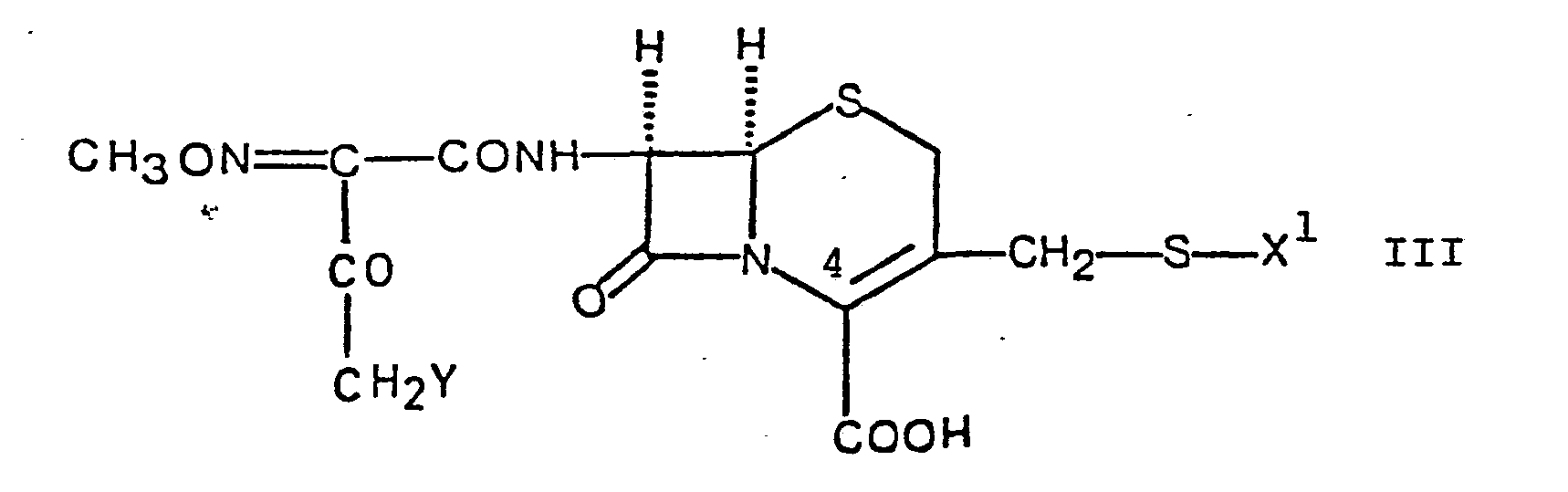


Applications Claiming Priority (4)
| Application Number | Priority Date | Filing Date | Title |
|---|---|---|---|
| CH232680 | 1980-03-25 | ||
| CH2326/80 | 1980-03-25 | ||
| CH245/81 | 1981-01-15 | ||
| CH24581 | 1981-01-15 |
Publications (2)
| Publication Number | Publication Date |
|---|---|
| EP0036652A2 true EP0036652A2 (en) | 1981-09-30 |
| EP0036652A3 EP0036652A3 (en) | 1982-12-01 |
Family
ID=25684007
Family Applications (1)
| Application Number | Title | Priority Date | Filing Date |
|---|---|---|---|
| EP81102131A Ceased EP0036652A3 (en) | 1980-03-25 | 1981-03-20 | Cephalosporin derivatives, process for their preparation, corresponding compositions, their use in the treatment of diseases and intermediates |
Country Status (8)
| Country | Link |
|---|---|
| EP (1) | EP0036652A3 (en) |
| AT (1) | AT374807B (en) |
| AU (1) | AU6851181A (en) |
| CA (1) | CA1154009A (en) |
| DK (1) | DK133081A (en) |
| IL (1) | IL62431A0 (en) |
| NZ (1) | NZ196551A (en) |
| PH (1) | PH16617A (en) |
Cited By (6)
| Publication number | Priority date | Publication date | Assignee | Title |
|---|---|---|---|---|
| EP0070331A3 (en) * | 1981-07-17 | 1983-02-23 | F. HOFFMANN-LA ROCHE & CO. Aktiengesellschaft | Cephalosporin derivatives, their preparation, compositions containing them, and their use in the treatment of diseases |
| EP0075095A3 (en) * | 1981-09-23 | 1984-10-17 | F. HOFFMANN-LA ROCHE & CO. Aktiengesellschaft | Cephalosporin derivatives, process for their preparation, pharmaceutical compositions containing them and intermediates |
| EP0075104A3 (en) * | 1981-09-23 | 1984-11-28 | F. HOFFMANN-LA ROCHE & CO. Aktiengesellschaft | Cephalosporin derivatives, process for their preparation, pharmaceutical compositions containing them and intermediates |
| EP0075110A3 (en) * | 1981-09-23 | 1984-12-12 | F. HOFFMANN-LA ROCHE & CO. Aktiengesellschaft | Cephalosporin derivatives, process for their preparation, pharmaceutical compositions containing them and intermediates |
| EP2539348A4 (en) * | 2010-02-26 | 2013-07-24 | Gary Igor Dmitrienko | Cephalosporin derivatives useful as -lactamase inhibitors and compositions and methods of use thereof |
| CN115433137A (en) * | 2022-04-15 | 2022-12-06 | 内蒙古京科医药科技有限公司 | The preparation method of 1-methyl-1,2,4-triazole-3-methanol |
Family Cites Families (2)
| Publication number | Priority date | Publication date | Assignee | Title |
|---|---|---|---|---|
| DE2715385A1 (en) * | 1976-04-14 | 1977-11-10 | Takeda Chemical Industries Ltd | CEPHALOSPORIN DERIVATIVES, THE PROCESS FOR THEIR MANUFACTURING AND MEDICINAL PRODUCTS CONTAINING THEM |
| MC1259A1 (en) * | 1978-05-30 | 1980-01-14 | Hoffmann La Roche | ACYL DERIVATIVES |
-
1981
- 1981-03-12 CA CA000372901A patent/CA1154009A/en not_active Expired
- 1981-03-18 NZ NZ196551A patent/NZ196551A/en unknown
- 1981-03-18 AU AU68511/81A patent/AU6851181A/en not_active Abandoned
- 1981-03-18 PH PH25383A patent/PH16617A/en unknown
- 1981-03-19 IL IL62431A patent/IL62431A0/en unknown
- 1981-03-20 EP EP81102131A patent/EP0036652A3/en not_active Ceased
- 1981-03-24 AT AT0137681A patent/AT374807B/en not_active IP Right Cessation
- 1981-03-24 DK DK133081A patent/DK133081A/en not_active Application Discontinuation
Cited By (6)
| Publication number | Priority date | Publication date | Assignee | Title |
|---|---|---|---|---|
| EP0070331A3 (en) * | 1981-07-17 | 1983-02-23 | F. HOFFMANN-LA ROCHE & CO. Aktiengesellschaft | Cephalosporin derivatives, their preparation, compositions containing them, and their use in the treatment of diseases |
| EP0075095A3 (en) * | 1981-09-23 | 1984-10-17 | F. HOFFMANN-LA ROCHE & CO. Aktiengesellschaft | Cephalosporin derivatives, process for their preparation, pharmaceutical compositions containing them and intermediates |
| EP0075104A3 (en) * | 1981-09-23 | 1984-11-28 | F. HOFFMANN-LA ROCHE & CO. Aktiengesellschaft | Cephalosporin derivatives, process for their preparation, pharmaceutical compositions containing them and intermediates |
| EP0075110A3 (en) * | 1981-09-23 | 1984-12-12 | F. HOFFMANN-LA ROCHE & CO. Aktiengesellschaft | Cephalosporin derivatives, process for their preparation, pharmaceutical compositions containing them and intermediates |
| EP2539348A4 (en) * | 2010-02-26 | 2013-07-24 | Gary Igor Dmitrienko | Cephalosporin derivatives useful as -lactamase inhibitors and compositions and methods of use thereof |
| CN115433137A (en) * | 2022-04-15 | 2022-12-06 | 内蒙古京科医药科技有限公司 | The preparation method of 1-methyl-1,2,4-triazole-3-methanol |
Also Published As
| Publication number | Publication date |
|---|---|
| EP0036652A3 (en) | 1982-12-01 |
| AU6851181A (en) | 1981-10-01 |
| NZ196551A (en) | 1984-05-31 |
| CA1154009A (en) | 1983-09-20 |
| ATA137681A (en) | 1983-10-15 |
| PH16617A (en) | 1983-11-28 |
| IL62431A0 (en) | 1981-05-20 |
| AT374807B (en) | 1984-06-12 |
| DK133081A (en) | 1981-09-26 |
Similar Documents
| Publication | Publication Date | Title |
|---|---|---|
| DE2727753C2 (en) | ||
| DE2462736C2 (en) | 7-Aminothiazolylacetamido-3-cephem-4-carboxylic acids and processes for making the same | |
| DE2715385C2 (en) | ||
| DE3485860T2 (en) | CEPHALOSPORINE COMPOUNDS, METHOD FOR THE PRODUCTION THEREOF AND PHARMACEUTICAL PREPARATIONS. | |
| EP0030294B1 (en) | Process for the preparation of cephalosporin derivatives; intermediates and their preparation | |
| EP0005830B1 (en) | Cephalosporin derivatives, their preparation and the corresponding pharmaceutical compositions | |
| DE69634581T2 (en) | Antibacterial cephalosporins | |
| DE3006888A1 (en) | CEPHALOSPORINE DERIVATIVES AND METHOD FOR THEIR PRODUCTION | |
| EP0002765B1 (en) | Cephalosporin derivatives, process for their preparation and pharmaceutical compositions and their preparation | |
| CH641468A5 (en) | CEPHEM DERIVATIVES. | |
| DE3233377A1 (en) | CEPHALOSPORINISOCHINOLINIUM BETAINE AND PHARMACEUTICAL PRODUCTS CONTAINING THEM | |
| DE3307550C2 (en) | ||
| EP0329008B1 (en) | Cephalosporinderivatives and process for its preparation | |
| EP0111934B1 (en) | Cephalosporin derivatives and process for their preparation | |
| EP0303172A2 (en) | Oxyimino-cephalosporins | |
| EP0049855B1 (en) | Cephalosporin derivatives, process for their preparation, pharmaceutical compositions containing them and intermediates for their preparation | |
| EP0036652A2 (en) | Cephalosporin derivatives, process for their preparation, corresponding compositions, their use in the treatment of diseases and intermediates | |
| EP0286144A2 (en) | Heterocyclylthiomethylcephalosporins | |
| EP0029966A2 (en) | Cephalosporin derivatives, preparations thereof, and pharmaceuticals compositions containing them | |
| EP0000005B1 (en) | New cephalosporin derivatives, their preparations and their pharmaceutical compositions | |
| DE2715038A1 (en) | NEW ANTIBACTERIAL COMPOUNDS | |
| EP0075104A2 (en) | Cephalosporin derivatives, process for their preparation, pharmaceutical compositions containing them and intermediates | |
| EP0049499B1 (en) | Cephalosporin derivatives, process for their preparation, pharmaceutical compositions containing them and intermediates for their preparation | |
| DE3901405A1 (en) | CEPHALOSPORINE DERIVATIVES AND METHOD FOR THEIR PRODUCTION | |
| EP0008372B1 (en) | Easily hydrolysable esters and ethers of cephalosporines, their preparation and pharmaceutical compositions containing them |
Legal Events
| Date | Code | Title | Description |
|---|---|---|---|
| PUAI | Public reference made under article 153(3) epc to a published international application that has entered the european phase |
Free format text: ORIGINAL CODE: 0009012 |
|
| 17P | Request for examination filed |
Effective date: 19810320 |
|
| AK | Designated contracting states |
Designated state(s): AT BE CH DE FR GB IT LU NL SE |
|
| PUAL | Search report despatched |
Free format text: ORIGINAL CODE: 0009013 |
|
| AK | Designated contracting states |
Designated state(s): AT BE CH DE FR GB IT LU NL SE |
|
| STAA | Information on the status of an ep patent application or granted ep patent |
Free format text: STATUS: THE APPLICATION HAS BEEN REFUSED |
|
| 18R | Application refused |
Effective date: 19850614 |
|
| RIN1 | Information on inventor provided before grant (corrected) |
Inventor name: MONTAVON, MARC, DR. Inventor name: REINER, ROLAND, DR. |