EP0033604B1 - Process for the preparation of methyl dihydrojasmonate and homologues - Google Patents
Process for the preparation of methyl dihydrojasmonate and homologues Download PDFInfo
- Publication number
- EP0033604B1 EP0033604B1 EP81300207A EP81300207A EP0033604B1 EP 0033604 B1 EP0033604 B1 EP 0033604B1 EP 81300207 A EP81300207 A EP 81300207A EP 81300207 A EP81300207 A EP 81300207A EP 0033604 B1 EP0033604 B1 EP 0033604B1
- Authority
- EP
- European Patent Office
- Prior art keywords
- reaction
- grams
- resulting
- water
- reaction mass
- Prior art date
- Legal status (The legal status is an assumption and is not a legal conclusion. Google has not performed a legal analysis and makes no representation as to the accuracy of the status listed.)
- Expired
Links
- 238000000034 method Methods 0.000 title claims description 18
- KVWWIYGFBYDJQC-UHFFFAOYSA-N methyl dihydrojasmonate Chemical compound CCCCCC1C(CC(=O)OC)CCC1=O KVWWIYGFBYDJQC-UHFFFAOYSA-N 0.000 title description 10
- YXFVVABEGXRONW-UHFFFAOYSA-N Toluene Chemical compound CC1=CC=CC=C1 YXFVVABEGXRONW-UHFFFAOYSA-N 0.000 claims description 48
- LRHPLDYGYMQRHN-UHFFFAOYSA-N N-Butanol Chemical compound CCCCO LRHPLDYGYMQRHN-UHFFFAOYSA-N 0.000 claims description 38
- XLYOFNOQVPJJNP-UHFFFAOYSA-N water Substances O XLYOFNOQVPJJNP-UHFFFAOYSA-N 0.000 claims description 38
- BGTOWKSIORTVQH-UHFFFAOYSA-N cyclopentanone Chemical compound O=C1CCCC1 BGTOWKSIORTVQH-UHFFFAOYSA-N 0.000 claims description 18
- 150000001875 compounds Chemical class 0.000 claims description 17
- HSJKGGMUJITCBW-UHFFFAOYSA-N 3-hydroxybutanal Chemical compound CC(O)CC=O HSJKGGMUJITCBW-UHFFFAOYSA-N 0.000 claims description 10
- 125000000217 alkyl group Chemical group 0.000 claims description 10
- 150000001299 aldehydes Chemical class 0.000 claims description 9
- 125000001246 bromo group Chemical group Br* 0.000 claims description 7
- 125000001309 chloro group Chemical group Cl* 0.000 claims description 7
- -1 malonic acid diester Chemical class 0.000 claims description 7
- 125000002496 methyl group Chemical group [H]C([H])([H])* 0.000 claims description 6
- 125000001495 ethyl group Chemical group [H]C([H])([H])C([H])([H])* 0.000 claims description 5
- 125000004178 (C1-C4) alkyl group Chemical group 0.000 claims description 4
- IYXGSMUGOJNHAZ-UHFFFAOYSA-N Ethyl malonate Chemical compound CCOC(=O)CC(=O)OCC IYXGSMUGOJNHAZ-UHFFFAOYSA-N 0.000 claims description 3
- OFOBLEOULBTSOW-UHFFFAOYSA-N Propanedioic acid Natural products OC(=O)CC(O)=O OFOBLEOULBTSOW-UHFFFAOYSA-N 0.000 claims description 3
- 238000006243 chemical reaction Methods 0.000 description 144
- FAPWRFPIFSIZLT-UHFFFAOYSA-M Sodium chloride Chemical class [Na+].[Cl-] FAPWRFPIFSIZLT-UHFFFAOYSA-M 0.000 description 32
- 238000003756 stirring Methods 0.000 description 30
- 239000010410 layer Substances 0.000 description 28
- QTBSBXVTEAMEQO-UHFFFAOYSA-N Acetic acid Chemical compound CC(O)=O QTBSBXVTEAMEQO-UHFFFAOYSA-N 0.000 description 27
- CDBYLPFSWZWCQE-UHFFFAOYSA-L Sodium Carbonate Chemical compound [Na+].[Na+].[O-]C([O-])=O CDBYLPFSWZWCQE-UHFFFAOYSA-L 0.000 description 24
- HEMHJVSKTPXQMS-UHFFFAOYSA-M Sodium hydroxide Chemical compound [OH-].[Na+] HEMHJVSKTPXQMS-UHFFFAOYSA-M 0.000 description 24
- CPELXLSAUQHCOX-UHFFFAOYSA-N Hydrogen bromide Chemical compound Br CPELXLSAUQHCOX-UHFFFAOYSA-N 0.000 description 22
- 238000010438 heat treatment Methods 0.000 description 22
- OKKJLVBELUTLKV-UHFFFAOYSA-N Methanol Chemical compound OC OKKJLVBELUTLKV-UHFFFAOYSA-N 0.000 description 21
- KFZMGEQAYNKOFK-UHFFFAOYSA-N Isopropanol Chemical compound CC(C)O KFZMGEQAYNKOFK-UHFFFAOYSA-N 0.000 description 20
- 238000007654 immersion Methods 0.000 description 20
- 239000000203 mixture Substances 0.000 description 19
- RTZKZFJDLAIYFH-UHFFFAOYSA-N Diethyl ether Chemical compound CCOCC RTZKZFJDLAIYFH-UHFFFAOYSA-N 0.000 description 18
- 239000000463 material Substances 0.000 description 17
- 238000010992 reflux Methods 0.000 description 17
- IJGRMHOSHXDMSA-UHFFFAOYSA-N Atomic nitrogen Chemical compound N#N IJGRMHOSHXDMSA-UHFFFAOYSA-N 0.000 description 16
- HGBOYTHUEUWSSQ-UHFFFAOYSA-N pentanal Chemical compound CCCCC=O HGBOYTHUEUWSSQ-UHFFFAOYSA-N 0.000 description 16
- PMZURENOXWZQFD-UHFFFAOYSA-L Sodium Sulfate Chemical compound [Na+].[Na+].[O-]S([O-])(=O)=O PMZURENOXWZQFD-UHFFFAOYSA-L 0.000 description 15
- 239000007795 chemical reaction product Substances 0.000 description 15
- 239000000047 product Substances 0.000 description 15
- JHIVVAPYMSGYDF-UHFFFAOYSA-N cyclohexanone Chemical compound O=C1CCCCC1 JHIVVAPYMSGYDF-UHFFFAOYSA-N 0.000 description 14
- CURLTUGMZLYLDI-UHFFFAOYSA-N Carbon dioxide Chemical compound O=C=O CURLTUGMZLYLDI-UHFFFAOYSA-N 0.000 description 13
- 229910000029 sodium carbonate Inorganic materials 0.000 description 12
- 239000013058 crude material Substances 0.000 description 11
- 229910000042 hydrogen bromide Inorganic materials 0.000 description 11
- 238000004508 fractional distillation Methods 0.000 description 10
- 239000011521 glass Substances 0.000 description 10
- 239000012044 organic layer Substances 0.000 description 10
- MUBZPKHOEPUJKR-UHFFFAOYSA-N Oxalic acid Chemical compound OC(=O)C(O)=O MUBZPKHOEPUJKR-UHFFFAOYSA-N 0.000 description 9
- 238000005882 aldol condensation reaction Methods 0.000 description 9
- 235000011089 carbon dioxide Nutrition 0.000 description 9
- 239000007859 condensation product Substances 0.000 description 8
- 150000005690 diesters Chemical class 0.000 description 8
- 229910052757 nitrogen Inorganic materials 0.000 description 8
- VEXZGXHMUGYJMC-UHFFFAOYSA-N Hydrochloric acid Chemical compound Cl VEXZGXHMUGYJMC-UHFFFAOYSA-N 0.000 description 6
- KWYUFKZDYYNOTN-UHFFFAOYSA-M Potassium hydroxide Chemical compound [OH-].[K+] KWYUFKZDYYNOTN-UHFFFAOYSA-M 0.000 description 6
- 239000012043 crude product Substances 0.000 description 6
- 125000001449 isopropyl group Chemical group [H]C([H])([H])C([H])(*)C([H])([H])[H] 0.000 description 6
- 239000011541 reaction mixture Substances 0.000 description 6
- DGAQECJNVWCQMB-PUAWFVPOSA-M Ilexoside XXIX Chemical compound C[C@@H]1CC[C@@]2(CC[C@@]3(C(=CC[C@H]4[C@]3(CC[C@@H]5[C@@]4(CC[C@@H](C5(C)C)OS(=O)(=O)[O-])C)C)[C@@H]2[C@]1(C)O)C)C(=O)O[C@H]6[C@@H]([C@H]([C@@H]([C@H](O6)CO)O)O)O.[Na+] DGAQECJNVWCQMB-PUAWFVPOSA-M 0.000 description 5
- 229910052708 sodium Inorganic materials 0.000 description 5
- 239000011734 sodium Substances 0.000 description 5
- 229920000742 Cotton Polymers 0.000 description 4
- 238000004821 distillation Methods 0.000 description 4
- 229910000041 hydrogen chloride Inorganic materials 0.000 description 4
- IXCSERBJSXMMFS-UHFFFAOYSA-N hydrogen chloride Substances Cl.Cl IXCSERBJSXMMFS-UHFFFAOYSA-N 0.000 description 4
- 238000012544 monitoring process Methods 0.000 description 4
- 239000011368 organic material Substances 0.000 description 4
- 239000008188 pellet Substances 0.000 description 4
- 0 *CC1=CCCC1=O Chemical compound *CC1=CCCC1=O 0.000 description 3
- 239000002585 base Substances 0.000 description 3
- 235000006408 oxalic acid Nutrition 0.000 description 3
- JOXIMZWYDAKGHI-UHFFFAOYSA-N toluene-4-sulfonic acid Chemical compound CC1=CC=C(S(O)(=O)=O)C=C1 JOXIMZWYDAKGHI-UHFFFAOYSA-N 0.000 description 3
- YZKUNNFZLUCEET-RMKNXTFCSA-N (2e)-2-pentylidenecyclopentan-1-one Chemical compound CCCC\C=C1/CCCC1=O YZKUNNFZLUCEET-RMKNXTFCSA-N 0.000 description 2
- DYVAUIYAEICDNS-UHFFFAOYSA-N CCCCC(C(CCC1)C1=O)O Chemical compound CCCCC(C(CCC1)C1=O)O DYVAUIYAEICDNS-UHFFFAOYSA-N 0.000 description 2
- VNWOJVJCRAHBJJ-UHFFFAOYSA-N CCCCCC(CCC1)C1=O Chemical compound CCCCCC(CCC1)C1=O VNWOJVJCRAHBJJ-UHFFFAOYSA-N 0.000 description 2
- 241000207840 Jasminum Species 0.000 description 2
- 235000010254 Jasminum officinale Nutrition 0.000 description 2
- QAOWNCQODCNURD-UHFFFAOYSA-N Sulfuric acid Chemical compound OS(O)(=O)=O QAOWNCQODCNURD-UHFFFAOYSA-N 0.000 description 2
- 229910052783 alkali metal Inorganic materials 0.000 description 2
- 125000001118 alkylidene group Chemical group 0.000 description 2
- 239000001569 carbon dioxide Substances 0.000 description 2
- 229910002092 carbon dioxide Inorganic materials 0.000 description 2
- BEPAFCGSDWSTEL-UHFFFAOYSA-N dimethyl malonate Chemical compound COC(=O)CC(=O)OC BEPAFCGSDWSTEL-UHFFFAOYSA-N 0.000 description 2
- 238000009472 formulation Methods 0.000 description 2
- 239000012299 nitrogen atmosphere Substances 0.000 description 2
- 238000012856 packing Methods 0.000 description 2
- 239000002304 perfume Substances 0.000 description 2
- 230000000717 retained effect Effects 0.000 description 2
- 239000002904 solvent Substances 0.000 description 2
- 239000000126 substance Substances 0.000 description 2
- 238000005406 washing Methods 0.000 description 2
- 125000006273 (C1-C3) alkyl group Chemical group 0.000 description 1
- UDFUFXGJDJZSJD-UHFFFAOYSA-N 2-pentylcyclohex-2-en-1-one Chemical compound CCCCCC1=CCCCC1=O UDFUFXGJDJZSJD-UHFFFAOYSA-N 0.000 description 1
- KTETXLGRNPACFS-UHFFFAOYSA-N 2-pentylidenecyclohexan-1-one Chemical compound CCCCC=C1CCCCC1=O KTETXLGRNPACFS-UHFFFAOYSA-N 0.000 description 1
- 238000006845 Michael addition reaction Methods 0.000 description 1
- ZLMJMSJWJFRBEC-UHFFFAOYSA-N Potassium Chemical compound [K] ZLMJMSJWJFRBEC-UHFFFAOYSA-N 0.000 description 1
- 239000002253 acid Substances 0.000 description 1
- 150000008044 alkali metal hydroxides Chemical class 0.000 description 1
- 150000001340 alkali metals Chemical class 0.000 description 1
- 125000002947 alkylene group Chemical group 0.000 description 1
- 125000000129 anionic group Chemical group 0.000 description 1
- 239000012298 atmosphere Substances 0.000 description 1
- 230000003190 augmentative effect Effects 0.000 description 1
- RQPZNWPYLFFXCP-UHFFFAOYSA-L barium dihydroxide Chemical compound [OH-].[OH-].[Ba+2] RQPZNWPYLFFXCP-UHFFFAOYSA-L 0.000 description 1
- 229910001863 barium hydroxide Inorganic materials 0.000 description 1
- 230000015572 biosynthetic process Effects 0.000 description 1
- 238000006664 bond formation reaction Methods 0.000 description 1
- GGNALUCSASGNCK-UHFFFAOYSA-N carbon dioxide;propan-2-ol Chemical compound O=C=O.CC(C)O GGNALUCSASGNCK-UHFFFAOYSA-N 0.000 description 1
- 239000003054 catalyst Substances 0.000 description 1
- 125000002091 cationic group Chemical group 0.000 description 1
- 235000009508 confectionery Nutrition 0.000 description 1
- 239000003599 detergent Substances 0.000 description 1
- 239000003814 drug Substances 0.000 description 1
- 230000002708 enhancing effect Effects 0.000 description 1
- 230000032050 esterification Effects 0.000 description 1
- 238000005886 esterification reaction Methods 0.000 description 1
- HHFAWKCIHAUFRX-UHFFFAOYSA-N ethoxide Chemical compound CC[O-] HHFAWKCIHAUFRX-UHFFFAOYSA-N 0.000 description 1
- 239000002979 fabric softener Substances 0.000 description 1
- 239000012467 final product Substances 0.000 description 1
- 239000004615 ingredient Substances 0.000 description 1
- 239000000543 intermediate Substances 0.000 description 1
- 150000002576 ketones Chemical class 0.000 description 1
- 229910052700 potassium Inorganic materials 0.000 description 1
- 239000011591 potassium Substances 0.000 description 1
- BDAWXSQJJCIFIK-UHFFFAOYSA-N potassium methoxide Chemical compound [K+].[O-]C BDAWXSQJJCIFIK-UHFFFAOYSA-N 0.000 description 1
- IKNCGYCHMGNBCP-UHFFFAOYSA-N propan-1-olate Chemical compound CCC[O-] IKNCGYCHMGNBCP-UHFFFAOYSA-N 0.000 description 1
- 125000001436 propyl group Chemical group [H]C([*])([H])C([H])([H])C([H])([H])[H] 0.000 description 1
- 230000035484 reaction time Effects 0.000 description 1
- 238000003786 synthesis reaction Methods 0.000 description 1
Images


Classifications
-
- C—CHEMISTRY; METALLURGY
- C07—ORGANIC CHEMISTRY
- C07C—ACYCLIC OR CARBOCYCLIC COMPOUNDS
- C07C403/00—Derivatives of cyclohexane or of a cyclohexene or of cyclohexadiene, having a side-chain containing an acyclic unsaturated part of at least four carbon atoms, this part being directly attached to the cyclohexane or cyclohexene or cyclohexadiene rings, e.g. vitamin A, beta-carotene, beta-ionone
- C07C403/02—Derivatives of cyclohexane or of a cyclohexene or of cyclohexadiene, having a side-chain containing an acyclic unsaturated part of at least four carbon atoms, this part being directly attached to the cyclohexane or cyclohexene or cyclohexadiene rings, e.g. vitamin A, beta-carotene, beta-ionone having side-chains containing only carbon and hydrogen atoms
-
- C—CHEMISTRY; METALLURGY
- C07—ORGANIC CHEMISTRY
- C07C—ACYCLIC OR CARBOCYCLIC COMPOUNDS
- C07C45/00—Preparation of compounds having >C = O groups bound only to carbon or hydrogen atoms; Preparation of chelates of such compounds
- C07C45/61—Preparation of compounds having >C = O groups bound only to carbon or hydrogen atoms; Preparation of chelates of such compounds by reactions not involving the formation of >C = O groups
- C07C45/65—Preparation of compounds having >C = O groups bound only to carbon or hydrogen atoms; Preparation of chelates of such compounds by reactions not involving the formation of >C = O groups by splitting-off hydrogen atoms or functional groups; by hydrogenolysis of functional groups
- C07C45/66—Preparation of compounds having >C = O groups bound only to carbon or hydrogen atoms; Preparation of chelates of such compounds by reactions not involving the formation of >C = O groups by splitting-off hydrogen atoms or functional groups; by hydrogenolysis of functional groups by dehydration
-
- C—CHEMISTRY; METALLURGY
- C07—ORGANIC CHEMISTRY
- C07C—ACYCLIC OR CARBOCYCLIC COMPOUNDS
- C07C45/00—Preparation of compounds having >C = O groups bound only to carbon or hydrogen atoms; Preparation of chelates of such compounds
- C07C45/61—Preparation of compounds having >C = O groups bound only to carbon or hydrogen atoms; Preparation of chelates of such compounds by reactions not involving the formation of >C = O groups
- C07C45/67—Preparation of compounds having >C = O groups bound only to carbon or hydrogen atoms; Preparation of chelates of such compounds by reactions not involving the formation of >C = O groups by isomerisation; by change of size of the carbon skeleton
-
- C—CHEMISTRY; METALLURGY
- C07—ORGANIC CHEMISTRY
- C07C—ACYCLIC OR CARBOCYCLIC COMPOUNDS
- C07C45/00—Preparation of compounds having >C = O groups bound only to carbon or hydrogen atoms; Preparation of chelates of such compounds
- C07C45/61—Preparation of compounds having >C = O groups bound only to carbon or hydrogen atoms; Preparation of chelates of such compounds by reactions not involving the formation of >C = O groups
- C07C45/67—Preparation of compounds having >C = O groups bound only to carbon or hydrogen atoms; Preparation of chelates of such compounds by reactions not involving the formation of >C = O groups by isomerisation; by change of size of the carbon skeleton
- C07C45/68—Preparation of compounds having >C = O groups bound only to carbon or hydrogen atoms; Preparation of chelates of such compounds by reactions not involving the formation of >C = O groups by isomerisation; by change of size of the carbon skeleton by increase in the number of carbon atoms
- C07C45/72—Preparation of compounds having >C = O groups bound only to carbon or hydrogen atoms; Preparation of chelates of such compounds by reactions not involving the formation of >C = O groups by isomerisation; by change of size of the carbon skeleton by increase in the number of carbon atoms by reaction of compounds containing >C = O groups with the same or other compounds containing >C = O groups
-
- C—CHEMISTRY; METALLURGY
- C07—ORGANIC CHEMISTRY
- C07C—ACYCLIC OR CARBOCYCLIC COMPOUNDS
- C07C45/00—Preparation of compounds having >C = O groups bound only to carbon or hydrogen atoms; Preparation of chelates of such compounds
- C07C45/61—Preparation of compounds having >C = O groups bound only to carbon or hydrogen atoms; Preparation of chelates of such compounds by reactions not involving the formation of >C = O groups
- C07C45/67—Preparation of compounds having >C = O groups bound only to carbon or hydrogen atoms; Preparation of chelates of such compounds by reactions not involving the formation of >C = O groups by isomerisation; by change of size of the carbon skeleton
- C07C45/68—Preparation of compounds having >C = O groups bound only to carbon or hydrogen atoms; Preparation of chelates of such compounds by reactions not involving the formation of >C = O groups by isomerisation; by change of size of the carbon skeleton by increase in the number of carbon atoms
- C07C45/72—Preparation of compounds having >C = O groups bound only to carbon or hydrogen atoms; Preparation of chelates of such compounds by reactions not involving the formation of >C = O groups by isomerisation; by change of size of the carbon skeleton by increase in the number of carbon atoms by reaction of compounds containing >C = O groups with the same or other compounds containing >C = O groups
- C07C45/74—Preparation of compounds having >C = O groups bound only to carbon or hydrogen atoms; Preparation of chelates of such compounds by reactions not involving the formation of >C = O groups by isomerisation; by change of size of the carbon skeleton by increase in the number of carbon atoms by reaction of compounds containing >C = O groups with the same or other compounds containing >C = O groups combined with dehydration
-
- C—CHEMISTRY; METALLURGY
- C07—ORGANIC CHEMISTRY
- C07C—ACYCLIC OR CARBOCYCLIC COMPOUNDS
- C07C49/00—Ketones; Ketenes; Dimeric ketenes; Ketonic chelates
- C07C49/587—Unsaturated compounds containing a keto groups being part of a ring
- C07C49/597—Unsaturated compounds containing a keto groups being part of a ring of a five-membered ring
-
- C—CHEMISTRY; METALLURGY
- C07—ORGANIC CHEMISTRY
- C07C—ACYCLIC OR CARBOCYCLIC COMPOUNDS
- C07C49/00—Ketones; Ketenes; Dimeric ketenes; Ketonic chelates
- C07C49/587—Unsaturated compounds containing a keto groups being part of a ring
- C07C49/603—Unsaturated compounds containing a keto groups being part of a ring of a six-membered ring, e.g. quinone methides
-
- C—CHEMISTRY; METALLURGY
- C07—ORGANIC CHEMISTRY
- C07C—ACYCLIC OR CARBOCYCLIC COMPOUNDS
- C07C49/00—Ketones; Ketenes; Dimeric ketenes; Ketonic chelates
- C07C49/587—Unsaturated compounds containing a keto groups being part of a ring
- C07C49/647—Unsaturated compounds containing a keto groups being part of a ring having unsaturation outside the ring
-
- C—CHEMISTRY; METALLURGY
- C11—ANIMAL OR VEGETABLE OILS, FATS, FATTY SUBSTANCES OR WAXES; FATTY ACIDS THEREFROM; DETERGENTS; CANDLES
- C11B—PRODUCING, e.g. BY PRESSING RAW MATERIALS OR BY EXTRACTION FROM WASTE MATERIALS, REFINING OR PRESERVING FATS, FATTY SUBSTANCES, e.g. LANOLIN, FATTY OILS OR WAXES; ESSENTIAL OILS; PERFUMES
- C11B9/00—Essential oils; Perfumes
- C11B9/0026—Essential oils; Perfumes compounds containing an alicyclic ring not condensed with another ring
- C11B9/003—Essential oils; Perfumes compounds containing an alicyclic ring not condensed with another ring the ring containing less than six carbon atoms
-
- C—CHEMISTRY; METALLURGY
- C07—ORGANIC CHEMISTRY
- C07C—ACYCLIC OR CARBOCYCLIC COMPOUNDS
- C07C2601/00—Systems containing only non-condensed rings
- C07C2601/12—Systems containing only non-condensed rings with a six-membered ring
- C07C2601/14—The ring being saturated
Landscapes
- Chemical & Material Sciences (AREA)
- Organic Chemistry (AREA)
- Chemical Kinetics & Catalysis (AREA)
- Life Sciences & Earth Sciences (AREA)
- Engineering & Computer Science (AREA)
- Oil, Petroleum & Natural Gas (AREA)
- Wood Science & Technology (AREA)
- Organic Low-Molecular-Weight Compounds And Preparation Thereof (AREA)
Description
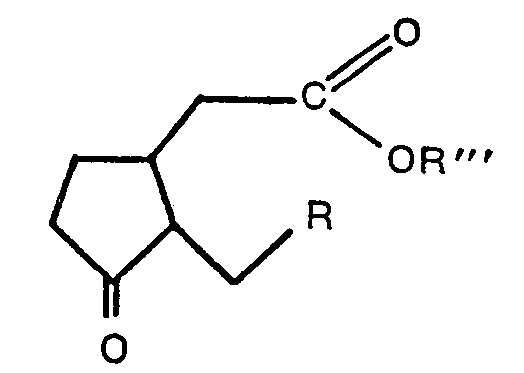
- Methyl dihydrojamonate having the structure:


- n is 0 or 1 and wherein R is C1-C4 alkyl and R"' represents C1-C3 alkyl are valuable ingredients useful as medicinal drug intermediates and perfumery materials; for use in augmenting or enhancing the aroma of perfumes, perfumed articles such as nonionic, anionic, cationic or zwitterionic detergents or dryer-added fabric softener articles or colognes.
- Methyl dihydrojasmonate has been previously shown to be prepared in United Kingdom Patent Specification 907,431 published on October 3, 1962, according to the process:

- R' is methyl or ethyl and R represents lower alkyl, and wherein R1 represents lower alkyl and M represents alkali metal such as potassium or sodium.
- Furthermore, the prior art sets forth alkylidenylation reactions with cyclopentanone and unsaturated aldehydes according to the reaction sequence:


- German Offenlengungsschrift 27 32 107, published on January 9, 1978, sets forth the reaction:

-
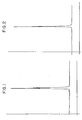
- Figure 1 represents the GLC profile for fraction 1 resulting from the fractional distillation of the reaction product produced according to Example I(D).
- Figure 2 represents the GLC profile for fraction 2 resulting from the fractional distillation of the reaction product produced according to Example i(D).
- Figure 3 represents the GLC profile for fraction 3 resulting from the fractional distillation of the reaction product produced according to Example I(D).
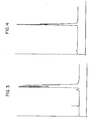
- Figure 4 represents the GLC profile for fraction 4 resulting from the fractional distillation of the reaction product produced according to Example I(D).
- Figure 5 represents the GLC profile for fraction 5 resulting from the fractional distillation of the reaction product produced according to Example I(D).
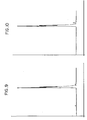
- Figure 6 represents the GLC profile for fraction 6 resulting from the fractional distillation of the reaction product produced according to Example I(D).
- Figure 7 represents the GLC profile for fraction 7 resulting from the fractional distillation of the reaction product produced according to Example I(D).
- Figure 8 represents the GLC profile for fraction 8 resulting from the fractional distillation of the reaction product produced according to Example i(D).
- Figure 9 represents the GLC profile for fraction 9 resulting from the fractional distillation of the reaction product produced according to Example I(D).
- Figure 10 represents the GLC profile for figure 10 resulting from the fractional distillation of the reaction product produced according to Example I(D).
- According to the present invention there is provided a process of reacting a compound defined according to the structure:


- n is 0 or 1, and wherein R is C,-C4 alkyl and X is chloro or bromo. Preferably the process comprises reacting the compound having the structure:


- R is C1-C4 alkyl and X is chloro or bromo.
- It will be appreciated that the double bond formation in the ring takes place, in the process of the invention, in one step. This is advantageous for reasons that will be clear to all people skilled in the art. Nothing in the prior art indicates the highly efficient reaction sequence of the present invention.
- According to a modified process according to the invention, the process comprises reacting a C2-C5 aldehyde having the structure:


- n is 0 or 1, to form an aldol having the structure:


- R is C1-C4 alkyl and wherein n is 0 or 1, and then dehydrating the aldol to form the alkylidene cycloalkanone and then rearranging the thus-formed alkylidene cycloalkanone to form the alkyl cycloalkenone having the structure:


- R is C,-C4 alkyl or n is 0 or 1; or, in the alternative, simultaneously dehydrating and rearranging the aldol to form the alkyl cyclopentenone having the structure:


- R and n are as defined above, then reacting the alkyl cyclopentenone with a malonic ester having the structure:


- n is 0 or 1 and wherein R is Cl-C4 alkyl; R' and R" represent the same or different methyl or ethyl; R"' represents methyl or ethyl and X represents chloro or bromo.
- The following reaction schemes incorporated the process of the present invention.


- More specifically, the aldol condensation between the cycloalkanone having the structure:
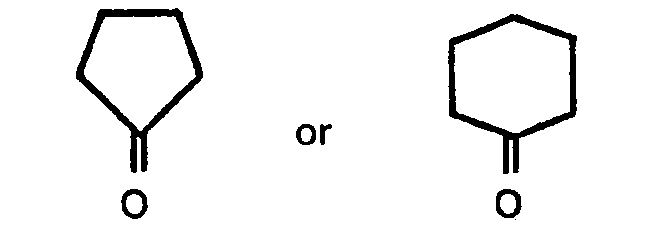

- n is 0 or 1 and the aldehyde having the structure:

- The reaction of the resulting aldol condensation product having the structure:


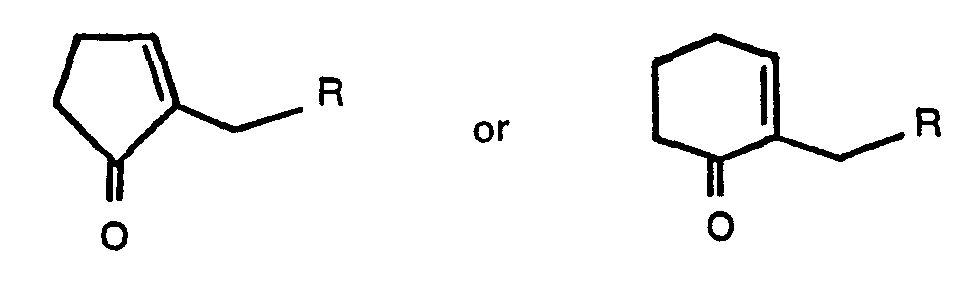


- The reaction of the malonic acid diester having the structure:


- The resulting malonic ester-cycloalkenone addition product having one of the structure:


- This reaction may be carried out according to the procedures set forth in German Offenlengungsschrift 27 32 107 of January 19, 1978.
- Alternatively, the malonic ester-cycloalkenone addition product may subsequently be saponified using aqueous alkali metal hydroxide such as sodium hydroxide or potassium hydroxide (20-50% in concentration) and then acidified with hydrochloric acid or acetic acid and finally heated at a temperature in the range of from 150°C up to 200°C thereby causing monodecarboxylation of the resulting dicarboxylic acid. The resulting material may then be re-esterified with methanol using a sulfuric acid catalyst according to standard esterification conditions.
- The following Examples I-III and V-VII serve to illustrate embodiments of our invention as it is now preferred to practice it. Example IV illustrates the utility for a compound produced according to a process of our invention. It will be understood that these examples are illustrative and restricted thereto only as defined in the appended claims.
-

-

- Into a 5-liter reaction flask equipped with mechanical stirrer, 500 ml addition funnel, immersion thermometer and reflux condenser and 5-liter heating mantle and dry ice-isopropanol alcohol bath are charged 16.5 grams of sodium hydroxide and 1500 ml water. The resulting mixture is warmed to 30°C. 756 grams (9.0 moles) of cyclopentanone is then added dropwise with stirring over a 15 minute period while maintaining the reaction temperature at 30°C with the dry ice/isopropanol bath.
- 430 grams (5.0 moles) of n-valeraldehyde is then added dropwise with stirring over a 40 minute period while keeping the temperature at 30°C. After addition, the reaction mass is stirred for a period of 1 hour at 30°C.
- After 1 hour, 30.0 grams of acetic acid is added using a dropping pipette and the reflux condenser is replaced with a splash column equipped with rush-over head. The resulting mixture is then heated and steam distilled. All fractions are monitored on a 400' SE-30 glass capillary GLC column. The distillation is shut down when no further apparent oil layer is formed. The resulting mixture is allowed to cool down and poured into a separatory funnel. The aqueous layer is separated and washed with two volumes of toluene. The toluene layer is combined with the organic layer and the resulting organic layer is washed with two volumes of saturated sodium chloride solution and then filtered through cotton. The resulting material is placed in the 5-liter reaction flask as equipped above.
- 10.0 grams of oxalic acid is then added and the reaction mixture is heated with stirring and azeotropically distilling water until no further water is evolved (about 90 ml water being removed). The reaction equipment is then shut down and the reaction mass is cooled and poured into a 4-liter separatory funnel. The reaction mass is then washed with two volumes of saturated sodium chloride solution followed by two volumes of 5% sodium carbonate solution followed by two volumes of saturated sodium chloride solution. The resulting material is then dried over anhydrous sodium sulfate and concentrated to yield 1120.0 grams of material.
- The resulting product is then distilled under vacuum using a splash column and rush-over head into 3 fractions with the following results:

-

- Into a 5-liter reaction flask equipped with mechanical stirrer, immersion thermometer, bubble condenser and 5-liter heating mantle are charged 570.4 grams (3.75 moles) of 2-pentylidene cyclopentanone prepared according to Example I-A (fractions 1-3 bulked) and 2400 ml of 5% hydrogen bromide in n-butanol (120 ml hydrogen bromide in 2280 ml n-butanol). The resulting mixture is heated with stirring to reflux at 105°C. The reaction mass is then stirred over a period of 115 minutes while monitoring the progress on a 6' x 1/4" glass SE-30 packed column (operated at 150°C isothermal) approximately every 5-10 minutes.
- After 115 minutes, the reaction apparatus is shut down and the reaction mass is cooled. The resulting mixture is poured into a separatory funnel and washed with 1 volume of saturated sodium chloride solution followed by 1 volume of 10% sodium carbonate solution and 2 volumes of saturated sodium chloride solution. The resulting material is then dried over anhydrous sodium sulfate and concentrated to yield 788.0 grams of crude product. The resulting crude is then distilled under vacuum using a splash column and rush-over head into 3 fractions as follows:

-

- Into a 5-liter reaction flask equipped with mechanical stirrer, immersion thermometer, 1000 ml addition funnel with nitrogen inlet and water-cooled condenser with nitrogen bubbler and dry ice/isopropyl alcohol bath is placed 1350 ml of anhydrous methyl alcohol and 7.82 grams (0.34 gm- atoms) of sodium pellets under a nitrogen atmosphere at 25°C. In one batch, 448.8 grams (3.40 moles) of dimethyl malonate is added with stirring while maintaining the reaction mass temperature at 25°C. The reaction mass is then cooled to -5°C.
- Over a 40 minute period 429.65 grams (2.83 moles) of 2-pentyl-2-cyclopent-1-one prepared according to Example I-B is added. The reaction mass is then stirred for a period of 1 hour at -5°C. 40.8 grams (0.68 moles) of acetic acid is then added to the reaction mass and the reaction mixture is stirred and permitted to attain room temperature. The reaction mass is then transferred to a large separatory funnel. Approximately 2 liters of water is added to the reaction mass and the resulting mixture is shaken vigorously. The oil layer separates to the bottom and is removed and retained.
- The aqueous layer is then stripped to remove the methanol; washed with 2 volumes of diethyl ether and discarded. The diethyl ether washings are combined with the organic layer (the oil layer), washed two times with saturated sodium chloride solution and then dried over anhydrous sodium sulfate. The resulting dried material is concentrated to yield 1271 grams of crude material. GLC analysis on a 6' x 1/4" SE-30 packed glass column shows the crude to be 40.34% diester (512.72 grams = 63.79% yield).
-

- Into a 3-liter reaction flask equipped with mechanical stirrer, immersion thermometer, 250 ml addition funnel with nitrogen inlet, 1-ft. jacketed column packed with saddles, a rush-over head with thermometer, a take-off adapter with nitrogen bubbler, a 500 ml receiver and a heating mantle is placed 1271.0 grams of the crude 3-dimethylmalonyl-2-pentylcyclopent-1-one prepared according to Example I-C. The compound is heated with stirring to 200°C. During the heating, any solvent from the previous reaction of Example I-C distills over and is discarded. At 200°C, 50.94 grams (2.83 moles) of water is added dropwise (1 drop per 1.5 seconds) causing a vigorous evolution of carbon dioxide and methyl alcohol which is collected in the receiver. The addition takes approximately 1 hour. Heating at 200°C is continued for 35 minutes. The reaction is monitored by GLC (6' x 1/4" SE-30 packed glass column) immediately after the water addition and 35 minutes later. Substantial diester still remains so an additional 10 grams of water is added over a 20 minute period and the reaction mass is again stirred for 30 minutes. GLC analysis continues to show diester as the reaction is shut down for 12 hours and recommenced when an additional 10 grams of water is added at 200°C over a 20 minute period. Stirring is continued at 200°C for an additional 30 minutes. At this point, GLC analysis indicates no diester is present and the reaction apparatus is shut down and the reaction mass cooled to room temperature.
- The crude material (664 grams) is then distilled under vacuum on a 2" splash column with rush-over head into four fractions as follows:
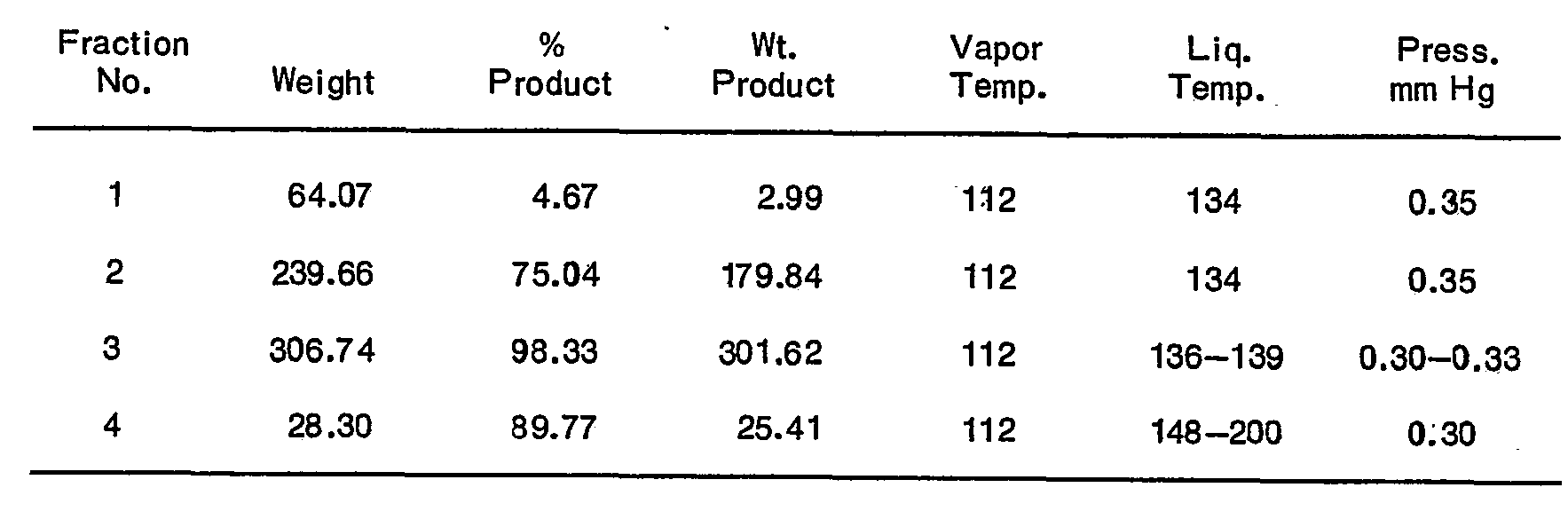
- Fractions 2, 3 and 4 are bulked and fractionally distilled on a 12" Hemple Column having Goodloe packing. The distillation is such that the material is distilled into 11 fractions as follows:

-
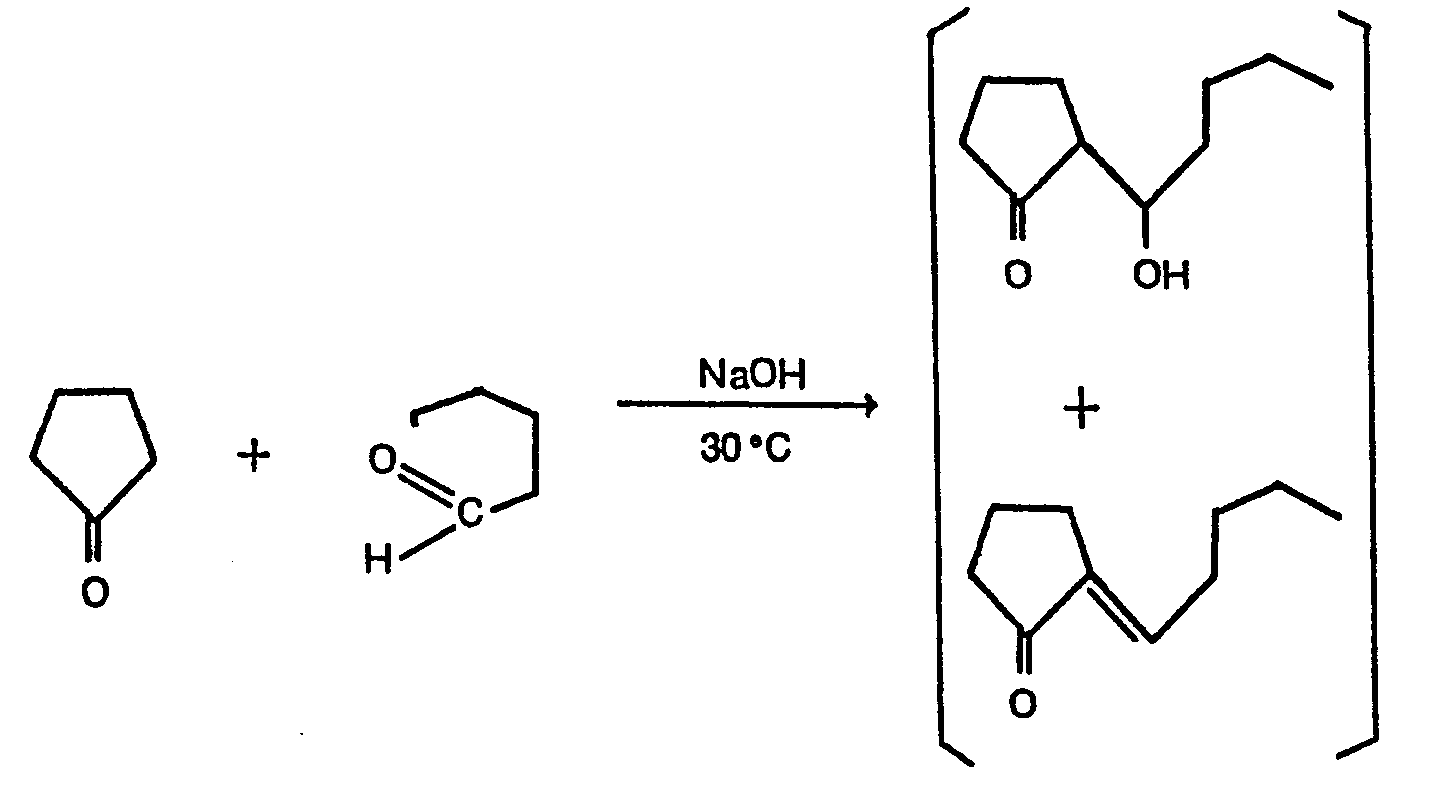
- Into a 500 ml reaction flask equipped with mechanical stirrer, immersion thermometer, 150 ml addition funnel, water-cooled condenser, heating mantle and ice bath is placed 1.65 grams of sodium hydroxide pellets and 155 ml water. The resulting solution is warmed to 30°C. 75.6 grams (0.9 moles) of cyclopentanone is then added dropwise with stirring while maintaining the temperature at 30-31 °C. 43.0 grams (0.5 moles) of n-valeraldehyde is then added dropwise with stirring over a period of about 30 minutes while maintaining the temperature at 30°C. The reaction mass is then stirred for 1 hour at 30°C. At this point, 3.0 grams of acetic acid and 100 ml of water are added. The condenser is then replaced with a splash column and rush-over head and the reaction mass is heated to 95°C to distill the unreacted cyclopentanone. The reaction mass is then distilled until the head temperature is 100°C and the majority of the cyclopentanone is removed. The reaction apparatus is then shut down and the reaction mass is cooled and poured into a separatory funnel.
- The oil layer is taken up in diethyl ether and separated from the aqueous layer. It is then washed with 1 volume of saturated sodium chloride solution and dried over anhydrous sodium sulfate and concentrated to yield 77.46 grams of crude product.
-

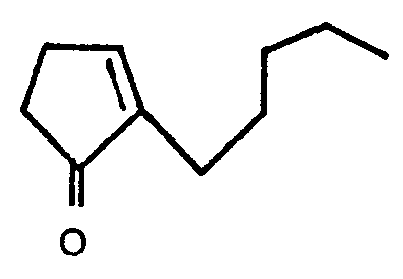
- Into a 250 ml reaction flask equipped with mechanical stirrer, immersion thermometer, water-cooled condenser and heating mantle are charged 38.73 grams (0.23 moles) of the aldol condensation product produced according to Example II-A and 138.6 ml of 5% hydrogen bromide in n-butanol (6.60 ml of 48% of HBr in 132 ml n-butanol). The reaction mixture is heated to reflux (102°C) and maintained at reflux (monitoring by GLC) until all of the isomer having the structure:


-

- Into a 250 ml reaction flask equipped with mechanical stirrer, immersion thermometer, water-cooled condenser and heating mantle is placed 38.73 grams (0.23 moles) of the aldol condensation product of cyclopentanone and n-valeraldehyde produced according to Example II-A and 176.4 ml of 5% hydrogen chloride in n-butanol (8.4 ml of 38% HCI in 168 ml n-butanol). The reaction mass is heated with stirring to reflux and refluxed until the ratio of endo:exo isomer is 13:1 (87.4% endo: 6.7% exo) monitored on a 6' x


- Yield of product is 17.66 grams (50.52%)
-

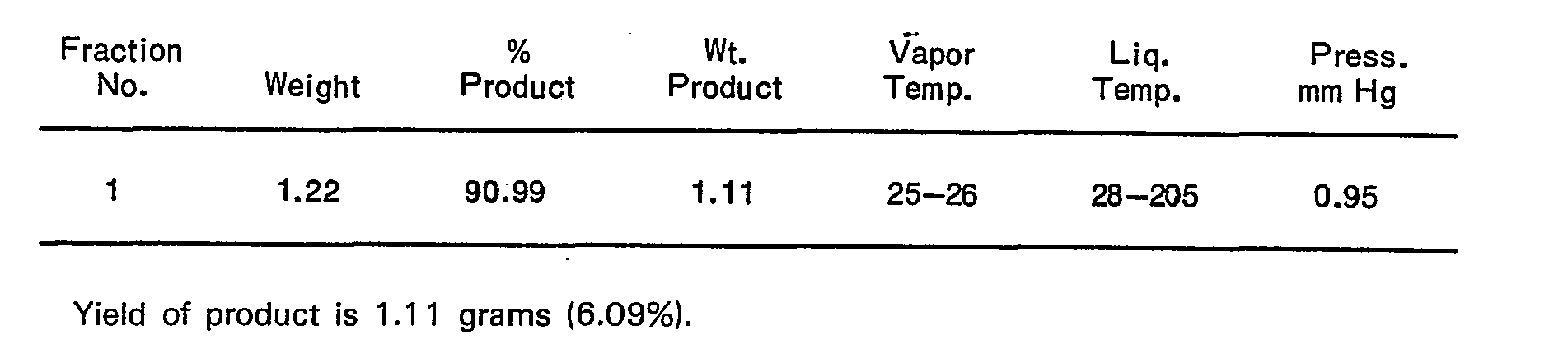
- Into a 250 ml reaction flask equipped with mechanical stirrer, Dean-Stark trap with Freidrich's condenser, immersion thermometer and heating mantle is placed 20.0 grams (0.12 moles) of the cyclopentanone-n-valeraldehyde aldol condensation product produced according to Example II-A; 100 ml toluene and 2.28 grams (0.012 moles) of paratoluene sulfonic acid. The reaction mass is heated to reflux (114°C) with stirring and approximately 2.6 ml water was azeotropically distilled from the reaction mass. The reaction is carried on for about 140 minutes and then the apparatus is shut down overnight for a period of 12 hours. The reaction is then restarted and run for 120 minutes additional time. The reaction mass is monitored on a 6' x 1.4" SE-30 GLC column until sufficient conversion appears to take place (91.6% endo:3.7% exo). The apparatus is shut down and the reaction product is cooled to room temperature.
- The reaction product is washed with 1 volume of saturated sodium chloride solution; 2 volumes of 5% sodium carbonate solution; and 2 volumes of saturated sodium chloride solution. The product is then dried over anhydrous sodium sulfate and concentrated to yield 15.46 grams of crude material. The crude is then rush-over distilled under vacuum into fractions as follows:
-


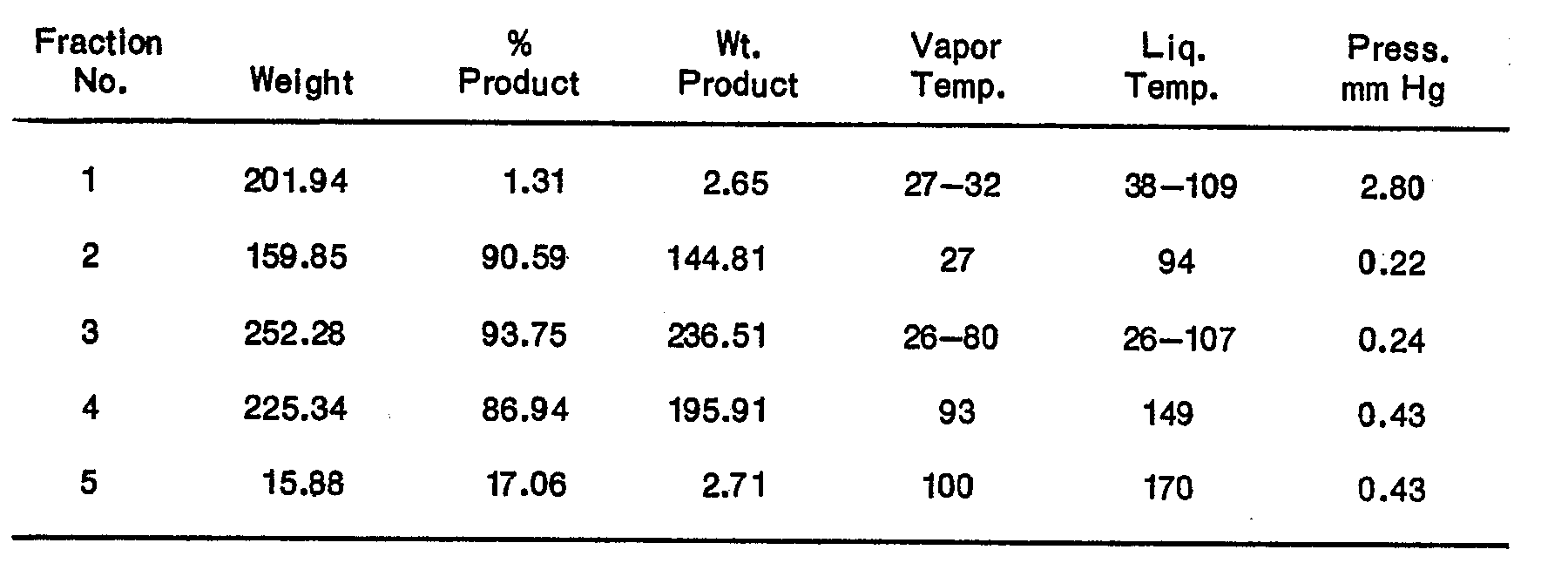
- Into a 5-liter reaction flask equipped with mechanical stirrer, 500 ml addition funnel, immersion thermometer, Friedrich's condenser, heating mantle and dry ice/isopropyl alcohol bath are placed 1.5 liters of water and 16.5 grams of sodium hydroxide. The resulting solution is warmed to 30°C. 756 grams (9.0 moles) of cyclopentanone is added dropwise with stirring while maintaining the temperature at 30°C. After addition of the cyclopentanone, 430 grams (5.0 moles) of n-valeraldehyde was added dropwise with stirring keeping the temperature at 30°C using the isopropyl alcohol/dry ice bath as needed. The reaction mass is then stirred for a period of 1 hour at 30°C.
- After 1 hour, 30.0 grams of acetic acid is added from a dropping pipette while maintaining the temperature at 30°C and stirring the reaction mass for 2-3 minutes thus obtaining in the reaction mass a pH of 6. The reaction apparatus is then shut down and the reaction mass is poured into a separatory funnel where the water and oil layers are separated. The water layer is washed with 2 volumes toluene and the toluene layer is combined with the oil layer and the washed aqueous layer is discarded. The organic layer is then washed with 2 volumes of saturated sodium chloride solution and filtered through cotton. The resulting organic material is then charged into a 5-liter reaction flask equipped with mechanical stirrer, Bidwell trap with bubble condenser, immersion thermometer and heating mantle and 10.0 grams of oxalic is added to the reaction mass. The resulting mixture is heated to reflux with stirring and water is azeotropically distilled until no further water is evolved (about 9 hours). 95 ml water is recovered. The resulting mixture is then cooled to room temperature and poured into a separatory funnel. The organic layer is washed with 2 volumes of saturated sodium chloride solution followed by 1 volume of 5% sodium carbonate solution, followed by 2 volumes of saturated sodium chloride solution. The resulting organic material is dried over anhydrous sodium sulfate and concentrated to yield 582 grams of crude product. This material is distilled in vacuo using a 2" splash column and rush-over head into five fractions as follows:
- Yield of product is 582.59 grams (76.66%).
- The following mixture is prepared:

- The methyl dihydrojasmonate produced according to Example I-D imparts to this jasmine formulation the green, sweet, floral note so important to the jasmine perfume formulation.
-

-

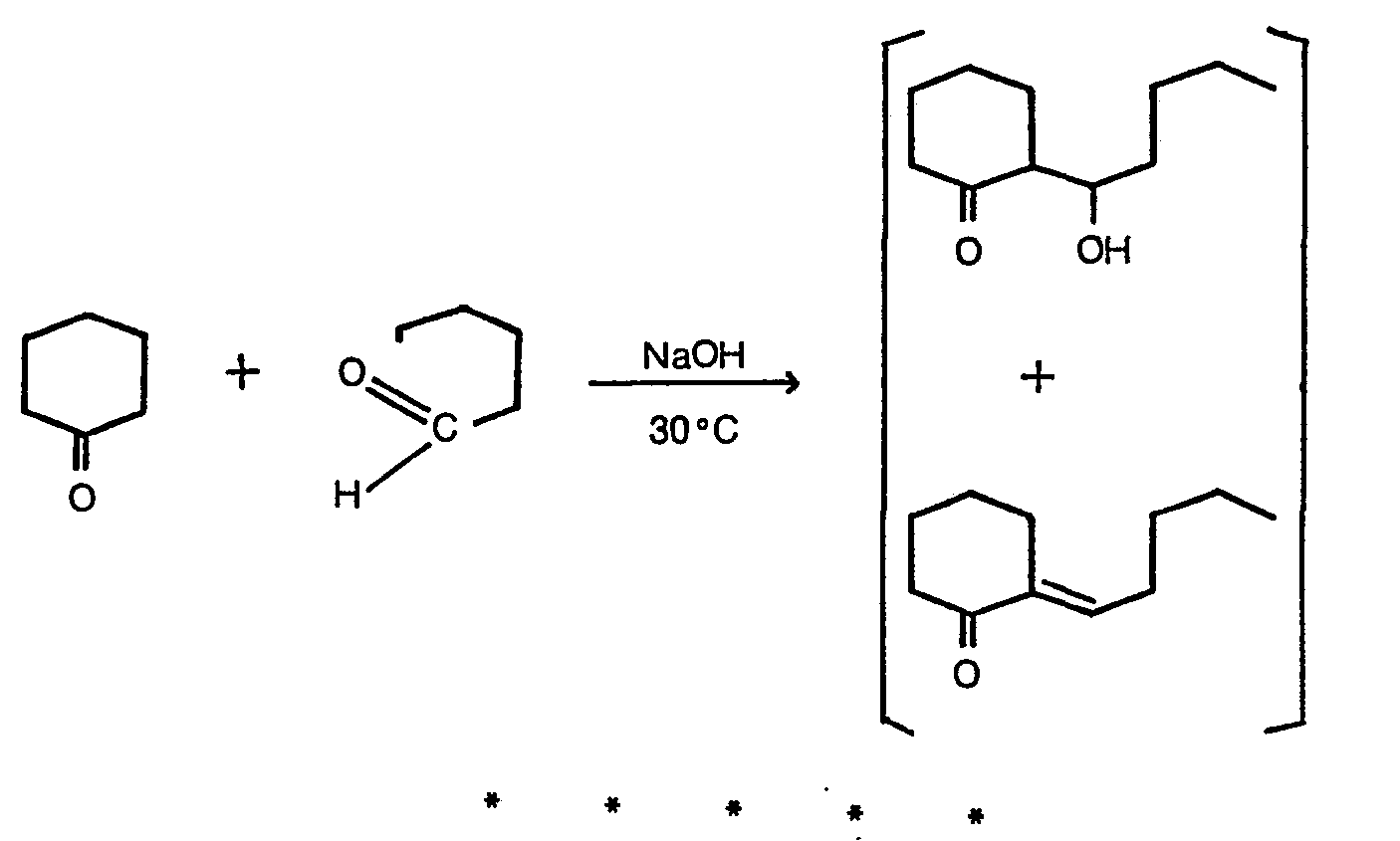
- Into a 5-liter reaction flask equipped with mechanical stirrer, 500 ml addition funnel, immersion thermometer and reflux condenser and 5-liter heating mantel and dry ice/isopropyl alcohol bath are charged 16.5 grams of sodium hydroxide and 1500 ml water. The resulting mixture is warmed to 30°C. 882 grams (9.0 moles) of cyclohexanone is then added dropwise with stirring over a 15 minute period while maintaining the reaction temperature at 30°C with the dry ice/isopropanol bath.
- 430 grams (5.0 moles) of n-valeraldehyde is then added dropwise with stirring over a 40 minute period while keeping the temperature at 30°C. After addition, the reaction mass is stirred for a period of 1 hour at 30°C.
- After 1 hour, 30.0 grams of acetic acid is added using a dropping pipette and the reflux condenser is replaced with a splash column equipped with rush-over head. The resulting mixture is then heated and steam distilled. All fractions are monitored on a 400' SE-30 glass capillary GLC column. The distillation is shut down when no further apparent oil layer is formed. The resulting mixture is allowed to cool down and poured into a separatory funnel. The aqueous layer is separated and washed with two volumes of toluene. The toluene layer is combined with the organic layer and the resulting organic layer is washed with two volumes of saturated sodium chloride solution and then filtered through cotton. The resulting material is placed in the 5-liter reaction flask as equipped above.
- 10.0 grams of oxalic acid is then added and the reaction mixture is heated with stirring and azeotropically distilling water until no further water is evolved (about 90 ml water being removed). The reaction equipment is then shut down and the reaction mass is cooled and poured into a 4-liter separatory funnel. The reaction mass is then washed with two volumes of saturated sodium chloride solution followed by two volumes of 5% sodium carbonate solution followed by two volumes of saturated sodium chloride solution. The resulting material is then dried over anhydrous sodium suifate and concentrated to yield 1120.0 grams of material.
- The resulting product is then distilled under vacuum using a splash column and rush-over head.
-

- Into a 5-liter reaction flask equipped with mechanical stirrer, immersion thermometer, bubble condenser and 5-liter heating mantel are charged 581.3 grams (3.75 moles) of 2-pentylidene cyclohexanone prepared according to Example V-A and 2400 ml of 5% hydrogen bromide in n-butanol (120 ml hydrogen bromide in 2280 ml n-butanol). The resulting mixture is heated with stirring to reflux at 105°C. The reaction mass is then stirred over a period of 115 minutes while monitoring the progress on a 6' x 1/4" glass SE-30 packed column (operated at 150°C isothermal) approximately every 5-10 minutes.
- After 115 minutes, the reaction apparatus is shut down and the reaction mass is cooled. The resulting mixture is poured into a separatory funnel and washed with 1 volume of saturated sodium chloride solution followed by 1 volume of 10% sodium carbonate solution and 2 volumes of saturated sodium chloride solution. The resulting material is then dried over anhydrous sodium sulfate and concentrated to yield 795 grams of crude product. The resulting crude is then distilled under vacuum using a splash column and rush-over head.
-

- Into a 5-liter reaction flask equipped with mechanical stirrer, immersion thermometer, 1000 ml addition funnel with nitrogen inlet and water-cooled condenser with nitrogen bubbler and dry ice/isopropyl alcohol bath is placed 1350 ml of anhydrous methyl alcohol and 7.82 grams (0.34 gm- atoms) of sodium pellets under a nitrogen atmosphere at 25°C. In one batch, 448.8 grams (3.40 moles) of dimethyl malonate is added with stirring while maintaining the reaction mass temperature at 25°C. The reaction mass is then cooled to -5°C.
- Over a 40 minute period 492 grams (3.00 moles) of 2-pentyl-2-cyclohexen-1-one prepared according to Example V-B is added. The reaction mass is then stirred for a period of 1 hour at -5°C. 40.8 grams (0.68 moles) of acetic acid is then added to the reaction mass and the reaction mixture is stirred and permitted to attain room temperature. The reaction mass is then transferred to a large separatory funnel. Approximately 2 liters of water is added to the reaction mass and the resulting mixture is shaken vigorously. The oil layer separates to the bottom and is removed and retained.
- The aqueous layer is then stripped to remove the methanol; washed with 2 volumes of diethyl ether and discarded. The diethyl ether washings are combined with the organic layer (the oil layer), washed two times with saturated sodium chloride solution and then dried over anhydrous sodium sulfate. The resulting dried material is concentrated to yield 1271 grams of crude material. GLC analysis on a 6' x 1/4" SE-30 packed glass column shows the crude to be 40.34% diester (512.72 grams = 63.79% yield).
-

- Into a 3-liter reaction flask equipped with mechanical stirrer, immersion thermometer, 250 ml addition funnel with nitrogen inlet, 1-ft. jacketed column packed with saddles, a rush-over head with thermometer, a take-off adapter with nitrogen bubbler, a 500 ml receiver and a heating mantle is placed 1280.0 grams of the crude 3-dimethylmalonyl-2-pentyl-cyclohexan-1-one prepared according to Example V-C. The compound is heated with stirring to 200°C. During the heating, any solvent from the previous reaction of Example V--C distills over and is discarded. At 200°C, 50.94 grams (2.83 moles) of water is added dropwise (1 drop per 1.5 seconds) causing a vigorous evolution of carbon dioxide and methyl alcohol which is collected in the receiver. The addition takes approximately 1 hour. Heating at 200°C is continued for 35 minutes. The reaction is monitored by GLC (6' x 1/4" SE-30 packed glass column) immediately after the water addition and 35 minutes later. Substantially diester still remains so an additional 10 grams of water is added over a 20 minute period and the reaction mass is again stirred for 30 minutes. GLC analysis continues to show diester as the reaction is shut down for 12 hours and recommenced when an additional 10 grams of water is added at 200°C over a 20 minute period. Stirring is continued at 200°C for an additional 30 minutes. At this point, GLC analysis indicates no diester is present and the reaction apparatus is shut down and the reaction mass cooled to room temperature. The crude material (640 grams) is then distilled under vacuum on a 2" splash column with rush-over head. The resulting fractions are then fractionally distilled on a 12" Hemple Column having a Goodloe packing. The distillation yields the resulting product in 11 fractions.
-

- Into a 500 ml reaction flask equipped with mechanical stirrer, immersion thermometer, 150 ml addition funnel, water-cooled condenser, heating mantle and ice bath is placed 1.65 grams of sodium hydroxide pellets and 155 ml water. The resulting solution is warmed to 30°C. 75.6 grams (0.9 moles) of cyclohexanone is then added dropwise with stirring while maintaining the temperature at 30-31 °C. 43.0 grams (0.5 moles) on n-valeraldehyde is then added dropwise with stirring over a period of about 30 minutes while maintaining the temperature at 30°C. The reaction mass is then stirred for 1 hour at 30°C. At this point, 3.0 grams of acetic acid and 100 ml of water are added. The condenser is then replaced with a splash column and rush-over head and the reaction mass is heated to 95°C to distill the unreacted cyclohexanone. The reaction mass is then distilled until the head temperature is 100°C and the majority of the cyclohexanone is removed. The reaction apparatus is then shut down and the reaction mass is cooled and poured into a separatory funnel.
- The oil layer is taken up in diethyl ether and separated from the aqueous layer. It is then washed with 1 volume of saturated sodium chloride solution and dried over anhydrous sodium sulfate and concentrated to yield 72.52 grams of crude product.
-


- The ratio of endo:exo is about 14:1. The reaction apparatus is then shut down and the reaction mass is cooled and poured into a separatory funnel. The oil layer is then washed with 1 volume of saturated sodium chloride solution; followed by 1 volume of 10% sodium carbonate solution; followed by 3 volumes of saturated sodium chloride solution. The resulting material is then dried over anhydrous sodium sulfate and the crude material (172 grams) is distilled under vacuum. The yield is 140 grams.
-

- Into a 250 ml reaction flask equipped with mechanical stirrer, immersion thermometer, water-cooled condenser and heating mantle is placed 0.23 moles of the aldol condensation product of cyclohexanone and n-valeraldehyde produced according to Example VI-A and 176.4 ml of 5% hydrogen chloride in n-butanol (8.4 ml of 38% HCI in 168 ml n-butanol). The reaction mass is heated with stirring to reflux and refluxed until a ratio of endo:exo isomer is about 13:1 monitored on a 6' x 1/4" SE-30 glass packed GLC column. The time of reaction is 170 minutes. At the end of the 170- minute period the reaction apparatus is shut down and the reaction mass is washed with 1 volume of saturated sodium chloride solution followed by 1 volume of 10% sodium carbonate solution and 3 volumes of saturated sodium chloride solution. The product is then dried over anhydrous sodium sulfate to yield 230 grams of crude. The crude material is distilled under vacuum using a rush-over head. The yield of product is 140 grams.
-

- Into a 250 ml reaction flask equipped with mechanical stirrer, Dean-Stark trap with Freidrich's condenser, immersion thermometer and heating mantle is placed 20.0 grams of the cyclohexanone-n-valeraldehyde aldol condensation product produced according to Example VI-A; 100 ml toluene and 2.28 grams (0.0.2 moles) of paratoluene sulfonic acid. The reaction mass is heated to reflux (114°C) with stirring and approximately 2.6 ml water is azeotropically distilled from the reaction mass. The reaction is carried on for about 140 minutes and then the apparatus is shut down overnight for a period of 12 hours. The reaction is then restarted and run for 120 minutes additional time. The reaction mass is monitored on a 6' x 1/4" SE-30 GLC column until sufficient conversion appears to take place (about 13:1 endo:exo). The apparatus is shut down- and the reaction product is cooled to room temperature.
- The reaction product is washed with 1 volume of saturated sodium chloride solution; 2 volumes of 5% sodium carbonate solution; and 2 volumes of saturated sodium chloride solution. The product is then dried over anhydrous sodium sulfate and concentrated to yield 20.0 grams of crude material. The crude material is then rush-over distilled under vacuum yielding 11.1 grams of final product.
-
-

- After 1 hour, 30.0 grams of acetic acid is added from a dropping pipette while maintaining the temperature at 30°C and stirring the reaction mass for 2-3 minutes thus obtaining in the reaction mass a pH of 6.
- The reaction apparatus is then shut down and the reaction mass is poured into a separatory funnel where the water and oil layers are separated. The water layer is washed with 2 volumes of toluene and the toluene layer is combined with the oil layer and the washed aqueous layer is discarded. The organic layer is then washed with 2 volumes of saturated sodium chloride solution and filtered through cotton. The resulting organic material is then charged into a 5-liter reaction flask equipped with mechanical stirrer, Bidwell trap with bubble condenser, immersion thermometer and heating mantel and 10.0 grams of oxalic acid is added to the reaction mass. The resulting mixture is heated to reflux with stirring and water is azeotropically distilled until no further water is evolved (about 9 hours). 95 ml water is recovered. The resulting mixture is then cooled to room temperature and poured into a separatory funnel. The organic layer is washed with 2 volumes of saturated sodium chloride solution followed by 1 volume of 5% sodium carbonate solution, followed by 2 volumes of saturated sodium chloride solution. The resulting organic material is dried over anhydrous sodium sulfate and concentrated to yield 485 grams of crude product. This material is distilled in vacuo using a 2" splash column and rush-over head. The yield of product is 375 grams.
Claims (4)






Applications Claiming Priority (4)
| Application Number | Priority Date | Filing Date | Title |
|---|---|---|---|
| US113297 | 1980-01-18 | ||
| US06/113,297 US4260830A (en) | 1980-01-18 | 1980-01-18 | Process for the preparation of methyl dihydrojasmonate and lower alkyl homologues |
| US206688 | 1980-11-13 | ||
| US06/206,688 US4310701A (en) | 1980-01-18 | 1980-11-13 | Process for the preparation of homologues of methyl dihydrojasmonate |
Publications (2)
| Publication Number | Publication Date |
|---|---|
| EP0033604A1 EP0033604A1 (en) | 1981-08-12 |
| EP0033604B1 true EP0033604B1 (en) | 1983-07-13 |
Family
ID=26810901
Family Applications (1)
| Application Number | Title | Priority Date | Filing Date |
|---|---|---|---|
| EP81300207A Expired EP0033604B1 (en) | 1980-01-18 | 1981-01-16 | Process for the preparation of methyl dihydrojasmonate and homologues |
Country Status (3)
| Country | Link |
|---|---|
| US (1) | US4310701A (en) |
| EP (1) | EP0033604B1 (en) |
| DE (1) | DE3160570D1 (en) |
Families Citing this family (13)
| Publication number | Priority date | Publication date | Assignee | Title |
|---|---|---|---|---|
| US4643903A (en) * | 1983-12-21 | 1987-02-17 | International Flavors & Fragrances Inc. | Alkyl substituted and unsubstituted para-carboalkoxy cyclohexanones and organoleptic uses thereof |
| US4668817A (en) * | 1983-12-21 | 1987-05-26 | International Flavors & Fragrances Inc. | Alkyl substituted para-carboalkoxy cyclohexanones |
| US4629805A (en) * | 1983-12-21 | 1986-12-16 | International Flavors & Fragrances Inc. | Alkyl substituted and unsubstituted para-carboalkoxy cyclohexanones and organoleptic uses thereof |
| US4537704A (en) * | 1983-12-21 | 1985-08-27 | International Flavors & Fragrances Inc. | Alkyl substituted and unsubstituted para-carboalkoxy cyclohexanones and organoleptic uses thereof |
| JPS61106537A (en) * | 1984-10-30 | 1986-05-24 | Sumitomo Chem Co Ltd | Production of cyclopentylacetic acid ester |
| US4585582A (en) * | 1985-03-08 | 1986-04-29 | International Flavors & Fragrances Inc. | Perfumery uses of 2-n-pentyl-2-cyclohexen-1-one |
| DE3707209A1 (en) * | 1987-03-06 | 1988-09-15 | Henkel Kgaa | 2-ALKYLIDES-3,3,5 (3,5,5) -TRIMETHYLCYCLOPENTANONE AS A FRAGRANCE |
| JP2003171336A (en) | 2001-11-30 | 2003-06-20 | Takasago Internatl Corp | Method for producing 2-alkyl-2-cyclopentenones |
| US7161041B2 (en) * | 2002-12-26 | 2007-01-09 | Kao Corporation | Process for producing cycloalkanone derivatives |
| IL159318A (en) * | 2002-12-26 | 2008-03-20 | Kao Corp | Method for producing 2-(alkyl) cycloalkenone |
| US7078559B2 (en) * | 2003-07-16 | 2006-07-18 | Kao Corporation | Method of producing acetate derivative |
| JP4651959B2 (en) * | 2004-03-15 | 2011-03-16 | 花王株式会社 | Cycloalkanone-containing composition |
| EP2953920B1 (en) * | 2013-02-11 | 2018-07-18 | Firmenich SA | Process for the isomerisation of an exo double bond |
Citations (3)
| Publication number | Priority date | Publication date | Assignee | Title |
|---|---|---|---|---|
| DE956948C (en) * | 1953-08-18 | 1957-01-24 | Huels Chemische Werke Ag | Process for the preparation of condensation products from cycloaliphatic ketones and aliphatic aldehydes with at least 2 carbon atoms |
| US3158644A (en) * | 1960-02-25 | 1964-11-24 | Firmenich & Cie | Alicyclic ketoesters and process for their manufacture |
| GB1347667A (en) * | 1972-01-18 | 1974-02-27 | Roure Bertrand Dupont Sa | Cyclic ketone |
Family Cites Families (2)
| Publication number | Priority date | Publication date | Assignee | Title |
|---|---|---|---|---|
| NL179368C (en) * | 1976-07-16 | 1986-09-01 | Roure Bertrand Dupont Sa | PROCESS FOR PREPARING OXOCYCLOPENTYL AND OXOCYCLOHEXYL COMPOUNDS. |
| US4260830A (en) * | 1980-01-18 | 1981-04-07 | International Flavors & Fragrances Inc. | Process for the preparation of methyl dihydrojasmonate and lower alkyl homologues |
-
1980
- 1980-11-13 US US06/206,688 patent/US4310701A/en not_active Expired - Lifetime
-
1981
- 1981-01-16 EP EP81300207A patent/EP0033604B1/en not_active Expired
- 1981-01-16 DE DE8181300207T patent/DE3160570D1/en not_active Expired
Patent Citations (3)
| Publication number | Priority date | Publication date | Assignee | Title |
|---|---|---|---|---|
| DE956948C (en) * | 1953-08-18 | 1957-01-24 | Huels Chemische Werke Ag | Process for the preparation of condensation products from cycloaliphatic ketones and aliphatic aldehydes with at least 2 carbon atoms |
| US3158644A (en) * | 1960-02-25 | 1964-11-24 | Firmenich & Cie | Alicyclic ketoesters and process for their manufacture |
| GB1347667A (en) * | 1972-01-18 | 1974-02-27 | Roure Bertrand Dupont Sa | Cyclic ketone |
Also Published As
| Publication number | Publication date |
|---|---|
| US4310701A (en) | 1982-01-12 |
| DE3160570D1 (en) | 1983-08-18 |
| EP0033604A1 (en) | 1981-08-12 |
Similar Documents
| Publication | Publication Date | Title |
|---|---|---|
| US4260830A (en) | Process for the preparation of methyl dihydrojasmonate and lower alkyl homologues | |
| EP0033604A1 (en) | Process for the preparation of methyl dihydrojasmonate and homologues | |
| US3754016A (en) | Novel cycloalkenone esters | |
| AU742027B2 (en) | Cyclopentylalkyl-nitriles | |
| US4168248A (en) | Perfume compositions | |
| US3318945A (en) | Cyclododecadiene carboxylic acid esters | |
| US3941828A (en) | Process for the preparation of cyclic ketones | |
| US4891447A (en) | Sandalwood odorants | |
| US6200254B1 (en) | Macrocyclic ketones as fragrance materials and methods for making same | |
| EP1067118B1 (en) | Cyclopentylalkyl-nitriles and the use of odoriferous cyclopentylalkyl derivatives as fragrances | |
| EP0054065B1 (en) | Ambrinol and its homologues | |
| US3673263A (en) | Dihydro-{62 -santalol and process for preparing dihydro-{62 -santalol from 3-endo-methyl-3-exo(4{40 -methyl-5{40 -hydroxypentyl) norcamphor | |
| JPH10504325A (en) | Method for producing unsaturated alicyclic ketone | |
| EP1668103B1 (en) | 3-isopropyl-1-methylcyclopentyl derivatives and their use in fragrance applications | |
| US4728747A (en) | Novel 2,3-disubstituted bicyclo(2.2.1)heptanes and heptenes, their preparation, and their use as scents | |
| US6861551B2 (en) | Processes for the preparation of macrocyclic ketones | |
| US4481372A (en) | Process for preparing allyl alpha and beta ionones and intermediates therefor | |
| JP4380024B2 (en) | Process for producing 2- (1-hydroxyalkyl) cycloalkanone | |
| EP0025638B1 (en) | Process for the production of 1-crotonoyl-2,6,6-trimethylcyclohexa-1,3-diene and esters of alkynylcyclohexane derivatives as intermediates therefor | |
| US2849491A (en) | 6, 8-dimethyl-5-nonen-2-one | |
| EP0177742B1 (en) | Nitrogen compounds, their preparation and their use as starting products for the preparation of decalin ketones | |
| US5037802A (en) | Sandalwood odorants | |
| US4124644A (en) | Process for preparing substituted oxyacetaldehydes and acetals thereof | |
| US4960946A (en) | Sandalwood odorants | |
| US2806887A (en) | 3, 7, 9-trimethyl-1, 6-decadien-3-ol |
Legal Events
| Date | Code | Title | Description |
|---|---|---|---|
| PUAI | Public reference made under article 153(3) epc to a published international application that has entered the european phase |
Free format text: ORIGINAL CODE: 0009012 |
|
| AK | Designated contracting states |
Designated state(s): CH DE FR GB NL |
|
| 17P | Request for examination filed |
Effective date: 19810804 |
|
| GRAA | (expected) grant |
Free format text: ORIGINAL CODE: 0009210 |
|
| AK | Designated contracting states |
Designated state(s): CH DE FR GB LI NL |
|
| PG25 | Lapsed in a contracting state [announced via postgrant information from national office to epo] |
Ref country code: NL Effective date: 19830713 Ref country code: LI Effective date: 19830713 Ref country code: FR Free format text: THE PATENT HAS BEEN ANNULLED BY A DECISION OF A NATIONAL AUTHORITY Effective date: 19830713 Ref country code: CH Effective date: 19830713 |
|
| REF | Corresponds to: |
Ref document number: 3160570 Country of ref document: DE Date of ref document: 19830818 |
|
| REG | Reference to a national code |
Ref country code: CH Ref legal event code: PL |
|
| NLV1 | Nl: lapsed or annulled due to failure to fulfill the requirements of art. 29p and 29m of the patents act | ||
| EN | Fr: translation not filed | ||
| PLBE | No opposition filed within time limit |
Free format text: ORIGINAL CODE: 0009261 |
|
| STAA | Information on the status of an ep patent application or granted ep patent |
Free format text: STATUS: NO OPPOSITION FILED WITHIN TIME LIMIT |
|
| 26N | No opposition filed | ||
| PGFP | Annual fee paid to national office [announced via postgrant information from national office to epo] |
Ref country code: DE Payment date: 19891220 Year of fee payment: 10 |
|
| PGFP | Annual fee paid to national office [announced via postgrant information from national office to epo] |
Ref country code: GB Payment date: 19891231 Year of fee payment: 10 |
|
| PG25 | Lapsed in a contracting state [announced via postgrant information from national office to epo] |
Ref country code: GB Effective date: 19910116 |
|
| GBPC | Gb: european patent ceased through non-payment of renewal fee | ||
| PG25 | Lapsed in a contracting state [announced via postgrant information from national office to epo] |
Ref country code: DE Effective date: 19911001 |