EP0032072A1 - Surfactant compositions useful in enhanced oil recovery processes - Google Patents
Surfactant compositions useful in enhanced oil recovery processes Download PDFInfo
- Publication number
- EP0032072A1 EP0032072A1 EP80401731A EP80401731A EP0032072A1 EP 0032072 A1 EP0032072 A1 EP 0032072A1 EP 80401731 A EP80401731 A EP 80401731A EP 80401731 A EP80401731 A EP 80401731A EP 0032072 A1 EP0032072 A1 EP 0032072A1
- Authority
- EP
- European Patent Office
- Prior art keywords
- composition
- surfactant
- parts
- alkyl radical
- alkylated
- Prior art date
- Legal status (The legal status is an assumption and is not a legal conclusion. Google has not performed a legal analysis and makes no representation as to the accuracy of the status listed.)
- Granted
Links
- 239000000203 mixture Substances 0.000 title claims abstract description 74
- 239000004094 surface-active agent Substances 0.000 title claims abstract description 65
- 238000011084 recovery Methods 0.000 title abstract description 9
- 239000003208 petroleum Substances 0.000 claims abstract description 21
- 239000007859 condensation product Substances 0.000 claims abstract description 18
- BDHFUVZGWQCTTF-UHFFFAOYSA-M sulfonate Chemical compound [O-]S(=O)=O BDHFUVZGWQCTTF-UHFFFAOYSA-M 0.000 claims abstract description 17
- 125000002947 alkylene group Chemical group 0.000 claims abstract description 14
- MTHSVFCYNBDYFN-UHFFFAOYSA-N diethylene glycol Chemical compound OCCOCCO MTHSVFCYNBDYFN-UHFFFAOYSA-N 0.000 claims abstract description 12
- -1 alkylated diphenyl oxide sulfonate Chemical class 0.000 claims description 45
- XLYOFNOQVPJJNP-UHFFFAOYSA-N water Substances O XLYOFNOQVPJJNP-UHFFFAOYSA-N 0.000 claims description 15
- 238000000034 method Methods 0.000 claims description 14
- 125000004432 carbon atom Chemical group C* 0.000 claims description 13
- 239000003945 anionic surfactant Substances 0.000 claims description 12
- 239000011435 rock Substances 0.000 claims description 12
- WOWFGZLCKNNPIV-UHFFFAOYSA-N 3-phenylbenzene-1,2-disulfonic acid Chemical group OS(=O)(=O)C1=CC=CC(C=2C=CC=CC=2)=C1S(O)(=O)=O WOWFGZLCKNNPIV-UHFFFAOYSA-N 0.000 claims description 10
- 229910001413 alkali metal ion Inorganic materials 0.000 claims description 10
- 229910052739 hydrogen Inorganic materials 0.000 claims description 10
- 239000001257 hydrogen Substances 0.000 claims description 10
- USIUVYZYUHIAEV-UHFFFAOYSA-N diphenyl ether Chemical group C=1C=CC=CC=1OC1=CC=CC=C1 USIUVYZYUHIAEV-UHFFFAOYSA-N 0.000 claims description 9
- 229910001420 alkaline earth metal ion Inorganic materials 0.000 claims description 7
- 230000008569 process Effects 0.000 claims description 7
- DGAQECJNVWCQMB-PUAWFVPOSA-M Ilexoside XXIX Chemical compound C[C@@H]1CC[C@@]2(CC[C@@]3(C(=CC[C@H]4[C@]3(CC[C@@H]5[C@@]4(CC[C@@H](C5(C)C)OS(=O)(=O)[O-])C)C)[C@@H]2[C@]1(C)O)C)C(=O)O[C@H]6[C@@H]([C@H]([C@@H]([C@H](O6)CO)O)O)O.[Na+] DGAQECJNVWCQMB-PUAWFVPOSA-M 0.000 claims description 6
- 150000002500 ions Chemical class 0.000 claims description 6
- 239000011734 sodium Substances 0.000 claims description 5
- QGZKDVFQNNGYKY-UHFFFAOYSA-O Ammonium Chemical compound [NH4+] QGZKDVFQNNGYKY-UHFFFAOYSA-O 0.000 claims description 4
- IAYPIBMASNFSPL-UHFFFAOYSA-N Ethylene oxide Chemical compound C1CO1 IAYPIBMASNFSPL-UHFFFAOYSA-N 0.000 claims description 4
- 229910052708 sodium Inorganic materials 0.000 claims description 4
- QXNVGIXVLWOKEQ-UHFFFAOYSA-N Disodium Chemical compound [Na][Na] QXNVGIXVLWOKEQ-UHFFFAOYSA-N 0.000 claims description 3
- ZLMJMSJWJFRBEC-UHFFFAOYSA-N Potassium Chemical compound [K] ZLMJMSJWJFRBEC-UHFFFAOYSA-N 0.000 claims description 3
- CIUQDSCDWFSTQR-UHFFFAOYSA-N [C]1=CC=CC=C1 Chemical group [C]1=CC=CC=C1 CIUQDSCDWFSTQR-UHFFFAOYSA-N 0.000 claims description 3
- 229910052700 potassium Inorganic materials 0.000 claims description 3
- 239000011591 potassium Substances 0.000 claims description 3
- 239000000047 product Substances 0.000 claims description 3
- VGGSQFUCUMXWEO-UHFFFAOYSA-N Ethene Chemical group C=C VGGSQFUCUMXWEO-UHFFFAOYSA-N 0.000 claims description 2
- 239000005977 Ethylene Substances 0.000 claims description 2
- 150000002431 hydrogen Chemical class 0.000 claims 2
- UFHFLCQGNIYNRP-UHFFFAOYSA-N Hydrogen Chemical compound [H][H] UFHFLCQGNIYNRP-UHFFFAOYSA-N 0.000 claims 1
- 229910021645 metal ion Inorganic materials 0.000 claims 1
- 150000001768 cations Chemical class 0.000 description 12
- 150000003871 sulfonates Chemical class 0.000 description 12
- 239000011148 porous material Substances 0.000 description 11
- 239000000126 substance Substances 0.000 description 8
- 125000004435 hydrogen atom Chemical class [H]* 0.000 description 7
- 239000000463 material Substances 0.000 description 7
- KFZMGEQAYNKOFK-UHFFFAOYSA-N Isopropanol Chemical compound CC(C)O KFZMGEQAYNKOFK-UHFFFAOYSA-N 0.000 description 6
- 238000001179 sorption measurement Methods 0.000 description 6
- AKEJUJNQAAGONA-UHFFFAOYSA-N sulfur trioxide Chemical compound O=S(=O)=O AKEJUJNQAAGONA-UHFFFAOYSA-N 0.000 description 6
- 125000004178 (C1-C4) alkyl group Chemical group 0.000 description 4
- MAUMSNABMVEOGP-UHFFFAOYSA-N (methyl-$l^{2}-azanyl)methane Chemical compound C[N]C MAUMSNABMVEOGP-UHFFFAOYSA-N 0.000 description 4
- POAOYUHQDCAZBD-UHFFFAOYSA-N 2-butoxyethanol Chemical compound CCCCOCCO POAOYUHQDCAZBD-UHFFFAOYSA-N 0.000 description 4
- CURLTUGMZLYLDI-UHFFFAOYSA-N Carbon dioxide Chemical compound O=C=O CURLTUGMZLYLDI-UHFFFAOYSA-N 0.000 description 4
- ROSDSFDQCJNGOL-UHFFFAOYSA-N Dimethylamine Chemical compound CNC ROSDSFDQCJNGOL-UHFFFAOYSA-N 0.000 description 4
- 239000004064 cosurfactant Substances 0.000 description 4
- 238000006073 displacement reaction Methods 0.000 description 4
- LYCAIKOWRPUZTN-UHFFFAOYSA-N ethylene glycol Natural products OCCO LYCAIKOWRPUZTN-UHFFFAOYSA-N 0.000 description 4
- WGCNASOHLSPBMP-UHFFFAOYSA-N hydroxyacetaldehyde Natural products OCC=O WGCNASOHLSPBMP-UHFFFAOYSA-N 0.000 description 4
- 239000007924 injection Substances 0.000 description 4
- 238000002347 injection Methods 0.000 description 4
- GETQZCLCWQTVFV-UHFFFAOYSA-N trimethylamine Chemical compound CN(C)C GETQZCLCWQTVFV-UHFFFAOYSA-N 0.000 description 4
- OYPRJOBELJOOCE-UHFFFAOYSA-N Calcium Chemical compound [Ca] OYPRJOBELJOOCE-UHFFFAOYSA-N 0.000 description 3
- FYYHWMGAXLPEAU-UHFFFAOYSA-N Magnesium Chemical compound [Mg] FYYHWMGAXLPEAU-UHFFFAOYSA-N 0.000 description 3
- DNIAPMSPPWPWGF-UHFFFAOYSA-N Propylene glycol Chemical compound CC(O)CO DNIAPMSPPWPWGF-UHFFFAOYSA-N 0.000 description 3
- 230000015572 biosynthetic process Effects 0.000 description 3
- 239000012267 brine Substances 0.000 description 3
- 239000011575 calcium Substances 0.000 description 3
- 229910052791 calcium Inorganic materials 0.000 description 3
- ZUOUZKKEUPVFJK-UHFFFAOYSA-N diphenyl Chemical group C1=CC=CC=C1C1=CC=CC=C1 ZUOUZKKEUPVFJK-UHFFFAOYSA-N 0.000 description 3
- FDENMIUNZYEPDD-UHFFFAOYSA-L disodium [2-[4-(10-methylundecyl)-2-sulfonatooxyphenoxy]phenyl] sulfate Chemical compound [Na+].[Na+].CC(C)CCCCCCCCCc1ccc(Oc2ccccc2OS([O-])(=O)=O)c(OS([O-])(=O)=O)c1 FDENMIUNZYEPDD-UHFFFAOYSA-L 0.000 description 3
- 239000011777 magnesium Substances 0.000 description 3
- 229910052749 magnesium Inorganic materials 0.000 description 3
- 238000004519 manufacturing process Methods 0.000 description 3
- HPALAKNZSZLMCH-UHFFFAOYSA-M sodium;chloride;hydrate Chemical compound O.[Na+].[Cl-] HPALAKNZSZLMCH-UHFFFAOYSA-M 0.000 description 3
- 239000000243 solution Substances 0.000 description 3
- 238000005320 surfactant adsorption Methods 0.000 description 3
- OAYXUHPQHDHDDZ-UHFFFAOYSA-N 2-(2-butoxyethoxy)ethanol Chemical compound CCCCOCCOCCO OAYXUHPQHDHDDZ-UHFFFAOYSA-N 0.000 description 2
- SBASXUCJHJRPEV-UHFFFAOYSA-N 2-(2-methoxyethoxy)ethanol Chemical compound COCCOCCO SBASXUCJHJRPEV-UHFFFAOYSA-N 0.000 description 2
- CUDYYMUUJHLCGZ-UHFFFAOYSA-N 2-(2-methoxypropoxy)propan-1-ol Chemical compound COC(C)COC(C)CO CUDYYMUUJHLCGZ-UHFFFAOYSA-N 0.000 description 2
- HZAXFHJVJLSVMW-UHFFFAOYSA-N 2-Aminoethan-1-ol Chemical compound NCCO HZAXFHJVJLSVMW-UHFFFAOYSA-N 0.000 description 2
- WAEVWDZKMBQDEJ-UHFFFAOYSA-N 2-[2-(2-methoxypropoxy)propoxy]propan-1-ol Chemical compound COC(C)COC(C)COC(C)CO WAEVWDZKMBQDEJ-UHFFFAOYSA-N 0.000 description 2
- QCDWFXQBSFUVSP-UHFFFAOYSA-N 2-phenoxyethanol Chemical compound OCCOC1=CC=CC=C1 QCDWFXQBSFUVSP-UHFFFAOYSA-N 0.000 description 2
- GAWIXWVDTYZWAW-UHFFFAOYSA-N C[CH]O Chemical group C[CH]O GAWIXWVDTYZWAW-UHFFFAOYSA-N 0.000 description 2
- 244000007835 Cyamopsis tetragonoloba Species 0.000 description 2
- BAVYZALUXZFZLV-UHFFFAOYSA-O Methylammonium ion Chemical compound [NH3+]C BAVYZALUXZFZLV-UHFFFAOYSA-O 0.000 description 2
- DJEQZVQFEPKLOY-UHFFFAOYSA-N N,N-dimethylbutylamine Chemical compound CCCCN(C)C DJEQZVQFEPKLOY-UHFFFAOYSA-N 0.000 description 2
- OPKOKAMJFNKNAS-UHFFFAOYSA-N N-methylethanolamine Chemical compound CNCCO OPKOKAMJFNKNAS-UHFFFAOYSA-N 0.000 description 2
- WCUXLLCKKVVCTQ-UHFFFAOYSA-M Potassium chloride Chemical compound [Cl-].[K+] WCUXLLCKKVVCTQ-UHFFFAOYSA-M 0.000 description 2
- RAHZWNYVWXNFOC-UHFFFAOYSA-N Sulphur dioxide Chemical compound O=S=O RAHZWNYVWXNFOC-UHFFFAOYSA-N 0.000 description 2
- 230000009471 action Effects 0.000 description 2
- 229910052783 alkali metal Inorganic materials 0.000 description 2
- 150000008378 aryl ethers Chemical class 0.000 description 2
- 125000000484 butyl group Chemical group [H]C([*])([H])C([H])([H])C([H])([H])C([H])([H])[H] 0.000 description 2
- 239000001569 carbon dioxide Substances 0.000 description 2
- 229910002092 carbon dioxide Inorganic materials 0.000 description 2
- 125000004122 cyclic group Chemical group 0.000 description 2
- XXJWXESWEXIICW-UHFFFAOYSA-N diethylene glycol monoethyl ether Chemical compound CCOCCOCCO XXJWXESWEXIICW-UHFFFAOYSA-N 0.000 description 2
- 229910000514 dolomite Inorganic materials 0.000 description 2
- 239000010459 dolomite Substances 0.000 description 2
- 239000003792 electrolyte Substances 0.000 description 2
- 125000001495 ethyl group Chemical group [H]C([H])([H])C([H])([H])* 0.000 description 2
- QUSNBJAOOMFDIB-UHFFFAOYSA-O ethylaminium Chemical compound CC[NH3+] QUSNBJAOOMFDIB-UHFFFAOYSA-O 0.000 description 2
- LIWAQLJGPBVORC-UHFFFAOYSA-N ethylmethylamine Chemical compound CCNC LIWAQLJGPBVORC-UHFFFAOYSA-N 0.000 description 2
- 238000002474 experimental method Methods 0.000 description 2
- 125000004029 hydroxymethyl group Chemical group [H]OC([H])([H])* 0.000 description 2
- 125000001449 isopropyl group Chemical group [H]C([H])([H])C([H])(*)C([H])([H])[H] 0.000 description 2
- 125000002496 methyl group Chemical group [H]C([H])([H])* 0.000 description 2
- 230000035699 permeability Effects 0.000 description 2
- 125000001436 propyl group Chemical group [H]C([*])([H])C([H])([H])C([H])([H])[H] 0.000 description 2
- 150000003254 radicals Chemical class 0.000 description 2
- 239000002562 thickening agent Substances 0.000 description 2
- SZNYYWIUQFZLLT-UHFFFAOYSA-N 2-methyl-1-(2-methylpropoxy)propane Chemical class CC(C)COCC(C)C SZNYYWIUQFZLLT-UHFFFAOYSA-N 0.000 description 1
- RZVAJINKPMORJF-UHFFFAOYSA-N Acetaminophen Chemical compound CC(=O)NC1=CC=C(O)C=C1 RZVAJINKPMORJF-UHFFFAOYSA-N 0.000 description 1
- BVKZGUZCCUSVTD-UHFFFAOYSA-L Carbonate Chemical compound [O-]C([O-])=O BVKZGUZCCUSVTD-UHFFFAOYSA-L 0.000 description 1
- 229920002134 Carboxymethyl cellulose Polymers 0.000 description 1
- 239000004354 Hydroxyethyl cellulose Substances 0.000 description 1
- 229920000663 Hydroxyethyl cellulose Polymers 0.000 description 1
- NPYPAHLBTDXSSS-UHFFFAOYSA-N Potassium ion Chemical compound [K+] NPYPAHLBTDXSSS-UHFFFAOYSA-N 0.000 description 1
- 238000010795 Steam Flooding Methods 0.000 description 1
- 238000010521 absorption reaction Methods 0.000 description 1
- 239000002253 acid Substances 0.000 description 1
- 150000001298 alcohols Polymers 0.000 description 1
- 150000001340 alkali metals Chemical class 0.000 description 1
- 229910052784 alkaline earth metal Inorganic materials 0.000 description 1
- 150000001342 alkaline earth metals Chemical class 0.000 description 1
- 150000008055 alkyl aryl sulfonates Chemical class 0.000 description 1
- 125000000217 alkyl group Chemical group 0.000 description 1
- 150000003863 ammonium salts Chemical class 0.000 description 1
- SRSXLGNVWSONIS-UHFFFAOYSA-N benzenesulfonic acid Chemical class OS(=O)(=O)C1=CC=CC=C1 SRSXLGNVWSONIS-UHFFFAOYSA-N 0.000 description 1
- 239000004305 biphenyl Substances 0.000 description 1
- 235000010290 biphenyl Nutrition 0.000 description 1
- 150000004649 carbonic acid derivatives Chemical class 0.000 description 1
- 239000001768 carboxy methyl cellulose Substances 0.000 description 1
- 235000010948 carboxy methyl cellulose Nutrition 0.000 description 1
- 239000008112 carboxymethyl-cellulose Substances 0.000 description 1
- 238000002485 combustion reaction Methods 0.000 description 1
- 230000001419 dependent effect Effects 0.000 description 1
- 230000000694 effects Effects 0.000 description 1
- 239000000839 emulsion Substances 0.000 description 1
- 230000002349 favourable effect Effects 0.000 description 1
- 239000012530 fluid Substances 0.000 description 1
- 239000008398 formation water Substances 0.000 description 1
- 238000009472 formulation Methods 0.000 description 1
- 239000007789 gas Substances 0.000 description 1
- 150000004676 glycans Chemical class 0.000 description 1
- 229920006158 high molecular weight polymer Polymers 0.000 description 1
- 230000007062 hydrolysis Effects 0.000 description 1
- 238000006460 hydrolysis reaction Methods 0.000 description 1
- 235000019447 hydroxyethyl cellulose Nutrition 0.000 description 1
- 230000006872 improvement Effects 0.000 description 1
- 238000011065 in-situ storage Methods 0.000 description 1
- 239000007788 liquid Substances 0.000 description 1
- 230000014759 maintenance of location Effects 0.000 description 1
- 239000003607 modifier Substances 0.000 description 1
- 230000003472 neutralizing effect Effects 0.000 description 1
- 238000005191 phase separation Methods 0.000 description 1
- 229920002401 polyacrylamide Polymers 0.000 description 1
- 229920000642 polymer Polymers 0.000 description 1
- 229920001282 polysaccharide Polymers 0.000 description 1
- 239000005017 polysaccharide Substances 0.000 description 1
- 239000001103 potassium chloride Substances 0.000 description 1
- 235000011164 potassium chloride Nutrition 0.000 description 1
- 229910001414 potassium ion Inorganic materials 0.000 description 1
- 239000002244 precipitate Substances 0.000 description 1
- 150000003138 primary alcohols Chemical class 0.000 description 1
- 238000005086 pumping Methods 0.000 description 1
- 230000009467 reduction Effects 0.000 description 1
- 238000010992 reflux Methods 0.000 description 1
- 150000003839 salts Chemical class 0.000 description 1
- 229920006395 saturated elastomer Polymers 0.000 description 1
- FAPWRFPIFSIZLT-UHFFFAOYSA-M sodium chloride Inorganic materials [Na+].[Cl-] FAPWRFPIFSIZLT-UHFFFAOYSA-M 0.000 description 1
- 239000011780 sodium chloride Substances 0.000 description 1
- 229910001415 sodium ion Inorganic materials 0.000 description 1
- FVEFRICMTUKAML-UHFFFAOYSA-M sodium tetradecyl sulfate Chemical compound [Na+].CCCCC(CC)CCC(CC(C)C)OS([O-])(=O)=O FVEFRICMTUKAML-UHFFFAOYSA-M 0.000 description 1
- 238000000638 solvent extraction Methods 0.000 description 1
- 229910052712 strontium Inorganic materials 0.000 description 1
- 125000001424 substituent group Chemical group 0.000 description 1
- 150000008054 sulfonate salts Chemical class 0.000 description 1
- 150000003467 sulfuric acid derivatives Chemical class 0.000 description 1
- 239000000080 wetting agent Substances 0.000 description 1
Classifications
-
- C—CHEMISTRY; METALLURGY
- C09—DYES; PAINTS; POLISHES; NATURAL RESINS; ADHESIVES; COMPOSITIONS NOT OTHERWISE PROVIDED FOR; APPLICATIONS OF MATERIALS NOT OTHERWISE PROVIDED FOR
- C09K—MATERIALS FOR MISCELLANEOUS APPLICATIONS, NOT PROVIDED FOR ELSEWHERE
- C09K8/00—Compositions for drilling of boreholes or wells; Compositions for treating boreholes or wells, e.g. for completion or for remedial operations
- C09K8/58—Compositions for enhanced recovery methods for obtaining hydrocarbons, i.e. for improving the mobility of the oil, e.g. displacing fluids
- C09K8/584—Compositions for enhanced recovery methods for obtaining hydrocarbons, i.e. for improving the mobility of the oil, e.g. displacing fluids characterised by the use of specific surfactants
-
- C—CHEMISTRY; METALLURGY
- C09—DYES; PAINTS; POLISHES; NATURAL RESINS; ADHESIVES; COMPOSITIONS NOT OTHERWISE PROVIDED FOR; APPLICATIONS OF MATERIALS NOT OTHERWISE PROVIDED FOR
- C09K—MATERIALS FOR MISCELLANEOUS APPLICATIONS, NOT PROVIDED FOR ELSEWHERE
- C09K23/00—Use of substances as emulsifying, wetting, dispersing, or foam-producing agents
- C09K23/017—Mixtures of compounds
Definitions
- This invention relates to surfactant compositions useful in enhanced oil recovery processes.
- the invention relates to.surfactant compositions comprising a glycol ether while in another aspect, the invention relates to the use of the surfactant compositions in an aqueous flooding process for removing oil from a porous, subterranean rock reservoir.
- tertiary oil recovery or enhanced oil recovery methods Other methods used to recover tne remaining portion (50-60 percent) of the original oil content of a reservoir are generally termed tertiary oil recovery or enhanced oil recovery methods.
- tertiary oil recovery or enhanced oil recovery methods include steam flooding, miscible flooding with carbon dioxide, in situ combustion of part of the reservoir oil content, and flooding with micellar or aqueous surfactant solutions.
- aqueous anionic surfactant systems are known to be useful for displacing oil from porous, subterranean rock reservoirs.
- These surfactant systems are generally comprised of petroleum sulfonates, often in combination with such materials as electrolytes, water-thickeners, and emulsion modifiers. While these systems demonstrate generally good efficiency, their utility is often limited by their low tolerance to multivalent cations. These cations, such as calcium and magnesium, are often encountered in brines of subterranean reservoirs and tend to form anionic surfactant precipitates or cause surfactant phase separations when contacted with aqueous anionic surfactant systems.
- interfacial tension between these systems and oil is less than about 0.1 dyne per centimeter and the systems are taught to have good tolerance toward salts of mono- and/or multivalent cations found in the brine of many oil reservoirs. While these surfactant systems have demonstrated utility in the removal of oil from a porous, subterranean rock reservoir, their use toward this end is not without cost.
- a significant factor in the cost of using aqueous anionic surfactant systems for the displacement of oil from a subterranean rock reservoir is loss of the surfactant system to the rock reservoir by adsorption, i.e., attachment of the active surfactant components to the reservoir surface.
- the extent of surfactant adsorption is primarily dependent upon the physical and chemical properties of the reservoir but given the relatively high cost of the surfactant systems, any decrease in the loss due to adsorption can be an economically significant factor in the production of oil from the reservoir.
- surfactant adsorption by a porous, subterranean rock reservoir is significantly reduced by using a surfactant composition
- a surfactant composition comprising:
- the surfactant compositions of this invention demonstrate good tolerance to reservoir brine having both a high salinity and divalent ion content, e.g., Ba , Mg ++ , Sr , Ca ++ , etc., and the compositions demonstrate remarkably low, as compared to prior art surfactant compositions, adsorption onto the surface of the oil reservoir.
- a high salinity and divalent ion content e.g., Ba , Mg ++ , Sr , Ca ++ , etc.
- the sulfonated, alkylated, polyaromatic surfactants are preferably selected from surfactants such as the alkylated diphenyl oxide sulfonates or the alkylated biphenyl disulfonates.
- the alkylated diphenyl oxide sulfonates here used are of the general formula wherein each R" is an alkyl radical and each R" can be the same or different, each M ⁇ is a hydrogen, alkali metal ion, alkaline earth metal ion or ammonium ion and each M ⁇ can be the same or different, a and b are individually 0 or 1 with the proviso that the ⁇ (a + b) is at least 1, and x and y are individually 0 or 1 with the proviso that the average value of ⁇ (x + y) for all (II) is at least about 1.7 and preferably at least about 1.8.
- R" is preferably an alkyl radical of between 4 and about 18 carbon atoms, and more preferably of between about 10 and about 18 carbon atoms.
- the alkyl radicals of R can be linear, branched or cyclic but the linear and branched radicals are preferred.
- the M ⁇ ammonium ion radicals are of the formula wherein R"' is a hydrogen, C 1 -C 4 alkyl or C 1 -C 4 hydroxyalkyl radical and each R"' can be the same or different.
- Illustrative C 1 -C 4 alkyl and hydroxyalkyl radicals include, for example, methyl, ethyl, propyl, isopropyl, butyl, hydroxymethyl, or hydroxyethyl.
- Typical ammonium ion radicals include, for example, ammonium (N ⁇ H 4 ), methyl ammonium (CH 3 N ⁇ H 3 ), ethyl ammonium (C 2 H 5 N ⁇ H 3 ), dimethyl ammonium ((CH 3 ) 2 N ⁇ H 2 ), methylethyl ammonium (CH 3 N ⁇ H 2 C 2 H 5 ), trimethyl ammonium ((CH 3 ) 3 N ⁇ H), dimethylbutyl ammonium ((CH 3 ) 2 N ⁇ HC 4 H 9 ), hydroxyethyl ammonium (HOCH 2 CH 2 N ⁇ H 3 ), or methylhydroxyethyl ammonium ( C H 3 N H 2 CH 2 CH 2 0H).
- M ⁇ is preferably an alkali metal ion and more preferably an ion of sodium or potassium.
- compositions comprising sulfonates of formula II are known in the art and a series of such compositions are manufactured by The Dow Chemical Company under the trademark DOWFAX.
- the sulfonates of formula II can be used alone as the alkylated diphenyl oxide sulfonate component of the surfactant composition of this invention, preferably a combination of two sulfonates of formula II differing only in the number of R" substituents (i.e., a combination of mono- and dialkylated sulfonates) are here used.
- the commercially available compositions of DOWFAX 2A1 and 3B2 surfactants are the preferred alkylated diphenyl oxide sulfonate component of this invention.
- the present invention also resides in an aqueous anionic surfactant system having a relatively high tolerance to multivalent cations, the system comprising:
- the present invention further resides in a process for displacing oil from a porous, subterranean rock reservior, the process comprising injecting into the reservoir an active aqueous anionic surfactant system, the improvement comprising injecting an aqueous anionic surfactant system that contains a sufficient amount of an alkylated biphenyl disulfonate to improve the system's multivalent cation tolerance without significantly reducing-the interfacial tension-lowering activity of the system said disulfonate being of the formula wherein
- the present invention additionally resides in a method of preparing an alkylated biphenyl disulfonate of the formula wherein
- the disulfonates of the invention demonstrate good tolerance to multivalent cations, such as the cations of calcium and magnesium, good resistance to hydrolysis, and are useful surfactants in enhanced oil recovery processes.
- ammonium ion radicals here used are of the formula wherein R' is a hydrogen, C 1 -C 4 alkyl or C 1 -C 4 hydroxyalkyl radical and each R' can be the same or different.
- Illustrative C 1 -C 4 alkyl and hydroxyalkyl radicals include: methyl, ethyl, propyl, isopropyl, butyl, hydroxymethyl, hydroxyethyl, etc.
- Typical ammonium ion radicals include: ammonium (N ⁇ H 4 ), methylammonium (CH 3 N ⁇ H 3 ), ethylammonium (C 2 H 5 N ⁇ H 3 ), dimethylammonium ((CH 3 ) 2 N ⁇ H 2 ), methylethylammonium (CH 3 N ⁇ H 2 C 2 H 5 ), trimethylammonium ((CH 3 ) 3 N ⁇ H), dimethylbutylammonium ((CH 3 ) 2 N ⁇ HC 4 H 9 ), hydroxyethylammonium (HOCH 2 CH 2 N ⁇ H 3 ), methylhydroxyethylammonium (CH 3 N ⁇ H 2 CH 2 CH 2 OH), etc.
- M ⁇ is preferably an alkali metal ion and more preferably an ion of sodium or potassium.
- R is preferably an alkyl radical of between 8 and about 18 carbon atoms, and more preferably of between about 10 and about 18 carbon atoms. Te alkyl radicals of R can be linear, branched or cyclic but the linear and branched radicals are preferred.
- the ⁇ (x+y) is preferably equal to 1 or 2.
- Alkylated biphenyl disulfonates wherein R is a linear or branched alkyl radical of between about 12 and about 18 carbon atoms, M ⁇ is a sodium or potassium ion, and I(x+y) is 1 or 2, are most preferred.
- dislufonate here includes both alkylated biphenyl disulfonic acids and the alkali metal, alkaline earth metal and ammonium salts thereof.
- the petroleum sulfonates here used typically comprise mixtures of relatively water-soluble and water--insoluble alkali metal salts of materials such as alkylaryl sulfonates, or alkylated benzene sulfonates.
- the petroleum sulfonates available commercially from Mobil Oil Company (e.g., Promor sulfonates) and Witco Chemical Company (e.g., Petronate® sulfonate salts and Pyronate sulfonates) are typical.
- These petroleum sulfonates usually have a molecular weight average of at least about 400.
- the third component of the surfactant composition of this invention typically comprises a condensation product of a C 8 -C 16 alkanol and a C 2 -C 3 alkylene oxide.
- the alkanols can be either linear or branched but primary C 10 -C 12 linear alkanols are preferred.
- Ethylene oxide is the preferred alkylene oxide.
- the alkanol and alkylene oxide are typically condensed into a product having an alkanol:oxide mole ratio between about 1:1 and about 1:10, preferably between about 1:1 and 1:5.
- the ethylene oxide is preferably present in a molar amount at least three times greater than the molar concentration of the C 3 alkylene oxide.
- condensation product of an alkanol and an alkylene oxide includes polyoxyalkylated alcohol surfactants, such as the sulfates of ethoxylated primary alcohols exemplified by those manufactured and sold by Shell Chemical Company and Union Carbide under the trademarks NEODOL and TERGITOL, respectively.
- glycol ethers here used are of formula I wherein R, R' and n are as previously defined.
- R is a C 1 -C 4 alkyl radical and R' is ethylene or 1,2-propylene.
- n is typically 1, 2 or 3 and preferably 1 or 2.
- Representative of the glycol ethers that can be used in the practice of this invention are a series of materials manufactured by The Dow Chemical Company under the trademark DOWANOL.
- DOWANOL glycol ethers include: DOWANOL DB (diethylene glycol n-butylether), DOWANOL DE (diethylene glycol ethylether), DOWANOL DM (diethylene glycol methylether), DOWANOL DFM (dipropylene glycol methylether), DOWANOL EB (ethylene glycol n-butylether), DOWANOL EPh (ethylene glycol phenylether), DOWANOL PiBT (a mixture of isobutylethers of propylene glycol and its homologs), and DOWANOL TPM (tripropylene glycol methylether).
- DOWANOL DB diethylene glycol n-butylether
- DOWANOL DE diethylene glycol ethylether
- DOWANOL DM diethylene glycol methylether
- DOWANOL DFM dipropylene glycol methylether
- DOWANOL EB ethylene glycol n-butylether
- DOWANOL EPh ethylene glycol phenylether
- each of the components that comprise the surfactant composition of this invention can be but a single material
- each component like the alkylated diphenyl oxide sulfonate, can comprise a mixture of materials.
- the petroleum sulfonate component of this invention can comprise a mixture of two different petroleum sulfonates or the alkanol/alkylene oxide condensation product component of this invention can comprise a mixture of one or more alkanols in combination with one or more alkylene oxides, or the glycol ether component of this invention can comprise a mixture of two or more glycol ethers.
- the surfactant composition of this invention can comprise materials in addition to the four components previously described.
- Additional such components include various electrolytes, such as sodium and potassium chloride, and various water thickeners, such as carboxymethyl cellulose, hydroxyethyl cellulose, guar and guar derivatives and other polysaccharides, partially hydrolyzed polyacrylamide, etc. These additional components are not critical to the invention and can be used as desired.
- each component that comprises the surfactant composition of this invention will, as noted earlier, depend upon the properties of the reservoir or formation.
- the surfactant composition contains sufficient alkyl diphenyl oxide sulfonate to provide good compatibility with the high salinity and divalent ion concentration of the reservoir brines, sufficient petroleum sulfonates to provide an interfacial tension between the surfactant composition and the oil no greater than 0.1, preferably 0.01, dyne per centimeter, sufficient alkanol/alkylene oxide condensation product to act as a solubility and water-wetting agent for the petroleum sulfonate and thus assist in reducing the interfacial tension between the water and the oil, and sufficient glycol ether to solubilize the other components such that the adsorption of the other components on the reservoir surface is significantly reduced.
- a typical surfactant composition comprises 100 parts by weight of an aqueous mixture of:.
- surfactant compositions of this invention are used in the same manner as known surfactant compositions for displacing oil from a porous, subterranean rock reservoir.
- a slug of surfactant formulation typically between about 4 and about 10 percent of the pore volume of the rock reservoir, is injected into the formation.
- the surfactant lowers the interfacial tension between the injected fluid and the reservoir oil to lower than about 0.1 dynes/cm, preferably to lower than about 0.01 dynes/cm.
- This low interfacial tension essentially eliminates the capillary forces and can result in essentially a 100 percent displacement efficiency in the sweep area of the reservoir.
- the surfactant slug is followed by a large slug of water containing a high molecular weight polymer. This subsequent slug usually ranges in size from about 25 to about 75 percent of the pore volume of the reservoir.
- the polymer solution slug is used to develop a favorable mobility ratio displacement, to improve the sweep efficiency, and to preserve the integrity of the surfactant composition slug.
- the use of the surfactant composition of this invention substantially reduces the interfacial tension between the water and oil while reducing surfactant retention due to adsorption and entrapment. Moreover, these benefits are gained frequently at lower surfactant concentrations than required by the prior art. Still further, the surfactant compositions of this invention demonstrate excellent tolerance to mono- and polyvalent cations, such as the cations of calcium and magnesium, typically found in reservoir brine.
- Core samples of a fairly uniform sandstone were used in this experiment.
- the samples had an average pore entry radius of 5 microns, a porosity of 20 percent, an average permeability of 35 md (1 md-110 md range), a connate water saturation of 30 percent and a wettability index of 0.20 (i.e., slightly water-wet).
- the samples also contained about 8 percent dolomite as determined by acid solubility.
- the cores were cleaned by carbon dioxide solvent extraction and then restored to their natural state.
- the cores were then flooded in the below-described procedure with the surfactants, injection water and isopropyl alcohol.
- a cleaned core was saturated with formation water. The weight, bulk volume, pore volume and porosity were then determined. The core was placed in a Hassler sleeve and subjected to the following flow sequence:
- the first composition contained 100 parts of an aqueous mixture of by weight 0.47 percent of a 75-25 (weight ratio) blend of Witco TRS 10-80 (80 percent active) and condensation product A and 0.20 parts DOWFAX 2Al.
- Witco TRS 10-80 (marketed by Witco Chemical Company, Inc.) is an 80 percent active petroleum sulfonate with an average molecular weight of 405
- condensation product A is a condensation product of one mole of a C I0- C 12 alcohol with 5 moles of ethylene oxide
- DOWFAX 2A1 surfactant (manufactured by The Dow Chemical Company) is an 80:20 mixture of sodium mono- and di- branched C 12 diphenylether disulfonates.
- the second composition contained by weight 91.9 parts of the first composition and 8.1 parts ethylene glycol monobutylether.
- the first surfactant composition was absorbed on the core to the extent of approximately 17,790 pounds per acre-foot.
- the second composition was absorbed to the extent of approximately 1,113 pounds per acre-foot. This marked reduction in absorption of surfactant greatly enhances the cost efficiency of a flooding process.
- Example 1 The procedure of Example 1 was repeated except different core samples were employed and the components of the surfactant compositions were changed.
- the core samples had an average pore entry radius of 10 microns, a porosity of 18 percent, an average permeability of 100 md (10 md-350 md range), a connate water saturation of 31 percent and wettability index of 0.22.
- the first surfactant composition contained 11.5 parts of a 50:40:10 (weight ratio) blend of Witco TRS 18, Witco TRS 40 and condensation product A, and 2.1 parts DOWFAX 2A1 surfactant.
- Witco TRS 18 is a 62 percent active petroleum sulfonate with an average molecular weight of 495 and Witco TRS 40 is a 40 percent active petroleum sulfonate with an average molecular weight of 335, both marketed by Witco Chemical Company, Inc.
- Condensation product A and DOWFAX 2Al surfactant are described in Example 1.
- the second composition contained by weight 91 parts of the first composition and 9 parts ethylene glycol monobutylether. Results of these experiments demonstrated that the first composition adsorbed onto the core sample at the rate of about 3,55C pounds per acre-foot while the second composition adsorbed at the rate of less than 7.5 percent of the first sample (about 266 pounds per acre--foot).
- the salinity of the injection water was relatively high (approximately 6 percent) but both surfactant compositions showed good displacement of the reservoir oil.
Landscapes
- Chemical & Material Sciences (AREA)
- Engineering & Computer Science (AREA)
- Materials Engineering (AREA)
- Organic Chemistry (AREA)
- Oil, Petroleum & Natural Gas (AREA)
- Life Sciences & Earth Sciences (AREA)
- General Life Sciences & Earth Sciences (AREA)
- Emulsifying, Dispersing, Foam-Producing Or Wetting Agents (AREA)
- Agricultural Chemicals And Associated Chemicals (AREA)
- Detergent Compositions (AREA)
Abstract
- (1) a sulfonated, alkylated, polyaromatic surfactant,
- (2) a petroleum sulfonate,
- (3) a condensation product of an alkanol and an alkylene oxide, and
- (4) a glycol ether
are useful in enhanced oil recovery processes.
Description
- This invention relates to surfactant compositions useful in enhanced oil recovery processes. In one aspect, the invention relates to.surfactant compositions comprising a glycol ether while in another aspect, the invention relates to the use of the surfactant compositions in an aqueous flooding process for removing oil from a porous, subterranean rock reservoir.
- Most of the oil held in subterranean, porous rock reservoirs is produced, i.e., raised to the surface, either through the action of dissolved gases which force the oil to the surface as a froth or through a pumping action when natural reservoir pressure has been dissipated. These two production methods are termed primary oil. recovery. However, such production methods usually recover less than about 25 percent of the known reservoir oil content.
- Early in the 1900's, forcing water down selected well bores or injection wells to force oil through the reservoir pores t.o designated producing wells was accomplished successfully in Pennsylvania. Water flooding, or secondary oil recovery, has now been widely applied and presently accounts for more than half of the oil produced in the United States. This method usually adds about 15 percent to the total oil recovery from a given reservoir before the ratio of water:oil produced becomes so high (about 30:1) that the wells can no longer be operated economically.
- Other methods used to recover tne remaining portion (50-60 percent) of the original oil content of a reservoir are generally termed tertiary oil recovery or enhanced oil recovery methods. A variety of such methods are known and include steam flooding, miscible flooding with carbon dioxide, in situ combustion of part of the reservoir oil content, and flooding with micellar or aqueous surfactant solutions.
- With regards to surfactant flooding, aqueous anionic surfactant systems are known to be useful for displacing oil from porous, subterranean rock reservoirs. These surfactant systems are generally comprised of petroleum sulfonates, often in combination with such materials as electrolytes, water-thickeners, and emulsion modifiers. While these systems demonstrate generally good efficiency, their utility is often limited by their low tolerance to multivalent cations. These cations, such as calcium and magnesium, are often encountered in brines of subterranean reservoirs and tend to form anionic surfactant precipitates or cause surfactant phase separations when contacted with aqueous anionic surfactant systems. Although the use of various cosurfactants, such as alkoxy-alcohol sulfates and aromatic ether polysulfonates, are known to improve the multivalent cation tolerance of these aqueous anionic surfactant systems, there continues a search for new such cosurfactants. Aqueous anionic surfactant systems, their tolerance problems to multivalent cations, and suggested cosurfactants for overcoming these tolerance problems are further described in U.S. Patent No. 3,945,437 which teaches systems consisting of an aromatic ether polysulfonate, a petroleum sulfonate, and alkoxy alcohol sulfates. The interfacial tension between these systems and oil is less than about 0.1 dyne per centimeter and the systems are taught to have good tolerance toward salts of mono- and/or multivalent cations found in the brine of many oil reservoirs. While these surfactant systems have demonstrated utility in the removal of oil from a porous, subterranean rock reservoir, their use toward this end is not without cost.
- A significant factor in the cost of using aqueous anionic surfactant systems for the displacement of oil from a subterranean rock reservoir is loss of the surfactant system to the rock reservoir by adsorption, i.e., attachment of the active surfactant components to the reservoir surface. The extent of surfactant adsorption is primarily dependent upon the physical and chemical properties of the reservoir but given the relatively high cost of the surfactant systems, any decrease in the loss due to adsorption can be an economically significant factor in the production of oil from the reservoir.
- According to this invention, surfactant adsorption by a porous, subterranean rock reservoir is significantly reduced by using a surfactant composition comprising:
- (1) at least one sulfonated alkylated polyaromatic surfactant,
- (2) at least one petroleum sulfonate,
- (3) at least one condensation product of a C2-C3 alkylene oxide and a C8-C16 alcohol, and
- (4) at least one glycol ether of the formula

where R is a C1-C6 alkyl radical or a phenyl radical, R' is a C2-C4 alkylene radical and n is 1-5. - The surfactant compositions of this invention demonstrate good tolerance to reservoir brine having both a high salinity and divalent ion content, e.g., Ba , Mg++, Sr , Ca++, etc., and the compositions demonstrate remarkably low, as compared to prior art surfactant compositions, adsorption onto the surface of the oil reservoir.
- The sulfonated, alkylated, polyaromatic surfactants are preferably selected from surfactants such as the alkylated diphenyl oxide sulfonates or the alkylated biphenyl disulfonates. The alkylated diphenyl oxide sulfonates here used are of the general formula
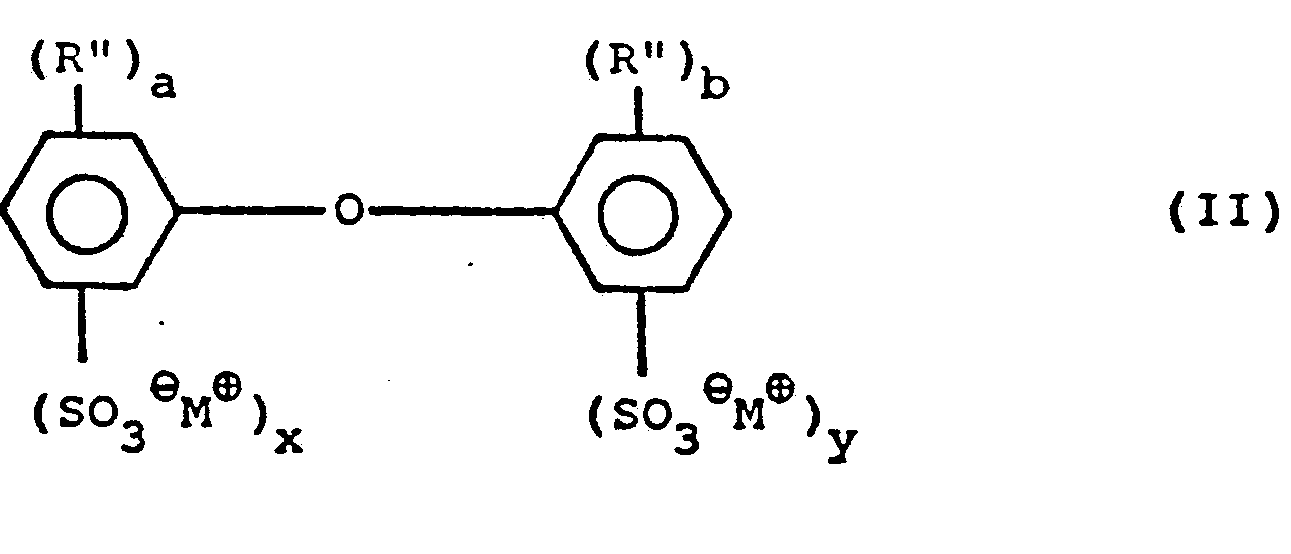

- Surfactant compositions comprising sulfonates of formula II are known in the art and a series of such compositions are manufactured by The Dow Chemical Company under the trademark DOWFAX. Representative of these compositions are DOWFAX 2A1 surfactant (an 80:20 mixture, by weight, of disodium mono-(Σ(a+b)=1) and di-(2(a+b)=2) alkylated (each R" is a branched C12 alkyl radical) diphenylether disulfonate) and DOWFAX 3B2 surfactant (an 80:20 mixture, by weight, of disodium mono-(Σ(a+b)=l) and di-(I(a+b)=2) alkylated (each R" is a linear C10 alkyl radical) diphenylether disulfonate). Although the sulfonates of formula II can be used alone as the alkylated diphenyl oxide sulfonate component of the surfactant composition of this invention, preferably a combination of two sulfonates of formula II differing only in the number of R" substituents (i.e., a combination of mono- and dialkylated sulfonates) are here used. The commercially available compositions of DOWFAX 2A1 and 3B2 surfactants are the preferred alkylated diphenyl oxide sulfonate component of this invention.
- The tolerance to multivalent cations of aqueous anionic surfactant systems useful for displacing oil from a porous, subterranean rock reservoir is improved by using as a cosurfactant an alkylated biphenyl disulfonate of the formula

- R is an alkyl radical of at least 6 carbon atoms and each R can be the same or different;
- M is hydrogen, alkali metal ion, alkaline earth metal ion or ammonium ion radical and each M⊕ can be the same or different; and
- x and y are individually integers of 0-2 with the proviso that Σ(x+y)≧1.
- The present invention also resides in an aqueous anionic surfactant system having a relatively high tolerance to multivalent cations, the system comprising:
- (a) a substantially homogenous aqueous liquid system containing at least one dissolved or dispersed petroleum sulfonate surfactant; and
- (b) at least one alkylated biphenyl disulfonate of the formula

- R is an alkyl radical of at least 6 carbon atoms and each R can be the same or different;
- M⊕ is hydrogen, alkali metal ion, alkaline earth metal ion or ammonium ion radical and each M⊕ can be the same or different; and
- x and y are individually integers of 0-2 with the proviso that Σ(x+y)≧1.
- The present invention further resides in a process for displacing oil from a porous, subterranean rock reservior, the process comprising injecting into the reservoir an active aqueous anionic surfactant system, the improvement comprising injecting an aqueous anionic surfactant system that contains a sufficient amount of an alkylated biphenyl disulfonate to improve the system's multivalent cation tolerance without significantly reducing-the interfacial tension-lowering activity of the system said disulfonate being of the formula

- R is an alkyl radical of at least 6 carbon atoms and each R can be the same or different;
- M⊕ is hydrogen, alkali metal ion, alkaline earth metal ion or ammonium ion radical and each M⊕ can be the same or different; and
- x and y are individually integers of 0-2 with the proviso that Σ(x+y)≧1.
- The present invention additionally resides in a method of preparing an alkylated biphenyl disulfonate of the formula

- R is an alkyl radical of at least 6 carbon atoms and each R can be the same or different;
- M⊕ is hydrogen, alkali metal ion, alkaline earth metal ion or ammonium ion radical and each M⊕ can be the same or different; and
- x and y are individually integers of 0-2 with the proviso that Σ(x+y)≧1, comprising the steps of:
- contacting the alkylated biphenyl with sulfur trioxide dissolved in refluxing sulfur dioxide, the sulfur trioxide and alkylated biphenyl contacted at a sulfur trioxide:alkylated biphenyl mole ratio of at least about 2; and, optionally, contacting the resulting alkylated biphenyl disulfonic acid with a neutralizing solution comprising ions or ion radicals of M⊕.
- The disulfonates of the invention demonstrate good tolerance to multivalent cations, such as the cations of calcium and magnesium, good resistance to hydrolysis, and are useful surfactants in enhanced oil recovery processes.
- The ammonium ion radicals here used are of the formula

- The term "dislufonate" here includes both alkylated biphenyl disulfonic acids and the alkali metal, alkaline earth metal and ammonium salts thereof.
- The petroleum sulfonates here used typically comprise mixtures of relatively water-soluble and water--insoluble alkali metal salts of materials such as alkylaryl sulfonates, or alkylated benzene sulfonates. The petroleum sulfonates available commercially from Mobil Oil Company (e.g., Promor sulfonates) and Witco Chemical Company (e.g., Petronate® sulfonate salts and Pyronate sulfonates) are typical. These petroleum sulfonates usually have a molecular weight average of at least about 400.
- The third component of the surfactant composition of this invention typically comprises a condensation product of a C8-C16 alkanol and a C2-C3 alkylene oxide. The alkanols can be either linear or branched but primary C 10-C12 linear alkanols are preferred. Ethylene oxide is the preferred alkylene oxide. The alkanol and alkylene oxide are typically condensed into a product having an alkanol:oxide mole ratio between about 1:1 and about 1:10, preferably between about 1:1 and 1:5. Where the condensation product is made from combining the alkanol with a mixture of C2 and C3 alkylene oxides, the ethylene oxide is preferably present in a molar amount at least three times greater than the molar concentration of the C3 alkylene oxide. As used herein, the term "condensation product" of an alkanol and an alkylene oxide includes polyoxyalkylated alcohol surfactants, such as the sulfates of ethoxylated primary alcohols exemplified by those manufactured and sold by Shell Chemical Company and Union Carbide under the trademarks NEODOL and TERGITOL, respectively.
- The glycol ethers here used are of formula I

- While each of the components that comprise the surfactant composition of this invention can be but a single material, each component, like the alkylated diphenyl oxide sulfonate, can comprise a mixture of materials. In other words, the petroleum sulfonate component of this invention can comprise a mixture of two different petroleum sulfonates or the alkanol/alkylene oxide condensation product component of this invention can comprise a mixture of one or more alkanols in combination with one or more alkylene oxides, or the glycol ether component of this invention can comprise a mixture of two or more glycol ethers. Moreover, the surfactant composition of this invention can comprise materials in addition to the four components previously described. Additional such components include various electrolytes, such as sodium and potassium chloride, and various water thickeners, such as carboxymethyl cellulose, hydroxyethyl cellulose, guar and guar derivatives and other polysaccharides, partially hydrolyzed polyacrylamide, etc. These additional components are not critical to the invention and can be used as desired.
- The respective proportions of each component that comprises the surfactant composition of this invention will, as noted earlier, depend upon the properties of the reservoir or formation. Typically, the surfactant composition contains sufficient alkyl diphenyl oxide sulfonate to provide good compatibility with the high salinity and divalent ion concentration of the reservoir brines, sufficient petroleum sulfonates to provide an interfacial tension between the surfactant composition and the oil no greater than 0.1, preferably 0.01, dyne per centimeter, sufficient alkanol/alkylene oxide condensation product to act as a solubility and water-wetting agent for the petroleum sulfonate and thus assist in reducing the interfacial tension between the water and the oil, and sufficient glycol ether to solubilize the other components such that the adsorption of the other components on the reservoir surface is significantly reduced. Reservoirs having relatively high porosity and small pore size make available a large surface area for adsorption and thus increase the possibility of entrapment of the surfactant molecules. In the presence of carbonates, such as dolomite, the possibility of surfactant adsorption is increased. Under such circumstances, relatively more glycol ether is required than under conditions where the reservoir or formation has a relatively low porosity, relatively large pore size and the presence of little or no carbonate. A typical surfactant composition comprises 100 parts by weight of an aqueous mixture of:.
- (1) about 0.005 to about 3.0, preferably about 0.30-1.50, parts alkylated diphenyl oxide sulfonate,
- (2) about 0.1 to about 12, preferably about 0.30-3.0 parts, petroleum sulfonate,
- (3) about 0.01 to about 5, preferably about 0.25-2.5 parts, alkanol/alkylene oxide condensation product,
- (4) about 4.5 to about 13.5, preferably about 6.5-9 parts, glycol ether, and
- (5) the remaining parts water.
- The surfactant compositions of this invention are used in the same manner as known surfactant compositions for displacing oil from a porous, subterranean rock reservoir. A slug of surfactant formulation, typically between about 4 and about 10 percent of the pore volume of the rock reservoir, is injected into the formation.
- The surfactant lowers the interfacial tension between the injected fluid and the reservoir oil to lower than about 0.1 dynes/cm, preferably to lower than about 0.01 dynes/cm. This low interfacial tension essentially eliminates the capillary forces and can result in essentially a 100 percent displacement efficiency in the sweep area of the reservoir. The surfactant slug is followed by a large slug of water containing a high molecular weight polymer. This subsequent slug usually ranges in size from about 25 to about 75 percent of the pore volume of the reservoir. The polymer solution slug is used to develop a favorable mobility ratio displacement, to improve the sweep efficiency, and to preserve the integrity of the surfactant composition slug. The use of the surfactant composition of this invention substantially reduces the interfacial tension between the water and oil while reducing surfactant retention due to adsorption and entrapment. Moreover, these benefits are gained frequently at lower surfactant concentrations than required by the prior art. Still further, the surfactant compositions of this invention demonstrate excellent tolerance to mono- and polyvalent cations, such as the cations of calcium and magnesium, typically found in reservoir brine.
- The following examples are illustrative of the specific embodiments of this invention. Unless indicated to the contrary, all parts and percentages are by weight.
- Core samples of a fairly uniform sandstone were used in this experiment. The samples had an average pore entry radius of 5 microns, a porosity of 20 percent, an average permeability of 35 md (1 md-110 md range), a connate water saturation of 30 percent and a wettability index of 0.20 (i.e., slightly water-wet). The samples also contained about 8 percent dolomite as determined by acid solubility.
- The cores were cleaned by carbon dioxide solvent extraction and then restored to their natural state. The cores were then flooded in the below-described procedure with the surfactants, injection water and isopropyl alcohol.
- A cleaned core was saturated with formation water. The weight, bulk volume, pore volume and porosity were then determined. The core was placed in a Hassler sleeve and subjected to the following flow sequence:
- (1) 10 pore volumes of surfactant composition,
- (2) 22 pore volumes of injection water, and
- (3) 41-, pore volumes of isopropyl alcohol (to desorb the surfactant).
- Samples were collected, analyzed and a material balance was then made to account for all of the surfactant.
- Two surfactant compositions were prepared. The first composition contained 100 parts of an aqueous mixture of by weight 0.47 percent of a 75-25 (weight ratio) blend of Witco TRS 10-80 (80 percent active) and condensation product A and 0.20 parts DOWFAX 2Al. Witco TRS 10-80 (marketed by Witco Chemical Company, Inc.) is an 80 percent active petroleum sulfonate with an average molecular weight of 405, condensation product A is a condensation product of one mole of a CI0-C12 alcohol with 5 moles of ethylene oxide, and DOWFAX 2A1 surfactant (manufactured by The Dow Chemical Company) is an 80:20 mixture of sodium mono- and di- branched C12 diphenylether disulfonates. The second composition contained by weight 91.9 parts of the first composition and 8.1 parts ethylene glycol monobutylether.
- Analysis of the collected samples indicated that the first surfactant composition was absorbed on the core to the extent of approximately 17,790 pounds per acre-foot. The second composition, the composition of this invention, was absorbed to the extent of approximately 1,113 pounds per acre-foot. This marked reduction in absorption of surfactant greatly enhances the cost efficiency of a flooding process.
- The procedure of Example 1 was repeated except different core samples were employed and the components of the surfactant compositions were changed. The core samples had an average pore entry radius of 10 microns, a porosity of 18 percent, an average permeability of 100 md (10 md-350 md range), a connate water saturation of 31 percent and wettability index of 0.22. The first surfactant composition contained 11.5 parts of a 50:40:10 (weight ratio) blend of Witco TRS 18, Witco TRS 40 and condensation product A, and 2.1 parts DOWFAX 2A1 surfactant. Witco TRS 18 is a 62 percent active petroleum sulfonate with an average molecular weight of 495 and Witco TRS 40 is a 40 percent active petroleum sulfonate with an average molecular weight of 335, both marketed by Witco Chemical Company, Inc. Condensation product A and DOWFAX 2Al surfactant are described in Example 1. The second composition contained by weight 91 parts of the first composition and 9 parts ethylene glycol monobutylether. Results of these experiments demonstrated that the first composition adsorbed onto the core sample at the rate of about 3,55C pounds per acre-foot while the second composition adsorbed at the rate of less than 7.5 percent of the first sample (about 266 pounds per acre--foot). Moreover, the salinity of the injection water was relatively high (approximately 6 percent) but both surfactant compositions showed good displacement of the reservoir oil.
- Although the invention has been described in considerable detail by the above examples, this detail is for the purpose of illustration only and is not to be construed as a limitation upon the specification or appended claims.
Claims (17)


Applications Claiming Priority (2)
| Application Number | Priority Date | Filing Date | Title |
|---|---|---|---|
| US9926479A | 1979-12-03 | 1979-12-03 | |
| US99264 | 1979-12-03 |
Publications (2)
| Publication Number | Publication Date |
|---|---|
| EP0032072A1 true EP0032072A1 (en) | 1981-07-15 |
| EP0032072B1 EP0032072B1 (en) | 1983-05-18 |
Family
ID=22274021
Family Applications (1)
| Application Number | Title | Priority Date | Filing Date |
|---|---|---|---|
| EP80401731A Expired EP0032072B1 (en) | 1979-12-03 | 1980-12-03 | Surfactant compositions useful in enhanced oil recovery processes |
Country Status (4)
| Country | Link |
|---|---|
| EP (1) | EP0032072B1 (en) |
| CA (1) | CA1146834A (en) |
| DE (1) | DE3063375D1 (en) |
| NO (1) | NO803644L (en) |
Cited By (14)
| Publication number | Priority date | Publication date | Assignee | Title |
|---|---|---|---|---|
| EP0090920A1 (en) * | 1982-03-26 | 1983-10-12 | Deutsche Texaco Aktiengesellschaft | Process for recovering oil from a subterranean formation |
| GB2127462A (en) * | 1982-09-01 | 1984-04-11 | British Petroleum Co Plc | Compositions suitable for modifying wettability and their use |
| GB2135597A (en) * | 1983-02-17 | 1984-09-05 | Henkel Kgaa | Method for regulating the viscosity of high-viscosity industrial surfactant concentrates |
| GB2165280A (en) * | 1984-10-05 | 1986-04-09 | Shell Int Research | Surfactant composition and process for the production of oil using such a composition |
| FR2595752A1 (en) * | 1985-10-24 | 1987-09-18 | Pfizer | PROCESS FOR IMPROVING VISCOUS RAW PETROLEUM PRODUCTION |
| EP0181915A4 (en) * | 1984-05-08 | 1987-09-21 | Dow Chemical Co | Surfactant compositions for steamfloods. |
| US4957646A (en) * | 1987-08-26 | 1990-09-18 | Shell Oil Company | Steam foam surfactants enriched in alpha olefin disulfonates for enhanced oil recovery |
| US5013462A (en) * | 1985-10-24 | 1991-05-07 | Pfizer Inc. | Method for improving production of viscous crude oil |
| WO2014055213A3 (en) * | 2012-10-01 | 2014-06-19 | Huntsman Petrochemical Llc | Surfactant formulation for release of underground fossil fluids |
| WO2016048765A1 (en) * | 2014-09-24 | 2016-03-31 | Dow Global Technologies Llc | Method for subterranean petroleum recovery using a surfactant blend |
| WO2016176385A1 (en) * | 2015-04-30 | 2016-11-03 | Dow Global Technologies Llc | Co-surfactant foam-forming composition for enhanced oil recovery |
| WO2019005289A1 (en) * | 2017-06-30 | 2019-01-03 | Dow Global Technologies Llc | Low-temperature stabilized surfactant blend for enhanced oil recovery |
| WO2021072043A1 (en) * | 2019-10-10 | 2021-04-15 | Dow Global Technologies Llc | Enhanced oil recovery methods and compositions |
| US11753582B2 (en) | 2017-07-31 | 2023-09-12 | Chevron U.S.A. Inc. | Injection fluids comprising an anionic surfactant for treating unconventional formations |
Families Citing this family (3)
| Publication number | Priority date | Publication date | Assignee | Title |
|---|---|---|---|---|
| US4878951A (en) * | 1989-01-17 | 1989-11-07 | A & L Laboratories, Inc. | Low-foaming alkaline, hypochlorite cleaner |
| US20150218436A1 (en) * | 2012-10-01 | 2015-08-06 | Huntsman Petrochemical Llc | Biodegradable chelant for surfactant formulation |
| CA3109079A1 (en) * | 2018-07-30 | 2020-02-06 | Downhole Chemical Solutions, Llc | Composition and method for breaking friction reducing polymer for well fluids |
Citations (1)
| Publication number | Priority date | Publication date | Assignee | Title |
|---|---|---|---|---|
| DE1917251A1 (en) * | 1969-03-25 | 1970-10-15 | Sanyo Chemical Ind Ltd | Emulsifier for agricultural and sanitary toxins and pesticides, its manufacture and use |
Family Cites Families (4)
| Publication number | Priority date | Publication date | Assignee | Title |
|---|---|---|---|---|
| DE1256222B (en) * | 1960-02-13 | 1967-12-14 | Dehydag Gmbh | Mineral oil emulsifiers |
| DE2150559A1 (en) * | 1970-12-21 | 1972-06-29 | Marathon Oil Co | Water-in-oil micellar dispersions - of high water content and low viscosity for crude oil extraction |
| JPS5224412B2 (en) * | 1971-08-25 | 1977-07-01 | ||
| US3945437A (en) * | 1975-03-26 | 1976-03-23 | Shell Oil Company | Process for displacing oil using aqueous anionic surfactant systems containing aromatic ether polysulfonates |
-
1980
- 1980-12-03 CA CA000366061A patent/CA1146834A/en not_active Expired
- 1980-12-03 EP EP80401731A patent/EP0032072B1/en not_active Expired
- 1980-12-03 NO NO803644A patent/NO803644L/en unknown
- 1980-12-03 DE DE8080401731T patent/DE3063375D1/en not_active Expired
Patent Citations (1)
| Publication number | Priority date | Publication date | Assignee | Title |
|---|---|---|---|---|
| DE1917251A1 (en) * | 1969-03-25 | 1970-10-15 | Sanyo Chemical Ind Ltd | Emulsifier for agricultural and sanitary toxins and pesticides, its manufacture and use |
Cited By (35)
| Publication number | Priority date | Publication date | Assignee | Title |
|---|---|---|---|---|
| EP0090920A1 (en) * | 1982-03-26 | 1983-10-12 | Deutsche Texaco Aktiengesellschaft | Process for recovering oil from a subterranean formation |
| GB2127462A (en) * | 1982-09-01 | 1984-04-11 | British Petroleum Co Plc | Compositions suitable for modifying wettability and their use |
| GB2135597A (en) * | 1983-02-17 | 1984-09-05 | Henkel Kgaa | Method for regulating the viscosity of high-viscosity industrial surfactant concentrates |
| EP0181915A4 (en) * | 1984-05-08 | 1987-09-21 | Dow Chemical Co | Surfactant compositions for steamfloods. |
| GB2165280A (en) * | 1984-10-05 | 1986-04-09 | Shell Int Research | Surfactant composition and process for the production of oil using such a composition |
| DE3535371A1 (en) * | 1984-10-05 | 1986-04-10 | Shell Internationale Research Maatschappij B.V., Den Haag | SURFACE ACTIVE AGENT FOR PETROLEUM PRODUCTION |
| AU572696B2 (en) * | 1984-10-05 | 1988-05-12 | Shell Internationale Research Maatschappij B.V. | Saline-water compatible surfactant with a flash point above 50 degrees celcius |
| FR2595752A1 (en) * | 1985-10-24 | 1987-09-18 | Pfizer | PROCESS FOR IMPROVING VISCOUS RAW PETROLEUM PRODUCTION |
| US5013462A (en) * | 1985-10-24 | 1991-05-07 | Pfizer Inc. | Method for improving production of viscous crude oil |
| US4957646A (en) * | 1987-08-26 | 1990-09-18 | Shell Oil Company | Steam foam surfactants enriched in alpha olefin disulfonates for enhanced oil recovery |
| WO2014055213A3 (en) * | 2012-10-01 | 2014-06-19 | Huntsman Petrochemical Llc | Surfactant formulation for release of underground fossil fluids |
| CN104254505A (en) * | 2012-10-01 | 2014-12-31 | 亨斯迈石油化学有限责任公司 | Surfactant formulation for release of underground fossil fluids |
| US20150129228A1 (en) * | 2012-10-01 | 2015-05-14 | Huntsman Petrochemical LLC a corporation | Surfactant formulation for release of underground fossil fluids |
| US9988571B2 (en) * | 2012-10-01 | 2018-06-05 | Huntsman Petrochemical Llc | Surfactant formulation for release of underground fossil fluids |
| RU2633842C2 (en) * | 2012-10-01 | 2017-10-18 | ХАНТСМЭН ПЕТРОКЕМИКАЛ ЭлЭлСи | Composition of surfactant for recoverying underground liquid fossil fuel |
| JP2017533293A (en) * | 2014-09-24 | 2017-11-09 | ダウ グローバル テクノロジーズ エルエルシー | Method for underground oil recovery using surfactant blends |
| WO2016048765A1 (en) * | 2014-09-24 | 2016-03-31 | Dow Global Technologies Llc | Method for subterranean petroleum recovery using a surfactant blend |
| US10370584B2 (en) | 2014-09-24 | 2019-08-06 | Dow Global Technologies Llc | Method for subterranean petroleum recovery using a surfactant blend |
| CN107532077B (en) * | 2015-04-30 | 2021-02-26 | 陶氏环球技术有限责任公司 | Cosurfactant foam-forming composition for enhanced oil recovery |
| US10717921B2 (en) | 2015-04-30 | 2020-07-21 | Dow Global Technologies Llc | Co-surfactant foam-forming composition for enhanced oil recovery |
| CN107532077A (en) * | 2015-04-30 | 2018-01-02 | 陶氏环球技术有限责任公司 | Cosurfactant formation of foam composition for intensified oil reduction |
| RU2710060C2 (en) * | 2015-04-30 | 2019-12-24 | Дау Глоубл Текнолоджиз Ллк | Foaming composition with combined use of surfactants for increasing oil recovery |
| WO2016176385A1 (en) * | 2015-04-30 | 2016-11-03 | Dow Global Technologies Llc | Co-surfactant foam-forming composition for enhanced oil recovery |
| US11584881B2 (en) | 2017-06-30 | 2023-02-21 | Dow Global Technologies Llc | Low-temperature stabilized surfactant blend for enhanced oil recovery |
| CN110997862A (en) * | 2017-06-30 | 2020-04-10 | 陶氏环球技术有限责任公司 | Low temperature stable surfactant blends for enhanced oil recovery |
| WO2019005289A1 (en) * | 2017-06-30 | 2019-01-03 | Dow Global Technologies Llc | Low-temperature stabilized surfactant blend for enhanced oil recovery |
| US11753582B2 (en) | 2017-07-31 | 2023-09-12 | Chevron U.S.A. Inc. | Injection fluids comprising an anionic surfactant for treating unconventional formations |
| US11760921B2 (en) | 2017-07-31 | 2023-09-19 | Chevron U.S.A. Inc. | Injection fluids comprising a non-ionic surfactant for treating unconventional formations |
| US11834609B2 (en) | 2017-07-31 | 2023-12-05 | Chevron U.S.A. Inc. | Injection fluids for stimulating fractured formations |
| US12435262B2 (en) | 2017-07-31 | 2025-10-07 | Chevron U.S.A. Inc. | Injection fluids comprising an anionic surfactant for treating unconventional formations |
| US12624277B2 (en) | 2017-07-31 | 2026-05-12 | Chevron U.S.A. Inc. | Injection fluids for stimulating fractured formations |
| WO2021072043A1 (en) * | 2019-10-10 | 2021-04-15 | Dow Global Technologies Llc | Enhanced oil recovery methods and compositions |
| CN114641553A (en) * | 2019-10-10 | 2022-06-17 | 陶氏环球技术有限责任公司 | Method and composition for enhanced oil recovery |
| CN114641553B (en) * | 2019-10-10 | 2023-11-28 | 陶氏环球技术有限责任公司 | Methods and compositions for enhanced oil recovery |
| US12043795B2 (en) | 2019-10-10 | 2024-07-23 | Dow Global Technologies Llc | Enhanced oil recovery methods and compositions |
Also Published As
| Publication number | Publication date |
|---|---|
| EP0032072B1 (en) | 1983-05-18 |
| NO803644L (en) | 1981-06-04 |
| CA1146834A (en) | 1983-05-24 |
| DE3063375D1 (en) | 1983-07-07 |
Similar Documents
| Publication | Publication Date | Title |
|---|---|---|
| EP0032072B1 (en) | Surfactant compositions useful in enhanced oil recovery processes | |
| US3939911A (en) | Surfactant oil recovery process usable in high temperature formations containing water having high concentrations of polyvalent ions | |
| US4463806A (en) | Method for surfactant waterflooding in a high brine environment | |
| US4077471A (en) | Surfactant oil recovery process usable in high temperature, high salinity formations | |
| US3858656A (en) | Oil recovery process usable in formations containing water having high concentrations of polyvalent ions | |
| US4088189A (en) | Surfactant oil recovery process usable in high temperature formations containing high salinity water | |
| CA1078160A (en) | Aqueous anionic surfactant systems | |
| US3811505A (en) | Surfactant oil recovery process usable in formations containing water having high concentrations of polyvalent ions such as calcium and magnesium | |
| US3811507A (en) | Surfactant oil recovery process usable in formations containing water having high concentration of polyvalent ions such as calcium and magnesium | |
| US4426303A (en) | Surfactant compositions useful in enhanced oil recovery processes | |
| US3977471A (en) | Oil recovery method using a surfactant | |
| US4008165A (en) | Surfactant oil recovery process usable in high temperature formations having high concentrations of polyvalent ions | |
| US4110229A (en) | Salinity tolerant surfactant oil recovery process | |
| US4157115A (en) | Lignosulfonates as additives in recovery processes involving chemical recovery processes | |
| US4609044A (en) | Alkali-enhanced steam foam oil recovery process | |
| US4470461A (en) | Organic nitro compounds as cosurfactants in enhanced oil recovery processes | |
| US3983940A (en) | Water-external microemulsion and method of recovering oil therewith | |
| US4094798A (en) | Oil recovery process usable in high temperature formations containing high salinity water which may include high concentrations of polyvalent ions | |
| US4143716A (en) | Tertiary oil recovery process utilizing a preflush | |
| US4532051A (en) | Surfactant compositions useful in enhanced oil recovery processes | |
| US4013569A (en) | Aqueous anionic surfactant systems containing aromatic ether polysulfonates | |
| US4154301A (en) | Surfactant oil recovery process usable in a formation having high salinity connate water | |
| CA1224024A (en) | Diverting agents for steamfloods | |
| US4181178A (en) | Oil recovery by waterflooding with thickened surfactant solutions | |
| US4235290A (en) | Lignosulfonates as additives in oil recovery processes involving chemical recovery agents |
Legal Events
| Date | Code | Title | Description |
|---|---|---|---|
| PUAI | Public reference made under article 153(3) epc to a published international application that has entered the european phase |
Free format text: ORIGINAL CODE: 0009012 |
|
| AK | Designated contracting states |
Designated state(s): DE FR GB |
|
| 17P | Request for examination filed |
Effective date: 19810923 |
|
| GRAA | (expected) grant |
Free format text: ORIGINAL CODE: 0009210 |
|
| AK | Designated contracting states |
Designated state(s): DE FR GB |
|
| ET | Fr: translation filed | ||
| REF | Corresponds to: |
Ref document number: 3063375 Country of ref document: DE Date of ref document: 19830707 |
|
| PLBE | No opposition filed within time limit |
Free format text: ORIGINAL CODE: 0009261 |
|
| STAA | Information on the status of an ep patent application or granted ep patent |
Free format text: STATUS: NO OPPOSITION FILED WITHIN TIME LIMIT |
|
| 26N | No opposition filed | ||
| PGFP | Annual fee paid to national office [announced via postgrant information from national office to epo] |
Ref country code: FR Payment date: 19840905 Year of fee payment: 5 |
|
| PGFP | Annual fee paid to national office [announced via postgrant information from national office to epo] |
Ref country code: DE Payment date: 19840914 Year of fee payment: 5 |
|
| GBPC | Gb: european patent ceased through non-payment of renewal fee | ||
| PG25 | Lapsed in a contracting state [announced via postgrant information from national office to epo] |
Ref country code: FR Free format text: LAPSE BECAUSE OF NON-PAYMENT OF DUE FEES Effective date: 19860829 |
|
| PG25 | Lapsed in a contracting state [announced via postgrant information from national office to epo] |
Ref country code: DE Effective date: 19860902 |
|
| REG | Reference to a national code |
Ref country code: FR Ref legal event code: ST |
|
| PG25 | Lapsed in a contracting state [announced via postgrant information from national office to epo] |
Ref country code: GB Effective date: 19881118 |