EP0030423B1 - A process for the production of 1,4-dihydro-4-oxo-quinoline-2-carboxylic acids, or salts, esters or amides thereof and intermediates therefor - Google Patents
A process for the production of 1,4-dihydro-4-oxo-quinoline-2-carboxylic acids, or salts, esters or amides thereof and intermediates therefor Download PDFInfo
- Publication number
- EP0030423B1 EP0030423B1 EP80304113A EP80304113A EP0030423B1 EP 0030423 B1 EP0030423 B1 EP 0030423B1 EP 80304113 A EP80304113 A EP 80304113A EP 80304113 A EP80304113 A EP 80304113A EP 0030423 B1 EP0030423 B1 EP 0030423B1
- Authority
- EP
- European Patent Office
- Prior art keywords
- compound
- formula
- coch
- process according
- hydrogen
- Prior art date
- Legal status (The legal status is an assumption and is not a legal conclusion. Google has not performed a legal analysis and makes no representation as to the accuracy of the status listed.)
- Expired
Links
- 238000000034 method Methods 0.000 title claims abstract description 20
- 150000002148 esters Chemical class 0.000 title claims abstract description 16
- 150000003839 salts Chemical class 0.000 title claims abstract description 11
- 150000001408 amides Chemical class 0.000 title claims abstract description 8
- 238000004519 manufacturing process Methods 0.000 title claims abstract description 7
- HCZHHEIFKROPDY-UHFFFAOYSA-N kynurenic acid Chemical class C1=CC=C2NC(C(=O)O)=CC(=O)C2=C1 HCZHHEIFKROPDY-UHFFFAOYSA-N 0.000 title abstract description 4
- 239000000543 intermediate Substances 0.000 title description 3
- 150000001875 compounds Chemical class 0.000 claims description 42
- VEXZGXHMUGYJMC-UHFFFAOYSA-N Hydrochloric acid Chemical compound Cl VEXZGXHMUGYJMC-UHFFFAOYSA-N 0.000 claims description 12
- 239000001257 hydrogen Substances 0.000 claims description 12
- 229910052739 hydrogen Inorganic materials 0.000 claims description 12
- 125000000217 alkyl group Chemical group 0.000 claims description 9
- 238000006243 chemical reaction Methods 0.000 claims description 9
- 150000002431 hydrogen Chemical class 0.000 claims description 7
- 239000002253 acid Substances 0.000 claims description 6
- WYACBZDAHNBPPB-UHFFFAOYSA-N diethyl oxalate Chemical compound CCOC(=O)C(=O)OCC WYACBZDAHNBPPB-UHFFFAOYSA-N 0.000 claims description 6
- 125000000896 monocarboxylic acid group Chemical group 0.000 claims description 6
- UFHFLCQGNIYNRP-UHFFFAOYSA-N Hydrogen Chemical compound [H][H] UFHFLCQGNIYNRP-UHFFFAOYSA-N 0.000 claims description 5
- 125000005843 halogen group Chemical group 0.000 claims description 5
- 125000002887 hydroxy group Chemical group [H]O* 0.000 claims description 5
- 125000003342 alkenyl group Chemical group 0.000 claims description 4
- 125000003545 alkoxy group Chemical group 0.000 claims description 4
- 125000000218 acetic acid group Chemical group C(C)(=O)* 0.000 claims description 3
- 229910052783 alkali metal Chemical group 0.000 claims description 3
- 150000001340 alkali metals Chemical group 0.000 claims description 3
- DZXIKYRDMDEUMX-UHFFFAOYSA-N diethyl 4,6-dioxo-10-propyl-9h-pyrano[3,2-g]quinoline-2,8-dicarboxylate Chemical compound O1C(C(=O)OCC)=CC(=O)C2=C1C(CCC)=C1NC(C(=O)OCC)=CC(=O)C1=C2 DZXIKYRDMDEUMX-UHFFFAOYSA-N 0.000 claims description 3
- 230000003301 hydrolyzing effect Effects 0.000 claims description 3
- OKTJSMMVPCPJKN-UHFFFAOYSA-N Carbon Chemical compound [C] OKTJSMMVPCPJKN-UHFFFAOYSA-N 0.000 claims description 2
- CURLTUGMZLYLDI-UHFFFAOYSA-N Carbon dioxide Chemical group O=C=O CURLTUGMZLYLDI-UHFFFAOYSA-N 0.000 claims description 2
- 229910052799 carbon Inorganic materials 0.000 claims description 2
- 125000004432 carbon atom Chemical group C* 0.000 claims description 2
- 229910052736 halogen Inorganic materials 0.000 claims description 2
- 150000002367 halogens Chemical class 0.000 claims description 2
- 125000003884 phenylalkyl group Chemical group 0.000 claims description 2
- 125000001436 propyl group Chemical group [H]C([*])([H])C([H])([H])C([H])([H])[H] 0.000 claims description 2
- 239000002904 solvent Substances 0.000 claims description 2
- LMBFAGIMSUYTBN-MPZNNTNKSA-N teixobactin Chemical compound C([C@H](C(=O)N[C@@H]([C@@H](C)CC)C(=O)N[C@@H](CO)C(=O)N[C@H](CCC(N)=O)C(=O)N[C@H]([C@@H](C)CC)C(=O)N[C@@H]([C@@H](C)CC)C(=O)N[C@@H](CO)C(=O)N[C@H]1C(N[C@@H](C)C(=O)N[C@@H](C[C@@H]2NC(=N)NC2)C(=O)N[C@H](C(=O)O[C@H]1C)[C@@H](C)CC)=O)NC)C1=CC=CC=C1 LMBFAGIMSUYTBN-MPZNNTNKSA-N 0.000 claims description 2
- CAOVWYZQMPNAFJ-UHFFFAOYSA-N 4-(2-aminophenyl)-2,4-dioxobutanoic acid Chemical compound NC1=CC=CC=C1C(=O)CC(=O)C(O)=O CAOVWYZQMPNAFJ-UHFFFAOYSA-N 0.000 abstract 1
- 238000007363 ring formation reaction Methods 0.000 abstract 1
- LFQSCWFLJHTTHZ-UHFFFAOYSA-N Ethanol Chemical compound CCO LFQSCWFLJHTTHZ-UHFFFAOYSA-N 0.000 description 36
- YMWUJEATGCHHMB-UHFFFAOYSA-N Dichloromethane Chemical compound ClCCl YMWUJEATGCHHMB-UHFFFAOYSA-N 0.000 description 21
- 239000000203 mixture Substances 0.000 description 20
- XLYOFNOQVPJJNP-UHFFFAOYSA-N water Substances O XLYOFNOQVPJJNP-UHFFFAOYSA-N 0.000 description 14
- 239000000047 product Substances 0.000 description 13
- 238000010992 reflux Methods 0.000 description 13
- 238000001914 filtration Methods 0.000 description 11
- -1 alkyl oxalate Chemical compound 0.000 description 7
- 125000004177 diethyl group Chemical group [H]C([H])([H])C([H])([H])* 0.000 description 7
- 239000000243 solution Substances 0.000 description 7
- 0 CC(c1c(*)c(*)c(C)c(*)c1*)=O Chemical compound CC(c1c(*)c(*)c(C)c(*)c1*)=O 0.000 description 6
- ZMXDDKWLCZADIW-UHFFFAOYSA-N N,N-Dimethylformamide Chemical compound CN(C)C=O ZMXDDKWLCZADIW-UHFFFAOYSA-N 0.000 description 6
- SECXISVLQFMRJM-UHFFFAOYSA-N N-Methylpyrrolidone Chemical compound CN1CCCC1=O SECXISVLQFMRJM-UHFFFAOYSA-N 0.000 description 6
- VSCWAEJMTAWNJL-UHFFFAOYSA-K aluminium trichloride Chemical compound Cl[Al](Cl)Cl VSCWAEJMTAWNJL-UHFFFAOYSA-K 0.000 description 6
- 239000007787 solid Substances 0.000 description 6
- IJGRMHOSHXDMSA-UHFFFAOYSA-N nitrogen Substances N#N IJGRMHOSHXDMSA-UHFFFAOYSA-N 0.000 description 5
- YEZSWHPLZBZVLH-UHFFFAOYSA-N Formylpyruvate Chemical compound OC(=O)C(=O)CC=O YEZSWHPLZBZVLH-UHFFFAOYSA-N 0.000 description 4
- KDLHZDBZIXYQEI-UHFFFAOYSA-N Palladium Chemical compound [Pd] KDLHZDBZIXYQEI-UHFFFAOYSA-N 0.000 description 4
- UIIMBOGNXHQVGW-UHFFFAOYSA-M Sodium bicarbonate Chemical compound [Na+].OC([O-])=O UIIMBOGNXHQVGW-UHFFFAOYSA-M 0.000 description 4
- QBXRGAQLGPKTLW-UHFFFAOYSA-N n-(2,4-diacetyl-5-hydroxyphenyl)acetamide Chemical compound CC(=O)NC1=CC(O)=C(C(C)=O)C=C1C(C)=O QBXRGAQLGPKTLW-UHFFFAOYSA-N 0.000 description 4
- 239000011541 reaction mixture Substances 0.000 description 4
- QDRKDTQENPPHOJ-UHFFFAOYSA-N sodium ethoxide Chemical compound [Na+].CC[O-] QDRKDTQENPPHOJ-UHFFFAOYSA-N 0.000 description 4
- 159000000000 sodium salts Chemical class 0.000 description 4
- PAYRUJLWNCNPSJ-UHFFFAOYSA-N Aniline Chemical compound NC1=CC=CC=C1 PAYRUJLWNCNPSJ-UHFFFAOYSA-N 0.000 description 3
- WETWJCDKMRHUPV-UHFFFAOYSA-N acetyl chloride Chemical compound CC(Cl)=O WETWJCDKMRHUPV-UHFFFAOYSA-N 0.000 description 3
- 239000012346 acetyl chloride Substances 0.000 description 3
- 125000003282 alkyl amino group Chemical group 0.000 description 3
- 229910052757 nitrogen Inorganic materials 0.000 description 3
- NHZHKZMMHVXEDR-UHFFFAOYSA-N 1-[5-acetyl-2-(ethylamino)-4-hydroxyphenyl]ethanone Chemical compound CCNC1=CC(O)=C(C(C)=O)C=C1C(C)=O NHZHKZMMHVXEDR-UHFFFAOYSA-N 0.000 description 2
- QGZKDVFQNNGYKY-UHFFFAOYSA-N Ammonia Chemical compound N QGZKDVFQNNGYKY-UHFFFAOYSA-N 0.000 description 2
- HEDRZPFGACZZDS-UHFFFAOYSA-N Chloroform Chemical compound ClC(Cl)Cl HEDRZPFGACZZDS-UHFFFAOYSA-N 0.000 description 2
- QXNVGIXVLWOKEQ-UHFFFAOYSA-N Disodium Chemical class [Na][Na] QXNVGIXVLWOKEQ-UHFFFAOYSA-N 0.000 description 2
- QUSNBJAOOMFDIB-UHFFFAOYSA-N Ethylamine Chemical compound CCN QUSNBJAOOMFDIB-UHFFFAOYSA-N 0.000 description 2
- BAVYZALUXZFZLV-UHFFFAOYSA-N Methylamine Chemical compound NC BAVYZALUXZFZLV-UHFFFAOYSA-N 0.000 description 2
- YNAVUWVOSKDBBP-UHFFFAOYSA-N Morpholine Chemical compound C1COCCN1 YNAVUWVOSKDBBP-UHFFFAOYSA-N 0.000 description 2
- MUBZPKHOEPUJKR-UHFFFAOYSA-N Oxalic acid Chemical compound OC(=O)C(O)=O MUBZPKHOEPUJKR-UHFFFAOYSA-N 0.000 description 2
- NQRYJNQNLNOLGT-UHFFFAOYSA-N Piperidine Chemical compound C1CCNCC1 NQRYJNQNLNOLGT-UHFFFAOYSA-N 0.000 description 2
- 230000021736 acetylation Effects 0.000 description 2
- 238000006640 acetylation reaction Methods 0.000 description 2
- 150000003973 alkyl amines Chemical class 0.000 description 2
- 125000005907 alkyl ester group Chemical group 0.000 description 2
- BHELZAPQIKSEDF-UHFFFAOYSA-N allyl bromide Chemical compound BrCC=C BHELZAPQIKSEDF-UHFFFAOYSA-N 0.000 description 2
- 230000015572 biosynthetic process Effects 0.000 description 2
- 238000007796 conventional method Methods 0.000 description 2
- 238000001816 cooling Methods 0.000 description 2
- 238000002425 crystallisation Methods 0.000 description 2
- 238000010790 dilution Methods 0.000 description 2
- 239000012895 dilution Substances 0.000 description 2
- USIUVYZYUHIAEV-UHFFFAOYSA-N diphenyl ether Chemical compound C=1C=CC=CC=1OC1=CC=CC=C1 USIUVYZYUHIAEV-UHFFFAOYSA-N 0.000 description 2
- 125000004494 ethyl ester group Chemical group 0.000 description 2
- 125000001495 ethyl group Chemical group [H]C([H])([H])C([H])([H])* 0.000 description 2
- 238000000605 extraction Methods 0.000 description 2
- 238000010438 heat treatment Methods 0.000 description 2
- OIEFZHJNURGFFI-UHFFFAOYSA-N n-(3-methoxyphenyl)acetamide Chemical compound COC1=CC=CC(NC(C)=O)=C1 OIEFZHJNURGFFI-UHFFFAOYSA-N 0.000 description 2
- 125000001997 phenyl group Chemical group [H]C1=C([H])C([H])=C(*)C([H])=C1[H] 0.000 description 2
- BWHMMNNQKKPAPP-UHFFFAOYSA-L potassium carbonate Chemical compound [K+].[K+].[O-]C([O-])=O BWHMMNNQKKPAPP-UHFFFAOYSA-L 0.000 description 2
- 229910000027 potassium carbonate Inorganic materials 0.000 description 2
- 125000002924 primary amino group Chemical group [H]N([H])* 0.000 description 2
- 229910000030 sodium bicarbonate Inorganic materials 0.000 description 2
- 235000017557 sodium bicarbonate Nutrition 0.000 description 2
- 238000003756 stirring Methods 0.000 description 2
- 239000000758 substrate Substances 0.000 description 2
- 238000003786 synthesis reaction Methods 0.000 description 2
- KAOVWCZQHGBCJL-UHFFFAOYSA-N 1-(5-acetyl-2-amino-4-hydroxy-3-propylphenyl)ethanone Chemical compound CCCC1=C(N)C(C(C)=O)=CC(C(C)=O)=C1O KAOVWCZQHGBCJL-UHFFFAOYSA-N 0.000 description 1
- UGGHBOQMYQCHLP-UHFFFAOYSA-N 1-(5-acetyl-2-amino-4-hydroxyphenyl)ethanone Chemical compound CC(=O)C1=CC(C(C)=O)=C(O)C=C1N UGGHBOQMYQCHLP-UHFFFAOYSA-N 0.000 description 1
- CQKYZTXHLWCUKY-UHFFFAOYSA-N 1-[5-acetyl-2-(ethylamino)-4-hydroxy-3-propylphenyl]ethanone Chemical compound CCCC1=C(O)C(C(C)=O)=CC(C(C)=O)=C1NCC CQKYZTXHLWCUKY-UHFFFAOYSA-N 0.000 description 1
- UDLIPBKHZZWUMR-UHFFFAOYSA-N 1-[5-acetyl-2-(ethylamino)-4-prop-2-enoxyphenyl]ethanone Chemical compound CCNC1=CC(OCC=C)=C(C(C)=O)C=C1C(C)=O UDLIPBKHZZWUMR-UHFFFAOYSA-N 0.000 description 1
- YQTCQNIPQMJNTI-UHFFFAOYSA-N 2,2-dimethylpropan-1-one Chemical group CC(C)(C)[C]=O YQTCQNIPQMJNTI-UHFFFAOYSA-N 0.000 description 1
- HIXDQWDOVZUNNA-UHFFFAOYSA-N 2-(3,4-dimethoxyphenyl)-5-hydroxy-7-methoxychromen-4-one Chemical compound C=1C(OC)=CC(O)=C(C(C=2)=O)C=1OC=2C1=CC=C(OC)C(OC)=C1 HIXDQWDOVZUNNA-UHFFFAOYSA-N 0.000 description 1
- CDAWCLOXVUBKRW-UHFFFAOYSA-N 2-aminophenol Chemical compound NC1=CC=CC=C1O CDAWCLOXVUBKRW-UHFFFAOYSA-N 0.000 description 1
- GRABRCDCLHIAFK-UHFFFAOYSA-N 2-oxopyrano[2,3-h]quinoline-3,4-dicarboxylic acid Chemical class O1C=CC=C2C3=NC(=O)C(C(O)=O)=C(C(=O)O)C3=CC=C21 GRABRCDCLHIAFK-UHFFFAOYSA-N 0.000 description 1
- 125000003903 2-propenyl group Chemical group [H]C([*])([H])C([H])=C([H])[H] 0.000 description 1
- PTLWJFSSVGEACH-UHFFFAOYSA-N 3-amino-2,4-dioxo-4-phenylbutanoic acid Chemical compound OC(=O)C(=O)C(N)C(=O)C1=CC=CC=C1 PTLWJFSSVGEACH-UHFFFAOYSA-N 0.000 description 1
- BILCUFMIUQDGEV-UHFFFAOYSA-N 4,6-dioxo-10-propyl-9h-pyrano[3,2-g]quinoline-2,8-dicarboxylic acid Chemical compound O1C(C(O)=O)=CC(=O)C2=C1C(CCC)=C1N=C(C(O)=O)C=C(O)C1=C2 BILCUFMIUQDGEV-UHFFFAOYSA-N 0.000 description 1
- IKHGUXGNUITLKF-UHFFFAOYSA-N Acetaldehyde Chemical compound CC=O IKHGUXGNUITLKF-UHFFFAOYSA-N 0.000 description 1
- 206010027654 Allergic conditions Diseases 0.000 description 1
- QGZKDVFQNNGYKY-UHFFFAOYSA-O Ammonium Chemical compound [NH4+] QGZKDVFQNNGYKY-UHFFFAOYSA-O 0.000 description 1
- WKBOTKDWSSQWDR-UHFFFAOYSA-N Bromine atom Chemical compound [Br] WKBOTKDWSSQWDR-UHFFFAOYSA-N 0.000 description 1
- OYPRJOBELJOOCE-UHFFFAOYSA-N Calcium Chemical compound [Ca] OYPRJOBELJOOCE-UHFFFAOYSA-N 0.000 description 1
- ZAMOUSCENKQFHK-UHFFFAOYSA-N Chlorine atom Chemical compound [Cl] ZAMOUSCENKQFHK-UHFFFAOYSA-N 0.000 description 1
- 238000005821 Claisen rearrangement reaction Methods 0.000 description 1
- IAZDPXIOMUYVGZ-UHFFFAOYSA-N Dimethylsulphoxide Chemical compound CS(C)=O IAZDPXIOMUYVGZ-UHFFFAOYSA-N 0.000 description 1
- VZCYOOQTPOCHFL-OWOJBTEDSA-N Fumaric acid Chemical class OC(=O)\C=C\C(O)=O VZCYOOQTPOCHFL-OWOJBTEDSA-N 0.000 description 1
- CPELXLSAUQHCOX-UHFFFAOYSA-N Hydrogen bromide Chemical compound Br CPELXLSAUQHCOX-UHFFFAOYSA-N 0.000 description 1
- AVXURJPOCDRRFD-UHFFFAOYSA-N Hydroxylamine Chemical compound ON AVXURJPOCDRRFD-UHFFFAOYSA-N 0.000 description 1
- DGAQECJNVWCQMB-PUAWFVPOSA-M Ilexoside XXIX Chemical compound C[C@@H]1CC[C@@]2(CC[C@@]3(C(=CC[C@H]4[C@]3(CC[C@@H]5[C@@]4(CC[C@@H](C5(C)C)OS(=O)(=O)[O-])C)C)[C@@H]2[C@]1(C)O)C)C(=O)O[C@H]6[C@@H]([C@H]([C@@H]([C@H](O6)CO)O)O)O.[Na+] DGAQECJNVWCQMB-PUAWFVPOSA-M 0.000 description 1
- WHXSMMKQMYFTQS-UHFFFAOYSA-N Lithium Chemical compound [Li] WHXSMMKQMYFTQS-UHFFFAOYSA-N 0.000 description 1
- ZLMJMSJWJFRBEC-UHFFFAOYSA-N Potassium Chemical compound [K] ZLMJMSJWJFRBEC-UHFFFAOYSA-N 0.000 description 1
- KEAYESYHFKHZAL-UHFFFAOYSA-N Sodium Chemical compound [Na] KEAYESYHFKHZAL-UHFFFAOYSA-N 0.000 description 1
- 125000005041 acyloxyalkyl group Chemical group 0.000 description 1
- 150000001298 alcohols Chemical class 0.000 description 1
- 229910052784 alkaline earth metal Inorganic materials 0.000 description 1
- 150000001342 alkaline earth metals Chemical class 0.000 description 1
- 150000001412 amines Chemical class 0.000 description 1
- 125000003277 amino group Chemical group 0.000 description 1
- 229910021529 ammonia Inorganic materials 0.000 description 1
- 238000004458 analytical method Methods 0.000 description 1
- 239000008346 aqueous phase Substances 0.000 description 1
- GDTBXPJZTBHREO-UHFFFAOYSA-N bromine Substances BrBr GDTBXPJZTBHREO-UHFFFAOYSA-N 0.000 description 1
- 229910052794 bromium Inorganic materials 0.000 description 1
- 229910052791 calcium Inorganic materials 0.000 description 1
- 239000011575 calcium Substances 0.000 description 1
- 239000003054 catalyst Substances 0.000 description 1
- 238000005119 centrifugation Methods 0.000 description 1
- 239000003153 chemical reaction reagent Substances 0.000 description 1
- 239000000460 chlorine Substances 0.000 description 1
- 229910052801 chlorine Inorganic materials 0.000 description 1
- 238000004587 chromatography analysis Methods 0.000 description 1
- 238000004440 column chromatography Methods 0.000 description 1
- 239000012043 crude product Substances 0.000 description 1
- 230000003247 decreasing effect Effects 0.000 description 1
- WKERURQSOJTGGR-UHFFFAOYSA-N diethyl 4,6-dioxo-9h-pyrano[3,2-g]quinoline-2,8-dicarboxylate Chemical compound O1C(C(=O)OCC)=CC(=O)C2=C1C=C1NC(C(=O)OCC)=CC(=O)C1=C2 WKERURQSOJTGGR-UHFFFAOYSA-N 0.000 description 1
- VLZRJBNJUAUWAE-UHFFFAOYSA-N diethyl 9-ethyl-4,6-dioxo-10-propylpyrano[3,2-g]quinoline-2,8-dicarboxylate Chemical compound CCN1C(C(=O)OCC)=CC(=O)C2=C1C(CCC)=C1OC(C(=O)OCC)=CC(=O)C1=C2 VLZRJBNJUAUWAE-UHFFFAOYSA-N 0.000 description 1
- VHILMKFSCRWWIJ-UHFFFAOYSA-N dimethyl acetylenedicarboxylate Chemical compound COC(=O)C#CC(=O)OC VHILMKFSCRWWIJ-UHFFFAOYSA-N 0.000 description 1
- 229960001760 dimethyl sulfoxide Drugs 0.000 description 1
- SMQOSYXADNEDEI-UHFFFAOYSA-L disodium;4,6-dioxo-10-propyl-9h-pyrano[3,2-g]quinoline-2,8-dicarboxylate Chemical compound [Na+].[Na+].O1C(C([O-])=O)=CC(=O)C2=C1C(CCC)=C1N=C(C([O-])=O)C=C(O)C1=C2 SMQOSYXADNEDEI-UHFFFAOYSA-L 0.000 description 1
- 239000003814 drug Substances 0.000 description 1
- 125000004185 ester group Chemical group 0.000 description 1
- RTZKZFJDLAIYFH-UHFFFAOYSA-N ether Substances CCOCC RTZKZFJDLAIYFH-UHFFFAOYSA-N 0.000 description 1
- 239000000706 filtrate Substances 0.000 description 1
- 125000002485 formyl group Chemical group [H]C(*)=O 0.000 description 1
- 231100001261 hazardous Toxicity 0.000 description 1
- 125000000623 heterocyclic group Chemical group 0.000 description 1
- IXCSERBJSXMMFS-UHFFFAOYSA-N hydrogen chloride Substances Cl.Cl IXCSERBJSXMMFS-UHFFFAOYSA-N 0.000 description 1
- 229910000041 hydrogen chloride Inorganic materials 0.000 description 1
- HVTICUPFWKNHNG-UHFFFAOYSA-N iodoethane Chemical compound CCI HVTICUPFWKNHNG-UHFFFAOYSA-N 0.000 description 1
- 239000007788 liquid Substances 0.000 description 1
- 229910052744 lithium Inorganic materials 0.000 description 1
- 150000002680 magnesium Chemical class 0.000 description 1
- VZCYOOQTPOCHFL-UPHRSURJSA-N maleic acid Chemical compound OC(=O)\C=C/C(O)=O VZCYOOQTPOCHFL-UPHRSURJSA-N 0.000 description 1
- 125000002496 methyl group Chemical group [H]C([H])([H])* 0.000 description 1
- ZSSHNMZQDWSUJJ-UHFFFAOYSA-N n-(4-acetyl-3-hydroxyphenyl)acetamide Chemical compound CC(=O)NC1=CC=C(C(C)=O)C(O)=C1 ZSSHNMZQDWSUJJ-UHFFFAOYSA-N 0.000 description 1
- 239000012299 nitrogen atmosphere Substances 0.000 description 1
- GTDQGKWDWVUKTI-UHFFFAOYSA-N o-aminoacetophenone Chemical compound CC(=O)C1=CC=CC=C1N GTDQGKWDWVUKTI-UHFFFAOYSA-N 0.000 description 1
- 238000005580 one pot reaction Methods 0.000 description 1
- 150000007530 organic bases Chemical class 0.000 description 1
- 239000012074 organic phase Substances 0.000 description 1
- 230000020477 pH reduction Effects 0.000 description 1
- 229920000137 polyphosphoric acid Polymers 0.000 description 1
- 229910052700 potassium Inorganic materials 0.000 description 1
- 239000011591 potassium Substances 0.000 description 1
- 239000002244 precipitate Substances 0.000 description 1
- 125000006239 protecting group Chemical group 0.000 description 1
- 238000000746 purification Methods 0.000 description 1
- LYYKXLNKDJVDPU-UHFFFAOYSA-N pyrano[2,3-h]quinolin-2-one Chemical class O1C=CC=C2C3=NC(=O)C=CC3=CC=C21 LYYKXLNKDJVDPU-UHFFFAOYSA-N 0.000 description 1
- 230000008707 rearrangement Effects 0.000 description 1
- 238000001953 recrystallisation Methods 0.000 description 1
- 229910052708 sodium Inorganic materials 0.000 description 1
- 239000011734 sodium Substances 0.000 description 1
- 239000012312 sodium hydride Substances 0.000 description 1
- 229910000104 sodium hydride Inorganic materials 0.000 description 1
- 230000003595 spectral effect Effects 0.000 description 1
- 239000012258 stirred mixture Substances 0.000 description 1
- 239000000126 substance Substances 0.000 description 1
- 239000000725 suspension Substances 0.000 description 1
- 229940066769 systemic antihistamines substituted alkylamines Drugs 0.000 description 1
- VZCYOOQTPOCHFL-UHFFFAOYSA-N trans-butenedioic acid Natural products OC(=O)C=CC(O)=O VZCYOOQTPOCHFL-UHFFFAOYSA-N 0.000 description 1
- LENZDBCJOHFCAS-UHFFFAOYSA-N tris Chemical compound OCC(N)(CO)CO LENZDBCJOHFCAS-UHFFFAOYSA-N 0.000 description 1
Classifications
-
- C—CHEMISTRY; METALLURGY
- C07—ORGANIC CHEMISTRY
- C07D—HETEROCYCLIC COMPOUNDS
- C07D215/00—Heterocyclic compounds containing quinoline or hydrogenated quinoline ring systems
- C07D215/02—Heterocyclic compounds containing quinoline or hydrogenated quinoline ring systems having no bond between the ring nitrogen atom and a non-ring member or having only hydrogen atoms or carbon atoms directly attached to the ring nitrogen atom
- C07D215/16—Heterocyclic compounds containing quinoline or hydrogenated quinoline ring systems having no bond between the ring nitrogen atom and a non-ring member or having only hydrogen atoms or carbon atoms directly attached to the ring nitrogen atom with hetero atoms or with carbon atoms having three bonds to hetero atoms with at the most one bond to halogen, e.g. ester or nitrile radicals, directly attached to ring carbon atoms
- C07D215/48—Carbon atoms having three bonds to hetero atoms with at the most one bond to halogen
-
- A—HUMAN NECESSITIES
- A61—MEDICAL OR VETERINARY SCIENCE; HYGIENE
- A61P—SPECIFIC THERAPEUTIC ACTIVITY OF CHEMICAL COMPOUNDS OR MEDICINAL PREPARATIONS
- A61P37/00—Drugs for immunological or allergic disorders
- A61P37/08—Antiallergic agents
-
- C—CHEMISTRY; METALLURGY
- C07—ORGANIC CHEMISTRY
- C07D—HETEROCYCLIC COMPOUNDS
- C07D491/00—Heterocyclic compounds containing in the condensed ring system both one or more rings having oxygen atoms as the only ring hetero atoms and one or more rings having nitrogen atoms as the only ring hetero atoms, not provided for by groups C07D451/00 - C07D459/00, C07D463/00, C07D477/00 or C07D489/00
- C07D491/02—Heterocyclic compounds containing in the condensed ring system both one or more rings having oxygen atoms as the only ring hetero atoms and one or more rings having nitrogen atoms as the only ring hetero atoms, not provided for by groups C07D451/00 - C07D459/00, C07D463/00, C07D477/00 or C07D489/00 in which the condensed system contains two hetero rings
- C07D491/04—Ortho-condensed systems
Definitions
- This invention relates to a novel process and novel intermediates therefor.
- 1,4-Dihydro-4-oxo-quinoline-2-carboxylic acids may also, in certain specialised cases, be produced by cyclisation of an ortho-amino-betadiketoester (see British Patent Specification No. 1,504,709).
- the remainder of R 5 , R 6 , R 7 and R a which may be the same or different, each represent hydrogen, hydroxy, alkyl, halogen, alkenyl, alkoxy, or ⁇ NR 1 R 2 in which R 1 and R 2 , which are the same or different, are each hydrogen or alkyl
- a preferred embodiment of the invention comprises cyclisation of a compound of formula III in which an adjacent pair of R 5 a, R 6 a, R 7 a and R 8 a represent the pair of groups ⁇ COCH 2 COCOR"; and ⁇ OM.
- the reaction may be carried out from about 0° to 150°C, preferably 30 to 80°C, e.g. the reflux temperature of the reaction mixture.
- the reaction can conveniently be carried out for 1 to 180, and preferably 5 to 90, minutes.
- the group -COR" is preferably a C 1 to 6 alkoxy ester group, e.g. an ethyl ester group.
- R' is a suitable leaving group, e.g. an alkoxy, halo, amino, alkylamino, substituted amino (e.g. an arylsulphonylamino group) or substituted alkylamino group, reactive with the carbanion of the ⁇ COCH 3 group of the 1-(2'-aminophenyl)ethanone of formula IV, and
- the compound of formula I is preferably a dialkyl oxalate, e.g. a di- C 1 to 6 alkyl oxalate such as diethyl oxalate.
- the compounds of formula IV may be made by Friedel Crafts acetylation of the appropriate aminophenol, which may if desired be in protected form, e.g. the amino group having been acylated (e.g. with a formyl, acetyl or pivaloyl group) and the hydroxy group having been alkylated, and subsequent removal of any remaining protecting groups.
- One compound of formula IV may if desired be converted to another, e.g. by O-alkenylation followed by Claisen rearrangement to produce the ring alkenylated derivative, which may then if desired be reduced to the corresponding ring alkyl compound.
- the compounds of formula I are known compounds.
- the compounds of formula II produced by the process of the invention have a variety of uses, e.g. as chemical intermediates, and as pharmaceuticals, particularly for the treatment of allergic conditions.
- the compounds of Example 2(c) is a new compound and is particularly advantageous as compared to other compounds of similar structure.
- each of Rg, R 1 , R 2 , R 5 , R 6 , R 7 and R 8 when they contain carbon, to contain up to 8, and preferably up to 4 carbon atoms.
- R 5 , R 6 , R 7 and R 8 to be selected from hydrogen, methoxy, propyl, allyl, methyl, ethyl, chlorine, bromine and hydroxy.
- Rg to be hydrogen or alkyl C 1 to 4, e.g. ethyl.
- R 8 to be alkyl, e.g. propyl.
- Pharmaceutically acceptable salts of the compounds of formula II include ammonium, alkali metal (e.g. sodium, potassium and lithium) and alkaline earth metal (e.g. calcium or magnesium) salts, and salts with suitable organic bases, e.g. salts with hydroxylamine, lower alkylamines such as methylamine or ethylamine, with substituted lower alkylamines, e.g. hydroxy substituted alkylamines such as tris(hydroxymethyl)methylamine, or with simple monocyclic nitrogen heterocyclic compounds, e.g. piperidine or morpholine.
- suitable esters include simple lower alkyl esters, e.g.
- esters derived from alcohols containing basic groups e.g. di-lower alkyl amino substituted alkanols such as the 2-diethylaminoethyl ester
- acyloxy alkyl esters e.g. a lower acyloxy-lower alkyl ester such as the pivaloyloxymethyl ester
- a bis-ester derived from a di-hydroxy compound e.g. a di(hydroxy-lower alkyl)ether, e.g. the bis-2-oxa-propan-1,3-diyl ester.
- the pharmaceutically acceptable; acid addition salts of the basic esters, and also of those compounds in which one of R 5 , R 6 , R 7 and R 8 is a group ⁇ NR 1 R 2 , e.g. the hydrochloride, the hydrobromide, the oxalate, the maleate or the fumarate salts, may also be used.
- the amides may be, for example, unsubstituted or mono- or di- C 1 to 6 alkyl amides and may be made by conventional techniques, e.g. reaction of an ester of the corresponding acid with ammonia or an appropriate amine.
- 3-Acetamidoanisole (0.2 moles) was added (in methylene chloride solution) to a stirred solution of aluminium chloride (2 moles) and acetyl chloride (2 moles) in dichloromethane at 0-5°C. The mixture was then heated to reflux (for 69 hours), and added to ice/water after cooling to 25°C. After filtration the aqueous phase was extracted with methylene chloride, and the organic phase washed with water, dried, and concentrated. Crystallisation of the residue from ethanol afforded the title compound in 34% yield, mp 201-202°C.
- step (b) The product of step (b) (5 mMol) and diethyl oxalate (50 mMol) were heated at reflux in a solution of sodium ethoxide (50 mMol) in ethanol (20 mls) for 3 hours.
- the mixture which contained the sodium salt of diethyl 4,4'-(2-amino-4-hydroxyphenylen-1,3-diyl)bis(2,4-dioxobutanoate), was acidified with gaseous HCI, and refluxed for a further 1 hour. Pouring into water followed by extraction with dichloromethane gave, on concentration, a yellow solid in 79% yield.
- step (b) Treatment of the product of step (b) (1.5 g) with K 2 C0 3 (1 equivalent) and allyl bromide (2 equivalents) in dimethylformamide (20 ml) at 70° for 2) hours followed by dilution with water at 70° afforded the sub-title product, as a pale yellow solid (83%) mp 131-134°.
- step (d) Heating of the product of step (d) (3.8 mmoles) in N-methyl pyrrolidone (4 ml) under N 2 at 200° for 3 hours effected rearrangement to the 2-allyl compound.
- the reaction mixture was cooled to room temperature, diluted with ethanol (50 ml) and hydrogenated over Pd/C (5%) at atmospheric pressure. After removal of the catalyst by filtration, concentration afforded a residue containing N-methyl pyrrolidone.
- the mixture was diluted with water and the crude product isolated by filtration. Recrystallisation from ethanol gave the sub-title compound (82%) mp 138-139°.
- step (e) Treatment of the product of step (e) (1 mmole) with sodium ethoxide (10 mmole), in ethanol (10 ml) containing diethyl oxalate (10 mmole) at reflux for 3 hours, followed by acidification of the mixture, which contained the sodium salt of diethyl 4,4'-(2-amino-4-hydroxy-3-propyl-phenylene-1,3-diyl)bis(2,4-dioxo- butanoate), with gaseous HCI and heating under reflux for 1 hour afforded the sub-title compound which was isolated by dilution with water, extraction with chloroform, concentration and purification by column chromatography (yield 65%) mp 211-212°.
- step (f) The bis ester from step (f) (2.5 g) was refluxed with sodium bicarbonate (1.64 g) in ethanol (100 ml) and water (50 ml) for 1.5 hours. The whole was poured into water and acidified to precipitate a gelatinous solid. This was collected by filtration, refluxed with ethanol and the product was separated by centrifugation (1.4 g) mp 303-304 0 dec. The structure of the product was confirmed by mass spectral and NMR evidence.
- step (b) The product of step (b) (0.013 mole) was heated in NMP (25 ml) at reflux under nitrogen for 1 hour. After cooling to room temperature, the mixture was diluted with ethanol (25 ml), and hydrogenated over 5% Pd/C at 15-20 psi for 2.5 hours. After filtration, the mixture was poured into water, the grey solid isolated by filtration, and recrystallised from ethanol to give the sub-title compound. Yield 63%, mp 114 ⁇ 115°.
- the reaction mixture was poured into water, the yellow precipitate filtered off and purified by chromatography to afford the title compound in 44.8% yield, mp 193-194°.
- the title compound may be converted to the free acid and the disodium salt thereof by conventional techniques.
Landscapes
- Organic Chemistry (AREA)
- Chemical & Material Sciences (AREA)
- Health & Medical Sciences (AREA)
- Medicinal Chemistry (AREA)
- General Chemical & Material Sciences (AREA)
- Bioinformatics & Cheminformatics (AREA)
- Chemical Kinetics & Catalysis (AREA)
- Life Sciences & Earth Sciences (AREA)
- Pharmacology & Pharmacy (AREA)
- Nuclear Medicine, Radiotherapy & Molecular Imaging (AREA)
- Pulmonology (AREA)
- Engineering & Computer Science (AREA)
- Immunology (AREA)
- Animal Behavior & Ethology (AREA)
- General Health & Medical Sciences (AREA)
- Public Health (AREA)
- Veterinary Medicine (AREA)
- Pharmaceuticals Containing Other Organic And Inorganic Compounds (AREA)
- Nitrogen Condensed Heterocyclic Rings (AREA)
- Quinoline Compounds (AREA)
- Pyrane Compounds (AREA)
- Organic Low-Molecular-Weight Compounds And Preparation Thereof (AREA)
- Nitrogen And Oxygen Or Sulfur-Condensed Heterocyclic Ring Systems (AREA)
Abstract
Description
- This invention relates to a novel process and novel intermediates therefor.
- The most generally used method for the production of 1,4-dihydro-4-oxo-quinoline-2-carboxylic acids employs reaction of an aniline with dimethyl acetylene dicarboxylate, an expensive and hazardous reagent, followed by high temperature cyclisation in diphenyl ether (ca 250°) (unpleasant) or lower temperature cyclisation in polyphosphoric acid, which latter is very awkward to use on a large scale. Yields can be very variable and unreliable at both stages of this process and the cyclisations can form a fused chain with either of the ortho positions on the benzene ring thus leading to intractable mixtures of isomeric products. 1,4-Dihydro-4-oxo-quinoline-2-carboxylic acids may also, in certain specialised cases, be produced by cyclisation of an ortho-amino-betadiketoester (see British Patent Specification No. 1,504,709).
- We have now found a process for the production of certain pharmaceutically useful dicarboxypyrano- quinolinones (which are known perse from German Patent Application No. 28 19 215), providing a method in which both the heterocyclic rings are formed at the same time, and in unambiguous manner, thus affording considerable advantages in time, effort and cost over previous multistep methods for the synthesis of such compounds. More particularly by reducing the number of steps, and avoiding costly procedures such as high pressure liquid chromatograph, in the synthesis of the pyranoquinolinones the overall yield can be enhanced (in some cases more than tripled), and the capital cost of the plant required can be decreased.
- According to the invention we provide a process for the production of a compound of formula II,

- Rg is hydrogen, alkyl, alkenyl or phenyl-alkyl,
- R" represents -OM or a group which is hydrolysable thereto,
- M represents hydrogen or an alkali metal, and
- Rg is as defined above,
- if desired hydrolysing R" to -OM,
- A preferred embodiment of the invention comprises cyclisation of a compound of formula III in which an adjacent pair of R5a, R6a, R7a and R8a represent the pair of groups ―COCH2COCOR"; and ―OM.
- It is preferred to carry out the cyclisation in the presence of for example, hydrochloric acid, and in a solvent which is inert under the reaction conditions, e.g. a lower alkanol such as ethanol. Hydrogen chloride may be used either in gaseous or aqueous form, e.g. dilute or concentrated aqueous form. We particularly prefer to use at least one mole of HCI per mole of aminobenzoyl pyruvic acid. The reaction may be carried out from about 0° to 150°C, preferably 30 to 80°C, e.g. the reflux temperature of the reaction mixture. The reaction can conveniently be carried out for 1 to 180, and preferably 5 to 90, minutes. The group -COR" is preferably a C 1 to 6 alkoxy ester group, e.g. an ethyl ester group.
- A further preferred embodiment of the invention comprises reaction of a compound of formula IV,
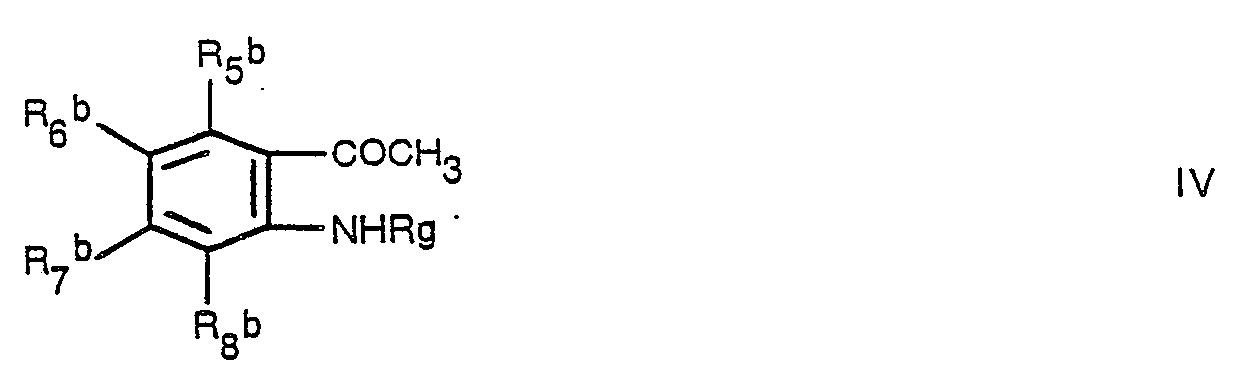
- Rg and M are as defined above,
- in which R' is a suitable leaving group, e.g. an alkoxy, halo, amino, alkylamino, substituted amino (e.g. an arylsulphonylamino group) or substituted alkylamino group, reactive with the carbanion of the―COCH3 group of the 1-(2'-aminophenyl)ethanone of formula IV, and
- Z is a carbonyl oxygen atom, or may represent two halogen atoms,
- if necessary hydrolysing the resulting compound to form a compound of formula III,
- and cyclising the resulting compound.
- The compound of formula I is preferably a dialkyl oxalate, e.g. a di- C 1 to 6 alkyl oxalate such as diethyl oxalate.
- The compounds of formula IV, other than that in which Rg, R5b and R8b are hydrogen, R6b is acetyl and R7b is -OH, are new compounds and the invention also provides these new compounds per se. (See Zhurnal Obschei Khimii, 1953, Vol. 23 pages 2043-2046).
- The compounds of formula IV may be made by Friedel Crafts acetylation of the appropriate aminophenol, which may if desired be in protected form, e.g. the amino group having been acylated (e.g. with a formyl, acetyl or pivaloyl group) and the hydroxy group having been alkylated, and subsequent removal of any remaining protecting groups. One compound of formula IV may if desired be converted to another, e.g. by O-alkenylation followed by Claisen rearrangement to produce the ring alkenylated derivative, which may then if desired be reduced to the corresponding ring alkyl compound.
- The compounds of formula I are known compounds.
- The compounds of formula II produced by the process of the invention have a variety of uses, e.g. as chemical intermediates, and as pharmaceuticals, particularly for the treatment of allergic conditions. The compounds of Example 2(c) is a new compound and is particularly advantageous as compared to other compounds of similar structure.
- In compounds of formula II we prefer each of Rg, R1, R2, R5, R6, R7 and R8, when they contain carbon, to contain up to 8, and preferably up to 4 carbon atoms. Specifically we prefer R5, R6, R7 and R8 to be selected from hydrogen, methoxy, propyl, allyl, methyl, ethyl, chlorine, bromine and hydroxy. We also prefer Rg to be hydrogen or alkyl C 1 to 4, e.g. ethyl. The―COCH=C(COOH)―O― chain may be bonded to the benzene ring in any direction and in any of the adjacent positions R5, R6, R7, Re. However, we prefer the chain to be bonded in the positions R6 and R7 the ―O― part of the chain being in position R7. We also prefer R8 to be alkyl, e.g. propyl.
- Pharmaceutically acceptable salts of the compounds of formula II include ammonium, alkali metal (e.g. sodium, potassium and lithium) and alkaline earth metal (e.g. calcium or magnesium) salts, and salts with suitable organic bases, e.g. salts with hydroxylamine, lower alkylamines such as methylamine or ethylamine, with substituted lower alkylamines, e.g. hydroxy substituted alkylamines such as tris(hydroxymethyl)methylamine, or with simple monocyclic nitrogen heterocyclic compounds, e.g. piperidine or morpholine. Suitable esters include simple lower alkyl esters, e.g. the ethyl ester, esters derived from alcohols containing basic groups, e.g. di-lower alkyl amino substituted alkanols such as the 2-diethylaminoethyl ester, and acyloxy alkyl esters, e.g. a lower acyloxy-lower alkyl ester such as the pivaloyloxymethyl ester, or a bis-ester derived from a di-hydroxy compound, e.g. a di(hydroxy-lower alkyl)ether, e.g. the bis-2-oxa-propan-1,3-diyl ester. The pharmaceutically acceptable; acid addition salts of the basic esters, and also of those compounds in which one of R5, R6, R7 and R8 is a group―NR1R2, e.g. the hydrochloride, the hydrobromide, the oxalate, the maleate or the fumarate salts, may also be used. The amides may be, for example, unsubstituted or mono- or di- C 1 to 6 alkyl amides and may be made by conventional techniques, e.g. reaction of an ester of the corresponding acid with ammonia or an appropriate amine.
- The invention is illustrated by the following Examples in which the temperatures are in °C.
- 3-Acetamidoanisole (0.2 moles) was added (in methylene chloride solution) to a stirred solution of aluminium chloride (2 moles) and acetyl chloride (2 moles) in dichloromethane at 0-5°C. The mixture was then heated to reflux (for 69 hours), and added to ice/water after cooling to 25°C. After filtration the aqueous phase was extracted with methylene chloride, and the organic phase washed with water, dried, and concentrated. Crystallisation of the residue from ethanol afforded the title compound in 34% yield, mp 201-202°C.
- 3-Acetamidoanisole (0.01 mole) in dry dichloromethane, was added to a solution of aluminium chloride (0.03 Mol) and acetyl chloride (0.03 Mol) in dry dichloromethane, at a temperature below 10°C. After stirring at 5°C for 1 hour, the temperature was raised to, and held at, reflux until reaction was complete. The mixture was poured into water and the product isolated by filtration, yield 83%.
- 1-(4'-Acetamido-2'-hydroxypheny))ethanone (500 g) was added to a cooled (10-15°C) soluiton of aluminium chloride (10 eq) and acetyl chloride (10 eq) in dichloromethane (7 I). The mixture was heated to, and maintained at, reflux for 40 hours. The mixture was cooled to 20°C and added slowly to water. The solid was isolated by filtration and recrystallised from ethanol to aford the sub-title compound in 56% yield, mp 201-202°C.
- 3-Acetamido-4,6-diacetylphenol (250 g) was suspended in ethanol (2 I) containing conc. hydrochloric acid (200 ml) and heated on a steam bath for 5 hours. The mixture was allowed to cool, and the crystalline product isolated by filtration. Yield 91 %, mp 227-230°C.
- The product of step (b) (5 mMol) and diethyl oxalate (50 mMol) were heated at reflux in a solution of sodium ethoxide (50 mMol) in ethanol (20 mls) for 3 hours.
- The mixture, which contained the sodium salt of diethyl 4,4'-(2-amino-4-hydroxyphenylen-1,3-diyl)bis(2,4-dioxobutanoate), was acidified with gaseous HCI, and refluxed for a further 1 hour. Pouring into water followed by extraction with dichloromethane gave, on concentration, a yellow solid in 79% yield.
- Crystallisation from dimethylsulphoxide afforded the sub-title product mp 282-284°.
- Treatment of the product of step (b) (1.5 g) with K2C03 (1 equivalent) and allyl bromide (2 equivalents) in dimethylformamide (20 ml) at 70° for 2) hours followed by dilution with water at 70° afforded the sub-title product, as a pale yellow solid (83%) mp 131-134°.
- Heating of the product of step (d) (3.8 mmoles) in N-methyl pyrrolidone (4 ml) under N2 at 200° for 3 hours effected rearrangement to the 2-allyl compound. The reaction mixture was cooled to room temperature, diluted with ethanol (50 ml) and hydrogenated over Pd/C (5%) at atmospheric pressure. After removal of the catalyst by filtration, concentration afforded a residue containing N-methyl pyrrolidone. The mixture was diluted with water and the crude product isolated by filtration. Recrystallisation from ethanol gave the sub-title compound (82%) mp 138-139°.
- Treatment of the product of step (e) (1 mmole) with sodium ethoxide (10 mmole), in ethanol (10 ml) containing diethyl oxalate (10 mmole) at reflux for 3 hours, followed by acidification of the mixture, which contained the sodium salt of diethyl 4,4'-(2-amino-4-hydroxy-3-propyl-phenylene-1,3-diyl)bis(2,4-dioxo- butanoate), with gaseous HCI and heating under reflux for 1 hour afforded the sub-title compound which was isolated by dilution with water, extraction with chloroform, concentration and purification by column chromatography (yield 65%) mp 211-212°.
- The bis ester from step (f) (2.5 g) was refluxed with sodium bicarbonate (1.64 g) in ethanol (100 ml) and water (50 ml) for 1.5 hours. The whole was poured into water and acidified to precipitate a gelatinous solid. This was collected by filtration, refluxed with ethanol and the product was separated by centrifugation (1.4 g) mp 303-3040 dec. The structure of the product was confirmed by mass spectral and NMR evidence.
- The bis acid from step (g) (1.35 g) and sodium bicarbonate (0.661 g) in water (150 ml) were warmed and stirred until a clear solution was obtained. This solution was filtered and the filtrate was freeze dried to give 1.43 g of the required disodium salt.
- Analysis:

- 3-Acetamido-4,6-diacetylphenol (0.01 mole) in N-methylpyrrolidone (NMP) (20 ml) was added to a cooled (<5°), stirred suspension of sodium hydride (0.022 mole) in NMP (5 ml). After 15 minutes the mixture was treated with ethyl iodide (0.019 mole). After two hours at <5°C, the mixture was acidified with ethanol/conc. HCI (1:1, 20 ml) and heated to reflux for 2.5 hours. The mixture was allowed to cool and the crystalline sub-title compound isolated by filtration. Yield 63%, mp 103-104°.
- Allyl bromide (2 g) was added to a stirred solution of 4,6-diacetyl-3-ethylaminophenol (0.016 M) in dimethylformamide (30 ml) containing potassium carbonate (2 g). The mixture was heated at 60-70° for two hours, and was then poured into water (100 ml), stirred, and the precipitated product isolated by filtration. Yield 93%, mp 82-83°.
- The product of step (b) (0.013 mole) was heated in NMP (25 ml) at reflux under nitrogen for 1 hour. After cooling to room temperature, the mixture was diluted with ethanol (25 ml), and hydrogenated over 5% Pd/C at 15-20 psi for 2.5 hours. After filtration, the mixture was poured into water, the grey solid isolated by filtration, and recrystallised from ethanol to give the sub-title compound. Yield 63%, mp 114―115°.
- A stirred mixture of 4,6-diacetyl-3-N-ethylamino-2-propylphenol (3.8 mMol), sodium ethoxide (30.4 mMol) and diethyl oxalate (26.5 mMol) in ethanol (50 ml/g of substrate) under nitrogen was heated under reflux for 3 hours. The reaction mixture, which contained the sodium salt of diethyl 4,4'-(2-ethylamino-4-hydroxy-3-propylphenylene-1,3-diyl)bis(2,4-dioxo-butanoate) was cooled, treated slowly with a 50:50 mixture of ethanol/concentrated hydrochloric acid, and heated under reflux for 0.5 hour.
- The mixture was cooled, poured into ice and the precipitated solid filtered off and recrystallised from ethanol to give the title compound in 82% yield, mp 132134°.
- A mixture of 4,6-diacetyl-3-N-ethylaminophenol (4.5 mmol) sodium ethoxide (36 mmol) and diethyl oxalate (36 mmol) in ethanol (50 ml/g) of substrate) was heated under reflux and with stirring, in a nitrogen atmosphere, for 2 hours. The mixture, which contained the sodium salt of diethyl 4,4'-(2-ethylamino-4-hydroxyphenylene-1,3-diyl)bis(2,4-dioxo-butanoate) was then treated with a 50:50 mixture of ethanol/ concentrated hydrochloric acid and heated under reflux for a further 20 minutes.
- The reaction mixture was poured into water, the yellow precipitate filtered off and purified by chromatography to afford the title compound in 44.8% yield, mp 193-194°. The title compound may be converted to the free acid and the disodium salt thereof by conventional techniques.
or a pharmaceutically acceptable salt, ester or amide thereof,
which comprises cyclisation in the presence of an acid of a compound of formula III,

and if desired or necessary converting the resulting compound to a pharmaceutically acceptable salt, ester or amide thereof, or vice versa.
with a compound of formula I,

Claims (10)

or a pharmaceutically acceptable salt, ester or amide thereof,
which comprises cyclisation in the presence of an acid of a compound of formula III,

and if desired or necessary converting the resulting compound to a pharmaceutically acceptable salt, ester or amide thereof, or vice versa.

with a compound of formula I,

Priority Applications (1)
| Application Number | Priority Date | Filing Date | Title |
|---|---|---|---|
| AT80304113T ATE11774T1 (en) | 1979-12-07 | 1980-11-17 | PROCESSES FOR THE PREPARATION OF 1,4-DIHYDRO-4-OXO-QUINOLINE-2-CARBONIC ACIDS OR SALTS, ESTERS OR AMIDES THEREOF AND INTERMEDIATE COMPOUNDS THEREOF. |
Applications Claiming Priority (2)
| Application Number | Priority Date | Filing Date | Title |
|---|---|---|---|
| GB7942248 | 1979-12-07 | ||
| GB7942248 | 1979-12-07 |
Publications (2)
| Publication Number | Publication Date |
|---|---|
| EP0030423A1 EP0030423A1 (en) | 1981-06-17 |
| EP0030423B1 true EP0030423B1 (en) | 1985-02-13 |
Family
ID=10509689
Family Applications (1)
| Application Number | Title | Priority Date | Filing Date |
|---|---|---|---|
| EP80304113A Expired EP0030423B1 (en) | 1979-12-07 | 1980-11-17 | A process for the production of 1,4-dihydro-4-oxo-quinoline-2-carboxylic acids, or salts, esters or amides thereof and intermediates therefor |
Country Status (5)
| Country | Link |
|---|---|
| US (2) | US4328341A (en) |
| EP (1) | EP0030423B1 (en) |
| JP (2) | JPS5692289A (en) |
| AT (1) | ATE11774T1 (en) |
| DE (1) | DE3070179D1 (en) |
Cited By (1)
| Publication number | Priority date | Publication date | Assignee | Title |
|---|---|---|---|---|
| EP0077090B1 (en) * | 1981-10-10 | 1986-01-15 | FISONS plc | Process for the production of quinoline containing heterocycles, intermediates, and process for the production of the intermediates |
Families Citing this family (7)
| Publication number | Priority date | Publication date | Assignee | Title |
|---|---|---|---|---|
| USRE38628E1 (en) * | 1986-12-23 | 2004-10-19 | Fisons Plc | Pharmaceutical compositions |
| DE3787274T2 (en) * | 1986-12-23 | 1994-01-27 | Fisons Plc | Pharmaceutical preparations containing an aqueous solution of a pyranoquinoline. |
| JP2831000B2 (en) * | 1988-03-03 | 1998-12-02 | 大日本製薬株式会社 | (2-aminobenzoyl) acetic acid ester derivative |
| JP2888142B2 (en) | 1993-11-08 | 1999-05-10 | 三菱電機株式会社 | Rotary motor and method of manufacturing the same |
| DE69816080T2 (en) | 1997-04-18 | 2004-04-15 | Kirin Beer K.K. | METHOD FOR PRODUCING CHINOLINE DERIVATIVES |
| JP5351155B2 (en) * | 2008-06-09 | 2013-11-27 | 旭化成イーマテリアルズ株式会社 | Polyamide resin, photosensitive resin composition, method for forming cured relief pattern, and semiconductor device |
| CN102516252A (en) * | 2011-12-23 | 2012-06-27 | 四川滇虹医药开发有限公司 | Preparation method of Nedocromil sodium |
Family Cites Families (4)
| Publication number | Priority date | Publication date | Assignee | Title |
|---|---|---|---|---|
| GB1504709A (en) * | 1974-12-07 | 1978-03-22 | Fisons Ltd | N-substituted quinolinone-2-carboxyl. acid der |
| US4156726A (en) * | 1974-12-07 | 1979-05-29 | Fisons Limited | 4-Oxo-2-carboxyl quinoline derivatives used as antiallergic compounds |
| JPS5283711A (en) * | 1976-01-01 | 1977-07-12 | Tsukasa Eguchi | Molecular compound of hydroquinoneeketones |
| IL54614A (en) * | 1977-05-04 | 1983-07-31 | Fisons Ltd | Dihydrodioxo-pyranoquinoline dicarboxylic acid derivatives,their production and pharmaceutical compositions containing them |
-
1980
- 1980-11-17 AT AT80304113T patent/ATE11774T1/en not_active IP Right Cessation
- 1980-11-17 EP EP80304113A patent/EP0030423B1/en not_active Expired
- 1980-11-17 DE DE8080304113T patent/DE3070179D1/en not_active Expired
- 1980-12-02 US US06/212,331 patent/US4328341A/en not_active Expired - Lifetime
- 1980-12-05 JP JP17253680A patent/JPS5692289A/en active Granted
-
1982
- 1982-01-20 US US06/340,974 patent/US4414416A/en not_active Expired - Fee Related
-
1991
- 1991-04-30 JP JP3124443A patent/JPH059177A/en active Pending
Non-Patent Citations (1)
| Title |
|---|
| Zhurnal Obschei Khimii, 1953, vol. 23, pp. 2043-2046 * |
Cited By (1)
| Publication number | Priority date | Publication date | Assignee | Title |
|---|---|---|---|---|
| EP0077090B1 (en) * | 1981-10-10 | 1986-01-15 | FISONS plc | Process for the production of quinoline containing heterocycles, intermediates, and process for the production of the intermediates |
Also Published As
| Publication number | Publication date |
|---|---|
| JPH0524158B2 (en) | 1993-04-06 |
| ATE11774T1 (en) | 1985-02-15 |
| EP0030423A1 (en) | 1981-06-17 |
| US4328341A (en) | 1982-05-04 |
| JPH059177A (en) | 1993-01-19 |
| JPS5692289A (en) | 1981-07-25 |
| DE3070179D1 (en) | 1985-03-28 |
| US4414416A (en) | 1983-11-08 |
Similar Documents
| Publication | Publication Date | Title |
|---|---|---|
| Kloek et al. | An improved synthesis of sulfamoyl chlorides | |
| EP0916675B1 (en) | Process for preparing sildenafil | |
| KR940006764B1 (en) | Process for the preparation of (z)-1-phenyl-1-diethyl amino carbonyl 2-amino methyl cyclo propane hydrochloride | |
| US4414416A (en) | Certain diacetyl-amino-phenolic derivatives | |
| EP1116719B1 (en) | 3-(1-Hydroxy-pentylidene)-5-nitro-3H-benzofuran-2-one, a process for the preparation thereof and the use thereof | |
| US4153791A (en) | 3-Carboxy-4 hydroxyphenylthioacetmorpholide | |
| US4313000A (en) | Process for preparing 5-(2-chloro-4-trifluoromethylphenoxy)-2-nitro-N-alkanesulphonyl benzamides from a toluene derivative and intermediates | |
| EP0275971A1 (en) | Process and intermediates for quinolonecaboxylic acid | |
| WO1989006230A1 (en) | Cyano-dienes, halopyridines, intermediates and a process for their preparation | |
| US3663551A (en) | Production of isocarbostyrils | |
| KR870000234B1 (en) | Process for preparing trans-dl-5-substituted-7-substituted-1h(and 2h)-pyrazolo(3,4-g)quinolines | |
| HU200996B (en) | Process for producing n-(3', 4'-dimethoxycinnamoyl)-anthranilic acid (tranilast) | |
| US5290947A (en) | Process for the preparation of pyrrole derivates | |
| US4506078A (en) | 7-Nitroindoles | |
| JPH07121931B2 (en) | Benzo [b] furan derivative | |
| US4987247A (en) | Production of tetrahydrophthalimide compound | |
| US5395939A (en) | Method of making asymmetric de ring intermediates for the synthesis of camptothecin and camptothecin analogs | |
| US3954771A (en) | Process for the preparation of 2H-3-isoquinolones | |
| EP0670300B1 (en) | Process for the preparation of allyl quinone derivatives, and intermediates | |
| EP0216696A2 (en) | Process for preparing cotarnine | |
| US5210218A (en) | 2- and 3-chloropyrroles and process for preparing the same | |
| US4369316A (en) | 3,1 Benzoxazine 2,4-dione | |
| US4175209A (en) | Preparation of 6,11-dihydro-11-oxodibenz[b,e]-oxepin-2-acetic acid and precursors therefor | |
| US4376860A (en) | Pyridyl ketone | |
| Inazu et al. | Macro Rings. I. Syntheses of a Novel Class of Compounds with a Chain of Alternating Benzene Rings and Methylene Groups |
Legal Events
| Date | Code | Title | Description |
|---|---|---|---|
| PUAI | Public reference made under article 153(3) epc to a published international application that has entered the european phase |
Free format text: ORIGINAL CODE: 0009012 |
|
| AK | Designated contracting states |
Designated state(s): AT BE CH DE FR GB IT LU NL SE |
|
| 17P | Request for examination filed |
Effective date: 19811116 |
|
| RAP1 | Party data changed (applicant data changed or rights of an application transferred) |
Owner name: FISONS PLC |
|
| ITF | It: translation for a ep patent filed | ||
| GRAA | (expected) grant |
Free format text: ORIGINAL CODE: 0009210 |
|
| AK | Designated contracting states |
Designated state(s): AT BE CH DE FR GB IT LI LU NL SE |
|
| REF | Corresponds to: |
Ref document number: 11774 Country of ref document: AT Date of ref document: 19850215 Kind code of ref document: T |
|
| REF | Corresponds to: |
Ref document number: 3070179 Country of ref document: DE Date of ref document: 19850328 |
|
| ET | Fr: translation filed | ||
| PLBE | No opposition filed within time limit |
Free format text: ORIGINAL CODE: 0009261 |
|
| STAA | Information on the status of an ep patent application or granted ep patent |
Free format text: STATUS: NO OPPOSITION FILED WITHIN TIME LIMIT |
|
| 26N | No opposition filed | ||
| ITTA | It: last paid annual fee | ||
| REG | Reference to a national code |
Ref country code: FR Ref legal event code: CC Free format text: FRCC 92C0520, 920701 |
|
| REG | Reference to a national code |
Ref country code: FR Ref legal event code: CB Free format text: FRCB 92C0520, 801117 |
|
| REG | Reference to a national code |
Ref country code: FR Ref legal event code: CL |
|
| PGFP | Annual fee paid to national office [announced via postgrant information from national office to epo] |
Ref country code: GB Payment date: 19931109 Year of fee payment: 14 |
|
| PGFP | Annual fee paid to national office [announced via postgrant information from national office to epo] |
Ref country code: LU Payment date: 19931201 Year of fee payment: 14 |
|
| PGFP | Annual fee paid to national office [announced via postgrant information from national office to epo] |
Ref country code: BE Payment date: 19931222 Year of fee payment: 14 |
|
| EPTA | Lu: last paid annual fee | ||
| PG25 | Lapsed in a contracting state [announced via postgrant information from national office to epo] |
Ref country code: LU Free format text: LAPSE BECAUSE OF NON-PAYMENT OF DUE FEES Effective date: 19941117 Ref country code: GB Effective date: 19941117 |
|
| PG25 | Lapsed in a contracting state [announced via postgrant information from national office to epo] |
Ref country code: BE Effective date: 19941130 |
|
| EAL | Se: european patent in force in sweden |
Ref document number: 80304113.6 |
|
| BERE | Be: lapsed |
Owner name: FISONS P.L.C. Effective date: 19941130 |
|
| GBPC | Gb: european patent ceased through non-payment of renewal fee |
Effective date: 19941117 |
|
| PGFP | Annual fee paid to national office [announced via postgrant information from national office to epo] |
Ref country code: SE Payment date: 19991104 Year of fee payment: 20 |
|
| PGFP | Annual fee paid to national office [announced via postgrant information from national office to epo] |
Ref country code: FR Payment date: 19991109 Year of fee payment: 20 |
|
| PGFP | Annual fee paid to national office [announced via postgrant information from national office to epo] |
Ref country code: AT Payment date: 19991112 Year of fee payment: 20 |
|
| PGFP | Annual fee paid to national office [announced via postgrant information from national office to epo] |
Ref country code: DE Payment date: 19991119 Year of fee payment: 20 |
|
| PGFP | Annual fee paid to national office [announced via postgrant information from national office to epo] |
Ref country code: CH Payment date: 19991129 Year of fee payment: 20 |
|
| PGFP | Annual fee paid to national office [announced via postgrant information from national office to epo] |
Ref country code: NL Payment date: 19991130 Year of fee payment: 20 |
|
| PG25 | Lapsed in a contracting state [announced via postgrant information from national office to epo] |
Ref country code: LI Free format text: LAPSE BECAUSE OF EXPIRATION OF PROTECTION Effective date: 20001116 Ref country code: CH Free format text: LAPSE BECAUSE OF EXPIRATION OF PROTECTION Effective date: 20001116 |
|
| PG25 | Lapsed in a contracting state [announced via postgrant information from national office to epo] |
Ref country code: NL Free format text: LAPSE BECAUSE OF EXPIRATION OF PROTECTION Effective date: 20001117 Ref country code: AT Free format text: LAPSE BECAUSE OF EXPIRATION OF PROTECTION Effective date: 20001117 |
|
| PG25 | Lapsed in a contracting state [announced via postgrant information from national office to epo] |
Ref country code: SE Free format text: THE PATENT HAS BEEN ANNULLED BY A DECISION OF A NATIONAL AUTHORITY Effective date: 20001129 |
|
| REG | Reference to a national code |
Ref country code: CH Ref legal event code: PL |
|
| NLV7 | Nl: ceased due to reaching the maximum lifetime of a patent |
Effective date: 20001117 |
|
| EUG | Se: european patent has lapsed |
Ref document number: 80304113.6 |