EP0030181B1 - Composition pulvérulente et procédé de fabrication d'une pièce réfractaire à partir de cette composition - Google Patents
Composition pulvérulente et procédé de fabrication d'une pièce réfractaire à partir de cette composition Download PDFInfo
- Publication number
- EP0030181B1 EP0030181B1 EP80401648A EP80401648A EP0030181B1 EP 0030181 B1 EP0030181 B1 EP 0030181B1 EP 80401648 A EP80401648 A EP 80401648A EP 80401648 A EP80401648 A EP 80401648A EP 0030181 B1 EP0030181 B1 EP 0030181B1
- Authority
- EP
- European Patent Office
- Prior art keywords
- weight
- composition
- particles
- products
- alkaline earth
- Prior art date
- Legal status (The legal status is an assumption and is not a legal conclusion. Google has not performed a legal analysis and makes no representation as to the accuracy of the status listed.)
- Expired
Links
- 239000000203 mixture Substances 0.000 title claims abstract description 37
- 238000000034 method Methods 0.000 title description 6
- 238000004519 manufacturing process Methods 0.000 title description 2
- VYPSYNLAJGMNEJ-UHFFFAOYSA-N Silicium dioxide Chemical compound O=[Si]=O VYPSYNLAJGMNEJ-UHFFFAOYSA-N 0.000 claims abstract description 42
- 239000002245 particle Substances 0.000 claims abstract description 20
- XLYOFNOQVPJJNP-UHFFFAOYSA-N water Substances O XLYOFNOQVPJJNP-UHFFFAOYSA-N 0.000 claims abstract description 14
- 229910000287 alkaline earth metal oxide Inorganic materials 0.000 claims abstract description 11
- 150000001875 compounds Chemical class 0.000 claims abstract description 10
- 239000011449 brick Substances 0.000 claims abstract description 4
- 238000010276 construction Methods 0.000 claims abstract description 4
- 239000011230 binding agent Substances 0.000 claims description 7
- 239000003795 chemical substances by application Substances 0.000 claims description 6
- 238000002156 mixing Methods 0.000 claims description 2
- 239000000377 silicon dioxide Substances 0.000 abstract description 17
- 239000002270 dispersing agent Substances 0.000 abstract 1
- 239000000047 product Substances 0.000 description 32
- 239000004568 cement Substances 0.000 description 18
- 239000000499 gel Substances 0.000 description 12
- 235000008733 Citrus aurantifolia Nutrition 0.000 description 10
- 235000011941 Tilia x europaea Nutrition 0.000 description 10
- 239000004571 lime Substances 0.000 description 10
- 230000000694 effects Effects 0.000 description 9
- 238000003825 pressing Methods 0.000 description 9
- 238000010411 cooking Methods 0.000 description 8
- 239000004567 concrete Substances 0.000 description 5
- 238000009826 distribution Methods 0.000 description 5
- 238000007493 shaping process Methods 0.000 description 5
- 230000008901 benefit Effects 0.000 description 4
- 238000001035 drying Methods 0.000 description 4
- 230000007062 hydrolysis Effects 0.000 description 4
- 238000006460 hydrolysis reaction Methods 0.000 description 4
- 230000015572 biosynthetic process Effects 0.000 description 3
- 239000000470 constituent Substances 0.000 description 3
- 150000002500 ions Chemical class 0.000 description 3
- 239000000126 substance Substances 0.000 description 3
- 230000000930 thermomechanical effect Effects 0.000 description 3
- PNEYBMLMFCGWSK-UHFFFAOYSA-N aluminium oxide Inorganic materials [O-2].[O-2].[O-2].[Al+3].[Al+3] PNEYBMLMFCGWSK-UHFFFAOYSA-N 0.000 description 2
- 238000005266 casting Methods 0.000 description 2
- 238000000280 densification Methods 0.000 description 2
- 239000010419 fine particle Substances 0.000 description 2
- 230000036571 hydration Effects 0.000 description 2
- 238000006703 hydration reaction Methods 0.000 description 2
- 238000001935 peptisation Methods 0.000 description 2
- 230000007928 solubilization Effects 0.000 description 2
- 238000005063 solubilization Methods 0.000 description 2
- 239000011882 ultra-fine particle Substances 0.000 description 2
- UDHXJZHVNHGCEC-UHFFFAOYSA-N Chlorophacinone Chemical compound C1=CC(Cl)=CC=C1C(C=1C=CC=CC=1)C(=O)C1C(=O)C2=CC=CC=C2C1=O UDHXJZHVNHGCEC-UHFFFAOYSA-N 0.000 description 1
- BPQQTUXANYXVAA-UHFFFAOYSA-N Orthosilicate Chemical compound [O-][Si]([O-])([O-])[O-] BPQQTUXANYXVAA-UHFFFAOYSA-N 0.000 description 1
- 239000011398 Portland cement Substances 0.000 description 1
- 230000004913 activation Effects 0.000 description 1
- 239000011149 active material Substances 0.000 description 1
- 239000000920 calcium hydroxide Substances 0.000 description 1
- 235000011116 calcium hydroxide Nutrition 0.000 description 1
- 239000000919 ceramic Substances 0.000 description 1
- 238000006243 chemical reaction Methods 0.000 description 1
- 238000005056 compaction Methods 0.000 description 1
- 230000000295 complement effect Effects 0.000 description 1
- 238000007596 consolidation process Methods 0.000 description 1
- 230000007423 decrease Effects 0.000 description 1
- 230000002349 favourable effect Effects 0.000 description 1
- 239000000945 filler Substances 0.000 description 1
- 238000010304 firing Methods 0.000 description 1
- 238000005243 fluidization Methods 0.000 description 1
- 229910052500 inorganic mineral Inorganic materials 0.000 description 1
- 238000003475 lamination Methods 0.000 description 1
- 230000001050 lubricating effect Effects 0.000 description 1
- 239000011707 mineral Substances 0.000 description 1
- 235000010755 mineral Nutrition 0.000 description 1
- 239000000843 powder Substances 0.000 description 1
- 239000002244 precipitate Substances 0.000 description 1
- 238000001556 precipitation Methods 0.000 description 1
- 238000002360 preparation method Methods 0.000 description 1
- 230000001737 promoting effect Effects 0.000 description 1
- 230000003252 repetitive effect Effects 0.000 description 1
- 150000004760 silicates Chemical class 0.000 description 1
- 238000005245 sintering Methods 0.000 description 1
- 239000002689 soil Substances 0.000 description 1
- 230000006641 stabilisation Effects 0.000 description 1
- 238000011105 stabilization Methods 0.000 description 1
- 238000003860 storage Methods 0.000 description 1
- 239000012749 thinning agent Substances 0.000 description 1
Images
Classifications
-
- C—CHEMISTRY; METALLURGY
- C04—CEMENTS; CONCRETE; ARTIFICIAL STONE; CERAMICS; REFRACTORIES
- C04B—LIME, MAGNESIA; SLAG; CEMENTS; COMPOSITIONS THEREOF, e.g. MORTARS, CONCRETE OR LIKE BUILDING MATERIALS; ARTIFICIAL STONE; CERAMICS; REFRACTORIES; TREATMENT OF NATURAL STONE
- C04B35/00—Shaped ceramic products characterised by their composition; Ceramics compositions; Processing powders of inorganic compounds preparatory to the manufacturing of ceramic products
- C04B35/66—Monolithic refractories or refractory mortars, including those whether or not containing clay
-
- C—CHEMISTRY; METALLURGY
- C04—CEMENTS; CONCRETE; ARTIFICIAL STONE; CERAMICS; REFRACTORIES
- C04B—LIME, MAGNESIA; SLAG; CEMENTS; COMPOSITIONS THEREOF, e.g. MORTARS, CONCRETE OR LIKE BUILDING MATERIALS; ARTIFICIAL STONE; CERAMICS; REFRACTORIES; TREATMENT OF NATURAL STONE
- C04B28/00—Compositions of mortars, concrete or artificial stone, containing inorganic binders or the reaction product of an inorganic and an organic binder, e.g. polycarboxylate cements
- C04B28/02—Compositions of mortars, concrete or artificial stone, containing inorganic binders or the reaction product of an inorganic and an organic binder, e.g. polycarboxylate cements containing hydraulic cements other than calcium sulfates
-
- C—CHEMISTRY; METALLURGY
- C04—CEMENTS; CONCRETE; ARTIFICIAL STONE; CERAMICS; REFRACTORIES
- C04B—LIME, MAGNESIA; SLAG; CEMENTS; COMPOSITIONS THEREOF, e.g. MORTARS, CONCRETE OR LIKE BUILDING MATERIALS; ARTIFICIAL STONE; CERAMICS; REFRACTORIES; TREATMENT OF NATURAL STONE
- C04B35/00—Shaped ceramic products characterised by their composition; Ceramics compositions; Processing powders of inorganic compounds preparatory to the manufacturing of ceramic products
- C04B35/01—Shaped ceramic products characterised by their composition; Ceramics compositions; Processing powders of inorganic compounds preparatory to the manufacturing of ceramic products based on oxide ceramics
- C04B35/10—Shaped ceramic products characterised by their composition; Ceramics compositions; Processing powders of inorganic compounds preparatory to the manufacturing of ceramic products based on oxide ceramics based on aluminium oxide
- C04B35/101—Refractories from grain sized mixtures
-
- C—CHEMISTRY; METALLURGY
- C04—CEMENTS; CONCRETE; ARTIFICIAL STONE; CERAMICS; REFRACTORIES
- C04B—LIME, MAGNESIA; SLAG; CEMENTS; COMPOSITIONS THEREOF, e.g. MORTARS, CONCRETE OR LIKE BUILDING MATERIALS; ARTIFICIAL STONE; CERAMICS; REFRACTORIES; TREATMENT OF NATURAL STONE
- C04B35/00—Shaped ceramic products characterised by their composition; Ceramics compositions; Processing powders of inorganic compounds preparatory to the manufacturing of ceramic products
- C04B35/622—Forming processes; Processing powders of inorganic compounds preparatory to the manufacturing of ceramic products
- C04B35/626—Preparing or treating the powders individually or as batches ; preparing or treating macroscopic reinforcing agents for ceramic products, e.g. fibres; mechanical aspects section B
- C04B35/63—Preparing or treating the powders individually or as batches ; preparing or treating macroscopic reinforcing agents for ceramic products, e.g. fibres; mechanical aspects section B using additives specially adapted for forming the products, e.g.. binder binders
- C04B35/6303—Inorganic additives
- C04B35/6316—Binders based on silicon compounds
-
- C—CHEMISTRY; METALLURGY
- C04—CEMENTS; CONCRETE; ARTIFICIAL STONE; CERAMICS; REFRACTORIES
- C04B—LIME, MAGNESIA; SLAG; CEMENTS; COMPOSITIONS THEREOF, e.g. MORTARS, CONCRETE OR LIKE BUILDING MATERIALS; ARTIFICIAL STONE; CERAMICS; REFRACTORIES; TREATMENT OF NATURAL STONE
- C04B2235/00—Aspects relating to ceramic starting mixtures or sintered ceramic products
- C04B2235/02—Composition of constituents of the starting material or of secondary phases of the final product
- C04B2235/30—Constituents and secondary phases not being of a fibrous nature
- C04B2235/34—Non-metal oxides, non-metal mixed oxides, or salts thereof that form the non-metal oxides upon heating, e.g. carbonates, nitrates, (oxy)hydroxides, chlorides
- C04B2235/3418—Silicon oxide, silicic acids or oxide forming salts thereof, e.g. silica sol, fused silica, silica fume, cristobalite, quartz or flint
Definitions
- the present invention relates to a shaped refractory product which, without it being essential to bake it, has physical, thermo-mechanical and thermo-chemical characteristics at least equivalent to those of baked shaped refractory products known to date.
- the invention makes it possible to eliminate the drawbacks which are in particular the expenditure of energy, the slowness of manufacture and a certain imprecision of the dimensions coming from deformations due to cooking.
- a mixture of granular powder and water is prepared and placed in a mold to give it the desired shape.
- the products thus obtained are stabilized by firing at a temperature generally close to the service temperature in order to give the components a ceramic bond and to stabilize the products in size.
- Another known method for obtaining refractory products consists in using mixtures of hydraulic concrete types. These mixtures (pulverulent composition and water) are molded by casting and vibration and give products which have advantageous characteristics for certain applications. But the proportion of hydraulic binder based on alkaline earth oxides which they must contain remains relatively high, even if it could have been reduced significantly, and thereby reduces the qualities of the products such as their thermo-mechanical characteristics. .
- shaping by casting and vibration excludes shaping at high flow in a single mold due to the time required for the hydraulic setting of the concrete before demolding.
- French patent 2,390,400 which describes a cement for concrete.
- This cement has effects quite different from that of the present application because the pouring of a concrete into a mold and then its vibration, as indicated in this French patent page 3 lines 5 to 7 for example, causes a arrangement of the particles according to a simple juxtaposition and not according to a tangle as is explained below in particular on page 8 lines 30 to 33.
- Pressing provides, effectively, an effect by which the grains are somehow "broken” which favors this entanglement and which results in the creation of a kind of "skeleton". This gives the piece itself a clean, immediately obtained hold, since the demolding operation does not require more than 10 to 20 seconds while pouring concrete into a mold requires setting time. at least half an hour and more frequently three hours, since the arrangement of the particles in a simple juxtaposition does not give this "skeleton" effect, hence the need to wait relatively long until the mixture has set in a mold.
- This operation can be neither mechanized nor automated unlike industrial pressing which can be carried out by means of machines with repetitive cycle and high efficiency.
- the composition intended to be mixed with an aggregate comprises only two components and a fluidizing agent, one of these components having to have a fine particle size but not strictly enclosed within a precise range.
- silica / cement ratio has a value between 0.5 and 5.4 in French patent 2,390,400 (calculation resulting from claim 1) whereas according to the present invention, this same ratio has a value which ranges from 24 to 2.33 according to the calculations which result from the precise indications of claim 1.
- Japanese patent 79 / 113,617 is also known (summary published in Chemical Abstracts) which relates to a composition which must necessarily be cooked while that which results from the invention is especially intended to be used in the raw state, cooking not being only a favorable complement, certainly, but not essential.
- the Japanese patent provides for silica at a rate of 4% whereas, according to the present application, this silica is present in a proportion which ranges from 1.4 to 19.2.
- the proportions between silica and cement are exactly opposite to those of the invention.
- there is 4% of silica and 8% of aluminous cement that is to say a ratio of 0.5 whereas according to the present application the quantities of silica (1.4 to 19.2) and the quantities of cement (0.1 to 1), as a compound providing alkaline earth oxides, give ratios of 24 to 2.33 (see claim 1).
- a compound providing alkaline earth oxides such as a cement must be present in a minimum amount, which materializes in the proportion 0.08 to (2%, preferably 0.1 to 1% , and which is incompatible with the amount as large as 8% described in the Japanese patent.
- the composition according to the invention consists of two very precise products and a fluidizing agent with a view to mixing them with an aggregate and a small amount of water, to obtain a gel which is formed in place.
- the use of pressing provides ready-to-use parts in a very short time, allowing the use of a mechanized, automatic and industrial system, the composition of these products not making their stabilization by cooking essential.
- the invention relates to a pulverulent composition to be mixed with a refractory aggregate and with water with a view to obtaining by pressing refractory pieces such as bricks, for the construction of thermal chambers, characterized in what it only comprises three constituents which are, on the one hand, 70 to 96% by weight of silica, either vitreous or amorphous, the particles of which have a diameter of less than 1 ⁇ m, and on the other hand 4 to 30% by weight of a compound providing 1 to 20% by weight of alkaline earth oxides and, on the third hand, 0.5 to 3% by weight of a fluidizing agent.
- This silica is solubilized by activation using water and the resulting hydrolysis leads, by drying, to the precipitation of the gel formed.
- the silica associated with a small part of elements promoting its solubilization constitutes a binder for refractory aggregate.
- alkaline earth ions are advantageously used, preferably provided by a cement.
- This set contains a fluidifying or "dispersing" agent allowing the deflocculation of the fine and ultrafine fraction of the constituents to facilitate the homogeneous distribution of all the particles, which makes it possible to limit the amount of binder relative to the set.
- Deflocculation generates, moreover, a lubricating action which makes it possible to reduce the quantity of water theoretically necessary for the arrangement of the particles by compaction.
- a pulverulent composition as defined above, to use binder is mixed with a refractory aggregate of which 5% by weight at least consists of particles of diameter less than 20 m M, the aggregate representing 80 to 98% of the total weight of the whole and this mixture thus containing either vitreous or amorphous silica, the particles of which have a diameter less than 1 ⁇ m at a rate of 1.4 to 19.2% by weight, a compound providing alkaline earth oxides in an amount of 0.08 to 2% by weight and a thinning agent in an amount of 0.01 to 0.6% by weight.
- the invention relates more precisely to such a composition which contains 0.1 to 1% by weight of a compound providing alkaline earth oxides and according to a variant, 4 to 10% by weight of silica, either vitreous or amorphous.
- the binder and the refractory aggregate perfectly mixed are added with water, as said above, and the assembly is compacted in a mold under a pressure of 300 to 500 bars reached quickly and maintained for a short time in order to obtain a refractory piece such as a brick for the construction of thermal enclosures.
- a particular bond is obtained by the hydrolysis of ultra-fine silica (or amorphous), distributed homogeneously between the particles of the aggregate, in the presence of a small amount of alkaline earth ions. This hydrolysis leads to the formation of a gel which precipitates during drying by cementing the particles.
- the alkaline earth ions are preferably provided by a cement which may only be present in an extremely small quantity (less than 1% by weight of the binder-aggregate assembly).
- the pozzolanic effect can be conventional, that is to say obtained by fixing, in the form of lime silicate, by the fine silica of Portlandite resulting from the hydration of a Portland cement or obtained by hydration in the presence of fine silica in large quantities of an aluminous cement (refractory) in the form of hydrated pseudo- Fromite.
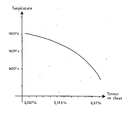
- This phenomenon is illustrated, by way of indication, by the single figure in the appended drawing.
- This drawing represents a curve of variation in subsidence temperature under load (on the ordinate) of refractory products obtained with compositions in accordance with the invention and produced with the same aggregate, as a function of the lime content (on the abscissa) of these compositions.
- the temperature indicated is that at which a collapse of 0.5% occurs under a load of 2 daN cm- 2 , measured by the differential method (AFNOR NFB 49-105 standard and ISO R 1893 standard).
- the lime content indicated is that which results from the use of an aluminous cement containing approximately 70% of alumina and 27% of lime.
- This cement is, here, that known under the name of "SECAR 71".
- silica gels The binding by silica gels is well known to those skilled in the art. However, the invention cannot be assimilated to the prior art. Indeed, known silica gels contain a large amount of water and a low concentration of active material. Consequently, their use provides a large amount of water which is very unfavorable since it gives the products a high porosity and a low mechanical cohesion.
- the gel is formed in place, with the same and same water as that which is necessary for the humidification of the mixture.
- the invention provides raw products whose thermo-mechanical characteristics are at least equal to those of cooked products of the cone technique.
- the invention provides an additional advantage over known products with respect to density and porosity.
- the raw products in accordance with the invention can have porosities of the order of 10%. These same products if cooked, can see their porosity fall to 5% without shrinkage greater than 1%, which represents a very good performance.
- refractory aggregate is identical to that usually used and chosen according to the application envisaged, as is well known to those skilled in the art.
- a characteristic of the invention is that, to ensure the good particle size distribution of the particles, the aggregate contains a substantial fraction of ultra-fine particles (diameter less than 20 ⁇ m). Depending on the binder content, the result is generally achieved with a proportion of between 5 and 25% of the total weight of the aggregate.
- cement cited is an aluminous cement containing 70% alumina and 27% lime sold by the company LAFARGE FONDU INTERNATIONAL.
- the products according to the invention after sufficient storage to allow setting are dried to remove the free water. They can, incidentally of course, be cooked, which can further improve their characteristics but cooking does not offer any major benefit and considerably increases the cost.
Landscapes
- Chemical & Material Sciences (AREA)
- Engineering & Computer Science (AREA)
- Ceramic Engineering (AREA)
- Manufacturing & Machinery (AREA)
- Materials Engineering (AREA)
- Structural Engineering (AREA)
- Organic Chemistry (AREA)
- Inorganic Chemistry (AREA)
- Chemical Kinetics & Catalysis (AREA)
- Compositions Of Oxide Ceramics (AREA)
- Curing Cements, Concrete, And Artificial Stone (AREA)
- Ceramic Products (AREA)
- Manufacturing Of Micro-Capsules (AREA)
- Furnace Housings, Linings, Walls, And Ceilings (AREA)
- Devices For Post-Treatments, Processing, Supply, Discharge, And Other Processes (AREA)
- Polyurethanes Or Polyureas (AREA)
Priority Applications (1)
| Application Number | Priority Date | Filing Date | Title |
|---|---|---|---|
| AT80401648T ATE8126T1 (de) | 1979-11-19 | 1980-11-18 | Pulverfoermige zusammensetzung und verfahren zur herstellung eines feuerfesten formkoerpers mittels dieser zusammensetzung. |
Applications Claiming Priority (2)
| Application Number | Priority Date | Filing Date | Title |
|---|---|---|---|
| FR7928418 | 1979-11-19 | ||
| FR7928418A FR2470104A1 (fr) | 1979-11-19 | 1979-11-19 | Composition pulverulente et piece refractaire obtenue a partir de cette composition |
Publications (2)
| Publication Number | Publication Date |
|---|---|
| EP0030181A1 EP0030181A1 (fr) | 1981-06-10 |
| EP0030181B1 true EP0030181B1 (fr) | 1984-06-27 |
Family
ID=9231813
Family Applications (1)
| Application Number | Title | Priority Date | Filing Date |
|---|---|---|---|
| EP80401648A Expired EP0030181B1 (fr) | 1979-11-19 | 1980-11-18 | Composition pulvérulente et procédé de fabrication d'une pièce réfractaire à partir de cette composition |
Country Status (12)
| Country | Link |
|---|---|
| US (1) | US4346177A (enExample) |
| EP (1) | EP0030181B1 (enExample) |
| JP (1) | JPS5857389B2 (enExample) |
| AT (1) | ATE8126T1 (enExample) |
| AU (1) | AU530387B2 (enExample) |
| BR (1) | BR8007503A (enExample) |
| CA (1) | CA1189879A (enExample) |
| DE (1) | DE3068377D1 (enExample) |
| ES (1) | ES8205188A1 (enExample) |
| FR (1) | FR2470104A1 (enExample) |
| MX (1) | MX156499A (enExample) |
| ZA (1) | ZA807136B (enExample) |
Families Citing this family (12)
| Publication number | Priority date | Publication date | Assignee | Title |
|---|---|---|---|---|
| FR2523572B1 (fr) * | 1982-03-19 | 1986-07-25 | Ags Bmp Argiles Mineraux | Composition pour beton |
| US4486545A (en) * | 1982-04-02 | 1984-12-04 | Shinagawa Refractories, Co., Ltd. | SIO2 -CaO Based low cubically expansive flame-spraying material |
| JPS5988365A (ja) * | 1982-11-11 | 1984-05-22 | 信越化学工業株式会社 | タイル用組成物 |
| LU85107A1 (fr) * | 1983-11-28 | 1985-07-17 | Tunjet A G | Composition de beton refractaire et application en metallurgie |
| JPS60152376A (ja) * | 1984-01-18 | 1985-08-10 | Nippon Alum Mfg Co Ltd:The | クラツド材の溶接方法 |
| DE3440252A1 (de) * | 1984-11-03 | 1986-05-15 | Hoechst Ag, 6230 Frankfurt | Formkoerper aus silikatischem material, verfahren zu ihrer herstellung und verwendung |
| NZ212330A (en) * | 1985-06-07 | 1989-01-06 | Nz Silicon Supplies Ltd | Ceramic-like material; mineral material in vitreous matrix |
| US4656146A (en) * | 1985-06-24 | 1987-04-07 | Exxon Research & Eng. Co. | Abrasion resistant refractory composition |
| DE3801130A1 (de) * | 1988-01-16 | 1989-07-27 | Didier Werke Ag | Verfahren zur herstellung eines feuerleichtsteines und nach dem verfahren hergestellte feuerleichtsteine |
| AU660205B2 (en) | 1991-12-23 | 1995-06-15 | Virbac, Inc | Systemic control of parasites |
| US5439924A (en) * | 1991-12-23 | 1995-08-08 | Virbac, Inc. | Systemic control of parasites |
| FR2914300B1 (fr) | 2007-03-26 | 2011-03-04 | Saint Gobain Ct Recherches | Bloc de beton refractaire tempere a deformation controlee. |
Family Cites Families (5)
| Publication number | Priority date | Publication date | Assignee | Title |
|---|---|---|---|---|
| FR2062039A5 (enExample) * | 1969-10-08 | 1971-06-25 | Prost | |
| FR2243163B1 (enExample) * | 1973-09-07 | 1977-05-13 | Efsi | |
| FR2390400A2 (fr) * | 1977-05-13 | 1978-12-08 | Produits Refractaires | Ciment a faible teneur en chaux et betons formes a partir de ce ciment |
| JPS54113617A (en) * | 1978-02-24 | 1979-09-05 | Harima Refractories Co Ltd | Nonshaped refractory having high strength and high fire resistance |
| JPS5580774A (en) * | 1978-12-07 | 1980-06-18 | Asahi Glass Co Ltd | Aluminum titanate molded body |
-
1979
- 1979-11-19 FR FR7928418A patent/FR2470104A1/fr active Granted
-
1980
- 1980-09-18 MX MX184818A patent/MX156499A/es unknown
- 1980-11-17 ZA ZA00807136A patent/ZA807136B/xx unknown
- 1980-11-18 AT AT80401648T patent/ATE8126T1/de not_active IP Right Cessation
- 1980-11-18 DE DE8080401648T patent/DE3068377D1/de not_active Expired
- 1980-11-18 BR BR8007503A patent/BR8007503A/pt unknown
- 1980-11-18 EP EP80401648A patent/EP0030181B1/fr not_active Expired
- 1980-11-18 AU AU64464/80A patent/AU530387B2/en not_active Ceased
- 1980-11-18 CA CA000364884A patent/CA1189879A/fr not_active Expired
- 1980-11-18 JP JP55162528A patent/JPS5857389B2/ja not_active Expired
- 1980-11-18 US US06/208,023 patent/US4346177A/en not_active Expired - Lifetime
- 1980-11-19 ES ES496987A patent/ES8205188A1/es not_active Expired
Also Published As
| Publication number | Publication date |
|---|---|
| JPS5857389B2 (ja) | 1983-12-20 |
| CA1189879A (fr) | 1985-07-02 |
| DE3068377D1 (en) | 1984-08-02 |
| FR2470104B1 (enExample) | 1985-05-17 |
| US4346177A (en) | 1982-08-24 |
| MX156499A (es) | 1988-09-02 |
| FR2470104A1 (fr) | 1981-05-29 |
| ES496987A0 (es) | 1982-06-01 |
| AU530387B2 (en) | 1983-07-14 |
| AU6446480A (en) | 1981-05-28 |
| JPS5678469A (en) | 1981-06-27 |
| BR8007503A (pt) | 1981-06-02 |
| EP0030181A1 (fr) | 1981-06-10 |
| ES8205188A1 (es) | 1982-06-01 |
| ATE8126T1 (de) | 1984-07-15 |
| ZA807136B (en) | 1981-10-28 |
Similar Documents
| Publication | Publication Date | Title |
|---|---|---|
| EP0030181A1 (fr) | Composition pulvérulente et procédé de fabrication d'une pièce réfractaire à partir de cette composition | |
| JP4568430B2 (ja) | ポンピング可能な調合物を調製する方法及び廃棄物フォームを形成する方法 | |
| EP0934915A1 (fr) | Béton très haute performance, autonivelant, son procédé de preparation et son utilisation | |
| CN113620618B (zh) | 一种利用花岗岩石粉和燃煤渣制备一体化胶凝材料的方法 | |
| BE898398A (fr) | Additif pour le béton comprenant plusieurs consituants contenant de la microsilice, procédé pour le préparer et béton en contenant. | |
| CN101328073A (zh) | 自增强型陶瓷纤维浇注料及其制备方法 | |
| FR2525381A1 (fr) | Procede pour le perfectionnement des proprietes necessaires pour un stockage de longue duree de dechets radioactifs solidifies | |
| FR2937636A1 (fr) | Beton frais auto-nivelant | |
| FR2519625A1 (fr) | Composition ceramique a base d'alumine et substrat obtenu a l'aide de cette composition | |
| EP3652129A1 (fr) | Procédé d'obtention d'un matériau compacté et matériau compacté obtenu de ce procédé | |
| FR2499975A1 (fr) | Profiles avec une stabilite mecanique elevee aux hautes temperatures, leur procede de fabrication et leur utilisation | |
| WO1984000747A1 (en) | A refractory composition | |
| WO1990009970A1 (fr) | Procede de revetement d'un repartiteur de coulee continue par un materiau refractaire | |
| EP0215997B1 (fr) | Produit réfractaire fabriqué sans cuisson, à haute résistance | |
| CN112479729B (zh) | 一种高强碳化硅-氧化物复合材料及其制备方法 | |
| CN1341572A (zh) | 一种高纯刚玉制品 | |
| EP0672638B1 (fr) | Matériau isolant thermique à base de fibres d'alumine et sa fabrication | |
| EP4161883A1 (fr) | Coulis pour l'injection de cables de precontrainte et procede d'installation d'un cable comprenant un tel coulis | |
| EP0322007A1 (en) | Method for producing ceramic components | |
| FR2677976A1 (fr) | Procede de fabrication d'un materiau ceramique refractaire, a base de carbone. | |
| FR2499970A1 (fr) | Procede pour la preparation de materiaux resistant au feu ou refractaires, granulaires, contenant des fibres ceramiques, materiaux prepares selon ce procede et leur utilisation | |
| BE451188A (enExample) | ||
| JP2979445B2 (ja) | セラミックスの鋳込み成形方法 | |
| Cook et al. | Pore structure development in portland cement/fly ash blends | |
| US6171387B1 (en) | Reversible agglomeration of fine particle plaster of Paris |
Legal Events
| Date | Code | Title | Description |
|---|---|---|---|
| PUAI | Public reference made under article 153(3) epc to a published international application that has entered the european phase |
Free format text: ORIGINAL CODE: 0009012 |
|
| AK | Designated contracting states |
Designated state(s): AT BE CH DE GB IT LI LU NL SE |
|
| 17P | Request for examination filed |
Effective date: 19810807 |
|
| ITF | It: translation for a ep patent filed | ||
| RAP1 | Party data changed (applicant data changed or rights of an application transferred) |
Owner name: LAFARGE REFRACTAIRES SOCIETE ANONYME |
|
| GRAA | (expected) grant |
Free format text: ORIGINAL CODE: 0009210 |
|
| AK | Designated contracting states |
Designated state(s): AT BE CH DE GB IT LI LU NL SE |
|
| REF | Corresponds to: |
Ref document number: 8126 Country of ref document: AT Date of ref document: 19840715 Kind code of ref document: T |
|
| REF | Corresponds to: |
Ref document number: 3068377 Country of ref document: DE Date of ref document: 19840802 |
|
| PLBI | Opposition filed |
Free format text: ORIGINAL CODE: 0009260 |
|
| 26 | Opposition filed |
Opponent name: DIDIER-WERKE AG Effective date: 19850326 |
|
| NLR1 | Nl: opposition has been filed with the epo |
Opponent name: DIDIER-WERKE AG. |
|
| PLBN | Opposition rejected |
Free format text: ORIGINAL CODE: 0009273 |
|
| STAA | Information on the status of an ep patent application or granted ep patent |
Free format text: STATUS: OPPOSITION REJECTED |
|
| 27O | Opposition rejected |
Effective date: 19870227 |
|
| NLR2 | Nl: decision of opposition | ||
| REG | Reference to a national code |
Ref country code: CH Ref legal event code: PUE Owner name: LAFARGE REFRACTAIRES MONOLITHIQUES S.A. |
|
| ITPR | It: changes in ownership of a european patent |
Owner name: CESSIONE;LAFARGE REFRACTAIRES MONOLITHIQUES |
|
| REG | Reference to a national code |
Ref country code: GB Ref legal event code: 732 |
|
| NLS | Nl: assignments of ep-patents |
Owner name: LAFARGE REFRACTAIRES MONOLITHIQUES TE MONTROUGE, F |
|
| ITTA | It: last paid annual fee | ||
| EPTA | Lu: last paid annual fee | ||
| PGFP | Annual fee paid to national office [announced via postgrant information from national office to epo] |
Ref country code: LU Payment date: 19941001 Year of fee payment: 15 |
|
| PGFP | Annual fee paid to national office [announced via postgrant information from national office to epo] |
Ref country code: CH Payment date: 19941011 Year of fee payment: 15 |
|
| PGFP | Annual fee paid to national office [announced via postgrant information from national office to epo] |
Ref country code: AT Payment date: 19941013 Year of fee payment: 15 |
|
| PGFP | Annual fee paid to national office [announced via postgrant information from national office to epo] |
Ref country code: SE Payment date: 19941027 Year of fee payment: 15 |
|
| PGFP | Annual fee paid to national office [announced via postgrant information from national office to epo] |
Ref country code: BE Payment date: 19941103 Year of fee payment: 15 |
|
| PGFP | Annual fee paid to national office [announced via postgrant information from national office to epo] |
Ref country code: GB Payment date: 19941114 Year of fee payment: 15 |
|
| PGFP | Annual fee paid to national office [announced via postgrant information from national office to epo] |
Ref country code: NL Payment date: 19941130 Year of fee payment: 15 |
|
| EAL | Se: european patent in force in sweden |
Ref document number: 80401648.3 |
|
| PGFP | Annual fee paid to national office [announced via postgrant information from national office to epo] |
Ref country code: DE Payment date: 19950131 Year of fee payment: 15 |
|
| PG25 | Lapsed in a contracting state [announced via postgrant information from national office to epo] |
Ref country code: LU Free format text: LAPSE BECAUSE OF NON-PAYMENT OF DUE FEES Effective date: 19951118 Ref country code: GB Effective date: 19951118 Ref country code: AT Effective date: 19951118 |
|
| PG25 | Lapsed in a contracting state [announced via postgrant information from national office to epo] |
Ref country code: SE Effective date: 19951119 |
|
| PG25 | Lapsed in a contracting state [announced via postgrant information from national office to epo] |
Ref country code: LI Effective date: 19951130 Ref country code: CH Effective date: 19951130 Ref country code: BE Effective date: 19951130 |
|
| BERE | Be: lapsed |
Owner name: LAFARGE REFRACTAIRES MONOLITHIQUES S.A. Effective date: 19951130 |
|
| PG25 | Lapsed in a contracting state [announced via postgrant information from national office to epo] |
Ref country code: NL Effective date: 19960601 |
|
| REG | Reference to a national code |
Ref country code: CH Ref legal event code: PL |
|
| GBPC | Gb: european patent ceased through non-payment of renewal fee |
Effective date: 19951118 |
|
| NLV4 | Nl: lapsed or anulled due to non-payment of the annual fee |
Effective date: 19960601 |
|
| PG25 | Lapsed in a contracting state [announced via postgrant information from national office to epo] |
Ref country code: DE Effective date: 19960801 |
|
| EUG | Se: european patent has lapsed |
Ref document number: 80401648.3 |
|
| APAH | Appeal reference modified |
Free format text: ORIGINAL CODE: EPIDOSCREFNO |