EP0030102A1 - Control of adhesive bond thickness - Google Patents
Control of adhesive bond thickness Download PDFInfo
- Publication number
- EP0030102A1 EP0030102A1 EP80304151A EP80304151A EP0030102A1 EP 0030102 A1 EP0030102 A1 EP 0030102A1 EP 80304151 A EP80304151 A EP 80304151A EP 80304151 A EP80304151 A EP 80304151A EP 0030102 A1 EP0030102 A1 EP 0030102A1
- Authority
- EP
- European Patent Office
- Prior art keywords
- adhesive
- bond
- thickness
- beads
- ballotini
- Prior art date
- Legal status (The legal status is an assumption and is not a legal conclusion. Google has not performed a legal analysis and makes no representation as to the accuracy of the status listed.)
- Withdrawn
Links
- 239000000853 adhesive Substances 0.000 title claims abstract description 24
- 230000001070 adhesive effect Effects 0.000 title claims abstract description 24
- 239000011324 bead Substances 0.000 claims abstract description 12
- 239000011521 glass Substances 0.000 claims abstract description 7
- 239000000203 mixture Substances 0.000 claims abstract description 6
- 239000004593 Epoxy Substances 0.000 claims description 4
- 238000004132 cross linking Methods 0.000 claims description 2
- 229910000838 Al alloy Inorganic materials 0.000 claims 2
- 238000000034 method Methods 0.000 abstract description 2
- 238000007792 addition Methods 0.000 description 3
- 238000011068 loading method Methods 0.000 description 3
- 239000000956 alloy Substances 0.000 description 2
- 229910045601 alloy Inorganic materials 0.000 description 2
- 206010067482 No adverse event Diseases 0.000 description 1
- QXJJQWWVWRCVQT-UHFFFAOYSA-K calcium;sodium;phosphate Chemical compound [Na+].[Ca+2].[O-]P([O-])([O-])=O QXJJQWWVWRCVQT-UHFFFAOYSA-K 0.000 description 1
- 239000008367 deionised water Substances 0.000 description 1
- 230000000694 effects Effects 0.000 description 1
- 229920006332 epoxy adhesive Polymers 0.000 description 1
- 238000013007 heat curing Methods 0.000 description 1
- 239000000463 material Substances 0.000 description 1
- 238000005259 measurement Methods 0.000 description 1
- 238000002156 mixing Methods 0.000 description 1
- 150000003839 salts Chemical class 0.000 description 1
- 238000005488 sandblasting Methods 0.000 description 1
- 238000007873 sieving Methods 0.000 description 1
- 239000002356 single layer Substances 0.000 description 1
- 239000007921 spray Substances 0.000 description 1
- 239000001117 sulphuric acid Substances 0.000 description 1
Images


Classifications
-
- C—CHEMISTRY; METALLURGY
- C09—DYES; PAINTS; POLISHES; NATURAL RESINS; ADHESIVES; COMPOSITIONS NOT OTHERWISE PROVIDED FOR; APPLICATIONS OF MATERIALS NOT OTHERWISE PROVIDED FOR
- C09J—ADHESIVES; NON-MECHANICAL ASPECTS OF ADHESIVE PROCESSES IN GENERAL; ADHESIVE PROCESSES NOT PROVIDED FOR ELSEWHERE; USE OF MATERIALS AS ADHESIVES
- C09J201/00—Adhesives based on unspecified macromolecular compounds
-
- C—CHEMISTRY; METALLURGY
- C08—ORGANIC MACROMOLECULAR COMPOUNDS; THEIR PREPARATION OR CHEMICAL WORKING-UP; COMPOSITIONS BASED THEREON
- C08L—COMPOSITIONS OF MACROMOLECULAR COMPOUNDS
- C08L2666/00—Composition of polymers characterized by a further compound in the blend, being organic macromolecular compounds, natural resins, waxes or and bituminous materials, non-macromolecular organic substances, inorganic substances or characterized by their function in the composition
- C08L2666/54—Inorganic substances
Definitions
- This invention relates to adhesives.
- the invention provides an adhesive which includes glass heads admixed therewith, the beads having diameters within the range of from 100 to 400 micrometers and occupying up to 30% by volume of the mixture.
- the adhesive is of the cross-linking polymeric type and is preferably an epoxy-based adhesive.
- the diameter of the beads is preferably within the range of from 200 to 300 micrometers.
- the invention is of particular use in the automotive industry, where body panels and other parts for example, of alloy, may be secured together by the adhesive.
- the amount of spread can be reduced by sieving, for example, until the range of diameters is + 10%, preferably + 5%.
- the beads may be but do not have to be spherical. It has been found that glass beads normally used for sandblasting (known as "ballotini") are suitable for the present invention.
- the adhesive mixture comprised EC 2214, a single part alurinium-filled heat curing epoxy paste and ballotini (that is, beads) of 180 to 300 ⁇ m diameter.
- a measured weight of epoxy paste was warmed to room temperature, and a measured weight of ballotini was stirred in and thoroughly mixed by hand.
- the adhesive mixture was then applied to the strips, which were lightly pressed together until the minimum bond thickness was limited by the ballotini.
- ballotini establishes a simple way to control bond-line thickness and hence give uniformity of strenath. There is also a cost advantage, the ballotin costing less than a comparable volume of adhesive.
Landscapes
- Chemical & Material Sciences (AREA)
- Organic Chemistry (AREA)
- Adhesives Or Adhesive Processes (AREA)
- Compositions Of Macromolecular Compounds (AREA)
- Epoxy Resins (AREA)
Abstract
Glass beads having diameters within the range of from 100 to 400 micrometers and occupying up to 30% by volume of the mixture, are admixed with adhesive. When two surfaces to be adhered are pressed together, the glass beads produce a bond of a certain thickness. Because the bond thickness can be controlled in this way, the bond strength can also be so controlled. The method can be used for securing together parts of vehicle bodies.
Description
- This invention relates to adhesives.
- Although the various parts of motor vehicle bodies are usually welded or bolted together, it is sometimes advantageous for them to be secured together with adhesive. However, it is important for the bond to be of a certain strengon, which depends on the thickness of the bond, but this is difficult to control.
- The use of wires to space apart surfaces to be joined together.has been proposed in laboratory conditions, and in the aerospace industry adhesives in the form of film are used, the film containing an inert metrix for determining the thickness of the bond.
- The invention provides an adhesive which includes glass heads admixed therewith, the beads having diameters within the range of from 100 to 400 micrometers and occupying up to 30% by volume of the mixture.
- The use of glass ensures that the bond is of the desired thickness while not substantially affecting the strength of the bond.
- Advantageously, the adhesive is of the cross-linking polymeric type and is preferably an epoxy-based adhesive.
- The diameter of the beads is preferably within the range of from 200 to 300 micrometers.
- The invention is of particular use in the automotive industry, where body panels and other parts for example, of alloy, may be secured together by the adhesive.
- It should be noted there will normally be a certain amount of spread in the.diameter of the beads, and the thickness of the bond will tend to lie in the region of the diameter of the larger beads. The amount of spread can be reduced by sieving, for example, until the range of diameters is + 10%, preferably + 5%. The beads may be but do not have to be spherical. It has been found that glass beads normally used for sandblasting (known as "ballotini") are suitable for the present invention.
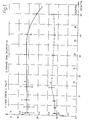
- An adhesive in accordance with the invention will now be described by way of example, with reference to the accompanying drawings, which are graphs of the strength and thickness of the bond at various strengths of mixture. The adhesive mixture comprised EC 2214, a single part alurinium-filled heat curing epoxy paste and ballotini (that is, beads) of 180 to 300 µm diameter. A measured weight of epoxy paste was warmed to room temperature, and a measured weight of ballotini was stirred in and thoroughly mixed by hand.
- Two sheets of 16 swg., Biometals BB-2, an aluminium- magnesian alloy were then prepared. Strips of 130mm x 20mm were cut from the sheet which was degreased by swabbing with M.E.K. and then etched in chromic-sulphuric acid solution for 5 minutes, rinsed with deionised water and then dried.
- The adhesive mixture was then applied to the strips, which were lightly pressed together until the minimum bond thickness was limited by the ballotini.
- Measurements were made on the specimens as follows. Referring to Figure 1, lap shear strength (measured on a Mayes LU-50 testing machine at a strain rate of lmm/min) in MNm-2 was measured at various ballotini loadings (plot A) and the average bond thickness (plot B) was also measured. Five samples were prepared for each loading and the results averaged. Referring to Figure 2, five samples of various ballotini loadings were again measured. Plot A shows initial pecl strength in MNm-1, plot B shows continuous peel strength in MNm-1, both being measured on a Mayes LU-50 testing machine. Plot C shows average bond thickness.
- With ballotini filled adhesive the bond thickness was consistently 0.24mm + 0.02mm and did not vary with ballotini additions up to 40% by weight. Beyond 40% there seemed to be a greater resistance to developing a single layer of the glass spheres and hence thicker bonds were formed. This was more apparent with the T-peel specimens because the jigging method, using springclips to hold the specimens together, exerts relatively light loads.
- The addition of ballotini up to 40% by weight had no apparent effect on shear or peel strengths but at 50% there did seem to be some reduction in properties. The 40% ballotini addition also appeared to be the maximum limit at which there was easy mixing and handling of the material.
- Lap shear strength variation with exposure time to salt spray and hvmid environments is shown in Figure 3. The reaction to aggressive environments of epoxy adhesives containing glass ballotini at 10% by volume was examined after a short exposure period of 4 weeks. Within this limited period there seemed to be no adverse reaction.
- The use of ballotini establishes a simple way to control bond-line thickness and hence give uniformity of strenath. There is also a cost advantage, the ballotin costing less than a comparable volume of adhesive.
Claims (8)
1. An adhesive which includes glass beads admixed therewith, the beads having diameters within the range of from 100 to 400 micrometers and occupying up to 30% by volume of the mixture.
2. An adhesive as claimed in claim 1, wherein the adhesive is of the cross-linking polymeric type.
3. An adhesive as claimed in claim 2, wherein the adhesive is an epoxy-based adhesive.
4. An adhesive as claimed in any one of claims 1 to 3, wherein the diameter of th'e beads is within the range of from 200 to 300 micrometers.
5. An adhesive as hereinbefore described with reference to the accompanying drawings.
6 Two surfaces joined by an adhesive as claimed in any one of claims 1 to 5.
7. Two aluminium alloy parts joined by an adhesive as claimed in any one of claims 1 to 5.
8. A vehicle incorporating two body parts of aluminium alloy as claimed in claim 7.
Applications Claiming Priority (2)
| Application Number | Priority Date | Filing Date | Title |
|---|---|---|---|
| GB7940515 | 1979-11-23 | ||
| GB7940515A GB2063269A (en) | 1979-11-23 | 1979-11-23 | Adhesives |
Publications (1)
| Publication Number | Publication Date |
|---|---|
| EP0030102A1 true EP0030102A1 (en) | 1981-06-10 |
Family
ID=10509368
Family Applications (1)
| Application Number | Title | Priority Date | Filing Date |
|---|---|---|---|
| EP80304151A Withdrawn EP0030102A1 (en) | 1979-11-23 | 1980-11-20 | Control of adhesive bond thickness |
Country Status (3)
| Country | Link |
|---|---|
| EP (1) | EP0030102A1 (en) |
| JP (1) | JPS56139573A (en) |
| GB (1) | GB2063269A (en) |
Cited By (5)
| Publication number | Priority date | Publication date | Assignee | Title |
|---|---|---|---|---|
| WO1996024876A1 (en) * | 1995-02-07 | 1996-08-15 | Hendrik Jan Westendorp | Counting chamber and method for manufacturing a counting chamber |
| US6074506A (en) * | 1992-04-16 | 2000-06-13 | The Budd Company | Method of bonding using non-compressible beads |
| US6180199B1 (en) | 1992-04-16 | 2001-01-30 | The Budd Company | Beaded adhesive and hem flanged part made therefrom |
| US6696147B1 (en) | 1992-04-16 | 2004-02-24 | Thyssenkrupp Budd Company | Beaded adhesive and flanged part made therefrom |
| KR20050083250A (en) * | 2004-02-21 | 2005-08-26 | 곽상운 | Adhesive composition |
Families Citing this family (5)
| Publication number | Priority date | Publication date | Assignee | Title |
|---|---|---|---|---|
| JPS58214711A (en) * | 1982-06-07 | 1983-12-14 | Takuma Co Ltd | Method for automatically controlling combustion of refuse incinerator |
| DE3331789A1 (en) * | 1982-09-29 | 1984-03-29 | Dana Corp., 43697 Toledo, Ohio | METHOD FOR PRODUCING A DRIVE SHAFT |
| GB8320616D0 (en) * | 1983-07-30 | 1983-09-01 | Mcdowall A | Synthetic material |
| GB8703075D0 (en) * | 1987-02-11 | 1987-03-18 | Brilcut Patent | Cement |
| JPH0251574A (en) * | 1988-08-12 | 1990-02-21 | Honda Motor Co Ltd | Bonded structure of dynamic quantity detecting element and object of detection |
Citations (2)
| Publication number | Priority date | Publication date | Assignee | Title |
|---|---|---|---|---|
| GB1203933A (en) * | 1966-10-17 | 1970-09-03 | Alkaline Batteries Ltd | Improvements relating to adhesives |
| DE2130773A1 (en) * | 1970-07-02 | 1972-04-13 | Iskra Zd Za Avtomatizacijo V Z | Adhesive for gluing with a precisely determined distance |
-
1979
- 1979-11-23 GB GB7940515A patent/GB2063269A/en not_active Withdrawn
-
1980
- 1980-11-20 EP EP80304151A patent/EP0030102A1/en not_active Withdrawn
- 1980-11-22 JP JP16522080A patent/JPS56139573A/en active Pending
Patent Citations (2)
| Publication number | Priority date | Publication date | Assignee | Title |
|---|---|---|---|---|
| GB1203933A (en) * | 1966-10-17 | 1970-09-03 | Alkaline Batteries Ltd | Improvements relating to adhesives |
| DE2130773A1 (en) * | 1970-07-02 | 1972-04-13 | Iskra Zd Za Avtomatizacijo V Z | Adhesive for gluing with a precisely determined distance |
Non-Patent Citations (1)
| Title |
|---|
| CHEMICAL ABSTRACTS, Vol. 77, 1972, page 54, No. 49515a Columbus, Ohio, U.S.A. & JP-A-46 030953 (TOKYO SHIBAURA ELECTRIC) 08-09-1971 * Abstract * * |
Cited By (5)
| Publication number | Priority date | Publication date | Assignee | Title |
|---|---|---|---|---|
| US6074506A (en) * | 1992-04-16 | 2000-06-13 | The Budd Company | Method of bonding using non-compressible beads |
| US6180199B1 (en) | 1992-04-16 | 2001-01-30 | The Budd Company | Beaded adhesive and hem flanged part made therefrom |
| US6696147B1 (en) | 1992-04-16 | 2004-02-24 | Thyssenkrupp Budd Company | Beaded adhesive and flanged part made therefrom |
| WO1996024876A1 (en) * | 1995-02-07 | 1996-08-15 | Hendrik Jan Westendorp | Counting chamber and method for manufacturing a counting chamber |
| KR20050083250A (en) * | 2004-02-21 | 2005-08-26 | 곽상운 | Adhesive composition |
Also Published As
| Publication number | Publication date |
|---|---|
| GB2063269A (en) | 1981-06-03 |
| JPS56139573A (en) | 1981-10-31 |
Similar Documents
| Publication | Publication Date | Title |
|---|---|---|
| EP0030102A1 (en) | Control of adhesive bond thickness | |
| KR100680095B1 (en) | One-part curable epoxy adhesive with ambient temperature stability | |
| CN104812860B (en) | Structural Adhesive Film | |
| CZ237797A3 (en) | Single-component heat hardenable material based on liquid rubber, process of its preparation and use | |
| GB2110705A (en) | Polymerizable epoxy/acrylic adhesive compositions | |
| JPS57179268A (en) | Epoxy resin adhesive composition | |
| JP7173193B2 (en) | Article manufacturing method and stacking device | |
| JPH05255644A (en) | Process for preparing substrate surface for bonding with activatable adhesive by applying activator-containing layer onto substrate surface | |
| GB2059425A (en) | Mixed emulsifying agent for making adhesive polymers | |
| US3684617A (en) | Curable epoxy resin/acrylic resin mixtures | |
| Bowditch et al. | Adhesive bonding of GRP | |
| JP7077529B2 (en) | How to manufacture adhesive sheet sets and articles | |
| JPS58189277A (en) | Adhesive | |
| JPH061955A (en) | Adhesive sheet and method | |
| JPH05293924A (en) | Damping composite metal panel and production thereof | |
| JPH02292378A (en) | Self-adhesive member and porous sheet | |
| JPS6041100B2 (en) | thermosetting adhesive composition | |
| JP2002129134A (en) | Recyclable water-based adhesive | |
| CA1273727A (en) | Initiator compositions for two part acrylic adhesives | |
| JPH04142383A (en) | Adhesive composition | |
| JPH0617010A (en) | Adhesion method with moisture-curable adhesive | |
| JPS5825706B2 (en) | Setsuchiyakuhouhou | |
| JPH0671700U (en) | Joining type building material | |
| US3194726A (en) | Acrylamide cements | |
| JPH03134083A (en) | Jointing of coated steel sheet |
Legal Events
| Date | Code | Title | Description |
|---|---|---|---|
| PUAI | Public reference made under article 153(3) epc to a published international application that has entered the european phase |
Free format text: ORIGINAL CODE: 0009012 |
|
| AK | Designated contracting states |
Designated state(s): BE CH DE FR GB IT LU NL |
|
| STAA | Information on the status of an ep patent application or granted ep patent |
Free format text: STATUS: THE APPLICATION IS DEEMED TO BE WITHDRAWN |
|
| 18D | Application deemed to be withdrawn |
Effective date: 19820515 |
|
| RIN1 | Information on inventor provided before grant (corrected) |
Inventor name: WOOD, CHRISTOPHER JOHN Inventor name: O'NEILL, JOHN SIDNEY |