EP0030098B1 - Compositions including mercaptoorganopolysiloxanes, aliphatically unsaturated polydiorganosiloxanes and carboxylic acid salts of metals - Google Patents
Compositions including mercaptoorganopolysiloxanes, aliphatically unsaturated polydiorganosiloxanes and carboxylic acid salts of metals Download PDFInfo
- Publication number
- EP0030098B1 EP0030098B1 EP80304121A EP80304121A EP0030098B1 EP 0030098 B1 EP0030098 B1 EP 0030098B1 EP 80304121 A EP80304121 A EP 80304121A EP 80304121 A EP80304121 A EP 80304121A EP 0030098 B1 EP0030098 B1 EP 0030098B1
- Authority
- EP
- European Patent Office
- Prior art keywords
- units
- formula
- parts
- group
- aliphatically unsaturated
- Prior art date
- Legal status (The legal status is an assumption and is not a legal conclusion. Google has not performed a legal analysis and makes no representation as to the accuracy of the status listed.)
- Expired
Links
- 239000000203 mixture Substances 0.000 title claims description 75
- 229910052751 metal Inorganic materials 0.000 title claims description 18
- 239000002184 metal Substances 0.000 title claims description 18
- 150000001734 carboxylic acid salts Chemical class 0.000 title claims description 6
- 150000002739 metals Chemical class 0.000 title description 2
- -1 dimethylsiloxane units Chemical group 0.000 claims description 45
- 150000003839 salts Chemical class 0.000 claims description 17
- 150000001451 organic peroxides Chemical class 0.000 claims description 13
- 125000003396 thiol group Chemical group [H]S* 0.000 claims description 13
- XEEYBQQBJWHFJM-UHFFFAOYSA-N Iron Chemical compound [Fe] XEEYBQQBJWHFJM-UHFFFAOYSA-N 0.000 claims description 11
- PXHVJJICTQNCMI-UHFFFAOYSA-N Nickel Chemical compound [Ni] PXHVJJICTQNCMI-UHFFFAOYSA-N 0.000 claims description 10
- 239000000945 filler Substances 0.000 claims description 9
- 239000000463 material Substances 0.000 claims description 9
- 125000004432 carbon atom Chemical group C* 0.000 claims description 6
- NINIDFKCEFEMDL-UHFFFAOYSA-N Sulfur Chemical compound [S] NINIDFKCEFEMDL-UHFFFAOYSA-N 0.000 claims description 5
- 150000001732 carboxylic acid derivatives Chemical class 0.000 claims description 5
- 229910052759 nickel Inorganic materials 0.000 claims description 5
- 229910052717 sulfur Inorganic materials 0.000 claims description 5
- 239000011593 sulfur Substances 0.000 claims description 5
- PWHULOQIROXLJO-UHFFFAOYSA-N Manganese Chemical compound [Mn] PWHULOQIROXLJO-UHFFFAOYSA-N 0.000 claims description 4
- 229910052742 iron Inorganic materials 0.000 claims description 4
- 229910052748 manganese Inorganic materials 0.000 claims description 4
- 239000011572 manganese Substances 0.000 claims description 4
- CIUQDSCDWFSTQR-UHFFFAOYSA-N [C]1=CC=CC=C1 Chemical compound [C]1=CC=CC=C1 CIUQDSCDWFSTQR-UHFFFAOYSA-N 0.000 claims description 3
- ORTRPLABQKAPKJ-UHFFFAOYSA-K iron(3+);octanoate Chemical compound [Fe+3].CCCCCCCC([O-])=O.CCCCCCCC([O-])=O.CCCCCCCC([O-])=O ORTRPLABQKAPKJ-UHFFFAOYSA-K 0.000 claims 2
- SGLXWMAOOWXVAM-UHFFFAOYSA-L manganese(2+);octanoate Chemical compound [Mn+2].CCCCCCCC([O-])=O.CCCCCCCC([O-])=O SGLXWMAOOWXVAM-UHFFFAOYSA-L 0.000 claims 1
- DVTHIMLUHWEZOM-UHFFFAOYSA-L nickel(2+);octanoate Chemical compound [Ni+2].CCCCCCCC([O-])=O.CCCCCCCC([O-])=O DVTHIMLUHWEZOM-UHFFFAOYSA-L 0.000 claims 1
- 229920000642 polymer Polymers 0.000 description 21
- FRIBMENBGGCKPD-UHFFFAOYSA-N 3-(2,3-dimethoxyphenyl)prop-2-enal Chemical compound COC1=CC=CC(C=CC=O)=C1OC FRIBMENBGGCKPD-UHFFFAOYSA-N 0.000 description 12
- KNMWLFKLSYMSBR-UHFFFAOYSA-N iron;octanoic acid Chemical group [Fe].CCCCCCCC(O)=O KNMWLFKLSYMSBR-UHFFFAOYSA-N 0.000 description 11
- VYPSYNLAJGMNEJ-UHFFFAOYSA-N Silicium dioxide Chemical compound O=[Si]=O VYPSYNLAJGMNEJ-UHFFFAOYSA-N 0.000 description 10
- QVGXLLKOCUKJST-UHFFFAOYSA-N atomic oxygen Chemical compound [O] QVGXLLKOCUKJST-UHFFFAOYSA-N 0.000 description 9
- 239000001301 oxygen Substances 0.000 description 9
- 229910052760 oxygen Inorganic materials 0.000 description 9
- 235000013870 dimethyl polysiloxane Nutrition 0.000 description 8
- 229920001971 elastomer Polymers 0.000 description 8
- 239000000806 elastomer Substances 0.000 description 8
- 229920000435 poly(dimethylsiloxane) Polymers 0.000 description 8
- 150000001735 carboxylic acids Chemical class 0.000 description 7
- 239000004205 dimethyl polysiloxane Substances 0.000 description 7
- UKRVECBFDMVBPU-UHFFFAOYSA-N ethyl 3-oxoheptanoate Chemical compound CCCCC(=O)CC(=O)OCC UKRVECBFDMVBPU-UHFFFAOYSA-N 0.000 description 7
- 0 **C[N+](*)(N)[O-] Chemical compound **C[N+](*)(N)[O-] 0.000 description 4
- 239000003054 catalyst Substances 0.000 description 4
- 239000002480 mineral oil Substances 0.000 description 4
- 235000010446 mineral oil Nutrition 0.000 description 4
- 229920001296 polysiloxane Polymers 0.000 description 4
- 239000000377 silicon dioxide Substances 0.000 description 4
- 125000000391 vinyl group Chemical group [H]C([*])=C([H])[H] 0.000 description 4
- KWYUFKZDYYNOTN-UHFFFAOYSA-M Potassium hydroxide Chemical compound [OH-].[K+] KWYUFKZDYYNOTN-UHFFFAOYSA-M 0.000 description 3
- 239000003517 fume Substances 0.000 description 3
- 125000002496 methyl group Chemical group [H]C([H])([H])* 0.000 description 3
- 238000000465 moulding Methods 0.000 description 3
- 150000002978 peroxides Chemical class 0.000 description 3
- 238000002360 preparation method Methods 0.000 description 3
- 229920002554 vinyl polymer Polymers 0.000 description 3
- UVPKUTPZWFHAHY-UHFFFAOYSA-L 2-ethylhexanoate;nickel(2+) Chemical compound [Ni+2].CCCCC(CC)C([O-])=O.CCCCC(CC)C([O-])=O UVPKUTPZWFHAHY-UHFFFAOYSA-L 0.000 description 2
- VTYYLEPIZMXCLO-UHFFFAOYSA-L Calcium carbonate Chemical compound [Ca+2].[O-]C([O-])=O VTYYLEPIZMXCLO-UHFFFAOYSA-L 0.000 description 2
- 125000001931 aliphatic group Chemical group 0.000 description 2
- 125000003342 alkenyl group Chemical group 0.000 description 2
- 230000015572 biosynthetic process Effects 0.000 description 2
- 230000000052 comparative effect Effects 0.000 description 2
- 125000001495 ethyl group Chemical group [H]C([H])([H])C([H])([H])* 0.000 description 2
- 238000009472 formulation Methods 0.000 description 2
- 150000002432 hydroperoxides Chemical class 0.000 description 2
- 229910052740 iodine Inorganic materials 0.000 description 2
- 238000000034 method Methods 0.000 description 2
- 229910017464 nitrogen compound Inorganic materials 0.000 description 2
- 150000002830 nitrogen compounds Chemical class 0.000 description 2
- 125000002801 octanoyl group Chemical group C(CCCCCCC)(=O)* 0.000 description 2
- IALUUOKJPBOFJL-UHFFFAOYSA-N potassium oxidosilane Chemical compound [K+].[SiH3][O-] IALUUOKJPBOFJL-UHFFFAOYSA-N 0.000 description 2
- 125000001436 propyl group Chemical group [H]C([*])([H])C([H])([H])C([H])([H])[H] 0.000 description 2
- 239000000565 sealant Substances 0.000 description 2
- GJBRNHKUVLOCEB-UHFFFAOYSA-N tert-butyl benzenecarboperoxoate Chemical compound CC(C)(C)OOC(=O)C1=CC=CC=C1 GJBRNHKUVLOCEB-UHFFFAOYSA-N 0.000 description 2
- WRXCBRHBHGNNQA-UHFFFAOYSA-N (2,4-dichlorobenzoyl) 2,4-dichlorobenzenecarboperoxoate Chemical compound ClC1=CC(Cl)=CC=C1C(=O)OOC(=O)C1=CC=C(Cl)C=C1Cl WRXCBRHBHGNNQA-UHFFFAOYSA-N 0.000 description 1
- HQFBDBUXEMTDCW-UHFFFAOYSA-N 3,4-dihydro-2H-silol-1-yl-methyl-silyloxysilane Chemical compound [SiH3]O[SiH](C)[Si]1=CCCC1 HQFBDBUXEMTDCW-UHFFFAOYSA-N 0.000 description 1
- ZCYVEMRRCGMTRW-UHFFFAOYSA-N 7553-56-2 Chemical compound [I] ZCYVEMRRCGMTRW-UHFFFAOYSA-N 0.000 description 1
- 239000004342 Benzoyl peroxide Substances 0.000 description 1
- OMPJBNCRMGITSC-UHFFFAOYSA-N Benzoylperoxide Chemical compound C=1C=CC=CC=1C(=O)OOC(=O)C1=CC=CC=C1 OMPJBNCRMGITSC-UHFFFAOYSA-N 0.000 description 1
- 239000005909 Kieselgur Substances 0.000 description 1
- 229910020175 SiOH Inorganic materials 0.000 description 1
- 125000002777 acetyl group Chemical group [H]C([H])([H])C(*)=O 0.000 description 1
- 230000001464 adherent effect Effects 0.000 description 1
- 125000003236 benzoyl group Chemical group [H]C1=C([H])C([H])=C(C([H])=C1[H])C(*)=O 0.000 description 1
- 235000019400 benzoyl peroxide Nutrition 0.000 description 1
- 229910000019 calcium carbonate Inorganic materials 0.000 description 1
- 239000006229 carbon black Substances 0.000 description 1
- 238000000576 coating method Methods 0.000 description 1
- 238000013329 compounding Methods 0.000 description 1
- 239000000470 constituent Substances 0.000 description 1
- 125000004122 cyclic group Chemical group 0.000 description 1
- 229920005645 diorganopolysiloxane polymer Polymers 0.000 description 1
- 238000005516 engineering process Methods 0.000 description 1
- 230000002708 enhancing effect Effects 0.000 description 1
- 125000002887 hydroxy group Chemical group [H]O* 0.000 description 1
- 239000011630 iodine Substances 0.000 description 1
- DALUDRGQOYMVLD-UHFFFAOYSA-N iron manganese Chemical class [Mn].[Fe] DALUDRGQOYMVLD-UHFFFAOYSA-N 0.000 description 1
- 125000000400 lauroyl group Chemical group O=C([*])C([H])([H])C([H])([H])C([H])([H])C([H])([H])C([H])([H])C([H])([H])C([H])([H])C([H])([H])C([H])([H])C([H])([H])C([H])([H])[H] 0.000 description 1
- 125000002669 linoleoyl group Chemical group O=C([*])C([H])([H])C([H])([H])C([H])([H])C([H])([H])C([H])([H])C([H])([H])C([H])([H])/C([H])=C([H])\C([H])([H])/C([H])=C([H])\C([H])([H])C([H])([H])C([H])([H])C([H])([H])C([H])([H])[H] 0.000 description 1
- WPBNNNQJVZRUHP-UHFFFAOYSA-L manganese(2+);methyl n-[[2-(methoxycarbonylcarbamothioylamino)phenyl]carbamothioyl]carbamate;n-[2-(sulfidocarbothioylamino)ethyl]carbamodithioate Chemical compound [Mn+2].[S-]C(=S)NCCNC([S-])=S.COC(=O)NC(=S)NC1=CC=CC=C1NC(=S)NC(=O)OC WPBNNNQJVZRUHP-UHFFFAOYSA-L 0.000 description 1
- 230000007246 mechanism Effects 0.000 description 1
- 150000002736 metal compounds Chemical class 0.000 description 1
- 238000012986 modification Methods 0.000 description 1
- 230000004048 modification Effects 0.000 description 1
- 125000001038 naphthoyl group Chemical group C1(=CC=CC2=CC=CC=C12)C(=O)* 0.000 description 1
- 150000002815 nickel Chemical class 0.000 description 1
- 125000002811 oleoyl group Chemical group O=C([*])C([H])([H])C([H])([H])C([H])([H])C([H])([H])C([H])([H])C([H])([H])C([H])([H])/C([H])=C([H])\C([H])([H])C([H])([H])C([H])([H])C([H])([H])C([H])([H])C([H])([H])C([H])([H])C([H])([H])[H] 0.000 description 1
- 150000003961 organosilicon compounds Chemical class 0.000 description 1
- 230000003647 oxidation Effects 0.000 description 1
- 238000007254 oxidation reaction Methods 0.000 description 1
- 230000000704 physical effect Effects 0.000 description 1
- 230000001737 promoting effect Effects 0.000 description 1
- 125000001501 propionyl group Chemical group O=C([*])C([H])([H])C([H])([H])[H] 0.000 description 1
- 239000010453 quartz Substances 0.000 description 1
- 230000005855 radiation Effects 0.000 description 1
- 239000012763 reinforcing filler Substances 0.000 description 1
- 238000007789 sealing Methods 0.000 description 1
- 229910000077 silane Inorganic materials 0.000 description 1
- 239000007787 solid Substances 0.000 description 1
- 125000003696 stearoyl group Chemical group O=C([*])C([H])([H])C([H])([H])C([H])([H])C([H])([H])C([H])([H])C([H])([H])C([H])([H])C([H])([H])C([H])([H])C([H])([H])C([H])([H])C([H])([H])C([H])([H])C([H])([H])C([H])([H])C([H])([H])C([H])([H])[H] 0.000 description 1
- 239000002344 surface layer Substances 0.000 description 1
- CIHOLLKRGTVIJN-UHFFFAOYSA-N tert‐butyl hydroperoxide Chemical compound CC(C)(C)OO CIHOLLKRGTVIJN-UHFFFAOYSA-N 0.000 description 1
- 238000004448 titration Methods 0.000 description 1
- 229910052723 transition metal Inorganic materials 0.000 description 1
- 150000003624 transition metals Chemical class 0.000 description 1
- 229910052720 vanadium Inorganic materials 0.000 description 1
Classifications
-
- C—CHEMISTRY; METALLURGY
- C08—ORGANIC MACROMOLECULAR COMPOUNDS; THEIR PREPARATION OR CHEMICAL WORKING-UP; COMPOSITIONS BASED THEREON
- C08L—COMPOSITIONS OF MACROMOLECULAR COMPOUNDS
- C08L83/00—Compositions of macromolecular compounds obtained by reactions forming in the main chain of the macromolecule a linkage containing silicon with or without sulfur, nitrogen, oxygen or carbon only; Compositions of derivatives of such polymers
- C08L83/04—Polysiloxanes
- C08L83/08—Polysiloxanes containing silicon bound to organic groups containing atoms other than carbon, hydrogen and oxygen
-
- C—CHEMISTRY; METALLURGY
- C08—ORGANIC MACROMOLECULAR COMPOUNDS; THEIR PREPARATION OR CHEMICAL WORKING-UP; COMPOSITIONS BASED THEREON
- C08K—Use of inorganic or non-macromolecular organic substances as compounding ingredients
- C08K5/00—Use of organic ingredients
- C08K5/04—Oxygen-containing compounds
- C08K5/09—Carboxylic acids; Metal salts thereof; Anhydrides thereof
-
- C—CHEMISTRY; METALLURGY
- C08—ORGANIC MACROMOLECULAR COMPOUNDS; THEIR PREPARATION OR CHEMICAL WORKING-UP; COMPOSITIONS BASED THEREON
- C08K—Use of inorganic or non-macromolecular organic substances as compounding ingredients
- C08K5/00—Use of organic ingredients
- C08K5/04—Oxygen-containing compounds
- C08K5/14—Peroxides
-
- C—CHEMISTRY; METALLURGY
- C08—ORGANIC MACROMOLECULAR COMPOUNDS; THEIR PREPARATION OR CHEMICAL WORKING-UP; COMPOSITIONS BASED THEREON
- C08L—COMPOSITIONS OF MACROMOLECULAR COMPOUNDS
- C08L83/00—Compositions of macromolecular compounds obtained by reactions forming in the main chain of the macromolecule a linkage containing silicon with or without sulfur, nitrogen, oxygen or carbon only; Compositions of derivatives of such polymers
- C08L83/04—Polysiloxanes
Definitions
- This invention relates to oxygen-curable compositions including mercaptoorganopolysiloxanes, aliphatically unsaturated polydiorganosiloxanes and carboxylic acid salts of metals.
- Homan and Lee's U.S. Patent Nos. 4,039,504 issued August 2, 1977 and 4,039,505 issued August 2, 1977 are generally directed to compositions curable to elastomers at room temperature or with heat. These compositions are prepared from mixtures of certain polymethylvinylsiloxanes and mercaptoorganopolysiloxanes with an organic peroxide, and, optionally, a filler.
- U.S. Patent No. 4,070,329 issued January 24, 1978 to Homan and Lee discloses compositions prepared from mixtures of mercaptoorganopolysiloxanes, and organic peroxide catalysts.
- U.S. Patent No. 4,070,328 issued January 24, 1978 to Homan and Lee discloses compositions prepared from mixtures of mercaptoorganopolysiloxanes, organic hydroperoxide, and selected nitrogen compounds. The compositions prepared according to these references can be used as sealants which rapidly cure to elastomers with non-tacky surfaces.
- German Patent Publication No. 2,748,527 also describes organopolysiloxane compositions which may contain a mercaptoorganopolysiloxane and an aliphatic unsaturated polydiorganosiloxane.
- the compositions are hardenable in UV-light and are described as useful for non-adherent coatings on papers and films.
- the compositions described in German Patent Publication No. 2,748,527 are not intended to be oxygen-curable and do not contain any carboxylic acid salts of iron manganese or nickel.
- compositions containing diorganopolysiloxanes and organosilicons are described in U.S. Patent No. 3,287,291.
- the compositions are described as particularly useful in sealing, puttying and caulking applications.
- the compositions of the present invention contain mercapto-organopolysiloxanes and aliphatic unsaturated polydiorganosiloxanes.
- the metal salts of carboxylic acids are used in the present invention for the purpose of increasing that rate of curing in an oxygen-containing atmosphere whereas the compositions according to U.S. Patent No. 3,287,291 are curable in the absence of oxygen.
- novel oxygen-curable compositions are provided by mixing mercaptoorganopolysiloxanes and aliphatically unsaturated polydiorganosiloxanes with carboxylic acid salts of a metal selected from the group consisting of iron, manganese and nickel.
- a metal selected from the group consisting of iron, manganese and nickel.
- Curable compositions of the invention may optionally include fillers and provide sealants which cure rapidly to elastomeric materials with non-tacky surfaces.
- Compositions additionally including an organic peroxide cure to elastomers in a shorter time than similar compositions not containing the metal compounds.
- This invention relates to an oxygen curable composition
- the mercaptoorganopolysiloxanes which are useful in the practice of the present invention include those consisting essentially of dimethylsiloxane units, trimethylsiloxane units, hydroxydimethylsiloxane units, and units represented by the formulas: wherein: R is a monovalent radical selected from the group consisting of alkyl radicals of from 1 to 3 carbon atoms inclusive (such as methyl, ethyl or propyl) and phenyl radical; R 1 is selected from the group consisting of alkyl radicals having 1 to 3 carbon atoms (such as methyl, ethyl and propyl); and n has a value of from 1 to 4 inclusive, there being present in such mercaptoorganopolysiloxane an average of at least two mercapto-containing siloxane units per molecule and no more than 10 mole percent mercapto-containing units based upon the total units in the mercaptoorganopolysiloxane.
- Examples of the mercaptoorganopolysiloxanes include those having "terminal" mercapto groups such as those represented by the formulas I through IV: wherein R, R 1 and n are as defined above and x has a value of from 18 to 1000 and preferably 200 to 800, and those having pendent mercapto groups such as those represented by formulas V through VIII: wherein in n and R are as above; y + z has a value of from 18 to 1000 and preferably 200 to 800, and z is at least 2 and no more than a number providing 10 mole percent mercapto-containing siloxane units, based on total siloxane units in the polymer.
- the mercaptoorganopolysiloxanes of formulas I and V are known in the art as evidenced by the prior art cited herein.
- the mercaptosilacyclopentylpolysiloxanes of formulas III and VI and their position isomers can be prepared by the method defined in U.S. Patent No. 3,655,713 issued April 11, 1972 to LeGrow which shows the mercaptosilacyclopentylpolysiloxanes and their preparation.
- the mercaptoorganopolysiloxanes of formula II which contain endblocking units of the formula: can be prepared by reacting a hydroxyl endblocked polydimethylsiloxane and a mercaptoalkyltrialkoxy- silane of the formula: in the presence of solid potassium hydroxide or potassium silanolate catalysts.
- the potassium silanolate catalyst is preferred for the higher viscosity polydimethylsiloxanes.
- the mercaptoalkyl- trialkoxysilane is preferably used in excess of about 10 mole percent over stoichiometric amounts.
- the resulting product is essentially a polydimethylsiloxane endblocked with units of the formula: There may be some small amounts of units wherein two SiOH groups have reacted with one mercapto- alkyltrialkoxysilane molecule, but these amounts are small enough that the character of the endblocked polydimethylsiloxane is not noticeably altered.
- aliphatically unsaturated polydiorganosiloxanes which are useful in the practice of the present invention include those having at least three diorganosiloxane units per molecule wherein each unit of a combination forming the molecule is selected from the group consisting of units of the formula units of the formula and units of the formula any endblocking siloxane units present being selected from the group consisting of units of the formula units of the formula and units of the formula wherein R and R 1 are as defined above, there being at least two aliphatically unsaturated siloxane units per molecule.
- aliphatically unsaturated polydiorganosiloxanes examples include those having "terminal" unsaturated groups such as those represented by formulas IX through XI wherein R and R 1 are as defined above and q has a value from 1 to 1000 and preferably from 200 to 800, and those having "pendent" unsaturated groups such as those represented by formulas XII and XIII wherein: R is as defined above; the sum of j and k has a value of from 2 to 1000 and preferably from 200 to 800; and j is at least 2. Also included are cyclic aliphatically unsaturated polydiorganosiloxanes such as those represented by the formula, wherein: R is as defined above and is preferably methyl and p has a value of from 3 to 6 inclusive.
- compositions including mixtures of mercaptoorganopolysiloxanes of any of formulas I through VIII with aliphatically unsaturated polydiorganosiloxanes of any of formulas IX through XIV are useful, if the mercaptoorganopolysiloxanes employed are substantially exclusive of the types represented by formulas I through IV (i.e., have terminal groups), then it is preferred that the aliphatically unsaturated polydiorganosiloxanes be of the types represented by formulas XII through XIV (have pendent unsaturated groups).
- Suitable metal salts of carboxylic acids can be represented by the formula, wherein: T is a metal selected from the group consisting of iron, manganese, and nickel, R 2 is a monovalent acyl radical: and m is from 2 to 4 depending upon the oxidation state of T.
- Suitable monovalent acyl radicals include acetyl, propionyl, isobutyryl, stearoyl, lauroyl, 2-ethylhexanoyl (sometimes referred to as "octanoyl"), oleoyl, linoleoyl, benzoyl, naphthoyl, /i-benzoyl-propionyl, crotonoyl, atropoyl, palmin- toyl, and cinnamoyl.
- the 2-ethylhexanoyl, (“octanoyl”) radical is the preferred acyl radical.
- the most preferred catalyst is ferric octoate.
- compositions of the present invention containing a mercaptoorganopolysiloxane, an aliphatically unsaturated polydiorganosiloxane and the metal salt of a carboxylic acid can be cured by exposure to atmospheric oxygen. Accelerated cures are obtained if an optional organic peroxide is included in the curable composition. In that case, the compositions cure quickly in thick sections shortly after formulation.
- Organic peroxides which are suitable for the practice of the present invention include 2,4-dichlorobenzoyl peroxide, tertiary-butyl perbenzoate, benzoyl peroxide, tertiary-butyl peroctoate, para- methane hydroperoxide, tertiary-butyl hydroperoxide, cumene hydroperoxide and the like.
- Fillers can be used in the compositions of this invention, but are not required.
- the fillers can be both treated and untreated reinforcing fillers, such as fume silica and fume silica having triorganosiloxy groups, (e.g., trimethylsiloxy groups) on the surface, carbon black or precipitated silica, and extending fillers such as crushed or ground quartz, diatomaceous earth, and calcium carbonate.
- the curable compositions may crosslink by two different mechanisms, one of which involves the formation of monosulfide bonds while the other involves the formation of disulfide bonds. It is thought that the monosulfide bonds are more stable than the disulfide bonds and further that the ratio of monosulfide bonds to disulfide bonds can be influenced by varying the mole ratios of the various constituents with respect to each other.
- Curable compositions having desirable properties are thus formed when the mole ratio of aliphatically unsaturated groups to mercapto groups in the mixture of polymers (A) and (B) is from 0.05/1 and to 20/1, and preferably from 0.2/1 to 5/1. If the composition is to be cured with atmospheric oxygen at room temperature, desirable compositions are formed if the mole ratio of mercapto groups in polymer (A) to metal salt is from 4/1 to 250/1, and preferably 150/1 to 200/1.
- the curable composition includes an organic peroxide
- desirable compositions are formed if the mole ratio of mercapto groups in polymer (A) to metal salt is from 4/1 to 250/1, preferably 25/1 to 150/1, the mole ratio of peroxide molecules to mercapto groups in polymer (A) is from 0.05/1 to 8/1, and preferably 0.4/1 to 1.5/1.
- Example 1 illustrates that a mixture of a representative mercaptoorganopolysiloxane and a representative aliphatically unsaturated polydiorganosiloxane does not cure spontaneously upon exposure to atmospheric oxygen.
- a methylphenylvinylsiloxy endblocked polydimethylsiloxane of the general formula IX having a molecular weight of about 10,000, a viscosity of about 0.0004 m 2 /s at 25°C and containing about 0.5 weight percent vinyl groups was mixed with an equal quantity of a mercaptoorganopolysiloxane of the general formula V and the average formula
- the latter polymer had a viscosity of about 0.00106 m 2 /s at 27°C and a mercapto content of 2.25 weight percent -SH (or 0.068 moles -SH/1 00 g polymer) as determined by iodine titration.
- a portion of the formulation was poured into a covered container and stored at room temperature for two months without a change in viscosity. Another portion was poured into an open container which was placed in an oven at 150°C and the following observations were made:
- Examples 2 through 6 illustrate the preparation of mixtures according to the invention which include ferric salts of carboxylic acids and which cure to elastomeric materials upon exposure to atmospheric oxygen.
- Example 1 was repeated using 66.6 parts by weight of the methylphenylvinylsiloxy endblocked polydimethylsiloxane, 33.3 parts by weight of the mercaptoorganopolysiloxane, and 0.6 parts by weight of a 50 weight percent solution of ferric octoate in mineral oil.
- the polymers were de-aired before mixing and blended in a sealed tube. After a sample of the mixture was extruded from the tube, a tack-free surface formed in about 15 minutes and cured to a thickness of 1.524 mm (60 mils) in three to four hours when exposed to the atmosphere at room temperature.
- the polymers were de-aired and mixed in a sealed tube. An extruded sample formed a skin in about 8 minutes and cured completely upon standing overnight at room temperature exposed to the atmosphere.
- the polymers were de-aired and mixed in a sealed tube. An extruded sample formed a tack-free surface in 8 hours and cured completely upon standing overnight at room temperature exposed to the atmosphere.
- Examples 7 through 9 illustrate preparation of mixtures according to the invention which include manganese and nickel salts of carboxylic acids and which cure to elastomeric materials upon exposure to atmospheric oxygen.
- Example 1 One hundred grams of the methylphenylvinylsiloxy endblocked polymer described in Example 1 was mixed with 50 g of a mercaptoorganopolysiloxane of the general formula and 0.75 g manganese octoate (50% solution in mineral oil) in the manner of the previous examples. A skin formed on an extruded sample exposed to the atmosphere at room temperature in about 8 minutes. The skin was covered with an oily film which was still present after 20 minutes even though the skin grew thicker. After four hours at room temperature the surface was tack-free.
- Example 2 Ten grams of the methylphenylvinylsiloxy endblocked polymer described in Example 1 was mixed with 5 g of the mercaptoorganopolysiloxane described in Example 1 and 0.2 g of the manganese octoate solution. An extruded sample exposed to the atmosphere cured to provide a tack-free surface upon standing overnight at room temperature.
- Example 7 The procedure of Example 7 was repeated using 20 g of the methylphenylvinylsiloxy endblocked polymer, 10 g of the mercaptoorganopolysiloxane and 0.5 g of nickel octoate (20% solution in mineral oil). After 24 hours at room temperature a surface skin of 0.916 mm (40 mils) had formed on an extruded sample exposed to the atmosphere. After six days the skin had thickened to approximately 1.832 mm (80 mils).
- Example 10 illustrates that a representative metal salt of a carboxylic acid is ineffective in promoting the curing of a representative aliphatically unsaturated polydiorganosiloxane alone in the presence of an organic peroxide and is presented for comparative purposes.
- a mixture of 30 g of treated fume silica filler and 100 g of a methylphenylvinylsiloxy endblocked polydimethylsiloxane of the general formula IX, having a molecular weight of about 38,000, a viscosity of about 0.01004 m 2 /s at 25°C and containing about 0.14 weight percent vinyl groups was prepared on a 3 roll mill. Twenty grams of this mixture was mixed with 0.5 g of ferric octoate (50% solution in mineral oil) and 0.1 g of 73% cumene hydroperoxide. A sample remained uncured after 15 minutes in a molding press at 100°C.
- Examples 11 through 21 illustrate that a metal salt of a carboxylic acid is effective in enhancing the curing of mixtures of mercaptoorganopolysiloxanes and aliphatically unsaturated polydiorganosiloxanes in the presence of an organic peroxide.
- the sample began gelling within 1 to 2 minutes and was rapidly pressed into a molding chase and heat/press cured for 5 minutes at 100°C to provide a cured elastomer with a tack- free surface. Physical properties of the sample are set out in Table I.
- Example 11 was repeated except that 0.05 g of the ferric octoate solution and 1.7 g of the mercaptoorganopolysiloxane was used. Properties of the heat/press cured mixture were as set out in Table II.
- Example 12 was repeated except that 0.05 g cumene hydroperoxide was used. Properties of a heat/press cured sample were as set out in Table III.
- Example 10 One hundred grams of the methylphenylvinylsiloxy endblocked polydimethylsiloxane described in Example 10 was mixed with 10 g ferric octoate solution and 10 g cumene hydroperoxide. Fifteen grams of the resulting mixture was combined with 2.1 g of mercaptoorgancpolysiloxane described in Example 1. A portion was cold press molded at 22°C for 10 minutes and formed a clear and colorless elastomer with a tack-free surface.
- Example 14 was repeated except that 0.5 g ferric octoate solution and 0.5 g cumene hydroperoxide was used. Again, a tack-free clear elastomer was formed after cold press molding at 22°C for 10 minutes.
- Example 15 was repeated except that 0.1 g cumene hydroperoxide was used, and yielded a tack- free elastomer after 5 minutes at 22°C in a cold press mold.
- Example 2 Ten grams of the methylphenylvinylsiloxy endblocked polymer described in Example 1 was mixed with 0.5 g ferric octoate solution and 0.2 g t-butylperbenzoate. To the mixture was added 5.0 g of the mercaptoorganopolysiloxane as described in Example 1. An extruded sample began gelling in 45 seconds and was completely cured with a tack-free surface in 10 minutes at room temperature.
- Example 8 was repeated with the exception that manganese octoate solution was added to 10 g of the mixture of vinyl-containing and mercapto-containing polymers with 0.2 g of cumene hydroperoxide. In a series of four compoundings, manganese octoate solution was added in amounts of 0.2 g, 0.1 g, 0.03 g and 0.05 g. All samples cured with a tack-free surface upon standing overnight at room temperature.
- a series of three mixtures was prepared employing varying quantities of manganese octoate solution and cumene hydroperoxide.
- 100 g of the methylphenylvinylsiloxy endblocked polymer described in Example 10 was combined with the ferric salt and the cumene hydroperoxide and 15 g of the resulting mixture was combined with 5 g of the mercaptoorganopolysiloxane described in Example 1.
- the quantities of manganese octoate solution and cumene hydroperoxide in the four mixtures were:
- Example 10 Ten grams of the methylphenylvinylsiloxy endblocked polymer described in Example 10 was mixed with 0.2 g of the manganese octoate solution, 0.2 g cumene hydroperoxide and 1.4 g of the mercaptoorganopolysiloxane described in Example 1. A sample heated to 200°C for 3 minutes cured to a thickness of 6.35 mm ('- 4 inch) but had a slightly tacky surface.
- Example 9 was repeated with 0.1 g cumene hydroperoxide added to the polymer/nickel octoate mixture.
- the center of an extruded sample exposed to the atmosphere was cured after 2 minutes while a surface layer of about 0.458 mm (20 mils) remained uncured. After 5 minutes the surface was cured but still tacky. The surface was tack-free upon standing overnight at room temperature.
Landscapes
- Chemical & Material Sciences (AREA)
- Health & Medical Sciences (AREA)
- Chemical Kinetics & Catalysis (AREA)
- Medicinal Chemistry (AREA)
- Polymers & Plastics (AREA)
- Organic Chemistry (AREA)
- Compositions Of Macromolecular Compounds (AREA)
- Dental Prosthetics (AREA)
Description
- This invention relates to oxygen-curable compositions including mercaptoorganopolysiloxanes, aliphatically unsaturated polydiorganosiloxanes and carboxylic acid salts of metals.
- Homan and Lee's U.S. Patent Nos. 4,039,504 issued August 2, 1977 and 4,039,505 issued August 2, 1977 are generally directed to compositions curable to elastomers at room temperature or with heat. These compositions are prepared from mixtures of certain polymethylvinylsiloxanes and mercaptoorganopolysiloxanes with an organic peroxide, and, optionally, a filler.
- U.S. Patent No. 4,070,329 issued January 24, 1978 to Homan and Lee discloses compositions prepared from mixtures of mercaptoorganopolysiloxanes, and organic peroxide catalysts. U.S. Patent No. 4,070,328 issued January 24, 1978 to Homan and Lee discloses compositions prepared from mixtures of mercaptoorganopolysiloxanes, organic hydroperoxide, and selected nitrogen compounds. The compositions prepared according to these references can be used as sealants which rapidly cure to elastomers with non-tacky surfaces.
- Numerous other prior art references are directed to compositions involving mercaptoorganopolysiloxanes and mixtures thereof with alkenyl-containing siloxanes as well as to curing systems employing electromagnetic and particulate radiation. These references include: U.S. Patent No. 3,445,419 issued May 20, 1969 to Vanderlinde; U.S. Patent No. 3,816,282 issued June 11, 1974 to Viventi; U.S. Patent No. 3,873,499 issued March 25, 1975 to Michael; German Patent Publication (OLS) 2,008,426 issued September 10, 1970 to Bazant et al.; U.S. Patent No. 4,064,027 issued January 20, 1977 to Gant; U.S. Patent No. 4,066,603 issued January 3, 1978 to Homan and Lee; and Japanese Patent No. 930,035, issued October 7, 1978 to Bokerman and Kalinowski. The disclosures of the above-identified patents are referred to for the purpose of exemplifying the state of the prior art.
- German Patent Publication No. 2,748,527 also describes organopolysiloxane compositions which may contain a mercaptoorganopolysiloxane and an aliphatic unsaturated polydiorganosiloxane. The compositions are hardenable in UV-light and are described as useful for non-adherent coatings on papers and films. In contradistinction to the compositions according to the present invention, the compositions described in German Patent Publication No. 2,748,527 are not intended to be oxygen-curable and do not contain any carboxylic acid salts of iron manganese or nickel.
- The use of certain metal salts of carboxylic acids in conjunction with compositions containing diorganopolysiloxanes and organosilicons is described in U.S. Patent No. 3,287,291. The compositions are described as particularly useful in sealing, puttying and caulking applications. In contrast, the compositions of the present invention contain mercapto-organopolysiloxanes and aliphatic unsaturated polydiorganosiloxanes. Moreover, the metal salts of carboxylic acids are used in the present invention for the purpose of increasing that rate of curing in an oxygen-containing atmosphere whereas the compositions according to U.S. Patent No. 3,287,291 are curable in the absence of oxygen.
- Although the prior art describes elastomeric materials formed by mixing mercaptoorganopolysiloxanes with alkenyl-containing polysiloxanes and organic peroxides, by mixing mercaptoorganopolysiloxanes with organic peroxides alone, or by mixing mercaptoorganopolysiloxanes with organic hydroperoxides and selected nitrogen compounds, it was not expected that useful materials, including elastomeric materials, could be provided by mixing, at room temperature, aliphatically unsaturated polydiorganosiloxanes, mercaptoorganopolysiloxanes and certain metal salts of carboxylic acids. Nor was it expected that these metal salts, when used in mixtures of aliphatically unsaturated polydiorganosiloxanes, mercaptoorganopolysiloxanes and organic peroxides would substantially increase the rate of curing of the mixture to provide elastomeric compositions.
- According to the present invention, novel oxygen-curable compositions are provided by mixing mercaptoorganopolysiloxanes and aliphatically unsaturated polydiorganosiloxanes with carboxylic acid salts of a metal selected from the group consisting of iron, manganese and nickel. Including among the compositions provided according to the invention are compositions curable to elastomers at room temperature in the presence of an oxygen-containing atmosphere such as air. Curable compositions of the invention may optionally include fillers and provide sealants which cure rapidly to elastomeric materials with non-tacky surfaces. Compositions additionally including an organic peroxide cure to elastomers in a shorter time than similar compositions not containing the metal compounds.
- This invention relates to an oxygen curable composition comprising a material prepared by mixing:
- (A) a mercaptoorganopolysiloxane consisting essentially of a combination of units selected from dimethylsiloxane units, hydroxydimethylsiloxane units, trimethylsiloxane units, units of the formula


- (B) an aliphatically unsaturated polydiorganosiloxane having at least three diorganosiloxane units per molecule wherein each unit of the combination forming the molecule is selected from the group consisting of units of the formula


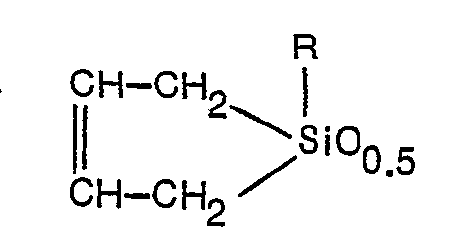
- (C) an organic peroxide in an amount equal to from 0 to 10 parts by weight per 100 parts of the combined weight of (A) and (B);
- (D) a filler in an amount equal to from 0 to 200 parts by weight per 100 parts of the combined weight of (A) and (B); and
- (E) a carboxylic acid salt of a transition metal selected from the group consisting of iron, manganese and nickel in an amount equal to from 0.01 to 5 parts by weight per 100 parts of the combined weight of (A) and (B).
- The mercaptoorganopolysiloxanes which are useful in the practice of the present invention include those consisting essentially of dimethylsiloxane units, trimethylsiloxane units, hydroxydimethylsiloxane units, and units represented by the formulas:


- Examples of the mercaptoorganopolysiloxanes include those having "terminal" mercapto groups such as those represented by the formulas I through IV:


- The mercaptoorganopolysiloxanes of formulas I and V are known in the art as evidenced by the prior art cited herein. The mercaptosilacyclopentylpolysiloxanes of formulas III and VI and their position isomers can be prepared by the method defined in U.S. Patent No. 3,655,713 issued April 11, 1972 to LeGrow which shows the mercaptosilacyclopentylpolysiloxanes and their preparation. The mercaptoorganopolysiloxanes of formula II which contain endblocking units of the formula:


- The aliphatically unsaturated polydiorganosiloxanes which are useful in the practice of the present invention include those having at least three diorganosiloxane units per molecule wherein each unit of a combination forming the molecule is selected from the group consisting of units of the formula


- Examples of the aliphatically unsaturated polydiorganosiloxanes include those having "terminal" unsaturated groups such as those represented by formulas IX through XI


- While compositions including mixtures of mercaptoorganopolysiloxanes of any of formulas I through VIII with aliphatically unsaturated polydiorganosiloxanes of any of formulas IX through XIV are useful, if the mercaptoorganopolysiloxanes employed are substantially exclusive of the types represented by formulas I through IV (i.e., have terminal groups), then it is preferred that the aliphatically unsaturated polydiorganosiloxanes be of the types represented by formulas XII through XIV (have pendent unsaturated groups).
- Suitable metal salts of carboxylic acids can be represented by the formula,

- The curable compositions of the present invention containing a mercaptoorganopolysiloxane, an aliphatically unsaturated polydiorganosiloxane and the metal salt of a carboxylic acid can be cured by exposure to atmospheric oxygen. Accelerated cures are obtained if an optional organic peroxide is included in the curable composition. In that case, the compositions cure quickly in thick sections shortly after formulation.
- Organic peroxides which are suitable for the practice of the present invention include 2,4-dichlorobenzoyl peroxide, tertiary-butyl perbenzoate, benzoyl peroxide, tertiary-butyl peroctoate, para- methane hydroperoxide, tertiary-butyl hydroperoxide, cumene hydroperoxide and the like.
- Fillers can be used in the compositions of this invention, but are not required. The fillers can be both treated and untreated reinforcing fillers, such as fume silica and fume silica having triorganosiloxy groups, (e.g., trimethylsiloxy groups) on the surface, carbon black or precipitated silica, and extending fillers such as crushed or ground quartz, diatomaceous earth, and calcium carbonate.
- While not intended to be limiting upon the scope of the present invention, it is thought that the curable compositions may crosslink by two different mechanisms, one of which involves the formation of monosulfide bonds while the other involves the formation of disulfide bonds. It is thought that the monosulfide bonds are more stable than the disulfide bonds and further that the ratio of monosulfide bonds to disulfide bonds can be influenced by varying the mole ratios of the various constituents with respect to each other.
- Curable compositions having desirable properties are thus formed when the mole ratio of aliphatically unsaturated groups to mercapto groups in the mixture of polymers (A) and (B) is from 0.05/1 and to 20/1, and preferably from 0.2/1 to 5/1. If the composition is to be cured with atmospheric oxygen at room temperature, desirable compositions are formed if the mole ratio of mercapto groups in polymer (A) to metal salt is from 4/1 to 250/1, and preferably 150/1 to 200/1. If the curable composition includes an organic peroxide, desirable compositions are formed if the mole ratio of mercapto groups in polymer (A) to metal salt is from 4/1 to 250/1, preferably 25/1 to 150/1, the mole ratio of peroxide molecules to mercapto groups in polymer (A) is from 0.05/1 to 8/1, and preferably 0.4/1 to 1.5/1.
- Mixtures of metal salts of carboxylic acids and peroxides tend to be unstable and therefore should not be mixed until shortly before use.
- The following examples are presented for illustrative purposes and should not be construed as limiting the invention.
- Example 1 illustrates that a mixture of a representative mercaptoorganopolysiloxane and a representative aliphatically unsaturated polydiorganosiloxane does not cure spontaneously upon exposure to atmospheric oxygen.
- Twenty-five grams of a methylphenylvinylsiloxy endblocked polydimethylsiloxane of the general formula IX, having a molecular weight of about 10,000, a viscosity of about 0.0004 m2/s at 25°C and containing about 0.5 weight percent vinyl groups was mixed with an equal quantity of a mercaptoorganopolysiloxane of the general formula V and the average formula

- (1) After 6 hours the viscosity was virtually unchanged.
- (2) After 20 hours, the sample was partially crosslinked with a tacky surface.
- (3) After 28 hours, the surface was tackfree.
- (4) After 72 hours, the sample was cured. This example is presented for comparative purposes.
- The following Examples 2 through 6 illustrate the preparation of mixtures according to the invention which include ferric salts of carboxylic acids and which cure to elastomeric materials upon exposure to atmospheric oxygen.
- Example 1 was repeated using 66.6 parts by weight of the methylphenylvinylsiloxy endblocked polydimethylsiloxane, 33.3 parts by weight of the mercaptoorganopolysiloxane, and 0.6 parts by weight of a 50 weight percent solution of ferric octoate in mineral oil. In the mixture so prepared, the ratio of parts of ferric salt to 100 parts unsaturated group-containing polymer was 0.45; the molar ratio of unsaturated group-containing units to ferric salt (C=C/Fe) was 20/1; and the molar ratio of mercapto-containing units to unsaturated group-containing units (SH/C=C) was 2/1. The polymers were de-aired before mixing and blended in a sealed tube. After a sample of the mixture was extruded from the tube, a tack-free surface formed in about 15 minutes and cured to a thickness of 1.524 mm (60 mils) in three to four hours when exposed to the atmosphere at room temperature.
- A series of three mixtures was prepared according to Example 2, but with the proportions of mercaptoorganopolysiloxane and vinyl-containing polymer altered to result in compositional SH/C=C ratios of 1.3/1, 1.0/1.0, and 0.8/1 respectively. Extruded samples exhibited tack-free surfaces when exposed to the atmosphere at room temperature in 45 minutes, 1-1 hours, and about 2 hours respectively.
- A series of five mixtures was prepared according to Example 2 but with the proportion of ferric octoate altered to result in C=C/Fe molar ratios of 103/1, 34/1, 8.5/1, 3.5/1, and 2.0/1 respectively. Extruded samples exhibited tack-free surfaces when exposed to the atmosphere at room temperature in about 3 hours, 30 minutes, 5 minutes, about 4 hours, and about 5 hours respectively.
- A mixture was prepared using 100 parts by weight of the mercaptoorganopolysiloxane described in Example 1, 0.6 parts by weight of the ferric octoate solution and 3.6 parts by weight of a methylsilacyclopentenyl-disiloxane having approximately 25 weight percent -CH=CH- units. The mixture so prepared had a C=C/Fe ratio of 17/1 and an SH/C=C ratio of 2/1. The polymers were de-aired and mixed in a sealed tube. An extruded sample formed a skin in about 8 minutes and cured completely upon standing overnight at room temperature exposed to the atmosphere.
- A mixture was prepared using 100 parts by weight of a methylsilacyclopentenyl endblocked polydimethysiloxane polymer (having a viscosity of 0.000703 m2/s and approximately 0.58 weight percent -CH=CH- units), 64.7 parts by weight of the mercaptoorganopolysiloxane described in Example 1, and 0.6. parts by weight of the ferric octoate solution. The polymers were de-aired and mixed in a sealed tube. An extruded sample formed a tack-free surface in 8 hours and cured completely upon standing overnight at room temperature exposed to the atmosphere.
- The following Examples 7 through 9 illustrate preparation of mixtures according to the invention which include manganese and nickel salts of carboxylic acids and which cure to elastomeric materials upon exposure to atmospheric oxygen.
- One hundred grams of the methylphenylvinylsiloxy endblocked polymer described in Example 1 was mixed with 50 g of a mercaptoorganopolysiloxane of the general formula

- Ten grams of the methylphenylvinylsiloxy endblocked polymer described in Example 1 was mixed with 5 g of the mercaptoorganopolysiloxane described in Example 1 and 0.2 g of the manganese octoate solution. An extruded sample exposed to the atmosphere cured to provide a tack-free surface upon standing overnight at room temperature.
- The procedure of Example 7 was repeated using 20 g of the methylphenylvinylsiloxy endblocked polymer, 10 g of the mercaptoorganopolysiloxane and 0.5 g of nickel octoate (20% solution in mineral oil). After 24 hours at room temperature a surface skin of 0.916 mm (40 mils) had formed on an extruded sample exposed to the atmosphere. After six days the skin had thickened to approximately 1.832 mm (80 mils).
- Example 10 illustrates that a representative metal salt of a carboxylic acid is ineffective in promoting the curing of a representative aliphatically unsaturated polydiorganosiloxane alone in the presence of an organic peroxide and is presented for comparative purposes.
- A mixture of 30 g of treated fume silica filler and 100 g of a methylphenylvinylsiloxy endblocked polydimethylsiloxane of the general formula IX, having a molecular weight of about 38,000, a viscosity of about 0.01004 m2/s at 25°C and containing about 0.14 weight percent vinyl groups was prepared on a 3 roll mill. Twenty grams of this mixture was mixed with 0.5 g of ferric octoate (50% solution in mineral oil) and 0.1 g of 73% cumene hydroperoxide. A sample remained uncured after 15 minutes in a molding press at 100°C.
- The following Examples 11 through 21 illustrate that a metal salt of a carboxylic acid is effective in enhancing the curing of mixtures of mercaptoorganopolysiloxanes and aliphatically unsaturated polydiorganosiloxanes in the presence of an organic peroxide.
- Example 10 was repeated with the addition of 2.8 g of the mercaptoorganopolysiloxane described in Example 1 to the mixture of vinyl polymer, filler, peroxide and ferric octoate, providing a compositional SH/C=C ratio 2.5. The sample began gelling within 1 to 2 minutes and was rapidly pressed into a molding chase and heat/press cured for 5 minutes at 100°C to provide a cured elastomer with a tack- free surface. Physical properties of the sample are set out in Table I.
- Example 11 was repeated except that 0.05 g of the ferric octoate solution and 1.7 g of the mercaptoorganopolysiloxane was used. Properties of the heat/press cured mixture were as set out in Table II.
- Example 12 was repeated except that 0.05 g cumene hydroperoxide was used. Properties of a heat/press cured sample were as set out in Table III.
- One hundred grams of the methylphenylvinylsiloxy endblocked polydimethylsiloxane described in Example 10 was mixed with 10 g ferric octoate solution and 10 g cumene hydroperoxide. Fifteen grams of the resulting mixture was combined with 2.1 g of mercaptoorgancpolysiloxane described in Example 1. A portion was cold press molded at 22°C for 10 minutes and formed a clear and colorless elastomer with a tack-free surface.
- Example 14 was repeated except that 0.5 g ferric octoate solution and 0.5 g cumene hydroperoxide was used. Again, a tack-free clear elastomer was formed after cold press molding at 22°C for 10 minutes.
- Example 15 was repeated except that 0.1 g cumene hydroperoxide was used, and yielded a tack- free elastomer after 5 minutes at 22°C in a cold press mold.
- Ten grams of the methylphenylvinylsiloxy endblocked polymer described in Example 1 was mixed with 0.5 g ferric octoate solution and 0.2 g t-butylperbenzoate. To the mixture was added 5.0 g of the mercaptoorganopolysiloxane as described in Example 1. An extruded sample began gelling in 45 seconds and was completely cured with a tack-free surface in 10 minutes at room temperature.
- Example 8 was repeated with the exception that manganese octoate solution was added to 10 g of the mixture of vinyl-containing and mercapto-containing polymers with 0.2 g of cumene hydroperoxide. In a series of four compoundings, manganese octoate solution was added in amounts of 0.2 g, 0.1 g, 0.03 g and 0.05 g. All samples cured with a tack-free surface upon standing overnight at room temperature.
- A series of three mixtures was prepared employing varying quantities of manganese octoate solution and cumene hydroperoxide. In each mixture, 100 g of the methylphenylvinylsiloxy endblocked polymer described in Example 10 was combined with the ferric salt and the cumene hydroperoxide and 15 g of the resulting mixture was combined with 5 g of the mercaptoorganopolysiloxane described in Example 1. The quantities of manganese octoate solution and cumene hydroperoxide in the four mixtures were:

- The resulting mixtures were press molded for 40 minutes at 22°C. All three mixtures cured to elastomeric materials.
- Ten grams of the methylphenylvinylsiloxy endblocked polymer described in Example 10 was mixed with 0.2 g of the manganese octoate solution, 0.2 g cumene hydroperoxide and 1.4 g of the mercaptoorganopolysiloxane described in Example 1. A sample heated to 200°C for 3 minutes cured to a thickness of 6.35 mm ('-4 inch) but had a slightly tacky surface.
- Example 9 was repeated with 0.1 g cumene hydroperoxide added to the polymer/nickel octoate mixture. The center of an extruded sample exposed to the atmosphere was cured after 2 minutes while a surface layer of about 0.458 mm (20 mils) remained uncured. After 5 minutes the surface was cured but still tacky. The surface was tack-free upon standing overnight at room temperature.
- Numerous modifications and variations in the practice of the invention are expected to occur to those of ordinary skill in the silicone technology after reading the foregoing description and examples. Only such limitations as appear in the appended claims are intended to be placed upon the invention.


Claims (4)


Applications Claiming Priority (2)
| Application Number | Priority Date | Filing Date | Title |
|---|---|---|---|
| US99257 | 1979-12-03 | ||
| US06/099,257 US4284539A (en) | 1979-12-03 | 1979-12-03 | Compositions including mercaptoorganopolysiloxanes, aliphatically unsaturated polydiorganosiloxanes and carboxylic acid salts of metals |
Publications (2)
| Publication Number | Publication Date |
|---|---|
| EP0030098A1 EP0030098A1 (en) | 1981-06-10 |
| EP0030098B1 true EP0030098B1 (en) | 1984-06-13 |
Family
ID=22273960
Family Applications (1)
| Application Number | Title | Priority Date | Filing Date |
|---|---|---|---|
| EP80304121A Expired EP0030098B1 (en) | 1979-12-03 | 1980-11-18 | Compositions including mercaptoorganopolysiloxanes, aliphatically unsaturated polydiorganosiloxanes and carboxylic acid salts of metals |
Country Status (11)
| Country | Link |
|---|---|
| US (1) | US4284539A (en) |
| EP (1) | EP0030098B1 (en) |
| JP (1) | JPS603421B2 (en) |
| KR (1) | KR840000526B1 (en) |
| BR (1) | BR8008955A (en) |
| CA (1) | CA1151791A (en) |
| DD (1) | DD154991A5 (en) |
| DE (1) | DE3068249D1 (en) |
| ES (1) | ES497372A0 (en) |
| WO (1) | WO1981001570A1 (en) |
| ZA (1) | ZA807297B (en) |
Families Citing this family (9)
| Publication number | Priority date | Publication date | Assignee | Title |
|---|---|---|---|---|
| US4526954A (en) * | 1983-12-28 | 1985-07-02 | Union Carbide Corporation | Organosiloxane polymers and compositions containing same curable upon exposure to gaseous oxygen |
| ATE131834T1 (en) * | 1990-03-23 | 1996-01-15 | Ici Plc | POLYMERS |
| JP2511729B2 (en) * | 1990-10-16 | 1996-07-03 | 信越化学工業株式会社 | Method for preventing creep of silicone grease and photocurable silicone grease composition suitable therefor |
| US5543443A (en) * | 1992-01-27 | 1996-08-06 | The Procter & Gamble Company | Denture stabilizing compositions |
| FR2743565B1 (en) * | 1996-01-11 | 1998-02-20 | Rhone Poulenc Chimie | USE OF A COMBINATION OF SILICON COMPOUNDS AS A COUPLING AGENT IN SILICA-LOADED ELASTOMER COMPOSITIONS |
| EP1819738A4 (en) | 2004-11-18 | 2008-02-20 | Hexion Specialty Chemicals Res | Ultra-thin thiol-ene coatings |
| US8044111B2 (en) | 2007-11-30 | 2011-10-25 | Novartis Ag | Actinically-crosslinkable silicone-containing block copolymers |
| RU2576622C2 (en) | 2010-07-30 | 2016-03-10 | Новартис Аг | Amphiphilic polysiloxane prepolymers and their application |
| US8967888B2 (en) * | 2012-04-25 | 2015-03-03 | Tyco Electronics Raychem Bvba | Dry silicone gels and their methods of making using thiol-ene chemistry |
Family Cites Families (13)
| Publication number | Priority date | Publication date | Assignee | Title |
|---|---|---|---|---|
| US3287291A (en) * | 1962-07-12 | 1966-11-22 | Union Carbide Corp | Diorganosiloxanes cured with an alkoxy end-blocked silyl tetraformal |
| US3445419A (en) * | 1966-01-21 | 1969-05-20 | Dow Corning | Room temperature vulcanizable silicones |
| DE2008426A1 (en) | 1969-02-27 | 1970-09-10 | ||
| US3655713A (en) * | 1970-07-13 | 1972-04-11 | Dow Corning | Silacyclopentane thiols and thiolates |
| US3816282A (en) * | 1971-04-15 | 1974-06-11 | Gen Electric | Radiation induced polymerization of polysiloxanes |
| US4064027A (en) * | 1973-09-28 | 1977-12-20 | Dow Corning Corporation | UV curable composition |
| US3873499A (en) * | 1973-11-29 | 1975-03-25 | Dow Corning | Fast curing mercaptoalkyl vinyl siloxane resins |
| US4066603A (en) * | 1976-03-03 | 1978-01-03 | Dow Corning Corporation | Sulfur containing silicone elastomer and method of preparation |
| US4039504A (en) * | 1976-03-03 | 1977-08-02 | Dow Corning Corporation | Mercaptosiloxane elastomer and method of preparation |
| US4039505A (en) * | 1976-03-03 | 1977-08-02 | Dow Corning Corporation | Siloxane elastomers containing sulfur and method of preparation |
| JPS5355362A (en) * | 1976-10-29 | 1978-05-19 | Shin Etsu Chem Co Ltd | Organopolysiloxane composition |
| US4070328A (en) * | 1977-01-03 | 1978-01-24 | Dow Corning Corporation | Mercaptoorganopolysiloxanes cured to elastomers with peroxides and nitrogen compounds |
| US4070329A (en) * | 1977-01-03 | 1978-01-24 | Dow Corning Corporation | Siloxane elastomer prepared from mercaptoorg anopolysiloxanes |
-
1979
- 1979-12-03 US US06/099,257 patent/US4284539A/en not_active Expired - Lifetime
-
1980
- 1980-11-03 WO PCT/US1980/001481 patent/WO1981001570A1/en not_active Ceased
- 1980-11-03 JP JP56500183A patent/JPS603421B2/en not_active Expired
- 1980-11-03 BR BR8008955A patent/BR8008955A/en unknown
- 1980-11-07 CA CA000364232A patent/CA1151791A/en not_active Expired
- 1980-11-18 EP EP80304121A patent/EP0030098B1/en not_active Expired
- 1980-11-18 DE DE8080304121T patent/DE3068249D1/en not_active Expired
- 1980-11-21 ZA ZA00807297A patent/ZA807297B/en unknown
- 1980-12-02 ES ES497372A patent/ES497372A0/en active Granted
- 1980-12-03 KR KR1019800004613A patent/KR840000526B1/en not_active Expired
- 1980-12-03 DD DD80225682A patent/DD154991A5/en unknown
Also Published As
| Publication number | Publication date |
|---|---|
| JPS56501603A (en) | 1981-11-05 |
| CA1151791A (en) | 1983-08-09 |
| KR840000526B1 (en) | 1984-04-17 |
| DE3068249D1 (en) | 1984-07-19 |
| KR830004369A (en) | 1983-07-09 |
| WO1981001570A1 (en) | 1981-06-11 |
| ES8302044A1 (en) | 1983-01-01 |
| JPS603421B2 (en) | 1985-01-28 |
| ES497372A0 (en) | 1983-01-01 |
| EP0030098A1 (en) | 1981-06-10 |
| ZA807297B (en) | 1981-11-25 |
| US4284539A (en) | 1981-08-18 |
| BR8008955A (en) | 1981-10-20 |
| DD154991A5 (en) | 1982-05-05 |
Similar Documents
| Publication | Publication Date | Title |
|---|---|---|
| US4066603A (en) | Sulfur containing silicone elastomer and method of preparation | |
| JPH02133492A (en) | Manufacture of non-slumping silicone sealant | |
| US5610230A (en) | Liquid silicone rubber compositions | |
| US4039505A (en) | Siloxane elastomers containing sulfur and method of preparation | |
| US4284539A (en) | Compositions including mercaptoorganopolysiloxanes, aliphatically unsaturated polydiorganosiloxanes and carboxylic acid salts of metals | |
| EP0041547B1 (en) | Oxygen-curable mercaptoorganosiloxane compositions possessing rapid surface reaction and method of forming higher molecular weight products therefrom | |
| EP0041558B1 (en) | Oxygen-curable mercaptoorganosiloxane compositions containing both redox and iron carbonyl compounds and method of forming higher molecular weight products therefrom | |
| EP0030155B1 (en) | Oxygen-curable mercaptoorganosiloxane compositions catalyzed by metal carbonyl compounds and method of forming higher molecular weight products therefrom | |
| EP0030801B1 (en) | Ferrocene catalyzed elastomer formation | |
| EP0041542B1 (en) | Compositions including mercaptoorganopolysiloxanes and metal salts of carboxylic acids | |
| US4272623A (en) | Mercaptoorganopolysiloxane elastomers catalyzed by metallic compounds in the presence of peroxides | |
| CA1151338A (en) | Oxygen-curable mercapto-functional organosilicon- organic compound compositions catalyzed by metal carbonyl compounds and method of forming higher molecular weight products therefrom | |
| EP0030800B1 (en) | Compositions including mercaptoorganopolysiloxanes and stannous salts of carboxylic acids | |
| EP0036054A2 (en) | Oxygen-curable mercapto-functional organosilicon-organic compound compositions possessing rapid surface reaction and method of forming higher molecular weight products therefrom | |
| JPS604218B2 (en) | Mercaptoorganopolysiloxane elastomers catalyzed with metal compounds in the presence of peroxides |
Legal Events
| Date | Code | Title | Description |
|---|---|---|---|
| PUAI | Public reference made under article 153(3) epc to a published international application that has entered the european phase |
Free format text: ORIGINAL CODE: 0009012 |
|
| AK | Designated contracting states |
Designated state(s): BE DE FR GB IT NL SE |
|
| 17P | Request for examination filed |
Effective date: 19811112 |
|
| ITF | It: translation for a ep patent filed | ||
| GRAA | (expected) grant |
Free format text: ORIGINAL CODE: 0009210 |
|
| AK | Designated contracting states |
Designated state(s): BE DE FR GB IT NL SE |
|
| REF | Corresponds to: |
Ref document number: 3068249 Country of ref document: DE Date of ref document: 19840719 |
|
| ET | Fr: translation filed | ||
| PGFP | Annual fee paid to national office [announced via postgrant information from national office to epo] |
Ref country code: FR Payment date: 19841122 Year of fee payment: 5 |
|
| PGFP | Annual fee paid to national office [announced via postgrant information from national office to epo] |
Ref country code: DE Payment date: 19841127 Year of fee payment: 5 |
|
| PGFP | Annual fee paid to national office [announced via postgrant information from national office to epo] |
Ref country code: SE Payment date: 19841231 Year of fee payment: 5 Ref country code: BE Payment date: 19841231 Year of fee payment: 5 |
|
| PLBE | No opposition filed within time limit |
Free format text: ORIGINAL CODE: 0009261 |
|
| STAA | Information on the status of an ep patent application or granted ep patent |
Free format text: STATUS: NO OPPOSITION FILED WITHIN TIME LIMIT |
|
| 26N | No opposition filed | ||
| PGFP | Annual fee paid to national office [announced via postgrant information from national office to epo] |
Ref country code: NL Payment date: 19861130 Year of fee payment: 7 |
|
| PG25 | Lapsed in a contracting state [announced via postgrant information from national office to epo] |
Ref country code: SE Effective date: 19871119 |
|
| PG25 | Lapsed in a contracting state [announced via postgrant information from national office to epo] |
Ref country code: NL Effective date: 19880601 |
|
| NLV4 | Nl: lapsed or anulled due to non-payment of the annual fee | ||
| GBPC | Gb: european patent ceased through non-payment of renewal fee | ||
| PG25 | Lapsed in a contracting state [announced via postgrant information from national office to epo] |
Ref country code: FR Free format text: LAPSE BECAUSE OF NON-PAYMENT OF DUE FEES Effective date: 19880729 |
|
| PG25 | Lapsed in a contracting state [announced via postgrant information from national office to epo] |
Ref country code: DE Effective date: 19880802 |
|
| REG | Reference to a national code |
Ref country code: FR Ref legal event code: ST |
|
| PG25 | Lapsed in a contracting state [announced via postgrant information from national office to epo] |
Ref country code: GB Effective date: 19881118 |
|
| PG25 | Lapsed in a contracting state [announced via postgrant information from national office to epo] |
Ref country code: BE Effective date: 19881130 |
|
| BERE | Be: lapsed |
Owner name: DOW CORNING CORP. Effective date: 19881130 |
|
| EUG | Se: european patent has lapsed |
Ref document number: 80304121.9 Effective date: 19880913 |