EP0029707B1 - Novel piperidine derivatives, method for the preparation thereof and pharmaceutical compositions containing them - Google Patents
Novel piperidine derivatives, method for the preparation thereof and pharmaceutical compositions containing them Download PDFInfo
- Publication number
- EP0029707B1 EP0029707B1 EP19800304147 EP80304147A EP0029707B1 EP 0029707 B1 EP0029707 B1 EP 0029707B1 EP 19800304147 EP19800304147 EP 19800304147 EP 80304147 A EP80304147 A EP 80304147A EP 0029707 B1 EP0029707 B1 EP 0029707B1
- Authority
- EP
- European Patent Office
- Prior art keywords
- compound
- piperidine
- stirred
- methanol
- water
- Prior art date
- Legal status (The legal status is an assumption and is not a legal conclusion. Google has not performed a legal analysis and makes no representation as to the accuracy of the status listed.)
- Expired
Links
- 0 Cc1cc(**CN2CC*(*)CC2)cc(C2*C2)c1C Chemical compound Cc1cc(**CN2CC*(*)CC2)cc(C2*C2)c1C 0.000 description 8
- WEFVBVHSXVHRRS-UHFFFAOYSA-N CC(C)(C)OC(N(CC1)CCC1=C(c(cccc1)c1N1)C1=O)=O Chemical compound CC(C)(C)OC(N(CC1)CCC1=C(c(cccc1)c1N1)C1=O)=O WEFVBVHSXVHRRS-UHFFFAOYSA-N 0.000 description 1
- ROUYFJUVMYHXFJ-UHFFFAOYSA-N CC(C)(C)OC(N(CC1)CCC1=O)=O Chemical compound CC(C)(C)OC(N(CC1)CCC1=O)=O ROUYFJUVMYHXFJ-UHFFFAOYSA-N 0.000 description 1
- BBZCPUCZKLTAJQ-UHFFFAOYSA-N CC(c(cccc1)c1N1)C1=O Chemical compound CC(c(cccc1)c1N1)C1=O BBZCPUCZKLTAJQ-UHFFFAOYSA-N 0.000 description 1
- UFCPEXUYXOBDLC-UHFFFAOYSA-N CN(C(CCCC1)C1N1)C1=O Chemical compound CN(C(CCCC1)C1N1)C1=O UFCPEXUYXOBDLC-UHFFFAOYSA-N 0.000 description 1
Classifications
-
- C—CHEMISTRY; METALLURGY
- C07—ORGANIC CHEMISTRY
- C07D—HETEROCYCLIC COMPOUNDS
- C07D211/00—Heterocyclic compounds containing hydrogenated pyridine rings, not condensed with other rings
- C07D211/04—Heterocyclic compounds containing hydrogenated pyridine rings, not condensed with other rings with only hydrogen or carbon atoms directly attached to the ring nitrogen atom
- C07D211/06—Heterocyclic compounds containing hydrogenated pyridine rings, not condensed with other rings with only hydrogen or carbon atoms directly attached to the ring nitrogen atom having no double bonds between ring members or between ring members and non-ring members
- C07D211/36—Heterocyclic compounds containing hydrogenated pyridine rings, not condensed with other rings with only hydrogen or carbon atoms directly attached to the ring nitrogen atom having no double bonds between ring members or between ring members and non-ring members with hetero atoms or with carbon atoms having three bonds to hetero atoms with at the most one bond to halogen, e.g. ester or nitrile radicals, directly attached to ring carbon atoms
- C07D211/56—Nitrogen atoms
- C07D211/58—Nitrogen atoms attached in position 4
Definitions
- Examples of the substituent R 4 in Compound [IV] are acyl (e.g. acetyl and benzoyl), alkyloxycarbonyl (e.g. tert.-butoxycarbonyl and ethoxycarbonyl), benzyl, tosyl and mesyl.
- acyl e.g. acetyl and benzoyl
- alkyloxycarbonyl e.g. tert.-butoxycarbonyl and ethoxycarbonyl
- benzyl tosyl and mesyl.
- the conversion of the nitro group into the amino group can be accomplished by the methods generally adopted for the purpose, for example, catalytic reduction method using palladium carbon or Raney nickel as a catalyst, methods using tin or tin compounds under an acidic condition and methods using complexes metal hydride such as lithium aluminum hydride.
- Catalytic reduction method using palladium carbon or Raney nickel as a catalyst methods using tin or tin compounds under an acidic condition and methods using complexes metal hydride such as lithium aluminum hydride.
- Compound [VIII] can be readily derived by directly acidifying the reaction mixture.
- the reduction is carried out under an acidic condition as in the use of a tin compound, the reduction of the nitro group and the ring-closing to benzimidazole can be simultaneously accomplished.
- the proper concentration of metal ion is from 1 to 1.2 mols per mol of the compound [X]. Generally, the reaction is completed in 15 minutes to 2 hours.
- the reaction solvents advantageously usable include alcohols) e.g. methanol, ethanol and isopropanol), chloroform, dichloromethane, dioxane, etc.
- Compound [11-5] is produced as shown below.
- a compound represented by the formula [XVIII]: (wherein, R , R 3 , R 4 and n have the same significance as defined above) is prepared by reacting Compound [XI] with salicylaldehyde or a derivative thereof represented by the formula [XVII]: (wherein, R 3 and n have the same significance as defined above). This reaction can be performed similarly to that in the preparation of Compound [XIII] from Compound [XII].
- a compound represented by the formula [XXV]: (wherein, R 2 , R 3 , R 4 and n have the same significance as defined above) is prepared by reacting a 4-oxo- piperidine derivative represented by the formula [XXIII]: (wherein, R 2 and R 4 have the same significance as defined above) with a compound represented by the formula [XXIV]: (wherein, R 3 and n have the same significance as defined above) in an aromatic hydrocarbon type solvent such as benzene, toluene and xylene in the presence of sulfuric acid, an alkane-sulfonic acid (e.g. methanesulfonic acid) or an aryl-sulfonic acid (e.g. p-toluenesulfonic acid) as a catalyst.
- an aromatic hydrocarbon type solvent such as benzene, toluene and xylene
- Example 2 the procedure of Example 1 is repeated except that 2.31 g of 4-[3,4-dihydro-2-(1H)-quinazolinon-3-yl]-piperidine and 2.43 g of ⁇ -bromo-3,4-methylenedioxyacetophenone is used to produce a crude product.
- the crude product is recrystallized from hot ethanol to obtain 3.18 g of the desired product.
- Example 35 1.16 g of the product obtained in Example 35 is suspended in 30 ml of ethanol. While the suspension is stirred, 2.0 g of sodium borohydride is added thereto over a period of one hour. After the addition, the resultant mixture is heated to 50°C and allowed to undergo reaction for 2 hours. The reaction mixture is concentrated to dryness under reduced pressure. The residue is mixed with 10 ml of water and the deposited crystals are separated by filtration. The crystals are washed with water and ethanol and then dried. The crude crystals are recrystallized from chloroform-methanol to obtain 923 mg of the desired product.
- the solution is extracted with 50 ml of chloroform three times, and the extract is washed with 20 ml of a saturated aqueous sodium chloride and dried.
- the extract is freed from the solvent by distillation.
- the residue is mixed with n-hexane and stirred for crystallization.
- the crystals are separated by filtration, recrystallized from a mixed solvent of n-hexane and ethanol to obtain 6.7 g of 4-(2-methyl-benzimidazol-3-yl)-piperidine.
- a solution of 1.0 g of 1-tert.-butoxycarbonyl-4-(2-aminoanilino)-piperidine, 1.0 g of dimethyl-N-cyanodithioiminocarbonate and 1.2 g of diazabicycloundecene in 50 ml of dioxane is heated to 80°C for 7 hours.
- the solution is freed from dioxane by distillation under reduced pressure.
- the residue is mixed with water and ethyl acetate and shaken and then the organic layer is separated.
- the organic layer is washed with 10 ml of 0.6N hydrochloric acid four times.
- the organic layer is further washed with a saturated aqueous sodium bicarbonate and water and then dried.
- the dried organic layer is concentrated to dryness under reduced pressure.
- the residue is subjected to silica gel chromatography (Wako Gel Q-200, 50 ml, with CHCI 3 as the eluent).
- the eluate is concentrated and the residual crystals are recrystallized from ethanol to obtain 0.6 g of the desired product.
- this compound is in a free form, it can be converted into a crystalline hydrochloride by introducing hydrogen chloride gas into an ethanol solution of the compound.
Landscapes
- Chemical & Material Sciences (AREA)
- Organic Chemistry (AREA)
- Pharmaceuticals Containing Other Organic And Inorganic Compounds (AREA)
- Plural Heterocyclic Compounds (AREA)
Description
- The present invention is concerned with piperidine derivatives, acid-addition salts thereof and pharmaceutical compositions containing them.
- The piperidine derivatives of the present invention are compounds represented by the formula[l]:


- The compounds represented by the formula [I] and the pharmaceutically acceptable acid addition salts thereof have a hypotensive activity, and therefore are useful as medicine.
- Heretofore, the following compounds, each having a piperidine ring, were commercially available as tranquilizers.
benperidol


- U.S. Patent No. US-A-4166117 discloses compounds represented by the following formula:

- U.S. Patent No. US-A-4,144,344 discloses compounds represented by the following formula:

- Further an application for patent relating to compounds which have a hypotensive activity and are substantially represented by the following general formula:

- Compounds having excellent pharmacological activity are always in demand. In order to obtain such compounds, studies have been made on piperidine derivatives and as a result, it has been found that novel piperidine derivatives represented by the formula [I] have a hypotensive activity. Further, it has been found that some compounds in the compounds represented by the formula [I] have an antiulcer activity, an antiplatelet aggregation activity, a cholesterol-lowering activity, antihistaminic activity or trachea relaxant activity.
- Among the halogens in the definition of A and R3 in Compound [I] are chlorine and bromine; among the C1-5 groups, C1-3 groups are preferred; C2-6 alkoxycarbonyl preferably has 2―4 carbon atoms.
- Compound [I] includes all of the optical isomers.
- Examples of pharmacologically acceptable acid-addition salts of Compound [I] are inorganic acid-addition salts such as hydrochloride, hydrobromide, hydriodide, nitrate, sulfate and phosphate and organic acid-addition salts such as acetate, benzoate, maleate, fumarate, succinate, tartrate, citrate, oxalate, glyoxylate, aspartate, methanesulfonate, ethanesulfonate, propanesulfonate, methane- disulfonate, α,β-ethanedisulfonate and benzenesulfonate.
- Especially preferred compounds in Compound [I] are represented by the formula [I']:


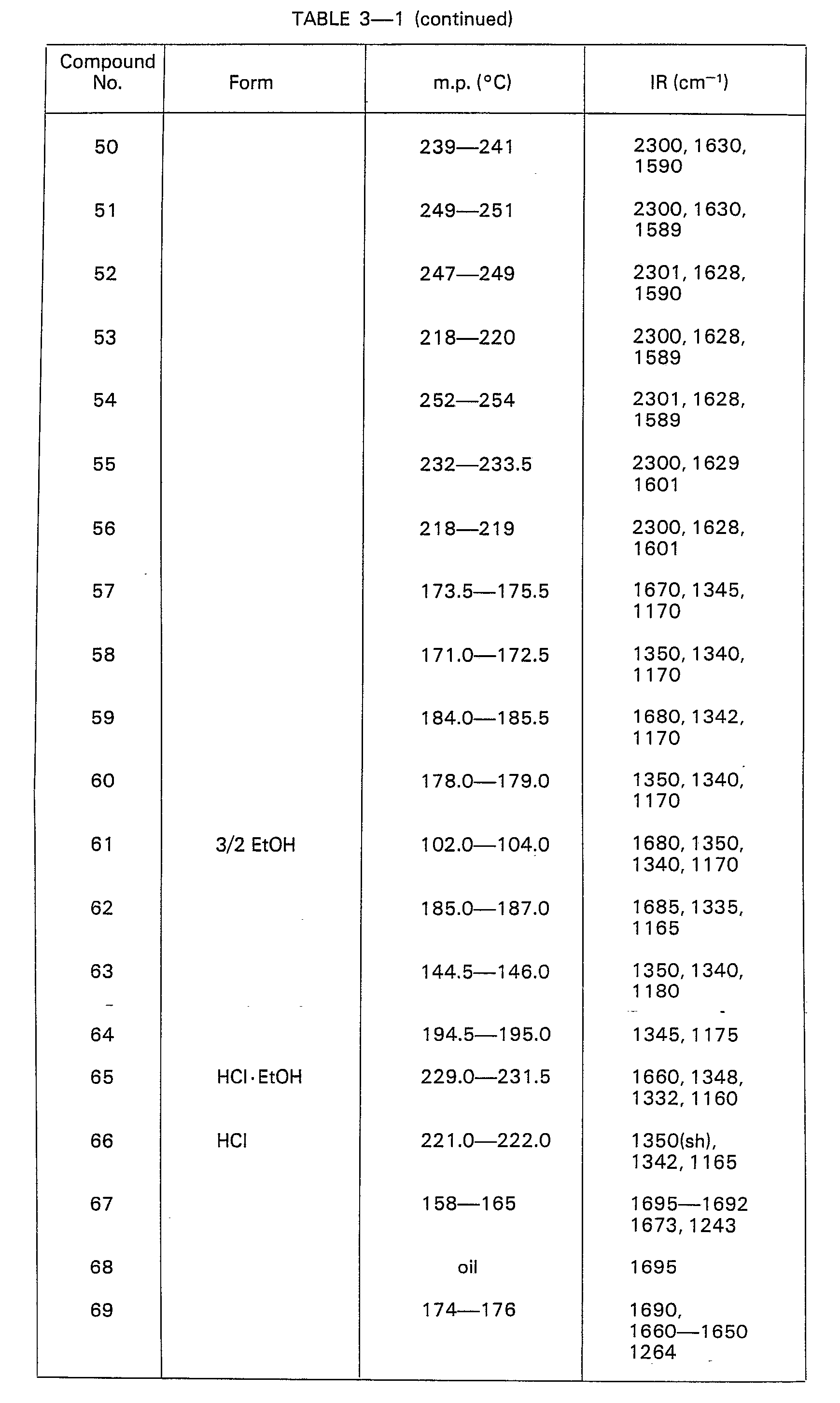
- Examples of Compound [I] are tabulated in the following Table 1. Table 2 shows structures and Tables 3-1, 2 and 3 show properties of the present compounds.




- Hypotensive activity and acute toxicity of Compound [I] are illustrated below as experiments.
- This experiment is conducted according to the method described in "Spontaneously Hypertensive Rats (SHR) Guidelines for Breeding, Care and Use" (published by SHR Conference) (1976) p. 11.
- Five spontaneously hypertensive rats (15 weeks old, 180 mmHg or more in blood pressure) are used as one group. Each of the test compound is added to 0.3% (w/v) CMC aqueous solution in a concentration of 3 mg/ml. Each of the mixtures is orally administered to the rats in a dose 1 mg/100 g. Changes in blood pressure are measured according to the method of tail artery plethysmography (see the literature cited above). The maximum reduction (mmHg) in blood pressure after the administration on the basis of the pressure immediately before the administration is shown in Table 4.


- Three male dd-strain mice (weight 20 ± 1 g) are used for each test compound.
- Each of the compounds is added to aqueous physiological sodium chloride, and the mixture is orally (P.O.) administered to the mice in a dose of 1000 mg/kg. After the observation for 7 days, the numbers of deaths are counted, and the results are shown in Table 5.

- Now, the process for preparing Compound [I] is described below.
- Compound [I] may be prepared by reacting a compound represented by the formula [II]:


- In the definition of Z, halogen includes chlorine, bromine or iodine; and the eliminable group includes alkylsulfonyloxy (for example, methanesulfonyloxy), arylsulfonyloxy (for example, benzene- sulfonyloxy or p-toluenesulfonyloxy), etc.
- The reaction of Compound [I] or the protected one with Compound [III] or the protected one is carried out in an inert solvent. Ketone (e.g. acetone), halogenated hydrocarbon (e.g. chloroform and methylene chloride), amide (e.g. dimethylforrriamide), sulfoxide (e.g. dimethylsulfoxide), substituted or unsubstituted aromatic hydrocarbon (e.g. benzene, toluene and chlorobenzene), lower alcohol (e.g. methanol, ethanol and isopropanol), etc. may be used alone or in combination as an inert solvent. The reaction is carried out at 0-150°C, preferably at a temperature between room temperature and the boiling point of the solvent depending on the reactivity of the group Z which is exchangeable. The reaction usually proceeds very smoothly in the presence of a base such as lower alcoholate (e.g. sodium methylate and sodium ethylate), alkali hydroxide (e.g. sodium hydroxide), alkali carbonate (e.g. sodium carbonate and potassium carbonate), tertiary amine (e.g. triethylamine and pyridine), etc. The amount of the base is usually 1.0 to 1.2 times the equivalent amount based on Compound [II]. When an acid addition salt of Compound [II] such as hydrochloride is used, it goes without saying that the base supplementary enough to neutralize the acid is added thereto. Use of reaction-promoting agents such as potassium iodide is effective for smooth proceeding of the reaction.
- When either R3 or A, or both is (are) hydroxy, amino or lower alkylamino, these groups are protected in a conventional manner prior to the above reaction. After completion of the reaction, the protective group is eliminated in a conventional manner to obtain the desired product.
- When X' is carbonyl, the resulting product is reduced to obtain Compound [I] where X is hydroxymethylene. The reaction may be carried out by reacting Compound [I] wherein X is carbonyl with a complex metal hydride such as sodium borohydride in a lower alcohol such as methanol, ethanol and isopropanol at -10 to 100°C, preferably at a temperature between 0°C and the boiling piont of the used solvent. Alternatively, the reaction may be carried out by subjecting Compound [I] wherein X is carbonyl to catalytic reduction using hydrogenating catalyst such as palladium carbon, Raney nickel, platinum black, platinum carbon and platinum oxide in lower alcohol such as methanol and ethanol, lower aliphatic acid such as acetic acid, water or a mixed solvent thereof. These reactions may be carried out either in an open vessel or in a closed vessel under pressure. When the carbon atom of R adjacent to X is an asymmetrical carbon in the above reduction, Compound [I] is stereo-selectively obtained according to the reduction method. That is, Compound [I] in threo form is obtained when a complex metal hydride is used and Compound [I] in erythro form is obtained according to catalytic reduction in an acidic condition. The acidic condition is brought with inorganic acids such as hydrochloric acid or organic acids such as acetic acid, propionic acid and succinic acid.
- Compound [II] used as a starting compound of Compound [I] is also new compound. Compound [II] is classified as described in Table 6 for convenience.

- The compound [II-1] is produced as shown below.
- First, a compound represented by the general formula [V]:


- It is proper to use sodium nitrite in an amount of 1 to 1.1 mols per mol of Compound [IV].
- This reaction can be effectively carried out in an appropriate solvent such as water and acetic acid in combination thereof or alone at -10°C to 10°C.
- Examples of the substituent R4 in Compound [IV] are acyl (e.g. acetyl and benzoyl), alkyloxycarbonyl (e.g. tert.-butoxycarbonyl and ethoxycarbonyl), benzyl, tosyl and mesyl.
- Finally, Compound [V] is converted to Compound [11-1] by being subjected to the usual reaction for eliminating the amino-protecting group.
- Compound [II-2] is produced as shown below. First, an acetyl derivative represented by the formula [VII]:
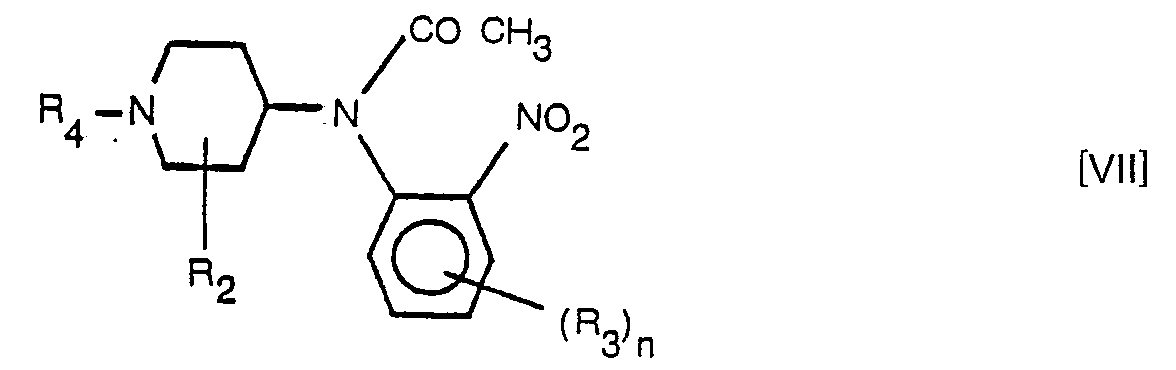

- Then, a benzimidazole derivative represented by the formula [VIII]:

- The conversion of the nitro group into the amino group can be accomplished by the methods generally adopted for the purpose, for example, catalytic reduction method using palladium carbon or Raney nickel as a catalyst, methods using tin or tin compounds under an acidic condition and methods using complexes metal hydride such as lithium aluminum hydride. From the compound which has resulted from the conversion into the amino group, Compound [VIII] can be readily derived by directly acidifying the reaction mixture. When the reduction is carried out under an acidic condition as in the use of a tin compound, the reduction of the nitro group and the ring-closing to benzimidazole can be simultaneously accomplished. The method to be adopted for the reduction of the nitro group may be suitably selected depending on the kind of the protective group R4 in the formula [VII]. When a protective group such as the benzyl group which can be removed by hydrogenation is selected as the substituent R4, the reduction of the nitro group and the removal of the protective group, or the reduction of the nitro group, the ring-closing into a benzimidazole derivative and the removal of the protective group can be simultaneously effected.
- Of the aforementioned various methods available for the reduction, that which involves use of palladium carbon or a tin compound will be explained in detail below. The reduction using palladium carbon is carried in an inert solvent under continuous introduction of hydrogen generally at room temperature to 50°C for 2 to 10 hours. Examples of the solvent usable in this reaction are lower alcohols such as methanol, ethanol and isopropanol, lower fatty acids such as acetic acid, water, dioxane, etc. and mixtures thereof.
- The reduction using a tin compound is carried out in an inert solvent in the presence of a mineral acid such as hydrochloric acid or a lower fatty acid such as acetic acid generally at room temperature to 80°C for 2 to 10 hours. Examples of the solvent usable in this reaction are water, dioxane, lower alcohols, etc. and mixtures thereof.
- Finally, Compound [VIII] is converted into the compound [ll-2] by being subjected to the usual reaction for eliminating the amino-protective group.
- Compound [11-3] is produced as shown below. First, a compound represented by the formula [IX]:


- Then, a compound represented by the formula [X]:

- Finally, Compound [X] is converted to Compound [II-3] by being subjected to the usual reaction for eliminating the amino-protecting group.
- Compound [11-4] is produced as shown below. First, a compound represented by the formula [XIII]:


- The reaction can be carried out either without any solvent or in a lower alkanol (e.g. methanol, ethanol and propanol), an aromatic hydrocarbon (e.g. benzene, toluene and xylene), a halogenated hydrocarbon (e.g. methylene chloride and chloroform) or a mixture thereof. The reaction in an alkanol has the advantage that the conversion to a compound represented by the formula [XIV] below can be carried out without isolation of Compound [XIII] from the reaction solution. As regards the amounts of the reactants to be used, it is proper to use Compound [XII] in an amount of 1.0 to 1.2 equivalent weights, preferably 1.0 equivalent weight, of Compound [XI]. Although the reaction proceeds at room temperature in a short time, it may be carried out at an elevated temperature, if necessary.
- Then, a 4-substituted piperidine derivative represented by the formula [XIV]:

- Then, a compound represented by the formula [XV]:
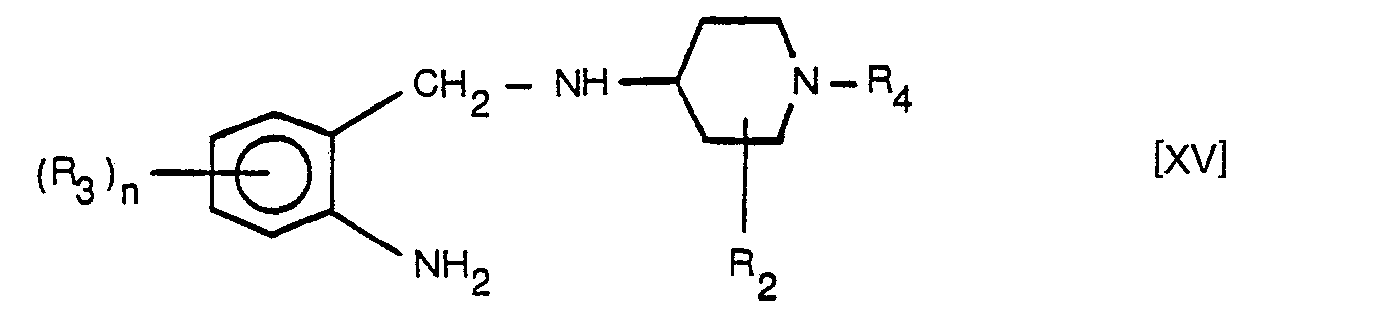
- Thereafter, a compound represented by the formula [XVI]:

- All of the above reactions can be carried out according to conventional methods and the reaction wherein 1,1'-carbonyldiimidazole is used is particularly described hereinafter. The reaction is carried out in an aprotic polar solvent such as halogenated hydrocarbon (e.g. methylene chloride and chloroform), ether (e.g. ethyl ether, tetrahydrofuran and dioxane), acetonitrile, dimethylformamide and dimethylsulfoxide, in combination thereof or alone, preferably with stirring. Preferably, the amount of 1,1'-carbonyldiimidazole is 1.0 to 2.0 times the equivalent amount based on Compound [VIII]. The reaction is carried out at a temperature of from room temperature to the boiling point of the used solvent. The reaction is usually completed in 1 to 3 hours when treated at the boiling point of the solvent and is completed in 10 to 15 hours, when treated at room temperature.
- Finally, Compound [XVI] is converted to Compound [II-4] by eliminating the group R4 by the usual methods.
- Compound [11-5] is produced as shown below. First, a compound represented by the formula [XVIII]:


- Then, a compound represented by the formula [XIX]:

- Subsequently, a compound represented by the formula [XX]:

- Compound [II-6] is produced as shown below.
- First, a compound represented by the formula [XXI]:

- [XXII]: Compound [II-7] is produced as shown below. First, a compound represented by the formula

- This reaction is performed in pyridine. As concerns the amounts of the reactants involved in this reaction, it is advantageous to use the sulfurylamide in the amount of 1.0 to 4.0 equivalent weights of Compound [XV]. The reaction is generally performed under thermal reflux and is completed in a period of 2 to 10 hours. Then, Compound [XXII] is converted into Compound [II-7] by eliminating the group R4 by the usual methods.
- Compound [II-8] is produced as shown below.
- First, a compound represented by the formula [XXV]:


- The reaction mentioned above is advantageously performed by using p-toluenesulfonic acid as a catalyst and removing the water through distillation under reflux.
- Then, a compound represented by the formula [XXVI]:

- Subsequently, a compound represented by the formula [XXVII]:

- Compound [II-9] is produced as shown below. First, a compound represented by the formula [XXVIII] :
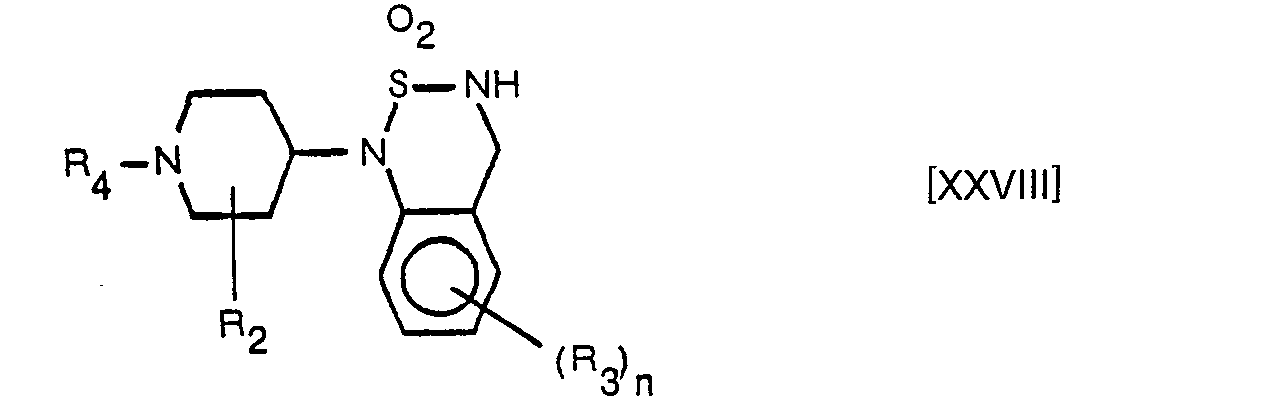
- Compound [11-10] is produced as shown below. First, a compound represented by the formula [XXX]:
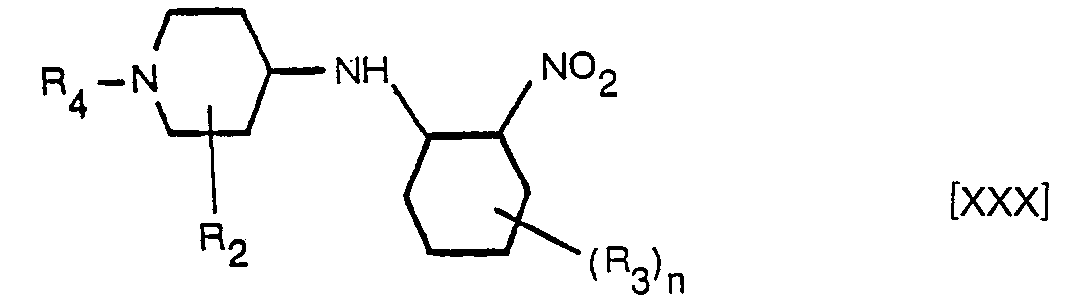

- Then, a compound represented by the formula [XXXI]:


- Compound [11-11] is produced as shown below. First, a compound represented by the formula [XXXIV]:


- In this case, the choice between the presence and absence of the exo double bond at the 4- position of the piperidine in Compound [11-11] can be freely made by suitably selecting the kind of the protective group R4 and the method for the removal of this group.
- Isolation and purification of Compound [I] as well as the above-mentioned intermediates are carried out according to conventional methods in the field of organic synthetic chemistry, for example, concentration, extraction, recrystallization and chromatography. Specifically, since Compound [I] readily crystallizes in general, it can be isolated and purified by distilling off the solvent from the reaction mixture and recrystallizing the residue from a suitable solvent such as ethanol.
- A pharmacologically acceptable acid addition salt of Compound [I] may be obtained by reacting Compound [I] with a suitable acid in a suitable solvent such as ethanol.
- The pharmaceutical compositions of the present invention are described below.
- It is obvious from the foregoing various experimental data that Compound [I] has a hypotensive activity.
- In view of the hypotensive activity, the compounds of the present invention may be used in various pharmaceutical forms for administration. Pharmaceutical compositions of the present invention are prepared by uniformly mixing an effective amount of the compound in the form of a base or a acid addition salt as an active ingredient with a pharmaceutically acceptable carrier. According to the pharmaceutical forms suitable for administration, the carrier may take various forms. It is desirable that the pharmaceutical compositions are in single administration form suitable for administration per os or by injection.
- In preparation of the composition for oral administration, any useful pharmaceutical carrier may be used. For example, water, glycols, oils, alcohols, etc. may be used to prepare oral liquid preparations such as suspensions and syrups, and excipients, lubricants, binders, disintegrators, etc. may be used to prepare powders, pills, capsules and tablets. Examples of the carriers are glucose and lactose as the excipients, starch and sodium alginate as the disintegrators, magnesium stearate, paraffin sulfate and talc as the lubricants, and syrup, ethanol and gelatin as the binders. The active ingredient is orally administered in a dose of 1-100 mg, particularly 10-60 mg, per day for an adult.
- The preparation of Compound [I] and the present pharmaceutical compositions are illustrated by the following examples, and the preparation of the intermediates is illustrated by the following reference examples.
- In this example, 2.31 g of 4-[3,4-dihydro-2-(1 H)-quinazolinon-3-yl]-piperidine, 2.59 g of ∞- bromo-3,4-dimethoxyacetophenone, 1.01 g of triethylamine and 70 ml of chloroform are mixed and stirred at room temperature for 8 hours. Then, the resultant solution is concentrated to dryness. The residual crystals are mixed with water, then separated therefrom by filtration and dried to obtain 3.80 g of a crude product. The crude product is recrystallized from hot ethanol to obtain 3.17 g of the desired product.
- In this example, the procedure of Example 1 is repeated except that 2.31 g of 4-[3,4-dihydro-2-(1H)-quinazolinon-3-yl]-piperidine and 2.43 g of ω-bromo-3,4-methylenedioxyacetophenone is used to produce a crude product. The crude product is recrystallized from hot ethanol to obtain 3.18 g of the desired product.
- In this example, 2.80 g of 1-(3,4-dimethoxybenzoylmethyl)-4-[3,4-dihydro-2(1 H)-quinazolinon-3-yl)-piperidine and 150 ml of methanol are mixed and stirred at room temperature. Then, 460 mg of sodium borohydride is added to the stirred mixture over a period of 30 minutes. Thereafter, the mixture is stirred overnight at room temperature. The white crystals deposited are separated by filtration, successively washed with methanol and water and dried to obtain 2.02 g of a crude product. The crude product is crystallized from hot ethanol to obtain 1.86 g of the desired product.
- In this example, the procedure of Example 3 is repeated except that 2.2 g of 1-(3,4-methylene- dioxybenzoylmethyl)-4-[3,4-dihydro-2-(1 H)-quinazolinon-3-yi]-piperidine and 410 mg of sodium borohydride are used to obtain 1.69 g of a crude product. The crude product is recrystallized from hot ethanol to obtain 1.50 g of the desired product.
- In this example, 3.46 g of 4-[3,4-dihydro-2-(1H)-quinazoiinon-3-yi]-piperidine, 4.10 g of a-bromo-3,4-dimethoxypropiophenone, 2.1 ml of triethylamine and 30 ml of dimethylformamide are mixed and stirred at room temperature for a half and 2 hours. Then, the reaction solution is poured into 150 ml of ice water and the mixture is stirred for 30 minutes. The white crystals deposited are separated by filtration, washed with water and dried to obtain 5.87 g of a crude product. The crude product is recrystallized from hot ethanol to obtain 4.44 g of the desired product.
- In this example, 3.0 g of 1-[1-(3,4-dimethoxybenzoyl)-ethyl]-4-[3,4-dihydro-2(1H)-quinazolinon-3-yl]-piperidine and 150 ml of methanol are mixed and stirred under ice-cooling. Then, 1.50 g of sodium borohydride is added to the stirred mixture over a period of 3 hours. Thereafter, the mixture is stirred overnight at room temperature. Then, the white crystals deposited are separated by filtration, successively washed with methanol and water and dried to obtain 2.03 g of a crude product. On the other hand, the filtrate is concentrated and mixed with water. The white crystals deposited are separated by filtration, washed with water and dried to obtain 0.77 g of a crude product. The crude products are combined and recrystallized from hot ethanol to obtain 2.08 g of the desired product.
- In this example, 3.47 g of 4-[3,4-dihydro-2(1H)-quinazolinon-3-yl]-piperidine, 4.33 g of ω-bromo-3,4,5-trimethoxyacetophenone, 2.1 ml of triethylamine and 100 ml of methanol are mixed and stirred at room temperature for one hour and 40 minutes. Then, the reaction solution is concentrated and the resulting residue is crystallized by addition of water. The crystals are separated by filtration, washed with water and dried to obtain 6.50 g of crude crystals of 1-(3,4,5-trimethoxybenzoyl)-4-[3,4-dihydro-2(1 H)-quinazolinon-3-yl]-piperidine. Then, 3.20 g of the crude crystals is suspended in 150 ml of methanol and the suspension is stirred under ice-cooling. Then, 2.5 g of sodium borohydride is added to the stirred suspension over a period of 3 hours. Thereafter, the resultant mixture is brought back to room temperature and then stirred overnight. The white crystals deposited are separated by filtration, successively washed with methanol and water, and dried to obtain 2.27 g of a crude product. The crude product is recrystallized from a mixed solvent of chloroform and ethanol to obtain 1.86 g of the desired product.
- In this example, the procedure of Example 1 is repeated except that 2..77 g of 4-[3,4-dihydro-2(1H)-quinazolinon-1-yl]-piperidine, 3.11 g of w-bromo-3,4-dimethoxyacetophenone and 1.21 g of triethylamine are used to obtain 4.15 g of a crude product. The crude product is recrystallized from hot ethanol to obtain 2.58 g of the desired product.
- In this example, 3.46 g of 4-[3,4-dihydro-2(1H)-quinazolinon-1-yl]-piperidine, 3.64 g of w-bromo-3,4-methylenedioxyacetophenone, 2.1 ml of triethylamine and 30 ml of dimethylformamide are mixed and stirred at room temperature for 3 hours. The resultant solution is poured into ice water. The crystals deposited are separated by filtration, washed with water and dried to obtain 5.23 g of a crude product. The crude product is recrystallized from hot ethanol to obtain 3.87 g of the desired product.
- In this example, 2.20 g of 1-(3,4-methylenedioxybenzoylmethyl)-4-[3,4-dihydro-2(1H)-quinazolinon-1-yl]-piperidine and 150 ml of methanol are mixed and stirred at room temperature. To the stirred mixture, 200 mg of sodium borohydride is added over a period of 30 minutes. Thereafter, the mixture is stirred at room temperature overnight and the resultant reaction solution is concentrated. The residue is mixed with water. The crystals deposited are separated by filtration, washed with water and dried to obtain 1.68 g of a crude product. The crude product is recrystallized from hot ethanol to obtain 1.23 g of the desired product.
- In this example, 2.70 g of 1-(3,4-methylenedioxybenzoylmethyl)-4-[3,4-dihydro-2(1H)-quinazo- linon-1-yl]piperidine and 150 ml of methanol are mixed and stirred under ice-cooling. Then, 2.0 g of sodium borohydride is added to the stirred mixture over a period of one hour. Subsequently, the mixture is brought back to room temperature and stirred for 3 hours at room temperature and the reaction solution is concentrated. The resultant residue is mixed with 50 ml of water and the mixture is extracted with ethyl acetate (100 ml x 2 and 50 ml x 1). The extract is washed with water, dried and concentrated. The resultant viscous residue is mixed with 5 ml of methanol. The crystals deposited are separated by filtration, washed with methanol and dried to obtain 2.5 g of a crude product. The crude product is recrystallized from hot ethanol to obtain 1.74 g of the desired product.
separated by filtration, washed with methanol and dried to obtain 2.05 g of a crude product. The crude product is recrystallized from hot ethanol to obtain 1.74 g of the desired product. - In this example, 3.46 g of 4-[3,4-dihydro-2(1H)-quinazolinon-1-yl]-piperidine, 4.10 g of α-bromo-3,4-dimethoxypropiophenone, 2.1 ml of triethylamine and 30 ml of dimethylformamide are mixed and stirred for 3 hours at room temperature. Then, the resultant solution is poured into ice water. The insoluble substance deposited is separated by filtration, washed with water and mixed with methanol. The crystals deposited are separated by filtration, washed with methanol and dried to obtain 4.68 g of a crude product. On the other hand, the water layer is further extracted with chloroform and the organic layer is washed with water, dried and concentrated. The residue is mixed with 2 ml of methanol. The resultant crystals are separated by filtration and dried to obtain 0.46 g of a crude product. These crude products are combined and recrystallized from hot ethanol to obtain 3.73 g of the desired product.
- In this example, 2.70 g of 1-[1-(3,4-dimethoxybenzoyl)-ethyl]-4-[3,4-dihydro-2(1H)-quinazolinon-1-yl]-piperidine and 150 ml of methanol are mixed and stirred under ice-cooling. Then, 2.0 g of sodium borohydride is added to the stirred mixture over a period of one hour. The resultant mixture is brought back to room temperature and stirred at room temperature for 3 hours. The white crystals deposited are separated by filtration, successively washed with methanol and dried to obtain 2.07 g of a crude product. This crude product is recrystallized from a mixed solvent of chloroform and ethanol to obtain 1.87 g of the desired product.
- In this example, 4.0 g of 4-[3,4-dihydro-2(1H)-quinazolinon-3-yl]-piperidine mono-hydrochloride, 3.0 g of ω-bromoacetophenone, 4.2 ml of triethylamine and 60 ml of methanol are mixed and stirred at room temperature overnight. Then, the white crystals deposited are separated by filtration, successively washed with methanol and water and dried to obtain 4.38 g of a crude product. The crude product is recrystallized from chloroform-ethanol to obtain 3.40 g of the desired product.
- In this example, 2.67 g of 4-[3,4-dihydro-2(1 H-quinazolinon-3-yl]-piperidine mono-hydrochloride, 2.33 g of a-bromo-m-chloroacetophenone, 2.8 ml of triethylamine and 30 ml of methanol are mixed and stirred at room temperature overnight. Then, the white crystals deposited are separated by filtration, successively washed with methanol and water and dried to obtain 2.89 g of a crude product. The crude product is recrystallized from a mixed solvent of chloroform and ethanol to obtain 1.93 g of the desired product.
- In this example, 4.0 g of 4-[3,4-dihydro-2(1 H)-quinazolinon-3-yl]-piperidine mono-hydrochloride, 3.5 g of α-bromo-p-chloroacetophenone, 4.2 ml of triethylamine and 60 ml of methanol are mixed and stirred at room temperature overnight. The white crystals deposited are separated by filtration, successively washed with methanol and water and dried to obtain 5.17 g of a crude product. The crude product is recrystallized from a mixed solvent of chloroform and ethanol to obtain 3.21 g of the desired product.
- In this example, 4.00 g of 4-[3,4-dihydro-2(1 H)-quinazolinon-3-yl]-piperidine mono-hydrochloride, 3.44 g of α-bromo-p-methoxyacetophenone, 4.2 ml of triethylamine and 60 ml of methanol are mixed and stirred at room temperature overnight. Then, the white crystals deposited are separated by filtration, successively washed with methanol and water and dried to obtain 4.71 g of a crude product. The crude product is recrystallized from a mixed solvent of chloroform and ethanol to obtain 3.79 g of the desired product.
- In this example, 2.30 g of 1-benzoylmethyl-4-[3,4-dihydro-2(1 H)-quinazolinon-3-yl]-piperidine and 100 ml of methanol are mixed and stirred at room temperature. To the stirred mixture. 1.5 g of sodium borohydride is added over a period of 5 hours. Then, the mixture is stirred at room temperature overnight. The white crystals deposited are separated by filtration, successively washed with methanol and water and dried to obtain 2.06 g of a crude product. The crude product is recrystallized from a mixed solvent of chloroform and ethanol to obtain 1.47 g of the desired product.
- In this example, 1.50 g of 1-(3-chlorobenzoylmethyl)-4-[3,4-dihydro-2(1H)-quinazolinon-3-yl]-piperidine and 75 ml of methanol are mixed and stirred at room temperature. To the stirred mixture, 1.0 g of sodium borohydride is added over a period of 5 hours. Then, the mixture is stirred overnight at room temperature. The white crystals deposited are separated by filtration, successively washed with methanol and water and dried to obtain 1.21 g of a crude product. The crude product is recrystallized from a mixed solvent of chloroform and ethanol to obtain 0.87 g of the desired product.
- In this example, 2.70 g of 1-(4-chlorobenzoylmethyl)-4-[3,4-dihydro-2(1 H)-quinazolinon-3-yl]-piperidine and 150 ml of methanol are mixed and stirred at room temperature. To the stirred mixture, 2.0 g of sodium borohydride is added over a period of 5 hours. Then, the resultant mixture is stirred overnight at room temperature. The white crystals deposited are separated by filtration, successively washed with methanol and water and dried to obtain 2.07 g of a crude product. The crude product is recrystallized from a mixed solvent of chloroform and ethanol to obtain 1.59 g of the desired product.
- In this example, 2.70 g of 1-(4-methoxybenzoyl)-4-[3,4-dihydro-2(1H)-quinazolinon-3-yl]-piperidine and 150 ml of methanol are mixed and stirred at room temperature. To the stirred mixture, 2.0 g of sodium borohydride is added over a period of 5 hours. Then, the mixture is stirred overnight at room temperature. The white crystals deposited are separated by filtration, successively washed with methanol and water and dried to obtain 2.40 g of a crude product. The crude product is recrystallized from a mixed solvent of chloroform and ethanol to obtain 1.41 g of the desired product.
- In this example, 3.20 g of 4-[3,4-dihydro-2(1H)-quinazolinon-3-yl]-piperidine hydrochloride, 3.22 g of ω-bromo-3,4-dichloroacetophenone, 3.36 ml of triethylamine and 48 ml of methanol are mixed and stirred overnight. The resultant crystals are separated by filtration, washed with 5 ml of methanol and dried to obtain 4.55 g of 1-(3,4-dichlorobenzoylmethyl)-4-[3,4-dihydro-2(1H)-quinazolinon-3-yl]-piperidine as crude crystals. Then, 4.00 g of the crude crystals are suspended in 200 ml of ethanol and stirred at room temperature. Then, 2.0 g of sodium borohydride is added to the stirred suspension and the mixture is stirred overnight. Further, 1.0 g of sodium borohydride is added to the mixture. The mixture is refluxed with heating for 3 hours and then brought back to room temperature. The resultant white crystals are separated by filtration, successively washed with methanol and water and dried to obtain 3.5 g of a crude product. The crude product is twice recrystallized from a mixed solvent of dimethylformamide and methanol to obtain 1.88 g of the desired product.
- In this example, 4.03 g of 4-(2oxo-3,4-dihydro-2H-1,3-benzoxazin-3-yi)-piperidine hydrochloride, 3.88 g of w-bromo-3,4-dimethoxy-acetophenone, 4.2 ml of triethylamine and 30 ml of N,N-dimethylformamide are mixed and stirred at room temperature for 2 hours and 30 minutes. Subsequently, the reaction mixture is poured into 150 ml of ice water and stirred therein for 3 hours. The crystals deposited are separated by filtration and dried to obtain 5.36 g of a crude product. The crude product is recrystallized from hot ethanol to obtain 4.94 g of the desired product.
- In this example, 4.03 g of 4-(2-oxo-3,4-dihydro-2H-1,3-benzoxazin-3-yl)-piperidine hydrochloride, 3.64 g of co-bromo-3,4-methylenedioxy-acetophenone, 4.2 ml of triethylamine and 30 ml of N,N-dimethylformamide are mixed and stirred at room temperature for 2 hours and 30 minutes. Subsequently, the reaction mixture is poured into 150 ml of ice water and stirred therein for 3 hours. The crystals deposited are separated by filtration and dried to obtain 5.43 g of a crude product. The crude product is recrystallized from hot ethanol to obtain 4.82 g of the desired product.
- In this example, 3.0 g of 1-(3,4-dimethoxybenzyolmethyl)-4-(2-oxo-3,4-dihydro-2H-1,3-benzoxazin-3-yi)-piperidine obtained in Example 23 is mixed with 150 ml of methanol. While this mixture is stirred at 0-10°C, 0.8 g of sodium borohydride is added thereto over a period of 3 hours. The reaction solution is stirred overnight at room temperature. Then, the solution is further mixed with 0.4 g of sodium borohydride and stirred at room temperature for 3 hours. The white crystals deposited are separated by filtration, washed with methanol and water and dried to obtain 2.77 g of a crude product. The crude product is recrystallized from ethanol to obtain 2.52 g of the desired product.
- In this example, 3.0 g of 1-(3,4-methylenedioxybenzoylmethyl)-4-(2-oxo-3,4-dihydro-2H-1,3-benzoxazine-3-yl)-piperidine obtained in Example 24 is mixed with 150 ml of methanol. While the mixture is stirred at 0 to 10°C, 0.8 g of sodium borohydride is added thereto over a period of 3 hours. Then, the mixture is stirred overnight at room temperature. The mixture is further mixed with 0.4 g of sodium borohydride and stirred at room temperature for 3 hours. The white crystals deposited are separated by filtration, washed with methanol and water and dried to obtain 2.36 g of a crude product. In the meantime, the filtrate is concentrated under reduced pressure. The residue is mixed with water. The crystals deposited are separated by filtration, washed with water and dried to obtain 0.37 g of a crude product. The two crude products are combined and recrystallized from ethanol to obtain 2.49 g of the desired product.
- In this example, 4.03 g of 4-(2-oxo-3,4-dihydro-2H-1,3-benzoxazin-3-yi)-piperidine hydrochloride, 4.10 g of α-bromo-3,4-dimethoxypropiophenone, 4.2 ml of triethylamine and 30 ml of N,N-dimethylformamide are mixed and stirred at room temperature for 6 hours. Then, the reaction mixture is poured into 150 ml of ice water. The oily substance formed is separated by decantation of the water phase. The oily substance is dissolved in 100 ml of ethyl acetate. The solution is washed with a saturated aqueous sodiom chloride, dried and concentrated under reduced pressure to obtain 5.0 g of a crude product. The crude product is recrystallized from ethanol to obtain 4.21 g of the desired product.
- In this example, 2.8 g of I-[1-(3,4-dimethoxybenzoyl)-ethyl]-4-(2-oxo-3,4-dihydro-2H-1,3-benzoxazin-3-yl)-piperidine obtained in Example 27 is mixed with 150 ml of methanol. While the mixture is stirred at 0 to 10°C, 2 g of sodium borohydride is added thereto over a period of one hour. The mixture is further stirred for 3 hours at that temperature and then stirred overnight at room temperature. The white crystals deposited are separated by filtration, washed with methanol and water and dried to obtain 1.90 g of a crude product. The crude product is recrystallized from ethanol to obtain 1.67 g of the desired product.
- In this example, 4.03 g of 4-(2-oxo-3,4-dihydro-2H-1,3-benzoxazin-3-yl)-piperidine hydrochloride, 4.33 g of ω-bromo-3,4,5-trimethoxy-acetophenone, 42 ml of triethylamine and 100 ml of methanol are mixed and stirred at room temperature for one hour and 40 minutes. The reaction solution is concentrated under reduced pressure and the residue is mixed with water. The crystals deposited are separated by filtration, washed with water and dried to obtain 5.8 g of a crude product. The crude product is recrystallized from ethanol to obtain 2.75 g of the desired product.
- In this example, 2.8 g of 1-(3,4,5-trimethoxybenzoylmethyl)-4-(2-oxo-3,4-dihydro-2H-1,3-benzoxazin-3-yl)-piperidine is mixed with 150 ml of methanol. While this mixture is stirred at 0 to 10°C, 1.5 g of sodium borohydride is added thereto over a period of 2 hours. Then, the mixture is stirred overnight at room temperature. The mixture is further mixed with 1 g of sodium borohydride and stirred overnight. The white crystals deposited are separated by filtration, washed with methanol and water and dried to obtain 1.96 g of a crude product. The crude product is recrystallized from ethanol to obtain 1.76 g of the desired product.
- In this example, 3.7 g of ω-bromo-3,4-methylenedioxy-acetophenone is added to a solution of 4.0 g of 4-(1H-benzotriazol-1-yl)-piperidine hydrochloride and 3.1 g of triethylamine in 50 ml of methanol and the mixture is stirred overnight at room temperature. The reaction mixture is concentrated and the residue is mixed with 50 ml of ethyl acetate and 50 ml of water to separate an organic layer. The organic layer is washed with water several times, dried and concentrated. The residue is recrystallized from isopropyl alcohol to obtain 3.2 g of the desired product.
- In this example, 1.75 g of 1-[2-(3,4-methylene-dioxyphenyl)-2-oxo-ethyl]-4-(1H-benzotriazol-1-yl)piperidine obtained in Example 31 is suspended in 30 ml of methanol. To this suspension, 190 mg of sodium borohydride is added at room temperature over a period of 30 minutes. After completion of the addition, the reaction mixture is heated to 40°C and stirred for one hour. The reaction mixture is concentrated. The residue is mixed with 20 ml of water, stirred and then filtered. The cake is dried to obtain 1.61 g of crude crystals. The crude crystals are recrystallized from ethanol to obtain 1.4 g of the desired product.
- A solution of 2.8 g of 4-(2-methyl-benzimidazol-3-yl)-piperidine, 1.32 g of triethylamine and 3.37 g of ω-dimethoxy-acetophenone in 50 ml of methanol is stirred at room temperature for 10 hours. The reaction mixture is concentrated. The residue is mixed with ethyl acetate and water and shaken and then the organic layer is separated. The organic layer is washed with 30 ml of water four times and then dried. The dried organic layer is concentrated to dryness under reduced pressure. The residue is recrystallized from isopropyl alcohol twice to obtain 2.72 g of the desired product.
- In this example, 1.38 g of 1-[2-(3,4-dimethoxyphenyl)-2-oxoethyl]-4-(2-methyl-benzimidazol-3-yl)-piperidine obtained in Example 33 is dissolved in 40 mi of methanol. To this solution, 0.13 g of sodium borohydride is added with stirring over a period of 30 minutes. The resultant mixture is further stirred for 2 hours and then concentrated. The residue is mixed with a small amount of water. The mixture is extracted with 20 ml of chloroform three times. The chloroform layer is washed with water and dried. The layer is concentrated to dryness under reduced pressure. The residual oily substance is dissolved in 10 ml of ethanol. The solution is mixed with 0.8 g of fumaric acid and stirred. The crystals deposited are separated by filtration and dried. The crude crystals are recrystallized from methanol to obtain 1.28 g of the desired product.
- In this example, 1.74 g of ω-bromo-3,4-methylenedioxy-acetophenone is added to a solution of 2.4 g of 4-(2-cyanoimino-3,4-dihydro-1 H-quinazolin-3-yl)-piperidine hydrochloride and 2.5 g of triethylamine in 50 ml of methanol. The mixture is stirred overnight at room temperature. The reaction mixture is concentrated. The residue is mixed with 10 ml of water and stirred and the crystals deposited are separated by filtration. The crystals are washed with water and methanol and dried. The crude crystals are recrystallized from methanol to obtain 1.9 g of the desired product.
- In this example, 1.16 g of the product obtained in Example 35 is suspended in 30 ml of ethanol. While the suspension is stirred, 2.0 g of sodium borohydride is added thereto over a period of one hour. After the addition, the resultant mixture is heated to 50°C and allowed to undergo reaction for 2 hours. The reaction mixture is concentrated to dryness under reduced pressure. The residue is mixed with 10 ml of water and the deposited crystals are separated by filtration. The crystals are washed with water and ethanol and then dried. The crude crystals are recrystallized from chloroform-methanol to obtain 923 mg of the desired product.
- In this example, 2.17 g of w-bromo-3,4,5-trimethoxypropiophenone is added to a solution of 2.4 g of 4-(2-cyanoimino-3,4-dihydro-1 H-quinazolin-3-yl)-piperidine hydrochloride and 2.5 g of triethylamine in 50 ml of methanol. The mixture is allowed to react at room temperature for 12 hours. The solution is concentrated, the residue is mixed with 15 ml of water and the mixture is stirred. The crystals deposited are separated by filtration. The crystals are washed with water and ethanol and dried. The crude crystals are recrystallized from methanol to obtain 1.4 g of the desired product.
- In this example, 848 mg of the product obtained in Example 37 is dissolved in 30 ml of ethanol. The solution is subjected to reaction in the same conditions as those of Example 36 by using 1 g of sodium borohydride. The reaction mixture is subjected to the same post-treatment as that of Example 36 to obtain crude crystals. The crude crystals are recrystallized from methanol to obtain 554 mg of the desired product.
- In this example, 1.9 g of w-bromo-3,4-methylenedioxyacetophenone is added to a solution of 2.5 g of 4-(2-cyanoimino-1 H-benzimidazol-1-yl)piperidine hydrochloride and 2.75 g of triethylamine in 20 mi of methanol. The mixture is allowed to react at room temperature for 12 hours. The solution is concentrated and the residue is mixed with 20 ml of water and stirred. The crystals formed therein are separated by filtration, washed with water and ethanol and then dried. The crude crystals are recrystallized from methanol to obtain 1.8 g of the desired product.
- In this example, 600 mg of sodium borohydride is added to a suspension of 715 mg of the product obtained in Example 39 in 30 ml of ethanol at room temperature. After completion of the addition, the reaction mixture is concentrated. The residue is mixed with water, and the crystals deposited are separated by filtration and dried. The crude crystals are recrystallized from methanol to obtain 632 mg of the desired product.
- In this example, 4.56 g of 4-(3,4-dihydro-2,2-dioxo-1 H-2,1,3-benzothiadiazin-3-yl)-piperidine hydrochloride, 3.88 g of 3,4-dimethoxy-ω-bromoacetophenone and 3.04 g of triethylamine are dissolved in 100 ml of chloroform. The solution is stirred at room temperature for 2 days. The reaction mixture is washed with water, dried and concentrated under reduced pressure. The residue is'mixed with 10 ml of methanol and allowed to stand for one hour. The crystals deposited are separated by filtration, washed with methanol and dried to obtain 2.57 g of crude crystals. The crude crystals are recrystallized from ethanol to obtain 2.35 g of the desired product.
- Since the compounds designated as Compound Nos. 59, 61, 62 and 65 in Table 1 are obtained according to a similar procedure, the procedure for the preparation of compound 61 is exemplified below. Particulars on the other compounds are shown in Table 7.
- In 30 ml of N,N-dimethylformamide, 4.545 g (15 m.mols) of 4-(3,4-dihydro-2,2-dioxo-1H-2,1,3-benzothiadiazin-1-yl)-piperidine monohydrochloride, 3.884 g (15 m.mols) of ω-bromo-3,4-dimethoxy- acetophenone and 4.2 ml (30 m.mols) of triethylamine are dissolved and the solution is stirred at room temperature for 2 hours and 20 minutes. The reaction solution is mixed with 300 ml of chloroform, washed with water (100 ml x 2 and 50 ml x 2), washed with a saturated aqueous sodium chloride, dried and concentrated to dryness under reduced pressure. Since the residue still contains N,N-dimethylformamide, it is washed with 80 ml of water added thereto. The water layer is removed by decantation. The residue is mixed with 50 ml of methanol. The solvent is distilled off under reduced pressure. The residual crystals are mixed with 3 ml of methanol and separated by filtration to obtain 5.88 g of crude crystals. The crude crystals are recrystallized from ethanol to obtain 5.55 g of 1-(3,4-dimethoxybenzoylmethyl) - 4 - (3,4 - dihydro - 2,2 - dioxo - 1 H - 2,1,3 - benzothiadiazin - 1 - yl)-piperidine C2H50H (Compound No. 61).
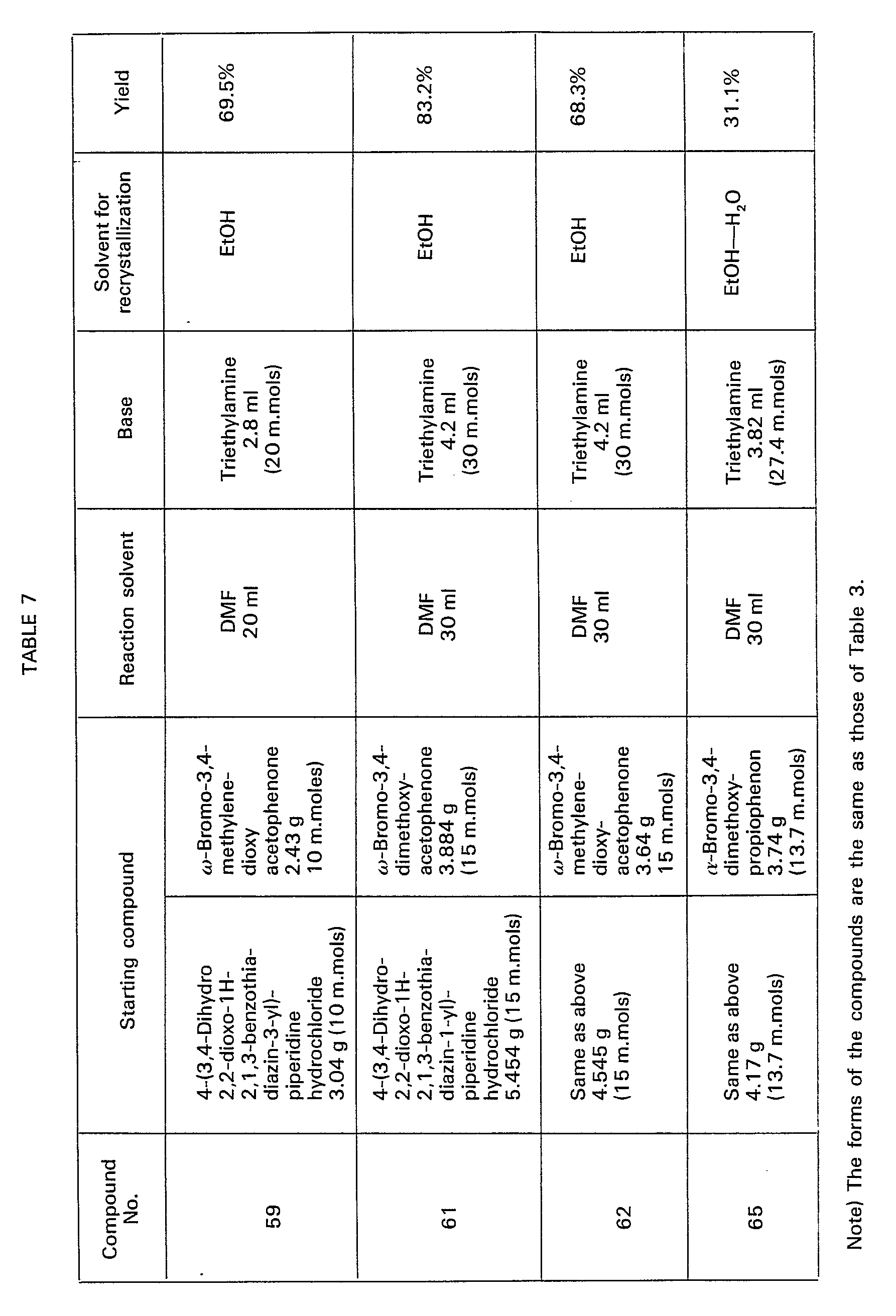
- Since the compounds designated as Compound Nos. 58, 60, 63, 64 and 66 in Table 1 are prepared according to a similar procedure, the procedure for the preparation of Compound 58 is exemplified below. Particulars on the other compounds are shown in Table 8.
- In 150 ml of methanol, 2.2 g of 1-(3,4-dimethoxybenzoylmethyl)-4-(3,4-dihydro-2,2-dioxo-1 H-2,1,3-benzothiadiazin-3-yl)-piperidine is suspended. While this suspension is stirred at room temperature, 1.0 g of sodium borohydride is added thereto by portions over a period of four hours. The mixture is stirred overnight at room temperature and 400 mg of sodium borohydride is added thereto. Then, the mixture is stirred overnight. The reaction solution is concentrated under reduced pressure. The residue is mixed with 100 ml of water and adjusted to pH 9.3 with concentrated hydrochloric acid. The resultant mixture is extracted with chloroform. The organic layer is washed with water, dried and freed from the solvent by distillation to obtain a syrup as a residue. This residue is crystallized by adding methanol thereto. The crystals are separated by filtration to obtain 1.93 g of crude crystals. The crude crystals are recrystallized from ethanol to obtain 1.45 g of 1-[2-(3,4-dimethoxyphenyl)-2-hydroxyethyl]-4-(3,4-dihydro-2,2-dioxo-1 H-2,1,3-benzothiadiazin-3-yl)-piperidine (Compound No. 58).

- In this example, 4.45 g of co-bromo-3,4-methylenedioxy-acetophenone is added to a solution of 4.62 g of 4-(2-oxyindol-3-yl)-piperidine hydrochloride and 3.8 g of triethylamine in 100 ml of methanol. The mixture is stirred overnight at room temperature. The reaction mixture is concentrated. The residue is mixed with 50 ml of water, stirred and filtered. The crystals are washed with 20 ml of' water and 10 ml of ethanol and then dried. Consequently, 5.5 g of crude crystals are obtained. The crude crystals are recrystallized from ethanol to obtain 5.0 g of the desired product.
- In this example, 0.3 g of sodium borohydride is added to a solution of 2.9 g of 1-(3,4-methylene- dioxybenzoylmethyJ)-4-(2-oxyindol-3-yl)-piperidine obtained in Example 51 in 50 ml of ethanol over a period of 30 minutes. After the addition, the mixture is stirred at room temperature for 2 hours and then concentrated. The residue is mixed with water to separate an oily substance, which is extracted with 50 ml of chloroform twice. The chloroform layer is washed with water and then dried. The dried layer is concentrated to dryness under reduced pressure and the residue is recrystallized from ethyl acetate to obtain 2.0 g of the desired product.
- In this example, 2.53 g of cv-bromo-3,4-dimethoxy-propiophenone is added to a solution of 2.34 g of 4-(2-oxyindol-3-yl)-piperidine hydrochloride and 1.88 g of triethylamine in 40 ml of methanol. The mixture is stirred at room temperature for 24 hours. The resultant mixture is concentrated to dryness under reduced pressure, and the residue is mixed with water, stirred and then filtered. The crystals are washed with 20 ml of water and 5 ml of isopropyl alcohol and then dried to obtain 3.55 g of crude crystals. The crude crystals are recrystallized from isopropyl alcohol to obtain 3.0 g of the desired product.
- In this example, 1.0 g of sodium borohydride is added to a solution of 1.6 g of 1-[2-(3,4-dimethoxyphenyl)-2-oxo-1-methylethyl]-4-(2-oxyindol-3-yl)-piperidine obtained in Example 53 in 70 ml of methanol over a period of 30 minutes. The mixture is stirred at room temperature for 2 hours and then concentrated to dryness under reduced pressure. The residue is mixed with water and the resultant crystalline substance is separated by filtration. The crystalline substance is washed with water and then dried to obtain 1.49 g of crude crystals. The crude crystals are dissolved in 15 ml of isopropyl alcohol and then 0.42 g of fumaric acid is added thereto. The crystals deposited are separated by filtration and dried. The crude crystals are recrystallized from isopropyl alcohol to obtain 1.23 g of the desired product.
- In this example, 2.84 g of ω-bromo-3,4-methylenedioxyacetophenone is added to a solution of 2.5 g of 3-(4-piperidylidene)-2-oxyindole and 1.19 g of triethylamine in methanol. The mixture is stirred at room temperature for 7 hours. The reaction mixture is freed from the solvent by distillation. The residue is mixed with water, stirred and then filtered. The crystals are washed with 20 ml of water and 5 ml of ethanol and dried to obtain 3.83 g of a crude product. The crude product is recrystallized from ethanol to obtain 3.61 g of the desired product.
- In this example, 4 g of 3-[1-(3,4-methylenedioxybenzoylmethyl)-4-piperidylidene]-2-oxyindole ' obtained in the same manner as that of Example 55 is dissolved in 300 ml of methylene chloride. To the solution, a solution of 8 g of diisobutyl aluminum hydride in 100 ml of methylene chloride is added dropwise at -25°C over a period of 2 hours. The resultant mixture is further stirred at the same temperature for 5 hours. Then, 30 ml of methanol and subsequent 100 ml of water are added to the mixture, and the methylene chloride layer is separated. The methylene chloride layer is washed with 30 ml of water and then dried three times. The layer is freed from methylene chloride by distillation. The residue is mixed with 10 ml of ethyl acetate and stirred. The resultant crystals are separated by filtration and dried to obtain 4.0 g of a crude product. The crude product is recrystallized from methanol- methylene chloride to obtain 2.3 g of the desired product.
- In this example, 0.6 g of sodium borohydride is added to a solution of 2.9 g of 3-[1-(3,4-Methylenedioxybenzoylmethyl)-4-piperidylidene]-2-oxyindole obtained in the same manner as that of Example 55 in 50 ml of ethanol over a period of one hour. After the addition, the mixture is stirred at room temperature for 2 hours and then concentrated. The residue is mixed with water and the oily substance separated is extracted with 50 ml of chloroform twice. The chloroform layer is washed with water and dried. The layer is freed from chloroform by distillation. The residue is recrystallized from ethyl acetate to obtain 2.05 g of the desired product.
- In this example, 1.03 g of co-bromo-3,4-dimethoxyacetophenone is added to a solution of 1.1 g of 4-(octahydro-2H-benzimidazoi-2-one-1-yi)-piperidine hydrochloride and 810 mg of triethylamine in 10 ml of methanol. The mixture is stirred at room temperature for 2 hours. The reaction mixture is concentrated. The residue is mixed with water and the crystals formed are separated by filtration. The crystals are washed with water and then with isopropanol and subsequently dried. Consequently, 1.4 g of crude crystals are obtained. The crude crystals are recrystallized from 20 ml of ethanol to obtain 1.18 g of the desired product.
- Compounds of Compound Nos. 78-80 can be prepared in a similar manner as that of this example.
- In this example, 720 mg of 1-[2-(3,4-dimethoxyphenyl)-2-oxo-ethyl]-4-octahydro-2H-benzimidazol-2-one-1-yl)-piperidine obtained by the procedure of Example 58 is suspended in 10 ml of methanol. To this suspension, 200 mg of sodium borohydride is added by portions at room temperature over a period of 30 minutes. After completion of the addition, the mixture is further stirred at room temperature for one hour and then concentrated. The residue is mixed with water and ethyl acetate and shaken. The organic layer is separated, washed with water and dried. The layer is concentrated to dryness under reduced pressure. The residue is mixed with a small amount of ether and stirred. The crystals formed are separated by filtration and dried to obtain 590 mg of crude crystals. The crude crystals are recrystallized from ethyl acetate to obtain 520 mg of the desired product.
- The compounds of Compound Nos. 82-84 can be prepared in a similar manner to that of this example.
-

- The above-described ingredients are mixed for 5 minutes by means of a mixer. The resulting mixed powder is made into 10,000 tablets of 6.0 mm in diameter, 2.5 mm in thickness, and 80 mg in weight using a tablet-making machine (Model HU-37; made by Kikusui Seisakusho) equipped with a pestle having a plane surface and round corners.
-
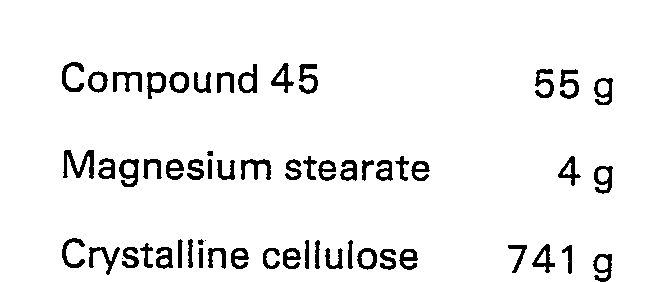
- The above-described ingredients are processed in the same manner as in Example 60 to obtain tablets.
-

- The above-described ingredients are processed in the same manner as in Example 60 to obtain tablets.
-

- The above-described ingredients are mixed for 10 minutes using a mixer to obtain a uniform mixture (powder).
-

- The above-described ingredients are mixed for 10 minutes using a mixer to obtain a uniform mixture (powder).
-

- In this reference example, 5.24 g of 1-benzyl-4-amino-piperidine dihydrochloride, 3.02 g of o-nitrobenzaldehyde, 2.02 g of triethylamine and 30 ml of methanol are mixed and stirred at room temperature for one hour. The resultant solution is cooled with ice and stirred. To the stirred solution, 1 g of sodium borohydride is added little by little over a period of one hour. Then, the mixture is brought back to room temperature and stirred at room temperature for 2 hours. The resultant solution is poured into 200 ml of ice water and extracted with ether. The organic layer is washed with water, dried and concentrated. The oily residue is dissolved in 20 ml of ethanol. The solution is mixed with 10 ml of a solution of 5.7N hydrochloric acid in ethyl acetate. The white crystals deposited are separated by filtration, washed with 20 ml of ethyl acetate and dried to obtain 5.70 g of a crude product. The crude product is recrystallized from hot ethanol to obtain 2.90 g of the desired product.
- Melting point: 260.0-263.5°C
- Elementary analysis (%): C19H25N30O2Cl2

-

- In this reference example, 31.8 g of 1-benzyl-4-[N-(o-nitrobenzyl)-amino]-piperidine dihydrochloride, 3.2 g of 10% Pd-C and 500 ml of water are mixed and stirred at room temperature. Then, about 6 I of hydrogen gas is absorbed by the mixture. Then the reaction is discontinued and the Pd-C is removed by filtration. The aqueous solution is adjusted to pH 11 with an aqueous sodium hydroxide and then extracted with ethyl acetate. The organic layer is washed with water, dried and concentrated. The resulting oily product is dissolved in 140 ml of ethanol. Then, 70 ml of a solution of 5.7N hydrochloric acid in ethyl acetate is added thereto. The white crystals deposited are separated by filtration, washed with ethyl acetate and dried to obtain 23.5 g of a crude product. The crude product is recrystallized from a mixed solvent of methanol and ethyl acetate to obtain 15.0 g of the desired product.
- Melting point: 225.0-228.0°C
- Elementary analysis (%): C19H28N3Cl3

-
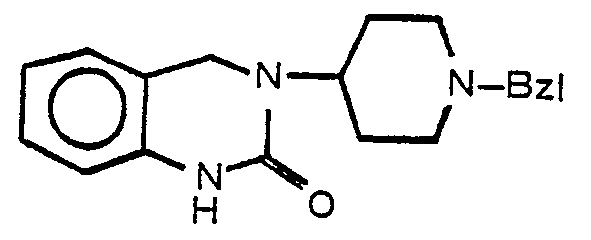
- In this reference example, 4.04 g of 1-benzyl-4-[N-o-aminobenzyl)-amino]-piperidine trihydrochloride, 3.04 g of triethylamine, 2.03 g of 1,1'-carbonyidiimidazole and 50 ml of acetonitrile are mixed and stirred at room temperature for 4 hours. Then, 0.8 g of 1,1'-carbonyldiimidazole is further added to the mixture and the resultant mixture is refluxed with heating for 20 minutes. The solution is cooled to room temperature. The crystals deposited are separated by filtration, washed with water and dried to obtain 2.50 g of a crude product. The crude product is recrystallized from hot ethanol to obtain 1.75 g of the desired product.
- Melting point: 204.5-205.5°C
- Elementary analysis (%): C20H23N3O

-

- In this reference example, 1.0 g of 1-benzyl-4-[3,4-dihydro-2(1 H)-quinazolinon-3-yl]-piperidine, 0.10 g of 10% Pd-C, 10 ml of acetic acid and 10 ml of methanol are mixed and stirred at room temperature. Hydrogen gas is introduced to the stirred mixture for 4 days. Then, the reaction is discontinued and the Pd-C is removed by filtration. The filtrate is concentrated. The resultant oily substance is dissolved in 5 ml of ethanol. Then, 5 ml of a solution of 5.7N hydrochloric acid in ethyl acetate is added thereto and the resultant mixture is allowed to stand overnight at room temperature. The crystals deposited are separated by filtration, washed with ethyl acetate and dried to obtain 0.75 g of a crude product. The crude product is recrystallized from a mixed solvent of methanol and ethyl acetate to obtain 0.52 g of the desired product.
- Melting point: 288.0-293.0°C
- Elementary analysis (%): C13H18N30Cl

-

- In this reference example, the mixture of 13.6 g of anthranilamide, 18.9 g of 1-benzyl-4-piperidone, 1.0 g of p-toluene-sulfonic acid monohydrate and 200 ml of benzene is refluxed in a Dean Stark apparatus for 6 hours to distil off water. The resultant suspension of the Schiff-base is concentrated. The residue is mixed with 250 ml of dry dioxane to form a suspension. Separately, 100 ml of dry dioxane and 12.4 g of lithium aluminum hydride are mixed. The above Schiff-base suspension is added little by little to the mixture with stirring without cooling. The mixture is stirred for one hour and then refluxed with heating for 18 hours. The reaction solution is cooled to room temperature and poured little by little into 1.3 I of ice water. The resultant suspension is poured little by little into a funnel previously coated with a filter aid and subjected to suction filtration. The cake on the funnel is washed with 500 ml of chloroform and filtered. The organic layer is washed with water, dried and concentrated to obtain 22.9 g of a crude product. The crude product is recrystallized from hot ethanol to obtain 18.7 g of the desired product.
- Melting point: 117.0-118.0°C
- Elementary analysis (%): C19H25N3

-

- In this reference example, to the mixture of 23.0 g of 1-benzyl-4-[N-(ortho-aminomethylphenyl)-amino]-piperidine and 200 ml of acetonitrile, 17.4 g of 1,1 '-carbonyidiimidazoie is added over a period of 3 hours with stirring at 40° to 60°C. Then, the resultant mixture is refluxed with heating for one hour, brought back to room temperature and stirred at room temperature for 2 hours. The crystals deposited are separated by filtration, successively washed with water and methanol and dried to obtain 16.8 g of a crude product. The crude product is recrystallized from methanol to obtain 12.18 g of the desired product.
- Melting point: 119.5-120.5°C
- Elementary analysis (%): C20H23N3O

-

- In this reference example, 16.0 g of 1-benzyl-4-[3,4-dihydro-2(1H)-quinazolinon-1-yl]-piperidine, 4.0 g of 10% Pd-C, 50 ml of 1 N hydrochloric acid, 150 ml of water and 300 ml of methanol are mixed and stirred at 40°C. Hydrogen gas is introduced to the mixture for 5 hours with stirring. Then, the Pd-C is removed by filtration and the filtrate is concentrated. The white crytalline residue is dissolved in 50 ml of water. The solution is adjusted to pH 10 with aqueous 5N sodium hydroxide and extracted with chloroform. The extract is washed with water, dried and thereafter concentrated. Then, 50 ml of a mixture of ethyl acetate and n-hexane (1:1 by volume) is added to the residue. After trituration, the solid is separated by filtration, washed with the same mixed solvent to obtain 9.9 g of a crude product. The crude product is recrystallized from water-ethanol to obtain 5.1 g of the desired product.
- Melting point: 153.0-155.0°C
- Elementary analysis (%): C13H17N3O

-

- In this reference example, 9.76 g of salicylaldehyde, 15.12 g of 1-benzyl-4-amino-piperidine and 1OOml of methanol are mixed and stirred at room temperature for one hour. While the resultant mixture is cooled with ice, 3.2 g of sodium borohydride is added thereto over a period of one hour and 30 minutes. Then, the mixture is stirred at room temperature for 2 hours. The resultant reaction mixture is poured into 1 I of ice water. The light yellow crystals deposited are separated by filtration and then dissolved in 200 ml of ethyl acetate. The ethyl acetate solution is washed with a saturated aqueous sodium chloride, dried and subsequently concentrated under reduced pressure to obtain 19.0 g of light yellow crystals. The crystals are recrystallized from ethanol to obtain 12.0 g of the desired product.
- Melting point: 92.5-93.0°C
- Elementary analysis (%): C19H24N2O

-

- In this reference example, 17.7 g of 1-benzyl-4-[N-(o-hydroxybenzyl)-amino]-piperidine obtained by the procedure of Reference Example 8, 19.4 g of 1,1'-carbonyl-dimidazole and 150 ml of tetrahydrofuran are mixed, stirred for 2 hours and 30 minutes, refluxed and then concentrated under reduced pressure.
- Subsequently, the formed crystalline residue is mixed with water and separated by filtration to obtain 18.0 g of crude crystals. The crude crystals are recrystallized from a mixture of n-hexane and ethyl acetate [50:7 (V/V)] to obtain 14.85 g of the desired product.
- Melting point: 106.0-107.0°C
- Elementary analysis (%): C20H22N2O2

-

- In this reference example, 16.0 g of 1-benzyl-4-(2-oxo-3,4-dihydro-2H-1,3-benzoxazin-3-yl)-piperidine and 4.0 g of 10% palladium carbon are added to a mixture of 150 ml of water, 50 ml of 1 N hydrochloric acid and 300 ml of methanol. While the resultant mixture is stirred, hydrogen gas is passed therethrough overnight. Then, the reaction mixture is filtered and the filtrate is concentrated. The white crystals as a residue are mixed with methanol and separated by filtration to obtain 11.4 g of the desired product.
- Melting point: 288.0-290.0°C
- Elementary analysis (%): C13H17N2O2Cl

-

- In this reference example, 600 mg of 1-benzyl-4-(2-nitroanilino)-piperidine is dissolved in methanol. The solution is mixed with 60 mg of 5% palladium carbon and stirred at 30-32°C in the atmosphere of hydrogen under the atmospheric pressure. The stirring is stopped after 2 hours and 30 minutes, and the catalyst is removed by filtration. The filtrate is mixed with 1 ml of a solution of 215 mg of hydrogen chloride gas in 1 ml of methanol and then concentrated. The residue is mixed with ether filtered and dried to obtain 640 mg of the desired product as a powder.
- Infrared absorption spectrum (KBr): 1625, 1280 cm-1
- Elementary analysis (%): C18H26Cl3N3

-

- In this reference example, 2.0 g of 1-benzyl-4-(2-aminoanilino)-piperidine trihydrochloride obtained in the same manner as that of Reference Example 11 is dissolved in 30 ml of water and the solution is cooled to 0°C. To the cooled solution, 5 ml of a solution of 360 mg of sodium nitrite in 5 ml of water is added dropwise under the current of nitrogen gas over a period of 30 minutes. After completion of the dropwise addition, the reaction mixture is stirred at 0-5°C for one hour and then adjusted to pH 10.7. The reaction mixture is extracted with 30 ml of chloroform three times. The chloroform layer is washed with water and dried. The chloroform layer is concentrated to dryness under reduced pressure. The residue is subjected to silica gel chromatography [Wako Gel C-200, 1 50 ml, with a chloroform-methanol (10:1) as the eluent]. The eluate is concentrated to obtain 0.71 g of the desired product.
- Melting point: 110―111°C
- Infrared absorption spectrum (KBr): 1461, 1140, 1083 cm-1
- Elementary analysis (%): C18H20N4

-

- A solution of 8.76 g 1-benzyl-4-(1H-benzotriazol-1-yl)-piperidine obtained in the same manner as that of Reference Example 12 in 200 ml of methanol is mixed with 9.0 g of acetic acid and 20 g of 5% palladium carbon and shaken in the atmosphere of hydrogen at 50°C under the initial pressure of 5 atmospheres. The reaction mixture is filtered and the filtrate is concentrated. The residue is recrystallized from ethyl acetate to obtain 8.6 g of the desired product.
- Melting point: 132.5-135.5°C
- IR (KBr): 1583, 1175 cm-'
- Elementary analysis (%): C11H14N4.C2H4O2

-

- In this reference example, 1.67 g of 1-benzyl-4-(2-nitroanilino)-piperidine hydrochloride is suspended in 30 ml of dioxane. The suspension is mixed with 13 ml of acetyl bromide and refluxed for 4 hours. The resultant reaction mixture is cooled and then the deposited crystals are separated by filtration. The crystals are washed with ether and then dried to obtain 1.96 g of crude crystals. The crude crystals are recrystallized from 25 ml of ethanol to obtain 1.33 g of the desired product.
- Melting point: 253-255°C
- IR (KBr): 1665, 1658, 1530, 1378 cm-'
- Elementary analysis (%): C20H24BrN3O3

-

- In this reference example, 14.8 g of 1-benzyl-4-[N-(2-nitrophenyl)-N-acetylamino]-piperidine hydrobromide obtained in the same manner as that of Reference Example 14, 250 ml of methanol and 1.0 g of 5% palladium carbon are mixed and stirred at room temperature under the atmospheric pressure in the current of hydrogen for 12 hours. The resultant reaction mixture is filtered. The filtrate is mixed with 29 ml of concentrated hydrochloric acid and stirred overnight. The reaction solution is concentrated and the residue is dissolved in 50 ml of water. The solution is adjusted to pH 11.0 with 1 N aqueous sodium hydroxide. The solution is extracted with 50 ml of chloroform three times, and the extract is washed with 20 ml of a saturated aqueous sodium chloride and dried. The extract is freed from the solvent by distillation. The residue is mixed with n-hexane and stirred for crystallization. The crystals are separated by filtration, recrystallized from a mixed solvent of n-hexane and ethanol to obtain 6.7 g of 4-(2-methyl-benzimidazol-3-yl)-piperidine.
- Melting point: 130-1320C
- IR (KBr): 1468 cm-1
- Elementary analysis (%): C13H17N3

-

- In this reference example, a solution of 28.0 g of 1-tert.-butoxycarbonyl-4-(2-aminophenylmethylamino)-piperidine, 2 g of dimethyl-N-cyanodithioiminocarbonate and 28 g of diazabicycloundecene in 150 ml of dioxane is heated at 63°C for 10 hours. The solution is then cooled and the deposited crystals are separated by filtration. The crystals are dried and then recrystallized from methanol to obtain 18 g of 1-tert.-butoxycarbonyl-4-(2-cyanoimino-3,4-dihydro-1H-quinazolin-3-yl)-piperidine.
- Melting point: 249-250°C
- IR (KBr): 2300, 1688―1680, 1627, 1585 cm-1
- Elementary analysis (%): C19H25N5O2

-

- In this reference example, 13.0 g of the product obtained in Reference Example 16 is suspended in 100 ml of ethyl acetate. The suspension is cooled to 0°C. To the cooled suspension, 60 ml of ethyl acetate solution of 5.8N HCI is added dropwise over a period of one hour. After the dropwise addition, the solution is further stirred at the same temperature for 30 minutes and then filtered. The resultant crystals are washed with 20 ml of ethyl acetate three times and dried to obtain 9.9 g of the desired compound.
- Melting point: 260-262°C (decomposition)
- IR (KBr): 2300, 1623, 1588 cm-1
- Elementary analysis (%): C14H18ClN4

-

- In this reference example, a solution of 1.0 g of 1-tert.-butoxycarbonyl-4-(2-aminoanilino)-piperidine, 1.0 g of dimethyl-N-cyanodithioiminocarbonate and 1.2 g of diazabicycloundecene in 50 ml of dioxane is heated to 80°C for 7 hours. The solution is freed from dioxane by distillation under reduced pressure. The residue is mixed with water and ethyl acetate and shaken and then the organic layer is separated. The organic layer is washed with 10 ml of 0.6N hydrochloric acid four times. The organic layer is further washed with a saturated aqueous sodium bicarbonate and water and then dried. The dried organic layer is concentrated to dryness under reduced pressure. The residue is subjected to silica gel chromatography (Wako Gel Q-200, 50 ml, with CHCI3 as the eluent). The eluate is concentrated and the residual crystals are recrystallized from ethanol to obtain 0.6 g of the desired product.
- Melting point: 169―171°C
- IR (KBr): 2201, 1695, 1690, 1605, 1575 cm-1
- Elementary analysis (%): C19H27N5O2S

-
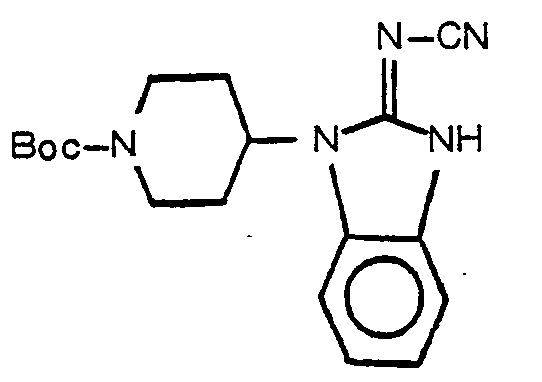
- In this reference example, 2.48 g of the product obtained in the same manner as that of Reference Example 18 is suspended in 22 ml of methanol. This suspension is mixed with 2.1 g of mercuric acetate and stirred at room temperature for one hour. After completion of the reaction, the reaction solution is concentrated to dryness under reduced pressure. The residue is mixed with 30 ml of chloroform. The chloroform solution is washed four times with 10 ml of 0.32N hydrochloric acid. The chloroform solution is further washed with 10 ml of a saturated aqueous sodium chloride four times and then dried. The solution is concentrated to dryness under reduced pressure and the residual crystals are recrystallized from ethanol to obtain 1.88 g of the desired product.
- Melting point: 242-243°C
- IR (KBr): 2198, 1699-1690, 1633, 1613 cm-'
- Elementary analysis (%): C18H23N5O2

-

- In this reference example, 18 g of the product obtained in the same manner as that of Reference Example 19 is suspended in 530 ml of ethyl acetate. To this suspension, 180 ml of ethyl acetate solution of 5.8N HCI is added dropwise at room temperature over a period of 30 minutes. The mixture is stirred for 2 hours and then filtered. The resultant crystals are washed with 20 ml of ethyl acetate five times and then dried to obtain 13.3 g of the desired product.
- Melting point: 273-276°C (decomposition)
- IR (KBr): 2195, 1630, 1601 cm-1
- Elementary analysis (%): C13H16ClN5

-

- In this reference example, 590 mg of 1-benzyl-4-[N-(o-aminobenzyl)-amino]-piperidine, 600 mg of sulfurylamide and 12 ml of pyridine are mixed and refluxed with heating for 2 hours. The reaction mixture is cooled to room temperature and poured into 50 ml of ice water. The white crystals deposited are separated by filtration, washed with 10 ml of water and dried to obtain 520 mg of the desired product as crystals.
- NMR (8 ppm in CDCI3): 1.37-2.27 (6H, m), 2.66-3.10 (2H, m), 3.42 (2H, s), 3.83 (1 H, m), 4.62 (2H, s), 5.76 (1 H, s) (exchangeable proton), 6.33-7.46 (9H, m)
- IR (KBr): 1340, 1165 (S02) cm-1
-

- In this reference example, 7.14 g (20 m.mols) of 1-benzyl-4-(3,4-dihydro-2,2-dioxo-1H-2,1,3-benzothiadiazin-3-yl)-piperidine, 2 g of 10% palladium carbon, 20 ml of 1 N hydrochloric acid, 60 ml of water and 120 ml of methanol are mixed. While the mixture is stirred at 40°C, hydrogen gas is blown into the mixture at 40°C for 20 hours. The reaction mixture is filtered to remove palladium carbon. The filtrate is concentrated to dryness to obtain 5.0 g of the desired product.
- NMR (δ ppm in d6DMSO): 1.47―2.20 (4H, m), 2.60―4.35 (5H, m), 4.63 (2H, s), 6.60―7.40 (4H, m), 9.10 (2H, broad s) (exchangeable proton), 10.46 (1 H, s) (exchangeable proton)
- IR (KBr): 1330, 1155 (SO2) cm-1
-
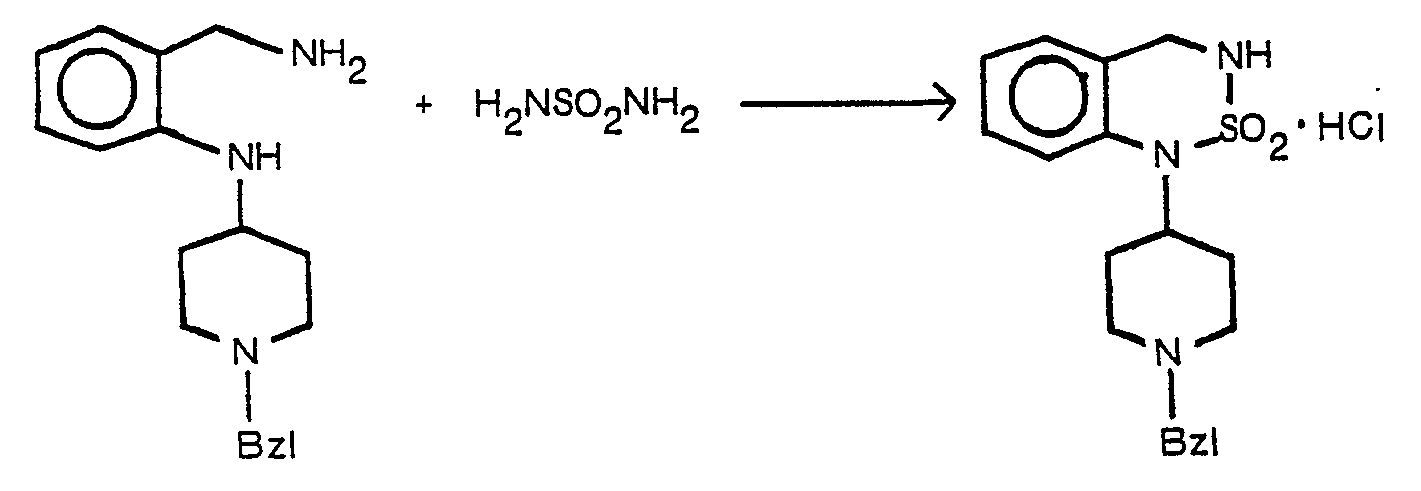
- In this reference example, 33.0 g (112.4 m.mols) of 1-benzyl-4-[N-(o-aminomethylphenyl)-amino]-piperidine, 21.6 g (224.8 m.mols) of sulfuryl amide and 250 ml of pyridine are mixed and refluxed with heating for 8 hours. The reaction solution is cooled to room temperature, concentrated to 70 ml and poured into 500 ml of ice water. The mixture is mixed with 300 ml of chloroform, stirred and adjusted to pH 9 with 2N aqueous sodium hydroxide. The chloroform layer is separated with separating funnel and the remaining water layer is further extracted with chloroform (300 ml x 3). The chloroform layers are combined, washed with water (300 ml x 4), dried and concentrated to obtain an oily residue. This residue is dissolved in 150 ml of ethanol. To the solution, 50 ml of 5.7N hydrogen chloride in ethyl acetate is added. The resultant solution is concentrated under reduced pressure. The crystalline residue is mixed with 50 ml of ethanol and filtered to obtain 29.0 g of the desired product. This compound is tested for NMR after it has been freed from hydrochloric acid, and it is tested for IR in its unaltered form of hydrochloride.
- NMR (δ ppm in CDCl3): 1.66―2.33 (6H, m), 2.6―3.2 (2H, m), 3.48 (2H, s), 4.0 (1H, m), 4.43 (2H, s), 4.80 (1H, br.s) (exchangeable proton), 7.0―7.4 (9H, m)
- IR (KBr): 1330, 1165 (S02) cm-1
-

- While a mixture of 16 g of 1-benzyl-4-(3,4-dihydro-2,2-dioxo-2,1,3-benzothiadiazin-1-yl)-piperidine-monohydrochloride, 4 g of 10% palladium carbon, 160 ml of water and 240 ml of methanol is stirred at 40°C, hydrogen gas is blown into the mixture for 20 hours. Then, the resultant reaction mixture is freed from palladium carbon by filtration. The filtrate is concentrated to dryness to obtain 11.2 g of crude crystals of the desired product. This compound is tested for NMR after it has been freed from hydrochloric acid, and it is tested for IR in its unaltered form of hydrochloride.
- NMR (δ ppm in CDCl3): 1.60―3.26 (8H, m), 3.70―4.26 (3H, m) (exchangeable proton 2H),4.40 (2H, s), 6.86-7.46 (4H, m)
- IR (KBr): 1340, 1160 (SO2) cm-1
-

- In this reference example, an ethanol solution of 2.4 g of ammonia is prepared by bubbling ammonia gas through 20 ml of ethanol. To this solution, 1.51 g of 1-tert.-butoxycarbonyl-4-piperidone and 1.01 g of oxyindole are added at 5°C. The resultant mixture is gradually heated to 70°C. The mixture is stirred at the same temperature for one hour and then freed from ammonia and the solvent by distillation under reduced pressure. The residue is mixed with a small amount of ethanol and then stirred. The crystals consequently deposited are separated by filtration and dried to obtain 1.7 g of crude crystals. The crude crystals are recrystallized from ethanol to obtain 1.62 g of the desired product.
- Melting point: 204-205°C
- IR (KBr): 1700, 1690, 1660 cm-1
- Elementary analysis (%): C18H22N2O3

-

- In this reference example, 7.5 g of 3-[1-(tert.-butoxycarbonyl)-4-piperidinylidene]-2-oxyindole obtained in the same manner as that of Reference Example 25 is added by portions to 25 g of trifluoroacetic acid which is cooled to 0°C. The resultant mixture is stirred at the same temperature for 2 hours and then concentrated to dryness under reduced pressure. The residue is mixed with water, and the resultant solution is adjusted to pH 10.6 with 0.1 N aqueous sodium hydroxide. The deposited crystals are separated by filtration and washed with water. The crude crystals are dried and then recrystallized from ethyl acetate to obtain 4.4 g of the desired product.
- Melting point: 234-238°C (decomposition)
- IR (KBr): 1697, 1680 cm-1
- Elementary analysis (%): C13H14N2O

-

- In this reference example, 0.5 g of 5% palladium carbon is added to a solution of 4.0 g of 3-(4-piperidinylidene)-2-oxyindole obtained in the same manner as that of Reference Example 26 in 200 ml of methanol. The mixture is stirred in the atmosphere of hydrogen under the atmospheric pressure for 10 hours. The mixture is filtered and the filtrate is concentrated. The residue is dissolved in 10 ml of ethanol. The crystals which are deposited therein by blowing dry hydrogen chloride gas into the solution are separated by filtration and then dried. The crude crystals are recrystallized from ethanol to obtain 3.8 g of the desired product.
- Melting point: 284-286°C (decomposition)
- IR (KBr): 1718 cm-1
- Elementary analysis (%): C13H16N2O·HCl

-

- In this reference example, a solution of 16.6 g of 1-nitro-cyclohexene and 23 g of 1-benzyl-4-amino-piperidine in 150 ml of tetrahydrofuran is stirred overnight at room temperature. The reaction solution is filtered and the filtrate is concentrated. The residue is dissolved in 250 ml of 0.6N hydrochloric acid. The solution is shaken with ether twice and then the water layer is separated. The water layer is adjusted to pH 9.5 with 1 N aqueous sodium hydroxide. The oily substance separated is extracted with 100 ml of ether three times. The extract is washed with water and then dried. The dried extract is concentrated under reduced pressure to obtain 30 g of an oily residue. This oily residue is subjected to silica gel chromatography (Wako Gel Q-200, with ethyl acetate as the eluent) to obtain 22.2 g of the desired product in an oily form.
- IR (neat): 1545 cm-'
- NMR (CDCI3): 0.75-3.4, 3.42, 3.85-4.5, 7.25 ppm
- Elementary analysis (%): C18H27N3O2

-

- In this reference example, 1.0 g of 1-benzyl-4-(2-nitro-cyclohexylamino)-piperidine obtained in Reference Example 28 is dissolved in 25 ml of ethanol. Then, 1.0 g of a Raney-nickel catalyst is added thereto and the mixture is stirred at room temperature in the atmosphere of hydrogen under the atmospheric pressure. The stirring is ceased when the solution has absorbed the theoretical amount of hydrogen, and the reaction solution is filtered. The filtrate is concentrated. Consequently, 0.89 g of 1-benzyl-4-(2-amino-cyclohexylamino)-piperidine is obtained as the residue.
- IR (neat): 1580, 1450-1422 cm-'
- Although this compound is in a free form, it can be converted into a crystalline hydrochloride by introducing hydrogen chloride gas into an ethanol solution of the compound.
- The hydrochloride is recrystallized from methanol. The trihydrochloride of 1-benzyl-4-(2-amino- cyclohexylamino)-piperidine exhibits the following properties.
- Melting point: 245-247°C
- Elementary analysis (%): C18H32N3Cl3

-

- In this reference example, a solution of 631 mg of 1-benzyl-4-(2-amino-cyclohexylamino)-piperidine in a free form obtained in Reference Example 29 and 550 mg of 1,1'-carbonyldiimidazole in 10 ml of acetonitrile is stirred at room temperature for 12 hours. The deposited crystals are separated by filtration, washed with acetonitrile and then dried to obtain 383 mg of crude crystals. The crude crystals are recrystallized from 34 ml of isopropanol to obtain 300 mg of the desired product.
- Melting point: 192-193°C
- IB (KBr): 1680 cm-'
- Elementary analysis (%): C19H27N3O

-

- In this reference example, a solution of 6.1 g of 1-benzyl-4-(octahydro-2H-benzimidazol-2-one-1-yl)-piperidine obtained in the same manner as that of Reference Example 30 and 1 g of 5% palladium carbon in 100 ml of methanol, 100 ml of water and 20 ml of 12N hydrochloric acid is shaken in the atmosphere of hydrogen under 4 to 5 atmosphere in an autoclave. The shaking is ceased when the absorption of hydrogen has been completed. The reaction mixture is subjected to filtration to remove the catalyst and the filtrate is concentrated. The residue is mixed with 20 ml of isopropanol and stirred to crystallize the reaction product. The crystals are dried and recrystallized from ethanol to obtain 3.9 g of the desired product.
- Melting point: 300°C (coloring)
- IR (KBr): 1658, 1637 (shoulder) cm-1
- Elementary analysis (%): C12H22ClN2O

Claims (8)
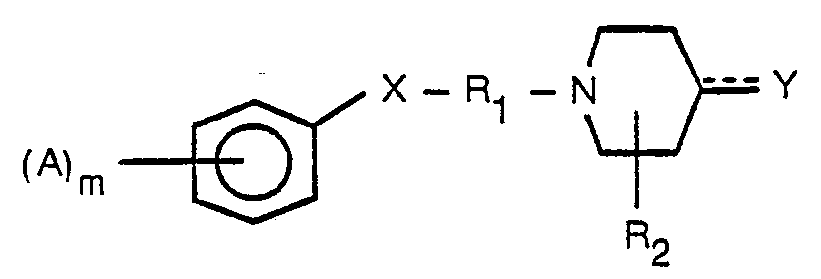

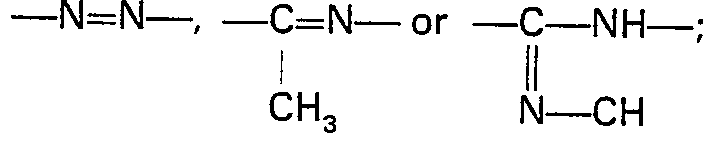


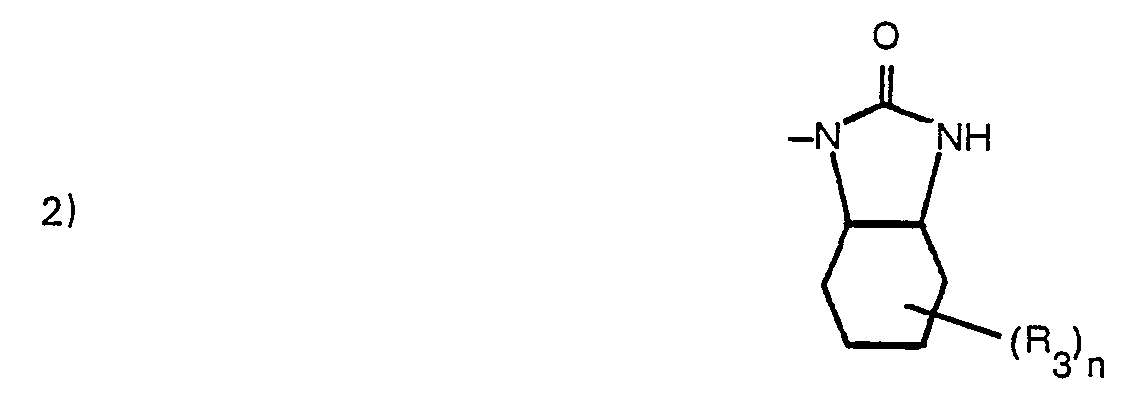


and further, if desired, reducing the X' group, when carbonyl, in the product so formed to form a hydroxymethylene group X, and/or removing the labile protecting group(s) in Y and/or A.
Applications Claiming Priority (14)
| Application Number | Priority Date | Filing Date | Title |
|---|---|---|---|
| JP150056/79 | 1979-11-21 | ||
| JP54150056A JPS5924990B2 (en) | 1979-11-21 | 1979-11-21 | Novel piperidine derivatives |
| JP2910680A JPS56125385A (en) | 1980-03-10 | 1980-03-10 | Novel piperidine derivative |
| JP29106/80 | 1980-03-10 | ||
| JP65094/80 | 1980-05-16 | ||
| JP6509480A JPS56161386A (en) | 1980-05-16 | 1980-05-16 | Novel piperidine derivative |
| JP6653280A JPS56164184A (en) | 1980-05-21 | 1980-05-21 | Novel piperidine derivative |
| JP66531/80 | 1980-05-21 | ||
| JP66532/80 | 1980-05-21 | ||
| JP6653180A JPS56164183A (en) | 1980-05-21 | 1980-05-21 | Novel piperidine derivative |
| JP6961980A JPS56166188A (en) | 1980-05-27 | 1980-05-27 | Novel piperidine derivative |
| JP69619/80 | 1980-05-27 | ||
| JP11475980A JPS5740482A (en) | 1980-08-22 | 1980-08-22 | Novel piperidine derivative |
| JP114759/80 | 1980-08-22 |
Publications (2)
| Publication Number | Publication Date |
|---|---|
| EP0029707A1 EP0029707A1 (en) | 1981-06-03 |
| EP0029707B1 true EP0029707B1 (en) | 1984-02-01 |
Family
ID=27564210
Family Applications (1)
| Application Number | Title | Priority Date | Filing Date |
|---|---|---|---|
| EP19800304147 Expired EP0029707B1 (en) | 1979-11-21 | 1980-11-19 | Novel piperidine derivatives, method for the preparation thereof and pharmaceutical compositions containing them |
Country Status (2)
| Country | Link |
|---|---|
| EP (1) | EP0029707B1 (en) |
| DE (1) | DE3066434D1 (en) |
Cited By (3)
| Publication number | Priority date | Publication date | Assignee | Title |
|---|---|---|---|---|
| US7956069B2 (en) | 2006-06-09 | 2011-06-07 | Astrazeneca Ab | Compounds |
| US8119661B2 (en) | 2007-09-11 | 2012-02-21 | Astrazeneca Ab | Piperidine derivatives and their use as muscarinic receptor modulators |
| US9090618B2 (en) | 2012-12-27 | 2015-07-28 | Purdue Pharma L.P. | Substituted benzimidazole-type piperidine compounds and uses thereof |
Families Citing this family (13)
| Publication number | Priority date | Publication date | Assignee | Title |
|---|---|---|---|---|
| JPS5815979A (en) * | 1981-07-11 | 1983-01-29 | Kyowa Hakko Kogyo Co Ltd | Novel piperidine derivative and its preparation |
| JPS58180481A (en) * | 1982-04-15 | 1983-10-21 | Kyowa Hakko Kogyo Co Ltd | Novel piperidine derivative |
| DE3373466D1 (en) * | 1982-06-10 | 1987-10-15 | Beecham Wuelfing Gmbh & Co Kg | AMINE DERIVATIVES |
| FI95572C (en) * | 1987-06-22 | 1996-02-26 | Eisai Co Ltd | Process for the preparation of a medicament useful as a piperidine derivative or its pharmaceutical salt |
| JP2807577B2 (en) * | 1990-06-15 | 1998-10-08 | エーザイ株式会社 | Cyclic amide derivative |
| ATE174908T1 (en) * | 1993-05-26 | 1999-01-15 | Sumitomo Pharma | QUINAZOLINONE DERIVATIVES |
| GB9312806D0 (en) * | 1993-06-22 | 1993-08-04 | Boots Co Plc | Therapeutic agents |
| US5741800A (en) * | 1993-06-22 | 1998-04-21 | Knoll Aktiengesellachaft | Azolyl-cyclic amine derivates with immunomodulatory activity |
| ES2087038B1 (en) * | 1994-11-07 | 1997-03-16 | Uriach & Cia Sa J | NEW PIPERIDINES WITH ANTAGONIST ACTIVITY OF THE PAF. |
| EP1997818A3 (en) * | 2001-04-18 | 2009-04-08 | Euro-Celtique S.A. | Quinolinone derivatives and their use to treat pain |
| BR0209129A (en) * | 2001-04-18 | 2005-12-20 | Euro Celtique Sa | Compounds, pharmaceutical compositions, methods for treating pain, methods for modulating a pharmacological response and uses of compounds. |
| WO2005075459A1 (en) * | 2004-02-03 | 2005-08-18 | Euro-Celtique S.A. | Synthesis of cyanoimino-benzoimidazoles |
| GB0526042D0 (en) | 2005-12-21 | 2006-02-01 | Syngenta Participations Ag | Chemical compounds |
Family Cites Families (4)
| Publication number | Priority date | Publication date | Assignee | Title |
|---|---|---|---|---|
| US4148796A (en) * | 1971-03-15 | 1979-04-10 | Sumitomo Chemical Company, Limited | γ-Piperidinobutyrophenones |
| AT344695B (en) * | 1974-02-28 | 1978-08-10 | Sumitomo Chemical Co | PROCESS FOR PRODUCING NEW PHENOXYPROPYLAMINE DERIVATIVES AND THEIR SALTS |
| DE2701794A1 (en) * | 1976-01-21 | 1977-07-28 | Ciba Geigy Ag | OXIGENATED N-ARYL DIAZACYCLES |
| GB1583753A (en) * | 1976-07-14 | 1981-02-04 | Science Union & Cie | Piperidine derivatives processes for their preparation and pharmaceutical compositions containing them |
-
1980
- 1980-11-19 DE DE8080304147T patent/DE3066434D1/en not_active Expired
- 1980-11-19 EP EP19800304147 patent/EP0029707B1/en not_active Expired
Cited By (4)
| Publication number | Priority date | Publication date | Assignee | Title |
|---|---|---|---|---|
| US7956069B2 (en) | 2006-06-09 | 2011-06-07 | Astrazeneca Ab | Compounds |
| US8119661B2 (en) | 2007-09-11 | 2012-02-21 | Astrazeneca Ab | Piperidine derivatives and their use as muscarinic receptor modulators |
| US9090618B2 (en) | 2012-12-27 | 2015-07-28 | Purdue Pharma L.P. | Substituted benzimidazole-type piperidine compounds and uses thereof |
| US9598411B2 (en) | 2012-12-27 | 2017-03-21 | Purdue Pharma L.P. | Substituted benzimidazole-type piperidine compounds and uses thereof |
Also Published As
| Publication number | Publication date |
|---|---|
| DE3066434D1 (en) | 1984-03-08 |
| EP0029707A1 (en) | 1981-06-03 |
Similar Documents
| Publication | Publication Date | Title |
|---|---|---|
| EP0563345B1 (en) | Novel 4-arylpiperazines and 4-arylpiperidines | |
| US6001836A (en) | Dihydropyridine NPY antagonists: cyanoguanidine derivatives | |
| US6294555B1 (en) | 1-[(1-Substituted-4-piperidinyl)methyl]-4-piperidine derivative, process for producing the same, medicinal compositions containing the same and intermediates of these compounds | |
| EP0070171B1 (en) | Novel piperidine derivatives, processes for preparation thereof and pharmaceutical compositions containing same | |
| EP0029707A1 (en) | Novel piperidine derivatives, method for the preparation thereof and pharmaceutical compositions containing them | |
| JP2002509148A (en) | 4- (2-keto-1-benzimidazolinyl) piperidine compounds as ORL1-receptor agonists | |
| CS228506B2 (en) | Method for the production of optical active ester of 1,4-dihydropyridincarboxyl acid | |
| US20030176693A1 (en) | Diphenylalkylamine derivatives useful as opioid receptor agonists | |
| EP0092391A2 (en) | Novel piperidine derivatives and pharmaceutical compositions containing same | |
| AU686400B2 (en) | Serotonin 5-HT-1A and dopamin D-2 receptor ligands | |
| CA2420177C (en) | Quinazoline derivatives as alpha-1 adrenergic antagonists | |
| US4410528A (en) | Hypotensive piperidine derivatives | |
| JPH11502861A (en) | Substituted benzolactam compounds as substance P antagonists | |
| CZ396591A3 (en) | Enantiomers of 1,4-dihydropyridine process of their preparation and pharmaceutical compositions prepared therefrom | |
| CA1097648A (en) | N-[1-(3-benzoylpropyl)-4-piperidyl]-sulfonic acid amides and processes for production thereof | |
| US4344948A (en) | Piperidine derivatives and pharmaceutical compositions containing same | |
| KR100412167B1 (en) | Piperazine-2,5-dione derivatives as modulators for multidrug resistance | |
| IE41648B1 (en) | 2-substituted-piperidinyl or tetrahydropyridinyl)alkyl-1h-benz de isoquinoline-1,3(2h)-diones | |
| US6916822B2 (en) | Phenoxyalkylamine derivatives useful as opioid δ receptor agonists | |
| US4344945A (en) | Piperidine derivatives | |
| EP0660822B1 (en) | Cyclic benzylamino, benzylamido and benzylimido derivatives as antipsychotic agents | |
| EP0018417B1 (en) | Novel piperidine derivatives and pharmaceutical compositions containing them | |
| US5472966A (en) | Antidepressant heteroarylaminoalkyl derivatives of naphthyl-monazines | |
| AU636972B2 (en) | 4-{3-(4-oxothiazoldinyl)}butynylamines, a process for their preparation and their use as medicaments | |
| EP0364091B1 (en) | Antipsychotic 4-(4-(3-benzisothiazolyl)-1-piperazinyl)butyl bridged bicyclic imides |
Legal Events
| Date | Code | Title | Description |
|---|---|---|---|
| PUAI | Public reference made under article 153(3) epc to a published international application that has entered the european phase |
Free format text: ORIGINAL CODE: 0009012 |
|
| AK | Designated contracting states |
Designated state(s): DE FR GB IT |
|
| 17P | Request for examination filed |
Effective date: 19810825 |
|
| ITF | It: translation for a ep patent filed | ||
| GRAA | (expected) grant |
Free format text: ORIGINAL CODE: 0009210 |
|
| AK | Designated contracting states |
Designated state(s): DE FR GB IT |
|
| REF | Corresponds to: |
Ref document number: 3066434 Country of ref document: DE Date of ref document: 19840308 |
|
| ET | Fr: translation filed | ||
| PLBE | No opposition filed within time limit |
Free format text: ORIGINAL CODE: 0009261 |
|
| STAA | Information on the status of an ep patent application or granted ep patent |
Free format text: STATUS: NO OPPOSITION FILED WITHIN TIME LIMIT |
|
| 26N | No opposition filed | ||
| PGFP | Annual fee paid to national office [announced via postgrant information from national office to epo] |
Ref country code: GB Payment date: 19911118 Year of fee payment: 12 |
|
| ITTA | It: last paid annual fee | ||
| PGFP | Annual fee paid to national office [announced via postgrant information from national office to epo] |
Ref country code: DE Payment date: 19920130 Year of fee payment: 12 |
|
| PGFP | Annual fee paid to national office [announced via postgrant information from national office to epo] |
Ref country code: FR Payment date: 19921019 Year of fee payment: 13 |
|
| PG25 | Lapsed in a contracting state [announced via postgrant information from national office to epo] |
Ref country code: GB Effective date: 19921119 |
|
| GBPC | Gb: european patent ceased through non-payment of renewal fee |
Effective date: 19921119 |
|
| PG25 | Lapsed in a contracting state [announced via postgrant information from national office to epo] |
Ref country code: DE Effective date: 19930803 |
|
| PG25 | Lapsed in a contracting state [announced via postgrant information from national office to epo] |
Ref country code: FR Effective date: 19940729 |
|
| REG | Reference to a national code |
Ref country code: FR Ref legal event code: ST |