EP0029443B1 - Process for composite polymer beads - Google Patents
Process for composite polymer beads Download PDFInfo
- Publication number
- EP0029443B1 EP0029443B1 EP19800901054 EP80901054A EP0029443B1 EP 0029443 B1 EP0029443 B1 EP 0029443B1 EP 19800901054 EP19800901054 EP 19800901054 EP 80901054 A EP80901054 A EP 80901054A EP 0029443 B1 EP0029443 B1 EP 0029443B1
- Authority
- EP
- European Patent Office
- Prior art keywords
- polymeric
- process according
- particulate matter
- beads
- vinyl monomers
- Prior art date
- Legal status (The legal status is an assumption and is not a legal conclusion. Google has not performed a legal analysis and makes no representation as to the accuracy of the status listed.)
- Expired
Links
- 238000000034 method Methods 0.000 title claims abstract description 47
- 239000011324 bead Substances 0.000 title claims abstract description 45
- 239000002131 composite material Substances 0.000 title abstract description 24
- 229920000642 polymer Polymers 0.000 title description 16
- 239000000178 monomer Substances 0.000 claims abstract description 40
- 239000002270 dispersing agent Substances 0.000 claims abstract description 24
- 239000013618 particulate matter Substances 0.000 claims abstract description 22
- 229920001577 copolymer Polymers 0.000 claims abstract description 20
- 229920002554 vinyl polymer Polymers 0.000 claims abstract description 19
- 125000000391 vinyl group Chemical group [H]C([*])=C([H])[H] 0.000 claims abstract description 14
- 239000003431 cross linking reagent Substances 0.000 claims abstract description 10
- PPBRXRYQALVLMV-UHFFFAOYSA-N Styrene Chemical compound C=CC1=CC=CC=C1 PPBRXRYQALVLMV-UHFFFAOYSA-N 0.000 claims description 43
- 239000006249 magnetic particle Substances 0.000 claims description 22
- MYRTYDVEIRVNKP-UHFFFAOYSA-N 1,2-Divinylbenzene Chemical group C=CC1=CC=CC=C1C=C MYRTYDVEIRVNKP-UHFFFAOYSA-N 0.000 claims description 16
- 238000006116 polymerization reaction Methods 0.000 claims description 15
- 239000004372 Polyvinyl alcohol Substances 0.000 claims description 12
- 229920002451 polyvinyl alcohol Polymers 0.000 claims description 12
- 239000008346 aqueous phase Substances 0.000 claims description 8
- KFDVPJUYSDEJTH-UHFFFAOYSA-N 4-ethenylpyridine Chemical compound C=CC1=CC=NC=C1 KFDVPJUYSDEJTH-UHFFFAOYSA-N 0.000 claims description 7
- AYTAKQFHWFYBMA-UHFFFAOYSA-N chromium(IV) oxide Inorganic materials O=[Cr]=O AYTAKQFHWFYBMA-UHFFFAOYSA-N 0.000 claims description 7
- 239000003999 initiator Substances 0.000 claims description 7
- 239000003054 catalyst Substances 0.000 claims description 6
- 239000012074 organic phase Substances 0.000 claims description 6
- 239000000725 suspension Substances 0.000 claims description 6
- 229910052845 zircon Inorganic materials 0.000 claims description 5
- 229910000859 α-Fe Inorganic materials 0.000 claims description 5
- KGIGUEBEKRSTEW-UHFFFAOYSA-N 2-vinylpyridine Chemical compound C=CC1=CC=CC=N1 KGIGUEBEKRSTEW-UHFFFAOYSA-N 0.000 claims description 4
- IAQWMWUKBQPOIY-UHFFFAOYSA-N chromium(4+);oxygen(2-) Chemical compound [O-2].[O-2].[Cr+4] IAQWMWUKBQPOIY-UHFFFAOYSA-N 0.000 claims description 4
- FWDBOZPQNFPOLF-UHFFFAOYSA-N ethenyl(triethoxy)silane Chemical compound CCO[Si](OCC)(OCC)C=C FWDBOZPQNFPOLF-UHFFFAOYSA-N 0.000 claims description 4
- HJWLCRVIBGQPNF-UHFFFAOYSA-N prop-2-enylbenzene Chemical class C=CCC1=CC=CC=C1 HJWLCRVIBGQPNF-UHFFFAOYSA-N 0.000 claims description 4
- 239000003381 stabilizer Substances 0.000 claims description 4
- GFQYVLUOOAAOGM-UHFFFAOYSA-N zirconium(iv) silicate Chemical compound [Zr+4].[O-][Si]([O-])([O-])[O-] GFQYVLUOOAAOGM-UHFFFAOYSA-N 0.000 claims description 4
- 229940090961 chromium dioxide Drugs 0.000 claims description 3
- CPBHJGWJMLDUNB-UHFFFAOYSA-N ethenoxysilane Chemical class [SiH3]OC=C CPBHJGWJMLDUNB-UHFFFAOYSA-N 0.000 claims description 3
- NKSJNEHGWDZZQF-UHFFFAOYSA-N ethenyl(trimethoxy)silane Chemical compound CO[Si](OC)(OC)C=C NKSJNEHGWDZZQF-UHFFFAOYSA-N 0.000 claims description 3
- 230000000379 polymerizing effect Effects 0.000 claims description 3
- 125000003011 styrenyl group Chemical group [H]\C(*)=C(/[H])C1=C([H])C([H])=C([H])C([H])=C1[H] 0.000 claims description 3
- 229930195733 hydrocarbon Natural products 0.000 claims 1
- 150000002430 hydrocarbons Chemical class 0.000 claims 1
- AOLJCKIDPDZWBS-UHFFFAOYSA-N methyl 3-(dimethylamino)-2-methylprop-2-enoate Chemical compound COC(=O)C(C)=CN(C)C AOLJCKIDPDZWBS-UHFFFAOYSA-N 0.000 claims 1
- 239000002245 particle Substances 0.000 abstract description 43
- 239000003463 adsorbent Substances 0.000 abstract description 18
- 239000000696 magnetic material Substances 0.000 abstract description 15
- 239000011159 matrix material Substances 0.000 abstract description 10
- 239000003456 ion exchange resin Substances 0.000 abstract description 8
- 229920003303 ion-exchange polymer Polymers 0.000 abstract description 8
- 229910052500 inorganic mineral Inorganic materials 0.000 abstract description 4
- 239000011707 mineral Substances 0.000 abstract description 4
- 239000000049 pigment Substances 0.000 abstract description 3
- 239000003505 polymerization initiator Substances 0.000 abstract description 3
- 239000000126 substance Substances 0.000 abstract description 3
- 150000003440 styrenes Chemical class 0.000 abstract description 2
- 239000000243 solution Substances 0.000 description 13
- 239000000203 mixture Substances 0.000 description 12
- 235000019422 polyvinyl alcohol Nutrition 0.000 description 11
- 239000000463 material Substances 0.000 description 9
- 238000002360 preparation method Methods 0.000 description 9
- QTBSBXVTEAMEQO-UHFFFAOYSA-N Acetic acid Chemical compound CC(O)=O QTBSBXVTEAMEQO-UHFFFAOYSA-N 0.000 description 8
- CSCPPACGZOOCGX-UHFFFAOYSA-N Acetone Chemical compound CC(C)=O CSCPPACGZOOCGX-UHFFFAOYSA-N 0.000 description 8
- LFQSCWFLJHTTHZ-UHFFFAOYSA-N Ethanol Chemical compound CCO LFQSCWFLJHTTHZ-UHFFFAOYSA-N 0.000 description 8
- XLYOFNOQVPJJNP-UHFFFAOYSA-N water Substances O XLYOFNOQVPJJNP-UHFFFAOYSA-N 0.000 description 8
- 239000004342 Benzoyl peroxide Substances 0.000 description 7
- OMPJBNCRMGITSC-UHFFFAOYSA-N Benzoylperoxide Chemical compound C=1C=CC=CC=1C(=O)OOC(=O)C1=CC=CC=C1 OMPJBNCRMGITSC-UHFFFAOYSA-N 0.000 description 7
- UXVMQQNJUSDDNG-UHFFFAOYSA-L Calcium chloride Chemical compound [Cl-].[Cl-].[Ca+2] UXVMQQNJUSDDNG-UHFFFAOYSA-L 0.000 description 7
- 239000007900 aqueous suspension Substances 0.000 description 7
- 235000019400 benzoyl peroxide Nutrition 0.000 description 7
- 239000011248 coating agent Substances 0.000 description 7
- 238000000576 coating method Methods 0.000 description 7
- 238000003756 stirring Methods 0.000 description 7
- 230000005294 ferromagnetic effect Effects 0.000 description 6
- 238000010348 incorporation Methods 0.000 description 6
- 239000011347 resin Substances 0.000 description 6
- 229920005989 resin Polymers 0.000 description 6
- 230000005291 magnetic effect Effects 0.000 description 5
- GWEVSGVZZGPLCZ-UHFFFAOYSA-N Titan oxide Chemical compound O=[Ti]=O GWEVSGVZZGPLCZ-UHFFFAOYSA-N 0.000 description 4
- 238000001914 filtration Methods 0.000 description 4
- 238000011010 flushing procedure Methods 0.000 description 4
- 239000011521 glass Substances 0.000 description 4
- JEIPFZHSYJVQDO-UHFFFAOYSA-N iron(III) oxide Inorganic materials O=[Fe]O[Fe]=O JEIPFZHSYJVQDO-UHFFFAOYSA-N 0.000 description 4
- OKTJSMMVPCPJKN-UHFFFAOYSA-N Carbon Chemical compound [C] OKTJSMMVPCPJKN-UHFFFAOYSA-N 0.000 description 3
- CTQNGGLPUBDAKN-UHFFFAOYSA-N O-Xylene Chemical compound CC1=CC=CC=C1C CTQNGGLPUBDAKN-UHFFFAOYSA-N 0.000 description 3
- YXFVVABEGXRONW-UHFFFAOYSA-N Toluene Chemical compound CC1=CC=CC=C1 YXFVVABEGXRONW-UHFFFAOYSA-N 0.000 description 3
- 229960000583 acetic acid Drugs 0.000 description 3
- 239000007864 aqueous solution Substances 0.000 description 3
- 239000001110 calcium chloride Substances 0.000 description 3
- 229910001628 calcium chloride Inorganic materials 0.000 description 3
- 239000003795 chemical substances by application Substances 0.000 description 3
- 238000005342 ion exchange Methods 0.000 description 3
- SZVJSHCCFOBDDC-UHFFFAOYSA-N iron(II,III) oxide Inorganic materials O=[Fe]O[Fe]O[Fe]=O SZVJSHCCFOBDDC-UHFFFAOYSA-N 0.000 description 3
- 238000003801 milling Methods 0.000 description 3
- 238000010992 reflux Methods 0.000 description 3
- 239000012508 resin bead Substances 0.000 description 3
- -1 vinyl aromatic hydrocarbons Chemical class 0.000 description 3
- 238000005406 washing Methods 0.000 description 3
- 239000008096 xylene Substances 0.000 description 3
- CHRJZRDFSQHIFI-UHFFFAOYSA-N 1,2-bis(ethenyl)benzene;styrene Chemical compound C=CC1=CC=CC=C1.C=CC1=CC=CC=C1C=C CHRJZRDFSQHIFI-UHFFFAOYSA-N 0.000 description 2
- IJGRMHOSHXDMSA-UHFFFAOYSA-N Atomic nitrogen Chemical compound N#N IJGRMHOSHXDMSA-UHFFFAOYSA-N 0.000 description 2
- XEEYBQQBJWHFJM-UHFFFAOYSA-N Iron Chemical compound [Fe] XEEYBQQBJWHFJM-UHFFFAOYSA-N 0.000 description 2
- PXHVJJICTQNCMI-UHFFFAOYSA-N Nickel Chemical compound [Ni] PXHVJJICTQNCMI-UHFFFAOYSA-N 0.000 description 2
- 239000002253 acid Substances 0.000 description 2
- 229910045601 alloy Inorganic materials 0.000 description 2
- 239000000956 alloy Substances 0.000 description 2
- 230000015572 biosynthetic process Effects 0.000 description 2
- 238000005119 centrifugation Methods 0.000 description 2
- 238000006243 chemical reaction Methods 0.000 description 2
- 239000003153 chemical reaction reagent Substances 0.000 description 2
- 238000007265 chloromethylation reaction Methods 0.000 description 2
- 239000000706 filtrate Substances 0.000 description 2
- 238000004519 manufacturing process Methods 0.000 description 2
- 229910000697 metglas Inorganic materials 0.000 description 2
- 239000011253 protective coating Substances 0.000 description 2
- VYPSYNLAJGMNEJ-UHFFFAOYSA-N silicon dioxide Inorganic materials O=[Si]=O VYPSYNLAJGMNEJ-UHFFFAOYSA-N 0.000 description 2
- 239000002904 solvent Substances 0.000 description 2
- XTHPWXDJESJLNJ-UHFFFAOYSA-N sulfurochloridic acid Chemical compound OS(Cl)(=O)=O XTHPWXDJESJLNJ-UHFFFAOYSA-N 0.000 description 2
- 239000004408 titanium dioxide Substances 0.000 description 2
- 229910006297 γ-Fe2O3 Inorganic materials 0.000 description 2
- NWUYHJFMYQTDRP-UHFFFAOYSA-N 1,2-bis(ethenyl)benzene;1-ethenyl-2-ethylbenzene;styrene Chemical compound C=CC1=CC=CC=C1.CCC1=CC=CC=C1C=C.C=CC1=CC=CC=C1C=C NWUYHJFMYQTDRP-UHFFFAOYSA-N 0.000 description 1
- YCIGYTFKOXGYTA-UHFFFAOYSA-N 4-(3-cyanopropyldiazenyl)butanenitrile Chemical compound N#CCCCN=NCCCC#N YCIGYTFKOXGYTA-UHFFFAOYSA-N 0.000 description 1
- 229910000640 Fe alloy Inorganic materials 0.000 description 1
- 229910000676 Si alloy Inorganic materials 0.000 description 1
- 229910021536 Zeolite Inorganic materials 0.000 description 1
- MCMNRKCIXSYSNV-UHFFFAOYSA-N ZrO2 Inorganic materials O=[Zr]=O MCMNRKCIXSYSNV-UHFFFAOYSA-N 0.000 description 1
- 239000002250 absorbent Substances 0.000 description 1
- 230000002745 absorbent Effects 0.000 description 1
- 239000011358 absorbing material Substances 0.000 description 1
- 150000007513 acids Chemical class 0.000 description 1
- 239000004411 aluminium Substances 0.000 description 1
- 229910052782 aluminium Inorganic materials 0.000 description 1
- XAGFODPZIPBFFR-UHFFFAOYSA-N aluminium Chemical compound [Al] XAGFODPZIPBFFR-UHFFFAOYSA-N 0.000 description 1
- 238000013459 approach Methods 0.000 description 1
- 229910001570 bauxite Inorganic materials 0.000 description 1
- 239000006229 carbon black Substances 0.000 description 1
- 239000000919 ceramic Substances 0.000 description 1
- 239000010941 cobalt Substances 0.000 description 1
- 229910017052 cobalt Inorganic materials 0.000 description 1
- GUTLYIVDDKVIGB-UHFFFAOYSA-N cobalt atom Chemical compound [Co] GUTLYIVDDKVIGB-UHFFFAOYSA-N 0.000 description 1
- 239000000805 composite resin Substances 0.000 description 1
- 239000012141 concentrate Substances 0.000 description 1
- 238000004132 cross linking Methods 0.000 description 1
- HNPSIPDUKPIQMN-UHFFFAOYSA-N dioxosilane;oxo(oxoalumanyloxy)alumane Chemical compound O=[Si]=O.O=[Al]O[Al]=O HNPSIPDUKPIQMN-UHFFFAOYSA-N 0.000 description 1
- 239000006185 dispersion Substances 0.000 description 1
- 238000004821 distillation Methods 0.000 description 1
- 238000001704 evaporation Methods 0.000 description 1
- 230000008020 evaporation Effects 0.000 description 1
- 238000002474 experimental method Methods 0.000 description 1
- 239000000945 filler Substances 0.000 description 1
- 239000012530 fluid Substances 0.000 description 1
- 125000000524 functional group Chemical group 0.000 description 1
- 239000012362 glacial acetic acid Substances 0.000 description 1
- 239000008187 granular material Substances 0.000 description 1
- 239000010439 graphite Substances 0.000 description 1
- 229910002804 graphite Inorganic materials 0.000 description 1
- 229910052809 inorganic oxide Inorganic materials 0.000 description 1
- 229910052909 inorganic silicate Inorganic materials 0.000 description 1
- 230000003993 interaction Effects 0.000 description 1
- 229910052742 iron Inorganic materials 0.000 description 1
- UQSXHKLRYXJYBZ-UHFFFAOYSA-N iron oxide Inorganic materials [Fe]=O UQSXHKLRYXJYBZ-UHFFFAOYSA-N 0.000 description 1
- XWHPIFXRKKHEKR-UHFFFAOYSA-N iron silicon Chemical compound [Si].[Fe] XWHPIFXRKKHEKR-UHFFFAOYSA-N 0.000 description 1
- 150000002605 large molecules Chemical class 0.000 description 1
- 239000007788 liquid Substances 0.000 description 1
- 229920002521 macromolecule Polymers 0.000 description 1
- 230000005389 magnetism Effects 0.000 description 1
- WPBNNNQJVZRUHP-UHFFFAOYSA-L manganese(2+);methyl n-[[2-(methoxycarbonylcarbamothioylamino)phenyl]carbamothioyl]carbamate;n-[2-(sulfidocarbothioylamino)ethyl]carbamodithioate Chemical compound [Mn+2].[S-]C(=S)NCCNC([S-])=S.COC(=O)NC(=S)NC1=CC=CC=C1NC(=S)NC(=O)OC WPBNNNQJVZRUHP-UHFFFAOYSA-L 0.000 description 1
- 229910052751 metal Inorganic materials 0.000 description 1
- 239000002184 metal Substances 0.000 description 1
- 229910044991 metal oxide Inorganic materials 0.000 description 1
- 150000002739 metals Chemical class 0.000 description 1
- KWZABWOTTQCERW-UHFFFAOYSA-N methyl 3-amino-2-ethylbut-2-enoate Chemical compound CCC(=C(C)N)C(=O)OC KWZABWOTTQCERW-UHFFFAOYSA-N 0.000 description 1
- 229910052759 nickel Inorganic materials 0.000 description 1
- 229910052757 nitrogen Inorganic materials 0.000 description 1
- 238000012856 packing Methods 0.000 description 1
- 230000035699 permeability Effects 0.000 description 1
- 239000002952 polymeric resin Substances 0.000 description 1
- 239000002685 polymerization catalyst Substances 0.000 description 1
- 239000000843 powder Substances 0.000 description 1
- 239000010453 quartz Substances 0.000 description 1
- 238000000926 separation method Methods 0.000 description 1
- 239000000741 silica gel Substances 0.000 description 1
- 229910002027 silica gel Inorganic materials 0.000 description 1
- 150000004760 silicates Chemical class 0.000 description 1
- 150000003384 small molecules Chemical class 0.000 description 1
- 238000001179 sorption measurement Methods 0.000 description 1
- 229920003002 synthetic resin Polymers 0.000 description 1
- 229920006305 unsaturated polyester Polymers 0.000 description 1
- 230000004580 weight loss Effects 0.000 description 1
- 239000010457 zeolite Substances 0.000 description 1
Classifications
-
- C—CHEMISTRY; METALLURGY
- C08—ORGANIC MACROMOLECULAR COMPOUNDS; THEIR PREPARATION OR CHEMICAL WORKING-UP; COMPOSITIONS BASED THEREON
- C08F—MACROMOLECULAR COMPOUNDS OBTAINED BY REACTIONS ONLY INVOLVING CARBON-TO-CARBON UNSATURATED BONDS
- C08F2/00—Processes of polymerisation
- C08F2/44—Polymerisation in the presence of compounding ingredients, e.g. plasticisers, dyestuffs, fillers
Definitions
- This invention relates to polymeric composites which are useful for the separation of small quantities of material from solution.
- it relates to processes for the manufacture of polymeric material containing non- polymeric particulate matter.
- Australian patent 493 973 discloses the incorporation of particles into fluid dispersions prior to polymerization so that the cured polymer will be strengthened or stiffened by a suitable choice of particulate matter. There is no suggestion of forming beads containing particles which are useful as absorbents after their incorporation into the polymer.
- Australian patent 439 432 discloses vesiculated granules with cell-like structure which contain opacifying agents. The cells are incompletely bounded by polymeric surfaces.
- particulate matter such as for example magnetic particles
- the particle-containing resins utilize the discovery that when finely divided ferromagnetic-containing ion exchange adsorbents are flocculated by magnetic forces of a suitable strength and agitated in the liquid to be treated, they still exhibit the high rates of adsorption appropriate to the original resin bead size but have the mechanical characteristics normally associated with larger resin beads.
- ferromagnetic-containing resin beads may be used in mixed beds with other non-ferromagnetic beads and conveniently separated as desired, by the application of a magnetic field.
- magnetic particles have also been incorporated in composite adsorbents containing common absorbing materials such as activated carbon which is used extensively throughout the chemical and process industries. It is typically used in the form of carbon black, graphite, or charcoals.
- Other materials with suitable adsorbing properties are the various naturally- occurring clays, for example, fuller's earth, and other mineral powders. Examples of the latter include quartz, silica gel, titanium dioxide, bauxite, zeolite and many metallic oxides.
- the composite adsorbent material typically comprises adsorbent particles and magnetic particles embedded in a porous matrix of organic polymeric material, the porosity of the matrix being such as to allow small molecules of molecular weight up to several hundred to enter freely into the interstitial structure of the matrix but to exclude large molecules of higher molecular weight whereby the composite material functions selectively to adsorb dissolved materials from solution.
- the inclusion of magnetic particles enables the composite adsorbents to be easily and rapidly separated from the solutions being treated even when those solutions contain other suspended particulate matter.
- flushing refers to the tendency of the particle to leave the polymer during the formation of the bead. The particles frequently are completely excluded from the forming bead or concentrate and protrude from the outer surfaces of the bead. Where attempts have been made to encapsulate magnetic particles in a protective coating prior to incorporation in a resin or composite adsorbent, flushing has also been a problem.
- a further problem relates to the processes of manufacturing ion exchange resins. Frequently it is desired to prepare polymeric beads and by subsequent reaction schemes to introduce onto these beads functional groups which will provide the desired ion exchange function.
- the range of possible subsequent chemical reactions of the polymeric bead matrix can be severely limited by the susceptibility of the magnetic material to attack.
- key processes such as chloromethylation and sulphonation with chlorosulphonic acid or oleum cannot be used.
- a process of incorporating non-polymeric particulate matter into a polymeric matrix comprises a first step of dispersing the non- polymeric particulate matter in a medium comprising one or more vinyl monomers selected from the group consisting of styrene and vinyltoluenes and a cross-!inking agent, with a polymeric dispersant which is a copolymer prepared from a first component consisting of at least one monomer selected from the group consisting of at least one monomer selected from the group consisting of tertiary-nitrogen-containing vinyl monomers and vinyl oxysilanes, a second step of adding a catalyst initiator, and a third step of polymerizing the said vinyl monomers.
- the nature of the polymeric dispersant and of the vinyl monomers is critical. Many dispersants and monomers are unsuitable and lead either to a porous polymeric matrix through which reagents may diffuse to attack the non- polymeric particulate matter, or to flushing of the non-polymeric particles from the forming polymer leaving the particles unprotected.
- the polymeric dispersants used in the. process of our invention are copolymers prepared from two or more vinyl monomers. At least one monomer is selected from vinyl aromatic hydrocarbons, such as styrene and the vinyltoluenes. This monomer or groups of monomers forms the major component of the copolymer and is preferably from 80 to 97% of the copolymer on a molar basis.
- At least one monomer is selected from the group consisting of tertiary-nitrogen-containing vinyl monomers and vinyl oxysilanes.
- Typical examples of this group of monomers are 2-vinylpyridine, 4-vinylpyridine, methyl dimethyl- aminomethacrylate, vinyltrimethoxysilane, and vinyltriethoxysilane.
- Monomers chosen from this group preferably comprise 20 to 3% of the copolymer on a molar basis.
- the most preferred copolymers are styrene/4-vinylpyridine, styrene/2-vinylpyridine and styrene/vinyltriethoxysilane.
- the molecular weight range of the preferred copolymer is 10 000 to 30 000.
- the vinyl monomers used to prepare the polymeric matrix are vinyltoluenes and styrene, optionally substituted.
- Substituted styrenes may include, for example, polyfluorostyrene but the preferred monomer is styrene. Two or more of' these monomers may be used in combination.
- Suitable crosslinking agents for the preparation of polymers from these monomers can be selected by those skilled in the art.
- Preferable crosslinking agents are divinylbenzene, unsaturated polyesters, and triallyloxyethane. Divinylbenzene is the preferred cross-linking agent when the vinyl monomer is styrene.
- catalyst initiator is added with the cross-linking agent to promote the cross- linking.
- catalyst initiators are well known to those skilled in the art, for example in the case of divinylbenzene crosslinking agent, benzoyl peroxide may be employed.
- the polymeric dispersant is used to disperse the non-polymeric particulate matter in a media containing the vinyl monomers and the crosslinking agent.
- the vinyl monomers polymerize and form a matrix enclosing the non- polymeric particles.
- a wide range of non-polymeric particles may be incorporated in polymeric matrixes by the process of our invention, for example, magnetic materials, inorganic oxides and silicates, minerals and pigments. While some of these materials, for example, titanium dioxide, have previously been incorporated into polymeric matrixes by conventional dispersants it is a particular feature of the process of our invention that a wide range of magnetic materials can be readily and effectively incorporated into polymers.
- Typical magnetic materials are iron and alloys of iron and metals such as for example, cobalt, nickel, manganese, molybedenum, and aluminium, iron-silicon alloys, magnetic ceramics and ferrites.
- Suitable ferrites include the naturally occurring magnetite (Fe 3 0 4 ), maghemite (y-Fe 2 0 3 ), jacobsite, franklinite, magnesioferrite, and magnetoplumbite. Chromium dioxides may also be used.
- nonpolymeric particles are pre-coated with the polymeric dispersant prior to formation of the cross-linked polymeric coating.
- the weight ratio of the polymer forming components to the non-polymeric particulate matter is adjusted to avoid too high a proportion of non-polymeric particles leading to incomplete covering of the non-polymeric materials, or too low a proportion for the particular application, e.g., too little magnetism where magnetic particles are being incorporated. High levels of the non-polymer particles can also lead to a thick paste where the non-polymeric particles are difficult to disperse.
- the weight ratio of non-polymeric particles to the polymeric dispersant is in a range from 12:1 to 5:1 while the weight ratio of polymeric dispersant to monomers is in a range from 1:5 to 1:20.
- the weight ratio of magnetic particles to polymer coating is preferably close to unity.
- this dispersant is conveniently that used in the subsequent polymerization step.
- This precoating of the particles with polymeric dispersant is more effective if heat is applied, for example by refluxing the non-polymeric particles in a solution of the dispersant in a solvent inert to the particles such as xylene. After refluxing the solvent is removed by evaporation.
- the weight ratio of polymeric dispersant to particles may be in the range of 5:1 to 30:1, preferably in the range of 8:1 to 16:1.
- the polymerization is carried out with an organic phase containing the monomers and an aqueous phase containing a suspension stabilizer, such as polyvinylalcohol. It is important to wash the coated particles after the polymerization step to remove this stabilizer and thus avoid difficulties in the subsequent incorporation of the coated particles into ion exchange resins and composite adsorbents.
- a suspension stabilizer such as polyvinylalcohol
- the weight ratio of organic phase to aqueous phase is preferably in the range from 1:5 to 1:20, preferably in the range of 1:10 to 1:16.
- the size of the coated particles is influenced by the apparent viscosity of the aqueous phase. Viscosity is largely determined by concentration and for polyvinylalcohol a useful concentration range is 4.5-5.5% w/w, with the addition of 10-40% w/w calcium chloride. Coated particles in the size range from 1 to 1 000 #m can readily be prepared, the larger size requiring a calcium chloride concentration near 10%.
- the preferred size is determined by the application to which the coated particles are put.
- Composite adsorbents for example, are typically beads of approximate diameter 200-300 p,m, and the size of coated magnetic particles incorporated into such adsorbents must be such as to allow adequate packing into the beads.
- the desired coated magnetic particle size is therefore 1-15 ⁇ m and this can be achieved in the above organic phase/aqueous phase embodiment of our process when about 30% w/w calcium chloride is used. If the magnetic material is initially of a larger particle size, it may be milled in the polymerization medium prior to the addition of the polymerization catalyst or initiator. This milling is also advantageous in ensuring that the individual particles are thoroughly wetted with dispersant.
- Polymer bead size is influenced by the viscosity of the aqueous phase, the stirring speed, and the time of stirring. Optimum conditions can be readily determined for particular magnetic materials and polymers by those skilled in the art. The choice of temperature is to some extent influenced by the nature of the catalyst initiators used, for example, 70-80°C with benzoyl peroxide, and 65-70°C with azo- bis-butyronitrile.
- One of the applications of the process of our invention is the preparation of coated ferromagnetic particles and composite adsorbents containing said particles, wherein the ferromagnetic particles are resistant to attack by components of the system being treated with the composite adsorbents.
- acid- resistant magnetic materials available, for example the "Metglas” amorphous alloys ("Metglas” is a trademark of Allied Chemical Company, New Jersey), but none of these have the high magnetic permeability required for particles incorporated into composite adsorbents.
- the preferred magnetic materials for this application are the ferrites, and particularly magnetite and maghemite. These materials are less dense than the alloys and are readily dispersed in the polymerization medium. They are also easily milled, for example, in the embodiment of our invention where the particles are milled in the polymerization medium prior to the addition of the polymerization initiator.
- Ferromagnetic particles prepared by the process of our invention are stable in the pH range from 14 to 2. In contrast to unprotected magnetic material they can be readily used in aqueous solutions of acids, such as acetic acid. Even below pH 2 some protection is provided.
- a further application for the coated magnetic particles prepared by the process of our invention is in the preparation of composite magnetic ion exchange resins.
- Beads comprising the cross-linked styrene polymer of our process can be converted to resins by processes such as chloromethylation and sulphonation with chlorosulphonic acid or oleum without significant attack on the magnetic particles incorporated into the beads. There has previously been no satisfactory process for such composite resins.
- particulate matter may be incorporated into the polymer beads of our invention in addition to magnetic particles.
- weighting agents such as zircon and other minerals, pigments, and fillers of various types.
- Example 1 The procedure of Example 1 was repeated except that the quantity of 4-vinylpyridine was 20 g.
- Example 1 The procedure of Example 1 was repeated except that the quantity of styrene was 100 g and the 4-vinylpyridine was replaced by an equal weight of vinyltrimethoxysilane.
- a sample of Bayer S11 ⁇ -Fe 2 O 3 was coated with the styrene/4-vinylpyridine copolymer of Example 1 by refluxing the sample in xylene with 6.25% of its weight of copolymer. The xylene was then removed by distillation.
- Example 4 The procedure of Example 4 was repeated using, respectively, the copolymers of Examples 2 and 3.
- Example 4 A mixture of the pre-treated ⁇ -Fe 2 0 3 (52 g) of Example 4, styrene (52 g), divinylbenzene (10 g), and the styrene/4-vinylpyridine copolymer (10 g) of Example 1 was glass-ball milled for about 6 hours at ambient temperature. Benzoyl peroxide (1.0 g) was then added and the milling continued for 1 hour. The mixture was decanted from the glass balls and added to an aqueous suspension containing polyvinyl alcohol (500 g of 10.76% solution) dissolved in calcium chloride solution (600 mls; 40% aqueous solution).
- polyvinyl alcohol 500 g of 10.76% solution
- calcium chloride solution 600 mls; 40% aqueous solution
- the mixture was dispersed by vigorous stirring at 1500 rpm for about 15-20 minutes. At this stage the desired particle size (2-15 ⁇ m) had been achieved and the stirring speed was reduced to 300 rpm. The temperature was raised to 80°C to initiate the styrene/divinylbenzene polymerization (approximately 16 hours).
- the suspension was then diluted with hot water and the coated particles were separated from the polyvinyl alcohol solution by centrifugation, followed by several successive hot-water washings and centrifugations to remove adhering solution.
- the coated particles were finally washed with ethanol and acetone and recovered by filtration.
- Example 7 The procedure of Example 7 was repeated using, respectively, the coated particles of Examples 5 and 6, and in each case the polymeric dispersant was that previously used to pre-coat the particles. If the polymeric dispersant was omitted during this coating procedure, some of the magnetic particles were "flushed" from the polymerizing beads and remained partly or completely uncoated and unprotected after the polymerization reaction was complete.
- Example 7 The coated particles of Example 7 were suspended in glacial acetic acid and the weight loss measured at various time intervals to determine the extent of attack on the magnetic material by the acid medium. The results are tabled below together with data from a comparison experiment with a sample of the magnetic material that had not been given a protected coating.
- Example 4 A mixture of the pre-treated ⁇ -Fe 2 O 3 (47 g) of Example 4, styrene (69.6 g), divinylbenzene (9.4 g), and the styrene/4-vinylpyridine copolymer (4.0 g) of Example 1 was glass-ball milled for about 4t hours at ambient temperature. Benzoyl peroxide (1.0 g) was then added and the milling continued for 1 hour. The mixture was decanted from the glass balls and added to an aqueous suspension containing polyvinyl alcohol (400 g of 10.76% solution) dissolved in calcium chloride solution (600 mls; 23.0 aqueous solution).
- polyvinyl alcohol 400 g of 10.76% solution
- the mixture was dispersed by vigorous stirring at 250 rpm for about 15-20 minutes.
- the suspension was then diluted with hot water and the coated beads were separated from the polyvinyl alcohol solution by sieves, followed by several successive hot-water washings.
- the coated beads were finally washed with ethanol and acetone and recovered by filtration.
- Styrene-4-vinylpyridine copolymer (12.6 g) was dissolved into styrene (111 g) and divinylbenzene (7.80 g) monomers. To the monomer mixture was added Cr0 2 (60 g) and the composite was glass-ball milled for 6 hours. Benzoyl peroxide (1.0 g), as an initiator was added to the mixture and further milled for 1 hour. The glass beads were then separated by filtering the monomer content through a coarse sieve. The filtrate was dispersed into a previously prepared aqueous suspension containing polyvinyl alcohol (PVA) (600 g, of 10.76% solution) dissolved in 900 ml of a 30% calcium chloride solution.
- PVA polyvinyl alcohol
- the composite was dispersed at 200 rpm until the desired bead size of 150-200 ⁇ m was obtained.
- the stirrer speed was then reduced to 100 rpm and the aqueous suspension was heated to 77-80°C (internal) or 90° (external temperature) to initiate the polymerization.
- the suspension was diluted with some hot water and the Cr0 2 beads were collected by pouring the content through a very fine sieve (usually 100 ⁇ m sieve) and washing the beads with copious amounts of warm water to remove any residual PVA on the beads. They were then transferred to a large sintered funnel and further washed with ethanol and with acetone.
- a very fine sieve usually 100 ⁇ m sieve
- Styrene-4-vinylpyridine copolymer 48.7 g was dissolved into styrene (333 g) and divinylbenzene (23.6 g) monomers.
- To the monomer mixture was added Cro 2 (130 g) and ZrSi0 4 (130 g) and the composite was glass-ball milled for 6t hours.
- Benzoyl peroxide (3.0 g) as an initiator was added and milled into the mixture for another 1 hr.
- the glass beads were then separated from the monomer mixture by filtration using a coarse sieve. The filtrate was dispersed into a previously prepared aqueous suspension containing PVA (2 000 g, of an 8.75% solution) dissolved in 2 500 g of a 21.6% calcium chloride solution.
- the composite was dispersed at 250 rpm until the desired bead size of 250-700 gm was obtained.
- the stirrer speed was then reduced to 100 rpm and the aqueous suspension heated to 77-80°C (int) or 90°C (ext) to initiate the polymerization.
Landscapes
- Chemical & Material Sciences (AREA)
- Health & Medical Sciences (AREA)
- Chemical Kinetics & Catalysis (AREA)
- Medicinal Chemistry (AREA)
- Polymers & Plastics (AREA)
- Organic Chemistry (AREA)
- Polymerisation Methods In General (AREA)
- Addition Polymer Or Copolymer, Post-Treatments, Or Chemical Modifications (AREA)
- Solid-Sorbent Or Filter-Aiding Compositions (AREA)
- Graft Or Block Polymers (AREA)
Abstract
A process of incorporating non-polymeric particulate matter such as magnetic materials, pigments and minerals, into a cross-linked styrene-base polymeric matrix, which process comprises dispersing the non-polymeric particles with a polymeric dispersant in a medium containing one or more vinyl monomers and a crosslinking agent, and adding a polymerization initiator. Typical polymeric dispersants are copolymers, styrenes and tertiary-nitrogen-containing vinyl monomers. Non-polymeric particulate matter incorporated into polymeric beads by this process is resistant to chemical attack and the beads may be used to prepare composite adsorbents or ion exchange resins.
Description
- This invention relates to polymeric composites which are useful for the separation of small quantities of material from solution. In particular it relates to processes for the manufacture of polymeric material containing non- polymeric particulate matter.
- Australian patent 493 973 discloses the incorporation of particles into fluid dispersions prior to polymerization so that the cured polymer will be strengthened or stiffened by a suitable choice of particulate matter. There is no suggestion of forming beads containing particles which are useful as absorbents after their incorporation into the polymer. Australian patent 439 432 discloses vesiculated granules with cell-like structure which contain opacifying agents. The cells are incompletely bounded by polymeric surfaces.
- The incorporation of particulate matter, such as for example magnetic particles, into polymeric resin beads to facilitate the handling and uses of these resins in ion exchange processes is well known. The particle-containing resins utilize the discovery that when finely divided ferromagnetic-containing ion exchange adsorbents are flocculated by magnetic forces of a suitable strength and agitated in the liquid to be treated, they still exhibit the high rates of adsorption appropriate to the original resin bead size but have the mechanical characteristics normally associated with larger resin beads. In another application ferromagnetic-containing resin beads may be used in mixed beds with other non-ferromagnetic beads and conveniently separated as desired, by the application of a magnetic field.
- In addition to these ion exchange resin applications, magnetic particles have also been incorporated in composite adsorbents containing common absorbing materials such as activated carbon which is used extensively throughout the chemical and process industries. It is typically used in the form of carbon black, graphite, or charcoals. Other materials with suitable adsorbing properties are the various naturally- occurring clays, for example, fuller's earth, and other mineral powders. Examples of the latter include quartz, silica gel, titanium dioxide, bauxite, zeolite and many metallic oxides.
- In this approach the composite adsorbent material typically comprises adsorbent particles and magnetic particles embedded in a porous matrix of organic polymeric material, the porosity of the matrix being such as to allow small molecules of molecular weight up to several hundred to enter freely into the interstitial structure of the matrix but to exclude large molecules of higher molecular weight whereby the composite material functions selectively to adsorb dissolved materials from solution. The inclusion of magnetic particles enables the composite adsorbents to be easily and rapidly separated from the solutions being treated even when those solutions contain other suspended particulate matter.
- Conventional ion-exchange resins and composite adsorbents have suffered from a number of disadvantages.
- First, there has been the risk of interaction between the magnetic particles and the components of the system in which the ion exchange resins or composite adsorbents have been employed. This is a particularly serious problem with the porous composite adsorbents referred to above. Many of the common magnetic materials, such as ferrites, cannot be readily used at a pH below 7 and are rapidly degraded at a low pH.
- Secondly, it has been very difficult to avoid "flushing" of the particulate matter during the preparation of the resin or composite adsorbent bead. "Flushing" refers to the tendency of the particle to leave the polymer during the formation of the bead. The particles frequently are completely excluded from the forming bead or concentrate and protrude from the outer surfaces of the bead. Where attempts have been made to encapsulate magnetic particles in a protective coating prior to incorporation in a resin or composite adsorbent, flushing has also been a problem.
- A further problem relates to the processes of manufacturing ion exchange resins. Frequently it is desired to prepare polymeric beads and by subsequent reaction schemes to introduce onto these beads functional groups which will provide the desired ion exchange function. When magnetic particles are incorporated into the beads the range of possible subsequent chemical reactions of the polymeric bead matrix can be severely limited by the susceptibility of the magnetic material to attack. For example, for the important class of cross-linked styrene based resins key processes such as chloromethylation and sulphonation with chlorosulphonic acid or oleum cannot be used.
- It is an object of our invention to provide a process of preparing polymeric beads containing particulate matter such as magnetic material, and which do not suffer from the disadvantages described above.
- Accordingly we provide a process of incorporating non-polymeric particulate matter into a polymeric matrix, which process comprises a first step of dispersing the non- polymeric particulate matter in a medium comprising one or more vinyl monomers selected from the group consisting of styrene and vinyltoluenes and a cross-!inking agent, with a polymeric dispersant which is a copolymer prepared from a first component consisting of at least one monomer selected from the group consisting of at least one monomer selected from the group consisting of tertiary-nitrogen-containing vinyl monomers and vinyl oxysilanes, a second step of adding a catalyst initiator, and a third step of polymerizing the said vinyl monomers.
- The nature of the polymeric dispersant and of the vinyl monomers is critical. Many dispersants and monomers are unsuitable and lead either to a porous polymeric matrix through which reagents may diffuse to attack the non- polymeric particulate matter, or to flushing of the non-polymeric particles from the forming polymer leaving the particles unprotected.
- The polymeric dispersants used in the. process of our invention are copolymers prepared from two or more vinyl monomers. At least one monomer is selected from vinyl aromatic hydrocarbons, such as styrene and the vinyltoluenes. This monomer or groups of monomers forms the major component of the copolymer and is preferably from 80 to 97% of the copolymer on a molar basis.
- At least one monomer is selected from the group consisting of tertiary-nitrogen-containing vinyl monomers and vinyl oxysilanes. Typical examples of this group of monomers are 2-vinylpyridine, 4-vinylpyridine, methyl dimethyl- aminomethacrylate, vinyltrimethoxysilane, and vinyltriethoxysilane. Monomers chosen from this group preferably comprise 20 to 3% of the copolymer on a molar basis.
- The most preferred copolymers are styrene/4-vinylpyridine, styrene/2-vinylpyridine and styrene/vinyltriethoxysilane. The molecular weight range of the preferred copolymer is 10 000 to 30 000.
- The vinyl monomers used to prepare the polymeric matrix are vinyltoluenes and styrene, optionally substituted. Substituted styrenes may include, for example, polyfluorostyrene but the preferred monomer is styrene. Two or more of' these monomers may be used in combination.
- Suitable crosslinking agents for the preparation of polymers from these monomers can be selected by those skilled in the art. Preferable crosslinking agents are divinylbenzene, unsaturated polyesters, and triallyloxyethane. Divinylbenzene is the preferred cross-linking agent when the vinyl monomer is styrene.
- Generally a catalyst initiator is added with the cross-linking agent to promote the cross- linking. Appropriate catalyst initiators are well known to those skilled in the art, for example in the case of divinylbenzene crosslinking agent, benzoyl peroxide may be employed.
- In the process of our invention the polymeric dispersant is used to disperse the non-polymeric particulate matter in a media containing the vinyl monomers and the crosslinking agent. On addition of the catalyst the vinyl monomers polymerize and form a matrix enclosing the non- polymeric particles. By adjusting the speed of stirring and the proportion of reagents it is possible to produce particles coated with a thin protecting layer of polymer or composites of several particles embedded in a polymer matrix bead.
- A wide range of non-polymeric particles may be incorporated in polymeric matrixes by the process of our invention, for example, magnetic materials, inorganic oxides and silicates, minerals and pigments. While some of these materials, for example, titanium dioxide, have previously been incorporated into polymeric matrixes by conventional dispersants it is a particular feature of the process of our invention that a wide range of magnetic materials can be readily and effectively incorporated into polymers.
- Furthermore the nature of the magnetic material that can be incorporated by the process of our invention is not narrowly critical. Typical magnetic materials are iron and alloys of iron and metals such as for example, cobalt, nickel, manganese, molybedenum, and aluminium, iron-silicon alloys, magnetic ceramics and ferrites. Suitable ferrites include the naturally occurring magnetite (Fe304), maghemite (y-Fe203), jacobsite, franklinite, magnesioferrite, and magnetoplumbite. Chromium dioxides may also be used.
- In a preferred embodiment of our process the nonpolymeric particles are pre-coated with the polymeric dispersant prior to formation of the cross-linked polymeric coating.
- The weight ratio of the polymer forming components to the non-polymeric particulate matter is adjusted to avoid too high a proportion of non-polymeric particles leading to incomplete covering of the non-polymeric materials, or too low a proportion for the particular application, e.g., too little magnetism where magnetic particles are being incorporated. High levels of the non-polymer particles can also lead to a thick paste where the non-polymeric particles are difficult to disperse.
- Preferably the weight ratio of non-polymeric particles to the polymeric dispersant is in a range from 12:1 to 5:1 while the weight ratio of polymeric dispersant to monomers is in a range from 1:5 to 1:20. When the process is used to encapsulate individual magnetic particles in a protective coating prior to incorporation of the protected magnetic particles into ion exchange resins or composite adsorbents, the weight ratio of magnetic particles to polymer coating is preferably close to unity.
- In the embodiment where the non-polymeric particles are coated with polymeric dispersant in a pre-coating step before the main polymerization step, this dispersant is conveniently that used in the subsequent polymerization step. This precoating of the particles with polymeric dispersant is more effective if heat is applied, for example by refluxing the non-polymeric particles in a solution of the dispersant in a solvent inert to the particles such as xylene. After refluxing the solvent is removed by evaporation. For this pre-coating step the weight ratio of polymeric dispersant to particles may be in the range of 5:1 to 30:1, preferably in the range of 8:1 to 16:1.
- In a preferred embodiment of our process the polymerization is carried out with an organic phase containing the monomers and an aqueous phase containing a suspension stabilizer, such as polyvinylalcohol. It is important to wash the coated particles after the polymerization step to remove this stabilizer and thus avoid difficulties in the subsequent incorporation of the coated particles into ion exchange resins and composite adsorbents.
- The weight ratio of organic phase to aqueous phase is preferably in the range from 1:5 to 1:20, preferably in the range of 1:10 to 1:16. The size of the coated particles is influenced by the apparent viscosity of the aqueous phase. Viscosity is largely determined by concentration and for polyvinylalcohol a useful concentration range is 4.5-5.5% w/w, with the addition of 10-40% w/w calcium chloride. Coated particles in the size range from 1 to 1 000 #m can readily be prepared, the larger size requiring a calcium chloride concentration near 10%.
- The preferred size is determined by the application to which the coated particles are put. Composite adsorbents, for example, are typically beads of approximate diameter 200-300 p,m, and the size of coated magnetic particles incorporated into such adsorbents must be such as to allow adequate packing into the beads. The desired coated magnetic particle size is therefore 1-15 µm and this can be achieved in the above organic phase/aqueous phase embodiment of our process when about 30% w/w calcium chloride is used. If the magnetic material is initially of a larger particle size, it may be milled in the polymerization medium prior to the addition of the polymerization catalyst or initiator. This milling is also advantageous in ensuring that the individual particles are thoroughly wetted with dispersant.
- Polymer bead size is influenced by the viscosity of the aqueous phase, the stirring speed, and the time of stirring. Optimum conditions can be readily determined for particular magnetic materials and polymers by those skilled in the art. The choice of temperature is to some extent influenced by the nature of the catalyst initiators used, for example, 70-80°C with benzoyl peroxide, and 65-70°C with azo- bis-butyronitrile.
- One of the applications of the process of our invention is the preparation of coated ferromagnetic particles and composite adsorbents containing said particles, wherein the ferromagnetic particles are resistant to attack by components of the system being treated with the composite adsorbents. There are some acid- resistant magnetic materials available, for example the "Metglas" amorphous alloys ("Metglas" is a trademark of Allied Chemical Company, New Jersey), but none of these have the high magnetic permeability required for particles incorporated into composite adsorbents.
- The preferred magnetic materials for this application are the ferrites, and particularly magnetite and maghemite. These materials are less dense than the alloys and are readily dispersed in the polymerization medium. They are also easily milled, for example, in the embodiment of our invention where the particles are milled in the polymerization medium prior to the addition of the polymerization initiator.
- Ferromagnetic particles prepared by the process of our invention are stable in the pH range from 14 to 2. In contrast to unprotected magnetic material they can be readily used in aqueous solutions of acids, such as acetic acid. Even below pH 2 some protection is provided.
- A further application for the coated magnetic particles prepared by the process of our invention is in the preparation of composite magnetic ion exchange resins. Beads comprising the cross-linked styrene polymer of our process can be converted to resins by processes such as chloromethylation and sulphonation with chlorosulphonic acid or oleum without significant attack on the magnetic particles incorporated into the beads. There has previously been no satisfactory process for such composite resins.
- Other particulate matter may be incorporated into the polymer beads of our invention in addition to magnetic particles. For example, there may be added weighting agents such as zircon and other minerals, pigments, and fillers of various types.
- The invention is now illustrated by, but not limited to, the following examples:
- A mixture of styrene (90 g), 4-vinylpyridine (10 g), and benzoyl peroxide (1.27 g) was added dropwise to toluene (100 ml; nitrogen purged) over 3 hours at 100°C. The solution was then refluxed for 4-5 hours until a golden-coloured copolymer was obtained. The copolymer is stable to air but will thicken if left standing for longer periods.
- The procedure of Example 1 was repeated except that the quantity of 4-vinylpyridine was 20 g.
- The procedure of Example 1 was repeated except that the quantity of styrene was 100 g and the 4-vinylpyridine was replaced by an equal weight of vinyltrimethoxysilane.
- A sample of Bayer S11 γ-Fe2O3 was coated with the styrene/4-vinylpyridine copolymer of Example 1 by refluxing the sample in xylene with 6.25% of its weight of copolymer. The xylene was then removed by distillation.
- The procedure of Example 4 was repeated using, respectively, the copolymers of Examples 2 and 3.
- A mixture of the pre-treated γ-Fe203 (52 g) of Example 4, styrene (52 g), divinylbenzene (10 g), and the styrene/4-vinylpyridine copolymer (10 g) of Example 1 was glass-ball milled for about 6 hours at ambient temperature. Benzoyl peroxide (1.0 g) was then added and the milling continued for 1 hour. The mixture was decanted from the glass balls and added to an aqueous suspension containing polyvinyl alcohol (500 g of 10.76% solution) dissolved in calcium chloride solution (600 mls; 40% aqueous solution).
- The mixture was dispersed by vigorous stirring at 1500 rpm for about 15-20 minutes. At this stage the desired particle size (2-15 µm) had been achieved and the stirring speed was reduced to 300 rpm. The temperature was raised to 80°C to initiate the styrene/divinylbenzene polymerization (approximately 16 hours).
- The suspension was then diluted with hot water and the coated particles were separated from the polyvinyl alcohol solution by centrifugation, followed by several successive hot-water washings and centrifugations to remove adhering solution. The coated particles were finally washed with ethanol and acetone and recovered by filtration.
- The procedure of Example 7 was repeated using, respectively, the coated particles of Examples 5 and 6, and in each case the polymeric dispersant was that previously used to pre-coat the particles. If the polymeric dispersant was omitted during this coating procedure, some of the magnetic particles were "flushed" from the polymerizing beads and remained partly or completely uncoated and unprotected after the polymerization reaction was complete.
- The coated particles of Example 7 were suspended in glacial acetic acid and the weight loss measured at various time intervals to determine the extent of attack on the magnetic material by the acid medium. The results are tabled below together with data from a comparison experiment with a sample of the magnetic material that had not been given a protected coating.
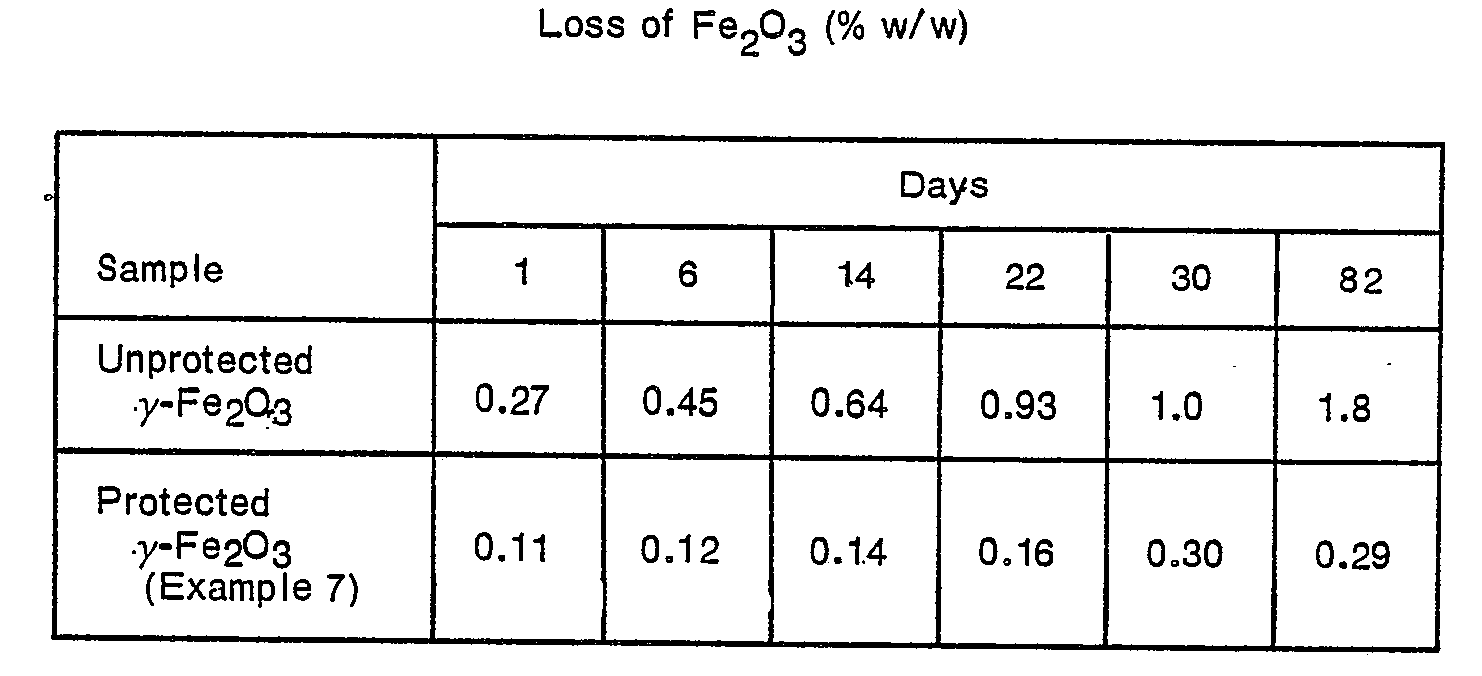
- Similar protection against attack by acetic acid was found with the protected particles of Examples 8 and 9.
- Preparation of beads comprising y-ferric oxide
- A mixture of the pre-treated γ-Fe2O3 (47 g) of Example 4, styrene (69.6 g), divinylbenzene (9.4 g), and the styrene/4-vinylpyridine copolymer (4.0 g) of Example 1 was glass-ball milled for about 4t hours at ambient temperature. Benzoyl peroxide (1.0 g) was then added and the milling continued for 1 hour. The mixture was decanted from the glass balls and added to an aqueous suspension containing polyvinyl alcohol (400 g of 10.76% solution) dissolved in calcium chloride solution (600 mls; 23.0 aqueous solution).
- The mixture was dispersed by vigorous stirring at 250 rpm for about 15-20 minutes.
- At this stage the desired bead size 50-500 ,am) had been achieved and the stirring speed was reduced to 100 rpm. The temperature was raised to 80°C to initiate the styrene/divinylbenzene polymerization (approximately 16 hours).
- The suspension was then diluted with hot water and the coated beads were separated from the polyvinyl alcohol solution by sieves, followed by several successive hot-water washings. The coated beads were finally washed with ethanol and acetone and recovered by filtration.
- Styrene-4-vinylpyridine copolymer (12.6 g) was dissolved into styrene (111 g) and divinylbenzene (7.80 g) monomers. To the monomer mixture was added Cr02 (60 g) and the composite was glass-ball milled for 6 hours. Benzoyl peroxide (1.0 g), as an initiator was added to the mixture and further milled for 1 hour. The glass beads were then separated by filtering the monomer content through a coarse sieve. The filtrate was dispersed into a previously prepared aqueous suspension containing polyvinyl alcohol (PVA) (600 g, of 10.76% solution) dissolved in 900 ml of a 30% calcium chloride solution.
- The composite was dispersed at 200 rpm until the desired bead size of 150-200 µm was obtained. The stirrer speed was then reduced to 100 rpm and the aqueous suspension was heated to 77-80°C (internal) or 90° (external temperature) to initiate the polymerization.
- The suspension was diluted with some hot water and the Cr02 beads were collected by pouring the content through a very fine sieve (usually 100 µm sieve) and washing the beads with copious amounts of warm water to remove any residual PVA on the beads. They were then transferred to a large sintered funnel and further washed with ethanol and with acetone.
- Styrene-4-vinylpyridine copolymer (48.7 g) was dissolved into styrene (333 g) and divinylbenzene (23.6 g) monomers. To the monomer mixture was added Cro2 (130 g) and ZrSi04 (130 g) and the composite was glass-ball milled for 6t hours. Benzoyl peroxide (3.0 g), as an initiator was added and milled into the mixture for another 1 hr. The glass beads were then separated from the monomer mixture by filtration using a coarse sieve. The filtrate was dispersed into a previously prepared aqueous suspension containing PVA (2 000 g, of an 8.75% solution) dissolved in 2 500 g of a 21.6% calcium chloride solution.
- The composite was dispersed at 250 rpm until the desired bead size of 250-700 gm was obtained. The stirrer speed was then reduced to 100 rpm and the aqueous suspension heated to 77-80°C (int) or 90°C (ext) to initiate the polymerization.
- Fairly firm beads were obtained after 2 hours, but left for 16 hours to complete the polymerization. The aqueous suspension was diluted with some hot water and the CrO2/ZrSiO4 beads were filtered through a fine sieve (100 µm sieve) and the collected beads washed with copious amounts of warm water to remove residual PVA adhering on the beads. The beads were then transferred to a large sintered funnel and further washed with ethanol and then with acetone.
Claims (17)
1. A process of preparing polymeric beads containing non-polymeric particulate matter and in a size range from 1 to 1000 micrometres which process comprises a first step of dispersing the non-polymeric particulate matter in a medium comprising one or more vinyl monomers selected from the group consisting of styrene and vinyltoluenes and a cross-linking agent, with a polymeric dispersant which is a copolymer prepared from a first component consisting of at least one monomer selected from the group consisting of vinylaromatic hydrocarbons and a second component consisting of at least one monomer selected from the group consisting of tertiary-nitrogen-containing vinyl monomers and vinyl oxysilanes, a second step of adding a catalyst initiator, and a third step of polymerizing the said vinyl monomers.
2. A process according to claim 1 wherein the non-polymeric particulate matter comprises magnetic particles.
3. A process according to claim 2 wherein the magnetic particles are selected from the group consisting of ferrites and chromium dioxide.
4. A process according to claim 2 or 3 wherein the non-polymeric particulate matter comprises zircon.
5. A process according to any one of claims 1 to 4 wherein the second component is selected from the group consisting of 2-vinylpyridine, 4-vinylpyridine, methyl dimethylamino- methacrylate, vinyltrimethoxysilane, and vinyltriethoxysilane.
6. A process according to any of claims 1 to 5 wherein the copolymer is selected from the group consisting of styrene/2-vinylpyridine, styrene/4-vinylpyridine, and styrene/vinyltriethoxysilane.
7. A process according to claim 6 wherein the copolymer contains from 80 to 97% on a molar basis of the first component and the balance is the second component.
8. A process according to any one of claims 1 to 7 wherein the weight ratio of non-polymeric particulate matter to the polymeric dispersant is in a range from 12:1 to 5:1 and the weight ratio of polymeric dispersant to vinyl monomers is in a range from 1:5 to 1:20.
9. A process according to any one of claims 1 to 8 wherein the crosslinking agent is divinylbenzene.
10. A process according to any one of claims 1 to 9 wherein in the first step the said non- polymeric particulate matter is pre-coated with the said polymeric dispersant and then the said vinyl monomers and the said crosslinking agents are added.
11. A process according to any one of claims 1 to 10 wherein the polymerization is carried out with an organic phase containing the vinyl monomers and an aqueous phase containing a suspension stabilizer.
12. A process according to claim 11 wherein the suspension stabilizer is polyvinyl alcohol.
13. A process according to claim 11 or 12 wherein the weight ratio of organic phase to aqueous phase is in a range from 1:5 to 1:20.
14. A process according to claim 13 wherein the weight ratio of organic phase to aqueous phase is in a range from 1:10 to 1:16.
15. Polymeric beads in a size range from 1 to 1000 ym comprising non-polymeric particulate matter and prepared by the process of any one of claims 1 to 14.
16. Polymeric beads according to claim 15 wherein the non-polymeric particulate matter comprises magnetic particles.
17. Polymeric beads according to claim 16 comprising zircon.
Applications Claiming Priority (2)
| Application Number | Priority Date | Filing Date | Title |
|---|---|---|---|
| AUPD911479 | 1979-06-08 | ||
| AU9114/79 | 1979-06-08 |
Publications (3)
| Publication Number | Publication Date |
|---|---|
| EP0029443A1 EP0029443A1 (en) | 1981-06-03 |
| EP0029443A4 EP0029443A4 (en) | 1981-09-21 |
| EP0029443B1 true EP0029443B1 (en) | 1984-05-16 |
Family
ID=3768137
Family Applications (1)
| Application Number | Title | Priority Date | Filing Date |
|---|---|---|---|
| EP19800901054 Expired EP0029443B1 (en) | 1979-06-08 | 1980-12-15 | Process for composite polymer beads |
Country Status (5)
| Country | Link |
|---|---|
| EP (1) | EP0029443B1 (en) |
| JP (1) | JPH049803B2 (en) |
| DE (1) | DE3038751C1 (en) |
| GB (1) | GB2061293B (en) |
| WO (1) | WO1980002687A1 (en) |
Families Citing this family (6)
| Publication number | Priority date | Publication date | Assignee | Title |
|---|---|---|---|---|
| US5204388A (en) * | 1988-04-13 | 1993-04-20 | Crown Decorative Products Limited | Aqueous surface coating material prepared by emulsion polymerization |
| GB8808755D0 (en) * | 1988-04-13 | 1988-05-18 | Crown Decorative Prod Ltd | Aqueous surface coatings |
| DE4316416A1 (en) * | 1993-05-17 | 1994-11-24 | Roehm Gmbh | Plastic molded body with metal gloss effect |
| AUPM807094A0 (en) * | 1994-09-09 | 1994-10-06 | Commonwealth Scientific And Industrial Research Organisation | Polymer beads and method for preparation thereof |
| DE10235302A1 (en) * | 2002-08-01 | 2004-02-12 | Henkel Kgaa | Process for the production of pearl or spherical magnetic particles based on acrylic acid for the purification of biological substances |
| AU2004251492B2 (en) * | 2003-06-27 | 2011-03-17 | Invitrogen Dynal As | Conjugates of magnetic polymer particles and carboxymethylated aspartic acid |
Family Cites Families (8)
| Publication number | Priority date | Publication date | Assignee | Title |
|---|---|---|---|---|
| GB1073455A (en) * | 1964-12-03 | 1967-06-28 | Imerial Chemical Indutries Ltd | Polymerisation process |
| BE792928A (en) * | 1971-12-18 | 1973-06-18 | Bayer Ag | SORBANT PREPARATION PROCESS |
| US3941718A (en) * | 1972-10-03 | 1976-03-02 | Gaf Corporation | Insoluble crosslinked homopolymers and copolymers, polymerized on an inert substrate |
| SU476279A1 (en) * | 1973-01-05 | 1975-07-05 | Предприятие П/Я В-8172 | The method of producing sorbent |
| US3884871A (en) * | 1973-06-29 | 1975-05-20 | Nl Industries Inc | Process for coating pigment particles with organic polymers |
| SU496287A1 (en) * | 1974-09-27 | 1975-12-25 | Предприятие П/Я В-8172 | The method of producing sorbents |
| US4133774A (en) * | 1977-09-29 | 1979-01-09 | Reprographic Materials, Inc. | Process for preparing direct imaging pressure fixable magnetic toners |
| AU547349B2 (en) * | 1977-10-07 | 1985-10-17 | Commonwealth Scientific And Industrial Research Organisation | Composite material containing crosslinked polymer, adsorbent and magnetic particles |
-
1980
- 1980-06-02 DE DE19803038751 patent/DE3038751C1/en not_active Expired
- 1980-06-02 WO PCT/AU1980/000018 patent/WO1980002687A1/en not_active Ceased
- 1980-06-02 JP JP55501254A patent/JPH049803B2/ja not_active Expired
- 1980-06-02 GB GB8101278A patent/GB2061293B/en not_active Expired
- 1980-12-15 EP EP19800901054 patent/EP0029443B1/en not_active Expired
Also Published As
| Publication number | Publication date |
|---|---|
| GB2061293B (en) | 1983-08-24 |
| JPH049803B2 (en) | 1992-02-21 |
| GB2061293A (en) | 1981-05-13 |
| WO1980002687A1 (en) | 1980-12-11 |
| DE3038751C1 (en) | 1989-05-11 |
| EP0029443A4 (en) | 1981-09-21 |
| JPS56500656A (en) | 1981-05-14 |
| EP0029443A1 (en) | 1981-06-03 |
Similar Documents
| Publication | Publication Date | Title |
|---|---|---|
| US4447475A (en) | Process for composite polymer beads | |
| US6171489B1 (en) | Polymer beads and method for preparation thereof | |
| US5318797A (en) | Coated particles, hollow particles, and process for manufacturing the same | |
| JP2757964B2 (en) | Magnetic attractive particles and method for producing the same | |
| DE3536397A1 (en) | POROESES COMPOSITE MATERIAL, METHOD FOR THE PRODUCTION THEREOF AND THE USE THEREOF FOR SEPARATING METAL ELEMENTS | |
| AU2002314455B2 (en) | Preparation of polymer particles | |
| KR20070037708A (en) | Polymer Beads Impregnated with Iron Oxide Particles | |
| AU2002314455A1 (en) | Preparation of polymer particles | |
| AU534337B2 (en) | Process for composite polymer beads | |
| US4438179A (en) | Resin particles with magnetic particles bonded to surface | |
| WO1980002687A1 (en) | Process for composite polymer beads | |
| AU6053080A (en) | Process for composite polymer beads | |
| TW200302233A (en) | Complexing resins and method for preparation thereof | |
| US4028255A (en) | Preparation of polymer composites | |
| AU744706B2 (en) | Polymer beads and method for preparation thereof | |
| US4532153A (en) | Method of bonding magnetic particles to a resin particle | |
| KR100482277B1 (en) | Magnetic cation exchange resin and preparation method thereof | |
| JPS62244438A (en) | Manufacturing method of magnetic microspheres | |
| CN118925692B (en) | Polymer-coated porous magnetic solid-phase extraction material and preparation method and application thereof | |
| KR102437001B1 (en) | Manufacturing method of polymer beads and magsand including polymer beads | |
| DE3038751T5 (en) | PROCESS FOR COMPOSITE POLYMER BEADS | |
| MXPA97002438A (en) | Polymeric spheres and method for the preparation of mys | |
| KR102096314B1 (en) | Magnetic ion exchange resin for reducing TOC(Total Organic Carbon) and manufacturing method the same | |
| JPH05320534A (en) | Pigment and its production | |
| JPH0149426B2 (en) |
Legal Events
| Date | Code | Title | Description |
|---|---|---|---|
| PUAI | Public reference made under article 153(3) epc to a published international application that has entered the european phase |
Free format text: ORIGINAL CODE: 0009012 |
|
| AK | Designated contracting states |
Designated state(s): FR |
|
| 17P | Request for examination filed |
Effective date: 19810416 |
|
| GRAA | (expected) grant |
Free format text: ORIGINAL CODE: 0009210 |
|
| AK | Designated contracting states |
Designated state(s): FR |
|
| ET | Fr: translation filed | ||
| PLBE | No opposition filed within time limit |
Free format text: ORIGINAL CODE: 0009261 |
|
| STAA | Information on the status of an ep patent application or granted ep patent |
Free format text: STATUS: NO OPPOSITION FILED WITHIN TIME LIMIT |
|
| 26N | No opposition filed | ||
| PGFP | Annual fee paid to national office [announced via postgrant information from national office to epo] |
Ref country code: FR Payment date: 19991111 Year of fee payment: 20 |