EP0029323B1 - Use of vinyl phenol polymer as colour developer for leuco pigment and colour developer composition and thermosensitive recording element comprising same - Google Patents
Use of vinyl phenol polymer as colour developer for leuco pigment and colour developer composition and thermosensitive recording element comprising same Download PDFInfo
- Publication number
- EP0029323B1 EP0029323B1 EP80303948A EP80303948A EP0029323B1 EP 0029323 B1 EP0029323 B1 EP 0029323B1 EP 80303948 A EP80303948 A EP 80303948A EP 80303948 A EP80303948 A EP 80303948A EP 0029323 B1 EP0029323 B1 EP 0029323B1
- Authority
- EP
- European Patent Office
- Prior art keywords
- polymer
- vinyl phenol
- colour developer
- leuco pigment
- leuco
- Prior art date
- Legal status (The legal status is an assumption and is not a legal conclusion. Google has not performed a legal analysis and makes no representation as to the accuracy of the status listed.)
- Expired
Links
Images
Classifications
-
- G—PHYSICS
- G03—PHOTOGRAPHY; CINEMATOGRAPHY; ANALOGOUS TECHNIQUES USING WAVES OTHER THAN OPTICAL WAVES; ELECTROGRAPHY; HOLOGRAPHY
- G03G—ELECTROGRAPHY; ELECTROPHOTOGRAPHY; MAGNETOGRAPHY
- G03G9/00—Developers
- G03G9/08—Developers with toner particles
- G03G9/09—Colouring agents for toner particles
- G03G9/0928—Compounds capable to generate colouring agents by chemical reaction
-
- B—PERFORMING OPERATIONS; TRANSPORTING
- B41—PRINTING; LINING MACHINES; TYPEWRITERS; STAMPS
- B41M—PRINTING, DUPLICATING, MARKING, OR COPYING PROCESSES; COLOUR PRINTING
- B41M5/00—Duplicating or marking methods; Sheet materials for use therein
- B41M5/124—Duplicating or marking methods; Sheet materials for use therein using pressure to make a masked colour visible, e.g. to make a coloured support visible, to create an opaque or transparent pattern, or to form colour by uniting colour-forming components
- B41M5/132—Chemical colour-forming components; Additives or binders therefor
- B41M5/155—Colour-developing components, e.g. acidic compounds; Additives or binders therefor; Layers containing such colour-developing components, additives or binders
-
- B—PERFORMING OPERATIONS; TRANSPORTING
- B41—PRINTING; LINING MACHINES; TYPEWRITERS; STAMPS
- B41M—PRINTING, DUPLICATING, MARKING, OR COPYING PROCESSES; COLOUR PRINTING
- B41M5/00—Duplicating or marking methods; Sheet materials for use therein
- B41M5/26—Thermography ; Marking by high energetic means, e.g. laser otherwise than by burning, and characterised by the material used
- B41M5/30—Thermography ; Marking by high energetic means, e.g. laser otherwise than by burning, and characterised by the material used using chemical colour formers
- B41M5/333—Colour developing components therefor, e.g. acidic compounds
- B41M5/3331—Macromolecular compounds
-
- G—PHYSICS
- G03—PHOTOGRAPHY; CINEMATOGRAPHY; ANALOGOUS TECHNIQUES USING WAVES OTHER THAN OPTICAL WAVES; ELECTROGRAPHY; HOLOGRAPHY
- G03G—ELECTROGRAPHY; ELECTROPHOTOGRAPHY; MAGNETOGRAPHY
- G03G7/00—Selection of materials for use in image-receiving members, i.e. for reversal by physical contact; Manufacture thereof
-
- Y—GENERAL TAGGING OF NEW TECHNOLOGICAL DEVELOPMENTS; GENERAL TAGGING OF CROSS-SECTIONAL TECHNOLOGIES SPANNING OVER SEVERAL SECTIONS OF THE IPC; TECHNICAL SUBJECTS COVERED BY FORMER USPC CROSS-REFERENCE ART COLLECTIONS [XRACs] AND DIGESTS
- Y10—TECHNICAL SUBJECTS COVERED BY FORMER USPC
- Y10S—TECHNICAL SUBJECTS COVERED BY FORMER USPC CROSS-REFERENCE ART COLLECTIONS [XRACs] AND DIGESTS
- Y10S430/00—Radiation imagery chemistry: process, composition, or product thereof
- Y10S430/165—Thermal imaging composition
-
- Y—GENERAL TAGGING OF NEW TECHNOLOGICAL DEVELOPMENTS; GENERAL TAGGING OF CROSS-SECTIONAL TECHNOLOGIES SPANNING OVER SEVERAL SECTIONS OF THE IPC; TECHNICAL SUBJECTS COVERED BY FORMER USPC CROSS-REFERENCE ART COLLECTIONS [XRACs] AND DIGESTS
- Y10—TECHNICAL SUBJECTS COVERED BY FORMER USPC
- Y10T—TECHNICAL SUBJECTS COVERED BY FORMER US CLASSIFICATION
- Y10T428/00—Stock material or miscellaneous articles
- Y10T428/27—Web or sheet containing structurally defined element or component, the element or component having a specified weight per unit area [e.g., gms/sq cm, lbs/sq ft, etc.]
- Y10T428/273—Web or sheet containing structurally defined element or component, the element or component having a specified weight per unit area [e.g., gms/sq cm, lbs/sq ft, etc.] of coating
-
- Y—GENERAL TAGGING OF NEW TECHNOLOGICAL DEVELOPMENTS; GENERAL TAGGING OF CROSS-SECTIONAL TECHNOLOGIES SPANNING OVER SEVERAL SECTIONS OF THE IPC; TECHNICAL SUBJECTS COVERED BY FORMER USPC CROSS-REFERENCE ART COLLECTIONS [XRACs] AND DIGESTS
- Y10—TECHNICAL SUBJECTS COVERED BY FORMER USPC
- Y10T—TECHNICAL SUBJECTS COVERED BY FORMER US CLASSIFICATION
- Y10T428/00—Stock material or miscellaneous articles
- Y10T428/31504—Composite [nonstructural laminate]
- Y10T428/31855—Of addition polymer from unsaturated monomers
- Y10T428/3188—Next to cellulosic
- Y10T428/31895—Paper or wood
Definitions
- the present invention relates to the use of a polymer of a vinyl phenol as a colour developer for a leuco pigment. Furthermore, the present invention relates to a colour developer composition and to a thermosensitive recording element comprising a polymer of a vinyl phenol as a colour developer for a leuco pigment.
- thermosensitive recording elements which comprise a recording layer formed on an appropriate substrate by dispersing in a polymeric binder a leuco pigment, which is colourless or has only a light colour in its normal state, and a phenol which is solid at normal temperatures but fusible under heating to form independent dispersed phases of the leuco pigment and the phenol.
- DE-A-2647696 and DE-A-2703574 describe the use of dimers of compounds of the formula (wherein R 1' R z and R 3 are independently hydrogen, alkyl, aryl or aralkyl and n is an integer from 1 to 4) as colour developers for leuco pigments in such reproduction materials as pressure sensitive or thermosensitive copying papers.
- the dimers need not be pure and may contain minor amounts of monomer and oligomers such as the trimer.
- a vinyl phenol derivative as a colour developer for a leuco pigment, characterised in that the vinyl phenol derivative is a polymer having an average molecular weight of from 600 to 24000 and a melting point or softening point of 120 to 220°C and derived from a vinyl phenol of the formula: or is a halogenated such polymer containing 1 or 2 halogen atoms per phenol ring.
- the invention also provides a colour developer composition
- a colour developer composition comprising a leuco pigment and, as phenolic colour developer, said polymer of a vinyl phenol.
- the polymer of a vinyl phenol that is to be used in accordance with the present invention is a known substance which can be obtained by dehydrogenating ethylphenol in the presence of a catalyst composed of an oxide or iron, magnesium, copper, zinc or chromium, thermally polymerising the resulting phenol at a temperature of, for example, 100 to 140°C, and, if necessary, purifying the resulting polymer.
- the preferred vinyl phenol is p-vinyl phenol.
- the vinyl phenol polymer used in accordance with the invention is different from ordinary phenolic resins in that it has a substantially linear structure composed of repeating addition-polymerised vinyl phenol units, and the weight average molecular weight ( M w) can -be calculated from the intrinsic viscosity (n) as measured at 30°C in tetrahydrofuran according to the following formula:
- the benzene rings of the vinyl phenol polymer may be substituted by 1 or 2 halogen atoms, especially chlorine or bromine atoms, per phenol ring according to need, with brominated polymers of p-vinyl phenol being preferred.
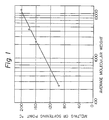
- the melting point increases with an increase of the molecular weight. This is illustrated for p-vinyl phenol polymers by the accompanying drawing which plots the melting or softening point of oligomers of p-vinyl phenol against average molecular weight.
- the melting point or softening point of the polymers that are used in accordance with the present invention is from 120°C to 220°C. It will readily be understood that the sensitive temperature of a thermosensitive recording element can be adjusted over a broad range by controlling the molecular weight of the vinyl phenol.
- the vinyl phenol polymers used in accordance with the invention normally are white or light- orange colour powders. Accordingly, the vinyl phenol polymers are advantageous in that when they are used as a colour developer, the background of, for example, a thermosensitive recording element is hardly coloured by the inherent hue of the colour developer.
- the vinyl phenol polymers for use in accordance with the present invention are water-insoluble but soluble in alcohols such as methanol, cellulosive type solvents such as butylcellosolve, ketones such as methyl ethyl ketone and ester type solvents such as ethyl acetate. Furthermore, the polymers are heat-fusible. Accordingly, the phenols can easily be used for the preparation of recording materials for use in thermosensitive recording, pressure-sensitive recording and electrostatic photographic recording.
- a vinyl phenol polymer and a leuco pigment are independently dispersed in a water-soluble or water-dispersible inactive polymer binder to form a recording layer on a substrate.
- a water-soluble or water-dispersible binder there can be mentioned, for example, polyvinyl alcohol, starch, carboxymethyl starch, hydroxyethyl starch, carboxymethyl cellulose, ethyl cellulose, gum arabic, gelatin, casein, polyvinyl pyrrolidone, polyacrylamide, styrene-maleic acid salt copolymer, vinyl ether-maleic acid salt copolymer and styrene-butadiene copolymer latex.
- the vinyl phenol polymer is wet-pulverised in an aqueous solution or suspension of a resin such as mentioned above by using a ball mill or the like, there is obtained a finely divided dispersion.
- the vinyl phenol polymer is also characterised in that it is relatively brittle and so easy to use in the pulverising operation.
- leuco pigments that have been used for thermosensitive recording papers can be used in accordance with the present invention.
- leuco pigments there can be used triphenylmethane leuco pigments, fluoran type leuco pigments, spiropyran type leuco pigments, Rhodamine lactam type leuco pigments, Auramine type leuco pigments and phenothiazine type leuco pigments, and mixtures of two or more of these.
- Preferred examples of leuco pigments are as follows.
- Benzoyl-Leucomethylene Blue p-chlorobenzoyl-Leucomethylene Blue, 3,4-dichlorobenzoyl-Leucomethylene Blue and p-methoxybenzoyl-Leucomethylene Blue.
- a dispersion of a leuco pigment such as mentioned above can easily be obtained by wet- pulverising the pigment in an aqueous solution or suspension of a water-soluble or water-dispersible binder.
- a composition for formation of a thermosensitive recording layer can be obtained by mixing the so formed dispersion with the above-mentioned dispersion of the vinyl phenol polymer.
- the vinyl phenol polymer when used as a colour developer for a leuco pigment provides a recorded image having a high density even if the concentration of the leuco pigment is low.
- the weight ratio of the leuco pigment to the vinyl phenol polymer is from 1/5 to 1/40, especially from 1/10 to 1/20.
- the binder be used in an amount of 20 to 65% by weight, especially 25 to 50% by weight, based on the combined amount of leuco pigment and colour developer.
- thermosensitive recording layer a white pigment such as titanium oxide may be added to improve the whiteness of the recording layer or as an extender, or a filler such as clay or calcium carbonate may be added for the same purpose.
- a white pigment such as titanium oxide
- a filler such as clay or calcium carbonate
- animal, vegetable and mineral waxes such as paraffin wax and carbauba wax, higher fatty acids and their derivatives such as stearic acid, soaps and fatty acid amides, and synthetic waxes such as polyethylene wax, polypropylene wax and polyethylene glycol.
- alkanolamines such as triethanolamine and other organic bases.
- water resistance- imparting agents and defoaming agents according to need.
- the substrate on which the recording layer is formed there can be used, for example, papers, non-woven fabrics, synthetic papers, films, metal foils and laminates thereof. It is preferred that the recording layer be formed at coating weights of 2 to 10 g/m 2 , especially 3 to 8 g/m 2 , on a dry basis.
- thermosensitive recording element of the present invention is valuable as a recording element in the facsimile, printer, data communications, computer terminal, measuring device, passometer or copying machine using a thermal head, thermal pen, infrared flash lamp or laser as the heat source.
- the vinyl phenol polymer can be used as colour developer not only for thermosensitive recording elements but also for pressure-sensitive recording elements. More specifically, since the vinyl phenol polymer can itself function as the binder, it can easily be coated on a substrate such as paper to provide an underlying sheet of a pressure-sensitive recording element comprising a top sheet coated with a leuco pigment. Of course, in this case also, the polymer may be finely divided and dispersed in a medium of a water-soluble or water-dispersible inactive polymeric binder and be used for formation of a pressure-sensitive colour developer layer. Furthermore, the polymer may be used as the binder and be combined with a known solid acid colour developer.
- the vinyl phenol polymer to be used as a colour developer in accordance with the present invention is heat-fusible and can be charged under application of electricity or by friction, it can be used in the field of electrostatic photographic recording. More specifically, when a dry powder of the vinyl phenol polymer is mixed with a magnetic carrier, the powder is negatively charged. Accordingly, if a positive electrostatic latent image on an electrostatic photographic light-sensitive plate is developed with magnetic brushes of a two-component type developer comprising the vinyl phenol polymer and a known magnetic carrier by known means, a powder image of the polymer is formed on the light-sensitive plate. If this powder image is transferred onto a transfer sheet having a layer of a leuco pigment and the transferred powder image is then heated, an excellent image can be formed by the reaction between the vinyl phenol polymer and the leuco pigment.
- p-Vinyl phenol was polymerised to form a dimer and polymers having average molecular weight of 2300, 4300 and 12000, and their melting points (the softening point in case of the polymer having an average molecular weight of 1200) were examined by using, as the melting point measuring device, Micro Melting Point Apparatus Model No. 428 (manufactured by Shibayama Seisakusho). The relation between the melting point (softening point) and the average molecular weight, thus observed, is shown in Figure 1.
- thermosensitive recording paper can be changed and adjusted by controlling the average molecular weight of the vinyl phenol polymer for use as a colour developer in accordance with the invention.
- a p-vinyl phenol polymer having an average molecular weight of 2300 were pulverised in a ball mill and mixed with 10 parts of Kao Wax # 230 (special esterified wax having a melting point of 80°C; a product of Kao Sekken K.K.) for 20 hours in 735 parts of a 5% by weight aqueous solution of etherified starch (Pio-Starch CM manufactured by Niommen Kagaku K.K.) and 110 parts of water to form a liquid A.
- Kao Wax # 230 special esterified wax having a melting point of 80°C; a product of Kao Sekken K.K.
- a liquid B2 was prepared in the same manner by using 50 parts of Rhodamine lactam instead of Malachite Green lactone.
- liquid B1 and B2 were each added to 20 parts of the liquid A, and the mixtures were stirred well to form coating compositions.
- the coating compositions were independently coated on high quality papers having a basis weight of 55 g/m 2 by a wire bar so that the coating weight of each composition was 5 g/m 2 on a dry basis, and the coated compositions were dried at 60°C, whereby thermosensitive recording papers were prepared.
- the recording papers were passed at a speed of 4 cm/sec between heater rollers maintained at 140°C to effect colour development.
- the density of the developed colour for the composition containing liquid B1 was 0.82 (green filter) while that for the composition containing liquid B2 was 0.70 (visible filter).
- a developer was prepared by mixing 50 parts of fine particles (having a particle size of 20 to 50 m,u) of a p-vinyl phenol polymer (having an average molecular weight of 4300) with 950 parts of iron powder (EFV 200/300 manufactured by Nippon Teppun K.K.).
- the transfer sheets were passed at a speed of 2 cm/sec through heater rollers maintained at 185°C. Clear and sharp positive images having a blue colour and a black colour, respectively, were obtained.
- the p-vinyl phenol polymer used as the toner was charged negatively, and fogging was not observed at all.
- a high quality paper was dipped in a 1% by weight methanol solution of a p-vinyl phenol polymer (having an average molecular weight of 12000) or a brominated p-vinyl phenol polymer (having an average molecular weight of 2400; 3 bromine atoms were added to 2 molecules of the vinyl phenol monomer) and was then dried.
- the back face of an upper sheet of a commercially available pressure-sensitive paper was superimposed on the surface of the above high quality paper, and letters were written on the front face of the pressure-sensitive recording paper by a ball pen. A blue transcript was observed on the surface of each high quality paper.
- the p-vinyl phenol polymer is valuable as a colour developer for pressure-sensitive recording.
Landscapes
- Chemical & Material Sciences (AREA)
- Chemical Kinetics & Catalysis (AREA)
- General Chemical & Material Sciences (AREA)
- Physics & Mathematics (AREA)
- General Physics & Mathematics (AREA)
- Optics & Photonics (AREA)
- Heat Sensitive Colour Forming Recording (AREA)
- Color Printing (AREA)
- Developing Agents For Electrophotography (AREA)
Description
- The present invention relates to the use of a polymer of a vinyl phenol as a colour developer for a leuco pigment. Furthermore, the present invention relates to a colour developer composition and to a thermosensitive recording element comprising a polymer of a vinyl phenol as a colour developer for a leuco pigment.
- Compositions comprising a leuco pigment and an acidic colour developer have been used widely for various methods of recording information, such as thermosensitive recording, pressure-sensitive recording and electrostatic photographic recording. For example, thermosensitive recording elements are known which comprise a recording layer formed on an appropriate substrate by dispersing in a polymeric binder a leuco pigment, which is colourless or has only a light colour in its normal state, and a phenol which is solid at normal temperatures but fusible under heating to form independent dispersed phases of the leuco pigment and the phenol.
- However, known phenolic colour developers for leuco pigments are not entirely satisfactory. For example, in order to obtain a recorded image having a certain density for a constant coating weight of colour developer composition, it is necessary to use the expensive leuco pigment in a large proportion. Accordingly, the cost of a recording material, for example a thermosensitive recording element, is increased and fogging is readily caused in the thermosensitive recording element.
- It is known that among known phenolic colour developers, some phenols, for example bis-2,2-(4-hydroxyphenyl)propane, have a reduced tendency to cause fogging. However, these phenols have a relatively high melting point, and therefore, they are still unsatisfactory in that a high temperature heat source is necessary to effect thermosensitive recording.
- DE-A-2647696 and DE-A-2703574 describe the use of dimers of compounds of the formula

- It has now been found that a polymer of a vinyl phenol is an excellent colour developer for a leuco pigment and that when such a polymer is used, even if it is used at a concentration much lower than the concentrations customarily used for known colour developer for leuco pigments, recorded images having a high density can be obtained.
- More specifically, in accordance with the present invention there is provided the use of a vinyl phenol derivative as a colour developer for a leuco pigment, characterised in that the vinyl phenol derivative is a polymer having an average molecular weight of from 600 to 24000 and a melting point or softening point of 120 to 220°C and derived from a vinyl phenol of the formula:

- The invention also provides a colour developer composition comprising a leuco pigment and, as phenolic colour developer, said polymer of a vinyl phenol.
- The polymer of a vinyl phenol that is to be used in accordance with the present invention is a known substance which can be obtained by dehydrogenating ethylphenol in the presence of a catalyst composed of an oxide or iron, magnesium, copper, zinc or chromium, thermally polymerising the resulting phenol at a temperature of, for example, 100 to 140°C, and, if necessary, purifying the resulting polymer.
- The preferred vinyl phenol is p-vinyl phenol.
- The vinyl phenol polymer used in accordance with the invention is different from ordinary phenolic resins in that it has a substantially linear structure composed of repeating addition-polymerised vinyl phenol units, and the weight average molecular weight (
M w) can -be calculated from the intrinsic viscosity (n) as measured at 30°C in tetrahydrofuran according to the following formula:
- The benzene rings of the vinyl phenol polymer may be substituted by 1 or 2 halogen atoms, especially chlorine or bromine atoms, per phenol ring according to need, with brominated polymers of p-vinyl phenol being preferred.
- In the vinyl phenol polymers used in accordance with the invention, the melting point increases with an increase of the molecular weight. This is illustrated for p-vinyl phenol polymers by the accompanying drawing which plots the melting or softening point of oligomers of p-vinyl phenol against average molecular weight. The melting point or softening point of the polymers that are used in accordance with the present invention is from 120°C to 220°C. It will readily be understood that the sensitive temperature of a thermosensitive recording element can be adjusted over a broad range by controlling the molecular weight of the vinyl phenol.
- The vinyl phenol polymers used in accordance with the invention normally are white or light- orange colour powders. Accordingly, the vinyl phenol polymers are advantageous in that when they are used as a colour developer, the background of, for example, a thermosensitive recording element is hardly coloured by the inherent hue of the colour developer.
- The vinyl phenol polymers for use in accordance with the present invention are water-insoluble but soluble in alcohols such as methanol, cellulosive type solvents such as butylcellosolve, ketones such as methyl ethyl ketone and ester type solvents such as ethyl acetate. Furthermore, the polymers are heat-fusible. Accordingly, the phenols can easily be used for the preparation of recording materials for use in thermosensitive recording, pressure-sensitive recording and electrostatic photographic recording.
- In preparing a thermosensitive recording element, a vinyl phenol polymer and a leuco pigment are independently dispersed in a water-soluble or water-dispersible inactive polymer binder to form a recording layer on a substrate. As the water-soluble or water-dispersible binder, there can be mentioned, for example, polyvinyl alcohol, starch, carboxymethyl starch, hydroxyethyl starch, carboxymethyl cellulose, ethyl cellulose, gum arabic, gelatin, casein, polyvinyl pyrrolidone, polyacrylamide, styrene-maleic acid salt copolymer, vinyl ether-maleic acid salt copolymer and styrene-butadiene copolymer latex. If the vinyl phenol polymer is wet-pulverised in an aqueous solution or suspension of a resin such as mentioned above by using a ball mill or the like, there is obtained a finely divided dispersion.
- The vinyl phenol polymer is also characterised in that it is relatively brittle and so easy to use in the pulverising operation.
- All leuco pigments that have been used for thermosensitive recording papers can be used in accordance with the present invention. For example, there can be used triphenylmethane leuco pigments, fluoran type leuco pigments, spiropyran type leuco pigments, Rhodamine lactam type leuco pigments, Auramine type leuco pigments and phenothiazine type leuco pigments, and mixtures of two or more of these. Preferred examples of leuco pigments are as follows.
- 3,3 - Bis - (p - dimethylaminophenyl)phthalide, 3,3 - bis - (p - dimethylaminophenol) - 6 - dimethylaminophthalide, 3,3 - bis - (p - dimethylaminophenyl) - 6 - methoxyphthalide, 4 - hydroxy - 4' - dimethylaminotriphenylmethane lactone and 4,4' - bis - dihydroxy - 3,3' - bis - diaminotriphenylmethane lactone.
- 3 - Dimethylamino - 5,7 - dimethylfluoran, 3 - diethylamino - 5,7 - dimethylfuoran, 3 - dimethylamino - 6,7 - dimethylfluoran, 3 - cyclohexylamino - 6 - methoxyfluoran, 3,6 - bis - f3 - methoxyethoxyfluoran, 3 - diethylamino - 7 - dibenzylaminofluoran, 3 - diethylamino - 6 - methyl - 7 - chlorofluoran, 3 - dimethylamino - 6 - methyl - 5 - methyl - 7 - anilinofluoran, 3,7 - bis - di- ethylaminofluoran and 3 - dimethyiamino - 7 - methoxyfluoran.
- 8' - Methoxybenzoindolinospiropyran, 3 - phenyl - 8' - methoxybenzoindolinospiropyran, 6' - chloro - 8' - methoxybenzoindolinospiropyran, 5,6' - dichloro - 8' - methoxybenzoindolinospiropyran, 4,7,8' - trimethoxybenzoindolinospiropyran, benzo - β - naphthospiropyran, 3 - methyl - di - f3 - naphthospiropyran and 1,3,3 - trimethyl - 6' - chloro - 8' - methoxyindolinobenzospiropyran.
- 9 - (p - Nitroanilino) - 3,6 - bis - (diethylamino) - 9 - xanthyl - o - benzoic acid lactam and 2 - [3,6 - bis - (diethyiamino) - 9 - (o - chloroanilino)xanthyl]benzoic acid lactam.
- 2,5 - Dichloro - N - phenylleuco - Auramine, 4,4' - bis - dimethylamino - 3,4 - chlorophenylleuco - Auramine and 4,4' - bis - dimethylaminopiperazine - Hydrol.
- Benzoyl-Leucomethylene Blue, p-chlorobenzoyl-Leucomethylene Blue, 3,4-dichlorobenzoyl-Leucomethylene Blue and p-methoxybenzoyl-Leucomethylene Blue.
- A dispersion of a leuco pigment such as mentioned above can easily be obtained by wet- pulverising the pigment in an aqueous solution or suspension of a water-soluble or water-dispersible binder. A composition for formation of a thermosensitive recording layer can be obtained by mixing the so formed dispersion with the above-mentioned dispersion of the vinyl phenol polymer.
- As pointed out hereinbefore, the vinyl phenol polymer when used as a colour developer for a leuco pigment provides a recorded image having a high density even if the concentration of the leuco pigment is low. In the present invention, it is preferred that the weight ratio of the leuco pigment to the vinyl phenol polymer is from 1/5 to 1/40, especially from 1/10 to 1/20.
- Furthermore, it is preferred that the binder be used in an amount of 20 to 65% by weight, especially 25 to 50% by weight, based on the combined amount of leuco pigment and colour developer.
- Known additives may be incorporated in known amounts so as to improve various properties of the thermosensitive recording layer. For example, a white pigment such as titanium oxide may be added to improve the whiteness of the recording layer or as an extender, or a filler such as clay or calcium carbonate may be added for the same purpose. Furthermore, in order to adjust the recording sensitivity, there may be added animal, vegetable and mineral waxes such as paraffin wax and carbauba wax, higher fatty acids and their derivatives such as stearic acid, soaps and fatty acid amides, and synthetic waxes such as polyethylene wax, polypropylene wax and polyethylene glycol. Moreover, in order to inhibit coloration of the background, there may be used alkanolamines such as triethanolamine and other organic bases. Still further, there may be incorporated water resistance- imparting agents and defoaming agents according to need.
- As the substrate on which the recording layer is formed, there can be used, for example, papers, non-woven fabrics, synthetic papers, films, metal foils and laminates thereof. It is preferred that the recording layer be formed at coating weights of 2 to 10 g/m2, especially 3 to 8 g/m2, on a dry basis.
- The thermosensitive recording element of the present invention is valuable as a recording element in the facsimile, printer, data communications, computer terminal, measuring device, passometer or copying machine using a thermal head, thermal pen, infrared flash lamp or laser as the heat source.
- The vinyl phenol polymer can be used as colour developer not only for thermosensitive recording elements but also for pressure-sensitive recording elements. More specifically, since the vinyl phenol polymer can itself function as the binder, it can easily be coated on a substrate such as paper to provide an underlying sheet of a pressure-sensitive recording element comprising a top sheet coated with a leuco pigment. Of course, in this case also, the polymer may be finely divided and dispersed in a medium of a water-soluble or water-dispersible inactive polymeric binder and be used for formation of a pressure-sensitive colour developer layer. Furthermore, the polymer may be used as the binder and be combined with a known solid acid colour developer.
- Moreover, since the vinyl phenol polymer to be used as a colour developer in accordance with the present invention is heat-fusible and can be charged under application of electricity or by friction, it can be used in the field of electrostatic photographic recording. More specifically, when a dry powder of the vinyl phenol polymer is mixed with a magnetic carrier, the powder is negatively charged. Accordingly, if a positive electrostatic latent image on an electrostatic photographic light-sensitive plate is developed with magnetic brushes of a two-component type developer comprising the vinyl phenol polymer and a known magnetic carrier by known means, a powder image of the polymer is formed on the light-sensitive plate. If this powder image is transferred onto a transfer sheet having a layer of a leuco pigment and the transferred powder image is then heated, an excellent image can be formed by the reaction between the vinyl phenol polymer and the leuco pigment.
- The present invention will now be described with reference to the following Examples, in which all parts are by weight.
- p-Vinyl phenol was polymerised to form a dimer and polymers having average molecular weight of 2300, 4300 and 12000, and their melting points (the softening point in case of the polymer having an average molecular weight of 1200) were examined by using, as the melting point measuring device, Micro Melting Point Apparatus Model No. 428 (manufactured by Shibayama Seisakusho). The relation between the melting point (softening point) and the average molecular weight, thus observed, is shown in Figure 1.
- From Figure 1, it is seen that the melting point of polymers to be used in accordance with the invention can be chosen within a broad range of from about 120 to.200°C and it is one of the advantages of the present invention that the sensitive temperature of a thermosensitive recording paper can be changed and adjusted by controlling the average molecular weight of the vinyl phenol polymer for use as a colour developer in accordance with the invention.
- 100 Parts of a p-vinyl phenol polymer having an average molecular weight of 2300 were pulverised in a ball mill and mixed with 10 parts of Kao Wax #230 (special esterified wax having a melting point of 80°C; a product of Kao Sekken K.K.) for 20 hours in 735 parts of a 5% by weight aqueous solution of etherified starch (Pio-Starch CM manufactured by Nichiden Kagaku K.K.) and 110 parts of water to form a liquid A.
- 50 parts of Malachite Green lactone was pulverised for 20 hours in a ball mill in 330 parts of a 5% by weight aqueous solution of the above-mentioned etherified starch and 50 parts of water to form a liquid B1. A liquid B2 was prepared in the same manner by using 50 parts of Rhodamine lactam instead of Malachite Green lactone.
- Then, 3.6 parts of liquid B1 and B2 were each added to 20 parts of the liquid A, and the mixtures were stirred well to form coating compositions.
- The coating compositions were independently coated on high quality papers having a basis weight of 55 g/m2 by a wire bar so that the coating weight of each composition was 5 g/m2 on a dry basis, and the coated compositions were dried at 60°C, whereby thermosensitive recording papers were prepared. The recording papers were passed at a speed of 4 cm/sec between heater rollers maintained at 140°C to effect colour development.
- The density of the developed colour for the composition containing liquid B1 was 0.82 (green filter) while that for the composition containing liquid B2 was 0.70 (visible filter).
- A developer was prepared by mixing 50 parts of fine particles (having a particle size of 20 to 50 m,u) of a p-vinyl phenol polymer (having an average molecular weight of 4300) with 950 parts of iron powder (
EFV 200/300 manufactured by Nippon Teppun K.K.). The surface of a photosensitive plate comprising a photosensitive layer of polyvinyl carbazole/2,4,7-trinitrofluoroenone (molar ratio= 1/0.4) having a thickness of 12 m,u and formed on an aluminium foil (having a thickness of 100 mµ) was positively charged at 6 KV in the dark by corona discharge, and the photosensitive plate was exposed imagewise through a positive original according to customary electrophotographic operations. Then, magnetic brush development was carried out using the above-mentioned developer, and the developed image was transferred by corona discharge onto a transfer sheet formed by dipping a high quality paper (having a basis weight of 55 g/m2) in a 0.5% by weight tetrahydrofuran solution of Crystal Violet lactone and a transfer sheet formed by coating a high quality paper (having a basis weight of 55 g/m2) with a leuco pigment dispersion prepared by pulverizing 50 parts of 3-dimethylamino-6-methyl-7-anilinofluoran in a ball mill for 20 hours in 330 parts of a 5% by weight aqueous solution of polyacrylamide and 50 parts of water. After the transfer operations, the transfer sheets were passed at a speed of 2 cm/sec through heater rollers maintained at 185°C. Clear and sharp positive images having a blue colour and a black colour, respectively, were obtained. The p-vinyl phenol polymer used as the toner was charged negatively, and fogging was not observed at all. - A high quality paper was dipped in a 1% by weight methanol solution of a p-vinyl phenol polymer (having an average molecular weight of 12000) or a brominated p-vinyl phenol polymer (having an average molecular weight of 2400; 3 bromine atoms were added to 2 molecules of the vinyl phenol monomer) and was then dried. The back face of an upper sheet of a commercially available pressure-sensitive paper was superimposed on the surface of the above high quality paper, and letters were written on the front face of the pressure-sensitive recording paper by a ball pen. A blue transcript was observed on the surface of each high quality paper. Thus, it was confirmed that the p-vinyl phenol polymer is valuable as a colour developer for pressure-sensitive recording.
Claims (6)

Applications Claiming Priority (2)
| Application Number | Priority Date | Filing Date | Title |
|---|---|---|---|
| JP14899679A JPS5672991A (en) | 1979-11-19 | 1979-11-19 | Color former for coloring substance of leucoline and recording material made by use thereof |
| JP148996/79 | 1979-11-19 |
Publications (3)
| Publication Number | Publication Date |
|---|---|
| EP0029323A2 EP0029323A2 (en) | 1981-05-27 |
| EP0029323A3 EP0029323A3 (en) | 1981-10-28 |
| EP0029323B1 true EP0029323B1 (en) | 1984-09-05 |
Family
ID=15465365
Family Applications (1)
| Application Number | Title | Priority Date | Filing Date |
|---|---|---|---|
| EP80303948A Expired EP0029323B1 (en) | 1979-11-19 | 1980-11-05 | Use of vinyl phenol polymer as colour developer for leuco pigment and colour developer composition and thermosensitive recording element comprising same |
Country Status (4)
| Country | Link |
|---|---|
| US (1) | US4349600A (en) |
| EP (1) | EP0029323B1 (en) |
| JP (1) | JPS5672991A (en) |
| DE (1) | DE3069109D1 (en) |
Families Citing this family (8)
| Publication number | Priority date | Publication date | Assignee | Title |
|---|---|---|---|---|
| GB2116577B (en) * | 1981-12-25 | 1985-12-04 | Pentel Kk | Ink and eraser of ink |
| DE3246539A1 (en) * | 1982-12-16 | 1984-06-20 | Rütgerswerke AG, 6000 Frankfurt | DEVELOPER RESINS FOR LEUCOPIGMENT |
| US4877767A (en) * | 1987-08-14 | 1989-10-31 | The Mead Corporation | Vinyl developer resins |
| US5008237A (en) * | 1987-08-14 | 1991-04-16 | The Mead Corporation | Vinyl developer resins |
| US4853364A (en) * | 1988-02-05 | 1989-08-01 | The Mead Corporation | Developer composition comprising phenol resins and vinylic or acrylic resins |
| JPH082106A (en) * | 1994-06-24 | 1996-01-09 | Nippon Kayaku Co Ltd | Marking composition and laser marking method |
| EP3173249A1 (en) * | 2015-11-30 | 2017-05-31 | Agfa-Gevaert | Laser markable compositions and methods to manufacture a packaging therewith |
| JP7424053B2 (en) * | 2019-12-27 | 2024-01-30 | コニカミノルタ株式会社 | Toner for developing electrostatic images and method for producing the same |
Family Cites Families (9)
| Publication number | Priority date | Publication date | Assignee | Title |
|---|---|---|---|---|
| US3669658A (en) * | 1969-06-11 | 1972-06-13 | Fuji Photo Film Co Ltd | Photosensitive printing plate |
| US4054712A (en) * | 1971-11-15 | 1977-10-18 | Canon Kabushiki Kaisha | Toner image receiving sheet with color forming agents |
| GB1375461A (en) * | 1972-05-05 | 1974-11-27 | ||
| JPS51105389A (en) * | 1975-03-01 | 1976-09-17 | Kenji Kanezaki | Kojundo pp binirufuenoorujugotaino seizohoho |
| JPS5841756B2 (en) * | 1975-10-28 | 1983-09-14 | 富士写真フイルム株式会社 | Kilok sheet |
| JPS5286340A (en) * | 1976-01-12 | 1977-07-18 | Fuji Photo Film Co Ltd | Heat-sensitive or electroconductive heat-sensitive recording sheet |
| US4147830A (en) * | 1976-01-28 | 1979-04-03 | Fuji Photo Film Co., Ltd. | Recording sheet |
| JPS5386229A (en) * | 1977-01-07 | 1978-07-29 | Kanzaki Paper Mfg Co Ltd | Thermosensitive recording body |
| US4147645A (en) * | 1977-12-23 | 1979-04-03 | Xerox Corporation | Electrographic flash fusing toners |
-
1979
- 1979-11-19 JP JP14899679A patent/JPS5672991A/en active Pending
-
1980
- 1980-10-28 US US06/201,591 patent/US4349600A/en not_active Expired - Lifetime
- 1980-11-05 DE DE8080303948T patent/DE3069109D1/en not_active Expired
- 1980-11-05 EP EP80303948A patent/EP0029323B1/en not_active Expired
Also Published As
| Publication number | Publication date |
|---|---|
| DE3069109D1 (en) | 1984-10-11 |
| EP0029323A2 (en) | 1981-05-27 |
| EP0029323A3 (en) | 1981-10-28 |
| JPS5672991A (en) | 1981-06-17 |
| US4349600A (en) | 1982-09-14 |
Similar Documents
| Publication | Publication Date | Title |
|---|---|---|
| US4349600A (en) | Color developer for leuco pigment and recording material comprising same | |
| JPS59214686A (en) | Recording material | |
| US4289535A (en) | Heat sensitive coating | |
| EP0275203A2 (en) | Heat-sensitive recording material containing color forming components | |
| US4411700A (en) | Desensitizer compositions | |
| US4920091A (en) | Recording material | |
| GB2128502A (en) | Process for producing heat-sensitive recording paper | |
| US4707464A (en) | Recording material | |
| GB2047728A (en) | Fluoran compounds process for their preparation and recording sheets incorporating them | |
| JPH0323986A (en) | Thermal recording material | |
| JPS60123557A (en) | Fluoran derivative, and recording material using it | |
| JPH0549034B2 (en) | ||
| EP0399831B1 (en) | Heat-sensitive recording material | |
| JPH0471891A (en) | Recording material | |
| JPH0225369A (en) | Recording material | |
| JPH0226783A (en) | Recording material | |
| JPH0229376A (en) | Recording material | |
| JPH0239516B2 (en) | ||
| JPS63162280A (en) | Recording material | |
| JPS6378790A (en) | Recording material | |
| JPS6211677A (en) | Recording material | |
| JPH05221132A (en) | Thermal recording material | |
| JPS61109757A (en) | Color-developing compound and heat-sensitive recording material | |
| JPH058545A (en) | Thermal recording material | |
| JPS6394877A (en) | Recording material |
Legal Events
| Date | Code | Title | Description |
|---|---|---|---|
| PUAI | Public reference made under article 153(3) epc to a published international application that has entered the european phase |
Free format text: ORIGINAL CODE: 0009012 |
|
| AK | Designated contracting states |
Designated state(s): DE FR GB |
|
| PUAL | Search report despatched |
Free format text: ORIGINAL CODE: 0009013 |
|
| AK | Designated contracting states |
Designated state(s): DE FR GB |
|
| 17P | Request for examination filed |
Effective date: 19811204 |
|
| GRAA | (expected) grant |
Free format text: ORIGINAL CODE: 0009210 |
|
| AK | Designated contracting states |
Designated state(s): DE FR GB |
|
| REF | Corresponds to: |
Ref document number: 3069109 Country of ref document: DE Date of ref document: 19841011 |
|
| ET | Fr: translation filed | ||
| PGFP | Annual fee paid to national office [announced via postgrant information from national office to epo] |
Ref country code: FR Payment date: 19841108 Year of fee payment: 5 |
|
| PGFP | Annual fee paid to national office [announced via postgrant information from national office to epo] |
Ref country code: DE Payment date: 19841116 Year of fee payment: 5 |
|
| PLBE | No opposition filed within time limit |
Free format text: ORIGINAL CODE: 0009261 |
|
| STAA | Information on the status of an ep patent application or granted ep patent |
Free format text: STATUS: NO OPPOSITION FILED WITHIN TIME LIMIT |
|
| 26N | No opposition filed | ||
| GBPC | Gb: european patent ceased through non-payment of renewal fee | ||
| PG25 | Lapsed in a contracting state [announced via postgrant information from national office to epo] |
Ref country code: FR Free format text: LAPSE BECAUSE OF NON-PAYMENT OF DUE FEES Effective date: 19860731 |
|
| PG25 | Lapsed in a contracting state [announced via postgrant information from national office to epo] |
Ref country code: DE Effective date: 19860801 |
|
| REG | Reference to a national code |
Ref country code: FR Ref legal event code: ST |
|
| PG25 | Lapsed in a contracting state [announced via postgrant information from national office to epo] |
Ref country code: GB Effective date: 19881118 |