EP0028897B1 - Preparation of products for human or animal consumption using a sucrose substitute - Google Patents
Preparation of products for human or animal consumption using a sucrose substitute Download PDFInfo
- Publication number
- EP0028897B1 EP0028897B1 EP80303795A EP80303795A EP0028897B1 EP 0028897 B1 EP0028897 B1 EP 0028897B1 EP 80303795 A EP80303795 A EP 80303795A EP 80303795 A EP80303795 A EP 80303795A EP 0028897 B1 EP0028897 B1 EP 0028897B1
- Authority
- EP
- European Patent Office
- Prior art keywords
- sucrose
- isomaltulose
- product
- ingredient
- products
- Prior art date
- Legal status (The legal status is an assumption and is not a legal conclusion. Google has not performed a legal analysis and makes no representation as to the accuracy of the status listed.)
- Expired
Links
- 239000005720 sucrose Substances 0.000 title claims abstract description 96
- CZMRCDWAGMRECN-UGDNZRGBSA-N Sucrose Chemical compound O[C@H]1[C@H](O)[C@@H](CO)O[C@@]1(CO)O[C@@H]1[C@H](O)[C@@H](O)[C@H](O)[C@@H](CO)O1 CZMRCDWAGMRECN-UGDNZRGBSA-N 0.000 title claims abstract description 93
- 229930006000 Sucrose Natural products 0.000 title claims abstract description 93
- 241001465754 Metazoa Species 0.000 title claims abstract description 12
- 238000002360 preparation method Methods 0.000 title claims description 12
- PVXPPJIGRGXGCY-TZLCEDOOSA-N 6-O-alpha-D-glucopyranosyl-D-fructofuranose Chemical compound O[C@@H]1[C@@H](O)[C@H](O)[C@@H](CO)O[C@@H]1OC[C@@H]1[C@@H](O)[C@H](O)C(O)(CO)O1 PVXPPJIGRGXGCY-TZLCEDOOSA-N 0.000 claims abstract description 85
- 239000000047 product Substances 0.000 claims description 42
- 239000004615 ingredient Substances 0.000 claims description 31
- 239000000203 mixture Substances 0.000 claims description 23
- 235000013305 food Nutrition 0.000 claims description 22
- 235000009508 confectionery Nutrition 0.000 claims description 16
- 238000000034 method Methods 0.000 claims description 16
- 239000012141 concentrate Substances 0.000 claims description 5
- 239000000606 toothpaste Substances 0.000 claims description 5
- 239000013588 oral product Substances 0.000 claims description 4
- 235000015218 chewing gum Nutrition 0.000 claims description 3
- 235000013611 frozen food Nutrition 0.000 claims description 3
- 239000007788 liquid Substances 0.000 claims description 3
- 239000000843 powder Substances 0.000 claims description 3
- 235000014214 soft drink Nutrition 0.000 claims description 3
- 239000007787 solid Substances 0.000 claims description 3
- 235000013361 beverage Nutrition 0.000 claims description 2
- 229940112822 chewing gum Drugs 0.000 claims description 2
- 238000010411 cooking Methods 0.000 claims description 2
- 238000010438 heat treatment Methods 0.000 claims description 2
- 239000006210 lotion Substances 0.000 claims description 2
- 239000002324 mouth wash Substances 0.000 claims description 2
- 229940034610 toothpaste Drugs 0.000 claims description 2
- UHZZMRAGKVHANO-UHFFFAOYSA-M chlormequat chloride Chemical compound [Cl-].C[N+](C)(C)CCCl UHZZMRAGKVHANO-UHFFFAOYSA-M 0.000 claims 2
- 229940051866 mouthwash Drugs 0.000 claims 1
- 229940023486 oral product Drugs 0.000 claims 1
- 235000013324 preserved food Nutrition 0.000 claims 1
- 230000036961 partial effect Effects 0.000 abstract description 6
- 229960004793 sucrose Drugs 0.000 description 90
- 235000015149 toffees Nutrition 0.000 description 15
- 235000012970 cakes Nutrition 0.000 description 13
- 239000000126 substance Substances 0.000 description 13
- 239000000796 flavoring agent Substances 0.000 description 11
- 235000019634 flavors Nutrition 0.000 description 11
- 238000004519 manufacturing process Methods 0.000 description 10
- WQZGKKKJIJFFOK-GASJEMHNSA-N Glucose Natural products OC[C@H]1OC(O)[C@H](O)[C@@H](O)[C@@H]1O WQZGKKKJIJFFOK-GASJEMHNSA-N 0.000 description 9
- 241000220324 Pyrus Species 0.000 description 8
- 235000015895 biscuits Nutrition 0.000 description 8
- XLYOFNOQVPJJNP-UHFFFAOYSA-N water Substances O XLYOFNOQVPJJNP-UHFFFAOYSA-N 0.000 description 8
- 239000008103 glucose Substances 0.000 description 7
- 235000021017 pears Nutrition 0.000 description 7
- 235000009499 Vanilla fragrans Nutrition 0.000 description 6
- 235000012036 Vanilla tahitensis Nutrition 0.000 description 6
- 241001622809 Serratia plymuthica Species 0.000 description 5
- WQZGKKKJIJFFOK-VFUOTHLCSA-N beta-D-glucose Chemical compound OC[C@H]1O[C@@H](O)[C@H](O)[C@@H](O)[C@@H]1O WQZGKKKJIJFFOK-VFUOTHLCSA-N 0.000 description 5
- 238000006243 chemical reaction Methods 0.000 description 5
- 235000013399 edible fruits Nutrition 0.000 description 5
- 239000000686 essence Substances 0.000 description 5
- 235000011962 puddings Nutrition 0.000 description 5
- 244000263375 Vanilla tahitensis Species 0.000 description 4
- 230000001580 bacterial effect Effects 0.000 description 4
- 235000013405 beer Nutrition 0.000 description 4
- 230000015572 biosynthetic process Effects 0.000 description 4
- 150000001875 compounds Chemical class 0.000 description 4
- 230000000694 effects Effects 0.000 description 4
- 238000000855 fermentation Methods 0.000 description 4
- 230000004151 fermentation Effects 0.000 description 4
- 238000009472 formulation Methods 0.000 description 4
- 235000015243 ice cream Nutrition 0.000 description 4
- 210000000214 mouth Anatomy 0.000 description 4
- AVTYONGGKAJVTE-OLXYHTOASA-L potassium L-tartrate Chemical compound [K+].[K+].[O-]C(=O)[C@H](O)[C@@H](O)C([O-])=O AVTYONGGKAJVTE-OLXYHTOASA-L 0.000 description 4
- 230000002829 reductive effect Effects 0.000 description 4
- 235000020357 syrup Nutrition 0.000 description 4
- 239000006188 syrup Substances 0.000 description 4
- 241000894006 Bacteria Species 0.000 description 3
- 239000006227 byproduct Substances 0.000 description 3
- 239000003153 chemical reaction reagent Substances 0.000 description 3
- 235000008504 concentrate Nutrition 0.000 description 3
- 238000002425 crystallisation Methods 0.000 description 3
- 230000008025 crystallization Effects 0.000 description 3
- 239000003814 drug Substances 0.000 description 3
- 235000003599 food sweetener Nutrition 0.000 description 3
- 238000005984 hydrogenation reaction Methods 0.000 description 3
- 235000015122 lemonade Nutrition 0.000 description 3
- 239000000463 material Substances 0.000 description 3
- 238000002156 mixing Methods 0.000 description 3
- 235000013615 non-nutritive sweetener Nutrition 0.000 description 3
- 235000015145 nougat Nutrition 0.000 description 3
- 229940111695 potassium tartrate Drugs 0.000 description 3
- 239000001472 potassium tartrate Substances 0.000 description 3
- 235000011005 potassium tartrates Nutrition 0.000 description 3
- 235000019204 saccharin Nutrition 0.000 description 3
- CVHZOJJKTDOEJC-UHFFFAOYSA-N saccharin Chemical compound C1=CC=C2C(=O)NS(=O)(=O)C2=C1 CVHZOJJKTDOEJC-UHFFFAOYSA-N 0.000 description 3
- 229940081974 saccharin Drugs 0.000 description 3
- 239000000901 saccharin and its Na,K and Ca salt Substances 0.000 description 3
- 239000000243 solution Substances 0.000 description 3
- 239000003765 sweetening agent Substances 0.000 description 3
- MIDXCONKKJTLDX-UHFFFAOYSA-N 3,5-dimethylcyclopentane-1,2-dione Chemical compound CC1CC(C)C(=O)C1=O MIDXCONKKJTLDX-UHFFFAOYSA-N 0.000 description 2
- 244000144725 Amygdalus communis Species 0.000 description 2
- 240000006766 Cornus mas Species 0.000 description 2
- 235000003363 Cornus mas Nutrition 0.000 description 2
- 102000002322 Egg Proteins Human genes 0.000 description 2
- 108010000912 Egg Proteins Proteins 0.000 description 2
- 102000004190 Enzymes Human genes 0.000 description 2
- 108090000790 Enzymes Proteins 0.000 description 2
- 229930091371 Fructose Natural products 0.000 description 2
- 239000005715 Fructose Substances 0.000 description 2
- RFSUNEUAIZKAJO-ARQDHWQXSA-N Fructose Chemical compound OC[C@H]1O[C@](O)(CO)[C@@H](O)[C@@H]1O RFSUNEUAIZKAJO-ARQDHWQXSA-N 0.000 description 2
- AYRXSINWFIIFAE-SCLMCMATSA-N Isomaltose Natural products OC[C@H]1O[C@H](OC[C@@H](O)[C@@H](O)[C@H](O)[C@@H](O)C=O)[C@@H](O)[C@@H](O)[C@@H]1O AYRXSINWFIIFAE-SCLMCMATSA-N 0.000 description 2
- 241000192130 Leuconostoc mesenteroides Species 0.000 description 2
- 240000000111 Saccharum officinarum Species 0.000 description 2
- 235000007201 Saccharum officinarum Nutrition 0.000 description 2
- 244000299461 Theobroma cacao Species 0.000 description 2
- ATJFFYVFTNAWJD-UHFFFAOYSA-N Tin Chemical compound [Sn] ATJFFYVFTNAWJD-UHFFFAOYSA-N 0.000 description 2
- 244000290333 Vanilla fragrans Species 0.000 description 2
- 235000013334 alcoholic beverage Nutrition 0.000 description 2
- 235000020224 almond Nutrition 0.000 description 2
- 235000013736 caramel Nutrition 0.000 description 2
- 150000001720 carbohydrates Chemical class 0.000 description 2
- 238000001311 chemical methods and process Methods 0.000 description 2
- 235000019219 chocolate Nutrition 0.000 description 2
- 239000013078 crystal Substances 0.000 description 2
- 229940109275 cyclamate Drugs 0.000 description 2
- HCAJEUSONLESMK-UHFFFAOYSA-N cyclohexylsulfamic acid Chemical compound OS(=O)(=O)NC1CCCCC1 HCAJEUSONLESMK-UHFFFAOYSA-N 0.000 description 2
- 208000002925 dental caries Diseases 0.000 description 2
- 239000008121 dextrose Substances 0.000 description 2
- 235000014103 egg white Nutrition 0.000 description 2
- 210000000969 egg white Anatomy 0.000 description 2
- DLRVVLDZNNYCBX-RTPHMHGBSA-N isomaltose Chemical compound O[C@@H]1[C@@H](O)[C@H](O)[C@@H](CO)O[C@@H]1OC[C@@H]1[C@@H](O)[C@H](O)[C@@H](O)C(O)O1 DLRVVLDZNNYCBX-RTPHMHGBSA-N 0.000 description 2
- 230000004060 metabolic process Effects 0.000 description 2
- 244000005700 microbiome Species 0.000 description 2
- 235000013336 milk Nutrition 0.000 description 2
- 239000008267 milk Substances 0.000 description 2
- 210000004080 milk Anatomy 0.000 description 2
- 235000019520 non-alcoholic beverage Nutrition 0.000 description 2
- 235000014571 nuts Nutrition 0.000 description 2
- 238000004806 packaging method and process Methods 0.000 description 2
- 239000008194 pharmaceutical composition Substances 0.000 description 2
- 230000000704 physical effect Effects 0.000 description 2
- 230000002335 preservative effect Effects 0.000 description 2
- 239000000758 substrate Substances 0.000 description 2
- 229960004016 sucrose syrup Drugs 0.000 description 2
- 239000008371 vanilla flavor Substances 0.000 description 2
- SERLAGPUMNYUCK-DCUALPFSSA-N 1-O-alpha-D-glucopyranosyl-D-mannitol Chemical compound OC[C@@H](O)[C@@H](O)[C@H](O)[C@H](O)CO[C@H]1O[C@H](CO)[C@@H](O)[C@H](O)[C@H]1O SERLAGPUMNYUCK-DCUALPFSSA-N 0.000 description 1
- OWEGMIWEEQEYGQ-UHFFFAOYSA-N 100676-05-9 Natural products OC1C(O)C(O)C(CO)OC1OCC1C(O)C(O)C(O)C(OC2C(OC(O)C(O)C2O)CO)O1 OWEGMIWEEQEYGQ-UHFFFAOYSA-N 0.000 description 1
- QCVGEOXPDFCNHA-UHFFFAOYSA-N 5,5-dimethyl-2,4-dioxo-1,3-oxazolidine-3-carboxamide Chemical compound CC1(C)OC(=O)N(C(N)=O)C1=O QCVGEOXPDFCNHA-UHFFFAOYSA-N 0.000 description 1
- SERLAGPUMNYUCK-YJOKQAJESA-N 6-O-alpha-D-glucopyranosyl-D-glucitol Chemical compound OC[C@H](O)[C@@H](O)[C@H](O)[C@H](O)CO[C@H]1O[C@H](CO)[C@@H](O)[C@H](O)[C@H]1O SERLAGPUMNYUCK-YJOKQAJESA-N 0.000 description 1
- PVXPPJIGRGXGCY-DJHAAKORSA-N 6-O-alpha-D-glucopyranosyl-alpha-D-fructofuranose Chemical compound O[C@@H]1[C@@H](O)[C@H](O)[C@@H](CO)O[C@@H]1OC[C@@H]1[C@@H](O)[C@H](O)[C@](O)(CO)O1 PVXPPJIGRGXGCY-DJHAAKORSA-N 0.000 description 1
- 235000011437 Amygdalus communis Nutrition 0.000 description 1
- 244000061520 Angelica archangelica Species 0.000 description 1
- 241000219310 Beta vulgaris subsp. vulgaris Species 0.000 description 1
- 241000167854 Bourreria succulenta Species 0.000 description 1
- 235000005979 Citrus limon Nutrition 0.000 description 1
- 244000131522 Citrus pyriformis Species 0.000 description 1
- 244000060011 Cocos nucifera Species 0.000 description 1
- 235000013162 Cocos nucifera Nutrition 0.000 description 1
- 208000002064 Dental Plaque Diseases 0.000 description 1
- 229920002307 Dextran Polymers 0.000 description 1
- 235000001287 Guettarda speciosa Nutrition 0.000 description 1
- 229920002774 Maltodextrin Polymers 0.000 description 1
- GUBGYTABKSRVRQ-PICCSMPSSA-N Maltose Natural products O[C@@H]1[C@@H](O)[C@H](O)[C@@H](CO)O[C@@H]1O[C@@H]1[C@@H](CO)OC(O)[C@H](O)[C@H]1O GUBGYTABKSRVRQ-PICCSMPSSA-N 0.000 description 1
- 235000014443 Pyrus communis Nutrition 0.000 description 1
- 240000004808 Saccharomyces cerevisiae Species 0.000 description 1
- 229920002472 Starch Polymers 0.000 description 1
- 241000194019 Streptococcus mutans Species 0.000 description 1
- 235000021536 Sugar beet Nutrition 0.000 description 1
- 239000000654 additive Substances 0.000 description 1
- XAGFODPZIPBFFR-UHFFFAOYSA-N aluminium Chemical compound [Al] XAGFODPZIPBFFR-UHFFFAOYSA-N 0.000 description 1
- 229910052782 aluminium Inorganic materials 0.000 description 1
- 239000004411 aluminium Substances 0.000 description 1
- 235000015173 baked goods and baking mixes Nutrition 0.000 description 1
- 230000009286 beneficial effect Effects 0.000 description 1
- GUBGYTABKSRVRQ-QUYVBRFLSA-N beta-maltose Chemical compound OC[C@H]1O[C@H](O[C@H]2[C@H](O)[C@@H](O)[C@H](O)O[C@@H]2CO)[C@H](O)[C@@H](O)[C@@H]1O GUBGYTABKSRVRQ-QUYVBRFLSA-N 0.000 description 1
- 238000009835 boiling Methods 0.000 description 1
- 239000004067 bulking agent Substances 0.000 description 1
- 235000014121 butter Nutrition 0.000 description 1
- 230000000711 cancerogenic effect Effects 0.000 description 1
- 235000013574 canned fruits Nutrition 0.000 description 1
- 230000001013 cariogenic effect Effects 0.000 description 1
- 238000009903 catalytic hydrogenation reaction Methods 0.000 description 1
- 239000007795 chemical reaction product Substances 0.000 description 1
- 235000019693 cherries Nutrition 0.000 description 1
- 235000020186 condensed milk Nutrition 0.000 description 1
- 208000001970 congenital sucrase-isomaltase deficiency Diseases 0.000 description 1
- 239000000470 constituent Substances 0.000 description 1
- 238000011109 contamination Methods 0.000 description 1
- 238000001816 cooling Methods 0.000 description 1
- 239000002178 crystalline material Substances 0.000 description 1
- 235000011850 desserts Nutrition 0.000 description 1
- 239000003599 detergent Substances 0.000 description 1
- 238000010790 dilution Methods 0.000 description 1
- 239000012895 dilution Substances 0.000 description 1
- 150000002016 disaccharides Chemical class 0.000 description 1
- 238000010410 dusting Methods 0.000 description 1
- 210000002969 egg yolk Anatomy 0.000 description 1
- 235000013345 egg yolk Nutrition 0.000 description 1
- 235000013601 eggs Nutrition 0.000 description 1
- 230000002255 enzymatic effect Effects 0.000 description 1
- 235000019197 fats Nutrition 0.000 description 1
- 125000005313 fatty acid group Chemical group 0.000 description 1
- 238000011049 filling Methods 0.000 description 1
- 235000020375 flavoured syrup Nutrition 0.000 description 1
- 235000013312 flour Nutrition 0.000 description 1
- 235000011389 fruit/vegetable juice Nutrition 0.000 description 1
- 239000011521 glass Substances 0.000 description 1
- 230000007062 hydrolysis Effects 0.000 description 1
- 238000006460 hydrolysis reaction Methods 0.000 description 1
- 238000000338 in vitro Methods 0.000 description 1
- 210000000936 intestine Anatomy 0.000 description 1
- 235000015110 jellies Nutrition 0.000 description 1
- 239000008274 jelly Substances 0.000 description 1
- 230000000670 limiting effect Effects 0.000 description 1
- 235000014666 liquid concentrate Nutrition 0.000 description 1
- 239000000594 mannitol Substances 0.000 description 1
- 235000013310 margarine Nutrition 0.000 description 1
- 239000003264 margarine Substances 0.000 description 1
- 235000016337 monopotassium tartrate Nutrition 0.000 description 1
- 150000002772 monosaccharides Chemical class 0.000 description 1
- 235000020365 orange squash Nutrition 0.000 description 1
- 238000012856 packing Methods 0.000 description 1
- 235000014594 pastries Nutrition 0.000 description 1
- 235000021110 pickles Nutrition 0.000 description 1
- 235000021018 plums Nutrition 0.000 description 1
- 238000004321 preservation Methods 0.000 description 1
- 239000003755 preservative agent Substances 0.000 description 1
- 150000003267 reducing disaccharides Chemical class 0.000 description 1
- 230000000717 retained effect Effects 0.000 description 1
- 239000012266 salt solution Substances 0.000 description 1
- 235000015067 sauces Nutrition 0.000 description 1
- 238000007789 sealing Methods 0.000 description 1
- 235000019613 sensory perceptions of taste Nutrition 0.000 description 1
- 239000000600 sorbitol Substances 0.000 description 1
- 238000001179 sorption measurement Methods 0.000 description 1
- 239000008107 starch Substances 0.000 description 1
- 235000019698 starch Nutrition 0.000 description 1
- 238000003756 stirring Methods 0.000 description 1
- 238000003860 storage Methods 0.000 description 1
- 239000013589 supplement Substances 0.000 description 1
- 239000004094 surface-active agent Substances 0.000 description 1
- 238000003786 synthesis reaction Methods 0.000 description 1
- 230000035923 taste sensation Effects 0.000 description 1
- 235000013311 vegetables Nutrition 0.000 description 1
Classifications
-
- A—HUMAN NECESSITIES
- A21—BAKING; EDIBLE DOUGHS
- A21D—TREATMENT OF FLOUR OR DOUGH FOR BAKING, e.g. BY ADDITION OF MATERIALS; BAKING; BAKERY PRODUCTS
- A21D2/00—Treatment of flour or dough by adding materials thereto before or during baking
- A21D2/08—Treatment of flour or dough by adding materials thereto before or during baking by adding organic substances
- A21D2/14—Organic oxygen compounds
- A21D2/18—Carbohydrates
- A21D2/181—Sugars or sugar alcohols
-
- A—HUMAN NECESSITIES
- A23—FOODS OR FOODSTUFFS; TREATMENT THEREOF, NOT COVERED BY OTHER CLASSES
- A23L—FOODS, FOODSTUFFS OR NON-ALCOHOLIC BEVERAGES, NOT OTHERWISE PROVIDED FOR; PREPARATION OR TREATMENT THEREOF
- A23L2/00—Non-alcoholic beverages; Dry compositions or concentrates therefor; Preparation or treatment thereof
- A23L2/52—Adding ingredients
- A23L2/60—Sweeteners
-
- A—HUMAN NECESSITIES
- A23—FOODS OR FOODSTUFFS; TREATMENT THEREOF, NOT COVERED BY OTHER CLASSES
- A23L—FOODS, FOODSTUFFS OR NON-ALCOHOLIC BEVERAGES, NOT OTHERWISE PROVIDED FOR; PREPARATION OR TREATMENT THEREOF
- A23L27/00—Spices; Flavouring agents or condiments; Artificial sweetening agents; Table salts; Dietetic salt substitutes; Preparation or treatment thereof
- A23L27/30—Artificial sweetening agents
- A23L27/33—Artificial sweetening agents containing sugars or derivatives
Definitions
- the present invention is concerned with the preparation of food and related products, and in particular with the use of a certain material as a total or partial substitute for sucrose in the preparation of food and other products intended for human or animal consumption.
- Sucrose otherwise known simply as 'sugar', is obtained from sugar beet and from sugar cane, with sugar cane representing on a world-wide basis the more important source.
- Sucrose is a unique substance of great versatility, possessing not only in itself an excepticnal combination of organoleptic and related properties but also being able to contribute significantly to the properties of manufactured foods such as confectionery, jams, cakes and biscuits. Furthermore, there is a strong and increasing separate demand for the use of sucrose as a feedstock for fermentative and chemical processes.
- sucrose is principally employed as a chemical or biochemical substrate and is converted into compounds different from sucrose itself.
- sucrose is sometimes used as a fermentation supplement for yeasts, while for example to produce surfactants the sucrose is esterified with fatty acid groups.
- sucrose as a feedstock or reagent in fermentative processes and chemical processes thus has little in common with the other uses of sucrose, being based as it is on the biochemical or chemical properties of sucrose.
- sucrose substitute of use in the manner of a chemical reagent as a substrate for conversion in the fermentative and chemical industries. Rather, we are concerned with a sucrose substitute of use as an ingredient in the preparation of foods and related products.
- sucrose is a unique substance and it is not possible to provide a single substance which can act as a substitute for sucrose in all the instances where sucrose is used.
- sucrose In the food and related industries, use is being made of the ability of sucrose to impart organoleptic, structural or other properties to a product for human or animal consumption. Such properties include, for example, taste, bulk, mouthfeel, texture, body, and other directly perceived effects, as well as ancillary properties such as preserving action or formation of structure. It is these and kindred properties of sucrose which we aim to match or modify with our sucrose substitute. As a simplification we will therefore use the term "ingredient” as an indication that we are concerned with a sucrose substitute for use as an ingredient in the preparation of food or other products for human on animal consumption. By the term “ingredient” we exclude use in the chemical or fermentative industries for the production of sucrochemicals or of beer, wine or other alcoholic drink.
- our invention concerns itself with an ingredient for use in place of sucrose in manufactured or domestically-produced foods such as confectionery, cakes, biscuits and jams; beverages and soft drinks; and in pharmaceuticals which are orally administered, as well as in concentrates such as svruos or powders employed to manufacture the foods or other products.
- sucrose substitute is not for use in the chemical industry in the preparation of for instance detergents, nor is it for use in the fermentative industry in the preparation of alcoholic drinks.
- sucrose used industrially in the United Kingdom to manufacture foods is employed in the manufacture of chocolate and other confectionery, followed by cakes and biscuits (around 15%), then jam and preserves, and also soft drinks (both about 10%), and then in a miscellany of products, ranging from canned vegetables and fruit to pickles and sauces or frozen foods.
- Some sucrose is also used by the pharmaceutical industry in producing pharmaceutical compositions to make. them more palatable.
- sucrose is the bulk provided by sucrose which, in addition to the sweetness and ready solubility in water, forms the basis for the large manufacturing use of sucrose in chocolates and confectionery. Indeed, it is the bulk and other characteristics of sucrose, aside from its sweetness, which are major factors in its utility, and to some extent the sweetness can be a disadvantage. Thus, for instance, sucrose is a valuable preservative but necessarily sucrose contributes sweetness to condensed milk, jams and pet- foods which embody this preservative action. In some products one would like to be able to raise the sucrose level without imparting additional, over-sweetness.
- sucrose substitutes such as glucose, maltose, and maltodextrins are principally obtained through hydrolysis of starch, with the end-product glucose showing promise and meeting with consumer acceptability. Nevertheless, glucose is not ideal in all respects, and there is still a need for a sucrose substitute which when used as an ingredient can match some of the characteristics of sucrose, or glucose and yet which possesses other beneficial characteristics unique to itself.
- isomaltulose possesses properties which make it suited for use directly as an ingredient in total or partial replacement of sucrose in the preparation of foods, pharmaceuticals and other products intended to be taken into the human or animal mouth.
- this finding was particularly surprising in view of the industrial use of isomaltulose as a chemical intermediate in the preparation of another sweetening agent.. c
- Isomaltulose is a reducing disaccharide which is sometimes known as palatinose. It has the structure and is more systematically known as 6-O-(a-D-glucopyranosyll-D-fructofuranose.
- isomaltulose was first mentioned in a 1952 article (J. Amer. Chem. Soc. 74,3202 (1952)) as a by-product of a fermenting micro-organism, Leuconostoc mesenteroides. Subsequent work published in 1956 and 1960 (respectively, J. Amer. Chem. Soc. 78, 2514 (1956) and J. Org. Chem. 25, 1062 (1960)) confirmed the formation of isomaltulose as a by-product of dextran synthesis from sucrose by L. mesenteroides.
- Isomaltulose was also found during a German study of bacterial contamination occurring in a sugar factory; see the articles by Silvia Lorenz in Z. Zuckerind. (1958) 8 at 490-494 and 535-541, particularly the second article at pages 539 and 540. Lorenz found that one infecting bacterium, Protaminobacter rubrum strain 12, was converting sucrose in raw sugar juice into a disaccharide shown to have the structure given above.
- the UK Patent Specification No. 1429334 is itself directed to the preparation of isomaltitol (a-D-glucopyranosyl-1,6-sorbitol) from isomaltulose by a catalytic hydrogenation.
- the hydrogenation gives a mixture that also contains ⁇ -D-giucopyranosyl-1,6-mannitol; this mixture is available as a low calorie sweetener under the trade name 'Palatinit'.
- Bayer Aktiengesellschaft describe a process for continuous fermentation of micro-organisms, eg Protaminobacter rubrum or Serratia plymuthica, with simultaneous conversion of sucrose to isomaltulose. Again the isomaltulose is being prepared for hydrogenation to give. the low calorie sweetener product.
- isomaltulose itself has a combination of properties, largely unfor- seeable, which make it suitable as an ingredient for formulation into compositions for human or animal consumption.
- isomaltulose can be used as a total or partial replacement for sucrose and yet contribute similar mouthfeel, bulk, structure, body, preservation, and other desirable properties as does sucrose.
- the crystallinity, solubility in water (46g/100ml) and other physical properties make isomaltulose a satisfactory replacement for sucrose, without the same amount of sweetness being imparted.
- isomaltulose as an ingredient in the formulation of ingestible or oral products for human or animal use.
- Ingestible products are those which are intended to be swallowed, and include manufactured or domestically-produced food such as confectionery, for instance fudge, toffee and other candies or sweets; baked foods, for instance cakes, pastries and biscuits; preserves, for instance, jams, marmalades and fruit conserves; frozen products, for instance ice-cream, frozen desserts and other frozen foods; canned products, for instance fruit canned in syrup; bottled, steamed, poached and other cooked foods not otherwise mentioned; non-alcoholic drinks or beverages; and other foods previously made with sucrose, as well as orally-administered ingested pharmaceutical compositions.
- Oral compositions are those taken into the mouth but not intended to be ingested as such, for instance toothpastes, tooth powders, mouth washes, gargles, dental lotions and chewing gums.
- liquid or solid pre-mixes and concentrates for use in preparing ingestible or oral products.
- pre-mixes and concentrates include liquid concentrates, for instance flavoured syrups for dilution to give drinks, and also include solid pre-mixes, for instance cake pre-mixes for mixing with milk and/or eggs or other available ingredient to give a cake mix.
- isomaltulose has some physical properties similar to those of sucrose, though it does have reduced sweetness (37% that of sucrose sweetness at 7% w/v).
- isomaltulose has less readily quantifiable properties which make it especially suited as an ingredient in place of sucrose.
- isomaltulose is particularly useful in preparing cooked foods, whether by baking, boiling or other heat treatment.
- the resultant cooked product often has a richness of taste and developed flavour which is more pronounced than obtained when using sucrose.
- isomaltulose has not dominated the taste sensation and has allowed other ingredients to exert a more pronounced organoleptic effect.
- isomaltulose has less tendency to give grainy products, as for instance sometimes occurs with sucrose in meringues. Especially with baked products such as cakes, isomaltulose often gives a lighter, more voluminous texture particularly suited to sponge cakes and the like products.
- isomaltulose can be used as a bulking agent to impart bulk without strong sweetness.
- lsomaltulose in direct contrast to sucrose, is a reducing sugar and can impart colour more readily than does sucrose.
- isomaltulose can be used to form toffee and related confections.
- Sucrose undergoes complex physical and chemical changes during the making of toffee, and other common saccharides can not be used.
- the isomaltulose will be 100% pure, as may be obtained from repeated crystallization of the material prepared by enzymatic conversion of sucrose using for example the bacterial process described in German Patenschrift No. 1049800, UK Patent Specification No. 1429334 or European Patent Application No. 0001099.
- the isomaltulose can be impure, containing up to 10%, 20% or even higher percentage of other saccharides and accompanying matter.
- crystallization may not be necessary where the isomaltulose can be added as a solution.
- sucrose replacement of sucrose with an equal weight of a mixture of isomaltulose and sucrose may be desired, particularly where the product is to retain characteristic sweetness.
- replacement of sucrose with an equal weight of isomaltulose alone may be preferred where less sweetness is wanted, for example in toothpastes.
- the reduced sweetness of isomaltulose permits use of a greater amount of isomaltulose to impart bulk, etc, without producing an over-sweet product.
- isomaltulose is readily hydrolyzed by an enzyme complex in the human intestine and that the constituent monosaccharides (fructose and glucose) are adsorbed, metabolized and otherwise behave as fructose and glucose derived from sucrose.
- the present invention resides in the use of isomaltulose as an ingredient in the preparation of products for human or animal consumption. It does not reside in the use of isomaltulose as a chemical reagent, nor does it reside in the use of isomaltulose in the production of beer or wine.
- the use of isomaltulose in the production of beer or wine has already been proposed in German Auslegeschrift No. 2344252, though in this prior proposal it is important to note that the isomaltulose is not being used as a substitute for sucrose.
- isomaltulose is crystalline material which is'at least 90%.pure and which has been prepared by the process of example 1 in the specification of the said patent application entitled "Production of Isomaltulose”. Isomaltulose produced by other methods can be used instead.
- vanilla essence was added and the mix poured onto a greased heat-proof surface.
- edges of the toffee were then turned over to the middle and the toffee pulled until a good sheen developed and the product began to harden.
- the hardening mass was cut with scissors into humbug shapes.
- the cooled humbugs were well-formed and retained the pleasant dark colour of the molten mix, and had an equally enjoyable taste.
- the margarine was rubbed into the flour using an electric mixer, then the caster sugar and isomaltulose were added, and lastly the milk.
- the mix was rolled out to approx 0.5 cm thickness, cut into rounds and cooked at 205°C for 15 ⁇ 20 minutes.
- the shortcake biscuits made with isomaltulose had an improved colour, texture and richness of taste when compared with shortcake biscuits made using 4.7 parts of sucrose instead of the isomaltulose in the above recipe.
- the ground almonds, sucrose and isomaltulose were mixed together using an electric mixer, then the egg yolk and water were mixed in.
- This marzipan had a very pleasant taste and texture. The sweetness was reduced (as compared with an all-sucrose marzipan) and this meant that the almond flavour came through more strongly. It was also slightly drier than an all-sucrose marzipan, and this made it less cloying to taste.
- Toffee was prepared as follows:
- the isomaltulose mixture had a much darker colour than sucrose toffee and since it was much less sweet, the vanilla flavour and butter taste came through much more.
- Toffee was prepared as for example 4(a), but instead of using 63.5 pts isomaltulose, 30 pts sucrose and 33.5 pts isomaltulose were used.
- Toffee was prepared as for Example 4(a) but instead of using 63.5 pts of isomaltulose, 127 pts. of isomaltulose was used.
- the egg white was whipped, using electric whisk, then the isomaltulose was folded in. 2 to 3 cm diameter meringues were piped onto baking trays and cooked at 65°C for 1.5 hours.
- This pudding had slightly lower sweetness and improved flavour as compared with a similar pudding made with only sucrose, extra sucrose replacing the isomaltulose.
- Vanilla pudding was prepared as for Example 6(a), but instead of using the 1.06 parts isomaltulose and 6.39 pts icing sugar and 3.19 pts dextrose, 5.32 pts isomaltulose and 3.192 pts icing sugar and 2.128 pts dextrose were used.
- Sponge cakes were prepared as described below:
- Sponge cake prepared as above has a darker colour than sucrose sponge, and much lower sweetness.
- the volume and texture of the cake were good (ie similar to sucrose sponge).
- Toppings and fillings for bakery products were prepared as follows:
- the ingredients for each topping or filling were mixed together for several minutes using an electric mixer.
- the isomaltulose and glucose were heated with the water until dissolved.
- the egg whites were beaten stiffly then added, and the mixture was beaten until it was very thick.
- the angelica, nuts and cherries were added and mixed in well. The whole mixture was poured into a tin, and a weight put on top, and left to set for 12 hours.
- the isomaltulose nougat had lower sweetness and greater bulk than a similar nougat made with sucrose.
- the can ends were clinched and the cans exhausted at about 85°C for 10 minutes before sealing, then processed at 90 to 95°C for 20 minutes and finally cooled.
- the pears with isomaltulose were found to have a more intense pear flavour than pears canned with a sucrose syrup of the same concentration.
- the isomaltulose syrup was considerably less sweet than the equivalent sucrose syrup, but there was no noticeable difference in the texture of the pears canned in isomaltulose and sucrose syrups.
- the plums were halved and stoned, then stewed for 1 hour in the water.
- the sucrose and isomaltulose were added and the mixture was stirred, and then left to boil without stirring until the temperature was 104°C.
- the jam was then poured into hot glass jars and sealed..
- This jam had a lower sweetness than a similar jam made with only sucrose, so more of the plum flavour came through.
- the texture was also better, as the jam was thicker and richer. There was no visible evidence of bacterial spoilage after storage for 6 weeks.
- Toothpaste was prepared by a conventional mixing procedure, using the following ingredients: Amount (parts by weight)
- the resultant product was fully comparable with conventional toothpastes and was suited for packaging in aluminium tubes.
- Chewing gum with a balanced flavour was made in the usual way, but using the following ingredients:
- the gum was given a light dusting of sugar before packaging.
- Lemonade was made by firstly mixing the following ingredients:
- the resultant solution was then used to prepare the lemonade drink by addition of 45 parts by weight of isomaltulose, 50 parts by weight of sucrose, 0.1 parts by weight of saccharin and sufficient carbonated water to reach 1000 parts by weight.
- the lemonade had a pleasant taste, with a noticeable mouthfeel and bulked flavour.
Landscapes
- Life Sciences & Earth Sciences (AREA)
- Health & Medical Sciences (AREA)
- Engineering & Computer Science (AREA)
- Food Science & Technology (AREA)
- Nutrition Science (AREA)
- Chemical & Material Sciences (AREA)
- Polymers & Plastics (AREA)
- Proteomics, Peptides & Aminoacids (AREA)
- Molecular Biology (AREA)
- Saccharide Compounds (AREA)
- Confectionery (AREA)
- Coloring Foods And Improving Nutritive Qualities (AREA)
- Pharmaceuticals Containing Other Organic And Inorganic Compounds (AREA)
- Medicinal Preparation (AREA)
- Fodder In General (AREA)
- General Preparation And Processing Of Foods (AREA)
- Peptides Or Proteins (AREA)
- Jellies, Jams, And Syrups (AREA)
- Heating, Cooling, Or Curing Plastics Or The Like In General (AREA)
- Polysaccharides And Polysaccharide Derivatives (AREA)
- Transition And Organic Metals Composition Catalysts For Addition Polymerization (AREA)
- Cosmetics (AREA)
- Medicines That Contain Protein Lipid Enzymes And Other Medicines (AREA)
- Seasonings (AREA)
Abstract
Description
- The present invention is concerned with the preparation of food and related products, and in particular with the use of a certain material as a total or partial substitute for sucrose in the preparation of food and other products intended for human or animal consumption.
- Sucrose, otherwise known simply as 'sugar', is obtained from sugar beet and from sugar cane, with sugar cane representing on a world-wide basis the more important source. Sucrose is a unique substance of great versatility, possessing not only in itself an excepticnal combination of organoleptic and related properties but also being able to contribute significantly to the properties of manufactured foods such as confectionery, jams, cakes and biscuits. Furthermore, there is a strong and increasing separate demand for the use of sucrose as a feedstock for fermentative and chemical processes.
- Currently in the United Kingdom, about half of the sucrose sold is bought as sucrose by the consumer for domestic use. Most of the remaining sucrose is used by food and related manufacturers, and. the fermentation and chemical industries take only about 5% of the total sucrose. It will readily be appreciated that in the fermentation and chemical industries, sucrose is principally employed as a chemical or biochemical substrate and is converted into compounds different from sucrose itself. Thus, in producing beer or wine, sucrose is sometimes used as a fermentation supplement for yeasts, while for example to produce surfactants the sucrose is esterified with fatty acid groups.
- The use of sucrose as a feedstock or reagent in fermentative processes and chemical processes thus has little in common with the other uses of sucrose, being based as it is on the biochemical or chemical properties of sucrose. With the present invention we are not concerned with providing a sucrose substitute of use in the manner of a chemical reagent as a substrate for conversion in the fermentative and chemical industries. Rather, we are concerned with a sucrose substitute of use as an ingredient in the preparation of foods and related products. As mentioned, sucrose is a unique substance and it is not possible to provide a single substance which can act as a substitute for sucrose in all the instances where sucrose is used.
- In the food and related industries, use is being made of the ability of sucrose to impart organoleptic, structural or other properties to a product for human or animal consumption. Such properties include, for example, taste, bulk, mouthfeel, texture, body, and other directly perceived effects, as well as ancillary properties such as preserving action or formation of structure. It is these and kindred properties of sucrose which we aim to match or modify with our sucrose substitute. As a simplification we will therefore use the term "ingredient" as an indication that we are concerned with a sucrose substitute for use as an ingredient in the preparation of food or other products for human on animal consumption. By the term "ingredient" we exclude use in the chemical or fermentative industries for the production of sucrochemicals or of beer, wine or other alcoholic drink.
- Thus, our invention concerns itself with an ingredient for use in place of sucrose in manufactured or domestically-produced foods such as confectionery, cakes, biscuits and jams; beverages and soft drinks; and in pharmaceuticals which are orally administered, as well as in concentrates such as svruos or powders employed to manufacture the foods or other products. By definition, our sucrose substitute is not for use in the chemical industry in the preparation of for instance detergents, nor is it for use in the fermentative industry in the preparation of alcoholic drinks.
- About one third of the sucrose used industrially in the United Kingdom to manufacture foods is employed in the manufacture of chocolate and other confectionery, followed by cakes and biscuits (around 15%), then jam and preserves, and also soft drinks (both about 10%), and then in a miscellany of products, ranging from canned vegetables and fruit to pickles and sauces or frozen foods. Some sucrose is also used by the pharmaceutical industry in producing pharmaceutical compositions to make. them more palatable.
- It is the bulk provided by sucrose which, in addition to the sweetness and ready solubility in water, forms the basis for the large manufacturing use of sucrose in chocolates and confectionery. Indeed, it is the bulk and other characteristics of sucrose, aside from its sweetness, which are major factors in its utility, and to some extent the sweetness can be a disadvantage. Thus, for instance, sucrose is a valuable preservative but necessarily sucrose contributes sweetness to condensed milk, jams and pet- foods which embody this preservative action. In some products one would like to be able to raise the sucrose level without imparting additional, over-sweetness.
- For these and other reasons, there have been efforts to develop substitutes for sucrose. Where bulk and texture is relatively unimportant, the high potency sweeteners such as saccharin or cyclamate might be of use. However the use of both saccharin and cyclamate has met with opposition, especially in view of their alleged carcinogenic effects. Other substances are being developed as high potency sweetening agents, but even if they are formulated with bulking aids and other additives, it is unlikely they will form a complete substitute for sucrose in the manufacture of foods, pharmaceuticals and like products taken into the human or animal mouth.
- Other sucrose substitutes such as glucose, maltose, and maltodextrins are principally obtained through hydrolysis of starch, with the end-product glucose showing promise and meeting with consumer acceptability. Nevertheless, glucose is not ideal in all respects, and there is still a need for a sucrose substitute which when used as an ingredient can match some of the characteristics of sucrose, or glucose and yet which possesses other beneficial characteristics unique to itself.
- We have now unexpectedly discovered that a certain compound known as isomaltulose possesses properties which make it suited for use directly as an ingredient in total or partial replacement of sucrose in the preparation of foods, pharmaceuticals and other products intended to be taken into the human or animal mouth. As will become apparent, this finding was particularly surprising in view of the industrial use of isomaltulose as a chemical intermediate in the preparation of another sweetening agent.. c
- Isomaltulose is a reducing disaccharide which is sometimes known as palatinose. It has the structure

- Historically, isomaltulose was first mentioned in a 1952 article (J. Amer. Chem. Soc. 74,3202 (1952)) as a by-product of a fermenting micro-organism, Leuconostoc mesenteroides. Subsequent work published in 1956 and 1960 (respectively, J. Amer. Chem. Soc. 78, 2514 (1956) and J. Org. Chem. 25, 1062 (1960)) confirmed the formation of isomaltulose as a by-product of dextran synthesis from sucrose by L. mesenteroides.
- Isomaltulose was also found during a German study of bacterial contamination occurring in a sugar factory; see the articles by Silvia Lorenz in Z. Zuckerind. (1958) 8 at 490-494 and 535-541, particularly the second article at pages 539 and 540. Lorenz found that one infecting bacterium, Protaminobacter rubrum strain 12, was converting sucrose in raw sugar juice into a disaccharide shown to have the structure given above.
- The bacterial conversion of sucrose to isomaltulose by P. rubrum was the subject of German Patentschrift No. 1049800 in the name of the Suddeutsche Zucker-Aktiengesellschaft. It was later discovered that other bacteria may be used to effect the conversion of sucrose to isomaltulose, and in their UK Patent Specification No. 1429334 (which corresponds to German Patentschrift 2217628), the same company mention that Serratia plymuthica is also suitable.
- The UK Patent Specification No. 1429334 is itself directed to the preparation of isomaltitol (a-D-glucopyranosyl-1,6-sorbitol) from isomaltulose by a catalytic hydrogenation. In practice the hydrogenation gives a mixture that also contains α-D-giucopyranosyl-1,6-mannitol; this mixture is available as a low calorie sweetener under the trade name 'Palatinit'.
- More recently, in their European Patent Specification No. 0001099, Bayer Aktiengesellschaft describe a process for continuous fermentation of micro-organisms, eg Protaminobacter rubrum or Serratia plymuthica, with simultaneous conversion of sucrose to isomaltulose. Again the isomaltulose is being prepared for hydrogenation to give. the low calorie sweetener product.
- The hydrogenation of isomaltulose to low calorie sweeteners appears to be the only practical use made of the compound.
- We have now found that isomaltulose itself has a combination of properties, largely unfor- seeable, which make it suitable as an ingredient for formulation into compositions for human or animal consumption.
- It has often been a disadvantage of sucrose-containing products that there are economic and other considerations which prevent re-formulation. We have unexpectedly discovered that isomaltulose can be used as a total or partial replacement for sucrose and yet contribute similar mouthfeel, bulk, structure, body, preservation, and other desirable properties as does sucrose. The crystallinity, solubility in water (46g/100ml) and other physical properties (for example mp 118―122°C, equilibrium relative humidity 25 to 32% water at 80% and 22°C) make isomaltulose a satisfactory replacement for sucrose, without the same amount of sweetness being imparted.
- In accordance with the present invention, we employ isomaltulose as an ingredient in the formulation of ingestible or oral products for human or animal use.
- Ingestible products are those which are intended to be swallowed, and include manufactured or domestically-produced food such as confectionery, for instance fudge, toffee and other candies or sweets; baked foods, for instance cakes, pastries and biscuits; preserves, for instance, jams, marmalades and fruit conserves; frozen products, for instance ice-cream, frozen desserts and other frozen foods; canned products, for instance fruit canned in syrup; bottled, steamed, poached and other cooked foods not otherwise mentioned; non-alcoholic drinks or beverages; and other foods previously made with sucrose, as well as orally-administered ingested pharmaceutical compositions. Oral compositions are those taken into the mouth but not intended to be ingested as such, for instance toothpastes, tooth powders, mouth washes, gargles, dental lotions and chewing gums.
- Also provided by the invention are liquid or solid pre-mixes and concentrates for use in preparing ingestible or oral products. Such pre-mixes and concentrates include liquid concentrates, for instance flavoured syrups for dilution to give drinks, and also include solid pre-mixes, for instance cake pre-mixes for mixing with milk and/or eggs or other available ingredient to give a cake mix.
- We have determined that isomaltulose has some physical properties similar to those of sucrose, though it does have reduced sweetness (37% that of sucrose sweetness at 7% w/v).
- Surprisingly, we found that isomaltulose has less readily quantifiable properties which make it especially suited as an ingredient in place of sucrose.
- Thus, in general, isomaltulose is particularly useful in preparing cooked foods, whether by baking, boiling or other heat treatment. When using isomaltulose in cooking, the resultant cooked product often has a richness of taste and developed flavour which is more pronounced than obtained when using sucrose. These improvements arise presumably because the isomaltulose has not dominated the taste sensation and has allowed other ingredients to exert a more pronounced organoleptic effect. We have noticed this effect particularly with products which contain flavouring essences or some fruit or nuts, for instance jams, tinned fruit, cakes. With jams and related products such as conserves, marmalades, it is significant to note that isomaltulose does give a setting point.
- Additionally, isomaltulose has less tendency to give grainy products, as for instance sometimes occurs with sucrose in meringues. Especially with baked products such as cakes, isomaltulose often gives a lighter, more voluminous texture particularly suited to sponge cakes and the like products.
- Furthermore, isomaltulose can be used as a bulking agent to impart bulk without strong sweetness.
- lsomaltulose, in direct contrast to sucrose, is a reducing sugar and can impart colour more readily than does sucrose. Total or partial replacement of sucrose by isomaltulose in the ingredients for cakes, biscuits and other baked products readily leads to a darker, often more attractive product. Similar considerations apply to the use of isomaltulose in fudge, humbugs, and candies in general.
- Particularly surprising is our discovery that isomaltulose can be used to form toffee and related confections. Sucrose undergoes complex physical and chemical changes during the making of toffee, and other common saccharides can not be used. However, we have been able to make isomaltulose toffee without any difficulty.
- In general terms, when proceeding in accordance with the present invention, isomaltulose.can be used as a whole or partial replacement of sucrose in conventional formulations, due allowance being made for the difference in sweetness.
- Ideally the isomaltulose will be 100% pure, as may be obtained from repeated crystallization of the material prepared by enzymatic conversion of sucrose using for example the bacterial process described in German Patenschrift No. 1049800, UK Patent Specification No. 1429334 or European Patent Application No. 0001099. However, we find that satisfactory results can be obtained using the once-crystallized material. Thus, in practice, the isomaltulose can be impure, containing up to 10%, 20% or even higher percentage of other saccharides and accompanying matter. Furthermore, crystallization may not be necessary where the isomaltulose can be added as a solution.
- In the specification of our patent application entitled "Production of Isomaltulose" which also claims a priority date of 7 November 1979, we have described a novel process using immobilized isomaltulose-forming enzyme systems to convert sucrose. The immediate product of this process is an isomaltulose solution also containing sucrose and by-products. Simple crystallization by conventional concentration and cooling procedures can be used to obtain crystals in 90% or higher content of isomaltulose. Such crystals are particularly suited to use in the present invention.
- For some uses, replacement of sucrose with an equal weight of a mixture of isomaltulose and sucrose may be desired, particularly where the product is to retain characteristic sweetness. On the other hand, replacement of sucrose with an equal weight of isomaltulose alone may be preferred where less sweetness is wanted, for example in toothpastes. As a corollary, the reduced sweetness of isomaltulose permits use of a greater amount of isomaltulose to impart bulk, etc, without producing an over-sweet product.
- lsomaltulose has been used as an alternative for isomaltose in in vitro studies of isomaltose adsorption ("Some Recent Advances in Inborn Errors os Metabolism" Proceedings of Fourth Sym., posium of the Society for the Study of Inborn Errors in Metabolism held in Dublin, July, 1966, pub-4 lished as a book in 1968 by E and S Livingston, Ed Hold and Coffey, at page 106 in the paper by Holzel on Disaccharide Intolerances). As a result of the clinical studies it appears that isomaltulose is readily hydrolyzed by an enzyme complex in the human intestine and that the constituent monosaccharides (fructose and glucose) are adsorbed, metabolized and otherwise behave as fructose and glucose derived from sucrose.
- Preliminary studies indicate that although isomaltulose is metabolized by Streptococcus mutans (the bacterium present in the oral cavity and believed to cause dental caries), no dental plaque is formed thereby. There are thus good reasons for believing isomaltulase to be non-cariogenic (that is, a compound which does not include formation of dental caries).
- In summary, the present invention resides in the use of isomaltulose as an ingredient in the preparation of products for human or animal consumption. It does not reside in the use of isomaltulose as a chemical reagent, nor does it reside in the use of isomaltulose in the production of beer or wine. The use of isomaltulose in the production of beer or wine has already been proposed in German Auslegeschrift No. 2344252, though in this prior proposal it is important to note that the isomaltulose is not being used as a substitute for sucrose.
- The present invention is illustrated by the following non-limiting examples.
- In these examples, the isomaltulose is crystalline material which is'at least 90%.pure and which has been prepared by the process of example 1 in the specification of the said patent application entitled "Production of Isomaltulose". Isomaltulose produced by other methods can be used instead.
- Toffee Humbugs were made as follows:

- With the exception of the potassium tartrate and vanilla essence, the ingredients were placed in a saucepan and heated until the isomaltulose had dissolved. The potassium tartrate was then added and the mixture brought to the boil at 143°. The resulting viscous liquid was much darker than was obtained when using sucrose instead of isomaltulose.
- The vanilla essence was added and the mix poured onto a greased heat-proof surface. In the conventional manner, the edges of the toffee were then turned over to the middle and the toffee pulled until a good sheen developed and the product began to harden. The hardening mass was cut with scissors into humbug shapes.
- The cooled humbugs were well-formed and retained the pleasant dark colour of the molten mix, and had an equally enjoyable taste.
- Shortcake biscuits were prepared as follows:

- The margarine was rubbed into the flour using an electric mixer, then the caster sugar and isomaltulose were added, and lastly the milk.
- The mix was rolled out to approx 0.5 cm thickness, cut into rounds and cooked at 205°C for 15―20 minutes.
- The shortcake biscuits made with isomaltulose had an improved colour, texture and richness of taste when compared with shortcake biscuits made using 4.7 parts of sucrose instead of the isomaltulose in the above recipe.
- Low sweetness marzipan, with improved flavour, was prepared as follows:

- The ground almonds, sucrose and isomaltulose were mixed together using an electric mixer, then the egg yolk and water were mixed in.
- This marzipan had a very pleasant taste and texture. The sweetness was reduced (as compared with an all-sucrose marzipan) and this meant that the almond flavour came through more strongly. It was also slightly drier than an all-sucrose marzipan, and this made it less cloying to taste.
- Reduced sweetness marzipan, with improved flavour, was prepared as follows:
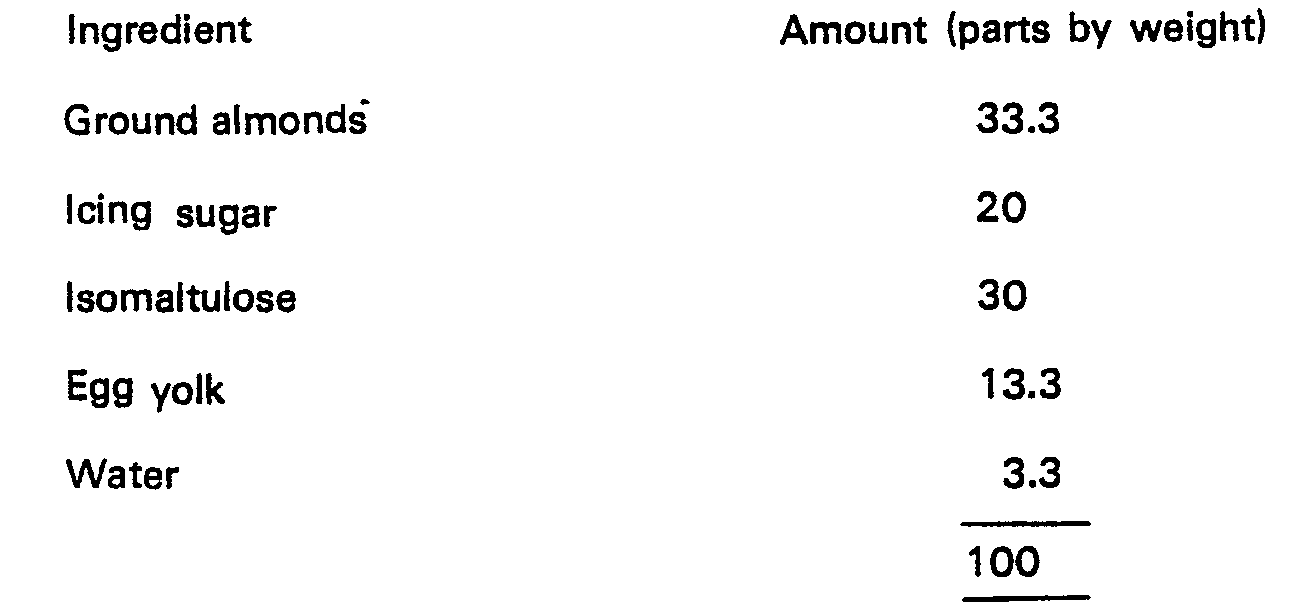
- Marzipan was prepared as for Example 3(a).
- This recipe gave a slightly sweeter marzipan than Example 3(a), but it was not as sweet as an all-sucrose marzipan, and had a better colour and texture.
- Toffee was prepared as follows:

- All of the ingredients except the potassium tartrate and vanilla essence were heated in a saucepan until the isomaltulose had dissolved. The cream of tartar was added, and the mixture was boiled to 290°F.
- The essence was added and the mixture poured onto a well-greased heatproof surface and "pulled" until the toffee had a good sheen and was beginning to harden.
- The isomaltulose mixture had a much darker colour than sucrose toffee and since it was much less sweet, the vanilla flavour and butter taste came through much more.
- Toffee was prepared as for example 4(a), but instead of using 63.5 pts isomaltulose, 30 pts sucrose and 33.5 pts isomaltulose were used.
- This gave a toffee with a nice creamy flavour and good sweetness. The toffee was quite brittle - not chewy.
- Toffee was prepared as for Example 4(a) but instead of using 63.5 pts of isomaltulose, 127 pts. of isomaltulose was used.
- This gave a chewy toffee, with a rich dark colour and a caramel flavour.
- Meringues were prepared as follows:

- The egg white was whipped, using electric whisk, then the isomaltulose was folded in. 2 to 3 cm diameter meringues were piped onto baking trays and cooked at 65°C for 1.5 hours.
- These meringues were crisp and golden-brown, and had a nice caramel taste. (Similar meringues made with sucrose are white, very sweet and have a 'grainy' texture, as the sugar usually does not dissolve).
- Vanilla puddings were made using the recipe below:

- All of the ingredients were mixed together using an electric mixer, and then poured into small dishes.
- This pudding had slightly lower sweetness and improved flavour as compared with a similar pudding made with only sucrose, extra sucrose replacing the isomaltulose.
- Vanilla pudding was prepared as for Example 6(a), but instead of using the 1.06 parts isomaltulose and 6.39 pts icing sugar and 3.19 pts dextrose, 5.32 pts isomaltulose and 3.192 pts icing sugar and 2.128 pts dextrose were used.
- This gave a pudding of good texture, sweetness and vanilla flavour.
- Sponge cakes were prepared as described below:

- All of the dry ingredients except the isomaltulose were mixed together, then mixed with the fat. The isomaltulose was mixed in, then the water. The mixture was poured into a baking tin and cooked at 175°C for 30 minutes.
- Sponge cake prepared as above has a darker colour than sucrose sponge, and much lower sweetness. The volume and texture of the cake were good (ie similar to sucrose sponge).
-
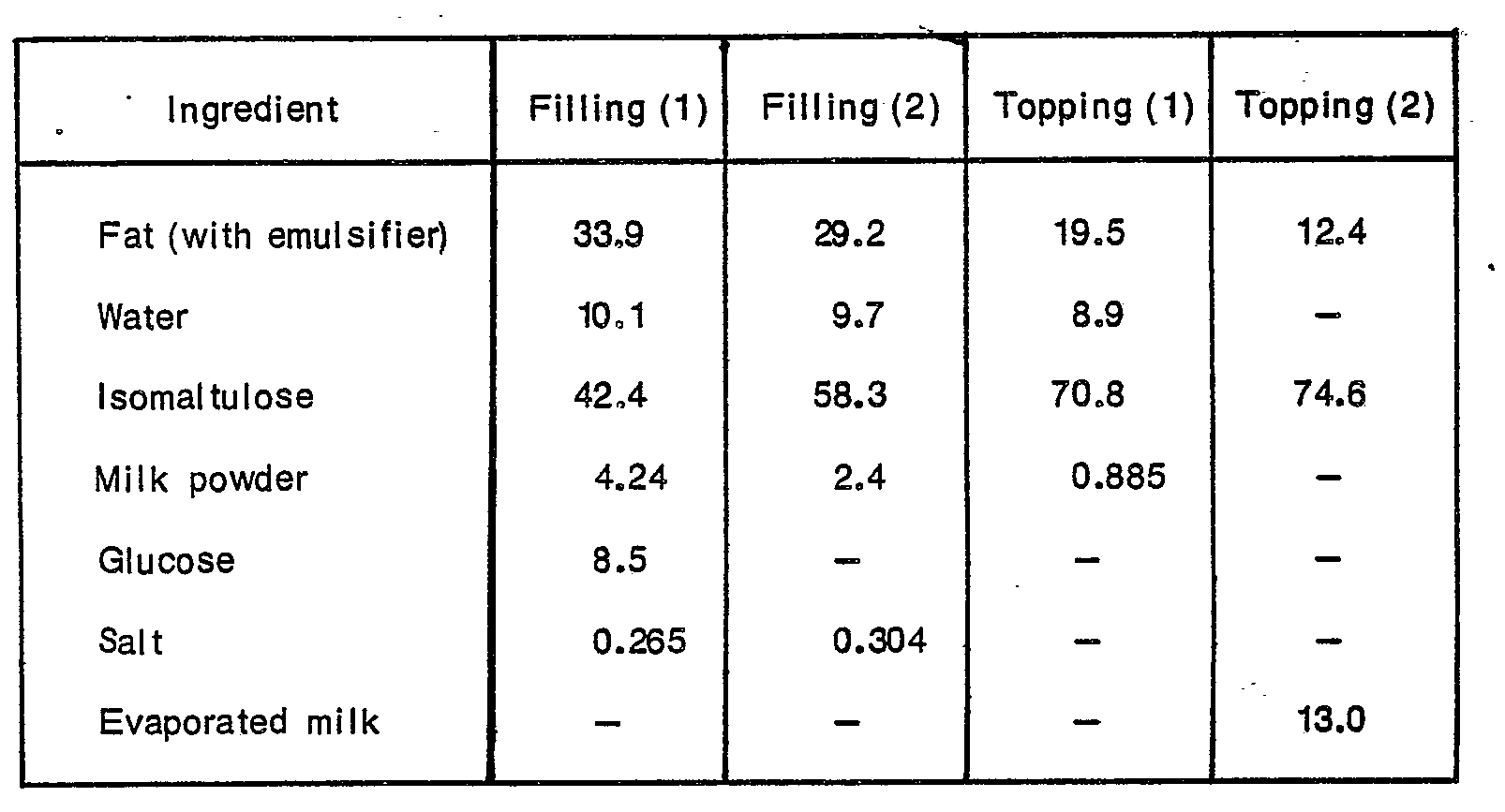
- The ingredients for each topping or filling were mixed together for several minutes using an electric mixer.
- These fillings and toppings had greater volume and lower sweetness than similar ones made with sucrose.
- French nougat was prepared as follows:

- The isomaltulose and glucose were heated with the water until dissolved. The egg whites were beaten stiffly then added, and the mixture was beaten until it was very thick. The angelica, nuts and cherries were added and mixed in well. The whole mixture was poured into a tin, and a weight put on top, and left to set for 12 hours.
- The isomaltulose nougat had lower sweetness and greater bulk than a similar nougat made with sucrose.
- Canned fruit (pears) were prepared as follows:
- Pears were peeled by hand, quartered and the cores removed. Because of possible discolouration, the pears were quickly submerged in dilute salt solution (1 %) before packing into cans. The cans were filled with a 'light' syrup comprising in parts by weight:

- The can ends were clinched and the cans exhausted at about 85°C for 10 minutes before sealing, then processed at 90 to 95°C for 20 minutes and finally cooled.
- On tasting, the pears with isomaltulose were found to have a more intense pear flavour than pears canned with a sucrose syrup of the same concentration. The isomaltulose syrup was considerably less sweet than the equivalent sucrose syrup, but there was no noticeable difference in the texture of the pears canned in isomaltulose and sucrose syrups.
- Plum Jam was prepared as follows:

- The plums were halved and stoned, then stewed for 1 hour in the water. The sucrose and isomaltulose were added and the mixture was stirred, and then left to boil without stirring until the temperature was 104°C.
- The jam was then poured into hot glass jars and sealed..
- This jam had a lower sweetness than a similar jam made with only sucrose, so more of the plum flavour came through. The texture was also better, as the jam was thicker and richer. There was no visible evidence of bacterial spoilage after storage for 6 weeks.
- Toothpaste was prepared by a conventional mixing procedure, using the following ingredients: Amount (parts by weight)
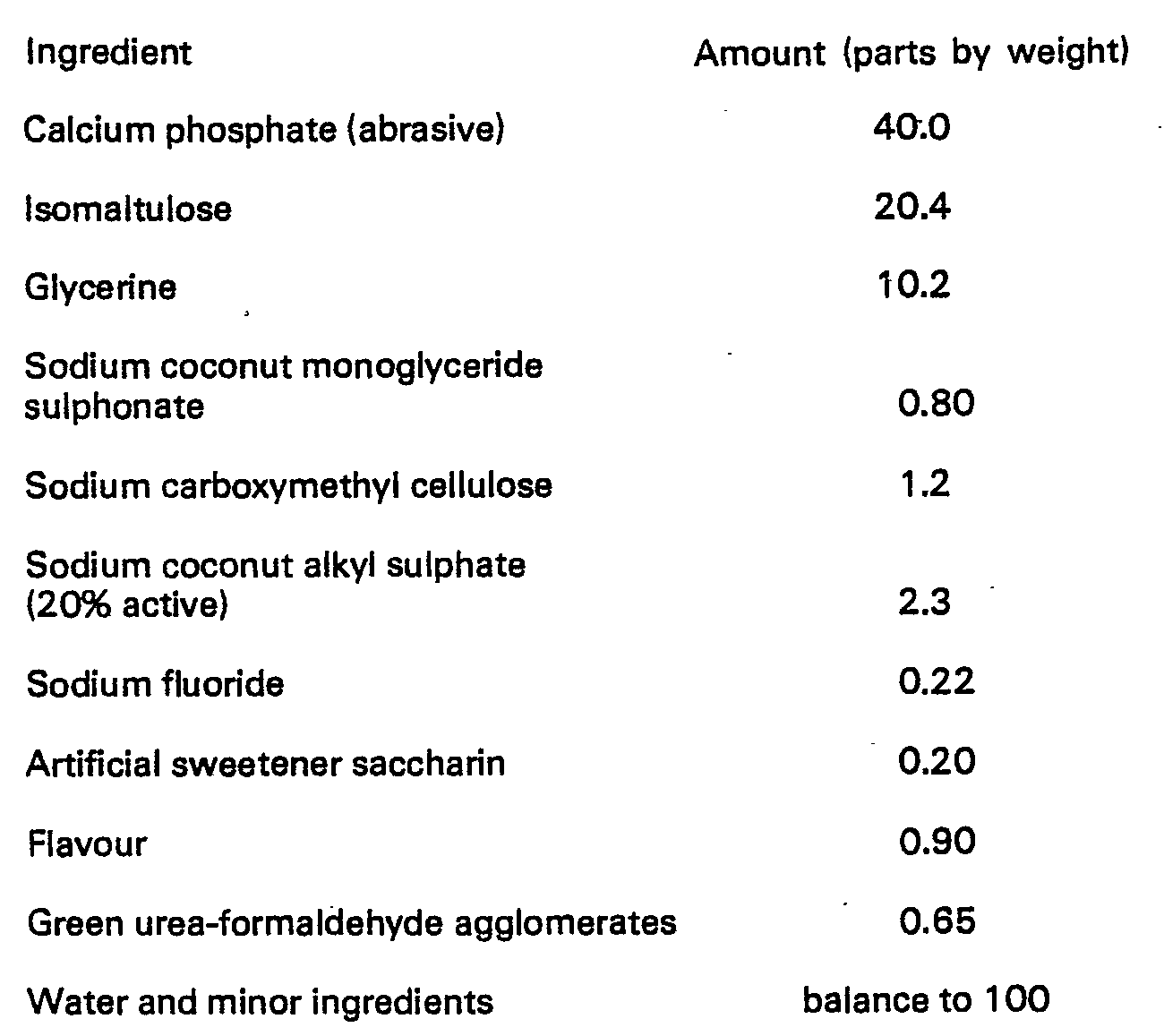
- The resultant product was fully comparable with conventional toothpastes and was suited for packaging in aluminium tubes.
- Chewing gum with a balanced flavour was made in the usual way, but using the following ingredients:

- The gum was given a light dusting of sugar before packaging.
- Lemonade was made by firstly mixing the following ingredients:

- The resultant solution was then used to prepare the lemonade drink by addition of 45 parts by weight of isomaltulose, 50 parts by weight of sucrose, 0.1 parts by weight of saccharin and sufficient carbonated water to reach 1000 parts by weight.
- The lemonade had a pleasant taste, with a noticeable mouthfeel and bulked flavour.
- In a similar manner, and by substituting isomaltulose for sucrose in conventional recipes, we have also prepared poached pears, coconut ice (a confection), fudge, orange squash, shortbread, scones, orange jelly, lemon sorbet, vanilla ice cream and other products. On each occasion there was no difficulty in producing a product similar to the conventional product, through sometimes with modified taste or other characteristics. Generally the isomaltulose products were markedly less sweet. For some products eg the ice cream a better taste was obtained by using a mixture of sucrose and isomaltulose. For the ice cream, sorbet, and scones, a product of greater volume was obtained. Overall, the conclusion was that isomaltulose behaved most satisfactorily as a sucrose substitute.
Claims (11)
Priority Applications (1)
| Application Number | Priority Date | Filing Date | Title |
|---|---|---|---|
| AT80303795T ATE4770T1 (en) | 1979-11-07 | 1980-10-24 | MANUFACTURE OF PRODUCTS FOR HUMAN OR ANIMAL CONSUMPTION USING A SUCrose SUBSTITUTE. |
Applications Claiming Priority (2)
| Application Number | Priority Date | Filing Date | Title |
|---|---|---|---|
| GB7938562 | 1979-11-07 | ||
| GB7938562 | 1979-11-07 |
Publications (2)
| Publication Number | Publication Date |
|---|---|
| EP0028897A1 EP0028897A1 (en) | 1981-05-20 |
| EP0028897B1 true EP0028897B1 (en) | 1983-09-28 |
Family
ID=10509033
Family Applications (1)
| Application Number | Title | Priority Date | Filing Date |
|---|---|---|---|
| EP80303795A Expired EP0028897B1 (en) | 1979-11-07 | 1980-10-24 | Preparation of products for human or animal consumption using a sucrose substitute |
Country Status (10)
| Country | Link |
|---|---|
| US (1) | US4587119A (en) |
| EP (1) | EP0028897B1 (en) |
| JP (2) | JPS5686122A (en) |
| AT (1) | ATE4770T1 (en) |
| CA (1) | CA1156509A (en) |
| DE (1) | DE3065075D1 (en) |
| DK (1) | DK162013C (en) |
| GB (2) | GB2066639B (en) |
| IE (1) | IE50828B1 (en) |
| NO (1) | NO151392C (en) |
Families Citing this family (58)
| Publication number | Priority date | Publication date | Assignee | Title |
|---|---|---|---|---|
| JPS5771377A (en) * | 1980-10-23 | 1982-05-04 | Mitsui Seito Kk | Sweetening agent having low cariogenicity |
| JPS5786246A (en) * | 1980-11-17 | 1982-05-29 | Mitsui Seito Kk | Palatinose-containing chewing gum |
| GB8309855D0 (en) * | 1983-04-12 | 1983-05-18 | Tate & Lyle Plc | Flavour modifiers |
| IL74842A (en) * | 1984-04-12 | 1988-04-29 | Tate & Lyle Plc | Method of modifying taste |
| JPS61227777A (en) * | 1985-04-02 | 1986-10-09 | Showa Sangyo Kk | Agent for activating growth of bifidus bacteria |
| JPS63112963A (en) * | 1986-10-30 | 1988-05-18 | Mitsui Seito Kk | Special food and drink |
| US4792453A (en) * | 1987-05-04 | 1988-12-20 | Wm. Wrigley Jr. Company | Hard coated sugarless chewing gum |
| GB8907007D0 (en) * | 1989-03-28 | 1989-05-10 | Tate & Lyle Plc | Sucralose compositions |
| JPH0797964B2 (en) * | 1987-11-07 | 1995-10-25 | 株式会社ロッテ | Sweetened condensed milk-like composition and method for producing the same |
| US4961935A (en) * | 1987-12-23 | 1990-10-09 | Warner-Lambert Company | Sugarless, substantially anhydrous chewing gum compositions and methods for preparing same |
| JPH02106601A (en) * | 1988-10-14 | 1990-04-18 | Kurita Water Ind Ltd | Method for operating boiler system |
| US4971798A (en) * | 1989-11-30 | 1990-11-20 | Miles Inc. | Hard confections containing hydrogenated isomaltulose and medicinally active ingredient |
| JPH06102605B2 (en) * | 1990-11-19 | 1994-12-14 | 昭和薬品化工株式会社 | Dental test agent composition |
| US5399365A (en) * | 1991-06-19 | 1995-03-21 | Wm. Wrigley Jr. Company | Chewing gum containing palatinose and/or palatinose oligosaccharide |
| US5296244A (en) * | 1991-06-19 | 1994-03-22 | Wm. Wrigley Jr. Company | Chewing gum containing aspartame and palatinose oligosaccharide |
| US5298263A (en) * | 1991-06-19 | 1994-03-29 | Wm. Wrigley Jr. Company | Chewing gum coated with palatinose or palatinose oligosaccharide |
| WO1991015941A1 (en) * | 1991-06-19 | 1991-10-31 | Wm. Wrigley Jr. Company | Chewing gum containing palatinose |
| US5437877A (en) | 1992-03-03 | 1995-08-01 | Wm. Wrigley Jr. Company | Wax-free chewing gum with initial soft bite |
| US5342631A (en) * | 1992-12-29 | 1994-08-30 | Wm. Wrigley Jr. Company | Wax-free chewing gum including special oligosaccharide binders |
| US5462754A (en) | 1992-03-03 | 1995-10-31 | Wm. Wrigley Jr. Company | Abhesive chewing gum with improved sweetness profile |
| US5270061A (en) * | 1992-03-26 | 1993-12-14 | Wm. Wrigley Jr. Company | Dual composition hard coated gum with improved shelf life |
| US5248508A (en) * | 1992-03-23 | 1993-09-28 | Wm. Wrigley Jr. Company | Hard coated gum with improved shelf life |
| US5286502A (en) * | 1992-04-21 | 1994-02-15 | Wm. Wrigley Jr. Company | Use of edible film to prolong chewing gum shelf life |
| JPH0732304U (en) * | 1992-06-18 | 1995-06-16 | オルガノアクア株式会社 | Small pure steam generator |
| US5401723A (en) * | 1992-12-02 | 1995-03-28 | Colgate-Palmolive Company | Glycoconjugate inhibition of Streptococcus pyrogenes adhesion |
| US5437875A (en) | 1993-03-02 | 1995-08-01 | Wm. Wrigley, Jr. Company | Wax-free low moisture chewing gum |
| US5437876A (en) | 1993-03-02 | 1995-08-01 | Wm. Wrigley Jr. Company | Wax-free chewing gums with controlled sweetener release |
| US5441750A (en) | 1993-03-02 | 1995-08-15 | Wm. Wrigley Jr. Company | Wax-free chewing gum with improved processing properties |
| US5436013A (en) | 1993-03-02 | 1995-07-25 | Wm. Wrigley Jr. Company | Process for manufacturing wax-free chewing gums with fast set-up times |
| US5785957A (en) * | 1995-12-12 | 1998-07-28 | Losee; Paul | Inclusion of tooth whitening oxidation chemistries into a tooth-paste composition |
| US6149211A (en) * | 1995-12-12 | 2000-11-21 | Losee; Paul | Inclusion of tooth whitening oxidation chemistries into slow releasing food products |
| DE19629167C2 (en) * | 1996-07-19 | 2000-05-04 | Einhorn Apotheke Dr Guenther H | Solid oral anti-cariogenic composition in the form of a lozenge for cleaning the oral cavity and teeth |
| JP3719874B2 (en) * | 1998-04-24 | 2005-11-24 | サンスター株式会社 | Oral composition |
| US6238648B1 (en) * | 1999-03-25 | 2001-05-29 | The Procter & Gamble Company | Anti-caries oral care compositions and their methods of use |
| DE19943491B4 (en) * | 1999-09-10 | 2010-04-01 | Südzucker AG Mannheim/Ochsenfurt | Improved compressed |
| GB2388027B (en) * | 2002-04-19 | 2006-01-18 | Shin Mitsui Sugar Co Ltd | Use of palatinose for the treatment of mental stress |
| JP2004033109A (en) * | 2002-07-03 | 2004-02-05 | Ueno Seiyaku Oyo Kenkyusho:Kk | Baked confectionery and method for producing the same |
| JP2004033108A (en) * | 2002-07-03 | 2004-02-05 | Ueno Seiyaku Oyo Kenkyusho:Kk | Foam-stabilized dough for baked confectionery, and method for producing confectionery for baking the dough |
| AU2003281488A1 (en) * | 2002-07-19 | 2004-02-09 | Sudzucker Aktiengesellschaft Mannheim/Ochsenfurt | Isomaltulose-containing instant beverage powder |
| JP4048166B2 (en) * | 2002-11-18 | 2008-02-13 | 三井製糖株式会社 | Glucose level rise inhibitor, body fat accumulation inhibitor, and edible material |
| CN100346718C (en) * | 2002-12-18 | 2007-11-07 | 株式会社上野制药应用研究所 | Foods containing sweetener mixtures |
| US6746681B1 (en) | 2002-12-20 | 2004-06-08 | Preventive Dental Specialties, Inc. | Pet tooth care preparation |
| KR20060041258A (en) * | 2003-07-23 | 2006-05-11 | 세레스타 홀딩 비.브이. | Food products containing isomaltulose and trehalose for sustained carbohydrate energy release and increased fat oxidation |
| DE10349465B4 (en) * | 2003-10-23 | 2014-04-03 | Südzucker Aktiengesellschaft Mannheim/Ochsenfurt | Gelatin-free, isomaltulose-containing soft caramel |
| DE102004035373B3 (en) * | 2004-07-21 | 2006-03-30 | Südzucker AG Mannheim/Ochsenfurt | Improved cocoa mixtures |
| DE102005010834A1 (en) | 2005-03-07 | 2006-09-14 | Südzucker AG Mannheim/Ochsenfurt | Isomaltulose in cereal products |
| DE102005022601A1 (en) * | 2005-05-11 | 2006-11-23 | Südzucker AG Mannheim/Ochsenfurt | Hard caramels with isomaltulose |
| DE102005025895A1 (en) * | 2005-05-27 | 2006-11-30 | Südzucker AG Mannheim/Ochsenfurt | Isomaltulose as a taste-shortening agent |
| DE102005056652A1 (en) * | 2005-11-25 | 2007-05-31 | Südzucker AG Mannheim/Ochsenfurt | Preparation, useful for increasing fat combustion, supporting fat metabolism, reducing fat content in mammals, preferably humans, comprises a polyphenol composition and isomaltulose |
| JP2007270746A (en) * | 2006-03-31 | 2007-10-18 | Univ Nihon | Vertical axis wind turbine with variable wings |
| DE102007026975A1 (en) * | 2007-06-01 | 2008-12-04 | Südzucker Aktiengesellschaft Mannheim/Ochsenfurt | Antioxidant for food |
| JP4973463B2 (en) | 2007-11-16 | 2012-07-11 | トヨタ自動車株式会社 | Semiconductor device |
| CN103391722A (en) * | 2010-12-30 | 2013-11-13 | Wm.雷格利Jr.公司 | Hard candy with reduced sugar |
| CA2860430C (en) | 2012-01-09 | 2019-01-08 | Wm. Wrigley Jr. Company | Gelled confection with reduced sugar comprising erythritol and a doctoring agent |
| SG11201404129UA (en) * | 2012-02-29 | 2014-10-30 | Meiji Co Ltd | Baked confectionery and method for manufacturing same |
| BR112019010627B1 (en) * | 2016-12-16 | 2023-05-02 | Société des Produits Nestlé S.A. | USE OF AN ISO-OLIGOSACCHARIDE, AND METHOD FOR GENERATING FLAVOR IN A HEAT-TREATED FOOD PRODUCT |
| JP7080607B2 (en) * | 2017-08-29 | 2022-06-06 | 三井製糖株式会社 | Food softening inhibitor, method of suppressing food softening using this, and method of manufacturing heated food |
| JP7851139B2 (en) * | 2022-02-09 | 2026-04-24 | Dm三井製糖株式会社 | Choux pastry |
Family Cites Families (8)
| Publication number | Priority date | Publication date | Assignee | Title |
|---|---|---|---|---|
| DE2344252C3 (en) * | 1973-09-01 | 1981-09-24 | Haase, Georg Wilhelm, Dr.Agr., 4600 Dortmund | Process for the production of a low-alcohol, light, beer-like beverage |
| DE2520173C3 (en) * | 1975-05-06 | 1989-08-10 | Südzucker AG Mannheim/Ochsenfurt, 6800 Mannheim | Process for the preparation of glucopyranosido-1,6-mannitol and its use as a sugar substitute |
| DE2860239D1 (en) * | 1977-09-13 | 1980-12-04 | Bayer Ag | Process for the continuous isomerisation if saccharose to isomaltulose by means of microorganisms |
| GB2014149A (en) * | 1978-01-23 | 1979-08-22 | Cpc International Inc | Maltulose-containing syrups and process for making same |
| US4217413A (en) * | 1979-01-22 | 1980-08-12 | Cpc International Inc. | Novel maltulose-containing syrups and process for making the same |
| JPS5846294B2 (en) * | 1980-09-25 | 1983-10-15 | 三井製糖株式会社 | Anti-caries hondant-like molasses sugar and method for producing the same |
| JPS5771377A (en) * | 1980-10-23 | 1982-05-04 | Mitsui Seito Kk | Sweetening agent having low cariogenicity |
| JPS5772910A (en) * | 1980-10-23 | 1982-05-07 | Mitsui Seito Kk | Cleaning agent for oral cavity |
-
1980
- 1980-10-24 AT AT80303795T patent/ATE4770T1/en not_active IP Right Cessation
- 1980-10-24 EP EP80303795A patent/EP0028897B1/en not_active Expired
- 1980-10-24 DE DE8080303795T patent/DE3065075D1/en not_active Expired
- 1980-11-03 CA CA000363869A patent/CA1156509A/en not_active Expired
- 1980-11-04 GB GB8035338A patent/GB2066639B/en not_active Expired
- 1980-11-04 GB GB8035339A patent/GB2066640B/en not_active Expired
- 1980-11-05 NO NO803312A patent/NO151392C/en unknown
- 1980-11-06 IE IE2303/80A patent/IE50828B1/en not_active IP Right Cessation
- 1980-11-07 JP JP15678480A patent/JPS5686122A/en active Granted
- 1980-11-07 DK DK475980A patent/DK162013C/en not_active IP Right Cessation
- 1980-11-07 JP JP15678580A patent/JPS5692757A/en active Pending
-
1984
- 1984-12-14 US US06/682,567 patent/US4587119A/en not_active Expired - Fee Related
Also Published As
| Publication number | Publication date |
|---|---|
| IE50828B1 (en) | 1986-07-23 |
| NO803312L (en) | 1981-05-08 |
| GB2066639A (en) | 1981-07-15 |
| GB2066639B (en) | 1983-11-30 |
| DE3065075D1 (en) | 1983-11-03 |
| GB2066640B (en) | 1983-11-23 |
| US4587119A (en) | 1986-05-06 |
| NO151392C (en) | 1985-04-03 |
| DK162013B (en) | 1991-09-09 |
| JPS5686122A (en) | 1981-07-13 |
| ATE4770T1 (en) | 1983-10-15 |
| DK475980A (en) | 1981-05-08 |
| DK162013C (en) | 1992-02-17 |
| GB2066640A (en) | 1981-07-15 |
| IE802303L (en) | 1981-05-06 |
| CA1156509A (en) | 1983-11-08 |
| EP0028897A1 (en) | 1981-05-20 |
| JPS6239133B2 (en) | 1987-08-21 |
| NO151392B (en) | 1984-12-27 |
| JPS5692757A (en) | 1981-07-27 |
Similar Documents
| Publication | Publication Date | Title |
|---|---|---|
| CA1156509A (en) | Preparation of products for human or animal consumption using a sucrose substitute | |
| US3957976A (en) | Methods for reducing cholesterol levels | |
| JP3084609B2 (en) | Trehalose-containing syrup | |
| JP6847727B2 (en) | Food products containing slow-digesting or resistant-digesting carbohydrate compositions | |
| US3914434A (en) | Non-cariogenic foods and delicacies containing xylitol as a sugar substitute | |
| US5219842A (en) | Method of improving intestinal floras | |
| US4346116A (en) | Non-cariogenic hydrogenated starch hydrolysate, process for the preparation and applications of this hydrolysate | |
| GB2038832A (en) | Non-cariogenic hydrogenated starch hydrolysate process for its preparation and uses thereof | |
| KR19980032612A (en) | Trehalose-containing syrup | |
| JP2000023699A (en) | Trehalose 2 hydrous crystal, its production method and use | |
| GB2162524A (en) | Crystalline maltose | |
| US20100112156A1 (en) | Process for manufacturing a sweetener and use thereof | |
| JPH10168093A (en) | Crystalline powdery glucide, its production and use thereof | |
| US3973050A (en) | Containing lactitol as a sweetener | |
| CA2489459A1 (en) | Condensed palatinose and method for producing the same | |
| JP3100139B2 (en) | Manufacturing method of food and drink | |
| US5585480A (en) | Hydrogenated fructooligosaccharides | |
| US4676991A (en) | Sweetener composition | |
| US6897202B2 (en) | Powder comprising water-containing β-maltose crystals and production process and use thereof | |
| GB1566821A (en) | Sweetening composition | |
| JPH10165118A (en) | High-trehalose containing syrup as well as its production and application | |
| US2772168A (en) | Fermentable carbohydrate food products | |
| SU1321396A3 (en) | Method of sweetening foodstuffs | |
| JPH02234651A (en) | Preparation of low cariogenetic food or drink | |
| JPH0722B2 (en) | Method for suppressing production of water-insoluble glucan due to sucrose in food and drink containing sucrose |
Legal Events
| Date | Code | Title | Description |
|---|---|---|---|
| PUAI | Public reference made under article 153(3) epc to a published international application that has entered the european phase |
Free format text: ORIGINAL CODE: 0009012 |
|
| AK | Designated contracting states |
Designated state(s): AT BE CH DE FR IT LI LU NL SE |
|
| 17P | Request for examination filed |
Effective date: 19811005 |
|
| ITF | It: translation for a ep patent filed | ||
| GRAA | (expected) grant |
Free format text: ORIGINAL CODE: 0009210 |
|
| RAP1 | Party data changed (applicant data changed or rights of an application transferred) |
Owner name: TATE & LYLE PUBLIC LIMITED COMPANY |
|
| AK | Designated contracting states |
Designated state(s): AT BE CH DE FR IT LI LU NL SE |
|
| REF | Corresponds to: |
Ref document number: 4770 Country of ref document: AT Date of ref document: 19831015 Kind code of ref document: T |
|
| REF | Corresponds to: |
Ref document number: 3065075 Country of ref document: DE Date of ref document: 19831103 |
|
| ET | Fr: translation filed | ||
| PLBE | No opposition filed within time limit |
Free format text: ORIGINAL CODE: 0009261 |
|
| STAA | Information on the status of an ep patent application or granted ep patent |
Free format text: STATUS: NO OPPOSITION FILED WITHIN TIME LIMIT |
|
| 26N | No opposition filed | ||
| ITTA | It: last paid annual fee | ||
| EPTA | Lu: last paid annual fee | ||
| REG | Reference to a national code |
Ref country code: CH Ref legal event code: PUE Owner name: SUEDZUCKER AKTIENGESELLSCHAFT MANNHEIM/OCHSENFURT |
|
| ITPR | It: changes in ownership of a european patent |
Owner name: CESSIONE;SUDZUCKER AKTIENGESELLSCHAFT MANNHEIM OCH |
|
| NLS | Nl: assignments of ep-patents |
Owner name: SUEDZUCKER AKTIENGESELLSCHAFT MANNHEIM/OCHSENFURT |
|
| EAL | Se: european patent in force in sweden |
Ref document number: 80303795.1 |
|
| PGFP | Annual fee paid to national office [announced via postgrant information from national office to epo] |
Ref country code: LU Payment date: 19951001 Year of fee payment: 16 |
|
| PGFP | Annual fee paid to national office [announced via postgrant information from national office to epo] |
Ref country code: FR Payment date: 19951010 Year of fee payment: 16 |
|
| PGFP | Annual fee paid to national office [announced via postgrant information from national office to epo] |
Ref country code: AT Payment date: 19951011 Year of fee payment: 16 |
|
| PGFP | Annual fee paid to national office [announced via postgrant information from national office to epo] |
Ref country code: SE Payment date: 19951017 Year of fee payment: 16 |
|
| PGFP | Annual fee paid to national office [announced via postgrant information from national office to epo] |
Ref country code: DE Payment date: 19951020 Year of fee payment: 16 |
|
| PGFP | Annual fee paid to national office [announced via postgrant information from national office to epo] |
Ref country code: NL Payment date: 19951024 Year of fee payment: 16 |
|
| PGFP | Annual fee paid to national office [announced via postgrant information from national office to epo] |
Ref country code: CH Payment date: 19951113 Year of fee payment: 16 |
|
| PGFP | Annual fee paid to national office [announced via postgrant information from national office to epo] |
Ref country code: BE Payment date: 19951201 Year of fee payment: 16 |
|
| PG25 | Lapsed in a contracting state [announced via postgrant information from national office to epo] |
Ref country code: LU Free format text: LAPSE BECAUSE OF NON-PAYMENT OF DUE FEES Effective date: 19961024 Ref country code: AT Effective date: 19961024 |
|
| PG25 | Lapsed in a contracting state [announced via postgrant information from national office to epo] |
Ref country code: SE Effective date: 19961025 |
|
| PG25 | Lapsed in a contracting state [announced via postgrant information from national office to epo] |
Ref country code: LI Effective date: 19961031 Ref country code: CH Effective date: 19961031 Ref country code: BE Effective date: 19961031 |
|
| BERE | Be: lapsed |
Owner name: SUDZUCKER A.G. MANNHEIM/OCHSENFURT Effective date: 19961031 |
|
| PG25 | Lapsed in a contracting state [announced via postgrant information from national office to epo] |
Ref country code: NL Effective date: 19970501 |
|
| REG | Reference to a national code |
Ref country code: CH Ref legal event code: PL |
|
| PG25 | Lapsed in a contracting state [announced via postgrant information from national office to epo] |
Ref country code: FR Effective date: 19970630 |
|
| NLV4 | Nl: lapsed or anulled due to non-payment of the annual fee |
Effective date: 19970501 |
|
| PG25 | Lapsed in a contracting state [announced via postgrant information from national office to epo] |
Ref country code: DE Effective date: 19970701 |
|
| EUG | Se: european patent has lapsed |
Ref document number: 80303795.1 |
|
| REG | Reference to a national code |
Ref country code: FR Ref legal event code: ST |