EP0024799B1 - Conditioning shampoo, process for preparing it, dispenser containing it and a method of treating hair - Google Patents
Conditioning shampoo, process for preparing it, dispenser containing it and a method of treating hair Download PDFInfo
- Publication number
- EP0024799B1 EP0024799B1 EP80302389A EP80302389A EP0024799B1 EP 0024799 B1 EP0024799 B1 EP 0024799B1 EP 80302389 A EP80302389 A EP 80302389A EP 80302389 A EP80302389 A EP 80302389A EP 0024799 B1 EP0024799 B1 EP 0024799B1
- Authority
- EP
- European Patent Office
- Prior art keywords
- weight
- shampoo
- hair
- alkyl
- sulphate
- Prior art date
- Legal status (The legal status is an assumption and is not a legal conclusion. Google has not performed a legal analysis and makes no representation as to the accuracy of the status listed.)
- Expired
Links
- 239000002453 shampoo Substances 0.000 title claims abstract description 70
- 238000000034 method Methods 0.000 title claims description 7
- 238000004519 manufacturing process Methods 0.000 title claims description 3
- 230000003750 conditioning effect Effects 0.000 title abstract description 11
- -1 alkyl ether sulfate Chemical class 0.000 claims abstract description 42
- 239000011347 resin Substances 0.000 claims abstract description 26
- 229920005989 resin Polymers 0.000 claims abstract description 26
- 229920000768 polyamine Polymers 0.000 claims abstract description 19
- 239000003599 detergent Substances 0.000 claims abstract description 17
- 229910019142 PO4 Inorganic materials 0.000 claims abstract description 15
- 239000010452 phosphate Substances 0.000 claims abstract description 15
- 238000009833 condensation Methods 0.000 claims abstract description 13
- 230000005494 condensation Effects 0.000 claims abstract description 13
- 150000005690 diesters Chemical class 0.000 claims abstract description 7
- RTZKZFJDLAIYFH-UHFFFAOYSA-N Diethyl ether Chemical compound CCOCC RTZKZFJDLAIYFH-UHFFFAOYSA-N 0.000 claims description 22
- LYCAIKOWRPUZTN-UHFFFAOYSA-N Ethylene glycol Chemical compound OCCO LYCAIKOWRPUZTN-UHFFFAOYSA-N 0.000 claims description 20
- 229910021653 sulphate ion Inorganic materials 0.000 claims description 14
- 125000004432 carbon atom Chemical group C* 0.000 claims description 10
- WGCNASOHLSPBMP-UHFFFAOYSA-N hydroxyacetaldehyde Natural products OCC=O WGCNASOHLSPBMP-UHFFFAOYSA-N 0.000 claims description 10
- 150000001875 compounds Chemical class 0.000 claims description 7
- QGZKDVFQNNGYKY-UHFFFAOYSA-O Ammonium Chemical group [NH4+] QGZKDVFQNNGYKY-UHFFFAOYSA-O 0.000 claims description 6
- 125000004435 hydrogen atom Chemical group [H]* 0.000 claims description 6
- 238000006068 polycondensation reaction Methods 0.000 claims description 6
- 229910052783 alkali metal Inorganic materials 0.000 claims description 4
- 150000001340 alkali metals Chemical group 0.000 claims description 4
- 230000001588 bifunctional effect Effects 0.000 claims description 4
- 125000001183 hydrocarbyl group Chemical group 0.000 claims description 4
- 150000007824 aliphatic compounds Chemical class 0.000 claims description 3
- 125000002947 alkylene group Chemical group 0.000 claims description 3
- 238000006243 chemical reaction Methods 0.000 claims description 3
- 125000000524 functional group Chemical group 0.000 claims description 3
- 229910052736 halogen Inorganic materials 0.000 claims description 3
- 125000005843 halogen group Chemical group 0.000 claims description 3
- 229910052739 hydrogen Inorganic materials 0.000 claims description 3
- 239000001257 hydrogen Substances 0.000 claims description 3
- 125000002887 hydroxy group Chemical group [H]O* 0.000 claims description 3
- 229910052757 nitrogen Inorganic materials 0.000 claims description 3
- 125000004433 nitrogen atom Chemical group N* 0.000 claims description 3
- 125000003700 epoxy group Chemical group 0.000 claims 1
- 230000008021 deposition Effects 0.000 abstract description 8
- 239000003795 chemical substances by application Substances 0.000 abstract description 6
- 150000003014 phosphoric acid esters Chemical class 0.000 abstract description 2
- 150000008051 alkyl sulfates Chemical class 0.000 abstract 1
- NBIIXXVUZAFLBC-UHFFFAOYSA-K phosphate Chemical compound [O-]P([O-])([O-])=O NBIIXXVUZAFLBC-UHFFFAOYSA-K 0.000 abstract 1
- 239000006260 foam Substances 0.000 description 14
- 229920000642 polymer Polymers 0.000 description 14
- 239000007795 chemical reaction product Substances 0.000 description 10
- 229920003171 Poly (ethylene oxide) Polymers 0.000 description 7
- 150000002148 esters Chemical class 0.000 description 7
- 125000000217 alkyl group Chemical group 0.000 description 6
- QTDIEDOANJISNP-UHFFFAOYSA-N 2-dodecoxyethyl hydrogen sulfate Chemical compound CCCCCCCCCCCCOCCOS(O)(=O)=O QTDIEDOANJISNP-UHFFFAOYSA-N 0.000 description 5
- 238000002474 experimental method Methods 0.000 description 5
- GKQPCPXONLDCMU-CCEZHUSRSA-N lacidipine Chemical compound CCOC(=O)C1=C(C)NC(C)=C(C(=O)OCC)C1C1=CC=CC=C1\C=C\C(=O)OC(C)(C)C GKQPCPXONLDCMU-CCEZHUSRSA-N 0.000 description 5
- 239000000203 mixture Substances 0.000 description 5
- 239000000047 product Substances 0.000 description 5
- IAYPIBMASNFSPL-UHFFFAOYSA-N Ethylene oxide Chemical compound C1CO1 IAYPIBMASNFSPL-UHFFFAOYSA-N 0.000 description 4
- DGAQECJNVWCQMB-PUAWFVPOSA-M Ilexoside XXIX Chemical compound C[C@@H]1CC[C@@]2(CC[C@@]3(C(=CC[C@H]4[C@]3(CC[C@@H]5[C@@]4(CC[C@@H](C5(C)C)OS(=O)(=O)[O-])C)C)[C@@H]2[C@]1(C)O)C)C(=O)O[C@H]6[C@@H]([C@H]([C@@H]([C@H](O6)CO)O)O)O.[Na+] DGAQECJNVWCQMB-PUAWFVPOSA-M 0.000 description 4
- 229910052708 sodium Inorganic materials 0.000 description 4
- 239000011734 sodium Substances 0.000 description 4
- BRLQWZUYTZBJKN-UHFFFAOYSA-N Epichlorohydrin Chemical compound ClCC1CO1 BRLQWZUYTZBJKN-UHFFFAOYSA-N 0.000 description 3
- ZLMJMSJWJFRBEC-UHFFFAOYSA-N Potassium Chemical compound [K] ZLMJMSJWJFRBEC-UHFFFAOYSA-N 0.000 description 3
- HEMHJVSKTPXQMS-UHFFFAOYSA-M Sodium hydroxide Chemical compound [OH-].[Na+] HEMHJVSKTPXQMS-UHFFFAOYSA-M 0.000 description 3
- 230000003766 combability Effects 0.000 description 3
- 230000000052 comparative effect Effects 0.000 description 3
- 238000009472 formulation Methods 0.000 description 3
- 239000004615 ingredient Substances 0.000 description 3
- 150000002924 oxiranes Chemical class 0.000 description 3
- 229910052700 potassium Inorganic materials 0.000 description 3
- 239000011591 potassium Substances 0.000 description 3
- FAPWRFPIFSIZLT-UHFFFAOYSA-M Sodium chloride Chemical compound [Na+].[Cl-] FAPWRFPIFSIZLT-UHFFFAOYSA-M 0.000 description 2
- 230000001419 dependent effect Effects 0.000 description 2
- QVBODZPPYSSMEL-UHFFFAOYSA-N dodecyl sulfate;2-hydroxyethylazanium Chemical compound NCCO.CCCCCCCCCCCCOS(O)(=O)=O QVBODZPPYSSMEL-UHFFFAOYSA-N 0.000 description 2
- 239000004519 grease Substances 0.000 description 2
- 239000000463 material Substances 0.000 description 2
- ZBJVLWIYKOAYQH-UHFFFAOYSA-N naphthalen-2-yl 2-hydroxybenzoate Chemical compound OC1=CC=CC=C1C(=O)OC1=CC=C(C=CC=C2)C2=C1 ZBJVLWIYKOAYQH-UHFFFAOYSA-N 0.000 description 2
- 239000000243 solution Substances 0.000 description 2
- XLYOFNOQVPJJNP-UHFFFAOYSA-N water Substances O XLYOFNOQVPJJNP-UHFFFAOYSA-N 0.000 description 2
- WRIDQFICGBMAFQ-UHFFFAOYSA-N (E)-8-Octadecenoic acid Natural products CCCCCCCCCC=CCCCCCCC(O)=O WRIDQFICGBMAFQ-UHFFFAOYSA-N 0.000 description 1
- VILCJCGEZXAXTO-UHFFFAOYSA-N 2,2,2-tetramine Chemical compound NCCNCCNCCN VILCJCGEZXAXTO-UHFFFAOYSA-N 0.000 description 1
- SZIFAVKTNFCBPC-UHFFFAOYSA-N 2-chloroethanol Chemical class OCCCl SZIFAVKTNFCBPC-UHFFFAOYSA-N 0.000 description 1
- LQJBNNIYVWPHFW-UHFFFAOYSA-N 20:1omega9c fatty acid Natural products CCCCCCCCCCC=CCCCCCCCC(O)=O LQJBNNIYVWPHFW-UHFFFAOYSA-N 0.000 description 1
- QSBYPNXLFMSGKH-UHFFFAOYSA-N 9-Heptadecensaeure Natural products CCCCCCCC=CCCCCCCCC(O)=O QSBYPNXLFMSGKH-UHFFFAOYSA-N 0.000 description 1
- GAWIXWVDTYZWAW-UHFFFAOYSA-N C[CH]O Chemical group C[CH]O GAWIXWVDTYZWAW-UHFFFAOYSA-N 0.000 description 1
- RPNUMPOLZDHAAY-UHFFFAOYSA-N Diethylenetriamine Chemical compound NCCNCCN RPNUMPOLZDHAAY-UHFFFAOYSA-N 0.000 description 1
- 239000005642 Oleic acid Substances 0.000 description 1
- ZQPPMHVWECSIRJ-UHFFFAOYSA-N Oleic acid Natural products CCCCCCCCC=CCCCCCCCC(O)=O ZQPPMHVWECSIRJ-UHFFFAOYSA-N 0.000 description 1
- DBMJMQXJHONAFJ-UHFFFAOYSA-M Sodium laurylsulphate Chemical compound [Na+].CCCCCCCCCCCCOS([O-])(=O)=O DBMJMQXJHONAFJ-UHFFFAOYSA-M 0.000 description 1
- 239000004141 Sodium laurylsulphate Substances 0.000 description 1
- GSEJCLTVZPLZKY-UHFFFAOYSA-N Triethanolamine Chemical class OCCN(CCO)CCO GSEJCLTVZPLZKY-UHFFFAOYSA-N 0.000 description 1
- 239000000654 additive Substances 0.000 description 1
- 125000003342 alkenyl group Chemical group 0.000 description 1
- BTBJBAZGXNKLQC-UHFFFAOYSA-N ammonium lauryl sulfate Chemical compound [NH4+].CCCCCCCCCCCCOS([O-])(=O)=O BTBJBAZGXNKLQC-UHFFFAOYSA-N 0.000 description 1
- 125000000129 anionic group Chemical group 0.000 description 1
- 239000007864 aqueous solution Substances 0.000 description 1
- 125000002091 cationic group Chemical group 0.000 description 1
- 125000001309 chloro group Chemical group Cl* 0.000 description 1
- XENVCRGQTABGKY-ZHACJKMWSA-N chlorohydrin Chemical compound CC#CC#CC#CC#C\C=C\C(Cl)CO XENVCRGQTABGKY-ZHACJKMWSA-N 0.000 description 1
- 238000004040 coloring Methods 0.000 description 1
- 230000002860 competitive effect Effects 0.000 description 1
- 125000000392 cycloalkenyl group Chemical group 0.000 description 1
- 125000000753 cycloalkyl group Chemical group 0.000 description 1
- 230000003745 detangling effect Effects 0.000 description 1
- 125000003438 dodecyl group Chemical group [H]C([H])([H])C([H])([H])C([H])([H])C([H])([H])C([H])([H])C([H])([H])C([H])([H])C([H])([H])C([H])([H])C([H])([H])C([H])([H])C([H])([H])* 0.000 description 1
- 230000000694 effects Effects 0.000 description 1
- 150000002314 glycerols Chemical class 0.000 description 1
- 150000002334 glycols Chemical class 0.000 description 1
- 125000004356 hydroxy functional group Chemical group O* 0.000 description 1
- QXJSBBXBKPUZAA-UHFFFAOYSA-N isooleic acid Natural products CCCCCCCC=CCCCCCCCCC(O)=O QXJSBBXBKPUZAA-UHFFFAOYSA-N 0.000 description 1
- 230000002045 lasting effect Effects 0.000 description 1
- 239000007788 liquid Substances 0.000 description 1
- ZQPPMHVWECSIRJ-KTKRTIGZSA-N oleic acid Chemical compound CCCCCCCC\C=C/CCCCCCCC(O)=O ZQPPMHVWECSIRJ-KTKRTIGZSA-N 0.000 description 1
- 125000001117 oleyl group Chemical group [H]C([*])([H])C([H])([H])C([H])([H])C([H])([H])C([H])([H])C([H])([H])C([H])([H])C([H])([H])/C([H])=C([H])\C([H])([H])C([H])([H])C([H])([H])C([H])([H])C([H])([H])C([H])([H])C([H])([H])C([H])([H])[H] 0.000 description 1
- 239000003605 opacifier Substances 0.000 description 1
- 238000004806 packaging method and process Methods 0.000 description 1
- 239000002304 perfume Substances 0.000 description 1
- 239000004033 plastic Substances 0.000 description 1
- 239000003755 preservative agent Substances 0.000 description 1
- 230000002335 preservative effect Effects 0.000 description 1
- 125000001436 propyl group Chemical group [H]C([*])([H])C([H])([H])C([H])([H])[H] 0.000 description 1
- 102000004169 proteins and genes Human genes 0.000 description 1
- 108090000623 proteins and genes Proteins 0.000 description 1
- 235000019574 salt enhancing Nutrition 0.000 description 1
- 150000003839 salts Chemical class 0.000 description 1
- 239000011780 sodium chloride Substances 0.000 description 1
- 235000011121 sodium hydroxide Nutrition 0.000 description 1
- 235000019333 sodium laurylsulphate Nutrition 0.000 description 1
- 238000007619 statistical method Methods 0.000 description 1
- 239000002562 thickening agent Substances 0.000 description 1
- 238000005406 washing Methods 0.000 description 1
Classifications
-
- A—HUMAN NECESSITIES
- A61—MEDICAL OR VETERINARY SCIENCE; HYGIENE
- A61K—PREPARATIONS FOR MEDICAL, DENTAL OR TOILETRY PURPOSES
- A61K8/00—Cosmetics or similar toiletry preparations
- A61K8/18—Cosmetics or similar toiletry preparations characterised by the composition
- A61K8/30—Cosmetics or similar toiletry preparations characterised by the composition containing organic compounds
- A61K8/55—Phosphorus compounds
- A61K8/556—Derivatives containing from 2 to 10 oxyalkylene groups
-
- A—HUMAN NECESSITIES
- A61—MEDICAL OR VETERINARY SCIENCE; HYGIENE
- A61K—PREPARATIONS FOR MEDICAL, DENTAL OR TOILETRY PURPOSES
- A61K8/00—Cosmetics or similar toiletry preparations
- A61K8/18—Cosmetics or similar toiletry preparations characterised by the composition
- A61K8/72—Cosmetics or similar toiletry preparations characterised by the composition containing organic macromolecular compounds
- A61K8/84—Cosmetics or similar toiletry preparations characterised by the composition containing organic macromolecular compounds obtained by reactions otherwise than those involving only carbon-carbon unsaturated bonds
- A61K8/86—Polyethers
-
- A—HUMAN NECESSITIES
- A61—MEDICAL OR VETERINARY SCIENCE; HYGIENE
- A61Q—SPECIFIC USE OF COSMETICS OR SIMILAR TOILETRY PREPARATIONS
- A61Q5/00—Preparations for care of the hair
- A61Q5/12—Preparations containing hair conditioners
Definitions
- the invention relates to shampoos, particularly to shampoos which contain a polymer as a hair conditioning agent.
- Certain polymers can be incorporated into aqueous liquid shampoos for deposition onto the hair during the shampooing process. These polymers can thereby impart useful conditioning benefits to the hair, such as improved ease of combing while the hair is still wet. Generally, any benefit obtained is dependent upon the amount of the polymer left on the hair after the shampooing and rinsing procedures. The magnitude of the benefit obtained is therefore usually dependent on the amount of the polymer present in the shampoo.
- Shampoo formulators have been concerned with devising ways of modifying shampoo formulae so as to increase the degree by which polymers of this type can be deposited on the hair so as either to enhance the conditioning effect or to be able to produce the same effect through the use of less of the polymer.
- DE-Al-2 727 255 Unilever NV
- a shampoo containing a cationic cellulosic resin and a simple salt, preferably sodium chloride the presence of this salt enhancing the level of deposition of the resin onto the hair when the shampoo is applied thereto.
- the normal conditioning effect due to this resin can thereby be achieved by employing a shampoo containing an unusually low concentration of the resin.
- polymers which have more recently become of interest to shampoo formulators as potentially useful hair conditioning agents are polyglycol-polyamine condensation resins.
- alkyl sulphate and alkyl ether sulphate anionic detergents are the most widely used. It is with the enhancement of the deposition of polyglycol- polyamine condensation resins from such anionic detergent-based shampoos that the present invention is concerned.
- the invention is based on the discovery that deposition onto the hair of a polyglycol-polyamine condensation resin, as a conditioning agent from a shampoo based on an alkyl sulphate or alkyl ether sulphate detergent is enhanced by including in the shampoo certain anionic additives.
- an aqueous shampoo comprising:
- the detergent employed in the shampoo of this invention is an C 10 -C 18 alkyl sulphate or C lo -C 18 alkyl ether sulphate containing 2 or 3 moles of ethylene oxide.
- These detergents are generally employed in the form of their sodium, potassium, ammonium or mono-, di- or tri-ethanolamine salts.
- Examples of these detergents are sodium lauryl sulphate, ammonium lauryl sulphate, mono-, di- and triethanolammonium lauryl sulphates, sodium lauryl ether sulphate (2 EO), sodium lauryl ether sulphate (3 EO), potassium lauryl ether sulphate (2 EO) and ammonium lauryl ether sulphate (3 EO).
- the shampoo will generally contain from 5% to 30% by weight of anionic detergent.
- Shampoos containing less than about 5% by weight of anoinic detergent are likely in use to produce insufficient lather to clean the hair efficiently, while shampoos containing more than 30% by weight of anionic detergent may be too thick to apply conveniently to the hair and may also degrease the hair to an undesirably excessive degree.
- the polymeric hair conditioning ingredient is a polyglycol-polyamine condensation resin which is a hardenable polycondensation product produced by reacting a polyamine compound having from 2 to 10 carbon atoms with an ether of polyoxyalkylene glycol having terminal halogens or hydroxyls and having from 2 to 4 carbon atoms in the alkylene units thereof, said polyamine reaction compounds having more than one hydrogen atom attached to a nitrogen atom and being further reacted with a bifunctional aliphatic compound having functional groups selected from the group consisting of epoxide and ⁇ -halo-f3-hydroxy-alkyl.
- the polycondensation product is a reaction product selected from the group consisting of
- the preferred polyglycol-polyamine condensation resin for use in shampoos according to the invention is that which is available commercially under the trade name POLYQUART H from Henkel & Cie GmbH, as a 50% aqueous solution.
- POLYQUART H is a trade mark.
- the polyglycol-polyamine condensation resin is present in the shampoo of the invention in an amount of from 0.1 % to 5% based on the weight of the shampoo. Preferred amounts are from 0.2% to 3% by weight.
- Shampoos containing less than 0.1 % by weight of the resins are likely in use to lead to little or no improvement in the ease of wet combing of shampooed hair compared to the use of a similar shampoo from which the resin has been omitted altogether, while shampoos containing more than 5% by weight of the resin are unlikely in use to further improve the ease of wet combing beyond that achieved when using a shampoo containing 5% by weight of the resin.
- the phosphate ester of the shampoo according to the invention comprises a monoester of the formula and/or a diester of the formula where
- the hydrocarbon group R is preferably one chosen from alkyl, alkenyl, cycloalkyl or cycloalkenyl groups.
- the group M is an alkali metal, it is preferably sodium or potassium, and when the group M is an amine salt forming group it can be a substituted ammonium group, particularly the lower alkyl and hydroxy lower alkyl groups, especially the mono-, di- and tri-ethyl, propyl, hydroxyethyl and hydroxypropyl-substituted ammonium groups.
- the phosphate ester is usually produced commercially as a mixture of the mono- and di-esters defined above. They are available commercially under various trade names, for example, BEROL, BRIPHOS, CRODAFOS and HOSTAPHAT.
- BEROL 729 has alkyl chain lengths of 16-18 carbon atoms and contains series of 4 ethylene oxide units.
- BRIPHOS L2D the alkyl chains are lauryl groups and it contains series of 2 ethylene oxide units.
- BRIPHOS 03D and CRODAFOS N3N the alkyl groups are oleyl and the ethylene oxide groups comprise 3 units.
- HOSTAPHAT KO 300N mono-, di- and triphosphoric esters of oleic acid are present.
- the weight ratio of monoester to di-ester may vary, typically from 1:10 to 10:1.
- Preferred phosphate esters are those in which n is 0 or an integer of from 1 to 6, in the structural formulae set out hereinbefore.
- the phosphate ester is included in the shampoo in an amount of 0.1% to 3% by weight of the shampoo, preferably from 0.2% to 2.5% by weight.
- Shampoos containing less than 0.1% by weight of the phosphate ester are unlikely in use to improve the deposition on the hair of the polymer beyond that which occurs when the phosphate ester is omitted altogether, while shampoos containing more than 3% by weight of the phosphate ester may lead to competitive deposition of both the polymer and the phosphate ester leading to poor conditioning results.
- the shampoo of the invention may also include minor amounts of other ingredients which are commonly employed in shampoos, for example foam booster, thickener, opacifier, perfume, colouring agent, preservative, proteins, and an agent for adjusting pH, the latter usually being in the range 4 to 9 and is preferably from 5.5 to 7.5.
- foam booster for example foam booster, thickener, opacifier, perfume, colouring agent, preservative, proteins, and an agent for adjusting pH, the latter usually being in the range 4 to 9 and is preferably from 5.5 to 7.5.
- the shampoo can be formulated as a clear shampoo or as an opaque shampoo, depending upon consumer preference and available packaging.
- the degree to which the polyglycol-polyamine condensation resin is deposited on the hair, and the influence of the phosphate ester on this, can be assessed by examining three properties which result from washing hair with the shampoo. Firstly, it has been shown that the time taken to comb out, that is to de-tangle, a switch of wet shampooed hair is less when both the resin and the ester are present in the shampoo, than when either is omitted. This is indicative of improved conditioning, recognised by the consumer as easier wet combing, when the shampoo of the invention is employed. Secondly, it has been shown that the foam volume of the shampoo on the hair is greater when both resin and ester are present in the shampoo, than when either is omitted.
- the ester in the absence of the resin may even depress the foam volume.
- the foam-stability which can also be recognised as creaminess, is likewise improved when both resin and ester are present in the shampoo, than when either is omitted.
- the improvement of both foam volume and stability are also seen as desirable attributes which the consumer will readily recognise when using the shampoo of the invention.
- the pH of each of the test shampoos was adjusted to pH 6.5 with caustic soda.
- Strips of moistened plastic sponge and impregnated with a standard quantity of each shampoo were massaged between the fingers following a standard pattern for a standard time by a panel of trained assessors.
- the assessors first applied a little grease to their hands to simulate the presence of natural grease on the hair. They then employed a left and right hand pair comparison test to determine which of either sample (chosen from shampoos D, E and F) generated the greater foam volume and the greater creaminess (as an index of foam stability). The tests was set up and the result analysed statistically: none of the assessors knew the identity of the shampoos under test.
- the assessors' preference for creaminess i.e. the creamier the foam, the greater the preference
- the invention also provides a process for preparing an aqueous shampoo which comprises mixing together from 5% to 30% by weight of an alkyl sulphate or an alkyl ether sulphate detergent; from 0.1% to 5% by weight of a polyglycol-polyamine condensation resin; and from 0.1% to 3% by weight of a phosphate ester, each ingredient as herein defined.
- the invention further provides a method of treating hair which comprises applying to hair an effective amount of an aqueous shampoo as herein defined.
- the invention furthermore provides a closed container or dispenser containing an aqueous shampoo as herein defined.
- Example 1 is clear shampoos and Example 5 is an opaque shampoo.
- the shampoo had a pH of 6 and a viscosity of 1500 cp at 25°C.
Landscapes
- Health & Medical Sciences (AREA)
- Life Sciences & Earth Sciences (AREA)
- Animal Behavior & Ethology (AREA)
- General Health & Medical Sciences (AREA)
- Public Health (AREA)
- Veterinary Medicine (AREA)
- Birds (AREA)
- Epidemiology (AREA)
- Dermatology (AREA)
- Cosmetics (AREA)
- Detergent Compositions (AREA)
Abstract
Description
- The invention relates to shampoos, particularly to shampoos which contain a polymer as a hair conditioning agent.
- Certain polymers can be incorporated into aqueous liquid shampoos for deposition onto the hair during the shampooing process. These polymers can thereby impart useful conditioning benefits to the hair, such as improved ease of combing while the hair is still wet. Generally, any benefit obtained is dependent upon the amount of the polymer left on the hair after the shampooing and rinsing procedures. The magnitude of the benefit obtained is therefore usually dependent on the amount of the polymer present in the shampoo.
- It has been proposed, for example in US-A-3 987 162 (assigned to Henkel Et Cie GmbH), to treat the hair with a shampoo containing readily soluble, hardenable polycondensation products which are the reaction products of water-soluble polyamines with polyoxyalkylene glycol derivatives reacted with a bifunctional compound containing more than one epoxide and/or α-halo-β-hydroxy alkyl groups in the molecule. Hair so treated is stated to have excellent, lasting combability with softness and body, but there is no evidence to attribute this to improved substantivity of the polycondensation product to the hair.
- Shampoo formulators have been concerned with devising ways of modifying shampoo formulae so as to increase the degree by which polymers of this type can be deposited on the hair so as either to enhance the conditioning effect or to be able to produce the same effect through the use of less of the polymer. To this end, it has been proposed in DE-Al-2 727 255 (Unilever NV) to treat hair with a shampoo containing a cationic cellulosic resin and a simple salt, preferably sodium chloride, the presence of this salt enhancing the level of deposition of the resin onto the hair when the shampoo is applied thereto. The normal conditioning effect due to this resin can thereby be achieved by employing a shampoo containing an unusually low concentration of the resin.
- Of the polymers which have more recently become of interest to shampoo formulators as potentially useful hair conditioning agents are polyglycol-polyamine condensation resins.
- Of the detergents used in formulating shampoos the alkyl sulphate and alkyl ether sulphate anionic detergents are the most widely used. It is with the enhancement of the deposition of polyglycol- polyamine condensation resins from such anionic detergent-based shampoos that the present invention is concerned.
- The invention is based on the discovery that deposition onto the hair of a polyglycol-polyamine condensation resin, as a conditioning agent from a shampoo based on an alkyl sulphate or alkyl ether sulphate detergent is enhanced by including in the shampoo certain anionic additives.
- Accordingly, the invention provides an aqueous shampoo comprising:
- A) from 5% to 30% by weight of a C10-C18 alkyl sulphate or a C10-C18 alkyl ether sulphate detergent;
- B) from 0.1% to 5% by weight of a polyglycol-polyamine condensation resin which is a hardenable polycondensation product produced by reacting a polyamine compound having from 2 to 10 carbon atoms with an ether of polyoxyalkylene glycol having terminal halogens or hydroxyls and having from 2 to 4 carbon atoms in the alkylene units thereof, said polyamine reaction compounds having more than one hydrogen atom attached to a nitrogen atom and being further reacted with a bifunctional aliphatic compound having functional groups selected from the group consisting of epoxide and α-halo-β-hydroxy-alkyl; and
- C) from 0.1% to 3% by weight of a phosphate ester comprising a monoester of the formula


- R is an hydrocarbon group having 8 to 22 carbon atoms;
- n is 0 or an integer of from 1 to 10; and
- M is hydrogen or an alkali metal, ammonium or amine salt forming group.
- The detergent employed in the shampoo of this invention is an C10-C18 alkyl sulphate or Clo-C18 alkyl ether sulphate containing 2 or 3 moles of ethylene oxide. These detergents are generally employed in the form of their sodium, potassium, ammonium or mono-, di- or tri-ethanolamine salts. Examples of these detergents are sodium lauryl sulphate, ammonium lauryl sulphate, mono-, di- and triethanolammonium lauryl sulphates, sodium lauryl ether sulphate (2 EO), sodium lauryl ether sulphate (3 EO), potassium lauryl ether sulphate (2 EO) and ammonium lauryl ether sulphate (3 EO). The shampoo will generally contain from 5% to 30% by weight of anionic detergent.
- Shampoos containing less than about 5% by weight of anoinic detergent are likely in use to produce insufficient lather to clean the hair efficiently, while shampoos containing more than 30% by weight of anionic detergent may be too thick to apply conveniently to the hair and may also degrease the hair to an undesirably excessive degree.
- The polymeric hair conditioning ingredient is a polyglycol-polyamine condensation resin which is a hardenable polycondensation product produced by reacting a polyamine compound having from 2 to 10 carbon atoms with an ether of polyoxyalkylene glycol having terminal halogens or hydroxyls and having from 2 to 4 carbon atoms in the alkylene units thereof, said polyamine reaction compounds having more than one hydrogen atom attached to a nitrogen atom and being further reacted with a bifunctional aliphatic compound having functional groups selected from the group consisting of epoxide and œ-halo-f3-hydroxy-alkyl.
- Preferably, the polycondensation product is a reaction product selected from the group consisting of
- i) the reaction product of dipropylenetriamine, bischlorohydrin ether of polyoxyethylene glycol having an average molecular weight of about 1,000 and epichlorohydrin,
- ii) the reaction product of dipropylenetriamine, bischlorohydrin ether of polyoxyethylene glycol having an average molecular weight of about 1,000, and bis-chlorohydrin ether of polyoxyethylene glycol having an average molecular weight of about 600.
- iii) the reaction product of diethylenetriamine, ethoxylated ethylene chlorohydrin, and epichlorohydrin,
- iv) the reaction product of dipropylenetriamine, ethoxylated glycerin chlorohydrin ether, and epichlorohydrin,
- v) the reaction product of triethylenetetramine, bischlorohydrin ether of polyoxyethylene glycol having an average molecular weight of about 1,000, and bis-chlorohydrin ether of polyoxyethylene glycol having an average molecular weight of about 600,
- vi) the reaction product of dipropylenetriamine and bis-chlorohydrin ether of polyoxyethylene glycol having an average molecular weight of about 600, and
- vii) the reaction product of dipropylenetriamine and bis-chlorohydrin ether of polyoxyethylene glycol having an average molecular weight of about 200, wherein the ratio of chlorine atoms to amino hydrogen atoms in the reaction products is 4:5 to 7:5.
- The identity of resins prepared in accordance with the above directions is further described in US Patent Specification No 3 987 162 assigned to Henkel & Cie GmbH, the disclosure of which is incorporated herein by reference.
- The preferred polyglycol-polyamine condensation resin for use in shampoos according to the invention is that which is available commercially under the trade name POLYQUART H from Henkel & Cie GmbH, as a 50% aqueous solution. POLYQUART H is a trade mark.
- The polyglycol-polyamine condensation resin is present in the shampoo of the invention in an amount of from 0.1 % to 5% based on the weight of the shampoo. Preferred amounts are from 0.2% to 3% by weight.
- Shampoos containing less than 0.1 % by weight of the resins are likely in use to lead to little or no improvement in the ease of wet combing of shampooed hair compared to the use of a similar shampoo from which the resin has been omitted altogether, while shampoos containing more than 5% by weight of the resin are unlikely in use to further improve the ease of wet combing beyond that achieved when using a shampoo containing 5% by weight of the resin.
- The phosphate ester of the shampoo according to the invention comprises a monoester of the formula


- R is an hydrocarbon group having from 8 to 22 carbon atoms;
- n is 0 or an integer of from 1 to 10; and
- M is hydrogen or an alkali metal, ammonium or amine salt forming group.
- The hydrocarbon group R is preferably one chosen from alkyl, alkenyl, cycloalkyl or cycloalkenyl groups.
- When the group M is an alkali metal, it is preferably sodium or potassium, and when the group M is an amine salt forming group it can be a substituted ammonium group, particularly the lower alkyl and hydroxy lower alkyl groups, especially the mono-, di- and tri-ethyl, propyl, hydroxyethyl and hydroxypropyl-substituted ammonium groups.
- The phosphate ester is usually produced commercially as a mixture of the mono- and di-esters defined above. They are available commercially under various trade names, for example, BEROL, BRIPHOS, CRODAFOS and HOSTAPHAT. BEROL 729 has alkyl chain lengths of 16-18 carbon atoms and contains series of 4 ethylene oxide units. In BRIPHOS L2D the alkyl chains are lauryl groups and it contains series of 2 ethylene oxide units. In BRIPHOS 03D and CRODAFOS N3N the alkyl groups are oleyl and the ethylene oxide groups comprise 3 units. In HOSTAPHAT KO 300N, mono-, di- and triphosphoric esters of oleic acid are present. For mono- and di-ester mixtures, the weight ratio of monoester to di-ester may vary, typically from 1:10 to 10:1. Preferred phosphate esters are those in which n is 0 or an integer of from 1 to 6, in the structural formulae set out hereinbefore.
- The phosphate ester is included in the shampoo in an amount of 0.1% to 3% by weight of the shampoo, preferably from 0.2% to 2.5% by weight.
- Shampoos containing less than 0.1% by weight of the phosphate ester are unlikely in use to improve the deposition on the hair of the polymer beyond that which occurs when the phosphate ester is omitted altogether, while shampoos containing more than 3% by weight of the phosphate ester may lead to competitive deposition of both the polymer and the phosphate ester leading to poor conditioning results.
- The shampoo of the invention may also include minor amounts of other ingredients which are commonly employed in shampoos, for example foam booster, thickener, opacifier, perfume, colouring agent, preservative, proteins, and an agent for adjusting pH, the latter usually being in the range 4 to 9 and is preferably from 5.5 to 7.5.
- The shampoo can be formulated as a clear shampoo or as an opaque shampoo, depending upon consumer preference and available packaging.
- The degree to which the polyglycol-polyamine condensation resin is deposited on the hair, and the influence of the phosphate ester on this, can be assessed by examining three properties which result from washing hair with the shampoo. Firstly, it has been shown that the time taken to comb out, that is to de-tangle, a switch of wet shampooed hair is less when both the resin and the ester are present in the shampoo, than when either is omitted. This is indicative of improved conditioning, recognised by the consumer as easier wet combing, when the shampoo of the invention is employed. Secondly, it has been shown that the foam volume of the shampoo on the hair is greater when both resin and ester are present in the shampoo, than when either is omitted. The ester in the absence of the resin may even depress the foam volume. Thirdly, the foam-stability, which can also be recognised as creaminess, is likewise improved when both resin and ester are present in the shampoo, than when either is omitted. The improvement of both foam volume and stability are also seen as desirable attributes which the consumer will readily recognise when using the shampoo of the invention.
- Evidence to support the first of these benefits, that is the wet combing benefit attributable to the improved deposition of the polymer on the hair due to the presence of the ester, can be obtained from a comparative wet combing experiment, an example of which is described below.
- Three test shampoos having the following formulations were prepared:

- The pH of each of the test shampoos was adjusted to pH 6.5 with caustic soda.
- A 16% by weight solution of the detergent, monoethanolamine lauryl sulphate, was prepared as a control 'shampoo'.
- Standard switches of dark hair (10g and approximately 25 cm long) were first washed with monoethanolamine lauryl sulphate solution as a standard detergent and then rinsed with water to provide clean switches. Each switch was then combed while still wet and the time taken to comb out each switch was recorded as control values for combability. The control values for each switch were different.
- Each switch was then treated with Shampoos A, B or C, rinsed with water as before and then again wet combed to provide a new value for combability. The percentage reduction in wet combing time was then calculated in each case.
- The results were subjected to statistical analysis and were summarised in terms of the percentage reduction in combing time for each test treatment as compared with the control treatment. These results are summarised in the following Table.

- These results demonstrate that the time taken to detangle a wet hair switch is less when both the polymer and phosphate ester is present in the shampoo (B), than when either is omitted (A and C).
- Evidence to support the second and third of these benefits, that is the increase in both foam volume and foam stability (creaminess) attributable to the presence in the shampoo or both the polymer and the ester, can be obtained from a comparative experiment in which foam volume and creaminess are assessed subjectively by a panel of trained assessors. An example of such a comparative experiment is described below.
- Three test shampoos having the following formulations were prepared:

- Strips of moistened plastic sponge and impregnated with a standard quantity of each shampoo were massaged between the fingers following a standard pattern for a standard time by a panel of trained assessors. The assessors first applied a little grease to their hands to simulate the presence of natural grease on the hair. They then employed a left and right hand pair comparison test to determine which of either sample (chosen from shampoos D, E and F) generated the greater foam volume and the greater creaminess (as an index of foam stability). The tests was set up and the result analysed statistically: none of the assessors knew the identity of the shampoos under test.
- The test was carried out twice.
- The assessors' preference for foam volume (i.e. the higher the foam volume the greater the preference) are summarised in the following Table.

- The assessors' preference for creaminess (i.e. the creamier the foam, the greater the preference) are summarised in the following Table.

- These results demonstrate that the shampoo containing both the polymer and phosphate ester (D) was capable of being lathered to a greater foam volume with a greater stability, as determined by its creamy feel, than shampoos from which either is omitted (E and F).
- The invention also provides a process for preparing an aqueous shampoo which comprises mixing together from 5% to 30% by weight of an alkyl sulphate or an alkyl ether sulphate detergent; from 0.1% to 5% by weight of a polyglycol-polyamine condensation resin; and from 0.1% to 3% by weight of a phosphate ester, each ingredient as herein defined.
- The invention further provides a method of treating hair which comprises applying to hair an effective amount of an aqueous shampoo as herein defined.
- The invention furthermore provides a closed container or dispenser containing an aqueous shampoo as herein defined.
- The invention is illustrated by the following Examples of aqueous shampoo formulations, in which Examples 1 to 4 are clear shampoos and Example 5 is an opaque shampoo.
-
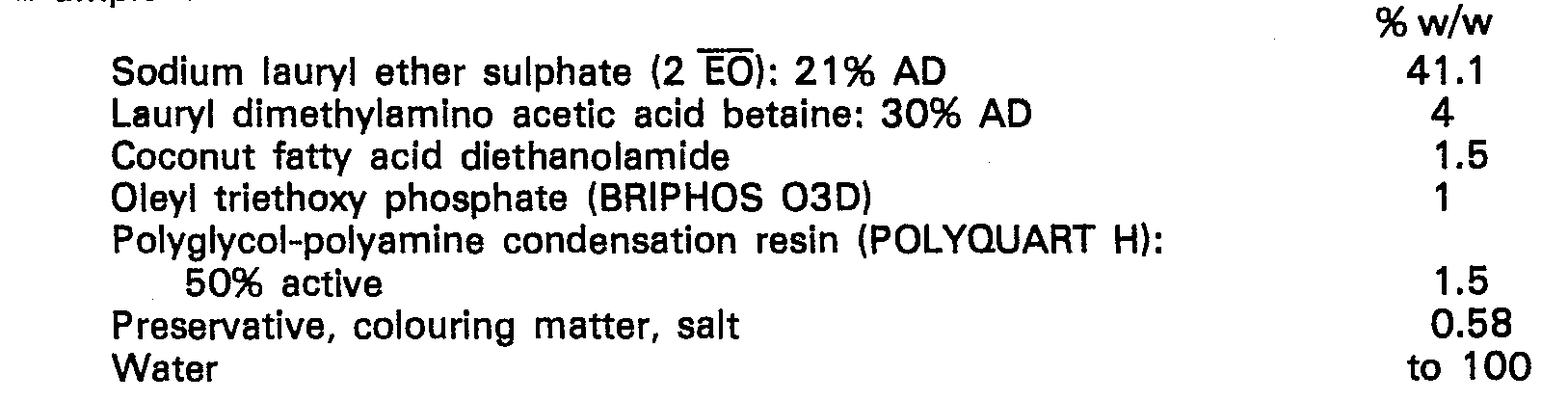
- The shampoo had a pH of 6 and a viscosity of 1500 cp at 25°C.
-

-

-

-

Claims (4)


Priority Applications (1)
| Application Number | Priority Date | Filing Date | Title |
|---|---|---|---|
| AT80302389T ATE2716T1 (en) | 1979-07-19 | 1980-07-16 | SHAMPOO WITH CONDITIONING ACTION, PROCESS FOR PRODUCTION THEREOF, CONTAINER HOLDING IT AND METHOD FOR TREATMENT OF HAIR. |
Applications Claiming Priority (2)
| Application Number | Priority Date | Filing Date | Title |
|---|---|---|---|
| GB7925175 | 1979-07-19 | ||
| GB7925175 | 1979-07-19 |
Publications (2)
| Publication Number | Publication Date |
|---|---|
| EP0024799A1 EP0024799A1 (en) | 1981-03-11 |
| EP0024799B1 true EP0024799B1 (en) | 1983-03-09 |
Family
ID=10506607
Family Applications (1)
| Application Number | Title | Priority Date | Filing Date |
|---|---|---|---|
| EP80302389A Expired EP0024799B1 (en) | 1979-07-19 | 1980-07-16 | Conditioning shampoo, process for preparing it, dispenser containing it and a method of treating hair |
Country Status (6)
| Country | Link |
|---|---|
| US (1) | US4321256A (en) |
| EP (1) | EP0024799B1 (en) |
| JP (1) | JPS5944358B2 (en) |
| AT (1) | ATE2716T1 (en) |
| CA (1) | CA1140467A (en) |
| DE (1) | DE3062279D1 (en) |
Families Citing this family (24)
| Publication number | Priority date | Publication date | Assignee | Title |
|---|---|---|---|---|
| JPS5874798A (en) * | 1981-10-28 | 1983-05-06 | 花王株式会社 | Shampoo composition |
| DK155912C (en) * | 1982-10-19 | 1989-10-23 | Colgate Palmolive Co | HAIR CONDITIONING SHAMPOO |
| US4676978A (en) * | 1983-10-17 | 1987-06-30 | Colgate-Palmolive Company | Shampoo |
| DE3431417A1 (en) * | 1984-08-27 | 1986-02-27 | Henkel KGaA, 4000 Düsseldorf | HAIR TREATMENT |
| JPH0762301B2 (en) * | 1986-09-08 | 1995-07-05 | 金井 宏之 | Base material for polyester artificial leather |
| JPH02273617A (en) * | 1989-04-14 | 1990-11-08 | Kao Corp | Skin detergent composition |
| GB9000704D0 (en) * | 1990-01-12 | 1990-03-14 | Unilever Plc | Topical composition |
| DE4338691B4 (en) * | 1993-11-12 | 2006-05-24 | Cognis Ip Management Gmbh | Hair treatment agents |
| US5665364A (en) * | 1995-07-24 | 1997-09-09 | The Procter & Gamble Company | Compositions for topical delivery of active ingredients |
| US5607980A (en) * | 1995-07-24 | 1997-03-04 | The Procter & Gamble Company | Topical compositions having improved skin feel |
| US6821509B2 (en) * | 2000-04-14 | 2004-11-23 | Cosmetica, Inc. | Nanoscopic hair care products |
| US6566313B1 (en) | 2000-09-15 | 2003-05-20 | Henkel Corporation | Shampoo and body wash composition and method of use thereof |
| JP4173712B2 (en) * | 2002-04-12 | 2008-10-29 | 花王株式会社 | Cleaning composition |
| GB2401875A (en) * | 2003-05-22 | 2004-11-24 | Reckitt Benckiser Nv | Aqueous cleaning compositions |
| CA2618223A1 (en) * | 2005-08-09 | 2007-02-22 | Soane Labs, Llc | Hair hold formulations |
| US8993506B2 (en) * | 2006-06-12 | 2015-03-31 | Rhodia Operations | Hydrophilized substrate and method for hydrophilizing a hydrophobic surface of a substrate |
| US7955606B2 (en) * | 2006-10-19 | 2011-06-07 | L'oreal | Aqueous systems containing polyamine, surfactant and phosphate ester for water-insoluble materials |
| CA2690744A1 (en) | 2007-06-12 | 2008-12-24 | Rhodia, Inc. | Mono-, di- and polyol alkoxylate phosphate esters in oral care formulations and methods for using same |
| CA2690602C (en) * | 2007-06-12 | 2017-02-28 | Rhodia Inc. | Hard surface cleaning composition with hydrophilizing agent and method for cleaning hard surfaces |
| CN101679916B (en) * | 2007-06-12 | 2013-03-20 | 罗迪亚公司 | Mono-di-and polyol phosphate esters in personal care formulations |
| EP2152839B1 (en) * | 2007-06-12 | 2018-11-14 | Solvay USA Inc. | Detergent composition with hydrophilizing soil-release agent and methods for using same |
| RU2434041C1 (en) * | 2007-07-20 | 2011-11-20 | Родиа Инк. | Procedure for withdrawal of crude oil from underground formation |
| FR2964320B1 (en) * | 2010-09-06 | 2013-06-14 | Oreal | COSMETIC COMPOSITION COMPRISING AT LEAST ONE FATTY POLYAMINE, AT LEAST ONE POLYOL AND AT LEAST ONE PARTICULATE THICKENER |
| KR101515269B1 (en) * | 2012-09-20 | 2015-04-24 | 주식회사 엘지화학 | Acrylic copolymer latex, and method for preparing thereof |
Citations (1)
| Publication number | Priority date | Publication date | Assignee | Title |
|---|---|---|---|---|
| DE2727255A1 (en) * | 1976-06-21 | 1977-12-29 | Unilever Nv | SHAMPOO |
Family Cites Families (5)
| Publication number | Priority date | Publication date | Assignee | Title |
|---|---|---|---|---|
| DE2363871C2 (en) * | 1973-12-21 | 1981-10-15 | Henkel KGaA, 4000 Düsseldorf | Shampoo and hair treatment preparations |
| JPS5851991B2 (en) * | 1976-08-24 | 1983-11-19 | 花王株式会社 | Hypoallergenic shampoo composition |
| JPS5326806A (en) * | 1976-08-24 | 1978-03-13 | Kao Corp | Low irritating detergent composition |
| GB1538174A (en) | 1976-11-05 | 1979-01-10 | Unilever Ltd | Cleaning composition |
| JPS5916597B2 (en) * | 1978-04-12 | 1984-04-16 | ライオン株式会社 | Shampoo - Composition |
-
1980
- 1980-07-14 US US06/167,977 patent/US4321256A/en not_active Expired - Lifetime
- 1980-07-15 CA CA000356203A patent/CA1140467A/en not_active Expired
- 1980-07-16 DE DE8080302389T patent/DE3062279D1/en not_active Expired
- 1980-07-16 JP JP55097445A patent/JPS5944358B2/en not_active Expired
- 1980-07-16 AT AT80302389T patent/ATE2716T1/en not_active IP Right Cessation
- 1980-07-16 EP EP80302389A patent/EP0024799B1/en not_active Expired
Patent Citations (1)
| Publication number | Priority date | Publication date | Assignee | Title |
|---|---|---|---|---|
| DE2727255A1 (en) * | 1976-06-21 | 1977-12-29 | Unilever Nv | SHAMPOO |
Also Published As
| Publication number | Publication date |
|---|---|
| EP0024799A1 (en) | 1981-03-11 |
| ATE2716T1 (en) | 1983-03-15 |
| DE3062279D1 (en) | 1983-04-14 |
| US4321256A (en) | 1982-03-23 |
| JPS5618698A (en) | 1981-02-21 |
| JPS5944358B2 (en) | 1984-10-29 |
| CA1140467A (en) | 1983-02-01 |
Similar Documents
| Publication | Publication Date | Title |
|---|---|---|
| US4321256A (en) | Shampoo containing a polyglycol-polyamine condensation resin and a phosphate ester | |
| EP0018717B2 (en) | Shampoo | |
| US4061602A (en) | Conditioning shampoo composition containing a cationic derivative of a natural gum (such as guar) as the active conditioning ingredient | |
| EP0269243B1 (en) | Hair products containing dimethyl diallyl ammonium chloride/acrylic acid-type polymer | |
| DE60011827T2 (en) | Cosmetic compositions containing an anionic hydroxyalkyl hydroxy ether and a cationic polymer and their uses | |
| US7514091B2 (en) | Aminated silicone detergent cosmetic composition and use | |
| EP0122324B1 (en) | Polyquaternary ammonium compounds and cosmetic compositions containing them | |
| KR19990078022A (en) | Keratin treating cosmetic compositions containing amphoteric polysaccharide derivatives | |
| DE3709089A1 (en) | AQUEOUS COSMETIC AGENT WITH DELAYED FOAM DEVELOPMENT FOR HAIR AND SKIN TREATMENT | |
| JPH05255040A (en) | Cosmetic composition containing a surfactant and a polyether urethane | |
| EP0266111A1 (en) | Personal skin care products containing dimethyl diallyl ammonium chloride/acrylic acid-type polymers | |
| JP2001115189A (en) | Anionic surfactant and detergent composition | |
| US4166845A (en) | Antidandruff shampoo compositions containing an aminopolyureylene resin | |
| EP0165397A2 (en) | Hair care compositions | |
| DE69100419T2 (en) | Hair cosmetic composition. | |
| CH660114A5 (en) | METHOD FOR WAVING OR SMOOTHING AND SIMULTANEOUSLY CONDITIONING HAIR. | |
| DE69431793T2 (en) | DETERGENT COMPOSITION | |
| IE41913B1 (en) | Shampoo compositions | |
| US5900232A (en) | Cosmetic compositions containing at least one anionic surfactant of alkylgalactoside uronate type and at least one cationic polymer, and uses thereof in the treatment of keratinous substances | |
| JP3525848B2 (en) | Anionic surfactant and detergent composition | |
| JPH0357159B2 (en) | ||
| JPH0529203B2 (en) | ||
| WO2026104274A1 (en) | Cosmetic composition comprising cationic inulins and specific amphoteric and anionic surfactants, and cosmetic treatment process | |
| NZ205951A (en) | A hair conditioning shampoo | |
| JPS5918440B2 (en) | cleaning composition |
Legal Events
| Date | Code | Title | Description |
|---|---|---|---|
| PUAI | Public reference made under article 153(3) epc to a published international application that has entered the european phase |
Free format text: ORIGINAL CODE: 0009012 |
|
| AK | Designated contracting states |
Designated state(s): AT BE CH DE FR GB IT NL SE |
|
| 17P | Request for examination filed |
Effective date: 19810722 |
|
| RAP1 | Party data changed (applicant data changed or rights of an application transferred) |
Owner name: UNILEVER NV Owner name: UNILEVER PLC |
|
| ITF | It: translation for a ep patent filed | ||
| GRAA | (expected) grant |
Free format text: ORIGINAL CODE: 0009210 |
|
| AK | Designated contracting states |
Designated state(s): AT BE CH DE FR GB IT LI NL SE |
|
| REF | Corresponds to: |
Ref document number: 2716 Country of ref document: AT Date of ref document: 19830315 Kind code of ref document: T |
|
| REF | Corresponds to: |
Ref document number: 3062279 Country of ref document: DE Date of ref document: 19830414 |
|
| ET | Fr: translation filed | ||
| RAP2 | Party data changed (patent owner data changed or rights of a patent transferred) |
Owner name: UNILEVER NV Owner name: UNILEVER PLC |
|
| PGFP | Annual fee paid to national office [announced via postgrant information from national office to epo] |
Ref country code: BE Payment date: 19840630 Year of fee payment: 5 |
|
| PGFP | Annual fee paid to national office [announced via postgrant information from national office to epo] |
Ref country code: CH Payment date: 19840726 Year of fee payment: 5 |
|
| PGFP | Annual fee paid to national office [announced via postgrant information from national office to epo] |
Ref country code: FR Payment date: 19840801 Year of fee payment: 5 |
|
| PGFP | Annual fee paid to national office [announced via postgrant information from national office to epo] |
Ref country code: DE Payment date: 19840831 Year of fee payment: 5 |
|
| PGFP | Annual fee paid to national office [announced via postgrant information from national office to epo] |
Ref country code: SE Payment date: 19840930 Year of fee payment: 5 |
|
| PGFP | Annual fee paid to national office [announced via postgrant information from national office to epo] |
Ref country code: AT Payment date: 19860715 Year of fee payment: 7 |
|
| PGFP | Annual fee paid to national office [announced via postgrant information from national office to epo] |
Ref country code: NL Payment date: 19860731 Year of fee payment: 7 |
|
| PG25 | Lapsed in a contracting state [announced via postgrant information from national office to epo] |
Ref country code: AT Effective date: 19870716 |
|
| PG25 | Lapsed in a contracting state [announced via postgrant information from national office to epo] |
Ref country code: SE Effective date: 19870717 |
|
| PG25 | Lapsed in a contracting state [announced via postgrant information from national office to epo] |
Ref country code: LI Effective date: 19870731 Ref country code: CH Effective date: 19870731 |
|
| BERE | Be: lapsed |
Owner name: UNILEVER N.V. Effective date: 19870731 |
|
| PG25 | Lapsed in a contracting state [announced via postgrant information from national office to epo] |
Ref country code: NL Effective date: 19880201 |
|
| NLV4 | Nl: lapsed or anulled due to non-payment of the annual fee | ||
| PG25 | Lapsed in a contracting state [announced via postgrant information from national office to epo] |
Ref country code: FR Free format text: LAPSE BECAUSE OF NON-PAYMENT OF DUE FEES Effective date: 19880331 |
|
| REG | Reference to a national code |
Ref country code: CH Ref legal event code: PL |
|
| PG25 | Lapsed in a contracting state [announced via postgrant information from national office to epo] |
Ref country code: DE Effective date: 19880401 |
|
| GBPC | Gb: european patent ceased through non-payment of renewal fee | ||
| REG | Reference to a national code |
Ref country code: FR Ref legal event code: ST |
|
| PG25 | Lapsed in a contracting state [announced via postgrant information from national office to epo] |
Ref country code: GB Free format text: LAPSE BECAUSE OF NON-PAYMENT OF DUE FEES Effective date: 19881118 |
|
| PG25 | Lapsed in a contracting state [announced via postgrant information from national office to epo] |
Ref country code: BE Effective date: 19890731 |
|
| EUG | Se: european patent has lapsed |
Ref document number: 80302389.4 Effective date: 19880831 |
|
| PLBE | No opposition filed within time limit |
Free format text: ORIGINAL CODE: 0009261 |
|
| STAA | Information on the status of an ep patent application or granted ep patent |
Free format text: STATUS: NO OPPOSITION FILED WITHIN TIME LIMIT |