EP0024112B1 - Verfahren zur Abtrennung und Isolierung konjugierten und nicht konjugierten Bilirubins, isoliertes konjugiertes Bilirubin und diese Verbindung enthaltende Bezugszusammensetzung - Google Patents
Verfahren zur Abtrennung und Isolierung konjugierten und nicht konjugierten Bilirubins, isoliertes konjugiertes Bilirubin und diese Verbindung enthaltende Bezugszusammensetzung Download PDFInfo
- Publication number
- EP0024112B1 EP0024112B1 EP80302364A EP80302364A EP0024112B1 EP 0024112 B1 EP0024112 B1 EP 0024112B1 EP 80302364 A EP80302364 A EP 80302364A EP 80302364 A EP80302364 A EP 80302364A EP 0024112 B1 EP0024112 B1 EP 0024112B1
- Authority
- EP
- European Patent Office
- Prior art keywords
- bilirubin
- mordant
- aqueous
- carried out
- mordanted
- Prior art date
- Legal status (The legal status is an assumption and is not a legal conclusion. Google has not performed a legal analysis and makes no representation as to the accuracy of the status listed.)
- Expired
Links
- BPYKTIZUTYGOLE-IFADSCNNSA-N Bilirubin Chemical compound N1C(=O)C(C)=C(C=C)\C1=C\C1=C(C)C(CCC(O)=O)=C(CC2=C(C(C)=C(\C=C/3C(=C(C=C)C(=O)N\3)C)N2)CCC(O)=O)N1 BPYKTIZUTYGOLE-IFADSCNNSA-N 0.000 title claims description 153
- 238000000034 method Methods 0.000 title claims description 81
- 239000000203 mixture Substances 0.000 title claims description 44
- 238000000926 separation method Methods 0.000 title claims description 16
- 238000002955 isolation Methods 0.000 title claims description 13
- BPYKTIZUTYGOLE-UHFFFAOYSA-N billirubin-IXalpha Natural products N1C(=O)C(C)=C(C=C)C1=CC1=C(C)C(CCC(O)=O)=C(CC2=C(C(C)=C(C=C3C(=C(C=C)C(=O)N3)C)N2)CCC(O)=O)N1 BPYKTIZUTYGOLE-UHFFFAOYSA-N 0.000 title claims description 7
- 239000007788 liquid Substances 0.000 claims description 72
- 230000002452 interceptive effect Effects 0.000 claims description 25
- 239000003795 chemical substances by application Substances 0.000 claims description 23
- 239000012736 aqueous medium Substances 0.000 claims description 22
- 230000003196 chaotropic effect Effects 0.000 claims description 22
- 150000003839 salts Chemical class 0.000 claims description 21
- LRFVTYWOQMYALW-UHFFFAOYSA-N 9H-xanthine Chemical compound O=C1NC(=O)NC2=C1NC=N2 LRFVTYWOQMYALW-UHFFFAOYSA-N 0.000 claims description 18
- 238000003556 assay Methods 0.000 claims description 16
- 239000003960 organic solvent Substances 0.000 claims description 14
- YMWUJEATGCHHMB-UHFFFAOYSA-N Dichloromethane Chemical compound ClCCl YMWUJEATGCHHMB-UHFFFAOYSA-N 0.000 claims description 12
- 239000002736 nonionic surfactant Substances 0.000 claims description 12
- 239000002609 medium Substances 0.000 claims description 10
- HEDRZPFGACZZDS-UHFFFAOYSA-N Chloroform Chemical group ClC(Cl)Cl HEDRZPFGACZZDS-UHFFFAOYSA-N 0.000 claims description 8
- 229920001577 copolymer Polymers 0.000 claims description 8
- BDERNNFJNOPAEC-UHFFFAOYSA-N propan-1-ol Chemical group CCCO BDERNNFJNOPAEC-UHFFFAOYSA-N 0.000 claims description 8
- 239000007790 solid phase Substances 0.000 claims description 8
- 230000002209 hydrophobic effect Effects 0.000 claims description 7
- 239000011159 matrix material Substances 0.000 claims description 7
- 239000002253 acid Substances 0.000 claims description 6
- 239000002904 solvent Substances 0.000 claims description 6
- 229940075420 xanthine Drugs 0.000 claims description 6
- 238000000605 extraction Methods 0.000 claims description 5
- 239000012298 atmosphere Substances 0.000 claims description 4
- 239000000178 monomer Substances 0.000 claims description 4
- 230000001590 oxidative effect Effects 0.000 claims description 4
- 229920000642 polymer Polymers 0.000 claims description 4
- XSQUKJJJFZCRTK-UHFFFAOYSA-N Urea Chemical compound NC(N)=O XSQUKJJJFZCRTK-UHFFFAOYSA-N 0.000 claims description 3
- 239000004202 carbamide Substances 0.000 claims description 3
- 150000001450 anions Chemical class 0.000 claims description 2
- 150000001768 cations Chemical class 0.000 claims description 2
- 125000000962 organic group Chemical group 0.000 claims description 2
- IJGRMHOSHXDMSA-UHFFFAOYSA-N Atomic nitrogen Chemical compound N#N IJGRMHOSHXDMSA-UHFFFAOYSA-N 0.000 description 22
- 210000002966 serum Anatomy 0.000 description 20
- 239000006228 supernatant Substances 0.000 description 17
- 210000000941 bile Anatomy 0.000 description 15
- RYYVLZVUVIJVGH-UHFFFAOYSA-N caffeine Chemical compound CN1C(=O)N(C)C(=O)C2=C1N=CN2C RYYVLZVUVIJVGH-UHFFFAOYSA-N 0.000 description 13
- 239000000243 solution Substances 0.000 description 13
- XLYOFNOQVPJJNP-UHFFFAOYSA-N water Substances O XLYOFNOQVPJJNP-UHFFFAOYSA-N 0.000 description 13
- 239000000843 powder Substances 0.000 description 12
- 229910052757 nitrogen Inorganic materials 0.000 description 11
- 238000008050 Total Bilirubin Reagent Methods 0.000 description 9
- 125000004432 carbon atom Chemical group C* 0.000 description 9
- 239000000126 substance Substances 0.000 description 9
- 238000010521 absorption reaction Methods 0.000 description 7
- WXMKPNITSTVMEF-UHFFFAOYSA-M sodium benzoate Chemical compound [Na+].[O-]C(=O)C1=CC=CC=C1 WXMKPNITSTVMEF-UHFFFAOYSA-M 0.000 description 7
- 235000010234 sodium benzoate Nutrition 0.000 description 7
- 239000004299 sodium benzoate Substances 0.000 description 7
- LFQSCWFLJHTTHZ-UHFFFAOYSA-N Ethanol Chemical compound CCO LFQSCWFLJHTTHZ-UHFFFAOYSA-N 0.000 description 6
- LPHGQDQBBGAPDZ-UHFFFAOYSA-N Isocaffeine Natural products CN1C(=O)N(C)C(=O)C2=C1N(C)C=N2 LPHGQDQBBGAPDZ-UHFFFAOYSA-N 0.000 description 6
- OKKJLVBELUTLKV-UHFFFAOYSA-N Methanol Chemical compound OC OKKJLVBELUTLKV-UHFFFAOYSA-N 0.000 description 6
- MUBZPKHOEPUJKR-UHFFFAOYSA-N Oxalic acid Chemical compound OC(=O)C(O)=O MUBZPKHOEPUJKR-UHFFFAOYSA-N 0.000 description 6
- FAPWRFPIFSIZLT-UHFFFAOYSA-M Sodium chloride Chemical compound [Na+].[Cl-] FAPWRFPIFSIZLT-UHFFFAOYSA-M 0.000 description 6
- 125000000217 alkyl group Chemical group 0.000 description 6
- -1 alkyl ketones Chemical class 0.000 description 6
- 239000011324 bead Substances 0.000 description 6
- 229960001948 caffeine Drugs 0.000 description 6
- VJEONQKOZGKCAK-UHFFFAOYSA-N caffeine Natural products CN1C(=O)N(C)C(=O)C2=C1C=CN2C VJEONQKOZGKCAK-UHFFFAOYSA-N 0.000 description 6
- 239000000499 gel Substances 0.000 description 6
- 239000000463 material Substances 0.000 description 6
- 125000005233 alkylalcohol group Chemical group 0.000 description 5
- 239000002585 base Substances 0.000 description 5
- 230000015556 catabolic process Effects 0.000 description 5
- 125000002091 cationic group Chemical group 0.000 description 5
- 239000003153 chemical reaction reagent Substances 0.000 description 5
- 238000006731 degradation reaction Methods 0.000 description 5
- 102000004169 proteins and genes Human genes 0.000 description 5
- 108090000623 proteins and genes Proteins 0.000 description 5
- 230000007480 spreading Effects 0.000 description 5
- 238000003892 spreading Methods 0.000 description 5
- 238000005406 washing Methods 0.000 description 5
- 239000008188 pellet Substances 0.000 description 4
- 239000008057 potassium phosphate buffer Substances 0.000 description 4
- JWBPVFVNISJVEM-UHFFFAOYSA-M sodium caffeine benzoate Chemical compound [Na+].[O-]C(=O)C1=CC=CC=C1.CN1C(=O)N(C)C(=O)C2=C1N=CN2C JWBPVFVNISJVEM-UHFFFAOYSA-M 0.000 description 4
- 238000011282 treatment Methods 0.000 description 4
- AEMOLEFTQBMNLQ-AQKNRBDQSA-N D-glucopyranuronic acid Chemical compound OC1O[C@H](C(O)=O)[C@@H](O)[C@H](O)[C@H]1O AEMOLEFTQBMNLQ-AQKNRBDQSA-N 0.000 description 3
- UYUXSRADSPPKRZ-UHFFFAOYSA-N D-glucuronic acid gamma-lactone Natural products O=CC(O)C1OC(=O)C(O)C1O UYUXSRADSPPKRZ-UHFFFAOYSA-N 0.000 description 3
- UYUXSRADSPPKRZ-SKNVOMKLSA-N D-glucurono-6,3-lactone Chemical compound O=C[C@H](O)[C@H]1OC(=O)[C@@H](O)[C@H]1O UYUXSRADSPPKRZ-SKNVOMKLSA-N 0.000 description 3
- IAJILQKETJEXLJ-UHFFFAOYSA-N Galacturonsaeure Natural products O=CC(O)C(O)C(O)C(O)C(O)=O IAJILQKETJEXLJ-UHFFFAOYSA-N 0.000 description 3
- HEMHJVSKTPXQMS-UHFFFAOYSA-M Sodium hydroxide Chemical compound [OH-].[Na+] HEMHJVSKTPXQMS-UHFFFAOYSA-M 0.000 description 3
- 150000007513 acids Chemical class 0.000 description 3
- 239000007864 aqueous solution Substances 0.000 description 3
- 210000001175 cerebrospinal fluid Anatomy 0.000 description 3
- 238000012512 characterization method Methods 0.000 description 3
- 238000001914 filtration Methods 0.000 description 3
- 229950002441 glucurolactone Drugs 0.000 description 3
- 229940097043 glucuronic acid Drugs 0.000 description 3
- 230000036961 partial effect Effects 0.000 description 3
- 238000002360 preparation method Methods 0.000 description 3
- 239000011780 sodium chloride Substances 0.000 description 3
- AKHNMLFCWUSKQB-UHFFFAOYSA-L sodium thiosulfate Chemical compound [Na+].[Na+].[O-]S([O-])(=O)=S AKHNMLFCWUSKQB-UHFFFAOYSA-L 0.000 description 3
- 210000002700 urine Anatomy 0.000 description 3
- KBPLFHHGFOOTCA-UHFFFAOYSA-N 1-Octanol Chemical compound CCCCCCCCO KBPLFHHGFOOTCA-UHFFFAOYSA-N 0.000 description 2
- CSCPPACGZOOCGX-UHFFFAOYSA-N Acetone Chemical compound CC(C)=O CSCPPACGZOOCGX-UHFFFAOYSA-N 0.000 description 2
- XKRFYHLGVUSROY-UHFFFAOYSA-N Argon Chemical compound [Ar] XKRFYHLGVUSROY-UHFFFAOYSA-N 0.000 description 2
- 241001465754 Metazoa Species 0.000 description 2
- 238000005481 NMR spectroscopy Methods 0.000 description 2
- 241000283973 Oryctolagus cuniculus Species 0.000 description 2
- 229920001213 Polysorbate 20 Polymers 0.000 description 2
- WCUXLLCKKVVCTQ-UHFFFAOYSA-M Potassium chloride Chemical compound [Cl-].[K+] WCUXLLCKKVVCTQ-UHFFFAOYSA-M 0.000 description 2
- PPBRXRYQALVLMV-UHFFFAOYSA-N Styrene Chemical class C=CC1=CC=CC=C1 PPBRXRYQALVLMV-UHFFFAOYSA-N 0.000 description 2
- WYURNTSHIVDZCO-UHFFFAOYSA-N Tetrahydrofuran Chemical compound C1CCOC1 WYURNTSHIVDZCO-UHFFFAOYSA-N 0.000 description 2
- 239000013504 Triton X-100 Substances 0.000 description 2
- 229920004890 Triton X-100 Polymers 0.000 description 2
- 238000002835 absorbance Methods 0.000 description 2
- 150000001298 alcohols Chemical class 0.000 description 2
- 150000001336 alkenes Chemical class 0.000 description 2
- 125000002947 alkylene group Chemical group 0.000 description 2
- 238000004458 analytical method Methods 0.000 description 2
- 239000006286 aqueous extract Substances 0.000 description 2
- 230000008901 benefit Effects 0.000 description 2
- 239000003809 bile pigment Substances 0.000 description 2
- 210000001124 body fluid Anatomy 0.000 description 2
- 239000010839 body fluid Substances 0.000 description 2
- 239000000872 buffer Substances 0.000 description 2
- 229940023964 caffeine and sodium benzoate Drugs 0.000 description 2
- 238000004440 column chromatography Methods 0.000 description 2
- 230000003247 decreasing effect Effects 0.000 description 2
- 239000012153 distilled water Substances 0.000 description 2
- 239000012530 fluid Substances 0.000 description 2
- 238000004108 freeze drying Methods 0.000 description 2
- 238000004442 gravimetric analysis Methods 0.000 description 2
- 230000003993 interaction Effects 0.000 description 2
- 150000002500 ions Chemical class 0.000 description 2
- 239000007791 liquid phase Substances 0.000 description 2
- 238000004519 manufacturing process Methods 0.000 description 2
- 238000012544 monitoring process Methods 0.000 description 2
- 235000006408 oxalic acid Nutrition 0.000 description 2
- 125000005496 phosphonium group Chemical group 0.000 description 2
- 239000000256 polyoxyethylene sorbitan monolaurate Substances 0.000 description 2
- 235000010486 polyoxyethylene sorbitan monolaurate Nutrition 0.000 description 2
- 238000010966 qNMR Methods 0.000 description 2
- 125000001453 quaternary ammonium group Chemical group 0.000 description 2
- 239000000523 sample Substances 0.000 description 2
- 239000011877 solvent mixture Substances 0.000 description 2
- 238000004611 spectroscopical analysis Methods 0.000 description 2
- 238000004809 thin layer chromatography Methods 0.000 description 2
- 238000009736 wetting Methods 0.000 description 2
- QLAJNZSPVITUCQ-UHFFFAOYSA-N 1,3,2-dioxathietane 2,2-dioxide Chemical compound O=S1(=O)OCO1 QLAJNZSPVITUCQ-UHFFFAOYSA-N 0.000 description 1
- CAFAOQIVXSSFSY-UHFFFAOYSA-N 1-ethoxyethanol Chemical class CCOC(C)O CAFAOQIVXSSFSY-UHFFFAOYSA-N 0.000 description 1
- QKNYBSVHEMOAJP-UHFFFAOYSA-N 2-amino-2-(hydroxymethyl)propane-1,3-diol;hydron;chloride Chemical compound Cl.OCC(N)(CO)CO QKNYBSVHEMOAJP-UHFFFAOYSA-N 0.000 description 1
- 102000009027 Albumins Human genes 0.000 description 1
- 108010088751 Albumins Proteins 0.000 description 1
- CIWBSHSKHKDKBQ-JLAZNSOCSA-N Ascorbic acid Natural products OC[C@H](O)[C@H]1OC(=O)C(O)=C1O CIWBSHSKHKDKBQ-JLAZNSOCSA-N 0.000 description 1
- 102000004506 Blood Proteins Human genes 0.000 description 1
- 108010017384 Blood Proteins Proteins 0.000 description 1
- CPELXLSAUQHCOX-UHFFFAOYSA-M Bromide Chemical compound [Br-] CPELXLSAUQHCOX-UHFFFAOYSA-M 0.000 description 1
- VEXZGXHMUGYJMC-UHFFFAOYSA-M Chloride anion Chemical compound [Cl-] VEXZGXHMUGYJMC-UHFFFAOYSA-M 0.000 description 1
- 230000005526 G1 to G0 transition Effects 0.000 description 1
- 108010010803 Gelatin Proteins 0.000 description 1
- 102000005720 Glutathione transferase Human genes 0.000 description 1
- 108010070675 Glutathione transferase Proteins 0.000 description 1
- 102000001554 Hemoglobins Human genes 0.000 description 1
- 108010054147 Hemoglobins Proteins 0.000 description 1
- 241000282412 Homo Species 0.000 description 1
- 102000008100 Human Serum Albumin Human genes 0.000 description 1
- 108091006905 Human Serum Albumin Proteins 0.000 description 1
- 206010023126 Jaundice Diseases 0.000 description 1
- 206010023129 Jaundice cholestatic Diseases 0.000 description 1
- FSVCELGFZIQNCK-UHFFFAOYSA-N N,N-bis(2-hydroxyethyl)glycine Chemical compound OCCN(CCO)CC(O)=O FSVCELGFZIQNCK-UHFFFAOYSA-N 0.000 description 1
- 229910002651 NO3 Inorganic materials 0.000 description 1
- NHNBFGGVMKEFGY-UHFFFAOYSA-N Nitrate Chemical compound [O-][N+]([O-])=O NHNBFGGVMKEFGY-UHFFFAOYSA-N 0.000 description 1
- 201000005267 Obstructive Jaundice Diseases 0.000 description 1
- 229920001214 Polysorbate 60 Polymers 0.000 description 1
- 229920004892 Triton X-102 Polymers 0.000 description 1
- 229920004894 Triton X-305 Polymers 0.000 description 1
- 229920004896 Triton X-405 Polymers 0.000 description 1
- 239000000654 additive Substances 0.000 description 1
- 150000001338 aliphatic hydrocarbons Chemical class 0.000 description 1
- 229910052783 alkali metal Inorganic materials 0.000 description 1
- 150000001340 alkali metals Chemical class 0.000 description 1
- 229910052784 alkaline earth metal Inorganic materials 0.000 description 1
- 125000005250 alkyl acrylate group Chemical class 0.000 description 1
- 125000002877 alkyl aryl group Chemical group 0.000 description 1
- 150000005215 alkyl ethers Chemical class 0.000 description 1
- BFNBIHQBYMNNAN-UHFFFAOYSA-N ammonium sulfate Chemical compound N.N.OS(O)(=O)=O BFNBIHQBYMNNAN-UHFFFAOYSA-N 0.000 description 1
- 229910052921 ammonium sulfate Inorganic materials 0.000 description 1
- 235000011130 ammonium sulphate Nutrition 0.000 description 1
- 239000003963 antioxidant agent Substances 0.000 description 1
- 235000006708 antioxidants Nutrition 0.000 description 1
- 239000008346 aqueous phase Substances 0.000 description 1
- 229910052786 argon Inorganic materials 0.000 description 1
- 150000004945 aromatic hydrocarbons Chemical class 0.000 description 1
- 125000003710 aryl alkyl group Chemical group 0.000 description 1
- 125000003118 aryl group Chemical group 0.000 description 1
- 125000000732 arylene group Chemical group 0.000 description 1
- 235000010323 ascorbic acid Nutrition 0.000 description 1
- 229960005070 ascorbic acid Drugs 0.000 description 1
- 239000011668 ascorbic acid Substances 0.000 description 1
- WPYMKLBDIGXBTP-UHFFFAOYSA-N benzoic acid Chemical compound OC(=O)C1=CC=CC=C1 WPYMKLBDIGXBTP-UHFFFAOYSA-N 0.000 description 1
- 239000007998 bicine buffer Substances 0.000 description 1
- 239000003613 bile acid Substances 0.000 description 1
- 239000013060 biological fluid Substances 0.000 description 1
- 230000015572 biosynthetic process Effects 0.000 description 1
- AIYUHDOJVYHVIT-UHFFFAOYSA-M caesium chloride Chemical compound [Cl-].[Cs+] AIYUHDOJVYHVIT-UHFFFAOYSA-M 0.000 description 1
- 229910052799 carbon Inorganic materials 0.000 description 1
- 238000005119 centrifugation Methods 0.000 description 1
- 230000008859 change Effects 0.000 description 1
- 238000006243 chemical reaction Methods 0.000 description 1
- SIHHLZPXQLFPMC-UHFFFAOYSA-N chloroform;methanol;hydrate Chemical compound O.OC.ClC(Cl)Cl SIHHLZPXQLFPMC-UHFFFAOYSA-N 0.000 description 1
- 238000004587 chromatography analysis Methods 0.000 description 1
- 229910000361 cobalt sulfate Inorganic materials 0.000 description 1
- 229940044175 cobalt sulfate Drugs 0.000 description 1
- KTVIXTQDYHMGHF-UHFFFAOYSA-L cobalt(2+) sulfate Chemical compound [Co+2].[O-]S([O-])(=O)=O KTVIXTQDYHMGHF-UHFFFAOYSA-L 0.000 description 1
- 239000012141 concentrate Substances 0.000 description 1
- 238000004132 cross linking Methods 0.000 description 1
- 150000004292 cyclic ethers Chemical class 0.000 description 1
- 238000004147 desorption mass spectrometry Methods 0.000 description 1
- 239000003599 detergent Substances 0.000 description 1
- 238000000502 dialysis Methods 0.000 description 1
- 125000000664 diazo group Chemical group [N-]=[N+]=[*] 0.000 description 1
- 150000005690 diesters Chemical class 0.000 description 1
- 235000014113 dietary fatty acids Nutrition 0.000 description 1
- 150000004683 dihydrates Chemical class 0.000 description 1
- LNGNZSMIUVQZOX-UHFFFAOYSA-L disodium;dioxido(sulfanylidene)-$l^{4}-sulfane Chemical compound [Na+].[Na+].[O-]S([O-])=S LNGNZSMIUVQZOX-UHFFFAOYSA-L 0.000 description 1
- 239000003995 emulsifying agent Substances 0.000 description 1
- 230000007613 environmental effect Effects 0.000 description 1
- 125000001301 ethoxy group Chemical group [H]C([H])([H])C([H])([H])O* 0.000 description 1
- 238000001704 evaporation Methods 0.000 description 1
- 230000008020 evaporation Effects 0.000 description 1
- 239000000194 fatty acid Substances 0.000 description 1
- 229930195729 fatty acid Natural products 0.000 description 1
- 239000008273 gelatin Substances 0.000 description 1
- 229920000159 gelatin Polymers 0.000 description 1
- 235000019322 gelatine Nutrition 0.000 description 1
- 235000011852 gelatine desserts Nutrition 0.000 description 1
- PJJJBBJSCAKJQF-UHFFFAOYSA-N guanidinium chloride Chemical compound [Cl-].NC(N)=[NH2+] PJJJBBJSCAKJQF-UHFFFAOYSA-N 0.000 description 1
- 229920001519 homopolymer Polymers 0.000 description 1
- 150000002430 hydrocarbons Chemical group 0.000 description 1
- 239000012535 impurity Substances 0.000 description 1
- 239000011261 inert gas Substances 0.000 description 1
- 239000002563 ionic surfactant Substances 0.000 description 1
- SUBFIBLJQMMKBK-UHFFFAOYSA-K iron(3+);trithiocyanate Chemical compound [Fe+3].[S-]C#N.[S-]C#N.[S-]C#N SUBFIBLJQMMKBK-UHFFFAOYSA-K 0.000 description 1
- TYQCGQRIZGCHNB-JLAZNSOCSA-N l-ascorbic acid Chemical compound OC[C@H](O)[C@H]1OC(O)=C(O)C1=O TYQCGQRIZGCHNB-JLAZNSOCSA-N 0.000 description 1
- 230000001000 lipidemic effect Effects 0.000 description 1
- 230000007246 mechanism Effects 0.000 description 1
- 230000002503 metabolic effect Effects 0.000 description 1
- 150000002734 metacrylic acid derivatives Chemical class 0.000 description 1
- 238000002156 mixing Methods 0.000 description 1
- 239000002808 molecular sieve Substances 0.000 description 1
- UYDLBVPAAFVANX-UHFFFAOYSA-N octylphenoxy polyethoxyethanol Chemical compound CC(C)(C)CC(C)(C)C1=CC=C(OCCOCCOCCOCCO)C=C1 UYDLBVPAAFVANX-UHFFFAOYSA-N 0.000 description 1
- 230000003647 oxidation Effects 0.000 description 1
- 238000007254 oxidation reaction Methods 0.000 description 1
- 239000013610 patient sample Substances 0.000 description 1
- 239000008363 phosphate buffer Substances 0.000 description 1
- 229920000139 polyethylene terephthalate Polymers 0.000 description 1
- 239000005020 polyethylene terephthalate Substances 0.000 description 1
- 238000006116 polymerization reaction Methods 0.000 description 1
- 239000001103 potassium chloride Substances 0.000 description 1
- 235000011164 potassium chloride Nutrition 0.000 description 1
- 239000012286 potassium permanganate Substances 0.000 description 1
- 230000008569 process Effects 0.000 description 1
- 239000000047 product Substances 0.000 description 1
- KIDBBTHHMJOMAU-UHFFFAOYSA-N propan-1-ol;hydrate Chemical compound O.CCCO KIDBBTHHMJOMAU-UHFFFAOYSA-N 0.000 description 1
- 238000000746 purification Methods 0.000 description 1
- FAIAJSOSTNJZCI-UHFFFAOYSA-N purine-2,6-dione Chemical compound O=C1NC(=O)C2=NC=NC2=N1 FAIAJSOSTNJZCI-UHFFFAOYSA-N 0.000 description 1
- 238000012207 quantitative assay Methods 0.000 description 1
- 230000009257 reactivity Effects 0.000 description 1
- 230000009467 reduction Effects 0.000 description 1
- 230000002829 reductive effect Effects 0.000 description 1
- 230000000717 retained effect Effects 0.000 description 1
- 230000000979 retarding effect Effects 0.000 description 1
- URGAHOPLAPQHLN-UHFFFAOYSA-N sodium aluminosilicate Chemical compound [Na+].[Al+3].[O-][Si]([O-])=O.[O-][Si]([O-])=O URGAHOPLAPQHLN-UHFFFAOYSA-N 0.000 description 1
- 239000001509 sodium citrate Substances 0.000 description 1
- NLJMYIDDQXHKNR-UHFFFAOYSA-K sodium citrate Chemical compound O.O.[Na+].[Na+].[Na+].[O-]C(=O)CC(O)(CC([O-])=O)C([O-])=O NLJMYIDDQXHKNR-UHFFFAOYSA-K 0.000 description 1
- 235000019345 sodium thiosulphate Nutrition 0.000 description 1
- 230000003381 solubilizing effect Effects 0.000 description 1
- 239000002195 soluble material Substances 0.000 description 1
- 238000000638 solvent extraction Methods 0.000 description 1
- 241000894007 species Species 0.000 description 1
- 230000003595 spectral effect Effects 0.000 description 1
- 230000006641 stabilisation Effects 0.000 description 1
- 238000011105 stabilization Methods 0.000 description 1
- 230000000087 stabilizing effect Effects 0.000 description 1
- 238000003860 storage Methods 0.000 description 1
- 150000003440 styrenes Chemical class 0.000 description 1
- 239000004094 surface-active agent Substances 0.000 description 1
- 239000000725 suspension Substances 0.000 description 1
- 229940065721 systemic for obstructive airway disease xanthines Drugs 0.000 description 1
- YLQBMQCUIZJEEH-UHFFFAOYSA-N tetrahydrofuran Natural products C=1C=COC=1 YLQBMQCUIZJEEH-UHFFFAOYSA-N 0.000 description 1
- YAPQBXQYLJRXSA-UHFFFAOYSA-N theobromine Chemical compound CN1C(=O)NC(=O)C2=C1N=CN2C YAPQBXQYLJRXSA-UHFFFAOYSA-N 0.000 description 1
- ZFXYFBGIUFBOJW-UHFFFAOYSA-N theophylline Chemical compound O=C1N(C)C(=O)N(C)C2=C1NC=N2 ZFXYFBGIUFBOJW-UHFFFAOYSA-N 0.000 description 1
- JOXIMZWYDAKGHI-UHFFFAOYSA-N toluene-4-sulfonic acid Chemical compound CC1=CC=C(S(O)(=O)=O)C=C1 JOXIMZWYDAKGHI-UHFFFAOYSA-N 0.000 description 1
- 238000000108 ultra-filtration Methods 0.000 description 1
Classifications
-
- C—CHEMISTRY; METALLURGY
- C07—ORGANIC CHEMISTRY
- C07D—HETEROCYCLIC COMPOUNDS
- C07D207/00—Heterocyclic compounds containing five-membered rings not condensed with other rings, with one nitrogen atom as the only ring hetero atom
- C07D207/02—Heterocyclic compounds containing five-membered rings not condensed with other rings, with one nitrogen atom as the only ring hetero atom with only hydrogen or carbon atoms directly attached to the ring nitrogen atom
- C07D207/44—Heterocyclic compounds containing five-membered rings not condensed with other rings, with one nitrogen atom as the only ring hetero atom with only hydrogen or carbon atoms directly attached to the ring nitrogen atom having three double bonds between ring members or between ring members and non-ring members
-
- C—CHEMISTRY; METALLURGY
- C07—ORGANIC CHEMISTRY
- C07D—HETEROCYCLIC COMPOUNDS
- C07D207/00—Heterocyclic compounds containing five-membered rings not condensed with other rings, with one nitrogen atom as the only ring hetero atom
- C07D207/02—Heterocyclic compounds containing five-membered rings not condensed with other rings, with one nitrogen atom as the only ring hetero atom with only hydrogen or carbon atoms directly attached to the ring nitrogen atom
- C07D207/44—Heterocyclic compounds containing five-membered rings not condensed with other rings, with one nitrogen atom as the only ring hetero atom with only hydrogen or carbon atoms directly attached to the ring nitrogen atom having three double bonds between ring members or between ring members and non-ring members
- C07D207/444—Heterocyclic compounds containing five-membered rings not condensed with other rings, with one nitrogen atom as the only ring hetero atom with only hydrogen or carbon atoms directly attached to the ring nitrogen atom having three double bonds between ring members or between ring members and non-ring members having two doubly-bound oxygen atoms directly attached in positions 2 and 5
-
- C—CHEMISTRY; METALLURGY
- C07—ORGANIC CHEMISTRY
- C07H—SUGARS; DERIVATIVES THEREOF; NUCLEOSIDES; NUCLEOTIDES; NUCLEIC ACIDS
- C07H7/00—Compounds containing non-saccharide radicals linked to saccharide radicals by a carbon-to-carbon bond
- C07H7/02—Acyclic radicals
- C07H7/033—Uronic acids
-
- C—CHEMISTRY; METALLURGY
- C09—DYES; PAINTS; POLISHES; NATURAL RESINS; ADHESIVES; COMPOSITIONS NOT OTHERWISE PROVIDED FOR; APPLICATIONS OF MATERIALS NOT OTHERWISE PROVIDED FOR
- C09B—ORGANIC DYES OR CLOSELY-RELATED COMPOUNDS FOR PRODUCING DYES, e.g. PIGMENTS; MORDANTS; LAKES
- C09B23/00—Methine or polymethine dyes, e.g. cyanine dyes
- C09B23/02—Methine or polymethine dyes, e.g. cyanine dyes the polymethine chain containing an odd number of >CH- or >C[alkyl]- groups
- C09B23/04—Methine or polymethine dyes, e.g. cyanine dyes the polymethine chain containing an odd number of >CH- or >C[alkyl]- groups one >CH- group, e.g. cyanines, isocyanines, pseudocyanines
-
- C—CHEMISTRY; METALLURGY
- C09—DYES; PAINTS; POLISHES; NATURAL RESINS; ADHESIVES; COMPOSITIONS NOT OTHERWISE PROVIDED FOR; APPLICATIONS OF MATERIALS NOT OTHERWISE PROVIDED FOR
- C09B—ORGANIC DYES OR CLOSELY-RELATED COMPOUNDS FOR PRODUCING DYES, e.g. PIGMENTS; MORDANTS; LAKES
- C09B67/00—Influencing the physical, e.g. the dyeing or printing properties of dyestuffs without chemical reactions, e.g. by treating with solvents grinding or grinding assistants, coating of pigments or dyes; Process features in the making of dyestuff preparations; Dyestuff preparations of a special physical nature, e.g. tablets, films
- C09B67/0096—Purification; Precipitation; Filtration
-
- G—PHYSICS
- G01—MEASURING; TESTING
- G01N—INVESTIGATING OR ANALYSING MATERIALS BY DETERMINING THEIR CHEMICAL OR PHYSICAL PROPERTIES
- G01N33/00—Investigating or analysing materials by specific methods not covered by groups G01N1/00 - G01N31/00
- G01N33/48—Biological material, e.g. blood, urine; Haemocytometers
- G01N33/50—Chemical analysis of biological material, e.g. blood, urine; Testing involving biospecific ligand binding methods; Immunological testing
- G01N33/72—Chemical analysis of biological material, e.g. blood, urine; Testing involving biospecific ligand binding methods; Immunological testing involving blood pigments, e.g. haemoglobin, bilirubin or other porphyrins; involving occult blood
- G01N33/728—Bilirubin; including biliverdin
-
- Y—GENERAL TAGGING OF NEW TECHNOLOGICAL DEVELOPMENTS; GENERAL TAGGING OF CROSS-SECTIONAL TECHNOLOGIES SPANNING OVER SEVERAL SECTIONS OF THE IPC; TECHNICAL SUBJECTS COVERED BY FORMER USPC CROSS-REFERENCE ART COLLECTIONS [XRACs] AND DIGESTS
- Y10—TECHNICAL SUBJECTS COVERED BY FORMER USPC
- Y10T—TECHNICAL SUBJECTS COVERED BY FORMER US CLASSIFICATION
- Y10T436/00—Chemistry: analytical and immunological testing
- Y10T436/14—Heterocyclic carbon compound [i.e., O, S, N, Se, Te, as only ring hetero atom]
- Y10T436/145555—Hetero-N
- Y10T436/146666—Bile pigment
-
- Y—GENERAL TAGGING OF NEW TECHNOLOGICAL DEVELOPMENTS; GENERAL TAGGING OF CROSS-SECTIONAL TECHNOLOGIES SPANNING OVER SEVERAL SECTIONS OF THE IPC; TECHNICAL SUBJECTS COVERED BY FORMER USPC CROSS-REFERENCE ART COLLECTIONS [XRACs] AND DIGESTS
- Y10—TECHNICAL SUBJECTS COVERED BY FORMER USPC
- Y10T—TECHNICAL SUBJECTS COVERED BY FORMER US CLASSIFICATION
- Y10T436/00—Chemistry: analytical and immunological testing
- Y10T436/25—Chemistry: analytical and immunological testing including sample preparation
- Y10T436/25375—Liberation or purification of sample or separation of material from a sample [e.g., filtering, centrifuging, etc.]
Definitions
- B c conjugated bilirubin
- Bile was chosen for the separation and isolation of B c because of the high concentration of B c which exists in bile.
- the presence and concentration of B c in body fluids is of diagnostic significance, particularly in dealing with the treatment of certain jaundice conditions, e.g., in obstructive jaundice the small amount of B c normally present in adult human serum becomes elevated to form a larger proportion of the total bilirubin content.
- the total bilirubin content consists of the sum of B c and the more familiar, predominant form of bilirubin, referred to as unconjugated bilirubin (B).
- B u standards that can be purchased typically come from nonhuman bile sources, e.g., cow or ox, while B c standards are not available from either human or nonhuman animal sources.
- Various artificial standards have been used for bilirubin, such as ferric thiocyanate, cobalt sulfate, and potassium permanganate.
- Lucassen procedure Although one could attempt to obtain a B c standard by use of the above-referenced Lucassen procedure, this procedure is difficult to perform. In addition, the Lucassen procedure provides little or no stabilization of B c during the isolation and extraction process, and therefore the B c has a pronounced tendency to degrade during the process. Moreover, the Lucassen procedure, although useful on bile which contains relatively high concentrations of B c and low concentrations of protein to which bilirubin readily binds, has never, to the knowledge of the inventor, been successfully applied to other aqueous biological liquids. For example, the Lucassen procedure has been found unsuccessful when applied to serum which contains relatively low amounts of B c and high concentrations of protein. Accordingly, a new method for separating and isolating B c and/or B u from bile as well as other aqueous liquids such as serum would be highly desirable.
- B c and/or B u can be employed for numerous clinical purposes, such as in the manufacture and preparation of various standards, i.e., reference compositions, such as calibrators and controls, used in the assay of bilirubin contained in biological fluids such as serum, urine, cerebrospinal fluid and bile.
- standards i.e., reference compositions, such as calibrators and controls
- the present invention provides a new method for the separation of conjugated and unconjugated bilirubin from aqueous liquids containing bilirubin, especially mixtures of B c and B u .
- interactive mordant we mean that the B c and B u enter into a chemical reaction opposed to mere physical absorption.
- the chaotropic agent employed in step (c) is selected from ionizable salts; xanthine; alkylated xanthines, e.g., caffeine; non-ionic surfactants, e.g., alkarylpolyethers; urea or mixtures of the foregoing materials.
- ionizable salts include ionizable salts; mixtures of sodium benzoate and an alkylated xanthine; and non-ionic surfactants.
- B c and B u are also selectively separated from one another. This is achieved during or after step (c) by selectively dissolving either the released B c or the released B u .
- step (c) of the present method is carried out at a pH at which the B c is soluble in the aqueous medium while the B u forms an insoluble solid-phase. Accordingly, this embodiment effectively isolates B c from B u .
- the selective separation of B c from B u can be achieved or further enhanced by addition of a water-miscible organic solvent following step (b).
- propanol and other alkyl alcohols partially dissolve B c while B u is substantially insoluble in these alcohols.
- the released B u is separated from the released B c by extraction in a water-immiscible organic solvent to dissolve B u , e.g., chloroform, dichloromethane, or a mixture thereof.
- a further embodiment of the invention provides isolated B c having a purity in excess of 75% by weight, preferably in excess of 85% by weight as determined by quantitative NMR (nuclear magnetic resonance) and gravimetric analysis.
- a reference composition including the isolated B c for assay of bilirubin contained in an aqueous liquid is also provided.
- This reference composition includes a wet or dry matrix, and the isolated B c .
- the resultant aqueous composition upon addition of an aqueous liquid, represents a useful reference fluid for calibrating clinical elements and reagents intended for assay of bilirubin in biological liquids, particularly quantitative assays of B c and total bilirubin, i.e., the sum of B c and B u contained in an aqueous liquid.
- the present invention provides a new method for the separation and isolation of conjugated bilirubin (B c ) and/or unconjugated bilirubin (B u ) from aqueous liquids containing mixtures of B u and B c .
- the method is also applicable to aqueous liquids in which the entire bilirubin content is composed solely of either B c or B u .
- the method of the invention is particularly useful in the isolation of B c from aqueous liquids containing mixtures of B c and B u .
- the method of the invention can advantageously be employed to isolate B c and/or B u from a variety of aqueous liquids.
- the method can be applied to aqueous biological liquids such as bile, serum, cerebrospinal fluid, and urine, derived from both human and nonhuman animal sources.
- the method can be applied to aqueous liquids that contain relatively low amounts of B c and relatively large amounts of protein to which bilirubin is known to bind.
- a further advantage of the present method is that the interactive mordants used appear to aid in stabilizing B c during the separation and isolation steps so that there is less tendency for the B c to degrade.
- the environmental conditions can vary considerably. However, owing to the susceptibility of bilirubin to degradation in oxidizing atmospheres and the general instability of bilirubin, particularly B c , the method is preferably carried out in a non-oxidizing atmosphere, such as under nitrogen or an inert gas such as argon. Likewise, the temperature is preferably maintained within a range effective to avoid degradation of bilirubin, for example, within a range of from 0 to 60°C, preferably from 0 to 10°C. By using the foregoing preferred conditions, one can optimize the amounts of B c and B u isolated.
- the present method is preferably carried out in the dark or under yellow safe-light conditions to avoid light-induced degradation of bilirubin.
- step (a) of the present method the liquid containing a quantity of B c and/or B u to be isolated is contacted with an interactive mordant to mordant both Be and B u .
- an interactive mordant to mordant both Be and B u .
- This can be carried out by mixing together an aqueous liquid containing the mordant dissolved or suspended therein and the aqueous bilirubin-containing liquid.
- the mordant can be mixed directly in the aqueous bilirubin-containing liquid as a dry powder; or the aqueous bilirubin-containing liquid can be applied to an essentially dry zone, e.g., a layer, comprising the mordant, for example, the dry test element described in U.S. Patent 4,069,017.
- the interactive mordant can be packed in a column and the aqueous liquid containing the bilirubin can be passed through the column to contact the mordant.
- the quantity of mordant used in this first step can vary widely depending upon the particular mordant selected, its binding capacity for Be and B " , and the particular means whereby this step is carried out, e.g., whether the mordant is contained in an aqueous liquid at the time of contact, is present as a dry zone of a dry test element, or is packed in a column.
- the amount of Be or B u isolated by the present invention one preferably employs in step (a) of the method an amount of mordant in excess of the maximum amount of B c and B u thought to be present in the liquid to ensure that as much bilirubin as possible is mordanted.
- a useful amount of the preferred copolymer mordants described in greater detail hereinafter is typically that which is sufficient to provide a final amount of mordant in the bilirubin-containing liquid within the range of from 0.007 to 10 g% based on the total weight of mordant and aqueous liquid.
- a useful test for determining the amount of a particular interactive mordant to be contacted with a particular bilirubin-containing aqueous liquid can readily be performed by monitoring the absorption maxima of the mordanted bilirubin. That is, mordanted bilirubin exhibits enhanced absorptivity because of the interaction of the mordant and bilirubin. This is described in U.S. Patent 4,016,017.
- the respective absorption maxima of mordanted B c and B u can vary somewhat depending upon the particular interactive mordant, but an absorption maximum for mordanted Be usually occurs at 420-430 ⁇ 20 nm and for mordanted B u at 460 nm ⁇ 20 nm.
- the addition of the mordant can be terminated when the absorption maxima of mordanted Be and mordanted B u stop increasing.
- the length of time for contacting the bilirubin-containing liquid and the interactive mordant can vary, depending upon the concentration of bilirubin in the liquid, the amount of mordant present, the binding capability of the mordant, and the degree of intermolecular contact between the mordant and the bilirubin.
- a contact time within the range of from 10 seconds to 10 minutes is usually effective, although shorter or longer contact times can also be used depending upon the particular circumstances.
- the pH at which the bilirubin-containing liquid and mordant are contacted can vary over a relatively wide range.
- the pH can range from 2 to 10, B u being soluble from pH 7.4 to 10 and Be being soluble from pH 2 to 10.
- the pH of the first step can be carried out essentially at the pH of the serum. Normal human serum has a pH of 7.35 ⁇ .05.
- the step of contacting the aqueous, bilirubin-containing liquid and the mordant can be carried out under conditions under which the mordant is partially solubilized or readily suspended in aqueous liquid to ensure good interaction between the mordant and bilirubin.
- various organic liquid solubilizing agents for the mordant can be added that are miscible with the aqueous bilirubin-containing liquid, such as lower alkyl alcohols, lower alkyl ethers, and lower alkyl ketones, containing 1 to 3 carbon atoms in the alkyl group, for example, methanol, ethanol, and acetone, and cyclic ethers, such as tetrahydrofuran.
- step (b) of the present method Having mordanted some, and preferably most of all, of the bilirubin present in the bilirubin-containing liquid, the mordanted bilirubin is separated from the aqueous liquid in step (b) of the present method.
- step (a) of the method is carried out in an aqueous liquid medium
- step (b) can readily be carried out by centrifuging because of the low solubility of the mordanted bilirubin in aqueous liquids.
- separation techniques including various filtration methods, are also useful. Separation is preferably carried out at a temperature within the range of from 0°C to 10°C.
- Bilirubin is believed to be more stable at this reduced temperature and the solubility of the mordanted bilirubin may also be decreased, thereby facilitating the separation of the mordanted bilirubin from the aqueous liquid phase. Separation by centrifuging can conveniently be carried out at 15000 x g for 5 to 15 minutes. However, other centrifuging conditions can also be used. The aforementioned conditions are merely representative and are not to be regarded as critical.
- step (a) of the present method is carried out by use of an essentially dry zone containing the mordant, such as by use of the dry test element described in U.S. 4,069,017
- the separation of the mordanted bilirubin from the aqueous liquid originally containing the bilirubin can readily be carried out in accord with step (b) of the present method as follows:
- the aqueous liquid is allowed to penetrate into the mordant-containing zone of the element upon application of the liquid to the element in step (a), the bilirubin in the liquid binds to the mordant, and the mordanted bilirubin can then be isolated from the dry mordant-containing zone of the element upon evaporation of the aqueous liquid.
- the Be and B u can then be released from the interactive mordant in step (c).
- the mordanted Be and B u are treated under appropriate pH conditions in an aqueous medium with a chaotropic agent at least slightly soluble in the aqueous medium. This treatment releases the bilirubin (both Be and B) from the mordant to which it is bound.
- the chaotropic agent used in step (c) may be a very water-soluble or at least slightly water-soluble material that disrupts the bond of the mordant with B u and/or B c . This bond is believed to occur through both ionic bonds and hydrophobic site bonds and a chaotropic agent effective to disrupt at least one of these bonding mechanisms is useful for releasing at least a portion of the B u and/or Be bound to the mordant.
- One preferred chaotropic agent is a salt ionizable in the aqueous medium.
- the usefulness of the salt in releasing the Be and/or B u from the mordant is believed to be brought about by the reduction of the ionic binding capacity between the mordant and the bilirubin molecules in the presence of the soluble ions derived from the salt.
- a variety of salts can be used for this purpose.
- the salt should be at least slightly soluble in the aqueous medium a,nd contain groups ionizable in the medium. Salts of strong acids and strong bases are preferred because of their ability to undergo essentially complete ionization and provide a large number of ions to the aqueous medium.
- salts of strong acids and strong bases can readily be removed from the aqueous medium following release of B c and B u , which is often desirable.
- Sodium chloride works especially well as the ionizable salt.
- Other monovalent alkali metal and alkaline earth metal salts are also preferred.
- a variety of other soluble, ionizable salts including polyvalent salts, ionic surfactants, and buffers, e.g., tris(hydroxymethyl)aminomethane hydrochloride and sodium citrate can be used.
- a partial listing of representative ionizable salts considered useful in the invention includes, in addition to sodium chloride, the following: potassium chloride, ammonium sulfate, cesium chloride, guanidinium hydrochloride and sodium benzoate.
- the amount of salt employed to release the bound bilirubin will depend, in large part, on the particular salt, its solubility, and its degree of ionization in the aqueous medium selected.
- amounts of the salt effective to bring its molar concentration in the aqueous medium within the range of from 0.1 M to 2 M have been found useful.
- concentrations outside the aforementioned molarity values can also be used.
- Non-ionic surfactants at least slightly soluble in the aqueous medium of step (c) also represent a preferred class of chaotropic agent effective to release B c or B u from the mordant.
- the release of B u or B c from the interactive mordant in the presence of these non-ionic surfactants is thought to occur as the non-ionic surfactant interferes with and thereby disrupts the hydrophobic bonding sites on the mordant for the B c or B u .
- a partial listing of representative non-ionic surfactants can be found in McCutcheon's Detergents and Emulsifiers, 1974 North American Edition by the Allured Publishing Corporation.
- useful non-ionic surfactants include alkarylpolyethers, such as alkylphenoxypoly- ethoxyethanols having from 1 to 9 carbon atoms in the alkyl group and 5 to 40 ethoxy groups.
- alkarylpolyethers are, for example, available from the Rohm and Haas Company under the trade names Triton X-100, Triton X-102, Triton X-305 and Triton X-405.
- Other specific useful non-ionic surfactants are the polyoxyethylene sorbitan fatty acid esters such as polyoxyethylene sorbitan monolaurate, sold under the tradename of Tween 20 by ICI America, Inc., Atlas Chemicals Division.
- the amount of the non-ionic surfactant useful in the present invention can vary, but an amount of non-ionic surfactant effective to bring the concentration of the surfactant in the aqueous medium to a value within 0.1 to 10 g% has been found useful.
- useful chaotropic agents include xanthine and xanthine homologs and derivatives, especially alkylated xanthines.
- Preferred alkylated xanthines include caffeine (1,3,7-trimethylxanthine), theobromine (3,7-dimethylxanthine), and theophylline (1,3-dimethylxanthine).
- One especially useful chaotropic agent comprises a mixture of xanthine and sodium benzoate, for example, a mixture of sodium benzoate and caffeine. The ratio of caffeine to sodium benzoate in the mixture can be varied. Typically, molar ratios of caffeine to sodium benzoate in the range of from 1:2 to 1:10 are considered useful.
- Yet another useful chaotropic agent is urea.
- chaotropic agents are useful in the present invention and the invention is not limited to a particular type or class of these agents.
- useful chaotropic agents should be at least slightly soluble in an aqueous medium, good or even moderate solubility is not required.
- Xanthines for example, are only slightly soluble in water. However, best results are generally obtained with chaotropic agents of moderate to excellent solubility in the aqueous medium.
- the phrase "slightly soluble" refers to a material having a solubility in water equal to or greater than that of xanthine (also known as 2,6-purinedione).
- the B c and B u will have been effectively separated from the other components of the original aqueous liquid and from the mordant.
- the B c and B u can also be effectively separated from each other. This can be achieved during or after step (c) of the method by selectively solubilizing B c or B u .
- the mordanted B c and B u can be treated with a chaotropic agent in step (c) at a pH which selectively solubilizes B c in an aqueous liquid phase supernatant while B u forms an insoluble solid phase.
- step (c) can be conducted at a pH less than 7.0, preferably 6.5 or lower, at which B c is soluble and B u is insoluble.
- a water-miscible organic solvent can be added following step (b), for example, during or after step (c), to separate or enhance separation of B c from B u .
- B c is soluble in propanol and propanol- water mixtures as well as in other water-miscible organic solvents such as alkyl alcohols having 1 to 10 carbon atoms in the alkyl group thereof and mixtures of these solvents with water.
- B u remains substantially insoluble in aqueous alkyl alcohol mixtures, especially if the pH is maintained below 7.0.
- B u and B c Separation and isolation of B u and B c from one another can also be achieved by organic solvent extraction of B u from B c . That is, B u is more soluble than B c in water-immiscible organic solvents, such as chloroform and dichloromethane. Thus, by extracting the released B u and B c from step (c) in such water-immiscible organic solvents, one can preferentially remove B u from a mixture of B u and B c .
- the B c is dissolved in the aqueous liquid supernatant, and the B u is retained in the solid phase.
- the Be-containing supernatant can readily be isolated from the B u -containing solid phase by ordinary means, e.g., by centrifuging, decanting or filtering. Thereafter, if desired, the liquid can be partially or wholly removed from the supernatant such as by lyophilization (freeze-drying) to yield either a more concentrated aqueous solution of B c or a finely- divided powder containing B c together with the chaotropic agent and other impurities.
- the liquid of the Be-containing supernatant is only partially removed, and the resultant concentrated aqueous solution of B c is further treated to remove the chaotropic agent, thereby further purifying the B c .
- removal of a soluble, ionizable salt can be carried out by any one of a number of conventional separation techniques including, but not limited to, ultrafiltration, dialysis, and chromatographic techniques such as thin-layer chromatography and column chromatography.
- aqueous media containing concentrated B c , B u , or mixtures of B c and B u can be stored, preferably in the dark or under yellow safe-light conditions, at low temperatures such as -75°C to 10°C under a vacuum or other non-oxidizing atmosphere to prevent degradation of the B c .
- the purified aqueous media containing concentrated B c , B u , or mixtures of B c and B u are freeze-dried to powder form for ease of storage. When needed, the dry powder can readily be reconstituted by addition of aqueous liquid.
- step (c) is carried out at a pH effective to solubilize B c while B u remains insoluble
- step (c) one can repeat step (c). That is, after treating the mordanted bilirubin in the presence of an aqueous medium at a pH of less than 7.0 with a chaotropic agent to release B c and B u and solubilize B c in the aqueous liquid supernatant, one can separate the aqueous supernatant from the solid phase, retain the supernatant, and then subject the solid phase to one or more additional treatments at a pH less than 7.0 to remove any additional B c that may be present in the solid phase. Thereafter, each of the aqueous phase supernatants containing B c can be collected and combined to form a single solution of B c .
- the treatment of the mordanted bilirubin with the chaotropic agent in step (c) is carried out not only at a pH of less than 7.0 but also in the presence of an aqueous medium containing a water-miscible organic solvent that is volatile.
- This volatile solvent is particularly useful because, among other reasons, it expedites any subsequent liquid removal step that may be carried out to further concentrate and purify B c .
- volatile, water-miscible organic solvents are the alkyl alcohols having 1 to 10 carbon atoms in the alkyl group, mentioned above. When such volatile solvents are employed, care should be taken to avoid those solvents which will also solubilize the B u . In this regard, the alcohols, octanol and propanol are considered especially effective.
- antioxidants for example, sodium thiosulfite or ascorbic acid
- antioxidants for example, sodium thiosulfite or ascorbic acid
- a further embodiment of the invention provides reference compositions, containing isolated B c , useful as calibrators and controls for assays of aqueous liquids containing B c .
- a major advantage of these reference compositions is that the isolated conjugated bilirubin contained therein is not only of high purity, i.e., in excess of 75%, preferably 85-90%, by weight or higher, but also is substantially free of bile acids and other substances (such as hemoglobin) that can interfere with bilirubin assays.
- These reference compositions typically contain a wet or dry matrix and the desired amount of isolated B c .
- a buffer e.g., a phosphate buffer, may also be present.
- a reference composition for assay of Be in serum can contain isolated Be and a serum matrix derived, for example, from pooled human serum or other aqueous medium that, under the conditions of the desired assay, behaves as serum does.
- the Be can be combined with matrices of other aqueous liquids for the assay of liquids other than serum, such as urine, cerebrospinal fluid, and bile.
- concentration of the Be in such reference compositions will vary widely depending on the liquid to be assayed. Concentration ranges for the B c content of reference compositions useful for the assay of biological liquids can extend from, for example, 0.1 to 40 mg/dl.
- the interactive mordants employed in the present method correspond to the mordants for bilirubin described in U.S. Patent 4,069,017.
- these mordants have multiple binding sites for bilirubin and contain at least one moiety having a hydrophobic organic matrix containing a charge-bearing cationic group.
- Such mordants can be non-polymeric or polymeric, with especially preferred embodiments of such mordants being represented by homopolymers or copolymers containing as a repeating unit a unit having a charge-bearing cationic group in a hydrophobic organic matrix. Materials having these properties and compositions bind both B c and B u and therefore these materials function as mordants for these bilirubin components.
- the charge-bearing cationic group present in the mordant typically retains its cationic charge in an aqueous environment regardless of pH fluctuation in the aqueous environment.
- the charge properties of the cationic group in the interactive mordant are therefore insensitive to pH.
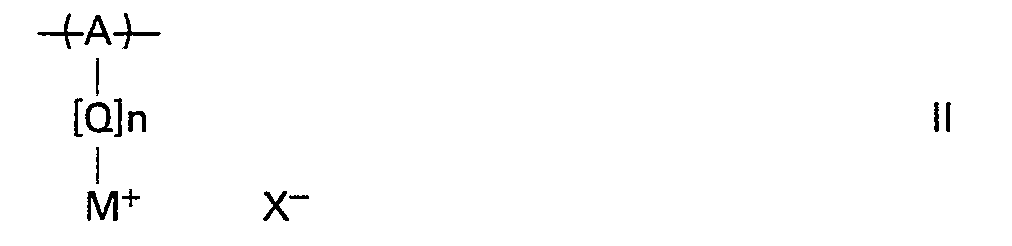
- Especially preferred polymeric interactive mordants have, in the polymer chain, monomeric units of Formula II below: wherein
- M + represents a quaternary ammonium or phosphonium group having Formulas III or IV below: wherein each of R', R 2 , and R 3 , which may be the same or different, represents an aryl, an aralkyl, or an alkaryl group preferably having from 5 to 20 carbon atoms or an alkyl group preferably having from 1 to 10 carbon atoms, especially 4 to 10 carbon atoms.
- Q in Formula II represents a hydrocarbon group, preferably an arylene, arylene- alkylene, alkylenearylene, and arylenebisalkylene or alkylenebisarylene group.
- Q contains from 5 to 10 carbon atoms.
- a in Formula II above will vary depending upon the particular polymeric backbone selected for use. Especially good results, however, have been obtained when A represents an alkylene group. Typically, such alkylene groups contain from 2 to 10 carbon atoms.
- Copolymers particularly useful as interactive mordants include copolymers containing recurring units having Formula II hereinabove, and, in addition, up to 75 weight percent of additional non-interfering repeating units.
- non-interfering repeating units is used herein to include units which do not chemically or physically interfere with the above-described mordanting of bilirubin.
- Monomers which provide such non-interfering repeating units and which also impart hydrophobicity to the resultant mordant copolymer include aliphatic and aromatic hydrocarbons, such as olefins and substituted olefins and styrene and substituted styrenes; alkylacrylates and methacrylates and derivatives thereof; and known equivalents for such monomers.
- difunctional crosslinking groups can be introduced into such copolymers.
- the preferred polymeric interactive mordants described above have been found to exhibit even greater binding affinity for bilirubin than endogenous serum proteins such as albumin and ligandin.
- the preferred polymeric interactive mordants used in the present method are only partially soluble in water. Therefore, these mordants can readily be separated from aqueous mixtures thereof by various means, such as centrifuging or filtration.
- a partial listing of individual representative interactive mordants useful in the method of the invention include the following materials.
- the weight ratio of the two monomers entering into the polymerization reaction is 50:50, except for polymer 6, where it is 49.5:49.5:1.
- mordants 4 and 6 refer to the mordants of the same number listed in Table I. All other chemicals in the examples including unconjugated bilirubin (except where it is specially referred to as being isolated from an aqueous liquid) were obtained from Eastman Organic Chemicals, Eastman Kodak Co., Rochester, New York, 14650.
- the dry test element referred to as a "film” or "bilirubin film” in Example 1 represents an integral multilayer bilirubin test element as described in U.S. Patent 4,069,017.
- the element is composed of a surface spreading layer for distributing an aqueous sample to an underlying reagent layer containing mordant 6 of Table I which, in turn, is coated on a transparent poly(ethylene terephthalate) film base.
- the structure and composition of this "film” is similar to that described in detail in Example 2 of U.S.
- Patent 4,069,017 except that the reagent layer also contained 8.608 g/m 2 of deionized gelatin and 0.2M bicine buffer to provide a layer having a pH of 8.0 when spotted with 10 microliters of serum and the spreading layer also contained 2.69 g/m z caffeine and 4.035 g/m 2 sodium benzoate.
- Serum pooled from 3-4 jaundiced-patient samples (each about 1-2 ml) was kept in the dark, on ice, and under a steady stream of nitrogen.
- a disposable pipette was used to apply about 0.5-1 ml of the serum pool in broad streaks (with total area of 7.5-12 cm Z ) over a sheet of bilirubin film as described above.
- the wetting was conducted in subdued light and under a nitrogen stream. When the wetting was completed, the spreading layer was gently, but thoroughly, removed (this can be done with the edge of a microscope slide).
- the exposed mordant-containing reagent layer which appeared yellowish, was similarly separated from the film base and collected into thick-walled 50-ml centrifuge tubes.
- 1.0 ml of n-propanol and 1.0 ml of 2M freshly prepared sodium chloride were added consecutively to each tube.
- the tube was sealed under nitrogen, shaken vigorously for 30 seconds, and left to stand at room temperature for 1-2 hours in the dark.
- the solution was then centrifuged for 10 minutes at 15,000 rpm.
- the yellowish colored supernatant was gently pipetted off, leaving a faintly yellow-colored pellet.
- the pellet was washed with propanol-NaCi twice as before and the washings were combined with the supernatant.
- the supernatant still contained small amounts of proteins and mordant.
- 2 ml of a caffeine-sodium benzoate solution (0.1 M:0.2M, final concentrations) were added to the supernatant under nitrogen and the mixture was stirred for one minute. Then the solution was adjusted to pH 5.5 with 1% oxalic acid, whereupon the residual protein and B u were precipitated, leaving Be in solution.
- the acidified Be solution was centrifuged at 10,000 rpm for 10 minutes. The pH of the supernatant was then readjusted to pH 7.0 with NaOH, mixed with an equal volume of ice-chilled chloroform under nitrogen and shaken for 30 seconds.
- Example 3 The whole mixture was centrifuged at 5,000 x g for 15 minutes and the aqueous supernatant was pipetted off carefully. For some preparations, this was the final step and the aqueous extract containing Be was freeze-dried overnight. Other preparations were further purified by passing the aqueous extract through a column packed with LH-20 gel beads (Pharmacia, Uppsala, Sweden) and 95% ethanol diluted 1:1 (v/v) with 0.1 M potassium phosphate buffer, pH 7.0. The same solvent mixture served as the eluting medium. The eluted yellow fraction was immediately dried, first under nitrogen, then under vacuum to give a dark brownish powder of concentrated B c . Further results from this Example are summarized in Example 3.
- the following method was found to be particularly suitable for extracting Be from jaundiced sera having a total bilirubin concentration equal to or in excess of 20 mg/dl, of which 70-80% appeared as "direct” bilirubin in a Jendrassik-Grof assay. Several of these samples appeared lipemic as well.
- a pool of serum having a high Be concentration was diluted 1 to 5 (v/v) with distilled water under nitrogen. This solution was carefully titrated with mordant 4 (made up to 1% fresh in water containing 5-10% methanol) until the absorbance at 425 nm stopped increasing. With a mild excess of mordant 4, the absorbance at 425 nm decreased slightly. The titrated solution appeared turbid and was rapidly centrifuged for 15 minutes at 15,000 g at 0-4°C. The yellowish mordanted pellet was gently resuspended in 3 volumes of 0.05 to 0.1 M potassium phosphate buffer, pH 7.0, to which 1% Na 2 S 2 O 3 had been added.
- a fresh solution of caffeine and sodium benzoate was added dropwise to the cloudly suspension until the final level of caffeine was approximately 0.1 M and that of benzoate 0.2M. During this time, the solution was stirred vigorously under nitrogen and in a bath of ice. The solution was allowed to stand for 1 ⁇ 2 hour in the dark and cold (0 ⁇ 4°C), then centrifuged at 10,000 ⁇ g for 15 minutes. The supernatant was saved. The pellet was washed at least twice with an equal volume of 0.1 M potassium phosphate buffer, pH 7.0, then three to four times with a 1:1 (v/v) mixture of 1M NaCI and n-propanol.
- Example 3 The washings were pooled with the supernatant from the preceding centrifugation, then stirred under nitrogen and in the dark for 1 ⁇ 2 hour. The solution was freeze-dried; the resultant powder was resuspended in a minimal amount of water and loaded on a column packed with LH-20 gel beads and 95% ethanol diluted 1:1 (v/v) with 0.1 M potassium phosphate buffer, pH 7.0. The same solvent mixture served as the eluting medium. The yellow eluted fractions were pooled, rechromatographed on a fresh column as before, and immediately freeze-dried. The resulting brownish- yellow powder contained concentrated Be having a purity of about 85% by weight based on quantitative NMR and gravimetric analysis. Further results from this Example are summarized in Example 3.
- the powdered Be-containing isolates prepared by either Example 1 or 2 were kept in the dark, at -25°C, under vacuum and in a desiccated environment. Under these conditions of keeping, there was no discernible change in the visible spectral characteristics of the powdered Be-containing isolates for periods up to two months. If exposed to air, moisture, or light, the powder readily turned green. When the Be-containing powder was reconstituted with water in the presence of 2-4 g% human serum albumin, the B c appeared significantly more stable.
- the method of the present invention can be used to separate both bilirubin components, i.e., B c and/or B u , from aqueous mammalian liquids other than those of human origin.
- a modified "Solution-Based Method" similar to that of Example 2 above was employed to successfully separate B c and B u from both dog and rabbit bile.
- the procedure of Example 2 was modified as follows: Mordant No. 6 of Table I was used in place of Mordant No. 4 of Table I.
- the B c and B u extracted by the mordant were released from the mordant by washing the mordanted B c and B u with a 1 % aqueous solution of the non-ionic surfactant octyl phenoxypolyethoxy ethanol, Triton X-100, a tradename of Rohm & Haas Co., having a pH of about 7-7.4, followed by washing with an aqueous caffeine-sodium benzoate solution having a pH of about 7.0 and containing a concentration of caffeine and sodium benzoate of 0.1 M and 0.2 M, respectively.
- the resultant washings were pooled and contained both B c and B u released from the mordant.
- the mixture of B c and B u thus obtained i.e., the total bilirubin, was then further purified by passing the total bilirubin in a liquid medium composed of a chloroform- methanol-water mixture (95:35:6 v/v) through a column packed with LH ⁇ 20 gel beads.
- B u and B c were then separately removed from the column.
- B u was removed by using dichloromethane as the eluting medium.
- B c was removed from the column using distilled water as the eluting medium.
- the two purified bilirubin components thus obtained were pooled and dried under nitrogen.
- the yield of total bilirubin obtained by this procedure average over several repeats of the procedure on rabbit bile, ranged from 50-80%.
Landscapes
- Chemical & Material Sciences (AREA)
- Organic Chemistry (AREA)
- Health & Medical Sciences (AREA)
- Life Sciences & Earth Sciences (AREA)
- Engineering & Computer Science (AREA)
- Molecular Biology (AREA)
- Hematology (AREA)
- Biomedical Technology (AREA)
- Immunology (AREA)
- Urology & Nephrology (AREA)
- Biotechnology (AREA)
- Biochemistry (AREA)
- General Health & Medical Sciences (AREA)
- Chemical Kinetics & Catalysis (AREA)
- Cell Biology (AREA)
- Microbiology (AREA)
- Genetics & Genomics (AREA)
- Food Science & Technology (AREA)
- Medicinal Chemistry (AREA)
- Physics & Mathematics (AREA)
- Analytical Chemistry (AREA)
- General Physics & Mathematics (AREA)
- Pathology (AREA)
- Investigating Or Analysing Biological Materials (AREA)
Claims (20)
Applications Claiming Priority (4)
| Application Number | Priority Date | Filing Date | Title |
|---|---|---|---|
| US5658579A | 1979-07-11 | 1979-07-11 | |
| US56585 | 1979-07-11 | ||
| US06/101,663 US4311665A (en) | 1979-07-11 | 1979-12-10 | Separation and isolation of conjugated and unconjugated bilirubin |
| US101663 | 1979-12-10 |
Publications (2)
| Publication Number | Publication Date |
|---|---|
| EP0024112A1 EP0024112A1 (de) | 1981-02-25 |
| EP0024112B1 true EP0024112B1 (de) | 1984-02-01 |
Family
ID=26735477
Family Applications (1)
| Application Number | Title | Priority Date | Filing Date |
|---|---|---|---|
| EP80302364A Expired EP0024112B1 (de) | 1979-07-11 | 1980-07-11 | Verfahren zur Abtrennung und Isolierung konjugierten und nicht konjugierten Bilirubins, isoliertes konjugiertes Bilirubin und diese Verbindung enthaltende Bezugszusammensetzung |
Country Status (4)
| Country | Link |
|---|---|
| US (1) | US4311665A (de) |
| EP (1) | EP0024112B1 (de) |
| CA (1) | CA1144555A (de) |
| DE (1) | DE3066383D1 (de) |
Families Citing this family (8)
| Publication number | Priority date | Publication date | Assignee | Title |
|---|---|---|---|---|
| US4336157A (en) * | 1980-06-27 | 1982-06-22 | Baxter Travenol Laboratories, Inc. | Process for reclaiming biliverdin-containing fluids |
| JPS5737262A (en) * | 1980-08-19 | 1982-03-01 | Fuji Photo Film Co Ltd | Analyzing method for bilirubin and multilayer analysis material for said method |
| US4344864A (en) * | 1980-10-30 | 1982-08-17 | Beckman Instruments, Inc. | Method for increasing shelf-life of a serum conjugated bilirubin reference composition and composition produced thereby |
| US4788153A (en) * | 1986-10-14 | 1988-11-29 | Eastman Kodak Company | Method for the determination of bilirubin and an element useful therein |
| US5286450A (en) * | 1992-06-01 | 1994-02-15 | Eastman Kodak Company | Bilirubin assay using crosslinkable polymers |
| KR970022316A (ko) * | 1995-10-27 | 1997-05-28 | 후루야 아끼라 | 빌리루빈의 정량 방법 |
| US5804405A (en) * | 1996-11-27 | 1998-09-08 | Research Corporation Technologies, Inc. | Bilirubin detection |
| AU2018326175A1 (en) | 2017-08-30 | 2020-03-05 | NeoLight LLC | System and methods for bilirubin analysis |
Family Cites Families (2)
| Publication number | Priority date | Publication date | Assignee | Title |
|---|---|---|---|---|
| US4069017A (en) * | 1977-01-14 | 1978-01-17 | Eastman Kodak Company | Colorimetric assay for bilirubin |
| US4204839A (en) * | 1978-08-09 | 1980-05-27 | Eastman Kodak Company | Fluorimetric analysis method for bilirubin |
-
1979
- 1979-12-10 US US06/101,663 patent/US4311665A/en not_active Expired - Lifetime
-
1980
- 1980-07-02 CA CA000355248A patent/CA1144555A/en not_active Expired
- 1980-07-11 DE DE8080302364T patent/DE3066383D1/de not_active Expired
- 1980-07-11 EP EP80302364A patent/EP0024112B1/de not_active Expired
Also Published As
| Publication number | Publication date |
|---|---|
| EP0024112A1 (de) | 1981-02-25 |
| US4311665A (en) | 1982-01-19 |
| DE3066383D1 (en) | 1984-03-08 |
| CA1144555A (en) | 1983-04-12 |
Similar Documents
| Publication | Publication Date | Title |
|---|---|---|
| US4115538A (en) | Assay kit for cAMP and/or cGMP and method of using the same | |
| Heirwegh et al. | Recent advances in the separation and analysis of diazo-positive bile pigments | |
| Wall et al. | Spectrophotometric determination of betaines and other quaternary nitrogen compounds as their periodides | |
| Ostrow et al. | The protein-binding of C 14-bilirubin in human and murine serum | |
| US5135875A (en) | Protein precipitation reagent | |
| Ingham | [20] Protein precipitation with polyethylene glycol | |
| CS257757B2 (en) | Method of reaction determination between antigen and antibody and reaction agent for realization of this process | |
| US4320194A (en) | Process for the production of carrier particles from yeast cells and for producing diagnostic agents therefrom and test kits containing such agents | |
| US4311665A (en) | Separation and isolation of conjugated and unconjugated bilirubin | |
| EP0027631B1 (de) | Flavin-adenin-dinucleotid-markierte Protein- und Polypeptidkonjugate | |
| Johansson et al. | Affinity partitioning of proteins in aqueous two-phases systems containing polymer-bound fatty acids: I. Effect of polyethylene glycol palmitate on the partition of human serum albumin and α-lactalbumin | |
| Clubb et al. | Isolation and characterization of a glycoprotein from the stonefly, Pteronarcys californica, which binds cadmium | |
| Brodersen et al. | Separation and determination of bile pigments | |
| CN112782408A (zh) | 一种血清淀粉样蛋白a胶体金免疫比浊法检测试剂盒 | |
| EP0152847B1 (de) | Stabilisierte, ein Enzymkonjugat enthaltende Zusammensetzung | |
| Morris et al. | [32] Colorimetric immunoassays using flavin adenine dinucleotide as label | |
| Saito et al. | Extraction behaviour of silver (I) with some cyclic tetrathioethers | |
| LEE | A possible mechanism of ellipticine-induced hemolysis | |
| Goldberg | Quantitative assay for submicrogram amounts of protein | |
| Deisseroth et al. | The purification and crystallization of beef erythrocyte catalase | |
| JPS6022295B2 (ja) | 赤血球凝集試験用水性溶媒 | |
| Walker | The influence of protein binding on the excretion of some sulphanilamidopyrimidines in man | |
| US4306019A (en) | Method of differential estimation of glutamic acid-oxalacetic acid transaminase isozyme | |
| JP2632989B2 (ja) | 不飽和鉄結合能の測定方法 | |
| JPS6234059A (ja) | 固相化試薬の安定化剤 |
Legal Events
| Date | Code | Title | Description |
|---|---|---|---|
| PUAI | Public reference made under article 153(3) epc to a published international application that has entered the european phase |
Free format text: ORIGINAL CODE: 0009012 |
|
| AK | Designated contracting states |
Designated state(s): BE CH DE FR GB IT NL |
|
| 17P | Request for examination filed |
Effective date: 19810721 |
|
| ITF | It: translation for a ep patent filed | ||
| GRAA | (expected) grant |
Free format text: ORIGINAL CODE: 0009210 |
|
| AK | Designated contracting states |
Designated state(s): BE CH DE FR GB IT LI NL |
|
| REF | Corresponds to: |
Ref document number: 3066383 Country of ref document: DE Date of ref document: 19840308 |
|
| ET | Fr: translation filed | ||
| PGFP | Annual fee paid to national office [announced via postgrant information from national office to epo] |
Ref country code: DE Payment date: 19840709 Year of fee payment: 5 |
|
| PGFP | Annual fee paid to national office [announced via postgrant information from national office to epo] |
Ref country code: CH Payment date: 19840712 Year of fee payment: 5 |
|
| PGFP | Annual fee paid to national office [announced via postgrant information from national office to epo] |
Ref country code: FR Payment date: 19840724 Year of fee payment: 5 |
|
| PGFP | Annual fee paid to national office [announced via postgrant information from national office to epo] |
Ref country code: BE Payment date: 19840930 Year of fee payment: 5 |
|
| PLBE | No opposition filed within time limit |
Free format text: ORIGINAL CODE: 0009261 |
|
| STAA | Information on the status of an ep patent application or granted ep patent |
Free format text: STATUS: NO OPPOSITION FILED WITHIN TIME LIMIT |
|
| 26N | No opposition filed | ||
| PGFP | Annual fee paid to national office [announced via postgrant information from national office to epo] |
Ref country code: NL Payment date: 19860731 Year of fee payment: 7 |
|
| PG25 | Lapsed in a contracting state [announced via postgrant information from national office to epo] |
Ref country code: LI Effective date: 19870731 Ref country code: CH Effective date: 19870731 |
|
| BERE | Be: lapsed |
Owner name: EASTMAN KODAK CY Effective date: 19870731 |
|
| PG25 | Lapsed in a contracting state [announced via postgrant information from national office to epo] |
Ref country code: NL Effective date: 19880201 |
|
| NLV4 | Nl: lapsed or anulled due to non-payment of the annual fee | ||
| PG25 | Lapsed in a contracting state [announced via postgrant information from national office to epo] |
Ref country code: FR Free format text: LAPSE BECAUSE OF NON-PAYMENT OF DUE FEES Effective date: 19880331 |
|
| REG | Reference to a national code |
Ref country code: CH Ref legal event code: PL |
|
| PG25 | Lapsed in a contracting state [announced via postgrant information from national office to epo] |
Ref country code: DE Effective date: 19880401 |
|
| GBPC | Gb: european patent ceased through non-payment of renewal fee | ||
| REG | Reference to a national code |
Ref country code: FR Ref legal event code: ST |
|
| PG25 | Lapsed in a contracting state [announced via postgrant information from national office to epo] |
Ref country code: GB Free format text: LAPSE BECAUSE OF NON-PAYMENT OF DUE FEES Effective date: 19881118 |
|
| PG25 | Lapsed in a contracting state [announced via postgrant information from national office to epo] |
Ref country code: BE Effective date: 19890731 |