EP0023726B1 - 2,5-disubstituted-3 substituted methyl-penta-2,4-dienoic acid and derivatives and process for their preparation - Google Patents
2,5-disubstituted-3 substituted methyl-penta-2,4-dienoic acid and derivatives and process for their preparation Download PDFInfo
- Publication number
- EP0023726B1 EP0023726B1 EP80105285A EP80105285A EP0023726B1 EP 0023726 B1 EP0023726 B1 EP 0023726B1 EP 80105285 A EP80105285 A EP 80105285A EP 80105285 A EP80105285 A EP 80105285A EP 0023726 B1 EP0023726 B1 EP 0023726B1
- Authority
- EP
- European Patent Office
- Prior art keywords
- group
- compound
- formula
- preparation
- alkyl
- Prior art date
- Legal status (The legal status is an assumption and is not a legal conclusion. Google has not performed a legal analysis and makes no representation as to the accuracy of the status listed.)
- Expired
Links
Classifications
-
- C—CHEMISTRY; METALLURGY
- C07—ORGANIC CHEMISTRY
- C07C—ACYCLIC OR CARBOCYCLIC COMPOUNDS
- C07C255/00—Carboxylic acid nitriles
-
- C—CHEMISTRY; METALLURGY
- C07—ORGANIC CHEMISTRY
- C07C—ACYCLIC OR CARBOCYCLIC COMPOUNDS
- C07C45/00—Preparation of compounds having >C = O groups bound only to carbon or hydrogen atoms; Preparation of chelates of such compounds
-
- C—CHEMISTRY; METALLURGY
- C07—ORGANIC CHEMISTRY
- C07C—ACYCLIC OR CARBOCYCLIC COMPOUNDS
- C07C57/00—Unsaturated compounds having carboxyl groups bound to acyclic carbon atoms
- C07C57/52—Unsaturated compounds having carboxyl groups bound to acyclic carbon atoms containing halogen
-
- C—CHEMISTRY; METALLURGY
- C07—ORGANIC CHEMISTRY
- C07D—HETEROCYCLIC COMPOUNDS
- C07D333/00—Heterocyclic compounds containing five-membered rings having one sulfur atom as the only ring hetero atom
- C07D333/02—Heterocyclic compounds containing five-membered rings having one sulfur atom as the only ring hetero atom not condensed with other rings
- C07D333/04—Heterocyclic compounds containing five-membered rings having one sulfur atom as the only ring hetero atom not condensed with other rings not substituted on the ring sulphur atom
- C07D333/06—Heterocyclic compounds containing five-membered rings having one sulfur atom as the only ring hetero atom not condensed with other rings not substituted on the ring sulphur atom with only hydrogen atoms, hydrocarbon or substituted hydrocarbon radicals, directly attached to the ring carbon atoms
- C07D333/24—Radicals substituted by carbon atoms having three bonds to hetero atoms with at the most one bond to halogen, e.g. ester or nitrile radicals
Definitions
- the invention relates to a class of compounds, which are useful as intermediates in the production of 3-substituted thiophenes.
- the compounds of formula (II) are novel compounds.
- the group X should be readily displaced by nucleophilic attack by sulphide ions.
- groups include chlorine, bromine, hydroxyl, arylsulphonyloxy such as benzenesulphonyloxy, p-toluenesulphonyloxy, or p-nitrosulphonyloxy, alkylsulphonyloxy such as methanesulphonyloxy or C 1-6 alkanoyloxy such as acetoxy, propionoxy or butyroxy.
- the group Y may be, for example, chlorine, bromine, hydroxy or C 1-6 alkoxy such as methoxy, ethoxy, or propoxy.
- X and Y are halogen, especially chlorine.
- the radicals R' and R 2 in compound (II) are chosen according to the requirements of the compound (I).
- the group R' should be carboxylic acid group or a group which may be converted to a carboxylic acid group or a functional derivative thereof for acylation the amino group of the penicillin or cephalosporin nucleus.
- the R 2 group is chosen to provide the required a-substituent, or a precursor thereof, for the side chain of a penicillin or cephalosporin.
- R' may be an ester group -CO 2 R 3 wherein R 3 is an alkyl, cycloalkyl, alkenyl, alkynyl, aryl or heterocyclic group, any of which may be substituted. Suitable such R 3 groups include:
- Preferred groups for R 3 include C 1-6 alkyl, benzyl, phthalidyl, indanyl, phenyl, mono-, di-, and tri-(C,-C 6 )-alkyl substituted phenyl such as o, m or p methylphenyl, ethylphenyl, n- or iso-propylphenyl, n-, sec-, iso- or butylphenyl.
- Suitable groups R 2 include hydrogen, C 1-6 alkyl, such as methyl, ethyl, propyl, or butyl, benzyl, phenyl, alkylphenyl, naphthyl, a 5- or 6-membered heterocyclic group containing one or more sulphur and/or nitrogen and/or oxygen atoms in the ring and which may be substituted by an alkyl group having from 1 to 3 carbon atoms, for example thienyl, imidazolyl, thiadiazolyl, isoxazolyl, methylisoxazolyl, tetrazolyl, methyltetrazolyl, pyrimidinyl, pyridyl, pyrazinyl, pyrrolidyl, piperidyl, morpholinyl, thiazinyl, furyl, or quinolyl; a carboxylic acid group, a carboxylic ester group -CO 2 R 3 as defined above, or
- the compound of formula (II) above may be prepared by a process which comprises condensing a compound of formula (III): wherein X and Y are as defined above with respect to formula (II); with a compound of formula (IV): wherein R' and R 2 are as defined above with respect to formula (I); under mild condensation conditions; and subsequently, if required, converting one group X or Y to a different such group.
- the conditions used for this condensation reaction should be sufficiently mild to prevent or minimise self-condensation or other unwanted reaction of the compound (II), and the conditions and reagents employed for the reaction depend on the nature of the groups R' and R 2 . In general, the more electron-withdrawing are the groups R' and R 2 then the more activated is the methylene group in compound (IV) and milder conditions may be employed.
- both the groups R' and R 2 are selected from a carboxylic acid group, a carboxylic ester group or an activated acyl group (for example in the form of a silyl enol ether), then the condensation of compound (III) with compound (IV) may conveniently be carried out in the presence of titanium tetrachloride and an organic nitrogen-containing base containing no acidic proton, for example pyridine.
- Suitable solvents for such a reaction are chlorinated hydrocarbon solvents, preferably carbon tetrachloride, optionally in the presence of a co-solvent such as tetrahydrofuran, dioxan or a polar aprotic solvent.
- the condensation is conveniently carried out at low to ambient temperature, preferably from 0°C to 25°C.
- This reaction may be carried out using conventional conditions known in the literature, for example as described by Naito et al, J. Antibiot (Tokyo) Ser A 20 (2), 77-86 (1967) or by Benson and Pohland, J. Org. Chem 29, 385
- the compounds of formula (I) in which one of the groups R' and R 2 represents a carboxylic acid function may be converted to a penicillin or cephalosporin by a method known per se, for example as described in British Patent Specification Nos. 1,004,670, 1,125,557, 1,133,886, 1,193,302, W. German OLS No. 2,600,866.
- Aluminium chloride (79.8 g, 0.6 mol) in methylene dichloride (300 ml) was treated with stirring with chloroacetyl chloride (44.6 ml, 0.56 mol). Acetylene (ca 1.2 mol) was passed through the reaction mixture with stirring for three hours at a flow rate of 150 ml/min.
- the reaction solution was slowly treated with ice-water (200 ml), and the mixture extracted with methylene dichloride (200 ml, 2 x 100 ml). The combined extracts are washed with brine (2 x 50 ml) and saturated sodium bicarbonate (50 ml), dried (Na 2 SO 4 ) and evaporated to give the title product in 74% yield, b.p.
- Titanium tetrachloride (10 ml., 0.1 mol) in CCI (10 ml) was added to tetrahydrofuran (25 ml) at 0°.
- a premix of trans 1,4-dichlorobut-3-en-2-one (5.6 g, 0.04 mol) and diethyl malonate (6.45 g., 0.04 mol) was added in tetrahydrofuran (20 ml).
- pyridine 13.0 ml., 0.16 mol
- Titanium tetrachloride (10 ml., 0.1 mol) in carbon tetrachloride (25 ml) was added to tetrahydrofuran (THF) (250 ml) at O°C.
- THF tetrahydrofuran
- a permix of trans-1, 4-dichlorobut-3-en-2-one (5.6 g., 0.04 mol) and dimethyl malonate (4.2 ml., 0.037 mol) in THF (20 ml) was added.
- Pyridine 13.0g., 0.16 mol
- THF 80 ml
- Titanium tetrachloride 0.5 ml, 5.0 mol in carbon tetrachloride (1.5 ml) was added to THF (10 ml) at 0°C.
- pyridine (0.32 ml., 4.0 mol) in THF (4 ml) was added.
- Calcium carbonate 0.4 g., 4.0 mol was added and the reaction mixture stirred at room temperature for 3 hours, diluted with water and extracted with ether. The ether extracts were washed with brine, sodium bicarbonate solution, brine; dried, treated with charcoal and evaporated to give the title compound in 69% yield, purified as in Example 6 (Spectroscopic data as in Example 6).
- Titanium tetrachloride 2.5 ml., 25 mmol in carbon tetrachloride (7.5 ml) was added to THF (60 ml) at 0°C.
- Malonic acid 1.0 g., 10 mmol
- trans 1,4-dichlorobut-3-en-2-one 1.4 g., 10 mmol
- Pyridine 3.3 ml., 40 mmol
- THF (10 ml) was added dropwise over fifteen minutes at 0°C.
- the reaction mixture was stirred at room temperature for three hours, diluted with water (50 ml) and extracted with ether (50 ml., 2 x 25 ml).
- Titanium tetrachloride (0.25 ml, 2.5 mmol) in CCI 4 (1.5 ml) was added to THF (10 ml) at 0°C.
- Trans-1,4-dichlorobut-3-en-2-one (0.28 g, 2.0 mmol) and ethyl cyanoacetate (0.21 g, 1.9 mmol) in THF (2 ml) were added.
- Pyridine (0.32 ml, 4.0 mmol) in THF (5 ml) was added over 5 minutes, and the mixture stirred for eighteen hours at room temperature. Work up as in example 6 gave the title compound (0.04 g, 8%).
- Cis-1, 4-dichlorobut-3-en-2-one (0.28 g, 2.0 mmol) in toluene (5 ml) was heated at 90° carbo- methoxymethylene triphenylphosphorane (0.66 g, 2.0 mmol) for 15 hours. Water was added, and extracted with ether.
Landscapes
- Chemical & Material Sciences (AREA)
- Organic Chemistry (AREA)
- Pharmaceuticals Containing Other Organic And Inorganic Compounds (AREA)
- Plural Heterocyclic Compounds (AREA)
- Heterocyclic Compounds Containing Sulfur Atoms (AREA)
- Organic Low-Molecular-Weight Compounds And Preparation Thereof (AREA)
Description
- The invention relates to a class of compounds, which are useful as intermediates in the production of 3-substituted thiophenes.
- A number of important penicillins and cephalosporins having a 3-thienyl group in the side-chain are well known. For example our British Patent No: 1,004,670 describes the penicillin 'ticarcillin', viz α-carboxy-3-thienyl-methyl-penicillin, whilst esters of that compound are disclosed in our British Patent Nos. 1,125,557 and 1,133,886. The 6α-methoxy substituted derivative of ticarcillin is disclosed in W. German Offenlegungsschrift No. 2,600,866.
- α-Carboxy-3-thienylmethylcephalosporin is disclosed as an antibacterial agent in U.K. Patent No. 1,193,302.
- We have devised a process for the preparation of a thiophene of formula (I):
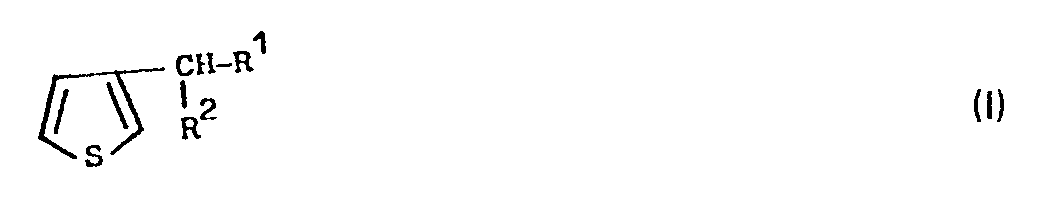

- This process forms the subject of our copending European Patent Application No. 78300140.7. (Publication No. 0 000 633).
- The compounds of formula (II) are novel compounds.
- Accordingly the present invention provides a compound of formula (II) as hereinbefore defined.
- In formula (II) the group X should be readily displaced by nucleophilic attack by sulphide ions. Such groups include chlorine, bromine, hydroxyl, arylsulphonyloxy such as benzenesulphonyloxy, p-toluenesulphonyloxy, or p-nitrosulphonyloxy, alkylsulphonyloxy such as methanesulphonyloxy or C1-6 alkanoyloxy such as acetoxy, propionoxy or butyroxy.
- The group Y may be, for example, chlorine, bromine, hydroxy or C1-6 alkoxy such as methoxy, ethoxy, or propoxy. Preferably both X and Y are halogen, especially chlorine.
- The radicals R' and R2 in compound (II) are chosen according to the requirements of the compound (I). For the preparation of penicillin and cephalosporin derivatives the group R' should be carboxylic acid group or a group which may be converted to a carboxylic acid group or a functional derivative thereof for acylation the amino group of the penicillin or cephalosporin nucleus. The R2 group is chosen to provide the required a-substituent, or a precursor thereof, for the side chain of a penicillin or cephalosporin.
- The radical R' may be an ester group -CO2R3 wherein R3 is an alkyl, cycloalkyl, alkenyl, alkynyl, aryl or heterocyclic group, any of which may be substituted. Suitable such R3 groups include:
- (a) alkyl especially C1-6 alkyl such as methyl, ethyl, n- and iso-propyl, n-, sec-, iso- and tert-butyl, and pentyl;
- (b) substituted C1-6 alkyl wherein the substituent is at least one of: chloro, bromo, fluoro, nitro, carbo (C1-6 alkoxy), C1-6 alkanoyl, C1-6 alkoxy, cyano, C1-6 alkylmercapto, C1-6 alkylsulfinyl, C1-6 alkylsulphonyl, 1-indanyl, 2-indanyl, furyl, pyridyl, 4-imidazolyl, phthalimido, azetidino, 1-aziridinyl, 1-pyrrolidinyl, piperidino, morpholino, thiomorpholino, 4-(C1-6 alkyl) 1-piperazinyl, 1-pyrrolyl, 1-imidazolyl, 2-imidazolin-1-yl, 2,5-dimethyl-1-pyrrolidinyl, 1,4,5,6-tetrahydro-1-pyrimidinyl, 4-methyl- piperidino, 2,6-dimethylpiperidino, alkylamino, dialkylamino, alkanoylamino, N-alkylanilino, or substituted N-alkylanilino wherein the substituent in the benzene ring is chloro, bromo, C1-6 alkyl or C1-6 alkoxy;
- (c) cycloalkyl and (C1-6 alkyl) substituted cycloalkyl having from 3 to 7 carbon atoms in the cycloalkyl moiety;
- (d) alkenyl having up to 8 carbon atoms;
- (e) alkynyl having up to 8 carbon atoms;
- (f) phenyl and substituted phenyl wherein the substituent is at least one of chloro, bromo, fluoro, C1-6 alkoxy, C1-6 alkanoyl, carbo-(C1-6) alkoxy, nitro, or di(C1-6) alkyl amino;
- (g) benzyl or substituted benzyl wherein the substituent in the benzene ring is chloro, bromo, fluoro, C1-6 alkyl, C1-6 alkoxy, C1-6 alkanoyl, carbo-(C1-6)-alkoxy, nitro, or di(C1-6alkyl) amino;
- (h) a 5- or 6- membered hereocyclic group containing one or more sulphur and/or nitrogen and/or oxygen atoms in the ring optionally fused to a second 5- and 6- membered hydrocarbyl or heterocyclic ring and which may be substituted with an alkyl group having 1 to 3 carbon atoms, for example thienyl, furyl quinolyl, methyl-substituted quinolyl, phenazinyl, pyridyl, methylpyridyl, phthalidyl, indanyl.
- Preferred groups for R3 include C1-6 alkyl, benzyl, phthalidyl, indanyl, phenyl, mono-, di-, and tri-(C,-C6)-alkyl substituted phenyl such as o, m or p methylphenyl, ethylphenyl, n- or iso-propylphenyl, n-, sec-, iso- or butylphenyl.
- Suitable groups R2 include hydrogen, C1-6 alkyl, such as methyl, ethyl, propyl, or butyl, benzyl, phenyl, alkylphenyl, naphthyl, a 5- or 6-membered heterocyclic group containing one or more sulphur and/or nitrogen and/or oxygen atoms in the ring and which may be substituted by an alkyl group having from 1 to 3 carbon atoms, for example thienyl, imidazolyl, thiadiazolyl, isoxazolyl, methylisoxazolyl, tetrazolyl, methyltetrazolyl, pyrimidinyl, pyridyl, pyrazinyl, pyrrolidyl, piperidyl, morpholinyl, thiazinyl, furyl, or quinolyl; a carboxylic acid group, a carboxylic ester group -CO2R3 as defined above, or a C1-6 alkanoyl group. When both groups R' and R2 are ester radicals they may together form a cyclic ester group, for example isopropylidine of formula:

- The compound of formula (II) above may be prepared by a process which comprises condensing a compound of formula (III):


- The conditions used for this condensation reaction should be sufficiently mild to prevent or minimise self-condensation or other unwanted reaction of the compound (II), and the conditions and reagents employed for the reaction depend on the nature of the groups R' and R2. In general, the more electron-withdrawing are the groups R' and R2 then the more activated is the methylene group in compound (IV) and milder conditions may be employed.
- When both the groups R' and R2 are selected from a carboxylic acid group, a carboxylic ester group or an activated acyl group (for example in the form of a silyl enol ether), then the condensation of compound (III) with compound (IV) may conveniently be carried out in the presence of titanium tetrachloride and an organic nitrogen-containing base containing no acidic proton, for example pyridine. Suitable solvents for such a reaction are chlorinated hydrocarbon solvents, preferably carbon tetrachloride, optionally in the presence of a co-solvent such as tetrahydrofuran, dioxan or a polar aprotic solvent. The condensation is conveniently carried out at low to ambient temperature, preferably from 0°C to 25°C.
- Many compounds of the general formula (III) are known in the literature and may be prepared by a process which comprises reacting a compound of formula (V):


- This reaction may be carried out using conventional conditions known in the literature, for example as described by Naito et al, J. Antibiot (Tokyo) Ser A 20 (2), 77-86 (1967) or by Benson and Pohland, J. Org. Chem 29, 385
- The compounds of formula (I) in which one of the groups R' and R2 represents a carboxylic acid function may be converted to a penicillin or cephalosporin by a method known per se, for example as described in British Patent Specification Nos. 1,004,670, 1,125,557, 1,133,886, 1,193,302, W. German OLS No. 2,600,866.
- The following Examples illustrate this invention.
- Aluminium chloride (39.9 g, 0.3 mol) in carbon tetrachloride (150 ml) was treated with chloro- acetylchloride (22.3 ml, 0.3 mol) while acetylene was passed through the reaction mixture. Acetylene addition was continued with stirring for 3 hours. Water was added to the reaction mixture, which was extracted with ether. The combined ether extracts were washed with saturated brine, N sodium bicarbonate solution, saturated brine, dried and evaporated to give the crude title compound (34.1 g, 82%) as a mixture of cis and trans isomers. Cis isomer δ (CDCl3) 4.32 (2H, s, CH2), 6.66 (1 H, d, 8Hz, -CH=), 6.88 (1H, d, J 8Hz, -CH=), trans isomer 8 (CDCl3) 4.22 (2H, s, CH2), 6,82 (1H, d, J 14Hz, CH =), 7.52 (1 H, d, J 14 Hz, CH =). vmeX (film) 1580, 1690 cm-'.
- Aluminium chloride (79.8 g, 0.6 mol) in methylene dichloride (300 ml) was treated with stirring with chloroacetyl chloride (44.6 ml, 0.56 mol). Acetylene (ca 1.2 mol) was passed through the reaction mixture with stirring for three hours at a flow rate of 150 ml/min. The reaction solution was slowly treated with ice-water (200 ml), and the mixture extracted with methylene dichloride (200 ml, 2 x 100 ml). The combined extracts are washed with brine (2 x 50 ml) and saturated sodium bicarbonate (50 ml), dried (Na2SO4) and evaporated to give the title product in 74% yield, b.p. 71―74°/10mm. δ (CDCl3) 4.22 (2H, s, CH2), 6.82 (1H, d, J14Hz, CH=), 7.52 (1H, d, J14 Hz, CH=), vmax(film) 1580, 1690 cm-1.
- The procedure described in Exampe 2 was repeated, but with a shorter reaction time (ninety minutes) to give a 50:50 mixture of cis and trans isomers. Chromatography (silica gel; 10% ethyl acetate in 60-80 petrol ether afforded the slower moving cis isomer (29% yield). δ (CDCl3) 4.35 (2H, s, CH2, 6.67 (1 H, d, J 8Hz, CH=), 6.90 (1 H, d, J 8Hz, CH=). λmax (ethanol) 239 nm (εm = 8,450). vmax (film) 1595, 1690, 1710 cm-1. Found: M+ 138. C4H4Cl2O requires M, 138.
- Titanium tetrachloride (10 ml., 0.1 mol) in CCI (10 ml) was added to tetrahydrofuran (25 ml) at 0°. A premix of trans 1,4-dichlorobut-3-en-2-one (5.6 g, 0.04 mol) and diethyl malonate (6.45 g., 0.04 mol) was added in tetrahydrofuran (20 ml). Over 20 minutes, pyridine (13.0 ml., 0.16 mol) in tetrahydrofuran (10 ml) was added. The reaction mixture was stirred for three hours at room temperature, diluted with water (100 ml) and extracted with MDC (50 ml., 2 x 25 ml). The combined extracts were washed with brine (2 x 20 ml), N sodium bicarbonate solution (20 ml), dried (Na2SO4) and evaporated to give the title product (61 % yield). 8 (CDCl3) 1.37 (6H, t, J 7Hz, CH3, 4.39 (4H, q, J 7Hz, OCH2), 4.62 (2H, s, Ch2), 7.12 (2H, s, CH=CH). vmax (film) 1610, 1720 cm-1. C11H14O4Cl2 requires M, 280.0269. Found: M+, 280.0256.
- cis 1, 4-Dichlorobut-3-en-2-one was condensed with diethyl malonate under the conditions described in Example 4, to give the title product (67% yield). δ (CDCl3) 1.28 (3H, t, J 7Hz, CH3), q.33 (3H, t, J 7Hz, CH3), 4.26 (2H, q, J 7Hz, OCH2), 4.33 (2H, q, J 7Hz, OCH2), 4.67 (2H, s, CH2), 6.35 (1 H, d, J 8Hz, CH=), 6.70 (1H, d, J 8Hz, CH=). λmax (ethanol) 269 nm (Em=6,000). vmax (film) 1610, 1720 cm-1.
- Titanium tetrachloride (10 ml., 0.1 mol) in carbon tetrachloride (25 ml) was added to tetrahydrofuran (THF) (250 ml) at O°C. A permix of trans-1, 4-dichlorobut-3-en-2-one (5.6 g., 0.04 mol) and dimethyl malonate (4.2 ml., 0.037 mol) in THF (20 ml) was added. Pyridine (13.0g., 0.16 mol) in THF (80 ml) was added over 20 mins. The reaction mixture was stirred at room temperature for 16 hours, diluted with water, and extracted with ether. The ether extracts were washed with brine, sodium bicarbonate solution, and brine. Drying and evaporation gave the title compound (7.72 g., 77%). Recrystallisation from ether:petrol gave large prisms, m.p. 56°, vmax (film) 1730, 1610 cm-1, δ (CDCI3) 3.85 (6H, s, 2 x CH3), 4.60 (2H, s, CH,), 7.03 (2H, s, CH = CH). Found: C, 42.9; H, 4.0; Cl, 28.0% C9H10O4Cl2 requires C, 42.7; H, 4.0; Cl, 28.0%.
- Titanium tetrachloride (0.5 ml, 5.0 mol) in carbon tetrachloride (1.5 ml) was added to THF (10 ml) at 0°C. A premix of trans-1,4-dichlorobut-3-en-2-one (0.28 g., 2.0 mol) and dimethyl malonate (0.22 ml., 2.0 mol) in THF (2 ml) was added. Over 5 minutes, pyridine (0.32 ml., 4.0 mol) in THF (4 ml) was added. Calcium carbonate (0.4 g., 4.0 mol) was added and the reaction mixture stirred at room temperature for 3 hours, diluted with water and extracted with ether. The ether extracts were washed with brine, sodium bicarbonate solution, brine; dried, treated with charcoal and evaporated to give the title compound in 69% yield, purified as in Example 6 (Spectroscopic data as in Example 6).
- Trans-1, 4- dichlorobut-3-en-2-one (2.8 g., 20.0 mmol) and dibenzyl malonate (5.7 g., 20.0 mol) were condensed as in Example 6 using the TiCl4/pyridine method, thus affording the title compound in 46% yield. Recrystallization from ethanol gave prisms, m.p. 45-6°, vmax (CH2Cl2) 1730, 1610 cm-1, δ (CDCl3), 4.50 (2H, s, CICH2), 5.24 (4H, s, 2 x PhCH2-), 7.00 (2H, s, CH=CH), 7.36 (1 OH, s, arylprotons), λmax (EtoH) 277 nm (E 22,100).
- Titanium tetrachloride (2.5 ml., 25 mmol) in carbon tetrachloride (7.5 ml) was added to THF (60 ml) at 0°C. Malonic acid (1.0 g., 10 mmol) and trans 1,4-dichlorobut-3-en-2-one (1.4 g., 10 mmol) in THF (10 ml) was added. Pyridine (3.3 ml., 40 mmol) in THF (10 ml) was added dropwise over fifteen minutes at 0°C. The reaction mixture was stirred at room temperature for three hours, diluted with water (50 ml) and extracted with ether (50 ml., 2 x 25 ml). The extracts were washed with brine, N sodium bicarbonate solution, brine, dried (Na2SO4) and evaporated to give the title product (0.35 g., 12%). δ (CDCl3) 5.00 (2H, s, Ch2), 6.91 (1 H, d, J 5Hz, CH=), 8.01 (1 H, d, J 5Hz, CH=), 9.68 (2H, s, -OH). vmax (CHCl3) 1720 cm-1.
- Titanium tetrachloride (0.25 ml, 2.5 mmol) in CCI4 (1.5 ml) was added to THF (10 ml) at 0°C. Trans-1,4-dichlorobut-3-en-2-one (0.28 g, 2.0 mmol) and ethyl cyanoacetate (0.21 g, 1.9 mmol) in THF (2 ml) were added. Pyridine (0.32 ml, 4.0 mmol) in THF (5 ml) was added over 5 minutes, and the mixture stirred for eighteen hours at room temperature. Work up as in example 6 gave the title compound (0.04 g, 8%). The E:Z isomeric mixture possessed δ (CDCl3) 1.37 (3H, t, J 7Hz, CH3), 4.39 (2H, q, J Hz, CH2) 4.60 (2H, s, CH2), 7.30 (2H, complex, CH = CH); 1.42 (3H, t, J Hz, CH3), 4.43 (2H, q, J 7Hz, CH2), 4.93 (2H, s, CH2), 7.30 (2H, complex, CH = CH).
- Cis-1, 4-dichlorobut-3-en-2-one (0.28 g, 2.0 mmol) in toluene (5 ml) was heated at 90° carbo- methoxymethylene triphenylphosphorane (0.66 g, 2.0 mmol) for 15 hours. Water was added, and extracted with ether. Drying, evaporation and chromatography on silica gave the title compound as a mixture of Δ4.5 cis and trans-isomers (0.05 g, 13%), vmax (film) 1720, 1625 cm-1; b (CDCl3) (cis-isomer) 3.60 (3H, s, ―CH3), 4.55 (2H, s, -CH2-), 6.23 (1 H, s, CHC02-), 6.37 (1 H, d, J 8Hz, CH =), 7.27 (1 H, d, J 8Hz, CH =); (trans-isomer) 3.60 (3H, s, -CH3), 4.40 (2H, s, -CH2-), 6.03 (1 H, s, CHC02-), 6.85 (1 H, d, J 14Hz, CH=), 7.95 (1 H, d, J 14Hz, CH=).
- trans 1,4-Dichlorobut-3-en-2-one (0.56 g, 4.0 mmol) in toluene (10 ml) was stirred with methoxycarbonylmethylenetriphenyl phosphorane (1.32 g, 4.0 mmol) at 90°C for sixteen hours. Water (50 ml) was added and the mixture extracted with ether (50 ml, 2 x 25 ml). The extracts were dried (Na2SO4) and evaporated to give the title compound (0.11 g, 14%), spectral details as in Example 11.
Claims (4)


Priority Applications (1)
| Application Number | Priority Date | Filing Date | Title |
|---|---|---|---|
| DE7878300140T DE2861280D1 (en) | 1977-07-23 | 1978-07-12 | Process for the preparation of alpha-substituted-thien-3-ylacetic acid and derivatives thereof |
Applications Claiming Priority (2)
| Application Number | Priority Date | Filing Date | Title |
|---|---|---|---|
| GB3100877 | 1977-07-23 | ||
| GB3100877 | 1977-07-23 |
Related Parent Applications (1)
| Application Number | Title | Priority Date | Filing Date |
|---|---|---|---|
| EP78300140.7 Division | 1978-07-12 |
Publications (2)
| Publication Number | Publication Date |
|---|---|
| EP0023726A1 EP0023726A1 (en) | 1981-02-11 |
| EP0023726B1 true EP0023726B1 (en) | 1982-05-19 |
Family
ID=10316543
Family Applications (2)
| Application Number | Title | Priority Date | Filing Date |
|---|---|---|---|
| EP78300140A Expired EP0000633B1 (en) | 1977-07-23 | 1978-07-12 | Process for the preparation of alpha-substituted-thien-3-ylacetic acid and derivatives thereof |
| EP80105285A Expired EP0023726B1 (en) | 1977-07-23 | 1978-07-12 | 2,5-disubstituted-3 substituted methyl-penta-2,4-dienoic acid and derivatives and process for their preparation |
Family Applications Before (1)
| Application Number | Title | Priority Date | Filing Date |
|---|---|---|---|
| EP78300140A Expired EP0000633B1 (en) | 1977-07-23 | 1978-07-12 | Process for the preparation of alpha-substituted-thien-3-ylacetic acid and derivatives thereof |
Country Status (10)
| Country | Link |
|---|---|
| US (2) | US4252976A (en) |
| EP (2) | EP0000633B1 (en) |
| JP (1) | JPS5424867A (en) |
| DK (1) | DK323978A (en) |
| ES (1) | ES471964A1 (en) |
| FI (1) | FI782300A7 (en) |
| IE (1) | IE47135B1 (en) |
| IL (1) | IL55144A0 (en) |
| IT (1) | IT1105934B (en) |
| ZA (1) | ZA784101B (en) |
Families Citing this family (8)
| Publication number | Priority date | Publication date | Assignee | Title |
|---|---|---|---|---|
| EP0038121B1 (en) * | 1980-04-11 | 1984-05-02 | Beecham Group Plc | Process for the preparation of 3-substituted thiophenes |
| ES504690A0 (en) * | 1981-08-11 | 1982-05-16 | Madaus Cerafarm Lab | PROCEDURE FOR THE PREPARATION OF 2- (3'-TENYL) PROPIONIC ACIDS 5'-SUBSTITUTED |
| DE3544079C2 (en) * | 1985-12-13 | 1998-07-30 | Bosch Gmbh Robert | Process for processing interrupt signals |
| AT392497B (en) | 1989-06-02 | 1991-04-10 | Voest Alpine Maschinenbau | SLIDING CHAIR, SLIDING PLATE OR RIB PLATE FOR SPREADING OR CROSSINGS |
| DE3919029A1 (en) * | 1989-06-10 | 1990-12-13 | Hoechst Ag | METHOD FOR ENZYMATICLY CLEAVING 2-ARYLPROPIONIC ACID VINYL ESTER |
| WO1993009112A1 (en) * | 1991-11-06 | 1993-05-13 | Ciba-Geigy Ag | A process for the production of cyclic sulfonium salts |
| DE202008004595U1 (en) | 2008-04-02 | 2008-07-17 | Wastec B.V. | Refuse container with an electronic data device |
| EP3691751B1 (en) | 2017-10-06 | 2024-02-14 | Wella Operations US, LLC | Dual polymer component hair coloring composition |
Family Cites Families (11)
| Publication number | Priority date | Publication date | Assignee | Title |
|---|---|---|---|---|
| US2381882A (en) * | 1945-08-14 | Ester | ||
| US2183929A (en) * | 1939-12-19 | Chx c ch | ||
| US2093519A (en) * | 1935-04-25 | 1937-09-21 | Ig Farbenindustrie Ag | Process for the manufacture of condensation products of crotonaldehyde |
| FR990943A (en) * | 1948-07-20 | 1951-09-27 | Bataafsche Petroleum | Process for the preparation of 2,4-pentadienoic acids |
| US2540071A (en) * | 1949-01-21 | 1951-01-30 | Rohm & Haas | Allylic rearrangement |
| US2662914A (en) * | 1950-04-22 | 1953-12-15 | Eastman Kodak Co | Alpha, alpha-vitamin a diacid and synthesis of isoprenic polyenes |
| US3360527A (en) * | 1966-05-03 | 1967-12-26 | Bristol Banyu Res Inst Ltd | Vinylpenicillins |
| DE1667997A1 (en) * | 1967-01-13 | 1971-07-22 | Tenneco Chem | Fungicides and seeds containing them |
| US3801608A (en) * | 1972-07-17 | 1974-04-02 | Zoecon Corp | Novel 2,4-diolefinic 2,2-diesters and cyanoesters |
| SU527431A1 (en) * | 1974-10-22 | 1976-09-05 | Иркутский институт органической химии СО АН СССР | The method of producing thiophene and thioacetaldehyde |
| JPS51122061A (en) * | 1975-03-20 | 1976-10-25 | Seitetsu Kagaku Co Ltd | Process for preparation of thiophene and its derivatives |
-
1978
- 1978-07-12 EP EP78300140A patent/EP0000633B1/en not_active Expired
- 1978-07-12 EP EP80105285A patent/EP0023726B1/en not_active Expired
- 1978-07-14 IL IL55144A patent/IL55144A0/en unknown
- 1978-07-19 ZA ZA00784101A patent/ZA784101B/en unknown
- 1978-07-19 DK DK323978A patent/DK323978A/en not_active Application Discontinuation
- 1978-07-20 FI FI782300A patent/FI782300A7/en not_active Application Discontinuation
- 1978-07-21 IE IE1469/78A patent/IE47135B1/en unknown
- 1978-07-21 US US05/926,727 patent/US4252976A/en not_active Expired - Lifetime
- 1978-07-21 IT IT50415/78A patent/IT1105934B/en active
- 1978-07-21 ES ES471964A patent/ES471964A1/en not_active Expired
- 1978-07-24 JP JP9032178A patent/JPS5424867A/en active Pending
-
1979
- 1979-05-07 US US06/036,407 patent/US4282373A/en not_active Expired - Lifetime
Also Published As
| Publication number | Publication date |
|---|---|
| IE781469L (en) | 1979-01-23 |
| ZA784101B (en) | 1979-07-25 |
| EP0023726A1 (en) | 1981-02-11 |
| IT7850415A0 (en) | 1978-07-21 |
| US4252976A (en) | 1981-02-24 |
| EP0000633A2 (en) | 1979-02-07 |
| JPS5424867A (en) | 1979-02-24 |
| IE47135B1 (en) | 1983-12-28 |
| EP0000633A3 (en) | 1979-06-13 |
| ES471964A1 (en) | 1980-01-16 |
| FI782300A7 (en) | 1979-01-24 |
| IL55144A0 (en) | 1978-09-29 |
| DK323978A (en) | 1979-01-24 |
| EP0000633B1 (en) | 1981-11-04 |
| IT1105934B (en) | 1985-11-11 |
| US4282373A (en) | 1981-08-04 |
Similar Documents
| Publication | Publication Date | Title |
|---|---|---|
| Farina et al. | Palladium catalysis in cephalosporin chemistry: General methodology for the synthesis of cephem side chains | |
| Isaka et al. | General synthesis of cyclopropenones and their acetals | |
| Ramadas et al. | Methods of synthesis of dithiocarboxylic acids and esters | |
| US4061656A (en) | Polyene compounds | |
| Krause | Synthesis of allenes by 1, 6‐addition of organocuprates to polarized enynes | |
| US4116975A (en) | Polyene compounds | |
| US4252976A (en) | Process for the preparation of thiophenes | |
| US3524886A (en) | Novel phosphonium halides | |
| Symmes Jr et al. | 1-Vinylcycloalkenes in the McCormack cycloaddition with phosphonous dihalides. Stereochemistry of some resulting bicyclic phospholene oxides | |
| DE2810262A1 (en) | PROCESS FOR THE PRODUCTION OF THIOPHENE DERIVATIVES AND ALPHA-SUBSTITUTED 2-THIOPHENACIC ACID COMPOUNDS AND 2- (2,2-DIHALOGENVINYL) -THIOPHENE | |
| US4014869A (en) | Cephalosporin derivatives | |
| US4219659A (en) | Process for the preparation of thiophene derivatives and thiophene derivatives obtained therethrough | |
| IE47136B1 (en) | 2,5-disubstituted-3-substituted methyl-penta-2,4-dienoic acid and derivatives and process for their preparation | |
| US4362880A (en) | Chemical process | |
| US3869507A (en) | Preparation of 5-fluoro-2-methyl-1-(p-methylsulfinylbenzylidene)-indenyl-3-acetic acid | |
| Tanaka et al. | New methods for stereoselective synthesis of. ALPHA.-alkylidene-. GAMMA.-butyrolactones using monoanion of O-ethyl S-(tetrahydro-2-oxo-3-furanyl) thiocarbonate and dianion of. ALPHA.-mercapto-. GAMMA.-butyrolactone. | |
| Kielbasinski et al. | Organosulfur compounds. Part 28. Reduction of sulfonyl halides with iodotrimethylsilane: new observations | |
| Oka | Use of thionyl chloride for sulfurization of active methylene compounds. Dechlorination of. alpha.-chlorosulfenyl chlorides | |
| US3595880A (en) | Preparation of (cis-1,2-epoxypropyl) phosphonic acids | |
| US4266067A (en) | Process for preparing thiophene derivatives | |
| SU1069621A3 (en) | Process for preparing derivatives of 3,7,11-trimethyl-2,4-dodecadienic acid | |
| Baird et al. | 1, 3-Dithiane-2-carbodithioate: synthesis and reactivity patterns | |
| Lok et al. | Acetylenic acids. III. The synthesis of pyridylpropiolic acids and esters and their reaction with thionyl chloride | |
| US4185014A (en) | Kentenimine intermediates for 6α-methoxy-α-carboxy penicillins | |
| GB2079744A (en) | 6-Alkyl-2-functionalized penems |
Legal Events
| Date | Code | Title | Description |
|---|---|---|---|
| PUAI | Public reference made under article 153(3) epc to a published international application that has entered the european phase |
Free format text: ORIGINAL CODE: 0009012 |
|
| 17P | Request for examination filed |
Effective date: 19800918 |
|
| AC | Divisional application: reference to earlier application |
Ref document number: 633 Country of ref document: EP |
|
| AK | Designated contracting states |
Designated state(s): BE CH DE FR GB NL SE |
|
| GRAA | (expected) grant |
Free format text: ORIGINAL CODE: 0009210 |
|
| AC | Divisional application: reference to earlier application |
Ref document number: 633 Country of ref document: EP |
|
| AK | Designated contracting states |
Designated state(s): BE CH DE FR GB NL SE |
|
| REF | Corresponds to: |
Ref document number: 2861845 Country of ref document: DE Date of ref document: 19820708 |
|
| PGFP | Annual fee paid to national office [announced via postgrant information from national office to epo] |
Ref country code: FR Payment date: 19840621 Year of fee payment: 7 |
|
| PGFP | Annual fee paid to national office [announced via postgrant information from national office to epo] |
Ref country code: CH Payment date: 19840712 Year of fee payment: 7 |
|
| PGFP | Annual fee paid to national office [announced via postgrant information from national office to epo] |
Ref country code: DE Payment date: 19840723 Year of fee payment: 7 |
|
| PGFP | Annual fee paid to national office [announced via postgrant information from national office to epo] |
Ref country code: SE Payment date: 19840930 Year of fee payment: 7 Ref country code: BE Payment date: 19840930 Year of fee payment: 7 |
|
| PG25 | Lapsed in a contracting state [announced via postgrant information from national office to epo] |
Ref country code: SE Effective date: 19860713 |
|
| PGFP | Annual fee paid to national office [announced via postgrant information from national office to epo] |
Ref country code: NL Payment date: 19860731 Year of fee payment: 9 |
|
| PG25 | Lapsed in a contracting state [announced via postgrant information from national office to epo] |
Ref country code: CH Effective date: 19870731 |
|
| BERE | Be: lapsed |
Owner name: BEECHAM GROUP P.L.C. Effective date: 19870731 |
|
| PG25 | Lapsed in a contracting state [announced via postgrant information from national office to epo] |
Ref country code: NL Effective date: 19880201 |
|
| NLV4 | Nl: lapsed or anulled due to non-payment of the annual fee | ||
| PG25 | Lapsed in a contracting state [announced via postgrant information from national office to epo] |
Ref country code: FR Free format text: LAPSE BECAUSE OF NON-PAYMENT OF DUE FEES Effective date: 19880331 |
|
| REG | Reference to a national code |
Ref country code: CH Ref legal event code: PL |
|
| PG25 | Lapsed in a contracting state [announced via postgrant information from national office to epo] |
Ref country code: DE Effective date: 19880401 |
|
| GBPC | Gb: european patent ceased through non-payment of renewal fee | ||
| REG | Reference to a national code |
Ref country code: FR Ref legal event code: ST |
|
| PG25 | Lapsed in a contracting state [announced via postgrant information from national office to epo] |
Ref country code: GB Free format text: LAPSE BECAUSE OF NON-PAYMENT OF DUE FEES Effective date: 19881118 |
|
| PG25 | Lapsed in a contracting state [announced via postgrant information from national office to epo] |
Ref country code: BE Effective date: 19890731 |
|
| EUG | Se: european patent has lapsed |
Ref document number: 80105285.3 Effective date: 19870518 |
|
| PLBE | No opposition filed within time limit |
Free format text: ORIGINAL CODE: 0009261 |
|
| STAA | Information on the status of an ep patent application or granted ep patent |
Free format text: STATUS: NO OPPOSITION FILED WITHIN TIME LIMIT |