EP0022141B2 - Zusammensetzungen und Verfahren zur Verminderung von Schädigungen durch Herbizide - Google Patents
Zusammensetzungen und Verfahren zur Verminderung von Schädigungen durch Herbizide Download PDFInfo
- Publication number
- EP0022141B2 EP0022141B2 EP19790301320 EP79301320A EP0022141B2 EP 0022141 B2 EP0022141 B2 EP 0022141B2 EP 19790301320 EP19790301320 EP 19790301320 EP 79301320 A EP79301320 A EP 79301320A EP 0022141 B2 EP0022141 B2 EP 0022141B2
- Authority
- EP
- European Patent Office
- Prior art keywords
- alkyl
- lower alkyl
- halo
- phosphorothioate
- herbicide
- Prior art date
- Legal status (The legal status is an assumption and is not a legal conclusion. Google has not performed a legal analysis and makes no representation as to the accuracy of the status listed.)
- Expired
Links
Classifications
-
- A—HUMAN NECESSITIES
- A01—AGRICULTURE; FORESTRY; ANIMAL HUSBANDRY; HUNTING; TRAPPING; FISHING
- A01N—PRESERVATION OF BODIES OF HUMANS OR ANIMALS OR PLANTS OR PARTS THEREOF; BIOCIDES, e.g. AS DISINFECTANTS, AS PESTICIDES OR AS HERBICIDES; PEST REPELLANTS OR ATTRACTANTS; PLANT GROWTH REGULATORS
- A01N25/00—Biocides, pest repellants or attractants, or plant growth regulators, characterised by their forms, or by their non-active ingredients or by their methods of application, e.g. seed treatment or sequential application; Substances for reducing the noxious effect of the active ingredients to organisms other than pests
- A01N25/32—Ingredients for reducing the noxious effect of the active substances to organisms other than pests, e.g. toxicity reducing compositions, self-destructing compositions
-
- A—HUMAN NECESSITIES
- A01—AGRICULTURE; FORESTRY; ANIMAL HUSBANDRY; HUNTING; TRAPPING; FISHING
- A01N—PRESERVATION OF BODIES OF HUMANS OR ANIMALS OR PLANTS OR PARTS THEREOF; BIOCIDES, e.g. AS DISINFECTANTS, AS PESTICIDES OR AS HERBICIDES; PEST REPELLANTS OR ATTRACTANTS; PLANT GROWTH REGULATORS
- A01N47/00—Biocides, pest repellants or attractants, or plant growth regulators containing organic compounds containing a carbon atom not being member of a ring and having no bond to a carbon or hydrogen atom, e.g. derivatives of carbonic acid
- A01N47/08—Biocides, pest repellants or attractants, or plant growth regulators containing organic compounds containing a carbon atom not being member of a ring and having no bond to a carbon or hydrogen atom, e.g. derivatives of carbonic acid the carbon atom having one or more single bonds to nitrogen atoms
- A01N47/10—Carbamic acid derivatives, i.e. containing the group —O—CO—N<; Thio analogues thereof
- A01N47/12—Carbamic acid derivatives, i.e. containing the group —O—CO—N<; Thio analogues thereof containing a —O—CO—N< group, or a thio analogue thereof, neither directly attached to a ring nor the nitrogen atom being a member of a heterocyclic ring
Definitions
- the invention herein pertains to the field of crop protection.
- This invention relates to novel compositions and methods for reducing or nullifying injury to young crop plants by selective herbicides. More specifically, this invention relates to novel compositions and methods for reducing injury to young grass crop plants, e. g., corn, rice, barley, sorghum and wheat by thiolcarbamate herbicides, such as diallate and triallate, which comprises treating the habitat of the crop plant or the seed of the crop plant prior to planting, with an antidote for the selective herbicide.
- thiolcarbamate herbicides such as diallate and triallate
- Thiolcarbamate herbicides such as diallate and triallate are very useful for controlling certain weeds in the presence of other growing plants.
- these herbicides sometimes injure certain crop plants, slowing growth and development at application rates necessary to stunt or kill the weeds.
- thiolcarbamate herbicides to control weeds in the presence of certain crops, some of which are important commodities in the world food supply.
- U.S. Patent 3,131,509 and South African Patent Publication No. 72/2519 are U.S. Patent 3,131,509 and South African Patent Publication No. 72/2519.
- the 509 U.S. patent discloses the use of various hormone-type plant growth regulants, e. g., bromoalkyl compounds, as antagonists for certain carbamates.
- the South African patent discloses the use of various acetamide and carbamate compounds as antagonists for thiolcarbamate herbicides.
- U.S. Patent No. 4,036,628 discloses the use of certain phosphate, phosphonate and phosphinate compounds as antidotes for certain thiolcarbamate herbicides.
- organothiophosphorous compounds would have antidotal activity against thiolcarbamate herbicides.
- organophosphorous compounds do not seem to have been widely used as antidotes for thiolcarbamate herbicides.
- the use has been as an insecticide, as a defoliant, as a herbicide, per se, or as a plant growth inhibitor of weeds or as fruit abscission agents. See, e. g., U.S. Patent Numbers 3,879,189, 3.907,540, 3,861,899 and 3,826,640 as illustrative prior art for the use of organosphosphorous compounds in crop protection uses.
- the present invention relates to the use of certain organophosphorous compounds as antidotal, antagonistic or safening agents for reducing crop injury by thiolcarbamate herbicides. More particularly, this invention is primarily concerned with reducing injury to grass crops, e. g., barley, rice,.sorghum and wheat, by the thiolcarbamate herbicides diallate or triallate.
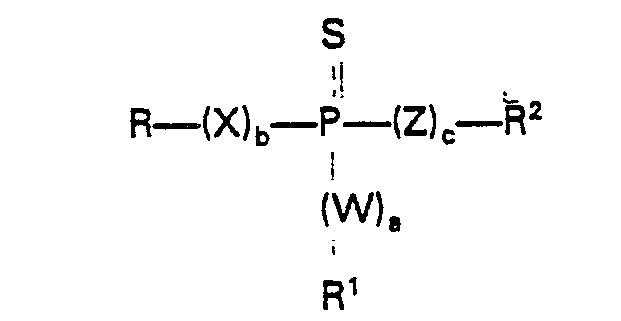
- this invention relates to the use as antidotes for thiolcarbamate herbicides of organophosphorous compounds defined by the following formula wherein
- the invention also relates to the use of the compounds S-benzyl O-ethyl methylphosphonodithioate, 0-(o-Chlorophenyl) O-ethyl methylphosphonothioate and O,O-dibutyl 0-(p-nitrophenyl) phosphorothioate as antidotes for triallate herbicide applied to wheat.
- alkyl refers to a straight or branched chain alkyl containing 1 to 13 carbon atoms.
- the preferred alkyls are those containing 1-6 carbon atoms.
- the term « lower alkyl is used herein to refer to a straight or branched chain alkyl of from 1 to 6 carbon atoms, e. g., methyl, ethyl, propyl, isopropyl, n-butyl, isobutyl, sec-butyl, tert-butyl, n-pentyl, isopentyl, n-hexyl and the like.
- halo or halogen includes chlorine, bromine, fluorine and iodine atoms.
- lower alkenyl is used herein to refer to an alkenyl radical having from 2 to 6 carbon atoms, preferably from 3 to 5 carbon atoms.
- lower alkynyl is used herein to refer to an alkynyl radical having 2 to 6 carbon atoms, preferably 3 to 4 carbon atoms.
- carbonyl when used herein is understood to mean the radical ;
- thiocarbonyl refers to the radical
- organophosphorous compounds have exhibited a general pattern for degrees of effectiveness as antidotes for thiolcarbamate herbicides.
- compositions comprising thiolcarbamate herbicides, especially diallate and triallate, and an effective amount of an organophosphorous antidote, and to methods of reducing injury to young crop plants, particularly grass crops such as barley, rice, sorghum and wheat by use of said safened compositions.
- the preferred crop plant to be safened is wheat.
- the preferred specific embodiment of the invention includes the safening of, or reduction in injury to, wheat by triallate herbicide by use of the antidotal compound, 0,0-di-ethyl O-(m-tolyl) phosphorothioate.
- herbicidal antidotes Compounds which are useful in reducing or eliminating crop injury are referred to in the art variously as herbicidal antidotes, safeners or antagonistic agents. These compounds counteract the action of the herbicide to reduce injury to a given crop plant. In many instances weed injury is also reduced, but to tolerable levels which are determined by economic factors.
- organophosphorous compounds within the above generic formula are used as antidotal compounds with thiolcarbamate herbicides.
- the thiolcarbamates will be represented by triallate and diallate.
- Triallate is the common name for the compound S-(2,3,3-trichloroallyl)-diisopropylthiolcarbamate
- diallate is the common name for the compound S-(2,3-dichloroallyl)-diisopropylthiolcarbamate.
- Triallate and diallate are the active ingredients, respectively, in the herbicides Avadex BW", FAR ⁇ GO ® and Avadex ® , (registered trademarks of Monsanto Company).
- the compounds identified by structure in formulae I-V are known as : I, phosphorothioates, or thionophosphates ; II, phosphonothioates ; III, phosphinothioates ; IV, phosphorodithioates and V, phosphonodithioates.
- the amount of antidote employed in methods and compositions of this invention will vary according to the particular herbicide with which the agent is employed and the rate of application of the herbicide. In each instance the amount of antidote employed is an effective safening amount.
- an effective safening amount is meant an amount which reduces crop injury by the herbicide. In the tests employed in illustrating this invention, the amount of crop injury was reduced by as much as 100 percent.
- the compounds used herein as antidotes for thiolcarbamate herbicides are either known compounds or are readily prepared from known compounds by known and/or conventional methods of preparation.
- a good grade of top soil is placed in an aluminum pan and compacted to a depth of 9.5 to 12.7 mm from the top of the pan.
- a predetermined number of seeds of each of the plant species to be tested are placed on top of the soil in the pans.
- a quantity of soil sufficient to substantially fill the pan is measured and placed in a suitable container.
- a measured quantity of the antidote compound dispersed or dissolved in a suitable carrier is sprayed on the soil in the container.
- a measured quantity of the triallate herbicide dispersed or dissolved in a suitable carrier is then sprayed on the soil in the container already treated with the safening agent.
- the quantity of triallate herbicide and antidote used is expressed in terms of kilograms per hectare.
- the soil containing the antidote and triallate herbicide is thoroughly mixed.
- the mixing is sometimes referred to as incorporation of the herbicide and antidote into the soil.
- the mixing or incorporation provides a substantially uniform distribution of the antidote and herbicide throughout the soil.
- the seeds are covered with the soil containing the antagonistic agent and triallate herbicide and the pans are leveled.
- the pans are then placed on a sand bench in the greenhouse and watered from below as needed. The plants are observed at the end of approximately 21 days and the results in terms of percent inhibition of each crop species are recorded. For each test series a pan of plants is also prepared containing no herbicide and no antidote as a control.
- a pan of plants is prepared with soil covering the seed containing no triallate herbicide and only the measured amount of antidote being incorporated into the soil covering the seeds to ascertain any herbicidal effect of the antidote alone.
- the herbicidal effect of the triallate is observed from pans of plants treated with the same quantity of herbicide alone.
- the antidote compound is applied to the crop seed to reduce, minimize or eliminate crop injury by the herbicide.
- the crop seed be treated with only a small amount of the antidote.
- application rates of 1,100 g to as low as 1,5 g of antidote per bushel of seed may be used.
- the presently preferrred application rate is in the range of 1,5 g to 550 g of agent per bushel.
- the seed is treated with the antidote compound by use of conventional seed treating apparatus well known to the art.
- the seed is thoroughly mixed with the antidote in the seed treating apparatus, thereby giving a seed which is coated with the agent.
- the compound may be formulated as a wettable powder or an emulsifiable concentrate which can be diluted with water by the seed treater for use in the seed treating apparatus.
- the antidote may be dissolved or suspended in an organic solvent for use as a seed treatment or the pure compound alone may be used under properly controlled conditions.
- novel seed treating compositions containing one or more of the described active antidotes intimately dispersed in an inert carrier or diluent for the intended use.
- Such carriers may be either solid such as talc, clay, diatomaceous earth, sawdust, calcium carbonate, or liquids such as water, kerosene, acetone, benzene, toluene, xylene, chlorinated hydrocarbons in which the antidote may be either dissolved or dispersed.
- Emulsifying agents are advisably used to achieve a suitable emulsion if two immiscible liquids are used as a carrier.
- Wetting agents may also be used to aid in dispersing the active antagonistic agent in liquids used as a carrier in which the agent is not completely soluble.
- Emulsifying agents and wetting agents also known as « surface active agents •, are sold under numerous tradenames and may be either pure compounds, mixtures of compounds of the same general groups, or they may be mixtures of compounds of different classes.
- Typical satisfactory surface active agents which may be used are alkali metal higher alkylarylsulfonates such as sodium dodecylbenzenesulfonate and the sodium salts of alkylnaphthalenesulfonic acids, fatty alcohol sulfates such as the sodium salts of monoesters of sulfuric acid with n-aliphatic alcohols containing 8-18 carbon atoms, long chain quaternary ammonium compounds, sodium salts of petroleum-derived alkylsulfonic acids, polyethylene sorbitan monooleate, alkylaryl polyether alcohols, water-soluble lignin sulfonate salts, alkali-casein compositions, long chain alcohols usually containing 10 to 18 carbon atoms, and condensation products of ethylene oxide with fatty acids, alkylphenols and mercaptans.
- alkali metal higher alkylarylsulfonates such as sodium dodecylbenzenesulfonate and the sodium salts of alkyln
- This example illustrates the safening effect of various organophosphorous compounds on thiolcarbamate herbicides in wheat when the antidote is applied as a seed treatment at varying concentrations.
- the herbicide/antidote safening composition by incorporating the components into the soil or by seed treatment with the antidote
- any conventional alternative modes of application may be used.
- the herbicide and antidote may be applied simultaneously, e. g., as a tank mix, or sequentially to the surface of the soil in which the seeds are planted prior to emergence of the plants or the herbicide and antidote may be applied postemergently after the plants have emerged.
- These alternative modes of application of herbicide and/or antidote are conventional practices in the crop protection art.
- organophosphorous compounds used as antidotes herein are all known and/or readily prepared by conventional processes as will be apparent to those skilled in the art.
- typical methods of preparation including alternatives, for preparing phosphates, phosphites, phosphorothioates (thionophosphates) or - dithioates, phosphonates, phosphonothioates and -dithioates, phosphinates and their sulfur analogs, and miscellaneous phosphorous such as the amides, amines, etc., of phosphorous and phosphoric acids, e.
Landscapes
- Life Sciences & Earth Sciences (AREA)
- Health & Medical Sciences (AREA)
- General Health & Medical Sciences (AREA)
- Dentistry (AREA)
- Plant Pathology (AREA)
- Engineering & Computer Science (AREA)
- Pest Control & Pesticides (AREA)
- Agronomy & Crop Science (AREA)
- Wood Science & Technology (AREA)
- Zoology (AREA)
- Environmental Sciences (AREA)
- Toxicology (AREA)
- Agricultural Chemicals And Associated Chemicals (AREA)
Claims (14)

Priority Applications (2)
| Application Number | Priority Date | Filing Date | Title |
|---|---|---|---|
| DE7979301320T DE2965611D1 (en) | 1979-07-09 | 1979-07-09 | Compositions and methods for reducing herbicidal injury |
| EP19790301320 EP0022141B2 (de) | 1979-07-09 | 1979-07-09 | Zusammensetzungen und Verfahren zur Verminderung von Schädigungen durch Herbizide |
Applications Claiming Priority (1)
| Application Number | Priority Date | Filing Date | Title |
|---|---|---|---|
| EP19790301320 EP0022141B2 (de) | 1979-07-09 | 1979-07-09 | Zusammensetzungen und Verfahren zur Verminderung von Schädigungen durch Herbizide |
Publications (3)
| Publication Number | Publication Date |
|---|---|
| EP0022141A1 EP0022141A1 (de) | 1981-01-14 |
| EP0022141B1 EP0022141B1 (de) | 1983-06-08 |
| EP0022141B2 true EP0022141B2 (de) | 1987-12-02 |
Family
ID=8186398
Family Applications (1)
| Application Number | Title | Priority Date | Filing Date |
|---|---|---|---|
| EP19790301320 Expired EP0022141B2 (de) | 1979-07-09 | 1979-07-09 | Zusammensetzungen und Verfahren zur Verminderung von Schädigungen durch Herbizide |
Country Status (2)
| Country | Link |
|---|---|
| EP (1) | EP0022141B2 (de) |
| DE (1) | DE2965611D1 (de) |
Families Citing this family (2)
| Publication number | Priority date | Publication date | Assignee | Title |
|---|---|---|---|---|
| US4659702A (en) * | 1984-04-16 | 1987-04-21 | Stauffer Chemical Company | S-(substituted allylic) trithiophosphonate insecticides |
| GR850923B (de) * | 1984-04-16 | 1985-11-25 | Stauffer Chemical Co |
Family Cites Families (1)
| Publication number | Priority date | Publication date | Assignee | Title |
|---|---|---|---|---|
| US4036628A (en) * | 1972-11-13 | 1977-07-19 | Stauffer Chemical Company | Phosphorus containing herbicide antidotes |
-
1979
- 1979-07-09 EP EP19790301320 patent/EP0022141B2/de not_active Expired
- 1979-07-09 DE DE7979301320T patent/DE2965611D1/de not_active Expired
Also Published As
| Publication number | Publication date |
|---|---|
| EP0022141B1 (de) | 1983-06-08 |
| EP0022141A1 (de) | 1981-01-14 |
| DE2965611D1 (en) | 1983-07-14 |
Similar Documents
| Publication | Publication Date | Title |
|---|---|---|
| US5656616A (en) | Activator for insecticide | |
| US4379716A (en) | Compositions and methods for reducing herbicidal injury | |
| CZ2003567A3 (cs) | Organofosforečné prostředky | |
| EP0022141B1 (de) | Zusammensetzungen und Verfahren zur Verminderung von Schädigungen durch Herbizide | |
| US4507143A (en) | Organothiophosphorous compounds useful as antidotes for thiocarbamate herbicides | |
| US4605431A (en) | Compositions and methods for reducing herbicidal injury | |
| US4380537A (en) | Stabilized insecticide formulations | |
| CA1213605A (en) | Alpha-branched alkylthiophosphate pesticides | |
| US2861876A (en) | Method of destroying undesired plants | |
| US4822401A (en) | Safening of herbicidal clomazone applications with organophosphorus compounds | |
| EP0243694A2 (de) | Pestizide Zusammensetzungen und Verfahren | |
| CA1157286A (en) | Compositions and methods for reducing herbicidal injury | |
| CA1134854A (en) | Amine salts of substituted n-phosphonomethylureas and their use as plant growth regulators | |
| CS270438B2 (en) | Insecticide and nematocide | |
| EP0017738B1 (de) | Ein Carbamat und eine organische Phosphorverbindung enthaltende insektizide und akarizide Zusammensetzung und Verfahren zur Bekämpfung von Insekten und Milben | |
| FI75972C (fi) | Synergistiska herbicidkomposition och foerfarande foer bekaempning av vaexlighet. | |
| EP0010178B1 (de) | Herbizide Zusammensetzungen, die ein Thiocarbamat und eine organische Fosfor-Verbindung enthalten, und ihre Verwendung | |
| CA1094952A (en) | Stabilized insecticide formulation | |
| PL124293B1 (en) | Agent counteracting the crop damages caused by herbicides | |
| US4304587A (en) | Formulations for improved pesticide-fertilizer compositions | |
| GB2088718A (en) | Pesticidal compositions | |
| CA1134636A (en) | Synergistic herbicidal compositions | |
| US4505737A (en) | Synergistic herbicidal compositions | |
| US4439430A (en) | O,O-Diethyl O-[(p-tertiarybutylthio)phenyl]phosphorothioates and its insecticidal use | |
| US3705241A (en) | Fungicidal process employing organic phosphorous acid esters |
Legal Events
| Date | Code | Title | Description |
|---|---|---|---|
| PUAI | Public reference made under article 153(3) epc to a published international application that has entered the european phase |
Free format text: ORIGINAL CODE: 0009012 |
|
| AK | Designated contracting states |
Designated state(s): BE DE FR GB IT LU NL |
|
| 17P | Request for examination filed |
Effective date: 19810310 |
|
| ITF | It: translation for a ep patent filed | ||
| GRAA | (expected) grant |
Free format text: ORIGINAL CODE: 0009210 |
|
| AK | Designated contracting states |
Designated state(s): BE DE FR GB IT LU NL |
|
| REF | Corresponds to: |
Ref document number: 2965611 Country of ref document: DE Date of ref document: 19830714 |
|
| ET | Fr: translation filed | ||
| PG25 | Lapsed in a contracting state [announced via postgrant information from national office to epo] |
Ref country code: LU Free format text: LAPSE BECAUSE OF NON-PAYMENT OF DUE FEES Effective date: 19830731 |
|
| PLBI | Opposition filed |
Free format text: ORIGINAL CODE: 0009260 |
|
| 26 | Opposition filed |
Opponent name: STAUFFER CHEMICAL COMPANY Effective date: 19840307 |
|
| PUAH | Patent maintained in amended form |
Free format text: ORIGINAL CODE: 0009272 |
|
| STAA | Information on the status of an ep patent application or granted ep patent |
Free format text: STATUS: PATENT MAINTAINED AS AMENDED |
|
| 27A | Patent maintained in amended form |
Effective date: 19871202 |
|
| AK | Designated contracting states |
Kind code of ref document: B2 Designated state(s): BE DE FR GB IT LU NL |
|
| ET3 | Fr: translation filed ** decision concerning opposition | ||
| NLR2 | Nl: decision of opposition | ||
| NLR3 | Nl: receipt of modified translations in the netherlands language after an opposition procedure | ||
| ITF | It: translation for a ep patent filed | ||
| PGFP | Annual fee paid to national office [announced via postgrant information from national office to epo] |
Ref country code: FR Payment date: 19890607 Year of fee payment: 11 |
|
| PGFP | Annual fee paid to national office [announced via postgrant information from national office to epo] |
Ref country code: BE Payment date: 19890623 Year of fee payment: 11 |
|
| PGFP | Annual fee paid to national office [announced via postgrant information from national office to epo] |
Ref country code: GB Payment date: 19890630 Year of fee payment: 11 Ref country code: DE Payment date: 19890630 Year of fee payment: 11 |
|
| PGFP | Annual fee paid to national office [announced via postgrant information from national office to epo] |
Ref country code: LU Payment date: 19890707 Year of fee payment: 11 |
|
| ITTA | It: last paid annual fee | ||
| PGFP | Annual fee paid to national office [announced via postgrant information from national office to epo] |
Ref country code: NL Payment date: 19890731 Year of fee payment: 11 |
|
| PG25 | Lapsed in a contracting state [announced via postgrant information from national office to epo] |
Ref country code: GB Effective date: 19900709 |
|
| PG25 | Lapsed in a contracting state [announced via postgrant information from national office to epo] |
Ref country code: BE Effective date: 19900731 |
|
| BERE | Be: lapsed |
Owner name: MONSANTO CY Effective date: 19900731 |
|
| PG25 | Lapsed in a contracting state [announced via postgrant information from national office to epo] |
Ref country code: NL Effective date: 19910201 |
|
| GBPC | Gb: european patent ceased through non-payment of renewal fee | ||
| NLV4 | Nl: lapsed or anulled due to non-payment of the annual fee | ||
| PG25 | Lapsed in a contracting state [announced via postgrant information from national office to epo] |
Ref country code: FR Effective date: 19910329 |
|
| PG25 | Lapsed in a contracting state [announced via postgrant information from national office to epo] |
Ref country code: DE Effective date: 19910403 |
|
| REG | Reference to a national code |
Ref country code: FR Ref legal event code: ST |