EP0022013A2 - Alpha-Quecksilberjodid-Einkristallen und Verfahren zu ihrer Herstellung - Google Patents
Alpha-Quecksilberjodid-Einkristallen und Verfahren zu ihrer Herstellung Download PDFInfo
- Publication number
- EP0022013A2 EP0022013A2 EP80400932A EP80400932A EP0022013A2 EP 0022013 A2 EP0022013 A2 EP 0022013A2 EP 80400932 A EP80400932 A EP 80400932A EP 80400932 A EP80400932 A EP 80400932A EP 0022013 A2 EP0022013 A2 EP 0022013A2
- Authority
- EP
- European Patent Office
- Prior art keywords
- solution
- growth
- mercuric iodide
- alpha
- iodide
- Prior art date
- Legal status (The legal status is an assumption and is not a legal conclusion. Google has not performed a legal analysis and makes no representation as to the accuracy of the status listed.)
- Granted
Links
Images

Classifications
-
- C—CHEMISTRY; METALLURGY
- C30—CRYSTAL GROWTH
- C30B—SINGLE-CRYSTAL GROWTH; UNIDIRECTIONAL SOLIDIFICATION OF EUTECTIC MATERIAL OR UNIDIRECTIONAL DEMIXING OF EUTECTOID MATERIAL; REFINING BY ZONE-MELTING OF MATERIAL; PRODUCTION OF A HOMOGENEOUS POLYCRYSTALLINE MATERIAL WITH DEFINED STRUCTURE; SINGLE CRYSTALS OR HOMOGENEOUS POLYCRYSTALLINE MATERIAL WITH DEFINED STRUCTURE; AFTER-TREATMENT OF SINGLE CRYSTALS OR A HOMOGENEOUS POLYCRYSTALLINE MATERIAL WITH DEFINED STRUCTURE; APPARATUS THEREFOR
- C30B7/00—Single-crystal growth from solutions using solvents which are liquid at normal temperature, e.g. aqueous solutions
- C30B7/02—Single-crystal growth from solutions using solvents which are liquid at normal temperature, e.g. aqueous solutions by evaporation of the solvent
- C30B7/06—Single-crystal growth from solutions using solvents which are liquid at normal temperature, e.g. aqueous solutions by evaporation of the solvent using non-aqueous solvents
-
- C—CHEMISTRY; METALLURGY
- C30—CRYSTAL GROWTH
- C30B—SINGLE-CRYSTAL GROWTH; UNIDIRECTIONAL SOLIDIFICATION OF EUTECTIC MATERIAL OR UNIDIRECTIONAL DEMIXING OF EUTECTOID MATERIAL; REFINING BY ZONE-MELTING OF MATERIAL; PRODUCTION OF A HOMOGENEOUS POLYCRYSTALLINE MATERIAL WITH DEFINED STRUCTURE; SINGLE CRYSTALS OR HOMOGENEOUS POLYCRYSTALLINE MATERIAL WITH DEFINED STRUCTURE; AFTER-TREATMENT OF SINGLE CRYSTALS OR A HOMOGENEOUS POLYCRYSTALLINE MATERIAL WITH DEFINED STRUCTURE; APPARATUS THEREFOR
- C30B29/00—Single crystals or homogeneous polycrystalline material with defined structure characterised by the material or by their shape
- C30B29/10—Inorganic compounds or compositions
- C30B29/12—Halides
-
- C—CHEMISTRY; METALLURGY
- C30—CRYSTAL GROWTH
- C30B—SINGLE-CRYSTAL GROWTH; UNIDIRECTIONAL SOLIDIFICATION OF EUTECTIC MATERIAL OR UNIDIRECTIONAL DEMIXING OF EUTECTOID MATERIAL; REFINING BY ZONE-MELTING OF MATERIAL; PRODUCTION OF A HOMOGENEOUS POLYCRYSTALLINE MATERIAL WITH DEFINED STRUCTURE; SINGLE CRYSTALS OR HOMOGENEOUS POLYCRYSTALLINE MATERIAL WITH DEFINED STRUCTURE; AFTER-TREATMENT OF SINGLE CRYSTALS OR A HOMOGENEOUS POLYCRYSTALLINE MATERIAL WITH DEFINED STRUCTURE; APPARATUS THEREFOR
- C30B7/00—Single-crystal growth from solutions using solvents which are liquid at normal temperature, e.g. aqueous solutions
-
- Y—GENERAL TAGGING OF NEW TECHNOLOGICAL DEVELOPMENTS; GENERAL TAGGING OF CROSS-SECTIONAL TECHNOLOGIES SPANNING OVER SEVERAL SECTIONS OF THE IPC; TECHNICAL SUBJECTS COVERED BY FORMER USPC CROSS-REFERENCE ART COLLECTIONS [XRACs] AND DIGESTS
- Y10—TECHNICAL SUBJECTS COVERED BY FORMER USPC
- Y10S—TECHNICAL SUBJECTS COVERED BY FORMER USPC CROSS-REFERENCE ART COLLECTIONS [XRACs] AND DIGESTS
- Y10S117/00—Single-crystal, oriented-crystal, and epitaxy growth processes; non-coating apparatus therefor
- Y10S117/901—Levitation, reduced gravity, microgravity, space
- Y10S117/902—Specified orientation, shape, crystallography, or size of seed or substrate
-
- Y—GENERAL TAGGING OF NEW TECHNOLOGICAL DEVELOPMENTS; GENERAL TAGGING OF CROSS-SECTIONAL TECHNOLOGIES SPANNING OVER SEVERAL SECTIONS OF THE IPC; TECHNICAL SUBJECTS COVERED BY FORMER USPC CROSS-REFERENCE ART COLLECTIONS [XRACs] AND DIGESTS
- Y10—TECHNICAL SUBJECTS COVERED BY FORMER USPC
- Y10S—TECHNICAL SUBJECTS COVERED BY FORMER USPC CROSS-REFERENCE ART COLLECTIONS [XRACs] AND DIGESTS
- Y10S117/00—Single-crystal, oriented-crystal, and epitaxy growth processes; non-coating apparatus therefor
- Y10S117/911—Seed or rod holders
Definitions
- the present invention relates to a process for manufacturing single crystals of alpha mercuric iodide ( ⁇ -HgI 2 ).
- a known method consists in growing a single crystal of a-HgI 2 at the end of a closed quartz tube, by mass transport under vacuum from an annular polycrystalline source of a-HgI 2 placed in the tube at the other end, the temperature of the crystal being kept constant, for example at 100 ° C., while the temperature of the source oscillates between 102 ° C. and 98 ° C.
- This process makes it possible to obtain a-HgI 2 single crystals up to 30 g in 3 to 12 days.
- high-performance detectors X and Y were produced, having a product ⁇ e T e of the order of 10 -4 cm 2 / V and a product ⁇ h T h of the order of 10 -6 cm 2 / V.
- p denotes the mobility of the charge carriers, T their lifetime, for the electrons with the index e and for the holes with the index h.
- this process has several drawbacks.
- the main drawback is linked to its operating principle which makes successive periods of growth separated by periods of pickling. As a result, the crystal is marked by growth rings where growth defects and impurities are concentrated.
- Crystals which grow from high purity polycrystals grow with difficulty; they have a prismatic - pinacoidal facies and are rich in mercury.
- the crystal develops by advancing the faces (110) of the prism, faces which easily capture impurities (excess mercury counts as an impurity) and growth defects spread throughout the mass of the crystal. Adding iodine during growth blocks the faces that can no longer grow the single crystal.
- the crystal grows from a germ obtained by spontaneous nucleation, that is to say that at the start of growth we select from several germs the one that we grow. But by spontaneous nucleation, one cannot control the orientation of the crystal compared to the tube and then as the germ is never perfect, it always generates defects which propagate in the mass of the crystal.
- the crystal obtained is cooled to room temperature, which makes it undergo additional deformations.
- This known process for manufacturing single crystals of alpha mercuric iodide consists in dissolving in an organic solvent alpha mercuric iodide and at least one dialkyl sulfoxide, the molar ratio of dialkyl sulfoxide relative to the solvent being between 0 , 01 and 0.1 mole of dialkyl sulfoxide per mole of solvent and the molar ratio of alpha mercuric iodide relative to dialkoy sulfoxide being between 0.5 and 0.6 mole of alpha mercuric iodide per mole of dialkyl sulfoxide, and growing from said solution monocrystals of alpha mercuric iodide.
- dialkyl sulfoxides used are chosen from the group comprising dimethyl sulfoxide, methyl ethyl sulfoxide and diethyl sulfoxide with a preference for dimethyl sulfoxide (DMSO).
- the organic solvents used are moderately polar saturated aliphatic solvents and stable in the presence of mercuric iodide, in particular esters resulting from the esterification of acetic acid with saturated aliphatic alcohols, such as methyl acetate, acetate ethyl, propyl acetate and butyl acetate, saturated aliphatic monocetones such as acetone, methyl ethyl ketone, diethyl ketone and dipropyl ketone, and saturated aliphatic nitro derivatives nitroethane and nitropropane.
- saturated aliphatic alcohols such as methyl acetate, acetate ethyl, propyl acetate and butyl acetate
- saturated aliphatic monocetones such as acetone, methyl ethyl ketone, diethyl ketone and dipropyl ketone
- Monocrystals of alpha mercuric iodide are grown by lowering the temperature of the solution, by evaporation of the solvent or by circulation of the solution between a container containing polycrystals of mercuric iodide and a container containing monocrystalline germs of mercuric iodide alpha.
- Mercuric iodide alpha raw material is synthesized from 5N iodine and 7N mercury in solution in a mixture of dimethylsulfoxide and ethyl acetate and further purified by successive recrystallizations using solutions of the same composition.
- the single crystals of alpha mercuric iodide obtained have a significant deviation from the exact stoichiometric composition, by mercury enrichment.
- the second drawback is that one obtains monocrystals of alpha mercuric iodide in prismatic-pinacoidal facies and therefore the crystals obtained have certain imperfections due to wedge dislocations and stacking faults in the growth sectors which correspond to the advancement of the faces (110).
- the third drawback is related to the fact that the solutions of alpha mercuric iodide become impure during the synthesis, the purification and the growth, by dissolution of impurities coming from the borosilicate glass used for all the containers receiving the solutions.
- the process which is the subject of the invention overcomes the drawbacks mentioned above, in particular in that it makes it possible to obtain single crystals of alpha mercuric iodide having an octahedral-pinacoidal facies and thus to eliminate the corner dislocations and / or screws and stacking faults coming from the seed by the advancement of the octahedron faces (Oll).
- H g I 2 is dissolved in DMSO at saturation between 20 and 80 ° C., for example according to a molar ratio (HgI 2 ) / (DMSO) of approximately 0.5, filters the solution on a sintered glass filter, then the glass container, containing the solution, is left open in contact with humid air at 15-50% humidity to crystallize for a period of 0.5 to 24 hours.
- the humidity decreases the solubility of HgI 2 , which crystallizes by spontaneous germination on the bottom of the container. Crystals from 10 to 7.5 cm are obtained.
- the crystals obtained by this process suffer from not being stoichiometric, the mercury being in excess, and they contain a very high rate of screw and wedge dislocations, of the order of 10 4 -10 5 cm - 2 .
- the invention makes it possible, by a particularly simple and easy to implement method, to obtain with good yield, monocrystals of alpha mercuric iodide improved in their purity, their structure and their properties in as elements of radiation detectors.
- This is obtained in accordance with the invention by adopting, in a process by growth in solution, various measures which essentially consist in promoting growth in the form of a monocrystal with pinacoidal octahedral facies.
- the subject of the invention is a process for manufacturing single crystals of alpha mercuric iodide by growth in solution according to which a solution of alpha mercuric iodide in an organic sulfoxide is used, preferably in admixture with an alcohol such as methanol and in presence of an excess of iodine, a solution which is preferably purified beforehand by electrolysis, and the monocrystalline germ is preferably placed in a cavity capable of blocking the growth defects of the monocrystal.
- a solution containing an excess of iodine is preferred, with a molar ratio (I 2 ) / (HgI 2 ) of between 10 -4 and 10. From such a solution, the growth of the single crystals can advantageously take place at a temperature between 25 and 40 ° C, in sealed containers away from humidity.
- dimethyl sulfoxide can be replaced by another organic sulfoxide nique, such as methyl ethyl sulfoxide, diethyl sulfoxide, tetramethylene sulfoxide.
- the octahedral-pinacoidal facies results on the one hand from the slowing down of the growth speed of the octahedron faces (011) by a stronger adsorption of the HgI 2 (DMSO) 2 complexes on these faces following the increase in the DMSO content of the growth bath compared to the growth baths previously used, and, on the other hand, of the normal speed of growth of the faces (110) of the prism which is no longer slowed down nor by an excess mercury iodide or by a high level of impurities.
- DMSO HgI 2
- the cavity in which the seed is placed is formed in a seed carrier which is advantageously made of quartz or of plastic material of the polyolefin or fluorinated polyolefin type, among which in particular polyethylene, polypropylene and polytetrafluoroethylene.
- the seed carrier is generally a plate with a prismatic dovetail cavity at the bottom of which comes to rest by one face (100) a monocrystalline seed cut in the prismatic shape of an axis in the direction (001). More specifically, it is desirable to use a straight prismatic seed with an isosceles triangular section, bounded laterally by a face (100) and two symmetrical faces (110) and terminated at the ends by two faces (001).
- the cavity of the corresponding germ carrier is advantageously of prismatic shape with rectangular section and terminated by plane faces which, at the ends of the germ, are inclined to approach above it towards the open face of the cavity through which the germ is put in place.
- the germ carrier thus designed has the effect of mechanically preventing the propagation of dislocations originating from the germ, the which are further refracted between the unstable initial faces (110) of the seed and the stable octahedron faces (011) in formation.
- the high purity thus obtained results from the fact that the mercuric iodide in organic sulfoxides, such as dimethyl sulfoxide and its counterparts is in the form of an unionized complex of the HgI 2 type (DMSO) 2 , whereas most of the impurities found in mercuric iodide, in iodine or in mercury in the case of so-called high purity commercial products, are iodides which readily ionize in solution by complexing with mercuric iodide and sulfoxide.
- DMSO HgI 2 type
- the principle of the purification of the growth bath by electrolysis consists in putting the solution of mercuric iodide in a sulphoxide at room temperature, in a quartz apparatus for semiconductors forming an anodic space and a cathodic space, communicating between them, but separated by a sintered quartz membrane and each containing a pure spectral graphite electrode, and a voltage of the order of 100 to 300 V is applied, successively emptying the cathodic space of the mercury iodide mud and the solution concentrated in impurities, until a high purity solution is obtained which remains in the anode space larger than the cathode space.
- the cathode space consists of a quartz tube 2, 100 ml in volume, containing the cathode 6 in pure spectral graphite.
- the two spaces are welded and communicate with each other via a sintered quartz plate 3 forming a membrane.
- the solution thus prepared has a conductivity which depends on the purity of the mercuric iodide used; it can be in the range of 100 to 400 ⁇ Scm -1 .
- a voltage is applied to the electrodes which can be between 50 and 300V.
- the power dissipating inside the solution is limited, or the solution is cooled so that it does not heat up to more than 25 ° C. Acceptable currents are around 20-100mA.
- the electric current is carried by the anions of iodomercurate (HgI 3 ) - , by the cations of impurities, and to a certain extent by cations (HgI) + .
- all these ions come either from the complexation of the iodide of impurities with mercuric iodide according to a general reaction of the type of the following for sodium iodide for example: either from a certain autocomplexation of the mercuric iodide even according to the reaction: At the anode, the iodomercurate anions discharge and deliver iodine.
- an excess of high purity mercury 7N (8) can be placed at the bottom of the flask, which reacts with iodine by reforming mercuric iodide. In this case, to avoid supersaturation, the solution is diluted from time to time.
- the impurity cations are concentrated in the cathode space: for example Na + , K + , Fe 3+ , Ni 2+ , Cu 2+ , Cu + , Cr 3+ , Ca 2+ , Ag + , etc ...
- the cations (HgI) + are discharged by depositing an insoluble mercury iodide mud (7).
- Certain impurity cations are deposited at the same time as the mercury iodide mud or are adsorbed in this mud.
- Conductivity of cathode space increases by one order or even two orders of magnitude by the concentration of ionized impurities. The space is drained under tension and electrolysis is continued.
- the conductivity of the anode space gradually decreases as a result of the purification and remains stationary at 110 ⁇ Scm -1 at 20 ° C., an approximate value since it is dependent not only on the autoionization of the mercuric iodide itself, but also the presence of a certain level of other ionized mercury salts accompanying mercuric iodide as impurities, for example other halides, nitrate, sulfate, cyanide, etc.
- the purification is continued until the conductivity of the cathode space no longer or very slowly increases.
- the solution is then purified from the impurity cations, the purity reaches 6-7N. Additional purification can be carried out to also remove the impurity anions in the same way, but reversing the polarity.
- Commercial 5N mercuric iodide or commercial 5N iodine and commercial 7N mercury can be taken as starting material and reacted in solution in stoichiometric amounts.
- the process of purification by electrolysis is simplified but still remains necessary.
- the solution is filtered through a funnel with a sintered quartz filter plate to remove the graphite particles from the electrodes.
- Part of the solution is used as a growth bath, another part is used to recover the solid mercuric iodide.
- the mercuric iodide is precipitated with ultra pure water of conductivity 0.1 ⁇ Scm -1 , filtered through a funnel with a sintered quartz filter plate, then the precipitate is dried under vacuum at 60 ° C.
- the excess iodine that results from electrolysis evaporates in vacuo. From a liter of solution, 1700 g of iodide are recovered 7N mercuric.
- the total yield of the purification by electrolysis depends on the purity of the starting mercuric iodide but it remains however very high, of the order of 80-90%.
- This growth bath used in the example described is a solution purified by electrolysis as described above, saturated at 25 ° C. with alpha mercuric iodide in a mixture of dimethylsulfoxide and methanol, to which is added an excess of iodine.
- a molar fraction of DMSO in the mixture of between 0.6 and 0.8 the molar ratio of mercuric iodide in the solution is between 0.22 and 0.36.
- the iodine is added until a molar ratio (I 2 ) / (H g I 2 ) of the order of 10 -2 to 10 4 is obtained.
- Single crystals of alpha mercuric iodide are grown from this solution, between 25 and 40 ° C., using conventional solution growth techniques: either by lowering the temperature of the solution, or by dilution with methanol, either by recirculation of the solution.
- the solution recirculation technique which consists in using two receptacles which communicate with each other, one of them containing the polycrystals to be dissolved and the other containing germs to be grown, to be maintained the dissolution container at a temperature higher than that of the growth container and continuously circulating the solution from one container to another.
- a stationary mass transfer is established which produces a certain growth rate of the single crystals.
- This apparatus comprises two receptacles 11 and 12 made of quartz for the semiconductors, which communicate with each other.
- the dissolving container 11 contains poly mercuric iodide alpha crystals purified by electrolysis in a polytetrafluoroethylene 14 becker pierced with holes.
- ultra pure 10 -3 molar compared to the mercuric iodide and the two containers are filled with this solution.
- a quartz agitator is mounted in the growth container and the temperature of the growth thermostat is brought to 40 ° C. for example and the temperature of the dissolution thermostat to 35 ° C. After 48 hours, the solution circulating between the two containers by thermal convection becomes saturated with alpha mercuric iodide at 35 ° C.
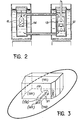
- the agitator is removed from the growth container and a quartz agitator shaft 13 carrying one or more polytetrafluoroethylene germ carriers is introduced, in accordance with the drawing in FIG. 3, containing germs placed in the cavities of the germ carrier plates.
- the plate cavities are prismatic in the shape of a dovetail.
- the germs are cut with a wet wire saw from large single crystals of good crystalline quality. They are prismatic in shape.
- each crystal 21 is cut in the form of a straight prism with an isosceles triangular section to present, between the end bases formed by faces (001), two rectangular lateral faces formed by faces (110) and a rectangular lateral face constituted by a face (100), of length at least 10mm along the direction (001).
- the germ rests on its face (100) at the bottom of the cavity 22.
- the latter is in the form of a prism of rectangular section, over a width corresponding substantially to that of the face (100) of the germ. It ends with two flat faces inclined towards each other over the germ, thus giving the shape of a dovetail.
- the temperature of the crystallization vessel is brought to, for example, 32 ° C and the temperature of the dissolution vessel is left unchanged.
- Mass transport of alpha mercuric iodide takes place between the two containers by concentration convection.
- the agitator shaft 13 rotates at a speed of 60 rpm 1 with a change of direction of rotation every 30 seconds.
- one or more monocrystals of iodide After two to three months, one or more monocrystals of iodide. Mercuric alpha 60-70mm in length, 20-30mm in thickness and 30-35mm in height weighing between 225 and 475g are obtained. pinacoid octahedral facies. The crystals are removed from the growth bath after the solution has been drained and the growth container is allowed to cool gradually to room temperature.
- the single crystals of alpha mercuric iodide thus obtained are perfectly transparent, free of solution inclusions, stacking faults, grain boundaries, internal tensions and deformations.
- the dislocation rate remains around 10 cm -2 and the purity is around 6-7N.
- the main residual impurity is silicon.
- the monocrystals of alpha mercuric iodide obtained by the process of the invention can be used for the manufacture of detectors and spectrometers of X and gamma radiation and they have the advantage of increasing the performance of these detectors and these spectrometers compared to the crystals obtained by the previous processes. They have in particular for these uses the following characteristics for the mobility product x lifetime of charge carriers:
Landscapes
- Chemical & Material Sciences (AREA)
- Engineering & Computer Science (AREA)
- Crystallography & Structural Chemistry (AREA)
- Materials Engineering (AREA)
- Metallurgy (AREA)
- Organic Chemistry (AREA)
- Inorganic Chemistry (AREA)
- Crystals, And After-Treatments Of Crystals (AREA)
- Measurement Of Radiation (AREA)
Applications Claiming Priority (2)
| Application Number | Priority Date | Filing Date | Title |
|---|---|---|---|
| FR7916418 | 1979-06-26 | ||
| FR7916418A FR2459843A1 (fr) | 1979-06-26 | 1979-06-26 | Procede de fabrication de monocristaux d'iodure mercurique alpha et monocristaux obtenus |
Publications (3)
| Publication Number | Publication Date |
|---|---|
| EP0022013A2 true EP0022013A2 (de) | 1981-01-07 |
| EP0022013A3 EP0022013A3 (en) | 1981-04-01 |
| EP0022013B1 EP0022013B1 (de) | 1984-01-25 |
Family
ID=9227112
Family Applications (1)
| Application Number | Title | Priority Date | Filing Date |
|---|---|---|---|
| EP80400932A Expired EP0022013B1 (de) | 1979-06-26 | 1980-06-23 | Alpha-Quecksilberjodid-Einkristallen und Verfahren zu ihrer Herstellung |
Country Status (5)
| Country | Link |
|---|---|
| US (1) | US4347230A (de) |
| EP (1) | EP0022013B1 (de) |
| JP (1) | JPS5641900A (de) |
| DE (1) | DE3066265D1 (de) |
| FR (1) | FR2459843A1 (de) |
Cited By (2)
| Publication number | Priority date | Publication date | Assignee | Title |
|---|---|---|---|---|
| FR2541668A1 (fr) * | 1983-02-28 | 1984-08-31 | Commissariat Energie Atomique | Procede de preparation d'iodure mercurique alpha de haute purete destine a etre utilise comme source de matiere premiere pour la croissance de monocristaux pour la detection nucleaire |
| US7383766B2 (en) | 2001-08-29 | 2008-06-10 | Mte Research Pty Ltd | Coal dewatering system and method |
Families Citing this family (9)
| Publication number | Priority date | Publication date | Assignee | Title |
|---|---|---|---|---|
| US4514989A (en) * | 1984-05-14 | 1985-05-07 | Carrier Corporation | Method and control system for protecting an electric motor driven compressor in a refrigeration system |
| US4538422A (en) * | 1984-05-14 | 1985-09-03 | Carrier Corporation | Method and control system for limiting compressor capacity in a refrigeration system upon a recycle start |
| US4535607A (en) * | 1984-05-14 | 1985-08-20 | Carrier Corporation | Method and control system for limiting the load placed on a refrigeration system upon a recycle start |
| JPS62120715A (ja) * | 1985-11-20 | 1987-06-02 | Tokyo Electric Co Ltd | リセツト信号発生回路 |
| US5004723A (en) * | 1989-01-31 | 1991-04-02 | Industrial Technology Research Institute | Preparation of superconducting epitaxial film using the method of liquid-phase epitaxial growth |
| US5853686A (en) * | 1993-08-10 | 1998-12-29 | State Of Oregon Acting By And Through The Oregon State Board Of Higher Education On Behalf Of The University Of Oregon | Calcium carbonates of altered crystal habit or morphology and methods for producing same |
| US5853691A (en) * | 1993-08-10 | 1998-12-29 | State Of Oregon Acting By And Through The Oregon State Board Of Higher Education On The Behalf Of The University Of Oregon | Silver halides of altered crystal habit or morphology and methods for producing same |
| US5545394A (en) * | 1993-08-10 | 1996-08-13 | The State Of Oregon Acting By And Through The State Board Of Higher Education On Behalf Of The University Of Oregon | Complexation-mediated crystal-forming reactions using complexing agents |
| CN102351430B (zh) * | 2011-07-11 | 2013-06-05 | 上海大学 | 用于辐射探测器的多晶碘化汞薄膜的制备方法 |
Family Cites Families (2)
| Publication number | Priority date | Publication date | Assignee | Title |
|---|---|---|---|---|
| US3969182A (en) * | 1975-07-16 | 1976-07-13 | The United States Of America As Represented By The United States Energy Research And Development Administration | Growth of mercuric iodide single crystals from dimethylsulfoxide |
| FR2338742A1 (fr) * | 1976-01-26 | 1977-08-19 | Commissariat Energie Atomique | Procede de fabrication de monocristaux d'iodure mercurique alpha |
-
1979
- 1979-06-26 FR FR7916418A patent/FR2459843A1/fr active Granted
-
1980
- 1980-06-23 EP EP80400932A patent/EP0022013B1/de not_active Expired
- 1980-06-23 US US06/161,923 patent/US4347230A/en not_active Expired - Lifetime
- 1980-06-23 DE DE8080400932T patent/DE3066265D1/de not_active Expired
- 1980-06-25 JP JP8638380A patent/JPS5641900A/ja active Pending
Cited By (4)
| Publication number | Priority date | Publication date | Assignee | Title |
|---|---|---|---|---|
| FR2541668A1 (fr) * | 1983-02-28 | 1984-08-31 | Commissariat Energie Atomique | Procede de preparation d'iodure mercurique alpha de haute purete destine a etre utilise comme source de matiere premiere pour la croissance de monocristaux pour la detection nucleaire |
| EP0118352A1 (de) * | 1983-02-28 | 1984-09-12 | Commissariat A L'energie Atomique | Verfahren zur Herstellung von hochreinem alpha-Quecksilberjodid bestimmt für die Verwendung als Ausgangsmaterial zum Wachsen von Einkristallen für die Nukleardetektion |
| US4581218A (en) * | 1983-02-28 | 1986-04-08 | Commissariat A L'energie Atomique | Process for the preparation of high purity alpha mercuric iodide for use as a starting material source for the growth of monocrystals for nuclear detection |
| US7383766B2 (en) | 2001-08-29 | 2008-06-10 | Mte Research Pty Ltd | Coal dewatering system and method |
Also Published As
| Publication number | Publication date |
|---|---|
| DE3066265D1 (en) | 1984-03-01 |
| JPS5641900A (en) | 1981-04-18 |
| FR2459843B1 (de) | 1985-02-22 |
| EP0022013B1 (de) | 1984-01-25 |
| EP0022013A3 (en) | 1981-04-01 |
| US4347230A (en) | 1982-08-31 |
| FR2459843A1 (fr) | 1981-01-16 |
Similar Documents
| Publication | Publication Date | Title |
|---|---|---|
| EP0022013B1 (de) | Alpha-Quecksilberjodid-Einkristallen und Verfahren zu ihrer Herstellung | |
| EP1567611B1 (de) | Herstellung von blockformen aus einem seltnererdhalogenid, dadurch hergestellte blockformen, ihre verwendung zur herstellung von einkristallen und dadurch hergestellte einkristalle | |
| CA1146721A (fr) | Maitere active positive pour generateur electrochimique a electrolyte non aqueux, methode de preparation de celle-ci et generateur electrochimique utilisant cette matiere active positive | |
| Schieber et al. | Purification, growth, and characterization of alpha mercuric-iodide crystals for gamma-ray detection | |
| EP0352182B1 (de) | Octasubstituierte Lithium-Phthalocyanine, Verfahren zu ihre Herstellung und ihrer Verwendung in EPR | |
| EP1415023B1 (de) | Verfahren zur herstellung eines einkristalles aus cdte oder cdznte | |
| CA2738543A1 (fr) | Phase precurseur et son utilisation pour preparer le sel de magnesium tetrahydrate d'un enantiomere d'omeprazole | |
| CA1113686A (fr) | Procede de fabrication de silicium pour la conversion photovoltaique | |
| Hay et al. | An electron spin resonance study of iron in silver chloride | |
| EP0118352B1 (de) | Verfahren zur Herstellung von hochreinem alpha-Quecksilberjodid bestimmt für die Verwendung als Ausgangsmaterial zum Wachsen von Einkristallen für die Nukleardetektion | |
| JPH10259189A (ja) | ヘキサフルオロリン酸リチウムの付加化合物及びその製造方法並びにそれを用いた電解液 | |
| CN113215658B (zh) | 一种厘米级长度钙钛矿单晶纤维及其制备方法和应用 | |
| Zheng et al. | An effective method for thallium bromide purification and research on crystal properties | |
| FR2526631A1 (fr) | Procede de fabrication de globules encapsulables | |
| US20150329983A1 (en) | Process for the electrochemical deposition of a semiconductor material | |
| Mischgofsky | Face stability and growth rate variations of the layer perovskite (C3H7NH3) 2CuCl4 | |
| EP0191512A1 (de) | Verfahren zur Herstellung von dichtem wasserfreiem Natriumcarbonat und nach diesem Verfahren hergestelltes dichtes wasserfreies Natriumcarbonat | |
| EP2358729A1 (de) | Kristallisierte pentasaccharide, verfahren zu deren gewinnung und deren verwendung zur herstellung von idraparinux | |
| JPH0329037B2 (de) | ||
| JP2002173395A (ja) | Gaドープシリコン単結晶の製造方法とシリコン単結晶 | |
| EP0001524B1 (de) | Neues ferromagnetisches Material auf der Basis von Chromdioxyd und Rhodiumdioxid und dessen Herstellung | |
| CN119497545B (zh) | 一种具有低并且稳定暗电流的FAPbBr3异质结晶体制备方法及应用 | |
| GB1560251A (en) | Method for producing sigle crystals of alpha mercuric iodide | |
| JP3848995B2 (ja) | 藻類育成用人工海水組成物及びその製造方法 | |
| EP0436414A1 (de) | Verfahren zur Herstellung von 2-amino-1,3-propandiol von seinen Salzen |
Legal Events
| Date | Code | Title | Description |
|---|---|---|---|
| PUAI | Public reference made under article 153(3) epc to a published international application that has entered the european phase |
Free format text: ORIGINAL CODE: 0009012 |
|
| AK | Designated contracting states |
Designated state(s): DE GB NL |
|
| PUAL | Search report despatched |
Free format text: ORIGINAL CODE: 0009013 |
|
| AK | Designated contracting states |
Designated state(s): DE GB NL |
|
| 17P | Request for examination filed |
Effective date: 19810615 |
|
| GRAA | (expected) grant |
Free format text: ORIGINAL CODE: 0009210 |
|
| AK | Designated contracting states |
Designated state(s): DE GB NL |
|
| REF | Corresponds to: |
Ref document number: 3066265 Country of ref document: DE Date of ref document: 19840301 |
|
| PLBE | No opposition filed within time limit |
Free format text: ORIGINAL CODE: 0009261 |
|
| STAA | Information on the status of an ep patent application or granted ep patent |
Free format text: STATUS: NO OPPOSITION FILED WITHIN TIME LIMIT |
|
| 26N | No opposition filed | ||
| PGFP | Annual fee paid to national office [announced via postgrant information from national office to epo] |
Ref country code: DE Payment date: 19890526 Year of fee payment: 10 |
|
| PGFP | Annual fee paid to national office [announced via postgrant information from national office to epo] |
Ref country code: NL Payment date: 19890630 Year of fee payment: 10 Ref country code: GB Payment date: 19890630 Year of fee payment: 10 |
|
| PG25 | Lapsed in a contracting state [announced via postgrant information from national office to epo] |
Ref country code: GB Effective date: 19900623 |
|
| PG25 | Lapsed in a contracting state [announced via postgrant information from national office to epo] |
Ref country code: NL Effective date: 19910101 |
|
| NLV4 | Nl: lapsed or anulled due to non-payment of the annual fee | ||
| GBPC | Gb: european patent ceased through non-payment of renewal fee | ||
| PG25 | Lapsed in a contracting state [announced via postgrant information from national office to epo] |
Ref country code: DE Effective date: 19910301 |