EP0021766B1 - Inhibitors of mammalian collagenase - Google Patents
Inhibitors of mammalian collagenase Download PDFInfo
- Publication number
- EP0021766B1 EP0021766B1 EP80302024A EP80302024A EP0021766B1 EP 0021766 B1 EP0021766 B1 EP 0021766B1 EP 80302024 A EP80302024 A EP 80302024A EP 80302024 A EP80302024 A EP 80302024A EP 0021766 B1 EP0021766 B1 EP 0021766B1
- Authority
- EP
- European Patent Office
- Prior art keywords
- methyl
- product
- acid
- amino
- compound
- Prior art date
- Legal status (The legal status is an assumption and is not a legal conclusion. Google has not performed a legal analysis and makes no representation as to the accuracy of the status listed.)
- Expired
Links
- 102000029816 Collagenase Human genes 0.000 title claims description 10
- 108060005980 Collagenase Proteins 0.000 title claims description 10
- 229960002424 collagenase Drugs 0.000 title claims description 7
- 239000003112 inhibitor Substances 0.000 title description 2
- 150000001875 compounds Chemical class 0.000 claims description 42
- -1 hydroxy, amino Chemical group 0.000 claims description 22
- DHMQDGOQFOQNFH-UHFFFAOYSA-N Glycine Chemical group NCC(O)=O DHMQDGOQFOQNFH-UHFFFAOYSA-N 0.000 claims description 16
- 125000002924 primary amino group Chemical group [H]N([H])* 0.000 claims description 15
- 150000003839 salts Chemical class 0.000 claims description 9
- 150000003863 ammonium salts Chemical class 0.000 claims description 6
- 125000002496 methyl group Chemical group [H]C([H])([H])* 0.000 claims description 6
- QNAYBMKLOCPYGJ-REOHCLBHSA-N L-alanine Chemical group C[C@H](N)C(O)=O QNAYBMKLOCPYGJ-REOHCLBHSA-N 0.000 claims description 5
- ZDXPYRJPNDTMRX-VKHMYHEASA-N L-glutamine Chemical group OC(=O)[C@@H](N)CCC(N)=O ZDXPYRJPNDTMRX-VKHMYHEASA-N 0.000 claims description 5
- ROHFNLRQFUQHCH-YFKPBYRVSA-N L-leucine Chemical group CC(C)C[C@H](N)C(O)=O ROHFNLRQFUQHCH-YFKPBYRVSA-N 0.000 claims description 5
- ROHFNLRQFUQHCH-UHFFFAOYSA-N Leucine Chemical group CC(C)CC(N)C(O)=O ROHFNLRQFUQHCH-UHFFFAOYSA-N 0.000 claims description 5
- 235000004279 alanine Nutrition 0.000 claims description 5
- 125000004432 carbon atom Chemical group C* 0.000 claims description 5
- ZDXPYRJPNDTMRX-UHFFFAOYSA-N glutamine Chemical group OC(=O)C(N)CCC(N)=O ZDXPYRJPNDTMRX-UHFFFAOYSA-N 0.000 claims description 5
- 125000003630 glycyl group Chemical group [H]N([H])C([H])([H])C(*)=O 0.000 claims description 4
- 239000001257 hydrogen Substances 0.000 claims description 4
- 229910052739 hydrogen Inorganic materials 0.000 claims description 4
- BMXXQOIIZQVVBC-UHFFFAOYSA-N 4-methyl-2-(sulfanylmethyl)pentanamide Chemical compound CC(C)CC(CS)C(N)=O BMXXQOIIZQVVBC-UHFFFAOYSA-N 0.000 claims description 3
- GCTDRFXPPSVRRP-UHFFFAOYSA-N 4-methyl-2-(sulfanylmethyl)pentanoic acid Chemical compound CC(C)CC(CS)C(O)=O GCTDRFXPPSVRRP-UHFFFAOYSA-N 0.000 claims description 3
- 125000000217 alkyl group Chemical group 0.000 claims description 3
- 125000001589 carboacyl group Chemical group 0.000 claims description 3
- 230000000694 effects Effects 0.000 claims description 3
- 125000004435 hydrogen atom Chemical group [H]* 0.000 claims description 3
- UVYHDQCPQHQXPP-BYPYZUCNSA-N (2S)-2-[amino(hydroxy)amino]-5-(diaminomethylideneamino)pentanoic acid Chemical group NN(O)[C@H](C(O)=O)CCCNC(N)=N UVYHDQCPQHQXPP-BYPYZUCNSA-N 0.000 claims description 2
- 230000002411 adverse Effects 0.000 claims 1
- ALBYIUDWACNRRB-UHFFFAOYSA-N hexanamide Chemical compound CCCCCC(N)=O ALBYIUDWACNRRB-UHFFFAOYSA-N 0.000 claims 1
- XEKOWRVHYACXOJ-UHFFFAOYSA-N Ethyl acetate Chemical compound CCOC(C)=O XEKOWRVHYACXOJ-UHFFFAOYSA-N 0.000 description 75
- 239000000047 product Substances 0.000 description 67
- HEMHJVSKTPXQMS-UHFFFAOYSA-M Sodium hydroxide Chemical compound [OH-].[Na+] HEMHJVSKTPXQMS-UHFFFAOYSA-M 0.000 description 39
- XLYOFNOQVPJJNP-UHFFFAOYSA-N water Substances O XLYOFNOQVPJJNP-UHFFFAOYSA-N 0.000 description 36
- RTZKZFJDLAIYFH-UHFFFAOYSA-N Diethyl ether Chemical compound CCOCC RTZKZFJDLAIYFH-UHFFFAOYSA-N 0.000 description 32
- XKRFYHLGVUSROY-UHFFFAOYSA-N Argon Chemical compound [Ar] XKRFYHLGVUSROY-UHFFFAOYSA-N 0.000 description 30
- 239000011541 reaction mixture Substances 0.000 description 30
- 239000000243 solution Substances 0.000 description 28
- WYURNTSHIVDZCO-UHFFFAOYSA-N Tetrahydrofuran Chemical compound C1CCOC1 WYURNTSHIVDZCO-UHFFFAOYSA-N 0.000 description 26
- CSNNHWWHGAXBCP-UHFFFAOYSA-L Magnesium sulfate Chemical compound [Mg+2].[O-][S+2]([O-])([O-])[O-] CSNNHWWHGAXBCP-UHFFFAOYSA-L 0.000 description 24
- YXFVVABEGXRONW-UHFFFAOYSA-N Toluene Chemical compound CC1=CC=CC=C1 YXFVVABEGXRONW-UHFFFAOYSA-N 0.000 description 24
- VEXZGXHMUGYJMC-UHFFFAOYSA-N Hydrochloric acid Chemical compound Cl VEXZGXHMUGYJMC-UHFFFAOYSA-N 0.000 description 16
- 239000002253 acid Substances 0.000 description 16
- OKKJLVBELUTLKV-UHFFFAOYSA-N Methanol Chemical compound OC OKKJLVBELUTLKV-UHFFFAOYSA-N 0.000 description 15
- 229910052786 argon Inorganic materials 0.000 description 15
- VLKZOEOYAKHREP-UHFFFAOYSA-N n-Hexane Chemical compound CCCCCC VLKZOEOYAKHREP-UHFFFAOYSA-N 0.000 description 15
- VHUUQVKOLVNVRT-UHFFFAOYSA-N Ammonium hydroxide Chemical compound [NH4+].[OH-] VHUUQVKOLVNVRT-UHFFFAOYSA-N 0.000 description 13
- LFQSCWFLJHTTHZ-UHFFFAOYSA-N Ethanol Chemical compound CCO LFQSCWFLJHTTHZ-UHFFFAOYSA-N 0.000 description 13
- 239000000908 ammonium hydroxide Substances 0.000 description 13
- YLQBMQCUIZJEEH-UHFFFAOYSA-N tetrahydrofuran Natural products C=1C=COC=1 YLQBMQCUIZJEEH-UHFFFAOYSA-N 0.000 description 13
- WEVYAHXRMPXWCK-UHFFFAOYSA-N Acetonitrile Chemical compound CC#N WEVYAHXRMPXWCK-UHFFFAOYSA-N 0.000 description 12
- 229910052943 magnesium sulfate Inorganic materials 0.000 description 12
- 235000019341 magnesium sulphate Nutrition 0.000 description 12
- 238000002844 melting Methods 0.000 description 10
- 230000008018 melting Effects 0.000 description 10
- FYSNRJHAOHDILO-UHFFFAOYSA-N thionyl chloride Chemical compound ClS(Cl)=O FYSNRJHAOHDILO-UHFFFAOYSA-N 0.000 description 10
- 239000004475 Arginine Substances 0.000 description 9
- KWYUFKZDYYNOTN-UHFFFAOYSA-M Potassium hydroxide Chemical compound [OH-].[K+] KWYUFKZDYYNOTN-UHFFFAOYSA-M 0.000 description 9
- ODKSFYDXXFIFQN-UHFFFAOYSA-N arginine Natural products OC(=O)C(N)CCCNC(N)=N ODKSFYDXXFIFQN-UHFFFAOYSA-N 0.000 description 9
- 235000009697 arginine Nutrition 0.000 description 9
- 238000006243 chemical reaction Methods 0.000 description 9
- 239000007864 aqueous solution Substances 0.000 description 8
- DUYAAUVXQSMXQP-UHFFFAOYSA-N ethanethioic S-acid Chemical compound CC(S)=O DUYAAUVXQSMXQP-UHFFFAOYSA-N 0.000 description 8
- 239000000463 material Substances 0.000 description 8
- 239000004471 Glycine Chemical group 0.000 description 7
- 239000000538 analytical sample Substances 0.000 description 7
- QTBSBXVTEAMEQO-UHFFFAOYSA-N Acetic acid Chemical compound CC(O)=O QTBSBXVTEAMEQO-UHFFFAOYSA-N 0.000 description 6
- VYPSYNLAJGMNEJ-UHFFFAOYSA-N Silicium dioxide Chemical compound O=[Si]=O VYPSYNLAJGMNEJ-UHFFFAOYSA-N 0.000 description 6
- 235000001014 amino acid Nutrition 0.000 description 6
- 229940024606 amino acid Drugs 0.000 description 6
- FGKJLKRYENPLQH-UHFFFAOYSA-N isocaproic acid Chemical compound CC(C)CCC(O)=O FGKJLKRYENPLQH-UHFFFAOYSA-N 0.000 description 6
- 239000000203 mixture Substances 0.000 description 6
- 239000002904 solvent Substances 0.000 description 6
- ADFXKUOMJKEIND-UHFFFAOYSA-N 1,3-dicyclohexylurea Chemical compound C1CCCCC1NC(=O)NC1CCCCC1 ADFXKUOMJKEIND-UHFFFAOYSA-N 0.000 description 5
- 150000001413 amino acids Chemical class 0.000 description 5
- 229910052799 carbon Inorganic materials 0.000 description 5
- 150000002148 esters Chemical class 0.000 description 5
- 239000007787 solid Substances 0.000 description 5
- 125000003396 thiol group Chemical class [H]S* 0.000 description 5
- FHWRKPCHKIBECI-UHFFFAOYSA-N 2-(chloromethyl)-4-methylpentanoyl chloride Chemical compound CC(C)CC(CCl)C(Cl)=O FHWRKPCHKIBECI-UHFFFAOYSA-N 0.000 description 4
- IJGRMHOSHXDMSA-UHFFFAOYSA-N Atomic nitrogen Chemical compound N#N IJGRMHOSHXDMSA-UHFFFAOYSA-N 0.000 description 4
- HEDRZPFGACZZDS-UHFFFAOYSA-N Chloroform Chemical compound ClC(Cl)Cl HEDRZPFGACZZDS-UHFFFAOYSA-N 0.000 description 4
- 102000008186 Collagen Human genes 0.000 description 4
- 108010035532 Collagen Proteins 0.000 description 4
- QOSSAOTZNIDXMA-UHFFFAOYSA-N Dicylcohexylcarbodiimide Chemical compound C1CCCCC1N=C=NC1CCCCC1 QOSSAOTZNIDXMA-UHFFFAOYSA-N 0.000 description 4
- ZRALSGWEFCBTJO-UHFFFAOYSA-N Guanidine Chemical compound NC(N)=N ZRALSGWEFCBTJO-UHFFFAOYSA-N 0.000 description 4
- 241000124008 Mammalia Species 0.000 description 4
- 238000009835 boiling Methods 0.000 description 4
- 150000001732 carboxylic acid derivatives Chemical class 0.000 description 4
- 229920001436 collagen Polymers 0.000 description 4
- 239000000706 filtrate Substances 0.000 description 4
- 239000000523 sample Substances 0.000 description 4
- 239000007858 starting material Substances 0.000 description 4
- 238000003756 stirring Methods 0.000 description 4
- ONJOLGIAGJAUMW-UHFFFAOYSA-N 2-(hydroxymethyl)-4-methylpentanoic acid Chemical compound CC(C)CC(CO)C(O)=O ONJOLGIAGJAUMW-UHFFFAOYSA-N 0.000 description 3
- BTJIUGUIPKRLHP-UHFFFAOYSA-N 4-nitrophenol Chemical compound OC1=CC=C([N+]([O-])=O)C=C1 BTJIUGUIPKRLHP-UHFFFAOYSA-N 0.000 description 3
- CSCPPACGZOOCGX-UHFFFAOYSA-N Acetone Chemical compound CC(C)=O CSCPPACGZOOCGX-UHFFFAOYSA-N 0.000 description 3
- QGZKDVFQNNGYKY-UHFFFAOYSA-N Ammonia Chemical compound N QGZKDVFQNNGYKY-UHFFFAOYSA-N 0.000 description 3
- UHOVQNZJYSORNB-UHFFFAOYSA-N Benzene Chemical compound C1=CC=CC=C1 UHOVQNZJYSORNB-UHFFFAOYSA-N 0.000 description 3
- OKTJSMMVPCPJKN-UHFFFAOYSA-N Carbon Chemical compound [C] OKTJSMMVPCPJKN-UHFFFAOYSA-N 0.000 description 3
- ZAFNJMIOTHYJRJ-UHFFFAOYSA-N Diisopropyl ether Chemical compound CC(C)OC(C)C ZAFNJMIOTHYJRJ-UHFFFAOYSA-N 0.000 description 3
- ZMANZCXQSJIPKH-UHFFFAOYSA-N Triethylamine Chemical compound CCN(CC)CC ZMANZCXQSJIPKH-UHFFFAOYSA-N 0.000 description 3
- 150000001408 amides Chemical class 0.000 description 3
- 238000005915 ammonolysis reaction Methods 0.000 description 3
- UAOMVDZJSHZZME-UHFFFAOYSA-N diisopropylamine Chemical compound CC(C)NC(C)C UAOMVDZJSHZZME-UHFFFAOYSA-N 0.000 description 3
- 235000004554 glutamine Nutrition 0.000 description 3
- 235000005772 leucine Nutrition 0.000 description 3
- 150000007530 organic bases Chemical class 0.000 description 3
- 125000000446 sulfanediyl group Chemical group *S* 0.000 description 3
- NGNBDVOYPDDBFK-UHFFFAOYSA-N 2-[2,4-di(pentan-2-yl)phenoxy]acetyl chloride Chemical compound CCCC(C)C1=CC=C(OCC(Cl)=O)C(C(C)CCC)=C1 NGNBDVOYPDDBFK-UHFFFAOYSA-N 0.000 description 2
- FYZAVMCVUDXYBB-UHFFFAOYSA-N 2-[[4-methyl-2-(sulfanylmethyl)pentanoyl]amino]acetic acid Chemical compound CC(C)CC(CS)C(=O)NCC(O)=O FYZAVMCVUDXYBB-UHFFFAOYSA-N 0.000 description 2
- XQIHFGYUMFFCFG-UHFFFAOYSA-N 4-methyl-2-methylidenepentanoic acid Chemical compound CC(C)CC(=C)C(O)=O XQIHFGYUMFFCFG-UHFFFAOYSA-N 0.000 description 2
- BGKHSGUBTITCTO-UHFFFAOYSA-N 5-[[2-(acetylsulfanylmethyl)-4-methylpentanoyl]amino]pentanoic acid Chemical compound CC(=O)SCC(CC(C)C)C(=O)NCCCCC(O)=O BGKHSGUBTITCTO-UHFFFAOYSA-N 0.000 description 2
- JJMDCOVWQOJGCB-UHFFFAOYSA-N 5-aminopentanoic acid Chemical compound [NH3+]CCCCC([O-])=O JJMDCOVWQOJGCB-UHFFFAOYSA-N 0.000 description 2
- 102000004190 Enzymes Human genes 0.000 description 2
- 108090000790 Enzymes Proteins 0.000 description 2
- MZRVEZGGRBJDDB-UHFFFAOYSA-N N-Butyllithium Chemical compound [Li]CCCC MZRVEZGGRBJDDB-UHFFFAOYSA-N 0.000 description 2
- CHJJGSNFBQVOTG-UHFFFAOYSA-N N-methyl-guanidine Natural products CNC(N)=N CHJJGSNFBQVOTG-UHFFFAOYSA-N 0.000 description 2
- 229930040373 Paraformaldehyde Natural products 0.000 description 2
- ABLZXFCXXLZCGV-UHFFFAOYSA-N Phosphorous acid Chemical compound OP(O)=O ABLZXFCXXLZCGV-UHFFFAOYSA-N 0.000 description 2
- QAOWNCQODCNURD-UHFFFAOYSA-N Sulfuric acid Chemical compound OS(O)(=O)=O QAOWNCQODCNURD-UHFFFAOYSA-N 0.000 description 2
- 150000001266 acyl halides Chemical class 0.000 description 2
- 239000003513 alkali Substances 0.000 description 2
- 125000000637 arginyl group Chemical group N[C@@H](CCCNC(N)=N)C(=O)* 0.000 description 2
- 230000015572 biosynthetic process Effects 0.000 description 2
- 150000001721 carbon Chemical group 0.000 description 2
- 210000000845 cartilage Anatomy 0.000 description 2
- 239000001913 cellulose Substances 0.000 description 2
- 229920002678 cellulose Polymers 0.000 description 2
- 238000003776 cleavage reaction Methods 0.000 description 2
- 238000007796 conventional method Methods 0.000 description 2
- 239000012043 crude product Substances 0.000 description 2
- 230000003247 decreasing effect Effects 0.000 description 2
- SWSQBOPZIKWTGO-UHFFFAOYSA-N dimethylaminoamidine Natural products CN(C)C(N)=N SWSQBOPZIKWTGO-UHFFFAOYSA-N 0.000 description 2
- 201000010099 disease Diseases 0.000 description 2
- 208000037265 diseases, disorders, signs and symptoms Diseases 0.000 description 2
- 229940088598 enzyme Drugs 0.000 description 2
- RIFGWPKJUGCATF-UHFFFAOYSA-N ethyl chloroformate Chemical compound CCOC(Cl)=O RIFGWPKJUGCATF-UHFFFAOYSA-N 0.000 description 2
- 239000012535 impurity Substances 0.000 description 2
- 238000000034 method Methods 0.000 description 2
- 229910052757 nitrogen Inorganic materials 0.000 description 2
- 229920002866 paraformaldehyde Polymers 0.000 description 2
- 229920001184 polypeptide Polymers 0.000 description 2
- IOLCXVTUBQKXJR-UHFFFAOYSA-M potassium bromide Chemical compound [K+].[Br-] IOLCXVTUBQKXJR-UHFFFAOYSA-M 0.000 description 2
- 108090000765 processed proteins & peptides Proteins 0.000 description 2
- 102000004196 processed proteins & peptides Human genes 0.000 description 2
- 206010039073 rheumatoid arthritis Diseases 0.000 description 2
- LDGPJUMFNAUOPX-UHFFFAOYSA-N s-(2-carbonochloridoyl-4-methylpentyl) ethanethioate Chemical compound CC(C)CC(C(Cl)=O)CSC(C)=O LDGPJUMFNAUOPX-UHFFFAOYSA-N 0.000 description 2
- 230000007017 scission Effects 0.000 description 2
- 239000000377 silicon dioxide Substances 0.000 description 2
- YZWKKMVJZFACSU-UHFFFAOYSA-N 1-bromopentane Chemical compound CCCCCBr YZWKKMVJZFACSU-UHFFFAOYSA-N 0.000 description 1
- AVFUGXZVSMKHDL-UHFFFAOYSA-N 2-(acetylsulfanylmethyl)-4-methylpentanoic acid Chemical compound CC(C)CC(C(O)=O)CSC(C)=O AVFUGXZVSMKHDL-UHFFFAOYSA-N 0.000 description 1
- CLEIVJDQTJFRTQ-UHFFFAOYSA-N 2-[[2-(acetylsulfanylmethyl)-4-methylpentanoyl]amino]acetic acid Chemical compound CC(=O)SCC(CC(C)C)C(=O)NCC(O)=O CLEIVJDQTJFRTQ-UHFFFAOYSA-N 0.000 description 1
- AYORUWNJMKYNAD-JEDNCBNOSA-N 2-aminoacetic acid;(2s)-2-amino-4-methylpentanoic acid Chemical compound NCC(O)=O.CC(C)C[C@H](N)C(O)=O AYORUWNJMKYNAD-JEDNCBNOSA-N 0.000 description 1
- MJHYCHHBCQHJNB-UHFFFAOYSA-N 2-methoxy-4-methylpentanoic acid Chemical compound COC(C(O)=O)CC(C)C MJHYCHHBCQHJNB-UHFFFAOYSA-N 0.000 description 1
- PLYLQUFCGNXLRS-UHFFFAOYSA-N 5-[(4-methyl-2-methylidenepentanoyl)amino]pentanoic acid Chemical compound CC(C)CC(=C)C(=O)NCCCCC(O)=O PLYLQUFCGNXLRS-UHFFFAOYSA-N 0.000 description 1
- XRNKPCUNCXQQBS-UHFFFAOYSA-N 5-[[2-(chloromethyl)-4-methylpentanoyl]amino]pentanoic acid Chemical compound CC(C)CC(CCl)C(=O)NCCCCC(O)=O XRNKPCUNCXQQBS-UHFFFAOYSA-N 0.000 description 1
- ROUFCTKIILEETD-UHFFFAOYSA-N 5-nitro-2-[(5-nitropyridin-2-yl)disulfanyl]pyridine Chemical compound N1=CC([N+](=O)[O-])=CC=C1SSC1=CC=C([N+]([O-])=O)C=N1 ROUFCTKIILEETD-UHFFFAOYSA-N 0.000 description 1
- WSSIUMAXIDSJRD-UHFFFAOYSA-N 6-[(4-methyl-2-methylidenepentanoyl)amino]hexanoic acid Chemical compound CC(C)CC(=C)C(=O)NCCCCCC(O)=O WSSIUMAXIDSJRD-UHFFFAOYSA-N 0.000 description 1
- SLXKOJJOQWFEFD-UHFFFAOYSA-N 6-aminohexanoic acid Chemical compound NCCCCCC(O)=O SLXKOJJOQWFEFD-UHFFFAOYSA-N 0.000 description 1
- YGOXXILFYXHWGE-UHFFFAOYSA-N 8-[[2-(acetylsulfanylmethyl)-4-methylpentanoyl]amino]octanoic acid Chemical compound CC(=O)SCC(CC(C)C)C(=O)NCCCCCCCC(O)=O YGOXXILFYXHWGE-UHFFFAOYSA-N 0.000 description 1
- JPTWMDQEEQLEEF-UHFFFAOYSA-N 8-[[2-(chloromethyl)-4-methylpentanoyl]amino]octanoic acid Chemical compound CC(C)CC(CCl)C(=O)NCCCCCCCC(O)=O JPTWMDQEEQLEEF-UHFFFAOYSA-N 0.000 description 1
- UQXNEWQGGVUVQA-UHFFFAOYSA-N 8-aminooctanoic acid Chemical compound NCCCCCCCC(O)=O UQXNEWQGGVUVQA-UHFFFAOYSA-N 0.000 description 1
- WKBOTKDWSSQWDR-UHFFFAOYSA-N Bromine atom Chemical compound [Br] WKBOTKDWSSQWDR-UHFFFAOYSA-N 0.000 description 1
- WWZKQHOCKIZLMA-UHFFFAOYSA-N Caprylic acid Natural products CCCCCCCC(O)=O WWZKQHOCKIZLMA-UHFFFAOYSA-N 0.000 description 1
- VEXZGXHMUGYJMC-UHFFFAOYSA-M Chloride anion Chemical compound [Cl-] VEXZGXHMUGYJMC-UHFFFAOYSA-M 0.000 description 1
- ZAMOUSCENKQFHK-UHFFFAOYSA-N Chlorine atom Chemical compound [Cl] ZAMOUSCENKQFHK-UHFFFAOYSA-N 0.000 description 1
- XBPCUCUWBYBCDP-UHFFFAOYSA-N Dicyclohexylamine Chemical compound C1CCCCC1NC1CCCCC1 XBPCUCUWBYBCDP-UHFFFAOYSA-N 0.000 description 1
- 108010016626 Dipeptides Chemical group 0.000 description 1
- 206010014989 Epidermolysis bullosa Diseases 0.000 description 1
- 206010023203 Joint destruction Diseases 0.000 description 1
- 239000005909 Kieselgur Substances 0.000 description 1
- ODKSFYDXXFIFQN-BYPYZUCNSA-N L-arginine Chemical compound OC(=O)[C@@H](N)CCCN=C(N)N ODKSFYDXXFIFQN-BYPYZUCNSA-N 0.000 description 1
- 229930064664 L-arginine Natural products 0.000 description 1
- 235000014852 L-arginine Nutrition 0.000 description 1
- MBBZMMPHUWSWHV-BDVNFPICSA-N N-methylglucamine Chemical compound CNC[C@H](O)[C@@H](O)[C@H](O)[C@H](O)CO MBBZMMPHUWSWHV-BDVNFPICSA-N 0.000 description 1
- 206010028980 Neoplasm Diseases 0.000 description 1
- 229920005654 Sephadex Polymers 0.000 description 1
- 239000012507 Sephadex™ Substances 0.000 description 1
- QAOWNCQODCNURD-UHFFFAOYSA-L Sulfate Chemical compound [O-]S([O-])(=O)=O QAOWNCQODCNURD-UHFFFAOYSA-L 0.000 description 1
- 206010064996 Ulcerative keratitis Diseases 0.000 description 1
- HCHKCACWOHOZIP-UHFFFAOYSA-N Zinc Chemical compound [Zn] HCHKCACWOHOZIP-UHFFFAOYSA-N 0.000 description 1
- 230000002378 acidificating effect Effects 0.000 description 1
- 239000013543 active substance Substances 0.000 description 1
- 229910052783 alkali metal Inorganic materials 0.000 description 1
- 229910052784 alkaline earth metal Inorganic materials 0.000 description 1
- 229960002684 aminocaproic acid Drugs 0.000 description 1
- 229910021529 ammonia Inorganic materials 0.000 description 1
- 238000004458 analytical method Methods 0.000 description 1
- 150000008064 anhydrides Chemical class 0.000 description 1
- 239000008346 aqueous phase Substances 0.000 description 1
- 150000004945 aromatic hydrocarbons Chemical class 0.000 description 1
- 206010003246 arthritis Diseases 0.000 description 1
- JUHORIMYRDESRB-UHFFFAOYSA-N benzathine Chemical compound C=1C=CC=CC=1CNCCNCC1=CC=CC=C1 JUHORIMYRDESRB-UHFFFAOYSA-N 0.000 description 1
- GONOPSZTUGRENK-UHFFFAOYSA-N benzyl(trichloro)silane Chemical compound Cl[Si](Cl)(Cl)CC1=CC=CC=C1 GONOPSZTUGRENK-UHFFFAOYSA-N 0.000 description 1
- 239000011230 binding agent Substances 0.000 description 1
- GDTBXPJZTBHREO-UHFFFAOYSA-N bromine Substances BrBr GDTBXPJZTBHREO-UHFFFAOYSA-N 0.000 description 1
- 229910052794 bromium Inorganic materials 0.000 description 1
- 239000002775 capsule Substances 0.000 description 1
- 239000007795 chemical reaction product Substances 0.000 description 1
- 239000003153 chemical reaction reagent Substances 0.000 description 1
- 239000000460 chlorine Substances 0.000 description 1
- 229910052801 chlorine Inorganic materials 0.000 description 1
- 125000001309 chloro group Chemical group Cl* 0.000 description 1
- 238000004587 chromatography analysis Methods 0.000 description 1
- 239000003086 colorant Substances 0.000 description 1
- 239000013058 crude material Substances 0.000 description 1
- 229940043279 diisopropylamine Drugs 0.000 description 1
- SMBQBQBNOXIFSF-UHFFFAOYSA-N dilithium Chemical class [Li][Li] SMBQBQBNOXIFSF-UHFFFAOYSA-N 0.000 description 1
- 238000004821 distillation Methods 0.000 description 1
- 239000002552 dosage form Substances 0.000 description 1
- 229940079593 drug Drugs 0.000 description 1
- 239000003814 drug Substances 0.000 description 1
- 238000001035 drying Methods 0.000 description 1
- 239000000839 emulsion Substances 0.000 description 1
- LJQKCYFTNDAAPC-UHFFFAOYSA-N ethanol;ethyl acetate Chemical compound CCO.CCOC(C)=O LJQKCYFTNDAAPC-UHFFFAOYSA-N 0.000 description 1
- WDCDAAMJNUHOIY-UHFFFAOYSA-N ethyl acetate;2-propan-2-yloxypropane Chemical compound CCOC(C)=O.CC(C)OC(C)C WDCDAAMJNUHOIY-UHFFFAOYSA-N 0.000 description 1
- 238000000605 extraction Methods 0.000 description 1
- 238000001914 filtration Methods 0.000 description 1
- 239000000796 flavoring agent Substances 0.000 description 1
- 235000019634 flavors Nutrition 0.000 description 1
- 125000000524 functional group Chemical group 0.000 description 1
- 150000004820 halides Chemical class 0.000 description 1
- 229910052736 halogen Inorganic materials 0.000 description 1
- 125000005843 halogen group Chemical group 0.000 description 1
- 150000002367 halogens Chemical group 0.000 description 1
- 238000010438 heat treatment Methods 0.000 description 1
- UCMFXAIFSBSDAQ-UHFFFAOYSA-N hexanamide Chemical compound CCCCCC(N)=O.CCCCCC(N)=O UCMFXAIFSBSDAQ-UHFFFAOYSA-N 0.000 description 1
- XGIHQYAWBCFNPY-AZOCGYLKSA-N hydrabamine Chemical compound C([C@@H]12)CC3=CC(C(C)C)=CC=C3[C@@]2(C)CCC[C@@]1(C)CNCCNC[C@@]1(C)[C@@H]2CCC3=CC(C(C)C)=CC=C3[C@@]2(C)CCC1 XGIHQYAWBCFNPY-AZOCGYLKSA-N 0.000 description 1
- 150000002431 hydrogen Chemical group 0.000 description 1
- 239000007924 injection Substances 0.000 description 1
- 238000002347 injection Methods 0.000 description 1
- 150000007529 inorganic bases Chemical class 0.000 description 1
- 238000002955 isolation Methods 0.000 description 1
- 238000012986 modification Methods 0.000 description 1
- 230000004048 modification Effects 0.000 description 1
- LCOQCYNCQDBSQA-UHFFFAOYSA-N n-(6-amino-6-oxohexyl)-4-methyl-2-methylidenepentanamide Chemical compound CC(C)CC(=C)C(=O)NCCCCCC(N)=O LCOQCYNCQDBSQA-UHFFFAOYSA-N 0.000 description 1
- FUZZWVXGSFPDMH-UHFFFAOYSA-N n-hexanoic acid Natural products CCCCCC(O)=O FUZZWVXGSFPDMH-UHFFFAOYSA-N 0.000 description 1
- 239000012299 nitrogen atmosphere Substances 0.000 description 1
- 229910000069 nitrogen hydride Inorganic materials 0.000 description 1
- 239000003960 organic solvent Substances 0.000 description 1
- 238000007911 parenteral administration Methods 0.000 description 1
- 230000007170 pathology Effects 0.000 description 1
- 235000019371 penicillin G benzathine Nutrition 0.000 description 1
- 208000028169 periodontal disease Diseases 0.000 description 1
- 239000003208 petroleum Substances 0.000 description 1
- 239000000546 pharmaceutical excipient Substances 0.000 description 1
- NNFCIKHAZHQZJG-UHFFFAOYSA-N potassium cyanide Chemical compound [K+].N#[C-] NNFCIKHAZHQZJG-UHFFFAOYSA-N 0.000 description 1
- 238000002360 preparation method Methods 0.000 description 1
- 239000003755 preservative agent Substances 0.000 description 1
- 230000002335 preservative effect Effects 0.000 description 1
- 230000035484 reaction time Effects 0.000 description 1
- 238000001953 recrystallisation Methods 0.000 description 1
- 238000012552 review Methods 0.000 description 1
- JBHDFNNINALOHP-UHFFFAOYSA-N s-[2-[(6-amino-6-oxohexyl)carbamoyl]-4-methylpentyl] ethanethioate Chemical compound CC(=O)SCC(CC(C)C)C(=O)NCCCCCC(N)=O JBHDFNNINALOHP-UHFFFAOYSA-N 0.000 description 1
- 238000001304 sample melting Methods 0.000 description 1
- 159000000000 sodium salts Chemical class 0.000 description 1
- 238000005507 spraying Methods 0.000 description 1
- 239000003381 stabilizer Substances 0.000 description 1
- 239000008174 sterile solution Substances 0.000 description 1
- 239000000758 substrate Substances 0.000 description 1
- 239000000725 suspension Substances 0.000 description 1
- 238000003786 synthesis reaction Methods 0.000 description 1
- 238000012360 testing method Methods 0.000 description 1
- DLYUQMMRRRQYAE-UHFFFAOYSA-N tetraphosphorus decaoxide Chemical compound O1P(O2)(=O)OP3(=O)OP1(=O)OP2(=O)O3 DLYUQMMRRRQYAE-UHFFFAOYSA-N 0.000 description 1
- 238000005292 vacuum distillation Methods 0.000 description 1
- 229910000634 wood's metal Inorganic materials 0.000 description 1
- 229910052725 zinc Inorganic materials 0.000 description 1
- 239000011701 zinc Substances 0.000 description 1
Classifications
-
- C—CHEMISTRY; METALLURGY
- C07—ORGANIC CHEMISTRY
- C07C—ACYCLIC OR CARBOCYCLIC COMPOUNDS
- C07C51/00—Preparation of carboxylic acids or their salts, halides or anhydrides
- C07C51/347—Preparation of carboxylic acids or their salts, halides or anhydrides by reactions not involving formation of carboxyl groups
- C07C51/377—Preparation of carboxylic acids or their salts, halides or anhydrides by reactions not involving formation of carboxyl groups by splitting-off hydrogen or functional groups; by hydrogenolysis of functional groups
-
- A—HUMAN NECESSITIES
- A61—MEDICAL OR VETERINARY SCIENCE; HYGIENE
- A61P—SPECIFIC THERAPEUTIC ACTIVITY OF CHEMICAL COMPOUNDS OR MEDICINAL PREPARATIONS
- A61P43/00—Drugs for specific purposes, not provided for in groups A61P1/00-A61P41/00
-
- C—CHEMISTRY; METALLURGY
- C07—ORGANIC CHEMISTRY
- C07C—ACYCLIC OR CARBOCYCLIC COMPOUNDS
- C07C323/00—Thiols, sulfides, hydropolysulfides or polysulfides substituted by halogen, oxygen or nitrogen atoms, or by sulfur atoms not being part of thio groups
-
- C—CHEMISTRY; METALLURGY
- C07—ORGANIC CHEMISTRY
- C07C—ACYCLIC OR CARBOCYCLIC COMPOUNDS
- C07C327/00—Thiocarboxylic acids
-
- C—CHEMISTRY; METALLURGY
- C07—ORGANIC CHEMISTRY
- C07C—ACYCLIC OR CARBOCYCLIC COMPOUNDS
- C07C51/00—Preparation of carboxylic acids or their salts, halides or anhydrides
- C07C51/08—Preparation of carboxylic acids or their salts, halides or anhydrides from nitriles
-
- C—CHEMISTRY; METALLURGY
- C07—ORGANIC CHEMISTRY
- C07C—ACYCLIC OR CARBOCYCLIC COMPOUNDS
- C07C51/00—Preparation of carboxylic acids or their salts, halides or anhydrides
- C07C51/347—Preparation of carboxylic acids or their salts, halides or anhydrides by reactions not involving formation of carboxyl groups
- C07C51/367—Preparation of carboxylic acids or their salts, halides or anhydrides by reactions not involving formation of carboxyl groups by introduction of functional groups containing oxygen only in singly bound form
-
- C—CHEMISTRY; METALLURGY
- C07—ORGANIC CHEMISTRY
- C07C—ACYCLIC OR CARBOCYCLIC COMPOUNDS
- C07C51/00—Preparation of carboxylic acids or their salts, halides or anhydrides
- C07C51/58—Preparation of carboxylic acid halides
-
- C—CHEMISTRY; METALLURGY
- C07—ORGANIC CHEMISTRY
- C07K—PEPTIDES
- C07K5/00—Peptides containing up to four amino acids in a fully defined sequence; Derivatives thereof
- C07K5/04—Peptides containing up to four amino acids in a fully defined sequence; Derivatives thereof containing only normal peptide links
- C07K5/06—Dipeptides
- C07K5/06008—Dipeptides with the first amino acid being neutral
- C07K5/06017—Dipeptides with the first amino acid being neutral and aliphatic
- C07K5/06026—Dipeptides with the first amino acid being neutral and aliphatic the side chain containing 0 or 1 carbon atom, i.e. Gly or Ala
-
- A—HUMAN NECESSITIES
- A61—MEDICAL OR VETERINARY SCIENCE; HYGIENE
- A61K—PREPARATIONS FOR MEDICAL, DENTAL OR TOILETRY PURPOSES
- A61K38/00—Medicinal preparations containing peptides
Definitions
- the compounds of formula I can be prepared using as a starting material 2-(hydroxymethyl)-4-methylpentanoic acid. Heating the starting material with phosphonic acid yields 4-methyl-2-methylenepentanoic acid which can in turn be reacted with a thio acid having the formula wherein R; is alkanoyl of 2 to 10 carbon atoms, to yield a product having the formula
- R is alkanoyl of 2 to 10 carbon atoms
- the products of formula III can also be used to prepare the products of formula I wherein R 2 is amino.
- Conversion of an acid of formula III to the corresponding amide having the formula can be accomplished using conventional techniques.
- the acid can be converted first to an acid halide (e.g., by reaction with thionyl chloride) and subsequently to an amide by ammonolysis. If concentrated ammonium hydroxide is used for ammonolysis, the resulting product will be the mercapto product having the formula
- Reaction of a compound of formula VII with an amino acid having the formula in the presence of alkali yields an intermediate having the formula After the completion of the above reaction, but before isolation of the product, it is desirable to add more alkali to the reaction mixture to form a compound having the formula
- a compound of formula X can be reacted with a thio acid of formula II to yield a product having the formula
- Treatment of a compound of formula XI with concentrated ammonium hydroxide yields an ammonium salt of the mercapto acid having the formula which can be neutralized with acid.
- Those compounds of formula I wherein R 2 is can be prepared from the corresponding carboxylic acid of formula X.
- the carboxylic acid is first converted to an acyl halide, preferably an acid chloride, using conventional techniques, e.g., reaction with a thionyl halide.
- the resulting acyl halide i.e., a compound having the formula can be converted to the corresponding amide, i.e., a compound having the formula by ammonolysis.
- a compound of formula XIV can be reacted with a thio acid of formula II to yield a product having the formula
- the corresponding mercapto compound having the formula can be prepared by treating an alkanoylthio compound of formula XV with concentrated ammonium hydroxide.
- Those compounds of formula I wherein R 2 is and R 4 is arginine, leucine, glutamine, alanine or glycine can be prepared from the corresponding carboxylic acid of formula XI.
- the carboxylic acid is first dissolved in an organic solvent, e.g., an aromatic hydrocarbon such as toluene, in the presence of an organic base.
- the compounds of this invention form salts with various inorganic and organic bases which are also within the scope of this invention.
- Such salts include ammonium salts, alkali metal salts, alkaline earth metal salts, salts with organic bases, e.g., dicyclohexylamine, benzathine, N-methyl-D-glucamine, hydrabamine or the like.
- the pharmaceutically acceptable salts are preferred, although other salts are also useful, e.g., in isolating or purifying the product.
- the compounds of formula I have at least one asymmetric carbon atom; the carbon noted with an asterisk ( * ) in formula I.
- the above described synthesis can utilize the starting compounds in the form of a racemic mixture or as a stereomer.
- R 2 is an amino acid or a dipeptide
- the L-isomers with respect to the carbon atom of the amino acids is generally preferred.
- collagenase is one of the key enzymes involved in the cartilage and joint destruction of rheumatoid arthritis; see, for example, Arthritis and Rheumatism, 20 (6):1231 (1977). It is, therefore, desirable to inhibit the action of the collagenase enzyme.
- the main components of cartilage are the collagen polypeptide molecules. These polypeptides are cleaved by mammalian collagenase at a single site.
- the compounds of this invention resemble the susceptible sequence of the collagen molecules and, it is theorized, bind to the mammalian collagenase enzyme and inhibit its activity.
- the mammalian collagenase enzyme contains zinc, which assists in the cleavage of a glycine- leucine or glycine-isoleucine bond and contains an extended cleft which interacts with an extended portion of the collagen molecule.
- This molecule in turn contains arginine as the last homologous amino acid in the substrate sequence adjacent to the cleavage site, a sequence showing a high degree of homology among the various types of collagen molecules.
- the inhibitors of this invention make use of these features of the enzyme and make modifications to enhance binding to the mammalian collagenase molecule.
- mammalian collagenase has also been implicated as a causative factor in several other diseases in mammals. These diseases include periodontal disease, corneal ulceration, tumor invasiveness, and epidermolysis bullosa; see, for example, American Journal of Pathology, 92 (2):509 (1978) and The New England Journal of Medicine, 291 (13):652 (1974).
- the compounds of this invention can be administered to a mammal in need thereof either orally or by injection intraarticularly into the affected joint.
- the daily dosage for a 70 kilogram mammal will be in the range of about 10 milligrams to 1 gram.
- the compounds of this invention can be formulated in compositions such as tablets, capsules or elixirs for oral administration or in sterile solutions or suspensions for parenteral administration.
- compositions such as tablets, capsules or elixirs for oral administration or in sterile solutions or suspensions for parenteral administration.
- About 10 to 500 mg of a compound of formula I or physiologically acceptable salt is compounded with a physiologically acceptable vehicle, carrier, excipient, binder, preservative, stabilizer, flavor, etc., in a unit dosage form as called for by accepted pharmaceutical practice.
- the amount of active substance in these compositions or preparations is such that a suitable dosage in the range indicated is obtained.
- Potassium cyanide (28 g) is partly dissolved in 125 ml of ethanol and 30 ml of water.
- Amyl bromide (63.6 g) is added and the reaction mixture is digested on the steam cone for 24 hours. The solution is decanted from the potassium bromide on to 35 g of potassium hydroxide. This is digested on the steam cone for 20 hours, diluted with 50 ml of water and concentrated in vacuo to remove the ethanol.
- a 1:1 mixture of sulfuric acid and water is added to the reaction mixture and product is extracted with petroleum ether to yield 60.6 g of crude product. Vacuum distillation yields 43.4 g of product boiling at 90-98°C/9 mm of Hg.
- Diisopropylamine (20.6 g) is dissolved in 80 ml of dry tetrahydrofuran. This solution is cooled to -30°C.
- n-Butyllithium (77 ml of 2.6M in hexane) is added dropwise in a nitrogen atmosphere at a rate that maintains the reaction at -30 to -20°C. This solution is stirred at -20°C for 30 minutes.
- Isocaproic acid (11.6 g) in 10 ml of tetrahydrofuran is added dropwise at -20 to -10°C, then stirred at -10°C for 30 minutes.
- Glycine (2.0 g) is dissolved in 10 ml of water containing 1.1 g (.027 mole) of sodium hydroxide. This solution is cooled to 5°C and 15 ml of (1:3) toluene:tetrahydrofuran is added. The chloroacid chloride is dissolved in 20 ml of tetrahydrofuran and is added dropwise to the glycine solution at 5°C. The pH of the reaction mixture is monitored and maintained at pH 8 to 9 by the addition of an aqueous solution of 1.1 g of sodium hydroxide (volume 20 ml). After stirring for about 16 hours the aqueous layer is separated, washed with ether and acidified with 10% hydrochloric acid. Product is extracted with ethyl acetate, dried with magnesium sulfate, filtered and concentrated in vacuo to yield 6.0 g of product.
- 2-(Chloromethyl)-4-methylvaleryl chloride (6.73 g; see Example 3C) is dissolved in 100 ml of toluene and is cooled to 0°C.
- 6-Aminohexanoic acid is dissolved in 35 ml of 1 N sodium hydroxide and is added to the vigorously stirred toluene solution. After 2 hours, 75 ml of 1N sodium hydroxide is added and the reaction mixture is stirred for about 16 hours.
- the toluene is decanted and the aqueous solution is acidified and extracted with ether. The ether is dried with magnesium sulfate, filtered and concentrated in vacuo to yield 6.7 g of product.
- this oil is shown to be a mixture of the chloro and dehydrohalogenated product. This is dissolved in 15 ml of 10% sodium hydroxide and digested on the steam cone for 1.5 hours. The aqueous solution is reacidified and extracted with ether. A sample (1.2 g) is removed and dissolved in 5 ml of 1 N sodium hydroxide. This solution is concentrated in vacuo and the residue is washed with ether. The solid is washed with cold ethyl acetate-ethanol and dried in vacuo to yield 1.0 g of product, melting point 166-171 °C. The product was found to contain 1/4 mole of water.
- the chromatography is followed by spotting fractions on filter paper and developing colors for the two functional groups (guanidine and sulfhydryl).
- the first 6 fractions contain an impurity which gives a positive guanidine test but a negative S-acetyl.
- the S-acetyl is visualized by spraying with a 0.3% acetone solution of 2,2'-dithiobis-(5-nitropyridine) then converting it to the sulfhydryl group by passing the filter paper over NH 3 vapors.
- the subsequent fractions totalling 150 ml yield 1.0 g of desired product upon concentration in vacuo. (product softens 97-120°C). Analysis indicates the presence of 0.75 mole of water.
- N-[6-[2-[(acetylthio)methyl-4-methyl-1-oxopentyl]amino-1-oxohexyl-L-arginine (see Example 4) is dissolved in 3 ml of water. The solution is cooled to 5°C and argon is passed over the solution. Concentrated ammonium hydroxide (1 ml) is added and the reaction mixture is stirred at 5°C for 15 minutes. The solution is then lyophilized and the residue is stirred with acetonitrile (20 ml) containing 5 drops of water. The solid is filtered under argon and dried in vacuo over potassium hydroxide to yield 0.7 g of the title compound.
- 6-[(4-Methyl-2-methylene-1-oxopentyJ)amino]hexanoic acid (0.7 g) is dissolved in 2 ml of thiolacetic acid and stirred under argon for 5 days. The sample is concentrated in vacuo, dissolved in ethyl acetate, and washed with water. The ethyl acetate solution is dried with maqnesium sulfate in the presence of activated charcoal (to decolorize). Upon filtration and concentration in vacuo the product slowly crystallizes and is washed with hexane. The product has a melting point of 64-80°C.
- N-[2-[(Acetylthio)methyl)-4-methyl-1-oxopentyl]glycine 0.5 g is dissolved in 30 ml of ethyl acetate along with p-nitrophenol (0.2 g). This solution is cooled to 5°C, N,N'-dicyclohexylcarbodiimide (.4 g) is added portionwise and the reaction mixture is stirred at 5° for about 16 hours. The dicyclohexyl urea is filtered off and the filtrate is concentrated thoroughly in vacuo. Isopropyl ether is added to the residue and allowed to sit for about 16 hours. The crystalline solid is filtered to yield 0.4 g of product, melting point 95-100°C.
- 5-Aminovaleric acid (3.2 g) is dissolved in 15 ml of water containing 1.09 g of sodium hydroxide. This is cooled to 5°C and 2-(chloromethyl)-4-methylvaleryl chloride in 30 ml of THF is added dropwise. The pH is maintained at 8-9 by the dropwise addition of 1.09 g sodium hydroxide in 20 ml of water as needed. After stirring for about 16 hours the reaction mixture is diluted with 30 ml of water and concentrated in vacuo to remove THF. The aqueous layer is washed with ether, and acidified with 10% hydrochloric acid. Product is extracted with ethyl acetate.
- the above compound is dissolved in 10 ml of ethanol and 10 ml of 10% sodium hydroxide digested on the steam cone for 30 minutes, and concentrated in vacuo to a volume of 10 ml.
- This solution is neutralized with 10% hydrochloric acid and product is extracted with ethyl acetate.
- the ethyl acetate is dried with magnesium sulfate, filtered and concentrated in vacuo to yield 1.7 g of product.
- the above crude active ester is dissolved in 20 ml of THF, added to a 5 ml aqueous solution of arginine (0.4 g) and stirred at room temperature for about 16 hours.
- the reaction mixture is concentrated in vacuo to 5 ml and the aqueous solution is washed with ethyl acetate and chromatographed on 80 g of cellulose using 1:1 water:methanol. After 300 ml of solvent elutes through the column, clean product elutes in a 20 ml fraction. Further portions contained contaminated product. Yield 0.25 g of analytical sample.
- 8-Amino caprylic acid (4.3 g) is dissolved in 20 ml of water containing 1.1 g of sodium hydroxide. To this is added 20 ml of THF, and 5 ml of toluene, and the solution is cooled to 5°C. 2-(Chloromethyl)-4-methylvaleryl chloride is dissolved in 10 ml of THF and added dropwise to the above solution. The pH of the reaction mixture is maintained between 8 and 9 during the reaction time by the addition of a total of 1.1 g of sodium hydroxide in 20 ml of water, as needed. After stirring at room temperature for about 16 hours, the aqueous layer is separated and acidified with 10% hydrochloric acid. Product is extracted with ethyl acetate and the ethyl acetate is dried with magnesium sulfate, filtered and concentrated in vacuo to yield 5.6 g of product.
- the above product is dissolved in 40 ml of absolute ethanol and 40 ml of 10% sodium hydroxide, digested on the steam cone for 2 hours and cooled and acidified with 10% hydrochloric acid. Product is extracted with ethyl acetate and the solution is dried with magnesium sulfate, filtered and concentrated in vacuo to yield 4.8 g of the product. The above two reactions are repeated on the same scale to yield a total of 8.7 g of unsaturated product.
- the active ester (4.4 g) is dissolved in 100 ml THF and added dropwise to a precooled solution of arginine (1.7 g) in 20 ml of water. This reaction mixture is stirred for about 16 hours, diluted with 350 ml of water and concentrated in vacuo to about 370 ml. This aqueous solution is washed with ethyl acetate until the bright yellow color disappears. During this procedure emulsion formation occurs which is broken up by the addition of diatomaceous earth to the separatory funnel. The aqueous layer is filtered and lyophilized. The crude residue (2.9 g) is chromatographed on 300 g of Avicel using 3:7 water:methanol.
Landscapes
- Chemical & Material Sciences (AREA)
- Organic Chemistry (AREA)
- Engineering & Computer Science (AREA)
- Oil, Petroleum & Natural Gas (AREA)
- Chemical Kinetics & Catalysis (AREA)
- Health & Medical Sciences (AREA)
- Life Sciences & Earth Sciences (AREA)
- General Health & Medical Sciences (AREA)
- Medicinal Chemistry (AREA)
- Genetics & Genomics (AREA)
- Biochemistry (AREA)
- Proteomics, Peptides & Aminoacids (AREA)
- Molecular Biology (AREA)
- Biophysics (AREA)
- Bioinformatics & Cheminformatics (AREA)
- Veterinary Medicine (AREA)
- Public Health (AREA)
- General Chemical & Material Sciences (AREA)
- Pharmacology & Pharmacy (AREA)
- Animal Behavior & Ethology (AREA)
- Nuclear Medicine, Radiotherapy & Molecular Imaging (AREA)
- Organic Low-Molecular-Weight Compounds And Preparation Thereof (AREA)
- Acyclic And Carbocyclic Compounds In Medicinal Compositions (AREA)
- Peptides Or Proteins (AREA)
- Pharmaceuticals Containing Other Organic And Inorganic Compounds (AREA)
- Medicines That Contain Protein Lipid Enzymes And Other Medicines (AREA)
Description
- Mammalian collagenase is inhibited by new compounds having the formula

- R1 is hydrogen or alkanoyl of 2 to 10 carbon atoms;
- R2 is hydroxy, amino, or

- R3 is hydrogen, alkyl of 1 to 4 carbon atoms,

- R4 is hydroxy, amino, arginine, leucine, glutamine, alanine or glycine; and
- m is 0 or an integer from 1 to 9.
- The compounds of formula I can be prepared using as a starting material 2-(hydroxymethyl)-4-methylpentanoic acid. Heating the starting material with phosphonic acid yields 4-methyl-2-methylenepentanoic acid which can in turn be reacted with a thio acid having the formula


- The products of formula III can also be used to prepare the products of formula I wherein R2 is amino. Conversion of an acid of formula III to the corresponding amide having the formula


- To prepare those compounds of formula I wherein R2 is

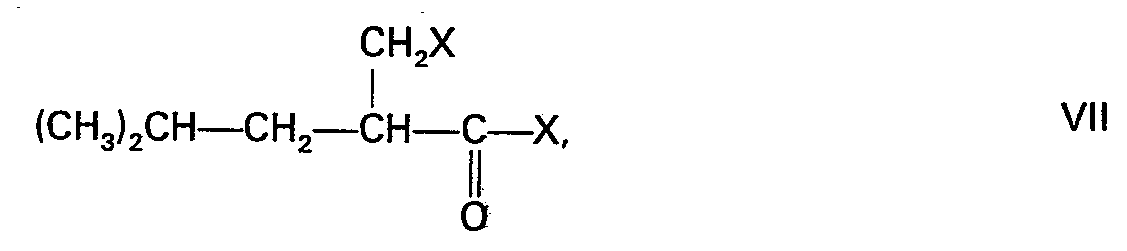
- Reaction of a compound of formula VII with an amino acid having the formula





- Those compounds of formula I wherein R2 is


- Those compounds of formula I wherein R2 is


- The compounds of this invention form salts with various inorganic and organic bases which are also within the scope of this invention. Such salts include ammonium salts, alkali metal salts, alkaline earth metal salts, salts with organic bases, e.g., dicyclohexylamine, benzathine, N-methyl-D-glucamine, hydrabamine or the like. The pharmaceutically acceptable salts are preferred, although other salts are also useful, e.g., in isolating or purifying the product.
- The compounds of formula I have at least one asymmetric carbon atom; the carbon noted with an asterisk (*) in formula I. The compounds accordingly exist in stereomeric forms or in racemic mixtures thereof. All of these are within the scope of this invention. The above described synthesis can utilize the starting compounds in the form of a racemic mixture or as a stereomer. When R2 is an amino acid or a dipeptide, the L-isomers with respect to the carbon atom of the amino acids is generally preferred.
- In mammals, collagenase is one of the key enzymes involved in the cartilage and joint destruction of rheumatoid arthritis; see, for example, Arthritis and Rheumatism, 20 (6):1231 (1977). It is, therefore, desirable to inhibit the action of the collagenase enzyme.
- While not limiting the scope of this invention to a specific theory or mechanism of operation, it is nevertheless helpful to an understanding of the invention to review the possible reasons for the activity of the compounds of formula I. The main components of cartilage are the collagen polypeptide molecules. These polypeptides are cleaved by mammalian collagenase at a single site. The compounds of this invention resemble the susceptible sequence of the collagen molecules and, it is theorized, bind to the mammalian collagenase enzyme and inhibit its activity.
- The mammalian collagenase enzyme contains zinc, which assists in the cleavage of a glycine- leucine or glycine-isoleucine bond and contains an extended cleft which interacts with an extended portion of the collagen molecule. This molecule in turn contains arginine as the last homologous amino acid in the substrate sequence adjacent to the cleavage site, a sequence showing a high degree of homology among the various types of collagen molecules. The inhibitors of this invention make use of these features of the enzyme and make modifications to enhance binding to the mammalian collagenase molecule.
- The action of mammalian collagenase has also been implicated as a causative factor in several other diseases in mammals. These diseases include periodontal disease, corneal ulceration, tumor invasiveness, and epidermolysis bullosa; see, for example, American Journal of Pathology, 92 (2):509 (1978) and The New England Journal of Medicine, 291 (13):652 (1974).
- For use in the treatment of rheumatoid arthritis, the compounds of this invention can be administered to a mammal in need thereof either orally or by injection intraarticularly into the affected joint. The daily dosage for a 70 kilogram mammal will be in the range of about 10 milligrams to 1 gram.
- The compounds of this invention can be formulated in compositions such as tablets, capsules or elixirs for oral administration or in sterile solutions or suspensions for parenteral administration. About 10 to 500 mg of a compound of formula I or physiologically acceptable salt is compounded with a physiologically acceptable vehicle, carrier, excipient, binder, preservative, stabilizer, flavor, etc., in a unit dosage form as called for by accepted pharmaceutical practice. The amount of active substance in these compositions or preparations is such that a suitable dosage in the range indicated is obtained.
- The following examples are specific embodiments of this invention.
- 4-Methyl-2-(methylhydroxy)pentanoic acid (8.7 g, see Example 3 below) is heated with 10 drops of 85% phosphonic acid in a Wood's metal bath at 220°C for 20 minutes. A distillation head is attached and the pressure is slowly decreased to 60 mm of Hg while the temperature is increased to 270°C. Product starts to distill and the pressure is further decreased to 10 mm. of Hg. The vapor temperature varies between 180 and 190°C. The yield of the title compound as distillate is 7.0 g.
- The above compound 6.8 g is stirred with 5 ml of thiolacetic acid under argon for 5 days. It is concentrated in vacuo and a portion is distilled. The product boils at 117-120°C at 9 mm of Hg.
- The above product (0.8 g) is dissolved in 1.8 ml of concentrated ammonium hydroxide at 5°C under argon and stirred at 5°C for 2 hours. Product slowly crystallizes out. The reaction mixture is lyophilized to 0.8 ml and the product is filtered to yield 0.4 g of analytical sample. Solid liqu,ifies at 120-130°C with ammonia given off.

- 2-[(Acetylthio)methyl]-4-methylpentanoic acid (6.0 g) is combined with thionyl chloride (5 ml). The reaction mixture is allowed to exotherm to 45°C. It is stirred at room temperature for about 16 hours and the acid chloride product is then vacuum distilled yielding 5.1 g, boiling point 80-90°C at 10 mm of Hg.
- 2-[(Acetylthio)methyl]-4-methylpentanoyl chloride (0.8 g) is cooled to 0°C and the reaction flask is purged with argon. Concentrated ammonium hydroxide (2.5 ml) is added and the reaction mixture is stirred at room temperature under argon for 5 hours. The oily material slowly solidifies. Extraction with ethyl acetate yields 0.3 g of material which crystallizes upon standing for 16 hours under ethyl acetate yielding 0.2 g of the title compound, melting point 147-154°C.
-

- Potassium cyanide (28 g) is partly dissolved in 125 ml of ethanol and 30 ml of water. Amyl bromide (63.6 g) is added and the reaction mixture is digested on the steam cone for 24 hours. The solution is decanted from the potassium bromide on to 35 g of potassium hydroxide. This is digested on the steam cone for 20 hours, diluted with 50 ml of water and concentrated in vacuo to remove the ethanol. A 1:1 mixture of sulfuric acid and water is added to the reaction mixture and product is extracted with petroleum ether to yield 60.6 g of crude product. Vacuum distillation yields 43.4 g of product boiling at 90-98°C/9 mm of Hg.
- Diisopropylamine (20.6 g) is dissolved in 80 ml of dry tetrahydrofuran. This solution is cooled to -30°C. n-Butyllithium (77 ml of 2.6M in hexane) is added dropwise in a nitrogen atmosphere at a rate that maintains the reaction at -30 to -20°C. This solution is stirred at -20°C for 30 minutes. Isocaproic acid (11.6 g) in 10 ml of tetrahydrofuran is added dropwise at -20 to -10°C, then stirred at -10°C for 30 minutes. In a separate flask, paraformaldehyde (28 g) is heated to about 200°C and the vapors are carried in a stream of nitrogen over the surface of the tetrahydrofuran solution of the dilithium salt of isocaproic acid. During this procedure the temperature is kept between -10 and +10°C. After all of the paraformaldehyde has vaporized the reaction mixture is cooled to 0°C and 10% hydrochloric acid is added dropwise until the reaction mixture becomes acidic. Product is extracted with 2 portions of ether (400 ml each). The ether is dried with magnesium sulfate, filtered and concentrated in vacuo to yield 13.2 g of crude material. Product is vacuum distilled to yield 9.0 g, boiling point 135-142°C/9 mm of Hg.
- The above acid (9.0 g) is cooled to 0°C. Thionyl chloride (15 ml) is added dropwise. After addition the reaction mixture is stirred for about 16 hours. Product is distilled in vacuo to yield 6.8 g, boiling point 42-50°C/9 mm of Hg.
- Glycine (2.0 g) is dissolved in 10 ml of water containing 1.1 g (.027 mole) of sodium hydroxide. This solution is cooled to 5°C and 15 ml of (1:3) toluene:tetrahydrofuran is added. The chloroacid chloride is dissolved in 20 ml of tetrahydrofuran and is added dropwise to the glycine solution at 5°C. The pH of the reaction mixture is monitored and maintained at pH 8 to 9 by the addition of an aqueous solution of 1.1 g of sodium hydroxide (volume 20 ml). After stirring for about 16 hours the aqueous layer is separated, washed with ether and acidified with 10% hydrochloric acid. Product is extracted with ethyl acetate, dried with magnesium sulfate, filtered and concentrated in vacuo to yield 6.0 g of product.
- The above material is dissolved in 40 ml of 10% sodium hydroxide and digested on the steam cone for 1 hour. The reaction mixture is cooled, neutralized with 10% hydrochloric acid and product is extracted with chloroform. The chloroform is dried with magnesium sulfate, filtered and concentrated in vacuo. Product crystallizes to yield 4.3 g, melting point 73-80°C.
- The above product is dissolved in 8 ml of thiolacetic acid and is stirred for about 16 hours under argon. The reaction mixture is concentrated in vacuo eliminating excess thiolacetic acid. Product (3.9 g) slowly crystallizes and is washed with hexane. Recrystallization from isopropyl ether-ethyl acetate yields an analytical sample, melting point 115-122°C.
- The above product (0.3 g) is dissolved in 0.5 ml of concentrated ammonium hydroxide in a flask purged with argon. This solution is stirred at 5°C for 20 minutes. The reaction mixture is treated with 10% hydrochloric acid to pH 2, and product is extracted with ethyl acetate. The ethyl acetate is dried with magnesium sulfate, filtered and concentrated in vacuo. A sample is dried at 60°C in vacuo over potassium hydroxide and phosphorous pentoxide for 6 hours to yield the title compound.
-

- 2-(Chloromethyl)-4-methylvaleryl chloride (6.73 g; see Example 3C) is dissolved in 100 ml of toluene and is cooled to 0°C. 6-Aminohexanoic acid is dissolved in 35 ml of 1 N sodium hydroxide and is added to the vigorously stirred toluene solution. After 2 hours, 75 ml of 1N sodium hydroxide is added and the reaction mixture is stirred for about 16 hours. The toluene is decanted and the aqueous solution is acidified and extracted with ether. The ether is dried with magnesium sulfate, filtered and concentrated in vacuo to yield 6.7 g of product. From NMR this oil is shown to be a mixture of the chloro and dehydrohalogenated product. This is dissolved in 15 ml of 10% sodium hydroxide and digested on the steam cone for 1.5 hours. The aqueous solution is reacidified and extracted with ether. A sample (1.2 g) is removed and dissolved in 5 ml of 1 N sodium hydroxide. This solution is concentrated in vacuo and the residue is washed with ether. The solid is washed with cold ethyl acetate-ethanol and dried in vacuo to yield 1.0 g of product, melting point 166-171 °C. The product was found to contain 1/4 mole of water.
- The free acid of the above salt (1.9 g) is dissolved in 100 ml of benzene. Thiolacetic acid (0.76 g) is added and the solution is stirred under nitrogen for 48 hours. The reaction mixture is concentrated in vacuo and water is added to the pot residue. Product is extracted with ether and the ether is dried with magnesium sulfate, filtered and concentrated in vacuo to yield 1.9 g of product.
- The above product (1.9 g) is dissolved in 150 ml of toluene and 0.66 g of triethylamine. This is cooled to 0°C and 0.65 g of ethyl chloroformate is added dropwise. After addition the reaction mixture is stirred at 0°C for 45 minutes and then filtered through Celite (a Registered Trade Mark in one or more designated states) into a flask containing 1.02 g of L-arginine in 25 ml of water. This is stirred for 48 hours, and the aqueous layer is separated from the toluene and concentrated in vacuo to yield 1.9 g of crude product which is redissolved in water and chromatographed with water through 200 g of Avicel (a Registered Trade Mark in one or more designated states) to remove unreacted arginine. After 500 ml of water has come through the column the product is eluted with 150 ml of water to yield 1.65 g of material. This is chromatographed through 200 g of LH-20 Sephadex (a Registered Trade Mark in one or more designated states). After 475 ml of water passed through the column, 10 ml fractions are collected. The chromatography is followed by spotting fractions on filter paper and developing colors for the two functional groups (guanidine and sulfhydryl). The first 6 fractions contain an impurity which gives a positive guanidine test but a negative S-acetyl. The S-acetyl is visualized by spraying with a 0.3% acetone solution of 2,2'-dithiobis-(5-nitropyridine) then converting it to the sulfhydryl group by passing the filter paper over NH3 vapors. The subsequent fractions totalling 150 ml yield 1.0 g of desired product upon concentration in vacuo. (product softens 97-120°C). Analysis indicates the presence of 0.75 mole of water.

- One gram of N-[6-[2-[(acetylthio)methyl-4-methyl-1-oxopentyl]amino-1-oxohexyl-L-arginine (see Example 4) is dissolved in 3 ml of water. The solution is cooled to 5°C and argon is passed over the solution. Concentrated ammonium hydroxide (1 ml) is added and the reaction mixture is stirred at 5°C for 15 minutes. The solution is then lyophilized and the residue is stirred with acetonitrile (20 ml) containing 5 drops of water. The solid is filtered under argon and dried in vacuo over potassium hydroxide to yield 0.7 g of the title compound.
-

- 6-[(4-Methyl-2-methylene-1-oxopentyl)amino]hexanoic acid (2.8 g, see Example 4a) is cooled to 5°C and thionyl chloride is added (5 ml). The reaction mixture is stirred at 35°C for 3 hours, and concentrated in vacuo at room temperature to remove excess thionyl chloride. The pot residue is cooled to 5°C and concentrated ammonium hydroxide (50 ml) is added and stirred for 1 hour. Product is extracted with ethyl acetate and the ethyl acetate solution is dried over magnesium sulfate, filtered and concentrated in vacuo. The resulting viscous oil slowly crystallizes, is washed with ether, and recrystallized from ethyl acetate to yield 0.8 g of the title compound, melting point 76-82°C.
- 6-[(4-Methyl-2-methylene-1-oxopentyJ)amino]hexanoic acid (0.7 g) is dissolved in 2 ml of thiolacetic acid and stirred under argon for 5 days. The sample is concentrated in vacuo, dissolved in ethyl acetate, and washed with water. The ethyl acetate solution is dried with maqnesium sulfate in the presence of activated charcoal (to decolorize). Upon filtration and concentration in vacuo the product slowly crystallizes and is washed with hexane. The product has a melting point of 64-80°C.
- N-[2-[(Acetylthio)methyl)-4-methyl-1-oxopentyl]glycine (0.5 g) is dissolved in 30 ml of ethyl acetate along with p-nitrophenol (0.2 g). This solution is cooled to 5°C, N,N'-dicyclohexylcarbodiimide (.4 g) is added portionwise and the reaction mixture is stirred at 5° for about 16 hours. The dicyclohexyl urea is filtered off and the filtrate is concentrated thoroughly in vacuo. Isopropyl ether is added to the residue and allowed to sit for about 16 hours. The crystalline solid is filtered to yield 0.4 g of product, melting point 95-100°C.
- The above active ester (0.4 g) is dissolved in 50 ml of tetrahydrofuran (THF). This solution is cooled to 0°C, arginine (0.2 g) in 20 ml of water is added dropwise with vigorous stirring, and the reaction mixture is stirred for about 16 hours. It is concentrated in vacuo to 20 ml and the aqueous solution is washed with portions of ethyl acetate until the bright yellow color disappears from the aqueous phase. This is concentrated to 4 ml and chromatographed on 160 g of cellulose with 1:4 methanol:water. After 700 ml of solvent passes through the column, product elutes in 80 ml of solvent free of unreacted arginine. This is lyophilized to yield 0.4 g of analytical product containing 0.5 mole of water.

- The above product (0.4 g) is dissolved in 2 ml of water. The solution is purged with argon and cooled to 5°C. Concentrated ammonium hydroxide (1 ml) is added, the solution is stirred for 30 minutes and lyophilized for about 16 hours. Acetonitrile (10 ml) is added to the residue followed by 4 drops of water. This is stirred under argon until product becomes a colorless granular solid, which is filtered and dried in vacuo at 45°C to yield 0.35 g of analytical sample, melting point 132-146°C.

- 5-Aminovaleric acid (3.2 g) is dissolved in 15 ml of water containing 1.09 g of sodium hydroxide. This is cooled to 5°C and 2-(chloromethyl)-4-methylvaleryl chloride in 30 ml of THF is added dropwise. The pH is maintained at 8-9 by the dropwise addition of 1.09 g sodium hydroxide in 20 ml of water as needed. After stirring for about 16 hours the reaction mixture is diluted with 30 ml of water and concentrated in vacuo to remove THF. The aqueous layer is washed with ether, and acidified with 10% hydrochloric acid. Product is extracted with ethyl acetate. The ethyl acetate is dried with magnesium sulfate, filtered and concentrated in vacuo to yield 4.3 g of product. Product is purified by chromatographing on 200 g of silica using as the solvent system 500 parts ether: 10 parts methanol: 5 parts acetic acid, yielding 2.0 g of material.
- The above compound is dissolved in 10 ml of ethanol and 10 ml of 10% sodium hydroxide digested on the steam cone for 30 minutes, and concentrated in vacuo to a volume of 10 ml. This solution is neutralized with 10% hydrochloric acid and product is extracted with ethyl acetate. The ethyl acetate is dried with magnesium sulfate, filtered and concentrated in vacuo to yield 1.7 g of product.
- The above material is dissolved in 3 ml of thiolacetic acid and stirred at room temperature for about 16 hours. The reaction mixture is washed with hexane and chromatographed on 100 g of silica using 50:5:2 ether:methanol:acetic acid, yielding 0.8 g of material.
- The above material is dissolved in 10 ml of ethyl acetate along with p-nitrophenol (0.37 g), the solution is cooled to 5°C and N,N-dicyclohexylcarbodiimide (0.54 g) is added portionwise. The reaction mixture is stirred at 5°C for about 16 hours. Dicyclohexyl urea is filtered and the filtrate is concentrated in vacuo. The residue is dissolved in isopropyl ether and after standing for 2 hours it is filtered free of additional dicyclohexyl urea and concentrated in vacuo to yield 1.0 g of active ester as an oil.
- The above crude active ester is dissolved in 20 ml of THF, added to a 5 ml aqueous solution of arginine (0.4 g) and stirred at room temperature for about 16 hours. The reaction mixture is concentrated in vacuo to 5 ml and the aqueous solution is washed with ethyl acetate and chromatographed on 80 g of cellulose using 1:1 water:methanol. After 300 ml of solvent elutes through the column, clean product elutes in a 20 ml fraction. Further portions contained contaminated product. Yield 0.25 g of analytical sample.

- The above sample is dissolved in 1 ml of water cooled to 5°C and purged with argon. Concentrated ammonium hydroxide (1 ml) is added, the reaction mixture is stirred at 5°C for 30 minutes, lyophilized for about 16 hours and washed with 10 ml of acetonitrile containing 4 drops of water. Product is dried at 60°C for 6 hours to yield an analytical sample melting point 117-130°C.

- 8-Amino caprylic acid (4.3 g) is dissolved in 20 ml of water containing 1.1 g of sodium hydroxide. To this is added 20 ml of THF, and 5 ml of toluene, and the solution is cooled to 5°C. 2-(Chloromethyl)-4-methylvaleryl chloride is dissolved in 10 ml of THF and added dropwise to the above solution. The pH of the reaction mixture is maintained between 8 and 9 during the reaction time by the addition of a total of 1.1 g of sodium hydroxide in 20 ml of water, as needed. After stirring at room temperature for about 16 hours, the aqueous layer is separated and acidified with 10% hydrochloric acid. Product is extracted with ethyl acetate and the ethyl acetate is dried with magnesium sulfate, filtered and concentrated in vacuo to yield 5.6 g of product.
- The above product is dissolved in 40 ml of absolute ethanol and 40 ml of 10% sodium hydroxide, digested on the steam cone for 2 hours and cooled and acidified with 10% hydrochloric acid. Product is extracted with ethyl acetate and the solution is dried with magnesium sulfate, filtered and concentrated in vacuo to yield 4.8 g of the product. The above two reactions are repeated on the same scale to yield a total of 8.7 g of unsaturated product.
- The above product (8.2 g) is dissolved in 15 ml of thiolacetic acid, stirred under argon at room temperature for 48 hours, and concentrated in vacuo for 16 hours to remove excess thiolacetic acid. The residue is dissolved in ether and washed 4 times with water. The ether is dried with magnesium sulfate, filtered and concentrated in vacuo to yield 8.9 g. A small amount of impurity is washed away from the product with hexane. Yield 8.2 g.
- The above compound (8.2 g) and p-nitrophenol (3.3 g) are dissolved in 200 ml of ethyl acetate and cooled to 5°C. N,N-Dicyclohexylcarbodiimide (5.0 g) is added portionwise and the reaction mixture is stirred at 5°C for about 16 hours. The dicyclohexylurea is filtered off and the ethyl acetate filtrate is concentrated in vacuo for 1 hour. Diisopropyl ether (4 ml) and ethyl acetate (4 ml) are added to the pot residue. A second crop of dicyclohexylurea is obtained. The filtrate is concentrated in vacuo to yield 8.7 g of crude active ester.
- The active ester (4.4 g) is dissolved in 100 ml THF and added dropwise to a precooled solution of arginine (1.7 g) in 20 ml of water. This reaction mixture is stirred for about 16 hours, diluted with 350 ml of water and concentrated in vacuo to about 370 ml. This aqueous solution is washed with ethyl acetate until the bright yellow color disappears. During this procedure emulsion formation occurs which is broken up by the addition of diatomaceous earth to the separatory funnel. The aqueous layer is filtered and lyophilized. The crude residue (2.9 g) is chromatographed on 300 g of Avicel using 3:7 water:methanol. After 900 ml of solvent passes through the column, product elutes in 100 ml of solvent to yield 1.0 g of analytical sample after drying 6 hours at 50°C in vacuo, melting point 85-102°C. Product contains 1/2 molar equivalent of water.

- Due to limited water solubility the above product (0.65 g) is first dissolved in 50 ml of argon purged ethanol followed by the addition of 2 ml of concentrated ammonium hydroxide. This reaction mixture is stirred for 1.5 hours at room temperature under argon. It is then lyophilized to almost dryness. Acetonitrile is added and the reaction mixture is stirred until product becomes granular and white. It is filtered and dried in vacuo at 50°C to yield analytical sample, melting point 102-130°C. Product contains 1/2 molar equivalent of water.

Claims (11)


Applications Claiming Priority (2)
| Application Number | Priority Date | Filing Date | Title |
|---|---|---|---|
| US06/051,915 US4235885A (en) | 1979-06-25 | 1979-06-25 | Inhibitors of mammalian collagenase |
| US51915 | 1979-06-25 |
Publications (3)
| Publication Number | Publication Date |
|---|---|
| EP0021766A2 EP0021766A2 (en) | 1981-01-07 |
| EP0021766A3 EP0021766A3 (en) | 1981-05-13 |
| EP0021766B1 true EP0021766B1 (en) | 1983-02-09 |
Family
ID=21974174
Family Applications (1)
| Application Number | Title | Priority Date | Filing Date |
|---|---|---|---|
| EP80302024A Expired EP0021766B1 (en) | 1979-06-25 | 1980-06-16 | Inhibitors of mammalian collagenase |
Country Status (8)
| Country | Link |
|---|---|
| US (1) | US4235885A (en) |
| EP (1) | EP0021766B1 (en) |
| JP (1) | JPS5612353A (en) |
| AU (1) | AU539714B2 (en) |
| CA (1) | CA1180324A (en) |
| DE (1) | DE3061889D1 (en) |
| IE (1) | IE49914B1 (en) |
| ZA (1) | ZA803198B (en) |
Families Citing this family (30)
| Publication number | Priority date | Publication date | Assignee | Title |
|---|---|---|---|---|
| US4611002A (en) * | 1977-07-14 | 1986-09-09 | E. R. Squibb And Sons, Inc. | Carboxymethyl esters of mercaptopropanoic acids as enkephalinase inhibitors |
| ZA794723B (en) * | 1978-09-11 | 1980-08-27 | Univ Miami | Anti-hypertensive agents |
| US4692458A (en) * | 1980-03-05 | 1987-09-08 | University Of Miami | Anti-hypertensive agents |
| GB2076809B (en) * | 1980-05-30 | 1984-03-14 | Squibb & Sons Inc | N-substituted mercapto propionamides |
| US4382081A (en) * | 1981-06-12 | 1983-05-03 | E. R. Squibb & Sons, Inc. | Inhibitors of mammalian collagenase |
| US4424354A (en) | 1981-06-12 | 1984-01-03 | E. R. Squibb & Sons, Inc. | Inhibitors of mammalian collagenase |
| US4371465A (en) * | 1981-10-07 | 1983-02-01 | American Home Products Corporation | Mammalian collagenase inhibitors |
| US4374765A (en) * | 1981-10-07 | 1983-02-22 | American Home Products Corporation | Mammalian collagenase inhibitors |
| US4371466A (en) * | 1981-10-07 | 1983-02-01 | American Home Products Corporation | Mammalian collagenase inhibitors |
| US4401677A (en) * | 1981-10-09 | 1983-08-30 | E. R. Squibb & Sons, Inc. | Enkephalinase inhibitors |
| US4474795A (en) * | 1981-10-09 | 1984-10-02 | E. R. Squibb & Sons, Inc. | Enkephalinase inhibitors |
| US4474799A (en) * | 1981-10-09 | 1984-10-02 | E. R. Squibb & Sons, Inc. | Enkephalinase inhibitors |
| US4774256A (en) * | 1983-10-03 | 1988-09-27 | E. R. Squibb & Sons, Inc. | Use of enkephalinase inhibitors as analgesic agents |
| US4798904A (en) * | 1983-10-03 | 1989-01-17 | E. R. Squibb & Sons, Inc. | Certain [(lower alkanoyl-thio)methyl-1-oxo-3-phenyl propyl amino]benzene lower alkanoic acid or ester derivatives which inhibit enkephalinase |
| US4722810A (en) * | 1984-08-16 | 1988-02-02 | E. R. Squibb & Sons, Inc. | Enkephalinase inhibitors |
| DE3467754D1 (en) * | 1983-10-03 | 1988-01-07 | Squibb & Sons Inc | ENKEPHALINASE INHIBITORS |
| FR2556721B1 (en) * | 1983-12-14 | 1986-05-16 | Roussel Uclaf | NOVEL AMINO-ACID O-MERCAPTOPROPANAMIDE DERIVATIVES, THEIR PREPARATION PROCESS, THEIR USE AS MEDICAMENTS AND THE COMPOSITIONS CONTAINING THEM |
| US4595700A (en) * | 1984-12-21 | 1986-06-17 | G. D. Searle & Co. | Thiol based collagenase inhibitors |
| CA1337400C (en) * | 1987-06-08 | 1995-10-24 | Norma G. Delaney | Inhibitors of neutral endopeptidase |
| US4855315A (en) * | 1988-09-02 | 1989-08-08 | E. R. Squibb & Sons, Inc. | Use of zofenopril for the treatment of rheumatoid arthritis |
| CA2045621A1 (en) * | 1989-11-24 | 1991-05-25 | Akira Okuyama | Physiologically active substance be-16627 |
| AU2228292A (en) * | 1991-06-14 | 1993-01-12 | Research Corporation Technologies, Inc. | Peptide derivatives of collagenase inhibitor |
| US5641636A (en) * | 1994-05-20 | 1997-06-24 | University Of Pennsylvania | Method of predicting fetal membrane rupture based on matrix metalloproteinase-9 activity |
| US6140099A (en) * | 1994-05-20 | 2000-10-31 | The Trustees Of The University Of Pennsylvania | Method of delaying fetal membrane rupture by inhibiting matrix metalloproteinase-9 activity |
| ES2133807T3 (en) * | 1994-10-05 | 1999-09-16 | Darwin Discovery Ltd | PEPTIDYL COMPOUNDS AND THEIR THERAPEUTIC USE AS METALOPROTEASE INHIBITORS. |
| US5831004A (en) | 1994-10-27 | 1998-11-03 | Affymax Technologies N.V. | Inhibitors of metalloproteases, pharmaceutical compositions comprising same and methods of their use |
| US5840698A (en) * | 1994-10-27 | 1998-11-24 | Affymax Technologies N.V. | Inhibitors of collagenase-1 and stormelysin-I metalloproteases, pharmaceutical compositions comprising same and methods of their use |
| US6294694B1 (en) | 1999-06-04 | 2001-09-25 | Wisconsin Alumni Research Foundation | Matrix metalloproteinase inhibitors and method of using same |
| AR050552A1 (en) * | 2004-09-02 | 2006-11-01 | Osi Pharm Inc | MERCAPTOAMIDS AS INHIBITORS OF HISTONA DEACETILASE |
| JP6507832B2 (en) * | 2015-05-07 | 2019-05-08 | 日油株式会社 | Method for producing N-acyl amino acid |
Family Cites Families (4)
| Publication number | Priority date | Publication date | Assignee | Title |
|---|---|---|---|---|
| US4105776A (en) * | 1976-06-21 | 1978-08-08 | E. R. Squibb & Sons, Inc. | Proline derivatives and related compounds |
| US4053651A (en) * | 1976-05-10 | 1977-10-11 | E. R. Squibb & Sons, Inc. | Compounds and method for alleviating angiotensin related hypertension |
| US4179434A (en) * | 1977-01-17 | 1979-12-18 | E. R. Squibb & Sons, Inc. | Amino acid derivatives |
| CA1125783A (en) * | 1978-03-27 | 1982-06-15 | Michael E. Condon | Thioalkanoylalkanoic acid compounds |
-
1979
- 1979-06-25 US US06/051,915 patent/US4235885A/en not_active Expired - Lifetime
-
1980
- 1980-05-28 AU AU58850/80A patent/AU539714B2/en not_active Ceased
- 1980-05-28 ZA ZA00803198A patent/ZA803198B/en unknown
- 1980-06-04 CA CA000353379A patent/CA1180324A/en not_active Expired
- 1980-06-16 DE DE8080302024T patent/DE3061889D1/en not_active Expired
- 1980-06-16 EP EP80302024A patent/EP0021766B1/en not_active Expired
- 1980-06-17 IE IE1251/80A patent/IE49914B1/en not_active IP Right Cessation
- 1980-06-25 JP JP8721180A patent/JPS5612353A/en active Granted
Also Published As
| Publication number | Publication date |
|---|---|
| AU539714B2 (en) | 1984-10-11 |
| EP0021766A2 (en) | 1981-01-07 |
| JPS5612353A (en) | 1981-02-06 |
| CA1180324A (en) | 1985-01-02 |
| US4235885A (en) | 1980-11-25 |
| ZA803198B (en) | 1981-05-27 |
| IE801251L (en) | 1980-12-25 |
| IE49914B1 (en) | 1986-01-08 |
| AU5885080A (en) | 1981-02-05 |
| EP0021766A3 (en) | 1981-05-13 |
| JPS6338024B2 (en) | 1988-07-28 |
| DE3061889D1 (en) | 1983-03-17 |
Similar Documents
| Publication | Publication Date | Title |
|---|---|---|
| US4235885A (en) | Inhibitors of mammalian collagenase | |
| US4297275A (en) | Inhibitors of mammalian collagenase | |
| US4595700A (en) | Thiol based collagenase inhibitors | |
| EP0018549B1 (en) | Tetrahydroisoquinoline compounds, process for preparing them and pharmaceutical compositions containing them | |
| KR950004960B1 (en) | SUBSTITUTED Ñß-AMINO ACIDS, THEIR PREPARATION AND PHARMACEUTICAL COMPOSITIONS | |
| EP0273689B1 (en) | Derivatives of n-(2-alkyl-3-mercapto-glutaryl) alpha-amino acids and their use as collagenase inhibitors | |
| EP1009750B1 (en) | Novel (alpha-aminophosphino) peptide derivatives, method for making same and therapeutic applications thereof | |
| EP0045161B1 (en) | Amides of 4-oxo-5-amidohexanoic acid derivatives | |
| EP0766687A1 (en) | Phosphinic acid derivatives with metallopeptidase inhibitory activity | |
| US4263293A (en) | Heterocyclic containing amides as inhibitors of mammalian collagenase | |
| FR2462428A1 (en) | DITHIOACYLDIHYDROPYRAZOLE CARBOXYLIC ACID DERIVATIVES, DITHIOACYLPROLINE DERIVATIVES, AND RELATED COMPOUNDS WITH ANTIHYPERTENSIVE ACTION | |
| EP0067429A1 (en) | Inhibitors of mammalian collagenase | |
| US4327111A (en) | N-Substituted mercaptoacyl pripionamides | |
| US4151303A (en) | Phenoxyalkylcarboxylic acid compounds and serum-lipid and triglyceride depressing therapeutic compositions | |
| DE69414194T2 (en) | Amino acid derivatives and their use as enkephalinase inhibitors | |
| US4681966A (en) | Intermediate for thiol based collagenase inhibitors | |
| US4325886A (en) | Optical resolution of acylthiopropionic acid | |
| CH639370A5 (en) | HALOGENATED MERCAPTOACYLAMINE ACIDS AND PROCESS FOR THEIR PREPARATION. | |
| BE861454A (en) | THIAZOLIDINECARBOXYLIC ACID DERIVATIVES, THEIR PREPARATION AND USE | |
| US4198509A (en) | Mercaptoacylpiperazine carboxylic acid compounds | |
| LU85780A1 (en) | NOVEL ENOLIC ESTERS PRECURSOR OF DRUGS AND PHARMACEUTICAL COMPOSITION CONTAINING THEM | |
| EP0636630A1 (en) | N-heteroaryl substituted derivatives of propanamide useful in the treatment of cardiovascular diseases | |
| CA2329637A1 (en) | (alpha-aminophosphino) peptidesderivative and compositions containing same | |
| AU666141B2 (en) | N-(mercaptoacyl)amino acids, methods of their preparation and therapeutic use, and pharmaceutical compositions containing them | |
| DK156054B (en) | ANALOGY PROCEDURE FOR PREPARING N- (3-ACYLTHIO-2-METHYLPROPANOYL) PROLINE COMPOUNDS OR SALTS THEREOF |
Legal Events
| Date | Code | Title | Description |
|---|---|---|---|
| PUAI | Public reference made under article 153(3) epc to a published international application that has entered the european phase |
Free format text: ORIGINAL CODE: 0009012 |
|
| AK | Designated contracting states |
Designated state(s): BE CH DE FR GB IT LU NL SE |
|
| PUAL | Search report despatched |
Free format text: ORIGINAL CODE: 0009013 |
|
| AK | Designated contracting states |
Designated state(s): BE CH DE FR GB IT LU NL SE BE CH DE FR GB IT LU NL |
|
| 17P | Request for examination filed |
Effective date: 19810515 |
|
| ITF | It: translation for a ep patent filed | ||
| GRAA | (expected) grant |
Free format text: ORIGINAL CODE: 0009210 |
|
| AK | Designated contracting states |
Designated state(s): BE CH DE FR GB IT LI LU NL SE |
|
| REF | Corresponds to: |
Ref document number: 3061889 Country of ref document: DE Date of ref document: 19830317 |
|
| ET | Fr: translation filed | ||
| PGFP | Annual fee paid to national office [announced via postgrant information from national office to epo] |
Ref country code: SE Payment date: 19920320 Year of fee payment: 13 |
|
| PGFP | Annual fee paid to national office [announced via postgrant information from national office to epo] |
Ref country code: GB Payment date: 19920508 Year of fee payment: 13 |
|
| PGFP | Annual fee paid to national office [announced via postgrant information from national office to epo] |
Ref country code: FR Payment date: 19920518 Year of fee payment: 13 |
|
| PGFP | Annual fee paid to national office [announced via postgrant information from national office to epo] |
Ref country code: LU Payment date: 19920527 Year of fee payment: 13 |
|
| PGFP | Annual fee paid to national office [announced via postgrant information from national office to epo] |
Ref country code: CH Payment date: 19920629 Year of fee payment: 13 |
|
| ITTA | It: last paid annual fee | ||
| PGFP | Annual fee paid to national office [announced via postgrant information from national office to epo] |
Ref country code: NL Payment date: 19920630 Year of fee payment: 13 |
|
| PGFP | Annual fee paid to national office [announced via postgrant information from national office to epo] |
Ref country code: BE Payment date: 19920731 Year of fee payment: 13 |
|
| PGFP | Annual fee paid to national office [announced via postgrant information from national office to epo] |
Ref country code: DE Payment date: 19920828 Year of fee payment: 13 |
|
| EPTA | Lu: last paid annual fee | ||
| PG25 | Lapsed in a contracting state [announced via postgrant information from national office to epo] |
Ref country code: LU Free format text: LAPSE BECAUSE OF NON-PAYMENT OF DUE FEES Effective date: 19930616 Ref country code: GB Effective date: 19930616 |
|
| PG25 | Lapsed in a contracting state [announced via postgrant information from national office to epo] |
Ref country code: SE Effective date: 19930617 |
|
| PG25 | Lapsed in a contracting state [announced via postgrant information from national office to epo] |
Ref country code: LI Effective date: 19930630 Ref country code: CH Effective date: 19930630 Ref country code: BE Effective date: 19930630 |
|
| BERE | Be: lapsed |
Owner name: E.R. SQUIBB & SONS INC. Effective date: 19930630 |
|
| PG25 | Lapsed in a contracting state [announced via postgrant information from national office to epo] |
Ref country code: NL Effective date: 19940101 |
|
| GBPC | Gb: european patent ceased through non-payment of renewal fee |
Effective date: 19930616 |
|
| NLV4 | Nl: lapsed or anulled due to non-payment of the annual fee | ||
| PG25 | Lapsed in a contracting state [announced via postgrant information from national office to epo] |
Ref country code: FR Effective date: 19940228 |
|
| REG | Reference to a national code |
Ref country code: CH Ref legal event code: PL |
|
| PG25 | Lapsed in a contracting state [announced via postgrant information from national office to epo] |
Ref country code: DE Effective date: 19940301 |
|
| REG | Reference to a national code |
Ref country code: FR Ref legal event code: ST |
|
| EUG | Se: european patent has lapsed |
Ref document number: 80302024.7 Effective date: 19940110 |
|
| PLBE | No opposition filed within time limit |
Free format text: ORIGINAL CODE: 0009261 |
|
| STAA | Information on the status of an ep patent application or granted ep patent |
Free format text: STATUS: NO OPPOSITION FILED WITHIN TIME LIMIT |