EP0021608B1 - Process and apparatus for casting fused refractory oxides having high melting points - Google Patents
Process and apparatus for casting fused refractory oxides having high melting points Download PDFInfo
- Publication number
- EP0021608B1 EP0021608B1 EP80301729A EP80301729A EP0021608B1 EP 0021608 B1 EP0021608 B1 EP 0021608B1 EP 80301729 A EP80301729 A EP 80301729A EP 80301729 A EP80301729 A EP 80301729A EP 0021608 B1 EP0021608 B1 EP 0021608B1
- Authority
- EP
- European Patent Office
- Prior art keywords
- bed
- shell
- furnace
- refractory oxide
- zone
- Prior art date
- Legal status (The legal status is an assumption and is not a legal conclusion. Google has not performed a legal analysis and makes no representation as to the accuracy of the status listed.)
- Expired
Links
- 238000000034 method Methods 0.000 title claims abstract description 16
- 238000002844 melting Methods 0.000 title claims description 10
- 230000008018 melting Effects 0.000 title claims description 10
- 238000005266 casting Methods 0.000 title description 2
- 239000000463 material Substances 0.000 claims abstract description 55
- 238000010079 rubber tapping Methods 0.000 claims abstract description 17
- 239000007788 liquid Substances 0.000 claims abstract description 9
- 239000011344 liquid material Substances 0.000 claims abstract description 6
- 239000011819 refractory material Substances 0.000 claims abstract description 5
- 239000011236 particulate material Substances 0.000 claims abstract description 3
- CPLXHLVBOLITMK-UHFFFAOYSA-N Magnesium oxide Chemical compound [Mg]=O CPLXHLVBOLITMK-UHFFFAOYSA-N 0.000 claims description 45
- 239000000395 magnesium oxide Substances 0.000 claims description 20
- 230000004927 fusion Effects 0.000 claims description 10
- 229910000831 Steel Inorganic materials 0.000 claims description 6
- 238000004519 manufacturing process Methods 0.000 claims description 6
- 239000010959 steel Substances 0.000 claims description 6
- 239000002184 metal Substances 0.000 claims description 5
- XLYOFNOQVPJJNP-UHFFFAOYSA-N water Substances O XLYOFNOQVPJJNP-UHFFFAOYSA-N 0.000 claims description 5
- 238000001816 cooling Methods 0.000 claims description 4
- 239000007921 spray Substances 0.000 claims description 3
- 210000003625 skull Anatomy 0.000 abstract description 16
- 238000010438 heat treatment Methods 0.000 abstract description 4
- OKTJSMMVPCPJKN-UHFFFAOYSA-N Carbon Chemical compound [C] OKTJSMMVPCPJKN-UHFFFAOYSA-N 0.000 description 5
- 229910002804 graphite Inorganic materials 0.000 description 4
- 239000010439 graphite Substances 0.000 description 4
- 239000000155 melt Substances 0.000 description 3
- 239000011449 brick Substances 0.000 description 2
- 230000007423 decrease Effects 0.000 description 2
- 238000007711 solidification Methods 0.000 description 2
- 230000008023 solidification Effects 0.000 description 2
- 241000467686 Eschscholzia lobbii Species 0.000 description 1
- PNEYBMLMFCGWSK-UHFFFAOYSA-N aluminium oxide Inorganic materials [O-2].[O-2].[O-2].[Al+3].[Al+3] PNEYBMLMFCGWSK-UHFFFAOYSA-N 0.000 description 1
- 238000010923 batch production Methods 0.000 description 1
- 230000015572 biosynthetic process Effects 0.000 description 1
- 229910052799 carbon Inorganic materials 0.000 description 1
- 238000010924 continuous production Methods 0.000 description 1
- 238000010411 cooking Methods 0.000 description 1
- 238000010891 electric arc Methods 0.000 description 1
- 239000002360 explosive Substances 0.000 description 1
- 239000008187 granular material Substances 0.000 description 1
- 238000011065 in-situ storage Methods 0.000 description 1
- ZLNQQNXFFQJAID-UHFFFAOYSA-L magnesium carbonate Chemical compound [Mg+2].[O-]C([O-])=O ZLNQQNXFFQJAID-UHFFFAOYSA-L 0.000 description 1
- 239000001095 magnesium carbonate Substances 0.000 description 1
- 235000014380 magnesium carbonate Nutrition 0.000 description 1
- 229910000021 magnesium carbonate Inorganic materials 0.000 description 1
- VNWKTOKETHGBQD-UHFFFAOYSA-N methane Chemical compound C VNWKTOKETHGBQD-UHFFFAOYSA-N 0.000 description 1
- 238000003801 milling Methods 0.000 description 1
- 239000000615 nonconductor Substances 0.000 description 1
- 230000000149 penetrating effect Effects 0.000 description 1
- 238000000926 separation method Methods 0.000 description 1
Images


Classifications
-
- C—CHEMISTRY; METALLURGY
- C04—CEMENTS; CONCRETE; ARTIFICIAL STONE; CERAMICS; REFRACTORIES
- C04B—LIME, MAGNESIA; SLAG; CEMENTS; COMPOSITIONS THEREOF, e.g. MORTARS, CONCRETE OR LIKE BUILDING MATERIALS; ARTIFICIAL STONE; CERAMICS; REFRACTORIES; TREATMENT OF NATURAL STONE
- C04B35/00—Shaped ceramic products characterised by their composition; Ceramics compositions; Processing powders of inorganic compounds preparatory to the manufacturing of ceramic products
- C04B35/622—Forming processes; Processing powders of inorganic compounds preparatory to the manufacturing of ceramic products
- C04B35/653—Processes involving a melting step
- C04B35/657—Processes involving a melting step for manufacturing refractories
-
- F—MECHANICAL ENGINEERING; LIGHTING; HEATING; WEAPONS; BLASTING
- F27—FURNACES; KILNS; OVENS; RETORTS
- F27B—FURNACES, KILNS, OVENS OR RETORTS IN GENERAL; OPEN SINTERING OR LIKE APPARATUS
- F27B3/00—Hearth-type furnaces, e.g. of reverberatory type; Electric arc furnaces ; Tank furnaces
- F27B3/08—Hearth-type furnaces, e.g. of reverberatory type; Electric arc furnaces ; Tank furnaces heated electrically, with or without any other source of heat
- F27B3/085—Arc furnaces
Definitions
- the present invention relates to a process and apparatus for the casting of fused refractory oxide materials having high fusion points, such as magnesia.
- refractory oxide materials have melting points greater than about 2400°C.
- Many refractory oxide materials, such as alumina have relatively low melting points and are commonly commercially produced on a continuous or semi-continous basis by pouring or tapping the molten oxide from a furnace.
- such methods have not been successfully employed with refractory oxides having melting points over about 2400°C. because the fluidity of such material decreases at a very rapid rate with a small decrease in temperature, causing the material to solidify in the furnace or to a great extent during pouring before any significant amount of product can be poured or drawn from a tap.
- the present method and apparatus are particularly adapted to the production of fused magnesia (MgO).
- MgO fused magnesia
- the melting point of magnesia is about 2800°C.
- Fused magnesia is typically commercially produced by batch processes using electric arc furnaces of the open arc type from feed material of calcined magnesia or magnesite having a high MgO content.
- fused magnesia is produced by placing a metal container, suitably a steel shell, partially filled with a bed of feed material, such as calcined magnesia, under a set of graphite or carbon electrodes.
- a bridge of carbon or graphite suitably in the form of resistor bars, is positioned in the bed to form an electrical connection, or bridge, between the electrodes when they are lowered.
- Current passing through the bridge causes local heating and subsequently the formation of an initial molten oxide pool.
- the electrodes are moved to a position sufficiently close to the surface of the pool so that electric current passes through the arc to the molten pool.
- the container is filled by gradually feeding additional feed material in the area of the molten bath. As the molten area increases in size, a surrounding layer of feed material congeals to form a container for the fused magnesia. This layer is generally termed the "skull". Between the skull and the sides of the container, a second layer of partly solidified material is formed, which, in turn, is surrounded by a layer of substantially unaffected feed material. The skull layer and the surrounding layers of unfused feed material serve to insulate the shell from the high temperatures of the bath. To further cool the shell, water is sprayed on the outside portions during the fusion operation, and, if desired, during the cooling stage.
- fused magnesia is formed, in situ, by allowing the contents of the furnace to cool sufficiently to solidify the bath.
- the fused magnesia product usually in the form of a large mass, generally referred to as a "pig"
- a pig is removed from the furnace after cooling by chipping with pneumatic hammers or, more frequently, by dumping the furnace contents on a sorting floor and separating the product from the congealed material and the unfused material.
- the congealed material and the unfused material are recovered and utilized as feed material in subsequent fusions.
- the pig is broken into smaller pieces as a feed material for a crusher or a subsequent milling operation.
- the product, granules or gains of fused magnesia is useful in the production of shaped refractory materials by being bonded together, with or without additional refractory materials, shaped and fired.
- the particulate product is also useful as an electrical insulator material in tubular heating elements, such as those used in electric stoves, water heaters, cooking pots and frying pans.
- the present invention provides a method and apparatus for the semi-continuous production of a cast, fused magnesia product.
- semi-continuous means that more than one run, or pour, of fused magnesia may be produced from a furnace without removal of the skull from the furnace.
- the cast product may be produced in a thin layer having a relatively smooth surface, particularly adapted to being easily fractured into pieces suited to crushing and requires no separation of fused from unfused material.
- the present invention provides a process and apparatus for the production of fused refractory oxide material having high melting or fusion points.
- high fusion points is meant melting points greater than 2400°C.
- the process of the present invention comprises the steps of:
- the present invention also provides a furnace for the production of fused refractory oxide materials having high fusion points.
- the apparatus comprises:
- the furnace is comprised of a metal shell 11, suitably of steel, having an elongated notch, or slit, 13 and a corresponding pouring spout 15, positioned adjacent notch 13 and extending outward from the side wall of shell 11.
- the outside and bottom of the shell 11 is suitably cooled with a water spray, not shown.
- the furnace contains a charge 17 of particulate refractory oxide material having a high melting or fusion point, e.g., magnesia, which has been heated by electrodes 19 positioned to heat the interior of the furnace and to form a bath, or zone, 21 of molten refractory oxide material.
- a skull layer 23 of solidfied, or congealed, refractory oxide material is formed around the zone of liquid refractory oxide material.
- a secondary layer of partially sintered and partially fused refractory oxide material 25 is formed around the skull layer.
- the partially sintered layer in turn, is surrounded by layer 27 of unmelted refractory oxide material.
- the vertical elongated bed of refractory oxide material is supported at its bottom and sides by metal shell 11 and, in turn, insulates shell 11 by layers 27, 25 and 23 of unmelted refractory oxide material.
- Elongated notch 13 is suitably sealed by removable, water-cooled damming plate 29.
- a 61 cm (24 inch) diameter steel shell furnace similar to that shown in Fig. 1 was equipped with two 10 cm (4-inch) diameter graphite electrodes adapted to operate at a voltage of 82 volts.
- the centre to centre distance of the electrodes was 23 cm (9 inches).
- the furnace was filled 4 full with calcined magnesia and the melt started by means of a graphite starting bar with the electrodes pulled close together. After getting a melt and an average energy input of at least 100 kW, the electrodes were pulled apart.
- a 900 kW average input single phase arc furnace having two 36 cm (14 inch) diameter electrodes was used.
- the centre to centre distance between the electrode was 56 to 61 cm (22 to 24 inches).
- the distance between the electrodes and the side wall of the furnace was about 25 cm (10 inches).
- the furnace notch was sealed with magnesia brick, and the furnace was charged with calcined magnesia.
- magnesia brick was removed, and a portion of the adjacent loose charge and partly congealed material removed to expose the skull layer.
- a trench was prepared in the remaining loose material and partly congealed material to receive the molten magnesia.
- a steel rod 5.1 cm (2 inches) in diameter about 3.3 m (10 feet) in length was used as a tapping ram.
- the ram was suspended by a wire rope to permit swinging the ram to acquire the necessary kinetic energy to pierce the skull layer. Piercing the skull required from 2 to 5 hits with the ram.
- the ram was quickly removed, and furnace tilted to an angle of about 60° to pour the melt from the furnace and prevent solidification of magnesia in the tap hole and pouring spout.
Landscapes
- Engineering & Computer Science (AREA)
- Chemical & Material Sciences (AREA)
- Manufacturing & Machinery (AREA)
- Ceramic Engineering (AREA)
- Structural Engineering (AREA)
- Materials Engineering (AREA)
- Inorganic Chemistry (AREA)
- Organic Chemistry (AREA)
- Mechanical Engineering (AREA)
- General Engineering & Computer Science (AREA)
- Vertical, Hearth, Or Arc Furnaces (AREA)
- Glass Melting And Manufacturing (AREA)
- Glass Compositions (AREA)
- Compounds Of Alkaline-Earth Elements, Aluminum Or Rare-Earth Metals (AREA)
Abstract
Description
- The present invention relates to a process and apparatus for the casting of fused refractory oxide materials having high fusion points, such as magnesia. Such refractory oxide materials have melting points greater than about 2400°C. Many refractory oxide materials, such as alumina, have relatively low melting points and are commonly commercially produced on a continuous or semi-continous basis by pouring or tapping the molten oxide from a furnace. However, such methods have not been successfully employed with refractory oxides having melting points over about 2400°C. because the fluidity of such material decreases at a very rapid rate with a small decrease in temperature, causing the material to solidify in the furnace or to a great extent during pouring before any significant amount of product can be poured or drawn from a tap.
- The present method and apparatus are particularly adapted to the production of fused magnesia (MgO). The melting point of magnesia is about 2800°C. Fused magnesia is typically commercially produced by batch processes using electric arc furnaces of the open arc type from feed material of calcined magnesia or magnesite having a high MgO content.
- Conventionally fused magnesia is produced by placing a metal container, suitably a steel shell, partially filled with a bed of feed material, such as calcined magnesia, under a set of graphite or carbon electrodes. A bridge of carbon or graphite, suitably in the form of resistor bars, is positioned in the bed to form an electrical connection, or bridge, between the electrodes when they are lowered. Current passing through the bridge causes local heating and subsequently the formation of an initial molten oxide pool. When the pool is of a size sufficient to conduct electric current by itself, the electrodes are moved to a position sufficiently close to the surface of the pool so that electric current passes through the arc to the molten pool. The container is filled by gradually feeding additional feed material in the area of the molten bath. As the molten area increases in size, a surrounding layer of feed material congeals to form a container for the fused magnesia. This layer is generally termed the "skull". Between the skull and the sides of the container, a second layer of partly solidified material is formed, which, in turn, is surrounded by a layer of substantially unaffected feed material. The skull layer and the surrounding layers of unfused feed material serve to insulate the shell from the high temperatures of the bath. To further cool the shell, water is sprayed on the outside portions during the fusion operation, and, if desired, during the cooling stage.
- Typically, fused magnesia is formed, in situ, by allowing the contents of the furnace to cool sufficiently to solidify the bath. The fused magnesia product, usually in the form of a large mass, generally referred to as a "pig", is removed from the furnace after cooling by chipping with pneumatic hammers or, more frequently, by dumping the furnace contents on a sorting floor and separating the product from the congealed material and the unfused material. The congealed material and the unfused material are recovered and utilized as feed material in subsequent fusions. The pig is broken into smaller pieces as a feed material for a crusher or a subsequent milling operation. The product, granules or gains of fused magnesia, is useful in the production of shaped refractory materials by being bonded together, with or without additional refractory materials, shaped and fired. The particulate product is also useful as an electrical insulator material in tubular heating elements, such as those used in electric stoves, water heaters, cooking pots and frying pans.
- The working of the pig, i.e., separating and breaking the pig to obtain pieces suitable for crushing, is time-consuming and requires a substantial amount of arduous labour.
- The present invention provides a method and apparatus for the semi-continuous production of a cast, fused magnesia product. The term "semi-continuous" means that more than one run, or pour, of fused magnesia may be produced from a furnace without removal of the skull from the furnace. The cast product may be produced in a thin layer having a relatively smooth surface, particularly adapted to being easily fractured into pieces suited to crushing and requires no separation of fused from unfused material.
- The present invention provides a process and apparatus for the production of fused refractory oxide material having high melting or fusion points. By high fusion points is meant melting points greater than 2400°C.
- The process of the present invention comprises the steps of:
- A) insulatingly supporting a vertically elongated bed of particulate refractory oxide material having a high fusion point at its bottom and sides with additional amounts of the particulate refractory oxide which will remain unmelted through the process,
- b) exposing the upper surface of the bed to a plurality of electrodes positioned over said bed to form at least one arc adjacent to the upper surface of the bed,
- c) melting a portion of the bed by the flow of electric current from one electrode to another, to form a zone of liquid refractory oxide material, or bath, surrounded by an open-topped layer of congealed material, or skull,
- d) removing a portion of particulate material along the side of the bed to expose the congealed layer at a point adjacent the bottom portion of the zone of liquid material,
- e) piercing the congealed layer and tapping the zone of liquid material, and
- f) tilting the bed to pour molten refractory oxide material from said liquid zone to a point outside of the bed.
- The present invention also provides a furnace for the production of fused refractory oxide materials having high fusion points. The apparatus comprises:
- a) a furnace shell having a bottom and at least one side wall adapted to receive and contain a charge of the refractory material,
- b) the side wall of the shell having a vertical notch, or slit, therein extending from the top of the wall downward to a distance at least 2/3 of the total height of the shell,
- c) the notch adapted to be sealed by a removable closure means and, when unsealed to receive a tapping means, such as a ram or a jet tapper,
- d) a pouring spout positioned adjacent the notch, extending outward from the shell,
- e) means to heat the interior portion of the shell, and
- f) means to tilt the shell to an angle from 5° to 90° from the initial vertial, or at rest, position.
- The present invention will be further illustrated and described in detail by reference to the accompanying drawings and the following examples which are to be considered illustrative of the invention and not limiting. In the drawings:
- Fig. 1 is a side view, partly in section, of a furnace of the present invention;
- Fig. 2 is a frontal view, partly in section, of the furnace of Fig. 1;
- Fig. 3 is a frontal view, partly in section, of the furnace of Fig. 1 being tapped;
- Fig. 4 is a frontal view, partly in section, showing the furnace of Fig. 1 in a pouring position; and
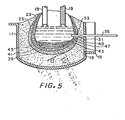
- Fig. 5 is a frontal view, partly in section, showing the furnace of Fig. 1 being tapped after several previous tappings.
- Looking now at Figs. 1 and 2, the furnace is comprised of a
metal shell 11, suitably of steel, having an elongated notch, or slit, 13 and a correspondingpouring spout 15, positionedadjacent notch 13 and extending outward from the side wall ofshell 11. The outside and bottom of theshell 11 is suitably cooled with a water spray, not shown. The furnace contains acharge 17 of particulate refractory oxide material having a high melting or fusion point, e.g., magnesia, which has been heated byelectrodes 19 positioned to heat the interior of the furnace and to form a bath, or zone, 21 of molten refractory oxide material. Askull layer 23 of solidfied, or congealed, refractory oxide material is formed around the zone of liquid refractory oxide material. A secondary layer of partially sintered and partially fusedrefractory oxide material 25 is formed around the skull layer. The partially sintered layer, in turn, is surrounded bylayer 27 of unmelted refractory oxide material. The vertical elongated bed of refractory oxide material is supported at its bottom and sides bymetal shell 11 and, in turn,insulates shell 11 bylayers notch 13 is suitably sealed by removable, water-cooleddamming plate 29. - Fig. 3 illustrates the furnace of Fig. 1 being tapped.
Damming plate 29 has been removed fromnotch 13, and a portion of the unfusedrefractory oxide layers adjacent notch 13 has been removed, andtrench 31 formed inparticulate charge layer 17 and partially sinteredlayer 25. Atap 33 is suitably made by arod 35 or by a jet tapper using an explosive charge, penetratingskull layer 23 preferably adjacent the lower portion ofnotch 13. - Fig. 4 shows the tapped furnace of Fig. 3 tilted to cast a fused refractory oxide product. The furnace is tilted, by means not shown, to an angle between 5° and 90° and, more preferably, between 15° and 60° from the original, vertial position, allowing molten
refractory oxide material 37 to flow throughtap 33 inskull 23, throughtrench 31 inlayers furnace shell 11. Preferably, tilting is carried out as speedily as possible to produce a rapid flow of the molten refractory oxide material before solidification. - Fig. 5 shows the furnace of the previous drawings being tapped after several previous tappings. As in Fig. 3,
damming plate 29 and a portion of the unfusedrefractory oxide layers trench 31 formed therein. As shown, theresidues previous tappings notch 13. Suitably, the tappings are carried out at angles progressively upward, that is, greater from horizontal, to ensure tapping the molten zone within the furnace and to avoid any previous taps and any bottom build up of solidified refractory oxide material, such as 39, 41 and 43, which may have been formed within the zone of liquid refractory oxide material from previous pours. - A 61 cm (24 inch) diameter steel shell furnace similar to that shown in Fig. 1 was equipped with two 10 cm (4-inch) diameter graphite electrodes adapted to operate at a voltage of 82 volts. The centre to centre distance of the electrodes was 23 cm (9 inches).
- The furnace was filled 4 full with calcined magnesia and the melt started by means of a graphite starting bar with the electrodes pulled close together. After getting a melt and an average energy input of at least 100 kW, the electrodes were pulled apart.
- Thirty minutes after the start, a full energy input of 150 kW was attained, and the furnace operated at this level for one hour. At this point, the furnace was slightly inclined at an angle of about 15°, and a portion of the loose charge and partly congealed material removed to expose the skull layer. A "V" shaped trench was made in the loose charge and partly congealed layer to form a path for the molten magnesia. A 3.8 cm (1 inch) diameter, 2.6 m (eight foot) long steel rod was used as a tapping ram to pierce the skull layer. The ram was removed and the furnace tilted to an angle of 60° to remove molten magnesia from the furnace.
- In this example a 900 kW average input single phase arc furnace having two 36 cm (14 inch) diameter electrodes was used. The centre to centre distance between the electrode was 56 to 61 cm (22 to 24 inches). The distance between the electrodes and the side wall of the furnace was about 25 cm (10 inches). The furnace notch was sealed with magnesia brick, and the furnace was charged with calcined magnesia.
- After an initial heating of about 2t hours, the magnesia brick was removed, and a portion of the adjacent loose charge and partly congealed material removed to expose the skull layer. A trench was prepared in the remaining loose material and partly congealed material to receive the molten magnesia.
- A steel rod 5.1 cm (2 inches) in diameter about 3.3 m (10 feet) in length was used as a tapping ram. The ram was suspended by a wire rope to permit swinging the ram to acquire the necessary kinetic energy to pierce the skull layer. Piercing the skull required from 2 to 5 hits with the ram.
- After piercing, the ram was quickly removed, and furnace tilted to an angle of about 60° to pour the melt from the furnace and prevent solidification of magnesia in the tap hole and pouring spout.
- After each pour, additional feed material was added to the furnace, and the tapping procedure was repeated at progressively higher points in the skull about every 2t hours, yielding pours of from about 226 to about 362 kg (about 500 to about 800 pounds) of fused magnesia. After the procedure was repeated 24 times, the bottom crust build-up became too thick to continue.
Claims (12)
Priority Applications (1)
| Application Number | Priority Date | Filing Date | Title |
|---|---|---|---|
| AT80301729T ATE2212T1 (en) | 1979-06-04 | 1980-05-23 | METHOD AND APPARATUS FOR CASTING MOLTEN REFRACTORY OXIDES WITH HIGH MELTING POINTS. |
Applications Claiming Priority (2)
| Application Number | Priority Date | Filing Date | Title |
|---|---|---|---|
| US06/045,485 US4304954A (en) | 1979-06-04 | 1979-06-04 | Apparatus for casting fused refractory oxides having high melting points |
| US45485 | 1979-06-04 |
Publications (2)
| Publication Number | Publication Date |
|---|---|
| EP0021608A1 EP0021608A1 (en) | 1981-01-07 |
| EP0021608B1 true EP0021608B1 (en) | 1983-01-12 |
Family
ID=21938158
Family Applications (1)
| Application Number | Title | Priority Date | Filing Date |
|---|---|---|---|
| EP80301729A Expired EP0021608B1 (en) | 1979-06-04 | 1980-05-23 | Process and apparatus for casting fused refractory oxides having high melting points |
Country Status (6)
| Country | Link |
|---|---|
| US (1) | US4304954A (en) |
| EP (1) | EP0021608B1 (en) |
| JP (1) | JPS55162481A (en) |
| AT (1) | ATE2212T1 (en) |
| CA (1) | CA1143161A (en) |
| DE (1) | DE3061603D1 (en) |
Families Citing this family (2)
| Publication number | Priority date | Publication date | Assignee | Title |
|---|---|---|---|---|
| US5738811A (en) * | 1995-05-16 | 1998-04-14 | Monofrax Inc. | Process for making fused-cast refractory products |
| US20220381513A1 (en) * | 2021-05-25 | 2022-12-01 | HarbisonWalker International Holdings, Inc. | Refractory layer for insulation and conduction in industrial furnaces |
Family Cites Families (10)
| Publication number | Priority date | Publication date | Assignee | Title |
|---|---|---|---|---|
| DE290498C (en) * | ||||
| US1954552A (en) * | 1934-04-10 | Basic refractory amd method of | ||
| US1229494A (en) * | 1917-01-02 | 1917-06-12 | Buckeye Products Company | Metal-melting furnace. |
| US1615750A (en) * | 1925-07-31 | 1927-01-25 | Corning Glass Works | Cast refractory article and method of making the same |
| US2290028A (en) * | 1940-07-02 | 1942-07-14 | Swindell Dressler Corp | Electric furnace structure |
| US2790019A (en) * | 1952-06-19 | 1957-04-23 | Owens Corning Fiberglass Corp | Apparatus for handling and processing mineral materials having high fusing temperatures |
| DE1433898A1 (en) * | 1964-04-30 | 1970-02-05 | Euratom | Device for melting metals and compounds with a high melting point |
| US3752895A (en) * | 1970-07-29 | 1973-08-14 | Corhart Refractories Co | Electric melting furnace and process of using it |
| US3879210A (en) * | 1972-06-14 | 1975-04-22 | Carborundum Co | Fused-cast refractory |
| US4097032A (en) * | 1977-03-03 | 1978-06-27 | Schmelzbasaltwerk Kalenborn, Dr. Ing. Mauritz Kg | Forehearth with weir, particularly for use in a basalt smelting furnace |
-
1979
- 1979-06-04 US US06/045,485 patent/US4304954A/en not_active Expired - Lifetime
-
1980
- 1980-04-11 CA CA000349683A patent/CA1143161A/en not_active Expired
- 1980-05-23 EP EP80301729A patent/EP0021608B1/en not_active Expired
- 1980-05-23 AT AT80301729T patent/ATE2212T1/en not_active IP Right Cessation
- 1980-05-23 DE DE8080301729T patent/DE3061603D1/en not_active Expired
- 1980-06-02 JP JP7284080A patent/JPS55162481A/en active Granted
Also Published As
| Publication number | Publication date |
|---|---|
| CA1143161A (en) | 1983-03-22 |
| ATE2212T1 (en) | 1983-01-15 |
| JPS631275B2 (en) | 1988-01-12 |
| EP0021608A1 (en) | 1981-01-07 |
| DE3061603D1 (en) | 1983-02-17 |
| US4304954A (en) | 1981-12-08 |
| JPS55162481A (en) | 1980-12-17 |
Similar Documents
| Publication | Publication Date | Title |
|---|---|---|
| US3973076A (en) | Furnace for melting highly corrosive slag | |
| US4838933A (en) | Apparatus for melting and continuous casting of metals, the process involved and use of the apparatus | |
| US4838340A (en) | Continuous casting of fine grain ingots | |
| US1812172A (en) | Production of castings free from pipes and blow-holes | |
| US3389208A (en) | Consumable electrode furnace for electroslag refining | |
| US3752216A (en) | Apparatus for homogeneous refining and continuously casting metals and alloys | |
| US7849912B2 (en) | Process for electroslag remelting of metals and ingot mould therefor | |
| US3273212A (en) | Method of operating an electric furnace | |
| US2754347A (en) | Apparatus for refining rare refractory metals | |
| CA2030252C (en) | Method of and apparatus for continuously discharging molten metal and slag | |
| US4304954A (en) | Apparatus for casting fused refractory oxides having high melting points | |
| US4349909A (en) | Process for casting fused refractory oxides having high melting points | |
| KR850001014B1 (en) | Granular Metal Melting Furnace | |
| JPS62502598A (en) | Method for manufacturing hollow billets by electroslag remelting and apparatus for carrying out the method | |
| JPH01264920A (en) | Silicon casting device | |
| US3834447A (en) | Apparatus for casting a plurality of ingots in a consumable electrode furnace | |
| US4202997A (en) | Atmospheric control of flux pre-melting furnace | |
| US4612649A (en) | Process for refining metal | |
| US1615750A (en) | Cast refractory article and method of making the same | |
| US4352189A (en) | Atmosphere control of slag melting furnace | |
| JP2005343781A (en) | Refining method for scrap silicon using electron beam | |
| CN112899491A (en) | Method for smelting heterogeneous ingot in electric furnace | |
| US2925636A (en) | Skull type furnace | |
| RU2286398C2 (en) | Method for metal casting with the use of lining slag as consumable electrode | |
| US3782445A (en) | Method of casting a plurality of ingots in a consumable electrode furnace |
Legal Events
| Date | Code | Title | Description |
|---|---|---|---|
| PUAI | Public reference made under article 153(3) epc to a published international application that has entered the european phase |
Free format text: ORIGINAL CODE: 0009012 |
|
| AK | Designated contracting states |
Designated state(s): AT DE FR GB |
|
| TCAT | At: translation of patent claims filed | ||
| DET | De: translation of patent claims | ||
| RAP1 | Party data changed (applicant data changed or rights of an application transferred) |
Owner name: KENNECOTT CORPORATION |
|
| 17P | Request for examination filed |
Effective date: 19810331 |
|
| GRAA | (expected) grant |
Free format text: ORIGINAL CODE: 0009210 |
|
| AK | Designated contracting states |
Designated state(s): AT DE FR GB |
|
| REF | Corresponds to: |
Ref document number: 2212 Country of ref document: AT Date of ref document: 19830115 Kind code of ref document: T |
|
| REF | Corresponds to: |
Ref document number: 3061603 Country of ref document: DE Date of ref document: 19830217 |
|
| ET | Fr: translation filed | ||
| PGFP | Annual fee paid to national office [announced via postgrant information from national office to epo] |
Ref country code: FR Payment date: 19840502 Year of fee payment: 5 |
|
| PGFP | Annual fee paid to national office [announced via postgrant information from national office to epo] |
Ref country code: DE Payment date: 19840930 Year of fee payment: 5 |
|
| PGFP | Annual fee paid to national office [announced via postgrant information from national office to epo] |
Ref country code: AT Payment date: 19860430 Year of fee payment: 7 |
|
| PG25 | Lapsed in a contracting state [announced via postgrant information from national office to epo] |
Ref country code: GB Effective date: 19880523 Ref country code: AT Effective date: 19880523 |
|
| PG25 | Lapsed in a contracting state [announced via postgrant information from national office to epo] |
Ref country code: FR Free format text: LAPSE BECAUSE OF NON-PAYMENT OF DUE FEES Effective date: 19890131 |
|
| GBPC | Gb: european patent ceased through non-payment of renewal fee | ||
| PG25 | Lapsed in a contracting state [announced via postgrant information from national office to epo] |
Ref country code: DE Effective date: 19890201 |
|
| REG | Reference to a national code |
Ref country code: FR Ref legal event code: ST |
|
| PLBE | No opposition filed within time limit |
Free format text: ORIGINAL CODE: 0009261 |
|
| STAA | Information on the status of an ep patent application or granted ep patent |
Free format text: STATUS: NO OPPOSITION FILED WITHIN TIME LIMIT |