EP0017937B1 - Bonding compositions to the hard tissue of human body - Google Patents
Bonding compositions to the hard tissue of human body Download PDFInfo
- Publication number
- EP0017937B1 EP0017937B1 EP80101965A EP80101965A EP0017937B1 EP 0017937 B1 EP0017937 B1 EP 0017937B1 EP 80101965 A EP80101965 A EP 80101965A EP 80101965 A EP80101965 A EP 80101965A EP 0017937 B1 EP0017937 B1 EP 0017937B1
- Authority
- EP
- European Patent Office
- Prior art keywords
- formula
- group
- component
- compounds
- composition according
- Prior art date
- Legal status (The legal status is an assumption and is not a legal conclusion. Google has not performed a legal analysis and makes no representation as to the accuracy of the status listed.)
- Expired
Links
- 239000000203 mixture Substances 0.000 title claims description 76
- 150000001875 compounds Chemical class 0.000 claims description 34
- 125000002887 hydroxy group Chemical group [H]O* 0.000 claims description 24
- 125000004435 hydrogen atom Chemical group [H]* 0.000 claims description 18
- 239000003054 catalyst Substances 0.000 claims description 17
- 239000000178 monomer Substances 0.000 claims description 15
- -1 amino, phosphono Chemical group 0.000 claims description 13
- 125000002496 methyl group Chemical group [H]C([H])([H])* 0.000 claims description 13
- 150000003609 titanium compounds Chemical class 0.000 claims description 13
- 239000012190 activator Substances 0.000 claims description 12
- 125000003545 alkoxy group Chemical group 0.000 claims description 11
- 125000001424 substituent group Chemical group 0.000 claims description 10
- OKTJSMMVPCPJKN-UHFFFAOYSA-N Carbon Chemical compound [C] OKTJSMMVPCPJKN-UHFFFAOYSA-N 0.000 claims description 9
- 229910052799 carbon Inorganic materials 0.000 claims description 9
- 125000006274 (C1-C3)alkoxy group Chemical group 0.000 claims description 7
- 150000002734 metacrylic acid derivatives Chemical class 0.000 claims description 7
- 150000001252 acrylic acid derivatives Chemical class 0.000 claims description 6
- 125000000217 alkyl group Chemical group 0.000 claims description 6
- 125000003178 carboxy group Chemical group [H]OC(*)=O 0.000 claims description 6
- 150000003926 acrylamides Chemical class 0.000 claims description 5
- 125000003277 amino group Chemical group 0.000 claims description 5
- 125000003700 epoxy group Chemical group 0.000 claims description 5
- 238000006116 polymerization reaction Methods 0.000 claims description 5
- 229920006395 saturated elastomer Polymers 0.000 claims description 5
- 229930195734 saturated hydrocarbon Natural products 0.000 claims description 5
- 125000006273 (C1-C3) alkyl group Chemical group 0.000 claims description 4
- 229910019142 PO4 Inorganic materials 0.000 claims description 4
- 125000002252 acyl group Chemical group 0.000 claims description 4
- 125000001118 alkylidene group Chemical group 0.000 claims description 4
- 230000015572 biosynthetic process Effects 0.000 claims description 4
- 238000006243 chemical reaction Methods 0.000 claims description 4
- FQPSGWSUVKBHSU-UHFFFAOYSA-N methacrylamide Chemical class CC(=C)C(N)=O FQPSGWSUVKBHSU-UHFFFAOYSA-N 0.000 claims description 4
- 125000000962 organic group Chemical group 0.000 claims description 4
- 125000001997 phenyl group Chemical group [H]C1=C([H])C([H])=C(*)C([H])=C1[H] 0.000 claims description 4
- 239000010452 phosphate Substances 0.000 claims description 4
- 125000002768 hydroxyalkyl group Chemical group 0.000 claims description 3
- 150000003014 phosphoric acid esters Chemical class 0.000 claims description 3
- 239000004593 Epoxy Substances 0.000 claims description 2
- 125000004432 carbon atom Chemical group C* 0.000 claims description 2
- 125000005702 oxyalkylene group Chemical group 0.000 claims description 2
- 239000002685 polymerization catalyst Substances 0.000 claims description 2
- 229910052739 hydrogen Inorganic materials 0.000 claims 5
- 239000001257 hydrogen Substances 0.000 claims 5
- 150000002430 hydrocarbons Chemical group 0.000 claims 4
- 150000001338 aliphatic hydrocarbons Chemical group 0.000 claims 3
- 239000004215 Carbon black (E152) Substances 0.000 claims 2
- 229930195733 hydrocarbon Natural products 0.000 claims 2
- 239000000805 composite resin Substances 0.000 description 32
- 210000001519 tissue Anatomy 0.000 description 24
- 239000000463 material Substances 0.000 description 22
- XLYOFNOQVPJJNP-UHFFFAOYSA-N water Substances O XLYOFNOQVPJJNP-UHFFFAOYSA-N 0.000 description 21
- 238000000034 method Methods 0.000 description 20
- AMFGWXWBFGVCKG-UHFFFAOYSA-N Panavia opaque Chemical compound C1=CC(OCC(O)COC(=O)C(=C)C)=CC=C1C(C)(C)C1=CC=C(OCC(O)COC(=O)C(C)=C)C=C1 AMFGWXWBFGVCKG-UHFFFAOYSA-N 0.000 description 15
- 239000007767 bonding agent Substances 0.000 description 15
- 239000000243 solution Substances 0.000 description 11
- 125000001183 hydrocarbyl group Chemical group 0.000 description 10
- VXUYXOFXAQZZMF-UHFFFAOYSA-N titanium(IV) isopropoxide Chemical compound CC(C)O[Ti](OC(C)C)(OC(C)C)OC(C)C VXUYXOFXAQZZMF-UHFFFAOYSA-N 0.000 description 10
- AXDJCCTWPBKUKL-UHFFFAOYSA-N 4-[(4-aminophenyl)-(4-imino-3-methylcyclohexa-2,5-dien-1-ylidene)methyl]aniline;hydron;chloride Chemical compound Cl.C1=CC(=N)C(C)=CC1=C(C=1C=CC(N)=CC=1)C1=CC=C(N)C=C1 AXDJCCTWPBKUKL-UHFFFAOYSA-N 0.000 description 9
- 238000012360 testing method Methods 0.000 description 9
- 210000003298 dental enamel Anatomy 0.000 description 8
- 125000001931 aliphatic group Chemical group 0.000 description 6
- 239000011256 inorganic filler Substances 0.000 description 6
- 229910003475 inorganic filler Inorganic materials 0.000 description 6
- 241000283690 Bos taurus Species 0.000 description 5
- 239000000945 filler Substances 0.000 description 5
- 230000035515 penetration Effects 0.000 description 5
- 150000002978 peroxides Chemical class 0.000 description 5
- 238000002360 preparation method Methods 0.000 description 5
- 239000011347 resin Substances 0.000 description 4
- 229920005989 resin Polymers 0.000 description 4
- 229910001312 Amalgam (dentistry) Inorganic materials 0.000 description 3
- 239000004342 Benzoyl peroxide Substances 0.000 description 3
- WOBHKFSMXKNTIM-UHFFFAOYSA-N Hydroxyethyl methacrylate Chemical compound CC(=C)C(=O)OCCO WOBHKFSMXKNTIM-UHFFFAOYSA-N 0.000 description 3
- RTAQQCXQSZGOHL-UHFFFAOYSA-N Titanium Chemical compound [Ti] RTAQQCXQSZGOHL-UHFFFAOYSA-N 0.000 description 3
- 235000019400 benzoyl peroxide Nutrition 0.000 description 3
- 239000000448 dental amalgam Substances 0.000 description 3
- 230000000694 effects Effects 0.000 description 3
- 239000011521 glass Substances 0.000 description 3
- 239000007788 liquid Substances 0.000 description 3
- 238000005259 measurement Methods 0.000 description 3
- 238000002156 mixing Methods 0.000 description 3
- 238000005325 percolation Methods 0.000 description 3
- 239000010936 titanium Substances 0.000 description 3
- 229910052719 titanium Inorganic materials 0.000 description 3
- JUVSRZCUMWZBFK-UHFFFAOYSA-N 2-[n-(2-hydroxyethyl)-4-methylanilino]ethanol Chemical compound CC1=CC=C(N(CCO)CCO)C=C1 JUVSRZCUMWZBFK-UHFFFAOYSA-N 0.000 description 2
- NIXOWILDQLNWCW-UHFFFAOYSA-M Acrylate Chemical compound [O-]C(=O)C=C NIXOWILDQLNWCW-UHFFFAOYSA-M 0.000 description 2
- 229910000497 Amalgam Inorganic materials 0.000 description 2
- OMPJBNCRMGITSC-UHFFFAOYSA-N Benzoylperoxide Chemical compound C=1C=CC=CC=1C(=O)OOC(=O)C1=CC=CC=C1 OMPJBNCRMGITSC-UHFFFAOYSA-N 0.000 description 2
- LFQSCWFLJHTTHZ-UHFFFAOYSA-N Ethanol Chemical compound CCO LFQSCWFLJHTTHZ-UHFFFAOYSA-N 0.000 description 2
- CERQOIWHTDAKMF-UHFFFAOYSA-M Methacrylate Chemical compound CC(=C)C([O-])=O CERQOIWHTDAKMF-UHFFFAOYSA-M 0.000 description 2
- JLTDJTHDQAWBAV-UHFFFAOYSA-N N,N-dimethylaniline Chemical compound CN(C)C1=CC=CC=C1 JLTDJTHDQAWBAV-UHFFFAOYSA-N 0.000 description 2
- 238000005299 abrasion Methods 0.000 description 2
- 239000000654 additive Substances 0.000 description 2
- 239000000853 adhesive Substances 0.000 description 2
- 230000001070 adhesive effect Effects 0.000 description 2
- 210000000988 bone and bone Anatomy 0.000 description 2
- 239000011248 coating agent Substances 0.000 description 2
- 238000000576 coating method Methods 0.000 description 2
- 239000002131 composite material Substances 0.000 description 2
- 239000006059 cover glass Substances 0.000 description 2
- 208000002925 dental caries Diseases 0.000 description 2
- 210000004268 dentin Anatomy 0.000 description 2
- ZQMIGQNCOMNODD-UHFFFAOYSA-N diacetyl peroxide Chemical compound CC(=O)OOC(C)=O ZQMIGQNCOMNODD-UHFFFAOYSA-N 0.000 description 2
- VOZRXNHHFUQHIL-UHFFFAOYSA-N glycidyl methacrylate Chemical compound CC(=C)C(=O)OCC1CO1 VOZRXNHHFUQHIL-UHFFFAOYSA-N 0.000 description 2
- 230000007794 irritation Effects 0.000 description 2
- 229910052751 metal Inorganic materials 0.000 description 2
- 239000002184 metal Substances 0.000 description 2
- 210000000214 mouth Anatomy 0.000 description 2
- 150000004767 nitrides Chemical class 0.000 description 2
- RZXMPPFPUUCRFN-UHFFFAOYSA-N p-toluidine Chemical compound CC1=CC=C(N)C=C1 RZXMPPFPUUCRFN-UHFFFAOYSA-N 0.000 description 2
- NBIIXXVUZAFLBC-UHFFFAOYSA-K phosphate Chemical compound [O-]P([O-])([O-])=O NBIIXXVUZAFLBC-UHFFFAOYSA-K 0.000 description 2
- 230000000704 physical effect Effects 0.000 description 2
- 239000002504 physiological saline solution Substances 0.000 description 2
- 239000000068 pit and fissure sealant Substances 0.000 description 2
- 230000000306 recurrent effect Effects 0.000 description 2
- 239000003469 silicate cement Substances 0.000 description 2
- WRXCBRHBHGNNQA-UHFFFAOYSA-N (2,4-dichlorobenzoyl) 2,4-dichlorobenzenecarboperoxoate Chemical compound ClC1=CC(Cl)=CC=C1C(=O)OOC(=O)C1=CC=C(Cl)C=C1Cl WRXCBRHBHGNNQA-UHFFFAOYSA-N 0.000 description 1
- JGBAASVQPMTVHO-UHFFFAOYSA-N 2,5-dihydroperoxy-2,5-dimethylhexane Chemical compound OOC(C)(C)CCC(C)(C)OO JGBAASVQPMTVHO-UHFFFAOYSA-N 0.000 description 1
- AFTBJQDQENGCPC-UHFFFAOYSA-N 2,5-ditert-butyl-4-methylphenol Chemical compound CC1=CC(C(C)(C)C)=C(O)C=C1C(C)(C)C AFTBJQDQENGCPC-UHFFFAOYSA-N 0.000 description 1
- XILIYVSXLSWUAI-UHFFFAOYSA-N 2-(diethylamino)ethyl n'-phenylcarbamimidothioate;dihydrobromide Chemical compound Br.Br.CCN(CC)CCSC(N)=NC1=CC=CC=C1 XILIYVSXLSWUAI-UHFFFAOYSA-N 0.000 description 1
- DMTMWMUHQLDCKP-UHFFFAOYSA-N 2-[n-(2-hydroxyethyl)-3,4-dimethylanilino]ethanol Chemical compound CC1=CC=C(N(CCO)CCO)C=C1C DMTMWMUHQLDCKP-UHFFFAOYSA-N 0.000 description 1
- WFUGQJXVXHBTEM-UHFFFAOYSA-N 2-hydroperoxy-2-(2-hydroperoxybutan-2-ylperoxy)butane Chemical compound CCC(C)(OO)OOC(C)(CC)OO WFUGQJXVXHBTEM-UHFFFAOYSA-N 0.000 description 1
- FRIBMENBGGCKPD-UHFFFAOYSA-N 3-(2,3-dimethoxyphenyl)prop-2-enal Chemical compound COC1=CC=CC(C=CC=O)=C1OC FRIBMENBGGCKPD-UHFFFAOYSA-N 0.000 description 1
- 125000000242 4-chlorobenzoyl group Chemical group ClC1=CC=C(C(=O)*)C=C1 0.000 description 1
- 229910001316 Ag alloy Inorganic materials 0.000 description 1
- 239000000120 Artificial Saliva Substances 0.000 description 1
- ZOXJGFHDIHLPTG-UHFFFAOYSA-N Boron Chemical compound [B] ZOXJGFHDIHLPTG-UHFFFAOYSA-N 0.000 description 1
- 229920001651 Cyanoacrylate Polymers 0.000 description 1
- MHAJPDPJQMAIIY-UHFFFAOYSA-N Hydrogen peroxide Chemical compound OO MHAJPDPJQMAIIY-UHFFFAOYSA-N 0.000 description 1
- YIVJZNGAASQVEM-UHFFFAOYSA-N Lauroyl peroxide Chemical compound CCCCCCCCCCCC(=O)OOC(=O)CCCCCCCCCCC YIVJZNGAASQVEM-UHFFFAOYSA-N 0.000 description 1
- 239000006087 Silane Coupling Agent Substances 0.000 description 1
- XUIMIQQOPSSXEZ-UHFFFAOYSA-N Silicon Chemical compound [Si] XUIMIQQOPSSXEZ-UHFFFAOYSA-N 0.000 description 1
- BQCADISMDOOEFD-UHFFFAOYSA-N Silver Chemical compound [Ag] BQCADISMDOOEFD-UHFFFAOYSA-N 0.000 description 1
- GSEJCLTVZPLZKY-UHFFFAOYSA-N Triethanolamine Chemical compound OCCN(CCO)CCO GSEJCLTVZPLZKY-UHFFFAOYSA-N 0.000 description 1
- XSQUKJJJFZCRTK-UHFFFAOYSA-N Urea Natural products NC(N)=O XSQUKJJJFZCRTK-UHFFFAOYSA-N 0.000 description 1
- 238000010521 absorption reaction Methods 0.000 description 1
- 239000002253 acid Substances 0.000 description 1
- 150000007513 acids Chemical class 0.000 description 1
- 230000002411 adverse Effects 0.000 description 1
- 229910052782 aluminium Inorganic materials 0.000 description 1
- XAGFODPZIPBFFR-UHFFFAOYSA-N aluminium Chemical compound [Al] XAGFODPZIPBFFR-UHFFFAOYSA-N 0.000 description 1
- 229910000323 aluminium silicate Inorganic materials 0.000 description 1
- UMGDCJDMYOKAJW-UHFFFAOYSA-N aminothiocarboxamide Natural products NC(N)=S UMGDCJDMYOKAJW-UHFFFAOYSA-N 0.000 description 1
- 229910052788 barium Inorganic materials 0.000 description 1
- DSAJWYNOEDNPEQ-UHFFFAOYSA-N barium atom Chemical compound [Ba] DSAJWYNOEDNPEQ-UHFFFAOYSA-N 0.000 description 1
- 239000011324 bead Substances 0.000 description 1
- 210000004763 bicuspid Anatomy 0.000 description 1
- 239000002639 bone cement Substances 0.000 description 1
- 229910052796 boron Inorganic materials 0.000 description 1
- 239000005388 borosilicate glass Substances 0.000 description 1
- UPIWXMRIPODGLE-UHFFFAOYSA-N butyl benzenecarboperoxoate Chemical group CCCCOOC(=O)C1=CC=CC=C1 UPIWXMRIPODGLE-UHFFFAOYSA-N 0.000 description 1
- 239000004568 cement Substances 0.000 description 1
- 239000003638 chemical reducing agent Substances 0.000 description 1
- 239000003795 chemical substances by application Substances 0.000 description 1
- HWVKIRQMNIWOLT-UHFFFAOYSA-L cobalt(2+);octanoate Chemical compound [Co+2].CCCCCCCC([O-])=O.CCCCCCCC([O-])=O HWVKIRQMNIWOLT-UHFFFAOYSA-L 0.000 description 1
- 239000011162 core material Substances 0.000 description 1
- 230000007423 decrease Effects 0.000 description 1
- 239000003479 dental cement Substances 0.000 description 1
- 239000011350 dental composite resin Substances 0.000 description 1
- 239000005548 dental material Substances 0.000 description 1
- 238000011161 development Methods 0.000 description 1
- 230000018109 developmental process Effects 0.000 description 1
- 239000012933 diacyl peroxide Substances 0.000 description 1
- 239000010432 diamond Substances 0.000 description 1
- 229910003460 diamond Inorganic materials 0.000 description 1
- HNPSIPDUKPIQMN-UHFFFAOYSA-N dioxosilane;oxo(oxoalumanyloxy)alumane Chemical compound O=[Si]=O.O=[Al]O[Al]=O HNPSIPDUKPIQMN-UHFFFAOYSA-N 0.000 description 1
- 239000012153 distilled water Substances 0.000 description 1
- 230000007613 environmental effect Effects 0.000 description 1
- LWQONHOBJZUIGE-UHFFFAOYSA-N ethane-1,2-diol;2-methylprop-2-enoic acid;titanium Chemical compound [Ti].OCCO.CC(=C)C(O)=O.CC(=C)C(O)=O LWQONHOBJZUIGE-UHFFFAOYSA-N 0.000 description 1
- 125000001495 ethyl group Chemical group [H]C([H])([H])C([H])([H])* 0.000 description 1
- 150000002432 hydroperoxides Chemical class 0.000 description 1
- 229910052588 hydroxylapatite Inorganic materials 0.000 description 1
- 230000006872 improvement Effects 0.000 description 1
- 230000001939 inductive effect Effects 0.000 description 1
- 238000011835 investigation Methods 0.000 description 1
- 229920000554 ionomer Polymers 0.000 description 1
- 230000001788 irregular Effects 0.000 description 1
- 125000001449 isopropyl group Chemical group [H]C([H])([H])C([H])(*)C([H])([H])[H] 0.000 description 1
- 230000007246 mechanism Effects 0.000 description 1
- QSHDDOUJBYECFT-UHFFFAOYSA-N mercury Chemical compound [Hg] QSHDDOUJBYECFT-UHFFFAOYSA-N 0.000 description 1
- 229910052753 mercury Inorganic materials 0.000 description 1
- 150000002736 metal compounds Chemical class 0.000 description 1
- GYVGXEWAOAAJEU-UHFFFAOYSA-N n,n,4-trimethylaniline Chemical compound CN(C)C1=CC=C(C)C=C1 GYVGXEWAOAAJEU-UHFFFAOYSA-N 0.000 description 1
- GEMHFKXPOCTAIP-UHFFFAOYSA-N n,n-dimethyl-n'-phenylcarbamimidoyl chloride Chemical compound CN(C)C(Cl)=NC1=CC=CC=C1 GEMHFKXPOCTAIP-UHFFFAOYSA-N 0.000 description 1
- 125000004123 n-propyl group Chemical group [H]C([H])([H])C([H])([H])C([H])([H])* 0.000 description 1
- 150000002902 organometallic compounds Chemical class 0.000 description 1
- 230000000399 orthopedic effect Effects 0.000 description 1
- 239000007800 oxidant agent Substances 0.000 description 1
- TWNQGVIAIRXVLR-UHFFFAOYSA-N oxo(oxoalumanyloxy)alumane Chemical compound O=[Al]O[Al]=O TWNQGVIAIRXVLR-UHFFFAOYSA-N 0.000 description 1
- 239000002245 particle Substances 0.000 description 1
- 230000000149 penetrating effect Effects 0.000 description 1
- XYJRXVWERLGGKC-UHFFFAOYSA-D pentacalcium;hydroxide;triphosphate Chemical compound [OH-].[Ca+2].[Ca+2].[Ca+2].[Ca+2].[Ca+2].[O-]P([O-])([O-])=O.[O-]P([O-])([O-])=O.[O-]P([O-])([O-])=O XYJRXVWERLGGKC-UHFFFAOYSA-D 0.000 description 1
- 230000000737 periodic effect Effects 0.000 description 1
- 150000004978 peroxycarbonates Chemical class 0.000 description 1
- 125000001476 phosphono group Chemical group [H]OP(*)(=O)O[H] 0.000 description 1
- 229920000728 polyester Polymers 0.000 description 1
- 229920006254 polymer film Polymers 0.000 description 1
- 239000000843 powder Substances 0.000 description 1
- 230000002035 prolonged effect Effects 0.000 description 1
- 239000010453 quartz Substances 0.000 description 1
- 230000009257 reactivity Effects 0.000 description 1
- 229910052710 silicon Inorganic materials 0.000 description 1
- 239000010703 silicon Substances 0.000 description 1
- VYPSYNLAJGMNEJ-UHFFFAOYSA-N silicon dioxide Inorganic materials O=[Si]=O VYPSYNLAJGMNEJ-UHFFFAOYSA-N 0.000 description 1
- 229910052709 silver Inorganic materials 0.000 description 1
- 239000004332 silver Substances 0.000 description 1
- 239000003381 stabilizer Substances 0.000 description 1
- 239000000126 substance Substances 0.000 description 1
- 238000001356 surgical procedure Methods 0.000 description 1
- 239000012970 tertiary amine catalyst Substances 0.000 description 1
- 150000003512 tertiary amines Chemical class 0.000 description 1
- CIHOLLKRGTVIJN-UHFFFAOYSA-N tert‐butyl hydroperoxide Chemical compound CC(C)(C)OO CIHOLLKRGTVIJN-UHFFFAOYSA-N 0.000 description 1
- 238000010998 test method Methods 0.000 description 1
- 150000003585 thioureas Chemical class 0.000 description 1
- JOXIMZWYDAKGHI-UHFFFAOYSA-N toluene-4-sulfonic acid Chemical class CC1=CC=C(S(O)(=O)=O)C=C1 JOXIMZWYDAKGHI-UHFFFAOYSA-N 0.000 description 1
- 210000001114 tooth apex Anatomy 0.000 description 1
- 230000001988 toxicity Effects 0.000 description 1
- 231100000419 toxicity Toxicity 0.000 description 1
- 229910001428 transition metal ion Inorganic materials 0.000 description 1
- 238000009736 wetting Methods 0.000 description 1
Classifications
-
- A—HUMAN NECESSITIES
- A61—MEDICAL OR VETERINARY SCIENCE; HYGIENE
- A61L—METHODS OR APPARATUS FOR STERILISING MATERIALS OR OBJECTS IN GENERAL; DISINFECTION, STERILISATION OR DEODORISATION OF AIR; CHEMICAL ASPECTS OF BANDAGES, DRESSINGS, ABSORBENT PADS OR SURGICAL ARTICLES; MATERIALS FOR BANDAGES, DRESSINGS, ABSORBENT PADS OR SURGICAL ARTICLES
- A61L24/00—Surgical adhesives or cements; Adhesives for colostomy devices
- A61L24/0047—Composite materials, i.e. containing one material dispersed in a matrix of the same or different material
- A61L24/0073—Composite materials, i.e. containing one material dispersed in a matrix of the same or different material with a macromolecular matrix
- A61L24/0094—Composite materials, i.e. containing one material dispersed in a matrix of the same or different material with a macromolecular matrix containing macromolecular fillers
-
- A—HUMAN NECESSITIES
- A61—MEDICAL OR VETERINARY SCIENCE; HYGIENE
- A61K—PREPARATIONS FOR MEDICAL, DENTAL OR TOILETRY PURPOSES
- A61K6/00—Preparations for dentistry
- A61K6/70—Preparations for dentistry comprising inorganic additives
- A61K6/71—Fillers
- A61K6/76—Fillers comprising silicon-containing compounds
-
- A—HUMAN NECESSITIES
- A61—MEDICAL OR VETERINARY SCIENCE; HYGIENE
- A61K—PREPARATIONS FOR MEDICAL, DENTAL OR TOILETRY PURPOSES
- A61K6/00—Preparations for dentistry
- A61K6/70—Preparations for dentistry comprising inorganic additives
- A61K6/78—Pigments
-
- A—HUMAN NECESSITIES
- A61—MEDICAL OR VETERINARY SCIENCE; HYGIENE
- A61L—METHODS OR APPARATUS FOR STERILISING MATERIALS OR OBJECTS IN GENERAL; DISINFECTION, STERILISATION OR DEODORISATION OF AIR; CHEMICAL ASPECTS OF BANDAGES, DRESSINGS, ABSORBENT PADS OR SURGICAL ARTICLES; MATERIALS FOR BANDAGES, DRESSINGS, ABSORBENT PADS OR SURGICAL ARTICLES
- A61L24/00—Surgical adhesives or cements; Adhesives for colostomy devices
- A61L24/04—Surgical adhesives or cements; Adhesives for colostomy devices containing macromolecular materials
- A61L24/06—Surgical adhesives or cements; Adhesives for colostomy devices containing macromolecular materials obtained by reactions only involving carbon-to-carbon unsaturated bonds
-
- Y—GENERAL TAGGING OF NEW TECHNOLOGICAL DEVELOPMENTS; GENERAL TAGGING OF CROSS-SECTIONAL TECHNOLOGIES SPANNING OVER SEVERAL SECTIONS OF THE IPC; TECHNICAL SUBJECTS COVERED BY FORMER USPC CROSS-REFERENCE ART COLLECTIONS [XRACs] AND DIGESTS
- Y10—TECHNICAL SUBJECTS COVERED BY FORMER USPC
- Y10S—TECHNICAL SUBJECTS COVERED BY FORMER USPC CROSS-REFERENCE ART COLLECTIONS [XRACs] AND DIGESTS
- Y10S528/00—Synthetic resins or natural rubbers -- part of the class 520 series
- Y10S528/92—Polymers useful for replacing hard animal tissues, e.g. dentures, bones
Definitions
- the present invention relates to a bonding composition for orto the hard tissue of the human body and more particularly to a bonding agent for medical or dental use to the hard tissue of the human body, such as bone and tooth.
- silver amalgam such as amalgam of silver alloy and mercury
- silicate cement have been used as restorative filling material.
- the dental amalgam is excellent in its physical properties, but it shows low bonding to the tooth and is insufficient in its impact resistance, which tends to cause recurrent caries with poor marginal seal and in addition, entails the fear of exerting adverse influences on the human body with respect to toxicity.
- silicate cement has a certain solubility and in addition it bonds poorly to teeth with a poor marginal seal, and on top of that, entails such shortcomings as intense pulpal irritation.
- Epoxy-type resin- based filling material has been used, but it entails such drawbacks as inferior hardness and abrasion resistance and high water absorption.
- compositions consisting predominantly of bisphenol A-diglycidylmethacrylate (hereafter abbreviated as "Bis-GMA”) which exhibits better compressive strength and water resistance and comparatively low pulpal irritation, and a great deal of inorganic filler containing, as polymerization catalyst, a benzoylperoxide-tertiary amine catalyst (hereinafter abbreviated as the “composite resin”) as disclosed in US ⁇ PS 3,539,533; 3,066,112, 3,926,096, etc., for instance came into use as restorative filling material for the anterior teeth in particular, but due to somewhat poor bonding of Bis-GMA, notwithstanding hydrophilic group-containing Bis-GMA being used, and due to the fact that joint use of a great deal of inorganic filler enhances the viscosity of the composite resin and worsens the wet on the tooth surface, it entails such serious shortcomings, as poor bonding to dentin and enamel, causing the shedding of the filling material after filling
- compositions consisting of a hydroperoxide oxidizing agent and a substituted thiourea reducing agent.
- the compositions also comprise a methacrylate monomer having 2 to 4 polymerizable double-bonds and 0.5-5.0% by weight thereof of silane coupling agent.
- the present invention is designed to provide bonding material having steadfast and durable bonding strength to the hard tissue of the human body.
- Another purpose of the present invention is to provide excellent bonding material which exhibits a steadfast and durable bonding strength for bonding operative dentistry and prosthetic dentistry material to the hard tissue of the human body such as dental composite resin, and the hard tissue of the human body without losing the characteristics of the operative dentistry and prosthetic dentistry material.
- any ones will do if they possess at least one member selected from carboxyl group, epoxy group, amino group, phosphono group, and hydroxyl group, but particularly preferred are those which are represented by following formula (1): wherein
- A-I The following are more preferred examples of such acrylate esters and methacrylate esters.
- acrylamide derivatives or methacrylamide derivatives possessing at least one group selected from carboxyl group, epoxy group, amino group and hydroxyl group which are used in the present invention are those which are represented by following formula (2): wherein
- the alkoxy-containing titanium compounds are those compounds which are represented by following formula (3): wherein
- the composition comprises besides catalyst and activator 80-99.5% by weight, and preferably 95-99.5% by weight, of component A and 0.5-20% by weight, and preferably 0.5-5% by weight, of component B.
- the bonding effect to the hard tissue clearly exhibits itself even when a small amount of the titanium component is used in the composition.
- the bonding compositions of the present invention for the hard tissue of the human body contains, in practical use, usually a catalyst for the polymerization of the composition and an activator for the formation of free radicals by the reaction with the catalyst besides the said composition.
- the bonding composition of the present invention can readily be polymerized and cured by use of catalyst and activator.
- the bonding agent of the present invention should advantageously be formulated in a two-liquid type agent, one containing a catalyst and the other containing an activator, and should be used by mixing together the two immediately before use.
- the catalyst peroxide is preferred and preferably it should be used in combination with an activator.
- the peroxide catalyst can be cited, for instance, diacyl peroxides, such as benzoyl peroxide, para- chlorobenzoyl peroxide, 2,4-dichlorobenzoyl peroxide, acetyl peroxide, lauroyl peroxide and so on, hydroperoxides, such as tertiary butyl hydroperoxide, cumene hydroperoxide, 2,5-dimethylhexane-2,5-dihydroperoxide and so on, ketone peroxides, such as methyl ethyl ketone peroxide and so on, peroxycarbonates, such as tertiary butyl peroxybenzoate etc..
- peroxide catalysts should preferably be used in proportions of 0.1-3.5% by weight based on the total weight of the polymerizable monomer of the present invention represented by the said formula (II) or (111).
- tertiary amines such as N,N-bis-(2-hydroxyethyl)-4-methylaniline, N,N-bis-(2 - hydroxyethyl)-3,4-dimethylaniline, N,N-bis-(2-hydroxyethy))-3,5-dimethy)aniiine, N-methyi-N-(2-hydroxyethy))-4-methytaniiine, 4-methylaniline, N,N-dimethyl-p-toluidine, N,N-dimethylaniline, triethanolamine and so on, and besides, transition metal ions, such as cobalt naphthenate, cobalt octanate and so on, amine salts of p-toluenesulphonic acids and sulphinic acids and so forth.
- transition metal ions such as cobalt naphthenate, cobalt octanate and so on, amine salts of p-toluenesulphonic acids
- These activators can be generally used in proportions of 0.1 to 3.5% by weight based on the total weight of the said polymerizable monomer.
- the bonding compositions of the present invention have steadfast and durable bonding strength to the hard tissue of the human body. Not only that, but it brings about steadfast and durable bonding strength between the operative dentistry and prosthetic dentistry material for the hard tissue of the human body and the hard tissue of the human body.
- the bonding compositions of the present invention can be used in combination with any conventionally known resin-forming material or composite resin suitable for medical or dental use.
- the bonding compositions of the present invention can be used when filling the tooth with the novel composition resin comprising the resin-forming monomer for medical or dental use of the formula (I) by the invention or such a monomer incorporated with the conventionally known inorganic filler or the said metal nitride filler belonging to this invention.
- the novel composite resin equals dental amalgam in physical properties, such as compressive strength, hardness, abrasion resistance and so on, and in addition, bonding strength to tooth is markedly improved and hence, the present invention could provide quite novel dental material as the restorative filling material for molars, for which dental amalgam alone was conventionally available.
- the bonding compositions of the present invention are applicable to bone cement, artificial bone and so forth in the orthopedic and restorative surgery field, or restorative material for crown bridge, core material for crown, dental cement, filling material, pit and fissure sealant and so forth in the operative dentistry and prosthetic dentistry field.
- the crown of a fresh anterior bovine tooth implanted in an acryl resin square rod was horizontally ground until the enamal exposed itself. It was stored in water and taken out from the water immediately before the bonding test was conducted. Water on the surface was wiped off, the enamel was etched with 50% aqueous phosphate solution for one minute and all specimens were dried with air.
- the tooth surface was coated with the bonding composition and then curable resin and a great deal of inorganic filler-based composite resin was placed on the surface of the bovine enamel, an acryl square rod was stuck and slowly pressed against the enamel from above, left to stand at room temperature for 15 minutes and then immersed into water at 37°C for 24 hours. Both ends of the acryl square rod of the specimen were taken out and pulled apart to determine its bonding strength. Bonding strength was indicated by average values for every 10 testpieces.
- the apical foramen of the tooth was closed with ionomer cement and then immersed alternately for every minute into water heated to 60°C and 0.2% aqueous fuchsin solution cooled to 4°C. This operation was repeated 120 times.
- the bonding compositions are comprised predominantly of 98 parts of various monomers corresponding to the component A of the present invention mentioned in Table 1 and 2 parts of tetraisopropyl titanate corresponding to the component B of the present invention, but they are of the two liquid type so that they can be cured at room temperature when used, one (solution a) is incorporated with N,N-bis-(2-hydroxyethyl)-4-methylaniline (hereinafter called DEPT for short), an activator, and one (solution b) is incorporated with benzoyl peroxide (hereinafter called BPO for short), a peroxide catalyst, and 2,5-di-tertiary butyl-4-methylphenol (hereinafter called BHT for short), a storage stabilizer, but the amounts in which additives, such as catalyst and so on, are mixed and are optionally set for the preparation of the composite resins as set forth in Table 1 in such a manner as to
- Nos. 2 to 12 in Table 1 were prepared following the same procedure as the above.
- No. 1 and Nos. 3 to 11 were prepared following the same procedure as the above.
- compositions were prepared following the same procedure as that of Nos. 1-11 by using, as the component B, dimethacrylethylene titanate, a titanium compound not corresponding to the component B of the composition of the present invention and by using 2-hydroxyethyl methacrylate alone.
- the bonding composition those in which the ratio between glycidyl methacrylate corresponding to the component A of the composition of the present invention and tetraisopropyl titanate corresponding to the component B of the composition of the present invention was altered as shown in Table 3, but for the amounts in which additives, such as catalyst and so on, were used on that occasion they were prepared as shown in Table 3 by following the same procedure as set forth in Example 1.
- additives such as catalyst and so on
- bonding strength between the composite resin and the tooth is particularly excellent when using, as the bonding agent, those compositions in which the composition ratio between glycidyl methacrylate and tetraisopropyl titanate falls within the specified range, viz., proportions of tetraisopropyl titanate incorporated fall in the range of 0.5-20%.
- the bonding composition used in No. 11 of Example 1 was coated on the bovine enamel and then it was filled and bonded with the Bis-GMAtype composite resin and novel composite resin used in Example 1 and Example 6 and immersed in water at 37°C for a given time to determine the bonding strength. Investigations were made on the changes of the bonding strength with the lapse of time. Results were tabulated in Table 5.
- the bonding composition of the present invention in filling the tooth with the said Bis-GMA type composite resin and said novel composite resin, it is much less in the lowering of the bonding strength even in the case of immersing over a prolonged period of time at such conditions as under water at 37°C.
Landscapes
- Health & Medical Sciences (AREA)
- Animal Behavior & Ethology (AREA)
- Public Health (AREA)
- General Health & Medical Sciences (AREA)
- Veterinary Medicine (AREA)
- Chemical & Material Sciences (AREA)
- Epidemiology (AREA)
- Life Sciences & Earth Sciences (AREA)
- Surgery (AREA)
- Inorganic Chemistry (AREA)
- Oral & Maxillofacial Surgery (AREA)
- Composite Materials (AREA)
- Engineering & Computer Science (AREA)
- Materials Engineering (AREA)
- Chemical Kinetics & Catalysis (AREA)
- Dental Preparations (AREA)
- Adhesives Or Adhesive Processes (AREA)
- Addition Polymer Or Copolymer, Post-Treatments, Or Chemical Modifications (AREA)
Description
- The present invention relates to a bonding composition for orto the hard tissue of the human body and more particularly to a bonding agent for medical or dental use to the hard tissue of the human body, such as bone and tooth.
- . Of materials for medical or dental use. and materials for dental use in particular, conventionally silver amalgam, such as amalgam of silver alloy and mercury, and silicate cement have been used as restorative filling material. The dental amalgam is excellent in its physical properties, but it shows low bonding to the tooth and is insufficient in its impact resistance, which tends to cause recurrent caries with poor marginal seal and in addition, entails the fear of exerting adverse influences on the human body with respect to toxicity. Further, silicate cement has a certain solubility and in addition it bonds poorly to teeth with a poor marginal seal, and on top of that, entails such shortcomings as intense pulpal irritation. Epoxy-type resin- based filling material has been used, but it entails such drawbacks as inferior hardness and abrasion resistance and high water absorption.
- Compositions consisting predominantly of bisphenol A-diglycidylmethacrylate (hereafter abbreviated as "Bis-GMA") which exhibits better compressive strength and water resistance and comparatively low pulpal irritation, and a great deal of inorganic filler containing, as polymerization catalyst, a benzoylperoxide-tertiary amine catalyst (hereinafter abbreviated as the "composite resin") as disclosed in US―PS 3,539,533; 3,066,112, 3,926,096, etc., for instance came into use as restorative filling material for the anterior teeth in particular, but due to somewhat poor bonding of Bis-GMA, notwithstanding hydrophilic group-containing Bis-GMA being used, and due to the fact that joint use of a great deal of inorganic filler enhances the viscosity of the composite resin and worsens the wet on the tooth surface, it entails such serious shortcomings, as poor bonding to dentin and enamel, causing the shedding of the filling material after filling the tooth and inducing recurrent caries due to incomplete marginal seal.
- Further, proposals have recently been made for methods using bonding agents which consist predominantly of Bis-GMA but not containing the inorganic filler for the improvement of the bonding of the Bis-GMA type composite resin, but their effect has not yet been fully recognized.
- Other than that, developments are made of adhesives consisting predominantly of a-cyanoacrylate as pit and fissure sealant or adhesive for orthodontics, but under such wet conditions as in the oral cavity the bonding strength decreases in a short period of time.
- US―A―3,991,008 describes dental compositions consisting of a hydroperoxide oxidizing agent and a substituted thiourea reducing agent. The compositions also comprise a methacrylate monomer having 2 to 4 polymerizable double-bonds and 0.5-5.0% by weight thereof of silane coupling agent.
- As mentioned above, no discovery has been made up to the present time of a bonding material having sufficient bonding strength to the hard tissue of the human body and in addition, being capable of maintaining the bonding strength for a long period of time under such wet and temperature gradient-rich environments as in the mouth cavity.
- In view of such problems, the inventors searched for bonding agents having excellent bonding strength to the hard tissue of the human body which led to the accomplishment of the present invention.
- The present invention is designed to provide bonding material having steadfast and durable bonding strength to the hard tissue of the human body.
- Another purpose of the present invention is to provide excellent bonding material which exhibits a steadfast and durable bonding strength for bonding operative dentistry and prosthetic dentistry material to the hard tissue of the human body such as dental composite resin, and the hard tissue of the human body without losing the characteristics of the operative dentistry and prosthetic dentistry material.
- Still other purposes and merits of the present invention will be clear from explanations which follow:
- According to the present invention, the said purposes and merits can be achieved by bonding compositions to the hard tissue of the human body consisting, besides a catalyst for the polymerization of the composition and an activator for the formation of free radicals by reaction with the catalyst, essentially of (A) from 80 to 99.5% by weight of at least one polymerizable monomer selected from the monomer group consisting of acrylate esters, methacrylate esters, acrylamide derivatives and methacrylamide derivatives, wherein all the members of said monomer group contain a carboxyl, epoxy, amino, phosphono or hydroxyl group in the molecule,
- (b) from 20 to 0.5% by weight of alkoxy-containing titanium compounds having the formula (3)

- R7, R8 and R9 may be each or mutually identical with or different from R6 and stand for a hydrocarbon residue which may possess the same substituents as those of Rs, or a group represented by following formula (3')


- For the said acrylate esters or methacrylate esters used as the component A in the present invention, any ones will do if they possess at least one member selected from carboxyl group, epoxy group, amino group, phosphono group, and hydroxyl group, but particularly preferred are those which are represented by following formula (1):

- n is a positive integer of 1-3,
- m is 1 or 2

- Z is a C1-25 organic group of (n + m) valence and
- R1 is a hydrogen atom or a methyl group.
- In the said group Y endows the acrylate esters or methacrylate esters with hydrophilic property.
- A-I. The following are more preferred examples of such acrylate esters and methacrylate esters.
- (1) Compounds represented by following formula (1-A):

- R1 is a hydrogen atom or a methyl group,
- R2 is a straight chain or branched C2-6 aliphatic hydrocarbon residue optionally replaced by a hydroxyl group being represented by

- (2) Phosphate esters of compounds of said formula (1-A) as represented by following formula (1-B):

- (3) Compounds represented by following formula (1-C) and their phosphate esters:

- (4) Compounds represented by following formula (1-D):

- X is an alkylidene group such as

- E is a C2-5 oxyalkylene group having a hydroxyl (-OH) group as substituent or an alkylidene group containing 1 to 5 carbon atoms with a hydroxyl group as substituent.
- X is an alkylidene group such as
- (5) Compounds represented by following formula (1―E):


- (6) Compounds represented by following formula (1-F):

- (7) Compounds represented by following formula (1-G):

- (8) Compounds represented by following formula (1-H):

- Of these compounds of (1) - (8) above, those containing hydroxy- or epoxy-groups and represented by the formulae 1-A, 1-C, 1-D, 1-E, 1-F and 1-H are particularly preferred.
- A―II. Preferred as the acrylamide derivatives or methacrylamide derivatives possessing at least one group selected from carboxyl group, epoxy group, amino group and hydroxyl group which are used in the present invention are those which are represented by following formula (2):

- m is 1 or 2,
- R1 is a hydrogen atom or a methyl group,
- R4 is a hydrogen atom or a C1-10 hydrocarbon residue,

- X is a C1-25 organic group of (m + I) valence.
- Of compounds represented by the above formula (2), those in which Y is a carboxyl group or a hydroxyl group are particularly preferred.
- Of such compounds the following are particularly preferred:-
- (9) Compounds represented by following formula (2-A):

- R5 is a straight chain or branched C1-6 hydrocarbon residue and R1 is as defined in the formula (1) and formula (2).
- (10) Compounds represented by following formula (2-B):

- Rs is as defined in the formula 2-A.
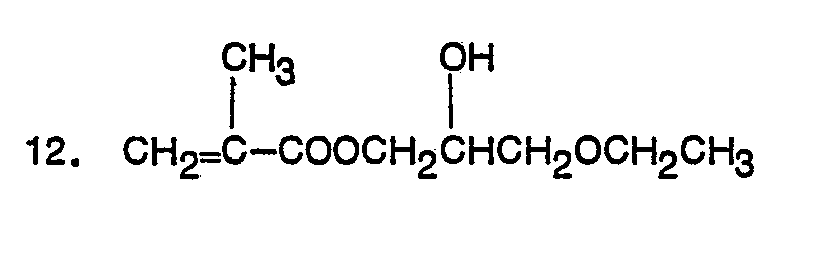
Of above-illustrated compounds (1)―(10), in general, acrylate or methacrylate esters are more preferred than acrylamide derivatives of (9) or (10). - The following are specific preferred examples of those compounds represented by the formulae 1-A to 1-H and formulae 2-A and 2-B.
-


-


-


-


-


-


-


-


-

-

-

- In the next place, explanations will be given of alkoxy-containing titanium compounds used as the component B in the present invention.
- B―I. The alkoxy-containing titanium compounds are those compounds which are represented by following formula (3):
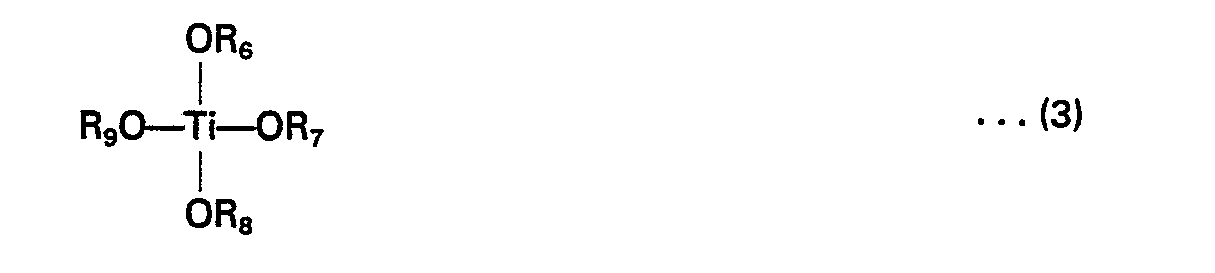
- R6 is a C1-20 aliphatic hydrocarbon residue which may optionally possess one or two hydroxyl groups, a C1-3 alkoxy group or (hydroxyalkyl)amino group (wherein the alkyl group has the carbon number of 2 or 3) and
- R7, R8 and R9 may be each or mutually identical with or different from R6 and stand for a hydrocarbon residue which may possess the same substituents as those of R6, or a group represented by following formula (3'):

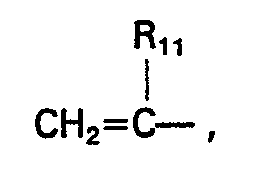

- The following are particularly preferred examples of the titanium compounds represented by the formula (3) above:-
- (11) Compounds represented by following formula (3-A):

- (12) Compounds represented by following formula (3-B):

- f is 1,2 or 3,
- R6a is as defined in the formula 3―A,
- R7a is a C1-20 saturated aliphatic hydrocarbon residue and said saturated hydrocarbon residue may possess 1 or 2 hydroxyl groups, a C1-3 alkoxy group or C1-3 acyl group.
- (13) Compounds represented by following formula (3-C):

- Of these compounds it is tetraalkoxy titanium represented by the formula 3-A that is particularly advantageous.
- The following are specific preferred examples of the above-described component B:
-


-


-


- In the present invention, the composition comprises besides catalyst and activator 80-99.5% by weight, and preferably 95-99.5% by weight, of component A and 0.5-20% by weight, and preferably 0.5-5% by weight, of component B.
- Particulars remain unknown of the chemical reaction mechanism to explain the reason for the extremely excellent bonding effect to the hard tissue of the human body, especially what causes the bonding to the hard tissue of the operative dentistry and prosthetic dentistry material, but it is considered to be that the content of hydrophilic acrylate or methacrylate monomer in the composition of the present invention results in good wetting on the surface of the hard tissue and uniform coating of even irregular portions of the hard tissue surfaces, and besides, intensified chemical bonding force with the hydrophilic part contained in the resin components on the hard tissue surface and the operative dentistry and prosthetic dentistry material and formation of a steadfast high polymer film between the hard tissue surface and the operative dentistry and prosthetic dentistry material and that with alkoxy-containing organometallic compound (component B), the alkoxy group of the metal compound reacts with trace water or water film constituting a factor impeding with the bondability between the operative dentistry and prosthetic dentistry material remaining on the hard tissue surface and the hard tissue surface to take off the trace water or water film out of the system and simultaneously the alkoxy group reacts with the trace water or water film, transforms itself into a hydroxy group thereby to bond steadfast to the hydrophilic group present on the hard tissue surface.
- Because of the very high reactivity of the alkoxy group in the titanium compound with the trace water or water film left over on the hard tissue surface, the bonding effect to the hard tissue clearly exhibits itself even when a small amount of the titanium component is used in the composition.
- The bonding compositions of the present invention for the hard tissue of the human body contains, in practical use, usually a catalyst for the polymerization of the composition and an activator for the formation of free radicals by the reaction with the catalyst besides the said composition.
- For a method of using such bonding material it is very convenient to prepare in advance a solution comprising the said composition and an activator (solution A) and a solution comprising the said composition and a catalyst (solution B), for instance, since the polymerization of the said composition is started by mixing these two kinds of solutions when used by doctors.
- The bonding composition of the present invention can readily be polymerized and cured by use of catalyst and activator.
- On this occasion, the application of heat often does harm to the human body and hence, preferred are those compositions which can be cured at normal temperatures.
- In practical use, the bonding agent of the present invention should advantageously be formulated in a two-liquid type agent, one containing a catalyst and the other containing an activator, and should be used by mixing together the two immediately before use.
- As the catalyst peroxide is preferred and preferably it should be used in combination with an activator. As the peroxide catalyst can be cited, for instance, diacyl peroxides, such as benzoyl peroxide, para- chlorobenzoyl peroxide, 2,4-dichlorobenzoyl peroxide, acetyl peroxide, lauroyl peroxide and so on, hydroperoxides, such as tertiary butyl hydroperoxide, cumene hydroperoxide, 2,5-dimethylhexane-2,5-dihydroperoxide and so on, ketone peroxides, such as methyl ethyl ketone peroxide and so on, peroxycarbonates, such as tertiary butyl peroxybenzoate etc..
- These peroxide catalysts should preferably be used in proportions of 0.1-3.5% by weight based on the total weight of the polymerizable monomer of the present invention represented by the said formula (II) or (111).
- As the activator capable of use in combination with the peroxide can be cited, for instance, tertiary amines, such as N,N-bis-(2-hydroxyethyl)-4-methylaniline, N,N-bis-(2-hydroxyethyl)-3,4-dimethylaniline, N,N-bis-(2-hydroxyethy))-3,5-dimethy)aniiine, N-methyi-N-(2-hydroxyethy))-4-methytaniiine, 4-methylaniline, N,N-dimethyl-p-toluidine, N,N-dimethylaniline, triethanolamine and so on, and besides, transition metal ions, such as cobalt naphthenate, cobalt octanate and so on, amine salts of p-toluenesulphonic acids and sulphinic acids and so forth.
- These activators can be generally used in proportions of 0.1 to 3.5% by weight based on the total weight of the said polymerizable monomer.
- The bonding compositions of the present invention have steadfast and durable bonding strength to the hard tissue of the human body. Not only that, but it brings about steadfast and durable bonding strength between the operative dentistry and prosthetic dentistry material for the hard tissue of the human body and the hard tissue of the human body.
- The bonding compositions of the present invention can be used in combination with any conventionally known resin-forming material or composite resin suitable for medical or dental use.
- When using the bonding compositions of the present invention on the occasion of filling the tooth excellent bonding strength is obtained and cavity sealability can be markedly improved, as compared to the composite resin which has poor bonding strength to the tooth.
- The typical, conventionally known resin-forming monomers for medical or dental use and composite resins using such monomers are disclosed, for instance, in the United States Patents, British Patents and Japanese Laid-Open Patent Applications (JAPAN KOKAI) which follow:
- The United States Patents 3,541,068; 3,597,389; 3,810,938; 3,923,740; 4,067,853; 3,825,518; 3,862,920 and 3,853,962, British Patent 1,451,262, Japanese Laid-Open Patent Applications (JAPAN KOKAI): JAPAN KOKAI No. 48-90332 and JAPAN KOKAI No. 50-116581.
- Particulars are given in the co-pending European patent application No. 0017936.
- The instant inventors found that at least one of compound represented by following formula (I):

- Z stands for a hydrogen atom or a group represented by following formula:

- R1, R2, R3 and R4 may be each identical or different and stand for a hydrogen atom, methyl group, ethyl group or n- or iso-propyl group, should be extremely excellent as resin-forming monomer for medical or dental use. Conventionally, as filler for the said composite resin are known many inorganic fillers, such as powdered quartz, powdered glass, glass beads, aluminum oxide, borosilicate glass, barium glass, hydroxy apatite, alumino silicate and so on, but the instant inventors found that fillers comprising nitride of at least one member of metal selected from the group consisting of Group IVB, Group VB and Group VIB in the Periodic Table of elements and boron, aluminum and silicon and having Mohs' hardness of at least 7 and fillers in powder form with particle size of 50 microns or less, in particular, should be extremely excellent as the composite resin-forming filler and particulars, of this discovery are given in the said co-pending European patent application No. 0017936 of the present inventors.
- The bonding compositions of the present invention can be used when filling the tooth with the novel composition resin comprising the resin-forming monomer for medical or dental use of the formula (I) by the invention or such a monomer incorporated with the conventionally known inorganic filler or the said metal nitride filler belonging to this invention. In this case, the novel composite resin equals dental amalgam in physical properties, such as compressive strength, hardness, abrasion resistance and so on, and in addition, bonding strength to tooth is markedly improved and hence, the present invention could provide quite novel dental material as the restorative filling material for molars, for which dental amalgam alone was conventionally available.
- Making the most of excellent bonding to the hard tissue of the human body, the bonding compositions of the present invention are applicable to bone cement, artificial bone and so forth in the orthopedic and restorative surgery field, or restorative material for crown bridge, core material for crown, dental cement, filling material, pit and fissure sealant and so forth in the operative dentistry and prosthetic dentistry field.
- The present invention will be specifically explained with reference to working examples as follows. Unless otherwise specified, "part" and "%" in working examples mean "part by weight" and "% by weight".
- In this connection, in working examples the method for the measurement of bonding test and percolation follows the hereinafter-described procedure.
- The crown of a fresh anterior bovine tooth implanted in an acryl resin square rod was horizontally ground until the enamal exposed itself. It was stored in water and taken out from the water immediately before the bonding test was conducted. Water on the surface was wiped off, the enamel was etched with 50% aqueous phosphate solution for one minute and all specimens were dried with air.
- In the next step, the tooth surface was coated with the bonding composition and then curable resin and a great deal of inorganic filler-based composite resin was placed on the surface of the bovine enamel, an acryl square rod was stuck and slowly pressed against the enamel from above, left to stand at room temperature for 15 minutes and then immersed into water at 37°C for 24 hours. Both ends of the acryl square rod of the specimen were taken out and pulled apart to determine its bonding strength. Bonding strength was indicated by average values for every 10 testpieces.
- In Examples the method of testing the marginal seal followed the hereinbelow-described procedure.
- The surface of a fresh sound human tooth pulled out was fully cleaned. After forming 4 simple cylindrical cavities of about 3,5 mm diameter and 2 mm depth, reaching the dentin; every sample tooth was stored by immersing into physiological saline solution. The extracted tooth taken out from the physiological saline solution immediately prior to the instant test was cleansed with distilled water, then cleaned with ethanol and dried. After that, the enamel in the cavity alone was etched with 40% H3P04 for one minute, then cleansed with water and dried. Then, optional bonding composition was coated on the cavity surface and it was filled with optional composite resin and pressed with polyester strips until it was cured. After curing it was immersed into artificial saliva and left to stand for 14 days. After that, the apical foramen of the tooth was closed with ionomer cement and then immersed alternately for every minute into water heated to 60°C and 0.2% aqueous fuchsin solution cooled to 4°C. This operation was repeated 120 times.
- After passing through this course, fuchsin adhering to the tooth surface was washed out with water and then the filled portion was cut off longitudinally by means of a diamond disk and the degree in which fuchsin penetrated from the cavity margin was microscopically observed. On that occasion, the ratio of the length of the fuchsin penetration to the length of the cavity wall perpendicular to the tooth surface was assessed as the degree of fuchsin penetration.
- Twelve (12) kinds of bonding compositions as shown in Table 1 were prepared. In the respective cases, the bonding compositions are comprised predominantly of 98 parts of various monomers corresponding to the component A of the present invention mentioned in Table 1 and 2 parts of tetraisopropyl titanate corresponding to the component B of the present invention, but they are of the two liquid type so that they can be cured at room temperature when used, one (solution a) is incorporated with N,N-bis-(2-hydroxyethyl)-4-methylaniline (hereinafter called DEPT for short), an activator, and one (solution b) is incorporated with benzoyl peroxide (hereinafter called BPO for short), a peroxide catalyst, and 2,5-di-tertiary butyl-4-methylphenol (hereinafter called BHT for short), a storage stabilizer, but the amounts in which additives, such as catalyst and so on, are mixed and are optionally set for the preparation of the composite resins as set forth in Table 1 in such a manner as to set at 3 minutes the time required for holding part of the solution prepared by mixing both solutions a and b at a 1:1 ratio between sheets of cover glass until the cover glass stays immobilized. (Measuring temperature was 24°C.) The following is one specific example (in the case of No. 1 in Table 1

- Nos. 2 to 12 in Table 1 were prepared following the same procedure as the above.
- As Control was used a bonding agent "ADAPTIC" (Trade Mark) (Code No. 20012) of J & J company.
- After various said bonding compositions were coated on the phosphate etched bovine enamel according to the above-described "method of bonding test", paste a and paste b of the Bis-GMA type composite resin with the following compositions were mixed at a 1:1 ratio, then it was filled and immersed in water for 24 hours to determine the bonding strength. Results were tabulated in Table 1.
- For comparison there were also cited results obtained in the case of directly bonding the said composite resin to the bovine enamel without coating it with the bonding composition.
- Method for the preparation of Bis-GMA type composite resin
-


- It is noted from Table 1 that if in improving the bonding to the tooth of the Bis-GMA type composite resin, there are used, as the bonding agent, various compositions consisting predominantly of tetraisopropyl titanate (2 parts) corresponding to the component B of the bonding composition of the present invention and various compounds (98 parts) listed in Table 1 corresponding to the component A of the bonding composition of the present invention, in either case, it is much more effective as compared to the case of directly filling with the composite resin or to the case of conventionally available bonding agents.
- It is also noted there that it is those compounds represented by formulas 1-A and 1-H in the text that are particularly preferred for the component A of the bonding composition of the present invention.
- Eleven (11) types of bonding compositions as shown in Table 2 were prepared. In the respective cases, composite resins are comprised predominantly of 98 parts of 2-hydroxyethyl methacrylate corresponding to the component A of the composition of the present invention and 2 parts of various titanium compounds corresponding to the component B of the composition of the present invention listed in Table 2 and they are of the two liquid type as is the case with Example 1 and amounts in which catalyst and so forth are mixed are suitably selected for the preparation of the bonding compositions.
- The following is one specific example (in the case of No. 2 in Table 2).

- No. 1 and Nos. 3 to 11 were prepared following the same procedure as the above.
- As Referential Examples 1 and 2 compositions were prepared following the same procedure as that of Nos. 1-11 by using, as the component B, dimethacrylethylene titanate, a titanium compound not corresponding to the component B of the composition of the present invention and by using 2-hydroxyethyl methacrylate alone.
- By using various said bonding compositions their bonding strength was measured following the same procedure as that of Example 1. Results were tabulated in Table 2.
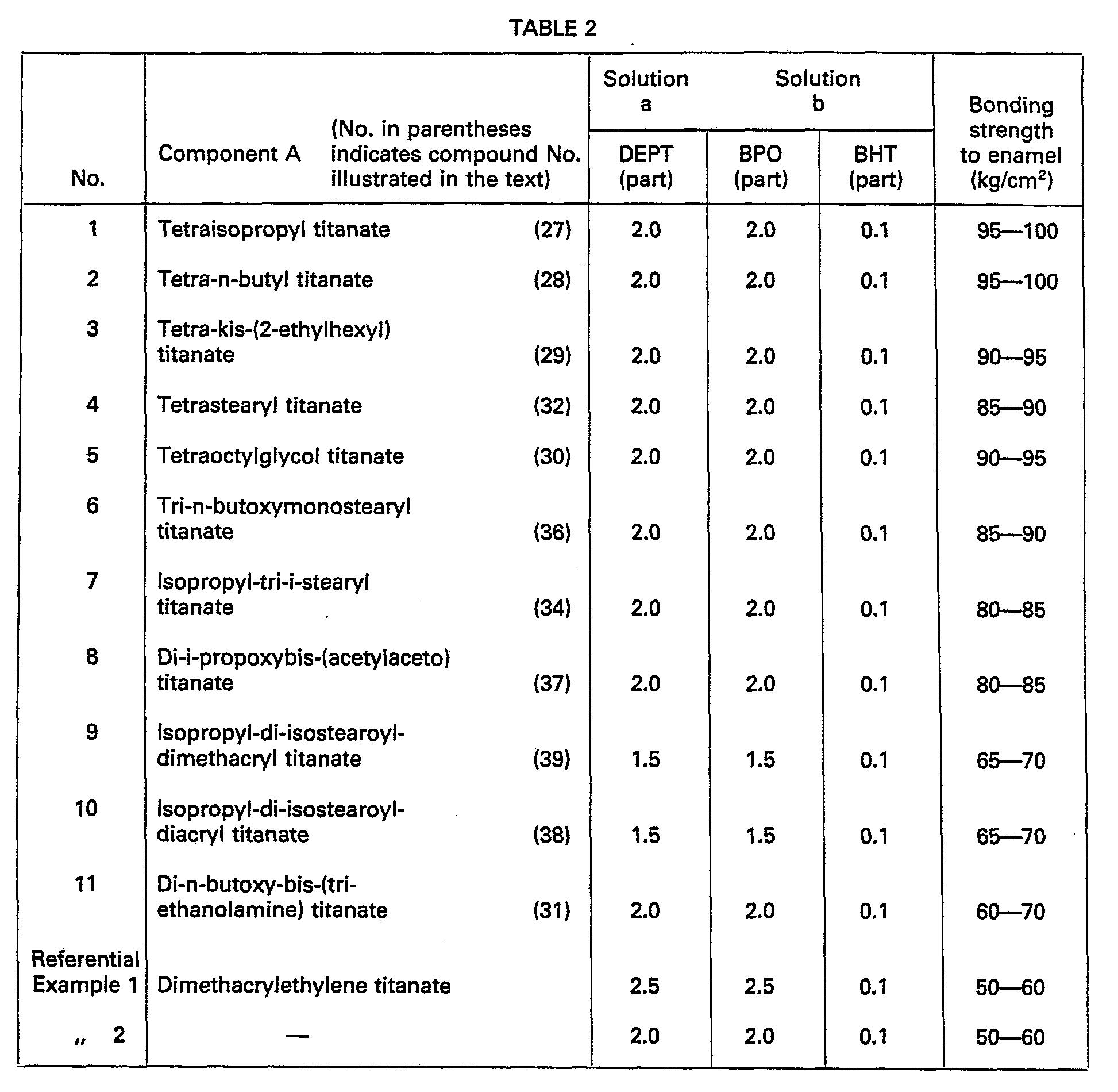
- It is noted from Table 2 that if in improving the bonding to the tooth of the Bis-GMA type composite resin, there are used, as the bonding agent, various compositions consisting predominantly of 2-hydroxyethyl methacrylate (98 parts) corresponding to the component A of the bonding composition of the present invention and various titanium compounds (2 parts) corresponding to the component B of the bonding composition of the present invention, mentioned in Table 2 in either case, it is more effective as compared to the case of using the titanium compound not corresponding to the component A of the bonding composition of the present invention or to the case of using 2-hydroxymethyl methacrylate alone. It is also noted there that it is tetralkoxy titanium represented by the formula 3-A in the text that is particularly advantageously used as the titanium compound corresponding to the component B of the bonding composition of the present invention.
- There were used, as the bonding composition, those in which the ratio between glycidyl methacrylate corresponding to the component A of the composition of the present invention and tetraisopropyl titanate corresponding to the component B of the composition of the present invention was altered as shown in Table 3, but for the amounts in which additives, such as catalyst and so on, were used on that occasion they were prepared as shown in Table 3 by following the same procedure as set forth in Example 1. By using various of said bonding compositions the bonding strength was measured following the same procedure as that of Example 1. Results were tabulated in Table 3.
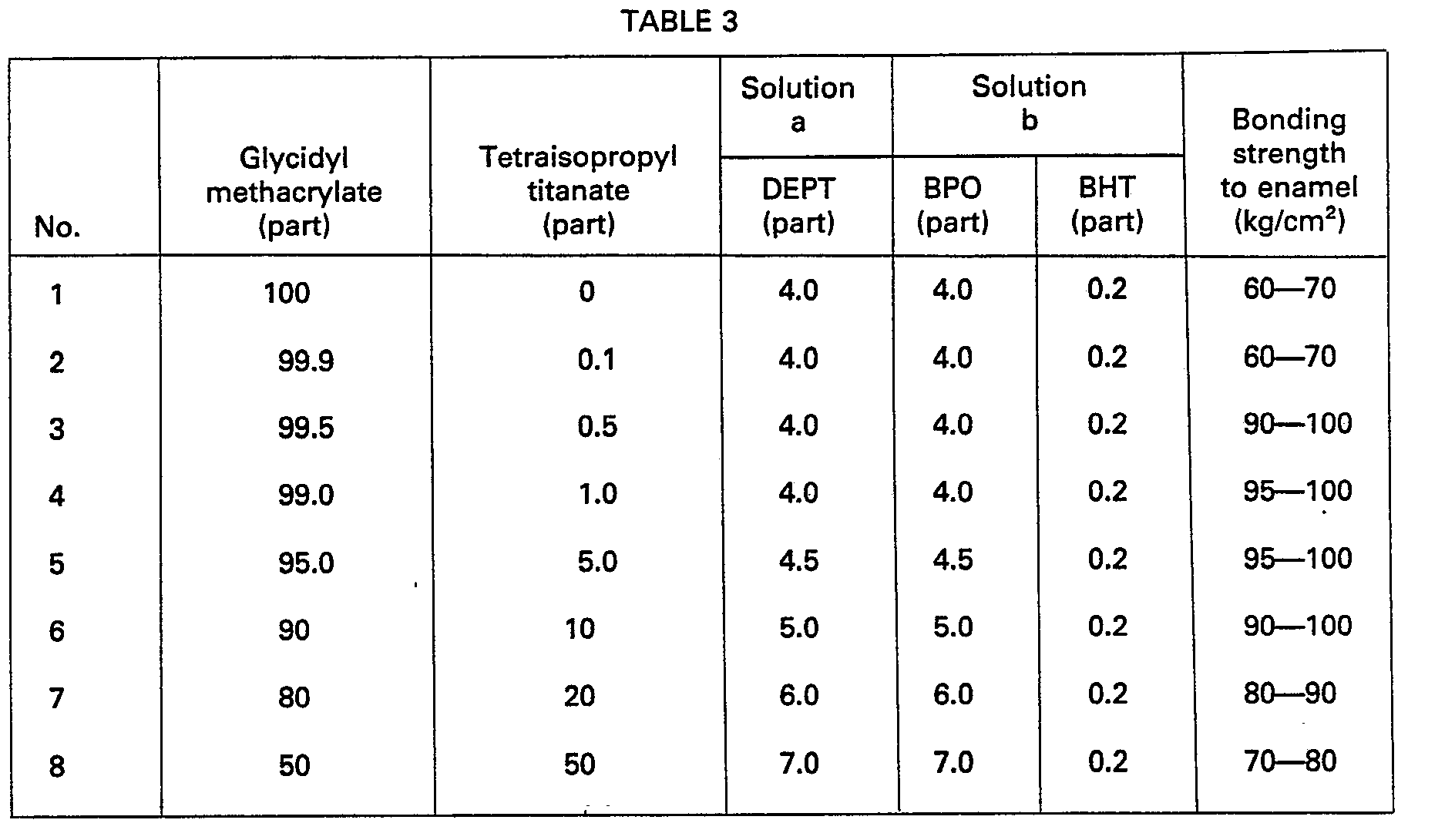
- It is noted from Table 3 that bonding strength between the composite resin and the tooth is particularly excellent when using, as the bonding agent, those compositions in which the composition ratio between glycidyl methacrylate and tetraisopropyl titanate falls within the specified range, viz., proportions of tetraisopropyl titanate incorporated fall in the range of 0.5-20%.
- Various bonding compositions used in No. 9 and No. 11 of Example 1, No. 5 of Example 2, were used as the bonding agent on the occasion of filling the tooth with following novel composite resins. The method for the preparation of novel composite resin and the method for its filling are identical with the case for the Bis-GMA type composite resin of Example 1. The method for the measurement of its bonding strength to the tooth is identical with that used in Example 1.
- Listed together are those results obtained in the same manner when using the bonding agent "ADAPTIC", a product of J & J company, and when using no bonding agent at all. Results were tabulated in Table 4.
- Method for the preparation of novel composite resin
-


- The above results show that the bonding compositions of the present invention are very effective when using as the bonding agent in filling the tooth with said novel composite resin discovered by the inventors and show a higher bonding strength than in the case of using in combination with the Bis-GMA type composite resin as noted from comparisons with No. 9 and No. 1 of Example 1, No. 5 of Example 2.
- The bonding composition used in No. 11 of Example 1 was coated on the bovine enamel and then it was filled and bonded with the Bis-GMAtype composite resin and novel composite resin used in Example 1 and Example 6 and immersed in water at 37°C for a given time to determine the bonding strength. Investigations were made on the changes of the bonding strength with the lapse of time. Results were tabulated in Table 5.

- It is noted from Table 5 that when using as bonding agent, the bonding composition of the present invention in filling the tooth with the said Bis-GMA type composite resin and said novel composite resin, it is much less in the lowering of the bonding strength even in the case of immersing over a prolonged period of time at such conditions as under water at 37°C.
- By using fresh sound human teeth pulled out (2 each of anterior teeth, premolars and molars) the degree of fuchsin penetration was assessed by conducting the following test based on the said "method of percolation test."
- On that occasion, the same novel composite resin as that of Example 4 was used as the composite resin and the same composite composition as that of No. 9 of Example 1 was used as the bonding agent.
- As the result of this test the number of "n" for the subject of measurement of the degree of fuchsin penetration was 48, but in either case, there was recognized no fuchsin penetrating phenomenon and the average degree of fuchsin penetration was 0.
- What is implied by this is that by jointly using the novel composite resin discovered by the inventors as mentioned in Example 4 and the composition used in No. 9 of Example 1 being the composition of the present invention a bonding extremely resistant to the environmental temperature changes could be brought about in the interface between the tooth and the filling material.
Claims (13)











Applications Claiming Priority (2)
| Application Number | Priority Date | Filing Date | Title |
|---|---|---|---|
| JP44751/79 | 1979-04-11 | ||
| JP4475179A JPS55137178A (en) | 1979-04-11 | 1979-04-11 | Adhesive material for rigid living tissue |
Publications (3)
| Publication Number | Publication Date |
|---|---|
| EP0017937A2 EP0017937A2 (en) | 1980-10-29 |
| EP0017937A3 EP0017937A3 (en) | 1980-11-12 |
| EP0017937B1 true EP0017937B1 (en) | 1985-04-24 |
Family
ID=12700142
Family Applications (1)
| Application Number | Title | Priority Date | Filing Date |
|---|---|---|---|
| EP80101965A Expired EP0017937B1 (en) | 1979-04-11 | 1980-04-11 | Bonding compositions to the hard tissue of human body |
Country Status (4)
| Country | Link |
|---|---|
| US (1) | US4308014A (en) |
| EP (1) | EP0017937B1 (en) |
| JP (1) | JPS55137178A (en) |
| DE (1) | DE3070545D1 (en) |
Families Citing this family (29)
| Publication number | Priority date | Publication date | Assignee | Title |
|---|---|---|---|---|
| US4504231A (en) * | 1981-02-17 | 1985-03-12 | Dentsply Research & Development Corp. | Process for filling teeth |
| US4514342A (en) * | 1982-02-16 | 1985-04-30 | Dentsply Limited | Polyethylenically unsaturated monophosphates |
| DE3227552A1 (en) * | 1982-07-23 | 1984-01-26 | Dynamit Nobel Ag, 5210 Troisdorf | COPOLYMERISATE WITH ETHYLENICALLY UNSATURATED BASIC BLOCKS AND SEVERAL FUNCTIONAL GROUPS |
| JPS5930877A (en) * | 1982-08-16 | 1984-02-18 | Tokuyama Soda Co Ltd | Adhesive |
| JPS5996180A (en) * | 1982-11-24 | 1984-06-02 | Tokuyama Soda Co Ltd | dental adhesive |
| EP0103420B1 (en) * | 1982-08-16 | 1989-07-19 | Tokuyama Soda Kabushiki Kaisha | Adhesive coating material |
| DE3314977A1 (en) * | 1983-04-26 | 1984-10-31 | ESPE Fabrik pharmazeutischer Präparate GmbH, 8031 Seefeld | USE OF DIFUNCTIONAL ACRYLIC ACID AND METHACRYLIC ACID ESTERS FOR THE PRODUCTION OF CURABLE BONE CEMENTS |
| JPS59203720A (en) * | 1983-05-04 | 1984-11-17 | Tokuyama Soda Co Ltd | Crystalline metal oxide and its manufacturing method |
| DE3414165A1 (en) * | 1984-04-14 | 1985-10-17 | Kulzer & Co GmbH, 6393 Wehrheim | Photopolymerisable dental adhesive |
| US4657941A (en) * | 1984-11-29 | 1987-04-14 | Dentsply Research & Development Corp. | Biologically compatible adhesive containing a phosphorus adhesion promoter and a sulfinic accelerator |
| AU587821B2 (en) * | 1985-04-24 | 1989-08-31 | Commonwealth Scientific And Industrial Research Organisation | Dental restorative material |
| DD238619A1 (en) * | 1985-06-24 | 1986-08-27 | Univ Schiller Jena | INORGANIC - ORGANIC COMPOSITE MATERIALS FOR BIOMEDICAL PURPOSES |
| CH665357A5 (en) * | 1985-07-05 | 1988-05-13 | Werther Lusuardi | Bone cement. |
| US4728706A (en) * | 1986-08-29 | 1988-03-01 | E. I. Du Pont De Nemours And Company | Titanium, zirconium- and hafnium containing initiators in the polymerization of acrylic monomers to "living" polymers |
| US4933376A (en) * | 1987-05-06 | 1990-06-12 | Mitsubishi Rayon Company Limited | Photopolymerizable dental composition |
| JPS63316709A (en) * | 1987-06-19 | 1988-12-26 | Mitsubishi Rayon Co Ltd | Photopolymerizable dental composition |
| EP0334338A3 (en) * | 1988-03-24 | 1990-06-20 | Dentsply International, Inc. | Titanate initiators for light cured compositions |
| US4945006A (en) * | 1989-01-17 | 1990-07-31 | Minnesota Mining And Manufacturing Company | Low odor adhesive compositions and bonding method employing same |
| US5145374A (en) * | 1989-10-03 | 1992-09-08 | The United States Of America As Represented By The Secretary Of Commerce | Synthetic dental compositions formed from cyclopolymerizable bis-acrylate and multi-functional oligomer and bonding method |
| DE4133494C2 (en) * | 1991-10-09 | 1996-03-28 | Fraunhofer Ges Forschung | Dental resin composition, process for their preparation and their use |
| US5380901A (en) * | 1992-01-30 | 1995-01-10 | The United States Of America As Represented By The Secretary Of Commerce | Multifunctional acrylates and the synthesis thereof |
| FR2687499B1 (en) * | 1992-02-13 | 1994-04-15 | Elf Atochem Sa | PROCESS FOR THE CONDITIONING OF ION EXCHANGE RESINS CONTAMINATED BY RADIOACTIVE ELEMENTS. |
| TW414713B (en) * | 1994-05-12 | 2000-12-11 | Dentsply Gmbh | Fluoride releasing liquid dental primer product and method |
| GB9507910D0 (en) * | 1995-04-13 | 1995-05-31 | Minnesota Mining & Mfg | Adhesion promotion of orthopaedic implants |
| DE19702704A1 (en) | 1997-01-25 | 1998-07-30 | Roland Dipl Phys Dr Goebel | Adhesive and moisture-stable alloy-plastic composite layer and process for its production |
| US6177534B1 (en) | 1997-12-23 | 2001-01-23 | The United States Of America As Represented By The Secretary Of Commerce | Silylated resins and the synthesis thereof |
| DE102004025030A1 (en) * | 2004-05-18 | 2005-12-15 | S&C Polymer Silicon- und Composite-Spezialitäten GmbH | Nano-apatite fillers containing curable restorative materials |
| EP2153812B1 (en) * | 2008-08-13 | 2014-11-26 | Mühlbauer Technology GmbH | X-ray opaque infiltrant |
| JP6942717B2 (en) * | 2016-10-14 | 2021-09-29 | 日本曹達株式会社 | Adhesive composition |
Family Cites Families (6)
| Publication number | Priority date | Publication date | Assignee | Title |
|---|---|---|---|---|
| US2865899A (en) * | 1955-05-12 | 1958-12-23 | Rohm & Haas | Vinylthioalkoxytrimethylsilane and polymers thereof |
| US3542585A (en) * | 1968-02-23 | 1970-11-24 | Dow Corning | Method for adhering acrylate finishes to silicone impregnated leather and resulting article |
| US3951893A (en) * | 1970-11-18 | 1976-04-20 | Johnson & Johnson | Film-forming silane crosslinked acrylate interpolymers having water-barrier properties |
| US3991008A (en) * | 1974-08-12 | 1976-11-09 | The Kendall Company | Dental compositions having improved color stability |
| US4147688A (en) * | 1975-03-19 | 1979-04-03 | Ppg Industries, Inc. | Method of preparing dispersions of gelled polymeric microparticles and products produced thereby |
| US4387240A (en) * | 1978-06-02 | 1983-06-07 | Minnesota Mining And Manufacturing Company | Oligomeric methacryl substituted alkylsiloxanes |
-
1979
- 1979-04-11 JP JP4475179A patent/JPS55137178A/en active Pending
-
1980
- 1980-04-09 US US06/138,815 patent/US4308014A/en not_active Expired - Lifetime
- 1980-04-11 DE DE8080101965T patent/DE3070545D1/en not_active Expired
- 1980-04-11 EP EP80101965A patent/EP0017937B1/en not_active Expired
Also Published As
| Publication number | Publication date |
|---|---|
| DE3070545D1 (en) | 1985-05-30 |
| EP0017937A2 (en) | 1980-10-29 |
| EP0017937A3 (en) | 1980-11-12 |
| US4308014A (en) | 1981-12-29 |
| JPS55137178A (en) | 1980-10-25 |
Similar Documents
| Publication | Publication Date | Title |
|---|---|---|
| EP0017937A2 (en) | Bonding compositions to the hard tissue of human body | |
| EP0017936B1 (en) | Compositions of restorative material especially suitable for dental filling material | |
| US4259117A (en) | Dental filling material | |
| EP0115410B1 (en) | Adhesive compositions | |
| JP5020087B2 (en) | Dental composite resin cement, dental primer, and dental adhesive kit containing them | |
| JP4636656B2 (en) | Dental adhesive composition | |
| EP0077849B1 (en) | Resin-forming material and restorative material suitable for medical or dental use | |
| EP0088527B1 (en) | Adhesion promoters | |
| JPS6317308B2 (en) | ||
| EP1986588A2 (en) | Self etch all purpose dental composition | |
| US5306338A (en) | Dental restoration composition | |
| EP0321683A1 (en) | Adhesive composition which bonds to collagen and calcium | |
| JPH0243721B2 (en) | ||
| EP0509516B1 (en) | Dental restoration composition | |
| US4486179A (en) | Biocompatible cementitious dental compositions | |
| JP3158422B2 (en) | Water-based photocurable adhesive composition | |
| EP0095587B1 (en) | Dental composite and porcelain repair | |
| US3540126A (en) | Fluoroalkoxyalkyl 2 - cyanoacrylate compositions used in tooth treatment | |
| JPS6351308A (en) | Adhesive composition for dental use | |
| EP1248587A1 (en) | Temporary dental cement compositions and related methods and systems | |
| WO1994000096A1 (en) | Dental adhesive primer composition and dentin conditioning primer composition | |
| WO2011080573A2 (en) | Endodontic cement with high bioactivity | |
| JPH0141601B2 (en) | ||
| JPH0653751B2 (en) | Phosphoryl compounds and adhesives containing them | |
| JPH0379323B2 (en) |
Legal Events
| Date | Code | Title | Description |
|---|---|---|---|
| PUAI | Public reference made under article 153(3) epc to a published international application that has entered the european phase |
Free format text: ORIGINAL CODE: 0009012 |
|
| PUAL | Search report despatched |
Free format text: ORIGINAL CODE: 0009013 |
|
| AK | Designated contracting states |
Designated state(s): CH DE FR GB NL |
|
| AK | Designated contracting states |
Designated state(s): CH DE FR GB NL |
|
| 17P | Request for examination filed |
Effective date: 19801230 |
|
| GRAA | (expected) grant |
Free format text: ORIGINAL CODE: 0009210 |
|
| AK | Designated contracting states |
Designated state(s): CH DE FR GB LI NL |
|
| REF | Corresponds to: |
Ref document number: 3070545 Country of ref document: DE Date of ref document: 19850530 |
|
| ET | Fr: translation filed | ||
| PLBE | No opposition filed within time limit |
Free format text: ORIGINAL CODE: 0009261 |
|
| STAA | Information on the status of an ep patent application or granted ep patent |
Free format text: STATUS: NO OPPOSITION FILED WITHIN TIME LIMIT |
|
| 26N | No opposition filed | ||
| PGFP | Annual fee paid to national office [announced via postgrant information from national office to epo] |
Ref country code: NL Payment date: 19870430 Year of fee payment: 8 |
|
| PG25 | Lapsed in a contracting state [announced via postgrant information from national office to epo] |
Ref country code: LI Effective date: 19880430 Ref country code: CH Effective date: 19880430 |
|
| PG25 | Lapsed in a contracting state [announced via postgrant information from national office to epo] |
Ref country code: NL Effective date: 19881101 |
|
| PG25 | Lapsed in a contracting state [announced via postgrant information from national office to epo] |
Ref country code: GB Effective date: 19881118 |
|
| NLV4 | Nl: lapsed or anulled due to non-payment of the annual fee | ||
| GBPC | Gb: european patent ceased through non-payment of renewal fee | ||
| PG25 | Lapsed in a contracting state [announced via postgrant information from national office to epo] |
Ref country code: FR Free format text: LAPSE BECAUSE OF NON-PAYMENT OF DUE FEES Effective date: 19881229 |
|
| REG | Reference to a national code |
Ref country code: CH Ref legal event code: PL |
|
| REG | Reference to a national code |
Ref country code: FR Ref legal event code: ST |
|
| PGFP | Annual fee paid to national office [announced via postgrant information from national office to epo] |
Ref country code: DE Payment date: 19890511 Year of fee payment: 10 |
|
| PG25 | Lapsed in a contracting state [announced via postgrant information from national office to epo] |
Ref country code: DE Effective date: 19910101 |