EP0016706A1 - Procédé et dispositif de contrôle de l'état d'une structure en béton armé immergée dans un liquide électriquement conducteur - Google Patents
Procédé et dispositif de contrôle de l'état d'une structure en béton armé immergée dans un liquide électriquement conducteur Download PDFInfo
- Publication number
- EP0016706A1 EP0016706A1 EP80400370A EP80400370A EP0016706A1 EP 0016706 A1 EP0016706 A1 EP 0016706A1 EP 80400370 A EP80400370 A EP 80400370A EP 80400370 A EP80400370 A EP 80400370A EP 0016706 A1 EP0016706 A1 EP 0016706A1
- Authority
- EP
- European Patent Office
- Prior art keywords
- density
- measured
- defect
- current density
- direct current
- Prior art date
- Legal status (The legal status is an assumption and is not a legal conclusion. Google has not performed a legal analysis and makes no representation as to the accuracy of the status listed.)
- Ceased
Links
- 238000000034 method Methods 0.000 title claims abstract description 19
- 239000007788 liquid Substances 0.000 title claims description 13
- 239000011150 reinforced concrete Substances 0.000 title 1
- 238000001514 detection method Methods 0.000 claims abstract description 5
- 238000012544 monitoring process Methods 0.000 claims abstract description 4
- 230000007797 corrosion Effects 0.000 claims description 15
- 238000005260 corrosion Methods 0.000 claims description 15
- 230000007547 defect Effects 0.000 claims description 15
- 238000005259 measurement Methods 0.000 claims description 12
- 238000007654 immersion Methods 0.000 claims description 10
- 230000002787 reinforcement Effects 0.000 claims description 8
- 230000004807 localization Effects 0.000 claims description 4
- 230000009471 action Effects 0.000 claims description 3
- 230000035945 sensitivity Effects 0.000 claims description 3
- 230000003014 reinforcing effect Effects 0.000 claims description 2
- 230000008569 process Effects 0.000 abstract description 3
- 238000011144 upstream manufacturing Methods 0.000 abstract 1
- XEEYBQQBJWHFJM-UHFFFAOYSA-N Iron Chemical compound [Fe] XEEYBQQBJWHFJM-UHFFFAOYSA-N 0.000 description 6
- 239000011248 coating agent Substances 0.000 description 4
- 238000000576 coating method Methods 0.000 description 4
- 238000007689 inspection Methods 0.000 description 3
- 229910052742 iron Inorganic materials 0.000 description 3
- 230000000007 visual effect Effects 0.000 description 3
- 238000004458 analytical method Methods 0.000 description 2
- 230000008901 benefit Effects 0.000 description 2
- 230000009172 bursting Effects 0.000 description 2
- 238000011835 investigation Methods 0.000 description 2
- 230000003071 parasitic effect Effects 0.000 description 2
- 238000005070 sampling Methods 0.000 description 2
- 239000013535 sea water Substances 0.000 description 2
- 230000009897 systematic effect Effects 0.000 description 2
- QVGXLLKOCUKJST-UHFFFAOYSA-N atomic oxygen Chemical compound [O] QVGXLLKOCUKJST-UHFFFAOYSA-N 0.000 description 1
- 238000004210 cathodic protection Methods 0.000 description 1
- 230000008859 change Effects 0.000 description 1
- 238000005336 cracking Methods 0.000 description 1
- 230000006866 deterioration Effects 0.000 description 1
- 230000006872 improvement Effects 0.000 description 1
- 239000011159 matrix material Substances 0.000 description 1
- 239000002184 metal Substances 0.000 description 1
- 229910052751 metal Inorganic materials 0.000 description 1
- 230000007935 neutral effect Effects 0.000 description 1
- 229910052760 oxygen Inorganic materials 0.000 description 1
- 239000001301 oxygen Substances 0.000 description 1
- 230000000149 penetrating effect Effects 0.000 description 1
- 230000003449 preventive effect Effects 0.000 description 1
- 238000004451 qualitative analysis Methods 0.000 description 1
- 238000011158 quantitative evaluation Methods 0.000 description 1
- 230000008439 repair process Effects 0.000 description 1
- 238000011160 research Methods 0.000 description 1
- 150000003839 salts Chemical class 0.000 description 1
- XLYOFNOQVPJJNP-UHFFFAOYSA-N water Substances O XLYOFNOQVPJJNP-UHFFFAOYSA-N 0.000 description 1
Images

Classifications
-
- G—PHYSICS
- G01—MEASURING; TESTING
- G01N—INVESTIGATING OR ANALYSING MATERIALS BY DETERMINING THEIR CHEMICAL OR PHYSICAL PROPERTIES
- G01N17/00—Investigating resistance of materials to the weather, to corrosion, or to light
- G01N17/02—Electrochemical measuring systems for weathering, corrosion or corrosion-protection measurement
Definitions
- the present invention relates to a method for controlling and monitoring the state of a reinforced masonry structure immersed in an electrically conductive liquid.
- the invention also relates to a device for implementing this method.
- one of the problems to be resolved results from the disproportion between the extent of the surface to be examined (for example of the order 40,000 m 2 ) and the size of the defects likely to cause serious damage, namely cracks of the order of 1/10 mm extending over 1 m.
- The. relationship between the defect surface area and the total area to be inspected is thus of the order of 10- 9, which means that the probability of detecting such defects by direct visual method is very low, less than analyzing a huge data volume (10 7 to 1 0 8 shots).
- the object of the invention is in particular to propose a method remedying these drawbacks and allowing rapid localization of only the defects of the coating or of the concrete surface of the structure. submerged likely to cause increasing deterioration of said structure by reinforcing corrosion.
- This object is achieved, in accordance with the invention, by measuring the density of direct current flowing near the surface of the structure at several points distributed over this surface! face, whereby we identify any places where the structure has a submitting defect. an armature with the corrosive action of the free immersion liquid surrounding the structure, this corrosion producing a direct current flowing in the immersion liquid in the vicinity of said defect.
- the Applicant has found that the direct current has a sufficient intensity to be detected at distances from the structure much greater than the width of the opening (for example crack) constituting said defect.
- the sampling rate (number of measurements) required to detect an anomaly of the structure is significantly reduced compared to that required by the method according to the prior art (visual method).
- a rough localization of the defect is also carried out in the following manner: an electrical voltage is applied between at least one metallic reinforcement element of the structure and an electrode placed in the immersion liquid at a certain distance from the structure, and the density of electric current flowing near the surface of the immersed structure is measured along a scanning line of this surface.
- the electric voltage applied is an alternating voltage and the alternating component of the same frequency, of the current density, is selectively measured, whereby the improvement is the sensitivity of fault detection.
- the density of direct current is measured at a distance from the surface of the structure which is lower than that at which the current density during the first location phase and / or at measurement points closer to each other than during said first phase.
- the current density is measured by mainly measuring the component perpendicular to the surface of the structure, of the current density flowing in the immersion liquid in the vicinity of this surface.
- the method proposed in the context of an underwater application of the present invention is based on the detection of electric currents due to corrosion of the concrete reinforcements, these being subjected to free seawater through a system of surface cracks.
- the Applicant has found that the phenomenon of reinforcement corrosion results in currents electric, so that the research of these electric currents carried out at a certain distance from the structure allows a localization of the really active cracks. A quantitative evaluation of the severity of the defect can thus be carried out: cracked surface, corrosion rate.
- Another advantage of the process according to the invention is that the electric currents, representative of corrosion or due to the application of the voltage between an armature element and the remote electrode, these currents are detectable in a much larger space. than the volume of the crack itself, which makes it possible to locate the defects with a much lower sampling rate than with visual methods. The volume of information to be processed therefore remains reasonable.
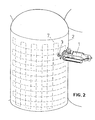
- the submarine 1 used is equipped with a relatively precise three-dimensional navigation device for knowing the positions of the measurements (for example inertial navigation and pressure gauge corrected for the tide).
- Two types of measurements are made during this systematic grid in order to identify the areas subject to corrosion: a) a measurement of direct current density and b) a measurement of alternating current density.
- the measurement is not really quantitative but only representative.
- the sensitivity typically obtained by a current density sensor of the aforementioned type is of the order of 1 mA / m2, which is equivalent to an iron loss of the order of 18 g / m2 / year or to a change in volume of 2.3 cm3 / m2 / year.
- the size of the defect corresponding to this detectability threshold depends of course on the extent of the defect, but such a detectability threshold already allows a preventive analysis of the integrity of the coating of a submerged platform such as 2.
- An alternating current generator-4 is connected between the system of metal armatures of the platform (at 5) and an electrode 6 relatively distant from the area to be inspected.
- the system of metallic armatures constitutes a region with low roughly equipotential impedance, and the resulting alternating surface current density is then proportional to the potential difference delivered by the generator 4 and to the local conductance of the concrete covering, conductance representative of the degree cracking.
- This density of alternating current is for example measured by a sensor of the type derived from the previous one (the element performing the cutting of the current having been removed). This sensor being located in the device 3 with the DC density sensor.
- the results are processed on a computer so as to identify the particularly active areas of the surface of structure 2; the representation of the results can be obtained by means of contour lines or by color coding on an appropriate terminal.
- a qualitative analysis is carried out on these documents which makes it possible to delimit the suspect areas where the degree of corrosion exceeds a threshold considered as critical.
- the vehicle 1, during the first investigation phase traverses a trajectory such that the device 3 scans the surface of the structure 2 along a grid line 7 of this surface.
Landscapes
- Life Sciences & Earth Sciences (AREA)
- Analytical Chemistry (AREA)
- General Health & Medical Sciences (AREA)
- Environmental & Geological Engineering (AREA)
- Environmental Sciences (AREA)
- Physics & Mathematics (AREA)
- Health & Medical Sciences (AREA)
- Chemical & Material Sciences (AREA)
- Biodiversity & Conservation Biology (AREA)
- Ecology (AREA)
- General Physics & Mathematics (AREA)
- Biochemistry (AREA)
- Immunology (AREA)
- Pathology (AREA)
- Investigating Or Analyzing Materials By The Use Of Electric Means (AREA)
- Consolidation Of Soil By Introduction Of Solidifying Substances Into Soil (AREA)
- On-Site Construction Work That Accompanies The Preparation And Application Of Concrete (AREA)
- Testing Resistance To Weather, Investigating Materials By Mechanical Methods (AREA)
Applications Claiming Priority (2)
| Application Number | Priority Date | Filing Date | Title |
|---|---|---|---|
| FR7907175A FR2452105A1 (fr) | 1979-03-21 | 1979-03-21 | Procede et dispositif de controle de l'etat d'une structure en beton arme immergee dans un liquide electriquement conducteur |
| FR7907175 | 1979-03-21 |
Publications (1)
| Publication Number | Publication Date |
|---|---|
| EP0016706A1 true EP0016706A1 (fr) | 1980-10-01 |
Family
ID=9223406
Family Applications (1)
| Application Number | Title | Priority Date | Filing Date |
|---|---|---|---|
| EP80400370A Ceased EP0016706A1 (fr) | 1979-03-21 | 1980-03-19 | Procédé et dispositif de contrôle de l'état d'une structure en béton armé immergée dans un liquide électriquement conducteur |
Country Status (3)
| Country | Link |
|---|---|
| EP (1) | EP0016706A1 (cg-RX-API-DMAC10.html) |
| FR (1) | FR2452105A1 (cg-RX-API-DMAC10.html) |
| NO (1) | NO800732L (cg-RX-API-DMAC10.html) |
Cited By (1)
| Publication number | Priority date | Publication date | Assignee | Title |
|---|---|---|---|---|
| CN118169374A (zh) * | 2024-04-15 | 2024-06-11 | 深圳大学 | 深远海混凝土智能化实时监测方法及系统 |
Citations (4)
| Publication number | Priority date | Publication date | Assignee | Title |
|---|---|---|---|---|
| FR2355285A1 (fr) * | 1976-06-18 | 1978-01-13 | Coprelec | Procede et dispositifs de detection de la corrosion sur des pieces ou ensembles de pieces metalliques enterrees, notamment sur des canalisations |
| US4078510A (en) * | 1976-01-12 | 1978-03-14 | Morgan Berkeley & Co. Ltd. | Relating to the cathodic protection of structures |
| FR2365797A1 (fr) * | 1976-09-23 | 1978-04-21 | Intersub Dev Sa | Procede et installation de controle d'une structure immergee munie d'un dispositif de protection cathodique |
| FR2376223A1 (fr) * | 1977-01-03 | 1978-07-28 | Continental Oil Co | Procede et appareil de saisie de donnees sans plongeur pour le controle de la protection cathodique d'une structure immergee dans l'eau salee |
-
1979
- 1979-03-21 FR FR7907175A patent/FR2452105A1/fr active Granted
-
1980
- 1980-03-13 NO NO800732A patent/NO800732L/no unknown
- 1980-03-19 EP EP80400370A patent/EP0016706A1/fr not_active Ceased
Patent Citations (4)
| Publication number | Priority date | Publication date | Assignee | Title |
|---|---|---|---|---|
| US4078510A (en) * | 1976-01-12 | 1978-03-14 | Morgan Berkeley & Co. Ltd. | Relating to the cathodic protection of structures |
| FR2355285A1 (fr) * | 1976-06-18 | 1978-01-13 | Coprelec | Procede et dispositifs de detection de la corrosion sur des pieces ou ensembles de pieces metalliques enterrees, notamment sur des canalisations |
| FR2365797A1 (fr) * | 1976-09-23 | 1978-04-21 | Intersub Dev Sa | Procede et installation de controle d'une structure immergee munie d'un dispositif de protection cathodique |
| FR2376223A1 (fr) * | 1977-01-03 | 1978-07-28 | Continental Oil Co | Procede et appareil de saisie de donnees sans plongeur pour le controle de la protection cathodique d'une structure immergee dans l'eau salee |
Cited By (1)
| Publication number | Priority date | Publication date | Assignee | Title |
|---|---|---|---|---|
| CN118169374A (zh) * | 2024-04-15 | 2024-06-11 | 深圳大学 | 深远海混凝土智能化实时监测方法及系统 |
Also Published As
| Publication number | Publication date |
|---|---|
| FR2452105B1 (cg-RX-API-DMAC10.html) | 1984-05-25 |
| FR2452105A1 (fr) | 1980-10-17 |
| NO800732L (no) | 1980-09-22 |
Similar Documents
| Publication | Publication Date | Title |
|---|---|---|
| CN112157368B (zh) | 一种激光非熔透焊接焊缝熔深无损检测方法 | |
| WO2017008621A1 (zh) | 微磁检测方法和微磁检测装置 | |
| EP2434280B1 (fr) | Contrôle non destructif d'une structure dans un aéronef | |
| Bandara et al. | Structural health assessment techniques for in-service timber poles | |
| US9898832B1 (en) | Surface metallographic method for characterizing the degree of sensitization of aluminum-magnesium alloys | |
| WO2017126975A1 (en) | Method for detection of electric fields surrounding a structure in an electrically conducting medium | |
| JP2004325246A (ja) | 欠陥検査装置 | |
| CN105181795A (zh) | 一种海底管道安全监测装置 | |
| EP0016706A1 (fr) | Procédé et dispositif de contrôle de l'état d'une structure en béton armé immergée dans un liquide électriquement conducteur | |
| WO2007141428A1 (fr) | Dispositif et procede de controle non destructif permettant de determiner la presence de materiau magnetique dans des materiaux non magnetique ou presentant une anisotropie magnetique : cristalline, de structure metallurgique, de forme ou de tension | |
| US10641048B2 (en) | Subsea automated ultrasonic testing | |
| Jegadeesan | Design of Remote Corrosion Detection System in the Marine Structure Using an Anisotropic Magnetic Resistance Sensor. | |
| CN118643397B (zh) | 一种埋地燃气管道防腐层缺陷自动识别与检测系统及方法 | |
| EP0505421B1 (fr) | Procede de detection et de dimensionnement de fissures dans des structures metalliques maillees | |
| JP3662231B2 (ja) | 鋼製ドラム缶の検査方法 | |
| FR2468903A1 (fr) | Procede de detection de fissures traversantes dans un revetement protecteur metallique inoxydable d'une piece elle-meme metallique | |
| Tang et al. | Quantitative Evaluation of Eddy Current Thermography for Flow-Related Defect Detection in Deep-Sea Structures | |
| Kingma | Acoustic emission monitoring of corrosion-fatigue damage evolution in submerged steel structures: a global parametric analysis | |
| Pearson | Discrimination of top and bottom discontinuities with MFL and the Surface Topology Air-gap Reluctance System (STARS) | |
| Mukherjee et al. | Enhanced Defect Detection in NDE Using Pixel Level Data Fusion | |
| CN121410097A (zh) | 电缆屏蔽层无损检测校准试块、制备方法及其应用 | |
| Zhang et al. | Quantitative Assessment of Chloride-Induced Corrosion in Concrete Bridge Decks Using Ground-Penetrating Radar | |
| Browne et al. | Nondestructive Evaluation Methods for Waterfront Facilities | |
| Lemire et al. | Variables affecting probability of detection in bolt hole eddy current inspection | |
| Gucunski et al. | Comprehensive condition assessment of bridge decks by multimodal NDE |
Legal Events
| Date | Code | Title | Description |
|---|---|---|---|
| PUAI | Public reference made under article 153(3) epc to a published international application that has entered the european phase |
Free format text: ORIGINAL CODE: 0009012 |
|
| AK | Designated contracting states |
Designated state(s): BE DE GB IT LU NL |
|
| 17P | Request for examination filed |
Effective date: 19810401 |
|
| RAP1 | Party data changed (applicant data changed or rights of an application transferred) |
Owner name: INTERSUB ENGINEERING S.A. |
|
| RAP1 | Party data changed (applicant data changed or rights of an application transferred) |
Owner name: INTERSUB ENGINEERING S.A. |
|
| STAA | Information on the status of an ep patent application or granted ep patent |
Free format text: STATUS: THE APPLICATION HAS BEEN REFUSED |
|
| 18R | Application refused |
Effective date: 19830826 |
|
| RIN1 | Information on inventor provided before grant (corrected) |
Inventor name: STANKOFF, ALAIN GEORGES |