EP0013085B1 - Process for preparing pyrogallol - Google Patents
Process for preparing pyrogallol Download PDFInfo
- Publication number
- EP0013085B1 EP0013085B1 EP79302776A EP79302776A EP0013085B1 EP 0013085 B1 EP0013085 B1 EP 0013085B1 EP 79302776 A EP79302776 A EP 79302776A EP 79302776 A EP79302776 A EP 79302776A EP 0013085 B1 EP0013085 B1 EP 0013085B1
- Authority
- EP
- European Patent Office
- Prior art keywords
- acid
- pyrogallol
- process according
- oxime
- hydrolysis
- Prior art date
- Legal status (The legal status is an assumption and is not a legal conclusion. Google has not performed a legal analysis and makes no representation as to the accuracy of the status listed.)
- Expired
Links
Classifications
-
- C—CHEMISTRY; METALLURGY
- C07—ORGANIC CHEMISTRY
- C07C—ACYCLIC OR CARBOCYCLIC COMPOUNDS
- C07C37/00—Preparation of compounds having hydroxy or O-metal groups bound to a carbon atom of a six-membered aromatic ring
- C07C37/06—Preparation of compounds having hydroxy or O-metal groups bound to a carbon atom of a six-membered aromatic ring by conversion of non-aromatic six-membered rings or of such rings formed in situ into aromatic six-membered rings, e.g. by dehydrogenation
- C07C37/07—Preparation of compounds having hydroxy or O-metal groups bound to a carbon atom of a six-membered aromatic ring by conversion of non-aromatic six-membered rings or of such rings formed in situ into aromatic six-membered rings, e.g. by dehydrogenation with simultaneous reduction of C=O group in that ring
-
- C—CHEMISTRY; METALLURGY
- C07—ORGANIC CHEMISTRY
- C07C—ACYCLIC OR CARBOCYCLIC COMPOUNDS
- C07C37/00—Preparation of compounds having hydroxy or O-metal groups bound to a carbon atom of a six-membered aromatic ring
- C07C37/01—Preparation of compounds having hydroxy or O-metal groups bound to a carbon atom of a six-membered aromatic ring by replacing functional groups bound to a six-membered aromatic ring by hydroxy groups, e.g. by hydrolysis
- C07C37/055—Preparation of compounds having hydroxy or O-metal groups bound to a carbon atom of a six-membered aromatic ring by replacing functional groups bound to a six-membered aromatic ring by hydroxy groups, e.g. by hydrolysis the substituted group being bound to oxygen, e.g. ether group
- C07C37/0555—Preparation of compounds having hydroxy or O-metal groups bound to a carbon atom of a six-membered aromatic ring by replacing functional groups bound to a six-membered aromatic ring by hydroxy groups, e.g. by hydrolysis the substituted group being bound to oxygen, e.g. ether group being esterified hydroxy groups
-
- C—CHEMISTRY; METALLURGY
- C07—ORGANIC CHEMISTRY
- C07C—ACYCLIC OR CARBOCYCLIC COMPOUNDS
- C07C37/00—Preparation of compounds having hydroxy or O-metal groups bound to a carbon atom of a six-membered aromatic ring
- C07C37/06—Preparation of compounds having hydroxy or O-metal groups bound to a carbon atom of a six-membered aromatic ring by conversion of non-aromatic six-membered rings or of such rings formed in situ into aromatic six-membered rings, e.g. by dehydrogenation
Definitions
- This invention relates to a process for preparing pyrogallol, 1,2,3-trihydroxybenzene.
- Pyrogallol has various uses, for instances as a photographic developer, in dyeing leather and wool, in the analysis of heavy metals and as an intermediate e.g. in the production of the pesticide 2,2-dimethyl-1,3-benzodioxol-4-yl methylcarbamate.
- all the pyrogallol available in commerce is prepared by decarboxylation of gallic acid obtained from comparatively rare plant sources. This makes pyrogallol expensive and difficult to procure. We have now discovered a much improved process for its preparation, which avoids such rare plant sources and produces pyrogallol readily.
- the invention provides a process for preparing pyrogallol or a salt thereof, which process comprises deoximating cyclohexane-1,2,3-trione mono-, di or tri- oxime or an oxime derivative thereof or a salt of either.
- JACS 81, page 4629 discusses the difficulty of hydrolyzing the dimer of cyclopentadienone oxime to the corresponding dione
- Monatschefte für Chemie 109, pages 1329-1336 (1978) makes no mention of pyrogallol and states that under its conditions 1,2,3-cyclohexanetrione trioxime is hydrolysed only to the extent of one oxime group, to produce 1,2,3-cyclohexanetrione 1,3-dioxime.
- the process is simple and employs a readily made starting material.
- the starting material can be prepared for instance from cyclohexanone or cyclohexane, which are relatively cheap bulk commodities.
- the starting material can be prepared in known ways.
- Cyclohexane-1,2,3-trione 1,3-dioxime can be prepared, for instance, by reacting cyclohexanone with nitrous acid (e.g. formed in situ by reaction of acetic acid and sodium nitrite). Cyclohexane can be reacted, e.g. with nitrosyl chloride, to form cyclohexanone oxime, and this may be converted to cyclohexane-1,2,3-trione 1,2,3-trioxime e.g. by nitrosyl chloride or nitrous acid.
- Deoximation is the conversion of an oxime to the corresponding carbonyl compound and is a procedure known in itself (see for instance Synthesis, 1976, page 610). It may be carried out for example by:
- pyrogallol can readily be produced by subjecting cyclohexane-1,2,3-trione mono- di or tri-oxime or an oxime derivative thereof or a salt of either to deoximation conditions.
- Pyrogallol forms salts by reason of its phenolic OH groups.
- the salts include particularly alkali metal, e.g. sodium or potassium, especially sodium, salts and can be prepared in conventional ways from pyrogallol, e.g. by reaction with alkali metal alkoxides.
- Pyrogallol itself can be prepared from its salts in conventional ways e.g. by reaction with acid for example hydrochloric acid.
- acid for example hydrochloric acid Usually pyrogallol itself is formed in the process of the invention, but it can be converted to a salt if desired though this is not preferred.
- the starting material is preferably supplied to the deoximation conditions as the oxime itself. It may, however, be supplied as an oxime derivative of the oxime, usually an ester (which may be formed from the oxime itself by esterification e.g. acetylation).
- the ester is usually an ester of the oxime with benzoic acid or an alkanoic acid of 2-7 carbon atoms particularly acetic acid.
- the ester may be for example the diacetyl or dibenzoyl ester of the 1,3-dioxime.
- the starting material may be supplied as a salt of the oxime or of a derivative of the oxime. Salts which may be employed include the sodium, potassium and ammonium salts. If one starts with a salt or derivative, this is generally converted under the deoximation conditions to the oxime, which is then deoximated.
- the oxime may be monoxide, dioxime or trioxime. It may be for example the 2-monoxime or the 1,2,3-trioxime. Preferably, however, the oxime is cyclohexane-1,2,3-trione 1,3-dioxime.
- the present process is usually carried out in a solvent, generally water. It is usually conducted at a temperature above -15°C, preferably above -5°C, especially above 20°C. The temperature is usually below 200°C, preferably below 140°C, especially below 120°C.
- the deoximation may be carried out in various ways, for instance the ways referred to above. For example, it can be brought about by a process comprising reacting the oxime, derivative or salt with bisulphite ion (e.g. provided by sodium or calcium bisulphite) in the presence of water, usually at a temperature from 20 to 140°C. It can be brought about by a process comprising reacting the oxime, derivative or salt with nitrous acid (e.g. provided by a nitrite, usually sodium nitrite, and acid, e.g. hydrochloric acid) in the presence of water, usually at a temperature from -15 to 30°C, preferably from 0 to 10°C.
- bisulphite ion e.g. provided by sodium or calcium bisulphite
- nitrous acid e.g. provided by a nitrite, usually sodium nitrite, and acid, e.g. hydrochloric acid
- the deoximation is carried out by a process comprising hydrolysing the oxime, derivative or salt.
- the hydrolysis is usually carried out under acidic conditions, i.e. at a pH below 7.
- the pH is up to 6, preferably up to 5, especially up to 4.5.
- the pH is above -1, preferably above 0, especially above 1.
- the acid employed to achieve the acid conditions may be a mineral acid, e.g. hydrochloric acid, or preferably, an organic acid for example an aromatic acid such as phthalic acid, benzoic acid, o-nitrobenzoic acid, 2,4-dichlorophenol or p-toluenesulphonic acid or a weak aliphatic acid such as oxalic acid or acetic acid.
- the hydrolysis can be conducted in the presence of an aldehyde or ketone, for example acetone or isobutyl methyl ketone.
- an aldehyde or ketone for example acetone or isobutyl methyl ketone.
- some element of exchange of oxime group from the cyclohexane-1,2,3-trione oxime with the carbonyl group of the aldehyde or ketone may occur, or the ketone may react with hydroxylamine produced in the hydrolysis.
- the carbonyl and acid functions can be provided in the same compound, i.e. an aldehydo-acid or a keto-acid, for instance pyruvic acid, levulinic acid or glyoxylic acid, preferably pyruvic acid.
- a mixture of acids can be employed.
- the pH is preferably maintained within the above limits throughout the hydrolysis. This can be done by adding further acid as the hydrolysis proceeds.
- the pH can be buffered. This can be achieved by a salt of an organic base.
- the salt can be supplied as such, or as equivalent amounts of its base and acid separately; either way, the hydrolysis is regarded as being conducted in the presence of the acid and base.
- the acid can be, for instance, hydrochloric acid or a dicarboxylic acid such as oxalic acid, adipic acid or citric acid.
- the base can be, for instance, an organic base such as a secondary or tertiary amine, e.g.
- the hydrolysis can be conducted, for example, at a pH of from -1 to 6 in the presence of a secondary or tertiary amine, the acid required to produce this pH being, for instance, a mixture of an aldehyde or keto-acid and the acid, such as hydrochloric acid, equivalent to the amine to provide the buffer.
- the amount of water employed in the hydrolysis is usually 0.2-1000, preferably 0.2-500, especially 0.2-100, e.g. 2-20, parts by weight per part by weight of the oxime, its derivative or salt of either.
- the hydrolysis is conveniently conducted in the presence of an inert solvent, e.g. excess water over that required in the hydrolysis.
- Co-solvents may be employed, e.g. acetone, isobutyl methyl ketone or acetic acid. As explained above, these may act as more than just co-solvents.
- phase transfer catalyst for instance a quaternary ammonium phase transfer catalyst, e.g. Adogen 464, can be employed in the hydrolysis.
- the hydrolysis may be conducted at a temperature for example from 20 to 140°C, e.g. from 20 to 120°C.
- the reaction mixture is usually heated.
- the temperature may be for instance 40-140 0 C, preferably 40-120°C.
- a combination of different classes of deoximation techniques may be employed, e.g. by reacting with bisulphite ion in the presence of water and an aldehydo-acid or keto-acid, e.g. pyruvic acid.
- the present process may be conducted under a pressure which is above, at, or below atmospheric pressure.
- the pressure may be for instance 0.1-15 atmospheres, conveniently atmospheric pressure.
- the deoximation generally produces pyrogallol directly. Where only cyclohexane-1,2,3-trione results, this can readily be converted to pyrogallol, e.g. by heating with acid, e.g. at a pH from -1 to 6, for example using an acid referred to above, or with toluene.
- Pyrogallol and its salts absorb oxygen when hot, and the salts absorb oxygen even at ambient temperature. Accordingly, excessive heating of them should be avoided, and it may be desirable in some instances to produce the pyrogallol or salt thereof in an inert atmosphere, e.g. an atmosphere of nitrogen or carbon dioxide.
- the present product can be extracted and purified in conventional ways.
- the pyrogallol is particularly suitable for reaction with 2,2-dimethoxypropane to form 2,2-dimethyl-4-hydroxy-1,3-benzodioxole, and then reaction of this with methyl isocyanate to produce the pesticide 2,2-dimethyl-1,3-benzodioxol-4-yl methylcarbamate.
- dioxime means cyclohexane-1,2,3-trione 1,3-dioxime.
- Cyclohexane-1,2,3-trione 1,3-dioxime was prepared by a modification of the method ofmaschines and Kuhn (Ber 90, 1691-6, 1957) in that cyclohexanone (100 parts), sodium nitrite (214 parts), ethanol (242 parts), H 2 0 (272 parts) and glacial acetic acid (321 parts) were mixed and stood for nine days, the mixture filtered and the solid slurried in water, then concentrated hydrochloric acid solution (261 parts) added and the yellow cyclohexane-1,2,3-trione-1,3-dioxime filtered off and dried in air (69 parts, 43% yield).
- the dioxime and water were heated to reflux to give a solution of pH 5.
- the pH was adjusted to 3.9 by adding some of the mixture of pyruvic acid and acetic acid. While continuing to heat the reaction mixture under reflux, the pH was kept in the range 4-4.5 by the addition of more of the mixture of pyruvic acid and acetic acid.
- the total reaction time was 25 hours.
- the total amount of pyruvic acid and acetic acid employed was 3.53 g (20% of the mixture prepared).
- Thin layer chromatography (TLC) showed the product to contain pyrogallol.
- N,N-dimethylaniline (5.8 g), water (25 ml), isobutyl methyl ketone (25 ml) and concentrated hydrochloric acid (3.3 ml) were heated under reflux for 4 hours. TLC showed that much pyrogallol was formed.
- Example 11 was repeated except that 0.5 ml instead of 25 ml of water was employed.
- the reflux temperature was 112°C. Pyrogallol (0.5% yield) was obtained.
- Example 11 was repeated except that 250 ml and 1250 ml instead of 25 ml of water was employed.
- the yield of pyrogallol was 28% and 26% respectively.
- Example 11 was repeated except that the reactants were heated at 40°C for 5 days.
- the yield of pyrogallol was 9.4%.
- Example 11 was repeated except that the reactants were not heated (the temperature thus remained ambient, 20°C) and the reaction mixture was neutralised after 14 days.
- the yield of pyrogallol was 13.7%.
- Dioxime (2.5 g) was heated under reflux with the amounts of the other materials shown in the table below for the time shown. The mixture was then brown or black. TLC showed that pyrogallol was produced, V indicating little pyrogallol and VV much pyrogallol.
- Dioxime (0.25 g) was heated with 0.1 N hydrochloric acid (5 ml) on a water bath for 30 seconds.
- the TLC showed that the product contained pyrogallol.
- Dioxime (0.25 g) was heated with 20% acetic acid in water (5 ml) on a water bath for 1 hour. TLC showed that the product contained pyrogallol.
- TLC showed that pyrogallol was produced.
- the end pH is shown in the Table.
- the reaction mixture was diluted with water, the pH adjusted to 1, and the mixture continuously extracted with ether.
- the ether extracts were evaporated to give oils which were analysed for pyrogallol by gas chromatography.
- a slurry of calcium oxide (2.24 parts) in water (100 parts) was heated to 50°C and sulphur dioxide bubbled through until a clear solution was obtained.
- Pyruvic acid (4.25 parts) and dioxime (2.5 parts) were added, and sulphur dioxide bubbled through at 50°C for a further 4 hours.
- the reaction mixture was allowed to cool, and the solids filtered off.
- the pH of the filtrate was adjusted to 6.2 with 5N NaOH and then continuously extracted with diethyl ether for 6 hours.
- the ether extract was dried over anhydrous sodium sulphate and evaporated under vacuum to yield a dark brown oil.
- the yield of pyrogallol assessed by gas chromatography was 18.9%.
Landscapes
- Chemical & Material Sciences (AREA)
- Organic Chemistry (AREA)
- Organic Low-Molecular-Weight Compounds And Preparation Thereof (AREA)
- Acyclic And Carbocyclic Compounds In Medicinal Compositions (AREA)
- Pharmaceuticals Containing Other Organic And Inorganic Compounds (AREA)
- Bipolar Transistors (AREA)
Abstract
Description
- This invention relates to a process for preparing pyrogallol, 1,2,3-trihydroxybenzene.
- Pyrogallol has various uses, for instances as a photographic developer, in dyeing leather and wool, in the analysis of heavy metals and as an intermediate e.g. in the production of the pesticide 2,2-dimethyl-1,3-benzodioxol-4-yl methylcarbamate. At present, all the pyrogallol available in commerce is prepared by decarboxylation of gallic acid obtained from comparatively rare plant sources. This makes pyrogallol expensive and difficult to procure. We have now discovered a much improved process for its preparation, which avoids such rare plant sources and produces pyrogallol readily.
- Accordingly, the invention provides a process for preparing pyrogallol or a salt thereof, which process comprises deoximating cyclohexane-1,2,3-trione mono-, di or tri- oxime or an oxime derivative thereof or a salt of either.
- Before the present invention, it was not known that this oxime or derivative or salt could be deoximated to produce pyrogallol or a salt thereof. It was known, however, e.g. from references given below, that oximes can be deoximated to carbonyl compounds, and from US specification 3674880 that 1,3,5-triketocyclohexane rearranges to 1,3,5-trihydroxybenzene. On the other hand, JACS 81, page 4629 discusses the difficulty of hydrolyzing the dimer of cyclopentadienone oxime to the corresponding dione, and Monatschefte für Chemie 109, pages 1329-1336 (1978) (which may not have been published before the present priority date) makes no mention of pyrogallol and states that under its conditions 1,2,3-cyclohexanetrione trioxime is hydrolysed only to the extent of one oxime group, to produce 1,2,3-cyclohexanetrione 1,3-dioxime.
- The process is simple and employs a readily made starting material. The starting material can be prepared for instance from cyclohexanone or cyclohexane, which are relatively cheap bulk commodities. The starting material can be prepared in known ways. Cyclohexane-1,2,3-trione 1,3-dioxime can be prepared, for instance, by reacting cyclohexanone with nitrous acid (e.g. formed in situ by reaction of acetic acid and sodium nitrite). Cyclohexane can be reacted, e.g. with nitrosyl chloride, to form cyclohexanone oxime, and this may be converted to cyclohexane-1,2,3-trione 1,2,3-trioxime e.g. by nitrosyl chloride or nitrous acid.
- Deoximation is the conversion of an oxime to the corresponding carbonyl compound and is a procedure known in itself (see for instance Synthesis, 1976, page 610). It may be carried out for example by:
- (a) Oxime Exchange. This is the exchange of an oxime group


- (b) Nucleophilic addition to the oxime group, followed by hydrolysis. It may be carried out for example by (i) bisulphite ion (e.g. provided by sodium or calcium bisulphite) in the presence of water, usually followed by acid hydrolysis, see for instance Pines S. H., Chemerda J. M. and Kozlowski M. A., J. Org. Chem., volume 31, the article beginning on page 3446; or (ii) formaldehyde and acid, usually mineral acid e.g. hydrochloric acid, see for instance Cava M. P., Little R. L. and Napier D. R., J. Amer. Chem. Soc., volume 80, the article beginning on page 2257.
- (c) Reductive Deoximation, for example by chromous acetate or titanium trichloride, e.g. in aqueous tetrahydrofuran solution, see for instance (i) Pappo R., Garland R. B., Jung C. J. and Nicholson R. T., Tetrahedron Letters, 1973, the article beginning on page 1827; (ii) Corey E. J. and Richman J. E., J. Amer. Chem. Soc., volume 92, the article beginning on page 5276; and (iii) Timms G. H. and Wildsmith E., Tetrahedron Letters, 1971, the article beginning on page 195.
- (d) Oxidative Deoximation, for example by (i) thallium (III) nitrate, e.g. in methanol, see for instance McKillop A., Hunt J. D., Naylor R. D. and Taylor E. C., J. Amer. Chem. Soc., volume 93, the article beginning on page 4918, (ii) alkali (e.g. sodium) hypochlorite, see for instance Ho T. L. and Wong C. M., J. Org. Chem., volume 39, the article beginning at page 3453, or (iii) nitrous acid (e.g. provided by sodium nitrite and acid e.g. acetic acid) in the presence of water, see for instance Kleigman J. M. and Barnes R. K., J. Org. Chem., volume 37, the article beginning on page 4223.
- (e) Hydrolysis. This is reaction with water, see for instance (i) Hartman W. W. and Roll L. J. Organic Syn. Coll., volume III, the article beginning on page 20; (ii) Hershberg E. B., J. Org. Chem., volume 13, the article beginning on page 542; and (iii) DePuy C. H. and Ponder B. W., J. Amer. Chem. Soc., volume S 1, the article beginning on page 4629.
- This is not a rigid classification, as is shown by the articles referred to above. For instance, the use of formaldehyde and acid can be regarded as oxime exchange (a), hydrolysis (e), or nucleophilic addition followed by hydrolysis (b). A particular deoximation may involve elements of more than one of these classes.
- We have found surprisingly that pyrogallol can readily be produced by subjecting cyclohexane-1,2,3-trione mono- di or tri-oxime or an oxime derivative thereof or a salt of either to deoximation conditions.
- Pyrogallol forms salts by reason of its phenolic OH groups. The salts include particularly alkali metal, e.g. sodium or potassium, especially sodium, salts and can be prepared in conventional ways from pyrogallol, e.g. by reaction with alkali metal alkoxides. Pyrogallol itself can be prepared from its salts in conventional ways e.g. by reaction with acid for example hydrochloric acid. Usually pyrogallol itself is formed in the process of the invention, but it can be converted to a salt if desired though this is not preferred.
- The starting material is preferably supplied to the deoximation conditions as the oxime itself. It may, however, be supplied as an oxime derivative of the oxime, usually an ester (which may be formed from the oxime itself by esterification e.g. acetylation). The ester is usually an ester of the oxime with benzoic acid or an alkanoic acid of 2-7 carbon atoms particularly acetic acid. The ester may be for example the diacetyl or dibenzoyl ester of the 1,3-dioxime. The starting material may be supplied as a salt of the oxime or of a derivative of the oxime. Salts which may be employed include the sodium, potassium and ammonium salts. If one starts with a salt or derivative, this is generally converted under the deoximation conditions to the oxime, which is then deoximated.
- The oxime may be monoxide, dioxime or trioxime. It may be for example the 2-monoxime or the 1,2,3-trioxime. Preferably, however, the oxime is cyclohexane-1,2,3-trione 1,3-dioxime.
- The present process is usually carried out in a solvent, generally water. It is usually conducted at a temperature above -15°C, preferably above -5°C, especially above 20°C. The temperature is usually below 200°C, preferably below 140°C, especially below 120°C.
- The deoximation may be carried out in various ways, for instance the ways referred to above. For example, it can be brought about by a process comprising reacting the oxime, derivative or salt with bisulphite ion (e.g. provided by sodium or calcium bisulphite) in the presence of water, usually at a temperature from 20 to 140°C. It can be brought about by a process comprising reacting the oxime, derivative or salt with nitrous acid (e.g. provided by a nitrite, usually sodium nitrite, and acid, e.g. hydrochloric acid) in the presence of water, usually at a temperature from -15 to 30°C, preferably from 0 to 10°C.
- Preferably, the deoximation is carried out by a process comprising hydrolysing the oxime, derivative or salt.
- The hydrolysis is usually carried out under acidic conditions, i.e. at a pH below 7. Generally the pH is up to 6, preferably up to 5, especially up to 4.5. Generally the pH is above -1, preferably above 0, especially above 1. The acid employed to achieve the acid conditions may be a mineral acid, e.g. hydrochloric acid, or preferably, an organic acid for example an aromatic acid such as phthalic acid, benzoic acid, o-nitrobenzoic acid, 2,4-dichlorophenol or p-toluenesulphonic acid or a weak aliphatic acid such as oxalic acid or acetic acid.
- The hydrolysis can be conducted in the presence of an aldehyde or ketone, for example acetone or isobutyl methyl ketone. In that aspect, some element of exchange of oxime group from the cyclohexane-1,2,3-trione oxime with the carbonyl group of the aldehyde or ketone may occur, or the ketone may react with hydroxylamine produced in the hydrolysis.
- The carbonyl and acid functions can be provided in the same compound, i.e. an aldehydo-acid or a keto-acid, for instance pyruvic acid, levulinic acid or glyoxylic acid, preferably pyruvic acid.
- A mixture of acids can be employed.
- The pH is preferably maintained within the above limits throughout the hydrolysis. This can be done by adding further acid as the hydrolysis proceeds. The pH can be buffered. This can be achieved by a salt of an organic base. The salt can be supplied as such, or as equivalent amounts of its base and acid separately; either way, the hydrolysis is regarded as being conducted in the presence of the acid and base. The acid can be, for instance, hydrochloric acid or a dicarboxylic acid such as oxalic acid, adipic acid or citric acid. The base can be, for instance, an organic base such as a secondary or tertiary amine, e.g. pyridine, N-methylaniline, N,N-dimethylaniline, morpholine, diphenylamine, diisopropylamine, dimethylamine or triethanolamine. Thus, the hydrolysis can be conducted, for example, at a pH of from -1 to 6 in the presence of a secondary or tertiary amine, the acid required to produce this pH being, for instance, a mixture of an aldehyde or keto-acid and the acid, such as hydrochloric acid, equivalent to the amine to provide the buffer.
- The amount of water employed in the hydrolysis is usually 0.2-1000, preferably 0.2-500, especially 0.2-100, e.g. 2-20, parts by weight per part by weight of the oxime, its derivative or salt of either.
- The hydrolysis is conveniently conducted in the presence of an inert solvent, e.g. excess water over that required in the hydrolysis. Co-solvents may be employed, e.g. acetone, isobutyl methyl ketone or acetic acid. As explained above, these may act as more than just co-solvents.
- A phase transfer catalyst, for instance a quaternary ammonium phase transfer catalyst, e.g. Adogen 464, can be employed in the hydrolysis.
- The hydrolysis may be conducted at a temperature for example from 20 to 140°C, e.g. from 20 to 120°C. The reaction mixture is usually heated. The temperature may be for instance 40-1400C, preferably 40-120°C.
- A combination of different classes of deoximation techniques may be employed, e.g. by reacting with bisulphite ion in the presence of water and an aldehydo-acid or keto-acid, e.g. pyruvic acid.
- The present process may be conducted under a pressure which is above, at, or below atmospheric pressure. The pressure may be for instance 0.1-15 atmospheres, conveniently atmospheric pressure.
- The deoximation generally produces pyrogallol directly. Where only cyclohexane-1,2,3-trione results, this can readily be converted to pyrogallol, e.g. by heating with acid, e.g. at a pH from -1 to 6, for example using an acid referred to above, or with toluene.
- Pyrogallol and its salts absorb oxygen when hot, and the salts absorb oxygen even at ambient temperature. Accordingly, excessive heating of them should be avoided, and it may be desirable in some instances to produce the pyrogallol or salt thereof in an inert atmosphere, e.g. an atmosphere of nitrogen or carbon dioxide.
- The present product can be extracted and purified in conventional ways.
- The pyrogallol is particularly suitable for reaction with 2,2-dimethoxypropane to form 2,2-dimethyl-4-hydroxy-1,3-benzodioxole, and then reaction of this with methyl isocyanate to produce the pesticide 2,2-dimethyl-1,3-benzodioxol-4-yl methylcarbamate.
- The invention is illustrated by the following Examples, in which parts and percentages are by weight and dioxime means cyclohexane-1,2,3-trione 1,3-dioxime.
- Cyclohexane-1,2,3-trione 1,3-dioxime was prepared by a modification of the method of Treibs and Kuhn (Ber 90, 1691-6, 1957) in that cyclohexanone (100 parts), sodium nitrite (214 parts), ethanol (242 parts), H20 (272 parts) and glacial acetic acid (321 parts) were mixed and stood for nine days, the mixture filtered and the solid slurried in water, then concentrated hydrochloric acid solution (261 parts) added and the yellow cyclohexane-1,2,3-trione-1,3-dioxime filtered off and dried in air (69 parts, 43% yield).
- To cyclohexane-1,2,3-trione 1,3-dioxime (100 parts) were added glacial acetic acid (400 parts) and water (1600 parts) and the mixture refluxed for four hours at 100-100.5°C. The pyrogallol was extracted and purified as follows. 47.3% NaOH solution (483 parts) were added to the cooled mixture, when the pH rose from 3.4 to 6.0. The mixture was filtered giving insolubles (60 parts), and the filtrate was continuously extracted with ether. The extract was dried over Na2S04 and evaporated. The residue was triturated with water and the mixture filtered giving insolubles (8 parts) and a filtrate which was evaporated on a water bath to give a tar (8 parts). To this tar were added glacial acetic acid (42 parts) and acetic anhydride (70 parts) and a catalytic amount of pyridine. After standing at room temperature for five hours, the mixture was drowned out in water and the tar obtained recrystallised from methanol (8 parts) to give pyrogallol triacetate (1 part), melting point 161-163°C, (0.5% yield).
- To 100 parts of pyrogallol triacetate as prepared above were added glacial acetic acid (364 parts) and 2N HCI solution (3640 parts) and the mixture refluxed for three hours under a nitrogen blanket. Continuous ether extraction followed by evaporation of the extract gave an oil which slowly crystallised. Recrystallisation from toluene gave pyrogallol (44 parts, 87% yield).
-

- The dioxime and water were heated to reflux to give a solution of pH 5. The pH was adjusted to 3.9 by adding some of the mixture of pyruvic acid and acetic acid. While continuing to heat the reaction mixture under reflux, the pH was kept in the range 4-4.5 by the addition of more of the mixture of pyruvic acid and acetic acid. The total reaction time was 25 hours. The total amount of pyruvic acid and acetic acid employed was 3.53 g (20% of the mixture prepared). Thin layer chromatography (TLC) showed the product to contain pyrogallol.
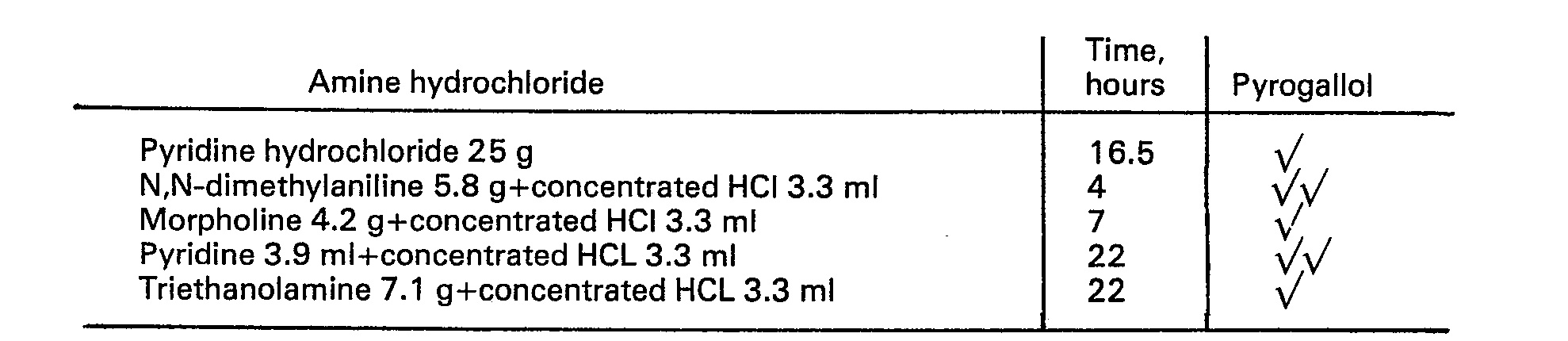
- 2.5 G of dioxime, 50 ml of water and the amounts of the amine hydrochlorides named (added as a mixture of the amine and the corresponding weight of HCL) in the table below were heated under reflux for the times shown. The reaction mixture went brown or black. TLC showed that pyrogallol was formed, il indicating a little and VV much.
- Dioxime (2.5 g), water (50 ml) and phthalic acid (3.2 g) were heated under reflux for 4-16 hours. The mixture turned brown. TLC showed that a little pyrogallol was found.
- N,N-dimethylaniline (5.8 g), water (25 ml), isobutyl methyl ketone (25 ml) and concentrated hydrochloric acid (3.3 ml) were heated under reflux for 4 hours. TLC showed that much pyrogallol was formed.
-

- These amounts of these reactants were heated under reflux for 2 hours 25 minutes. The reaction product was cooled, neutralised with sodium hydroxide or sodium bicarbonate and then continuously extracted with ether. Evaporation yielded 0.76 g of black oil. Analysis gave 41.7% pyrogallol, equivalent to a yield of 1 5.7%.
- Example 11 was repeated except that 0.5 ml instead of 25 ml of water was employed. The reflux temperature was 112°C. Pyrogallol (0.5% yield) was obtained.
- Example 11 was repeated except that 250 ml and 1250 ml instead of 25 ml of water was employed. The yield of pyrogallol was 28% and 26% respectively.
- Example 11 was repeated except that the reactants were heated at 40°C for 5 days. The yield of pyrogallol was 9.4%.
- Example 11 was repeated except that the reactants were not heated (the temperature thus remained ambient, 20°C) and the reaction mixture was neutralised after 14 days. The yield of pyrogallol was 13.7%.
- Dioxime (2 parts), pyruvic acid (6.9 parts), glacial acetic acid (21.2 parts) and water (40.5 parts) were heated under reflux for 1 t hours, cooled and neutralised with solid sodium bicarbonate. The product was then continuously extracted with diethyl ether, and the ether then evaporated off to yield a black oil (0.54 parts) containing 41.0% pyrogallol. The yield of pyrogallol was 13.7%.
- Dioxime (2.5 g), acetone (25 ml), water (25 ml) and p-toluenesulphonic acid (7.3 g) were heated under reflux for 3 hours. The reflux temperature was 69°C. The mixture was then cooled and continuously extracted with ether to yield 1.2 g of product containing 4.3% pyrogallol, equivalent to a yield of 2.6%.
- Dioxime (2.5 g), acetone (20 ml), water (20 ml) and phthalic acid (10 g) were heated under reflux, at a temperature of 73°C, for 4 hours 20 minutes. The mixture was cooled and then continuously extracted with ether. The ether extract was dried over MgS04. Evaporation then yielded 1.2 g of product containing 17.7% pyrogallol, corresponding to yield of 10.5%.
- Dioxime (2.5 g), isobutyl methyl ketone (25 g), water (25 g) and p-toluenesulphonic acid (0.25 g) were heated under reflux with stirring for 24 hours. The mixture was then cooled, neutralised with sodium bicarbonate and continuously extracted with ether. Evaporation of the ether yield 1.76 g of black oil containing 7.5% pyrogallol, corresponding to a yield of 6.5%.
- Dioxime (2.5 g) was heated under reflux with the amounts of the other materials shown in the table below for the time shown. The mixture was then brown or black. TLC showed that pyrogallol was produced, V indicating little pyrogallol and VV much pyrogallol.

- Dioxime (2.5 g) was heated under reflux with water (50 ml) and o-nitrobenzoic acid (10 g) for 5t hours. The mixture turned black. TLC showed that a small amount of pyrogallol was produced.
- Dioxime (2.5 g) was heated under reflux with isobutyl methyl ketone (25 g), water (25 g), Adogen 464-a phase transfer catalyst (0.25 g)-and p-toluenesulphonic acid (0.25 g) for 6 hours. TLC showed that pyrogallol was produced.
- Dioxime (5 g) and 2N hydrochloric acid (50 ml) was heated at 75°C for 15 minutes. Black solid was filtered off. Toluene was added to the filtrate in the proportions of 5 volumes of toluene per volume of filtrate, and heated under reflux via a Dean and Stark head for 2t hours, by which time all the water had been removed. TLC showed that the resulting tar contained pyrogallol.
- Dioxime (0.25 g) was heated with N hydrochloric acid (5 ml) on a water bath for 30 seconds. TLC showed that the product contained pyrogallol.
- Dioxime (0.25 g) was heated with 0.1 N hydrochloric acid (5 ml) on a water bath for 30 seconds. The TLC showed that the product contained pyrogallol.
- Dioxime (0.25 g) was heated with N sulphuric acid (5 ml) on a water bath for 1 hour. TLC showed that the product contained a trace of pyrogallol.
- Dioxime (0.25 g) was heated with 20% acetic acid in water (5 ml) on a water bath for 1 hour. TLC showed that the product contained pyrogallol.
- Dioxime (5 g) and water (100 ml) were heated under reflux while adding N hydrochloric acid dropwise over 2-L hours. The pH dropped gradually from 4.5 to 0. TLC showed that the product contained pyrogallol.
- Following the general procedure of Example 2 except that the initial mixture was heated at 40-60°C for 8 days, pyrogallol was produced, which was extracted by conversion to pyrogallol triacetate (0.8 part).
- Dioxime (2.5 g) was heated under reflux with water (50 ml) and 2,4-dichlorophenol (10 g) for 6 hours. TLC showed that the product contained a little pyrogallol.
- Dioxime (1 g), water (20 g) and the secondary amine hydrochloride whose amine is specified in the Table below were heated under reflux in an oil bath for the time state. The hydrochloride was formed from the weight of amine specified and 2.1 ml of concentrated hydrochloric acid (which contributed an additional 1.53 g water to the reaction). The dimethylamine was employed as its 33% solution in ethanol. The TLC showed that pyrogallol was produced. The terminal pH was measured, this is quoted in the Table. In those Examples where a yield of pyrogallol is stated, the reaction mixture was diluted with water and continuously extracted with ether, the ethereal solutions were evaporated and the yield was assessed by gas chromatographic analysis of the residue.

- Dioxime (1 g), water (20 g), the secondary or tertiary amine hydrochloride whose amine is specified in the Table below and the keto-acid specified in the Table were heated under reflux (105°C) in an oil bath for the time stated. The weights of amine used were as follows:


- TLC showed that pyrogallol was produced. The end pH is shown in the Table. The reaction mixture was diluted with water, the pH adjusted to 1, and the mixture continuously extracted with ether. The ether extracts were evaporated to give oils which were analysed for pyrogallol by gas chromatography.

- Dioxime (1 g), water (20 g), the amine specified in the Table below, the keto-acid specified and the dicarboxylic acid specified were heated under reflux in an oil bath for the time stated. The weights of the amine and acids were as follows:

- TLC showed that pyrogallol was produced. The end pH is shown in the table. Where a yield is quoted, the reaction mixture was diluted with water, the pH adjusted to 1 ( in Examples 56-69) or 6 (in Examples 70-84), the mixture continuously extracted with ether, and the ether extracts evaporated to give oils which were analysed for pyrogallol by gas chromatography.

- Dioxime (5.9 g), water (25 ml) and concentrated hydrochloric acid (15 ml) were stirred whilst a solution of sodium nitrite (10.35 g) in water (15 ml) was slowly added at between -20°C and -5°C. The addition took 0.5 hour. The solution was allowed to warm to ambient temperature (20°C). Urea was added to destroy the excess nitrite. Upon heating a small sample, pyrogallol was shown to be present by TLC.
- To a suspension of calcium oxide (2.24 g) in water (100 ml) was passed sulphur dioxide until almost all the solid has dissolved. The clear supernatant liquor was decanted. To the decanted liquor was added dioxime (2.5 g). Sulphur dioxide was then passed for 3 hours while stirring at ambient temperature (20°C). The mixture was then filtered. Upon acidification of the filtrate and boiling of a small sample, pyrogallol was shown to be present by TLC.
- To a suspension of calcium oxide (2.24 g) in water (100 ml) was passed sulphur dioxide until almost all the solid had dissolved. The clear supernatant liquor was decanted and the liquor heated to 50°C before dioxime (2.5 g) was added. Sulphur dioxide was passed through for 2 hours. A small sample of the solution was acidified and boiled; pyrogallol was shown to be present by TLC. The bulk of the solution was acidified to pH 1 with hydrochloric acid, and then refluxed for 0.5 hour. The resulting brown precipitate was filtered off. The pH of the filtrate was adjusted to 6 with 5M sodium hydroxide solution, and the mixture then continuously extracted with ether. Evaporation of the ether gave 0.56 g of a brown oil, whose analysis shown a yield of 2.8% pyrogallol.
- A slurry of calcium oxide (2.24 parts) in water (100 parts) was heated to 50°C and sulphur dioxide bubbled through until a clear solution was obtained. Pyruvic acid (4.25 parts) and dioxime (2.5 parts) were added, and sulphur dioxide bubbled through at 50°C for a further 4 hours. The reaction mixture was allowed to cool, and the solids filtered off. The pH of the filtrate was adjusted to 6.2 with 5N NaOH and then continuously extracted with diethyl ether for 6 hours. The ether extract was dried over anhydrous sodium sulphate and evaporated under vacuum to yield a dark brown oil. The yield of pyrogallol assessed by gas chromatography was 18.9%.
Claims (19)
Priority Applications (1)
| Application Number | Priority Date | Filing Date | Title |
|---|---|---|---|
| AT79302776T ATE2506T1 (en) | 1978-12-27 | 1979-12-04 | PROCESS FOR PRODUCTION OF PYROGALLOL. |
Applications Claiming Priority (2)
| Application Number | Priority Date | Filing Date | Title |
|---|---|---|---|
| GB4999678 | 1978-12-27 | ||
| GB7849996 | 1978-12-27 |
Publications (2)
| Publication Number | Publication Date |
|---|---|
| EP0013085A1 EP0013085A1 (en) | 1980-07-09 |
| EP0013085B1 true EP0013085B1 (en) | 1983-02-16 |
Family
ID=10501938
Family Applications (1)
| Application Number | Title | Priority Date | Filing Date |
|---|---|---|---|
| EP79302776A Expired EP0013085B1 (en) | 1978-12-27 | 1979-12-04 | Process for preparing pyrogallol |
Country Status (11)
| Country | Link |
|---|---|
| US (1) | US4275247A (en) |
| EP (1) | EP0013085B1 (en) |
| JP (1) | JPS5589235A (en) |
| AT (1) | ATE2506T1 (en) |
| BR (1) | BR7908517A (en) |
| CA (1) | CA1137516A (en) |
| DD (1) | DD150454A5 (en) |
| DE (1) | DE2964866D1 (en) |
| HU (1) | HU184090B (en) |
| IE (1) | IE49240B1 (en) |
| IL (1) | IL59029A (en) |
Families Citing this family (1)
| Publication number | Priority date | Publication date | Assignee | Title |
|---|---|---|---|---|
| US4515667A (en) * | 1983-07-19 | 1985-05-07 | The Standard Oil Company | Novel catalysts and processes for the photochemical decarboxylation of alpha-hydroxy carboxylic acids |
Family Cites Families (1)
| Publication number | Priority date | Publication date | Assignee | Title |
|---|---|---|---|---|
| US3717683A (en) * | 1970-01-12 | 1973-02-20 | Upjohn Co | Process for preparing hydroquinone from p-nitrosophenol |
-
1979
- 1979-12-04 DE DE7979302776T patent/DE2964866D1/en not_active Expired
- 1979-12-04 EP EP79302776A patent/EP0013085B1/en not_active Expired
- 1979-12-04 AT AT79302776T patent/ATE2506T1/en not_active IP Right Cessation
- 1979-12-21 IE IE2507/79A patent/IE49240B1/en unknown
- 1979-12-22 HU HU79FI721A patent/HU184090B/en unknown
- 1979-12-24 IL IL59029A patent/IL59029A/en unknown
- 1979-12-24 CA CA000342571A patent/CA1137516A/en not_active Expired
- 1979-12-26 JP JP16846179A patent/JPS5589235A/en active Pending
- 1979-12-26 BR BR7908517A patent/BR7908517A/en unknown
- 1979-12-27 US US06/107,615 patent/US4275247A/en not_active Expired - Lifetime
- 1979-12-27 DD DD79218167A patent/DD150454A5/en unknown
Also Published As
| Publication number | Publication date |
|---|---|
| CA1137516A (en) | 1982-12-14 |
| IL59029A (en) | 1982-08-31 |
| DD150454A5 (en) | 1981-09-02 |
| IL59029A0 (en) | 1980-03-31 |
| IE792507L (en) | 1980-06-27 |
| JPS5589235A (en) | 1980-07-05 |
| EP0013085A1 (en) | 1980-07-09 |
| BR7908517A (en) | 1980-10-07 |
| DE2964866D1 (en) | 1983-03-24 |
| US4275247A (en) | 1981-06-23 |
| HU184090B (en) | 1984-06-28 |
| ATE2506T1 (en) | 1983-03-15 |
| IE49240B1 (en) | 1985-09-04 |
Similar Documents
| Publication | Publication Date | Title |
|---|---|---|
| Baran | Method for the cleavage of osmate esters | |
| IE910538A1 (en) | New 3-hydroxy-2-cyclobuten-1-one salts, their preparation and use | |
| JPS632247B2 (en) | ||
| KR100339310B1 (en) | Chemical Intermediates Useful for Agriculture | |
| NO137891B (en) | PROCEDURES FOR THE PREPARATION OF AROMATIC HYDROXYALDEHIDS | |
| US4275247A (en) | Process for preparing an organic compound | |
| DE3821197A1 (en) | PROCESS FOR PREPARING (ALPHA), (BETA) -ENOUNDED KETONES | |
| US4233247A (en) | Process for the preparation of 2,2-dimethylolalkanals | |
| CA2200597A1 (en) | Processes for the preparation of cyclopropanecarboxylic acid and derivatives thereof | |
| US4374267A (en) | Fluorophthalamic acids and method of preparation | |
| US4264773A (en) | Preparation of 2-chloro-thioxanthone | |
| US4072722A (en) | Process for preparing dihydric phenol derivatives | |
| DE2918900A1 (en) | METHOD FOR PRODUCING 1,5-DIMETHYL-BICYCLO-ANGLE CLAMP TO 3,2,1-CORNER CLAMP FOR OCTANOL-8 AND ITS ESTER | |
| US3404166A (en) | Process for the preparation of hydroxy-alkenoic acids | |
| US4337355A (en) | Process for preparing 4-hydroxyphenylacetic acid | |
| US4132728A (en) | Preparation of nitriles | |
| EP0075237B1 (en) | Process for the preparation of 1-formyl-2,6,6-trimethyl-cyclohex-1-ene derivatives | |
| US4317781A (en) | Process for the manufacture of p-hydroxybenzyl cyanide | |
| US4412082A (en) | Method for preparing 4-hydroxyphenylacetic acid | |
| US4297181A (en) | Process for preparing ketones | |
| SU1116977A3 (en) | Method of obtaining 3,3-dimethylallyl alcohol | |
| US3038941A (en) | Process for preparing polyfluoroaldehydes | |
| US4244881A (en) | Process for preparing alpha-naphthol esters of aliphatic carboxylic acids | |
| CA1169088A (en) | Production of pyrogallol compounds | |
| CH498809A (en) | Preparation of cyanhydrins |
Legal Events
| Date | Code | Title | Description |
|---|---|---|---|
| PUAI | Public reference made under article 153(3) epc to a published international application that has entered the european phase |
Free format text: ORIGINAL CODE: 0009012 |
|
| AK | Designated contracting states |
Designated state(s): AT BE CH DE FR GB IT LU NL SE |
|
| 17P | Request for examination filed |
Effective date: 19801231 |
|
| RAP1 | Party data changed (applicant data changed or rights of an application transferred) |
Owner name: FBC LIMITED |
|
| ITF | It: translation for a ep patent filed | ||
| GRAA | (expected) grant |
Free format text: ORIGINAL CODE: 0009210 |
|
| AK | Designated contracting states |
Designated state(s): AT BE CH DE FR GB IT LU NL SE |
|
| PG25 | Lapsed in a contracting state [announced via postgrant information from national office to epo] |
Ref country code: SE Effective date: 19830216 |
|
| REF | Corresponds to: |
Ref document number: 2506 Country of ref document: AT Date of ref document: 19830315 Kind code of ref document: T |
|
| REF | Corresponds to: |
Ref document number: 2964866 Country of ref document: DE Date of ref document: 19830324 |
|
| ET | Fr: translation filed | ||
| PG25 | Lapsed in a contracting state [announced via postgrant information from national office to epo] |
Ref country code: LU Free format text: LAPSE BECAUSE OF NON-PAYMENT OF DUE FEES Effective date: 19831231 |
|
| PGFP | Annual fee paid to national office [announced via postgrant information from national office to epo] |
Ref country code: FR Payment date: 19841207 Year of fee payment: 6 |
|
| PGFP | Annual fee paid to national office [announced via postgrant information from national office to epo] |
Ref country code: DE Payment date: 19841215 Year of fee payment: 6 |
|
| PGFP | Annual fee paid to national office [announced via postgrant information from national office to epo] |
Ref country code: CH Payment date: 19841217 Year of fee payment: 6 |
|
| PGFP | Annual fee paid to national office [announced via postgrant information from national office to epo] |
Ref country code: BE Payment date: 19841231 Year of fee payment: 6 |
|
| PGFP | Annual fee paid to national office [announced via postgrant information from national office to epo] |
Ref country code: AT Payment date: 19861211 Year of fee payment: 8 |
|
| PGFP | Annual fee paid to national office [announced via postgrant information from national office to epo] |
Ref country code: NL Payment date: 19861231 Year of fee payment: 8 |
|
| BERE | Be: lapsed |
Owner name: FBC LTD Effective date: 19861231 |
|
| PG25 | Lapsed in a contracting state [announced via postgrant information from national office to epo] |
Ref country code: AT Effective date: 19871204 |
|
| PG25 | Lapsed in a contracting state [announced via postgrant information from national office to epo] |
Ref country code: CH Effective date: 19871231 Ref country code: BE Effective date: 19871231 |
|
| BERE | Be: lapsed |
Owner name: FBC LTD Effective date: 19871231 |
|
| PG25 | Lapsed in a contracting state [announced via postgrant information from national office to epo] |
Ref country code: NL Effective date: 19880701 |
|
| NLV4 | Nl: lapsed or anulled due to non-payment of the annual fee | ||
| GBPC | Gb: european patent ceased through non-payment of renewal fee | ||
| PG25 | Lapsed in a contracting state [announced via postgrant information from national office to epo] |
Ref country code: FR Free format text: LAPSE BECAUSE OF NON-PAYMENT OF DUE FEES Effective date: 19880831 |
|
| REG | Reference to a national code |
Ref country code: CH Ref legal event code: PL |
|
| PG25 | Lapsed in a contracting state [announced via postgrant information from national office to epo] |
Ref country code: DE Effective date: 19880901 |
|
| REG | Reference to a national code |
Ref country code: FR Ref legal event code: ST |
|
| PG25 | Lapsed in a contracting state [announced via postgrant information from national office to epo] |
Ref country code: GB Free format text: LAPSE BECAUSE OF NON-PAYMENT OF DUE FEES Effective date: 19881118 |
|
| PLBE | No opposition filed within time limit |
Free format text: ORIGINAL CODE: 0009261 |
|
| STAA | Information on the status of an ep patent application or granted ep patent |
Free format text: STATUS: NO OPPOSITION FILED WITHIN TIME LIMIT |