EP0012082B1 - Bouchon inviolable, à vis ou encliquetable, en une seule pièce moulée en matière thermoplastique - Google Patents
Bouchon inviolable, à vis ou encliquetable, en une seule pièce moulée en matière thermoplastique Download PDFInfo
- Publication number
- EP0012082B1 EP0012082B1 EP79400931A EP79400931A EP0012082B1 EP 0012082 B1 EP0012082 B1 EP 0012082B1 EP 79400931 A EP79400931 A EP 79400931A EP 79400931 A EP79400931 A EP 79400931A EP 0012082 B1 EP0012082 B1 EP 0012082B1
- Authority
- EP
- European Patent Office
- Prior art keywords
- tamper
- closure
- skirt
- ring
- proof
- Prior art date
- Legal status (The legal status is an assumption and is not a legal conclusion. Google has not performed a legal analysis and makes no representation as to the accuracy of the status listed.)
- Expired
Links
- 239000004033 plastic Substances 0.000 title description 5
- 229920003023 plastic Polymers 0.000 title description 5
- 239000000463 material Substances 0.000 title 1
- 238000000926 separation method Methods 0.000 claims description 5
- 230000000717 retained effect Effects 0.000 claims 1
- 239000012815 thermoplastic material Substances 0.000 claims 1
- 208000031968 Cadaver Diseases 0.000 description 2
- 240000008042 Zea mays Species 0.000 description 2
- 210000004027 cell Anatomy 0.000 description 1
- 238000002788 crimping Methods 0.000 description 1
- 230000014759 maintenance of location Effects 0.000 description 1
- 238000004519 manufacturing process Methods 0.000 description 1
- 238000012986 modification Methods 0.000 description 1
- 230000004048 modification Effects 0.000 description 1
- 239000002991 molded plastic Substances 0.000 description 1
- 230000002093 peripheral effect Effects 0.000 description 1
- 230000001681 protective effect Effects 0.000 description 1
- 238000005406 washing Methods 0.000 description 1
Images

Classifications
-
- B—PERFORMING OPERATIONS; TRANSPORTING
- B65—CONVEYING; PACKING; STORING; HANDLING THIN OR FILAMENTARY MATERIAL
- B65D—CONTAINERS FOR STORAGE OR TRANSPORT OF ARTICLES OR MATERIALS, e.g. BAGS, BARRELS, BOTTLES, BOXES, CANS, CARTONS, CRATES, DRUMS, JARS, TANKS, HOPPERS, FORWARDING CONTAINERS; ACCESSORIES, CLOSURES, OR FITTINGS THEREFOR; PACKAGING ELEMENTS; PACKAGES
- B65D41/00—Caps, e.g. crown caps or crown seals, i.e. members having parts arranged for engagement with the external periphery of a neck or wall defining a pouring opening or discharge aperture; Protective cap-like covers for closure members, e.g. decorative covers of metal foil or paper
- B65D41/32—Caps or cap-like covers with lines of weakness, tearing-strips, tags, or like opening or removal devices, e.g. to facilitate formation of pouring openings
- B65D41/34—Threaded or like caps or cap-like covers provided with tamper elements formed in, or attached to, the closure skirt
- B65D41/3442—Threaded or like caps or cap-like covers provided with tamper elements formed in, or attached to, the closure skirt with rigid bead or projections formed on the tamper element and coacting with bead or projections on the container
- B65D41/3447—Threaded or like caps or cap-like covers provided with tamper elements formed in, or attached to, the closure skirt with rigid bead or projections formed on the tamper element and coacting with bead or projections on the container the tamper element being integrally connected to the closure by means of bridges
-
- B—PERFORMING OPERATIONS; TRANSPORTING
- B65—CONVEYING; PACKING; STORING; HANDLING THIN OR FILAMENTARY MATERIAL
- B65D—CONTAINERS FOR STORAGE OR TRANSPORT OF ARTICLES OR MATERIALS, e.g. BAGS, BARRELS, BOTTLES, BOXES, CANS, CARTONS, CRATES, DRUMS, JARS, TANKS, HOPPERS, FORWARDING CONTAINERS; ACCESSORIES, CLOSURES, OR FITTINGS THEREFOR; PACKAGING ELEMENTS; PACKAGES
- B65D41/00—Caps, e.g. crown caps or crown seals, i.e. members having parts arranged for engagement with the external periphery of a neck or wall defining a pouring opening or discharge aperture; Protective cap-like covers for closure members, e.g. decorative covers of metal foil or paper
- B65D41/02—Caps or cap-like covers without lines of weakness, tearing strips, tags, or like opening or removal devices
- B65D41/04—Threaded or like caps or cap-like covers secured by rotation
- B65D41/0407—Threaded or like caps or cap-like covers secured by rotation with integral sealing means
- B65D41/0414—Threaded or like caps or cap-like covers secured by rotation with integral sealing means formed by a plug, collar, flange, rib or the like contacting the internal surface of a container neck
- B65D41/0421—Threaded or like caps or cap-like covers secured by rotation with integral sealing means formed by a plug, collar, flange, rib or the like contacting the internal surface of a container neck and combined with integral sealing means contacting other surfaces of a container neck
-
- B—PERFORMING OPERATIONS; TRANSPORTING
- B65—CONVEYING; PACKING; STORING; HANDLING THIN OR FILAMENTARY MATERIAL
- B65D—CONTAINERS FOR STORAGE OR TRANSPORT OF ARTICLES OR MATERIALS, e.g. BAGS, BARRELS, BOTTLES, BOXES, CANS, CARTONS, CRATES, DRUMS, JARS, TANKS, HOPPERS, FORWARDING CONTAINERS; ACCESSORIES, CLOSURES, OR FITTINGS THEREFOR; PACKAGING ELEMENTS; PACKAGES
- B65D41/00—Caps, e.g. crown caps or crown seals, i.e. members having parts arranged for engagement with the external periphery of a neck or wall defining a pouring opening or discharge aperture; Protective cap-like covers for closure members, e.g. decorative covers of metal foil or paper
- B65D41/32—Caps or cap-like covers with lines of weakness, tearing-strips, tags, or like opening or removal devices, e.g. to facilitate formation of pouring openings
- B65D41/34—Threaded or like caps or cap-like covers provided with tamper elements formed in, or attached to, the closure skirt
- B65D41/3423—Threaded or like caps or cap-like covers provided with tamper elements formed in, or attached to, the closure skirt with flexible tabs, or elements rotated from a non-engaging to an engaging position, formed on the tamper element or in the closure skirt
- B65D41/3428—Threaded or like caps or cap-like covers provided with tamper elements formed in, or attached to, the closure skirt with flexible tabs, or elements rotated from a non-engaging to an engaging position, formed on the tamper element or in the closure skirt the tamper element being integrally connected to the closure by means of bridges
-
- B—PERFORMING OPERATIONS; TRANSPORTING
- B65—CONVEYING; PACKING; STORING; HANDLING THIN OR FILAMENTARY MATERIAL
- B65D—CONTAINERS FOR STORAGE OR TRANSPORT OF ARTICLES OR MATERIALS, e.g. BAGS, BARRELS, BOTTLES, BOXES, CANS, CARTONS, CRATES, DRUMS, JARS, TANKS, HOPPERS, FORWARDING CONTAINERS; ACCESSORIES, CLOSURES, OR FITTINGS THEREFOR; PACKAGING ELEMENTS; PACKAGES
- B65D2401/00—Tamper-indicating means
- B65D2401/15—Tearable part of the closure
- B65D2401/30—Tamper-ring remaining connected to closure after initial removal
-
- B—PERFORMING OPERATIONS; TRANSPORTING
- B65—CONVEYING; PACKING; STORING; HANDLING THIN OR FILAMENTARY MATERIAL
- B65D—CONTAINERS FOR STORAGE OR TRANSPORT OF ARTICLES OR MATERIALS, e.g. BAGS, BARRELS, BOTTLES, BOXES, CANS, CARTONS, CRATES, DRUMS, JARS, TANKS, HOPPERS, FORWARDING CONTAINERS; ACCESSORIES, CLOSURES, OR FITTINGS THEREFOR; PACKAGING ELEMENTS; PACKAGES
- B65D2401/00—Tamper-indicating means
- B65D2401/15—Tearable part of the closure
- B65D2401/35—Vertical or axial lines of weakness
-
- B—PERFORMING OPERATIONS; TRANSPORTING
- B65—CONVEYING; PACKING; STORING; HANDLING THIN OR FILAMENTARY MATERIAL
- B65D—CONTAINERS FOR STORAGE OR TRANSPORT OF ARTICLES OR MATERIALS, e.g. BAGS, BARRELS, BOTTLES, BOXES, CANS, CARTONS, CRATES, DRUMS, JARS, TANKS, HOPPERS, FORWARDING CONTAINERS; ACCESSORIES, CLOSURES, OR FITTINGS THEREFOR; PACKAGING ELEMENTS; PACKAGES
- B65D2401/00—Tamper-indicating means
- B65D2401/15—Tearable part of the closure
- B65D2401/40—Bridges having different cross-sections
Definitions
- the invention relates to a tamper-evident, screw or snap-on stopper, made in a single piece molded from plastic, comprising a tamper-evident ring which keeps the stopper on the neck of the bottle or container to be closed and which is intended to separate from the cap body when opening the bottle or container.
- a tamper-evident plastic stopper in which inner segments connected to the tamper-evident ring provide retention by cooperating with teeth or notches carried by the neck of the container for maintain inviolability during uncorking.
- Such a stopper has the drawback of being able to be used only with receptacles whose neck has suitable notches or teeth.
- the object of the invention is to propose a screw or snap-on plug made of molded plastic which does not have the drawbacks of the plugs mentioned above, which is provided with a tamper-evident ring which is completely molded, which can be easily removed from the mold. without risk of separating the tamper-evident ring from the body of the stopper, which allows it to be mounted on the neck of a conventional bottle, avoiding any crimping or shrinking of part of the stopper under the counter-ring of the neck of the bottle after mounting of the stopper, and which effectively undergoes the separation or the rupture of the tamper-evident ring when uncorking.
- the tamper-evident ring consists, in accordance with the present invention, of an outer skirt provided with two or more inner segments which are connected to the skirt by their ends oriented with respect to the direction radial at an obliquity in a certain direction so that these segments fold up along the internal surface of the skirt during demolding as well as when the cap is mounted on the neck of the bottle or container and then return to their position initial slightly moved away from the skirt of the ring inwards when this ring has crossed the counter-ring of the bottle or container.
- the inner segments abut on the counter-ring of the container which therefore retains the tamper-evident ring by imposing its separation or rupture at points of least resistance provided for the manufacture of the stopper.
- the cap is a plastic screw cap for bottles.
- This stopper molded in one piece, comprises a top 1 from which descends an internal tube 2 intended to penetrate in a sealed manner inside the bottle neck and a skirt 3 with internal screw threads intended to be screwed onto the thread.
- outside of the bottle provided above a counter-ring which has a larger outside diameter than the part of the bottle neck situated below this counter-ring.
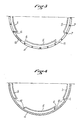
- the stopper comprises, at the base of its peripheral skirt 3, a tamper-evident ring composed of an outer skirt 4 and inner segments 5 slightly spaced from the skirt 4 to which each of these segments is connected by its two oriented ends 6 obliquely in a certain direction relative to the radial direction as shown in Figures 2 to 4.
- the skirt 4 of the tamper-evident ring is connected to the base of the skirt 3 of the stopper body by a series of narrow bars 7 constituting fasteners of low resistance intended to break when uncorked.
- the outer profile 8 of the counter-ring of a bottle corked by the stopper shown is shown diagrammatically in dashed lines, and it can be seen that the inner segments 5 of the tamper-evident ring have been placed, at the end of the stopper assembly operation, below the base 9 of the counter-ring 8. Thanks to the obliquity of the ends 6 , the inner segments 5 can fold against the inner surface of the skirt 4 of the tamper-evident ring by facilitating demolding.
- the inner segments 5 also fold against the skirt 4 of the tamper-evident ring to cross the counter-ring 8, after which they return to their initial position relative to the skirt by placing themselves under the base 9 of the counter-ring as shown in FIG. 1.
- these segments abut against the shoulder formed by the base 9 of the counter-ring 8, because they cannot fold back because of the obliquity of their ends 6 and the profile of the bottle counter-ring.
- the unscrewing of the cap exerts on the bars 7 a strong traction causing their rupture and the body of the cap separates from the tamper-evident ring which remains on the bottle.
- a resistant connection can be provided between the skirts 3 and 4, even on their entire periphery, while points of low resistance are provided at 12 at each of the ends 6 of the interior segments 5, as shown in FIG. 4.
- the segments 5 then separate from the skirt 4 of the ring by breaking the points 12, while the skirt 4 of the ring remains integral with the body of the stopper and emerges from the neck of the bottle, this ring being provided outside the profile of the neck of the bottle.
Landscapes
- Engineering & Computer Science (AREA)
- Mechanical Engineering (AREA)
- Closures For Containers (AREA)
Description
- L'invention concerne un bouchon inviolable, à vis ou encliquetable, réalisé en une seule pièce moulée en matière plastique, comprenant un anneau d'inviolabilité qui assure le maintien du bouchon sur le col de la bouteille ou du récipient à obturer et qui est destiné à se séparer du corps du bouchon lors de l'ouverture de la bouteille ou du récipient.
- Actuellement il est très difficile, sinon impossible, d'obtenir pour le bouchage de bouteilles ou autres récipients un bouchon en matière plastique en une seule pièca qui soit muni d'un anneau d'inviolabilité, qui puisse se démouler correctement et qui permette d'obtenir, à l'ouverture d'une bouteille ou d'un récipient bouché par un tel bouchon, une séparation ou une rupture efficace de l'anneau d'inviolabilité.
- On a déjà proposé, selon DE-A-2 150 709, un bouchon inviolable en matière plastique dans lequel des segments intérieurs reliés à l'anneau d'inviolabilité assurent la retenue en coopérant avec des dents ou crans portés par le col du récipient pour maintenir l'inviolabilité lors du débouchage. Un tel bouchon présente l'inconvénient de ne pouvoir être utilisé qu'avec des récipients dont le col présente des crans ou dents appropriés.
- On a également proposé, selon la demande de brevet français n° 7 210 928. publiée sous le n° 2 176 620, un bouchon pour récipients dans lequel des segments de verrouillage s'engagent sous une bride annulaire du col du récipient pour assurer l'inviolabilité. Outre qu'un tel boûchon ne convient qu'à une forme très particulière de col de récipient et n'est pas adapté au bouchage de bouteilles à col de type classique, on doit aussi relever que les segments de verrouillage sont reliés au corps du bouchon par des liaisons fragiles et non à un anneau d'inviolabilité, en nécessitant ainsi la présence d'une jupe extérieure de protection.
- L'invention a pour but de proposer un bouchon à vis ou encliquetable en matière plastique moulée qui ne présente pas les inconvénients des bouchons mentionnés ci-dessus, qui soit muni d'un anneau d'inviolabilité venu complètement de moulage, qui soit facilement démoulable sans risque de séparer l'anneau d'inviolabilité du corps du bouchon, qui permette son montage sur le col d'une bouteille classique en évitant tout sertissage ou rétreint d'une partie du bouchon sous la contre-bague du col de bouteille après montage du bouchon, et qui subisse efficacement la séparation ou la rupture de l'anneau d'inviolabilité lors du débouchage.
- Pour l'obtention de ce résultat, l'anneau d'inviolabilité se compose, conformément à la présente invention, d'une jupe extérieure munie de deux ou plusieurs segments intérieurs qui sont reliés à la jupe par leurs extrémités orientées par rapport à la direction radiale selon une obliquité dans un certain sens de façon que ces segments se replient le long de la surface interne de la jupe pendant le démoulage ainsi qu'au moment du montage du bouchon sur le col de la bouteille ou du récipient pour reprendre ensuite leur position initiale légèrement écartée de la jupe de l'anneau vers l'intérieur quand cet anneau a franchi la contre-bague de la bouteille ou du récipient. Ainsi, au débouchage, les segments intérieurs viennent buter sur la contre-bague du récipient qui retient donc l'anneau d'inviolabilité en imposant sa séparation ou sa rupture en des points de moindre résistance prévus à la fabrication du bouchon.
- Pour bien faire comprendre l'invention, on en décrira ci-après des exemples d'exécution en référence au dessin annexé dans lequel :
- la figure 1 est une vue d'un exemple de bouchon selon l'invention représenté en coupe axiale dans sa moitié de gauche et en élévation dans sa moitié de droite ;
- la figure 2 est une demi-coupe transversale du bouchon selon la ligne II-II de la figure 1 ;
- la figure 3 est une demi-coupe analogue à celle de la figure 2, mais montrant une variante pour l'obtention de la rupture de la jupe de l'anneau d'inviolabilité au débouchage au lieu de sa séparation du corps de bouchon ; et
- la figure 4 est une demi-coupe analogue à celles des figures 2 et 3, mais montrant une autre variante pour l'obtention de la rupture des segments intérieurs de l'anneau d'inviolabilité sans que la jupe de cet anneau se sépare du corps du bouchon ou se rompe.
- Dans l'exemple d'exécution représenté aux figures 1 et 2, le bouchon est un bouchon à vis en matière plastique pour bouteilles. Ce bouchon, moulé en une pièce, comprend un dessus 1 d'où descend une tubulure intérieure 2 destinée à pénétrer de façon étanche à l'intérieur du col de bouteille et une jupe 3 à filets de vis intérieurs destinés à se visser sur le filetage extérieur de la bouteille, prévu au-dessus d'une contre-bague qui présente un diamètre extérieur plus grand que la partie du col de bouteille située au-dessous de cette contre-bague.
- Le bouchon comprend, à la base de sa jupe périphérique 3, un anneau d'inviolabilité composé d'une jupe extérieure 4 et de segments intérieurs 5 légèrement écartés de la jupe 4 à laquelle chacun de ces segments est relié par ses deux extrémités 6 orientées obliquement dans un certain sens par rapport à la direction radiale comme on l'a représenté sur les figures 2 à 4. Dans le cas de la figure 2, la jupe 4 de l'anneau d'inviolabilité est reliée à la base de la jupe 3 du corps de bouchon par une série de barrettes étroites 7 constituant des attaches de faible résistance destinées à se rompre au débouchage.
- Sur la moitié de gauche de la figure 1, on a indiqué schématiquement en trait mixte le profil extérieur 8 de la contre-bague d'une bouteille bouchée par le bouchon représenté et on voit que les segments intérieurs 5 de l'anneau d'inviolabilité sont venus se placer, à la fin de l'opération de montage du bouchon, au-dessous de la base 9 de la contre-bague 8. Grâce à l'obliquité des extrémités 6, les segments intérieurs 5 peuvent se replier contre la surface interne de la jupe 4 de l'anneau d'inviolabilité en facilitant le démoulage.
- On comprend que, lors du vissage du bouchon sur la bouteille au cours de l'opération de bouchage, les segments intérieurs 5 se replient aussi contre la jupe 4 de l'anneau d'inviolabilité pour franchir la contre-bague 8, après quoi ils reviennent à leur position initiale par rapport à la jupe en se plaçant sous la base 9 de la contre-bague comme on l'a représenté sur la figure 1. Au débouchage, ces segments viennent buter contre l'épaulement formé par la base 9 de la contre-bague 8, car ils ne peuvent se replier à cause du sens de l'obliquité de leurs extrémités 6 et du profil de la contre-bague de bouteille. Dans ces conditions, le dévissage du bouchon exerce sur les barrettes 7 une forte traction provoquant leur rupture et le corps du bouchon se sépare de l'anneau d'inviolabilité qui reste sur la bouteille.
- Dans le cas où on désire éviter la nécessité de l'enlèvement de l'anneau d'inviolabilité lors du lavage de bouteilles à réutiliser, on peut prévoir en 10 (figure 3) une large patte de liaison à forte résistance entre la jupe 3 du corps du bouchon et la jupe 4 de l'anneau d'inviolabilité, tandis que cette jupe présente sur son pourtour en 11 un point de moindre résistance permettant la coupure en ce point de l'anneau d'inviolabilité dont les deux parties situées de part et d'autre de la patte résistante 10 peuvent ainsi s'écarter vers l'extérieur pour dégager le col de bouteille en accompagnant au débouchage la montée du bouchon.
- Selon une autre variante, représentée sur la figure 4 et permettant d'enlever l'anneau d'inviolabilité du col de la bouteille sans couper la jupe 4 de cet anneau, on peut prévoir une liaison résistante entre les jupes 3 et 4, même sur tout leur pourtour, tandis que des points de faible résistance sont prévus en 12 à chacune des extrémités 6 des segments intérieurs 5, comme on l'a représenté sur la figure 4. Au débouchage, les segments 5 se séparent alors de la jupe 4 de l'anneau par rupture des points 12, tandis que la jupe 4 de l'anneau reste solidaire du corps du bouchon et se dégage du col de la bouteille, cet anneau étant prévu à l'extérieur du profil du col de la bouteille.
- Pour pouvoir vérifier que le bouchage n'a pas été violé, on peut prévoir, sur la jupe 4 de l'anneau, des ouvertures permettant de contrôler la présence des parties intactes de faible résistance.
- On comprendra que les exemples d'exécution plus particulièrement décrits ci-dessus et représentés au dessin annexé n'ont aucun caractère limitatif et qu'on pourra prévoir diverses modifications constructives sans s'écarter du cadre de l'invention dont les caractéristiques sont définies par les revendications annexées.
Claims (4)
Applications Claiming Priority (2)
| Application Number | Priority Date | Filing Date | Title |
|---|---|---|---|
| FR7833943 | 1978-12-01 | ||
| FR7833943A FR2442778A1 (fr) | 1978-12-01 | 1978-12-01 | Bouchon inviolable, a vis ou encliquetable, en une seule piece moulee en matiere thermoplastique |
Publications (2)
| Publication Number | Publication Date |
|---|---|
| EP0012082A1 EP0012082A1 (fr) | 1980-06-11 |
| EP0012082B1 true EP0012082B1 (fr) | 1982-06-30 |
Family
ID=9215591
Family Applications (1)
| Application Number | Title | Priority Date | Filing Date |
|---|---|---|---|
| EP79400931A Expired EP0012082B1 (fr) | 1978-12-01 | 1979-11-29 | Bouchon inviolable, à vis ou encliquetable, en une seule pièce moulée en matière thermoplastique |
Country Status (4)
| Country | Link |
|---|---|
| EP (1) | EP0012082B1 (fr) |
| BE (1) | BE874858A (fr) |
| DE (1) | DE2963276D1 (fr) |
| FR (1) | FR2442778A1 (fr) |
Cited By (1)
| Publication number | Priority date | Publication date | Assignee | Title |
|---|---|---|---|---|
| US11059633B2 (en) | 2019-10-31 | 2021-07-13 | Cheer Pack North America | Flip-top closure for container |
Families Citing this family (4)
| Publication number | Priority date | Publication date | Assignee | Title |
|---|---|---|---|---|
| DE3323487A1 (de) * | 1983-06-30 | 1985-01-03 | Alcoa Deutschland Gmbh Verpackungswerke, 6520 Worms | Verschlusskappe fuer einen behaelterhals mit gegenring aus einem formteil aus thermoplastischem material mit einem kontrollring sowie verfahren zu dessen herstellung und verfahren zum verschliessen eines behaelterhalses mit einer solchen verschlusskappe |
| US4709824A (en) * | 1985-12-12 | 1987-12-01 | Tri-Tech Systems International Inc. | Tamper evident plastic caps with lower separable or breakaway portions and a method of forming them |
| GB8705040D0 (en) * | 1987-03-04 | 1987-04-08 | Cope Allman Plastics Ltd | Tamper-evident closures |
| ATE77327T1 (de) * | 1988-05-16 | 1992-07-15 | Crown Cork Ag | Verschlusskappe aus kunststoffmaterial. |
Family Cites Families (3)
| Publication number | Priority date | Publication date | Assignee | Title |
|---|---|---|---|---|
| FR2077685B1 (fr) * | 1970-02-05 | 1974-03-15 | Bouchon Couronne | |
| DE2150709A1 (de) * | 1971-10-12 | 1973-04-19 | Hans Heinlein | Verschlusskappe mit originalitaetssicherung und sicherung gegen unbefugtes oeffnen durch kinder |
| FR2176620B1 (fr) * | 1972-03-22 | 1976-08-06 | Chandrakant Somabhal Pat |
-
1978
- 1978-12-01 FR FR7833943A patent/FR2442778A1/fr active Granted
-
1979
- 1979-03-15 BE BE0/194031A patent/BE874858A/fr not_active IP Right Cessation
- 1979-11-29 DE DE7979400931T patent/DE2963276D1/de not_active Expired
- 1979-11-29 EP EP79400931A patent/EP0012082B1/fr not_active Expired
Cited By (1)
| Publication number | Priority date | Publication date | Assignee | Title |
|---|---|---|---|---|
| US11059633B2 (en) | 2019-10-31 | 2021-07-13 | Cheer Pack North America | Flip-top closure for container |
Also Published As
| Publication number | Publication date |
|---|---|
| FR2442778B1 (fr) | 1982-02-12 |
| DE2963276D1 (en) | 1982-08-19 |
| BE874858A (fr) | 1979-07-02 |
| EP0012082A1 (fr) | 1980-06-11 |
| FR2442778A1 (fr) | 1980-06-27 |
Similar Documents
| Publication | Publication Date | Title |
|---|---|---|
| EP0107680B1 (fr) | Capsule de bouchage a vis, en plastique, a bande d'inviolabilite perfectionnee | |
| EP0004500B1 (fr) | Bouchon inviolable en matière plastique et moule pour sa fabrication | |
| FR2499519A1 (fr) | Capsule de bouchage a vis avec anneau d'inviolabilite | |
| EP0682624B1 (fr) | Capsule de bouchage a vis avec bande de garantie | |
| EP0261037A2 (fr) | Moyens de fermeture inviolable d'un récipient à col fileté | |
| EP0251123B1 (fr) | Ensemble verseur et capsule de bouchage inviolable | |
| CA2148781A1 (fr) | Capsule de bouchage pour un recipient ayant un col a collerette d'accrochage unique | |
| FR2527558A1 (fr) | Bouchon de securite, notamment pour bouteille | |
| EP0685406A1 (fr) | Capsule de bouchage inviolable à verseur | |
| FR2482565A1 (fr) | Element de fermeture inviolable en matiere plastique moulee pour des recipients | |
| EP0873842A2 (fr) | Moule pour former des bouchons à languettes retournées ainsi que bouchon formé dans un tel moule | |
| CA2151892A1 (fr) | Capsule de bouchage en matiere plastique moulee pour la fermeture de recipients a goulot | |
| EP0012082A1 (fr) | Bouchon inviolable, à vis ou encliquetable, en une seule pièce moulée en matière thermoplastique | |
| EP0355235B1 (fr) | Moule utilisé pour la fabrication d'un bouchon à vis à ceinture d'inviolabilité, du type démoulé par dévissage | |
| CH419876A (fr) | Capsule de fermeture du type serti pour bouteilles et autres récipients munis d'un col | |
| FR2565208A1 (fr) | Ensemble verseur et capsule de bouchage inviolable | |
| WO2000035767A1 (fr) | Bouchon du type pousser-tirer comprenant une double inviolabilite | |
| FR2701248A1 (fr) | Dispositif de bouchage pour récipient, son procédé de fabrication et récipient équipé d'un tel dispositif. | |
| EP0794129A1 (fr) | Dispositif de bouchage pour un récipient tel qu'en particulier un flacon à usage médical | |
| EP0667298A1 (fr) | Bouchon surmoulé | |
| EP3288846B1 (fr) | Bouchon pour un col de récipient | |
| FR2707958A1 (fr) | Capsule distributrice en matière plastique pour flacon, tube ou analogue, munie d'un dispositif d'inviolabilité. | |
| EP0037771B1 (fr) | Capsule déchirable en matière plastique | |
| FR2687378A1 (fr) | Fermeture de securite enfant, pour recipients. | |
| FR2477507A1 (fr) | Capsule de securite moulee en une seule piece, pour bouchage de flacons ou de corps creux |
Legal Events
| Date | Code | Title | Description |
|---|---|---|---|
| PUAI | Public reference made under article 153(3) epc to a published international application that has entered the european phase |
Free format text: ORIGINAL CODE: 0009012 |
|
| AK | Designated contracting states |
Designated state(s): CH DE GB IT LU NL |
|
| ITCL | It: translation for ep claims filed |
Representative=s name: FIAMMENGHI FIAMMENGHI RACHELI |
|
| 17P | Request for examination filed |
Effective date: 19801013 |
|
| DET | De: translation of patent claims | ||
| ITF | It: translation for a ep patent filed | ||
| GRAA | (expected) grant |
Free format text: ORIGINAL CODE: 0009210 |
|
| AK | Designated contracting states |
Designated state(s): CH DE GB IT LU NL |
|
| DB1 | Publication of patent cancelled | ||
| PUAC | Information related to the publication of a b1 document modified or deleted |
Free format text: ORIGINAL CODE: 0009299EPPU |
|
| REF | Corresponds to: |
Ref document number: 2963276 Country of ref document: DE Date of ref document: 19820819 |
|
| AK | Designated contracting states |
Designated state(s): CH DE GB IT LU NL |
|
| RB1 | B1 document published (corrected) |
Effective date: 19820922 |
|
| PGFP | Annual fee paid to national office [announced via postgrant information from national office to epo] |
Ref country code: LU Payment date: 19821124 Year of fee payment: 4 |
|
| PG25 | Lapsed in a contracting state [announced via postgrant information from national office to epo] |
Ref country code: LU Free format text: LAPSE BECAUSE OF NON-PAYMENT OF DUE FEES Effective date: 19821130 |
|
| PGFP | Annual fee paid to national office [announced via postgrant information from national office to epo] |
Ref country code: NL Payment date: 19821130 Year of fee payment: 4 |
|
| PGFP | Annual fee paid to national office [announced via postgrant information from national office to epo] |
Ref country code: DE Payment date: 19821231 Year of fee payment: 4 Ref country code: CH Payment date: 19821231 Year of fee payment: 4 |
|
| RAP2 | Party data changed (patent owner data changed or rights of a patent transferred) |
Owner name: NOVEMBAL S.A. |
|
| PG25 | Lapsed in a contracting state [announced via postgrant information from national office to epo] |
Ref country code: CH Effective date: 19831130 |
|
| PG25 | Lapsed in a contracting state [announced via postgrant information from national office to epo] |
Ref country code: NL Effective date: 19840601 |
|
| GBPC | Gb: european patent ceased through non-payment of renewal fee | ||
| NLV4 | Nl: lapsed or anulled due to non-payment of the annual fee | ||
| REG | Reference to a national code |
Ref country code: CH Ref legal event code: PL |
|
| PG25 | Lapsed in a contracting state [announced via postgrant information from national office to epo] |
Ref country code: DE Effective date: 19841201 |
|
| PG25 | Lapsed in a contracting state [announced via postgrant information from national office to epo] |
Ref country code: GB Effective date: 19881118 |
|
| PLBE | No opposition filed within time limit |
Free format text: ORIGINAL CODE: 0009261 |
|
| STAA | Information on the status of an ep patent application or granted ep patent |
Free format text: STATUS: NO OPPOSITION FILED WITHIN TIME LIMIT |