EP0011355B1 - Method for controlling the thickness or weight of extruded stock - Google Patents
Method for controlling the thickness or weight of extruded stock Download PDFInfo
- Publication number
- EP0011355B1 EP0011355B1 EP79301621A EP79301621A EP0011355B1 EP 0011355 B1 EP0011355 B1 EP 0011355B1 EP 79301621 A EP79301621 A EP 79301621A EP 79301621 A EP79301621 A EP 79301621A EP 0011355 B1 EP0011355 B1 EP 0011355B1
- Authority
- EP
- European Patent Office
- Prior art keywords
- conveyor belt
- extrusion
- weight
- speed
- weigh
- Prior art date
- Legal status (The legal status is an assumption and is not a legal conclusion. Google has not performed a legal analysis and makes no representation as to the accuracy of the status listed.)
- Expired
Links
Images
Classifications
-
- G—PHYSICS
- G01—MEASURING; TESTING
- G01G—WEIGHING
- G01G11/00—Apparatus for weighing a continuous stream of material during flow; Conveyor belt weighers
- G01G11/08—Apparatus for weighing a continuous stream of material during flow; Conveyor belt weighers having means for controlling the rate of feed or discharge
- G01G11/12—Apparatus for weighing a continuous stream of material during flow; Conveyor belt weighers having means for controlling the rate of feed or discharge by controlling the speed of the belt
-
- B—PERFORMING OPERATIONS; TRANSPORTING
- B29—WORKING OF PLASTICS; WORKING OF SUBSTANCES IN A PLASTIC STATE IN GENERAL
- B29C—SHAPING OR JOINING OF PLASTICS; SHAPING OF MATERIAL IN A PLASTIC STATE, NOT OTHERWISE PROVIDED FOR; AFTER-TREATMENT OF THE SHAPED PRODUCTS, e.g. REPAIRING
- B29C48/00—Extrusion moulding, i.e. expressing the moulding material through a die or nozzle which imparts the desired form; Apparatus therefor
- B29C48/25—Component parts, details or accessories; Auxiliary operations
- B29C48/92—Measuring, controlling or regulating
-
- B—PERFORMING OPERATIONS; TRANSPORTING
- B29—WORKING OF PLASTICS; WORKING OF SUBSTANCES IN A PLASTIC STATE IN GENERAL
- B29D—PRODUCING PARTICULAR ARTICLES FROM PLASTICS OR FROM SUBSTANCES IN A PLASTIC STATE
- B29D30/00—Producing pneumatic or solid tyres or parts thereof
- B29D30/06—Pneumatic tyres or parts thereof (e.g. produced by casting, moulding, compression moulding, injection moulding, centrifugal casting)
- B29D30/52—Unvulcanised treads, e.g. on used tyres; Retreading
-
- G—PHYSICS
- G05—CONTROLLING; REGULATING
- G05D—SYSTEMS FOR CONTROLLING OR REGULATING NON-ELECTRIC VARIABLES
- G05D5/00—Control of dimensions of material
- G05D5/02—Control of dimensions of material of thickness, e.g. of rolled material
- G05D5/03—Control of dimensions of material of thickness, e.g. of rolled material characterised by the use of electric means
-
- B—PERFORMING OPERATIONS; TRANSPORTING
- B29—WORKING OF PLASTICS; WORKING OF SUBSTANCES IN A PLASTIC STATE IN GENERAL
- B29C—SHAPING OR JOINING OF PLASTICS; SHAPING OF MATERIAL IN A PLASTIC STATE, NOT OTHERWISE PROVIDED FOR; AFTER-TREATMENT OF THE SHAPED PRODUCTS, e.g. REPAIRING
- B29C37/00—Component parts, details, accessories or auxiliary operations, not covered by group B29C33/00 or B29C35/00
- B29C2037/90—Measuring, controlling or regulating
-
- B—PERFORMING OPERATIONS; TRANSPORTING
- B29—WORKING OF PLASTICS; WORKING OF SUBSTANCES IN A PLASTIC STATE IN GENERAL
- B29C—SHAPING OR JOINING OF PLASTICS; SHAPING OF MATERIAL IN A PLASTIC STATE, NOT OTHERWISE PROVIDED FOR; AFTER-TREATMENT OF THE SHAPED PRODUCTS, e.g. REPAIRING
- B29C2948/00—Indexing scheme relating to extrusion moulding
- B29C2948/92—Measuring, controlling or regulating
- B29C2948/92504—Controlled parameter
- B29C2948/9258—Velocity
-
- B—PERFORMING OPERATIONS; TRANSPORTING
- B29—WORKING OF PLASTICS; WORKING OF SUBSTANCES IN A PLASTIC STATE IN GENERAL
- B29C—SHAPING OR JOINING OF PLASTICS; SHAPING OF MATERIAL IN A PLASTIC STATE, NOT OTHERWISE PROVIDED FOR; AFTER-TREATMENT OF THE SHAPED PRODUCTS, e.g. REPAIRING
- B29C2948/00—Indexing scheme relating to extrusion moulding
- B29C2948/92—Measuring, controlling or regulating
- B29C2948/92504—Controlled parameter
- B29C2948/92609—Dimensions
- B29C2948/92647—Thickness
-
- B—PERFORMING OPERATIONS; TRANSPORTING
- B29—WORKING OF PLASTICS; WORKING OF SUBSTANCES IN A PLASTIC STATE IN GENERAL
- B29C—SHAPING OR JOINING OF PLASTICS; SHAPING OF MATERIAL IN A PLASTIC STATE, NOT OTHERWISE PROVIDED FOR; AFTER-TREATMENT OF THE SHAPED PRODUCTS, e.g. REPAIRING
- B29C2948/00—Indexing scheme relating to extrusion moulding
- B29C2948/92—Measuring, controlling or regulating
- B29C2948/92504—Controlled parameter
- B29C2948/92676—Weight
-
- B—PERFORMING OPERATIONS; TRANSPORTING
- B29—WORKING OF PLASTICS; WORKING OF SUBSTANCES IN A PLASTIC STATE IN GENERAL
- B29C—SHAPING OR JOINING OF PLASTICS; SHAPING OF MATERIAL IN A PLASTIC STATE, NOT OTHERWISE PROVIDED FOR; AFTER-TREATMENT OF THE SHAPED PRODUCTS, e.g. REPAIRING
- B29C2948/00—Indexing scheme relating to extrusion moulding
- B29C2948/92—Measuring, controlling or regulating
- B29C2948/92819—Location or phase of control
- B29C2948/92933—Conveying, transporting or storage of articles
-
- B—PERFORMING OPERATIONS; TRANSPORTING
- B29—WORKING OF PLASTICS; WORKING OF SUBSTANCES IN A PLASTIC STATE IN GENERAL
- B29C—SHAPING OR JOINING OF PLASTICS; SHAPING OF MATERIAL IN A PLASTIC STATE, NOT OTHERWISE PROVIDED FOR; AFTER-TREATMENT OF THE SHAPED PRODUCTS, e.g. REPAIRING
- B29C2948/00—Indexing scheme relating to extrusion moulding
- B29C2948/92—Measuring, controlling or regulating
- B29C2948/92819—Location or phase of control
- B29C2948/92942—Moulded article
-
- B—PERFORMING OPERATIONS; TRANSPORTING
- B29—WORKING OF PLASTICS; WORKING OF SUBSTANCES IN A PLASTIC STATE IN GENERAL
- B29C—SHAPING OR JOINING OF PLASTICS; SHAPING OF MATERIAL IN A PLASTIC STATE, NOT OTHERWISE PROVIDED FOR; AFTER-TREATMENT OF THE SHAPED PRODUCTS, e.g. REPAIRING
- B29C48/00—Extrusion moulding, i.e. expressing the moulding material through a die or nozzle which imparts the desired form; Apparatus therefor
- B29C48/03—Extrusion moulding, i.e. expressing the moulding material through a die or nozzle which imparts the desired form; Apparatus therefor characterised by the shape of the extruded material at extrusion
- B29C48/07—Flat, e.g. panels
-
- B—PERFORMING OPERATIONS; TRANSPORTING
- B29—WORKING OF PLASTICS; WORKING OF SUBSTANCES IN A PLASTIC STATE IN GENERAL
- B29L—INDEXING SCHEME ASSOCIATED WITH SUBCLASS B29C, RELATING TO PARTICULAR ARTICLES
- B29L2030/00—Pneumatic or solid tyres or parts thereof
- B29L2030/002—Treads
Definitions
- This invention generally relates to process control and more specifically to a method for accurately and automatically maintaining the desired weight or thickness of a continuously extruded elastomer that may be applied as tread stock in the manufacture of vehicle tires.
- the elastomeric stock used for tire treads is extruded in a continuous sheet form of the desired width, cooled, and cut to the required length for a particular tire circumference.
- the thickness of tread stock has heretofore been controlled by monitoring the weight of the extruded material since its weight is directly related to the material thickness.
- Monitoring of the extrusion is accomplished by comparing the weight of a running length of continuous extrusion as it passes over a running-weight-scale (hereinafter referred to as the RWS) to the weight of a cut length of the material taken at a check weight scale (hereinafter referred to as the CWS) after the extrusion is cooled and skived.
- the tread stock specification is established at the CWS with the RWS providing a means for making a first approximation inasmuch as the RWS and CWS are at separate locations in-the process.
- the desired value of CWS can be translated into a desired value of RWS.
- the desired value of RWS is the target value of RWS.
- a method for the control of the thickness of extruded stock is disclosed in U.S. Patent #4,088,721.
- the RWS is continuously compared with the CWS to obtain a targeted average.
- the measured RWS is compared to the targeted average to obtain a control signal.
- the control signal is used to increase or decrease the speed of a take-away conveyor belt, positioned at the exit orifice of the extruder. If, for example, the measured RWS is too high compared to the targeted RWS, the speed of the take-away conveyor belt is increased to stretch the extrusion. This will result in a thinner tread stock.
- the take-away belt may be slowed down with the result being a thicker extrusion.
- U.S. Patent Specification No. 2,726,922 discloses a control system for a series of conveyors used in conveying extruded rubber tread stock from an extruder to a severing mechanism. Weight control is achieved by varying the speed of all of the conveyors in relation to the extruder output whilst individual conveyor speeds are adjusted to maintain the desired tension in the material.
- U.S. Patent Specification No. 4,097,566 shows a control system in an extrusion line for producing rubber tire treads for controlling the conveyors carrying the tread for the purpose of maintaining constant tension in the tread between conveyors.
- the present invention provides in a process an extruder for producing a continuous sheet length of elastomeric extrusion, a first variable speed take-away conveyor belt to convey the extrusion as it exits the extruder, a running-weight-scale to measure the weight per unit length of the continuous extrusion, and a second variable speed conveyor belt for varying the thickness or weight of the extrusion after leaving the first conveyor belt; a method of controlling the thickness or weight of the extruded elastomer comprising the steps of: measuring the weight value of the extrusion at the running-weigh-scale; comparing a targeted running-weigh-scale value to said measured value to obtain a control signal; controlling the speeds of both the first conveyor belt and the second conveyor belt and adjusting the difference in speed between said first conveyor belt and said second conveyor belt in response to said control signal so that if the measured running-weigh-scale value is too high compared to the target running-weigh-scale value the speed of the second conveyor is increased.
- a process line for extruding elastomeric. material is generally indicated by reference numeral 10.
- the line 10 conventionally comprises an extruder 12 for producing a. sheet of elastomeric extrusion 14 that is carried away by a first variable speed conveyor 16 being driven by a first motor 18.
- the first variable speed conveyor 16 is generally referred to as a "take-away belt” and its purpose is to control elongation of the extrusion according to the take-away speed of the belt.
- the extrusion 14 is carried across a second variable speed conveyor 17.
- the second conveyor 17 is driven by a second motor 19, which conveys the extrusion 14 after leaving the first conveyor 16.
- the extrusion 14 is also carried across a running-weigh-scale (RWS) 20 to provide a measure of the weight per-unit-length . of a typical section of the continuous extrusion as it passes thereover.
- RWS 20 is directly at or near the second conveyor 17.
- the extrusion passes through a cooling train 22 to establish a "set" in the material so that it may be handled further by a skiver 24 that cuts the extrusion into a suitable length for production use.
- the extrusion will be the tread portion of a tire and it is, therefore, cut to the desired tire circumference.
- the line 10 Upon leaving the skiver the cut tread sections are weighed at a check-weigh-scale (CWS) 26 to make certain that all treads are within a weight specification since the weight is directly related to the thickness of the extrusion.
- the line 10 also comprises a target RWS value.
- the target RWS value may be a value decided by the operator of the line 10 based upon his experience.
- the target RWS value may also be a value derived from the CWS 26.
- Cut tread sections, weighed at CWS 26, are sampled at 32. Select samples of CWS 26 are used to establish target RWS. One way is to sample CWS 26 until the desired weight, and therefore thickness, is obtained. The measured value of RWS 34 for that sample of CWS 26 is then used to establish the target RWS.
- the extrusion 14 is measured at RWS 20.
- the measured value of RWS 34 is entered into a comparator 36.
- the target value of RWS is also entered into comparator 36.
- the comparator 36 compares the measured value of RWS 34 to the target value of RWS; where there is a difference, a control signal 38 results.
- the control signal 38 is entered into the speed controller 40.
- the speed controller 40 adjusts the difference in speed between the first motor 18 and the second motor 19. For example, if the measured RWS 34 is too high compared to the target RWS (indicating that the extrusion 14 is too thick) then the comparator 36 sends a control signal 38 to speed controller 40 to speed up the second motor 19 in relationship to the first motor 18. This will have the effect of stretching the extrusion 14. Conversely, slowing down the second motor 19 in relationship to the first motor 18 will have the effect of making thicker extrusion 14 with a resultant increase in the value of measured RWS 34.
- the control signal 38 can also be used in the rate controller 42.
- the rate controller 42 controls the rate of extrusion of the extruder 12 and the speed of the first motor 18.
- the rate controller 42 can be used as a further refinement to the control of line 10. For example, if the measured value of RWS 34 is still high relative to the target value of RWS (indicating the need to stretch the extrusion 14 out some more) and if the difference in speed between the first motor 18 and the second motor 19 is such that the difference in speed cannot be increased (without of course turning off the first motor 18 entirely), then the rate controller 42 may be used. In this instance the rate controller 42 would decrease the rate of extrusion from the extruder 12 in relationship to the speed of the first motor 18.
- the method controls the production of thickness or weight of elastomer material through two variables, i.e. the first motor 18 and the second motor 19. It is the difference in relative speed between the first and second motors 18 and 19, that controls the increase or decrease in thickness or weight. Thus, a greater degree of control and accuracy is achieved.
- the RWS 20 is located at or near the second conveyor 17. Thus, a very fast response is possible.
- the method of the present invention provides for a target value of RWS, which can be an a priori known fact based upon, such as, an operator's experience, it is possible to achieve feed forward control during initial start up of the production of line 10. This would save energy and material during start up.
Landscapes
- Engineering & Computer Science (AREA)
- Mechanical Engineering (AREA)
- Physics & Mathematics (AREA)
- General Physics & Mathematics (AREA)
- Automation & Control Theory (AREA)
- Extrusion Moulding Of Plastics Or The Like (AREA)
- Tyre Moulding (AREA)
Abstract
Description
- This invention generally relates to process control and more specifically to a method for accurately and automatically maintaining the desired weight or thickness of a continuously extruded elastomer that may be applied as tread stock in the manufacture of vehicle tires.
- Heretofore, the elastomeric stock used for tire treads is extruded in a continuous sheet form of the desired width, cooled, and cut to the required length for a particular tire circumference. The thickness of tread stock has heretofore been controlled by monitoring the weight of the extruded material since its weight is directly related to the material thickness.
- Monitoring of the extrusion is accomplished by comparing the weight of a running length of continuous extrusion as it passes over a running-weight-scale (hereinafter referred to as the RWS) to the weight of a cut length of the material taken at a check weight scale (hereinafter referred to as the CWS) after the extrusion is cooled and skived. The tread stock specification is established at the CWS with the RWS providing a means for making a first approximation inasmuch as the RWS and CWS are at separate locations in-the process. Once the relationship between RWS and CWS is established, the desired value of CWS can be translated into a desired value of RWS. The desired value of RWS is the target value of RWS.
- A method for the control of the thickness of extruded stock is disclosed in U.S. Patent #4,088,721. In that patent, the RWS is continuously compared with the CWS to obtain a targeted average. The measured RWS is compared to the targeted average to obtain a control signal. The control signal is used to increase or decrease the speed of a take-away conveyor belt, positioned at the exit orifice of the extruder. If, for example, the measured RWS is too high compared to the targeted RWS, the speed of the take-away conveyor belt is increased to stretch the extrusion. This will result in a thinner tread stock. Alternatively, if the RWS value is too low, resulting in a low value of CWS, indicative of a thinner tread stock, the take-away belt may be slowed down with the result being a thicker extrusion.
- While the method described offers simplicity of operation, it has a number of drawbacks. These will be apparent and the advantages of the present invention will be discussed in the detailed description that follows.
- U.S. Patent Specification No. 2,726,922 discloses a control system for a series of conveyors used in conveying extruded rubber tread stock from an extruder to a severing mechanism. Weight control is achieved by varying the speed of all of the conveyors in relation to the extruder output whilst individual conveyor speeds are adjusted to maintain the desired tension in the material. U.S. Patent Specification No. 4,097,566 shows a control system in an extrusion line for producing rubber tire treads for controlling the conveyors carrying the tread for the purpose of maintaining constant tension in the tread between conveyors.
- The present invention provides in a process an extruder for producing a continuous sheet length of elastomeric extrusion, a first variable speed take-away conveyor belt to convey the extrusion as it exits the extruder, a running-weight-scale to measure the weight per unit length of the continuous extrusion, and a second variable speed conveyor belt for varying the thickness or weight of the extrusion after leaving the first conveyor belt; a method of controlling the thickness or weight of the extruded elastomer comprising the steps of: measuring the weight value of the extrusion at the running-weigh-scale; comparing a targeted running-weigh-scale value to said measured value to obtain a control signal; controlling the speeds of both the first conveyor belt and the second conveyor belt and adjusting the difference in speed between said first conveyor belt and said second conveyor belt in response to said control signal so that if the measured running-weigh-scale value is too high compared to the target running-weigh-scale value the speed of the second conveyor is increased.
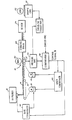
- The following is a description of one embodiment of the invention reference being made to the accompanying block flow diagram.
- Referring to the drawing, a process line for extruding elastomeric. material is generally indicated by
reference numeral 10. Theline 10 conventionally comprises anextruder 12 for producing a. sheet ofelastomeric extrusion 14 that is carried away by a firstvariable speed conveyor 16 being driven by afirst motor 18. The firstvariable speed conveyor 16 is generally referred to as a "take-away belt" and its purpose is to control elongation of the extrusion according to the take-away speed of the belt. Theextrusion 14 is carried across a second variable speed conveyor 17. The second conveyor 17 is driven by asecond motor 19, which conveys theextrusion 14 after leaving thefirst conveyor 16. Theextrusion 14 is also carried across a running-weigh-scale (RWS) 20 to provide a measure of the weight per-unit-length . of a typical section of the continuous extrusion as it passes thereover. Often the RWS 20 is directly at or near the second conveyor 17. From the RWS 20 the extrusion passes through acooling train 22 to establish a "set" in the material so that it may be handled further by askiver 24 that cuts the extrusion into a suitable length for production use. For example, in a tire manufacturing facility the extrusion will be the tread portion of a tire and it is, therefore, cut to the desired tire circumference. Upon leaving the skiver the cut tread sections are weighed at a check-weigh-scale (CWS) 26 to make certain that all treads are within a weight specification since the weight is directly related to the thickness of the extrusion. Theline 10 also comprises a target RWS value. The target RWS value may be a value decided by the operator of theline 10 based upon his experience. The target RWS value may also be a value derived from the CWS 26. Cut tread sections, weighed at CWS 26, are sampled at 32. Select samples ofCWS 26 are used to establish target RWS. One way is to sampleCWS 26 until the desired weight, and therefore thickness, is obtained. The measured value ofRWS 34 for that sample of CWS 26 is then used to establish the target RWS. - In the method of the present invention, the
extrusion 14 is measured atRWS 20. The measured value of RWS 34 is entered into acomparator 36. The target value of RWS is also entered intocomparator 36. Thecomparator 36 compares the measured value ofRWS 34 to the target value of RWS; where there is a difference, acontrol signal 38 results. Thecontrol signal 38 is entered into thespeed controller 40. Based upon thecontrol signal 38, thespeed controller 40 adjusts the difference in speed between thefirst motor 18 and thesecond motor 19. For example, if the measuredRWS 34 is too high compared to the target RWS (indicating that theextrusion 14 is too thick) then thecomparator 36 sends acontrol signal 38 tospeed controller 40 to speed up thesecond motor 19 in relationship to thefirst motor 18. This will have the effect of stretching theextrusion 14. Conversely, slowing down thesecond motor 19 in relationship to thefirst motor 18 will have the effect of makingthicker extrusion 14 with a resultant increase in the value of measuredRWS 34. - In a further refinement to the method of the present invention, the
control signal 38 can also be used in therate controller 42. Therate controller 42 controls the rate of extrusion of theextruder 12 and the speed of thefirst motor 18. Therate controller 42 can be used as a further refinement to the control ofline 10. For example, if the measured value of RWS 34 is still high relative to the target value of RWS (indicating the need to stretch theextrusion 14 out some more) and if the difference in speed between thefirst motor 18 and thesecond motor 19 is such that the difference in speed cannot be increased (without of course turning off thefirst motor 18 entirely), then therate controller 42 may be used. In this instance therate controller 42 would decrease the rate of extrusion from theextruder 12 in relationship to the speed of thefirst motor 18. - The advantages of the method of the present invention over the prior art, e.g. U.S. Patent #4,088,721, can now be seen. Firstly, in the present invention, the method controls the production of thickness or weight of elastomer material through two variables, i.e. the
first motor 18 and thesecond motor 19. It is the difference in relative speed between the first andsecond motors line 10. This would save energy and material during start up.
Claims (3)
Priority Applications (1)
| Application Number | Priority Date | Filing Date | Title |
|---|---|---|---|
| AT79301621T ATE5466T1 (en) | 1978-11-29 | 1979-08-10 | METHOD OF CONTROLLING THE THICKNESS OR WEIGHT OF AN EXTRUDED MATERIAL. |
Applications Claiming Priority (2)
| Application Number | Priority Date | Filing Date | Title |
|---|---|---|---|
| US05/964,502 US4233255A (en) | 1978-11-29 | 1978-11-29 | Method for controlling the thickness or weight of extruded stock |
| US964502 | 1978-11-29 |
Publications (2)
| Publication Number | Publication Date |
|---|---|
| EP0011355A1 EP0011355A1 (en) | 1980-05-28 |
| EP0011355B1 true EP0011355B1 (en) | 1983-11-30 |
Family
ID=25508617
Family Applications (1)
| Application Number | Title | Priority Date | Filing Date |
|---|---|---|---|
| EP79301621A Expired EP0011355B1 (en) | 1978-11-29 | 1979-08-10 | Method for controlling the thickness or weight of extruded stock |
Country Status (6)
| Country | Link |
|---|---|
| US (1) | US4233255A (en) |
| EP (1) | EP0011355B1 (en) |
| JP (2) | JPS5577547A (en) |
| AT (1) | ATE5466T1 (en) |
| CA (1) | CA1122308A (en) |
| DE (1) | DE2966447D1 (en) |
Cited By (1)
| Publication number | Priority date | Publication date | Assignee | Title |
|---|---|---|---|---|
| DE10306114A1 (en) * | 2003-02-14 | 2004-08-26 | Thyssenkrupp Elastomertechnik Gmbh | Width control for extruded strips of soft elastic material e.g. rubber, uses adjustable roller conveyor after extrusion to control shrinkage |
Families Citing this family (41)
| Publication number | Priority date | Publication date | Assignee | Title |
|---|---|---|---|---|
| NL8002782A (en) * | 1980-05-14 | 1981-12-16 | Stamicarbon | METHOD FOR PREPARING A POLYMER |
| US4448736A (en) * | 1982-05-24 | 1984-05-15 | Standard Oil Company (Indiana) | Continuous in-line melt flow rate control system |
| US4425289A (en) | 1982-08-30 | 1984-01-10 | The General Tire & Rubber Company | Method of producing an extrudate having controlled shape and size |
| US4428896A (en) | 1982-08-30 | 1984-01-31 | The General Tire & Rubber Company | Method of producing an extrudate of controlled size and shape from a roller die |
| GB2138178A (en) * | 1983-04-13 | 1984-10-17 | Ford Motor Co | Controlling an adhesive laying machine |
| NZ211647A (en) * | 1984-04-04 | 1987-02-20 | Rheon Automatic Machinery Co | Continuously measuring weight of dough portions on conveyor and providing a constant weight of dough per unit length |
| NZ211677A (en) * | 1984-04-09 | 1987-07-31 | Rheon Automatic Machinery Co | Producing dough strip: conveyor speed varied to keep constant weight per unit length |
| IT1200720B (en) * | 1984-09-22 | 1989-01-27 | Berstorff Gmbh Masch Hermann | PROCEDURE AND IMPLANT TO SURVEILL THE DIMENSIONS OF A PROFILED RUBBER TAPE OR SYNTHETIC THERMOPLASTIC MATERIAL, CONSTITUTED OF ONE OR MORE COMPOUNDS AND EXTRUDED IN CONTINUOUS |
| DE3434904C1 (en) * | 1984-09-22 | 1985-10-17 | Hermann Berstorff Maschinenbau Gmbh, 3000 Hannover | Method and system for monitoring the dimensions of a continuously extruded profile strip made of rubber or thermoplastic material consisting of one or more mixtures |
| US4880371A (en) * | 1984-11-13 | 1989-11-14 | Nabisco Brands, Inc. | Apparatus of machining doughy material |
| AU4901085A (en) * | 1984-11-13 | 1986-05-29 | Nabisco Brands Incorporated | Quantifying the flow rate of doughy material |
| US4849234A (en) * | 1984-11-13 | 1989-07-18 | Nabisco Brands, Inc. | Method of machining doughy material |
| GB8505199D0 (en) * | 1985-02-28 | 1985-04-03 | Bicc Plc | Extrusion control |
| JPS61209541A (en) * | 1985-03-12 | 1986-09-17 | レオン自動機株式会社 | Apparatus for continuously producing dough strip having constant dimension and flow amount |
| DE3526050C2 (en) * | 1985-07-20 | 1994-11-17 | Krupp Ag Hoesch Krupp | Process for operating an extruder |
| IT1185704B (en) * | 1985-09-11 | 1987-11-12 | Milani Resine Spa | AUTOMATIC EQUIPMENT FOR THE SELECTION AND ADJUSTMENT OF PROFILE BARS IN MACHINES PRODUCING EXTRUDED PLASTIC PROFILES |
| JPS6392429A (en) * | 1986-10-07 | 1988-04-22 | Toyoda Gosei Co Ltd | Device for setting to standard gage |
| JPH0653039B2 (en) * | 1987-04-01 | 1994-07-20 | レオン自動機株式会社 | Method and apparatus for supplying uniform continuous dough such as bread dough |
| GB8712546D0 (en) * | 1987-05-28 | 1987-07-01 | Bicc Plc | Extruder linearisation |
| US4844846A (en) * | 1988-01-15 | 1989-07-04 | The Uniroyal Goodrich Tire Company | Method and apparatus for controlling the weight per unit length of a continuous extrudate |
| IT1240368B (en) * | 1990-04-27 | 1993-12-10 | Firestone International Developments.P.A. | METHOD AND DEVICE FOR THE HOT DIRECT FEEDING OF SECTIONS OF AN EXTRUDED TREAD TO A MACHINE FOR MAKING MOTOR VEHICLE TIRES |
| GB9216724D0 (en) * | 1992-08-06 | 1992-09-23 | Rotalac Plastics | An automatic extrusion line |
| IT1257108B (en) * | 1992-09-18 | 1996-01-05 | Iveco Fiat | METHOD WITH EQUIPMENT FOR THE PREPARATION OF PLASTIC MATERIAL CHARGES FOR THE FEEDING OF A MOLDING PRESS. |
| DE19507598C2 (en) * | 1995-03-04 | 1997-02-20 | Uniroyal Englebert Gmbh | Multi-component extruder |
| US6441321B1 (en) | 2000-06-02 | 2002-08-27 | Creative Automation, Inc. | Method for controlling weight of divided portions |
| EP1294556B1 (en) * | 2000-06-29 | 2005-11-30 | PIRELLI PNEUMATICI Società per Azioni | Method and plant for manufacturing a belt structure of a green tire. |
| US6797095B2 (en) * | 2000-11-29 | 2004-09-28 | Pirelli Pneumatici S.P.A. | Method and plant for manufacturing a belt structure, a belt package and a crown structure of a green tire |
| FI116247B (en) | 2002-09-25 | 2005-10-14 | Metso Automation Oy | Method and apparatus for adjusting solid material feed |
| US20050051256A1 (en) * | 2003-09-09 | 2005-03-10 | Yovichin Albert James | Method and apparatus for building and transferring a tread belt structure |
| KR100713694B1 (en) * | 2005-03-22 | 2007-05-04 | (주) 케이엔엘 | Tread manufacturing device and manufacturing method |
| JP4898276B2 (en) * | 2006-04-28 | 2012-03-14 | 住友ゴム工業株式会社 | Tread automatic folding device |
| CN101498601B (en) * | 2009-03-04 | 2011-04-13 | 许阳 | Automatic weighing transmission quality control system for powder compacting product |
| US9127457B2 (en) * | 2012-07-10 | 2015-09-08 | King Saud University | Machine for deforming and cutting plastic strips for enhancing concrete |
| DE102013109346A1 (en) * | 2013-08-29 | 2015-03-05 | Continental Reifen Deutschland Gmbh | Process for the production of starting material for vehicle tires |
| JP6392638B2 (en) * | 2014-11-14 | 2018-09-19 | 東洋ゴム工業株式会社 | Rubber extrusion molding apparatus and method |
| US10098355B2 (en) | 2014-11-19 | 2018-10-16 | Bakery Systems, Inc. | System and method for weighing items |
| JP6740825B2 (en) * | 2016-09-08 | 2020-08-19 | 住友ゴム工業株式会社 | Tire manufacturing method |
| CN112810104A (en) * | 2021-02-07 | 2021-05-18 | 桂林理工大学 | Extrusion production line capable of automatically adjusting section size and extrusion control method |
| EP4079159B1 (en) | 2021-04-22 | 2024-07-03 | Radie B.V. | Dough handling device |
| DE102022200817A1 (en) * | 2022-01-25 | 2023-07-27 | Continental Reifen Deutschland Gmbh | Device and computer-implemented method for controlling an extrusion system, extrusion system and computer-readable storage medium |
| CN118682966B (en) * | 2024-08-23 | 2024-11-12 | 琥崧微纳米科技(常州)有限公司 | Control method of pre-filming device |
Family Cites Families (9)
| Publication number | Priority date | Publication date | Assignee | Title |
|---|---|---|---|---|
| US1456211A (en) * | 1920-12-29 | 1923-05-22 | Firestone Tire & Rubber Co | Apparatus for treating rubber |
| US1594845A (en) * | 1922-10-12 | 1926-08-03 | Firestone Tire & Rubber Co | Method and apparatus for treating rubber |
| US2051781A (en) * | 1934-07-27 | 1936-08-18 | Firestone Tire & Rubber Co | Integrating control method and apparatus for achieving uniformity of average conditions |
| US2156895A (en) * | 1938-02-12 | 1939-05-02 | Godat Edmond | Weight control system |
| US2726922A (en) * | 1952-10-06 | 1955-12-13 | Us Rubber Co | Control system |
| US3286302A (en) * | 1963-12-26 | 1966-11-22 | Industrial Nucleonics Corp | Control system for maximizing the production of a material forming process |
| US4087499A (en) * | 1975-08-07 | 1978-05-02 | The Goodyear Tire & Rubber Company | Method for controlling uniformity in tire tread stock |
| US4088721A (en) * | 1976-09-24 | 1978-05-09 | The Goodyear Tire & Rubber Company | Method and apparatus for controlling the thickness of extruded stock |
| US4097566A (en) * | 1977-06-01 | 1978-06-27 | Nucleonics Data Systems | Extrusion line control system |
-
1978
- 1978-11-29 US US05/964,502 patent/US4233255A/en not_active Expired - Lifetime
-
1979
- 1979-08-08 CA CA333,347A patent/CA1122308A/en not_active Expired
- 1979-08-10 EP EP79301621A patent/EP0011355B1/en not_active Expired
- 1979-08-10 DE DE7979301621T patent/DE2966447D1/en not_active Expired
- 1979-08-10 AT AT79301621T patent/ATE5466T1/en not_active IP Right Cessation
- 1979-11-29 JP JP15495279A patent/JPS5577547A/en active Pending
-
1987
- 1987-12-09 JP JP1987187624U patent/JPS6397531U/ja active Pending
Cited By (1)
| Publication number | Priority date | Publication date | Assignee | Title |
|---|---|---|---|---|
| DE10306114A1 (en) * | 2003-02-14 | 2004-08-26 | Thyssenkrupp Elastomertechnik Gmbh | Width control for extruded strips of soft elastic material e.g. rubber, uses adjustable roller conveyor after extrusion to control shrinkage |
Also Published As
| Publication number | Publication date |
|---|---|
| CA1122308A (en) | 1982-04-20 |
| US4233255A (en) | 1980-11-11 |
| JPS6397531U (en) | 1988-06-24 |
| ATE5466T1 (en) | 1983-12-15 |
| JPS5577547A (en) | 1980-06-11 |
| DE2966447D1 (en) | 1984-01-05 |
| EP0011355A1 (en) | 1980-05-28 |
Similar Documents
| Publication | Publication Date | Title |
|---|---|---|
| US4233255A (en) | Method for controlling the thickness or weight of extruded stock | |
| US4844846A (en) | Method and apparatus for controlling the weight per unit length of a continuous extrudate | |
| US4088721A (en) | Method and apparatus for controlling the thickness of extruded stock | |
| EP0197647B1 (en) | Control apparatus for extruders | |
| US4515738A (en) | Method of monitoring the production of extruded profiles and an apparatus incorporating means for effecting such monitoring | |
| US4097566A (en) | Extrusion line control system | |
| US4428896A (en) | Method of producing an extrudate of controlled size and shape from a roller die | |
| US4425289A (en) | Method of producing an extrudate having controlled shape and size | |
| FI79481B (en) | FOERFARANDE OCH ANORDNING FOER OEVERVAKNING AV FRAMSTAELLNINGEN AV LAONGSTRAECKTA GUMMI- ELLER TERMOPLASTPROFILER PRESSADE AV EN ELLER FLERE BLANDNINGAR. | |
| SU1382398A3 (en) | Method and apparatus for checking sizes of continuously extruded profiled band consisting of one or several mixtures of caoutchouc or thermoplastic synthetic material | |
| EP0182563A2 (en) | Apparatus and method of machining doughy material | |
| US4087499A (en) | Method for controlling uniformity in tire tread stock | |
| JP7524621B2 (en) | Apparatus and method for producing sheet-shaped rubber material | |
| US5385463A (en) | Control system for continuous vulcanization line for manufacturing sponge rubber product | |
| SU1516372A1 (en) | Apparatus for manufacturing tyres by winding narrow strips | |
| US1400137A (en) | Method for treating rubber | |
| GB2117311A (en) | Improvements in or relating to a method of and apparatus for extruding elastomeric components | |
| JPH10202725A (en) | Equipment of manufacturing strip rubber material | |
| Capelle | A Method and Apparatus for Monitoring the Production of Elongate Profiles |
Legal Events
| Date | Code | Title | Description |
|---|---|---|---|
| PUAI | Public reference made under article 153(3) epc to a published international application that has entered the european phase |
Free format text: ORIGINAL CODE: 0009012 |
|
| AK | Designated contracting states |
Designated state(s): AT CH DE FR GB IT SE |
|
| 17P | Request for examination filed | ||
| ITF | It: translation for a ep patent filed | ||
| GRAA | (expected) grant |
Free format text: ORIGINAL CODE: 0009210 |
|
| AK | Designated contracting states |
Designated state(s): AT CH DE FR GB IT SE |
|
| REF | Corresponds to: |
Ref document number: 5466 Country of ref document: AT Date of ref document: 19831215 Kind code of ref document: T |
|
| REF | Corresponds to: |
Ref document number: 2966447 Country of ref document: DE Date of ref document: 19840105 |
|
| ET | Fr: translation filed | ||
| PLBE | No opposition filed within time limit |
Free format text: ORIGINAL CODE: 0009261 |
|
| STAA | Information on the status of an ep patent application or granted ep patent |
Free format text: STATUS: NO OPPOSITION FILED WITHIN TIME LIMIT |
|
| 26N | No opposition filed | ||
| ITTA | It: last paid annual fee | ||
| PGFP | Annual fee paid to national office [announced via postgrant information from national office to epo] |
Ref country code: DE Payment date: 19930713 Year of fee payment: 15 |
|
| PGFP | Annual fee paid to national office [announced via postgrant information from national office to epo] |
Ref country code: CH Payment date: 19930714 Year of fee payment: 15 |
|
| PGFP | Annual fee paid to national office [announced via postgrant information from national office to epo] |
Ref country code: FR Payment date: 19930715 Year of fee payment: 15 |
|
| PGFP | Annual fee paid to national office [announced via postgrant information from national office to epo] |
Ref country code: AT Payment date: 19930716 Year of fee payment: 15 |
|
| PGFP | Annual fee paid to national office [announced via postgrant information from national office to epo] |
Ref country code: SE Payment date: 19930719 Year of fee payment: 15 |
|
| PGFP | Annual fee paid to national office [announced via postgrant information from national office to epo] |
Ref country code: GB Payment date: 19930729 Year of fee payment: 15 |
|
| PG25 | Lapsed in a contracting state [announced via postgrant information from national office to epo] |
Ref country code: GB Effective date: 19940810 Ref country code: AT Effective date: 19940810 |
|
| PG25 | Lapsed in a contracting state [announced via postgrant information from national office to epo] |
Ref country code: SE Effective date: 19940811 |
|
| PG25 | Lapsed in a contracting state [announced via postgrant information from national office to epo] |
Ref country code: CH Effective date: 19940831 |
|
| EAL | Se: european patent in force in sweden |
Ref document number: 79301621.3 |
|
| GBPC | Gb: european patent ceased through non-payment of renewal fee |
Effective date: 19940810 |
|
| PG25 | Lapsed in a contracting state [announced via postgrant information from national office to epo] |
Ref country code: FR Effective date: 19950428 |
|
| REG | Reference to a national code |
Ref country code: CH Ref legal event code: PL |
|
| PG25 | Lapsed in a contracting state [announced via postgrant information from national office to epo] |
Ref country code: DE Effective date: 19950503 |
|
| EUG | Se: european patent has lapsed |
Ref document number: 79301621.3 |
|
| REG | Reference to a national code |
Ref country code: FR Ref legal event code: ST |