EP0010992B1 - Process for the preparation of 1-hydroxylated vitamin d compounds - Google Patents
Process for the preparation of 1-hydroxylated vitamin d compounds Download PDFInfo
- Publication number
- EP0010992B1 EP0010992B1 EP79302488A EP79302488A EP0010992B1 EP 0010992 B1 EP0010992 B1 EP 0010992B1 EP 79302488 A EP79302488 A EP 79302488A EP 79302488 A EP79302488 A EP 79302488A EP 0010992 B1 EP0010992 B1 EP 0010992B1
- Authority
- EP
- European Patent Office
- Prior art keywords
- group
- oxidation
- hydroxy
- vitamin
- compound
- Prior art date
- Legal status (The legal status is an assumption and is not a legal conclusion. Google has not performed a legal analysis and makes no representation as to the accuracy of the status listed.)
- Expired
Links
- 229940046008 vitamin d Drugs 0.000 title claims description 34
- 238000000034 method Methods 0.000 title claims description 30
- 150000001875 compounds Chemical class 0.000 title claims description 18
- 238000002360 preparation method Methods 0.000 title description 5
- JPJALAQPGMAKDF-UHFFFAOYSA-N selenium dioxide Chemical compound O=[Se]=O JPJALAQPGMAKDF-UHFFFAOYSA-N 0.000 claims description 50
- -1 vitamin D compound Chemical class 0.000 claims description 47
- 238000007254 oxidation reaction Methods 0.000 claims description 39
- 239000011710 vitamin D Substances 0.000 claims description 33
- 229930003316 Vitamin D Natural products 0.000 claims description 32
- QYSXJUFSXHHAJI-XFEUOLMDSA-N Vitamin D3 Natural products C1(/[C@@H]2CC[C@@H]([C@]2(CCC1)C)[C@H](C)CCCC(C)C)=C/C=C1\C[C@@H](O)CCC1=C QYSXJUFSXHHAJI-XFEUOLMDSA-N 0.000 claims description 32
- 235000019166 vitamin D Nutrition 0.000 claims description 32
- 230000003647 oxidation Effects 0.000 claims description 30
- 125000004432 carbon atom Chemical group C* 0.000 claims description 19
- 239000007858 starting material Substances 0.000 claims description 19
- 125000002887 hydroxy group Chemical group [H]O* 0.000 claims description 18
- 239000007800 oxidant agent Substances 0.000 claims description 17
- 238000006243 chemical reaction Methods 0.000 claims description 15
- 229940082569 selenite Drugs 0.000 claims description 15
- 125000000217 alkyl group Chemical group 0.000 claims description 14
- 238000006317 isomerization reaction Methods 0.000 claims description 14
- LFQSCWFLJHTTHZ-UHFFFAOYSA-N Ethanol Chemical compound CCO LFQSCWFLJHTTHZ-UHFFFAOYSA-N 0.000 claims description 13
- 229910052739 hydrogen Inorganic materials 0.000 claims description 9
- 150000002148 esters Chemical class 0.000 claims description 7
- MCAHWIHFGHIESP-UHFFFAOYSA-N selenous acid Chemical compound O[Se](O)=O MCAHWIHFGHIESP-UHFFFAOYSA-N 0.000 claims description 7
- 125000005843 halogen group Chemical group 0.000 claims description 6
- 239000001257 hydrogen Substances 0.000 claims description 6
- 125000004435 hydrogen atom Chemical group [H]* 0.000 claims description 6
- 125000002496 methyl group Chemical group [H]C([H])([H])* 0.000 claims description 6
- 150000003710 vitamin D derivatives Chemical class 0.000 claims description 6
- UFHFLCQGNIYNRP-UHFFFAOYSA-N Hydrogen Chemical compound [H][H] UFHFLCQGNIYNRP-UHFFFAOYSA-N 0.000 claims description 4
- 125000003118 aryl group Chemical group 0.000 claims description 4
- 125000000468 ketone group Chemical group 0.000 claims description 4
- 239000011669 selenium Substances 0.000 claims description 4
- 125000002947 alkylene group Chemical group 0.000 claims description 3
- 125000001495 ethyl group Chemical group [H]C([H])([H])C([H])([H])* 0.000 claims description 3
- 238000005805 hydroxylation reaction Methods 0.000 claims description 3
- 238000011065 in-situ storage Methods 0.000 claims description 3
- 229910052751 metal Inorganic materials 0.000 claims description 3
- 239000002184 metal Substances 0.000 claims description 3
- 150000003839 salts Chemical class 0.000 claims description 3
- 229930194542 Keto Natural products 0.000 claims description 2
- 239000011203 carbon fibre reinforced carbon Substances 0.000 claims description 2
- 125000003700 epoxy group Chemical group 0.000 claims description 2
- 150000004965 peroxy acids Chemical class 0.000 claims description 2
- 230000004048 modification Effects 0.000 claims 1
- 238000012986 modification Methods 0.000 claims 1
- OKKJLVBELUTLKV-UHFFFAOYSA-N Methanol Chemical compound OC OKKJLVBELUTLKV-UHFFFAOYSA-N 0.000 description 24
- RTZKZFJDLAIYFH-UHFFFAOYSA-N Diethyl ether Chemical compound CCOCC RTZKZFJDLAIYFH-UHFFFAOYSA-N 0.000 description 23
- JQWHASGSAFIOCM-UHFFFAOYSA-M sodium periodate Chemical compound [Na+].[O-]I(=O)(=O)=O JQWHASGSAFIOCM-UHFFFAOYSA-M 0.000 description 18
- 239000000203 mixture Substances 0.000 description 17
- QYSXJUFSXHHAJI-FVUVGDFOSA-N 5,6-trans-vitamin D3 Chemical compound C1(/[C@@H]2CC[C@@H]([C@]2(CCC1)C)[C@H](C)CCCC(C)C)=C\C=C1/C[C@@H](O)CCC1=C QYSXJUFSXHHAJI-FVUVGDFOSA-N 0.000 description 13
- 239000011647 vitamin D3 Substances 0.000 description 11
- XKRFYHLGVUSROY-UHFFFAOYSA-N Argon Chemical compound [Ar] XKRFYHLGVUSROY-UHFFFAOYSA-N 0.000 description 10
- 230000000694 effects Effects 0.000 description 9
- 239000000047 product Substances 0.000 description 9
- CIHOLLKRGTVIJN-UHFFFAOYSA-N tert‐butyl hydroperoxide Chemical compound CC(C)(C)OO CIHOLLKRGTVIJN-UHFFFAOYSA-N 0.000 description 8
- VLKZOEOYAKHREP-UHFFFAOYSA-N n-Hexane Chemical compound CCCCCC VLKZOEOYAKHREP-UHFFFAOYSA-N 0.000 description 7
- MCAHWIHFGHIESP-UHFFFAOYSA-L selenite(2-) Chemical class [O-][Se]([O-])=O MCAHWIHFGHIESP-UHFFFAOYSA-L 0.000 description 7
- WPYMKLBDIGXBTP-UHFFFAOYSA-N benzoic acid Chemical compound OC(=O)C1=CC=CC=C1 WPYMKLBDIGXBTP-UHFFFAOYSA-N 0.000 description 6
- UEJBTVZPRCSFBM-UHFFFAOYSA-N diethyl selenite Chemical compound CCO[Se](=O)OCC UEJBTVZPRCSFBM-UHFFFAOYSA-N 0.000 description 6
- 238000004128 high performance liquid chromatography Methods 0.000 description 6
- 238000004519 manufacturing process Methods 0.000 description 6
- QYSXJUFSXHHAJI-YRZJJWOYSA-N vitamin D3 Chemical compound C1(/[C@@H]2CC[C@@H]([C@]2(CCC1)C)[C@H](C)CCCC(C)C)=C\C=C1\C[C@@H](O)CCC1=C QYSXJUFSXHHAJI-YRZJJWOYSA-N 0.000 description 6
- 229910052786 argon Inorganic materials 0.000 description 5
- 125000003710 aryl alkyl group Chemical group 0.000 description 5
- 238000010992 reflux Methods 0.000 description 5
- 229940088594 vitamin Drugs 0.000 description 5
- 229930003231 vitamin Natural products 0.000 description 5
- 235000013343 vitamin Nutrition 0.000 description 5
- 239000011782 vitamin Substances 0.000 description 5
- LYCAIKOWRPUZTN-UHFFFAOYSA-N Ethylene glycol Chemical compound OCCO LYCAIKOWRPUZTN-UHFFFAOYSA-N 0.000 description 4
- UIIMBOGNXHQVGW-UHFFFAOYSA-M Sodium bicarbonate Chemical compound [Na+].OC([O-])=O UIIMBOGNXHQVGW-UHFFFAOYSA-M 0.000 description 4
- 238000007796 conventional method Methods 0.000 description 4
- 239000003814 drug Substances 0.000 description 4
- 239000011541 reaction mixture Substances 0.000 description 4
- QTBSBXVTEAMEQO-UHFFFAOYSA-M Acetate Chemical compound CC([O-])=O QTBSBXVTEAMEQO-UHFFFAOYSA-M 0.000 description 3
- WEVYAHXRMPXWCK-UHFFFAOYSA-N Acetonitrile Chemical compound CC#N WEVYAHXRMPXWCK-UHFFFAOYSA-N 0.000 description 3
- UHOVQNZJYSORNB-UHFFFAOYSA-N Benzene Chemical compound C1=CC=CC=C1 UHOVQNZJYSORNB-UHFFFAOYSA-N 0.000 description 3
- 208000020084 Bone disease Diseases 0.000 description 3
- 208000013038 Hypocalcemia Diseases 0.000 description 3
- LFTLOKWAGJYHHR-UHFFFAOYSA-N N-methylmorpholine N-oxide Chemical compound CN1(=O)CCOCC1 LFTLOKWAGJYHHR-UHFFFAOYSA-N 0.000 description 3
- 125000000746 allylic group Chemical group 0.000 description 3
- 238000004587 chromatography analysis Methods 0.000 description 3
- 238000004440 column chromatography Methods 0.000 description 3
- 208000037265 diseases, disorders, signs and symptoms Diseases 0.000 description 3
- 230000000705 hypocalcaemia Effects 0.000 description 3
- 239000007787 solid Substances 0.000 description 3
- 238000003756 stirring Methods 0.000 description 3
- 150000003512 tertiary amines Chemical class 0.000 description 3
- XLYOFNOQVPJJNP-UHFFFAOYSA-N water Substances O XLYOFNOQVPJJNP-UHFFFAOYSA-N 0.000 description 3
- 238000010626 work up procedure Methods 0.000 description 3
- IJGRMHOSHXDMSA-UHFFFAOYSA-N Atomic nitrogen Chemical compound N#N IJGRMHOSHXDMSA-UHFFFAOYSA-N 0.000 description 2
- 0 CC(CCC1)(C(*)CC2)C2C1=CC=C(C[C@](*)CC1)C1=C Chemical compound CC(CCC1)(C(*)CC2)C2C1=CC=C(C[C@](*)CC1)C1=C 0.000 description 2
- HEDRZPFGACZZDS-UHFFFAOYSA-N Chloroform Chemical compound ClC(Cl)Cl HEDRZPFGACZZDS-UHFFFAOYSA-N 0.000 description 2
- MHAJPDPJQMAIIY-UHFFFAOYSA-N Hydrogen peroxide Chemical compound OO MHAJPDPJQMAIIY-UHFFFAOYSA-N 0.000 description 2
- 239000002841 Lewis acid Substances 0.000 description 2
- CSNNHWWHGAXBCP-UHFFFAOYSA-L Magnesium sulfate Chemical compound [Mg+2].[O-][S+2]([O-])([O-])[O-] CSNNHWWHGAXBCP-UHFFFAOYSA-L 0.000 description 2
- 208000001132 Osteoporosis Diseases 0.000 description 2
- VYPSYNLAJGMNEJ-UHFFFAOYSA-N Silicium dioxide Chemical compound O=[Si]=O VYPSYNLAJGMNEJ-UHFFFAOYSA-N 0.000 description 2
- 125000004423 acyloxy group Chemical group 0.000 description 2
- OFHCOWSQAMBJIW-AVJTYSNKSA-N alfacalcidol Chemical compound C1(/[C@@H]2CC[C@@H]([C@]2(CCC1)C)[C@H](C)CCCC(C)C)=C\C=C1\C[C@@H](O)C[C@H](O)C1=C OFHCOWSQAMBJIW-AVJTYSNKSA-N 0.000 description 2
- 229910052783 alkali metal Inorganic materials 0.000 description 2
- 125000001797 benzyl group Chemical group [H]C1=C([H])C([H])=C(C([H])=C1[H])C([H])([H])* 0.000 description 2
- 239000006227 byproduct Substances 0.000 description 2
- MVPPADPHJFYWMZ-UHFFFAOYSA-N chlorobenzene Chemical compound ClC1=CC=CC=C1 MVPPADPHJFYWMZ-UHFFFAOYSA-N 0.000 description 2
- 125000004122 cyclic group Chemical group 0.000 description 2
- 150000002009 diols Chemical group 0.000 description 2
- YWWZCHLUQSHMCL-UHFFFAOYSA-N diphenyl diselenide Chemical compound C=1C=CC=CC=1[Se][Se]C1=CC=CC=C1 YWWZCHLUQSHMCL-UHFFFAOYSA-N 0.000 description 2
- 208000035475 disorder Diseases 0.000 description 2
- MDKXBBPLEGPIRI-UHFFFAOYSA-N ethoxyethane;methanol Chemical compound OC.CCOCC MDKXBBPLEGPIRI-UHFFFAOYSA-N 0.000 description 2
- PNDPGZBMCMUPRI-UHFFFAOYSA-N iodine Chemical compound II PNDPGZBMCMUPRI-UHFFFAOYSA-N 0.000 description 2
- 150000007517 lewis acids Chemical class 0.000 description 2
- NUJOXMJBOLGQSY-UHFFFAOYSA-N manganese dioxide Chemical compound O=[Mn]=O NUJOXMJBOLGQSY-UHFFFAOYSA-N 0.000 description 2
- 229910052757 nitrogen Inorganic materials 0.000 description 2
- KHIWWQKSHDUIBK-UHFFFAOYSA-N periodic acid Chemical class OI(=O)(=O)=O KHIWWQKSHDUIBK-UHFFFAOYSA-N 0.000 description 2
- 239000008194 pharmaceutical composition Substances 0.000 description 2
- 238000000926 separation method Methods 0.000 description 2
- 239000000741 silica gel Substances 0.000 description 2
- 229910002027 silica gel Inorganic materials 0.000 description 2
- 229910000030 sodium bicarbonate Inorganic materials 0.000 description 2
- 235000017557 sodium bicarbonate Nutrition 0.000 description 2
- 150000003431 steroids Chemical class 0.000 description 2
- 238000004809 thin layer chromatography Methods 0.000 description 2
- DNIAPMSPPWPWGF-VKHMYHEASA-N (+)-propylene glycol Chemical compound C[C@H](O)CO DNIAPMSPPWPWGF-VKHMYHEASA-N 0.000 description 1
- DYLIWHYUXAJDOJ-OWOJBTEDSA-N (e)-4-(6-aminopurin-9-yl)but-2-en-1-ol Chemical compound NC1=NC=NC2=C1N=CN2C\C=C\CO DYLIWHYUXAJDOJ-OWOJBTEDSA-N 0.000 description 1
- YPFDHNVEDLHUCE-UHFFFAOYSA-N 1,3-propanediol Substances OCCCO YPFDHNVEDLHUCE-UHFFFAOYSA-N 0.000 description 1
- HJJZIMFAIMUSBW-UHFFFAOYSA-N 3-methylbutane-1,2-diol Chemical compound CC(C)C(O)CO HJJZIMFAIMUSBW-UHFFFAOYSA-N 0.000 description 1
- 208000008439 Biliary Liver Cirrhosis Diseases 0.000 description 1
- 206010004659 Biliary cirrhosis Diseases 0.000 description 1
- 208000013725 Chronic Kidney Disease-Mineral and Bone disease Diseases 0.000 description 1
- LCGLNKUTAGEVQW-UHFFFAOYSA-N Dimethyl ether Chemical compound COC LCGLNKUTAGEVQW-UHFFFAOYSA-N 0.000 description 1
- VGGSQFUCUMXWEO-UHFFFAOYSA-N Ethene Chemical compound C=C VGGSQFUCUMXWEO-UHFFFAOYSA-N 0.000 description 1
- 239000005977 Ethylene Substances 0.000 description 1
- 208000000038 Hypoparathyroidism Diseases 0.000 description 1
- 208000029663 Hypophosphatemia Diseases 0.000 description 1
- CXOFVDLJLONNDW-UHFFFAOYSA-N Phenytoin Chemical compound N1C(=O)NC(=O)C1(C=1C=CC=CC=1)C1=CC=CC=C1 CXOFVDLJLONNDW-UHFFFAOYSA-N 0.000 description 1
- 208000001647 Renal Insufficiency Diseases 0.000 description 1
- 206010041969 Steatorrhoea Diseases 0.000 description 1
- 208000003217 Tetany Diseases 0.000 description 1
- 201000006035 X-linked dominant hypophosphatemic rickets Diseases 0.000 description 1
- 238000010521 absorption reaction Methods 0.000 description 1
- 238000005903 acid hydrolysis reaction Methods 0.000 description 1
- 238000010306 acid treatment Methods 0.000 description 1
- 239000004480 active ingredient Substances 0.000 description 1
- 125000003545 alkoxy group Chemical group 0.000 description 1
- 150000001412 amines Chemical class 0.000 description 1
- 125000005333 aroyloxy group Chemical group 0.000 description 1
- 125000004429 atom Chemical group 0.000 description 1
- QVGXLLKOCUKJST-UHFFFAOYSA-N atomic oxygen Chemical compound [O] QVGXLLKOCUKJST-UHFFFAOYSA-N 0.000 description 1
- 229940125717 barbiturate Drugs 0.000 description 1
- 125000001231 benzoyloxy group Chemical group C(C1=CC=CC=C1)(=O)O* 0.000 description 1
- 238000009835 boiling Methods 0.000 description 1
- 239000001273 butane Substances 0.000 description 1
- 150000001721 carbon Chemical group 0.000 description 1
- 229910052799 carbon Inorganic materials 0.000 description 1
- 150000008280 chlorinated hydrocarbons Chemical class 0.000 description 1
- 239000006184 cosolvent Substances 0.000 description 1
- 238000002425 crystallisation Methods 0.000 description 1
- 230000001186 cumulative effect Effects 0.000 description 1
- 150000005690 diesters Chemical class 0.000 description 1
- 201000010099 disease Diseases 0.000 description 1
- 229940079593 drug Drugs 0.000 description 1
- 239000003937 drug carrier Substances 0.000 description 1
- 230000004064 dysfunction Effects 0.000 description 1
- 238000010828 elution Methods 0.000 description 1
- 125000004185 ester group Chemical group 0.000 description 1
- 125000001033 ether group Chemical group 0.000 description 1
- 238000001914 filtration Methods 0.000 description 1
- 210000001035 gastrointestinal tract Anatomy 0.000 description 1
- 125000005842 heteroatom Chemical group 0.000 description 1
- 150000002391 heterocyclic compounds Chemical class 0.000 description 1
- 125000000623 heterocyclic group Chemical group 0.000 description 1
- GGQOPZKTDHXXON-UHFFFAOYSA-N hexane;methanol Chemical compound OC.CCCCCC GGQOPZKTDHXXON-UHFFFAOYSA-N 0.000 description 1
- 230000007062 hydrolysis Effects 0.000 description 1
- 238000006460 hydrolysis reaction Methods 0.000 description 1
- 150000002432 hydroperoxides Chemical class 0.000 description 1
- 230000033444 hydroxylation Effects 0.000 description 1
- 208000011111 hypophosphatemic rickets Diseases 0.000 description 1
- 210000003734 kidney Anatomy 0.000 description 1
- 208000017169 kidney disease Diseases 0.000 description 1
- 201000006370 kidney failure Diseases 0.000 description 1
- 239000012280 lithium aluminium hydride Substances 0.000 description 1
- 210000004185 liver Anatomy 0.000 description 1
- 229910052943 magnesium sulfate Inorganic materials 0.000 description 1
- 230000007257 malfunction Effects 0.000 description 1
- 239000000463 material Substances 0.000 description 1
- 229910052987 metal hydride Inorganic materials 0.000 description 1
- 150000004681 metal hydrides Chemical class 0.000 description 1
- 125000000956 methoxy group Chemical group [H]C([H])([H])O* 0.000 description 1
- 239000002808 molecular sieve Substances 0.000 description 1
- 230000007935 neutral effect Effects 0.000 description 1
- 125000004433 nitrogen atom Chemical group N* 0.000 description 1
- 208000005368 osteomalacia Diseases 0.000 description 1
- 230000001590 oxidative effect Effects 0.000 description 1
- 229910052760 oxygen Inorganic materials 0.000 description 1
- 239000001301 oxygen Substances 0.000 description 1
- 125000004430 oxygen atom Chemical group O* 0.000 description 1
- 239000000546 pharmaceutical excipient Substances 0.000 description 1
- 229960002036 phenytoin Drugs 0.000 description 1
- ILORKHQGIMGDFN-UHFFFAOYSA-N phetharbital Chemical compound O=C1C(CC)(CC)C(=O)NC(=O)N1C1=CC=CC=C1 ILORKHQGIMGDFN-UHFFFAOYSA-N 0.000 description 1
- 229950010765 pivalate Drugs 0.000 description 1
- 229920000166 polytrimethylene carbonate Polymers 0.000 description 1
- 230000002265 prevention Effects 0.000 description 1
- 230000000069 prophylactic effect Effects 0.000 description 1
- 125000006239 protecting group Chemical group 0.000 description 1
- 201000006409 renal osteodystrophy Diseases 0.000 description 1
- 238000009877 rendering Methods 0.000 description 1
- 208000007442 rickets Diseases 0.000 description 1
- 125000004469 siloxy group Chemical group [SiH3]O* 0.000 description 1
- URGAHOPLAPQHLN-UHFFFAOYSA-N sodium aluminosilicate Chemical compound [Na+].[Al+3].[O-][Si]([O-])=O.[O-][Si]([O-])=O URGAHOPLAPQHLN-UHFFFAOYSA-N 0.000 description 1
- 229910000033 sodium borohydride Inorganic materials 0.000 description 1
- 239000012279 sodium borohydride Substances 0.000 description 1
- 208000001162 steatorrhea Diseases 0.000 description 1
- 230000000707 stereoselective effect Effects 0.000 description 1
- 230000003637 steroidlike Effects 0.000 description 1
- 125000004434 sulfur atom Chemical group 0.000 description 1
- LMBFAGIMSUYTBN-MPZNNTNKSA-N teixobactin Chemical compound C([C@H](C(=O)N[C@@H]([C@@H](C)CC)C(=O)N[C@@H](CO)C(=O)N[C@H](CCC(N)=O)C(=O)N[C@H]([C@@H](C)CC)C(=O)N[C@@H]([C@@H](C)CC)C(=O)N[C@@H](CO)C(=O)N[C@H]1C(N[C@@H](C)C(=O)N[C@@H](C[C@@H]2NC(=N)NC2)C(=O)N[C@H](C(=O)O[C@H]1C)[C@@H](C)CC)=O)NC)C1=CC=CC=C1 LMBFAGIMSUYTBN-MPZNNTNKSA-N 0.000 description 1
- 125000005207 tetraalkylammonium group Chemical group 0.000 description 1
- 230000001225 therapeutic effect Effects 0.000 description 1
- 230000001988 toxicity Effects 0.000 description 1
- 231100000419 toxicity Toxicity 0.000 description 1
- 125000005270 trialkylamine group Chemical group 0.000 description 1
- 208000032349 type 2B vitamin D-dependent rickets Diseases 0.000 description 1
- 150000003722 vitamin derivatives Chemical class 0.000 description 1
- 238000010792 warming Methods 0.000 description 1
Classifications
-
- C—CHEMISTRY; METALLURGY
- C07—ORGANIC CHEMISTRY
- C07C—ACYCLIC OR CARBOCYCLIC COMPOUNDS
- C07C401/00—Irradiation products of cholesterol or its derivatives; Vitamin D derivatives, 9,10-seco cyclopenta[a]phenanthrene or analogues obtained by chemical preparation without irradiation
Definitions
- the present invention relates to a process for the preparation of 1-hydroxylated Vitamin D compounds.
- 1 a-Hydroxy vitamin D compounds are known to be useful in medicine for a variety of purposes and, for example, possess important prophylactic and therapeutic applications in the prevention or treatment of disorders such as rickets and osteomalacia and are of value in the treatment of both vitamin D responsive and vitamin D resistant diseases such as hypoparathyroidism, hypophosphataemia, hypocalcaemia and/or associated bone disease, renal disorders or renal failure and hypocalcaemic tetany.
- vitamin D should be avoided because of its cumulative toxicity, in particular in the treatment of disorders such as vitamin D resistant rickets, renal osteodystrophy, steatorrhea, biliary cirrhosis and other malfunctions of absorption, osteoporosis, secondary hypocalcaemia and/or bone disease arising from dysfunction of the liver, kidneys or gastrointestinal tract, and secondary hypocalcaemia, osteoporosis or other bone diseases resulting from treatment with steroids, such as corticoids, diphenylhydantoin, barbiturates such as phenylbarbitone, and related drugs, which prove refractory to conventional compounds such as vitamin D 3 .
- disorders such as vitamin D resistant rickets, renal osteodystrophy, steatorrhea, biliary cirrhosis and other malfunctions of absorption, osteoporosis, secondary hypocalcaemia and/or bone disease arising from dysfunction of the liver, kidneys or gastrointestinal tract, and secondary hypocalcaemia, osteoporos
- the present invention is based on the discovery that the relatively poor yield of 1-hydroxy-5,6- trans vitamin D compounds obtained by oxidation of 5,6-trans vitamin D compounds using Se lv oxidising agents according to the prior art may be substantially improved by the use of a selenite ester as the Se lv oxidising agent.
- the selenite ester may for example be formed by reaction of selenium dioxide or selenous acid with an alcohol, the selenite ester thus being formed, for example in situ.
- the yield of 1-hydroxy-5,6-trans vitamin D compounds may be still further increased by the additional use of a co-oxidant.
- a process for the 1-hydroxylation of 5,6-trans vitamin D by Se lv oxidation characterised in that a 1-unsubstituted 5,6-trans vitamin D compound is oxidised using a selenite ester, which ester may be formed by reaction of selenium dioxide or selenous acid with an alcohol, the oxidation optionally being effected in the presence of a co-oxidant.
- the oxidation may thus be effected, for example by the use of selenium dioxide in the presence of an alcohol.
- the 5,6-trans vitamin D compounds used as starting materials may, for example, be represented by the formula: wherein Y represents a hydrogen atom or a hydroxyl or protected hydroxyl group and R represents a group of the formula: wherein R I and R 2 , which may be the same or different, each represents a hydrogen or halogen atom or a hydroxy or protected hydroxy group or together form a carbon-carbon bond or an epoxy group, R 3 and R 5 , which may be the same or different, each represents a hydrogen or halogen atom or a hydroxy or protected hydroxy group, and R 4 represents a hydrogen or halogen atom or a methyl or ethyl group, or R 3 and R 4 together represent a keto or protected keto group.
- Y represents a protected hydroxyl group this may be an esterified or etherified hydroxyl group e.g. an alkanoyloxy group having 1 to 6 carbon atoms such as an acetoxy, propionyloxy, isobutyryloxy or pivaloxy group, an aroyloxy group having 7 to 15 carbon atoms e.g. a benzoyloxy or 4-phenylazobenzoyloxy group, a lower alkoxy group having 1 to 6 carbon atoms which may be interrupted by an oxygen atom such as a methoxy or methoxymethoxy group, a tetrahydropyranyloxy group or a trihydrocarbylsilyloxy group e.g. with 3 to 9 carbon atoms such as a trimethylsilyloxy group.
- an alkanoyloxy group having 1 to 6 carbon atoms such as an acetoxy, propionyloxy, isobutyryloxy or pivaloxy group
- the protecting groups may be deprotected e.g. by conventional methods which methods are well documented in the literature.
- acyloxy groups of esters may be removed by basic hydrolysis, e.g. with alkali metal alkoxide in an alkanol.
- Ether groups, e.g. silyloxy groups may be removed by acid hydrolysis or treatment with tetra-alkyl ammonium fluorides.
- a 5,6-trans starting compound of formula I may, for example, be used in which the 17-side chain R represents the group as in vitamin D 3'
- the 5,6-trans vitamin D compound will, in general, be formed by isomerisation of the corresponding natural 5,6-cis compound, for example using conventional methods such as treatment with iodine, a Lewis acid such as BF 3 or diphenyldiselenide.
- the oxidation of 5,6-trans vitamin D compounds according to the invention may take place in the presence of the corresponding 5,6-cis isomers, for example a mixture resulting from incomplete isomerisation of the 5,6-cis starting compound.
- direct oxidation of 5,6-cis isomers with selenium dioxide tends to yield large quantities of unwanted by-products, as is seen from the poor results reported in the prior art (where no alcohol was present), this reaction is far slower than the allylic oxidation of the trans-isomer; the cis-isomer is thus largely either left unoxidised or is isomerised.
- the starting vitamin D compounds do not have a bulky group present in the 3-position e.g. have a free 3-hydroxyl group or a 3-hydroxyl group protected by a lower (i.e. C 1-6 ) ester or ether such as an acetate or methyl ether, the initial 5,6-cis vitamin D compounds are isomerised in situ in the oxidation reaction and thus it may not be necessary to effect the isomerisation in a separate step prior to the oxidation.
- a lower (i.e. C 1-6 ) ester or ether such as an acetate or methyl ether
- the unreacted 5,6-cis vitamin D analogue may then, if desired, be subjected to another isomerisation step and used in the oxidation reaction again. In these circumstances it is unnecessary to separate mixtures of cis and trans isomers prior to the oxidation. It is especially advantageous that there is no need to separate cis and trans isomers prior to the oxidation reaction, since isomerisation of the cis to the trans isomers inevitably results in an equilibrium mixture in which the ratio of trans to cis isomers is 3:2.
- the alcohol used in conjunction with the selenium dioxide or selenous acid is preferably a lower alkanol, for example haivng 1 to 9 carbon atoms and being substituted by at least one, preferably one or two, hydroxy groups and which may carry one or more aryl groups having 6-9 carbon atoms.
- the lower alkanol is substituted by two hydroxy groups the hydroxy groups are preferably on adjacent carbon atoms (vicinal diols) or are on different carbon atoms which atoms are separated by a further carbon atom e.g. 1,2-ethanediol, 1,3-propanediol or 1,2-dihydroxy-3-methy-butane.
- Preferred lower alkanols include ethanol and more especially methanol.
- the ester preferably has the formula:- wherein R I and R 2 , which may be the same or different, each represents a hydrogen atom or an alkyl group with 1 to 9 carbon atoms or an aralkyl group having 1-9 carbon atoms in the alkyl portion and 6-9 carbon atoms in the aryl portion, with the proviso that at least one of R' and R 2 represents an alkyl or aralkyl group; or R I and R 2 together represent an alkylene group with 2 to 9 carbon atoms.
- An ester of formula II may thus, for example, be used in which R 1 and R 2 together represent an ethylene or n-propylene chain. It is especially preferred, however,to use a compound of formula 11 in which one of R 1 and R 2 represents an alkyl group with 1 to 4 carbon atoms.
- R I and R 2 each represent alkyl or aralkyl groups
- R I and R 2 are normally the same, for example methyl, ethyl or benzyl groups. Diesters are preferred and R' and R 2 are preferably both alkyl groups or together represent an alkylene chain.
- the oxidation reaction may, if desired, be effected in the additional presence of a co-solvent, for example an ether such as diethyl ether or a chlorinated hydrocarbon such as chlorobenzene. It may also be advantageous to effect the oxidation in the presence of acetonitrile which facilitates solution of the starting materials. Water may also be present in small quantities but is preferably absent.
- the oxidation reaction is, in general, conveniently effected at a temperature from about ambient temperature (e.g. about 10-25 0 C) up to the boiling temperature of the reaction mixture.
- Co-oxidants include for example, the metal salts of per acids, for example the metal salts of periodic acid, preferably the alkali metal salts of periodic acid, especially sodium metaperiodate.
- alkyl hydroperoxides and tertiary amine oxides have been found to be especially advantageous for use as co-oxidants in view of the relatively clean oxidation reaction which can be effected under mild conditions, e.g. at ambient conditions, few contaminating by-products being formed.
- the hydroperoxides of particular interest as co-oxidants are tertiary alkyl hydroperoxides in which the alkyl moiety may, if desired, be substituted by one or more aryl groups.
- the hydroperoxide may have the formula in which R 3 , R 4 and R 5 , which may be the same or different, each represent alkyl e.g. methyl or aralkyl e.g. benzyl groups, the hydroperoxide advantageously having from 4 to 16 carbon atoms e.g. t-butyl hydroperoxide.
- the tertiary amine oxides of particular interest as co-oxidants are non-aromatic tertiary amine oxides, for example compounds of the formula: wherein R 6 , R 7 and R 8 , which may be the same or different, each represents an alkyl or aralkyl group or any two of R 6 , R 7 and R 8 may represent, together with the nitrogen atom to which they are attached, a saturated heterocyclic group which may contain one or more further hetero atoms, for example one or more nitrogen, oxygen or sulfur atoms, the amine oxide advantageously having 3-15 carbon atoms.
- the tertiary amine oxide may be a trialkylamine or a heterocyclic compound such as N-methyl morpholine N-oxide.
- the selenium dioxide is conveniently used inan amount ranging from 0.3 to 1.5, preferably about 1.0 molecular equivalents per molecular equivalent of 5,6-trans starting material. Where no co-oxidant is used the ratio of selenium dioxide to 5,6-trans starting material is preferably about 1:1. Selenous acid is conveniently used in the same proportions.
- the oxidation reaction normally will yield predominantly 1 ⁇ -hydroxy-5,6-trans vitamin D compounds but minor quantities of its ⁇ -isomer may be formed and where a small group is present at the 3-position, also minor quantities of 1 a- and 1 ⁇ -hydroxyvitamin D 3 cis-isomer. Yields of 1 a-hydroxy-5,6-transvitamin D 3 of the order of 44% have been obtained using 5,6-transvitamin D derivatives having a relatively bulky ester grouping at the 3-position and using sodium metaperiodate as co-oxidant a further 18% of 1 ⁇ -laydroxy-5,6-transvitamin D being formed simultaneously.
- Selenite esters have, for example, been described in "Comprehensive Organic Chemistry", Pergamon 1 st Ed, Vol 3; Editor: D. Neville Jones; pp 525 et seq.
- the above-described selenite esters may be prepared by reacting selenium dioxide or selenous acid with the appropriate alcohol, e.g. 1) of the formula R I OH or R 2 0H (wherein R' and R 2 are as hereinbefore defined) in which case a compound of formula II is normally prepared in which R 1 and R 2 are the same or 2) a diol in which the alkyl moiety is as hereinbefore defined for R 1 and R 2 together.
- the appropriate alcohol e.g. 1) of the formula R I OH or R 2 0H (wherein R' and R 2 are as hereinbefore defined) in which case a compound of formula II is normally prepared in which R 1 and R 2 are the same or 2) a diol in which the alkyl moiety is as hereinbefore defined for R 1 and R 2 together.
- 1-Hydroxytransvitamin D compounds may, if desired, be converted into the corresponding cis compound by isomerization methods well known from the literature e.g. by treatment with iodine, a Lewis acid or diphenyldiselenide.
- the 1 a-hydroxy compounds are of particular interest in that 1 a-hydroxyvitamin D 3 (cis-isomer) and many of its analogues are of great value in medicine while the 1 a-hydroxy-5,6-transvitamin D compounds may either be converted into their 5,6-cis isomers as described herein or used as an intermediate in the production of 1 a-hydroxy-dihydrotachysterols by conventional methods well known in the literature.
- the 1 ⁇ -hydroxy-material may be separated from the la-hydroxymaterial by conventional methods such as chromatography or even by direct crystallisation.
- the undesired 1 ⁇ -isomer may if desired subsequently be converted into the 1 ⁇ -isomer according to known isomerisation techniques e.g.
- allylic oxidant e.g. manganese dioxide
- a metal hydride e.g. lithium aluminium hydride or sodium borohydride.
- the isomerisation of 1 ⁇ -hydroxy-5,6-trans vitamin D compounds to the desired 1 a-hydroxy-5,6- cis vitamin D compounds thus requires two isomerisation steps; the isomerisation at the 1-position is preferably effected first.
- the present invention thus also relates to the isomerisation of a 1 a-hydroxy-5,6-trans vitamin D compound obtained according to the above-described process to the 1 ⁇ -hydroxy-5,6-vitamin D compound (i.e. the 5,6-cis isomers).
- the products of the process of the present invention e.g. 1 a-hydroxyvitamin D compounds (i.e. 5,6-cis isomers) especially 1 ⁇ -hydroxyvitamin D 3 , may be formulated into pharmaceutical compositions in the conventional manner.
- 1 a-hydroxyvitamin D compounds i.e. 5,6-cis isomers
- 1 ⁇ -hydroxyvitamin D 3 may be formulated into pharmaceutical compositions in the conventional manner.
- compositions comprising a la-hydroxy vitamin D compound, especially 1 ⁇ -hydroxyvitamin D 3 , prepared according to the process hereinbefore described as active ingredient in association with a pharmaceutical carrier of excipient.
- Transvitamin D 3 (1 g) was dissolved in dry methanol (30 ml) under an atmosphere of argon.
- Vitamin D 3 (2.4 g) was dissolved in dry methanol (70 mg) under a flow of argon. To the stirred solution was added selenium dioxide (672 mg) and sodium metaperiodate (1.92 g). The solution was rapidly brought to reflux whilst stirring vigorously. The reaction monitored by t.l.c. When the reaction was complete it was worked up as described above and chromatographed on silica gel (10 g) to afford a mixture of 1-hydroxy vitamins. Filtration from hexanes, gave as a white crystalline solid 1 ⁇ ,3 ⁇ -dihydroxytrans-vitamin D 3 (251 mg).
- Transvitamin D 3 acetate (0.75 g) was dissolved in dry methanol (21 ml) under an atmosphere of argon (required warming to achieve solubility).
- Selenium dioxide 155 mg
- sodium metaperiodate 409 mg
- the solution was rapidly brought to reflux whilst stirring vigorously, and followed by t.l.c.
- the reaction was judged complete (approx..17 mins) it was worked up as described above and chromatographed to yield recovered starting material (72 mg) cis to trans ratio 2:3.4) and 1-hydroxylated vitamins (345 mg) (49%).
- 4-Phenylazobenzoyltransvitamin D 3 (500 mg) is reacted with selenium dioxide and sodium metaperiodate in dry methanol/chloroform to yield recovered starting material (64 mg) 1 ⁇ -hydroxy-3 ⁇ -(4-phenylazobenzoyl)-transvitamin D 3 (70 mg) and 1 ⁇ -hydroxy-3 ⁇ -(4-phenylazobenzoyl)-transvitamin D 3 (157 mg).
- Transvitamin D 3 benzoate (495 mg) in dry ether (12 ml), was treated at room temperature with t-butyl hydroperoxide in ether (170 ⁇ l) and the title selenite (60 ⁇ l) under an atmosphere of argon. After 1 hour further t-butyl hydroperoxide and selenite were added as above. After 4 hours the work up described in Example 1 afforded 132 mg. of unreacted starting material and 170 mg. of the hydroxylated product.
- Transvitamin D 3 (320 mg) in a 3:1 mixture of methanolhexane (12 ml) was heated to reflux. Diethyl selenite (40 ,ul) and sodium metaperiodate (280 mg) were added. After refluxing for 20 mins., the reaction mixture was cooled rapidly, poured into ether and partitioned between ether and dilute aqueous sodium bicarbonate solution. The aqueous layer was extracted twice with ether.
- transvitamin D 3 (370 mg, in a 1:3 mixture of methanol-ether (8 ml) was oxidized at room temperature using diethyl selenite (95 ⁇ l) and 70% aqueous tert-butylhydroperoxide (dried over 3A molecular sieves 230 ⁇ l) at room temperature.
- the work up described in (a) and chromatography yielded 124 mg of starting material and 137 mg of (A) and (B).
- transvitamin D 3 benzoate 950 mg
- diethyl selenite 250 ⁇ l
- N-methyl morpholine N-oxide 500 mg
- mixture of methanol-ether 16 ml
- the reaction mixture was worked up as usual. After column chromatography, 190 mg of starting material, 50 mg of pure (A) and 55 mg of an approximately 1:1 mixture of (A) and (B), and 260 mg of pure (B) were obtained.
Landscapes
- Chemical & Material Sciences (AREA)
- Organic Chemistry (AREA)
- Organic Low-Molecular-Weight Compounds And Preparation Thereof (AREA)
- Pharmaceuticals Containing Other Organic And Inorganic Compounds (AREA)
- Medicinal Preparation (AREA)
Description
- The present invention relates to a process for the preparation of 1-hydroxylated Vitamin D compounds.
- 1 a-Hydroxy vitamin D compounds, especially 1 a-hydroxy vitamin D3, are known to be useful in medicine for a variety of purposes and, for example, possess important prophylactic and therapeutic applications in the prevention or treatment of disorders such as rickets and osteomalacia and are of value in the treatment of both vitamin D responsive and vitamin D resistant diseases such as hypoparathyroidism, hypophosphataemia, hypocalcaemia and/or associated bone disease, renal disorders or renal failure and hypocalcaemic tetany. Furthermore, the activity of these compounds and their rapid onset and termination of activity render them of value in cases where vitamin D should be avoided because of its cumulative toxicity, in particular in the treatment of disorders such as vitamin D resistant rickets, renal osteodystrophy, steatorrhea, biliary cirrhosis and other malfunctions of absorption, osteoporosis, secondary hypocalcaemia and/or bone disease arising from dysfunction of the liver, kidneys or gastrointestinal tract, and secondary hypocalcaemia, osteoporosis or other bone diseases resulting from treatment with steroids, such as corticoids, diphenylhydantoin, barbiturates such as phenylbarbitone, and related drugs, which prove refractory to conventional compounds such as vitamin D3.
- Processes for the preparation of 1 a-hydroxyvitamin D3, and the analogues thereof have been described in the literature, but the yield obtained is low and in certain cases a mixture of products is obtained from which it is very difficult to separate the desired product. Most published processes involve the preparation of a suitably substituted steroidal 5,7-diene followed by the known photochemical and thermal isomerization to the desired 1-hydroxy vitamin D analogue. These processes are multistage, complex and give small yields thus rendering them uneconomic for commercial production. The direct allylic hydroxylation of vitamin D3 with selenium dioxide is described by Pelc B; (1977) Steroids 30, 193-201, but the yield of hydroxylated products does not exceed 5% and it is very difficult to separate the various products of the mixture. Similar results were obtained by Deluca H. F. et a/. Proc. NatLAcad. Sci. U.S.A. Vol. 75 No. 5 pp. 2080-2081 (May 1978) and the preparation of 1 a-hydroxy vitamin D from 3,5-cyclovitamin D described therein also involves a multistage low yield process.
- Although, in view of the very high activity of 1 a-hydroxy vitamin D3, and the analogues thereof, processes having relatively low yields, e.g. of the order of 15%, may be sufficiently economic for commercial production, known processes are not capable of achieving even these low yields, and are not therefore well adapted for commercial production.
- There is therefore a need for a process which will enable 1-hydroxyvitamin D compounds to be prepared more simply and/or in higher yields than hitherto possible, thus providing a process which would be sufficiently economic for commercial production.
- The present invention is based on the discovery that the relatively poor yield of 1-hydroxy-5,6- trans vitamin D compounds obtained by oxidation of 5,6-trans vitamin D compounds using Selv oxidising agents according to the prior art may be substantially improved by the use of a selenite ester as the Selv oxidising agent. The selenite ester may for example be formed by reaction of selenium dioxide or selenous acid with an alcohol, the selenite ester thus being formed, for example in situ. We have also found that the yield of 1-hydroxy-5,6-trans vitamin D compounds may be still further increased by the additional use of a co-oxidant.
- Thus according to one feature of the present invention there is provided a process for the 1-hydroxylation of 5,6-trans vitamin D by Selv oxidation characterised in that a 1-unsubstituted 5,6-trans vitamin D compound is oxidised using a selenite ester, which ester may be formed by reaction of selenium dioxide or selenous acid with an alcohol, the oxidation optionally being effected in the presence of a co-oxidant.
- The oxidation may thus be effected, for example by the use of selenium dioxide in the presence of an alcohol.
- The 5,6-trans vitamin D compounds used as starting materials may, for example, be represented by the formula:
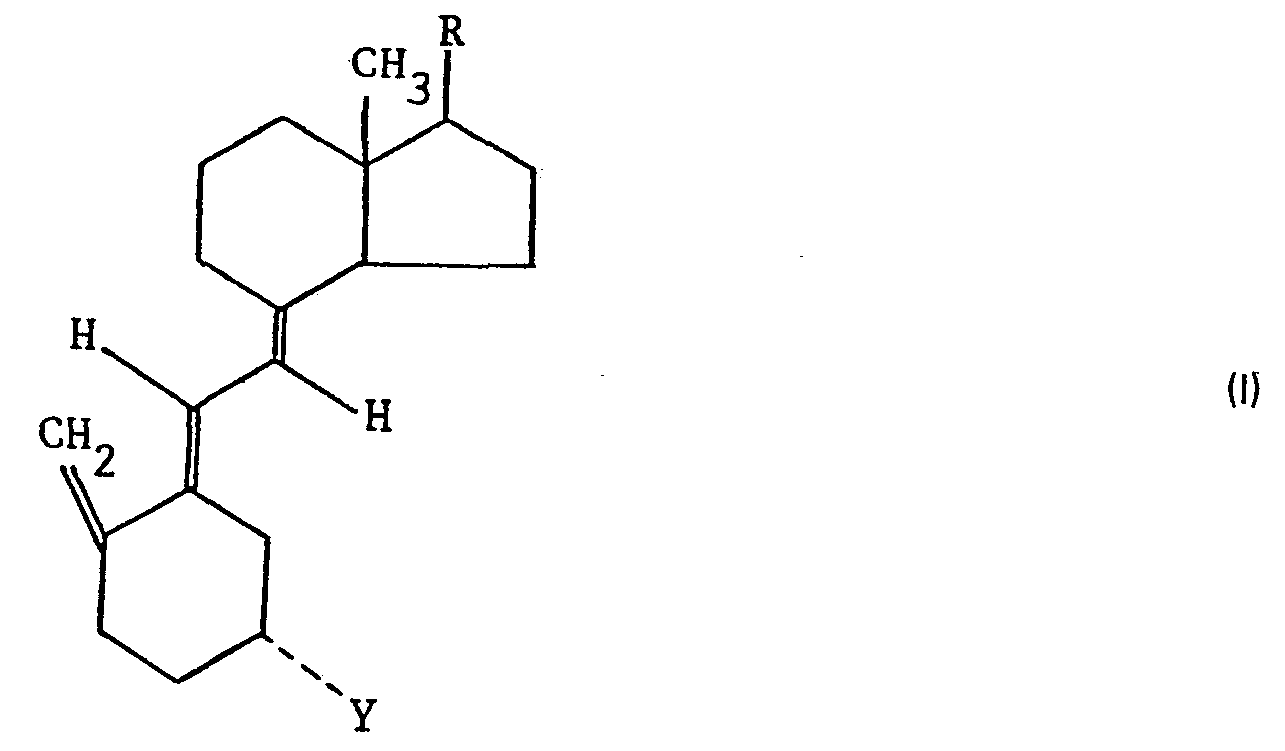

- Where Y represents a protected hydroxyl group this may be an esterified or etherified hydroxyl group e.g. an alkanoyloxy group having 1 to 6 carbon atoms such as an acetoxy, propionyloxy, isobutyryloxy or pivaloxy group, an aroyloxy group having 7 to 15 carbon atoms e.g. a benzoyloxy or 4-phenylazobenzoyloxy group, a lower alkoxy group having 1 to 6 carbon atoms which may be interrupted by an oxygen atom such as a methoxy or methoxymethoxy group, a tetrahydropyranyloxy group or a trihydrocarbylsilyloxy group e.g. with 3 to 9 carbon atoms such as a trimethylsilyloxy group.
- Although such protected forms are in general physiologically active, the free hydroxy forms are preferred for use in medicine. The protecting groups may be deprotected e.g. by conventional methods which methods are well documented in the literature. Thus, acyloxy groups of esters may be removed by basic hydrolysis, e.g. with alkali metal alkoxide in an alkanol. Ether groups, e.g. silyloxy groups, may be removed by acid hydrolysis or treatment with tetra-alkyl ammonium fluorides.
- A 5,6-trans starting compound of formula I may, for example, be used in which the 17-side chain R represents the group

- The 5,6-trans vitamin D compound will, in general, be formed by isomerisation of the corresponding natural 5,6-cis compound, for example using conventional methods such as treatment with iodine, a Lewis acid such as BF3 or diphenyldiselenide.
- The oxidation of 5,6-trans vitamin D compounds according to the invention may take place in the presence of the corresponding 5,6-cis isomers, for example a mixture resulting from incomplete isomerisation of the 5,6-cis starting compound. Although direct oxidation of 5,6-cis isomers with selenium dioxide tends to yield large quantities of unwanted by-products, as is seen from the poor results reported in the prior art (where no alcohol was present), this reaction is far slower than the allylic oxidation of the trans-isomer; the cis-isomer is thus largely either left unoxidised or is isomerised.
- In this connection we have found that if the starting vitamin D compounds do not have a bulky group present in the 3-position e.g. have a free 3-hydroxyl group or a 3-hydroxyl group protected by a lower (i.e. C1-6) ester or ether such as an acetate or methyl ether, the initial 5,6-cis vitamin D compounds are isomerised in situ in the oxidation reaction and thus it may not be necessary to effect the isomerisation in a separate step prior to the oxidation.
- We have also found, however, that where a bulky group, for example a bulky ester group such as a pivalyloxy, isobutyryloxy, benzoyloxy or 4-phenylazobenzoyloxy group, is present in the 3-position; 5,6-cis vitamin D compounds do not isomerise satisfactorily under the conditions of the oxidation.
- Although in these cases the 5,6-trans starting material has to be prepared by isomerisation in a separate step prior to oxidation, we have found that such 5,6-cis vitamin D compounds having bulky groups in the 3-position are oxidised very slowly indeed by selenium dioxide. It is thus possible to prepare a mixture, e.g. an equilibrium mixture of the 5,6-cis and 5,6-trans isomers and to continue the oxidation with selenium dioxide until a substantial amount e.g. at least 60%, preferably about 80%, of the 5,6-trans isomer has been oxidised. In this connection the course of the reaction may be monitored by, for example, thin layer chromatography. The unreacted 5,6-cis vitamin D analogue may then, if desired, be subjected to another isomerisation step and used in the oxidation reaction again. In these circumstances it is unnecessary to separate mixtures of cis and trans isomers prior to the oxidation. It is especially advantageous that there is no need to separate cis and trans isomers prior to the oxidation reaction, since isomerisation of the cis to the trans isomers inevitably results in an equilibrium mixture in which the ratio of trans to cis isomers is 3:2.
- The alcohol used in conjunction with the selenium dioxide or selenous acid is preferably a lower alkanol, for example haivng 1 to 9 carbon atoms and being substituted by at least one, preferably one or two, hydroxy groups and which may carry one or more aryl groups having 6-9 carbon atoms. Where the lower alkanol is substituted by two hydroxy groups the hydroxy groups are preferably on adjacent carbon atoms (vicinal diols) or are on different carbon atoms which atoms are separated by a further carbon atom e.g. 1,2-ethanediol, 1,3-propanediol or 1,2-dihydroxy-3-methy-butane. Preferred lower alkanols include ethanol and more especially methanol.
- Where it is desired to effect the oxidation reaction using a selenite ester, the ester preferably has the formula:-

- An ester of formula II may thus, for example, be used in which R1 and R2 together represent an ethylene or n-propylene chain. It is especially preferred, however,to use a compound of formula 11 in which one of R1 and R2 represents an alkyl group with 1 to 4 carbon atoms. Where RI and R2 each represent alkyl or aralkyl groups RI and R2 are normally the same, for example methyl, ethyl or benzyl groups. Diesters are preferred and R' and R2 are preferably both alkyl groups or together represent an alkylene chain.
- Although not essential, it is advantageous to effect the oxidation reaction using a selenite ester in the presence of an alcohol, preferably the alcohol from which the selenite ester is formed.
- Regardless of whether the oxidation is effected using selenium dioxide or selenous acid in the presence of an alcohol or using a selenite ester, the oxidation reaction may, if desired, be effected in the additional presence of a co-solvent, for example an ether such as diethyl ether or a chlorinated hydrocarbon such as chlorobenzene. It may also be advantageous to effect the oxidation in the presence of acetonitrile which facilitates solution of the starting materials. Water may also be present in small quantities but is preferably absent.
- The oxidation reaction is, in general, conveniently effected at a temperature from about ambient temperature (e.g. about 10-250C) up to the boiling temperature of the reaction mixture.
- The process of the present invention as described above has been found to result in yields of about 15-20% which yields are sufficiently high to render such processes economic for commercial production having regard to the high activity of 1 a-hydroxyvitamin D compounds. In a further preferred embodiment of the present invention we have been able to increase still further the yield of 1-hydroxyvitamin D compounds by the use of a co-oxidant capable of oxidising Sell compounds to SeIV compounds. Indeed we have achieved yields as high as 60% by the use of such co-oxidants. Co-oxidants include for example, the metal salts of per acids, for example the metal salts of periodic acid, preferably the alkali metal salts of periodic acid, especially sodium metaperiodate. Certain alkyl hydroperoxides and tertiary amine oxides have been found to be especially advantageous for use as co-oxidants in view of the relatively clean oxidation reaction which can be effected under mild conditions, e.g. at ambient conditions, few contaminating by-products being formed.
- The hydroperoxides of particular interest as co-oxidants are tertiary alkyl hydroperoxides in which the alkyl moiety may, if desired, be substituted by one or more aryl groups. Thus, for example, the hydroperoxide may have the formula

- The tertiary amine oxides of particular interest as co-oxidants are non-aromatic tertiary amine oxides, for example compounds of the formula:

- 1 to 2.5, preferably about 2, molecular equivalents of the co-oxidant are conveniently used per molecular equivalent of the 5,6-trans starting material used.
- The selenium dioxide is conveniently used inan amount ranging from 0.3 to 1.5, preferably about 1.0 molecular equivalents per molecular equivalent of 5,6-trans starting material. Where no co-oxidant is used the ratio of selenium dioxide to 5,6-trans starting material is preferably about 1:1. Selenous acid is conveniently used in the same proportions.
- The oxidation reaction normally will yield predominantly 1α-hydroxy-5,6-trans vitamin D compounds but minor quantities of its β-isomer may be formed and where a small group is present at the 3-position, also minor quantities of 1 a- and 1β-hydroxyvitamin D3 cis-isomer. Yields of 1 a-hydroxy-5,6-transvitamin D3 of the order of 44% have been obtained using 5,6-transvitamin D derivatives having a relatively bulky ester grouping at the 3-position and using sodium metaperiodate as co-oxidant a further 18% of 1 β-laydroxy-5,6-transvitamin D being formed simultaneously.
- Selenite esters have, for example, been described in "Comprehensive Organic Chemistry", Pergamon 1 st Ed, Vol 3; Editor: D. Neville Jones; pp 525 et seq.
- Thus, for example, the above-described selenite esters may be prepared by reacting selenium dioxide or selenous acid with the appropriate alcohol, e.g. 1) of the formula RIOH or R20H (wherein R' and R2 are as hereinbefore defined) in which case a compound of formula II is normally prepared in which R1 and R2 are the same or 2) a diol in which the alkyl moiety is as hereinbefore defined for R1 and R2 together.
- 1-Hydroxytransvitamin D compounds may, if desired, be converted into the corresponding cis compound by isomerization methods well known from the literature e.g. by treatment with iodine, a Lewis acid or diphenyldiselenide.
- The 1 a-hydroxy compounds are of particular interest in that 1 a-hydroxyvitamin D3 (cis-isomer) and many of its analogues are of great value in medicine while the 1 a-hydroxy-5,6-transvitamin D compounds may either be converted into their 5,6-cis isomers as described herein or used as an intermediate in the production of 1 a-hydroxy-dihydrotachysterols by conventional methods well known in the literature. The 1β-hydroxy-material may be separated from the la-hydroxymaterial by conventional methods such as chromatography or even by direct crystallisation. The undesired 1β-isomer may if desired subsequently be converted into the 1 α-isomer according to known isomerisation techniques e.g. directly or, more preferably, by oxidation with an allylic oxidant, e.g. manganese dioxide, to the corresponding 1-oxo steroid followed by stereospecific reduction with a metal hydride e.g. lithium aluminium hydride or sodium borohydride.
- The isomerisation of 1β-hydroxy-5,6-trans vitamin D compounds to the desired 1 a-hydroxy-5,6- cis vitamin D compounds thus requires two isomerisation steps; the isomerisation at the 1-position is preferably effected first.
- The present invention thus also relates to the isomerisation of a 1 a-hydroxy-5,6-trans vitamin D compound obtained according to the above-described process to the 1α-hydroxy-5,6-vitamin D compound (i.e. the 5,6-cis isomers).
- The products of the process of the present invention, e.g. 1 a-hydroxyvitamin D compounds (i.e. 5,6-cis isomers) especially 1α-hydroxyvitamin D3, may be formulated into pharmaceutical compositions in the conventional manner.
- Thus according to a further feature of the present invention there are provided pharmaceutical compositions comprising a la-hydroxy vitamin D compound, especially 1α-hydroxyvitamin D3, prepared according to the process hereinbefore described as active ingredient in association with a pharmaceutical carrier of excipient.
- In the following Examples which illustrate the present invention variation of concentration was found to have a noticeable effect on reaction rate. Yields were generally found to be in the range 30 to 35% based on the recovered starting material. The high pressure liquid chromatography (HPLC) conditions are as follows:

- Transvitamin D3 (1 g) was dissolved in dry methanol (30 ml) under an atmosphere of argon. Selenium dioxide [solid (280 mg)] and solid sodium metaperiodate (800 mg) were added to the stirred solution and the mixture was brought rapidly to reflux whilst stirring vigorously. The appearance of product was followed by thin layer chromatography (t.l.c.). When the reaction was completed (usually 10-20 min.) the reaction mixture was cooled in a water bath, then diluted with ether, washed twice with 5% sodium bicarbonate solution dried (MgSO4), filtered and evaporated in vacuo. The residue was taken up in hexane/benzene and chromatographed over silica gel (10 g) (medium pressure-rapid chromatography) to afford a mixture of 1-hydroxylated vitamins (330 mg). The mixture of vitamins was taken up in hexanes, and filtered yielding 1 α,3β-dihydroxytransvitamin D3 (120 mg). The mother liquors were chromatographed using high pressure liquid chromatography to yield in order of elution:
- 1α,3β-dihydroxytrans-vitamin D3
- 1α,3β-dihydroxycisvitamin D3
- 1β,2β-dihydroxycisvitamin D3
- 1β,3β-dihydroxytransvitamin D3
- Oxidation of vitamin D3 under identical conditions afforded a similar result.
- Vitamin D3 (2.4 g) was dissolved in dry methanol (70 mg) under a flow of argon. To the stirred solution was added selenium dioxide (672 mg) and sodium metaperiodate (1.92 g). The solution was rapidly brought to reflux whilst stirring vigorously. The reaction monitored by t.l.c. When the reaction was complete it was worked up as described above and chromatographed on silica gel (10 g) to afford a mixture of 1-hydroxy vitamins. Filtration from hexanes, gave as a white crystalline solid 1α,3β-dihydroxytrans-vitamin D3 (251 mg). High pressure liquid chromatography (HPLC) separation of the residue gave 1 α,3β-dihydroxytrans-vitamin D3 (49 mg), 1 α,3β-dihdyroxycisvitamin D3 (38 mg), 1β,3β-dihydroxycisvitamin D3 (32 mg) and as the most polar vitamin 1β,3β-dihydroxytransvitamin D3 (83 mg).
- Transvitamin D3 acetate (0.75 g) was dissolved in dry methanol (21 ml) under an atmosphere of argon (required warming to achieve solubility). Selenium dioxide (155 mg) and sodium metaperiodate (409 mg) were added to the solution. The solution was rapidly brought to reflux whilst stirring vigorously, and followed by t.l.c. When the reaction was judged complete (approx..17 mins) it was worked up as described above and chromatographed to yield recovered starting material (72 mg) cis to trans ratio 2:3.4) and 1-hydroxylated vitamins (345 mg) (49%). The mixture was chromatographed on HPLC to yield 1β-hydroxy-3β-acetoxycisvitamin D3 (D34 mg); 1 α-hydroxy-3β-acetoxycisvitamin D3 (64.2 mg); and as a mixture 1 a and 1 β-hydroxy-3β-acetoxytransvitamin D3 (206 mg). Separation of 1 α- and 1β-hydroxy-3β-acetoxytransvitamin D3 has been achieved on medium pressure rapid column chromatography.
- Under conditions similar to those outlined above 3β-pivaloyltransvitamin D3 (445 mg) was reacted with selenium dioxide (105 mg) and sodium metaperiodate (420 mg) in dry methanol (15 ml) to afford after column chromatography recovered starting material (131 mg), followed by 1β-hydroxy-3β-pivaloyltransvitamin D3 (61.2 mg, 18%) and 1 α-hydroxy-3β-pivaloyltransvitamin D3 (143 mg, 44%), as the only hydroxylated products.
- 4-Phenylazobenzoyltransvitamin D3 (500 mg) is reacted with selenium dioxide and sodium metaperiodate in dry methanol/chloroform to yield recovered starting material (64 mg) 1β-hydroxy-3β-(4-phenylazobenzoyl)-transvitamin D3 (70 mg) and 1α-hydroxy-3β-(4-phenylazobenzoyl)-transvitamin D3 (157 mg).
- Transvitamin D3 benzoate (495 mg) in dry ether (12 ml), was treated at room temperature with t-butyl hydroperoxide in ether (170 µl) and the title selenite (60µl) under an atmosphere of argon. After 1 hour further t-butyl hydroperoxide and selenite were added as above. After 4 hours the work up described in Example 1 afforded 132 mg. of unreacted starting material and 170 mg. of the hydroxylated product.
- Trans vitamin D3 benzoate (220 mg) in ether (5 ml) was treated at room temperature with t-butyl hydroperoxide (124 µl) and the title selenite (33 µl) under an atmosphere of argon. After 2 hours the work up described in Example 1 afforded 70 mg of unreacted starting material and 57 mg of hydroxylated product.
- Transvitamin D3 (320 mg) in a 3:1 mixture of methanolhexane (12 ml) was heated to reflux. Diethyl selenite (40 ,ul) and sodium metaperiodate (280 mg) were added. After refluxing for 20 mins., the reaction mixture was cooled rapidly, poured into ether and partitioned between ether and dilute aqueous sodium bicarbonate solution. The aqueous layer was extracted twice with ether. The combined ethereal layers were washed with water until neutral, dried and ether was evaporated to give an oil which was chromatographed to yield 75 mg of starting material, 15 mg of 1β-hydroxy-transvitamin D3 3β-benzoate (A) as an oil and 80 mg of 1 α-hydroxy-transvitamin D3 3β-benzoate, (B), as an oil.
- NMR of(A): 0.46(3H.s), 0.80, 0.90 (methyls), 4.29(1 H,m), 5.10(1 H,br.s.) 5.20(1 H, br.s.), 5.23(1 H,m), 5.86(1 H,d,J 11. 5Hz), 6.68(1 H,d, J 115Hz), 7.53(3H,m), 8.06(2H,m).
- NMR of (B):0.40(3H,s), 0.80, 0.90 (methyls), 4.57(1 H,m), 5.03(1 H,br.s) 5.13(1 H, br.s.), 5.50(1 H,m), 5.80 (1 H, d., J 11.5Hz), 6.60(1 H,d, J 1 1.5Hz), 7.43 (3H,m), 8.00(2H,m).
- A solution of transvitamin D3 (370 mg, in a 1:3 mixture of methanol-ether (8 ml) was oxidized at room temperature using diethyl selenite (95 µl) and 70% aqueous tert-butylhydroperoxide (dried over 3A molecular sieves 230 µl) at room temperature. The work up described in (a) and chromatography yielded 124 mg of starting material and 137 mg of (A) and (B).
- A solution of transvitamin D3 benzoate (950 mg), diethyl selenite (250 µl), and N-methyl morpholine N-oxide (500 mg) in a 1:3. mixture of methanol-ether (16 ml) was allowed to stand overnight at 22°C. The reaction mixture was worked up as usual. After column chromatography, 190 mg of starting material, 50 mg of pure (A) and 55 mg of an approximately 1:1 mixture of (A) and (B), and 260 mg of pure (B) were obtained.
the latter was obtained as the second most abundant isomer.
Claims (11)


Applications Claiming Priority (3)
| Application Number | Priority Date | Filing Date | Title |
|---|---|---|---|
| GB4345878 | 1978-11-07 | ||
| GB7843458 | 1978-11-07 | ||
| CA000339258A CA1184920A (en) | 1978-11-07 | 1979-11-06 | Process for the preparation of 1-hydroxylated vitamin d compounds |
Publications (2)
| Publication Number | Publication Date |
|---|---|
| EP0010992A1 EP0010992A1 (en) | 1980-05-14 |
| EP0010992B1 true EP0010992B1 (en) | 1982-05-05 |
Family
ID=25668995
Family Applications (1)
| Application Number | Title | Priority Date | Filing Date |
|---|---|---|---|
| EP79302488A Expired EP0010992B1 (en) | 1978-11-07 | 1979-11-06 | Process for the preparation of 1-hydroxylated vitamin d compounds |
Country Status (15)
| Country | Link |
|---|---|
| US (1) | US4263215A (en) |
| EP (1) | EP0010992B1 (en) |
| JP (1) | JPS55105662A (en) |
| KR (1) | KR830000454B1 (en) |
| AU (1) | AU532046B2 (en) |
| CA (1) | CA1184920A (en) |
| DE (1) | DE2962733D1 (en) |
| DK (1) | DK147178C (en) |
| GB (1) | GB2038834B (en) |
| IE (1) | IE48984B1 (en) |
| IL (1) | IL58643A (en) |
| NO (1) | NO148596C (en) |
| NZ (1) | NZ192058A (en) |
| PH (1) | PH16989A (en) |
| ZA (1) | ZA795958B (en) |
Cited By (1)
| Publication number | Priority date | Publication date | Assignee | Title |
|---|---|---|---|---|
| DE10019861A1 (en) * | 2000-04-18 | 2001-10-31 | Schering Ag | New synthetic intermediate, its microbiological production and use for the synthesis of vitamin D derivatives |
Families Citing this family (18)
| Publication number | Priority date | Publication date | Assignee | Title |
|---|---|---|---|---|
| DE3048698A1 (en) * | 1980-12-23 | 1982-07-15 | Wisconsin Alumni Research Foundation, 53707 Madison, Wis. | 1-Alpha-hydroxy-vitamin=D prepn. - by allylic oxidn. of 5,6-trans-vitamin=D followed by irradiation |
| FR2496656B1 (en) * | 1980-12-24 | 1986-04-11 | Wisconsin Alumni Res Found | PROCESS FOR THE PREPARATION OF VITAMIN D SUBSTITUTED COMPOUNDS AT POSITION 1 BY HYDROXYL RADICAL FROM 5,6-TRANS-VITAMIN D COMPOUNDS AND COMPOUNDS THUS OBTAINED |
| JPS57109765A (en) * | 1980-12-27 | 1982-07-08 | Wisconsin Alumni Res Found | Preparation of 1-hydroxylated vitamin d compound from 5,6-trans-vitamin d compound |
| US4338250A (en) * | 1981-04-27 | 1982-07-06 | Wisconsin Alumni Research Foundation | 1-Hydroxylation process |
| EP0070588B1 (en) * | 1981-07-17 | 1986-05-07 | Duphar International Research B.V | Method of preparing 1-alpha-hydroxyvitamin d and 1-alpha-hydroxy-previtamin d compounds, and adduct of a previtamin d or tachysterol compound with a suitable dienophile |
| US4358406A (en) * | 1981-07-27 | 1982-11-09 | Wisconsin Alumni Research Foundation | 26,26,26,27,27,27-Hexafluoro-1α,25-dihydroxycholecalciferol and process for preparing same |
| EP0078705B1 (en) * | 1981-11-02 | 1988-04-27 | Research Institute For Medicine And Chemistry Inc. | Process for the preparation of 1-hydroxylated vitamin d compounds |
| ZA828012B (en) * | 1981-11-02 | 1983-09-28 | Res Inst Medicine Chem | Process for the preparation of 1-hydroxylated vitamin d compounds |
| US4456553A (en) * | 1982-05-07 | 1984-06-26 | Teijin Limited | Vitamin D3 derivatives, process for preparation thereof, and antigens comprising said derivatives to be used for preparation of antibodies for immunochemical assay and antibodies prepared therefrom |
| US5502224A (en) * | 1991-06-04 | 1996-03-26 | Marigen, S.A. | Biotenside esters and phosphatides with vitamin-D and vitamin-E compounds |
| US5869472A (en) * | 1994-07-18 | 1999-02-09 | Bone Care International, Inc. | Synthesis of 1α-hydroxy vitamin D |
| US5869709A (en) * | 1997-05-07 | 1999-02-09 | Humanetics Corporation | Process for effecting allylic oxidation |
| US6686486B1 (en) * | 1997-05-07 | 2004-02-03 | Padma Marwah | Process for effecting allylic oxidation |
| US6252119B1 (en) | 1997-07-28 | 2001-06-26 | Salvador Jorge Antonio Riberiro | Copper-catalysed allylic oxidation using alkyl hydroperoxide |
| US6384251B1 (en) | 1998-03-18 | 2002-05-07 | Humanetics Corporation | Process for effecting allylic oxidation using dicarboxylic acid imides and chromium reagents |
| WO2003087048A2 (en) * | 2002-04-11 | 2003-10-23 | Instytut Farmaceutyczny | Preparation of 24 alkyl analogs of cholecalciferol and non-racemic compounds |
| TW200714580A (en) * | 2005-10-14 | 2007-04-16 | Formosa Lab Inc | Process for preparing vitamin D analogs |
| WO2011002756A2 (en) * | 2009-07-01 | 2011-01-06 | Vitamin Derivatives, Inc. | Vitamin d compounds and methods for preparing same |
Family Cites Families (2)
| Publication number | Priority date | Publication date | Assignee | Title |
|---|---|---|---|---|
| US4195027A (en) * | 1978-01-16 | 1980-03-25 | Wisconsin Alumni Research Foundation | Process for preparing 1α-hydroxylated compounds |
| US6282956B1 (en) | 1994-12-29 | 2001-09-04 | Kazuhiro Okada | Multi-axial angular velocity sensor |
-
1979
- 1979-10-29 PH PH23221A patent/PH16989A/en unknown
- 1979-11-05 AU AU52516/79A patent/AU532046B2/en not_active Expired
- 1979-11-06 DE DE7979302488T patent/DE2962733D1/en not_active Expired
- 1979-11-06 US US06/091,743 patent/US4263215A/en not_active Expired - Lifetime
- 1979-11-06 GB GB7938350A patent/GB2038834B/en not_active Expired
- 1979-11-06 NO NO793579A patent/NO148596C/en unknown
- 1979-11-06 DK DK469379A patent/DK147178C/en not_active IP Right Cessation
- 1979-11-06 IE IE2135/79A patent/IE48984B1/en not_active IP Right Cessation
- 1979-11-06 EP EP79302488A patent/EP0010992B1/en not_active Expired
- 1979-11-06 NZ NZ192058A patent/NZ192058A/en unknown
- 1979-11-06 IL IL58643A patent/IL58643A/en unknown
- 1979-11-06 ZA ZA00795958A patent/ZA795958B/en unknown
- 1979-11-06 CA CA000339258A patent/CA1184920A/en not_active Expired
- 1979-11-06 JP JP14377579A patent/JPS55105662A/en active Granted
- 1979-11-07 KR KR1019790003895A patent/KR830000454B1/en not_active Expired
Cited By (1)
| Publication number | Priority date | Publication date | Assignee | Title |
|---|---|---|---|---|
| DE10019861A1 (en) * | 2000-04-18 | 2001-10-31 | Schering Ag | New synthetic intermediate, its microbiological production and use for the synthesis of vitamin D derivatives |
Also Published As
| Publication number | Publication date |
|---|---|
| PH16989A (en) | 1984-05-04 |
| JPS55105662A (en) | 1980-08-13 |
| NO793579L (en) | 1980-05-08 |
| NZ192058A (en) | 1982-03-23 |
| CA1184920A (en) | 1985-04-02 |
| KR830000454B1 (en) | 1983-03-08 |
| DK469379A (en) | 1980-05-08 |
| IL58643A0 (en) | 1980-02-29 |
| DK147178B (en) | 1984-05-07 |
| IE792135L (en) | 1980-05-07 |
| AU532046B2 (en) | 1983-09-15 |
| DK147178C (en) | 1984-11-19 |
| DE2962733D1 (en) | 1982-06-24 |
| EP0010992A1 (en) | 1980-05-14 |
| NO148596C (en) | 1983-11-09 |
| GB2038834B (en) | 1983-03-23 |
| ZA795958B (en) | 1980-11-26 |
| JPS6258353B2 (en) | 1987-12-05 |
| IL58643A (en) | 1983-06-15 |
| US4263215A (en) | 1981-04-21 |
| AU5251679A (en) | 1980-05-15 |
| NO148596B (en) | 1983-08-01 |
| IE48984B1 (en) | 1985-06-26 |
| GB2038834A (en) | 1980-07-30 |
Similar Documents
| Publication | Publication Date | Title |
|---|---|---|
| US4263215A (en) | Process for the preparation of 1-hydroxylated vitamin D compounds | |
| US4670190A (en) | 1-α-hydroxy vitamin D compounds and process for preparing same | |
| GB2127023A (en) | Synthesis of 25-hydroxyvitamin d2 and related compounds | |
| US4554105A (en) | Process for the preparation of 1-hydroxylated vitamin D compounds | |
| EP0171990B1 (en) | Vitamin d3 derivatives | |
| JPH05271182A (en) | 1α, 7,8-trihydroxyvitamin D compound | |
| US4652405A (en) | Synthesis of 1α,25-dihydroxy-24R-fluorocholecalciferol and 1α,25-dihydroxy-24S-fluorocholecalciferol | |
| US4421690A (en) | Process for the preparation of 24,24-difluoro-1α,25-dihydroxy vitamin D3 and intermediates obtained therefrom | |
| EP0402982B1 (en) | Adduct-aldehyde and its use for the preparation of a vitamin-D compound | |
| US4397847A (en) | Method of treatment | |
| US4344888A (en) | 24,25-Dihydroxycholestans and process for preparing the same | |
| JPS5823660A (en) | Manufacture of 1 alpha-hydroxyvitamin d or 1 alpha-hydroxy-previtamin d compound and adduct of previtamin d or tachysterol and dienophile | |
| US4634692A (en) | Synthesis of 1α,25-dihydroxy-24R-fluorocholecalciferol and 1α,25-dihydroxy-24S-fluorocholecalciferol | |
| CA2062520C (en) | Synthesis of 1-alpha-hydroxy-secosterol compounds | |
| US3939156A (en) | Cardenolides | |
| JP3105973B2 (en) | Method for producing active vitamin D derivative | |
| EP0468037B1 (en) | Process for preparing vitamin d2 compounds and the corresponding 1 alpha-hydroxylated derivatives | |
| JPH05339230A (en) | Activated type vitamin d2 and the production of its derivative | |
| JPH0539261A (en) | Active type vitamin d derivative | |
| JP2731543B2 (en) | 20-methyl-21-hydroxypregnane derivative | |
| JPH0353299B2 (en) | ||
| JPH0680589A (en) | Method for producing optically active olefin | |
| JPH0251551B2 (en) | ||
| JPS58121243A (en) | Novel bicyclooctane derivative and its preparation |
Legal Events
| Date | Code | Title | Description |
|---|---|---|---|
| PUAI | Public reference made under article 153(3) epc to a published international application that has entered the european phase |
Free format text: ORIGINAL CODE: 0009012 |
|
| AK | Designated contracting states |
Designated state(s): BE CH DE FR GB IT NL SE |
|
| 17P | Request for examination filed |
Effective date: 19801114 |
|
| ITF | It: translation for a ep patent filed | ||
| GRAA | (expected) grant |
Free format text: ORIGINAL CODE: 0009210 |
|
| AK | Designated contracting states |
Designated state(s): BE CH DE FR GB IT NL SE |
|
| REF | Corresponds to: |
Ref document number: 2962733 Country of ref document: DE Date of ref document: 19820624 |
|
| REG | Reference to a national code |
Ref country code: GB Ref legal event code: 746 |
|
| ITTA | It: last paid annual fee | ||
| EAL | Se: european patent in force in sweden |
Ref document number: 79302488.6 |
|
| PGFP | Annual fee paid to national office [announced via postgrant information from national office to epo] |
Ref country code: GB Payment date: 19981029 Year of fee payment: 20 Ref country code: FR Payment date: 19981029 Year of fee payment: 20 |
|
| PGFP | Annual fee paid to national office [announced via postgrant information from national office to epo] |
Ref country code: SE Payment date: 19981030 Year of fee payment: 20 |
|
| PGFP | Annual fee paid to national office [announced via postgrant information from national office to epo] |
Ref country code: BE Payment date: 19981117 Year of fee payment: 20 |
|
| PGFP | Annual fee paid to national office [announced via postgrant information from national office to epo] |
Ref country code: CH Payment date: 19981123 Year of fee payment: 20 |
|
| PGFP | Annual fee paid to national office [announced via postgrant information from national office to epo] |
Ref country code: NL Payment date: 19981130 Year of fee payment: 20 |
|
| BE20 | Be: patent expired |
Free format text: 19991106 *RESEARCH INSTITUTE FOR MEDICINE AND CHEMISTRY INC. |
|
| PGFP | Annual fee paid to national office [announced via postgrant information from national office to epo] |
Ref country code: DE Payment date: 19990104 Year of fee payment: 20 |
|
| PG25 | Lapsed in a contracting state [announced via postgrant information from national office to epo] |
Ref country code: GB Free format text: LAPSE BECAUSE OF EXPIRATION OF PROTECTION Effective date: 19991105 Ref country code: CH Free format text: LAPSE BECAUSE OF EXPIRATION OF PROTECTION Effective date: 19991105 |
|
| PG25 | Lapsed in a contracting state [announced via postgrant information from national office to epo] |
Ref country code: NL Free format text: LAPSE BECAUSE OF EXPIRATION OF PROTECTION Effective date: 19991106 |
|
| PG25 | Lapsed in a contracting state [announced via postgrant information from national office to epo] |
Ref country code: SE Free format text: LAPSE BECAUSE OF NON-PAYMENT OF DUE FEES Effective date: 19991107 |
|
| REG | Reference to a national code |
Ref country code: CH Ref legal event code: PL |
|
| REG | Reference to a national code |
Ref country code: GB Ref legal event code: PE20 Effective date: 19991105 |
|
| NLV7 | Nl: ceased due to reaching the maximum lifetime of a patent |
Effective date: 19991106 |
|
| EUG | Se: european patent has lapsed |
Ref document number: 79302488.6 |
|
| PLBE | No opposition filed within time limit |
Free format text: ORIGINAL CODE: 0009261 |
|
| STAA | Information on the status of an ep patent application or granted ep patent |
Free format text: STATUS: NO OPPOSITION FILED WITHIN TIME LIMIT |