EP0010886B1 - A process for the dimerisation of acrylonitrile - Google Patents
A process for the dimerisation of acrylonitrile Download PDFInfo
- Publication number
- EP0010886B1 EP0010886B1 EP79302188A EP79302188A EP0010886B1 EP 0010886 B1 EP0010886 B1 EP 0010886B1 EP 79302188 A EP79302188 A EP 79302188A EP 79302188 A EP79302188 A EP 79302188A EP 0010886 B1 EP0010886 B1 EP 0010886B1
- Authority
- EP
- European Patent Office
- Prior art keywords
- solvent
- acrylonitrile
- process according
- donating
- range
- Prior art date
- Legal status (The legal status is an assumption and is not a legal conclusion. Google has not performed a legal analysis and makes no representation as to the accuracy of the status listed.)
- Expired
Links
Classifications
-
- C—CHEMISTRY; METALLURGY
- C07—ORGANIC CHEMISTRY
- C07C—ACYCLIC OR CARBOCYCLIC COMPOUNDS
- C07C255/00—Carboxylic acid nitriles
-
- B—PERFORMING OPERATIONS; TRANSPORTING
- B01—PHYSICAL OR CHEMICAL PROCESSES OR APPARATUS IN GENERAL
- B01J—CHEMICAL OR PHYSICAL PROCESSES, e.g. CATALYSIS OR COLLOID CHEMISTRY; THEIR RELEVANT APPARATUS
- B01J31/00—Catalysts comprising hydrides, coordination complexes or organic compounds
- B01J31/02—Catalysts comprising hydrides, coordination complexes or organic compounds containing organic compounds or metal hydrides
- B01J31/0234—Nitrogen-, phosphorus-, arsenic- or antimony-containing compounds
- B01J31/0255—Phosphorus containing compounds
- B01J31/0257—Phosphorus acids or phosphorus acid esters
- B01J31/0259—Phosphorus acids or phosphorus acid esters comprising phosphorous acid (-ester) groups ((RO)P(OR')2) or the isomeric phosphonic acid (-ester) groups (R(R'O)2P=O), i.e. R= C, R'= C, H
-
- B—PERFORMING OPERATIONS; TRANSPORTING
- B01—PHYSICAL OR CHEMICAL PROCESSES OR APPARATUS IN GENERAL
- B01J—CHEMICAL OR PHYSICAL PROCESSES, e.g. CATALYSIS OR COLLOID CHEMISTRY; THEIR RELEVANT APPARATUS
- B01J31/00—Catalysts comprising hydrides, coordination complexes or organic compounds
- B01J31/02—Catalysts comprising hydrides, coordination complexes or organic compounds containing organic compounds or metal hydrides
- B01J31/0234—Nitrogen-, phosphorus-, arsenic- or antimony-containing compounds
- B01J31/0255—Phosphorus containing compounds
- B01J31/0257—Phosphorus acids or phosphorus acid esters
- B01J31/0261—Phosphorus acids or phosphorus acid esters comprising phosphonous acid (-ester) groups (RP(OR')2) or the isomeric phosphinic acid (-ester) groups (R2(R'O)P=O), i.e. R= C, R'= C, H
Definitions
- the present invention relates to a dimerisation process and, in particular, to a process for the dimerisation of acrylonitrile to linear C 6 dinitriles.
- novel organo-phosphorus compounds and their use as catalysts in the dimerisation of acrylonitrile.
- the novel compounds are phosphinites and phosphonites of general formula: where R, is an electron-donating substituent, R i and R 3 are electron-donating substituents or hydrogen atoms, provided that they are not both hydrogen atoms, or either R i or R 3 forms part of a fused alicyclic ring with R 2' R is alkyl or cycloalkyl, and n and m are integers, each being either 1 or 2, provided that ( m + n) equals 3, and when n is 2, the substituents on each aromatic ring may be the same or different.
- electrostatic substituent we mean a substituent of the aromatic nucleus which gives rise to a negative Hammett a constant.
- substituents R" R 2 and R 3 include alkoxy groups, e.g. methoxy, ethoxy, i-propoxy and t-butoxy; alkyl groups, e.g. methyl, ethyl and propyl; and alkyl amino groups, e.g. dimethylamino and diethylamino.
- alkoxy, alkyl and alkylamino groups preferably contain from 1 to 8 carbon atoms, especially from 1 to 5 carbon atoms. It is essential that the groups R 1 , R 2 and R 3 should be those which do not react adversely with the components of the reaction system.
- Suitable groups R include alkyl groups such as methyl, ethyl, isopropyl, neopentyl, 2-ethylhexyl; and cycloalkyl groups such as cyclohexyl.
- group R there is no finite limit on the numbers of carbon atoms which group R may contain, but it will commonly contain from 1 to 10 carbon atoms. When two groups R are present, they may be the same or different; but, generally, they will be the same.
- the compounds of the invention may be used as catalysts for the dimerisation of acrylonitrile by the process described and claimed in our copending UK Patent Applications Nos. 45324/75 and 52888/75 (published as German OLS 2,649,904) and British Patent 1,547,431.
- the acrylonitrile, substantially free of water and acrylonitrile stabilisers of the phenolic type, e.g. hydroquinone, is contacted with the phosphinite or phosphonite catalyst, the acrylonitrile being dissolved in an inert organic solvent which is capable of donating protons.
- an “inert” solvent is meant one which is substantially unreactive with respect to addition to, or reaction with, the unsaturated linkage of the acrylonitrile or the products of the acrylonitrile dimerisation. Furthermore, the solvent must not react with the phosphorous compound or catalytic intermediates to form inactive phosphorus species at such a rate as to seriously impair the dimerisation reaction.
- hydroxylic solvents such as alcohols
- hydroxylic solvents such as alcohols
- Tertiary and secondary alcohols are preferred, for example, t-butylalcohol, 2-butanol and isopropanol.
- the concentration of proton-donating solvent is generally in the range 5 to 50% by volume, calculated on the total volume of the reactants, but the optimum concentration will vary with the precise nature of the solvent and the catalyst compound.
- the molar concentration of proton-donating solvent will generally be greater than the molar concentration of the phosphorus (III) compound.
- Suitable non-hydroxylic organic solvents include hydrocarbons, for example, hexane, cyclohexane, toluene, and petroleum ethers; ethers, for example, tetrahydrofuran, diethyl ether and di-isopropyl ether; and nitriles, for example, acetonitrile, propionitrile; and fluorobenzenes.
- hydrocarbon co-solvents are generally preferred. We have now found that by careful choice of the co-solvent there is produced a system which provides economies in the operation of the process particularly in respect of product separation and catalyst recycle.
- a process for the dimerisation of acrylonitrile comprises contacting the acrylonitrile with a phosphinite or phosphonite of general formula where R 2 is an electron-donating substituent, R i and R 3 are electron-donating substituents or hydrogen atoms, provided that they are not both hydrogen atoms, or either R, or R 2 forms part of a fused alicyclic ring with R 2 , R is alkyl or cycloalkyl, and n and m are integers, each being either 1 or 2, provided that (m + n) equals 3, and when n is 2, the substituents on each aromatic ring may be the same or different, the acrylonitrile being present in solution in a mixed solvent comprising an inert organic solvent as hereinbefore described which is capable of donating protons and an inert hydrocarbon co-solvent which is a mixture of aromatic and aliphatic hydrocarbons, the nature of the components of the solvent mixture and their relative proportions being so chosen that the dicyan
- the ratio of aromatic hydrocarbon:aliphatic hydrocarbon:proton donating solvent:acrylonitrile is suitably in the range 3 to 7:3 to 7:0.5 to 1.5:3 preferably 5:5:1:3.
- DCB dicyanobutene
- MGN methyleneglutaronitrile
- the acrylonitrile conversion required for separation to take place can also be reduced.
- the DCB-and MGN may be removed from the reaction product by liquid/liquid extraction so that the catalyst remains in the solvent mixture which may, wholly or in part, be recycled.
- an extractant boiling in the range 50 to 300°C suitably a saturated nitrile e.g. adiponitrile, methylglutarodinitrile or ethylsuccindinitrile or mixtures of the these three nitriles.
- the aromatic hydrocarbon solvent preferably boils in the range 75 to 150°C and is suitably benzene or an alkylbenzene, preferably a methyl benzene e.g. toluene.
- the aliphatic hydrocarbon solvent may be an alkane or a cycloalkane and preferably boils in the range 30 to 150°C. Mixtures of aliphatic hydrocarbons may be used e.g. a mixture of alkanes boiling in the temperature range 40 to 80°C.
- An essential feature of the present invention is that the reaction must be conducted in the substantial absence of water. Without prejudice to our invention, we believe that the water reacts with the catalyst in the presence of acrylonitrile to give non-catalytic addition compounds. Thus, the acrylonitrile, proton-donating solvent and co-solvents must be dried before use, otherwise the reaction may be completely inhibited. In particular acrylonitrile, which commonly contains as much as 4000 ppm of water, even after distillation, must be rigorously dried. It is also noted that hydroquinone stabilisers, which are present in acrylonitrile as supplied, should be removed. For example, if the reactants contain 300 ppm of water, reaction is.
- acrylonitrile and hydroxylic solvents may be dried by being contacted with calcium hydride or a 3A or 4A molecular sieve.
- the concentration of the phosphorus compound in the reactant mixture may be varied over a wide range, for example, from 0.001, commonly 0.1, to 5% by volume, calculated on the volume of liquid reactants, but preferably the concentration is in the range of 0.01 to 3% by volume.
- the reaction temperature is commonly in the range 0 to 120°C, but it is generally preferred to keep the temperature below 75°C to minimise polymerisation of the acrylonitrile and dimeric products.
- the reaction temperature is in the range 20 to 70°C. It is noted that the reaction will proceed below 0°C, maintaining selectivity, but at a reduced rate.
- the reaction may be carried out batchwise or continuously, the latter being preferred.
- the lower phase was extracted twice by 30-40° petroleum ether (15 parts and 6 parts) and the combined upper phases from this extraction transferred to a third reaction vessel. After evaporation of solvents this third reaction vessel, containing a small quantity of catalyst which had remained in the bottom phase from the first reaction vessel, was used to receive the upper phase (A) from the second reaction vessel and, after making up with monomer and solvents, (to replace materials used in reaction and those removed with the product phase) became the reaction vessel for the third cycle.
- the lower phase from the petroleum ether extraction was analysed by GLC for 1,4 dicyanobutene and methyleneglutaronitrile after filtration to remove the hexamer.
Landscapes
- Chemical & Material Sciences (AREA)
- Organic Chemistry (AREA)
- Engineering & Computer Science (AREA)
- Materials Engineering (AREA)
- Chemical Kinetics & Catalysis (AREA)
- Organic Low-Molecular-Weight Compounds And Preparation Thereof (AREA)
- Low-Molecular Organic Synthesis Reactions Using Catalysts (AREA)
Description
- The present invention relates to a dimerisation process and, in particular, to a process for the dimerisation of acrylonitrile to linear C6 dinitriles.
- In our copending British patent application No. 31148/78 we have described a group of novel organo-phosphorus compounds and their use as catalysts in the dimerisation of acrylonitrile. The novel compounds are phosphinites and phosphonites of general formula:

- By "electron-donating substituent" we mean a substituent of the aromatic nucleus which gives rise to a negative Hammett a constant.
- A discussion on Hammett a constants and a table showing values for most common substituents is to be found in an article by Clark and Perrin in Quarterly Reviews, vol 18, 1964 pp 295-320.
- Examples of suitable substituents R" R2 and R3 include alkoxy groups, e.g. methoxy, ethoxy, i-propoxy and t-butoxy; alkyl groups, e.g. methyl, ethyl and propyl; and alkyl amino groups, e.g. dimethylamino and diethylamino. The alkoxy, alkyl and alkylamino groups preferably contain from 1 to 8 carbon atoms, especially from 1 to 5 carbon atoms. It is essential that the groups R1, R2 and R3 should be those which do not react adversely with the components of the reaction system.
- Suitable groups R include alkyl groups such as methyl, ethyl, isopropyl, neopentyl, 2-ethylhexyl; and cycloalkyl groups such as cyclohexyl.
- There is no finite limit on the numbers of carbon atoms which group R may contain, but it will commonly contain from 1 to 10 carbon atoms. When two groups R are present, they may be the same or different; but, generally, they will be the same.
- The compounds of the invention may be used as catalysts for the dimerisation of acrylonitrile by the process described and claimed in our copending UK Patent Applications Nos. 45324/75 and 52888/75 (published as German OLS 2,649,904) and British Patent 1,547,431.
- In such a process the acrylonitrile, substantially free of water and acrylonitrile stabilisers of the phenolic type, e.g. hydroquinone, is contacted with the phosphinite or phosphonite catalyst, the acrylonitrile being dissolved in an inert organic solvent which is capable of donating protons.
- By an "inert" solvent is meant one which is substantially unreactive with respect to addition to, or reaction with, the unsaturated linkage of the acrylonitrile or the products of the acrylonitrile dimerisation. Furthermore, the solvent must not react with the phosphorous compound or catalytic intermediates to form inactive phosphorus species at such a rate as to seriously impair the dimerisation reaction.
- Preferably hydroxylic solvents, such as alcohols, are used, provided always that they do not react adversely with the phosphorus compound or an intermediates it may form with acrylonitirle. This may be readily established by experiment. Tertiary and secondary alcohols are preferred, for example, t-butylalcohol, 2-butanol and isopropanol.
- The concentration of proton-donating solvent is generally in the range 5 to 50% by volume, calculated on the total volume of the reactants, but the optimum concentration will vary with the precise nature of the solvent and the catalyst compound. The molar concentration of proton-donating solvent will generally be greater than the molar concentration of the phosphorus (III) compound.
- In order to reduce the amount of hexamer and/or other oligomers or polymers (hereafter referred collectively as polymeric by-products or merely polymers) which may be co-produced with the desired dimeric products, it is often desirable to add an inert, non-hydroxylic co-solvent to the reaction mixture used in our process. It will be apparent that the co-solvent must be dried to a level which maintains the overall anhydrous state of the system.
- Suitable non-hydroxylic organic solvents include hydrocarbons, for example, hexane, cyclohexane, toluene, and petroleum ethers; ethers, for example, tetrahydrofuran, diethyl ether and di-isopropyl ether; and nitriles, for example, acetonitrile, propionitrile; and fluorobenzenes. The hydrocarbon co-solvents are generally preferred. We have now found that by careful choice of the co-solvent there is produced a system which provides economies in the operation of the process particularly in respect of product separation and catalyst recycle.
- According to the present invention a process for the dimerisation of acrylonitrile comprises contacting the acrylonitrile with a phosphinite or phosphonite of general formula
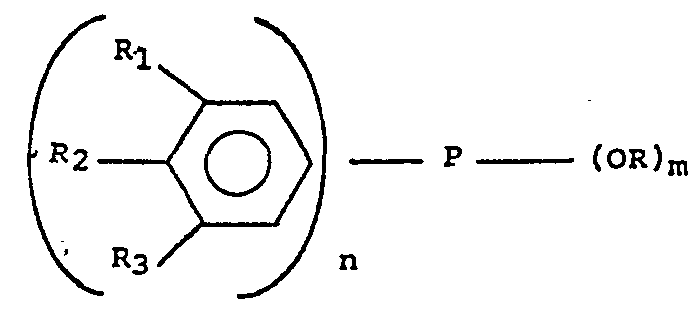
- The ratio of aromatic hydrocarbon:aliphatic hydrocarbon:proton donating solvent:acrylonitrile is suitably in the range 3 to 7:3 to 7:0.5 to 1.5:3 preferably 5:5:1:3. In order that the dicyanobutene (DCB) and methyleneglutaronitrile (MGN) products of the process separate from the solvent mixture it is necessary for the conversion of the acrylonitrile to reach a certain figure. This figure is dependent upon the temperature of the reaction mixture e.g. in the case of the ratios preferred above at 60°C separation of DCB and MGN will occur when the conversion of acrylonitrile is approximately 60%. If the reaction products are cooled prior to separation e.g. to 25°C then the acrylonitrile conversion required for separation to take place can also be reduced. Alternatively, and preferably, the DCB-and MGN may be removed from the reaction product by liquid/liquid extraction so that the catalyst remains in the solvent mixture which may, wholly or in part, be recycled. For the liquid/liquid extraction it is preferred to use an extractant boiling in the range 50 to 300°C suitably a saturated nitrile e.g. adiponitrile, methylglutarodinitrile or ethylsuccindinitrile or mixtures of the these three nitriles. Whichever method is used to remove the DCB and MGN the advantage of the present process over separating the reaction product by distillation includes the avoidance of catalyst damage caused by the heat of distillation as well as an energy saving. In the prior art processes as represented by Offenlegengschrift 2,720, 791 (equivalent to British patent 1,547,431) and French patent 2,368,470 it is first necessary to distil off the excess acrylonitrile before phase separation of catalyst plus solvent and reaction products takes place so incurring the disadvantages mentioned in the preceding sentence.
- The aromatic hydrocarbon solvent preferably boils in the range 75 to 150°C and is suitably benzene or an alkylbenzene, preferably a methyl benzene e.g. toluene. The aliphatic hydrocarbon solvent may be an alkane or a cycloalkane and preferably boils in the range 30 to 150°C. Mixtures of aliphatic hydrocarbons may be used e.g. a mixture of alkanes boiling in the temperature range 40 to 80°C.
- An essential feature of the present invention is that the reaction must be conducted in the substantial absence of water. Without prejudice to our invention, we believe that the water reacts with the catalyst in the presence of acrylonitrile to give non-catalytic addition compounds. Thus, the acrylonitrile, proton-donating solvent and co-solvents must be dried before use, otherwise the reaction may be completely inhibited. In particular acrylonitrile, which commonly contains as much as 4000 ppm of water, even after distillation, must be rigorously dried. It is also noted that hydroquinone stabilisers, which are present in acrylonitrile as supplied, should be removed. For example, if the reactants contain 300 ppm of water, reaction is. seriously inhibited at a concentration of the phosphorus compound of 0.5% by volume, but at water concentrations of 50 ppm or lower reaction takes place readily. Any suitable drying technique may be used provided that the final water level is sufficiently low. For example, acrylonitrile and hydroxylic solvents may be dried by being contacted with calcium hydride or a 3A or 4A molecular sieve.
- The concentration of the phosphorus compound in the reactant mixture may be varied over a wide range, for example, from 0.001, commonly 0.1, to 5% by volume, calculated on the volume of liquid reactants, but preferably the concentration is in the range of 0.01 to 3% by volume.
- The reaction temperature is commonly in the range 0 to 120°C, but it is generally preferred to keep the temperature below 75°C to minimise polymerisation of the acrylonitrile and dimeric products. Preferably, the reaction temperature is in the range 20 to 70°C. It is noted that the reaction will proceed below 0°C, maintaining selectivity, but at a reduced rate.
- Unlike other acrylonitrile dimerisation processes, the presence of compounds such as hydroquinone and its monomethyl ether, p-methoxyphenol, which are commonly used at present as acrylonitrile stabilisers, should be avoided.
- The reaction may be carried out batchwise or continuously, the latter being preferred.
- The invention will now be further described with reference to the following Examples in which all materials and apparatus were rigorously dried prior to used and all manipulations were carried out under moisture and oxygen free conditions (quantities are given in parts by weight).
- Acrylonitrile (24 parts), isopropanol (7.9 parts), toluene (43.3 parts), methylcyclohexane (38.5 parts) and isopropyl bis-3, 4-dimethylphenylphosphinite (1 part) were charged to a reaction vessel and heated at 60°C. After 3 hours reaction time, cooling to 15°C caused separation into 2 phases. The upper phase (A) comprising the major proportion of solvents and catalyst was transferred to a second reaction vessel, make-up quantities of monomer and solvents added as necessary (to replace materials used in reaction and those removed with the product phase) (see Table 1) and then allowed to react further in a second cycle.
- The lower phase was extracted twice by 30-40° petroleum ether (15 parts and 6 parts) and the combined upper phases from this extraction transferred to a third reaction vessel. After evaporation of solvents this third reaction vessel, containing a small quantity of catalyst which had remained in the bottom phase from the first reaction vessel, was used to receive the upper phase (A) from the second reaction vessel and, after making up with monomer and solvents, (to replace materials used in reaction and those removed with the product phase) became the reaction vessel for the third cycle.
- The lower phase from the petroleum ether extraction was analysed by GLC for 1,4 dicyanobutene and methyleneglutaronitrile after filtration to remove the hexamer.
- Operation was continued in this way for 14 cycles details of which are given in Table 1.

- Acrylonitrile (20 parts),isopropanol (7.8 parts) toluene (43 parts), 30-40° petroleum ether (33 parts) and isopropyl bis-3, 4-dimethylphenylphosphinite (0.2 parts) were charged to a reaction vessel and heated at 60°C. After 24 hours reaction time the reaction mixture was extracted twice with adiponitrile (10 parts and 5 parts respectively) and the upper phase comprising catalyst and a major part of the solvents transferred to a second reaction vessel.
- The combined adiponitrile lower phases were then extracted twice by 30-40° petroleum ether and the combined upper (petroleum ether) phase evacuated to remove most of the petroleum ether. The residue was then transferred to the second reaction vessel which after addition of make up quantities of monomer, solvent and catalyst became the reaction vessel for the second cycle.
- The lower phase from the petroleum ether extraction was analysted as in Example I.
- Operation was continuned in this way for 4 cycles, details of which are given in Table 2.

Claims (10)

Applications Claiming Priority (2)
| Application Number | Priority Date | Filing Date | Title |
|---|---|---|---|
| GB4198978 | 1978-10-26 | ||
| GB7841989 | 1978-10-26 |
Publications (2)
| Publication Number | Publication Date |
|---|---|
| EP0010886A1 EP0010886A1 (en) | 1980-05-14 |
| EP0010886B1 true EP0010886B1 (en) | 1982-12-01 |
Family
ID=10500594
Family Applications (1)
| Application Number | Title | Priority Date | Filing Date |
|---|---|---|---|
| EP79302188A Expired EP0010886B1 (en) | 1978-10-26 | 1979-10-11 | A process for the dimerisation of acrylonitrile |
Country Status (4)
| Country | Link |
|---|---|
| US (1) | US4316857A (en) |
| EP (1) | EP0010886B1 (en) |
| JP (1) | JPS5598149A (en) |
| DE (1) | DE2964157D1 (en) |
Cited By (2)
| Publication number | Priority date | Publication date | Assignee | Title |
|---|---|---|---|---|
| US11845711B2 (en) | 2020-10-28 | 2023-12-19 | Lg Chem, Ltd. | Method for preparing acrylonitrile dimer |
| US12404234B2 (en) | 2019-11-11 | 2025-09-02 | Lg Chem, Ltd. | Method of producing acrylonitrile dimer |
Families Citing this family (12)
| Publication number | Priority date | Publication date | Assignee | Title |
|---|---|---|---|---|
| JPS57158750A (en) * | 1981-03-25 | 1982-09-30 | Mitsubishi Petrochem Co Ltd | Preparation of methylene glutaronitrile |
| US4661615A (en) * | 1982-11-03 | 1987-04-28 | Allied Corporation | Selective conversion of acrylonitrile into 1,4-dicyano-1-butene catalyzed by plymer-bound alkyl diarylphosphinites |
| DE3375144D1 (en) * | 1982-11-03 | 1988-02-11 | Allied Corp | Polymer-bound alkyl diarylphosphinite catalyst compositions and processes for making same and using same for selective conversion of acrylonitrile into 1,4-dicyano-1-butene |
| US4574060A (en) * | 1982-11-03 | 1986-03-04 | Allied Corporation | Selective conversion of acrylonitrile into 1,4-dicyano-1-butene catalyzed by polymer-bound alkyl diarylphosphinites |
| DE3565830D1 (en) * | 1984-12-24 | 1988-12-01 | Monsanto Co | Dimerization process improvements |
| US4639539A (en) * | 1984-12-24 | 1987-01-27 | Monsanto Company | Dimerization process improvements |
| GB8725218D0 (en) * | 1987-10-28 | 1987-12-02 | Ici Plc | Dimerisation of acrylonitrile |
| GB9124303D0 (en) * | 1991-11-15 | 1992-01-08 | Ici Plc | Dimerisation of acrylonitrile |
| JPH09248710A (en) * | 1996-10-07 | 1997-09-22 | Iscar Ltd | Herical cutting tool |
| KR102625391B1 (en) * | 2019-12-12 | 2024-01-15 | 주식회사 엘지화학 | Method for preparing the acrylonitrile dimer |
| KR102800446B1 (en) * | 2020-10-12 | 2025-04-23 | 주식회사 엘지화학 | Method of preparing acrylonitrile dimer |
| WO2022080751A1 (en) * | 2020-10-12 | 2022-04-21 | 주식회사 엘지화학 | Preparation method of acrylonitrile dimer |
Family Cites Families (8)
| Publication number | Priority date | Publication date | Assignee | Title |
|---|---|---|---|---|
| US4089890A (en) * | 1975-05-09 | 1978-05-16 | Imperial Chemical Industries Limited | Process for the dimerization of acrylonitrile |
| GB1510707A (en) * | 1975-05-09 | 1978-05-17 | Ici Ltd | Catalytic compositions |
| AU499165B2 (en) * | 1975-10-31 | 1979-04-05 | Ici Limited | Dimerisation process |
| GB1547431A (en) * | 1976-05-10 | 1979-06-20 | Ici Ltd | Dimerisation of acrylonitrile |
| GB1514642A (en) * | 1976-05-24 | 1978-06-21 | Ici Ltd | Dimerisation of acrylonitrile |
| US4129589A (en) * | 1976-07-15 | 1978-12-12 | Surpass Chemicals Limited | Over-based magnesium salts of sulphonic acids |
| US4138428A (en) * | 1976-10-21 | 1979-02-06 | Imperial Chemical Industries Limited | Dimerization process |
| GB1547432A (en) * | 1976-11-24 | 1979-06-20 | Ici Ltd | Process for the dimerisation of acrylonitrile |
-
1979
- 1979-10-11 DE DE7979302188T patent/DE2964157D1/en not_active Expired
- 1979-10-11 EP EP79302188A patent/EP0010886B1/en not_active Expired
- 1979-10-18 US US06/086,035 patent/US4316857A/en not_active Expired - Lifetime
- 1979-10-25 JP JP13825579A patent/JPS5598149A/en active Granted
Cited By (2)
| Publication number | Priority date | Publication date | Assignee | Title |
|---|---|---|---|---|
| US12404234B2 (en) | 2019-11-11 | 2025-09-02 | Lg Chem, Ltd. | Method of producing acrylonitrile dimer |
| US11845711B2 (en) | 2020-10-28 | 2023-12-19 | Lg Chem, Ltd. | Method for preparing acrylonitrile dimer |
Also Published As
| Publication number | Publication date |
|---|---|
| EP0010886A1 (en) | 1980-05-14 |
| JPS5598149A (en) | 1980-07-25 |
| JPS6364418B2 (en) | 1988-12-12 |
| DE2964157D1 (en) | 1983-01-05 |
| US4316857A (en) | 1982-02-23 |
Similar Documents
| Publication | Publication Date | Title |
|---|---|---|
| EP0010886B1 (en) | A process for the dimerisation of acrylonitrile | |
| US5294740A (en) | Preparation of formic acid by thermal cleavage of quaternary ammonium formates | |
| US4237326A (en) | Method of inhibiting polymerization of styrene | |
| EP0314383B1 (en) | Dimerisation of acrylonitrile | |
| US4190616A (en) | Phosphinite and phosphonite compounds | |
| JPS6117816B2 (en) | ||
| US5336815A (en) | Preparation of vinyl glycols | |
| KR100452078B1 (en) | Esterification of (Meth)Acrylic Acid with an Alkanol | |
| US4238422A (en) | Substituted phenyl phosphinites and phosphonites | |
| US4639539A (en) | Dimerization process improvements | |
| EP0187132B1 (en) | Dimerization process improvements | |
| US4115205A (en) | Separation of phenol-, cyclohexanone-, and cyclohexylbenzene-containing mixtures employing an N-substituted lactam | |
| US4092316A (en) | Synthesis of C-alkyl-triethylenediamines | |
| US4246199A (en) | Process for the preparation of N-alkyl-substituted carboxylic acid amides | |
| US4841087A (en) | Acrylonitrile dimerization process | |
| US3102905A (en) | Process for preparing tertiary butyl acetate | |
| US4006194A (en) | Production of phenols | |
| GB1063133A (en) | Separating acetic acid from reaction mixtures by distillation | |
| JP7493628B2 (en) | Method for producing acrylonitrile dimer | |
| US4541960A (en) | Method for preparing cyanacetaldehyde acetals | |
| EP0001847B1 (en) | Process for the preparation of alkenyl cyanoacetates | |
| KR102800446B1 (en) | Method of preparing acrylonitrile dimer | |
| CA1148563A (en) | Process for the preparation of the methyl ester of 4-oxopentane-1-carboxylic acid | |
| KR20150005646A (en) | Process for isomerization of cis-2-pentenenitrile to 3-pentenenitriles | |
| EP0339899A2 (en) | Preparation of isoxazolines and isoxazoles |
Legal Events
| Date | Code | Title | Description |
|---|---|---|---|
| PUAI | Public reference made under article 153(3) epc to a published international application that has entered the european phase |
Free format text: ORIGINAL CODE: 0009012 |
|
| AK | Designated contracting states |
Designated state(s): BE DE FR GB IT NL |
|
| 17P | Request for examination filed | ||
| RAP1 | Party data changed (applicant data changed or rights of an application transferred) |
Owner name: IMPERIAL CHEMICAL INDUSTRIES PLC |
|
| ITF | It: translation for a ep patent filed | ||
| GRAA | (expected) grant |
Free format text: ORIGINAL CODE: 0009210 |
|
| AK | Designated contracting states |
Designated state(s): BE DE FR GB IT NL |
|
| REF | Corresponds to: |
Ref document number: 2964157 Country of ref document: DE Date of ref document: 19830105 |
|
| ET | Fr: translation filed | ||
| PGFP | Annual fee paid to national office [announced via postgrant information from national office to epo] |
Ref country code: FR Payment date: 19930914 Year of fee payment: 15 |
|
| PGFP | Annual fee paid to national office [announced via postgrant information from national office to epo] |
Ref country code: DE Payment date: 19930920 Year of fee payment: 15 |
|
| PGFP | Annual fee paid to national office [announced via postgrant information from national office to epo] |
Ref country code: GB Payment date: 19930923 Year of fee payment: 15 |
|
| PGFP | Annual fee paid to national office [announced via postgrant information from national office to epo] |
Ref country code: BE Payment date: 19930927 Year of fee payment: 15 |
|
| ITTA | It: last paid annual fee | ||
| PGFP | Annual fee paid to national office [announced via postgrant information from national office to epo] |
Ref country code: NL Payment date: 19931031 Year of fee payment: 15 |
|
| PG25 | Lapsed in a contracting state [announced via postgrant information from national office to epo] |
Ref country code: GB Effective date: 19941011 |
|
| PG25 | Lapsed in a contracting state [announced via postgrant information from national office to epo] |
Ref country code: BE Effective date: 19941031 |
|
| BERE | Be: lapsed |
Owner name: IMPERIAL CHEMICAL INDUSTRIES P.L.C. Effective date: 19941031 |
|
| PG25 | Lapsed in a contracting state [announced via postgrant information from national office to epo] |
Ref country code: NL Effective date: 19950501 |
|
| GBPC | Gb: european patent ceased through non-payment of renewal fee |
Effective date: 19941011 |
|
| NLV4 | Nl: lapsed or anulled due to non-payment of the annual fee | ||
| PG25 | Lapsed in a contracting state [announced via postgrant information from national office to epo] |
Ref country code: FR Effective date: 19950630 |
|
| PG25 | Lapsed in a contracting state [announced via postgrant information from national office to epo] |
Ref country code: DE Effective date: 19950701 |
|
| REG | Reference to a national code |
Ref country code: FR Ref legal event code: ST |
|
| PLBE | No opposition filed within time limit |
Free format text: ORIGINAL CODE: 0009261 |
|
| STAA | Information on the status of an ep patent application or granted ep patent |
Free format text: STATUS: NO OPPOSITION FILED WITHIN TIME LIMIT |