EP0010842A1 - Polyurethane foam and method of preparation thereof - Google Patents
Polyurethane foam and method of preparation thereof Download PDFInfo
- Publication number
- EP0010842A1 EP0010842A1 EP79301810A EP79301810A EP0010842A1 EP 0010842 A1 EP0010842 A1 EP 0010842A1 EP 79301810 A EP79301810 A EP 79301810A EP 79301810 A EP79301810 A EP 79301810A EP 0010842 A1 EP0010842 A1 EP 0010842A1
- Authority
- EP
- European Patent Office
- Prior art keywords
- polyurethane
- triol
- cooh
- absorbing
- substituted
- Prior art date
- Legal status (The legal status is an assumption and is not a legal conclusion. Google has not performed a legal analysis and makes no representation as to the accuracy of the status listed.)
- Granted
Links
Classifications
-
- C—CHEMISTRY; METALLURGY
- C08—ORGANIC MACROMOLECULAR COMPOUNDS; THEIR PREPARATION OR CHEMICAL WORKING-UP; COMPOSITIONS BASED THEREON
- C08G—MACROMOLECULAR COMPOUNDS OBTAINED OTHERWISE THAN BY REACTIONS ONLY INVOLVING UNSATURATED CARBON-TO-CARBON BONDS
- C08G18/00—Polymeric products of isocyanates or isothiocyanates
- C08G18/06—Polymeric products of isocyanates or isothiocyanates with compounds having active hydrogen
- C08G18/28—Polymeric products of isocyanates or isothiocyanates with compounds having active hydrogen characterised by the compounds used containing active hydrogen
- C08G18/2805—Compounds having only one group containing active hydrogen
- C08G18/2815—Monohydroxy compounds
-
- C—CHEMISTRY; METALLURGY
- C08—ORGANIC MACROMOLECULAR COMPOUNDS; THEIR PREPARATION OR CHEMICAL WORKING-UP; COMPOSITIONS BASED THEREON
- C08G—MACROMOLECULAR COMPOUNDS OBTAINED OTHERWISE THAN BY REACTIONS ONLY INVOLVING UNSATURATED CARBON-TO-CARBON BONDS
- C08G18/00—Polymeric products of isocyanates or isothiocyanates
- C08G18/06—Polymeric products of isocyanates or isothiocyanates with compounds having active hydrogen
- C08G18/28—Polymeric products of isocyanates or isothiocyanates with compounds having active hydrogen characterised by the compounds used containing active hydrogen
- C08G18/2805—Compounds having only one group containing active hydrogen
-
- C—CHEMISTRY; METALLURGY
- C08—ORGANIC MACROMOLECULAR COMPOUNDS; THEIR PREPARATION OR CHEMICAL WORKING-UP; COMPOSITIONS BASED THEREON
- C08G—MACROMOLECULAR COMPOUNDS OBTAINED OTHERWISE THAN BY REACTIONS ONLY INVOLVING UNSATURATED CARBON-TO-CARBON BONDS
- C08G18/00—Polymeric products of isocyanates or isothiocyanates
- C08G18/06—Polymeric products of isocyanates or isothiocyanates with compounds having active hydrogen
- C08G18/28—Polymeric products of isocyanates or isothiocyanates with compounds having active hydrogen characterised by the compounds used containing active hydrogen
- C08G18/2805—Compounds having only one group containing active hydrogen
- C08G18/2815—Monohydroxy compounds
- C08G18/282—Alkanols, cycloalkanols or arylalkanols including terpenealcohols
-
- C—CHEMISTRY; METALLURGY
- C08—ORGANIC MACROMOLECULAR COMPOUNDS; THEIR PREPARATION OR CHEMICAL WORKING-UP; COMPOSITIONS BASED THEREON
- C08G—MACROMOLECULAR COMPOUNDS OBTAINED OTHERWISE THAN BY REACTIONS ONLY INVOLVING UNSATURATED CARBON-TO-CARBON BONDS
- C08G18/00—Polymeric products of isocyanates or isothiocyanates
- C08G18/06—Polymeric products of isocyanates or isothiocyanates with compounds having active hydrogen
- C08G18/28—Polymeric products of isocyanates or isothiocyanates with compounds having active hydrogen characterised by the compounds used containing active hydrogen
- C08G18/65—Low-molecular-weight compounds having active hydrogen with high-molecular-weight compounds having active hydrogen
- C08G18/66—Compounds of groups C08G18/42, C08G18/48, or C08G18/52
- C08G18/6666—Compounds of group C08G18/48 or C08G18/52
- C08G18/667—Compounds of group C08G18/48 or C08G18/52 with compounds of group C08G18/32 or polyamines of C08G18/38
-
- C—CHEMISTRY; METALLURGY
- C08—ORGANIC MACROMOLECULAR COMPOUNDS; THEIR PREPARATION OR CHEMICAL WORKING-UP; COMPOSITIONS BASED THEREON
- C08G—MACROMOLECULAR COMPOUNDS OBTAINED OTHERWISE THAN BY REACTIONS ONLY INVOLVING UNSATURATED CARBON-TO-CARBON BONDS
- C08G18/00—Polymeric products of isocyanates or isothiocyanates
- C08G18/06—Polymeric products of isocyanates or isothiocyanates with compounds having active hydrogen
- C08G18/70—Polymeric products of isocyanates or isothiocyanates with compounds having active hydrogen characterised by the isocyanates or isothiocyanates used
- C08G18/72—Polyisocyanates or polyisothiocyanates
- C08G18/80—Masked polyisocyanates
- C08G18/8003—Masked polyisocyanates masked with compounds having at least two groups containing active hydrogen
- C08G18/8006—Masked polyisocyanates masked with compounds having at least two groups containing active hydrogen with compounds of C08G18/32
- C08G18/8009—Masked polyisocyanates masked with compounds having at least two groups containing active hydrogen with compounds of C08G18/32 with compounds of C08G18/3203
- C08G18/8012—Masked polyisocyanates masked with compounds having at least two groups containing active hydrogen with compounds of C08G18/32 with compounds of C08G18/3203 with diols
- C08G18/8019—Masked aromatic polyisocyanates
Definitions
- This invention relates to a polyurethane foam and to a method of making same.
- Semi-flexible urethane foams are being used extensively in automotive interior safety padding such as crash pads, sun visors, arm rests, door panels, pillars and steering wheel padding.
- Conventional semi-flexible urethane foams currently in use for these applications are supposed to perform two functions, viz: (i) load distribution and (ii) energy absorption.
- Experimental evidence shows that although these foams are good load distributors, they are deficient in their shock and energy-absorbing capabilities.
- Pendulum impact test data reveal that on impacting, these foams produce high rebound velocity due to their low hysteresis and yield high peak deceleration (G) and severity index, which are not conducive to their functions as good energy absorbers.
- the energy-absorbing charateris- tics of a semi-flexible polyurethane foam based on a polyol plus water or blowing agent, a crosslinker and/or a chain-extender and a polyisocyanate can be substantially increased by the incorporation of certain bulky mono-functional, reactive hydrogen-containing compounds.
- the invention provides an impact and energy-absorbing, semi-flexible, open-cell polyurethane foam capable of repeatedly absorbing shock without structural damage, comprising a reaction product of:
- the modifying compounds (i) to (iii) as described above may if desired contain one or more additional non- interfering substituents not containing active hydrogen, such as alkyl, aralkyl, alkoxy, acetoxy, halogen, or the like.
- additional non- interfering substituents not containing active hydrogen such as alkyl, aralkyl, alkoxy, acetoxy, halogen, or the like.
- Equivalent to such substituted naphthalene, anthracene or phenanthrene are the hydrogenated forms thereof, that is, hydrogenated naphthalene, hydrogenated anthracene or hydrogenated phenanthrene containing a substituent having a single active hydrogen as described above.
- the modifying compound is preferably a substituted naphthalene and the substituent is preferably -OH (as in 1-naphthol or 2-naphthol).
- additives such as filler, pigments, surfactants and stabilizers can be incorporated as - desired.
- the objectives of the invention are to provide:
- Typical polyurethane foams of the invention have a density of from 6 to 25 pounds per cubic foot.
- the present foams ordinarily exhibit a dynamic hysteresis loss of over 75%, a severity index of less than 1000 seconds, and a peak deceleration of less than 200 G when a 12 inch by 12 inch by 2 inch test specimen of the foam is impacted with the flat end of a cylindrical head having 5.05 inches diameter and 40 pounds weight travelling at a velocity of 22 feet per second.
- the foam of the invention has a rebound of 12 - 20% when a one-pound steel ball is dropped from a height of 1.5 to 3 feet on a one inch thick sheet of the foam, and the foam is capable of recovering repeatedly from a deflection of 75%.
- the modifiers of the invention are remarkable for their efficiency.
- the amount (by weight) of 2-naphthol required would be only 1/2 that of rosin needed.
- Foam slabs 12 inch by 12 inch by 2 inch are molded using the following formulation:
- the 2-naphthol is stirred into the polyether triol heated to 80 - 85°.
- the polyether, triol is a poly(oxypropylene)-poly(oxyethylene) triol of about 3000 molecular weight (hydroxyl number 56) prepared by the polymerization of 1,2-propylene oxide using glycerol as an initiator and then at least 50% endcapped with ethylene oxide to get at least 50% primary hydroxyl groups to increase the reactivity towards isocyanate (Voranol CP 3001 [trademark]).
- Voranol CP 3001 [trademark] isocyanate
- Polyurethane foams are prepared by the procedure of Example 1 using the formulation:
- the hydroabietyl alcohol is a technical grade available under the trademark Abitol.
- Pendulum impact test data obtained at room temperature at 20 ft./sec. impact velocity are:
- Polyurethane foams are prepared by the procedure of Example 1 using the following:
- Pendulum impact test data obtained at room temperature at 20 ft./sec. impact velocity are:
Landscapes
- Chemical & Material Sciences (AREA)
- Health & Medical Sciences (AREA)
- Chemical Kinetics & Catalysis (AREA)
- Medicinal Chemistry (AREA)
- Polymers & Plastics (AREA)
- Organic Chemistry (AREA)
- Polyurethanes Or Polyureas (AREA)
Abstract
- (a) a polyether triol having an hydroxyl number of from 25 to 115;
- (b) a bulky modifying compound soluble in said triol (a) and having a single reactive hydrogen site, selected from:
- (i) naphthalene substituted with -OH, -COOH, -NH2, or-SH;
- (ii) anthrscene substituted with -OH, -COOH, -NH2, or-SH;
- (iii) phenanthrene substituted with -OH, -COOH, -NH2, or -SH;
- (iv) hydroabietyl alcohol; and
- (v) dehydroabietyl amine;
- (c) an aromatic polyisocyanate reactive with (a) to form a polyurethane;
- (d) at least one blowing agent selected from water and low boiling volatile organic liquid polyurethane blowing agents;
- (e) at least one substance which is a polyurethane chain-extender or crosslinking agent having at least two reactive hydrogens; and
- (f) a catalyst for polyurethane-forming reaction between the said triol (a) and the said polyisocyanate (c).
Description
- This invention relates to a polyurethane foam and to a method of making same.
- Semi-flexible urethane foams are being used extensively in automotive interior safety padding such as crash pads, sun visors, arm rests, door panels, pillars and steering wheel padding. Conventional semi-flexible urethane foams currently in use for these applications are supposed to perform two functions, viz: (i) load distribution and (ii) energy absorption. Experimental evidence shows that although these foams are good load distributors, they are deficient in their shock and energy-absorbing capabilities. Pendulum impact test data reveal that on impacting, these foams produce high rebound velocity due to their low hysteresis and yield high peak deceleration (G) and severity index, which are not conducive to their functions as good energy absorbers.
- Attempts have been made to modify polyurethane foams used in safety cushions to obtain novel urethane foams having improved and more efficient energy-absorbing properties. For example, there has been developed a urethane-polystyrene composite foam which is composed of foamed in-situ polystyrene beads dispersed in a polyurethane foam matrix. It is reported that an improvement in energy absorption of these composite foams results from the crushing action of foamed polystyrene during an impact. This technique of obtaining polyurethane foams having improved energy-absorbing properties has a main drawback as the system is good for one shot use only. Once the polystyrene foam beads are crushed during an impact, the energy absorbing characteristics of the foam decrease sharply.
- U.S. patent 3,703,482, Nov. 21, 1972, Coglianese, et al., discloses low density polyurethane foam having low thermal conductivity made with wood rosin as a modifier of the polyurethane. No mention is made of improved energy absorption and there is no disclosure of modifiers employed in the present invention as described hereinafter.
- It has now been found in accordance with the present invention that the energy-absorbing charateris- tics of a semi-flexible polyurethane foam based on a polyol plus water or blowing agent, a crosslinker and/or a chain-extender and a polyisocyanate, can be substantially increased by the incorporation of certain bulky mono-functional, reactive hydrogen-containing compounds. In more detail, the invention provides an impact and energy-absorbing, semi-flexible, open-cell polyurethane foam capable of repeatedly absorbing shock without structural damage, comprising a reaction product of:
- (a) a polyether triol having an hydroxyl number of from 25 to 115;
- (b) a bulky modifying compound which is soluble in said triol (a) having a single reactive hydrogen site, selected from the group consisting of:
- (i) naphthalene substituted with a substituent selected from the group consisting of -OH, -COOH, -NH2, and -SH;
- (ii) anthracene substituted with a substituent selected from the group consisting of -OH, -COOH, -NH2, and -SH;
- (iii) phenanthrene substituted with a substituent selected from the group consisting of -OH, -COOH, -NH2 and -SH;
- (iv) hydroabietyl alcohol; and
- (v) dehydroabietyl amine;
- (c) an aromatic polyisocyanate reactive with (a) to form a polyurethane;
- (d) at least one blowing agent selected from water and low boiling volatile organic liquid polyurethane blowing agents;
- (e) at least one substance which is a polyurethane chain-extender or crosslinking agent having at least two reactive hydrogens; and
- (f) a catalyst for polyurethane-forming reaction between the said triol (a) and the said polyisocyanate (c).
- The modifying compounds (i) to (iii) as described above may if desired contain one or more additional non- interfering substituents not containing active hydrogen, such as alkyl, aralkyl, alkoxy, acetoxy, halogen, or the like. Equivalent to such substituted naphthalene, anthracene or phenanthrene are the hydrogenated forms thereof, that is, hydrogenated naphthalene, hydrogenated anthracene or hydrogenated phenanthrene containing a substituent having a single active hydrogen as described above. The modifying compound is preferably a substituted naphthalene and the substituent is preferably -OH (as in 1-naphthol or 2-naphthol).
- As a consequence of having present, during the polyurethane forming reaction, a bulky monofunctional - modifying ingredient as defined in (b) above, the impact and energy-absorbing properties of the polyurethane foam are unexpectedly greatly enhanced. The improvement in energy-absorbing characteristics of these foams is judged by a pendulum impact test, which produces data on hysteresis loss, rebound velocity, peak deceleration, severity index and energy-absorbing efficiency.
- In practicing the invention there is first provided a physical mixture of the bulky monofunctional modifying ingredient (b) in the triol (a) without reaction between the modifying ingredient (b) and the triol (a). Thereafter the physical mixture of the triol (a) and the bulky monofunctional modifying ingredient (b) in the unreacted state is combined with (c) the aromatic polyisocyanate and the other ingredients to form the novel polyurethane foam of the invention capable of load distribution and having unexpectedly enhanced impact- and energy-absorbing characteristics compared to an otherwise similar foam from which the said modifying compound (b) is omitted. The pendulum impact test data on these modified urethane foams surprisingly reveal that the above-mentioned modifications produce urethane foams characterized by lower rebound velocity, peak deceleration (G) and severity index and higher energy-absorbing efficiency.
- Various materials which may be used in carrying out the teachings of this invention are:
- (a) Polyols:. Polyols which are commercially available and used for the production of flexible and semi-flexible foams are well-known and described in the - literature. For example, polyether polyols are produced by the addition of an alkylene oxide such as ethylene oxide, 1,2-propylene oxide, 1,2-butylene oxide and/or others to polyfunctional alcohols, amines or aminoalkanols. Polyols used to carry out this invention typically are triols having hydroxyl numbers in the range of about 25 - 115. An example of a suitable polyol is poly-(oxypropylene)-poly(oxyethylene) triol having a hydroxyl number of from 50 to 60.
- (b) Modifiers: The bulky compounds having mono-functional reactive hydrogen sites such as 2-naphthol, hydroabietyl alcohol etc. which can be used as modifiers have been set forth above. However, short and long chain aliphatic compounds such as "isostearic acid" or butanol are not suitable. By way of non-limiting example, the following modifiers may be mentioned as typical:
- 1-naphthol, 2-naphthol, 1-naphthylamine, 2-naphthylamine, 1-amino-4-bromonaphthalene, 1-amino-5-bromonaphthalene, 2-amino-1-bromonaphthalene, 2-amino-3-bromonaphthalene, 2-amino-6-bromonaphthalene, 1-naphthoic acid, 2-naphthoic acid, 1-thionaphthol, 2-thionaphthol, 1-acetyl-2-naphthol, 2-acetyl-l-naphthol, 4-acetyl-l-naphthol, 3-acetyl-2-naphthol, 6-acetyl-2-naphthol, 3-acetyl-1-naphthol, 2-amino-1,6-dibromonaphthalene, 1-amino-2,4-dichloronaphthalene, 5-amino-1,4-dihydronaphthalene, 1-amino-2-methylnaphthalene, 1-amino-3-methylnaphthalene, 1-amino-4-methylnaphthalene, 2-amino-l-methylnaphthalene, 2-amino-6-methylnaphthalene, 1-benzyl-2-hydroxynaphthalene, 1-benzyl-4-hydroxynaphthalenes 2-benzyl-1-hydroxynaphthalene, 1-bromo-2-naphthol, 4-bromo-1-naphthol, 5-bromo-l-naphthol, 6-bromo-l-naphthol, 7-bromo-1-naphthol, 6-bromo-2-naphthol, 1-methyl-2-naphthol, 1-bromo-2-naphthoic acid, 2-chloro-l-naphthoic acid, 1,2-dihydro-2-naphthoic acid, 1,2-dihydro-l-naphthoic acid, 2-anthrol, 1-anthrol, 9-anthrol, 1-hydroxy-9,10-dihydro- anthracene, 2-hydroxy-9,10-dihydroanthracene, 1-anthroic acid, 2-anthroic acid, 9-anthroic acid, 1-aminoanthracene, 2-aminoanthracene, 9-aminoanthracene, 1-amino-2-benzoyl- anthracene, 2-amino-3-benzoylanthracene, l-amino-2-bromo- anthracene, 1-amino-3-bromoanthracene, 2-aminophenanthrene, 3-aminophenanthrene, 9-aminophenanthrene, 1-phenanthrol; 2-phenanthrol, 9-phenanthrol, 1-phenanthroic, acid, 2-phenanthroic acid, 9-phenanthroic acid, and the like.
- (c) Polyisocyanates: Any of the aromatic polyisocyanates conventionally used in making polyurethane, including toluene diisocyanate (TDI), 4,4'-diphenylmethane diisocyanate (MDI), their polymeric forms and prepolymers can be used to prepare the foams of this invention. An example of a suitable polyisocyanate is polymeric 4,4'-diphenylmethane diisocyanate (MDI) having an equivalent weight of 125-145 and an isocyanate functionality of 2.6-3.0. An example of a suitable prepolymer is a quasi- prepolymer prepared by reacting a small amount of a low molecular weight (e.g., molecular weight of from 90 to 500) polyol such as a diol (e.g., a chain extender as described below) with a large amount of a polyisocyanate to provide a product having 10-40 weight percent of free -NCO groups.
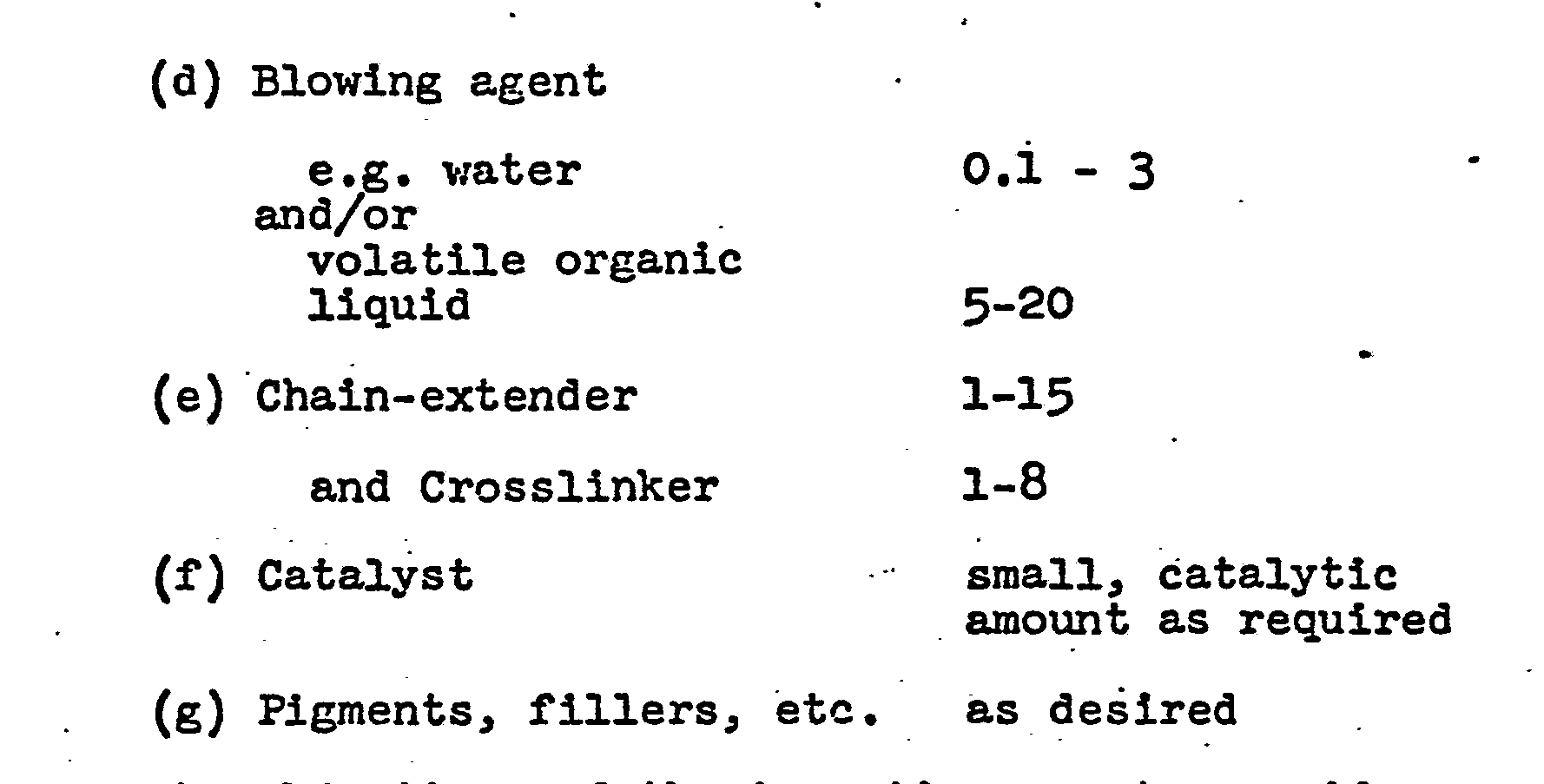
- (d) Blowing Agents: Any conventional blowing agents for polyurethanes such as Freon 11B (trademark; trichlorofluoromethane), methylene chloride and water can be used.
- (e) Chain-Extenders and Crosslinkers: Any conventional chain-extenders for polyurethanes may be used. Difunctional chain-extenders useful for carrying out this invention are usually either diols such as diethylene glycol, dipropylene glycol, 1,4-butanediol, or diamines such as 1,5-naphthylene diamine, 4,4'-methylene-bis(2-chloroaniline), etc. These chain-extenders increase the modulus of the foam without causing any change in the crosslink density.
Any conventional crosslinkers for polyurethanes may be used. Crosslinkers-such as Quadrol [trademark; N,N,N',N'-tetrakis(2-hydroxypropyl)-ethylene diamine], glyerol trimethylolpropane, pentaerythritol, di- or trialkanolamines are typically used to increase the crosslink density which increases the compressive strength of the foam. - (f) Catalysts: Any conventional catalysts for polyurethanes can be used. Amine catalysts alone or in conjunction with a tin catalyst can be used to get a balanced rise and cure of the foam. Typical catalysts include, 1,4-diazabicyclo-2,2,2-octane (Dabco; trademark), triethylamine, N-ethylmorpholine, N,N,N',N'-tetramethylenediamine, N,N',N',N'-tetramethylbutanediamine (TMBDA) alkanolamines, dibutyl tin dilaurate, stannous octoate etc.
- Other additives such as filler, pigments, surfactants and stabilizers can be incorporated as - desired.
- The quantities of the above material which can be used to prepare the foams of this invention are in accordance with conventional practice. In many cases preferred quantities are as follows:

- The objectives of the invention are to provide:
- 1. semi-flexible polyurathane foams having improved energy-absorbing characteristics,
- 2. semi-flexible polyurethane foams for use in safety cushioning for automobile interiors and exteriors,
- 3. urethane foams having low rebound velocity (high hysteresis),
- 4. urethane foams which produce low peak deceleration (G) on impact,
- 5. foams having low severity index,
- 6. foams having improved energy-absorbing efficiency.
- The procedure followed to formulate, process and test polyurethane foams of this invention is typically as follows:
- The required amount of a modifier (e.g., 2-naphthol) may be dissolved in a polyol heated to about 80 - 85°C with stirring. These modifiers give a clear solution which does not separate into two layers when cooled to room temperature. The required amounts of a chain-extender and/or a crosslinker, water (and/or volatile blowing agent), an isocyanate and catalysts are thoroughly mixed into the polyol solution of the modifiers (using a mechanical stirrer) and then poured into a 12 inch by 12 inch by 2 inch mold to form test slabs. Impact test data may be obtained by impacting these test slabs using a pendulum impact tester described as follows:
- The pendulum impact tester consists of a 60 inch pendulum arm of steel tubing in which is mounted a 5.05 inch diameter, 40 pound steel, cylindrical head. The foam slabs (12" x 12" x 2") are mounted against a cemented abutment. An accelerometer is mounted on the back face of the cylindrical head and connected to an oscilloscope. This.setup provides a direct deceleration vs. time curve on the oscilloscope screen which is photographed. In addition, a pin is mounted on the side of the impacting head and with the help of a stroboscopic lamp and a camera, reflected flashes of light - from the protruding tip on the pin are photographed during an impact. This provides penetration vs. time data for the impact and rebound interval which is used to compute impact and rebound velocities, maximum penetration, decleration vs. time, energy absorption, severity index and energy-absorbing efficiency. The energy absorption is defined as loss of energy due to hysteresis and is calculated by using equation (1):


- The pendulum impact tester consists of a 60 inch pendulum arm of steel tubing in which is mounted a 5.05 inch diameter, 40 pound steel, cylindrical head. The foam slabs (12" x 12" x 2") are mounted against a cemented abutment. An accelerometer is mounted on the back face of the cylindrical head and connected to an oscilloscope. This.setup provides a direct deceleration vs. time curve on the oscilloscope screen which is photographed. In addition, a pin is mounted on the side of the impacting head and with the help of a stroboscopic lamp and a camera, reflected flashes of light - from the protruding tip on the pin are photographed during an impact. This provides penetration vs. time data for the impact and rebound interval which is used to compute impact and rebound velocities, maximum penetration, decleration vs. time, energy absorption, severity index and energy-absorbing efficiency. The energy absorption is defined as loss of energy due to hysteresis and is calculated by using equation (1):
- Typical polyurethane foams of the invention have a density of from 6 to 25 pounds per cubic foot. The present foams ordinarily exhibit a dynamic hysteresis loss of over 75%, a severity index of less than 1000 seconds, and a peak deceleration of less than 200 G when a 12 inch by 12 inch by 2 inch test specimen of the foam is impacted with the flat end of a cylindrical head having 5.05 inches diameter and 40 pounds weight travelling at a velocity of 22 feet per second. Typically the foam of the invention has a rebound of 12 - 20% when a one-pound steel ball is dropped from a height of 1.5 to 3 feet on a one inch thick sheet of the foam, and the foam is capable of recovering repeatedly from a deflection of 75%.
- The modifiers of the invention are remarkable for their efficiency. Thus, for example, to obtain a particular energy absorption level, the amount (by weight) of 2-naphthol required would be only 1/2 that of rosin needed.
- The following examples will serve to illustrate the practice of the invention in more detail.
- Foam slabs 12 inch by 12 inch by 2 inch are molded using the following formulation:

- The 2-naphthol is stirred into the polyether triol heated to 80 - 85°. The polyether, triol is a poly(oxypropylene)-poly(oxyethylene) triol of about 3000 molecular weight (hydroxyl number 56) prepared by the polymerization of 1,2-propylene oxide using glycerol as an initiator and then at least 50% endcapped with ethylene oxide to get at least 50% primary hydroxyl groups to increase the reactivity towards isocyanate (Voranol CP 3001 [trademark]). A clear solution is obtained which does not separate into two layers when cooled to room temperature. To this solution are added the propoxylated ethylene diamine (equivalent weight 73; Quadrol [trademark]), the water, and the polymeric MDI (equivalent weight about 135, isocyanate functionality about 2.8; Rubinate M [trademark]) in amounts shown which give an isocyanate index of 1.05, the stannous octoate(T9 [trademark]), and the triethylamine. The mixture is thoroughly blended using a mechanical stirrer and poured into a mold which has previously been coated with mold release. The sample is demolded after about 15 minutes and allowed to post-cure at room temperature for at least 24 hours before testing. The following results are obtained when the slab is impacted at room temperature at a velocity of 20 feet per second using the pendulum impact tester described above:


- Polyurethane foams are prepared by the procedure of Example 1 using the formulation:

- The hydroabietyl alcohol is a technical grade available under the trademark Abitol. Pendulum impact test data obtained at room temperature at 20 ft./sec. impact velocity are:

- Polyurethane foams are prepared by the procedure of Example 1 using the following:

- Pendulum impact test data obtained at room temperature at 20 ft./sec. impact velocity are:

Claims (10)
thereafter combining said physical mixture of (a) and (b) in the unreacted state with:
whereby there is formed a polyurethane foam Capable of load distribution and having enhanced impact-and energy-absorbing characteristics compared to an otherwise similar foam from which the said modifying compound (b) is omitted.
Applications Claiming Priority (2)
| Application Number | Priority Date | Filing Date | Title |
|---|---|---|---|
| CA311,684A CA1111996A (en) | 1978-09-20 | 1978-09-20 | Semi-flexible shock-absorbing polyurethane foam |
| CA311684 | 1978-09-20 |
Publications (2)
| Publication Number | Publication Date |
|---|---|
| EP0010842A1 true EP0010842A1 (en) | 1980-05-14 |
| EP0010842B1 EP0010842B1 (en) | 1983-09-21 |
Family
ID=4112394
Family Applications (1)
| Application Number | Title | Priority Date | Filing Date |
|---|---|---|---|
| EP79301810A Expired EP0010842B1 (en) | 1978-09-20 | 1979-09-03 | Polyurethane foam and method of preparation thereof |
Country Status (8)
| Country | Link |
|---|---|
| US (1) | US4209593A (en) |
| EP (1) | EP0010842B1 (en) |
| JP (1) | JPS5543197A (en) |
| AU (1) | AU528720B2 (en) |
| BR (1) | BR7905958A (en) |
| CA (1) | CA1111996A (en) |
| DE (1) | DE2966189D1 (en) |
| ES (1) | ES484281A1 (en) |
Cited By (5)
| Publication number | Priority date | Publication date | Assignee | Title |
|---|---|---|---|---|
| GB2191208A (en) * | 1986-06-05 | 1987-12-09 | Basf Corp | High resiliency molded polyurethane foams |
| EP0379008A1 (en) * | 1989-01-17 | 1990-07-25 | Bayer Ag | Process for preparing low apparent density moulded soft polyurethane foams |
| EP0386974A3 (en) * | 1989-03-06 | 1991-09-04 | Pmc, Inc. | Flexible polyurethane foam |
| EP2543689A1 (en) | 2011-07-04 | 2013-01-09 | Repsol, S.A. | Continuous method for the synthesis of polyols |
| WO2024153757A1 (en) | 2023-01-19 | 2024-07-25 | Repsol, S.A. | Controlled addition of ligand in polyol synthesis |
Families Citing this family (25)
| Publication number | Priority date | Publication date | Assignee | Title |
|---|---|---|---|---|
| JPS62143643U (en) * | 1986-03-03 | 1987-09-10 | ||
| JPS62143644U (en) * | 1986-03-03 | 1987-09-10 | ||
| JPS62143642U (en) * | 1986-03-03 | 1987-09-10 | ||
| US4722946A (en) * | 1986-07-03 | 1988-02-02 | Polymer Dynamics (Delaware), Ltd. | Energy-attenuating polyurethanes |
| US4788269A (en) * | 1987-12-04 | 1988-11-29 | W. R. Grace & Co.-Conn. | Polyurethane coatings for bridge deckings and the like |
| US4950694A (en) * | 1989-06-29 | 1990-08-21 | Union Carbide Chemicals And Plastics Company Inc. | Preparation of polyurethane foams without using inert blowing agents |
| US5496911A (en) * | 1993-10-04 | 1996-03-05 | Ecp Enichem Polimeri Netherlands, B.V. | Process for the production of polyurea based articles |
| US5527833A (en) * | 1995-06-07 | 1996-06-18 | Woodbridge Foam Corp. | Process for producing a polyurethane foam |
| US6391935B1 (en) | 2000-01-31 | 2002-05-21 | Bayer Antwerp, N.V. | Viscoelastic polyurethane foams |
| US7238730B2 (en) * | 2003-06-26 | 2007-07-03 | Basf Corporation | Viscoelastic polyurethane foam |
| US7208531B2 (en) * | 2003-06-26 | 2007-04-24 | Basf Corporation | Viscoelastic polyurethane foam |
| US20040266900A1 (en) * | 2003-06-26 | 2004-12-30 | Raymond Neff | Viscoelastic polyurethane foam |
| US7078443B2 (en) * | 2003-10-22 | 2006-07-18 | Intellectual Property Holdings, Llc | Viscoelastic foam layer and composition |
| US20070105970A1 (en) * | 2005-11-10 | 2007-05-10 | Kenneth Warnshuis | Energy absorbing flexible foam |
| US20070105969A1 (en) * | 2005-11-10 | 2007-05-10 | Kenneth Warnshuis | Multi-density flexible foam |
| JP5398122B2 (en) * | 2006-03-31 | 2014-01-29 | エスケー化研株式会社 | An emulsion stabilizer composed of a polymer compound |
| JP5136750B2 (en) * | 2007-06-11 | 2013-02-06 | 株式会社ブリヂストン | Thermal insulation composition, polyurethane foam thermal insulation, and thermal insulation construction method |
| US8975335B2 (en) | 2011-09-23 | 2015-03-10 | Bayer Materialscience Llc | Process for the production of high air flow polyether foams and the foams produced by this process |
| KR20150023462A (en) * | 2012-06-27 | 2015-03-05 | 바이엘 머티리얼사이언스 아게 | Dielectric polyurethane film |
| US9951174B2 (en) | 2015-05-20 | 2018-04-24 | Covestro Llc | Polyol compositions, a process for the production of these polyol compositions, and their use in the production of open celled polyurethane foams having high airflow |
| EP3596149A1 (en) | 2017-03-15 | 2020-01-22 | Covestro LLC | Viscoelastic polyurethane foams with reduced temperature sensitivity |
| US10766998B2 (en) | 2017-11-21 | 2020-09-08 | Covestro Llc | Flexible polyurethane foams |
| US10793692B2 (en) | 2018-10-24 | 2020-10-06 | Covestro Llc | Viscoelastic flexible foams comprising hydroxyl-terminated prepolymers |
| US11572433B2 (en) | 2021-03-12 | 2023-02-07 | Covestro Llc | In-situ formed polyols, a process for their preparation, foams prepared from these in-situ formed polyols and a process for their preparation |
| US11718705B2 (en) | 2021-07-28 | 2023-08-08 | Covestro Llc | In-situ formed polyether polyols, a process for their preparation, and a process for the preparation of polyurethane foams |
Citations (3)
| Publication number | Priority date | Publication date | Assignee | Title |
|---|---|---|---|---|
| GB1104839A (en) * | 1966-01-10 | 1968-02-28 | Shell Int Research | Process for the preparation of a polyurethane foam |
| US3664976A (en) * | 1969-08-21 | 1972-05-23 | Uniroyal Ltd | Polyurethane foam with integral skin |
| US3847859A (en) * | 1973-08-29 | 1974-11-12 | Dow Chemical Co | Rapid-setting polyurethanes containing substituted hydroxyl-containing aromatic compounds as modifiers |
Family Cites Families (10)
| Publication number | Priority date | Publication date | Assignee | Title |
|---|---|---|---|---|
| DE1143019B (en) * | 1961-04-29 | 1963-01-31 | Bayer Ag | Process for the production of foams containing urethane groups |
| US3703482A (en) * | 1962-03-15 | 1972-11-21 | Johns Manville | Polyurethane foam |
| US3298857A (en) * | 1964-11-30 | 1967-01-17 | Hoover Ball & Bearing Co | Method of stiffening polyurethane foams |
| CH547328A (en) * | 1967-07-20 | 1974-03-29 | Cincinnati Milling Machine Co | METHOD FOR PRODUCING A CELLULAR RIGID POLYURETHANE MOLDED BODY. |
| US3836487A (en) * | 1968-09-23 | 1974-09-17 | Goodyear Tire & Rubber | High impact rigid self-skinned polyurethane foam and method |
| US3630819A (en) * | 1968-09-23 | 1971-12-28 | Goodyear Tire & Rubber | Foamed polyurethane laminates |
| US3677869A (en) * | 1970-11-27 | 1972-07-18 | Goodyear Tire & Rubber | Polyureaurethane shock absorbing compositions |
| US3833526A (en) * | 1971-05-27 | 1974-09-03 | Ici America Inc | Semi-rigid polyurethane foams from a mixture of oxypropylated polyols |
| CH554387A (en) * | 1971-12-18 | 1974-09-30 | Weber Wilhelm G | PROCESS FOR THE MANUFACTURING OF POROUS FABRICS. |
| US3823833A (en) * | 1973-08-08 | 1974-07-16 | Goodyear Tire & Rubber | Polyureaurethane shock absorbing unit |
-
1978
- 1978-09-20 CA CA311,684A patent/CA1111996A/en not_active Expired
- 1978-11-15 US US05/960,994 patent/US4209593A/en not_active Expired - Lifetime
-
1979
- 1979-09-03 DE DE7979301810T patent/DE2966189D1/en not_active Expired
- 1979-09-03 EP EP79301810A patent/EP0010842B1/en not_active Expired
- 1979-09-11 AU AU50721/79A patent/AU528720B2/en not_active Ceased
- 1979-09-18 BR BR7905958A patent/BR7905958A/en unknown
- 1979-09-19 JP JP12060379A patent/JPS5543197A/en active Granted
- 1979-09-19 ES ES484281A patent/ES484281A1/en not_active Expired
Patent Citations (3)
| Publication number | Priority date | Publication date | Assignee | Title |
|---|---|---|---|---|
| GB1104839A (en) * | 1966-01-10 | 1968-02-28 | Shell Int Research | Process for the preparation of a polyurethane foam |
| US3664976A (en) * | 1969-08-21 | 1972-05-23 | Uniroyal Ltd | Polyurethane foam with integral skin |
| US3847859A (en) * | 1973-08-29 | 1974-11-12 | Dow Chemical Co | Rapid-setting polyurethanes containing substituted hydroxyl-containing aromatic compounds as modifiers |
Cited By (6)
| Publication number | Priority date | Publication date | Assignee | Title |
|---|---|---|---|---|
| GB2191208A (en) * | 1986-06-05 | 1987-12-09 | Basf Corp | High resiliency molded polyurethane foams |
| EP0379008A1 (en) * | 1989-01-17 | 1990-07-25 | Bayer Ag | Process for preparing low apparent density moulded soft polyurethane foams |
| EP0386974A3 (en) * | 1989-03-06 | 1991-09-04 | Pmc, Inc. | Flexible polyurethane foam |
| EP2543689A1 (en) | 2011-07-04 | 2013-01-09 | Repsol, S.A. | Continuous method for the synthesis of polyols |
| WO2013004694A1 (en) | 2011-07-04 | 2013-01-10 | Repsol, S.A. | Continuous method for the synthesis of polyols |
| WO2024153757A1 (en) | 2023-01-19 | 2024-07-25 | Repsol, S.A. | Controlled addition of ligand in polyol synthesis |
Also Published As
| Publication number | Publication date |
|---|---|
| DE2966189D1 (en) | 1983-10-27 |
| CA1111996A (en) | 1981-11-03 |
| JPS5543197A (en) | 1980-03-26 |
| JPS579734B2 (en) | 1982-02-23 |
| EP0010842B1 (en) | 1983-09-21 |
| AU5072179A (en) | 1980-03-27 |
| ES484281A1 (en) | 1980-05-16 |
| BR7905958A (en) | 1980-06-03 |
| US4209593A (en) | 1980-06-24 |
| AU528720B2 (en) | 1983-05-12 |
Similar Documents
| Publication | Publication Date | Title |
|---|---|---|
| EP0010842B1 (en) | Polyurethane foam and method of preparation thereof | |
| KR0135747B1 (en) | Flexible polyurethane foams prepared using unsaturated | |
| DE60112764T2 (en) | METHOD FOR PRODUCING A POLYURETHANE FOAMING FOAM | |
| DE2751923C2 (en) | Process for the production of a cellular polyurethane elastomer | |
| EP0253834B1 (en) | Flexible polyurethane foams prepared from poly(ethylene carbonate) polyols | |
| DE60019975T2 (en) | METHOD FOR PRODUCING A FREE-LOADING OR BLOCK flexible polyurethane foam | |
| US12054589B2 (en) | Isocyanate-functional polymer components and polyurethane articles formed from recycled polyurethane articles and associated methods for forming same | |
| TW297029B (en) | ||
| US4119582A (en) | Process for manufacturing high-resilient flexible urethan foams | |
| EP2609131B1 (en) | Method for making resilient low density polyurethane foam having low compression sets | |
| US4195151A (en) | Phenol-aldehyde-amine resin/glycol curative compositions | |
| US8658709B2 (en) | Process for making a polyurethane foam | |
| US4410641A (en) | Polysiocyanurate-polyurethane foams | |
| CA2039217A1 (en) | Polyurethane foams blown only with water | |
| US5240635A (en) | Composition of flexible polyurethane foams blown using reduced amounts of chlorofluorocarbon blowing agents and method for preparation | |
| JPH1095825A (en) | Method for reusing microcellular foamed polyurethane | |
| KR100621956B1 (en) | Method for Making Semi-Rigid Energy-Absorbing Foam with Polyurethane Fillers | |
| CA2093780A1 (en) | Polyurethane foam moldings | |
| US3115481A (en) | Polyurethane collapsed foam elastomer | |
| US5164423A (en) | Composition of flexible polyurethane foams below using reduced amounts of chlorofluorocarbone blowing agents and method for preparation | |
| KR830000258B1 (en) | Preparation of polyurethane foam | |
| EP1242525B1 (en) | Blister-resistant molded polyurea polymer and method of making a blister-resistant molded polyurea polymer | |
| EP0276927A2 (en) | Storage stable isocyanate prepolymers | |
| JPH07207051A (en) | Manufacturing method of semi-rigid urethane foam | |
| JPH06228259A (en) | Partial prepolymer and flexible polyurethane foam using the same |
Legal Events
| Date | Code | Title | Description |
|---|---|---|---|
| PUAI | Public reference made under article 153(3) epc to a published international application that has entered the european phase |
Free format text: ORIGINAL CODE: 0009012 |
|
| AK | Designated contracting states |
Designated state(s): DE FR GB IT SE |
|
| 17P | Request for examination filed |
Effective date: 19801030 |
|
| ITF | It: translation for a ep patent filed | ||
| GRAA | (expected) grant |
Free format text: ORIGINAL CODE: 0009210 |
|
| AK | Designated contracting states |
Designated state(s): DE FR GB IT SE |
|
| PG25 | Lapsed in a contracting state [announced via postgrant information from national office to epo] |
Ref country code: SE Effective date: 19830921 |
|
| REF | Corresponds to: |
Ref document number: 2966189 Country of ref document: DE Date of ref document: 19831027 |
|
| ET | Fr: translation filed | ||
| PGFP | Annual fee paid to national office [announced via postgrant information from national office to epo] |
Ref country code: FR Payment date: 19840621 Year of fee payment: 6 |
|
| PLBE | No opposition filed within time limit |
Free format text: ORIGINAL CODE: 0009261 |
|
| STAA | Information on the status of an ep patent application or granted ep patent |
Free format text: STATUS: NO OPPOSITION FILED WITHIN TIME LIMIT |
|
| PGFP | Annual fee paid to national office [announced via postgrant information from national office to epo] |
Ref country code: DE Payment date: 19840919 Year of fee payment: 6 |
|
| 26N | No opposition filed | ||
| GBPC | Gb: european patent ceased through non-payment of renewal fee | ||
| PG25 | Lapsed in a contracting state [announced via postgrant information from national office to epo] |
Ref country code: FR Free format text: LAPSE BECAUSE OF NON-PAYMENT OF DUE FEES Effective date: 19860530 |
|
| PG25 | Lapsed in a contracting state [announced via postgrant information from national office to epo] |
Ref country code: DE Effective date: 19860603 |
|
| REG | Reference to a national code |
Ref country code: FR Ref legal event code: ST |
|
| PG25 | Lapsed in a contracting state [announced via postgrant information from national office to epo] |
Ref country code: GB Effective date: 19881118 |