EP0010583B1 - 2-hydroxybenzamide derivatives, fungicidal compositions containing them and method for preventing diseases of plant - Google Patents
2-hydroxybenzamide derivatives, fungicidal compositions containing them and method for preventing diseases of plant Download PDFInfo
- Publication number
- EP0010583B1 EP0010583B1 EP79103085A EP79103085A EP0010583B1 EP 0010583 B1 EP0010583 B1 EP 0010583B1 EP 79103085 A EP79103085 A EP 79103085A EP 79103085 A EP79103085 A EP 79103085A EP 0010583 B1 EP0010583 B1 EP 0010583B1
- Authority
- EP
- European Patent Office
- Prior art keywords
- formula
- hydrogen
- compound
- fungi
- caused
- Prior art date
- Legal status (The legal status is an assumption and is not a legal conclusion. Google has not performed a legal analysis and makes no representation as to the accuracy of the status listed.)
- Expired
Links
- 239000000203 mixture Substances 0.000 title claims description 25
- 238000000034 method Methods 0.000 title claims description 16
- 201000010099 disease Diseases 0.000 title claims description 12
- 208000037265 diseases, disorders, signs and symptoms Diseases 0.000 title claims description 12
- 230000000855 fungicidal effect Effects 0.000 title claims description 3
- SKZKKFZAGNVIMN-UHFFFAOYSA-N Salicilamide Chemical class NC(=O)C1=CC=CC=C1O SKZKKFZAGNVIMN-UHFFFAOYSA-N 0.000 title description 3
- 150000001875 compounds Chemical class 0.000 claims description 58
- 125000001997 phenyl group Chemical group [H]C1=C([H])C([H])=C(*)C([H])=C1[H] 0.000 claims description 24
- 229910052739 hydrogen Inorganic materials 0.000 claims description 21
- 239000001257 hydrogen Substances 0.000 claims description 21
- 125000004435 hydrogen atom Chemical group [H]* 0.000 claims description 18
- -1 cyano, thiocyano Chemical group 0.000 claims description 12
- 241000233866 Fungi Species 0.000 claims description 11
- 125000002496 methyl group Chemical group [H]C([H])([H])* 0.000 claims description 10
- 239000002689 soil Substances 0.000 claims description 10
- 125000000217 alkyl group Chemical group 0.000 claims description 9
- 125000004448 alkyl carbonyl group Chemical group 0.000 claims description 8
- 125000004453 alkoxycarbonyl group Chemical group 0.000 claims description 6
- 125000004390 alkyl sulfonyl group Chemical group 0.000 claims description 6
- 125000004432 carbon atom Chemical group C* 0.000 claims description 6
- 241001503436 Plasmodiophora brassicae Species 0.000 claims description 5
- 229910052736 halogen Inorganic materials 0.000 claims description 5
- 150000002367 halogens Chemical class 0.000 claims description 5
- 125000002777 acetyl group Chemical group [H]C([H])([H])C(*)=O 0.000 claims description 4
- 125000003545 alkoxy group Chemical group 0.000 claims description 4
- 125000001624 naphthyl group Chemical group 0.000 claims description 4
- 125000006678 phenoxycarbonyl group Chemical group 0.000 claims description 4
- 125000005115 alkyl carbamoyl group Chemical group 0.000 claims description 3
- 125000000738 acetamido group Chemical group [H]C([H])([H])C(=O)N([H])[*] 0.000 claims description 2
- 125000004644 alkyl sulfinyl group Chemical group 0.000 claims description 2
- 125000004414 alkyl thio group Chemical group 0.000 claims description 2
- 125000002485 formyl group Chemical group [H]C(*)=O 0.000 claims description 2
- 238000003898 horticulture Methods 0.000 claims description 2
- 125000000956 methoxy group Chemical group [H]C([H])([H])O* 0.000 claims description 2
- 125000002816 methylsulfanyl group Chemical group [H]C([H])([H])S[*] 0.000 claims description 2
- 125000000449 nitro group Chemical group [O-][N+](*)=O 0.000 claims description 2
- 125000005031 thiocyano group Chemical group S(C#N)* 0.000 claims description 2
- 125000001309 chloro group Chemical group Cl* 0.000 claims 2
- 150000002431 hydrogen Chemical group 0.000 claims 2
- UFHFLCQGNIYNRP-UHFFFAOYSA-N Hydrogen Chemical compound [H][H] UFHFLCQGNIYNRP-UHFFFAOYSA-N 0.000 claims 1
- 125000001153 fluoro group Chemical group F* 0.000 claims 1
- UHOVQNZJYSORNB-UHFFFAOYSA-N Benzene Chemical compound C1=CC=CC=C1 UHOVQNZJYSORNB-UHFFFAOYSA-N 0.000 description 18
- ZMANZCXQSJIPKH-UHFFFAOYSA-N Triethylamine Chemical compound CCN(CC)CC ZMANZCXQSJIPKH-UHFFFAOYSA-N 0.000 description 15
- 239000013078 crystal Substances 0.000 description 15
- XLYOFNOQVPJJNP-UHFFFAOYSA-N water Substances O XLYOFNOQVPJJNP-UHFFFAOYSA-N 0.000 description 15
- CSCPPACGZOOCGX-UHFFFAOYSA-N Acetone Chemical compound CC(C)=O CSCPPACGZOOCGX-UHFFFAOYSA-N 0.000 description 14
- 241000196324 Embryophyta Species 0.000 description 11
- 238000009472 formulation Methods 0.000 description 11
- 239000011541 reaction mixture Substances 0.000 description 10
- 238000002360 preparation method Methods 0.000 description 9
- LFQSCWFLJHTTHZ-UHFFFAOYSA-N Ethanol Chemical compound CCO LFQSCWFLJHTTHZ-UHFFFAOYSA-N 0.000 description 8
- 239000008187 granular material Substances 0.000 description 8
- 239000000417 fungicide Substances 0.000 description 7
- 238000002844 melting Methods 0.000 description 7
- 230000008018 melting Effects 0.000 description 7
- VEXZGXHMUGYJMC-UHFFFAOYSA-N Hydrochloric acid Chemical compound Cl VEXZGXHMUGYJMC-UHFFFAOYSA-N 0.000 description 6
- OKKJLVBELUTLKV-UHFFFAOYSA-N Methanol Chemical compound OC OKKJLVBELUTLKV-UHFFFAOYSA-N 0.000 description 6
- 239000000969 carrier Substances 0.000 description 6
- SGTFRDWYFMUXHX-UHFFFAOYSA-N [2-(1,2,2,2-tetrachloroethylcarbamoyl)phenyl] acetate Chemical compound CC(=O)OC1=CC=CC=C1C(=O)NC(Cl)C(Cl)(Cl)Cl SGTFRDWYFMUXHX-UHFFFAOYSA-N 0.000 description 5
- 238000001816 cooling Methods 0.000 description 5
- 239000000843 powder Substances 0.000 description 5
- 0 *C(*c(cccc1)c1O*)O* Chemical compound *C(*c(cccc1)c1O*)O* 0.000 description 4
- VYPSYNLAJGMNEJ-UHFFFAOYSA-N Silicium dioxide Chemical compound O=[Si]=O VYPSYNLAJGMNEJ-UHFFFAOYSA-N 0.000 description 4
- 239000000428 dust Substances 0.000 description 4
- 239000000839 emulsion Substances 0.000 description 4
- VLKZOEOYAKHREP-UHFFFAOYSA-N n-Hexane Chemical compound CCCCCC VLKZOEOYAKHREP-UHFFFAOYSA-N 0.000 description 4
- 229960000581 salicylamide Drugs 0.000 description 4
- 239000000243 solution Substances 0.000 description 4
- 235000010149 Brassica rapa subsp chinensis Nutrition 0.000 description 3
- 235000000536 Brassica rapa subsp pekinensis Nutrition 0.000 description 3
- 241000499436 Brassica rapa subsp. pekinensis Species 0.000 description 3
- ZAMOUSCENKQFHK-UHFFFAOYSA-N Chlorine atom Chemical compound [Cl] ZAMOUSCENKQFHK-UHFFFAOYSA-N 0.000 description 3
- ZMXDDKWLCZADIW-UHFFFAOYSA-N N,N-Dimethylformamide Chemical compound CN(C)C=O ZMXDDKWLCZADIW-UHFFFAOYSA-N 0.000 description 3
- HEMHJVSKTPXQMS-UHFFFAOYSA-M Sodium hydroxide Chemical compound [OH-].[Na+] HEMHJVSKTPXQMS-UHFFFAOYSA-M 0.000 description 3
- KPNOKFLWDMAFNH-UHFFFAOYSA-N [2-[(2,2,2-trichloro-1-naphthalen-2-yloxyethyl)carbamoyl]phenyl] acetate Chemical compound CC(=O)OC1=CC=CC=C1C(=O)NC(C(Cl)(Cl)Cl)OC1=CC=C(C=CC=C2)C2=C1 KPNOKFLWDMAFNH-UHFFFAOYSA-N 0.000 description 3
- 239000002671 adjuvant Substances 0.000 description 3
- 239000003795 chemical substances by application Substances 0.000 description 3
- 239000000460 chlorine Substances 0.000 description 3
- 229910052801 chlorine Inorganic materials 0.000 description 3
- 239000004927 clay Substances 0.000 description 3
- 230000000694 effects Effects 0.000 description 3
- 238000003756 stirring Methods 0.000 description 3
- 239000000454 talc Substances 0.000 description 3
- 229910052623 talc Inorganic materials 0.000 description 3
- 239000004563 wettable powder Substances 0.000 description 3
- QPUYECUOLPXSFR-UHFFFAOYSA-N 1-methylnaphthalene Chemical compound C1=CC=C2C(C)=CC=CC2=C1 QPUYECUOLPXSFR-UHFFFAOYSA-N 0.000 description 2
- NRZSYWXMJRYSJL-UHFFFAOYSA-N 2-hydroxy-n-(2,2,2-trichloro-1-naphthalen-2-yloxyethyl)benzamide Chemical compound OC1=CC=CC=C1C(=O)NC(C(Cl)(Cl)Cl)OC1=CC=C(C=CC=C2)C2=C1 NRZSYWXMJRYSJL-UHFFFAOYSA-N 0.000 description 2
- QGZFTIJWNIVPNA-UHFFFAOYSA-N 2-hydroxy-n-[2,2,2-trichloro-1-(4-chlorophenoxy)ethyl]benzamide Chemical compound OC1=CC=CC=C1C(=O)NC(C(Cl)(Cl)Cl)OC1=CC=C(Cl)C=C1 QGZFTIJWNIVPNA-UHFFFAOYSA-N 0.000 description 2
- RTGDDQRYJGVXDW-UHFFFAOYSA-N 2-hydroxy-n-[2,2,2-trichloro-1-(4-methylphenoxy)ethyl]benzamide Chemical compound C1=CC(C)=CC=C1OC(C(Cl)(Cl)Cl)NC(=O)C1=CC=CC=C1O RTGDDQRYJGVXDW-UHFFFAOYSA-N 0.000 description 2
- 239000005995 Aluminium silicate Substances 0.000 description 2
- VTYYLEPIZMXCLO-UHFFFAOYSA-L Calcium carbonate Chemical compound [Ca+2].[O-]C([O-])=O VTYYLEPIZMXCLO-UHFFFAOYSA-L 0.000 description 2
- IAZDPXIOMUYVGZ-UHFFFAOYSA-N Dimethylsulphoxide Chemical compound CS(C)=O IAZDPXIOMUYVGZ-UHFFFAOYSA-N 0.000 description 2
- DGAQECJNVWCQMB-PUAWFVPOSA-M Ilexoside XXIX Chemical compound C[C@@H]1CC[C@@]2(CC[C@@]3(C(=CC[C@H]4[C@]3(CC[C@@H]5[C@@]4(CC[C@@H](C5(C)C)OS(=O)(=O)[O-])C)C)[C@@H]2[C@]1(C)O)C)C(=O)O[C@H]6[C@@H]([C@H]([C@@H]([C@H](O6)CO)O)O)O.[Na+] DGAQECJNVWCQMB-PUAWFVPOSA-M 0.000 description 2
- 239000005909 Kieselgur Substances 0.000 description 2
- CTQNGGLPUBDAKN-UHFFFAOYSA-N O-Xylene Chemical compound CC1=CC=CC=C1C CTQNGGLPUBDAKN-UHFFFAOYSA-N 0.000 description 2
- STHDJKVQVXEWSF-UHFFFAOYSA-N [2-[(2,2,2-trichloro-1-phenoxyethyl)carbamoyl]phenyl] n-methylcarbamate Chemical compound CNC(=O)OC1=CC=CC=C1C(=O)NC(C(Cl)(Cl)Cl)OC1=CC=CC=C1 STHDJKVQVXEWSF-UHFFFAOYSA-N 0.000 description 2
- 235000012211 aluminium silicate Nutrition 0.000 description 2
- 239000000440 bentonite Substances 0.000 description 2
- 229910000278 bentonite Inorganic materials 0.000 description 2
- SVPXDRXYRYOSEX-UHFFFAOYSA-N bentoquatam Chemical compound O.O=[Si]=O.O=[Al]O[Al]=O SVPXDRXYRYOSEX-UHFFFAOYSA-N 0.000 description 2
- JHIVVAPYMSGYDF-UHFFFAOYSA-N cyclohexanone Chemical compound O=C1CCCCC1 JHIVVAPYMSGYDF-UHFFFAOYSA-N 0.000 description 2
- 230000006378 damage Effects 0.000 description 2
- 230000007547 defect Effects 0.000 description 2
- 235000014113 dietary fatty acids Nutrition 0.000 description 2
- 239000000194 fatty acid Substances 0.000 description 2
- 229930195729 fatty acid Natural products 0.000 description 2
- 239000005457 ice water Substances 0.000 description 2
- NLYAJNPCOHFWQQ-UHFFFAOYSA-N kaolin Chemical compound O.O.O=[Al]O[Si](=O)O[Si](=O)O[Al]=O NLYAJNPCOHFWQQ-UHFFFAOYSA-N 0.000 description 2
- 239000007788 liquid Substances 0.000 description 2
- 238000002156 mixing Methods 0.000 description 2
- 150000004045 organic chlorine compounds Chemical class 0.000 description 2
- IWDCLRJOBJJRNH-UHFFFAOYSA-N p-cresol Chemical compound CC1=CC=C(O)C=C1 IWDCLRJOBJJRNH-UHFFFAOYSA-N 0.000 description 2
- LKPLKUMXSAEKID-UHFFFAOYSA-N pentachloronitrobenzene Chemical compound [O-][N+](=O)C1=C(Cl)C(Cl)=C(Cl)C(Cl)=C1Cl LKPLKUMXSAEKID-UHFFFAOYSA-N 0.000 description 2
- MHLBKXUSOSHPEH-UHFFFAOYSA-N phenyl [2-[(2,2,2-trichloro-1-phenoxyethyl)carbamoyl]phenyl] carbonate Chemical compound C=1C=CC=CC=1OC(C(Cl)(Cl)Cl)NC(=O)C1=CC=CC=C1OC(=O)OC1=CC=CC=C1 MHLBKXUSOSHPEH-UHFFFAOYSA-N 0.000 description 2
- 239000011734 sodium Substances 0.000 description 2
- 229910052708 sodium Inorganic materials 0.000 description 2
- 239000007787 solid Substances 0.000 description 2
- 239000008096 xylene Substances 0.000 description 2
- KGHXFBVYXDFJGG-UHFFFAOYSA-N (2-carbamoylphenyl) acetate Chemical compound CC(=O)OC1=CC=CC=C1C(N)=O KGHXFBVYXDFJGG-UHFFFAOYSA-N 0.000 description 1
- MFVONJRCDREFOD-UHFFFAOYSA-N 2-hydroxy-n-(2,2,2-trichloro-1-phenoxyethyl)benzamide Chemical compound OC1=CC=CC=C1C(=O)NC(C(Cl)(Cl)Cl)OC1=CC=CC=C1 MFVONJRCDREFOD-UHFFFAOYSA-N 0.000 description 1
- VKALYYFVKBXHTF-UHFFFAOYSA-N 4-(methylsulfanyl)-m-cresol Chemical compound CSC1=CC=C(O)C=C1C VKALYYFVKBXHTF-UHFFFAOYSA-N 0.000 description 1
- WXNZTHHGJRFXKQ-UHFFFAOYSA-N 4-chlorophenol Chemical compound OC1=CC=C(Cl)C=C1 WXNZTHHGJRFXKQ-UHFFFAOYSA-N 0.000 description 1
- 241000478345 Afer Species 0.000 description 1
- OYPRJOBELJOOCE-UHFFFAOYSA-N Calcium Chemical compound [Ca] OYPRJOBELJOOCE-UHFFFAOYSA-N 0.000 description 1
- PXGOKWXKJXAPGV-UHFFFAOYSA-N Fluorine Chemical compound FF PXGOKWXKJXAPGV-UHFFFAOYSA-N 0.000 description 1
- 241001465754 Metazoa Species 0.000 description 1
- 240000007594 Oryza sativa Species 0.000 description 1
- 235000007164 Oryza sativa Nutrition 0.000 description 1
- 206010034972 Photosensitivity reaction Diseases 0.000 description 1
- LFFOGIOVVNORQZ-UHFFFAOYSA-N [2-[[2,2,2-trichloro-1-(4-chlorophenoxy)ethyl]carbamoyl]phenyl] acetate Chemical compound CC(=O)OC1=CC=CC=C1C(=O)NC(C(Cl)(Cl)Cl)OC1=CC=C(Cl)C=C1 LFFOGIOVVNORQZ-UHFFFAOYSA-N 0.000 description 1
- 239000002250 absorbent Substances 0.000 description 1
- 230000002745 absorbent Effects 0.000 description 1
- 230000000895 acaricidal effect Effects 0.000 description 1
- 239000000642 acaricide Substances 0.000 description 1
- 239000002253 acid Substances 0.000 description 1
- 239000003377 acid catalyst Substances 0.000 description 1
- 239000004480 active ingredient Substances 0.000 description 1
- 239000003905 agrochemical Substances 0.000 description 1
- 150000001298 alcohols Chemical class 0.000 description 1
- 150000008051 alkyl sulfates Chemical class 0.000 description 1
- 239000010775 animal oil Substances 0.000 description 1
- KXDAEFPNCMNJSK-UHFFFAOYSA-N benzene carboxamide Natural products NC(=O)C1=CC=CC=C1 KXDAEFPNCMNJSK-UHFFFAOYSA-N 0.000 description 1
- 239000011575 calcium Substances 0.000 description 1
- 229910052791 calcium Inorganic materials 0.000 description 1
- 229910000019 calcium carbonate Inorganic materials 0.000 description 1
- 238000011109 contamination Methods 0.000 description 1
- 238000010790 dilution Methods 0.000 description 1
- 239000012895 dilution Substances 0.000 description 1
- 239000002270 dispersing agent Substances 0.000 description 1
- 239000003995 emulsifying agent Substances 0.000 description 1
- 150000004665 fatty acids Chemical class 0.000 description 1
- 239000003337 fertilizer Substances 0.000 description 1
- 229910052731 fluorine Inorganic materials 0.000 description 1
- 239000011737 fluorine Substances 0.000 description 1
- 244000053095 fungal pathogen Species 0.000 description 1
- 150000004820 halides Chemical class 0.000 description 1
- 230000002140 halogenating effect Effects 0.000 description 1
- 238000010438 heat treatment Methods 0.000 description 1
- 239000004009 herbicide Substances 0.000 description 1
- 238000001746 injection moulding Methods 0.000 description 1
- 229910052500 inorganic mineral Inorganic materials 0.000 description 1
- 239000002917 insecticide Substances 0.000 description 1
- 238000011835 investigation Methods 0.000 description 1
- 239000012948 isocyanate Substances 0.000 description 1
- 150000002513 isocyanates Chemical class 0.000 description 1
- 231100000053 low toxicity Toxicity 0.000 description 1
- GBMDVOWEEQVZKZ-UHFFFAOYSA-N methanol;hydrate Chemical compound O.OC GBMDVOWEEQVZKZ-UHFFFAOYSA-N 0.000 description 1
- HAMGRBXTJNITHG-UHFFFAOYSA-N methyl isocyanate Chemical compound CN=C=O HAMGRBXTJNITHG-UHFFFAOYSA-N 0.000 description 1
- 239000011707 mineral Substances 0.000 description 1
- 150000002903 organophosphorus compounds Chemical class 0.000 description 1
- 239000002245 particle Substances 0.000 description 1
- 244000052769 pathogen Species 0.000 description 1
- 230000001717 pathogenic effect Effects 0.000 description 1
- 239000008188 pellet Substances 0.000 description 1
- AHWALFGBDFAJAI-UHFFFAOYSA-N phenyl carbonochloridate Chemical compound ClC(=O)OC1=CC=CC=C1 AHWALFGBDFAJAI-UHFFFAOYSA-N 0.000 description 1
- 208000007578 phototoxic dermatitis Diseases 0.000 description 1
- 231100000018 phototoxicity Toxicity 0.000 description 1
- 229920001495 poly(sodium acrylate) polymer Polymers 0.000 description 1
- 230000002265 prevention Effects 0.000 description 1
- 230000003449 preventive effect Effects 0.000 description 1
- 235000009566 rice Nutrition 0.000 description 1
- 239000000377 silicon dioxide Substances 0.000 description 1
- NNMHYFLPFNGQFZ-UHFFFAOYSA-M sodium polyacrylate Chemical compound [Na+].[O-]C(=O)C=C NNMHYFLPFNGQFZ-UHFFFAOYSA-M 0.000 description 1
- 238000009331 sowing Methods 0.000 description 1
- 239000003381 stabilizer Substances 0.000 description 1
- 239000007858 starting material Substances 0.000 description 1
- 239000004094 surface-active agent Substances 0.000 description 1
- 231100000419 toxicity Toxicity 0.000 description 1
- 230000001988 toxicity Effects 0.000 description 1
- HFFLGKNGCAIQMO-UHFFFAOYSA-N trichloroacetaldehyde Chemical compound ClC(Cl)(Cl)C=O HFFLGKNGCAIQMO-UHFFFAOYSA-N 0.000 description 1
- 235000015112 vegetable and seed oil Nutrition 0.000 description 1
- 239000008158 vegetable oil Substances 0.000 description 1
- 239000000080 wetting agent Substances 0.000 description 1
Classifications
-
- A—HUMAN NECESSITIES
- A01—AGRICULTURE; FORESTRY; ANIMAL HUSBANDRY; HUNTING; TRAPPING; FISHING
- A01N—PRESERVATION OF BODIES OF HUMANS OR ANIMALS OR PLANTS OR PARTS THEREOF; BIOCIDES, e.g. AS DISINFECTANTS, AS PESTICIDES OR AS HERBICIDES; PEST REPELLANTS OR ATTRACTANTS; PLANT GROWTH REGULATORS
- A01N39/00—Biocides, pest repellants or attractants, or plant growth regulators containing aryloxy- or arylthio-aliphatic or cycloaliphatic compounds, containing the group or, e.g. phenoxyethylamine, phenylthio-acetonitrile, phenoxyacetone
-
- A—HUMAN NECESSITIES
- A01—AGRICULTURE; FORESTRY; ANIMAL HUSBANDRY; HUNTING; TRAPPING; FISHING
- A01N—PRESERVATION OF BODIES OF HUMANS OR ANIMALS OR PLANTS OR PARTS THEREOF; BIOCIDES, e.g. AS DISINFECTANTS, AS PESTICIDES OR AS HERBICIDES; PEST REPELLANTS OR ATTRACTANTS; PLANT GROWTH REGULATORS
- A01N41/00—Biocides, pest repellants or attractants, or plant growth regulators containing organic compounds containing a sulfur atom bound to a hetero atom
- A01N41/02—Biocides, pest repellants or attractants, or plant growth regulators containing organic compounds containing a sulfur atom bound to a hetero atom containing a sulfur-to-oxygen double bond
- A01N41/04—Sulfonic acids; Derivatives thereof
-
- A—HUMAN NECESSITIES
- A01—AGRICULTURE; FORESTRY; ANIMAL HUSBANDRY; HUNTING; TRAPPING; FISHING
- A01N—PRESERVATION OF BODIES OF HUMANS OR ANIMALS OR PLANTS OR PARTS THEREOF; BIOCIDES, e.g. AS DISINFECTANTS, AS PESTICIDES OR AS HERBICIDES; PEST REPELLANTS OR ATTRACTANTS; PLANT GROWTH REGULATORS
- A01N41/00—Biocides, pest repellants or attractants, or plant growth regulators containing organic compounds containing a sulfur atom bound to a hetero atom
- A01N41/02—Biocides, pest repellants or attractants, or plant growth regulators containing organic compounds containing a sulfur atom bound to a hetero atom containing a sulfur-to-oxygen double bond
- A01N41/10—Sulfones; Sulfoxides
-
- A—HUMAN NECESSITIES
- A01—AGRICULTURE; FORESTRY; ANIMAL HUSBANDRY; HUNTING; TRAPPING; FISHING
- A01N—PRESERVATION OF BODIES OF HUMANS OR ANIMALS OR PLANTS OR PARTS THEREOF; BIOCIDES, e.g. AS DISINFECTANTS, AS PESTICIDES OR AS HERBICIDES; PEST REPELLANTS OR ATTRACTANTS; PLANT GROWTH REGULATORS
- A01N47/00—Biocides, pest repellants or attractants, or plant growth regulators containing organic compounds containing a carbon atom not being member of a ring and having no bond to a carbon or hydrogen atom, e.g. derivatives of carbonic acid
- A01N47/02—Biocides, pest repellants or attractants, or plant growth regulators containing organic compounds containing a carbon atom not being member of a ring and having no bond to a carbon or hydrogen atom, e.g. derivatives of carbonic acid the carbon atom having no bond to a nitrogen atom
- A01N47/06—Biocides, pest repellants or attractants, or plant growth regulators containing organic compounds containing a carbon atom not being member of a ring and having no bond to a carbon or hydrogen atom, e.g. derivatives of carbonic acid the carbon atom having no bond to a nitrogen atom containing —O—CO—O— groups; Thio analogues thereof
-
- A—HUMAN NECESSITIES
- A01—AGRICULTURE; FORESTRY; ANIMAL HUSBANDRY; HUNTING; TRAPPING; FISHING
- A01N—PRESERVATION OF BODIES OF HUMANS OR ANIMALS OR PLANTS OR PARTS THEREOF; BIOCIDES, e.g. AS DISINFECTANTS, AS PESTICIDES OR AS HERBICIDES; PEST REPELLANTS OR ATTRACTANTS; PLANT GROWTH REGULATORS
- A01N47/00—Biocides, pest repellants or attractants, or plant growth regulators containing organic compounds containing a carbon atom not being member of a ring and having no bond to a carbon or hydrogen atom, e.g. derivatives of carbonic acid
- A01N47/08—Biocides, pest repellants or attractants, or plant growth regulators containing organic compounds containing a carbon atom not being member of a ring and having no bond to a carbon or hydrogen atom, e.g. derivatives of carbonic acid the carbon atom having one or more single bonds to nitrogen atoms
- A01N47/10—Carbamic acid derivatives, i.e. containing the group —O—CO—N<; Thio analogues thereof
- A01N47/22—O-Aryl or S-Aryl esters thereof
-
- A—HUMAN NECESSITIES
- A01—AGRICULTURE; FORESTRY; ANIMAL HUSBANDRY; HUNTING; TRAPPING; FISHING
- A01N—PRESERVATION OF BODIES OF HUMANS OR ANIMALS OR PLANTS OR PARTS THEREOF; BIOCIDES, e.g. AS DISINFECTANTS, AS PESTICIDES OR AS HERBICIDES; PEST REPELLANTS OR ATTRACTANTS; PLANT GROWTH REGULATORS
- A01N47/00—Biocides, pest repellants or attractants, or plant growth regulators containing organic compounds containing a carbon atom not being member of a ring and having no bond to a carbon or hydrogen atom, e.g. derivatives of carbonic acid
- A01N47/40—Biocides, pest repellants or attractants, or plant growth regulators containing organic compounds containing a carbon atom not being member of a ring and having no bond to a carbon or hydrogen atom, e.g. derivatives of carbonic acid the carbon atom having a double or triple bond to nitrogen, e.g. cyanates, cyanamides
- A01N47/48—Biocides, pest repellants or attractants, or plant growth regulators containing organic compounds containing a carbon atom not being member of a ring and having no bond to a carbon or hydrogen atom, e.g. derivatives of carbonic acid the carbon atom having a double or triple bond to nitrogen, e.g. cyanates, cyanamides containing —S—C≡N groups
Definitions
- the present invention relates to new 2-hydroxybenzamide derivatives represented by the formula: wherein
- organomercurous compounds As fungicides used for protecting agricultural and horticultural plants from diseases, there have been used organomercurous compounds, organic chlorine compounds, organic phosphorus compounds and gaseous compounds.
- the organomercurous compounds have a very strong toxicity to humans and beasts.
- the organic chlorine compounds have a considerable phototoxicity for plants. Since they are required in large amounts and in a high concentration for obtaining a satisfactory preventive effect, they are liable to remain in the plant body or in the soil.
- the gaseous fungicides have the defect of having an irritating or unpleasant smell.
- the compounds of the present invention have a very low toxicity to humans and beasts, do not damage plants, are free from an irritating or unpleasant smell, and are capable of preventing diseases of plants at low concentrations. Therefore, the compounds can be used as ideal agricultural and horticultural fungicides in only small amounts without fear of soil contamination.
- lower alkyl and lower alkoxy designate alkyl and alkoxy groups having 1-6 carbon atoms, preferably such groups have 1-4 carbon atoms.
- Preferred compounds of the present invention are compounds of formula (I) wherein R 1 is hydrogen and R 2 is substituted phenyl represented by the formula: wherein
- More preferred compounds are:
- the compounds of the present invention are prepared for example, as follows:
- a compound represented by the formula: is reacted with a halogenating agent to form a compound represented by the formula: wherein
- a compound represented by formula (I) wherein R 1 is lower alkylcarbonyl, lower alkoxycarbonyl, phenoxycarbonyl or lower alkylsulfonyl can be obtained by reacting a compound represented by formula (VI) with an acid halide of the formula: wherein
- the benzene layer was separated out, washed with water and benzene was removed under reduced pressure to obtain 5.4 g of N-(1'-p-chlorophenoxy-2',2',2'-trichloroethyl)-2-acetoxybenzamide as white crystals.
- the compound thus obtained was suspended in 300 ml of ethanol, then 0.5 ml of concentrated hydrochloric acid was added thereto and the reaction was carried out at 60-70°C for three hours. After cooling, the reaction mixture was poured into a large amount of water to obtain 4.2 g of N-(1 '-p-chlorophenoxy-2',2',2'-trichloroethyl)-2-hydroxybenzamide as white crystals. Melting point: 116-117°C.
- the compounds of the present invention are used as agricultural or horticultural fungicides sometimes solely but usually in various types of formulations, with carriers or other adjuvants, such as emulsion, wettable powder, dusts, granules and micro granules in compliance with the intended purposes.
- carriers or other adjuvants such as emulsion, wettable powder, dusts, granules and micro granules in compliance with the intended purposes.
- the content of a compound of formula (I) in the formulations will usually be satisfactory if it is the same as that of the effective component in conventional formulations: namely, 0.5 to 95%, preferably 2 to 70%.
- the solid carriers include clay, kaolin, talc, diatomaceous earth, silica, and calcium carbonate
- the liquid carriers include benzene, alcohols, acetone, xylene, methylnaphthalene, cyclohexanone, dimethylformamide, dimethylsulfoxide, animal or vegetable oils, fatty acids, fatty acid esters, and many kinds of surface active agents.
- Adjuvants other than carriers usually used for agricultural chemicals such as spreading agents, emulsifiers, wetting agents, dispersing agents and fixing agents can be properly mixed in order to assure the desired effects.
- the compounds of the present invention can be used in the form of blends with other herbicides, insecticides, acaricides, agricultural and horticultural fungicides, soil fungicides, soil stabilizers or fertilizers.
- non-absorbent coarse mineral powder of 105 to 74 microns were placed in a proper mixing machine into which 20 parts of water were added under rotation to moisten the powder and then the above mentioned concentrated powder mixture was added thereto to coat the same. The products were dried to obtain micro granules.
- the compounds of the present invention can be used for soil treatment as they are, they are usually formulated as mentioned above.
- the quantity of the compounds of the present invention usable for the purpose of soil treatment varies depending on kind of the compounds used, the method of use and formulations, and is difficult to determine this quantity generally. However, they are used in an amount of usually 0.2 to 8 kg/10 are, preferably 0.2 to 6 kg/10 are, in the case of overall soil treatment; about 0.5 to 6 kg/10 are, preferably 1 to 5 kg/10 are, in the case of furrow treatment; and 0.1 to 2 g/plant, preferably 0.3 to 0.7 g/plant for treating planting holes.
- An unglazed pot of 15 cm diameter was filled with soil infected by the pathogenic fungi of said disease (Plasmodiophora brassicae).
- the soil was mixed thoroughly with a 10% dust of the compositions of the present invention prepared by the same procedure as in Formulation Example 1 in an amount of 2 g in each pot.
- 15 seeds of chinese cabbage (variety: Taibyo 60-nichi) were sowed per pot.
- the pot was buried in the field to allow the plant to be attacked by the pathogen.
- PCNB active ingredient: pentachloronitrobenzene
Landscapes
- Life Sciences & Earth Sciences (AREA)
- Dentistry (AREA)
- Pest Control & Pesticides (AREA)
- Plant Pathology (AREA)
- Health & Medical Sciences (AREA)
- Engineering & Computer Science (AREA)
- Agronomy & Crop Science (AREA)
- General Health & Medical Sciences (AREA)
- Wood Science & Technology (AREA)
- Zoology (AREA)
- Environmental Sciences (AREA)
- Organic Low-Molecular-Weight Compounds And Preparation Thereof (AREA)
- Agricultural Chemicals And Associated Chemicals (AREA)
Description
- The present invention relates to new 2-hydroxybenzamide derivatives represented by the formula:
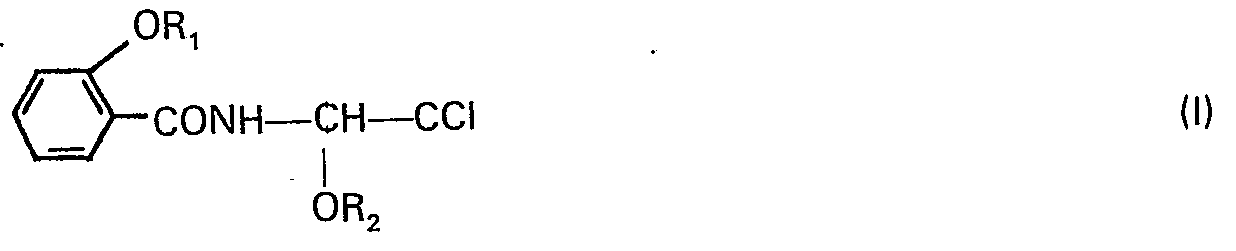
- R1 is hydrogen, lower alkylcarbonyl, lower alkoxycarbonyl, phenoxycarbonyl, lower alkylsulfonyl or lower alkylcarbamoyl, R2 is phenyl; phenyl substituted by one or more members selected from lower alkyl, lower alkoxy, lower alkylthio, lower alkoxycarbonyl, halogen, formyl, cyano, thiocyano, nitro, lower alkylsulfinyl, lower alkylsulfonyl, lower alkylcarbonyl, acetylamino or phenyl; or naphthyl, with the proviso that when R1 is hydrogen or lower alkylcarbonyl, R2 is the said substituted phenyl or naphthyl; a fungicidal composition for agriculture and horticulture comprising 0.5 to 95% by weight of said 2-hydroxybenzamide derivatives as effective components and a method of preventing fungi.
- As fungicides used for protecting agricultural and horticultural plants from diseases, there have been used organomercurous compounds, organic chlorine compounds, organic phosphorus compounds and gaseous compounds. However, the organomercurous compounds have a very strong toxicity to humans and beasts. The organic chlorine compounds have a considerable phototoxicity for plants. Since they are required in large amounts and in a high concentration for obtaining a satisfactory preventive effect, they are liable to remain in the plant body or in the soil. The gaseous fungicides have the defect of having an irritating or unpleasant smell.
- After investigations for the development of agricultural and horticultural fungicides free of said defects, the inventors have found that compounds represented by formula (I) are highly effective in preventing diseases in agricultural and horticultural plants, particularly a remarkable effect against the clubroot of Cruciferous plants and rice blast disease at low concentrations.
- The compounds of the present invention have a very low toxicity to humans and beasts, do not damage plants, are free from an irritating or unpleasant smell, and are capable of preventing diseases of plants at low concentrations. Therefore, the compounds can be used as ideal agricultural and horticultural fungicides in only small amounts without fear of soil contamination.
- The terms "lower alkyl" and "lower alkoxy" herein designate alkyl and alkoxy groups having 1-6 carbon atoms, preferably such groups have 1-4 carbon atoms.
- Preferred compounds of the present invention are compounds of formula (I) wherein R1 is hydrogen and R2 is substituted phenyl represented by the formula:
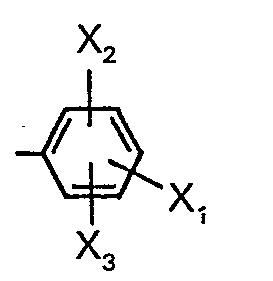
- X1 is alkyl having 1-4 carbon atoms, methoxy, methoxycarbonyl, halogen, cyano, nitro, acetyl, thiocyano or phenyl, X2 is hydrogen or alkyl having 1-3 carbon atoms and X3 is hydrogen or methyl; or A-naphthyl.
- More preferred compounds are:
- (1) compounds represented by formula (I) wherein R1 is hydrogen and R2 is substituted phenyl represented by the formula:

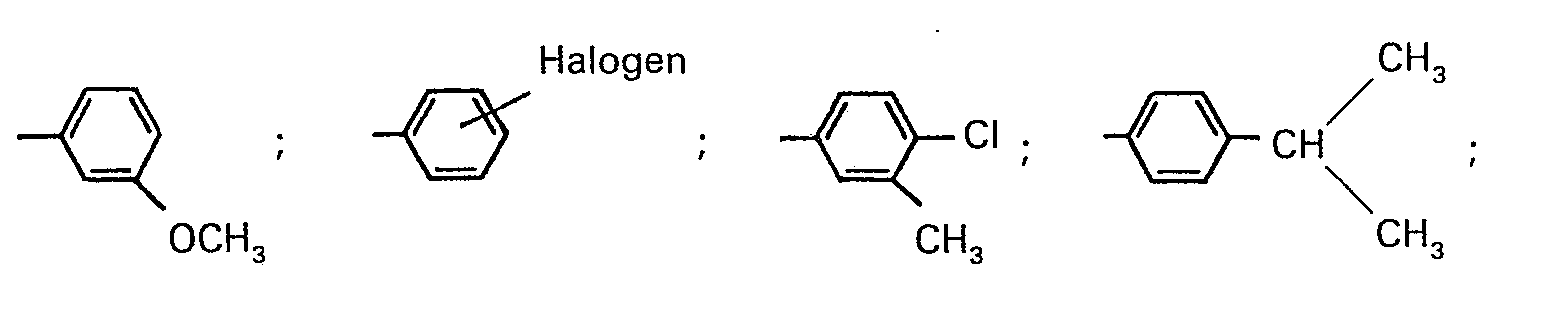
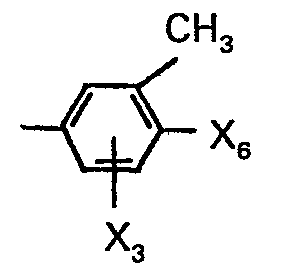
- (2) compounds represented by formula (I) wherein R, is acetyl and R2 is substituted phenyl represented by the formula:

- X8 is hydrogen, methylthio or chlorine and X3 is hydrogen or methyl which is in m- or p-position to the methyl on the phenyl nucleus, with the proviso that when X3 is methyl, X6 is hydrogen; substituted phenyl represented by the formula:

- X7 is methyl, chlorine, acetyl or methoxy; substituted phenyl represented by the formula:

- X8 is chlorine or fluorine; substituted phenyl represented by the formula:

- X8 is hydrogen, methylthio or chlorine and X3 is hydrogen or methyl which is in m- or p-position to the methyl on the phenyl nucleus, with the proviso that when X3 is methyl, X6 is hydrogen; substituted phenyl represented by the formula:
- The compounds of the present invention are prepared for example, as follows:
- A compound represented by the formula:

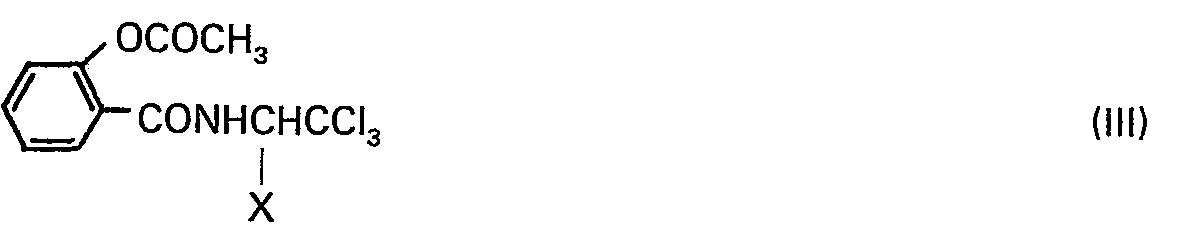
- X represents halogen, and then the resulting compound is reacted with a compound represented by the formula:

- R2 has the same meaning as above, to obtain a compound represented by formula (I) wherein R1 is acetyl:

- When a compound of formula (V) is hydrolyzed in the presence of an acid catalyst, a compound of formula (1) wherein R1 is hydrogen:

- A compound represented by formula (I) wherein R1 is lower alkylcarbonyl, lower alkoxycarbonyl, phenoxycarbonyl or lower alkylsulfonyl can be obtained by reacting a compound represented by formula (VI) with an acid halide of the formula:

- R'1 is lower alkylcarbonyl, lower alkoxycarbonyl, phenoxycarbonyl or lower alkylsulfonyl in the presence of a base. A compound represented by formula (I) wherein R1 is lower alkylcarbamoyl can be obtained by reacting an isocyanate of the formula:

- R3 represents lower alkyl with a compound of formula (VI) in the presence of a base. The compound represented by formula (II) used as a starting material can be prepared by reacting o-acetylsalicylamide with chloral.
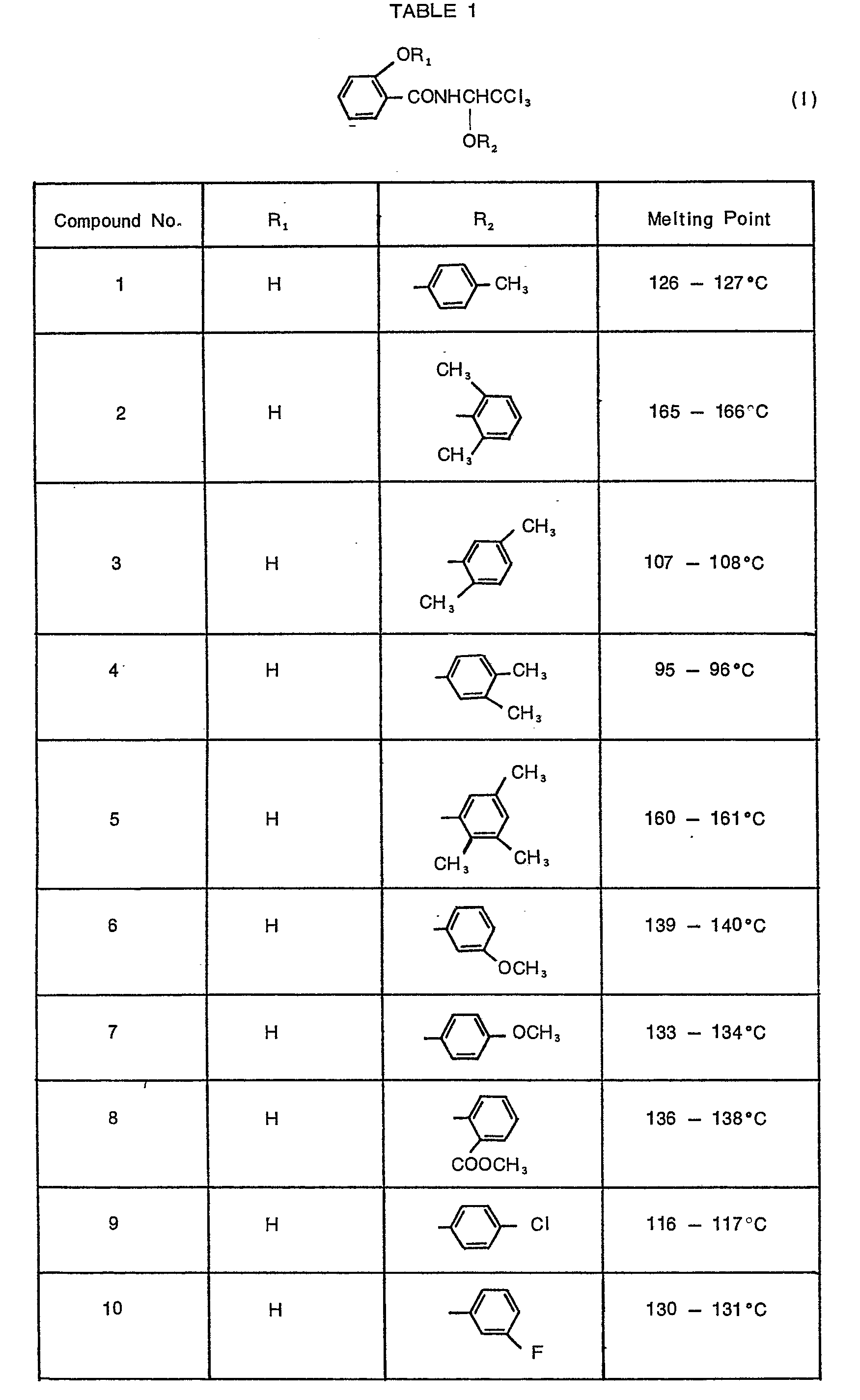
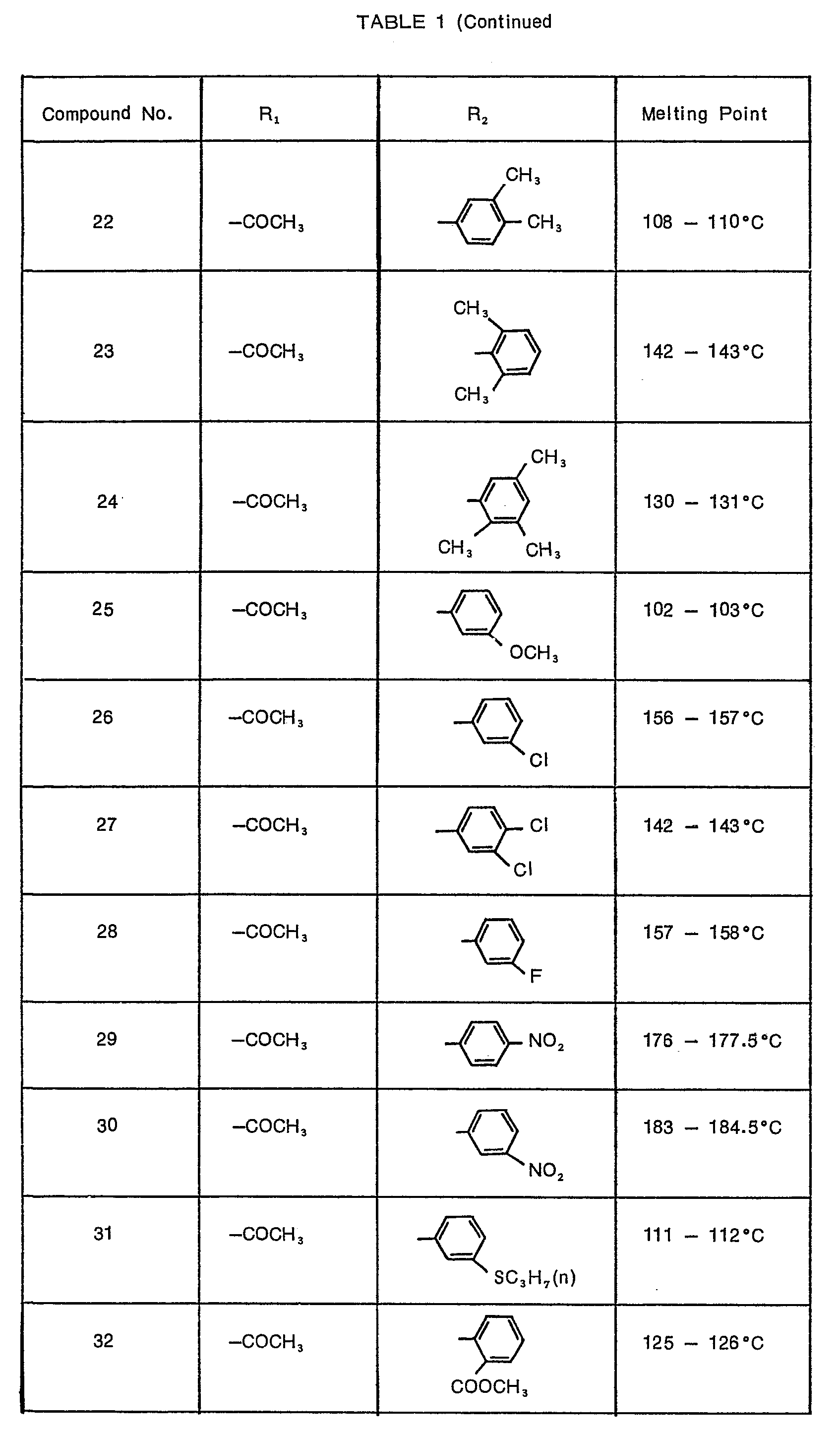
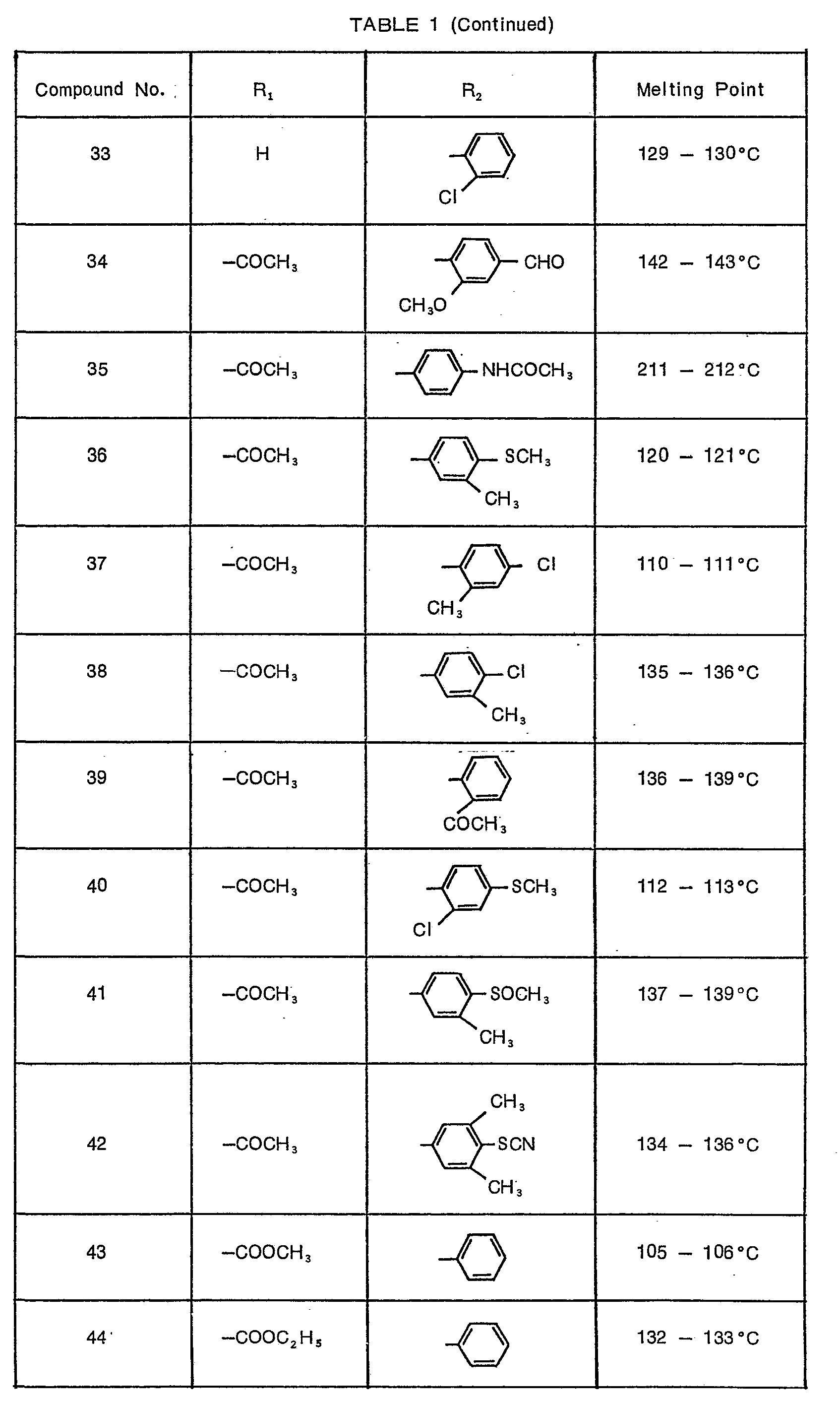
- The typical compounds of the present invention prepared by the procedures mentioned above are shown in Table 1.



- For further illustration of methods of preparing the compounds of the present invention, the following examples are given, which by no means limit the present invention.
- 15.0 g of N-(1',2',2',2'-tetrachloroethyl)-2-acetoxybenzamide and 5.65 g of p-cresol were dissolved in 250 ml of acetone. 5.3 g of triethylamine were added dropwise thereto at a temperature below 12°C. After effecting the reaction at room temperature for 30 minutes, the reaction mixture was poured into water. 15.2 g of white N-(1'-p-methylphenoxy-2',2',2'-trich(oroethyl)-2-acetoxy- benzamide were obtained. The compound was suspended in 300 ml of ethanol, then 3.6 ml of concentrated hydrochloric acid were added thereto and the reaction was carried out at 60-70°C for three hours. Afer cooling, the reaction mixture was poured into water to obtain 14.3 g of N-(1'-p-methylphenoxy-2',2',2'-trichloroethyl)-2-hydroxybenzamide as white crystals. M.p. 126-127°C.
- 4.8 g of p-chlorophenol were dissolved in 150 ml of benzene. 0.8 g of metallic sodium was added thereto and the reaction was carried out under heating for one hour. After cooling, 8.0 g of N-(1',2',2',2'-tetrachloroethyl)-2-acetoxybenzamide was added thereto at a temperature below 10°C. The reaction was continued for one hour and the reaction mixture was poured into water. The benzene layer was separated out, washed with water and benzene was removed under reduced pressure to obtain 5.4 g of N-(1'-p-chlorophenoxy-2',2',2'-trichloroethyl)-2-acetoxybenzamide as white crystals. The compound thus obtained was suspended in 300 ml of ethanol, then 0.5 ml of concentrated hydrochloric acid was added thereto and the reaction was carried out at 60-70°C for three hours. After cooling, the reaction mixture was poured into a large amount of water to obtain 4.2 g of N-(1 '-p-chlorophenoxy-2',2',2'-trichloroethyl)-2-hydroxybenzamide as white crystals. Melting point: 116-117°C.
- 15.0 g of N-(1',2',2',2'-tetrachloroethyl)-2-acetoxybenzamide and 6.4 g of 2,5-dimethylphenyl were dissolved in 250 ml of acetone. 5.3 g of triethylamine were added dropwise thereto at a temperature of below 10°C. After the reaction was carried out for one hour, the reaction mixture was poured into water. The crystals which thus resulted were recrystallized from water-methanol to obtain 14.5 g of N-(1'-2"-5"-dimethylphenoxy-2',2',2'-trichloroethyl)-2-acetoxybenzamide as white crystals. Melting point: 119-120°C.
- 17.0 g of N-(1',2',2',2'-tetrachloroethyl)-2-acetoxybenzamide and 7.7 g of 3-methyl-4-(methylthio)phenol were dissolved in 100 ml of acetone. 12 g of 20% aqueous NaOH solution were added dropwise thereto at a temperature below 20°C. After the reaction was carried out for one hour, the reaction mixture was poured into water. The crystals which thus resulted were recrystallized from n-hexane/benzene to obtain 18.4 g of N-(-1'-3''-methyl-4''-methylthiophenoxy-2',2',2'-trichloroethyl)-2-acetoxybenzamide as white crystals. Melting point: 120-121 °C.
- 8.5 g of N-(1',2',2',2'-tetrachloroethyl)-2-acetoxybenzamide and 3.6 g of A-naphthol were dissolved in 50 ml of acetone, and the temperature was maintained at 5-15°C by cooling in an ice-water bath. Then 4.5 ml of triethylamine were added dropwise and slowly to the solution under stirring. Then, the reaction was carried out at room temperature for about one hour and the reaction mixture was poured into water. The crystals which thus resulted were recrystallized from ethanol.
- 5.4 g of N-(1'-β-naphthoxy-2',2',2'-trichloroethyl)-2-acetoxybenzamide were obtained as white crystals. Melting point: 158-160°C.
- 50 ml of ethanol and 1 ml of concentrated hydrochloric acid were added to 4.2 g of N-(1'-β-naphthoxy-2',2',2'-trichloroethyl)-2-acetoxybenzamide synthesized in Preparation Example 5. The whole was refluxed for about three hours. After cooling, the reaction mixture was poured into water and the resulting crystals were recrystallized from n-hexane/benzene (2:1) to obtain 2.0 g of N-(1'-j8-naphthoxy-2',2',2'-trichloroethyl)-2-hydroxybenzamide as white crystals. Melting point: 144-145°C.
- 10 g of N-(1'-phenoxy-2',2',2'-trichloroethyl)-2-hydroxybenzamide and 1.8 g of methyl isocyanate were dissolved in 150 ml of acetone. Two or three drops of triethylamine were added to the solution under stirring. After allowing to stand overnight, the reaction mixture was poured into water and the crystals which thus resulted were recrystallized from methanol to obtain 4.2 g of N-(1'-phenoxy-2',2',2'-trichloroethyl)-2-methylcarbamoyloxybenzamide as white crystals. Melting point: 138-141 °C.
- 10 g of N-(1'-phenoxy-2',2',2'-trichioroethy))-2-hydroxybenzamide and 5.2 g of phenyl chloroformate were dissolved in 200 ml of acetone and the solution was kept at a temperature below 10°C with an ice-water bath. 3.3 g of triethylamine were added dropwise thereto under stirring and the reaction was continued at room temperature for a further period of three hours. The reaction mixture was poured into water and the resulting crystals were recrystallized from methanol to obtain 5.2 g of N-(1'-phenoxy-2',2',2'-trichloroethyl)-2-phenoxycarbonyloxybenzamide as white crystals. Melting point: 110-111°C.
- The compounds of the present invention are used as agricultural or horticultural fungicides sometimes solely but usually in various types of formulations, with carriers or other adjuvants, such as emulsion, wettable powder, dusts, granules and micro granules in compliance with the intended purposes. In this case, the content of a compound of formula (I) in the formulations will usually be satisfactory if it is the same as that of the effective component in conventional formulations: namely, 0.5 to 95%, preferably 2 to 70%.
- Both solid carriers and liquid carriers can be used. The solid carriers include clay, kaolin, talc, diatomaceous earth, silica, and calcium carbonate, and the liquid carriers include benzene, alcohols, acetone, xylene, methylnaphthalene, cyclohexanone, dimethylformamide, dimethylsulfoxide, animal or vegetable oils, fatty acids, fatty acid esters, and many kinds of surface active agents. Adjuvants other than carriers usually used for agricultural chemicals such as spreading agents, emulsifiers, wetting agents, dispersing agents and fixing agents can be properly mixed in order to assure the desired effects.
- The compounds of the present invention can be used in the form of blends with other herbicides, insecticides, acaricides, agricultural and horticultural fungicides, soil fungicides, soil stabilizers or fertilizers.
- Further detailed formulation examples of the present invention will be illustrated below. The kinds of adjuvants and the mixing ratios should not be limited within the range of the examples but can be utilized in wider ranges for practical uses.
- In the following examples, parts are given by weight.
- Dusts:
- 10 parts of compound No. 1 of the present invention [N-(1'-p-methyiphenoxy-2',2',2'-trichloroethyl)-2-hydroxybenzamide], 41 parts of talc and 49 parts of clay were mixed together and pulverized to obtain a dust.
- Wettable powders:
- 80 parts of compound No. 9 [N-(1'-p-chiorophenoxy-2',2',2'-trichioroethy))-2-hydroxybenzamide)] of the present invention, 15 parts of kaolin, 3 parts of a sodium higher alkyl sulfate and 2 parts of a sodium polyacrylate were mixed together and pulverized to obtain a wettable powder.
- Granules:
- 3 parts of compound No. 30 [N-(1'-m-nitrophenoxy-2',2',2'-trichioroethyi)-2-acetoxybenzamide] of the present invention, 35 parts of diatomaceous earth, 23 parts of bentonite, 37 parts of talc and 2 parts of a disintegrator were mixed together and 18 parts of water were added thereto to moisten the mixture homogeneously. Then, the mixture was extruded through' an injection molding machine to obtain granules, which were then dried, treated in a crusher and regranulated by means of a granulator to obtain granules having a particle size of 0.6 to 1 mm.
- Micro granules:
- 5 parts of compound No. 48 [N-(I'-phenoxy-2',2',2'-trichloroethyl)-2-methylcarbamoyloxy- benzamide] of the present invention were homogeneously mixed with 6 parts of bentonite and 9 parts of clay to make a concentrated powder mixture.
- Separately, 80 parts of non-absorbent coarse mineral powder of 105 to 74 microns were placed in a proper mixing machine into which 20 parts of water were added under rotation to moisten the powder and then the above mentioned concentrated powder mixture was added thereto to coat the same. The products were dried to obtain micro granules.
- Emulsion:
- 20 parts of compound No. 51 [N-(1'-β-naphthoxy-2',2',2'-trichloroethyl)-2-hydroxybenzamide] were dissolved in 63 parts of xylene, into which 17 parts of a mixture of an alkylphenol-ethylene oxide condensate and a calcium alkylbenzenesulfonate (8:2) were mixed and dissolved to obtain an emulsion. The emulsion is to be used after dilution with water. When the composition in the form of a wettable powder, a water-soluble concentration or an emulsifiable concentration is practically applied to fungi which harm agricultural and horticultural plants or crops, it may preferably be diluted with water so that the present compounds are contained in an amount of about 25-8000 ppm, preferably 50-2000 ppm. In the form of a dust, pellets or granules, the present compound is used in an amount of 0.30 kg-1 kg/10 ares.
- Although the compounds of the present invention can be used for soil treatment as they are, they are usually formulated as mentioned above. The quantity of the compounds of the present invention usable for the purpose of soil treatment varies depending on kind of the compounds used, the method of use and formulations, and is difficult to determine this quantity generally. However, they are used in an amount of usually 0.2 to 8 kg/10 are, preferably 0.2 to 6 kg/10 are, in the case of overall soil treatment; about 0.5 to 6 kg/10 are, preferably 1 to 5 kg/10 are, in the case of furrow treatment; and 0.1 to 2 g/plant, preferably 0.3 to 0.7 g/plant for treating planting holes.
- The advantageous effects of the present invention will be shown by the following experimental results:
- An unglazed pot of 15 cm diameter was filled with soil infected by the pathogenic fungi of said disease (Plasmodiophora brassicae). The soil was mixed thoroughly with a 10% dust of the compositions of the present invention prepared by the same procedure as in Formulation Example 1 in an amount of 2 g in each pot. Thereafter, 15 seeds of chinese cabbage (variety: Taibyo 60-nichi) were sowed per pot.
- The pot was buried in the field to allow the plant to be attacked by the pathogen.
- A dust containing 20% of PCNB (active ingredient: pentachloronitrobenzene) was used as a control and tested in the same procedure as mentioned above.
- 4 weeks after sowing, the chinese cabbages were taken up and the degree of the attack by the fungus was observed.
- "Percentage of healthy seedlings" was calculated as follows:

- The results are shown in Table 2.


Claims (19)




Applications Claiming Priority (2)
| Application Number | Priority Date | Filing Date | Title |
|---|---|---|---|
| JP102789/78 | 1978-08-25 | ||
| JP53102789A JPS6058905B2 (en) | 1978-08-25 | 1978-08-25 | New 2-hydroxybenzamide derivative and soil fungicide |
Publications (2)
| Publication Number | Publication Date |
|---|---|
| EP0010583A1 EP0010583A1 (en) | 1980-05-14 |
| EP0010583B1 true EP0010583B1 (en) | 1981-12-16 |
Family
ID=14336882
Family Applications (1)
| Application Number | Title | Priority Date | Filing Date |
|---|---|---|---|
| EP79103085A Expired EP0010583B1 (en) | 1978-08-25 | 1979-08-22 | 2-hydroxybenzamide derivatives, fungicidal compositions containing them and method for preventing diseases of plant |
Country Status (5)
| Country | Link |
|---|---|
| US (1) | US4284628A (en) |
| EP (1) | EP0010583B1 (en) |
| JP (1) | JPS6058905B2 (en) |
| CA (1) | CA1116626A (en) |
| DE (1) | DE2961583D1 (en) |
Families Citing this family (2)
| Publication number | Priority date | Publication date | Assignee | Title |
|---|---|---|---|---|
| US4468405A (en) * | 1981-07-30 | 1984-08-28 | The Dow Chemical Company | Substituted N-aroyl N'-phenyl urea compounds |
| CN1078204C (en) * | 1993-04-28 | 2002-01-23 | 久美蓝化学工业株式会社 | Amino acid amide derivative, agrohorticultural bactericide, and production process |
Family Cites Families (11)
| Publication number | Priority date | Publication date | Assignee | Title |
|---|---|---|---|---|
| FR1082861A (en) * | 1953-06-03 | 1955-01-03 | Sharples Chemicals | Improvements relating to a composition containing trichloromethyl thiocyanate and its use |
| US3929879A (en) * | 1960-09-19 | 1975-12-30 | Ben Venue Lab Inc | 3-Nitrohalosalicylanilides |
| US3644518A (en) * | 1965-05-24 | 1972-02-22 | Makoto Yoshida | Process for the production of naphthamide derivatives |
| DE1768864A1 (en) * | 1968-07-09 | 1972-02-03 | Bayer Ag | Fluoroacetylaminotrichloromethyl methane ether |
| DE1922927A1 (en) * | 1969-05-06 | 1971-03-25 | Bayer Ag | 2-Alkyl-4,6-dinitrophenol derivatives, processes for their preparation and their use as insecticidal and acaricidal active ingredients |
| CA956974A (en) * | 1970-06-22 | 1974-10-29 | Yasunori Abe | Compounds having the herbicidal effect and the process for the manufacture thereof |
| US4055639A (en) * | 1975-07-14 | 1977-10-25 | Nippon Kayaku Kabushiki Kaisha | Derivatives of N-(2,2-dichlorovinyl) salicylamide and use thereof as bactericides, fungicides and algicides for industry |
| JPS5215823A (en) * | 1975-07-18 | 1977-02-05 | Nippon Kayaku Co Ltd | Germicide for agriculture and gardening |
| US4146646A (en) * | 1976-02-12 | 1979-03-27 | Fisons Limited | Bis-amide fungicidal compounds |
| DE2611599A1 (en) * | 1976-03-19 | 1977-09-22 | Basf Ag | (2)-Alk(en)yl-sulphonyloxy-phenyl carbamates - useful as insecticides and acaricides |
| JPS5439040A (en) * | 1977-09-01 | 1979-03-24 | Nippon Kayaku Co Ltd | Novel 2-hydroxybenzamide derivatives and bactericides for the soil |
-
1978
- 1978-08-25 JP JP53102789A patent/JPS6058905B2/en not_active Expired
-
1979
- 1979-08-13 US US06/065,910 patent/US4284628A/en not_active Expired - Lifetime
- 1979-08-22 CA CA000334265A patent/CA1116626A/en not_active Expired
- 1979-08-22 EP EP79103085A patent/EP0010583B1/en not_active Expired
- 1979-08-22 DE DE7979103085T patent/DE2961583D1/en not_active Expired
Also Published As
| Publication number | Publication date |
|---|---|
| DE2961583D1 (en) | 1982-02-11 |
| CA1116626A (en) | 1982-01-19 |
| JPS6058905B2 (en) | 1985-12-23 |
| US4284628A (en) | 1981-08-18 |
| EP0010583A1 (en) | 1980-05-14 |
| JPS5531012A (en) | 1980-03-05 |
Similar Documents
| Publication | Publication Date | Title |
|---|---|---|
| KR20000011943A (en) | Herbicidal phenoxypropionic acid N-alkyl-N-2-fluorophenyl amides | |
| EP0086111B1 (en) | A fungicidal indanylbenzamide | |
| US4200632A (en) | 2-Hydroxy benzamide derivatives and use thereof as fungicides | |
| US4284813A (en) | Benzamide derivatives and herbicidal composition containing the same | |
| EP0010583B1 (en) | 2-hydroxybenzamide derivatives, fungicidal compositions containing them and method for preventing diseases of plant | |
| US4294835A (en) | 2-Hydroxy benzamide derivatives and use thereof as a fungicide | |
| US3819609A (en) | Fungicidal-2-alkoxy-5-halogeno-benzene diazonium cyanides | |
| CS209924B2 (en) | Herbicide means and method of making the active component | |
| US4942178A (en) | Plant protection agents for control of fungi | |
| JPS6220992B2 (en) | ||
| GB2044257A (en) | 2-Hydroxybenzamide derivatives | |
| JPS6254281B2 (en) | ||
| JPS599521B2 (en) | herbicide | |
| JP2541506B2 (en) | Nitro compound | |
| EP0121344A2 (en) | N,N-substituted azolecarboxamide derivatives useful as fungicides and nematicides | |
| JP2767128B2 (en) | Herbicide composition | |
| US4280834A (en) | Novel diphenyl ether derivative and herbicidal composition containing the same as an active component | |
| JP2567251B2 (en) | Tetrahydrophthalimide derivative | |
| JPH047347B2 (en) | ||
| KR830001149B1 (en) | Insecticide composition | |
| JPS6143188A (en) | Tetrahydrophthalimide derivative, preparation and herbicide containing same as active constituent | |
| JPS6193150A (en) | Cyclohexenylacetamide derivative and its production | |
| JPS61178904A (en) | Herbicide | |
| JPS59175407A (en) | Herbicide | |
| JPS623835B2 (en) |
Legal Events
| Date | Code | Title | Description |
|---|---|---|---|
| PUAI | Public reference made under article 153(3) epc to a published international application that has entered the european phase |
Free format text: ORIGINAL CODE: 0009012 |
|
| AK | Designated contracting states |
Designated state(s): CH DE FR GB IT NL |
|
| 17P | Request for examination filed |
Effective date: 19801031 |
|
| ITF | It: translation for a ep patent filed | ||
| GRAA | (expected) grant |
Free format text: ORIGINAL CODE: 0009210 |
|
| AK | Designated contracting states |
Designated state(s): CH DE FR GB IT NL |
|
| REF | Corresponds to: |
Ref document number: 2961583 Country of ref document: DE Date of ref document: 19820211 |
|
| KL | Correction list |
Free format text: 82/06 |
|
| PGFP | Annual fee paid to national office [announced via postgrant information from national office to epo] |
Ref country code: CH Payment date: 19840726 Year of fee payment: 6 |
|
| PGFP | Annual fee paid to national office [announced via postgrant information from national office to epo] |
Ref country code: FR Payment date: 19840817 Year of fee payment: 6 |
|
| PGFP | Annual fee paid to national office [announced via postgrant information from national office to epo] |
Ref country code: DE Payment date: 19840919 Year of fee payment: 6 |
|
| PGFP | Annual fee paid to national office [announced via postgrant information from national office to epo] |
Ref country code: NL Payment date: 19850831 Year of fee payment: 7 |
|
| PG25 | Lapsed in a contracting state [announced via postgrant information from national office to epo] |
Ref country code: CH Effective date: 19860831 |
|
| PG25 | Lapsed in a contracting state [announced via postgrant information from national office to epo] |
Ref country code: NL Effective date: 19870301 |
|
| NLV4 | Nl: lapsed or anulled due to non-payment of the annual fee | ||
| GBPC | Gb: european patent ceased through non-payment of renewal fee | ||
| PG25 | Lapsed in a contracting state [announced via postgrant information from national office to epo] |
Ref country code: FR Free format text: LAPSE BECAUSE OF NON-PAYMENT OF DUE FEES Effective date: 19870430 |
|
| REG | Reference to a national code |
Ref country code: CH Ref legal event code: PL |
|
| PG25 | Lapsed in a contracting state [announced via postgrant information from national office to epo] |
Ref country code: DE Effective date: 19870501 |
|
| REG | Reference to a national code |
Ref country code: FR Ref legal event code: ST |
|
| PG25 | Lapsed in a contracting state [announced via postgrant information from national office to epo] |
Ref country code: GB Effective date: 19881118 |
|
| PLBE | No opposition filed within time limit |
Free format text: ORIGINAL CODE: 0009261 |
|
| STAA | Information on the status of an ep patent application or granted ep patent |
Free format text: STATUS: NO OPPOSITION FILED WITHIN TIME LIMIT |