EP0010243B1 - Process for treating biomasses; modified biomasses and their application - Google Patents
Process for treating biomasses; modified biomasses and their application Download PDFInfo
- Publication number
- EP0010243B1 EP0010243B1 EP79103832A EP79103832A EP0010243B1 EP 0010243 B1 EP0010243 B1 EP 0010243B1 EP 79103832 A EP79103832 A EP 79103832A EP 79103832 A EP79103832 A EP 79103832A EP 0010243 B1 EP0010243 B1 EP 0010243B1
- Authority
- EP
- European Patent Office
- Prior art keywords
- biomass
- und
- mol
- acid
- compounds
- Prior art date
- Legal status (The legal status is an assumption and is not a legal conclusion. Google has not performed a legal analysis and makes no representation as to the accuracy of the status listed.)
- Expired
Links
- 0 C*INC1=CCCC=C1 Chemical compound C*INC1=CCCC=C1 0.000 description 1
Classifications
-
- C—CHEMISTRY; METALLURGY
- C05—FERTILISERS; MANUFACTURE THEREOF
- C05F—ORGANIC FERTILISERS NOT COVERED BY SUBCLASSES C05B, C05C, e.g. FERTILISERS FROM WASTE OR REFUSE
- C05F11/00—Other organic fertilisers
-
- C—CHEMISTRY; METALLURGY
- C02—TREATMENT OF WATER, WASTE WATER, SEWAGE, OR SLUDGE
- C02F—TREATMENT OF WATER, WASTE WATER, SEWAGE, OR SLUDGE
- C02F1/00—Treatment of water, waste water, or sewage
- C02F1/02—Treatment of water, waste water, or sewage by heating
- C02F1/025—Thermal hydrolysis
-
- C—CHEMISTRY; METALLURGY
- C02—TREATMENT OF WATER, WASTE WATER, SEWAGE, OR SLUDGE
- C02F—TREATMENT OF WATER, WASTE WATER, SEWAGE, OR SLUDGE
- C02F11/00—Treatment of sludge; Devices therefor
-
- C—CHEMISTRY; METALLURGY
- C02—TREATMENT OF WATER, WASTE WATER, SEWAGE, OR SLUDGE
- C02F—TREATMENT OF WATER, WASTE WATER, SEWAGE, OR SLUDGE
- C02F11/00—Treatment of sludge; Devices therefor
- C02F11/008—Sludge treatment by fixation or solidification
-
- C—CHEMISTRY; METALLURGY
- C07—ORGANIC CHEMISTRY
- C07D—HETEROCYCLIC COMPOUNDS
- C07D243/00—Heterocyclic compounds containing seven-membered rings having two nitrogen atoms as the only ring hetero atoms
- C07D243/06—Heterocyclic compounds containing seven-membered rings having two nitrogen atoms as the only ring hetero atoms having the nitrogen atoms in positions 1 and 4
- C07D243/08—Heterocyclic compounds containing seven-membered rings having two nitrogen atoms as the only ring hetero atoms having the nitrogen atoms in positions 1 and 4 not condensed with other rings
-
- C—CHEMISTRY; METALLURGY
- C08—ORGANIC MACROMOLECULAR COMPOUNDS; THEIR PREPARATION OR CHEMICAL WORKING-UP; COMPOSITIONS BASED THEREON
- C08G—MACROMOLECULAR COMPOUNDS OBTAINED OTHERWISE THAN BY REACTIONS ONLY INVOLVING UNSATURATED CARBON-TO-CARBON BONDS
- C08G12/00—Condensation polymers of aldehydes or ketones with only compounds containing hydrogen attached to nitrogen
-
- C—CHEMISTRY; METALLURGY
- C08—ORGANIC MACROMOLECULAR COMPOUNDS; THEIR PREPARATION OR CHEMICAL WORKING-UP; COMPOSITIONS BASED THEREON
- C08G—MACROMOLECULAR COMPOUNDS OBTAINED OTHERWISE THAN BY REACTIONS ONLY INVOLVING UNSATURATED CARBON-TO-CARBON BONDS
- C08G8/00—Condensation polymers of aldehydes or ketones with phenols only
-
- C—CHEMISTRY; METALLURGY
- C12—BIOCHEMISTRY; BEER; SPIRITS; WINE; VINEGAR; MICROBIOLOGY; ENZYMOLOGY; MUTATION OR GENETIC ENGINEERING
- C12N—MICROORGANISMS OR ENZYMES; COMPOSITIONS THEREOF; PROPAGATING, PRESERVING, OR MAINTAINING MICROORGANISMS; MUTATION OR GENETIC ENGINEERING; CULTURE MEDIA
- C12N1/00—Microorganisms; Compositions thereof; Processes of propagating, maintaining or preserving microorganisms or compositions thereof; Processes of preparing or isolating a composition containing a microorganism; Culture media therefor
- C12N1/005—Microorganisms; Compositions thereof; Processes of propagating, maintaining or preserving microorganisms or compositions thereof; Processes of preparing or isolating a composition containing a microorganism; Culture media therefor after treatment of microbial biomass not covered by C12N1/02 - C12N1/08
-
- C—CHEMISTRY; METALLURGY
- C12—BIOCHEMISTRY; BEER; SPIRITS; WINE; VINEGAR; MICROBIOLOGY; ENZYMOLOGY; MUTATION OR GENETIC ENGINEERING
- C12N—MICROORGANISMS OR ENZYMES; COMPOSITIONS THEREOF; PROPAGATING, PRESERVING, OR MAINTAINING MICROORGANISMS; MUTATION OR GENETIC ENGINEERING; CULTURE MEDIA
- C12N11/00—Carrier-bound or immobilised enzymes; Carrier-bound or immobilised microbial cells; Preparation thereof
- C12N11/02—Enzymes or microbial cells immobilised on or in an organic carrier
Definitions
- the present application relates to a new process for processing biomass with the aid of carbonyl and / or thiocarbonyl compounds and compounds capable of aminoplast or phenoplast formation.
- the application also relates to the modified biomass itself and the use thereof which are obtained in the process according to the invention.
- the process can only be carried out using partially dried sewage sludge.
- Living mycelium-like biomass with a content of 75-80% of bound cell water and a content of 100-300% of extracellular water cannot be used as starting materials.
- the process is also unsuitable for processing any and living biomass, i.e. in the state of maximum turbulence and cell division, since the cell walls of many bacteria, bacilli, fungi and a wide variety of microbial systems, in particular living microbial systems such as Pseudomonas, etc ., from biological or fully biological wastewater treatment plants under the implementation conditions are not destroyed or hydrolyzed are blown up and broken down.
- biomass waste with a solids content of up to 60% by weight can be processed by mixing the biomass sludge with formaldehyde (to kill bacteria), then adding concentrated nitric acid, giving a homogeneous mixture forms and the available nitrogen dioxide has an oxidizing effect on the waste sludge, and then urea is added to the homogeneous mixture, after which polymerization and then agglomeration occurs within a certain time (cf. US Pat. No. 3,655,395).
- this method has the same disadvantages as the previously known method mentioned above.
- the waste sludge that can be used must have the highest possible solids content. Therefore, a complex pre-drying of the sludge is essential.
- a relatively large amount of nitric acid is used as an oxidizing agent.
- sewage sludge can be converted into nitrogen fertilizer by first mixing the sludge with peat and solid urea, then adding an aqueous urea-formaldehyde solution and an aqueous solution of a strong mineral acid and then adding aqueous ammonia. Solution neutralized (see U.S. Patent 3,073,693).
- U.S. Patent 3,073,693 it is necessary to bring the sewage sludge into solid form, that is to say to largely drain and pre-dry it. Since these operations, as already described in connection with the method known from DT-OS 2 523 483, are very complex, the method is unprofitable for practical use.
- the invention also relates to the use of the modified biomasses according to the invention for various purposes.
- substances according to the invention are suitable for fixing metal ions or organic or inorganic acids.
- substances according to the invention can be used as reactive fillers and combination fillers, flame retardants and anti-aging agents in plastics, such as natural or synthetic rubbers, polyamides and epoxy resins.
- substances according to the invention can act as catalysts or as carriers for catalysts or other substances.
- certain substances according to the invention are suitable as catalysts for formose-sugar mixture synthesis on the basis high-proof formalin solutions.
- substances according to the invention can be used to deactivate crop protection agents, as nutrient media for bacteria and as agricultural chemicals or as feed additives.
- the method according to the invention has a number of advantages. It enables biomass to be processed easily and on a technical scale. In addition, the process is not limited to special biomass, but is generally applicable. A preliminary drainage of the biomass to be used is not necessary.
- the resulting products do not stick together in the aqueous phase, can be filtered without complications and can be dried in an energy-saving manner. They are completely stable in storage and free of pathogenic pathogens. Due to total enzyme deactivation and complete cell death of the biomass in the process products according to the invention, decomposition, putrefaction, fermentation and unpleasant odors of enzymatically or microbiologically degradable cell contents are completely prevented.
- the process products are therefore fully stabilized in the long term in the dry state and in filled containers with regard to unpleasant odor formation and further enzymatic degradation.
- the process products are useful for a variety of purposes.
- the versatility of the method according to the invention makes any significant contribution to solving important environmental problems.
- the method according to the invention is suitable for processing any biomass.
- biomasses include all biosystems from microorganisms such as prokaryotes, eukaryotes, bacteria, fungi, yeasts, algae, protozoa and those that are already in the state of division, dormancy, partial or complete cell death, or already in the enzymatic decomposition or in the decomposition by foreign cultures Cellular organisms, etc., as well as biosystems of highly differentiated cells of plant or animal origin, for example cell components of the blood, such as erythrocytes, granulocytes, lymphocytes and thrombocytes.
- microorganisms such as prokaryotes, eukaryotes, bacteria, fungi, yeasts, algae, protozoa and those that are already in the state of division, dormancy, partial or complete cell death, or already in the enzymatic decomposition or in the decomposition by foreign cultures Cellular organisms, etc.
- biosystems of highly differentiated cells of plant or animal origin for example cell components of the blood,
- biomasses can also be used in the method according to the invention. Furthermore, the method according to the invention can also be used if the biomass contains a wide variety of impurities. Biomass in which heavy metal salts, crop protection agents, antibiotics or other organic or inorganic chemicals are present may be mentioned in this context.
- Biomasses from the production of penicillin can be used as living mushroom masses, as dead cell aggregates or as systems which have already passed through fermentation and decomposition or partial rotting in the process according to the invention.
- the biosystems of penicillin production which are filtered off, for example, by filter presses, can be condensed according to the invention even with a certain adsorbed penicillin content, penicillin still adsorbed on the biomass being completely deactivated in its antibiotic effectiveness by condensation.
- Biomasses which consist of microorganism masses from fermentation processes of the pharmaceutical, enzyme, food and luxury food industry, have a special position compared to the microorganism masses from biological sewage treatment plants - the so-called water or excess sludge ("activated sludge •)" - in that they (the first-mentioned biomasses) have a very uniform composition and are completely free of heavy metal salts. They are therefore also preferred as reaction components in the process according to the invention, provided the process products are used in the agricultural or animal feed sector. Particularly preferred within this complex are industrially used microorganisms whose metabolism can be controlled to obtain high-quality organic and pharmaceutical products from natural raw materials.
- Suitable carbonyl compounds which can be used as reaction components when carrying out the process according to the invention are all customary carbonyl compounds with sufficiently reactive carbonyl groups. These preferably include aldehydes and ketones.
- aldehydes are saturated, aliphatic, optionally halogen-substituted or hydroxy-substituted mono-aldehydes, such as formaldehyde, acetaldehyde, butyraldehyde, isobutyraldehyde, pivalinaldehyde, chloral, hydroxyacetaldehyde, hydroxypivalinaldehyde, glyceraldehyde, hydroxyaldehydes, which are contained in formose-sugar mixtures, and hydroxyaldehyde mixtures that arise from other aldehydes through aldol condensation.
- mono-aldehydes such as formaldehyde, acetaldehyde, butyraldehyde, isobutyraldehyde, pivalinaldehyde, chloral, hydroxyacetaldehyde, hydroxypivalinaldehyde, glyceraldehyde, hydroxyaldehy
- aldehydes are furthermore unsaturated aliphatic aldehydes, such as acrolein and crotonaldehyde, further cycloaliphatic aldehydes, such as cyclohexanaldehyde, furthermore aliphatic dialdehydes, such as glyoxal, methylglyoxal, glyoxal sulfate and glutardialdehyde, furthermore aromatic aldehydes, such as benzaldaldehyde, and 4-methylbenzaldehyde, t-salicylaldehyde, and t-benzaldehyde aldehydes derived from heterocycles, such as furfural and hydroxymethylfurfural.
- unsaturated aliphatic aldehydes such as acrolein and crotonaldehyde
- further cycloaliphatic aldehydes such as cyclohexanaldehyde
- Paraformaldehyde, trioxane, chloral hydrate, hexamethylenetetramine and hemiacetals of aldehydes, in particular of formaldehyde, with mono-, di- or polyfunctional alcohols such as methanol, ethanol, butanol, ethylene glycol and diethylene glycol may be mentioned specifically in this connection.
- ketones are hydroxyacetone, dihydroxyacetone, methyl ethyl ketone, methyl isobutyl ketone, cyclohexanone, acetophenone and quinones such as benzoquinone.
- aldehydes and / or ketones can also be used, mixtures of formaldehyde and other aldehydes or ketones being particularly preferred.
- Mixtures of formaldehyde with numerous aldehydes or ketones which have a-hydrogen atoms can, in situ, cause aldehyde condensation to give hydroxyaldehydes or hydroxy ketones are formed, as is illustrated for formaldehyde and isobutyraldehyde by the formula scheme below.
- equation (d) corresponds to the Butlerow-Löw formose reaction.
- reaction according to equation (e) is an acyloin condensation which can take place if cyanide ions are present in the reaction mixture in a catalytic amount.
- ketones with a-hydrogen atoms can react with formaldehyde.
- the hydroxy aldehydes and polyhydroxy ketones thus produced go to the extent of its formation, especially in the weak to strong alkaline range, for example, urea, and many readily aminoplast images
- Add i tion reactions to N-alkylol compounds represent condensation partners for the aforementioned biomass.
- Suitable thiocarbonyl compounds which can be used as reaction components when carrying out the process according to the invention are all customary thiocarbonyl compounds with sufficiently reactive thiocarbonyl groups. These preferably include thioaldehydes and thioketones. Particularly preferred thioaldehydes and thioketones are those which are derived from those aldehydes and ketones which have already been mentioned as being particularly preferred.
- thioaldehydes ie those compounds which release thioaldehydes under the reaction conditions, can also be used with preference. Special mention should be made of the trimeric thioformaldehyde, the trithiane, which breaks down into thioformaldehyde at elevated temperature in the presence of acids.
- Suitable carbonyl compounds which are in dissociation equilibrium with low molecular weight, uncondensed N-alkylol compounds are preferably simple aldehydes, in particular formaldehyde, which is in equilibrium with the corresponding N-methylol compounds.
- N-methylol compounds include in particular N-methylol-urea, N, N'-dimethylol-urea, methylolated dicyandiamide, methylolated oxamide, N-methylol-thiourea, N, N'-dimethylolthiourea and methylolated melamines, such as hexamethylolmelamine and trishydroxymethylmelamine of the constitution
- Monomethylol ethylene urea of the constitution should also be mentioned
- Alkylol compounds which are derived from simple aldehydes, preferably those with up to 5 carbon atoms, are also suitable.
- the following substances are suitable as carbonyl compounds: formaldehyde, acetaldehyde, isobutyraldehyde, crotonaldehyde, glyoxal, furfurol, hydroxymethylfurfurol, salicylaldehyde and their hemiacetals, also polymers of formaldehyde, such as paraformaldehyde and trioxane, also hexamethylene tetramine and also thioamaldehyde such as thioformaldehyde.
- N-methylolurea dimethylolurea, trimethylolmelamine, hexamethylolmelamine, monomethylol-ethylene urea, monomethylol-ethylene thiourea and tetramethylol acetylene diurea.
- Aminoplast formers are also used as starting materials in the process according to the invention.
- Aminoplast formers are understood here to mean all those nitrogen compounds which are capable of forming N-oligo- and N-polycondensation products with reactive carbonyl compounds.
- nitrogen compounds such as ureas, including urea itself, acetylene urea, Dimethylacetylenharnstoff and N-methyl urea, further thioureas, such as the unsubstituted thiourea, further diureas as hexamethylenediurea, tetramethylenediurea and ⁇ t h y-diurea, also polyureas as aliphatic by reacting , cycloaliphatic or araliphatic di- or triisocyanates or also biuret polyisocyanates with ammonia or primary amines can be obtained, moreover polycarboxamides, such as oxalic acid diamide, succinic acid diamide and adipic acid diamide, furthermore mono-, di- and polyurethanes, such as the reaction products of aliphatic, cyclo , araliphatic and aromatic mono- or Bischlorameisen(7)
- aminoplast formers are preferably higher molecular weight a, oo-di-ureas, their N-methylol derivatives and N-methylolalkyl ethers, and also a, w-bis-alkoxymethyl urethanes which are polyether between the ⁇ -, ⁇ -functional groups.
- Particularly preferred are higher molecular weight nitrogen compounds capable of aminoplast formation, water-soluble or water-dispersible compounds, e.g.
- aminoplast formers required as starting compounds are known or can be prepared by methods known in principle (cf. Houben-Weyl “Methods of Organic Chemistry”, Volume XIV, Part 2 (1963), pages 319-402, Georg Thieme-Verlag, Stuttgart) .
- modified aminoplast formers are preferably also considered as aminoplast formers. These are to be understood as aminoplast formers, which contain additional easily installable substances. Examples include compounds that can be installed quickly and easily through mixed condensation. These preferably include polyurethanes and polyureas with NH 2 end groups, polyamides made of poly- ( ⁇ -alanine) with molecular weights up to 2000, N-methylol methyl ether of polycaprolactam, polythiolactams, polypeptides made of N-carboxy-a-aminocarboxylic acids, low molecular weight polyamides made of aliphatic dicarboxylic acids and Diamines, polyamides from cycloaliphatic components and aromatic components, polyamides with O- or S- or N- as heteroatoms.
- Polyester amides, mixed condensates which contain ester, urethane or urea groups in addition to amide groups, ethoxylated and propoxylated mono- and polyamides, polyhydrazides and polyaminotriazoles, polysulfonamides, formaldehyde mixed condensates with urea, melamine and dicyandiamide, low molecular weight aniline-formaldehyde condensates, sulfates Mono- and dinitriles, acrylonitrile, urotropin, hexahydrotriazines from primary amines and formaldehyde, Schiff's bases and ketimines or polyketimines, such as those from one mole of hexamethylene diamine and 2 moles of cyclohexanone, polyadducts and polycondensation products of melamine and other aminoheterocycles with aldehydes Polyaddition and polycondensation products of nitriles with al
- the proportion of alcohols or polyalcohols in these products can be up to 60% by weight, based on the sum of the percentages of nitrogen compounds and alcohols.
- aminoplast formers When carrying out the process according to the invention, the following substances are particularly suitable as aminoplast formers: urea, thiourea, diureas, such as, for example, hexamethylene diurea, tetramethylene diurea, ethylene urea, acetylene urea, dimethylacetylene lenurea, oxalic acid diamide, succinic acid diamide, adipic acid diamide, mono- or bishydrazides, such as hydrazodicarbonamide, methyl and ethyl carbazate, hydrazodicarboxylic acid esters, mono- and especially diurethanes, such as the reaction products of aliphatic, cycloaliphatic and arylamiphatic, arylamiphatic and arylamiphatic, arylamiphatic and arylamiphatic, arylamiphatic and arylamiphatic, arylamiphatic and arylamiphatic, aryl
- aminoplast formers when carrying out the process according to the invention as aminoplast formers, there are also azulmic acids which are almost free of defects, so-called modified azulmic acids containing defects, azulmic acids stabilized by condensation with carbonyl compounds, furthermore azulmic acids stabilized by condensation with carbonyl compounds and aminoplast formers or their low molecular weight condensation products, and metal salt complexes of the aforementioned azulmic acids .
- these substances are preferably used together with other aminoplast formers, in particular urea.
- a degree of polymerization (HCN) of X 15-24 was calculated from the oxygen contents of these azulmic acids, so that values of 1 to 4 result for m (Formula 1).
- the maximum molecular weights achieved for the polymers are slightly above 700.
- Azulmic acids containing modified sites are to be understood as those azulmic acids which contain from 0.5 to 55 percent by weight of ionic groups of the formula in which R stands for hydrogen, ammonium, an equivalent of a protonized or quaternized organic nitrogen base, a sulfonium cation or for an equivalent of a metal cation, and a content of 0.5 to 15 percent by weight of groups of the formula represented by decarboxylation reactions exhibit.
- Modified azulmic acids in which R is hydrogen, ammonium or an equivalent of a cation of one can preferably be used in the process according to the invention
- Those modified azulmic acids in which R is equivalent to a protonized alkylamine having 1 to 6 carbon atoms, a protonized dialkylamine having 1 to 6 carbon atoms per alkyl group, a protonized trialkylamine having 1 to 6 carbon atoms per alkyl group, and a protonized hydroxyalkylamine having 1 are also preferably usable to 6 carbon atoms, a protonistic di- (hydroxy-alkyl) amine having 1 to 6 carbon atoms per hydroxyalkyl group, a protonized tri- (hydroxyalkyl) amine having 1 to 6 carbon atoms per hydroxyalkyl group, a protonized cycloalkylamine having 3 to 8 carbon atoms, one protonized alkylenediamine with 2 to 6 carbon atoms, a protonized guanidine, melamine or dicyandiamide or a protonized, saturated or unsaturated heterocyclic nitrogen base with 5 to 7 ring members and
- nitrogen bases in this connection are methylamine, dimethylamine, trimethylamine, ethylamine, diethylamine, triethylamine, tert-butylamine, ethanolamine, diethanolamine, triethanolamine, cyclopropylamine, cyclopentylamine, cyclohexylamine, ethylenediamine, pyrrolidine, piperidine, morpholine, imazolazole 2,4-triazole, 1,2,3-triazole, 2-ethylimidazole and aminotriazole.
- R is trialkylsulfonium. Cations, in particular for the triethyl sulfonium cation.
- the (F i ) and (F 2 ) groups present in the modified azulmic acids originate from nitrile groups which are present in the azulmic acid and can be regarded as breakpoints of the cyclizing nitrile polymerization.
- transition from a nitrile group of azulmic acid to a corresponding carboxyl group can be illustrated as follows: respectively.
- amide or imide groups from nitrile groups is also given.
- formation of amide groups can be represented by the formula scheme below.
- (F i ) and (F 2 ) groups are generated not only on nitrile groups which are already present in the polymer used, but also on those nitrile groups which are formed by catalytic decyclization.
- various other hydrolysis reactions are responsible for the formation of defects.
- one which is to be understood as a-aminonitrile in the molecular association of azulmic acid can be converted into a carbonyl group by hydrogen cyanide elimination and subsequent topochemical hydrolysis reaction according to the following formula:
- the following are the ionic groups of the formula as F 1 defects and the groups of the formula referred to as F r flaws.
- the amount of ammonia and carbon dioxide released is a quantitative measure of the amount of the defect sites generated.
- the quotient from the unbound molar amount of ammonia and the unbound molar amount of carbon dioxide provides information about the ratio of F 1 to F 2 defects.
- the defect concentration for an F 1 defect, in which R stands for hydrogen is calculated from the molar amount of ammonia formed in each case and the fact that the associated ionic grouping of the formula
- the F 2 defect site content is calculated in an analogous manner from the respectively released molar amount of carbon dioxide and the fact that the relevant grouping of the formula has an equivalent weight of 29.
- reaction products are isolated by customary methods.
- the procedure is such that, after the reaction has ended, the solid reaction product is filtered off, washed and dried.
- “Azulmic acids stabilized by condensation with carbonyl compounds” are to be understood as those azulmic acids which contain from 0.5 to 55 percent by weight of ionic groups of the formula in which R has the meaning given above, and a content of 0.5 to 15 percent by weight of groups of the formula formed by decarboxylation reactions have and are stabilized by reaction with carbonyl compounds against hydrocyanic acid elimination.
- Aldehydes and ketones with reactive carbonyl groups can be used as carbonyl compounds in these processes. All those carbonyl compounds which can also be used when carrying out the process according to the invention can preferably be used. Formaldehyde is particularly preferred as the carbonyl component.
- reaction products are isolated by customary methods.
- the procedure is such that, after the reaction has ended, the solid reaction product is filtered off, washed and dried.
- azulmic acids stabilized by condensation with carbonyl compounds azulmic acids stabilized partially with carbonyl compounds, in particular formaldehyde, can preferably be used in the process according to the invention, by which are meant those azulmic acids containing defects in which only a part of the available reactive groups with carbonyl compounds, in particular formaldehyde, was implemented.
- “Azulmic acids stabilized by condensation with carbonyl compounds and aminoplast formers or their low molecular weight condensation products are to be understood as those azulmic acids which contain 0.5 to 55 percent by weight of ionic groups of the formula in which R has the meaning given above, and a content of 0.5 to 15 percent by weight of those resulting from decarboxylation reactions Groups of the formula have and are stabilized by reaction with carbonyl compounds and aminoplast formers or their low molecular weight condensation products against hydrogen cyanide elimination.
- Aldehydes and ketones with reactive carbonyl groups can be used as carbonyl compounds in these processes. All those carbonyl compounds which can also be used when carrying out the process according to the invention can preferably be used. Formaldehyde is particularly preferred as the carbonyl component.
- All conventional aminoplast formers can be used as aminoplast formers in these processes. All those aminoplast formers which can also be used when carrying out the process according to the invention can preferably be used. Urea is particularly preferred as an aminoplast former.
- N-alkylol compounds in particular N-methylol compounds, can preferably be used as low-molecular addition or condensation products of aminoplast formers and carbonyl compounds, with monomethylol urea and dimethylol urea being mentioned as examples.
- condensation catalysts can be used as catalysts in these processes. These preferably include all those acids, bases and salts which are also preferred as condensation catalysts in the process according to the invention (cf. page 60).
- chain terminators all customary monofunctional compounds suitable for chain termination reactions can be used as chain terminators.
- reaction products are isolated by customary methods.
- the procedure is such that the solid reaction product is filtered off, washed and dried after the reaction has ended.
- partially stabilized azulmic acids can preferably be used in the process according to the invention, which includes those azulmic acids containing defects in which only a part of the available reactive ones Groups with aminoplast formers, in particular urea, and carbonyl compounds, in particular formaldehyde, or with their low molecular weight addition or condensation products.
- the metal salt complexes of the aforementioned modified and stabilized azulmic acids are not yet known. However, they can be prepared by stirring the aforementioned modified or stabilized azulmic acids in an aqueous medium at temperatures between 20 ° C. and 120 ° C., preferably at 50 ° C. to 110 ° C., with the substances to be complexed.
- the processing takes place according to usual methods. In general, the reaction products are isolated by filtration.
- phenoplast formers capable of forming phenoplast can be used as phenoplast formers.
- phenols and compounds derived therefrom examples include phenols, cresols, bisphenol A, nitrophenol, Catechol, hydroquinone and naphtholsulfonic acid.
- All conventional condensation catalysts can be used as catalysts in the process according to the invention. These include acids such as hydrochloric acid, sulfuric acid, nitric acid, phosphoric acid, phosphorous acid, other acids derived from phosphorus, formic acid, acetic acid, thioacetic acid, maleic acid and oxalic acid, as well as bases such as sodium hydroxide, potassium hydroxide, calcium hydroxide, barium hydroxide, lead hydroxide, zinc oxide, magnesium oxide and others Metal oxides and their hydrates, furthermore salts, such as phosphates, for example primary or secondary potassium hydrogen phosphate, ammonium sulfate, copper, zinc, tin (II), cadmium and magnesium salts of various organic acids, as well as numerous organic acid anhydrides and acid-releasing compounds such as ammonium chloride, trimethylammonium formate, chloral hydrate, and also amine salts of formic acid and other organic carboxylic acids, maleic acid semiesters, terti
- Catalysts which can be used with preference are acids such as phosphoric acid, phosphorous acid, nitric acid, hydrochloric acid, sulfuric acid, formic acid, oxalic acid and maleic acid, and also bases such as sodium hydroxide, potassium hydroxide, calcium hydroxide, barium hydroxide, lead hydroxide, benzyldimethylamine and triethylamine.
- acids such as phosphoric acid, phosphorous acid, nitric acid, hydrochloric acid, sulfuric acid, formic acid, oxalic acid and maleic acid
- bases such as sodium hydroxide, potassium hydroxide, calcium hydroxide, barium hydroxide, lead hydroxide, benzyldimethylamine and triethylamine.
- phosphoric acid or sulfuric acid is used as condensation catalysts
- the acids mentioned can often advantageously be precipitated quantitatively on the process products by precipitation with calcium ions or, in the case of phosphoric acid, with iron or aluminum ions, so that washing-out operations of the process products and waste water pollution are eliminated.
- All customary monofunctional compounds suitable for chain termination reactions can be used as chain terminators in the process according to the invention.
- Preferred monofunctional chain terminators are lactams, such as e-caprolactam, valerolactam, butyrolactam and the corresponding thiolactams, furthermore formamide and acetamide, furthermore alcohols, such as methanol, ethanol, propanol, butanol, allyl alcohol, isopropanol, oleyl alcohol and benzyl alcohol, which grow Stop aminoplast segments by etherification reactions.
- - Chain breakers that can preferably be used are also those connections as are described on pages 13 and 14 of German Offenlegungsschrift 2324134.
- N-methylolcaprolactam, N-methylolvalerolactam, N-methylolbutyrolactam and N-methylolazalactams such as, for example, basic methylol compounds of azalactams of the constitution, can also be used as chain terminators act.
- the latter substances are not yet known. However, they can be prepared from the corresponding azalactams by methylolation with formaldehyde using customary methods.
- the azalactams required are known (cf. DE-OS 2035800).
- Organic natural substances and products obtained therefrom, inorganic natural substances and products obtained therefrom, synthetic organic products, synthetic inorganic products and / or mixed products of organic and inorganic products can be used as additives when carrying out the process according to the invention.
- Organic natural substances and products derived therefrom are preferably wood powder, lignin powder, ligninsulfonic acids, ammonified ligninsulfonic acids, humus, humic acids, ammonified humic acids, peat, proteins and their degradation products, for example hydrolysis products of yeasts, algae material (alginates), polypeptides, such as wool and Gelatin, fish meal and bone meal, furthermore amino acids, oligopolypeptides, pectins, monosaccharides, such as glucose and fructose, disaccharides, such as sucrose, oligosaccharides, polysaccharides, such as starch and cellulose, furthermore hemicelluloses, homogenized materials of plant and animal origin, Activated carbons and ashes, which are obtainable by partial oxidation, complete oxidation or combustion of organic substances formed by photosynthesis or conventional fuels, with fir ash, gorse ash, ash from Bulgarian spruce, oak ash, birch ash
- silicates such as aluminum silicates, calcium silicates, magnesium silicates and alkali silicates, sea sand and other naturally occurring silicon dioxides, silicas, in particular disperse silicas, silica gels, furthermore clay minerals, mica, carbonates such as calcium carbonate, phosphorite and phosphates are preferred such as calcium phosphate and ammonium magnesium phosphate, sulfates such as calcium sulfate and barium sulfate, in addition oxides such as zirconium dioxide, nickel oxide, palladium oxide, barium oxide, disperse antimony oxides and aluminum oxides such as bauxite, aluminum oxide hydrate, in addition fly ash and various types of soot.
- silicates such as aluminum silicates, calcium silicates, magnesium silicates and alkali silicates, sea sand and other naturally occurring silicon dioxides, silicas, in particular disperse silicas, silica gels, furthermore clay minerals, mica, carbonates such as calcium carbon
- Suitable synthetic organic products are preferably aminoplast condensates, in particular those made from urea, dicyandiamide, melamine or oxamide and aldehydes, such as formaldehyde, acetaldehyde, isobutyraldehyde, hydroxypivalinaldehyde, crotonaldehyde, hydroxyacetaldehyde, furfurol, hydroxymethylfurfurol, glyoxal and glucose products, special mention being made of glyoxal and glucose products Urea and formaldehyde, urea and glyoxal, urea and acetaldehyde, urea and isobutyraldehyde, urea and crotonaldehyde, urea and hydroxypivalinaldehyde, and 2-oxo-4-methyt-6-ureido-hexahydropyrimidine, which is a known condensation product of 1 mol of crot
- plastics such as polyamide powder, polyurethane powder and polycarbodiimides, furthermore polymeric
- Synthetic inorganic products which are preferably considered are fertilizers such as superphosphate, Thomas slag, rhenania phosphate, phosphorite, calcium cyanamide, calcium ammonium nitrate, leunasal nitrate, potassium phosphate, potassium nitrate and ammonium nitrate, furthermore pigments such as iron oxides and titanium dioxide, as well as metal oxides and metal hydroxides, such as metal oxides and metal hydroxides Calcium oxide, calcium hydroxide, lead hydroxide, bismuth hydroxide, manganese hydroxide and magnesium hydroxide, with hydroxides produced in situ being particularly preferred, and also sulfur, poorly soluble metal Sulphates, carbonates, phosphates and silicates, heteropolyacids of tungsten, vanadium and molydane, further synthetic silicas, in particular silicic acid produced in situ and their salts, also water glass, salts such as cobalt molybate, ammonium carbonate and calcium carbonate, and furthermore catalysts,
- Neutral, basic or acidic soils, natural soil improvers and biologically active garden soil are preferred as mixed products from inorganic and organic products.
- phenoplast formers can also be added before the condensation of the biomass with carbonyl compounds and aminoplast formers is carried out.
- phenolic formers are to be understood as meaning phenols and compounds derived therefrom. Examples include phenols, cresols, bisphenol A, nitrophenol, benzate, hydroquinone and naphtholsulfonic acid.
- aminoplast-phenoplast segments are introduced into the condensation products. Such mixed condensates often increase the speed of the flocculation reaction and can bring advantages in improving the filterability and reducing the stickiness of the process products.
- hydroxyalkanephosphonic acid esters or hydroxyalkanephosphonic acids in particular hydroxymethylphosphonic acid esters or hydroxymethylphosphonic acid, to the biomasses before carrying out the condensations, since these substances undergo mixed condensations with their hydroxymethyl group with aminoplast formers and at the same time are catalytically active.
- the addition of 10-20% by weight of mono- and polynitriles to the biomass, e.g. of acrylonitrile, and especially hydroxyacetonitrile, can be advantageous before carrying out the condensations, e.g. Hydroxyacetonitrile in the presence of formaldehyde and aminoplast formers, such as urea, mixed condensation.
- an aftertreatment of the process products can also be carried out, if appropriate in the presence of diluents, such as, for example, anhydrous organic solvents, at temperatures between 0 ° C. and 150 ° C .; preferably treated between 10 ° C and 120 ° C with a wide variety of reagents or subject to a wide variety of reactions. Chemical reactions occur to a small extent on the surface of the process products, so that chemically modified products are obtained on the surface.
- diluents such as, for example, anhydrous organic solvents
- aftertreatment reagents sodium hydroxide, potassium hydroxide, calcium hydroxide, sodium sulfide, rongalite, ammonium polysulfides, diethyl phosphite and dimethyl phosphite.
- the process according to the invention is preferably carried out in an aqueous medium or in an aqueous-alcoholic medium.
- Additional inert organic solvents can also be used; the latter serve for azeotropic removal of the water after the reaction has ended.
- water is preferably used as reaction medium without additional organic solvents.
- reaction temperatures can be varied within a substantial range in the case of the process according to the invention. In general, temperatures between 0 ° C and 200 ° C, preferably between 10 ° C and 150 ° C. However, it is also possible to complete the mixed condensation according to the invention in the course of the drying process, for example in spray drying, at temperatures up to 250 ° C. In many cases, the method according to the invention can also preferably be carried out at room temperature. Any remaining pathogenic germs can be killed in the drying phase by sterilization.
- the reaction according to the process of the invention is generally carried out under normal pressure. However, it is also possible to work under increased or reduced pressure.
- the method according to the invention can be carried out under elevated pressure, for example at temperatures between 120 ° C. and 160 ° C., in addition to sterilization of the products, a targeted degradation of proteins, ribonucleic acids, deoxyribonucleic acids, nucleoproteins and / or other cell contents can also take place.
- Thiocarbonyl compounds and / or low molecular weight, non-condensed N-alkylol compounds which are in dissociation equilibrium with carbonyl compounds, and 0.1 to 6 mol, preferably 0.2 to 5 mol, of aminoplast formers or phenoplast formers, and chain terminators are optionally used, if appropriate Catalysts and also, if necessary, such an amount of additives that their proportion in the end product is between 1 and 95 percent by weight, preferably between 5 and 90 percent by weight.
- Catalysts are generally used in amounts of 0.05 to 10% by weight, preferably 0.1 to 5% by weight, based on the total amount of all reaction components involved in the polycondensation. In some cases, however, significantly higher catalyst concentrations can also be used. For example, especially if the condensation is carried out with the use of azulmic acids, 0.4 to 0.6 mol of acidic catalyst, preferably phosphoric acid or nitric acid, can be used per 100 g of biomass and azulmic acids. This creates products in which the catalyst acids are fixed to basic groups of the mixed condensates.
- Chain terminators can be used in amounts of 0.5 to 60% by weight, based on the total amount of the starting compounds capable of aminoplast formation. If N-methylollactams or N-methylolazalactams serve as chain terminators, their concentrations are generally between 0.5 and 20% by weight, preferably between 2 and 14% by weight, based on the total amount of aminoplast formers and carbonyl compounds or thiocarbonyl compounds .
- Phenoplast formers can be used in amounts of 0.5 to 100% by weight, based on the biomass.
- the process according to the invention is generally carried out in practice by adding an aqueous biomass dispersion, optionally in the presence of additives, to carbonyl compounds, thiocarbonyl compounds and / or carbonyl compounds which are in dissociation equilibrium with low molecular weight, uncondensed N-alkylol compounds, optionally one Adds catalyst and initiates the condensation, then in the second reaction phase with an aqueous solution of aminoplast formers (also partially alkylated or partly methylolated products) or phenoplast formers or with an aqueous solution of still soluble aminoplast formers (eg polyalkylol or polymethylol compounds), if necessary, add additives, catalysts and chain terminators and carry out the condensation and, if appropriate, then subsequently carry out post-treatment reactions.
- aminoplast formers also partially alkylated or partly methylolated products
- phenoplast formers or with an aqueous solution of still soluble aminoplast formers (eg polyalkylol
- aqueous dispersions or solutions of carbonyl compounds, thiocarbonyl compounds and / or carbonyl compounds which are in dissociation equilibrium with low molecular weight, uncondensed N-alkylol compounds these then with the aqueous biomass dispersion and, if appropriate, with additives and / or catalysts to move and initiate the condensation and then proceed in the second reaction phase as described above.
- the reaction according to the invention is preferably carried out in such a way that an aqueous solution or dispersion of the aminoplast-forming or phenoplast-forming compounds is acidified, for example brought to pH values between 1 and 4, and this mixture is allowed to act on the biomass.
- the reactions are very quick. Based on an NH 2 or NH equivalent of all reactants, 0.2 to 1.4 equivalents of carbonyl compounds can act.
- reaction products are isolated by customary methods.
- the procedure is such that, after the reaction has ended, the solid reaction product is filtered off, washed and dried.
- catalyst residues are still present in the products according to the invention after their production, it is often advisable to wash them out or to deactivate them chemically by reaction with suitable reagents. If acids or bases were used as catalysts, it is advisable to neutralize them by adding bases or acids.
- organic products still contain soluble substances in the products according to the invention, they can be removed by washing the products with organic solvents, such as acetone.
- These chlorophyll types can be partially isolated by extraction with acetone.
- the process according to the invention can also be carried out on an industrial scale in conventional kettles, screws and reaction vessels. It is advisable to work with biomasses containing pathogenic pathogens in closed reactors in order to avoid the spread of bacteria through aerosol formation.
- Poorly or insoluble polymethylene or polyalkylidene ureas which can be precipitated on the products according to the invention are, for example, those which can be illustrated by the idealized constitutional formulas given below:
- X can represent numbers from 0 to 20.
- poorly or insoluble fillers, flame retardants, pigments, dyes, etc. can also be deposited on the products according to the invention.
- Metal salts which are present in excess or added later are converted into poorly soluble metal hydroxides or metal oxides by adding bases.
- metal salts in the form of poorly soluble metal phosphates, metal sulfates, metal carbonates or metal silicates can be precipitated in many cases by adding appropriate acids. Salts of tungsten, vanadium and molybdenum can be precipitated in the form of heteropolyacids.
- Polysilicic acids can be produced on the products according to the invention by adding sodium or potassium water glass solutions and gassing with carbon dioxide. Sulfur can also be deposited on the insoluble mixed condensates by adding sodium or ammonium polysulfides and strongly acidifying them.
- the subsequent loading of the mixed condensates according to the invention with the sparingly soluble melamine phosphate, the sparingly soluble urea oxalate, or urea nitrate, the sparingly soluble ammonium magnesium phosphate is important.
- the resulting products are ideal as flame retardants for plastics, especially for polyurethane plastics.
- preferred additives are also sugars, such as cane sugar and other sugars which have no free aldehyde groups, or formose sugar mixtures prepared from formaldehyde.
- sugars such as cane sugar and other sugars which have no free aldehyde groups, or formose sugar mixtures prepared from formaldehyde.
- cane sugar and other sugars which have no free aldehyde groups, or formose sugar mixtures prepared from formaldehyde.
- sugars can be fixed in the channels and pores of the rigid azulmic acid bodies they contain.
- the various sugars can also be added to the mixed condensates in the form of their mostly poorly soluble calcium complexes.
- the products according to the invention contain azulmic acids, it is always possible to gase the products with ammonia and carbon dioxide simultaneously after their production.
- Ammonia and carbon dioxide penetrate the contained azulmic acid structure as small molecules to a considerable extent.
- fumigation with ammonia and carbon dioxide in a fluidized bed gives the unstable ammonium carbaminates, ammonium bicarbonates and, if ammonia and carbon dioxide are introduced in the presence of water, carbamic acid ammonium of the formula fixed in the channels of the azulmic acid mixed condensates.
- the carbamic acid ammonium exhibits reduced decomposability at room temperature.
- Products of this type are suitable as fertilizers for the long-term supply of plants with nitrogen and, depending on the load, with other macro and / or micronutrients.
- the number of defects can be increased, if desired, before or during the reaction. Furthermore, the number of defects in the azulmic acids can also be increased in the products containing azulmic acid prepared by the process according to the invention after the mixed condensation has ended. For this purpose, all those processes are suitable which have already been listed in connection with the description of the production of the modified azulmic acids, that is to say which contain defects. - If the generation of defects is to be carried out after mixed condensation has been carried out, the reaction products are stirred in an aqueous medium, if appropriate at elevated temperatures, with the reagents used to generate the defects. The products are isolated by filtration.
- sterilization of the biomass used can also be achieved particularly advantageously by carrying out the condensation in the temperature range from 10 ° C. to 140 ° C. under greatly reduced pressure.
- sterilization, plasmolysis, cell wall blasting of microorganisms such as bacteria, algae, yeast, etc., can be accelerated extraordinarily.
- aldehydes such as formaldehyde, is
- a particularly rapid enzyme deactivation is to be achieved in the process according to the invention, it is expedient to proceed in such a way that in the first reaction phase 0.5-2% by weight of water-insoluble aldehydes, such as isobutyraldehyde and in particular crotonaldehyde, are added before the addition of urea and add formaldehyde.
- water-insoluble aldehydes such as isobutyraldehyde and in particular crotonaldehyde
- oxidizing agents such as nitric acid, chlorine solution, calcium hypochlorite, hydrogen peroxide, chromic acid or potassium permanganate, before the condensation. This partially destroys odorants and improves the color of the filtrates.
- aldehyde mixtures which may form in situ from formaldehyde and numerous other aldehydes or ketones under the conditions of aldol condensation, formose synthesis or acyloin condensation (see reaction equations on pages 26 and 27).
- Such hydroxyaldehydes react with their formation, especially in the weak to strongly alkaline range, with aminoplast formers, e.g. Urea, easily with addition to N-alkylol compounds, which are then mixed condensed.
- the process is carried out by allowing special aldehydes, preferably formaldehyde, to act on other aldehydes in an alkaline medium, in the presence of the substances used for aminoplast formation.
- special aldehydes preferably formaldehyde
- N-alkylol compounds or N-methylol compounds are formed, these are not the most thermostable derivatives and the more thermostable hydroxyaldehydes are formed.
- the latter lead to aminoplast carbohydrates containing hydroxyl groups, which give the spray-dried products a desired crumbly structure.
- This variant of the method according to the invention can above all be used to influence the swelling work of the products according to the invention.
- this reaction can be used in the presence of calcium hydroxide or lead hydroxide precipitated on azulmic acid to synthesize caramelized sugars (Butlerow-Löw formose reaction), which take part in the aminoplast condensation and provide a crumb structure of the products according to the invention.
- potassium ions and cyanide ions can exercise their known catalytic activity and e.g. Cause acyloin condensations (see reaction equation (e) on page 27).
- the resulting products can participate in the condensation in the course of the aminoplast condensations, in particular in the case of base-catalyzed reactions, and furthermore, when formaldehyde is offered, can be converted to methylolated ketones by aldol condensations, which are also condensation partners.
- aminoplast formers used are those azulmic acids which, prior to the actual reaction, have been partially condensed with carbonyl compounds, such as formaldehyde, glyoxal or glyoxal sulfate, and thereby stabilized against the release of hydrocyanic acid.
- carbonyl compounds such as formaldehyde, glyoxal or glyoxal sulfate
- an advantageous variant of the process according to the invention is that urea, melamine or dicyandiamide is initially introduced in aqueous solution, then azulmic acid and biomass are dispersed, then condensed with formaldehyde and, by adding phosphoric acid or oxalic acid from unreacted melamine or urea, poorly soluble melamine phosphate or urea oxalate generated. In this case, generation of defects in the azulmic acid and mixed condensation take place simultaneously.
- the resulting products are high-quality reactive fillers and flame retardants for plastics, especially polyurethane plastics.
- the condensation of the biomass according to the invention in the presence of azulmic acids can also be carried out under oxidative conditions with small amounts of oxidizing agents, such as hydrogen peroxide, chlorine solution, chlorinated lime or potassium permanganate.
- oxidizing agents such as hydrogen peroxide, chlorine solution, chlorinated lime or potassium permanganate.
- the method according to the invention can also be carried out in the form of a one-pot reaction.
- the procedure is to mix biomass with large amounts of aminoplast formers, such as urea, and optionally in the presence of other soluble aminoplast formers and optionally in the presence of mono- and polyalcohols and small amounts of phenoplast formers, such as phenol or o-cresol. pretreated at about 70 ° C., then adding aldehydes, such as crotonaldehyde, and then preferably condensed in the pH range 1 to 2.5 with formaldehyde.
- aminoplast formers such as urea
- phenoplast formers such as phenol or o-cresol
- Another variant of the process according to the invention is that in the mixed condensation 100 to 500 parts by weight of about 30% aqueous sodium per 100 parts by weight of biomass. or potassium silicate solutions, where it is generally advisable to condense at about 40 ° C. to 100 ° C. with carbonyl compound and aminoplast former, or to subsequently react the mixed condensates with the abovementioned amounts of alkali silicates.
- excess dissolved sodium or potassium silicate can be precipitated by simply gassing the respective dispersions with carbon dioxide, or in a particularly advantageous manner by adding phosphoric acid or calcium chloride mixed with potassium or sodium phosphates or calcium silicates.
- the resulting products are interesting combination fillers with reactive groups.
- aminoplast formers with ionic groups for example the connection of the constitution and also phosphonic acids, for example that of the constitution
- the hydrolyzed and water-soluble fraction of cell constituents can be reduced to a minimum, particularly when a wide variety of azulmic acids are used.
- the process products according to the invention can be prepared by using e.g. 10-60% by weight of polyfunctional hydroxyl compounds, e.g. Modify polyalcohols such as ethylene glycol, glycerin, formose-sugar mixtures, glucose, poly- and oligosaccharides, starch, etc. via etherification reactions.
- polyfunctional hydroxyl compounds e.g. Modify polyalcohols such as ethylene glycol, glycerin, formose-sugar mixtures, glucose, poly- and oligosaccharides, starch, etc. via etherification reactions.
- the products according to the invention cannot be clearly defined in terms of formula. However, they are precisely characterized by the starting components and the process for their production. - A common feature of the substances according to the invention is that they contain molecular segments "A", which are formed by condensation of carbonyl compounds or thiocarbonyl compounds and aminoplast formers or phenoplast formers with reactive groups of the biomass.
- the substances according to the invention are germ-free, stable in storage and in most cases odorless. They can be used for a variety of purposes.
- Products according to the invention can thus be used as multi-component fillers with reactive groups in plastics of all kinds.
- Water-soluble or water-dispersible inorganic salts, double salts or complex compounds for example ammonium sulfate, ammonium sulfate-containing end liquors from caprolactam production, calcium sulfate, (NH 4 ) 2 SO 4 .H 2 O.Ca (H 2 PO 4 ) 2 , ammonium phosphate, CaNa are preferred -PO 4 .Ca 2 SiO 4 , 5 CaO.P 2 O 5 .SiO 2 , Ca 4 P 2 0 9 , (CaMg) O.Al 2 O 3 .4 Si0 2 , Al 2 O 3 .2 Si0 2 .
- substances according to the invention can be used as flame retardants or anti-aging agents to prevent oxidative degradation in a wide variety of vinyl polymers, polyamide plastics, rubbers and epoxy resins.
- Particularly suitable for this purpose are the substances according to the invention which are condensed azulmic acids and at the same time phosphoric acid, phosphorous acid, polymethylene ureas, polymethylene melamines, calcium phosphates, calcium carbonate, titanium dioxide, alumina hydrates, aluminum phosphates, aluminum silicates, aluminum oxide hydrate, water glass, melamine phosphate, barium phosphates, ammonium magnesium phosphates and / or Contain urea oxalate.
- substances according to the invention can be used as support materials for numerous catalysts, resulting in mixed catalysts which can be used in a variety of ways.
- sulfide precipitation e.g. using ammonium sulfide, sodium sulfide, hydrogen sulfide, etc.
- the process according to the invention is particularly suitable for the problem-free processing of various types of biomass when using highly reactive carbonyl compounds, such as formaldehyde.
- the resulting products are germ-free, easy to filter, storable and mostly free from odors.
- those biomasses which occur in a large number of technical fermentation processes or in the fully biological purification of waste water and which are very difficult or impossible to filter can be readily converted into easily filterable products even at low temperatures transfer, which are completely tack-free powder after drying and do not form colloidal solutions.
- the method according to the invention can also be used with particular advantage to completely deactivate biomass contaminated with pesticide residues, such as activated sludge from biological sewage treatment plants or biomass containing penicillin, and convert it into usable products.
- pesticide residues such as activated sludge from biological sewage treatment plants or biomass containing penicillin
- the deactivation of pesticide residues still present in biomasses from the biological purification of industrial and municipal wastewater is possible, for example, by condensing or hydrolyzing these active ingredients and often by way of functional groups that arise in condensation reactions with carbonyl compounds or N-methylol compounds.
- carbamates condense on their NH groups, for example with formaldehyde and / or N-methylol compounds; likewise 3-amino-1,2,4-triazole on NH 2 and NH groups; Dithiocarbamates hydrolyze and are deactivated; All kinds of phosphoric acid esters are generally hydrolyzed and deactivated, for example, by formaldehyde condensation in the phenol part. Active substances containing mercury and other metals are deactivated when complexing with azulmic acids as aminoplast formers, active substances containing urea groups are deactivated by condensation of their NH groups, for example with formaldehyde or N-methylol compounds.
- Active ingredients of the thiophosphoric acid series are hydrolyzed, active ingredients containing phosphoric acid groups are hydrolyzed, active ingredients containing sulfamide groups are condensed hydrolyzing.
- Phenol and nitrophenol derivatives as active ingredients are condensed in the unsubstituted ortho and para position, for example with formaldehyde or N-methylol compounds, as are benzothiazolylureas on their NH groups.
- 2,4-dichlorophenoxyacetic acid and similar active ingredients are fixed and deactivated in a salt-like manner when azulmic acids are also used.
- Active ingredients containing imidazolidine and uracil groups are condensed and deactivated on free NH groups.
- N-trichloromethyl-thiophthalimide is condensed hydrolyzing.
- the active ingredient 4-amino-6-tert-butyl-3- (methylthio) -1,2,4-triazin-5 (4 H) -one is obtained by condensation of the highly reactive NH group e.g. deactivated with formaldehyde or N-methylol compounds.
- 3-Dimethyl-3- (2-benzothiazolyl) urea is deactivated by condensation on the reactive NH group, as are thiadiazole derivatives and benzimidazole derivatives containing NH groups.
- the process according to the invention is particularly suitable when thiourea or other compounds with a highly complexing action are used as aminoplast formers in order to contain heavy metal ions, such as e.g. To bind ions of lead, copper, mercury, cadmium or zinc so tightly that no damage to plants occurs when such products are used as fertilizers.
- heavy metal ions such as e.g. To bind ions of lead, copper, mercury, cadmium or zinc so tightly that no damage to plants occurs when such products are used as fertilizers.
- azulmic acids crude azulminic acids, modified azulmic acids and / or stabilized azulmic acids
- water-soluble cell constituents of the biomass such as polysaccharides, water-dispersible or soluble glycolipids, lipoproteids, degraded proteins, nucleic bases, degraded but not condensed acids can normally be very easily are completely adsorbed on azulmic acids, so that the waste water is not contaminated with the nutrients valuable for humification and plant nutrition.
- the method according to the invention can be used particularly advantageously for processing such biomasses in which the formation of unpleasant odor carriers by decomposition reactions has already progressed to a great extent and in which in particular enzymes of microorganisms are used Contribute to the formation of the odorant.
- Such biomasses can form on spoiled nutrients, furthermore on castor oil residues, yeast masses, cottonseed flour, soybean meal, fish meal, animal meal, bone meal, algae meal, ricinus seed meal, starch meal, dextrins, peptones, lignin, moist cellulose powders, moist and homogenized homogenized coniferous wood material , Peptone agar combinations, meat extract powder, etc.
- Such mixtures of natural substances with biomass can be completely sterilized or pasteurized according to the invention and their odor carriers can be largely eliminated by condensation reactions.
- the resulting products have an increased nitrogen content compared to the starting materials and can therefore be used particularly well as nitrogen fertilizers with long-term effects.
- bacteria with a size of 1 ⁇ with the densest spherical packing in a cube of 1 cm 3 contain approx. 10 12 bacteria and 10 15 bacteria per liter.
- 10 15 bacteria and their enzyme spectrum with, for example, 6-10 mol of urea and 6-10 mol of formaldehyde.
- the method according to the invention can be used with particular advantage for working up industrially used microorganisms.
- Such biomasses such as those obtained in large quantities during penicillin production, cannot be effectively dewatered mechanically because of their high cell-bound water content. Even when laboriously drying to crumbly filter cakes, it is difficult to accommodate these biomasses in landfills, since they liquefy again through so-called autolysis and also easily decompose with the development of odors.
- Using the method according to the invention however, such biomasses can be denatured in a simple manner.
- the resulting products which are free of heavy metals and have a high nitrogen content, can not only be disposed of in an environmentally friendly way, but can even be used in a variety of ways.
- the method according to the invention can be used particularly advantageously, because the lack of uniformity in the composition is compensated for by the fact that, for example, pollutants such as heavy metals or Plant protection products, especially when using azulmic acids as an additional aminoplast component, are bound so firmly that there are no longer any harmful effects to fear.
- pollutants such as heavy metals or Plant protection products, especially when using azulmic acids as an additional aminoplast component, are bound so firmly that there are no longer any harmful effects to fear.
- non-condensed or non-deactivated organic substances such as chlorinated hydrocarbons or nitrobenzene, which are difficult to degrade and possibly adhere to the activated sludge, can easily be extracted from the products according to the invention by organic solvents.
- Products of the potato starch industry containing biomass e.g. Soluble protein components in mother liquors of starch preparation infested with various bacterial and yeast-like microorganisms can be worked up without costly evaporation of the mother liquors.
- the method according to the invention makes it possible to largely convert the organic portion of growing cells, which often consists of 40 to 60% protein and of the order of about 20% cell wall polymers (carbohydrate portions), nucleic acids and lipids, into pulverulent substances with a high nitrogen content.
- Cells that are at rest, in which the protein contents are lower ( often 30% protein components and nucleic acid components of 5 to 8%), behave in the same way when they are used and used for the mixed condensation according to the invention. Fluctuations in the lipoid content, ie in the neutral fat, in the waxes, phosphoJpiden, steroids and in the individual building blocks of the cell wall polymers in resting and unilaterally nourished cells do not interfere with the inventive method.
- Reserve cells such as ⁇ -hydroxybutyric acid and neutral fats in yeasts and fungi, which occur more strongly in cells fed on one side, are easily fixed on the mixed condensates by adsorption, as are starch-like products, which can be formed to a greater extent in algae, for example. Also extracellular mucus such as dextrans from Carbohydrates supplied to fermentations can be adsorbed in powder form on the process products.
- Microorganisms from biological sludges from sewage treatment plants that are in the state of post-fermentation are also condensed to completely odorless process products.
- the method according to the invention also offers the interesting possibility of enriching hydrolyzates of cell sludge and biomass in water and isolating them in a colorless form by concentration.
- the condensation according to the invention takes place here under hydrolyzing conditions, separation of the mother liquor and removal of the heavy metal salts present therein with the aid of commercially available ion exchangers.
- the aqueous solution containing hydrolyzate is then evaporated.
- Such hydrolysates can be used, for example, as a breeding ground for a large number of microorganisms in industrial fermentation processes.
- the resulting hydrolysates contain sugar-like components, ammonium salts of phosphoric acid and condensed, water-soluble amino acids.
- the process according to the invention also converts biomasses from the brewery yeast group, which are in enzymatic decomposition, into storage-stable, odorless products and thus standardizes biosystems that are in decomposition, as well as spent grains residues infected with microorganisms, excess sludge from carcass utilization, microbially infected animal meal and entrained products from waste Factory farming.
- This shows a way to solve disposal problems that were previously difficult or impossible to solve in a simple manner.
- the same advantages are offered in the case of activated sludge which is rotting, on soy proteins infested with bacteria and fungi, etc., in the case of wet sludge sludge and to achieve hygienic safety and to remove odor carriers.
- the condensation reactions described can substantially improve dewatering processes under process conditions which are easily realized on an industrial scale or, for example, are already practiced in sewage treatment plants; i.e. sewage sludge or other biomass with a significantly increased solids content is obtained.
- biomass condensates which are produced according to the methods described in (a) to (d), prove to be unfilterable.
- the biomass condensates can be isolated by centrifugation, but glue-like, very sticky condensates are obtained which, even after gentle drying at 80 ° C, are sticky and cannot be converted into powdery form.
- aqueous grass homogenizate which is in microbiological decomposition tes, - (dry matter of the plant cells approx. 14% by weight, protein content of the homogenate approx. 12% by weight, based on dry matter) -, its microbiological decomposition aerobic by fermentation with the addition of 1 g of garden soil by heating to 35 ° for 48 hours C has been introduced, are reacted with aqueous formaldehyde solution in the quantitative ratio given in Example 1 under (a) to (d).
- condensation described in this example under (a) is carried out on the same plant cell homogenate but after fermentation with microbially active garden soil under anaerobic conditions (fermentation duration as indicated under (a)), one reaction to formaldehyde becomes extremely difficult in each case Obtain the condensate dispersion to be filtered and sticky to dry.
- a) 1,000 g of a bacteria-activated sludge which is unfilterable under normal pressure or extremely difficult to filter in pressure filters with a solids content of about 8.5% by weight from a fully biological sewage treatment plant for municipal and industrial waste water are ground in a reflux condenser, thermometer and stirrer -Stirring beaker condensed with 0.2 mol of formaldehyde for 20 minutes at 60 ° C and then mixed with 90 g (1 mol) of a freshly prepared monomethylol urea solution (prepared by dissolving 90 g monomethylol urea in 200 g water) and on for 20 minutes Heated to 80 ° C. The mixture is then allowed to cool to 50 ° C.
- biomass mixed condensation is catalyzed by adding 18.4 g of concentrated sulfuric acid at a pH of approximately 1.9.
- the mixed condensation and polymethylene urea formation is complete after up to 2 hours.
- Filtration samples show that excellent filterable, non-sticky biomass mixed condensate powders form after only 10 minutes of condensation.
- the batch is neutralized with 14 g calcium hydroxide, with poorly soluble calcium sulfate being deposited on the biomass mixed condensate.
- An excellently filterable biomass mixed condensate is obtained which, after drying at 80 ° C. under reduced pressure, is obtained in the form of a gray powder.
- the yield is 160 g of biomass mixed condensate.
- a gray, powdery, easily filterable biomass mixed condensate is obtained in a yield of 145 g.
- Example 7 variant (a) The procedure is as described in Example 7, variant (a), the same type and amount of biomass are used, and the biomass is first precondensed with 100% 30% aqueous formaldehyde solution (1 Moi) in the presence of 100 g 85 wt .-% phosphoric acid under hydrolytic conditions in a period of 4 hours at 100 ° C. Then, after cooling to 80 ° C., a solution of 60 g of urea (1 mol) and 20 g of aqueous formaldehyde solution is added. The condensing grafting of polymethylene ureas to biomass starts immediately with slight heating. After a 1-hour condensation period, a powdery biomass mixed condensate which can be easily isolated by filtration is obtained.
- the process product consists of approximately 52% by weight of condensed and sterilized biomass, approximately 2.9% by weight of phosphorus and approximately 45% by weight of urea-formaldehyde condensates (polymethylene polyureas).
- the washing out of the phosphoric acid still contained in the biomass is spared by converting the free phosphoric acid into poorly soluble calcium phosphate or aluminum phosphate by adding calcium hydroxide or freshly prepared aluminum hydroxide after the condensation has been carried out.
- calcium hydroxide By using excess amounts of calcium hydroxide, water-soluble oligosaccharides are precipitated as poorly soluble calcium oxide-oligosaccharide complexes.
- Example 7 variant (a) The procedure is exactly as described in Example 7, variant (a), but the condensation is carried out at a pressure of 18 torr at a temperature between 55 and 60 ° C., with small amounts of water distilling off. This procedure destroys and attacks bacterial cell walls and cytoplastic material much faster than with the previously described method. After a reaction time of 45 minutes, the biomass-polymethylene urea mixed condensate is isolated in powder form by simple filtration.
- This mixed condensate binds harmful heavy metal ions such as that of mercury and lead, and metal ions, e.g. Ions of cadmium, nickel, chromium and zinc, very solid and can therefore be used as an ion exchanger and as a heavy metal ion scavenger for waste water containing mercury and lead.
- metal ions e.g. Ions of cadmium, nickel, chromium and zinc
- the condensate mixtures which are obtained in reactions (a) to (j) are gray, storage-stable powders in which all enzymes in the biomass are completely deactivated by condensation. No annoying odors can be observed even after storage periods of any length.
- the sulfuric acid used in the reactions (a) to (j) in each case for acidification can also be replaced by in each case 25 g of aqueous 85% phosphoric acid.
- a precipitation of poorly soluble calcium phosphate in an amount of 22 to 28 g is uniformly distributed over the biomass mixed condensates.
- the yields of mixed biomass condensates for reactions (a) to (i) are:
- Example 7 The inventive implementation of the biomass described in Example 7 can be achieved in a simplified manner by carrying out the formation of the monomethylolurea in the biomass in situ from 1 mol of urea and 1 mol of formaldehyde (30% strength formalin solution)
- the yields of biomass mixed condensate for reactions (a) to (d) are:
- the acidic condensation is carried out exactly as in Example 7 using sulfuric acid as a catalyst at room temperature.
- Example 7 the procedure is exactly as described in Example 7, variant (a), but the condensation is carried out at room temperature over a period of 8 hours.
- the biomass mixed condensate isolated by filtration is then dried at 110 ° C. This results in complete sterilization of the process product. There is only a very small amount of cell contents in the mother liquor.
- a biomass mixed condensate is obtained in a yield of 175 g; Nitrogen content: 18.4 % .
- Example 7, variant (a) The procedure is exactly as described in Example 7, variant (a), but the mixed condensation is carried out at 75 ° C. After condensation and neutralization of the reaction mixture with ammonia and cooling to 35 ° C., 2 g of dextrin powder and 3 g of a meat extract nutrient solution are added. The mixture is then stirred at 35 ° C. for 48 hours in order to stimulate spore-forming microorganisms for nucleation and cell division. The mixture is then heated to 80 ° C. for 2 hours with the addition of 20 g of a 30 % strength formalin solution. - After filtration and drying, 165 g of mixed condensate with a nitrogen content of 18.5% are obtained.
- the process product contains, based on the mixture of condensed proteins, enzymes, nucleic acids and other cell contents, about 39% by weight of polymethylene ureas the idealized constitution where x is unknown and the proportion of (K) fused to functional groups of the biomass cannot be determined analytically at the moment due to the insolubility of the biomass mixed condensate.
- Example 17 As described in Example 17, an amount of 865 g of the bacterial activated sludge mentioned there, which contains about 73.8 g of dry substance, is heated to 70 ° C. for 30 minutes in the presence of 0.1 mol of formaldehyde, with intensive stirring, then adds 63 g of melamine and, after a further 5 minutes, 150 g of a 30% strength aqueous formalin solution (1.5 mol) and 0.2 g of potassium carbonate as methylolation catalyst are added. Essentially the trimethylol melamine of the constitution is produced in the biomass within half an hour
- the aqueous supernatant above the biomass mixed condensate is isolated by centrifugation as an almost colorless or only slightly yellowish liquid.
- this aqueous phase is evaporated at a pressure of 14 torr, about 7 g of a residue remain, which essentially consists of cell contents, such as polysaccharides and oligopeptides or glycoproteids of unknown constitution, and is suitable as a valuable nutrient for the most diverse microbial systems.
- this variant of the method according to the invention only a relatively small amount of cell constituents is thus transferred into the mother liquor.
- the product obtained also binds ions of heavy metals such as lead, mercury and copper Ions from metals such as zinc, cadmium and chromium.
- about 21 g of three-dimensionally crosslinked polymethylene melamines are of the idealized constitution generated with unknown size of x. They convert about 74 g of the starting biomass used by mixing condensation of their reactive centers into powdery products. As a result of the insolubility of the biomass mixed condensates, the proportion of (M) which is fixed on biomass cannot be determined. The filtrate of the mixture shows a remarkably light color. About 9% by weight, based on the biomass used, of bright polysaccharide and oligopeptide condensates, ie non-crosslinked cell contents, are isolated from the mother liquor by concentrating the mother liquors.
- Nitrogen content of the biomass-trimethylolmelamine mixed condensatej 15.5%.
- the presence of the co-condensing azulmic acid firmly binds ions of metals such as mercury, lead, cadmium, zinc, copper, nickel, iron, chromium and manganese in the biomass mixed condensate. Even a biomass mixed condensate, which contains 43 ppm mercury, 480 ppm zinc, 320 ppm copper, 2% iron, 216 ppm nickel, 230 ppm chromium, 0.21% lead and 440 ppm manganese, has no effect in the plant germ test negative.
- metals such as mercury, lead, cadmium, zinc, copper, nickel, iron, chromium and manganese
- N-methylol compounds of biomass and melamine are not used in isolated form, but are generated in situ after primary precondensation of the biomass with aldehyde and then acid-condensed.
- 1100 g of a bacterial activated sludge from a fully biological wastewater treatment plant for industrial and municipal wastewater, containing about 11.2% by weight of solids, which consists of various microorganisms, are first mixed with 200 g of water to improve stirrability. Then 100 g of a 30% aqueous formaldehyde solution (1 mol) are added. It is then condensed for 2 hours at pH 7.5 in the absence of melamine at 96 ° C. Then 63 g (0.5 mol) of powdery melamine and an additional 50 g of 30% formalin solution (0.5 mol) are added and the mixture is condensed at 96 ° C. for one hour.
- the mixture is allowed to cool to 45 ° C., 1.84 g of concentrated sulfuric acid are added to the reaction mixture and the mixture is kept at this temperature for 4 hours with vigorous stirring. It is neutralized with calcium hydroxide and a very easily filterable biomass mixed condensate is obtained. Yield of the dried product: 195 g; Nitrogen content of the mixed condensate: 27.3 % ; Calcium sulfate content approx. 2.5% by weight.
- the product proves to be completely germ-free.
- evaporation of the aqueous mother liquor about 10 g of polysaccharide and peptide-like cell contents are isolated, likewise about 0.9 g of hydroxybutyric acids as components of destroyed bacterial cell walls.
- the biomass mixed condensate is then filtered, freed from sulfuric acid by washing with water and dried at 80 ° C. under a pressure of 14 torr. 133 g of a powdery biomass mixed condensate are obtained, which has a nitrogen content of 24.7%.
- the biomass mixed condensation according to the invention can also be carried out by adding a relatively large amount of aldehyde in the first stage, predominantly methylolation products of proteins and N-methylolation products of nucleic bases within the macromolecules of the nucleic acids which are obtained in the second stage the respective aminoplast formers are condensed under acidic conditions.
- 1,093 g of a bacterial activated sludge from a biological treatment plant for industrial and municipal waste water, containing about 11.2% by weight of solids, the microbial components of which still have a high activity, are mixed with 150 g of water and 200 g of a 30% aqueous solution Formaldehyde solution (2 mol) reacted at 98 ° C for 2 hours. It is then cooled to room temperature. At this point in time, the methylolated biomass is free of phatogenic pathogens, but the N-methylolation products cannot be isolated by filtration.
- a solution of 120 g of urea (2 mol) in 200 g of water is added and 18.4 g of concentrated sulfuric acid are added.
- biomass-azulmic acid-condensate mixture is then cooled to 80 ° C. and mixed with 60 g (1 mol) of urea. After 10 minutes, 100 g of a 30% formalin solution (1 mol) are added in one pour and then 18.4 g of 85% phosphoric acid are added. It is condensed for 2 hours at 80 ° C. and an excellent filterable biomass-azulmic acid-urea-formaldehyde condensate is obtained. Yield after washing with 2% aqueous ammonia solution and after drying at 80 ° C. under a pressure of 15 torr: 288 g; N content: 24.2%; Phosphorus content: 1.3%.
- 1,000 g of a biomass originating from a fully biological sewage treatment plant and containing about 8.4% by weight of dry substance and consisting of a wide variety of microorganisms are used. This 3-day storage at room temperature without further supply of nutrients has already caused this biomass to decompose strongly, and malodorous odors have formed.
- 100 g of an azulmic acid condensed with formaldehyde and stabilized against hydrocyanic acid cleavage are stirred into this aqueous biomass slurry. Then 100 g of 30% formalin solution are added, the mixture is heated at 80 ° C. for half an hour, then 60 g (1 mol) of urea are added, and after a further 10 minutes 25 g of 85% phosphoric acid are added. It is condensed at 80 ° C for 0.5 hours, then cooled to 50 ° C and filtered.
- a powdery, black-gray biomass mixed condensate is obtained; Yield after drying at 80 ° C under a pressure of 16 torr: 291 g; Nitrogen content 23.9%; Phosphorus content: 1.35%.
- the product proves to be completely germ-free in the biological test. It is almost odorless. Complete odorlessness is achieved by washing with a little acetone or methanol.
- 1,000 g of a bacterial activated sludge which comes from a biological treatment plant for industrial and municipal waste water and contains about 8.4% by weight of solids and is in cell division is used for an anionically catalyzed hydrocyanic acid polymerization.
- the biomass-azulmic acid-urea-formaldehyde mixed condensate obtained is powdery and is isolated by simple filtration.
- the mixed condensate is washed with 1,000 ml of water and then with 200 ml of a 2% aqueous ammonia solution. Yield after drying for 20 hours at 50 ° C 315 g; Nitrogen content: 28.5% by weight.
- the mixed condensate binds about 10% by weight of water by adsorption.
- Metal content of the biomass-azulmic acid-trimethylolmelamine mixed condensate Metals per liter of wastewater:
- the highly dried process product binds about 8-10% by weight of water adsorptively in open storage at normal atmospheric humidity, while maintaining its powdery form.
- the biomass is in microbial and enzymatic decomposition due to 5 days storage at 25 ° C without the supply of nutrients, whereby in addition to living Pseudomonas species numerous microorganisms are in the state of cell death. Enzymatic catalyzed decomposition reactions, decarboxylation of amino acids and other cell contents are used to develop malodorous odorants.
- 100 g of 30% formalin solution (1 mol) are added to this biomass, stirred well and condensed at 95 ° C. for half an hour.
- urea (1 mol) are then added at 74 ° C. and the polymethylene urea formation or condensing grafting of polymethylene ureas to reactive centers of the biomass is initiated by adding 18.4 g of 85% phosphoric acid.
- the mixture is kept at 75 ° C. for two hours, filtered and the readily filterable powder is washed with a 2% aqueous ammonia solution. After drying at 50 ° C. under a pressure of 18 torr, a biomass mixed condensate is obtained in a yield of 132 g in the form of an almost odorless powder.
- sulfuric acid oxalic acid, formic acid, hydrochloric acid, p-toluenesulfonic acid, phosphorous acid, trichloroacetic acid, dichloroacetic acid, hydrofluoric acid
- Phosphoric acid, sulfuric acid and phosphorous acid are the preferred acids used.
- Example 17 variant (a) The procedure is exactly as described in Example 17, variant (a), but about 40 g of calcium hydroxide are used to neutralize the batch containing about 25 g of 85% phosphoric acid.
- sugar-like cell constituents such as oligosaccharides and glycoproteids
- dissolved in the mother liquor are also precipitated, in that complexes of approximately 3 CaO. 2 Form sucrose molecules.
- the mother liquor is approximately 8 g poorer in hydrolyzed, water-soluble cell contents.
- Excess calcium hydroxide is then converted into calcium carbonate by gassing the reaction mixture with carbon dioxide.
- biomass mixed condensates are obtained whose particle sizes are between 150 ⁇ m and 200 ⁇ m. If the reaction is carried out without a chain terminator, the particle sizes of the resulting products are between 350 ⁇ m and 550 ⁇ m.
- all biomass-aminoplast mixed condensates contain between 11 and 14% by weight of calcium sulfate intimately mixed with the bio-mixed condensates.
- acetaldehyde, crotonaldehyde, isobutyraldehyde and chloral hydrate react between 60-70% of theory, based on the amount of aldehyde used, due to the relatively large dilution and the lower reactivity of the aforementioned carbonyl compounds towards formaldehyde.
- the aforementioned aqueous biomass dispersions are each precondensed with 15 g of formaldehyde at 70 ° C. (methylolation and cell wall detonation), then 60 g (1 mol) of urea and 100 g of 30% formalin solution (1 mol) are added, and the mixture is stirred for 20 minutes 70 ° C condensed. 4 g of concentrated 96% sulfuric acid are used for the condensation with urea, so that a pH of about 2.2 is reached. The mixed condensation starts immediately in the case of reactions (a) to (g). The mixture is stirred at 70 ° C. for 0.5 hours, then cooled to room temperature and left to stir at room temperature for 4 hours. Excellent filterable, powdery biomass mixed condensates are obtained, which are freed from traces of sulfuric acid by washing with a 2% aqueous ammonia solution.
- the fine powdery product proves to be completely germ-free and free of pathogenic pathogens.
- the powdery aminoplast-biomass mixed condensates which contain extracellular cross-linked components, prove to be completely germ-free in the biological test.
- 1,000 g of a biomass originating from a fully biological sewage treatment plant for industrial and municipal waste water and containing about 8.4% by weight of dry substance are first treated with 300 g of a 30% aqueous formaldehyde solution at 95 ° C. for 30 minutes. Then 15 calcium hydroxide slurried in water are slowly added. Thereafter, about 2 moles of formaldehyde are converted into caramelized formose, a mixture of sugar-like hydroxyaldehydes, at 90 ° C. in the course of 4 hours. An additional 1 mol of urea is added, and finally the condensation of the urea with formaldehyde and the resulting hydroxyaldehydes is initiated using 34 g of sulfuric acid as a catalyst.
- ammonia as a compound capable of aminoplast formation and benzoquinone as Carbonyl component for mixed condensation of biomass.
- Example 41 100 of the biomass mentioned in Example 41 are heated to 80 ° C., then 10.8 g of finely powdered benzoquinone are dispersed and gaseous ammonia is passed into the well-stirred dispersion at 85 ° C. The formation of addition and polycondensation products takes place very rapidly, which deepen the color of the dispersed biomass over brown-black or graphite-black.
- hexamethylenetetramine and other hexahydrotriazines as blocked carbonyl compounds and blocked aminoplast formers for the mixed condensation of biomass.
- a solution of 45 g (0.75 mol) of urea in 75 g (0.75 mol) of a 30% strength formalin solution and 325 g of water is then intimately mixed with the blood and, with vigorous stirring, 18.4% about 98% sulfuric acid added.
- the reaction mixture has a pH of 1.6, the condensation commencing immediately and the temperature rising to about 33 ° C. due to exothermic heat of reaction. After 15 minutes the control sample (5 ml) shows that the progressive mixed condensation of the biomass already gives excellent filterability.
- the process product after treatment with 2% aqueous ammonia solution and intensive washing with acetone, proves to be completely odorless.
- a) 300 g of the biomass mixed condensate prepared according to Example 17, variant (a) are gassed in a fluidized bed additionally equipped with a stirrer, in a glass tube with a cross section of 2.5 cm in countercurrent with carbon dioxide from below and with ammonia from above, whereby the dosage is carried out in such a way that the molar NH 3 / CO 2 ratio is 2: 1 and pressure equalization takes place through a side-mounted outlet pipe in the column.
- 100 g of carbamic acid ammonium of the formula are generated within the channels and pores of the biomass mixed condensate in the course of one hour in addition to ammonium bicarbonate and ammonium carbonate.
- the resulting mixture contains the ammonium salts in a significantly improved storable form, in that ammonia is released more slowly into the air space of containers by a factor of 4 when stored at room temperature than is the case with the free salts.
- ammonium forms in addition to the carbamic acid to an increasing extent ammonium bicarbonate and ammonium carbonate.
Landscapes
- Chemical & Material Sciences (AREA)
- Organic Chemistry (AREA)
- Life Sciences & Earth Sciences (AREA)
- Engineering & Computer Science (AREA)
- Health & Medical Sciences (AREA)
- Zoology (AREA)
- Wood Science & Technology (AREA)
- Genetics & Genomics (AREA)
- Bioinformatics & Cheminformatics (AREA)
- Environmental & Geological Engineering (AREA)
- Medicinal Chemistry (AREA)
- Water Supply & Treatment (AREA)
- Hydrology & Water Resources (AREA)
- Biotechnology (AREA)
- Chemical Kinetics & Catalysis (AREA)
- Microbiology (AREA)
- Biomedical Technology (AREA)
- Polymers & Plastics (AREA)
- Biochemistry (AREA)
- General Engineering & Computer Science (AREA)
- General Health & Medical Sciences (AREA)
- Sustainable Development (AREA)
- Thermal Sciences (AREA)
- Physics & Mathematics (AREA)
- Tropical Medicine & Parasitology (AREA)
- Virology (AREA)
- Preparation Of Compounds By Using Micro-Organisms (AREA)
- Immobilizing And Processing Of Enzymes And Microorganisms (AREA)
- Purification Treatments By Anaerobic Or Anaerobic And Aerobic Bacteria Or Animals (AREA)
- Agricultural Chemicals And Associated Chemicals (AREA)
- Soil Conditioners And Soil-Stabilizing Materials (AREA)
- Fodder In General (AREA)
Description
Die vorliegende Anmeldung betrifft ein neues Verfahren zur Aufarbeitung von Biomassen mit Hilfe von Carbonyl- und/oder Thiocarbonyl-Verbindungen und zur Aminoplastbildung bzw. Phenoplastbildung befähigten Verbindungen. Die Anmeldung betrifft ferner die bei dem erfindungsgemäßen Verfahren anfallenden modifizierten Biomassen selbst und deren Verwendung.The present application relates to a new process for processing biomass with the aid of carbonyl and / or thiocarbonyl compounds and compounds capable of aminoplast or phenoplast formation. The application also relates to the modified biomass itself and the use thereof which are obtained in the process according to the invention.
Bei der Durchführung zahlreicher technischer und halbtechnischer Fermentationsprozesse mit Hilfe von Enzymen bzw. mit in Zellteilung befindlichen Biomassen und mikrobiellen Systemen der verschiedensten Art fallen bei der Herstellung von Futtermitteln, Nahrungsmitteln, Arzneimitteln, bei der Isolierung von Enzymen und Antibiotika etc., bei der Herstellung von alkoholischen Getränken, Futter-und Nährhefen der verschiedensten Art weltweit große Mengen an protein-, desoxy- und ribonukleinsäurehaltigen Blomassen an, die bisher nur zu einem Bruchteil einer nutzbringenden Verwendung zugeführt werden konnten. Außerdem führen die zahlreichen Erweiterungen vollbiologisch arbeitender Anlagen oder die Errichtung neuer Anlagen zur Reinigung industrieller und kommunaler Abwässer zu einer rapide anwachsenden Produktionssteigerung an Biomassen, wobei derartige Biomassen in Form kostspieliger Verfahren isoliert, kostenintensiv entwässert und in der Regel trotz ihres hohen Proteingehaltes infolge von möglicherweise vorhandenen Schadstoffen, wie hohen Gehalten an Metallionen, Pflanzenschutzmittel-Rückständen, pathogenen Keimen usw. zum Beispiel durch Verbrennung vernichtet werden müssen.When carrying out numerous technical and semi-technical fermentation processes with the help of enzymes or with biomasses in cell division and various types of microbial systems fall in the production of feed, food, pharmaceuticals, in the isolation of enzymes and antibiotics etc., in the production of Alcoholic beverages, feed and nutritional yeasts of the most varied types all over the world have large amounts of protein masses containing protein, deoxy and ribonucleic acid, which until now could only be used for a fraction of their useful use. In addition, the numerous expansions of fully biological plants or the construction of new plants for the purification of industrial and municipal waste water lead to a rapidly increasing increase in the production of biomass, whereby such biomasses are isolated in the form of costly processes, are costly dewatered and, as a rule, despite their high protein content as a result of possibly existing ones Pollutants such as high levels of metal ions, pesticide residues, pathogenic germs, etc. must be destroyed, for example, by combustion.
Die technisch bisher nicht in befriedigendem Maße durchführbare einfache Isolierung und chemische Modifizierung der verschiedensten Biomassen, ihre konfektionierung unter standardisierten Bedingungen bei gleichzeitiger vollständiger Zerstörung pathogener Keime, die lagerbeständige Konservierung aller Zellinhaltsstoffe unter totaler Enzymdesaktivierung, die Desaktivierung von enthaltenen Pflanzenschutzmittel-Rückständen oder Antibiotika-Rückständen und die nutzbringende Verwendung derartiger desaktivierter Biomassen im Sinne wirtschaftlicher Recycling-Prozesse ist von weltweiter Bedeutung. Dies geht unter anderem auch aus den nachstehenden Angaben hervor.The simple isolation and chemical modification of a wide variety of biomasses, which has so far not been technically feasible to a satisfactory extent, their assembly under standardized conditions with simultaneous complete destruction of pathogenic germs, the storage-stable preservation of all cell contents with total enzyme deactivation, the deactivation of contained pesticide residues or antibiotic residues and the beneficial use of such deactivated biomass in the sense of economic recycling processes is of global importance. This is also evident from the information below.
Ohne Berücksichtigung der bei den verschiedensten technischen Fermentationsprozessen anfallenden großen Mengen an Biomassen verarbeiten moderne Einzelanlagen der chemischen Großindustrie bei der vollbiologischen Reinigung industrieller und kommunaler Abwässer bis zu 100 000 m3 Abwasser pro Tag, wobei Biomassen aus Mikroorganismen anfallen, deren Trockengewicht etwa zwischen 1 200 bis 1 500 Monatstonnen pro Einzelanlage liegt. Allein in der Bundesrepublik Deutschland fallen bereits Mengen von etwa 2 Mio jato an derartigen proteinhaltigen Biomassen an. Diese Menge steigt laufend infolge der Errichtung weiterer notwendiger vollbiologischer Reinigungsanlagen an. Die im gesamten europäischen Raum, USA und Canada anfallenden Biomassen stellen daher bereits jetzt riesige Monatstonnagen an Zellbestandteilen, z.B. interessanten Proteinen oder phosphorhaltigen Zellinhaltsstoffen dar. Sie werden grundsätzlich nicht nur nach teuren Verfahren isoliert und entwässert, sondern auch in der Regel wegen der möglichen Anwesenheit von pathogenen Bakterien, Protozonen, Pilzen, Pestiziden, Herbiziden oder wegen zu hoher Metallionen-Gehalte usw. nach der Entwässerung mittels kostspieliger Verfahren verbrannt bzw. in Deponien gelagert.Without taking into account the large amounts of biomass produced in the most varied of technical fermentation processes, modern individual plants in the large chemical industry process up to 100,000 m 3 of wastewater per day in the fully biological purification of industrial and municipal wastewater, whereby biomasses are produced from microorganisms, the dry weight of which is between 1,200 to 1,500 metric tons per individual plant. In the Federal Republic of Germany alone, amounts of around 2 million tons per year of such proteinaceous biomass are produced. This amount is constantly increasing as a result of the construction of further necessary fully biological cleaning systems. The biomass generated in the whole of Europe, the USA and Canada therefore already represent huge monthly tonnages of cell components, eg interesting proteins or phosphorus-containing cell substances. They are not only isolated and dehydrated by expensive processes, but also generally because of the possible presence of pathogenic bacteria, protozones, fungi, pesticides, herbicides or because of excessive metal ion contents etc. burned after dewatering using costly processes or stored in landfills.
Die Vernichtung derartiger riesiger Mengen an Proteinen und anderen wertvollen Zellinhaltsstoffen ist gleichbedeutend mit der Vernichtung wertvoller Pflanzennährstoffe und damit indirekt auch wertvoller Tiernährstoffe.The destruction of such huge amounts of proteins and other valuable cell contents is equivalent to the destruction of valuable plant nutrients and thus indirectly also valuable animal nutrients.
Es hat daher nicht an Versuchen gefehlt, die anfallenden Biomassen aufzuarbeiten und nutzbringend zu verwenden. Die bisher erzielten Ergebnisse sind allerdings nicht voll befriedigend.There has been no shortage of attempts to process the resulting biomass and use it profitably. However, the results achieved so far are not entirely satisfactory.
So ist bereits ein Verfahren zur Aufarbeitung von Klärschlamm bekannt geworden, welches darin besteht, daß man :
- - die bei der biologischen Klärung anfallenden Klärschlämme zunächst filtriert,
- - den Filterkuchen auf Teilchengrößen von etwa 3 mm und darunter zerkleinert,
- - den Feuchtigkeitsgehalt der Teilchen auf etwa 30 bis 50 % herabsetzt und
- - anschließend eine wäßrige Lösung eines separat alkalisch vorkondensierten N-Methylolharnstoffes mit den teilgetrockneten Klärschlammteilchen zur Reaktion bringt, wobei eine Temperatur zwischen etwa 30 °C und 80 °C und ein pH-Wert von 3 bis 5eingehaiten wird, um ein körniges Reaktionsprodukt zu erzeugen, das als Düngemittel oder Futterzusatzmittel für Tiere verwendbar ist (vgl. DT-OS 25 23 483).
- - the sewage sludge resulting from the biological clarification is first filtered,
- - crushing the filter cake to particle sizes of about 3 mm and below,
- - Reduces the moisture content of the particles to about 30 to 50% and
- subsequently reacting an aqueous solution of a separately alkaline precondensed N-methylolurea with the partially dried sewage sludge particles, a temperature between about 30 ° C. and 80 ° C. and a pH of 3 to 5 being maintained to produce a granular reaction product, that can be used as fertilizer or feed additive for animals (cf. DT-OS 25 23 483).
Dieses Verfahren ist jedoch mit mehreren Nachteilen behaftet. Zum Beispiel ist das Verfahren nur beim Einsatz von teilgetrockneten Klärschlämmen durchführbar. Lebende mycelartige Biomassen mit einem Gehalt von 75-80 % an gebundenem Zellwasser und einem Gehalt von 100-300 % an extrazellulärem Wasser lassen sich nicht als Ausgangsmaterialien verwenden. Ebensowenig ist das Verfahren geeignet zur Aufarbeitung von beliebigen und lebenden Biomassen, das heißt sich im Zustande maximaler Turgeszenz und zellteilung befindlicher Biomassen, da die Zellwände von vielen Bakterien, Bazillen, Pilzen und den verschiedensten mikrobiellen Systemen, insbesondere von lebenden mikrobiellen Systemen, wie Pseudomonaden usw., aus biologisch oder vollbiologisch arbeitenden Kläranlagen unter den Umsetzungsbedingungen nicht zerstört oder hydrolysierend gesprengt und abgebaut werden. - Nachteilig ist auch, daß zur Herstellung der teilgetrockneten Klärschlämme aufwendige Filtrationen und mechanische Zerkleinerungen sowie mit hohen Kosten verbundene Trocknungen erforderlich sind. Ferner sind die Verfahrensprodukte noch reich an resistenten sporenbildenden Mikroorganismen, wodurch sich erneut Bakterien oder Pilze bilden. Ein weiterer Nachteil besteht darin, daß nur geruchlose teilgetrocknete Klärschlämme in geruchslose Verfahrensprodukte überführt werden können. Sind in den eingesetzten Klärschlammteilchen übelriechende Substanzen enthalten, so werden diese durch die verfahrensgemäßen Kondensationen in überwiegendem Maße nicht zerstört.However, this method has several disadvantages. For example, the process can only be carried out using partially dried sewage sludge. Living mycelium-like biomass with a content of 75-80% of bound cell water and a content of 100-300% of extracellular water cannot be used as starting materials. The process is also unsuitable for processing any and living biomass, i.e. in the state of maximum turbulence and cell division, since the cell walls of many bacteria, bacilli, fungi and a wide variety of microbial systems, in particular living microbial systems such as Pseudomonas, etc ., from biological or fully biological wastewater treatment plants under the implementation conditions are not destroyed or hydrolyzed are blown up and broken down. - It is also disadvantageous that the production of the partially dried sewage sludge requires complex filtration and mechanical comminution, as well as drying which is associated with high costs. Furthermore, the process products are still rich in resistant spore-forming microorganisms, which causes bacteria or fungi to form again. Another disadvantage is that only odorless, partially dried sewage sludge can be converted into odorless process products. If malodorous substances are contained in the sewage sludge particles used, these are not largely destroyed by the process condensations.
Schließlich sei erwähnt, daß die nach dem in der DT-OS 25 23 483 beschriebenen Verfahren zugänglichen Produkte relativ hohe Mengen an unkomplexierten oder nicht ausreichend fest komplexierten Metallionen enthalten, welche in wasserlöslicher Form vorliegen, daher in relativ hohen Konzentrationen abgegeben werden und eine praktische Verwendung der Verfahrensprodukte beeinträchtigen.Finally, it should be mentioned that the products accessible by the process described in DT-OS 25 23 483 contain relatively large amounts of uncomplexed or insufficiently complexed metal ions, which are present in water-soluble form, are therefore released in relatively high concentrations and are of practical use of the process products.
Weiterhin ist bereits bekannt geworden, daß sich Biomassen-Abfälle mit einem Feststoffgehalt von bis zu 60 Gew.-% aufarbeiten lassen, indem man den Biomassen-Schlamm mit Formaldehyd vermischt (um Bakterien abzutöten), dann konzentrierte Salpetersäure zugibt, wobei sich eine homogene Mischung bildet und das verfügbare Stickstoffdioxid oxidierend auf den Abfallschlamm einwirkt, und man anschließend Harnstoff zu der homogenen Mischung zugibt, wonach innerhalb einer gewissen Zeit Polymerisation und dann Agglomerisation eintritt (vgl. US-PS 3 655 395). Dieses Verfahren besitzt jedoch die gleichen Nachteile wie das oben erwähnte vorbekannte Verfahren. Hervorzuheben ist, daß der einsetzbare Abfallschlamm einen möglichst hohen Feststoffgehalt aufweisen muß. Daher ist eine aufwendige Vortrocknung des Schlammes unerläßlich. Im übrigen wird eine relativ große Menge an Salpetersäure als Oxidationsmittel gebraucht.Furthermore, it has already been known that biomass waste with a solids content of up to 60% by weight can be processed by mixing the biomass sludge with formaldehyde (to kill bacteria), then adding concentrated nitric acid, giving a homogeneous mixture forms and the available nitrogen dioxide has an oxidizing effect on the waste sludge, and then urea is added to the homogeneous mixture, after which polymerization and then agglomeration occurs within a certain time (cf. US Pat. No. 3,655,395). However, this method has the same disadvantages as the previously known method mentioned above. It should be emphasized that the waste sludge that can be used must have the highest possible solids content. Therefore, a complex pre-drying of the sludge is essential. In addition, a relatively large amount of nitric acid is used as an oxidizing agent.
Außerdem ist bekannt, daß man Kloaken-Schlamm in Stickstoff-Düngemittel überführen kann, indem man den Schlamm zunächst mit Torf und festem Harnstoff vermischt, dann eine wäßrige Harnstoff-Formaldehyd-Lösung sowie eine wäßrige Lösung einer starken Mineralsäure zugibt und anschließend mit wäßriger Ammoniak-Lösung neutralisiert (vgl. US-PS 3 073 693). Auch hierbei ist es erforderlich, den Klärschlamm in feste Form zu bringen, also weitgehend zu entwässern und vorzutrocknen. Da diese Operationen, - wie schon im Zusammenhang mit dem aus der DT-OS 2 523 483 bekannten Verfahren beschrieben -, sehr aufwendig sind, ist das Verfahren für einen praktischen Einsatz unrentabel.It is also known that sewage sludge can be converted into nitrogen fertilizer by first mixing the sludge with peat and solid urea, then adding an aqueous urea-formaldehyde solution and an aqueous solution of a strong mineral acid and then adding aqueous ammonia. Solution neutralized (see U.S. Patent 3,073,693). Here, too, it is necessary to bring the sewage sludge into solid form, that is to say to largely drain and pre-dry it. Since these operations, as already described in connection with the method known from DT-OS 2 523 483, are very complex, the method is unprofitable for practical use.
Schließlich ist es bereits bekannt, Abfallschlamm zu verfestigen und für verschiedene Zwecke nutzbar zu machen, indem man den Abfallschlamm mit polymerisierbaren oder kondensierbaren Monomeren, wie Acrylsäure oder niedermolekulare Aldehyde und Benzolderivate, z.B. Phenole, vermischt und die Polymerisation bzw. Kondensation unter üblichen Bedingungen durchführt (vgl. US-PS 3 226 318). Dieses Verfahren ist ebenfalls mit den Nachteilen behaftet, die schon im Rahmen der Diskussion des in der DT-OS 2 523 483 offenbarten Verfahrens genannt wurden. So wird zum Beispiel ausdrücklich darauf hingewiesen, daß der Wassergehalt des Abfallschlammes möglichst niedrig liegen muß. Daher ist auch bei diesem Verfahren unbedingt eine arbeits- und kostenaufwendige Vortrocknung des Abfallschlammes nötig.Finally, it is already known to solidify waste sludge and make it usable for various purposes by mixing the waste sludge with polymerizable or condensable monomers such as acrylic acid or low molecular weight aldehydes and benzene derivatives, e.g. Phenols, mixed and the polymerization or condensation is carried out under customary conditions (cf. US Pat. No. 3,226,318). This process also has the disadvantages that have already been mentioned in the course of the discussion of the process disclosed in DT-OS 2 523 483. For example, it is expressly pointed out that the water content of the waste sludge must be as low as possible. Therefore, this method also requires labor-intensive and costly pre-drying of the waste sludge.
Gegenstand der vorliegenden Erfindung ist ein neues Verfahren zur Aufarbeitung von Biomassen verschiedenster Art durch Umsetzen der Biomassen in wäßrigem Medium mit Carbonylverbindungen, Thiocarbonylverbindungen und/oder Carbonylverbindungen, die mit niedermolekularen, nicht kondensierten N-Alkylolverbindungen im Dissoziationsgleichgewicht stehen, gegebenenfalls in Gegenwart eines Katalysators sowie gegebenenfalls in Gegenwart von Zusatzstoffen, dadurch gekennzeichnet, daß man anschließend die nicht umgesetzten Carbonylverbindungen, Thiocarbonylverbindungen und/oder Carbonylverbindungen, die mit niedermolekularen, nicht kondensierten N-Alkylolverbindungen im Gleichgewicht stehen, in wäßrigem Medium mit Aminoplastbildnern, die gegebenenfalls N-Alkylolgruppen enthalten, bzw. mit Phenoplastbildnern, gegebenenfalls in Gegenwart eines Katalysators und gegebenenfalls in Gegenwart von Kettenabbrechern sowie gegebenenfalls in Gegenwart von Zusatzstoffen kondensiert und
- - die so entstehenden modifizierten Biomassen gegebenenfalls anschließend von noch enthaltenen unerwünschten Stoffen befreit und/oder einer Nachbehandlung unterwirft.
- - The resulting modified biomasses are then optionally freed of any undesirable substances still present and / or subjected to post-treatment.
Gegenstand der Erfindung sind weiterhin modifizierte Biomassen, die nach dem erfindungsgemäßen Verfahren entstehen. Sie sind gekennzeichnet durch einen Gehalt an
- - mit Carbonylverbindungen, Thiocarbonylverbindungen und/oder Carbonylverbindungen, die mit niedermolekularen, nicht kondensierten N-Alkylolverbindungen im Dissoziationsgleichgewicht stehen,
- - und mit Aminoplastbildnern, die gegebenenfalls N-Alkylolgruppen enthalten bzw. mit Phenoplastbildnern
kondensierten Biomassen-Zellinhaltsstoffen bzw. anderen in Biomassen vorkommenden reaktionsfähigen Stoffen, sowie gegebenenfalls durch einen Gehalt an Zusatzstoffen.The invention further relates to modified biomasses which are produced by the process according to the invention. They are characterized by a content of
- with carbonyl compounds, thiocarbonyl compounds and / or carbonyl compounds which are in dissociation equilibrium with low molecular weight, uncondensed N-alkylol compounds,
- - And with aminoplast formers, which may contain N-alkylol groups or with phenoplast formers
condensed biomass cell constituents or other reactive substances occurring in biomass, and optionally by a content of additives.
Gegenstand der Erfindung ist außerdem die Verwendung der erfindungsgemäßen modifizierten Biomassen für verschiedene Zwecke. So eignen sich erfindungsgemäße Stoffe zur Fixierung von Metallionen beziehungsweise organischen oder anorganischen Säuren. Weiterhin können erfindungsgemäße Stoffe als reaktive Füllstoffe und Kombinationsfüllstoffe, Flammschutzmittel und Alterungsschutzmittel in Kunststoffen, wie natürlichen oder synthetischen Kautschuken, Polyamiden und Epoxidharzen verwendet werden. Darüber hinaus können erfindungsgemäße Stoffe als Katalysatoren oder als Trägerstoffe für Katalysatoren oder andere Stoffe fungieren. Zum Beispiel eignen sich bestimmte erfindungsgemäße Stoffe als Katalysatoren zur Formose-Zuckergemisch-Synthese auf der Grundlage hochprozentiger Formalinlösungen. Schließlich können erfindungsgemäße Stoffe zur Desaktivierung von Pflanzenschutzmitteln, als Nährmedien für Bakterien sowie als Agrarchemikalien oder als Futterzusatzmittel eingesetzt werden.The invention also relates to the use of the modified biomasses according to the invention for various purposes. For example, substances according to the invention are suitable for fixing metal ions or organic or inorganic acids. Furthermore, substances according to the invention can be used as reactive fillers and combination fillers, flame retardants and anti-aging agents in plastics, such as natural or synthetic rubbers, polyamides and epoxy resins. In addition, substances according to the invention can act as catalysts or as carriers for catalysts or other substances. For example, certain substances according to the invention are suitable as catalysts for formose-sugar mixture synthesis on the basis high-proof formalin solutions. Finally, substances according to the invention can be used to deactivate crop protection agents, as nutrient media for bacteria and as agricultural chemicals or as feed additives.
Die glatte und reproduzierbare Durchführbarkeit des erfindungsgemäßen Verfahrens ist als überraschend zu bezeichnen, denn wie umfangreiche Versuche zeigten, ist eine allgemeine anwendbare rationelle Aufarbeitung von Biomassen unterschiedlichster Herkunft bisher weder
- - durch Behandlung von Biomassen mit verschiedenartigsten hochreaktiven Reagenzien, die üblicherweise zur Fällung und Denaturierung von Proteinen verwendet werden,
- - noch durch thermische Denaturierung und Ausflockung der Biomassen,
- - oder durch Kondensation von Biomassen mit Carbonyl- oder Thiocarbonyl-Verbindungen,
- - bzw. durch andere Flockungs- und Modifizierungsreaktionen
in befriedigender Weise gelungen.The smooth and reproducible feasibility of the method according to the invention can be described as surprising, because, as extensive tests have shown, there is as yet no generally applicable, rational processing of biomasses of various origins
- by treating biomass with a wide variety of highly reactive reagents which are usually used for the precipitation and denaturation of proteins,
- - still by thermal denaturation and flocculation of the biomass,
- - or by condensation of biomass with carbonyl or thiocarbonyl compounds,
- - or by other flocculation and modification reactions
succeeded in a satisfactory manner.
So führen viele an Eiweißstoffen durchführbare Denaturierungen, Ausflockungen und Aussalzungen mit Reagenzien, wie gut hydratisierendem Ammoniumsulfat, Trichloressigsäure, Kupfersulfat, Zinkhydroxid, Äthanol oder Aceton, oder thermische Denaturierungen und Ausflockungen bei vielen Biomassen, z.B. Pseudomonaden oder Hefen etc., nicht zu pulvrigen, leicht filtrierbaren Produkten. Zudem gelangen die zugesetzten Stoffe in relativ hoher Konzentration in das Abwasser und schaffen dadurch neue Abwasserprobleme. Ebenso werden bei Kondensationen von Biomassen mit carbonylverbindungen, wie Formaldehyd, Glyoxal, Glyoxalsulfat, Trichloracetaldehyd, Furfurol oder Isobutyraldehyd oder Thiocarbonylverbindungen, wie Thioformaldehyd oder polymerem Thioacetaldehyd, die zwar starke Enzymdesaktivierungen und Sterilisationen von Biomassen bewirken, bei vielen Biomassen, zum Beispiel Pseudomonaden, die als Mikroorganismen meist in vollbiologisch arbeitenden Kläranlagen vorhanden sind, lediglich schwer filtrierbare, verklebende, schleimige Massen erhalten. Ferner sind Modifizierungsreaktionen und Flockungen von Biomassen mit Acylierungsmitteln, Alkylierungsmitteln, Schwefelchloriden, Phosphorchloriden, Phosgen und Sulfonsäuregruppen enthaltenden Fällungsmitteln nicht generell anwendhar. Es war daher nicht zu erwarten, daß sich Biomassen verschiedenster Art mit Hilfe der erfindungsgemäßen Umsetzungen in einfacher Weise aufarbeiten lassen könnten.For example, many denaturations, flocculations and salting out which can be carried out on proteins lead to reagents such as well-hydrating ammonium sulfate, trichloroacetic acid, copper sulfate, zinc hydroxide, ethanol or acetone, or thermal denaturing and flocculation in many biomasses, e.g. Pseudomonas or yeasts etc., not to powdery, easily filterable products. In addition, the added substances get into the wastewater in a relatively high concentration, creating new wastewater problems. Likewise, in the case of condensation of biomasses with carbonyl compounds, such as formaldehyde, glyoxal, glyoxal sulfate, trichloroacetaldehyde, furfurol or isobutyraldehyde or thiocarbonyl compounds, such as thioformaldehyde or polymeric thioacetaldehyde, which indeed cause strong enzyme deactivation and sterilization of biomass, for many biomasses, for example Pseudomonads Microorganisms are mostly present in fully biological wastewater treatment plants, only get sticky, slimy masses that are difficult to filter. Furthermore, modification reactions and flocculation of biomass with acylating agents, alkylating agents, sulfur chlorides, phosphorus chlorides, phosgene and precipitants containing sulfonic acid groups are not generally applicable. It was therefore not to be expected that a wide variety of biomasses could be processed in a simple manner with the aid of the reactions according to the invention.
Das erfindungsgemäße Verfahren weist eine Reihe von Vorteilen auf. So ermöglicht es eine einfache und auch im technischen Maßstab durchführbare Aufarbeitung von Biomassen. Zudem ist das Verfahren nicht auf spezielle Biomassen besckränkt, sondern generell anwendbar. Eine Vorentwässerung der einzusetzenden Biomassen ist nicht erforderlich.The method according to the invention has a number of advantages. It enables biomass to be processed easily and on a technical scale. In addition, the process is not limited to special biomass, but is generally applicable. A preliminary drainage of the biomass to be used is not necessary.
Die anfallenden Produkte verkleben in wäßriger Phase nicht, sind ohne Komplikationen filtrierbar und lassen sich in energiesparender Weise trocknen. Sie sind völlig lagerbeständig und frei von pathogenen Krankheitserregern. Bedingt durch totale Enzymdesaktivierung und vollständigen Zelltod der Biomassen in den erfindungsgemäßen Verahrensprodukten werden Zersetzungs-, Fäulnisvorgänge, Gärungen und unangenehme Geruchsbildungen von enzymatisch oder mikrobiologisch abbaubaren Zellinhaltsstoffen vollständig unterbunden. Die Verfahrensprodukte sind daher bei beliebig langen Lagerzeiten in trockenem Zustand und in abgefüllten Gebinden bezüglich unangenehmer Geruchsbildung und weiterem enzymatischem Abbau vollständig stabilisiert. Außerdem sind die Verfahrensprodukte für eine Vielzahl von Zwecken nutzbringend verwendbar. Im übrigen wird durch die vielseitige Anwendbarkeit des erfindungsgemäßen Verfahrens auf beliebige Biomassen ein wesentlicher Beitrag zur Lösung wichtiger Umweltschutzprobleme geleistet. Während bisher an sich hochwertige, proteinhaltige Stoffe, Nucleinsäuren und wertvolle Zellinhaltsstoffe enthaltende Produkte, wegen Beimengungen von Schadstoffen, Lagerinstabilität bzw. wegen Anwesenheit von zu hohen Metallgehalten, pathogenen Krankheitserregern etc. in der Regel zunächst nach kostspieligen Verfahren isoliert und getrocknet und dann verbrannt oder in Deponien für spätere Verbrennungen abgelagert werden mußten, ist es mit Hilfe des erfindungsgemäßen Verfahrens möglich, derartige Stoffe einer sinnvollen Verwendung zuzuführen. Das erfindungsgemäße Verfahren und die erfindungsgemäßen Produkte stellen daher eine wertvolle Bereicherung der Technik dar.The resulting products do not stick together in the aqueous phase, can be filtered without complications and can be dried in an energy-saving manner. They are completely stable in storage and free of pathogenic pathogens. Due to total enzyme deactivation and complete cell death of the biomass in the process products according to the invention, decomposition, putrefaction, fermentation and unpleasant odors of enzymatically or microbiologically degradable cell contents are completely prevented. The process products are therefore fully stabilized in the long term in the dry state and in filled containers with regard to unpleasant odor formation and further enzymatic degradation. In addition, the process products are useful for a variety of purposes. In addition, the versatility of the method according to the invention makes any significant contribution to solving important environmental problems. While previously high-quality products containing protein, nucleic acids and valuable cell contents, due to admixtures of pollutants, storage instability or due to the presence of excessively high metal contents, pathogenic pathogens etc., were generally first isolated and dried and then burned or burned in after expensive processes Landfills had to be deposited for later burns, it is possible with the aid of the method according to the invention to use such substances in a meaningful way. The method according to the invention and the products according to the invention therefore represent a valuable enrichment of technology.
Wie bereits erwähnt, ist das erfindungsgemäße Verfahren zur Aufarbeitung beliebiger Biomassen geeignet. Dies ist möglich, obwohl die meisten Zellbestandteile beliebiger Zellarten, z.B. das Gytoplasma X, die Desoxyribonukleinsäure Y und Ribonukleinsäure Z (X + Y + Z) eines pflanzlichen oder tierischen Einzellers mit dem Cytoplasma Xm, der Desoxyribonukleinsäure Ym und Ribonukleinsäure Zm (= Xm + Ym + Zm) eines differenzierten Mehrzellers starke charakteristische Variationen im molekularen Aufbau von (X + Y + Z) gegenüber (Xm + Ym + Zm) aufweisen.As already mentioned, the method according to the invention is suitable for processing any biomass. This is possible, although most cell components of any cell type, e.g. gytoplasm X, deoxyribonucleic acid Y and ribonucleic acid Z (X + Y + Z) of a plant or animal single cell with the cytoplasm X m , deoxyribonucleic acid Y m and ribonucleic acid Z m (= X m + Y m + Z m ) of a differentiated multi-cell have strong characteristic variations in the molecular structure of (X + Y + Z) compared to (X m + Y m + Z m ).
Unter Biomassen sind im vorliegenden Fall alle sich im Teilungszustand, Ruhezustand, partiellen oder vollständigen Zelltod, oder bereits in der enzymatischen Zersetzung oder in der Zersetzung durch Fremdkulturen befindlichen Biosysteme aus Mikroorganismen, wie Prokaryonten, Eukaryonten, Bakterien, Pilzen, Hefen, Algen, Protozoen und Einzellern usw., sowie auch Biosysteme höherdifferenzierter Zellen pflanzlicher oder tierischer Herkunft, zum Beispiel Zellbestandteile des Blutes, wie Erythrozyten, Granulozyten, Lymphozyten und Thrombozyten zu verstehen.In the present case, biomasses include all biosystems from microorganisms such as prokaryotes, eukaryotes, bacteria, fungi, yeasts, algae, protozoa and those that are already in the state of division, dormancy, partial or complete cell death, or already in the enzymatic decomposition or in the decomposition by foreign cultures Cellular organisms, etc., as well as biosystems of highly differentiated cells of plant or animal origin, for example cell components of the blood, such as erythrocytes, granulocytes, lymphocytes and thrombocytes.
Als bevorzugt verwendbare Biomassen kommen bei der Durchführung des erfindungsgemäßen Verfahrens die folgenden Produkte in Betracht :
- - Biomassen, die
- a) bei Verfahren zur Gewinnung von Produkten des primären Stoffwechsels anfallen, also zum Beispiel bei der biotechnischen Herstellung von Äthanol, Butanol, Aceton, Zitronensäure, Milchsäure, Weinsäure, einfachen aliphatischen Carbonsäuren, Aminosäuren usw.,
- b) bei technischen Fermentationsprozessen zur Herstellung von Produkten des sekundären Stoffwechsels anfallen, also zum Beispiel bei der Gewinnung von Antibiotika, Vitaminen, Wuchsstoffen, Steroidhormonen, Alkaloiden usw.,
- c) bei Verfahren zur Gewinnung von Zellbestandteilen, wie Enzymen, Nucleinsäuren oder Polysacchariden, anfallen und
- d) bei Verfahren zur Gewinnung von Zellen als Biomasse, z.B. Hefen zum Backen oder zur alkoholischen Gärung, oder Hefen zur Proteingewinnung aus Methan, Erdöl und Methanol.
- - Biomassen aus Mikroorganismen von biologisch arbeitenden Kläranlagen.
- - Biomassen, die bei Verfahren der Biotransformation anfallen, also bei Verfahren, bei denen Mikroorganismen als Katalysatoren organisch chemischer Reaktionen, wie Oxidationen, Reduktionen, Decarboxylierungen, Phosphorylierungen, Aminierungen, Desaminierungen, Acetylierungen, Desacetylierungen usw. verwendet werden.
- - Biomassen unterschiedlichster pflanzlicher Herkunft.
- - Biomassen mikrobieller bzw. bakterieller Natur.
- - Biomassen aus tierischen Abfallprodukten.
- - biomass, the
- a) incurred in processes for the production of products of primary metabolism, that is Example in the biotechnical production of ethanol, butanol, acetone, citric acid, lactic acid, tartaric acid, simple aliphatic carboxylic acids, amino acids etc.,
- b) occur in technical fermentation processes for the production of products of secondary metabolism, i.e. for example in the production of antibiotics, vitamins, growth substances, steroid hormones, alkaloids etc.,
- c) are incurred in processes for the production of cell components, such as enzymes, nucleic acids or polysaccharides, and
- d) in processes for the production of cells as biomass, for example yeasts for baking or for alcoholic fermentation, or yeasts for the production of proteins from methane, petroleum and methanol.
- - Biomasses from microorganisms from biological wastewater treatment plants.
- - Biomasses that occur in processes of biotransformation, i.e. in processes in which microorganisms are used as catalysts for organic chemical reactions, such as oxidations, reductions, decarboxylations, phosphorylations, aminations, deaminations, acetylations, deacetylations, etc.
- - Biomass of various vegetable origin.
- - Biomasses of a microbial or bacterial nature.
- - Biomass from animal waste products.
Besonders bevorzugte Biomassen sind :
- - Die verschiedensten Hefearten (Pilzarten) aus technischen Prozessen, zum Beispiel aus Fermentationsprozessen der alkoholischen Gärung oder der Alkohol-Bier-Produktion, sowie untergärige und obergärige Hefen.
- - Biomassen der Essig-, Milchsäure-, Zitronensäure-, Weinsäure- oder Weißkraut-Herstellung, ferner geruchlich nicht einwandfreie Biomassen dieser Verfahren und Bakterienkulturen, die infolge enzymatischer Prozesse vergären.
- - Fehlpartien von Hefekulturen.
- - Biomassen der Proteinherstellung auf der Grundlage verschiedener Kohlenwasserstoff-Quellen, wie Paraffinverschnitten, Methan oder Methanol. Speziell in Frage kommen hierbei Biomassen aus speziellen Hefezellen der Großanlagen zur Erzeugung von Eiweiß aus Petroleumfraktionen, die etwa 60 % Rohprotein enthalten, sich innerhalb einer Stunde teilen und etwa 40 % verdauliches Eiweiß enthalten, und Fehlpartien derartiger Biomassen. - Solche Hefebiomassen enthalten beispielsweise pro 220 g Rohprodukt an interessanten Aminosäuren, etwa 30 g Lysin, 7,5 g Methionin, 9 g Cystin, 12,5 g Tryptophan und etwa 9 g an Vitamin B und Vitamin D. - Speziell verwendbar sind auch Biomassen aus einzelligen Mikroorganismen, die bei der Eiweißgewinnung aus Erdgas (Methan) eingesetzt werden, die aus bakteriellen Mischkulturen bestehen, Eiweißgehalte von etwa 70 % aufweisen und etwa hochwertigem Fischmehl entsprechen. Ferner besonders geeignet sind Biomassen aus Pseudomonas-Bakterien, die im Fermenter bei etwa 37 °C gezüchtet werden und aus Methanol als Kohlenstoffquelle proteinreiche Biomassen erzeugen.
- - Biomassen der Penicillin-Herstellung, z.B. Penicillium notatum und Penicillium chryzogenum.
- - Biomassen aus der Endstufe der Tetracyclin-Herstellung (Streptomyceten).
- - Biomassen aus fadenartigen Bakterien der Sisomicin-Herstellung (Micromonospora), sowie andere Streptomyces-Arten.
- - Biomassen von biologisch arbeitenden Reinigungsanlagen von industriellen und kommunalen Abwässern. Derartige Biomassen bestehen zu einem großen Teil aus Pseudomonas-Arten und anderen Bakterien-, Algen- und Pilzarten, die optimal etwa bei einem P : N : C-Verhältnis von 1 : 5 : 100 arbeiten und als Omnivore (= Allesfresser) zu bezeichnen sind. Die aus Kläranlagen stammenden Biomassen, die auch als Belebtschlämme bezeichnet werden, sind bei dem erfindungsgemäßen Verfahren auch dann verwendbar, wenn sie Spuren an Ionen des Quecksilbers, Cadmiums, Zinks, Eisens, Chroms und/oder des Bleis enthalten.
- - Algenarten, wie Blaualgen (Nostoc, Spirulina) Grünalgen (z.B. Chlorella, Scenedesmus und Coleastrum), Kieselalgen, Jochalgen (z.B. Spirogyra), Geißelalgen (z.B. Chlamydomonas), Braunalgen (Blasentang) und Rotalgen wie auch Protozoen.
- - Blutplasma-Biomassen, extracelluläre und celluläre Bestandteile des Blutes, z.B. Erythrozyten, Granulozyten, Lymphozyten und Thrombozyten.
- - Biomassen der Fischindustrie.
- - Biomassen aus tierischen Abfällen, wie Leberzellen, Nervenzellen, Knochenmarkzellen etc.
- - Biomassen aus dem Reich der Bakterien insbesondere solche der Ordnung Eubacteriales wie z.B. der Familien Pseudomonadaceae (z.B. Pseudomonas, Rhizobium, Acetobacter), der Enterobacteriaceae (z.B. Escherichia coli, Flavobacterium, Proteus, Serratia, Salmonella), der Bacillaceae (z.B. B. subtilis, B. megaterium, Clostridium), der Lactobacteriaceae (z.B. Lactobacillus), der Micrococcaceae (z.B. Leuconostoc), der Bacterioidaceae (z.B. Desulfovibrio), der Methanobacteriaceae (z.B. Methanobacter), aber auch gleitende Bakterien (wie Beggiatoa), Scheiden tragende Bakterien (z.B. Sphaerotilus), phototrope Bakterien (wie z.B. Chromatium) wie auch Bakterien der Ordnung Actinomycetales (wie Streptomyces, z.B. S. rimosus, Micromonospora, Actinoplanes, Streptosporangium), aus dem Reich der Pilze sowohl höhere wie niedere Pilze, Basidiomyceten (z.B. Agaricus), Ascomyceten (z.B. Penicillium, Aspergillus, Saccharomyces), Phycomyceten (z.B. Mucor) wie auch Fungi imperfecti (z.B. Fusarium), und zahlreiche andere Biomassen mikrobieller Art wie sie in der Literatur beschrieben sind (vgl. Synthesis 4, 120-134 und 147-157 (1969)). Diese Biomassen können aus Reinkulturen aber selbstverständlich auch aus Mischkulturen, d.h. aus bei Fermentationsprozessen infizierten und daher unbrauchbaren Kulturen bestehen und selbstverständlich auch in Mischung tote Zellen pflanzlicher Art oder Zellinhaltsstoffe wie Hemicellulosen, Zellwandbestandteile pflanzlicher Art wie Cellulose und andere Zuschläge wie homogenisierte Cellulose-abfälle und Lignin-Abfälle enthalten.
- - Mischkulturen der verschiedenartigsten Bakterien, Pilze, Algen etc., ebenso infizierte Kulturen von Biomassen, die durch Infektion mit Pilzarten, andersartigen Bakterienarten etc. charakterisiert sind und eine komplexe Zusammensetzung aufweisen. Beispielhaft genannt seien Mischkulturen, die sich an in Zersetzung befindlichen Trebern, Nährmedien wie Gelatine, Melassen, Stärken, Polysacchariden an freier Luft und im feuchten Zustand sowie an proteinhaltigem, noch lebenden oder bereits in der Zersetzung befindlichen Algentang ausbilden. Ferner genannt seien Biomassen, die bei in Fäulnis übergehenden Pflanzenarten und Zellinhaltsstoften. (z.B. Zuckerrohr-Rückstands-Homogenisate, Zuckerrüben-Rückstands-Homogenisate, Melassen, Homogenisate von Breitblattgewächsen oder Grashomogenisate) bei der Lagerung in Wasser oder im feuchten Zustand aerob und anaerob durch Proteinabbau und enzymatischen Abbau entstehen und oft überlriechende Stoffe enthalten.
- - Erdige Materialien, wie biologisch aktive Gartenerde, erdige Materialien normalen Bakterien-, Algen- und/oder Pilzgehaltes,
- - Biomassen, die sich auf verdorbenen Nährstoffen bilden, ferner auf Ricinusölrückständen (z.B. auf warm gelagertem und feuchtem Ricinusschrot), Hefemassen, Baumwollsaatmehl, Sojamehl, Fischmehl, Tiermehl, Knochenmehl, Algenmehl, Ricinussamenmehl, Stärkemehl, Dextrinen, Peptonen, Lignin. feuchten Cellulosepulvern, feuchtem homogenisierten Nadelholz und homogenisiertem Blattmaterial, feucht gelagerten Pepton-Agar-Kombinationen, Fleisch-Extraktpulvern, unsachgemäß gelagerten Malzkeimen, Tabakrippen, Rückständen von nicht kristallisierenden Zuckern und Zuckerrübenschnitzeln, sowie auf feuchten Ligninsulfonaten aus Sulfitablaugen der Papierindustrie und auf unsachgemäß gelagertem Tang.
- - Biomassen, in denen der Zelltod bereits weit fortgeschritten ist, also zum Beispiel solche Biomassen, die viel an Zellinhaltsstoffen (Polysaccharide, pflanzliche Pektinstoffe, gelatineartige Produkte) außerhalb der Zellmembran in wäßriger Lösung enthalten.
- - Biomassen enthaltende Produkte der Kartoffelstärke-Industrie, zum Beispiel mit verschiedenen bakteriellen und hefeartigen Mikroorganismen befallene lösliche Proteinanteile in Mutterlaugen der Stärkeaufbereitung. Ebenso können Produkte der Cellulose-Industrie verwendet werden, z.B. neutralisierte und von Bakterien, Pilzen, Algen oder Hefen befallene Sulfitablaugen der Zellstoffindustrie.
- - Faul- und Bioschlämme der verschiedensten Art sowie Biomassen mit hohen Anteilen an Escherichia coli und/oder verschiedensten pflanzlichen Schwebstoffen.
- - Biomassen anaerober Faulung (= Intensiv-faulung), Müll-Klärschlamm-Kompostierungsprodukte, zum Beispiel aus Verfahren der thermophilen Faulung (= aerobthermophile Verfahren), ferner Produkte der aeroben Klärschlamm-Kompostierung nach dem System der Schnellrotte, weiterhin mikrobiell befallene Faserschlämme, Schlämme der Nahrungs- und Genußmittel-Industrie, Schlämme aus Molkereien und Schlachthöfen sowie bereits getrocknete und in Deponien befindliche Bioschlämme.
- - The most varied types of yeast (types of mushrooms) from technical processes, for example from fermentation processes of alcoholic fermentation or alcohol-beer production, as well as bottom-fermenting and top-fermenting yeasts.
- - Biomasses from the production of acetic, lactic acid, citric acid, tartaric acid or white cabbage, as well as odorless biomass of these processes and bacterial cultures that ferment as a result of enzymatic processes.
- - Missing lots of yeast cultures.
- - Biomasses of protein production based on various hydrocarbon sources, such as paraffin blends, methane or methanol. Biomasses from special yeast cells of the large plants for the production of protein from petroleum fractions, which contain about 60% crude protein, split within one hour and contain about 40% digestible protein, and missing parts of such biomasses are particularly suitable. Such yeast biomasses contain, for example, per 20 g of crude product of interesting amino acids, about 30 g of lysine, 7.5 g of methionine, 9 g of cystine, 12.5 g of tryptophan and about 9 g of vitamin B and vitamin D. Also particularly useful Biomass from unicellular microorganisms that are used in the production of protein from natural gas (methane), which consist of mixed bacterial cultures, have protein contents of around 70% and correspond to approximately high-quality fish meal. Also particularly suitable are biomasses from Pseudomonas bacteria, which are grown in the fermenter at about 37 ° C. and produce protein-rich biomasses from methanol as a carbon source.
- - Biomasses of penicillin production, e.g. Penicillium notatum and Penicillium chryzuzum.
- - Biomass from the final stage of tetracycline production (Streptomycetes).
- - Biomass from filamentous bacteria of the sisomicin production (Micromonospora), as well as other Streptomyces species.
- - Biomass from biological cleaning plants of industrial and municipal wastewater. Such biomasses largely consist of Pseudomonas species and other types of bacteria, algae and fungi, which work optimally at a P: N: C ratio of 1: 5: 100 and can be described as omnivores . The biomass from sewage treatment plants, which are also referred to as activated sludge, can also be used in the process according to the invention if they contain traces of ions of mercury, cadmium, zinc, iron, chromium and / or lead.
- - Algae species, such as blue-green algae (Nostoc, Spirulina), green algae (e.g. Chlorella, Scenedesmus and Coleastrum), diatoms, yoke algae (e.g. Spirogyra), scourge algae (e.g. Chlamydomonas), brown algae (bladder wrack) and red algae as well as protozoa.
- - Blood plasma biomass, extracellular and cellular components of the blood, e.g. erythrocytes, granulocytes, lymphocytes and thrombocytes.
- - Biomass from the fish industry.
- - Biomass from animal waste such as liver cells, nerve cells, bone marrow cells etc.
- - Biomass from the realm of bacteria, especially those of the order Eubacteriales such as the Pseudomonadaceae families (e.g. Pseudomonas, Rhizobium, Acetobacter), the Enterobacteriaceae (e.g. Escherichia coli, Flavobacterium, Proteus, Serratia, Salmonella), the Bacillaceae (e.g. B. subtilis, B. megaterium, Clostridium), the Lactobacteriaceae (e.g. Lactobacillus), the Micrococcaceae (e.g. Leuconostoc), the Bacterioidaceae (e.g. Desulfovibrio), the Methanobacteriaceae (e.g. Methanobacter), but also gliding bacteria (such as Beggiatilus) (e.g. vaginal haemotrophs) ), phototropic bacteria (such as Chromatium) as well as bacteria of the order Actinomycetales (such as Streptomyces, e.g. S. rimosus, Micromonospora, Actinoplanes, Streptosporangium), from the realm of fungi both higher and lower fungi, Basidiomycetes (e.g. Agaricus), Ascomycetes ( e.g. Penicillium, Aspergillus, Saccharomyces), Phycomycetes (e.g. Mucor) as well as Fungi imperfecti (e.g. Fusarium), and Numerous other microbial biomasses as described in the literature (cf. Synthesis 4, 120-134 and 147-157 (1969)). These biomasses can of course consist of pure cultures but also of mixed cultures, i.e. cultures which are infected and therefore unusable during fermentation processes, and of course also in a mixture of dead cells of plant type or cell contents such as hemicelluloses, cell wall components of plant type such as cellulose and other additives such as homogenized cellulose waste and lignin -Waste included.
- - Mixed cultures of the most varied of bacteria, fungi, algae, etc., as well as infected cultures of biomass, which are characterized by infection with fungi, different types of bacteria, etc. and have a complex composition. Mixed cultures which form on spent grains in decomposition, nutrient media such as gelatin, molasses, starches, polysaccharides in the open air and in the moist state and on proteinaceous algae still living or already in decomposition may be mentioned as examples. Also worth mentioning are biomasses from plant species and cell constituents that go into putrefaction. (e.g. sugar cane residue homogenisates, sugar beet residue homogenisates, molasses, homogenisates of broad-leaf plants or grass homogenates) during storage in water or in the moist state aerobically and anaerobically arise from protein degradation and enzymatic degradation and often contain odorous substances.
- - Earthy materials, such as biologically active garden soil, earthy materials with normal bacteria, algae and / or fungus content,
- - Biomasses that form on spoiled nutrients, also on castor oil residues (e.g. on warm and moist castor meal), yeast masses, cottonseed meal, soybean meal, fish meal, animal meal, bone meal, algae meal, castor bean meal, starch meal, dextrins, peptones, lignin. moist cellulose powders, moist homogenized softwood and homogenized leaf material, moist stored peptone-agar combinations, meat extract powders, improperly stored malt sprouts, tobacco ribs, residues of non-crystallizing sugars and sugar beet chips, as well as on moist lignin sulphonates from sulphite and liquor stored in paper industry.
- - Biomasses in which cell death is already well advanced, for example those biomasses which contain a large amount of cell contents (polysaccharides, vegetable pectin substances, gelatin-like products) outside the cell membrane in aqueous solution.
- - Products from the potato starch industry containing biomass, for example soluble protein components in mother liquors of starch preparation infested with various bacterial and yeast-like microorganisms. Products from the cellulose industry can also be used, for example neutralized sulfite liquors from the pulp industry infested with bacteria, fungi, algae or yeast.
- - Various types of digested and organic sludges as well as biomass with high proportions of Escherichia coli and / or various plant suspended matter.
- - Biomass of anaerobic digestion (= intensive digestion), waste sewage sludge composting products, for example from thermophilic digestion processes (= aerobthermophilic processes), furthermore products of aerobic sewage sludge composting according to the system of rapid rotting, furthermore microbially infested fiber sludge, sludge from the Food and luxury food industry, sludge from dairies and slaughterhouses as well as dried and sludge bio sludge.
Bei dem erfindungsgemäßen Verfahren können auch Gemische verschiedenster Biomassen eingesetzt werden. Ferner ist das erfindungsgemäße Verfahren auch dann anwendbar, wenn die Biomassen verschiedenartigste Verunreinigungen enthalten. Beispielsweise genannt seien in diesem Zusammenhang Biomassen, in denen Schwermetall-Salze, Pflanzenschutzmittel, Antibiotika oder andere organische oder anorganische Chemikalien vorhanden sind.Mixtures of various biomasses can also be used in the method according to the invention. Furthermore, the method according to the invention can also be used if the biomass contains a wide variety of impurities. Biomass in which heavy metal salts, crop protection agents, antibiotics or other organic or inorganic chemicals are present may be mentioned in this context.
Als reaktive Komponenten der Biomassen können fungieren :
- - Alle Proteine beliebiger Zellarten, von Einzellern bis zu höchst differenzierten Mehrzellern.
- - Alle Lipoproteine der verschiedensten Zellarten der belebten Natur.
- - Verschiedenste Desoxyribonucleinsäuren sowie die verschiedensten Ribonucleinsäuren.
- - Glykoproteide als Bestandteile der verschiedenartigsten Enzyme.
- - Nucleoproteide.
- - Phosphorproteine.
- - Phosphatide, insbesondere Inositphosphatid, Colamin-kephalin und Serin-kephalin.
- - Lipoide oder Plasmalogene, soweit sie als Base Colamin in Form eines Phosphorsäureesters gebunden enthalten.
- - Alle Zucker und polysaccharidartigen Zellreserve- und Zellinhaltsstoffe, Hemicellulosen, Stärken, Pektine und Lignine.
- - Bestandteile der Zellwände von verschiedenartigsten Bacterienarten. Derartige Stoffe sind beispielsweise Polymere von Aminozuckern (Acetylglykosamin + N-Acetylmuraminsäure), die im N-Acetylmuraminsäure-Anteil über Polypeptide vernetzt sind.
- - Zellwandbestandteile von verschiedenartigsten Pilzen und Algen. Beispielsweise genannt seien Cellulosen, Hemicellulosen und andere Polysaccharide und Chitinanteile mit Acetyl-glukosamin- bzw. Acetyt-gaiaktosamin-Anteiien.
- - Enzyme, wie Glukoseoxidase, Katalase, Glukose-Isomerase, Invertase, Lactase, Naringinase, Lipasen, Asparaginasen, a-Amylasen und Glykoamylasen, Cellulasen, Lysozyme, Proteasen usw.
- - All proteins of any cell type, from single cells to highly differentiated multi-cells.
- - All lipoproteins from a wide variety of cell types in living nature.
- - Various deoxyribonucleic acids and a wide variety of ribonucleic acids.
- - Glycoproteins as components of a wide variety of enzymes.
- - nucleoproteins.
- - phosphorus proteins.
- - Phosphatides, especially inositol phosphatide, colamine-kephalin and serine-kephalin.
- - Lipoids or plasmalogens, insofar as they contain bound as base colamine in the form of a phosphoric acid ester.
- - All sugars and polysaccharide-like cell reserves and cell contents, hemicelluloses, starches, pectins and lignins.
- - Components of the cell walls of various types of bacteria. Such substances are, for example, polymers of amino sugars (acetylglycosamine + N-acetylmuramic acid) which are crosslinked in the N-acetylmuramic acid portion via polypeptides.
- - Cell wall components of a wide variety of fungi and algae. Examples include celluloses, hemicelluloses and other polysaccharides and chitin components with acetyl-glucosamine or acetyt-gaiactosamine components.
- - Enzymes, such as glucose oxidase, catalase, glucose isomerase, invertase, lactase, naringinase, lipases, asparaginases, a-amylases and glycoamylases, cellulases, lysozymes, proteases, etc.
Biomassen der Penicillin-Herstellung (Penicillium chrysogenum) können als lebende Pilzmassen, als tote Zellaggregate oder als bereits in Gärung und Zersetzung oder partielle Fäulnis übergegangene Systeme beim erfindungsgemäßen Verfahren eingesetzt werden. Die zum Beispiel über Filterpressen abfiltrierten Biosysteme der Penicillin-Herstellung können selbst bei einem gewissen adsorbierten Penicillingehalt erfindungsgemäß kondensiert werden, wobei an der Biomasse noch adsorbiertes Penicillin durch Kondensation in seiner antibiotischen Wirksamkeit vollständig desaktiviert wird.Biomasses from the production of penicillin (Penicillium chrysogenum) can be used as living mushroom masses, as dead cell aggregates or as systems which have already passed through fermentation and decomposition or partial rotting in the process according to the invention. The biosystems of penicillin production, which are filtered off, for example, by filter presses, can be condensed according to the invention even with a certain adsorbed penicillin content, penicillin still adsorbed on the biomass being completely deactivated in its antibiotic effectiveness by condensation.
Biomassen der Sisomizin-Herstellung, die aus Micromonospora (= fädige Bakterien) bestehen, und in denen der Wirkstoff zunächst intracellulär gebildet und dann durch Zellsprengung beim Ansäurern in die wäßrige Phase überführt wird, fallen als unlösliche, klebrige Produkte an und können als solche bei der erfindungsgemäßen Umsetzung verwendet werden ; ebenso geeignet sind Biomassen aus Streptomyces-Arten und Coli-Bakterien.Biomasses of sisomizine production, which consist of micromonospora (= filamentous bacteria), and in which the active substance is first formed intracellularly and then converted into the aqueous phase by cell disruption in the acidification process, are obtained as insoluble, sticky products and, as such, can occur in the implementation according to the invention are used; Biomasses from Streptomyces species and coli bacteria are also suitable.
Biomassen, die aus Mikroorganismenmassen von Fermentationsprozessen der Arzneimittel-, Enzym-, Lebensmittel- und Genußmittel-Industrie bestehen, nehmen gegenüber den Mikroorganismenmassen aus biologischen Kläranlagen, - den sogennanten Anwasser- oder Überschußschlämmen (« Belebtschlämmen •) -, dadurch eine Sonderstellung ein, daß sie (die erstgenannten Biomassen) eine sehr gleichmäßige Zusammensetzung besitzen und völlig frei von Schwermetall-Salzen sind. Sie kommen daher auch bevorzugt als Reaktionskomponenten bei dem erfindungsgemäßen Verfahren in Frage, sofern die Verfahrensprodukte auf dem Agrar- bzw. Futtermittel-Sektor verwendet werden. Besonders bevorzugt sind innerhalb dieses Komplexes industriell genutzte Mikroorganismen, deren Stoffwechsel zur Gewinnung hochwertiger organischer und pharmazeutischer Produkte aus natürlichen Rohstoffen gelenkt werden kann.Biomasses, which consist of microorganism masses from fermentation processes of the pharmaceutical, enzyme, food and luxury food industry, have a special position compared to the microorganism masses from biological sewage treatment plants - the so-called water or excess sludge ("activated sludge •)" - in that they (the first-mentioned biomasses) have a very uniform composition and are completely free of heavy metal salts. They are therefore also preferred as reaction components in the process according to the invention, provided the process products are used in the agricultural or animal feed sector. Particularly preferred within this complex are industrially used microorganisms whose metabolism can be controlled to obtain high-quality organic and pharmaceutical products from natural raw materials.
Als Carbonylverbindungen, die bei der Durchführung des erfindungsgemäßen Verfahrens als Reaktionskomponenten eingesetzt werden können, kommen alle üblichen Carbonylverbindungen mit ausreichend reaktiven Carbonylgruppen in Betracht. Hierzu gehören vorzugsweise Aldehyde und ketone.Suitable carbonyl compounds which can be used as reaction components when carrying out the process according to the invention are all customary carbonyl compounds with sufficiently reactive carbonyl groups. These preferably include aldehydes and ketones.
Besonders bevorzugte Aldehyde sind gesättigte, aliphatische, gegebenenfalls durch Halogen oder Hydroxy substituierte Mono-Aldehyde, wie Formaldehyd, Acetaldehyd, Butyraldehyd, Isobutyraldehyd, Pivalinaldehyd, Chloral, Hydroxyacetaldehyd, Hydroxypivalinaldehyd, Glycerinaldehyd, Hydroxyaldehyde, die in Formose-Zuckergemischen enthalten sind, und Hydroxyaldehyde, die aus anderen Aldehyde durch Aldol-Kondensationen entstehen. Besonders bevorzugte Aldehyde sind weiterhin ungesättigte aliphatische Aldehyde, wie Acrolein und Crotonaldehyd, ferner cycloaliphatische Aldehyde, wie Cyclohexanaldehyd, außerdem aliphatische Dialdehyde, wie Glyoxal, Methylglyoxal, Glyoxalsulfat und Glutardialdehyd, darüberhinaus aromatische Aldehyde, wie Benzaldehyd, 4-Methylbenzaldehyd, Salicylaldehyd und Terephthaldialdehyd, sowie ferner von Heterocyclen abgeleitete Aldehyde, wie Furfurol und Hydroxymethyl-furfurol.Particularly preferred aldehydes are saturated, aliphatic, optionally halogen-substituted or hydroxy-substituted mono-aldehydes, such as formaldehyde, acetaldehyde, butyraldehyde, isobutyraldehyde, pivalinaldehyde, chloral, hydroxyacetaldehyde, hydroxypivalinaldehyde, glyceraldehyde, hydroxyaldehydes, which are contained in formose-sugar mixtures, and hydroxyaldehyde mixtures that arise from other aldehydes through aldol condensation. Particularly preferred aldehydes are furthermore unsaturated aliphatic aldehydes, such as acrolein and crotonaldehyde, further cycloaliphatic aldehydes, such as cyclohexanaldehyde, furthermore aliphatic dialdehydes, such as glyoxal, methylglyoxal, glyoxal sulfate and glutardialdehyde, furthermore aromatic aldehydes, such as benzaldaldehyde, and 4-methylbenzaldehyde, t-salicylaldehyde, and t-benzaldehyde aldehydes derived from heterocycles, such as furfural and hydroxymethylfurfural.
Bevorzugt verwendbar sind auch « verkappte Aldehyde », also solche Verbindungen, die unter den Reaktionsbedingungen Aldehyde freisetzten oder wie Aldehyde reagieren. Speziell genannt seien in diesem Zusammenhang Paraformaldehyd, Trioxan, Chloralhydrat, Hexamethylentetramin und Halbacetale von Aldehyden, insbesondere von Formaldehyd, mit mono-, di- oder polyfunktionellen Alkoholen, wie Methanol, Äthanol, Butanol, Äthylenglykol und Diäthylenglykol.“Capped aldehydes”, that is to say those compounds which release aldehydes under the reaction conditions or react like aldehydes, can also be used with preference. Paraformaldehyde, trioxane, chloral hydrate, hexamethylenetetramine and hemiacetals of aldehydes, in particular of formaldehyde, with mono-, di- or polyfunctional alcohols such as methanol, ethanol, butanol, ethylene glycol and diethylene glycol may be mentioned specifically in this connection.
Besonders bevorzugte Ketone sind Hydroxyaceton, Dihydroxyaceton, Methyläthylketon, Methylisobutylketon, Cyclohexanon, Acetophenon und Chinone, wie Benzochinon.Particularly preferred ketones are hydroxyacetone, dihydroxyacetone, methyl ethyl ketone, methyl isobutyl ketone, cyclohexanone, acetophenone and quinones such as benzoquinone.
Verwendet werden können auch Mischungen aus Aldehyden und/oder Ketonen, wobei Mischungen aus Formaldehyd und anderen Aldehyden oder Ketonen besonders bevorzugt sind Aus derartigen Mischungen von Formaldehyd mit zahlreichen Aldehyden oder Ketonen, die a-ständige Wasserstoffatome besitzen, können durch Aldol-Kondensationen in situ Hydroxyaldehyde bzw. Hydroxyketone entstehen, wie dies für Formaldehyd und Isobutyraldehyd durch das nachstehende Formelschema veranschaulicht ist.

Speziell erwähnt seien hierbei außerdem diejenigen Hydroxyaldehyde, deren Bildung durch die nachstehenden Reaktionsgleichungen wiedergegeben ist.


Die Umsetzung gemäß Gleichung (d) entspricht dabei der Butlerow-Löw-Formose-Reaktion.The implementation according to equation (d) corresponds to the Butlerow-Löw formose reaction.
Bei der Umsetzung gemäß Gleichung (e) handelt es sich um eine Acyloinkondensation, die ablaufen kann, wenn Cyanid-lonen im Reaktionsgemisch in katalytischer Menge enthalten sind.The reaction according to equation (e) is an acyloin condensation which can take place if cyanide ions are present in the reaction mixture in a catalytic amount.
Analog können Ketone mit a-ständigen Wasserstoffatomen mit Formaldehyd reagieren. Die so entstehenden Hydroxyaldehyde und Polyhydroxyketone gehen im Maße ihrer Bildung, insbesondere im schwach bis stark alkalischen Bereich, zum Beispiel mit Harnstoff und vielen Aminoplast-bildern leicht Additionsreaktionen zu N-Alkylol-Verbindungen ein, die wiederum Kondensationspartner für die vorgenannten Biomassen darstellen.Analogously, ketones with a-hydrogen atoms can react with formaldehyde. The hydroxy aldehydes and polyhydroxy ketones thus produced go to the extent of its formation, especially in the weak to strong alkaline range, for example, urea, and many readily aminoplast images Add i tion reactions to N-alkylol compounds, in turn, represent condensation partners for the aforementioned biomass.
Als Thiocarbonylverbindungen , die bei der Durchführung des erfindungsgemäßen Verfahrens als Reaktionskomponenten eingesetzt werden können, kommen alle üblichen Thiocarbonylverbindungen mit ausreichend reaktiven Thiocarbonylgruppen in Betracht. Hierzu gehören vorzugsweise Thioaldehyde und Thioketone. Besonders bevorzugte Thioaldehyde und Thioketone sind solche, die sich von denjenigen Aldehyden und Ketonen ableiten, die bereits als besonders bevorzugt genannt wurden.Suitable thiocarbonyl compounds which can be used as reaction components when carrying out the process according to the invention are all customary thiocarbonyl compounds with sufficiently reactive thiocarbonyl groups. These preferably include thioaldehydes and thioketones. Particularly preferred thioaldehydes and thioketones are those which are derived from those aldehydes and ketones which have already been mentioned as being particularly preferred.
Bevorzugt verwendbar sind auch « verkappte Thioaldehyde », also solche Verbindungen, die unter den Reaktionsbedingungen Thioaldehyde freisetzen. Speziell genannt sei der trimere Thioformaldehyd, - das Trithian -, der bei erhöhter Temperatur in Gegenwart von Säuren in Thioformaldehyd zerfällt."Masked thioaldehydes", ie those compounds which release thioaldehydes under the reaction conditions, can also be used with preference. Special mention should be made of the trimeric thioformaldehyde, the trithiane, which breaks down into thioformaldehyde at elevated temperature in the presence of acids.
Als Carbonylverbindungen, die mit niedermolekularen, nicht kondensierten N-Alkylolverbindungen im Dissoziationsgleichgewicht stehen, kommen vorzugsweise einfache Aldehyde, insbesondere Formaldehyd in Betracht, der mit den entsprechenden N-Methylolverbindungen im Gleichgewicht steht. Zu solchen N-Methylolverbindungen gehören insbesondere N-Methylol-harnstoff, N,N'-Dimethylol-harnstoff, methyloliertes Dicyandiamid, methyloliertes Oxamid, N-Methylol-thioharnstoff, N,N'-Dimethylolthioharnstoff und methylolierte Melamine, wie Hexamethylolmelamin und Trishydroxymethyl-melamin der Konstitution


In Betracht kommen ferner Alkylol-Verbindungen, die sich von einfachen Aldehyden ableiten, bevorzugt von solchen mit bis zu 5 Kohlenstoffatomen.Alkylol compounds which are derived from simple aldehydes, preferably those with up to 5 carbon atoms, are also suitable.
Insbesondere kommen bei der Durchführung der erfindungsgemäßen Verfahrens als Carbonylverbindungen die folgenden Stoffe in Frage : Formaldehyd, Acetaldehyd, Isobutyraldehyd, Crotonaldehyd, Glyoxal, Furfurol, Hydroxymethylfurfurol, Salicylaldehyd sowie deren Halbacetale, außerdem Polymere des Formaldehyds, wie Paraformaldehyd und Trioxan, ferner Hexamethylentetramin und auch Thioaldehyde, wie Thioformaldehyd. Als nicht kondensierte (niedermolekulare) N-Alkylolverbindungen kommen bei der Durchführung des erfindungsgemäßen Verfahrens insbesondere in Betracht : N-Methylolharnstoff, Dimethylolharnstoff, Trimethylolmelamin, Hexamethylolmelamin, Monomethylol-äthylenharnstoff, Monomethylol-äthylenthioharnstoff und Tetramethylolacetylen-diharnstoff.In particular, when carrying out the process according to the invention, the following substances are suitable as carbonyl compounds: formaldehyde, acetaldehyde, isobutyraldehyde, crotonaldehyde, glyoxal, furfurol, hydroxymethylfurfurol, salicylaldehyde and their hemiacetals, also polymers of formaldehyde, such as paraformaldehyde and trioxane, also hexamethylene tetramine and also thioamaldehyde such as thioformaldehyde. The following are particularly suitable as uncondensed (low molecular weight) N-alkylol compounds when carrying out the process according to the invention: N-methylolurea, dimethylolurea, trimethylolmelamine, hexamethylolmelamine, monomethylol-ethylene urea, monomethylol-ethylene thiourea and tetramethylol acetylene diurea.
Bei dem erfindungsgemäßen Verfahren werden als Ausgangsstoffe weiterhin Aminoplastbildner eingesetzt. Unter Aminoplastbildnern sind hierbei alle diejenigen Stickstoff-Verbindungen zu verstehen, die in der Lage sind, mit reaktionsfähigen Carbonyl-Verbindungen N-Oligo- und N-Polykondensationsprodukte zu bilden.Aminoplast formers are also used as starting materials in the process according to the invention. Aminoplast formers are understood here to mean all those nitrogen compounds which are capable of forming N-oligo- and N-polycondensation products with reactive carbonyl compounds.
Hierzu gehören Stickstoffverbindungen, wie Harnstoffe, z.B. der Harnstoff selbst, Acetylenharnstoff, Dimethylacetylenharnstoff und N-Methylenharnstoff, ferner Thioharnstoffe, wie der unsubstituierte Thioharnstoff, weiterhin Diharnstoffe, wie Hexamethylendiharnstoff, Tetramethylendiharnstoff und Äthy-lendiharnstoff, außerdem Polyharnstoffe wie sie durch Umsetzung von aliphatischen, cycloaliphatischen bzw. araliphatischen Di- oder Triisocyanaten oder auch Biuret-polyisocyanaten mit Ammoniak oder primären Aminen erhalten werden, darüber hinaus Polycarbonsäureamide, wie Oxalsäurediamid, Bernsteinsäurediamid und Adipinsäurediamid, ferner Mono-, Di- und Polyurethane, wie beispielsweise die Umsetzungsprodukte von aliphatischen, cycloaliphatischen, araliphatischen und aromatischen Mono- oder Bischlorameisensäureestern mit Ammoniak oder primären Aminen, außerdem Biurete, Melamine, wie das Melamin selbst, Amidine, wie Dicyandiamidin, Guanidine, wie Aminoguanidin, weiterhin Guanazole, Guanamine, Cyanamid, Dicyandiamid, primäre Monoamine, sekundäre Monoamine, Arylamine, Ammoniak, Diamine, Triamine, Hydrazine und Carbonsäurehydrazide, wie Hydrazodi- carbonamid, Carbacinsäureester und Hydrazodicarbonsäureester, und außerdem ähnliche zur Aminoplastbildung befähigte Stickstoffverbindungen, vorzugsweise die den vorgenannten stickstoffverbindungen entsprechenden N-Alkylolgruppen, vorzugsweise N-Methylolgruppen aufweisenden Derivate und die entsprechenden Cl-C4 Alkyläther dieser N-Alkylol-Derivate.For this purpose, include nitrogen compounds such as ureas, including urea itself, acetylene urea, Dimethylacetylenharnstoff and N-methyl urea, further thioureas, such as the unsubstituted thiourea, further diureas as hexamethylenediurea, tetramethylenediurea and Ät h y-diurea, also polyureas as aliphatic by reacting , cycloaliphatic or araliphatic di- or triisocyanates or also biuret polyisocyanates with ammonia or primary amines can be obtained, moreover polycarboxamides, such as oxalic acid diamide, succinic acid diamide and adipic acid diamide, furthermore mono-, di- and polyurethanes, such as the reaction products of aliphatic, cyclo , araliphatic and aromatic mono- or Bischlorameisensäureestern with ammonia or primary amines, as well as biurets, melamines, such as melamine itself, amidines, such as Dic y andiamidin, guanidines, such as aminoguanidine, further Guanazole, Guanam i n e, cyanamide, dicyandiamide, primary monoamines, secondary monoamines, arylamines, ammonia, diamines, triamines, hydrazines and carboxylic acid hydrazides, such as Hy d razodi- carbonam i d, i ns Carbac ä urees ter and Hydrazodicarbonsäureester, and also similar to Ami Noplast formation capable nitrogen compounds, preferably the N-alkylol groups corresponding to the aforementioned nitrogen compounds, preferably derivatives containing N-methylol groups and the corresponding C 1 -C 4 alkyl ethers of these N-alkylol derivatives.
Ferner kommen als Aminoplastbildner vorzugsweise auch höhermolekulare a,oo-Di-harnstoffe in Betracht, deren N-Methylol-Derivate und N-Methylolalkyläther, ferner a,w-Bis-alkoxymethylurethane, welche zwischen den α-,ω-ständigen funktionellen Gruppen Polyäther-, Polythioäther-, Polyacetal-, Polyester-, Polyesteramid- oder Polycarbonatreste vom Durchschnittsmolekulargewicht 400 bis 10000 und gegebenenfalls zusätzliche Urethan- oder substituierte Harnstoffgruppen aufweisen. Besonders bevorzugt sind hierbei als höhermolekulare zur Aminoplastbildung befähigte Stickstoffverbindungen wasserlösliche oder in Wasser dispergierbare Verbindungen, z.B. Verbindungen, welche zwischen den a,w-ständigen funktionellen Urethan- oder Harnstoffgruppen Polyäthylenoxidreste oder Reste von Mischpolymerisaten des Äthylenoxids mit Propylenoxid bzw. Tetrahydrofuran oder von wasserlöslichen Polyacetalen, hergestellt aus Di-, Tri- oder Tetraäthylenglykol und Formaldehyd, aufweisen.Also suitable as aminoplast formers are preferably higher molecular weight a, oo-di-ureas, their N-methylol derivatives and N-methylolalkyl ethers, and also a, w-bis-alkoxymethyl urethanes which are polyether between the α-, ω-functional groups. , Polythioether, polyacetal, polyester, polyesteramide or polycarbonate residues with an average molecular weight of 400 to 10,000 and optionally additional urethane or substituted urea groups. Particularly preferred are higher molecular weight nitrogen compounds capable of aminoplast formation, water-soluble or water-dispersible compounds, e.g. Compounds which, between the a, w -functional urethane or urea groups, have polyethylene oxide residues or residues of copolymers of ethylene oxide with propylene oxide or tetrahydrofuran or of water-soluble polyacetals, made from di-, tri- or tetraethylene glycol and formaldehyde.
Diese als Ausgangsverbindungen benötigten Aminoplastbildner sind bekannt oder lassen sich nach im Prinzip bekannten Methoden herstellen (vgl. Houben-Weyl « Methoden der organischen Chemie », Band XIV, Teil 2 (1963), Seiten 319-402, Georg Thieme-Verlag, Stuttgart).These aminoplast formers required as starting compounds are known or can be prepared by methods known in principle (cf. Houben-Weyl “Methods of Organic Chemistry”, Volume XIV, Part 2 (1963), pages 319-402, Georg Thieme-Verlag, Stuttgart) .
Bei der Durchführung des erfindungsgemäßen Verfahrens kommen als Aminoplastbildner vorzugsweise auch « modifizierte Aminoplastbildner » in Betracht. Hierunter sind Aminoplastbildner zu verstehen, die zusätzliche leicht einbaubare Stoffe enthalten. Genannt seien z.B. Verbindungen, die rasch und leicht durch Mischkondensation einbaufähig sind. Hierzu gehören vorzugsweise Polyurethane und polyharnstoffe mit NH2-Endgruppen, Polyamide aus Poly-(ß-alanin) mit Molgewichten bis 2000, N-Methylolmethyläther von Polycaprolactam, Polythiolactame, Polypeptide aus N-Carboxy-a-aminocarbonsäuren, niedermolekulare Polyamide aus aliphatischen Dicarbonsäuren und Diaminen, Polyamide aus cycloaliphatischen Komponenten und aromatischen Komponenten, Polyamide mit O- bzw. S- oder N-als Heteroatome. Polyesteramide, Mischkondensate, die neben Amidgruppen noch Ester-, Urethan- oder Harnstoffgruppen enthalten, äthoxylierte und propoxylierte Mono- und Polyamide, Polyhydrazide und Polyaminotriazole, Polysulfonamide, Formaldehyd-Mischkondensate mit Harnstoff, Melamin und Dicyandiamid, niedermolekulare Anilin-Formaldehyd-Kondensate, Sulfonsäureamide, Mono- und Dinitrile, Acrylnitril, Urotropin, Hexahydrotriazine aus primären Aminen und Formaldehyd, Schiff'sche Basen und Ketimine oder polyketimine, wie z.B. solche aus einem Mol Hexamethylendiamin und 2 Mol Cyclohexanon, Polyadditionsprodukte und Polykondensationsprodukte des Melamins und anderer Aminoheterocyclen mit Aldehyden und Alkoholen, Polyadditions- und Polykondensationsprodukte von Nitrilen mit Aldehyden, Umsetzungsprodukte von phosphoriger Säure und Dialkylphosphiten mit Carbonylverbindungen und Aminen bzw. Polyaminen. Ferner kommen als zur Aminoplastbildung befähigte Verbindungen in diesem Zusammenhang auch diejenigen Verbindungen in Frage, die in der DE-OS 2 324134 auf den Seiten 7 bis 12 angeführt sind.When carrying out the process according to the invention, “modified aminoplast formers” are preferably also considered as aminoplast formers. These are to be understood as aminoplast formers, which contain additional easily installable substances. Examples include compounds that can be installed quickly and easily through mixed condensation. These preferably include polyurethanes and polyureas with NH 2 end groups, polyamides made of poly- (β-alanine) with molecular weights up to 2000, N-methylol methyl ether of polycaprolactam, polythiolactams, polypeptides made of N-carboxy-a-aminocarboxylic acids, low molecular weight polyamides made of aliphatic dicarboxylic acids and Diamines, polyamides from cycloaliphatic components and aromatic components, polyamides with O- or S- or N- as heteroatoms. Polyester amides, mixed condensates which contain ester, urethane or urea groups in addition to amide groups, ethoxylated and propoxylated mono- and polyamides, polyhydrazides and polyaminotriazoles, polysulfonamides, formaldehyde mixed condensates with urea, melamine and dicyandiamide, low molecular weight aniline-formaldehyde condensates, sulfates Mono- and dinitriles, acrylonitrile, urotropin, hexahydrotriazines from primary amines and formaldehyde, Schiff's bases and ketimines or polyketimines, such as those from one mole of hexamethylene diamine and 2 moles of cyclohexanone, polyadducts and polycondensation products of melamine and other aminoheterocycles with aldehydes Polyaddition and polycondensation products of nitriles with aldehydes, reaction products of phosphorous acid and dialkyl phosphites with carbonyl compounds and amines or polyamines. Also suitable as compounds capable of aminoplast formation in this connection are those compounds which are listed on pages 7 to 12 of DE-OS 2 324134.
Zu den modifizierten Aminoplastbildnern, die bei dem erfindungsgemäßen Verfahren eingesetzt werden können, gehören weiterhin N-Alkylolverbindungen und insbesondere N-Methylolverbindungen, die zum Teil veräthert sind mit Verbindungen wie
- - polyfunktionellen Hydroxylverbindungen, z.B. Polyalkoholen, wobei Äthylenglykol, Glyzerin, Formose-Zuckergemische, Glukose, Oligo- und Polysaccharide sowie Stärke beispielhaft genannt seien ;
- - Polyäthern mehr oder wenigen hoher OH-Funktionalität, wie sie in der polyurethanchemie verwendet werden, also z.B. Polyäther aus Propylenoxid, die anteilweise Äthylenoxidsegmente, sei es in Mischblöcken, in statistischer Verteilung oder bevorzugt als endständige Segmente enthalten und die primäre Hydroxylgruppen als Endgruppen besitzen, wobei diese Polyäther bis zu 70 Gew.-% und mehr an Polyäthylenoxid-Segmenten enthalten können und bevorzugt 13-30 Gew.-%, - bezogen auf eingebaute Propylenoxid-Segmente -, an Polyäthylenoxid-Segmenten enthalten können ;
- - höherschmelzende, reine Polyäthylenoxide vom Durchschnittsmolekulargewicht 500-60000, wobei insbesondere in Frage kommen Additionsprodukte des Propylenoxids an Trimethylolpropan bzw. Glyzerin, die in zweiter Stufe mit Äthylenoxid derartig umgesetzt werden, daß auf etwa 83-87 Gew.-Teile an gebundenem Propylenoxid etwa 17-13 Gew.-Teile an Äthylenoxid entfalten ;
- - Polyhydroxylverbindungen mit einem Durchschnittsmolekulargewicht von 250-14000, vorzugsweise 400-6000, welche gegebenenfalls im Gemisch mit niedermolekularen Polyhydroxylverbindungen des Molekulargewichtsbereiches 62-250 vorliegen ;
- - höhermolekularen Polyhydroxylverbindungen, wie z.B. mindestens zwei endständige Hydroxylgruppen aufweisende Polyäther, in denen bevorzugt mindestens 10% der Hydroxylgruppen primäre Hydroxylgruppen darstellen ;
- - Polyhydroxylpolyestern, wie sie in großer Variationsbreite beim Diisocyanat-polyadditionsverfahren eingesetzt werden.
- polyfunctional hydroxyl compounds, for example polyalcohols, ethylene glycol, glycerin, formose-sugar mixtures, glucose, oligo- and polysaccharides and starch being mentioned as examples;
- Polyethers of more or less high OH functionality, such as are used in polyurethane chemistry, that is to say, for example, polyethers made from propylene oxide, which partly contain ethylene oxide segments, be it in mixing blocks, in statistical distribution or preferably as terminal segments and which have primary hydroxyl groups as end groups, these polyethers can contain up to 70% by weight and more of polyethylene oxide segments and can preferably contain 13-30% by weight, based on built-in propylene oxide segments, of polyethylene oxide segments;
- - High-melting, pure polyethylene oxides with an average molecular weight of 500-60000, in particular addition products of propylene oxide with trimethylolpropane or glycerol, which are reacted in a second stage with ethylene oxide in such a way that about 17 to about 83-87 parts by weight of bound propylene oxide Unfold 13 parts by weight of ethylene oxide;
- Polyhydroxyl compounds with an average molecular weight of 250-14000, preferably 400-6000, which are optionally present in a mixture with low molecular weight polyhydroxyl compounds of the molecular weight range 62-250;
- - High molecular weight polyhydroxyl compounds, such as at least two terminal hydroxyl-containing polyethers, in which preferably at least 10% of the hydroxyl groups are primary hydroxyl groups;
- - Polyhydroxyl polyesters, as are used in a wide range of diisocyanate polyaddition processes.
Der Anteil von Alkoholen bzw. Polyalkoholen in diesen Produkten kann je nach Komponente bis zu 60 Gew.-%, bezogen auf die Summe der Prozente an Stickstoff-Verbindungen und Alkoholen, betragen.Depending on the component, the proportion of alcohols or polyalcohols in these products can be up to 60% by weight, based on the sum of the percentages of nitrogen compounds and alcohols.
Bei der Durchführung des erfindungsgemäßen Verfahrens kommen als Aminoplastbildner insbesondere unter anderem die folgenden Stoffe in Frage : Harnstoff, Thioharnstoff, Diharnstoffe, wie z.B. Hexamethylendiharnstoff, Tetramethylendiharnstoff, Äthylenharnstoff, Acetylenharnstoff, Dimethylacetylenharnstoff, Oxalsäurediamid, Bernsteinsäurediamid, Adipinsäurediamid, Mono- oder Bishydrazide, wie Hydrazodicarbonamid, Carbazinsäure-methyl- und äthylester, Hydrazodicarbonsäureester, Mono- und insbesondere .Diurethane, wie beispielsweise die Umsetzungsprodukte von aliphatischen, cycloaliphatischen, araliphatischen und aromatischen Mono- oder Bis-chlorameisensäureestern mit Ammoniak und primären Aminen, ferner Anilin, Melamin, Dicyandiamid, Cyanamid, Aminoguanidin, Dicyandiamidin, Guanamine, Guanazole, ferner Polyharnstoffe und Polybiurete, wie sie durch Umsetzung von aliphatischen, cycloaliphatischen, araliphatischen Di-oder Triisocyanaten, wie auch Biuretpolyisocyanaten mit einem Überschuß an Ammoniak oder primären Aminen erhalten werden.When carrying out the process according to the invention, the following substances are particularly suitable as aminoplast formers: urea, thiourea, diureas, such as, for example, hexamethylene diurea, tetramethylene diurea, ethylene urea, acetylene urea, dimethylacetylene lenurea, oxalic acid diamide, succinic acid diamide, adipic acid diamide, mono- or bishydrazides, such as hydrazodicarbonamide, methyl and ethyl carbazate, hydrazodicarboxylic acid esters, mono- and especially diurethanes, such as the reaction products of aliphatic, cycloaliphatic and arylamiphatic, arylamiphatic and arylamiphatic, arylamiphatic and arylamiphatic, arylamiphatic and arylamiphatic, arylamiphatic and arylamiphatic, arylamiphatic and arylamiphatic, arylamiphatic and arylamiphatic, arylamiphatic and arylamiphatic, arylamiphatic and arylamiphatic, arylamiphatic and arylamiphatic, arylamiphatic and arylamiphatic, arylamiphatic and arylamiphatic bis, arylamiphatic and arylamiphatic, arylamiphatic and arylamiphatic, arylamiphatic, arylamiphatic and arylamiphatic, arylamiphatic and arylamiphatic, arylamiphatic and arylaliphatic bis, for example with ammonia and primary amines, also aniline, melamine, dicyandiamide, cyanamide, aminoguanidine, dicyandiamidine, guanamines, guanazoles, furthermore polyureas and polybiurets, such as those obtained by reacting aliphatic, cycloaliphatic, araliphatic di- or triisocyanates, and also biuret polyisocyanates with an excess of biuret polyisocyanates Ammonia or primary amines can be obtained.
Im übrigen kommen bei der Durchführung des erfindungsgemäßen Verfahrens als Aminoplastbildner auch nahezu fehlerstellenfreie Azulminsäuren, fehlerstellenhaltige sogenannte modifizierte Azulminsäuren, durch Kondensation mit Carbonylverbindungen stabilisierte Azulminsäuren, ferner durch Kondensation mit Carbonylverbindungen und Aminoplastbildnern bzw. deren niedermolekularen Kondensationsprodukten stabilisierte Azulminsäuren, sowie Metallsalzkomplexe der vorgenannten Azulminsäuren in Frage. Diese Stoffe werden bei dem erfindungsgemäßen Verfahren bevorzugt zusammen mit anderen Aminoplastbildnern, insbesondere Harnstoff, eingesetzt.Moreover, when carrying out the process according to the invention as aminoplast formers, there are also azulmic acids which are almost free of defects, so-called modified azulmic acids containing defects, azulmic acids stabilized by condensation with carbonyl compounds, furthermore azulmic acids stabilized by condensation with carbonyl compounds and aminoplast formers or their low molecular weight condensation products, and metal salt complexes of the aforementioned azulmic acids . In the process according to the invention, these substances are preferably used together with other aminoplast formers, in particular urea.
Unter nahezu fehlerstellenfreien Azulminsäuren sind braunschwarze bis schwarze, in allen inerten Solventien unlösliche Blausäure-Polymerisate zu verstehen, denen nach einem Vorschlag von Th. Völker im wesentlichen die folgende Formel zukommt (vgl. Angew. Chem 72, (1960) Seiten 379-384) :

Aus den Sauerstoffgehalten dieser Azulminsäuren wurde ein Polymerisationsgrad (HCN) von X = 15 - 24 berechnet, so daß sich für m (Formel 1) Werte von 1 bis 4 ergeben. Die maximal erzielten Molekulargewichte der Polymere liegen wenig oberhalb von 700.A degree of polymerization (HCN) of X = 15-24 was calculated from the oxygen contents of these azulmic acids, so that values of 1 to 4 result for m (Formula 1). The maximum molecular weights achieved for the polymers are slightly above 700.
Derartige nahezu fehlerstellenfreie Azulminsäuren sind bekannt (vgl. Houben-Weyl, Band 8 (1952), Seite 261, DT-PS 662 338 und DT-PS 949 600).Such azulmic acids which are almost free of defects are known (cf. Houben-Weyl, Volume 8 (1952), page 261, DT-PS 662 338 and DT-PS 949 600).
Unter fehlerstellenhaltigen Azulminsäuren (modifizierte Azulminsäuren) sind solche Azulminsäuren zu verstehen, die einen Gehalt von 0,5 bis 55 Gewichtsprozent an ionischen Gruppen der Formel

R für Wasserstoff, Ammonium, ein Äquivalent einer protonisierten oder quaternierten organischen Stickstoffbase, eines Sulfonium-Kations oder für ein Äquivalent eines Metallkations steht, und einen Gehalt von 0,5 bis 15 Gewichtsprozent an 'durch Decarboxylierungsreakti.onen standenen Gruppen der Formel

R stands for hydrogen, ammonium, an equivalent of a protonized or quaternized organic nitrogen base, a sulfonium cation or for an equivalent of a metal cation, and a content of 0.5 to 15 percent by weight of groups of the formula represented by decarboxylation reactions
Vorzugsweise verwendbar bei dem erfindungsgemäßen Verfahren sind solche modifizierten Azulminsäuren, in denen R für Wasserstoff, Ammonium, oder ein Äquivalent eines Kations von einem Metall aus der I. bis V. Hauptgruppe bzw. aus der I. bis VIII. Nebengruppe steht, wobei als Kationen Lithium, Natrium, Kalium, Beryllium, Magnesium, Calcium, Strontium, Barium, Aluminium, Thallium, Zinn, Blei, Wismut, Kupfer, Silber, Gold, Zink, Cadmium, Quecksilber, Titan, Zirkon, Chrom, Mangan, Eisen, Cobalt, Nickel, Platin und Palladium, Rhodium und Ruthenium beispielhaft genannt seien.Modified azulmic acids in which R is hydrogen, ammonium or an equivalent of a cation of one can preferably be used in the process according to the invention Metal from the 1st to 5th main group or from the 1st to VIIIth subgroup, with lithium, sodium, potassium, beryllium, magnesium, calcium, strontium, barium, aluminum, thallium, tin, lead, bismuth as cations, Copper, silver, gold, zinc, cadmium, mercury, titanium, zirconium, chromium, manganese, iron, cobalt, nickel, platinum and palladium, rhodium and ruthenium may be mentioned as examples.
Bevorzugt verwendbar sind ferner solche modifizierten Azulminsäuren, in denen R für ein Äquivalent eines protonisierten Alkylamins mit 1 bis 6 Kohlenstoffatomen, eines protonisierten Dialkylamins mit 1 bis 6 Kohlenstoffatomen pro Alkylgruppe, eines protonisierten Trialkylamins mit 1 bis 6 Kohlenstoffatomen pro Alkylgruppe, eines protonisierten Hydroxyalkylamins mit 1 bis 6 Kohlenstoffatomen, eines protonistarten Di-(hydroxy-alkyl)-amins mit 1 bis 6 Kohlenstoffatomen pro Hydroxyalkylgruppe, eines protonisierten Tri-(hydroxyalkyl)-amins mit 1 bis 6 Kohlenstoffatomen pro Hydroxyalkylgruppe, eines protonisiserten Cycloalkylamins mit 3 bis 8 Kohlenstoffatomen, eines protonisierten Alkylendiamins mit 2 bis 6 Kohlenstoffatomen, eines protonisierten Guanidins, Melamins oder Dicyandiamids oder einer protonisierten, gesättigten oder ungesättigten heterocyclischen Stickstoffbase mit 5 bis 7 Ringgliedern und 1 bis 3 Stickstoffatomen im heterocyclischen Ring, sowie für diejenigen Kationen steht, die durch Quaternisierung, wie z.B. Permethylierung, der vorgenannten basischen Stickstoff-Verbindungen entstehen. Besonders bevorzugte Stickstoffbasen sind in diesem Zusammenhang Methylamin, Dimethylamin, Trimethylamin, Äthylamin, Diäthylamin, Triäthylamin, tert.-Butylamin, Äthanolamin, Diäthanolamin, Triäthanolamin, Cyclopropylamin, Cyclopentylamin, Cyclohexylamin, Äthylendiamin, Pyrrolidin, Piperidin, Morpholin, Imidazol, Pyrazol, 1,2,4-Triazol, 1,2,3-Triazol, 2-Äthylimidazol und Aminotriazol.Those modified azulmic acids in which R is equivalent to a protonized alkylamine having 1 to 6 carbon atoms, a protonized dialkylamine having 1 to 6 carbon atoms per alkyl group, a protonized trialkylamine having 1 to 6 carbon atoms per alkyl group, and a protonized hydroxyalkylamine having 1 are also preferably usable to 6 carbon atoms, a protonistic di- (hydroxy-alkyl) amine having 1 to 6 carbon atoms per hydroxyalkyl group, a protonized tri- (hydroxyalkyl) amine having 1 to 6 carbon atoms per hydroxyalkyl group, a protonized cycloalkylamine having 3 to 8 carbon atoms, one protonized alkylenediamine with 2 to 6 carbon atoms, a protonized guanidine, melamine or dicyandiamide or a protonized, saturated or unsaturated heterocyclic nitrogen base with 5 to 7 ring members and 1 to 3 nitrogen atoms in the heterocyclic ring, as well as for those cations, ie e through quaternization, e.g. Permethylation, the aforementioned basic nitrogen compounds arise. Particularly preferred nitrogen bases in this connection are methylamine, dimethylamine, trimethylamine, ethylamine, diethylamine, triethylamine, tert-butylamine, ethanolamine, diethanolamine, triethanolamine, cyclopropylamine, cyclopentylamine, cyclohexylamine, ethylenediamine, pyrrolidine, piperidine, morpholine, imazolazole 2,4-triazole, 1,2,3-triazole, 2-ethylimidazole and aminotriazole.
Weiterhin bevorzugt sind solche modifizierten Azulminsäuren, in denen R für Trialkylsulfonium- . Kationen, insbesondere für das Triäthylsulfonium-Kation steht.Also preferred are those modified azulmic acids in which R is trialkylsulfonium. Cations, in particular for the triethyl sulfonium cation.
In den modifizierten Azulminsäuren vorhandene (Fi)- und (F2)-Gruppen haben ihren Ursprung in Nitrilgruppen, die in der Azulminsäure vorhanden sind und als Haltepunkte der cyclisierenden Nitrilpolymerisation aufgefaßt werden können.The (F i ) and (F 2 ) groups present in the modified azulmic acids originate from nitrile groups which are present in the azulmic acid and can be regarded as breakpoints of the cyclizing nitrile polymerization.
In idealisierter Darstellung kann der Übergang von einer Nitrilgruppe der Azulminsäure in eine entsprechende Carboxylgruppe formelmäßig wie folgt veranschaulicht werden :


Selbstverständlich ist auch die Bildung von Amid- oder Imidgruppen aus Nitrilgruppen gegeben. So läßt sich z.B. die Bildung von Amidgruppen durch das nachstehende Formelschema wiedergeben.

Die Erzeugung von (Fi)- und (F2)-Gruppen erfolgt nicht nur an Nitril-Gruppen, die in dem eingesetzten Polymerisat bereits vorhanden sind, sondern auch an solchen Nitrilgruppen, die durch katalytische Entcyclisierungen entstehen. Darüber hinaus sind verschiedene andere Hydrolyse-Reaktionen für die Bildung von Fehlerstellen verantwortliche. Z.B. kann eine


Die F2-Fehlerstellen entstehen aus den F1-Fehlerstellen, in denen R für Wasserstoff oder ein anderes geeignetes Ion steht, gemäß nachstehendem Formelschema :

- Fehlerstellen durch. Decarboxylierungsreaktion

- Errors through. Decarboxylation reaction
Da die Entstehung der F1-Fehlerstellen mit der Freisetzung von Ammoniak und die Entstehung der F2-Fehlersteilen mit der Freisetzung von Kohlendioxid gekoppelt ist, stellt die entbundene Menge an Ammoniak und Kohlendioxid ein quantitatives Maß für die Menge der erzeugten Fehlerstellen dar. Der Quotient aus der entbundenen Molmenge an Ammoniak und der entbundenen Molmenge an Kohlendioxid gibt Aufschluß über das Verhältnis von F1- zu F2-Fehlerstellen.Since the development of the F 1 defect sites is linked to the release of ammonia and the production of the F 2 defect sections is linked to the release of carbon dioxide, the amount of ammonia and carbon dioxide released is a quantitative measure of the amount of the defect sites generated. The quotient from the unbound molar amount of ammonia and the unbound molar amount of carbon dioxide provides information about the ratio of F 1 to F 2 defects.
Der Fehlerstellengehalt in modifizierten Azulminsäuren ausgedrückt in Gewichtsprozent kann jeweils in der Weise bestimmt werden, daß man das Äquivalentgewicht der betreffenden Fehlerstelle (= ionische oder nichtionische Gruppierung F1 oder F2) in Relation setzt zu der entsprechenden nicht in eine ionische oder nicht-ionische Gruppierung überführten Gewichtsgröße (100 g). So errechnet sich beispielsweise die Fehlerstellenkonzentration für eine F1-Fehlerstelle, in der R für Wasserstoff steht, aus der jeweils entstandenen molaren Menge an Ammoniak und der Tatsache, daß die zugehörige ionische Gruppierung der FormelThe defect site content in modified azulmic acids, expressed in percent by weight, can be determined in each case by comparing the equivalent weight of the defect site in question (= ionic or nonionic grouping F 1 or F 2 ) with the corresponding non-ionic or non-ionic grouping transferred weight size (100 g). For example, the defect concentration for an F 1 defect, in which R stands for hydrogen, is calculated from the molar amount of ammonia formed in each case and the fact that the associated ionic grouping of the formula

In analoger Weise errechnet sich der F2-Fehlerstellengehalt aus der jeweils entbundenen molaren Menge an Kohlendioxid und der Tatsache, daß die betreffende Gruppierung der Formel

Die genannten fehlerstellenhaltigen Azulminsäuren sind bisher noch nicht bekannt. Sie lassen sich jedoch in einfacher Weise nach mehreren Verfahren herstellen. So erhält man derartige modifizierte Azulminsäuren dadurch, daß man
- - nahezu fehlerstellenfreie bekannte Azulminsäuren in wässrigen Medium bei Temperaturen zwischen 0 °C und 200 °C, vorzugsweise zwischen 20 °C und 120°C
- a) mit organischen oder anorganischen Säuren behandelt, oder
- b) mit Basen oder basischen Salzen behandelt, oder
- c) mit Wasser im Neutralbereich behandelt, oder
- d) mit pflanzlichen Aschen, katalytisch wirksamen Naturstoffen und/oder Düngemitteln behandelt, oder
- e) gegebenenfalls in Anwesenheit von Oxidationsmitteln sowie gegebenenfalls in Anwesenheit von organischen Säuren mit Metallsalzen behandelt, oder
- f) mit Metallsalz-Komplexen stabilisierter Azulminsäuren behandelt, oder
- g) mit Oxidationsmitteln behandelt,
oder daß man - - Blausäure mit Hilfe basischer Katalysatoren, wie Natriumcyanat, unter hydrolysierenden Bedingungen in wässrigen Medium bei Temperaturen zwischen 0°C und 100 °C, vorzugsweise zwischen 20 °C und 95 °C, gegebenenfalls in Anwesenheit von Zusatzstoffen polymerisiert, oder daß man
- - modifizierte Azulminsäuren im wässrigen Medium bei Temperaturen zwischen 50 °C und 120 °C, vorzugsweise zwischen 60 °C und 100 °C, mit starken Basen, wie z.B. Natriumhydroxid oder Kaliumhydroxid, umsetzt und gegebenenfalls anschließend das Kation durch Behandlung mit Metallsalzen austauscht, oder daß man
- - modifizierte Azulminsäuren in wässrigem Medium bei Temperaturen zwischen 0°C und 200 °C, vorzugsweise zwischen 20 °C und 120°C, mit organischen oder anorganischen Säuren behandelt.
- - Known azulmic acids free of defects in an aqueous medium at temperatures between 0 ° C. and 200 ° C., preferably between 20 ° C. and 120 ° C.
- a) treated with organic or inorganic acids, or
- b) treated with bases or basic salts, or
- c) treated with neutral water, or
- d) treated with vegetable ashes, catalytically active natural substances and / or fertilizers, or
- e) optionally treated with metal salts in the presence of oxidizing agents and optionally in the presence of organic acids, or
- f) treated with metal salt complexes stabilized azulmic acids, or
- g) treated with oxidizing agents,
or that one - - Hydrocyanic acid using basic catalysts, such as sodium cyanate, under hydrolyzing conditions in an aqueous medium at temperatures between 0 ° C and 100 ° C, preferably between 20 ° C and 95 ° C, optionally in the presence of additives, or that
- - Modified azulmic acids in an aqueous medium at temperatures between 50 ° C and 120 ° C, preferably between 60 ° C and 100 ° C, with strong bases, such as sodium hydroxide or potassium hydroxide, and optionally then exchanging the cation by treatment with metal salts, or that he
- - Modified azulmic acids in an aqueous medium at temperatures between 0 ° C and 200 ° C, preferably between 20 ° C and 120 ° C, treated with organic or inorganic acids.
Die Isolierung der Reaktionsprodukte erfolgt bei allen diesen Verfahren nach üblichen Methoden. Im allgemeinen verfährt man in der Weise, daß man nach beendeter Umsetzung das feste Reaktionsprodukt abfiltriert, wäscht und trocknet.In all of these processes, the reaction products are isolated by customary methods. In general, the procedure is such that, after the reaction has ended, the solid reaction product is filtered off, washed and dried.
Unter « durch Kondensation mit Carbonylverbindungen stabilisierten Azulminsäuren » sind solche Azulminsäuren zu verstehen, die einen Gehalt von 0,5 bis 55 Gewichtsprozent an ionischen Gruppen der Formel

R die oben angegebene Bedeutung hat, und einen Gehalt von 0,5 bis 15 Gewichtsprozent an durch Decarboxylierungsreaktionen entstandenen Gruppen der Formel
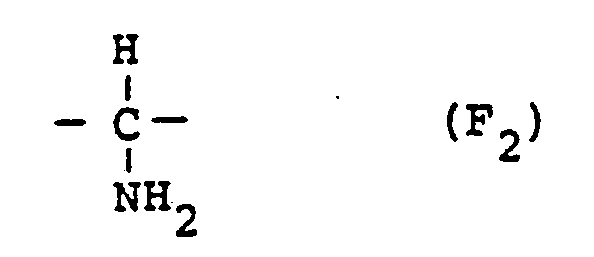
R has the meaning given above, and a content of 0.5 to 15 percent by weight of groups of the formula formed by decarboxylation reactions
Vorzugsweise verwendbar bei dem erfindungsgemäßen Verfahren sind solche stabilisierten Azulminsäuren
- - in denen R diejenigen Bedeutungen hat, die schon im Zusammenhang mit der Beschreibung der modifizierten Azulminsäuren vorzugsweise für R aufgeführt wurden, und
- - bei denen als Carbonylkomponenten zur Stabilisierung einfache Aldehyde, insbesondere Formaldehyd, benutzt wurden.
- - in which R has those meanings which have already been given for R in connection with the description of the modified azulmic acids, and
- - In which simple aldehydes, in particular formaldehyde, were used as carbonyl components for stabilization.
Die genannten durch Kondensation mit Carbonylverbindungen stabilisierten Azulminsäuren sind bisher noch nicht bekannt. Sie lassen sich jedoch in einfacher Weise nach mehreren Verfahren herstellen. So erhält man derartige durch Kondensation mit Carbonylverbindungen stabilisierten Azulminsäuren dadurch, daß man
- - modifizierte Azulminsäuren mit einem Gehalt von 0,5 bis 55 Gewichtsprozent an ionischen Gruppen der Formel

R die oben angegebene Bedeutung hat, und mit einem Gehalt von 0,5 bis 15 Gewichtsprozent an Gruppen der Formel
oder daß man - - Säureadditions-Salze bzw. Komplex-Verbindungen von modifizierten Azulminsäuren mit einem Gehalt von 0,5 bis 55 Gewichtsprozent an ionischen Gruppen der Formel

R die oben angegebene Bedeutung hat, und mit einem Gehalt von 0,5 bis 15 Gewichtsprozent an Gruppen der Formel
oder daß man - - nahezu fehlerstellenfreie Azulminsäuren in wässrigem Medium bei Temperaturen zwischen 10 °C und 250 °C, vorzugsweise zwischen 50 °C und 150 °C, mit Carbonylverbindungen kondensiert,
oder daß man - - Blausäure mit Hilfe basischer Katalysatoren, wie Natriumcyanat, unter hydrolysierenden Bedingungen in wässrigem Medium bei Temperaturen zwischen 0°C und 100 °C, vorzugsweise zwischen 20 °C und 95°C, gegebenenfalls in Gegenwart von Zusatzstoffen polymerisiert und anschließend ohne vorherige Isolierung der Reaktionsprodukte gegebenenfalls in Gegenwart von Zusatzstoffen bei Temperaturen bis zu 250 °C, vorzugsweise bis zu 150 °C, in wässrigem Medium mit Carbonylverbindungen kondensiert, '
oder daß man - - modifizierte Azulminsäuren mit einem Gehalt von 0,5 bis 55 Gewichtsprozent an ionischen Gruppen der Formel

R die oben angegebene Bedeutung hat, und mit einem Gehalt von 0,5 bis 15 Gewichtsprozent an Gruppen der Formel
oder daß man - - modifizierte Azulminsäuren in wäßrigem Medium mit organischen oder anorganischen Säuren behandelt und anschließend gegebenenfalls in Gegenwart von Zusatzstoffen in wäßrigem Medium bei Temperaturen zwischen 10 °C und 250 °C, vorzugsweise zwischen 50 °C und 150°C, mit Carbonylverbindungen kondensiert,
oder daß man - - nahezu fehlerstellenfreie Azulminsäuren in Anwesenheit von hydrolytisch abbaubaren Naturstoffen sowie in Gegenwart von Säure in wäßrigem Medium bei Temperaturen zwischen 10 °C und 250 °C, vorzugsweise zwischen 50 °C und 150 °C, mit Carbonylverbindungen kondensiert.
- - Modified azulmic acids containing 0.5 to 55 percent by weight of ionic groups of the formula
R has the meaning given above, and with a content of 0.5 to 15 percent by weight of groups of the formula
or that one - - Acid addition salts or complex compounds of modified azulmic acids with a content of 0.5 to 55 percent by weight of ionic groups of the formula
R has the meaning given above, and with a content of 0.5 to 15 percent by weight of groups of the formula
or that one - azulmic acids almost free of defects in an aqueous medium at temperatures between 10 ° C. and 250 ° C., preferably between 50 ° C. and 150 ° C., condensed with carbonyl compounds,
or that one - - Hydrogen cyanide with the aid of basic catalysts, such as sodium cyanate, under hydrolyzing conditions in an aqueous medium at temperatures between 0 ° C and 100 ° C, preferably between 20 ° C and 95 ° C, optionally in the presence of additives and then polymerized without previous isolation of the reaction products, if appropriate in the presence of additives, at temperatures up to 250 ° C., preferably up to 150 ° C., condensed in an aqueous medium with carbonyl compounds,
or that one - - Modified azulmic acids containing 0.5 to 55 percent by weight of ionic groups of the formula
R has the meaning given above, and with a content of 0.5 to 15 percent by weight of groups of the formula
or that one - modified azulmic acids treated in an aqueous medium with organic or inorganic acids and then optionally condensed with carbonyl compounds in the presence of additives in an aqueous medium at temperatures between 10 ° C. and 250 ° C., preferably between 50 ° C. and 150 ° C.
or that one - - Almost flawless azulmic acids in the presence of hydrolytically degradable natural substances and in the presence of acid in an aqueous medium at temperatures between 10 ° C and 250 ° C, preferably between 50 ° C and 150 ° C, condensed with carbonyl compounds.
Als Carbonylverbindungen können bei diesen Verfahren Aldehyde und Ketone mit reaktiven Carbonylgruppen verwendet werden. Vorzugsweise verwendbar sind alle diejenigen Carbonylverbindungen, die auch bei der Durchführung des erfindungsgemäßen Verfahrens in Frage kommen. Besonders bevorzugt als Carbonylkomponente ist Formaldehyd.Aldehydes and ketones with reactive carbonyl groups can be used as carbonyl compounds in these processes. All those carbonyl compounds which can also be used when carrying out the process according to the invention can preferably be used. Formaldehyde is particularly preferred as the carbonyl component.
Die Isolierung der Reaktionsprodukte erfolgt bei allen diesen Verfahren nach üblichen Methoden. Im allgemeinen verfährt man in der Weise, daß man nach beendeter Umsetzung das feste Reaktionsprodukt abfiltriert, wäscht und trocknet.In all of these processes, the reaction products are isolated by customary methods. In general, the procedure is such that, after the reaction has ended, the solid reaction product is filtered off, washed and dried.
Von den durch Kondensation mit Carbonylverbindungen stabilisierten Azulminsäuren sind bei dem erfindungsgemäßen Verfahren bevorzugt partiell mit Carbonylverbindungen, insbesondere Formaldehyd, stabilisierte Azulminsäuren verwendbar, worunter solche fehlerstellenhaltigen Azulminsäuren zu verstehen sind, in denen nur ein Teil der zur Verfügung stehenden reaktiven Gruppen mit Carbonylverbindungen, insbesondere Formaldehyd, umgesetzt wurde.Of the azulmic acids stabilized by condensation with carbonyl compounds, azulmic acids stabilized partially with carbonyl compounds, in particular formaldehyde, can preferably be used in the process according to the invention, by which are meant those azulmic acids containing defects in which only a part of the available reactive groups with carbonyl compounds, in particular formaldehyde, was implemented.
Unter « durch Kondensation mit Carbonylverbindungen und Aminoplastbildnern bzw. deren niedermolekularen Kondensationsprodukten stabilisierten Azulminsäuren sind solche Azulminsäuren zu verstehen, die einen Gehalt von 0,5 bis 55 Gewichtsprozent an ionischen Gruppen der Formel

R die oben angegebene Bedeutung hat, und einen Gehalt von 0,5 bis 15 Gewichtsprozent an durch Decarboxylierungsreaktionen entstandenen Gruppen der Formel

R has the meaning given above, and a content of 0.5 to 15 percent by weight of those resulting from decarboxylation reactions Groups of the formula
Vorzugsweise verwendbar bei dem erfindungsgemäßen Verfahren sind solche stabilisierten Azulminsäuren,
- - in denen R diejenigen Bedeutungen hat, die schon im Zusammenhang mit der Beschreibung der modifizierten Azulminsäuren vorzugsweise für R aufgeführt wurden und
- - bei denen als Carbonylkomponenten zur Stabilisierung einfache Aldehyde, wie Form-aldehyd, und einfache Aminoplastbildner, insbesondere Harnstoff, bzw. niedermolekulare Additionsprodukte aus solchen Carbonylverbindungen und Aminoplastbildnern, z.B. Monomethylolharnstoff oder Dimethylolharnstoff, bzw. ihre oligomeren Kondensationsprodukte benutzt wurden.
- - In which R has those meanings which have already been given for R in connection with the description of the modified azulmic acids and
- - In which simple aldehydes, such as form aldehyde, and simple aminoplast formers, in particular urea, or low-molecular addition products from such carbonyl compounds and aminoplast formers, for example monomethylol urea or dimethylol urea, or their oligomeric condensation products were used as carbonyl components for stabilization.
Die genannten durch Kondensation mit Carbonylverbindungen und Aminoplastbildnern bzw. deren niedermolekularen Additions- bzw. Kondensationsprodukten stabilisierten Azulminsäuren sind bisher noch nicht bekannt. Sie lassen sich jedoch in einfacher Weise nach mehreren Verfahren herstellen. So erhält man derartige durch Kondensation mit Carbonylverbindungen und Aminoplastbildnern bzw. deren niedermolekularen Additions- bzw. Kondensationsprodukten stabilisierten Azulminsäuren dadurch, daß man
- - modifizierte Azulminsäuren mit einem Gehalt von 0,5 bis 55 Gewichtsprozent an ionischen Gruppen der Formel

R die oben angegebenen Bedeutung hat, und mit einem Gehalt von 0,5 bis 15 Gewichtsprozent an Gruppen der Formel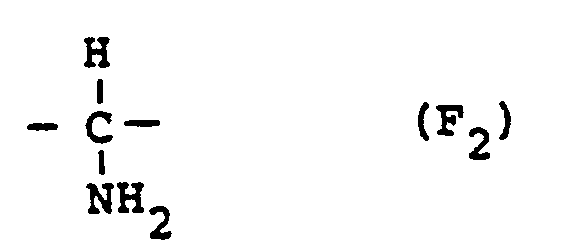
oder daß man - - Säureadditions-Salze bzw. Komplex-Verbindungen von modifizierten Azulminsäuren mit einem Gehalt von 0,5 bis 55 Gewichtsprozent an ionischen Gruppen der Formel

R die oben angegebene Bedeutung hat, und mit einem Gehalt von 0,5 bis 15 Gewichtsprozent an Gruppen der Formel
oder daß man - - nahezu fehlerstellenfreie Azulminsäuren in wäßrigem Medium bei Temperaturen zwischen 0°C und 200°C, vorzugsweise zwischen 10 °C und 150 °C gegebenenfalls in Gegenwart von Katalysatoren mit Aminoplastbildnern und Carbonylverbindungen bzw. deren frisch zubereiteten Additions- bzw. Kondensationsprodukten umsetzt,
oder daß man - - Blausäure mit Hilfe basischer Katalysatoren, wie Natriumcyanat, unter hydrolysierenden Bedingungen in wäßrigem Medium gegebenenfalls in Gegenwart von Zusatzstoffen bei Temperaturen zwischen 0°C und 100 °C, vorzugsweise zwischen 20 °C und 95 °C, polymerisiert und anschließend ohne vorherige Isolierung der Reaktionsprodukte gegebenenfalls in Gegenwart von Zusatzstoffen und gegebenenfalls in Gegenwart von Katalysatoren sowie gegebenenfalls in Gegenwart von Kettenabbrechern mit Aminoplastbildnern und Carbonylverbindungen bzw. deren frisch zubereiteten Additions- bzw. Kondensationsprodukten bei Temperaturen bis zu 200 °C, vorzugsweise bis zu 150 °C, in wäßrigem Medium kondensiert,
oder daß man - - Blausäure mit Hilfe basischer Katalysatoren, wie Natriumcyanat, in Gegenwart von Aminoplast- bildnern unter hydrolysierenden Bedingungen in wäßrigem Medium gegebenenfalls in Gegenwart von Zusatzstoffen bei Temperaturen zwischen 0°C und 100 °C, vorzugsweise zwischen 20 °C und 95 °C, polymerisiert und anschließend ohne vorherige Isolierung der Reaktionsprodukte gegebenenfalls in Gegenwart von Zusatzstoffen und gegebenenfalls in Gegenwart von Katalysatoren sowie gegebenenfalls in Gegenwart von Kettenabbrechern mit Carbonylverbindungen und Aminoplastbildnern bzw. deren frisch zubereiteten Additions- bzw. Kondensationsprodukten in wäßrigem Medium bei Temperaturen bis zu 200°C, vorzugsweise bis zu 150°C, kondensiert,
oder daß man - - modifizierte Azulminsäuren mit einem Gehalt von 0,5 bis 55 Gewichtsprozent an ionischen Gruppen der Formel

R die oben angegebene Bedeutung hat, und mit einem Gehalt von 0,5 bis 15 Gewichtsprozent an Gruppen der Formel
oder daß man - - modifizierte Azulminsäuren in wäßrigem Medium bei Temperaturen zwischen 0°C und 200°C, vorzugsweise zwischen 20 °C und 120°C, mit organischen oder anorganischen Säuren behandelt und anschließend in wäßrigem Medium bei Temperaturen zwischen 0°C und 200 °C. vorzugsweise zwischen 10 °C und 150 °C, gegebenenfalls in Gegenwart von Katalysatoren sowie gegebenenfalls in Gegenwart von Kettenabbrechern mit Aminoplastbildnern und Carbonylverbindungen bzw. deren frisch zubereiteten Additions- bzw. Kondensationsprodukten umsetzt,
oder daß man - - nahezu fehlerstellenfreie Azulminsäuren in Anwesenheit von hydrolytisch abbaubaren Naturstoffen in Gegenwart von Säure in wäßrigem Medium, gegebenenfalls in Gegenwart von Katalysatoren sowie gegebenenfalls in Gegenwart von Kettenabbrechern mit Aminoplastbildnern und Carbonylverbindungen bzw. deren frisch zubereiteten Additions- bzw. Kondensationsprodukten bei Temperaturen zwischen 0°C und 200 °C, vorzugsweise zwischen 10 °C und 150 °C, umsetzt,
oder daß man - - partiell oder vollständig mit Carbonylverbindungen stabilisierte Azulminsäuren in wäßrigem Medium bei Temperaturen zwischen 0°C und 200°C, vorzugsweise zwischen 10 °C und 150 °C, gegebenenfalls in Gegenwart von Katalysatoren sowie gegebenenfalls in Gegenwart von Kettenabbrechern mit Aminoplastbildnern und Carbonylverbindungen bzw. deren frisch zubereiteten Additions- bzw. Kondensationsprodukten umsetzt,
oder daß man - - thermisch bei Temperaturen bis zu 550 °C vorbehandelte Blausäure-Polymerisate in wäßrigem Medium gegebenenfalls in Gegenwart von Zusatzstoffen und gegebenenfalls in Gegenwart von Katalysatoren sowie gegebenenfalls in Gegenwart von Kettenabbrechern mit Aminoplastbildnern und Carbonylverbindungen bzw. deren frisch zubereiteten Additions- bzw. Kondensationsprodukten bei Temperaturen zwischen 0°C und 200 °C, vorzugsweise zwischen 10 °C und 150 °C. umsetzt,
oder daß man - an der Oberfläche chemisch modifizierte Azulminsäuren in wäßrigem Medium bei Temperaturen zwischen 0°C und 200 °C, vorzugsweise zwischen 10 °C und 150 °C, gegebenenfalls in Gegenwart von Katalysatoren sowie gegebenenfalls in Gegenwart von Kettenabbrechern mit Aminoplastbildnern und Carbonylverbindungen bzw. deren frisch bereiteten Additions- bzw. Kondensationsprodukten umsetzt.
- - Modified azulmic acids containing 0.5 to 55 percent by weight of ionic groups of the formula
R has the meaning given above, and with a content of 0.5 to 15 percent by weight of groups of the formula
or that one - - Acid addition salts or complex compounds of modified azulmic acids with a content of 0.5 to 55 percent by weight of ionic groups of the formula
R has the meaning given above, and with a content of 0.5 to 15 percent by weight of groups of the formula
or that one - - azulmic acids with virtually no defects in an aqueous medium at temperatures between 0 ° C. and 200 ° C., preferably between 10 ° C. and 150 ° C., optionally in the presence of catalysts with aminoplast formers and carbonyl compounds or their freshly prepared addition or condensation products,
or that one - - Hydrogen cyanide with the aid of basic catalysts, such as sodium cyanate, under hydrolyzing conditions in an aqueous medium, if appropriate in the presence of additives, at temperatures between 0 ° C. and 100 ° C., preferably between 20 ° C. and 95 ° C., and then polymerized without prior isolation of the reaction products if appropriate in the presence of additives and if appropriate in the presence of catalysts and if appropriate in the presence of chain terminators with aminoplast formers and carbonyl compounds or their freshly prepared addition or condensation products at temperatures up to 200 ° C., preferably up to 150 ° C., condensed in an aqueous medium ,
or that one - - Hydrogen cyanide with the aid of basic catalysts, such as sodium cyanate, in the presence of aminoplast formers under hydrolyzing conditions in an aqueous medium, if appropriate in the presence of additives, at temperatures between 0 ° C. and 100 ° C., preferably between 20 ° C. and 95 ° C., and subsequently without prior isolation of the reaction products, if appropriate in the presence of additives and if appropriate in the presence of catalysts and if appropriate in the presence of chain terminators with carbonyl compounds and aminoplast formers or their freshly prepared addition or condensation products in an aqueous medium at temperatures up to 200 ° C., preferably up to at 150 ° C, condensed,
or that one - - Modified azulmic acids containing 0.5 to 55 percent by weight of ionic groups of the formula
R has the meaning given above, and with a content of 0.5 to 15 percent by weight of groups of the formula
or that one - - Modified azulmic acids in an aqueous medium at temperatures between 0 ° C and 200 ° C, preferably between 20 ° C and 120 ° C, treated with organic or inorganic acids and then in an aqueous medium at temperatures between 0 ° C and 200 ° C. preferably between 10 ° C. and 150 ° C., if appropriate in the presence of catalysts and if appropriate in the presence of chain terminators, with aminoplast formers and carbonyl compounds or their freshly prepared addition or condensation products,
or that one - - Almost flawless azulmic acids in the presence of hydrolytically degradable natural substances in the presence of acid in an aqueous medium, optionally in the presence of catalysts and optionally in the presence of chain terminators with aminoplast formers and carbonyl compounds or their freshly prepared addition or condensation products at temperatures between 0 ° C. and 200 ° C, preferably between 10 ° C and 150 ° C,
or that one - - Azulmic acids partially or completely stabilized with carbonyl compounds in an aqueous medium at temperatures between 0 ° C. and 200 ° C., preferably between 10 ° C. and 150 ° C., optionally in the presence of catalysts and optionally in the presence of chain terminators with aminoplast formers and carbonyl compounds or their implement freshly prepared addition or condensation products,
or that one - - Pretreated at temperatures up to 550 ° C hydrocyanic acid polymers in an aqueous medium, optionally in the presence of additives and optionally in the presence of catalysts and optionally in the presence of chain terminators with aminoplast formers and carbonyl compounds or their freshly prepared addition or condensation products at temperatures between 0 ° C and 200 ° C, preferably between 10 ° C and 150 ° C. implements
or that one - chemically modified azulmic acids on the surface in an aqueous medium at temperatures between 0 ° C and 200 ° C, preferably between 10 ° C and 150 ° C, optionally in the presence of catalysts and optionally in the presence of chain terminators with aminoplast formers and carbonyl compounds or their freshly prepared Addition or condensation products implemented.
Als Carbonylverbindungen können bei diesen Verfahren Aldehyde und Ketone mit reaktiven Carbonylgruppen verwendet werden. Vorzugsweise verwendbar sind alle diejenigen Carbonylverbindungen, die auch bei der Durchführung des erfindungsgemäßen Verfahrens in Frage kommen. Besonders bevorzugt als Carbonylkomponente ist Formaldehyd.Aldehydes and ketones with reactive carbonyl groups can be used as carbonyl compounds in these processes. All those carbonyl compounds which can also be used when carrying out the process according to the invention can preferably be used. Formaldehyde is particularly preferred as the carbonyl component.
Als Aminoplastbildner können bei diesen Verfahren alle üblichen Aminoplastbildner verwendet werden. Vorzugsweise verwendbar sind alle diejenigen Aminoplastbildner, die auch bei der Durchführung des erfindungsgemäßen Verfahrens in Frage kommen. Besonders bevorzugt als Aminoplastbildner ist Harnstoff.All conventional aminoplast formers can be used as aminoplast formers in these processes. All those aminoplast formers which can also be used when carrying out the process according to the invention can preferably be used. Urea is particularly preferred as an aminoplast former.
Als niedermolekulare Additions- bzw. Kondensationsprodukte aus Aminoplastbildnern und Carbonylverbindungen können bei diesen Verfahren vorzugsweise N-Alkylolverbindungen, insbesondere N-Methylolverbindungen, verwendet werden, wobei Monomethylol-harnstoff und Dimethylolharnstoff beispielhaft genannt seien.N-alkylol compounds, in particular N-methylol compounds, can preferably be used as low-molecular addition or condensation products of aminoplast formers and carbonyl compounds, with monomethylol urea and dimethylol urea being mentioned as examples.
Als Katalysatoren können bei diesen Verfahren alle üblichen Kondensationskatalysatoren verwendet werden. Hierzu gehören vorzugsweise alle diejenigen Säuren, Basen und Salze, die auch bei dem erfindungsgemäßen Verfahren vorzugsweise als Kondensationskatalysatoren in Frage kommen (vgl. Seite 60).All conventional condensation catalysts can be used as catalysts in these processes. These preferably include all those acids, bases and salts which are also preferred as condensation catalysts in the process according to the invention (cf. page 60).
Als Kettenabbrecher können bei diesen Verfahren alle übliche, für Kettenabbruch-Reaktionen geeigneten monofunktionellen Verbindungen eingesetzt werden. Vorzugsweise in Betracht kommen hierbei alle diejenigen Kettenabbrecher, die auch bei dem erfindungsgemäßen Verfahren vorzugsweise als Kettenabbrecher in Frage kommen (vgl. Seite 61).In this process, all customary monofunctional compounds suitable for chain termination reactions can be used as chain terminators. In this case, preference is given to all those chain terminators which are also preferred as chain terminators in the process according to the invention (cf. page 61).
Die Isolierung der Reaktionsprodukte erfolgt bei allen diesen Verfahren nach üblichen Methoden. Im allgemeinen verfährt man in der Weise, daß man nach beendetet Umsetzung das feste Reaktionsprodukt abfiltriert, wäscht und trocknet.In all of these processes, the reaction products are isolated by customary methods. In general, the procedure is such that the solid reaction product is filtered off, washed and dried after the reaction has ended.
Von den durch Kondensation mit Aminoplastbildnern und Carbonylverbindungen bzw. deren niedermolekularen frisch zubereiteten Additions- bzw. Kondensationsprodukten stabilisierten Azulminsäuren sind bei dem erfindungsgemäßen Verfahren bevorzugt partiell stabilisierte Azulminsäuren verwendbar, worunter solche fehlerstellenhaltigen Azulminsäuren zu verstehen sind, in denen nur ein Teil der zu Verfügung stehenden reaktiven Gruppen mit Aminoplastbildnern, insbesondere Harnstoff, und Carbonylverbindungen, insbesondere Formaldehyd, bzw. mit deren niedermolekularen Additions- bzw. Kondensationsprodukten umgesetzt wurde.Of the azulmic acids stabilized by condensation with aminoplast formers and carbonyl compounds or their low molecular weight freshly prepared addition or condensation products, partially stabilized azulmic acids can preferably be used in the process according to the invention, which includes those azulmic acids containing defects in which only a part of the available reactive ones Groups with aminoplast formers, in particular urea, and carbonyl compounds, in particular formaldehyde, or with their low molecular weight addition or condensation products.
Die Metallsalz-Komplexe der vorgenannten modifizierten und stabilisierten Azulminsäuren sind bisher noch nicht bekannt. Sie lassen sich jedoch herstellen, indem man die vorgenannten modifizierten oder stabilisierten Azulminsäuren in wässrigen Medium bei Temperaturen zwischen 20 °C und 120 °C, vorzugsweise bei 50 °C bis 110 °C, mit den zu komplexierenden Stoffen verrührt. Die Aufarbeitung erfolgt nach üblichen Methoden. Im Allgemeinen isoliert man die Reaktionsprodukte durch Filtration.The metal salt complexes of the aforementioned modified and stabilized azulmic acids are not yet known. However, they can be prepared by stirring the aforementioned modified or stabilized azulmic acids in an aqueous medium at temperatures between 20 ° C. and 120 ° C., preferably at 50 ° C. to 110 ° C., with the substances to be complexed. The processing takes place according to usual methods. In general, the reaction products are isolated by filtration.
Als Phenoplastbildner können bei dem erfindungsgemäßen Verfahren alle üblichen zur Phenoplastbildung befähigten Verbindungen verwendet werden. Hierzu gehören vorzugsweise Phenole und davon abgeleitete Verbindungen. Beispielhaft genannt seien Phenole, Kresole, Bisphenol A, Nitrophenol, Brenzkatechin, Hydrochinon und Naphtholsulfonsäure.In the process according to the invention, all customary compounds capable of forming phenoplast can be used as phenoplast formers. These preferably include phenols and compounds derived therefrom. Examples include phenols, cresols, bisphenol A, nitrophenol, Catechol, hydroquinone and naphtholsulfonic acid.
Als Katalysatoren können bei dem erfindungsgemäßen Verfahren alle üblichen Kondensationskatalysatoren verwendet werden. Hierzu gehören Säuren, wie Salzsäure, Schwefelsäure, Salpetersäure, Phosphorsäure, Phosphorige Säure, andere vom Phosphor abgeleitete Säuren, Ameisensäure, Essigsäure, Thioessigsäure, Maleinsäure und Oxalsäure, ferner Basen wie Natriumhydroxid, Kaliumhydroxid, Calciumhydroxid, Bariumhydroxid, Bleihydroxid, Zinkoxid, Magnesiumoxid und andere Metalloxide und deren Hydrate, weiterhin Salze, wie Phosphate, z.B. primäres oder sekundäres Kaliumhydrogenphosphat, Ammoniumsulfat, Kupfer-, Zink-, Zinn-(II)-, Cadmium- und Magnesium-Salze verschiedenster organischer Säuren, außerdem zahlreiche organische Säureanhydride sowie säureabspaltenden Verbindungen wie Ammoniumchlorid, Trimethylammoniumformiat, Chloralhydrat, darüber hinaus Aminsalze der Ameisensäure und anderer organischer Carbonsäuren, Maleinsäurehalbester, tertiäre Aminsalze und tertiäre Amine, Dibenzoylperoxid, Kohlensäure, N-Carbaminsäuren, Glykolchlorhydrin, Glycerinchlorhydrin und Epichlorhydrin.All conventional condensation catalysts can be used as catalysts in the process according to the invention. These include acids such as hydrochloric acid, sulfuric acid, nitric acid, phosphoric acid, phosphorous acid, other acids derived from phosphorus, formic acid, acetic acid, thioacetic acid, maleic acid and oxalic acid, as well as bases such as sodium hydroxide, potassium hydroxide, calcium hydroxide, barium hydroxide, lead hydroxide, zinc oxide, magnesium oxide and others Metal oxides and their hydrates, furthermore salts, such as phosphates, for example primary or secondary potassium hydrogen phosphate, ammonium sulfate, copper, zinc, tin (II), cadmium and magnesium salts of various organic acids, as well as numerous organic acid anhydrides and acid-releasing compounds such as ammonium chloride, trimethylammonium formate, chloral hydrate, and also amine salts of formic acid and other organic carboxylic acids, maleic acid semiesters, tertiary amine salts and tertiary amines, dibenzoyl peroxide, carbonic acid, N-carbamic acids, glycol chlorohydrin, glycerol chlorohydrin and epichlorohydrin.
Bevorzugt verwendbare Katalysatoren sind Säuren wie Phosphorsäure, Phosphorige Säure, Salpetersäure, Salzsäure, Schwefelsäure, Ameisensäure, Oxalsäure und Maleinsäure, ferner Basen wie Natriumhydroxid, Kaliumhydroxid, Calciumhydroxid, Bariumhydroxid, Bleihydroxid, Benzyldimethylamin und Triäthylamin.Catalysts which can be used with preference are acids such as phosphoric acid, phosphorous acid, nitric acid, hydrochloric acid, sulfuric acid, formic acid, oxalic acid and maleic acid, and also bases such as sodium hydroxide, potassium hydroxide, calcium hydroxide, barium hydroxide, lead hydroxide, benzyldimethylamine and triethylamine.
Verwendet man Phosphorsäure oder Schwefelsäure als Kondensationskatalysatoren, so können die genannten Säuren oft mit Vorteil durch Fällung mit Calcium- oder für den Fall der Phosphorsäure mit Eisen- oder Aluminiumionen auf den Verfahrensprodukten quantitativ niedergeschlagen werden, so daß Auswaschoperationen der Verfahrensprodukte und Abwasserbelastungen entfallen.If phosphoric acid or sulfuric acid is used as condensation catalysts, the acids mentioned can often advantageously be precipitated quantitatively on the process products by precipitation with calcium ions or, in the case of phosphoric acid, with iron or aluminum ions, so that washing-out operations of the process products and waste water pollution are eliminated.
Als Kettenabbrecher können bei dem erfindungsgemäßen Verfahren alle üblichen, für Kettenabbruch-Reaktionen geeigneten monofunktionellen Verbindungen eingesetzt werden. Vorzugsweise in Betracht kommende monofunktionelle Kettenabbrecher sind Lactame, wie e-Caprolactam, Valerolactam, Butyrolactam und die entsprechenden Thiolactame, ferner Formamid und Acetamid, weiterhin Alkohole, wie Methanol, Äthanol, Propanol, Butanol, Allylalkohol, Isopropanol, Oleylalkohol und Benzylalkohol, welche die wachsenden Aminoplast-Segmente durch Verätherungsreaktionen stoppen. - Vorzugsweise verwendbare Kettenabbrecher sind auch solche Verbindungen, wie sie in der Deutschen Offenlegungsschrift 2324134 auf den Seiten 13 und 14 beschrieben werden. In einer besonderen Ausführungsform des erfindungsgemäßen Verfahrens können als Kettenabbrecher auch N-Methylolcaprolactam, N-Methylolvalerolactam, N-Methylolbutyrolactam und N-Methylolazalactame, wie z.B. basische Methylolverbindungen von Azalactamen der Konstitution

Als Zusatzstoffe können bei der Durchführung des erfindungsgemäßen Verfahrens organische Naturstoffe und daraus gewonnene Produkte, anorganische Naturstoffe und daraus gewonnene Produkte, synthetische organische Produkte, synthetische anorganische Produkte und/oder Mischprodukte aus organischen und anorganischen Produkten verwendet werden.Organic natural substances and products obtained therefrom, inorganic natural substances and products obtained therefrom, synthetic organic products, synthetic inorganic products and / or mixed products of organic and inorganic products can be used as additives when carrying out the process according to the invention.
Vorzugsweise in Frage kommende organische Naturstoffe und daraus gewonnene Produkte sind hierbei Holzpulver, Ligninpulver, Ligninsulfonsäuren, ammonifizierte Ligninsulfonsäuren, Humus, Huminsäuren, ammonifizierte Huminsäuren, Torf, Proteine und deren Abbauprodukte, z.B. Hydrolyseprodukte von Hefen, Algenmaterial (Alginate), Polypeptiden, wie Wolle und Gelatine, Fischmehl und Knochenmehl, ferner Aminosäuren, Oligopolypeptide, Pektine, Monosaccharide, wie Glucose und Fructose, Disaccharide, wie Saccharose, Oligosaccharide, Polysaccharide, wie Stärke und Cellulose, weiterhin Hemicellulosen, homogenisierte Materialien pflanzlichen und tierischen Ursprungs, Aktivkohlen sowie Aschen, die durch Partialoxidation, vollständige Oxidation oder Verbrennung organischer, durch Photosynthese gebildeter Stoffe oder üblicher Brennstoffe erhältlich sind, wobei Tannenasche, Ginsterasche, Asche von serbischen Fichten, Eichenasche, Birkenasche, Buchenasche, Weidenasche und Tabakblätter-Asche speziell genannt seien.Organic natural substances and products derived therefrom are preferably wood powder, lignin powder, ligninsulfonic acids, ammonified ligninsulfonic acids, humus, humic acids, ammonified humic acids, peat, proteins and their degradation products, for example hydrolysis products of yeasts, algae material (alginates), polypeptides, such as wool and Gelatin, fish meal and bone meal, furthermore amino acids, oligopolypeptides, pectins, monosaccharides, such as glucose and fructose, disaccharides, such as sucrose, oligosaccharides, polysaccharides, such as starch and cellulose, furthermore hemicelluloses, homogenized materials of plant and animal origin, Activated carbons and ashes, which are obtainable by partial oxidation, complete oxidation or combustion of organic substances formed by photosynthesis or conventional fuels, with fir ash, gorse ash, ash from Serbian spruce, oak ash, birch ash, beech ash, willow ash and tobacco leaf ash being specifically mentioned.
Als anorganische Naturstoffe und daraus gewonnene Produkte kommen vorzugsweise in Betracht Silikate, wie Aluminiumsilikate, Calciumsilikate, Magnesiumsilikate und Alkalisilikate, ferner Seesand und andere natürlich vorkommende Siliziumdioxide, Kieselsäuren, insbesondere disperse Kieselsäuren, Kieselgele, weiterhin Tonmineralien, Glimmer, Carbonate wie Calciumcarbonat, Phosphorit und Phosphate wie Calciumphosphat und Ammoniummagnesiumphosphat, Sulfate wie Calciumsulfat und Bariumsulfat, außerdem Oxide wie Zirkondioxid, Nickeloxid, Palladiumoxid, Bariumoxid, disperse Antimonoxide und Aluminiumoxide, wie Bauxit, Aluminiumoxidhydrat, darüber hinaus Flugaschen und Ruß-Sorten verschiedenster Art.As inorganic natural substances and products obtained therefrom, silicates such as aluminum silicates, calcium silicates, magnesium silicates and alkali silicates, sea sand and other naturally occurring silicon dioxides, silicas, in particular disperse silicas, silica gels, furthermore clay minerals, mica, carbonates such as calcium carbonate, phosphorite and phosphates are preferred such as calcium phosphate and ammonium magnesium phosphate, sulfates such as calcium sulfate and barium sulfate, in addition oxides such as zirconium dioxide, nickel oxide, palladium oxide, barium oxide, disperse antimony oxides and aluminum oxides such as bauxite, aluminum oxide hydrate, in addition fly ash and various types of soot.
Als synthetische organische Produkte kommen vorzugsweise in Frage Aminoplastkondensate, insbesondere solche aus Harnstoff, Dicyandiamid, Melamin oder Oxamid und Aldehyden, wie Formaldehyd, Acetaldehyd, Isobutyraldehyd, Hydroxypivalinaldehyd, Crotonaldehyd, Hydroxyacetaldehyd, Furfurol, Hydroxymethylfurfurol, Glyoxal un Glucose, wobei speziell genannt seien Kondensationsprodukte aus Harnstoff und Formaldehyd, Harnstoff und Glyoxal, Harnstoff und Acetaldehyd, Harnstoff und Isobutyraldehyd, Harnstoff und Crotonaldehyd, Harnstoff und Hydroxypivalinaldehyd sowie das 2-Oxo-4- methyt-6-ureido-hexahydropyrimidin, welches ein bekanntes Kondensationsprodukt aus 1 Mol Crotonaldehyd und 2 Mol Harnstoff ist, das aus intermediär anfallendem Crotonyliden-diharnstoff unter Absättigung der Doppelbindung entsteht und dem die Konstitution
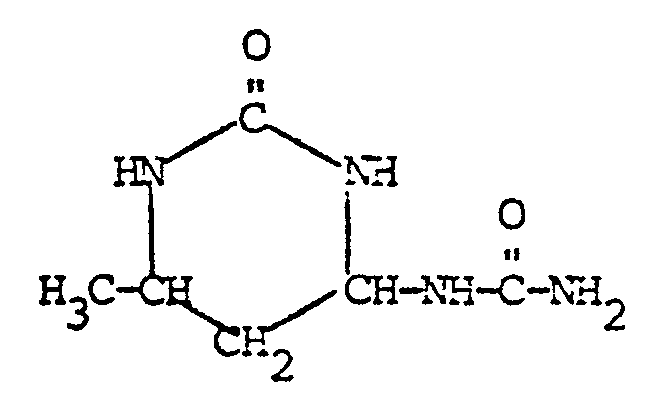

Weitherhin kommen als synthetische organische Produkte vorzugsweise in Betracht Kunststoffe, wie Polyamidpulver, Polyurethanpulver und Polycarbodiimide, ferner polymere Chinone, Additions- zw. Kondensationsprodukte aus Chinonen, insbesondere Benzochinon, mit Aminen oder Ammoniak, außerdem mit Aldehyden, insbesondere Formaldehyd, vernetzte Gelatine, synthetische Bodenverbesserungsmittel, wie z.B. das als Hygromull bekannte Produkt (= Harnstoff-Formaldehyd-Harzflocken), darüber hinaus synthetische Zucker, wie z.B. aus Formaldehyd hergestellte Formose-Zuckergemische, ferner schwerlösliche Rohrzucker-Komplexe, wie der Saccharose-Calciumoxid-Komplex der Zusammensetzung 1 Mol Saccharose. 3 Mol Calciumoxid, und schließlich organische Ammoniumsalze, wie Ammoniumcarbaminat, und andere organische Stickstoffverbindungen wie Hexamethylentetramin und Hexahydrotriazine.Furthermore, synthetic organic products are preferably plastics, such as polyamide powder, polyurethane powder and polycarbodiimides, furthermore polymeric quinones, addition or condensation products from quinones, in particular benzoquinone, with amines or ammonia, furthermore with aldehydes, in particular formaldehyde, crosslinked gelatin, synthetic soil conditioners , such as the product known as Hygromull (= urea-formaldehyde resin flakes), in addition synthetic sugars, e.g. formose-sugar mixtures prepared from formaldehyde, and also poorly soluble cane sugar complexes, such as the sucrose-calcium oxide complex of the composition 1 mol of sucrose. 3 moles of calcium oxide, and finally organic ammonium salts such as ammonium carbaminate and other organic nitrogen compounds such as hexamethylenetetramine and hexahydrotriazines.
Als synthetische anorganische Produkte, die vorzugsweise in Frage kommen, seien genannt Düngemittel, wie Superphosphat, Thomasschlacke, Rhenaniaphosphat, Phosphorit, Kalkstickstoff, Kalkammonsalpeter, Leunasalpeter, Kaliumphosphate, Kaliumnitrat und Ammoniumnitrat, ferner Pigmente, wie Eisenoxide und Titandioxide, außerdem Metalloxide und Metallhydroxide, wie Calciumoxid, Calciumhydroxid, Bleihydroxid, Wismuthydroxid, Manganhydroxid und Magnesiumhydroxid, wobei in situ hergestellte Hydroxide besonders bevorzugt sind, außerdem Schwefel, schwerlösliche Metall-Sulfate, -Carbonate, -Phosphate und Silikate, Heteropolysäuren des Wolframs, Vanadins und Molydäns, weiterhin synthetische Kieselsäuren, insbesondere in situ hergestellte Kieselsäure und deren Salze, außerdem Wasserglas, Salze wie Cobaltmolybat, Ammoniumcarbonat und Calciumcarbonat, und darüber hinaus Katalysatoren, insbesondere Schwermetallkatalysatoren, der verschiedensten Art.Synthetic inorganic products which are preferably considered are fertilizers such as superphosphate, Thomas slag, rhenania phosphate, phosphorite, calcium cyanamide, calcium ammonium nitrate, leunasal nitrate, potassium phosphate, potassium nitrate and ammonium nitrate, furthermore pigments such as iron oxides and titanium dioxide, as well as metal oxides and metal hydroxides, such as metal oxides and metal hydroxides Calcium oxide, calcium hydroxide, lead hydroxide, bismuth hydroxide, manganese hydroxide and magnesium hydroxide, with hydroxides produced in situ being particularly preferred, and also sulfur, poorly soluble metal Sulphates, carbonates, phosphates and silicates, heteropolyacids of tungsten, vanadium and molydane, further synthetic silicas, in particular silicic acid produced in situ and their salts, also water glass, salts such as cobalt molybate, ammonium carbonate and calcium carbonate, and furthermore catalysts, in particular heavy metal catalysts, of all kinds.
Als Mischprodukte aus anorganischen und organischen Produkten kommen vorzugsweise neutrale, basische oder saure Böden, natürliche Bodenverbesserungsmittel und biologische aktive Gartenerde in Betracht.Neutral, basic or acidic soils, natural soil improvers and biologically active garden soil are preferred as mixed products from inorganic and organic products.
Im übrigen können bei dem erfindungsgemäßen Verfahren vor der Durchführung der Kondensation der Biomassen mit Carbonylverbindungen und Aminoplastbildnern auch Phenoplastbildner zugesetzt werden. Unter Phenoplastbildnern sind in diesem Zusammenhang Phenole und davon abgeleitete Verbindungen zu verstehen. Beispielhaft genannt seien Phenole, Kresole, Bisphenol A, Nitrophenol, Benzkatechin, Hydrochinon und Naphtholsulfonsäure. - Bei dieser Art der Durchführung des erfindungsgemäßen Verfahrens werden Aminoplast-Phenoplast-Segmente in die Kondensationsprodukte eingeführt. Derartige Mischkondensate erhöhen oft die Geschwindigkeit der Flockungsreaktion und können Vorteile bei der Verbesserung der Filtrierfähigkeit und der Verminderung der Klebrigkeit der Verfahrensprodukte erbringen.In addition, in the process according to the invention, phenoplast formers can also be added before the condensation of the biomass with carbonyl compounds and aminoplast formers is carried out. In this context, phenolic formers are to be understood as meaning phenols and compounds derived therefrom. Examples include phenols, cresols, bisphenol A, nitrophenol, benzate, hydroquinone and naphtholsulfonic acid. - In this way of carrying out the method according to the invention, aminoplast-phenoplast segments are introduced into the condensation products. Such mixed condensates often increase the speed of the flocculation reaction and can bring advantages in improving the filterability and reducing the stickiness of the process products.
Außerdem kann es bei der Durchführung des erfindungsgemäßen Verfahrens von Vorteil sein, den Biomassen vor der Durchführung der Kondensationen Hydroxyalkanphosphonsäureester bzw. Hydroxyalkanphosphonsäuren, insbesondere Hydroxymethylphosphonsäureester oder Hydroxymethylphosphonsäure, zuzugeben, da diese Stoffe über ihre Hydroxymethylgruppe mit Aminoplastbildnern Mischkondensationen eingehen und gleichzeitig katalytisch wirksam sind.In addition, when carrying out the process according to the invention, it may be advantageous to add hydroxyalkanephosphonic acid esters or hydroxyalkanephosphonic acids, in particular hydroxymethylphosphonic acid esters or hydroxymethylphosphonic acid, to the biomasses before carrying out the condensations, since these substances undergo mixed condensations with their hydroxymethyl group with aminoplast formers and at the same time are catalytically active.
Auch die Zugabe von 10-20 Gew.-% an Mono- und Polynitrilen zu den Biomassen, z.B. von Acrylnitril und insbesondere Hydroxyacetonitril, kann vor der Durchführung der Kondensationen von Vorteil sein, da z.B. Hydroxyacetonitril in Gegenwart von Formaldehyd und Aminoplastbildnern, wie Harnstoff, Mischkondensationen eingeht.The addition of 10-20% by weight of mono- and polynitriles to the biomass, e.g. of acrylonitrile, and especially hydroxyacetonitrile, can be advantageous before carrying out the condensations, e.g. Hydroxyacetonitrile in the presence of formaldehyde and aminoplast formers, such as urea, mixed condensation.
Bei der Durchführung des erfindungsgemäßen Verfahrens kann auch eine Nachbehandlung der Verfahrensprodukte erfolgen, indem man sie gegebenenfalls in Gegenwart von Verdünnungsmitteln, wie z.B. wasserfreien organischen Lösungsmitteln bei Temperaturen zwischen 0 °C und 150 °C; vorzugsweise zwischen 10 °C und 120 °C mit den verschiedensten Reagenzien behandelt bzw. den verschiedensten Reaktionen unterwirft. Hierbei treten in geringem Umfang an der Oberfläche der Verfahrensprodukte chemische Reaktionen auf, so daß man an der Oberfläche chemisch modifizierte Produkte erhält.When carrying out the process according to the invention, an aftertreatment of the process products can also be carried out, if appropriate in the presence of diluents, such as, for example, anhydrous organic solvents, at temperatures between 0 ° C. and 150 ° C .; preferably treated between 10 ° C and 120 ° C with a wide variety of reagents or subject to a wide variety of reactions. Chemical reactions occur to a small extent on the surface of the process products, so that chemically modified products are obtained on the surface.
Zur chemischen Modifizierung der Oberfläche der nach dem erfindungsgemäßen Verfahren herstellbaren Mischkondensate kommen vorzugsweise in Betracht
- - die Behandlung mit Harnstoffschmelzen (= Isocyansäurelieferent);
- - die Behandlung mit mit Acylierungsmitteln, wie Ameisensäure, Essigsäureanhydrid, Buttersäureanhydrid, gemischten Säureanhydriden aus Essigsäure und Ölsäure, vorzugsweise in Gegenwart von Natrium- oder Kaliumacetat ;
- - die Behandlung mit cyclischen Säure-Anhydriden, wie Maleinsäureanhydrid, Phthalsäu,rean- hydrid oder Hexahydrophthalsäureanhydrid ;
- - die Behandlung mit Schmelzen von Dicarbonsäuren, wie Adipinsäure, Phthalsäure, Hexahydrophthalsäure oder Trimelithsäure ;
- - die Behandlung mit anorganischen Säurechloriden, wie Chlorcyan, Phosgen, Thionylchlorid, Schwefelchloriden, Phosphoroxychlorid, Phosphorpentachlorid, Siliziumtetrachlorid, Antimontrichlorid oder Titantetrachlorid ;
- - die Behandlung mit organischen Säurechloriden, wie Acetylchlorid, Benzoylchlorid, Chlorameisensäureestern der Formel

- R' für Alkyl mit 1 bis 8 Kohlenstoffatomen steht, bifunktionellen' Chlorameisensäureestern der Formel

- R" für Alkylen mit 2 bis 8 Kohlenstoffatomen steht, Benzolsulfonsäurechloriden, Phosphorsäureesterchloriden, Chlormethansulfochlorid oder Cyanursäurechlorid ;
- R' für Alkyl mit 1 bis 8 Kohlenstoffatomen steht, bifunktionellen' Chlorameisensäureestern der Formel
- - die Behandlung mit Alkylierungsmitteln, wie Dimethylsulfat, Methyljodid oder Methylbromid,
- - durch Behandlung mit Dichloräthan, Glykolchlorhydrin, Chloressigsäureäthylester, Dichlo-. ressigsäureäthylester Chloracetaldehyd-di-äthylacetal, Allylchlorid, Benzylchlorid, Trichlormethylisocyaniddichlorid oder anderen Isocyaniddichloriden bzw. Alkylierungsreagentien ;
- - die Behandlung mit ε-Caprolactam, e-Gaprolacton, Hydroxypivalinsäurelacton, cyclischen 6- gliedrigen oder 8-gliedrigen Siloxanen, Azalactamen wie sie aus der DT-OS 2035800 bekannt sind, Glykolcarbonat, Äthylenoxid, Propylenoxid, Butylenoxid, Styroloxid, Epichlorhydrin, Butyrolacton, Valerolacton, Oxazolidinen, Oxazolinen, Imidazolidinen, Isatosäureanhydrid oder Leuchsschen Anhydriden aus Aminosäuren und Phosgen ;
- - die Behandlung mit Acrylnitril oder anderen Vinylmonomeren, wie Acrylsäure, Methacrylsäure bzw. deren Methyl-, Äthyl-, β-hydroxyäthyl- oder Propylestern ;
- - die Behandlung mit Alkoholen oder bifunktionellen Alkoholen, wie Äthylenglykol, Hexandiol oder Octandiol, unter den Bedingungen der Pinner-Reaktion (vorzugsweise in wasserfreier HCI und Alkoholen) ;
- - die Behandlung mit Mono- oder Biscyanaten bzw. Mono- oder Biscyanamiden ;
- - die Behandlung mit Hydroxy-alkanphosphorsäureestern bzw. den zugrunde liegenden Säuren, insbesondere mit Hydroxymethyl-phosphonsäureestern bzw. der freien Hydroxymethyl-phosphonsäure ; - die Behandlung mit Chlormethylalkoxysilanen, z.B. solchen der Formeln


- - Die Behandlung mit den verschiedensten Mono- oder Polynitrilen, bevorzugt Hydroxymethylnitril, unter den Bedingungen der durch Hydroxylgruppen katalysierten Thorpe-Reaktion.
- - treatment with urea melts (= isocyanic acid supplier);
- - Treatment with acylating agents such as formic acid, acetic anhydride, butyric anhydride, mixed acid anhydrides from acetic acid and oleic acid, preferably in the presence of sodium or potassium acetate;
- - Treatment with cyclic acid anhydrides, such as maleic anhydride, phthalic acid, reanhydride or hexahydrophthalic anhydride;
- - Treatment with melts of dicarboxylic acids, such as adipic acid, phthalic acid, hexahydrophthalic acid or trimelitic acid;
- - Treatment with inorganic acid chlorides, such as cyanogen chloride, phosgene, thionyl chloride, sulfur chlorides, phosphorus oxychloride, phosphorus pentachloride, silicon tetrachloride, antimony trichloride or titanium tetrachloride;
- - Treatment with organic acid chlorides, such as acetyl chloride, benzoyl chloride, chloroformate of the formula
- R 'represents alkyl having 1 to 8 carbon atoms, bifunctional' chloroformates of the formula
- R "stands for alkylene with 2 to 8 carbon atoms, benzenesulfonic acid chlorides, phosphoric acid ester chlorides, chloromethanesulfochloride or cyanuric acid chloride;
- R 'represents alkyl having 1 to 8 carbon atoms, bifunctional' chloroformates of the formula
- treatment with alkylating agents, such as dimethyl sulfate, methyl iodide or methyl bromide,
- - by treatment with dichloroethane, glycol chlorohydrin, chloroacetic acid ethyl ester, dichlo-. ethyl acetate chloroacetaldehyde di-ethyl acetal, allyl chloride, benzyl chloride, trichloromethyl isocyanide dichloride or other isocyanide dichlorides or alkylating reagents;
- - Treatment with ε-caprolactam, e-gaprolactone, hydroxypivalic acid lactone, cyclic 6-membered or 8-membered siloxanes, azalactams as known from DT-OS 2035800, glycol carbonate, ethylene oxide, propylene oxide, butylene oxide, styrene oxide, epichlorohydrin, butyrolactone, Valerolactone, oxazolidines, oxazolines, imidazolidines, isatoic anhydride or Leuchsian anhydrides from amino acids and phosgene;
- - Treatment with acrylonitrile or other vinyl monomers, such as acrylic acid, methacrylic acid or their methyl, ethyl, β-hydroxyethyl or propyl esters;
- treatment with alcohols or bifunctional alcohols, such as ethylene glycol, hexanediol or octanediol, under the conditions of the Pinner reaction (preferably in anhydrous HCl and alcohols);
- - Treatment with mono- or bis-cyanates or mono- or bis-cyanamides;
- - Treatment with hydroxyalkanephosphoric acid esters or the underlying acids, in particular with hydroxymethylphosphonic acid esters or the free hydroxymethylphosphonic acid; - Treatment with chloromethylalkoxysilanes, for example those of the formulas
- - Treatment with a wide variety of mono- or polynitriles, preferably hydroxymethyl nitrile, under the conditions of the Thorpe reaction catalyzed by hydroxyl groups.
Als Nachbehandlungsreagenzien seien außerdem erwähnt : Natriumhydroxid, Kaliumhydroxid, Calciumhydroxid, Natriumsulfid, Rongalit, Ammoniumpolysulfide, Diäthylphosphit und Dimethylphosphit.The following may also be mentioned as aftertreatment reagents: sodium hydroxide, potassium hydroxide, calcium hydroxide, sodium sulfide, rongalite, ammonium polysulfides, diethyl phosphite and dimethyl phosphite.
Bei, diesen Nachbehandlungsreaktionen können auch die verschiedensten Mischpolymerisationen oder Polymerisationen von Vinylmonomeren durchgeführt werden, wobei die Biomassen-Mischkondensate durch die entstehend Polymeren umhüllt bzw. mikroverkapselt werden. Hierbei können selbstverständlich die « Hüllmaterialien » auch in einem großen Überschuß eingesetzt werden.In these aftertreatment reactions, a wide variety of mixed polymerizations or polymerizations of vinyl monomers can also be carried out, the biomass mixed condensates being encapsulated or microencapsulated by the polymers formed. Of course, the «envelope materials» can also be used in a large excess.
Bei der Durchführung des erfindungsgemäßen Verfahrens arbeitet man bevorzugt in wäßrigem Medium oder in wäßrigalkoholischem Medium. Dabei können auch zusätzliche inerte organische Lösungsmittel mitverwendet werden ; letztere dienen zur azeotropen Entfernung des Wassers nach beendeter Umsetzung. Vorzugsweise kommt jedoch Wasser ohne zusätzliche organische Lösungsmittel als Reaktionsmedium in Betracht.The process according to the invention is preferably carried out in an aqueous medium or in an aqueous-alcoholic medium. Additional inert organic solvents can also be used; the latter serve for azeotropic removal of the water after the reaction has ended. However, water is preferably used as reaction medium without additional organic solvents.
Die Reaktionstemperaturen können im Falle des erfindungsgemäßen Verfahrens innerhalb eines größeren Bereiches variiert werden. Im allgemeinen arbeitet man bei Temperaturen zwischen 0°C und 200 °C, vorzugsweise zwischen 10 °C und 150 °C. Es ist jedoch auch möglich, die erfindungsgemäße Mischkondensation im Verlaufe des Trocknungsprozesses, zum Beispiel bei der Sprühtrocknung, bei Temperaturen bis zu 250 °C zu Ende zu führen. In vielen Fällen kann das erfindungsgemäße Verfahren auch bevorzugt bei Raumtemperatur durchgeführt werden. Eventuell noch verbleibende pathogene Krankheitskeime können dabei in der Trocknungsphase durch Sterilisierung abgetötet werden.The reaction temperatures can be varied within a substantial range in the case of the process according to the invention. In general, temperatures between 0 ° C and 200 ° C, preferably between 10 ° C and 150 ° C. However, it is also possible to complete the mixed condensation according to the invention in the course of the drying process, for example in spray drying, at temperatures up to 250 ° C. In many cases, the method according to the invention can also preferably be carried out at room temperature. Any remaining pathogenic germs can be killed in the drying phase by sterilization.
Die Umsetzung nach dem erfindungsgemäßen Verfahren wird im allgemeinen unter Normaldruck ausgeführt. Es ist jedoch auch möglich, unter erhöhtem oder vermindertem Druck zu arbeiten. Zum Beispiel kann das erfindungsgemäße Verfahren unter erhöhtem Druck zum Beispiel bei Temperaturen zwischen 120 °C und 160 °C durchgeführt werden wobei neben Sterilisation der Produkte auch ein gezielter Abbau von Proteinen, Ribonucleinsäuren, Desoxyribonucleinsäuren, Nucleoproteiden und/oder anderer Zellinhaltsstoffe erfolgen kann.The reaction according to the process of the invention is generally carried out under normal pressure. However, it is also possible to work under increased or reduced pressure. For example, the method according to the invention can be carried out under elevated pressure, for example at temperatures between 120 ° C. and 160 ° C., in addition to sterilization of the products, a targeted degradation of proteins, ribonucleic acids, deoxyribonucleic acids, nucleoproteins and / or other cell contents can also take place.
Bei der Durchführung des erfindungsgemäßen Verfahrens setzt man auf 1 kg Biomasse mit einem Feststoffgehalt von 1 bis 16 Gewichtsprozent, etwa 0,1 bis 6 Mol, vorzugsweise 0,2 bis 5 Mol, an Carbonylverbindungen. Thiocarbonylverbindungen und/oder an niedermolekularen, nicht kondensierten N-Alkylolverbindungen, die mit Carbonylverbindungen im Dissoziationsgleichgewicht stehen, sowie 0,1 bis 6 Mol, vorzugsweise 0,2 bis 5 Mol, an Aminoplastbildnern bzw. Phenoplastbildnern ein, ferner setzt man gegebenenfalls Kettenabbrecher, gegebenenfalls Katalysatoren und außerdem gegebenenfalls eine solche Menge an Zusatzstoffen ein, daß deren Anteil im Endprodukt zwischen 1 und 95 Gewichtsprozent vorzugsweise zwischen 5 und 90 Gewichtsprozent liegt.When carrying out the method according to the invention, 1 kg of biomass is used Solids content of 1 to 16 percent by weight, about 0.1 to 6 mol, preferably 0.2 to 5 mol, of carbonyl compounds. Thiocarbonyl compounds and / or low molecular weight, non-condensed N-alkylol compounds which are in dissociation equilibrium with carbonyl compounds, and 0.1 to 6 mol, preferably 0.2 to 5 mol, of aminoplast formers or phenoplast formers, and chain terminators are optionally used, if appropriate Catalysts and also, if necessary, such an amount of additives that their proportion in the end product is between 1 and 95 percent by weight, preferably between 5 and 90 percent by weight.
Katalysatoren werden im allgemeinen in Mengen von 0,05 bis 10 Gew.-%, vorzugsweise von 0,1 bis 5 Gew.-%, bezogen auf die Gesamtmenge aller an der Polykondensation beteiligten Reaktionskomponenten, eingesetzt. In manchen Fällen können jedoch auch wesentlich höhere Katalysator-Konzentrationen zur Anwendung gelangen. So können zum Beispiel insbesondere dann, wenn die Kondensation unter Mitverwendung von Azulminsäuren durchgeführt wird, 0,4 bis 0,6 Mol an saurem Katalysator, vorzugsweise an Phosphorsäure oder Salpersäure, pro 100 g an Biomassen und Azulminsäuren eingesetzt werden. Hierbei entstehen Produkte, in denen die Katalysator-Säuren an basischen Gruppen der Mischkondensate fixiert sind.Catalysts are generally used in amounts of 0.05 to 10% by weight, preferably 0.1 to 5% by weight, based on the total amount of all reaction components involved in the polycondensation. In some cases, however, significantly higher catalyst concentrations can also be used. For example, especially if the condensation is carried out with the use of azulmic acids, 0.4 to 0.6 mol of acidic catalyst, preferably phosphoric acid or nitric acid, can be used per 100 g of biomass and azulmic acids. This creates products in which the catalyst acids are fixed to basic groups of the mixed condensates.
Kettenabbrecher können in Mengen von 0,5 bis 60 Gew.-%, bezogen auf die Gesamtmenge der zur Aminoplastbildung befähigten Ausgangsverbindungen eingesetzt werden. Dienen N-Methylollactame bzw. N-Methylolazalactame als Kettenabbrecher, so liegen deren Konzentrationen in allgemeinen zwischen 0,5 und 20 Gew.-%, vorzugsweise zwischen 2 und 14 Gew.-%, bezogen auf die Gesamtmenge an Aminoplastbildnern und Carbonylverbindungen bzw. Thiocarbonylverbindungen.Chain terminators can be used in amounts of 0.5 to 60% by weight, based on the total amount of the starting compounds capable of aminoplast formation. If N-methylollactams or N-methylolazalactams serve as chain terminators, their concentrations are generally between 0.5 and 20% by weight, preferably between 2 and 14% by weight, based on the total amount of aminoplast formers and carbonyl compounds or thiocarbonyl compounds .
Phenoplastbildner können in Mengen von 0,5 bis 100 Gew.-%, bezogen auf die Biomassen eingesetzt werden.Phenoplast formers can be used in amounts of 0.5 to 100% by weight, based on the biomass.
Die praktische Durchführung des erfindungsgemäßen Verfahrens erfolgt im allgemeinen in der Weise, daß man eine wässrige Biomassen-Dispersion gegebenenfalls in Gegenwart von Zusatzstoffen mit Carbonylverbindungen Thiocarbonylverbindungen und/oder Carbonylverbindungen, die mit niedermolekularen, nicht kondensierten N-Alkylolverbindungen im Dissoziationsgleichgewicht stehen, versetzt, gegebenenfalls einen Katalysator hinzufügt und die Kondensation einleitet, dann in der zweiten Reaktionsphase mit einer wässrigen Lösung von Aminoplastbildnern (auch teilalkylolierte bzw. teilmethylolierte Produkte) oder Phenoplastbildnern bzw. mit einer wäßrigen Lösung von noch löslichen Aminoplastbildnern (z.B. Polyalkylol- bzw. Polymethylol-Verbindungen) versetzt, gegebenenfallsZusatzstoffe, Katalysatoren und Kettenabbrecher hinzufügt und die Kondensation vornimmt und gegebenenfalls anschließend noch Nachbehandlungsreaktionen vornimmt. Es ist jedoch auch möglich, wäßrige Dispersionen oder Lösungen von Carbonylverbindungen, Thiocarbonylverbindungen und/oder Carbonylverbindungen, die mit niedermolekularen, nicht kondensierten N-Alkylolverbindungen im Dissoziationsgleichgewicht stehen, vorzulegen, diese dann mit der wäßrigen Biomassen-Dispersion sowie gegebenenfalls mit Zusatzstoffen und/oder Katalysatoren zu versetzen und die Kondensation einzuleiten und dann in der zweiten Reaktionsphase so zu verfahren, wie es zuvor beschrieben ist.The process according to the invention is generally carried out in practice by adding an aqueous biomass dispersion, optionally in the presence of additives, to carbonyl compounds, thiocarbonyl compounds and / or carbonyl compounds which are in dissociation equilibrium with low molecular weight, uncondensed N-alkylol compounds, optionally one Adds catalyst and initiates the condensation, then in the second reaction phase with an aqueous solution of aminoplast formers (also partially alkylated or partly methylolated products) or phenoplast formers or with an aqueous solution of still soluble aminoplast formers (eg polyalkylol or polymethylol compounds), if necessary, add additives, catalysts and chain terminators and carry out the condensation and, if appropriate, then subsequently carry out post-treatment reactions. However, it is also possible to provide aqueous dispersions or solutions of carbonyl compounds, thiocarbonyl compounds and / or carbonyl compounds which are in dissociation equilibrium with low molecular weight, uncondensed N-alkylol compounds, these then with the aqueous biomass dispersion and, if appropriate, with additives and / or catalysts to move and initiate the condensation and then proceed in the second reaction phase as described above.
Bevorzugt wird die erfindungsgemäße Umsetzung so durchgeführt, daß man eine wäßrige Lösung oder Dispersion der aminoplastbildenden bzw. phenoplastbildenden Verbindungen sauer eingestellt - etwa auf pH-Werte zwischen 1 und 4 bringt -, und diese Mischung auf die Biomassen einwirken läßt. Hierbei laufen die Reaktionen sehr rasch ab. Es können dabei bezogen auf ein NH2- bzw. NH-Äquivalent aller Reaktionspartner 0,2 bis 1,4 Äquivalente an Carbonylverbindungen zur Einwirkung gelangen.The reaction according to the invention is preferably carried out in such a way that an aqueous solution or dispersion of the aminoplast-forming or phenoplast-forming compounds is acidified, for example brought to pH values between 1 and 4, and this mixture is allowed to act on the biomass. The reactions are very quick. Based on an NH 2 or NH equivalent of all reactants, 0.2 to 1.4 equivalents of carbonyl compounds can act.
Bevorzugt ist auch die Verfahrensweise, bei der man Aminoplastbildner und Carbonylverbindung in Wasser oder niederen Alkoholen löst und diese reaktiven Lösungen, in denen sich Gleichgewichte zwischen Ausgangsverbindungen und N-Alkylolierungsprodukten bzw. N-Methylolierungs-produkten einstellen, bei Temperaturen zwischen 20 °C und 100 °C unter intensivem Rühren in die vorgelegten wäßrigen Biomassen-Dispersionen eintropft. Hierbei kann man auch so vorgehen, daß man Lösungen teilalkylolierter, insbesondere teilmethylolierter Verbindungen oder bereits teilweise vorkondensierte, noch lösliche Polyalkylol-, insbesondere Polymethylol-Verbindungen in einem Guß zu den dispergierten Biomassen gibt und die Kondensation durch Wärme, im basischen oder sauren Bereich unter Entfernung des Wassers bei Normaldruck oder unter vermindertem Druck zu Ende führt.The procedure in which the aminoplast former and carbonyl compound are dissolved in water or lower alcohols is also preferred, and these reactive solutions, in which equilibria are established between starting compounds and N-alkylolation products or N-methylolation products, at temperatures between 20 ° C. and 100 ° C drops with vigorous stirring in the aqueous biomass dispersions. One can also proceed in such a way that solutions of partially alkylated, in particular partially methylolated compounds or already partially precondensed, still soluble polyalkylol, in particular polymethylol compounds are added in one pour to the dispersed biomass and the condensation by heat, in the basic or acidic range, with removal of the water at normal pressure or under reduced pressure.
Oft ist es auch vorteilhaft, in einer ersten Phase zu einer wässrigen Biomassen-Dispersion die zur Aminoplastbildung befähigten Verbindungen zu geben, letztere dann im pH-Bereich zwischen 7,5 und 10 durch Zugabe der entsprechenden Carbonylverbindungen zu alkylolieren bzw. zu methylolieren und die bereits vorgebildeten N-Alkylolverbindungen bzw. N-Methylolverbindungen, - gegebenenfalls auch ihre Äther -, auf die Biomassen in Gegenwart unlöslicher Aminoplastbildner (Zusatzstoffe) zur Einwirkung zu bringen.It is often also advantageous to add the compounds capable of aminoplast formation to an aqueous biomass dispersion in a first phase, to alkylate or methylolate the latter in the pH range between 7.5 and 10 by adding the corresponding carbonyl compounds, and to do so to bring preformed N-alkylol compounds or N-methylol compounds, possibly also their ethers, onto the biomass in the presence of insoluble aminoplast formers (additives).
Die Isolierung der Reaktionsprodukte erfolgt bei dem erfindungsgemäßen Verfahren nach üblichen Methoden. Im allgemeinen geht man so vor, daß man nach beendeter Umsetzung das feste Reaktionsprodukt abfiltriert, wäscht und trocknet.In the process according to the invention, the reaction products are isolated by customary methods. In general, the procedure is such that, after the reaction has ended, the solid reaction product is filtered off, washed and dried.
Häufig ist es von Vorteil, die erfindungsgemäßen Mischkondensate nach ihrer Herstellung mit Ammoniak, primären oder sekundären Aminen zu behandeln bzw. zu begasen, oder mit wäßrigen Ammoniak-Hydrazin-Lösungen, Hydrazinhydrat, Methylhydrazin oder wäßrigen Cyanid-Lösungen nachzuwaschen, um Spuren an Formaldehyd oder anderen Aldehyden oder Ketonen quantitativ zu entfernen. Bei der Einwirkung von Ammoniak bzw. primären Aminen werden zum Beispiel in den mit Formaldehyd kondensierten Produkten noch enthaltene kleine Mengen an Formaldehyd in Hexamethylentetramin bzw. Hexahydrotriazine überführt. Oft empfiehlt es sich, eine Nachbehandlung mit 25 %iger wäßriger Ammoniak-Lösung vorzunehmen. - Alle diese Reinigungsoperationen können technisch z.B. durch Begasung im Wirbelbett oder gekoppelt mit der Sprühtrocknung der Produkte durchgeführt werden.It is often advantageous to treat the mixed condensates according to the invention with ammonia, primary or secondary amines or to gas them, or to wash them with aqueous ammonia-hydrazine solutions, hydrazine hydrate, methylhydrazine or aqueous cyanide solutions in order to trace traces of formaldehyde or remove other aldehydes or ketones quantitatively. When exposed to ammonia or primary amines, for example, those with formaldehyde condensed products still contained small amounts of formaldehyde in hexamethylenetetramine or hexahydrotriazines. It is often advisable to carry out a post-treatment with a 25% aqueous ammonia solution. - All of these cleaning operations can be carried out technically, for example by gassing in a fluidized bed or coupled with the spray drying of the products.
Sind in den erfindungsgemäßen Produkten nach ihrer Herstellung noch Katalysator-Reste vorhanden, so ist es häufig zweckmäßig, letztere auszuwaschen oder durch Umsetzung mit geeigneten Reagenzien chemisch zu desaktivieren. Wurden Säuren oder Basen als Katalysatoren verwendet, so empfiehlt es sich, diese durch Zugabe von Basen bzw. Säuren zu neutralisieren.If catalyst residues are still present in the products according to the invention after their production, it is often advisable to wash them out or to deactivate them chemically by reaction with suitable reagents. If acids or bases were used as catalysts, it is advisable to neutralize them by adding bases or acids.
Sind in den erfindungsgemäßen Produkten nach ihrer Herstellung noch löslich organische Substanzen enthalten, so können diese durch Waschen der Produkte mit organischen Lösungsmitteln, wie Aceton, entfernt werden.If organic products still contain soluble substances in the products according to the invention, they can be removed by washing the products with organic solvents, such as acetone.
Werden bei dem erfindungsgemäßen Verfahren Biomassen eingesetzt, die Chlorophyll a und b enthalten, so werden diese Chlorophyll-Typen bei der Durchführung des Verfahrens z.B. bei der Kondensation unter Erzeugung von Polymethylenharnstoffen (bei pH = 2 und Temperaturen zwischen 60 und 70 °C) meist in kondensierter Form in den anfallenden Pulvern fixiert. Durch Extraktion mit Aceton können diese Chlorophyll-Typen teilweise isoliert werden.If biomasses containing chlorophyll a and b are used in the process according to the invention, these chlorophyll types are used in carrying out the process e.g. in the condensation to produce polymethylene ureas (at pH = 2 and temperatures between 60 and 70 ° C) mostly in condensed form in the resulting powders. These chlorophyll types can be partially isolated by extraction with acetone.
Das erfindungsgemäße Verfahren kann in üblichen Kesseln, Schnecken und Reaktionsgefäßen auch in technischem Maßstab durchgeführt werden. Zweckmäßigerweise arbeitet man bei Biomassen, die pathogene Erreger enthalten, in geschlossenen Reaktoren, um die Verbreitung von Bakterien durch Aerosolbildung zu vermeiden.The process according to the invention can also be carried out on an industrial scale in conventional kettles, screws and reaction vessels. It is advisable to work with biomasses containing pathogenic pathogens in closed reactors in order to avoid the spread of bacteria through aerosol formation.
Bei der Herstellung der erfindungsgemäßen Produkte kann man auch so vorgehen, daß man im Anschluß an die Mischkondensation auf den erfindungsgemäßen Verfahrensprodukten in Form ihrer in Wasser unslöslichen Dispersionen nahezu beliebige Mengen an Polymethylenharnstoffen, Polyalkylidenharnstoffen und schwer- oder unlöslichen Verbindungen, d.h. hochvernetzte Aminoplastkondensate erzeugt, die mit den Verfahrensprodukten infolge ihrer Unlöslichkeit nicht in covalente Verknüpfung zur Biomasse treten. Derartige Mischungen, in denen der nicht covalent gebundenen Anteil an Aminoplastkondensaten bzw. Phenoplastkondensaten praktisch beliebig sein kann, stellen insbesondere für den Fall der Beladung mit Polymethylenthioharnstoffen, vernetzten Polymethylenmelaminpulvern, Harnstoff-Hydrazodicarbonamid-Formaldehydkondensaten und Dicyandiamid-, Oxamid-Kondensaten außerordentlich interessante Flammschutzmittel für die verschiedensten Polyurethanschaumkunststoffe, bevorzugt für Polyurethanschaumstoffe dar.In the preparation of the products according to the invention, it is also possible to proceed in such a way that, after the mixed condensation on the process products according to the invention in the form of their water-insoluble dispersions, almost any amounts of polymethylene ureas, polyalkylidene ureas and poorly or insoluble compounds, i.e. produces highly cross-linked aminoplast condensates which, due to their insolubility, do not covalently link to the biomass due to their insolubility. Mixtures of this type, in which the non-covalently bound portion of aminoplast condensates or phenoplast condensates can be practically arbitrary, make the flame retardants extremely interesting, in particular when they are loaded with polymethylene thioureas, crosslinked polymethylene melamine powders, urea hydrazodicarbonamide formaldehyde condensates and dicyandiamide, oxamide condensates various polyurethane foams, preferably for polyurethane foams.
Schwer- oder unlösliche Polymethylen- oder Polyalkylidenharnstoffe, die sich auf den erfindungsgemäßen Produkten niederschlagen lassen, sind zum Beispiel solche, die sich durch die nachstehend angegebenen idealisierten Konstitutionsformeln veranschaulichen lassen :


In diesen Formeln kann X jeweils für Zahlen von 0 bis 20 stehen.In these formulas, X can represent numbers from 0 to 20.
Im übrigen lassen sich auf den erfindungsgemäßen Produkten auch andere schwer- oder unlösliche Füllstoffe, Flammschutzmittel, Pigmente, Farbstoffe usw. niederschlagen. So können z.B. im Überschuß vorhandene oder später zugefügte Metallsalze durch Zugabe von Basen in schwerlösliche Metallhydroxide oder Metalloxide überführt werden. Ferner lassen sich in vielen Fällen durch Zugabe entsprechender Säuren Metallsalze in Form von schwerlöslichen Metallphosphaten, Metallsulfaten, Metallcarbonaten oder Metallsilikaten ausfällen. Salze des Wolframs, Vanadins und Molybdäns können in Form von Heteropolysäuren ausgefällt werden. Polykieselsäuren lassen sich auf den erfindungsgemäßen Produkten erzeugen, indem man Natrium- oder Kaliumwasserglas-Lösungen zugibt und mit Kohlendioxid begast. Man kann auch Schwefel auf den unlöslichen Mischkondensaten niederschlagen, indem man Natrium- oder Ammoniumpolysulfide zugibt und stark ansäuert.In addition, other poorly or insoluble fillers, flame retardants, pigments, dyes, etc. can also be deposited on the products according to the invention. For example, Metal salts which are present in excess or added later are converted into poorly soluble metal hydroxides or metal oxides by adding bases. In addition, metal salts in the form of poorly soluble metal phosphates, metal sulfates, metal carbonates or metal silicates can be precipitated in many cases by adding appropriate acids. Salts of tungsten, vanadium and molybdenum can be precipitated in the form of heteropolyacids. Polysilicic acids can be produced on the products according to the invention by adding sodium or potassium water glass solutions and gassing with carbon dioxide. Sulfur can also be deposited on the insoluble mixed condensates by adding sodium or ammonium polysulfides and strongly acidifying them.
Von Interesse ist auch die nachträgliche Beladung der erfindungsgemäßen Mischkondensate mit dem schwerlöslichen Melaminphosphat, dem schwerlöslichen Harnstoffoxalat, oder Harnstoffnitrat, dem schwerlöslichen Ammoniummagnesiumphosphat. Auch die Zugabe von Tonerdehydraten, Aluminiumoxiden, Titandioxid und Calciumcarbonat, von Quarzmehl sowie die Zugabe linearer oder vernetzter Polymethylenharnstoffe, von pulvrigen Melamin-Formaldehyd-Kondensaten, Harnstoff-Hydrazodicarbonamid-Kondensaten und hochmolekularen Polyammoniumpolyphosphaten der Konstitution

ist von Bedeutung. Die dabei entstehenden Produkte eignen sich hervorragend als Flammschutzmittel für Kunststoffe, insbesondere für Polyurethankunststoffe.Also of interest is the subsequent loading of the mixed condensates according to the invention with the sparingly soluble melamine phosphate, the sparingly soluble urea oxalate, or urea nitrate, the sparingly soluble ammonium magnesium phosphate. Also the addition of alumina hydrates, aluminum oxides, titanium dioxide and calcium carbonate, quartz powder and the addition of linear or cross-linked polymethylene ureas, powdery melamine-formaldehyde condensates, urea hydrazodicarbonamide condensates and high-molecular polyammonium polyphosphates of the constitution
is important. The resulting products are ideal as flame retardants for plastics, especially for polyurethane plastics.
Weiterhin kommen bei dem erfindungsgemäßen Verfahren insbesondere dann, wenn Azulminsäuren mitverwendet werden, als bevorzugte Zusatzstoffe auch Zucker, wie Rohrzucker und andere keine freien Aldehydgruppen aufweisenden Zucker, oder auch aus Formaldehyd hergestellte Formose-Zuckergemische in Frage. Diese verschiedensten Zuckerarten können in Kanälen und Poren der enthaltenen starren Azulminsäurekörper fixiert werden. Darüber hinaus können die verschiedenen Zucker auch in Form ihrer meist schwer löslichen Calcium-Komplexe auf den Misch-kondensaten aufziehen.Furthermore, in the process according to the invention, especially when azulmic acids are also used, preferred additives are also sugars, such as cane sugar and other sugars which have no free aldehyde groups, or formose sugar mixtures prepared from formaldehyde. These various types of sugar can be fixed in the channels and pores of the rigid azulmic acid bodies they contain. In addition, the various sugars can also be added to the mixed condensates in the form of their mostly poorly soluble calcium complexes.
Ferner ist es stets dann, wenn die erfindungsgemäßen Produkte Azulminsäuren enthalten, möglich, die Produkte nach ihrer Herstellung gleichzeitig mit Ammoniak und Kohlendioxid zu begasen. Dabei dringen Ammoniak und kohlendioxid als kleine Moleküle in beträchtlichem Maße in das enthaltene Azulminsäuregerüst ein. Man erhält z.B. bei der Begasung mit Ammoniak und Kohlendioxid im Wirbelbett die instabilen Ammoniumcarbaminate, Ammoniumbicarbonate und, - sofern Ammoniak und Kohlendioxid in Anwesenheit von Wasser eingeleitet werden -, carbaminsaures Ammonium der Formel
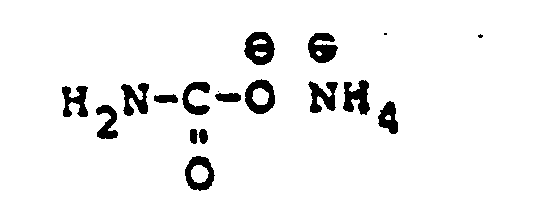
Derartige Produkte eignen sich als Düngemittel zur langfristigen Versorgung von Pflanzen mit Stickstoff und, je nach Beladung-, mit anderen Makro- und/oder Mikronährstoffen.Products of this type are suitable as fertilizers for the long-term supply of plants with nitrogen and, depending on the load, with other macro and / or micronutrients.
In den Azulminsäuren, die bei dem erfindungsgemäßen Verfahren mit verwendet werden können, läßt sich gewünschtenfalls vor oder während der Umsetzung die Zahl der Fehlerstellen erhöhen. Ferner kann auch nach beendeter Mischkondensation in den nach dem erfindungsgemäßen Verfahren hergestellten Azulminsäure enthaltenden Produkten die Zahl der Fehlerstellen in den Azulminsäuren erhöht werden. Hierzu eignen sich alle diejenigen Verfahren, die bereits im Zusammenhang mit der Beschreibung der Herstellung der modifizierten, also fehlerstellenhaltigen Azulminsäuren aufgeführt wurden. - Soll die Fehlerstellenerzeugung nach erfolgter Mischkondensation vorgenommen werden, so verfährt man in der Weise, daß man die Reaktionsprodukte in wäßrigem Medium, gegebenenfalls bei erhöhten Temperaturen mit den zur Fehlerstellenerzeugung eingesetzten Reagenzien verrührt. Die Produkte werden durch Filtration isoliert.In the azulmic acids which can also be used in the process according to the invention, the number of defects can be increased, if desired, before or during the reaction. Furthermore, the number of defects in the azulmic acids can also be increased in the products containing azulmic acid prepared by the process according to the invention after the mixed condensation has ended. For this purpose, all those processes are suitable which have already been listed in connection with the description of the production of the modified azulmic acids, that is to say which contain defects. - If the generation of defects is to be carried out after mixed condensation has been carried out, the reaction products are stirred in an aqueous medium, if appropriate at elevated temperatures, with the reagents used to generate the defects. The products are isolated by filtration.
Bei der Durchführung des erfindungsgemäßen Verfahrens lassen sich insbesondere bei Verwendung hochreaktiver Carbonylverbindungen, wie Formaldehyd oder Crotonaldehyd, auch solche Biomassen, die zur Bildung resistenter Sporen neigen, vollständig desaktivieren. Nötigenfalls können bei besonders stark resistenten Sporen die bekannten Verfahren der Pasteurisierung angewendet werden, indem beispielsweise in den Verfahrensprodukten enthaltende Aldehyd-Spuren durch Ammoniak völlig desaktiviert werden, dann Peptone, Dextrine zugegeben werden, bei 37 °C die Sporen erneut zur Belebung und Zellteilung angeregt werden und anschließend z.B. mit kleinen Mengen an Monomethylolharnstoff und Formaldehyd die erfindungsgemäße Mischkondensation bei 70-80 °C gegebenenfalls mehrfach wiederholt wird.When carrying out the process according to the invention, especially when using highly reactive carbonyl compounds such as formaldehyde or crotonaldehyde, even those biomasses which tend to form resistant spores can be completely deactivated. If necessary, the known methods of pasteurization can be used in the case of particularly highly resistant spores, for example by completely deactivating traces of aldehyde contained in the process products by ammonia, then adding peptones and dextrins, and stimulating the spores again at 37 ° C. to revitalize and cell division and then eg with small amounts of monomethylol urea and formaldehyde, the mixed condensation according to the invention is repeated several times at 70-80 ° C.
Der Nachweis dafür, daß bei dem erfindungsgemäßen Verfahren rasch und quantitativ eine Sterilisation der eingesetzten Biomassen erfolgt, kann in bekannter Weise in sterilen Agar und Peptone enthaltenden Petrischalen geführt werden, wobei diese primär zur Sterilisierung in üblicher Weise bei 120 °C etwa 40 Minuten einer Dampfatmosphäre ausgesetzt werden. Messungen an derartig sterilisierten, mit den Verfahrensprodukten angeimpften Nährböden zeigen unter standardisierten Prüfbedingungen in gesättigter steriler Wasserathmosphäre sowohl nach 24 Stunden und als auch nach 48 Stunden bei erfindungsgemäß sterilisierten Bakterien-Biomassen keine Keimbildung, ebenso nicht nach 72 und mehr Stunden. Gleiches gilt für erfindungsgemäß kondensierte und sterilisierte bzw. pasteurisierte Pilzmassen und Hefemassen. Die Keimteste sind in allen Fällen negativ. Entsprechende Prüfungen an anaeroben oder aeroben Mikroorganismen-Kondensaten unter optimalen Anzucht- und Temperaturbedingungen deuten die völlige Sterilisierung der Biomassen bei der Durchführung des erfindungsgemäßen Verfahrens an.Evidence that the biomass used can be sterilized rapidly and quantitatively in the method according to the invention can be provided in a known manner in petri dishes containing sterile agar and peptones, these primarily for sterilization in a conventional manner at 120 ° C. for about 40 minutes in a steam atmosphere get abandoned. Measurements on culture media sterilized in this way and inoculated with the process products show no nucleation under standardized test conditions in saturated sterile water atmosphere both after 24 hours and after 48 hours in the case of bacterial biomasses sterilized according to the invention, likewise not after 72 or more hours. The same applies to mushrooms and yeasts which are condensed and sterilized or pasteurized according to the invention. The germ test is negative in all cases. Corresponding tests on anaerobic or aerobic microorganism condensates under optimal cultivation and temperature conditions indicate the complete sterilization of the biomass when the method according to the invention is carried out.
Sterilisationen der eingesetzten Biomassen lassen sich bei dem erfindungsgemäßen Verfahren besonders vorteilhaft auch dadurch erreichen, daß man die Kondensation im Temperaturbereich von 10 °C bis 140 °C unter stark vermindertem Druck vornimmt. Hierdurch können Sterilisationen, Plasmolyse, Zellwandsprengung von Mikroorganismen, wie Bakterien, Algen, Hefen u.s.w., außerordentlich beschleunigt werden.In the process according to the invention, sterilization of the biomass used can also be achieved particularly advantageously by carrying out the condensation in the temperature range from 10 ° C. to 140 ° C. under greatly reduced pressure. As a result, sterilization, plasmolysis, cell wall blasting of microorganisms such as bacteria, algae, yeast, etc., can be accelerated extraordinarily.
Um bei der Durchführung des erfindungsgemäßen Verfahrens eine maximale Zellabtötung, Enzymdesaktivierung und Geruchsverbesserung bei beliebigen Biomassen zu erreichen, gleichzeitig aber wertvolle Zellinhaltsstoffe hydrolytisch nicht in wasserlösliche Produkte zu spalten (= Proteinabbau, Polysaccharidabbau) hat es sich als besonders vorteilhaft erwiesen, die Biomassen primär mit einen 1 bis 2-molaren Überschuß an Aldehyden, wie Formaldehyd, Isobutyraldehyd, Crotonaldehyd oder Glyoxal, bei Temperaturen zwischen 20 °C und 100 °C, vorzugsweise zwischen 40 °C und 70 °C, im pH-Bereich zwischen 6 und 7,5, also praktisch neutral, in 30 Minuten bis zu 2 Stunden zu kondensieren und anschließend nach Zusatz eines Aminoplastbildners, wie Harnstoff, Melamin oder bevorzugt Harnstoff-Azulminsäure oder Melamin-Azulminsäure, in Gegenwart von Phosphorsäure oder Schwefelsäure bei pH-Werten zwischen 1 und 4 und bei Temperaturen zwischen 20 °C und 70 °C im Verlaufe von 1 bis 4 Stunden die Mischkondensation zu Ende zu führen. Dabei werden völlig klebfreie, leicht filtrierbare, pulvrige Mischkondensate höchster Lagerstabilität bei vollständiger Enzymdesaktivierung erhalten. Derartige Mischkondensate sind vollständig keimfrei.In order to achieve maximum cell killing, enzyme deactivation and odor improvement in any biomass when carrying out the process according to the invention, but at the same time not hydrolytically splitting valuable cell contents into water-soluble products (= protein degradation, polysaccharide degradation), it has proven to be particularly advantageous to use the biomass primarily with one 1 to 2 molar excess of aldehydes, such as formaldehyde, isobutyraldehyde, crotonaldehyde or glyoxal, at temperatures between 20 ° C and 100 ° C, preferably between 40 ° C and 70 ° C, in the pH range between 6 and 7.5, So practically neutral, to condense in 30 minutes up to 2 hours and then after adding an aminoplast former, such as urea, melamine or preferably urea-azulmic acid or melamine-azulmic acid, in the presence of phosphoric acid or sulfuric acid at pH values between 1 and 4 and at Temperatures between 20 ° C and 70 ° C in the course of 1 to 4 hours the mixed condensation to finish. Completely tack-free, easily filterable, powdery mixed condensates with the highest storage stability are obtained with complete enzyme deactivation. Such mixed condensates are completely germ-free.
Im übrigen lassen sich bei dem erfindungsgemäßen Verfahren auch mit Hilfe erdiger Materialien normalen Bakteriengehaltes, Algen- und Pilzgehaltes, vollständige Sterilisierungen errreichen. Verwendet man zum Beispiel beim erfindungsgemäßen Verfahren als Zusatzmittel für 1 Liter etwa 2 Gew.-% Feststoff enthaltende Jungzellen-Nährhefe-Suspensionen zusätzlich
- a) 100 cm3 Flußwasser (= 1 cm3 enthält 10000 bis eine Billion Bakterien)
- b) 100 cm3 normales Leitungswasser (= 1 cm3 enthält ca-1 000 Bakterienkeime)
- c) 20 g feuchte, mit Torf gemischte Gartenerde (= 1 g enthält Millionen von Mikroorganismen wie Bakterien, Kleinalgen und Pilze),
so stellt man nach Durchführung der erfindungsgemäßen Kondensation und nach Bestimmung des Sterilitätsgrades nach erfolgter Mischkondensation mit 60 g Harnstoff und 30 g Formaldehyd völlige Keimfreiheit In biologischen Testen fest. Hierbei ist Phosphorsäure oder Schwefelsäure der bevorzugte Kondensationskatalysator, da der Katalysator durch Zugabe von Calciumoxyd, Calciumcarbonat oder Kalkmilch praktisch quantitativ gefällt werden oder gewünschtenfalls Phosphorsäure auch als Aluminiumphosphat mit frisch gefälltem Aluminiumhydroxyd niedergeschlagen werden kann, so daß keine Abwasserbelastung durch Phosphat-haltige Filtrate erfolgt.Incidentally, in the method according to the invention, complete sterilization can also be achieved with the aid of earthy materials of normal bacterial content, algae and fungus content. For example, in the process according to the invention, young cell nutrient yeast suspensions containing about 2% by weight of solid are additionally used as an additive for 1 liter
- a) 100 cm 3 of river water (= 1 cm 3 contains 10,000 to a trillion bacteria)
- b) 100 cm 3 normal tap water (= 1 cm 3 contains approx. 1 000 bacterial germs)
- c) 20 g of moist garden soil mixed with peat (= 1 g contains millions of microorganisms such as bacteria, small algae and fungi),
so it after having carried out the condensation according to the invention and after determining the sterile i tätsgrades after co-condensation with 60 g of urea and 30 g formaldehyde complete sterility In biological testing fixed. Here, phosphoric acid or sulfuric acid is the preferred condensation catalyst, since the catalyst is added by adding calcium oxide, calcium carbonate or Lime milk can be precipitated practically quantitatively or, if desired, phosphoric acid can also be precipitated as aluminum phosphate with freshly precipitated aluminum hydroxide, so that there is no pollution of wastewater by filtrates containing phosphate.
Wenn bei dem erfindungsgemäßen Verfahren eine besonders schnelle Enzymdesaktivierung erreicht werden soll, so geht man zweckmäßigerweise so vor, daß man in der ersten Reaktionsphase 0,5 - 2 Gew.- % an wasserunlöslichen Aldehyden, wie Isobutyraldehyd und insbesondere Crotonaldehyd, vor der Zugabe von Harnstoff und Formaldehyd zusetzt.If a particularly rapid enzyme deactivation is to be achieved in the process according to the invention, it is expedient to proceed in such a way that in the first reaction phase 0.5-2% by weight of water-insoluble aldehydes, such as isobutyraldehyde and in particular crotonaldehyde, are added before the addition of urea and add formaldehyde.
Bei der Durchführung des erfindungsgemäßen Verfahrens können die verschiedensten Biomassen gewünschtenfalls vor der Kondensation mit kleinen Mengen an Oxidationsmitteln, wie Salpetersäure, Chlorlauge, Calciumhypochlorit, Wasserstoffperoxid, Chromsäure oder Kaliumpermanganat vorbehandelt werden. Dadurch werden Geruchsträger zum Teil zerstört, und die Farbe der Filtrate wird verbessert.When carrying out the process according to the invention, a wide variety of biomasses can, if desired, be pretreated with small amounts of oxidizing agents, such as nitric acid, chlorine solution, calcium hypochlorite, hydrogen peroxide, chromic acid or potassium permanganate, before the condensation. This partially destroys odorants and improves the color of the filtrates.
Im übrigen ist es oft vorteilhaft, schwerlösliches Harnstoffnitrat auf den Biomassen zu erzeugen und dann mit Formaldehyd und Azulminsäuren die erfindungsgemäße Kondensation durchzuführen. Ebenso kann primär schwerlösliches Ammoniummagnesiumphosphat auf den Biomassen als Trägersubstanz erzeugt werden und dann die erfindungsgemäße Kondensation durchgeführt werden.In addition, it is often advantageous to produce poorly soluble urea nitrate on the biomass and then to carry out the condensation according to the invention with formaldehyde and azulmic acids. Likewise, primarily poorly soluble ammonium magnesium phosphate can be generated on the biomass as a carrier substance and the condensation according to the invention can then be carried out.
Bei dem erfindungsgemäßen Verfahren können selbstverständlich auch Mischungen von mehreren Aminoplastbildnern, Phenoplastbildnern und/oder Mischungen von mehreren Carbonylverbindungen zur Kondensation verwendet werden. So können z.B. solche Aldehyd-Gemische eingesetzt werden, die aus Formaldehyd und zahlreichen anderen Aldehyden bzw. Ketonen unter den Bedingungen der Aldolkondensation, der Formose-Synthese oder der Acyloinkondensation gegebenenfalls in situ entstehen (vgl. Reaktionsgleichungen auf Seiten 26 und 27). Derartige Hydroxyaldehyde reagieren im Maße ihrer Bildung, insbesondere im schwach bis stark alkalischen Bereich mit Aminoplastbildnern, wie z.B. Harnstoff, leicht unter Addition zu N-Alkylolverbindungen, die dann mischkondensiert werden.Mixtures of several aminoplast formers, phenoplast formers and / or mixtures of several carbonyl compounds can of course also be used for the condensation in the process according to the invention. For example, such aldehyde mixtures are used which may form in situ from formaldehyde and numerous other aldehydes or ketones under the conditions of aldol condensation, formose synthesis or acyloin condensation (see reaction equations on pages 26 and 27). Such hydroxyaldehydes react with their formation, especially in the weak to strongly alkaline range, with aminoplast formers, e.g. Urea, easily with addition to N-alkylol compounds, which are then mixed condensed.
In einer besonderen Variante des erfindungsgemäßen Verfahrens arbeitet man in der Weise, daß man spezielle Aldehyde, bevorzugt Formaldehyd in alkalischem Milieu auf andere Aldehyde einwirken läßt, und zwar in Gegenwart der zur Aminoplastbildung eingesetzten Stoffe. Obwohl sich dabei N-Alkylolverbindungen bzw. N-Methylolverbindungen bilden, so sind diese doch nicht die thermostabilsten Derivate und es erfolgt Bildung der thermostabileren Hydroxyaldehyde. Letztere führen im Zuge der erfindungsgemäßen Umsetzung zu Hydroxylgruppen enthaltenden Aminoplastkohdensaten, die den sprühgetrockneten Produkten eine gewünschte krümelige Struktur verleihen. Über diese Variante des erfindungsgemäßen Verfahrens kann vor allem auch die Quellarbeit der erfindungsgemäßen Produkte beeinflußt werden. Außerdem kann diese Reaktion in Gegenwart von auf Azulminsäure niedergeschlagenem Calciumhydroxid oder Bleihydroxid dazu benutzt werden, um karamelisierte Zucker zu synthetisieren (Butlerow-Löw-Formose-Reaktion), die an den Aminoplastkondensationen teilnehmen und für eine Krümelstruktur der erfindungsgemäßen Produkte sorgen.In a special variant of the process according to the invention, the process is carried out by allowing special aldehydes, preferably formaldehyde, to act on other aldehydes in an alkaline medium, in the presence of the substances used for aminoplast formation. Although N-alkylol compounds or N-methylol compounds are formed, these are not the most thermostable derivatives and the more thermostable hydroxyaldehydes are formed. In the course of the reaction according to the invention, the latter lead to aminoplast carbohydrates containing hydroxyl groups, which give the spray-dried products a desired crumbly structure. This variant of the method according to the invention can above all be used to influence the swelling work of the products according to the invention. In addition, this reaction can be used in the presence of calcium hydroxide or lead hydroxide precipitated on azulmic acid to synthesize caramelized sugars (Butlerow-Löw formose reaction), which take part in the aminoplast condensation and provide a crumb structure of the products according to the invention.
Bei der Durchführung der erfindungsgemäßen Mischkondensation können Kalium-lonen und Cyanid-lonen, ihre bekannte katalytische Aktivität ausüben und z.B. Acyloinkondensationen bewirken (vgl. Reaktionsgleichung (e) auf Seite 27). Die dabei entstehenden Produkte können im Zuge der Aminoplastkondensationen, insbesondere bei basisch katalysierten Reaktionen, an der Kondensation teilnehmen und ferner bei Angebot von Formaldehyd durch Aldolkondensationen in methylolierte Ketone übergehen, welche ebenfalls Kondensationspartner darstellen.When carrying out the mixed condensation according to the invention, potassium ions and cyanide ions can exercise their known catalytic activity and e.g. Cause acyloin condensations (see reaction equation (e) on page 27). The resulting products can participate in the condensation in the course of the aminoplast condensations, in particular in the case of base-catalyzed reactions, and furthermore, when formaldehyde is offered, can be converted to methylolated ketones by aldol condensations, which are also condensation partners.
Eine weitere Variante des erfindungsgemäßen Verfahrens besteht darin, daß man als Aminoplastbildner solche Azulminsäuren einsetzt, die vor der eigentlichen Umsetzung partiell mit Carbonylverbindungen, wie Formaldehyd, Glyoxal oder Glyoxalsulfat, kondensiert und dadurch gegen Blausäuresäureabspaltung stabilisiert wurden. Die damit erhaltenen erfindungsgemäßen Produkte zeichnen sich durch eine besonders hohe thermische Beständigkeit aus.A further variant of the process according to the invention is that the aminoplast formers used are those azulmic acids which, prior to the actual reaction, have been partially condensed with carbonyl compounds, such as formaldehyde, glyoxal or glyoxal sulfate, and thereby stabilized against the release of hydrocyanic acid. The products according to the invention obtained in this way are distinguished by a particularly high thermal resistance.
Ferner besteht eine vorteilhafte Variante des erfindungsgemäßen Verfahrens darin, daß man Harnstoff, Melamin oder Dicyandiamid in wäßriger Lösung vorlegt, dann Azulminsäure und Biomasse dispergiert, danach mit Formaldehyd kondensiert und durch Zugabe von Phosphorsäure bzw. Oxalsäure aus nicht umgesetztem Melamin oder Harnstoff schwerlösliches Melaminphosphat oder Harnstoffoxalat erzeugt. Hierbei laufen Fehlerstellenerzeugung in der Azulminsäure und Mischkondensation gleichzeitig ab. Die dabei entstehenden Produkte stellen hochwertige reaktive Füllstoffe und Flammschutzmittel für Kunststoffe, insbesondere Polyurethankunststoffe, dar.Furthermore, an advantageous variant of the process according to the invention is that urea, melamine or dicyandiamide is initially introduced in aqueous solution, then azulmic acid and biomass are dispersed, then condensed with formaldehyde and, by adding phosphoric acid or oxalic acid from unreacted melamine or urea, poorly soluble melamine phosphate or urea oxalate generated. In this case, generation of defects in the azulmic acid and mixed condensation take place simultaneously. The resulting products are high-quality reactive fillers and flame retardants for plastics, especially polyurethane plastics.
Die erfindungsgemäße Kondensation der Biomassen in Gegenwart von Azulminsäuren kann auch unter oxidativen Bedingungen mit kleinen Mengen an Oxidationsmitteln, wie Wasserstoffperoxid, Chlorlauge, Chlorkalk oder Kaliumpermanganat, vorgenommen werden.The condensation of the biomass according to the invention in the presence of azulmic acids can also be carried out under oxidative conditions with small amounts of oxidizing agents, such as hydrogen peroxide, chlorine solution, chlorinated lime or potassium permanganate.
In einer weiteren Variante kann das erfindungsgemäße Verfahren auch in Form einer Eintopfreaktion durchgeführt werden. Dabei geht man so vor, daß man Biomassen mit größeren Mengen an Aminoplast- bildnern, wie Harnstoff, mischt und gegebenenfalls in Gegenwart anderer löslicher Aminoplastbildner sowie gegebenenfalls in Gegenwart von Mono- und Polyalkoholen und kleinen Mengen an Phenoplastbildnern, wie Phenol oder o-Kresol, bei etwa 70 °C vorbehandelt, dann Aldehyde, wie Crotonaldehyd, zugibt und anschließend bevorzugt im pH-Bereich 1 bis 2,5 mit Formaldehyd kondensiert.In a further variant, the method according to the invention can also be carried out in the form of a one-pot reaction. The procedure is to mix biomass with large amounts of aminoplast formers, such as urea, and optionally in the presence of other soluble aminoplast formers and optionally in the presence of mono- and polyalcohols and small amounts of phenoplast formers, such as phenol or o-cresol. pretreated at about 70 ° C., then adding aldehydes, such as crotonaldehyde, and then preferably condensed in the pH range 1 to 2.5 with formaldehyde.
Eine andere Variante des erfindungsgemäßen Verfahrens besteht darin, daß man bei der Mischkondensation auf 100 Gewichtsteile Biomasse 100 bis 500 Gewichtsteile an etwa 30 %-igen wäßrigen Natrium-oder Kaliumsilikat-Lösungen zugibt, wobei es in der Regel zweckmäßig ist, bei etwa 40 °C bis 100 °C mit Carbonylverbindung und Aminoplastbildner zu kondensieren, oder die Mischkondensate nachträglich mit den oben genannten Mengen an Alkalisilikaten umzusetzten.Another variant of the process according to the invention is that in the mixed condensation 100 to 500 parts by weight of about 30% aqueous sodium per 100 parts by weight of biomass. or potassium silicate solutions, where it is generally advisable to condense at about 40 ° C. to 100 ° C. with carbonyl compound and aminoplast former, or to subsequently react the mixed condensates with the abovementioned amounts of alkali silicates.
Nach beendeter Reaktion kann überschüssiges gelöstes Natrium- bzw. Kaliumsilikat durch einfaches Begasen der jeweiligen Dispersionen mit Kohlendioxid gefällt werden, oder in besonders vorteilhafter Weise durch Zugabe von Phosphorsäure oder Calciumchlorid in Mischung mit Kalium- bzw. Natriumphosphaten oder Calciumsilikaten ausgefällt werden. Die so entstehenden Produkte sind interessante Kombinationsfüllstofte mit reaktiven Gruppen.After the reaction has ended, excess dissolved sodium or potassium silicate can be precipitated by simply gassing the respective dispersions with carbon dioxide, or in a particularly advantageous manner by adding phosphoric acid or calcium chloride mixed with potassium or sodium phosphates or calcium silicates. The resulting products are interesting combination fillers with reactive groups.
Eine weitere interessante Variante des erfindungsgemäßen Verfahrens besteht in der Mitverwendung von solchen Aminoplastbildnern, die besonders gute Komplexbildner für Schwermetalle sind. Hierzu gehören z.B. Thioharnstoff und N-Methylolgruppen enthaltende Polymethylenthioharnstoffe der Konstitution

- R = H, CH2OH
- x = 0 bis 14,
ferner ringförmige Äthylenthioharnstoffkondensate wie
- R = H, CH20H
- X = 0 bis 14
- R = H, CH 2 OH
- x = 0 to 14,
also ring-shaped ethylene thiourea condensates such as - R = H, CH 2 0H
- X = 0 to 14
Weiterhin Aminoplastbildner mit ionischen Gruppen, z.B. die Verbindung der Konstitution


Bei der Verwendung derartiger Komplexbildner können insbesondere in Biomassen aus Kläranlagen für industrielle und kommunale Abwässer enthaltene schädliche Schwermetall-lonen so fest gebunden werden, daß bei der Verwendung der erfindungsgemäßen Biomassenkondensationsprodukte als Langzeitdüngemittel keine Pflanzenschädigungen durch Schwermetalle, wie Quecksilber, Blei, Chrom, Cadmium und Zink, auftreten.When using such complexing agents, harmful heavy metal ions contained in biomass from sewage treatment plants for industrial and municipal waste water can be bound so tightly that when the biomass condensation products according to the invention are used as long-term fertilizers, no plant damage by heavy metals such as mercury, lead, chromium, cadmium and zinc , occur.
Wenn man bei der Durchführung des erfindungsgemäßen Verfahrens eine Proteinhydrolyse von Glykoproteiden, Nucleinsäuren und anderen Zellinhaltsstoffen maximal vermeiden will, so erweist es sich als vorteilhaft, die Biomassen zunächst im strengen Neutralbereich bei pH 7 mit Harnstoff und Formaldehyd bzw. Dimethylolharnstoff oder Monomethylolharnstoff in einer Verdünnung von etwa 60 g Harnstoff pro Liter 8-10 % Feststoff enthaltender wäßriger Biomasse bei 60-80 °C in Gegenwart von 80-100 g Azulminsäuren zu kondensieren, anschließend auf 35-20 °C herunterzukühlen und dann spontan durch Ansäuren (pH = 1,5-2,5) die Weiterkondensation gebildeter Methylolierungsprodukte durchzuführen. Hierdurch kann der hydrolysierte und wasserlösliche Anteil von Zellinhaltsstoffen insbesondere bei Mitverwendung der verschiedensten Azulminsäuren auf ein Minimum herabgedrängt werden. In einzelnen Fällen kann es von Vorteil sein, hierbei 2-10 Gew.-% Melamin oder Dicyandiamid, bezogen auf eingesetzten Harnstoff, mitzuverwenden.If you want to avoid protein hydrolysis of glycoproteids, nucleic acids and other cell contents as much as possible when carrying out the process according to the invention, it proves to be advantageous to first dilute the biomass in the strict neutral range at pH 7 with urea and formaldehyde or dimethylol urea or monomethylol urea condense about 60 g urea per liter of 8-10% solids aqueous biomass at 60-80 ° C in the presence of 80-100 g azulmic acids, then cool down to 35-20 ° C and then spontaneously by acidification (pH = 1.5 -2.5) the further condensation of formed methylolation products to lead. As a result, the hydrolyzed and water-soluble fraction of cell constituents can be reduced to a minimum, particularly when a wide variety of azulmic acids are used. In individual cases it can be advantageous to use 2-10% by weight of melamine or dicyandiamide, based on the urea used.
Da N-Alkylolverbindungen und insbesondere N-Methylolverbindungen im sauren pH-Bereich leicht Verätherungsreaktionen eingehen, kann man die erfindungsgemäßen Verfahrensprodukte bei ihrer Herstellung durch Mitverwendung von z.B. 10-60 Gew.-% an polyfunktionellen Hydroxylverbindungen, z.B. Polyalkoholen wie Äthylenglykol, Glyzerin, Formose-Zuckergemischen, Glukose, Poly- und Oligosaccariden, Stärke, etc., über Verätherungsreaktionen modifizieren.Since N-alkylol compounds and especially N-methylol compounds easily undergo etherification reactions in the acidic pH range, the process products according to the invention can be prepared by using e.g. 10-60% by weight of polyfunctional hydroxyl compounds, e.g. Modify polyalcohols such as ethylene glycol, glycerin, formose-sugar mixtures, glucose, poly- and oligosaccharides, starch, etc. via etherification reactions.
Die erfindungsgemäßen Produkte lassen sich formelmäßig nicht eindeutig definieren. Sie sind jedoch durch die Ausgangskomponenten und das Verfahren zu ihrer Herstellung genau charakterisiert. - Ein gemeinsames Merkmal der erfindungsgemäßen Stoffe besteht darin, daß sie Molekülsegmente « A » enthalten, die durch Kondensation von Carbonylverbindungen bzw. Thiocarbonylverbindungen und Aminoplastbildnern bzw. Phenoplastbildnern mit reaktiven Gruppen der Biomassen entstehen.The products according to the invention cannot be clearly defined in terms of formula. However, they are precisely characterized by the starting components and the process for their production. - A common feature of the substances according to the invention is that they contain molecular segments "A", which are formed by condensation of carbonyl compounds or thiocarbonyl compounds and aminoplast formers or phenoplast formers with reactive groups of the biomass.
Das segment « A kann dabei unter anderem für folgende Reste stehen :
- - Aralkyliden - polythioharnstoff - Reste, Polyalkyliden-polythioharnstoff-Reste und insbesondere Polymethylen-polythioharnstoff-Reste, welche sich durch folgende idealisierte Formel veranschaulichen lassen

- X für ganze Zahlen von 0 bis 18 steht und
- R vorzugsweise für Wasserstoff, Methyl, Äthyl, Propyl, Isopropyl sowie für Reste der Formeln


- - Biuretsulfone der Konstitution
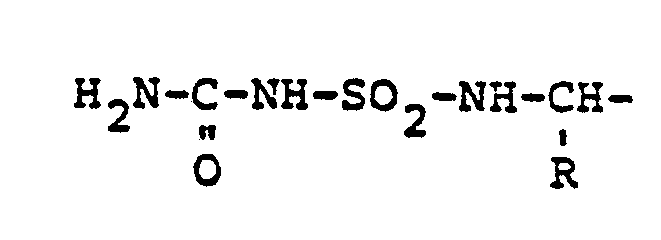

- - Hydrouracil-Reste, die aus 1 Mol an ungesättigter Carbonsäure, z.B. Crotonsäure, 1 Mol Harnstoff und Formaldehyd entstehen, wobei der Rest der Konstitution
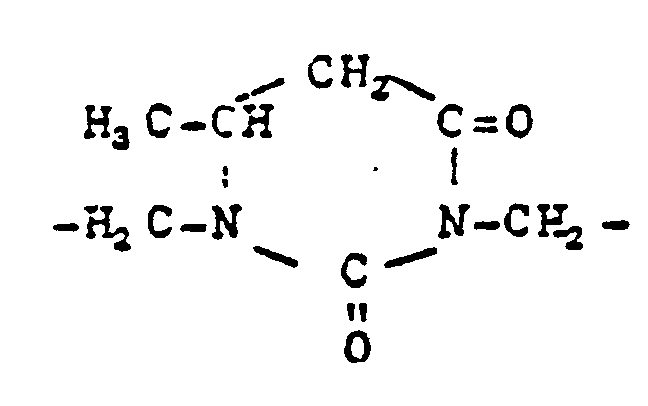
- - Reste von Umsetzungsprodukten der Maleinsäureureide mit Aldehyden, bevorzugt Formaldehyd, wobei der Rest der Konstitution

- - Methylengruppen enthaltende Lactam- und Azalactam-Reste, z.B. Reste der Konstitution

- - Methylengruppen enthaltende Reste cyclischer Verbindungen der Konstitution

- X für Sauerstoff oder Schwefel steht und
- R1, R2 und R3 gleich oder verschieden sind und für Wasserstoff, Methyl, Äthyl oder Methylengruppen stehen ;
- - Methylengruppen enthaltende Reste des Äthylendiharnstoffs wie z.B. der Konstitution

- - Methylengruppen enthaltende Reste des Äthylenharnstoffs, Vinylidenharnstoffs und Dihydroxyathylenharnstoffs wie Reste der Formeln


- - Methylengruppen enthaltende Reste des Harnstoffs, wie z.B. Reste der Konstitution
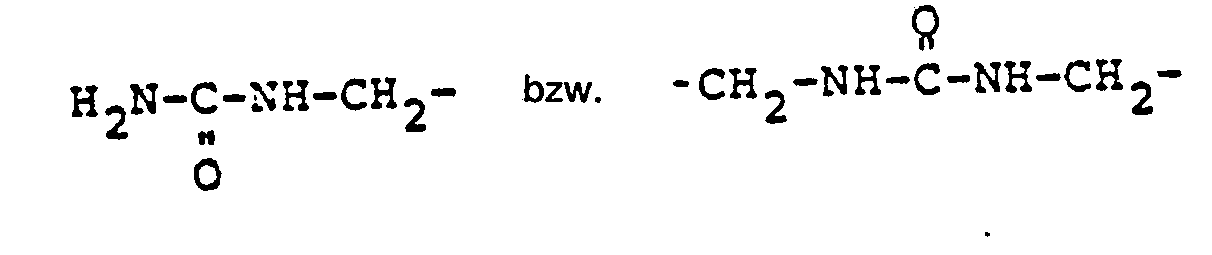
- - Methylen- bzw. Alkyliden-Reste des 2-Oxo-4-methyl-6-ureido-hexahydropyrimidins der Konstitution

- - Methylen- bzw. Alkyliden-Reste mit Melamin-Strukturen wie

- - Reste der Formel

R die oben angegebene Bedeutung hat ; - - Methylen- bzw. Alkyliden-Reste mit Sulfonamid-Strukturen wie z.B.


R die oben angegebene Bedeutung hat ; - - Methylen- bzw. Alkyliden-Reste mit Dicyandiamid-, Guanidin-, Formaldehyd- bzw. Isobutyraldehyd-Strukturen ;
- - durch Methylen- bzw. Alkyliden-Reste substituierte aromatische und aliphatische Amine, Polyamine, Hydrazine, Hydrazide, Hydrazodicarbonamide. Dicarbonsäure-dihydrazide, Hydrazincarbonsäure- äthylester und Phosphoramid-Reste.
- - Aralkylidene - polythiourea residues, polyalkylidene-polythiourea residues and in particular polymethylene-polythiourea residues, which can be illustrated by the following idealized formula
- X stands for integers from 0 to 18 and
- R preferably for hydrogen, methyl, ethyl, propyl, isopropyl and for residues of the formulas
- - Biuretsulfones of the constitution
- - Hydrouracil residues that arise from 1 mole of unsaturated carboxylic acid, eg crotonic acid, 1 mole of urea and formaldehyde, the rest of the constitution
- - Residues of reaction products of maleic acid with aldehydes, preferably formaldehyde, the rest of the constitution
- - Lactam and azalactam residues containing methylene groups, for example residues of the constitution
- - Residues of cyclic compounds of the constitution containing methylene groups
- X represents oxygen or sulfur and
- R 1 , R 2 and R 3 are the same or different and represent hydrogen, methyl, ethyl or methylene groups;
- - Residues of ethylene diurea containing methylene groups, such as the constitution
- Residues of ethylene urea, vinylidene urea and dihydroxyathylene urea containing methylene groups, such as residues of the formulas
- Residues of urea containing methylene groups, such as residues of the constitution
- - Methylene or alkylidene residues of 2-oxo-4-methyl-6-ureido-hexahydropyrimidine of the constitution
- - Methylene or alkylidene residues with melamine structures such as
- - Remains of the formula
R has the meaning given above; - - Methylene or alkylidene residues with sulfonamide structures such as
R has the meaning given above; - - Methylene or alkylidene residues with dicyandiamide, guanidine, formaldehyde or isobutyraldehyde structures;
- - Aromatic and aliphatic amines, polyamines, hydrazines, hydrazides, hydrazodicarbonamides substituted by methylene or alkylidene radicals. Dicarboxylic acid dihydrazide, hydrazine carboxylic acid ethyl ester and phosphoramide residues.
Die erfindungsgemäßen Stoffe sind keimfrei, lagerbeständig und in den meisten Fällen geruchlos. Sie können für eine Vielzahl von Zwecken verwendet werden.The substances according to the invention are germ-free, stable in storage and in most cases odorless. They can be used for a variety of purposes.
So können erfindungsgemäße Produkte Verwendung finden als Mehrkomponentenfüllstoffe mit reaktiven Gruppen in Kunststoffen verschiedenster Art.Products according to the invention can thus be used as multi-component fillers with reactive groups in plastics of all kinds.
Bei der Herstellung von gegebenenfalls zelligen Kunststoffen unter Verwendung erfindungsgemäßer Mischkondensate als Füllstoffe können selbstverständlich auch andere gebräuchliche Füllstoffe, Flammschutzmittel und Zusatzstoffe der verschiedensten Art mitverwendet werden. Bevorzugt in Betracht kommen hierbei wasserlösliche oder wasserdispergierbare anorganische Salze, Doppelsalze oder komplexe Verbindungen, beispielsweise Ammoniumsulfat, ammoniumsulfathaltige Endlaugen der Caprolactamherstellung, Calciumsulfat, (NH4)2SO4.H2O.Ca(H2PO4)2, Ammoniumphosphat, CaNa-PO4.Ca2SiO4, 5 CaO.P2O5.SiO2, Ca4P209, (CaMg)O.Al2O3.4 Si02, Al2O3.2 Si02. 2 H2O, KCl.MgSO4.3 H20, K2SO4.MgSO4.6 H20, Si206AIK, Natriumnitrat, Ammoniumnitrat, sekundäres Natriumammoniumphosphat und ähnliche Stoffe.In the production of optionally cellular plastics using mixed condensates according to the invention as fillers, other common fillers, flame retardants and additives of various types can of course also be used. Water-soluble or water-dispersible inorganic salts, double salts or complex compounds, for example ammonium sulfate, ammonium sulfate-containing end liquors from caprolactam production, calcium sulfate, (NH 4 ) 2 SO 4 .H 2 O.Ca (H 2 PO 4 ) 2 , ammonium phosphate, CaNa are preferred -PO 4 .Ca 2 SiO 4 , 5 CaO.P 2 O 5 .SiO 2 , Ca 4 P 2 0 9 , (CaMg) O.Al 2 O 3 .4 Si0 2 , Al 2 O 3 .2 Si0 2 . 2 H 2 O, KCl.MgSO 4 .3 H 2 0, K 2 SO 4 .MgSO 4 .6 H 2 0, Si 2 0 6 AIK, sodium nitrate, ammonium nitrate, secondary sodium ammonium phosphate and similar substances.
Zahlreiche erfindungsgemäße Stoffe lassen sich als Flammschutzmittel bzw. Alterungsschutzmittel zur Verhinderung des oxidativen Abbaus in den verschiedensten Vinylpolymerisaten, Polyamidkunststoffen, Kautschuken und Epoxidharzen verwenden. Insbesondere eignen sich hierzu diejenigen erfindungsgemäßen Stoffe, die kondensierte Azulminsäuren und gleichzeitig Phosphorsäure, phosphorige Säure, Polymethylenharnstoffe, Polymethylenmelamine, Calciumphosphate, Calciumcarbonat, Titandioxid, Tonerdehydrate, Aluminiumphosphate, Aluminiumsilikate, Aluminiumoxidhydrat, Wasserglas, Melaminphosphat, Bariumphosphate, Ammonium-magnesium-phosphate und/oder Harnstoffoxalat enthalten.Numerous substances according to the invention can be used as flame retardants or anti-aging agents to prevent oxidative degradation in a wide variety of vinyl polymers, polyamide plastics, rubbers and epoxy resins. Particularly suitable for this purpose are the substances according to the invention which are condensed azulmic acids and at the same time phosphoric acid, phosphorous acid, polymethylene ureas, polymethylene melamines, calcium phosphates, calcium carbonate, titanium dioxide, alumina hydrates, aluminum phosphates, aluminum silicates, aluminum oxide hydrate, water glass, melamine phosphate, barium phosphates, ammonium magnesium phosphates and / or Contain urea oxalate.
Darüber hinaus können erfindungsgemäße Stoffe als Trägermaterialien für zahlreiche Katalysatoren eingesetzt werden, wobei Mischkatalysatoren entstehen, die sich vielseitig verwenden lassen.In addition, substances according to the invention can be used as support materials for numerous catalysts, resulting in mixed catalysts which can be used in a variety of ways.
Im übrigen lassen sich erfindungsgemäße Stoffe als Futterzusatzmittel, als Nährmedium für Bakterien als Bodenverbesserungsmittel und als Düngemittel verwenden. Sie eignen sich insbesondere zur langfristigen Versorgung von Pflanzen mit Stickstoff und, = je nach den enthaltenden Komponenten -, auch zur Versorgung von Pflanzen mit anderen Makro- und/oder Mikronährstoffen. Hierbei sind als Düngemittel vor allem diejenigen Produkte geeignet, die aus schwermetallfreien Biomassen der Arzneimittel-, Genußmittel- und Lebensmittelindustrie bestehen. Ferner auch solche Produkte, die aus Biomassen aus biologisch oder vollbiologisch arbeitenden Kläranlagen für industrielle und kommunale Abwässer hergestellt werden, sofern die betreffenden Abwässer vor der biologischen oder vollbiologischen Reinigung einer Sulfidfällung, z.B. mittels Ammoniumsulfid, Natriumsulfid, Schwefelwasserstoff u.s.w., unterzogen werden und die entstehenden Biomassen-Mischkondensate somit nur winzige Mengen an Schwermetallen enthalten.In addition, substances according to the invention can be used as feed additives, as a nutrient medium for bacteria, as soil improvers and as fertilizers. They are particularly suitable for the long-term supply of plants with nitrogen and, = depending on the components they contain, also for supplying plants with other macro and / or micronutrients. Products that consist of heavy metal-free biomass from the pharmaceutical, luxury food and food industries are particularly suitable as fertilizers. Furthermore, such products made from biomass from biological or fully biological sewage treatment plants for industrial and municipal Wastewater is produced if the wastewater in question is subjected to sulfide precipitation, e.g. using ammonium sulfide, sodium sulfide, hydrogen sulfide, etc., before the biological or fully biological purification, and the resulting biomass mixed condensates thus contain only tiny amounts of heavy metals.
Das erfindungsgemäße Verfahren ist insbesondere bei Verwendung hochreaktiver Carbonylverbindungen, wie Formaldehyd, zur problemlosen Aufarbeitung von Biomassen der verschiedensten Art geeignet. Die entstehenden Produkte sind keimfrei, leicht filtrierbar, lagerfähig und meistens frei von Geruchsträgern.The process according to the invention is particularly suitable for the problem-free processing of various types of biomass when using highly reactive carbonyl compounds, such as formaldehyde. The resulting products are germ-free, easy to filter, storable and mostly free from odors.
Bei der Durchführung des erfindungsgemäßen Verfahrens werden somit alle in den Biomassen vorkommenden Enzyme, die zum Beispiel Oxydationen, Reduktionen, hydrolytische Reaktionen, Acylierungen und Kondensationen, Aminierungen, Decarboxylierungen, Einführungen von Hydroxylgruppen in Steroide, Hydroxylierungen und Weiteroxydationen, oxydative Ringöffnungen, Dehydrierungsreaktionen, Hydrierungsreaktionen olefinischer Doppelbindungen, Hydrolyse von Amidgruppen, von Harnstoffgruppen und Hydantoin-Gruppen, hydrolytische Eliminierung von Substituenten wie NH2- durch OH-Gruppen, fermentative Wasseradditionen an Doppelbindungen, hydrolytische Ringöffnungsreaktionen, Phosphorylierungesreaktionen, Umgruppierungen und Abbaureaktionen an Nucleotiden, Acylolinkondensationen, Desaminierungsreaktionen, Transaminierungsreaktionen, Amidierungsreaktionen oder Decarboxylierungsreaktionen mit anschließender gekoppelter ß-Oxydation bewirken können, vollständig desaktiviert.When carrying out the process according to the invention, all enzymes occurring in the biomass, for example oxidations, reductions, hydrolytic reactions, acylations and condensations, aminations, decarboxylations, introductions of hydroxyl groups into steroids, hydroxylations and further oxidations, oxidative ring openings, dehydrogenation reactions, hydrogenation reactions become more olefinic Double bonds, hydrolysis of amide groups, of urea groups and hydantoin groups, hydrolytic elimination of substituents such as NH 2 - by OH groups, fermentative water additions to double bonds, hydrolytic ring opening reactions, phosphorylation reactions, regrouping and degradation reactions on nucleotides, acyloline reactions, amination reactions, amination reactions, desamination reactions, amination reactions Decarboxylation reactions with subsequent coupled ß-oxidation can cause completely deactivated.
Ferner gelingt es mit HΨe des erfindungsgemäßen Verfahrens auch solche Biomassen, die bei einer Vielzahl von technischen Fermentationsprozessen oder bei der vollbiologischen Reinigung von Abwässern anfallen, und die sehr schwer oder gar nicht filtrierbar sind, schon bei niedrigen Temperaturen innerhalb kurzer Zeiten in leicht filtrierbare Produkte zu überführen, die nach dem Trocknen völlig klebfreie Pulver darstellen und keine kolloidalen Lösungen bilden.Furthermore, with the method according to the invention, those biomasses which occur in a large number of technical fermentation processes or in the fully biological purification of waste water and which are very difficult or impossible to filter can be readily converted into easily filterable products even at low temperatures transfer, which are completely tack-free powder after drying and do not form colloidal solutions.
Das erfindungsgemäße Verfahren kann mit besonderem Vorteil auch angewendet werden, um mit Pflanzenschutzmittel-Resten verseuchte Biomassen, wie z.B. Belebtschlamm aus biologischen Kläranlagen oder Antibiotika enthaltende Biomassen der Penicillinherstellung völlig zu desaktivieren und in weiter verwendbare Produkte zu überführen. - Die Desaktivierung von noch vorhandenen Pflanzenschutzmittel-Resten in Biomassen aus der biologischen Reinigung industrieller und kommunaler Abwässer ist zum Beispiel dadurch möglich, daß diese Wirkstoffe mitkondensieren oder hydrolysiert werden und oft über entstehende funktionelle Gruppen in Kondensationsreaktionen mit Carbonylverbindungen bzw. N-Methylolverbindungen eintreten. So kondensieren zum Beispiel Carbamate an ihren NH-Gruppen z.B. mit Formaldehyd und/oder N-Methylolverbindungen ; ebenso 3-Amino-1,2,4-triazol an NH2- und NH-Gruppen ; Dithiocarbamate hydrolysieren und werden desaktiviert ; Phosphorsäureester der verschiedensten Art werden generell hydrolysiert und z.B. durch Formaldehydkondensation im Phenolteil desaktiviert. Quecksilber und andere Metalle enthaltende Wirkstoffe werden bei Mitverwendung von Azulminsäuren als Aminoplastbildner durch komplexierung desaktiviert, Harnstoffgruppen aufweisende Wirkstoffe werden durch Kondensation ihrer NH-Gruppen z.B. mit Formaldehyd oder N-Methylolverbindungen desaktiviert. Wirkstoffe der Thiophosphorsäure-Reihe werden hydrolysiert, Phosphorsäure-Gruppen enthaltende Wirkstoffe werden hydrolysiert, Sulfamidgruppen enthaltende Wirkstoffe werden hydrolysierend kondensiert. Phenol- und Nitrophenol-Derivate als Wirkstoffe werden bei nicht substituierter ortho- und para-Stellung z.B. mit Formaldehyd oder N-Methylolverbindungen kondensiert, ebenso Benzthiazolyl-harnstoffe an ihren NH-Gruppen.The method according to the invention can also be used with particular advantage to completely deactivate biomass contaminated with pesticide residues, such as activated sludge from biological sewage treatment plants or biomass containing penicillin, and convert it into usable products. - The deactivation of pesticide residues still present in biomasses from the biological purification of industrial and municipal wastewater is possible, for example, by condensing or hydrolyzing these active ingredients and often by way of functional groups that arise in condensation reactions with carbonyl compounds or N-methylol compounds. For example, carbamates condense on their NH groups, for example with formaldehyde and / or N-methylol compounds; likewise 3-amino-1,2,4-triazole on NH 2 and NH groups; Dithiocarbamates hydrolyze and are deactivated; All kinds of phosphoric acid esters are generally hydrolyzed and deactivated, for example, by formaldehyde condensation in the phenol part. Active substances containing mercury and other metals are deactivated when complexing with azulmic acids as aminoplast formers, active substances containing urea groups are deactivated by condensation of their NH groups, for example with formaldehyde or N-methylol compounds. Active ingredients of the thiophosphoric acid series are hydrolyzed, active ingredients containing phosphoric acid groups are hydrolyzed, active ingredients containing sulfamide groups are condensed hydrolyzing. Phenol and nitrophenol derivatives as active ingredients are condensed in the unsubstituted ortho and para position, for example with formaldehyde or N-methylol compounds, as are benzothiazolylureas on their NH groups.
2,4-Dichlorphenoxyessigsäure und ähnliche Wirkstoffe werden bei Mitverwendung von Azulminsäuren salzartig fixiert und desaktiviert. Imidazolidin- und Uracilgruppen enthaltende Wirkstoffe werden an freien NH-Gruppen kondensiert und desaktiviert. N-Trichlormethyl-thiophthalimid wird hydrolysierend kondensiert. Der Wirkstoff 4-Amino-6-tert.-butyl-3-(methylthio)-1,2,4-triazin-5(4 H)-on wird durch Kondensation der hochreaktiven NH -Gruppe z.B. mit Formaldehyd oder N-Methylolverbindungen desaktiviert. 3-Dimethyl-3-(2-benzthiazolyl)-harnstoff wird durch Kondensation an der reaktiven NH-Gruppe desaktiviert, desgleichen NH-Gruppen enthaltende Thiadiazol-Derivate und Benzimidazol-Derivate.2,4-dichlorophenoxyacetic acid and similar active ingredients are fixed and deactivated in a salt-like manner when azulmic acids are also used. Active ingredients containing imidazolidine and uracil groups are condensed and deactivated on free NH groups. N-trichloromethyl-thiophthalimide is condensed hydrolyzing. The active ingredient 4-amino-6-tert-butyl-3- (methylthio) -1,2,4-triazin-5 (4 H) -one is obtained by condensation of the highly reactive NH group e.g. deactivated with formaldehyde or N-methylol compounds. 3-Dimethyl-3- (2-benzothiazolyl) urea is deactivated by condensation on the reactive NH group, as are thiadiazole derivatives and benzimidazole derivatives containing NH groups.
Das erfindungsgemäße Verfahren eignet sich vor allem dann, wenn Thioharnstoff oder andere stark komplexierend wirkende Verbindungen als Aminoplastbildner verwendet werden, um in den Biomassen enthalt ne Schwermetallionen, wie z.B. Ionen des Bleis, Kupfers, Quecksilbers, Cadmiums oder des Zinks, so fest zu binden, daß beim Einsatz derartiger Produkte als Düngemittel keine Pflanzenschädigungen auftreten.The process according to the invention is particularly suitable when thiourea or other compounds with a highly complexing action are used as aminoplast formers in order to contain heavy metal ions, such as e.g. To bind ions of lead, copper, mercury, cadmium or zinc so tightly that no damage to plants occurs when such products are used as fertilizers.
Wird das erfindungsgemäße Verfahren unter Mitverwendung von Azulminsäuren (Rohazulminsäuren, modifizierten Azulminsäuren und/oder stabilisierten Azulminsäuren) durchgeführt, so können normalerweise sehr leicht wasserlösliche Zellinhaltsstoffe der Biomassen wie Polysaccharide, wasserdispergierbare oder lösliche Glykolipide, Lipoproteide, abgebaute Proteine, Nucleinbasen, abgebaute aber nicht kondensierte Nucleinsäuren vollständig auf Azulminsäuren adsorbiert werden, so daß die Abwässer nicht mit den für die Humifizierung und für die Pflanzenernährung wertvollen Nährstoffen belastet werden.If the process according to the invention is carried out with the use of azulmic acids (crude azulminic acids, modified azulmic acids and / or stabilized azulmic acids), water-soluble cell constituents of the biomass such as polysaccharides, water-dispersible or soluble glycolipids, lipoproteids, degraded proteins, nucleic bases, degraded but not condensed acids can normally be very easily are completely adsorbed on azulmic acids, so that the waste water is not contaminated with the nutrients valuable for humification and plant nutrition.
Weiterhin kann das erfindungsgemäße Verfahren besonders vorteilhaft zur Aufarbeitung solcher Biomassen angewendet werden, in denen die Bildung unangenehmer Geruchsträger durch Zersetzungsreaktionen bereits weit fortgeschritten ist und in denen insbesondere Enzyme von Mikroorganismen zur Bildung der Geruchsträger beitragen.Furthermore, the method according to the invention can be used particularly advantageously for processing such biomasses in which the formation of unpleasant odor carriers by decomposition reactions has already progressed to a great extent and in which in particular enzymes of microorganisms are used Contribute to the formation of the odorant.
Derartige Biomassen können sich auf verdorbenen Nährstoffen bilden, ferner auf Ricinusölrückständen, Hefemassen, Baumwollsaatmehl, Sojamehl, Fischmehl, Tiermehl, Knochenmehl, Algenmehl, Ricinussamenmehl, Stärkemehl, Dextrinen, Peptonen, Lignin, feuchten Cellulosepulvern, feuchtem homogenisiertem Nadelholz und homogenisiertem Blattmaterial, feucht gelagerten Gelatinen, Pepton-Agarkombinationen, Fleisch-Extraktpulver, etc. Solche Mischungen von Naturstoffen mit Biomassen können erfindungsgemäß völlig sterilisiert oder pasteurisiert werden und ihre Geruchsträger weitgehend durch Kondensationsreaktionen eliminiert werden. Die anfallenden Produkte weisen gegenüber den Ausgangsstoffen einen erhöhten Stickstoffgehalt auf und lassen sich deshalb besonders gut als Stickstoff-Düngemittel mit Langzeitwirkung einsetzen.Such biomasses can form on spoiled nutrients, furthermore on castor oil residues, yeast masses, cottonseed flour, soybean meal, fish meal, animal meal, bone meal, algae meal, ricinus seed meal, starch meal, dextrins, peptones, lignin, moist cellulose powders, moist and homogenized homogenized coniferous wood material , Peptone agar combinations, meat extract powder, etc. Such mixtures of natural substances with biomass can be completely sterilized or pasteurized according to the invention and their odor carriers can be largely eliminated by condensation reactions. The resulting products have an increased nitrogen content compared to the starting materials and can therefore be used particularly well as nitrogen fertilizers with long-term effects.
Das erfindungsgemäße Verfahren eignet sich auch besonders gut zur Aufarbeitung
- - von Biomassen in Gegenwart von größeren Anteilen an extracellulären Kolloiden,
- - ebenso von Biomassen, in denen der Zelltod bereits weit fortgeschritten ist, d.h. Biomassen, die eine große Menge an Zellinhaltsstoffen außerhalb der Zellmembranen in wässriger Lösung enthalten,
- - ferner von Biomassen der cellulären und extracellulären Blutbestandteile,
- - sowie schleimartige, völlig unfiltrierbare Biomassen.
- - of biomass in the presence of larger proportions of extracellular colloids,
- - also of biomasses in which cell death is already well advanced, ie biomasses which contain a large amount of cell contents outside the cell membranes in aqueous solution,
- - also of biomasses of cellular and extracellular blood components,
- - as well as slimy, completely unfilterable biomass.
Dabei werden diese Biomassen, schwer filtrierbare Schwebstoffe, Faul- und Bioschlämme der verschiedensten Art und Biomassen mit hohen Anteilen an Escherichia coli unter sterilisierenden Bedingungen als Pulver ausgefällt.These biomasses, difficult to filter suspended solids, digested and bio-sludges of all kinds and biomasses with high proportions of Escherichia coli are precipitated as powder under sterilizing conditions.
Mit Hilfe des erfindungsgemäßen Verfahrens können auch extrem große Mengen an Bakterienzellen abgetötet und in ihren wichtigsten Zellinhaltsstoffen kondensiert werden. Größenordnungsmäßig sind bei Bakterien mit 1 µ Größe bei dichtester Kugelpackung in einem Würfel von 1 cm3 ca. 1012 Bakterien und , pro Liter 1015 Bakterien enthalten. Beim Einsatz von 10 Litern einer wäßrigen, etwa 10 %igen Biomasse (= Trockengewicht ca 1 kg.) gelingt es daher etwa z.B. mit 6-10 Mol Harnstoff und 6-10 Mol Formaldehyd 1015 Bakterien und ihr Enzymspektrum abzutöten. Durch Zerstörung der Bakterienzellwände und durch Hydrolyse von enthaltener Poly-ß-hydroxybuttersäure tritt hierbei der Geruch von β-Hydroxybuttersäure auf. Durch kurzzeitiges Waschen mit 2 %iger Ammoniaklösung und durch Neutralisation mit Calciumsalzen kann ihr Geruch weitgehend beseitigt werden.With the help of the method according to the invention, extremely large amounts of bacterial cells can also be killed and their most important cell contents condensed. In the order of magnitude, bacteria with a size of 1 µ with the densest spherical packing in a cube of 1 cm 3 contain approx. 10 12 bacteria and 10 15 bacteria per liter. When using 10 liters of an aqueous, about 10% biomass (= dry weight about 1 kg.) It is possible to kill 10 15 bacteria and their enzyme spectrum with, for example, 6-10 mol of urea and 6-10 mol of formaldehyde. By destroying the bacterial cell walls and by hydrolysis of the poly-β-hydroxybutyric acid contained therein, the smell of β-hydroxybutyric acid occurs. By briefly washing with a 2% ammonia solution and by neutralizing with calcium salts, their smell can be largely eliminated.
Weiterhin kann das erfindungsgemäße Verfahren mit besonderem Vorteil zur Aufarbeitung von industriell genutzten Mikroorganismen herangezogen werden. Derartige Biomassen, wie sie beispielsweise in großen Mengen bei der Penicillin-Herstellung anfallen, lassen sich wegen ihres hohen Gehaltes an zellgebundenem Wasser auf mechanischem Wege nicht wirksam entwässern. Auch bei einer mühseligen Trocknung zu krümeligen Filterkuchen ist eine Unterbringung dieser Biomassen auf Deponien schwierig, da sie sich durch sogenannte Autolyse wieder verflüssigen und sich zudem unter Geruchsentwicklung leicht zersetzen. Mit Hilfe des erfindungsgemäßen Verfahrens lassen sich derartige Biomassen jedoch in einfacher Weise denaturieren. Außerdem können die dabei anfallenden Produkte, die frei von Schwermetallen sind und einen hohen Stickstoffgehalt besitzen, nicht nur umweltfreundlich beseitigt werden, sondern sogar in vielfältiger Weise sinnvoll verwertet werden.Furthermore, the method according to the invention can be used with particular advantage for working up industrially used microorganisms. Such biomasses, such as those obtained in large quantities during penicillin production, cannot be effectively dewatered mechanically because of their high cell-bound water content. Even when laboriously drying to crumbly filter cakes, it is difficult to accommodate these biomasses in landfills, since they liquefy again through so-called autolysis and also easily decompose with the development of odors. Using the method according to the invention, however, such biomasses can be denatured in a simple manner. In addition, the resulting products, which are free of heavy metals and have a high nitrogen content, can not only be disposed of in an environmentally friendly way, but can even be used in a variety of ways.
Überall dort, wo primär keine Kontinuität in der analytischen Zusammensetzung von Biomassen industrieller und kommunaler Abwässer-Kläranlagen gegeben ist, kann das erfindungsgemäße Verfahren besonders vorteilhaft angewendet werden, denn die fehlende Gleichartigkeit in der Zusammensetzung wird dadurch ausgeglichen, daß zum Beispiel Schadstoffe, wie Schwermetalle oder Pflanzenschutzmittel, vor allem bei Verwendung von Azulminsäuren als zusätzliche Aminoplastkomponente so fest gebunden werden, daß keine schädigenden Wirkungen mehr zu befürchten sind. Im übrigen können nicht kondensierte bzw. nicht desaktivierte organische Stoffe wie chlorierte Kohlenwasserstoffe oder Nitrobenzol, die nur schwer abgebaut werden und dem Belebtschlamm eventuell anhaften, aus den erfindungsgemäßen Produkten leicht durch organische Lösungsmittel extrahiert werden.Wherever there is primarily no continuity in the analytical composition of biomasses of industrial and municipal wastewater treatment plants, the method according to the invention can be used particularly advantageously, because the lack of uniformity in the composition is compensated for by the fact that, for example, pollutants such as heavy metals or Plant protection products, especially when using azulmic acids as an additional aminoplast component, are bound so firmly that there are no longer any harmful effects to fear. Incidentally, non-condensed or non-deactivated organic substances such as chlorinated hydrocarbons or nitrobenzene, which are difficult to degrade and possibly adhere to the activated sludge, can easily be extracted from the products according to the invention by organic solvents.
Mit Hilfe des erfindungsgemäßen Verfahrens können bevorzugt auch Biomassen enthaltende Produkte der Kartoffelstärke-Industrie, z.B. mit verschiedenen bakteriellen und hefeartigen Mikroorganismen befallene lösliche Proteinanteile in Mutterlaugen der Stärkeaufbereitung, ohne kostspieliges Eindampfen der Mutterlaugen aufgearbeitet werden. Gleiches gilt für entsprechende Produkte der Cellulose-Industrie, wie z.B. für neutralisierte und von Bakterien, Pilzen, Algen oder Hefen befallene Sulfitablaugen der Zellstoff-Industrie.Products of the potato starch industry containing biomass, e.g. Soluble protein components in mother liquors of starch preparation infested with various bacterial and yeast-like microorganisms can be worked up without costly evaporation of the mother liquors. The same applies to corresponding products from the cellulose industry, e.g. for neutralized sulfite waste liquors from the pulp industry that are infested with bacteria, fungi, algae or yeast.
Das erfindungsgemäße Verfahren ermöglicht es, den organischen Anteil von wachsenden Zellen, der oft aus 40 bis 60 % Protein und größenordnungsmäßig aus etwa 20 % Zellwandpolymeren (Kohlehydratanteile), Nucleinsäuren und Lipiden besteht, weitgehend in pulverförmige, in ihrem Stickstoffgehalt stark angereicherte Stoffe umzuwandeln. Im Ruhestand befindliche Zellen, bei denen die Proteingehalte niedriger liegen (= oft 30 % Proteinanteile und Nucleinsäureanteile von 5 bis 8 %), verhalten sich bei ihrer Verwendung und ihrem Einsatz zur erfindungsgemäßen Mischkondensation gleichartig. Schwankungen im Lipoidgehalt, d.h. im Neutralfett, in den Wachsen, PhosphoJpiden, Steroiden und in den Einzelbausteinen der Zellwand polymeren in ruhenden und einseitig ernährten Zellen wirken sich nicht störend auf das erfindungsgemäße Verfahren aus. In einseitig ernährten Zellen stärker auftretende Reservekörper wie β-Hydroxybuttersäure und Neutralfette bei Hefen und Pilzen werden auf den Mischkondensaten leicht durch Adsorption fixiert, ebenso stärkeähnliche Produkte, die z.B. bei Algen in größerem Maße gebildet werden können. Auch extracelluläre Schleime wie z.B. Dextrane aus bei Fermentationen zugeführten Kohlehydraten können pulvrig an den Verfahrensprodukten adsorbiert werden.The method according to the invention makes it possible to largely convert the organic portion of growing cells, which often consists of 40 to 60% protein and of the order of about 20% cell wall polymers (carbohydrate portions), nucleic acids and lipids, into pulverulent substances with a high nitrogen content. Cells that are at rest, in which the protein contents are lower (= often 30% protein components and nucleic acid components of 5 to 8%), behave in the same way when they are used and used for the mixed condensation according to the invention. Fluctuations in the lipoid content, ie in the neutral fat, in the waxes, phosphoJpiden, steroids and in the individual building blocks of the cell wall polymers in resting and unilaterally nourished cells do not interfere with the inventive method. Reserve cells, such as β-hydroxybutyric acid and neutral fats in yeasts and fungi, which occur more strongly in cells fed on one side, are easily fixed on the mixed condensates by adsorption, as are starch-like products, which can be formed to a greater extent in algae, for example. Also extracellular mucus such as dextrans from Carbohydrates supplied to fermentations can be adsorbed in powder form on the process products.
Auch Mikroorganismen der biologischen Schlämme aus Kläranlagen, sie sich im Zustand einer Nachgärung befinden, werden zu völlig geruchlosen Verfahrensprodukten kondensiert.Microorganisms from biological sludges from sewage treatment plants that are in the state of post-fermentation are also condensed to completely odorless process products.
Das erfindungsgemäße Verfahren bietet auch die interessante Möglichkeit, Hydrolysate von Zellschlämmen und Biomassen in Wasser anzureichern und durch Einengen in farbloser Form zu isolieren. Hierbei erfolgt die erfindungsgemäße Kondensation unter hydrolysierenden Bedingungen, Abtrennung der Mutterlauge und Entfernung der darin vorhandenen Schwermetallsalze mit Hilfe handelsüblicher lonenaustauscher. Anschließend wird die Hydrolysat enthaltende wäßrige Lösung eingedampft. Derartige Hydrolysate können zum Beispiel als Nährboden für eine Vielzahl von Mikroorganismen bei technischen Fermentationsprozessen verwendet werden. Die anfallenden Hydrolysate enthalten zuckerartige Bestandteile, Ammoniumsalze der Phosphorsäure und kondensierte, wasserlösliche Aminosäuren.The method according to the invention also offers the interesting possibility of enriching hydrolyzates of cell sludge and biomass in water and isolating them in a colorless form by concentration. The condensation according to the invention takes place here under hydrolyzing conditions, separation of the mother liquor and removal of the heavy metal salts present therein with the aid of commercially available ion exchangers. The aqueous solution containing hydrolyzate is then evaporated. Such hydrolysates can be used, for example, as a breeding ground for a large number of microorganisms in industrial fermentation processes. The resulting hydrolysates contain sugar-like components, ammonium salts of phosphoric acid and condensed, water-soluble amino acids.
Das erfindungsgemäße Verfahren überführt ferner Biomassen aus der Gruppe der Brauereihefen, die sich in Enzymatischer Zersetzung befinden, in lagerstabile, geruchslose Produkte und standardisiert damit in Zersetzung befindliche Biosysteme, ferner mit Mikroorganismen befallene Treberrückstände, Überschußschlämme der Tierkörperverwertung, mikrobiell infiziertes Tiermehl und Verhefungsprodukte aus Abfällen von Massentierhaltungen. Damit wird ein Weg aufgezeigt, bisher schwierig oder gar nicht zu bewältigende Beseitigungsprobleme in einfacher Weise zu lösen. Die gleichen Vorteile bieten sich an bei in Verrottung befindlichen Belebtschlämmen, an mit Bakterien und Pilzen, etc., befallenen Sojaproteinen, bei Naß- und Faulschltmmen zur Erzielung hygienischer Unbedenklichkeit und zur Beseitigung von Geruchsträgern.The process according to the invention also converts biomasses from the brewery yeast group, which are in enzymatic decomposition, into storage-stable, odorless products and thus standardizes biosystems that are in decomposition, as well as spent grains residues infected with microorganisms, excess sludge from carcass utilization, microbially infected animal meal and entrained products from waste Factory farming. This shows a way to solve disposal problems that were previously difficult or impossible to solve in a simple manner. The same advantages are offered in the case of activated sludge which is rotting, on soy proteins infested with bacteria and fungi, etc., in the case of wet sludge sludge and to achieve hygienic safety and to remove odor carriers.
Außerdem ermöglicht das erfindungsgemäße Verfahren eine problemlose Aufarbeitung von Biomassen anaerober Faulung (= Intensivfaulung), von Biomassen aus aeroben Stabilisierungsprozessen, Müll-Klärschlamm-Kompostierungsprodukte z.B. aus Verfahren der thermophilen Faulung (= aerobthermophile Verfahren), bei der die freiwerdende Reaktionswärme des mikrobiellen Stoffwechsels zur Erwärmung des Schlammes ausgenutzt wird (= Prozeßtemperaturen ca. 70 °C), ferner von Produkten der aeroben Klärschlammkompostierung nach dem System der Schnellrotte (= Prozeßdauer 10-15 Tage), wobei eine Nachrotte von etwa 6 Wochen vermieden wird. Auch mikrobiell befallene Faserschlämme der Zellstoff- und Papierindustrie, Schlämme der Nahrungs- und Genußmittelindustrie, z.B. Schlämme aus Molkereien, Schlachthöfen, in Zersetzung befindliche Rückstände aus Fermentationsprozessen, geruchlich nicht einwandfreie Hefen, bereits getrocknete und in Deponien befindliche Bioschlämme, z.B. nach dem Porteous-Verfahren getrocknete Biosysteme, können erfindungsgemäß geruchlich stabilisiert werden.In addition, the method according to the invention enables problem-free processing of biomasses of anaerobic digestion (= intensive digestion), of biomasses from aerobic stabilization processes, waste-sewage sludge composting products e.g. from processes of thermophilic digestion (= aerobic thermophilic processes), in which the heat of reaction released by the microbial metabolism is used to heat the sludge (= process temperatures approx. 70 ° C), as well as from products of aerobic sewage sludge composting according to the system of quick rotting (= process time 10 -15 days), avoiding post-rotting for about 6 weeks. Also microbial infested fiber sludges from the pulp and paper industry, sludges from the food and beverages industry, e.g. Sludge from dairies, slaughterhouses, decomposition residues from fermentation processes, odorless yeast, bio-sludge that has already dried and is in landfills, e.g. Biosystems dried according to the Porteous process can be stabilized with an odor according to the invention.
Nach dem erfindungsgemäßen Verfahren können durch die beschriebenen Kondensationsreaktionen Entwässerungsverfahren unter großtechnisch leicht realisierbaren oder beispielsweise in Kläranlagen bereits praktizierten Verfahrensbedingungen wesentlich verbessert werden ; d.h. man erhält Klärschlämme oder andere Biomassen mit bedeutend erhöhtem Feststoffgehalt.According to the process of the invention, the condensation reactions described can substantially improve dewatering processes under process conditions which are easily realized on an industrial scale or, for example, are already practiced in sewage treatment plants; i.e. sewage sludge or other biomass with a significantly increased solids content is obtained.
Im einzelnen wird das erfindungsgemäße Verfahren durch die nachfolgenden Beispiele veranschaulicht.The process according to the invention is illustrated in detail by the following examples.
Bei den nachstehend unter (a) bis (d) beschriebenen Umsetzungen wird jeweils ein schwarz-brauner Bakterienbelebtschlamm aus einer vollbiologisch arbeitenden Anlage der Abwasserreinigung industrieller und kommunaler Abwässer mit Formaldehyd kondensiert. Die verwendete Biomasse besteht aus Pseudomonas-Arten, Flagellaten, Algen und anderen Mikroorganismen sowie extrazellulären Bestandteilen. Die eingesetzte Biomasse enthält ca. 85 g an Trockengewicht, Proteingehalt in der Trockensubstanz etwa 42 Gew.-%.
- a) 1 000 g der obengenannten Bakterien-Biomasse werden mit 100 g einer 30 %igen wäßrigen Formaldehyd-Lösung (1 Mol) im Verlaufe von 6 Stunden in Gegenwart von 0,5 g Kaliumcarbonat als Methylolierungskatalysator bei 60 °C unter kondensierenden Bedingungen umgesetzt.
- b) 1 000 g der obengenannten Bakterien-Biomasse werden bei pH = 7,5 mit 100 g einer 30 %igen wäßrigen Formaldehyd-Lösung (1 Mol) im Verlaufe von 6 Stunden bei 100 °C kondensiert. Hierbei liegen Bedingungen vor, unter denen sich N-Methylolierungsprodukte von Proteinen bzw. N-Methylolierungsprodukte von Nucleinsäuren und Desoxyribonucleinsäuren in ihrem Adenin-, Guanin-, Thymin-, Cytosin-Anteil bilden und neben N-Methylolierungsprodukten auch die Bildung von-N-CH2-N- und N-CH2-O-CH2-N-Segmenten nicht ausgeschlossen werden kann.
- c) 1 000 g der obengenannten Bakterien-Biomasse werden mit 100 g einer 30 %igen wäßrigen Formaldehyd-Lösung (1 Mol) in Gegenwart von 25 g 85 %iger Phosphorsäure im Verlaufe von 8 Stunden bei 80 °C kondensiert. Hierbei liegen Bedingungen vor, unter denen an Proteinen, wie DNS, RNS und Bakterienzellenwänden unter gleichzeitigen hydrolytischen Abbaureaktionen bevorzugt die Bildung von verzweigten und vernetzten N-CH2-N-Segmenten und N-CH2-O-CH2-N- Segmenten erfolgt.
- d) 1 000 g der obengenannten Bakterien-Biomasse werden mit 25 g einer 30 %igen wäßrigen Formaldehyd-Lösung (0,25 Mol) in Gegenwart von 18,4 g konzentrierter Schwefelsäure im Verlaufe von 6 Stunden bei 100 °C kondensiert. Hierbei liegen Bedingungen vor, unter denen wegen der relativ niedrigen Formaldehyd-Konzentration überwiegend Vernetzungsreaktionen zwischen Proteinen und Oligopeptiden und ähnlichen Stoffen unter 'Bildung von N,N-Methylenbindungen zwischen Peptidbindungsarten (

- a) 1,000 g of the above-mentioned bacterial biomass are reacted with 100 g of a 30% strength aqueous formaldehyde solution (1 mol) in the course of 6 hours in the presence of 0.5 g of potassium carbonate as a methylolation catalyst at 60 ° C. under condensing conditions.
- b) 1000 g of the above bacterial biomass at pH = 7.5 with 100 g of a 3% strength s 0 aqueous formaldehyde solution (1 mol) over a period of 6 hours at 100 ° C is condensed. There are conditions under which N-methylolation products of proteins or N-methylolation products of nucleic acids and deoxyribonucleic acids form in their adenine, guanine, thymine, cytosine content and, in addition to N-methylolation products, also the formation of -N-CH 2 -N and N-CH 2 -O-CH 2 -N segments cannot be excluded.
- c) 1,000 g of the above-mentioned bacterial biomass are mixed with 100 g of a 30% aqueous formaldehyde solution (1 mol) in the presence of 25 g of 85% phosphoric acid over a period of 8 hours condensed at 80 ° C. Here, conditions exist under which proteins, such as DNA, RNA and bacterial cell walls, with simultaneous hydrolytic degradation reactions, preferentially form the formation of branched and crosslinked N-CH 2 -N segments and N-CH 2 -O-CH 2 -N segments .
- d) 1,000 g of the above-mentioned bacterial biomass are condensed with 25 g of a 30% aqueous formaldehyde solution (0.25 mol) in the presence of 18.4 g of concentrated sulfuric acid at 100 ° C. in the course of 6 hours. There are conditions under which, due to the relatively low formaldehyde concentration, predominantly crosslinking reactions between proteins and oligopeptides and similar substances with the formation of N, N-methylene bonds between peptide bond types (
Die Biomassen-Kondensate, die nach den unter (a) bis (d) beschriebenen Methoden hergestellt werden, erweisen sich als unfiltrierbar. Die Biomassen-Kondensate können zwar durch Zentrifugierung isoliert werden, jedoch werden leimartige, stark klebrige Kondensate erhalten, die selbst nach schonender Trocknung bei 80 °C klebrig sind und nicht in pulvrige Form überführt werden können.The biomass condensates, which are produced according to the methods described in (a) to (d), prove to be unfilterable. The biomass condensates can be isolated by centrifugation, but glue-like, very sticky condensates are obtained which, even after gentle drying at 80 ° C, are sticky and cannot be converted into powdery form.
Setzt man Formaldehyd nach den unter (a) bis (d) beschriebenen Methoden mit
- - Biomassen aus der Reihe der Essigbakterien (Acetobacter),
- - Biomassen aus der Reihe der Bakterien der Ordnung der Eubacteriales (Escherichia coli),
- - Biomassen mit eiweißzersetzenden Heubazillen (Bakterium subtilis),
- - Biomassen mit Bakterien aus der Reihe der Chlamydobacteriales (Fadenbakterien),
- - Biomassen mit Mikroorganismen aus der Reihe der Actinomycetales
- - biomass from the series of vinegar bacteria (Acetobacter),
- Biomass from the series of bacteria of the order of the Eubacteriales (Escherichia coli),
- - biomass with protein-degrading hay bacilli (bacterium subtilis),
- - biomass with bacteria from the series of Chlamydobacteriales (thread bacteria),
- - Biomasses with microorganisms from the Actinomycetales range
Verwendet man bei den vorstehend beschriebenen Umsetzungen nicht Formaldehyd, sondern
- - Acetaldehyd,
- - Glyoxal,
- - Glutardialdehyd,
- - Isobutyraldehyd,
- - Chloralhydrat,
- - Crotonaldehyd,
- - Acrolein,
- - Furfurol,
- - Salicylaldehyd,
- - Methyläthylketon,
- - Cyclohexanon,
so werden wiederum jeweils nur unfiltrierbare Biomassen-Kondensate erhalten.In the reactions described above, formaldehyde is not used, but
- - acetaldehyde,
- - glyoxal,
- - glutardialdehyde,
- - isobutyraldehyde,
- - chloral hydrate,
- - crotonaldehyde,
- - acrolein,
- - furfural,
- - salicylaldehyde,
- - methyl ethyl ketone,
- - cyclohexanone,
in turn, only unfilterable biomass condensates are obtained.
Jeweils 1 000 g einer
- a) wäßrigen weiß-gelblichen, in Zersetzung befindlichen Bäckereihefekultur, enthaltend etwa 70 Gew.-Teile an Trockensubstanz,
- b) weiß-gelblichen Biomassen-Dispersion einer kolloidalen käuflichen Jungzellen-Nährhefe-Kultur mit 20 Gew.-Teilen Trockensubstanz an Hefezellen,
- c) einer bräunlichen, obergärigen Bierhefedispersion mit einem Trockengewicht von 50 Gew.-Teilen werden nach den im Beispiel 1 unter (a) bis (d) angegebenen Methoden in dem dort jeweils genannten Mengenverhältnis mit wäßriger Formaldehyd-Lösung umgesetzt.
- a) aqueous white-yellowish, decomposed bakery yeast culture containing about 70 parts by weight of dry matter,
- b) white-yellowish biomass dispersion of a colloidal commercial young cell nutrient yeast culture with 20 parts by weight of dry substance on yeast cells,
- c) a brownish, top-fermented brewer's yeast dispersion with a dry weight of 50 parts by weight is reacted with aqueous formaldehyde solution in the quantitative ratio given in Example 1 under (a) to (d).
In gleicher Weise werden die obengenannten Pilz-Biomassen nach den im Beispiel 1 unter (a) bis (d) angegebenen Methoden in dem dort jeweils genannten Mengenverhältnis mit
- - Glyoxal,
- - Isobutyraldehyd,
- - Crotonaldehyd,
- - Acrolein,
- - Cyclohexanon
umgesetzt.In the same way, the above-mentioned fungal biomasses are mixed in according to the methods given in example 1 under (a) to (d) in the quantitative ratio specified there
- - glyoxal,
- - isobutyraldehyde,
- - crotonaldehyde,
- - acrolein,
- - cyclohexanone
implemented.
In allen Fällen erhält man unfiltrierbare Biomassen-Kondensate.In all cases, unfilterable biomass condensates are obtained.
a) jeweils 1 000 g eines wäßrigen, in mikrobiologischer Zersetzung befindlichen Gras-Homogenisates, -(Trokkensubstanz der Pflanzenzellen ca. 14Gew.-%, Proteingehalt des Homogenisates ca. 12Gew.-%, bezogen auf Trockensubstanz)-, dessen mikrobiologische Zersetzung aerob durch Fermentation unter Zusatz von einem g Gartenerde durch 48-stündige Erwärmung auf 35 °C eingeleiter wurde, werden nach den im Beispiel 1 unter (a) bis (d) angegebenen Methoden in dem dort jeweils genannten Mengenverhältnis mit wäßriger Formaldehyd-Lösung umgesetzt.a) 1,000 g each of an aqueous grass homogenizate which is in microbiological decomposition tes, - (dry matter of the plant cells approx. 14% by weight, protein content of the homogenate approx. 12% by weight, based on dry matter) -, its microbiological decomposition aerobic by fermentation with the addition of 1 g of garden soil by heating to 35 ° for 48 hours C has been introduced, are reacted with aqueous formaldehyde solution in the quantitative ratio given in Example 1 under (a) to (d).
Man erhält jeweils eine äußerst schwierig filtrierbare Kondensat-Dispersion.An extremely difficult to filter condensate dispersion is obtained in each case.
b) Führt man die in diesem Beispiel unter (a) beschriebene Kondensation an einem gleichen Pflanzenzellhomogenisat jedoch nach Fermentation mit mikrobiell aktiver Gartenerde unter anaeroben Bedingungen durch (Fermentationsdauer wie unter (a) angegeben), so wird nach der Umsetzung mit Formaldehyd jeweils eine äußerst schwierig zu filtrierende, klebrig antrocknende Kondensat-Dispersion erhalten.b) If the condensation described in this example under (a) is carried out on the same plant cell homogenate but after fermentation with microbially active garden soil under anaerobic conditions (fermentation duration as indicated under (a)), one reaction to formaldehyde becomes extremely difficult in each case Obtain the condensate dispersion to be filtered and sticky to dry.
1 000 g eines Belebtschlammes mit einem Feststoffgehalt von 2 bis 3 Gewichtsprozent eines Gemisches von Biomassen aus der Reihe der Blaualgen, Grünalgen, die zusätzlich Flagellaten, die verschiedensten Algenarten und schleimige extrazelluläre Bestandteile enthalten, werden bei pH = 7,5 mit 100 g einer 30 %igen wäßrigen Formaldehyd-Lösung (1 Mol) im Verlaufe von 6 Stunden bei 100 °C kondensiert. Man erhält ein Biomassen-Kondensat, das sich noch schwieriger filtrieren läßt als die zugrunde-liegenden unbehandelten Biomassen.1,000 g of an activated sludge with a solids content of 2 to 3 percent by weight of a mixture of biomasses from the series of blue-green algae, green algae, which additionally contain flagellates, the most diverse types of algae and slimy extracellular constituents, at pH = 7.5 with 100 g of a 30 % aqueous formaldehyde solution (1 mol) condensed at 100 ° C over 6 hours. A biomass condensate is obtained which is even more difficult to filter than the underlying untreated biomass.
Kondensation von cellulären Blutbestandteilen mit Formaldehyd
- a) 500 g frisches Rinderblut, dessen Biomassen-Anteil hauptsächlich aus Erythrozyten (ca. 44 % des Zellvolumens) und Granulocyten, Lymphozyten, Thrombozyten (= ca. 1 % des Gesamtzellvolumens) besteht und dessen extracelluläre Bestandteile aus Blutplasma (6-8 % Proteine) und Blutserum bestehen, werden mit 500 g destilliertem Wasser verdünnt und anschließend mit 100 g einer 30 %igen wäßrigen Formaldehyd-Lösung (1 Mol) in Gegenwart von 25 g 85 %iger Phosphorsäure im Verlaufe von 4 Stunden bei 40 °C kondensiert.
- b) In analoger Weise werden 500 g frisches Rinderblut der oben angegebenen Zusammensetzung nach dem Verdünnen mit 500 g destilliertem Wasser mit 25 g einer 30 %igen wäßrigem Formaldehyd- Lösung (0,25 Mol) in Gegenwart von 18,4 g konzentrierter Schwefelsäure im Verlaufe von 4 Stunden bei 40 °C kondensiert.
- a) 500 g fresh bovine blood, the biomass part of which mainly consists of erythrocytes (approx. 44% of the cell volume) and granulocytes, lymphocytes, thrombocytes (= approx. 1% of the total cell volume) and whose extracellular components consist of blood plasma (6-8% proteins ) and blood serum are diluted with 500 g of distilled water and then condensed with 100 g of a 30% aqueous formaldehyde solution (1 mol) in the presence of 25 g of 85% phosphoric acid over a period of 4 hours at 40 ° C.
- b) In an analogous manner, 500 g of fresh bovine blood of the above composition after dilution with 500 g of distilled water with 25 g of a 30% aqueous formaldehyde solution (0.25 mol) in the presence of 18.4 g of concentrated sulfuric acid in the course condensed for 4 hours at 40 ° C.
Man erhält in beiden Fällen durch gleichzeitige Bildung von schleimartigen Oligopeptiden und abgebauten Blutbestandteilen schwer filtrierbare, verklebende Kondensate.In both cases, simultaneous formation of mucilaginous oligopeptides and degraded blood components gives sticky condensates that are difficult to filter.
1 000 g eines bei Normaldruck unfiltrierbaren Bakterienbelebtschlammes (Biomassen-Mycel) aus einer vollbiologisch arbeitenden Anlage zur Reinigung industrieller und kommunaler Abwässer (Zusammensetzung der Biomasse wie im Beispiel 1 angegeben ; Trockengewicht der Biomasse etwa 85 g) werden 10 Stunden bei 5 atü auf eine Drucknutsche gepreßt. Dadurch erhält man eine Biomasse mit einem Trokkengewicht von etwa 11,6 Gewichtsprozent. Die verwendeten Filter verstopfen schon nach kurzer Zeit.
- a) 1 000 g des oben angegebenen unfiltrierbaren wäßrigen Biomassen-Mycels werden nach der in der DT-OS 25 23 483 beschriebenen Verfahrensweise mit 1 Mol einer alkalisch eingestellten Methylolharnstoff-Lösung, die zuvor in alkalischem Medium in 20 Minuten bei einer Temperatur von 30 °C in ein höhermolekulares Oligokondensat überführt wurde, in 200 g Wasser eine halbe Stunde bei einem pH-Wert von 3 kondensiert, wobei der pH-Wert durch Zugabe von Salzsäure eingestellt wurde. Man erhält ein schleimartiges, praktisch nicht filtrierbares Reaktionsgemisch.
- b) 1 000 g des oben angegebenen unfiltrierbaren wäßrigen Biomassen-Mycels werden nach der in der DT-OS 25 23 483 beschriebenen Verfahrensweise mit 1 Mol einer alkalisch eingestellten Methylolharnstoff-Lösung, die zuvor in alkalischem Medium in 20 Minuten bei einer Temperatur von 80 °C in ein höhermolekulares Oligokondensat überführt wurde, in 200 g Wasser eine halbe Stunde bei einem pH-Wert von 5 kondensiert, wobei der PH-Wert durch Zugabe von Schwefelsäure eingestellt wurde. Man erhält ein schleimartiges, praktisch nicht filtrierbares Reaktionsgemisch.
- a) 1,000 g of the above-mentioned unfilterable aqueous biomass mycelium are in accordance with the procedure described in DT-OS 25 23 483 with 1 mol of an alkaline methylol urea solution, previously in an alkaline medium in 20 minutes at a temperature of 30 ° C was converted into a higher molecular weight oligocondensate, condensed in 200 g of water for half an hour at a pH of 3, the pH being adjusted by adding hydrochloric acid. A slimy, practically non-filterable reaction mixture is obtained.
- b) 1,000 g of the above-mentioned unfilterable aqueous biomass mycelium are, according to the procedure described in DT-OS 25 23 483, with 1 mole of an alkaline methylol urea solution, previously in an alkaline medium in 20 minutes at a temperature of 80 ° C was converted into a higher molecular weight oligocondensate, condensed in 200 g of water for half an hour at a pH of 5, the pH being adjusted by adding sulfuric acid. A slimy, practically non-filterable reaction mixture is obtained.
Verlängert man bei den unter (a) und (b) angegebenen Kondensationen die Reaktionsdauer auf 4 Stunden, so erhält man ebenfalls nicht filtrierbare Biomassen-Dispersionen mit schleimartigem Charakter. Ebenso werden extrem unangenehme Geruchsträger nicht gebunden.If the reaction time is extended to 4 hours for the condensations given under (a) and (b), then non-filterable biomass dispersions with a slimy character are also obtained. Extremely unpleasant odor carriers are also not bound.
a) 1 000 g eines unter Normaldruck unfiltrierbaren bzw. in Drucknutschen extrem schwer filtrierbaren Bakterienbelebtschlammes mit einem Feststoffgehalt von etwa 8,5 Gew.-% aus einer vollbiologisch arbeitenden Kläranlage für kommunale und industrielle Abwässer werden in einem mit Rückflußkühler, Thermometer und Rührer bestückten Schliff-Rührbecherglas zunächst mit 0,2 Mol Formaldehyd 20 Minuten bei 60 °C kondensiert und dann mit 90 g (1 Mol) an einer frisch bereiteten Monomethylolharnstoff-Lösung (hergestellt durch Auflösen von 90 g Monomethylolharnstoff in 200 g Wasser) versetzt und 20 Minuten auf 80 °C erhitzt. Man läßt anschließend auf 50 °C abkühlen und katalysiert die Biomassen-Mischkondensation durch Zugabe von 18,4 g konzentrierter Schwefelsäure bei einem pH-Wert von ca. 1,9. Nach bis 2 Stunden ist die Mischkondensation und Polymethylenharnstoffbildung beendet. Filtrationsproben zeigen, daß sich bereits nach 10 Minuten Kondensationsdauer ausgezeichnet filtrierbare, nicht-klebende Biomassen-Mischkondensat-Pulver bilden. Zur Aufarbeitung wird der Ansatz mit 14 g Calciumhydroxid neutralisiert, wobei sich schwerlösliches Calciumsulfat auf dem Biomassen-Mischkondensat niederschlägt. Man erhält ein hervorragend filtrierbares Biomassen-Mischkondensat, das nach dem Trocknen bei 80 °C unter vermindertem Druck in Form eines grauen Pulvers anfällt. Die Ausbeute beträgt 160 g an Biomassen-Mischkondensat. Es enthält 14,2 Gew.-% an Stickstoff und bedingt durch die kondensierten bzw. vernetzten Nucleinsäuren und phosphorhaitigen Zellinhaltsstoffe etwa 1,5 Gew.-% an Phosphor. Somit wird durch diese Umsetzung der Stickstoffgehalt der eingesetzten Biomasse um etwa 8 Gew.-% erhöht. Durch Behandlung des feuchten oder getrockneten, pulvrigen Biomassen-Mischkondensates mit einer 2 %igen wäßrigen Ammoniak-Lösung werden Spuren an Formaldehyd in Hexamethylentetramin umgewandelt und Spuren an Hydroxybuttersäuren entfernt. Man erhält ein praktisch geruchloses Pulver.a) 1,000 g of a bacteria-activated sludge which is unfilterable under normal pressure or extremely difficult to filter in pressure filters with a solids content of about 8.5% by weight from a fully biological sewage treatment plant for municipal and industrial waste water are ground in a reflux condenser, thermometer and stirrer -Stirring beaker condensed with 0.2 mol of formaldehyde for 20 minutes at 60 ° C and then mixed with 90 g (1 mol) of a freshly prepared monomethylol urea solution (prepared by dissolving 90 g monomethylol urea in 200 g water) and on for 20 minutes Heated to 80 ° C. The mixture is then allowed to cool to 50 ° C. and the biomass mixed condensation is catalyzed by adding 18.4 g of concentrated sulfuric acid at a pH of approximately 1.9. The mixed condensation and polymethylene urea formation is complete after up to 2 hours. Filtration samples show that excellent filterable, non-sticky biomass mixed condensate powders form after only 10 minutes of condensation. For working up, the batch is neutralized with 14 g calcium hydroxide, with poorly soluble calcium sulfate being deposited on the biomass mixed condensate. An excellently filterable biomass mixed condensate is obtained which, after drying at 80 ° C. under reduced pressure, is obtained in the form of a gray powder. The yield is 160 g of biomass mixed condensate. It contains 14.2% by weight of nitrogen and, due to the condensed or crosslinked nucleic acids and phosphorus-containing cell contents, about 1.5% by weight of phosphorus. This conversion thus increases the nitrogen content of the biomass used by about 8% by weight. By treating the moist or dried, powdery biomass mixed condensate with a 2% aqueous ammonia solution, traces of formaldehyde are converted into hexamethylenetetramine and traces of hydroxybutyric acids are removed. A practically odorless powder is obtained.
Biologische Prüfungen auf Sterilität der so erhaltenen Pulver wie auch der Filtrate zeigen, daß die Verfahrensprodukte wie auch die Mutterlaugen völlig frei von Bakterien, sporenbildenden Mikroorganismen und pathogenen Krankheitserregern sind.Biological tests for sterility of the powders obtained in this way, as well as of the filtrates, show that the process products and the mother liquors are completely free from bacteria, spore-forming microorganisms and pathogenic pathogens.
Durch Einengung der Mutterlaugen unter vermindertem Druck werden etwa 18 g an wasserlöslichen Zeilinhaltsstoffen, die aus Polysacchariden, Harnstoff-Formaldehydkondensaten und löslichen Zellreservestoffen bestehen, in gegenüber der Ausgangsfarbe der Biomassen stark aufgehellter Form isoliert. Bezogen auf eingesetzten Harnstoff gelangen bei der Ausführungsform dieses Beispiels ca. 93 Gew.-% Harnstoff und 93 Gew.-% Formaldehyd unter Bildung pulvriger Biomasse-Mischkondensate zur Reaktion.By concentrating the mother liquors under reduced pressure, approximately 18 g of water-soluble cell constituents, which consist of polysaccharides, urea-formaldehyde condensates and soluble cell reserve substances, are isolated in a form which is greatly lightened compared to the starting color of the biomass. Based on the urea used, in the embodiment of this example, about 93% by weight of urea and 93% by weight of formaldehyde react to form powdery biomass mixed condensates.
Parallelversuche und analytische Untersuchungen an Biomassen-Mischkondensaten, die nach der in diesem Beispiel beschriebenen Verfahrensweise erhalten werden, zeigen aufgrund des Phosphorsäuregehaltes der Verfahrensprodukte, daß in 132 g des pulvrigen Biomassen-Polymethylenharnstoff-Mischkondensates etwa 27,6 an kondensierten Ribonucleinsäuren, Desoxyribonucleinsäuren und phosphorhaltigen Zellinhaltsstoffen vorliegen (= ca. 21 Gew.-%).Parallel experiments and analytical studies on biomass mixed condensates, which are obtained according to the procedure described in this example, show, due to the phosphoric acid content of the process products, that in 132 g of the powdery biomass-polymethylene urea mixed condensate about 27.6 of condensed ribonucleic acids, deoxyribonucleic acids and phosphorus-containing cell contents are present (= approx. 21% by weight).
b) Man verfährt in der unter (a) beschriebenen Weise, verwendet jedoch anstelle von Monomethylolharnstoff jetzt 1 Mol Monomethylolthioharnstoff.b) The procedure described in (a) is followed, except that 1 mol of monomethylol thiourea is now used instead of monomethylol urea.
Man erhält ein graues, pulvriges, leicht filtrierbares Biomassen-Mischkondensat in einer Ausbeute von 145 g.

Man verfährt nach der im Beispiels 7, Variante (a) beschriebenen Weise, setzt dabei die gleiche Art und Menge an Biomasse ein und führt zunächst eine Vorkondensation der Biomasse mit 100 einer 30 %igen wäßrigen Formaldehyd-Lösung (1 Moi) in Gegenwart von 100 g 85 Gew.-%iger Phosphorsäure unter hydrotysierenden Bedingungen in einem Zeitraum von 4 Stunden bei 100 °C durch. Anschließend gibt man nach erfolgter Abkühlung auf 80 °C eine Lösung von 60 g Harnstoff (1 Mol) und 20 g wäßriger Formaldehyd-Lösung hinzu. Die kondensierende Pfropfung von Polymethylenharnstoffen an Biomassen setzt dabei sofort unter leichter Erwärmung ein. Nach 1-stündiger Kondensationsdauer erhält man ein pulvriges, durch Filtration leicht zu isolierendes Biomassen-Mischkondensat. Das Kondensat wird von nicht-gebundener Phosphorsäure durch mehrfaches Verrühren mit 2 %iger wäßriger Ammoniaklösung befreit und bei 80 °C im Vakuum getrocknet. Ausbeute : 136 g N-Gehalt = 18,5. Das Verfahrensprodukt besteht aus etwa 52 Gew.-% an kondensierter und sterilisierter Biomasse, etwa 2,9 Gew.-% Phosphor und etwa 45 Gew.-% an Harnstoff-Formaldehyd-Kondensaten (Polymethylenpolyharnstoffen).The procedure is as described in Example 7, variant (a), the same type and amount of biomass are used, and the biomass is first precondensed with 100% 30% aqueous formaldehyde solution (1 Moi) in the presence of 100 g 85 wt .-% phosphoric acid under hydrolytic conditions in a period of 4 hours at 100 ° C. Then, after cooling to 80 ° C., a solution of 60 g of urea (1 mol) and 20 g of aqueous formaldehyde solution is added. The condensing grafting of polymethylene ureas to biomass starts immediately with slight heating. After a 1-hour condensation period, a powdery biomass mixed condensate which can be easily isolated by filtration is obtained. The condensate is freed from unbound phosphoric acid by stirring several times with 2% aqueous ammonia solution and dried at 80 ° C. in vacuo. Yield: 136 g of N content = 18.5. The process product consists of approximately 52% by weight of condensed and sterilized biomass, approximately 2.9% by weight of phosphorus and approximately 45% by weight of urea-formaldehyde condensates (polymethylene polyureas).
In einer besonders vorteilhaften Variante dieses Verfahrens wird das Auswaschen der noch enthaltenden Phosphorsäure aus der Biomasse erspart, indem man nach Durchführung der Kondensation die freie Phosphorsäure durch Zugabe von Calciumhydroxid bzw. frisch hergestelltem Aluminiumhydroxid in schwerlösliches Calciumphosphat bzw. Aluminiumphosphat überführt. Durch Verwendung von überschüssigen Mengen an Calciumhydroxid werden wasserlösliche Oligosaccharide als schwerlösliche Calciumoxid-Oligosaccharid-Komplexe gefällt.In a particularly advantageous variant of this process, the washing out of the phosphoric acid still contained in the biomass is spared by converting the free phosphoric acid into poorly soluble calcium phosphate or aluminum phosphate by adding calcium hydroxide or freshly prepared aluminum hydroxide after the condensation has been carried out. By using excess amounts of calcium hydroxide, water-soluble oligosaccharides are precipitated as poorly soluble calcium oxide-oligosaccharide complexes.
Man verfährt genau wie im Beispiel 7, Variante (a), beschrieben, führt jedoch die Kondensation bei einem Druck von 18 Torr bei einer Temperatur zwischen 55 und 60 °C durch, wobei kleine Mengen an Wasser abdestillieren. Durch diese Verfahrensweise werden Bakterienzellwände und cytoplastisches Material wesentlich schneller zerstört und angegriffen als bei der zuvor beschriebenen Methode. Bereits nach 45-minütiger Reaktionsdauer wird das Biomassen-Polymethylenharnstoff-Mischkondensat durch einfache Filtration in Pulverform isoliert.The procedure is exactly as described in Example 7, variant (a), but the condensation is carried out at a pressure of 18 torr at a temperature between 55 and 60 ° C., with small amounts of water distilling off. This procedure destroys and attacks bacterial cell walls and cytoplastic material much faster than with the previously described method. After a reaction time of 45 minutes, the biomass-polymethylene urea mixed condensate is isolated in powder form by simple filtration.
Man verfährt genau wie im Beispiel 7, Variante (a) beschrieben, verwendet aber anstelle von 1 Mol Monomethylolharnstoff jetzt ein Gemisch aus 0,7 Mol Monomethylolharnstoff und 0,3 Mol Monomethylolthioharnstoff. - Nach dem Aufarbeiten erhält man 144 g eines Polymethylenharnstoff-Polymethylenthioharnstoff-Biomassen-Mischkondensates, das sich ausgezeichnet filtrieren läßt.The procedure is exactly as described in Example 7, variant (a), but instead of 1 mol of monomethylol urea, a mixture of 0.7 mol of monomethylol urea and 0.3 mol of monomethylol thiourea is now used. - After working up, 144 g of a polymethylene urea-polymethylene thiourea-biomass mixed condensate are obtained, which can be excellently filtered.
Dieses Mischkondensat bindet schädliche Schwermetall-lonen wie die des Quecksilbers und des Bleis, und Metallionen, z.B. Ionen des Cadmiums, Nickels, Chroms und des Zinks, sehr fest und kann daher als Ionenaustauscher und als Schwermetall-lonenfänger für Quecksilber und Blei enthaltende Abwässer verwendet werden. So beträgt z.B. in einem Abwasser, das einen Quecksilbergehalt von 50 ppm und einen Bleigehalt von 2 100 ppm aufweist, nach der Behandlung mit dem obengenannten Mischkondensat die Konzentration an Quecksilber nur noch 0,5 ppm und die an Blei nur noch 0,8 ppm.This mixed condensate binds harmful heavy metal ions such as that of mercury and lead, and metal ions, e.g. Ions of cadmium, nickel, chromium and zinc, very solid and can therefore be used as an ion exchanger and as a heavy metal ion scavenger for waste water containing mercury and lead. For example, in a wastewater which has a mercury content of 50 ppm and a lead content of 2 100 ppm, after treatment with the above-mentioned mixed condensate, the concentration of mercury is only 0.5 ppm and that of lead is only 0.8 ppm.
Man verfährt genau wie in Beispiel 7, Variante (a) beschrieben, verwendet aber die gleiche Art und Menge an Biomasse aus einer vollbiologisch arbeitenden Kläranlage und ersetzt lediglich die wäßrige Monomethylolharnstoff-Lösung durch :
- a) 1 Mol Dimethylolharnstoff, gelöst in 400 g Wasser,
- b) 1 Mol Dimethylolthioharnstoff, gelöst in 400 g Wasser,
- c) 1 Mol Trimethylolmelamin, gelöst in 400 g heißem Wasser,
- d) 1 Mol Hexamethylolmelamin, gelöst in 600 g siedendheißem Wasser,
- e) 1 Mol eines methylolierten Dicyandiamids aus 1 Mol Dicyandiamid und 2 Mol Formaldehyd,
- f) 1 Mol Monomethyloloxamid in 200 g Wasser,
- g) 1 Mol Monomethylol-äthylenharnstoff der Konstitution

- h) 1 Mol Monomethylol-äthylenthioharnstoff der Konstitution

- i) 1 Mol Tetramethylolacetylendiharnstoff der Konstitution

- j) 0,5 Mol

- a) 1 mol of dimethylol urea, dissolved in 400 g of water,
- b) 1 mol of dimethylolthiourea, dissolved in 400 g of water,
- c) 1 mol of trimethylolmelamine, dissolved in 400 g of hot water,
- d) 1 mol of hexamethylolmelamine, dissolved in 600 g of boiling hot water,
- e) 1 mol of a methylolated dicyandiamide from 1 mol of dicyandiamide and 2 mol of formaldehyde,
- f) 1 mol of monomethyloloxamide in 200 g of water,
- g) 1 mol of monomethylol ethylene urea of the constitution
- h) 1 mole of monomethylol-ethylenethiourea of the constitution
- i) 1 mole of tetramethylolacetylene diurea of the constitution
- j) 0.5 mol
Man erhält im Falle der Umsetzungen (a) bis (j) jeweils ein Biomassen-Mischkondensat, in dem von 85 an eingesetzter Biomasse (Feststoffanteil) etwa. 82-88 Gew.-% durch Mischkondensation mit den genannten Aminoplastbildnern und durch Eigenkondensation der genannten Aminoplastbildner gut fiftrierbare, pulvrige Kondensate ergeben. Die restlichen 18-12 Gew.-% der eingesetzten Biomasse (Feststoffanteil) können als wasserlösliche Zellinhaltsstoffe durch Eindampfen der Mutterlaugen isoliert werden. Alle Verfahrensprodukte enthalten durch die Neutralisation der Schwefelsäure mit Calciumhydroxid etwa 22-27 g Calciumsulfat. Die Ausbeuten an Biomassen-Mischkondensaten betragen bei den Umsetzungen (a) bis (j):

Die Kondensat-Mischungen, die bei den Umsetzungen (a) bis (j) erhalten werden, stellen graue, lagerbeständige Pulver dar, in denen alle Enzyme der Biomassen durch Kondensation vollständig desaktiviert sind. Störende Geruchsbildungen sind selbst nach beliebig langen Lagerzeiten nicht zu beobachten.The condensate mixtures which are obtained in reactions (a) to (j) are gray, storage-stable powders in which all enzymes in the biomass are completely deactivated by condensation. No annoying odors can be observed even after storage periods of any length.
Bei der Durchführung der obigen Mischkondensationen läßt sich die bei den Umsetzungen (a) bis (j) jeweils zur Acidifizierung verwendete Schwefelsäure auch durch jeweils 25 g an wäßriger 85 %iger Phosphorsäure ersetzen. Hierbei erhält man nach der Neutralisation der Ansätze mit Calciumoxid oder Calciumhydroxid eine Fällung von schwerlöslichem Calciumphosphat in einer Menge von 22 bis 28 g gleichmäßig auf die Biomassen-Mischkondensate verteilt.When carrying out the above mixed condensations, the sulfuric acid used in the reactions (a) to (j) in each case for acidification can also be replaced by in each case 25 g of aqueous 85% phosphoric acid. After neutralization of the batches with calcium oxide or calcium hydroxide, a precipitation of poorly soluble calcium phosphate in an amount of 22 to 28 g is uniformly distributed over the biomass mixed condensates.
Man verfährt genau wie in Beispiel 7, Variante (a) beschrieben, verwendet aber nur jeweils 100 g der dort beschriebenen Biomasse, 1,9 g Schwefelsäure und jeweils eine der folgenden zur Aminoplastbildung befähigten Mischungen :
- a) 0,01 Mol eines mit 4 Mol Formaldehyd methylolierten Hexamethylendiharnstoffs der Konstitution

- b) 0,1 Mol des methylolierten Diurethans der Konstitution

- d) 0,01 Mol Tetramethylolhydrazodicarbonamid der Konstitution

- d) 0,01 Mol eines mit 4 Mol Formaldehyd permethylolierten Adipinsäurediamids und 0,09 Mol Monomethylölharnstoff.
- e) 0,01 Mol eines mit 4 Mol Formaldehyd permethylolierten Sulfonsäurediamids der Konstitution

- f) 0,01 Mol eines mit 4 Mol Formaldehyd methylolierten Phosphorsäuretriamids der Konstitution

- g) 0,01 Mol Calciumcyanamid, 0,03 Mol Formaldehyd und 0,09 Mol Monomethylolharnstoff.
- h) 0,01 Mol eines permethylolierten, höhermolekularen, Urethangruppen enthaltenden a, ω-Diharnstoffes und 0,09 Mol Monomethylolharnstoff in 100 g Wasser. ―Der benötigte a, ω-Diharnstoff wird hergestellt durch Umsetzung von 1 Mol eines a, ω-Dihydroxypolyäthylenoxids vom Durchschnittsmolekulargewicht 1 500 mit 2 Mol Hexamethylendiisocyanat, anschließende Umsetzung des NCO-Prepolymeren mit überschüssigem, wäßrigen Ammoniak und Methylolierung mit 4 Mol Formaldehyd unter Verwendung von 0,5 g Kaliumcarbonat als Methylolierungskatalysator.
- i) 0,025 Mol Trimethylolmelamin und 0,05 Mol Monomethylolharnstoff.
- a) 0.01 mol of a hexamethylene diurea of the constitution methylolated with 4 mol of formaldehyde
- b) 0.1 mole of the methylolated diurethane of the constitution
- d) 0.01 mol of tetramethylolhydrazodicarbonamide of the constitution
- d) 0.01 mol of an adipic acid diamide permethylolated with 4 mol of formaldehyde and 0.09 mol of monomethyl oil urea.
- e) 0.01 mol of a sulfonic acid diamide of the constitution permethylolated with 4 mol of formaldehyde
- f) 0.01 mol of a phosphoric acid triamide of the constitution methylolated with 4 mol of formaldehyde
- g) 0.01 mole of calcium cyanamide, 0.03 mole of formaldehyde and 0.09 mole of monomethylol urea.
- h) 0.01 mol of a permethylolated, higher molecular weight, containing urethane groups a, ω-diurea and 0.09 mol of monomethylol urea in 100 g of water. BenötThe required a, ω-diurea is produced by reacting 1 mol of an a, ω-dihydroxypolyethylene oxide with an average molecular weight of 1,500 with 2 mol of hexamethylene diisocyanate, then reacting the NCO prepolymer with excess aqueous ammonia and methylolation with 4 mol of formaldehyde using 0.5 g of potassium carbonate as a methylolation catalyst.
- i) 0.025 mol of trimethylol melamine and 0.05 mol of monomethylol urea.
Man erhält im Falle der Umsetzungen (a) bis (i) leicht filtrierbare Biomassen-Mischkondensate mit den genannten Aminoplast-bildnern. Bei den Produkten handelt es sich um graue, nahezu geruchlose Pulver.In the case of reactions (a) to (i), easily filterable biomass mixed condensates with the aminoplast formers mentioned are obtained. The products are gray, almost odorless powders.
Die Ausbeuten an Biomassen-Mischkondensaten betragen bei den Umsetzungen (a) bis (i) :

Die erfindungsgemäße Umsetzung der im Beispiel 7 beschriebenen Biomasse läßt sich in vereinfachter Weise dadurch erreichen, daß man die Bildung des Monomethylolharnstoffs in der Biomasse in situ aus 1 Mol Harnstoff und 1 Mol Formaldehyd (30 %ige Formalin-Lösung) durchführt, und zwarThe inventive implementation of the biomass described in Example 7 can be achieved in a simplified manner by carrying out the formation of the monomethylolurea in the biomass in situ from 1 mol of urea and 1 mol of formaldehyde (30% strength formalin solution)

Man verfährt bei den Umsetzungen (a) bis (d) genau nach der im Beispiel 7, Variante (a) beschriebenen Methode, mischt aber alle Reaktionskomponenten ohne vorhergehende N-Methylolierung der Aminoplastbildner. Anschließend erfolgt die Temperaturführung und sauer katalysierte Kondensation genau wie im Beispiel 7, Variante (a) offenbart.The reactions (a) to (d) are carried out exactly according to the method described in Example 7, variant (a), but all the reaction components are mixed without previous N-methylolation of the aminoplast formers. The temperature control and acid-catalyzed condensation then take place exactly as disclosed in Example 7, variant (a).
Die Ausbeuten an Biomassen-Mischkondensat betragen bei den Umsetzungen (a) bis (d) :

Man verfährt genau wie in Beispiel 7, Variante (a) beschrieben unter Verwendung eines Bakterienbelebtschlammes der vollbiologischen Abwasserreinigung - das heißt mit einer Biomasse, welche verschiedenartige mikrobielle Zusammensetzungen enthält -, führt die Kondensation jedoch bei nur 35 °C durch und setzt vor der Durchführung der Mischkondensation jeweils 100 von einem der folgenden pigmentartigen, schwerlöslichen, pulvrigen Trägerstoffe zu :
- a) 100 g eines Polymethylenharnstoffes und 400 g Wasser,
- b) 100 g eines Äthyliden-polyharnstoffes und 400 g Wasser,
- c) 100 g eines Polyisobutylidenpolyharnstoffes und 400 g Wasser,
- d) 100 g eines schwerlöslichen Kondensates aus 2 Mol Harnstoff und 1 Mol Crotonaldehyd und 400 g Wasser,
- e) 20 g Quarzsand und 80 g eines Polymethylenpolyharnstoffes und 400 g Wasser,
- f) 20 g Tonerdehydrat (= Aluminiumoxidhydrat) und 80 g eines Isobutylidenpolyharnstoffes und 400 g Wasser,
- g) 30 g Calciumphosphat und 70 g eines Polyisobutylidenpolyharnstoffes und 400 g Wasser,
- h) 30 g Aluminiumsilikat und 70 g eines Polyisobutylidenharnstoffes und 400 g Wasser.
- a) 100 g of a polymethylene urea and 400 g of water,
- b) 100 g of an ethylidene polyurea and 400 g of water,
- c) 100 g of a polyisobutylidene polyurea and 400 g of water,
- d) 100 g of a sparingly soluble condensate composed of 2 moles of urea and 1 mole of crotonaldehyde and 400 g of water,
- e) 20 g of quartz sand and 80 g of a polymethylene polyurea and 400 g of water,
- f) 20 g of alumina hydrate (= aluminum oxide hydrate) and 80 g of an isobutylidene polyurea and 400 g of water,
- g) 30 g of calcium phosphate and 70 g of a polyisobutylidene polyurea and 400 g of water,
- h) 30 g of aluminum silicate and 70 g of a polyisobutylidene urea and 400 g of water.
Die saure Kondensation wird genau wie in Beispiel 7 mit Schwefelsäure als Katalysator bei Raumtemperatur durchgeführt.The acidic condensation is carried out exactly as in Example 7 using sulfuric acid as a catalyst at room temperature.
Man erhält im Falle der Umsetzungen (a) bis (h) ausgezeichnet filtrierbare Biomassen-Mischkondensate, die mit den zugesetzten Trägerstoffen innig vermischt sind.In the case of reactions (a) to (h), excellent filterable biomass mixed condensates are obtained which are intimately mixed with the added carrier substances.
Die Ausbeuten betragen bei den Umsetzungen (a) bis (h) :
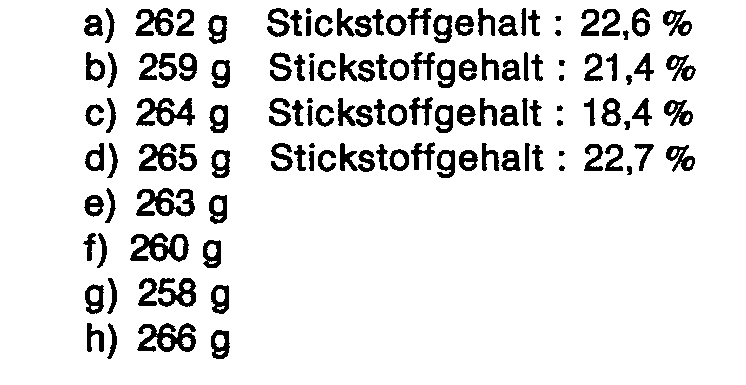
Man verfährt mengenmäßig genau nach den im Beispiel 7, Variante (a) enthaltenden Angaben, führt die Kondensation jedoch bei Raumtemperatur im Verlaufe von 8 Stunden durch. Anschließend wird das durch Filtration isolierte Biomassen-Mischkondensat bei 110°C getrocknet. Hierbei tritt eine vollständige Sterilisation des Verfahrensproduktes ein. In der Mutterlauge ist nur eine sehr geringe Menge an Zellinhaitsstoffen vorhanden.In terms of quantity, the procedure is exactly as described in Example 7, variant (a), but the condensation is carried out at room temperature over a period of 8 hours. The biomass mixed condensate isolated by filtration is then dried at 110 ° C. This results in complete sterilization of the process product. There is only a very small amount of cell contents in the mother liquor.
Man erhält ein Biomassen-Mischkondensat in einer Ausbeute von 175 g ; Stickstoffgehalt : 18,4 %.A biomass mixed condensate is obtained in a yield of 175 g; Nitrogen content: 18.4 % .
Man verfährt genau wie in Beispiel 7, Variante (a) beschrieben, führt die Mischkondensation jedoch bei 75 °C aus. Nach erfolgter Kondensation und Neutralisation des Reaktionsgemisches mit Ammoniak und Abkühlung auf 35°C werden 2g Dextrinpulver und 3g einer Fleischextrakt-Nährstofflösung zugegeben. Man rührt anschließend 48 Stunden bei 35 °C, um Sporen bildende Mikroorganismen wieder zur Keimbildung und Zellteilung anzuregen. Anschließend wird unter Zusatz von 20 g einer 30 %igen Formalin-Lösung 2 Stunden- auf 80 °C erhitzt. - Nach Filtration und Trocknung erhält man 165 g an Mischkondensat mit einem Stickstoff-Gehalt von 18,5 %.The procedure is exactly as described in Example 7, variant (a), but the mixed condensation is carried out at 75 ° C. After condensation and neutralization of the reaction mixture with ammonia and cooling to 35 ° C., 2 g of dextrin powder and 3 g of a meat extract nutrient solution are added. The mixture is then stirred at 35 ° C. for 48 hours in order to stimulate spore-forming microorganisms for nucleation and cell division. The mixture is then heated to 80 ° C. for 2 hours with the addition of 20 g of a 30 % strength formalin solution. - After filtration and drying, 165 g of mixed condensate with a nitrogen content of 18.5% are obtained.
Die gekoppelte Pasteurisierung und Sterilisation durch die verwendeten Reagenzien führt zu einem vollig keimfreien Mischkondensat.The coupled pasteurization and sterilization by the reagents used leads to a completely germ-free mixed condensate.
a) 1 000 g eines aus einer vollbiologisch arbeitenden Kläranlage für industrielle und kommunale Abwässer stammenden, etwa 8,5 % Feststoff enthaltenden Bakterienbelebtschlammes, der aus verschiedensten Mikroorganismen besteht und mit Spuren an den Pflanzenschutzmitteln (Herbiziden)
- N-Methyl-isopropyl-carbamat (0,5 g),
- 4-Amino-6-tert.-butyl-3-methylthio-4,5-dihydro-1,2,4-triazin-5-on (0,5 g),
- N-(3-Benzthiazolyl)-N,N'-dimethylharnstoff (0,5 g),
verunreinigt ist, werden in einem Schliffbecherglas unter intensivem Rühren zunächst mit 100 einer 30 %igen Formalin-Lösung (1 Mol) und 25 g 85 %iger Phosphorsäure auf 80 °C erwärmt. Hierbei werden Bakterienzellwände gesprengt und die enthaltenden Pflanzenschutzmittel durch Reaktion ihrer NH2- bzw. NH-Funktionen mit Formaldehyd unter N-Methylolierung (N-CH2-O-CH2-N〈) bzw. Methylenverknüpfung (N-CH2-N〈) desaktiviert und hydrolysiert. - Nach dieser Primärreaktion werden Proben entnommen und zentrifugiert. Durch Titration des Formaldehyds in den Filtraten wird analytisch ermittelt, daß 0,05 Mol an Formaldehyd verbraucht worden sind. - Anschließend werden zu dem Reaktionsgemisch eine Lösung von 60 g Harnstoff (1 Mol) in 100 g Wasser sowie 10 g einer 30 %igen Formalin-Lösung (0,1 Mol) gegeben. Man läßt 15 Minuten bei 70 °C kondensieren, kühlt dann innerhalb von 30 Minuten auf 45 °C ab und erhält ein leicht filtrierbares, pulvriges Biomassen-Mischkondensat. Dieses Biomassen-Mischkondensat wird mit Calciumhydroxid neutralisiert, wobei sich schwerlösliches Calciumphosphat in feinst verteilter Form in der Biomassen-Kondensat-Dispersion niederschlägt. Man filtriert das pulvrige Produkt ab, wäscht mit einer 2 %igen wäßrigen Ammoniak-Lösung, trocknet das Produkt anschließend bei 70 °C unter vermindertem Druck und erhält so ein nahezu geruchloses Pulver in einer Ausbeute von 176 g ; der Stickstoffgehalt beträgt 13,4 %.a) 1,000 g of a bacterial activated sludge from a fully biological sewage treatment plant for industrial and municipal wastewater, containing about 8.5% solids, which consists of a wide variety of microorganisms and contains traces of crop protection agents (herbicides)
- N-methyl-isopropyl-carbamate (0.5 g),
- 4-amino-6-tert-butyl-3-methylthio-4,5-dihydro-1,2,4-triazin-5-one (0.5 g),
- N- (3-benzothiazolyl) -N, N'-dimethylurea (0.5 g),
is contaminated, are first heated to 80 ° C. in a cut glass beaker while stirring vigorously with 100 of a 30% formalin solution (1 mol) and 25 g of 85% phosphoric acid. Bacterial cell walls are blown up and the pesticides contained by reacting their NH 2 or NH functions with formaldehyde with N-methylolation (N-CH 2 -O-CH 2 -N 〈) or methylene linkage (N-CH 2 - N 〈) deactivated and hydrolyzed. - After this primary reaction, samples are taken and centrifuged. Titration of the formaldehyde in the filtrates analytically determined that 0.05 mol of formaldehyde had been consumed. - A solution of 60 g of urea (1 mol) in 100 g of water and 10 g of a 30% strength formalin solution (0.1 mol) are then added to the reaction mixture. The mixture is allowed to condense at 70 ° C. for 15 minutes, then cooled to 45 ° C. in the course of 30 minutes and an easily filterable, powdery biomass mixed condensate is obtained. This biomass mixed condensate is neutralized with calcium hydroxide, with poorly soluble calcium phosphate being reflected in the finely divided form in the biomass condensate dispersion. The powdery product is filtered off, washed with a 2% aqueous ammonia solution, the product is then dried at 70 ° C. under reduced pressure and an almost odorless powder is thus obtained in a yield of 176 g; the nitrogen content is 13.4%.
Das Verfahrensprodukt enthält, - bezogen auf die Mischung von kondensierten Proteinen, Enzymen, Nucleinsäuren und anderen Zellinhaltsstoffen -, etwa 39 Gew.-% an Polymethylenharnstoffen der idealisierten Konstitution

Biologische Prüfungen auf Sterilität der pulvrigen Biokondensate wie auch der Filtrate zeigen, daß die pulvrigen Verfahrensprodukte und die Filtrate frei von Bakterien und pathogenen Krankheitserregern sind.Biological tests for sterility of the powdery biocondensates as well as the filtrates show that the powdery process products and the filtrates are free from bacteria and pathogenic pathogens.
b) Man verfährt genau wie unter (a) beschrieben, ersetzt aber die als Katalysator verwendete Phosphorsäure durch 18,4 g an konzentrierter Schwefelsäure. Nach Durchführung der Kondensation wird mit Calciumhydroxid neutralisiert. Man isoliert ein Calciumsulfat enthaltendes Biomassen-Mischkondensat. Ausbeute : 171 g.b) The procedure is exactly as described under (a), but the phosphoric acid used as catalyst is replaced by 18.4 g of concentrated sulfuric acid. After the condensation has been carried out, it is neutralized with calcium hydroxide. A biomass mixed condensate containing calcium sulfate is isolated. Yield: 171 g.
a) Man verwendet wie in Beispiel 17 beschrieben eine Menge von 865 g des dort genannten Bakterienbelebtschlammes, welcher etwa 73,8 g Trockensubstanz enthält, erhitzt diese Biomasse in Gegenwart von 0,1 Mol Formaldehyd unter intensivem Rühren 30 Minuten lang auf 70 °C, fügt dann 63 g Melamin hinzu und versetzt nach weiteren 5 Minuten mit 150 g einer 30 %igen wäßrigen Formalin-Lösung (1,5 Mol) sowie mit 0,2 g Kaliumcarbonat als Methylolierungskatalysator. Hierbei erzeugt man in der Biomasse innerhalb einer halben Stunde im wesentlichen das Trimethylolmelamin der Konstitution

Anschließend kühlt man auf 45°C ab. Nachdem die Innentemperatur der noch unfiltrierbaren Biomassen-Dispersion 45°C erreicht hat, fügt man 18 konzentrierte Schwefelsäure hinzu. Die Biomassen-Trimethylolmelamin-Kondensation setzt bei einem pH-Wert von ca. 2,5 sofort ein. Man rührt 2 Stunden nach und neutralisiert mit 24 g Calciumhydroxid. Das Biomassen-Mischkondensat wird abfiltriert und fällt nach der Trocknung bei 70 °C im Vakuum in einer Ausbeute von 184g an. Stickstoffgehalt des Biomassen-Mischkondensates : 28,1 %. Der Stickstoffgehalt des Biomassen-Mischkondensates ist also von ca. 7,4 Gew.-%, - bezogen auf Trockengewicht des Ausgangsproduktes -, auf 28,1 % angehoben worden, d.h. um einen Wert von Δ = + 20,7 % erhöht. Der Phosphorgehalt des Mischkondensates beträgt 2 %, der Calcium-sulfat-Anteil ca. 12,8 Gew.-%.Then it is cooled to 45 ° C. After the internal temperature of the still unfilterable biomass dispersion has reached 45 ° C, 18 concentrated sulfuric acid are added. The biomass trimethylol melamine condensation starts immediately at a pH of approx. 2.5. The mixture is stirred for 2 hours and neutralized with 24 g of calcium hydroxide. The biomass mixed condensate is filtered off and, after drying at 70 ° C. in a vacuum, is obtained in a yield of 184 g. Nitrogen content of the biomass mixed condensate: 28.1%. The nitrogen content of the biomass mixed condensate has thus been increased from approximately 7.4% by weight, based on the dry weight of the starting product, to 28.1%, i.e. increased by a value of Δ = + 20.7%. The phosphorus content of the mixed condensate is 2%, the calcium sulfate content is approximately 12.8% by weight.
Nach der Durchführung der erfindungsgemäßen Mischkondensation wird in einem Parallelversuch der wäßrige Überstand über dem Biomassen-Mischkondensat durch Zentrifugierung als fast farblose bzw. nur leicht gelbstichige Flüssigkeit isoliert. Beim Eindampfen dieser wäßrigen Phase bei einem Druck von 14 Torr verbleiben etwa 7 g eines Rückstandes, der im wesentlichen aus Zellinhaltsstoffen, wie Polysacchariden und Oligopeptiden bzw. Glykoproteiden unbekannter Konstitution besteht und sich als wertvoller Nährstoff für die verschiedensten mikrobiellen System eignet. Bei dieser Variante des erfindungsgemäßen Verfahrens wird somit nur eine relativ geringe Menge an Zellinhaltsstoffen in die Mutterlauge überführt.After carrying out the mixed condensation according to the invention, the aqueous supernatant above the biomass mixed condensate is isolated by centrifugation as an almost colorless or only slightly yellowish liquid. When this aqueous phase is evaporated at a pressure of 14 torr, about 7 g of a residue remain, which essentially consists of cell contents, such as polysaccharides and oligopeptides or glycoproteids of unknown constitution, and is suitable as a valuable nutrient for the most diverse microbial systems. In this variant of the method according to the invention, only a relatively small amount of cell constituents is thus transferred into the mother liquor.
b) Man verfährt genau wie unter (a) beschrieben, mit dem Unterschied, daß die eingesetzte Trimethylolmelaminmenge verringert wird, indem man 31,5 g Melamin (0,25 Mol) und 75 g einer 30 %igen Formalinlösung verwendet (0,75 Mol). Ansonsten werden die Kondensationsbedingungen eingehalten, die unter (a) beschrieben sind. Man gewinnt ein ausgezeichnet filtrierbares Biomassen-Mischkondensat.

Das erhaltene Produkt bindet Ionen von Schwermetallen, wie Blei, Quecksilber und Kupfer, ferner Ionen von Metallen wie Zink, Cadmium und Chrom.The product obtained also binds ions of heavy metals such as lead, mercury and copper Ions from metals such as zinc, cadmium and chromium.
c) Man verfährt genau wie unter (b) beschrieben, setzt jedoch lediglich 15,75 g (0,125 Mol) Melamin und 37,5 g einer wäßrigen 30 %igen Formalin-Lösung (0,375 Mol entsprechend 11,2 g Formaldehyd) ein. - Man erhält ein pulvriges Biomassen-Mischkondensat in einer Ausbeute von 100 g.c) The procedure is exactly as described under (b), but only 15.75 g (0.125 mol) melamine and 37.5 g of an aqueous 30% formalin solution (0.375 mol corresponding to 11.2 g formaldehyde) are used. - A powdery biomass mixed condensate is obtained in a yield of 100 g.
Bei dieser Ausführungsform des erfindungsgemäßen Verfahrens werden etwa 21 g an dreidimensional vernetzten Polymethylenmelaminen der idealisierten Konstitution

Stickstoffgehalt des Biomassen-Trimethylolmelamin-Mischkondensatej : 15,5 %.Nitrogen content of the biomass-trimethylolmelamine mixed condensatej: 15.5%.
d) Verwendet man gemäß Ausführungsform (c) lediglich 0,03 Mol Melamin (3,78 g) und zur Trimethylolmelaminbildung 0,09 Mol Formaldehyd (9 g 30 %iger Formaldehydlösung) und verfährt wie unter (a) beschrieben, so wird ebenfalls ein flockbares, filtrierbares Biomassen-Mischkondensat erhalten. Ausbeute : 79 g ; Stickstoffgehalt : 8,4 % ; P-Gehalt : 3,9 %.d) If, according to embodiment (c), only 0.03 mol of melamine (3.78 g) and 0.09 mol of formaldehyde (9 g of 30% strength formaldehyde solution) are used for the formation of trimethylolmelamine and the procedure is as described under (a), a Obtain flocculable, filterable biomass mixed condensate. Yield: 79 g; Nitrogen content: 8.4%; P content: 3.9%.
e) Man verfährt wie unter (a) beschrieben, verwendet aber eine Mischung von Aminoplastbildnern folgender Art : 6 g Harnstoff (0,1 Mol), 11,4 g Azulminsäure, - hergestellt gemäß DT-PS 662 338 -, 1,26 g Melamin (0,01 Mol) und 18,4 g konzentrierte Schwefelsäure als Katalysator. Man kondensiert, neutralisiert anschließend mit Calciumoxid und arbeitet, wie in Beispiel 16 beschrieben, auf. Ausbeute : 121 g ; Stickstoffgehalt : ca. 11,7 Gew.-%.e) The procedure is as described under (a), but a mixture of aminoplast formers of the following type is used: 6 g of urea (0.1 mol), 11.4 g of azulmic acid, - prepared in accordance with DT-PS 662 338 -, 1.26 g Melamine (0.01 mol) and 18.4 g concentrated sulfuric acid as a catalyst. It is condensed, then neutralized with calcium oxide and worked up as described in Example 16. Yield: 121 g; Nitrogen content: approx. 11.7% by weight.
Durch die Anwesenheit der mitkondensierenden Azulminsäure werden Ionen von Metallen wie Quecksilber, Blei, Cadmium, Zink, Kupfer, Nickel, Eisen, Chrom und Mangan im Biomassen-Mischkondensat fest gebunden. Selbst ein Biomassen-Mischkondensat, das einen Gehalt von 43 ppm Quecksilber, 480 ppm Zink, 320 ppm Kupfer, 2 % Eisen, 216 ppm Nickel, 230 ppm Chrom, 0,21 % Blei und 440 ppm Mangan aufweist, wirkt sich im Pflanzenkeimtest nicht negativ aus.The presence of the co-condensing azulmic acid firmly binds ions of metals such as mercury, lead, cadmium, zinc, copper, nickel, iron, chromium and manganese in the biomass mixed condensate. Even a biomass mixed condensate, which contains 43 ppm mercury, 480 ppm zinc, 320 ppm copper, 2% iron, 216 ppm nickel, 230 ppm chromium, 0.21% lead and 440 ppm manganese, has no effect in the plant germ test negative.
f) Man verfährt wie unter (e) beschrieben, setzt jedoch eine nach bekannten technischen Verfahren hergestellte bereits bei 110 °C getrocknete Biomasse ein, in der weitgehender Zelltod eingetreten ist. Ausbeute : 119 g an pulverförmiger Substanz.f) The procedure is as described under (e), but a biomass which has already been dried at 110 ° C. and has been prepared by known technical processes is used, in which extensive cell death has occurred. Yield: 119 g of powdery substance.
g) Man verfährt wie unter (e) beschrieben, setzt aber die in (f) verwendete, jedoch 2 Monate auf einer Deponie gelagerte, mit Pilzen und anderen Mikroorganismen befallene Biomasse ein. Man erhält ein pulvriges Biomassen-Mischkondensat in einer Ausbeute von 112 g. Das Produkt ist in der Lage, Metallionen sehr fest zu binden.g) The procedure is as described under (e), but the biomass used in (f), but stored in a landfill for 2 months, is infested with fungi and other microorganisms. A powdery biomass mixed condensate is obtained in a yield of 112 g. The product is able to bind metal ions very firmly.
h) Beim Zusatz von 6 g Thioharnstoff zu dem unter (a) angegebenen Reaktionsgemisch wird ebenfalls ein Biomassen-Mischkondensat erhalten, das in der Lage ist, Ionen der Metalle Quecksilber, Blei, Kupfer, Chrom, Zink und Cadmium zu binden.h) When 6 g of thiourea are added to the reaction mixture given under (a), a biomass mixed condensate is also obtained which is able to bind ions of the metals mercury, lead, copper, chromium, zinc and cadmium.
Eintopfverfahren, bei dem N-Methylolverbindungen der Biomasse und des Melamins nicht in isolierter Form eingesetzt, sondern in situ nach primärer Vorkondensation der Biomasse mit Aldehyd erzeugt werden und anschließend sauer kondensiert wird.One-pot process in which N-methylol compounds of biomass and melamine are not used in isolated form, but are generated in situ after primary precondensation of the biomass with aldehyde and then acid-condensed.
1100 g eines aus einer vollbiologisch arbeitenden Kläranlage für industrielle und kommunale Abwässer stammenden, etwa 11,2 Gew.-% Feststoff enthaltenden Bakterienbelebtschlammes, der aus verschiedensten Mikroorganismen besteht, werden zunächst zur Verbesserung der Rührbarkeit mit 200 g Wasser versetzt. Hierauf werden 100 g einer 30 %igen wäßrigen Formaldehyd-Lösung (1 Mol) zugegeben. Anschließend wird 2 Stunden bei pH = 7,5 in Abwesenheit von Melamin bei 96 °C kondensiert. Danach gibt man 63 g (0,5 Mol) pulvriges Melamin und zusätzlich 50 g 30 %iger Formalinlösung (0,5 Mol) hinzu und kondensiert eine Stunde bei 96 °C. Man läßt auf 45 °C abkühlen, versetzt das Reaktionsgemisch mit 1,84 g konzentrierter Schwefelsäure und hält 4 Stunden unter intensivem Rühren auf dieser Temperatur. Man neutralisiert mit Calciumhydroxid und erhält ein sehr leicht filtrierbares Biomassen-Mischkondensat. Ausbeute des getrockneten Produktes : 195 g ; Stickstoffgehalt des Mischkondensates : 27,3 % ; Calcium- sulfat-Anteil ca. 2,5 Gew.-%.1100 g of a bacterial activated sludge from a fully biological wastewater treatment plant for industrial and municipal wastewater, containing about 11.2% by weight of solids, which consists of various microorganisms, are first mixed with 200 g of water to improve stirrability. Then 100 g of a 30% aqueous formaldehyde solution (1 mol) are added. It is then condensed for 2 hours at pH = 7.5 in the absence of melamine at 96 ° C. Then 63 g (0.5 mol) of powdery melamine and an additional 50 g of 30% formalin solution (0.5 mol) are added and the mixture is condensed at 96 ° C. for one hour. The mixture is allowed to cool to 45 ° C., 1.84 g of concentrated sulfuric acid are added to the reaction mixture and the mixture is kept at this temperature for 4 hours with vigorous stirring. It is neutralized with calcium hydroxide and a very easily filterable biomass mixed condensate is obtained. Yield of the dried product: 195 g; Nitrogen content of the mixed condensate: 27.3 % ; Calcium sulfate content approx. 2.5% by weight.
Im biologischen Test erweist sich das Produkt als völlig keimfrei. Durch Eindunsten der wäßrigen Mutterlauge werden etwa 10 g an polysaccharid- und peptidartigen Zellinhaltsstoffen isoliert, ebenso etwa 0,9 g an Hydroxybuttersäuren als Bestandteile von zerstörten Bakterienzellwänden.In the biological test, the product proves to be completely germ-free. By evaporation of the aqueous mother liquor, about 10 g of polysaccharide and peptide-like cell contents are isolated, likewise about 0.9 g of hydroxybutyric acids as components of destroyed bacterial cell walls.
- a) Man verfährt wie in Beispiel 17, Variante (a) beschrieben, erhöht jedoch die Biomassen-Menge auf 2 000 g und setzt neben 200 g 30 %iger Formalinlösung (2 Mol) auch 200 g an 85 %iger Phosphorsäure ein. Man erwärmt zwei Stunden auf 80 °C, wobei eine Vorkondensation unter hydrolyisierenden, proteinabbauenden Bedingungen durchgeführt wird. Anschließend fügt man 40g 30%ige Formaldehydlösung und zuletzt 120 g Harnstoff (2 Mol) zu, wobei die Mischkondensation sofort einsetzt. Man läßt im Verlaufe von 2 Stunden auf 45 °C erkalten und neutralisiert dann mit Calciumhydroxid. Nach erfolgter Filtration und Trocknung erhält man ein Biomassen-Mischkondensat in einer Ausbeute von 525 g. Dieses Kondensat besitzt infolge der Bildung von unlöslichem Calciumhydrogenphosphat bei der Neutralisation der großen menge an Phosphorsäure, die als Katalysator verwendet wurde, einen Calciumphosphat-Anteil von etwa 46,6 Gew.-% und einen Stickstoffgehalt von 13,8 Gew.-%.a) The procedure is as described in Example 17, variant (a), but the amount of biomass is increased to 2,000 g and, in addition to 200 g of 30% formalin solution (2 mol), 200 g of 85% phosphoric acid are used. The mixture is heated to 80 ° C. for two hours, precondensation being carried out under hydrolyzing, protein-degrading conditions. Then 40 g of 30% formaldehyde solution and finally 120 g of urea (2 moles) are added, the mixed condensation beginning immediately. The mixture is allowed to cool to 45 ° C. in the course of 2 hours and then neutralized with calcium hydroxide. After filtration and drying, a biomass mixed condensate is obtained in a yield of 525 g. This condensate has a calcium phosphate content of about 46.6% by weight and a nitrogen content of 13.8% by weight due to the formation of insoluble calcium hydrogen phosphate when neutralizing the large amount of phosphoric acid used as a catalyst.
- b) Verwendet man eine Menge von nur 20 g an 85 %iger Phosphorsäure als Katalysator und kondensiert genau wie unter (a) beschrieben, indem man die primäre Formaldehydkondensation 8 Stunden bei 98 °C bei einem pH-Wert von 3,4 durchführt, also unter Bedingungen arbeitet, unter denen Proteine, Zellwände und Zellinhaltsstoffe hydrolysieren, so erhält man nach dem Filtrieren und Trocknen ein Biomassen-Mischkondensat in einer Ausbeute von 341 g. Der Calciumhydrogenphosphat-Gehalt beträgt etwa 7,2 Gew.-% ; der Stickstoffgehalt beträgt 17,8 Gew.-%.b) If an amount of only 20 g of 85% phosphoric acid is used as a catalyst and condensed exactly as described under (a), the primary formaldehyde condensation is carried out for 8 hours at 98 ° C. at a pH of 3.4, that is works under conditions under which proteins, cell walls and cell contents hydrolyze, so after filtering and drying a biomass mixed condensate is obtained in a yield of 341 g. The calcium hydrogen phosphate content is about 7.2% by weight; the nitrogen content is 17.8% by weight.
971 g eines etwa 7,4 Gew.-% Trockensubstanz enthaltenden Bakterienbelebtschlammes, dessen mikrobielle Bestandteile noch in voller Aktivität sind, werden mit 100 g Wasser und 100 g einer 30 %igen Formalinlösung (1 Mol Formaldehyd) bei Raumtemperatur ohne Zusatz eines basischen Methylolierungskatalysators 90 Minuten vorkondensiert. Anschließend werden 60 g Harnstoff (1 Mol) in der Dispersion gelöst, zusätzlich 10 Formalinlösung (30%ig) zugegeben, und nach 10 Minuten werden 18,4g Schwefelsäure als saurer Kondensationskatalysator zugesetzt. Man kondensiert 4 Stunden bei Raumtemperatur unter sauren Bedingungen (pH-Wert = 2,3). Anschließend wird das Biomassenmischkondensat filtriert, durch Waschen mit Wasser von Schwefelsäure befreit und bei 80 °C unter einem Druck von 14 Torr getrocknet. Man erhält 133 g eines pulvrigen Biomassen-Mischkondensates, das einen Stickstoffgehalt von 24,7 % besitzt.971 g of a bacterial activated sludge containing about 7.4% by weight of dry substance, the microbial components of which are still in full activity, are mixed with 100 g of water and 100 g of a 30% formalin solution (1 mol of formaldehyde) at room temperature without the addition of a basic methylolation catalyst 90 Minutes precondensed. Then 60 g of urea (1 mol) are dissolved in the dispersion, an additional 10 formalin solution (30% strength) are added, and after 10 minutes 18.4 g of sulfuric acid are added as an acidic condensation catalyst. It is condensed for 4 hours at room temperature under acidic conditions (pH = 2.3). The biomass mixed condensate is then filtered, freed from sulfuric acid by washing with water and dried at 80 ° C. under a pressure of 14 torr. 133 g of a powdery biomass mixed condensate are obtained, which has a nitrogen content of 24.7%.
Die erfindungsgemäße Biomassen-Mischkondensation kann auch so durchgeführt werden, daß man in der ersten Stufe eine relativ große Menge an Aldehyd zugibt, wobei vorwiegend Methylolierungsprodukte von Proteinen sowie N-Methylolierungsprodukte von Nucleinbasen innerhalb der Makromoleküle der Nucleinsäuren erhalten werden, die in der zweiten Stufe mit den jeweiligen Aminoplastbildnern unter sauren Bedingungen kondensiert werden.The biomass mixed condensation according to the invention can also be carried out by adding a relatively large amount of aldehyde in the first stage, predominantly methylolation products of proteins and N-methylolation products of nucleic bases within the macromolecules of the nucleic acids which are obtained in the second stage the respective aminoplast formers are condensed under acidic conditions.
1 093 g eines aus einer biologisch arbeitenden Kläranlage für industrielle und kommunale Abwässer stammenden, etwa 11,2 Gew.-% Feststoff enthaltenden Bakterienbelebtschlammes, dessen mikrobielle Bestandteile noch eine hohe Aktivität aufweisen, werden mit 150 g Wasser und 200 g einer 30 %igen wäßrigen Formaldehyd-Lösung (2 Mol) 2 Stunden bei 98 °C umgesetzt. Anschließend wird auf Raumtemperatur abgekühlt. Zu diesem Zeitpunkt ist die methylolierte Biomasse frei von phatogenen Krankheitserregern, jedoch läßt sich eine Isolierung der N-Methylolierungsprodukte durch Filtration nicht durchführen. Man fügt eine Lösung von 120 g Harnstoff (2 Mol) in 200 g Wasser zu und versetzt mit 18,4 g konzentrierter Schwefelsäure. Es wird 6 Stunden bei Raumtemperatur bei pH = 2,3 kondensiert und dann mit Calciumhydroxid neutralisiert. Man erhält ein pulvriges, gut filtrierbares Biomassen-Mischkondensat. Ausbeute nach der Trocknung bei 80 °C : 257 g ; Stickstoffgehalt des Kondensates : 22,7 % ; Calcium- sulfat-Gehalt : 9,4 %.1,093 g of a bacterial activated sludge from a biological treatment plant for industrial and municipal waste water, containing about 11.2% by weight of solids, the microbial components of which still have a high activity, are mixed with 150 g of water and 200 g of a 30% aqueous solution Formaldehyde solution (2 mol) reacted at 98 ° C for 2 hours. It is then cooled to room temperature. At this point in time, the methylolated biomass is free of phatogenic pathogens, but the N-methylolation products cannot be isolated by filtration. A solution of 120 g of urea (2 mol) in 200 g of water is added and 18.4 g of concentrated sulfuric acid are added. It is condensed for 6 hours at room temperature at pH = 2.3 and then neutralized with calcium hydroxide. A powdery, easily filterable biomass mixed condensate is obtained. Yield after drying at 80 ° C: 257 g; Nitrogen content of the condensate: 22.7%; Calcium sulfate content: 9.4%.
Biologische Prüfungen zeigen, daß dieses Biomassen-Mischkondensat steril und frei von phatogenen Krankheitserregern ist.Biological tests show that this biomass mixed condensate is sterile and free of phatogenic pathogens.
1 000 g einer aus einer biologisch arbeitenden Kläranlage stammenden, etwa 8,4 Gewichtsprozent Trockensubstanz enthaltenden Biomasse, die sich im Zustand reger Zellteilung befindet, werden mit 18,4 g 85 %iger Phosphorsäure versetzt und 2 Stunden auf 96 °C erhitzt. Hierbei wird Kohlendioxid in einer Menge von 2,2 g durch ablaufende Zersetzungsvorgänge entbunden. Das entweichende Kohlendioxid wird in einer mit Natronlauge beschickten Vorlage aufgefangen und nach der Bariumcarbonat-Methode titrimetrisch bestimmt. Nachdem die Kohlendioxid-Entwicklung innerhalb von 3 Stunden auf den Nullwert abgesunken ist, verfährt man wie folgt :
- Zu 1 000 g der vorgenannten Biomasse fügt man 100 g an schwarzer Rohazulminsäure, - hergestellt gemäß DT-PS 662 338 -, und 100 g einer 30 %igen wäßrigen Formalin-Lösung (1 Mol) hinzu. Man kondensiert 8 Stunden bei 90 °C, wobei 1,36 g (0,03 Mol) Kohlendioxid entbunden werden. Diese Kohlendioxid-Entwicklung ist auf die Bildung von F2-Fehlerstellen durch Decarboxylierung von F1-Fehlerstellen in der Azulminsäure zurückzuführen. Es werden etwa 0,87 Gew.-% an F2-Fehlerstellen der Konstitution


- 100 g of black crude azulminic acid, prepared according to DT-PS 662 338, and 100 g of a 30% strength aqueous formalin solution (1 mol) are added to 1,000 g of the aforementioned biomass. It is condensed for 8 hours at 90 ° C., 1.36 g (0.03 mol) of carbon dioxide being released. This evolution of carbon dioxide is due to the formation of F 2 defects by decarboxylation of F 1 defects in azulmic acid. There are about 0.87% by weight of F 2 defects in the constitution
Anschließend wird die Biomassen-Azulminsäure-Kondensat-Mischung auf 80 °C abgekühlt und mit 60 g (1 Mol) Harnstoff versetzt. Nach 10 Minuten werden in einem Guß 100 g einer 30 %igen Formalinlösung (1 Mol) zugegeben und anschließend werden 18,4 g 85 %ige Phosphorsäure hinzugefügt. Man kondensiert 2 Stunden bei 80 °C und erhält ein ausgezeichnet filtrierbares Biomasse-Azulminsäure-Harnstoff-Formaldehyd-Kondensat. Ausbeute nach dem Waschen mit 2 %iger wäßriger Ammoniaklösung und nach Trocknung bei 80 °C unter einem Druck von 15 Torr : 288 g ; N-Gehalt : 24,2 % ; Phosphorgehalt : 1,3 %.The biomass-azulmic acid-condensate mixture is then cooled to 80 ° C. and mixed with 60 g (1 mol) of urea. After 10 minutes, 100 g of a 30% formalin solution (1 mol) are added in one pour and then 18.4 g of 85% phosphoric acid are added. It is condensed for 2 hours at 80 ° C. and an excellent filterable biomass-azulmic acid-urea-formaldehyde condensate is obtained. Yield after washing with 2% aqueous ammonia solution and after drying at 80 ° C. under a pressure of 15 torr: 288 g; N content: 24.2%; Phosphorus content: 1.3%.
Beim Eindampfen der Mutterlauge werden nur 8 Gew.-% an Polysaccharid- und anderen Zellinhaltsstoffen isoliert.When the mother liquor is evaporated, only 8% by weight of polysaccharide and other cell contents are isolated.
Im übrigen ist die kondensierte Azulminsäure bei der Umsetzung vollständig gegenüber BlausäureAbspaltung stabilisiert worden.In addition, the condensed azulmic acid was completely stabilized during the reaction against hydrogen cyanide elimination.
Die in der Ausgangsbiomasse vorhandenen Metallmengen von 0,0043 % Quecksilber, 0,0005 % Cadmium, 0,042 % Zink, 0,032 % Kupfer, 1,8 % Eisen, 0,022 % Nickel, 0,03 % Chrom und 0,19 % Blei sind in dem erhaltenen Biomassen-Mischkondensat fest gebunden. Dies zeigt sich daran, daß der Metallgehalt in der Mutterlauge (= Abwasser) des obigen Biomassen-Kondensat-Ansatzes nach der erfindungsgemäßen Umsetzung um den Faktor 102 bis 103 gesunken ist. - Im einzelnen wurden folgenden Metallkonzentrationen im Abwasser gefunden :
- 0,25 mg Zink pro Liter
- 0,13 mg Blei pro Liter
- weniger als 0,1 . 10-6 g Chrom pro Liter
- weniger als 0,1 . 10-6 g Kupfer pro Liter
- weniger als 0,1 . 10-6 g Quecksilber pro Liter
- 0.25 mg zinc per liter
- 0.13 mg lead per liter
- less than 0.1. 10- 6 g chromium per liter
- less than 0.1. 10- 6 g copper per liter
- less than 0.1. 10- 6 g of mercury per liter
In 100 g der eingesetzten Biomassen waren etwa 43 mg Quecksilber enthalten ; davon gelangen nach der erfindungsgemäßen Umsetzung nur 0,0001 mg in das Abwasser.About 100 mg of the biomass used contained about 43 mg of mercury; of these, only 0.0001 mg reach the wastewater after the reaction according to the invention.
Man verwendet 1 000 g einer aus einer vollbiologisch arbeitenden Kläranlage stammenden, etwa 8,4 Gew.-% an Trockensubstanz enthaltenden Biomasse, die aus den verschiedensten Mikroorganismen besteht. Diese Biomasse ist durch 3-tägige Lagerung bei Raumtemperatur ohne weitere Nährstoffzufuhr bereits in starker Zersetzung begriffen, wobei sich übelriechende Geruchsträger gebildet haben. Man rührt in diese wäßrige Biomassen-Aufschlämmung 100 g einer mit Formaldehyd kondensierten und gegenüber Blausäure-Rückspaltung stabilisierten Azulminsäure ein. Danach fügt man 100 g 30 %ige Formalin-Lösung hinzu, erhitzt eine halbe Stunde auf 80 °C, gibt anschließend 60 g (1 Mol) Harnstoff und nach weiteren 10 Minuten 25 g 85 %ige Phosphorsäure hinzu. Es wird 0,5 Stunden bei 80 °C kondensiert, dann auf 50 °C abgekühlt und filtriert.1,000 g of a biomass originating from a fully biological sewage treatment plant and containing about 8.4% by weight of dry substance and consisting of a wide variety of microorganisms are used. This 3-day storage at room temperature without further supply of nutrients has already caused this biomass to decompose strongly, and malodorous odors have formed. 100 g of an azulmic acid condensed with formaldehyde and stabilized against hydrocyanic acid cleavage are stirred into this aqueous biomass slurry. Then 100 g of 30% formalin solution are added, the mixture is heated at 80 ° C. for half an hour, then 60 g (1 mol) of urea are added, and after a further 10 minutes 25 g of 85% phosphoric acid are added. It is condensed at 80 ° C for 0.5 hours, then cooled to 50 ° C and filtered.
Man erhält ein pulvriges, schwarz-graues Biomassen-Mischkondensat ; Ausbeute nach dem Trocknen bei 80 °C unter einem Druck von 16 Torr : 291 g ; Stickstoffgehalt 23,9 % ; Phosphorgehalt : 1,35 %.A powdery, black-gray biomass mixed condensate is obtained; Yield after drying at 80 ° C under a pressure of 16 torr: 291 g; Nitrogen content 23.9%; Phosphorus content: 1.35%.
Das Produkt erweist sich im biologischen Test als völlig keimfrei. Es ist nahezu geruchlos. Völlige Geruchlosigkeit wird durch Nachwaschen mit wenig Aceton oder Methanol erreicht.The product proves to be completely germ-free in the biological test. It is almost odorless. Complete odorlessness is achieved by washing with a little acetone or methanol.
1 000 g eines aus einer biologisch arbeitenden Kläranlage für industrielle und kommunale Abwässer stammenden, etwa 8,4 Gew.-% Feststoff enthaltenden Bakterienbelebtschlammes, der sich in Zellteilung befindet, wird für eine anionisch katalysierte Blausäurepolymerisation eingesetzt.1,000 g of a bacterial activated sludge which comes from a biological treatment plant for industrial and municipal waste water and contains about 8.4% by weight of solids and is in cell division is used for an anionically catalyzed hydrocyanic acid polymerization.
Dazu gibt man zu der gerührten Biomasse 163 g Blausäure, 440 ml Wasser, 25 ml einer 25 %igen wäßrigen Ammoniak-Lösung und 5 g Natriumcyanat hinzu. Diese Mischung wird 7 Stunden bei 70-90 °C gerührt, wobei die Blausäure zu Azulminsäure polymerisiert. Danach zieht man noch enthaltenen Ammoniak und Cyanwasserstoff im Wasserstrahlvakuum ab. Hierbei schäumt die Polymerisat-Biomassen-Dispersion sehr stark auf.163 g of hydrocyanic acid, 440 ml of water, 25 ml of a 25% strength aqueous ammonia solution and 5 g of sodium cyanate are added to the stirred biomass. This mixture is stirred at 70-90 ° C for 7 hours, during which the hydrocyanic acid polymerizes to azulmic acid. Thereafter, ammonia and hydrogen cyanide still present are removed in a water jet vacuum. The polymer-biomass dispersion foams very strongly.
Nach der Entfernung monomerer Blausäure werden 120 g 30 %ige Formaldehyd-Lösung zugesetzt, und es wird eine Stunde bei 100 °C gerührt. Anschließend wird auf 40 °C abgekühlt. Nunmehr werden 120 g Harnstoff (2 Mol) zugegeben. Man läßt 30 Minuten bei 40 °C nachrühren und fügt 10 ml 96 %ige Schwefelsäure zu (pH-Wert = 4). Hierauf werden 200 g 30 %ige Formalinlösung (2 Mol) zugesetzt. Die Polymethylenharnstoffbildung und Mischkondensation setzt sehr rasch ein. Man rührt 6 Stunden bei 40 °C und neutralisiert anschließend mit 13 g Calciumhydroxid. Das erhaltene Biomassen-Azulminsäure-Harnstoff-Formaldehyd-Mischkondensat ist pulvrig und wird durch einfache Filtration isoliert. Das Mischkondensat wird mit 1 000 ml Wasser und anschließend mit 200 ml einer 2 %igen wäßrigen Ammoniak-Lösung gewaschen. Ausbeute nach 20-stündigem Trocknen bei 50 °C 315 g ; Stickstoffgehalt : 28,5 Gew.-%. Das Mischkondensat bindet adsorptiv ca. 10 Gew.-% an Wasser.After monomeric hydrocyanic acid has been removed, 120 g of 30% formaldehyde solution are added, and the mixture is stirred at 100 ° C. for one hour. It is then cooled to 40 ° C. Now 120 g of urea (2 mol) are added. The mixture is stirred at 40 ° C. for 30 minutes and 10 ml of 96% sulfuric acid are added (pH = 4). Then 200 g of 30% formalin solution (2 mol) are added. Polymethylene urea formation and mixed condensation set in very quickly. The mixture is stirred at 40 ° C. for 6 hours and then neutralized with 13 g of calcium hydroxide. The biomass-azulmic acid-urea-formaldehyde mixed condensate obtained is powdery and is isolated by simple filtration. The mixed condensate is washed with 1,000 ml of water and then with 200 ml of a 2% aqueous ammonia solution. Yield after drying for 20 hours at 50 ° C 315 g; Nitrogen content: 28.5% by weight. The mixed condensate binds about 10% by weight of water by adsorption.
Die Metallanalyse des Verfahrensproduktes nach der Methode der Atomadsorption ergibt folgende Werte :

Der Metallgehalt in der Mutterlauge (= Abwasser) beträgt pro Liter :

Man verfährt genau wie in Beispiel 25 beschrieben, erzeugt die Azulminsäure durch Polymerisation der Blausäure in Gegenwart der gleichen Art und Menge an Biomasse, kondensiert aber anschließend die Biomassen-Azulminsäure-Dispersion mit Trimethylolmelamin als Aminoplastbildner. Hierzu verfährt man wie folgt :
- 1 000 g der in Beispiel 25 beschriebenen, etwa 8,4 % Feststoff enthaltenden wäßrigen Biomasse werden mit 163 ml (= 110 g) Blausäure, 440 ml Wasser, 25 ml einer 25 %igen wäßrigen Ammoniak-Lösung und 5 g Natriumcyanat vermengt. Diese Mischung wird 7 Stunden bei 70-90°C gerührt, wobei die Blausäure zu Azulminsäuren polymerisiert. Bei 20-30 °C entfernt man restliche Blausäure und Ammoniak im Wasserstrahlvakuum und sorgt durch langsame Vakuumeinstellung dafür, daß die zu diesem Zeitpunkt noch nicht filtrierbare Azulminsäure-Biomassen-Dispersion nicht überschäumt. Hierauf werden dem Ansatz 120 g 30 %ige Formaldehyd-Lösung beigefügt. Es wird eine Stunde bei 10Q °C kondensiert. Anschließend werden 126 g Melamin (1 Mol) zugesetzt. Man läßt 30 Minuten bei 100 °C rühren und setzt nun 300 g 30 %ige Formaldehyd-Lösung zu. Nach einer halben Stunde läßt man auf 45 °C abkühlen. Hierauf erfolgt Zugabe von 8 ml 96 %iger Schwefelsäure (pH = 4). Man kondensiert vier Stunden bei 45 °C unter intensivem Rühren. Anschließend wird mit 10 g Calciumhydroxid auf pH = 7 eingestellt. Man erhält ein gut filtrierbares Biomassen-Azulminsäure-Trimethylolmelamin-Kondensat. Man wäscht mit 1 000 ml Wasser und 200 ml 2 %iger wäßriger Ammoniak-Lösung. Ausbeute nach 20-stündiger Trocknung bei 60 °C im Vakuumtrockenschrank : 430 g.
- 1,000 g of the aqueous biomass containing about 8.4% solids described in Example 25 are mixed with 163 ml (= 110 g) of hydrocyanic acid, 440 ml of water, 25 ml of a 25% aqueous ammonia solution and 5 g of sodium cyanate. This mixture is stirred for 7 hours at 70-90 ° C, the hydrocyanic acid polymerizes to azulmic acids. At 20-30 ° C, residual hydrocyanic acid and ammonia are removed in a water jet vacuum and slow vacuum setting ensures that the azulmic acid-biomass dispersion, which is not yet filterable, does not foam. 120 g of 30% formaldehyde solution are then added to the batch. It is condensed for one hour at 10 ° C. Then 126 g of melamine (1 mol) are added. The mixture is stirred at 100 ° C. for 30 minutes and 300 g of 30% formaldehyde solution are then added. After half an hour, the mixture is allowed to cool to 45 ° C. 8 ml of 96% sulfuric acid (pH = 4) are then added. It is condensed for four hours at 45 ° C. with vigorous stirring. The pH is then adjusted to 7 using 10 g of calcium hydroxide. A readily filterable biomass azulmic acid trimethylol melamine condensate is obtained. It is washed with 1,000 ml of water and 200 ml of 2% aqueous ammonia solution. Yield after drying for 20 hours at 60 ° C. in a vacuum drying cabinet: 430 g.
Stickstoffgehalt des Mischkondensates : 32,5 %.Nitrogen content of the mixed condensate: 32.5%.
Metallgehalt des Biomassen-Azulminsäure-Trimethylolmelamin-Mischkondensates :


Das hochgetrocknete Verfahrensprodukt bindet bei offener Lagerung bei normaler Luftfeuchtigkeit etwa 8-10 Gew.-% an Wasser adsorptiv, wobei es seine pulvrige Form beibehält.The highly dried process product binds about 8-10% by weight of water adsorptively in open storage at normal atmospheric humidity, while maintaining its powdery form.
Man verwendet 1 000 einer aus einer vollbiologisch arbeitenden Kläranlage stammenden, etwa 8,4 Gew.-% Trockensubstanz enthaltenden Biomasse, die aus verschiedensten Mikroorganismen besteht. Die Biomasse ist durch 5-tägige Lagerung bei 25 °C ohne die Zufuhr von Nährstoffen in mikrobieller und enzymatischer Zersetzung begriffen, wobei sich neben lebenden Pseudomonas-Arten zahlreiche Mikroorganismen im Zustand des Zelltodes befinden. Durch enzymatische katalysierte Zersetzungsreaktionen, Decarboxylierungen von Aminosäuren und anderen Zellinhaltsstoffen werden hierbei übelriechende Geruchsträger entwickelt. Zu dieser Biomasse fügt man 100 g 30 %ige Formalinlösung (1 Mol) hinzu, rührt gut durch und kondensiert eine halbe Stunde bei 95 °C. Anschließend versetzt man bei 74 °C mit 60 g Harnstoff (1 Mol) und leitet die Polymethylenharnstoffbildung bzw. kondensierende Anpfropfung von Polymethylenharnstoffen an reaktive Zentren der Biomassen durch Zugabe von 18,4 g 85 %iger Phosphorsäure ein. Man hält zwei Stunden bei 75 °C, filtriert und wäscht das gut filtrierbare Pulver mit 2 %iger wäßriger Ammoniak-Lösung. Man erhält nach dem Trocknen bei 50 °C unter einem Druck von 18 Torr ein Biomassen-Mischkondensat in einer Ausbeute von 132 g in Form eines nahezu geruchlosen Pulvers.One uses 1,000 of a biomass originating from a fully biological sewage treatment plant and containing approximately 8.4% by weight of dry substance, which consists of various microorganisms. The biomass is in microbial and enzymatic decomposition due to 5 days storage at 25 ° C without the supply of nutrients, whereby in addition to living Pseudomonas species numerous microorganisms are in the state of cell death. Enzymatic catalyzed decomposition reactions, decarboxylation of amino acids and other cell contents are used to develop malodorous odorants. 100 g of 30% formalin solution (1 mol) are added to this biomass, stirred well and condensed at 95 ° C. for half an hour. 60 g of urea (1 mol) are then added at 74 ° C. and the polymethylene urea formation or condensing grafting of polymethylene ureas to reactive centers of the biomass is initiated by adding 18.4 g of 85% phosphoric acid. The mixture is kept at 75 ° C. for two hours, filtered and the readily filterable powder is washed with a 2% aqueous ammonia solution. After drying at 50 ° C. under a pressure of 18 torr, a biomass mixed condensate is obtained in a yield of 132 g in the form of an almost odorless powder.
N-Gehalt des Biomassen-Mischkondensates : 18,6 %N content of the biomass mixed condensate: 18.6%
Phosphor-Gehalt : 2,9 %.Phosphorus content: 2.9%.
In Parallelversuchen wird festgestellt, daß als Kondensationskatalysatoren Schwefelsäure, Oxalsäure, Ameisensäure, Salzsäure, p-Toluolsulfonsäure, phosphorige Säure, Trichloressigsäure, Dichloressigsäure, Fluorwasserstoffsäure zur Herstellung der Biomassen-Mischkondensate ebenfalls brauchbar sind. Phosphorsäure, Schwefelsäure und phosphorige Säure sind die bevorzugt verwendeten Säuren.In parallel experiments it is found that sulfuric acid, oxalic acid, formic acid, hydrochloric acid, p-toluenesulfonic acid, phosphorous acid, trichloroacetic acid, dichloroacetic acid, hydrofluoric acid can also be used as condensation catalysts for the preparation of the biomass mixed condensates. Phosphoric acid, sulfuric acid and phosphorous acid are the preferred acids used.
Man verfährt genau wie in Beispiel 27 beschrieben, fügt jedoch vor der Formaldehydzugabe 1,2 g Natriumsulfid, 0,5 g Natriumhydrogensulfid und 0,4 g an Ammoniumpolysulfiden als Methylolierungskatalysator und Schwefelüberträger zu, um Schwermetalle wie Quecksilber, Blei, Kupfer, Cadmium, etc. in unlösliche Sulfide zu überführen. Bei der anschließenden sauren Kondensation, die nach den im Beispiel 27 enthaltenen Angaben durchgeführt wird, entstehen kleine Mengen an Schwefelwasserstoff, der teilweise mit Formaldehyd zu Polythioformaldehyd reagiert. Unter den sauren Kondensationsbedingungen geht der Polythioformaldehyd Kondensationsreaktionen ein, wobei Schwefelwasserstoff abgespalten wird. Ausbeute des Schwefelwasserstoff-freien Biomassen-Mischkondensates : 133 g. N-Gehalt des Biomassen-Mischkondensates : 18,1 % Phosphor-Gehalt : 2,7 %.The procedure is exactly as described in Example 27, but before the addition of formaldehyde, 1.2 g of sodium sulfide, 0.5 g of sodium hydrogen sulfide and 0.4 g of ammonium polysulfides as methylolation catalyst and sulfur transfer agent are added to remove heavy metals such as mercury, lead, copper, cadmium, etc. to convert into insoluble sulfides. In the subsequent acidic condensation, which is carried out according to the information contained in Example 27, small amounts of hydrogen sulfide are formed, which partially reacts with formaldehyde to form polythioformaldehyde. Under the acidic condensation conditions, the polythioformaldehyde undergoes condensation reactions, whereby hydrogen sulfide is split off. Yield of the hydrogen sulfide-free biomass mixed condensate: 133 g. N content of the biomass mixed condensate: 18.1% phosphorus content: 2.7%.
Man verfährt genau wie in Beispiel 17, Variante (a) beschrieben, verwendet aber zur Neutralisation des etwa 25 g 85 %ige Phosphorsäure enthaltenden Ansatzes etwa 40 g Calciumhydroxid. Durch die Calciumhydroxidzugabe werden zuckerartige, in der Mutterlauge gelöste Zellinhaltsstoffe wie Oligosaccharide und Glykoproteide Mitgefällt, indem sich Komplexe etwa der Zusammensetzung 3 CaO. 2 Saccharose-Moleküle bilden. Durch diese Maßnahme wird die Mutterlauge um ca. 8 g ärmer an hydrolysierten, wasserlöslichen Zellinhaltsstoffen. Anschließend wird überschüssiges Calciumhydroxid durch Begasen des Reaktionsgemisches mit Kohlendioxid in Calciumcarbonat umgewandelt.

In der Mutterlauge des Biomassen-Kondensates sind weniger als 0,01 ppm an Quecksilber vorhanden. Diese Konzentration an Quecksilber kommt nach A. Stock überall in der belebten Natur vor und spielt in diesen Spurenkonzentrationen vermutlich eine positive, biologisch wichtige Rolle.Less than 0.01 ppm of mercury is present in the mother liquor of the biomass condensate. According to A. Stock, this concentration of mercury occurs everywhere in living nature and presumably plays a positive, biologically important role in these trace concentrations.
Man verfährt genau wie in Beispiel 17, Variante (a) beschrieben, setzt jedoch vor der Zugabe des Harnstoffes jeweils als Kettenabbrecher für entstehende Polymethylenharnstoffsegmente einen der nachfolgend genannten Stoffe ein :
- a) 0,1 Mol N-Methylolcaprolactam der Formel
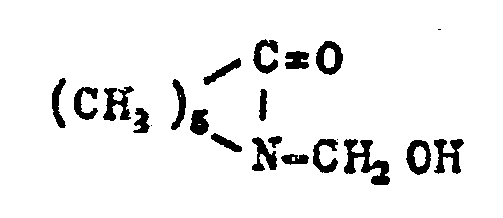
- b) 0,1 Mol eines Azalactams der Formel
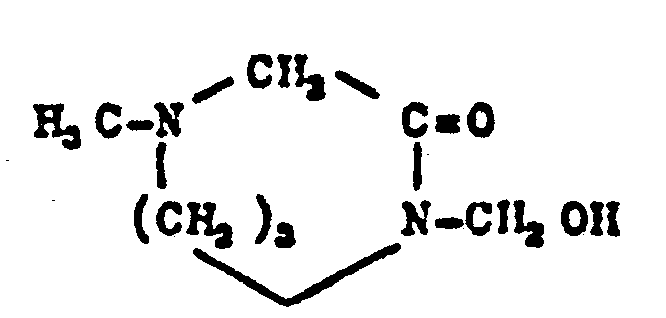
- c) 0,1 Mol Benzolsulfonsäureamid,
- d) 0,1 Mol Acetamid,
- e) 0,1 Mol Thioacetamid,
- f) 0,1 Mol Glyzerin,
- g) 0,1 Mol Trimethylolpropan.
- a) 0.1 mol of N-methylolcaprolactam of the formula
- b) 0.1 mole of an azalactam of the formula
- c) 0.1 mol of benzenesulfonic acid amide,
- d) 0.1 mol of acetamide,
- e) 0.1 mol of thioacetamide,
- f) 0.1 mol of glycerol,
- g) 0.1 mole trimethylolpropane.
Ansonsten führt man die Kondensation nach den im Beispiel 17, Variante (a) enthaltenen Angaben durch.Otherwise, the condensation is carried out according to the information contained in Example 17, variant (a).
Ausbeuten an Biomassen-Mischkondensat :

Durch den Zusatz der Kettenabbrecher werden feinteiligere Biomassen-Mischkondensate erhalten als dies ohne derartige Zusätze der Fall ist. Bei den obigen Umsetzungen werden Biomassen-Mischkondensate erhalten, deren Teilchengrößen zwischen 150 µm und 200 µm liegen. Führt man die Reaktion ohne Kettenabbrecher durch, so liegen die Teilchengrößen der entstehenden Produkte zwischen 350 µm und 550 µm.By adding the chain terminators, finer-particle biomass mixed condensates are obtained than is the case without such additives. In the above reactions, biomass mixed condensates are obtained whose particle sizes are between 150 μm and 200 μm. If the reaction is carried out without a chain terminator, the particle sizes of the resulting products are between 350 μm and 550 μm.
Man verfährt genau wie in Beispiel 17, Variante (b) beschrieben, dispergiert aber vor der Formaldehydzugabe in der Biomasse jeweils einen der folgenden schwer- bzw. unlöslichen Trägerstoffe bzw. eines der folgenden Trägerstoff-Gemische :
- a) 20 g eines Lignin-Cellulose-Homogenisates,
- b) etwa 20 g Kieselsäure. Diese wird dadurch erzeugt, daß man 126 g einer ca. 32 %igen Wasserglaslösung zusetzt, bei 70 °C mit der Biomasse mischt und Kohlendioxid einleitet, wodurch unlösliche Polykieselsäuren in situ in der Biomasse dispergiert werden.
- c) 20 g Quarzpulver,
- d) 10 g Tonerdehydrat und 10 g Antimontrioxid,
- e) 20 g mikrobiell infiziertes und geruchlich nicht einwandfreies Sojamehl,
- f) 20 g mikrobiell infiziertes und in Zersetzung befindliches Fischmehl.
- a) 20 g of a lignin-cellulose homogenate,
- b) about 20 g of silica. This is produced by adding 126 g of an approx. 32% water glass solution, mixing it with the biomass at 70 ° C. and introducing carbon dioxide, as a result of which insoluble polysilicic acids are dispersed in situ in the biomass.
- c) 20 g quartz powder,
- d) 10 g of alumina hydrate and 10 g of antimony trioxide,
- e) 20 g of soybean meal which is microbially infected and does not smell perfectly
- f) 20 g of microbial infected and decomposed fish meal.
Ansonsten wird die Biomassen-Mischkondensation nach den in Beispiel 17, Variante (b) enthaltenen Angaben durchgeführt.Otherwise, the biomass mixed condensation is carried out according to the information contained in Example 17, variant (b).
Ausbeute an gut filtrierbaren und geruchlosen Biomassen-Mischkondensaten : .
Man verfährt genau wie in Beispiel 17, Variante (b) beschrieben, verwendet die gleiche Art und Menge (1 000 g) an einer aus einer biologisch arbeitenden Kläranlage stammenden, 8,4 Gew.-% Trockensubstanz (Proteingehalt ca. 45 Gew.-% bezogen auf Trockensubstanz) enthaltenden Biomasse, setzt aber als Carbonyl-Komponente jeweils eine der nachstehend genannten Verbindungen bzw. eines der folgenden Verbindungs-Gemische ein :
- a) 1 Mol Acetaldehyd,
- b) 1 Mol Isobutyraldehyd,
- c) 0,5 Mol Crotonaldehyd, 0,2 Mol Isobutyraldehyd und 0,2 Mol Formaldehyd,
- d) 0,5 Mol Glyoxal und 0,5 Mol Formaldehyd,
- e) 0,5 Mol Crotonaldehyd und 0,5 Mol Formaldehyd,
- f) 0,5 Mol Acrolein und 0,5 Mol Formaldehyd,
- g) 1,5 Mol Formaldehyd und 0,5 Mol Cyclohexanon,
- h) 2,5 Mol Formaldehyd und 0,5 Mol Methyläthylketon,
- i) 0,5 Mol Glutardialdehyd und 0,5 Mol Formaldehyd,
- j) 0,6 Mol Formaldehyd und 0,5 Mol Salicylaldehyd,
- k) 0,5 Mol Formaldehyd und 0,5 Mol Furfurol,
- I) 0,5 Mol Formaldehyd und 0,5 Mol Chloralhydrat.
- a) 1 mole of acetaldehyde,
- b) 1 mole of isobutyraldehyde,
- c) 0.5 mol of crotonaldehyde, 0.2 mol of isobutyraldehyde and 0.2 mol of formaldehyde,
- d) 0.5 mol of glyoxal and 0.5 mol of formaldehyde,
- e) 0.5 mol of crotonaldehyde and 0.5 mol of formaldehyde,
- f) 0.5 mol of acrolein and 0.5 mol of formaldehyde,
- g) 1.5 mol of formaldehyde and 0.5 mol of cyclohexanone,
- h) 2.5 mol of formaldehyde and 0.5 mol of methyl ethyl ketone,
- i) 0.5 mol of glutardialdehyde and 0.5 mol of formaldehyde,
- j) 0.6 mol of formaldehyde and 0.5 mol of salicylaldehyde,
- k) 0.5 mol of formaldehyde and 0.5 mol of furfural,
- I) 0.5 mol of formaldehyde and 0.5 mol of chloral hydrate.
Zunächst wird in Abwesenheit von Harnstoff und ohne Säure 1 Stunde bei 70 °C kondensiert. Anschließend wird das Reaktionsgemisch in den Fällen (a) bis (1) jeweils mit einem Mol Harnstoff versetzt und die Temperatur auf 35 °C herabgesetzt. Zu diesem Zeitpunkt fügt man bei 35 °C zu jedem Ansatz 25 g 85 %ige Schwefelsäure hinzu. Man läßt acht Stunden reagieren, kondensiert anschließend zwei Stunden bei Raumtemperatur nach und erhält nach der Neutralisation mit Calciumoxid gut filtrierbare Biomassen-Aminoplast-Mischkondensate, die nach ihrer Trocknung bei 50 °C unter einem Druck von 18 Torr in feinpulvriger Form in folgenden Ausbeuten"erhalten werden :

Alle Biomassen-Aminoplast-Mischkondensate enthalten durch die Neutralisation der Schwefelsäure durch Calciumoxid zwischen 11 bis 14 Gew.-% an mit den Biomischkondensaten innig vermischtem Calciumsulfat.Due to the neutralization of the sulfuric acid by calcium oxide, all biomass-aminoplast mixed condensates contain between 11 and 14% by weight of calcium sulfate intimately mixed with the bio-mixed condensates.
Bei den vorgenannten Umsetzungen reagieren Acetaldehyd, Crotonaldehyd, Isobutyraldehyd, Chloralhydrat infolge der relativ großen Verdünnung und infolge der geringeren Reaktivität vorgenannter Carbonylverbindungen gegenüber Formaldehyd zwischen 60-70 % der Theorie, bezogen auf die eingesetzten Aldehydmengen.In the above reactions, acetaldehyde, crotonaldehyde, isobutyraldehyde and chloral hydrate react between 60-70% of theory, based on the amount of aldehyde used, due to the relatively large dilution and the lower reactivity of the aforementioned carbonyl compounds towards formaldehyde.
Man verfährt wie in Beispiel 17, Variante (b) beschrieben und setzt als Carbonyl-Komponente jeweils einen der folgenden polymeren Thioaldehyde ein :
- a) Polymeren Thioformaldehyd (1,2 Mol)
- b) Trimeren Thioformaldehyd (Trithian) (1,5 Mol)
- c) Polymeren Thloacetaldehyd (1,3 Mol).
- a) polymeric thioformaldehyde (1.2 mol)
- b) Trimers thioformaldehyde (Trithian) (1.5 mol)
- c) Polymer thloacetaldehyde (1.3 mol).
Man verwendet zur Aufspaltung der Thioaldehyde 20 g konzentrierter Schwefelsäure und verwendet jeweils 1 Mol Harnstoff als Aminoplastbildner. Die Mischkondensation verläuft unter Schwefelwasserstoffentbindung etwa bei 95 °C. Man kondensiert 12 Stunden und arbeitet wie in Beispiel 17, Variante (b) beschrieben auf, indem man die verwendete Schwefelsäure mit Calciumhydroxid neutralisiert.20 g of concentrated sulfuric acid are used to break down the thioaldehydes and 1 mol of urea is used as aminoplast former. The mixed condensation takes place at around 95 ° C with hydrogen sulfide release. It is condensed for 12 hours and worked up as described in Example 17, variant (b), by neutralizing the sulfuric acid used with calcium hydroxide.
Ausbeuten :
- a) 158 g c) 142 g
- b) 147 g
- a) 158 gc) 142 g
- b) 147 g
Man verfährt wie in Beispiel 17, Variante (b) beschrieben, verwendet aber andere Biomassen, und zwar jeweils eine der nachstehend genannten :
- a) 1 800 g einer wäßrigen Biomasse-Dispersion, enthaltend lebende Zellen des Bacteriums Alcaligenes eutrophus (Stamm H16, ATCC 176 999), die zur Gewinnung von Einzellerproteinen verwendet werden (Gehatt an Trokkensubstanz : ca. 2 Gew.-%).
- b) 1 800 g einer wäßrigen Biomasse-Dispersion, enthaltend Zellen des Bacterienstammes Serratia mascescens (Gehalt an Trockensubstanz : ca. 2 Gew.-%).
- c) 900 g einer wäßrigen Biomasse-Dispersion, enthaltend Bakterienzellen von Streptomyces-Arten (ca. 2 Gew.-% Trockensubstanz), die zur Herstellung des Antibioticums Streptomycin verwendet werden.
- d) 1 000 g einer wäßrigen Biomasse-Dispersion, bestehend aus fadenartigen Bacterien, enthaltend Zellen des Bacterlums Mikromonospora, die zur Herstellung des Breitband-Antibioticums Sisomic verwendet werden (ca. 5 Gew.-% Trockensubstanz).
- e) 1 000 g einer wäßrigen Biomasse-Dispersion, bestehend aus Pilzen der Penicillin-Herstellung, enthaltend Zellen des Pilzes Penicillium chrysogenum (Penicillium notatum) (enthaltend ca. 5 Gew.-% Trockensubstanz).
- f) 1 000 g einer wäßrigen Biomasse-Dispersion, bestehend aus Zellen des Pilzes Aspergillus niger (Trockengewicht ca. 5 Gew.-%).
- g) 1 000 g einer wäßrigen Biomasse-Dispersion, bestehend aus pilzlichen Organismen aus der Reihe hochaktiver Hefen der alkoholischen Gärung, enthaltend zusätzlich pflanzliche Stoffe, ferner Saccharomyces cerevisiae, Saccharomyces uvarum und andere Mikroorganismen, wie Botrytis cinerea, Milchsäure- und Essigbakterien (Trokkengewicht : Summe an pflanzlichem änd mikrobiellem Material ca. 5 Gew.- %).
- a) 1,800 g of an aqueous biomass dispersion containing living cells of the bacterium Alcaligenes eutrophus (strain H 16 , ATCC 176 999), which are used to obtain single-cell proteins (content of dry substance: approx. 2% by weight).
- b) 1,800 g of an aqueous biomass dispersion containing cells of the bacterial strain Serratia mascescens (dry matter content: approx. 2% by weight).
- c) 900 g of an aqueous biomass dispersion containing bacterial cells from Streptomyces species (approx. 2% by weight dry substance), which are used for the preparation of the antibiotic streptomycin.
- d) 1,000 g of an aqueous biomass dispersion consisting of thread-like bacteria, containing cells of the bacterium Mikromonospora, which are used to produce the broad-spectrum antibiotic Sisomic (approx. 5% by weight dry substance).
- e) 1,000 g of an aqueous biomass dispersion, consisting of fungi from penicillin production, containing cells of the fungus Penicillium chrysogenum (Penicillium notatum) (containing approx. 5% by weight Dry matter).
- f) 1,000 g of an aqueous biomass dispersion consisting of cells of the fungus Aspergillus niger (dry weight about 5% by weight).
- g) 1,000 g of an aqueous biomass dispersion consisting of fungal organisms from the series of highly active yeasts of alcoholic fermentation, additionally containing vegetable substances, also Saccharomyces cerevisiae, Saccharomyces uvarum and other microorganisms, such as Botrytis cinerea, lactic acid and vinegar bacteria (dry weight: Sum of vegetable and microbial material approx. 5% by weight).
Die vorgenannten wäßrigen Biomassen-Dispersionen werden jeweils zunächst mit 15 g Formaldehyd bei 70 °C vorkondensiert (Methylolierung und Zellwandsprengung) anschließend werden 60g (1 Mol) Harnstoff und 100 g 30 %ige Formalinlösung (1 Mol) zugesetzt, und es wird 20 Minuten bei 70°C kondensiert. Für die Kondensation mit Harnstoff werden 4g konzentrierte 96 %ige Schwefelsäure verwendet, so daß ein pH-Wert von etwa 2,2 erreicht wird. Die Mischkondensation setzt im Falle der Umsetzungen (a) bis (g) sofort ein. Man rührt 0,5 Stunden bei 70°C, kühlt anschließend auf Raumtemperatur ab und läßt 4 Stunden bei Raumtemperatur nachrühren. Man erhält ausgezeichnet filtrierbare, pulvrige Biomassen-Mischkondensate, die durch Waschen mit 2 %iger wäßriger Ammoniak- Lösung von Spuren an Schwefelsäure befreit werden.The aforementioned aqueous biomass dispersions are each precondensed with 15 g of formaldehyde at 70 ° C. (methylolation and cell wall detonation), then 60 g (1 mol) of urea and 100 g of 30% formalin solution (1 mol) are added, and the mixture is stirred for 20 minutes 70 ° C condensed. 4 g of concentrated 96% sulfuric acid are used for the condensation with urea, so that a pH of about 2.2 is reached. The mixed condensation starts immediately in the case of reactions (a) to (g). The mixture is stirred at 70 ° C. for 0.5 hours, then cooled to room temperature and left to stir at room temperature for 4 hours. Excellent filterable, powdery biomass mixed condensates are obtained, which are freed from traces of sulfuric acid by washing with a 2% aqueous ammonia solution.
Ausbeuten nach dem Trocknen bei 50 °C im Vakuumtrockenschrank :

Durch Einengen der Mutterlaugen werden bei den Ansätzen (a) bis (f) Zellinhaltsstoffe wie Polysaccharide, Glykoproteide und Oligopeptide noch unbekannter Art isoliert, die eine weiß-gelbliche Farbe besitzen und wertvolle Nährstoffe für andere Bakterienkulturen darstellen.Concentrating the mother liquors in batches (a) to (f) isolates cell constituents such as polysaccharides, glycoproteids and oligopeptides of an unknown type, which have a white-yellowish color and are valuable nutrients for other bacterial cultures.
Ausbeuten an Zellinhaltsstoffen :

Man verfährt wie in Beispiel 17, Variante (b) beschrieben, jedoch mit 1 000 g einer etwa 4,8 % Trockensubstanz enthaltenden wäßrigen Biomasse, bestehend aus Flagellaten, Euglena, Escherichia coli, Amöben (Wechseltierchen), Pantoffeltierchen, Fadenalgen (Spirogyra), und extracellulären schleimigen Massen und Zellen abgestorbener Pflanzenteile. Ansonsten verfährt man genau nach den im Beispiel 17, Variante (b) enthaltenden Angaben und kondensiert bei pH = 2,8.The procedure is as described in Example 17, variant (b), but with 1 000 g of an aqueous biomass containing about 4.8% dry matter, consisting of flagellates, Euglena, Escherichia coli, amoebas (change animals), slipper animals, thread algae (Spirogyra), and extracellular slimy masses and cells of dead plant parts. Otherwise, the procedure is exactly as in Example 17, variant (b) containing information and condensed at pH = 2. 8
Ausbeute an Biomassen-Mischkondensat : 163 g.Yield of biomass mixed condensate: 163 g.
Stickstoffgehalt : 16,4 %.Nitrogen content: 16.4%.
Im biologischen Test erweist sich das feinpulvrige Produkt als völlig keimfrei und frei von pathogenen Krankheitserregern.In the biological test, the fine powdery product proves to be completely germ-free and free of pathogenic pathogens.
1 000 g einer wäßrigen, oberflächlich wachsenden und unter Bildung von Geruchsträgern befindlichen Pilzmyceldispersion verschiedenster Schimmelpilze, wachsend auf einer Mischung von CellulosePulver, Kartoffelstärke-Konzentraten und Peptone enthaltenden Nährlösungen, enthaltend ferner celluloseabbauende Asco- und Deuteromyceten, ferner Lignin-abbauende Pilze wie Phellinus igniarius und Basidiomyceten, mit einem Trockengewicht von ca. 8 Gew.-%, bezogen auf celluläre und extracelluläre Bestandteile, werden
- a) genau wie im Beispiel 17, Variante (a) beschrieben zunächst mit Formaldehyd und dann mit Harnstoff und Formaldehyd kondensiert,
- b) genau wie im Beispiel 17, Variante (a) beschrieben zunächst mit Formaldehyd und dann nach der im Beispiel 19 beschriebenen Methode mit Trimethylolmelamin kondensiert.
- a) exactly as described in Example 17, variant (a), first condensed with formaldehyde and then with urea and formaldehyde,
- b) exactly as described in Example 17, variant (a), first condensed with formaldehyde and then with the method described in Example 19 with trimethylol melamine.
Ausbeuten :
- a) 161 g an Polymethylenharnstoff-Biomassen-Mischkondensat.
- b) 153 g an Polymethylen-melamin-Biomassen-Mischkondensat.
- a) 161 g of polymethylene urea-biomass mixed condensate.
- b) 153 g of polymethylene-melamine-biomass mixed condensate.
Man kondensiert primär 30 Minuten mit 0,1 Mol Formaldehyd bei pH = 8 und 80 °C, anschließend mit 0,4 Mol Monomethylolharnstoff und 0,1 Mol Trimethylolmelamin bei 60 °C eine Stunde lang mit jeweils einem der folgenden wäßrigen Biomassen-Homogenisate, die extracelluläre Bestandteile enthalten :
- a) 200 g eines frischen, wäßrigen, vermahlenen Zellhomogenisates aus Leguminosenwurzeln, die durch Infektion unter natürlichen Wachstumsbedingungen Stickstoff assimilierenden Bakterien (= Rhizobium, Bacterium radiciola) enthalten. Trockengewicht : ca. 15 g an Pflanzenzellen und Rhizobium.
- b) 200 g eines frischen, wäßrigen Zellhomogenisates von Wurzeln der Erle, die symbiontisch lebende Actinomyceten enthalten.
- c) 200g eines frischen, wäßrigen Grashomogenisates, das einen Proteingehalt von ca. 12 Gew.-%, bezogen auf das eingesetzte Trockengewicht von ca. 10 g aufweist.
- d) 200 g eines durch Zusatz von einem g mikrobiell aktiver Gartenerde in anaerober Fäulnis befindlichen wäßrigen Grashomogenisates von Mischgräsern (= 7-tägige Lagerung unter Luftabschluß bei 37°C), auf dem sich zahlreiche Mikroorganismen und schleimartige, extracelluläre Bestandteile gebildet haben ; Trockengewicht : 12 g.
- e) 200 g eines wäßrigen in aerober Fäulnis bei 35 °C befindlichen Zellhomogenisates von Mischgräsern und Unkräutern, in denen sich bei 7-tägiger Lagerung unter Luftzutritt zahlreiche Mikroorganismen als Biomassen gebildet haben, deren Bildung hauptsächlich durch Zusatz von einem g mikrobiell aktiver Gartenerde eingeleitet wurde, wobei in diesen Biomassen auch Sulfatreduzierende, Nitrit- und Nitratbakterien enthalten sind ; Trockengewicht ca. 16 g.
- a) 200 g of a fresh, aqueous, ground cell homogenate from legume roots, the contain nitrogen assimilating bacteria (= Rhizobium, Bacterium radiciola) by infection under natural growth conditions. Dry weight: approx. 15 g on plant cells and rhizobium.
- b) 200 g of a fresh, aqueous cell homogenate from alder roots containing symbiotic actinomycetes.
- c) 200 g of a fresh, aqueous grass homogenate which has a protein content of approx. 12% by weight, based on the dry weight used of approx. 10 g.
- d) 200 g of an aqueous grass homogenate from mixed grasses (= 7 days' storage in the absence of air at 37 ° C.), which has been formed by adding 1 g of microbially active garden soil in anaerobic rot, on which numerous microorganisms and mucilaginous, extracellular constituents have formed; Dry weight: 12 g.
- e) 200 g of an aqueous cell homogenate of mixed grasses and weeds in aerobic rot at 35 ° C., in which numerous microorganisms have formed as biomasses after 7 days of storage under air, the formation of which was initiated mainly by the addition of ag microbially active garden soil , whereby these biomasses also contain sulfate-reducing, nitrite and nitrate bacteria; Dry weight approx. 16 g.
Alle vorgenannten Biomassen-Zellhomogenisate sind durch Bildung extracellulärer Schleimstoffe primär unfiltrierbar. Nach Durchführung der Kondensation unter den im Beispiel 17, Variante (b) angegebenen Bedingungen und nach dem Ansäuern mit Schwefelsäure auf pH 2,2 wird die Kondensation zu Ende geführt. Man erhält leicht filtrierbare Aminoplast-Biomassen-Mischkondensate, die nach der Entfernung des Katalysators durch Waschen mit Wasser und nach Trocknung bei 60°C unter vermindertem Druck in folgenden Ausbeuten anfallen :
- a) 59 g d) 53 g
- b) 57 g e) 57 g
- c) 54 g
- a) 59 gd) 53 g
- b) 57 ge) 57 g
- c) 54 g
Bei der obigen Umsetzung (c) sind pflanzliche Zellinhaltsstoffe wie Chlorophyll (a) und Chlorophyll (b) weitgehend mischkondensiert worden. Nichtkondensierte kleinere Anteile derartiger Zellinhaltsstoffe können mit Aceton extrahiert werden.In the above reaction (c), plant cell constituents such as chlorophyll (a) and chlorophyll (b) have been largely mixed-condensed. Uncondensed smaller portions of such cell contents can be extracted with acetone.
Man kondensiert genau wie in Beispiel 37 beschrieben, verwendet aber jeweils eines der folgenden wäßrigen Biomassen-Systeme:
- a) 1 000 g einer mikrobiell infizierten, etwa 87 Gew.-% Wasser und etwa 12 Gew.-% Trockensubstanz (hauptsächlich bestehend aus Casein, Milchzucker und Milchfett) enthaltenden Milch, die Milchsäurebakterien und andere Bakteriensorten enthält.
- b) 100 g einer bakteriell infizierten Molke, die nach der Ausscheidung von Milchfett und Casein noch Milchzucker, Salze und etwa 2 Gew.-% an löslichem Eiweiß enthält.
- a) 1,000 g of a microbially infected milk containing about 87% by weight of water and about 12% by weight of dry substance (mainly consisting of casein, milk sugar and milk fat), which contains lactic acid bacteria and other types of bacteria.
- b) 100 g of a bacterially infected whey, which after the excretion of milk fat and casein still contains milk sugar, salts and about 2% by weight of soluble protein.
Die unter (a) und (b) genannten Biomassen-Systeme werden genau wie in Beispiel 37 beschrieben mischkondensiert.The biomass systems mentioned under (a) and (b) are mixed-condensed exactly as described in Example 37.
Ausbeuten an Aminoplasi-Biomasse-Mischkondensaten, enthaltend vernetzte extracelluläre Stoffe :
- a) 58 g
- b) 51 g
- a) 58 g
- b) 51 g
Die pulvrigen Aminoplast-Biomassen-Mischkondensate, die extracelluläre vernetzte Bestandteile enthalten, erweisen sich im biologischen Test als völlig keimfrei.The powdery aminoplast-biomass mixed condensates, which contain extracellular cross-linked components, prove to be completely germ-free in the biological test.
Man verfährt genau wie in Beispiel 37 beschrieben, verwendet aber jeweils eines der folgenden wäßrigen Biomassen-Homogenisate :
- a) 60 g eines wäßrigen Homogenisates von pflanzlichem Plankton (= Algen, und zwar überwiegend Phaeophyceen und Rhodophyceen (Desmarestia, Delesseria, Bangia, Porphyra und Fucus). Trockengewicht ca. 3 g.
- b) 180 g pflanzliches Plankton des Meeres [= Pyrrophyceen, Chrysophyceen, Diatomeen, Peridineen, Coccolithineen und Silicoflagellaten, die in Maschen des Plankton-Netzes nicht erfaßt werden können (Nannoplankton)] ; Trockengewicht : ca. 2 Gew.-%.
- c) 12 g in Zersetzung befindliches dispergiertes Fischmehl in 200 ml Wasser.
- d) 240 g eines wäßrigen antarktischen Krill-Homogenisates [= homogenisierte tierische Zellen der Krill-Krebsart, die eine Hauptnahrung der Bartenwale darstellen = Walkrebschen, Euphausia superba, (= garnelenartiges Krebschen von 2-4 cm Länge)], das in Zersetzung befindlich ist ; Trockengewicht etwa 18 g.
- a) 60 g of an aqueous homogenate of plant plankton (= algae, namely predominantly phaeophyceae and rhodophyceae (Desmarestia, Delesseria, Bangia, Porphyra and Fucus). Dry weight approx. 3 g.
- b) 180 g of plant plankton from the sea [= pyrrophyceae, chrysophyceae, diatomaceous earth, peridene, coccolithinee and silicoflagellate, which cannot be detected in meshes of the plankton network (nannoplankton)]; Dry weight: approx. 2% by weight.
- c) 12 g of dispersed fish meal in decomposition in 200 ml of water.
- d) 240 g of an aqueous Antarctic krill homogenate [= homogenized animal cells of the krill cancer type, which are a main food of the baleen whales = whale prawns, Euphausia superba, (= shrimp-like crabs of 2-4 cm length)], which is in the process of decomposition ; Dry weight about 18 g.
Man erhält im Falle der Umsetzungen (a) bis (d) jeweils pulvrige, gut filtrierbare Polymethylenpolyharnstoff-polymethylenmelamin-Biomassen-Mischkondensate, die völlig geruchlos sind und in folgenden Ausbeuten anfallen :
- a) 56 g, Stickstoffgehalt : 40,8 % c) 63 g, Stickstoffgehalt : 38,5 %
- b) 51 g, Stickstoffgehalt : 39,2 % d) 71 g, Stickstoffgehalt : 38,1 %.
- a) 56 g, nitrogen content: 40.8% c) 63 g, nitrogen content: 38.5%
- b) 51 g, nitrogen content: 39.2% d) 71 g, nitrogen content: 38.1%.
1 000 g einer aus einer vollbiologisch arbeitenden Kläranlage für industrielle und kommunale Abwässer stammenden, etwa 8,4 Gew.-% Trockensubstanz enthaltenden Biomasse werden zunächst mit 300 g einer 30 %igen wäßrigen Formaldehyd-Lösung 30 Minuten bei 95 °C behandelt. Anschließend werden 15 in Wasser aufgeschlämmtes Calciumhydroxid langsam zugegeben. Danach werden bei 90 °C im Verlaufe von 4 Stunden etwa 2 Mol an Formaldehyd in karamelisierte Formose, - ein Gemisch von zuckerartigen Hydroxyaldehyden -, umgewandelt. Es wird zusätzlich 1 Mol Harnstoff zugegeben und schließlich mit 34 g Schwefelsäure als Katalysator die Kondensation des Harnstoffs mit Formaldehyd und den entstandenen Hydroxyaldehyden eingeleitet.1,000 g of a biomass originating from a fully biological sewage treatment plant for industrial and municipal waste water and containing about 8.4% by weight of dry substance are first treated with 300 g of a 30% aqueous formaldehyde solution at 95 ° C. for 30 minutes. Then 15 calcium hydroxide slurried in water are slowly added. Thereafter, about 2 moles of formaldehyde are converted into caramelized formose, a mixture of sugar-like hydroxyaldehydes, at 90 ° C. in the course of 4 hours. An additional 1 mol of urea is added, and finally the condensation of the urea with formaldehyde and the resulting hydroxyaldehydes is initiated using 34 g of sulfuric acid as a catalyst.
Anschließend wird mit Calciumoxid neutralisiert. Man erhält ein filtrierbares Biomassen-Mischkondensat. Zur Vermeidung der Entfernung von löslichen Zellinhaltsstoffen wird jedoch nicht filtriert, sondern das Wasser unter vermindertem Druck entfernt und die Reaktionsmischung zusammen mit den gebildeten karamelisierten Zuckern auf einer Blechschale eingedampft. Man erhält ein Calciumsulfat enthaltendes Biomassen-Mischkondensat, das nach karamelisierten Zuckern riecht. Das Mischkondensat wird in krümeliger Form mit torfbrauner Farbe erhalten :
- Ausbeute : 332 g
- Stickstoffgehalt : 12,8%
- Yield: 332 g
- Nitrogen content: 12.8%
Verwendung von Aminen, Hydrazinen und Hydraziden zur Biomassen-Mischkondensation.Use of amines, hydrazines and hydrazides for mixed biomass condensation.
100 g einer aus einer vollbiologisch arbeitenden Kläranlage für kommunale Abwässer stammenden, etwa 7,8 Gew.-% Trockensubstanz enthaltenden Biomasse, in der neben Pseudomonas-Arten zahlreiche andere Mikroorganismen, z.B. Flagellaten, Escherichia coli-Bakterien, Amöben etc. und extracelluläre Stoffwechselprodukte, schleimige Bestandteile und Schwebstoffe pflanzlicher cellulose- und ligninhaltiger Materialien vorliegen, werden zunächst mit 10 einer 30 %igen wäßrigen Formaldehyd-Lösung (0,1 Mol) bei 95 °C kondensiert, wobei pathogene Krankheitserreger und Bakterienzellwände bereits angegriffen und abgetötet werden. Man läßt die Temperatur auf 30 °C fallen und dosiert im Verlaufe von einer Stunde jeweils eine der folgenden, sehr rasch kondensierenden Verbindungen (Aminoplastbildner bzw. Phenoplastbildner) bzw. Verbindungs-Gemische hinzu :
- a) 0,05 Mol Hexamethylendiamin
- b) 0,1 Mol Anilin
- c) 0,01 Mol Isophorondiamin der Formel

- d) 0,05 Mol Anilin und 0,05 Mol Phenol
- e) 0,05 Mol Anilin und 0,025 Mol Bisphenol A
- f) 0,02 Mol Hydrazinhydrat
- g) 0,05 Mol Adipinsäuredihydrazid und 0,02 Mol Thioacetamid
- h) 0,05 Mol Hydroxylamin und 0,005 Mol Hexamethylendiamin
- i) 0,05 Mol p-Phenylendiamin, 0,01 Mol Salicylaldehyd und 0,01 Mol Terephthaldialdehyd.
- a) 0.05 mol of hexamethylenediamine
- b) 0.1 mole of aniline
- c) 0.01 mol of isophoronediamine of the formula
- d) 0.05 mol aniline and 0.05 mol phenol
- e) 0.05 mol aniline and 0.025 mol bisphenol A
- f) 0.02 mol of hydrazine hydrate
- g) 0.05 mol adipic acid dihydrazide and 0.02 mol thioacetamide
- h) 0.05 mole of hydroxylamine and 0.005 mole of hexamethylene diamine
- i) 0.05 mol of p-phenylenediamine, 0.01 mol of salicylaldehyde and 0.01 mol of terephthalaldehyde.
Man kondensiert anschließend 4 Stunden bei Raumtemperatur nach und erhält pulvrige, filtrierbare Aminoplast-Biomassen-Mischkondensate in Form von braun-schwarzen Pulvern. Im Falle der Verwendung von Hexamethylendiamin (Umsetzung a) oder Isophorondiamin (Umsetzung b) als zur Aminoplastbildung befähigte Verbindungen werden in der Mischung hochvernetzte Polyhexahydrotriazinkondensate erhalten.It is then condensed for 4 hours at room temperature and powdery, filterable aminoplast-biomass mixed condensates are obtained in the form of brown-black powders. If hexamethylenediamine (reaction a) or isophoronediamine (reaction b) is used as compounds capable of aminoplast formation, highly crosslinked polyhexahydrotriazine condensates are obtained in the mixture.
Ausbeute nach erfolgter Trocknung bei 80 °C bei einem Druck von 14 Torr :

Verwendung von Ammoniak als zur Aminoplastbildung befähigte Verbindung und Benzochinon als Carbonylkomponente zur Mischkondensation von Biomassen.Use of ammonia as a compound capable of aminoplast formation and benzoquinone as Carbonyl component for mixed condensation of biomass.
Man erhitzt 100 der im Beispiel41 genannten Biomasse auf 80°C, dispergiert dann 10,8 g feingepulvertes Benzochinon und leitet in die gut erührte Dispersion bei 85 °C gasförmigen Ammoniak ein. Es erfolgt hierbei sehr rasch Bildung von Additions- und Polykondensationsprodukten, welche die Farbe der dispergierten Biomasse über braunschwarz bie graphitartif schwarz vertiefen.100 of the biomass mentioned in Example 41 are heated to 80 ° C., then 10.8 g of finely powdered benzoquinone are dispersed and gaseous ammonia is passed into the well-stirred dispersion at 85 ° C. The formation of addition and polycondensation products takes place very rapidly, which deepen the color of the dispersed biomass over brown-black or graphite-black.
Man erhält nach der Filtration und Trocknung 19,4 g Biomassen-Mischkondensat in Form einer pulvrigen Substanz.After filtration and drying, 19.4 g of biomass mixed condensate are obtained in the form of a powdery substance.
Verwendung von Hexamethylentetramin und anderen Hexahydrotriazinen als verkappte Carbonylverbindungen und verkappte Aminoplastbildner zur Mischkondensation von Biomassen.Use of hexamethylenetetramine and other hexahydrotriazines as blocked carbonyl compounds and blocked aminoplast formers for the mixed condensation of biomass.
Man erhitzt jeweils 100 g der im Beispiel 41 genannten wäßrigen Biomassen-Dispersion zunächst mit 0,1 Mol Formaldehyd 20 Minuten auf 90 °C und anschließend mit einer der folgenden Verbindungen auf 100°C:
- a) 10 g Hexamethylentetramin
- b) 15 g Tri-n-butyl-hexahydrotriazin
- c) 18 g 2,4,6-Tris-dimethylaminomethylphenol.
- a) 10 g of hexamethylenetetramine
- b) 15 g of tri-n-butyl-hexahydrotriazine
- c) 18 g 2,4,6-tris-dimethylaminomethylphenol.
Im Verlaufe von 2 Stunden erfolgt kontinuierliche Abspaltung von Ammoniak (a), bzw. n-Butylamin (b) bzw. von Dimethylamin (c), wobei Ankondensation von N-Methylengruppen bzw. C-Methylengruppen enthaltenden Resten der obengenannten Kondensationspartner an aktive Zentren der Biomassen erfolgt. Nach 6-stündiger Kondensationsdauer erhält man nach Filtration und Trocknung folgende Ausbeuten an Biomassen-Mischkondensaten :
- a) 15,6 g c) 17,8 g.
- b) 11,8g
- a) 15.6 gc) 17.8 g.
- b) 11.8g
Verwendung von Blut zur Mischkondensation mit Carbonylverbindungen und zur Aminoplastbildung befähigten Verbindungen.Use of blood for mixed condensation with carbonyl compounds and compounds capable of aminoplast formation.
a) 450 g frisches Rinderblut werden bei Raumtemperatur zunächst bei pH = 8 mit 0,1 Mol Formaldehyd in Gegenwart von Kaliumcarbonat kondensiert, wobei die im Blut enthaltenen Proteine partiell methyloliert werden. Anschließend wird eine Lösung von 45 g (0,75 Mol) Harnstoff in 75 g (0,75 Mol) einer 30 %igen Formalin-Lösung und 325 g Wasser innig mit dem Blut vermischt und unter intensivem Rühren mit 18,4 etwa 98 %iger Schwefelsäure versetzt. Das Reaktionsgemisch weist einen pH-Wert von 1,6 auf, wobei die Kondensation sofort einsetzt und die Temperatur durch exotherme Reaktionswärme auf ca. 33 °C ansteigt. Bereits nach 15 Minuten zeigt die Kontrollprobe (5 ml), daß durch die fortschreitende Mischkondensation der Biomasse bereits ausgezeichnete Filtrierbarkeit gegeben ist. Man kondensiert vier weitere Stunden bei Raumtemperatur, neutralisiert dann mit Calciumhydroxid und erhält ein ausgezeichnet filtrierbares, bräunliches Blut-Biomassen-Mischkondensat. Das Filtrat ist wasserhell und enthält nach dem Einengen unter vermindertem Druck praktisch keine extracellulären Proteine, sondern lediglich geringe Mengen an Polymethylenharnstoffen und ca. 1,6 g Calciumsulfat.a) 450 g of fresh beef blood are first condensed at room temperature at pH = 8 with 0.1 mol of formaldehyde in the presence of potassium carbonate, the proteins contained in the blood being partially methylolated. A solution of 45 g (0.75 mol) of urea in 75 g (0.75 mol) of a 30% strength formalin solution and 325 g of water is then intimately mixed with the blood and, with vigorous stirring, 18.4% about 98% sulfuric acid added. The reaction mixture has a pH of 1.6, the condensation commencing immediately and the temperature rising to about 33 ° C. due to exothermic heat of reaction. After 15 minutes the control sample (5 ml) shows that the progressive mixed condensation of the biomass already gives excellent filterability. It is condensed for a further four hours at room temperature, then neutralized with calcium hydroxide and an excellent filterable, brownish blood-biomass mixed condensate is obtained. The filtrate is water-white and, after concentration under reduced pressure, contains practically no extracellular proteins, but only small amounts of polymethylene ureas and about 1.6 g of calcium sulfate.
Ausbeute nach dem Trocknen im Vakuumtrockenschrank bei 50 °C : 170 Gew.-Teile : 15,6 % N Calciumsulfat-Gehalt: 11,2%.Yield after drying in a vacuum drying cabinet at 50 ° C.: 170 parts by weight: 15.6% N calcium sulfate content: 11.2%.
b) Man verfährt genau wie unter (a) beschrieben, verwendet jedoch eine erhöhte Menge an Harnstoff und Formaldehyd und zwar 90 g Harnstoff (1,5 Mol) und 150 g 30 %ige Formalinlösung. Man erhält ein Polymethylenharnstoffreicheres Biomassen-Mischkondensat, das alle extracellulären wasserlöslichen Proteine des Blutes mischkondensiert enthält. Die völlig farblose Mutterlauge enthält lediglich 10 g an Harnstoff-Formaldehyd-Kondensaten sowie Kochsalz und Calciumsulfat. Ausbeute nach dem Trocknen bei 50 °C im Vakuumtrockenschrank : 232 g, 23,4 % Stickstoffgehalt, Calciumsulfat-Gehalt ca. 10,3 %.b) The procedure is exactly as described under (a), but an increased amount of urea and formaldehyde is used, namely 90 g of urea (1.5 mol) and 150 g of 30% formalin solution. A biomass mixed condensate rich in polymethylene urea is obtained which contains all the extracellular water-soluble proteins of the blood in a mixed condensed form. The completely colorless mother liquor contains only 10 g of urea-formaldehyde condensates as well as table salt and calcium sulfate. Yield after drying at 50 ° C in a vacuum drying cabinet: 232 g, 23.4% nitrogen content, calcium sulfate content approx. 10.3%.
c) Verfährt man gemäß (b) mit frischem Schweineblut, so wird nahezu in identischer Ausbeute ein Biomassen-Mischkondensat von torfbrauner Farbe erhalten. Ausbeute : 233 g, Stickstoffgehalt 20 %, Calciumsulfat-Gehalt: 10,5 %.c) If fresh pig blood is used in accordance with (b), a biomass mixed condensate of peat-brown color is obtained in almost identical yield. Yield: 233 g, nitrogen content 20%, calcium sulfate content: 10.5%.
1 000 g eines aus einer vollbiologisch arbeitenden Kläranlage für industrielle und kommunale Abwässer stammenden, etwa 8,5 % Trockensubstanz enthaltenden, extrem schwer filtrierbaren Bakterienbelebtschlammes werden in der ersten Stufe mit 0,6 Mol Formaldehyd und 0,4 Mol Isobutyraldehyd 30 Minuten bei 70 °C umgesetzt, wobei Zellwandsprengung und Plasmolyse der Mikroorganismen eintritt und N-Alkylolierungsreaktionen sowie N,N-Aminalbildungen proteinhaltiger und nucleinsäurehaltiger Zellinhattsstoffe ablaufen. Anschließend wird auf 30 °C abgekühlt und mit 60g Harnstoff unter Verwendung von Schwefelsäure als Katalysator 4 Stunden kondensiert. Man erhält ein leicht filtrierbares putvriges Biomassen-Mischkondensat, das neben


Obwohl die Ausgangsbiomasse außerordentlich unangenehme Geruchsträger enthält, erweist sich das Verfahrensprodukt nach erfolgter Behandlung mit 2 %iger wäßriger Ammoniaklösung und intensivem Nachwaschen mit Aceton als völlig geruchlos.Although the starting biomass contains extremely unpleasant odor carriers, the process product, after treatment with 2% aqueous ammonia solution and intensive washing with acetone, proves to be completely odorless.
Auf jeweils 100 g der gemäß Beispiel 17, Varianten (a) und (b) hergestellten Biomassen-Mischkondensate wird in wäßriger Dispersion zunächst durch Zugabe von überschüssiger, wäßriger Natronlauge jeweils eines der nachstehend genannten Hydroxide niedergeschlagen :
- Calciumhydroxid,
- Bariumhydroxid,
- Magnesiumhydroxid,
- Bleihydroxid,
- Eisen-II-hydroxid,
- Aluminiumhydroxid,
wobei diese Hydroxide aus den zuvor zugefügten Metallhalogeniden entstehen. Anschließend wird die überschüssige Natronlauge durch Zugabe einer äquivalenten Menge an Phosphorsäure neutralisiert. Hierbei werden schwerlösliche Phosphate auf der Biomassen-Mischkondensat-Matrix erzgugt. - Man erhält leicht filtrierbare, Metallhydroxid- und Metallphosphat-haltige Biomassen-Mischkondensate.For each 100 g of the biomass mixed condensates prepared according to Example 17, variants (a) and (b), one of the hydroxides mentioned below is first precipitated in aqueous dispersion by adding excess, aqueous sodium hydroxide solution:
- Calcium hydroxide,
- Barium hydroxide,
- Magnesium hydroxide,
- Lead hydroxide,
- Iron (II) hydroxide,
- Aluminum hydroxide,
whereby these hydroxides arise from the previously added metal halides. The excess sodium hydroxide solution is then neutralized by adding an equivalent amount of phosphoric acid. Poorly soluble phosphates are generated on the biomass mixed condensate matrix. - Easily filterable, metal hydroxide and metal phosphate-containing biomass mixed condensates are obtained.
Behandlung der Oberfläche von Biomassen-Mischkondensaten durch Umsetzung dieser Produkte mit Reagenzien, die Alkylierungs-, Acylierungs-Reaktionen, ringöffnende Additions-reaktionen, Michael-Additionen,Treatment of the surface of biomass mixed condensates by reacting these products with reagents, the alkylation, acylation reactions, ring-opening addition reactions, Michael additions,
Polymerisationen oder Mischpolymerisationen bewirken und so die Oberfläche der Biomassen-Mischkondensate modifizieren.Carry out polymerizations or mixed polymerizations and thus modify the surface of the biomass mixed condensates.
Jeweils 100 g des gemäß Beispiel 17 hergestellten Verfahrensproduktes werden in hoch getrocknetem Zustand (100 °C, 12 Torr) mit jeweils einem der nachstehend genannten Stoffe bzw. Stoffgemische versetzt :
- a) mit 30 g Essigsäureanhydrid und 50 g Toluol unter Verwendung von 0,4 g Natriumacetat als Katalysator,
- b) mit 80 g Styrol, 20g Acrylnitril (in 100 g Xylol) und 2 des Radikalbildners Azoisobuttersäuredinitril,
- c) mit 100 g Styrol, gelöst in 400 g o-Dichlorbenzol und 2 g des Radikalbildners Azoisobuttersäuredinitril,
- d) mit 100 g Methacrylsäuremethylester, gelöst in 400 g o-Dichlorbenzol und 2 g Azoisobuttersäuredinitril,
- e) mit 100 g Vinylacetat, gelöst in 400 g Dichlorbenzol und 2 g Azoisobuttersäuredinitril,
- f) 50 g Styrol und 50 g Methacrylsäure-ß-hydroxypropylester.
- a) with 30 g acetic anhydride and 50 g toluene using 0.4 g sodium acetate as catalyst,
- b) with 80 g of styrene, 20 g of acrylonitrile (in 100 g of xylene) and 2 of the radical generator azoisobutyronitrile,
- c) with 100 g of styrene, dissolved in 400 g of o-dichlorobenzene and 2 g of the radical generator azoisobutyronitrile,
- d) with 100 g of methyl methacrylate, dissolved in 400 g of o-dichlorobenzene and 2 g of azoisobutyronitrile,
- e) with 100 g of vinyl acetate, dissolved in 400 g of dichlorobenzene and 2 g of azoisobutyronitrile,
- f) 50 g of styrene and 50 g of methacrylic acid-β-hydroxypropyl ester.
Das jeweilige Gemisch wird auf 150 °C aufgeheizt und 6 Stunden bei dieser Temperatur gehalten. Die Aufarbeitung erfolgt jeweils durch Ausfällung der Produkte mit Methanol. Man erhält im Falle der Umsetzungen (a) bis (f) jeweils an ihren Oberflächen modifizierte Biomassen-Mischkondensate, die völlig geruchlos sind.The mixture in question is heated to 150 ° C. and kept at this temperature for 6 hours. The product is worked up by precipitation of the products with methanol. In the case of reactions (a) to (f), modified biomass mixed condensates are obtained on their surfaces which are completely odorless.
Ausbeuten :

a) 300 g des gemäß Beispiel 17, Variante (a) hergestellten Biomassen-Mischkondensates werden in einem zusätzlich mit einem Rührer ausgestatteten Wirbelbett, in einem Glasrohr vom Querschnitt 2,5 cm im Gegenstrom von unten mit Kohlendioxid und von oben mit Ammoniak begast, wobei man die Dosierung derartig vornimmt, daß das molare NH3/C02-Verhältnis 2:1 beträgt und durch ein seitlich angebrachtes Abgangsrohr in der Säule Druckausgleich erfolgt. Man erzeugt hierbei innerhalb der Kanäle und Poren des Biomassen-Mischkondensates im Verlaufe einer Stunde 100 g von carbaminsaurem Ammonium der Formel

Ausbeute : 400 g ; N-Gehalt : 18,8 %.Yield: 400 g; N content: 18.8%.
b) Führt man die Erzeugung von carbaminsaurem Ammonium 4 Stunden durch, so werden von 300 g des feinpulvrigen Biomassen-Mischkondensates etwa 300 g Ammoniumcarbaminate includiert bzw. auf der Biomassen-Mischkondensat-Matrix niederschlagen.b) If the production of carbamic acid ammonium is carried out for 4 hours, about 300 g of the fine powdery biomass mixed condensate are included or about 300 g of ammonium carbaminate are deposited on the biomass mixed condensate matrix.
Ausbeute : 600 g, N-Gehalt : 24,6 %.Yield: 600 g, N content: 24.6%.
Mit zunehmendem Wassergehalt der eingesetzten Biomassen-Mischkondensate bilden sich dabei neben dem carbaminsauren Ammonium

Claims (9)
Applications Claiming Priority (2)
| Application Number | Priority Date | Filing Date | Title |
|---|---|---|---|
| DE2844641 | 1978-10-13 | ||
| DE2844641 | 1978-10-13 |
Publications (2)
| Publication Number | Publication Date |
|---|---|
| EP0010243A1 EP0010243A1 (en) | 1980-04-30 |
| EP0010243B1 true EP0010243B1 (en) | 1981-09-30 |
Family
ID=6052105
Family Applications (1)
| Application Number | Title | Priority Date | Filing Date |
|---|---|---|---|
| EP79103832A Expired EP0010243B1 (en) | 1978-10-13 | 1979-10-08 | Process for treating biomasses; modified biomasses and their application |
Country Status (6)
| Country | Link |
|---|---|
| EP (1) | EP0010243B1 (en) |
| JP (1) | JPS5562986A (en) |
| BR (1) | BR7906568A (en) |
| DE (1) | DE2961148D1 (en) |
| DK (1) | DK432879A (en) |
| IL (1) | IL58431A (en) |
Cited By (3)
| Publication number | Priority date | Publication date | Assignee | Title |
|---|---|---|---|---|
| US7960520B2 (en) | 2007-06-15 | 2011-06-14 | Uop Llc | Conversion of lignocellulosic biomass to chemicals and fuels |
| US8013195B2 (en) | 2007-06-15 | 2011-09-06 | Uop Llc | Enhancing conversion of lignocellulosic biomass |
| US8158842B2 (en) | 2007-06-15 | 2012-04-17 | Uop Llc | Production of chemicals from pyrolysis oil |
Families Citing this family (4)
| Publication number | Priority date | Publication date | Assignee | Title |
|---|---|---|---|---|
| DE2920527A1 (en) * | 1979-05-21 | 1981-02-05 | Bayer Ag | METHOD FOR PRODUCING POLYURETHANE PLASTICS |
| DE2920525A1 (en) * | 1979-05-21 | 1980-12-04 | Bayer Ag | METHOD FOR THE PRODUCTION OF POLYADDITION PRODUCTS FROM ISOCYANATES AND DENATURED BIOMASSES AND THE USE THEREOF AS REACTIVE FILLER AND AS PLANT NUTRIENTS AND METHOD FOR THE PRODUCTION OF PLATES OR MOLDED DISPOSITIONS OF THE POLAND |
| US5539104A (en) * | 1991-10-31 | 1996-07-23 | Smithkline Beecham Corp. | 1,4 Diazocines as fibrinogen antagonists |
| CN113663653B (en) * | 2021-07-02 | 2024-02-23 | 浙江工业大学 | Copolymer based on decomposed pine bark and preparation method and application thereof |
Family Cites Families (14)
| Publication number | Priority date | Publication date | Assignee | Title |
|---|---|---|---|---|
| US3073693A (en) * | 1958-08-25 | 1963-01-15 | Int Minerals & Chem Corp | Process for producing a solid nitrogenous fertilizer |
| NL285803A (en) * | 1961-11-22 | |||
| US3681197A (en) * | 1969-01-02 | 1972-08-01 | Clarence T Smith | Method and solution for maintaining biological activity in enzymes |
| US3655395A (en) * | 1969-01-10 | 1972-04-11 | John N Karnemaat | Process for treating waste materials |
| US3929630A (en) * | 1971-12-20 | 1975-12-30 | Gary Aircraft Corp | Process for biochemical reactions |
| US3767790A (en) * | 1972-02-11 | 1973-10-23 | Nat Patent Dev Corp | Microorganisms |
| US4021368A (en) * | 1973-02-12 | 1977-05-03 | Ceskoslovenska Komise Pro Atomovou Energii Praha | Process of treating mycelia of fungi for retention of metals |
| JPS5130390B2 (en) * | 1973-03-26 | 1976-08-31 | ||
| DE2324134C3 (en) * | 1973-05-12 | 1981-01-08 | Bayer Ag, 5090 Leverkusen | Process for the production of aminoplast dispersions |
| US3957580A (en) * | 1974-03-27 | 1976-05-18 | Pfizer Inc. | Immobilized microbial cells |
| AR206029A1 (en) * | 1974-05-23 | 1976-06-23 | Orgonics | PROCEDURE TO TREAT FILTER CAKES FROM THE TREATMENT OF SERVED WATER AND OBTAIN AN ODORLESS GRANULATED PRODUCT WITH A HIGH NITROGEN CONTENT AND RESULTING PRODUCT |
| US3935069A (en) * | 1974-12-23 | 1976-01-27 | R. J. Reynolds Tobacco Company | Enzymatic process using immobilized microbial cells |
| CS184471B3 (en) * | 1975-03-20 | 1978-08-31 | Vaclav Votapek | Treatment of mycelle fungi for the retention of metals by aglomeration |
| CA1117042A (en) * | 1977-07-25 | 1982-01-26 | Marshall L. Spector | High nitrogen and phosphorous content biomass produced by treatment of a bod containing material |
-
1979
- 1979-10-08 DE DE7979103832T patent/DE2961148D1/en not_active Expired
- 1979-10-08 EP EP79103832A patent/EP0010243B1/en not_active Expired
- 1979-10-10 IL IL58431A patent/IL58431A/en unknown
- 1979-10-12 BR BR7906568A patent/BR7906568A/en unknown
- 1979-10-12 DK DK432879A patent/DK432879A/en unknown
- 1979-10-13 JP JP13237479A patent/JPS5562986A/en active Pending
Cited By (3)
| Publication number | Priority date | Publication date | Assignee | Title |
|---|---|---|---|---|
| US7960520B2 (en) | 2007-06-15 | 2011-06-14 | Uop Llc | Conversion of lignocellulosic biomass to chemicals and fuels |
| US8013195B2 (en) | 2007-06-15 | 2011-09-06 | Uop Llc | Enhancing conversion of lignocellulosic biomass |
| US8158842B2 (en) | 2007-06-15 | 2012-04-17 | Uop Llc | Production of chemicals from pyrolysis oil |
Also Published As
| Publication number | Publication date |
|---|---|
| BR7906568A (en) | 1980-07-22 |
| DK432879A (en) | 1980-04-23 |
| JPS5562986A (en) | 1980-05-12 |
| IL58431A0 (en) | 1980-01-31 |
| DE2961148D1 (en) | 1981-12-10 |
| EP0010243A1 (en) | 1980-04-30 |
| IL58431A (en) | 1982-04-30 |
Similar Documents
| Publication | Publication Date | Title |
|---|---|---|
| EP0019215B1 (en) | Process for preparation of denatured polyaddition products from residues of distillation of isocyanates and biomasses and their use as reactive fillers as nutritious matter for plants and as binder in the production of panels or shaped pieces | |
| US4081366A (en) | Process for dewatering organic waste product | |
| EP0019214A1 (en) | Use of reactive, organic fillers for the preparation of polyurethane plastics | |
| DE3323078A1 (en) | IMMOBILIZED BIOLOGICAL MATERIAL, METHOD FOR THE PRODUCTION THEREOF AND APPLICATION METHOD USING THE SAME | |
| DE2609256A1 (en) | PROCESS FOR MANUFACTURING PROTEIN-CONTAINING FEED ADDING | |
| EP0008685B1 (en) | Agrochemical agents and their use | |
| DE68925097T2 (en) | Biocatalysts | |
| US3976465A (en) | Sterilized organic waste product and process of producing same | |
| EP0010638B1 (en) | Agrochemical agents and animal feed additive, their use, process for production of fertilizers and process for fertilizing plants | |
| EP0010243B1 (en) | Process for treating biomasses; modified biomasses and their application | |
| EP3587381B1 (en) | Method for the preparation of biomass fertilizer from liquid manure from agricultural animals, such as cattle, pig, sheep, chickens and the like | |
| RU2253641C2 (en) | Method of manufacturing biological stimulator of growth and development of plants from humus-containing substances | |
| DE3443204A1 (en) | BIOCHEMICAL PROCESS AND COMPOSITION | |
| DE60027833T2 (en) | Process for the preparation of polyaspartic acid | |
| DE2010486A1 (en) | Process for the production of proteins | |
| CN111675578A (en) | Fruit swelling coloring microbial agent | |
| EP0008420A1 (en) | Chemically stabilised azulmic acids, process for their preparation and their use | |
| CN117362115A (en) | How to prepare liquid fertilizer using feces | |
| US20050230309A1 (en) | Functional water with deodorization activity and sterilization activity against multi-drug resistent bacteria, and a preparation method thereof | |
| CN115215708A (en) | Method for preparing amino acid liquid fertilizer by taking sludge and straw as raw materials | |
| CN114249614A (en) | Straw composting method | |
| DE2631047C3 (en) | Process for the production of biological proteins. Microorganisms of the species Prototheca | |
| EP3162784A1 (en) | Method for the preparation of biomass fertilizer from ion solutions contained in the liquid manure | |
| RU2784063C1 (en) | Bioorganic agent as a humic fertiliser constituting a vermicompost extract | |
| RU2776454C1 (en) | Method for production of humic fertilizer |
Legal Events
| Date | Code | Title | Description |
|---|---|---|---|
| PUAI | Public reference made under article 153(3) epc to a published international application that has entered the european phase |
Free format text: ORIGINAL CODE: 0009012 |
|
| 17P | Request for examination filed | ||
| AK | Designated contracting states |
Designated state(s): BE CH DE FR GB IT NL |
|
| ITF | It: translation for a ep patent filed | ||
| GRAA | (expected) grant |
Free format text: ORIGINAL CODE: 0009210 |
|
| AK | Designated contracting states |
Designated state(s): BE CH DE FR GB IT NL |
|
| REF | Corresponds to: |
Ref document number: 2961148 Country of ref document: DE Date of ref document: 19811210 |
|
| PGFP | Annual fee paid to national office [announced via postgrant information from national office to epo] |
Ref country code: FR Payment date: 19821012 Year of fee payment: 4 |
|
| PGFP | Annual fee paid to national office [announced via postgrant information from national office to epo] |
Ref country code: NL Payment date: 19821031 Year of fee payment: 4 |
|
| PGFP | Annual fee paid to national office [announced via postgrant information from national office to epo] |
Ref country code: DE Payment date: 19821231 Year of fee payment: 4 Ref country code: CH Payment date: 19821231 Year of fee payment: 4 Ref country code: BE Payment date: 19821231 Year of fee payment: 4 |
|
| PG25 | Lapsed in a contracting state [announced via postgrant information from national office to epo] |
Ref country code: CH Effective date: 19831031 Ref country code: BE Effective date: 19831031 |
|
| PG25 | Lapsed in a contracting state [announced via postgrant information from national office to epo] |
Ref country code: NL Effective date: 19840501 |
|
| NLV4 | Nl: lapsed or anulled due to non-payment of the annual fee | ||
| PG25 | Lapsed in a contracting state [announced via postgrant information from national office to epo] |
Ref country code: FR Free format text: LAPSE BECAUSE OF NON-PAYMENT OF DUE FEES Effective date: 19840629 |
|
| REG | Reference to a national code |
Ref country code: CH Ref legal event code: PL |
|
| PG25 | Lapsed in a contracting state [announced via postgrant information from national office to epo] |
Ref country code: DE Effective date: 19840703 |
|
| REG | Reference to a national code |
Ref country code: FR Ref legal event code: ST |
|
| PG25 | Lapsed in a contracting state [announced via postgrant information from national office to epo] |
Ref country code: GB Effective date: 19881118 |
|
| PLBE | No opposition filed within time limit |
Free format text: ORIGINAL CODE: 0009261 |
|
| STAA | Information on the status of an ep patent application or granted ep patent |
Free format text: STATUS: NO OPPOSITION FILED WITHIN TIME LIMIT |