EP0008870B1 - Heat sealing element - Google Patents
Heat sealing element Download PDFInfo
- Publication number
- EP0008870B1 EP0008870B1 EP79301525A EP79301525A EP0008870B1 EP 0008870 B1 EP0008870 B1 EP 0008870B1 EP 79301525 A EP79301525 A EP 79301525A EP 79301525 A EP79301525 A EP 79301525A EP 0008870 B1 EP0008870 B1 EP 0008870B1
- Authority
- EP
- European Patent Office
- Prior art keywords
- heat
- sealing element
- groove
- sealing
- membrane
- Prior art date
- Legal status (The legal status is an assumption and is not a legal conclusion. Google has not performed a legal analysis and makes no representation as to the accuracy of the status listed.)
- Expired
Links
- 238000007789 sealing Methods 0.000 title claims abstract description 117
- 239000012528 membrane Substances 0.000 claims abstract description 42
- 239000007788 liquid Substances 0.000 claims abstract description 26
- 238000009455 aseptic packaging Methods 0.000 claims abstract description 3
- 230000001954 sterilising effect Effects 0.000 claims abstract 2
- 239000012530 fluid Substances 0.000 claims description 33
- 238000012546 transfer Methods 0.000 claims description 14
- 238000010438 heat treatment Methods 0.000 claims description 8
- 238000004891 communication Methods 0.000 claims description 5
- 229920001721 polyimide Polymers 0.000 claims description 2
- 230000000007 visual effect Effects 0.000 claims 1
- 230000000694 effects Effects 0.000 abstract description 3
- 239000000853 adhesive Substances 0.000 abstract 1
- 230000001070 adhesive effect Effects 0.000 abstract 1
- 239000000463 material Substances 0.000 description 14
- 235000013305 food Nutrition 0.000 description 5
- 239000000945 filler Substances 0.000 description 4
- PEDCQBHIVMGVHV-UHFFFAOYSA-N Glycerine Chemical compound OCC(O)CO PEDCQBHIVMGVHV-UHFFFAOYSA-N 0.000 description 3
- 238000010276 construction Methods 0.000 description 3
- 239000007789 gas Substances 0.000 description 3
- 239000002699 waste material Substances 0.000 description 3
- IJGRMHOSHXDMSA-UHFFFAOYSA-N Atomic nitrogen Chemical compound N#N IJGRMHOSHXDMSA-UHFFFAOYSA-N 0.000 description 2
- XEEYBQQBJWHFJM-UHFFFAOYSA-N Iron Chemical compound [Fe] XEEYBQQBJWHFJM-UHFFFAOYSA-N 0.000 description 2
- 239000003570 air Substances 0.000 description 2
- 239000012080 ambient air Substances 0.000 description 2
- 230000004888 barrier function Effects 0.000 description 2
- 230000001788 irregular Effects 0.000 description 2
- 229910052751 metal Inorganic materials 0.000 description 2
- 239000002184 metal Substances 0.000 description 2
- 238000000034 method Methods 0.000 description 2
- 238000004806 packaging method and process Methods 0.000 description 2
- 238000012856 packing Methods 0.000 description 2
- 239000002245 particle Substances 0.000 description 2
- 230000002093 peripheral effect Effects 0.000 description 2
- 239000004033 plastic Substances 0.000 description 2
- 230000003252 repetitive effect Effects 0.000 description 2
- MHCVCKDNQYMGEX-UHFFFAOYSA-N 1,1'-biphenyl;phenoxybenzene Chemical compound C1=CC=CC=C1C1=CC=CC=C1.C=1C=CC=CC=1OC1=CC=CC=C1 MHCVCKDNQYMGEX-UHFFFAOYSA-N 0.000 description 1
- RYGMFSIKBFXOCR-UHFFFAOYSA-N Copper Chemical compound [Cu] RYGMFSIKBFXOCR-UHFFFAOYSA-N 0.000 description 1
- BQCADISMDOOEFD-UHFFFAOYSA-N Silver Chemical compound [Ag] BQCADISMDOOEFD-UHFFFAOYSA-N 0.000 description 1
- 102000000591 Tight Junction Proteins Human genes 0.000 description 1
- 108010002321 Tight Junction Proteins Proteins 0.000 description 1
- 229910052782 aluminium Inorganic materials 0.000 description 1
- XAGFODPZIPBFFR-UHFFFAOYSA-N aluminium Chemical compound [Al] XAGFODPZIPBFFR-UHFFFAOYSA-N 0.000 description 1
- 230000015556 catabolic process Effects 0.000 description 1
- 230000003749 cleanliness Effects 0.000 description 1
- 229910052802 copper Inorganic materials 0.000 description 1
- 239000010949 copper Substances 0.000 description 1
- 235000011932 dessert puddings Nutrition 0.000 description 1
- 235000012489 doughnuts Nutrition 0.000 description 1
- 238000001914 filtration Methods 0.000 description 1
- 235000015203 fruit juice Nutrition 0.000 description 1
- 230000005484 gravity Effects 0.000 description 1
- 239000011261 inert gas Substances 0.000 description 1
- 229910052742 iron Inorganic materials 0.000 description 1
- 238000012423 maintenance Methods 0.000 description 1
- QSHDDOUJBYECFT-UHFFFAOYSA-N mercury Chemical compound [Hg] QSHDDOUJBYECFT-UHFFFAOYSA-N 0.000 description 1
- 229910052753 mercury Inorganic materials 0.000 description 1
- 239000013528 metallic particle Substances 0.000 description 1
- 150000002739 metals Chemical class 0.000 description 1
- 230000002906 microbiologic effect Effects 0.000 description 1
- 229910052757 nitrogen Inorganic materials 0.000 description 1
- 239000003208 petroleum Substances 0.000 description 1
- 229920003223 poly(pyromellitimide-1,4-diphenyl ether) Polymers 0.000 description 1
- 230000001105 regulatory effect Effects 0.000 description 1
- 238000011160 research Methods 0.000 description 1
- 230000000717 retained effect Effects 0.000 description 1
- 229920002545 silicone oil Polymers 0.000 description 1
- 229920002379 silicone rubber Polymers 0.000 description 1
- 239000004945 silicone rubber Substances 0.000 description 1
- 229910052709 silver Inorganic materials 0.000 description 1
- 239000004332 silver Substances 0.000 description 1
- 229910000679 solder Inorganic materials 0.000 description 1
- 238000003756 stirring Methods 0.000 description 1
- 239000000126 substance Substances 0.000 description 1
- 230000000153 supplemental effect Effects 0.000 description 1
- 230000001360 synchronised effect Effects 0.000 description 1
- 210000001578 tight junction Anatomy 0.000 description 1
- 235000013618 yogurt Nutrition 0.000 description 1
Images


Classifications
-
- B—PERFORMING OPERATIONS; TRANSPORTING
- B29—WORKING OF PLASTICS; WORKING OF SUBSTANCES IN A PLASTIC STATE IN GENERAL
- B29C—SHAPING OR JOINING OF PLASTICS; SHAPING OF MATERIAL IN A PLASTIC STATE, NOT OTHERWISE PROVIDED FOR; AFTER-TREATMENT OF THE SHAPED PRODUCTS, e.g. REPAIRING
- B29C66/00—General aspects of processes or apparatus for joining preformed parts
- B29C66/01—General aspects dealing with the joint area or with the area to be joined
- B29C66/05—Particular design of joint configurations
- B29C66/10—Particular design of joint configurations particular design of the joint cross-sections
- B29C66/13—Single flanged joints; Fin-type joints; Single hem joints; Edge joints; Interpenetrating fingered joints; Other specific particular designs of joint cross-sections not provided for in groups B29C66/11 - B29C66/12
- B29C66/131—Single flanged joints, i.e. one of the parts to be joined being rigid and flanged in the joint area
-
- B—PERFORMING OPERATIONS; TRANSPORTING
- B29—WORKING OF PLASTICS; WORKING OF SUBSTANCES IN A PLASTIC STATE IN GENERAL
- B29C—SHAPING OR JOINING OF PLASTICS; SHAPING OF MATERIAL IN A PLASTIC STATE, NOT OTHERWISE PROVIDED FOR; AFTER-TREATMENT OF THE SHAPED PRODUCTS, e.g. REPAIRING
- B29C65/00—Joining or sealing of preformed parts, e.g. welding of plastics materials; Apparatus therefor
- B29C65/02—Joining or sealing of preformed parts, e.g. welding of plastics materials; Apparatus therefor by heating, with or without pressure
- B29C65/18—Joining or sealing of preformed parts, e.g. welding of plastics materials; Apparatus therefor by heating, with or without pressure using heated tools
-
- B—PERFORMING OPERATIONS; TRANSPORTING
- B29—WORKING OF PLASTICS; WORKING OF SUBSTANCES IN A PLASTIC STATE IN GENERAL
- B29C—SHAPING OR JOINING OF PLASTICS; SHAPING OF MATERIAL IN A PLASTIC STATE, NOT OTHERWISE PROVIDED FOR; AFTER-TREATMENT OF THE SHAPED PRODUCTS, e.g. REPAIRING
- B29C65/00—Joining or sealing of preformed parts, e.g. welding of plastics materials; Apparatus therefor
- B29C65/02—Joining or sealing of preformed parts, e.g. welding of plastics materials; Apparatus therefor by heating, with or without pressure
- B29C65/18—Joining or sealing of preformed parts, e.g. welding of plastics materials; Apparatus therefor by heating, with or without pressure using heated tools
- B29C65/24—Joining or sealing of preformed parts, e.g. welding of plastics materials; Apparatus therefor by heating, with or without pressure using heated tools characterised by the means for heating the tool
- B29C65/26—Hot fluid
-
- B—PERFORMING OPERATIONS; TRANSPORTING
- B29—WORKING OF PLASTICS; WORKING OF SUBSTANCES IN A PLASTIC STATE IN GENERAL
- B29C—SHAPING OR JOINING OF PLASTICS; SHAPING OF MATERIAL IN A PLASTIC STATE, NOT OTHERWISE PROVIDED FOR; AFTER-TREATMENT OF THE SHAPED PRODUCTS, e.g. REPAIRING
- B29C65/00—Joining or sealing of preformed parts, e.g. welding of plastics materials; Apparatus therefor
- B29C65/02—Joining or sealing of preformed parts, e.g. welding of plastics materials; Apparatus therefor by heating, with or without pressure
- B29C65/18—Joining or sealing of preformed parts, e.g. welding of plastics materials; Apparatus therefor by heating, with or without pressure using heated tools
- B29C65/24—Joining or sealing of preformed parts, e.g. welding of plastics materials; Apparatus therefor by heating, with or without pressure using heated tools characterised by the means for heating the tool
- B29C65/30—Electrical means
- B29C65/305—Electrical means involving the use of cartridge heaters
-
- B—PERFORMING OPERATIONS; TRANSPORTING
- B29—WORKING OF PLASTICS; WORKING OF SUBSTANCES IN A PLASTIC STATE IN GENERAL
- B29C—SHAPING OR JOINING OF PLASTICS; SHAPING OF MATERIAL IN A PLASTIC STATE, NOT OTHERWISE PROVIDED FOR; AFTER-TREATMENT OF THE SHAPED PRODUCTS, e.g. REPAIRING
- B29C65/00—Joining or sealing of preformed parts, e.g. welding of plastics materials; Apparatus therefor
- B29C65/78—Means for handling the parts to be joined, e.g. for making containers or hollow articles, e.g. means for handling sheets, plates, web-like materials, tubular articles, hollow articles or elements to be joined therewith; Means for discharging the joined articles from the joining apparatus
- B29C65/7858—Means for handling the parts to be joined, e.g. for making containers or hollow articles, e.g. means for handling sheets, plates, web-like materials, tubular articles, hollow articles or elements to be joined therewith; Means for discharging the joined articles from the joining apparatus characterised by the feeding movement of the parts to be joined
- B29C65/7861—In-line machines, i.e. feeding, joining and discharging are in one production line
- B29C65/7867—In-line machines, i.e. feeding, joining and discharging are in one production line using carriers, provided with holding means, said carriers moving in a closed path
-
- B—PERFORMING OPERATIONS; TRANSPORTING
- B29—WORKING OF PLASTICS; WORKING OF SUBSTANCES IN A PLASTIC STATE IN GENERAL
- B29C—SHAPING OR JOINING OF PLASTICS; SHAPING OF MATERIAL IN A PLASTIC STATE, NOT OTHERWISE PROVIDED FOR; AFTER-TREATMENT OF THE SHAPED PRODUCTS, e.g. REPAIRING
- B29C66/00—General aspects of processes or apparatus for joining preformed parts
- B29C66/01—General aspects dealing with the joint area or with the area to be joined
- B29C66/05—Particular design of joint configurations
- B29C66/10—Particular design of joint configurations particular design of the joint cross-sections
- B29C66/11—Joint cross-sections comprising a single joint-segment, i.e. one of the parts to be joined comprising a single joint-segment in the joint cross-section
- B29C66/112—Single lapped joints
-
- B—PERFORMING OPERATIONS; TRANSPORTING
- B29—WORKING OF PLASTICS; WORKING OF SUBSTANCES IN A PLASTIC STATE IN GENERAL
- B29C—SHAPING OR JOINING OF PLASTICS; SHAPING OF MATERIAL IN A PLASTIC STATE, NOT OTHERWISE PROVIDED FOR; AFTER-TREATMENT OF THE SHAPED PRODUCTS, e.g. REPAIRING
- B29C66/00—General aspects of processes or apparatus for joining preformed parts
- B29C66/01—General aspects dealing with the joint area or with the area to be joined
- B29C66/05—Particular design of joint configurations
- B29C66/20—Particular design of joint configurations particular design of the joint lines, e.g. of the weld lines
- B29C66/24—Particular design of joint configurations particular design of the joint lines, e.g. of the weld lines said joint lines being closed or non-straight
- B29C66/242—Particular design of joint configurations particular design of the joint lines, e.g. of the weld lines said joint lines being closed or non-straight said joint lines being closed, i.e. forming closed contours
- B29C66/2422—Particular design of joint configurations particular design of the joint lines, e.g. of the weld lines said joint lines being closed or non-straight said joint lines being closed, i.e. forming closed contours being circular, oval or elliptical
- B29C66/24221—Particular design of joint configurations particular design of the joint lines, e.g. of the weld lines said joint lines being closed or non-straight said joint lines being closed, i.e. forming closed contours being circular, oval or elliptical being circular
-
- B—PERFORMING OPERATIONS; TRANSPORTING
- B29—WORKING OF PLASTICS; WORKING OF SUBSTANCES IN A PLASTIC STATE IN GENERAL
- B29C—SHAPING OR JOINING OF PLASTICS; SHAPING OF MATERIAL IN A PLASTIC STATE, NOT OTHERWISE PROVIDED FOR; AFTER-TREATMENT OF THE SHAPED PRODUCTS, e.g. REPAIRING
- B29C66/00—General aspects of processes or apparatus for joining preformed parts
- B29C66/50—General aspects of joining tubular articles; General aspects of joining long products, i.e. bars or profiled elements; General aspects of joining single elements to tubular articles, hollow articles or bars; General aspects of joining several hollow-preforms to form hollow or tubular articles
- B29C66/51—Joining tubular articles, profiled elements or bars; Joining single elements to tubular articles, hollow articles or bars; Joining several hollow-preforms to form hollow or tubular articles
- B29C66/53—Joining single elements to tubular articles, hollow articles or bars
- B29C66/534—Joining single elements to open ends of tubular or hollow articles or to the ends of bars
- B29C66/5346—Joining single elements to open ends of tubular or hollow articles or to the ends of bars said single elements being substantially flat
- B29C66/53461—Joining single elements to open ends of tubular or hollow articles or to the ends of bars said single elements being substantially flat joining substantially flat covers and/or substantially flat bottoms to open ends of container bodies
-
- B—PERFORMING OPERATIONS; TRANSPORTING
- B29—WORKING OF PLASTICS; WORKING OF SUBSTANCES IN A PLASTIC STATE IN GENERAL
- B29C—SHAPING OR JOINING OF PLASTICS; SHAPING OF MATERIAL IN A PLASTIC STATE, NOT OTHERWISE PROVIDED FOR; AFTER-TREATMENT OF THE SHAPED PRODUCTS, e.g. REPAIRING
- B29C66/00—General aspects of processes or apparatus for joining preformed parts
- B29C66/80—General aspects of machine operations or constructions and parts thereof
-
- B—PERFORMING OPERATIONS; TRANSPORTING
- B29—WORKING OF PLASTICS; WORKING OF SUBSTANCES IN A PLASTIC STATE IN GENERAL
- B29C—SHAPING OR JOINING OF PLASTICS; SHAPING OF MATERIAL IN A PLASTIC STATE, NOT OTHERWISE PROVIDED FOR; AFTER-TREATMENT OF THE SHAPED PRODUCTS, e.g. REPAIRING
- B29C66/00—General aspects of processes or apparatus for joining preformed parts
- B29C66/80—General aspects of machine operations or constructions and parts thereof
- B29C66/81—General aspects of the pressing elements, i.e. the elements applying pressure on the parts to be joined in the area to be joined, e.g. the welding jaws or clamps
- B29C66/814—General aspects of the pressing elements, i.e. the elements applying pressure on the parts to be joined in the area to be joined, e.g. the welding jaws or clamps characterised by the design of the pressing elements, e.g. of the welding jaws or clamps
- B29C66/8141—General aspects of the pressing elements, i.e. the elements applying pressure on the parts to be joined in the area to be joined, e.g. the welding jaws or clamps characterised by the design of the pressing elements, e.g. of the welding jaws or clamps characterised by the surface geometry of the part of the pressing elements, e.g. welding jaws or clamps, coming into contact with the parts to be joined
- B29C66/81427—General aspects of the pressing elements, i.e. the elements applying pressure on the parts to be joined in the area to be joined, e.g. the welding jaws or clamps characterised by the design of the pressing elements, e.g. of the welding jaws or clamps characterised by the surface geometry of the part of the pressing elements, e.g. welding jaws or clamps, coming into contact with the parts to be joined comprising a single ridge, e.g. for making a weakening line; comprising a single tooth
-
- B—PERFORMING OPERATIONS; TRANSPORTING
- B29—WORKING OF PLASTICS; WORKING OF SUBSTANCES IN A PLASTIC STATE IN GENERAL
- B29C—SHAPING OR JOINING OF PLASTICS; SHAPING OF MATERIAL IN A PLASTIC STATE, NOT OTHERWISE PROVIDED FOR; AFTER-TREATMENT OF THE SHAPED PRODUCTS, e.g. REPAIRING
- B29C66/00—General aspects of processes or apparatus for joining preformed parts
- B29C66/80—General aspects of machine operations or constructions and parts thereof
- B29C66/81—General aspects of the pressing elements, i.e. the elements applying pressure on the parts to be joined in the area to be joined, e.g. the welding jaws or clamps
- B29C66/814—General aspects of the pressing elements, i.e. the elements applying pressure on the parts to be joined in the area to be joined, e.g. the welding jaws or clamps characterised by the design of the pressing elements, e.g. of the welding jaws or clamps
- B29C66/8141—General aspects of the pressing elements, i.e. the elements applying pressure on the parts to be joined in the area to be joined, e.g. the welding jaws or clamps characterised by the design of the pressing elements, e.g. of the welding jaws or clamps characterised by the surface geometry of the part of the pressing elements, e.g. welding jaws or clamps, coming into contact with the parts to be joined
- B29C66/81431—General aspects of the pressing elements, i.e. the elements applying pressure on the parts to be joined in the area to be joined, e.g. the welding jaws or clamps characterised by the design of the pressing elements, e.g. of the welding jaws or clamps characterised by the surface geometry of the part of the pressing elements, e.g. welding jaws or clamps, coming into contact with the parts to be joined comprising a single cavity, e.g. a groove
-
- B—PERFORMING OPERATIONS; TRANSPORTING
- B29—WORKING OF PLASTICS; WORKING OF SUBSTANCES IN A PLASTIC STATE IN GENERAL
- B29C—SHAPING OR JOINING OF PLASTICS; SHAPING OF MATERIAL IN A PLASTIC STATE, NOT OTHERWISE PROVIDED FOR; AFTER-TREATMENT OF THE SHAPED PRODUCTS, e.g. REPAIRING
- B29C66/00—General aspects of processes or apparatus for joining preformed parts
- B29C66/80—General aspects of machine operations or constructions and parts thereof
- B29C66/81—General aspects of the pressing elements, i.e. the elements applying pressure on the parts to be joined in the area to be joined, e.g. the welding jaws or clamps
- B29C66/814—General aspects of the pressing elements, i.e. the elements applying pressure on the parts to be joined in the area to be joined, e.g. the welding jaws or clamps characterised by the design of the pressing elements, e.g. of the welding jaws or clamps
- B29C66/8145—General aspects of the pressing elements, i.e. the elements applying pressure on the parts to be joined in the area to be joined, e.g. the welding jaws or clamps characterised by the design of the pressing elements, e.g. of the welding jaws or clamps characterised by the constructional aspects of the pressing elements, e.g. of the welding jaws or clamps
- B29C66/81455—General aspects of the pressing elements, i.e. the elements applying pressure on the parts to be joined in the area to be joined, e.g. the welding jaws or clamps characterised by the design of the pressing elements, e.g. of the welding jaws or clamps characterised by the constructional aspects of the pressing elements, e.g. of the welding jaws or clamps being a fluid inflatable bag or bladder, a diaphragm or a vacuum bag for applying isostatic pressure
-
- B—PERFORMING OPERATIONS; TRANSPORTING
- B29—WORKING OF PLASTICS; WORKING OF SUBSTANCES IN A PLASTIC STATE IN GENERAL
- B29C—SHAPING OR JOINING OF PLASTICS; SHAPING OF MATERIAL IN A PLASTIC STATE, NOT OTHERWISE PROVIDED FOR; AFTER-TREATMENT OF THE SHAPED PRODUCTS, e.g. REPAIRING
- B29C66/00—General aspects of processes or apparatus for joining preformed parts
- B29C66/80—General aspects of machine operations or constructions and parts thereof
- B29C66/81—General aspects of the pressing elements, i.e. the elements applying pressure on the parts to be joined in the area to be joined, e.g. the welding jaws or clamps
- B29C66/816—General aspects of the pressing elements, i.e. the elements applying pressure on the parts to be joined in the area to be joined, e.g. the welding jaws or clamps characterised by the mounting of the pressing elements, e.g. of the welding jaws or clamps
- B29C66/8167—Quick change joining tools or surfaces
-
- B—PERFORMING OPERATIONS; TRANSPORTING
- B29—WORKING OF PLASTICS; WORKING OF SUBSTANCES IN A PLASTIC STATE IN GENERAL
- B29C—SHAPING OR JOINING OF PLASTICS; SHAPING OF MATERIAL IN A PLASTIC STATE, NOT OTHERWISE PROVIDED FOR; AFTER-TREATMENT OF THE SHAPED PRODUCTS, e.g. REPAIRING
- B29C66/00—General aspects of processes or apparatus for joining preformed parts
- B29C66/80—General aspects of machine operations or constructions and parts thereof
- B29C66/83—General aspects of machine operations or constructions and parts thereof characterised by the movement of the joining or pressing tools
- B29C66/832—Reciprocating joining or pressing tools
- B29C66/8322—Joining or pressing tools reciprocating along one axis
-
- B—PERFORMING OPERATIONS; TRANSPORTING
- B29—WORKING OF PLASTICS; WORKING OF SUBSTANCES IN A PLASTIC STATE IN GENERAL
- B29C—SHAPING OR JOINING OF PLASTICS; SHAPING OF MATERIAL IN A PLASTIC STATE, NOT OTHERWISE PROVIDED FOR; AFTER-TREATMENT OF THE SHAPED PRODUCTS, e.g. REPAIRING
- B29C66/00—General aspects of processes or apparatus for joining preformed parts
- B29C66/90—Measuring or controlling the joining process
- B29C66/91—Measuring or controlling the joining process by measuring or controlling the temperature, the heat or the thermal flux
- B29C66/912—Measuring or controlling the joining process by measuring or controlling the temperature, the heat or the thermal flux by measuring the temperature, the heat or the thermal flux
- B29C66/9121—Measuring or controlling the joining process by measuring or controlling the temperature, the heat or the thermal flux by measuring the temperature, the heat or the thermal flux by measuring the temperature
- B29C66/91211—Measuring or controlling the joining process by measuring or controlling the temperature, the heat or the thermal flux by measuring the temperature, the heat or the thermal flux by measuring the temperature with special temperature measurement means or methods
- B29C66/91212—Measuring or controlling the joining process by measuring or controlling the temperature, the heat or the thermal flux by measuring the temperature, the heat or the thermal flux by measuring the temperature with special temperature measurement means or methods involving measurement means being part of the welding jaws, e.g. integrated in the welding jaws
-
- B—PERFORMING OPERATIONS; TRANSPORTING
- B29—WORKING OF PLASTICS; WORKING OF SUBSTANCES IN A PLASTIC STATE IN GENERAL
- B29C—SHAPING OR JOINING OF PLASTICS; SHAPING OF MATERIAL IN A PLASTIC STATE, NOT OTHERWISE PROVIDED FOR; AFTER-TREATMENT OF THE SHAPED PRODUCTS, e.g. REPAIRING
- B29C66/00—General aspects of processes or apparatus for joining preformed parts
- B29C66/90—Measuring or controlling the joining process
- B29C66/91—Measuring or controlling the joining process by measuring or controlling the temperature, the heat or the thermal flux
- B29C66/912—Measuring or controlling the joining process by measuring or controlling the temperature, the heat or the thermal flux by measuring the temperature, the heat or the thermal flux
- B29C66/9121—Measuring or controlling the joining process by measuring or controlling the temperature, the heat or the thermal flux by measuring the temperature, the heat or the thermal flux by measuring the temperature
- B29C66/91231—Measuring or controlling the joining process by measuring or controlling the temperature, the heat or the thermal flux by measuring the temperature, the heat or the thermal flux by measuring the temperature of the joining tool
-
- B—PERFORMING OPERATIONS; TRANSPORTING
- B29—WORKING OF PLASTICS; WORKING OF SUBSTANCES IN A PLASTIC STATE IN GENERAL
- B29C—SHAPING OR JOINING OF PLASTICS; SHAPING OF MATERIAL IN A PLASTIC STATE, NOT OTHERWISE PROVIDED FOR; AFTER-TREATMENT OF THE SHAPED PRODUCTS, e.g. REPAIRING
- B29C66/00—General aspects of processes or apparatus for joining preformed parts
- B29C66/90—Measuring or controlling the joining process
- B29C66/91—Measuring or controlling the joining process by measuring or controlling the temperature, the heat or the thermal flux
- B29C66/914—Measuring or controlling the joining process by measuring or controlling the temperature, the heat or the thermal flux by controlling or regulating the temperature, the heat or the thermal flux
- B29C66/9141—Measuring or controlling the joining process by measuring or controlling the temperature, the heat or the thermal flux by controlling or regulating the temperature, the heat or the thermal flux by controlling or regulating the temperature
-
- B—PERFORMING OPERATIONS; TRANSPORTING
- B29—WORKING OF PLASTICS; WORKING OF SUBSTANCES IN A PLASTIC STATE IN GENERAL
- B29C—SHAPING OR JOINING OF PLASTICS; SHAPING OF MATERIAL IN A PLASTIC STATE, NOT OTHERWISE PROVIDED FOR; AFTER-TREATMENT OF THE SHAPED PRODUCTS, e.g. REPAIRING
- B29C66/00—General aspects of processes or apparatus for joining preformed parts
- B29C66/90—Measuring or controlling the joining process
- B29C66/91—Measuring or controlling the joining process by measuring or controlling the temperature, the heat or the thermal flux
- B29C66/914—Measuring or controlling the joining process by measuring or controlling the temperature, the heat or the thermal flux by controlling or regulating the temperature, the heat or the thermal flux
- B29C66/9141—Measuring or controlling the joining process by measuring or controlling the temperature, the heat or the thermal flux by controlling or regulating the temperature, the heat or the thermal flux by controlling or regulating the temperature
- B29C66/91421—Measuring or controlling the joining process by measuring or controlling the temperature, the heat or the thermal flux by controlling or regulating the temperature, the heat or the thermal flux by controlling or regulating the temperature of the joining tools
-
- B—PERFORMING OPERATIONS; TRANSPORTING
- B29—WORKING OF PLASTICS; WORKING OF SUBSTANCES IN A PLASTIC STATE IN GENERAL
- B29C—SHAPING OR JOINING OF PLASTICS; SHAPING OF MATERIAL IN A PLASTIC STATE, NOT OTHERWISE PROVIDED FOR; AFTER-TREATMENT OF THE SHAPED PRODUCTS, e.g. REPAIRING
- B29C66/00—General aspects of processes or apparatus for joining preformed parts
- B29C66/90—Measuring or controlling the joining process
- B29C66/91—Measuring or controlling the joining process by measuring or controlling the temperature, the heat or the thermal flux
- B29C66/914—Measuring or controlling the joining process by measuring or controlling the temperature, the heat or the thermal flux by controlling or regulating the temperature, the heat or the thermal flux
- B29C66/9141—Measuring or controlling the joining process by measuring or controlling the temperature, the heat or the thermal flux by controlling or regulating the temperature, the heat or the thermal flux by controlling or regulating the temperature
- B29C66/91431—Measuring or controlling the joining process by measuring or controlling the temperature, the heat or the thermal flux by controlling or regulating the temperature, the heat or the thermal flux by controlling or regulating the temperature the temperature being kept constant over time
-
- B—PERFORMING OPERATIONS; TRANSPORTING
- B29—WORKING OF PLASTICS; WORKING OF SUBSTANCES IN A PLASTIC STATE IN GENERAL
- B29C—SHAPING OR JOINING OF PLASTICS; SHAPING OF MATERIAL IN A PLASTIC STATE, NOT OTHERWISE PROVIDED FOR; AFTER-TREATMENT OF THE SHAPED PRODUCTS, e.g. REPAIRING
- B29C66/00—General aspects of processes or apparatus for joining preformed parts
- B29C66/90—Measuring or controlling the joining process
- B29C66/91—Measuring or controlling the joining process by measuring or controlling the temperature, the heat or the thermal flux
- B29C66/919—Measuring or controlling the joining process by measuring or controlling the temperature, the heat or the thermal flux characterised by specific temperature, heat or thermal flux values or ranges
-
- B—PERFORMING OPERATIONS; TRANSPORTING
- B65—CONVEYING; PACKING; STORING; HANDLING THIN OR FILAMENTARY MATERIAL
- B65B—MACHINES, APPARATUS OR DEVICES FOR, OR METHODS OF, PACKAGING ARTICLES OR MATERIALS; UNPACKING
- B65B7/00—Closing containers or receptacles after filling
- B65B7/16—Closing semi-rigid or rigid containers or receptacles not deformed by, or not taking-up shape of, contents, e.g. boxes or cartons
- B65B7/162—Closing semi-rigid or rigid containers or receptacles not deformed by, or not taking-up shape of, contents, e.g. boxes or cartons by feeding web material to securing means
- B65B7/164—Securing by heat-sealing
-
- B—PERFORMING OPERATIONS; TRANSPORTING
- B29—WORKING OF PLASTICS; WORKING OF SUBSTANCES IN A PLASTIC STATE IN GENERAL
- B29C—SHAPING OR JOINING OF PLASTICS; SHAPING OF MATERIAL IN A PLASTIC STATE, NOT OTHERWISE PROVIDED FOR; AFTER-TREATMENT OF THE SHAPED PRODUCTS, e.g. REPAIRING
- B29C35/00—Heating, cooling or curing, e.g. crosslinking or vulcanising; Apparatus therefor
- B29C35/02—Heating or curing, e.g. crosslinking or vulcanizing during moulding, e.g. in a mould
- B29C35/04—Heating or curing, e.g. crosslinking or vulcanizing during moulding, e.g. in a mould using liquids, gas or steam
- B29C35/041—Heating or curing, e.g. crosslinking or vulcanizing during moulding, e.g. in a mould using liquids, gas or steam using liquids
- B29C2035/042—Heating or curing, e.g. crosslinking or vulcanizing during moulding, e.g. in a mould using liquids, gas or steam using liquids other than water
- B29C2035/043—Heating or curing, e.g. crosslinking or vulcanizing during moulding, e.g. in a mould using liquids, gas or steam using liquids other than water oil
-
- B—PERFORMING OPERATIONS; TRANSPORTING
- B29—WORKING OF PLASTICS; WORKING OF SUBSTANCES IN A PLASTIC STATE IN GENERAL
- B29C—SHAPING OR JOINING OF PLASTICS; SHAPING OF MATERIAL IN A PLASTIC STATE, NOT OTHERWISE PROVIDED FOR; AFTER-TREATMENT OF THE SHAPED PRODUCTS, e.g. REPAIRING
- B29C35/00—Heating, cooling or curing, e.g. crosslinking or vulcanising; Apparatus therefor
- B29C35/02—Heating or curing, e.g. crosslinking or vulcanizing during moulding, e.g. in a mould
- B29C35/04—Heating or curing, e.g. crosslinking or vulcanizing during moulding, e.g. in a mould using liquids, gas or steam
- B29C35/041—Heating or curing, e.g. crosslinking or vulcanizing during moulding, e.g. in a mould using liquids, gas or steam using liquids
-
- B—PERFORMING OPERATIONS; TRANSPORTING
- B29—WORKING OF PLASTICS; WORKING OF SUBSTANCES IN A PLASTIC STATE IN GENERAL
- B29C—SHAPING OR JOINING OF PLASTICS; SHAPING OF MATERIAL IN A PLASTIC STATE, NOT OTHERWISE PROVIDED FOR; AFTER-TREATMENT OF THE SHAPED PRODUCTS, e.g. REPAIRING
- B29C66/00—General aspects of processes or apparatus for joining preformed parts
- B29C66/70—General aspects of processes or apparatus for joining preformed parts characterised by the composition, physical properties or the structure of the material of the parts to be joined; Joining with non-plastics material
- B29C66/72—General aspects of processes or apparatus for joining preformed parts characterised by the composition, physical properties or the structure of the material of the parts to be joined; Joining with non-plastics material characterised by the structure of the material of the parts to be joined
- B29C66/723—General aspects of processes or apparatus for joining preformed parts characterised by the composition, physical properties or the structure of the material of the parts to be joined; Joining with non-plastics material characterised by the structure of the material of the parts to be joined being multi-layered
- B29C66/7234—General aspects of processes or apparatus for joining preformed parts characterised by the composition, physical properties or the structure of the material of the parts to be joined; Joining with non-plastics material characterised by the structure of the material of the parts to be joined being multi-layered comprising a barrier layer
- B29C66/72341—General aspects of processes or apparatus for joining preformed parts characterised by the composition, physical properties or the structure of the material of the parts to be joined; Joining with non-plastics material characterised by the structure of the material of the parts to be joined being multi-layered comprising a barrier layer for gases
-
- B—PERFORMING OPERATIONS; TRANSPORTING
- B29—WORKING OF PLASTICS; WORKING OF SUBSTANCES IN A PLASTIC STATE IN GENERAL
- B29C—SHAPING OR JOINING OF PLASTICS; SHAPING OF MATERIAL IN A PLASTIC STATE, NOT OTHERWISE PROVIDED FOR; AFTER-TREATMENT OF THE SHAPED PRODUCTS, e.g. REPAIRING
- B29C66/00—General aspects of processes or apparatus for joining preformed parts
- B29C66/70—General aspects of processes or apparatus for joining preformed parts characterised by the composition, physical properties or the structure of the material of the parts to be joined; Joining with non-plastics material
- B29C66/72—General aspects of processes or apparatus for joining preformed parts characterised by the composition, physical properties or the structure of the material of the parts to be joined; Joining with non-plastics material characterised by the structure of the material of the parts to be joined
- B29C66/723—General aspects of processes or apparatus for joining preformed parts characterised by the composition, physical properties or the structure of the material of the parts to be joined; Joining with non-plastics material characterised by the structure of the material of the parts to be joined being multi-layered
- B29C66/7234—General aspects of processes or apparatus for joining preformed parts characterised by the composition, physical properties or the structure of the material of the parts to be joined; Joining with non-plastics material characterised by the structure of the material of the parts to be joined being multi-layered comprising a barrier layer
- B29C66/72343—General aspects of processes or apparatus for joining preformed parts characterised by the composition, physical properties or the structure of the material of the parts to be joined; Joining with non-plastics material characterised by the structure of the material of the parts to be joined being multi-layered comprising a barrier layer for liquids
-
- B—PERFORMING OPERATIONS; TRANSPORTING
- B29—WORKING OF PLASTICS; WORKING OF SUBSTANCES IN A PLASTIC STATE IN GENERAL
- B29C—SHAPING OR JOINING OF PLASTICS; SHAPING OF MATERIAL IN A PLASTIC STATE, NOT OTHERWISE PROVIDED FOR; AFTER-TREATMENT OF THE SHAPED PRODUCTS, e.g. REPAIRING
- B29C66/00—General aspects of processes or apparatus for joining preformed parts
- B29C66/80—General aspects of machine operations or constructions and parts thereof
- B29C66/81—General aspects of the pressing elements, i.e. the elements applying pressure on the parts to be joined in the area to be joined, e.g. the welding jaws or clamps
- B29C66/814—General aspects of the pressing elements, i.e. the elements applying pressure on the parts to be joined in the area to be joined, e.g. the welding jaws or clamps characterised by the design of the pressing elements, e.g. of the welding jaws or clamps
- B29C66/8141—General aspects of the pressing elements, i.e. the elements applying pressure on the parts to be joined in the area to be joined, e.g. the welding jaws or clamps characterised by the design of the pressing elements, e.g. of the welding jaws or clamps characterised by the surface geometry of the part of the pressing elements, e.g. welding jaws or clamps, coming into contact with the parts to be joined
- B29C66/81411—General aspects of the pressing elements, i.e. the elements applying pressure on the parts to be joined in the area to be joined, e.g. the welding jaws or clamps characterised by the design of the pressing elements, e.g. of the welding jaws or clamps characterised by the surface geometry of the part of the pressing elements, e.g. welding jaws or clamps, coming into contact with the parts to be joined characterised by its cross-section, e.g. transversal or longitudinal, being non-flat
- B29C66/81415—General aspects of the pressing elements, i.e. the elements applying pressure on the parts to be joined in the area to be joined, e.g. the welding jaws or clamps characterised by the design of the pressing elements, e.g. of the welding jaws or clamps characterised by the surface geometry of the part of the pressing elements, e.g. welding jaws or clamps, coming into contact with the parts to be joined characterised by its cross-section, e.g. transversal or longitudinal, being non-flat being bevelled
- B29C66/81417—General aspects of the pressing elements, i.e. the elements applying pressure on the parts to be joined in the area to be joined, e.g. the welding jaws or clamps characterised by the design of the pressing elements, e.g. of the welding jaws or clamps characterised by the surface geometry of the part of the pressing elements, e.g. welding jaws or clamps, coming into contact with the parts to be joined characterised by its cross-section, e.g. transversal or longitudinal, being non-flat being bevelled being V-shaped
-
- B—PERFORMING OPERATIONS; TRANSPORTING
- B29—WORKING OF PLASTICS; WORKING OF SUBSTANCES IN A PLASTIC STATE IN GENERAL
- B29C—SHAPING OR JOINING OF PLASTICS; SHAPING OF MATERIAL IN A PLASTIC STATE, NOT OTHERWISE PROVIDED FOR; AFTER-TREATMENT OF THE SHAPED PRODUCTS, e.g. REPAIRING
- B29C66/00—General aspects of processes or apparatus for joining preformed parts
- B29C66/90—Measuring or controlling the joining process
- B29C66/96—Measuring or controlling the joining process characterised by the method for implementing the controlling of the joining process
- B29C66/961—Measuring or controlling the joining process characterised by the method for implementing the controlling of the joining process involving a feedback loop mechanism, e.g. comparison with a desired value
Definitions
- This invention relates to a packaging machine and method whereby sterilized and filled flanged containers are closed by lid stock secured to the flanges of the containers by a heat seal.
- One known heat sealing means for sealing plastic materials utilizes a heat sealing member which is fluid heated and which includes a body of material of low thermal conductivity and a strip of material of high thermal conductivity in communication with a heat exchange fluid passage formed in the body of low thermal conductivity.
- This known structure utilizes nonyieldable pressure applying elements and hence is not well adapted for applying a uniform sealing pressure and temperature to areas to be sealed which are of irregular or nonuniform configuration.
- United States Patent 4,062,718 is representative of this known structure.
- Another known structure for sealing covers to containers utilizes a nonyieldable element arranged to apply heat and pressure to the lid of a container and thereby to seal the lid to the container flange and is arranged to cooperate with a yieldable bevelled compressible member against which the container flange rests.
- sealing pressure and temperature are not applied uniformly throughout the sealing area due in part at least to the bevelled or inclined disposition of the sealing surface of the yieldable compressible element.
- Canadian Patent 957,662 is representative of this known device.
- U.S.-A-4.,050,971 discloses a sealing device for applying lids to flanged containers in a packing machine which device comprises a sealing head for bonding by application of heat and pressure a lid on to a container.
- a resiliently deformable membrane is carried by the head and heating means to maintain the membrane within a predetermined temperature range. The arrangement is such that, during sealing, the membrane is resiliently deformed whilst applying heat and pressure so that the lid is bonded uniformly on to the container.
- a heat sealing element for a packing machine comprising a sealing block having a heat exchanging passage formed therein, a fluid (liquefied metal), means for heating said fluid to a temperature within a predetermined range of temperature.
- the heat exchange passage comprises a groove formed in a surface of the sealing block and a flexible membrane secured to the sealing block in overlying fluid-tight relation to the groove.
- EP-A1-0001 939 discloses a heat sealing device for heat sealing lid stock to a downwardly sloping flange of a flanged container.
- the present invention is particularly suitable for applying, by means of heat and pressure, lid stock to a downwardly sloping flange of a flanged container and provides a heat sealing element having advantageous features not present in prior constructions.
- the heat sealing element of the present invention incorporates a sealing block having a heat exchanging groove in which heated fluid is contained and which is covered by a flexible membrane.
- a heat transfer passage is formed in the block communicating with the groove. This allows circulation of the fluid within the groove and passage so that repetitive operation of the sealing element results in a continuous redistribution of heat throughout the body of the fluid thus maintaining a uniform sealing temperature of the membrane.
- the flexible membrane is shaped such that uniform heat and pressure is applied progressively from an innermost to an outermost peripheral region of the container flange by direct contact with the lid stock.
- the invention provides a heat sealing element for applying lid stock to a downwardly sloping flange of a flanged container, said heat sealing element comprising a sealing block having a heat exchanging passage formed therein, said heat exchanging passage comprising an annular groove formed in a surface of said sealing block, a flexible membrane secured to said sealing block in overlying fluid-tight relationship with respect to said groove so that the membrane and groove together define an annular cavity in which a fluid is contained, heating means for heating said fluid to a temperature within a predetermined range of temperatures and a heat transfer passage formed in said sealing block and communicating with said groove so that said fluid can circulate between said groove and said heat transfer passage, characterized in that said flexible membrane is an annulus projecting outwardly of said surface and has a cross-sectional shape such as to form a yieldable structure for applying uniform heat and pressure progressively from the inner to the outer region of said flange through direct contact with said lid stock.
- the membrane As the yieldable flexible membrane is brought into pressure applying heat exchanging contact with the lid stock, the membrane is adapted to engage and apply uniform pressure throughout the sealing area of the lid stock irrespective of irregularities in the configuration or surface area of the lid stock or of the cooperating sealing area of the container flange due to the fact that the membrane is flexible and may this conform to the configuration of the sealing area.
- the heat transfer passage is formed in the sealing block and arranged in communication with the groove so that the application of sealing pressure by the flexible membrane effects a stirring or agitating action of the fluid whereby the membrane and fluid having given up heat during a sealing operation may be circulated within the heat transfer passage to a region therein adjacent the heater unit so that the temperature of the fluid is automatically regulated with the aid of the mechanical and hydraulic action on the fluid due to the performance of each sealing operation.
- a sealing block has a heat exchanging passage formed therein to which liquid is supplied from a separate liquid reservoir and a controlled heater unit via flexible conduits.
- the groove formed in the sealing block is circular and the flexible membrane is secured in overlying fluid tight relation to the groove formed in the sealing block by a pair of concentric rings which are secured to the sealing block by a plurality of screws which extend through the sealing membrane so as to grip the sealing membrane between the sealing rings and the surface of the sealing block in which the sealing groove is formed.
- the sealing membrane is configured so that the sealing portion thereof which is disposed between the clamping rings protrudes from the sealing block so as to form a doughnut shaped annular structure or so as to form an annular structure the lower portion of which is of a V-shaped cross-sectional configuration. If desired the membrane could be specially molded so as closely to conform with the shape of the sealing surface.
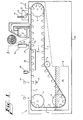
- FIG. 1 is a schematic representation of an aseptic packaging machine to which the sealing element of this invention is particularly well adapted
- Fig. 2 is a perspective view of a sealing element formed according to one embodiment of this invention
- Fig. 3 is a cross-sectional view of the arrangement shown in Fig. 2 which is taken along the line designated 3-3 in Fig. 1
- Fig. 4 is a view from below taken along the line designated 4-4 in Fig. 3
- Fig. 5 is a schematic system view of a second embodiment of the invention.
- the packaging apparatus is generally indicated by the numeral 1, and is fully enclosed by a hood or shroud which permits sealing of the interior thereof from outside ambient air, a feature which permits maintenance of sterile and inert atmospheric conditions inside the machine.
- a cup conveying means 2 which is composed of a series of orifice carrier plates connected together with chains to form an endless belt.
- the orifice carrier plates have holes which are shaped to conform to the shape of the preformed cups, which cups extend through the plate and are retained with the cup sealing flanges conforming to the shaped surfaces of the plates.
- the cup conveying means 2 passes around a series of drive and guide sprockets 3, 4, 5, and 6 so that the cup conveying means can move the cups through a sequence of machine operations as set forth below.
- a supply of preformed cups is provided as indicated at 7, the cups being positively delivered into orifices in the carrier plates of the cup conveying means which carries the cups around guide sprocket 3 into a generally downward travel. Continuing downwardly and around sprocket 4, the cups are carried below the surface of a reservoir of liquid sterilant 10 continued in sterilant tank 9. As the cup conveying means travels around sprocket 4, the cups are turned to an inverted position. Cup retainer rail 8 is disposed along the path of travel of the cups through this portion of the machine to prevent cups from falling out of the orifice carrier plates, while inverted, by action of gravity.
- the arrangement of the cup travel through the sterilant tank or reservoir is such that the cups are completely flooded with the liquid sterilant and all traces of air are displaced therefrom to insure liquid contact over all internal surfaces of the cups.
- the supply of sterilant in tank 9 is maintained at a temperature in the range of 60°C to 100°C, and the speed of travel through the sterilant is such as to keep the cups immersed in the liquid for a period of one to sixty seconds.
- Fresh sterilant is supplied to tank 9 from a.source outside the machine (not shown), and sterilant from the machine tank 9 is continuously recirculated through filtering and heating means (not shown) to maintain the temperature and cleanliness thereof.
- the cups travel upwardly out of the sterilant tank and around guide sprocket 5 and then generally horizontally to drive sprocket 6.
- Sterilant drains from the inverted cups during this portion of their travel through the machine.
- the entire inner atmosphere of the machine is an inert sterile gas such as nitrogen.
- jets of sterile inert gas may be directed inside the cups during this portion of their travel to sweep remaining traces of the liquid sterilant therefrom.
- gas jets 11 may also be directed to the sealing rim or flange areas of the cups to insure that such sealing areas are dry and free of liquid which might interfere with the later sealing operation.
- the cup conveying means travels around sprocket 6 turning the cups to an upright position, and then carries them to filler section 12.
- filler nozzle 13 delivers a metered amount of food product into each cup, and nozzle 13 is supplied by conduit 14 with pre-sterilized food product.
- Filler 12 and its associated parts are designed to deliver food product into the cups without splashing of the food, and without contaminating the sealing flange or rim of the cups with particles or droplets of the food product.
- the cup conveying means next carries the cups to a sealing station, indicated generally at 15.
- a supply web of cover material 16 is passed through a sterilant bath 17 and into proximity above the flanges of the cups.
- Sealer 15, operating heat sealing element 18, applies the cover material to the top of the filled cups and seals the cover material thereto by the action of heat and pressure.
- Reciprocating vertical movement of the sealing element 18 is permitted by flexible diaphragm 19 which separates the sealing element from the sterile and inert atmosphere of the interior of the machine.
- the cover material may be cut to the desired shape of the cup and waste cover material can be stripped from the cups by die cutting and stripping means 20, the waste material, still interconnected, passing out of the machine and being wound into a roll for easy disposal.
- the cover web may be pre-cut into strands of interconnected covers prior to delivery to the machine, and, following the sealing operation, merely cut apart, thus eliminating any stripping of waste cover material from the filled and sealed cups.
- cutting means 20 may be located immediately following sealing means 15, or may be spaced therefrom and follow after cups have moved past a microbiological barrier 21. This barrier may suitably be a liquid sterilant curtain, which separates the interior, sterile part of the machine from the ambient air.
- the cup conveying means next carries the finished cups to an ejection mechanism indicated at 22 where cups are displaced from the cup conveying means and removed from the machine as indicated at 23. Thereafter, the cup conveying means completes its travel and returns to cup supply means 7. While details are not shown, drive means for the cup conveying means may be conveniently located in the lower portion of the machine as indicated at 24. Motion of the cup conveying means is intermittent and is synchronized with the operation of filler means 12, sealing means 15, and cutting and stripping means 20.
- sealing element 15 includes a sealing block 25 supported by vertically re- ciprocable plunger 26 whose up and down motion is imparted by means of fluid motor 27.
- This fluid motor comprises a piston and cylinder mechanism of known construction which is operated by a source of air or liquid under pressure not shown in the drawings which is interconnected with the fluid motor 27 via conduit 28.
- Fluid motor 27 is supported by plate 29 which in turn is mounted on support blocks 30 secured to the frame 31 of the machine. If desired some other known mechanical drive could be used instead of fluid motor 27.
- a cup 7 such as is indicated at C in Fig. 3 is disposed in the opening 42 in carrier plate 40 with the flange F of the container C disposed in the recess 41.
- the lid stock from which the closure for the container C is formed is indicated at S in Fig. 3.
- a flexible sealing membrane M which preferably is about three mils thick is secured to the lower surface 43 of sealing block 25 by a pair of retaining elements 44 and 45.
- These seal retaining elements 44 and 45 are secured to the sealing block 25 by screws 46 and 46a so as to form a fluid tight junction between the membrane M and the sealing block 25 so that liquid L disposed within the annular groove 47 is secured in fluid tight relation therein.
- the groove or passage 47 constitutes a heat exchanging passage which is illustrated in Fig. 3 is in the form of a groove 47 formed in surface 43 of sealing block 25.
- the peripheral configuration of the flexible and resilient sealing membrane M corresponds to the flanged opening of the article and is shaped so as to apply uniform sealing pressure to the flange.
- the membrane may be of V-shaped contour and positioned so that it will apply sealing pressure progressively from the inner to the outer region of the sloping flange as the membrane is moved downwardly into sealing contact.
- the material used to form the membrane must be highly resistant to heat and be adaptable to being permanently shaped in a desired configuration.
- Oil derived from petroleum may be used as the fluid L. Its temperature preferably is maintained in a range between 90°C and 300°C. For most applications of the invention the fluid L will be a liquid when at operating temperature.
- the invention is not limited to liquids however and the term "fluid" is intended to include other media, some of which are identified below. Whatever medium is employed should be capable of withstanding a temperature of 300°C without breakdown and should have high heat capacity and high thermal conductivity.
- Glycerol could be used as could a silicone oil produced by Dow Chemical Company and marketed as Dowtherm.
- Solder, mercury and an oil having metallic particles suspended therein could also be used. Such particles could be aluminum, copper, silver, iron and other metals. Wax and steam can also be used.
- annular heat transfer passage H Arranged in communication with the heat exchanging passage 47 is an annular heat transfer passage H which also contains heated fluid.
- a heater unit 48 is imbedded within the sealing block 25.
- this heater unit could be ring shaped or could take the form of a plurality of heater units disposed about the body of sealing block 25.
- a temperature indicating element 49 preferably is arranged with its temperature sensing element 50 imbedded within a passage formed in sealing block 25 and preferably in close proximity to the lower surface 43 of block 25.
- heat transfer passage H is in direct communication with heat exchange passage 47 causes circulation of heated liquid within the passages 47 and H to cause a redistribution of the liquid so that heat given up from the liquid through the membrane M is replaced due to the proximity of liquid within heat transfer passage H to the heater means 48.
- the lid stock is stretched somewhat during the sealing operation due to the fact that the membrane M by frictional engagement with the lid stock places the lid stock in tension about the downwardly bevelled flange F as is obvious from Fig. 3.
- the membrane M is of V-shaped cross-sectional configuration. It will be understood that the invention is not limited to this particular configuration but that for some applications of the invention other configurations are desirable such for example as arcuate stepped or other special cross-sectional configurations.
- the membrane M is preset in configuration as is desired for a particular application of the invention.
- the liquid L supplied to the heat exchanging passage 47 and the heat transfer passage H may be heated by a unit which is separate and apart from the movable sealing block 25.
- a unit which is separate and apart from the movable sealing block 25.
- a fluid reservoir 51 is connected by a conduit 52 and pump P with a heater 53 whose temperature is controlled by control device TC.
- liquid is supplied through conduit 54 and valve 55 to manifold 56 from whence it is supplied through flexible conduit 57 to the sealing block schematically indicated at 25a.
- connection of conduit 57 is by way of a suitable passageway indicated by dotted lines 58 in Fig. 3 to the heat exchanging passage 47 and the heat transfer passage H.
- Fluid from the sealing block 25 is returned via the passage indicated in dotted lines in Fig. 3 by the numeral 59 which in turn is connected with flexible conduit 60 to the manifold 56 and thence through valve 61 and conduit 62 to reservoir 51.
- a suitable temperature gauge 63a may be arranged so as to monitor the operating conditions and supplemental control may be achieved by conduit 63 and valve 64.
- container 7 and the lid stock S may be formed of any known suitable plastic material and may take the form of laminated or other structures.
- sealing element and method according to this invention may be employed to perform a variety of sealing operations requiring hermetic gas and moisture proof seals
- this invention is particularly well adapted for use in sealing containers used to package consumer items such as fruit juices, dessert puddings, yogurt, and many other similar items.
Landscapes
- Engineering & Computer Science (AREA)
- Mechanical Engineering (AREA)
- Physics & Mathematics (AREA)
- Thermal Sciences (AREA)
- Manufacturing & Machinery (AREA)
- Closing Of Containers (AREA)
- Package Closures (AREA)
- Lining Or Joining Of Plastics Or The Like (AREA)
- Cooling Or The Like Of Semiconductors Or Solid State Devices (AREA)
Priority Applications (1)
| Application Number | Priority Date | Filing Date | Title |
|---|---|---|---|
| AT79301525T ATE11504T1 (de) | 1978-07-31 | 1979-07-31 | Vorrichtung zum verschliessen unter anwendung von waerme. |
Applications Claiming Priority (2)
| Application Number | Priority Date | Filing Date | Title |
|---|---|---|---|
| US92951278A | 1978-07-31 | 1978-07-31 | |
| US929512 | 1978-07-31 |
Publications (2)
| Publication Number | Publication Date |
|---|---|
| EP0008870A1 EP0008870A1 (en) | 1980-03-19 |
| EP0008870B1 true EP0008870B1 (en) | 1985-01-30 |
Family
ID=25457974
Family Applications (1)
| Application Number | Title | Priority Date | Filing Date |
|---|---|---|---|
| EP79301525A Expired EP0008870B1 (en) | 1978-07-31 | 1979-07-31 | Heat sealing element |
Country Status (5)
| Country | Link |
|---|---|
| EP (1) | EP0008870B1 (enExample) |
| JP (1) | JPS5571209A (enExample) |
| AT (1) | ATE11504T1 (enExample) |
| DE (1) | DE2967372D1 (enExample) |
| ES (1) | ES482984A1 (enExample) |
Families Citing this family (4)
| Publication number | Priority date | Publication date | Assignee | Title |
|---|---|---|---|---|
| FR2689810B1 (fr) * | 1992-04-10 | 1995-07-07 | Kaysersberg Packaging Sa | Procede de fermeture des bords de plaques alveolaires et dispositif permettant la mise en óoeuvre du procede. |
| JPH0717502A (ja) * | 1993-05-27 | 1995-01-20 | Haagendatsutsu Japan Kk | ヒートシール方法及びヒートシーラ |
| GB0302780D0 (en) * | 2003-02-06 | 2003-03-12 | Meridica Ltd | Apparatus and method for heat sealing a lidding sheet |
| CN115892561A (zh) * | 2022-10-28 | 2023-04-04 | 蜡笔小新(福建)食品工业有限公司 | 一种用于果冻生产的杯口封装装置 |
Family Cites Families (11)
| Publication number | Priority date | Publication date | Assignee | Title |
|---|---|---|---|---|
| GB581047A (en) * | 1944-07-19 | 1946-09-30 | Walter Roy Bridgens | Improvements in and relating to hydraulic presses |
| DE1924323B1 (de) * | 1969-05-13 | 1970-08-27 | Daref Ges Fuer Kunststoffverar | Vorrichtung zum Verschliessen von Verpackungsbehaeltern od.dgl. |
| JPS4825108A (enExample) * | 1971-08-06 | 1973-04-02 | ||
| US3864892A (en) * | 1973-05-29 | 1975-02-11 | Mahaffy & Harder Eng Co | Automatic packaging method and apparatus with heat-sealing elements having resilient heat conducting members |
| JPS50123673U (enExample) * | 1974-03-22 | 1975-10-09 | ||
| JPS50127786A (enExample) * | 1974-03-28 | 1975-10-08 | ||
| SE7502496L (sv) * | 1975-03-06 | 1976-09-07 | Ziristor Ab | Lockappliceringsanordning |
| DE2522119A1 (de) * | 1975-05-17 | 1976-11-25 | Richard Sterling Cawrse | Verfahren und vorrichtung zum aufbringen von deckeln auf behaelter |
| US4050971A (en) * | 1976-02-19 | 1977-09-27 | Minnesota Mining And Manufacturing Company | Device for fusing lengths of film over the open ends of cups |
| US4062718A (en) * | 1976-09-02 | 1977-12-13 | The Dow Chemical Company | Heat sealing means |
| FR2407861A1 (fr) * | 1977-11-03 | 1979-06-01 | Serac Sa | Procede et dispositif de thermoscellage d'opercules sur des recipients en verre |
-
1979
- 1979-07-30 ES ES79482984A patent/ES482984A1/es not_active Expired
- 1979-07-31 AT AT79301525T patent/ATE11504T1/de not_active IP Right Cessation
- 1979-07-31 EP EP79301525A patent/EP0008870B1/en not_active Expired
- 1979-07-31 JP JP9804379A patent/JPS5571209A/ja active Granted
- 1979-07-31 DE DE7979301525T patent/DE2967372D1/de not_active Expired
Also Published As
| Publication number | Publication date |
|---|---|
| ATE11504T1 (de) | 1985-02-15 |
| JPS6234610B2 (enExample) | 1987-07-28 |
| JPS5571209A (en) | 1980-05-29 |
| EP0008870A1 (en) | 1980-03-19 |
| DE2967372D1 (en) | 1985-03-14 |
| ES482984A1 (es) | 1980-09-01 |
Similar Documents
| Publication | Publication Date | Title |
|---|---|---|
| US4409775A (en) | Apparatus for the aseptic packing of high acid food | |
| US2976655A (en) | Packaging method and apparatus | |
| US4282699A (en) | Heat sealing apparatus | |
| US8069637B2 (en) | Bag sealing system and method | |
| US3911640A (en) | Method for the packing under aseptic conditions of sterile goods into containers | |
| EP0085564A2 (en) | Apparatus and method for filling a container, especially aseptic filling | |
| ES472767A1 (es) | Metodo y su correspondiente aparato para el envasado asepti-co de productos alimenticios fuertemente acidos | |
| US4391080A (en) | Method for providing an inert sterile atmosphere in an aseptic packaging machine | |
| FR2354927A1 (fr) | Procede et appareillage de conditionnement pour matieres fluides | |
| DE59305151D1 (de) | Verfahren und Vorrichtung zum Füllen und Verschliessen eines Doppelkammerbechers aus Kunststoff | |
| EP0008870B1 (en) | Heat sealing element | |
| US4297161A (en) | Method and apparatus for heat-sealing lids on glass containers | |
| SU1542409A3 (ru) | Способ изготовлени запорного устройства на упаковочном контейнере дл жидких продуктов | |
| EP0356011A2 (en) | Method and apparatus for container conveyance in germ-free filling/packaging system | |
| US4730435A (en) | Sterile docking system for filling IV bags | |
| CA1139641A (en) | Method and apparatus for treating flexible containers | |
| US4996824A (en) | Method and device for sterilizing a packaging installation for food and pharmaceutical products | |
| CN1201005A (zh) | 液态食品包装机械上所用的改进填充管 | |
| US20110167766A1 (en) | Low-speed inerting means and device for using said inerting means for packaging a food product | |
| US3060655A (en) | Packaging | |
| US3530641A (en) | Sanitary packaging machine | |
| US2392395A (en) | Method and apparatus for packaging food products | |
| GB1008075A (en) | Heat-contact welding device for welding together superimposed layers of thermoplastic material | |
| EP4257536B1 (en) | An aseptic apparatus for filling and closing aluminium receptacles | |
| US6848235B2 (en) | Adverse environment foil cap seal system |
Legal Events
| Date | Code | Title | Description |
|---|---|---|---|
| PUAI | Public reference made under article 153(3) epc to a published international application that has entered the european phase |
Free format text: ORIGINAL CODE: 0009012 |
|
| AK | Designated contracting states |
Designated state(s): AT BE CH DE FR GB IT LU NL SE |
|
| 17P | Request for examination filed |
Effective date: 19800922 |
|
| R17P | Request for examination filed (corrected) |
Effective date: 19800919 |
|
| ITF | It: translation for a ep patent filed | ||
| GRAA | (expected) grant |
Free format text: ORIGINAL CODE: 0009210 |
|
| AK | Designated contracting states |
Designated state(s): AT BE CH DE FR GB IT LU NL SE |
|
| PG25 | Lapsed in a contracting state [announced via postgrant information from national office to epo] |
Ref country code: CH Effective date: 19850130 Ref country code: AT Effective date: 19850130 |
|
| REF | Corresponds to: |
Ref document number: 11504 Country of ref document: AT Date of ref document: 19850215 Kind code of ref document: T |
|
| REF | Corresponds to: |
Ref document number: 2967372 Country of ref document: DE Date of ref document: 19850314 |
|
| ET | Fr: translation filed | ||
| REG | Reference to a national code |
Ref country code: CH Ref legal event code: PL |
|
| PG25 | Lapsed in a contracting state [announced via postgrant information from national office to epo] |
Ref country code: LU Free format text: LAPSE BECAUSE OF NON-PAYMENT OF DUE FEES Effective date: 19850731 |
|
| PLBE | No opposition filed within time limit |
Free format text: ORIGINAL CODE: 0009261 |
|
| STAA | Information on the status of an ep patent application or granted ep patent |
Free format text: STATUS: NO OPPOSITION FILED WITHIN TIME LIMIT |
|
| 26N | No opposition filed | ||
| PGFP | Annual fee paid to national office [announced via postgrant information from national office to epo] |
Ref country code: NL Payment date: 19870731 Year of fee payment: 9 |
|
| PG25 | Lapsed in a contracting state [announced via postgrant information from national office to epo] |
Ref country code: SE Effective date: 19890801 |
|
| PG25 | Lapsed in a contracting state [announced via postgrant information from national office to epo] |
Ref country code: NL Effective date: 19900201 |
|
| NLV4 | Nl: lapsed or anulled due to non-payment of the annual fee | ||
| PGFP | Annual fee paid to national office [announced via postgrant information from national office to epo] |
Ref country code: FR Payment date: 19900611 Year of fee payment: 12 |
|
| PGFP | Annual fee paid to national office [announced via postgrant information from national office to epo] |
Ref country code: GB Payment date: 19900614 Year of fee payment: 12 |
|
| PGFP | Annual fee paid to national office [announced via postgrant information from national office to epo] |
Ref country code: BE Payment date: 19900626 Year of fee payment: 12 |
|
| PGFP | Annual fee paid to national office [announced via postgrant information from national office to epo] |
Ref country code: DE Payment date: 19900629 Year of fee payment: 12 |
|
| ITTA | It: last paid annual fee | ||
| PG25 | Lapsed in a contracting state [announced via postgrant information from national office to epo] |
Ref country code: GB Effective date: 19910731 Ref country code: BE Effective date: 19910731 |
|
| BERE | Be: lapsed |
Owner name: THE MEAD CORP. Effective date: 19910731 |
|
| PG25 | Lapsed in a contracting state [announced via postgrant information from national office to epo] |
Ref country code: FR Effective date: 19920331 |
|
| GBPC | Gb: european patent ceased through non-payment of renewal fee | ||
| PG25 | Lapsed in a contracting state [announced via postgrant information from national office to epo] |
Ref country code: DE Effective date: 19920401 |
|
| REG | Reference to a national code |
Ref country code: FR Ref legal event code: ST |
|
| EUG | Se: european patent has lapsed |
Ref document number: 79301525.6 Effective date: 19900418 |