EP0008237B1 - A sensor for generating electrical signals representative of relative motion - Google Patents
A sensor for generating electrical signals representative of relative motion Download PDFInfo
- Publication number
- EP0008237B1 EP0008237B1 EP79301626A EP79301626A EP0008237B1 EP 0008237 B1 EP0008237 B1 EP 0008237B1 EP 79301626 A EP79301626 A EP 79301626A EP 79301626 A EP79301626 A EP 79301626A EP 0008237 B1 EP0008237 B1 EP 0008237B1
- Authority
- EP
- European Patent Office
- Prior art keywords
- electret
- electrically conductive
- conductive member
- sensor according
- displacement current
- Prior art date
- Legal status (The legal status is an assumption and is not a legal conclusion. Google has not performed a legal analysis and makes no representation as to the accuracy of the status listed.)
- Expired
Links
- 230000033001 locomotion Effects 0.000 title claims description 27
- 238000006073 displacement reaction Methods 0.000 claims description 39
- 230000005684 electric field Effects 0.000 claims description 28
- 239000004020 conductor Substances 0.000 claims description 12
- 230000004044 response Effects 0.000 claims description 7
- 230000003993 interaction Effects 0.000 claims description 2
- 239000000463 material Substances 0.000 description 4
- 238000000926 separation method Methods 0.000 description 4
- 238000010586 diagram Methods 0.000 description 3
- 230000005670 electromagnetic radiation Effects 0.000 description 3
- 238000005259 measurement Methods 0.000 description 3
- 229920000642 polymer Polymers 0.000 description 3
- 239000000126 substance Substances 0.000 description 3
- 239000004809 Teflon Substances 0.000 description 2
- 229920006362 Teflon® Polymers 0.000 description 2
- 230000008901 benefit Effects 0.000 description 2
- 239000003989 dielectric material Substances 0.000 description 2
- 230000005686 electrostatic field Effects 0.000 description 2
- 230000004907 flux Effects 0.000 description 2
- 230000009467 reduction Effects 0.000 description 2
- 239000007787 solid Substances 0.000 description 2
- 229920002799 BoPET Polymers 0.000 description 1
- ZZSNKZQZMQGXPY-UHFFFAOYSA-N Ethyl cellulose Chemical compound CCOCC1OC(OC)C(OCC)C(OCC)C1OC1C(O)C(O)C(OC)C(CO)O1 ZZSNKZQZMQGXPY-UHFFFAOYSA-N 0.000 description 1
- 239000001856 Ethyl cellulose Substances 0.000 description 1
- 239000005041 Mylar™ Substances 0.000 description 1
- 239000004793 Polystyrene Substances 0.000 description 1
- 229920006397 acrylic thermoplastic Polymers 0.000 description 1
- 230000032683 aging Effects 0.000 description 1
- XAGFODPZIPBFFR-UHFFFAOYSA-N aluminium Chemical compound [Al] XAGFODPZIPBFFR-UHFFFAOYSA-N 0.000 description 1
- 229910052782 aluminium Inorganic materials 0.000 description 1
- 210000004556 brain Anatomy 0.000 description 1
- 210000003169 central nervous system Anatomy 0.000 description 1
- 238000003776 cleavage reaction Methods 0.000 description 1
- 238000010276 construction Methods 0.000 description 1
- 239000013078 crystal Substances 0.000 description 1
- 230000000694 effects Effects 0.000 description 1
- 235000019325 ethyl cellulose Nutrition 0.000 description 1
- 229920001249 ethyl cellulose Polymers 0.000 description 1
- 239000011888 foil Substances 0.000 description 1
- 238000010438 heat treatment Methods 0.000 description 1
- 238000001093 holography Methods 0.000 description 1
- 230000036039 immunity Effects 0.000 description 1
- 238000009434 installation Methods 0.000 description 1
- 238000009413 insulation Methods 0.000 description 1
- 239000007788 liquid Substances 0.000 description 1
- 238000004519 manufacturing process Methods 0.000 description 1
- 230000000873 masking effect Effects 0.000 description 1
- 239000011159 matrix material Substances 0.000 description 1
- 238000002844 melting Methods 0.000 description 1
- 230000008018 melting Effects 0.000 description 1
- 238000000034 method Methods 0.000 description 1
- 239000013081 microcrystal Substances 0.000 description 1
- 238000012544 monitoring process Methods 0.000 description 1
- 235000001968 nicotinic acid Nutrition 0.000 description 1
- 210000000056 organ Anatomy 0.000 description 1
- 230000035699 permeability Effects 0.000 description 1
- 229920003229 poly(methyl methacrylate) Polymers 0.000 description 1
- 229920002223 polystyrene Polymers 0.000 description 1
- 239000004814 polyurethane Substances 0.000 description 1
- 229920002635 polyurethane Polymers 0.000 description 1
- 230000008569 process Effects 0.000 description 1
- 230000006798 recombination Effects 0.000 description 1
- 238000005215 recombination Methods 0.000 description 1
- 230000007017 scission Effects 0.000 description 1
- 230000008054 signal transmission Effects 0.000 description 1
- 230000035882 stress Effects 0.000 description 1
- ISXSCDLOGDJUNJ-UHFFFAOYSA-N tert-butyl prop-2-enoate Chemical compound CC(C)(C)OC(=O)C=C ISXSCDLOGDJUNJ-UHFFFAOYSA-N 0.000 description 1
- 239000010409 thin film Substances 0.000 description 1
- 230000009466 transformation Effects 0.000 description 1
- 229920002554 vinyl polymer Polymers 0.000 description 1
Images

Classifications
-
- G—PHYSICS
- G01—MEASURING; TESTING
- G01D—MEASURING NOT SPECIALLY ADAPTED FOR A SPECIFIC VARIABLE; ARRANGEMENTS FOR MEASURING TWO OR MORE VARIABLES NOT COVERED IN A SINGLE OTHER SUBCLASS; TARIFF METERING APPARATUS; MEASURING OR TESTING NOT OTHERWISE PROVIDED FOR
- G01D5/00—Mechanical means for transferring the output of a sensing member; Means for converting the output of a sensing member to another variable where the form or nature of the sensing member does not constrain the means for converting; Transducers not specially adapted for a specific variable
- G01D5/12—Mechanical means for transferring the output of a sensing member; Means for converting the output of a sensing member to another variable where the form or nature of the sensing member does not constrain the means for converting; Transducers not specially adapted for a specific variable using electric or magnetic means
- G01D5/14—Mechanical means for transferring the output of a sensing member; Means for converting the output of a sensing member to another variable where the form or nature of the sensing member does not constrain the means for converting; Transducers not specially adapted for a specific variable using electric or magnetic means influencing the magnitude of a current or voltage
- G01D5/24—Mechanical means for transferring the output of a sensing member; Means for converting the output of a sensing member to another variable where the form or nature of the sensing member does not constrain the means for converting; Transducers not specially adapted for a specific variable using electric or magnetic means influencing the magnitude of a current or voltage by varying capacitance
- G01D5/2405—Mechanical means for transferring the output of a sensing member; Means for converting the output of a sensing member to another variable where the form or nature of the sensing member does not constrain the means for converting; Transducers not specially adapted for a specific variable using electric or magnetic means influencing the magnitude of a current or voltage by varying capacitance by varying dielectric
-
- G—PHYSICS
- G01—MEASURING; TESTING
- G01D—MEASURING NOT SPECIALLY ADAPTED FOR A SPECIFIC VARIABLE; ARRANGEMENTS FOR MEASURING TWO OR MORE VARIABLES NOT COVERED IN A SINGLE OTHER SUBCLASS; TARIFF METERING APPARATUS; MEASURING OR TESTING NOT OTHERWISE PROVIDED FOR
- G01D5/00—Mechanical means for transferring the output of a sensing member; Means for converting the output of a sensing member to another variable where the form or nature of the sensing member does not constrain the means for converting; Transducers not specially adapted for a specific variable
- G01D5/12—Mechanical means for transferring the output of a sensing member; Means for converting the output of a sensing member to another variable where the form or nature of the sensing member does not constrain the means for converting; Transducers not specially adapted for a specific variable using electric or magnetic means
-
- G—PHYSICS
- G01—MEASURING; TESTING
- G01D—MEASURING NOT SPECIALLY ADAPTED FOR A SPECIFIC VARIABLE; ARRANGEMENTS FOR MEASURING TWO OR MORE VARIABLES NOT COVERED IN A SINGLE OTHER SUBCLASS; TARIFF METERING APPARATUS; MEASURING OR TESTING NOT OTHERWISE PROVIDED FOR
- G01D5/00—Mechanical means for transferring the output of a sensing member; Means for converting the output of a sensing member to another variable where the form or nature of the sensing member does not constrain the means for converting; Transducers not specially adapted for a specific variable
- G01D5/12—Mechanical means for transferring the output of a sensing member; Means for converting the output of a sensing member to another variable where the form or nature of the sensing member does not constrain the means for converting; Transducers not specially adapted for a specific variable using electric or magnetic means
- G01D5/14—Mechanical means for transferring the output of a sensing member; Means for converting the output of a sensing member to another variable where the form or nature of the sensing member does not constrain the means for converting; Transducers not specially adapted for a specific variable using electric or magnetic means influencing the magnitude of a current or voltage
- G01D5/24—Mechanical means for transferring the output of a sensing member; Means for converting the output of a sensing member to another variable where the form or nature of the sensing member does not constrain the means for converting; Transducers not specially adapted for a specific variable using electric or magnetic means influencing the magnitude of a current or voltage by varying capacitance
- G01D5/241—Mechanical means for transferring the output of a sensing member; Means for converting the output of a sensing member to another variable where the form or nature of the sensing member does not constrain the means for converting; Transducers not specially adapted for a specific variable using electric or magnetic means influencing the magnitude of a current or voltage by varying capacitance by relative movement of capacitor electrodes
- G01D5/2412—Mechanical means for transferring the output of a sensing member; Means for converting the output of a sensing member to another variable where the form or nature of the sensing member does not constrain the means for converting; Transducers not specially adapted for a specific variable using electric or magnetic means influencing the magnitude of a current or voltage by varying capacitance by relative movement of capacitor electrodes by varying overlap
Definitions
- This invention relates to sensors of the type used to generate electrical signals in response to relative motion between two or more sensor elements.
- sensing devices which are capable of generating electrical signals in response to the relative motion between two or more sensor elements.
- Examples of such devices are electromagnetic transducers, in which relative motion between an electrically conductive coil and a magnet produces electrical current signals; electret transducers in which relative motion between an electret member and another member produces an electrical current (see e.g. the article entitled “Electrete” in Elektrotechnik, Vol. 58, No. 6 (March 1976) pages 18 and 19) US-A-3,778,561 and US ⁇ A ⁇ 3,890,511); piezoelectric transducers, triboelectric transducers and strain gauges.
- the displacement current has the dimensions of a real current even though actual charges are not transported along an ohmic conductor.
- a magnetic field may be established in two ways: Firstly, by a changing electric field (the displacement current term); and secondly, by a conduction current (the conduction current term).
- transducers which employ the conduction current are generally quite useful, certain limitations inhere in any transducer of this type. Since such transducers require a closed loop ohmic circuit for the conductive current, any varying electromagnetic radiation in the vicinity of the closed loop conductive path (which is usually coupled to amplifying and measuring circuitry) produces spurious conductive current signals which are capable of masking the information conveyed in the conductive current signals generated by the transducer. Accordingly, great care is required to shield the conductive loop portion of such sensors against stray electromagnetic radiation. Such shields introduce complexity to the structure of the transducers themselves and also to the structure of the conductive paths used to couple the transducer to the amplifying and measuring circuitry.
- conductive current sensors require the application of electrical power to the closed loop portion of the circuit in order for the device to be operable. While this requirement poses no constraint in many applications, there are other applications for which this requirement is extremely burdensome. For example, in applications requiring the installation of many sensors in a structure for the purpose of monitoring vibrations of the structure, either individual sources of electrical power must be installed at the site of each sensor or the structure must be wired to provide electrical power from a central source to the individual sensors. In an office high-rise building, for example, in which it is desired to install several sensors on each floor of the building to provide vibration information, this requirement is at best costly and at worst impossible for pre-existing structures. In aircraft sensing applications, this requirement is similarly highly undesirable.
- conductive current sensors which employ permanent magnets possess additional disadvantages.
- the energy required to magnetize a permanent magnet is relatively high when compared to the energy required to polarize an electret substance.
- permanent magnets possess aging characteristics which result in a reduction of the magnetic field strength provided by the magnet with time, which requires recalibration of the system composed of the individual sensors at predetermined intervals and eventual replacement of the magnets.
- a displacement current sensor for generating an output signal representative of relative motion between parts of the sensor, comprising means for generating an electric field, means arranged to interact with said electric field for generating an induced displacement current, at least a part of said interacting means being movable relative to said field generating means, and at least a part of said interacting means comprising electrically conductive means in which said displacement current is induced in response to variations in said electric field caused by such relative motion, and sensing means connected to said conductive means for sensing said induced displacement current and for generating said sensor output signal representative of said relative motion, characterised in that said electrically conductive means comprises a single electrically conductive member and a single electrical connection connecting said member to said sensing means, said sensing means being adapted to measure said induced displacement current supplied by said single connection.
- the senor may be for generating an electrical output signal representative of relative motion between the conductive member and the field generating means.
- the field generating means comprises an electret which may be formed in a wide variety of geometrical shapes, such as planar, cylindrical or special geometrical shapes, while the electrically conductive member may comprise one or more plates, wires, rods, or other special shapes.
- the field generating means comprises an electret with a planar shape and the electrically conductive member comprises a conductive plate having a surface generally parallel to the plane of the electret but spaced therefrom.
- the electrically conductive member comprises a flat spiral coil generally parallel and spaced from the plane of the electret.
- multiple electret plates are spaced in a direction normal to the planar surfaces thereof and a plurality of electrically conductive wires or plates connected as a unit are received within the spaces between adjacent electret plates.
- first and second oppositely polarized planar electret members are mutually spaced in a direction normal to the plane of each electret member, and an electrically conductive rod, wire or plate is received within the space between the electret members.
- the field generating means comprises a cylindrical electret member
- the electrically conductive member comprises a conductive rod received within the inner diameter of the electret.
- the electrically conductive member may comprise an electret member in the shape of a rod, the rod being received within the inner diameter of the coil.
- a displacement sensor for generating an output signal representative of relative motion between an electrically non-conductive member and an electric field source, characterised in that said electric field source comprises first and second oppositely polarized generally planar electret members mutually spaced in a direction normal to the plane of each electret member; in that said electrically non-conductive member is received within the space between said first and second electret members and is arranged for relative motion therewith in non-contacting relationship; in that a single electrically conductive member is coupled to one of said first and second electret members on the opposite surface thereof from said space, said single electrically conductive member providing a gaussian surface for generating an induced displacement current in response to variations in the electric field between said first and second electret members caused by relative motion between said electret members and said electrically non-conductive member; and in that a single electrical connection connects said single electrically conductive member with a sensing means, said sensing means being adapted to measure said induced displacement current supplied by said single electrical connection
- the electrically non-conductive member may be fabricated from a dielectric or may be another electret.
- Each embodiment may be provided with an electrostatic shield to prevent interaction between the field generated by the field generating means and stray electric fields.
- all embodiments may he coupled directly to a suitable measuring instrument, or may be coupled to the input of an amplifier, which may be either local to the sensor or remote therefrom, and having a relatively low input impedance and negligible zero drift.
- All embodiments of the invention are capable of affording high reliability at extremely low cost and light weight and thus are suitable for a wide variety of applications.
- All embodiments of the invention function by measuring the Maxwell displacement current generated whenever an electric field changes with time.
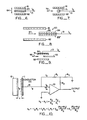
- an electrically conductive plate 11 is normally spaced by a distance d from an electric field source 12, which may comprise a charged plate, an electret planar member or other equivalent devices.
- An ohmic conductor 13 is coupled between the plate 11 and a measuring instrument 15 such as an ammeter, or the equivalent.
- the electric field which cuts the conductive plate 11 changes in magnitude which produces a displacement current given by the equation: From Gauss' law it is known that: where E is the electric field intensity, A is the surface area of plate 12 and q is the charge present on or in field source 11.
- the displacement current may be generated by varying the magnitude of the area A of plate 11, by changing the strength of the charge q on or in field source 12 or by altering the permittivity EQ of the region between plate 11 and source 12 by inserting a dielectric substance having a different permittivity than air.
- the displacement current is 0.070 amp, which is a very detectable magnitude.
- the magnitude of the displacement current may be increased by using the arrangement of Figure 2 in which a plurality of conductive plates 11 are received within the spaces between adjacent ones of a plurality of field generating plates 12, the conductive plates 11 being coupled in parallel to lead 13 and thus to the measuring instrument 15.
- lead 13 may be coupled to the input of the amplifier shown in Figure 10, described below.
- the geometry of the plate 11 and the electric field generating element 12 may assume any suitable configuration, such as circular, rectangular, square or special configurations required in any given application of the sensor. While in the Figure 1 embodiment the displacement current may be generated by varying either the separation distance d or by translating plate 11 or field generating element 12 in the vertical plane as illustrated in order to vary the effective area of the plate 11, in the Figure 2 embodiment motion is restricted to horizontal movement as depicted.
- Figure 3 illustrates a cylindrical embodiment of the invention in which the field generating element comprises a cylindrical electret member 31 and the conductive member comprises a conducting rod 32 having an outer diameter which is less than the inner diameter of the electret member 31.
- an electrostatic shield 33 fabricated from a suitable material such as aluminum foil is placed about the electret member 31 and coupled to a reference potential 34, such as ground, in order to shield the sensor from the effects of stray electrostatic fields.
- a major advantage of sensors fabricated in accordance with the invention is the fact that such sensors are completely immune to electromagnetic radiation, since the electrically conductive member 11, 32 is connected in an open loop configuration.
- Figure 4 illustrates an alternate cylindrical embodiment of the invention in which the electret comprises a solid cylindrical rod 41 and the electrically conductive member comprises a coil 42 having an inner diameter greater than the outer diameter of the rod 41.
- Figure 5 illustrates an alternate planar embodiment of the invention in which the electrically conductive member comprises a flat spiral coil 51.
- the displacement current may be generated either by motion in a plane parallel to the coil 51 of the field generating plate 52 or by motion perpendicular to such planes.
- Figure 6 illustrates an alternate embodiment of the invention in which the electric field generating means comprises a pair of spaced plates 61, 62 bearing charges of opposite polarity, and in which the electrically conductive member comprises an interstitial plate 63 arranged for movement in the direction of the vertically depicted arrow 64.
- Figure 7 shows a variation of the Figure 6 arrangement in which the electrically conductive member comprises a wire or rod 71 arranged for motion in the direction of the horizontally depicted arrow 72.
- Figure 8 shows an alternate embodiment of the invention employing planar geometry in which oppositely charged field generating plates 81, 82 coact with a member generally designated by reference numeral 83 and comprising a sandwich fabricated from oppositely polarized dielectric layers 84, 85 and intermediate electrically conductive plate 86.
- Figure 9 illustrates an alternate embodiment of the invention in which a spaced pair of oppositely polarized electret plates 91, 92 coact with a translatable electrically non-conductive interstitial plate fabricated from a dielectric material or an electret.
- the electrically conductive member in this embodiment comprises a conductive layer 94 adhered to the surface of the electret member 91 on the opposite surface from that defining the gap.
- the field generating elements 12, 31, 41, 52, 61, 62, 81, 82, 91 and 92 may comprise any one of a number of elements capable of establishing the electrostatic field required, such as charge bearing conductive plates, these elements are preferably fabricated from any one of a number of suitable electret substances which are permanently polarized. Examples of such electrets may be taken from the class of polymer electrets, which are polymers consisting of microcrystals embedded in an amorphous matrix and whose composition varies from a few percent up to 90%.
- Such polymer electrets are acrylics, ethylcellulose, polystyrene, vinyl polymers, polyurethane, and materials sold under the trademark "Mylar” or "Teflon". Fabrication of electrets is a well known process which generally proceeds by heating the electret material to a temperature just below the melting point in the presence of an electric field, and subsequently permitting the electret to cool, also in the presence of the field.
- So called monocharge electrets are highly suitable for use in fabricating sensors according to the invention. These electrets are thin film electrets having a single charge, either positive or negative. Electrets of this type fabricated from Teflon have a thickness in the range from 12 to 25 microns and have been charged to a charge density in the range from about 10 to about 20 nanocoulombs per square meter. Such electrets are capable of providing a vibrational frequency response of extremely broad bandwidth in the range from about 10- 3 to about 2 x 1 08 Hz. Further, such electrets have a longer charge lifetime due to the absence of recombination losses and the possibility of a larger gap separation with comparable electric flux than other types of electrets.
- FIG. 10 is a schematic of an amplifier circuit which is suitable for such use.
- an operational amplifier 101 preferably a Burr-Brown type Model 3430 amplifier, has a first input which is coupled via input conductor 13 to electrically conductive plate 11 and a second input which is coupled to reference potential, such as ground.
- Amplifier 101 is configured by means of resistances R1, R2 and R3 as a current feedback current-to-voltage transformation mode amplifier, and is capable of measuring extremely small currents on the order of 1 picoampere (10- 12 amp).
- the operational characteristics are as follows:
- a displacement current of 1 picoamp will produce a signal of 1 volt at the output of the circuit.
- an input current resolution of 10- 15 amp is possible.
- the value of should be less than 100 in order to restrict noise error voltages.
- the dependence of zero drift on the ratio of R f to the equivalent internal impedance of the sensor leads to the limitation on the value of R f to a value no larger than the source impedance.
- the sensor source impedance is that of an open loop circuit, very large values of R f can be used without incurring drift problems.
- the advantage of employing a relatively high open loop gain comprises the corresponding reduction of the equivalent operational amplifier input impedance by a factor of This relatively low impedance employed in low current measurements assures measurement accuracies and reduces insulation requirements for the components.
- the input capacitance is also reduced by a factor of so that the measurement rise time is no longer a function of the input RC time constant and becomes a function of R f xC f where C f is the shunt capacity of R f .
- the displacement current although very small in magnitude, may be readily converted to usable voltages with the circuit of Figure 10.
- the amplifier circuitry can be located either at the sensor or at a remote site, because of the principle of the continuity of current, i.e., the value of the displacement current is the same at each point in the circuit.
- Sensors fabricated according to the invention are ideally suited for a wide variety of applications, due to their low cost, light weight, noise immunity, simplicity of construction, and adaptability to different geometrical configurations.
- Such sensors may be used to measure linear or torsional displacements of structural members, such as support beams in buildings, aircraft struts; to measure ultrasonic vibrations in liquids and solids; in crystalo- graphy to measure stress, strain, crystal growth and cleavage; in the field of bionics to measure changing electric fields from living organs, such as the human central nervous system or human brain; in atmospheric physics to measure atmospheric currents; in acoustic holography to measure signal transmission modes in dielectrics and conductors; and in other applications which will occur to those skilled in the art.
- the sensors are also energy efficient in that the energy required to establish a uniform electric field required to polarize the electret is substantially less than the energy required to set up a comparable uniform magnetic field required to orient a permanent magnet.
Landscapes
- Physics & Mathematics (AREA)
- General Physics & Mathematics (AREA)
- Engineering & Computer Science (AREA)
- Power Engineering (AREA)
- Measurement Of Length, Angles, Or The Like Using Electric Or Magnetic Means (AREA)
- Transmission And Conversion Of Sensor Element Output (AREA)
Applications Claiming Priority (2)
| Application Number | Priority Date | Filing Date | Title |
|---|---|---|---|
| US05/932,582 US4224540A (en) | 1978-08-10 | 1978-08-10 | Displacement current sensor |
| US932582 | 2004-09-01 |
Publications (2)
| Publication Number | Publication Date |
|---|---|
| EP0008237A1 EP0008237A1 (en) | 1980-02-20 |
| EP0008237B1 true EP0008237B1 (en) | 1984-06-20 |
Family
ID=25462539
Family Applications (1)
| Application Number | Title | Priority Date | Filing Date |
|---|---|---|---|
| EP79301626A Expired EP0008237B1 (en) | 1978-08-10 | 1979-08-10 | A sensor for generating electrical signals representative of relative motion |
Country Status (5)
| Country | Link |
|---|---|
| US (1) | US4224540A (https=) |
| EP (1) | EP0008237B1 (https=) |
| JP (1) | JPS5524699A (https=) |
| CA (1) | CA1113580A (https=) |
| DE (1) | DE2967065D1 (https=) |
Families Citing this family (14)
| Publication number | Priority date | Publication date | Assignee | Title |
|---|---|---|---|---|
| US4344004A (en) * | 1980-09-22 | 1982-08-10 | Design Professionals Financial Corp. | Dual function transducer utilizing displacement currents |
| CH654170GA3 (https=) * | 1983-08-22 | 1986-02-14 | ||
| US20040066185A1 (en) * | 2000-11-20 | 2004-04-08 | Emile Helayel | Process for determining a relative movement of two systems and a sensor therefor |
| US7276911B2 (en) * | 2001-03-20 | 2007-10-02 | Integrated Power Components, Inc. | Detection of malfunctioning bulbs in decorative light strings |
| US20040016120A1 (en) * | 2002-06-07 | 2004-01-29 | California Institute Of Technology | Method and resulting device for fabricating electret materials on bulk substrates |
| EP1512216A2 (en) * | 2002-06-07 | 2005-03-09 | California Institute Of Technology | Electret generator apparatus and method |
| EP1543343A1 (en) * | 2002-09-27 | 2005-06-22 | BAE Systems Information Electronic Systems Integration Inc. | Determining bearing to a rocket launch or muzzle blast |
| US7154275B2 (en) * | 2002-12-10 | 2006-12-26 | Bae Systems Information And Electronic Systems Integration Inc. | Method and apparatus for detecting individuals using electrical field sensors |
| BRPI1001408B1 (pt) * | 2010-03-08 | 2019-06-25 | Sabo Industria E Comercio De Autopeças S/A | Conjunto roda emissora |
| US10084395B2 (en) * | 2012-07-06 | 2018-09-25 | Richard Banduric | Complex electric fields and static electric fields to effect motion with conduction currents |
| US9337752B2 (en) | 2012-07-06 | 2016-05-10 | Richard Banduric | Interacting complex electric fields and static electric fields to effect motion |
| US10320312B2 (en) | 2012-07-06 | 2019-06-11 | Richard Banduric | Complex electric fields and static electric fields to effect motion with conduction currents and magnetic materials |
| GB201513843D0 (en) * | 2015-08-05 | 2015-09-16 | Hextern Sensor Technologies | Sensor and method of manufacture thereof |
| CN114264219B (zh) * | 2021-12-23 | 2022-10-28 | 西安交通大学 | 一种基于可拉伸驻极体的高精度大量程非接触式位移传感器 |
Family Cites Families (7)
| Publication number | Priority date | Publication date | Assignee | Title |
|---|---|---|---|---|
| US2581063A (en) * | 1950-03-16 | 1952-01-01 | Standard Oil Dev Co | Geophone |
| US3500146A (en) * | 1967-10-18 | 1970-03-10 | Simmonds Precision Products | Linear displacement transducer |
| GB1274856A (en) * | 1968-10-17 | 1972-05-17 | Peter Caleb Frederi Wolfendale | Improvements in capacitive displacement transducers |
| JPS4840084B1 (https=) * | 1969-11-19 | 1973-11-28 | ||
| US3778561A (en) * | 1972-06-21 | 1973-12-11 | Bell Canada Northern Electric | Electret microphone |
| JPS5419172B2 (https=) * | 1973-07-23 | 1979-07-13 | ||
| US3890511A (en) * | 1974-04-15 | 1975-06-17 | Gte Laboratories Inc | Electret pulse generator |
-
1978
- 1978-08-10 US US05/932,582 patent/US4224540A/en not_active Expired - Lifetime
-
1979
- 1979-08-08 CA CA333,400A patent/CA1113580A/en not_active Expired
- 1979-08-10 EP EP79301626A patent/EP0008237B1/en not_active Expired
- 1979-08-10 DE DE7979301626T patent/DE2967065D1/de not_active Expired
- 1979-08-10 JP JP10137179A patent/JPS5524699A/ja active Granted
Non-Patent Citations (2)
| Title |
|---|
| ELEKTROTECHNIK, vol. 58, no. 6, March 1976, pages 18, 19 Würzburg, DE. H. BAUSER et al.: "Elektrete" * |
| JOURNAL OF THE ACOUSTICAL SOCIETY OF AMERICA, vol. 55, no. 2, February 1974, pages 345-349 New York, U.S.A. G.M. SESSLER: "Analysis of the operation of electret transducers subject to large electrode displacements" * |
Also Published As
| Publication number | Publication date |
|---|---|
| JPS5524699A (en) | 1980-02-21 |
| DE2967065D1 (en) | 1984-07-26 |
| EP0008237A1 (en) | 1980-02-20 |
| CA1113580A (en) | 1981-12-01 |
| JPS6122887B2 (https=) | 1986-06-03 |
| US4224540A (en) | 1980-09-23 |
Similar Documents
| Publication | Publication Date | Title |
|---|---|---|
| EP0008237B1 (en) | A sensor for generating electrical signals representative of relative motion | |
| Patranabis | Sensors and tranducers | |
| EP0103360A2 (en) | Capacitive load cell | |
| US3585415A (en) | Stress-strain transducer charge coupled to a piezoelectric material | |
| Riedesel et al. | Limits of sensitivity of inertial seismometers with velocity transducers and electronic amplifiers | |
| US4344004A (en) | Dual function transducer utilizing displacement currents | |
| US3928796A (en) | Capacitive displacement transducer | |
| US4088946A (en) | Magnetic bridge transducer formed with permanent magnets and a hall effect sensor for identifying the presence and location of ferromagnetic discontinuities within or on a tubular specimen | |
| US3390286A (en) | Hermetically sealed instrument transducer with external sensitivity selection | |
| US3742347A (en) | Shaft movement differential pressure measuring apparatus embodying capacitive transducers | |
| US3484678A (en) | Linear differential transformer transducer with nonmagnetic core | |
| US3090934A (en) | Reduction of unwanted coupling between transformer members of position-measuring transformers | |
| US3657630A (en) | Electro servosystem for a force balancing gauge | |
| US6989623B2 (en) | Method and apparatus for measurement using piezoelectric sensor | |
| Hristoforou et al. | A new position sensor based on the MDL technique | |
| Wolfendale | Capacitive displacement transducers with high accuracy and resolution | |
| JP3401436B2 (ja) | 磁界検知装置 | |
| US3238479A (en) | Transducer | |
| EP2230523B1 (en) | Physical quantity measuring unit and device for measuring a voltage and an electric field | |
| US3164987A (en) | Electrostatic vibration transducer | |
| US3396328A (en) | Magnetoresistive transducer | |
| US6246244B1 (en) | Method and device for measuring axial deviation in a taut wire alignment system | |
| US3714561A (en) | A transducer for measuring the displacement of an electrically conductive objective | |
| US2187541A (en) | Electric field sensitive device | |
| US3522531A (en) | Electric field intensity indicator employing a vibratory conductor sensor |
Legal Events
| Date | Code | Title | Description |
|---|---|---|---|
| PUAI | Public reference made under article 153(3) epc to a published international application that has entered the european phase |
Free format text: ORIGINAL CODE: 0009012 |
|
| AK | Designated contracting states |
Designated state(s): DE FR GB |
|
| 17P | Request for examination filed | ||
| GRAA | (expected) grant |
Free format text: ORIGINAL CODE: 0009210 |
|
| AK | Designated contracting states |
Designated state(s): DE FR GB |
|
| PGFP | Annual fee paid to national office [announced via postgrant information from national office to epo] |
Ref country code: FR Payment date: 19840716 Year of fee payment: 6 |
|
| PGFP | Annual fee paid to national office [announced via postgrant information from national office to epo] |
Ref country code: DE Payment date: 19840720 Year of fee payment: 6 |
|
| REF | Corresponds to: |
Ref document number: 2967065 Country of ref document: DE Date of ref document: 19840726 |
|
| ET | Fr: translation filed | ||
| PLBE | No opposition filed within time limit |
Free format text: ORIGINAL CODE: 0009261 |
|
| STAA | Information on the status of an ep patent application or granted ep patent |
Free format text: STATUS: NO OPPOSITION FILED WITHIN TIME LIMIT |
|
| 26N | No opposition filed | ||
| PG25 | Lapsed in a contracting state [announced via postgrant information from national office to epo] |
Ref country code: FR Free format text: LAPSE BECAUSE OF NON-PAYMENT OF DUE FEES Effective date: 19880429 |
|
| PG25 | Lapsed in a contracting state [announced via postgrant information from national office to epo] |
Ref country code: DE Effective date: 19880503 |
|
| GBPC | Gb: european patent ceased through non-payment of renewal fee | ||
| REG | Reference to a national code |
Ref country code: FR Ref legal event code: ST |
|
| PG25 | Lapsed in a contracting state [announced via postgrant information from national office to epo] |
Ref country code: GB Free format text: LAPSE BECAUSE OF NON-PAYMENT OF DUE FEES Effective date: 19881118 |