EP0008152B1 - Non-absorbable synthetic sutures and ligatures - Google Patents
Non-absorbable synthetic sutures and ligatures Download PDFInfo
- Publication number
- EP0008152B1 EP0008152B1 EP79300252A EP79300252A EP0008152B1 EP 0008152 B1 EP0008152 B1 EP 0008152B1 EP 79300252 A EP79300252 A EP 79300252A EP 79300252 A EP79300252 A EP 79300252A EP 0008152 B1 EP0008152 B1 EP 0008152B1
- Authority
- EP
- European Patent Office
- Prior art keywords
- surgical suture
- polymeric blocks
- suture
- ligature
- copolymer
- Prior art date
- Legal status (The legal status is an assumption and is not a legal conclusion. Google has not performed a legal analysis and makes no representation as to the accuracy of the status listed.)
- Expired
Links
- 229920001577 copolymer Polymers 0.000 claims description 12
- -1 ethylene, propylene Chemical group 0.000 claims description 12
- 229920001400 block copolymer Polymers 0.000 claims description 9
- 125000004432 carbon atom Chemical group C* 0.000 claims description 8
- 125000002947 alkylene group Chemical group 0.000 claims description 6
- 125000004956 cyclohexylene group Chemical group 0.000 claims description 5
- 125000001140 1,4-phenylene group Chemical group [H]C1=C([H])C([*:2])=C([H])C([H])=C1[*:1] 0.000 claims description 4
- OFOBLEOULBTSOW-UHFFFAOYSA-N Malonic acid Chemical compound OC(=O)CC(O)=O OFOBLEOULBTSOW-UHFFFAOYSA-N 0.000 claims description 4
- 239000007795 chemical reaction product Substances 0.000 claims description 3
- 125000004122 cyclic group Chemical group 0.000 claims description 3
- 125000001931 aliphatic group Chemical group 0.000 claims description 2
- 125000003118 aryl group Chemical group 0.000 claims description 2
- 150000002009 diols Chemical class 0.000 claims description 2
- 125000001033 ether group Chemical group 0.000 claims description 2
- 229920001281 polyalkylene Polymers 0.000 claims description 2
- 125000004805 propylene group Chemical group [H]C([H])([H])C([H])([*:1])C([H])([H])[*:2] 0.000 claims description 2
- 125000000383 tetramethylene group Chemical group [H]C([H])([*:1])C([H])([H])C([H])([H])C([H])([H])[*:2] 0.000 claims description 2
- QQONPFPTGQHPMA-UHFFFAOYSA-N propylene Natural products CC=C QQONPFPTGQHPMA-UHFFFAOYSA-N 0.000 claims 1
- LYCAIKOWRPUZTN-UHFFFAOYSA-N Ethylene glycol Chemical compound OCCO LYCAIKOWRPUZTN-UHFFFAOYSA-N 0.000 description 6
- 239000000463 material Substances 0.000 description 6
- 238000000034 method Methods 0.000 description 5
- 229910001220 stainless steel Inorganic materials 0.000 description 5
- 239000010935 stainless steel Substances 0.000 description 5
- 239000004743 Polypropylene Substances 0.000 description 4
- 239000000835 fiber Substances 0.000 description 4
- 229920001155 polypropylene Polymers 0.000 description 4
- 239000003356 suture material Substances 0.000 description 4
- 229920001634 Copolyester Polymers 0.000 description 3
- 206010052428 Wound Diseases 0.000 description 3
- 208000027418 Wounds and injury Diseases 0.000 description 3
- WGCNASOHLSPBMP-UHFFFAOYSA-N hydroxyacetaldehyde Natural products OCC=O WGCNASOHLSPBMP-UHFFFAOYSA-N 0.000 description 3
- 239000000049 pigment Substances 0.000 description 3
- XZMCDFZZKTWFGF-UHFFFAOYSA-N Cyanamide Chemical compound NC#N XZMCDFZZKTWFGF-UHFFFAOYSA-N 0.000 description 2
- UQSXHKLRYXJYBZ-UHFFFAOYSA-N Iron oxide Chemical compound [Fe]=O UQSXHKLRYXJYBZ-UHFFFAOYSA-N 0.000 description 2
- 241000699670 Mus sp. Species 0.000 description 2
- PXHVJJICTQNCMI-UHFFFAOYSA-N Nickel Chemical compound [Ni] PXHVJJICTQNCMI-UHFFFAOYSA-N 0.000 description 2
- KKEYFWRCBNTPAC-UHFFFAOYSA-N Terephthalic acid Chemical compound OC(=O)C1=CC=C(C(O)=O)C=C1 KKEYFWRCBNTPAC-UHFFFAOYSA-N 0.000 description 2
- GWEVSGVZZGPLCZ-UHFFFAOYSA-N Titan oxide Chemical compound O=[Ti]=O GWEVSGVZZGPLCZ-UHFFFAOYSA-N 0.000 description 2
- 238000009954 braiding Methods 0.000 description 2
- 239000004033 plastic Substances 0.000 description 2
- 229920003023 plastic Polymers 0.000 description 2
- 229920000139 polyethylene terephthalate Polymers 0.000 description 2
- 239000005020 polyethylene terephthalate Substances 0.000 description 2
- 229920002635 polyurethane Polymers 0.000 description 2
- 239000004814 polyurethane Substances 0.000 description 2
- PXGZQGDTEZPERC-UHFFFAOYSA-N 1,4-cyclohexanedicarboxylic acid Chemical compound OC(=O)C1CCC(C(O)=O)CC1 PXGZQGDTEZPERC-UHFFFAOYSA-N 0.000 description 1
- 229920000742 Cotton Polymers 0.000 description 1
- IAYPIBMASNFSPL-UHFFFAOYSA-N Ethylene oxide Chemical compound C1CO1 IAYPIBMASNFSPL-UHFFFAOYSA-N 0.000 description 1
- 206010073306 Exposure to radiation Diseases 0.000 description 1
- 241001465754 Metazoa Species 0.000 description 1
- 206010067482 No adverse event Diseases 0.000 description 1
- 239000004677 Nylon Substances 0.000 description 1
- 229920003171 Poly (ethylene oxide) Polymers 0.000 description 1
- 229920000954 Polyglycolide Polymers 0.000 description 1
- WYURNTSHIVDZCO-UHFFFAOYSA-N Tetrahydrofuran Chemical compound C1CCOC1 WYURNTSHIVDZCO-UHFFFAOYSA-N 0.000 description 1
- 238000005299 abrasion Methods 0.000 description 1
- 239000002253 acid Substances 0.000 description 1
- 150000007513 acids Chemical class 0.000 description 1
- 230000002411 adverse Effects 0.000 description 1
- 239000006229 carbon black Substances 0.000 description 1
- 239000002729 catgut Substances 0.000 description 1
- 238000004113 cell culture Methods 0.000 description 1
- 239000013553 cell monolayer Substances 0.000 description 1
- 238000006243 chemical reaction Methods 0.000 description 1
- 239000003086 colorant Substances 0.000 description 1
- 238000010276 construction Methods 0.000 description 1
- 239000013078 crystal Substances 0.000 description 1
- 230000003013 cytotoxicity Effects 0.000 description 1
- 231100000135 cytotoxicity Toxicity 0.000 description 1
- 230000007850 degeneration Effects 0.000 description 1
- 230000002939 deleterious effect Effects 0.000 description 1
- 125000000118 dimethyl group Chemical group [H]C([H])([H])* 0.000 description 1
- 238000000605 extraction Methods 0.000 description 1
- 238000001125 extrusion Methods 0.000 description 1
- 230000009975 flexible effect Effects 0.000 description 1
- 238000010438 heat treatment Methods 0.000 description 1
- 238000002347 injection Methods 0.000 description 1
- 239000007924 injection Substances 0.000 description 1
- 238000002156 mixing Methods 0.000 description 1
- 229910052759 nickel Inorganic materials 0.000 description 1
- 229920001778 nylon Polymers 0.000 description 1
- 125000000843 phenylene group Chemical group C1(=C(C=CC=C1)*)* 0.000 description 1
- 229920001748 polybutylene Polymers 0.000 description 1
- 229920001707 polybutylene terephthalate Polymers 0.000 description 1
- 239000004633 polyglycolic acid Substances 0.000 description 1
- 229920000874 polytetramethylene terephthalate Polymers 0.000 description 1
- 239000003206 sterilizing agent Substances 0.000 description 1
- 238000001356 surgical procedure Methods 0.000 description 1
- 230000009885 systemic effect Effects 0.000 description 1
- 239000004408 titanium dioxide Substances 0.000 description 1
- 230000001988 toxicity Effects 0.000 description 1
- 231100000419 toxicity Toxicity 0.000 description 1
- 238000011282 treatment Methods 0.000 description 1
Classifications
-
- A—HUMAN NECESSITIES
- A61—MEDICAL OR VETERINARY SCIENCE; HYGIENE
- A61L—METHODS OR APPARATUS FOR STERILISING MATERIALS OR OBJECTS IN GENERAL; DISINFECTION, STERILISATION OR DEODORISATION OF AIR; CHEMICAL ASPECTS OF BANDAGES, DRESSINGS, ABSORBENT PADS OR SURGICAL ARTICLES; MATERIALS FOR BANDAGES, DRESSINGS, ABSORBENT PADS OR SURGICAL ARTICLES
- A61L17/00—Materials for surgical sutures or for ligaturing blood vessels ; Materials for prostheses or catheters
- A61L17/04—Non-resorbable materials
Definitions
- This invention relates to a sterile surgical suture or ligature, which can be a monofilament, or a twisted or braided multifilament article.
- sutures are divided into two broad classes, the absorbable sutures, such as catgut or polyglycolic acid sutures, which are absorbed by the body tissues, and nonabsorbable sutures which either remain in the tissues in substantially their original form for prolonged periods or are removed from the skin surfaces after the underlying tissues have been healed.
- absorbable sutures such as catgut or polyglycolic acid sutures
- nonabsorbable sutures which either remain in the tissues in substantially their original form for prolonged periods or are removed from the skin surfaces after the underlying tissues have been healed.
- non- absorbable sutures many materials have been suggested which range from cotton and silk through various synthetic filaments such as polypropylene to stainless steel or nickel or other metallic filaments.
- the suture material needs good handling characteristics.
- the handling characteristics of a suture are difficult to define but should include a high degree of flexibility. Handling characteristics also include knot strength and knot security; that is, the suture must have such characteristics that a knot can be tied in the suture. Some materials are so brittle that if a suture made from them is knotted, the strength of the suture is markedly reduced. For some materials an over-hand knot in a strand can reduce the strength of the strand by a factor of two or more.
- the suture should have such characteristics that the knot when tied remains in position. Also, the suture should be "throwable" so that when the free end is placed in position by the surgeon it will remain in that position until moved. Similarly, the suture should have such characteristics that it can be thrown or moved from side to side and yet retain the position into which it is thrown.
- a surgical suture comprising a high degree of tensile strength with a high degree of flexibility is therefore needed in the medical profession.
- a polypropylene monofilament suture is one attempt at solving this need.
- the tensile strength of this suture is good when compared to stainless steel; however the flexibility of the suture, though better than stainless steel, is still considered to be stiff and springy.
- a polyurethane suture is another attempt.
- the primary advantage of this suture is its very high degree of flexibility.
- polyurethane sutures have low tensile strength and extremely high elongations at break which make then unsatisfactory for general wound closure methods.
- a monofilament suture is generally preferred in most surgical procedures to a braided suture because of the reduced tissue drag of the monofilament. Also, in skin suturing a monofilament suture is generally preferred because it is usually less susceptible to capillary action than a braided suture.
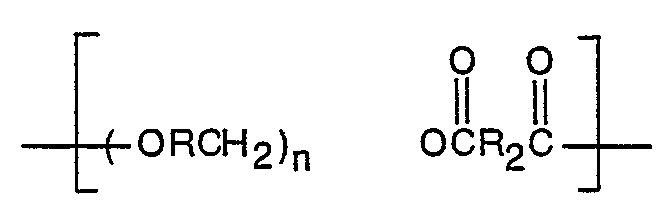
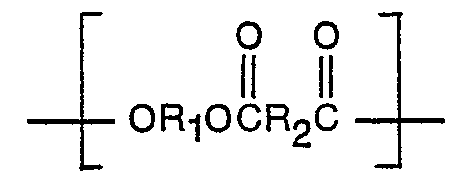
- the present invention provides a non- absorbable sterile surgical suture or ligature comprising a filament formed from a block copolymer containing polymeric blocks (A) and polymeric blocks (B), wherein the polymeric blocks (A) consist of a polyalkylene ether unit having a number average molecular weight of from 500-3000 and have the formula: wherein R is a straight or branched chain alkylene group of from 1 to 9 carbon atoms, R is 1,4-phenylene or cyclohexylene and n is the number of repeating units; and wherein the polymeric blocks (B) are the reaction product of (i) an aromatic dicarboxylic acid or a cycloaliphatic dicarboxylic acid and (ii) a short chain aliphatic or cycloaliphatic diol, and have the formula: wherein R 1 is a straight or branched chain alkylene group of from 2 to 10 carbon atoms or a cyclic group having the formula: and R 2 is 1,4
- a surgical suture or ligature described above wherein R is selected from ethylene, propylene and butylene groups is also preferred, and where R is a propylene group is most preferred.
- the suture or ligature of this invention may be in monofilament form or it may be of a braided or twisted construction.
- monofilament sutures and ligatures are however preferred.
- this invention it is possible, in preferred embodiments, to provide a monofilament suture or ligature which has good flexibility and fatigue life and high tensile strength. More particularly, we can provide a monofilament suture or ligature which has approximately the following characteristics: A surgical suture or ligature wherein the elongation at break precent is between 25 and 55 is preferred.
- a surgical suture package comprising a sterile enclosure and within which is a non-absorbable sterile surgical suture or ligature of this invention, as described above.
- Preferred monofilament sutures and ligatures of this invention combine the advantages of a braided suture material (i.e. flexibility and knot security) with those of a monofilament suture material (i.e. smooth surface, low tissue drag, inertness, and ease of knot run down).
- R is a straight or branched chain alkylene group of 1 to 9 carbon atoms
- R 1 is a straight or branched chain alkylene group of from 2 to 10 carbon atoms or a cyclic group having the formula:
- R 2 is selected from phenylene and cyclohexylene; and
- n is the number of repeating units.
- polymeric blocks A for example, units derived from polyethylene oxide or polybutylene oxide may constitute the soft segment of the block copolymer.
- polymeric blocks B for example, units derived from polyethylene terephthalate or polybutylene terephthalate may constitute the hard segment of the block copolymer.
- the sutures and ligatures of this invention must be formed from a copolymer containing polymeric blocks A and B, wherein the hard segment, provided by the polymeric blocks B, constitutes 30-95% by weight of the copolymer, and as already noted the B component should preferably constitute 50-85% by weight, most preferably 55-80% by weight, of the copolymer.
- the soft segment, provided by the polymeric blocks A is derived from a (tetramethylene ether) glycol having a number average molecular weight in the range of 500-3000.
- the total number average molecular weight of the block polyether-esters i.e. the copolymer is 25-30,000.
- the hard segment, provided by polymeric blocks B, can be derived from (1) a diacid, for example,
- the reaction product of (1) and (2) forms the polymeric blocks B.
- Sutures and ligatures can be formed from the block copolymers described in this application by conventional extrusion and drawing techniques.
- the extruded filaments are drawn from 5 to 10 times the original length of the undrawn extruded strand, preferably from 6 to 8 times, and this draw is preferably effected in two stages.
- the drawn filament may be subjected to conventional post-treatments, e.g. heating at constant length at, say, about 185°C.
- the sutures and ligatures formed from the block copolymers in accordance with this invention can be sterilized by a variety of methods recognized in the art including exposure to a gaseous sterilizing agent such as ethylene oxide, and exposure to radiation of gamma rays.
- a gaseous sterilizing agent such as ethylene oxide
- the sutures of this invention cannot generally be sterilized by exposure to heat because the flexible properties of the sutures may be adversely affected.
- the sutures of this invention can, if desired, be colored by mechanically blending with a pigment.
- Pigments such as titanium dioxide, iron oxide or carbon black give identifiable colors.
- Other colored pigments which do not cause deleterious tissue reactions may also be used to impart color to the strands.
- Sutures formed from the block copolymers in accordance with this invention were tested for toxicity by placing two 4 cm. segments on each of three plates of HEp-2 cell culture. The cultures were incubated for 24 hours at 36°C., stained with crystal violet and checked for degeneration of the cell monolayer in the area of the suture segment. None of the suture segments tested showed any evidence of cytotoxicity.
- the sutures were also tested in mice by the Systemic Injection Test according to the U.S.P. Biological Test for Plastic Containers No..
- the sutures were subjected to an extraction procedure and the extractant was injected into mice. No adverse reactions were observed in any of the test animals.
- any size may be used, depending upon the preference of the surgeon.
- U.S.P. United States Pharmacopeia
- the more common standard sizes are defined in the United States Pharmacopeia (which is abbreviated U.S.P.) as follows: (see United States Pharmacopeia Convention, Inc., Mack Publishing Co., Easton, Pa.):
- a two stage draw was used an 8X draw at 160°C in zone 1 and 1.1 X draw at 120°C in zone 2 for a total draw of 8.8X (where X is the original length of the undrawn strand).
- the properties of this size 3/0 USP fiber (0.245 mm) are described in the Table below.
- a copolyester composed of the hard and soft segments of Example 1 but with a content of 76% by weight hard segment is extruded at 230°C-245°C.
- a two stage draw is used where zone 1 is at 165°C. and drawn 2X and zone 2 is drawn 3.5X at 150°C. for a total draw of 7.0X.
- the properties of this size 3/0 U.S.P. fiber (0.231 mm) are described in the Table below.
- a copolyester composed of the hard and soft segments of Example 1, but with a content of 66% by weight hard segment is extruded at 230°-245°C.
- a two stage draw is used where Zone 1 is at 160°C (320°F) and drawn 2X and Zone 2 is at 160°C (320°F) and drawn at 4.1 for a total draw of 8.2X.
- the fiber is then heated at constant length at 185°C for 10 minutes.
- the properties of this fiber (0.195mm diameter) are described in the Table below.
Landscapes
- Health & Medical Sciences (AREA)
- Chemical & Material Sciences (AREA)
- Engineering & Computer Science (AREA)
- Materials Engineering (AREA)
- Surgery (AREA)
- Vascular Medicine (AREA)
- Epidemiology (AREA)
- Life Sciences & Earth Sciences (AREA)
- Animal Behavior & Ethology (AREA)
- General Health & Medical Sciences (AREA)
- Public Health (AREA)
- Veterinary Medicine (AREA)
- Materials For Medical Uses (AREA)
- Polyesters Or Polycarbonates (AREA)
Description
- This invention relates to a sterile surgical suture or ligature, which can be a monofilament, or a twisted or braided multifilament article.
- The medical profession is continuously seeking more satisfactory sutures to be used in closing wounds, whether such wounds are incisions from operations, or tears, cuts or abrasions from accidental or other causes. Many materials have been suggested for use as sutures. Sutures are divided into two broad classes, the absorbable sutures, such as catgut or polyglycolic acid sutures, which are absorbed by the body tissues, and nonabsorbable sutures which either remain in the tissues in substantially their original form for prolonged periods or are removed from the skin surfaces after the underlying tissues have been healed. For non- absorbable sutures many materials have been suggested which range from cotton and silk through various synthetic filaments such as polypropylene to stainless steel or nickel or other metallic filaments.
- Other things being equal, the medical profession usually prefers the suture which is strongest. In spite of many disadvantages stainless steel has met with considerable acceptance because of its extremely high tensile strength. Such plastics material as polypropylene are meeting currently with considerable commercial acceptance because of comparatively high tensile strength and because of other advantages over stainless steel.
- Additionally, the suture material needs good handling characteristics. The handling characteristics of a suture, as a general statement, are difficult to define but should include a high degree of flexibility. Handling characteristics also include knot strength and knot security; that is, the suture must have such characteristics that a knot can be tied in the suture. Some materials are so brittle that if a suture made from them is knotted, the strength of the suture is markedly reduced. For some materials an over-hand knot in a strand can reduce the strength of the strand by a factor of two or more. In addition to knot strength, the suture should have such characteristics that the knot when tied remains in position. Also, the suture should be "throwable" so that when the free end is placed in position by the surgeon it will remain in that position until moved. Similarly, the suture should have such characteristics that it can be thrown or moved from side to side and yet retain the position into which it is thrown.
- A surgical suture comprising a high degree of tensile strength with a high degree of flexibility is therefore needed in the medical profession.
- A polypropylene monofilament suture is one attempt at solving this need. The tensile strength of this suture is good when compared to stainless steel; however the flexibility of the suture, though better than stainless steel, is still considered to be stiff and springy.
- A polyurethane suture is another attempt. The primary advantage of this suture is its very high degree of flexibility. However, polyurethane sutures have low tensile strength and extremely high elongations at break which make then unsatisfactory for general wound closure methods.
- Other attempts include the braiding of materials with a high tensile strength but a low degree of flexibility. Polyethylene terephthalate is an example of a suture material with a satisfactory tensile strength after braiding and an increased degree of flexibility. A monofilament suture is generally preferred in most surgical procedures to a braided suture because of the reduced tissue drag of the monofilament. Also, in skin suturing a monofilament suture is generally preferred because it is usually less susceptible to capillary action than a braided suture.
- The present invention provides a non- absorbable sterile surgical suture or ligature comprising a filament formed from a block copolymer containing polymeric blocks (A) and polymeric blocks (B), wherein the polymeric blocks (A) consist of a polyalkylene ether unit having a number average molecular weight of from 500-3000 and have the formula:

- A surgical suture or ligature wherein the polymeric blocks (B) comprise from 50% to 85% of the copolymer is preferred, with the most preferred content of blocks (B) being from 55% to 80%.
- A surgical suture or ligature described above wherein R is selected from ethylene, propylene and butylene groups is also preferred, and where R is a propylene group is most preferred.
- Within the scope of this invention is a surgical suture or ligature described above and having an attached needle.
- As noted above, the suture or ligature of this invention may be in monofilament form or it may be of a braided or twisted construction. For reasons already explained, monofilament sutures and ligatures are however preferred. By means of this invention it is possible, in preferred embodiments, to provide a monofilament suture or ligature which has good flexibility and fatigue life and high tensile strength. More particularly, we can provide a monofilament suture or ligature which has approximately the following characteristics:

- Also within the scope of this invention is a surgical suture package comprising a sterile enclosure and within which is a non-absorbable sterile surgical suture or ligature of this invention, as described above.
- Preferred monofilament sutures and ligatures of this invention combine the advantages of a braided suture material (i.e. flexibility and knot security) with those of a monofilament suture material (i.e. smooth surface, low tissue drag, inertness, and ease of knot run down).
- The structures of the block copolymers used in this invention may be represented by the following general formula:


- In the polymeric blocks A, for example, units derived from polyethylene oxide or polybutylene oxide may constitute the soft segment of the block copolymer.
- In the polymeric blocks B, for example, units derived from polyethylene terephthalate or polybutylene terephthalate may constitute the hard segment of the block copolymer.
- In order to have the desired qualities of flexibility and high tensile strength, the sutures and ligatures of this invention must be formed from a copolymer containing polymeric blocks A and B, wherein the hard segment, provided by the polymeric blocks B, constitutes 30-95% by weight of the copolymer, and as already noted the B component should preferably constitute 50-85% by weight, most preferably 55-80% by weight, of the copolymer.
- Preferably, the soft segment, provided by the polymeric blocks A, is derived from a (tetramethylene ether) glycol having a number average molecular weight in the range of 500-3000. The total number average molecular weight of the block polyether-esters i.e. the copolymer is 25-30,000.
- The hard segment, provided by polymeric blocks B, can be derived from (1) a diacid, for example,
- (a) terephthalic acid,

- (b) 1,4-cyclohexane dicarboxylic acid; or
- (c) from the dimethyl esters of these acids; and,
-
- (a) a linear or branched chain glycol of 2 to 10 carbon atoms; and preferably of 4 carbon atoms, or
- (b) 1,4-cydohexanedimethanol,

- The reaction product of (1) and (2) forms the polymeric blocks B.
- Methods for preparing these block copolymers are known in the art. See, e.g., Belgium Patent 832,445 issued December 1, 1975; German Offen. 2,265,320 published May 6th, 1977 and German Offen. 2,265,294 published April 21, 1977.
- Sutures and ligatures can be formed from the block copolymers described in this application by conventional extrusion and drawing techniques. Generally, the extruded filaments are drawn from 5 to 10 times the original length of the undrawn extruded strand, preferably from 6 to 8 times, and this draw is preferably effected in two stages. If desired, the drawn filament may be subjected to conventional post-treatments, e.g. heating at constant length at, say, about 185°C.
- The sutures and ligatures formed from the block copolymers in accordance with this invention can be sterilized by a variety of methods recognized in the art including exposure to a gaseous sterilizing agent such as ethylene oxide, and exposure to radiation of gamma rays. However, the sutures of this invention cannot generally be sterilized by exposure to heat because the flexible properties of the sutures may be adversely affected.
- The sutures of this invention can, if desired, be colored by mechanically blending with a pigment. Pigments such as titanium dioxide, iron oxide or carbon black give identifiable colors. Other colored pigments which do not cause deleterious tissue reactions may also be used to impart color to the strands.
- Sutures formed from the block copolymers in accordance with this invention were tested for toxicity by placing two 4 cm. segments on each of three plates of HEp-2 cell culture. The cultures were incubated for 24 hours at 36°C., stained with crystal violet and checked for degeneration of the cell monolayer in the area of the suture segment. None of the suture segments tested showed any evidence of cytotoxicity.
- The sutures were also tested in mice by the Systemic Injection Test according to the U.S.P. Biological Test for Plastic Containers No.. The sutures were subjected to an extraction procedure and the extractant was injected into mice. No adverse reactions were observed in any of the test animals.
- For use as sutures, and ligatures, any size may be used, depending upon the preference of the surgeon. In the United States, the more common standard sizes are defined in the United States Pharmacopeia (which is abbreviated U.S.P.) as follows: (see United States Pharmacopeia Convention, Inc., Mack Publishing Co., Easton, Pa.):

- The results of tests conducted to compare three types of non-absorbable sutures: (1) Oermalon@, a nylon suture manufactured by American Cyanamid Company, Wayne, New Jersey; and (2) Surgilene®, a polypropylene suture of American Cyanamid Company, Wayne, New Jersey, and (3) the copolymers of this invention are disclosed in the following examples.
- A copolyester composed of a polytetramethylene oxide soft segment (MW = 1000) and a poly(tetramethylene terephthalate) hard segment and containing 58 + 2% by weight of the hard segment is extruded at 230°-245°C. with a collection of extrudate at about 7.625 metres (25 feet) per minute. A two stage draw was used an 8X draw at 160°C in zone 1 and 1.1 X draw at 120°C in zone 2 for a total draw of 8.8X (where X is the original length of the undrawn strand). The properties of this size 3/0 USP fiber (0.245 mm) are described in the Table below.
- A copolyester composed of the hard and soft segments of Example 1 but with a content of 76% by weight hard segment is extruded at 230°C-245°C. A two stage draw is used where zone 1 is at 165°C. and drawn 2X and zone 2 is drawn 3.5X at 150°C. for a total draw of 7.0X. The properties of this size 3/0 U.S.P. fiber (0.231 mm) are described in the Table below.
- A copolyester composed of the hard and soft segments of Example 1, but with a content of 66% by weight hard segment is extruded at 230°-245°C. A two stage draw is used where Zone 1 is at 160°C (320°F) and drawn 2X and Zone 2 is at 160°C (320°F) and drawn at 4.1 for a total draw of 8.2X. The fiber is then heated at constant length at 185°C for 10 minutes. The properties of this fiber (0.195mm diameter) are described in the Table below.

Claims (9)


Applications Claiming Priority (2)
| Application Number | Priority Date | Filing Date | Title |
|---|---|---|---|
| US05/933,224 US4224946A (en) | 1978-08-14 | 1978-08-14 | Surgical sutures derived from segmented polyether-ester block copolymers |
| US933224 | 1978-08-14 |
Related Child Applications (1)
| Application Number | Title | Priority Date | Filing Date |
|---|---|---|---|
| EP83100214.2 Division-Into | 1979-02-20 |
Publications (3)
| Publication Number | Publication Date |
|---|---|
| EP0008152A2 EP0008152A2 (en) | 1980-02-20 |
| EP0008152A3 EP0008152A3 (en) | 1980-03-05 |
| EP0008152B1 true EP0008152B1 (en) | 1984-01-18 |
Family
ID=25463574
Family Applications (2)
| Application Number | Title | Priority Date | Filing Date |
|---|---|---|---|
| EP83100214A Expired - Lifetime EP0210281B1 (en) | 1978-08-14 | 1979-02-20 | A method of using a filament for manufacturing a suture or ligature |
| EP79300252A Expired EP0008152B1 (en) | 1978-08-14 | 1979-02-20 | Non-absorbable synthetic sutures and ligatures |
Family Applications Before (1)
| Application Number | Title | Priority Date | Filing Date |
|---|---|---|---|
| EP83100214A Expired - Lifetime EP0210281B1 (en) | 1978-08-14 | 1979-02-20 | A method of using a filament for manufacturing a suture or ligature |
Country Status (24)
| Country | Link |
|---|---|
| US (1) | US4224946A (en) |
| EP (2) | EP0210281B1 (en) |
| JP (1) | JPS6025975B2 (en) |
| AR (1) | AR223972A1 (en) |
| AU (1) | AU522500B2 (en) |
| BR (1) | BR7901300A (en) |
| CA (1) | CA1116776A (en) |
| DD (1) | DD142295A5 (en) |
| DE (1) | DE2909161C2 (en) |
| DK (1) | DK153775C (en) |
| EG (1) | EG14102A (en) |
| ES (1) | ES479909A1 (en) |
| FI (1) | FI71059C (en) |
| GR (1) | GR73533B (en) |
| HK (2) | HK83789A (en) |
| HU (1) | HU182441B (en) |
| IL (1) | IL56665A (en) |
| NO (1) | NO145458C (en) |
| NZ (1) | NZ189665A (en) |
| PL (1) | PL120124B1 (en) |
| PT (1) | PT69468B (en) |
| RO (1) | RO77508A (en) |
| YU (1) | YU53279A (en) |
| ZA (1) | ZA79733B (en) |
Families Citing this family (31)
| Publication number | Priority date | Publication date | Assignee | Title |
|---|---|---|---|---|
| IN151798B (en) * | 1978-12-08 | 1983-07-30 | Ethicon Inc | |
| CS228122B2 (en) * | 1978-12-08 | 1984-05-14 | Ethicon Inc | Surgical sewing or aid materials |
| US4314561A (en) * | 1979-01-29 | 1982-02-09 | American Cyanamid Company | Surgical suture derived from segmented polyether-ester block copolymers |
| US4388926A (en) * | 1980-12-22 | 1983-06-21 | Ethicon, Inc. | High compliance monofilament surgical sutures comprising poly[alkylene terephthalate-co-(2-alkenyl or alkyl)succinate] |
| US4543952A (en) * | 1981-04-13 | 1985-10-01 | Ethicon, Inc. | Flexible copolymers of p-(hydroxyalkoxy)benozic acid and pliant surgical products, particularly monofilament surgical sutures, therefrom |
| US4550730A (en) * | 1981-12-07 | 1985-11-05 | Ethicon, Inc. | Flexible monofilament surgical sutures comprising poly(polymethylene terephthalate, isophthalate or cyclohexane-1,4-dicarboxylate-co-dimerate) |
| CA1192715A (en) * | 1981-12-07 | 1985-09-03 | Edgar S. Schipper | Flexible monofilament surgical sutures comprising poly(polymethylene terephthalate, isophthalate or cyclohexane-1,4-dicarboxylate-co-dimerate) |
| US5110852A (en) * | 1982-07-16 | 1992-05-05 | Rijksuniversiteit Te Groningen | Filament material polylactide mixtures |
| NL8202894A (en) * | 1982-07-16 | 1984-02-16 | Rijksuniversiteit | POLYESTER FILAMENT MATERIAL. |
| US4461298A (en) * | 1982-07-26 | 1984-07-24 | Ethicon, Inc. | Composite sutures of silk and hydrophobic thermoplastic elastomers |
| US4608428A (en) * | 1982-07-26 | 1986-08-26 | Ethicon, Inc. | Copolymers of a 4,4'-(ethylenedioxy)bis benzoate, an alkylene diol and a (2-alkenyl or alkyl) succinic anhydride; and surgical devices formed therefrom |
| US4511706A (en) * | 1982-07-26 | 1985-04-16 | Ethicon, Inc. | Copolymers of a 4,4'-(ethylenedioxy)bis benzoate, an alkylene diol and a (2-alkenyl or alkyl) succinic anhydride |
| US4520822A (en) * | 1982-10-04 | 1985-06-04 | Ethicon, Inc. | Ethylene-propylene copolymer sutures |
| US4459462A (en) * | 1982-12-27 | 1984-07-10 | International Business Machines Corporation | Drive system for energizing elements of a fixed bar printer |
| US4532928A (en) * | 1983-01-20 | 1985-08-06 | Ethicon, Inc. | Surgical sutures made from absorbable polymers of substituted benzoic acid |
| US4578451A (en) * | 1983-07-15 | 1986-03-25 | Ethicon, Inc. | Surgical filaments from block copolyetheramides |
| JPS60189468A (en) * | 1984-03-08 | 1985-09-26 | Seiko Epson Corp | Copy printing device |
| JPS60209039A (en) * | 1984-03-28 | 1985-10-21 | 東洋紡績株式会社 | Sewing yarn |
| JPS60209040A (en) * | 1984-03-28 | 1985-10-21 | 東洋紡績株式会社 | Sewing yarn |
| US5007922A (en) * | 1989-11-13 | 1991-04-16 | Ethicon, Inc. | Method of making a surgical suture |
| JPH03104866U (en) * | 1990-02-08 | 1991-10-30 | ||
| US5225485A (en) * | 1992-03-03 | 1993-07-06 | United States Surgical Corporation | Polyetherimide ester suture and its method of manufacture and method of use |
| US5284489A (en) * | 1992-08-19 | 1994-02-08 | United States Surgical Corporation | Filament fabricated from a blend of ionomer resin and nonionic thermoplastic resin |
| EP1068872A1 (en) * | 1999-07-12 | 2001-01-17 | IsoTis B.V. | Sutures |
| JP2001054563A (en) | 1999-07-12 | 2001-02-27 | Isotis Bv | Suture |
| US6197043B1 (en) | 1999-08-18 | 2001-03-06 | James A. Davidson | Isoelastic suture material and device |
| AU2002305079B8 (en) * | 2001-05-11 | 2006-05-25 | Ortho-Mcneil Pharmaceutical, Inc. | Immune modulation device for use in animals |
| US20090264925A1 (en) * | 2008-04-17 | 2009-10-22 | Joseph Hotter | Poly(Trimethylene)Terephthalate Filaments And Articles Made Therefrom |
| US10149923B2 (en) * | 2013-01-15 | 2018-12-11 | Tepha, Inc. | Implants for soft and hard tissue regeneration |
| EP3085820B1 (en) | 2015-04-22 | 2017-12-20 | Sofradim Production | A method for forming a barbed suture and the barbed suture thus obtained |
| EP3085332B1 (en) | 2015-04-23 | 2019-02-27 | Sofradim Production | Package for a surgical mesh |
Family Cites Families (10)
| Publication number | Priority date | Publication date | Assignee | Title |
|---|---|---|---|---|
| US3023192A (en) * | 1958-05-29 | 1962-02-27 | Du Pont | Segmented copolyetherester elastomers |
| US3359983A (en) * | 1963-01-23 | 1967-12-26 | American Cyanamid Co | Synthetic surgical sutures |
| US3701755A (en) * | 1968-12-04 | 1972-10-31 | Toyo Boseki | Production of elastomers |
| US3652713A (en) * | 1969-02-18 | 1972-03-28 | Toray Industries | Polyester composition having improved antistatic properties and process for the preparation thereof |
| US3766146A (en) * | 1971-03-18 | 1973-10-16 | Du Pont | Segmented thermoplastic copolyester elastomers |
| US3763109A (en) * | 1971-08-19 | 1973-10-02 | Du Pont | Segmented thermoplastic copolyesters |
| BE793332A (en) * | 1972-01-26 | 1973-04-16 | Du Pont | THERMOPLASTIC COPOLYESTERS WITH SEGMENTS |
| BE806869A (en) * | 1972-11-03 | 1974-04-30 | Ethicon Inc | IMPROVED BRAID TIE WIRE |
| US3861521A (en) * | 1973-04-17 | 1975-01-21 | Mildred V Burtz | Disposable suture organizer |
| US3875946A (en) * | 1974-02-27 | 1975-04-08 | Ethicon Inc | Controlled release suture |
-
1978
- 1978-08-14 US US05/933,224 patent/US4224946A/en not_active Expired - Lifetime
-
1979
- 1979-02-14 IL IL56665A patent/IL56665A/en unknown
- 1979-02-15 NO NO790509A patent/NO145458C/en unknown
- 1979-02-15 NZ NZ189665A patent/NZ189665A/en unknown
- 1979-02-16 ZA ZA79733A patent/ZA79733B/en unknown
- 1979-02-20 EP EP83100214A patent/EP0210281B1/en not_active Expired - Lifetime
- 1979-02-20 EP EP79300252A patent/EP0008152B1/en not_active Expired
- 1979-02-21 AU AU44455/79A patent/AU522500B2/en not_active Expired
- 1979-02-21 CA CA000322005A patent/CA1116776A/en not_active Expired
- 1979-02-21 FI FI790591A patent/FI71059C/en not_active IP Right Cessation
- 1979-02-23 AR AR275618A patent/AR223972A1/en active
- 1979-02-26 EG EG122/79A patent/EG14102A/en active
- 1979-02-27 JP JP54021492A patent/JPS6025975B2/en not_active Expired
- 1979-02-28 GR GR58503A patent/GR73533B/el unknown
- 1979-03-02 BR BR7901300A patent/BR7901300A/en unknown
- 1979-03-05 PL PL1979213904A patent/PL120124B1/en unknown
- 1979-03-05 YU YU00532/79A patent/YU53279A/en unknown
- 1979-03-08 DE DE2909161A patent/DE2909161C2/en not_active Expired
- 1979-03-15 HU HU79AE562A patent/HU182441B/en unknown
- 1979-03-16 DD DD79211632A patent/DD142295A5/en unknown
- 1979-04-11 PT PT69468A patent/PT69468B/en not_active IP Right Cessation
- 1979-04-19 RO RO7997300A patent/RO77508A/en unknown
- 1979-04-25 ES ES479909A patent/ES479909A1/en not_active Expired
- 1979-07-19 DK DK304379A patent/DK153775C/en not_active IP Right Cessation
-
1989
- 1989-10-19 HK HK837/89A patent/HK83789A/en not_active IP Right Cessation
-
1995
- 1995-05-04 HK HK67695A patent/HK67695A/en not_active IP Right Cessation
Also Published As
Similar Documents
| Publication | Publication Date | Title |
|---|---|---|
| EP0210281B1 (en) | A method of using a filament for manufacturing a suture or ligature | |
| US4246904A (en) | Surgical suture derived from segmented polyether-ester block copolymers | |
| US5147382A (en) | Elastomeric surgical sutures comprising segmented copolyether/esters | |
| US3297033A (en) | Surgical sutures | |
| US3359983A (en) | Synthetic surgical sutures | |
| Bezwada et al. | Monocryl® suture, a new ultra-pliable absorbable monofilament suture | |
| CA2337133C (en) | Absorbable polymers and surgical articles fabricated therefrom | |
| US5261886A (en) | Cabled core and braided suture made therefrom | |
| US6235869B1 (en) | Absorbable polymers and surgical articles fabricated therefrom | |
| US3454011A (en) | Sutures and prosthetic patches | |
| Chellamani et al. | Surgical sutures: an overview | |
| JPS60185562A (en) | Surgical prosthesis | |
| IE52433B1 (en) | High compliance monofilament surgical sutures comprising poly-(alkylene terephthalate-co-(2-alkenyl or alkyl)succinate) | |
| US4314561A (en) | Surgical suture derived from segmented polyether-ester block copolymers | |
| US5102419A (en) | Elastomeric surgical sutures comprising segmented copolyether/esters | |
| GB1588031A (en) | Isotactic polypropylene surgical sutures | |
| USRE32770E (en) | Surgical suture derived from segmented polyether-ester block copolymers | |
| CA2160202C (en) | Absorbable polymer and surgical articles fabricated therefrom | |
| CA1203137B (en) | Elastomeric surgical sutures-comprising segmented copolyether/esters | |
| EP0513335B1 (en) | Cabled core and braided suture made therefrom | |
| CA2347790C (en) | Absorbable polymers and surgical articles fabricated therefrom | |
| KR0126599B1 (en) | Biodegradable Surgical Sutures | |
| RU2201259C2 (en) | Surgical suture | |
| AU2880899A (en) | Absorbable copolymers and surgical articles fabricated thefefrom |
Legal Events
| Date | Code | Title | Description |
|---|---|---|---|
| PUAI | Public reference made under article 153(3) epc to a published international application that has entered the european phase |
Free format text: ORIGINAL CODE: 0009012 |
|
| PUAL | Search report despatched |
Free format text: ORIGINAL CODE: 0009013 |
|
| AK | Designated contracting states |
Designated state(s): BE CH FR GB IT NL SE |
|
| AK | Designated contracting states |
Designated state(s): BE CH FR GB IT NL SE |
|
| 17P | Request for examination filed | ||
| ITF | It: translation for a ep patent filed | ||
| ITF | It: translation for a ep patent filed | ||
| GRAA | (expected) grant |
Free format text: ORIGINAL CODE: 0009210 |
|
| AK | Designated contracting states |
Designated state(s): BE CH FR GB IT NL SE |
|
| ET | Fr: translation filed | ||
| PLBE | No opposition filed within time limit |
Free format text: ORIGINAL CODE: 0009261 |
|
| STAA | Information on the status of an ep patent application or granted ep patent |
Free format text: STATUS: NO OPPOSITION FILED WITHIN TIME LIMIT |
|
| 26N | No opposition filed | ||
| ITTA | It: last paid annual fee | ||
| EAL | Se: european patent in force in sweden |
Ref document number: 79300252.8 |
|
| PGFP | Annual fee paid to national office [announced via postgrant information from national office to epo] |
Ref country code: NL Payment date: 19971231 Year of fee payment: 20 |
|
| PGFP | Annual fee paid to national office [announced via postgrant information from national office to epo] |
Ref country code: GB Payment date: 19980108 Year of fee payment: 20 |
|
| PGFP | Annual fee paid to national office [announced via postgrant information from national office to epo] |
Ref country code: SE Payment date: 19980205 Year of fee payment: 20 |
|
| PGFP | Annual fee paid to national office [announced via postgrant information from national office to epo] |
Ref country code: FR Payment date: 19980209 Year of fee payment: 20 |
|
| PG25 | Lapsed in a contracting state [announced via postgrant information from national office to epo] |
Ref country code: SE Free format text: LAPSE BECAUSE OF NON-PAYMENT OF DUE FEES Effective date: 19980221 |
|
| PGFP | Annual fee paid to national office [announced via postgrant information from national office to epo] |
Ref country code: BE Payment date: 19980320 Year of fee payment: 20 |
|
| PGFP | Annual fee paid to national office [announced via postgrant information from national office to epo] |
Ref country code: CH Payment date: 19980325 Year of fee payment: 20 |
|
| BE20 | Be: patent expired |
Free format text: 19990220 *AMERICAN CYANAMID CY |
|
| PG25 | Lapsed in a contracting state [announced via postgrant information from national office to epo] |
Ref country code: GB Free format text: LAPSE BECAUSE OF EXPIRATION OF PROTECTION Effective date: 19990219 Ref country code: CH Free format text: LAPSE BECAUSE OF EXPIRATION OF PROTECTION Effective date: 19990219 |
|
| PG25 | Lapsed in a contracting state [announced via postgrant information from national office to epo] |
Ref country code: NL Free format text: LAPSE BECAUSE OF EXPIRATION OF PROTECTION Effective date: 19990220 |
|
| REG | Reference to a national code |
Ref country code: CH Ref legal event code: PL |
|
| REG | Reference to a national code |
Ref country code: GB Ref legal event code: PE20 Effective date: 19990219 |
|
| EUG | Se: european patent has lapsed |
Ref document number: 79300252.8 |
|
| NLV7 | Nl: ceased due to reaching the maximum lifetime of a patent |
Effective date: 19990219 |