EP0006951B1 - Improvements in or relating to nickel-, cobalt-, and iron based alloys - Google Patents
Improvements in or relating to nickel-, cobalt-, and iron based alloys Download PDFInfo
- Publication number
- EP0006951B1 EP0006951B1 EP78900280A EP78900280A EP0006951B1 EP 0006951 B1 EP0006951 B1 EP 0006951B1 EP 78900280 A EP78900280 A EP 78900280A EP 78900280 A EP78900280 A EP 78900280A EP 0006951 B1 EP0006951 B1 EP 0006951B1
- Authority
- EP
- European Patent Office
- Prior art keywords
- platinum
- alloy
- metals
- component
- nickel
- Prior art date
- Legal status (The legal status is an assumption and is not a legal conclusion. Google has not performed a legal analysis and makes no representation as to the accuracy of the status listed.)
- Expired
Links
- 229910045601 alloy Inorganic materials 0.000 title claims abstract description 116
- 239000000956 alloy Substances 0.000 title claims abstract description 116
- PXHVJJICTQNCMI-UHFFFAOYSA-N Nickel Chemical compound [Ni] PXHVJJICTQNCMI-UHFFFAOYSA-N 0.000 title claims abstract description 36
- XEEYBQQBJWHFJM-UHFFFAOYSA-N Iron Chemical compound [Fe] XEEYBQQBJWHFJM-UHFFFAOYSA-N 0.000 title claims abstract description 20
- 229910052742 iron Inorganic materials 0.000 title claims abstract description 10
- GUTLYIVDDKVIGB-UHFFFAOYSA-N cobalt atom Chemical compound [Co] GUTLYIVDDKVIGB-UHFFFAOYSA-N 0.000 title claims abstract description 8
- 229910052751 metal Inorganic materials 0.000 claims abstract description 48
- 239000002184 metal Substances 0.000 claims abstract description 48
- 230000003647 oxidation Effects 0.000 claims abstract description 28
- 238000007254 oxidation reaction Methods 0.000 claims abstract description 28
- 150000002739 metals Chemical class 0.000 claims abstract description 26
- 230000007797 corrosion Effects 0.000 claims abstract description 17
- 238000005260 corrosion Methods 0.000 claims abstract description 17
- 229910052799 carbon Inorganic materials 0.000 claims abstract description 14
- 229910052759 nickel Inorganic materials 0.000 claims abstract description 14
- OKTJSMMVPCPJKN-UHFFFAOYSA-N Carbon Chemical compound [C] OKTJSMMVPCPJKN-UHFFFAOYSA-N 0.000 claims abstract description 13
- 239000000203 mixture Substances 0.000 claims abstract description 10
- 239000010936 titanium Substances 0.000 claims abstract description 9
- 229910052719 titanium Inorganic materials 0.000 claims abstract description 8
- 229910017052 cobalt Inorganic materials 0.000 claims abstract description 7
- 239000010941 cobalt Substances 0.000 claims abstract description 7
- 239000010955 niobium Substances 0.000 claims abstract description 7
- RTAQQCXQSZGOHL-UHFFFAOYSA-N Titanium Chemical compound [Ti] RTAQQCXQSZGOHL-UHFFFAOYSA-N 0.000 claims abstract description 6
- 239000012535 impurity Substances 0.000 claims abstract description 6
- 229910052758 niobium Inorganic materials 0.000 claims abstract description 6
- 229910052715 tantalum Inorganic materials 0.000 claims abstract description 6
- GUVRBAGPIYLISA-UHFFFAOYSA-N tantalum atom Chemical compound [Ta] GUVRBAGPIYLISA-UHFFFAOYSA-N 0.000 claims abstract description 6
- 239000011651 chromium Substances 0.000 claims abstract description 5
- GUCVJGMIXFAOAE-UHFFFAOYSA-N niobium atom Chemical compound [Nb] GUCVJGMIXFAOAE-UHFFFAOYSA-N 0.000 claims abstract description 5
- 229910052782 aluminium Inorganic materials 0.000 claims abstract description 4
- 229910052804 chromium Inorganic materials 0.000 claims abstract description 4
- VYZAMTAEIAYCRO-UHFFFAOYSA-N Chromium Chemical compound [Cr] VYZAMTAEIAYCRO-UHFFFAOYSA-N 0.000 claims abstract description 3
- ZOKXTWBITQBERF-UHFFFAOYSA-N Molybdenum Chemical compound [Mo] ZOKXTWBITQBERF-UHFFFAOYSA-N 0.000 claims abstract description 3
- 239000004411 aluminium Substances 0.000 claims abstract description 3
- XAGFODPZIPBFFR-UHFFFAOYSA-N aluminium Chemical compound [Al] XAGFODPZIPBFFR-UHFFFAOYSA-N 0.000 claims abstract description 3
- 229910052750 molybdenum Inorganic materials 0.000 claims abstract description 3
- 239000011733 molybdenum Substances 0.000 claims abstract description 3
- WFKWXMTUELFFGS-UHFFFAOYSA-N tungsten Chemical compound [W] WFKWXMTUELFFGS-UHFFFAOYSA-N 0.000 claims abstract description 3
- 229910052721 tungsten Inorganic materials 0.000 claims abstract description 3
- 239000010937 tungsten Substances 0.000 claims abstract description 3
- 238000005728 strengthening Methods 0.000 claims description 15
- 238000000034 method Methods 0.000 claims description 7
- 230000014509 gene expression Effects 0.000 claims description 6
- 229910052723 transition metal Inorganic materials 0.000 claims description 6
- 150000003623 transition metal compounds Chemical class 0.000 claims description 6
- 150000003624 transition metals Chemical class 0.000 claims description 6
- BASFCYQUMIYNBI-UHFFFAOYSA-N platinum Chemical group [Pt] BASFCYQUMIYNBI-UHFFFAOYSA-N 0.000 abstract description 46
- 229910052697 platinum Inorganic materials 0.000 abstract description 19
- 229910052727 yttrium Inorganic materials 0.000 abstract description 12
- VWQVUPCCIRVNHF-UHFFFAOYSA-N yttrium atom Chemical compound [Y] VWQVUPCCIRVNHF-UHFFFAOYSA-N 0.000 abstract description 10
- -1 platinum group metals Chemical class 0.000 abstract description 9
- 229910052735 hafnium Inorganic materials 0.000 abstract description 6
- KDLHZDBZIXYQEI-UHFFFAOYSA-N Palladium Chemical compound [Pd] KDLHZDBZIXYQEI-UHFFFAOYSA-N 0.000 abstract description 5
- QCWXUUIWCKQGHC-UHFFFAOYSA-N Zirconium Chemical compound [Zr] QCWXUUIWCKQGHC-UHFFFAOYSA-N 0.000 abstract description 5
- VBJZVLUMGGDVMO-UHFFFAOYSA-N hafnium atom Chemical compound [Hf] VBJZVLUMGGDVMO-UHFFFAOYSA-N 0.000 abstract description 5
- 229910052726 zirconium Inorganic materials 0.000 abstract description 5
- 229910000765 intermetallic Inorganic materials 0.000 abstract description 4
- 229910052741 iridium Inorganic materials 0.000 abstract description 4
- 229910052746 lanthanum Inorganic materials 0.000 abstract description 4
- GKOZUEZYRPOHIO-UHFFFAOYSA-N iridium atom Chemical compound [Ir] GKOZUEZYRPOHIO-UHFFFAOYSA-N 0.000 abstract description 3
- 229910052747 lanthanoid Inorganic materials 0.000 abstract description 3
- 150000002602 lanthanoids Chemical class 0.000 abstract description 3
- FZLIPJUXYLNCLC-UHFFFAOYSA-N lanthanum atom Chemical compound [La] FZLIPJUXYLNCLC-UHFFFAOYSA-N 0.000 abstract description 3
- 229910052762 osmium Inorganic materials 0.000 abstract description 3
- 229910052763 palladium Inorganic materials 0.000 abstract description 3
- 229910052703 rhodium Inorganic materials 0.000 abstract description 3
- 239000010948 rhodium Substances 0.000 abstract description 3
- 229910052707 ruthenium Inorganic materials 0.000 abstract description 3
- 229910052706 scandium Inorganic materials 0.000 abstract description 3
- SIXSYDAISGFNSX-UHFFFAOYSA-N scandium atom Chemical compound [Sc] SIXSYDAISGFNSX-UHFFFAOYSA-N 0.000 abstract description 3
- KJTLSVCANCCWHF-UHFFFAOYSA-N Ruthenium Chemical compound [Ru] KJTLSVCANCCWHF-UHFFFAOYSA-N 0.000 abstract description 2
- SYQBFIAQOQZEGI-UHFFFAOYSA-N osmium atom Chemical compound [Os] SYQBFIAQOQZEGI-UHFFFAOYSA-N 0.000 abstract description 2
- MHOVAHRLVXNVSD-UHFFFAOYSA-N rhodium atom Chemical compound [Rh] MHOVAHRLVXNVSD-UHFFFAOYSA-N 0.000 abstract description 2
- 238000007792 addition Methods 0.000 description 19
- PNEYBMLMFCGWSK-UHFFFAOYSA-N Alumina Chemical compound [O-2].[O-2].[O-2].[Al+3].[Al+3] PNEYBMLMFCGWSK-UHFFFAOYSA-N 0.000 description 9
- 239000007789 gas Substances 0.000 description 9
- 150000001247 metal acetylides Chemical class 0.000 description 7
- 229910003470 tongbaite Inorganic materials 0.000 description 7
- 230000003014 reinforcing effect Effects 0.000 description 6
- QVYYOKWPCQYKEY-UHFFFAOYSA-N [Fe].[Co] Chemical compound [Fe].[Co] QVYYOKWPCQYKEY-UHFFFAOYSA-N 0.000 description 5
- 150000001875 compounds Chemical class 0.000 description 5
- 238000012360 testing method Methods 0.000 description 5
- 239000000470 constituent Substances 0.000 description 4
- 230000000694 effects Effects 0.000 description 4
- 230000005496 eutectics Effects 0.000 description 4
- 230000000717 retained effect Effects 0.000 description 4
- 229910000601 superalloy Inorganic materials 0.000 description 4
- 208000021017 Weight Gain Diseases 0.000 description 3
- 230000015572 biosynthetic process Effects 0.000 description 3
- 238000000576 coating method Methods 0.000 description 3
- 230000001788 irregular Effects 0.000 description 3
- 239000011159 matrix material Substances 0.000 description 3
- 230000001052 transient effect Effects 0.000 description 3
- 230000004584 weight gain Effects 0.000 description 3
- 235000019786 weight gain Nutrition 0.000 description 3
- IJGRMHOSHXDMSA-UHFFFAOYSA-N Atomic nitrogen Chemical compound N#N IJGRMHOSHXDMSA-UHFFFAOYSA-N 0.000 description 2
- DGAQECJNVWCQMB-PUAWFVPOSA-M Ilexoside XXIX Chemical compound C[C@@H]1CC[C@@]2(CC[C@@]3(C(=CC[C@H]4[C@]3(CC[C@@H]5[C@@]4(CC[C@@H](C5(C)C)OS(=O)(=O)[O-])C)C)[C@@H]2[C@]1(C)O)C)C(=O)O[C@H]6[C@@H]([C@H]([C@@H]([C@H](O6)CO)O)O)O.[Na+] DGAQECJNVWCQMB-PUAWFVPOSA-M 0.000 description 2
- FAPWRFPIFSIZLT-UHFFFAOYSA-M Sodium chloride Chemical compound [Na+].[Cl-] FAPWRFPIFSIZLT-UHFFFAOYSA-M 0.000 description 2
- NINIDFKCEFEMDL-UHFFFAOYSA-N Sulfur Chemical compound [S] NINIDFKCEFEMDL-UHFFFAOYSA-N 0.000 description 2
- 239000005864 Sulphur Substances 0.000 description 2
- 230000001464 adherent effect Effects 0.000 description 2
- 230000002411 adverse Effects 0.000 description 2
- 230000009286 beneficial effect Effects 0.000 description 2
- 239000008199 coating composition Substances 0.000 description 2
- 238000001816 cooling Methods 0.000 description 2
- 229910052593 corundum Inorganic materials 0.000 description 2
- 230000002939 deleterious effect Effects 0.000 description 2
- QDOXWKRWXJOMAK-UHFFFAOYSA-N dichromium trioxide Chemical compound O=[Cr]O[Cr]=O QDOXWKRWXJOMAK-UHFFFAOYSA-N 0.000 description 2
- 229910002804 graphite Inorganic materials 0.000 description 2
- 239000010439 graphite Substances 0.000 description 2
- 239000010410 layer Substances 0.000 description 2
- 239000000463 material Substances 0.000 description 2
- 229910000510 noble metal Inorganic materials 0.000 description 2
- 230000003287 optical effect Effects 0.000 description 2
- 239000002245 particle Substances 0.000 description 2
- 229910052761 rare earth metal Inorganic materials 0.000 description 2
- 150000003839 salts Chemical class 0.000 description 2
- 239000000523 sample Substances 0.000 description 2
- 229910052708 sodium Inorganic materials 0.000 description 2
- 239000011734 sodium Substances 0.000 description 2
- 238000004901 spalling Methods 0.000 description 2
- 239000000758 substrate Substances 0.000 description 2
- 229910001845 yogo sapphire Inorganic materials 0.000 description 2
- ZOXJGFHDIHLPTG-UHFFFAOYSA-N Boron Chemical compound [B] ZOXJGFHDIHLPTG-UHFFFAOYSA-N 0.000 description 1
- 229910000531 Co alloy Inorganic materials 0.000 description 1
- 229910000846 In alloy Inorganic materials 0.000 description 1
- PWHULOQIROXLJO-UHFFFAOYSA-N Manganese Chemical compound [Mn] PWHULOQIROXLJO-UHFFFAOYSA-N 0.000 description 1
- 229910000990 Ni alloy Inorganic materials 0.000 description 1
- 229910001005 Ni3Al Inorganic materials 0.000 description 1
- 229910018487 Ni—Cr Inorganic materials 0.000 description 1
- OAICVXFJPJFONN-UHFFFAOYSA-N Phosphorus Chemical compound [P] OAICVXFJPJFONN-UHFFFAOYSA-N 0.000 description 1
- XUIMIQQOPSSXEZ-UHFFFAOYSA-N Silicon Chemical compound [Si] XUIMIQQOPSSXEZ-UHFFFAOYSA-N 0.000 description 1
- QXZUUHYBWMWJHK-UHFFFAOYSA-N [Co].[Ni] Chemical compound [Co].[Ni] QXZUUHYBWMWJHK-UHFFFAOYSA-N 0.000 description 1
- VMSKLDDPZGDWTO-UHFFFAOYSA-N [Y].[C] Chemical compound [Y].[C] VMSKLDDPZGDWTO-UHFFFAOYSA-N 0.000 description 1
- 238000005275 alloying Methods 0.000 description 1
- QVGXLLKOCUKJST-UHFFFAOYSA-N atomic oxygen Chemical compound [O] QVGXLLKOCUKJST-UHFFFAOYSA-N 0.000 description 1
- 229910052796 boron Inorganic materials 0.000 description 1
- VNNRSPGTAMTISX-UHFFFAOYSA-N chromium nickel Chemical compound [Cr].[Ni] VNNRSPGTAMTISX-UHFFFAOYSA-N 0.000 description 1
- MMAADVOQRITKKL-UHFFFAOYSA-N chromium platinum Chemical compound [Cr].[Pt] MMAADVOQRITKKL-UHFFFAOYSA-N 0.000 description 1
- OLFCLHDBKGQITG-UHFFFAOYSA-N chromium(3+) nickel(2+) oxygen(2-) Chemical compound [Ni+2].[O-2].[Cr+3] OLFCLHDBKGQITG-UHFFFAOYSA-N 0.000 description 1
- 239000002131 composite material Substances 0.000 description 1
- 238000000354 decomposition reaction Methods 0.000 description 1
- 230000006866 deterioration Effects 0.000 description 1
- 238000011161 development Methods 0.000 description 1
- 239000006185 dispersion Substances 0.000 description 1
- 239000006023 eutectic alloy Substances 0.000 description 1
- 238000002474 experimental method Methods 0.000 description 1
- 230000002349 favourable effect Effects 0.000 description 1
- 239000000446 fuel Substances 0.000 description 1
- 239000001257 hydrogen Substances 0.000 description 1
- 229910052739 hydrogen Inorganic materials 0.000 description 1
- 125000004435 hydrogen atom Chemical class [H]* 0.000 description 1
- ZKEYULQFFYBZBG-UHFFFAOYSA-N lanthanum carbide Chemical compound [La].[C-]#[C] ZKEYULQFFYBZBG-UHFFFAOYSA-N 0.000 description 1
- 230000000670 limiting effect Effects 0.000 description 1
- 229910052748 manganese Inorganic materials 0.000 description 1
- 239000011572 manganese Substances 0.000 description 1
- 238000004519 manufacturing process Methods 0.000 description 1
- 238000005259 measurement Methods 0.000 description 1
- 229910052757 nitrogen Inorganic materials 0.000 description 1
- 239000001301 oxygen Substances 0.000 description 1
- 229910052760 oxygen Inorganic materials 0.000 description 1
- 230000035515 penetration Effects 0.000 description 1
- 229910052698 phosphorus Inorganic materials 0.000 description 1
- 239000011574 phosphorus Substances 0.000 description 1
- 230000001681 protective effect Effects 0.000 description 1
- 239000011241 protective layer Substances 0.000 description 1
- 150000002910 rare earth metals Chemical class 0.000 description 1
- 230000002829 reductive effect Effects 0.000 description 1
- 230000002787 reinforcement Effects 0.000 description 1
- 239000013535 sea water Substances 0.000 description 1
- 238000005204 segregation Methods 0.000 description 1
- 229910052710 silicon Inorganic materials 0.000 description 1
- 239000010703 silicon Substances 0.000 description 1
- 239000011780 sodium chloride Substances 0.000 description 1
- 239000006104 solid solution Substances 0.000 description 1
- 238000007711 solidification Methods 0.000 description 1
- 230000008023 solidification Effects 0.000 description 1
- 239000000243 solution Substances 0.000 description 1
- 229910052566 spinel group Inorganic materials 0.000 description 1
- 230000003019 stabilising effect Effects 0.000 description 1
- 230000003068 static effect Effects 0.000 description 1
- 230000007704 transition Effects 0.000 description 1
- 229910052720 vanadium Inorganic materials 0.000 description 1
- GPPXJZIENCGNKB-UHFFFAOYSA-N vanadium Chemical compound [V]#[V] GPPXJZIENCGNKB-UHFFFAOYSA-N 0.000 description 1
- 230000003313 weakening effect Effects 0.000 description 1
Images

Classifications
-
- C—CHEMISTRY; METALLURGY
- C22—METALLURGY; FERROUS OR NON-FERROUS ALLOYS; TREATMENT OF ALLOYS OR NON-FERROUS METALS
- C22C—ALLOYS
- C22C19/00—Alloys based on nickel or cobalt
- C22C19/07—Alloys based on nickel or cobalt based on cobalt
-
- C—CHEMISTRY; METALLURGY
- C22—METALLURGY; FERROUS OR NON-FERROUS ALLOYS; TREATMENT OF ALLOYS OR NON-FERROUS METALS
- C22C—ALLOYS
- C22C19/00—Alloys based on nickel or cobalt
-
- C—CHEMISTRY; METALLURGY
- C22—METALLURGY; FERROUS OR NON-FERROUS ALLOYS; TREATMENT OF ALLOYS OR NON-FERROUS METALS
- C22C—ALLOYS
- C22C38/00—Ferrous alloys, e.g. steel alloys
- C22C38/60—Ferrous alloys, e.g. steel alloys containing lead, selenium, tellurium, or antimony, or more than 0.04% by weight of sulfur
Definitions
- This invention relates to nickel-, cobalt- and iron-based alloys comprising those suitable for use at high temperatures under oxidising conditions or corrosive conditions, and more particularly, but not exclusively, is concerned with directionally solidified nickel-based alloys for use in these conditions.
- Typical coatings of the kind which cover the surface of alloy components or diffuse into the surface thereof are discussed in US-A-3 918 139 wherein is disclosed and claimed an improved overlay coating composition of the MCrAIY type consisting essentially of 8-30 wt% Cr, 5-15 wt% Al, up to 1 wt% reactive metal selected from a group comprising yttrium and other rare earth elements, the balance being selected from nickel, cobalt and nickel-cobalt, to which 3-12 wt% of a noble metal is added selected from a group comprising platinum.
- the present invention seeks to provide, for fabrication into alloy components, high temperature nickel, cobalt and iron-based alloys incorporating a strengthening phase dispersed throughout the microstructure wherein oxidation and corrosion resistance is conferred by controlled alloying additions thereto which, in combination, do not have any substantial adverse effect on the high temperature mechanical strength of the alloys, and which, at least in some cases, lead to enhanced oxide scale adhesion.
- the presence of the strengthening phase, to confer high temperature strength requires that the controlled additions shall not adversely affect this phase.
- an alloy consisting of at least 5 wt% of chromium, from 0 to 3 wt% of carbon, a component X, a component Z, and a balance of one or more of nickel, cobalt and iron together with incidental elements and impurities if any, wherein component X is one or more of:
- platinum group metal should be taken to mean one of osmium, iridium, platinum, ruthenium, rhodium and palladium
- platinum-complementing element should be taken to mean one of the following:- titanium, scandium, yttrium, lanthanum, hafnium, tantalum, zirconium, niobium, and any of the lanthanide elements (Ce to Lu).
- Industry elements and impurities can comprise elements such as silicon, manganese and boron or, to a lesser extent vanadium, which elements are usually found in commercial iron-based alloys, and will also generally comprise small amounts of oxygen, nitrogen, hydrogen, phosphorus and sulphur.
- Nickel-, cobalt- and iron-based gas turbine alloys depend for their high temperature strength on carefully controlled micro-structures which generally contain, among several other phases, carbides based on Ti(Mo)C, Ti(Nb)C or other transition element compounds. Otherwise, the micro-structures may contain less stable components, such as Cr 3 C 2 . (It has been proposed to provide Cr 3 c 2 in a directionally solidified alloy in the form of slender reinforcing fibres). If these strengthening carbides are to retain their integrity and reinforcing ability at high temperatures, the matrix of the alloy must have a low affinity either for carbon or for the metal from which the carbide is formed. Certain metals known for their solution strengthening capabilities have a high affinity for one or the other of the components of these strengthening carbides.
- reactive metals such as Y and La
- these elements have, like zirconium, a high affinity for carbon.
- they have a tendency to attack the reinforcing constituents of the alloy in which they are incorporated.
- Ni-Ni 3 Al-Cr 3 C 2 directionally solidified eutectic alloy which depends for its high temperature strength upon fine longitudinal fibres of Cr 3 C 2 .
- rare earth metals such as yttrium, when present in excess in the alloy, tend to decompose these reinforcing fibres, thus limiting the high temperature mechanical properties of this material, although its oxidation resistance is improved.
- platinum and iridium are capable of decomposing lanthanum carbide at temperatures as low as 1000°C.
- platinum additions are made, therefore, to the directionally solidified Ni-Ni3Al-Cr3C2 eutectic composite mentioned above, the aligned Cr 3 C 2 reinforcing fibres are partly decomposed and carbon is released in the form of graphite flakes. This leads to a deterioration in mechanical properties.
- the above-mentioned carbide-forming and carbide-decomposing groups of metals can in certain circumstances be jointly added to superalloys in quantities up to a total of 5% by weight without any deleterious effect upon structure or mechanical properties, and with some improvement in their resistance to oxidation and. corrosion at high temperatures.
- the platinum group (carbide-decomposing) metals have an affinity for the carbide-forming elements which is comparable to and in most instances higher than the affinity of these carbide-forming elements for carbon.
- the strengthening carbides can thus remain stable, and the platinum group metals can therefore be safely added without detriment to the high temperature properties of nickel, cobalt- or iron-based alloys, provided that they are suitably associated with one or more of the platinum complementing elements titanium, scandium, yttrium, lanthanum, hafnium, tantalum, zirconium, niobium and any of the lanthanide elements (Ce to Lu).
- component Z contains between 50 and about 93% by weight of the platinum group metals. In any case, there must be more than about 0.023 wt% of a platinum group metal present in component Z (corresponding to a lower limit of 0.3 in the quantity given a lower limit of 0.1 in the quantity (mp + m . ).
- Alloys C and D are according to the invention.
- the basic alloy and alloys A and B are for comparison.
- the alloy to which 1.96% by weight of platinum(alloy B) had been added contained a quite different irregular phase. This phase is thought to be pure graphite deposited due to the release of carbon on the formation of a highly stable platinum-chromium compound.
- the basic alloy to which no addition had been made had a relatively poor resistance to oxidation when exposed to air at high temperatures either cyclically or under isothermal conditions.
- the initially formed scale of AI 2 0 3 spalled readily and oxidation continued with the formation of Cr 2 O 3 , nickel-chromium spinels, and with internal oxidation.
- alloy C The alloy to which the stoichiometrically adjusted Pt 5 Y addition has been made (alloy C) developed an oxidation testing in air a protective skin of alumina which was resistant to spalling when cycled in temperature and also when handled at room temperature. After exposure to air at atmospheric pressure for 1000 hours at 1000°C no measurable oxide skin was observed and the carbide fibres retained their integrity to the specimen surface.
- the principal impurities in the fuel used in the burner were 0.15 ppm sulphur and 50 ppm sodium, the latter being introduced in the form of sodium carboxylite.
- 50 ppm of sodium chloride was injected into the air feed in the form of sea water. The specimens were removed and examined at 24 hr intervals and the tests were run for a total of 300 hrs.
- Table 2 above shows the results of creep tests performed in air on the various alloys at 1000°C under a direct tensile stress of 100 MPa.
- the alloy C retained the mechanical properties of the yttrium doped alloy (alloy A) and both were substantially stronger at high temperatures than those containing either Pt or Y (alloys B and D respectively) above the level required to form stoichiometric Pt S Y.
- alloy J No microstructural differences between alloys J and L were observed.
- Alloy K (containing 0.3 Hf - 0.9 Pt) had a grain size smaller than alloy L and similar to that in Hf- containing alloys with no platinum (alloys M and N). Again, no platinum-containing intermetallics could be detected in alloy K and it would appear that the hafnium and platinum additions were both completely soluble in the alloy, at least at the concentrations used here.
- the hafnium On oxidation of the samples of alloy K, the hafnium usually oxidised internally, but there was no apparent segregation of the platinum.
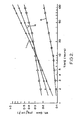
- Figures 1 and 2 of the accompanying drawings show the effect of Pt and Pt + Hf additions on the rate of weight gain of the basic Co-10Cr-11Al alloy L under isothermal oxidising conditions at 1100°C.
- Figure 1 shows that the addition of 1% Pt (alloy J) results in a slight decrease in the isothermal oxidation rate.
- Figure 2 is a plot of wt gain versus time each on a logarithmic scale. When measured over the period 10 to 100 h to avoid the initial transient stages of oxidation, the slope of the curve for alloy L has a value of 0.5, corresponding almost exactly to a parabolic rate law. The slope is reduced to 0.4 for the Co-1 OCr-11Al-1Pt alloy J.
- Table 5 compares with weight gains of the four alloys after this period (1 h) and after 120 h exposure. Also included for comparison are the data for an alloy R known to the Applicants to have a particularly low overall weight gain under these conditions.
- This alloy R is Co-10Cr-11Al-0.3Hf internally oxidized for 300 h at 1200°C.
Landscapes
- Chemical & Material Sciences (AREA)
- Engineering & Computer Science (AREA)
- Materials Engineering (AREA)
- Mechanical Engineering (AREA)
- Metallurgy (AREA)
- Organic Chemistry (AREA)
- Turbine Rotor Nozzle Sealing (AREA)
Abstract
Description
- This invention relates to nickel-, cobalt- and iron-based alloys comprising those suitable for use at high temperatures under oxidising conditions or corrosive conditions, and more particularly, but not exclusively, is concerned with directionally solidified nickel-based alloys for use in these conditions.
- Alloys capable of resisting oxidation, corrosion and high mechanical stresses at elevated temperatures are increasingly required, particularly in the gas turbine field. In these applications slight increases in permissible blade temperature have a considerable and very favourable effect upon engine output and efficiency. It is an unfortunate characteristic of gas turbine alloy development, however, that changes in alloy composition which lead to improved high temperature strength tend also to reduce the oxidation resistance of the alloys. Many of the strongest gas turbine alloys presently known have a relatively low resistance to oxidation and corrosion, so that they must be protected against high temperature attack, ie corrosion and oxidation, by coatings which either remain on the surface of the alloy components or are caused to diffuse into the body of the components on which they are deposited. It is a disadvantage of the various coating processes employed that they are costly, and that they tend also to have a deleterious effect upon the high temperature mechanical properties of the components to which they are applied.
- Typical coatings of the kind which cover the surface of alloy components or diffuse into the surface thereof are discussed in US-A-3 918 139 wherein is disclosed and claimed an improved overlay coating composition of the MCrAIY type consisting essentially of 8-30 wt% Cr, 5-15 wt% Al, up to 1 wt% reactive metal selected from a group comprising yttrium and other rare earth elements, the balance being selected from nickel, cobalt and nickel-cobalt, to which 3-12 wt% of a noble metal is added selected from a group comprising platinum.
- The present invention, by contrast, seeks to provide, for fabrication into alloy components, high temperature nickel, cobalt and iron-based alloys incorporating a strengthening phase dispersed throughout the microstructure wherein oxidation and corrosion resistance is conferred by controlled alloying additions thereto which, in combination, do not have any substantial adverse effect on the high temperature mechanical strength of the alloys, and which, at least in some cases, lead to enhanced oxide scale adhesion. The presence of the strengthening phase, to confer high temperature strength, requires that the controlled additions shall not adversely affect this phase.
- It is known that Pt-group metal additions have frequently been made over a period of many years to Ni-Co- and Fe- base alloys with the object of improving their resistance to oxidation and corrosion, and this is further demonstrated in US-A-3 918 139. Substantial quantities of Pt-group metals have however generally been required to achieve significant improvements and on account of the high cost this method of improving the oxidation resistance of high temperature alloys has not been considered feasible. Even in US-A-3 918 139, where there is an addition of a Pt-group metal to an overlay coating composition containing reactive metal, no measurable benefit in the hot corrosion resistance is claimed for noble metal contents of < 3 wt% and, preferably, additions of 5-10 wt% are said to be needed. It has now been unexpectedly discovered however that provided the Pt-group metal and the reactive metal are present together in controlled proportions quantities of Pt-group metal substantially less than 3 wt% can be quite effective.
- It is further known that Pt-group metal additions made to alloys containing carbide or intermetallic compound strengthening phases cause disruption of the strengthening phase and a weakening of the high temperature strength. It is also known that reactive metal such as yttrium have a similar effect when they are added by themselves to alloys having a high temperature strengthening phase. It has now been unexpectedly discovered, however, that provided the Pt-group metals and the reactive metals are present together in controlled proportions the disruptive effect is substantially obviated.
- Accordingly there is provided by a first aspect of the present invention an alloy consisting of at least 5 wt% of chromium, from 0 to 3 wt% of carbon, a component X, a component Z, and a balance of one or more of nickel, cobalt and iron together with incidental elements and impurities if any, wherein component X is one or more of:
- (i) at least 2 wt% in total of one or more of aluminium, titanium, tantalum and niobium, (ii) at least 5 wt% in total of one or both of tungsten and molybdenum, and (iii) at least 60 wt% of nickel; and having a strengthening phase selected from either a transition metal carbide or an intermetallic transition metal compound;
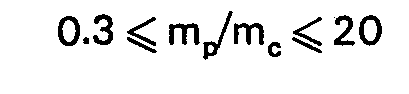
- and component Z comprises mp wt% of one or more platinum-group metals (as herein defined) together with me wt% of one or more platinum-complementing metals (as herein defined), where the limits for mp and me are set by the expressions

- the weight percentages being expressed in terms of the total alloy weight.
- According to a second aspect of the present invention there is provided a method of modifying the oxidation resistance and corrosion resistance of a nickel-based, cobalt-based or iron-based alloy having a strengthening phase selected from either a transition metal carbide or an intermetallic transition metal compound which comprises including in the alloy composition an amount mp wt% of one or more platinum-group metals (as herein defined) and an amount me wt% of one or more platinum-complementing metals (as herein defined), and wherein the limits for mp and me are set by the expressions


- In this specification, the expression "platinum group metal" should be taken to mean one of osmium, iridium, platinum, ruthenium, rhodium and palladium, and the expression "platinum-complementing element" should be taken to mean one of the following:- titanium, scandium, yttrium, lanthanum, hafnium, tantalum, zirconium, niobium, and any of the lanthanide elements (Ce to Lu).
- "Incidental elements and impurities" can comprise elements such as silicon, manganese and boron or, to a lesser extent vanadium, which elements are usually found in commercial iron-based alloys, and will also generally comprise small amounts of oxygen, nitrogen, hydrogen, phosphorus and sulphur.
- Nickel-, cobalt- and iron-based gas turbine alloys depend for their high temperature strength on carefully controlled micro-structures which generally contain, among several other phases, carbides based on Ti(Mo)C, Ti(Nb)C or other transition element compounds. Otherwise, the micro-structures may contain less stable components, such as Cr3C2. (It has been proposed to provide Cr3c2 in a directionally solidified alloy in the form of slender reinforcing fibres). If these strengthening carbides are to retain their integrity and reinforcing ability at high temperatures, the matrix of the alloy must have a low affinity either for carbon or for the metal from which the carbide is formed. Certain metals known for their solution strengthening capabilities have a high affinity for one or the other of the components of these strengthening carbides. Their addition has been shown to render the reinforcing carbides less stable. Thus zirconium, for example, which strengthens solid solutions very effectively in other alloy systems, cannot, in general, be added safely to superalloys because of its very high affinity for carbon, which tends to decompose any titanium or niobium carbides in its vicinity.
- It is well known that reactive metals such as Y and La, when present in suitable concentrations, can improve the high temperature oxidation and corrosion resistance of nickel-, cobalt- and iron-based alloys. However, these elements have, like zirconium, a high affinity for carbon. When they are present above a critical concentration level they have a tendency to attack the reinforcing constituents of the alloy in which they are incorporated. For example, consider a Ni-Ni3Al-Cr3C2 directionally solidified eutectic alloy which depends for its high temperature strength upon fine longitudinal fibres of Cr3C2. The Applicants have found that rare earth metals such as yttrium, when present in excess in the alloy, tend to decompose these reinforcing fibres, thus limiting the high temperature mechanical properties of this material, although its oxidation resistance is improved.
- Relatively small additions of one of the six platinum group metals (Os, Ir, Pt, Ru, Rh, Pd) are known by the present Applicants to enhance the oxidation and corrosion resistance of specific nickel-, iron-and cobalt-based alloys, particularly when the alloy to which additions are made is one of those which form a protective layer of aluminium oxide. Substantial additions of platinum group metals can rarely be made to such materials, however, because these metals have a tendency to decompose any carbides upon which the superalloy depends for mechanical reinforcement. This decomposition is caused, not because of the affinity of the platinum metals for carbon, which is very small, but because of their exceedingly high affinity for the metals which form stable carbides. It is known, for example, that platinum and iridium are capable of decomposing lanthanum carbide at temperatures as low as 1000°C. When platinum additions are made, therefore, to the directionally solidified Ni-Ni3Al-Cr3C2 eutectic composite mentioned above, the aligned Cr3C2 reinforcing fibres are partly decomposed and carbon is released in the form of graphite flakes. This leads to a deterioration in mechanical properties.
- Considerations such as those outlined above appear therefore, at first glance, to preclude the use of the strongly carbide-forming elements and of the carbide-decomposing elements as beneficial additions to existing high temperature nickel-, cobalt- and iron-based alloys.
- It has been found that, in accordance with the present invention, the above-mentioned carbide-forming and carbide-decomposing groups of metals can in certain circumstances be jointly added to superalloys in quantities up to a total of 5% by weight without any deleterious effect upon structure or mechanical properties, and with some improvement in their resistance to oxidation and. corrosion at high temperatures.
- It is thought that this is possible because the platinum group (carbide-decomposing) metals have an affinity for the carbide-forming elements which is comparable to and in most instances higher than the affinity of these carbide-forming elements for carbon. The strengthening carbides can thus remain stable, and the platinum group metals can therefore be safely added without detriment to the high temperature properties of nickel, cobalt- or iron-based alloys, provided that they are suitably associated with one or more of the platinum complementing elements titanium, scandium, yttrium, lanthanum, hafnium, tantalum, zirconium, niobium and any of the lanthanide elements (Ce to Lu).
- While the most beneficial effects are obtained when the composition of the component Z is stoichiometrically adjusted to provide for example the compounds listed below in Table 1, precise adjustment is not essential, and preferably component Z contains between 50 and about 93% by weight of the platinum group metals. In any case, there must be more than about 0.023 wt% of a platinum group metal present in component Z (corresponding to a lower limit of 0.3 in the quantity


- The present invention will now be illustrated by the following Examples:-
- To an alloy having a nominal composition (expressed in wt%) as set out below (incidental elements and impurities mounting to 1 wt%)


- Alloys C and D are according to the invention. The basic alloy and alloys A and B are for comparison.
- The observations set out below were made on the five alloy compositions given in Table 2.
- Directional solidification of the basic alloy at a rate of 300 mm/hour in a temperature gradient of about 13°Kmm-1 produced an ingot in which were present Cr3C2 fibres well aligned within a gamma nickel matrix which contained equi-axed particles of gamma prime (Ni3AI). The alloys A and D contained yttrium in excess of that required for the formation of PtsY and, in addition to the phases mentioned above, these two alloys also exhibited an elongated eutectic-like constituent which tended to run parallel to the aligned carbide fibres. This irregular constituent is thought to contain an yttrium- carbon compound.
- The alloy to which 1.96% by weight of platinum(alloy B) had been added contained a quite different irregular phase. This phase is thought to be pure graphite deposited due to the release of carbon on the formation of a highly stable platinum-chromium compound.
- No additional phases or micro constituents were observed in the alloy to which the platinum and yttrium in the ratio needed to form the compound PtsY (alloy C) had been added. (If the compound PtsY retained its separate identity when added to the alloy it must, presumably, have been in the form of a dispersion too fine to resolve with the optical microscope). The alloy displayed a regular aligned eutectic structure with thin fibres of Cr3C2 supported in a matrix consisting of nickel containing finely distributed particles of the compound Ni3Al.
- The basic alloy to which no addition had been made had a relatively poor resistance to oxidation when exposed to air at high temperatures either cyclically or under isothermal conditions. The initially formed scale of AI203 spalled readily and oxidation continued with the formation of Cr2O3, nickel-chromium spinels, and with internal oxidation.
- The addition of yttrium alone (alloy A) improved the oxidation resistance significantly by stabilising the layer of AI203 which formed initially. Even so, the A1203 scale which formed was not completely tenacious, and spalling occurred under tests carried out in a high velocity gas stream approximating in composition and speed to the hot gas passing over the first stage blading in a gas turbine, when the alumina scale was removed as rapidly as it was formed leaving behind the more tenacious skin of nickel-chromium oxide.
- The alloy to which the stoichiometrically adjusted Pt5Y addition has been made (alloy C) developed an oxidation testing in air a protective skin of alumina which was resistant to spalling when cycled in temperature and also when handled at room temperature. After exposure to air at atmospheric pressure for 1000 hours at 1000°C no measurable oxide skin was observed and the carbide fibres retained their integrity to the specimen surface.
- Specimens (in the form of cylinders 6 mm dia x 44 mm) of alloys A and C and of the basic alloy were. tested in a gas burner rig in conditions of hot salt corrosion at a temperature of 850°C. A commercial superalloy designated IN 713 LC was also tested for purposes of comparison. Two specimens of each alloy were tested.
- The principal impurities in the fuel used in the burner were 0.15 ppm sulphur and 50 ppm sodium, the latter being introduced in the form of sodium carboxylite. In
addition 50 ppm of sodium chloride was injected into the air feed in the form of sea water. The specimens were removed and examined at 24 hr intervals and the tests were run for a total of 300 hrs. - At the end of the tests all the alloys showed distinct evidence of attack although all of the eutectic-based alloys retained a more regular cylindrical shape than the IN 713 LC specimens. The latter was subject to internal attack along grain boundaries giving both more rapid and irregular corrosion than with the former which degraded by regular surface attack. The depths of penetration of the corrosion products, determined from transverse sections of the specimens are given in Table 3 below, from which it will be seen that the most corrosion resistant alloys are the basic (eutectic) alloy and the alloy C according to the invention.

- Table 2 above shows the results of creep tests performed in air on the various alloys at 1000°C under a direct tensile stress of 100 MPa. The alloy C retained the mechanical properties of the yttrium doped alloy (alloy A) and both were substantially stronger at high temperatures than those containing either Pt or Y (alloys B and D respectively) above the level required to form stoichiometric PtSY.
- The nominal compositions of the alloys studied are shown in Table 4. Alloy K is according to the invention and the remaining alloys are for comparison.

- Oxidation experiments were carried out in static air at 1 atmosphere pressure in a horizontal tube furnace. Thermogravimetric measurements were performed in a Sartorius automatic recording microbalance at 1100°C. Results are as set out below and as shown in Table 4.
- No microstructural differences between alloys J and L were observed. In alloy J, neither electron probe micro=analysis or optical examination were able to detect any intermetallics containing platinum. Alloy K (containing 0.3 Hf - 0.9 Pt) had a grain size smaller than alloy L and similar to that in Hf- containing alloys with no platinum (alloys M and N). Again, no platinum-containing intermetallics could be detected in alloy K and it would appear that the hafnium and platinum additions were both completely soluble in the alloy, at least at the concentrations used here. On oxidation of the samples of alloy K, the hafnium usually oxidised internally, but there was no apparent segregation of the platinum.
- Figures 1 and 2 of the accompanying drawings show the effect of Pt and Pt + Hf additions on the rate of weight gain of the basic Co-10Cr-11Al alloy L under isothermal oxidising conditions at 1100°C. Figure 1 shows that the addition of 1% Pt (alloy J) results in a slight decrease in the isothermal oxidation rate. Figure 2 is a plot of wt gain versus time each on a logarithmic scale. When measured over the
period 10 to 100 h to avoid the initial transient stages of oxidation, the slope of the curve for alloy L has a value of 0.5, corresponding almost exactly to a parabolic rate law. The slope is reduced to 0.4 for the Co-1 OCr-11Al-1Pt alloy J. - For the alloys containing 0.3 wt% Hf (alloys K an N) the situation was rather different. Neither conformed to a parabolic rate law, the Co-1 OCr-1 1Al-0.3Hf alloy N had a slope of 0.28 whilst for the alloy containing 0.9 Pt (alloy K) the slope was 0.18. In addition, Figure 1 shows that the initial stages of oxidation of alloy K were terminated more rapidly than in alloy N, and that with both these Hf- containing alloys the transient stage was shorter than with the Hf-free alloys J and L. As indicated previously, it is difficult to define precisely the end of the transient stage, but typically it lasted for 2-1 h. Table 5 compares with weight gains of the four alloys after this period (1 h) and after 120 h exposure. Also included for comparison are the data for an alloy R known to the Applicants to have a particularly low overall weight gain under these conditions. This alloy R is Co-10Cr-11Al-0.3Hf internally oxidized for 300 h at 1200°C.

- The Al2O3 scale which formed on the alloy Co-1OCr-11Al-1Pt (alloy J) after 265 h oxidation at 1200°C was not adherent and spalled from the alloy on cooling. The oxide was multi-layered in many locations, particularly at the corners of the sample, and the outer layer of oxide at the gas/scale interface was heavily wrinkled. Similar features were observed with the ternary Co-Cr-AI alloy (alloy L) oxidized under similar conditions.
- Surface examinations of the alloy Co-10Cr-11Al-0.3Hf-0.9Pt (alloy K) after oxidation at 12000C revealed features similar to those of the alloy Co-10Cr-1AI-0.3Hf (alloy N). The Al2O3 scale was tightly adherent to the substrate and spalled during cooling only from small discrete areas. The major difference between the two alloys was that, with the Pt-free alloy N, the substrate surface appeared to be more heavily convoluted than with the Pt-containing alloy K.
Claims (10)
and having a strengthening phase selected from either a transition metal carbide or an intermetallic transition metal compound, and component Z comprises mp wt% of one or more platinum-group metals (as herein defined) together with me wt% of one or more platinum-complementing metals (as herein defined), where the limits for mp and me are set by the expressions


Applications Claiming Priority (2)
| Application Number | Priority Date | Filing Date | Title |
|---|---|---|---|
| GB5059777 | 1977-12-05 | ||
| GB5059777 | 1977-12-05 |
Publications (2)
| Publication Number | Publication Date |
|---|---|
| EP0006951A1 EP0006951A1 (en) | 1980-01-23 |
| EP0006951B1 true EP0006951B1 (en) | 1983-01-12 |
Family
ID=10456565
Family Applications (1)
| Application Number | Title | Priority Date | Filing Date |
|---|---|---|---|
| EP78900280A Expired EP0006951B1 (en) | 1977-12-05 | 1979-06-18 | Improvements in or relating to nickel-, cobalt-, and iron based alloys |
Country Status (3)
| Country | Link |
|---|---|
| EP (1) | EP0006951B1 (en) |
| DE (1) | DE2862157D1 (en) |
| WO (1) | WO1979000343A1 (en) |
Cited By (1)
| Publication number | Priority date | Publication date | Assignee | Title |
|---|---|---|---|---|
| DE19652562A1 (en) * | 1996-12-17 | 1998-06-25 | Heidenhain Gmbh Dr Johannes | Position measuring device |
Families Citing this family (3)
| Publication number | Priority date | Publication date | Assignee | Title |
|---|---|---|---|---|
| US5482789A (en) * | 1994-01-03 | 1996-01-09 | General Electric Company | Nickel base superalloy and article |
| US6494971B1 (en) * | 1996-10-28 | 2002-12-17 | National Research Institute For Metals | Iridium-containing nickel-base superalloy |
| ES2288002T3 (en) * | 1998-10-19 | 2007-12-16 | Sulzer Metco Ag | SYSTEM AND PROCEDURE FOR COATING THERMAL BARRIER. |
Family Cites Families (6)
| Publication number | Priority date | Publication date | Assignee | Title |
|---|---|---|---|---|
| DE1758010A1 (en) * | 1968-03-20 | 1970-12-10 | Dr Dietrich Merz | Heat-resistant alloys with a proportion of rhenium and hafnium |
| US3589894A (en) * | 1968-05-31 | 1971-06-29 | Garrett Corp | Sulfidation resistant cobalt-base alloy |
| SU322396A1 (en) * | 1969-09-25 | 1971-11-30 | вители Центральный научно исследовательский институт черной металлургии И. П. Бардина , Ленинградский ордена Трудового Красного Знамени сталепрокатный завод | ALLOY FOR SPRINGS |
| US3762918A (en) * | 1972-01-26 | 1973-10-02 | Nasa | Cobalt base alloy |
| US3887363A (en) * | 1973-12-18 | 1975-06-03 | Gen Electric | Nickel-base superalloy cast article |
| US3918139A (en) * | 1974-07-10 | 1975-11-11 | United Technologies Corp | MCrAlY type coating alloy |
-
1978
- 1978-12-05 DE DE7878900280T patent/DE2862157D1/en not_active Expired
- 1978-12-05 WO PCT/GB1978/000048 patent/WO1979000343A1/en not_active Ceased
-
1979
- 1979-06-18 EP EP78900280A patent/EP0006951B1/en not_active Expired
Non-Patent Citations (2)
| Title |
|---|
| GARD Conference Proceedings No 156, page 96 published 1977 Ref. EUR 5623e, Appendie C table c * |
| Review of Technological Requirements for High Temperature Materials, R&D Sept. 1976, published for the Commision of the European communities by Joint, Res. Centre Establishment of Petten (The Netherlands) * |
Cited By (2)
| Publication number | Priority date | Publication date | Assignee | Title |
|---|---|---|---|---|
| DE19652562A1 (en) * | 1996-12-17 | 1998-06-25 | Heidenhain Gmbh Dr Johannes | Position measuring device |
| DE19652562C2 (en) * | 1996-12-17 | 1999-07-22 | Heidenhain Gmbh Dr Johannes | Position measuring device |
Also Published As
| Publication number | Publication date |
|---|---|
| DE2862157D1 (en) | 1983-02-17 |
| EP0006951A1 (en) | 1980-01-23 |
| WO1979000343A1 (en) | 1979-06-14 |
Similar Documents
| Publication | Publication Date | Title |
|---|---|---|
| EP0433072B1 (en) | Oxidation resistant low expansion superalloys | |
| McKamey et al. | A review of recent developments in Fe3Al-based alloys | |
| Gurrappa | Hot corrosion behavior of CM 247 LC alloy in Na2SO4 and NaCl environments | |
| Göbel et al. | The isothermal-oxidation behavior of several nickel-base single-crystal superalloys with and without coatings | |
| Wagner et al. | Physical metallurgy of alloy 718 | |
| US5741376A (en) | High temperature melting niobium-titanium-chromium-aluminum-silicon alloys | |
| EP1528124A2 (en) | Ni-base superalloy having a coating system containing a diffusion barrier layer | |
| EP0518590A1 (en) | Oxidation resistant coatings of gamma titanium aluminum alloys modified by chromium and tantalum | |
| US10227680B2 (en) | Alloys | |
| JPH11501364A (en) | Corrosion resistant iron aluminide with improved mechanical properties and corrosion resistance | |
| US5296056A (en) | Titanium aluminide alloys | |
| Paciej et al. | Metallurgical variables influencing the corrosion susceptibility of a powder metallurgy SiCw/Al composite | |
| Espevik et al. | Oxidation of ternary Co-Cr-W alloys | |
| EP0372312A1 (en) | Chromium containing high temperature alloy | |
| WO1979000343A1 (en) | Improvements in or relating to nickel-,cobalt-,and iron based alloys | |
| GB2110240A (en) | Nickel base superalloy | |
| RU2148671C1 (en) | Nickel-aluminum-base intermetallic alloy | |
| US5089223A (en) | Fe-cr-ni-al ferritic alloys | |
| Liang et al. | Influence of Co addition on constituent phases and performance of a NiCrAlYRe alloy system | |
| Wasielewski et al. | Nickel-Base Superalloy Oxidation | |
| Mannan et al. | Thermal stability of inconel alloy 783 at 593C and 704C | |
| Anton et al. | Dispersion Strengthening of High Temperature Niobium Alloys | |
| McAlarney et al. | Creep and rupture of an ods alloy with high stress rupture ductility | |
| Berthod et al. | Dependence on the chromium content of the high-temperature oxidation behavior of Ta-rich nickel-based cast alloys | |
| US5226984A (en) | Process of preparing fe-cr-ni-al ferritic alloys |
Legal Events
| Date | Code | Title | Description |
|---|---|---|---|
| PUAI | Public reference made under article 153(3) epc to a published international application that has entered the european phase |
Free format text: ORIGINAL CODE: 0009012 |
|
| AK | Designated contracting states |
Designated state(s): DE FR GB |
|
| 17P | Request for examination filed | ||
| GRAA | (expected) grant |
Free format text: ORIGINAL CODE: 0009210 |
|
| AK | Designated contracting states |
Designated state(s): DE FR GB |
|
| REF | Corresponds to: |
Ref document number: 2862157 Country of ref document: DE Date of ref document: 19830217 |
|
| ET | Fr: translation filed | ||
| PGFP | Annual fee paid to national office [announced via postgrant information from national office to epo] |
Ref country code: FR Payment date: 19831207 Year of fee payment: 6 |
|
| PGFP | Annual fee paid to national office [announced via postgrant information from national office to epo] |
Ref country code: DE Payment date: 19831219 Year of fee payment: 6 |
|
| GBPC | Gb: european patent ceased through non-payment of renewal fee | ||
| PG25 | Lapsed in a contracting state [announced via postgrant information from national office to epo] |
Ref country code: FR Free format text: LAPSE BECAUSE OF NON-PAYMENT OF DUE FEES Effective date: 19850830 |
|
| PG25 | Lapsed in a contracting state [announced via postgrant information from national office to epo] |
Ref country code: DE Effective date: 19850903 |
|
| REG | Reference to a national code |
Ref country code: FR Ref legal event code: ST |
|
| PG25 | Lapsed in a contracting state [announced via postgrant information from national office to epo] |
Ref country code: GB Effective date: 19881118 |
|
| PLBE | No opposition filed within time limit |
Free format text: ORIGINAL CODE: 0009261 |
|
| STAA | Information on the status of an ep patent application or granted ep patent |
Free format text: STATUS: NO OPPOSITION FILED WITHIN TIME LIMIT |