EP0004480A2 - Verfahren zum Behandeln von Papiermaschinen-Trocknerfilzen - Google Patents
Verfahren zum Behandeln von Papiermaschinen-Trocknerfilzen Download PDFInfo
- Publication number
- EP0004480A2 EP0004480A2 EP79300502A EP79300502A EP0004480A2 EP 0004480 A2 EP0004480 A2 EP 0004480A2 EP 79300502 A EP79300502 A EP 79300502A EP 79300502 A EP79300502 A EP 79300502A EP 0004480 A2 EP0004480 A2 EP 0004480A2
- Authority
- EP
- European Patent Office
- Prior art keywords
- fabric
- resin
- roller
- dryer
- resin mixture
- Prior art date
- Legal status (The legal status is an assumption and is not a legal conclusion. Google has not performed a legal analysis and makes no representation as to the accuracy of the status listed.)
- Granted
Links
Images

Classifications
-
- D—TEXTILES; PAPER
- D06—TREATMENT OF TEXTILES OR THE LIKE; LAUNDERING; FLEXIBLE MATERIALS NOT OTHERWISE PROVIDED FOR
- D06B—TREATING TEXTILE MATERIALS USING LIQUIDS, GASES OR VAPOURS
- D06B1/00—Applying liquids, gases or vapours onto textile materials to effect treatment, e.g. washing, dyeing, bleaching, sizing or impregnating
- D06B1/10—Applying liquids, gases or vapours onto textile materials to effect treatment, e.g. washing, dyeing, bleaching, sizing or impregnating by contact with a member carrying the treating material
- D06B1/14—Applying liquids, gases or vapours onto textile materials to effect treatment, e.g. washing, dyeing, bleaching, sizing or impregnating by contact with a member carrying the treating material with a roller
- D06B1/142—Applying liquids, gases or vapours onto textile materials to effect treatment, e.g. washing, dyeing, bleaching, sizing or impregnating by contact with a member carrying the treating material with a roller where an element is used to mitigate the quantity of treating material that the textile material can retain
Definitions
- the present invention relates to a process for treating papermaking fabrics, with a primary concern being the treatment of dryer fabrics or felts.
- the invention relates to a process for treating a papermaking fabric, in which an untreated woven fabric having an air permeability of between 82.6 and 377.6 1/s is coated with a resin in fluent state, and dried, said dried resin partially filling the interstices of the fabric to reduce its air permeability.
- a papermaking machine has three basic sections: fourdrinier or paperforming section, presses and dryers. In each of these sections different types of papermaking fabrics are utilized.
- the fourdrinier section uses fourdrinier fabrics or paperforming fabrics, the presses use wet felts and the dryers use dryer fabrics or felts.
- the treatment process of the present invention can be used for treating fabrics employed in any of these sections, the process has been primarily developed for treating the dryer fabrics.
- Another function of the dryer fabric is to press the sheet tightly against the cylinder surface thereby increasing the heat transfer between the cylinder and the paper. As the wet paper web moves through the drying section, the heat of the drums causes the moisture within the paper to evaporate. The water vapor evaporates through the openings in the woven dryer fabric.
- the dryer fabrics that are commonly used in the papermaking machine are generally woven with multifilament and mono-filament yarns. Occasionally, glass yarns are also employed.
- the resulting woven fabric lacks sufficient rigidity. In order to increase the rigidity, such fabrics have been coated with a liquid resin mixture by a kiss coating process. The resin coating also improves the wearing characteristics of the fabrics.
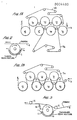
- a kiss coating operation is illustrated in Figure 2.
- a liquid i.e., low viscosity resin mixture 7
- Kiss roller 5 which is rotated in a direction opposite the direction of movement of dryer fabric 4
- the amount of liquid that is applied can be varied by changing the speed of the kiss roller as well as changing the relative speed between the fabric and the kiss roller.
- the viscosity of the liquid resin mixture that is employed in this process is on the order of between 80 and 200 centipoise.
- the woven dryer fabric has an air permeability of between 82.6 and 377.6 1/s.
- air permeability typically, before being treated the woven dryer fabric has an air permeability of between 82.6 and 377.6 1/s.
- the present invention seeks to provide a more efficient and better controlled process of treating the woven fabric and is characterised by the fact that the fabric is coated (only on its rear surface) with a resin mixture having a viscosity of 1000 to 5000 centipoise in such a manner as to form a continuous resin film over the interstices of the fabric which maintaining the front surface of the fabric uncoated, the said resin film being caused to shrink and break open within the interstices when dried.
- This process enables air permeability of the fabric to be reduced to a desired useful range in fewer coating stages than was necessary in the prior art processes and also reduce or eliminate the amount of resin despoited on the front, paper web engaging surface of the treated fabric.
- the operating conditions including the viscosity of the resin mixture, are so controlled as to enable air permeability of the fabric to be reduced to the range 14.16 to 70.8 1/s in a single coating operation, and the resin mixture has a solids content of 20 to 25% by weight.
- the wet resin forms a continuous film over the interstices in the woven dryer fabric.
- the water content of the resin mixture evaporates so that the film breaks and pops within the fabric interstices.
- the solids within the resin migrate to the adjacent yarns as shown in Figure 6, thereby effectively reducing the weave opening.
- the quantity of the resin that builds up on the yarns significantly affect the resulting air permeability value of the treated fabric. Consequently, the level of the resulting air permeability can be controlled by varying the solid contents of the resin mixture.
- a cross-section of a treated dryer fabric is shown in Figure 7.
- a dryer fabric 8 to be treated is driven in a first direction so as to pass over and in contact with a roller applicator 9 that is rotated in a direction opposite the movement of the dryer fabric.
- roller 9 rotates, it passes through a trough 11 that contains a thickened resin mixture 10.
- the roller picks ups the thickened resin mixture and then applies that mixture to the back surface of the dryer fabric.
- any excess resin is wiped off the fabric by a doctor blade 13. Since the doctor blade is biased against the fabric so as to urge it in an upward direction, two pressure rollers 12 and 14 are used to ensure that the fabric maintains proper contact with roller applicator 9.
- Pressure roller 12 presses the dryer fabric being treated against roller 9 with enough pressure to ensure that the thickened resin mixture penetrates dryer fabric 8.
- the contact pressure and the angle of the doctor blade are controlled in such a manner so as to force the thickened resin mixture into the openings in the woven dryer fabrics.
- the doctor blade is also positioned over the trough so that any excess resin that is removed from the fabric falls back into the trough.
- the resin mixture may be either of a solvent or water base.
- a water base resin mixture In carrying out the present invention, it is considered preferable to use a water base resin mixture.
- the thickened resin mixture includes: dilution water, an anti-foaming agent, surfactants, a catalyst, an acrylic latex, thermal setting resins, a thickener and an ammonium hydroxide neutralizer.
- acrylic latex While it is preferable to use an acrylic latex in the resin system, other conventional latexes may be used such as: natural or synthetic rubber latexes, vinyl acetates, vinyl chlorides, vinyl pyridines, polyvinyl alcohols and resorcinol formaldehydes.
- the ammonium hydroxide neutralizer serves as a base for activating the thickener.
- One particular thickener which has been successfully employed is Acrysol ASE-60 sold by Rohm & Haas Company of Philadelphia, Pennsylvania.
- Acrysol ASE-60 is an acid containing, cross-linked acrylic emulsion copolymer. When the emulsion is diluted with water and neutralized with the base, each emulsion particle swells greatly, the emulsion clarifies under such conditions and becomes highly viscous.
- Other thickeners can also be used, such as starches, polyvinyl alcohols, cellulose gums carboxymethylcellulose and carboxypolymethylene resins.
- a sufficient quantity of the thickener is added so as to significantly increase the viscosity in order to provide the desired thickened resin mixture.
- the viscosity of the mixture preferably should be increased to a level of between 3,000 and 5,000 centipoise.
- the viscosity of the mixture preferably should be increased to a level of between 1,000 and 5,000 centipoise.
- the fabric may be adequately treated in a single pass and yet still reduce the air permeability to the desired level.
- the resin mixture that is applied only covers the rear surface of the treated fabric and partially penetrates the fabric, i.e., by properly controlling the operation, the front surface, or face, of the fabric will not be coated with the resin.
- This factor is particularly advantageous for fabrics that have a soft side composed of spun or continuous filament yarns and another side composed of monofilament yarns.
- the front surface of the fabric is free of resin contamination which would otherwise alter the surface. The presence of such resin contaminations on the front surface render the surface harsh and rough which leads to undesirable marks on the paper web.
- the thickened resin mixture is prepared by starting with a mixture of the following ingredients: water 74.1% by weight, ammonium sulfamate (a catalyst) 0.5%, Dow DB-110A (an anti-foaming agent) 0.4%; Triton GR5M (a surfactant) 1%, Rhoplex TR 407 (an acrylic latex made by Rohm & Haas) 23% and ammonium hydroxide 1%.
- the acrylic latex contains 46% solids, approximately 2% emulsifier and approximately 52% water. After those ingredients are mixed, the mixture is sufficiently thickened by an appropriate thickener such as Acrysol ASE-60 to increase the viscosity to the desired level.
- the thickened resin mixture is applied to roller applicator 9 by an intermediate roller 15.
- a back-up roller may be used for pressing the fabric against the roller applicator. Such a back-up roller helps to obtain maximum penetration of the thickened resin mixture into the fabric.
- Another possible modification is the employment of an extra doctor blade to meter the amount of resin on the roller applicator before the resin is transferred to the fabric.
Landscapes
- Engineering & Computer Science (AREA)
- Textile Engineering (AREA)
- Treatments For Attaching Organic Compounds To Fibrous Goods (AREA)
- Treatment Of Fiber Materials (AREA)
- Application Of Or Painting With Fluid Materials (AREA)
Applications Claiming Priority (2)
| Application Number | Priority Date | Filing Date | Title |
|---|---|---|---|
| US891046 | 1978-03-28 | ||
| US05/891,046 US4172910A (en) | 1978-03-28 | 1978-03-28 | Coating of papermaking fabrics |
Publications (3)
| Publication Number | Publication Date |
|---|---|
| EP0004480A2 true EP0004480A2 (de) | 1979-10-03 |
| EP0004480A3 EP0004480A3 (en) | 1979-10-31 |
| EP0004480B1 EP0004480B1 (de) | 1982-02-10 |
Family
ID=25397531
Family Applications (1)
| Application Number | Title | Priority Date | Filing Date |
|---|---|---|---|
| EP79300502A Expired EP0004480B1 (de) | 1978-03-28 | 1979-03-28 | Verfahren zum Behandeln von Papiermaschinen-Trocknerfilzen |
Country Status (4)
| Country | Link |
|---|---|
| US (1) | US4172910A (de) |
| EP (1) | EP0004480B1 (de) |
| CA (1) | CA1107583A (de) |
| DE (1) | DE2962081D1 (de) |
Cited By (2)
| Publication number | Priority date | Publication date | Assignee | Title |
|---|---|---|---|---|
| US4684568A (en) * | 1986-04-21 | 1987-08-04 | E. I. Du Pont De Nemours And Company | Vapor-permeable liquid-impermeable fabric |
| US4981745A (en) * | 1989-05-26 | 1991-01-01 | Lefkowitz Leonard R | Forming fabric for papermaking |
Families Citing this family (30)
| Publication number | Priority date | Publication date | Assignee | Title |
|---|---|---|---|---|
| US5002801A (en) * | 1988-10-31 | 1991-03-26 | Albany International Corp. | Paper machine fabrics having controlled release |
| US5275700A (en) * | 1990-06-29 | 1994-01-04 | The Procter & Gamble Company | Papermaking belt and method of making the same using a deformable casting surface |
| WO1992000415A1 (en) * | 1990-06-29 | 1992-01-09 | The Procter & Gamble Company | Papermaking belt and method of making the same using differential light transmission techniques |
| US5098522A (en) * | 1990-06-29 | 1992-03-24 | The Procter & Gamble Company | Papermaking belt and method of making the same using a textured casting surface |
| US5260171A (en) * | 1990-06-29 | 1993-11-09 | The Procter & Gamble Company | Papermaking belt and method of making the same using a textured casting surface |
| US5274930A (en) * | 1992-06-30 | 1994-01-04 | The Procter & Gamble Company | Limiting orifice drying of cellulosic fibrous structures, apparatus therefor, and cellulosic fibrous structures produced thereby |
| WO1994022432A1 (en) * | 1993-04-07 | 1994-10-13 | Rexham Industries Corp. | Method of coating microporous membranes and resulting products |
| US5478880A (en) * | 1994-02-01 | 1995-12-26 | Moore Business Forms, Inc. | Printable release |
| US5581906A (en) * | 1995-06-07 | 1996-12-10 | The Procter & Gamble Company | Multiple zone limiting orifice drying of cellulosic fibrous structures apparatus therefor, and cellulosic fibrous structures produced thereby |
| US5584128A (en) * | 1995-06-07 | 1996-12-17 | The Procter & Gamble Company | Multiple zone limiting orifice drying of cellulosic fibrous structures, apparatus therefor, and cellulosic fibrous structures produced thereby |
| US5539996A (en) * | 1995-06-07 | 1996-07-30 | The Procter & Gamble Company | Multiple zone limiting orifice drying of cellulosic fibrous structures, apparatus therefor, and cellulosic fibrous structures produced thereby |
| GB9521299D0 (en) * | 1995-10-18 | 1995-12-20 | Scapa Group Plc | Papermakers dryer fabric |
| US5787602A (en) * | 1997-03-31 | 1998-08-04 | Wangner Systems Corporation | Dryer fabric with adhesive tacky surface for web |
| US6105276A (en) * | 1997-06-19 | 2000-08-22 | The Procter & Gamble Company | Limiting orifice drying medium, apparatus therefor, and cellulosic fibrous structures produced thereby |
| US5942322A (en) * | 1997-09-11 | 1999-08-24 | The Procter & Gamble Company | Reduced surface energy limiting orifice drying medium process of making and process of making paper therewith |
| US6021583A (en) * | 1997-09-18 | 2000-02-08 | The Procter & Gamble Company | Low wet pressure drop limiting orifice drying medium and process of making paper therewith |
| US6110324A (en) * | 1998-06-25 | 2000-08-29 | The Procter & Gamble Company | Papermaking belt having reinforcing piles |
| US6190506B1 (en) | 1998-10-29 | 2001-02-20 | Voith Sulzer Papiertechnik Patent Gmbh | Paper making apparatus having pressurized chamber |
| US6161303A (en) * | 1998-10-29 | 2000-12-19 | Voith Sulzer Papiertechnik Patent Gmbh | Pressing apparatus having chamber end sealing |
| US6248203B1 (en) | 1998-10-29 | 2001-06-19 | Voith Sulzer Papiertechnik Patent Gmbh | Fiber web lamination and coating apparatus having pressurized chamber |
| US6416631B1 (en) | 1998-10-29 | 2002-07-09 | Voith Sulzer Papiertechnik Patent Gmbh | Pressing apparatus having semipermeable membrane |
| US6274042B1 (en) | 1998-10-29 | 2001-08-14 | Voith Sulzer Papiertechnik Gmbh | Semipermeable membrane for pressing apparatus |
| US6287427B1 (en) | 1999-09-30 | 2001-09-11 | Voith Sulzer Papiertechnik Patent Gmbh | Pressing apparatus having chamber sealing |
| US6645420B1 (en) * | 1999-09-30 | 2003-11-11 | Voith Sulzer Papiertechnik Patent Gmbh | Method of forming a semipermeable membrane with intercommunicating pores for a pressing apparatus |
| US6485612B1 (en) | 2001-05-18 | 2002-11-26 | Voith Paper, Inc. | Air press assembly for use in a paper-making machine |
| US7919173B2 (en) * | 2002-12-31 | 2011-04-05 | Albany International Corp. | Method for controlling a functional property of an industrial fabric and industrial fabric |
| US7472961B2 (en) | 2003-11-18 | 2009-01-06 | Casual Living Worldwide, Inc. | Woven articles from synthetic yarns |
| DE102004044569A1 (de) * | 2004-09-15 | 2006-03-30 | Voith Fabrics Patent Gmbh | Papiermaschinenbespannungen |
| US20080092980A1 (en) * | 2005-08-26 | 2008-04-24 | Bryan Wilson | Seam for papermachine clothing |
| US10240292B2 (en) | 2016-02-29 | 2019-03-26 | Kimberly-Clark Worldwide, Inc. | Through-air drying apparatus and methods of manufacture |
Family Cites Families (13)
| Publication number | Priority date | Publication date | Assignee | Title |
|---|---|---|---|---|
| US2432074A (en) * | 1940-08-02 | 1947-12-02 | Copeman Lab Co | Coated paper and method of producing the same |
| US2963381A (en) * | 1955-10-11 | 1960-12-06 | Heberlein Patent Corp | Porous fabrics and methods for producing the same |
| US3075274A (en) * | 1959-09-23 | 1963-01-29 | Appleton Mills | Method of making and finishing papermaker's felts |
| DE1228915B (de) * | 1959-12-15 | 1966-11-17 | Waldhof Zellstoff Fab | Vorrichtung zum fortlaufenden Beschichten von Papier |
| US3032441A (en) * | 1960-04-18 | 1962-05-01 | Huyck Corp | Open weave endless fabric and method for producing the same |
| US3121660A (en) * | 1961-02-13 | 1964-02-18 | Jr Edward H Hall | Fourdrinier wire and method of making the same |
| US3519475A (en) * | 1966-12-09 | 1970-07-07 | Johns Manville | Thermosetting resin coated asbestos yarn for use in dryer's felts |
| US3594213A (en) * | 1967-10-27 | 1971-07-20 | Joseph T Rudman | Process for controlling porosity in fibrous webs |
| US3653961A (en) * | 1970-02-11 | 1972-04-04 | Huyck Corp | Papermakers fabrics |
| FR2101002A1 (en) * | 1970-08-05 | 1972-03-31 | Ferrari Andre Serge Fabr | Coated air-permeable fabric - for upholstery blinds etc |
| US3751281A (en) * | 1972-02-17 | 1973-08-07 | American Can Co | Method for preparing a dimensionally stable waxed polyethylene sheet |
| US3758381A (en) * | 1972-03-29 | 1973-09-11 | Appleton Mills | Rmaking machine single endless strand mounted in self centering fashion in a series of parallel convolutions as a fibrous web supporting surface in a pape |
| US3840429A (en) * | 1972-08-07 | 1974-10-08 | Beloit Corp | Anti-rewet membrane for an extended press nip system |
-
1978
- 1978-03-28 US US05/891,046 patent/US4172910A/en not_active Expired - Lifetime
-
1979
- 1979-03-27 CA CA324,289A patent/CA1107583A/en not_active Expired
- 1979-03-28 DE DE7979300502T patent/DE2962081D1/de not_active Expired
- 1979-03-28 EP EP79300502A patent/EP0004480B1/de not_active Expired
Cited By (2)
| Publication number | Priority date | Publication date | Assignee | Title |
|---|---|---|---|---|
| US4684568A (en) * | 1986-04-21 | 1987-08-04 | E. I. Du Pont De Nemours And Company | Vapor-permeable liquid-impermeable fabric |
| US4981745A (en) * | 1989-05-26 | 1991-01-01 | Lefkowitz Leonard R | Forming fabric for papermaking |
Also Published As
| Publication number | Publication date |
|---|---|
| EP0004480B1 (de) | 1982-02-10 |
| EP0004480A3 (en) | 1979-10-31 |
| DE2962081D1 (en) | 1982-03-18 |
| US4172910A (en) | 1979-10-30 |
| CA1107583A (en) | 1981-08-25 |
Similar Documents
| Publication | Publication Date | Title |
|---|---|---|
| US4172910A (en) | Coating of papermaking fabrics | |
| US4596633A (en) | Surface treatment of paper and paperboard | |
| US4588614A (en) | Pseudoplastic gel transfer | |
| EP0006316B2 (de) | Papiermaschine | |
| US2117432A (en) | Process and apparatus for impregnating fibrous sheet material | |
| US2919495A (en) | Process of papermaking | |
| EP0120095B1 (de) | Verfahren zur herstellung eines gegossenen und beschichteten papiers | |
| US5316624A (en) | Method and apparatus for high density paper | |
| US5152872A (en) | Apparatus for the wet end coating of paper | |
| BR9713820A (pt) | Método para secagen de papel e extremidade de secagem de uma máquina de fabricar papel | |
| US5049420A (en) | Process for applying microcapsule-containing compositions to paper | |
| US6284097B1 (en) | Method and apparatus to produce paper webs coated on both sides | |
| US2331922A (en) | Process of coating paper | |
| US3911174A (en) | Method of coating flexible sheet material | |
| US2746878A (en) | Production of coated sheet material | |
| US2645201A (en) | Apparatus for coating paper | |
| US3080847A (en) | Web coating and doctoring apparatus | |
| KR100408769B1 (ko) | 경사가호기 | |
| US5895542A (en) | Coater and a method for coating a substrate | |
| CS212275B2 (en) | Integrated method of treatment,smoothing and compressive tissue contraction | |
| US2534321A (en) | Coating method and apparatus | |
| WO2002000998A1 (en) | Precalendering method, finishing method and apparatus for implementing the methods | |
| US3133855A (en) | Minimizing scratches in a blade coated paper web by roughening the smooth side of the web prior to the blade coating operation | |
| US2398843A (en) | Apparatus for coating paper | |
| US3096229A (en) | Carbon impregnated paper and method of making same |
Legal Events
| Date | Code | Title | Description |
|---|---|---|---|
| PUAI | Public reference made under article 153(3) epc to a published international application that has entered the european phase |
Free format text: ORIGINAL CODE: 0009012 |
|
| PUAL | Search report despatched |
Free format text: ORIGINAL CODE: 0009013 |
|
| AK | Designated contracting states |
Designated state(s): BE CH DE FR GB IT LU NL SE |
|
| AK | Designated contracting states |
Designated state(s): BE CH DE FR GB IT LU NL SE |
|
| 17P | Request for examination filed | ||
| ITF | It: translation for a ep patent filed | ||
| GRAA | (expected) grant |
Free format text: ORIGINAL CODE: 0009210 |
|
| AK | Designated contracting states |
Designated state(s): BE CH DE FR GB IT LU NL SE |
|
| REF | Corresponds to: |
Ref document number: 2962081 Country of ref document: DE Date of ref document: 19820318 |
|
| PG25 | Lapsed in a contracting state [announced via postgrant information from national office to epo] |
Ref country code: LU Free format text: LAPSE BECAUSE OF NON-PAYMENT OF DUE FEES Effective date: 19820331 |
|
| PGFP | Annual fee paid to national office [announced via postgrant information from national office to epo] |
Ref country code: LU Payment date: 19820628 Year of fee payment: 4 |
|
| PLBI | Opposition filed |
Free format text: ORIGINAL CODE: 0009260 |
|
| 26 | Opposition filed |
Opponent name: FILZTUCHVERWALTUNGS GMBH Effective date: 19821110 |
|
| PGFP | Annual fee paid to national office [announced via postgrant information from national office to epo] |
Ref country code: FR Payment date: 19840321 Year of fee payment: 6 |
|
| PGFP | Annual fee paid to national office [announced via postgrant information from national office to epo] |
Ref country code: CH Payment date: 19840327 Year of fee payment: 6 |
|
| PGFP | Annual fee paid to national office [announced via postgrant information from national office to epo] |
Ref country code: SE Payment date: 19840331 Year of fee payment: 6 |
|
| PG25 | Lapsed in a contracting state [announced via postgrant information from national office to epo] |
Ref country code: SE Effective date: 19860329 |
|
| PG25 | Lapsed in a contracting state [announced via postgrant information from national office to epo] |
Ref country code: CH Effective date: 19860331 |
|
| GBPC | Gb: european patent ceased through non-payment of renewal fee | ||
| PG25 | Lapsed in a contracting state [announced via postgrant information from national office to epo] |
Ref country code: FR Free format text: LAPSE BECAUSE OF NON-PAYMENT OF DUE FEES Effective date: 19861128 |
|
| REG | Reference to a national code |
Ref country code: CH Ref legal event code: PL |
|
| REG | Reference to a national code |
Ref country code: FR Ref legal event code: ST |
|
| PG25 | Lapsed in a contracting state [announced via postgrant information from national office to epo] |
Ref country code: GB Effective date: 19881117 |
|
| PLBM | Termination of opposition procedure: date of legal effect published |
Free format text: ORIGINAL CODE: 0009276 |
|
| STAA | Information on the status of an ep patent application or granted ep patent |
Free format text: STATUS: OPPOSITION PROCEDURE CLOSED |
|
| 27C | Opposition proceedings terminated |
Effective date: 19890709 |
|
| PGFP | Annual fee paid to national office [announced via postgrant information from national office to epo] |
Ref country code: NL Payment date: 19900331 Year of fee payment: 12 |
|
| PG25 | Lapsed in a contracting state [announced via postgrant information from national office to epo] |
Ref country code: NL Effective date: 19911001 |
|
| NLV4 | Nl: lapsed or anulled due to non-payment of the annual fee | ||
| EUG | Se: european patent has lapsed |
Ref document number: 79300502.6 Effective date: 19870223 |
|
| PGFP | Annual fee paid to national office [announced via postgrant information from national office to epo] |
Ref country code: DE Payment date: 19960328 Year of fee payment: 18 |
|
| PGFP | Annual fee paid to national office [announced via postgrant information from national office to epo] |
Ref country code: BE Payment date: 19960510 Year of fee payment: 18 |
|
| PG25 | Lapsed in a contracting state [announced via postgrant information from national office to epo] |
Ref country code: BE Effective date: 19970331 |
|
| BERE | Be: lapsed |
Owner name: ASTEN GROUP INC. Effective date: 19970331 |
|
| PG25 | Lapsed in a contracting state [announced via postgrant information from national office to epo] |
Ref country code: DE Effective date: 19971202 |