EP0004256A1 - Easily split substrates for the quantification of proteases, a process for their production and a method for the quantification of proteases - Google Patents
Easily split substrates for the quantification of proteases, a process for their production and a method for the quantification of proteases Download PDFInfo
- Publication number
- EP0004256A1 EP0004256A1 EP79850009A EP79850009A EP0004256A1 EP 0004256 A1 EP0004256 A1 EP 0004256A1 EP 79850009 A EP79850009 A EP 79850009A EP 79850009 A EP79850009 A EP 79850009A EP 0004256 A1 EP0004256 A1 EP 0004256A1
- Authority
- EP
- European Patent Office
- Prior art keywords
- group
- proteases
- arg
- substrates
- split
- Prior art date
- Legal status (The legal status is an assumption and is not a legal conclusion. Google has not performed a legal analysis and makes no representation as to the accuracy of the status listed.)
- Granted
Links
Classifications
-
- C—CHEMISTRY; METALLURGY
- C07—ORGANIC CHEMISTRY
- C07K—PEPTIDES
- C07K5/00—Peptides containing up to four amino acids in a fully defined sequence; Derivatives thereof
- C07K5/04—Peptides containing up to four amino acids in a fully defined sequence; Derivatives thereof containing only normal peptide links
- C07K5/08—Tripeptides
- C07K5/0821—Tripeptides with the first amino acid being heterocyclic, e.g. His, Pro, Trp
- C07K5/0825—Tripeptides with the first amino acid being heterocyclic, e.g. His, Pro, Trp and Glp-amino acid; Derivatives thereof
-
- C—CHEMISTRY; METALLURGY
- C12—BIOCHEMISTRY; BEER; SPIRITS; WINE; VINEGAR; MICROBIOLOGY; ENZYMOLOGY; MUTATION OR GENETIC ENGINEERING
- C12Q—MEASURING OR TESTING PROCESSES INVOLVING ENZYMES, NUCLEIC ACIDS OR MICROORGANISMS; COMPOSITIONS OR TEST PAPERS THEREFOR; PROCESSES OF PREPARING SUCH COMPOSITIONS; CONDITION-RESPONSIVE CONTROL IN MICROBIOLOGICAL OR ENZYMOLOGICAL PROCESSES
- C12Q1/00—Measuring or testing processes involving enzymes, nucleic acids or microorganisms; Compositions therefor; Processes of preparing such compositions
- C12Q1/34—Measuring or testing processes involving enzymes, nucleic acids or microorganisms; Compositions therefor; Processes of preparing such compositions involving hydrolase
- C12Q1/37—Measuring or testing processes involving enzymes, nucleic acids or microorganisms; Compositions therefor; Processes of preparing such compositions involving hydrolase involving peptidase or proteinase
-
- C—CHEMISTRY; METALLURGY
- C12—BIOCHEMISTRY; BEER; SPIRITS; WINE; VINEGAR; MICROBIOLOGY; ENZYMOLOGY; MUTATION OR GENETIC ENGINEERING
- C12Q—MEASURING OR TESTING PROCESSES INVOLVING ENZYMES, NUCLEIC ACIDS OR MICROORGANISMS; COMPOSITIONS OR TEST PAPERS THEREFOR; PROCESSES OF PREPARING SUCH COMPOSITIONS; CONDITION-RESPONSIVE CONTROL IN MICROBIOLOGICAL OR ENZYMOLOGICAL PROCESSES
- C12Q1/00—Measuring or testing processes involving enzymes, nucleic acids or microorganisms; Compositions therefor; Processes of preparing such compositions
- C12Q1/56—Measuring or testing processes involving enzymes, nucleic acids or microorganisms; Compositions therefor; Processes of preparing such compositions involving blood clotting factors, e.g. involving thrombin, thromboplastin, fibrinogen
-
- C—CHEMISTRY; METALLURGY
- C12—BIOCHEMISTRY; BEER; SPIRITS; WINE; VINEGAR; MICROBIOLOGY; ENZYMOLOGY; MUTATION OR GENETIC ENGINEERING
- C12Q—MEASURING OR TESTING PROCESSES INVOLVING ENZYMES, NUCLEIC ACIDS OR MICROORGANISMS; COMPOSITIONS OR TEST PAPERS THEREFOR; PROCESSES OF PREPARING SUCH COMPOSITIONS; CONDITION-RESPONSIVE CONTROL IN MICROBIOLOGICAL OR ENZYMOLOGICAL PROCESSES
- C12Q2337/00—N-linked chromogens for determinations of peptidases and proteinases
- C12Q2337/20—Coumarin derivatives
- C12Q2337/22—7-Amino-4-methylcoumarin, i.e. AMC, MCA
-
- C—CHEMISTRY; METALLURGY
- C12—BIOCHEMISTRY; BEER; SPIRITS; WINE; VINEGAR; MICROBIOLOGY; ENZYMOLOGY; MUTATION OR GENETIC ENGINEERING
- C12Q—MEASURING OR TESTING PROCESSES INVOLVING ENZYMES, NUCLEIC ACIDS OR MICROORGANISMS; COMPOSITIONS OR TEST PAPERS THEREFOR; PROCESSES OF PREPARING SUCH COMPOSITIONS; CONDITION-RESPONSIVE CONTROL IN MICROBIOLOGICAL OR ENZYMOLOGICAL PROCESSES
- C12Q2337/00—N-linked chromogens for determinations of peptidases and proteinases
- C12Q2337/30—Naphthyl amides, e.g. beta-NA, 2-NA, 4-methoxy-beta-naphthylamine, i.e. 4MNA
-
- G—PHYSICS
- G01—MEASURING; TESTING
- G01N—INVESTIGATING OR ANALYSING MATERIALS BY DETERMINING THEIR CHEMICAL OR PHYSICAL PROPERTIES
- G01N2333/00—Assays involving biological materials from specific organisms or of a specific nature
- G01N2333/90—Enzymes; Proenzymes
- G01N2333/914—Hydrolases (3)
- G01N2333/948—Hydrolases (3) acting on peptide bonds (3.4)
- G01N2333/95—Proteinases, i.e. endopeptidases (3.4.21-3.4.99)
- G01N2333/964—Proteinases, i.e. endopeptidases (3.4.21-3.4.99) derived from animal tissue
- G01N2333/96425—Proteinases, i.e. endopeptidases (3.4.21-3.4.99) derived from animal tissue from mammals
- G01N2333/96427—Proteinases, i.e. endopeptidases (3.4.21-3.4.99) derived from animal tissue from mammals in general
- G01N2333/9643—Proteinases, i.e. endopeptidases (3.4.21-3.4.99) derived from animal tissue from mammals in general with EC number
- G01N2333/96433—Serine endopeptidases (3.4.21)
- G01N2333/96441—Serine endopeptidases (3.4.21) with definite EC number
- G01N2333/96444—Factor X (3.4.21.6)
-
- G—PHYSICS
- G01—MEASURING; TESTING
- G01N—INVESTIGATING OR ANALYSING MATERIALS BY DETERMINING THEIR CHEMICAL OR PHYSICAL PROPERTIES
- G01N2333/00—Assays involving biological materials from specific organisms or of a specific nature
- G01N2333/90—Enzymes; Proenzymes
- G01N2333/914—Hydrolases (3)
- G01N2333/948—Hydrolases (3) acting on peptide bonds (3.4)
- G01N2333/968—Plasmin, i.e. fibrinolysin
-
- G—PHYSICS
- G01—MEASURING; TESTING
- G01N—INVESTIGATING OR ANALYSING MATERIALS BY DETERMINING THEIR CHEMICAL OR PHYSICAL PROPERTIES
- G01N2333/00—Assays involving biological materials from specific organisms or of a specific nature
- G01N2333/90—Enzymes; Proenzymes
- G01N2333/914—Hydrolases (3)
- G01N2333/948—Hydrolases (3) acting on peptide bonds (3.4)
- G01N2333/972—Plasminogen activators
- G01N2333/9723—Urokinase
-
- G—PHYSICS
- G01—MEASURING; TESTING
- G01N—INVESTIGATING OR ANALYSING MATERIALS BY DETERMINING THEIR CHEMICAL OR PHYSICAL PROPERTIES
- G01N2333/00—Assays involving biological materials from specific organisms or of a specific nature
- G01N2333/90—Enzymes; Proenzymes
- G01N2333/914—Hydrolases (3)
- G01N2333/948—Hydrolases (3) acting on peptide bonds (3.4)
- G01N2333/972—Plasminogen activators
- G01N2333/9726—Tissue plasminogen activator
-
- Y—GENERAL TAGGING OF NEW TECHNOLOGICAL DEVELOPMENTS; GENERAL TAGGING OF CROSS-SECTIONAL TECHNOLOGIES SPANNING OVER SEVERAL SECTIONS OF THE IPC; TECHNICAL SUBJECTS COVERED BY FORMER USPC CROSS-REFERENCE ART COLLECTIONS [XRACs] AND DIGESTS
- Y02—TECHNOLOGIES OR APPLICATIONS FOR MITIGATION OR ADAPTATION AGAINST CLIMATE CHANGE
- Y02P—CLIMATE CHANGE MITIGATION TECHNOLOGIES IN THE PRODUCTION OR PROCESSING OF GOODS
- Y02P20/00—Technologies relating to chemical industry
- Y02P20/50—Improvements relating to the production of bulk chemicals
- Y02P20/55—Design of synthesis routes, e.g. reducing the use of auxiliary or protecting groups
-
- Y—GENERAL TAGGING OF NEW TECHNOLOGICAL DEVELOPMENTS; GENERAL TAGGING OF CROSS-SECTIONAL TECHNOLOGIES SPANNING OVER SEVERAL SECTIONS OF THE IPC; TECHNICAL SUBJECTS COVERED BY FORMER USPC CROSS-REFERENCE ART COLLECTIONS [XRACs] AND DIGESTS
- Y10—TECHNICAL SUBJECTS COVERED BY FORMER USPC
- Y10S—TECHNICAL SUBJECTS COVERED BY FORMER USPC CROSS-REFERENCE ART COLLECTIONS [XRACs] AND DIGESTS
- Y10S530/00—Chemistry: natural resins or derivatives; peptides or proteins; lignins or reaction products thereof
- Y10S530/802—Chromogenic or luminescent peptides
Definitions
- This invention relates to novel easily split substrates intended to be used as reagents in the quantitative determination of serine proteases and SH-proteases, or in the study of reactions where serine proteases are formed, inhibited or consumed, or in the determination of factors influencing, or participating in such reactions.
- the short peptide chain is of importance to the affinity of the substrate to the enzyme.
- the N-terminal amino acid either has the L-form with an acylated amino group, or the D-form with a free amino group.
- substrates with an N-terminal pyroglutamic acid are very easily split by a number of serine proteases. Pyroglutamic acid with its a-amino group not being free but acylated by ring closure, that is lactam of glutamic acid, has not been used before in peptides intended for use as substrates in the determination of enzymes.
- the novel chromogenic substrates, according to the invention are represented by the following general formula: or salts thereof wherein
- the principle of the synthesis may be a step-wise coupling of the amino acids to the C-terminal arginyl or lysyl rest, either initially provided with a linked-on determinable group (-HN 2 -R 2 according to the formula) which then serves as a carboxylic protective group, or provided with a carboxylic protective group which is removable and, in that case, the determinable group is linked to the protected tripeptide derivative, or again the N-terminal protected dipeptide fraction may be synthetized separately and then linked to the arginyl or lysyl rest, with or without determinable group, according to the foregoing.
- a linked-on determinable group (-HN 2 -R 2 according to the formula) which then serves as a carboxylic protective group, or provided with a carboxylic protective group which is removable and, in that case, the determinable group is linked to the protected tripeptide derivative, or again the N-terminal protected dipeptide fraction may be synthetized separately and
- I. 0.8 g (1.25 mmol) of Ib is deprotected with 30 ml of HF at 0°C for 1 hour in the presence of 0.6 ml of anisole. After evaporation in vacuo, the product is dissolved in approximately 30 ml of 2 per cent HOAc and washed with a small amount of ether. The H 2 0-phase is chromatographed on a column with Sephadex G-15 (Pharmacia Fine Chemicals) in 2 per cent of HOAc with the same medium for eluation.
- Trypsin (Novo, 400 fd of a solution of 2.0 mg trypsin per ml of 1 mM of HC1) is added to a solution of 250 mg (0.50 mmol) of p-Glu-Gly-Arg-pNA .
- HC1 (S-2444) in 100 ml of 0.1 M NaHCO 3 in H 2 0.
- the release of pNA is followed in a spectrophotometer at 405 nm. The release is finished after approximately 45 minutes and the solution is thereafter acidified with HOAc to a pH of ⁇ 4.
- S-2251 H-D-Val-Leu-Lys- p NA
- S-2160 Bz-Phe-Val-Arg-pNA
- S-222 Bz-Ile-Glu-Gly-Arg-pNA (all Kabi Diagnostica, Sweden).
- the substrates produced according to the examples are used in the determination of various enzymes in the following ways.
- the specimens are irradiated in a fluoroscencephotometer with a light having an excitation wavelength (approximately 350 nm for p-naphthylamine and 4-methoxy- ⁇ -naphthylamine, and 380 nm for 7-amino-4-methyl-coumarin), and the amount of split-off product is then established by measuring the emitted light (approximately 420 nm for ⁇ -naphthylamine and 4-methoxy-p-naphthylamine, and 440 nm for 7-amino--4-methyl-coumarin) .
- Table II presents the reaction rate of the synthetic substrates with various enzymes.
- reaction rate 100
Landscapes
- Chemical & Material Sciences (AREA)
- Organic Chemistry (AREA)
- Life Sciences & Earth Sciences (AREA)
- Health & Medical Sciences (AREA)
- Proteomics, Peptides & Aminoacids (AREA)
- Engineering & Computer Science (AREA)
- Zoology (AREA)
- Wood Science & Technology (AREA)
- Biophysics (AREA)
- Biochemistry (AREA)
- Molecular Biology (AREA)
- General Health & Medical Sciences (AREA)
- Genetics & Genomics (AREA)
- Microbiology (AREA)
- Immunology (AREA)
- Biotechnology (AREA)
- Analytical Chemistry (AREA)
- Physics & Mathematics (AREA)
- Bioinformatics & Cheminformatics (AREA)
- General Engineering & Computer Science (AREA)
- Neurosurgery (AREA)
- Hematology (AREA)
- Medicinal Chemistry (AREA)
- Measuring Or Testing Involving Enzymes Or Micro-Organisms (AREA)
- Peptides Or Proteins (AREA)
- Enzymes And Modification Thereof (AREA)
Abstract

- R1 = H or a protective group, preferably t-butyl-oxycarbonyl, benzyloxycarbonyl;
- A, - Gly, Ala, Val, Leu, Ile. Ser, Thr, Pro, Pip, Phe or Tyr;
- A2 - Arg or Lys;
- R2 = an aromatic, possibly substituted, hydrocarbon group, wherein -NH-R2 is a physico-chemically determinable group, preferably a chromogenic or fluorogenic group which is split by a present enzyme and then forms a cleavage product of the formula H2N - R2 the amount of which can be quantified.
Description
- This invention relates to novel easily split substrates intended to be used as reagents in the quantitative determination of serine proteases and SH-proteases, or in the study of reactions where serine proteases are formed, inhibited or consumed, or in the determination of factors influencing, or participating in such reactions.
- Lately, a number of synthetic peptide substrates have been described. The majority of these present a tripeptide chain where either the amino group of the N-terminal amino acid is blocked by an acyl group or is free but then having the D-configuration. The C-terminal amino acid is blocked by a chromogenic or a fluorogenic group which is split off in the reaction of the enzyme with the substrate. The thus formed, liberated chromophoric or fluorescent group can be quantitatively determined by photometric or fluoroscence-photometric methods. The enzymatic activity can be calculated by measuring the amount of cleavage product liberated per time unit.
- The short peptide chain is of importance to the affinity of the substrate to the enzyme. In this connection it seems to be essential that the N-terminal amino acid either has the L-form with an acylated amino group, or the D-form with a free amino group. We have now established that substrates with an N-terminal pyroglutamic acid are very easily split by a number of serine proteases. Pyroglutamic acid with its a-amino group not being free but acylated by ring closure, that is lactam of glutamic acid, has not been used before in peptides intended for use as substrates in the determination of enzymes. The novel chromogenic substrates, according to the invention, are represented by the following general formula:

- R1 may be hydrogen or a protective group, preferably t-butyloxycarbonyl or benzyloxycarbonyl,
- Al may be chosen from the amino acids Gly, Ala, Val, Leu, Ile, Ser, Thr, Pro, Pip, Phe or Tyr,
- A2 may be Arg or Lys,
- R2 may be an aromatic, possibly substituted, hydrocarbon group wherein -NH-R2 constitutes a physico-chemically determinable group, preferably a chromogenic or fluorogenic group split by the mentioned enzyme and then forming a cleavage product of the formula H2N - R2 the amount of which can be quantified.
- In the synthesis of the novel substrates according to the invention, conventional protective groups and coupling- methods well known in peptide chemistry are used.
- The principle of the synthesis may be a step-wise coupling of the amino acids to the C-terminal arginyl or lysyl rest, either initially provided with a linked-on determinable group (-HN2-R2 according to the formula) which then serves as a carboxylic protective group, or provided with a carboxylic protective group which is removable and, in that case, the determinable group is linked to the protected tripeptide derivative, or again the N-terminal protected dipeptide fraction may be synthetized separately and then linked to the arginyl or lysyl rest, with or without determinable group, according to the foregoing.
- Whichever of these synthesis routes is chosen, the intermediary and end products are purified by recrystallization and/or gel filtration chromatography.
- The invention is illustrated by the following examples.
- In the thin-layer chromatography analysis of the eluates and the product, glass plates with silica gel F254 (Merck) are used as an absorption medium. The solvent systems used are:

- After thin-layer chromatography, the plates are first studied in UV light (254 nm) and then sprayed with nin- hydrine and subsequently treated with dicarboxidine/chlo- rine. The stated Rf-values are the results of single chromatographs.
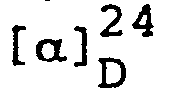
- The abbreviations used below are as follows:
- The abbreviations refer to amino acid rests. The free amino acid or peptide is indicated by an H- at the amino group and an -OH at the carboxyl group. The amino group is always indicated to the left and the carboxyl group to the right.
- Unless otherwise stated, all amino acids, with the exception of Gly, have the L-configuration.


-

- 175 ml of concentrated HOAc and 105 ml of 5.6 M HBr in HOAc are added to 35 g (0.074 mol) of Cbo-Arg(N02)-pNA. The mixture is allowed to react and stirred for 30 minutes after the reaction solution has cleared. The mixture is then poured into approximately 2 1 of dry ether while being stirred vigorously. The resulting precipitate is filtered and washed with dry ether and then vaccum dried over NaOH. The obtained HBr salt of H-Arg(N02)-pNA is dissolved in 150 ml of dry, distilled DMF and neutralized at a low temperature (-10°C) with Et3N until a slightly basic reaction is obtained on a moistened pH-paper over the reaction mixture. (Usually approximately 1.5 equivalents of HBr are neutralized.) The resulting Et3NHBr is filtered off. Under cool conditions,_1.1 equivalent = 0.81 mol = 26.8 g of Cbo-Gly-OpNP is added to the reaction mixture; after 30 minutes another 1/2 equivalent = 5.2 ml of Et3N is added. The mixture is allowed to react over night at room temperature and thereafter evaporated in vacuo to give an oil. The oil is triturated in an aqueous solution of 2 per cent of NaHCO3 and then dissolved in hot MeOH and crystallized while it is stirred and cooled. The resulting crystals are filtered off and washed with cold MeOH. TLC shows only minor impurifica- tions and the product is, therefore, recrystallized in the same solvent. This results in white crystals, pure according to TLC.
- Yield: 34 g (86 %) of Ia.
- Rf = 0.20 (P1)
-

- Ib' Cbo-p-Glu-OH (m.w. = 263.3)
- The EtOAc-phase is evaporated to a small volume and precipitated with petroleum ether; this results in heavy crystals of Ib' which are pure according to TLC.
- Yield: 36.9 g (80 %) of Ib'.
- Rf = 0.45 (A)
-
- Ib Cbo-p-Glu-Gly-Arg(NO2)pNA (m.w. = 641.6) 10.25 g (18.3 mmol) of H-Gly-Arg(NH2)pNa HBr, obtained by deprotecting Cbo-Gly-Arg(NO2)pNA with HBr according to the procedure as described in Ia, is dissolved in 35 ml of dry DMF and neutralized at a low temperature (-10 C) with Et3N until a basic reaction is obtained on moistened pH-paper.
- The resulting EtNHBr is filtered off. 2.47 g (18.3 mmol) of HOBT and 5.26 g (20 mmol) of Cbo-p-Glu-OH (Ib') are added to the reaction mixture and, thereafter, 4.53 g (22 mmol) of DCCI dissolved in a small amount of DCCI is added at a low temperature. The mixture is allowed to react over night at room temperature; subsequently, the reaction solution is evaporated to an oil. The oil is triturated with 2 per cent NaHCO3 in water, and with pure water. The obtained solid compound is dissolved in a small amount of acetone, and then hot MeOH and a small amount of water are added. The product is crystallized while it is cooled and stirred, and the resulting crystals are filtered off. The Ib obtained is pure according to TLC. After careful vacuum drying, 8.90 g (76 %) of Ib is obtained.
- Rf = 0.06 (P1)
-

- I. 0.8 g (1.25 mmol) of Ib is deprotected with 30 ml of HF at 0°C for 1 hour in the presence of 0.6 ml of anisole. After evaporation in vacuo, the product is dissolved in approximately 30 ml of 2 per cent HOAc and washed with a small amount of ether. The H20-phase is chromatographed on a column with Sephadex G-15 (Pharmacia Fine Chemicals) in 2 per cent of HOAc with the same medium for eluation. The fraction with the pure acetate of I is lyophilized and ion-exchanged on a column with QAE-25 (Pharmacia Fine Chemicals) in chloride form with EtOH-H2O (1:1) with the same medium for eluation.
- The fraction with the pure hydrochloride of I is lyophilized.
- Yield: 485 mg (78 %) of I.
- TLC [Rf = 0.29 (A)] only shows one spot
-

- Examples II-XIII as described in Table I are effected in the same way, in principle, as the foregoing examples; only the physical data, yields, as well as coupling and purification methods are therefore listed in this table form.
-

- Trypsin (Novo, 400 fd of a solution of 2.0 mg trypsin per ml of 1 mM of HC1) is added to a solution of 250 mg (0.50 mmol) of p-Glu-Gly-Arg-pNA . HC1 (S-2444) in 100 ml of 0.1 M NaHCO3 in H20. The release of pNA is followed in a spectrophotometer at 405 nm. The release is finished after approximately 45 minutes and the solution is thereafter acidified with HOAc to a pH of ~ 4. It is then evaporated to dryness, dissolved in MeOH and chromatographed on a column with LH-20 (Pharmacia Fine Chemicals) in MeOH with the same medium for eluation. The fraction with the pure acid XIVa is evaporated, dissolved in H20 and lyophilized.
- Yield: 167 mg (88%) of XIVa which is pure according to TLC. Rf = 0.08 (A).
- XIV:
- A solution of 27 µl. (0.25 mmol) of PC13 in 450 µl of dry pyridine is added, under moisturefree conditions and in a ice-bath, to a solution of 105 mg (0.50 mmol) of 4-MeO-β-NA . HC1 in 2.25 ml of dry pyridine. After being left for approximately 45 minutes at room temperature, all of the XIVa produced according to the foregoing is added. When the reaction ceases (after approximately 1 hour), the reaction mixture is evaporated to a dark-red oil (reduced pressure). The oil is dissolved in a small amount of EtOH-H20 (1:1) and applied to a column with QAE-25 (Pharmacia Fine Chemicals) in chloride form in EtOH-H20 (1:1) with the same medium for eluation. The fraction with the nearly pure hydrochloride of XIV is evaporated, dissolved again in a small amount of EtOH-H20 (1:1), and the procedure is repeated. The thus obtained hydrochloride of XIV is pure and it is lyophilized after all alcohol has been evaporated.
- Yield: 85 mg (36%) of XIV..
- TLC (Rf = 0.24 mg (A) shows only one spot.
-

-
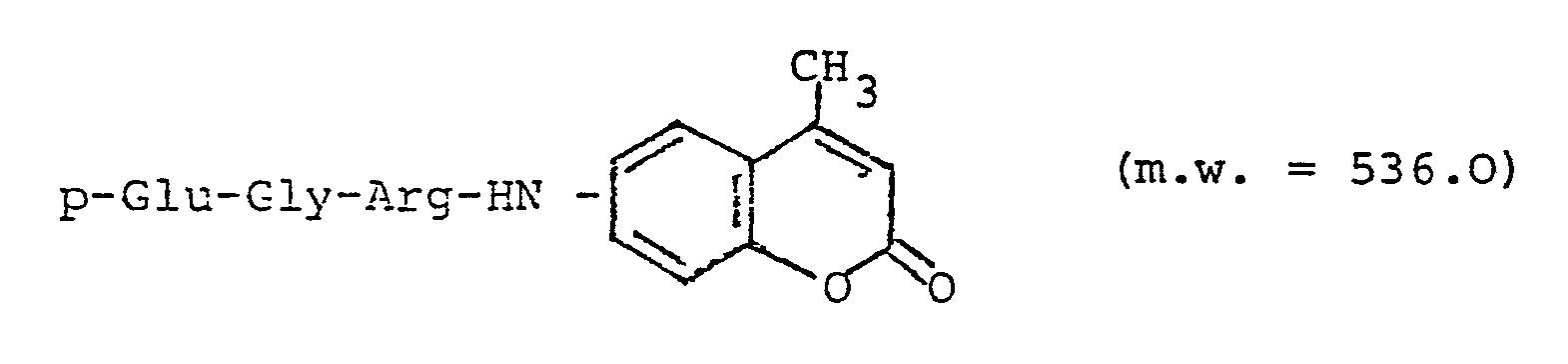
- Procedure analogous to Example XIV, but with 88 mg (0.50 mmol) of 7-A-4-M-C as an amine instead of 4-MeO-β-NA . HC1.
- Yield: 84 mg (32%) of XV.
- TLC [Rf = 0.25 (A)] shows only one spot.
-

-


- S-2251 = H-D-Val-Leu-Lys-pNA, S-2160 = Bz-Phe-Val-Arg-pNA, S-222 = Bz-Ile-Glu-Gly-Arg-pNA (all Kabi Diagnostica, Stockholm, Sweden).
- Pli = Plasmin, Try = Trypsin, FXa = Coagulation facto-r Xa, UK = Urokinase, TA = Plasminogen tissue activator.
- Sensibility of the reference substrates to the enzyme in question:

- The substrates produced according to the examples are used in the determination of various enzymes in the following ways.
- The principle of determination is based upon the fact that the split product obtained by enzymatic hydrolysis presents a UV spectrum essentially different from that of the substrate. Thus, all p-nitroanilide substrates according to the invention, for instance, have their absorption maxima at 310 nm with a molar extinction coefficient of approximately 12000. At 405 nm, the absorption of these substrates has almost entirely ceased. p-Nitroaniline which is released from the substrates in the enzymatic hydrolysis, has its absorption maximum at 380 nm with a molar extinction coefficient of 13200 which at 405 nm has decreased only to 9620. By measuring spectrophotometrically at 405 nm it is, therefore, easy to follow the amount of p-nitroaniline formed which is proportional to the rate of enzymatic hydrolysis which, in turn, is determined by the active amount of enzyme.
- To calculate the amount of fluorescent amine formed, the specimens are irradiated in a fluoroscencephotometer with a light having an excitation wavelength (approximately 350 nm for p-naphthylamine and 4-methoxy-β-naphthylamine, and 380 nm for 7-amino-4-methyl-coumarin), and the amount of split-off product is then established by measuring the emitted light (approximately 420 nm for β-naphthylamine and 4-methoxy-p-naphthylamine, and 440 nm for 7-amino--4-methyl-coumarin) .
- Table II presents the reaction rate of the synthetic substrates with various enzymes. The reaction rate is related to a reference substrate (reaction rate = 100) for each enzyme. Some of the reference substrates are known already and available on the market.
- The usefulness of the novel substrates according to the invention, and the fact that they are hydrolysed faster by various enzymes than are the substrates hitherto available, is evident from this Table II.
56.3 g (0.20 mol) of Cbo-Glu-OH is dissolved in 400 ml of EtOAc, and 49.4 g (0.24 mol) of DCCI dissolved in 60 ml of EtOAc is added and stirred in an ice bath. After two hours, the resulting DCU is filtered and the remaining solution evaporated to dryness. The product (anhydride of Cbo-Glu) is crystallized from EtOAc and petroleum ether. The anhydride is dissolved in 120 ml of dioxane plus 260 ml ether, and then 48 ml of DCHA dissolved in ether to a volume of 100 ml is added. After a while, Cbo-p-Glu DCHA precipitates. It is stirred for approximately 1 hour and then the formed DCHA salt is filtered off and washed with ether and EtOAc. The DCHA salt is suspended in EtOAc and shaken with 25 g (0.18 mol) of KHS04 dissolved in water, and the-Cbo-p-Glu-OH thus formed then goes into the EtOAc-phase. The EtOAc-phase is washed with 10% NaCl in H20 and dried over Na2SO4 (there is a risk of the product precipitating).
Claims (6)


which can be quantified;
characterized by the fact that the synthesis is carried out either by a step-wise coupling to A2 which carries R2 or a removable carboxyl protective group which is then substituted by R2, or starting from R1 - p-Glu - A wherein R1 is a protective group, preferably t-butyloxycarbonyl or benzyloxycarbonyl, and coupling to A2 - NH - R2 wherein R2 may be introduced separately in replacement of a removable carboxyl protective group.


Applications Claiming Priority (2)
| Application Number | Priority Date | Filing Date | Title |
|---|---|---|---|
| SE7801373 | 1978-02-07 | ||
| SE7801373A SE7801373L (en) | 1978-02-07 | 1978-02-07 | EASY SPLABLE SUBSTRATE FOR QUANTIFIATION OF PROTEASES |
Publications (2)
| Publication Number | Publication Date |
|---|---|
| EP0004256A1 true EP0004256A1 (en) | 1979-09-19 |
| EP0004256B1 EP0004256B1 (en) | 1982-07-21 |
Family
ID=20333883
Family Applications (1)
| Application Number | Title | Priority Date | Filing Date |
|---|---|---|---|
| EP79850009A Expired EP0004256B1 (en) | 1978-02-07 | 1979-02-06 | Easily split substrates for the quantification of proteases, a process for their production and a method for the quantification of proteases |
Country Status (18)
| Country | Link |
|---|---|
| US (2) | US4279810A (en) |
| EP (1) | EP0004256B1 (en) |
| JP (2) | JPS6345397B2 (en) |
| AT (1) | AT368773B (en) |
| AU (1) | AU4394579A (en) |
| CA (1) | CA1136124A (en) |
| DD (1) | DD142550A5 (en) |
| DE (1) | DE2963358D1 (en) |
| DK (1) | DK147495C (en) |
| ES (1) | ES477501A1 (en) |
| FI (1) | FI790376A7 (en) |
| IL (1) | IL56520A0 (en) |
| NO (1) | NO790375L (en) |
| PL (1) | PL116682B1 (en) |
| SE (1) | SE7801373L (en) |
| SU (1) | SU1277904A3 (en) |
| WO (1) | WO1979000602A1 (en) |
| ZA (1) | ZA79424B (en) |
Cited By (12)
| Publication number | Priority date | Publication date | Assignee | Title |
|---|---|---|---|---|
| EP0018002A1 (en) * | 1979-04-24 | 1980-10-29 | Marcel Jozefonvicz | Process for the determination of proteases and antiproteases |
| EP0016800A4 (en) * | 1978-08-03 | 1981-01-08 | American Hospital Supply Corp | Determination of proteolytic enzymes in body fluids and fluorogenic substrates. |
| WO1981002294A1 (en) * | 1980-02-12 | 1981-08-20 | Pentapharm Ag | Tripeptidic derivatives and use thereof for enzyme determination |
| EP0056210A3 (en) * | 1981-01-09 | 1982-08-18 | Pharmuka Laboratoires | Method for the fluorimetric determination of endotoxins, peptides containing a fluorophore used in the said method and their method of preparation |
| FR2535715A1 (en) * | 1982-11-10 | 1984-05-11 | Erba Farmitalia | BIOLOGICALLY ACTIVE PEPTIDES, PROCESS FOR PREPARING THEM AND THEIR USE AS MEDICAMENTS |
| EP0078703A3 (en) * | 1981-11-02 | 1984-06-13 | University Of Miami | New tagged pyroglu-l-phe-l-arg derivatives, substrates and assays for kallikrein |
| WO1988008455A1 (en) * | 1987-04-30 | 1988-11-03 | Kabi-Vitrum Ab | A process for identification of microorganisms |
| EP0187721A3 (en) * | 1985-01-11 | 1988-11-23 | E.I. Du Pont De Nemours And Company | Preparation of peptide substrates for virus-specified proteases |
| EP0264753A3 (en) * | 1986-10-16 | 1988-12-28 | Behringwerke Aktiengesellschaft | Method for determining plasminogen |
| WO1991012268A1 (en) * | 1990-02-19 | 1991-08-22 | Serbio | Novel peptide substrates, method of preparation and use in c protein determination |
| US5231006A (en) * | 1986-10-16 | 1993-07-27 | Behringwerke Aktiengesellschaft | Method for the determination of plasminogen |
| US7727739B2 (en) | 2002-04-19 | 2010-06-01 | Ge Healthcare Uk Limited | Methods for measuring enzyme activity |
Families Citing this family (24)
| Publication number | Priority date | Publication date | Assignee | Title |
|---|---|---|---|---|
| US4336186A (en) * | 1978-08-03 | 1982-06-22 | Gargiulo Robert J | Analytical fluorogenic substrates for proteolytic enzymes |
| US4409140A (en) * | 1979-04-23 | 1983-10-11 | Smith Robert E | Substrates and method for determining enzymes |
| DE2936543A1 (en) * | 1979-09-10 | 1981-04-09 | Behringwerke Ag, 3550 Marburg | CHROMOGENIC COMPOUNDS |
| DE3164437D1 (en) * | 1980-08-25 | 1984-08-02 | Kabivitrum Ab | Peptide substrates for determination of protease activity |
| US4388233A (en) * | 1981-05-15 | 1983-06-14 | The Regents Of The University Of California | Synthetic substrates for enzyme analysis |
| US4510241A (en) * | 1981-09-03 | 1985-04-09 | Mallinckrodt, Inc. | Peptide-type substrates useful in the quantitative determination of endotoxin |
| JPS5863399A (en) * | 1981-10-14 | 1983-04-15 | Nitto Boseki Co Ltd | Novel substrate for measuring plasmin |
| DE3211254A1 (en) * | 1982-03-26 | 1983-09-29 | Boehringer Mannheim Gmbh, 6800 Mannheim | METHOD FOR DETECTING THE PRESENCE OF AN ALLERGY AND FOR SPECIFIC DETECTING THE ALLERGY RESPONSIBLE FOR THE ALLERGY |
| DE3244030A1 (en) * | 1982-11-27 | 1984-05-30 | Behringwerke Ag, 3550 Marburg | CHROMOGENIC COMPOUNDS, METHOD FOR THEIR PRODUCTION AND THEIR USE |
| DE3484912D1 (en) * | 1983-06-03 | 1991-09-19 | Pentapharm Ag | PEPTIDE DERIVATIVES AND THE USE THEREOF AS SUBSTRATES FOR THE QUANTITATIVE DETERMINATION OF ENZYMES. |
| JPS6117956A (en) * | 1984-07-04 | 1986-01-25 | Nitto Boseki Co Ltd | Novel substrate for measuring kallikrein in urine |
| US4694070A (en) * | 1985-05-28 | 1987-09-15 | Coulter Electronics, Inc. | Water soluble xanthylium derivatives substrates |
| US4801534A (en) * | 1985-05-28 | 1989-01-31 | Coulter Electronics, Inc. | Water soluble zanthylium derivative substrates |
| US5115099A (en) * | 1988-06-14 | 1992-05-19 | Nitto Boseki Co., Ltd. | Substrates for determination of enzyme activity and intermediates for synthesis of the substrates as well as process for producing the intermediates |
| JPH06104079B2 (en) * | 1988-07-14 | 1994-12-21 | 日東紡績株式会社 | New enzyme activity measurement substrate |
| US5191065A (en) * | 1988-11-22 | 1993-03-02 | Hoechst Aktiengesellschaft | Process for the preparation of tripeptides |
| DE3839379A1 (en) * | 1988-11-22 | 1990-05-23 | Hoechst Ag | METHOD FOR PRODUCING TRIPEPTIDES |
| SE8904188D0 (en) * | 1989-12-12 | 1989-12-12 | Kabivitrum Ab | CHROMOGENIC SUBSTRATE |
| US5698411A (en) * | 1995-05-18 | 1997-12-16 | Coulter Corporation | Method for determining activity of enzymes in metabolically active whole cells |
| US5871946A (en) * | 1995-05-18 | 1999-02-16 | Coulter Corporation | Method for determining activity of enzymes in metabolically active whole cells |
| US5776720A (en) * | 1995-05-18 | 1998-07-07 | Coulter Corporation | Assay reagent |
| US5733719A (en) * | 1995-05-18 | 1998-03-31 | Coulter Corporation | Method of making an assay compound |
| AU2001265092A1 (en) * | 2000-06-02 | 2001-12-17 | Regents Of The University Of California | Profiling of protease specificity using combinatorial fluorogenic substrate libraries |
| CN115974752A (en) * | 2023-01-04 | 2023-04-18 | 郑州安图生物工程股份有限公司 | A kind of preparation method of p-nitroaniline compound |
Citations (4)
| Publication number | Priority date | Publication date | Assignee | Title |
|---|---|---|---|---|
| DE2527932A1 (en) * | 1974-07-02 | 1976-01-22 | Pentapharm Ag | SUBSTRATE |
| DE2552570A1 (en) * | 1974-12-05 | 1976-06-10 | Bofors Ab | CHROMOGENIC ENZYME SUBSTRATE |
| DE2629067A1 (en) * | 1975-07-11 | 1977-01-13 | Kabi Ab | CHROMOGENIC ENZYME SUBSTRATES |
| EP0000063A1 (en) * | 1977-06-06 | 1978-12-20 | Ajinomoto Co., Inc. | Dipeptide derivatives of 7-(N-alpha-substituted or non-substituted X-arginyl)-amino-4-methyl-coumarin |
Family Cites Families (4)
| Publication number | Priority date | Publication date | Assignee | Title |
|---|---|---|---|---|
| SE380257B (en) * | 1972-05-02 | 1975-11-03 | Bofors Ab | NEW DIAGNOSTIC OPERATING SUBSTRATES WITH HIGH SPECIFICITY FOR THROMBIN AND OTHER PROTEOLYTIC ENZYMES OF THE PEPTIDYL-PEPTIDE HYDROLASES |
| SE380258B (en) * | 1972-05-02 | 1975-11-03 | Bofors Ab | NEW DIAGNOSTIC OPERATING SUBSIDIES WITH HIGH SPECIFICITY FOR TRYPSIN AND OTHER PEPTIDYL-PEPTIDE HYDROLASES OF THE PEPTIDYL TYPE |
| CH622286A5 (en) * | 1975-06-23 | 1981-03-31 | Pentapharm Ag | |
| SE437153B (en) * | 1976-12-01 | 1985-02-11 | Kabi Ab | SPECIFIC CHROMOGENA ENZYM SUBSTATE FOR SERINE PROTEASES |
-
1978
- 1978-02-07 SE SE7801373A patent/SE7801373L/en unknown
-
1979
- 1979-01-29 US US06/007,447 patent/US4279810A/en not_active Expired - Lifetime
- 1979-01-29 IL IL56520A patent/IL56520A0/en unknown
- 1979-02-01 CA CA000320702A patent/CA1136124A/en not_active Expired
- 1979-02-01 ZA ZA79424A patent/ZA79424B/en unknown
- 1979-02-02 AT AT0078279A patent/AT368773B/en not_active IP Right Cessation
- 1979-02-05 PL PL1979213217A patent/PL116682B1/en unknown
- 1979-02-05 AU AU43945/79A patent/AU4394579A/en not_active Abandoned
- 1979-02-05 FI FI790376A patent/FI790376A7/en unknown
- 1979-02-06 NO NO790375A patent/NO790375L/en unknown
- 1979-02-06 DE DE7979850009T patent/DE2963358D1/en not_active Expired
- 1979-02-06 ES ES477501A patent/ES477501A1/en not_active Expired
- 1979-02-06 WO PCT/SE1979/000024 patent/WO1979000602A1/en not_active Ceased
- 1979-02-06 EP EP79850009A patent/EP0004256B1/en not_active Expired
- 1979-02-06 JP JP54500302A patent/JPS6345397B2/ja not_active Expired
- 1979-02-07 DD DD79210881A patent/DD142550A5/en unknown
- 1979-10-05 DK DK420879A patent/DK147495C/en not_active IP Right Cessation
-
1980
- 1980-03-06 SU SU802893256A patent/SU1277904A3/en active
-
1981
- 1981-03-25 US US06/247,488 patent/US4335204A/en not_active Expired - Lifetime
-
1987
- 1987-08-19 JP JP62204293A patent/JPS63173600A/en active Pending
Patent Citations (4)
| Publication number | Priority date | Publication date | Assignee | Title |
|---|---|---|---|---|
| DE2527932A1 (en) * | 1974-07-02 | 1976-01-22 | Pentapharm Ag | SUBSTRATE |
| DE2552570A1 (en) * | 1974-12-05 | 1976-06-10 | Bofors Ab | CHROMOGENIC ENZYME SUBSTRATE |
| DE2629067A1 (en) * | 1975-07-11 | 1977-01-13 | Kabi Ab | CHROMOGENIC ENZYME SUBSTRATES |
| EP0000063A1 (en) * | 1977-06-06 | 1978-12-20 | Ajinomoto Co., Inc. | Dipeptide derivatives of 7-(N-alpha-substituted or non-substituted X-arginyl)-amino-4-methyl-coumarin |
Non-Patent Citations (1)
| Title |
|---|
| CHEMICAL AND PHARMACEUTICAL BULLETIN PHARMACEUTICAL SOCIETY OF JAPAN, Vol. 25, 1977, Tokyo Y. KANAOKA et al. "A New Fluorogenic Substrate for Aminopeptidase" pages 362 to 363 * page 362, Abstract * * |
Cited By (17)
| Publication number | Priority date | Publication date | Assignee | Title |
|---|---|---|---|---|
| EP0016800A4 (en) * | 1978-08-03 | 1981-01-08 | American Hospital Supply Corp | Determination of proteolytic enzymes in body fluids and fluorogenic substrates. |
| EP0018002A1 (en) * | 1979-04-24 | 1980-10-29 | Marcel Jozefonvicz | Process for the determination of proteases and antiproteases |
| WO1981002294A1 (en) * | 1980-02-12 | 1981-08-20 | Pentapharm Ag | Tripeptidic derivatives and use thereof for enzyme determination |
| EP0034122B1 (en) * | 1980-02-12 | 1983-09-21 | Pentapharm A.G. | Tripeptide derivatives and their use in the determination of enzymes |
| US4480030A (en) * | 1980-02-12 | 1984-10-30 | Pentapharm A.G. | Tripeptide derivatives and their application in assaying enzymes |
| AU581050B2 (en) * | 1980-02-12 | 1989-02-09 | Pentapharm Ag | Process for quantitatively assaying blood coagulation factor Xa |
| EP0056210A3 (en) * | 1981-01-09 | 1982-08-18 | Pharmuka Laboratoires | Method for the fluorimetric determination of endotoxins, peptides containing a fluorophore used in the said method and their method of preparation |
| EP0078703A3 (en) * | 1981-11-02 | 1984-06-13 | University Of Miami | New tagged pyroglu-l-phe-l-arg derivatives, substrates and assays for kallikrein |
| FR2535715A1 (en) * | 1982-11-10 | 1984-05-11 | Erba Farmitalia | BIOLOGICALLY ACTIVE PEPTIDES, PROCESS FOR PREPARING THEM AND THEIR USE AS MEDICAMENTS |
| EP0187721A3 (en) * | 1985-01-11 | 1988-11-23 | E.I. Du Pont De Nemours And Company | Preparation of peptide substrates for virus-specified proteases |
| US5231006A (en) * | 1986-10-16 | 1993-07-27 | Behringwerke Aktiengesellschaft | Method for the determination of plasminogen |
| EP0264753A3 (en) * | 1986-10-16 | 1988-12-28 | Behringwerke Aktiengesellschaft | Method for determining plasminogen |
| WO1988008455A1 (en) * | 1987-04-30 | 1988-11-03 | Kabi-Vitrum Ab | A process for identification of microorganisms |
| FR2658520A1 (en) * | 1990-02-19 | 1991-08-23 | Serbio | NOVEL PEPTIDE SUBSTRATES, PROCESS FOR THEIR PREPARATION AND USE IN THE DETERMINATION OF PROTEIN C. |
| WO1991012268A1 (en) * | 1990-02-19 | 1991-08-22 | Serbio | Novel peptide substrates, method of preparation and use in c protein determination |
| US5362851A (en) * | 1990-02-19 | 1994-11-08 | Serbio | Peptide substrates, method of preparation and use in the determination of protein C |
| US7727739B2 (en) | 2002-04-19 | 2010-06-01 | Ge Healthcare Uk Limited | Methods for measuring enzyme activity |
Also Published As
| Publication number | Publication date |
|---|---|
| JPS63173600A (en) | 1988-07-18 |
| NO790375L (en) | 1979-08-08 |
| AT368773B (en) | 1982-11-10 |
| SE7801373L (en) | 1979-08-08 |
| ZA79424B (en) | 1980-01-30 |
| FI790376A7 (en) | 1979-08-08 |
| DK420879A (en) | 1979-10-05 |
| AU4394579A (en) | 1979-08-16 |
| PL213217A1 (en) | 1980-02-11 |
| EP0004256B1 (en) | 1982-07-21 |
| IL56520A0 (en) | 1979-03-12 |
| SU1277904A3 (en) | 1986-12-15 |
| JPS55500076A (en) | 1980-02-14 |
| PL116682B1 (en) | 1981-06-30 |
| US4335204A (en) | 1982-06-15 |
| DE2963358D1 (en) | 1982-09-09 |
| WO1979000602A1 (en) | 1979-08-23 |
| DK147495C (en) | 1985-07-15 |
| DK147495B (en) | 1984-09-03 |
| DD142550A5 (en) | 1980-07-02 |
| JPS6345397B2 (en) | 1988-09-09 |
| ATA78279A (en) | 1982-03-15 |
| ES477501A1 (en) | 1979-11-16 |
| CA1136124A (en) | 1982-11-23 |
| US4279810A (en) | 1981-07-21 |
Similar Documents
| Publication | Publication Date | Title |
|---|---|---|
| EP0004256B1 (en) | Easily split substrates for the quantification of proteases, a process for their production and a method for the quantification of proteases | |
| US4440678A (en) | Tripeptide derivatives and their application in assaying enzymes | |
| EP0046742B1 (en) | Peptide substrates for determination of protease activity | |
| US4061625A (en) | Novel chromogenic thrombin substrates | |
| US4457866A (en) | Chromogenic compounds and their use as enzyme substrates | |
| PL90746B1 (en) | ||
| KASAFÍREK et al. | p‐Nitroanilides of 3‐Carboxypropionyl‐peptides: Their Cleavage by Elastase, Trypsin, and Chymotrypsin | |
| PL89227B1 (en) | ||
| NO142074B (en) | NEW Chromogenic Enzyme Substrates for Serine Protease | |
| PL103098B1 (en) | METHOD OF PREPARATION OF NEW CHROMOGENIC DIAGNOSTIC REAGENTS FOR ENZYME DETERMINATION | |
| EP0802986B1 (en) | Methods of determining endogenous thrombin potential (etp) and thrombin substrates for use in said methods | |
| US4428874A (en) | Tripeptide derivatives | |
| US4568636A (en) | Tripeptide derivatives | |
| US4448715A (en) | Tagged pyroglu-L-Phe-L-Arg derivatives, substrates and assays for kallikrein | |
| US4247454A (en) | Novel chromogenic thrombin substrates | |
| US4244865A (en) | α hydroxy tripeptide substrates | |
| DK145799B (en) | TRIPEPTIDES OR SALTS THEREOF USED AS DIAGNOSTIC CHROMOGENT SUBSTRATE WITH HIGH SPECIFICITY ABOVE THROMBIN AND THROMBIN SIMILAR ENZYMES | |
| US4443367A (en) | Peptide and peptolide substrates for mammalian collagenase | |
| US4169015A (en) | Novel chromogenic thrombin substrates | |
| US4569907A (en) | Thiopeptolide substrates for vertebrate collagenase | |
| US4629695A (en) | Peptide derivatives and use thereof as substrates for quantitatively assaying enzymes | |
| US4474691A (en) | Chromophoric peptides, a process for their preparation, agents containing them and their use for determining DD-carboxypeptidases | |
| US4434096A (en) | Substrates for the quantitative determination of proteolytic enzymes | |
| US4596675A (en) | Novel thiopeptolide substrates for vertebrate collagenase | |
| EP0262191B1 (en) | Novel peptide derivatives |
Legal Events
| Date | Code | Title | Description |
|---|---|---|---|
| PUAI | Public reference made under article 153(3) epc to a published international application that has entered the european phase |
Free format text: ORIGINAL CODE: 0009012 |
|
| AK | Designated contracting states |
Designated state(s): BE CH DE FR GB IT NL SE |
|
| 17P | Request for examination filed | ||
| ITF | It: translation for a ep patent filed | ||
| GRAA | (expected) grant |
Free format text: ORIGINAL CODE: 0009210 |
|
| AK | Designated contracting states |
Designated state(s): BE CH DE FR GB IT NL SE |
|
| REF | Corresponds to: |
Ref document number: 2963358 Country of ref document: DE Date of ref document: 19820909 |
|
| ITTA | It: last paid annual fee | ||
| REG | Reference to a national code |
Ref country code: CH Ref legal event code: PUE Owner name: CHROMOGENIX AB |
|
| REG | Reference to a national code |
Ref country code: GB Ref legal event code: 732E |
|
| REG | Reference to a national code |
Ref country code: FR Ref legal event code: TP Ref country code: FR Ref legal event code: CD Ref country code: FR Ref legal event code: CA |
|
| NLT1 | Nl: modifications of names registered in virtue of documents presented to the patent office pursuant to art. 16 a, paragraph 1 |
Owner name: KABIVITRUM AKTIEBOLAG TE STOCKHOLM, ZWEDEN. |
|
| NLT1 | Nl: modifications of names registered in virtue of documents presented to the patent office pursuant to art. 16 a, paragraph 1 |
Owner name: KABI PHARMACIA AB TE UPPSALA, ZWEDEN. |
|
| NLS | Nl: assignments of ep-patents |
Owner name: CHROMOGENIX AB TE MOELNDAL, ZWEDEN. |
|
| BECA | Be: change of holder's address |
Free format text: 930422 *CHROMOGENIX A.B.:TALJEGARDSGATAN 3, S-431 53 MOELNDAL |
|
| BECH | Be: change of holder |
Free format text: 930422 *CHROMOGENIX A.B. |
|
| BECN | Be: change of holder's name |
Effective date: 19930422 |
|
| EAL | Se: european patent in force in sweden |
Ref document number: 79850009.6 |
|
| PGFP | Annual fee paid to national office [announced via postgrant information from national office to epo] |
Ref country code: GB Payment date: 19980128 Year of fee payment: 20 |
|
| PG25 | Lapsed in a contracting state [announced via postgrant information from national office to epo] |
Ref country code: SE Free format text: LAPSE BECAUSE OF NON-PAYMENT OF DUE FEES Effective date: 19980207 |
|
| PGFP | Annual fee paid to national office [announced via postgrant information from national office to epo] |
Ref country code: FR Payment date: 19980210 Year of fee payment: 20 |
|
| PGFP | Annual fee paid to national office [announced via postgrant information from national office to epo] |
Ref country code: DE Payment date: 19980213 Year of fee payment: 20 |
|
| PGFP | Annual fee paid to national office [announced via postgrant information from national office to epo] |
Ref country code: SE Payment date: 19980218 Year of fee payment: 20 |
|
| PGFP | Annual fee paid to national office [announced via postgrant information from national office to epo] |
Ref country code: CH Payment date: 19980223 Year of fee payment: 20 |
|
| PGFP | Annual fee paid to national office [announced via postgrant information from national office to epo] |
Ref country code: NL Payment date: 19980226 Year of fee payment: 20 |
|
| PGFP | Annual fee paid to national office [announced via postgrant information from national office to epo] |
Ref country code: BE Payment date: 19980417 Year of fee payment: 20 |
|
| BE20 | Be: patent expired |
Free format text: 19990206 *CHROMOGENIX A.B. |
|
| PG25 | Lapsed in a contracting state [announced via postgrant information from national office to epo] |
Ref country code: GB Free format text: LAPSE BECAUSE OF EXPIRATION OF PROTECTION Effective date: 19990205 Ref country code: CH Free format text: LAPSE BECAUSE OF EXPIRATION OF PROTECTION Effective date: 19990205 |
|
| PG25 | Lapsed in a contracting state [announced via postgrant information from national office to epo] |
Ref country code: NL Free format text: LAPSE BECAUSE OF EXPIRATION OF PROTECTION Effective date: 19990206 |
|
| REG | Reference to a national code |
Ref country code: CH Ref legal event code: PL |
|
| REG | Reference to a national code |
Ref country code: GB Ref legal event code: PE20 Effective date: 19990205 |
|
| NLV7 | Nl: ceased due to reaching the maximum lifetime of a patent |
Effective date: 19990206 |
|
| EUG | Se: european patent has lapsed |
Ref document number: 79850009.6 |
|
| PLBE | No opposition filed within time limit |
Free format text: ORIGINAL CODE: 0009261 |
|
| STAA | Information on the status of an ep patent application or granted ep patent |
Free format text: STATUS: NO OPPOSITION FILED WITHIN TIME LIMIT |