EP0003171A1 - A deodorant detergent product, process for preparing it and its use - Google Patents
A deodorant detergent product, process for preparing it and its use Download PDFInfo
- Publication number
- EP0003171A1 EP0003171A1 EP79300038A EP79300038A EP0003171A1 EP 0003171 A1 EP0003171 A1 EP 0003171A1 EP 79300038 A EP79300038 A EP 79300038A EP 79300038 A EP79300038 A EP 79300038A EP 0003171 A1 EP0003171 A1 EP 0003171A1
- Authority
- EP
- European Patent Office
- Prior art keywords
- deodorant
- detergent
- product
- soap
- product according
- Prior art date
- Legal status (The legal status is an assumption and is not a legal conclusion. Google has not performed a legal analysis and makes no representation as to the accuracy of the status listed.)
- Ceased
Links
- 239000002781 deodorant agent Substances 0.000 title claims abstract description 132
- 239000003599 detergent Substances 0.000 title claims abstract description 68
- 238000004519 manufacturing process Methods 0.000 title claims description 4
- 239000000203 mixture Substances 0.000 claims abstract description 98
- 239000000344 soap Substances 0.000 claims abstract description 61
- 239000004744 fabric Substances 0.000 claims abstract description 36
- 238000005406 washing Methods 0.000 claims abstract description 28
- 239000007844 bleaching agent Substances 0.000 claims abstract description 9
- 238000012360 testing method Methods 0.000 claims description 37
- 238000000034 method Methods 0.000 claims description 19
- 150000001875 compounds Chemical class 0.000 claims description 18
- -1 alkali metal salt Chemical class 0.000 claims description 17
- 125000000129 anionic group Chemical group 0.000 claims description 10
- 229910052783 alkali metal Inorganic materials 0.000 claims description 6
- 238000002156 mixing Methods 0.000 claims description 6
- BVKZGUZCCUSVTD-UHFFFAOYSA-M Bicarbonate Chemical class OC([O-])=O BVKZGUZCCUSVTD-UHFFFAOYSA-M 0.000 claims description 5
- 150000004760 silicates Chemical class 0.000 claims description 5
- 150000001642 boronic acid derivatives Chemical class 0.000 claims description 3
- 150000004649 carbonic acid derivatives Chemical class 0.000 claims description 3
- 125000002091 cationic group Chemical group 0.000 claims description 3
- 229910052816 inorganic phosphate Inorganic materials 0.000 claims description 2
- MWNQXXOSWHCCOZ-UHFFFAOYSA-L sodium;oxido carbonate Chemical compound [Na+].[O-]OC([O-])=O MWNQXXOSWHCCOZ-UHFFFAOYSA-L 0.000 claims 1
- 239000000047 product Substances 0.000 description 73
- YNAVUWVOSKDBBP-UHFFFAOYSA-N Morpholine Chemical compound C1COCCN1 YNAVUWVOSKDBBP-UHFFFAOYSA-N 0.000 description 56
- 125000004432 carbon atom Chemical group C* 0.000 description 23
- 229910052708 sodium Inorganic materials 0.000 description 20
- DGAQECJNVWCQMB-PUAWFVPOSA-M Ilexoside XXIX Chemical compound C[C@@H]1CC[C@@]2(CC[C@@]3(C(=CC[C@H]4[C@]3(CC[C@@H]5[C@@]4(CC[C@@H](C5(C)C)OS(=O)(=O)[O-])C)C)[C@@H]2[C@]1(C)O)C)C(=O)O[C@H]6[C@@H]([C@H]([C@@H]([C@H](O6)CO)O)O)O.[Na+] DGAQECJNVWCQMB-PUAWFVPOSA-M 0.000 description 19
- 239000011734 sodium Substances 0.000 description 19
- 239000000126 substance Substances 0.000 description 19
- 125000000217 alkyl group Chemical group 0.000 description 17
- 239000000843 powder Substances 0.000 description 17
- 235000014113 dietary fatty acids Nutrition 0.000 description 14
- 239000000194 fatty acid Substances 0.000 description 14
- 229930195729 fatty acid Natural products 0.000 description 14
- 239000003760 tallow Substances 0.000 description 14
- 150000004665 fatty acids Chemical class 0.000 description 13
- 239000000463 material Substances 0.000 description 13
- 150000003839 salts Chemical class 0.000 description 10
- 238000009472 formulation Methods 0.000 description 9
- 239000002585 base Substances 0.000 description 8
- 239000003240 coconut oil Substances 0.000 description 8
- 235000019864 coconut oil Nutrition 0.000 description 8
- 239000004615 ingredient Substances 0.000 description 8
- IAYPIBMASNFSPL-UHFFFAOYSA-N Ethylene oxide Chemical group C1CO1 IAYPIBMASNFSPL-UHFFFAOYSA-N 0.000 description 7
- 239000007795 chemical reaction product Substances 0.000 description 5
- 230000002070 germicidal effect Effects 0.000 description 5
- XLYOFNOQVPJJNP-UHFFFAOYSA-N water Substances O XLYOFNOQVPJJNP-UHFFFAOYSA-N 0.000 description 5
- QGZKDVFQNNGYKY-UHFFFAOYSA-O Ammonium Chemical compound [NH4+] QGZKDVFQNNGYKY-UHFFFAOYSA-O 0.000 description 4
- 235000013162 Cocos nucifera Nutrition 0.000 description 4
- 244000060011 Cocos nucifera Species 0.000 description 4
- 239000002253 acid Substances 0.000 description 4
- 150000001340 alkali metals Chemical class 0.000 description 4
- 239000003795 chemical substances by application Substances 0.000 description 4
- 239000007788 liquid Substances 0.000 description 4
- 239000002304 perfume Substances 0.000 description 4
- 229910052700 potassium Inorganic materials 0.000 description 4
- 239000011591 potassium Substances 0.000 description 4
- 159000000001 potassium salts Chemical class 0.000 description 4
- 239000002689 soil Substances 0.000 description 4
- 239000012265 solid product Substances 0.000 description 4
- 241000894006 Bacteria Species 0.000 description 3
- UHOVQNZJYSORNB-UHFFFAOYSA-N Benzene Chemical class C1=CC=CC=C1 UHOVQNZJYSORNB-UHFFFAOYSA-N 0.000 description 3
- KWIUHFFTVRNATP-UHFFFAOYSA-N Betaine Natural products C[N+](C)(C)CC([O-])=O KWIUHFFTVRNATP-UHFFFAOYSA-N 0.000 description 3
- 102000004190 Enzymes Human genes 0.000 description 3
- 108090000790 Enzymes Proteins 0.000 description 3
- CSNNHWWHGAXBCP-UHFFFAOYSA-L Magnesium sulfate Chemical compound [Mg+2].[O-][S+2]([O-])([O-])[O-] CSNNHWWHGAXBCP-UHFFFAOYSA-L 0.000 description 3
- KWIUHFFTVRNATP-UHFFFAOYSA-O N,N,N-trimethylglycinium Chemical compound C[N+](C)(C)CC(O)=O KWIUHFFTVRNATP-UHFFFAOYSA-O 0.000 description 3
- 150000003863 ammonium salts Chemical class 0.000 description 3
- 229960003237 betaine Drugs 0.000 description 3
- KRKNYBCHXYNGOX-UHFFFAOYSA-N citric acid Chemical compound OC(=O)CC(O)(C(O)=O)CC(O)=O KRKNYBCHXYNGOX-UHFFFAOYSA-N 0.000 description 3
- 238000011161 development Methods 0.000 description 3
- 230000000694 effects Effects 0.000 description 3
- 229940088598 enzyme Drugs 0.000 description 3
- 239000012263 liquid product Substances 0.000 description 3
- 235000019488 nut oil Nutrition 0.000 description 3
- 239000010466 nut oil Substances 0.000 description 3
- 239000002002 slurry Substances 0.000 description 3
- CDBYLPFSWZWCQE-UHFFFAOYSA-L sodium carbonate Substances [Na+].[Na+].[O-]C([O-])=O CDBYLPFSWZWCQE-UHFFFAOYSA-L 0.000 description 3
- 239000007921 spray Substances 0.000 description 3
- 239000004094 surface-active agent Substances 0.000 description 3
- 239000010457 zeolite Substances 0.000 description 3
- IJGRMHOSHXDMSA-UHFFFAOYSA-N Atomic nitrogen Chemical compound N#N IJGRMHOSHXDMSA-UHFFFAOYSA-N 0.000 description 2
- 239000004322 Butylated hydroxytoluene Substances 0.000 description 2
- NLZUEZXRPGMBCV-UHFFFAOYSA-N Butylhydroxytoluene Chemical compound CC1=CC(C(C)(C)C)=C(O)C(C(C)(C)C)=C1 NLZUEZXRPGMBCV-UHFFFAOYSA-N 0.000 description 2
- RTZKZFJDLAIYFH-UHFFFAOYSA-N Diethyl ether Chemical compound CCOCC RTZKZFJDLAIYFH-UHFFFAOYSA-N 0.000 description 2
- KCXVZYZYPLLWCC-UHFFFAOYSA-N EDTA Chemical class OC(=O)CN(CC(O)=O)CCN(CC(O)=O)CC(O)=O KCXVZYZYPLLWCC-UHFFFAOYSA-N 0.000 description 2
- 229910019142 PO4 Inorganic materials 0.000 description 2
- KFSLWBXXFJQRDL-UHFFFAOYSA-N Peracetic acid Chemical compound CC(=O)OO KFSLWBXXFJQRDL-UHFFFAOYSA-N 0.000 description 2
- 229920000388 Polyphosphate Polymers 0.000 description 2
- ZLMJMSJWJFRBEC-UHFFFAOYSA-N Potassium Chemical compound [K] ZLMJMSJWJFRBEC-UHFFFAOYSA-N 0.000 description 2
- GWEVSGVZZGPLCZ-UHFFFAOYSA-N Titan oxide Chemical compound O=[Ti]=O GWEVSGVZZGPLCZ-UHFFFAOYSA-N 0.000 description 2
- 229910021536 Zeolite Inorganic materials 0.000 description 2
- 150000007513 acids Chemical class 0.000 description 2
- 125000002252 acyl group Chemical group 0.000 description 2
- 150000001298 alcohols Chemical class 0.000 description 2
- 150000001335 aliphatic alkanes Chemical group 0.000 description 2
- 238000004458 analytical method Methods 0.000 description 2
- 239000003963 antioxidant agent Substances 0.000 description 2
- 239000007864 aqueous solution Substances 0.000 description 2
- 235000010354 butylated hydroxytoluene Nutrition 0.000 description 2
- 229940095259 butylated hydroxytoluene Drugs 0.000 description 2
- HNPSIPDUKPIQMN-UHFFFAOYSA-N dioxosilane;oxo(oxoalumanyloxy)alumane Chemical compound O=[Si]=O.O=[Al]O[Al]=O HNPSIPDUKPIQMN-UHFFFAOYSA-N 0.000 description 2
- 125000001495 ethyl group Chemical group [H]C([H])([H])C([H])([H])* 0.000 description 2
- 239000007789 gas Substances 0.000 description 2
- 239000008187 granular material Substances 0.000 description 2
- BHEPBYXIRTUNPN-UHFFFAOYSA-N hydridophosphorus(.) (triplet) Chemical compound [PH] BHEPBYXIRTUNPN-UHFFFAOYSA-N 0.000 description 2
- 235000019341 magnesium sulphate Nutrition 0.000 description 2
- YDSWCNNOKPMOTP-UHFFFAOYSA-N mellitic acid Chemical class OC(=O)C1=C(C(O)=O)C(C(O)=O)=C(C(O)=O)C(C(O)=O)=C1C(O)=O YDSWCNNOKPMOTP-UHFFFAOYSA-N 0.000 description 2
- 125000002496 methyl group Chemical group [H]C([H])([H])* 0.000 description 2
- 235000012149 noodles Nutrition 0.000 description 2
- 239000003605 opacifier Substances 0.000 description 2
- 150000007524 organic acids Chemical class 0.000 description 2
- 235000021317 phosphate Nutrition 0.000 description 2
- 150000003013 phosphoric acid derivatives Chemical class 0.000 description 2
- 229920005646 polycarboxylate Polymers 0.000 description 2
- 239000001205 polyphosphate Substances 0.000 description 2
- 235000011176 polyphosphates Nutrition 0.000 description 2
- BWHMMNNQKKPAPP-UHFFFAOYSA-L potassium carbonate Substances [K+].[K+].[O-]C([O-])=O BWHMMNNQKKPAPP-UHFFFAOYSA-L 0.000 description 2
- 239000002243 precursor Substances 0.000 description 2
- 238000002360 preparation method Methods 0.000 description 2
- KCXFHTAICRTXLI-UHFFFAOYSA-N propane-1-sulfonic acid Chemical compound CCCS(O)(=O)=O KCXFHTAICRTXLI-UHFFFAOYSA-N 0.000 description 2
- 239000003352 sequestering agent Substances 0.000 description 2
- 210000002966 serum Anatomy 0.000 description 2
- 239000012418 sodium perborate tetrahydrate Substances 0.000 description 2
- 159000000000 sodium salts Chemical class 0.000 description 2
- 235000019832 sodium triphosphate Nutrition 0.000 description 2
- IBDSNZLUHYKHQP-UHFFFAOYSA-N sodium;3-oxidodioxaborirane;tetrahydrate Chemical compound O.O.O.O.[Na+].[O-]B1OO1 IBDSNZLUHYKHQP-UHFFFAOYSA-N 0.000 description 2
- SFRLSTJPMFGBDP-UHFFFAOYSA-N 1,2-diphosphonoethylphosphonic acid Chemical class OP(O)(=O)CC(P(O)(O)=O)P(O)(O)=O SFRLSTJPMFGBDP-UHFFFAOYSA-N 0.000 description 1
- SIDULKZCBGMXJL-UHFFFAOYSA-N 1-dimethylphosphoryldodecane Chemical compound CCCCCCCCCCCCP(C)(C)=O SIDULKZCBGMXJL-UHFFFAOYSA-N 0.000 description 1
- KRUABTDBQQLWLS-UHFFFAOYSA-N 1-methylsulfinyltetradecane Chemical compound CCCCCCCCCCCCCCS(C)=O KRUABTDBQQLWLS-UHFFFAOYSA-N 0.000 description 1
- CFPOJWPDQWJEMO-UHFFFAOYSA-N 2-(1,2-dicarboxyethoxy)butanedioic acid Chemical class OC(=O)CC(C(O)=O)OC(C(O)=O)CC(O)=O CFPOJWPDQWJEMO-UHFFFAOYSA-N 0.000 description 1
- CIOXZGOUEYHNBF-UHFFFAOYSA-K 2-(carboxylatomethoxy)succinate(3-) Chemical compound [O-]C(=O)COC(C([O-])=O)CC([O-])=O CIOXZGOUEYHNBF-UHFFFAOYSA-K 0.000 description 1
- LVVZBNKWTVZSIU-UHFFFAOYSA-N 2-(carboxymethoxy)propanedioic acid Chemical compound OC(=O)COC(C(O)=O)C(O)=O LVVZBNKWTVZSIU-UHFFFAOYSA-N 0.000 description 1
- GLVYLTSKTCWWJR-UHFFFAOYSA-N 2-carbonoperoxoylbenzoic acid Chemical compound OOC(=O)C1=CC=CC=C1C(O)=O GLVYLTSKTCWWJR-UHFFFAOYSA-N 0.000 description 1
- XYJLPCAKKYOLGU-UHFFFAOYSA-N 2-phosphonoethylphosphonic acid Chemical class OP(O)(=O)CCP(O)(O)=O XYJLPCAKKYOLGU-UHFFFAOYSA-N 0.000 description 1
- 102000013142 Amylases Human genes 0.000 description 1
- 108010065511 Amylases Proteins 0.000 description 1
- BTBUEUYNUDRHOZ-UHFFFAOYSA-N Borate Chemical compound [O-]B([O-])[O-] BTBUEUYNUDRHOZ-UHFFFAOYSA-N 0.000 description 1
- MKMBXPCYGRULOD-UHFFFAOYSA-M C(C)(=O)OC1=C(C(=O)S(=O)(=O)[O-])C=CC=C1.[Na+] Chemical compound C(C)(=O)OC1=C(C(=O)S(=O)(=O)[O-])C=CC=C1.[Na+] MKMBXPCYGRULOD-UHFFFAOYSA-M 0.000 description 1
- LZZYPRNAOMGNLH-UHFFFAOYSA-M Cetrimonium bromide Chemical compound [Br-].CCCCCCCCCCCCCCCC[N+](C)(C)C LZZYPRNAOMGNLH-UHFFFAOYSA-M 0.000 description 1
- 229920000742 Cotton Polymers 0.000 description 1
- 239000001692 EU approved anti-caking agent Substances 0.000 description 1
- LFQSCWFLJHTTHZ-UHFFFAOYSA-N Ethanol Chemical compound CCO LFQSCWFLJHTTHZ-UHFFFAOYSA-N 0.000 description 1
- PIICEJLVQHRZGT-UHFFFAOYSA-N Ethylenediamine Chemical compound NCCN PIICEJLVQHRZGT-UHFFFAOYSA-N 0.000 description 1
- DBVJJBKOTRCVKF-UHFFFAOYSA-N Etidronic acid Chemical class OP(=O)(O)C(O)(C)P(O)(O)=O DBVJJBKOTRCVKF-UHFFFAOYSA-N 0.000 description 1
- 102000004882 Lipase Human genes 0.000 description 1
- 108090001060 Lipase Proteins 0.000 description 1
- 239000004367 Lipase Substances 0.000 description 1
- WHXSMMKQMYFTQS-UHFFFAOYSA-N Lithium Chemical compound [Li] WHXSMMKQMYFTQS-UHFFFAOYSA-N 0.000 description 1
- QZXSMBBFBXPQHI-UHFFFAOYSA-N N-(dodecanoyl)ethanolamine Chemical compound CCCCCCCCCCCC(=O)NCCO QZXSMBBFBXPQHI-UHFFFAOYSA-N 0.000 description 1
- 235000019482 Palm oil Nutrition 0.000 description 1
- 102000035195 Peptidases Human genes 0.000 description 1
- 108091005804 Peptidases Proteins 0.000 description 1
- ABLZXFCXXLZCGV-UHFFFAOYSA-N Phosphorous acid Chemical class OP(O)=O ABLZXFCXXLZCGV-UHFFFAOYSA-N 0.000 description 1
- OAICVXFJPJFONN-UHFFFAOYSA-N Phosphorus Chemical compound [P] OAICVXFJPJFONN-UHFFFAOYSA-N 0.000 description 1
- 229920003171 Poly (ethylene oxide) Polymers 0.000 description 1
- 239000004698 Polyethylene Substances 0.000 description 1
- GOOHAUXETOMSMM-UHFFFAOYSA-N Propylene oxide Chemical compound CC1CO1 GOOHAUXETOMSMM-UHFFFAOYSA-N 0.000 description 1
- 239000004365 Protease Substances 0.000 description 1
- 206010040904 Skin odour abnormal Diseases 0.000 description 1
- 239000004115 Sodium Silicate Substances 0.000 description 1
- UIIMBOGNXHQVGW-DEQYMQKBSA-M Sodium bicarbonate-14C Chemical compound [Na+].O[14C]([O-])=O UIIMBOGNXHQVGW-DEQYMQKBSA-M 0.000 description 1
- QAOWNCQODCNURD-UHFFFAOYSA-L Sulfate Chemical compound [O-]S([O-])(=O)=O QAOWNCQODCNURD-UHFFFAOYSA-L 0.000 description 1
- GSEJCLTVZPLZKY-UHFFFAOYSA-N Triethanolamine Chemical compound OCCN(CCO)CCO GSEJCLTVZPLZKY-UHFFFAOYSA-N 0.000 description 1
- IFTMCARQCOKBFG-UHFFFAOYSA-H [Na+].[Na+].[Na+].[Na+].[Na+].[Na+].[O-]C(=O)c1c(C([O-])=O)c(C([O-])=O)c(C([O-])=O)c(C([O-])=O)c1C([O-])=O Chemical compound [Na+].[Na+].[Na+].[Na+].[Na+].[Na+].[O-]C(=O)c1c(C([O-])=O)c(C([O-])=O)c(C([O-])=O)c(C([O-])=O)c1C([O-])=O IFTMCARQCOKBFG-UHFFFAOYSA-H 0.000 description 1
- 239000012190 activator Substances 0.000 description 1
- 239000000654 additive Substances 0.000 description 1
- 239000002671 adjuvant Substances 0.000 description 1
- 238000013019 agitation Methods 0.000 description 1
- 150000007933 aliphatic carboxylic acids Chemical class 0.000 description 1
- 125000001931 aliphatic group Chemical group 0.000 description 1
- 150000004996 alkyl benzenes Chemical class 0.000 description 1
- 150000004645 aluminates Chemical class 0.000 description 1
- 229910000323 aluminium silicate Inorganic materials 0.000 description 1
- 235000019418 amylase Nutrition 0.000 description 1
- 229940025131 amylases Drugs 0.000 description 1
- 230000003078 antioxidant effect Effects 0.000 description 1
- 210000001099 axilla Anatomy 0.000 description 1
- JXLHNMVSKXFWAO-UHFFFAOYSA-N azane;7-fluoro-2,1,3-benzoxadiazole-4-sulfonic acid Chemical compound N.OS(=O)(=O)C1=CC=C(F)C2=NON=C12 JXLHNMVSKXFWAO-UHFFFAOYSA-N 0.000 description 1
- 230000001580 bacterial effect Effects 0.000 description 1
- 235000015278 beef Nutrition 0.000 description 1
- KXEMXOYVVPLGSD-UHFFFAOYSA-N benzene-1,3-dicarboperoxoic acid Chemical compound OOC(=O)C1=CC=CC(C(=O)OO)=C1 KXEMXOYVVPLGSD-UHFFFAOYSA-N 0.000 description 1
- 229910021538 borax Inorganic materials 0.000 description 1
- 235000014121 butter Nutrition 0.000 description 1
- 150000007942 carboxylates Chemical class 0.000 description 1
- 150000001735 carboxylic acids Chemical class 0.000 description 1
- 150000001768 cations Chemical class 0.000 description 1
- 238000006243 chemical reaction Methods 0.000 description 1
- 229940096386 coconut alcohol Drugs 0.000 description 1
- 239000007859 condensation product Substances 0.000 description 1
- 238000007796 conventional method Methods 0.000 description 1
- 238000012937 correction Methods 0.000 description 1
- 238000002425 crystallisation Methods 0.000 description 1
- GPLRAVKSCUXZTP-UHFFFAOYSA-N diglycerol Chemical compound OCC(O)COCC(O)CO GPLRAVKSCUXZTP-UHFFFAOYSA-N 0.000 description 1
- 235000011180 diphosphates Nutrition 0.000 description 1
- 239000006185 dispersion Substances 0.000 description 1
- 238000004090 dissolution Methods 0.000 description 1
- SYELZBGXAIXKHU-UHFFFAOYSA-N dodecyldimethylamine N-oxide Chemical compound CCCCCCCCCCCC[N+](C)(C)[O-] SYELZBGXAIXKHU-UHFFFAOYSA-N 0.000 description 1
- 239000000975 dye Substances 0.000 description 1
- 229960001484 edetic acid Drugs 0.000 description 1
- 125000004185 ester group Chemical group 0.000 description 1
- 150000002148 esters Chemical class 0.000 description 1
- CCIVGXIOQKPBKL-UHFFFAOYSA-M ethanesulfonate Chemical compound CCS([O-])(=O)=O CCIVGXIOQKPBKL-UHFFFAOYSA-M 0.000 description 1
- 150000002170 ethers Chemical class 0.000 description 1
- 238000007046 ethoxylation reaction Methods 0.000 description 1
- 238000011156 evaluation Methods 0.000 description 1
- 238000001704 evaporation Methods 0.000 description 1
- 230000008020 evaporation Effects 0.000 description 1
- 239000003925 fat Substances 0.000 description 1
- 235000019197 fats Nutrition 0.000 description 1
- 239000000945 filler Substances 0.000 description 1
- 235000021588 free fatty acids Nutrition 0.000 description 1
- 229940083124 ganglion-blocking antiadrenergic secondary and tertiary amines Drugs 0.000 description 1
- 125000005456 glyceride group Chemical group 0.000 description 1
- 238000010438 heat treatment Methods 0.000 description 1
- 239000008240 homogeneous mixture Substances 0.000 description 1
- 125000002768 hydroxyalkyl group Chemical group 0.000 description 1
- 229910052806 inorganic carbonate Inorganic materials 0.000 description 1
- 239000002198 insoluble material Substances 0.000 description 1
- 238000005342 ion exchange Methods 0.000 description 1
- 238000004900 laundering Methods 0.000 description 1
- 238000010412 laundry washing Methods 0.000 description 1
- 235000019421 lipase Nutrition 0.000 description 1
- 229910052744 lithium Inorganic materials 0.000 description 1
- 150000004668 long chain fatty acids Chemical class 0.000 description 1
- 229910052943 magnesium sulfate Inorganic materials 0.000 description 1
- QSHDDOUJBYECFT-UHFFFAOYSA-N mercury Chemical compound [Hg] QSHDDOUJBYECFT-UHFFFAOYSA-N 0.000 description 1
- 229910052753 mercury Inorganic materials 0.000 description 1
- 230000007935 neutral effect Effects 0.000 description 1
- MGFYIUFZLHCRTH-UHFFFAOYSA-N nitrilotriacetic acid Chemical class OC(=O)CN(CC(O)=O)CC(O)=O MGFYIUFZLHCRTH-UHFFFAOYSA-N 0.000 description 1
- 229910052757 nitrogen Inorganic materials 0.000 description 1
- SXLLDUPXUVRMEE-UHFFFAOYSA-N nonanediperoxoic acid Chemical compound OOC(=O)CCCCCCCC(=O)OO SXLLDUPXUVRMEE-UHFFFAOYSA-N 0.000 description 1
- 239000003921 oil Substances 0.000 description 1
- 235000019198 oils Nutrition 0.000 description 1
- JRZJOMJEPLMPRA-UHFFFAOYSA-N olefin Natural products CCCCCCCC=C JRZJOMJEPLMPRA-UHFFFAOYSA-N 0.000 description 1
- 230000003287 optical effect Effects 0.000 description 1
- 235000005985 organic acids Nutrition 0.000 description 1
- 150000004967 organic peroxy acids Chemical class 0.000 description 1
- 150000003891 oxalate salts Chemical class 0.000 description 1
- MPQXHAGKBWFSNV-UHFFFAOYSA-N oxidophosphanium Chemical group [PH3]=O MPQXHAGKBWFSNV-UHFFFAOYSA-N 0.000 description 1
- VSXGXPNADZQTGQ-UHFFFAOYSA-N oxirane;phenol Chemical compound C1CO1.OC1=CC=CC=C1 VSXGXPNADZQTGQ-UHFFFAOYSA-N 0.000 description 1
- 239000003346 palm kernel oil Substances 0.000 description 1
- 235000019865 palm kernel oil Nutrition 0.000 description 1
- 239000002540 palm oil Substances 0.000 description 1
- 235000020030 perry Nutrition 0.000 description 1
- 150000004714 phosphonium salts Chemical class 0.000 description 1
- 229910052698 phosphorus Inorganic materials 0.000 description 1
- 239000011574 phosphorus Substances 0.000 description 1
- 239000004014 plasticizer Substances 0.000 description 1
- 229920000728 polyester Polymers 0.000 description 1
- 229920000573 polyethylene Polymers 0.000 description 1
- XAEFZNCEHLXOMS-UHFFFAOYSA-M potassium benzoate Chemical compound [K+].[O-]C(=O)C1=CC=CC=C1 XAEFZNCEHLXOMS-UHFFFAOYSA-M 0.000 description 1
- 235000011181 potassium carbonates Nutrition 0.000 description 1
- 230000035755 proliferation Effects 0.000 description 1
- 150000003242 quaternary ammonium salts Chemical class 0.000 description 1
- 150000003254 radicals Chemical class 0.000 description 1
- 230000000979 retarding effect Effects 0.000 description 1
- 244000005714 skin microbiome Species 0.000 description 1
- 238000002791 soaking Methods 0.000 description 1
- 229910000029 sodium carbonate Inorganic materials 0.000 description 1
- 235000011182 sodium carbonates Nutrition 0.000 description 1
- 239000001509 sodium citrate Substances 0.000 description 1
- NLJMYIDDQXHKNR-UHFFFAOYSA-K sodium citrate Chemical compound O.O.[Na+].[Na+].[Na+].[O-]C(=O)CC(O)(CC([O-])=O)C([O-])=O NLJMYIDDQXHKNR-UHFFFAOYSA-K 0.000 description 1
- DZCAZXAJPZCSCU-UHFFFAOYSA-K sodium nitrilotriacetate Chemical compound [Na+].[Na+].[Na+].[O-]C(=O)CN(CC([O-])=O)CC([O-])=O DZCAZXAJPZCSCU-UHFFFAOYSA-K 0.000 description 1
- 229960001922 sodium perborate Drugs 0.000 description 1
- NTHWMYGWWRZVTN-UHFFFAOYSA-N sodium silicate Chemical compound [Na+].[Na+].[O-][Si]([O-])=O NTHWMYGWWRZVTN-UHFFFAOYSA-N 0.000 description 1
- 229910052911 sodium silicate Inorganic materials 0.000 description 1
- 235000011152 sodium sulphate Nutrition 0.000 description 1
- 239000004328 sodium tetraborate Substances 0.000 description 1
- 235000010339 sodium tetraborate Nutrition 0.000 description 1
- IWMMSZLFZZPTJY-UHFFFAOYSA-M sodium;3-(dodecylamino)propane-1-sulfonate Chemical compound [Na+].CCCCCCCCCCCCNCCCS([O-])(=O)=O IWMMSZLFZZPTJY-UHFFFAOYSA-M 0.000 description 1
- HWCHICTXVOMIIF-UHFFFAOYSA-M sodium;3-(dodecylamino)propanoate Chemical compound [Na+].CCCCCCCCCCCCNCCC([O-])=O HWCHICTXVOMIIF-UHFFFAOYSA-M 0.000 description 1
- YKLJGMBLPUQQOI-UHFFFAOYSA-M sodium;oxidooxy(oxo)borane Chemical compound [Na+].[O-]OB=O YKLJGMBLPUQQOI-UHFFFAOYSA-M 0.000 description 1
- 239000007787 solid Substances 0.000 description 1
- 239000002195 soluble material Substances 0.000 description 1
- 235000015096 spirit Nutrition 0.000 description 1
- 238000001694 spray drying Methods 0.000 description 1
- 239000003381 stabilizer Substances 0.000 description 1
- 150000003890 succinate salts Chemical class 0.000 description 1
- BDHFUVZGWQCTTF-UHFFFAOYSA-N sulfonic acid Chemical compound OS(=O)=O BDHFUVZGWQCTTF-UHFFFAOYSA-N 0.000 description 1
- RWSOTUBLDIXVET-UHFFFAOYSA-O sulfonium Chemical compound [SH3+] RWSOTUBLDIXVET-UHFFFAOYSA-O 0.000 description 1
- 150000003467 sulfuric acid derivatives Chemical class 0.000 description 1
- 229910021653 sulphate ion Inorganic materials 0.000 description 1
- 239000001117 sulphuric acid Substances 0.000 description 1
- 235000011149 sulphuric acid Nutrition 0.000 description 1
- 239000000725 suspension Substances 0.000 description 1
- 210000000106 sweat gland Anatomy 0.000 description 1
- 150000003512 tertiary amines Chemical class 0.000 description 1
- FRPJTGXMTIIFIT-UHFFFAOYSA-N tetraacetylethylenediamine Chemical compound CC(=O)C(N)(C(C)=O)C(N)(C(C)=O)C(C)=O FRPJTGXMTIIFIT-UHFFFAOYSA-N 0.000 description 1
- XGMYMWYPSYIPQB-UHFFFAOYSA-J tetrasodium;2-(1,2-dicarboxylatoethoxy)butanedioate Chemical compound [Na+].[Na+].[Na+].[Na+].[O-]C(=O)CC(C([O-])=O)OC(C([O-])=O)CC([O-])=O XGMYMWYPSYIPQB-UHFFFAOYSA-J 0.000 description 1
- UEUXEKPTXMALOB-UHFFFAOYSA-J tetrasodium;2-[2-[bis(carboxylatomethyl)amino]ethyl-(carboxylatomethyl)amino]acetate Chemical compound [Na+].[Na+].[Na+].[Na+].[O-]C(=O)CN(CC([O-])=O)CCN(CC([O-])=O)CC([O-])=O UEUXEKPTXMALOB-UHFFFAOYSA-J 0.000 description 1
- 239000002562 thickening agent Substances 0.000 description 1
- 239000004408 titanium dioxide Substances 0.000 description 1
- UFTFJSFQGQCHQW-UHFFFAOYSA-N triformin Chemical compound O=COCC(OC=O)COC=O UFTFJSFQGQCHQW-UHFFFAOYSA-N 0.000 description 1
- AQLJVWUFPCUVLO-UHFFFAOYSA-N urea hydrogen peroxide Chemical compound OO.NC(N)=O AQLJVWUFPCUVLO-UHFFFAOYSA-N 0.000 description 1
- 235000013311 vegetables Nutrition 0.000 description 1
- GAWWVVGZMLGEIW-GNNYBVKZSA-L zinc ricinoleate Chemical compound [Zn+2].CCCCCC[C@@H](O)C\C=C/CCCCCCCC([O-])=O.CCCCCC[C@@H](O)C\C=C/CCCCCCCC([O-])=O GAWWVVGZMLGEIW-GNNYBVKZSA-L 0.000 description 1
- 229940100530 zinc ricinoleate Drugs 0.000 description 1
Classifications
-
- C—CHEMISTRY; METALLURGY
- C11—ANIMAL OR VEGETABLE OILS, FATS, FATTY SUBSTANCES OR WAXES; FATTY ACIDS THEREFROM; DETERGENTS; CANDLES
- C11D—DETERGENT COMPOSITIONS; USE OF SINGLE SUBSTANCES AS DETERGENTS; SOAP OR SOAP-MAKING; RESIN SOAPS; RECOVERY OF GLYCEROL
- C11D3/00—Other compounding ingredients of detergent compositions covered in group C11D1/00
- C11D3/0005—Other compounding ingredients characterised by their effect
- C11D3/0084—Antioxidants; Free-radical scavengers
-
- A—HUMAN NECESSITIES
- A61—MEDICAL OR VETERINARY SCIENCE; HYGIENE
- A61L—METHODS OR APPARATUS FOR STERILISING MATERIALS OR OBJECTS IN GENERAL; DISINFECTION, STERILISATION OR DEODORISATION OF AIR; CHEMICAL ASPECTS OF BANDAGES, DRESSINGS, ABSORBENT PADS OR SURGICAL ARTICLES; MATERIALS FOR BANDAGES, DRESSINGS, ABSORBENT PADS OR SURGICAL ARTICLES
- A61L9/00—Disinfection, sterilisation or deodorisation of air
- A61L9/01—Deodorant compositions
-
- C—CHEMISTRY; METALLURGY
- C11—ANIMAL OR VEGETABLE OILS, FATS, FATTY SUBSTANCES OR WAXES; FATTY ACIDS THEREFROM; DETERGENTS; CANDLES
- C11D—DETERGENT COMPOSITIONS; USE OF SINGLE SUBSTANCES AS DETERGENTS; SOAP OR SOAP-MAKING; RESIN SOAPS; RECOVERY OF GLYCEROL
- C11D3/00—Other compounding ingredients of detergent compositions covered in group C11D1/00
- C11D3/0005—Other compounding ingredients characterised by their effect
- C11D3/0068—Deodorant compositions
-
- C—CHEMISTRY; METALLURGY
- C11—ANIMAL OR VEGETABLE OILS, FATS, FATTY SUBSTANCES OR WAXES; FATTY ACIDS THEREFROM; DETERGENTS; CANDLES
- C11D—DETERGENT COMPOSITIONS; USE OF SINGLE SUBSTANCES AS DETERGENTS; SOAP OR SOAP-MAKING; RESIN SOAPS; RECOVERY OF GLYCEROL
- C11D3/00—Other compounding ingredients of detergent compositions covered in group C11D1/00
- C11D3/50—Perfumes
-
- C—CHEMISTRY; METALLURGY
- C11—ANIMAL OR VEGETABLE OILS, FATS, FATTY SUBSTANCES OR WAXES; FATTY ACIDS THEREFROM; DETERGENTS; CANDLES
- C11D—DETERGENT COMPOSITIONS; USE OF SINGLE SUBSTANCES AS DETERGENTS; SOAP OR SOAP-MAKING; RESIN SOAPS; RECOVERY OF GLYCEROL
- C11D9/00—Compositions of detergents based essentially on soap
- C11D9/04—Compositions of detergents based essentially on soap containing compounding ingredients other than soaps
- C11D9/44—Perfumes; Colouring materials; Brightening agents ; Bleaching agents
- C11D9/442—Perfumes
Definitions
- This invention relates to deodorant detergent products for use in suppressing human body malodour.
- germicides are at least partly effective in reducing or retarding the development of body malodour, but they do not completely solve the problem, possibly because there are other causes of malodour development on the skin which are unrelated to the proliferation of bacteria.
- deodorant compositions when incorporated into a fabric washing detergent product, can be deposited onto the fabric of a garment washed with the product, so that the fabric of the garment then has the property of reducing body malodour when the garment is subsequently worn in contact with the skin.
- the invention provides a deodorant detergent product comprising soap, a deodorant composition and other detergent adjuncts including at least one chosen from detergency builders (other than soap) and bleaches, the deodorant composition having a deodorant value of from 0.50 to 3.5 as measured by the Deodorant Value test.
- the invention also provides a process for preparing a deodorant detergent product which process comprises blending a soap, other detergent adjuncts including at least one chosen from detergency builders (other than soap) and bleaches and a deodorant composition as herein defined to provide a deodorant detergent product.
- the invention also provides a method for treating fabric, which comprises washing fabric clothing or other articles intended for contact with human skin with a deodorant detergent product as herein defined.
- the invention also provides a deodorant fabric which comprises a deodorant detergent product-washed fabric intended for contact with human-skin, the fabric comprising a deodorant- effective amount of a deodorant composition as herein defined.
- the invention furthermore provides a method for suppressing human body malodour which comprises contacting the skin with a fabric treated with a deodorant detergent product as herein defined.
- the deodorant detergent product of the invention should comprise a deodorant composition which satisfies a deodorancy test when applied to the skin of human subjects.
- the average amount by which body malodour should be reduced is expressed in terms of the deodorant value of the deodorant composition contained in the detergent product.
- Products of the invention accordingly comprise a deodorant composition having a deodorant value of from 0.50 to 3.5. Products in which the deodorant composition has a deodorant value of below 0.50 are outside the scope of this invention and are considered to be incapable of reducing body malodour to a significant extent.
- the deodorant value of a deodorant composition is measured by assessing its effectiveness, when contained in a standard soap bar at a standard concentration, in reducing body malodour when the standard soap bar is used to wash the axillae (armpits) of a panel of human subjects.
- soap base is not critical to the performance of the test but as illustrative of the conduct of the test in this respect the procedure followed in the preparation of the base employed in many of the tests referred to later in this specification is included in the description of the test.
- Standard soap bars are prepared as follows, all amounts given being by weight.
- soap base there is used a neutral wet sodium soap containing 63% of total fatty matter of which 82% is tallow fatty acid and 18% is coconut oil fatty acid.
- soap base a neutral wet sodium soap containing 63% of total fatty matter of which 82% is tallow fatty acid and 18% is coconut oil fatty acid.
- 9,770 parts of the soap noodles thus obtained are mixed at ambient temperature with 150 parts of the deodorant composition to be tested, together with 30 parts of a titanium dioxide opacifier and 50 parts of a colourant suspension.
- the resulting mixture is milled and plodded in conventional equipment, cut into billets and stamped into bars.
- the deodorant composition to be tested is therefore present at the standard level of 1.5%. These bars are described as 80/20/5 soap base and consist of 80 parts tallow soap and 20 parts coconut soap, 5 parts of this soap mixture being free fatty acids expressed as coconut oil fatty acid.
- Control soap bars are prepared in a similar manner except that the deodorant composition is omitted.
- the control bar should only contain those additives conventionally present in personal washing products and for the purpose in the amount conventionally used in the art.
- antioxidants it is permissible as indicated in the foregoing description to include antioxidants in the control bar, but these should be present only in the amount required to stabilise the soap base.
- the test described in that publication was modified in three ways: firstly, the standard soap bar containing 1.5% by weight of a deodorant composition instead of germicides was employed, secondly, a 0 to 5 instead of a 0 to 10 grading scale was employed as a basis for determining the deodorant value, and thirdly, grading of odour intensity was performed 5 hours instead of 24 hours after treatment. This test is referred to herein as the Deodorant Value test.
- deodorant detergent products comprising deodorant compositions having a deodorant value of from 0.50 to 3.5
- preferred deodorant detergent products are those comprising deodorant compositions which have a deodorant value of at least 0.60, or 0.70, or 0.80, or 0.90, or 1.00, or 1.20, the higher the minimum value, the more effective is the product as a deodorant detergent product.
- the product will contain soap which is a water-soluble or water-dispersible alkali metal salt of an organic acid, especially a sodium or a potassium salt, or the corresponding ammonium or substituted ammonium salt.
- suitable organic acids are natural or synthetic aliphatic carboxylic acids of from 10 to 22 carbon atoms, especially the fatty acids of triglyceride oils such as tallow and coconut oil.
- the preferred soap is a soap of tallow fatty acids, that is fatty acids derived from tallow class fats, for example beef tallow, mutton tallow, lard, palm oil and some vegetable butters. Minor amounts of up to about 30%, preferably 10 to 20%, by weight of sodium soaps of nut oil fatty acids derived from nut oils, for example coconut oil and palm kernel oil, may be admixed with the sodium tallow soaps, to improve their lathering and solubility characteristics if desired. Whereas tallow fatty acids are predominantly C 14 and C 18 fatty acids, the nut oil fatty acids are of shorter chain length and are predominantly C 10 -C 14 fatty acids.
- the amount of soap that can be incorporated into the deodorant detergent product according to the invention is from 1 to 99%, preferably 2 to 50% by weight.
- the product can also optionally contain non-soap detergents which can be non-soap anionic or nonionic or cationic or amphoteric or Zwitterionic in character.
- Typical non-soap anionic detergent-active compounds include water-soluble salts, particularly the alkali metal, ammonium and alkanolammonium salts, of organic sulphuric reaction products having in their molecular structure an alkyl group containing from about 8 to about 22 carbon atoms and a sulphonic acid or sulphuric acid ester group. (Included in the term "alkyl” is the alkyl portion of acyl groups).
- non-soap detergents which can be used are the sodium and potassium alkyl sulphates, especially those obtained by sulphating the higher alcohols (C 8 -C 18 carbon atoms) produced by reducing the glycerides of tallow or coconut oil; and sodium and potassium alkyl benzene sulphonates, in which the alkyl group contains from about 9 to about 15 carbon atoms in straight chain or branched chain configuration.
- anionic detergent-active compounds include the sodium alkyl glycerol ether sulphonates, especially those ethers of higher alcohols derived from tallow and coconut oil; sodium coconut oil fatty acid monoglyceride sulphonates and sulphates; and sodium or potassium salts of alkyl phenol ethylene oxide ether sulphate containing about 1 to about 10 units of ethylene oxide per molecule and -wherein the alkyl groups contain about 8 to about 12 carbon atoms.
- non-soap anionic detergent-active compounds include the water-so.luble salts of esters of ⁇ -sulphonated fatty acids containing from about 6 to about 20 carbon atoms in the ester group; water-soluble salts of 2-acyloxy-alkane-l-sulphonic acids containing from about 2 to 9 carbon atoms in the acyl group and from about 9 to about 23 carbon atoms in the alkane moiety; alkyl ether sulphates containing from about 10 to 20 carbon atoms in the alkyl group and from about 1 to 30 moles of ethylene oxide; water-soluble salts of olefin sulphonates containing from about 12 to 24 carbon atoms; and 6-alk-yl- oxy alkane sulphonates containing from about 1 to 3 carbon atoms in the alkyl group and from about 8 to 20 carbon atoms in the alkane moiety.
- Preferred water-soluble non-soap anionic detergent-active compounds include linear alkyl benzene sulphonates containing from about 11 to 14 carbon atoms in the alkyl group: the tallow range (C 12-20 ) alkyl sulphates; the coconut range alkyl glyceryl sulphonates: and alkyl ether sulphates wherein the alkyl moiety contains from about 14 to 18 carbon atoms and wherein the average degree of ethoxylation varies between 1 and 6.
- non-soap anionic detergent-active compounds include: sodium linear C 10 -C 12 alkyl benzene sulphonate; triethanolamine C 10 -C 12 alkyl benzene sulphonate; sodium tallow alkylsulphate; and sodium coconut alkyl glyceryl ether sulphonate; and the sodium salt of a sulphated condensation product of tallow alcohol with from about 3 to about 10 moles of ethylene oxide.
- nonionic detergent-active compounds are condensates of linear and branched-chain aliphatic alcohols or carboxylic acids of from 8 to 18 carbon atoms with ethylene oxide, for instance a coconut alcohol- ethylene oxide condensate of 6 to 30 moles of ethylene oxide per mole of coconut alcohol; condensates of alkylphenols whose alkyl group contains from 6 to 12 carbon atoms with 5 to 25 moles of ethylene oxide per mole of alkylphenol; condensates of the reaction product of ethylenediamine and propylene oxide with ethylene oxide, the condensates containing from 40 to 80% of polyoxyethylene radicals by weight and having a molecular weight of from 5,000 to 11,000; tertiary amine oxides of structure R 3 NO, where one group R is an alkyl group of 8 to 18 carbon atoms and the others are each methyl, ethyl or hydroxyethyl groups, for instance dimethyldodecylamine oxide; terti
- Suitable cationic detergent-active compounds are quaternary ammonium salts having an aliphatic radical of from 8 to 18 carbon atoms, for instance cetyltrimethylammonium bromide.
- amphoteric detergent-active compounds are derivatives of aliphatic secondary and tertiary amines containing an alkyl group of 5 to 18 carbon atoms and an aliphatic radical substituted by an anionic water-solubilising group, for instance sodium 3-dodecylaminopropionate, sodium 3-dodecylaminopropane sulphonate and sodium N-2-hydroxydodecyl-N-methyltaurate.
- Suitable zwitterionic detergent active compounds are derivatives of aliphatic quaternary ammonium, sulphonium and phosphonium compounds having an aliphatic radical of from 8 to 18 carbon atoms and an aliphatic radical substituted by an anionic water-solubilising group, for instance 3-(N;N-dimethyl-N-hexadecylammonium) propane-l-sulphonate betaine, 3-(dodecylmethyl sulphonium) propane-1-sulphonate betaine and 3-(cetylmeth y lphosphonium) ethane sulphonate betaine.
- optional detergent-active compounds are compounds commonly used as surface-active agents given in the well-known textbooks "Surface Active Agents", Volume 1 by Schwartz and Perry and “Surface Active Agents and Detergents", Volume II by Schwartz, Perry and Berch.
- the total amount of soap and other optional detergent-active compounds that can be incorporated into deodorant detergent products according to the invention is from about 1% to 98.99% by weight.
- the preferred amount will depend on the nature of the product (i.e. whether it is liquid or solid and whether it comprises soap or both soap and non-soap detergents).
- the preferred amount of soap together with optional detergent active compounds to be employed is within the range of from about 5 to about 95% by weight of the product.
- the essential substances required for the formulation of deodorant compositions that are operative according to the new principle are those that depress the partial vapour pressure of morpholine by at least 10% more than that required by Raoult's Law, as determined by the following test, which is designated "The Morpholine Test".
- the morpholine test is carried out in the following manner:
- a suitable apparatus for carrying out the above procedure is a Perkin-Elmer Automatic GC Multifract F40 for headspace analysis. Further details of this method are described by Kolb in "CZ-Chemie-Technik", Vol 1, No 2, 87-91 (1972) and by Jentzsch et al in "Z.Anal.Chem.” 236, 96-118 (1968).
- the measured areas representing the morpholine concentration are proportional to the partial vapour pressure of the morpholine in the bottle headspace. If A is the area under the morpholine peak when only morpholine is tested and A' is the area due to morpholine when a substance is present, the relative lowering of partial vapour pressure of morpholine by the substance is given by 1 - A'/A.
- the above ratio which will be referred to as the Raoult Variance Ratio, is calculated from the test results.
- a substance is a mixture of compounds, a calculated or experimentally determined average molecular weight is used for m.
- a substance that depresses the partial vapour pressure of morpholine by at least 10% more than that required by Raoult's Law is one in which the Raoult Variance Ratio is at least 1.1.
- Deodorant compositions can be incorporated in deodorant detergent products according to the invention at a concentration of from about 0.01 to about 10%, preferably from 0.05 to 3% and most preferably from 0.1 to 1% by weight.
- Deodorant detergent products of the invention contain other detergent composition ingredients (adjuncts), which will include at least one adjunct chosen from detergency builders (other than soap) and bleaches.
- Useful builders include inorganic and organic water-soluble builder salts, as well as various water-insoluble and so-called “seeded” builders.
- Inorganic detergency builders include, for example, water-soluble salts of phosphates, pyrophosphates, orthophosphates, polyphosphates, phosphonates, carbonates, bicarbonates, borates and silicates.
- Specific examples of inorganic phosphate builders include sodium and potassium tripolyphosphates, phosphates and hexametaphosphates.
- the polyphosphates specifically include, for example, the sodium and potassium salts of ethylene diphosphonic acid, the sodium and potassium salts of ethane 1-hydroxy-1,1-diphosphonic acid, and the sodium and potassium salts of ethane-1,1,2-triphosphonic acid.
- Sodium tripolyphosphate is an especially preferred, water-soluble inorganic builder.
- Non-phosphorous containing sequestrants can also be selected for use as detergency builders.
- Specific examples of non-phosphorus, inorganic builder ingredients include water-soluble inorganic carbonate, bicarbonate, borate and silicate salts.
- the alkali metal, e.g. sodium and potassium carbonates, bicarbonates, borates (Borax) and silicates are particularly useful.
- Water-soluble, non-phosphorous organic builders are also useful.
- the alkali metal, ammonium and substituted ammonium polyacetates, carboxylates, polycarboxylates, succinates, and polyhydroxysulphonates are useful builders in the present compositions and processes.
- Specific examples of the polyacetate and polycarboxylate builder salts include sodium, potassium, lithium, ammonium and substituted ammonium salts of ethylene diamine tetraacetic acid, nitrilotriacetic acid, oxydisuccinic acid, mellitic acid, benzene polycarboxylic acids, and citric acid.
- Highly preferred non-phosphorous builder materials include sodium carbonate, sodium bicarbonate, sodium silicate, sodium citrate, sodium oxydisuccinate, sodium mellitate, sodium nitrilotriacetate, and sodium ethylenediaminetetraacetate, carboxymethoxysuccinate, carboxymethoxymalonate and mixtures thereof.
- materials capable of forming the water-insoluble reaction product include the water-soluble salts of carbonates, bicarbonates, sequicarbonates, silicates, aluminates and oxalates.
- the alkali metal, especially sodium salts of the foregoing materials are preferred for convenience and economy.
- Another type of builder useful herein includes various substantially water-insoluble materials which are capable of reducing the hardness content of laundering liquors, e.g. by ion-exchange processes.
- the complex aluminosilicates i.e. zeolite-type materials, are useful pre-soaking/washing adjuvants in that these materials soften water, i.e. remove Ca ++ hardness.
- zeolites especially zeolite A and hydrated zeolite A materials, are useful for this builder purpose.
- the detergency builder component when present will generally comprise from about 1% to 90%, preferably from about 5% to 75% by weight of the product.
- Useful bleaches include, for example, the various organic peroxyacids such as peracetic acid, peradipic acid, perphthalic acid, diperphthalic acid, diperisophthalic acid, diperazelaic acid and the like.
- Inorganic bleaches i.e. persalts including such materials as sodium perborate, sodium perborate tetra-hydrate, urea peroxide, and the like, can be employed in the compositions.
- Bleach precursors such as tetraacetyl ethylene diamine and sodium acetoxybenzoyl sulphonate can also be employed. Bleaches or their precursors when employed can be used at a level of from about 1% to 45% by weight of the composition.
- An especially preferred bleaching agent is sodium perborate tetrahydrate, at an effective concentration of from about 10% to about 40% by weight of the product.
- bleach stabilisers such as magnesium sulphate can also be included together with a bleach.
- detergent adjuncts that can optionally be present in the product include sequestrants, superfatting agents, such as free long-chain fatty acids, lather boosters, such as coconut monoethanolamide; lather controllers; inorganic salts such as sodium and magnesium sulphates; moisturisers; plasticisers and anti-caking agents; antiredeposition agents; soil release agents; filler materials; optical brighteners; anti-spotting agents; dyes; thickeners; opacifiers, colourants, fluorescers, perfumes, germicides and other deodorant materials such as zinc ricinoleate; and water.
- sequestrants such as free long-chain fatty acids
- lather boosters such as coconut monoethanolamide
- lather controllers inorganic salts such as sodium and magnesium sulphates
- moisturisers such as sodium and magnesium sulphates
- moisturisers plasticisers and anti-caking agents
- antiredeposition agents soil release agents
- filler materials filler materials
- detergency enzymes well-known in the art for their ability to degrade and aid in the removal of various soils and stains can also optionally be employed in products according to this invention.
- Detergency enzymes are commonly used at concentrations of from about 0.1% to about 1.0% by weight of such compositions.
- Typical enzymes include the various proteases, lipases, amylases, and mixtures thereof, which are designed to remove a variety of soils and stains from fabrics.
- the total amount of detergent adjuncts that can be incorporated into the deodorant detergent product according to the invention will normally form the balance of the product after accounting for the deodorant perfume and the detergent-active compound.
- the detergent adjuncts will accordingly form from 0.99 to 98.99% by weight of the product.
- the deodorant detergent product can be formulated as a solid product, for example in the form of a laundry bar or a powder which can be used for fabric washing.
- the product can take the form of a liquid product for fabric washing.
- the composition can take the form of a gelled product for fabric washing.
- the deodorant detergent products of the invention as intended for fabric washing, can be prepared as liquid products or as solid products, for example in the form of a bar or a powder.
- Liquid products can be prepared simply by mixing the ingredients in any desired order, although it is preferable to add any volatile components which can include the deodorant composition towards the end of the mixing process to limit loss by evaporation of these volatile components. Some agitation is usually necessary to ensure proper dispersion of any insoluble ingredients and proper dissolution of soluble ingredients.
- Solid products in the form of a powder can be prepared by first making a slurry with water of all ingredients of the composition except those which are heat labile, volatile or otherwise unstable to heating, for example the deodorant composition and bleach ingredients.
- a typical slurry will have the following composition:
- the aqueous slurry is then spray dried by a conventional technique to produce detergent granules containing about 10% moisture.
- Additional detergent composition components including the deodorant composition and bleaches and bleach activators are then mixed with the spray dried detergent granules.
- the finished product has the following composition:
- Solid products in the form of a bar or tablet can be prepared by first mixing together the heat stable, nonvolatile materials and then adding heat labile volatile materials, such as the deodorant composition at a later stage in the process, preferably shortly before extruding and stamping.
- the deodorant detergent product can be employed in a normal domestic or other laundry processes conveniently employing a -washing machine. It is intende that the product is effective both in removing soil from fabrics being washed and in delivering to the fabric a deodorant effective amount of the deodorant composition.
- a 'deodorant effective amount' of the deodorant composition is defined as sufficient of the composition to reduce body malodour (as measured by the Deodorant Value Test) when the fabric, in the form of a shirt to be worn in contact with the skin, has been subjected to a laundry washing process employing the deodorant detergent product.
- the product can be employed it a concentration of 0.05 to 5% by weight of the wash liquor.
- concentration in the wash is from 0.2 to 2%, most preferably from 0.3 to 1% by weight of the wash liquor.
- the invention is illustrated by the following examples which exemplify granular soap powders suitable for use as fabric washing products.
- a spray dried granular soap powder was prepared according to the method described herein, the bleach and deodorant composition being mixed with the base after spray drying.
- the test product had the following composition:
- the control product had a similar composition except that the deodorant composition was omitted.
- the deodorant composition employed in the test product had the following formulation:
- Polyester cotton coat style button through shirts were first prewashed in an automatic washing machine using a nonionic detergent fabric washing powder. This was to ensure that the shirts to be used in the test were all equally clean and free from dressing prior to cashing in the deodorant fabric washing product.
- the washed shirts were line dried and then washed again in the automatic washing machine.
- the test deodorant fabric washing product was then added to the wash liquor at a concentration of 0.4% by weight of the liquor.
- the ratio of shirt fabric (dry weight basis) to wash liquor was 40g fabric per litre wash liquor.
- the shirts were agitated in the wash liquor for 10 minutes at a temperature of 50°C, then rinsed and spun to a moisture content of about 50% water and finally line dried to a moisture content of not greater than 10%.
- the shirts were folded and stored overnight in polyethylene bags until required for testing by a panel of male subjects and assessing for odour by a panel of female assessors.
- Body odour transferred to the shirts in the region of the axillae was assessed by the trained female assessors in the manner described in the Deodorant Value Test, the odour of the shirt fabric being scored in each case rather than the axillae of the panel subjects and the results expressed as odour reduction value.
- the powder had the following formulation:
- the powder had the following formulation:
- Examples 1 to 3 can be repeated by employing any of the soap powder formulations disclosed herein with any of the following deodorant compositions:
- the deodorant value of each of the deodorant compositions illustrated in the foregoing Examples was determined by the Deodorant Value Test as described herein before using the standard 80/20/5 soap base. The results were as follows:
- each of the Deodorant Compositions 1 to 6 had a deodorant value which was greater than 0.50, which defines the minimum deodorant value of a deodorant composition suitable for use in the deodorant detergent compositions of the invention.
Landscapes
- Chemical & Material Sciences (AREA)
- Life Sciences & Earth Sciences (AREA)
- Organic Chemistry (AREA)
- Engineering & Computer Science (AREA)
- Chemical Kinetics & Catalysis (AREA)
- Oil, Petroleum & Natural Gas (AREA)
- Wood Science & Technology (AREA)
- Health & Medical Sciences (AREA)
- Biochemistry (AREA)
- Epidemiology (AREA)
- Animal Behavior & Ethology (AREA)
- General Health & Medical Sciences (AREA)
- Public Health (AREA)
- Veterinary Medicine (AREA)
- Detergent Compositions (AREA)
- Cosmetics (AREA)
Abstract
Description
- This invention relates to deodorant detergent products for use in suppressing human body malodour.
- It has long been recognised that the development of body malodour is largely due to bacterial action on the products of the sweat glands. Washing the skin with a detergent, for instance in the form of a personal -washing detergent bar, removes malodorous products and reduces the concentration of bacteria on the skin. Likewise, washing soiled clothing with a fabric washing detergent product, for instance in the form of a powder or liquid detergent product, removes malodorous products and bacteria derived from the skin.
- It has been customary to incorporate germicides into detergent products, particularly those designed for personal washing, in the belief that growth of those skin microflora that contribute to body malodour can be inhibited and the production of malodorous substances suppressed. Germicides are at least partly effective in reducing or retarding the development of body malodour, but they do not completely solve the problem, possibly because there are other causes of malodour development on the skin which are unrelated to the proliferation of bacteria.
- It has now been discovered that certain combinations of substances other than germicides, hereinafter referred to as "deodorant compositions", when incorporated into a fabric washing detergent product, can be deposited onto the fabric of a garment washed with the product, so that the fabric of the garment then has the property of reducing body malodour when the garment is subsequently worn in contact with the skin.
- In the course of attempts to characterise this new principle, many hundreds of substances and blends of substances have been screened for evidence of their deodorant activity.
- In its widest aspect, the invention provides a deodorant detergent product comprising soap, a deodorant composition and other detergent adjuncts including at least one chosen from detergency builders (other than soap) and bleaches, the deodorant composition having a deodorant value of from 0.50 to 3.5 as measured by the Deodorant Value test.
- The invention also provides a process for preparing a deodorant detergent product which process comprises blending a soap, other detergent adjuncts including at least one chosen from detergency builders (other than soap) and bleaches and a deodorant composition as herein defined to provide a deodorant detergent product.
- The invention also provides a method for treating fabric, which comprises washing fabric clothing or other articles intended for contact with human skin with a deodorant detergent product as herein defined.
- The invention also provides a deodorant fabric which comprises a deodorant detergent product-washed fabric intended for contact with human-skin, the fabric comprising a deodorant- effective amount of a deodorant composition as herein defined.
- The invention furthermore provides a method for suppressing human body malodour which comprises contacting the skin with a fabric treated with a deodorant detergent product as herein defined.
- The deodorant detergent product of the invention should comprise a deodorant composition which satisfies a deodorancy test when applied to the skin of human subjects. The average amount by which body malodour should be reduced is expressed in terms of the deodorant value of the deodorant composition contained in the detergent product. Products of the invention accordingly comprise a deodorant composition having a deodorant value of from 0.50 to 3.5. Products in which the deodorant composition has a deodorant value of below 0.50 are outside the scope of this invention and are considered to be incapable of reducing body malodour to a significant extent.
- In this test the deodorant value of a deodorant composition is measured by assessing its effectiveness, when contained in a standard soap bar at a standard concentration, in reducing body malodour when the standard soap bar is used to wash the axillae (armpits) of a panel of human subjects.
- The choice of a soap base is not critical to the performance of the test but as illustrative of the conduct of the test in this respect the procedure followed in the preparation of the base employed in many of the tests referred to later in this specification is included in the description of the test.
- Standard soap bars are prepared as follows, all amounts given being by weight.
- As soap base there is used a neutral wet sodium soap containing 63% of total fatty matter of which 82% is tallow fatty acid and 18% is coconut oil fatty acid. To a homogeneous mixture of 9000 parts of this soap base and 340 parts of free coconut oil fatty acid at 80°C are added with mixing, 9.4 parts of a 20% aqueous solution of tetrasodium ethylenediamine tetraacetate, 2.2 parts of a 60% aqueous solution of l-hydroxyethane-l,l-diphosphonic acid and 7.2 parts of butylated hydroxy toluene (BHT) antioxidant dissolved in a little methylated spirits and the temperature of the mass is raised to 140°C under superatmospheric pressure. The mass is then sprayed at about 30 mm of mercury, to produce a dried soap composition which is collected and extruded at 30°C as noodles of about 12% moisture content.
- 9,770 parts of the soap noodles thus obtained are mixed at ambient temperature with 150 parts of the deodorant composition to be tested, together with 30 parts of a titanium dioxide opacifier and 50 parts of a colourant suspension. The resulting mixture is milled and plodded in conventional equipment, cut into billets and stamped into bars. The deodorant composition to be tested is therefore present at the standard level of 1.5%. These bars are described as 80/20/5 soap base and consist of 80 parts tallow soap and 20 parts coconut soap, 5 parts of this soap mixture being free fatty acids expressed as coconut oil fatty acid.
- Control soap bars are prepared in a similar manner except that the deodorant composition is omitted. In other respects, the control bar should only contain those additives conventionally present in personal washing products and for the purpose in the amount conventionally used in the art. For example, it is permissible as indicated in the foregoing description to include antioxidants in the control bar, but these should be present only in the amount required to stabilise the soap base.
- The test is conducted in a manner based on that devised by Vhitehouse & Carter as published in "The Proceedings of the Scientific Section of the Toilet Goods Association", Number 18, December 1967, at pages 31 to 37, under the title "Evaluation of Deodorant Toilet Bars".
- The test described in that publication was modified in three ways: firstly, the standard soap bar containing 1.5% by weight of a deodorant composition instead of germicides was employed, secondly, a 0 to 5 instead of a 0 to 10 grading scale was employed as a basis for determining the deodorant value, and thirdly, grading of odour intensity was performed 5 hours instead of 24 hours after treatment. This test is referred to herein as the Deodorant Value test.
- Although the invention in its widest aspect provides deodorant detergent products comprising deodorant compositions having a deodorant value of from 0.50 to 3.5, preferred deodorant detergent products are those comprising deodorant compositions which have a deodorant value of at least 0.60, or 0.70, or 0.80, or 0.90, or 1.00, or 1.20, the higher the minimum value, the more effective is the product as a deodorant detergent product.
- The product will contain soap which is a water-soluble or water-dispersible alkali metal salt of an organic acid, especially a sodium or a potassium salt, or the corresponding ammonium or substituted ammonium salt. Examples of suitable organic acids are natural or synthetic aliphatic carboxylic acids of from 10 to 22 carbon atoms, especially the fatty acids of triglyceride oils such as tallow and coconut oil.
- The preferred soap is a soap of tallow fatty acids, that is fatty acids derived from tallow class fats, for example beef tallow, mutton tallow, lard, palm oil and some vegetable butters. Minor amounts of up to about 30%, preferably 10 to 20%, by weight of sodium soaps of nut oil fatty acids derived from nut oils, for example coconut oil and palm kernel oil, may be admixed with the sodium tallow soaps, to improve their lathering and solubility characteristics if desired. Whereas tallow fatty acids are predominantly C14 and C18 fatty acids, the nut oil fatty acids are of shorter chain length and are predominantly C10-C14 fatty acids.
- The amount of soap that can be incorporated into the deodorant detergent product according to the invention is from 1 to 99%, preferably 2 to 50% by weight.
- The product can also optionally contain non-soap detergents which can be non-soap anionic or nonionic or cationic or amphoteric or Zwitterionic in character. Typical non-soap anionic detergent-active compounds include water-soluble salts, particularly the alkali metal, ammonium and alkanolammonium salts, of organic sulphuric reaction products having in their molecular structure an alkyl group containing from about 8 to about 22 carbon atoms and a sulphonic acid or sulphuric acid ester group. (Included in the term "alkyl" is the alkyl portion of acyl groups). Examples of this group of non-soap detergents which can be used are the sodium and potassium alkyl sulphates, especially those obtained by sulphating the higher alcohols (C8-C18 carbon atoms) produced by reducing the glycerides of tallow or coconut oil; and sodium and potassium alkyl benzene sulphonates, in which the alkyl group contains from about 9 to about 15 carbon atoms in straight chain or branched chain configuration.
- Other anionic detergent-active compounds include the sodium alkyl glycerol ether sulphonates, especially those ethers of higher alcohols derived from tallow and coconut oil; sodium coconut oil fatty acid monoglyceride sulphonates and sulphates; and sodium or potassium salts of alkyl phenol ethylene oxide ether sulphate containing about 1 to about 10 units of ethylene oxide per molecule and -wherein the alkyl groups contain about 8 to about 12 carbon atoms.
- Other useful non-soap anionic detergent-active compounds include the water-so.luble salts of esters of α-sulphonated fatty acids containing from about 6 to about 20 carbon atoms in the ester group; water-soluble salts of 2-acyloxy-alkane-l-sulphonic acids containing from about 2 to 9 carbon atoms in the acyl group and from about 9 to about 23 carbon atoms in the alkane moiety; alkyl ether sulphates containing from about 10 to 20 carbon atoms in the alkyl group and from about 1 to 30 moles of ethylene oxide; water-soluble salts of olefin sulphonates containing from about 12 to 24 carbon atoms; and 6-alk-yl- oxy alkane sulphonates containing from about 1 to 3 carbon atoms in the alkyl group and from about 8 to 20 carbon atoms in the alkane moiety.
- Preferred water-soluble non-soap anionic detergent-active compounds include linear alkyl benzene sulphonates containing from about 11 to 14 carbon atoms in the alkyl group: the tallow range (C12-20) alkyl sulphates; the coconut range alkyl glyceryl sulphonates: and alkyl ether sulphates wherein the alkyl moiety contains from about 14 to 18 carbon atoms and wherein the average degree of ethoxylation varies between 1 and 6.
- Specific preferred non-soap anionic detergent-active compounds include: sodium linear C10-C12 alkyl benzene sulphonate; triethanolamine C10-C12 alkyl benzene sulphonate; sodium tallow alkylsulphate; and sodium coconut alkyl glyceryl ether sulphonate; and the sodium salt of a sulphated condensation product of tallow alcohol with from about 3 to about 10 moles of ethylene oxide.
- It is to be understood that any of the foregoing optional anionic detergent-active compounds can be used separately or as mixtures.
- Examples of suitable nonionic detergent-active compounds are condensates of linear and branched-chain aliphatic alcohols or carboxylic acids of from 8 to 18 carbon atoms with ethylene oxide, for instance a coconut alcohol- ethylene oxide condensate of 6 to 30 moles of ethylene oxide per mole of coconut alcohol; condensates of alkylphenols whose alkyl group contains from 6 to 12 carbon atoms with 5 to 25 moles of ethylene oxide per mole of alkylphenol; condensates of the reaction product of ethylenediamine and propylene oxide with ethylene oxide, the condensates containing from 40 to 80% of polyoxyethylene radicals by weight and having a molecular weight of from 5,000 to 11,000; tertiary amine oxides of structure R3NO, where one group R is an alkyl group of 8 to 18 carbon atoms and the others are each methyl, ethyl or hydroxyethyl groups, for instance dimethyldodecylamine oxide; tertiary phosphine oxides of structure R3PO, where one group R is an alkyl group of from 10 to 18 carbon atoms, and the others are each alkyl or hydroxyalkyl groups of I to 3 carbon atoms, for instance dimethyldodecylphos- phine oxide: and dialkyl sulphoxides of structure R2SO where the group R is an alkyl group of from 10 to 18 carbon atoms and the other is methyl or ethyl, for instance methyltetradecyl sulphoxide.
- Suitable cationic detergent-active compounds are quaternary ammonium salts having an aliphatic radical of from 8 to 18 carbon atoms, for instance cetyltrimethylammonium bromide.
- Examples of suitable amphoteric detergent-active compounds are derivatives of aliphatic secondary and tertiary amines containing an alkyl group of 5 to 18 carbon atoms and an aliphatic radical substituted by an anionic water-solubilising group, for instance sodium 3-dodecylaminopropionate, sodium 3-dodecylaminopropane sulphonate and sodium N-2-hydroxydodecyl-N-methyltaurate.
- Suitable zwitterionic detergent active compounds are derivatives of aliphatic quaternary ammonium, sulphonium and phosphonium compounds having an aliphatic radical of from 8 to 18 carbon atoms and an aliphatic radical substituted by an anionic water-solubilising group, for instance 3-(N;N-dimethyl-N-hexadecylammonium) propane-l-sulphonate betaine, 3-(dodecylmethyl sulphonium) propane-1-sulphonate betaine and 3-(cetylmethylphosphonium) ethane sulphonate betaine.
- Further examples of optional detergent-active compounds are compounds commonly used as surface-active agents given in the well-known textbooks "Surface Active Agents", Volume 1 by Schwartz and Perry and "Surface Active Agents and Detergents", Volume II by Schwartz, Perry and Berch.
- The total amount of soap and other optional detergent-active compounds that can be incorporated into deodorant detergent products according to the invention is from about 1% to 98.99% by weight. The preferred amount will depend on the nature of the product (i.e. whether it is liquid or solid and whether it comprises soap or both soap and non-soap detergents).
- It can be stated generally that the preferred amount of soap together with optional detergent active compounds to be employed is within the range of from about 5 to about 95% by weight of the product.
- The essential substances required for the formulation of deodorant compositions that are operative according to the new principle are those that depress the partial vapour pressure of morpholine by at least 10% more than that required by Raoult's Law, as determined by the following test, which is designated "The Morpholine Test".
- In this test the capacity of a substance to depress the partial vapour pressure of morpholine more than that required by Raoult's Law is measured. Substances that undergo chemical reaction with morpholine are to be regarded as excluded from the test, even though they will generally depress the partial vapour pressure of morpholine by at least the defined amount, since not all such substances are operative according to the new principle. It is to be understood, however, that such substances can be included in the formulation of the deodorant composition, provided that, when included, the composition has the ability to reduce odour intensity by at least 0.50 as herein defined.
- The morpholine test is carried out in the following manner:
- Into a sample bottle of capacity 20 ml is introduced morpholine (lg), the bottle fitted with a serum cap and then maintained at 37°C for 30 minutes'for equilibrium to be reached. The gas in the headspace of the bottle is analysed by piercing the serum cap with a capillary needle through which nitrogen at 37°C is passed to increase the pressure in the bottle by a standard amount and then allowing the excess pressure to inject a sample from the headspace into gas chromatograph apparatus, which analyses it and provides a chromatographic trace curve with a peak due to morpholine, the area under which is proportional to the amount to morpholine in the sample.
- The procedure is repeated under exactly the same conditions using instead of morpholine alone, morpholine (0.25g) and the substance to be tested (lg); and also using the substance (lg) without the morpholine to check whether it gives an interference with the morpholine peak (which is unusual).
- The procedure is repeated until reproducible results are obtained. The areas under the morpholine peak are measured and any necessary correction due to interference by the substance is made.
- A suitable apparatus for carrying out the above procedure is a Perkin-Elmer Automatic GC Multifract F40 for headspace analysis. Further details of this method are described by Kolb in "CZ-Chemie-Technik", Vol 1, No 2, 87-91 (1972) and by Jentzsch et al in "Z.Anal.Chem." 236, 96-118 (1968).
- The measured areas representing the morpholine concentration are proportional to the partial vapour pressure of the morpholine in the bottle headspace. If A is the area under the morpholine peak when only morpholine is tested and A' is the area due to morpholine when a substance is present, the relative lowering of partial vapour pressure of morpholine by the substance is given by 1 - A'/A.
- According to Raoult's Law, if at a given temperature the partial vapour pressure of morpholine in equilibrium with air above liquid morpholine is p, the partial vapour pressure p' exerted by morpholine in a homogeneous liquid mixture of morpholine and the substance at the same temperature is pM/(M+PC), where M and PC are the molar concentrations of morpholine and the substance. Hence, according to Raoult's Law, the relative lowering of morpholine partial vapour pressure (p-p')/p, is given by 1-M/(M+PC), which under the circumstances of the test is 87/87+m/4), where m is the molecular weight of the substance.
- The extent to which the behaviour of the mixture departs from Raoult's Law is given by the ratio:
1-A'/A 87/(87+m/4) - The above ratio, which will be referred to as the Raoult Variance Ratio, is calculated from the test results. Where a substance is a mixture of compounds, a calculated or experimentally determined average molecular weight is used for m. A substance that depresses the partial vapour pressure of morpholine by at least 10% more than that required by Raoult's Law is one in which the Raoult Variance Ratio is at least 1.1.
- Deodorant compositions can be incorporated in deodorant detergent products according to the invention at a concentration of from about 0.01 to about 10%, preferably from 0.05 to 3% and most preferably from 0.1 to 1% by weight.
- It is apparent that if less than 0.01% of a deodorant composition is employed, then use of the detergent product is unlikely to provide a significant reduction in body malodour intensity. If more than 10% of a deodorant composition is employed, then use of the detergent product is unlikely to further reduce body malodour intensity beyond that observed at the 10% level. A method for assessing the deodorant effectiveness of the deodorant detergent product when employed in the washing of fabrics is described hereinafter in Example I.
- Deodorant detergent products of the invention contain other detergent composition ingredients (adjuncts), which will include at least one adjunct chosen from detergency builders (other than soap) and bleaches.
- Useful builders include inorganic and organic water-soluble builder salts, as well as various water-insoluble and so-called "seeded" builders.
- Inorganic detergency builders include, for example, water-soluble salts of phosphates, pyrophosphates, orthophosphates, polyphosphates, phosphonates, carbonates, bicarbonates, borates and silicates. Specific examples of inorganic phosphate builders include sodium and potassium tripolyphosphates, phosphates and hexametaphosphates. The polyphosphates specifically include, for example, the sodium and potassium salts of ethylene diphosphonic acid, the sodium and potassium salts of ethane 1-hydroxy-1,1-diphosphonic acid, and the sodium and potassium salts of ethane-1,1,2-triphosphonic acid. Sodium tripolyphosphate is an especially preferred, water-soluble inorganic builder.
- Non-phosphorous containing sequestrants can also be selected for use as detergency builders. Specific examples of non-phosphorus, inorganic builder ingredients include water-soluble inorganic carbonate, bicarbonate, borate and silicate salts. The alkali metal, e.g. sodium and potassium carbonates, bicarbonates, borates (Borax) and silicates are particularly useful.
- Water-soluble, non-phosphorous organic builders are also useful. For example, the alkali metal, ammonium and substituted ammonium polyacetates, carboxylates, polycarboxylates, succinates, and polyhydroxysulphonates are useful builders in the present compositions and processes. Specific examples of the polyacetate and polycarboxylate builder salts include sodium, potassium, lithium, ammonium and substituted ammonium salts of ethylene diamine tetraacetic acid, nitrilotriacetic acid, oxydisuccinic acid, mellitic acid, benzene polycarboxylic acids, and citric acid.
- Highly preferred non-phosphorous builder materials (both organic and inorganic) include sodium carbonate, sodium bicarbonate, sodium silicate, sodium citrate, sodium oxydisuccinate, sodium mellitate, sodium nitrilotriacetate, and sodium ethylenediaminetetraacetate, carboxymethoxysuccinate, carboxymethoxymalonate and mixtures thereof.
- Another type of detergency builder material useful in the products of the invention comprises a water-soluble material capable of forming a water-insoluble reaction product with water hardness cations in combination -with a crystallisation seed which is capable of providing growth sites for said reaction product.
- Specific examples of materials capable of forming the water-insoluble reaction product include the water-soluble salts of carbonates, bicarbonates, sequicarbonates, silicates, aluminates and oxalates. The alkali metal, especially sodium salts of the foregoing materials are preferred for convenience and economy.
- Another type of builder useful herein includes various substantially water-insoluble materials which are capable of reducing the hardness content of laundering liquors, e.g. by ion-exchange processes.
- The complex aluminosilicates, i.e. zeolite-type materials, are useful pre-soaking/washing adjuvants in that these materials soften water, i.e. remove Ca++ hardness. Both the naturally occurring and synthetic "zeolites", especially zeolite A and hydrated zeolite A materials, are useful for this builder purpose.
- The detergency builder component when present will generally comprise from about 1% to 90%, preferably from about 5% to 75% by weight of the product.
- Useful bleaches include, for example, the various organic peroxyacids such as peracetic acid, peradipic acid, perphthalic acid, diperphthalic acid, diperisophthalic acid, diperazelaic acid and the like. Inorganic bleaches, i.e. persalts including such materials as sodium perborate, sodium perborate tetra-hydrate, urea peroxide, and the like, can be employed in the compositions. Bleach precursors such as tetraacetyl ethylene diamine and sodium acetoxybenzoyl sulphonate can also be employed. Bleaches or their precursors when employed can be used at a level of from about 1% to 45% by weight of the composition.
- An especially preferred bleaching agent is sodium perborate tetrahydrate, at an effective concentration of from about 10% to about 40% by weight of the product.
- If necessary, bleach stabilisers such as magnesium sulphate can also be included together with a bleach.
- Other detergent adjuncts that can optionally be present in the product include sequestrants, superfatting agents, such as free long-chain fatty acids, lather boosters, such as coconut monoethanolamide; lather controllers; inorganic salts such as sodium and magnesium sulphates; moisturisers; plasticisers and anti-caking agents; antiredeposition agents; soil release agents; filler materials; optical brighteners; anti-spotting agents; dyes; thickeners; opacifiers, colourants, fluorescers, perfumes, germicides and other deodorant materials such as zinc ricinoleate; and water.
- Various detergency enzymes well-known in the art for their ability to degrade and aid in the removal of various soils and stains can also optionally be employed in products according to this invention. Detergency enzymes are commonly used at concentrations of from about 0.1% to about 1.0% by weight of such compositions. Typical enzymes include the various proteases, lipases, amylases, and mixtures thereof, which are designed to remove a variety of soils and stains from fabrics.
- The total amount of detergent adjuncts that can be incorporated into the deodorant detergent product according to the invention will normally form the balance of the product after accounting for the deodorant perfume and the detergent-active compound. The detergent adjuncts will accordingly form from 0.99 to 98.99% by weight of the product.
- The deodorant detergent product can be formulated as a solid product, for example in the form of a laundry bar or a powder which can be used for fabric washing. Alternatively, the product can take the form of a liquid product for fabric washing. As a further alternative, the composition can take the form of a gelled product for fabric washing.
- It is to be understood that the foregoing products are examples of forms which the deodorant detergent product can take: other product forms within the purview of the art are to be included within the scope of monopoly claimed.
- The deodorant detergent products of the invention, as intended for fabric washing, can be prepared as liquid products or as solid products, for example in the form of a bar or a powder.
- Liquid products can be prepared simply by mixing the ingredients in any desired order, although it is preferable to add any volatile components which can include the deodorant composition towards the end of the mixing process to limit loss by evaporation of these volatile components. Some agitation is usually necessary to ensure proper dispersion of any insoluble ingredients and proper dissolution of soluble ingredients.
- Solid products in the form of a powder can be prepared by first making a slurry with water of all ingredients of the composition except those which are heat labile, volatile or otherwise unstable to heating, for example the deodorant composition and bleach ingredients.
- By way of example, a typical slurry will have the following composition:

- The aqueous slurry is then spray dried by a conventional technique to produce detergent granules containing about 10% moisture.
- Additional detergent composition components including the deodorant composition and bleaches and bleach activators are then mixed with the spray dried detergent granules.
- In a typical example, the finished product has the following composition:

- Solid products in the form of a bar or tablet can be prepared by first mixing together the heat stable, nonvolatile materials and then adding heat labile volatile materials, such as the deodorant composition at a later stage in the process, preferably shortly before extruding and stamping.
- The deodorant detergent product can be employed in a normal domestic or other laundry processes conveniently employing a -washing machine. It is intende that the product is effective both in removing soil from fabrics being washed and in delivering to the fabric a deodorant effective amount of the deodorant composition.
A 'deodorant effective amount' of the deodorant composition is defined as sufficient of the composition to reduce body malodour (as measured by the Deodorant Value Test) when the fabric, in the form of a shirt to be worn in contact with the skin, has been subjected to a laundry washing process employing the deodorant detergent product. - For most purposes, the product can be employed it a concentration of 0.05 to 5% by weight of the wash liquor. Preferably, the concentration in the wash is from 0.2 to 2%, most preferably from 0.3 to 1% by weight of the wash liquor.
- The invention is illustrated by the following examples which exemplify granular soap powders suitable for use as fabric washing products.
- It should be noted that each of these soap powder products was evaluated in a manner similar to that described for the Deodorant Value Test referred to hereinbefore. However, in view of the fact that testing the fabric washing soap powders involved the assessment of body malodour after wearing a shirt which had been washed with such a powder (instead of by washing the axillae with a standard soap bar containing the deodorant composition previously described as the Deodorant Value Test) the effectiveness of-each soap powder was expressed in terms of "odour reduction value".
- It should be recognised that. if an odour reduction value of less than 0.50. is recorded following use of products of the invention, it is indicative that insufficient deodorant composition has been transferred to the skin of the axilla, rather than evidence that the product itself contains insufficient of a deodorant composition as herein defined.
- A spray dried granular soap powder was prepared according to the method described herein, the bleach and deodorant composition being mixed with the base after spray drying. The test product had the following composition:

- The control product had a similar composition except that the deodorant composition was omitted.
- The deodorant composition employed in the test product had the following formulation:
-
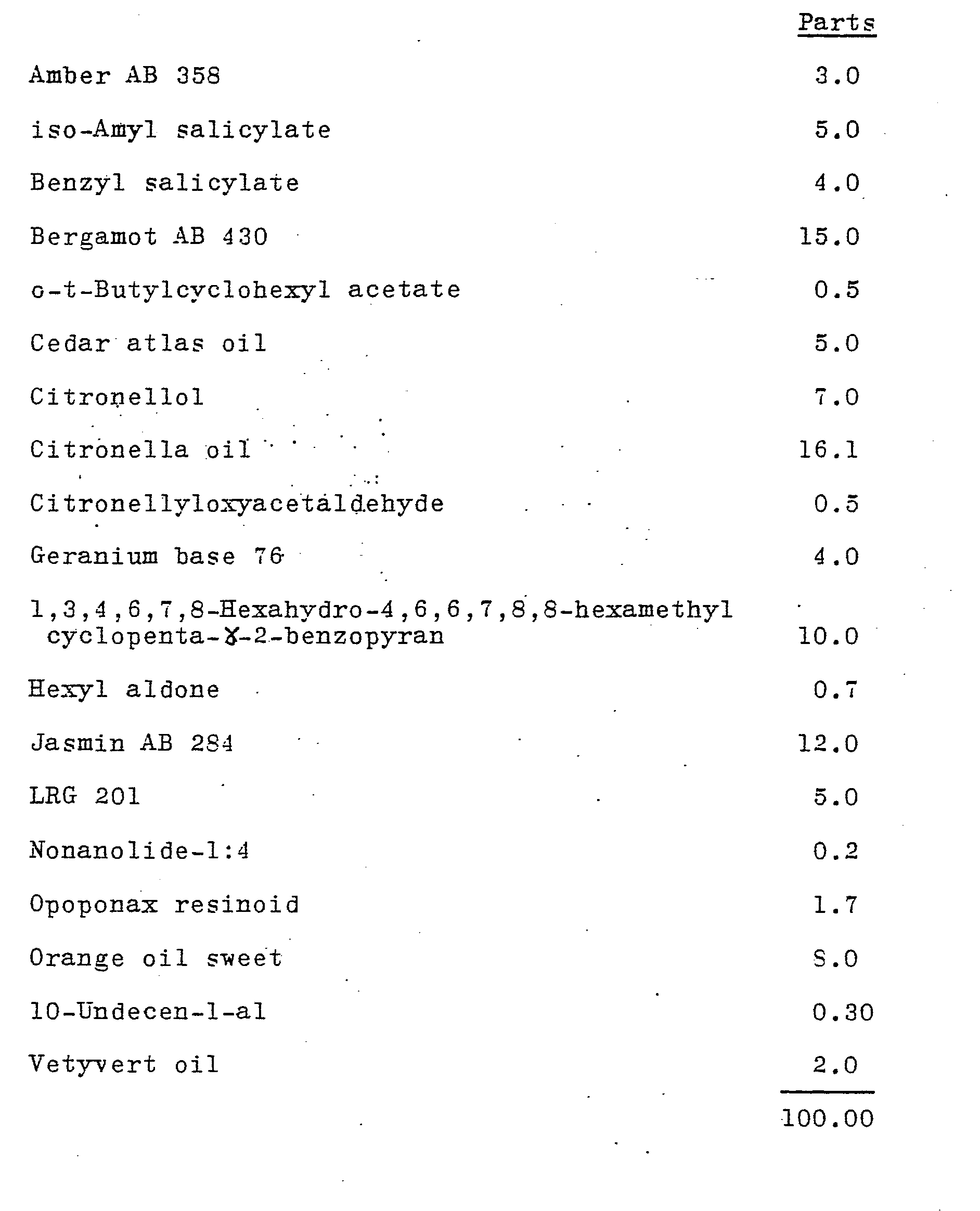
- In this example, the deodorant effectiveness of a fabric washing soap powder according to the invention was evaluated in terms of its odour reduction value in,the following manner.
- Polyester cotton coat style button through shirts were first prewashed in an automatic washing machine using a nonionic detergent fabric washing powder. This was to ensure that the shirts to be used in the test were all equally clean and free from dressing prior to cashing in the deodorant fabric washing product.
- The washed shirts were line dried and then washed again in the automatic washing machine. The test deodorant fabric washing product was then added to the wash liquor at a concentration of 0.4% by weight of the liquor. The ratio of shirt fabric (dry weight basis) to wash liquor was 40g fabric per litre wash liquor.
- The shirts were agitated in the wash liquor for 10 minutes at a temperature of 50°C, then rinsed and spun to a moisture content of about 50% water and finally line dried to a moisture content of not greater than 10%.
- A further batch of prewashed shirts which were to serve as control shirts were washed again and then dried under similar conditions except that deodorant composition was omitted from the fabric washing product added to the wash liquor.
- The shirts were folded and stored overnight in polyethylene bags until required for testing by a panel of male subjects and assessing for odour by a panel of female assessors.
- The above procedure was repeated on four consecutive days without prewashing, half of the subjects wearing shirts treated with the deodorant composition-containing detergent product and half wearing control shirts without deodorant composition treatment.
- Body odour transferred to the shirts in the region of the axillae was assessed by the trained female assessors in the manner described in the Deodorant Value Test, the odour of the shirt fabric being scored in each case rather than the axillae of the panel subjects and the results expressed as odour reduction value.

- In this example the effect of a deodorant composition incorporated in a non-soap detergent (NSD) soap fabric washing powder was evaluated by the Odour Reduction Test referred to above.
- The powder had the following formulation:

- This product was employed as the control product, while a corresponding test product was prepared by adding to the formulation 0.2% by weight of Deodorant Composition 2 which had the following composition:
-


- In this example, the effect of a deoaorant composition incorporated in a non-soap detergent (NSD)/soap powder was evaluated by the Odour Reduction Test referred to above.
- The powder had the following formulation:

- This product was employed as the control product, while a corresponding test product was prepared by adding to the formulation 0.2% by weight of deodorant composition 3 which had the following composition:
-


- Examples 1 to 3 can be repeated by employing any of the soap powder formulations disclosed herein with any of the following deodorant compositions:
-

-

-

- The deodorant value of each of the deodorant compositions illustrated in the foregoing Examples was determined by the Deodorant Value Test as described herein before using the standard 80/20/5 soap base. The results were as follows:

- It can be seen from the above results that each of the Deodorant Compositions 1 to 6 had a deodorant value which was greater than 0.50, which defines the minimum deodorant value of a deodorant composition suitable for use in the deodorant detergent compositions of the invention.
- The following glossary provides further information, including the suppliers' names, which will aid identification of some of the aforementioned deodorant components and ingredients.

-

- All materials which are classified by a name and number, such as those having the 'AB' notation, are obtainable from Proprietary Perfumes Limited.
Claims (15)
Applications Claiming Priority (2)
| Application Number | Priority Date | Filing Date | Title |
|---|---|---|---|
| GB128578 | 1978-01-12 | ||
| GB128578 | 1978-01-12 |
Publications (1)
| Publication Number | Publication Date |
|---|---|
| EP0003171A1 true EP0003171A1 (en) | 1979-07-25 |
Family
ID=9719321
Family Applications (1)
| Application Number | Title | Priority Date | Filing Date |
|---|---|---|---|
| EP79300038A Ceased EP0003171A1 (en) | 1978-01-12 | 1979-01-10 | A deodorant detergent product, process for preparing it and its use |
Country Status (20)
| Country | Link |
|---|---|
| US (1) | US4289641A (en) |
| EP (1) | EP0003171A1 (en) |
| JP (1) | JPS54102309A (en) |
| AT (1) | ATA15979A (en) |
| AU (1) | AU521006B2 (en) |
| BR (1) | BR7900155A (en) |
| CA (1) | CA1129775A (en) |
| DE (1) | DE2900722C2 (en) |
| DK (1) | DK65978A (en) |
| ES (1) | ES476678A1 (en) |
| FI (1) | FI780439A7 (en) |
| FR (1) | FR2414552A1 (en) |
| HK (1) | HK42284A (en) |
| MY (1) | MY8400108A (en) |
| NL (1) | NL7900210A (en) |
| NO (1) | NO150488C (en) |
| NZ (1) | NZ189333A (en) |
| SE (1) | SE438325B (en) |
| SG (1) | SG5183G (en) |
| ZA (1) | ZA79126B (en) |
Cited By (9)
| Publication number | Priority date | Publication date | Assignee | Title |
|---|---|---|---|---|
| FR2425861A1 (en) * | 1978-05-16 | 1979-12-14 | Unilever Nv | |
| EP0075976A1 (en) * | 1981-09-14 | 1983-04-06 | THE PROCTER & GAMBLE COMPANY | Alkaline aqueous liquid detergent compositions containing normally unstable ester perfumes |
| EP0147191A3 (en) * | 1983-12-22 | 1986-06-25 | Unilever Nv | Perfume and compositions containing perfume |
| WO1992008780A1 (en) * | 1990-11-14 | 1992-05-29 | The Procter & Gamble Company | Granular detergent or bleaching compositions containing amidoperoxyacid bleach and perfume |
| EP0545556A3 (en) * | 1991-11-08 | 1994-04-27 | Quest Int Nederland | |
| WO1994024999A3 (en) * | 1993-04-30 | 1994-12-22 | Quest Int | Perfume composition |
| US5482635A (en) * | 1989-06-19 | 1996-01-09 | Lever Brothers Company | Fabric conditioner with deodorant perfume composition |
| US5501805A (en) * | 1989-06-19 | 1996-03-26 | Lever Brothers Company, Division Of Conopco, Inc. | Fragrance compositions and their use in detergent products |
| US10945945B2 (en) | 2016-12-22 | 2021-03-16 | Conopco, Inc. | Stabilization of cosmetic compositions comprising fish oils and hydroxylated fatty acids and/or its derivatives |
Families Citing this family (21)
| Publication number | Priority date | Publication date | Assignee | Title |
|---|---|---|---|---|
| FI780440A7 (en) * | 1978-01-12 | 1979-07-13 | Unilever Nv | DETERGENT COMPOSITION |
| JPS60184598A (en) * | 1984-03-03 | 1985-09-20 | 馬場 末勝 | Deodorant detergent mixed with active carbon |
| GB8411161D0 (en) * | 1984-05-01 | 1984-06-06 | Unilever Plc | Multiple compartment pack |
| JPS60245699A (en) * | 1984-05-18 | 1985-12-05 | ライオン株式会社 | Bleaching detergent composition |
| DE3430611A1 (en) * | 1984-08-20 | 1986-02-20 | Werner & Mertz Gmbh, 6500 Mainz | AGENTS FOR THE KILLING OF HOUSE DUST MITES AND THE USE THEREOF |
| GB8506684D0 (en) * | 1985-03-14 | 1985-04-17 | Unilever Plc | Laundry bars |
| US4863626A (en) * | 1985-08-21 | 1989-09-05 | The Clorox Company | Encapsulated enzyme in dry bleach composition |
| US5093021A (en) * | 1985-08-21 | 1992-03-03 | The Clorox Company | Encapsulated enzyme in dry bleach composition |
| JPH075913B2 (en) * | 1987-05-06 | 1995-01-25 | 花王株式会社 | Enzyme-containing bleach composition |
| GB8716219D0 (en) * | 1987-07-09 | 1987-08-12 | Unilever Plc | Perfume compositions |
| JP2562193B2 (en) * | 1988-12-19 | 1996-12-11 | ライオン株式会社 | Bleaching detergent composition |
| GB8914055D0 (en) * | 1989-06-19 | 1989-08-09 | Unilever Plc | Low-odour deodorant perfume compositions |
| US5180511A (en) * | 1989-09-14 | 1993-01-19 | J.M. Huber Corporation | Flotation aid and process for removal of impurities from silicate minerals |
| GB8921995D0 (en) * | 1989-09-29 | 1989-11-15 | Unilever Plc | Perfumed laundry detergents |
| US5135747A (en) * | 1991-05-17 | 1992-08-04 | Chesebrough-Pond's Usa Co., Division Of Conopco, Inc. | Deodorant/antiperspirant products with fragrance and encapsulated odor counteractant |
| WO1993004158A1 (en) * | 1991-08-21 | 1993-03-04 | The Procter & Gamble Company | Detergent compositions containing lipase and terpene |
| GB9721588D0 (en) | 1997-10-10 | 1997-12-10 | Du Pont | Textile treatment |
| GB2365403A (en) * | 2000-08-05 | 2002-02-20 | Procter & Gamble | Alkaline-soluble bag containing detergent |
| US20030199402A1 (en) * | 2002-04-22 | 2003-10-23 | Carl Triplett | Composition for reducing malodors and method for using the same |
| US20040266638A1 (en) * | 2003-06-30 | 2004-12-30 | Requejo Luz P. | Compositions and methods for management of toilet odor |
| NL2007304C2 (en) | 2011-08-26 | 2013-02-27 | Progression Industry B V | Use of perfume composition as fuel for internal combustion engines. |
Citations (5)
| Publication number | Priority date | Publication date | Assignee | Title |
|---|---|---|---|---|
| DE2047030A1 (en) * | 1968-09-27 | 1972-03-30 | Unilever N V , Rotterdam (Nieder lande) | Detergents |
| US3779932A (en) * | 1970-07-01 | 1973-12-18 | B Jaggers | Solid washing compositions |
| DE2653329A1 (en) * | 1975-11-28 | 1977-06-02 | Procter & Gamble | LAUNDRY DETERGENT |
| DE2805767A1 (en) * | 1977-02-15 | 1978-08-17 | Unilever Nv | TEXTILE CONDITIONING AGENTS, METHOD FOR THEIR PRODUCTION AND THEIR USE |
| FR2379601A1 (en) * | 1977-02-02 | 1978-09-01 | Union Gle Savonnerie | DETERGENT COMPOSITION IN THE FORM OF A SOAP-BASED POWDER FOR USE IN A WASHING MACHINE |
Family Cites Families (27)
| Publication number | Priority date | Publication date | Assignee | Title |
|---|---|---|---|---|
| NL99111C (en) * | 1956-06-11 | |||
| US2889254A (en) * | 1956-07-12 | 1959-06-02 | Givaudan Corp | Soaps and other perfumed compositions containing dihydroterpinyl acetate |
| US2976321A (en) * | 1959-06-18 | 1961-03-21 | Givaudan Corp | Para-tertiary-butylhydrocinnamic aldehyde |
| US3144467A (en) * | 1962-07-16 | 1964-08-11 | Universal Oil Prod Co | Method of preparation of alkylated dihydrocoumarins |
| US3268594A (en) * | 1962-11-01 | 1966-08-23 | Bedoukian Paul | Dimethyl acetals of alpha, beta acetylenic aldehydes |
| US3318945A (en) * | 1963-09-27 | 1967-05-09 | Procter & Gamble | Cyclododecadiene carboxylic acid esters |
| DK126125A (en) * | 1964-04-21 | |||
| US3317397A (en) * | 1966-02-25 | 1967-05-02 | Universal Oil Prod Co | Method for prolonging the odor of perfumed materials with trimethylnorbornyl-alkylcyclohexanones |
| US3493650A (en) * | 1966-05-13 | 1970-02-03 | Universal Oil Prod Co | Perfume and deodorizing with citronellyl senecioate |
| US3591643A (en) * | 1968-02-28 | 1971-07-06 | Procter & Gamble | Process for the preparation of bicyclo hexane compounds and the novel compound demethyl-cis-sabinene hydrate |
| US3662007A (en) * | 1968-11-26 | 1972-05-09 | Procter & Gamble | Process for preparing dihydro-beta-santalol from 3-endo-methyl-3-exo(4'-methyl-5'-hydroxypentyl)norcamphor |
| US3679756A (en) * | 1969-05-21 | 1972-07-25 | Procter & Gamble | Process for preparing {62 -santalol from 3-methylnorcamphor |
| GB1412123A (en) * | 1972-01-28 | 1975-10-29 | Unilever Ltd | Detergent composition |
| US3836232A (en) * | 1973-02-02 | 1974-09-17 | Us Navy | Multiple channel optical system |
| CH585522A5 (en) | 1973-09-05 | 1977-03-15 | Firmenich & Cie | |
| US3953378A (en) | 1973-11-21 | 1976-04-27 | Firmenich S.A. | Mineral carrier for volatile substances and process for preparing same |
| US4066710A (en) * | 1974-01-02 | 1978-01-03 | Givaudan Corporation | Unsaturated alcohol |
| CH586551A5 (en) | 1974-01-29 | 1977-04-15 | Firmenich & Cie | |
| MX3273E (en) * | 1974-03-07 | 1980-08-13 | Unilever Nv | PROCEDURE FOR THE PREPARATION OF DETERGENT BARS CONTAINING ZINC OXIDE |
| US3969259A (en) * | 1974-03-18 | 1976-07-13 | Lever Brothers Company | Transparent soap bar |
| JPS5530688B2 (en) | 1974-04-01 | 1980-08-13 | ||
| GB1519443A (en) * | 1974-08-09 | 1978-07-26 | Bush Boake Allen Ltd | Isolongifolene derivatives |
| CA1062904A (en) | 1974-09-19 | 1979-09-25 | Alan O. Pittet | Flavoring and fragrance compositions containing alpha-substituted acetaldehyde taken alone or taken together with ketone and methods for imparting, altering, modifying or enhancing the organoleptic properties of consumable materials using same |
| DE2455761C2 (en) | 1974-11-26 | 1982-04-22 | Haarmann & Reimer Gmbh, 3450 Holzminden | Use of hydrogenated methyl ionones and their derivatives as fragrances, processes for their preparation and new hydrogenated methyl ionone derivatives |
| US4055506A (en) * | 1975-07-24 | 1977-10-25 | International Flavors & Fragrances Inc. | Novel fragrance compositions and perfumed articles containing alpha-substituted acetaldehyde |
| US4131557A (en) * | 1976-12-22 | 1978-12-26 | International Flavors & Fragrances Inc. | Soap composition |
| US4129569A (en) * | 1977-06-16 | 1978-12-12 | International Flavors & Fragrances Inc. | Cyclic oxazo derivatives |
-
1978
- 1978-02-10 FI FI780439A patent/FI780439A7/en unknown
- 1978-02-13 NO NO780489A patent/NO150488C/en unknown
- 1978-02-14 DK DK65978A patent/DK65978A/en not_active Application Discontinuation
- 1978-02-14 SE SE7801712A patent/SE438325B/en not_active IP Right Cessation
- 1978-08-15 US US05/933,931 patent/US4289641A/en not_active Expired - Lifetime
-
1979
- 1979-01-08 NZ NZ189333A patent/NZ189333A/en unknown
- 1979-01-09 AT AT0015979A patent/ATA15979A/en not_active IP Right Cessation
- 1979-01-09 AU AU43223/79A patent/AU521006B2/en not_active Expired
- 1979-01-09 ES ES476678A patent/ES476678A1/en not_active Expired
- 1979-01-10 DE DE2900722A patent/DE2900722C2/en not_active Expired
- 1979-01-10 FR FR7900572A patent/FR2414552A1/en active Granted
- 1979-01-10 NL NL7900210A patent/NL7900210A/en not_active Application Discontinuation
- 1979-01-10 BR BR7900155A patent/BR7900155A/en unknown
- 1979-01-10 EP EP79300038A patent/EP0003171A1/en not_active Ceased
- 1979-01-10 CA CA319,420A patent/CA1129775A/en not_active Expired
- 1979-01-11 JP JP215379A patent/JPS54102309A/en active Pending
- 1979-01-11 ZA ZA79126A patent/ZA79126B/en unknown
-
1983
- 1983-02-03 SG SG51/83A patent/SG5183G/en unknown
-
1984
- 1984-05-10 HK HK422/84A patent/HK42284A/en not_active IP Right Cessation
- 1984-12-30 MY MY108/84A patent/MY8400108A/en unknown
Patent Citations (6)
| Publication number | Priority date | Publication date | Assignee | Title |
|---|---|---|---|---|
| DE2047030A1 (en) * | 1968-09-27 | 1972-03-30 | Unilever N V , Rotterdam (Nieder lande) | Detergents |
| US3779932A (en) * | 1970-07-01 | 1973-12-18 | B Jaggers | Solid washing compositions |
| US3849326A (en) * | 1970-07-01 | 1974-11-19 | Bush Boake Allen Ltd | Solid washing compositions |
| DE2653329A1 (en) * | 1975-11-28 | 1977-06-02 | Procter & Gamble | LAUNDRY DETERGENT |
| FR2379601A1 (en) * | 1977-02-02 | 1978-09-01 | Union Gle Savonnerie | DETERGENT COMPOSITION IN THE FORM OF A SOAP-BASED POWDER FOR USE IN A WASHING MACHINE |
| DE2805767A1 (en) * | 1977-02-15 | 1978-08-17 | Unilever Nv | TEXTILE CONDITIONING AGENTS, METHOD FOR THEIR PRODUCTION AND THEIR USE |
Cited By (11)
| Publication number | Priority date | Publication date | Assignee | Title |
|---|---|---|---|---|
| FR2425861A1 (en) * | 1978-05-16 | 1979-12-14 | Unilever Nv | |
| EP0075976A1 (en) * | 1981-09-14 | 1983-04-06 | THE PROCTER & GAMBLE COMPANY | Alkaline aqueous liquid detergent compositions containing normally unstable ester perfumes |
| EP0147191A3 (en) * | 1983-12-22 | 1986-06-25 | Unilever Nv | Perfume and compositions containing perfume |
| TR22858A (en) * | 1983-12-22 | 1988-09-16 | Unilever Nv | PARFUEM AND PARFUEM REQUIRED COMPOSITIONS |
| US5482635A (en) * | 1989-06-19 | 1996-01-09 | Lever Brothers Company | Fabric conditioner with deodorant perfume composition |
| US5501805A (en) * | 1989-06-19 | 1996-03-26 | Lever Brothers Company, Division Of Conopco, Inc. | Fragrance compositions and their use in detergent products |
| WO1992008780A1 (en) * | 1990-11-14 | 1992-05-29 | The Procter & Gamble Company | Granular detergent or bleaching compositions containing amidoperoxyacid bleach and perfume |
| EP0545556A3 (en) * | 1991-11-08 | 1994-04-27 | Quest Int Nederland | |
| US5554588A (en) * | 1991-11-08 | 1996-09-10 | Lever Brothers Company, Division Of Conopco, Inc. | Perfume compositions |
| WO1994024999A3 (en) * | 1993-04-30 | 1994-12-22 | Quest Int | Perfume composition |
| US10945945B2 (en) | 2016-12-22 | 2021-03-16 | Conopco, Inc. | Stabilization of cosmetic compositions comprising fish oils and hydroxylated fatty acids and/or its derivatives |
Also Published As
| Publication number | Publication date |
|---|---|
| BR7900155A (en) | 1979-08-14 |
| FI780439A7 (en) | 1979-07-13 |
| ES476678A1 (en) | 1979-12-16 |
| HK42284A (en) | 1984-05-18 |
| SE7801712L (en) | 1979-07-13 |
| ZA79126B (en) | 1980-08-27 |
| SG5183G (en) | 1984-02-17 |
| NL7900210A (en) | 1979-07-16 |
| DK65978A (en) | 1979-07-13 |
| ATA15979A (en) | 1986-12-15 |
| NZ189333A (en) | 1984-05-31 |
| US4289641A (en) | 1981-09-15 |
| FR2414552B1 (en) | 1984-12-21 |
| MY8400108A (en) | 1984-12-31 |
| AU521006B2 (en) | 1982-03-11 |
| AU4322379A (en) | 1979-07-19 |
| NO150488C (en) | 1984-10-31 |
| DE2900722C2 (en) | 1986-10-30 |
| SE438325B (en) | 1985-04-15 |
| FR2414552A1 (en) | 1979-08-10 |
| NO150488B (en) | 1984-07-16 |
| NO780489L (en) | 1979-07-13 |
| JPS54102309A (en) | 1979-08-11 |
| DE2900722A1 (en) | 1979-07-19 |
| CA1129775A (en) | 1982-08-17 |
Similar Documents
| Publication | Publication Date | Title |
|---|---|---|
| EP0003172B1 (en) | The use of a deodorant detergent composition for suppressing human body malodour | |
| US4289641A (en) | Detergent product | |
| EP0147191B1 (en) | Perfume and compositions containing perfume | |
| CA2034666C (en) | Detergent composition | |
| EP0342917B2 (en) | Detergent composition | |
| CA1184860A (en) | Bleach composition | |
| US5130045A (en) | Delayed onset active oxygen bleach composition | |
| JPH08502546A (en) | Granular detergent with protease enzyme and bleach | |
| NO150003B (en) | WHITE AND CLEANING PREPARATION | |
| GB2101167A (en) | Bleach composition comprising hydrogen peroxide precursor | |
| CA2096254C (en) | Granular detergent or bleaching compositions containing amidoperoxyacid bleach and perfume | |
| JP2558158B2 (en) | Detergent composition | |
| JPH072955B2 (en) | Cleaning composition | |
| CA2022321C (en) | Granular laundry detergent compositions having improved solubility | |
| SU960244A1 (en) | Detergent and bleacher | |
| GB2172301A (en) | Laundry detergent bars comprising alkali metal sulphite | |
| SE9502909A0 (en) | Detergent composition and use |
Legal Events
| Date | Code | Title | Description |
|---|---|---|---|
| PUAI | Public reference made under article 153(3) epc to a published international application that has entered the european phase |
Free format text: ORIGINAL CODE: 0009012 |
|
| AK | Designated contracting states |
Designated state(s): BE CH DE FR GB IT NL |
|
| 17P | Request for examination filed | ||
| RAP1 | Party data changed (applicant data changed or rights of an application transferred) |
Owner name: UNILEVER NV Owner name: UNILEVER PLC |
|
| RAP1 | Party data changed (applicant data changed or rights of an application transferred) |
Owner name: UNILEVER PLC Owner name: UNILEVER NV |
|
| STAA | Information on the status of an ep patent application or granted ep patent |
Free format text: STATUS: THE APPLICATION HAS BEEN REFUSED |
|
| 18R | Application refused |
Effective date: 19870414 |
|
| RAP1 | Party data changed (applicant data changed or rights of an application transferred) |
Owner name: UNILEVER PLC Owner name: UNILEVER N.V. |
|
| RIN1 | Information on inventor provided before grant (corrected) |
Inventor name: HOOPER, DAVID CHARLES Inventor name: JOHNSON, GEORGE ARTHUR Inventor name: PETER, DONALD |
|
| RAP1 | Party data changed (applicant data changed or rights of an application transferred) |
Owner name: UNILEVER PLC Owner name: UNILEVER N.V. |